Acadia Healthcare Company, Inc. · NASDAQ:ACHC
Acadia Healthcare — Eating Disorder Webinar Dec 2015
75 slides from Acadia Healthcare's conference presentation, December 2015
Slide 1: Nutrition Therapy for Eating Disorders: What EVERY Dietitian Should Know
Nutrition Therapy for Eating Disorders: What EVERY Dietitian Should know Presenters: Kait Fortunato Greenberg RD/LD Empowered Eating, REBEL Dietitian Rebecca Bitzer and Associates Jenn Burnell MS RD/LDN CEDRD Carolina House Eating Disorder Treatment Programs
Slide 2: Objectives Part 1
Objectives Part 1 Types of Eating Disorders Identifying Eating Disorders in your Office Assessment tools for the RD What about weight Treating eating disorders
Slide 3: What exactly is an eating disorder?
What exactly is an eating disorder? Eating disorders are neurobiological disorders rooted in the brain causing medical and psychological issues They are NOT simply about “control” or weight management Genetics are responsible for 50-83% Two people can be living in the same house, undergo sim
Slide 4: Types of Eating Disorders
Types of Eating Disorders Anorexia Nervosa ◦ Restriction of energy intake leading to low body weight that is expected for age. Body Image Disturbance Bulimia Nervosa ◦ Recurrent binge episodes and compensatory behaviors that are meant to prevent weight gain Binge Eating Disorder ◦ Recurring ep
Slide 5: 9 Truths of ED
9 Truths of ED #1 Many people with eating disorders look healthy, yet may be extremely ill. #2: Families are not to blame and can be the patients' and providers' best allies in treatment. #3: An eating disorder diagnosis is a health crisis that disrupts personal and family functioning. #4: E
Slide 6: Screening
» SCREENING
Slide 7: Don't assume you know
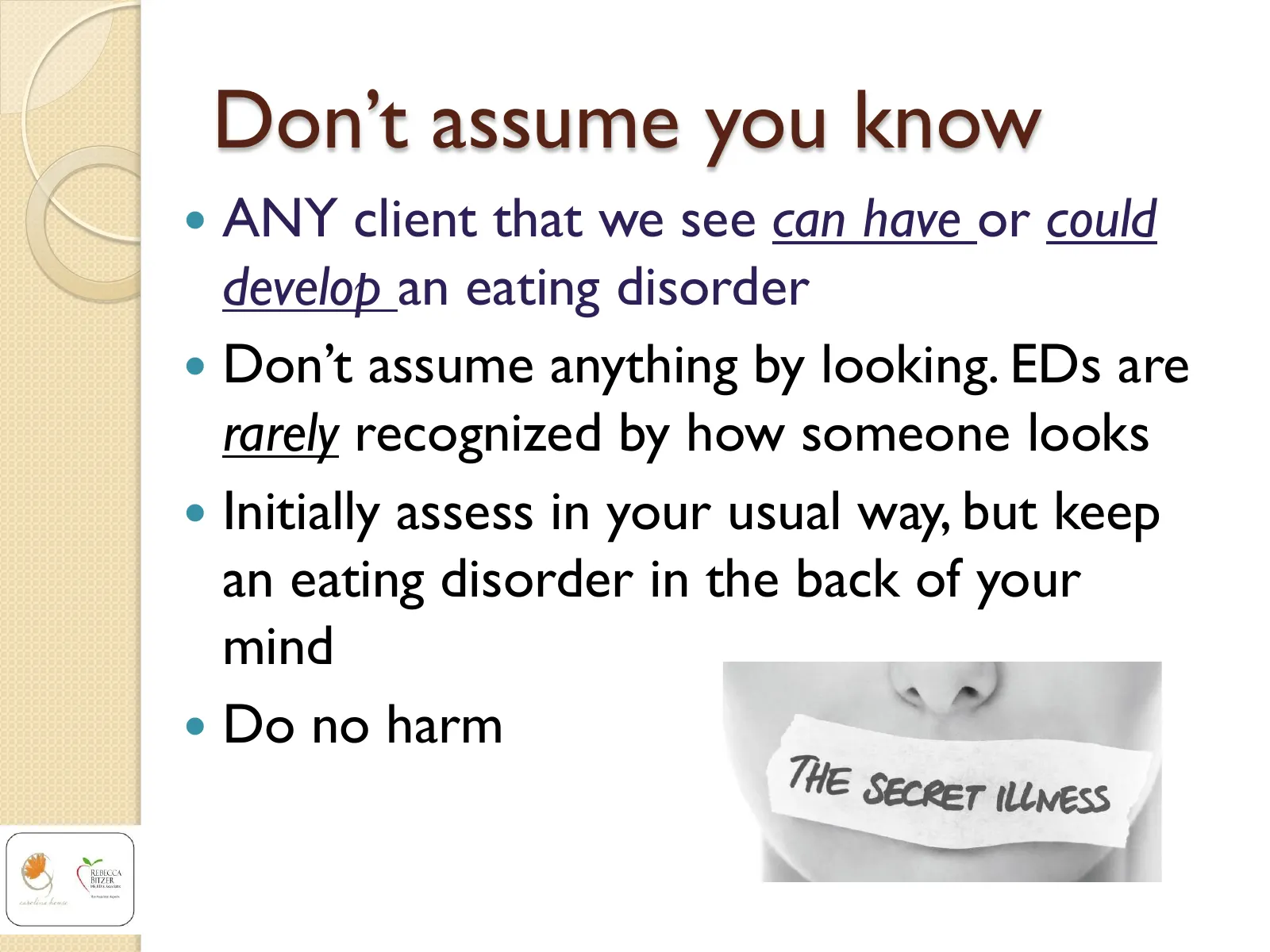
Don’t assume you know ANY client that we see can have or could develop an eating disorder Don’t assume anything by looking. EDs are rarely recognized by how someone looks Initially assess in your usual way, but keep an eating disorder in the back of your mind Do no harm
Slide 8: The Gun Metaphor
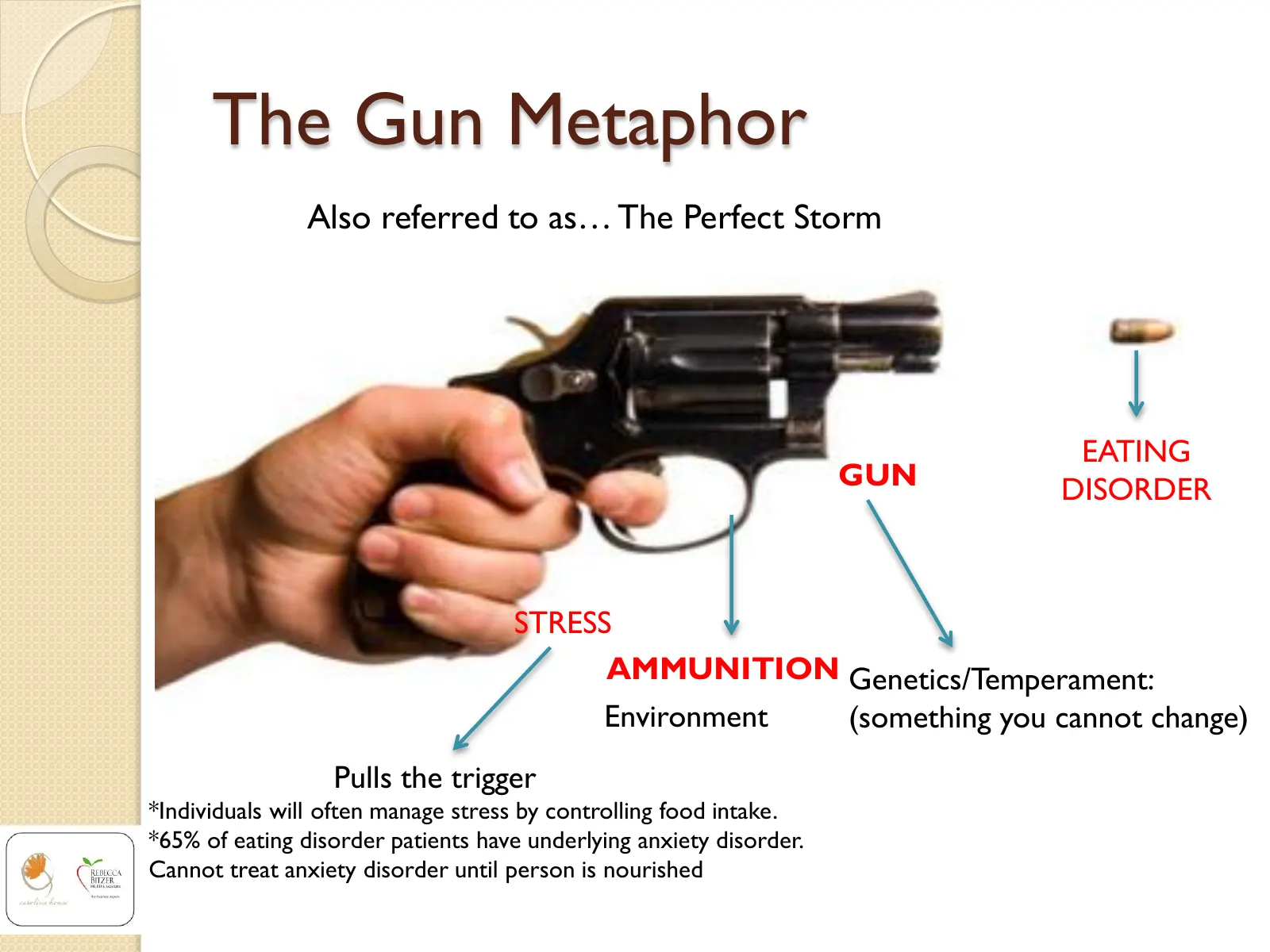
The Gun Metaphor Also referred to as… The Perfect Storm EATING GUN DISORDER STRESS AMMUNITION Genetics/Temperament: Environment (something you cannot change) Pulls the trigger *Individuals will often manage stress by controlling food intake. *65% of eating disorder patients have underlying anxiety d
Slide 9: How does a client with an eating disorder show up in your office?
How does a client with an eating disorder show up in your office? Athlete Complicated dieting history DM, Type 1 (diabulimia) Polycystic Ovarian Syndrome Bariatric Surgery Patients Autism Spectrum or “Picky Eating” GI disturbances, such as IBS or food sensitivities Newly vegetarian
Slide 10: Temperament Traits: Anorexia Nervosa
Temperament Traits: Anorexia Nervosa • Perfectionism • Personal self-imposed standards • Punishment sensitivity • Anxiety • Rigidity with thinking • Doubt • Harm avoidant • Low self-directedness • OCD tendencies • Experiential avoidance
Slide 11: Temperament Traits: Bulimia Nervosa
Temperament Traits: Bulimia Nervosa • Impulsive • Compulsive • Novelty-Seeking

Slide 12: What to look for
What to look for Are they seeking weight loss? Weight history, desired weight Do they count calories? What happens if they eat more than their goal for the day? Do they ever feel out of control around food? How does it feel to talk about food? Are there foods they won’t eat because of a be

Slide 13: What to look for
What to look for Food rituals Do they ever sneak food? Have they lied about (not) having something? Do they feel the need to compensate for the calories they ate? Are they weighing themselves? How does this impact their food choices and mood for the rest of the day? Do they ever feel guilt
Slide 14: Screening Tools for Eating Disorders
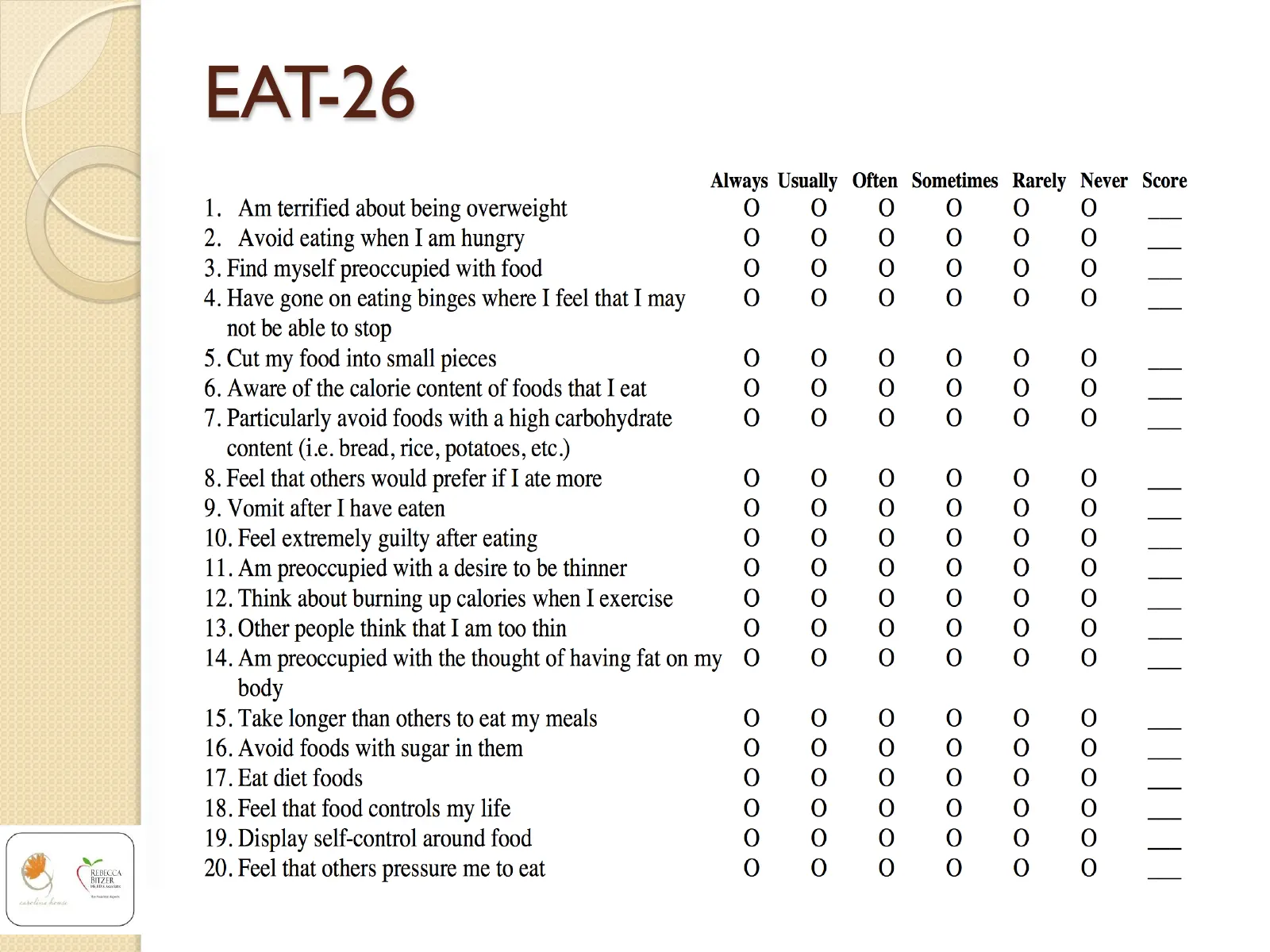
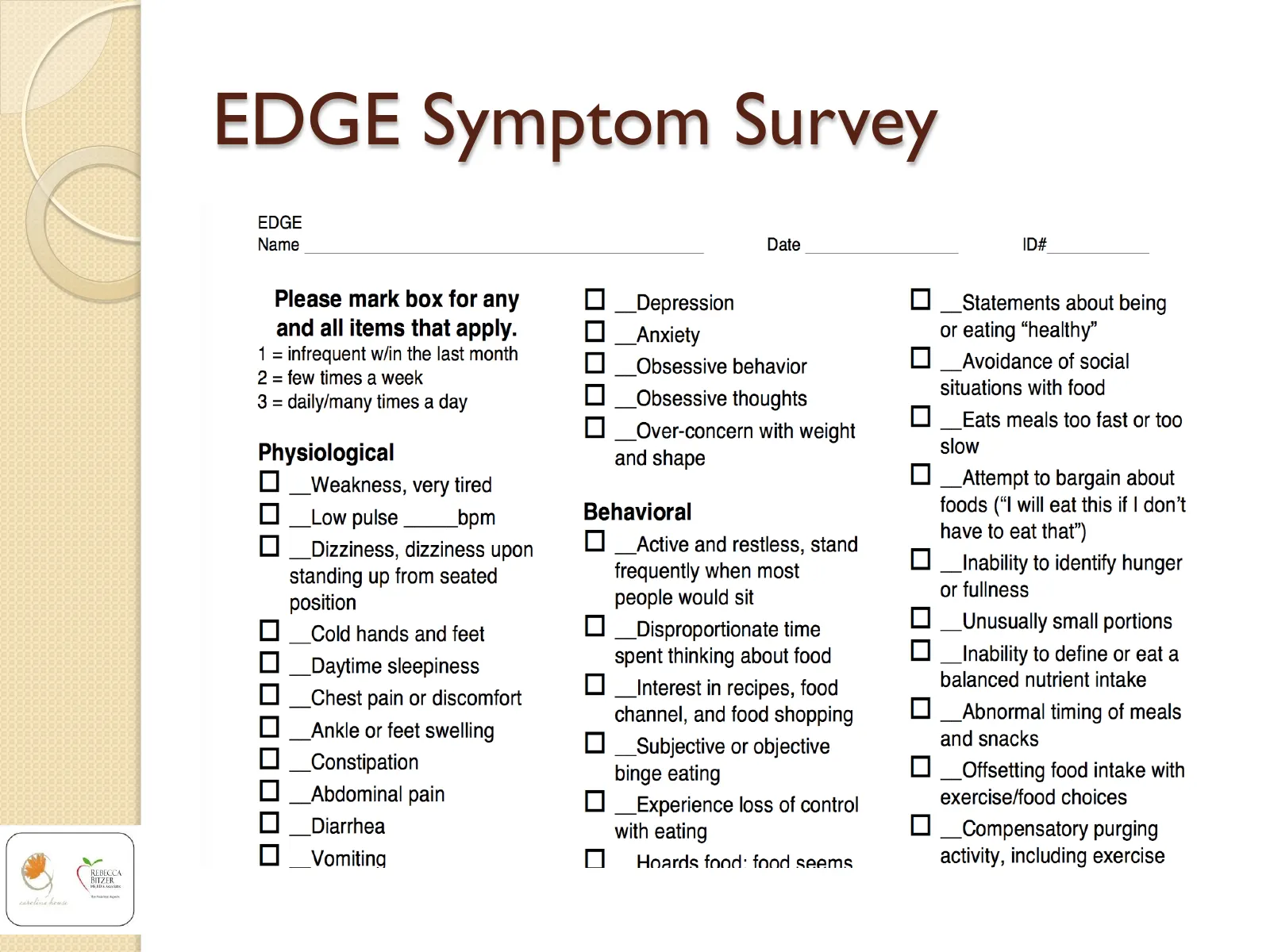
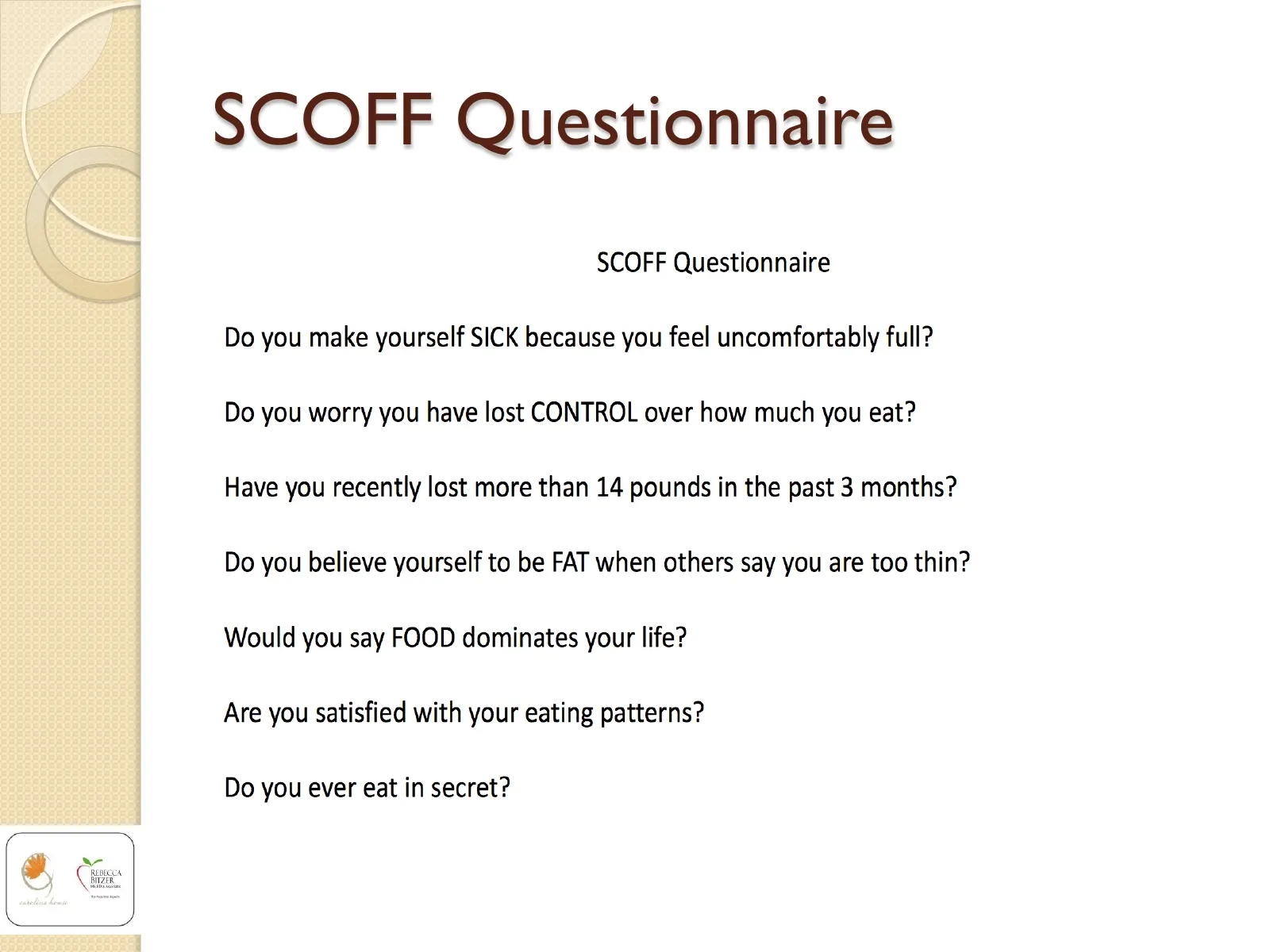
Screening Tools for Eating Disorders Eating Attitudes Test (EAT-26) EDGE tool BED Screening Female Athlete Screening Tool SCOFF
Slide 15: EAT-26
EAT-26 1. Am terrified about being overweight 2. Avoid eating when I am hungry 3. Find myself preoccupied with food 4. Have gone on eating binges where I feel that I may not be able to stop 5. Cut my food into small pieces 6. Aware of the calorie content of foods that I eat 7. Particularly avoid foo
Slide 16: EDGE Symptom Survey
e x- .- REBECCA Razin EDGE Name Date Please mark box for any and all items that apply. 1 = infrequent w/in the last month 2 = few times a week 3 = daily/many times a day Physiological O _ Weakness, very tired O _Lowpulse____ bpm Oo __Dizziness, dizziness upon standing up from seated position O __Col
Slide 17: SCOFF Questionnaire
SCOFF Questionnaire SCOFF Questionnaire Do you make yourself SICK because you feel uncomfortably full? Do you worry you have lost CONTROL over how much you eat? Have you recently lost more than 14 pounds in the past 3 months? Do you believe yourself to be FAT when others say you are too thin? Would
Slide 18: Assessment
» ASSESSMENT
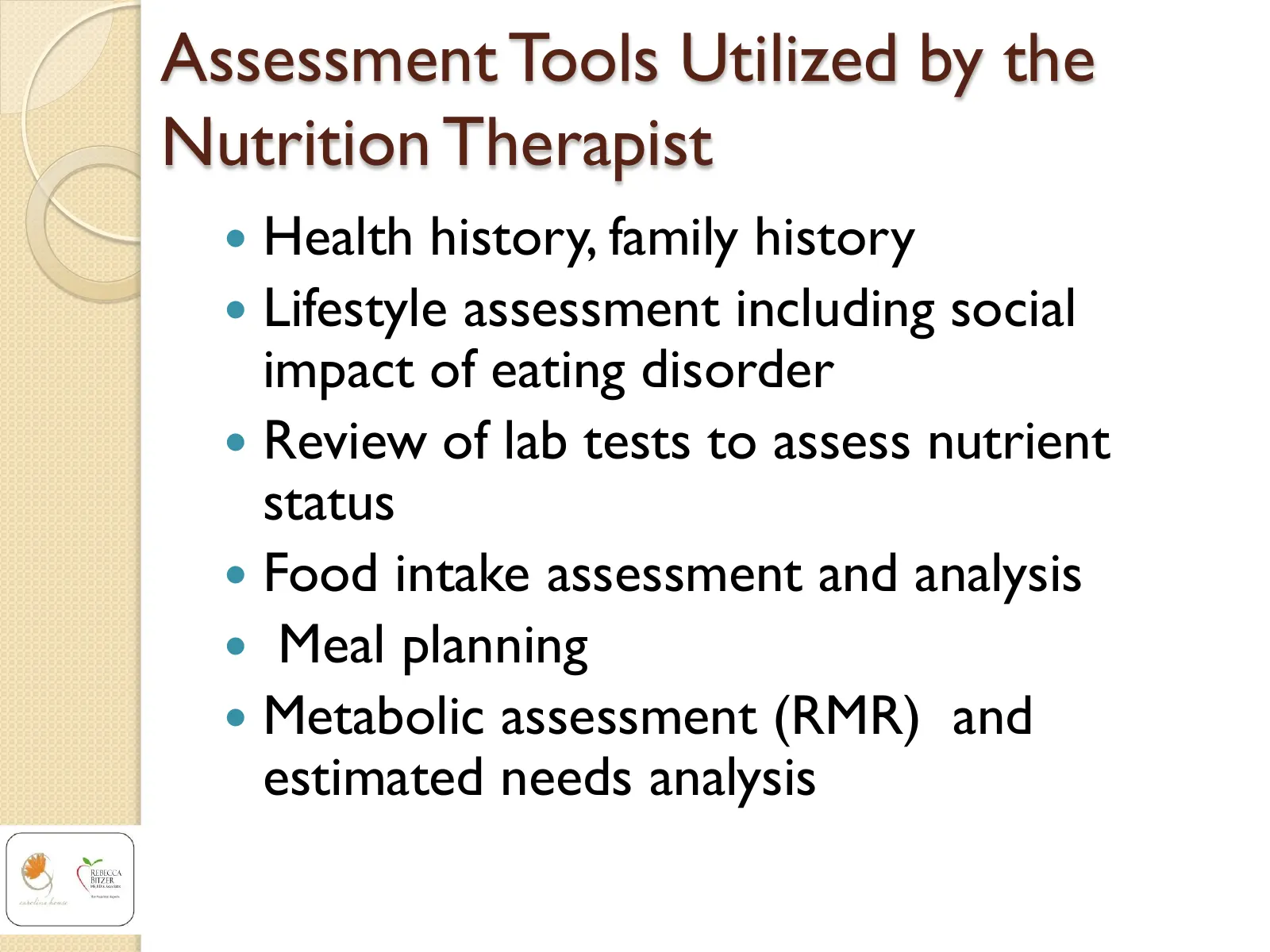
Slide 19: Assessment Tools Utilized by the Nutrition Therapist
Assessment Tools Utilized by the Nutrition Therapist Health history, family history Lifestyle assessment including social impact of eating disorder Review of lab tests to assess nutrient status Food intake assessment and analysis Meal planning Metabolic assessment (RMR) and estimated nee
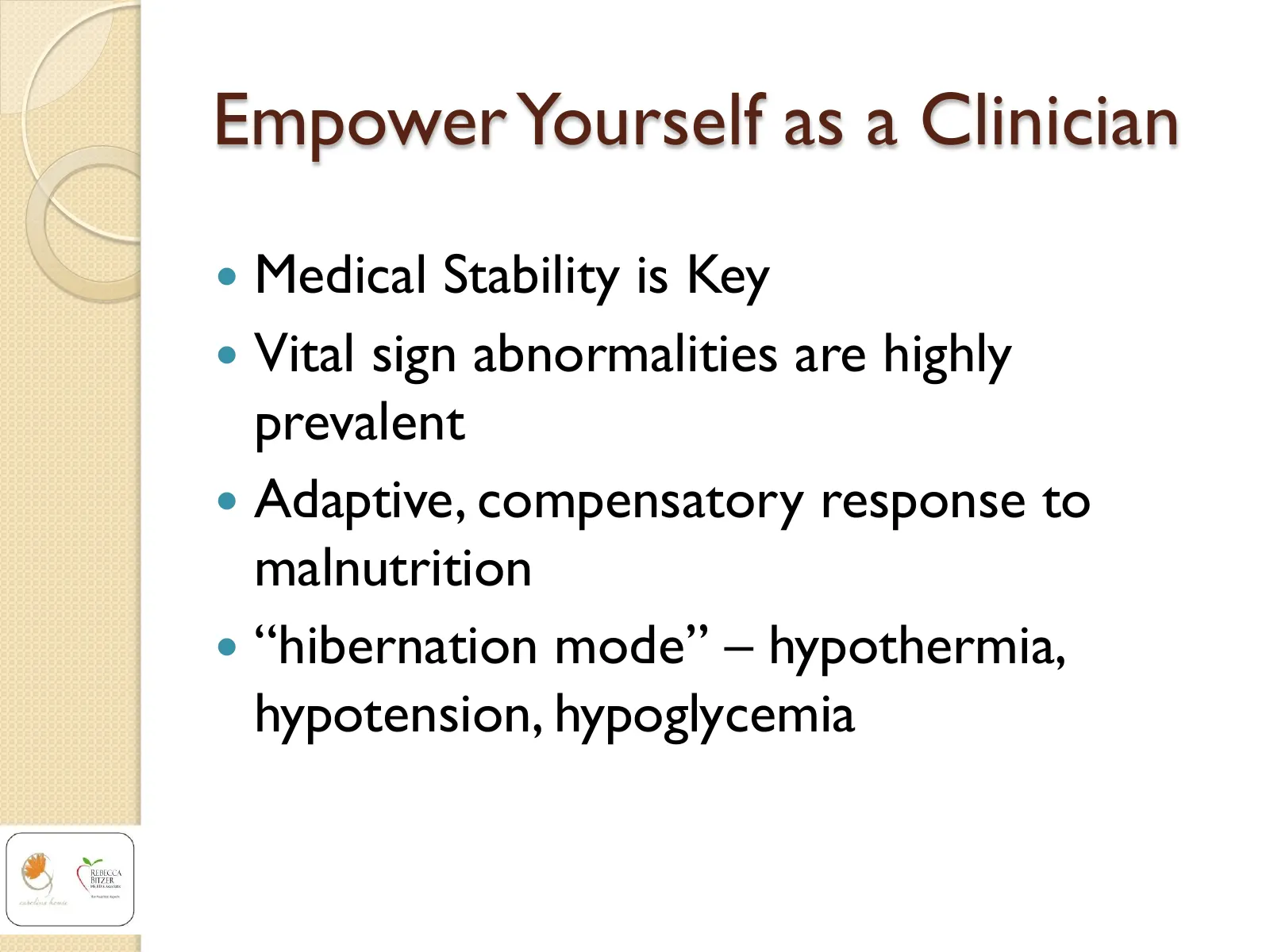
Slide 20: Empower Yourself as a Clinician
Empower Yourself as a Clinician Medical Stability is Key Vital sign abnormalities are highly prevalent Adaptive, compensatory response to malnutrition “hibernation mode” – hypothermia, hypotension, hypoglycemia
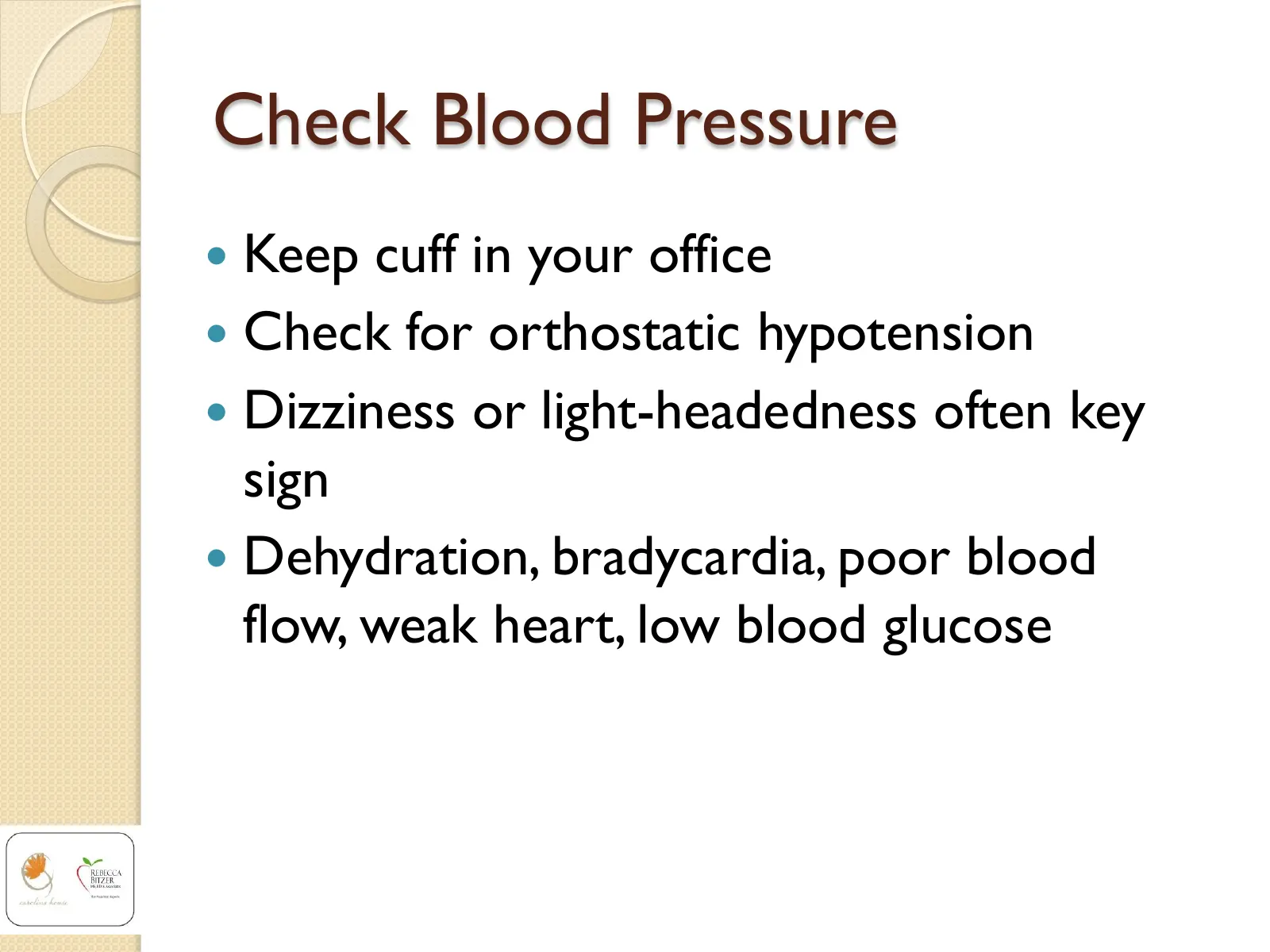
Slide 21: Check Blood Pressure
Check Blood Pressure Keep cuff in your office Check for orthostatic hypotension Dizziness or light-headedness often key sign Dehydration, bradycardia, poor blood flow, weak heart, low blood glucose
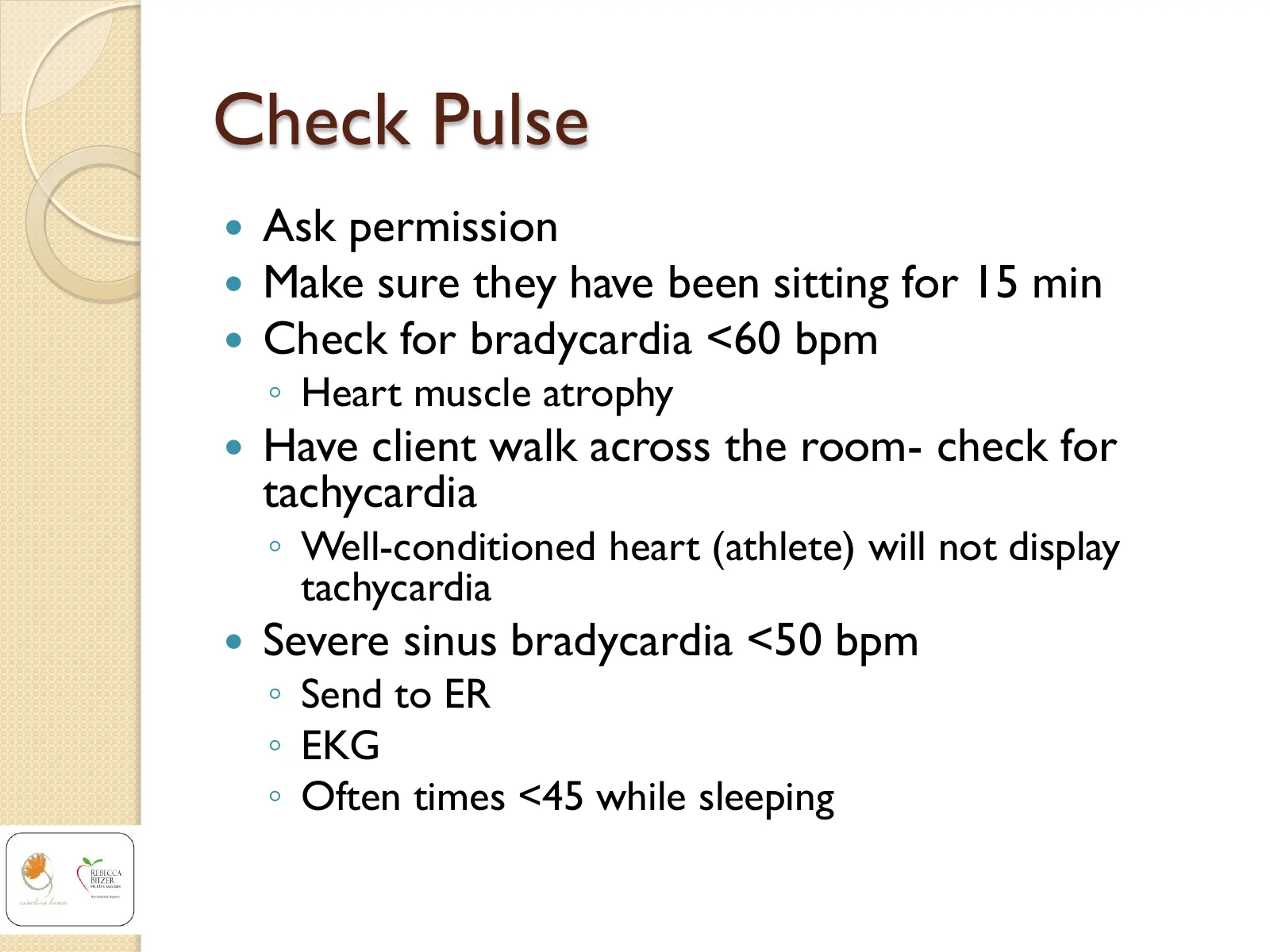
Slide 22: Check Pulse
Check Pulse Ask permission Make sure they have been sitting for 15 min Check for bradycardia <60 bpm ◦ Heart muscle atrophy Have client walk across the room- check for tachycardia ◦ Well-conditioned heart (athlete) will not display tachycardia Severe sinus bradycardia <50 bpm ◦ Send to ER
Slide 23: Check Blood Glucose
Check Blood Glucose Keep glucometer in office- may keep one glucometer per client for comfort level Most times clients are asymptomatic Glucose <60 high risk Low glucose result of depletion of glycogen “building blocks” in liver
Slide 24: Check Other Physical Signs
Check Other Physical Signs Cold extremities Edema Circulation-thumb print Lanugo Hair loss: malnourishment stops hair cells and other cells from dividing

Slide 25: 4 C's of Malnutrition
4 C’s of Malnutrition Cold Crabby Constipation Poor Circulation
Slide 26: Amenorrhea
Amenorrhea Not always present even in critically ill clients Brain reverts back to pre-puberty Check estradiol once client weight restored
Slide 27: Gastroparesis
Gastroparesis Stomach goes on “vacation” Can cause GI emptying to be up to 5x slower Loss of normal stomach peristalsis Early fullness, bloating, gassiness, nausea Treatment: small, frequent, calorie dense meals, low fiber, liquid in between meals
Slide 28: Treatment
- TREATMENT
Slide 29: Anorexia Nervosa
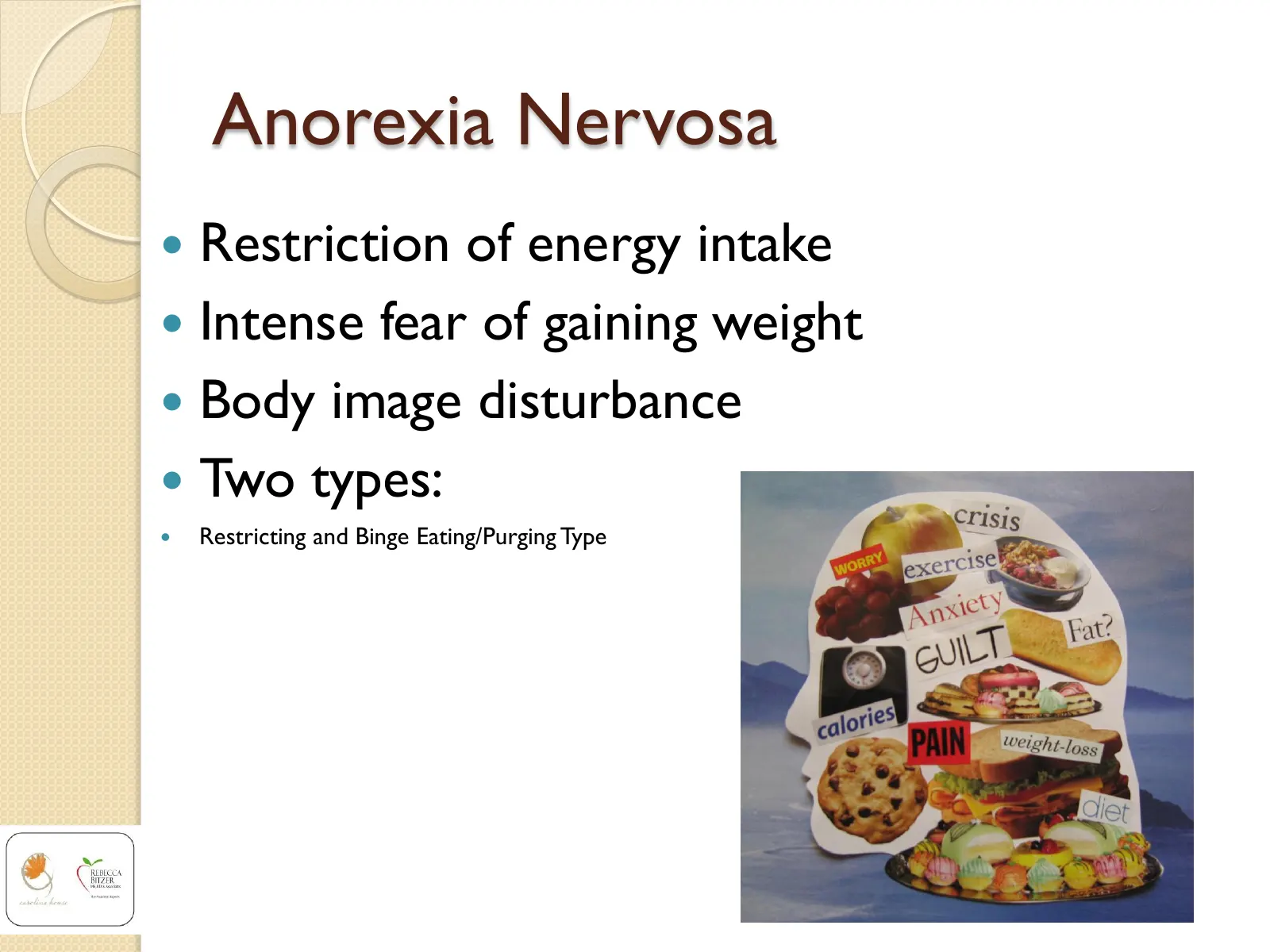
Anorexia Nervosa Restriction of energy intake Intense fear of gaining weight Body image disturbance Two types: Restricting and Binge Eating/Purging Type
Slide 30: Anorexia Nervosa
Anorexia Nervosa Initial goal: adequate calories Normalized and balanced eating will come in time Meet them where they are *Full weight restoration* 90% IBW- about 50% relapse Intuitive Eating---takes time
Slide 31: Anorexia Nervosa
Anorexia Nervosa Extremely high calorie need-Color coded snack lists with varying calorie levels Require more calories to maintain the rate of weight gain Post weight restoration, these clients require more calories to maintain their weight Hypermetabolism usually lasts 3 to 6 months, but ca
Slide 32: Bulimia Nervosa
Bulimia Nervosa Recurrent binge episodes Recurrent use of inappropriate behaviors to prevent weight gain Both B/P occur on average, >1/week for 3 months Self-evaluation focused on weight/shape Does not meet criteria for Anorexia
Slide 33: Bulimia Nervosa
Bulimia Nervosa Initial goal is to stop the purging cycle Often 5 pound weight gain once purging stops. Fluid shifts Regular meals and snacks Need satisfying foods: fat
Slide 34: Binge Eating Disorder
Binge Eating Disorder Recurring episodes of eating large amounts of food Feelings of loss of control during binge episodes, as well as marked distress Binge episodes occur, on average >1/week 3 months
Slide 35: Binge Eating Disorder
Binge Eating Disorder Assess timing of food intake Regular meals and snacks Mindful eating with focus on the food Structure areas for eating: dining room table Weight loss is not primary goal can increase shame cycle
Slide 36: The Dreaded Question: what about their weight?
The Dreaded Question: what about their weight? The weight of the client is not the only issue or even the main issue Crucial to develop trust Set up plan ahead of time with client Clients we should always weigh: anorexia, laxative abuse, purging, just out of treatment center
Slide 37: Determining Goal Weight
Determining Goal Weight Typically set a 5 lb range with understanding this may change along the way Growth charts Weight history When do ED behaviors and thoughts begin to diminish? Don’t aim too low!
Slide 38: Our client has to develop trust with us
Our client has to develop trust with us Takes time Often these clients have been hurt in the past and are hesitant to trust You won’t automatically be seen as an ally- even if the patient initiated making the appointment They will want to know you are on their side, while still pushing their
Slide 39: Trauma
Trauma Many clients with an eating disorder have experienced some type of trauma What you hear might be uncomfortable Ensure client has therapist For many clients, food has been used as a form of punishment or abuse Clients need to know you are not the food police, food will not be used as
Slide 40: What to do in session
What to do in session Learn to sit in silence with them Listen to what is not being said Learn to ask questions differently Don’t jump in and try to fix everything Meet them where they are at- when able, let them be involved in what to work on when
Slide 41: Create a safe, healing environment
Create a safe, healing environment Humor, humanity, kindness, compassion, and empathy. Tough fairness Safe place for client to show frustration and anger Structured environment to share and process the relationship with the ED, and offer alternative behaviors to cope and manage emotions Ex
Slide 42: Treatment Team
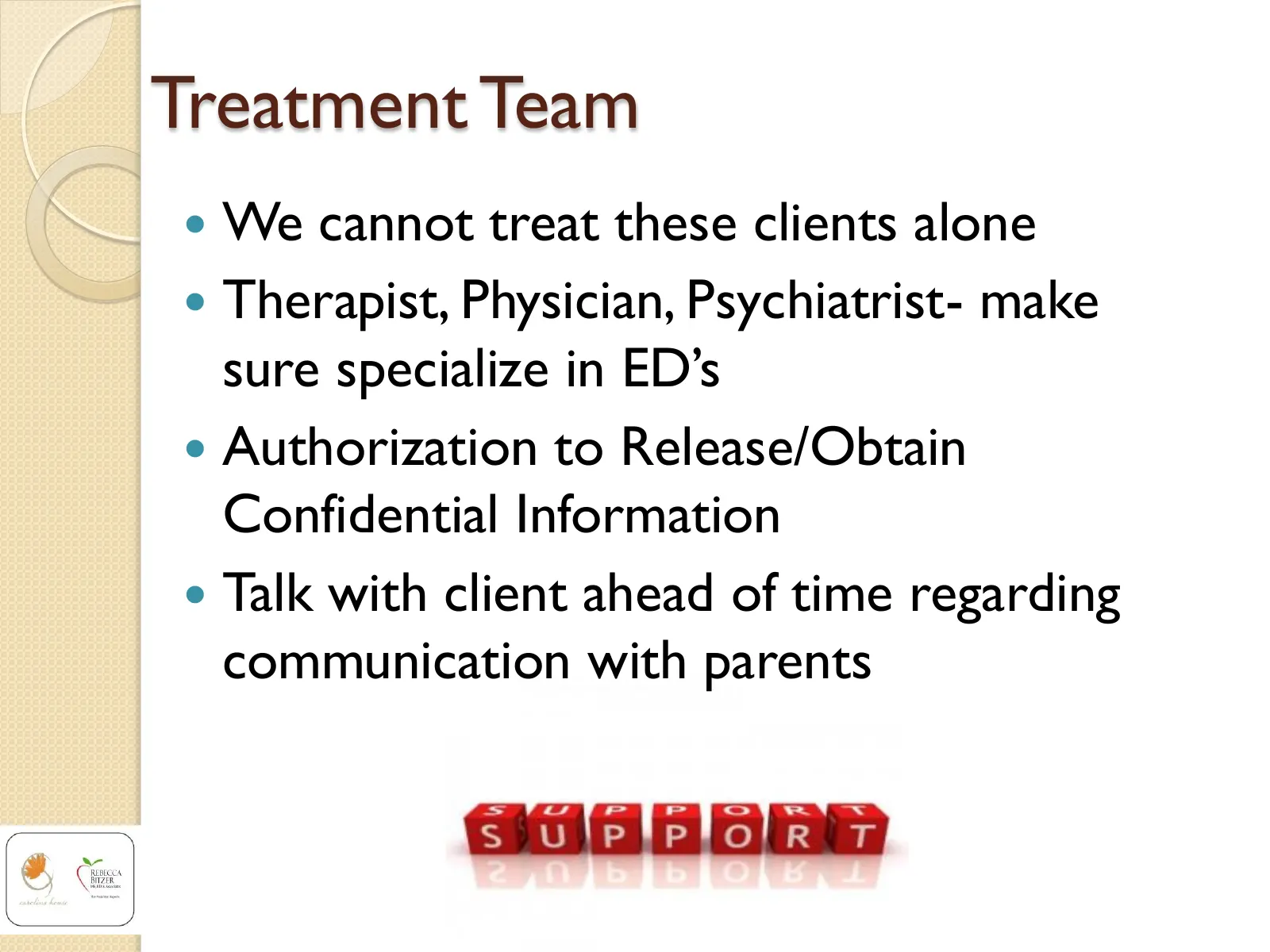
Treatment Team We cannot treat these clients alone Therapist, Physician, Psychiatrist- make sure specialize in ED’s Authorization to Release/Obtain Confidential Information Talk with client ahead of time regarding communication with parents
Slide 43: Recovery
Recovery 1) I don’t think I have a problem 2) I might have a problem but it’s not that bad 3) I have a problem but I don’t care 4) I want to change but I don’t know how and I’m scared 5) I tried to change but I couldn’t 6) I can stop some of the behaviors but not all of them 7) I can stop the behavi
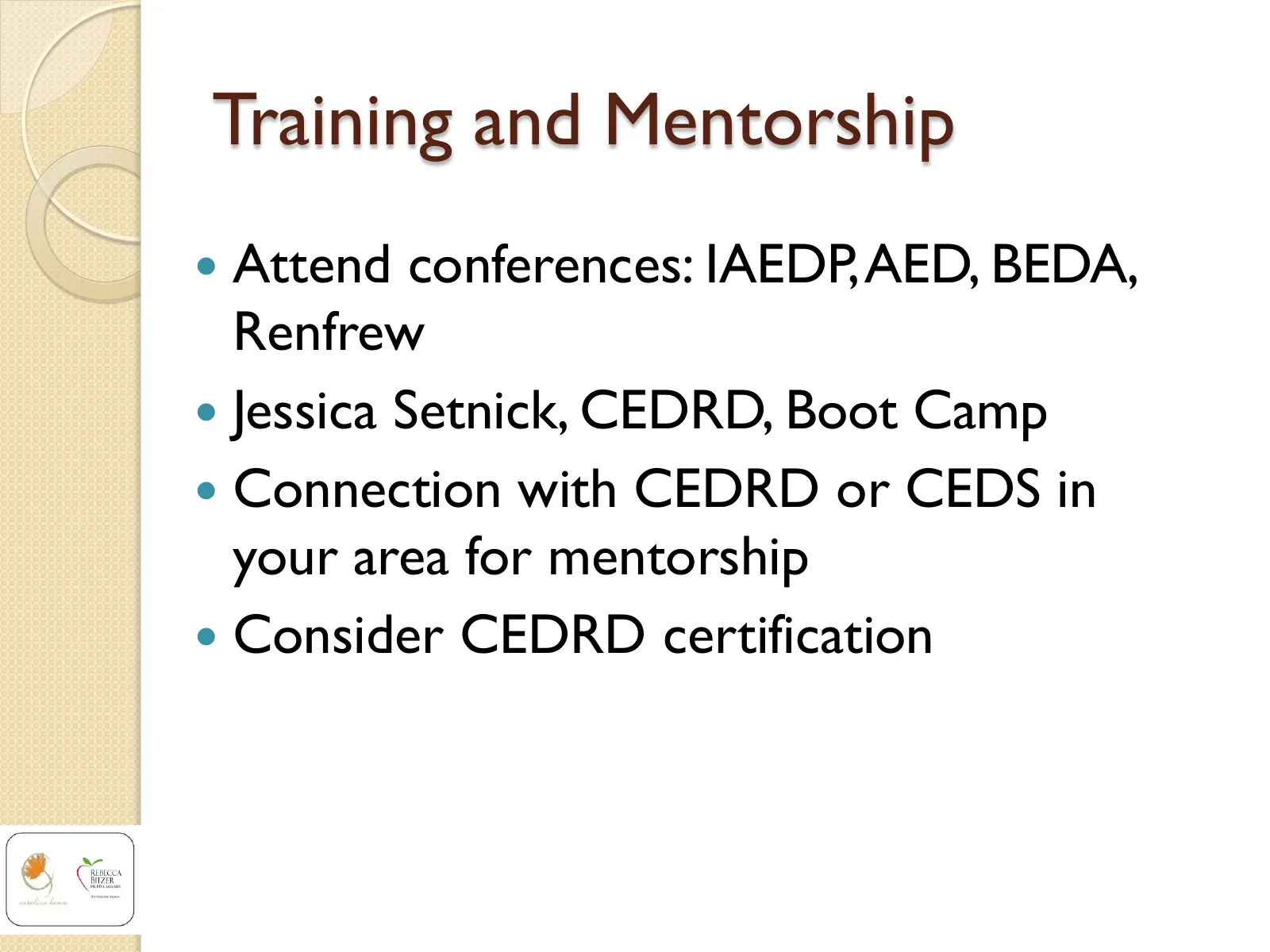
Slide 44: Training and Mentorship
Training and Mentorship Attend conferences: IAEDP, AED, BEDA, Renfrew Jessica Setnick, CEDRD, Boot Camp Connection with CEDRD or CEDS in your area for mentorship Consider CEDRD certification
Slide 45: Understanding Eating Disorder Treatment
UNDERSTANDING EATING DISORDER TREATMENT
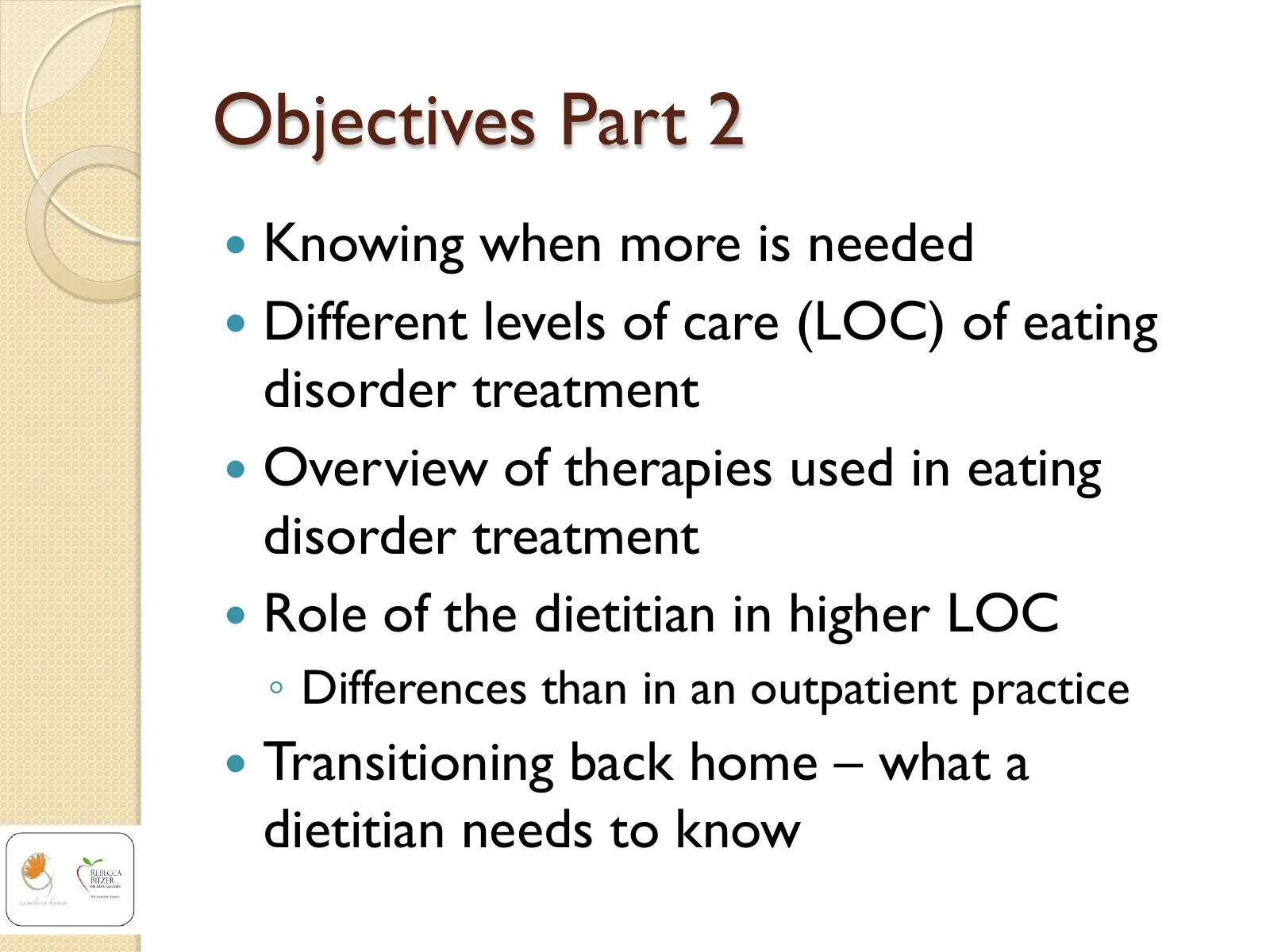
Slide 46: Objectives Part 2
Objectives Part 2 Knowing when more is needed Different levels of care (LOC) of eating disorder treatment Overview of therapies used in eating disorder treatment Role of the dietitian in higher LOC ◦ Differences than in an outpatient practice Transitioning back home – what a dietitian need
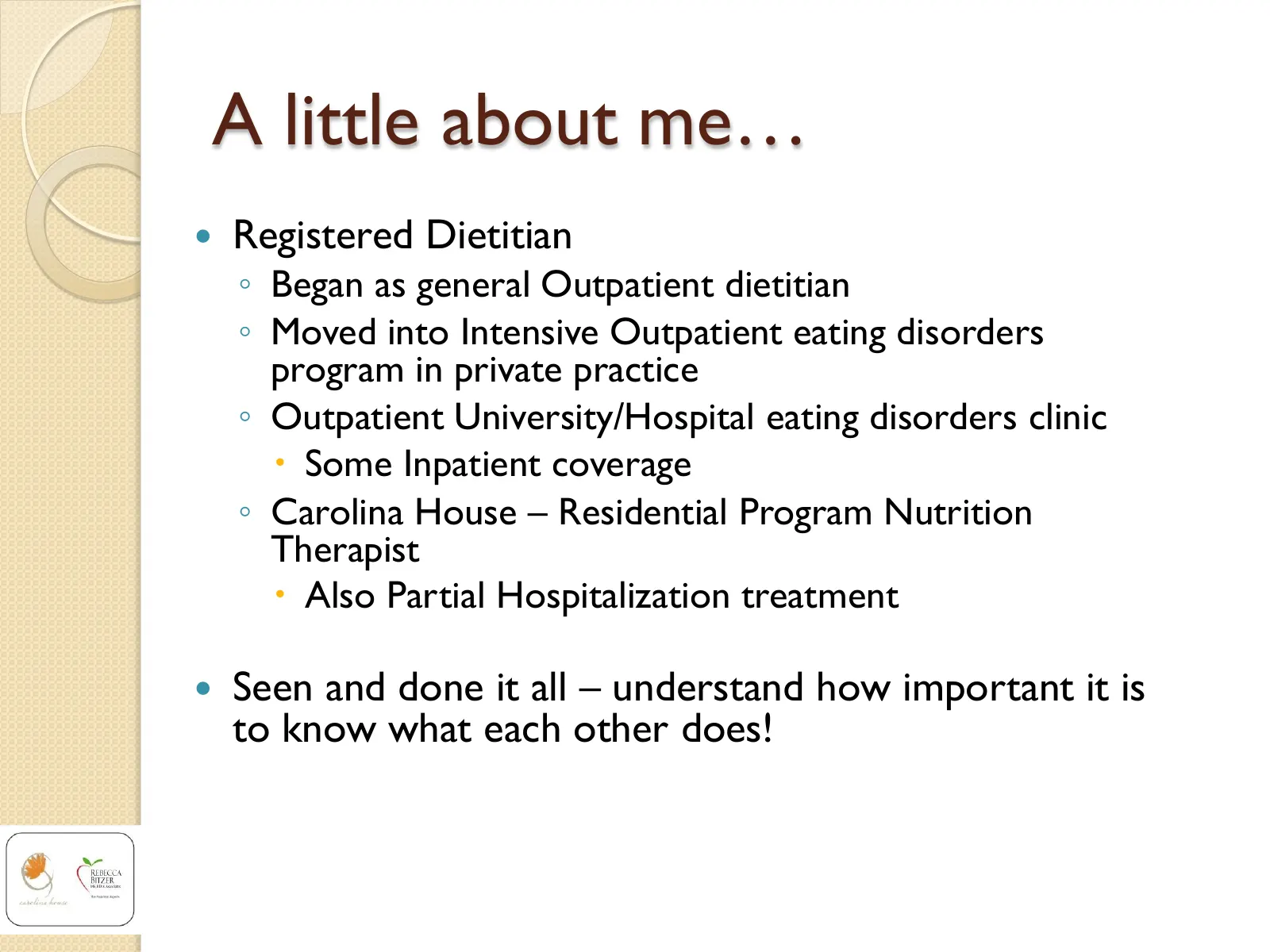
Slide 47: A little about me…
A little about me… Registered Dietitian ◦ Began as general Outpatient dietitian ◦ Moved into Intensive Outpatient eating disorders program in private practice ◦ Outpatient University/Hospital eating disorders clinic Some Inpatient coverage ◦ Carolina House – Residential Program Nutrition Therapi
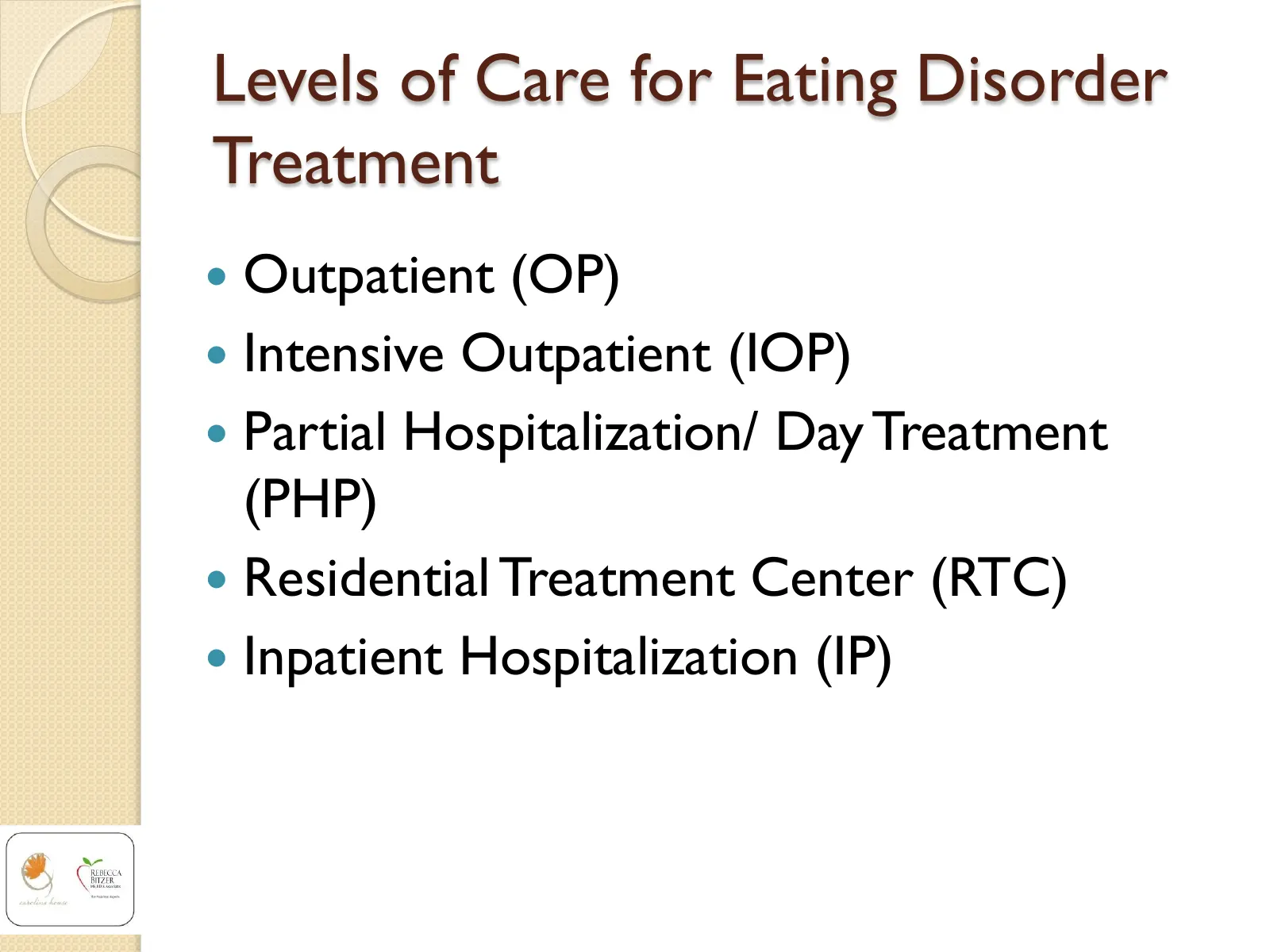
Slide 48: Levels of Care for Eating Disorder Treatment
Levels of Care for Eating Disorder Treatment Outpatient (OP) Intensive Outpatient (IOP) Partial Hospitalization/ Day Treatment (PHP) Residential Treatment Center (RTC) Inpatient Hospitalization (IP)
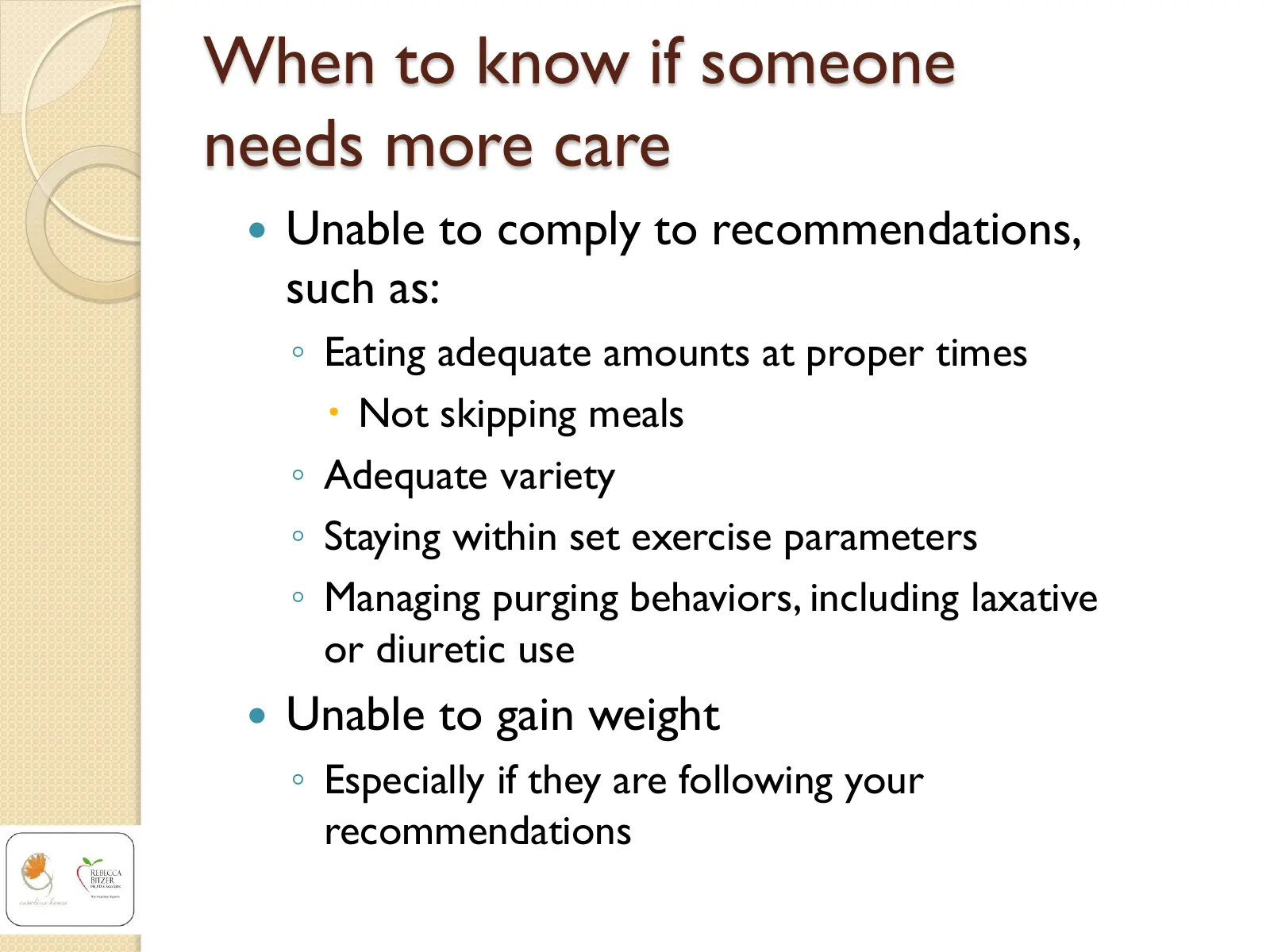
Slide 49: When to know if someone needs more care
When to know if someone needs more care Unable to comply to recommendations, such as: ◦ Eating adequate amounts at proper times Not skipping meals ◦ Adequate variety ◦ Staying within set exercise parameters ◦ Managing purging behaviors, including laxative or diuretic use Unable to gain weight
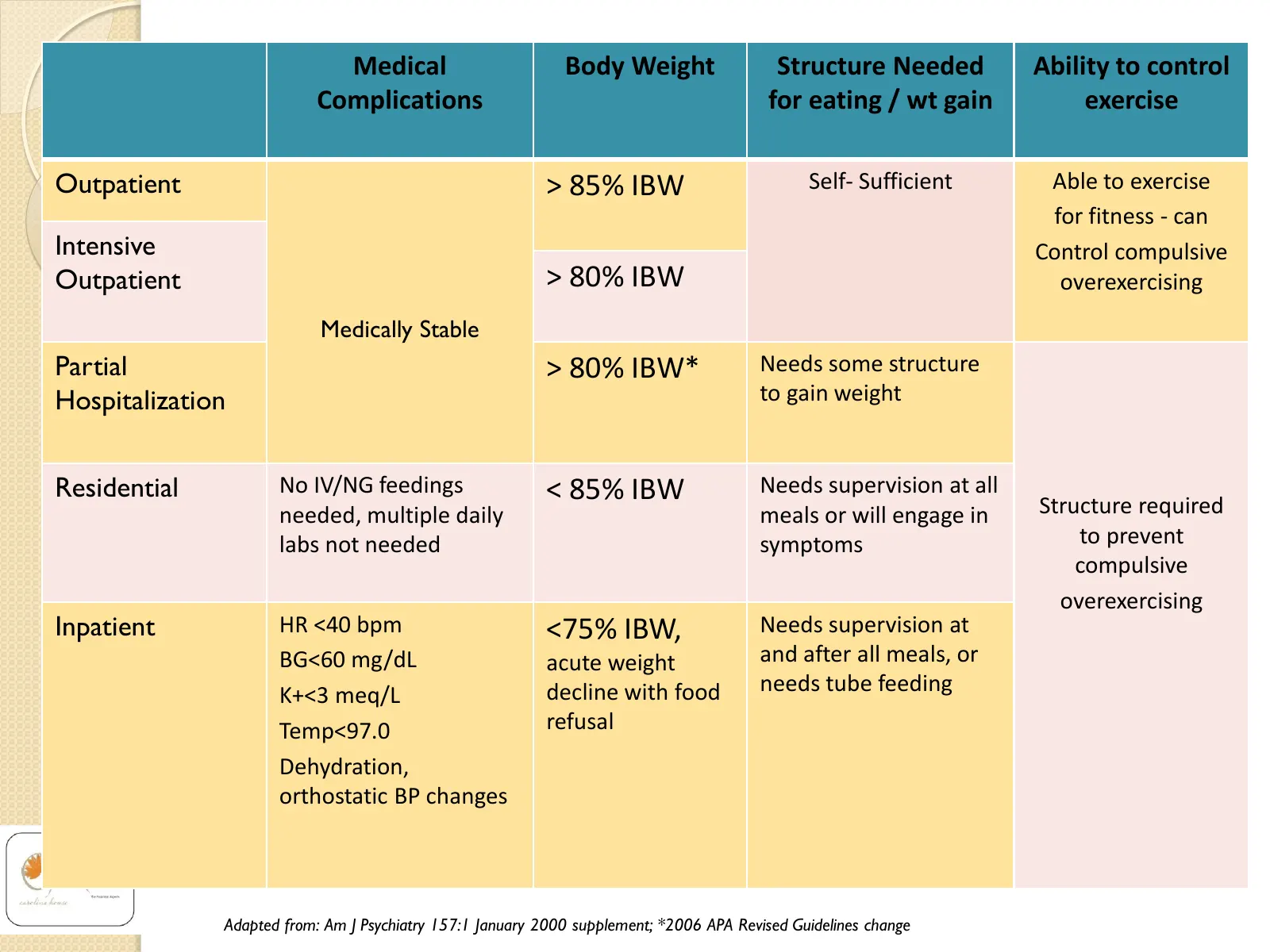
Slide 50: Levels of care criteria table
Medical Body Weight Structure Needed Ability to control Complications for eating / wt gain exercise Outpatient > 85% IBW Self- Sufficient Able to exercise for fitness - can Intensive Control compulsive Outpatient > 80% IBW overexercising Medically Stable Partial > 80% IBW* Needs some structure Hospi
Slide 51: Sometimes they just can't do it
Sometimes they just can’t do it Not always lack of effort or motivation Validate the challenges Not a punishment/ abandonment to recommend a higher LOC ◦ Liabilities
Slide 52: Goals of Different Levels of Care
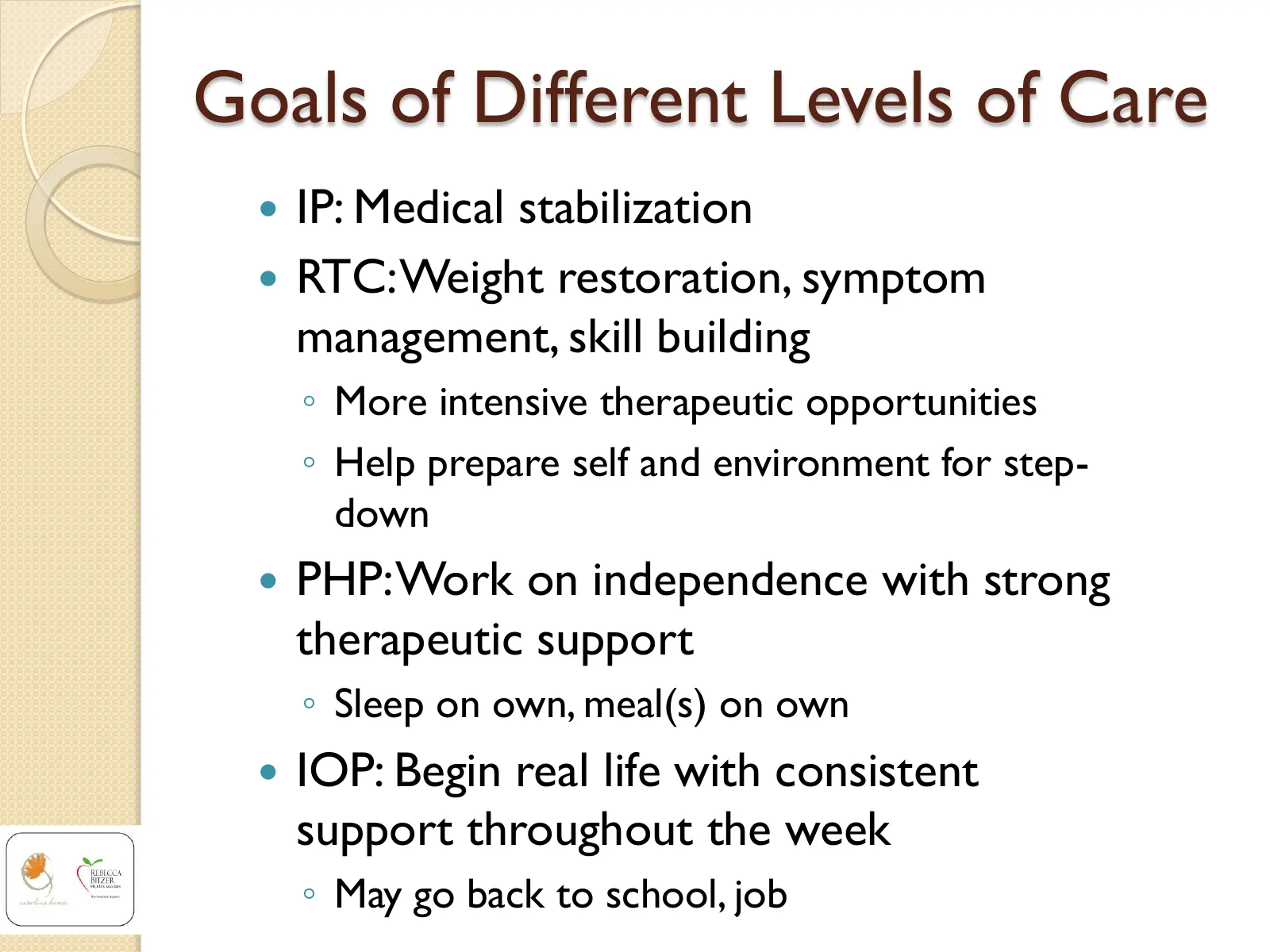
Goals of Different Levels of Care IP: Medical stabilization RTC: Weight restoration, symptom management, skill building ◦ More intensive therapeutic opportunities ◦ Help prepare self and environment for step- down PHP: Work on independence with strong therapeutic support ◦ Sleep on own, meal(s
Slide 53: What are some of the therapeutic interventions of eating disorder treatment?
SO WHAT ARE SOME OF THE THERAPEUTIC INTERVENTIONS OF EATING DISORDER TREATMENT?
Slide 54: Therapy 101: Different modalities
Therapy 101: Different modalities CBT DBT ◦ RO-DBT ACT FBT IPT MI And others Confused yet?
Slide 55: Cognitive Behavioral Therapy (CBT)
Cognitive Behavioral Therapy (CBT) Looking at how one’s thoughts and emotions affect behavior ◦ Changing thoughts and emotions/reactions around thoughts will thus change the behavior ◦ Examining evidence around negative thoughts and beliefs ◦ Automatic, ingrained thoughts
Slide 56: Dialectical Behavioral Therapy (DBT)
Dialectical Behavioral Therapy (DBT) Designed by Marcia Linehan for clients with self harm, suicidality ◦ Borderline Personality Disorder Skill based therapy- learning new behaviors Four Key Modules ◦ Structured format
Slide 57: Four Modules of DBT
Four Modules of DBT Mindfulness ◦ Non-judgmental, observe and describe ◦ Being in the moment Interpersonal Effectiveness ◦ Skills to ask for what one needs Emotion Regulation ◦ Identifying emotions and learning skills to manage emotions Distress Tolerance/ Reality Acceptance ◦ Willingness ve
Slide 58: Other aspects of DBT
Other aspects of DBT Individual and Group Therapy Skills Coaching Behavior Chain Analyses Diary Cards
Slide 59: Radically Open DBT (RO-DBT)
Radically Open DBT (RO-DBT) Relatively new Modality created by Thomas Lynch Geared towards individuals with issues of overcontrol ◦ Anorexia Nervosa ◦ Obsessive Compulsive Personality Disorders ◦ Autism Spectrum Disorders
Slide 60: Overcontrolled Temperament
Overcontrolled Temperament Emotionally constricted Harm Avoidant Low Novelty seeking Rigid
Slide 61: RO-DBT Core Features
RO-DBT Core Features Receptivity and Openness: to new experience and disconfirming feedback in order to learn Flexible-Control: in order to adapt to changing environmental conditions Intimacy & Connectedness (with at least one other person): species survival required capacities to form long-la
Slide 62: Acceptance and Commitment Therapy (ACT)
Acceptance and Commitment Therapy (ACT) Form of CBT Uses mindfulness and behavioral activation to increase psychological flexibility ◦ “The ability to contact the present moment without avoidance, enabling persistence or change in behavior in pursuit of goals or values” Acceptance of experienc
Slide 63: Family Based Therapy (FBT)
Family Based Therapy (FBT) Evidence-based indication for use in adolescents with AN FBT/Maudsley model does not indicate an RD ◦ Still is often utilized as important part of meal planning Outpatient treatment
Slide 64: Interpersonal Therapy (IPT)
Interpersonal Therapy (IPT) Focus on client/patient’s relationships and how it affects how they see themselves ◦ Help improve the relationships, or change the expectations about them Time-limited therapeutic intervention Markowitz and Weissman 2004
Slide 65: Motivational Interviewing (MI)
Motivational Interviewing (MI) Client-centered and directed way to elicit change ◦ Helpful when resistant to change Stages of Change “Roll with Resistance” ◦ VERY different from Nutrition Education that is taught in school ◦ Sit with ambivalence
Slide 66: Some MI Techniques
Some MI Techniques Open Ended Questions Reflective Listening Listen for “Change Talk” ◦ Mention of need, desire, ability ◦ “should, could, want” Curiosity and exploration ◦ Ask for permission
Slide 67: Others
Others 12-Step Model Sensorimotor Psychotherapy EMDR
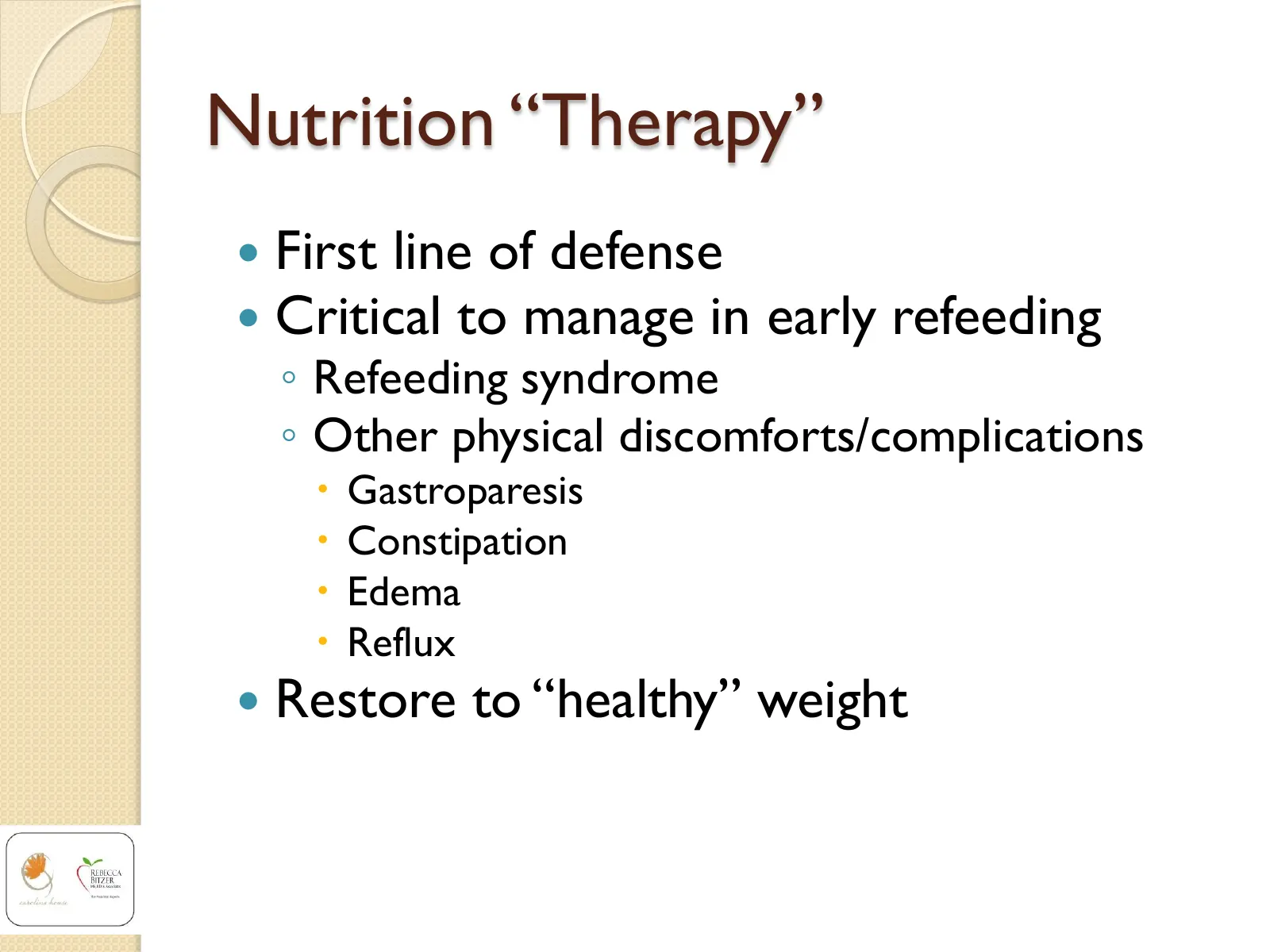
Slide 68: Nutrition "Therapy"
Nutrition “Therapy” First line of defense Critical to manage in early refeeding ◦ Refeeding syndrome ◦ Other physical discomforts/complications Gastroparesis Constipation Edema Reflux Restore to “healthy” weight
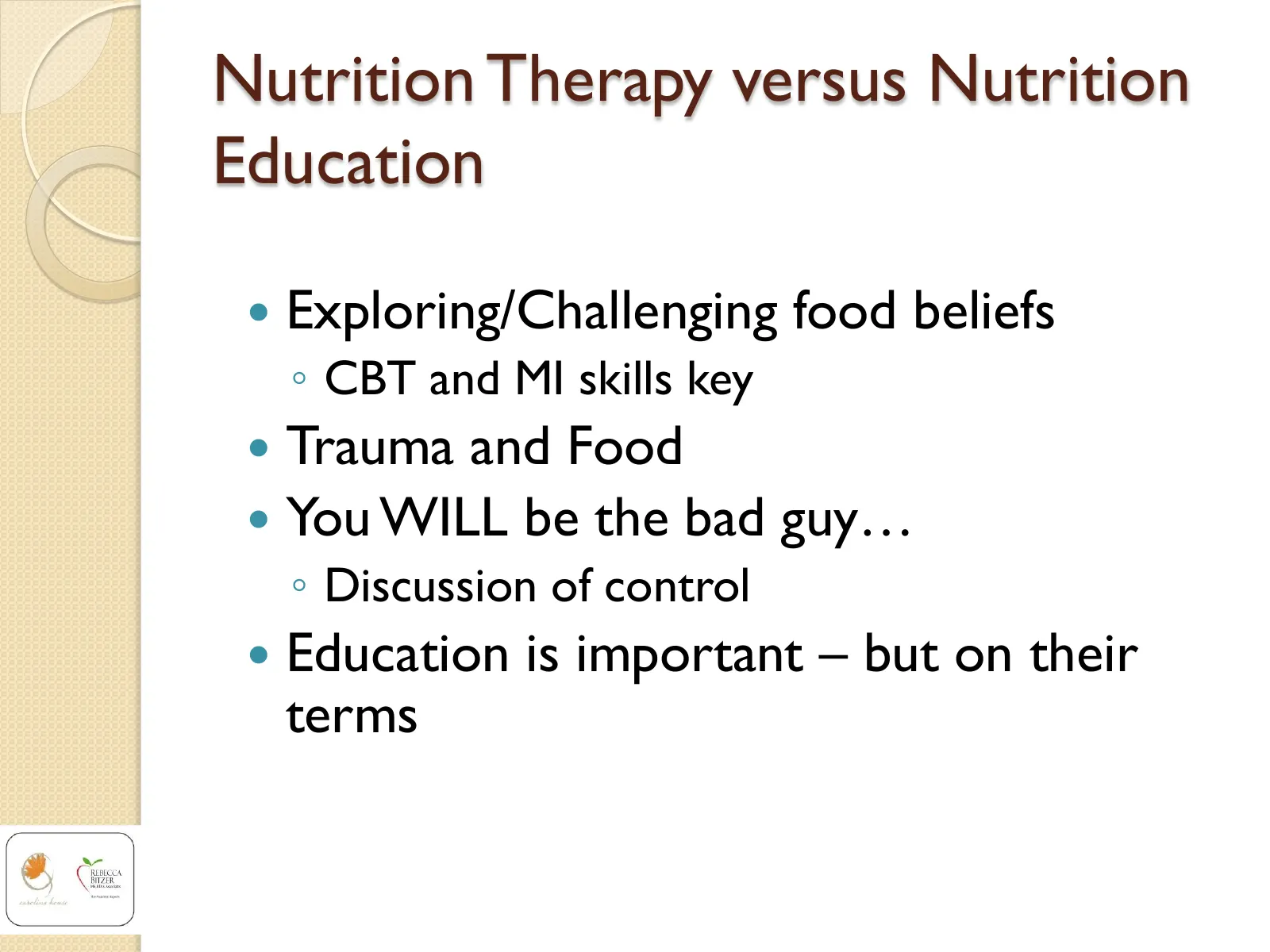
Slide 69: Nutrition Therapy versus Nutrition Education
Nutrition Therapy versus Nutrition Education Exploring/Challenging food beliefs ◦ CBT and MI skills key Trauma and Food You WILL be the bad guy… ◦ Discussion of control Education is important – but on their terms

Slide 70: Weight Restoration Goals
Weight Restoration Goals Phobic Threshold ◦ Thinking of target weight as a phobia Weight Suppression ◦ One weight does not fit all! ◦ Importance of gathering weight history
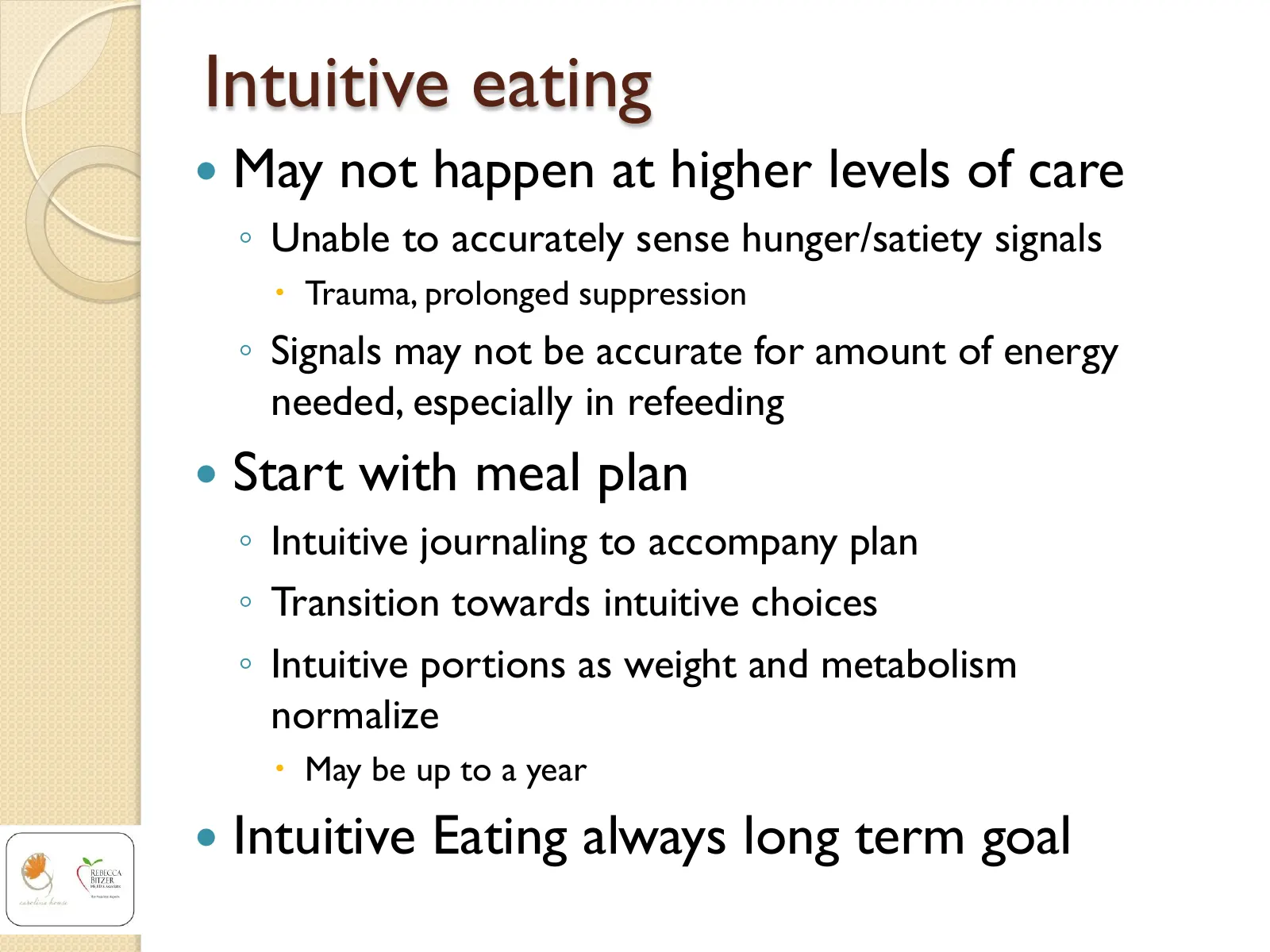
Slide 71: Intuitive eating
Intuitive eating May not happen at higher levels of care ◦ Unable to accurately sense hunger/satiety signals Trauma, prolonged suppression ◦ Signals may not be accurate for amount of energy needed, especially in refeeding Start with meal plan ◦ Intuitive journaling to accompany plan ◦ Transiti
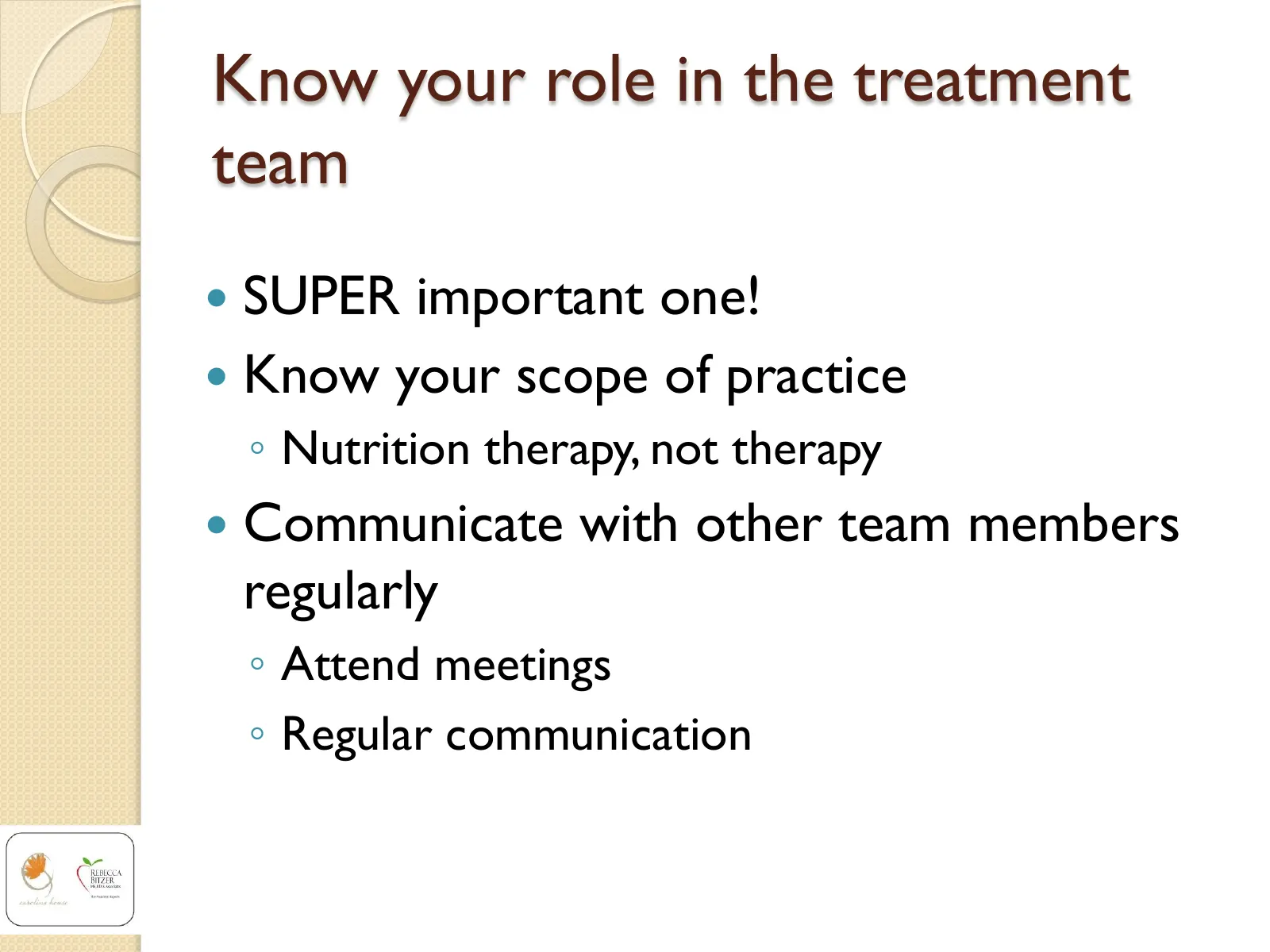
Slide 72: Know your role in the treatment team
Know your role in the treatment team SUPER important one! Know your scope of practice ◦ Nutrition therapy, not therapy Communicate with other team members regularly ◦ Attend meetings ◦ Regular communication
Slide 73: Transitioning to lower LOC
Transitioning to lower LOC Use Meal Plan in transition period ◦ Safety net ◦ Even if practicing intuitive eating Communication!!!
Slide 74: If working with clients with eating disorder
If working with clients with eating disorder Teamwork essential Supervision ◦ Case consultation ◦ Take Care of YOU – this is hard work!

Slide 75: Thank You! Questions?
Thank You! Questions? Kait Fortunato Jenn Burnell RD, LD MS, RD/LDN CEDRD Rebecca Bitzer & Associates: Empowered Carolina House Eating Residential, Partial Outpatient programs and Hospitalization and Intensive groups for clients with eating Outpatient Treatment disorders and their loved Raleigh/ Dur
Source: Internet Archive copy of acadiahealthcare.com
More decks from Acadia Healthcare Company, Inc.
 Q3 2026 Earnings Presentation21 slides · Nov 4, 2026
 Q2 2026 Earnings Presentation21 slides · Jul 29, 2026
 Q1 2026 Earnings Presentation23 slides · Apr 29, 2026
 Q4 2025 Earnings Presentation21 slides · Feb 25, 2026
 44th Annual J.P. Morgan Healthcare Conference (January 2026)19 slides · Jan 13, 2026
 Corporate Update (May 2019)19 slides · May 30, 2019