Osi Pharmaceuticals — Investor Day (December 2008)
149 slides from Osi Pharmaceuticals's investor day presentation, Dec 4, 2008
Slide 1: Welcome to OSI's Analyst Day
Shaping Medicine, Changing Lives Welcome to OSI's Analyst Day December 4, 2008
Slide 2: Forward-looking Statements
OSI Pharmaceuticals Forward-looking Statements OSI's presentation today contain forward-looking statements. These statements are subject to known and unknown risks and uncertainties that may cause actual future experience and results to differ materially from the statements made. Factors that might
Slide 3: Strategic Overview
Shaping Medicine, Changing Lives Colin Goddard, Ph.D. Chief Executive Officer Analyst Day December 4, 2008 CEO Gold Standard Founding Member Strategic Overview
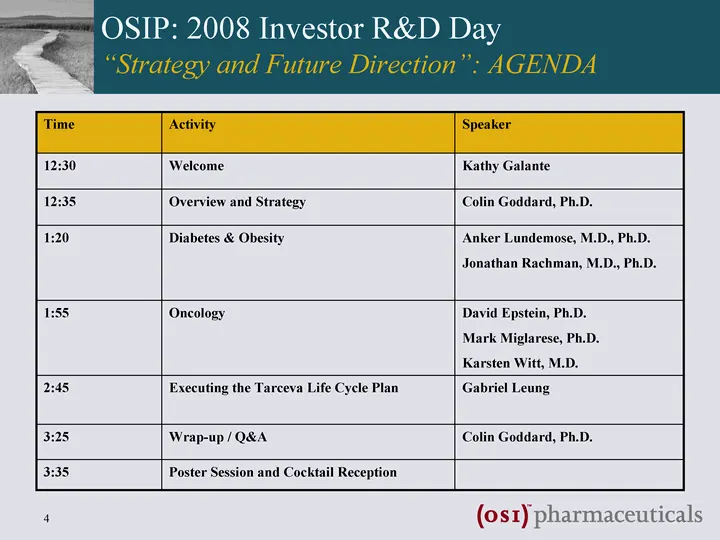
Slide 4: 2008 Investor R&D Day Agenda
OSIP: 2008 Investor R&D Day "Strategy and Future Direction": AGENDA Time Activity Speaker 12:30 Welcome Kathy Galante 12:35 Overview and Strategy Colin Goddard, Ph.D. 1:20 Diabetes & Obesity Anker Lundemose, M.D., Ph.D. Jonathan Rachman, M.D., Ph.D. 1:55 Oncology David Epstein, Ph.D. Mark Miglarese,
Slide 5: A Look Back: Key Goals for OSIP in 2007/8
A Look Back: Key Goals For OSIP in 2007/8: Financial Growth & Disciplined Investment Over the Last Two Years There Has Been Significant Investor Focus on: Financial Performance in 2007 and 2008 Two Major Tarceva Phase III Trial Read-Outs (SATURN and BeTa- Lung) in 2H2008 Divestiture of Eye Business
Slide 6: Strong Financial Performance Has Continued in 2008
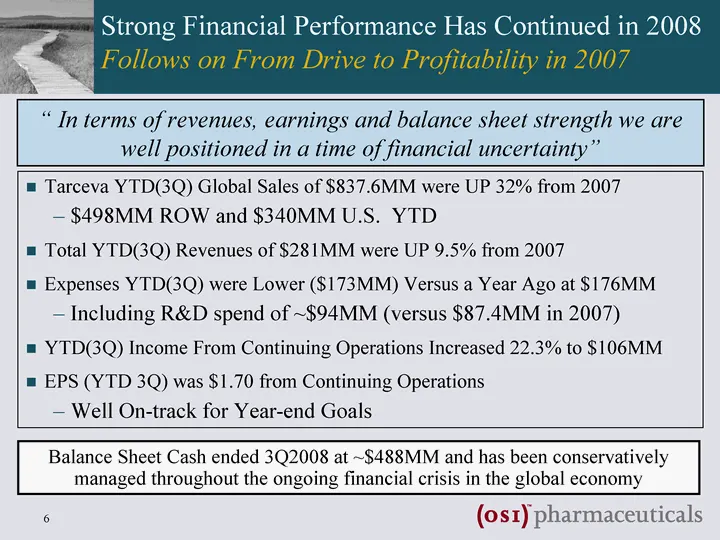
Strong Financial Performance Has Continued in 2008 Follows on From Drive to Profitability in 2007 Tarceva YTD(3Q) Global Sales of $837.6MM were UP 32% from 2007 $498MM ROW and $340MM U.S. YTD Total YTD(3Q) Revenues of $281MM were UP 9.5% from 2007 Expenses YTD(3Q) were Lower ($173MM) Versus a Year A
Slide 7: Tarceva: Bumps and Successes Along the Road
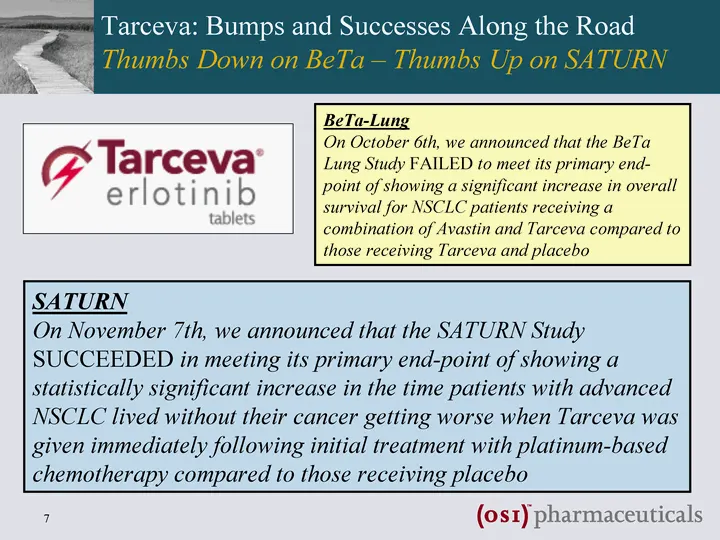
Tarceva: Bumps and Successes Along the Road Thumbs Down on BeTa - Thumbs Up on SATURN BeTa-Lung On October 6th, we announced that the BeTa Lung Study FAILED to meet its primary end- point of showing a significant increase in overall survival for NSCLC patients receiving a combination of Avastin and
Slide 8: The Key Question: Where Do We Go From Here?
The Key Question: Where Do We Go From Here? Discuss Overlying Strategic Themes Outline Plan for Strategic Execution Provide an Assessment of Risk & Reward Around Tarceva Franchise and Reassure You of Our Commitment to Delivering Tarceva Related Shareholder Value Walk Through Some Key Accounting Chan
Slide 9: OSI Exiting 2008: Strategic Focus
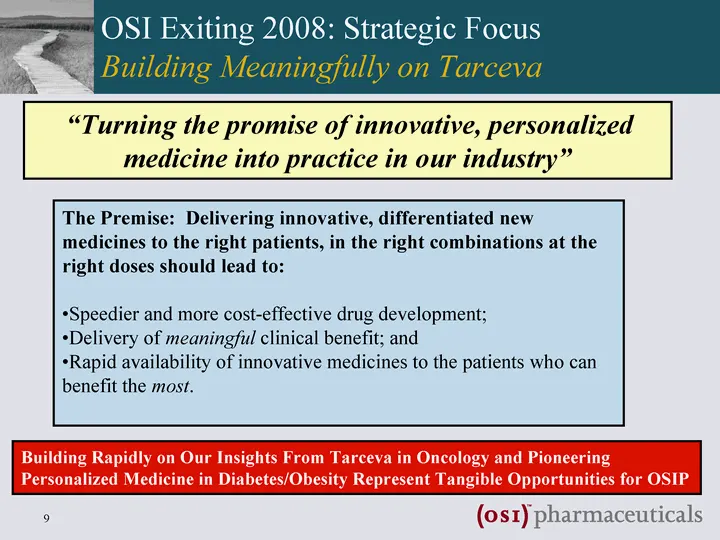
OSI Exiting 2008: Strategic Focus Building Meaningfully on Tarceva "Turning the promise of innovative, personalized medicine into practice in our industry" The Premise: Delivering innovative, differentiated new medicines to the right patients, in the right combinations at the right doses should lead
Slide 10: OSI Exiting 2008: Strategic Focus
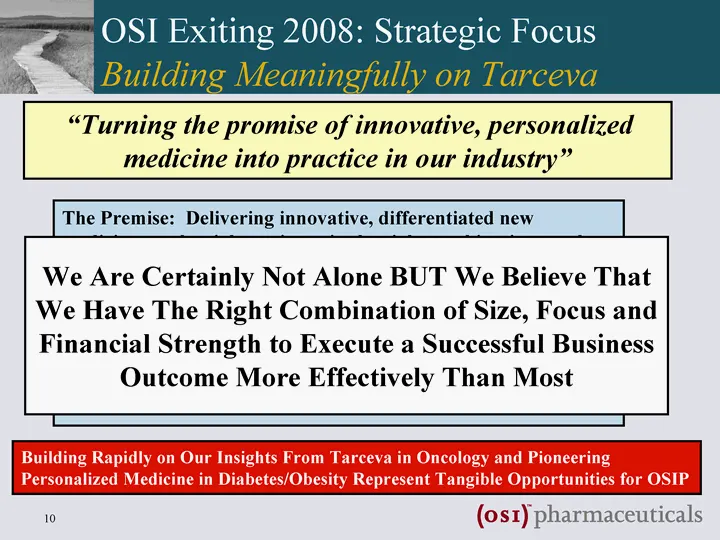
OSI Exiting 2008: Strategic Focus Building Meaningfully on Tarceva "Turning the promise of innovative, personalized medicine into practice in our industry" The Premise: Delivering innovative, differentiated new medicines to the right patients, in the right combinations at the right doses should lead
Slide 11: OSIP Exiting 2008: Strategic Execution
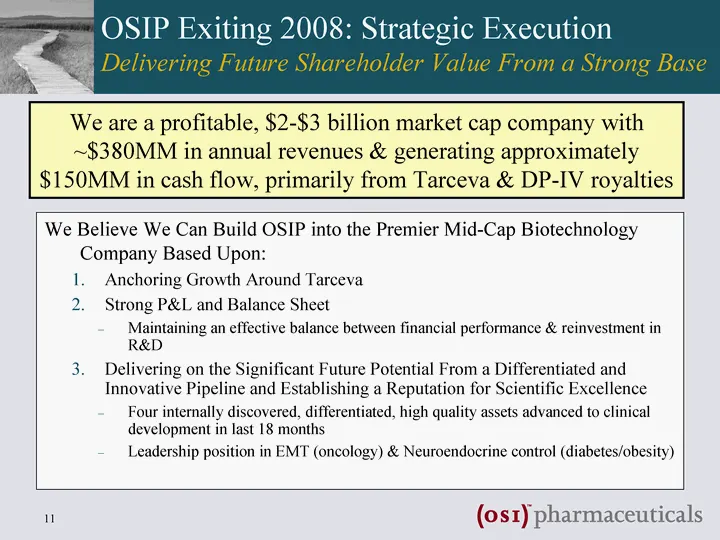
OSIP Exiting 2008: Strategic Execution Delivering Future Shareholder Value From a Strong Base We Believe We Can Build OSIP into the Premier Mid-Cap Biotechnology Company Based Upon: Anchoring Growth Around Tarceva Strong P&L and Balance Sheet Maintaining an effective balance between financial perfor
Slide 12: OSIP Exiting 2008: Strategic Execution
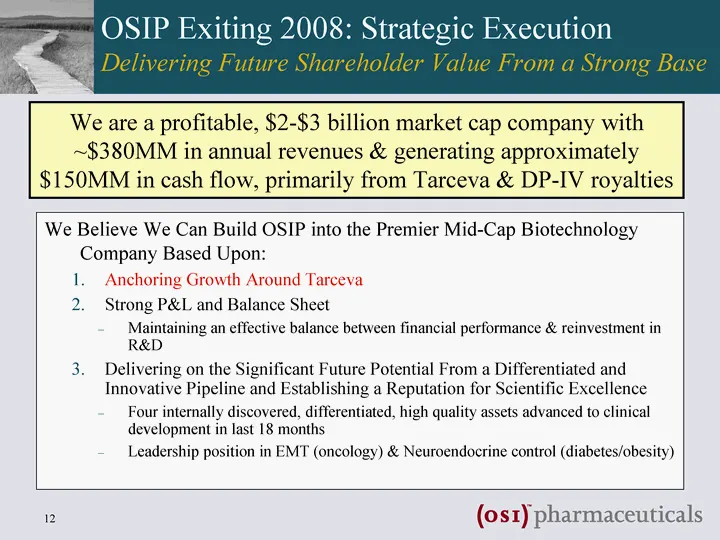
OSIP Exiting 2008: Strategic Execution Delivering Future Shareholder Value From a Strong Base We Believe We Can Build OSIP into the Premier Mid-Cap Biotechnology Company Based Upon: Anchoring Growth Around Tarceva Strong P&L and Balance Sheet Maintaining an effective balance between financial perfor
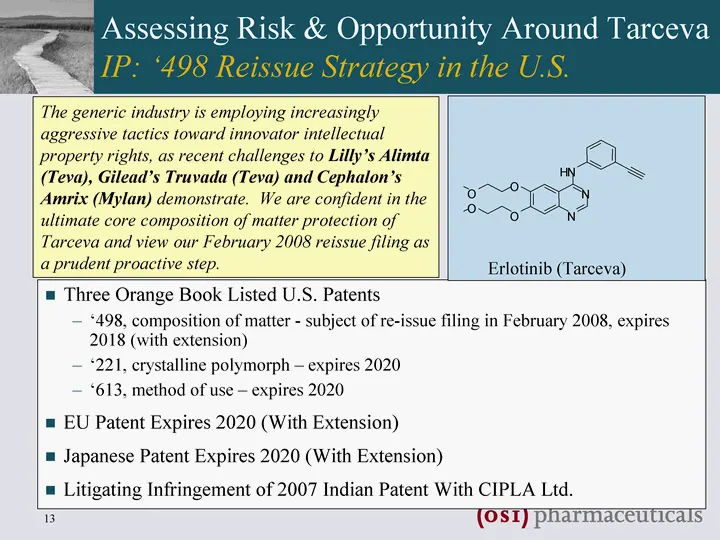
Slide 13: Assessing Risk & Opportunity Around Tarceva IP
Assessing Risk & Opportunity Around Tarceva IP: '498 Reissue Strategy in the U.S. Three Orange Book Listed U.S. Patents '498, composition of matter - subject of re-issue filing in February 2008, expires 2018 (with extension) '221, crystalline polymorph - expires 2020 '613, method of use - expires 20
Slide 14: Tarceva IP: '498 Reissue Strategy in the U.S.
Assessing Risk & Opportunity Around Tarceva IP: '498 Reissue Strategy in the U.S. In February 2008 we filed two requests to the PTO to address certain errors in the original '498 patent A certificate of correction related to claim one This was granted in 3Q 2008 A reissue application was filed in or
Slide 15: Tarceva 2009 Market Dynamics
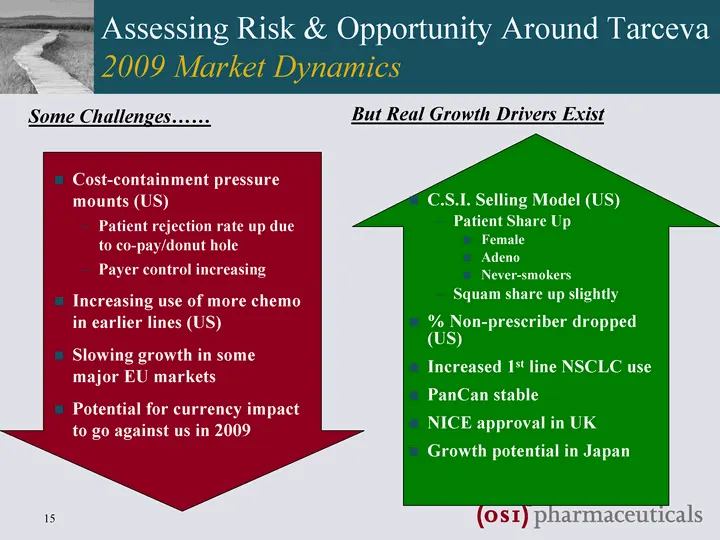
Assessing Risk & Opportunity Around Tarceva 2009 Market Dynamics C.S.I. Selling Model (US) Patient Share Up Female Adeno Never-smokers Squam share up slightly % Non-prescriber dropped (US) Increased 1st line NSCLC use PanCan stable NICE approval in UK Growth potential in Japan Cost-containment press
Slide 16: Assessing Risk & Opportunity Around Tarceva: Competition
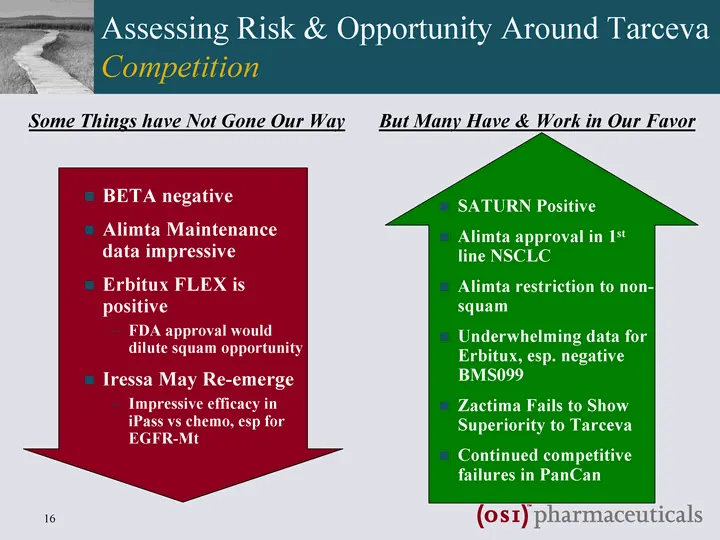
Assessing Risk & Opportunity Around Tarceva Competition SATURN Positive Alimta approval in 1st line NSCLC Alimta restriction to non- squam Underwhelming data for Erbitux, esp. negative BMS099 Zactima Fails to Show Superiority to Tarceva Continued competitive failures in PanCan BETA negative Alimta M
Slide 17: Tarceva Life Cycle Plan Has Robust Potential
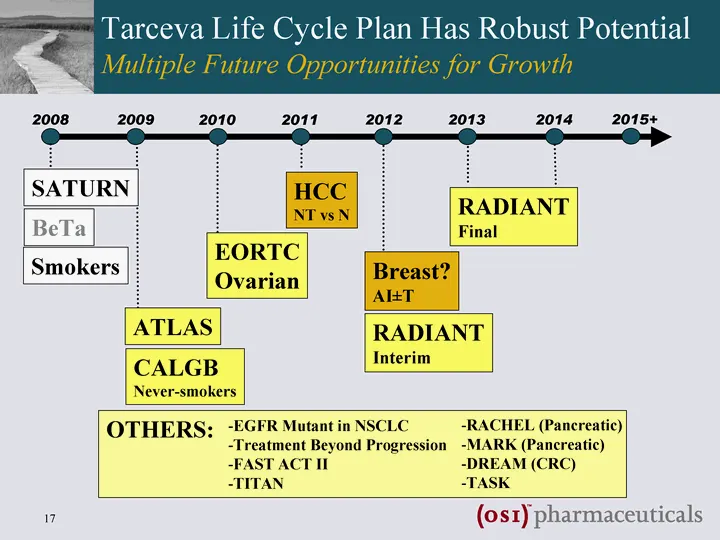
Smokers Tarceva Life Cycle Plan Has Robust Potential Multiple Future Opportunities for Growth 2008 2014 2013 2012 2011 2010 2009 SATURN BeTa ATLAS CALGB Never-smokers EORTC Ovarian HCC NT vs N Breast? AI+-T RADIANT Interim RADIANT Final OTHERS: EGFR Mutant in NSCLC Treatment Beyond Progression FAST
Slide 18: Competition, Market Dynamics & Life Cycle Summary
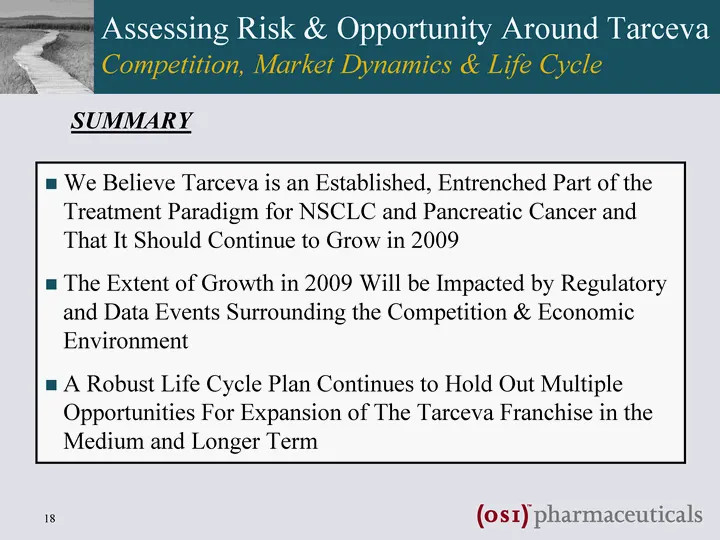
Assessing Risk & Opportunity Around Tarceva Competition, Market Dynamics & Life Cycle We Believe Tarceva is an Established, Entrenched Part of the Treatment Paradigm for NSCLC and Pancreatic Cancer and That It Should Continue to Grow in 2009 The Extent of Growth in 2009 Will be Impacted by Regulator
Slide 19: Committed to Realizing Tarceva Value
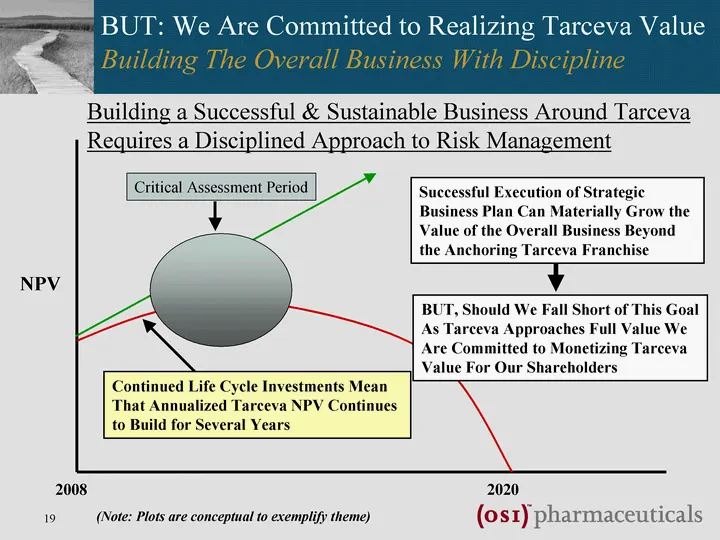
BUT: We Are Committed to Realizing Tarceva Value Building The Overall Business With Discipline 2008 2020 NPV (Note: Plots are conceptual to exemplify theme) Successful Execution of Strategic Business Plan Can Materially Grow the Value of the Overall Business Beyond the Anchoring Tarceva Franchise Co
Slide 20: OSIP Exiting 2008: Strategic Execution
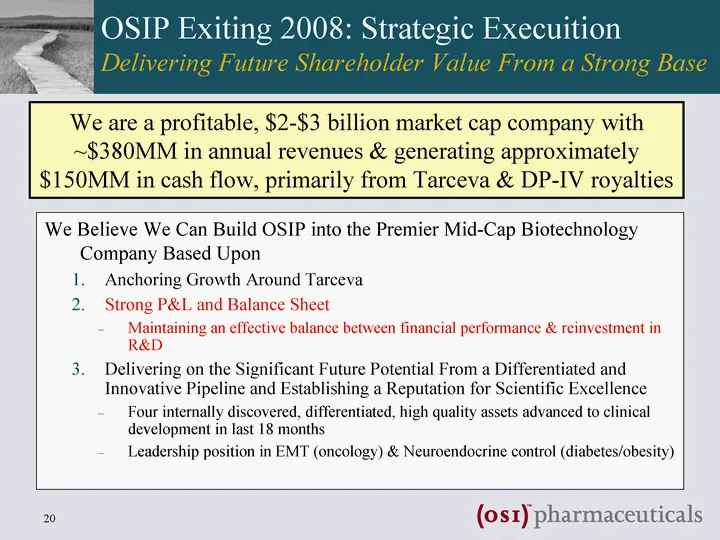
OSIP Exiting 2008: Strategic Execuition Delivering Future Shareholder Value From a Strong Base We Believe We Can Build OSIP into the Premier Mid-Cap Biotechnology Company Based Upon Anchoring Growth Around Tarceva Strong P&L and Balance Sheet Maintaining an effective balance between financial perfor
Slide 21: R&D Spend: Balancing P&L Impact in 2009
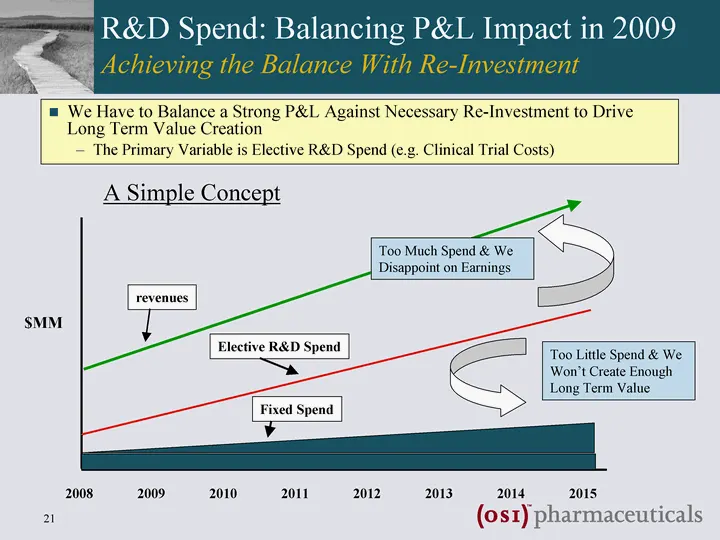
R&D Spend: Balancing P&L Impact in 2009 Achieving the Balance With Re-Investment We Have to Balance a Strong P&L Against Necessary Re-Investment to Drive Long Term Value Creation The Primary Variable is Elective R&D Spend (e.g. Clinical Trial Costs) revenues Fixed Spend Elective R&D Spend 2008 2009
Slide 22: R&D Spend: Balancing P&L Impact in 2009
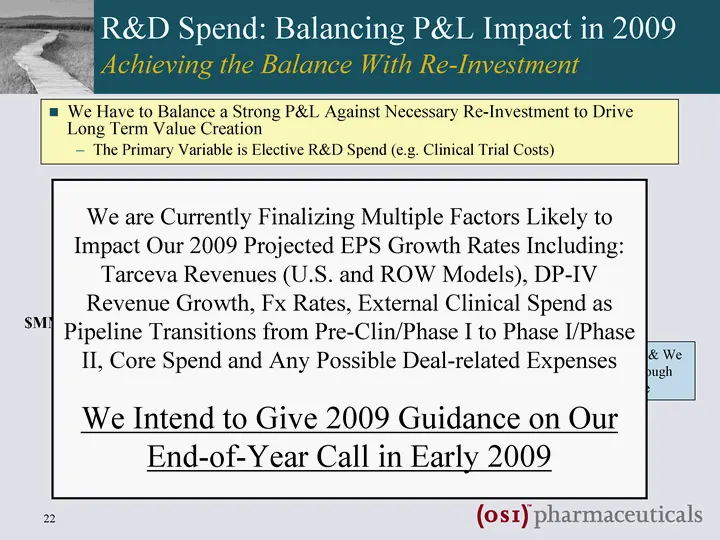
R&D Spend: Balancing P&L Impact in 2009 Achieving the Balance With Re-Investment We Have to Balance a Strong P&L Against Necessary Re-Investment to Drive Long Term Value Creation The Primary Variable is Elective R&D Spend (e.g. Clinical Trial Costs) revenues Fixed Spend Elective R&D Spend 2008 2009
Slide 23: Key Accounting Adjustments to the GAAP Baseline
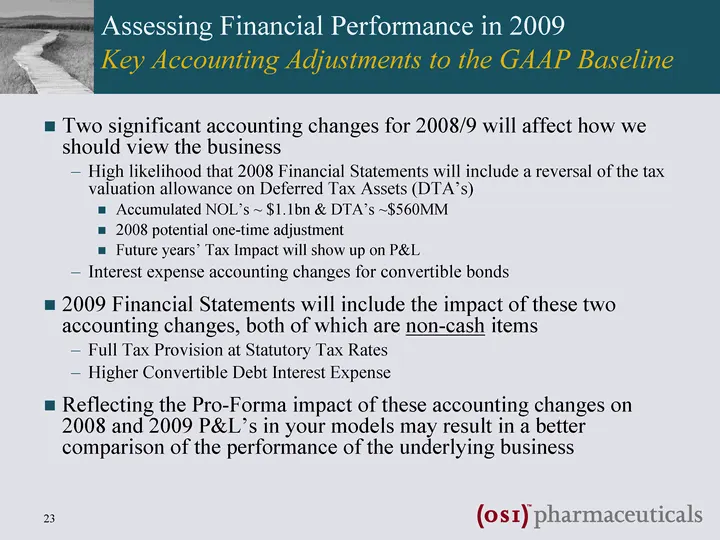
Assessing Financial Performance in 2009 Key Accounting Adjustments to the GAAP Baseline Two significant accounting changes for 2008/9 will affect how we should view the business High likelihood that 2008 Financial Statements will include a reversal of the tax valuation allowance on Deferred Tax Asse
Slide 24: Key Accounting Adjustments to the GAAP Baseline
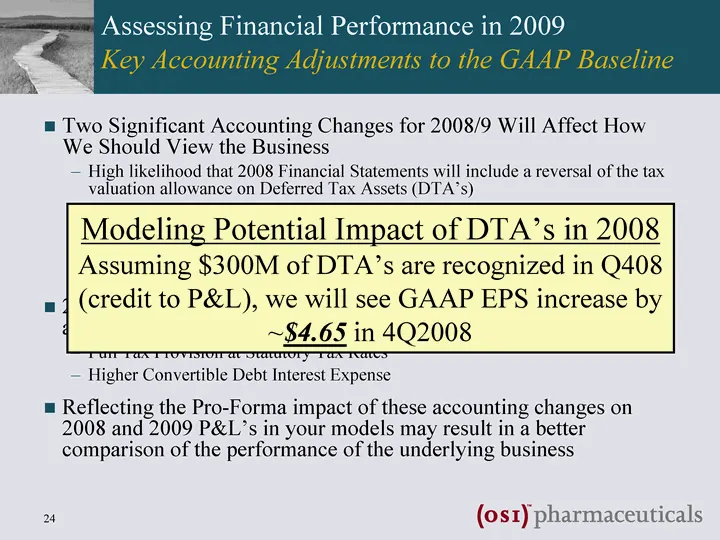
Assessing Financial Performance in 2009 Key Accounting Adjustments to the GAAP Baseline Two Significant Accounting Changes for 2008/9 Will Affect How We Should View the Business High likelihood that 2008 Financial Statements will include a reversal of the tax valuation allowance on Deferred Tax Asse
Slide 25: Pro-Forma Impact of DTA's in 2009
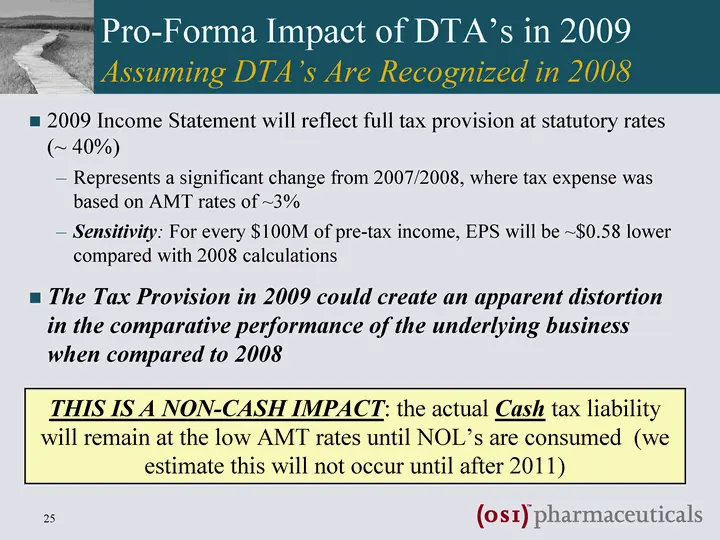
Pro-Forma Impact of DTA's in 2009 Assuming DTA's Are Recognized in 2008 2009 Income Statement will reflect full tax provision at statutory rates (~ 40%) Represents a significant change from 2007/2008, where tax expense was based on AMT rates of ~3% Sensitivity: For every $100M of pre-tax income, EPS
Slide 26: Pro-Forma Impact on 2009 Assuming DTA's Recognized
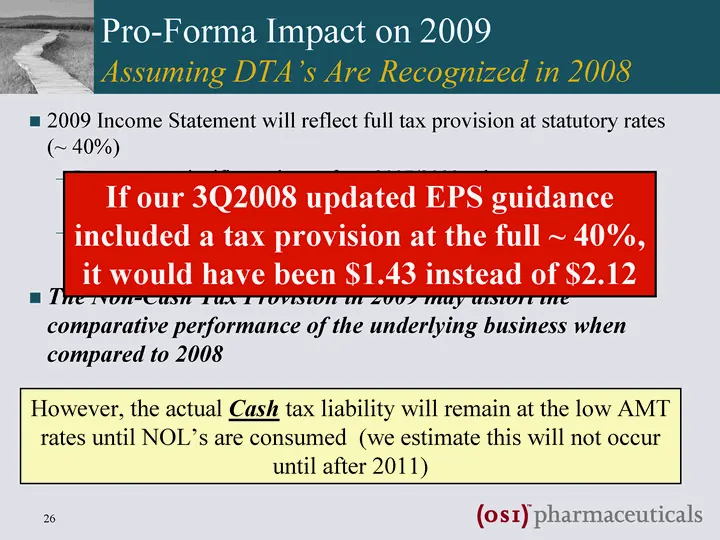
Pro-Forma Impact on 2009 Assuming DTA's Are Recognized in 2008 2009 Income Statement will reflect full tax provision at statutory rates (~ 40%) Represents a significant change from 2007/2008, where tax expense was based on the significantly lower AMT rates of ~3% Sensitivity: For every $100M of pre-
Slide 27: Convertible Debt Interest Expense FSP APB-14
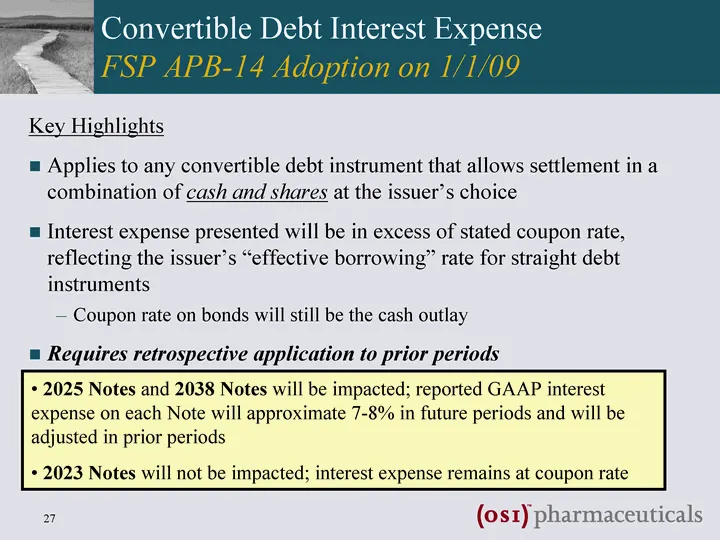
Convertible Debt Interest Expense FSP APB-14 Adoption on 1/1/09 Key Highlights Applies to any convertible debt instrument that allows settlement in a combination of cash and shares at the issuer's choice Interest expense presented will be in excess of stated coupon rate, reflecting the issuer's "eff
Slide 28: 2008 Pro-Forma Interest Expense Impact from FSP APB-14
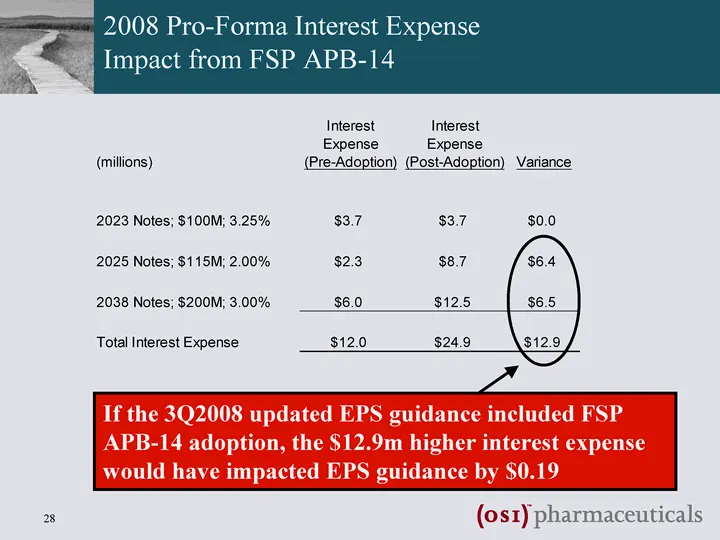
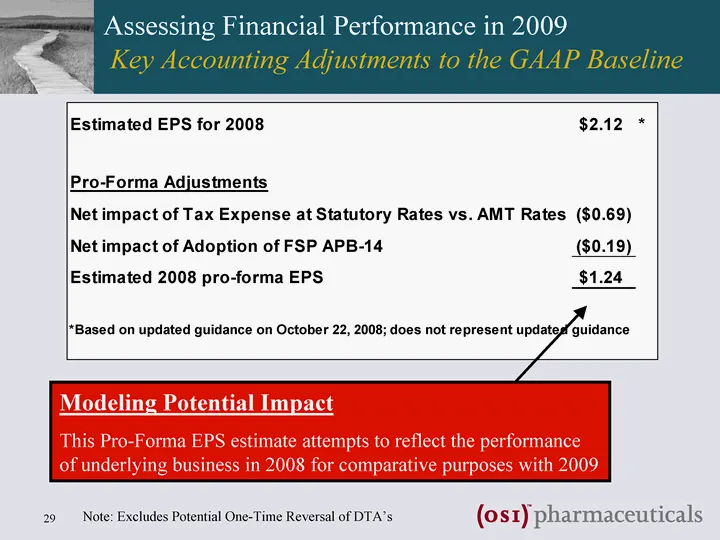
2008 Pro-Forma Interest Expense Impact from FSP APB-14 If the 3Q2008 updated EPS guidance included FSP APB-14 adoption, the $12.9m higher interest expense would have impacted EPS guidance by $0.19
Slide 29: Modeling Potential Impact
Assessing Financial Performance in 2009 Key Accounting Adjustments to the GAAP Baseline Modeling Potential Impact This Pro-Forma EPS estimate attempts to reflect the performance of underlying business in 2008 for comparative purposes with 2009 Note: Excludes Potential One-Time Reversal of DTA's
Slide 30: OSIP Exiting 2008: Strategic Execution
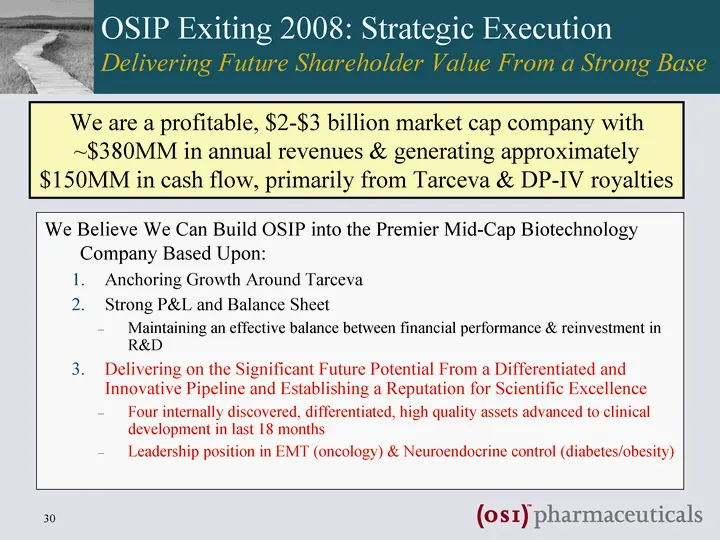
OSIP Exiting 2008: Strategic Execution Delivering Future Shareholder Value From a Strong Base We Believe We Can Build OSIP into the Premier Mid-Cap Biotechnology Company Based Upon: Anchoring Growth Around Tarceva Strong P&L and Balance Sheet Maintaining an effective balance between financial perfor
Slide 31: Core Assets in Phase I Are Key
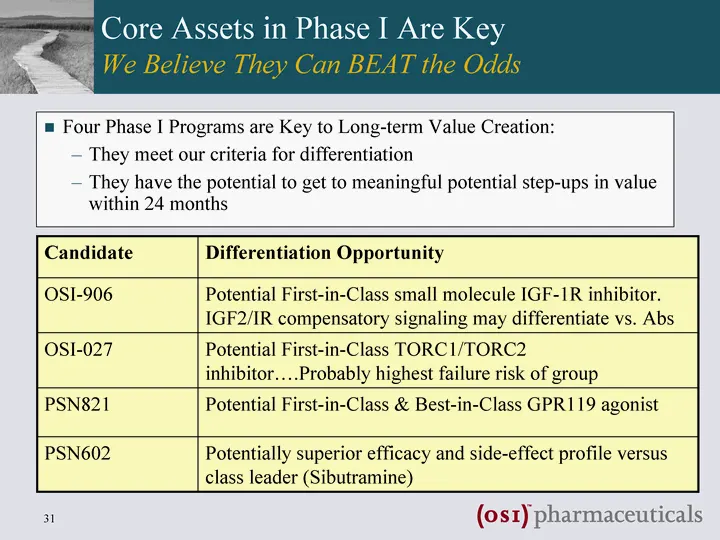
Core Assets in Phase I Are Key We Believe They Can BEAT the Odds Four Phase I Programs are Key to Long-term Value Creation: They meet our criteria for differentiation They have the potential to get to meaningful potential step-ups in value within 24 months Candidate Differentiation Opportunity OSI-9
Slide 32: Core Assets in Phase I Are Key
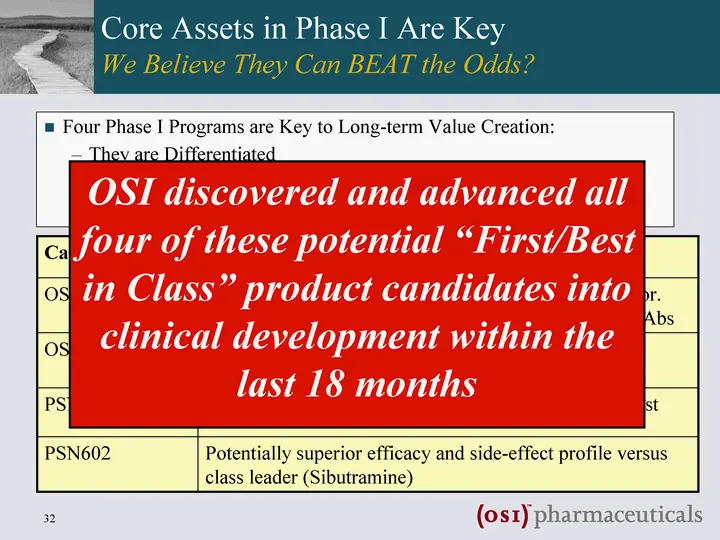
Core Assets in Phase I Are Key We Believe They Can BEAT the Odds? Four Phase I Programs are Key to Long-term Value Creation: They are Differentiated They have the Potential to Get to Meaningful Potential Step-Ups in Value Within 24 Months Candidate Differentiation Opportunity OSI-906 Potential First
Slide 33: The EMT Platform in Oncology
Focusing Resources to Enable a Leadership Role The EMT Platform in Oncology Oncology has become extremely competitive Pfizer, Lilly & Novartis alone are collectively spending billions of dollars annually on Oncology R&D None-the-less, changing treatment paradigms and reducing personalized medicine t
Slide 34: The EMT Platform in Oncology
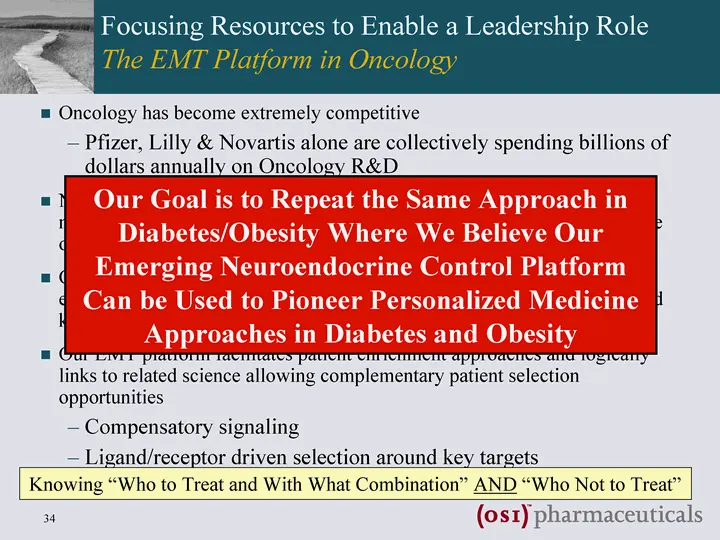
Focusing Resources to Enable a Leadership Role The EMT Platform in Oncology Oncology has become extremely competitive Pfizer, Lilly & Novartis alone are collectively spending billions of dollars annually on Oncology R&D None-the-less, changing treatment paradigms and reducing personalized medicine t
Slide 35: OSI-906: Driving Differentiation With Science
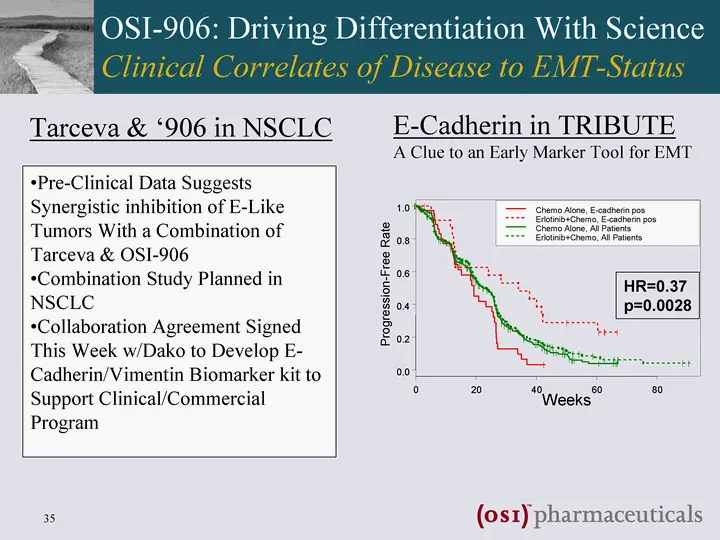
OSI-906: Driving Differentiation With Science Clinical Correlates of Disease to EMT-Status Tarceva & '906 in NSCLC HR=0.37 p=0.0028 Weeks Pre-Clinical Data Suggests Synergistic inhibition of E-Like Tumors With a Combination of Tarceva & OSI-906 Combination Study Planned in NSCLC Collaboration Agreem
Slide 36: OSI-906: Compensatory Signaling
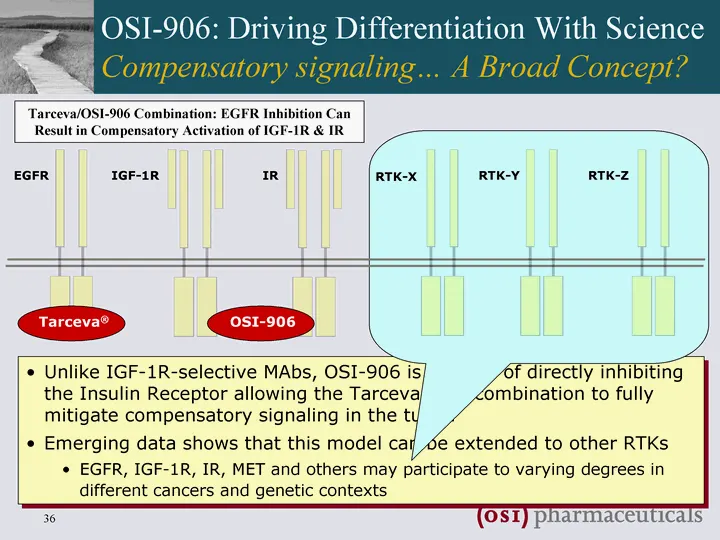
Unlike IGF-1R-selective MAbs, OSI-906 is capable of directly inhibiting the Insulin Receptor allowing the Tarceva/'906 combination to fully mitigate compensatory signaling in the tumor Emerging data shows that this model can be extended to other RTKs EGFR, IGF-1R, IR, MET and others may participate
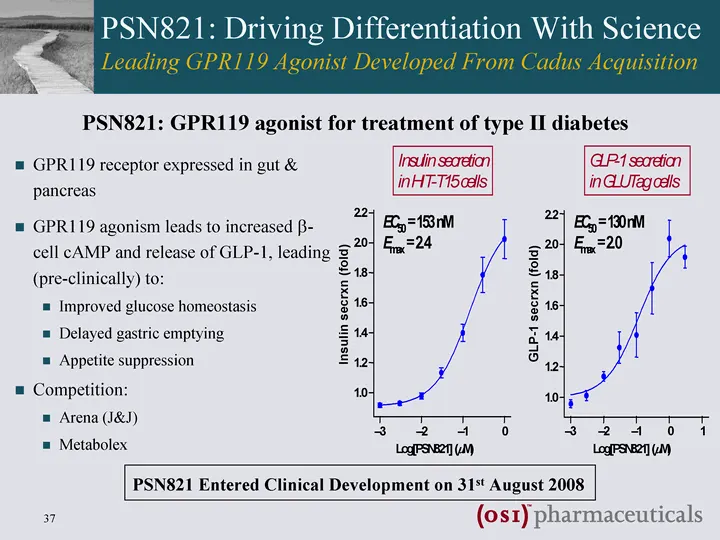
Slide 37: PSN821: Driving Differentiation With Science
GPR119 receptor expressed in gut & pancreas GPR119 agonism leads to increased b- cell cAMP and release of GLP-1, leading (pre-clinically) to: Improved glucose homeostasis Delayed gastric emptying Appetite suppression Competition: Arena (J&J) Metabolex PSN821: Driving Differentiation With Science Lea
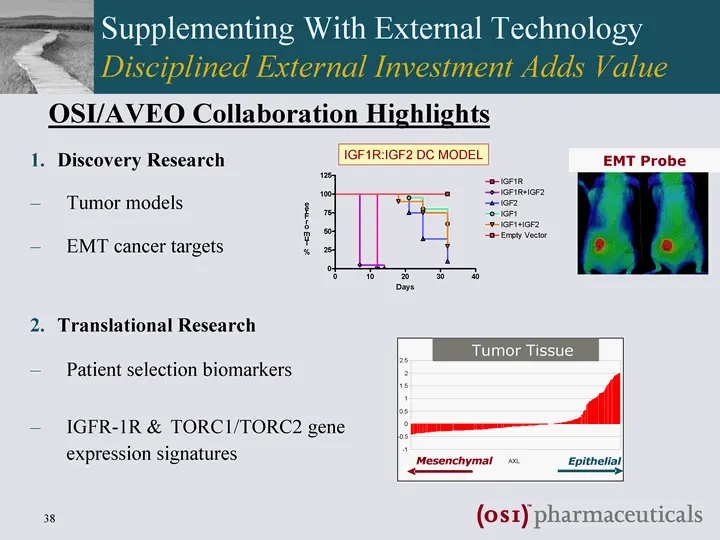
Slide 38: Supplementing With External Technology
Supplementing With External Technology Disciplined External Investment Adds Value Discovery Research Tumor models EMT cancer targets Translational Research Patient selection biomarkers IGFR-1R & TORC1/TORC2 gene expression signatures Mesenchymal Epithelial AVEO BH ARCHIVE AXL EMT INDEX - -1 - -0.5 0
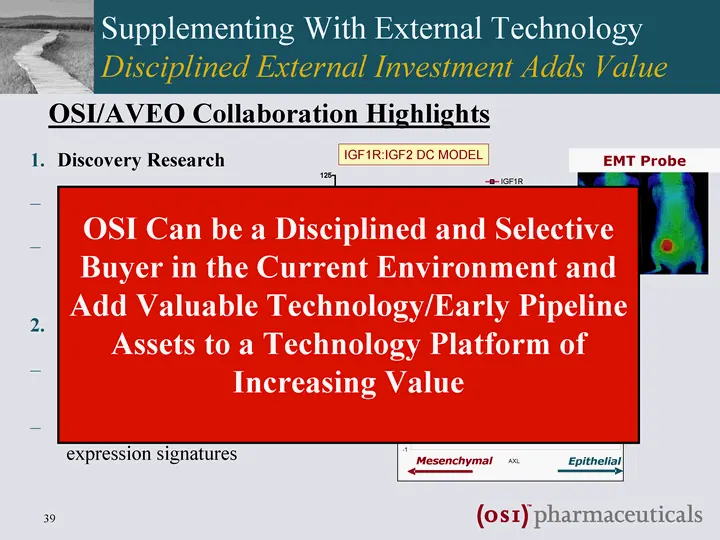
Slide 39: Supplementing With External Technology
Supplementing With External Technology Disciplined External Investment Adds Value Discovery Research Tumor models EMT cancer targets Translational Research Patient selection biomarkers IGFR-1R & TORC1/TORC2 gene expression signatures Mesenchymal Epithelial AVEO BH ARCHIVE AXL EMT INDEX - -1 - -0.5 0
Slide 40: OSIP Exiting 2008: Summary
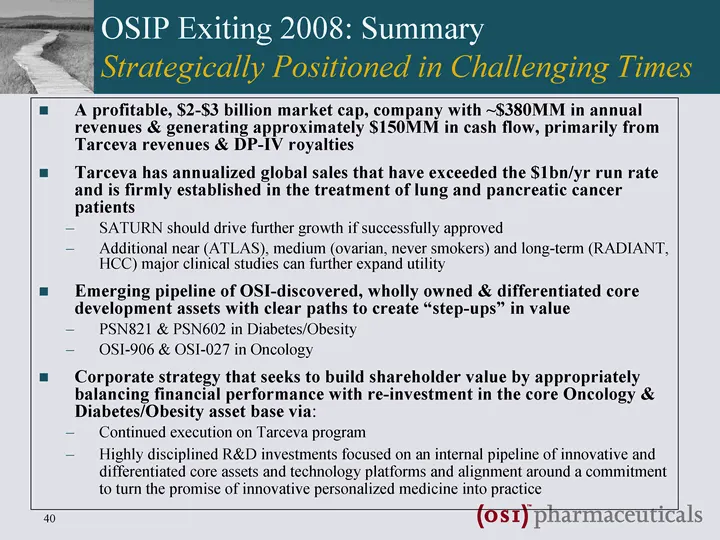
OSIP Exiting 2008: Summary Strategically Positioned in Challenging Times A profitable, $2-$3 billion market cap, company with ~$380MM in annual revenues & generating approximately $150MM in cash flow, primarily from Tarceva revenues & DP-IV royalties Tarceva has annualized global sales that have exc

Slide 41: Q&A
(os1) pharmaceuticals Q&A in(sight)
Slide 42: Overview of Diabetes/Obesity Strategy & Programs
Overview of Diabetes/Obesity Strategy & Programs Anker Lundemose, M.D., Ph.D. President, OSI Prosidion
Slide 43: Challenges Facing Diabetes & Obesity
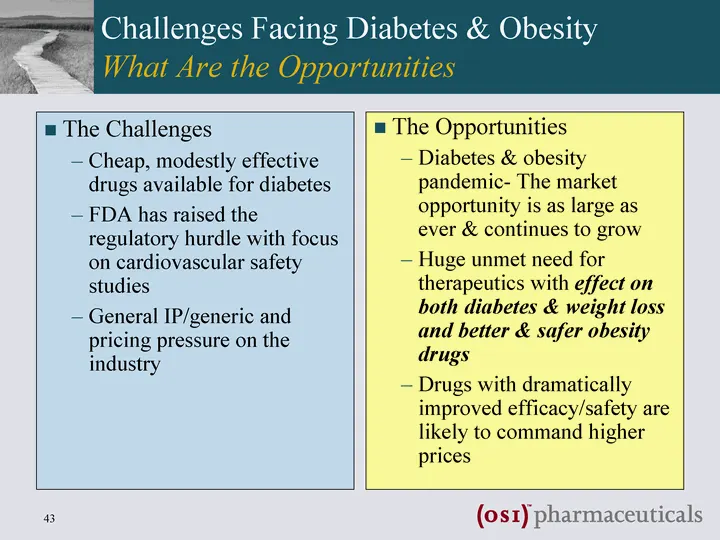
Challenges Facing Diabetes & Obesity What Are the Opportunities The Challenges Cheap, modestly effective drugs available for diabetes FDA has raised the regulatory hurdle with focus on cardiovascular safety studies General IP/generic and pricing pressure on the industry The Opportunities Diabetes &
Slide 44: Addressing the Challenges Facing Diabetes & Obesity
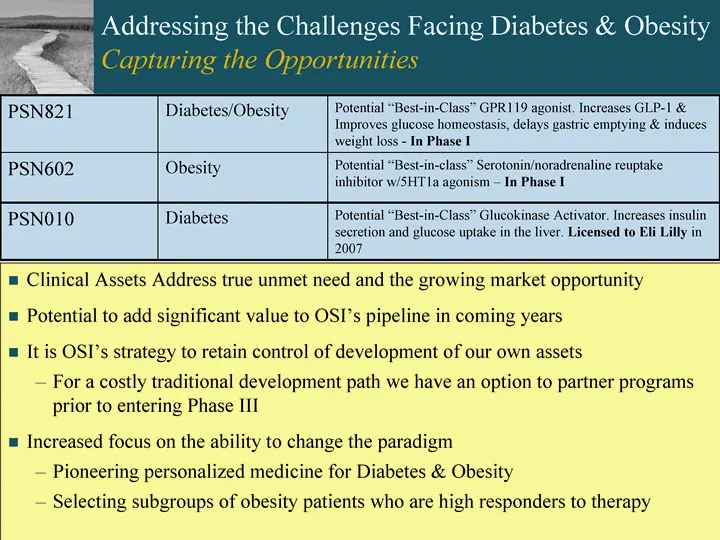
Addressing the Challenges Facing Diabetes & Obesity Capturing the Opportunities PSN821 Diabetes/Obesity Potential "Best-in-Class" GPR119 agonist. Increases GLP-1 & Improves glucose homeostasis, delays gastric emptying & induces weight loss - In Phase I PSN602 Obesity Potential "Best-in-class" Seroto
Slide 45: Targeted & Personalized Medicines for Diabetes & Obesity
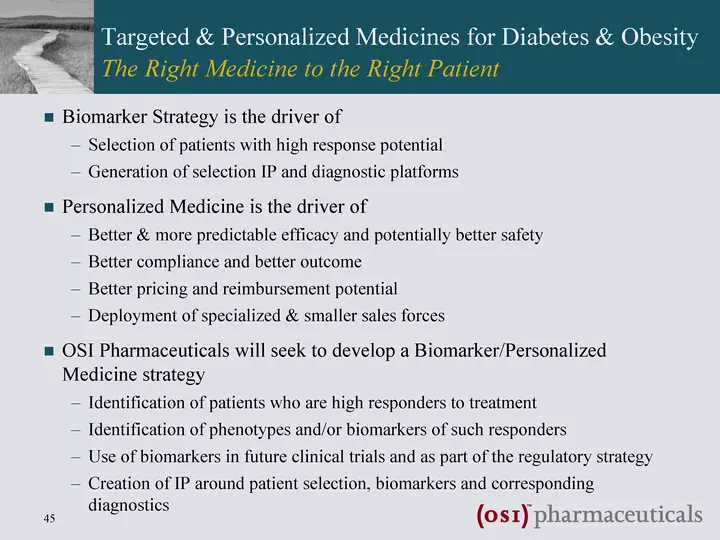
Targeted & Personalized Medicines for Diabetes & Obesity The Right Medicine to the Right Patient Biomarker Strategy is the driver of Selection of patients with high response potential Generation of selection IP and diagnostic platforms Personalized Medicine is the driver of Better & more predictable
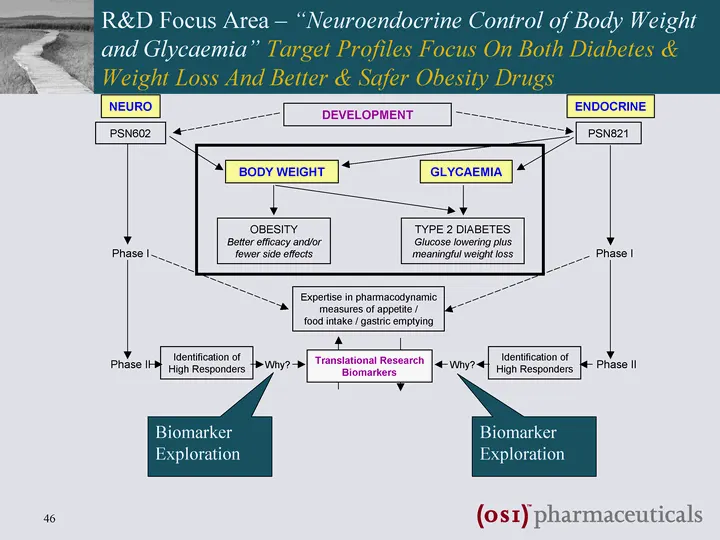
Slide 46: R&D Focus Area: Neuroendocrine Control of Body Weight and Glycaemia
R&D Focus Area - "Neuroendocrine Control of Body Weight and Glycaemia" Target Profiles Focus On Both Diabetes & Weight Loss And Better & Safer Obesity Drugs Phase II Identification of High Responders Why? Phase II Identification of High Responders Why? Translational Research Biomarkers BODY WEIGHT O
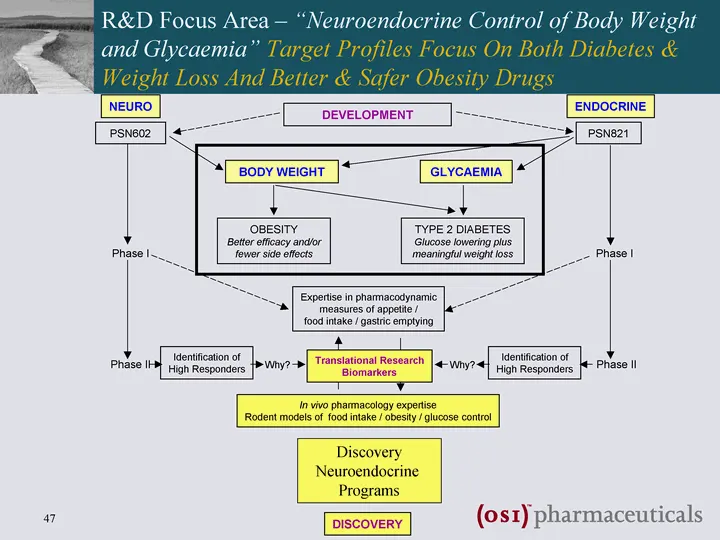
Slide 47: R&D Focus Area: Neuroendocrine Control of Body Weight and Glycaemia
R&D Focus Area - "Neuroendocrine Control of Body Weight and Glycaemia" Target Profiles Focus On Both Diabetes & Weight Loss And Better & Safer Obesity Drugs Phase II Identification of High Responders Why? Phase II Identification of High Responders Why? Translational Research Biomarkers BODY WEIGHT O
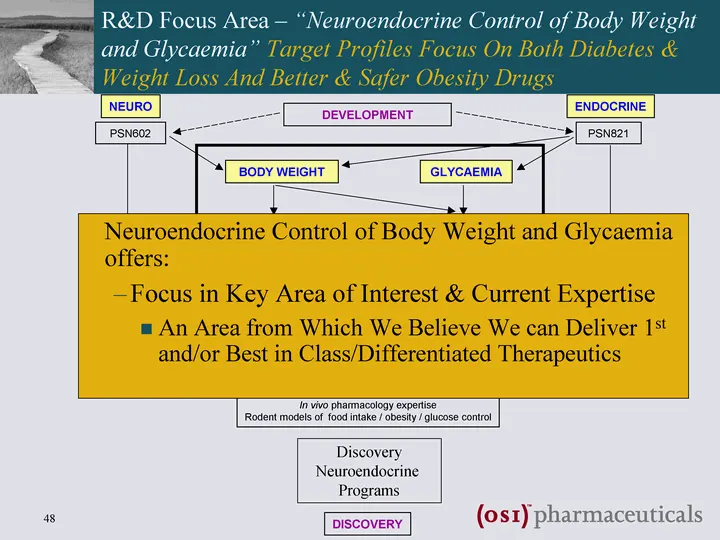
Slide 48: R&D Focus Area: Neuroendocrine Control of Body Weight and Glycaemia
R&D Focus Area - "Neuroendocrine Control of Body Weight and Glycaemia" Target Profiles Focus On Both Diabetes & Weight Loss And Better & Safer Obesity Drugs Phase II Identification of High Responders Why? Phase II Identification of High Responders Why? Translational Research Biomarkers BODY WEIGHT O
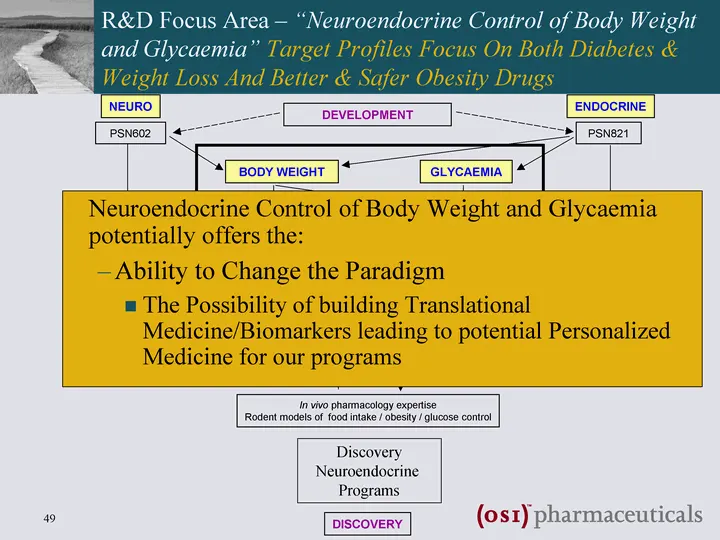
Slide 49: R&D Focus Area: Neuroendocrine Control of Body Weight and Glycaemia
R&D Focus Area - "Neuroendocrine Control of Body Weight and Glycaemia" Target Profiles Focus On Both Diabetes & Weight Loss And Better & Safer Obesity Drugs Phase II Identification of High Responders Why? Phase II Identification of High Responders Why? Translational Research Biomarkers BODY WEIGHT O
Slide 50: Update on PSN821 and PSN602
Update on PSN821 and PSN602 Jonathan Rachman, M.D., Ph.D. Senior Vice President, OSI Prosidion
Slide 51: PSN821
(os1) pharmaceuticals PSN821 in(sight)
Slide 52: Diabetes and Obesity Clinical Pipeline - PSN821
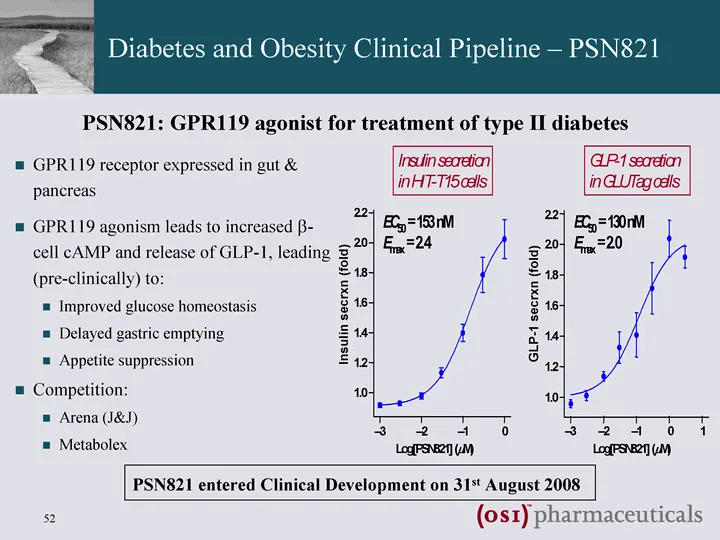
GPR119 receptor expressed in gut & pancreas GPR119 agonism leads to increased b- cell cAMP and release of GLP-1, leading (pre-clinically) to: Improved glucose homeostasis Delayed gastric emptying Appetite suppression Competition: Arena (J&J) Metabolex Diabetes and Obesity Clinical Pipeline - PSN821
Slide 53: PSN821 - Glucose Lowering in Prediabetic ZDF Rats
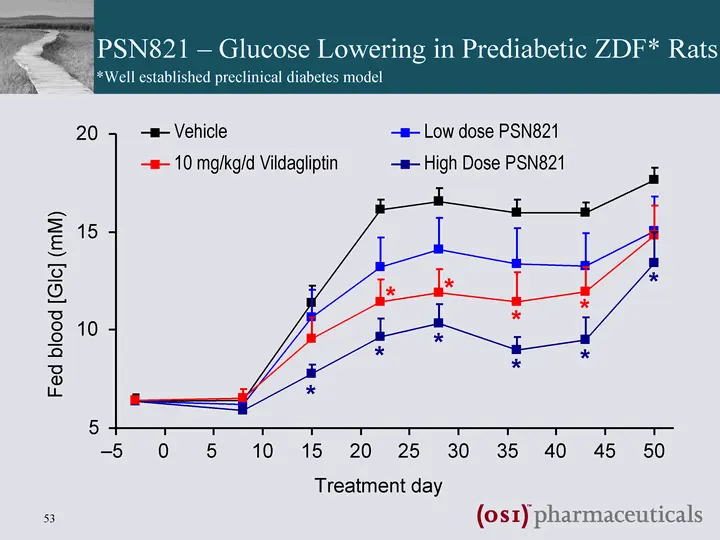
PSN821 - Glucose Lowering in Prediabetic ZDF* Rats 5 10 15 20 - -5 0 5 10 15 20 25 30 35 40 45 50 Treatment day Fed blood [Glc] (mM) Vehicle Low dose PSN821 High Dose PSN821 10 mg/kg/d Vildagliptin * * * * * * * * * * *Well established preclinical diabetes model
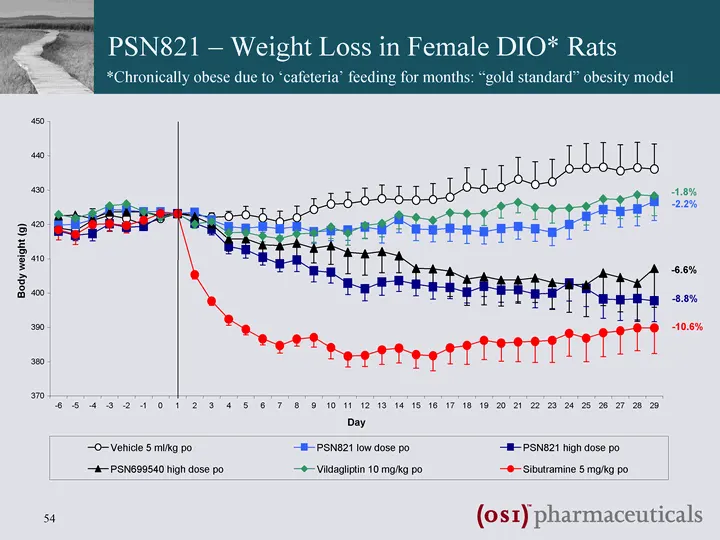
Slide 54: PSN821 - Weight Loss in Female DIO Rats
370 380 390 400 410 420 430 440 450 - -6 - -5 - -4 - -3 - -2 - -1 0 1 2 3 4 5 6 7 8 9 10 11 12 13 14 15 16 17 18 19 20 21 22 23 24 25 26 27 28 29 Day Body weight (g) Vehicle 5 ml/kg po PSN821 low dose po PSN821 high dose po PSN699540 high dose po Vildagliptin 10 mg/kg po Sibutramine 5 mg/kg po - -2.
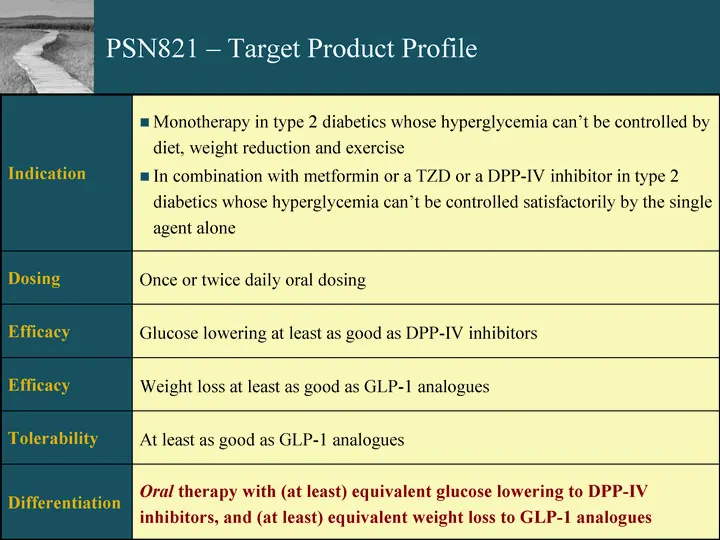
Slide 55: PSN821 - Target Product Profile
Indication Monotherapy in type 2 diabetics whose hyperglycemia can't be controlled by diet, weight reduction and exercise In combination with metformin or a TZD or a DPP-IV inhibitor in type 2 diabetics whose hyperglycemia can't be controlled satisfactorily by the single agent alone Dosing Once or t
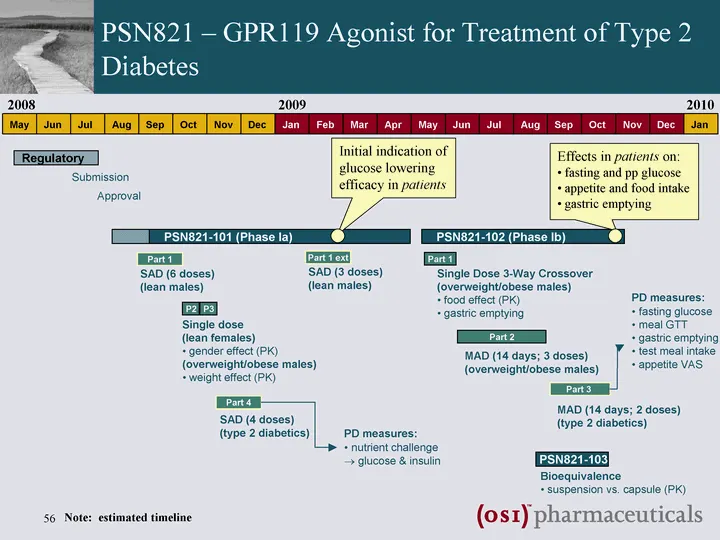
Slide 56: PSN821 - GPR119 Agonist for Treatment of Type 2 Diabetes
May Jun Jul Aug Sep Oct Nov Dec Jan Feb Mar Apr May Jun Jul Aug Sep Oct Nov Dec Jan 2008 2010 Approval PSN821-101 (Phase Ia) PSN821-102 (Phase Ib) 2009 Part 1 SAD (6 doses) (lean males) PD measures: nutrient challenge ? glucose & insulin P3 (overweight/obese males) weight effect (PK) Part 1 ext SAD
Slide 57: PSN602
(os1) pharmaceuticals PSN602 re(new)
Slide 58: Diabetes and Obesity Clinical Pipeline - PSN602
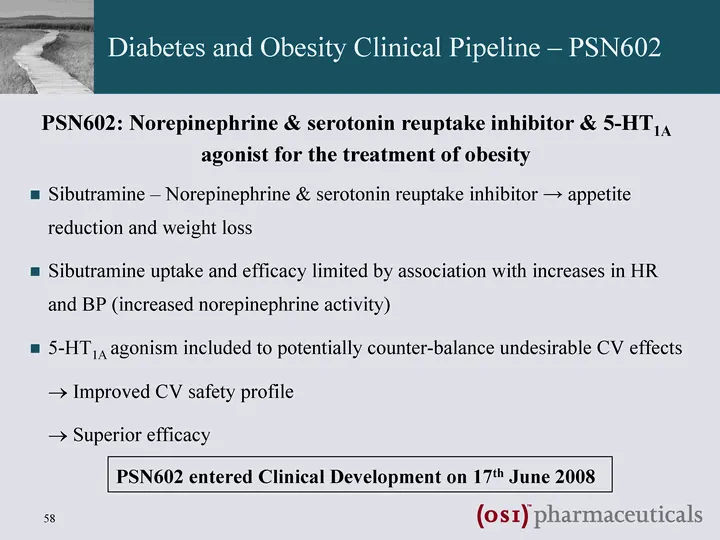
Diabetes and Obesity Clinical Pipeline - PSN602 Sibutramine - Norepinephrine & serotonin reuptake inhibitor ^ appetite reduction and weight loss Sibutramine uptake and efficacy limited by association with increases in HR and BP (increased norepinephrine activity) 5-HT1A agonism included to potential
Slide 59: Sibutramine - Phase II Study
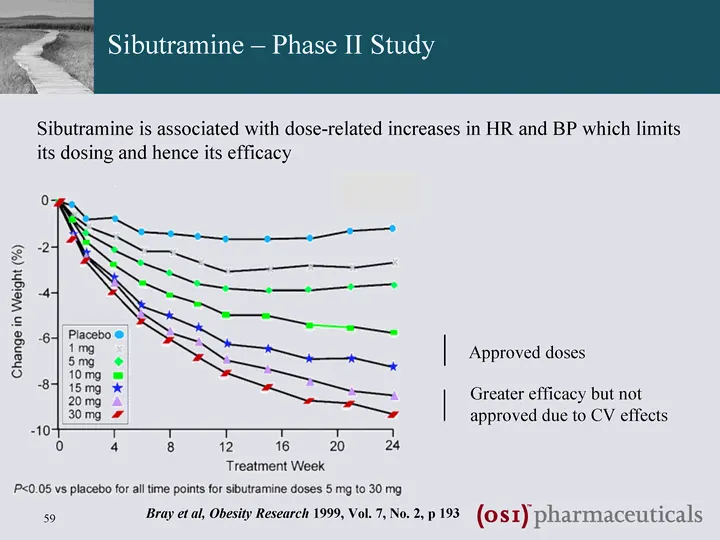
Sibutramine - Phase II Study Approved doses Greater efficacy but not approved due to CV effects Bray et al, Obesity Research 1999, Vol. 7, No. 2, p 193 Sibutramine is associated with dose-related increases in HR and BP which limits its dosing and hence its efficacy
Slide 60: PSN602 - Efficacy in Female DIO Rats
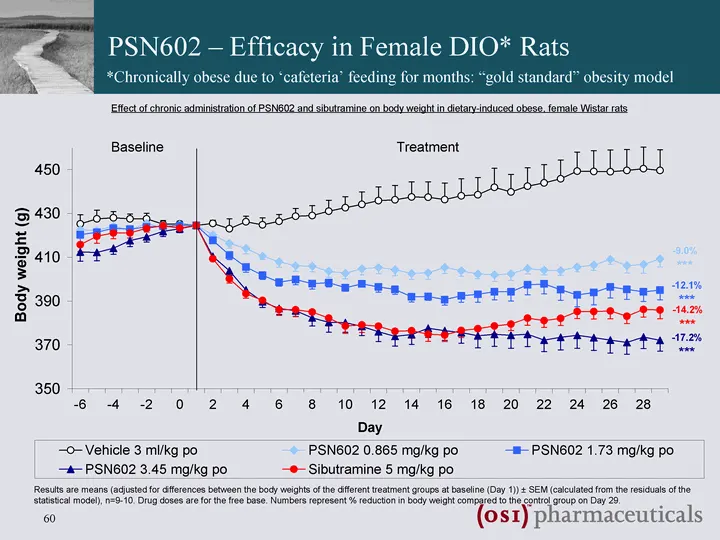
PSN602 - Efficacy in Female DIO* Rats *Chronically obese due to 'cafeteria' feeding for months: "gold standard" obesity model
Slide 61: PSN602 - Sibutramine CV Effects Not Seen in Rat Telemetry
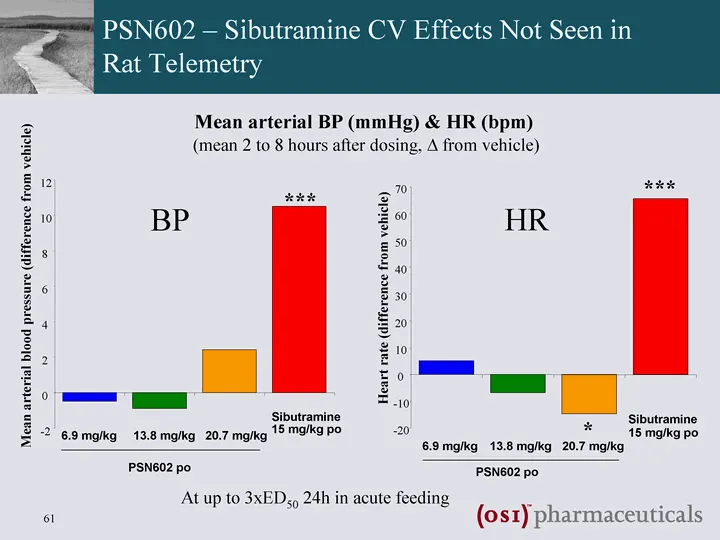
At up to 3xED50 24h in acute feeding - -2 0 2 4 6 8 10 12 6.9 mg/kg 13.8 mg/kg PSN602 po 20.7 mg/kg Sibutramine 15 mg/kg po Mean arterial blood pressure (difference from vehicle) *** BP - -20 - -10 0 10 20 30 40 50 60 70 6.9 mg/kg 13.8 mg/kg 20.7 mg/kg Sibutramine 15 mg/kg po Heart rate (difference
Slide 62: PSN602 - Target Product Profile
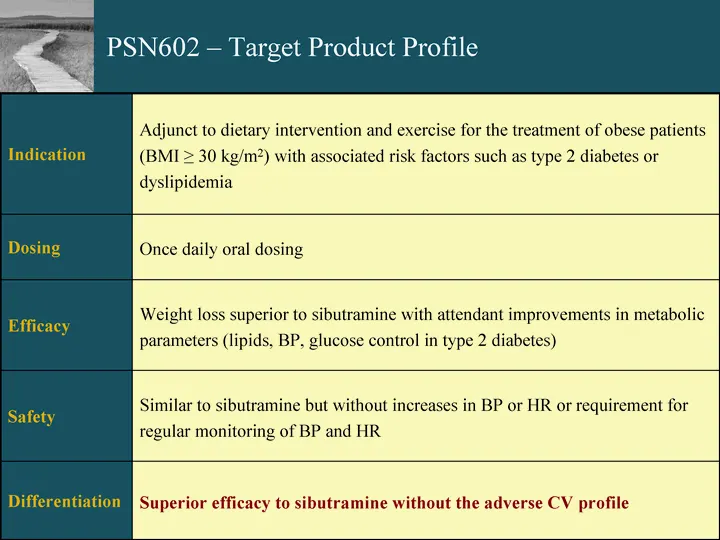
PSN602 - Target Product Profile Indication Adjunct to dietary intervention and exercise for the treatment of obese patients (BMI ^ 30 kg/m2) with associated risk factors such as type 2 diabetes or dyslipidemia Dosing Once daily oral dosing Efficacy Weight loss superior to sibutramine with attendant
Slide 63: PSN602 Clinical Development Timeline
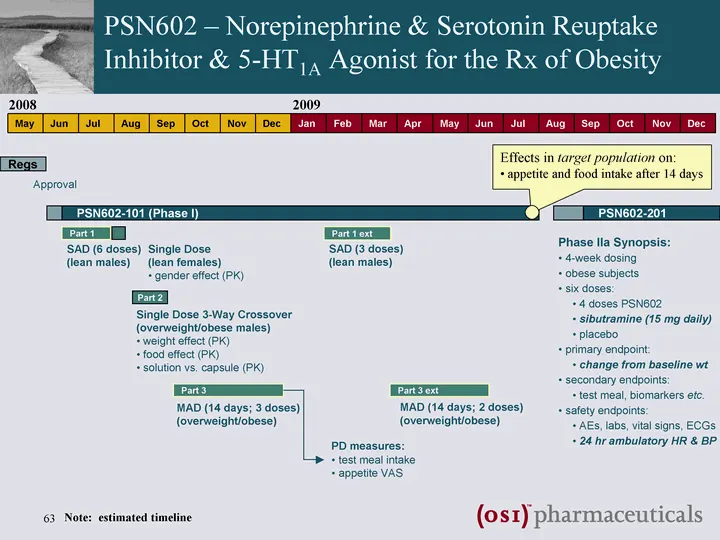
May Jun Jul Aug Sep Oct Nov Dec Jan Feb Mar Apr May Jun Jul Aug Sep Oct Nov Dec 2008 2009 Regs Approval PSN602-101 (Phase I) Phase IIa Synopsis: 4-week dosing obese subjects six doses: 4 doses PSN602 sibutramine (15 mg daily) placebo primary endpoint: change from baseline wt secondary endpoints: tes
Slide 64: PSN821 and PSN602 - Summary
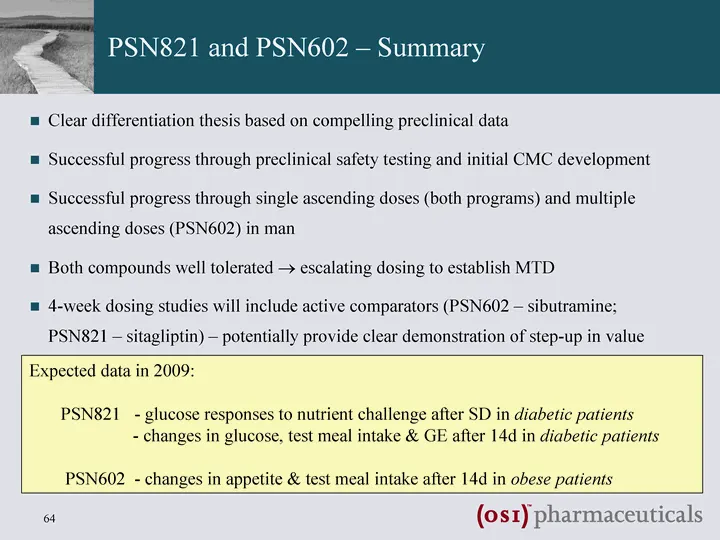
PSN821 and PSN602 - Summary Clear differentiation thesis based on compelling preclinical data Successful progress through preclinical safety testing and initial CMC development Successful progress through single ascending doses (both programs) and multiple ascending doses (PSN602) in man Both compou

Slide 65: Diabetes/Obesity Q&A
(os1) pharmaceuticals Diabetes/Obesity Q&A in(sight)
Slide 66: Epithelial-Mesenchymal Transition Platform
Epithelial-Mesenchymal Transition Platform David Epstein, Ph.D. Senior Vice President, Oncology
Slide 67: Outline
Outline Discovery & Translational Research Summary EMT Platform Update Proprietary technology for Discovery and Translational Research New development compound OSI-296 a Proprietary EMT-Targeted Agent OSI-AVEO Collaboration Update Translational Research Highlights
Slide 68: Monitoring EMT Research Outside OSI
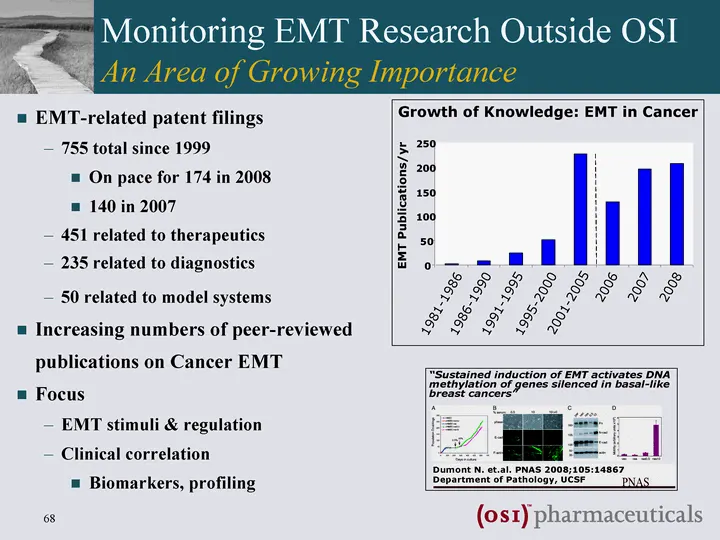
Monitoring EMT Research Outside OSI An Area of Growing Importance EMT-related patent filings 755 total since 1999 On pace for 174 in 2008 140 in 2007 451 related to therapeutics 235 related to diagnostics 50 related to model systems Increasing numbers of peer-reviewed publications on Cancer EMT Focu
Slide 69: Clinical Correlates of Disease to EMT Status
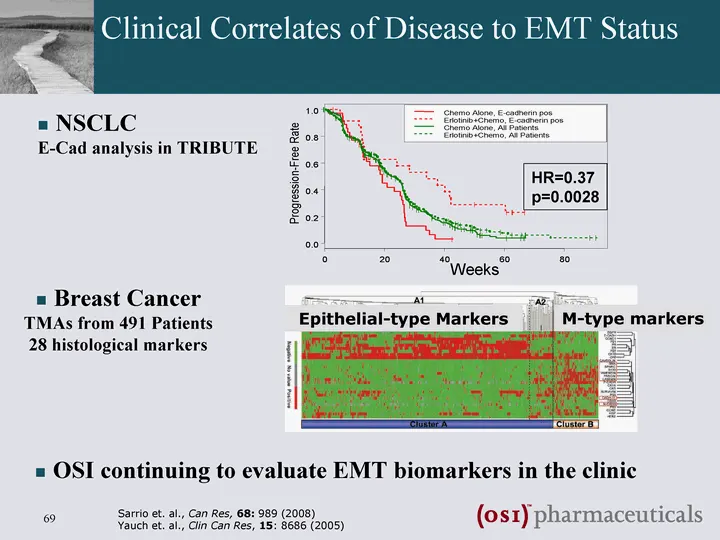
Clinical Correlates of Disease to EMT Status Sarrio et. al., Can Res, 68: 989 (2008) Yauch et. al., Clin Can Res, 15: 8686 (2005) Epithelial-type Markers M-type markers NSCLC E-Cad analysis in TRIBUTE Breast Cancer TMAs from 491 Patients 28 histological markers HR=0.37 p=0.0028 Weeks OSI continuing
Slide 70: The Story
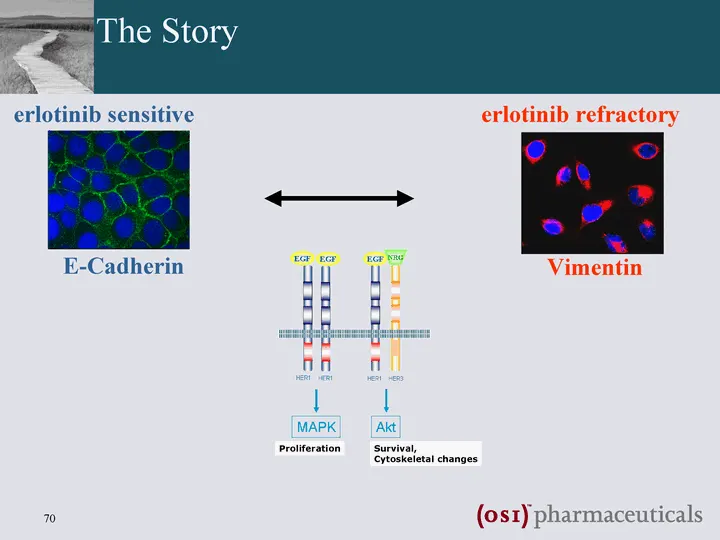
The Story E-Cadherin erlotinib sensitive Vimentin erlotinib refractory
Slide 71: EMT-Status Influences Sensitivity of TKIs
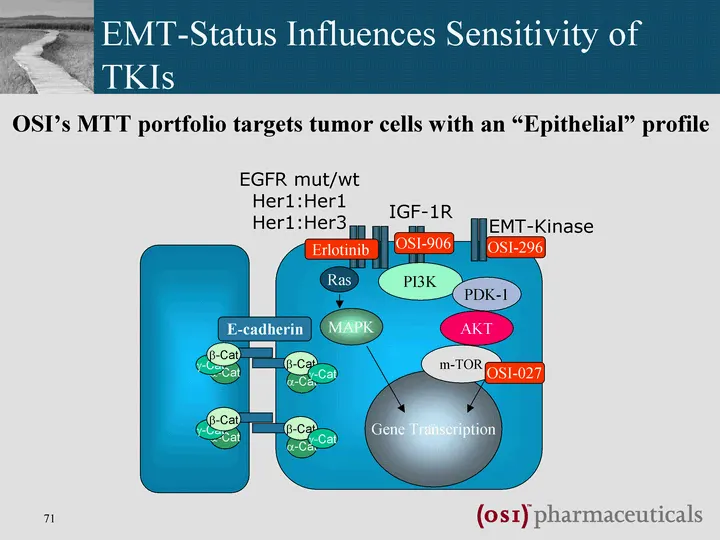
OSI's MTT portfolio targets tumor cells with an "Epithelial" profile Gene Transcription AKT MAPK EGFR mut/wt Her1:Her1 Her1:Her3 IGF-1R PI3K Ras a-Cat b-Cat g-Cat a-Cat g-Cat b-Cat E-cadherin a-Cat b-Cat g-Cat a-Cat g-Cat b-Cat PDK-1 m-TOR OSI-906 EMT-Status Influences Sensitivity of TKIs OSI-296 Er
Slide 72: Compensatory Signaling in E & M Cells
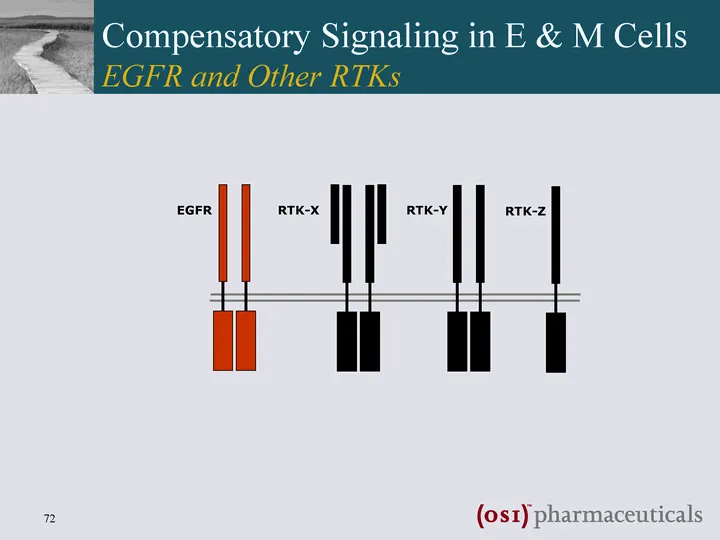
EGFR RTK-X RTK-Y RTK-Z Compensatory Signaling in E & M Cells EGFR and Other RTKs
Slide 73: Compensatory Signaling in E & M Cells
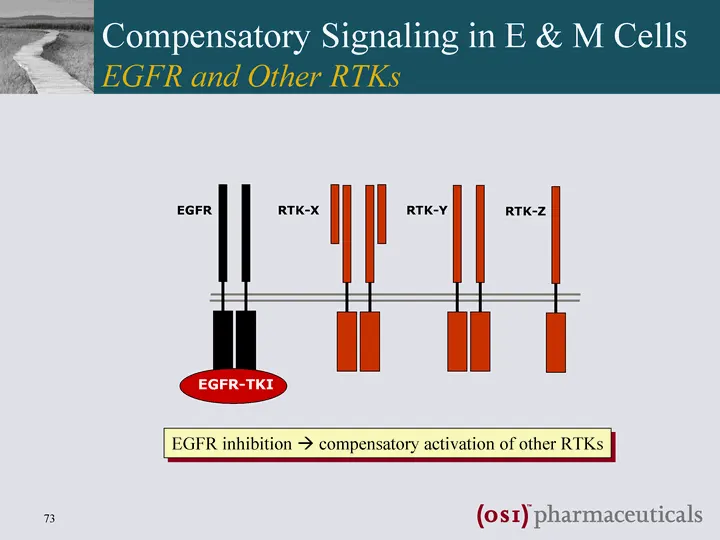
EGFR RTK-X RTK-Y RTK-Z EGFR-TKI EGFR inhibition ? compensatory activation of other RTKs Compensatory Signaling in E & M Cells EGFR and Other RTKs
Slide 74: EMT-Status Influences Sensitivity of TKIs
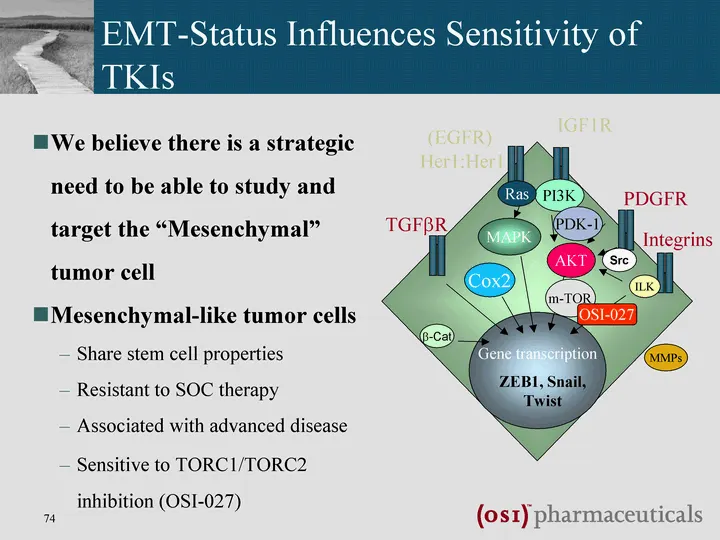
(EGFR) Her1:Her1 AKT MAPK IGF1R PI3K Ras ZEB1, Snail, Twist Integrins Cox2 PDGFR TGFbR Gene transcription ILK b-Cat MMPs PDK-1 m-TOR Src OSI-027 EMT-Status Influences Sensitivity of TKIs We believe there is a strategic need to be able to study and target the "Mesenchymal" tumor cell Mesenchymal-like
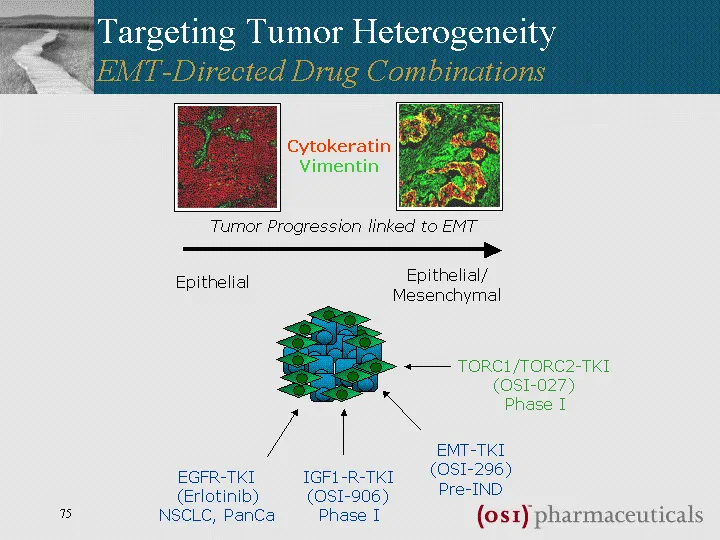
Slide 75: Targeting Tumor Heterogeneity: EMT-Directed Drug Combinations
EGFR-TKI (Erlotinib) NSCLC, PanCa IGF1-R-TKI (OSI-906) Phase I TORC1/TORC2-TKI (OSI-027) Phase I Epithelial Epithelial/ Mesenchymal Tumor Progression linked to EMT Cytokeratin Vimentin Targeting Tumor Heterogeneity EMT-Directed Drug Combinations cMET-TKI (OSI-296) Pre-IND
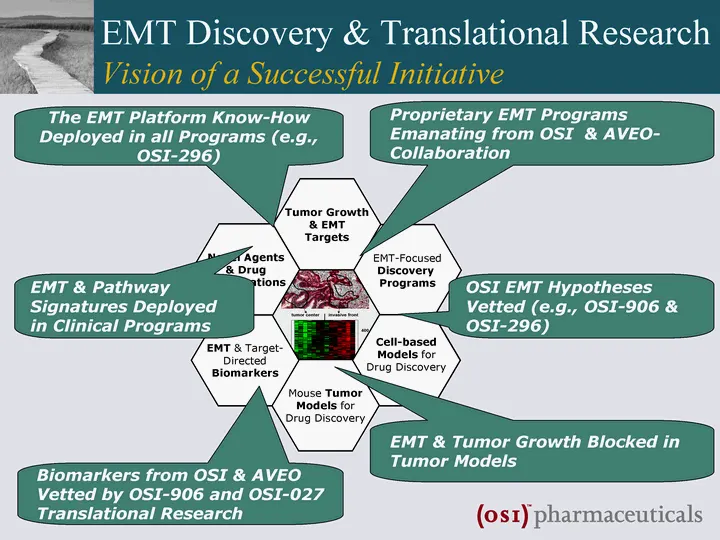
Slide 76: EMT Discovery & Translational Research Vision
EMT Discovery & Translational Research Vision of a Successful Initiative Proprietary EMT Programs Emanating from OSI & AVEO- Collaboration OSI EMT Hypotheses Vetted (e.g., OSI-906 & OSI-296) The EMT Platform Know-How Deployed in all Programs (e.g., OSI-296) EMT & Tumor Growth Blocked in Tumor Models
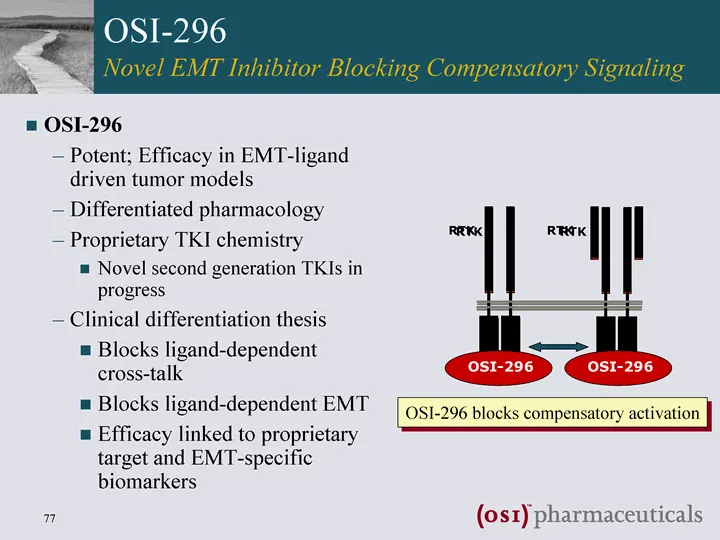
Slide 77: OSI-296 Novel EMT Inhibitor
OSI-296 Novel EMT Inhibitor Blocking Compensatory Signaling OSI-296 Potent; Efficacy in EMT-ligand driven tumor models Differentiated pharmacology Proprietary TKI chemistry Novel second generation TKIs in progress Clinical differentiation thesis Blocks ligand-dependent cross-talk Blocks ligand-depen
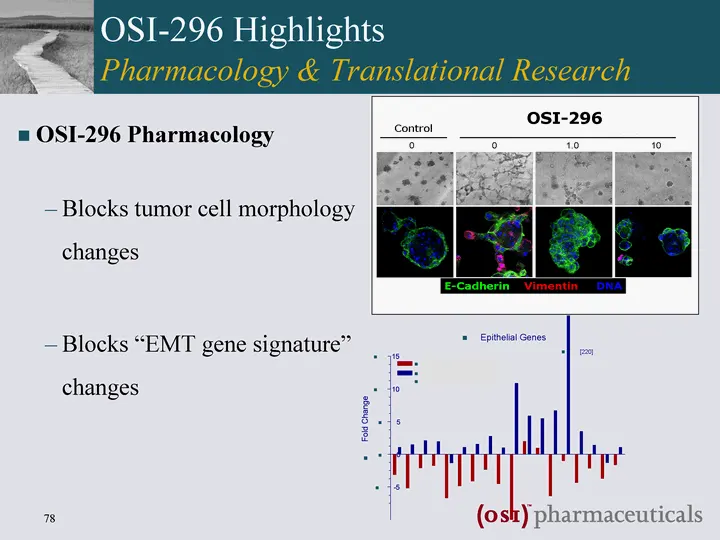
Slide 78: OSI-296 Pharmacology
OSI-296 Pharmacology Blocks tumor cell morphology changes Blocks "EMT gene signature" changes OSI-296 Highlights Pharmacology & Translational Research OSI-296
Slide 79: OSI-AVEO Collaboration Highlights
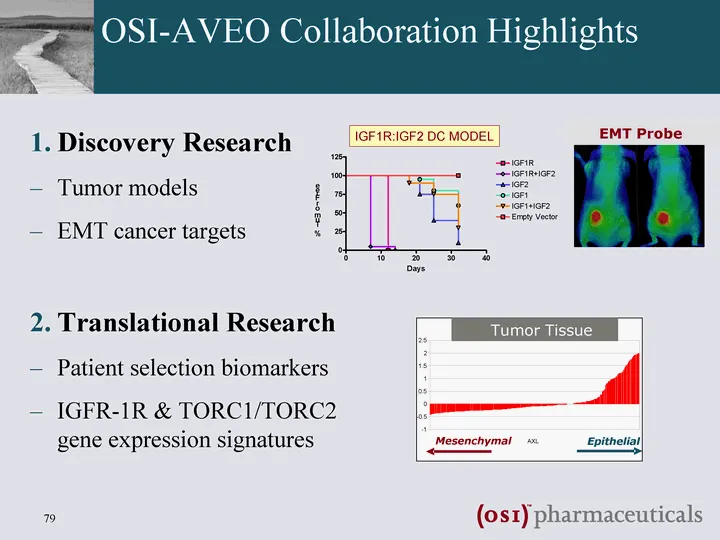
OSI-AVEO Collaboration Highlights Discovery Research Tumor models EMT cancer targets Translational Research Patient selection biomarkers IGFR-1R & TORC1/TORC2 gene expression signatures Mesenchymal Epithelial AVEO BH ARCHIVE AXL EMT INDEX - -1 - -0.5 0 0.5 1 1.5 2 2.5 Mesenchymal Epithelial Tumor Ti
Slide 80: OSI-AVEO Collaboration Highlights
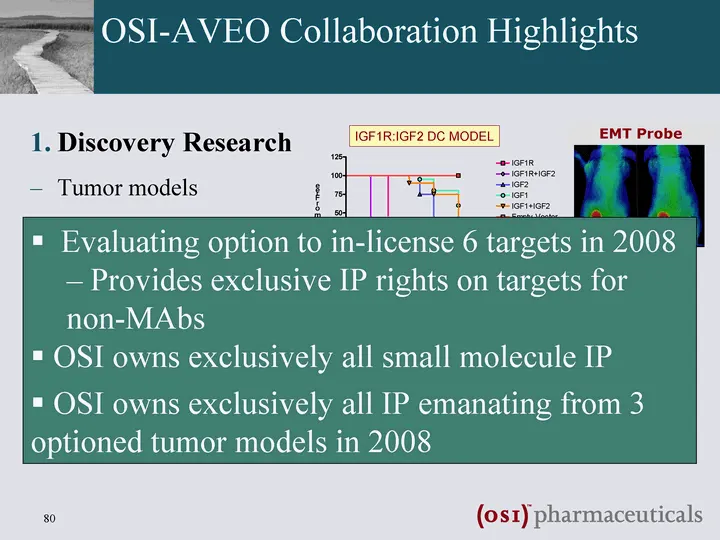
OSI-AVEO Collaboration Highlights Discovery Research Tumor models EMT cancer targets Translational Research Patient selection biomarkers IGFR-1R & TORC1/TORC2 gene expression signatures Mesenchymal Epithelial AVEO BH ARCHIVE AXL EMT INDEX - -1 - -0.5 0 0.5 1 1.5 2 2.5 Mesenchymal Epithelial Tumor Ti
Slide 81: Translational Research Highlights
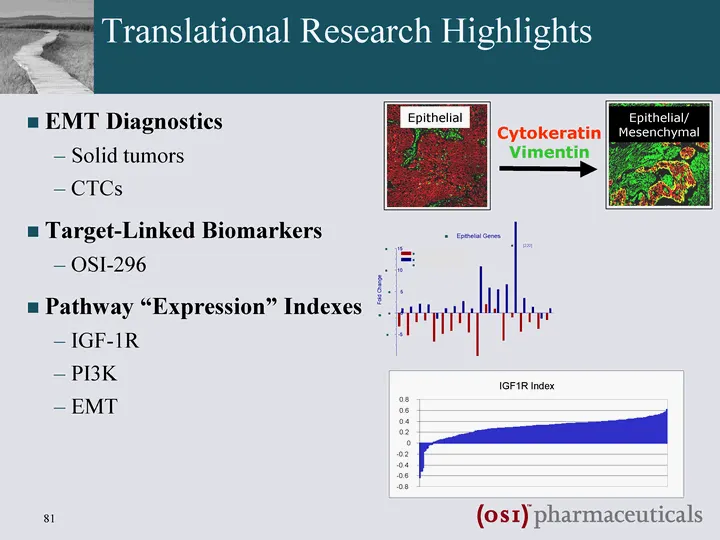
Translational Research Highlights EMT Diagnostics Solid tumors CTCs Target-Linked Biomarkers OSI-296 Pathway "Expression" Indexes IGF-1R PI3K EMT Cytokeratin Vimentin Epithelial Epithelial/ Mesenchymal
Slide 82: Translational Research Highlights
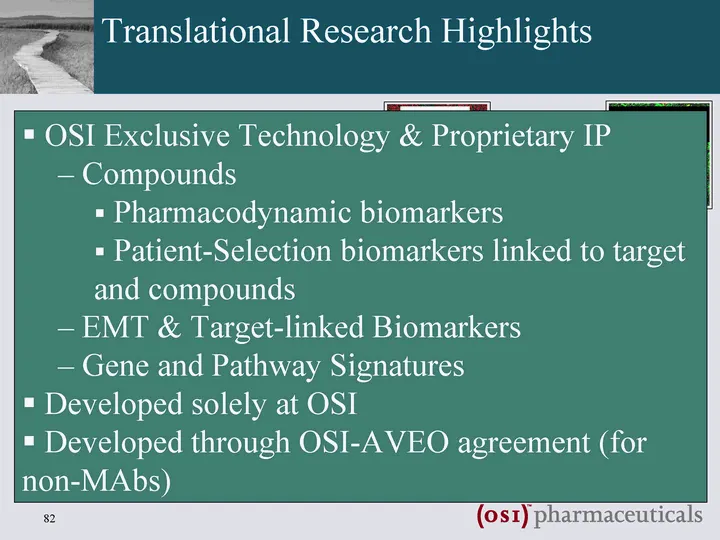
Translational Research Highlights EMT Diagnostics Solid tumors CTCs Target-Linked Biomarkers OSI-296 Pathway "Expression" Indexes IGF-1R PI3K EMT Cytokeratin Vimentin Epithelial Epithelial/ Mesenchymal OSI Exclusive Technology & Proprietary IP Compounds Pharmacodynamic biomarkers Patient-Selection b
Slide 83: Summary: The EMT R&D Initiative at OSI
Summary The EMT R & D Initiative at OSI EMT-status of tumors is a determinant of therapeutic response Erlotinib preclinical and clinical data OSI-906, OSI-027 & OSI-296 preclinical data E and M-tumor cells utilize alternate signaling pathways Blockade of signaling in E and M-tumor cells ? compensato
Slide 84: Translational Research
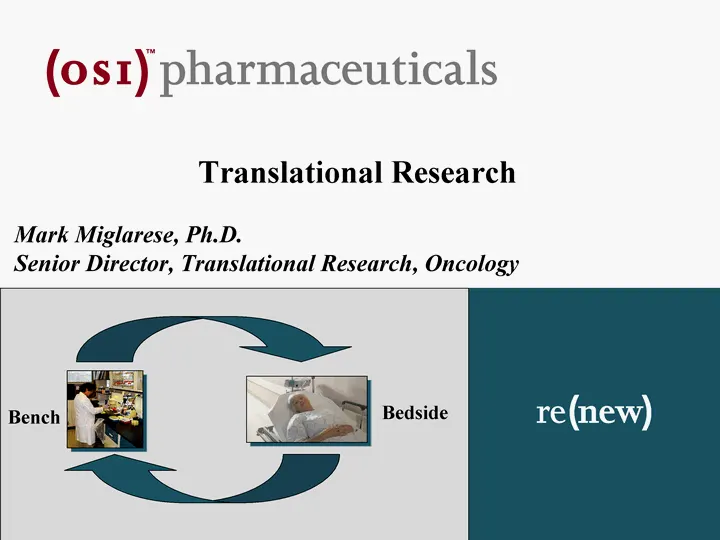
Translational Research Mark Miglarese, Ph.D. Senior Director, Translational Research, Oncology Bench Bedside
Slide 85: Our Vision and Key Themes
Our Vision and Key Themes Compensatory signaling and TKI pharmacology in the context of EMT Pathway- and ligand-based predictive biomarkers to provide maximum benefit to our patients Translational Research as a driver of our near-term clinical plans for OSI-906 Combination with Tarceva(r) for NSCLC
Slide 86: Translational Research at OSI
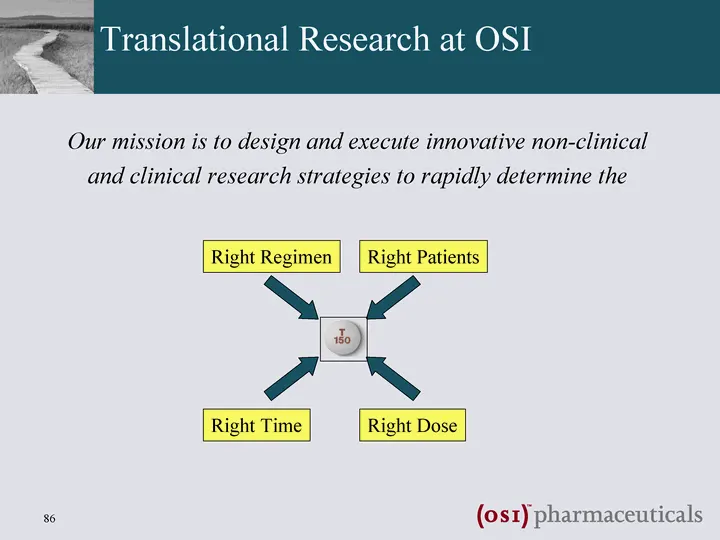
Translational Research at OSI Our mission is to design and execute innovative non-clinical and clinical research strategies to rapidly determine the Right Regimen Right Dose Right Patients Right Time
Slide 87: OSI Translational Research: Confronting TKI Resistance
OSI Translational Research Confronting TKI Resistance Epithelial-Mesenchymal Transition Transcriptional reprogramming Alternate RTK Activation Decreased ErbB3 activity Compensatory activation of RTKs IGF-1R, IR, EGFR, MET, others? Acute signaling feedback mechanisms Genetic/epigenetic adaptation Gen
Slide 88: Our Thesis: Differentiation via EMT
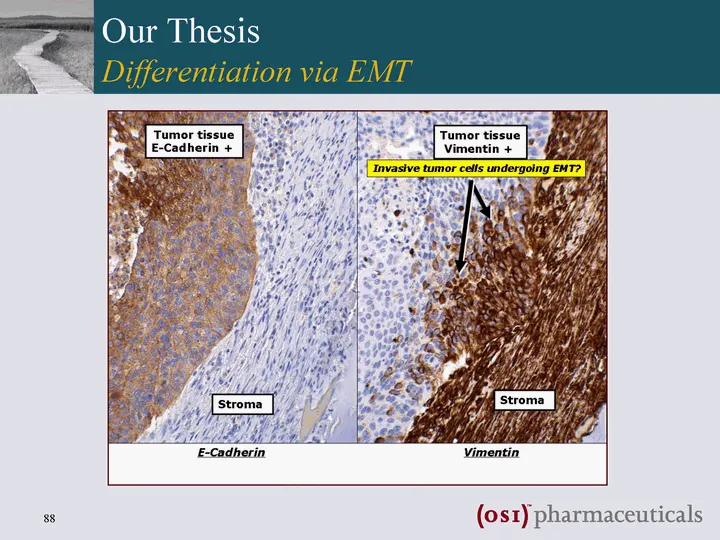
Our Thesis Differentiation via EMT
Slide 89: Sensitivity to IGF-1R Inhibition in NSCLC Is Linked to EMT Status
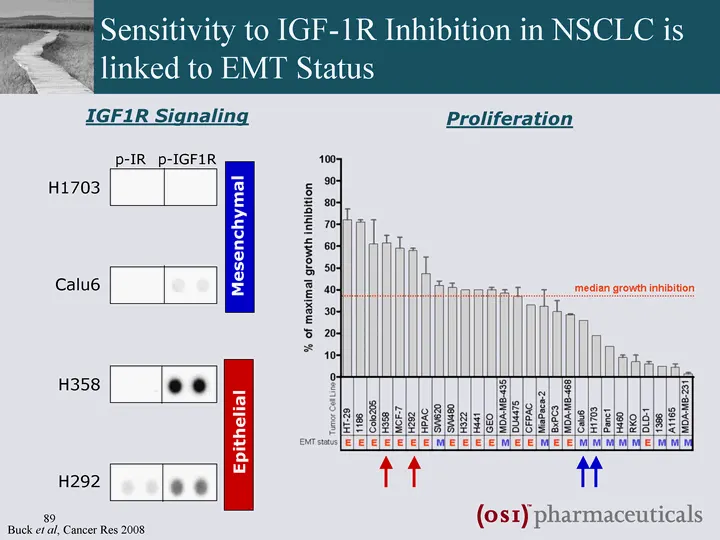
Sensitivity to IGF-1R Inhibition in NSCLC is linked to EMT Status IGF1R Signaling p-IR p-IGF1R H1703 Calu6 H358 H292 Epithelial Mesenchymal Proliferation Buck et al, Cancer Res 2008
Slide 90: EMT and Sensitivity to Combined Inhibition of EGFR and IGF-1R
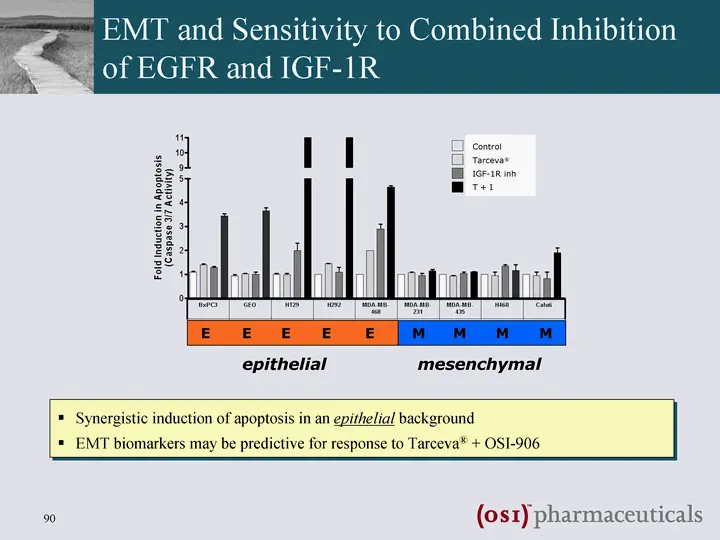
EMT and Sensitivity to Combined Inhibition of EGFR and IGF-1R Synergistic induction of apoptosis in an epithelial background EMT biomarkers may be predictive for response to Tarceva(r) + OSI-906 epithelial mesenchymal
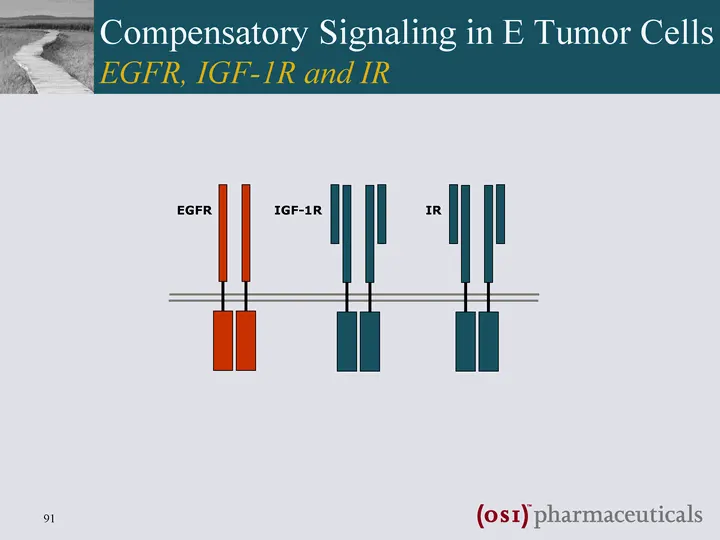
Slide 91: Compensatory Signaling in E Tumor Cells
Compensatory Signaling in E Tumor Cells EGFR, IGF-1R and IR EGFR IGF-1R IR
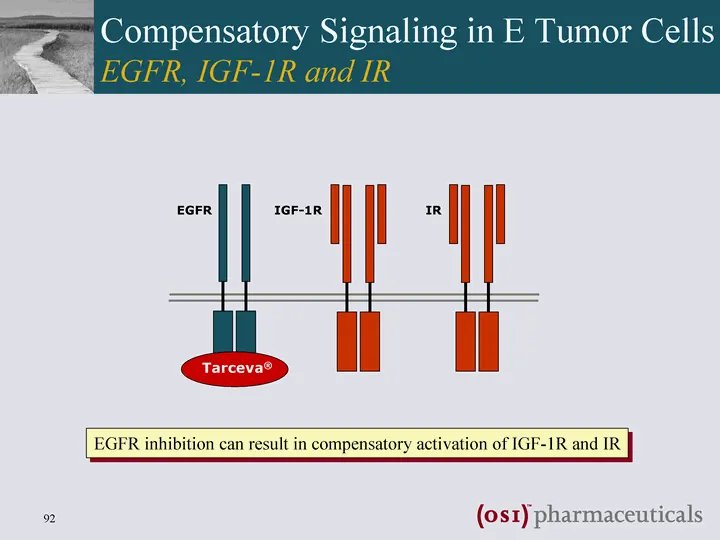
Slide 92: Compensatory Signaling in E Tumor Cells
EGFR IGF-1R IR Tarceva(r) EGFR inhibition can result in compensatory activation of IGF-1R and IR Compensatory Signaling in E Tumor Cells EGFR, IGF-1R and IR
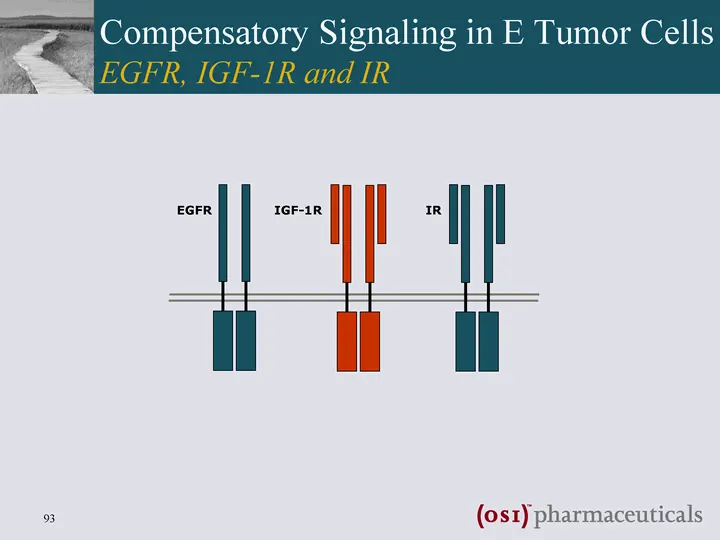
Slide 93: Compensatory Signaling in E Tumor Cells
Compensatory Signaling in E Tumor Cells EGFR, IGF-1R and IR EGFR IGF-1R IR
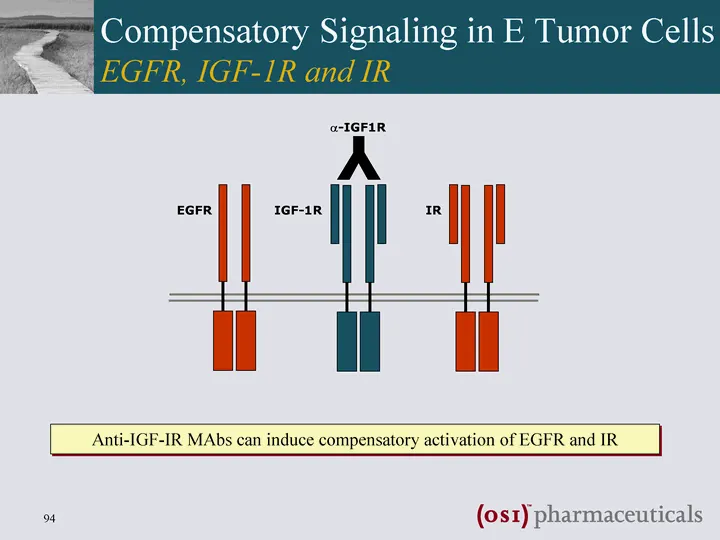
Slide 94: Compensatory Signaling in E Tumor Cells
EGFR IGF-1R IR Y a-IGF1R Anti-IGF-IR MAbs can induce compensatory activation of EGFR and IR Compensatory Signaling in E Tumor Cells EGFR, IGF-1R and IR
Slide 95: Compensatory Signaling in E Tumor Cells
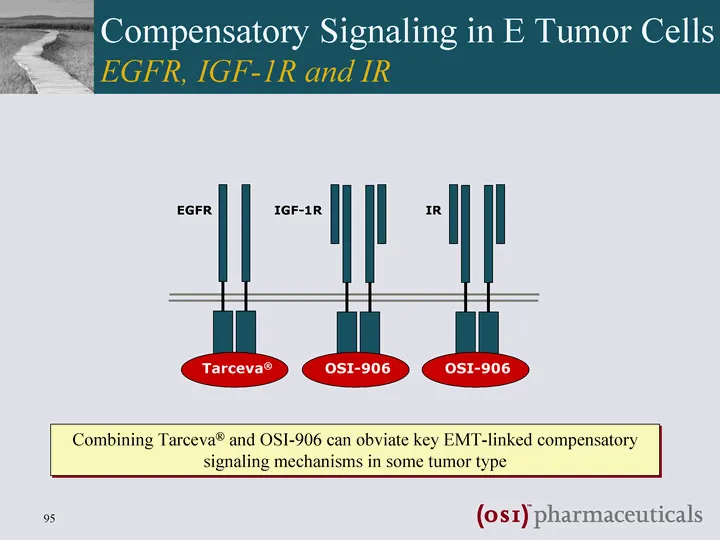
EGFR IGF-1R IR Tarceva(r) OSI-906 OSI-906 Combining Tarceva(r) and OSI-906 can obviate key EMT-linked compensatory signaling mechanisms in some tumor type Compensatory Signaling in E Tumor Cells EGFR, IGF-1R and IR
Slide 96: Scientific Rationale for OSI-906 + Tarceva
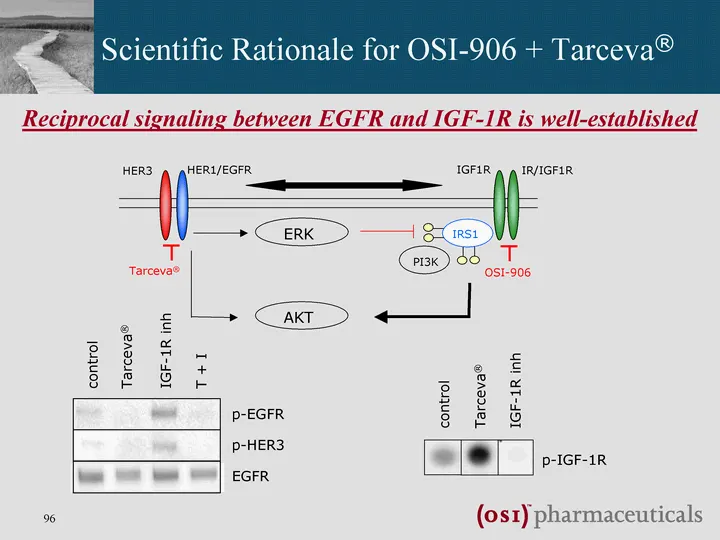
Scientific Rationale for OSI-906 + Tarceva(r) Reciprocal signaling between EGFR and IGF-1R is well-established HER3 HER1/EGFR ERK IGF1R IRS1 PI3K OSI-906 AKT Tarceva(r) IR/IGF1R control Tarceva(r) IGF-1R inh p-IGF-1R control Tarceva(r) IGF-1R inh T + I p-EGFR EGFR p-HER3
Slide 97: Differentiation from MAbs
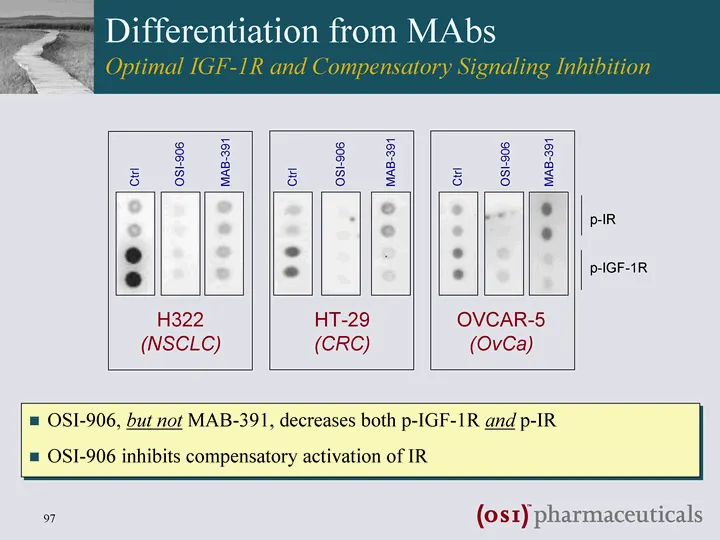
Differentiation from MAbs Optimal IGF-1R and Compensatory Signaling Inhibition OSI-906 MAB-391 Ctrl H322 (NSCLC) HT-29 (CRC) OVCAR-5 (OvCa) OSI-906 MAB-391 Ctrl OSI-906 MAB-391 Ctrl p-IR p-IGF-1R OSI-906, but not MAB-391, decreases both p-IGF-1R and p-IR OSI-906 inhibits compensatory activation of I
Slide 98: OSI-906 + Paclitaxel for OvCa
IGF-1R expression occurs in up to 80-100% of OvCa Over-expression of IGF-2 is a poor prognostic indicator in OvCa IGF-1R activates the AKT pathway and is a driver of growth and survival in many cancer types Paclitaxel induces AKT signaling in many human tumor cell lines OSI-906 can suppress paclitax
Slide 99: IGF-2 in Adrenocortical Carcinomas (ACC)
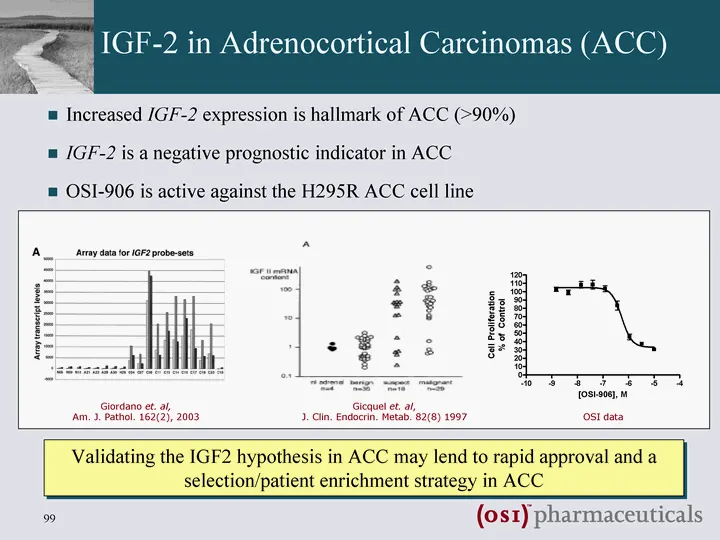
IGF-2 in Adrenocortical Carcinomas (ACC) Increased IGF-2 expression is hallmark of ACC (>90%) IGF-2 is a negative prognostic indicator in ACC OSI-906 is active against the H295R ACC cell line Validating the IGF2 hypothesis in ACC may lend to rapid approval and a selection/patient enrichment strategy
Slide 100: Translational Research Biomarker Activities for OSI-906
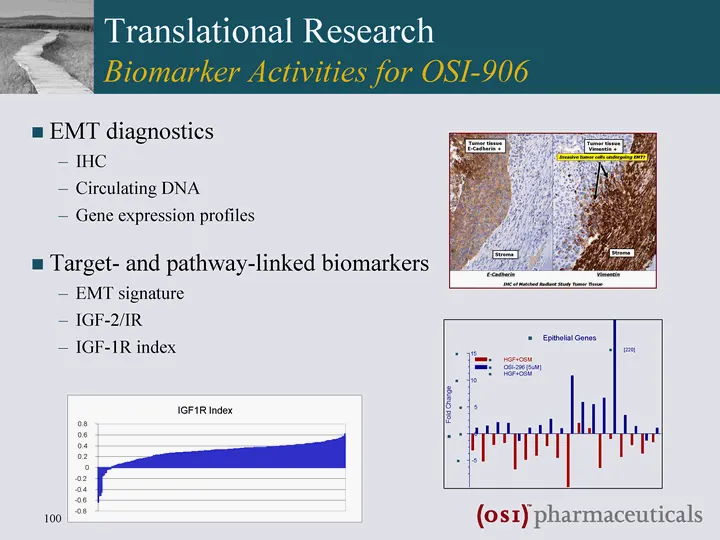
Translational Research Biomarker Activities for OSI-906 EMT diagnostics IHC Circulating DNA Gene expression profiles Target- and pathway-linked biomarkers EMT signature IGF-2/IR IGF-1R index
Slide 101: Oncology Portfolio: R&D Strategy and Update on Pipeline
Oncology Portfolio: R&D Strategy and Update on Pipeline Karsten Witt, M.D. Vice President, Clinical Development, Oncology
Slide 102: Agenda
Agenda OSI-906 (IGF-1R Inhibitor) Program Status Clinical Development Initiatives OSI-027 (TORC1/TORC2 Inhibitor) Program Status Clinical Development Initiatives
Slide 103: OSI-906 Phase I Program
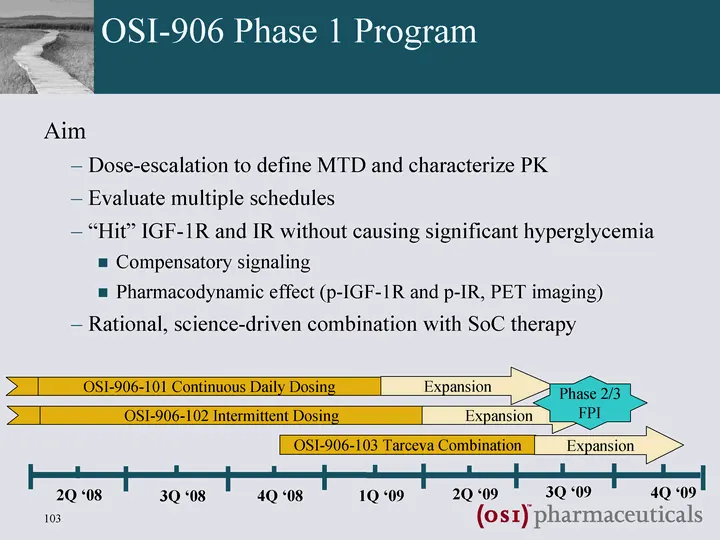
OSI-906 Phase 1 Program Aim Dose-escalation to define MTD and characterize PK Evaluate multiple schedules "Hit" IGF-1R and IR without causing significant hyperglycemia Compensatory signaling Pharmacodynamic effect (p-IGF-1R and p-IR, PET imaging) Rational, science-driven combination with SoC therapy
Slide 104: OSI-906 Phase I Program: Study OSI-906-101
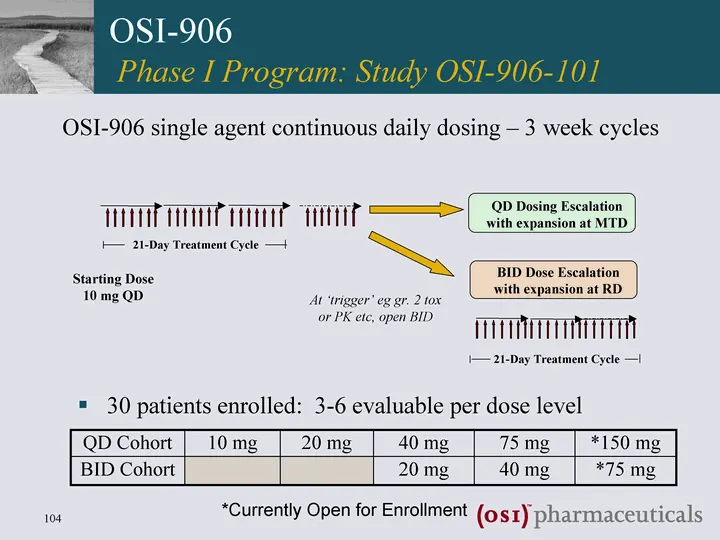
30 patients enrolled: 3-6 evaluable per dose level OSI-906 single agent continuous daily dosing - 3 week cycles OSI-906 Phase I Program: Study OSI-906-101 QD Cohort 10 mg 20 mg 40 mg 75 mg *150 mg BID Cohort 20 mg 40 mg *75 mg *Currently Open for Enrollment BID Dose Escalation with expansion at RD A
Slide 105: OSI-906-101 Pharmacokinetics
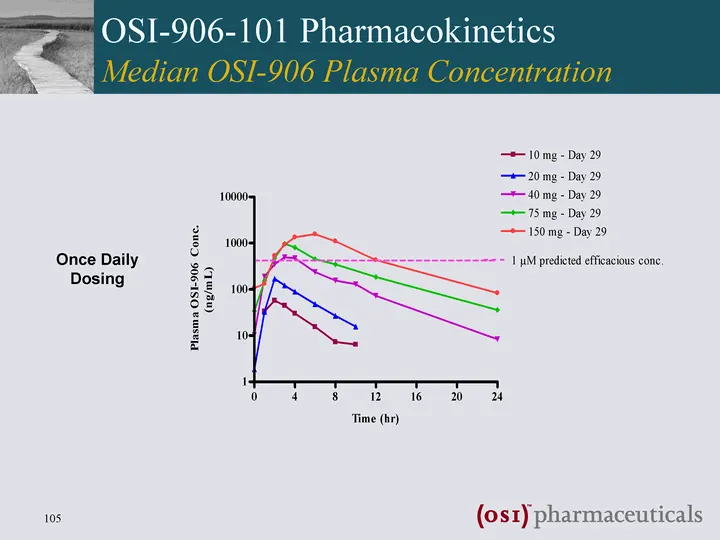
OSI-906-101 Pharmacokinetics Median OSI-906 Plasma Concentration Once Daily Dosing
Slide 106: OSI-906-101: Preliminary Efficacy and Safety
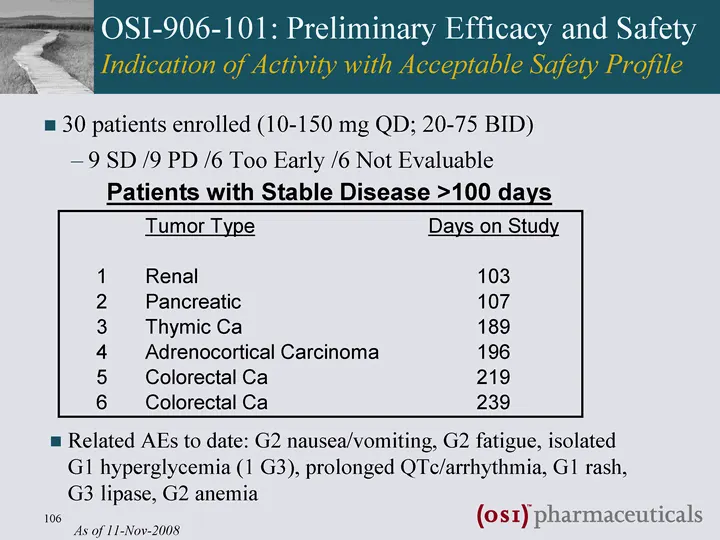
OSI-906-101: Preliminary Efficacy and Safety Indication of Activity with Acceptable Safety Profile 30 patients enrolled (10-150 mg QD; 20-75 BID) 9 SD /9 PD /6 Too Early /6 Not Evaluable Patients with Stable Disease >100 days As of 11-Nov-2008 Related AEs to date: G2 nausea/vomiting, G2 fatigue, iso
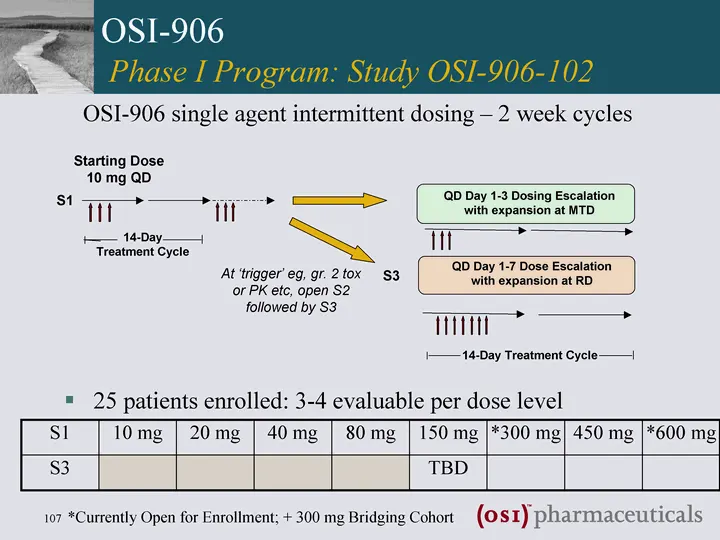
Slide 107: OSI-906 Phase I Program: Study OSI-906-102
25 patients enrolled: 3-4 evaluable per dose level OSI-906 single agent intermittent dosing - 2 week cycles OSI-906 Phase I Program: Study OSI-906-102 At 'trigger' eg, gr. 2 tox or PK etc, open S2 followed by S3 QD Day 1-3 Dosing Escalation with expansion at MTD Starting Dose 10 mg QD 14-Day Treatme
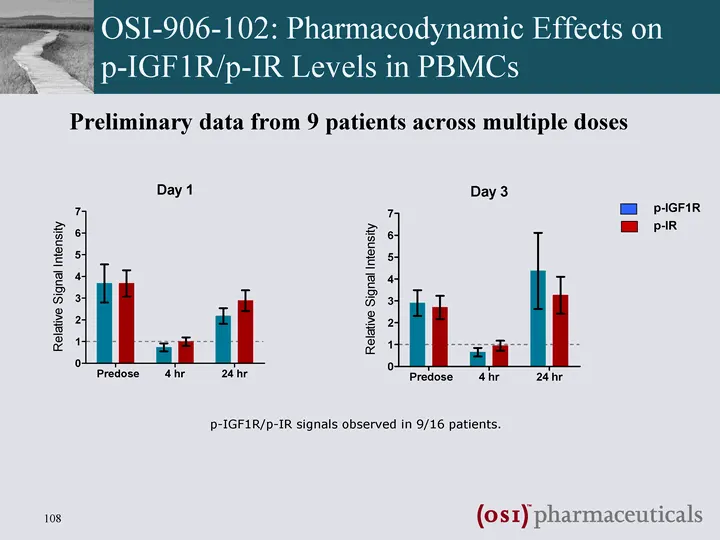
Slide 108: OSI-906-102: Pharmacodynamic Effects on p-IGF1R/p-IR Levels
OSI-906-102: Pharmacodynamic Effects on p-IGF1R/p-IR Levels in PBMCs p-IGF1R/p-IR signals observed in 9/16 patients. Preliminary data from 9 patients across multiple doses p-IGF1R p-IR
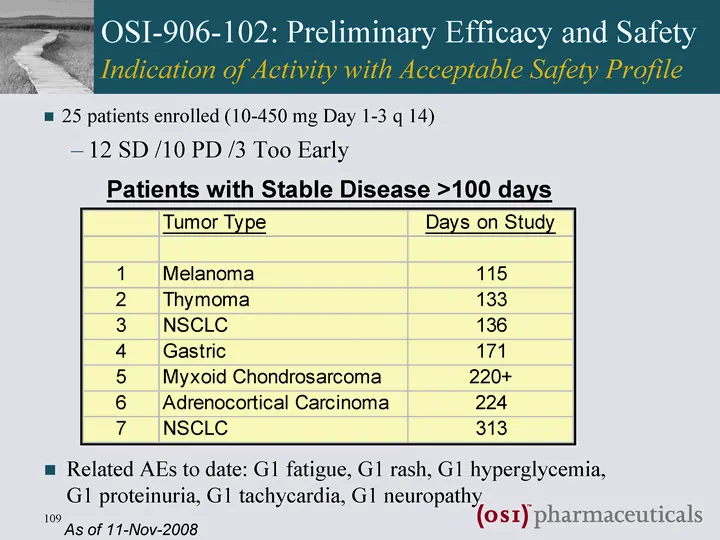
Slide 109: OSI-906-102: Preliminary Efficacy and Safety
OSI-906-102: Preliminary Efficacy and Safety Indication of Activity with Acceptable Safety Profile 25 patients enrolled (10-450 mg Day 1-3 q 14) 12 SD /10 PD /3 Too Early Patients with Stable Disease >100 days As of 11-Nov-2008 Related AEs to date: G1 fatigue, G1 rash, G1 hyperglycemia, G1 proteinur
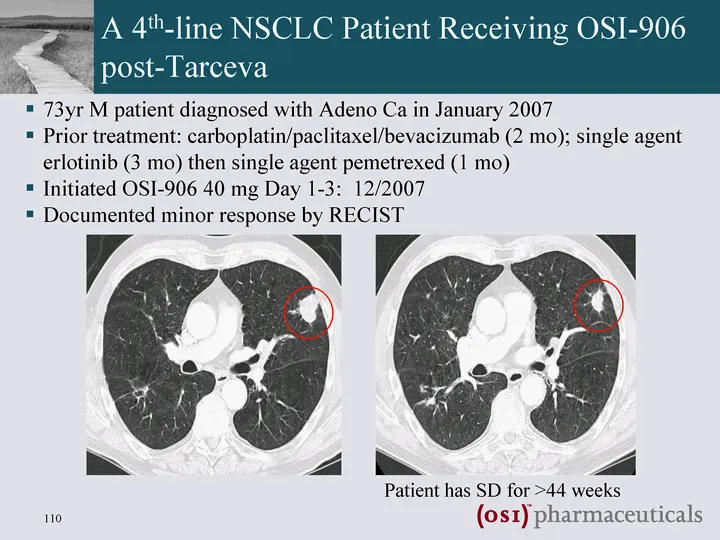
Slide 110: A 4th-line NSCLC Patient Receiving OSI-906 post-Tarceva
A 4th-line NSCLC Patient Receiving OSI-906 post-Tarceva 73yr M patient diagnosed with Adeno Ca in January 2007 Prior treatment: carboplatin/paclitaxel/bevacizumab (2 mo); single agent erlotinib (3 mo) then single agent pemetrexed (1 mo) Initiated OSI-906 40 mg Day 1-3: 12/2007 Documented minor respo
Slide 111: Plasma Concentrations vs. Glucose & Insulin
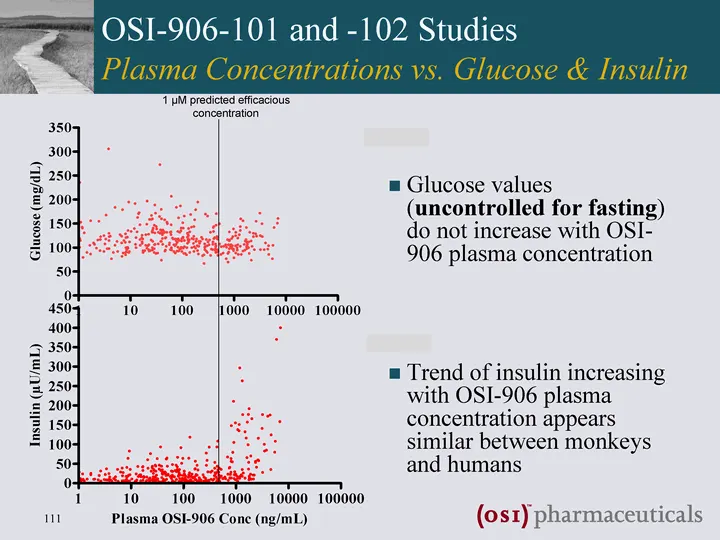
OSI-906-101 and -102 Studies Plasma Concentrations vs. Glucose & Insulin Glucose values (uncontrolled for fasting) do not increase with OSI- 906 plasma concentration Trend of insulin increasing with OSI-906 plasma concentration appears similar between monkeys and humans 1 µM predicted efficacious co
Slide 112: Plasma Concentrations vs. Glucose & Insulin
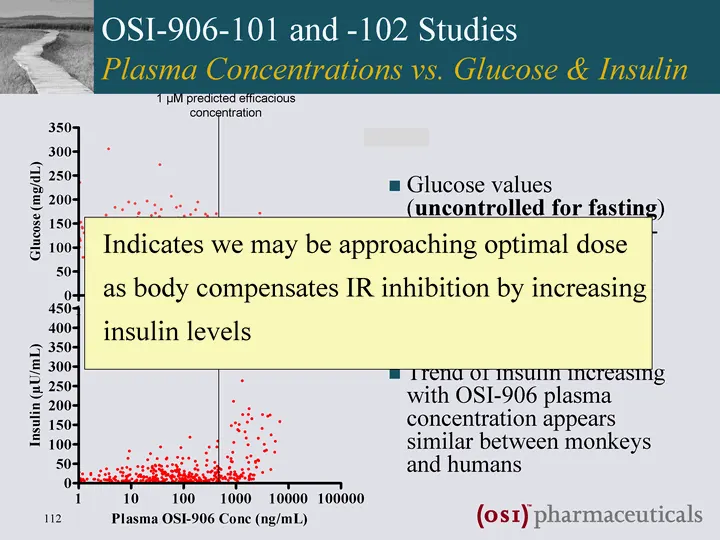
OSI-906-101 and -102 Studies Plasma Concentrations vs. Glucose & Insulin Glucose values (uncontrolled for fasting) do not correlate with OSI- 906 plasma concentration Trend of insulin increasing with OSI-906 plasma concentration appears similar between monkeys and humans 1 µM predicted efficacious c
Slide 113: OSI-906-103: Phase I OSI-906 + Tarceva Combination Study
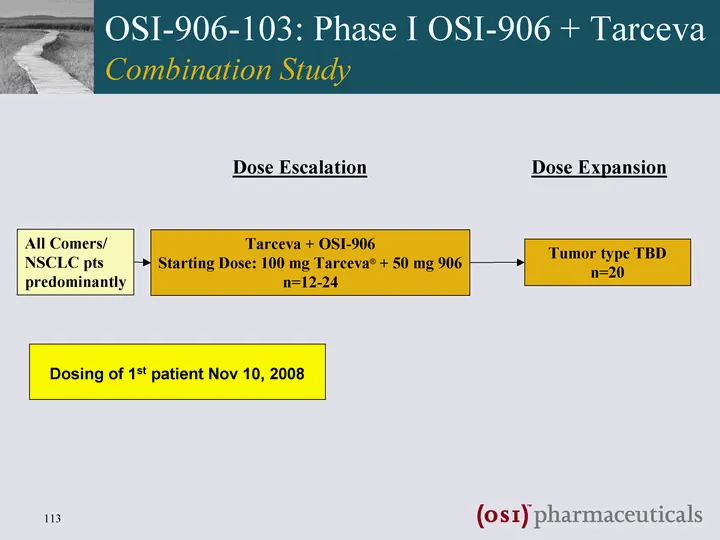
OSI-906-103: Phase I OSI-906 + Tarceva Combination Study All Comers/ NSCLC pts predominantly Tarceva + OSI-906 Starting Dose: 100 mg Tarceva(r) + 50 mg 906 n=12-24 Tumor type TBD n=20 Dose Escalation Dose Expansion Dosing of 1st patient Nov 10, 2008
Slide 114: OSI-906 Development Plan Prioritization Scheme
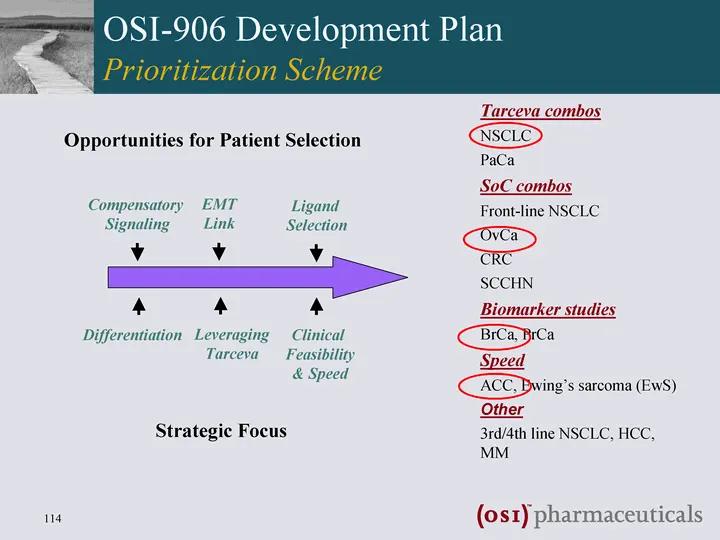
OSI-906 Development Plan Prioritization Scheme Tarceva combos NSCLC PaCa SoC combos Front-line NSCLC OvCa CRC SCCHN Biomarker studies BrCa, PrCa Speed ACC, Ewing's sarcoma (EwS) Other 3rd/4th line NSCLC, HCC, MM Compensatory Signaling Differentiation Ligand Selection EMT Link Clinical Feasibility &
Slide 115: Summary: OSI-906 Clinical Development Plan
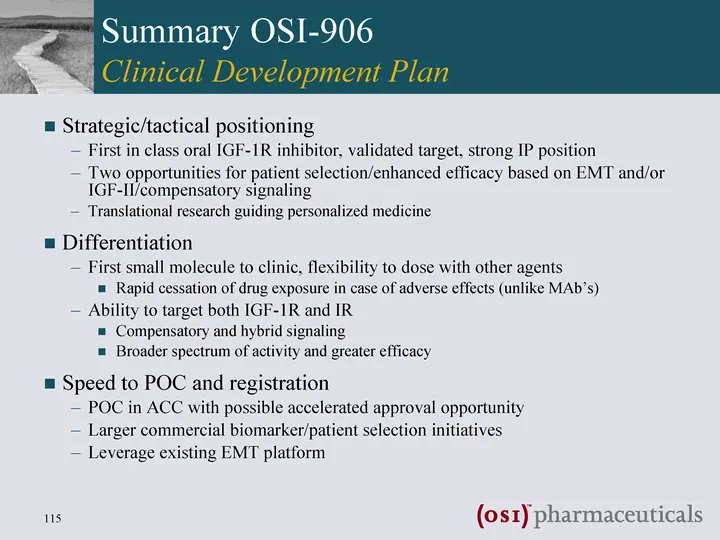
Summary OSI-906 Clinical Development Plan Strategic/tactical positioning First in class oral IGF-1R inhibitor, validated target, strong IP position Two opportunities for patient selection/enhanced efficacy based on EMT and/or IGF-II/compensatory signaling Translational research guiding personalized
Slide 116: Agenda
Agenda OSI-906 (IGF-1R Inhibitor) Program Status Clinical Development Initiatives OSI-027 (TORC1/TORC2 Inhibitor) Program Status Clinical Development Initiatives
Slide 117: Differentiation of OSI-027 from Rapalogs
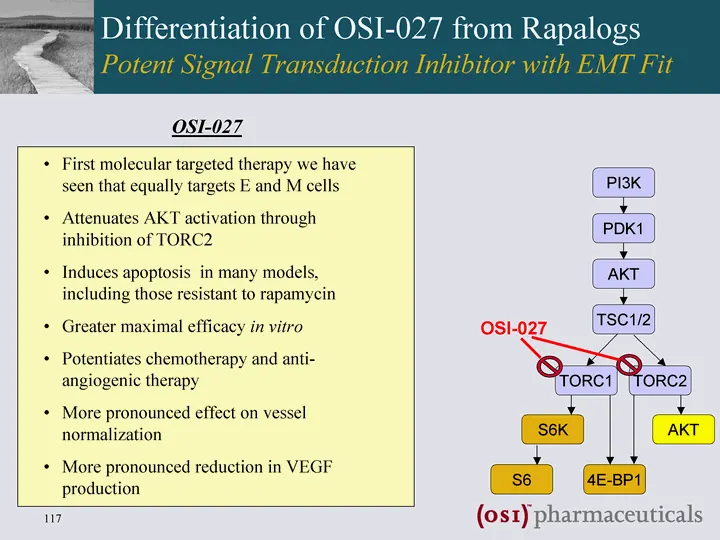
Differentiation of OSI-027 from Rapalogs Potent Signal Transduction Inhibitor with EMT Fit First molecular targeted therapy we have seen that equally targets E and M cells Attenuates AKT activation through inhibition of TORC2 Induces apoptosis in many models, including those resistant to rapamycin G
Slide 118: OSI-027-101 Study Outline
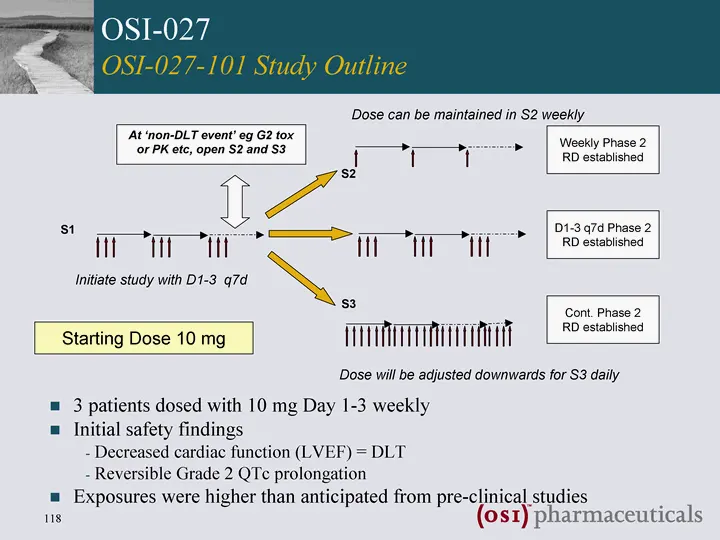
OSI-027 OSI-027-101 Study Outline S1 Dose will be adjusted downwards for S3 daily S2 S3 At 'non-DLT event' eg G2 tox or PK etc, open S2 and S3 Dose can be maintained in S2 weekly Weekly Phase 2 RD established Cont. Phase 2 RD established D1-3 q7d Phase 2 RD established Initiate study with D1-3 q7d S
Slide 119: OSI-027: Pharmacokinetic Data
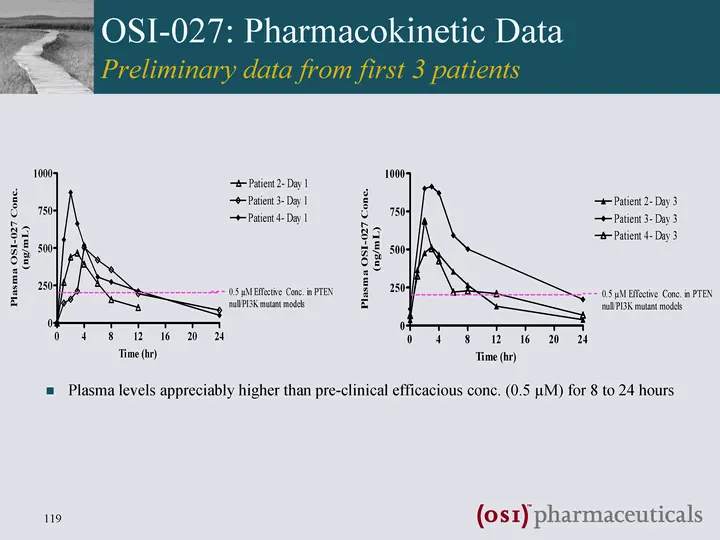
OSI-027: Pharmacokinetic Data Preliminary data from first 3 patients Plasma levels appreciably higher than pre-clinical efficacious conc. (0.5 µM) for 8 to 24 hours
Slide 120: OSI-027: Pharmacodynamic Data
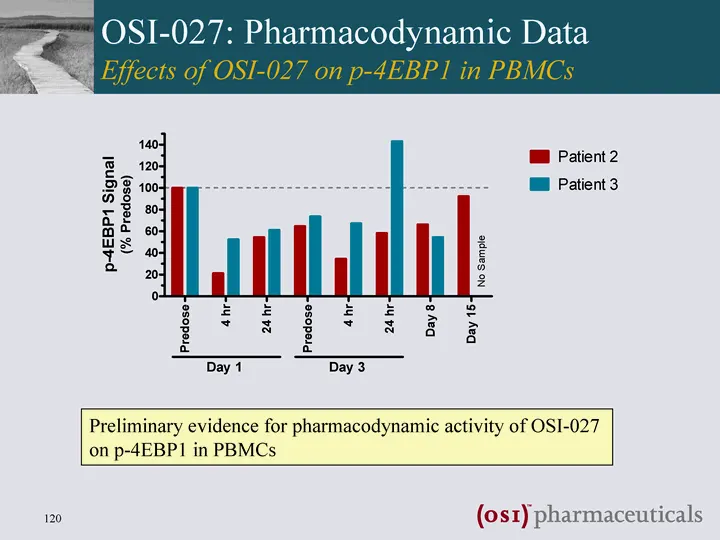
OSI-027: Pharmacodynamic Data Effects of OSI-027 on p-4EBP1 in PBMCs Preliminary evidence for pharmacodynamic activity of OSI-027 on p-4EBP1 in PBMCs
Slide 121: OSI-027 Program Summary
OSI-027 Program Summary OSI-027 is a potent and selective inhibitor of TORC1/TORC2 Differentiation Rapalogs lack activity against TORC2 Complete, effective TORC1/TORC2 blockade may have advantages over PI3K inhibitors Potential value in validating EMT clinically OSI-027 proprietary gene signature fr

Slide 122: Oncology Q&A
(os1) pharmaceuticals Oncology Q&A in(sight)
Slide 123: Executing the Tarceva Life Cycle Plan
Gabriel Leung President, OSI Oncology Executing the Tarceva Life Cycle Plan
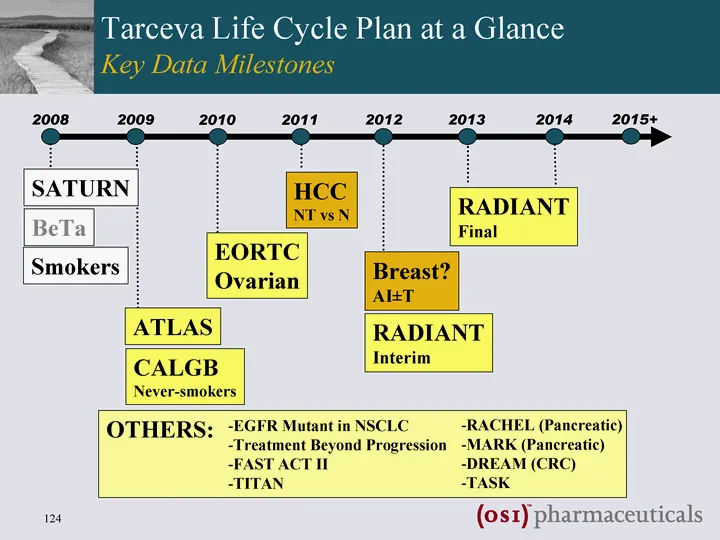
Slide 124: Tarceva Life Cycle Plan at a Glance
Smokers Tarceva Life Cycle Plan at a Glance Key Data Milestones 2008 2014 2013 2012 2011 2010 2009 SATURN BeTa ATLAS CALGB Never-smokers EORTC Ovarian HCC NT vs N Breast? AI+-T RADIANT Interim RADIANT Final OTHERS: EGFR Mutant in NSCLC Treatment Beyond Progression FAST ACT II TITAN RACHEL (Pancreati
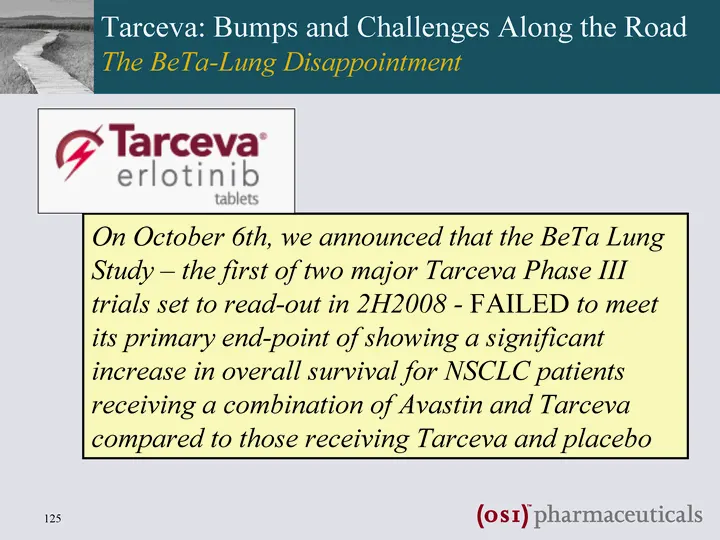
Slide 125: The BeTa-Lung Disappointment
Tarceva: Bumps and Challenges Along the Road The BeTa-Lung Disappointment On October 6th, we announced that the BeTa Lung Study - the first of two major Tarceva Phase III trials set to read-out in 2H2008 - FAILED to meet its primary end-point of showing a significant increase in overall survival for
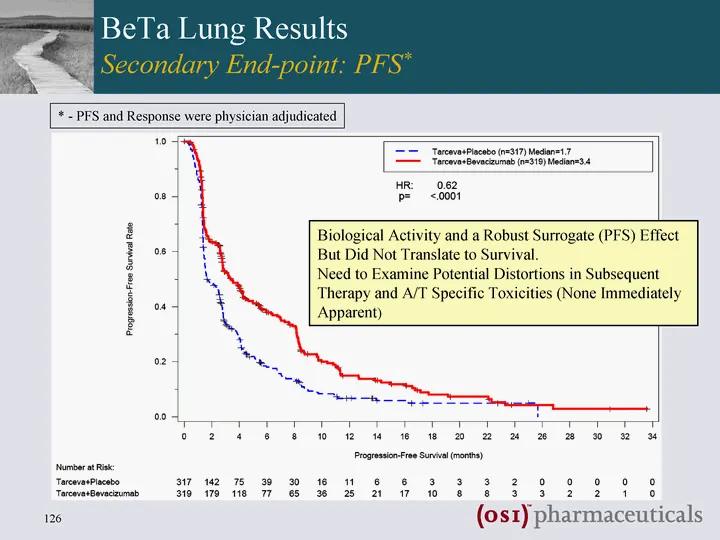
Slide 126: BeTa Lung Results
BeTa Lung Results Secondary End-point: PFS* Secondary End-point: PFS* Secondary End-point: PFS* Biological Activity and a Robust Surrogate (PFS) Effect But Did Not Translate to Survival. Need to Examine Potential Distortions in Subsequent Therapy and A/T Specific Toxicities (None Immediately Apparen
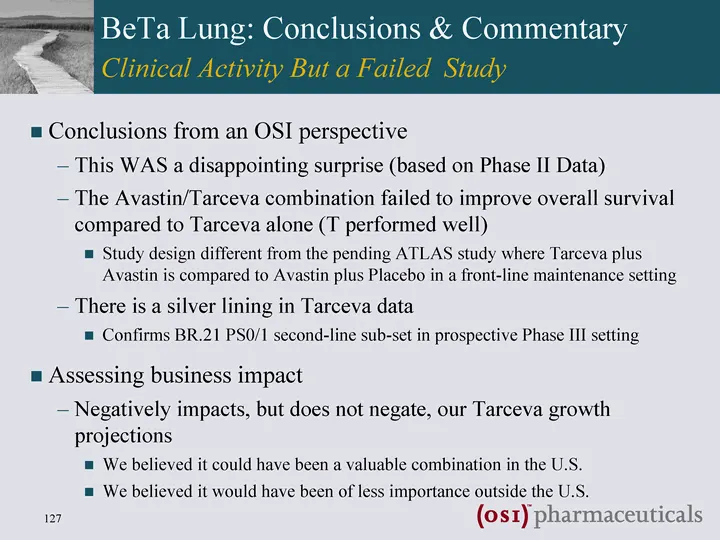
Slide 127: BeTa Lung: Conclusions & Commentary
BeTa Lung: Conclusions & Commentary Clinical Activity But a Failed Study Conclusions from an OSI perspective This WAS a disappointing surprise (based on Phase II Data) The Avastin/Tarceva combination failed to improve overall survival compared to Tarceva alone (T performed well) Study design differe
Slide 128: BeTa Lung: What Is the Silver Lining?
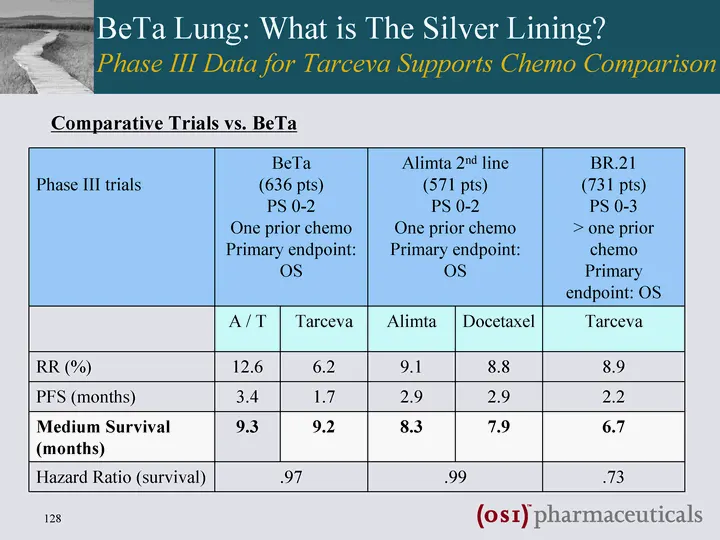
BeTa Lung: What is The Silver Lining? Phase III Data for Tarceva Supports Chemo Comparison Comparative Trials vs. BeTa Phase III trials BeTa (636 pts) PS 0-2 One prior chemo Primary endpoint: OS BeTa (636 pts) PS 0-2 One prior chemo Primary endpoint: OS Alimta 2nd line (571 pts) PS 0-2 One prior che
Slide 129: Onwards to SATURN and a Better Outcome
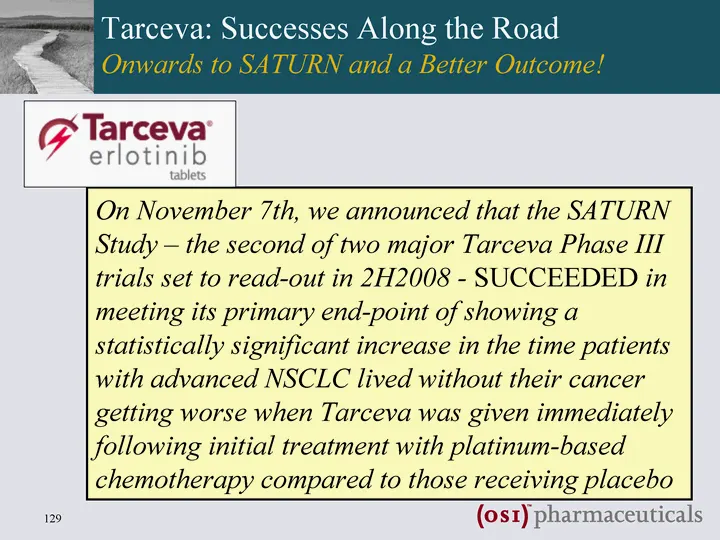
Tarceva: Successes Along the Road Onwards to SATURN and a Better Outcome! On November 7th, we announced that the SATURN Study - the second of two major Tarceva Phase III trials set to read-out in 2H2008 - SUCCEEDED in meeting its primary end-point of showing a statistically significant increase in t
Slide 130: SATURN Study Design
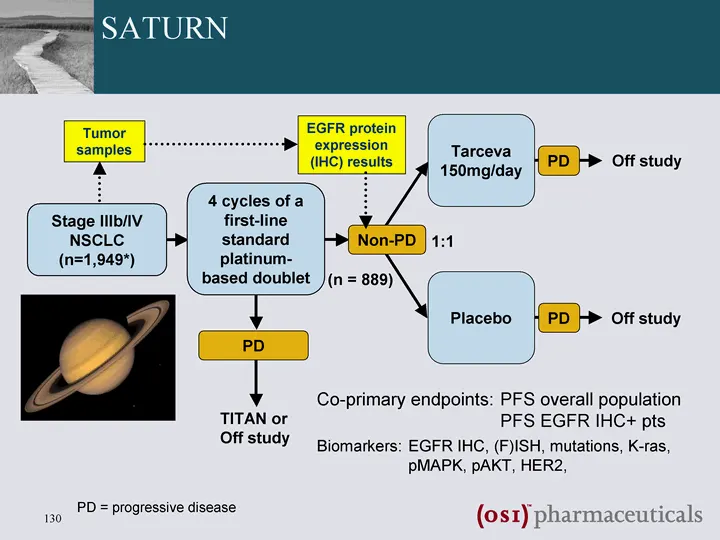
SATURN Placebo Stage IIIb/IV NSCLC (n=1,949*) Non-PD TITAN or Off study Tarceva 150mg/day PD Off study (n = 889) PD 1:1 4 cycles of a first-line standard platinum- based doublet PD PD = progressive disease Off study Tumor samples EGFR protein expression (IHC) results Biomarkers: EGFR IHC, (F)ISH, mu
Slide 131: SATURN Data Disclosure and Regulatory Plans
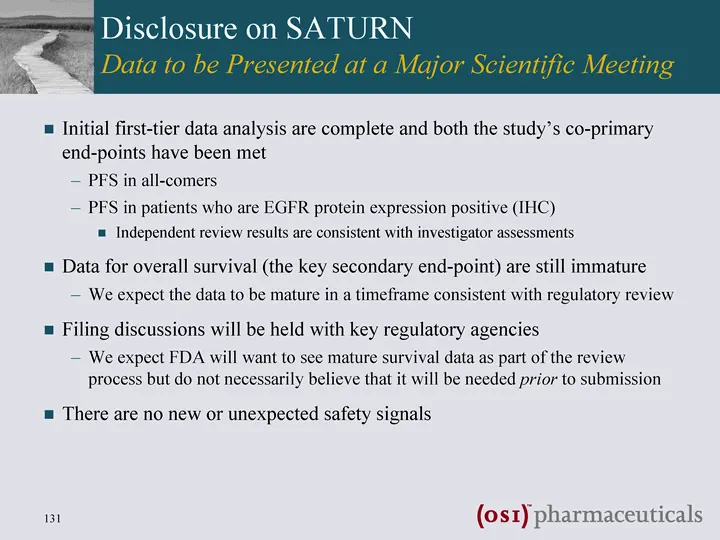
Disclosure on SATURN Data to be Presented at a Major Scientific Meeting Initial first-tier data analysis are complete and both the study's co-primary end-points have been met PFS in all-comers PFS in patients who are EGFR protein expression positive (IHC) Independent review results are consistent wi
Slide 132: OSI Smoking Initiative Resulted in Label Update
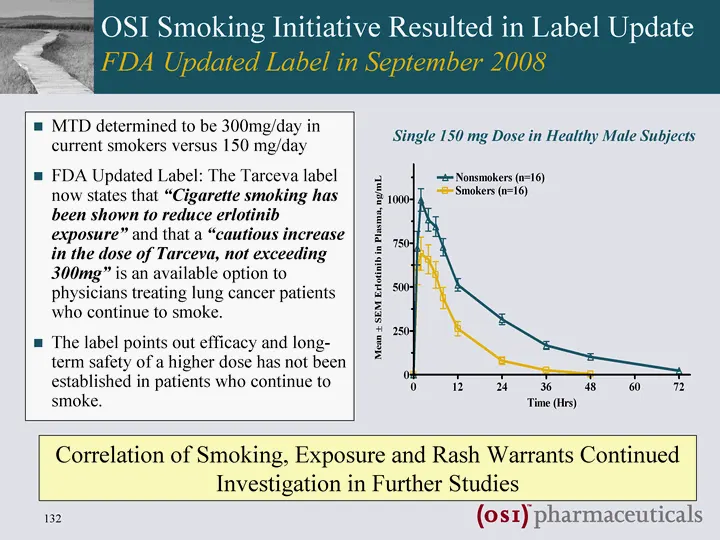
OSI Smoking Initiative Resulted in Label Update FDA Updated Label in September 2008 MTD determined to be 300mg/day in current smokers versus 150 mg/day FDA Updated Label: The Tarceva label now states that "Cigarette smoking has been shown to reduce erlotinib exposure" and that a "cautious increase i
Slide 133: Recent Changes in NSCLC Market
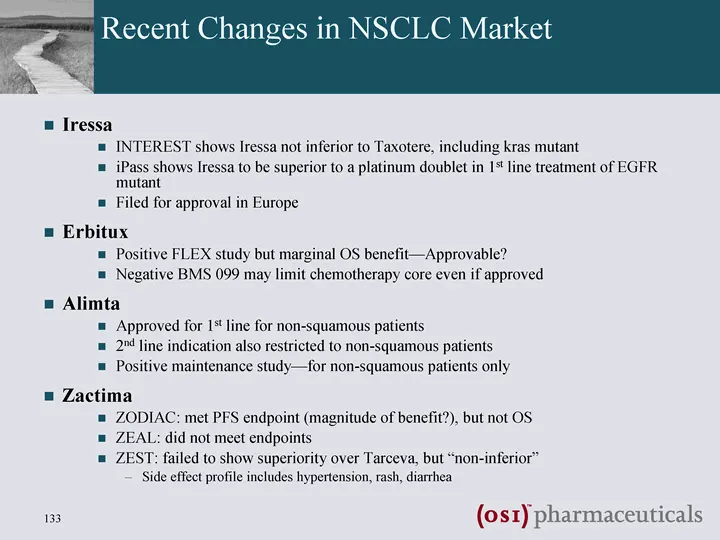
Recent Changes in NSCLC Market Iressa INTEREST shows Iressa not inferior to Taxotere, including kras mutant iPass shows Iressa to be superior to a platinum doublet in 1st line treatment of EGFR mutant Filed for approval in Europe Erbitux Positive FLEX study but marginal OS benefit-Approvable? Negati
Slide 134: Tarceva in NSCLC: Potential & Existing Opportunities
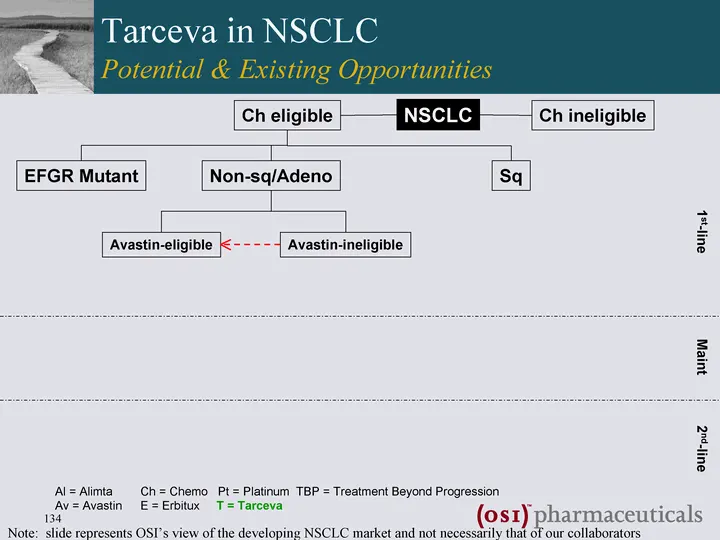
Ch eligible Ch ineligible Non-sq/Adeno Sq Avastin-eligible Avastin-ineligible EFGR Mutant NSCLC 1st-line Maint 2nd-line Al = Alimta Ch = Chemo Pt = Platinum TBP = Treatment Beyond Progression Av = Avastin E = Erbitux T = Tarceva Tarceva in NSCLC Potential & Existing Opportunities Note: slide represe
Slide 135: Tarceva in NSCLC: Potential & Existing Opportunities
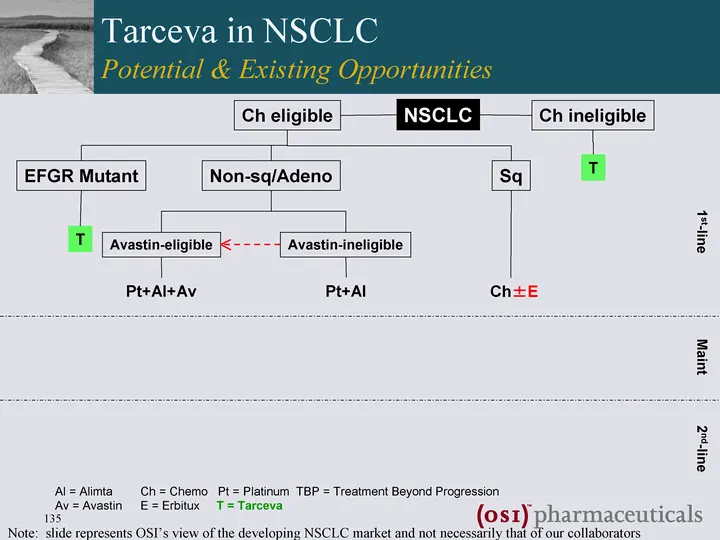
Ch eligible Ch ineligible Non-sq/Adeno Sq Avastin-eligible Avastin-ineligible Pt+Al+Av Pt+Al Ch+-E T EFGR Mutant NSCLC 1st-line Maint 2nd-line Al = Alimta Ch = Chemo Pt = Platinum TBP = Treatment Beyond Progression Av = Avastin E = Erbitux T = Tarceva T Tarceva in NSCLC Potential & Existing Opportun
Slide 136: Tarceva in NSCLC: Potential & Existing Opportunities
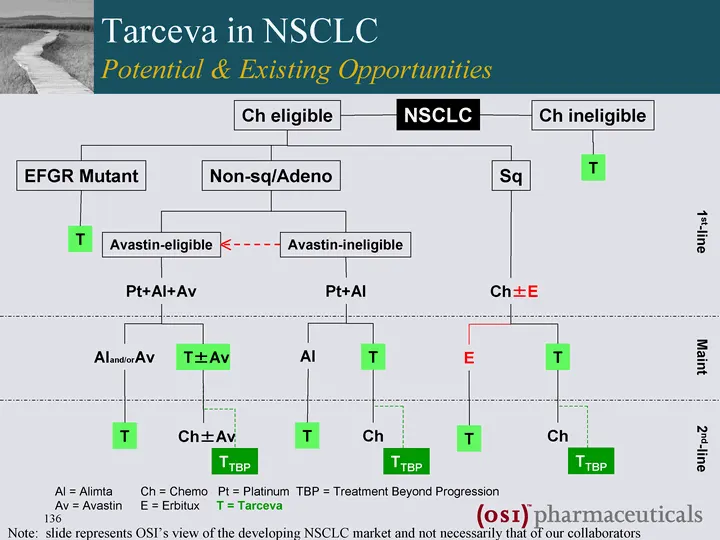
Ch eligible Ch ineligible Non-sq/Adeno Sq Avastin-eligible Avastin-ineligible Pt+Al+Av Pt+Al Aland/orAv T+-Av T Ch+-Av Al T T Ch Ch+-E T Ch TTBP TTBP TTBP T EFGR Mutant NSCLC 1st-line Maint 2nd-line Al = Alimta Ch = Chemo Pt = Platinum TBP = Treatment Beyond Progression Av = Avastin E = Erbitux T =
Slide 137: Tarceva Life Cycle Plan at a Glance
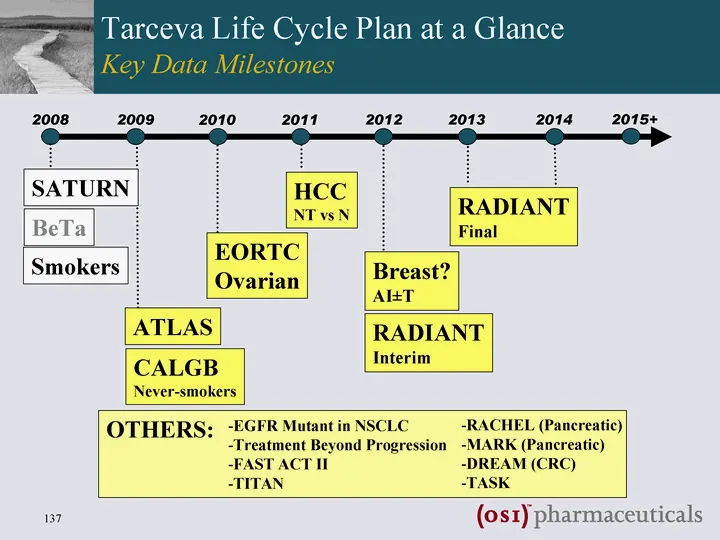
Smokers Tarceva Life Cycle Plan at a Glance Key Data Milestones 2008 2014 2013 2012 2011 2010 2009 SATURN BeTa ATLAS CALGB Never-smokers EORTC Ovarian HCC NT vs N Breast? AI+-T RADIANT Interim RADIANT Final OTHERS: EGFR Mutant in NSCLC Treatment Beyond Progression FAST ACT II TITAN RACHEL (Pancreati
Slide 138: ATLAS Study Schema
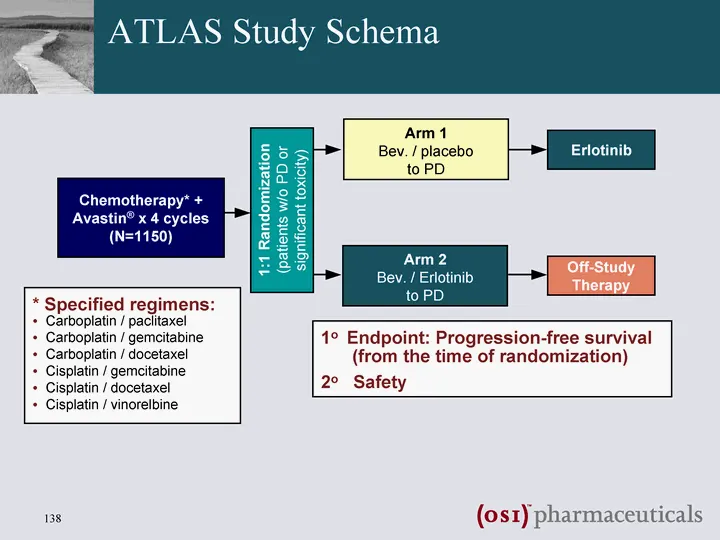
1o Endpoint: Progression-free survival (from the time of randomization) 2o Safety * Specified regimens: Carboplatin / paclitaxel Carboplatin / gemcitabine Carboplatin / docetaxel Cisplatin / gemcitabine Cisplatin / docetaxel Cisplatin / vinorelbine Arm 1 Bev. / placebo to PD Arm 2 Bev. / Erlotinib t
Slide 139: CALGB Never Smokers Study
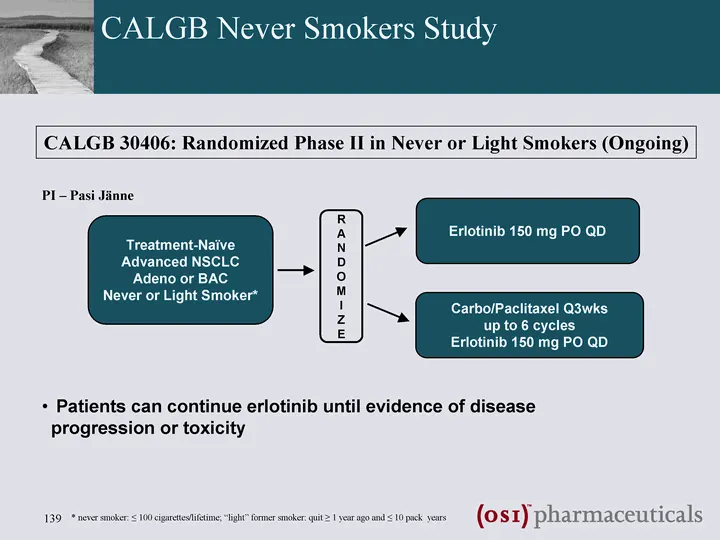
CALGB Never Smokers Study Treatment-Naive Advanced NSCLC Adeno or BAC Never or Light Smoker* Erlotinib 150 mg PO QD R A N D O M I Z E Carbo/Paclitaxel Q3wks up to 6 cycles Erlotinib 150 mg PO QD CALGB 30406: Randomized Phase II in Never or Light Smokers (Ongoing) Patients can continue erlotinib unti
Slide 140: EORTC Phase III Ovarian Study
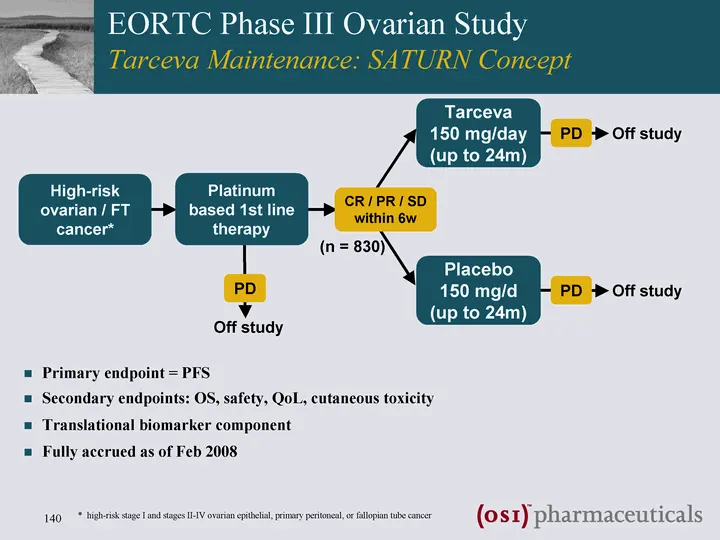
EORTC Phase III Ovarian Study Tarceva Maintenance: SATURN Concept (n = 830) High-risk ovarian / FT cancer* CR / PR / SD within 6w Platinum based 1st line therapy PD Placebo 150 mg/d (up to 24m) PD Off study Tarceva 150 mg/day (up to 24m) PD Off study Primary endpoint = PFS Secondary endpoints: OS, s
Slide 141: Key HCC Trials: Summary of Efficacy Outcomes
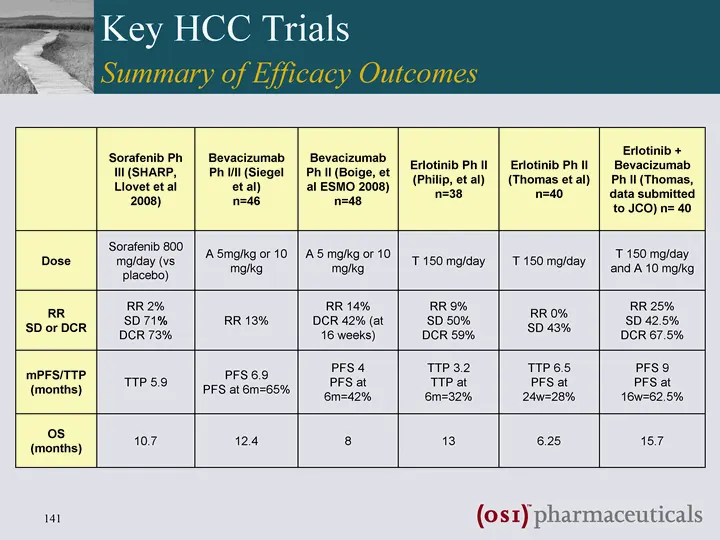
Key HCC Trials Summary of Efficacy Outcomes Sorafenib Ph III (SHARP, Llovet et al 2008) Bevacizumab Ph I/II (Siegel et al) n=46 Bevacizumab Ph II (Boige, et al ESMO 2008) n=48 Erlotinib Ph II (Philip, et al) n=38 Erlotinib Ph II (Thomas et al) n=40 Erlotinib + Bevacizumab Ph II (Thomas, data submitt
Slide 142: HCC Phase III Trials: Proposed Study
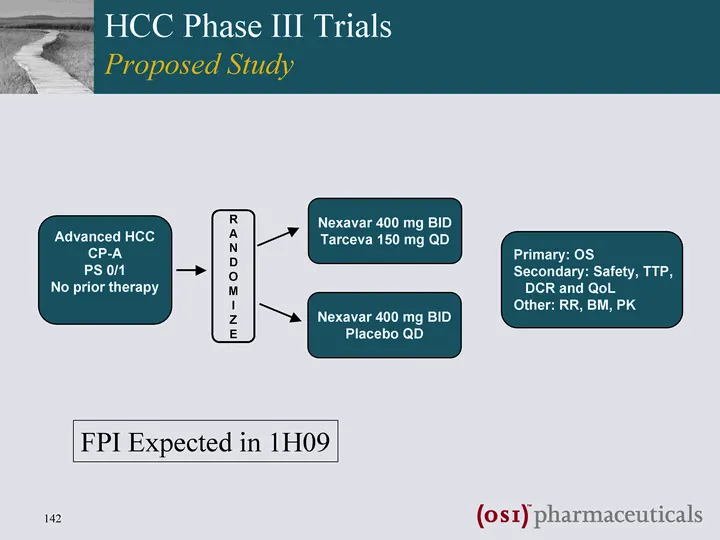
HCC Phase III Trials Proposed Study Advanced HCC CP-A PS 0/1 No prior therapy Nexavar 400 mg BID Tarceva 150 mg QD R A N D O M I Z E Nexavar 400 mg BID Placebo QD Primary: OS Secondary: Safety, TTP, DCR and QoL Other: RR, BM, PK FPI Expected in 1H09
Slide 143: Tarceva in Breast Cancer: Preclinical Rationale
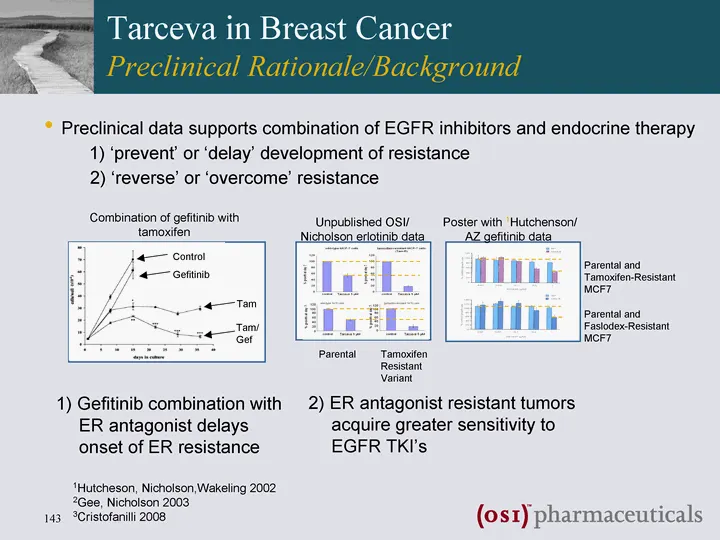
Tarceva in Breast Cancer Preclinical Rationale/Background 2) ER antagonist resistant tumors acquire greater sensitivity to EGFR TKI's Combination of gefitinib with tamoxifen significantly delays onset of ER inhibitor resistance Unpublished OSI/ Nicholson erlotinib data Poster with 1Hutchenson/ AZ ge
Slide 144: Tarceva in Breast Cancer: Rationale/Background
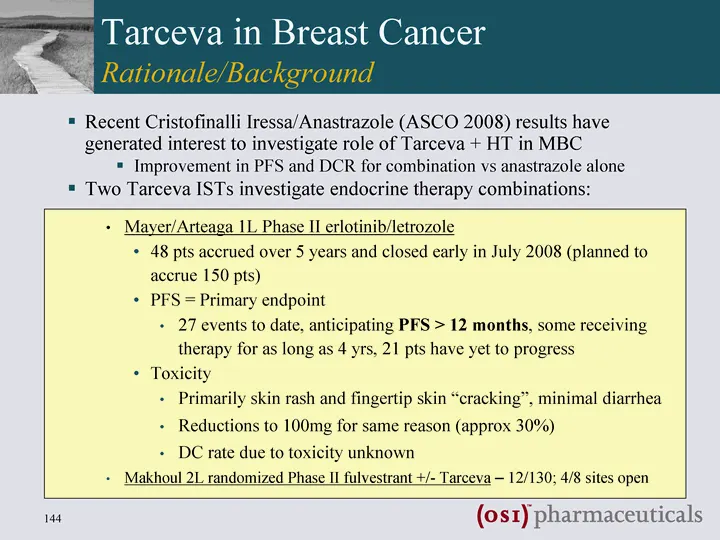
Tarceva in Breast Cancer Rationale/Background Recent Cristofinalli Iressa/Anastrazole (ASCO 2008) results have generated interest to investigate role of Tarceva + HT in MBC Improvement in PFS and DCR for combination vs anastrazole alone Two Tarceva ISTs investigate endocrine therapy combinations: Ma
Slide 145: Tarceva in Breast Cancer: Study Concept
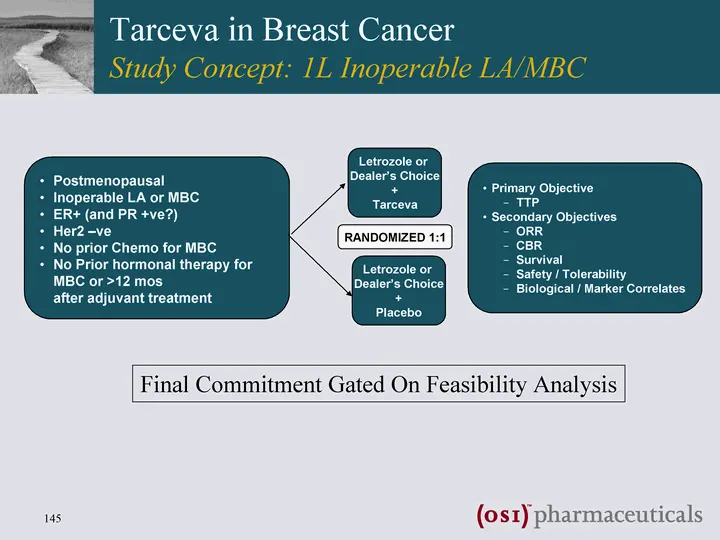
Tarceva in Breast Cancer Study Concept: 1L Inoperable LA/MBC Postmenopausal Inoperable LA or MBC ER+ (and PR +ve?) Her2 -ve No prior Chemo for MBC No Prior hormonal therapy for MBC or >12 mos after adjuvant treatment Letrozole or Dealer's Choice + Tarceva Primary Objective TTP Secondary Objectives O
Slide 146: RADIANT - Study Schema
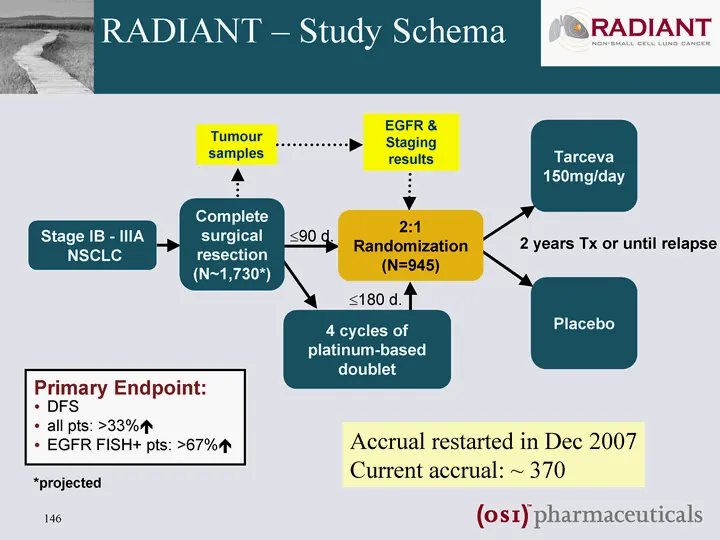
RADIANT - Study Schema Placebo Stage IB - IIIA NSCLC 2:1 Randomization (N=945) Tarceva 150mg/day 4 cycles of platinum-based doublet *projected 2 years Tx or until relapse Tumour samples EGFR & Staging results Complete surgical resection (N~1,730*) ?90 d. ?180 d. Primary Endpoint: DFS all pts: >33%?
Slide 147: Tarceva Life Cycle Plan at a Glance
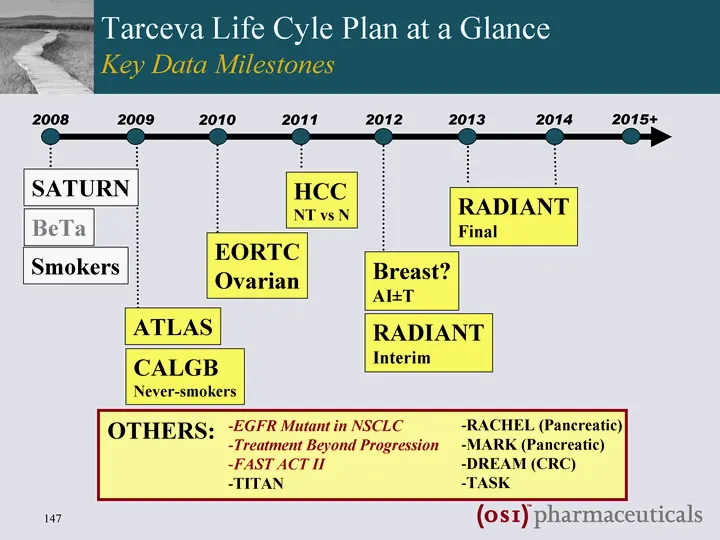
Smokers Tarceva Life Cyle Plan at a Glance Key Data Milestones 2008 2014 2013 2012 2011 2010 2009 SATURN BeTa ATLAS CALGB Never-smokers EORTC Ovarian HCC NT vs N Breast? AI+-T RADIANT Interim RADIANT Final OTHERS: EGFR Mutant in NSCLC Treatment Beyond Progression FAST ACT II TITAN RACHEL (Pancreatic
Slide 148: Tarceva Q&A
(os1) pharmaceuticals Tarceva Q&A (leader)ship

Slide 149: Wrap-up and Final Q&A
(os1) pharmaceuticals Wrap-up and Final Q&A in(sight)
Source: SEC EDGAR · 8-K filed Dec 4, 2008