PDS Biotechnology Corporation · NASDAQ:PDSB
PDS Biotechnology — Technical Presentation (October 2023)
57 slides from PDS Biotechnology's technical presentation, Oct 3, 2023
Slide 1: PDS0101 in HPV16+ Head and Neck Cancer KOL Roundtable
PDS0101 in HPV16+ Head and Neck Cancer KOL Roundtable NASDAQ: PDSB Precision Designed Science For Immunotherapy October 3, 2023 © 2023 PDS Biotechnology. All Rights Reserved. 1
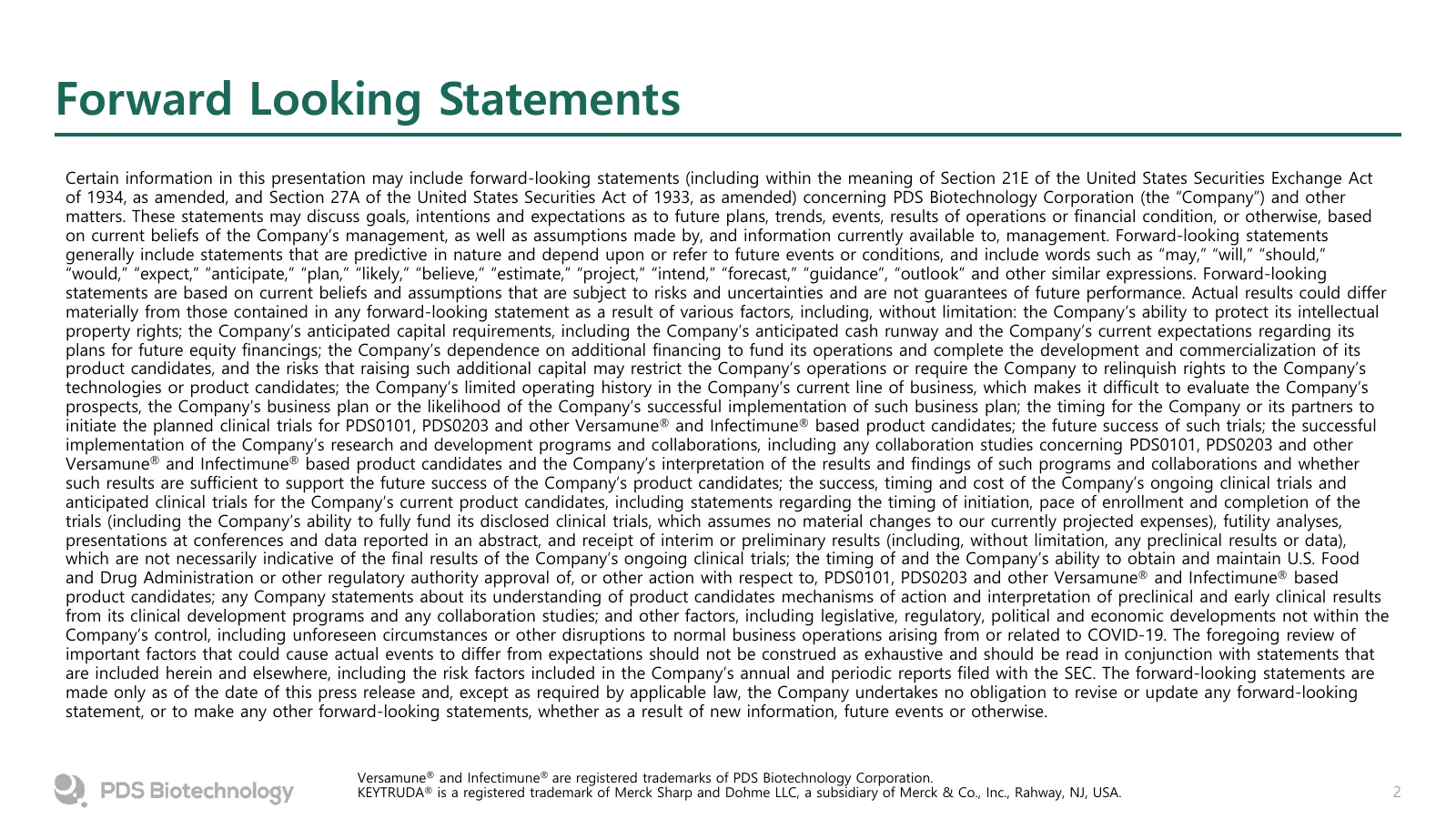
Slide 2: Forward Looking Statements
Forward Looking Statements Certain information in this presentation may include forward-looking statements (including within the meaning of Section 21E of the United States Securities Exchange Act of 1934, as amended, and Section 27A of the United States Securities Act of 1933, as amended) concernin
Slide 3: Disclaimer
Disclaimer • PDS Biotech is the sponsor of this roundtable • Each panelist is speaking on behalf of PDS Biotech under the terms of a consulting agreement • Information presented is consistent with FDA regulations and guidelines 3

Slide 4: Welcome and Introductions
Welcome and Introductions Dr. Lauren V. Wood 4

Slide 5: Introducing Our Panel
Introducing Our Panel Dr. Ricard Mesía Dr. John Kaczmar Dr. Katharine Price Dr. Glenn Hanna Head of Medical Oncology Associate Professor Medical Associate Professor Assistant Professor, Harvard Catalan Institute of Oncology University of South Carolina Mayo Clinic Comprehensive University and Medica
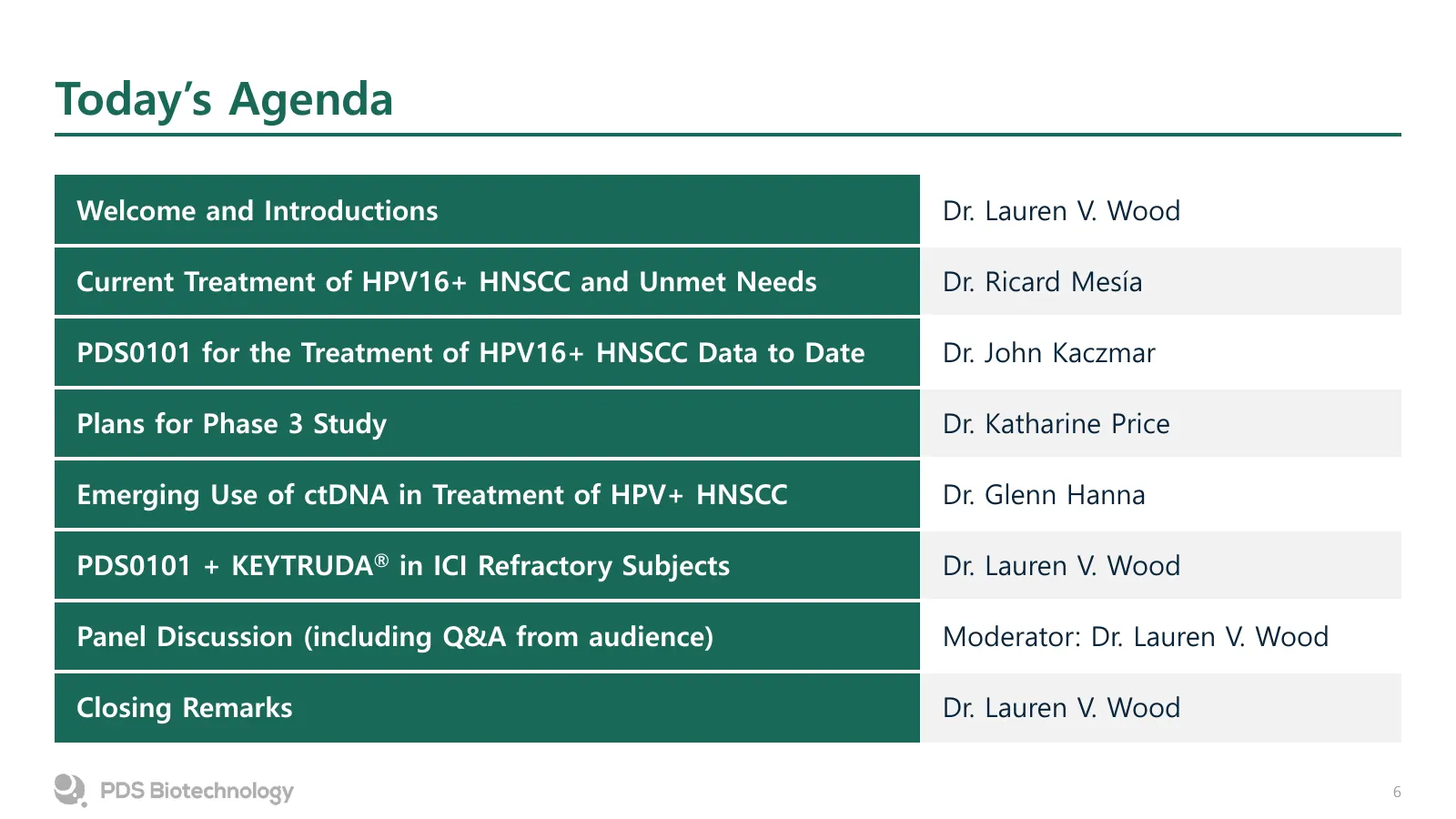
Slide 6: Today's Agenda
Today’s Agenda Welcome and Introductions Dr. Lauren V. Wood Current Treatment of HPV16+ HNSCC and Unmet Needs Dr. Ricard Mesía PDS0101 for the Treatment of HPV16+ HNSCC Data to Date Dr. John Kaczmar Plans for Phase 3 Study Dr. Katharine Price Emerging Use of ctDNA in Treatment of HPV+ HNSCC Dr. Glen
Slide 7: Current Treatment of HPV16+ HNSCC and Unmet Needs
Current Treatment of HPV16+ HNSCC and Unmet Needs Dr. Ricard Mesía 7
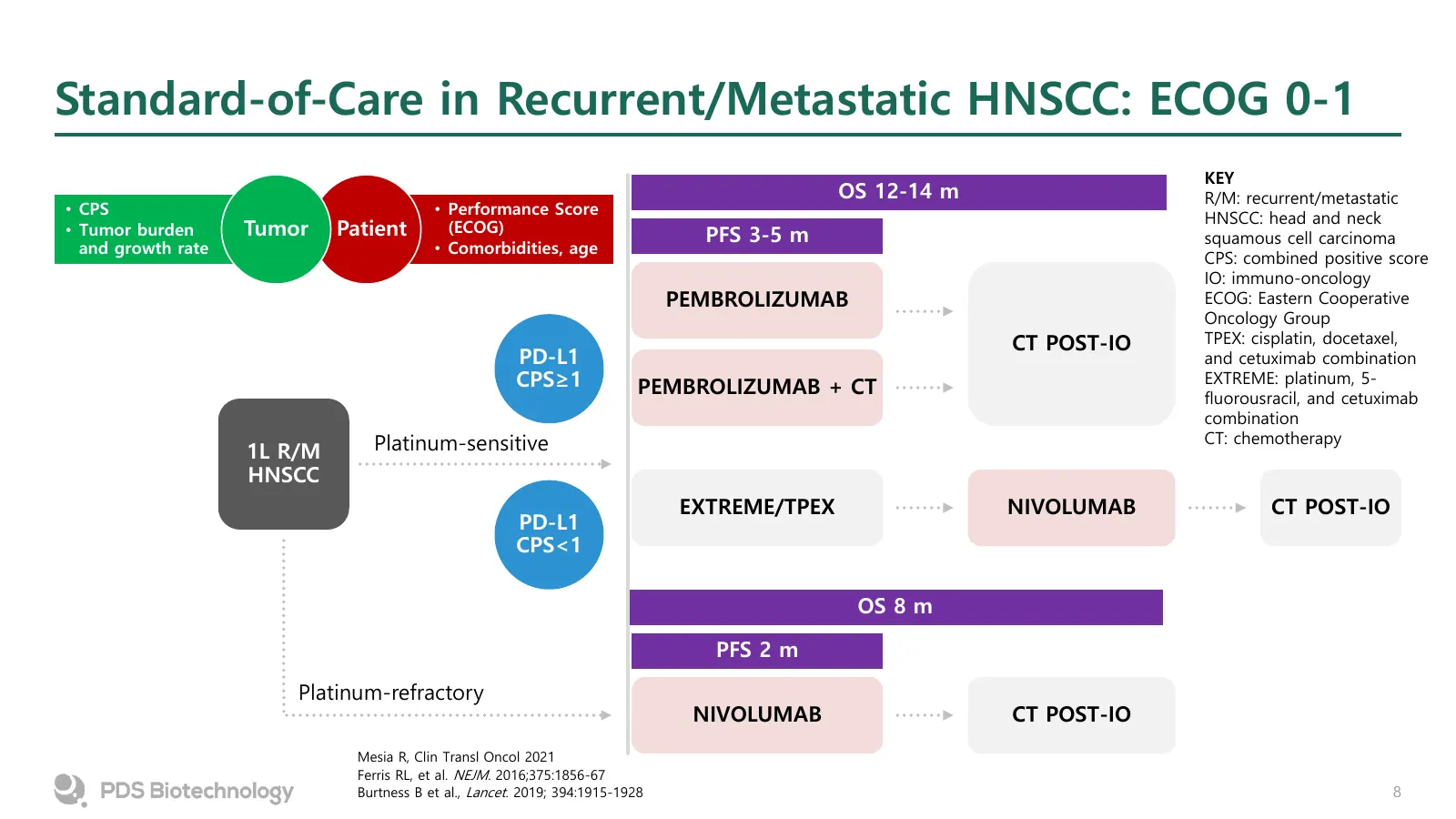
Slide 8: Standard-of-Care in Recurrent/Metastatic HNSCC: ECOG 0-1
Standard-of-Care in Recurrent/Metastatic HNSCC: ECOG 0-1 KEY OS 12-14 m R/M: recurrent/metastatic • CPS • Performance Score HNSCC: head and neck • Tumor burden Tumor Patient (ECOG) PFS 3-5 m squamous cell carcinoma and growth rate • Comorbidities, age CPS: combined positive score IO: immuno-oncology
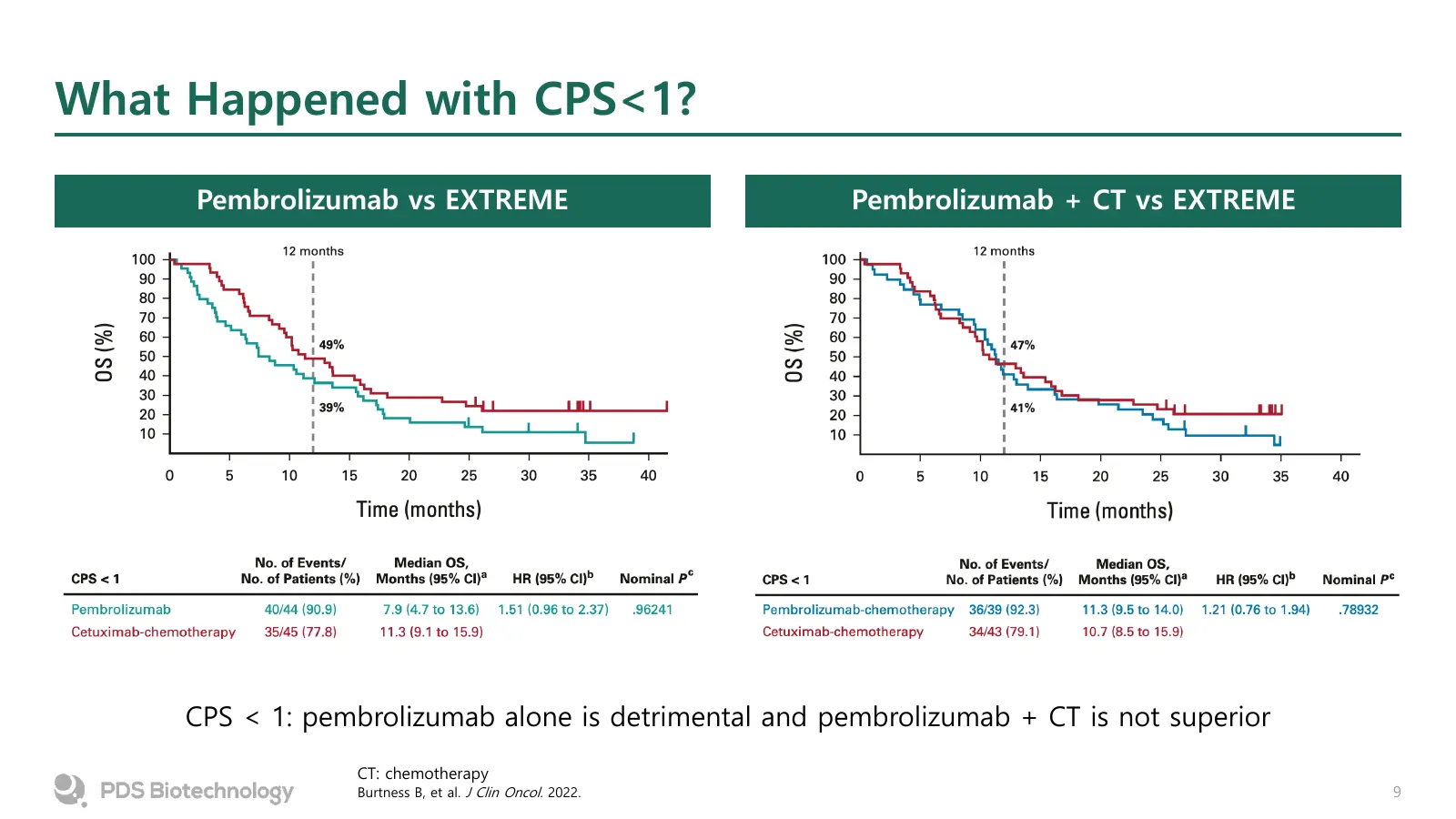
Slide 9: What Happened with CPS<1?
What Happened with CPS<1? Pembrolizumab vs EXTREME Pembrolizumab + CT vs EXTREME CPS < 1: pembrolizumab alone is detrimental and pembrolizumab + CT is not superior CT: chemotherapy Burtness B, et al. J Clin Oncol. 2022. 9
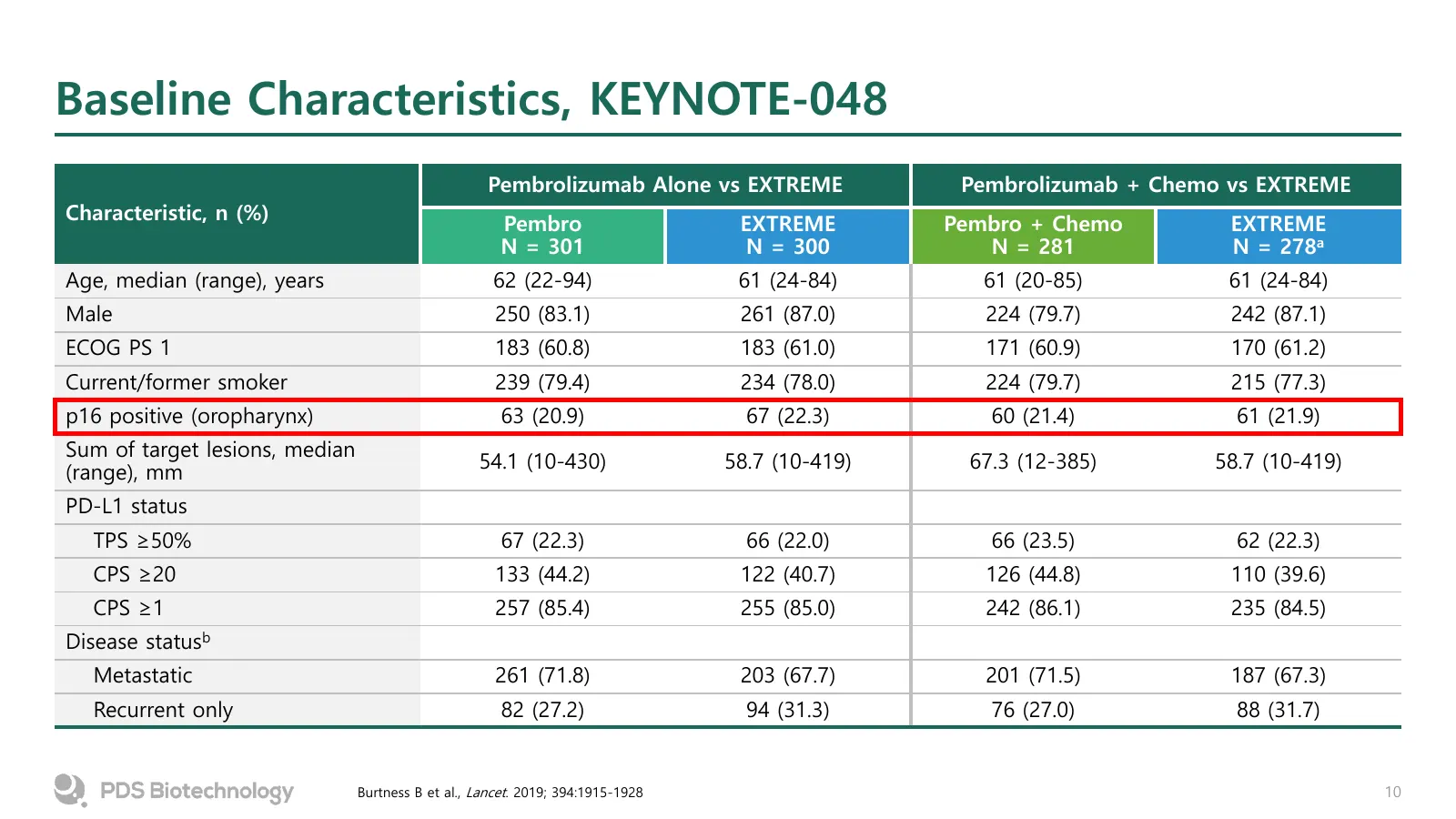
Slide 10: Baseline Characteristics, KEYNOTE-048
Baseline Characteristics, KEYNOTE-048 Pembrolizumab Alone vs EXTREME Pembrolizumab + Chemo vs EXTREME Characteristic, n (%) Pembro EXTREME Pembro + Chemo EXTREME N = 301 N = 300 N = 281 N = 278a Age, median (range), years 62 (22-94) 61 (24-84) 61 (20-85) 61 (24-84) Male 250 (83.1) 261 (87.0) 224 (79
Slide 11: The Actual Goals of Therapy in Recurrent/Metastatic Disease
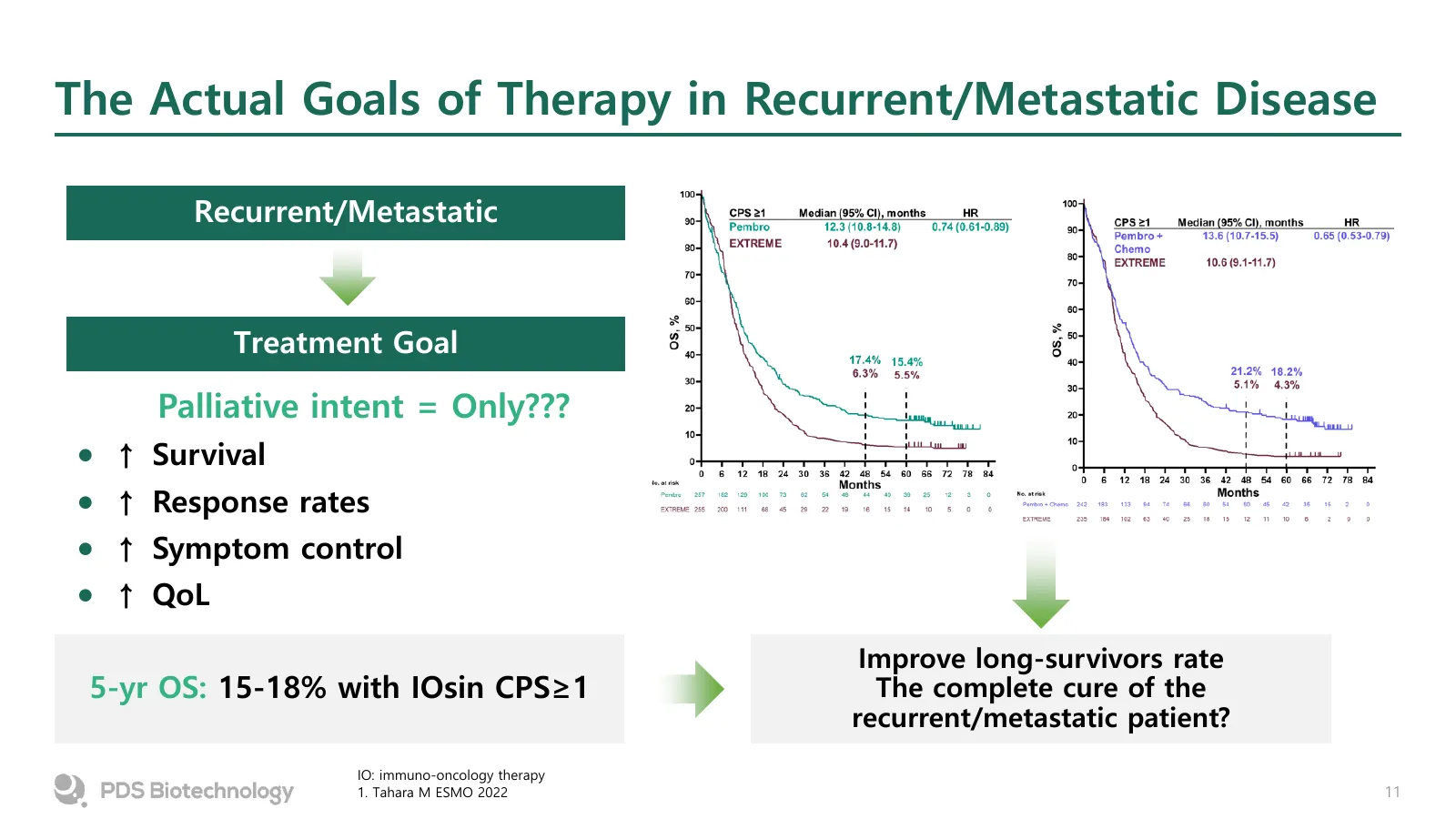
The Actual Goals of Therapy in Recurrent/Metastatic Disease Recurrent/Metastatic Treatment Goal Palliative intent = Only??? • ↑ Survival • ↑ Response rates • ↑ Symptom control • ↑ QoL Improve long-survivors rate 5-yr OS: 15-18% with IOsin CPS≥1 The complete cure of the recurrent/metastatic patient?
Slide 12: Treatment After 1st Line Recurrent/Metastatic: Expectations
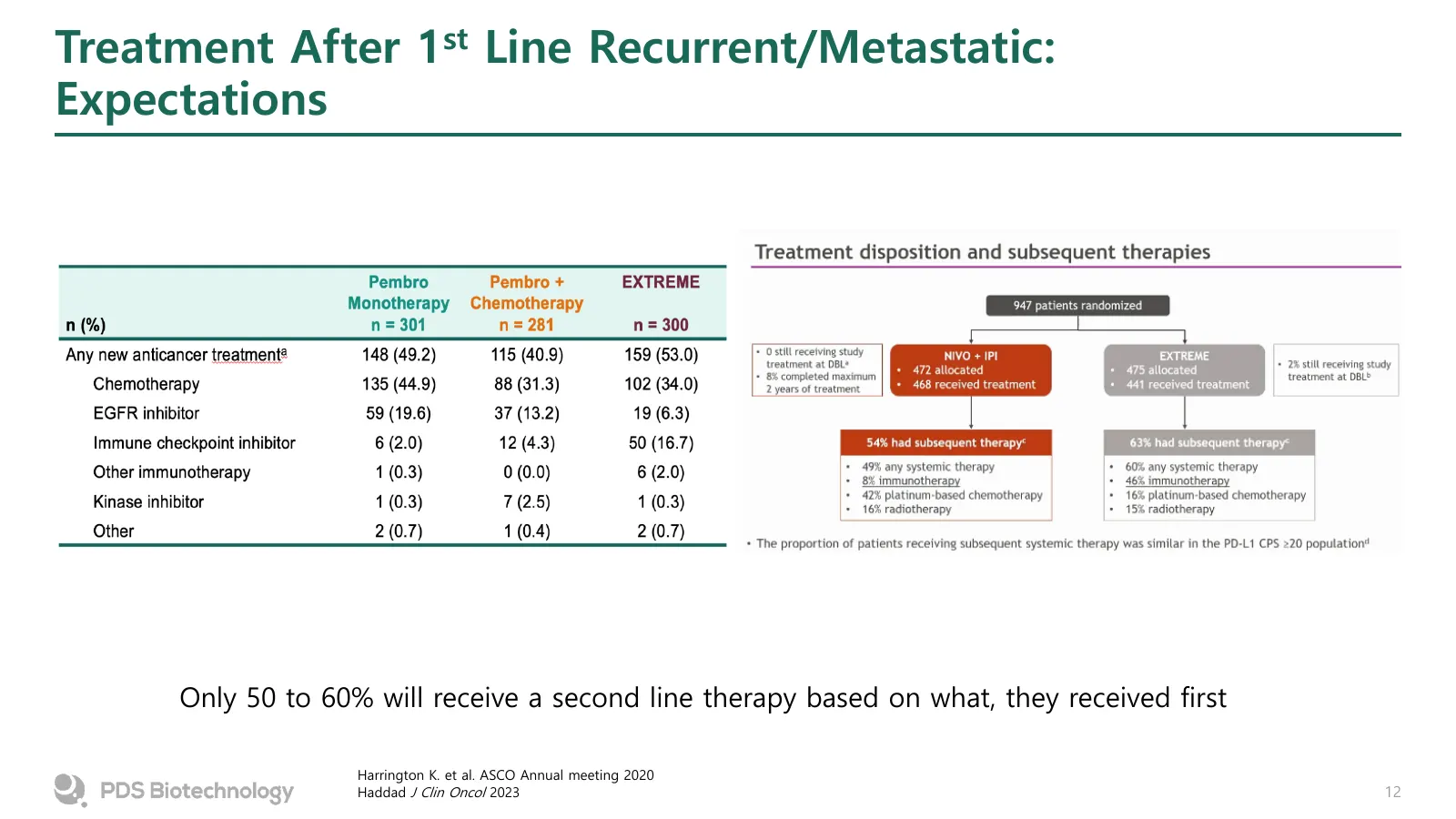
Treatment After 1st Line Recurrent/Metastatic: Expectations Only 50 to 60% will receive a second line therapy based on what, they received first Harrington K. et al. ASCO Annual meeting 2020 Haddad J Clin Oncol 2023 12
Slide 13: Treatment After 1st Line Recurrent/Metastatic: Expectations
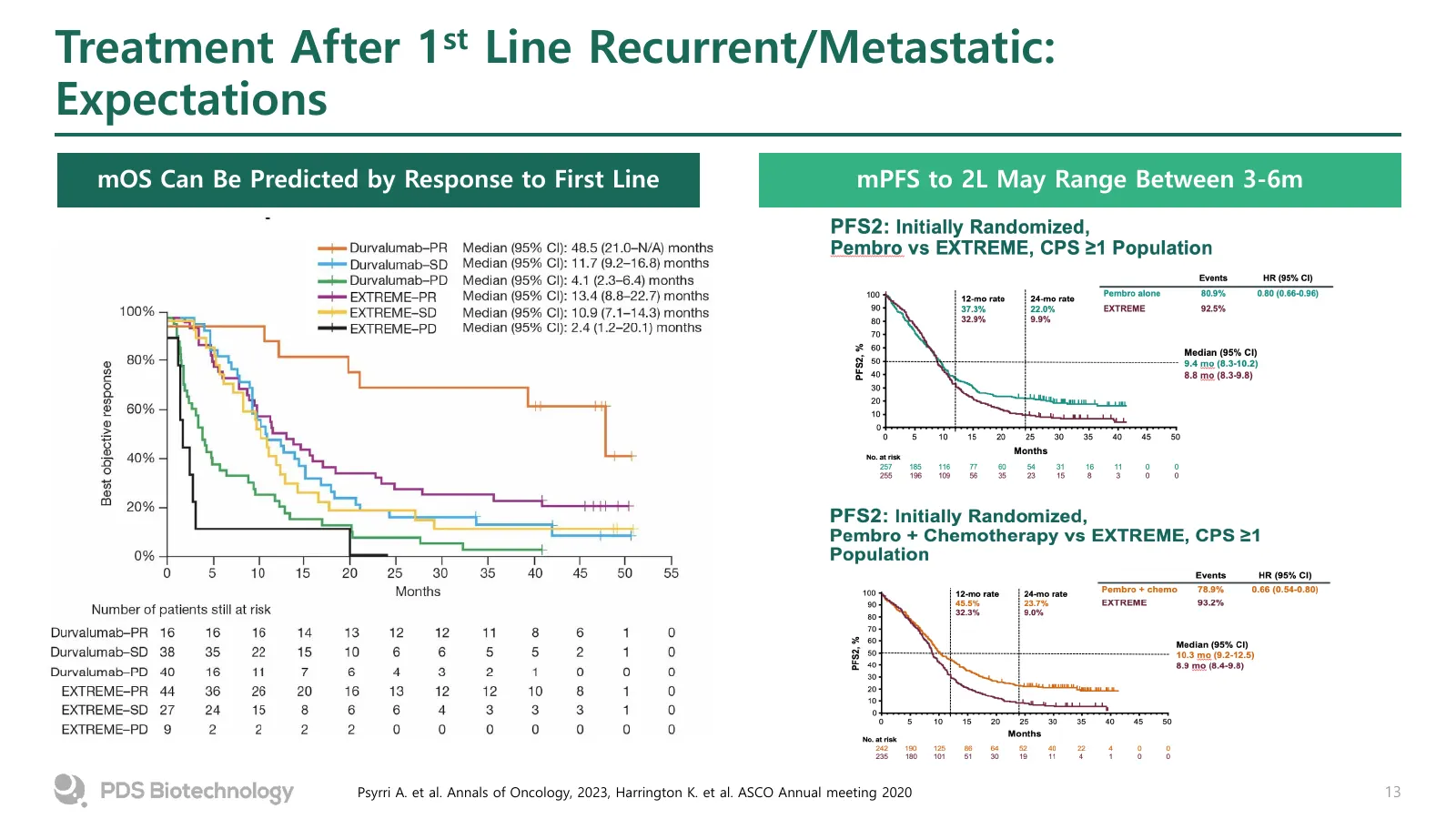
Treatment After 1st Line Recurrent/Metastatic: Expectations mOS Can Be Predicted by Response to First Line mPFS to 2L May Range Between 3-6m Psyrri A. et al. Annals of Oncology, 2023, Harrington K. et al. ASCO Annual meeting 2020 13
Slide 14: Unmet Needs in 1st Line Recurrent/Metastatic – HPV16+
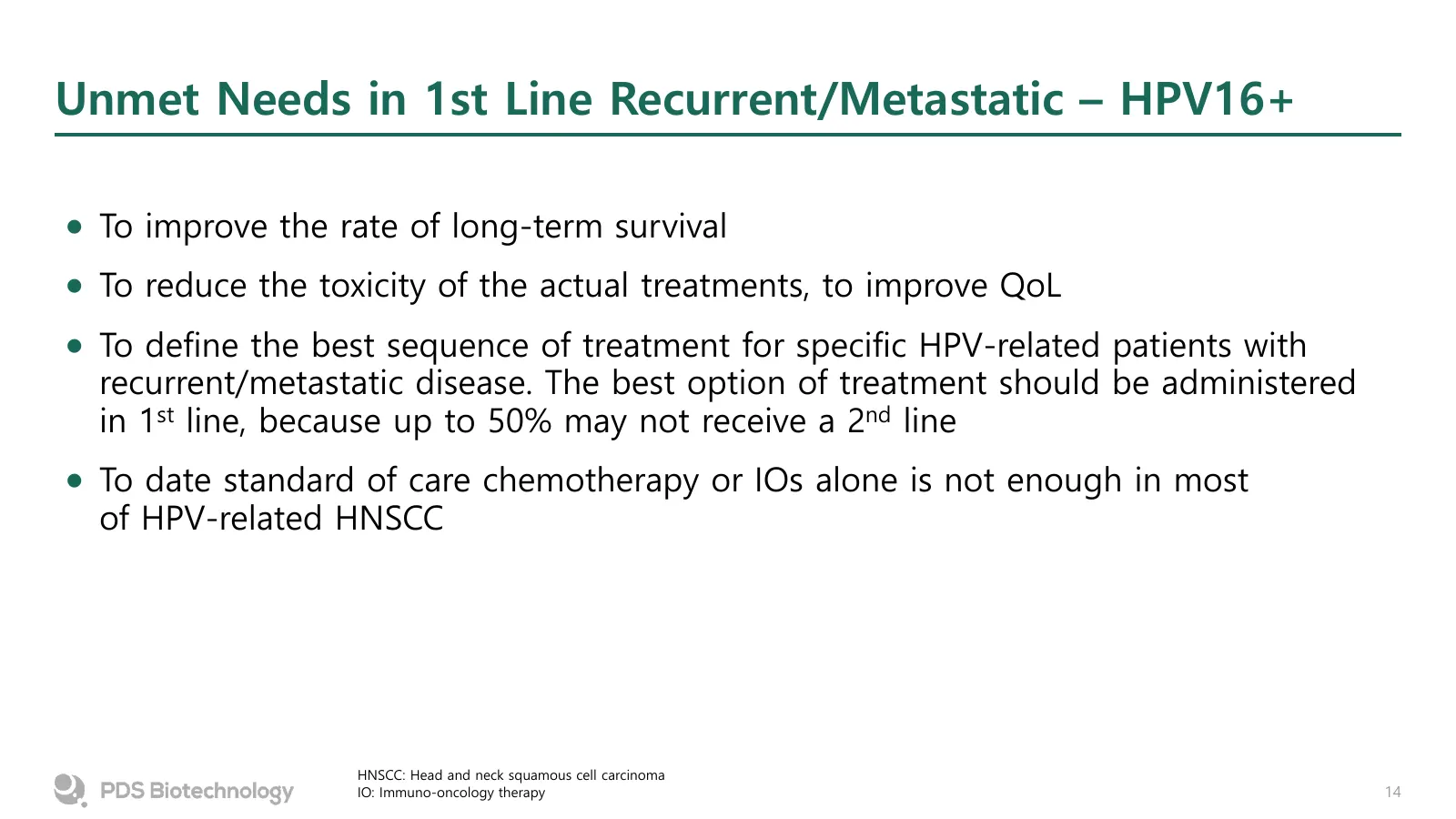
Unmet Needs in 1st Line Recurrent/Metastatic – HPV16+ • To improve the rate of long-term survival • To reduce the toxicity of the actual treatments, to improve QoL • To define the best sequence of treatment for specific HPV-related patients with recurrent/metastatic disease. The best option of treat
Slide 15: PDS0101 for the Treatment of HPV16+ HNSCC Data to Date
PDS0101 for the Treatment of HPV16+ HNSCC Data to Date Dr. John Kaczmar 15
Slide 16: VERSATILE-002 Key Goal: Improve Survival with PDS0101
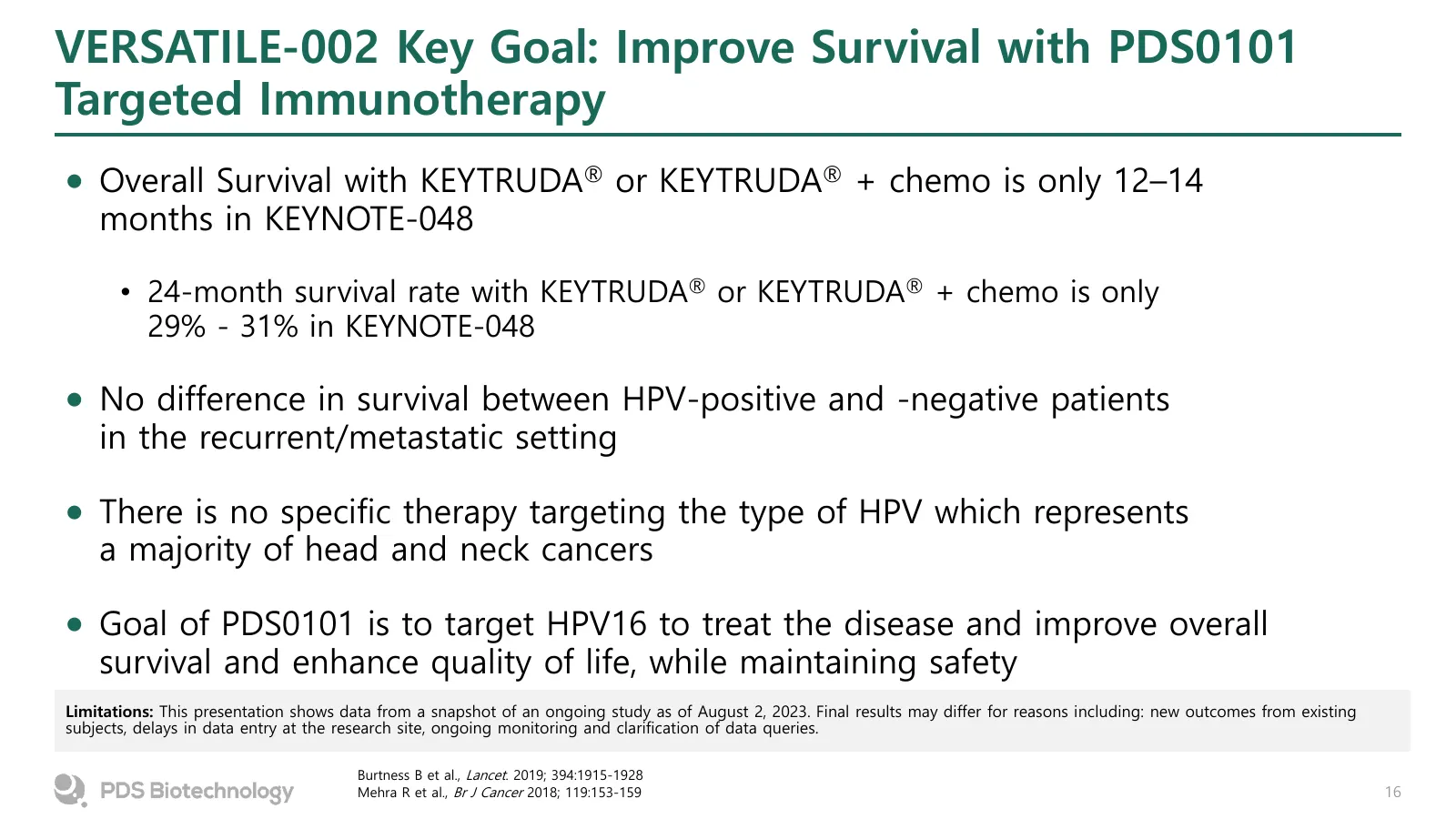
VERSATILE-002 Key Goal: Improve Survival with PDS0101 Targeted Immunotherapy • Overall Survival with KEYTRUDA® or KEYTRUDA® + chemo is only 12–14 months in KEYNOTE-048 • 24-month survival rate with KEYTRUDA® or KEYTRUDA® + chemo is only 29% - 31% in KEYNOTE-048 • No difference in survival between HP
Slide 17: VERSATILE-002 Phase 2 Clinical Trial
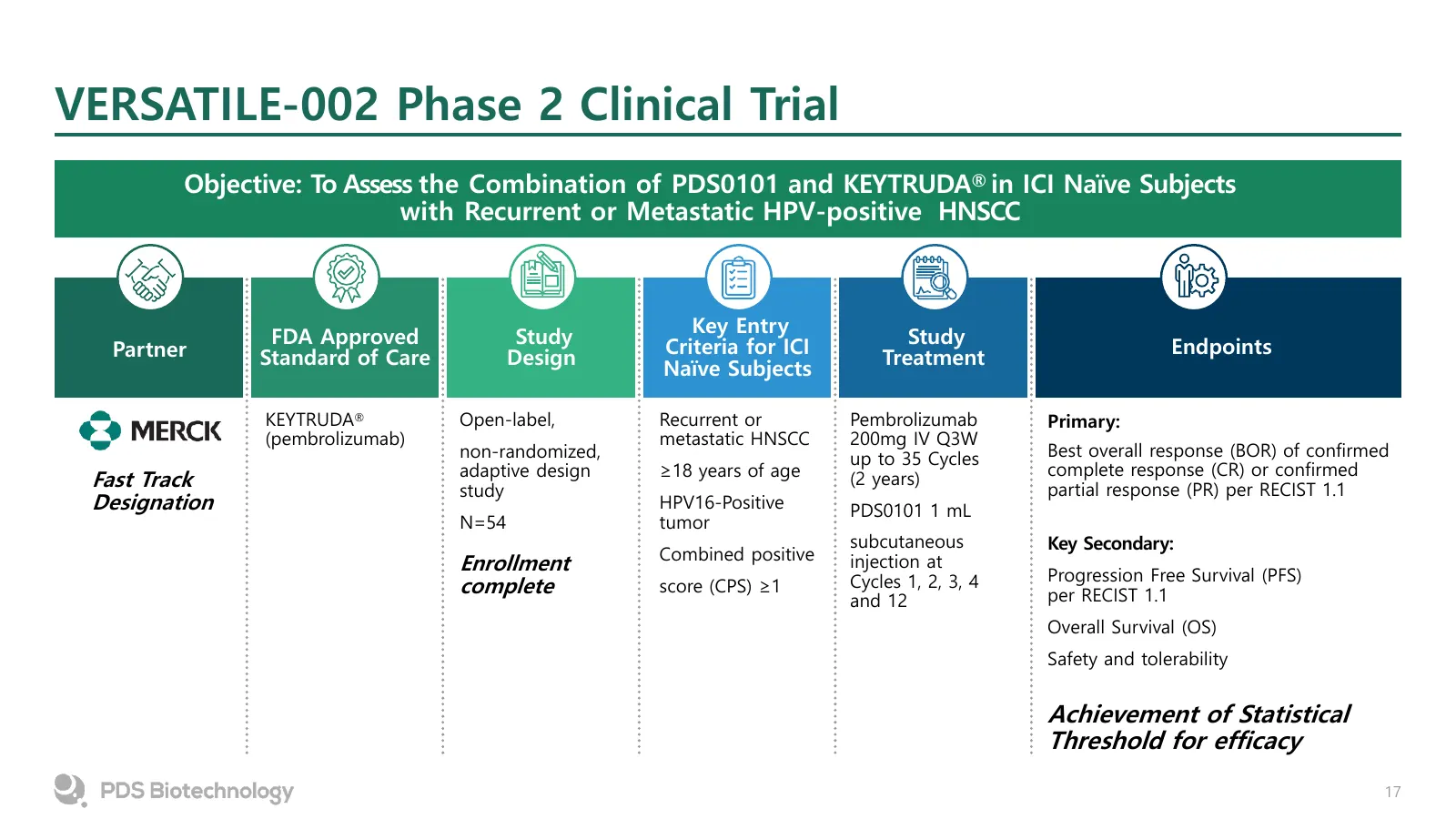
VERSATILE-002 Phase 2 Clinical Trial Objective: To Assess the Combination of PDS0101 and KEYTRUDA® in ICI Naïve Subjects with Recurrent or Metastatic HPV-positive HNSCC Key Entry FDA Approved Study Study Partner Criteria for ICI Endpoints Standard of Care Design Naïve Subjects Treatment KEYTRUDA® Op
Slide 18: VERSATILE-002 ICI Naïve Key Demographics and Treatment Exposure
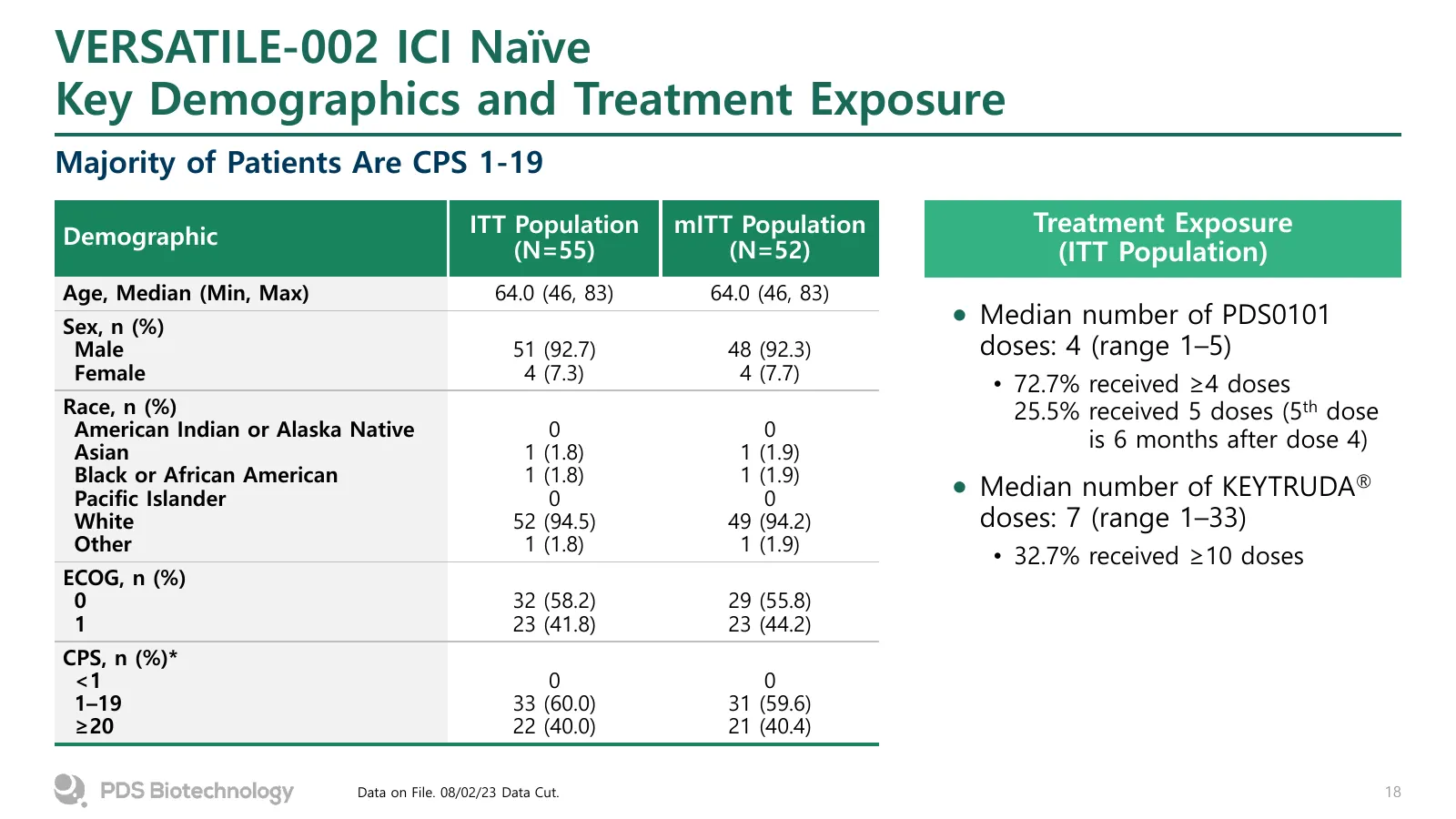
VERSATILE-002 ICI Naïve Key Demographics and Treatment Exposure Majority of Patients Are CPS 1-19 Demographic ITT Population mITT Population Treatment Exposure (N=55) (N=52) (ITT Population) Age, Median (Min, Max) 64.0 (46, 83) 64.0 (46, 83) Sex, n (%) • Median number of PDS0101 Male 51 (92.7) 48 (9
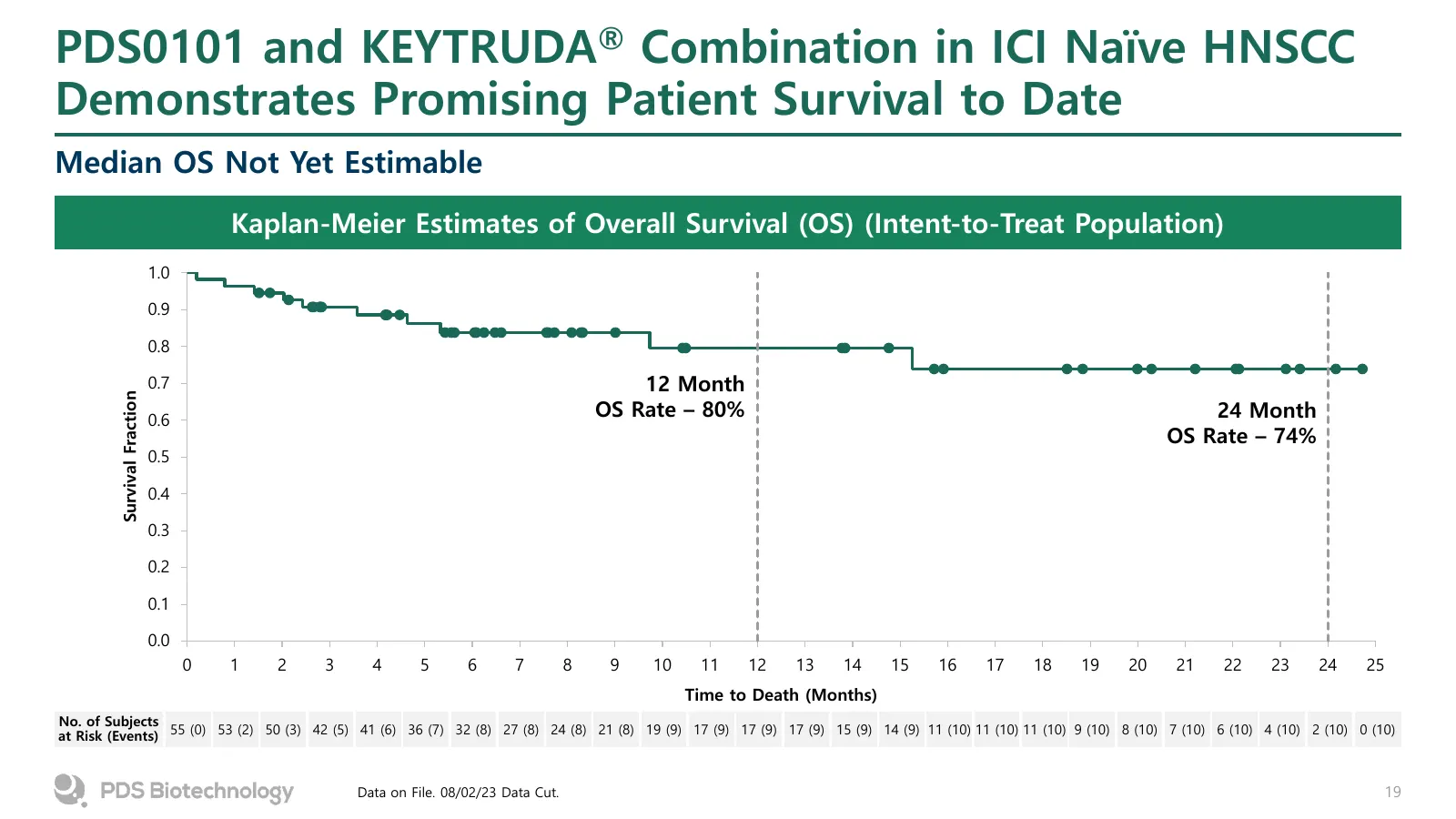
Slide 19: PDS0101 and KEYTRUDA Combination Demonstrates Promising Patient Survival to Date
PDS0101 and KEYTRUDA® Combination in ICI Naïve HNSCC Demonstrates Promising Patient Survival to Date Median OS Not Yet Estimable Kaplan-Meier Estimates of Overall Survival (OS) (Intent-to-Treat Population) 1.0 0.9 0.8 0.7 12 Month Survival Fraction 0.6 OS Rate – 80% 24 Month OS Rate – 74% 0.5 0.4 0.
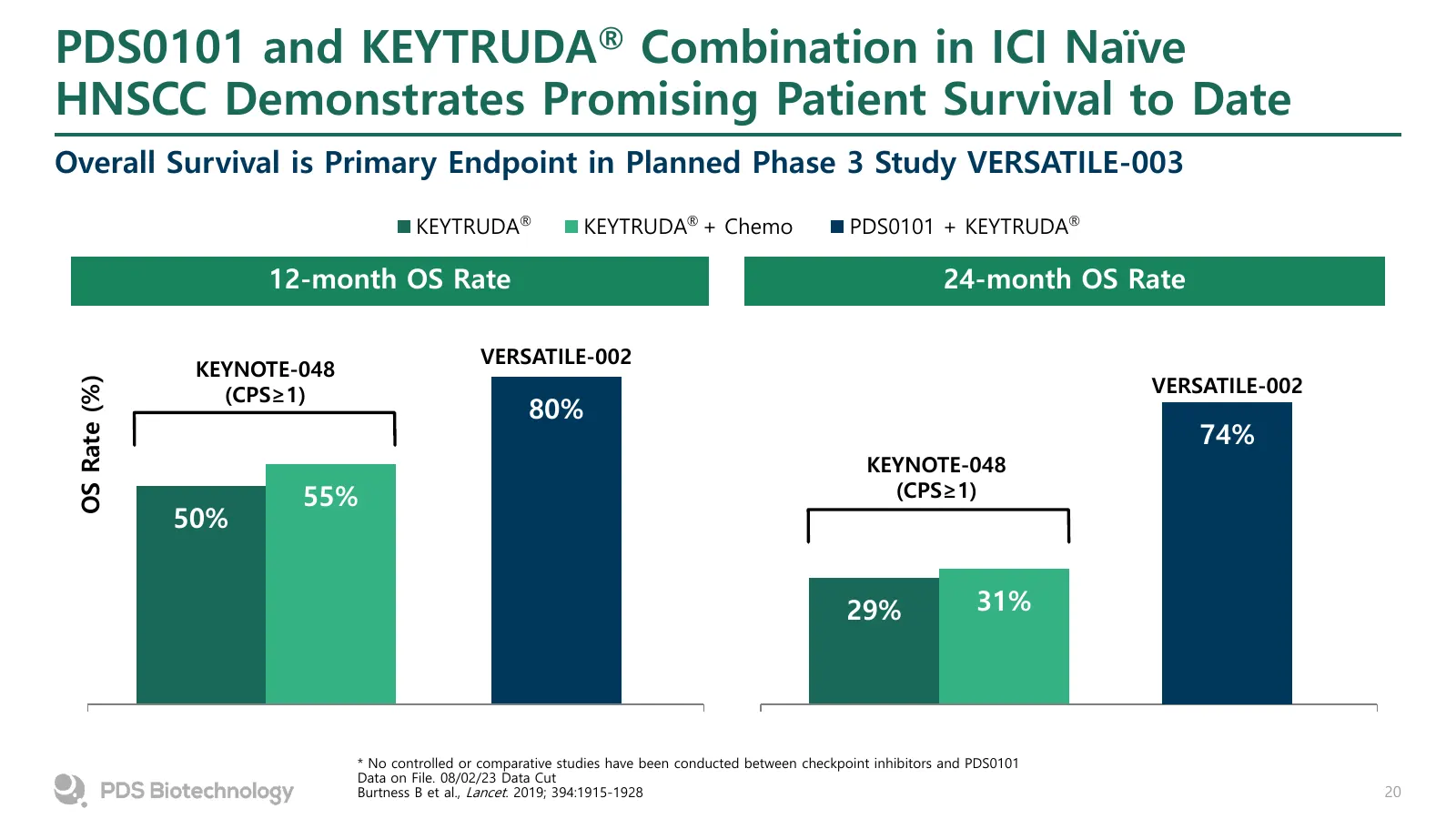
Slide 20: PDS0101 and KEYTRUDA Combination Survival vs KEYNOTE-048
PDS0101 and KEYTRUDA® Combination in ICI Naïve HNSCC Demonstrates Promising Patient Survival to Date Overall Survival is Primary Endpoint in Planned Phase 3 Study VERSATILE-003 KEYTRUDA® KEYTRUDA® + Chemo PDS0101 + KEYTRUDA® 12-month OS Rate 24-month OS Rate VERSATILE-002 KEYNOTE-048 VERSATILE-002 O
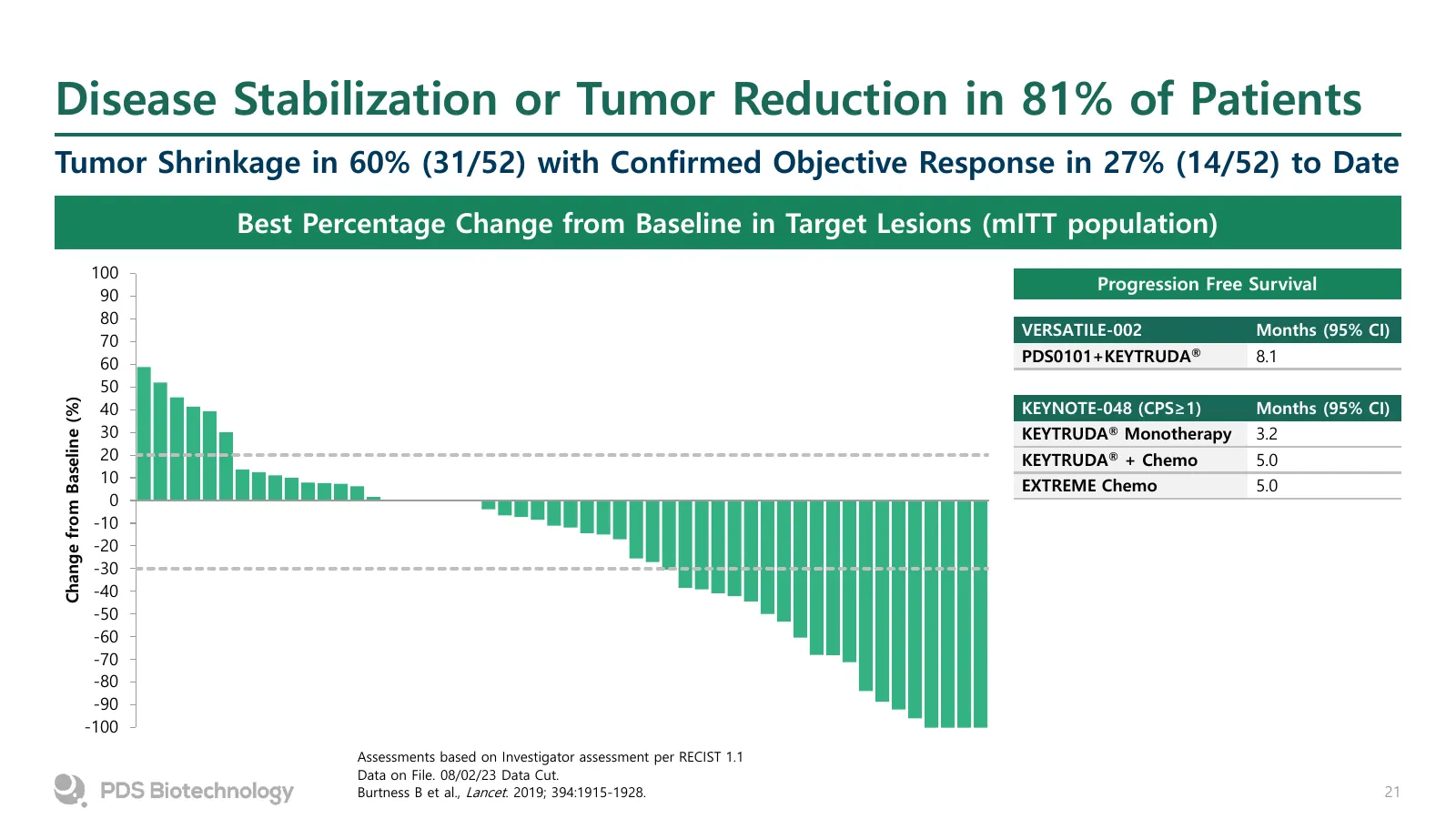
Slide 21: Disease Stabilization or Tumor Reduction in 81% of Patients
Disease Stabilization or Tumor Reduction in 81% of Patients Tumor Shrinkage in 60% (31/52) with Confirmed Objective Response in 27% (14/52) to Date Best Percentage Change from Baseline in Target Lesions (mITT population) 100 Progression Free Survival 90 80 VERSATILE-002 Months (95% CI) 70 60 PDS0101
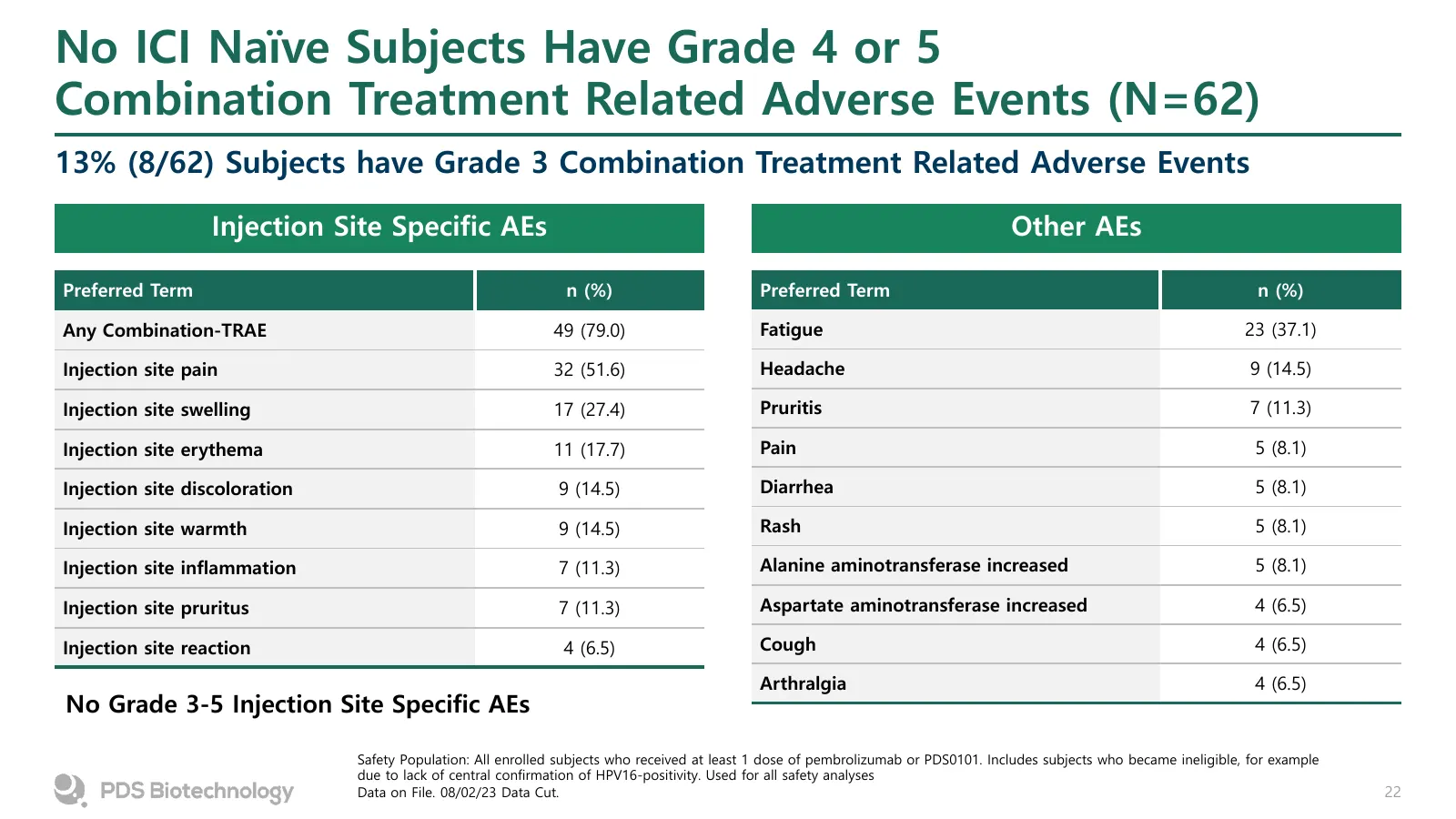
Slide 22: No ICI Naïve Subjects Have Grade 4 or 5 Treatment Related Adverse Events
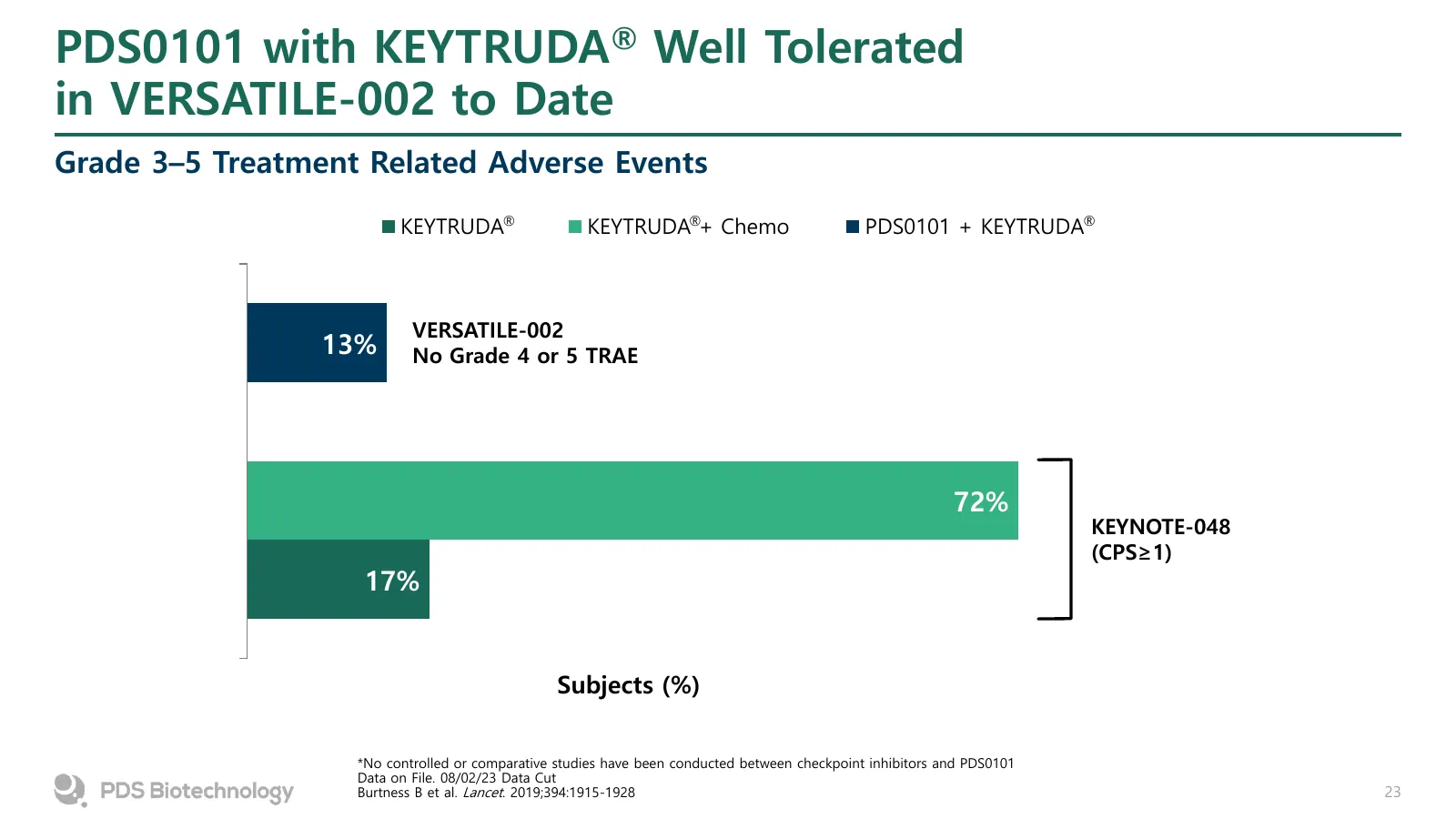
No ICI Naïve Subjects Have Grade 4 or 5 Combination Treatment Related Adverse Events (N=62) 13% (8/62) Subjects have Grade 3 Combination Treatment Related Adverse Events Injection Site Specific AEs Other AEs Preferred Term n (%) Preferred Term n (%) Any Combination-TRAE 49 (79.0) Fatigue 23 (37.1) I
Slide 23: PDS0101 with KEYTRUDA Well Tolerated in VERSATILE-002 to Date
PDS0101 with KEYTRUDA® Well Tolerated in VERSATILE-002 to Date Grade 3–5 Treatment Related Adverse Events KEYTRUDA® KEYTRUDA®+ Chemo PDS0101 + KEYTRUDA® VERSATILE-002 13% No Grade 4 or 5 TRAE 72% KEYNOTE-048 (CPS≥1) 17% Subjects (%) *No controlled or comparative studies have been conducted between c
Slide 24: Combination Continues to Show Promising Survival Outcomes in ICI Naïve Subjects
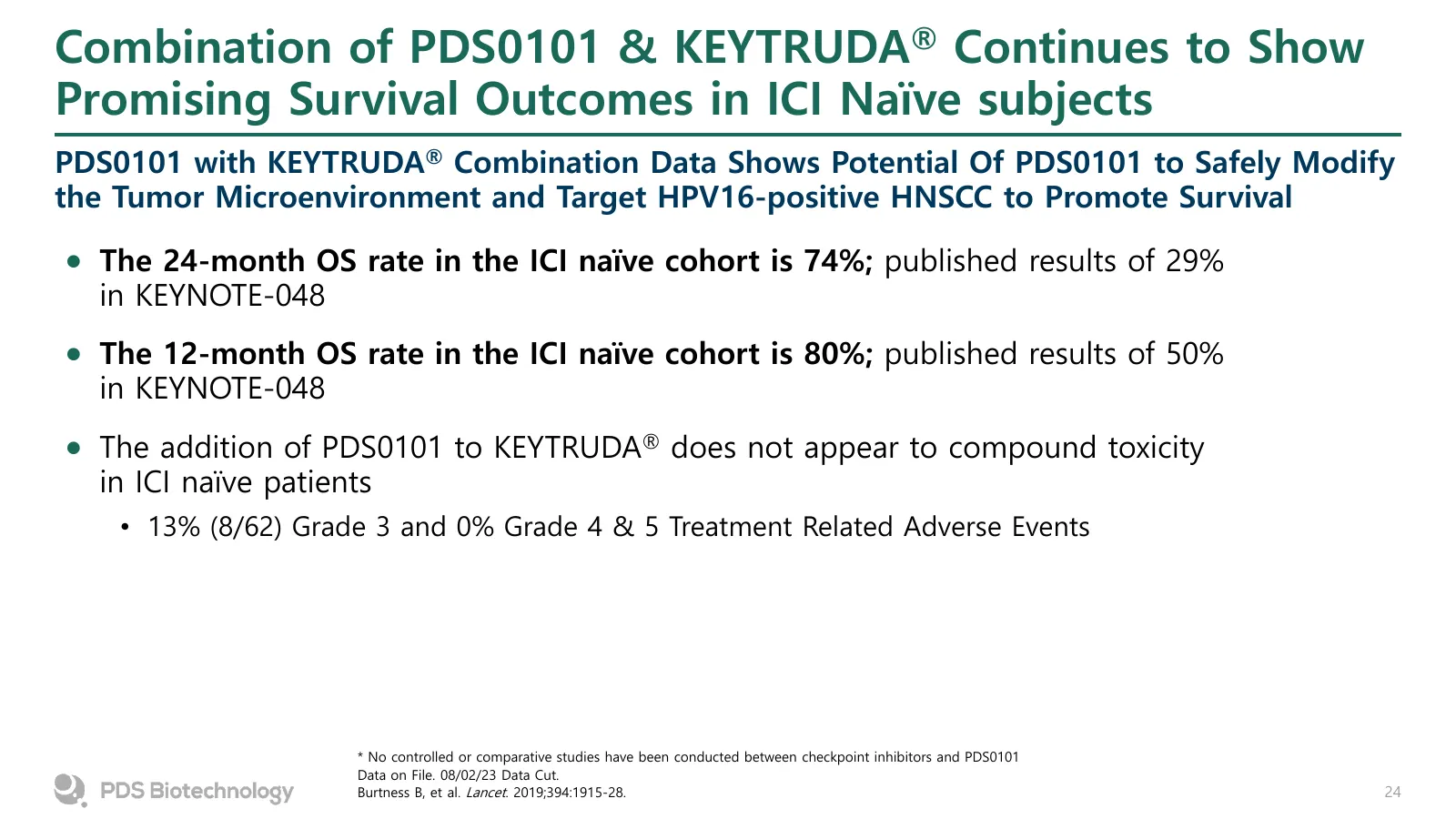
Combination of PDS0101 & KEYTRUDA® Continues to Show Promising Survival Outcomes in ICI Naïve subjects PDS0101 with KEYTRUDA® Combination Data Shows Potential Of PDS0101 to Safely Modify the Tumor Microenvironment and Target HPV16-positive HNSCC to Promote Survival • The 24-month OS rate in the ICI
Slide 25: Plans for Phase 3 Study
Plans for Phase 3 Study Dr. Katharine Price 25
Slide 26: VERSATILE-003
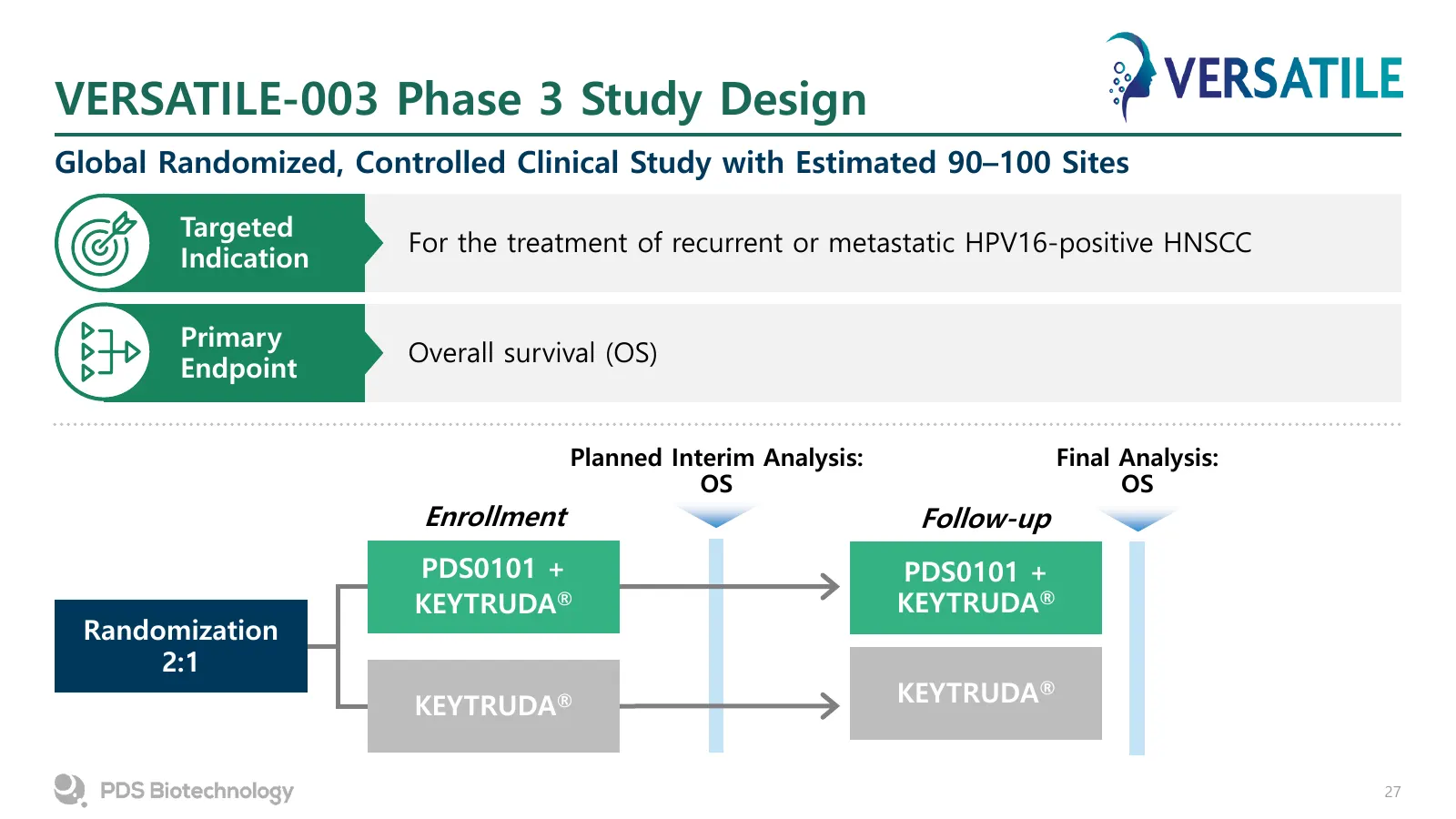
VERSATILE-003 Designed to Be Confirmatory Trial for ICI Naïve Cohort of Phase 2 VERSATILE-002 Study with Overall Survival as Primary Endpoint A Phase 3 Open-Label, Randomized Study of PDS0101 Plus Pembrolizumab vs Pembrolizumab Alone in First Line Treatment of Immune Checkpoint Inhibitor (ICI) Naïve
Slide 27: VERSATILE-003 Phase 3 Study Design
VERSATILE-003 Phase 3 Study Design Global Randomized, Controlled Clinical Study with Estimated 90–100 Sites Targeted For the treatment of recurrent or metastatic HPV16-positive HNSCC Indication Primary Overall survival (OS) Endpoint Planned Interim Analysis: Final Analysis: OS OS Enrollment Follow-u
Slide 28: Primary and Secondary Objectives
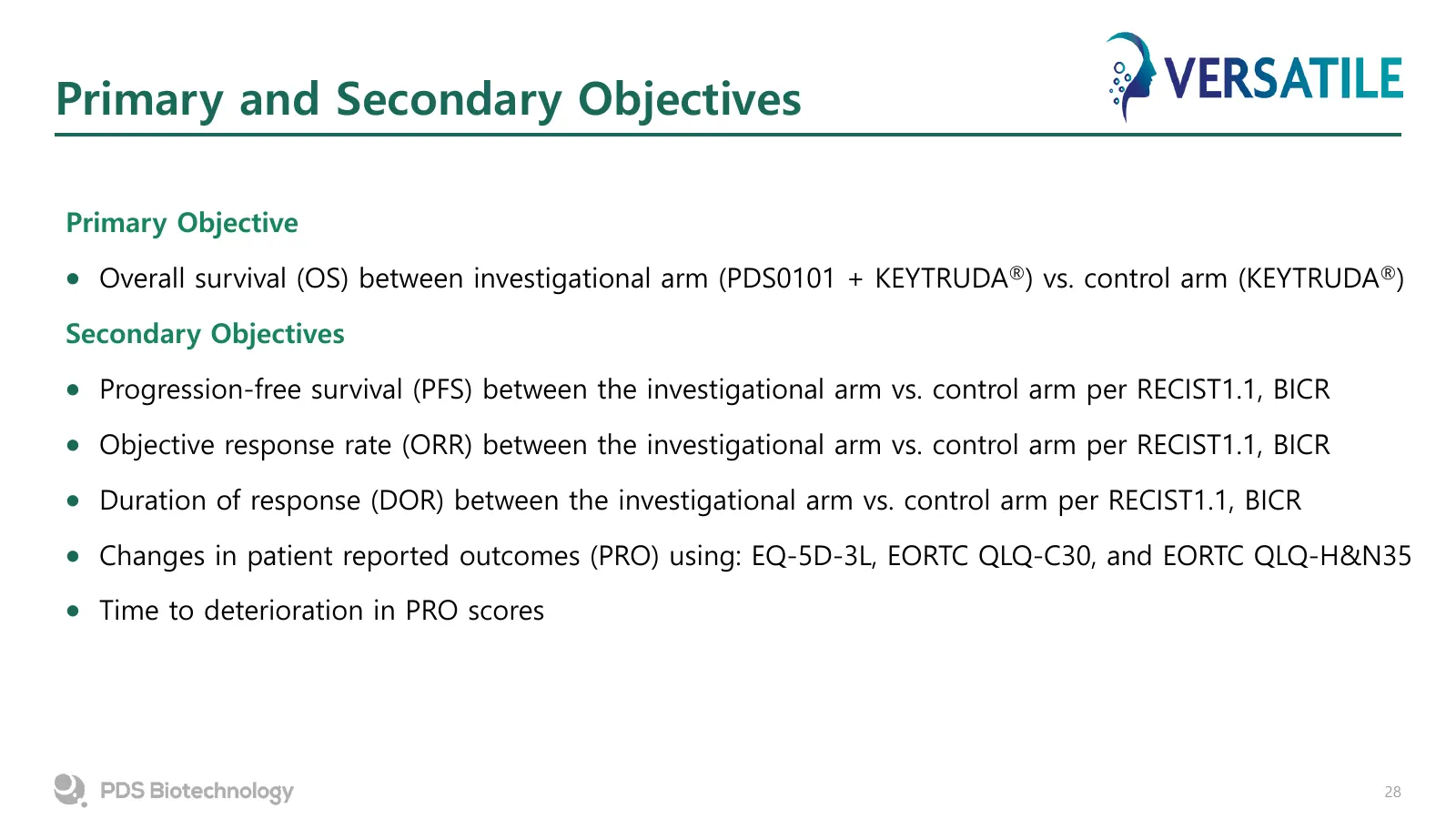
Primary and Secondary Objectives Primary Objective • Overall survival (OS) between investigational arm (PDS0101 + KEYTRUDA®) vs. control arm (KEYTRUDA®) Secondary Objectives • Progression-free survival (PFS) between the investigational arm vs. control arm per RECIST1.1, BICR • Objective response rat
Slide 29: Safety and Exploratory Objectives
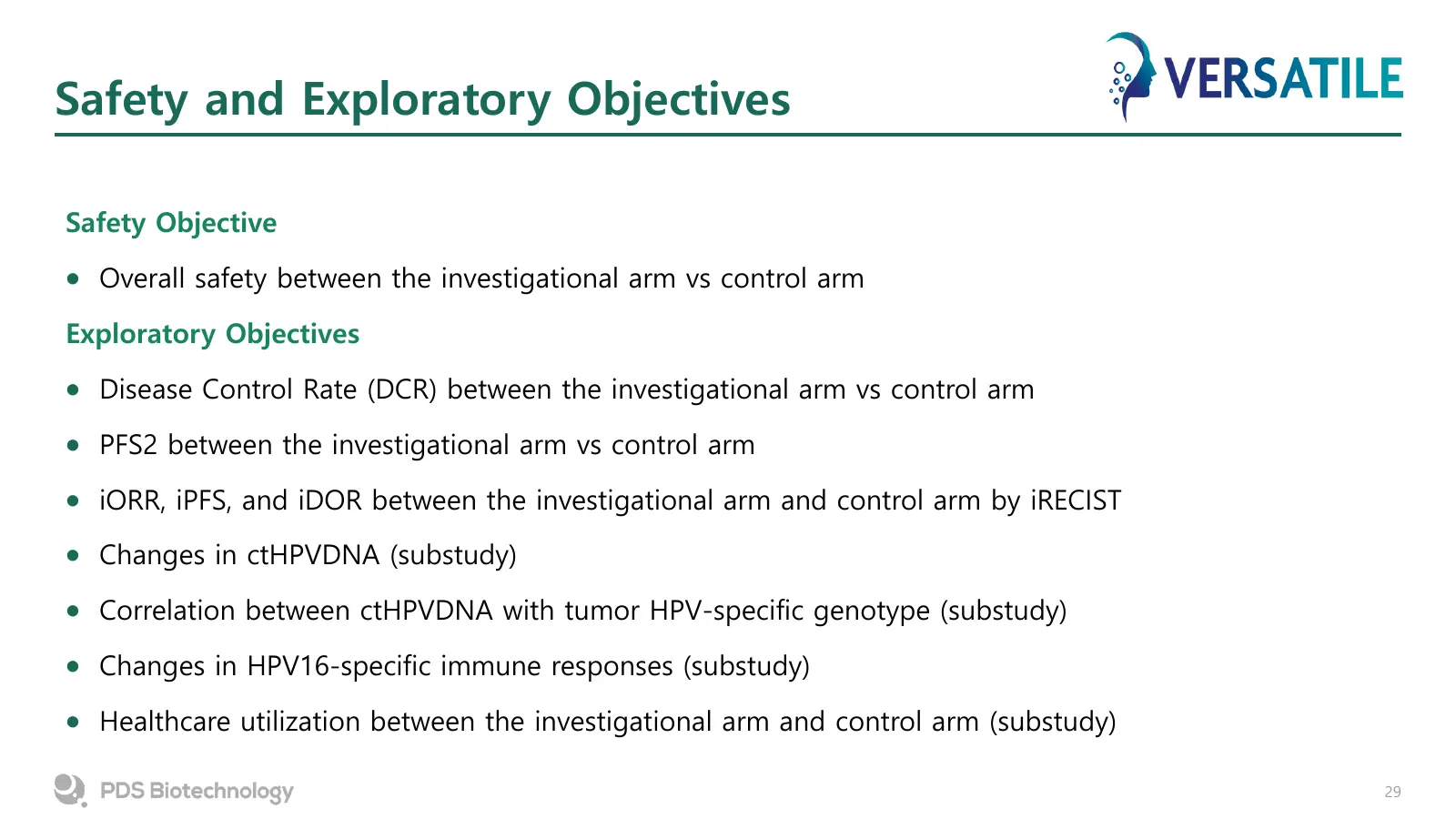
Safety and Exploratory Objectives Safety Objective • Overall safety between the investigational arm vs control arm Exploratory Objectives • Disease Control Rate (DCR) between the investigational arm vs control arm • PFS2 between the investigational arm vs control arm • iORR, iPFS, and iDOR between t
Slide 30: Study Treatment Schedule
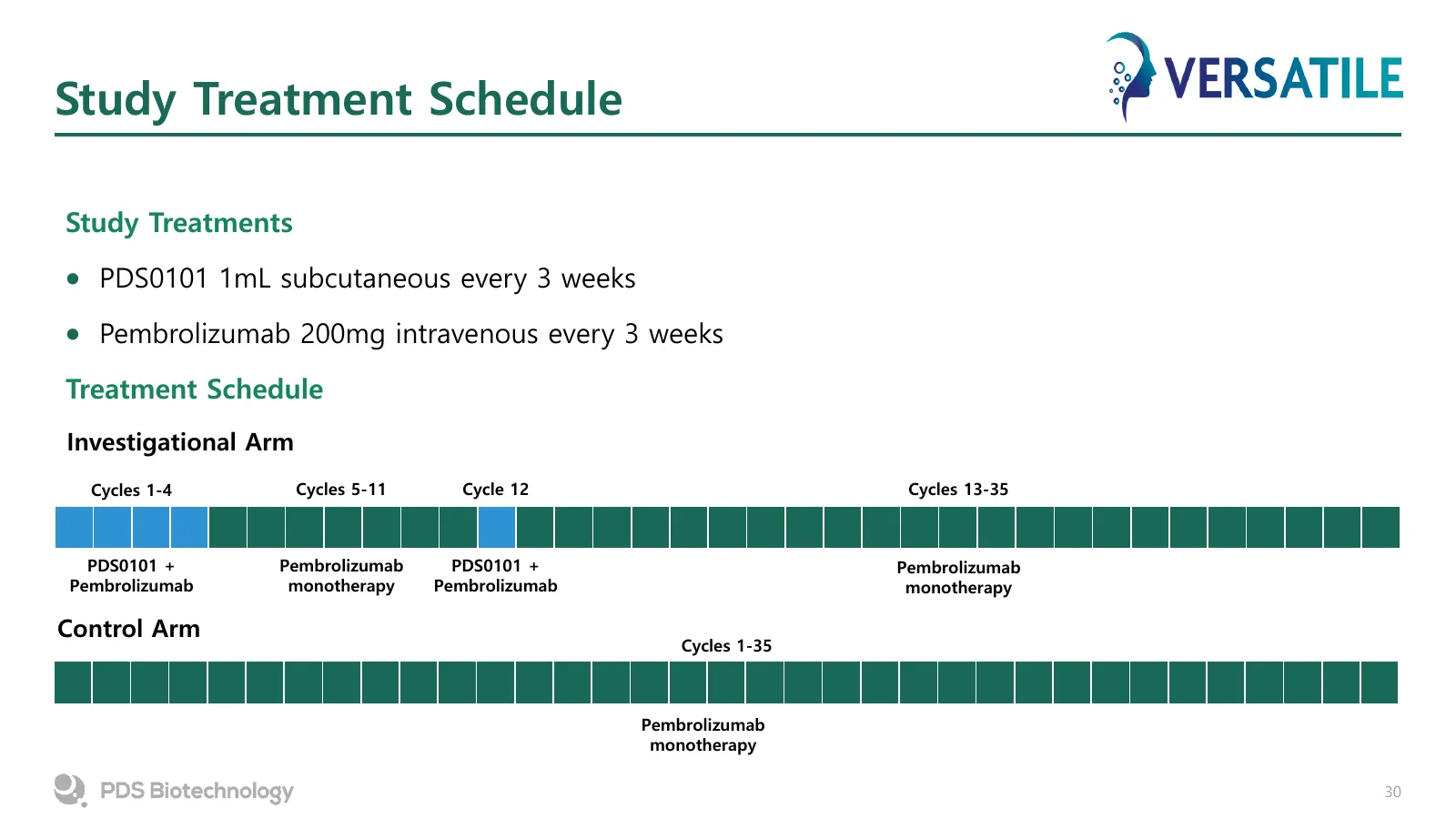
Study Treatment Schedule Study Treatments • PDS0101 1mL subcutaneous every 3 weeks • Pembrolizumab 200mg intravenous every 3 weeks Treatment Schedule Investigational Arm Cycles 1-4 Cycles 5-11 Cycle 12 Cycles 13-35 PDS0101 + Pembrolizumab PDS0101 + Pembrolizumab Pembrolizumab monotherapy Pembrolizum
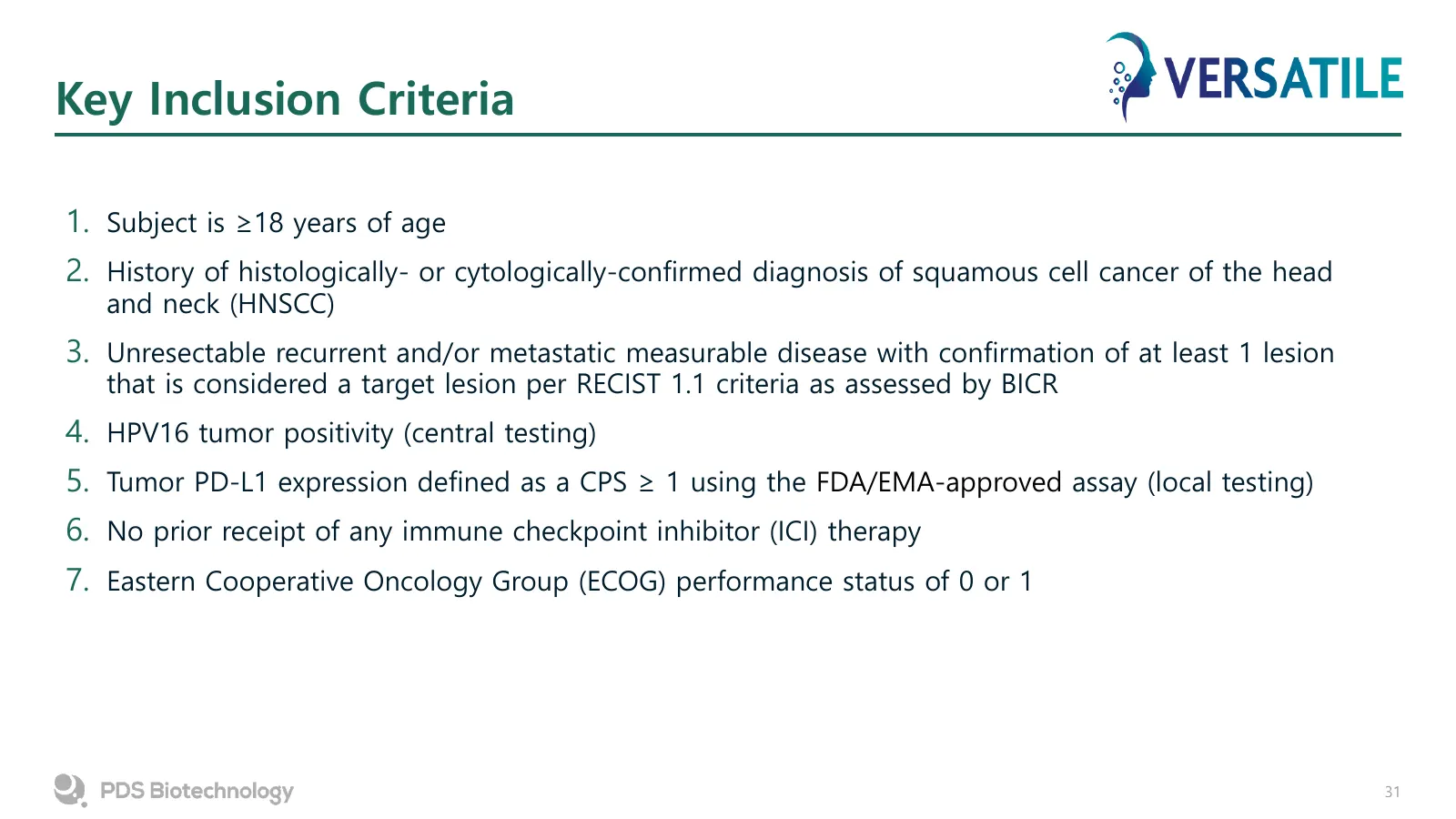
Slide 31: Key Inclusion Criteria
Key Inclusion Criteria 1. Subject is ≥18 years of age 2. History of histologically- or cytologically-confirmed diagnosis of squamous cell cancer of the head and neck (HNSCC) 3. Unresectable recurrent and/or metastatic measurable disease with confirmation of at least 1 lesion that is considered a tar
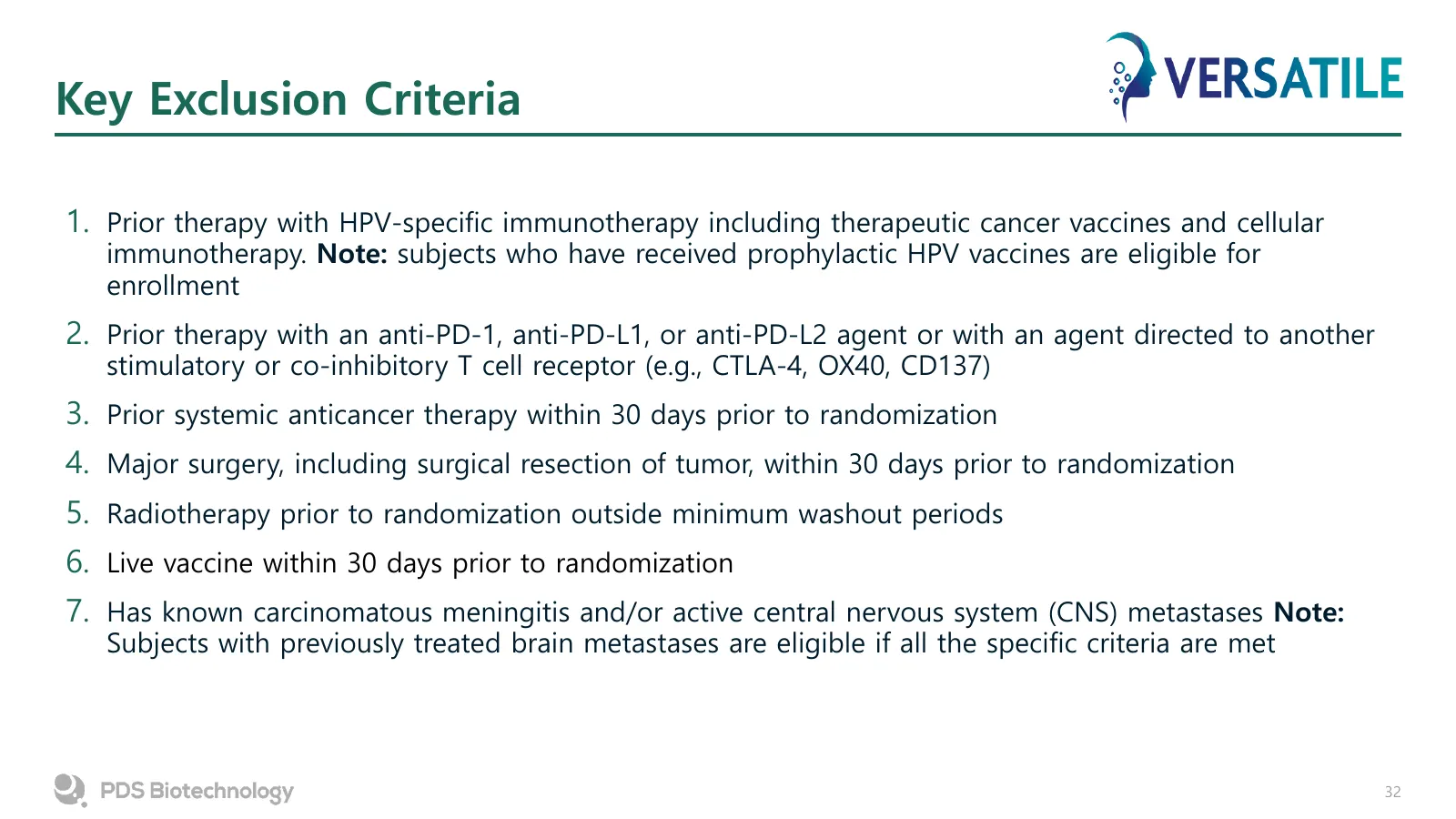
Slide 32: Key Exclusion Criteria
Key Exclusion Criteria 1. Prior therapy with HPV-specific immunotherapy including therapeutic cancer vaccines and cellular immunotherapy. Note: subjects who have received prophylactic HPV vaccines are eligible for enrollment 2. Prior therapy with an anti-PD-1, anti-PD-L1, or anti-PD-L2 agent or with
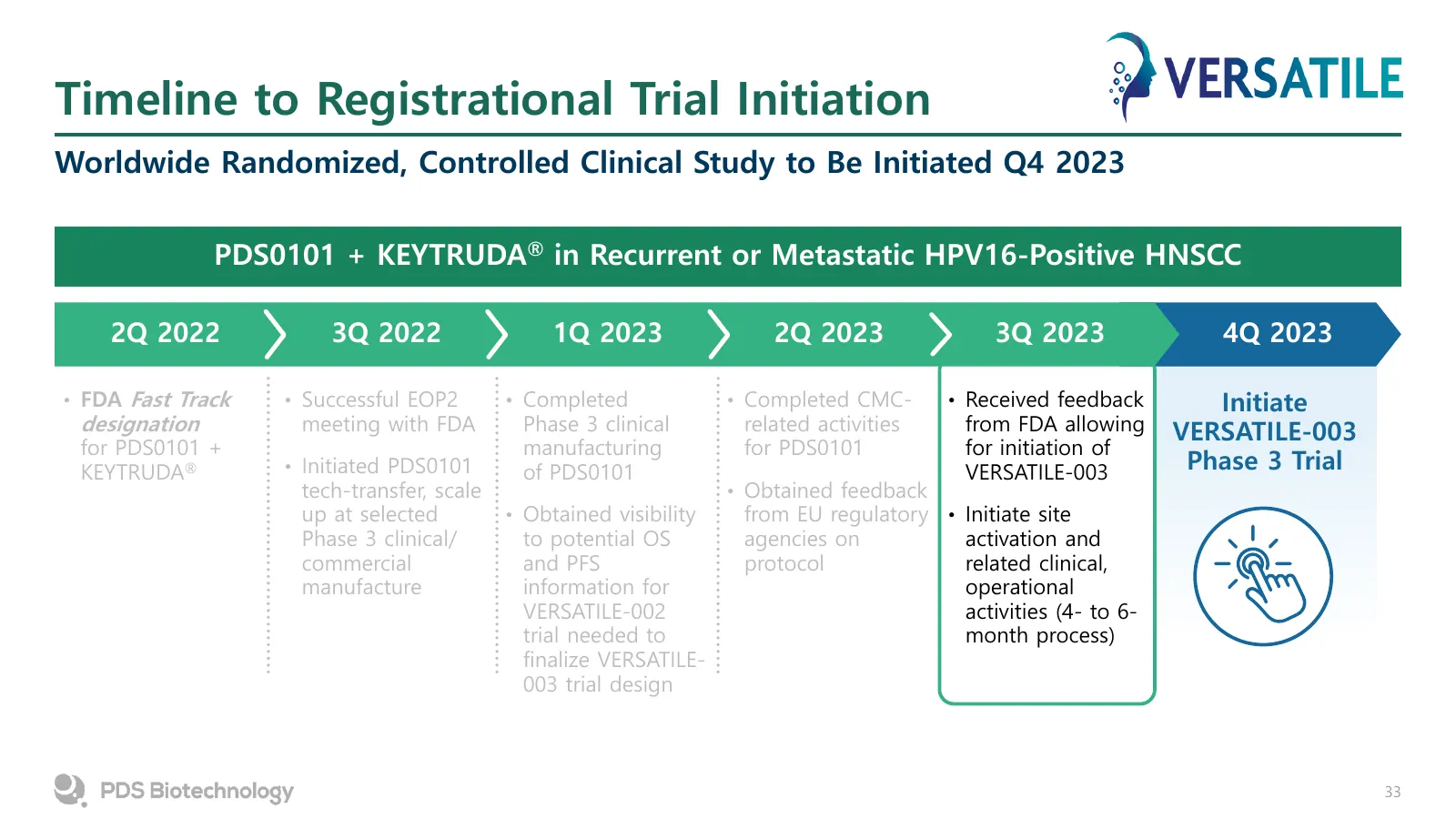
Slide 33: Timeline to Registrational Trial Initiation
Timeline to Registrational Trial Initiation Worldwide Randomized, Controlled Clinical Study to Be Initiated Q4 2023 PDS0101 + KEYTRUDA® in Recurrent or Metastatic HPV16-Positive HNSCC 2Q 2022 3Q 2022 1Q 2023 2Q 2023 3Q 2023 4Q 2023 • FDA Fast Track • Successful EOP2 • Completed • Completed CMC- • Re
Slide 34: Emerging Use of ctDNA in Treatment of HPV+ HNSCC
Emerging Use of ctDNA in Treatment of HPV+ HNSCC Dr. Glenn Hanna 34
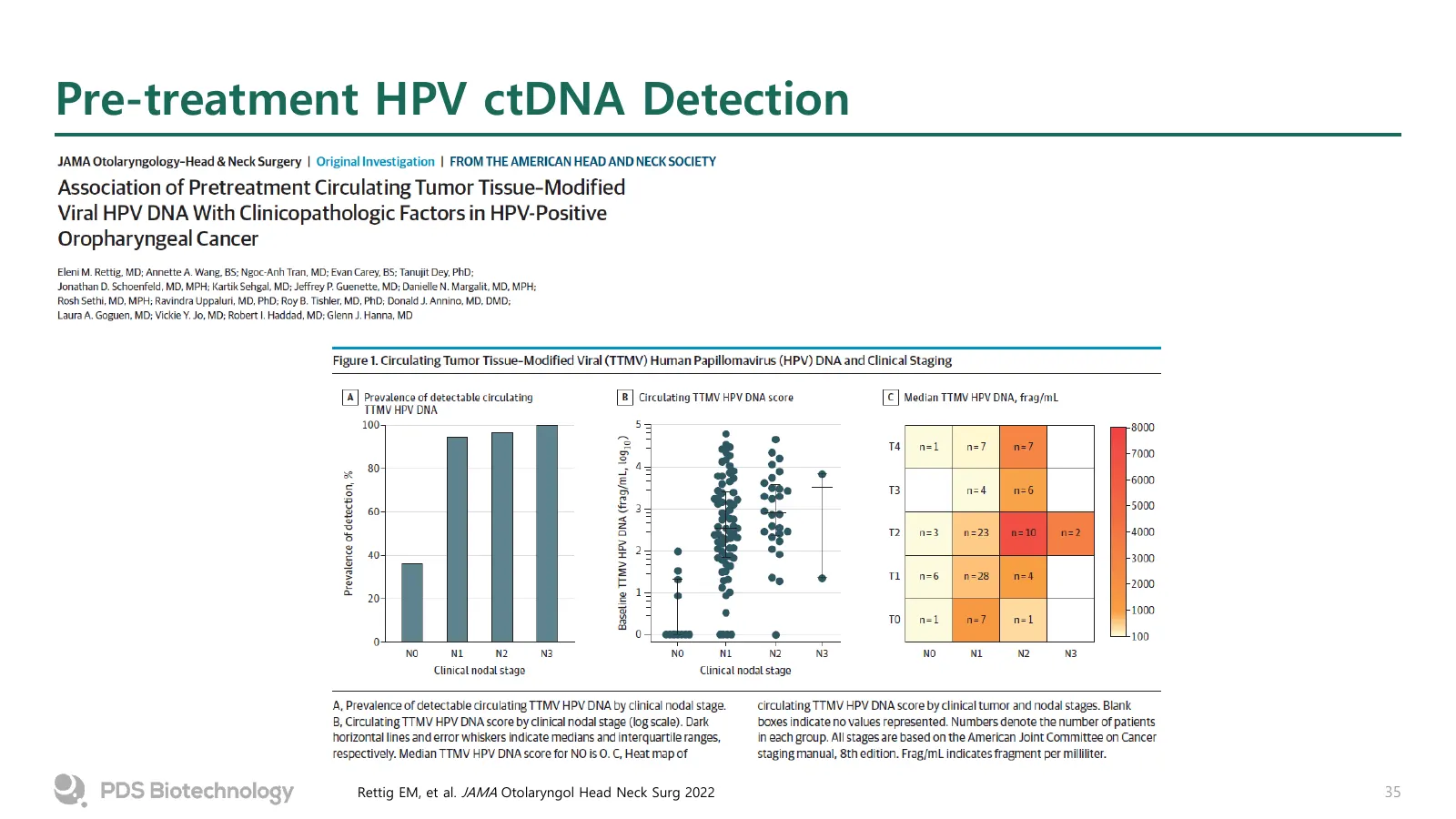
Slide 35: Pre-treatment HPV ctDNA Detection
Pre-treatment HPV ctDNA Detection Rettig EM, et al. JAMA Otolaryngol Head Neck Surg 2022 35
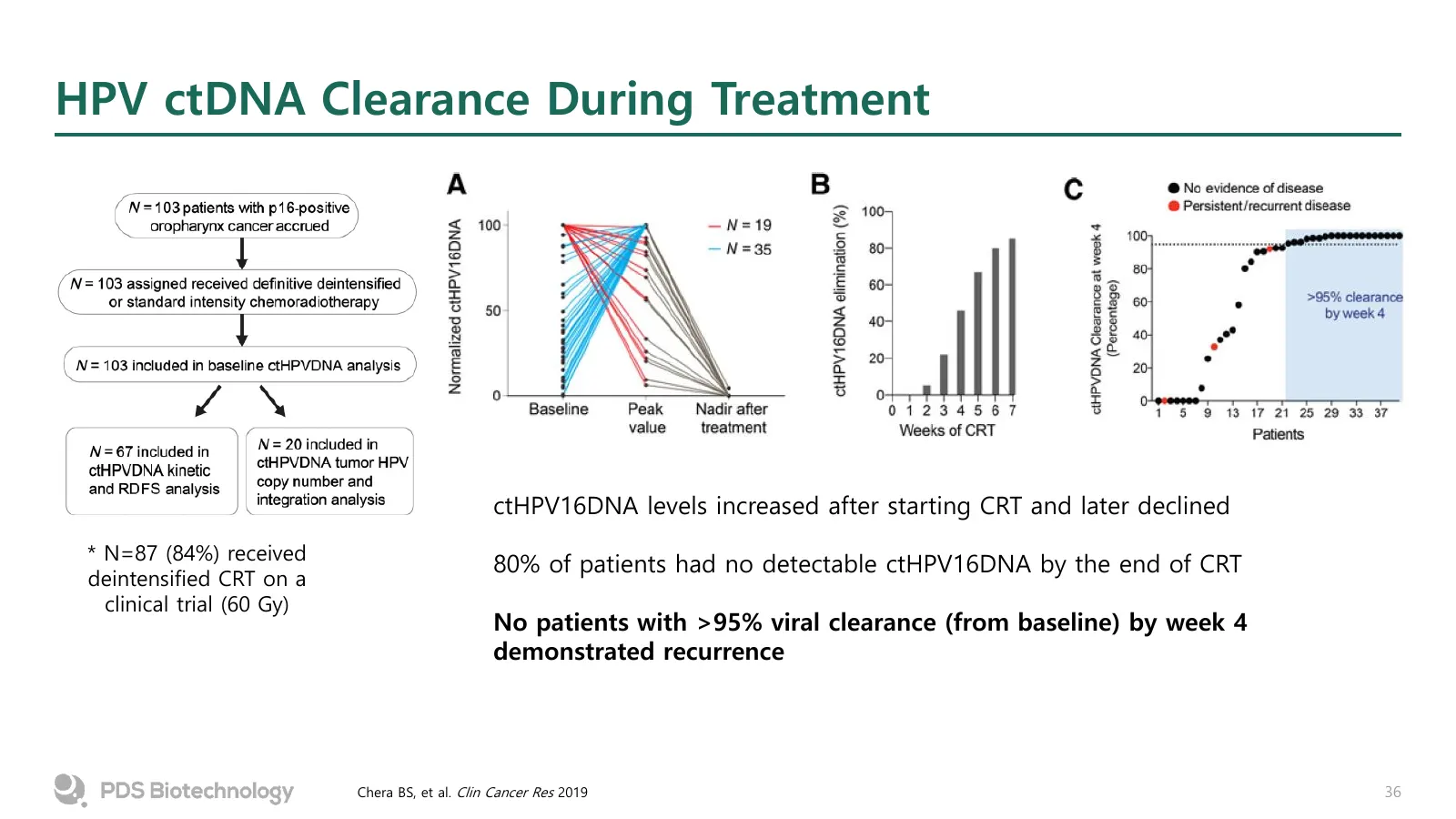
Slide 36: HPV ctDNA Clearance During Treatment
HPV ctDNA Clearance During Treatment ctHPV16DNA levels increased after starting CRT and later declined * N=87 (84%) received 80% of patients had no detectable ctHPV16DNA by the end of CRT deintensified CRT on a clinical trial (60 Gy) No patients with >95% viral clearance (from baseline) by week 4 de
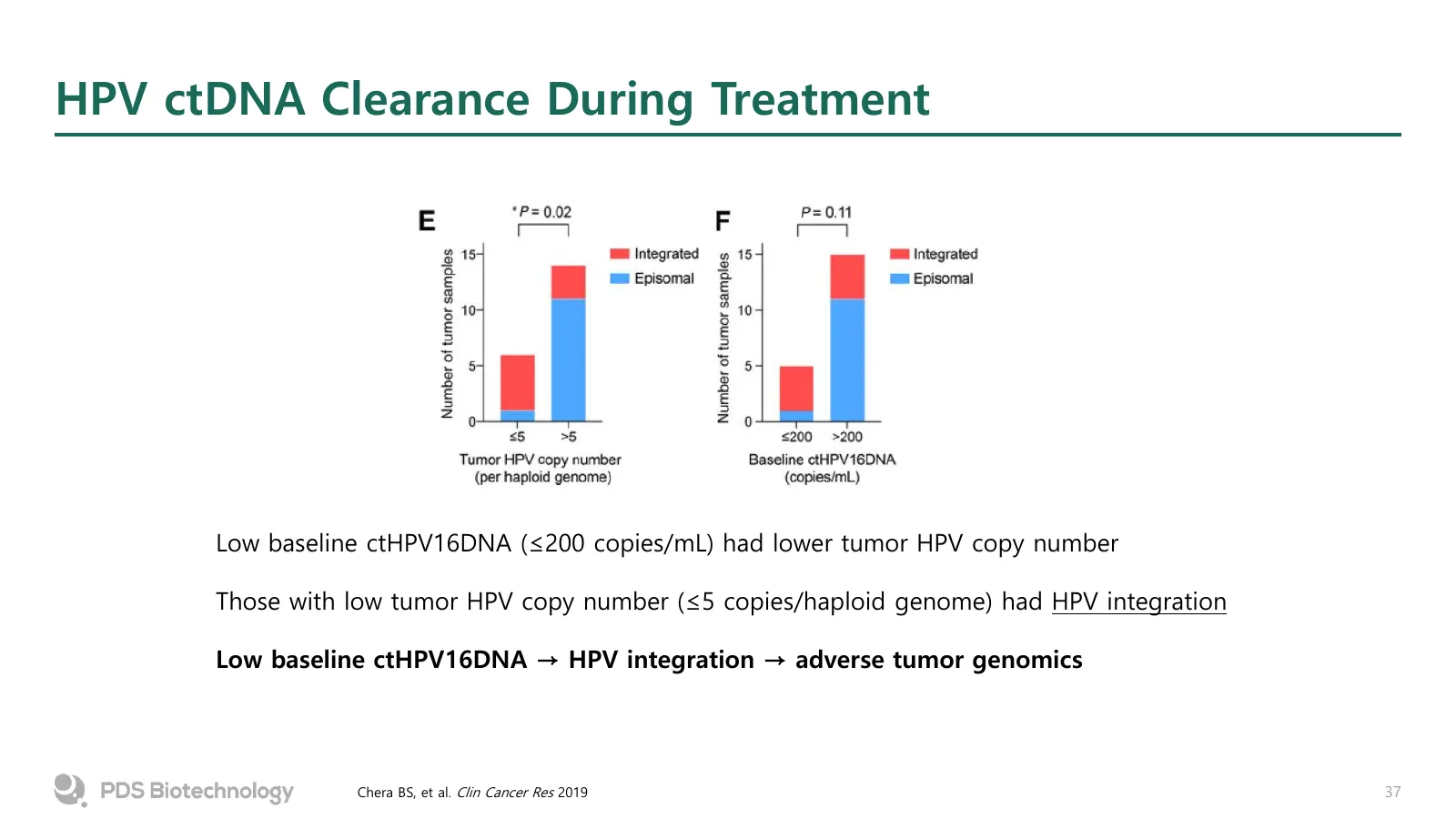
Slide 37: HPV ctDNA Clearance During Treatment
HPV ctDNA Clearance During Treatment Low baseline ctHPV16DNA (≤200 copies/mL) had lower tumor HPV copy number Those with low tumor HPV copy number (≤5 copies/haploid genome) had HPV integration Low baseline ctHPV16DNA → HPV integration → adverse tumor genomics Chera BS, et al. Clin Cancer Res 2019 3
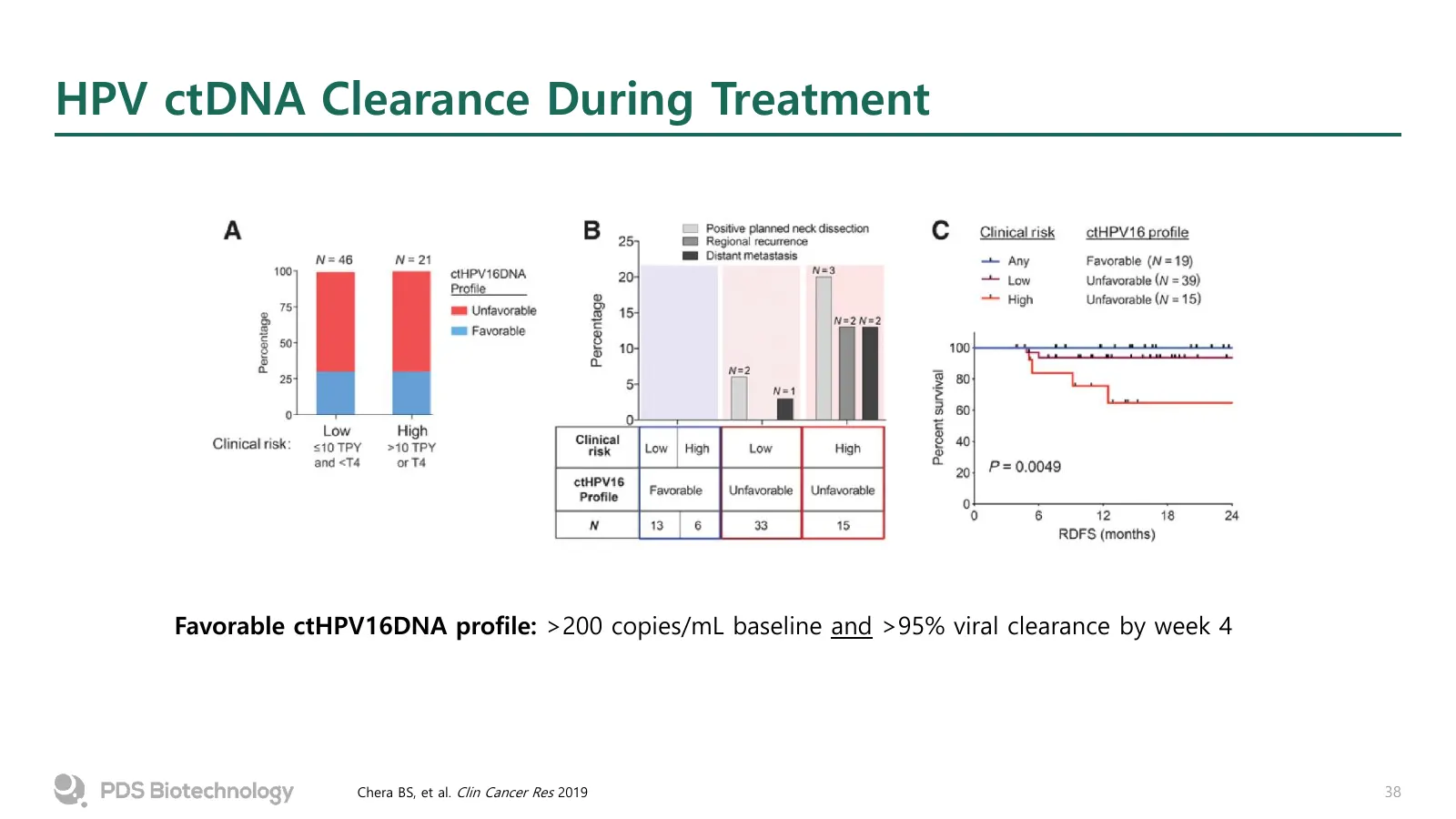
Slide 38: HPV ctDNA Clearance During Treatment
HPV ctDNA Clearance During Treatment Favorable ctHPV16DNA profile: >200 copies/mL baseline and >95% viral clearance by week 4 Chera BS, et al. Clin Cancer Res 2019 38
Slide 39: Risk Stratifying HPV+ Oropharyngeal Cancer
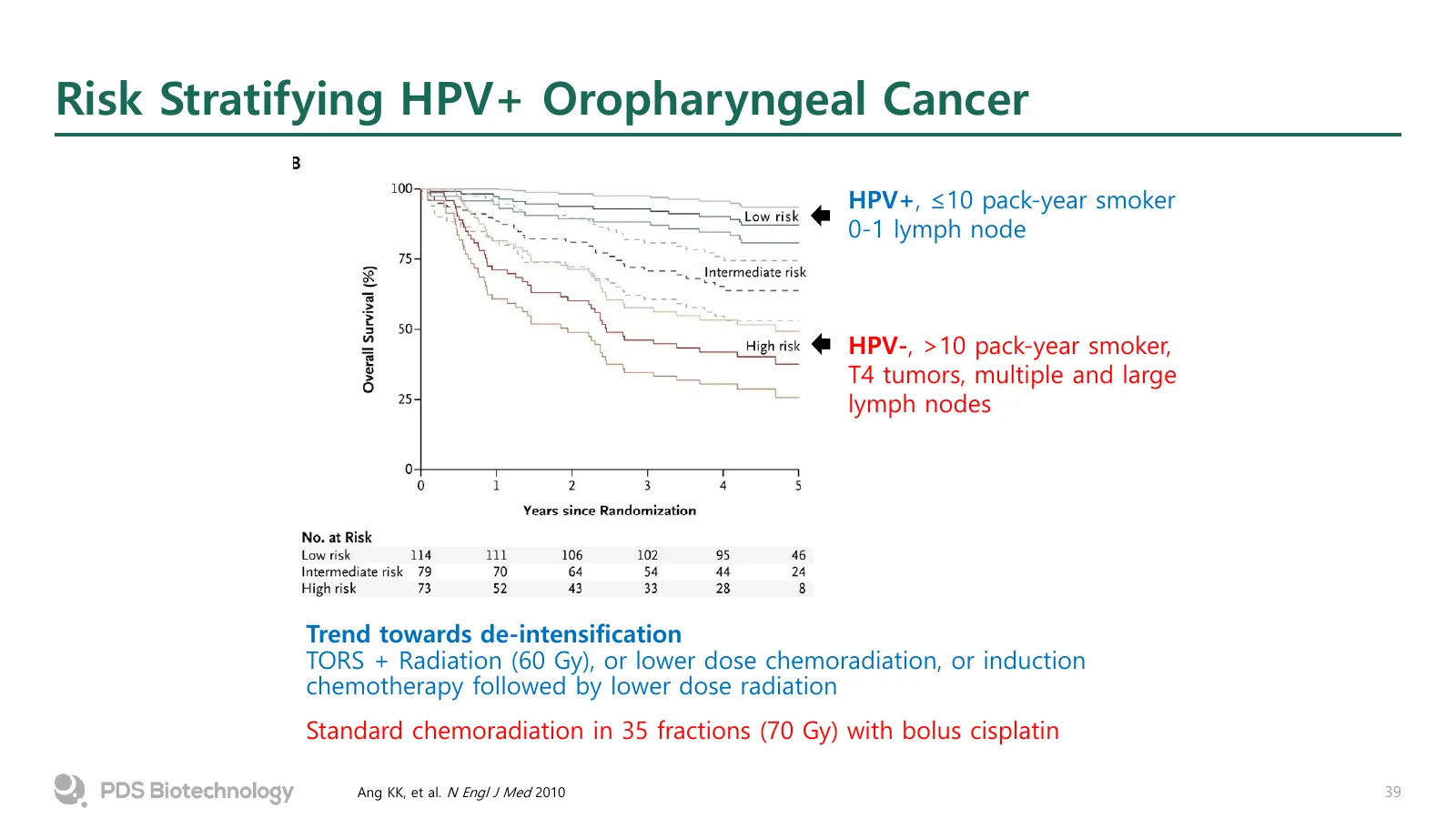
Risk Stratifying HPV+ Oropharyngeal Cancer HPV+, ≤10 pack-year smoker 0-1 lymph node HPV-, >10 pack-year smoker, T4 tumors, multiple and large lymph nodes Trend towards de-intensification TORS + Radiation (60 Gy), or lower dose chemoradiation, or induction chemotherapy followed by lower dose radiati
Slide 40: Risk Stratifying HPV+ Oropharyngeal Cancer
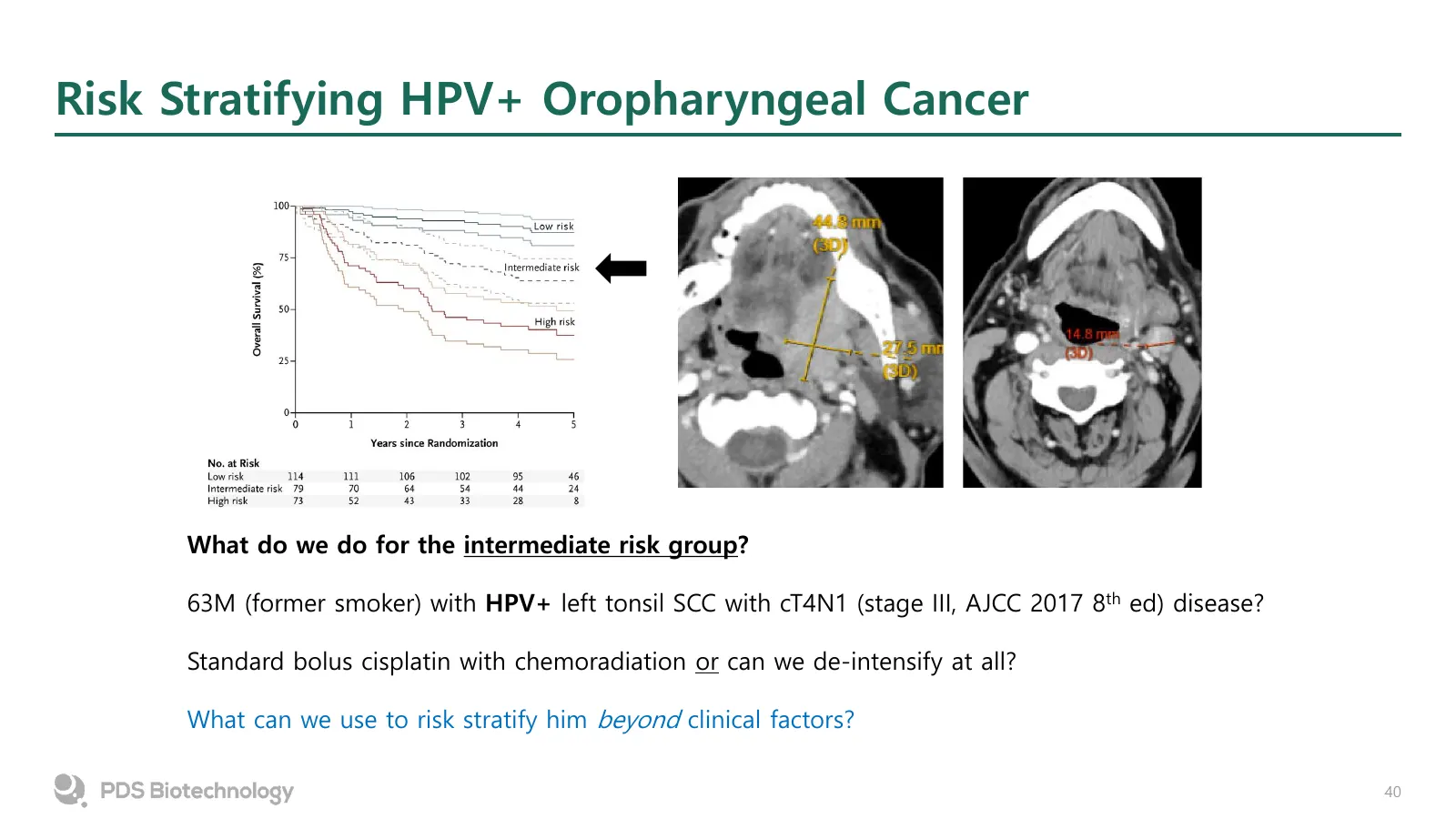
Risk Stratifying HPV+ Oropharyngeal Cancer What do we do for the intermediate risk group? 63M (former smoker) with HPV+ left tonsil SCC with cT4N1 (stage III, AJCC 2017 8th ed) disease? Standard bolus cisplatin with chemoradiation or can we de-intensify at all? What can we use to risk stratify him b
Slide 41: ReACT Study: Risk-adapted Therapy Using ctHPV DNA Profile
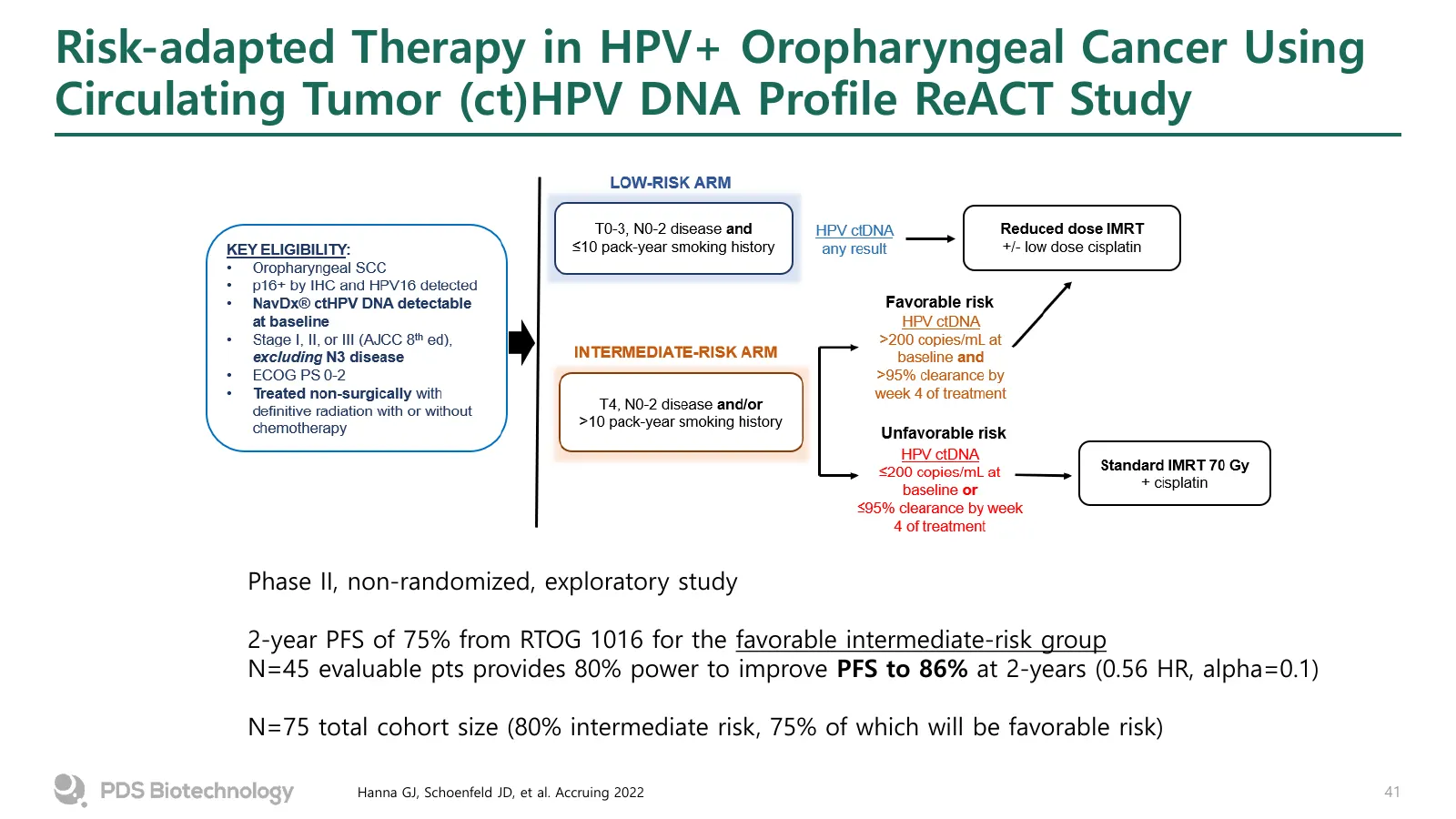
Risk-adapted Therapy in HPV+ Oropharyngeal Cancer Using Circulating Tumor (ct)HPV DNA Profile ReACT Study Phase II, non-randomized, exploratory study 2-year PFS of 75% from RTOG 1016 for the favorable intermediate-risk group N=45 evaluable pts provides 80% power to improve PFS to 86% at 2-years (0.5
Slide 42: ReACT Study: Risk-adapted Therapy Using ctHPV DNA Profile
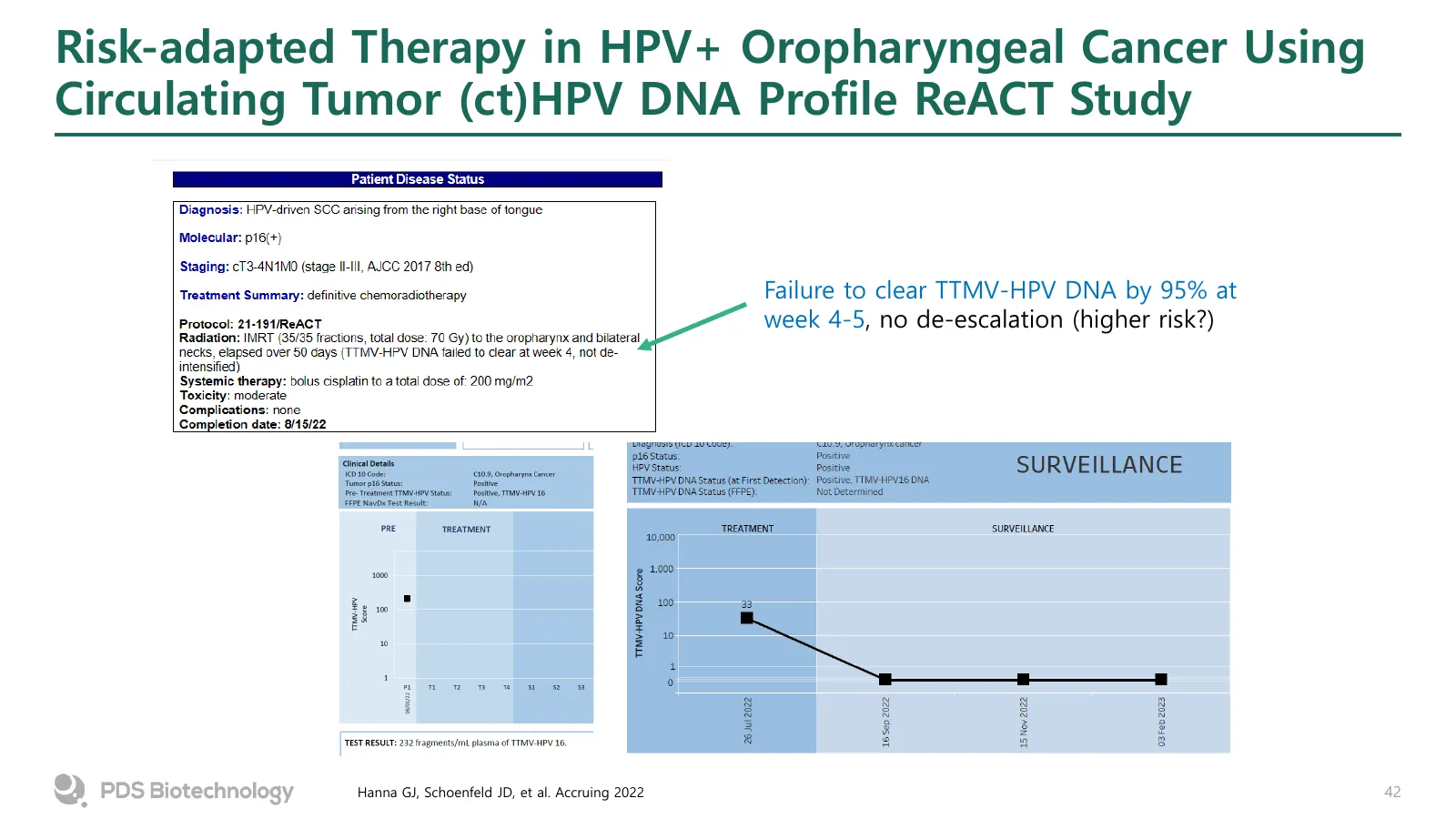
Risk-adapted Therapy in HPV+ Oropharyngeal Cancer Using Circulating Tumor (ct)HPV DNA Profile ReACT Study Failure to clear TTMV-HPV DNA by 95% at week 4-5, no de-escalation (higher risk?) Hanna GJ, Schoenfeld JD, et al. Accruing 2022 42
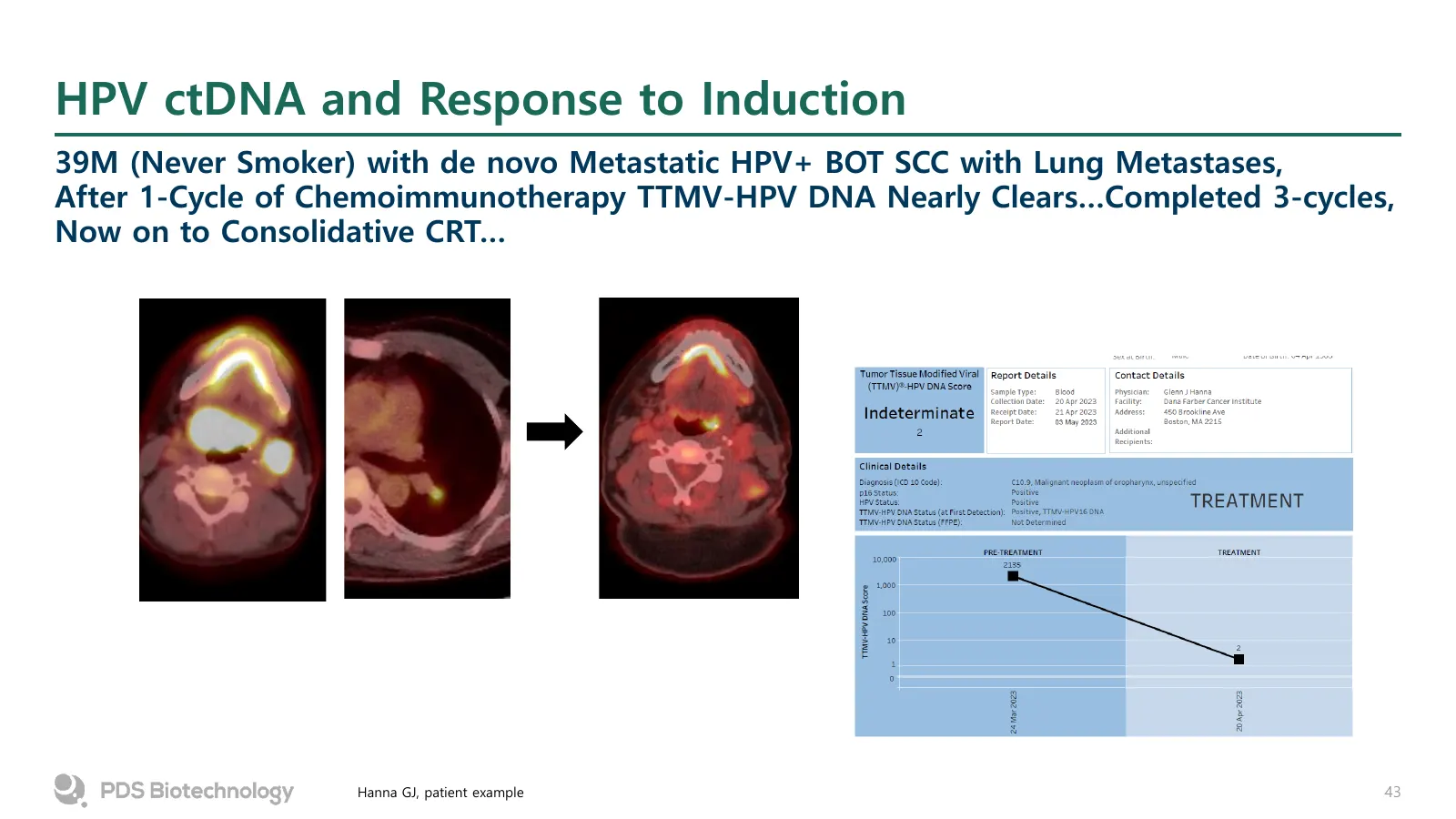
Slide 43: HPV ctDNA and Response to Induction
HPV ctDNA and Response to Induction 39M (Never Smoker) with de novo Metastatic HPV+ BOT SCC with Lung Metastases, After 1-Cycle of Chemoimmunotherapy TTMV-HPV DNA Nearly Clears…Completed 3-cycles, Now on to Consolidative CRT… Hanna GJ, patient example 43
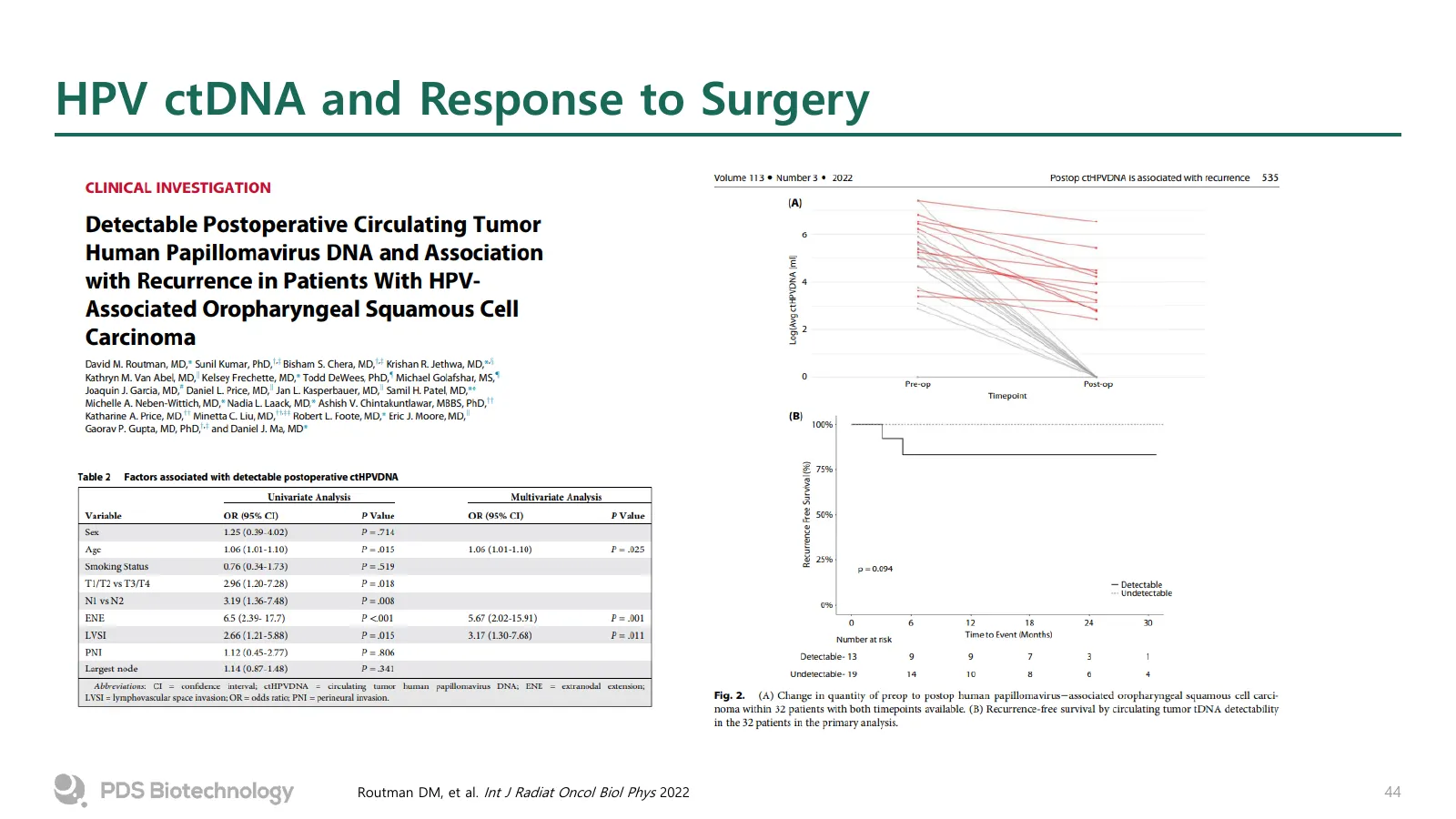
Slide 44: HPV ctDNA and Response to Surgery
HPV ctDNA and Response to Surgery Routman DM, et al. Int J Radiat Oncol Biol Phys 2022 44
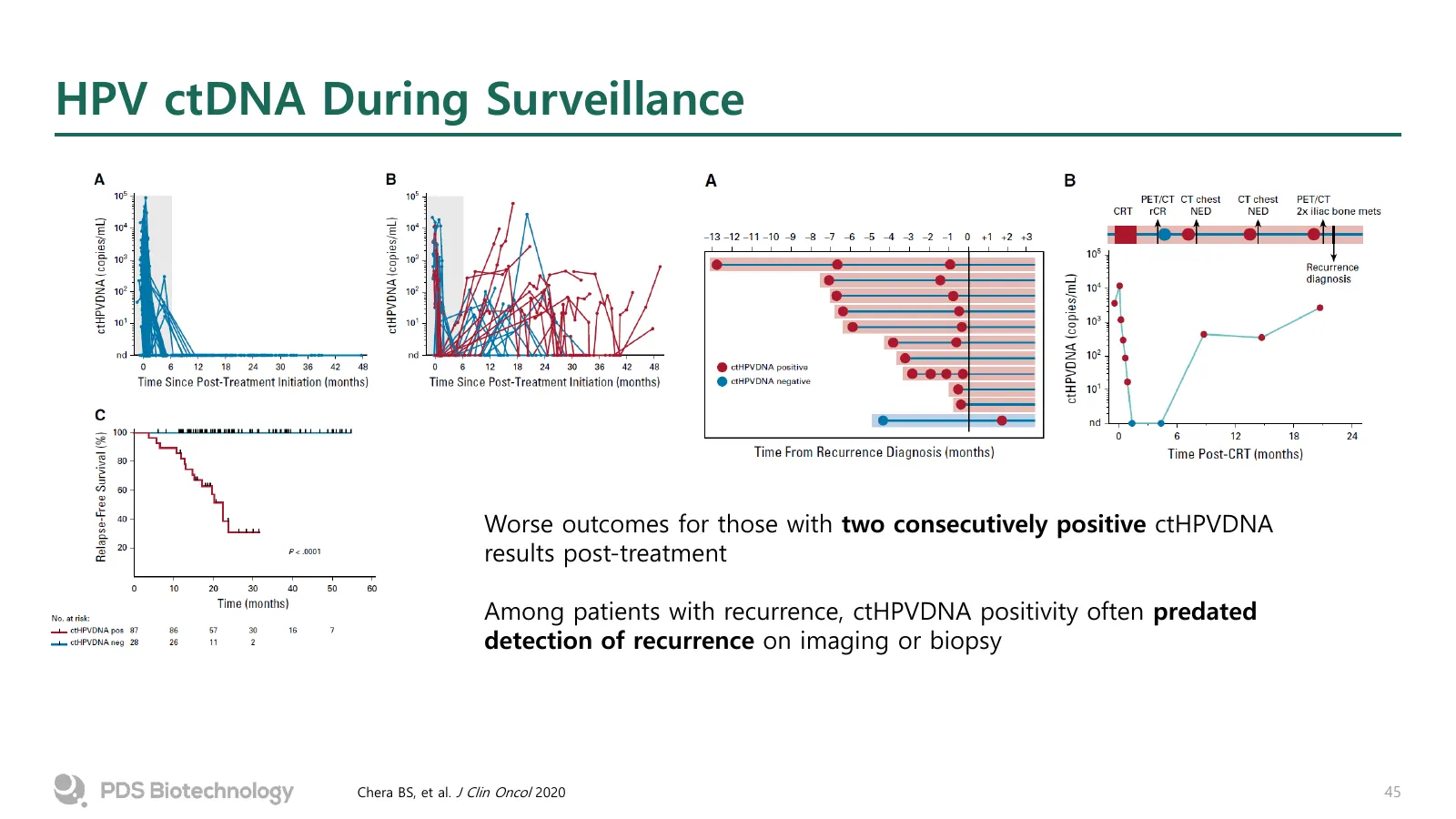
Slide 45: HPV ctDNA During Surveillance
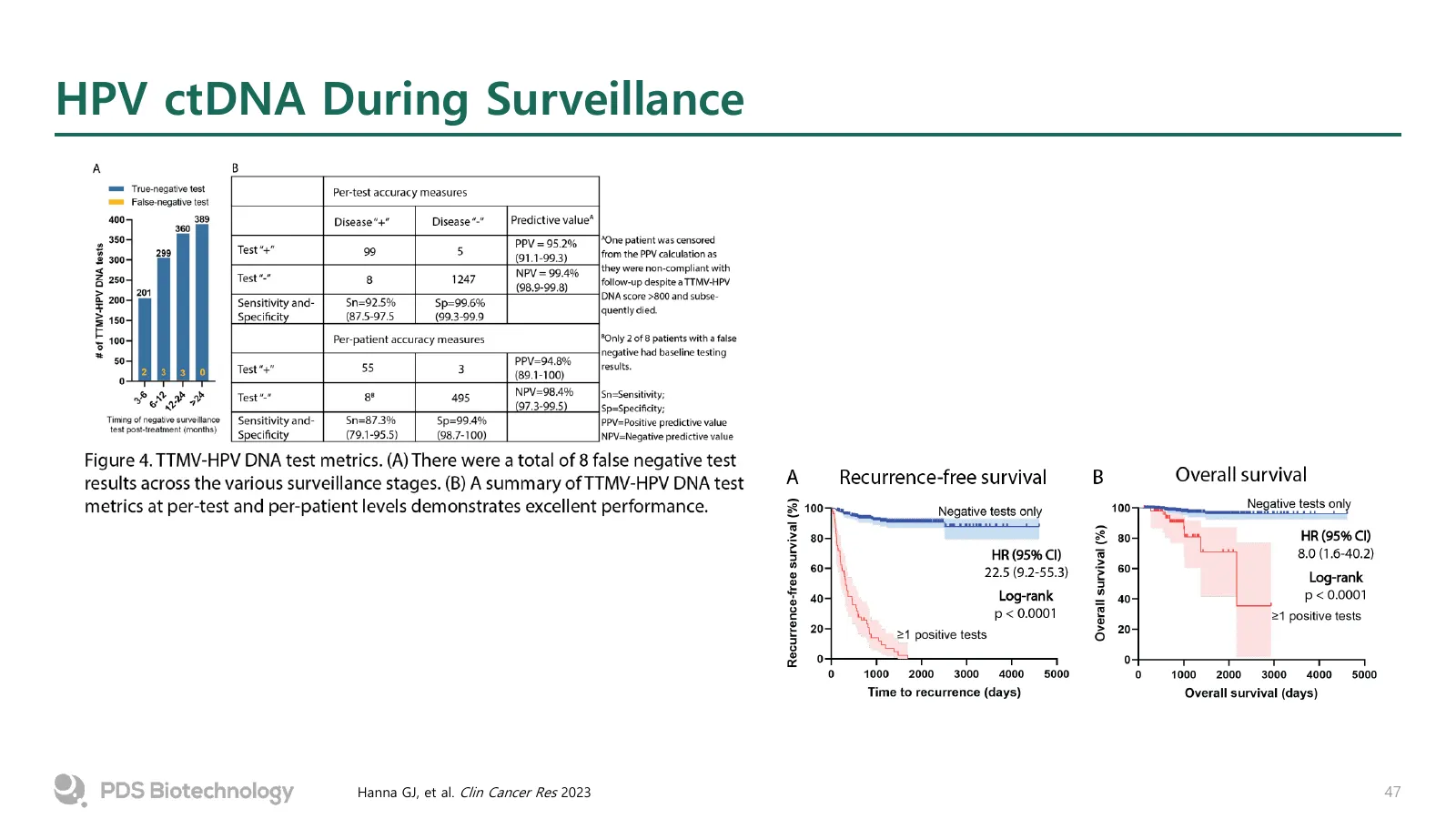
HPV ctDNA During Surveillance Worse outcomes for those with two consecutively positive ctHPVDNA results post-treatment Among patients with recurrence, ctHPVDNA positivity often predated detection of recurrence on imaging or biopsy Chera BS, et al. J Clin Oncol 2020 45
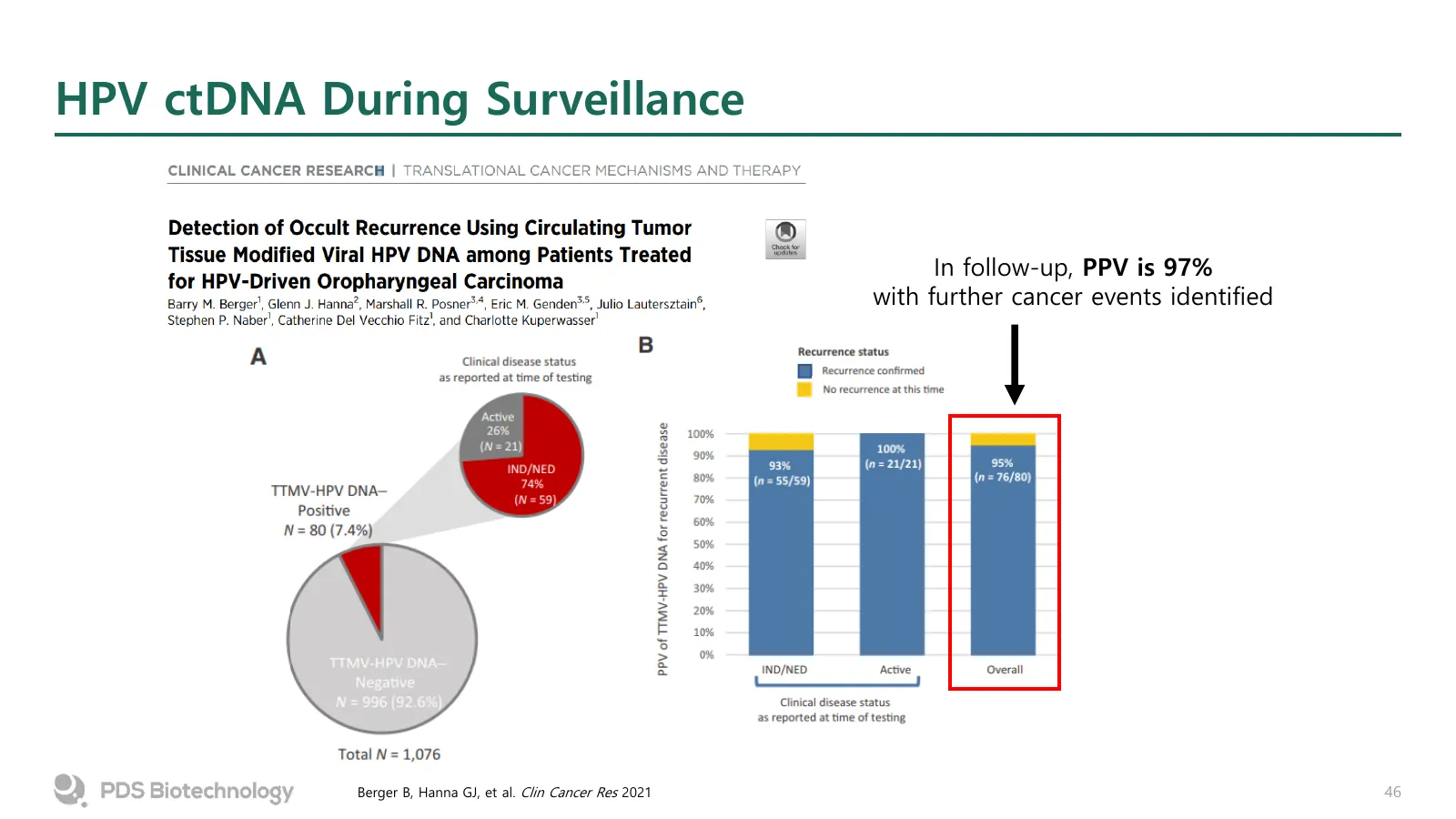
Slide 46: HPV ctDNA During Surveillance
HPV ctDNA During Surveillance In follow-up, PPV is 97% with further cancer events identified Berger B, Hanna GJ, et al. Clin Cancer Res 2021 46
Slide 47: HPV ctDNA During Surveillance
HPV ctDNA During Surveillance Hanna GJ, et al. Clin Cancer Res 2023 47
Slide 48: HPV ctDNA During Surveillance
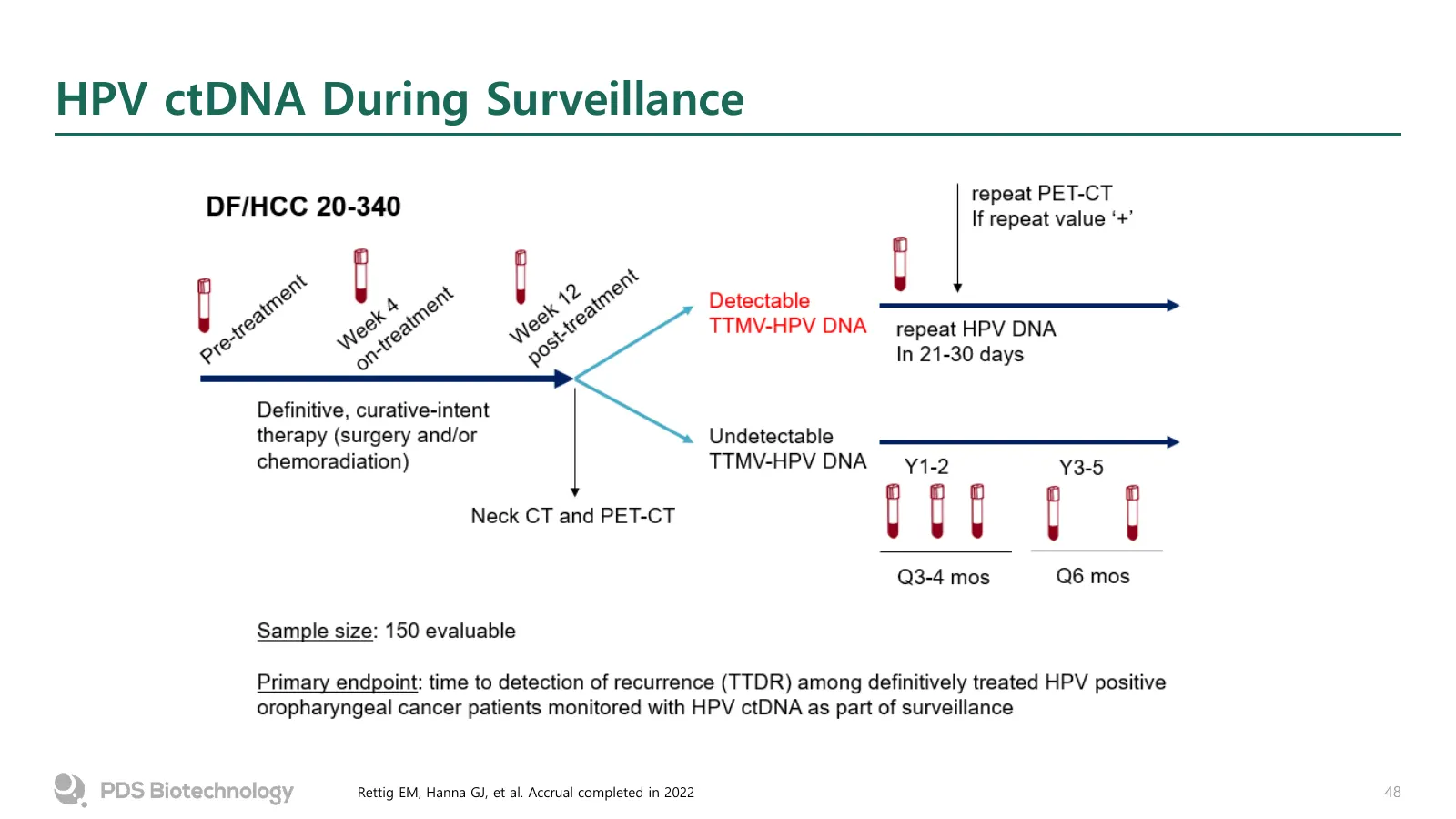
HPV ctDNA During Surveillance Rettig EM, Hanna GJ, et al. Accrual completed in 2022 48
Slide 49: HPV ctDNA Conclusions (or More Questions)…
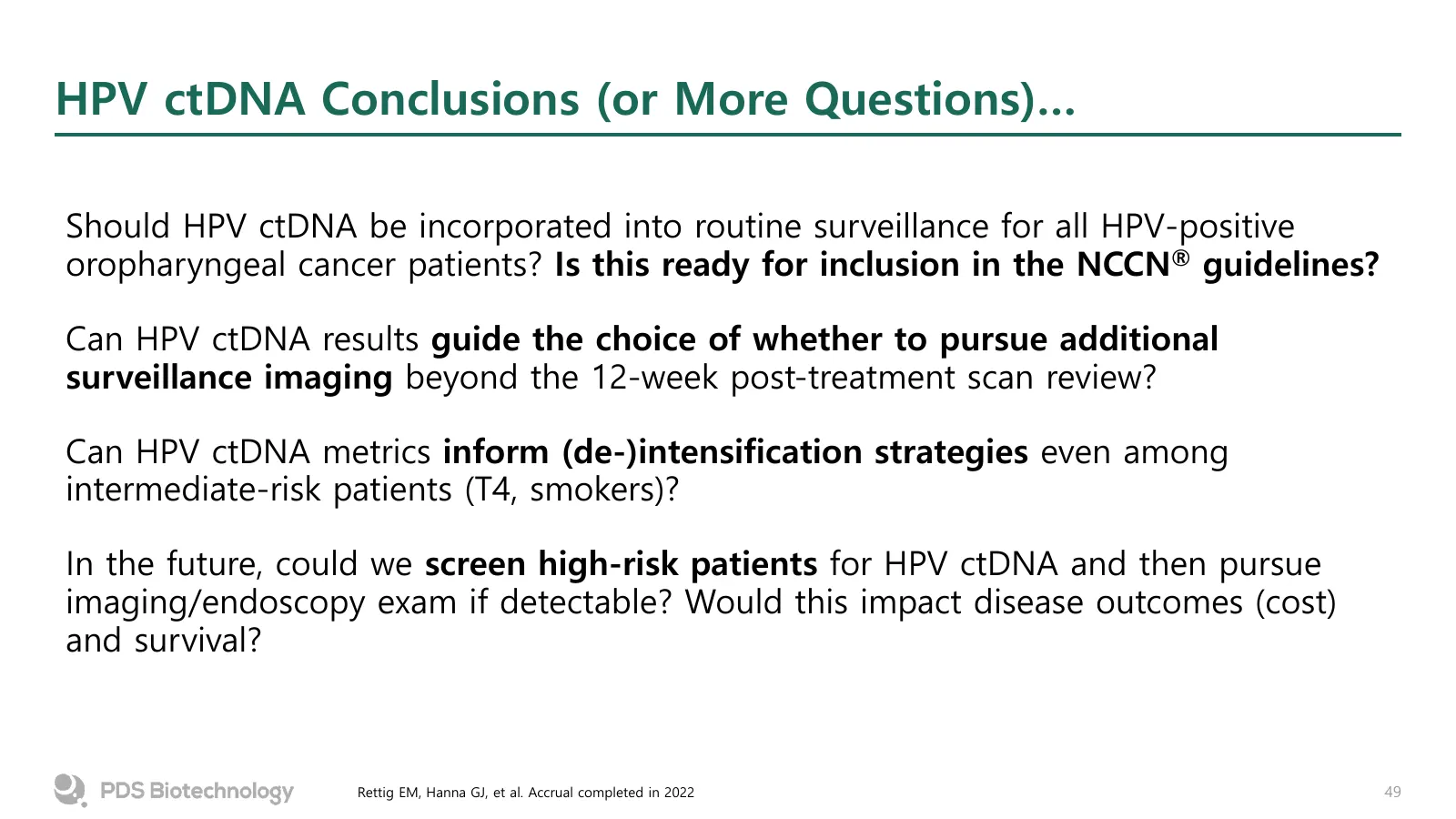
HPV ctDNA Conclusions (or More Questions)… Should HPV ctDNA be incorporated into routine surveillance for all HPV-positive oropharyngeal cancer patients? Is this ready for inclusion in the NCCN® guidelines? Can HPV ctDNA results guide the choice of whether to pursue additional surveillance imaging b
Slide 50: PDS0101 + KEYTRUDA in ICI Refractory Subjects
PDS0101 + KEYTRUDA® in ICI Refractory Subjects Dr. Lauren V. Wood 50
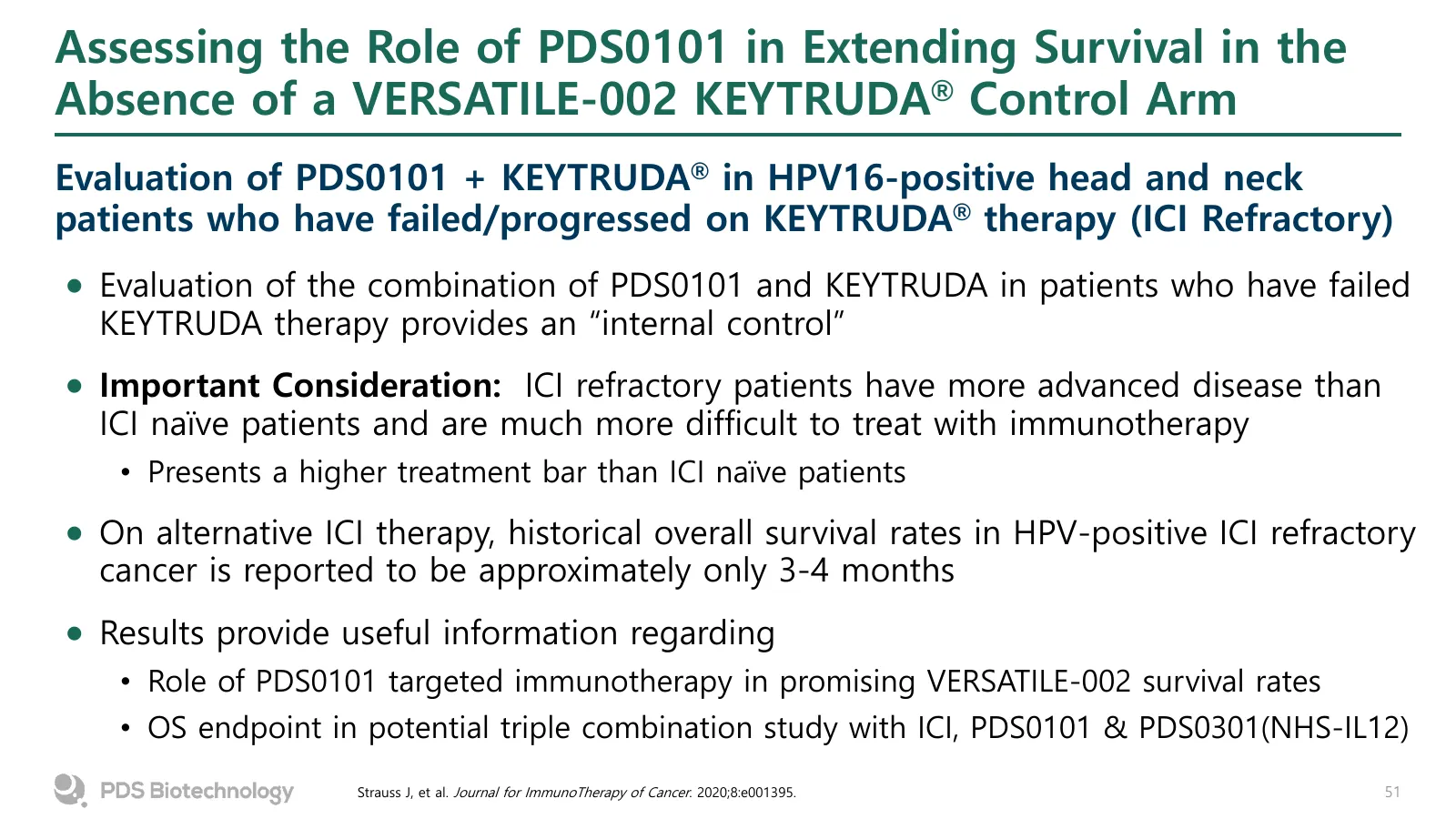
Slide 51: Assessing the Role of PDS0101 in Extending Survival Without a Control Arm
Assessing the Role of PDS0101 in Extending Survival in the Absence of a VERSATILE-002 KEYTRUDA® Control Arm Evaluation of PDS0101 + KEYTRUDA® in HPV16-positive head and neck patients who have failed/progressed on KEYTRUDA® therapy (ICI Refractory) • Evaluation of the combination of PDS0101 and KEYTR
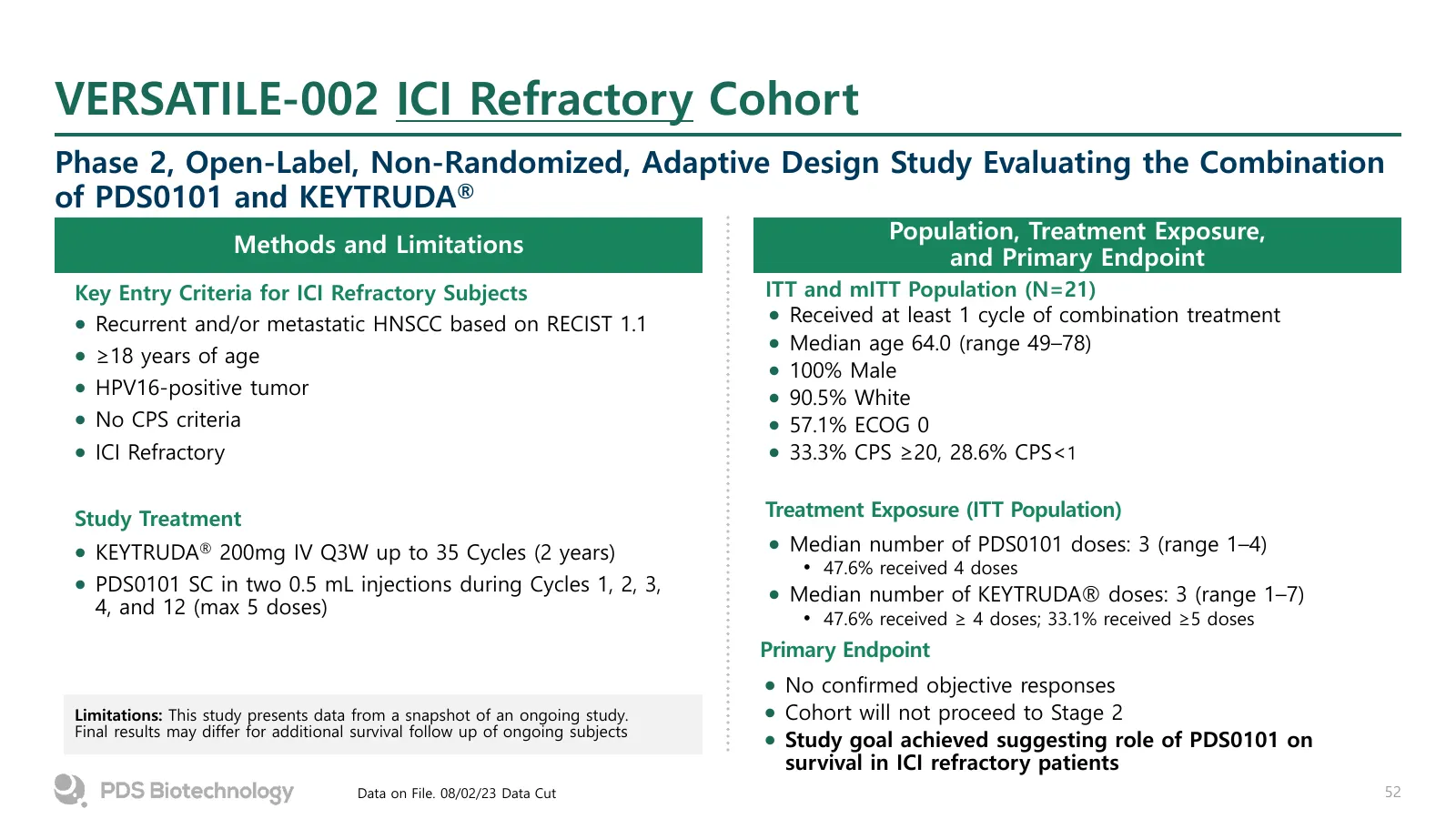
Slide 52: VERSATILE-002 ICI Refractory Cohort
VERSATILE-002 ICI Refractory Cohort Phase 2, Open-Label, Non-Randomized, Adaptive Design Study Evaluating the Combination of PDS0101 and KEYTRUDA® Population, Treatment Exposure, Methods and Limitations and Primary Endpoint Key Entry Criteria for ICI Refractory Subjects ITT and mITT Population (N=21
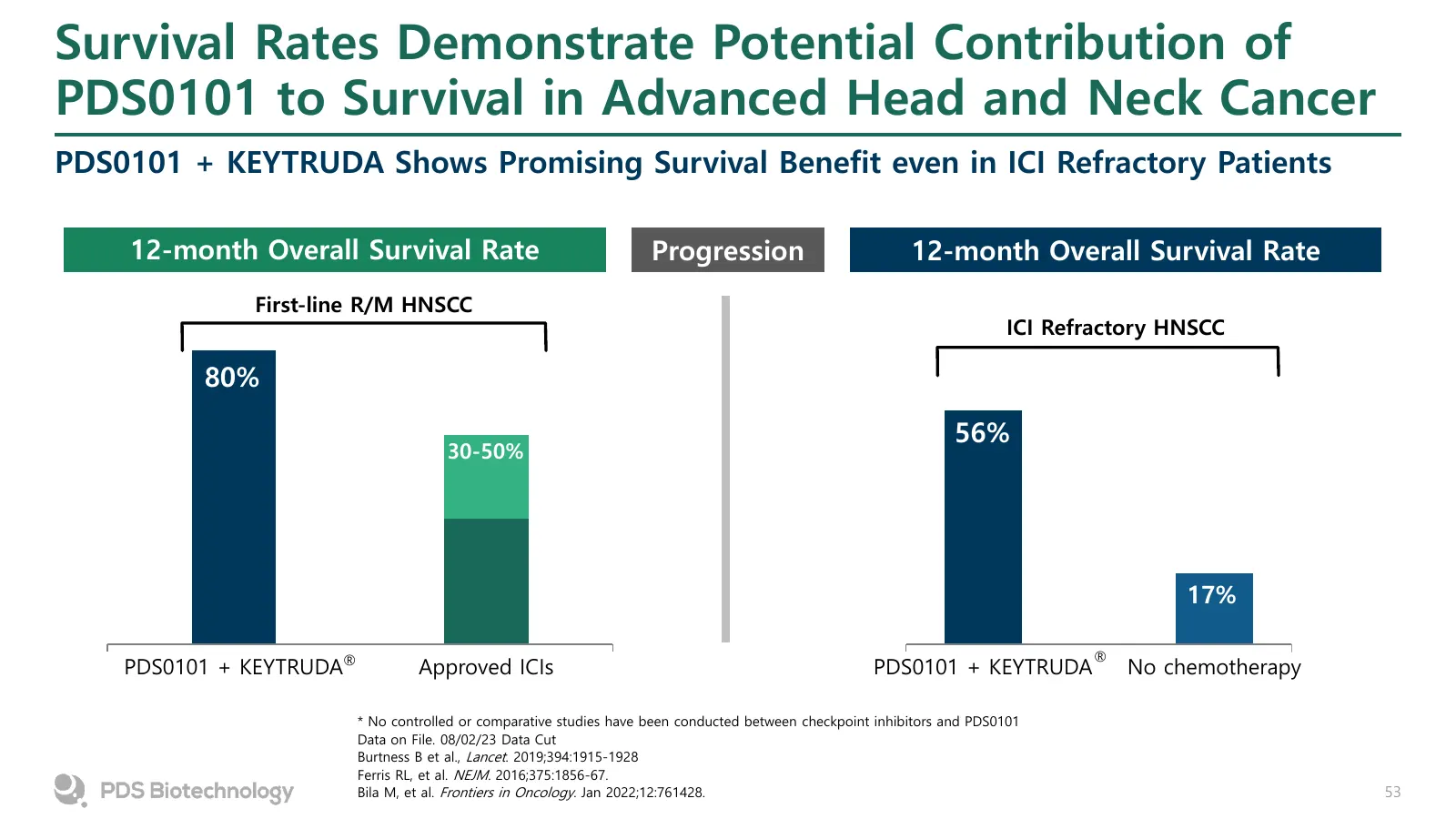
Slide 53: Survival Rates Demonstrate Potential Contribution of PDS0101
Survival Rates Demonstrate Potential Contribution of PDS0101 to Survival in Advanced Head and Neck Cancer PDS0101 + KEYTRUDA Shows Promising Survival Benefit even in ICI Refractory Patients 12-month Overall Survival Rate Progression 12-month Overall Survival Rate First-line R/M HNSCC ICI Refractory
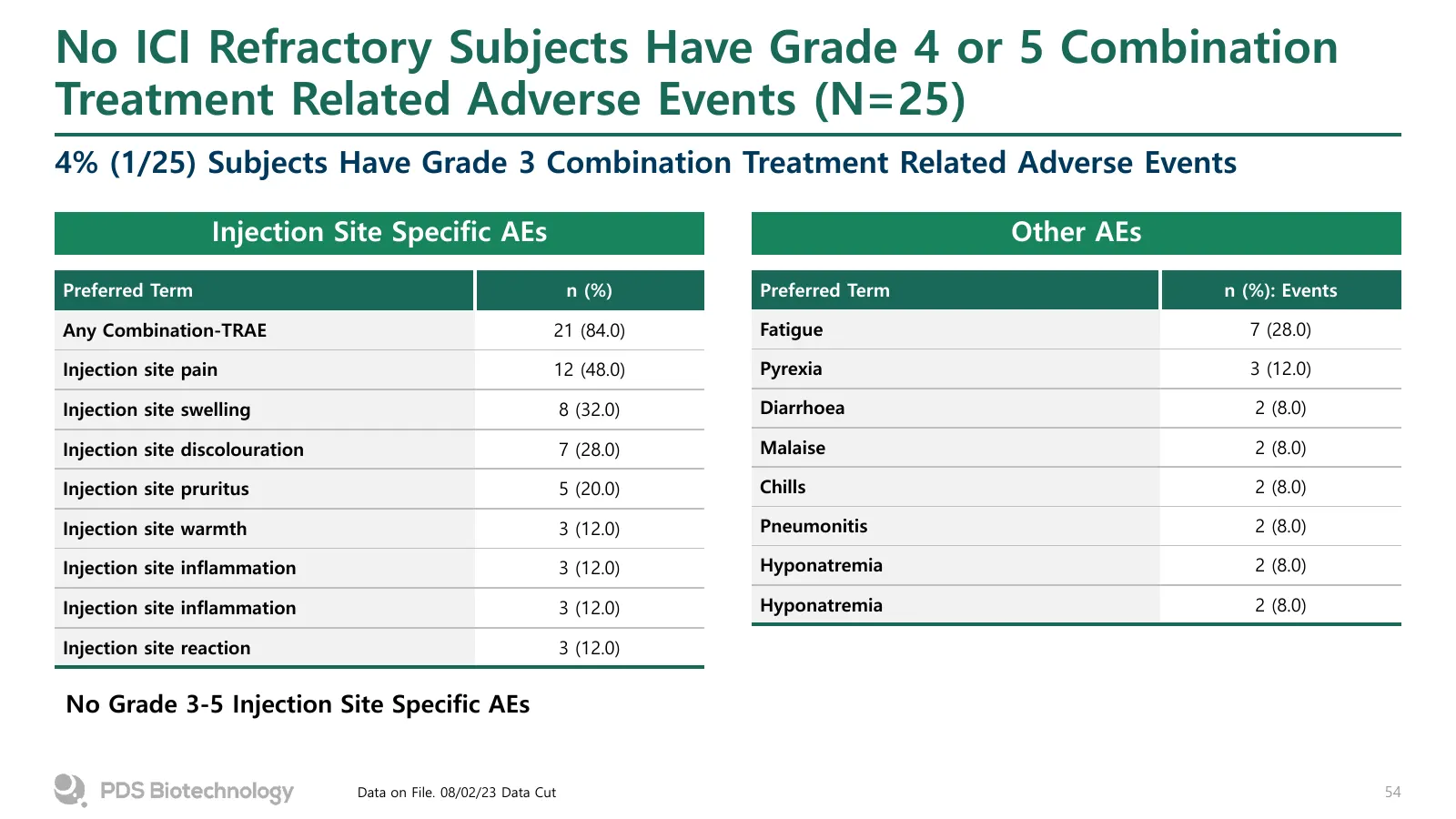
Slide 54: No ICI Refractory Subjects Have Grade 4 or 5 Treatment Related Adverse Events
No ICI Refractory Subjects Have Grade 4 or 5 Combination Treatment Related Adverse Events (N=25) 4% (1/25) Subjects Have Grade 3 Combination Treatment Related Adverse Events Injection Site Specific AEs Other AEs Preferred Term n (%) Preferred Term n (%): Events Any Combination-TRAE 21 (84.0) Fatigue
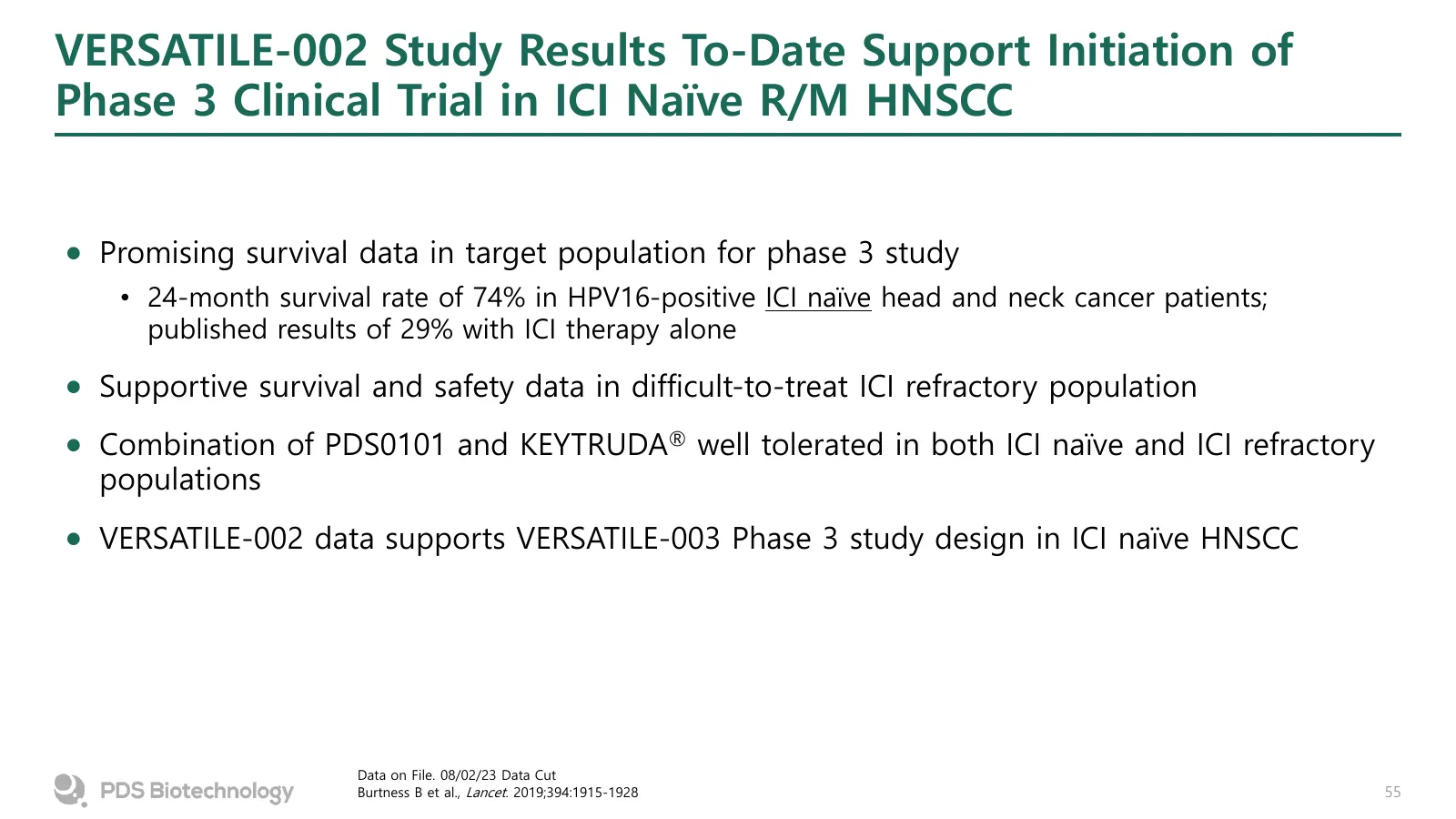
Slide 55: VERSATILE-002 Results Support Initiation of Phase 3 Trial in ICI Naïve R/M HNSCC
VERSATILE-002 Study Results To-Date Support Initiation of Phase 3 Clinical Trial in ICI Naïve R/M HNSCC • Promising survival data in target population for phase 3 study • 24-month survival rate of 74% in HPV16-positive ICI naïve head and neck cancer patients; published results of 29% with ICI therap

Slide 56: Panel Discussion
Panel Discussion 56

Slide 57: Closing Remarks
Closing Remarks Dr. Lauren V. Wood 57
Source: Internet Archive copy of pdsbiotech.com
More decks from PDS Biotechnology Corporation
 Investor Presentation (October 2026)28 slides · Oct 21, 2026
 Investor Presentation (September 2026)28 slides · September 2026
 Q1 2026 Earnings Presentation21 slides · May 13, 2026
 Investor Presentation (April 2026)21 slides · Apr 24, 2026
 Investor Presentation (February 2026)22 slides · Feb 23, 2026
 Investor Presentation (February 2026)22 slides · February 2026