Opthea Limited · ASX:OPT
Opthea — Circadian Technologies — Investor Presentation (September 2011)
44 slides from Opthea's investor presentation, September 2011
Slide 1: Circadian Technologies Limited Corporate Presentation
Circadian Ci di T Technologies h l i Li Limited i d (ASX:CIR OTCQX:CKDXY) (ASX:CIR, C Corporate t Presentation P t ti September 2011 Robert Klupacs Klupacs, CEO & Managing Director
Slide 2: Disclaimer
Disclaimer Investment in Circadian Technologies Limited (‘Circadian’) is subject to investment risk, including possible loss of income and capital invested. Neither Circadian nor any other member company of the Circadian Group guarantees any particular rate of return or performance, nor do they guar
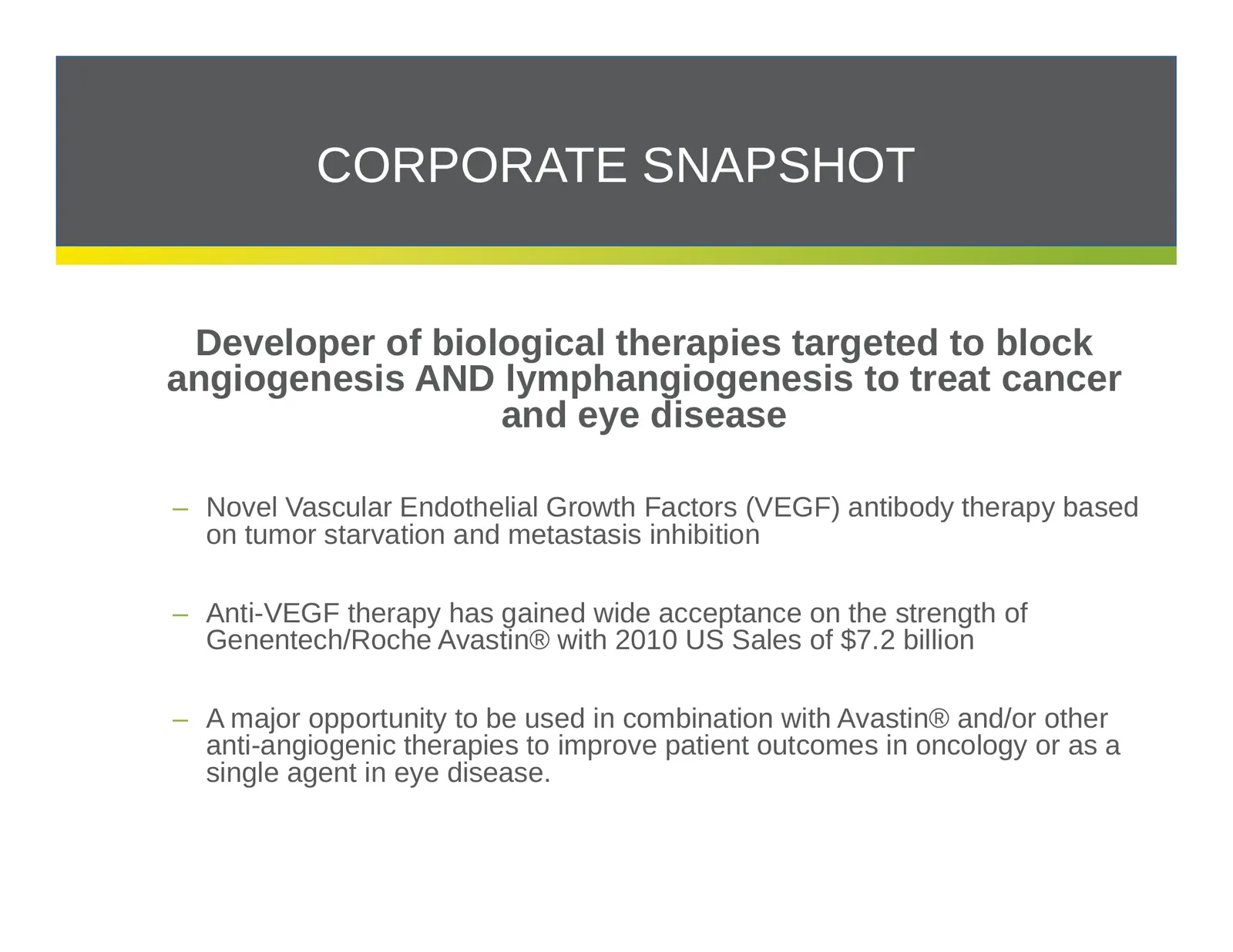
Slide 3: Corporate Snapshot
CORPORATE SNAPSHOT Developer of biological therapies targeted to block angiogenesis AND lymphangiogenesis to treat cancer and eye disease – Novel Vascular Endothelial Growth Factors (VEGF) antibody therapy based on tumor starvation and metastasis inhibition – Anti-VEGF therapy has gained wide accept
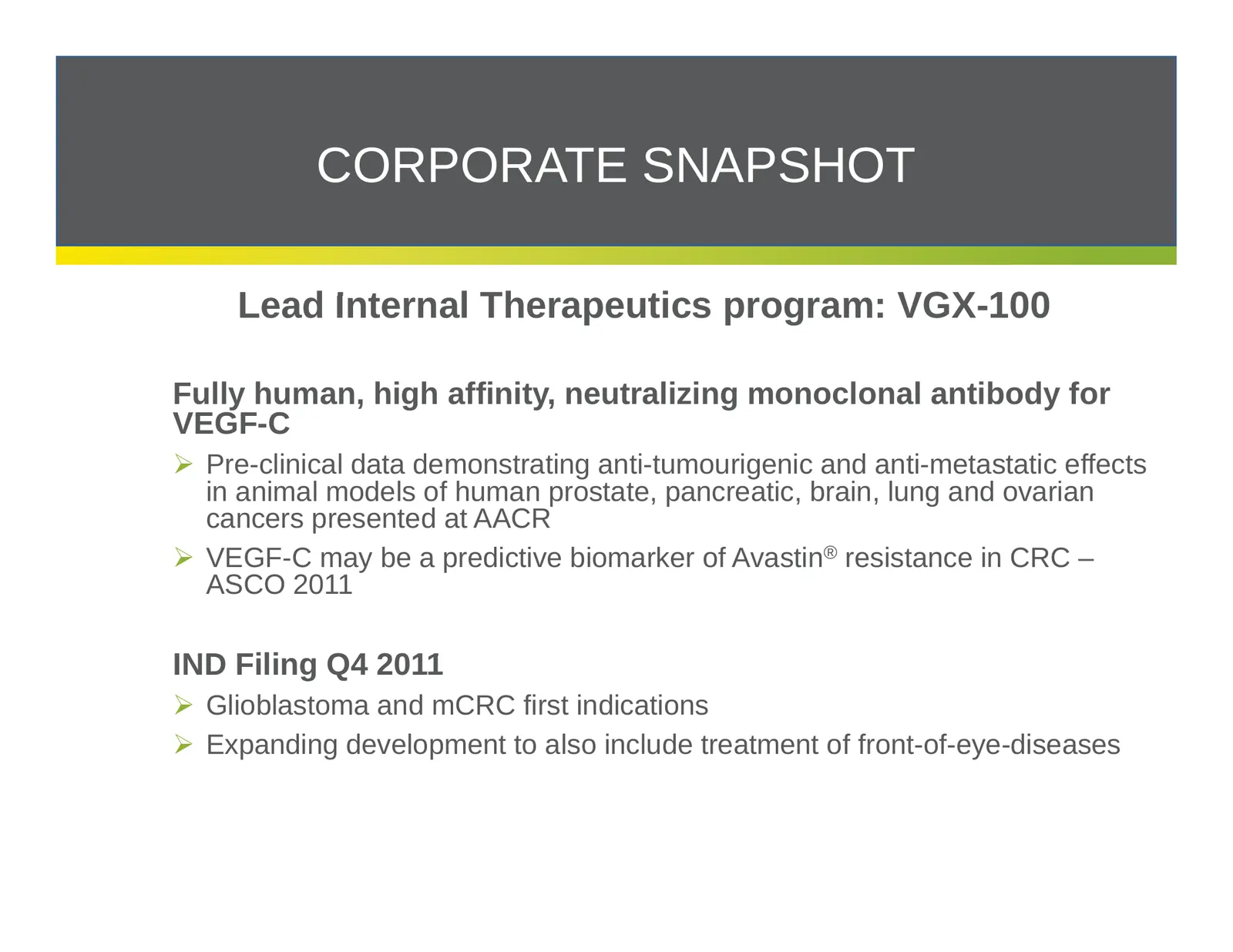
Slide 4: Corporate Snapshot: Lead Internal Therapeutics Program VGX-100
CORPORATE SNAPSHOT L d Internal Lead I t l Therapeutics Th ti program: VGX-100 VGX 100 Fully human, high affinity, neutralizing monoclonal antibody for VEGF C VEGF-C Pre-clinical data demonstrating anti-tumourigenic and anti-metastatic effects in animal models of human prostate, pancreatic, brain,
Slide 5: Corporate Snapshot: Partnered Programs
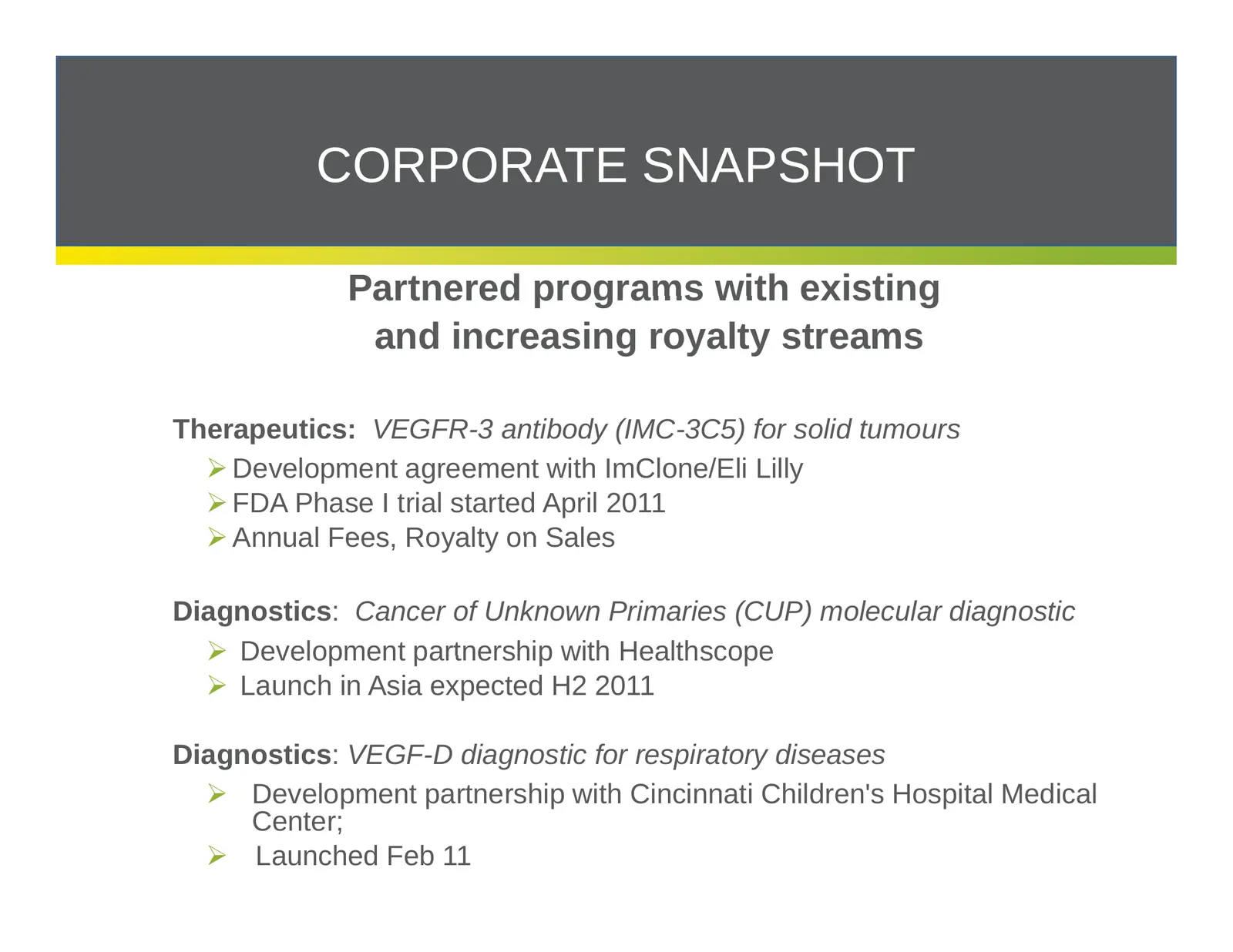
CORPORATE SNAPSHOT Partnered programs with existing and increasing royalty streams Therapeutics: VEGFR-3 antibody (IMC-3C5) for solid tumours Development agreement with ImClone/Eli Lilly FDA Phase I trial started April 2011 Annual Fees Fees, Royalty on Sales Diagnostics: Cancer of Unknown Prim
Slide 6: Corporate Snapshot: IP and Financial Position
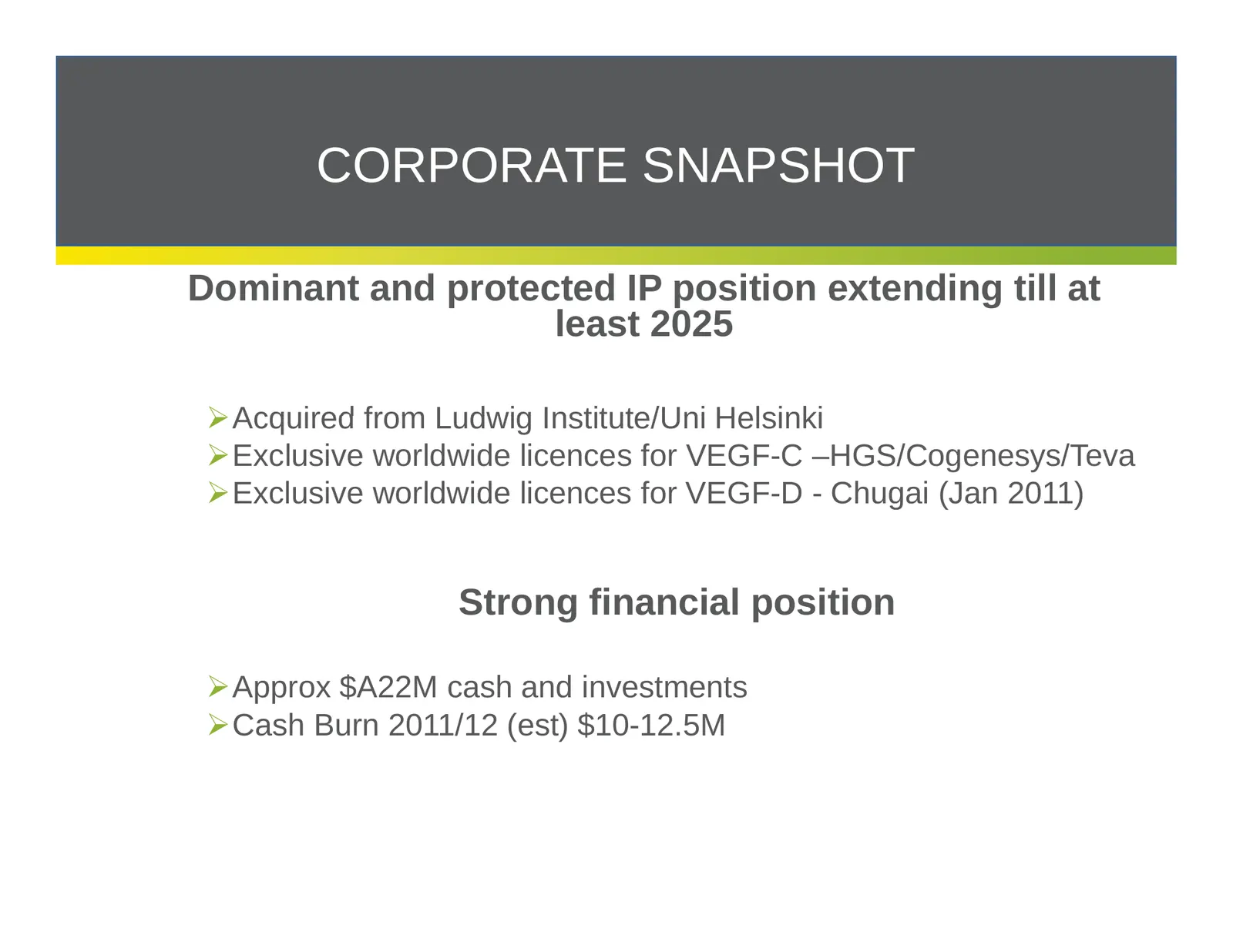
CORPORATE SNAPSHOT Dominant and protected IP position extending till at least 2025 Acquired from Ludwig Institute/Uni Helsinki Exclusive worldwide licences for VEGF-C –HGS/Cogenesys/Teva Exclusive worldwide licences for VEGF-D - Chugai (Jan 2011) Strong financial position Approx $A22M cash and i
Slide 7: VGX-100 VEGF-C Inhibition: Rationale
VGX-100 VEGF C IInhibition: VEGF-C hibiti R Rationale ti l 7
Slide 8: Mechanism of Circadian's Drugs: VGX-100 inhibits VEGF-C
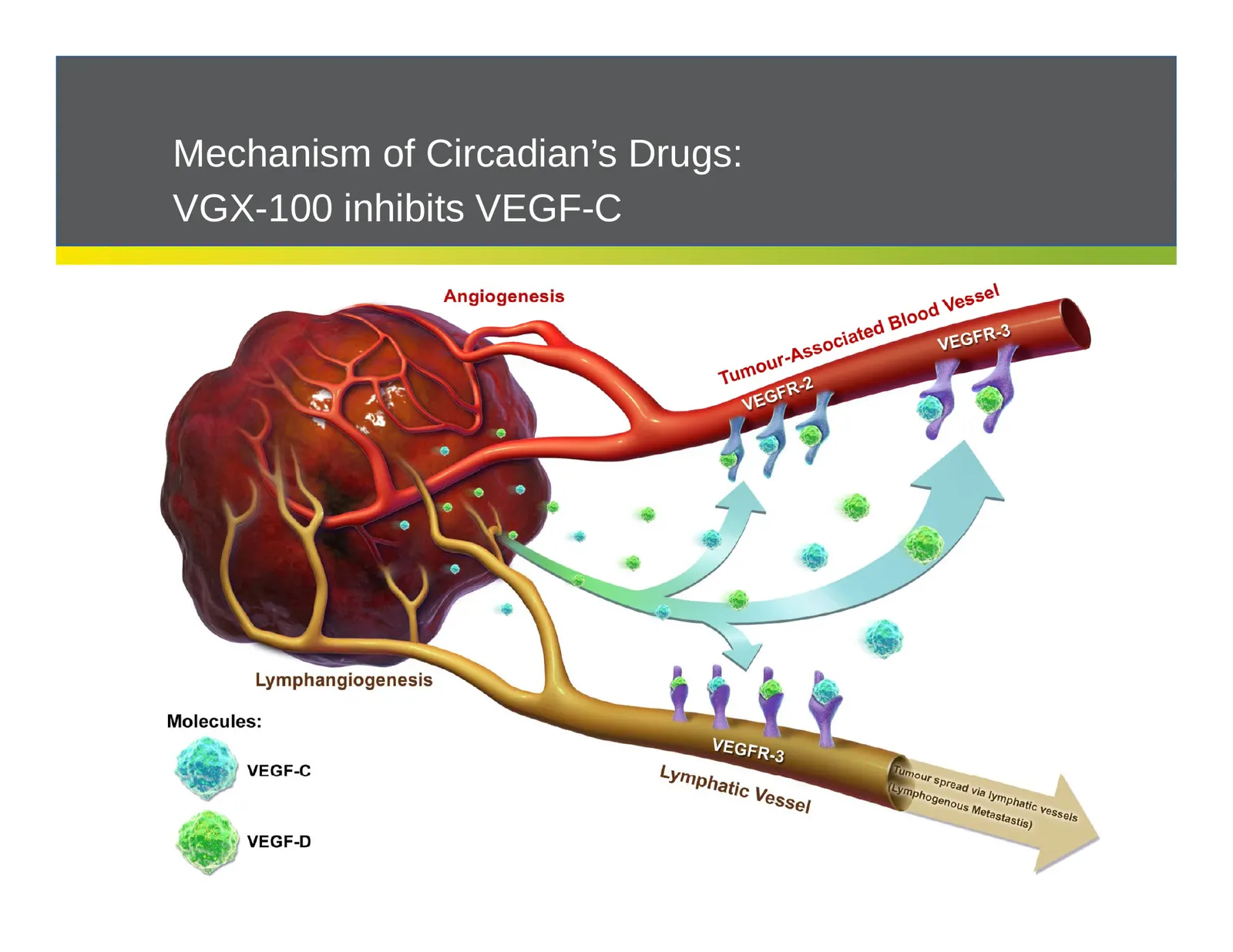
Mechanism of Circadian’s Drugs: VGX-100 inhibits VEGF-C 8
Slide 9: Combination targeted therapies are the way of the future in oncology
Our approach is based on the widely accepted view that combination targeted therapies is the way of the future in oncology Since most tumors eventually find a way to get around blocked p pathways, y "there is widespread understanding that we are going to need to learn how to combine two or more targ
Slide 10: VEGF-C is a member of the VEGF family
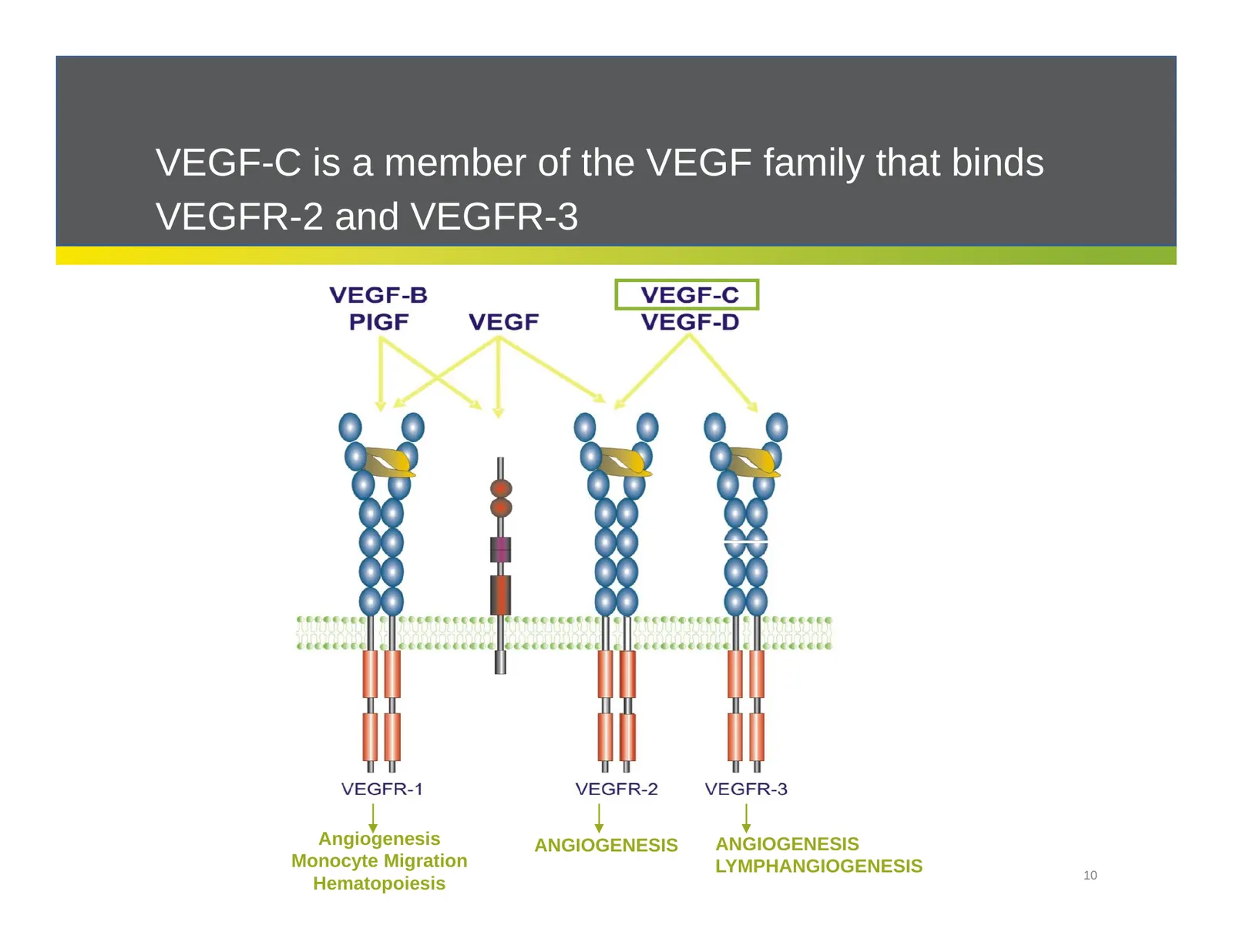
VEGF-C G C is s a member e be oof tthe e VEGF G family a y tthat at b binds ds VEGFR-2 and VEGFR-3 Angiogenesis ANGIOGENESIS ANGIOGENESIS Monocyte Migration LYMPHANGIOGENESIS 10 Hematopoiesis
Slide 11: VEGF-C in Avastin Escape
VEGF-C IN AVASTIN® ‘ESCAPE’ • Avastin®: Effective but not in all patients – Not all patients respond to therapy (30-50% response rate) – 25-50% 25 50% of responders become “resistant” resistant within 12 to 18 months – Likely reasons: • Tumor g growth due to factors other than VEGF; and/or • Other a
Slide 12: VEGF-C levels elevated in Avastin/FOLFIRI treated patients
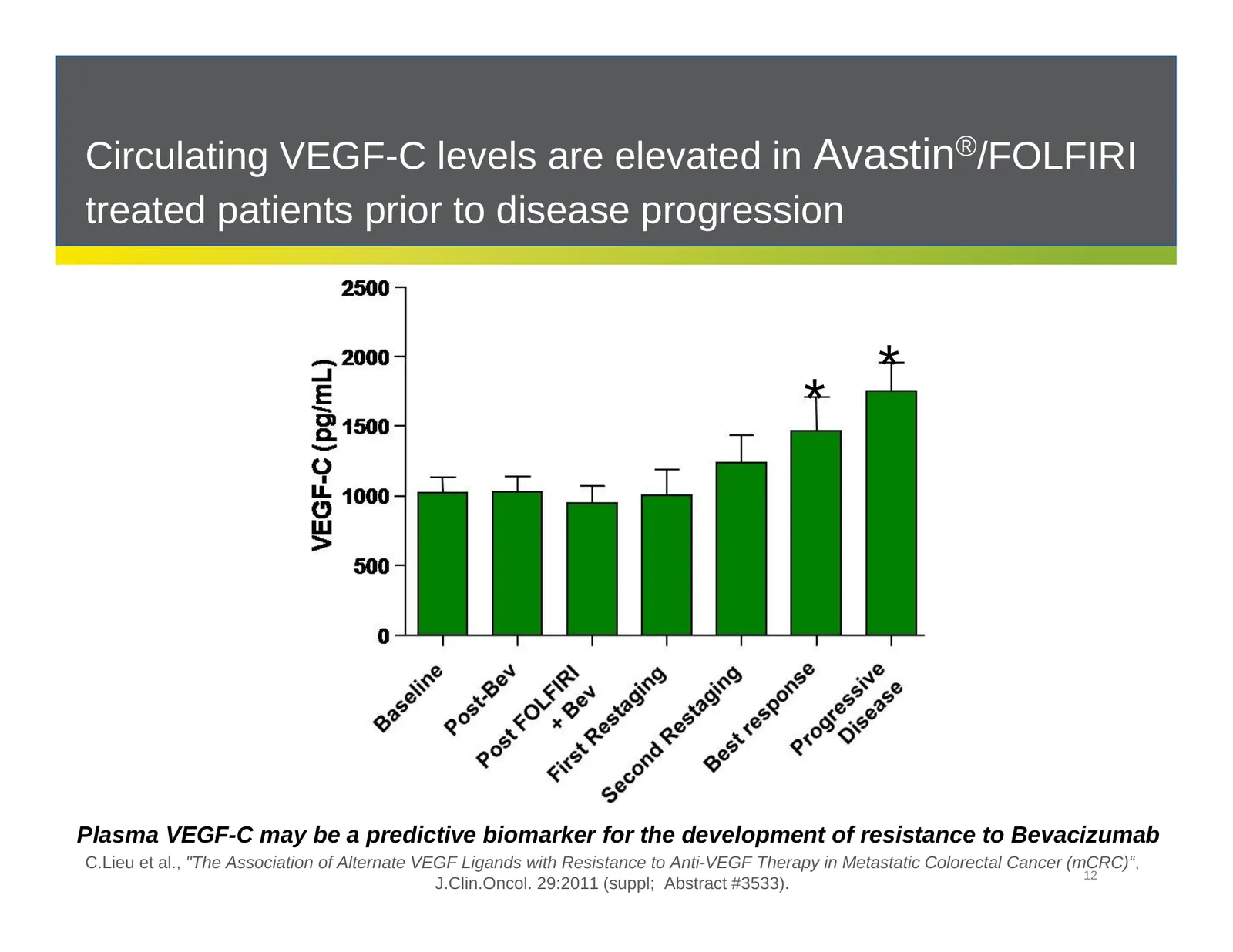
g VEGF-C levels are elevated in Avastin®/FOLFIRI Circulating treated patients prior to disease progression * * Plasma VEGF-C may be a predictive biomarker for the development of resistance to Bevacizumab C.Lieu et al., "The Association of Alternate VEGF Ligands with Resistance to Anti-VEGF Therapy i
Slide 13: VEGF-C well recognised survival prognostic factor
VEGF-C –well recognised survival prognostic factor in a number of tumour types Some examples
Slide 14: VEGF-C is a risk factor for colorectal cancer
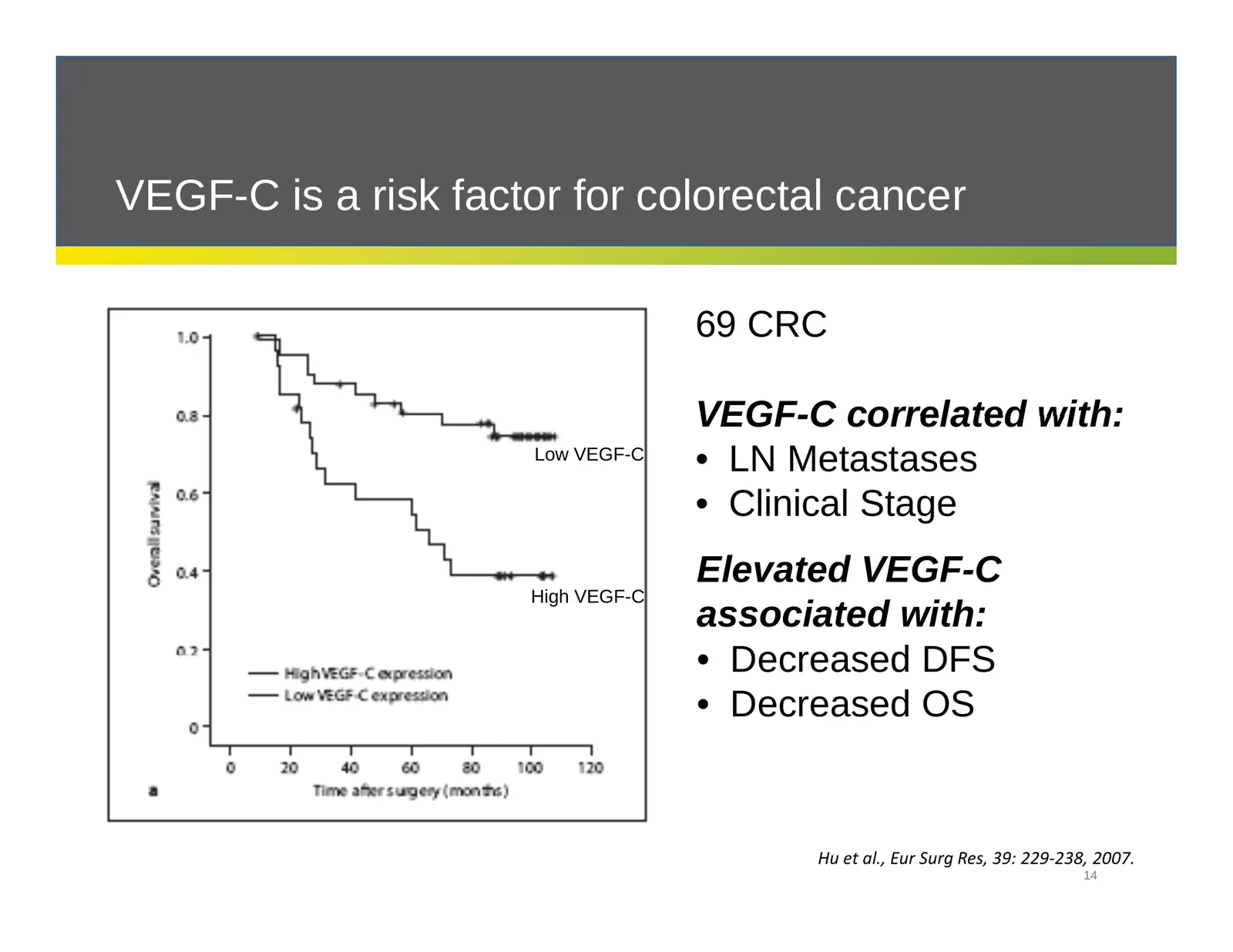
VEGF-C is a risk factor for colorectal cancer 69 CRC VEGF-C correlated with: Low VEGF-C • LN Metastases • Clinical Stage Elevated VEGF-C High VEGF-C associated with: • Decreased DFS • Decreased OS Hu et al., Eur Surg Res, 39: 229‐238, 2007. 14
Slide 15: VGX-100 Efficacy in Mouse Models of Human Cancer
VGX-100 Efficacy in Mouse M d l off H Models Human CCancer 15
Slide 16: U87MG Glioblastoma Xenografts: VGX-100 with Avastin
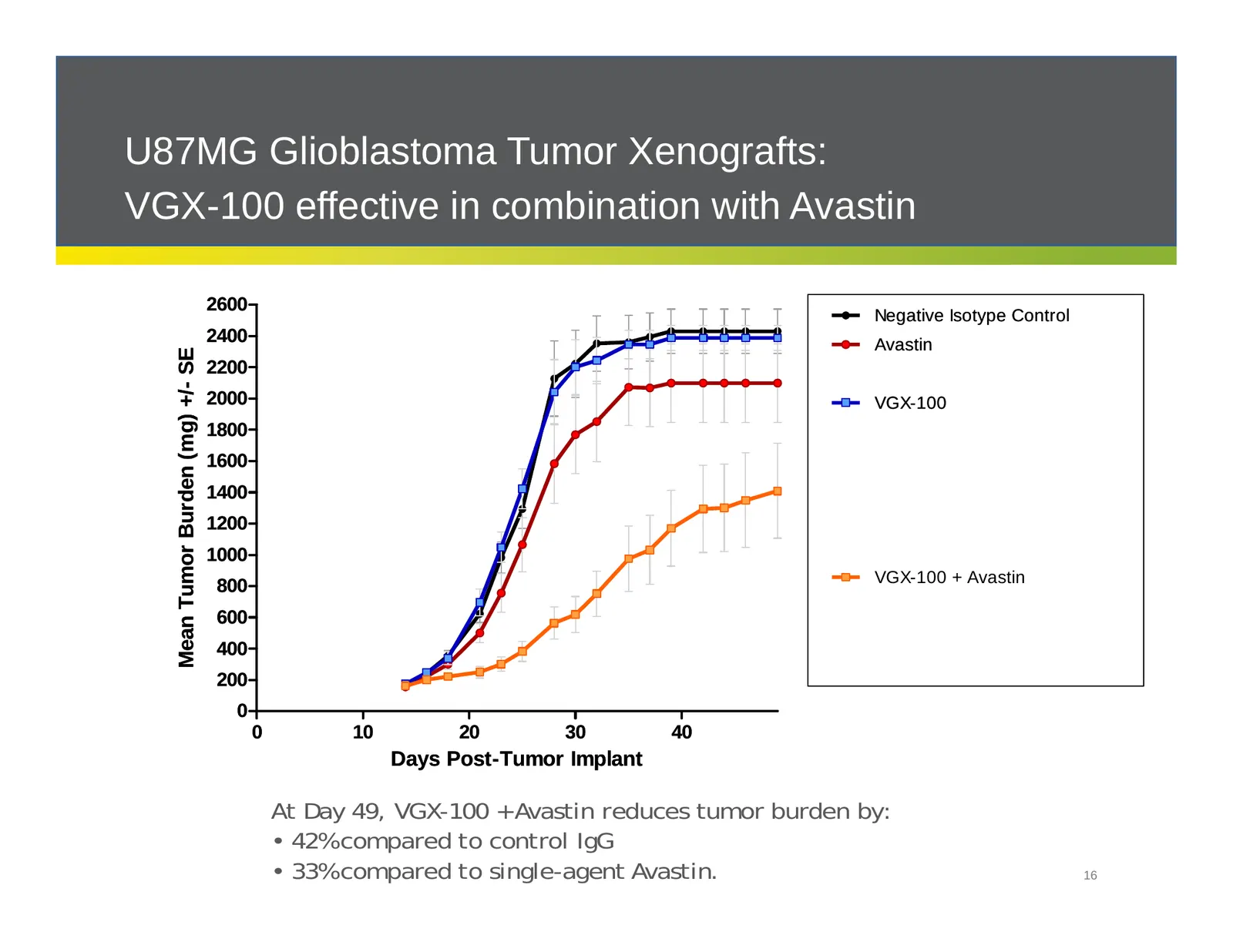
U87MG Glioblastoma Tumor Xenografts: VGX-100 effective in combination with Avastin 2600 Negative Isotype Control 2400 Avastin Burden (mg)) +/- SE 2200 2000 VGX-100 1800 1600 1400 1200 Mean Tumor B 1000 VGX-100 + Avastin 800 600 400 M 200 0 0 10 20 30 40 Days Post-Tumor Implant At Day 49, VGX-100 + A
Slide 17: VGX-100 single-agent and combination in PC-3 prostate xenografts
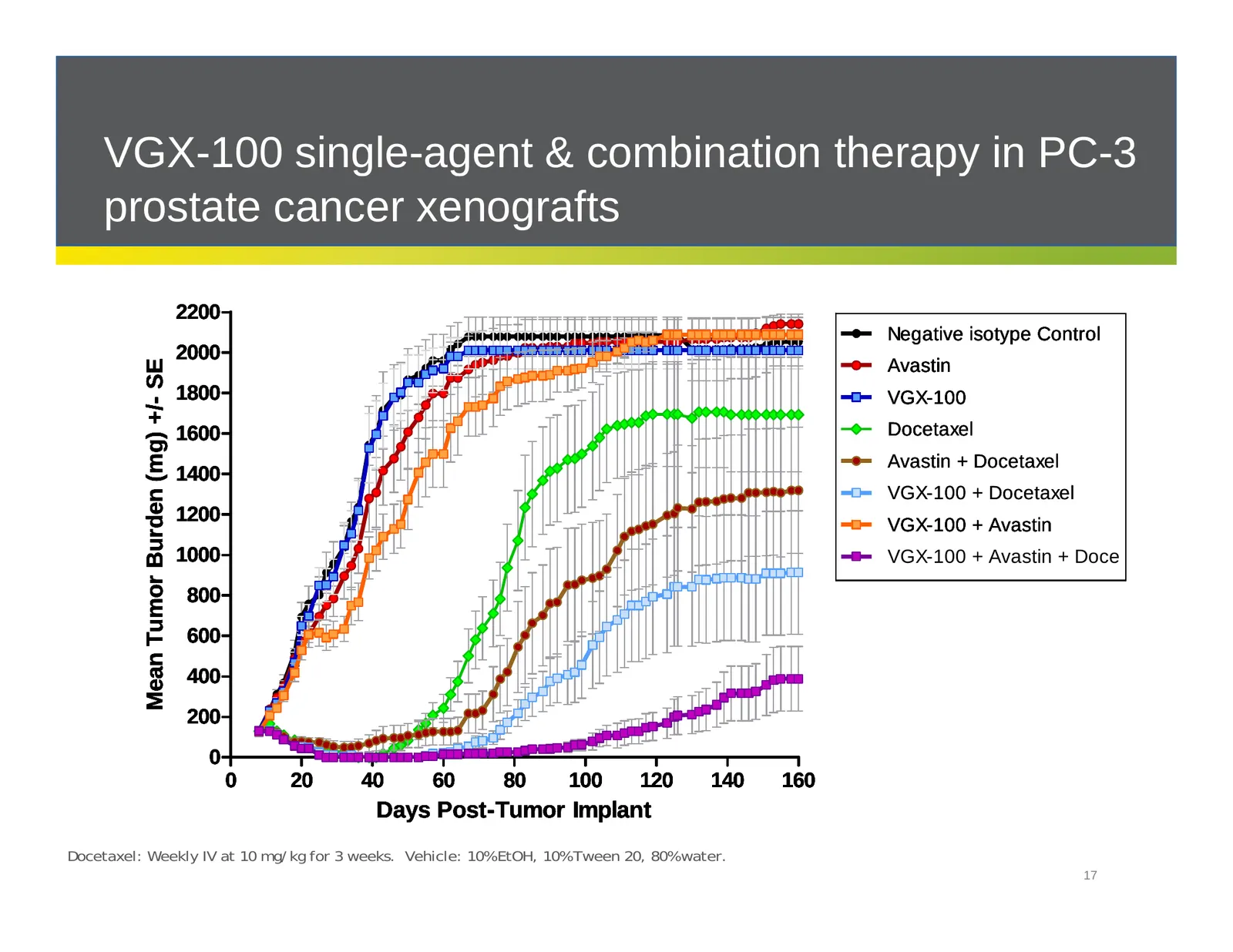
VGX-100 single-agent g g & combination therapy y in PC-3 prostate cancer xenografts 2200 Negative isotype Control 2000 Avastin +/- SE 1800 VGX-100 n Tumor Burrden (mg) + 1600 Docetaxel Avastin + Docetaxel 1400 VGX-100 + Docetaxel 1200 VGX-100 + Avastin 1000 VGX-100 + Avastin + Doce 800 600 Mean 400
Slide 18: H292 NSCLC Xenografts: VGX-100 with Avastin
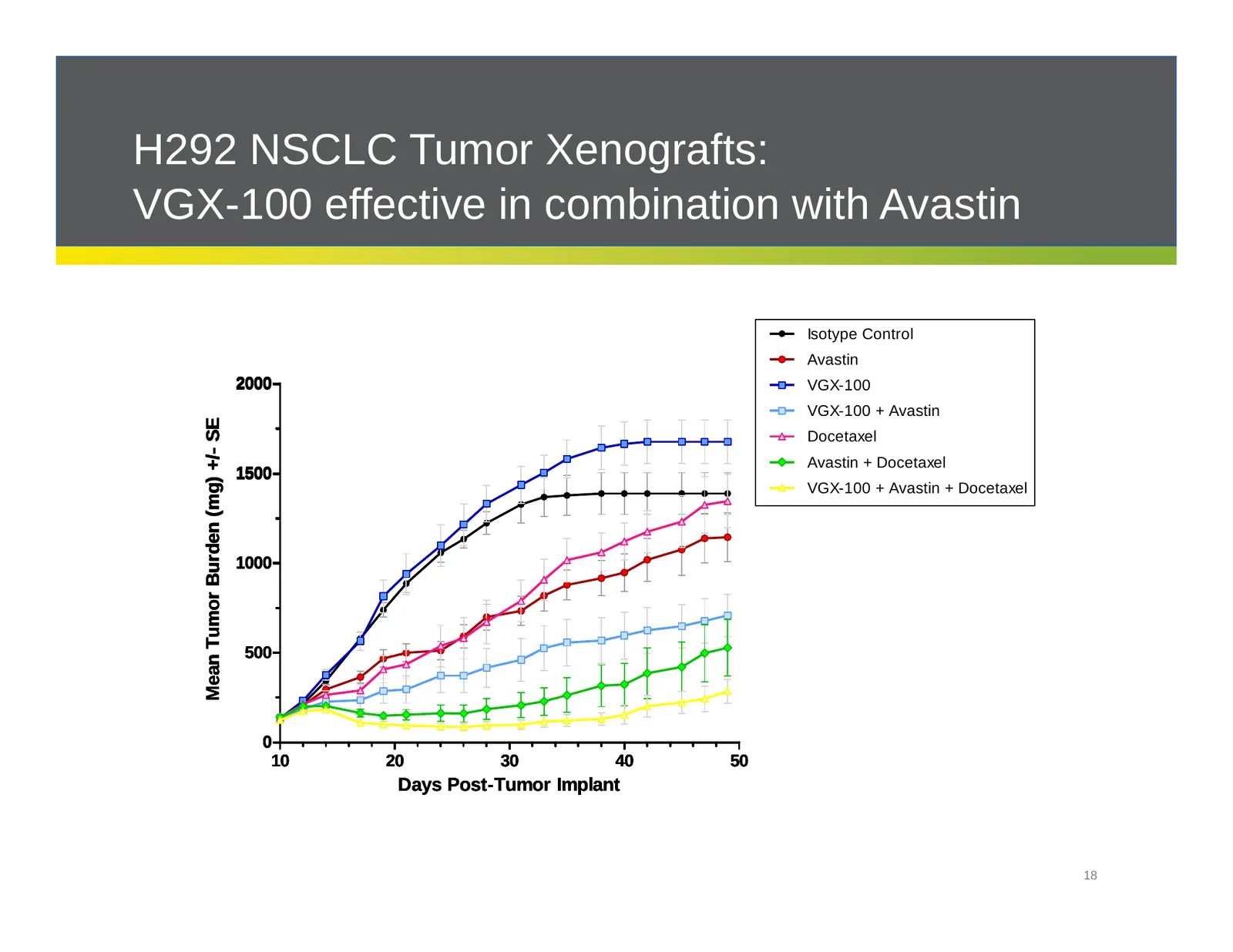
H292 NSCLC Tumor Xenografts: VGX-100 effective in combination with Avastin Isotype Control Avastin 2000 VGX-100 VGX-100 VGX 100 + Avastin en (mg) +/- SE Docetaxel Avastin + Docetaxel 1500 VGX-100 + Avastin + Docetaxel n Tumor Burde 1000 500 Mean 0 10 20 30 40 50 Days Post-Tumor Implant 18
Slide 19: VGX-100 reduces metastasis in orthotopic prostate cancer model
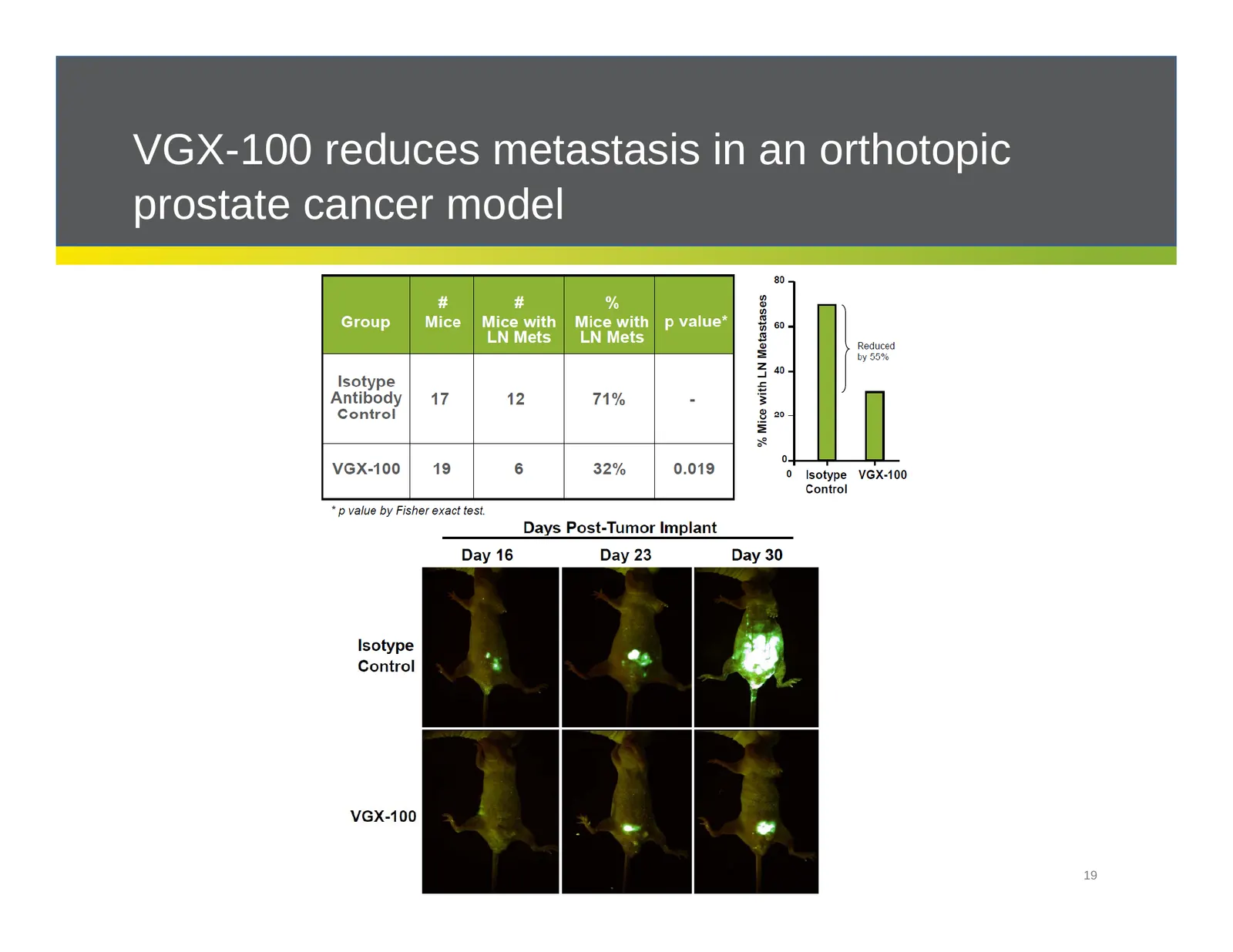
VGX-100 reduces metastasis in an orthotopic prostate cancer model 19
Slide 20: VGX-100 Oncology Clinical Development
VGX-100 ONCOLOGY CLINICAL DEVELOPMENT 20
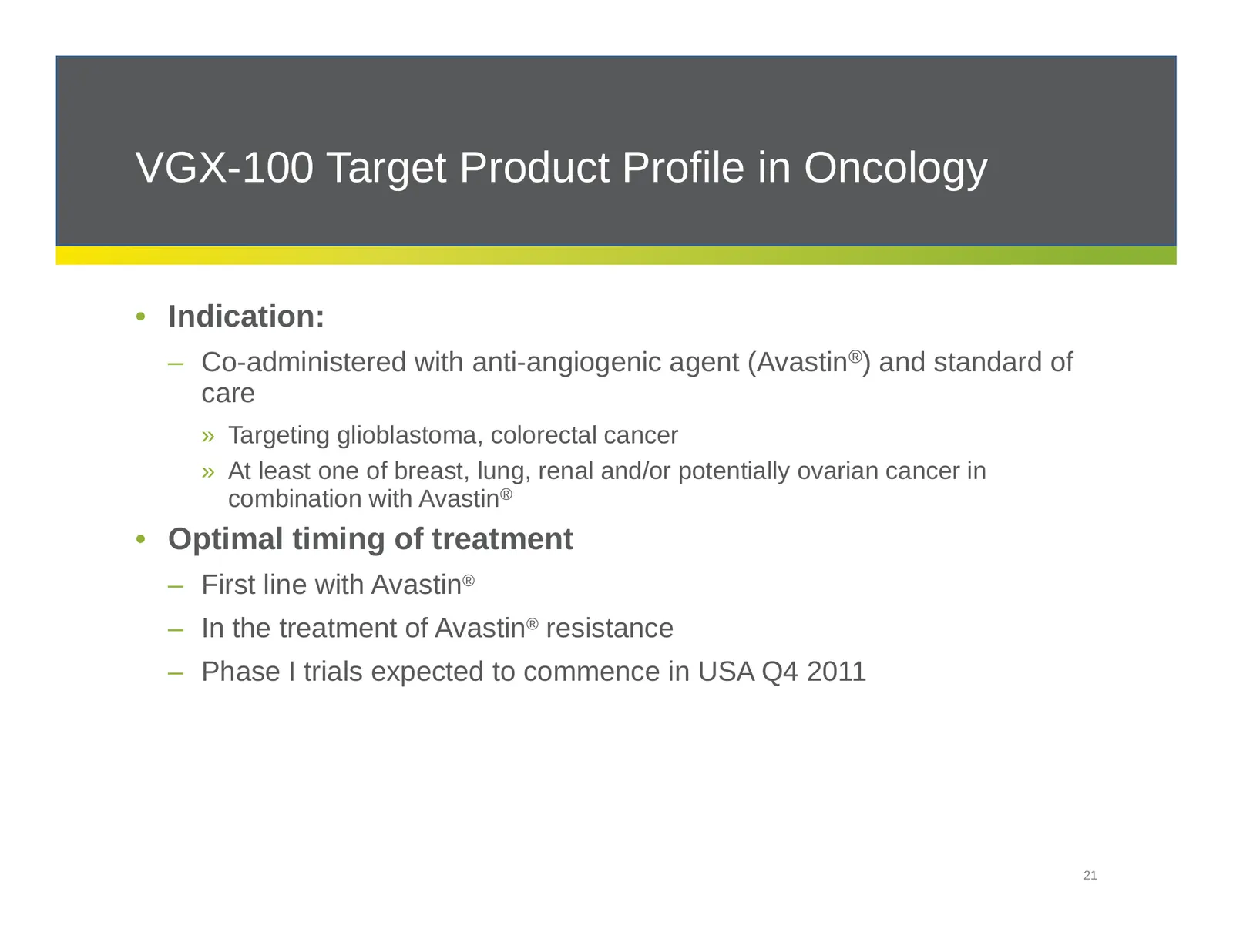
Slide 21: VGX-100 Target Product Profile in Oncology
VGX-100 VGX 100 Target Product Profile in Oncology • Indication: – Co-administered with anti-angiogenic agent (Avastin®) and standard of care » Targeting glioblastoma, colorectal cancer » At least one of breast, lung, renal and/or potentially ovarian cancer in combination with Avastin® • Optimal tim
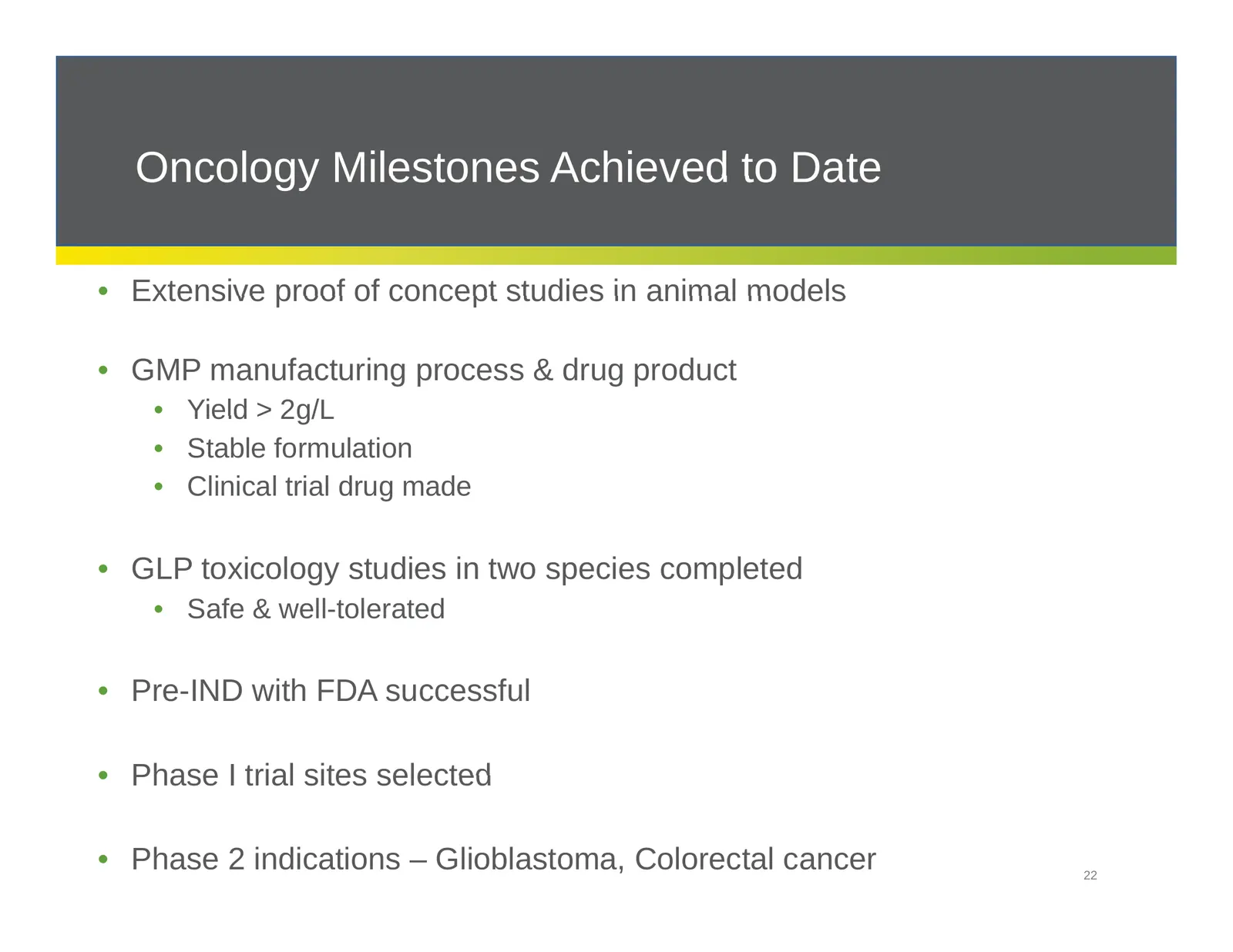
Slide 22: Oncology Milestones Achieved to Date
Oncology Milestones Achieved to Date • Extensive proof of concept studies in animal models • GMP manufacturing process & drug product • Yield > 2g/L • Stable formulation • Clinical trial drug made • GLP toxicology studies in two species completed • Safe & well-tolerated • Pre-IND with FDA successful
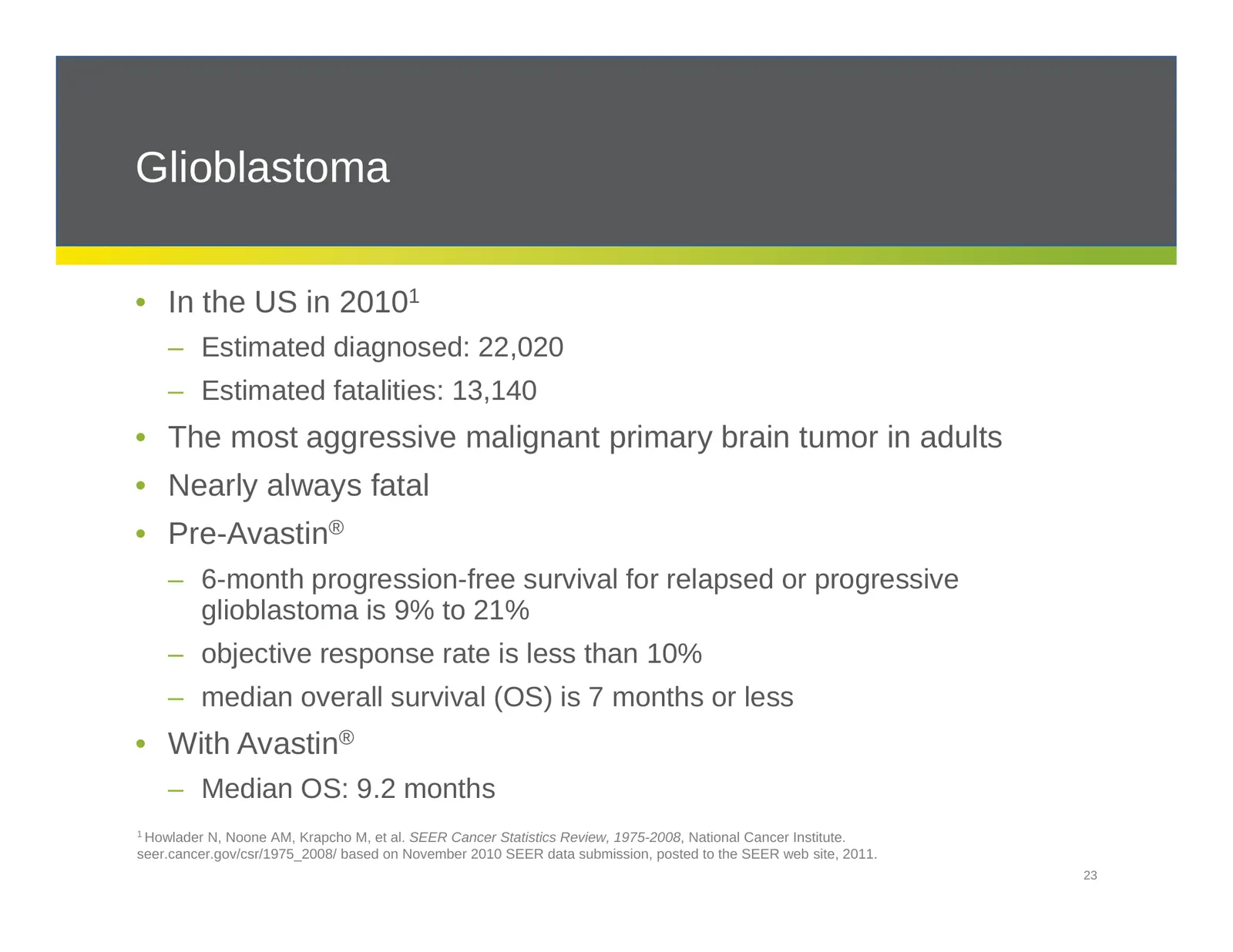
Slide 23: Glioblastoma
Glioblastoma • In I the i 20101 th US in – Estimated diagnosed: 22,020 – Estimated fatalities: 13,140 • The most aggressive malignant primary brain tumor in adults • Nearly always fatal • Pre-Avastin® – 6-month progression-free survival for relapsed or progressive glioblastoma is 9% to 21% – objecti
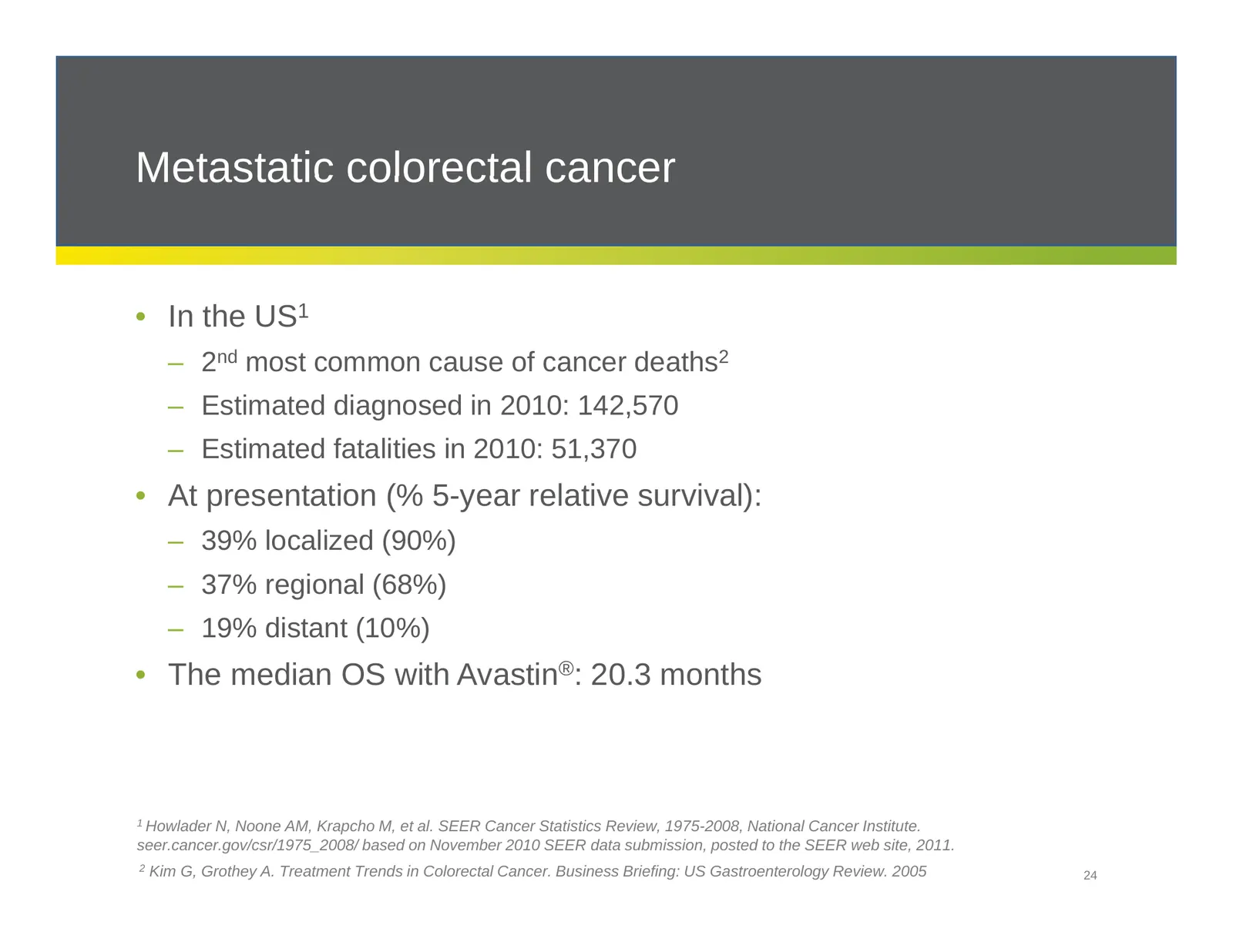
Slide 24: Metastatic colorectal cancer
Metastatic colorectal cancer • In the US1 – 2nd most common cause of cancer deaths2 – Estimated diagnosed g in 2010: 142,570 , – Estimated fatalities in 2010: 51,370 • At presentation (% 5-year relative survival): – 39% locali localized ed (90%) – 37% regional (68%) – 19% distant (10%) • The median
Slide 25: Phase I and II clinical program
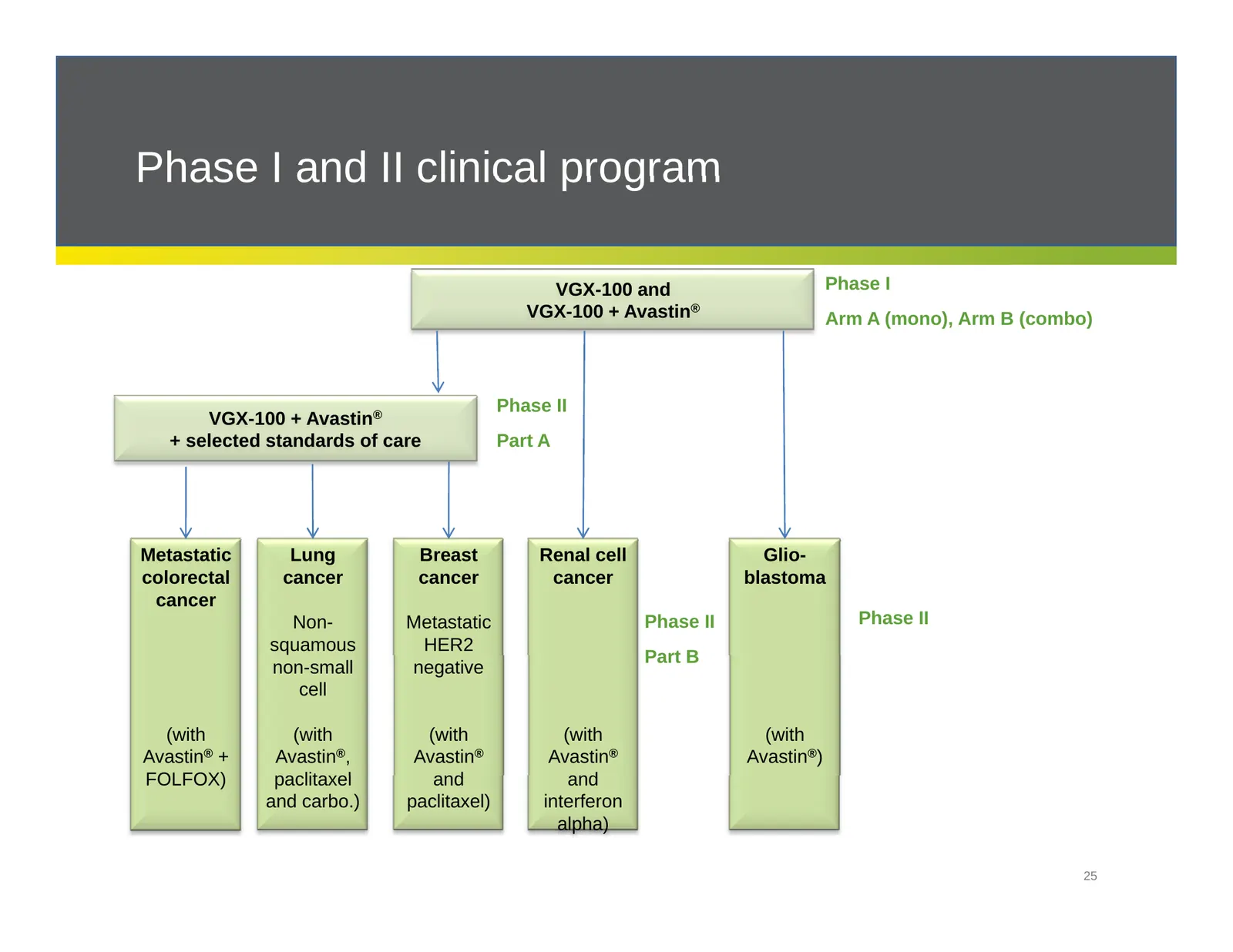
Phase I and II clinical program VGX 100 and VGX-100 Phase I VGX-100 + Avastin® Arm A (mono), Arm B (combo) Phase II 100 + Avastin® VGX-100 VGX + selected standards of care Part A Metastatic Lung Breast Renal cell Glio- colorectal cancer cancer cancer blastoma cancer Non- Metastatic Phase II Phase II
Slide 26: Phase I and II clinical program
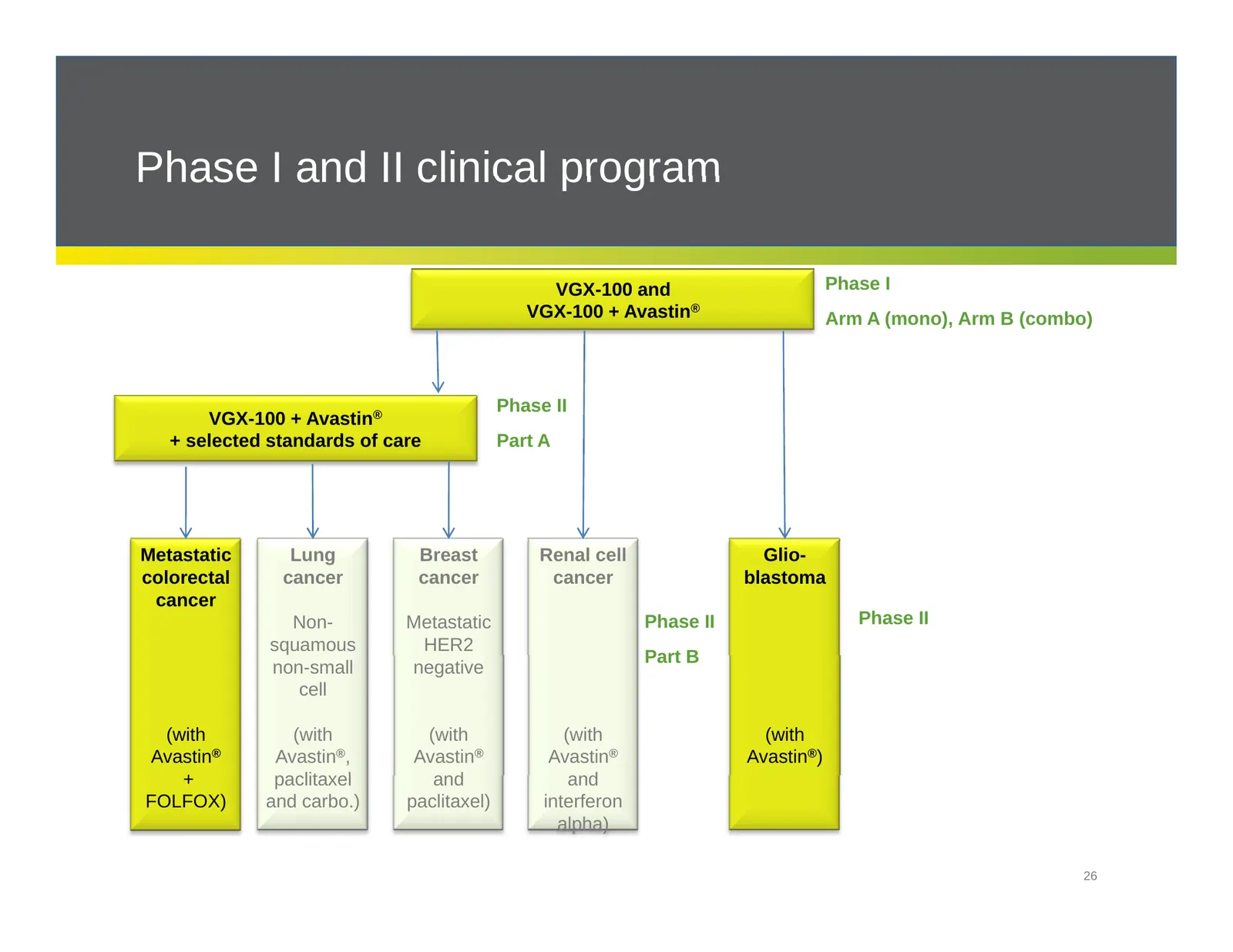
Phase I and II clinical program VGX 100 and VGX-100 Phase I VGX-100 + Avastin® Arm A (mono), Arm B (combo) Phase II 100 + Avastin® VGX-100 VGX + selected standards of care Part A Metastatic Lung Breast Renal cell Glio- colorectal cancer cancer cancer blastoma cancer Non- Metastatic Phase II Phase II
Slide 27: Avastin Registrational Study in Glioblastoma
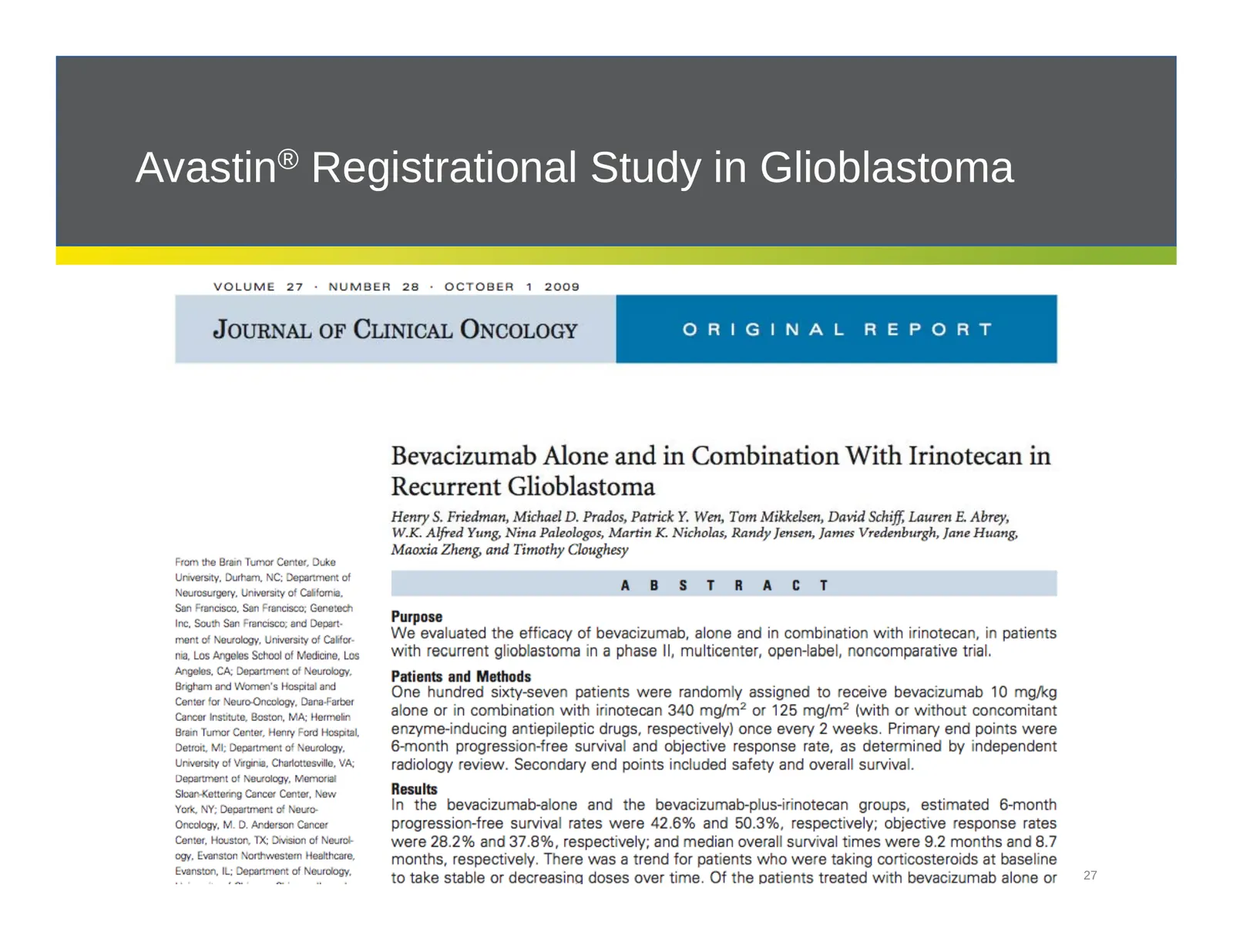
Avastin® Registrational Study in Glioblastoma 27
Slide 28: Current Activities and Value Adding Events
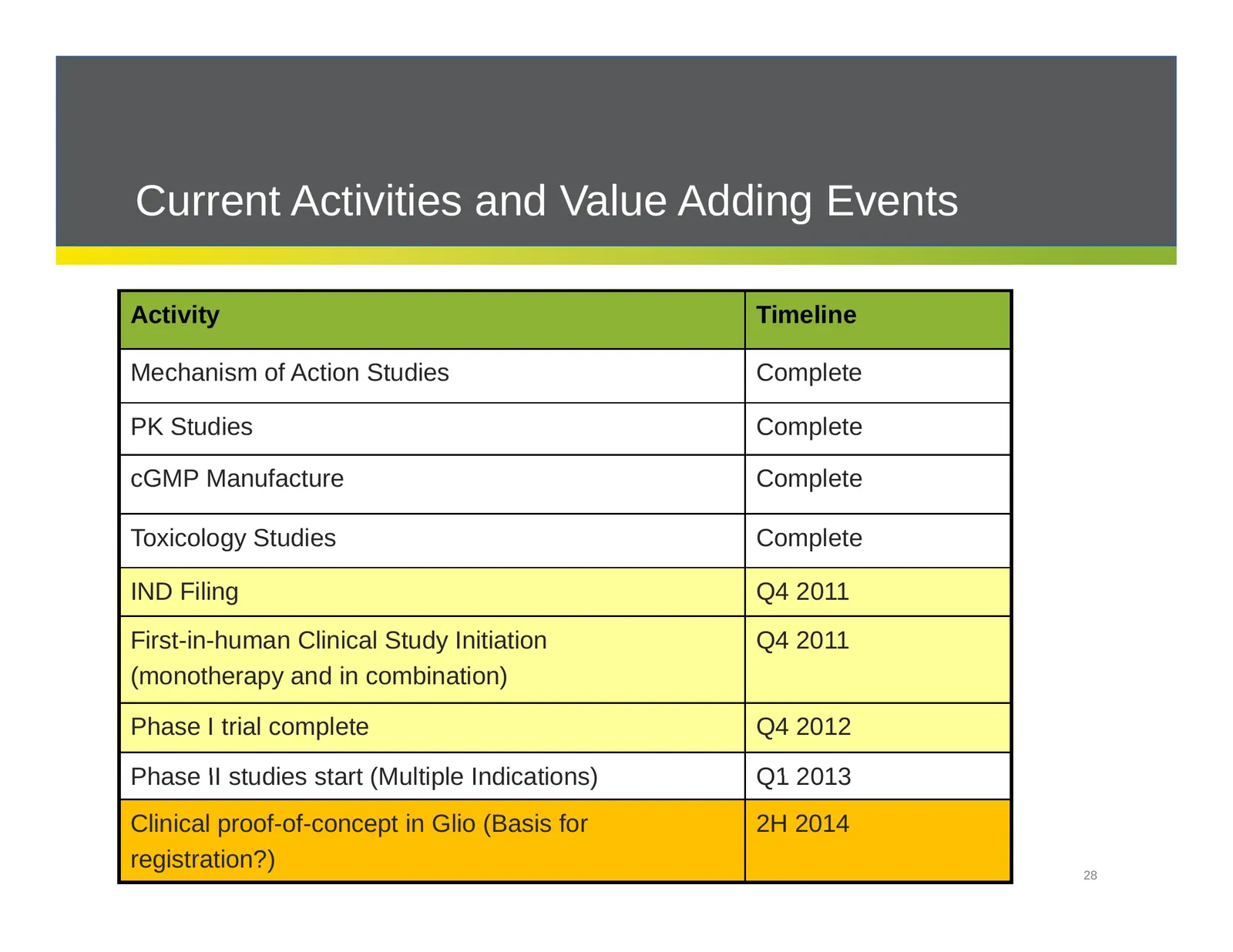
Current Activities and Value Adding Events Activity Timeline Mechanism of Action Studies Complete PK Studies Complete cGMP Manufacture Complete Toxicology Studies Complete IND Filing Q4 2011 First-in-human Clinical Study Initiation Q4 2011 (monotherapy and in combination) Phase I trial complete Q4 2
Slide 29: VGX-100 Ocular Development Opportunity
VGX 100 OCULAR VGX-100 DEVELOPMENT OPPORTUNITY 29
Slide 30: Compelling Reasons Supporting Development of VGX-100 for Eye-Disease
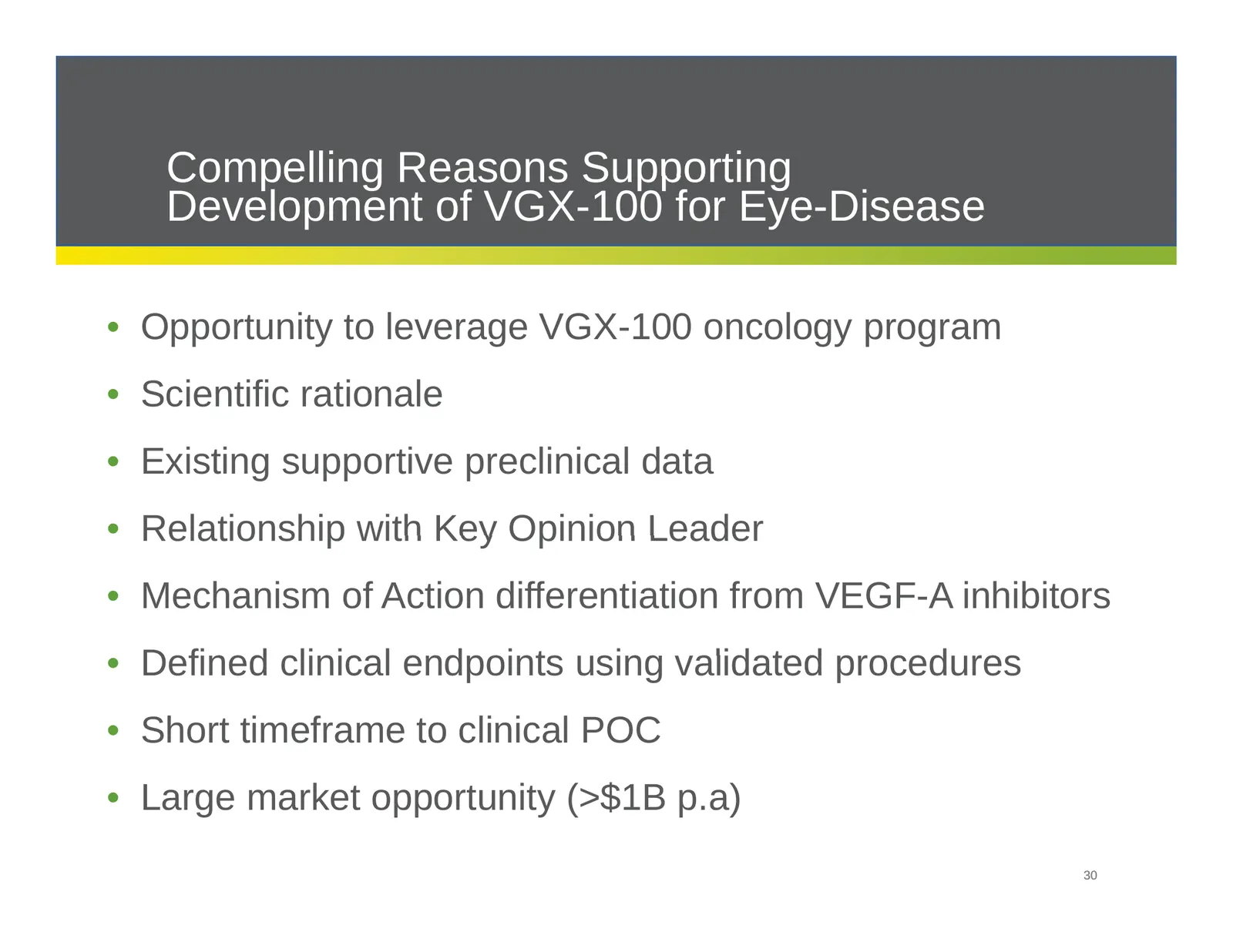
Compelling Reasons Supporting Development of VGX-100 for Eye-Disease • Opportunity to leverage VGX-100 oncology program • Scientific rationale • Existing supportive preclinical data • Relationship with Key Opinion Leader • Mechanism of Action differentiation from VEGF-A inhibitors • Defined D fi d c
Slide 31: Development Opportunity
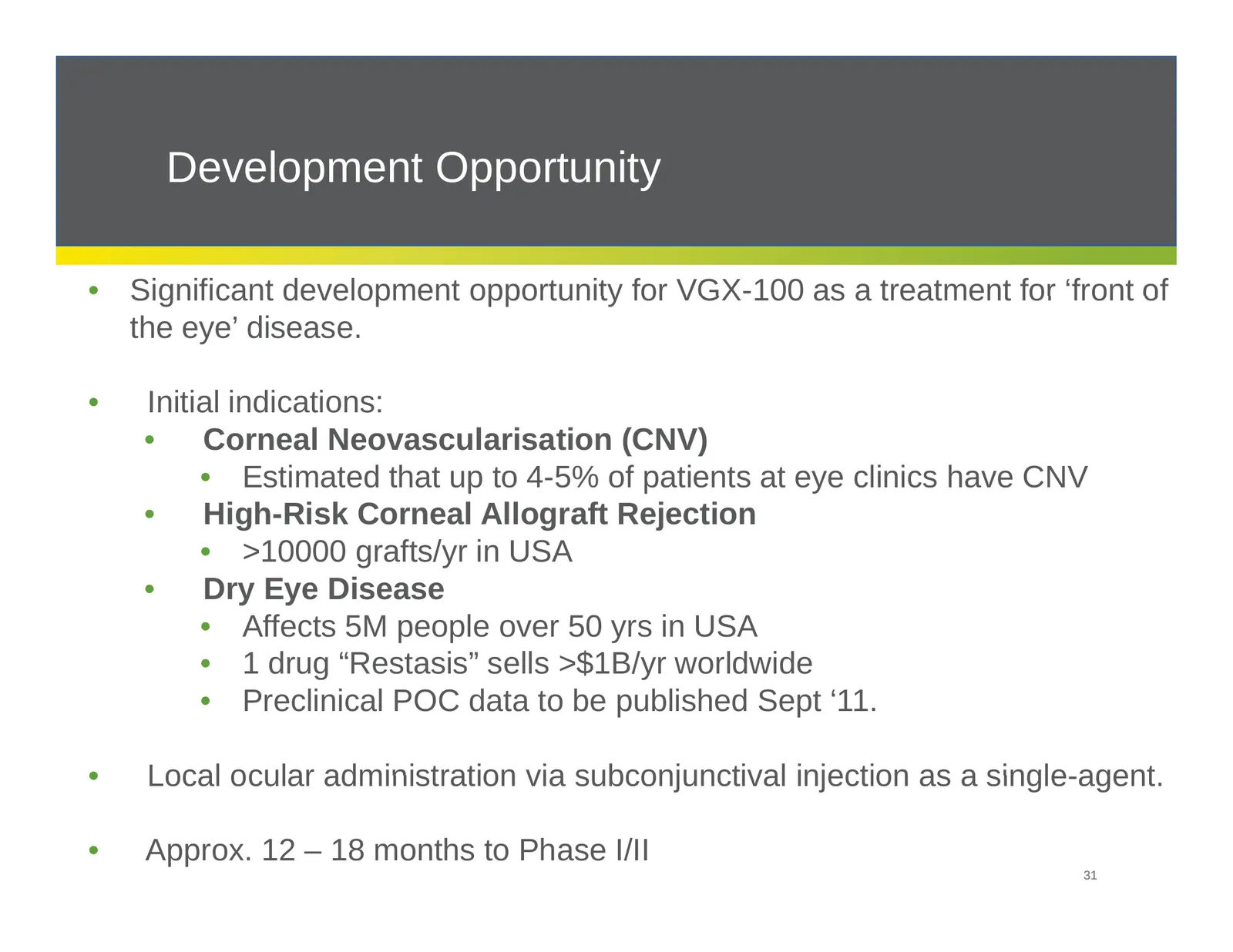
Development Opportunity • Significant development opportunity for VGX-100 VGX 100 as a treatment for ‘front front of the eye’ disease. • Initial indications: • Corneal Neovascularisation (CNV) • Estimated that up to 4-5% of patients at eye clinics have CNV • High-Risk Corneal Allograft Rejection • >
Slide 32: Existing & Supportive Preclinical Data
Existing & Supportive P Preclinical li i l Data: D t VGX-100 improves Corneal Transplant p Survival 32
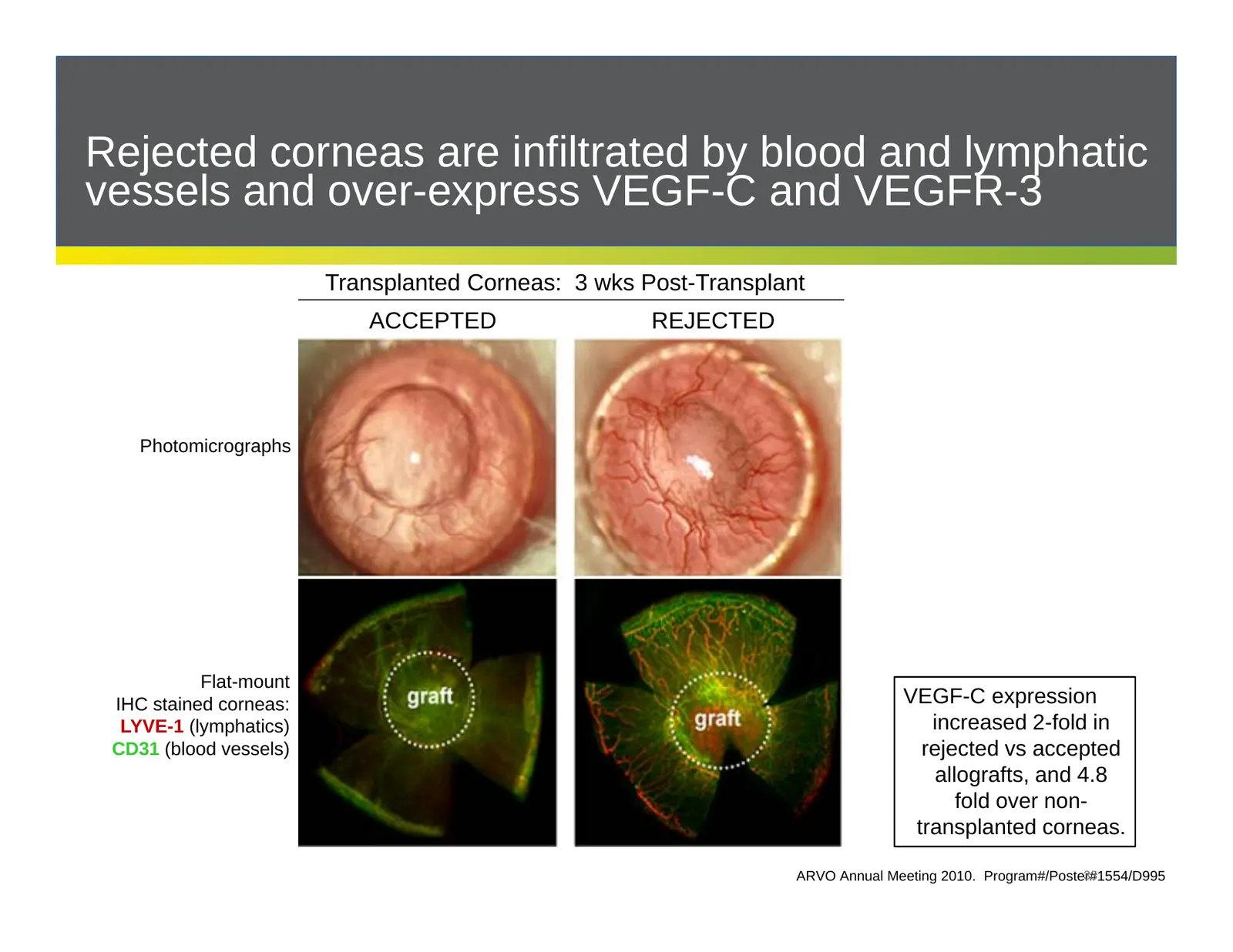
Slide 33: Rejected corneas infiltrated by blood and lymphatic vessels
Rejected j corneas are infiltrated by y blood and lymphatic y vessels l andd over-express VEGF-C VEGF C and d VEGFR VEGFR-3 3 Transplanted Corneas: 3 wks Post-Transplant ACCEPTED REJECTED Photomicrographs Flat-mount IHC stained corneas: VEGF-C expression LYVE-1 (lymphatics) increased 2-fold in CD31
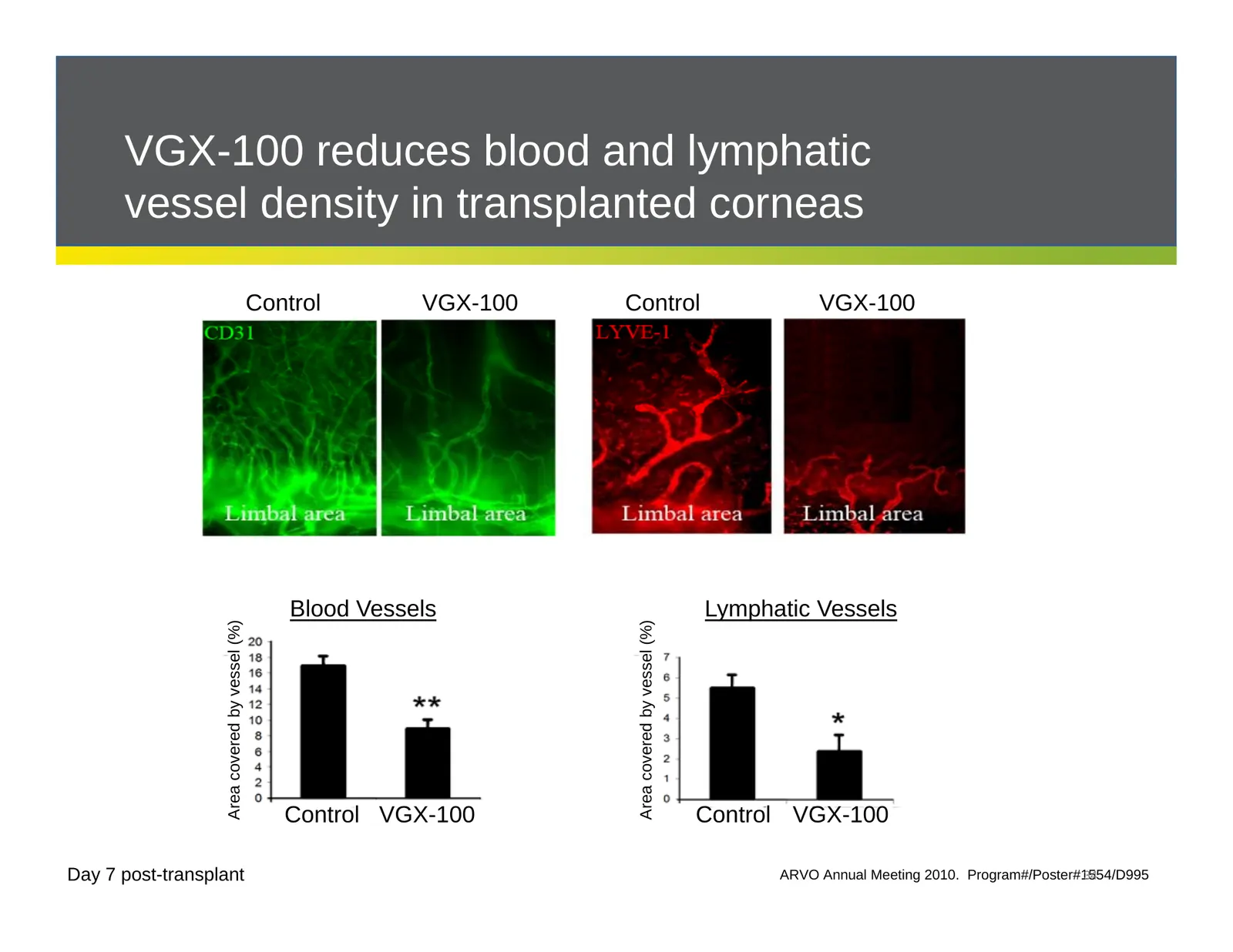
Slide 34: VGX-100 reduces blood and lymphatic vessel density in transplanted corneas
VGX-100 reduces blood and lymphatic vessel density in transplanted corneas C t l Control VGX 100 VGX-100 C t l Control VGX 100 VGX-100 Blood Vessels Lymphatic Vessels el (%) el (%) Area ccovered by vesse Area ccovered by vesse Control VGX-100 Control VGX-100 Day 7 post-transplant ARVO Annual Meeting
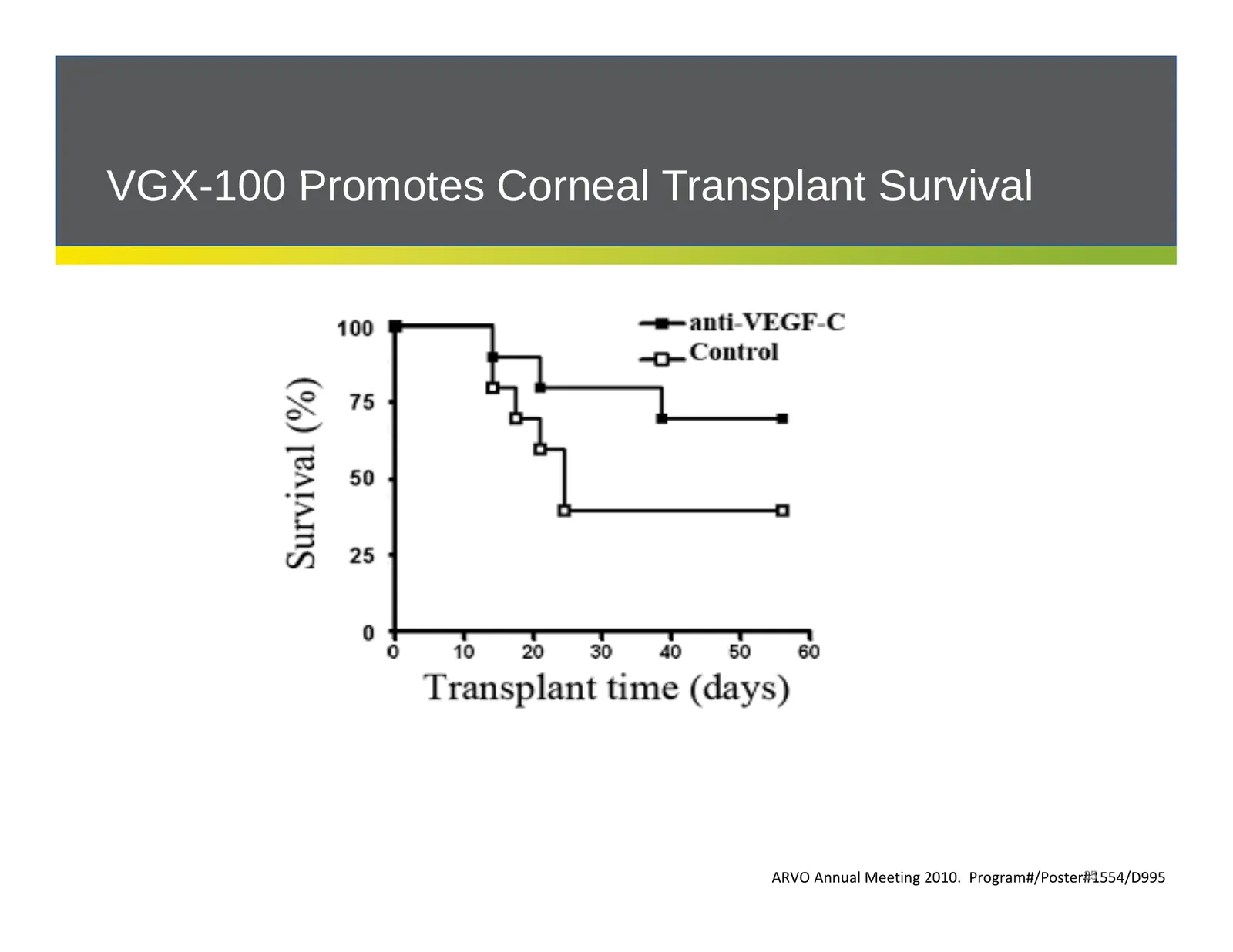
Slide 35: VGX-100 Promotes Corneal Transplant Survival
VGX 100 P VGX-100 Promotes t C Corneall T Transplant l tS Survival i l ARVO Annual Meeting 2010. Program#/Poster#1554/D995 35
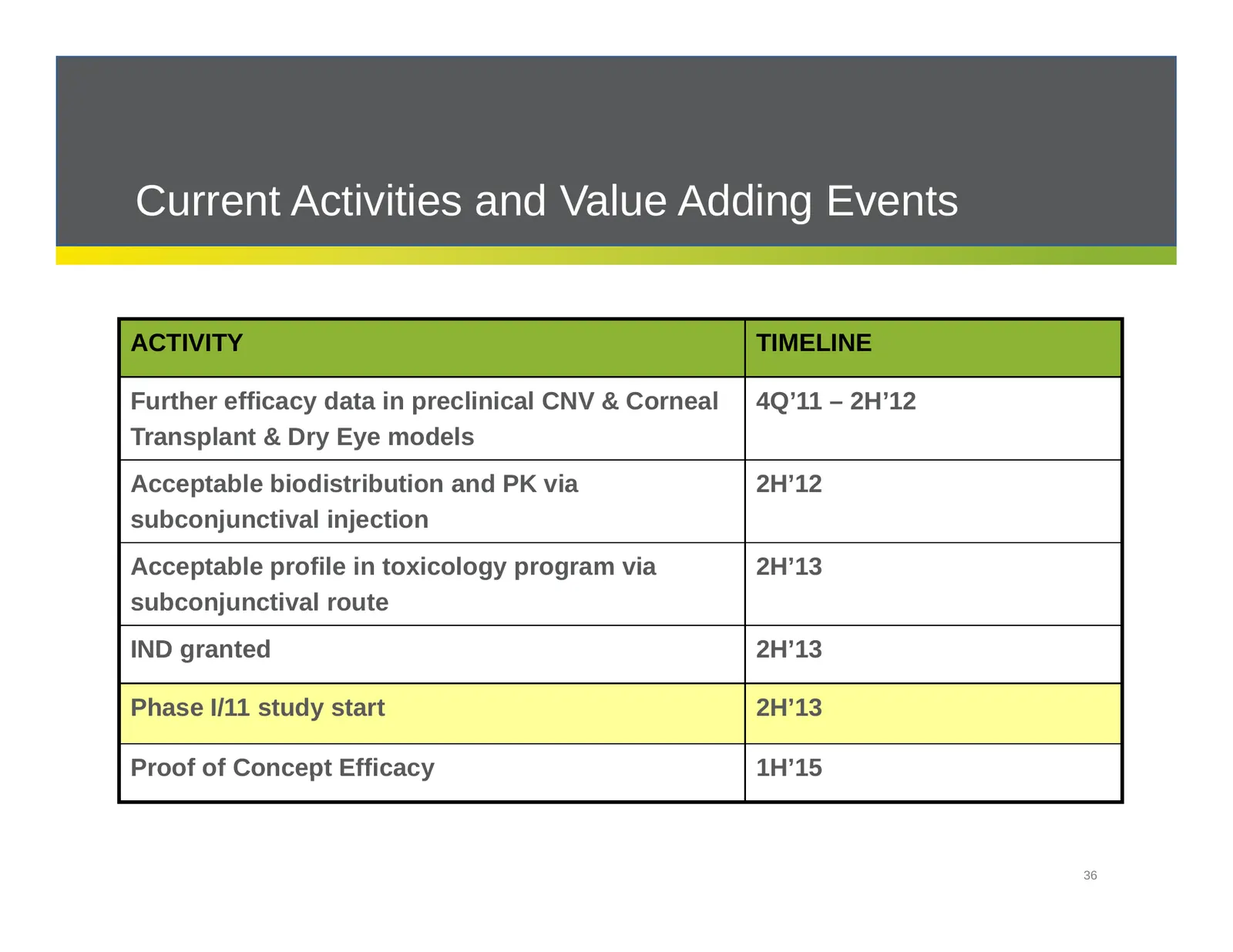
Slide 36: Current Activities and Value Adding Events
Current Activities and Value Adding Events ACTIVITY TIMELINE Further efficacy data in preclinical CNV & Corneal 4Q’11 – 2H’12 Transplant & Dry Eye models Acceptable biodistribution and PK via 2H’12 subconjunctival injection Acceptable profile in toxicology program via 2H’13 subconjunctival route IND

Slide 37: Corporate Details
C Corporate t Details D t il 37
Slide 38: A strong financial position & shareholder base
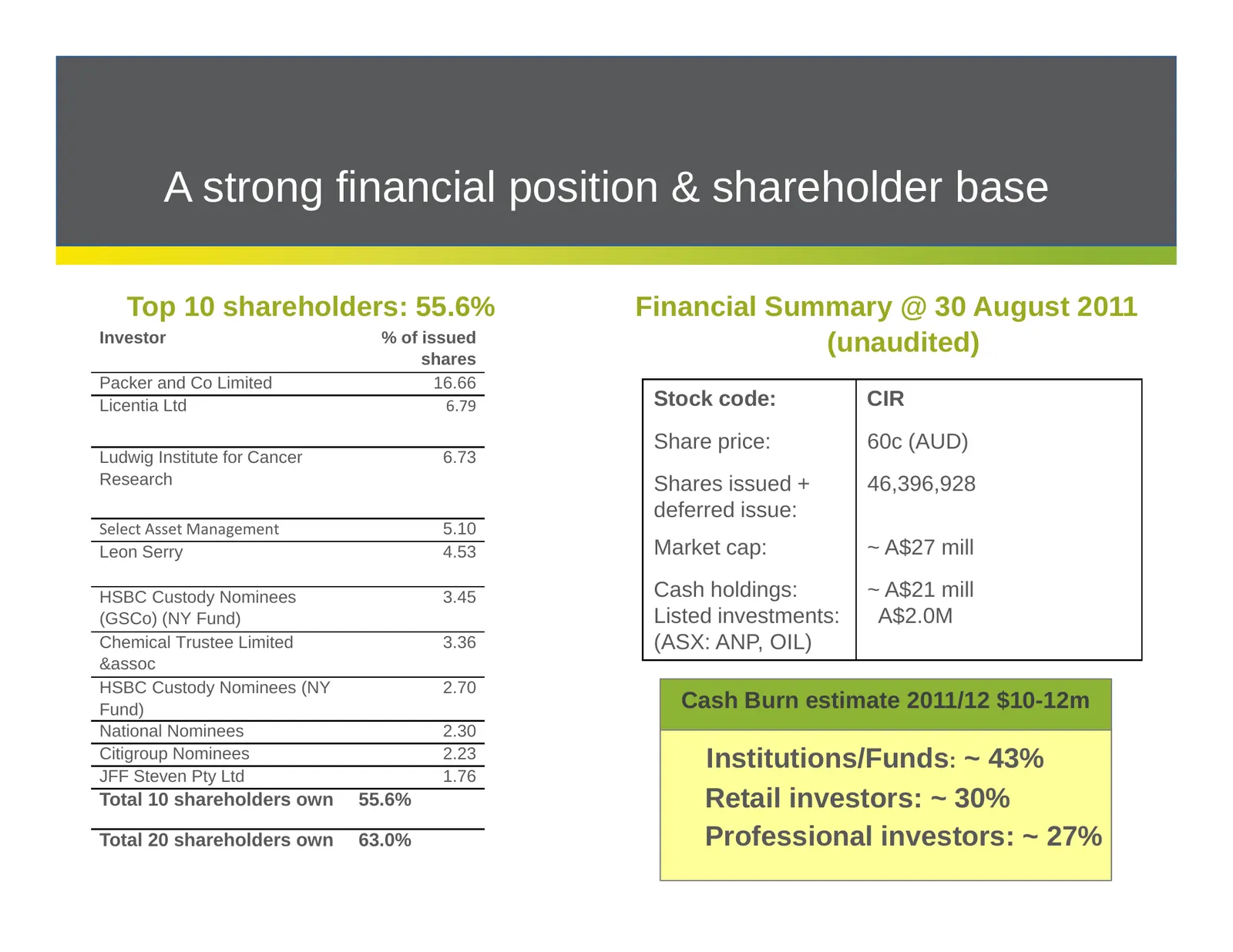
A strong t financial fi i l position iti & shareholder h h ld b base Top 10 shareholders: 55.6% Financial Summary S @ 30 August 2011 Investor % of issued (unaudited) shares Packer and Co Limited 16.66 Licentia Ltd 6.79 Stock code: CIR Share price: 60c (AUD) Ludwig Institute for Cancer 6.73 Research
Slide 39: Key Development Milestones
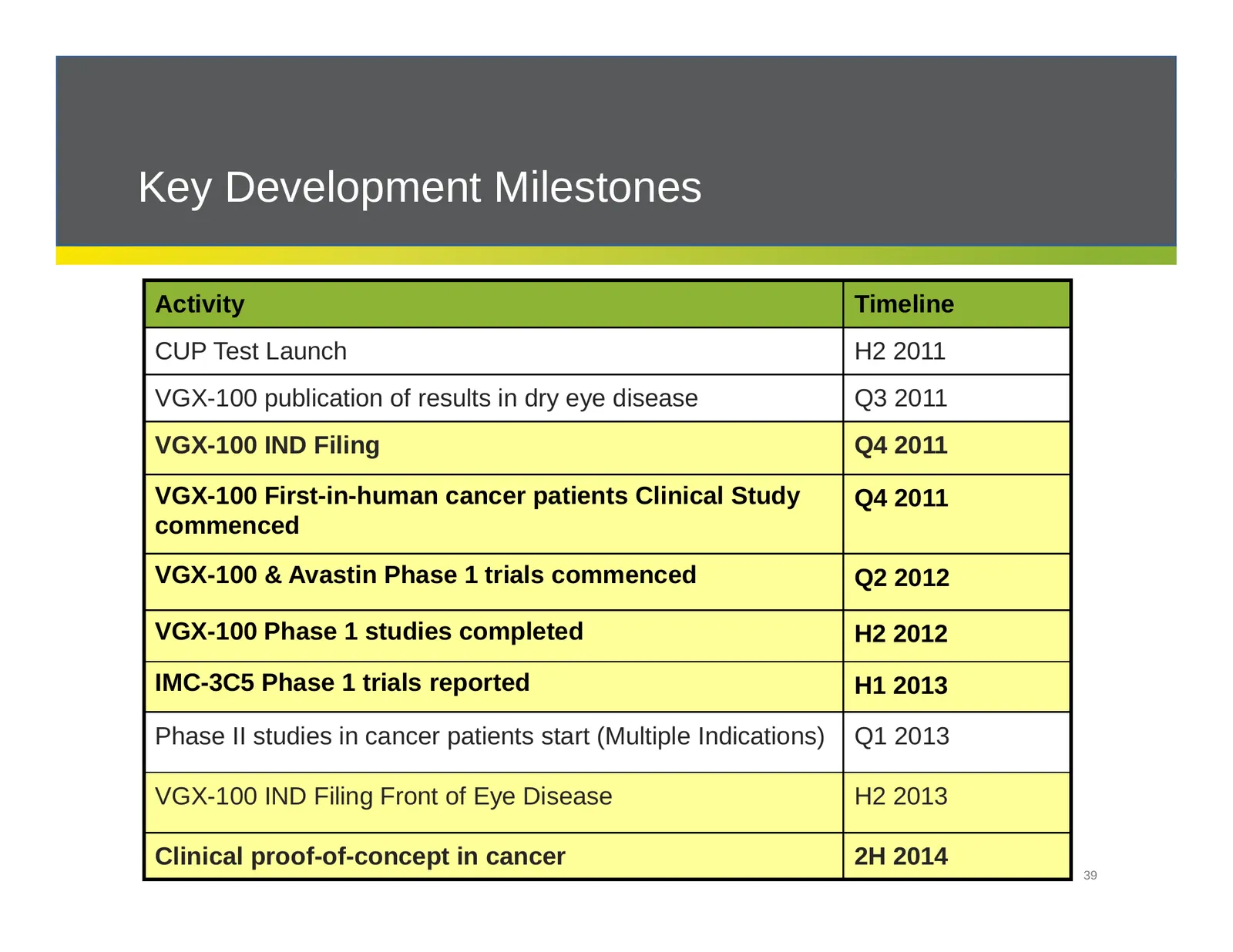
K D Key Development l t Mil Milestones t A ti it Activity Ti li Timeline CUP Test Launch H2 2011 VGX-100 publication of results in dry eye disease Q3 2011 VGX-100 IND Filing Q4 2011 VGX-100 First-in-human cancer patients Clinical Study Q4 2011 commenced VGX-100 & Avastin Phase 1 trials commenced Q2
Slide 40: Key Reasons to Invest
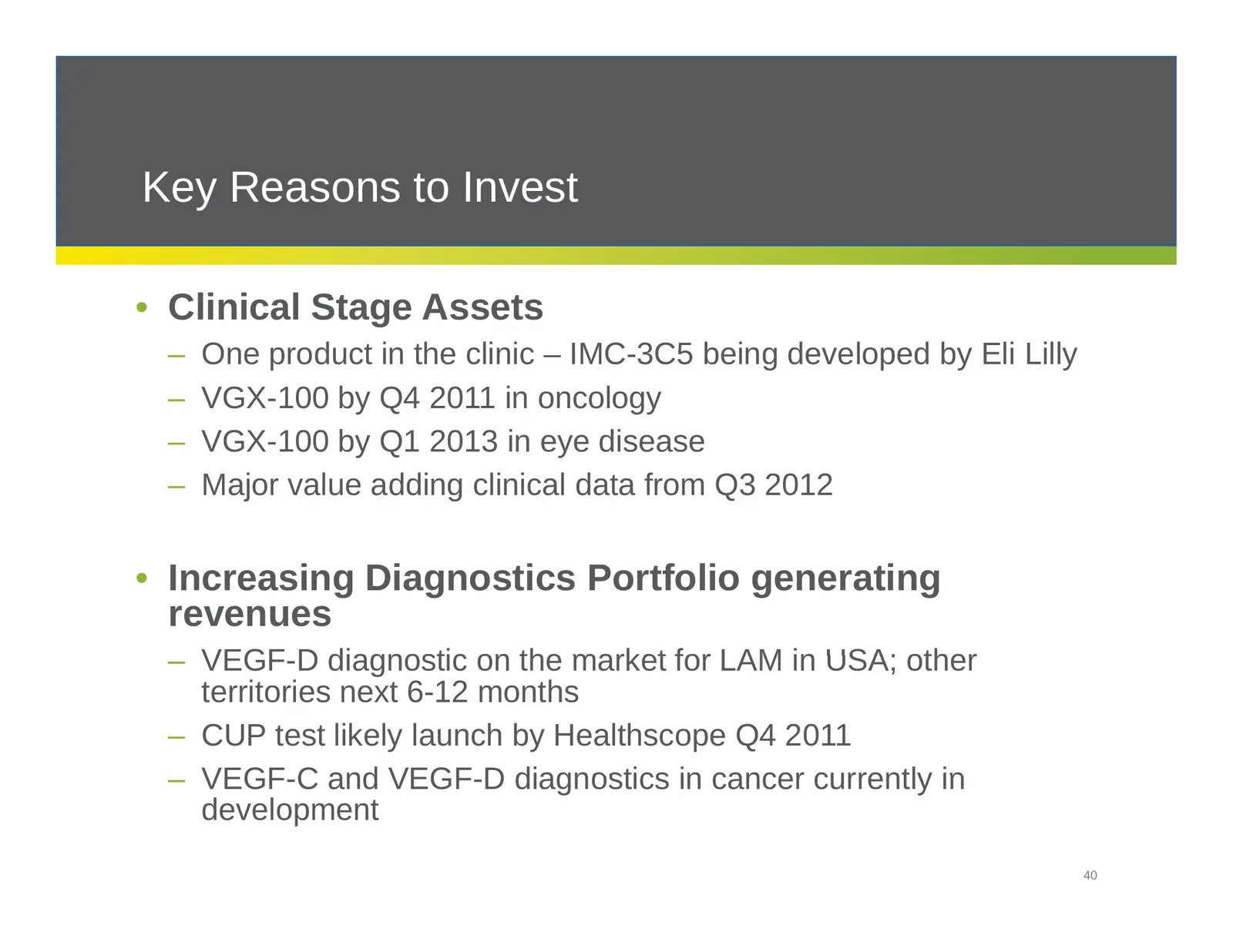
K R Key Reasons tto Invest I t • Clinical Cli i l Stage St Assets A t – One product in the clinic – IMC-3C5 being developed by Eli Lilly – VGX-100 by Q4 2011 in oncology – VGX-100 by Q1 2013 in eye disease – Major value adding clinical data from Q3 2012 • Increasing Diagnostics Portfolio generating
Slide 41: Key Reasons to Invest
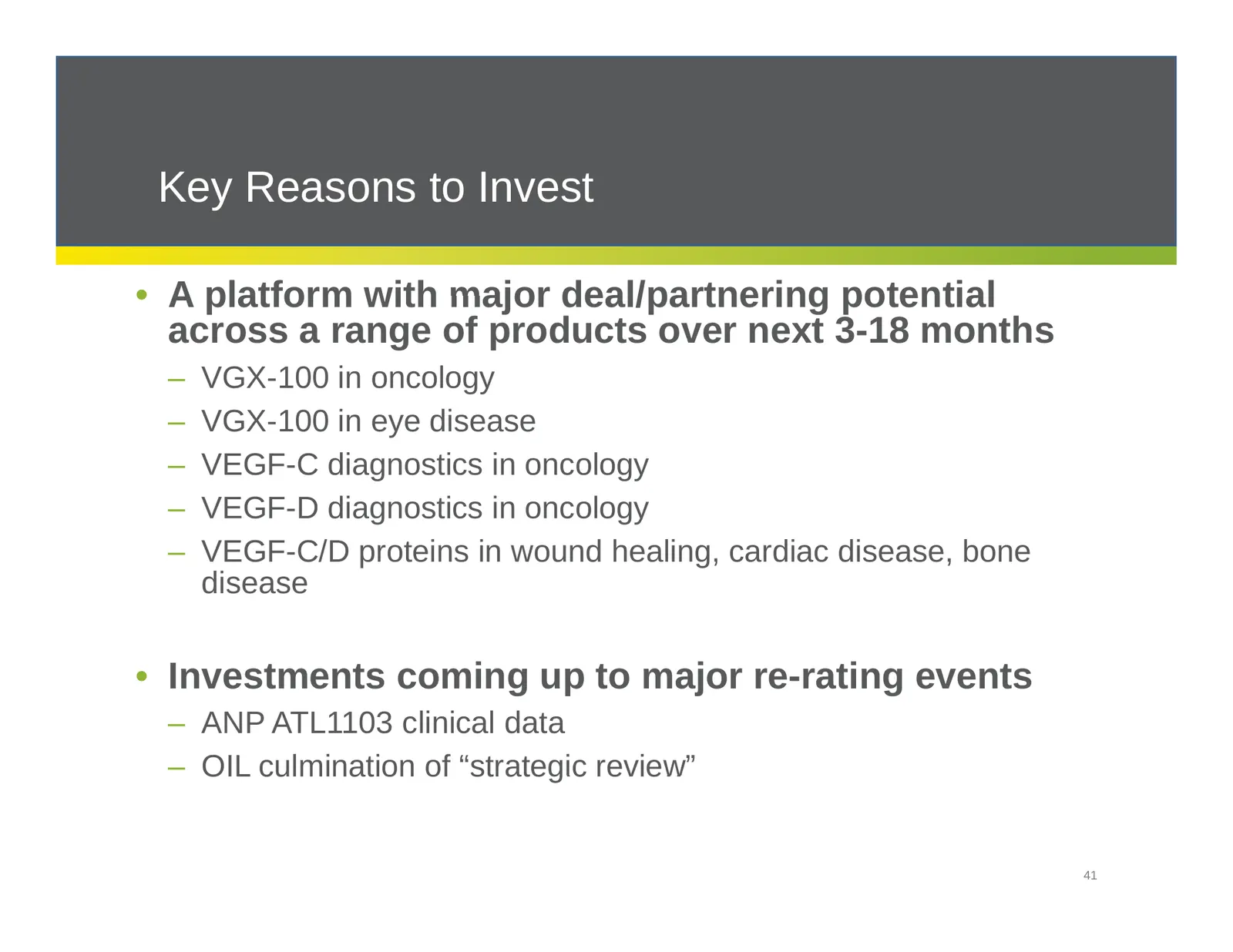
K R Key Reasons tto Invest I t • A platform with major deal/partnering potential across a range of products over next 3-18 months – VGX-100 in oncology – VGX-100 VGX 100 in eye disease – VEGF-C diagnostics in oncology – VEGF-D diagnostics in oncology – VEGF-C/D proteins in wound healing, cardiac dis
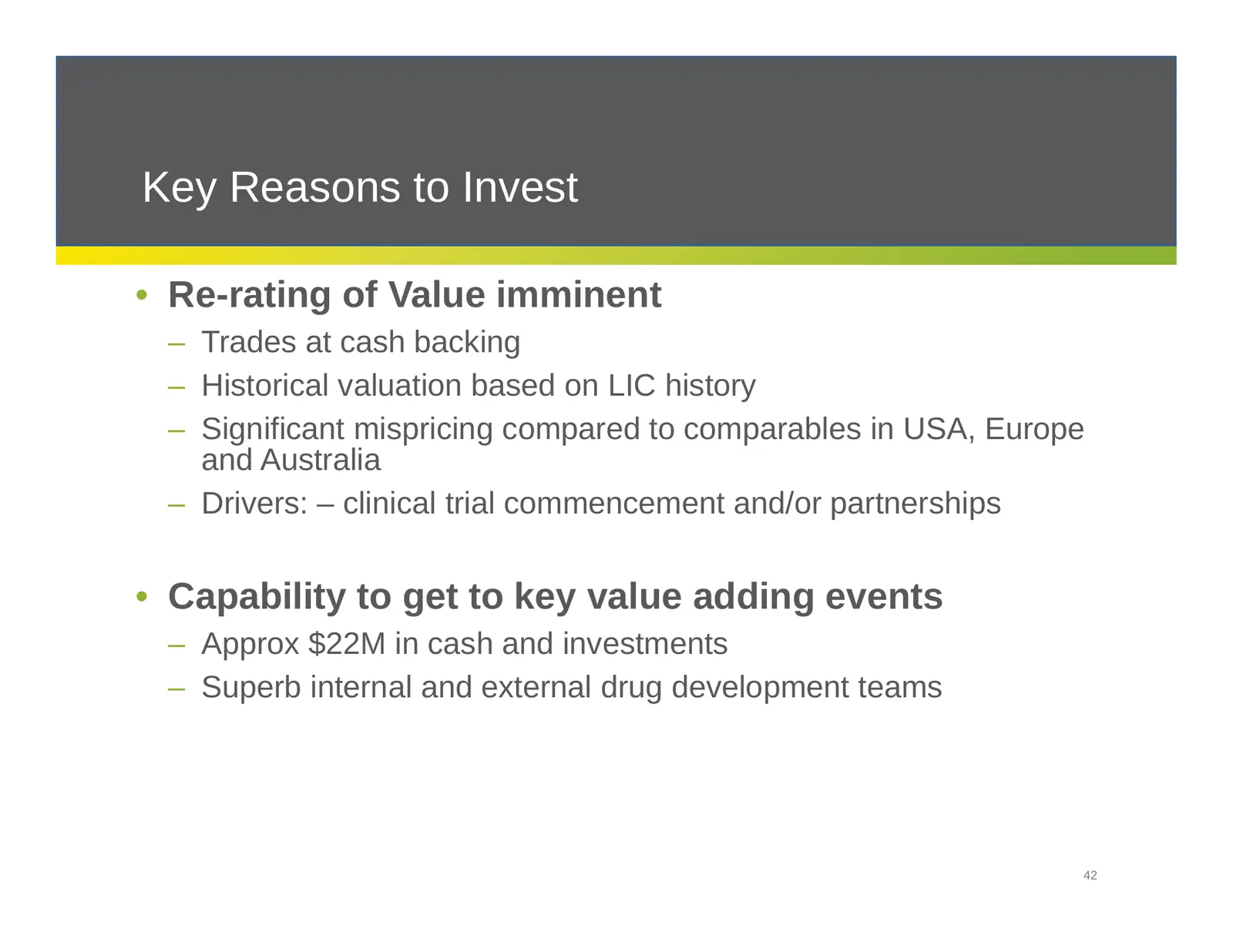
Slide 42: Key Reasons to Invest
K R Key Reasons tto Invest I t • Re-rating of Value imminent – Trades at cash backing – Historical valuation based on LIC history – Significant mispricing compared to comparables in USA, Europe and Australia – Drivers: – clinical trial commencement and/or partnerships • Capability to get to key valu

Slide 43: Thank You
Thank You www.circadian.com.au 43

Slide 44: 44
44
Source: Internet Archive copy of opthea.com
More decks from Opthea Limited
 Investor Presentation (June 2026)27 slides · Jun 12, 2026
 Corporate Update (December 2025)20 slides · Dec 17, 2025
 Corporate Update (August 2025)31 slides · Aug 20, 2025
 Investor Day (January 2025)53 slides · Jan 29, 2025
 Investor Presentation (January 2025)33 slides · Jan 14, 2025
 Investor Presentation (November 2024)30 slides · Nov 19, 2024