IRLAB Therapeutics AB Class A · OMXSTO:IRLAB_A
IRLAB Therapeutics AB Class A — Q3 2022 Earnings Presentation
46 slides from IRLAB Therapeutics AB Class A's earnings presentation, Nov 9, 2022
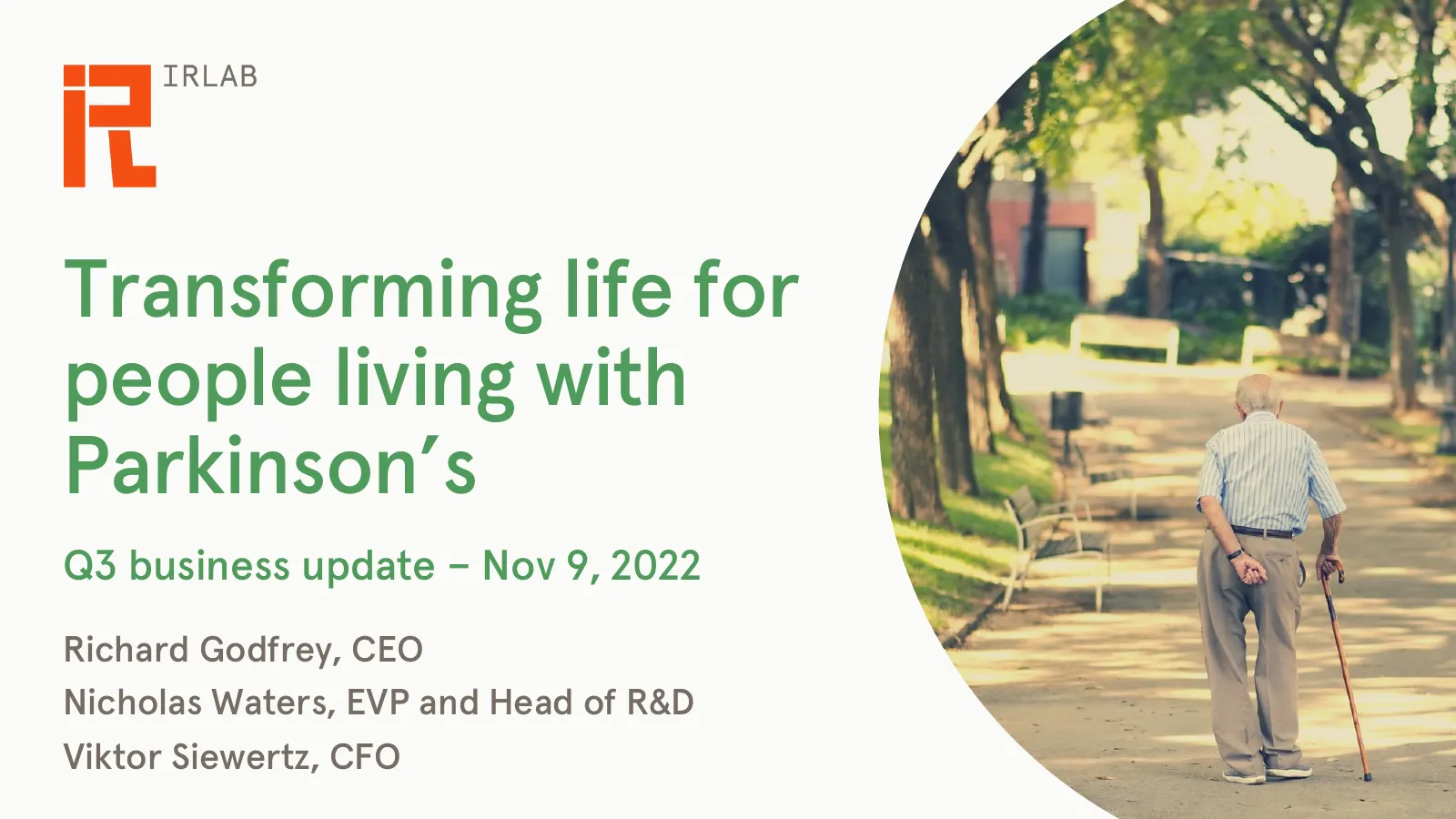
Slide 1: Transforming life for people living with Parkinson's
Transforming life for people living with Parkinson’s Q3 business update – Nov 9, 2022 Richard Godfrey, CEO Nicholas Waters, EVP and Head of R&D Viktor Siewertz, CFO
Slide 2: Disclaimer
Disclaimer This document, “IRLAB Therapeutics” (the “Presentation”), has been prepared by IRLAB Therapeutics AB (publ) (“IRLAB”) and is provided for informational purposes only. All information in this Presentation has been compiled in good faith by IRLAB. Neither IRLAB nor any of its directors, emp
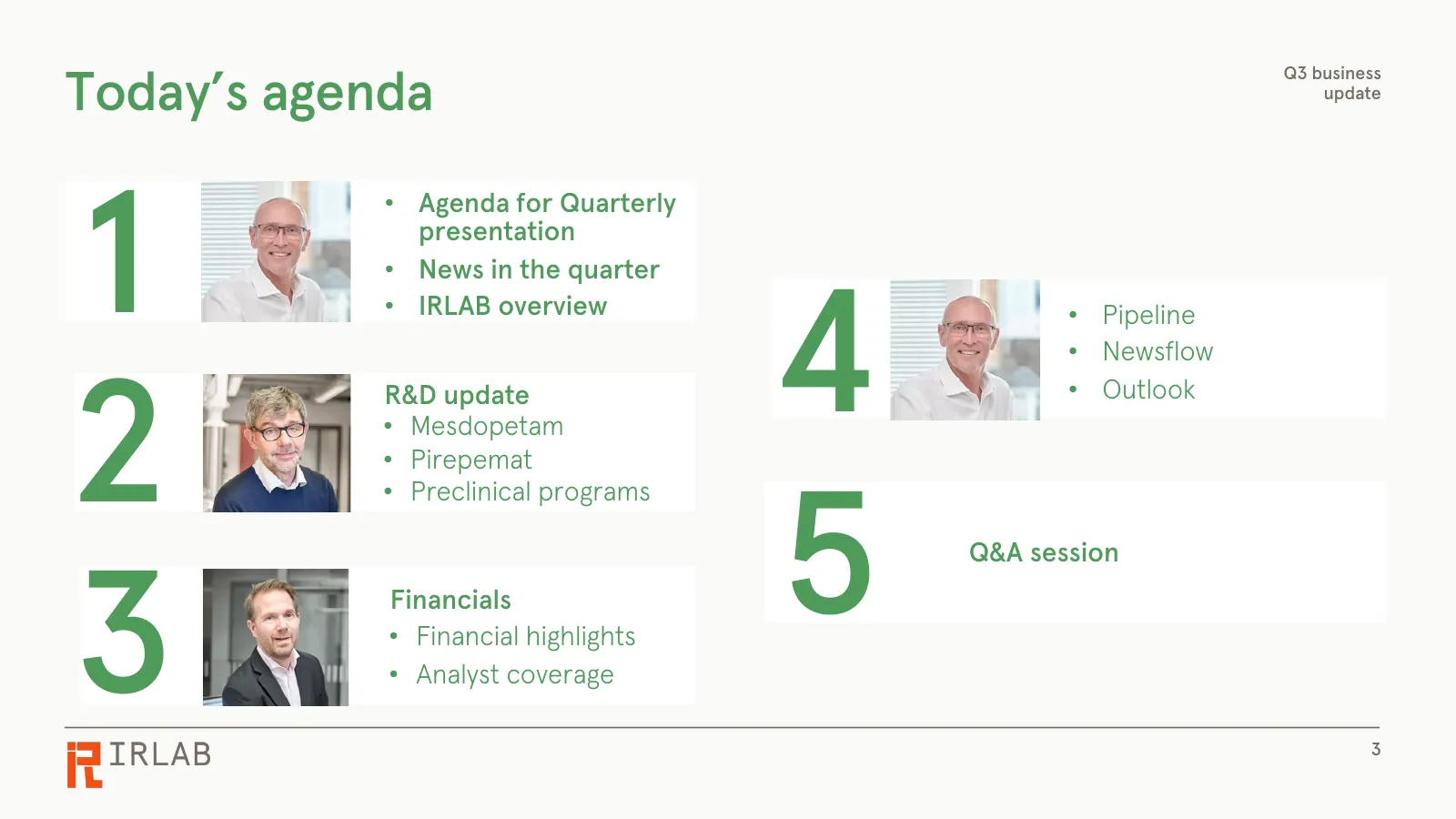
Slide 3: Today's agenda
Q3 business Today’s agenda update 1 • Agenda for Quarterly presentation • News in the quarter 4 • IRLAB overview • Pipeline • Newsflow 2 R&D update • Outlook • Mesdopetam • Pirepemat • Preclinical programs 3 Financials • Financial highlights • Analyst coverage 5 Q&A session 3
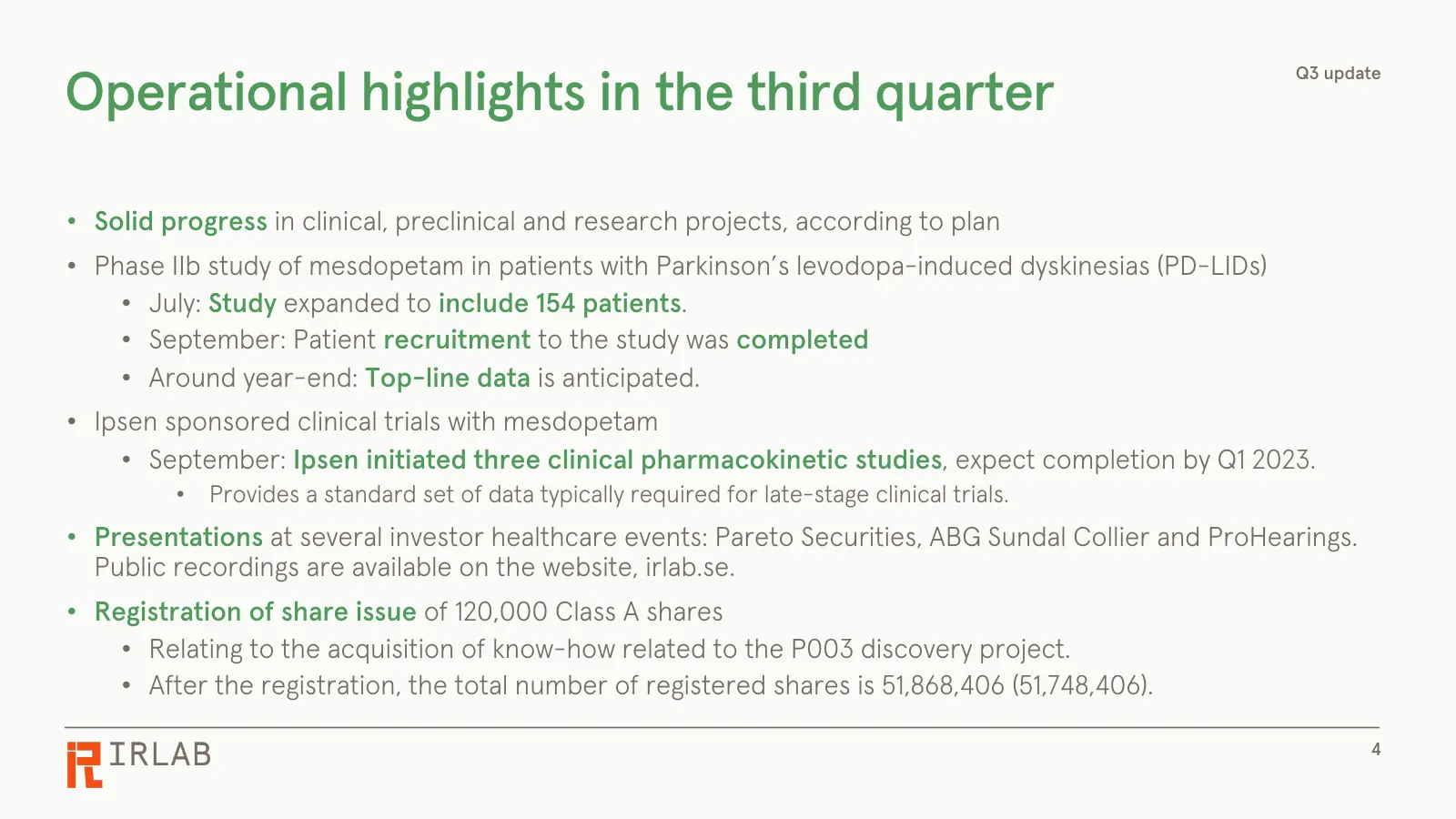
Slide 4: Operational highlights in the third quarter
Q3 update Operational highlights in the third quarter • Solid progress in clinical, preclinical and research projects, according to plan • Phase IIb study of mesdopetam in patients with Parkinson’s levodopa-induced dyskinesias (PD-LIDs) • July: Study expanded to include 154 patients. • September: Pa
Slide 5: Financial highlights in the third quarter
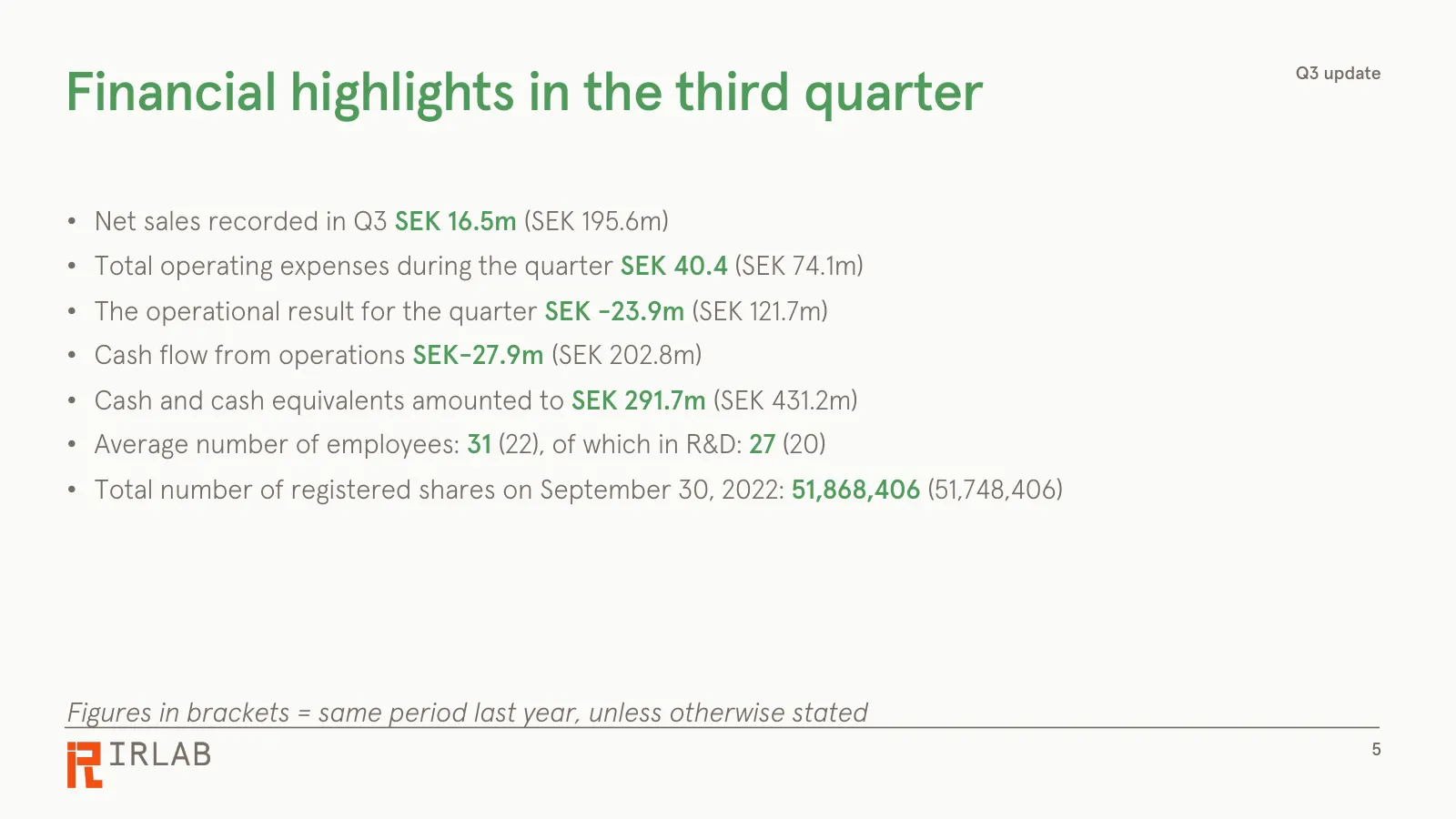
Q3 update Financial highlights in the third quarter • Net sales recorded in Q3 SEK 16.5m (SEK 195.6m) • Total operating expenses during the quarter SEK 40.4 (SEK 74.1m) • The operational result for the quarter SEK -23.9m (SEK 121.7m) • Cash flow from operations SEK-27.9m (SEK 202.8m) • Cash and cash
Slide 6: IRLAB – at a glance
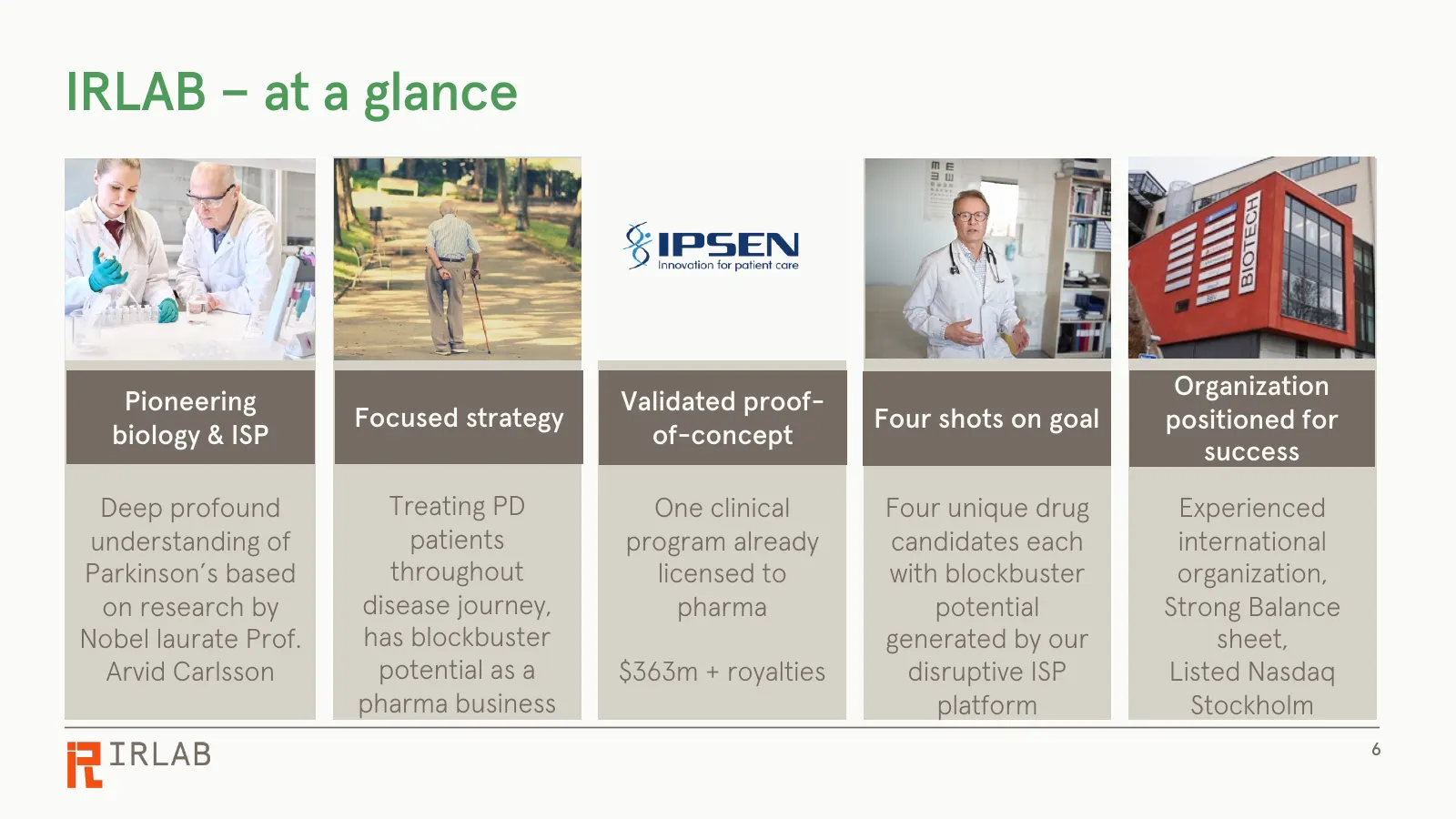
IRLAB – at a glance Organization Pioneering Validated proof- Focused strategy Four shots on goal positioned for biology & ISP of-concept success Deep profound Treating PD One clinical Four unique drug Experienced understanding of patients program already candidates each international Parkinson’s bas
Slide 7: Parkinson's disease is a chronic and progressive neurodegenerative disease, with no cure
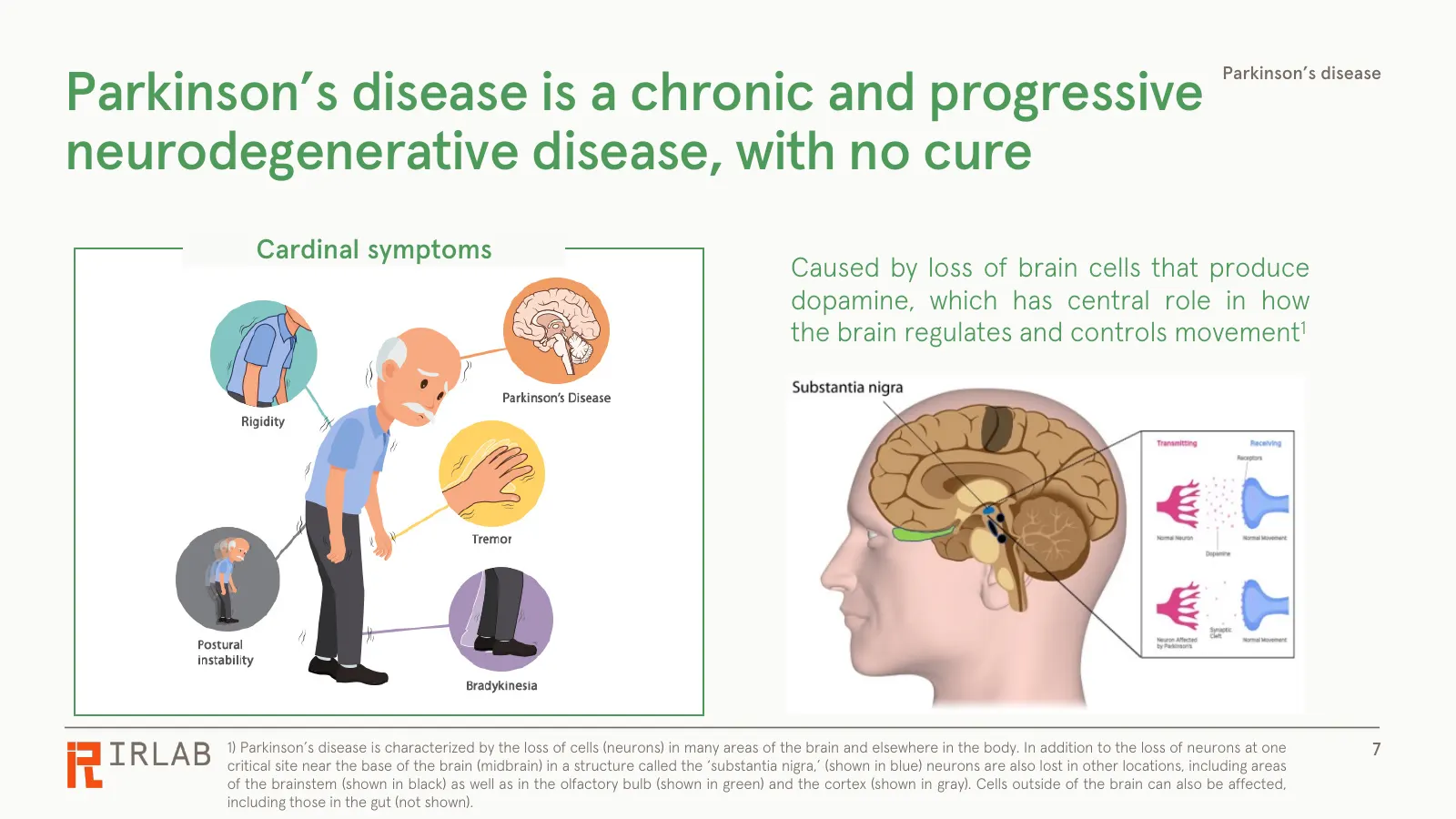
Parkinson’s disease Parkinson’s disease is a chronic and progressive neurodegenerative disease, with no cure Cardinal symptoms Caused by loss of brain cells that produce dopamine, which has central role in how the brain regulates and controls movement1 1) Parkinson’s disease is characterized by the
Slide 8: Parkinson's disease
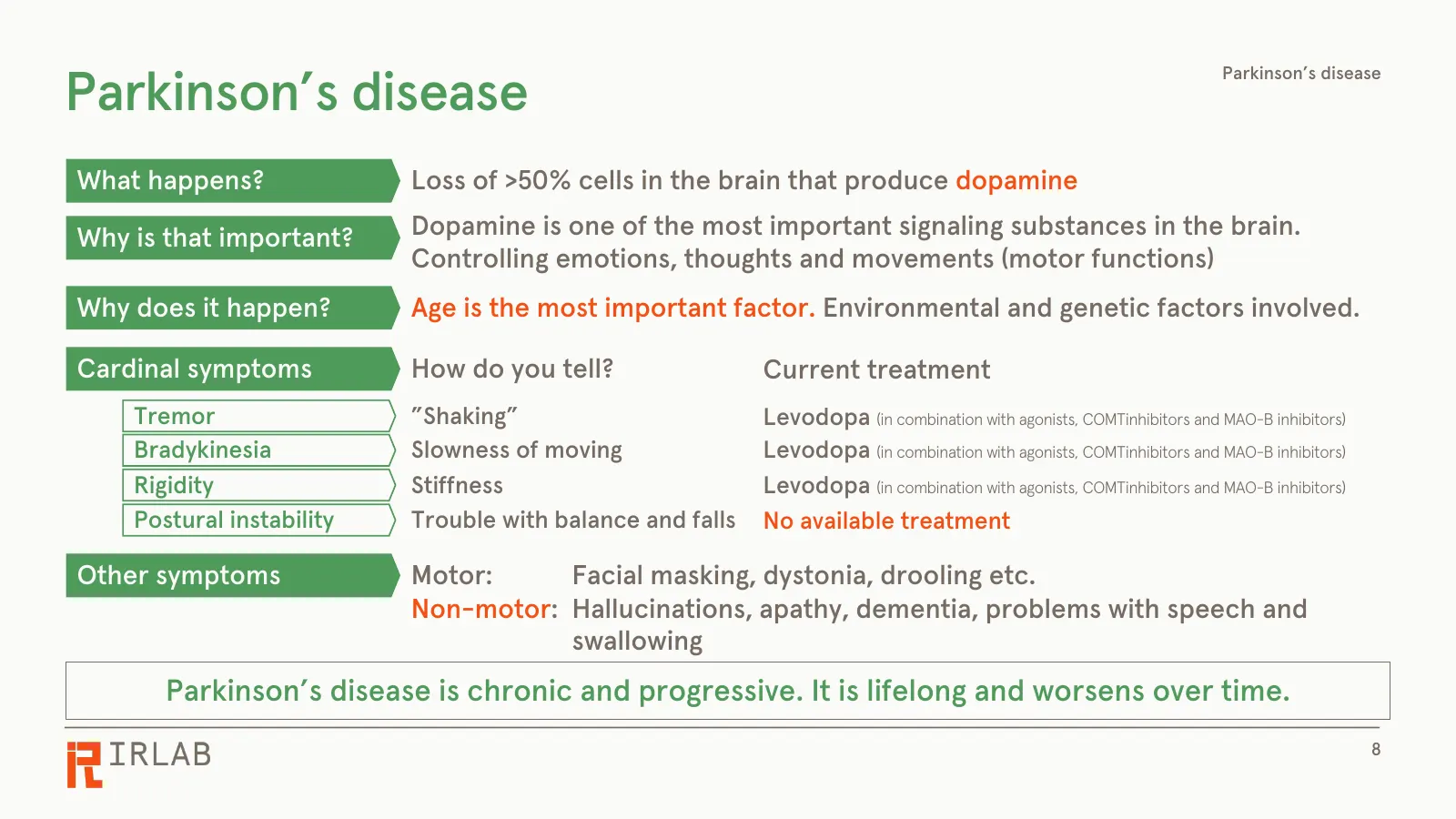
Parkinson’s disease Parkinson’s disease What happens? Loss of >50% cells in the brain that produce dopamine Why is that important? Dopamine is one of the most important signaling substances in the brain. Controlling emotions, thoughts and movements (motor functions) Why does it happen? Age is the mo
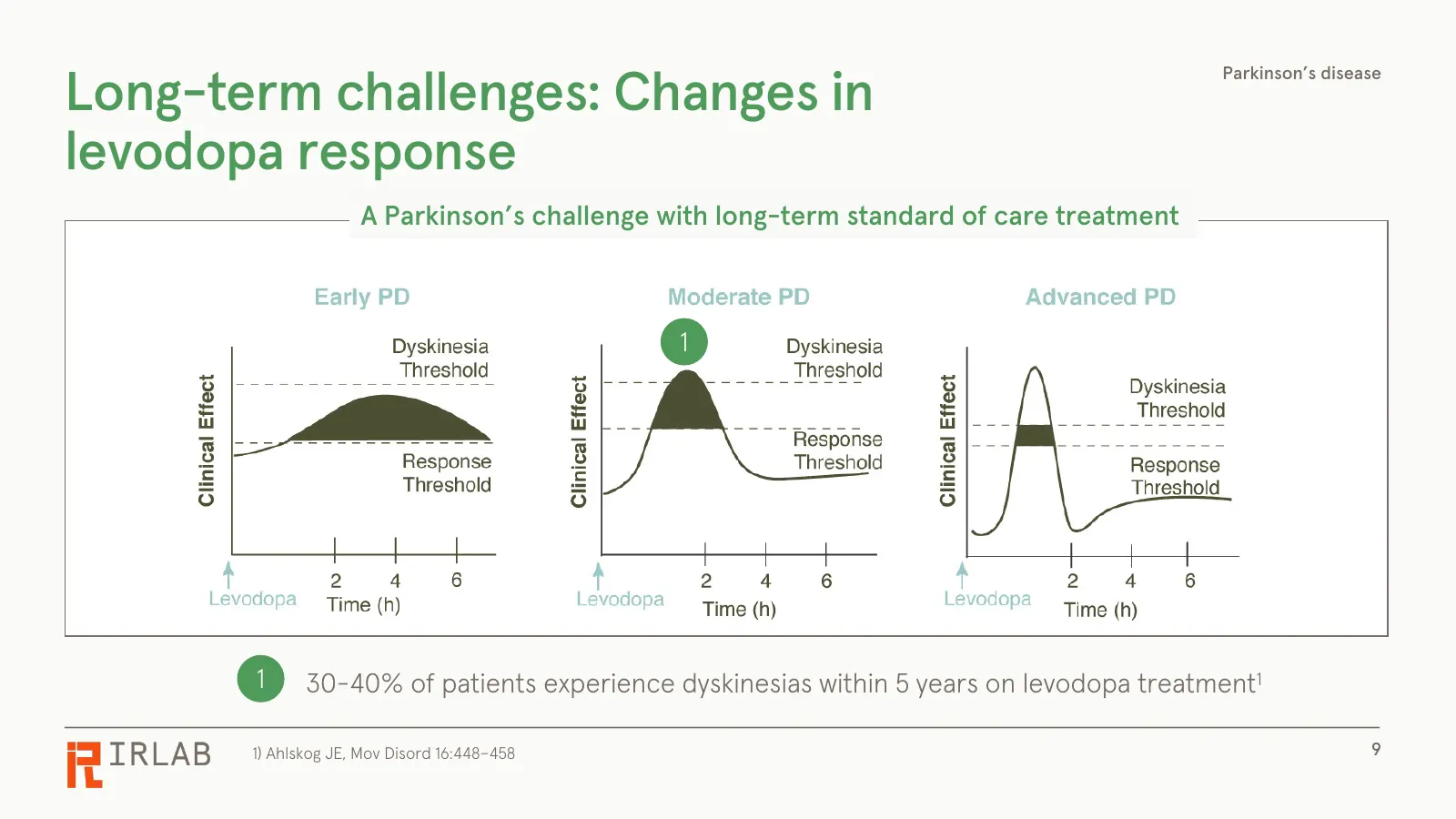
Slide 9: Long-term challenges: Changes in levodopa response
Parkinson’s disease Long-term challenges: Changes in levodopa response A Parkinson’s challenge with long-term standard of care treatment 1 1 30-40% of patients experience dyskinesias within 5 years on levodopa treatment1 1) Ahlskog JE, Mov Disord 16:448–458 9
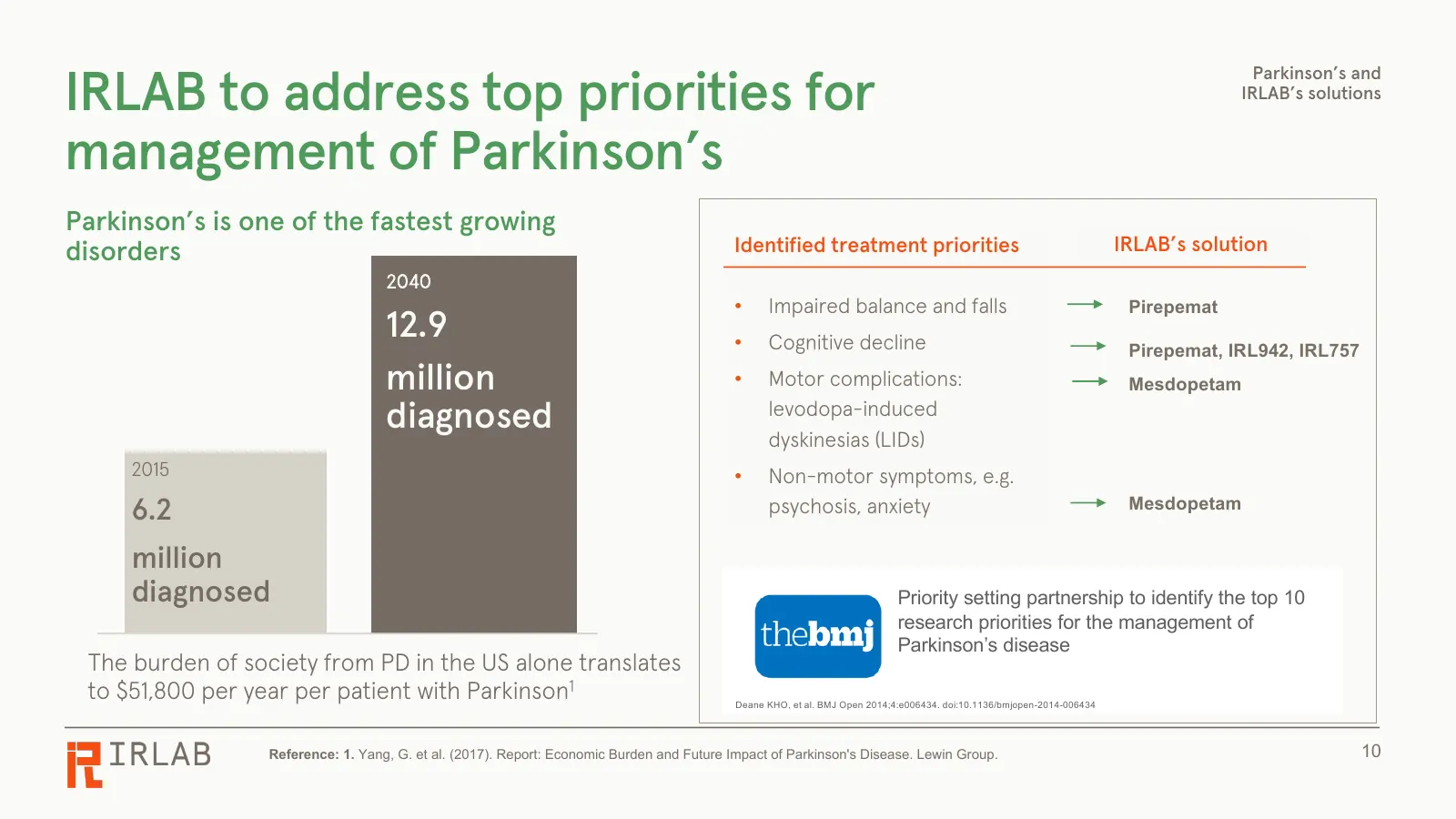
Slide 10: IRLAB to address top priorities for management of Parkinson's
Parkinson’s and IRLAB to address top priorities for IRLAB’s solutions management of Parkinson’s Parkinson’s is one of the fastest growing disorders Identified treatment priorities IRLAB’s solution 2040 • Impaired balance and falls Pirepemat 12.9 • Cognitive decline Pirepemat, IRL942, IRL757 million
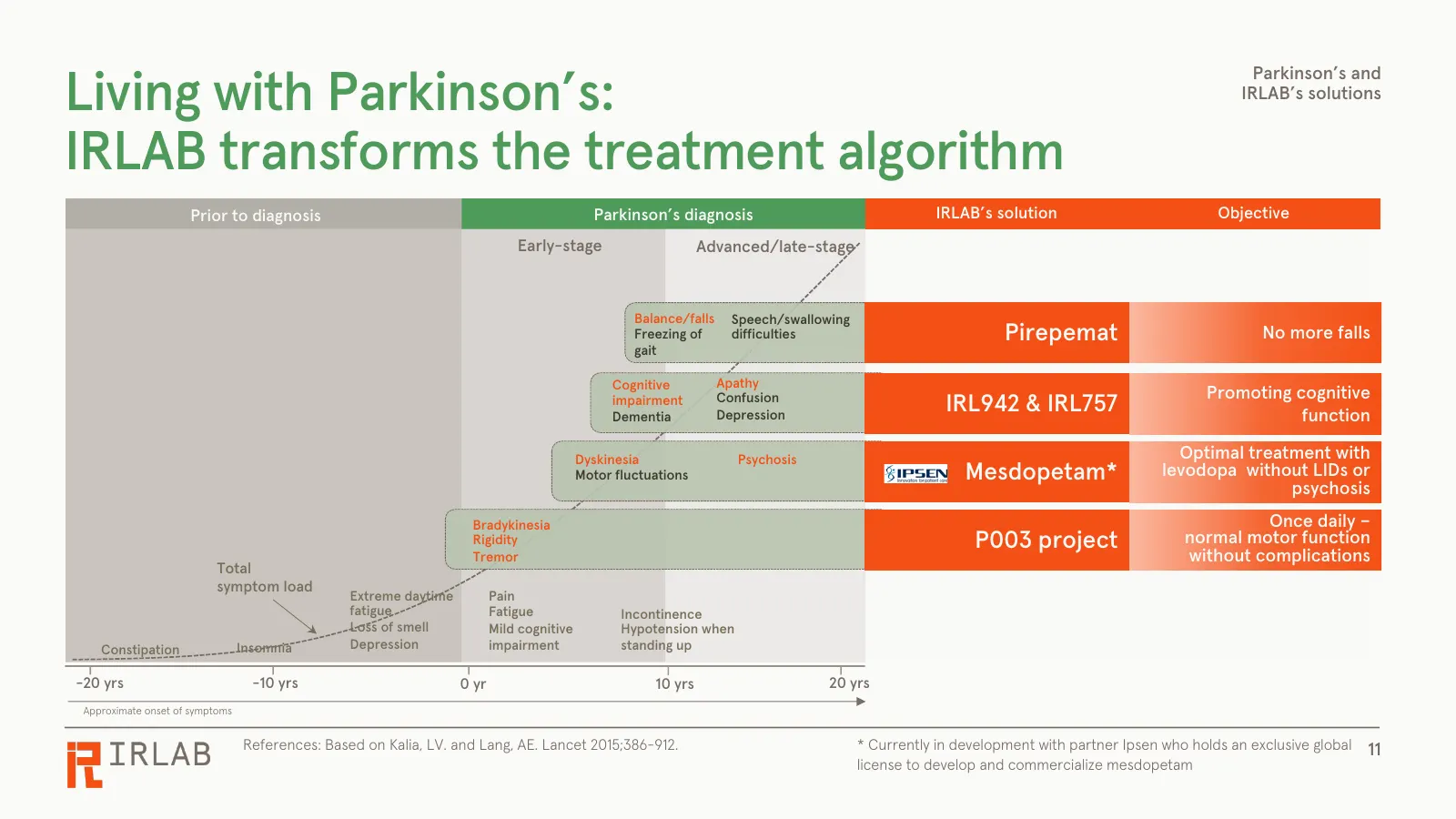
Slide 11: Living with Parkinson's: IRLAB transforms the treatment algorithm
Parkinson’s and Living with Parkinson’s: IRLAB’s solutions IRLAB transforms the treatment algorithm Prior to diagnosis Parkinson’s diagnosis IRLAB’s solution Objective Early-stage Advanced/late-stage Balance/falls Speech/swallowing Freezing of difficulties Pirepemat No more falls gait Cognitive Apat
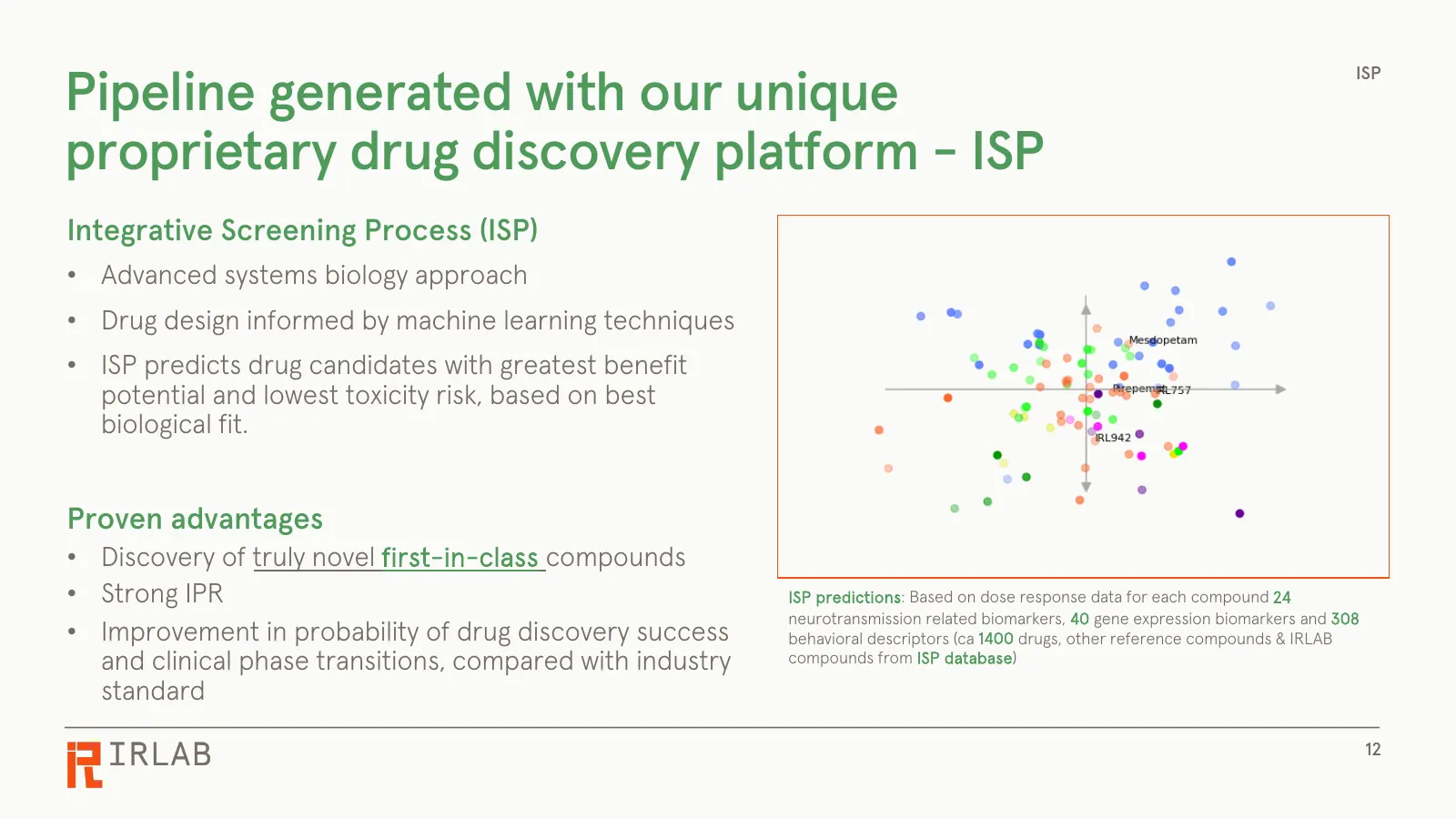
Slide 12: Pipeline generated with our unique proprietary drug discovery platform - ISP
ISP Pipeline generated with our unique proprietary drug discovery platform - ISP Integrative Screening Process (ISP) • Advanced systems biology approach • Drug design informed by machine learning techniques • ISP predicts drug candidates with greatest benefit potential and lowest toxicity risk, base
Slide 13: Mesdopetam (IRL790)
Mesdopetam (IRL790) ( mes⏝dop⏝e⏝tam ) • Mesdopetam counteracts levodopa-induced dyskinesias (PD-LIDs) by inhibiting dopamine D3 receptors • Potential treatment and prevention of psychosis in Parkinson’s (PD-P) • Ipsen licensed the exclusive global rights to develop and commercialize mesdopetam Curre
Slide 14: Mesdopetam is designed to reduce levodopa-induced dyskinesia
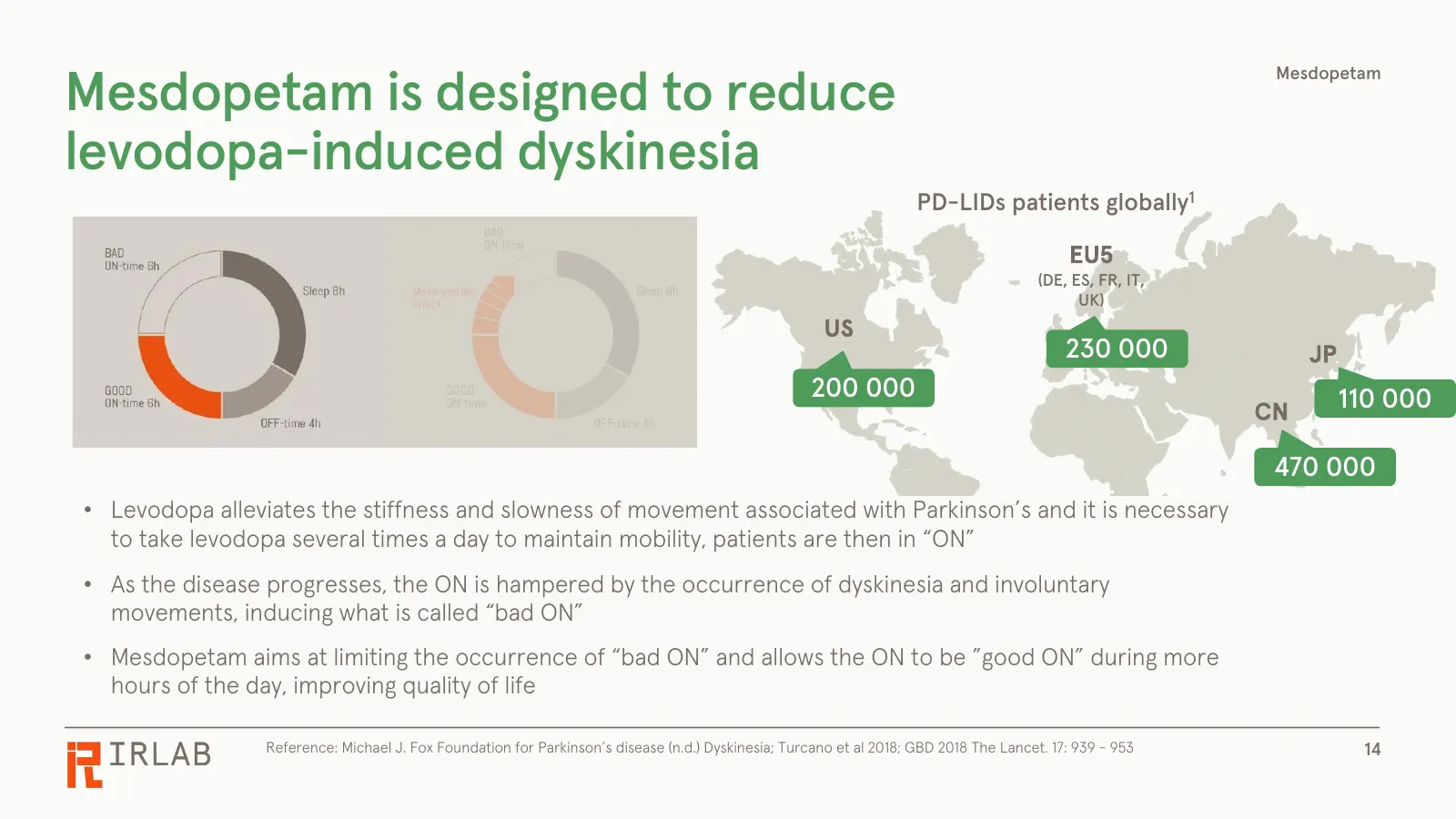
Mesdopetam Mesdopetam is designed to reduce levodopa-induced dyskinesia PD-LIDs patients globally1 EU5 (DE, ES, FR, IT, UK) US 230 000 JP 200 000 110 000 CN 470 000 • Levodopa alleviates the stiffness and slowness of movement associated with Parkinson’s and it is necessary to take levodopa several t
Slide 15: Mesdopetam uniquely reduces "bad ON"-time to improve "good ON"
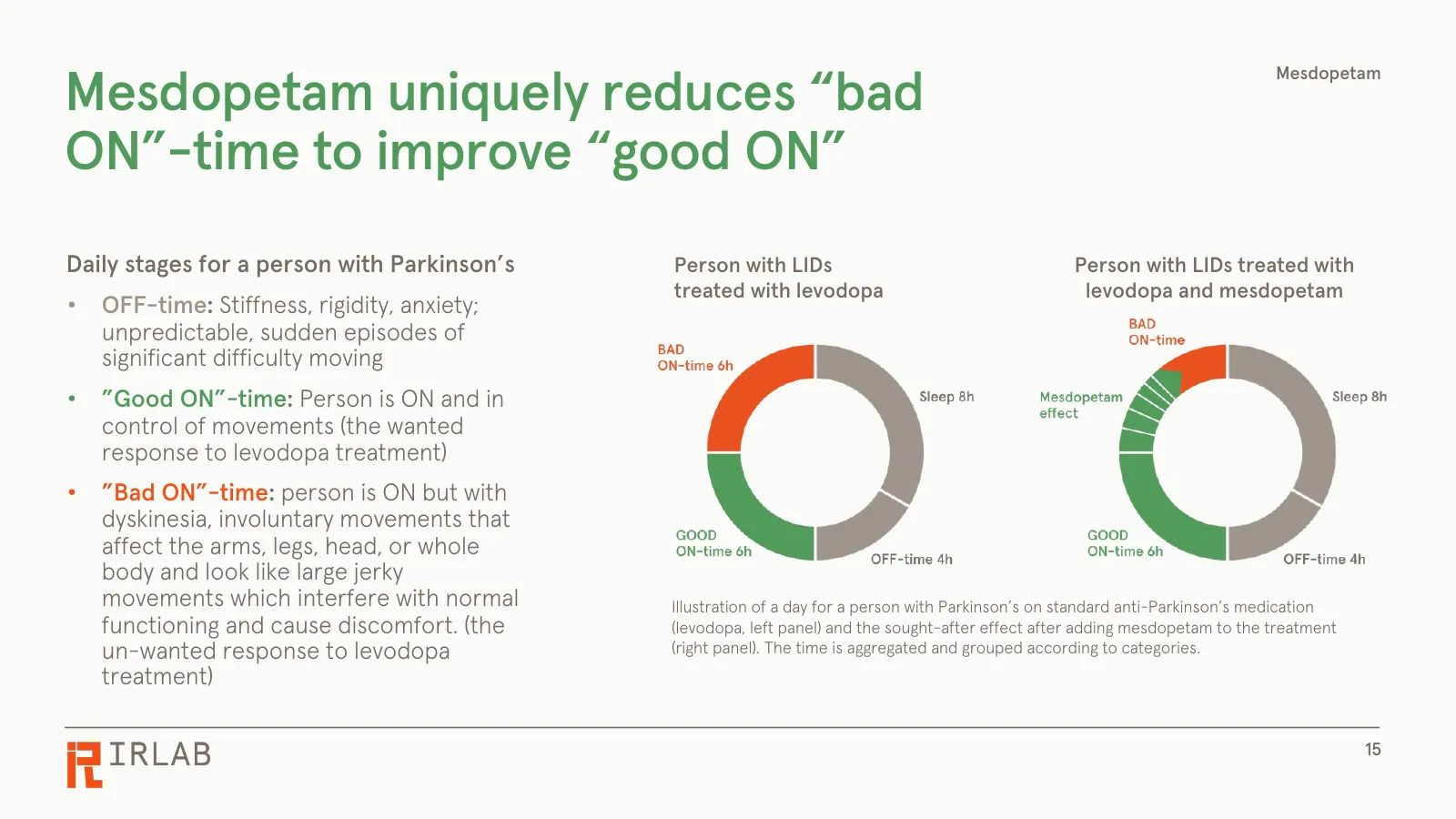
Mesdopetam Mesdopetam uniquely reduces “bad ON”-time to improve “good ON” Daily stages for a person with Parkinson’s Person with LIDs Person with LIDs treated with treated with levodopa levodopa and mesdopetam • OFF-time: Stiffness, rigidity, anxiety; unpredictable, sudden episodes of significant di
Slide 16: Pharmacology and efficacy profile
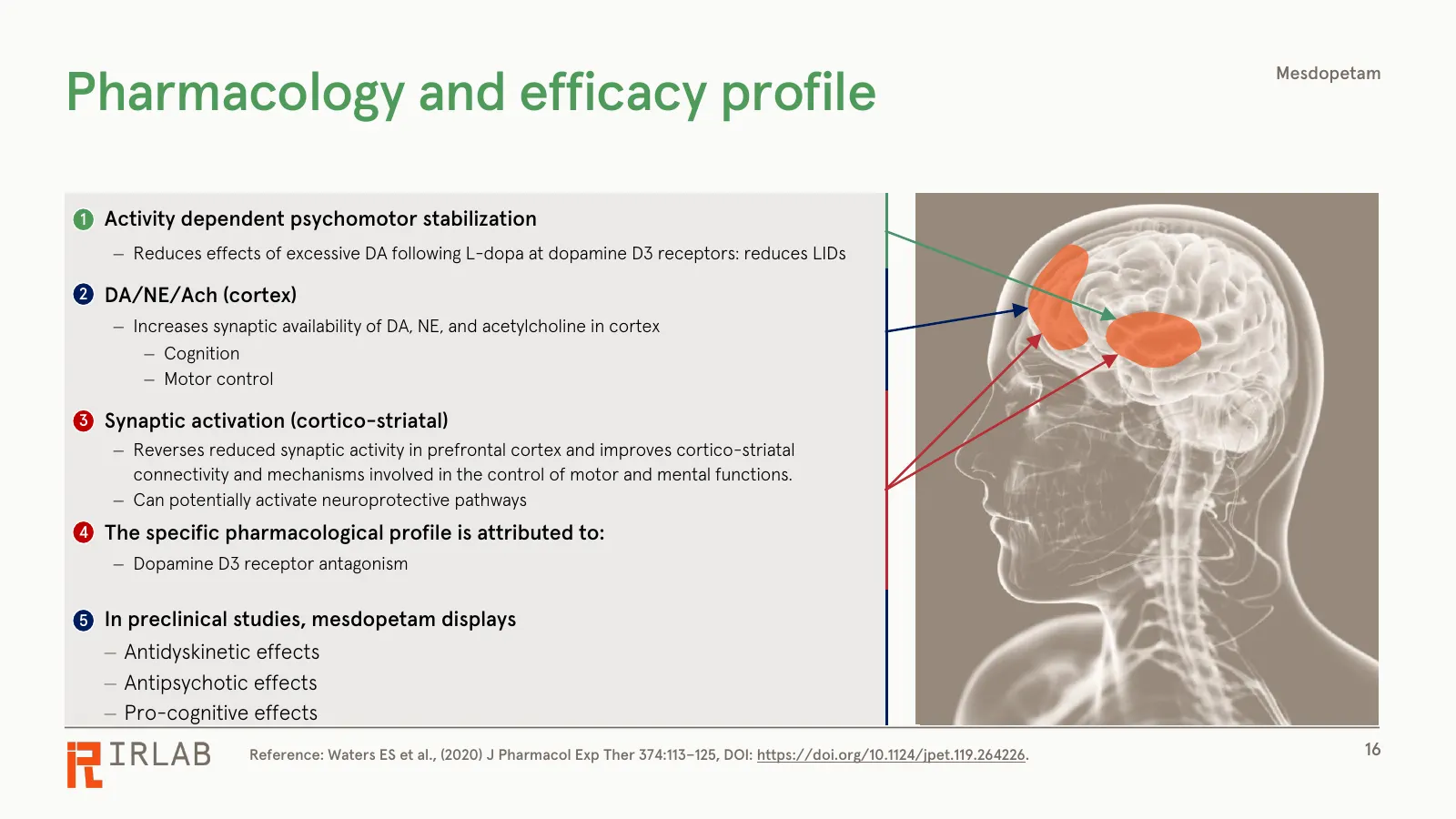
Mesdopetam Pharmacology and efficacy profile 1¡ Activity dependent psychomotor stabilization – Reduces effects of excessive DA following L-dopa at dopamine D3 receptors: reduces LIDs 2¡ DA/NE/Ach (cortex) – Increases synaptic availability of DA, NE, and acetylcholine in cortex – Cognition – Motor co
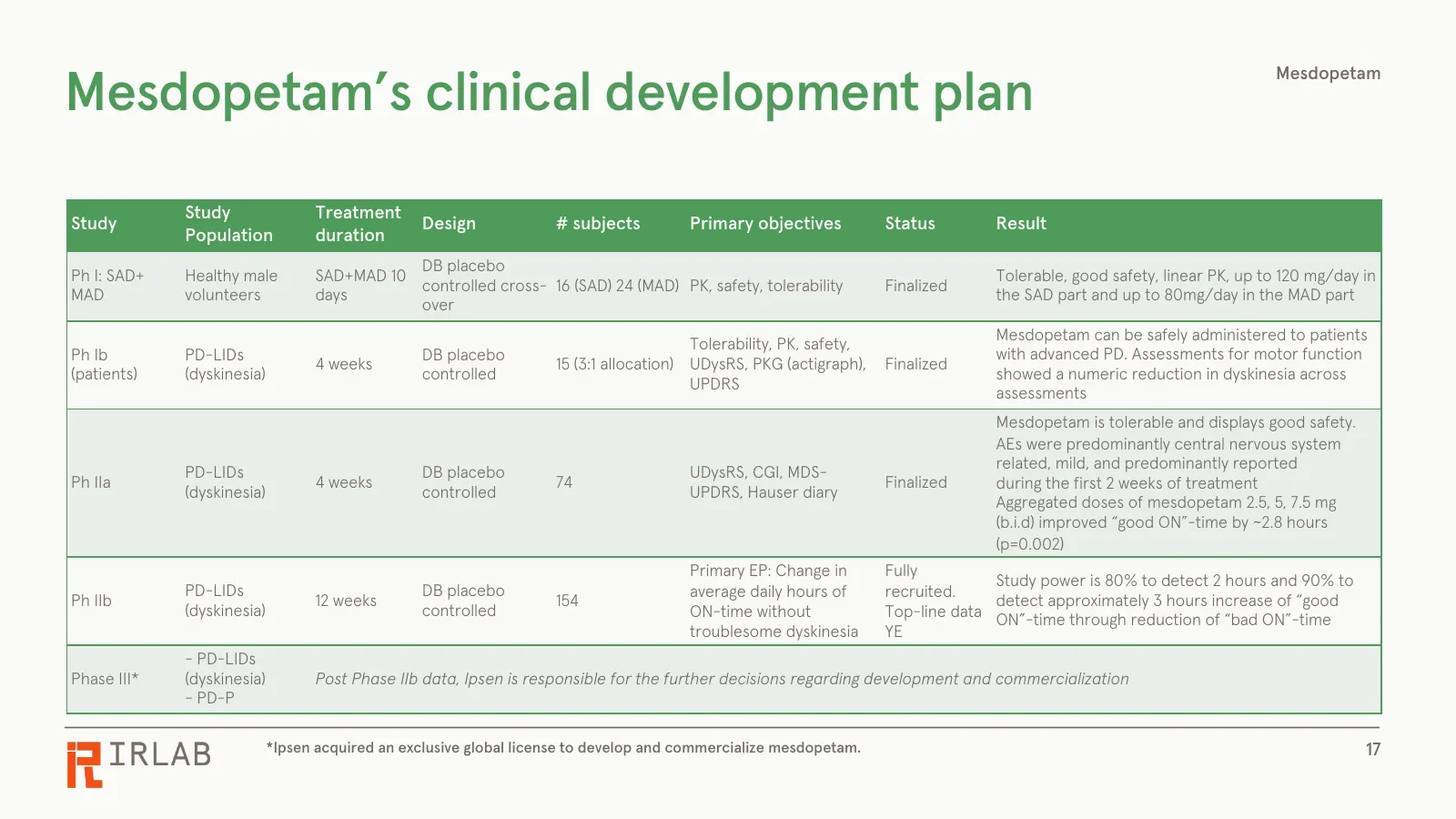
Slide 17: Mesdopetam's clinical development plan
Mesdopetam Mesdopetam’s clinical development plan Study Treatment Study Design # subjects Primary objectives Status Result Population duration DB placebo Ph I: SAD+ Healthy male SAD+MAD 10 Tolerable, good safety, linear PK, up to 120 mg/day in controlled cross- 16 (SAD) 24 (MAD) PK, safety, tolerabi
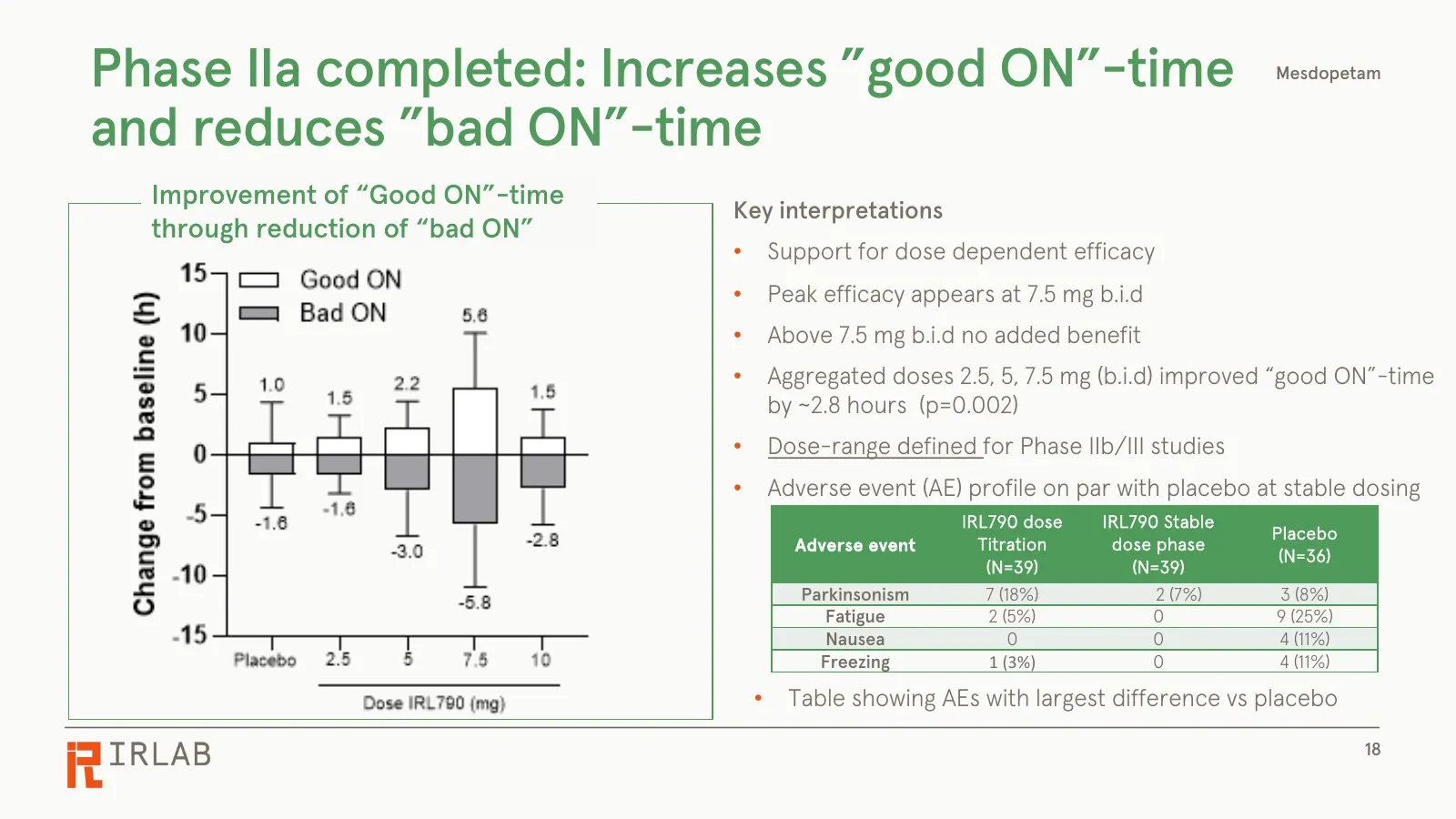
Slide 18: Phase IIa completed: Increases "good ON"-time and reduces "bad ON"-time
Phase IIa completed: Increases ”good ON”-time Mesdopetam and reduces ”bad ON”-time Improvement of “Good ON”-time Key interpretations through reduction of “bad ON” • Support for dose dependent efficacy • Peak efficacy appears at 7.5 mg b.i.d • Above 7.5 mg b.i.d no added benefit • Aggregated doses 2.
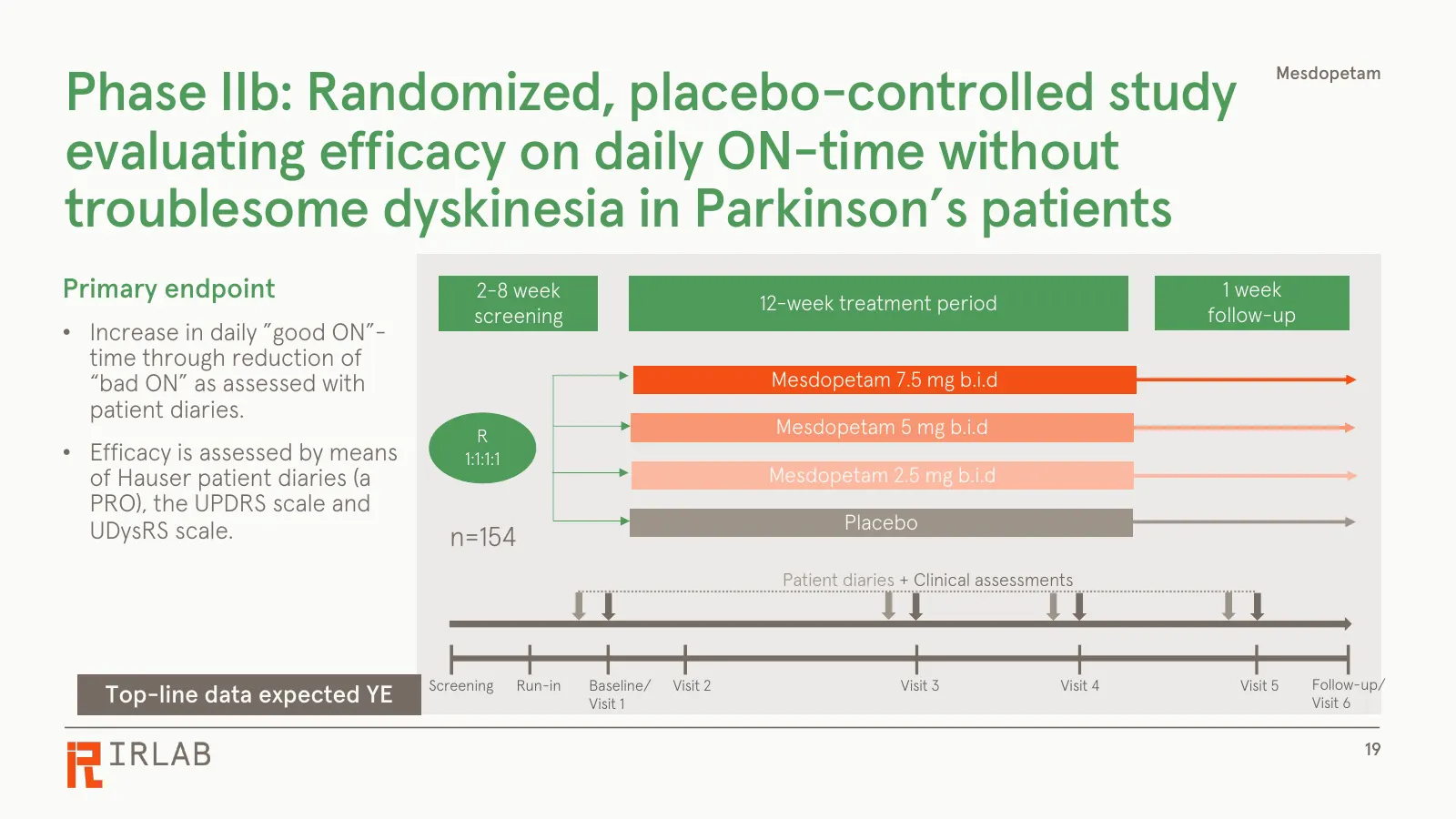
Slide 19: Phase IIb: Randomized, placebo-controlled study in Parkinson's patients
Mesdopetam Phase IIb: Randomized, placebo-controlled study evaluating efficacy on daily ON-time without troublesome dyskinesia in Parkinson’s patients Primary endpoint 2-8 week 12-week treatment period 1 week screening follow-up • Increase in daily ”good ON”- time through reduction of “bad ON” as as
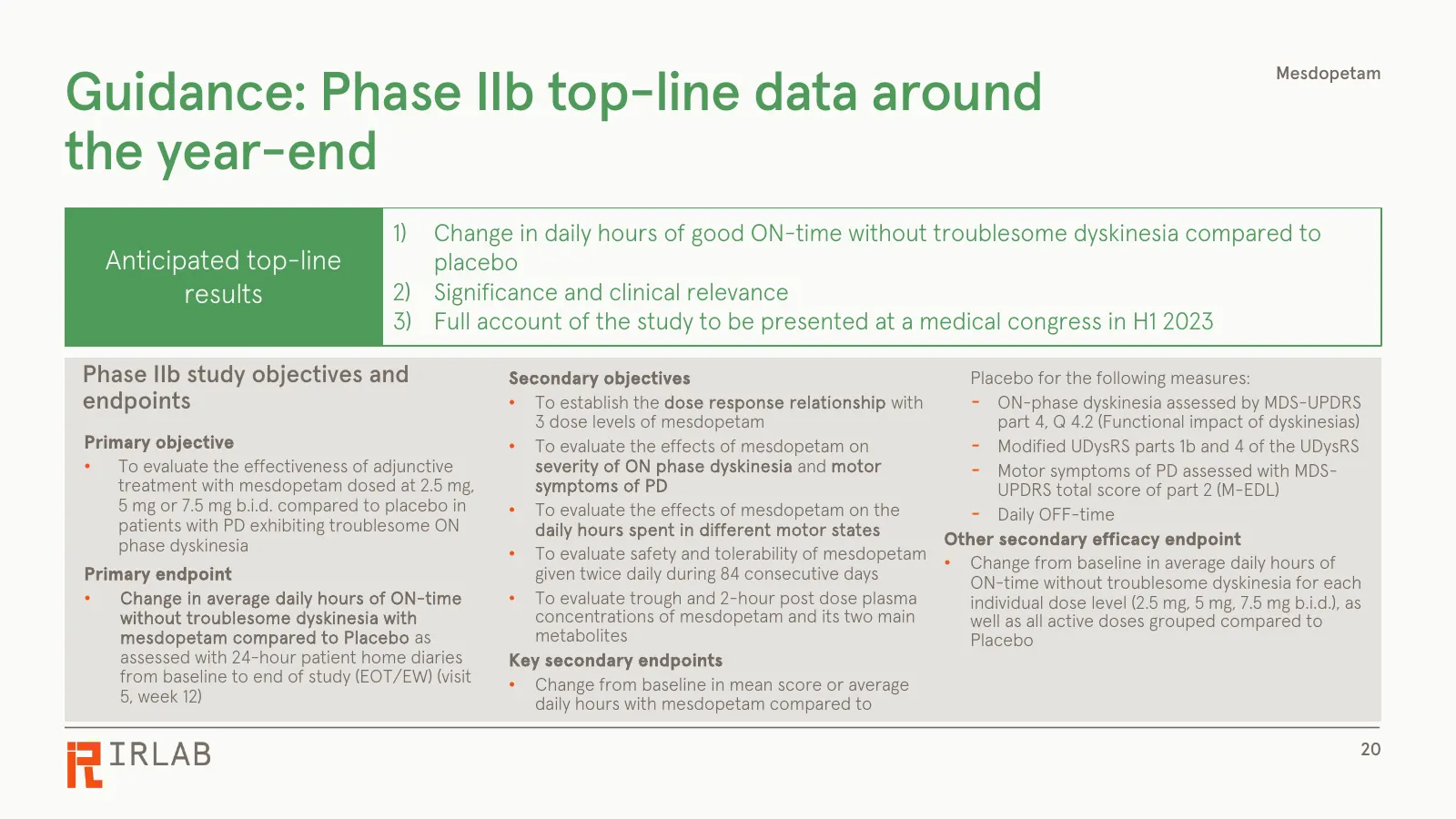
Slide 20: Guidance: Phase IIb top-line data around the year-end
Mesdopetam Guidance: Phase IIb top-line data around the year-end 1) Change in daily hours of good ON-time without troublesome dyskinesia compared to Anticipated top-line placebo results 2) Significance and clinical relevance 3) Full account of the study to be presented at a medical congress in H1 20
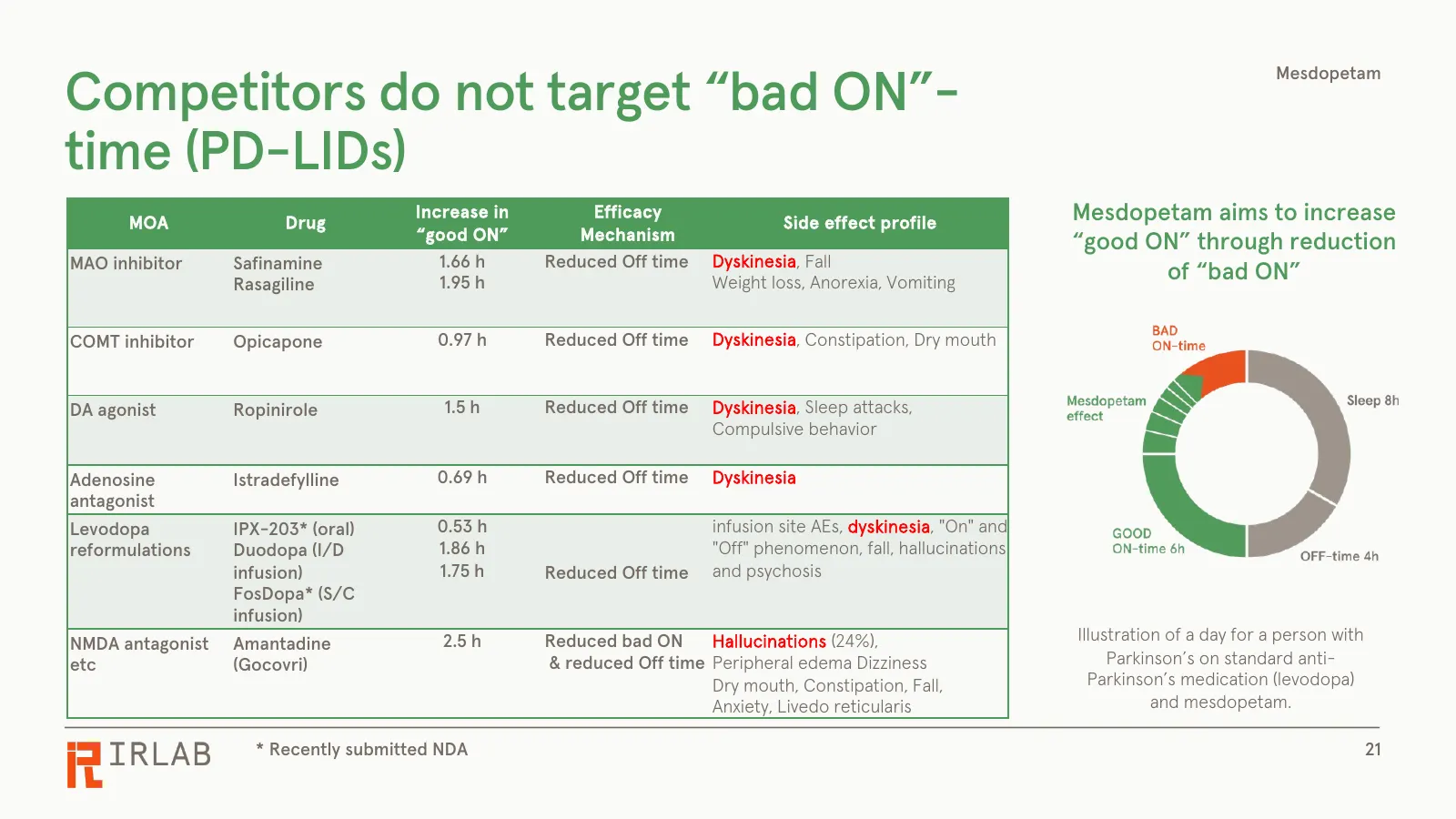
Slide 21: Competitors do not target "bad ON"-time (PD-LIDs)
Mesdopetam Competitors do not target “bad ON”- time (PD-LIDs) MOA Drug Increase in Efficacy Side effect profile Mesdopetam aims to increase “good ON” Mechanism “good ON” through reduction MAO inhibitor Safinamine 1.66 h Reduced Off time Dyskinesia, Fall Rasagiline 1.95 h Weight loss, Anorexia, Vomit
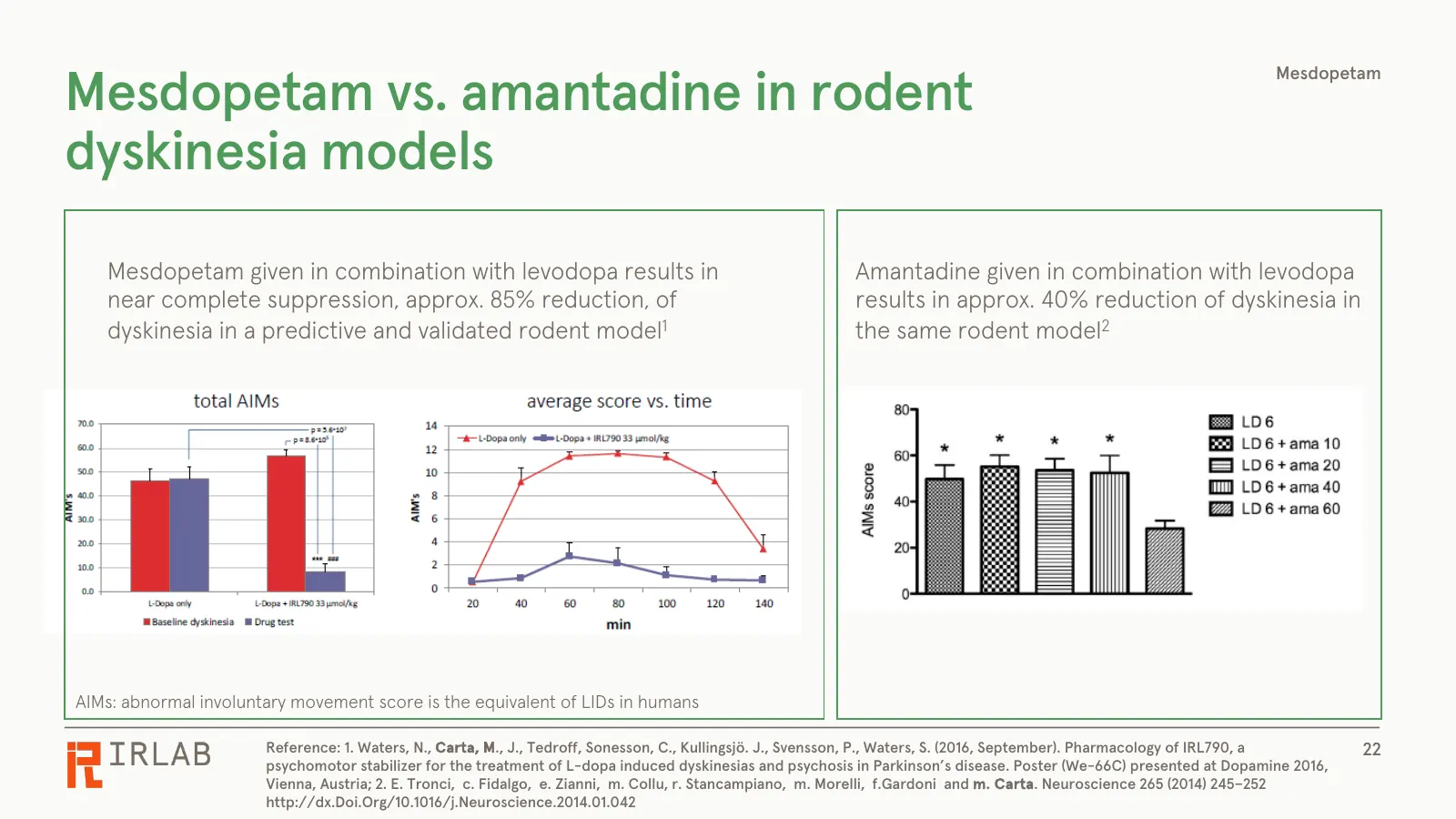
Slide 22: Mesdopetam vs. amantadine in rodent dyskinesia models
Mesdopetam Mesdopetam vs. amantadine in rodent dyskinesia models Mesdopetam given in combination with levodopa results in Amantadine given in combination with levodopa near complete suppression, approx. 85% reduction, of results in approx. 40% reduction of dyskinesia in dyskinesia in a predictive an
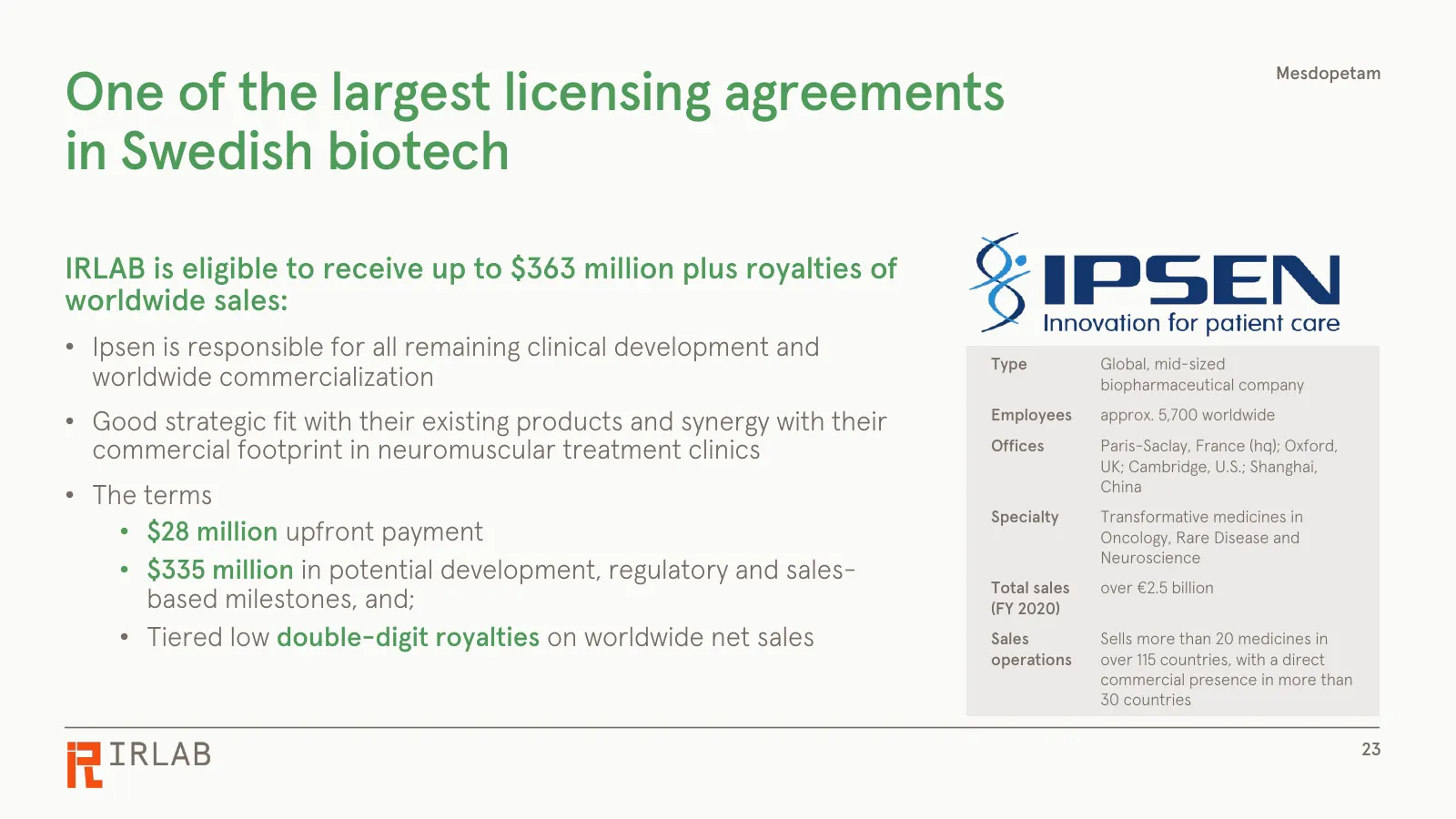
Slide 23: One of the largest licensing agreements in Swedish biotech
Mesdopetam One of the largest licensing agreements in Swedish biotech IRLAB is eligible to receive up to $363 million plus royalties of worldwide sales: • Ipsen is responsible for all remaining clinical development and Type Global, mid-sized worldwide commercialization biopharmaceutical company • Go
Slide 24: Pirepemat (IRL752)
Pirepemat (IRL752) ( pir⏝epe⏝mat ) • Improve balance and reduce falls in Parkinson’s (PD-Falls) • Ongoing randomized, placebo-controlled Phase IIb clinical trial • Wholly-owned unencumbered asset
Slide 25: Why preventing falls in Parkinson's?
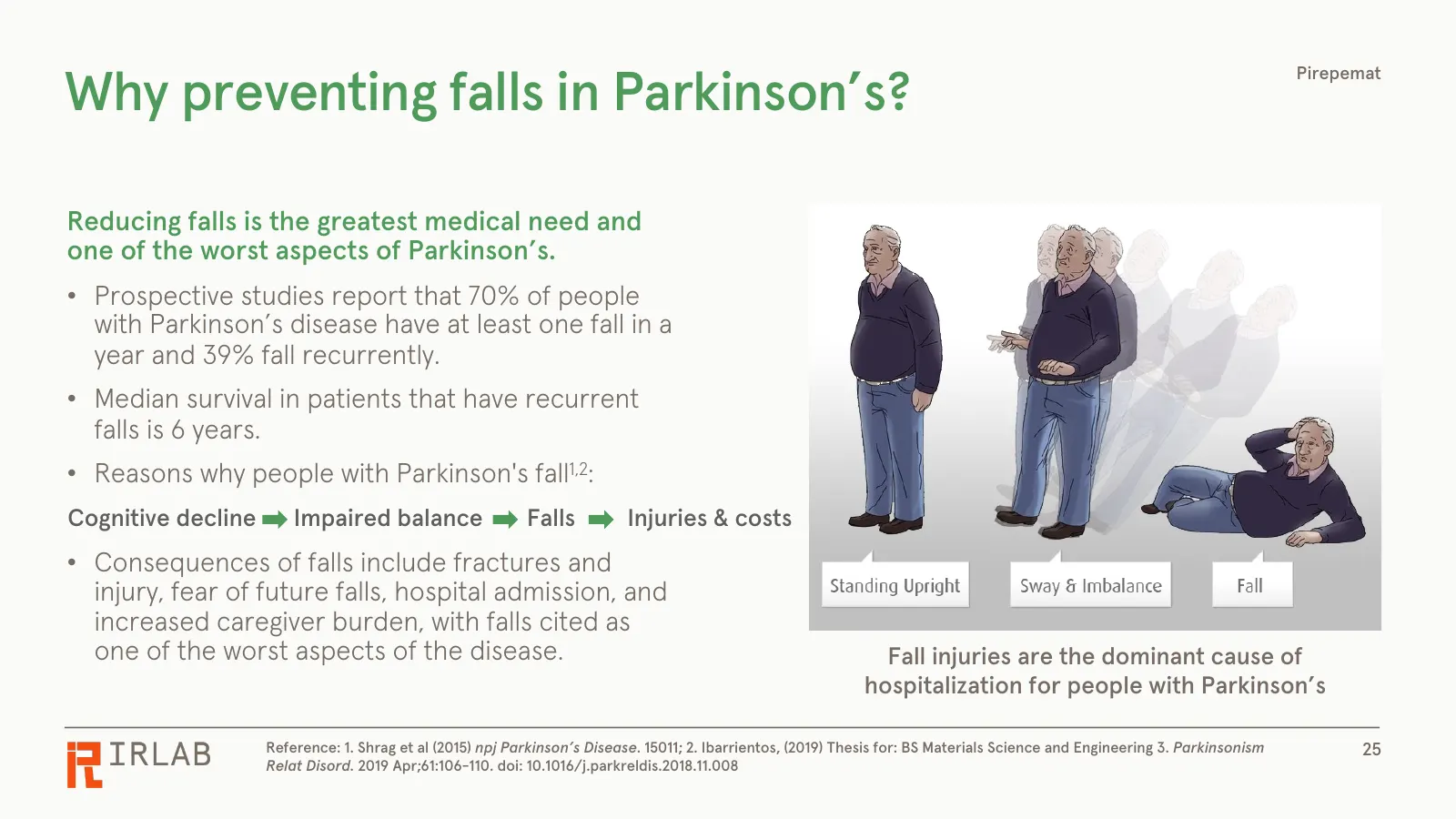
Pirepemat Why preventing falls in Parkinson’s? Reducing falls is the greatest medical need and one of the worst aspects of Parkinson’s. • Prospective studies report that 70% of people with Parkinson’s disease have at least one fall in a year and 39% fall recurrently. • Median survival in patients th
Slide 26: Pirepemat can improve balance and reduce falls in Parkinson's
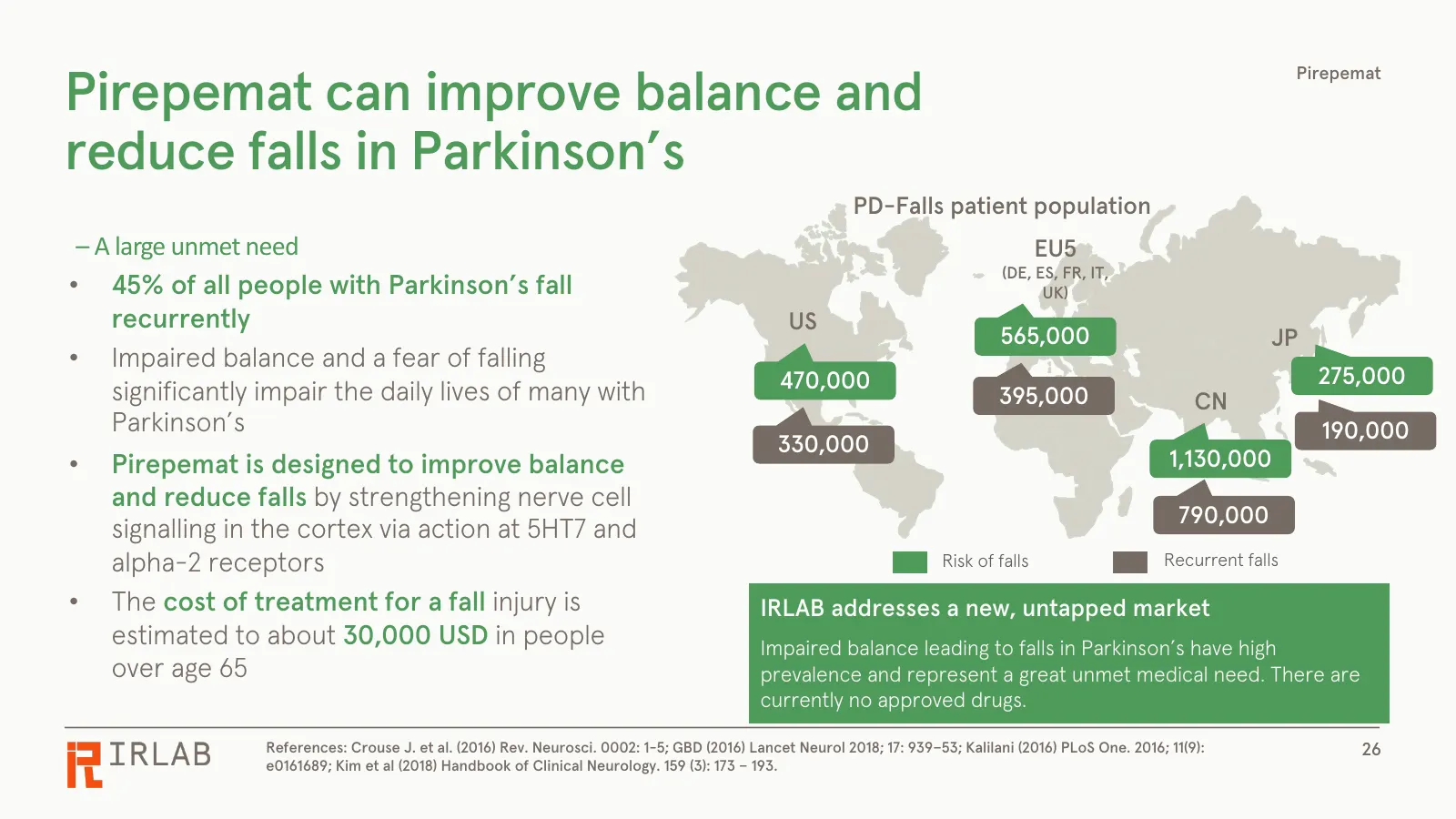
Pirepemat Pirepemat can improve balance and reduce falls in Parkinson’s PD-Falls patient population – A large unmet need EU5 (DE, ES, FR, IT, • 45% of all people with Parkinson’s fall UK) recurrently US 565,000 JP • Impaired balance and a fear of falling 470,000 275,000 significantly impair the dail
Slide 27: Mechanism of action: pirepemat
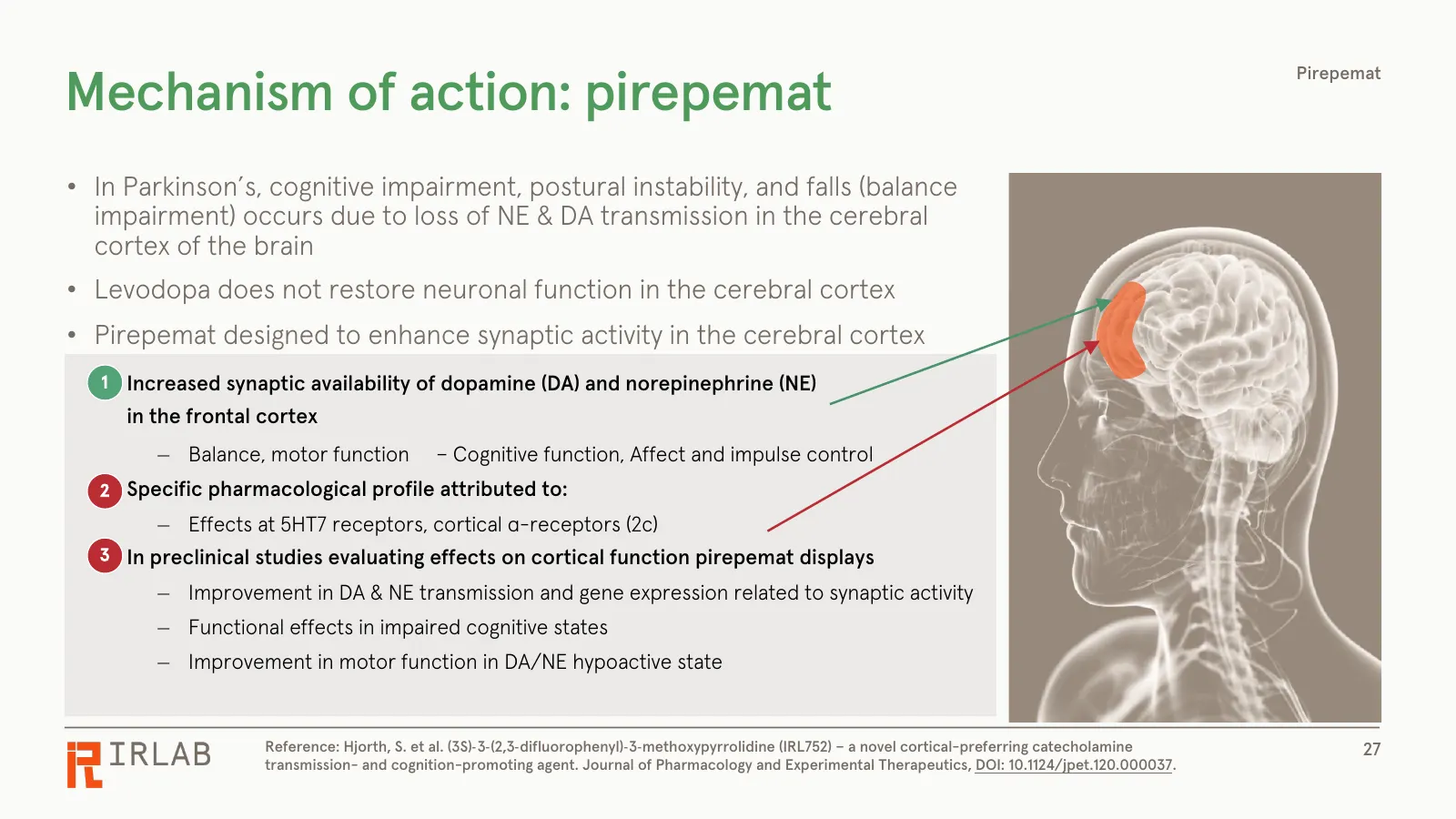
Pirepemat Mechanism of action: pirepemat • In Parkinson’s, cognitive impairment, postural instability, and falls (balance impairment) occurs due to loss of NE & DA transmission in the cerebral cortex of the brain • Levodopa does not restore neuronal function in the cerebral cortex • Pirepemat design
Slide 28: A first-in-class treatment for impaired balance and falls
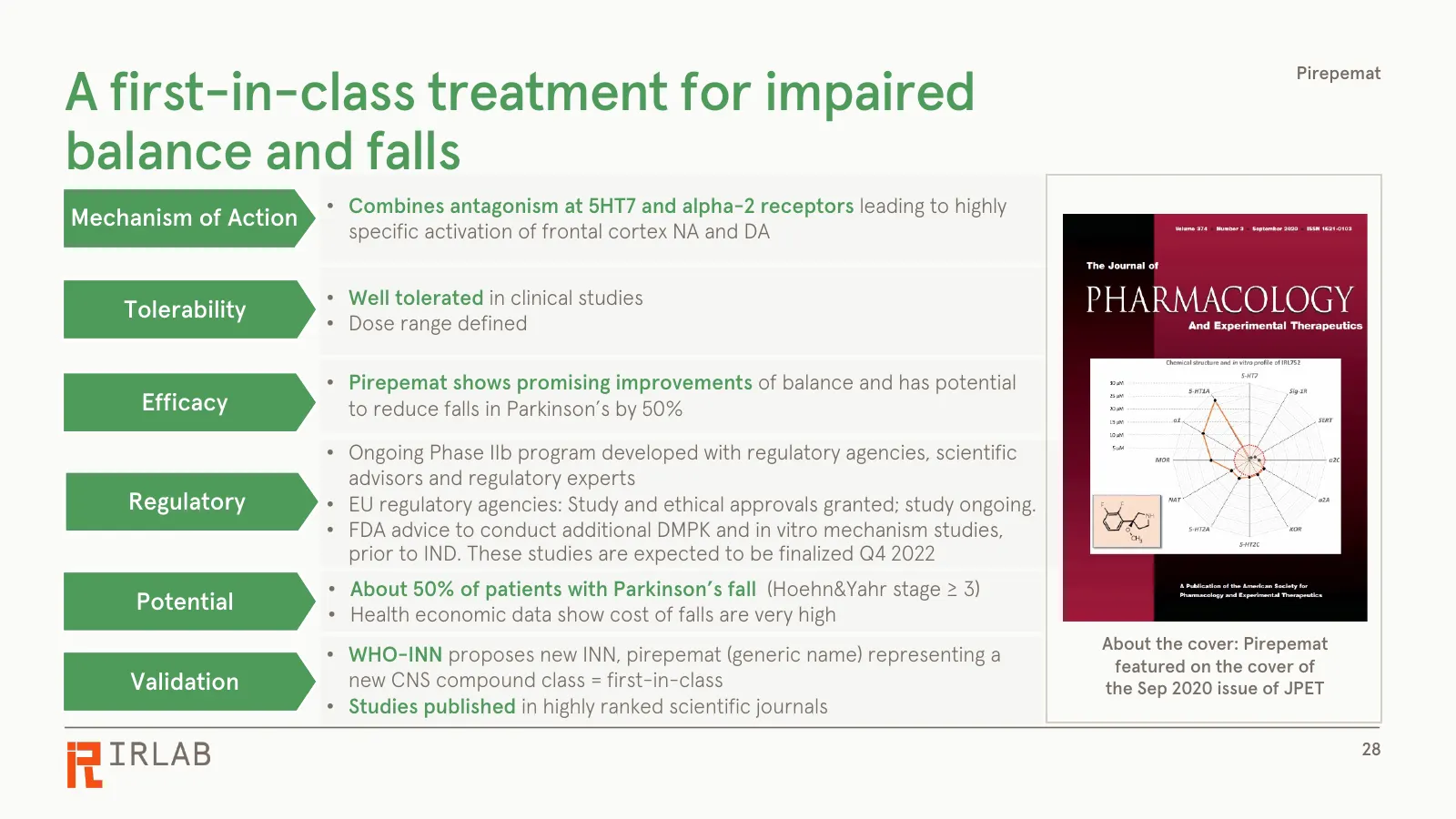
Pirepemat A first-in-class treatment for impaired balance and falls • Combines antagonism at 5HT7 and alpha-2 receptors leading to highly Mechanism of Action specific activation of frontal cortex NA and DA • Well tolerated in clinical studies Tolerability • Dose range defined • Pirepemat shows promi
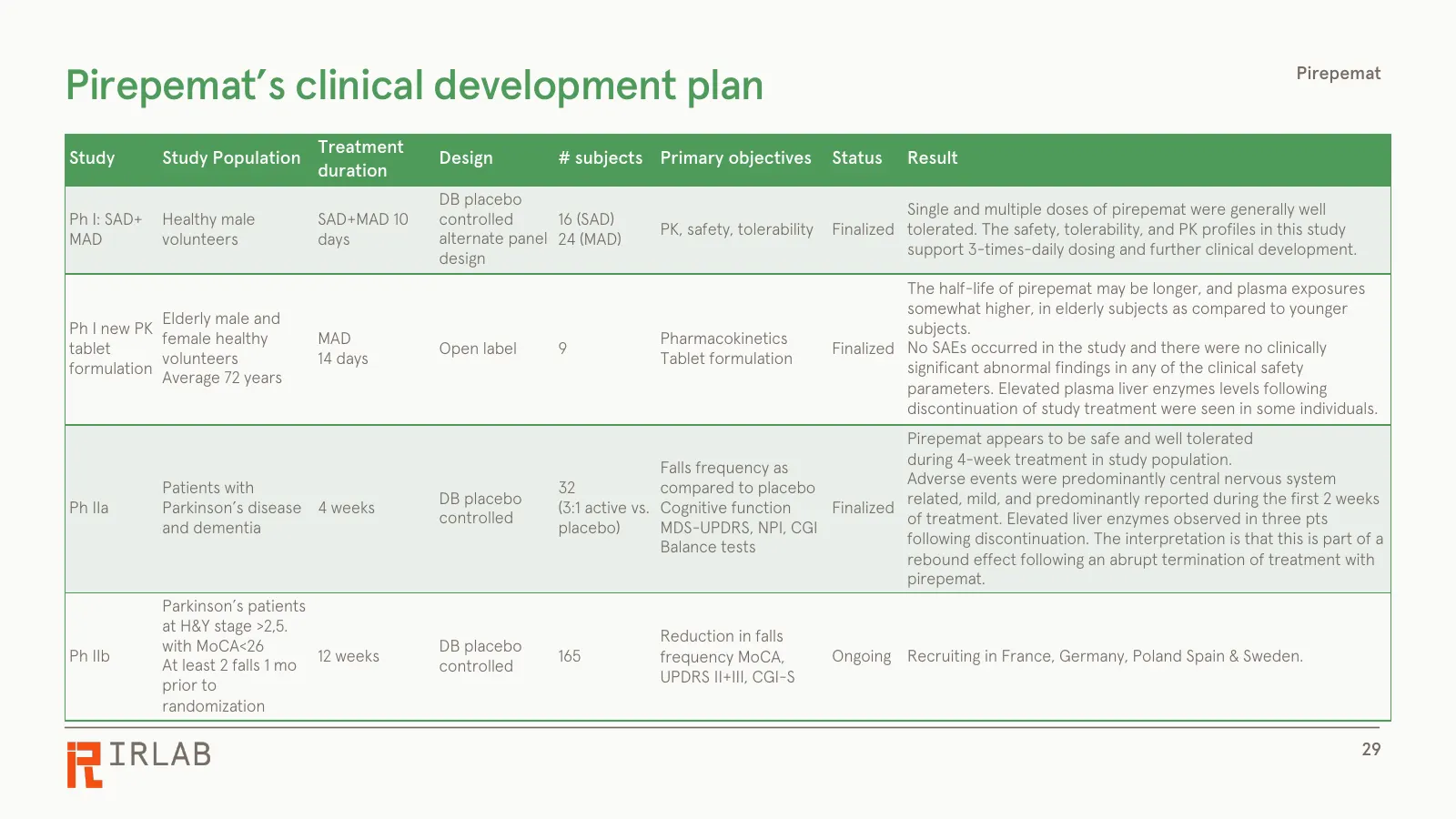
Slide 29: Pirepemat's clinical development plan
Pirepemat Pirepemat’s clinical development plan Treatment Study Study Population Design # subjects Primary objectives Status Result duration DB placebo Single and multiple doses of pirepemat were generally well Ph I: SAD+ Healthy male SAD+MAD 10 controlled 16 (SAD) PK, safety, tolerability Finalized
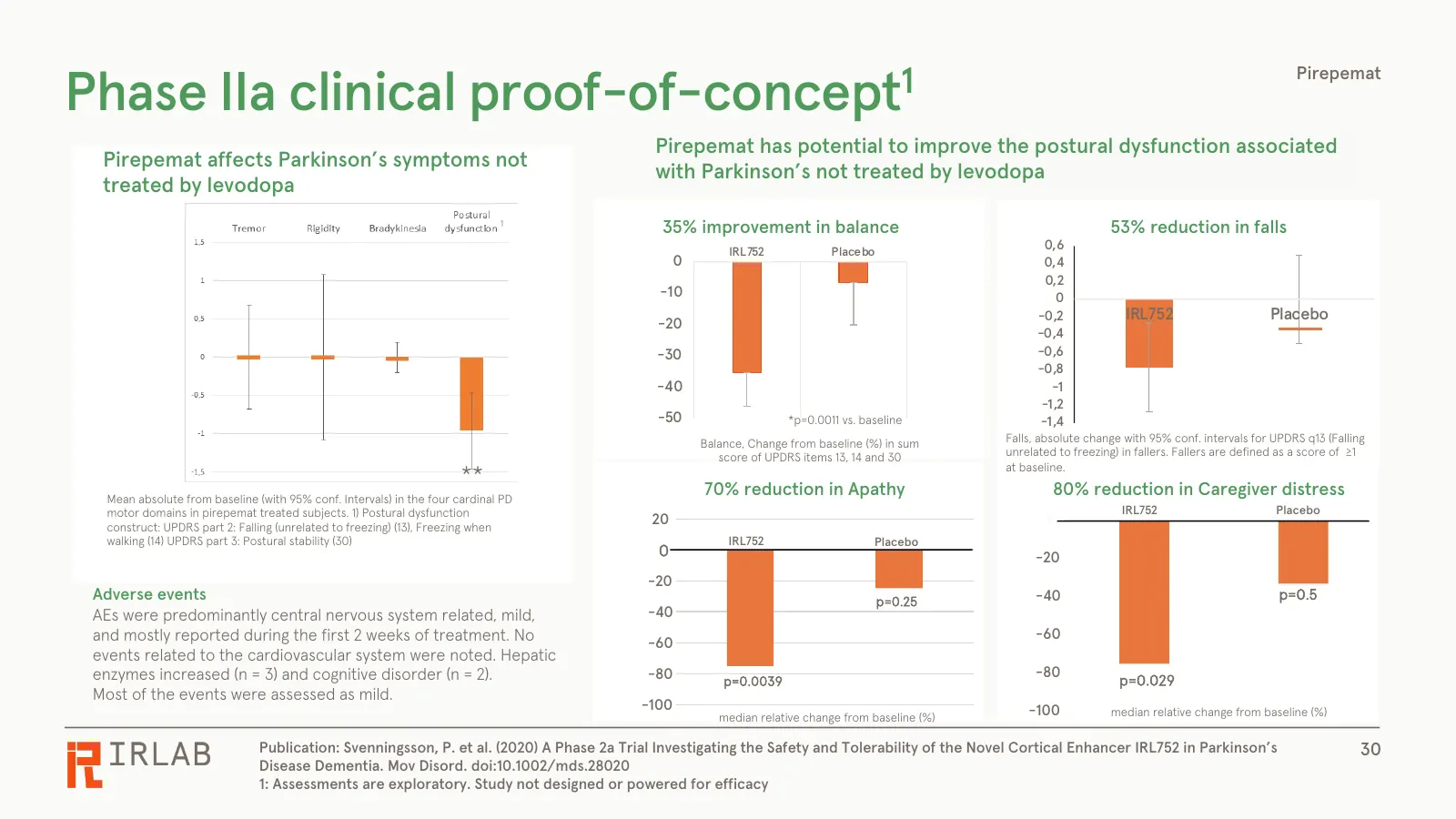
Slide 30: Phase IIa clinical proof-of-concept
Phase IIa clinical proof-of-concept1 Pirepemat Pirepemat has potential to improve the postural dysfunction associated Pirepemat affects Parkinson’s symptoms not with Parkinson’s not treated by levodopa treated by levodopa 1 35% improvement in balance 53% reduction in falls IRL752 Placebo 0,6 0 0,4 0
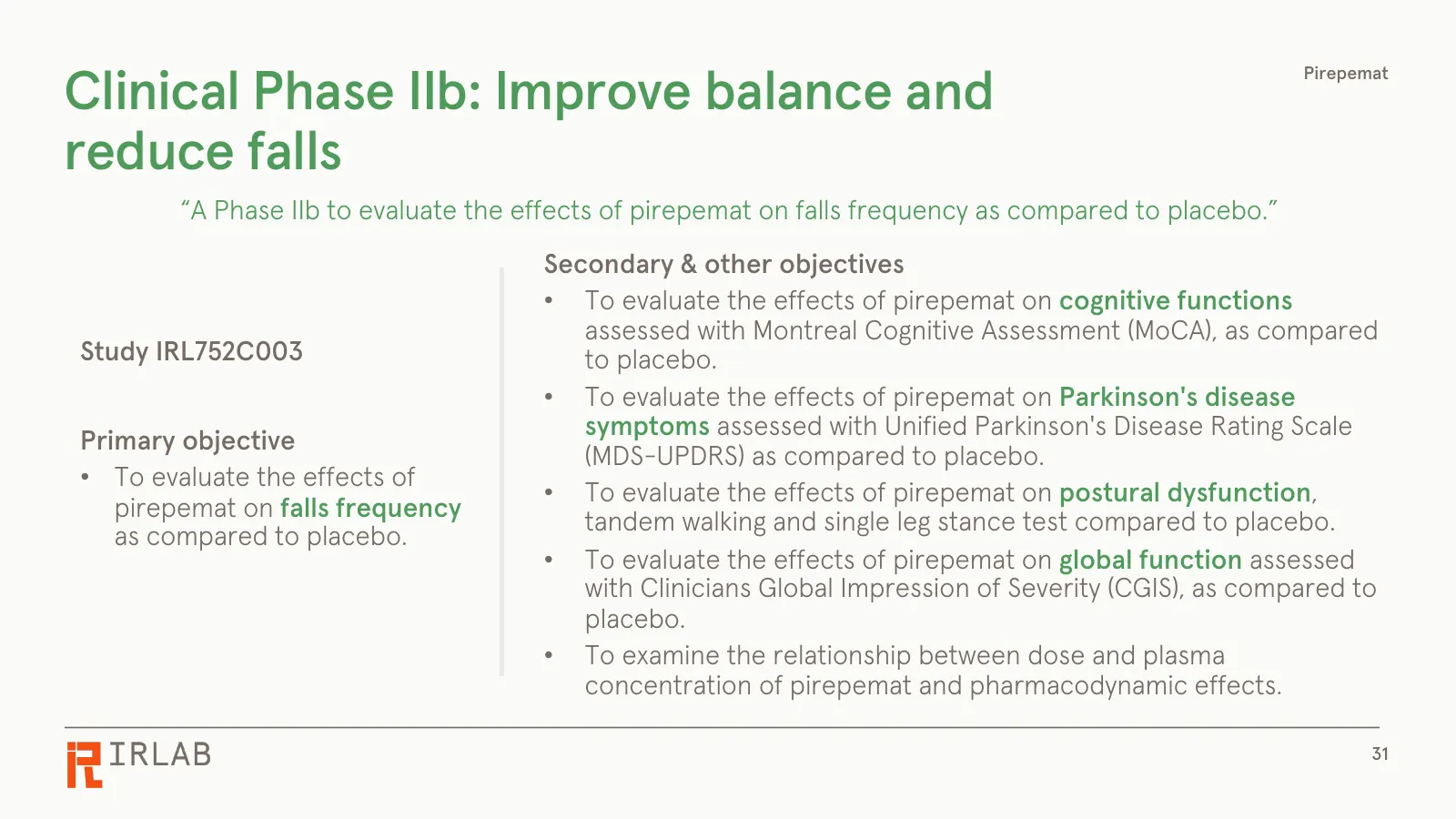
Slide 31: Clinical Phase IIb: Improve balance and reduce falls
Pirepemat Clinical Phase IIb: Improve balance and reduce falls “A Phase IIb to evaluate the effects of pirepemat on falls frequency as compared to placebo.” Secondary & other objectives • To evaluate the effects of pirepemat on cognitive functions assessed with Montreal Cognitive Assessment (MoCA),
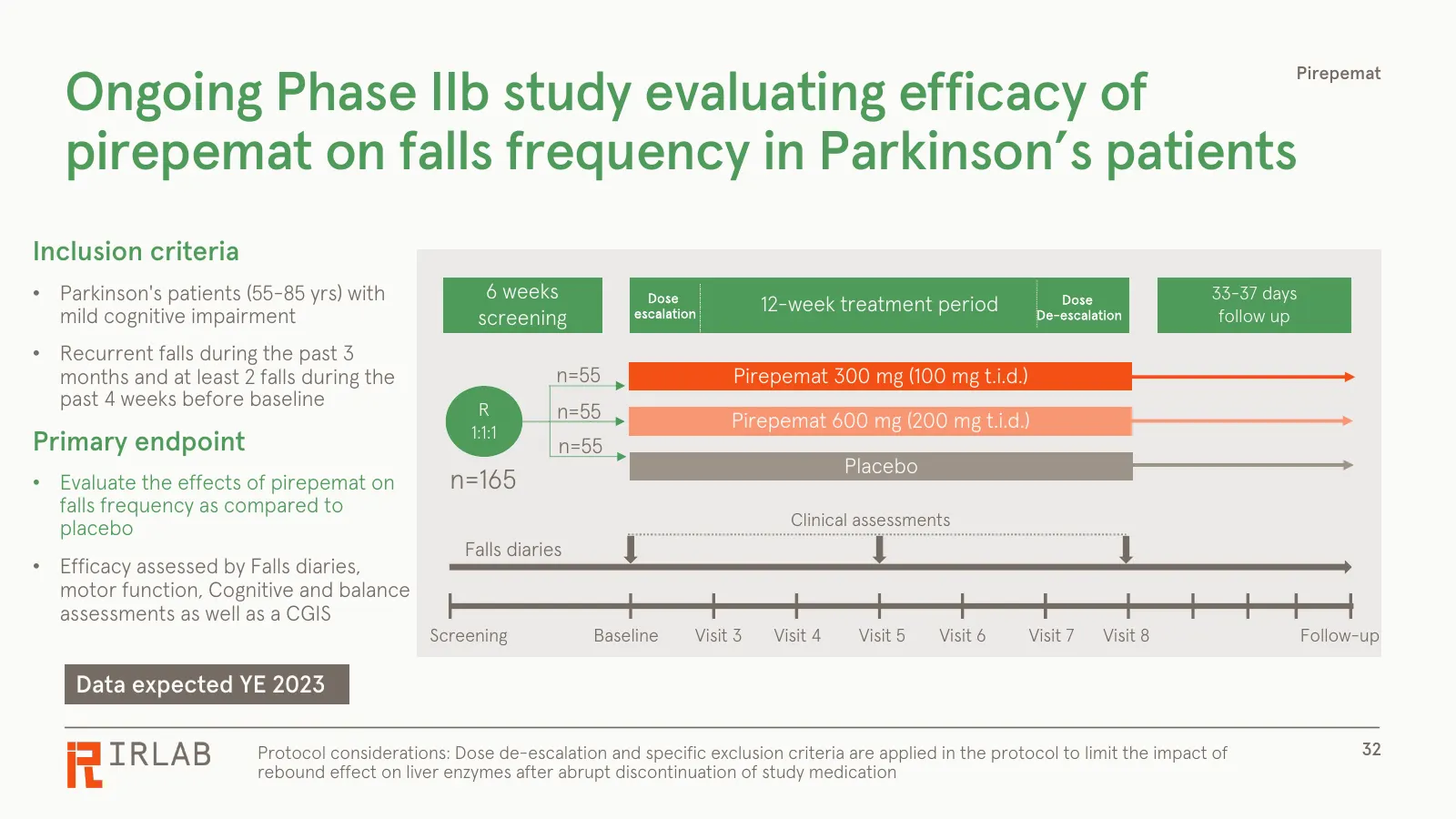
Slide 32: Ongoing Phase IIb study evaluating efficacy of pirepemat on falls frequency
Pirepemat Ongoing Phase IIb study evaluating efficacy of pirepemat on falls frequency in Parkinson’s patients Inclusion criteria • Parkinson's patients (55-85 yrs) with 6 weeks Dose Dose 33-37 days 12-week treatment period mild cognitive impairment screening escalation De-escalation follow up • Recu
Slide 33: Preclinical & Research projects
Preclinical & Research projects IRL942: Clinical candidate: to improve cognitive function and brain health IRL757: Clinical candidate: to treat apathy P003: Lead optimization stage: Once-daily treatment of Parkinson’s without the troublesome complications
Slide 34: Ongoing preclinical development programs on track
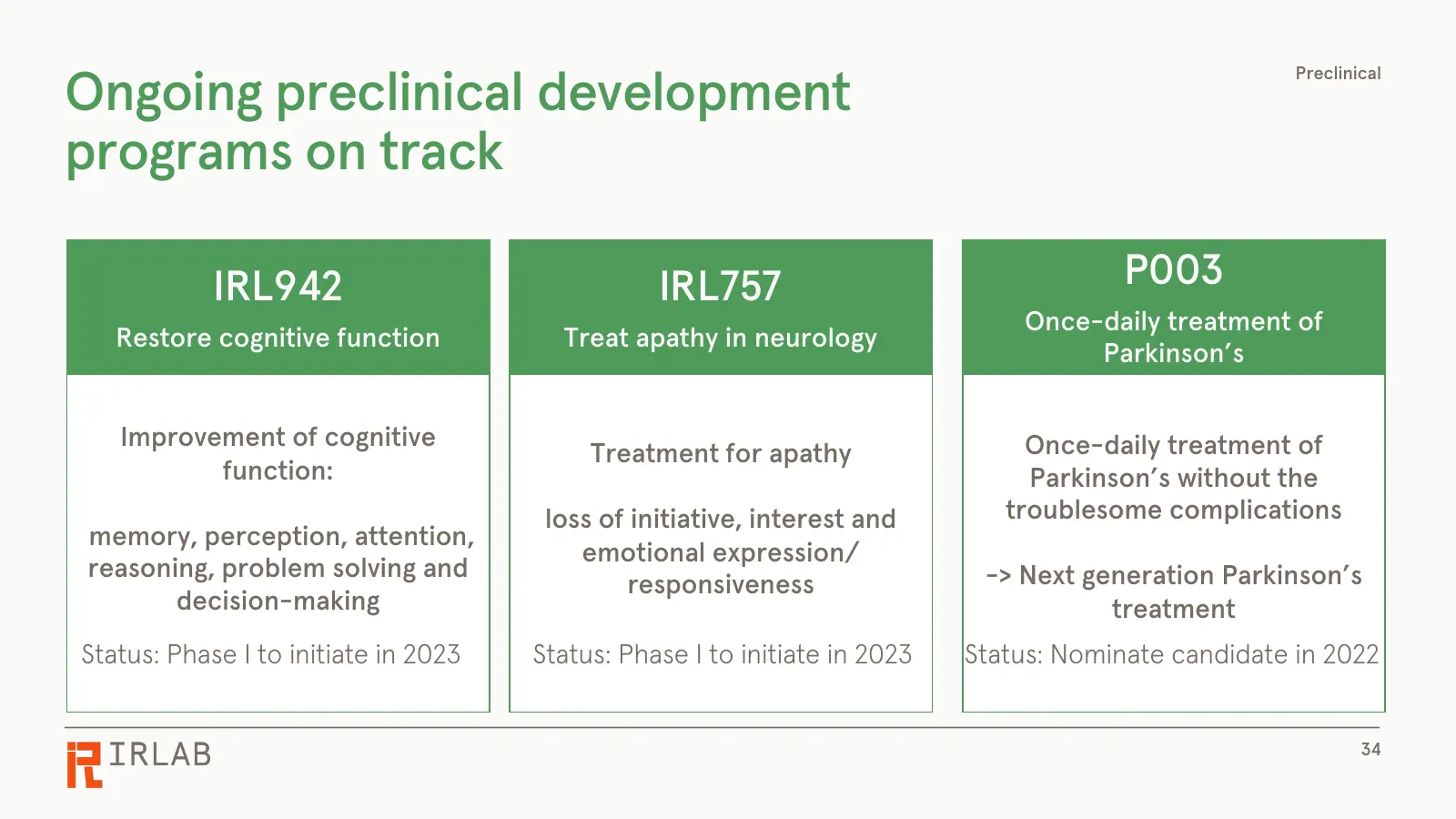
Preclinical Ongoing preclinical development programs on track IRL942 IRL757 P003 Once-daily treatment of Restore cognitive function Treat apathy in neurology Parkinson’s Improvement of cognitive Once-daily treatment of Treatment for apathy function: Parkinson’s without the loss of initiative, intere
Slide 35: Scientific rationale of IRL942 & IRL757
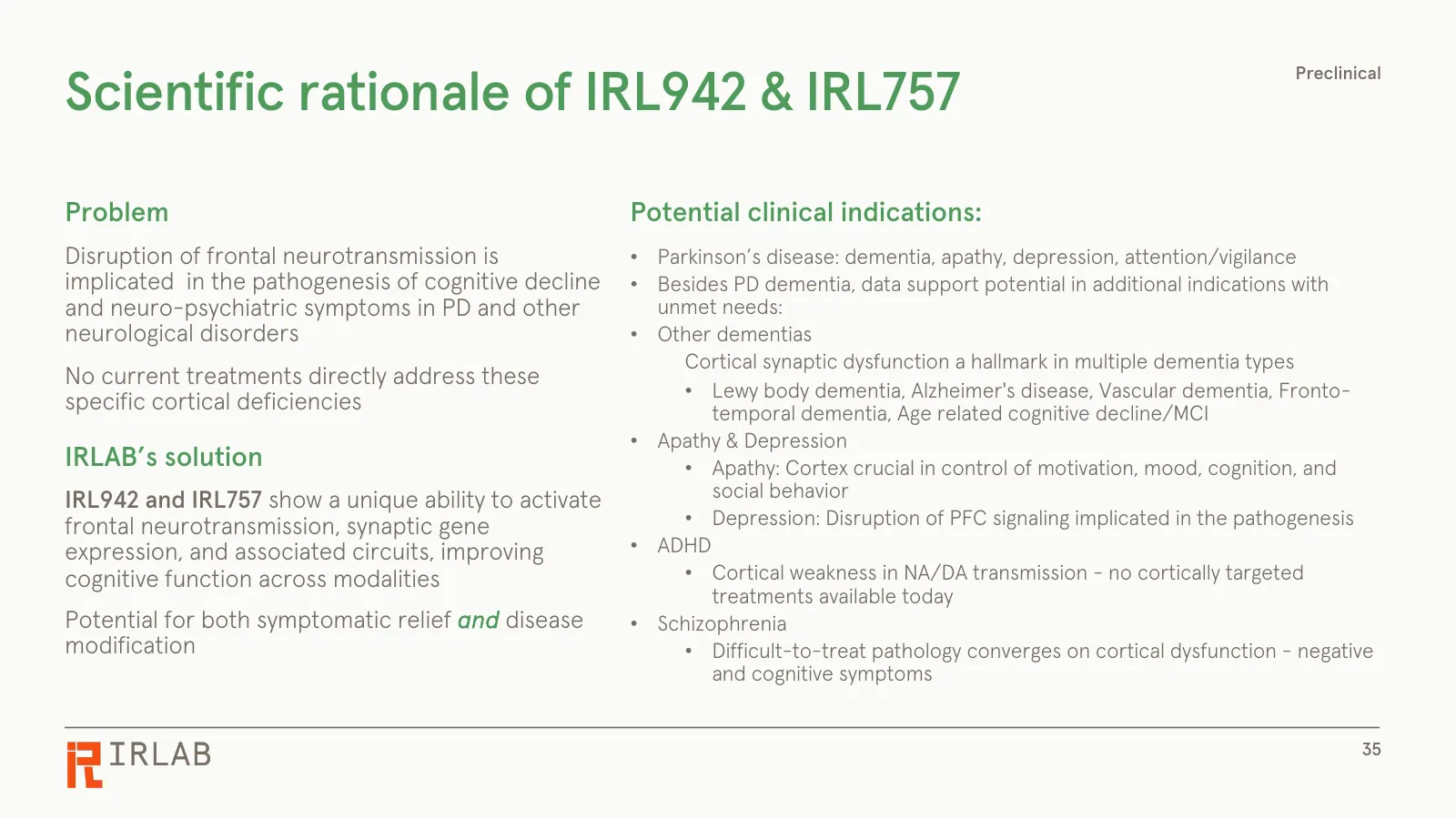
Preclinical Scientific rationale of IRL942 & IRL757 Problem Potential clinical indications: Disruption of frontal neurotransmission is • Parkinson’s disease: dementia, apathy, depression, attention/vigilance implicated in the pathogenesis of cognitive decline • Besides PD dementia, data support pote
Slide 36: Therapeutic response
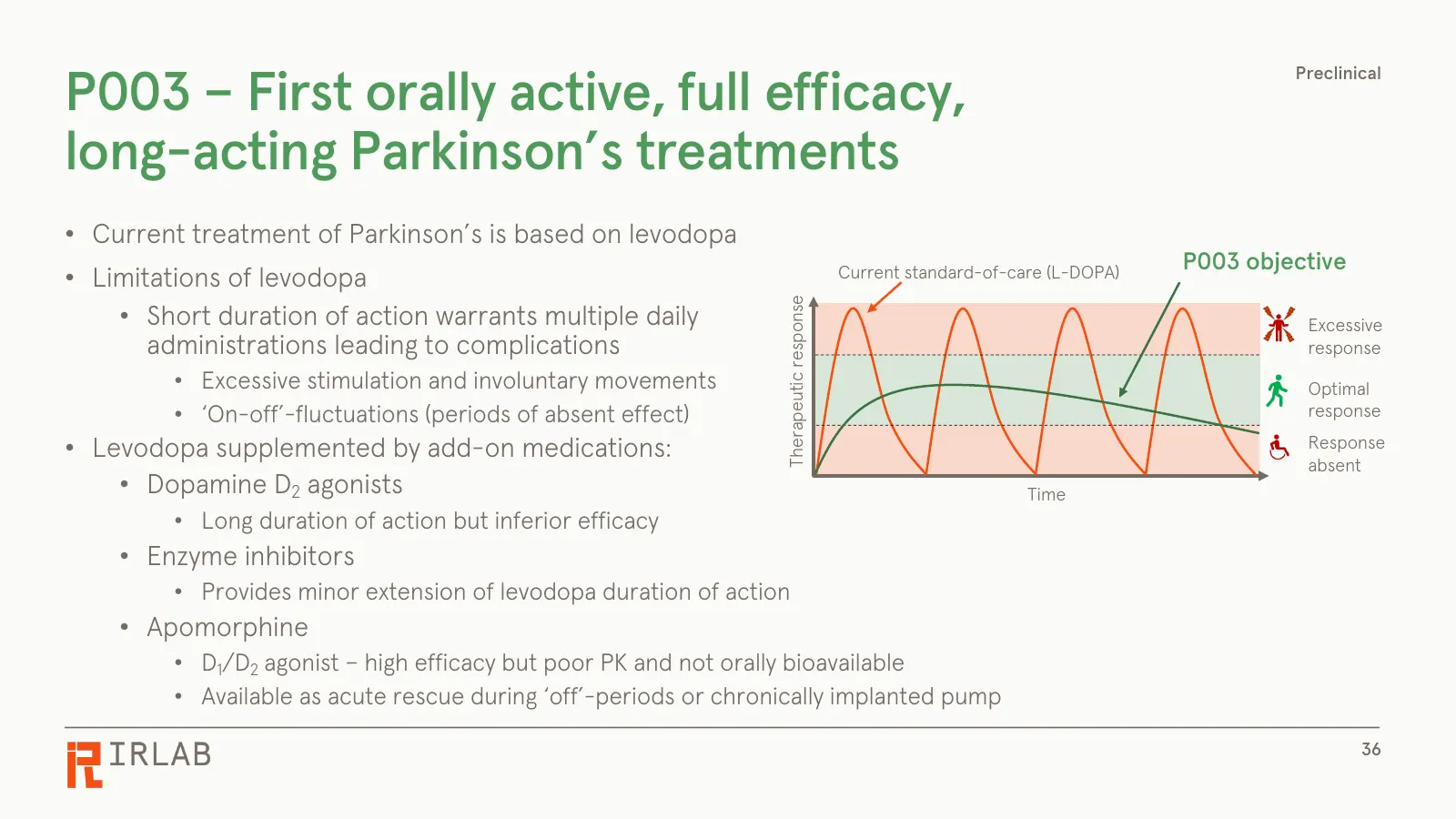
Preclinical P003 – First orally active, full efficacy, long-acting Parkinson’s treatments • Current treatment of Parkinson’s is based on levodopa P003 objective • Limitations of levodopa Current standard-of-care (L-DOPA) Therapeutic response • Short duration of action warrants multiple daily Excessi
Slide 37: Finance report Q3 2022
Finance report Q3 2022 • Highlights and summary • Analyst coverage
Slide 38: Financial highlights of Q3 2022
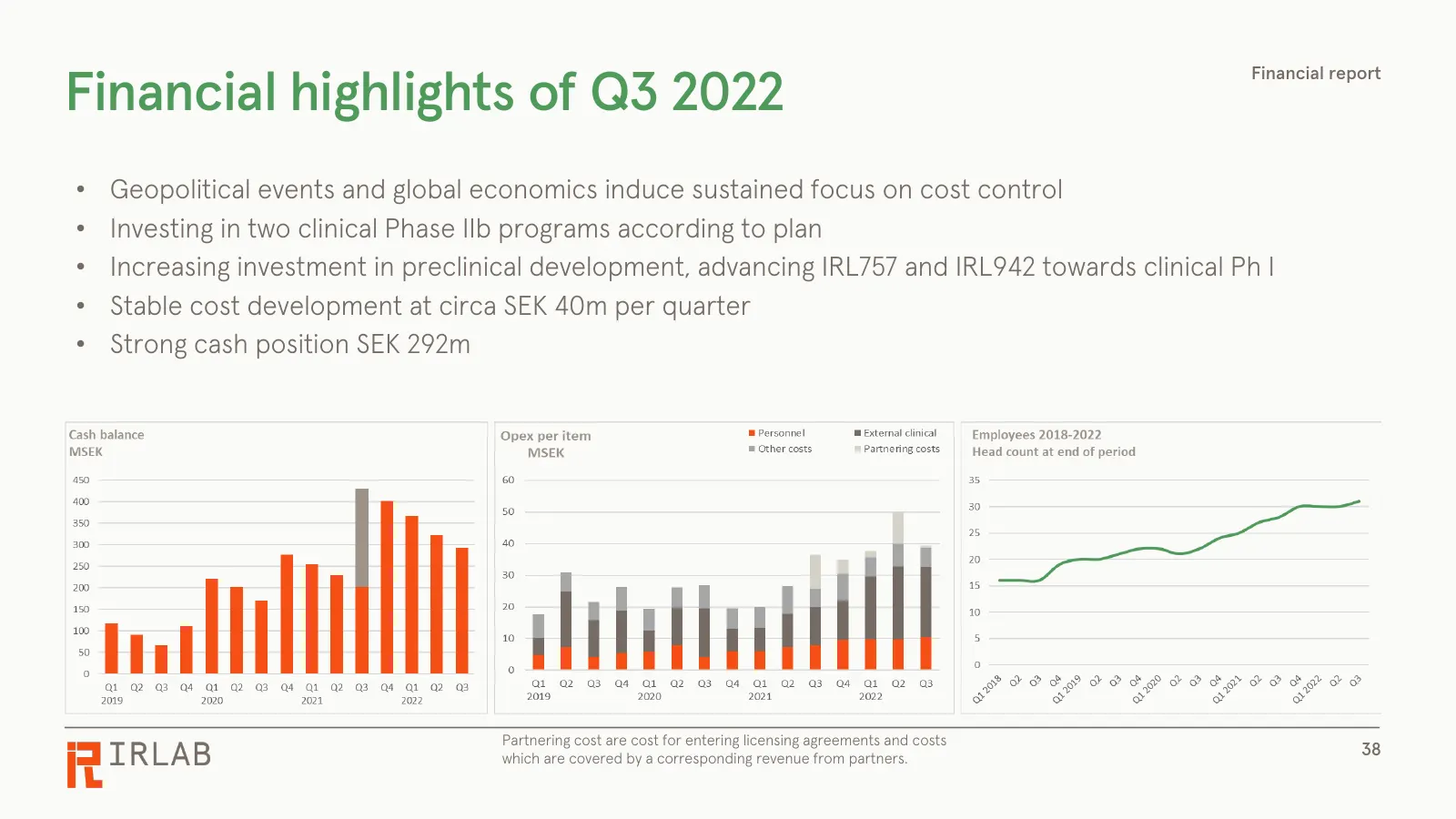
Financial report Financial highlights of Q3 2022 • Geopolitical events and global economics induce sustained focus on cost control • Investing in two clinical Phase IIb programs according to plan • Increasing investment in preclinical development, advancing IRL757 and IRL942 towards clinical Ph I •
Slide 39: Financial summary of Q3 2022
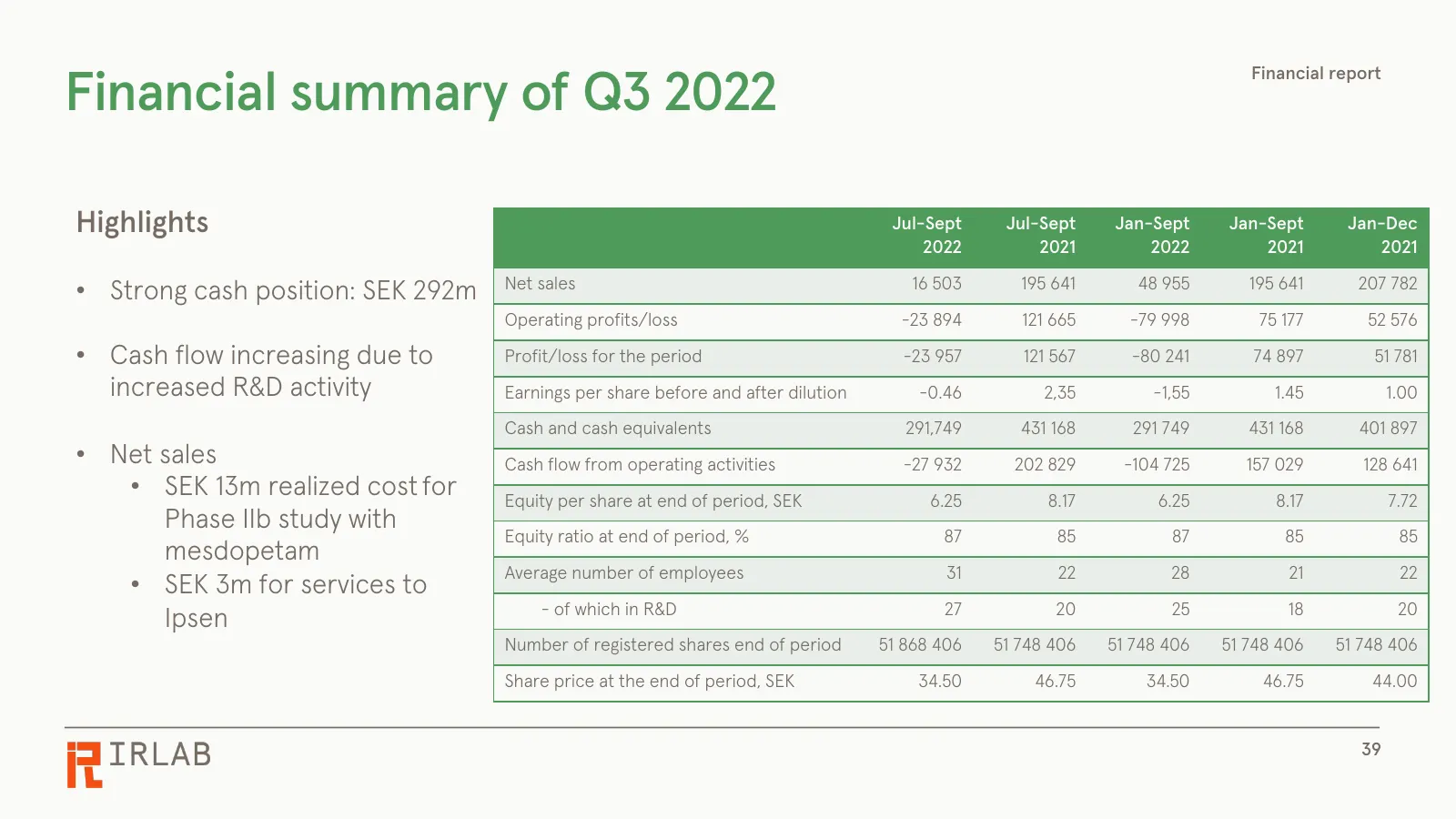
Financial report Financial summary of Q3 2022 Highlights Jul-Sept Jul-Sept Jan-Sept Jan-Sept Jan-Dec 2022 2021 2022 2021 2021 • Strong cash position: SEK 292m Net sales 16 503 195 641 48 955 195 641 207 782 Operating profits/loss -23 894 121 665 -79 998 75 177 52 576 • Cash flow increasing due to Pr
Slide 40: Analyst coverage
Financial report Analyst coverage • Fredrik Thor and Kevin Sule +46 (0) 545 013 30 info@redeye.se • Dr Adam Karlsson and Dr Gonzalo Artiach +46 (0)8 566 286 00 • Soo Romanoff and Dr Harry Shrives +44 (0)20 3077 5700 healthcare@edisongroup.com 40
Slide 41: Increasing visibility and company reach
Outlook Increasing visibility and company reach Media coverage and interviews Company presentations and business updates Scrip: Pivotal Period For Irlab And Its Parkinson’s Pipeline (Oct 4) ParetoTV Trading Direkt Healthcare Redeye 41
Slide 42: Pipeline transforming treatment of people living with Parkinson's
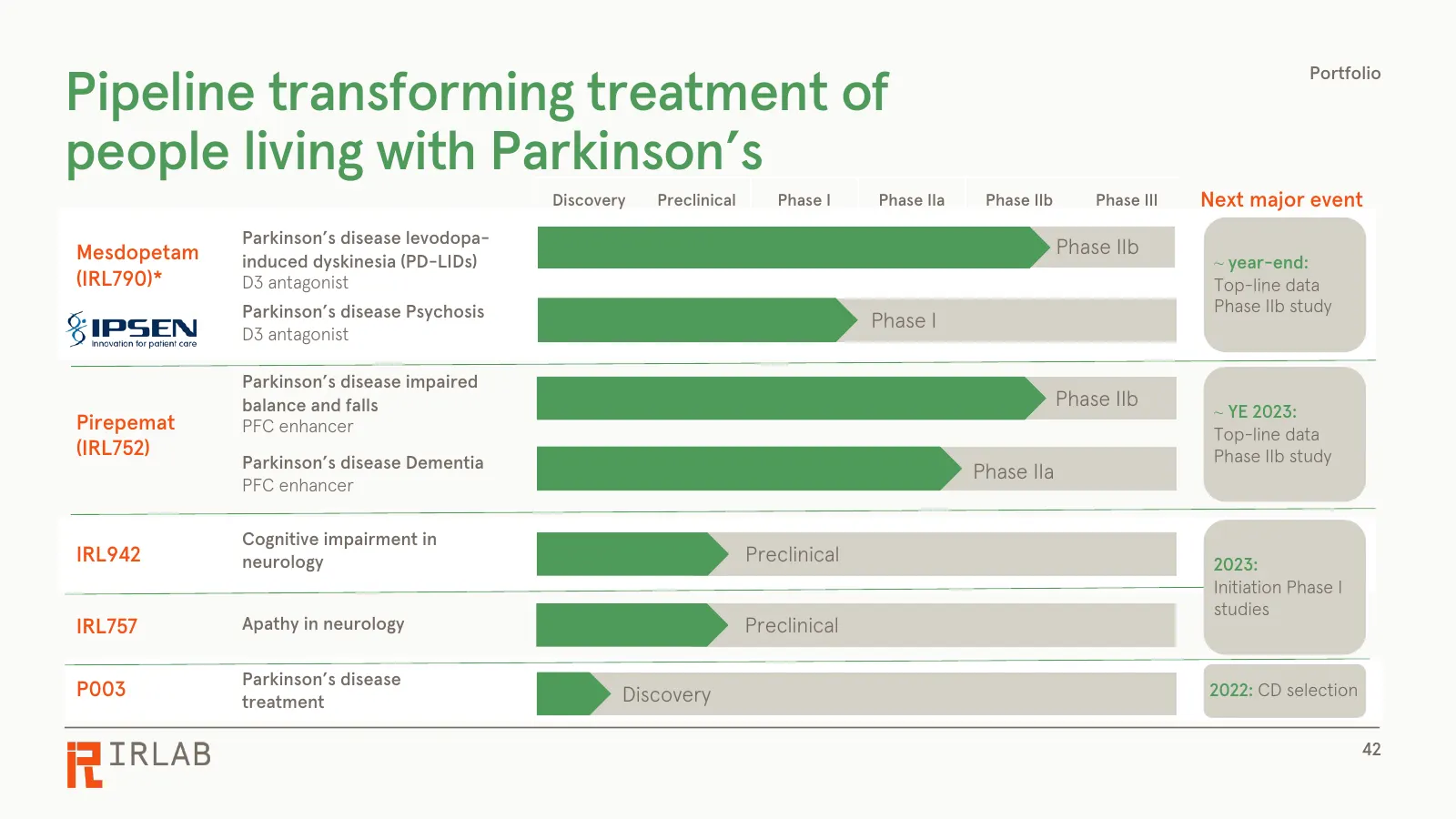
Portfolio Pipeline transforming treatment of people living with Parkinson’s Discovery Preclinical Phase I Phase IIa Phase IIb Phase III Next major event Parkinson’s disease levodopa- Mesdopetam Phase IIb induced dyskinesia (PD-LIDs) ⁓ year-end: (IRL790)* D3 antagonist Top-line data Parkinson’s disea
Slide 43: Milestones
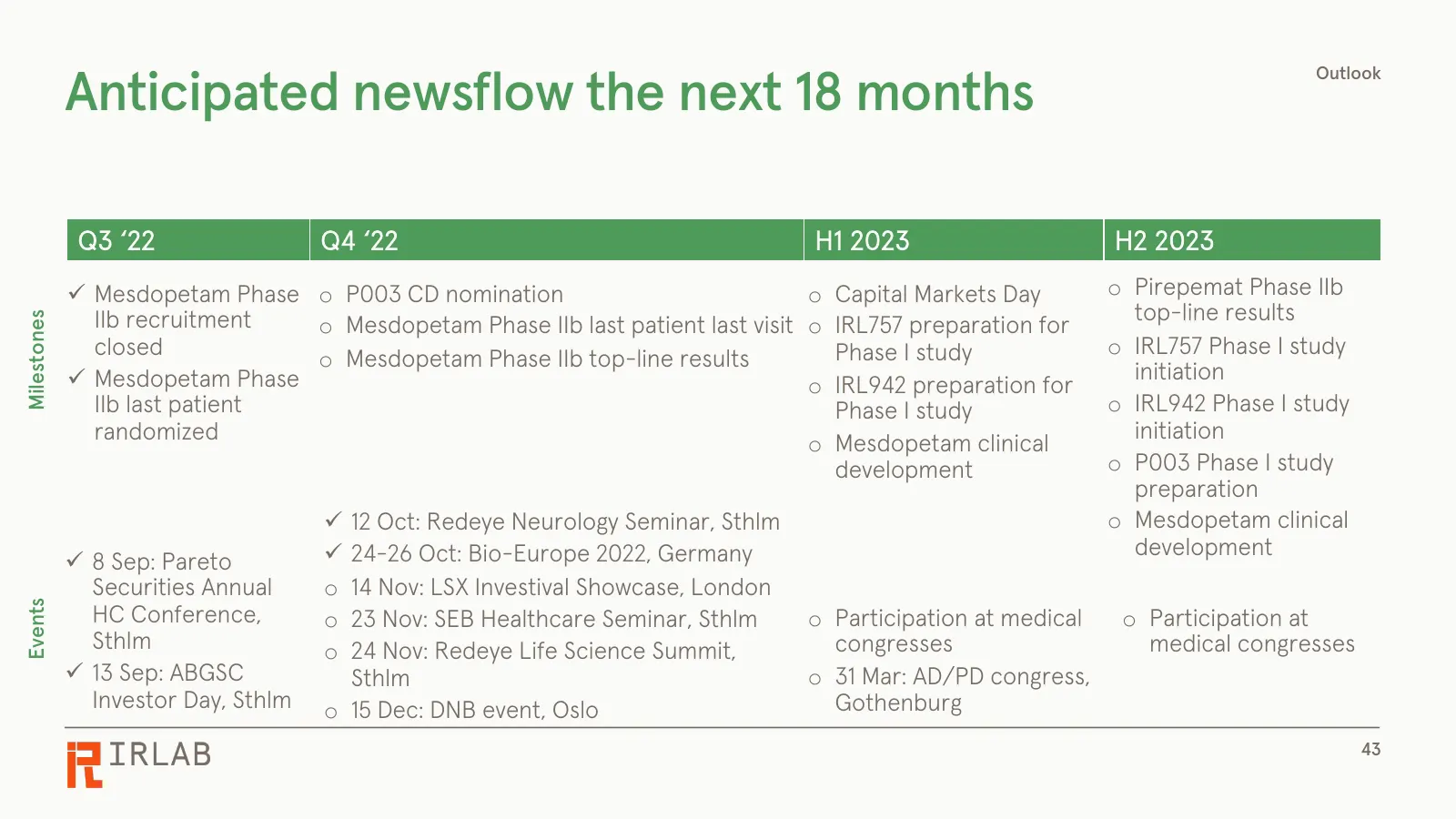
Outlook Anticipated newsflow the next 18 months Q3 ‘22 Q4 ‘22 H1 2023 H2 2023 ü Mesdopetam Phase o P003 CD nomination o Capital Markets Day o Pirepemat Phase IIb IIb recruitment top-line results Milestones o Mesdopetam Phase IIb last patient last visit o IRL757 preparation for closed Phase I study o
Slide 44: Outlook
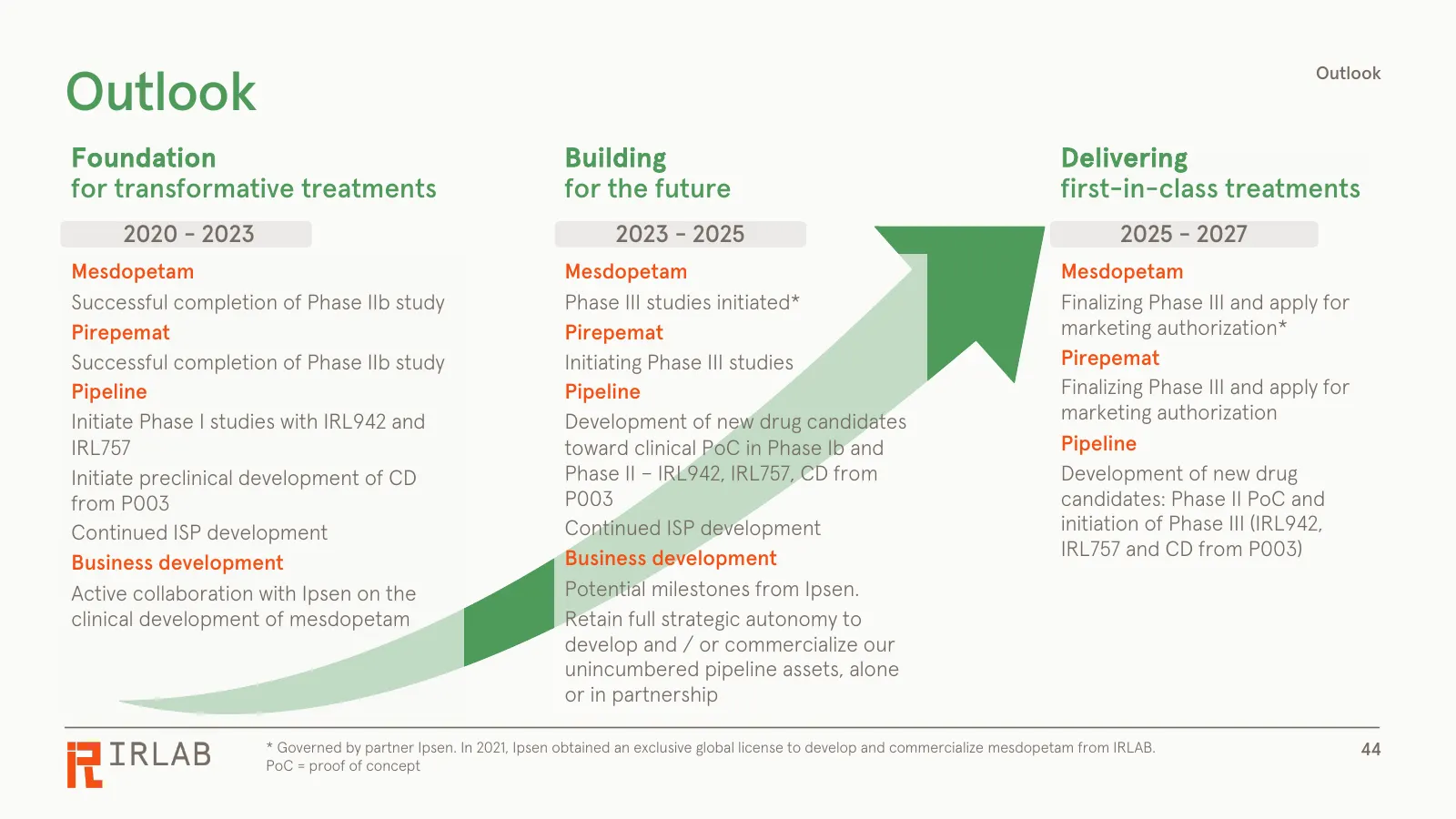
Outlook Outlook Foundation Building Delivering for transformative treatments for the future first-in-class treatments 2020 - 2023 2023 - 2025 2025 - 2027 Mesdopetam Mesdopetam Mesdopetam Successful completion of Phase IIb study Phase III studies initiated* Finalizing Phase III and apply for Pirepema
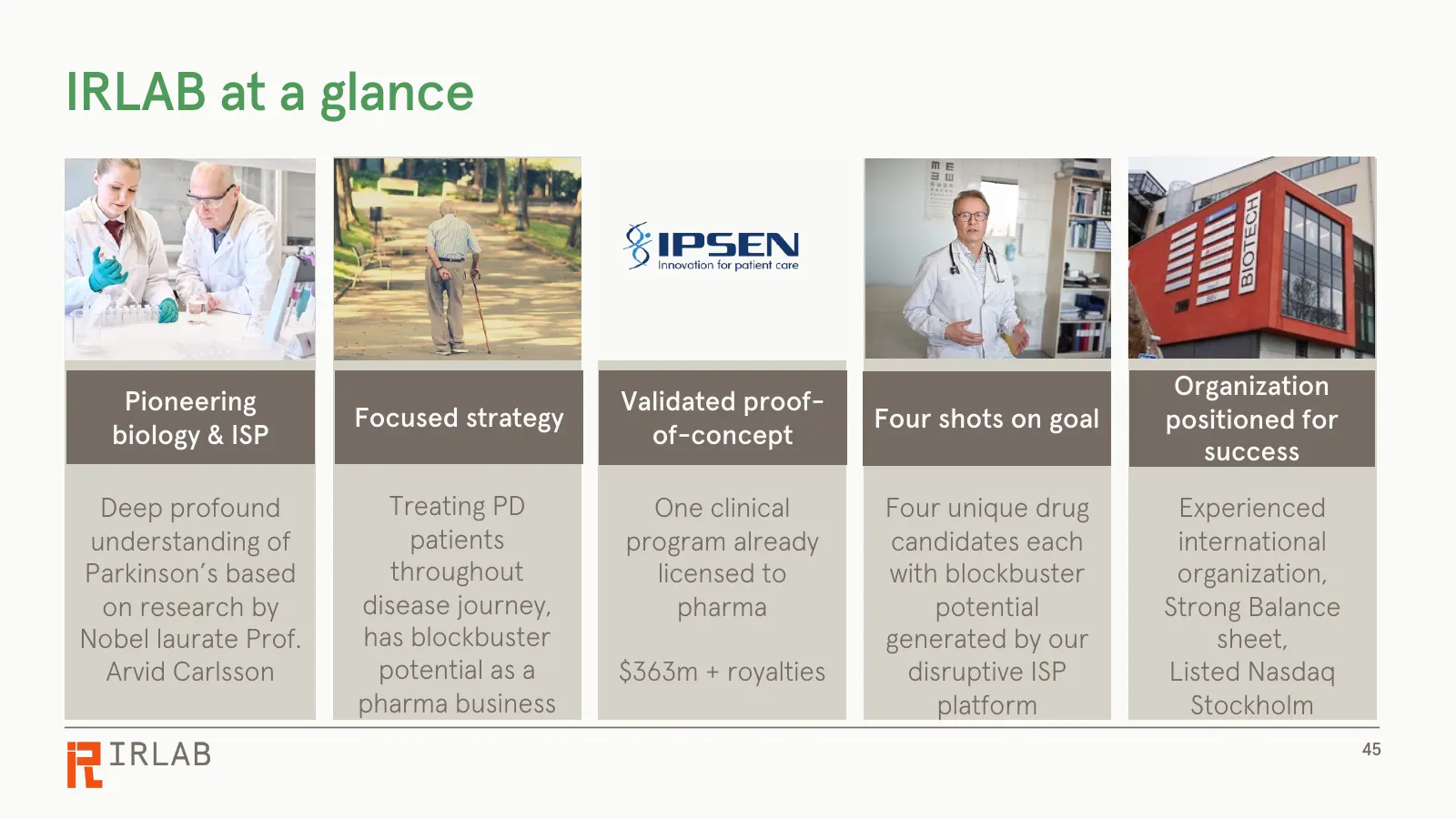
Slide 45: IRLAB at a glance
IRLAB at a glance Organization Pioneering Validated proof- Focused strategy Four shots on goal positioned for biology & ISP of-concept success Deep profound Treating PD One clinical Four unique drug Experienced understanding of patients program already candidates each international Parkinson’s based
Slide 46: Contact
Contact: Richard Godfrey, CEO, richard.godfrey@irlab.se Nicholas Waters, EVP and Head of R&D, nicholas.waters@irlab.se Viktor Siewertz, CFO, viktor.siewertz@irlab.se IRLAB discovers and develops novel drugs for the treatment of Parkinson’s disease and other disorders of the brain. The company’s most
Source: Internet Archive copy of irlab.se
More decks from IRLAB Therapeutics AB Class A
 Q3 2025 Earnings Presentation24 slides · Oct 1, 2025
 Q1 2025 Earnings Presentation36 slides · Sep 1, 2025
 Q2 2025 Earnings Presentation30 slides · September 2025
 Q2 2025 Earnings Presentation23 slides · Aug 27, 2025
 Q4 2024 Earnings Presentation35 slides · 2025
 Q1 2024 Earnings Presentation43 slides · May 1, 2024