Maximus, Inc. · NYSE:MMS
Maximus — Conference Presentation (February 2019)
56 slides from Maximus's conference presentation, Feb 19, 2019
Slide 1: MAXIMUS Higher Education: Introduction to F&A
MAXIMUS Higher Education Introduction to F&A Deb Carmel & Anne Feuerborn February 19, 2019 1
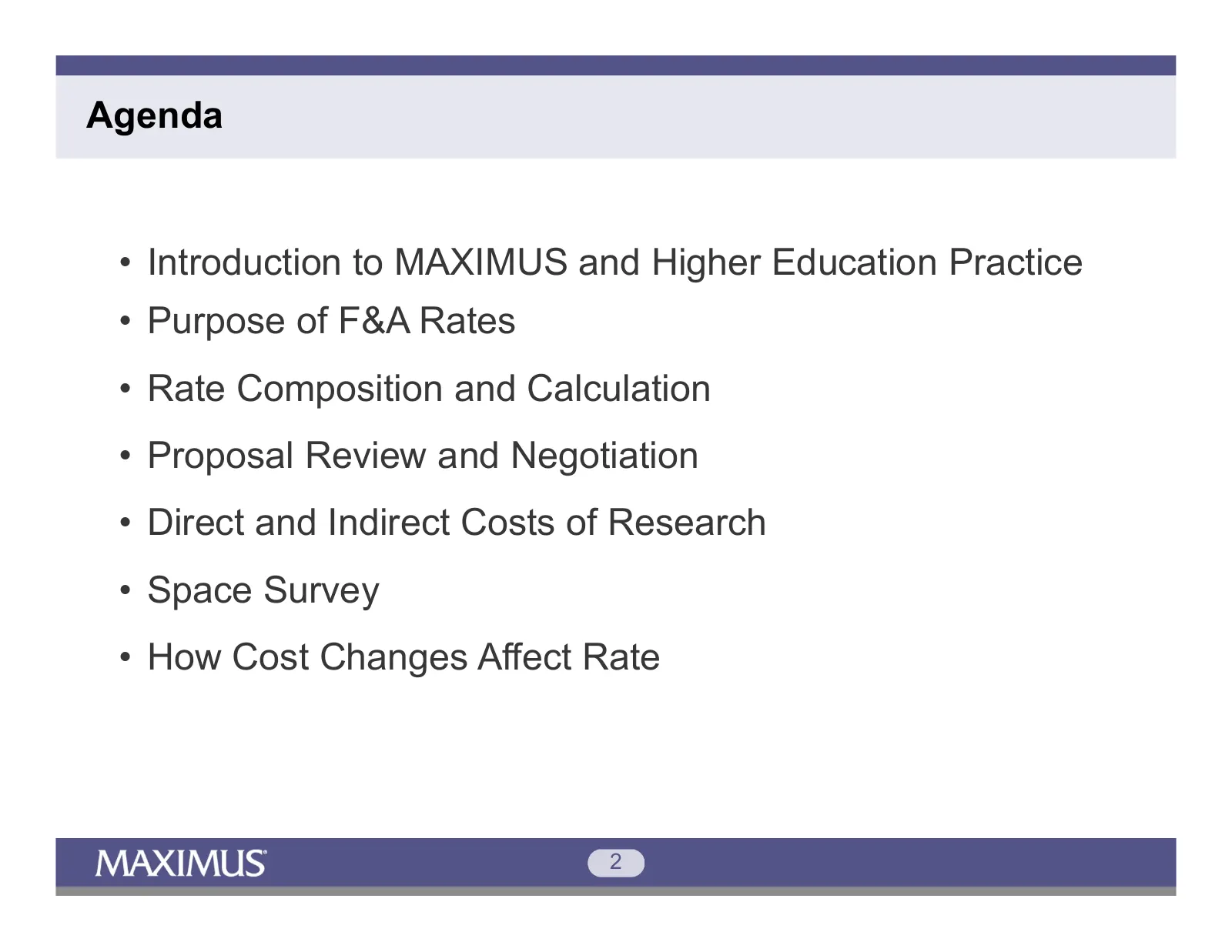
Slide 2: Agenda
Agenda • Introduction to MAXIMUS and Higher Education Practice • Purpose of F&A Rates • Rate Composition and Calculation • Proposal Review and Negotiation • Direct and Indirect Costs of Research • Space Survey • How Cost Changes Affect Rate 2
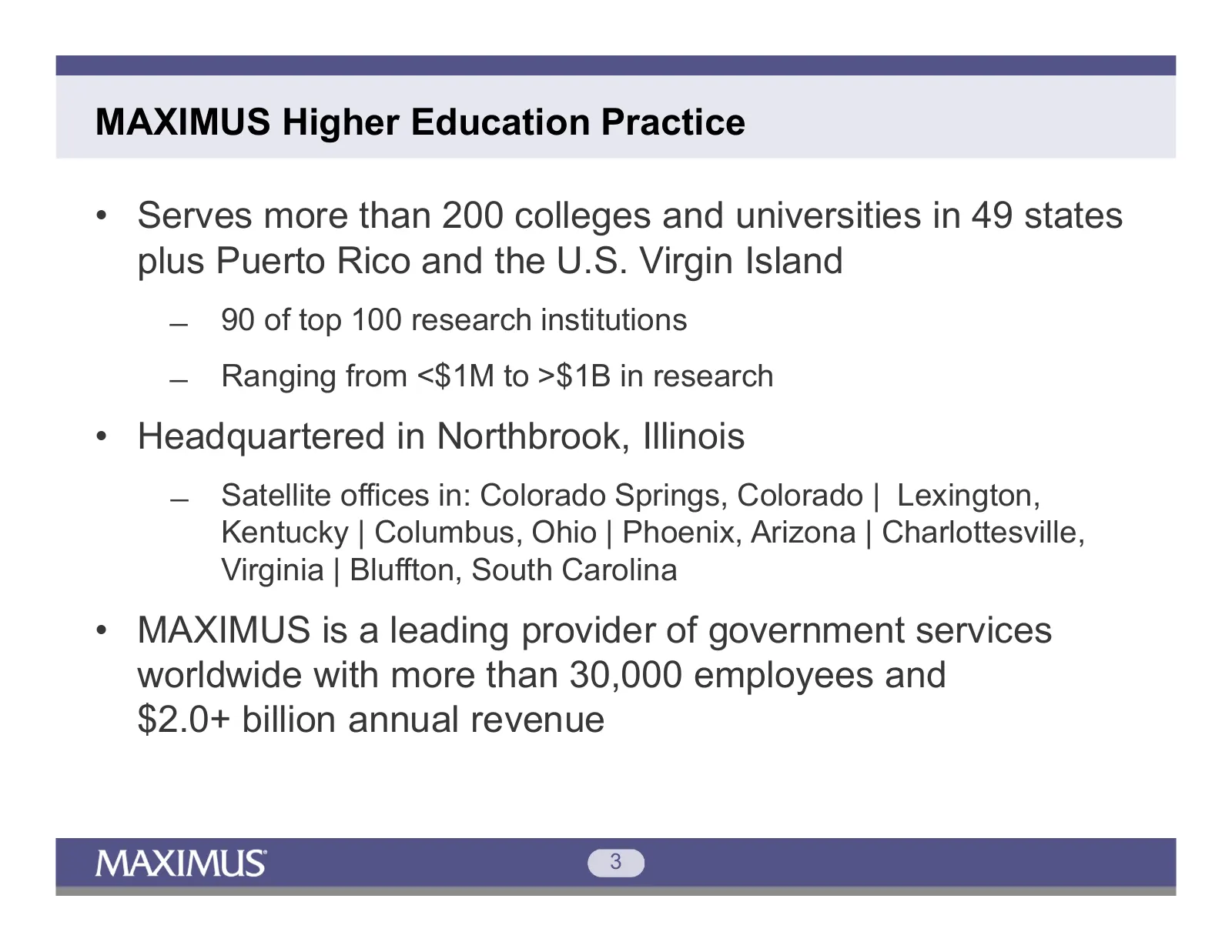
Slide 3: MAXIMUS Higher Education Practice
MAXIMUS Higher Education Practice • Serves more than 200 colleges and universities in 49 states plus Puerto Rico and the U.S. Virgin Island ̶ 90 of top 100 research institutions ̶ Ranging from <$1M to >$1B in research • Headquartered in Northbrook, Illinois ̶ Satellite offices in: Colorado Springs,
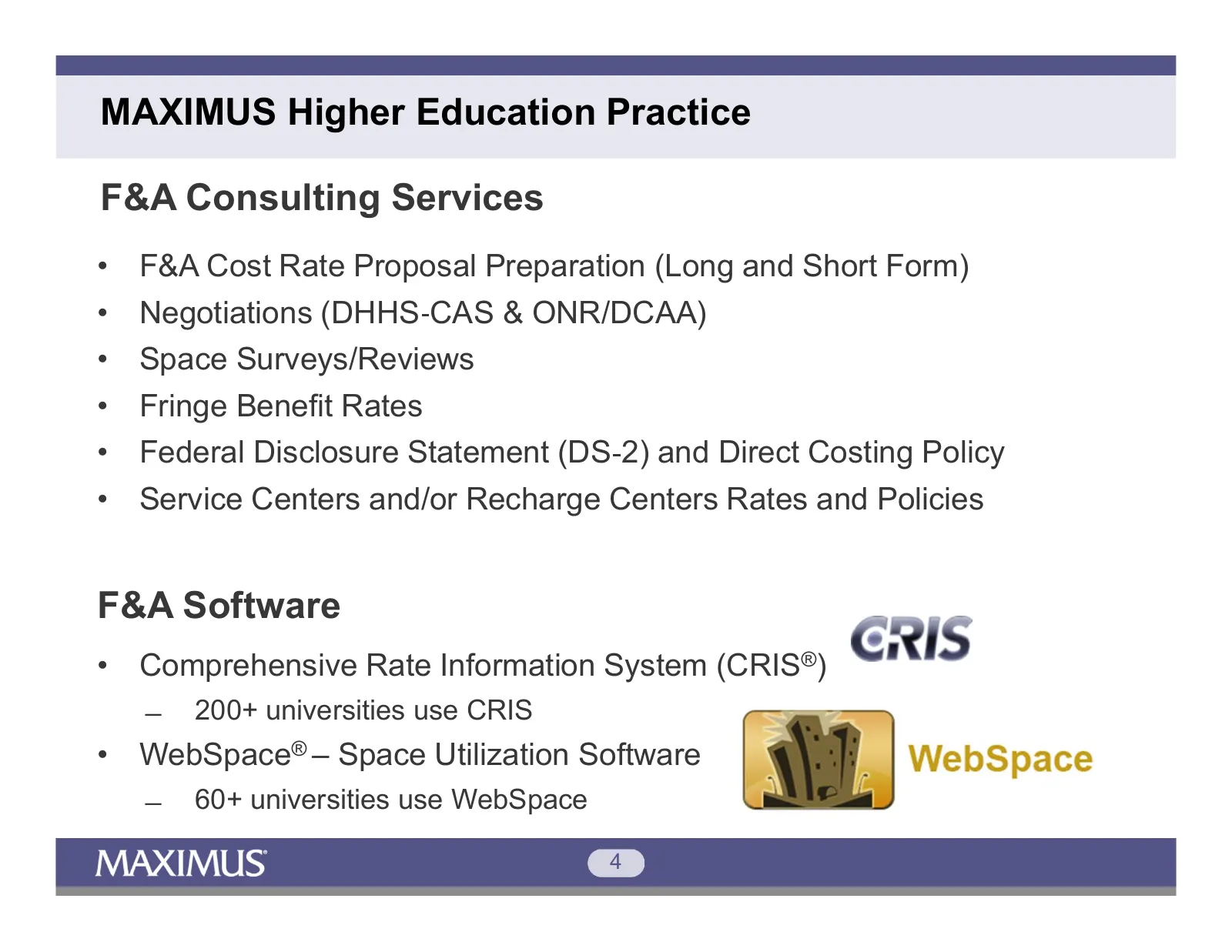
Slide 4: F&A Consulting Services and F&A Software
MAXIMUS Higher Education Practice F&A Consulting Services • F&A Cost Rate Proposal Preparation (Long and Short Form) • Negotiations (DHHS CAS & ONR/DCAA) • Space Surveys/Reviews • Fringe Benefit Rates • Federal Disclosure Statement (DS 2) and Direct Costing Policy • Service Centers and/or Recharge C
Slide 5: Other Services and Products
MAXIMUS Higher Education Practice Other Services and Products • Internal Controls Consulting and Effort Reporting Software (ERS) • Uniform Guidance Diagnostics and Compliance Consulting • Pre and Post Award Consulting Services and Training – Research Operational Reviews – Business Process Review and
Slide 6: Purpose of F&A Rates: Question
Purpose of F&A Rates Question Why do we calculate F&A rates? 6
Slide 7: Purpose of F&A Rates: Answer
Purpose of F&A Rates Answer • To identify the portion of F&A costs applicable to major functions of the university – Instruction – Organized Research – Other Sponsored Activities (Public Service) – Other Institutional Activities • To recover F&A expenditures allocable to sponsored activities 7
Slide 8: Rate Composition and Calculation
Rate Composition and Calculation F&A costs are real costs F&A rates are based on complex calculations 8
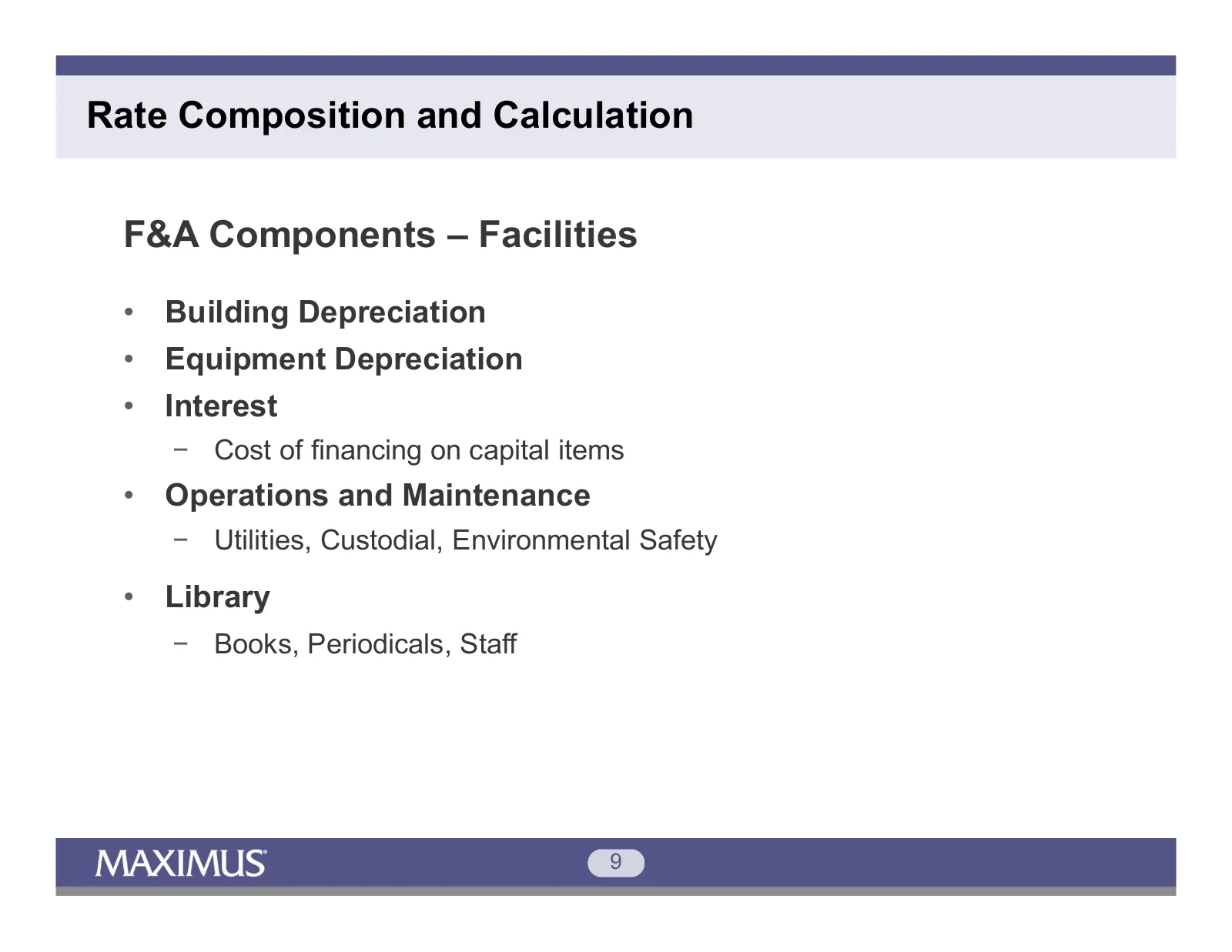
Slide 9: F&A Components – Facilities
Rate Composition and Calculation F&A Components – Facilities • Building Depreciation • Equipment Depreciation • Interest − Cost of financing on capital items • Operations and Maintenance − Utilities, Custodial, Environmental Safety • Library − Books, Periodicals, Staff 9
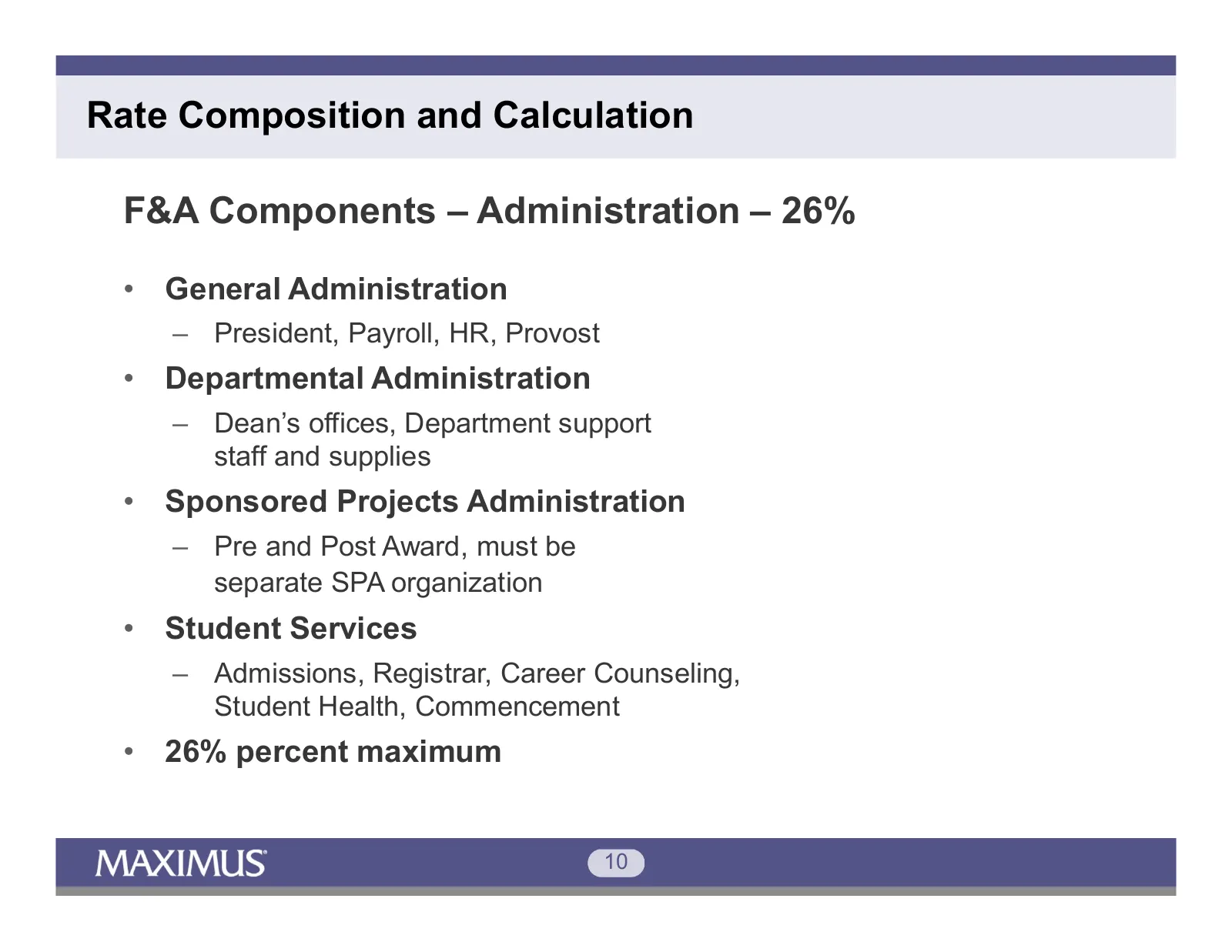
Slide 10: F&A Components – Administration – 26%
Rate Composition and Calculation F&A Components – Administration – 26% • General Administration – President, Payroll, HR, Provost • Departmental Administration – Dean’s offices, Department support staff and supplies • Sponsored Projects Administration – Pre and Post Award, must be separate SPA organ
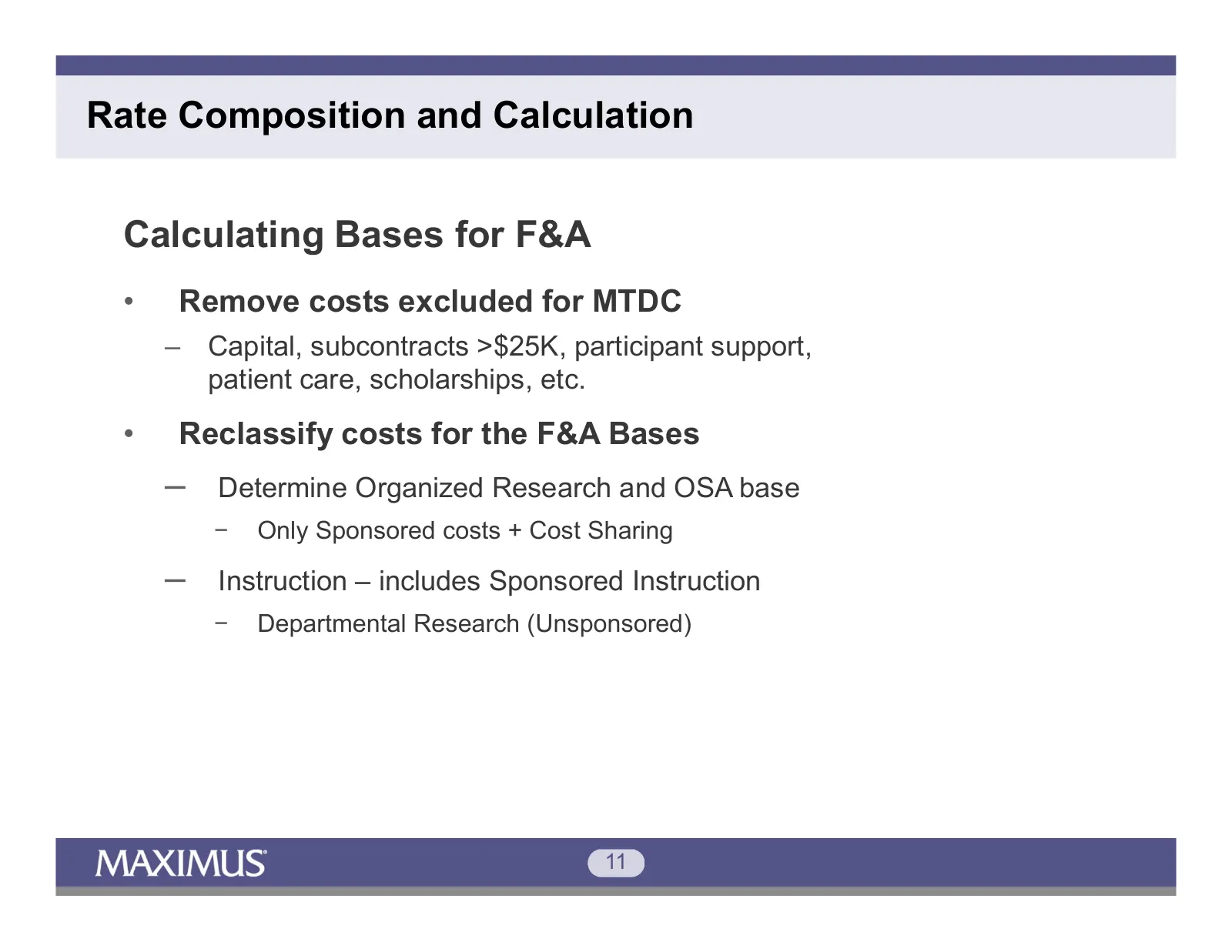
Slide 11: Calculating Bases for F&A
Rate Composition and Calculation Calculating Bases for F&A • Remove costs excluded for MTDC – Capital, subcontracts >$25K, participant support, patient care, scholarships, etc. • Reclassify costs for the F&A Bases – Determine Organized Research and OSA base − Only Sponsored costs + Cost Sharing – In
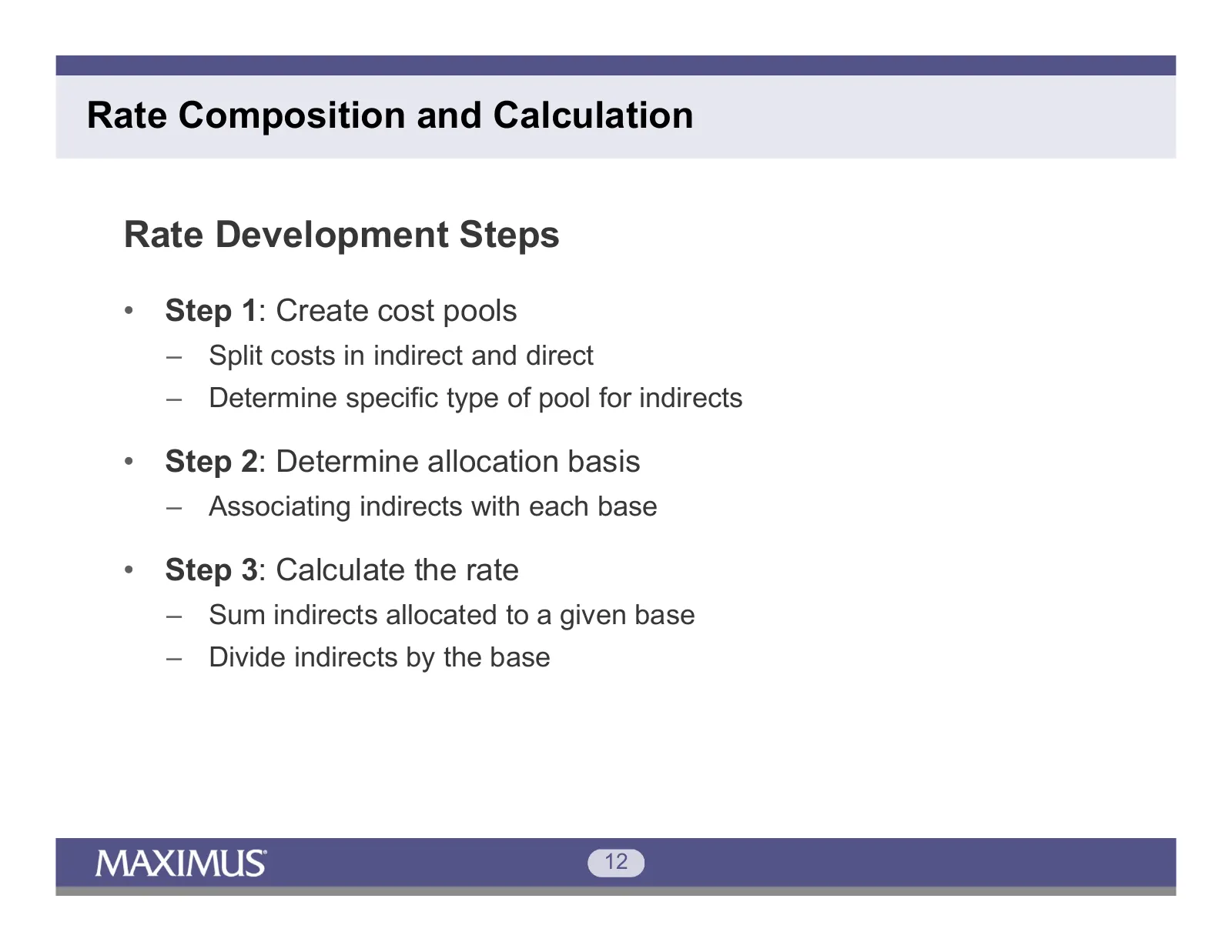
Slide 12: Rate Development Steps
Rate Composition and Calculation Rate Development Steps • Step 1: Create cost pools – Split costs in indirect and direct – Determine specific type of pool for indirects • Step 2: Determine allocation basis – Associating indirects with each base • Step 3: Calculate the rate – Sum indirects allocated
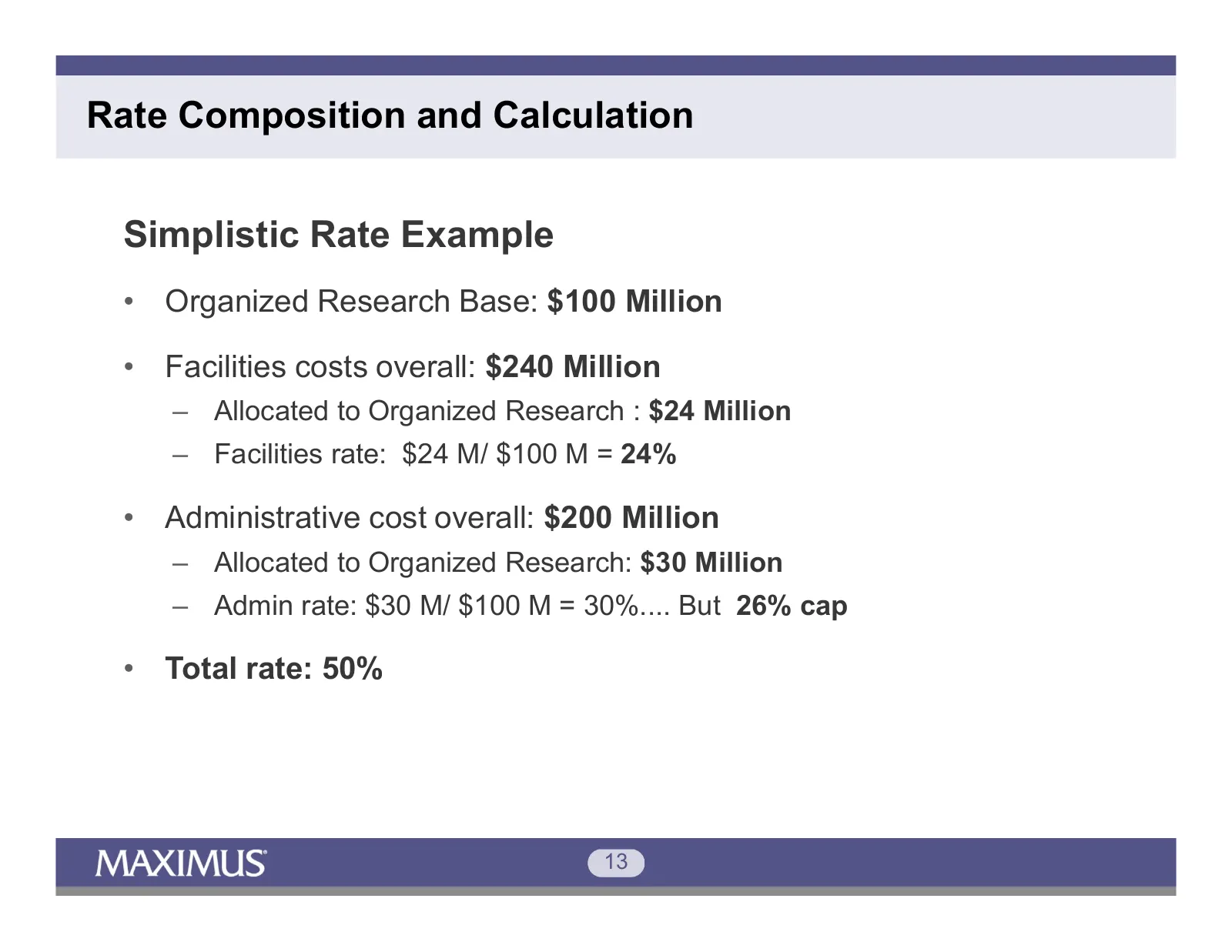
Slide 13: Simplistic Rate Example
Rate Composition and Calculation Simplistic Rate Example • Organized Research Base: $100 Million • Facilities costs overall: $240 Million – Allocated to Organized Research : $24 Million – Facilities rate: $24 M/ $100 M = 24% • Administrative cost overall: $200 Million – Allocated to Organized Resear
Slide 14: Proposal Review and Negotiation: Question
Proposal Review and Negotiation Question How are F&A rates proposed? 14
Slide 15: How F&A Rates Are Proposed: Answer
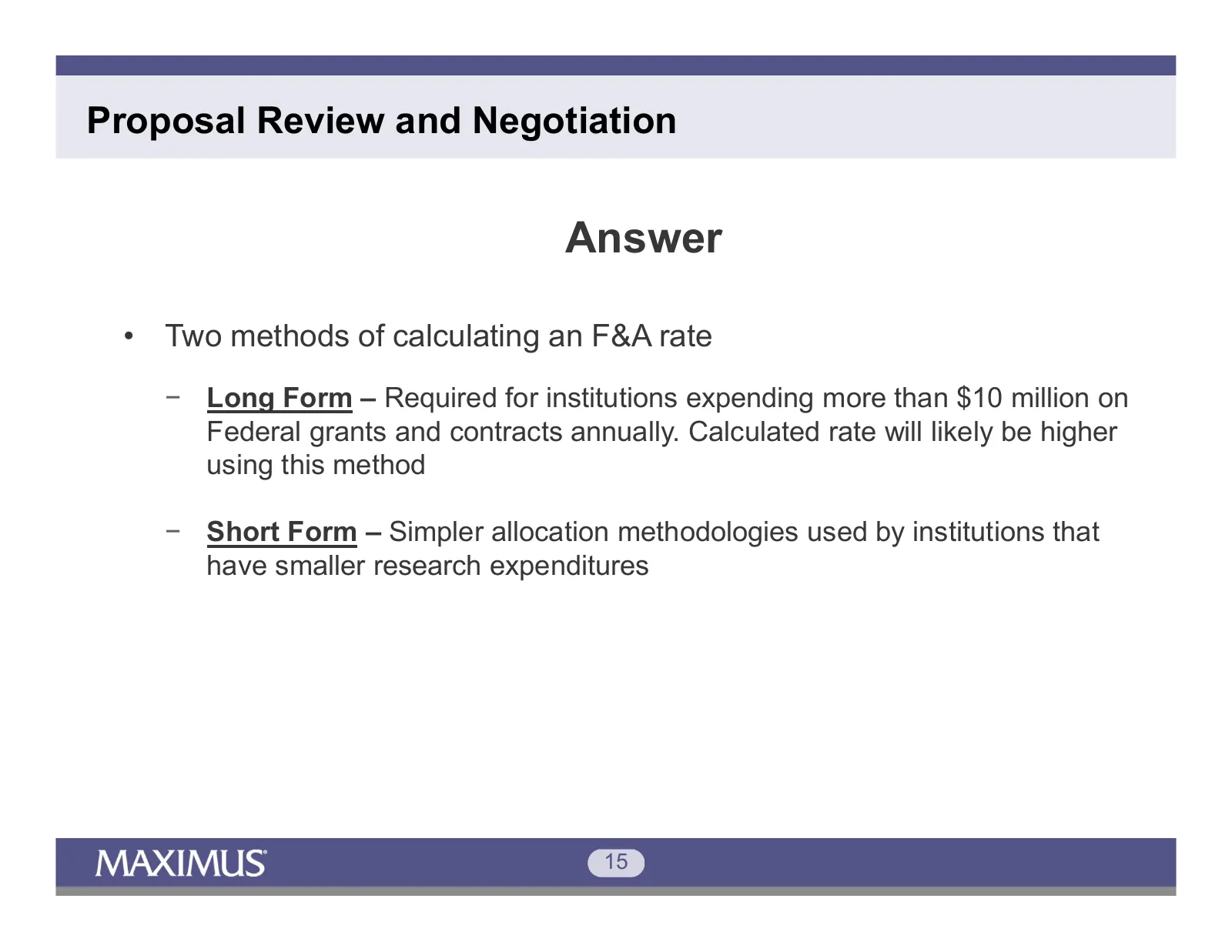
Proposal Review and Negotiation Answer • Two methods of calculating an F&A rate − Long Form – Required for institutions expending more than $10 million on Federal grants and contracts annually. Calculated rate will likely be higher using this method − Short Form – Simpler allocation methodologies us
Slide 16: Will Our Cognizant Agency Give Us an Increase?
Proposal Review and Negotiation Question We calculated a rate increase. Will our cognizant agency give us an increase? 16
Slide 17: Proposal Review and Negotiation: Answer
Proposal Review and Negotiation Answer • The government reviews the F&A rates closely. • Rarely will they negotiate what is proposed − Usually more reductions on Long Form than Short Form. 17
Slide 18: Government Review
Proposal Review and Negotiation Government Review • Review the calculations – poke holes in them • Review the Space Survey – “issues” always found • Negotiations usually consider: – Your past rate – If there are major changes at the university that substantiate a higher rate – Rates of other univers
Slide 19: F&A is important to your university
Proposal Review and Negotiation F&A is important to your university • Per A-21 and 2 CFR 200 Subpart E, the federal government will pay its fair share of total costs via the F&A rate process • Reimbursement of F&A is what allows the university to keep investing in its research resources • If sponsor
Slide 20: Direct and Indirect Costs of Research: Question
Direct and Indirect Costs of Research Question How does the rate apply? 20
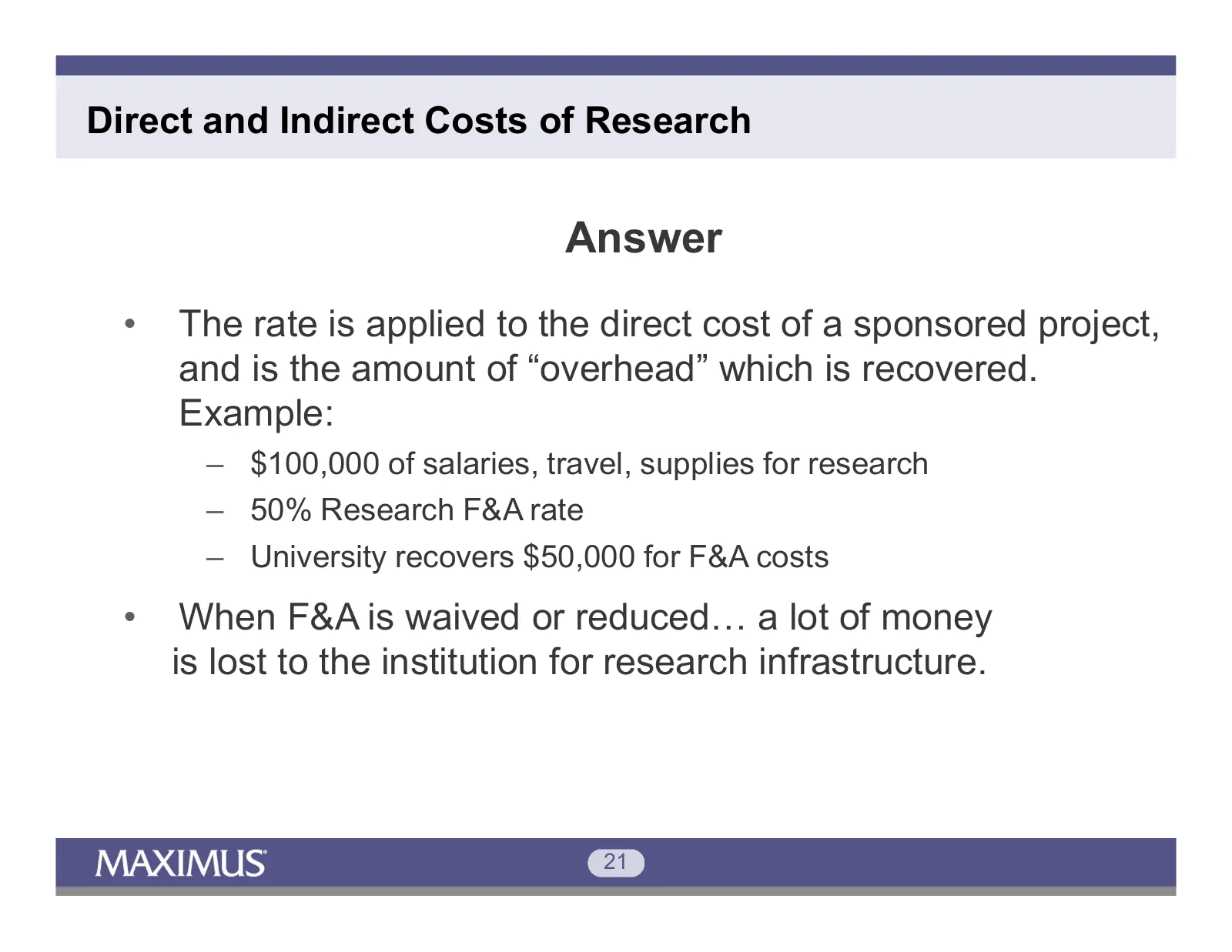
Slide 21: How the Rate Applies: Answer
Direct and Indirect Costs of Research Answer • The rate is applied to the direct cost of a sponsored project, and is the amount of “overhead” which is recovered. Example: – $100,000 of salaries, travel, supplies for research – 50% Research F&A rate – University recovers $50,000 for F&A costs • When
Slide 22: Will Researchers Get Less Money?
Direct and Indirect Costs of Research Question Will Researchers get less money to conduct their research now that our F&A rate has increased? 22
Slide 23: Direct and Indirect Costs: Answer
Direct and Indirect Costs of Research Answer • Both direct and indirect costs are necessary to conduct research. • Both are included in the budget, so indirect is not “taking away” from direct. • New F&A rates only applicable to new awards or segments. 23
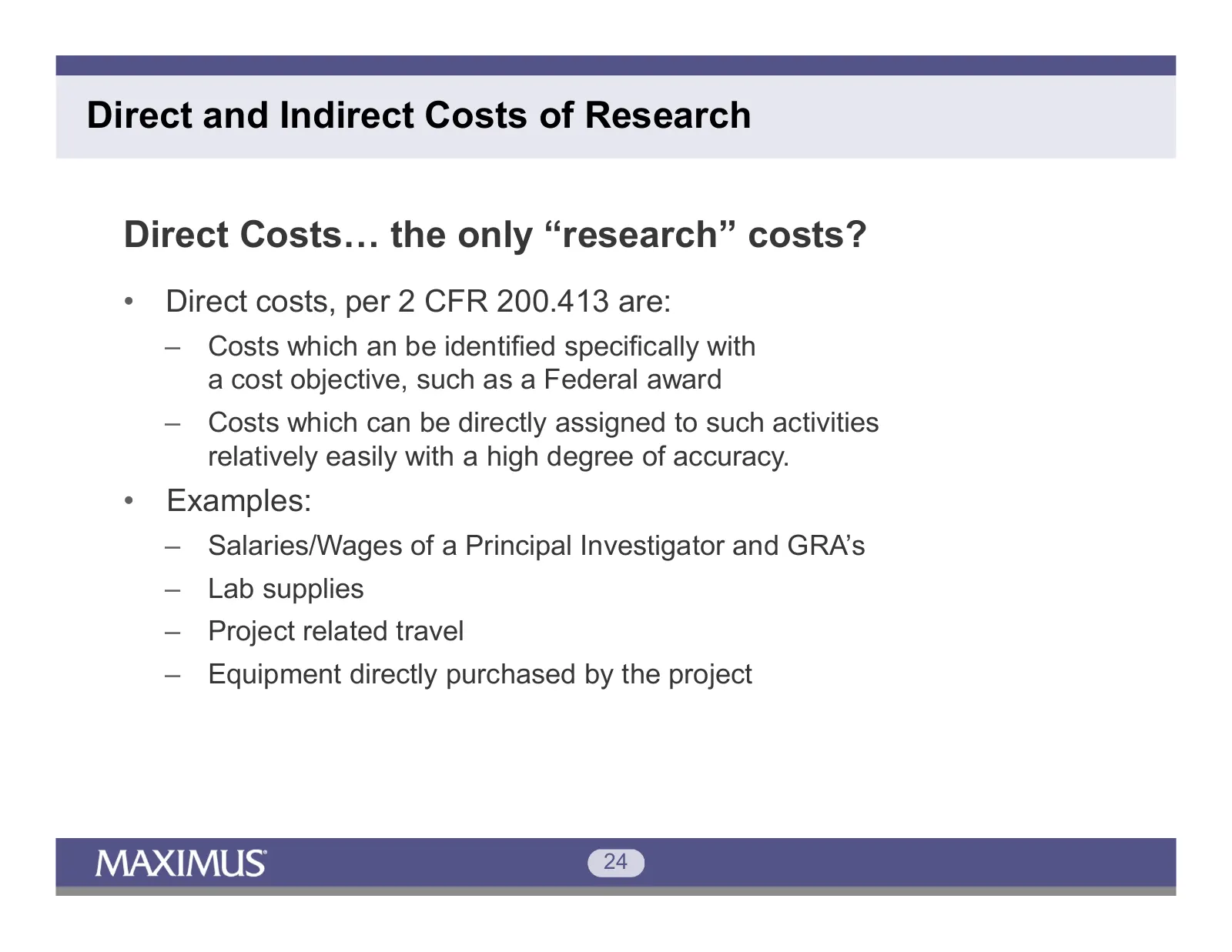
Slide 24: Direct Costs… the only research costs?
Direct and Indirect Costs of Research Direct Costs… the only “research” costs? • Direct costs, per 2 CFR 200.413 are: – Costs which an be identified specifically with a cost objective, such as a Federal award – Costs which can be directly assigned to such activities relatively easily with a high deg
Slide 25: Where there is direct… there is indirect
Direct and Indirect Costs of Research Where there is direct… there is indirect • Per 2 CFR 200.414, Indirect Costs are: – Costs which benefit common or joint objectives – Costs which cannot be identified to a specific activity such as instruction or research project • By definition, the benefit of F
Slide 26: Why Would an F&A Rate Increase?
Direct and Indirect Costs of Research Question Why would an F&A Rate increase? 26
Slide 27: Why an F&A Rate Increases: Answer
Direct and Indirect Costs of Research Answer • F&A Rates are a ratio between indirect and direct costs – e.g. $50 M Overhead/ $100 M Direct Research Costs • Simply stated, if the F&A rate is 50%: – For every $1.00 spent on research – 50 cents of cost is incurred by the university on infrastructure t
Slide 28: Will Hiring Administrative Staff Increase Our Rate?
Direct and Indirect Costs of Research Question Our university just hired a bunch of administrative staff this year – will our F&A rate increase? 28
Slide 29: Administrative Staff and Rate: Answer
Direct and Indirect Costs of Research Answer • Unfortunately… probably not • Administrative component is capped at 26% • Most universities meet that cap 29
Slide 30: 2 CFR 200 Appendix III, C.8
Direct and Indirect Costs of Research 2 CFR 200 Appendix III, C.8 • Administrative components are restricted to 26% reimbursement. • Most universities calculate more than 26% in their F&A rate proposals. • Therefore, more administration helps justify the 26% capped rate, but doesn’t raise the rate.
Slide 31: 2 CFR 200.413 – Opportunities
Direct and Indirect Costs of Research 2 CFR 200.413 – Opportunities • Allowed to identify more admin as direct costs • Administrative staff may be direct charged if: – Services are integral – Individuals can be specifically identified with the project – Such costs are explicitly included in the budg
Slide 32: Space Survey: What Is a Space Survey?
Space Survey Question What is a Space Survey? 32
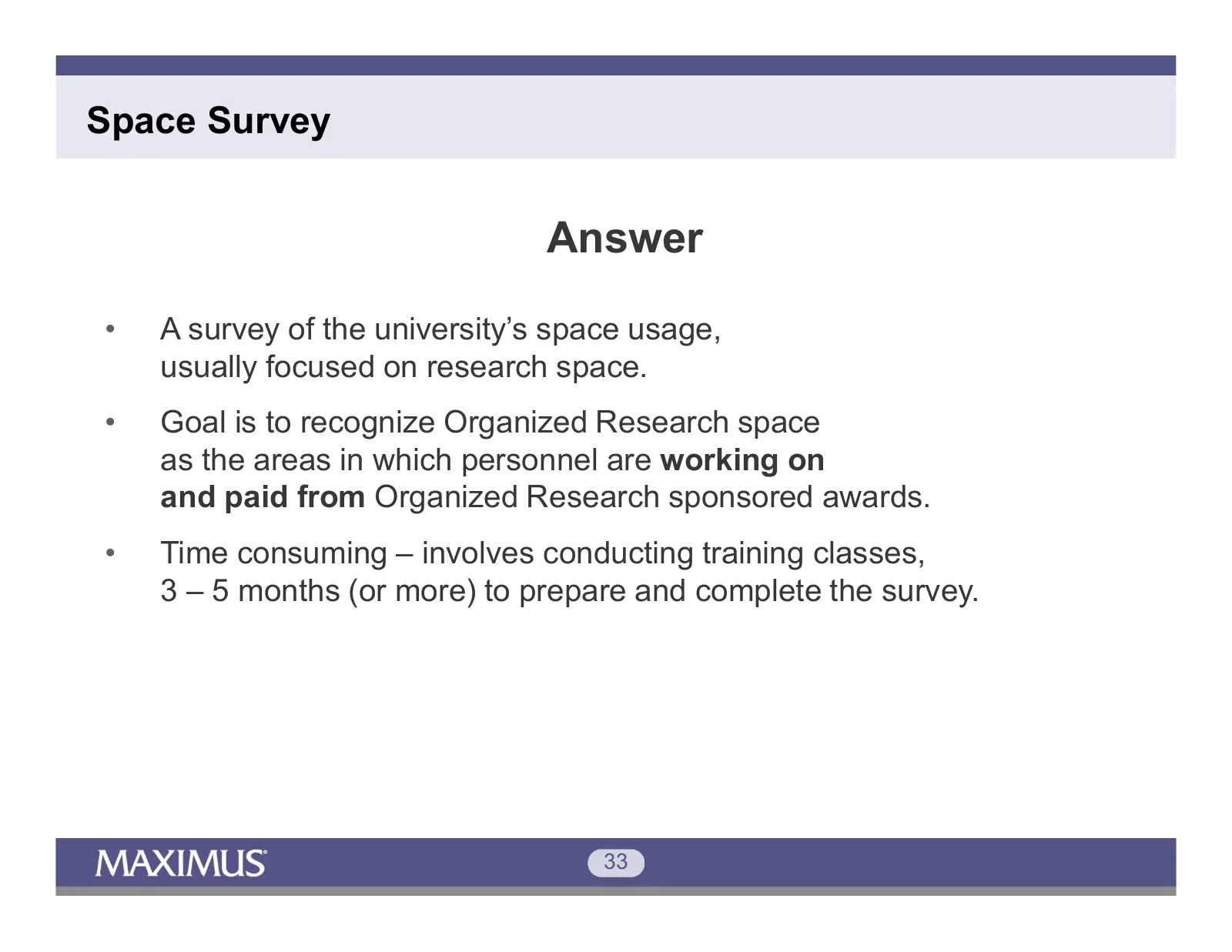
Slide 33: Space Survey: Answer
Space Survey Answer • A survey of the university’s space usage, usually focused on research space. • Goal is to recognize Organized Research space as the areas in which personnel are working on and paid from Organized Research sponsored awards. • Time consuming – involves conducting training classes
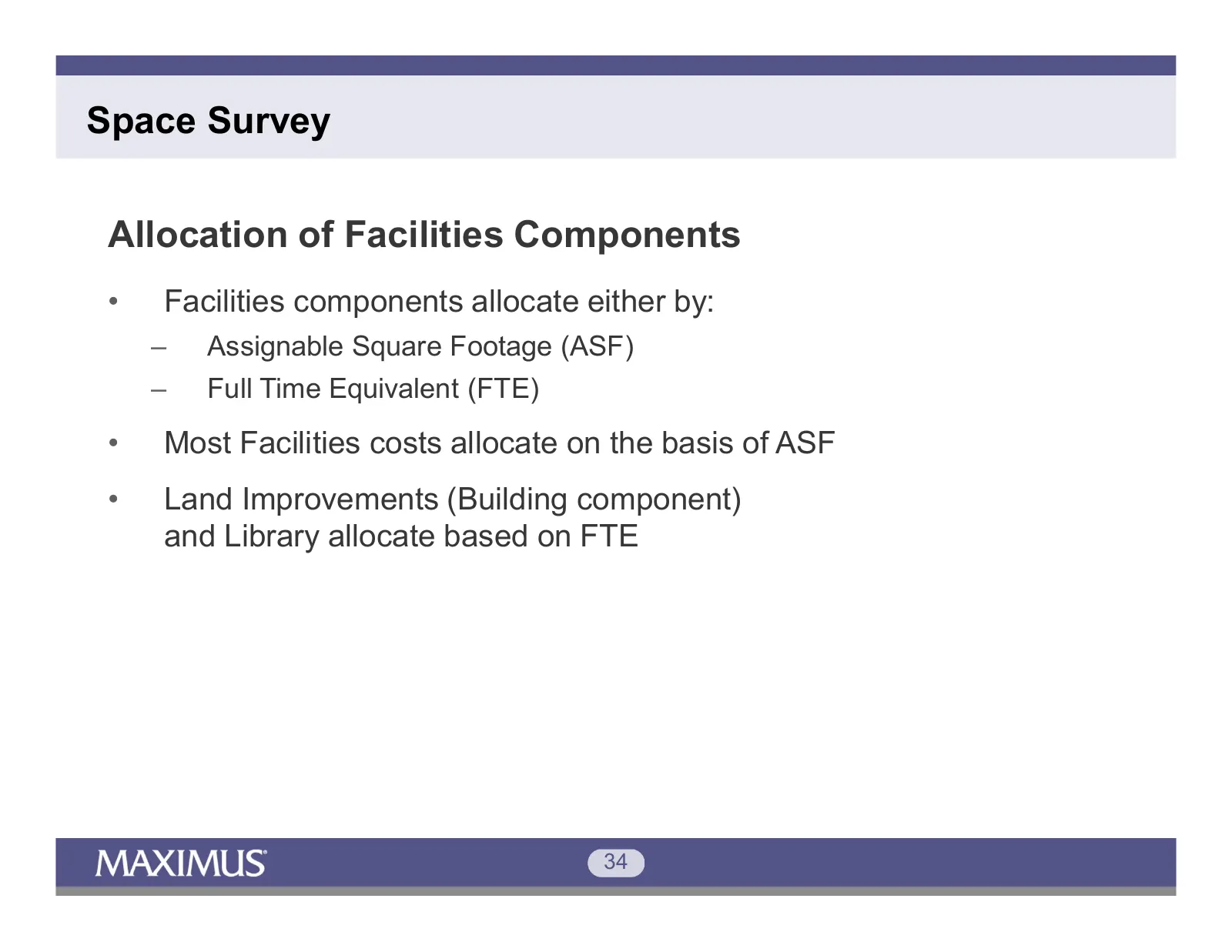
Slide 34: Allocation of Facilities Components
Space Survey Allocation of Facilities Components • Facilities components allocate either by: – Assignable Square Footage (ASF) – Full Time Equivalent (FTE) • Most Facilities costs allocate on the basis of ASF • Land Improvements (Building component) and Library allocate based on FTE 34
Slide 35: Why So Much Time on Space Surveys?
Space Survey Question Why do we spend so much time on space surveys? 35
Slide 36: Space Survey: Answer
Space Survey Answer • The space survey is the single most important part of the F&A rate 36
Slide 37: Space Survey and the Uncapped Facilities Component
Space Survey • The Facilities component is uncapped. • Therefore, identification of Facilities costs to Research is the only way to raise the rate. • The main way to identify costs to Organized Research is to conduct a space survey. • Often the Federal cognizant agency will come on-site and thorough
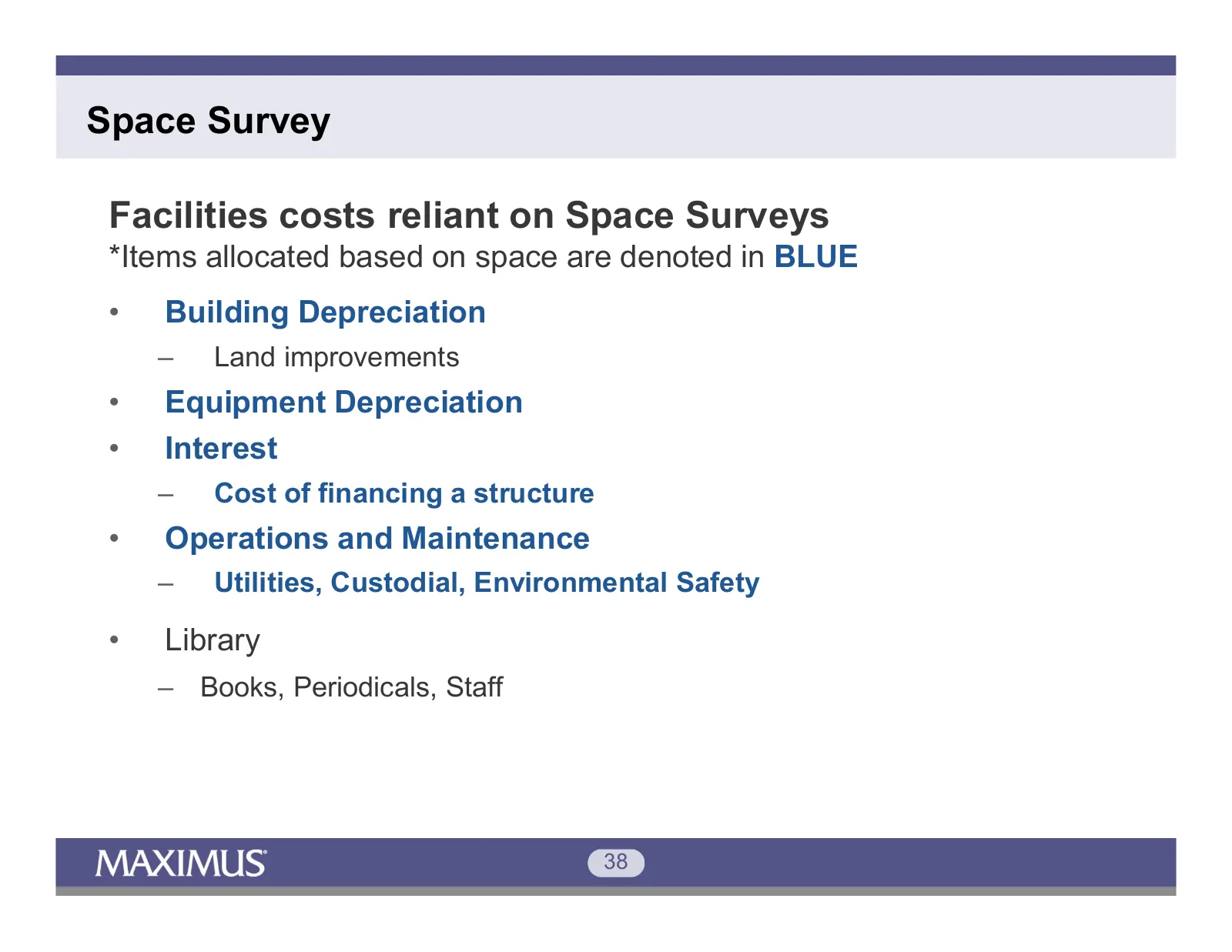
Slide 38: Facilities Costs Reliant on Space Surveys
Space Survey Facilities costs reliant on Space Surveys *Items allocated based on space are denoted in BLUE • Building Depreciation – Land improvements • Equipment Depreciation • Interest – Cost of financing a structure • Operations and Maintenance – Utilities, Custodial, Environmental Safety • Libra
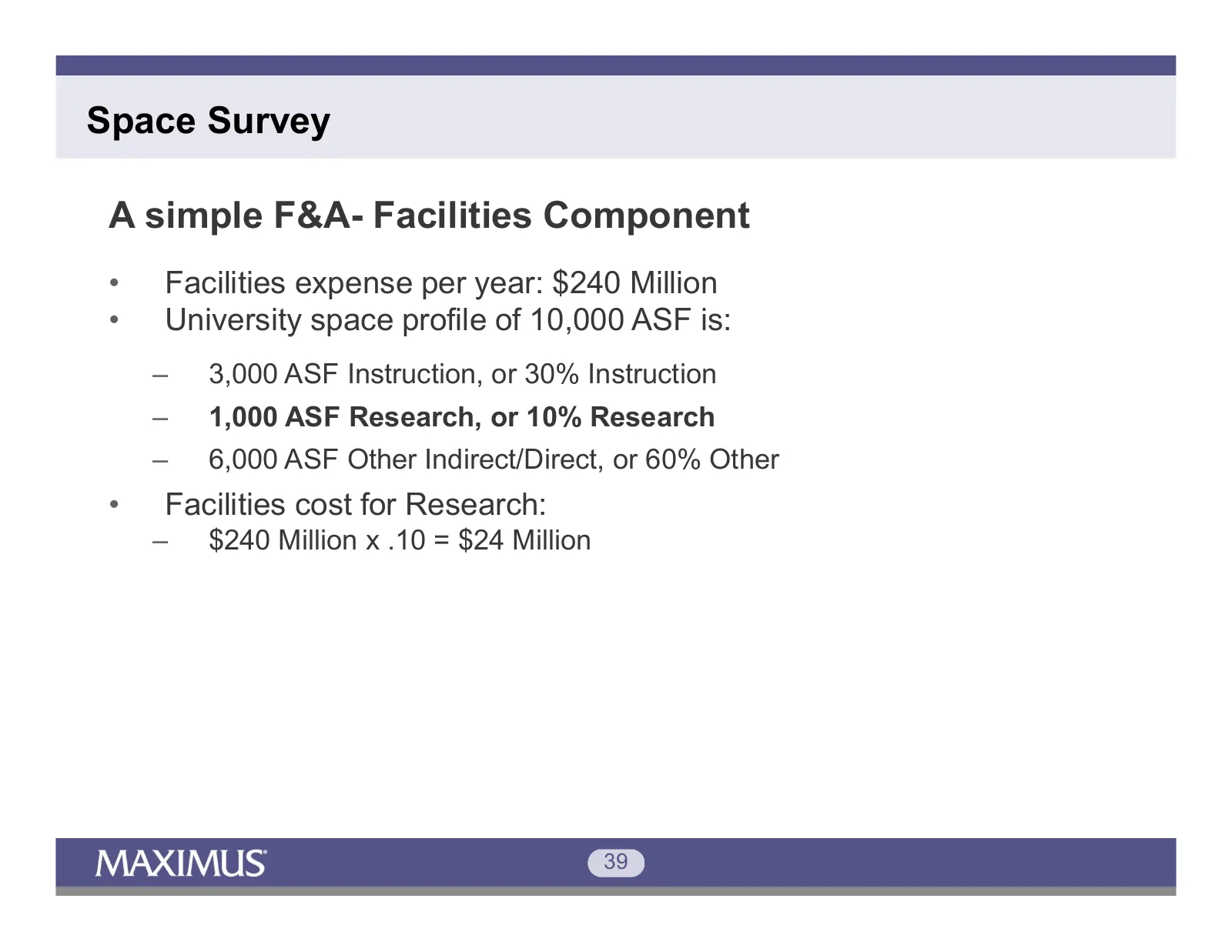
Slide 39: A Simple F&A Facilities Component
Space Survey A simple F&A- Facilities Component • Facilities expense per year: $240 Million • University space profile of 10,000 ASF is: – 3,000 ASF Instruction, or 30% Instruction – 1,000 ASF Research, or 10% Research – 6,000 ASF Other Indirect/Direct, or 60% Other • Facilities cost for Research: –
Slide 40: How Cost Changes Affect Rate: Equipment Question
How Cost Changes Affect Rate Question We bought a very expensive piece of research equipment in our base year. Will it increase our rate substantially? 40
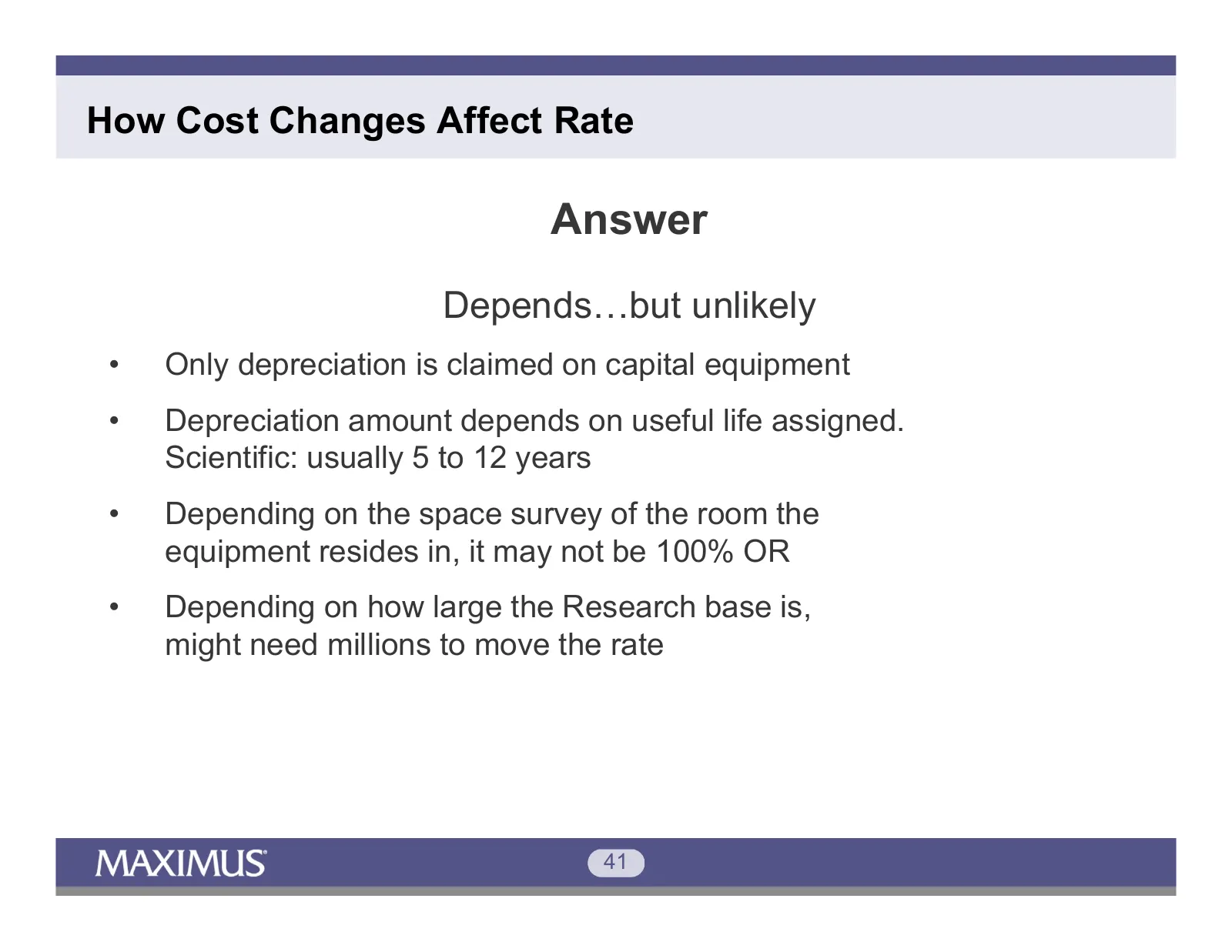
Slide 41: Expensive Equipment: Answer
How Cost Changes Affect Rate Answer Depends…but unlikely • Only depreciation is claimed on capital equipment • Depreciation amount depends on useful life assigned. Scientific: usually 5 to 12 years • Depending on the space survey of the room the equipment resides in, it may not be 100% OR • Dependin
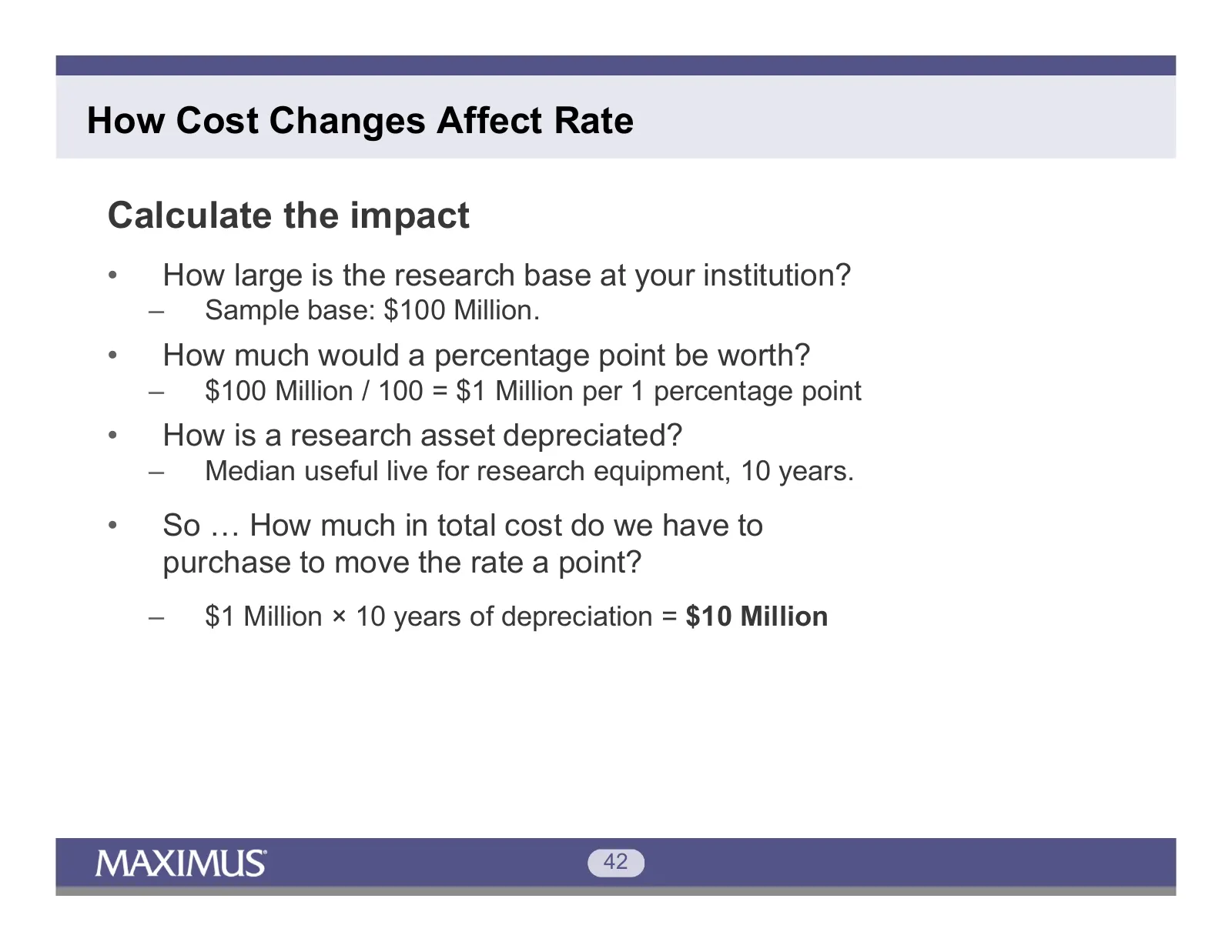
Slide 42: Calculate the Impact
How Cost Changes Affect Rate Calculate the impact • How large is the research base at your institution? – Sample base: $100 Million. • How much would a percentage point be worth? – $100 Million / 100 = $1 Million per 1 percentage point • How is a research asset depreciated? – Median useful live for
Slide 43: New Research Building: Question
How Cost Changes Affect Rate Question A new multi-million dollar research building just went online and was included in our proposal. Will we get an huge increase in F&A rate? 43
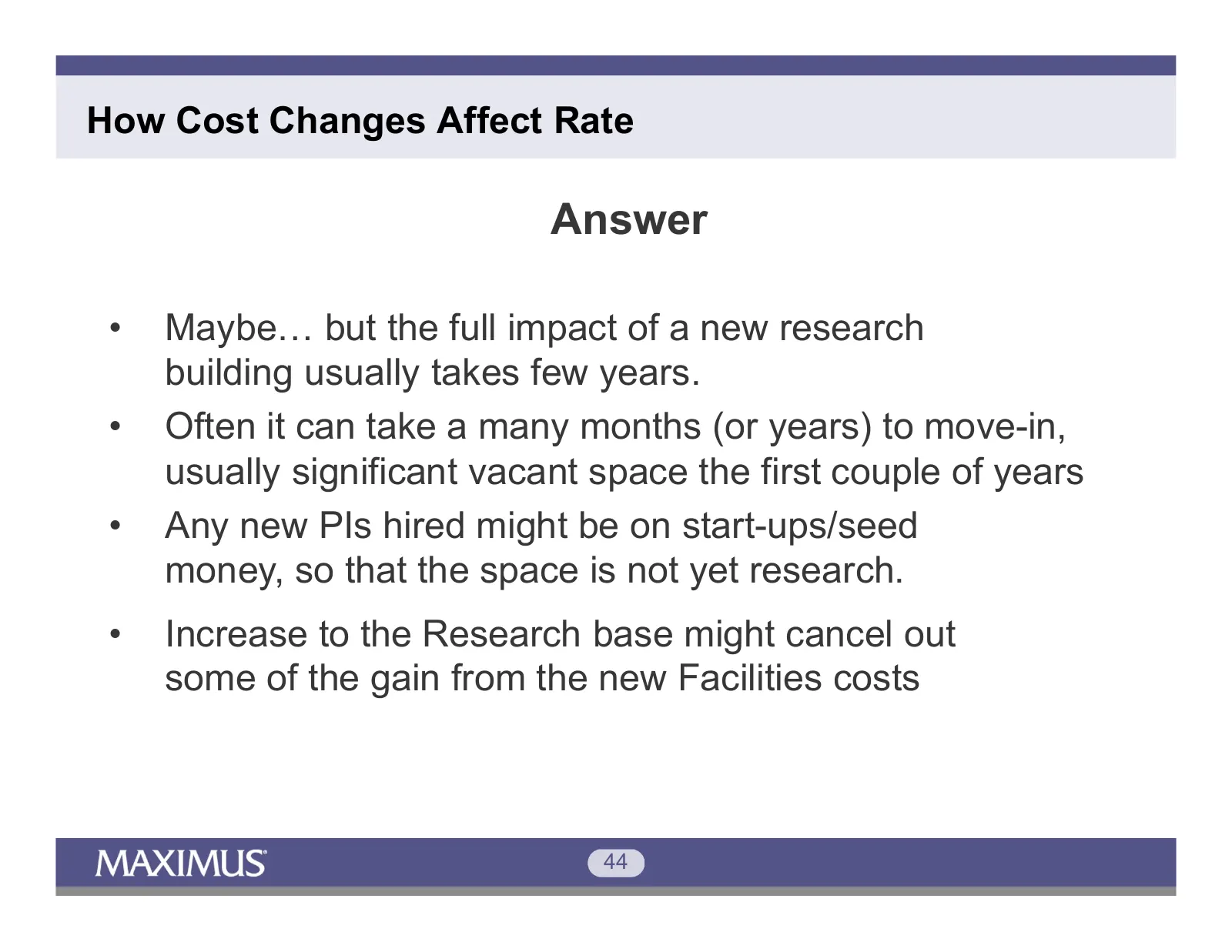
Slide 44: New Research Building: Answer
How Cost Changes Affect Rate Answer • Maybe… but the full impact of a new research building usually takes few years. • Often it can take a many months (or years) to move-in, usually significant vacant space the first couple of years • Any new PIs hired might be on start-ups/seed money, so that the s
Slide 45: What Does It Take to Move the F&A Rate?
How Cost Changes Affect Rate What does it take to move the F&A rate? • Costs to trickle down – Building is complete – There is equipment in the space – The lights are on, gas and water is running • Space survey to support facilities costs – Space must be fully occupied – People in the space must be
Slide 46: Timeline of the Facility
How Cost Changes Affect Rate Timeline of the facility • When is the facility going online? • Will there be a full year of depreciation in the rate? • May have already foregone a year or two of depreciation. 46
Slide 47: Reality of a New Facility
How Cost Changes Affect Rate Reality of a new facility • Full occupancy from depreciation date – Minimum six months to occupy the space – Realistically, a year or two to occupy fully • Who is in the space? How are they paid? – Seed funding? – Start up funding? – Visiting professors? – Unpaid Student
Slide 48: Why Did Our F&A Rate Go Down?
How Cost Changes Affect Rate Question Our research volume went way up. Why did our F&A rate go down? 48
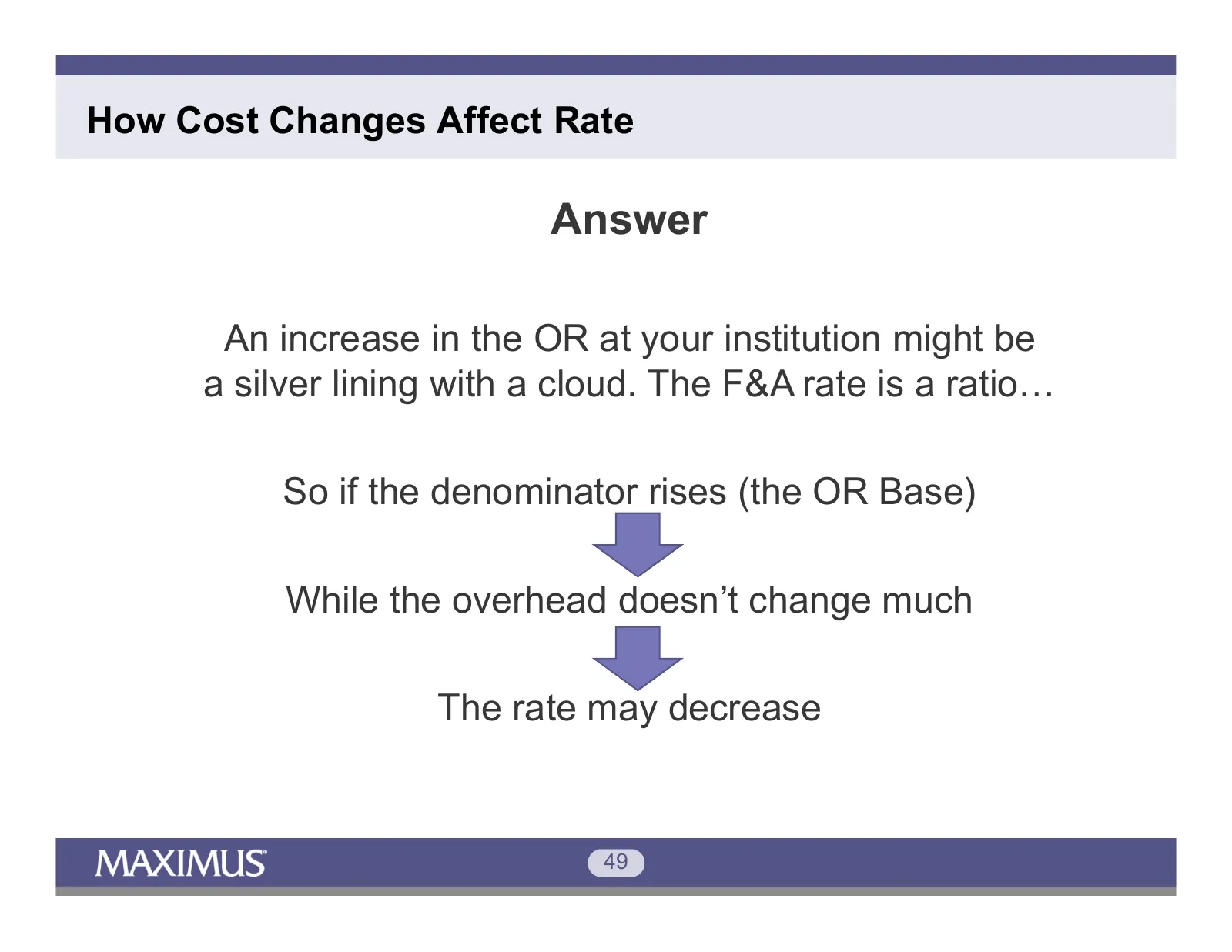
Slide 49: Research Volume and Rate: Answer
How Cost Changes Affect Rate Answer An increase in the OR at your institution might be a silver lining with a cloud. The F&A rate is a ratio… So if the denominator rises (the OR Base) While the overhead doesn’t change much The rate may decrease 49
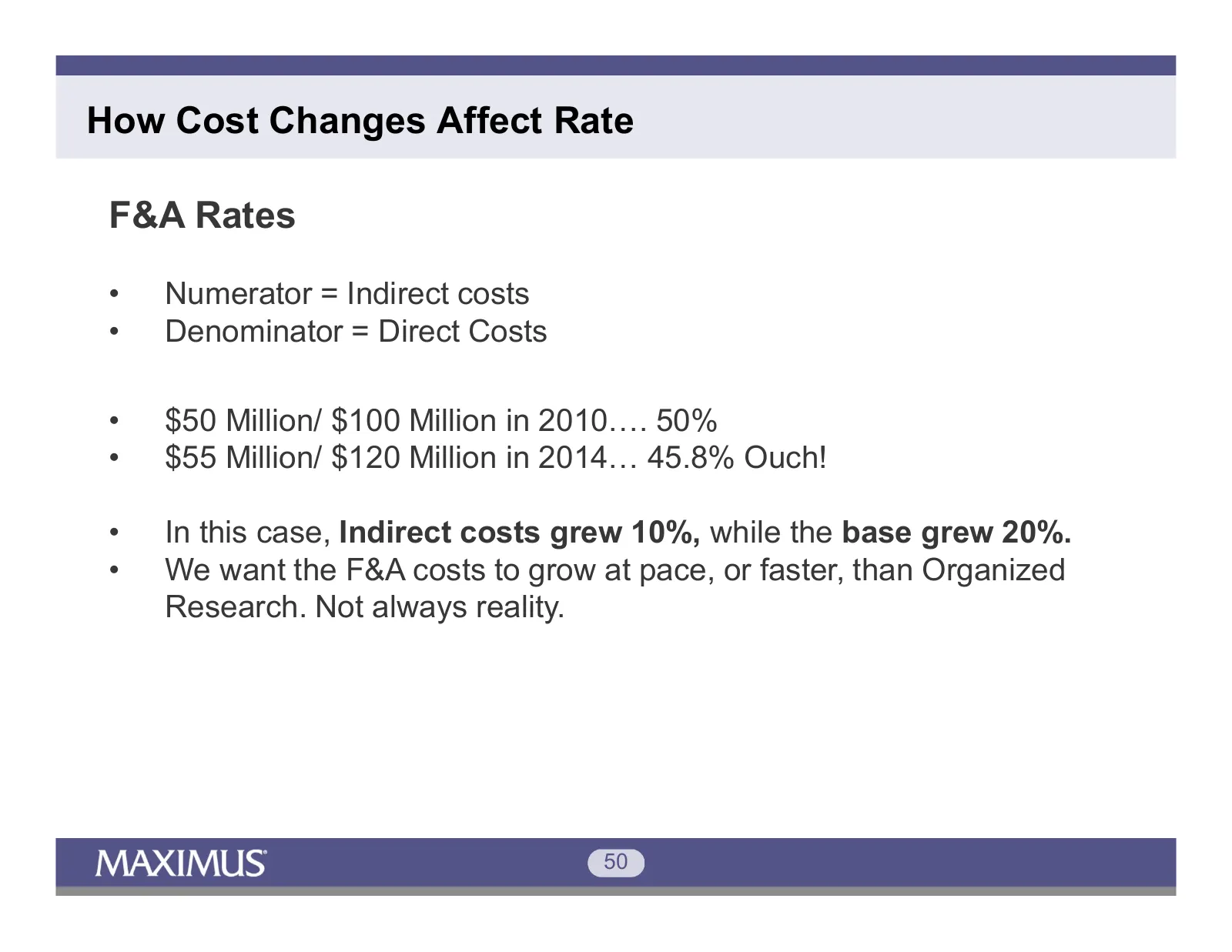
Slide 50: F&A Rates
How Cost Changes Affect Rate F&A Rates • Numerator = Indirect costs • Denominator = Direct Costs • $50 Million/ $100 Million in 2010…. 50% • $55 Million/ $120 Million in 2014… 45.8% Ouch! • In this case, Indirect costs grew 10%, while the base grew 20%. • We want the F&A costs to grow at pace, or fa
Slide 51: Reality of Research Growth
How Cost Changes Affect Rate Reality of Research Growth • Usually growth of research happens first – Grants and contracts can boom quickly • Lagging behind is the infrastructure to support it – At your institution are faculty packed like sardines into research space? – Things have to reach this poin
Slide 52: Conclusions
Conclusions • Indirect/F&A costs are real costs. • F&A is necessary to support research. • It is important to recover F&A to continue re-investing in infrastructure. • Proactive measures to raise the rate don’t really work… key is continuous, steady investment in research infrastructure over time. 5
Slide 53: Upcoming Webinars
Upcoming Webinars Pooled Fringe Rates – Are They Right for Your Institution March 5 | 2:00 p.m. ET Service Centers June 4 | 2:00 p.m. ET Information for F&A Short Form Institutions July 16 | 2:00 p.m. ET Tips for Becoming a CRIS Power User August 20 | 2:00 p.m. ET Alternative Methods for Documenting
Slide 54: Upcoming Workshops and Annual Meeting
Upcoming Workshops and Annual Meeting F&A Workshop April 9 to April 11 | Chicago, IL CRIS University: Introduction to CRIS Workshop May 14 to May 16 | Northbrook, IL 32nd Annual MAXIMUS Higher Education Practice Meeting September 2019 | Location TBD F&A Long Form Training Workshop – in conjunction w
Slide 55: Questions
Questions 55
Slide 56: Anne Feuerborn, Deb Carmel
Anne Feuerborn Deb Carmel AnneFeuerborn@maximus.com DeborahCarmel@maximus.com 480.580.8629 774.313.8991 56
Source: Internet Archive copy of maximus.com
More decks from Maximus, Inc.
 FY2026 Earnings Presentation13 slides · Nov 19, 2026
 Q3 2026 Earnings Presentation12 slides · Aug 6, 2026
 Investor Presentation (June 2026)11 slides · June 2026
 Q2 2026 Earnings Presentation11 slides · May 7, 2026
 Q1 FY2026 Earnings Presentation11 slides · Feb 5, 2026
 FY2025 Earnings Presentation11 slides · Nov 20, 2025