Aura Energy Ltd · ASX:AEE
Aura Energy — International Symposium on Uranium Raw Material for the Nuclear Fuel Cycle (2014)
26 slides from Aura Energy's conference presentation, 2014
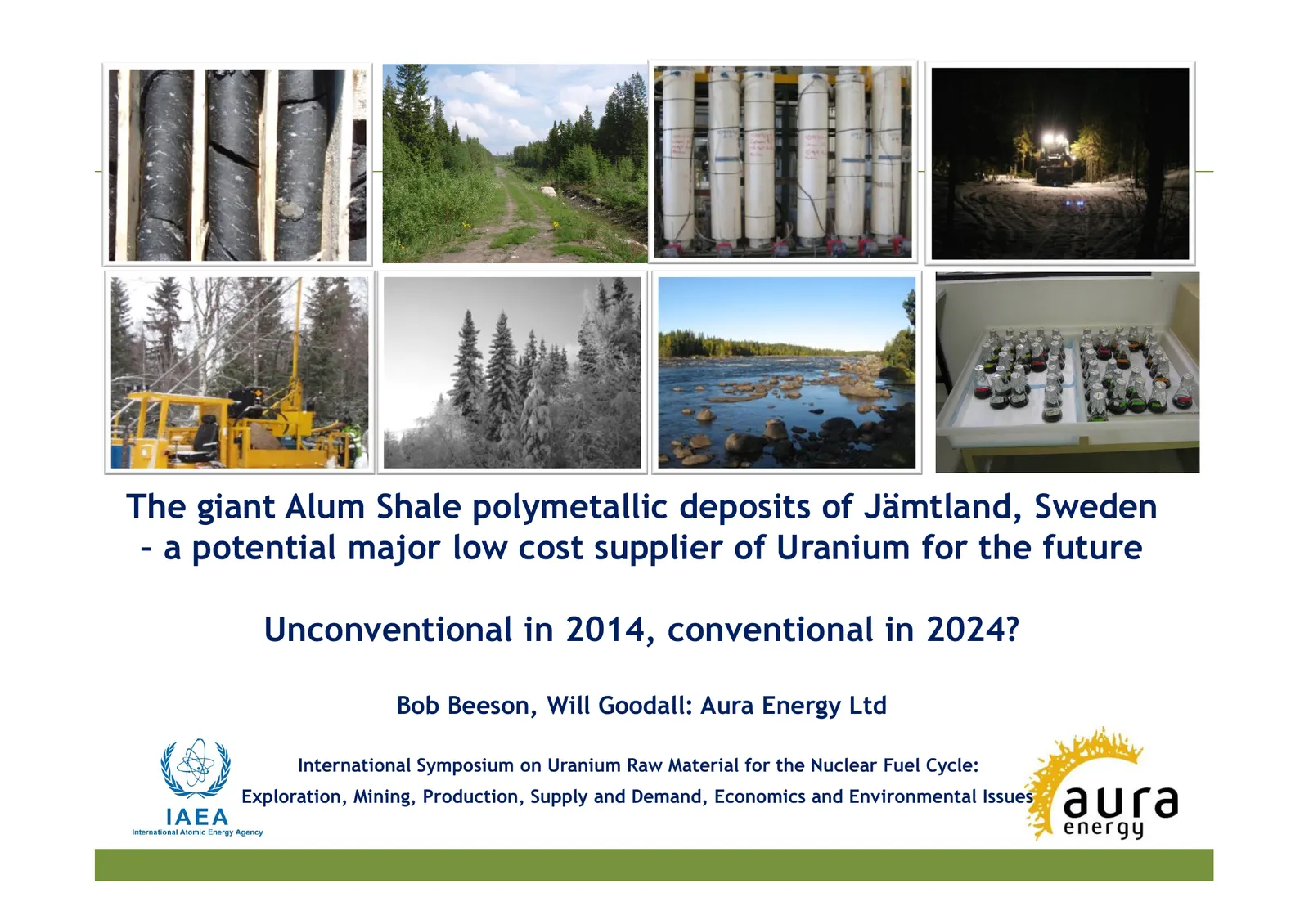
Slide 1: The giant Alum Shale polymetallic deposits of Jämtland, Sweden
The giant Alum Shale polymetallic deposits of Jämtland, Sweden – a potential major low cost supplier of Uranium for the future Unconventional in 2014, conventional in 2024? Bob Beeson, Will Goodall: Aura Energy Ltd International Symposium on Uranium Raw Material for the Nuclear Fuel Cycle: Explorati
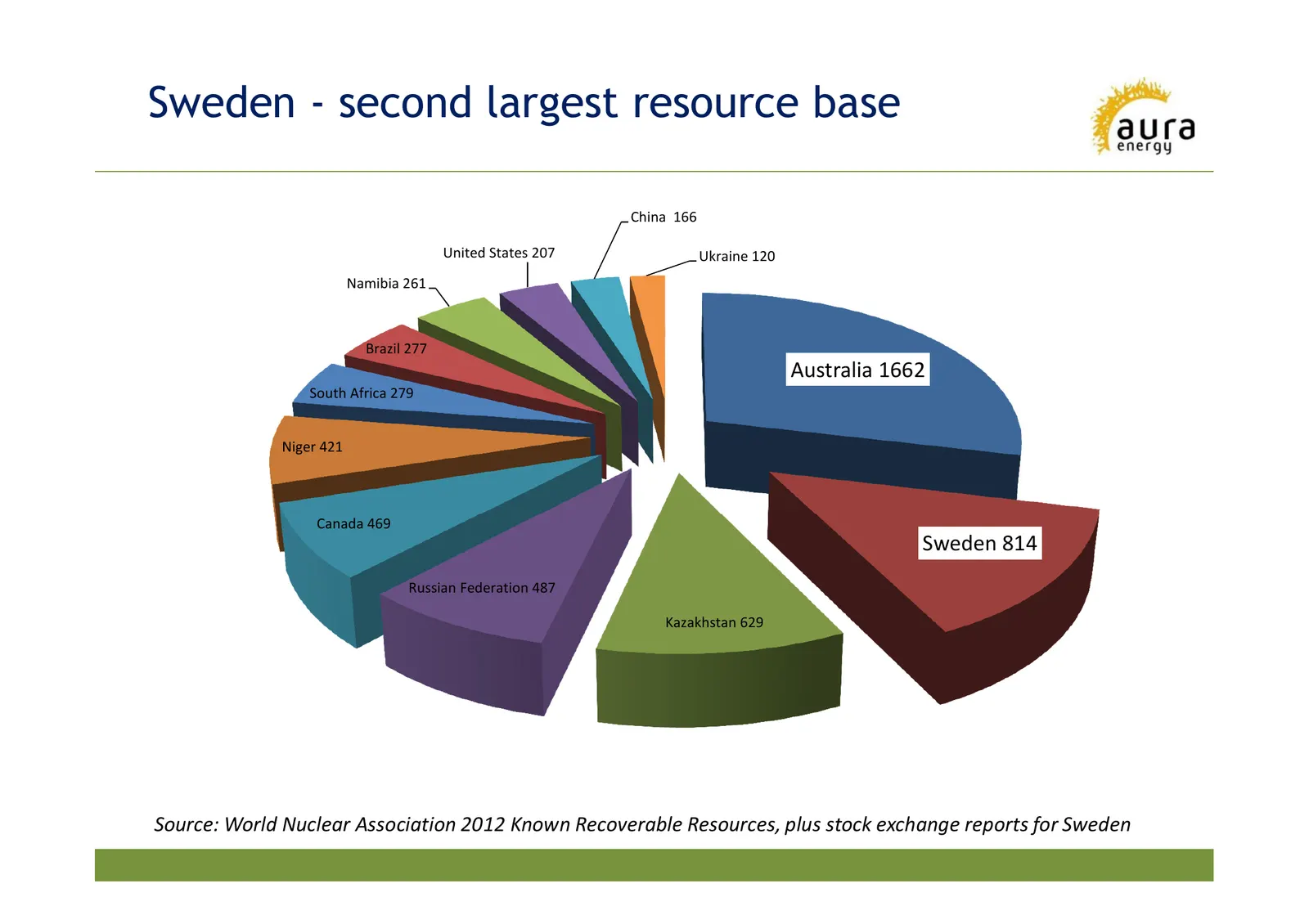
Slide 2: Sweden - second largest resource base
Sweden - second largest resource base China 166 United States 207 Ukraine 120 Namibia 261 Brazil 277 Australia 1662 South Africa 279 Niger 421 Canada 469 Sweden 814 Russian Federation 487 Kazakhstan 629 Source: World Nuclear Association 2012 Known Recoverable Resources, plus stock exchange reports f
Slide 3: Acknowledgements
Acknowledgements The Parker Cooperative Research Centre for Hydrometallurgy: Dr Helen Watling, Dr Ralph Hackl, Felicity Perot, Jian Li, D Collinson, and D Shiers Prof Ross Large, The University of Tasmania CSIRO Process Science and Engineering: Dr Mark Pownceby, Dr Aaron Torpy and Dr Colin McCrae AN
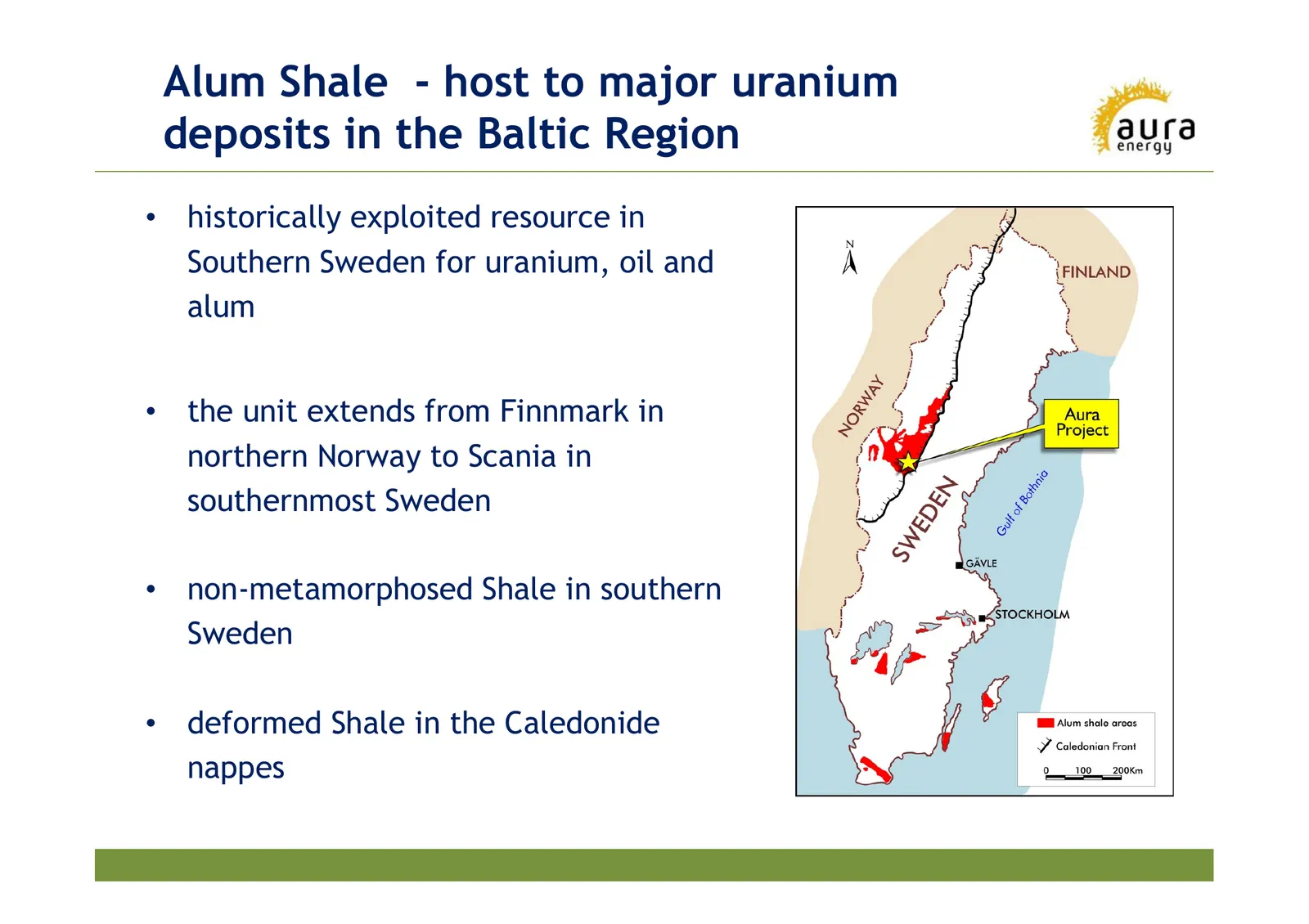
Slide 4: Alum Shale - host to major uranium deposits in the Baltic Region
Alum Shale - host to major uranium deposits in the Baltic Region • historically exploited resource in Southern Sweden for uranium, oil and alum • the unit extends from Finnmark in northern Norway to Scania in southernmost Sweden • non-metamorphosed Shale in southern Sweden • deformed Shale in the Ca
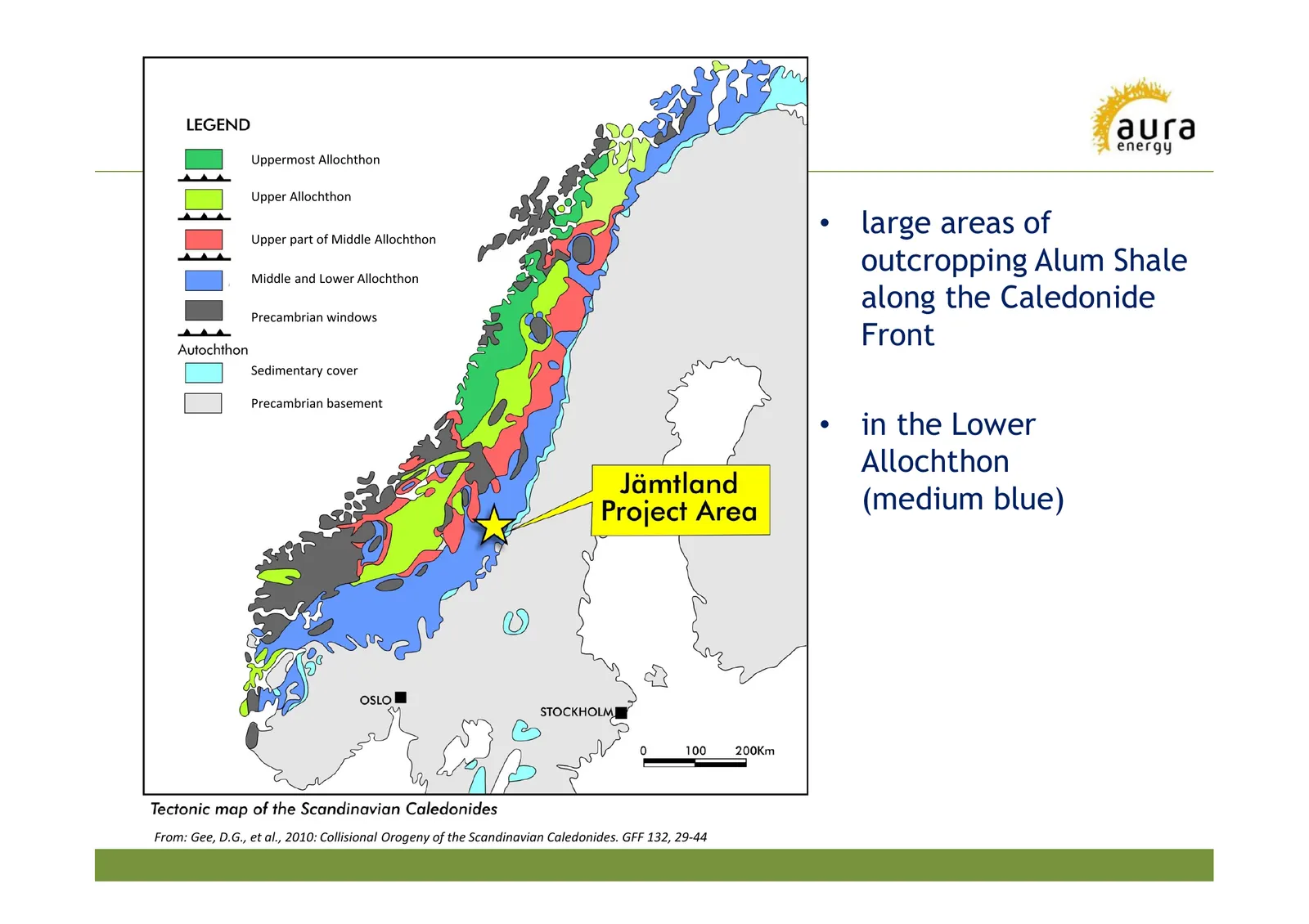
Slide 5: Large areas of outcropping Alum Shale along the Caledonide Front
UUUU Uppermost Allochthon Upper Allochthon Upper part of Middle Allochthon • large areas of Middle and Lower Allochthon outcropping Alum Shale Precambrian windows along the Caledonide Front Sedimentary cover Precambrian basement • in the Lower Allochthon (medium blue) From: Gee, D.G., et al., 2010:
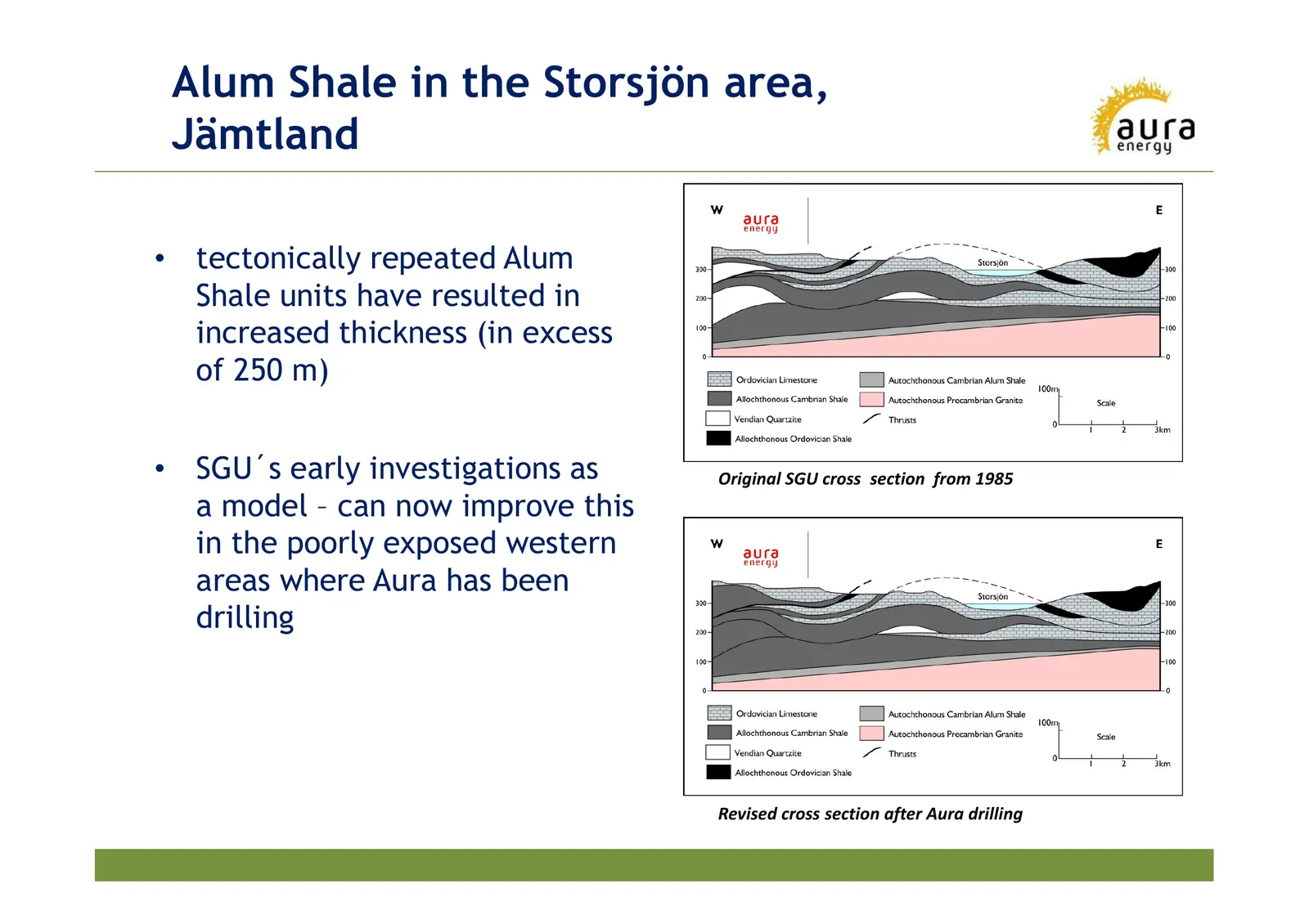
Slide 6: Alum Shale in the Storsjön area, Jämtland
Alum Shale in the Storsjön area, Jämtland • tectonically repeated Alum Shale units have resulted in increased thickness (in excess of 250 m) • SGU´s early investigations as Original SGU cross section from 1985 a model – can now improve this in the poorly exposed western areas where Aura has been dri
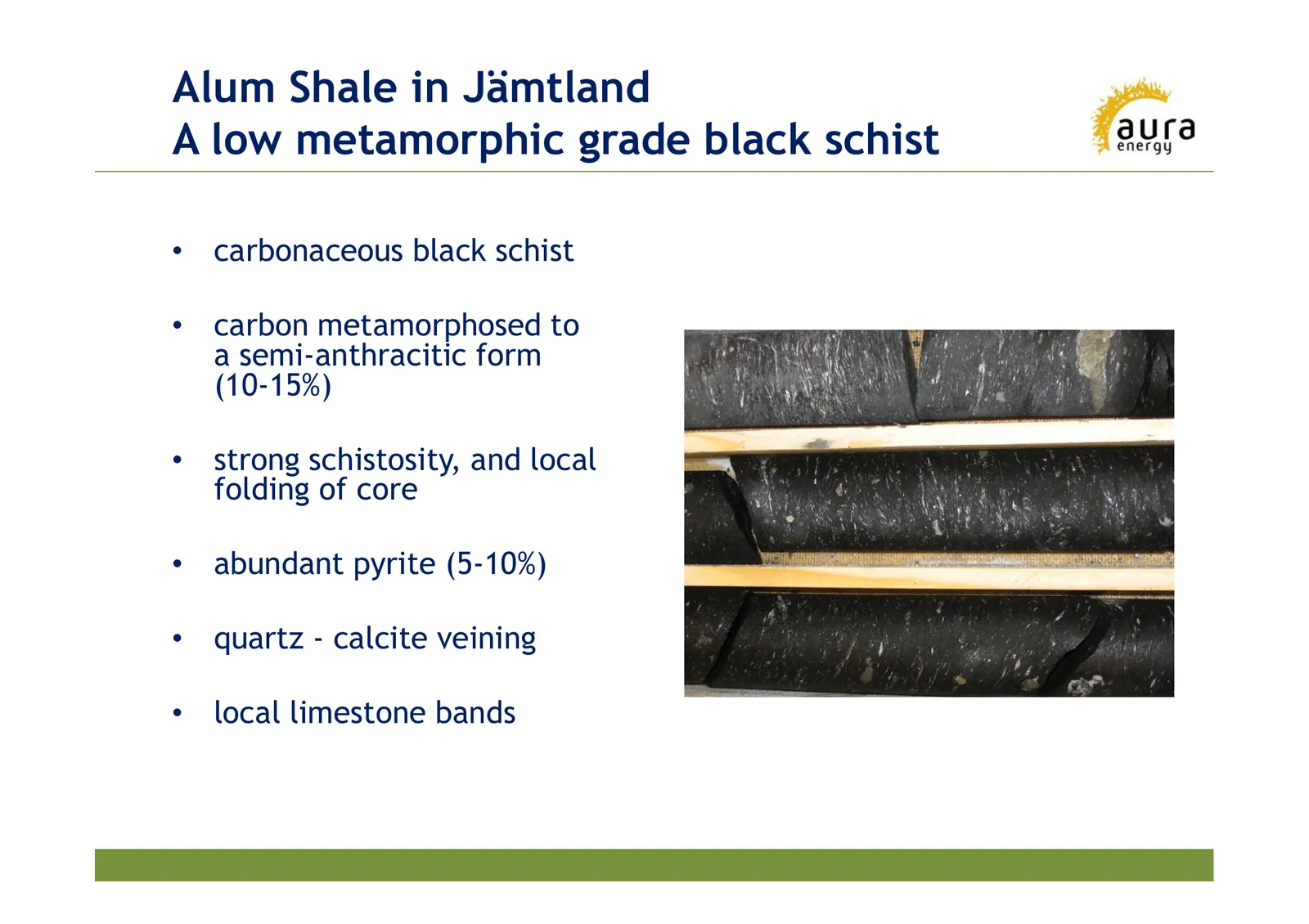
Slide 7: Alum Shale in Jämtland: A low metamorphic grade black schist
Alum Shale in Jämtland A low metamorphic grade black schist • carbonaceous black schist • carbon metamorphosed to a semi-anthracitic form (10-15%) • strong schistosity, and local folding of core • abundant pyrite (5-10%) • quartz - calcite veining • local limestone bands
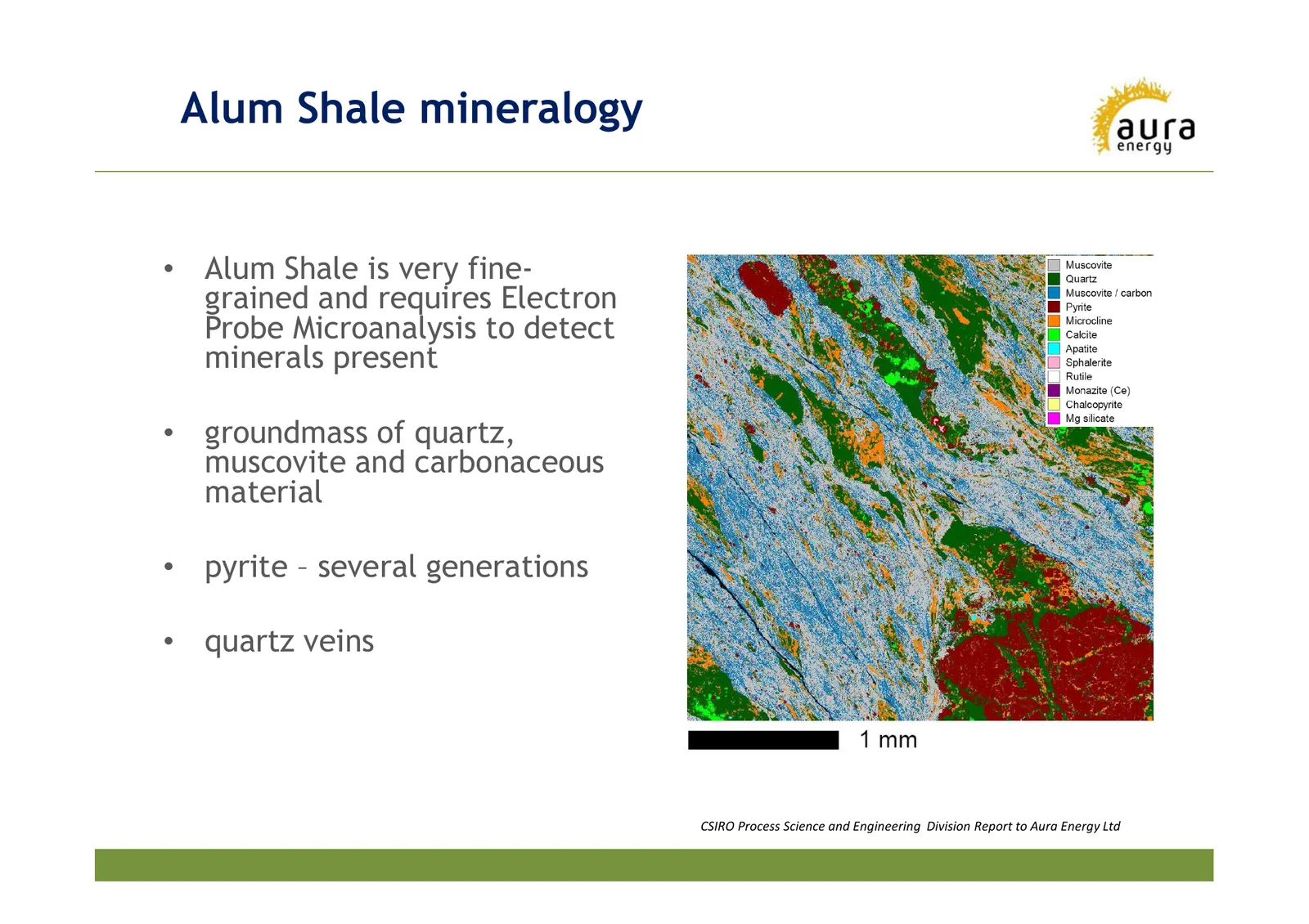
Slide 8: Alum Shale mineralogy
Alum Shale mineralogy • Alum Shale is very fine- grained and requires Electron Probe Microanalysis to detect minerals present • groundmass of quartz, muscovite and carbonaceous material • pyrite – several generations • quartz veins CSIRO Process Science and Engineering Division Report to Aura Energy
Slide 9: Uranium mineralisation
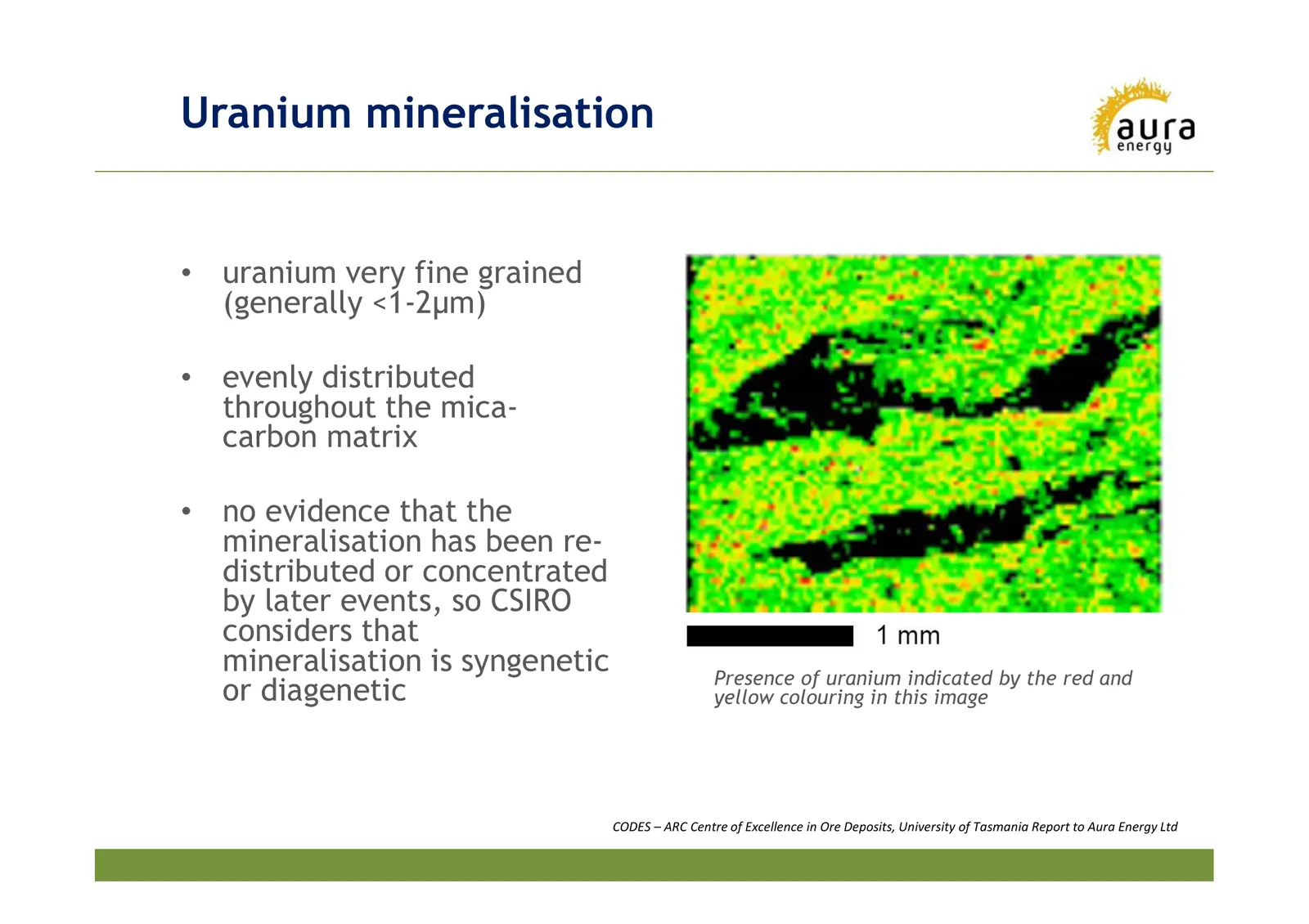
Uranium mineralisation • uranium very fine grained (generally <1-2µm) • evenly distributed throughout the mica- carbon matrix • no evidence that the mineralisation has been re- distributed or concentrated by later events, so CSIRO considers that mineralisation is syngenetic Presence of uranium indic
Slide 10: Examples of metal distributions
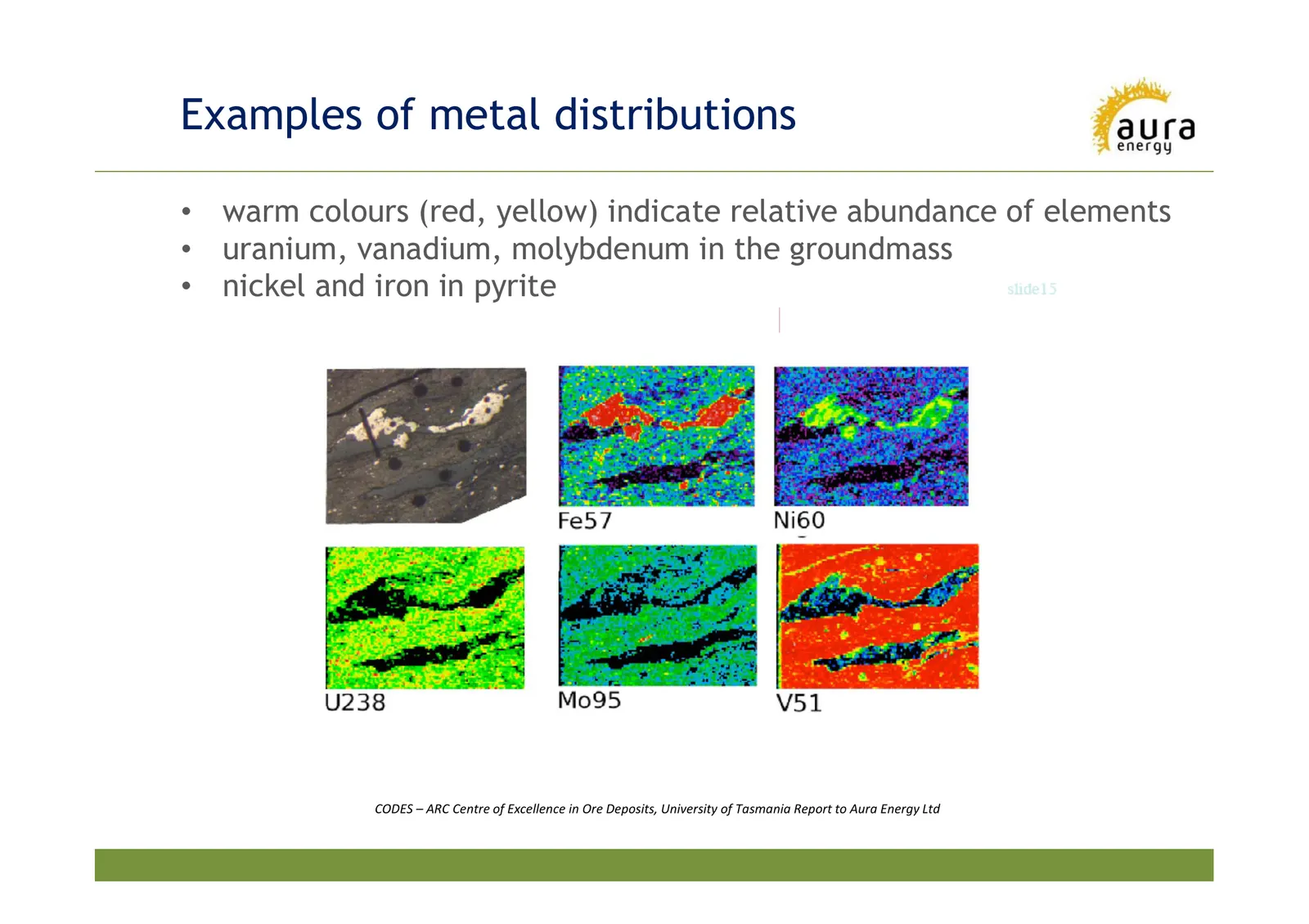
Examples of metal distributions • warm colours (red, yellow) indicate relative abundance of elements • uranium, vanadium, molybdenum in the groundmass • nickel and iron in pyrite CODES – ARC Centre of Excellence in Ore Deposits, University of Tasmania Report to Aura Energy Ltd
Slide 11: Laterally continuous, thick mineralisation
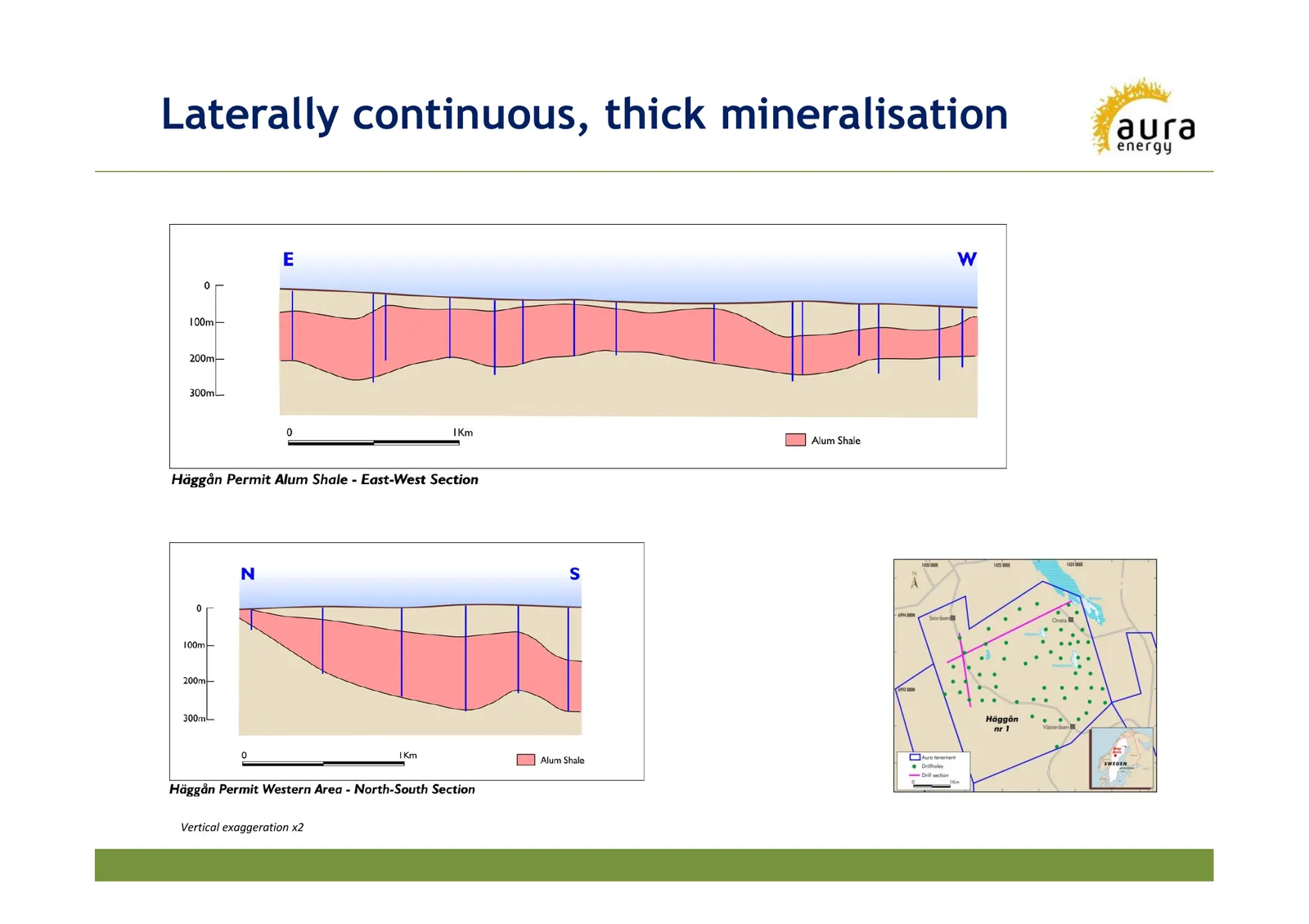
Laterally continuous, thick mineralisation Vertical exaggeration x2
Slide 12: 803Mlbs U3O8 resource
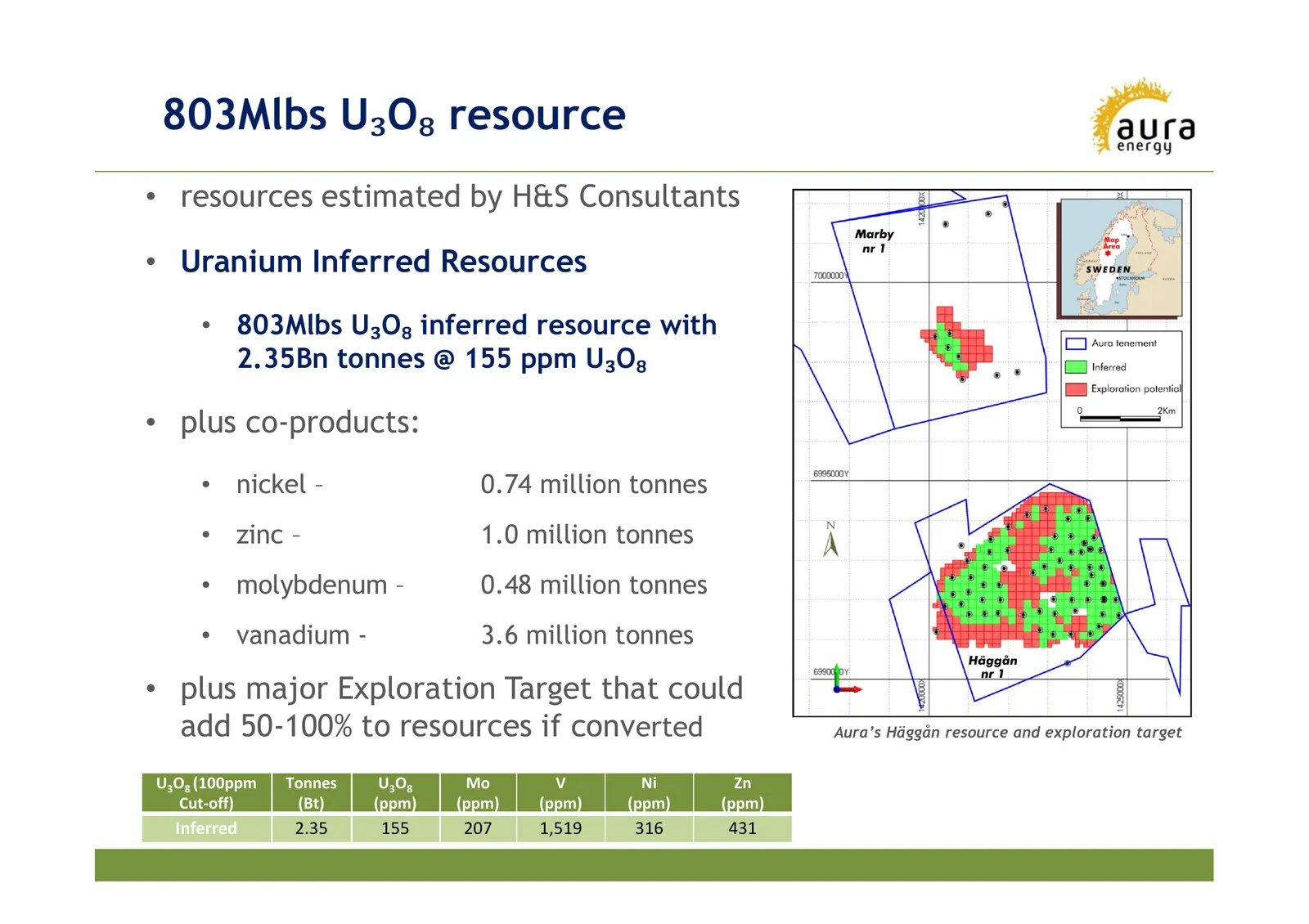
803Mlbs U₃₃O₈₈ resource • resources estimated by H&S Consultants • Uranium Inferred Resources • 803Mlbs U₃₃O₈₈ inferred resource with 2.35Bn tonnes @ 155 ppm U₃₃O₈₈ • plus co-products: • nickel – 0.74 million tonnes • zinc – 1.0 million tonnes • molybdenum – 0.48 million tonnes • vanadium - 3.6 mill
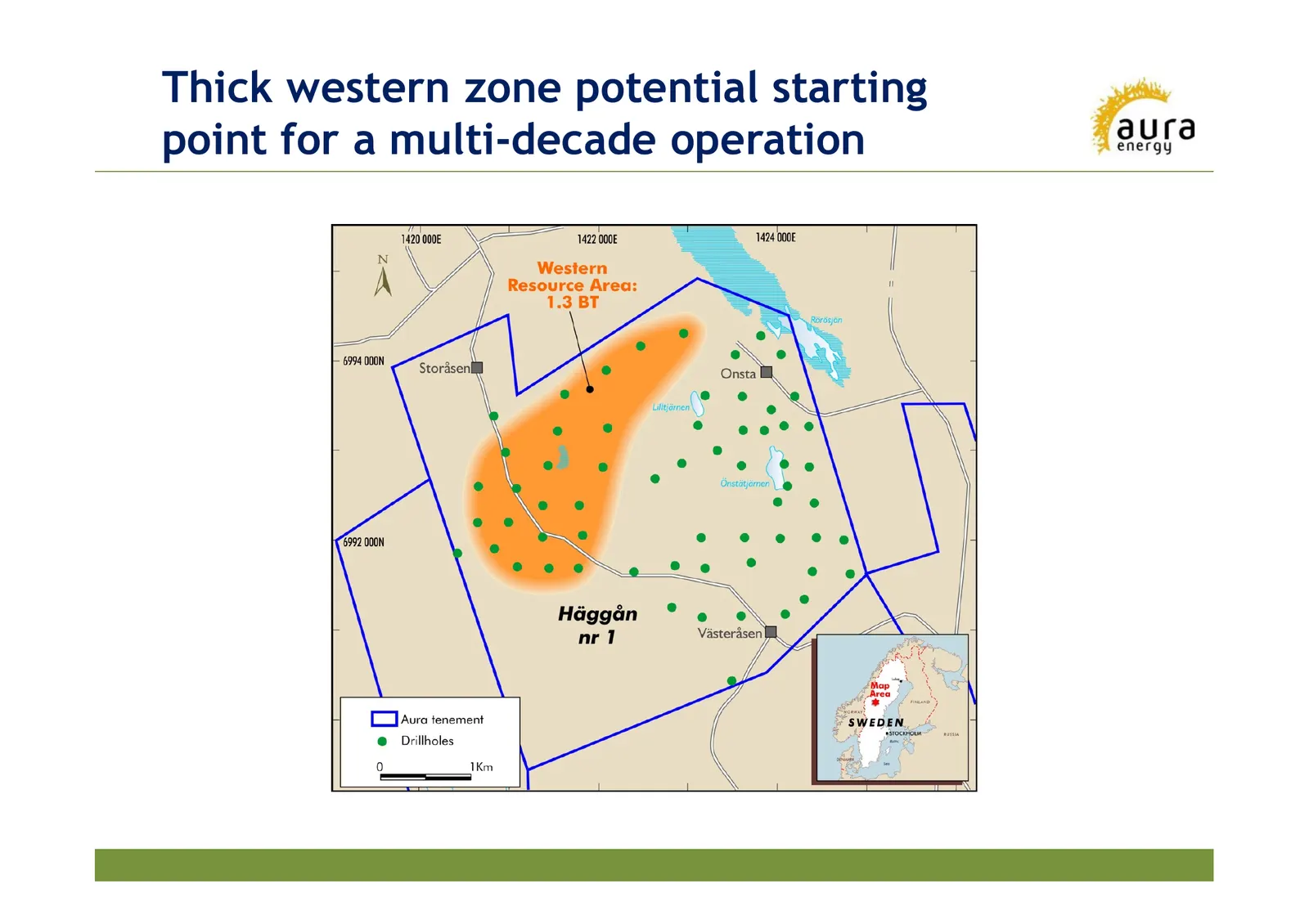
Slide 13: Thick western zone potential starting point for a multi-decade operation
Thick western zone potential starting point for a multi-decade operation
Slide 14: Exceptionally large resources, but can the mineralisation be processed economically?
Exceptionally large resources, but can the mineralisation be processed economically? 2011 Red book: ………………. By the late 1980s however, the cost of production was considered too high for economic production with uranium prices of the time and these deposits were no longer reported in the Red Book.
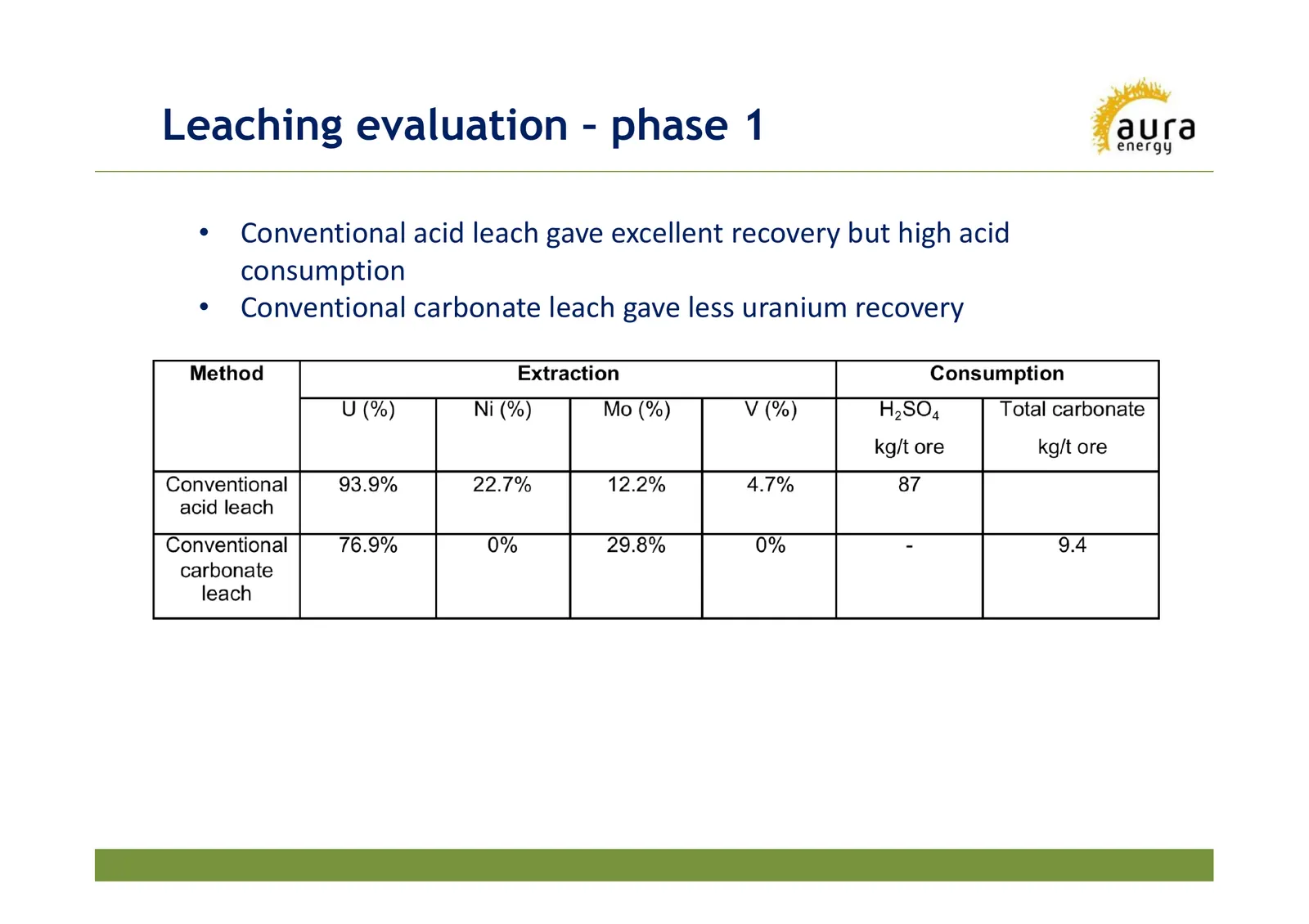
Slide 15: Leaching evaluation – phase 1
Leaching evaluation – phase 1 • Conventional acid leach gave excellent recovery but high acid consumption • Conventional carbonate leach gave less uranium recovery
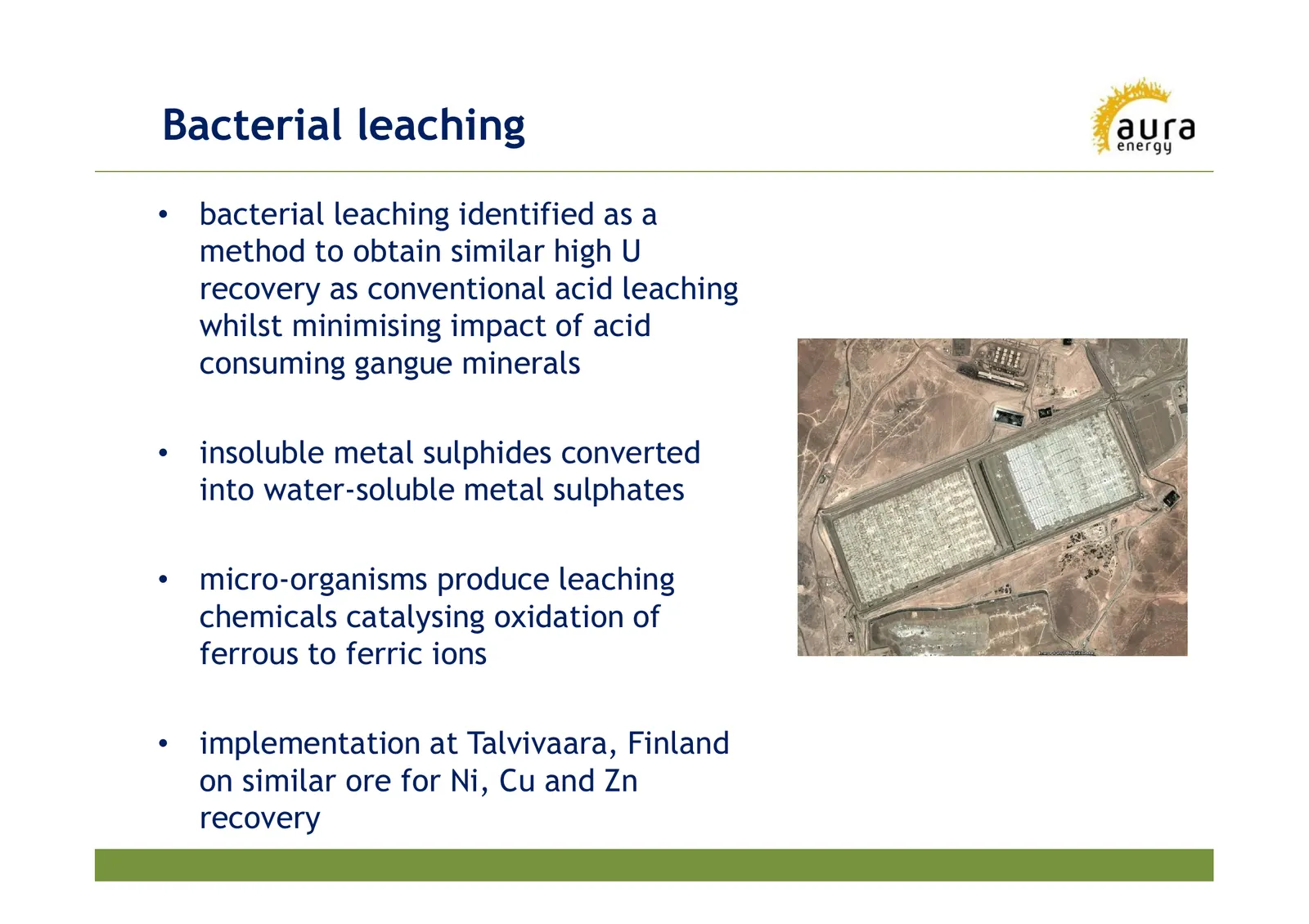
Slide 16: Bacterial leaching
Bacterial leaching • bacterial leaching identified as a method to obtain similar high U recovery as conventional acid leaching whilst minimising impact of acid consuming gangue minerals • insoluble metal sulphides converted into water-soluble metal sulphates • micro-organisms produce leaching chemic
Slide 17: Pyrite
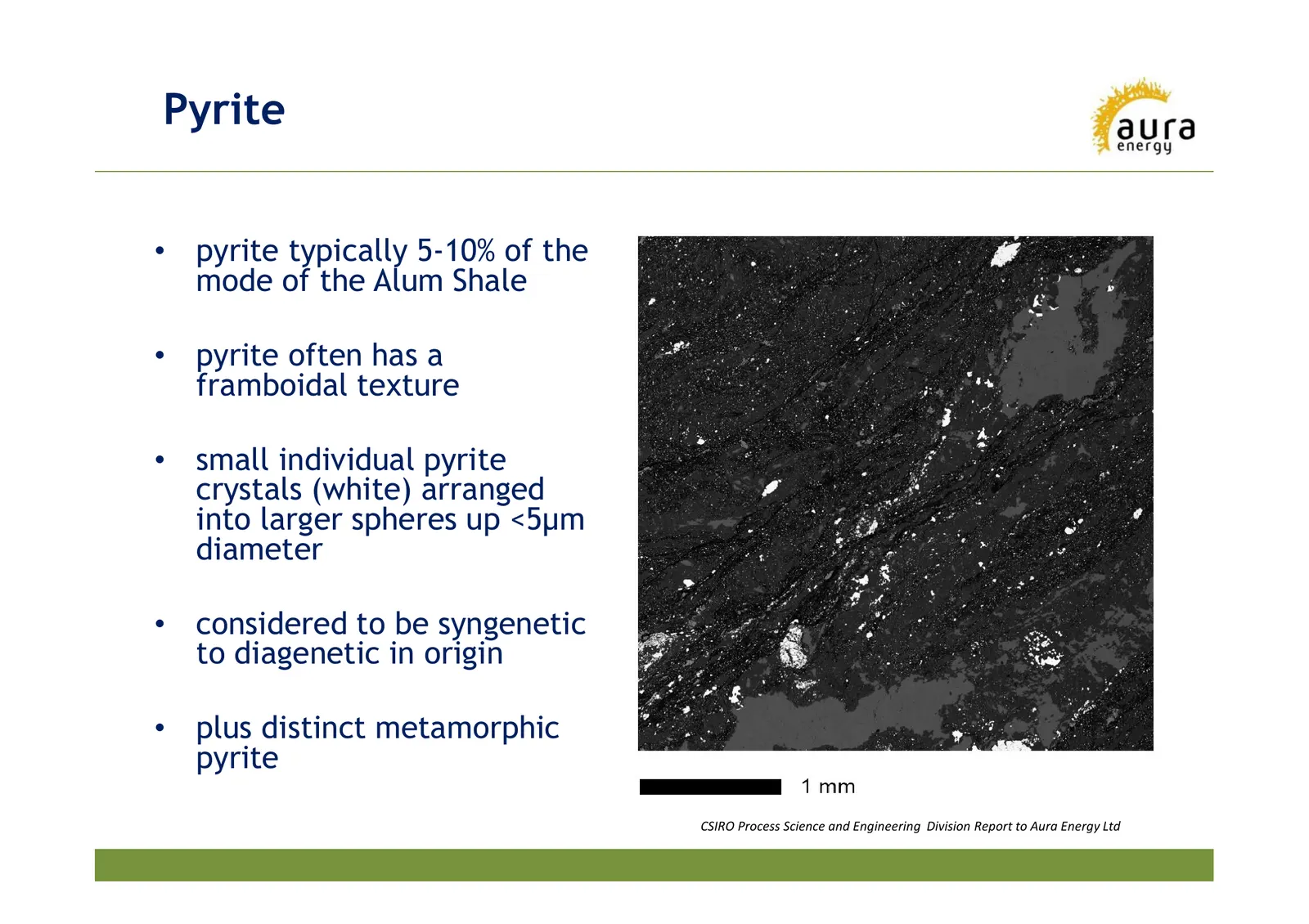
Pyrite • pyrite typically 5-10% of the mode of the Alum Shale • pyrite often has a framboidal texture • small individual pyrite crystals (white) arranged into larger spheres up <5µm diameter • considered to be syngenetic to diagenetic in origin • plus distinct metamorphic pyrite CSIRO Process Scienc
Slide 18: Two broad generations of pyrite present
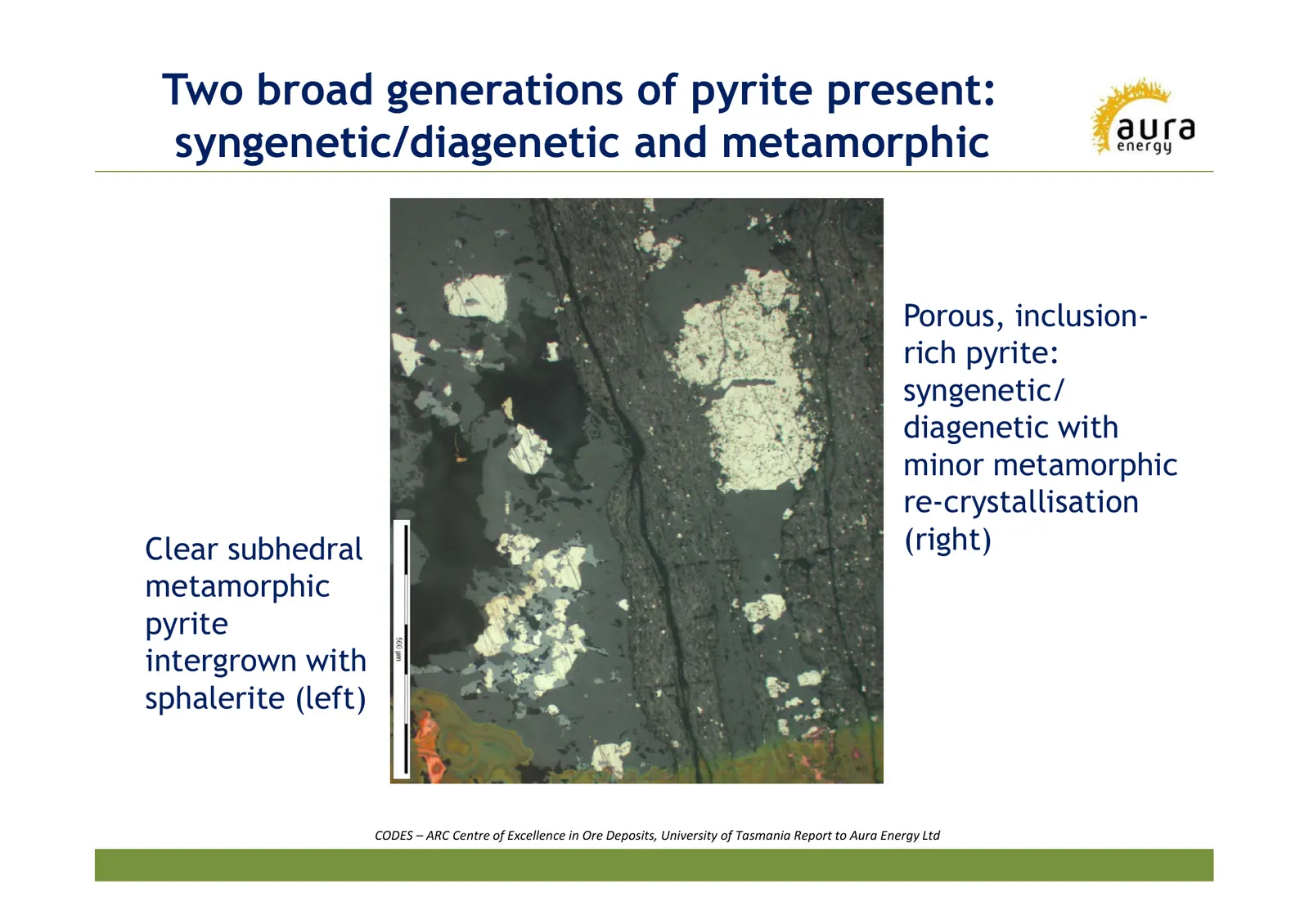
Two broad generations of pyrite present: syngenetic/diagenetic and metamorphic Porous, inclusion- rich pyrite: syngenetic/ diagenetic with minor metamorphic re-crystallisation Clear subhedral (right) metamorphic pyrite intergrown with sphalerite (left) CODES – ARC Centre of Excellence in Ore Deposit
Slide 19: Bacterial leaching results – Stage 1
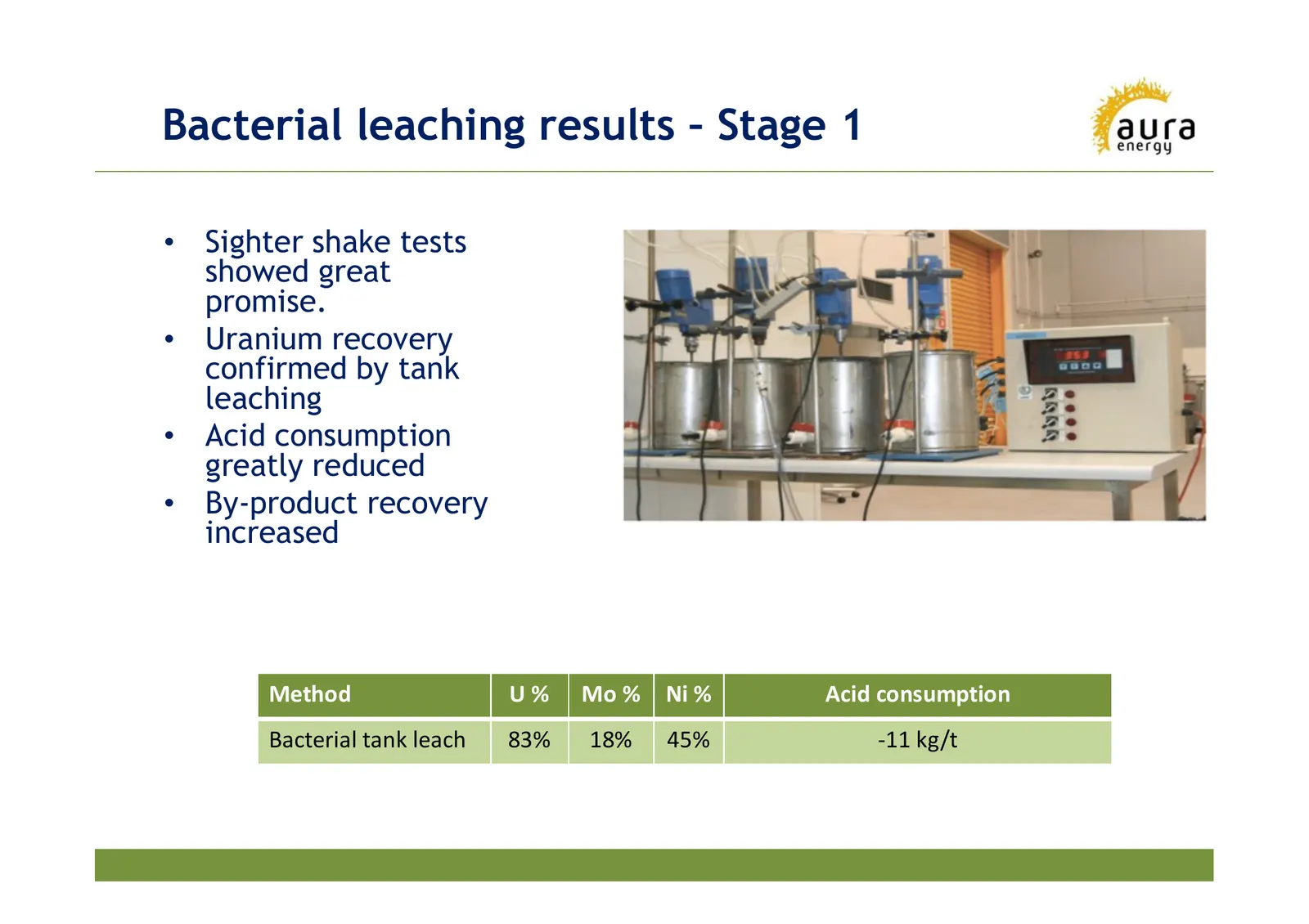
Bacterial leaching results – Stage 1 • Sighter shake tests showed great promise. • Uranium recovery confirmed by tank leaching • Acid consumption greatly reduced • By-product recovery increased Method U% Mo % Ni % Acid consumption Bacterial tank leach 83% 18% 45% -11 kg/t
Slide 20: Bacterial leaching results – column leaching
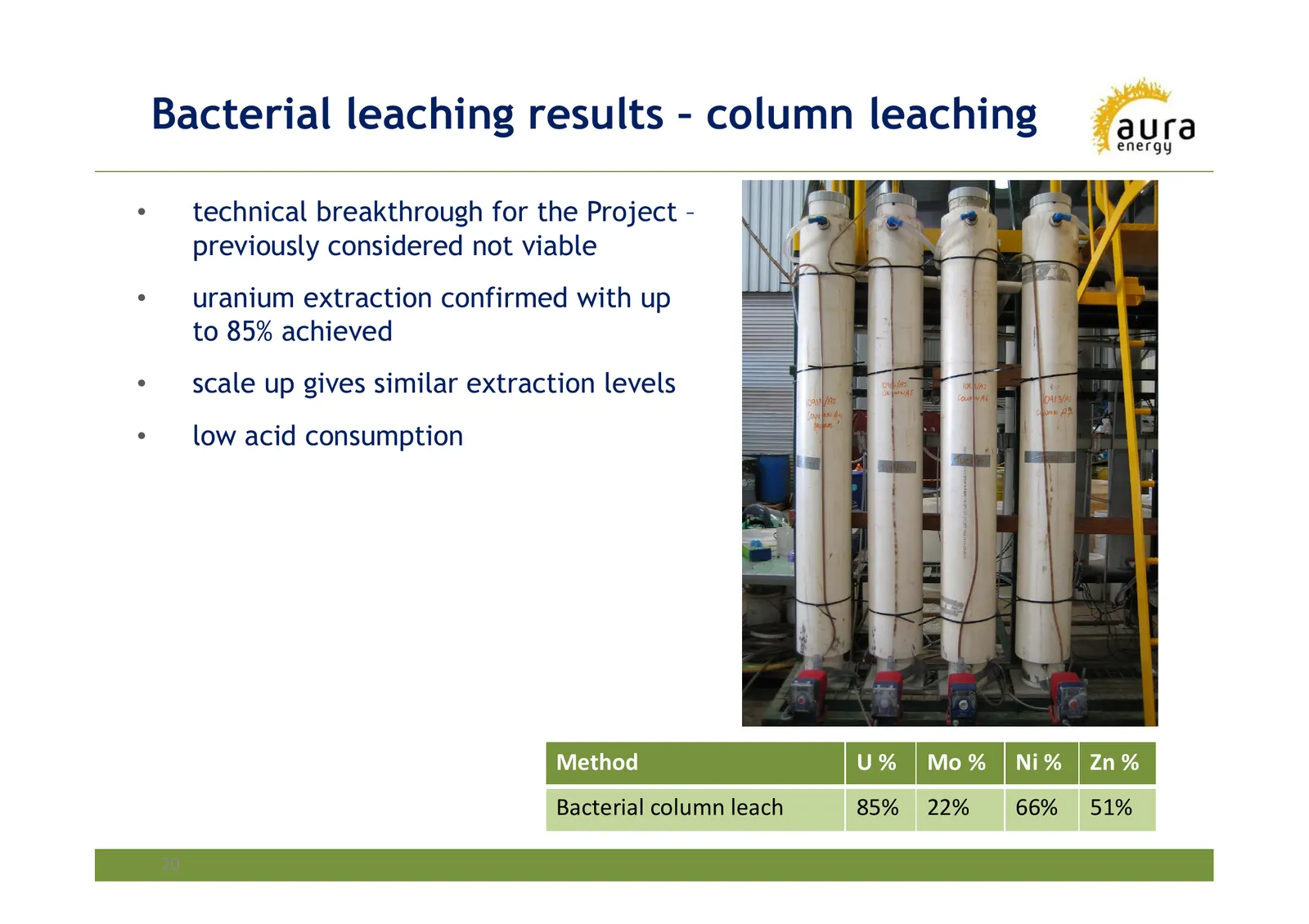
Bacterial leaching results – column leaching • technical breakthrough for the Project – previously considered not viable • uranium extraction confirmed with up to 85% achieved • scale up gives similar extraction levels • low acid consumption Method U% Mo % Ni % Zn % Bacterial column leach 85% 22% 66
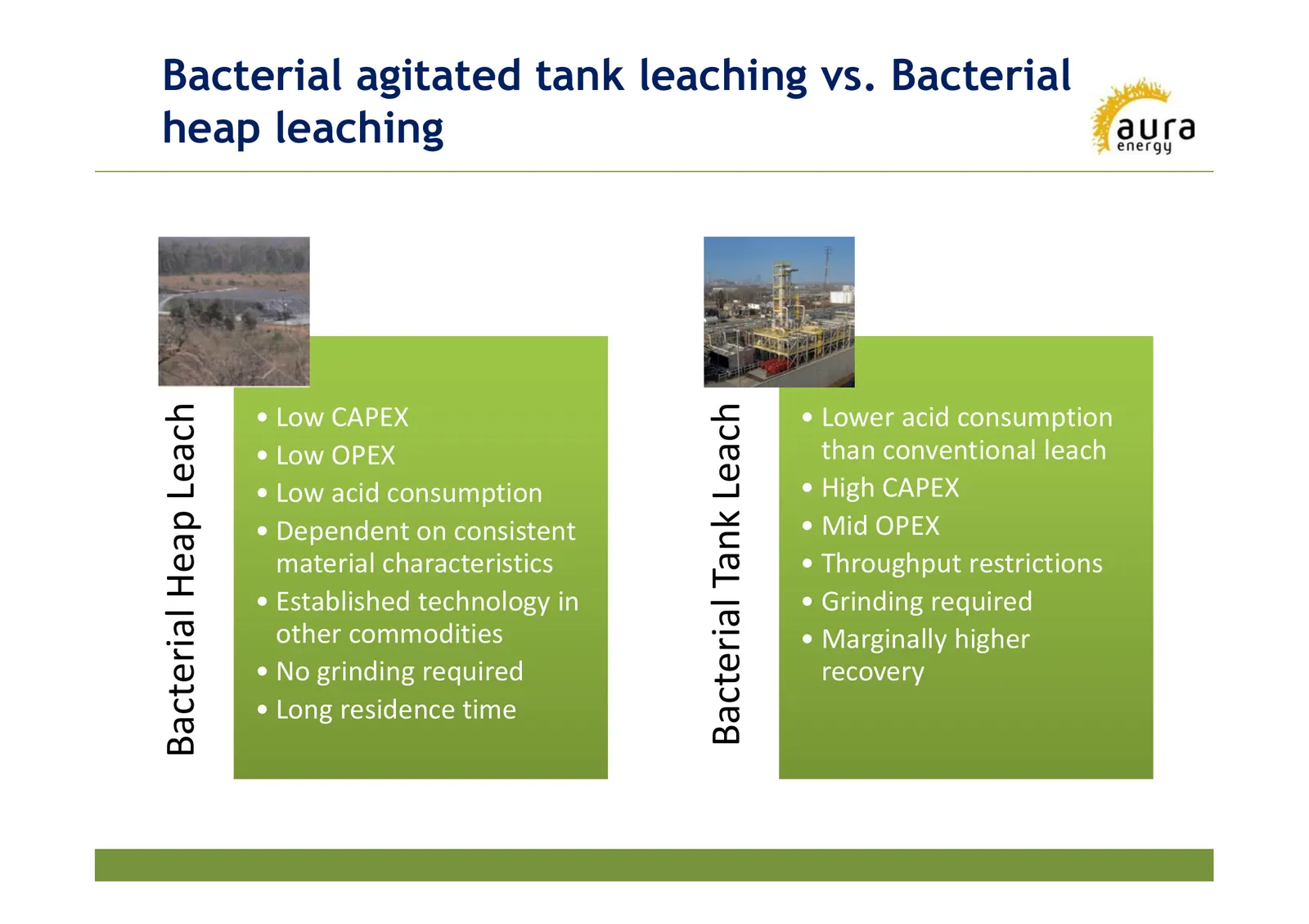
Slide 21: Bacterial agitated tank leaching vs. bacterial heap leaching
Bacterial agitated tank leaching vs. Bacterial heap leaching Bacterial Heap Leach Bacterial Tank Leach • Low CAPEX • Lower acid consumption • Low OPEX than conventional leach • Low acid consumption • High CAPEX • Dependent on consistent • Mid OPEX material characteristics • Throughput restrictions •
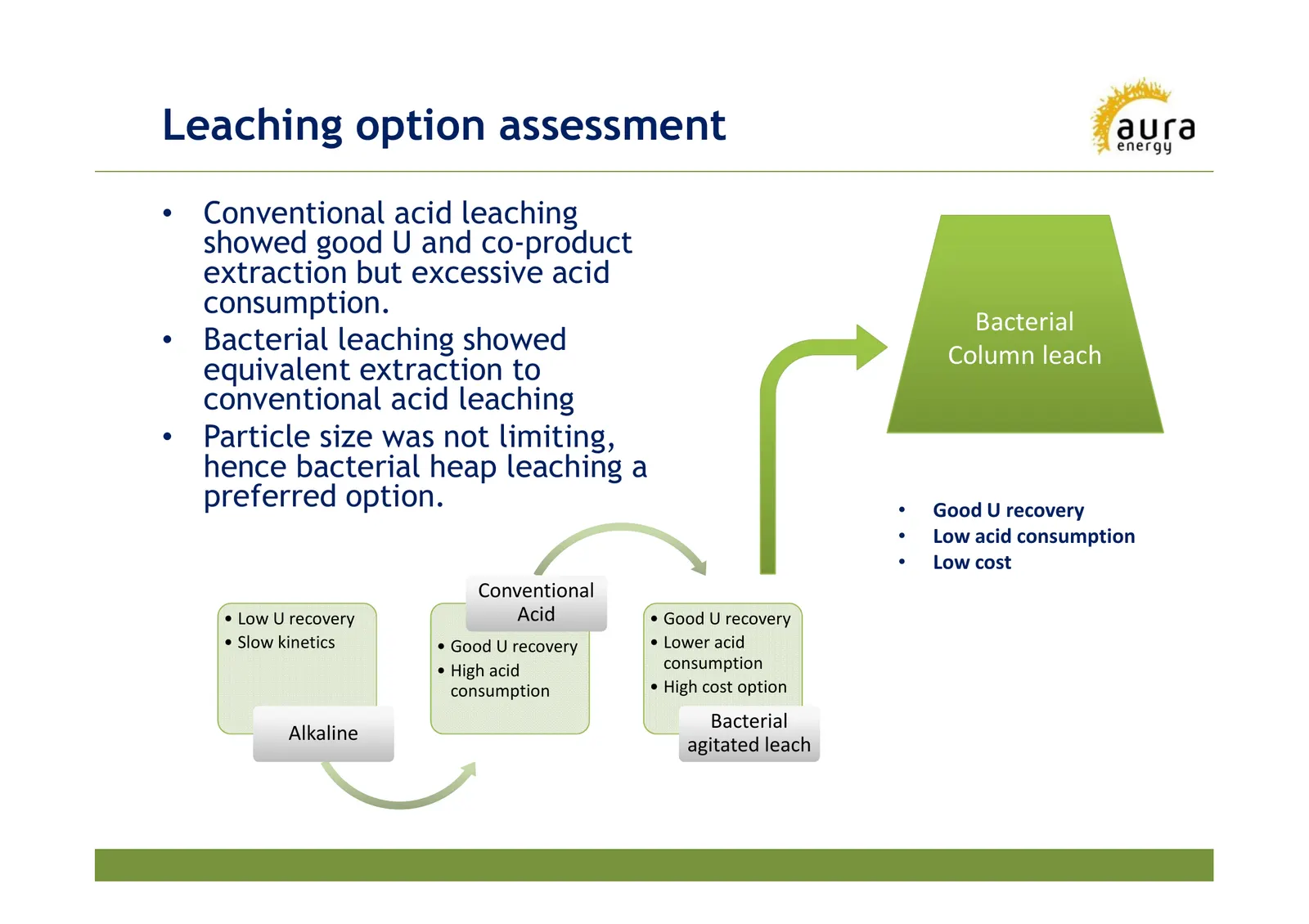
Slide 22: Leaching option assessment
Leaching option assessment • Conventional acid leaching showed good U and co-product extraction but excessive acid consumption. Bacterial • Bacterial leaching showed Column leach equivalent extraction to conventional acid leaching • Particle size was not limiting, hence bacterial heap leaching a pre
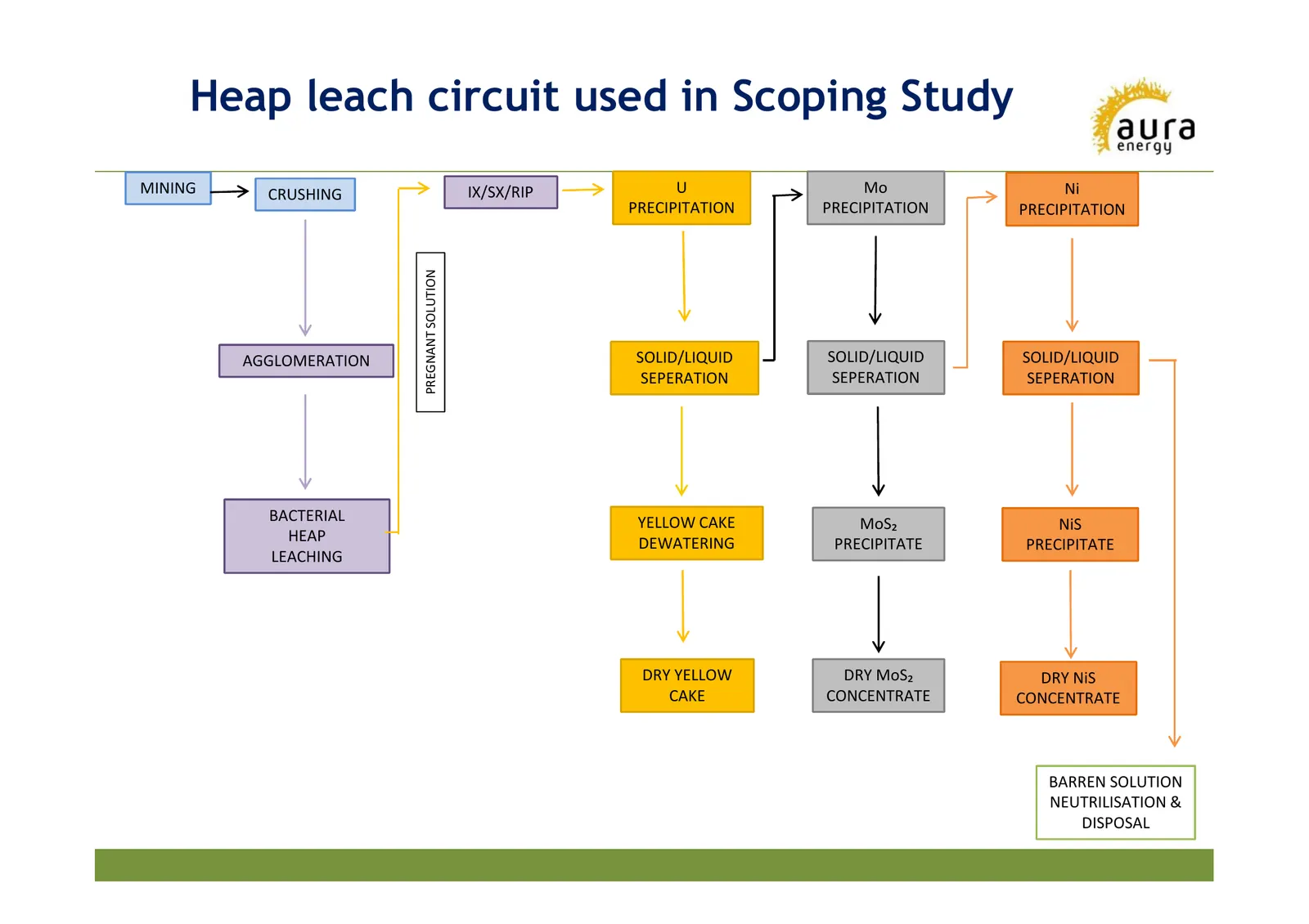
Slide 23: Heap leach circuit used in Scoping Study
Heap leach circuit used in Scoping Study MINING CRUSHING IX/SX/RIP U Mo Ni PRECIPITATION PRECIPITATION PRECIPITATION PREGNANT SOLUTION AGGLOMERATION SOLID/LIQUID SOLID/LIQUID SOLID/LIQUID SEPERATION SEPERATION SEPERATION BACTERIAL YELLOW CAKE MoS₂ NiS HEAP DEWATERING PRECIPITATE PRECIPITATE LEACHING
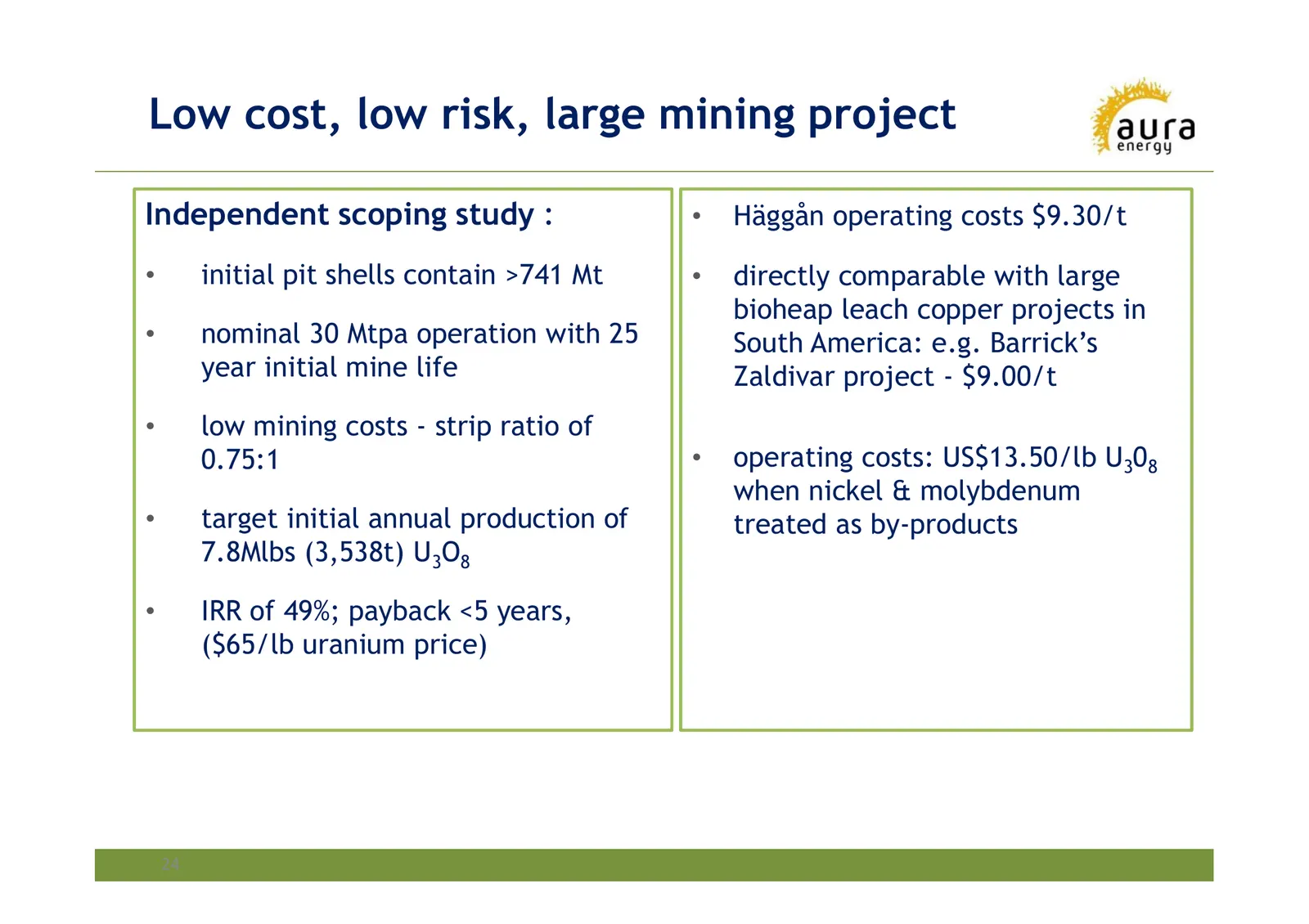
Slide 24: Low cost, low risk, large mining project
Low cost, low risk, large mining project Independent scoping study : • Häggån operating costs $9.30/t • initial pit shells contain >741 Mt • directly comparable with large bioheap leach copper projects in • nominal 30 Mtpa operation with 25 South America: e.g. Barrick’s year initial mine life Zaldiv
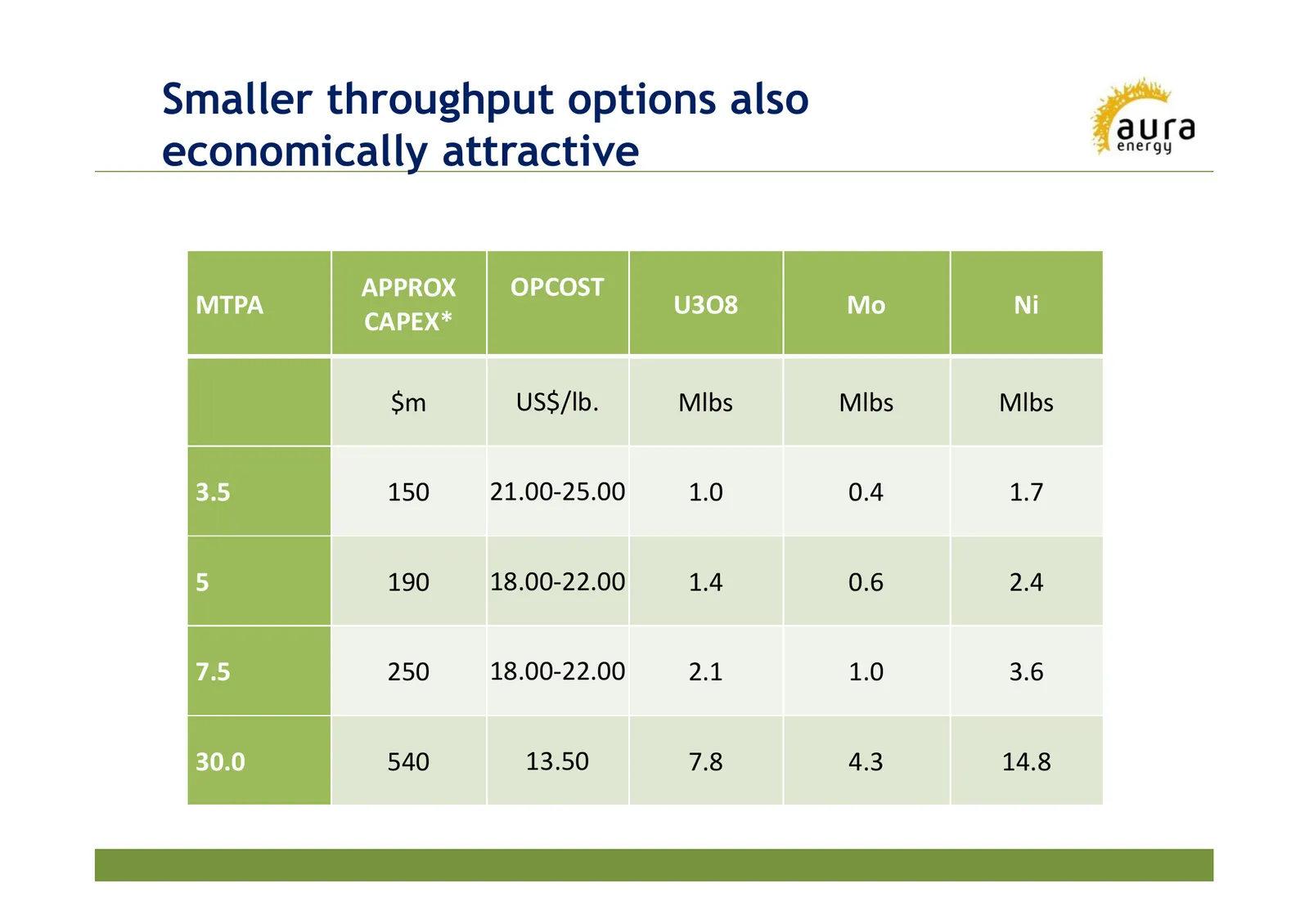
Slide 25: Smaller throughput options also economically attractive
Smaller throughput options also economically attractive APPROX OPCOST MTPA U3O8 Mo Ni CAPEX* $m US$/lb. Mlbs Mlbs Mlbs 3.5 150 21.00-25.00 1.0 0.4 1.7 5 190 18.00-22.00 1.4 0.6 2.4 7.5 250 18.00-22.00 2.1 1.0 3.6 30.0 540 13.50 7.8 4.3 14.8
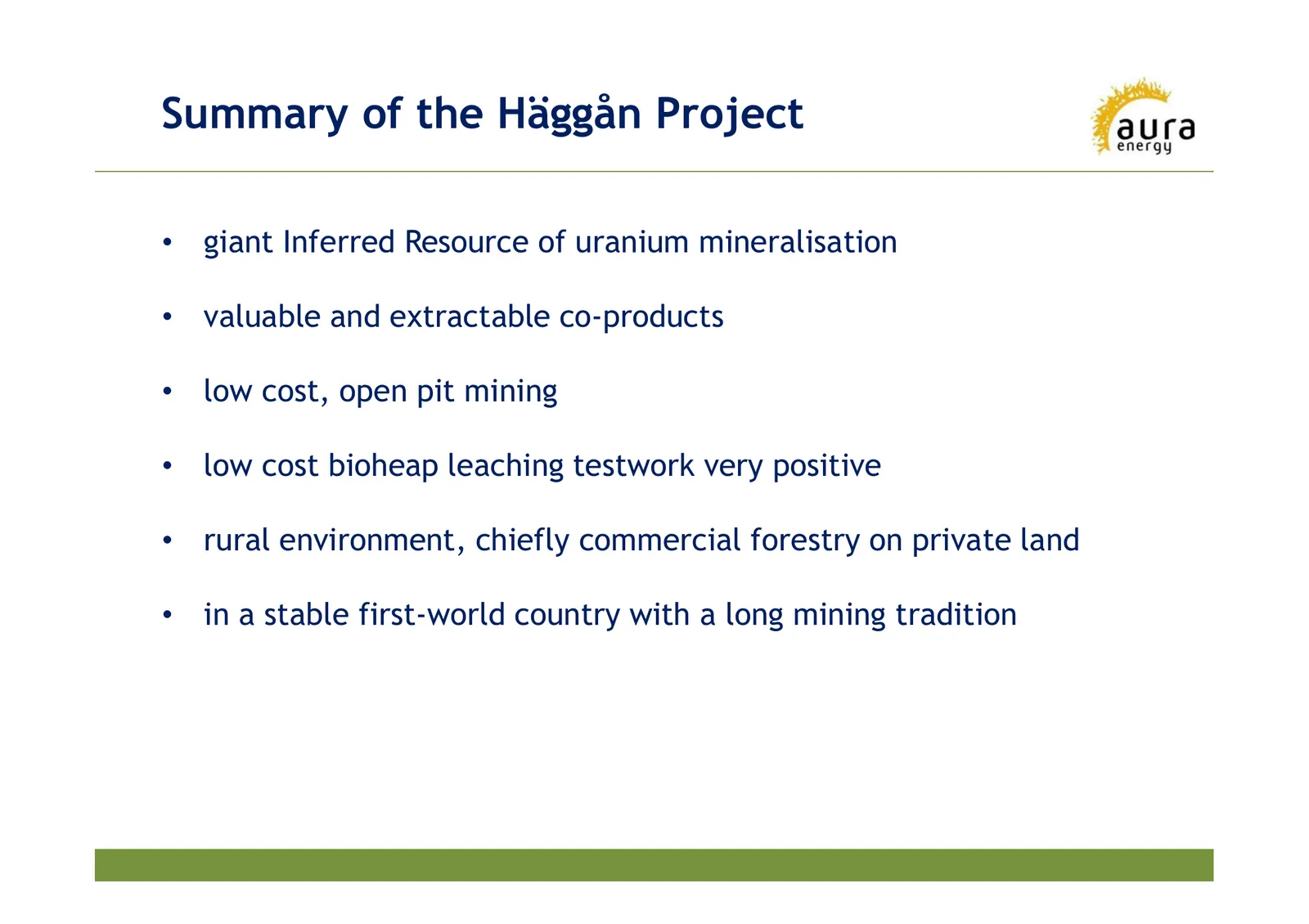
Slide 26: Summary of the Häggån Project
Summary of the Häggån Project • giant Inferred Resource of uranium mineralisation • valuable and extractable co-products • low cost, open pit mining • low cost bioheap leaching testwork very positive • rural environment, chiefly commercial forestry on private land • in a stable first-world country w
Source: Internet Archive copy of auraenergy.com.au
More decks from Aura Energy Ltd
 Technical Presentation (October 2026)75 slides · Oct 19, 2026
 121 Conference, London 202640 slides · May 2026
 Africa Downunder 202517 slides · Sep 5, 2025
 Investor Presentation (September 2025)23 slides · September 2025
 Fact Sheet (February 2025)1 slide · February 2025
 Investor Presentation (February 2025)21 slides · February 2025