BetaShares FTSE 100 ETF · ASX:F100
BetaShares FTSE 100 ETF — BetaShares — Conference Presentation (December 2017)
34 slides from BetaShares FTSE 100 ETF's conference presentation, December 2017
Slide 1: Hybrids – Risks, pitfalls and opportunities
Hybrids – Risks, pitfalls and opportunities
Slide 2: Important Information
Important Information The information contained in this document is general information only and does not constitute personal financial advice. It does not take into account any person’s financial objectives, situation or needs. It has been prepared by BetaShares Capital Limited (ABN 78 139 566 868,
Slide 3: Before we start…
Before we start… A recording of the session will be sent to all attendees Confidential – may not be distributed without the consent of BetaShares capital
Slide 4: Today's presenters
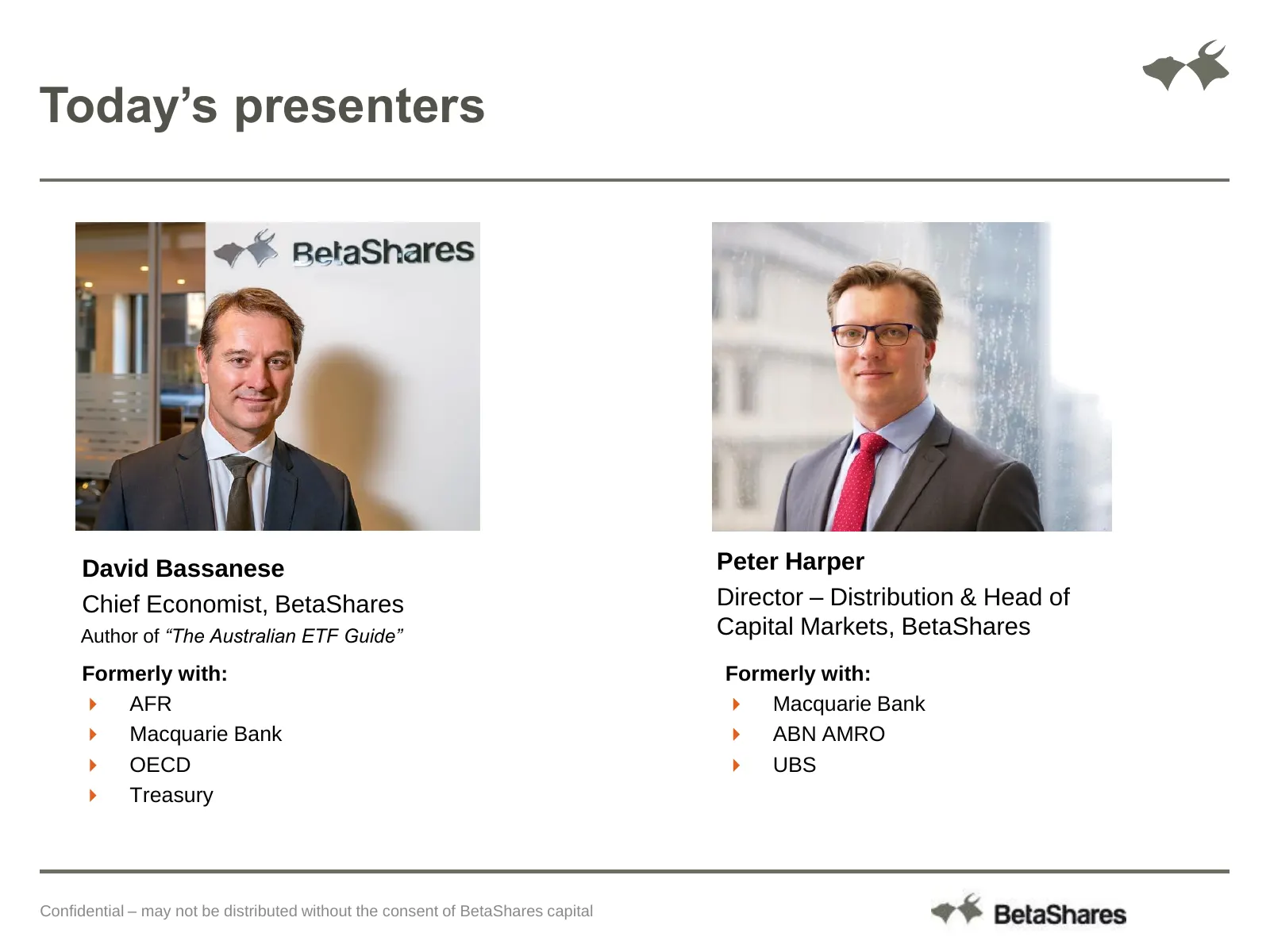
Today’s presenters David Bassanese Peter Harper Chief Economist, BetaShares Director – Distribution & Head of Author of “The Australian ETF Guide” Capital Markets, BetaShares Formerly with: Formerly with: AFR Macquarie Bank Macquarie Bank ABN AMRO OECD UBS Treasury Confidential – may n
Slide 5: Contents
Contents What are hybrids? Where do they sit in the risk-return investment spectrum? The challenges of directly investing into hybrids An introduction into BetaShares Active Australian Hybrids Fund (managed fund) Confidential – may not be distributed without the consent of BetaShares capital
Slide 6: Contents
Contents What are hybrids? Where do they sit in the risk-return investment spectrum? The challenges of directly investing into hybrids An introduction into BetaShares Active Australian Hybrids Fund (managed fund) Confidential – may not be distributed without the consent of BetaShares capital
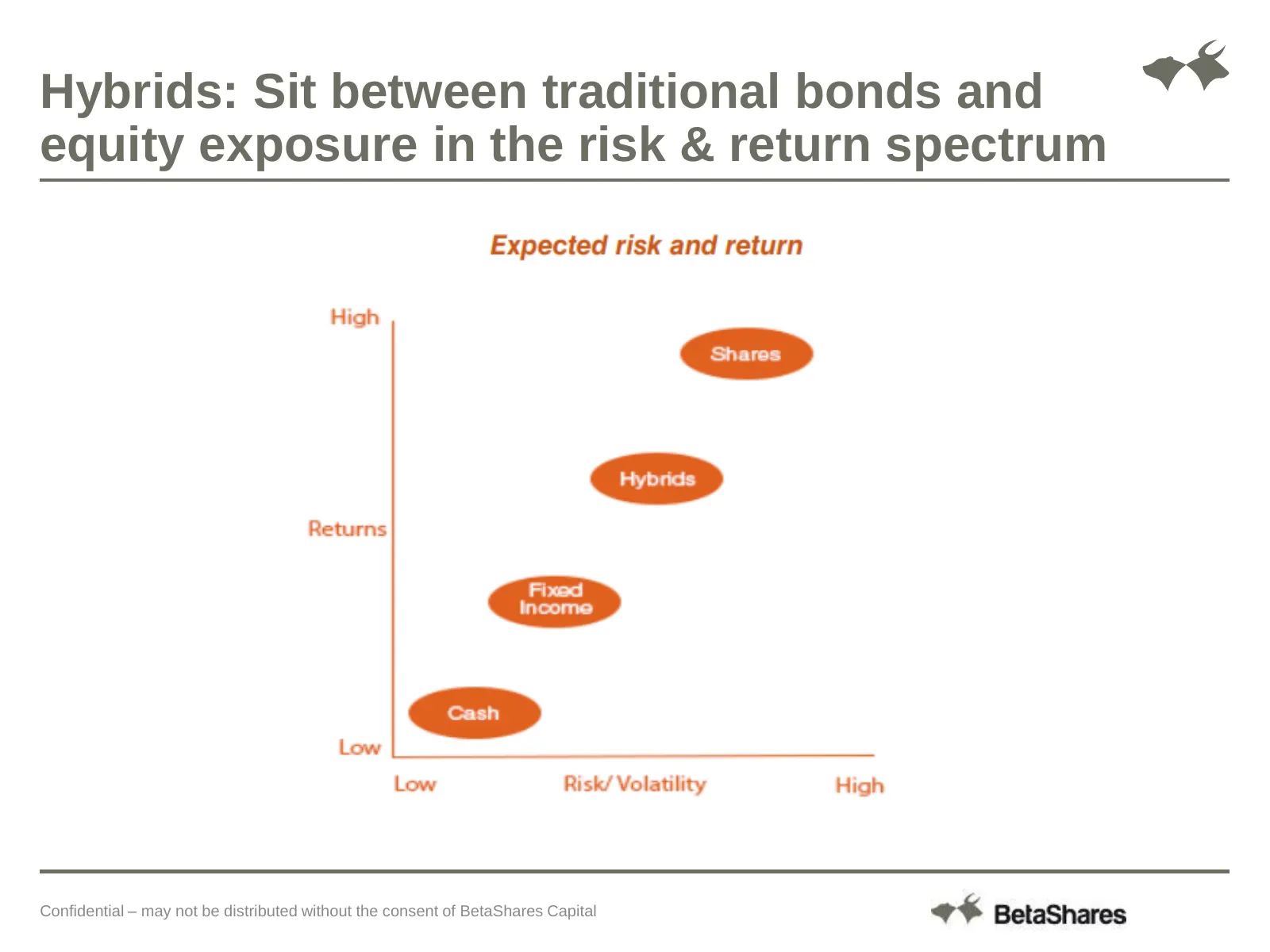
Slide 7: Hybrids: Sit between traditional bonds and equity exposure in the risk & return spectrum
Hybrids: Sit between traditional bonds and equity exposure in the risk & return spectrum Confidential – may not be distributed without the consent of BetaShares Capital
Slide 8: What are hybrids?
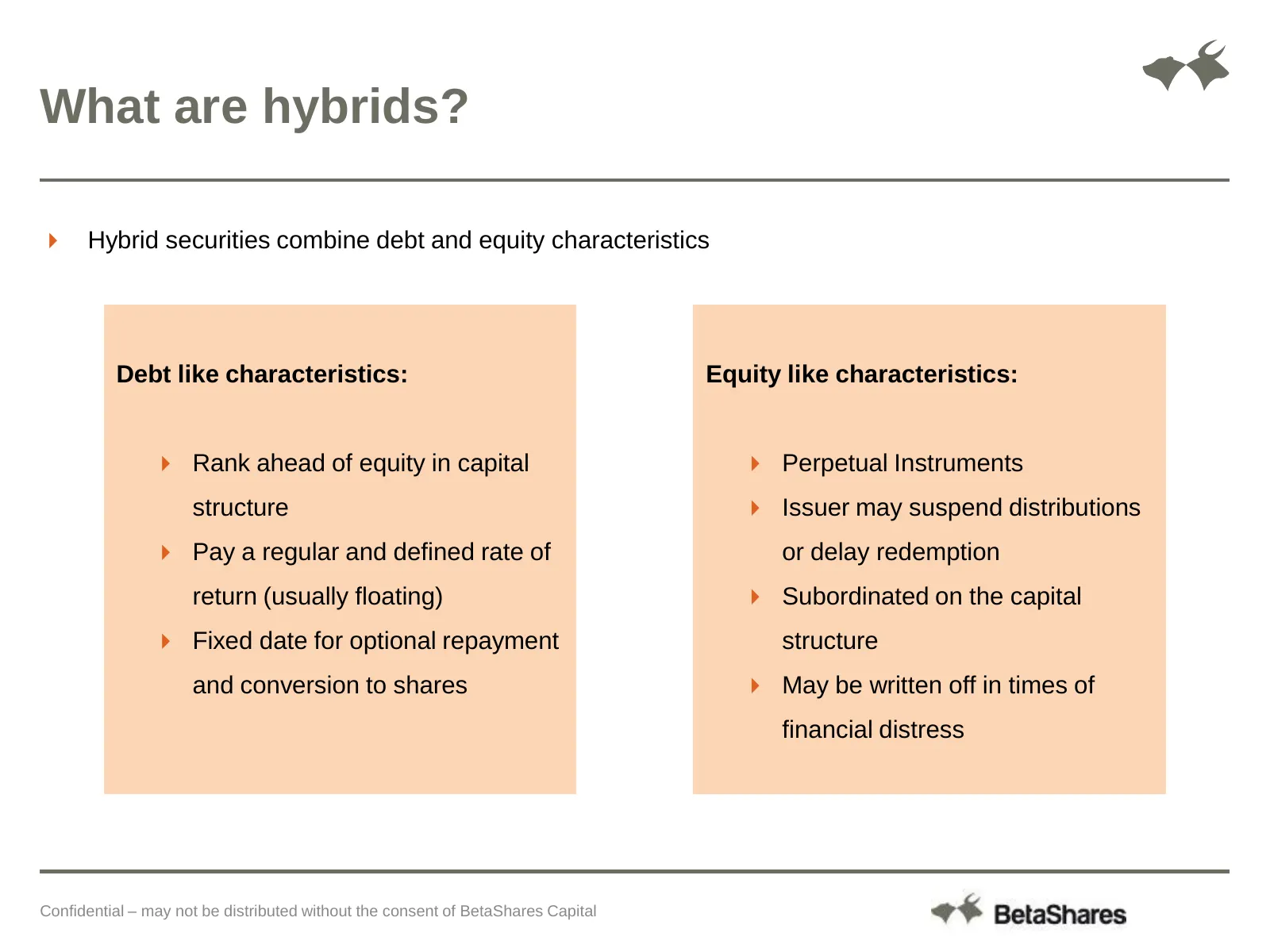
What are hybrids? Hybrid securities combine debt and equity characteristics Debt like characteristics: Equity like characteristics: Rank ahead of equity in capital Perpetual Instruments structure Issuer may suspend distributions Pay a regular and defined rate of or delay redemption return
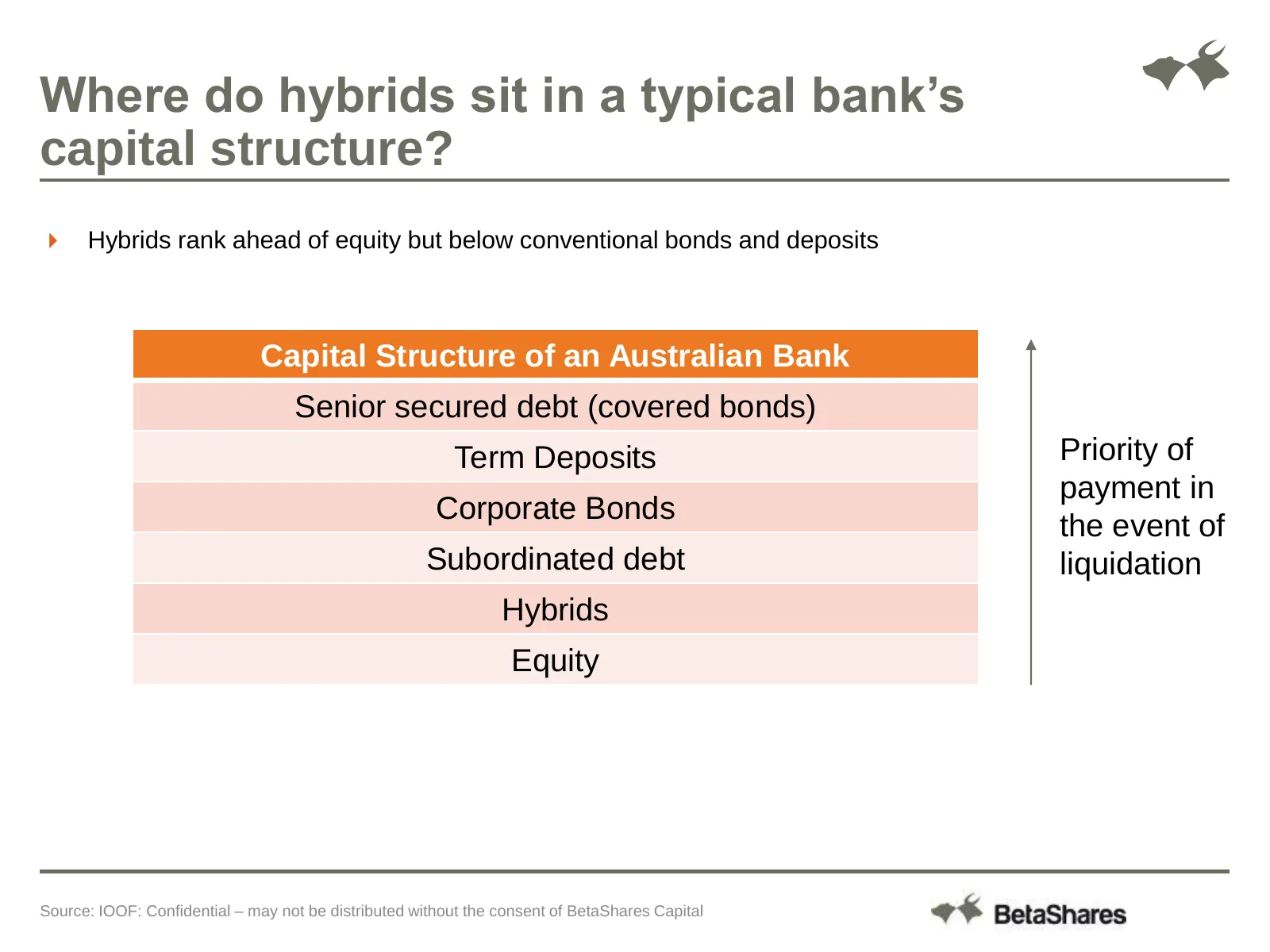
Slide 9: Where do hybrids sit in a typical bank's capital structure?
Where do hybrids sit in a typical bank’s capital structure? Hybrids rank ahead of equity but below conventional bonds and deposits Capital Structure of an Australian Bank Senior secured debt (covered bonds) Term Deposits Priority of payment in Corporate Bonds the event of Subordinated debt liquida
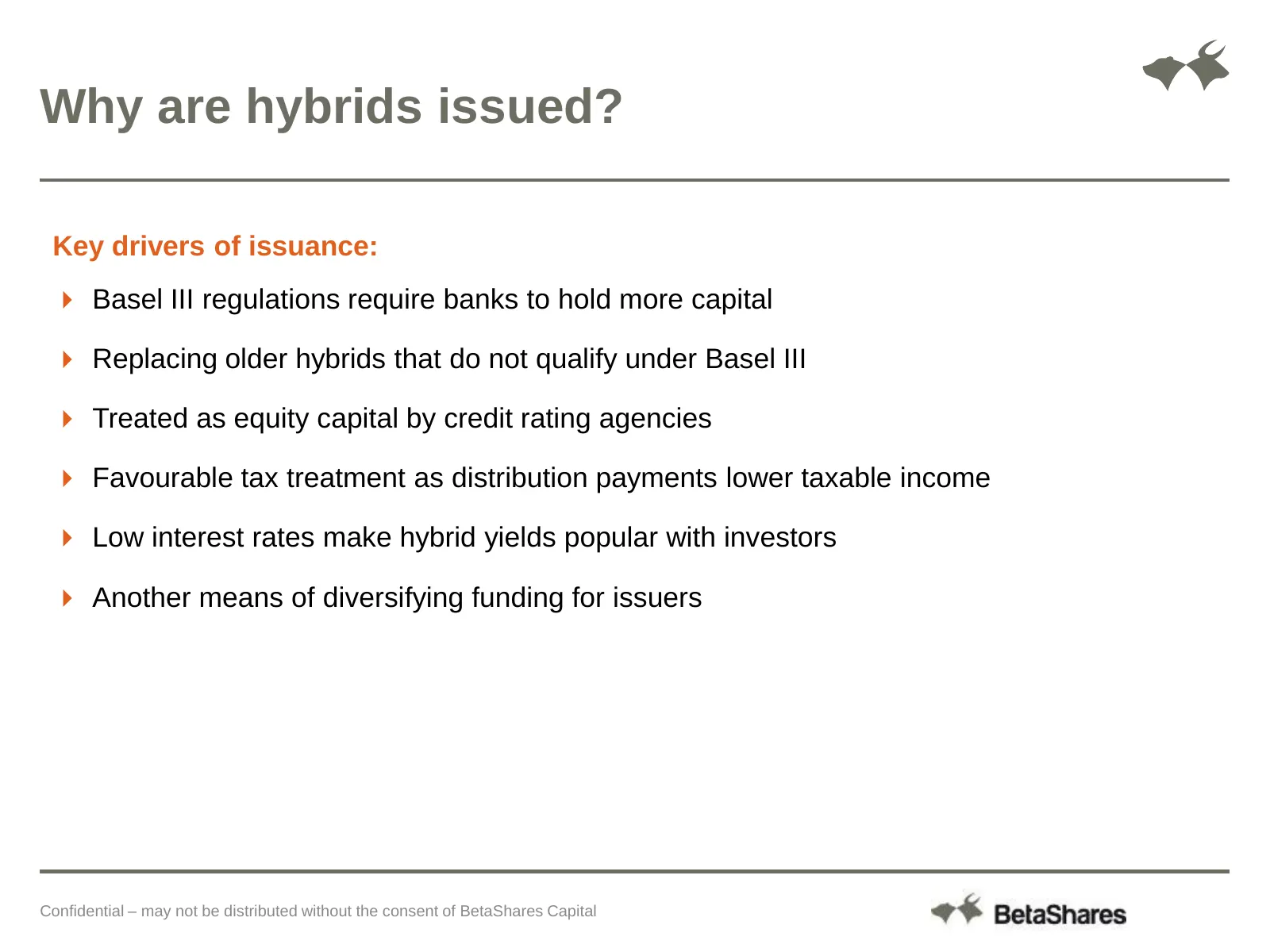
Slide 10: Why are hybrids issued?
Why are hybrids issued? Key drivers of issuance: Basel III regulations require banks to hold more capital Replacing older hybrids that do not qualify under Basel III Treated as equity capital by credit rating agencies Favourable tax treatment as distribution payments lower taxable income L
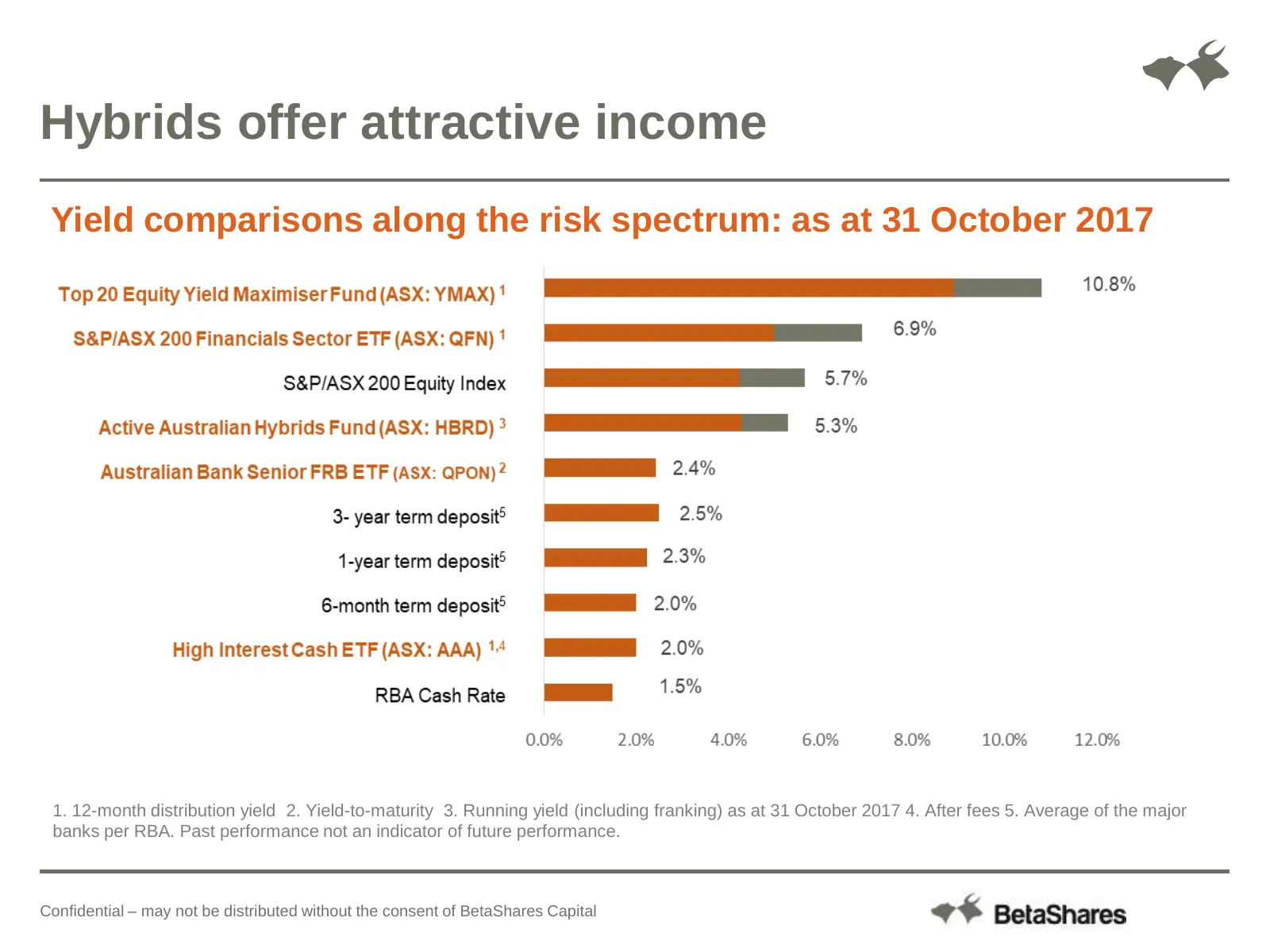
Slide 11: Hybrids offer attractive income
Hybrids offer attractive income Yield comparisons along the risk spectrum: as at 31 October 2017 1. 12-month distribution yield 2. Yield-to-maturity 3. Running yield (including franking) as at 31 October 2017 4. After fees 5. Average of the major banks per RBA. Past performance not an indicator of f
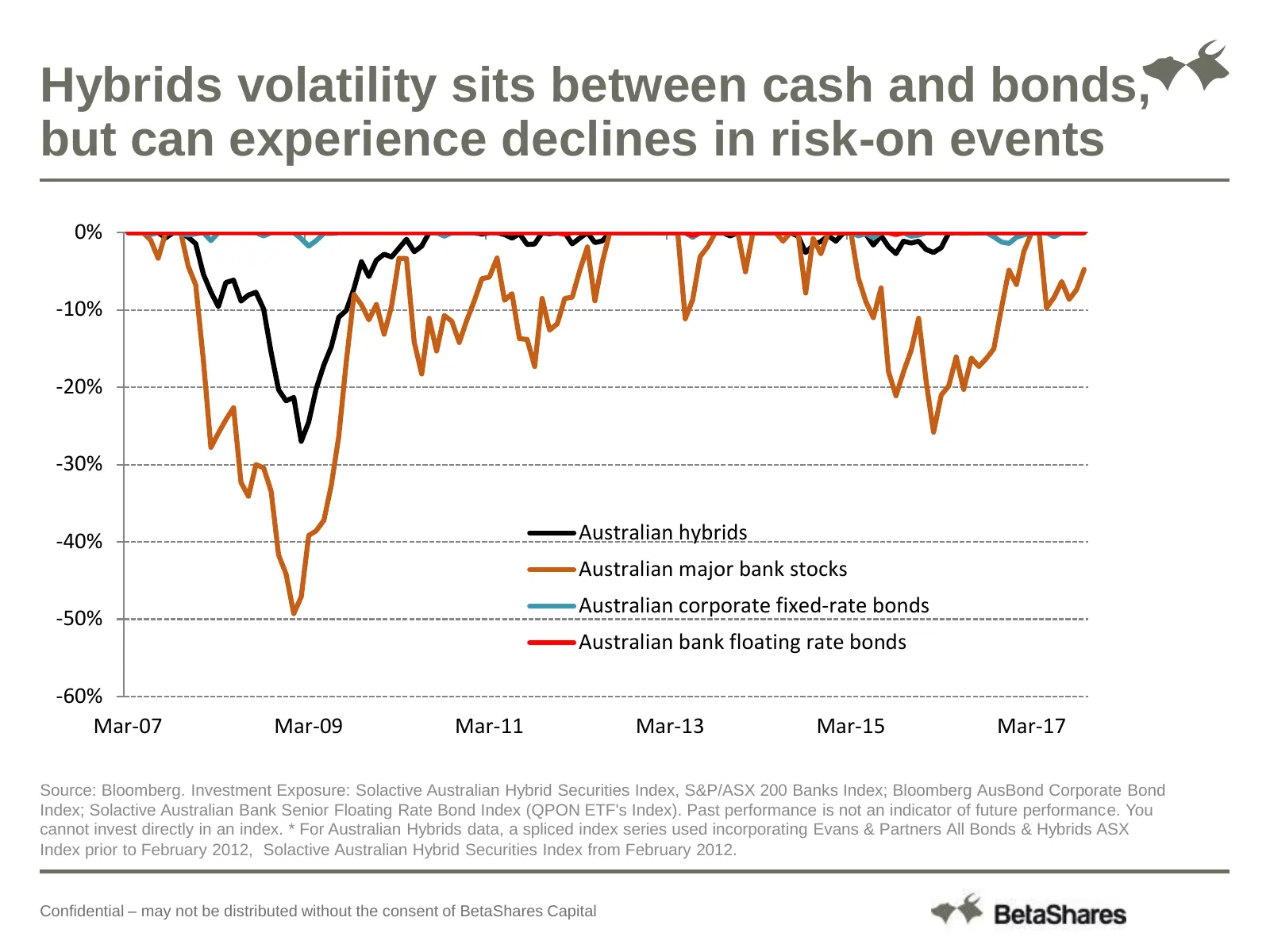
Slide 12: Hybrids volatility sits between cash and bonds, but can experience declines in risk-on events
Hybrids volatility sits between cash and bonds, but can experience declines in risk-on events 0% -10% -20% -30% -40% Australian hybrids Australian major bank stocks Australian corporate fixed-rate bonds -50% Australian bank floating rate bonds -60% Mar-07 Mar-09 Mar-11 Mar-13 Mar-15 Mar-17 Source: B
Slide 13: Financials dominate the issuance of hybrids
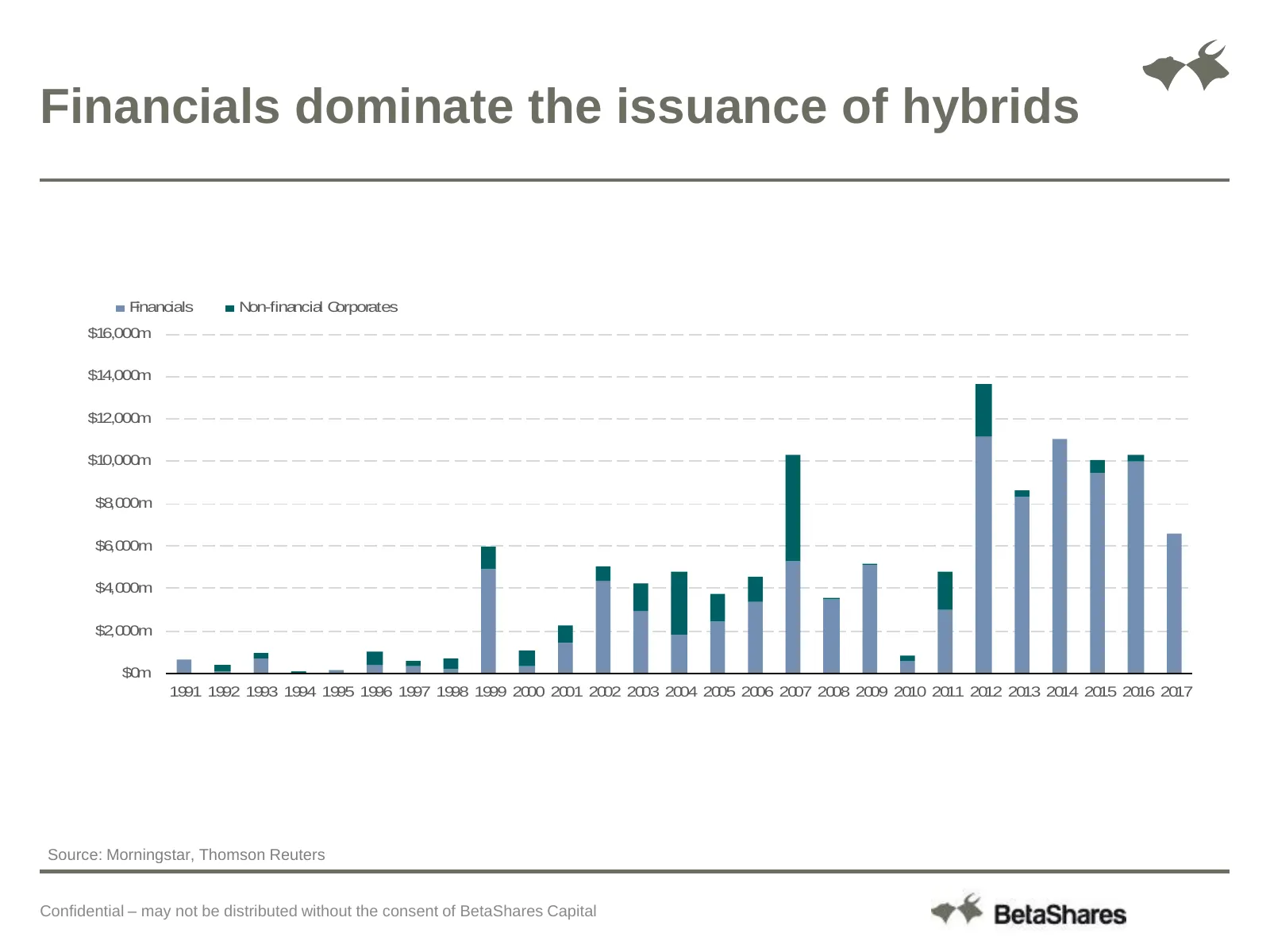
Financials dominate the issuance of hybrids Financials Non-financial Corporates $16,000m $14,000m $12,000m $10,000m $8,000m $6,000m $4,000m $2,000m $0m 1991 1992 1993 1994 1995 1996 1997 1998 1999 2000 2001 2002 2003 2004 2005 2006 2007 2008 2009 2010 2011 2012 2013 2014 2015 2016 2017 Source: Morni
Slide 14: Current valuations for hybrids appear reasonable
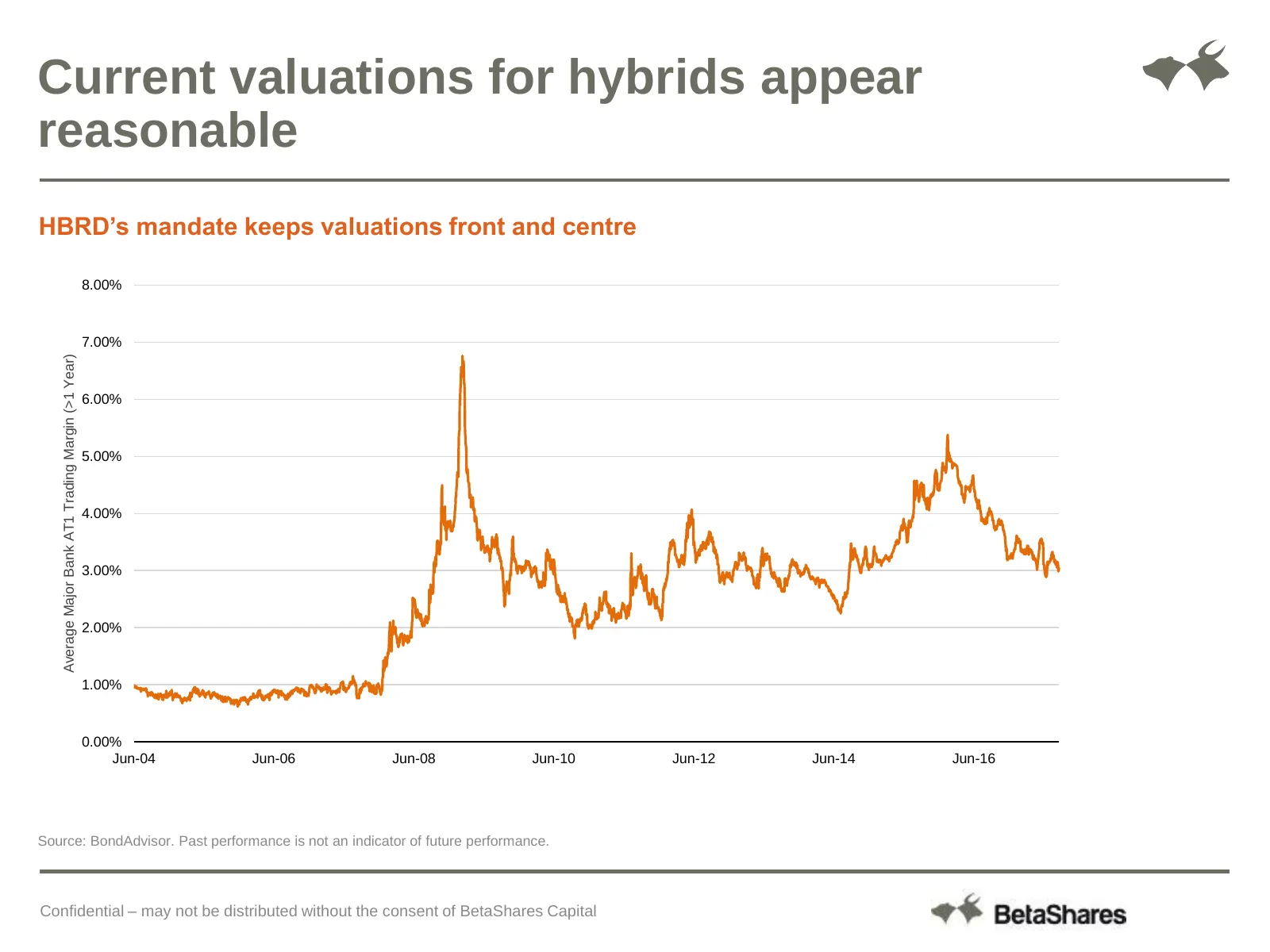
Current valuations for hybrids appear reasonable HBRD’s mandate keeps valuations front and centre 8.00% 7.00% Average Major Bank AT1 Trading Margin (>1 Year) 6.00% 5.00% 4.00% 3.00% 2.00% 1.00% 0.00% Jun-04 Jun-06 Jun-08 Jun-10 Jun-12 Jun-14 Jun-16 Source: BondAdvisor. Past performance is not an ind
Slide 15: Contents
Contents What are hybrids? Where do they sit in the risk-return investment spectrum? The challenges of directly investing into hybrids An introduction into BetaShares Active Australian Hybrids Fund (managed fund) Confidential – may not be distributed without the consent of BetaShares capital
Slide 16: Navigating Hybrids: The challenge of direct ownership…
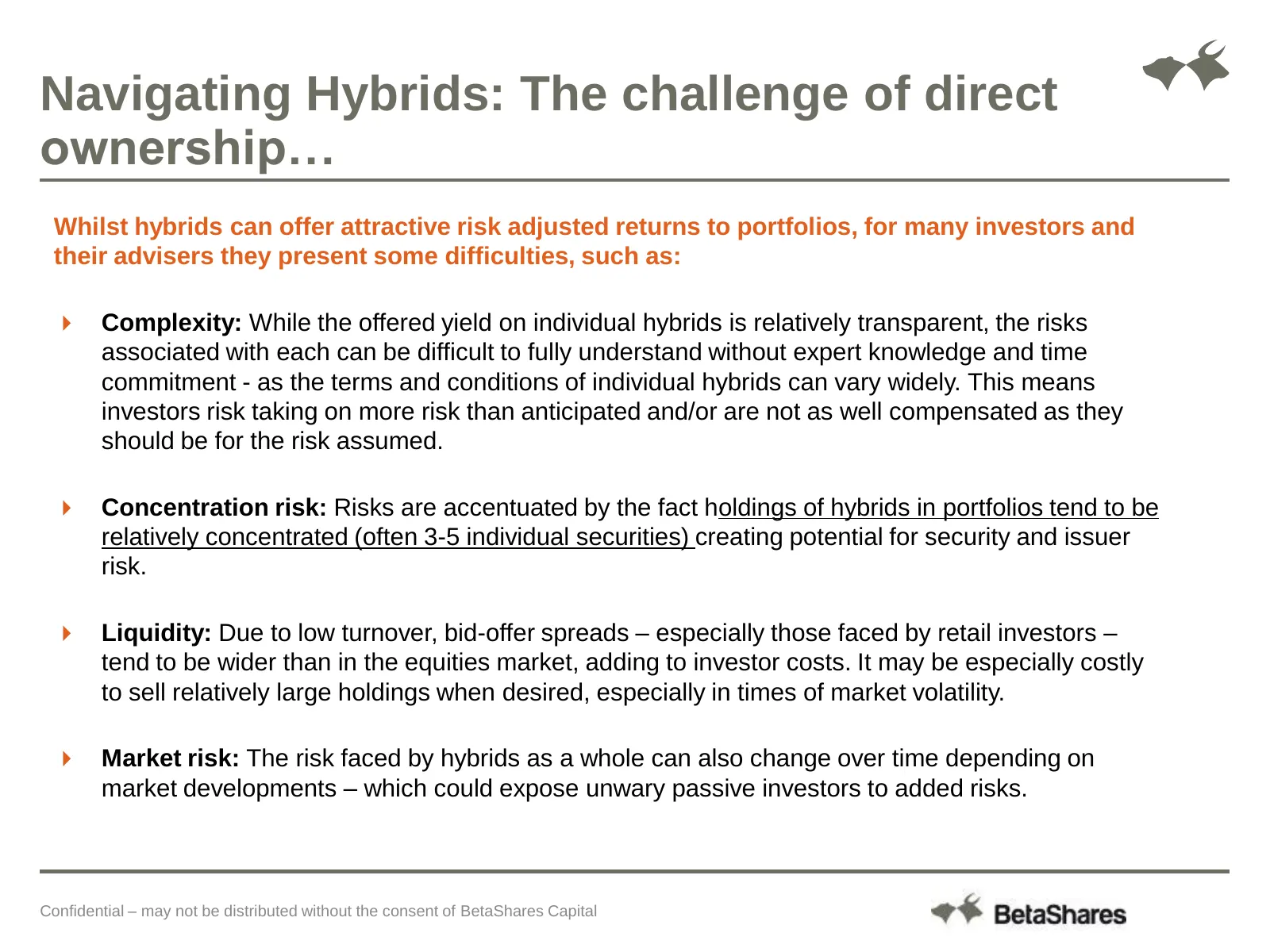
Navigating Hybrids: The challenge of direct ownership… Whilst hybrids can offer attractive risk adjusted returns to portfolios, for many investors and their advisers they present some difficulties, such as: Complexity: While the offered yield on individual hybrids is relatively transparent, the ri
Slide 17: Not all hybrids are created equal…
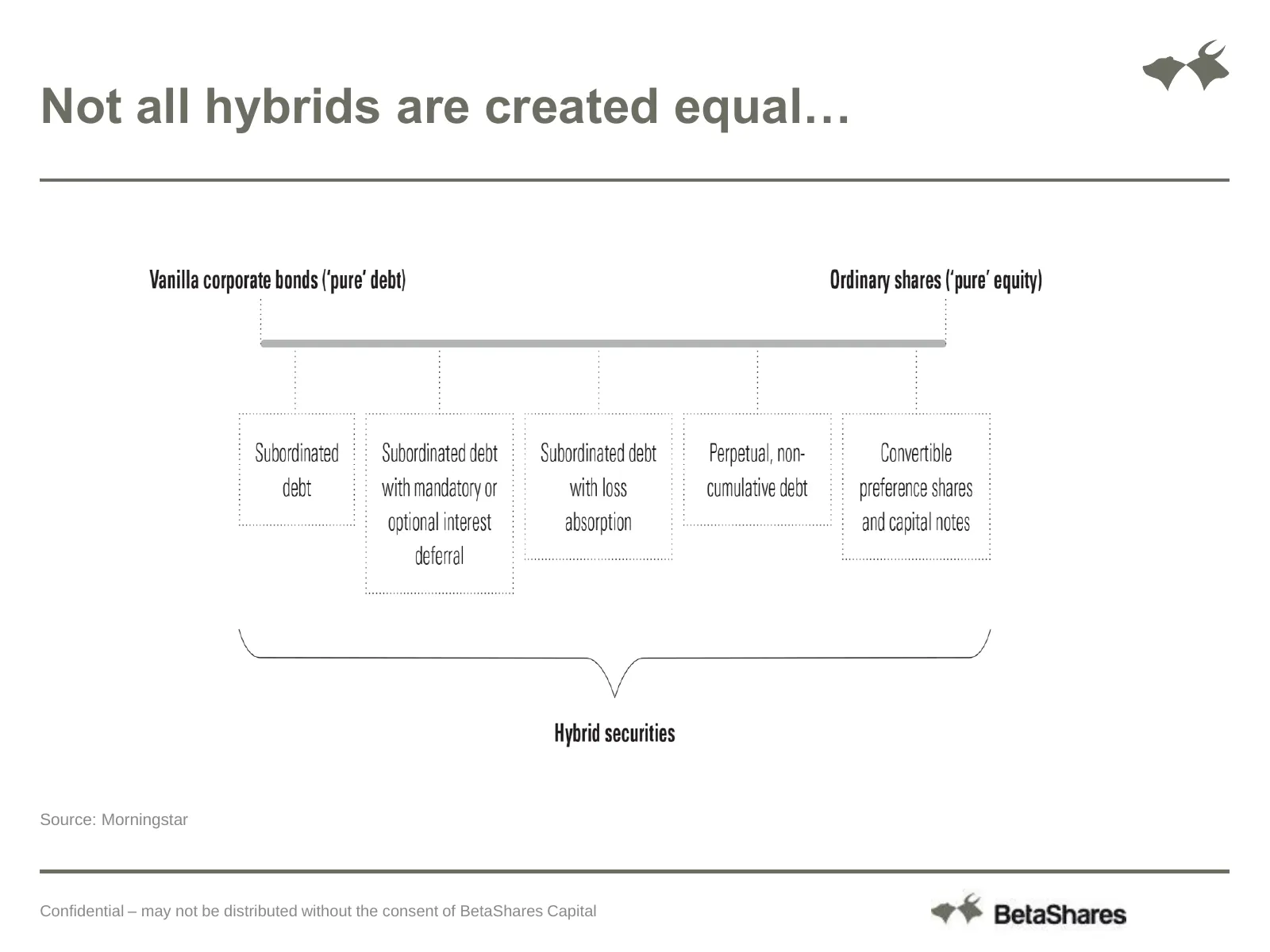
Not all hybrids are created equal… Source: Morningstar Confidential – may not be distributed without the consent of BetaShares Capital
Slide 18: Hybrids market is relatively illiquid – professional investors have an advantage
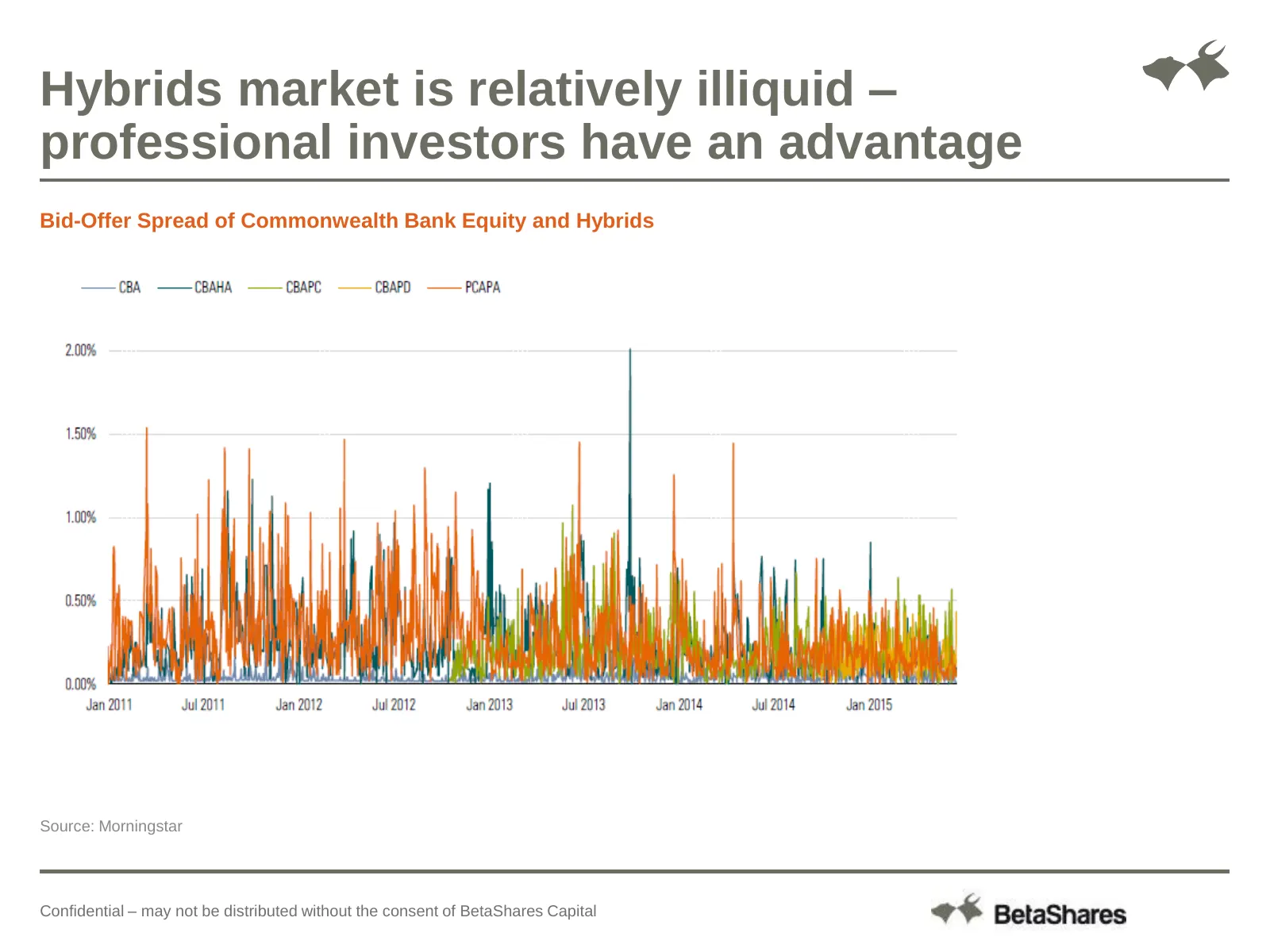
Hybrids market is relatively illiquid – professional investors have an advantage Bid-Offer Spread of Commonwealth Bank Equity and Hybrids Source: Morningstar Confidential – may not be distributed without the consent of BetaShares Capital
Slide 19: Trading Margins – Crown Subordinated Notes
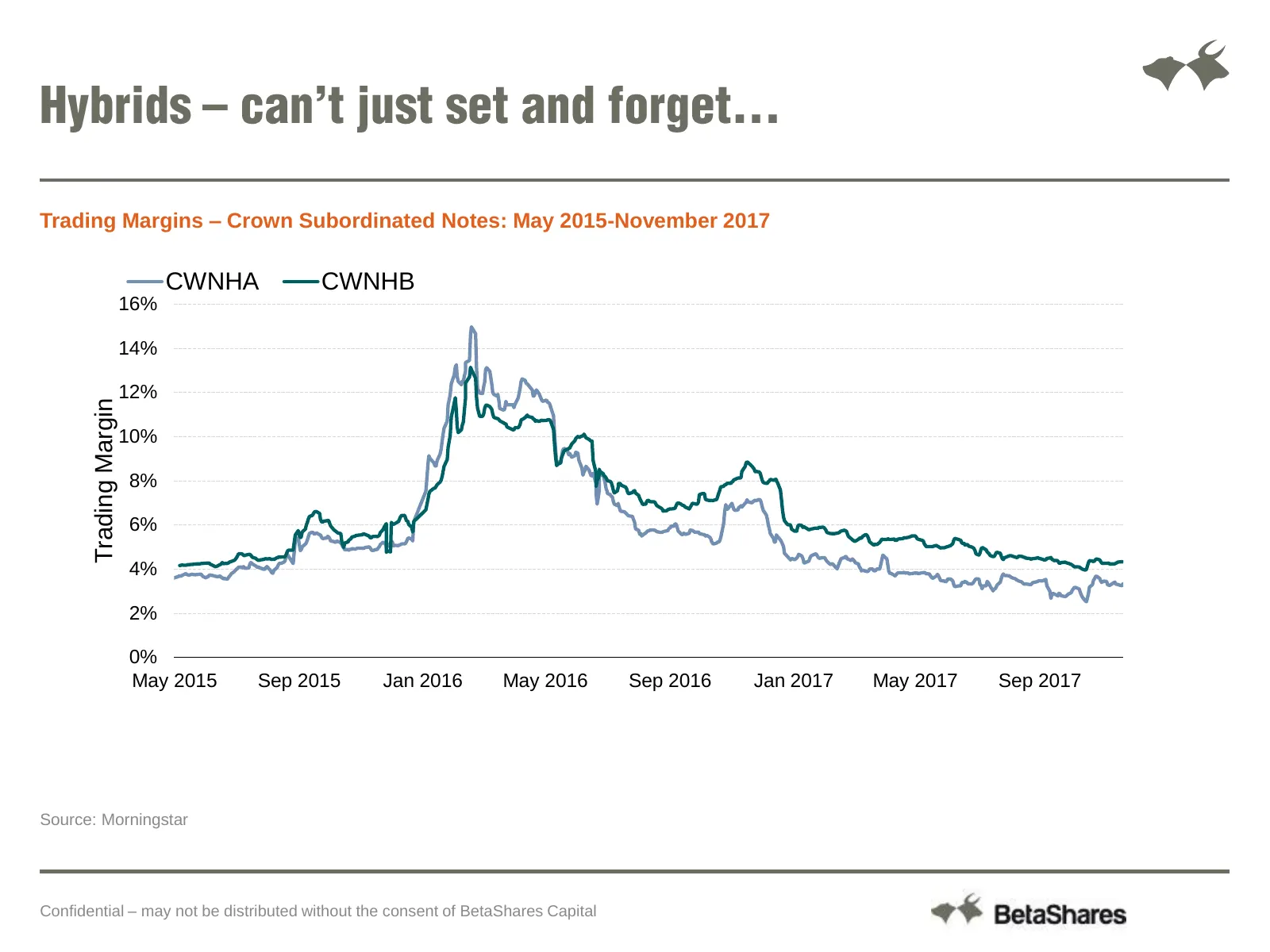
Trading Margins – Crown Subordinated Notes: May 2015-November 2017 CWNHA CWNHB 16% 14% 12% Trading Margin 10% 8% 6% 4% 2% 0% May 2015 Sep 2015 Jan 2016 May 2016 Sep 2016 Jan 2017 May 2017 Sep 2017 Source: Morningstar Confidential – may not be distributed without the consent of BetaShares Capital
Slide 20: Contents
What are hybrids? Where do they sit in the risk-return investment spectrum? The challenges of directly investing into hybrids An introduction into BetaShares Active Australian Hybrids Fund (managed fund) Confidential – may not be distributed without the consent of BetaShares capital
Slide 21: The potential problems…
The potential problems… The hybrids market is relatively inefficient and thus prone to regular over and under valuation – some investors may not have the ability to accurately price these securities Most investors’ hybrid holdings tend to be relatively passive creating the potential for risks to
Slide 22: A potential solution?
A potential solution? We believe many of the complexities of holding hybrids can be largely addressed via the use of an actively managed hybrids exposure run by an experienced professional manager: A professional manager may have valuation models allowing them to detect and potentially profit from
Slide 23: BetaShares Active Australian Hybrids Fund (managed fund) (ASX: HBRD)
BetaShares Active Australian Hybrids Fund (managed fund) (ASX: HBRD) Confidential – may not be distributed without the consent of BetaShares Capital
Slide 24: Investment Strategy for HBRD (I)
Investment Strategy for HBRD (I) HBRD will target: • Returns after fees that are greater than Australian Hybrids Index(1) • Post-fee returns > RBA cash rate + 2.5% pa over medium term • Post-fee, franked running yield generally similar to Australian Hybrids Index(1) • Post-fee volatility of 3-4% p.a
Slide 25: BetaShares Active Australian Hybrids Fund ASX: HBRD
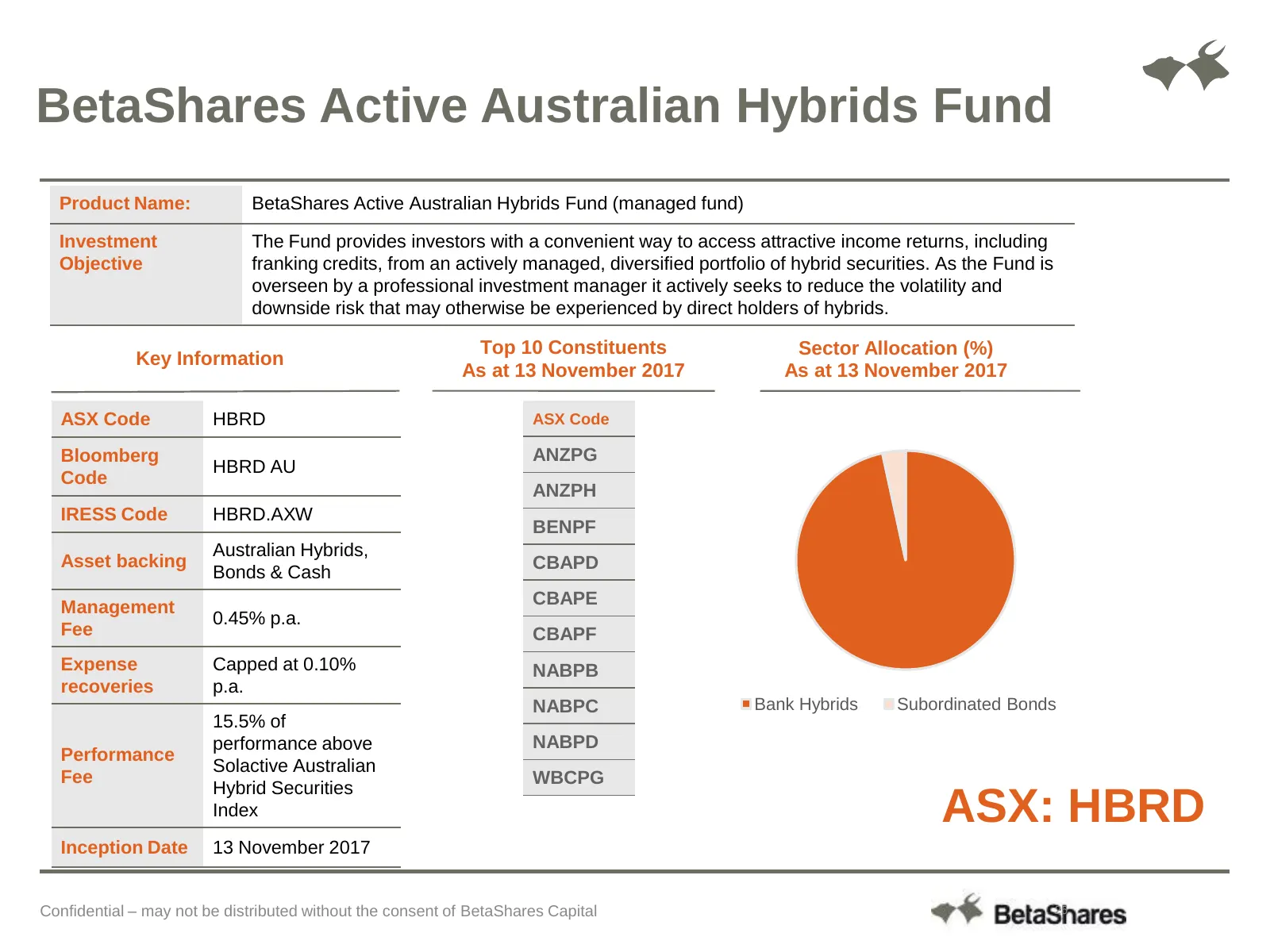
BetaShares Active Australian Hybrids Fund Product Name: BetaShares Active Australian Hybrids Fund (managed fund) Investment The Fund provides investors with a convenient way to access attractive income returns, including Objective franking credits, from an actively managed, diversified portfolio of
Slide 26: Investment Strategy for HBRD (II)
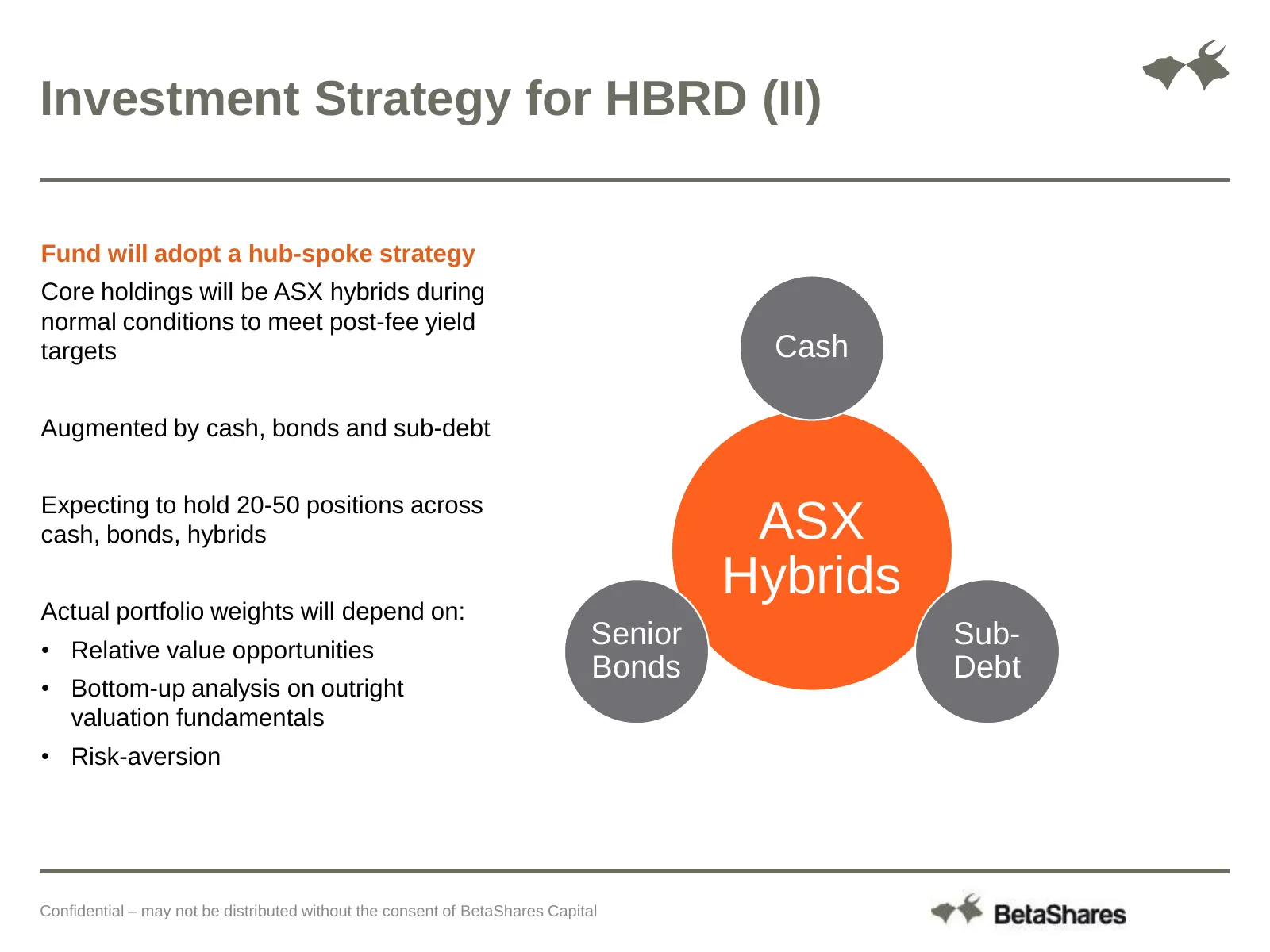
Investment Strategy for HBRD (II) Fund will adopt a hub-spoke strategy Core holdings will be ASX hybrids during normal conditions to meet post-fee yield targets Cash Augmented by cash, bonds and sub-debt Expecting to hold 20-50 positions across cash, bonds, hybrids ASX Actual portfolio weights will
Slide 27: About HBRD's Investment Manager - CCI
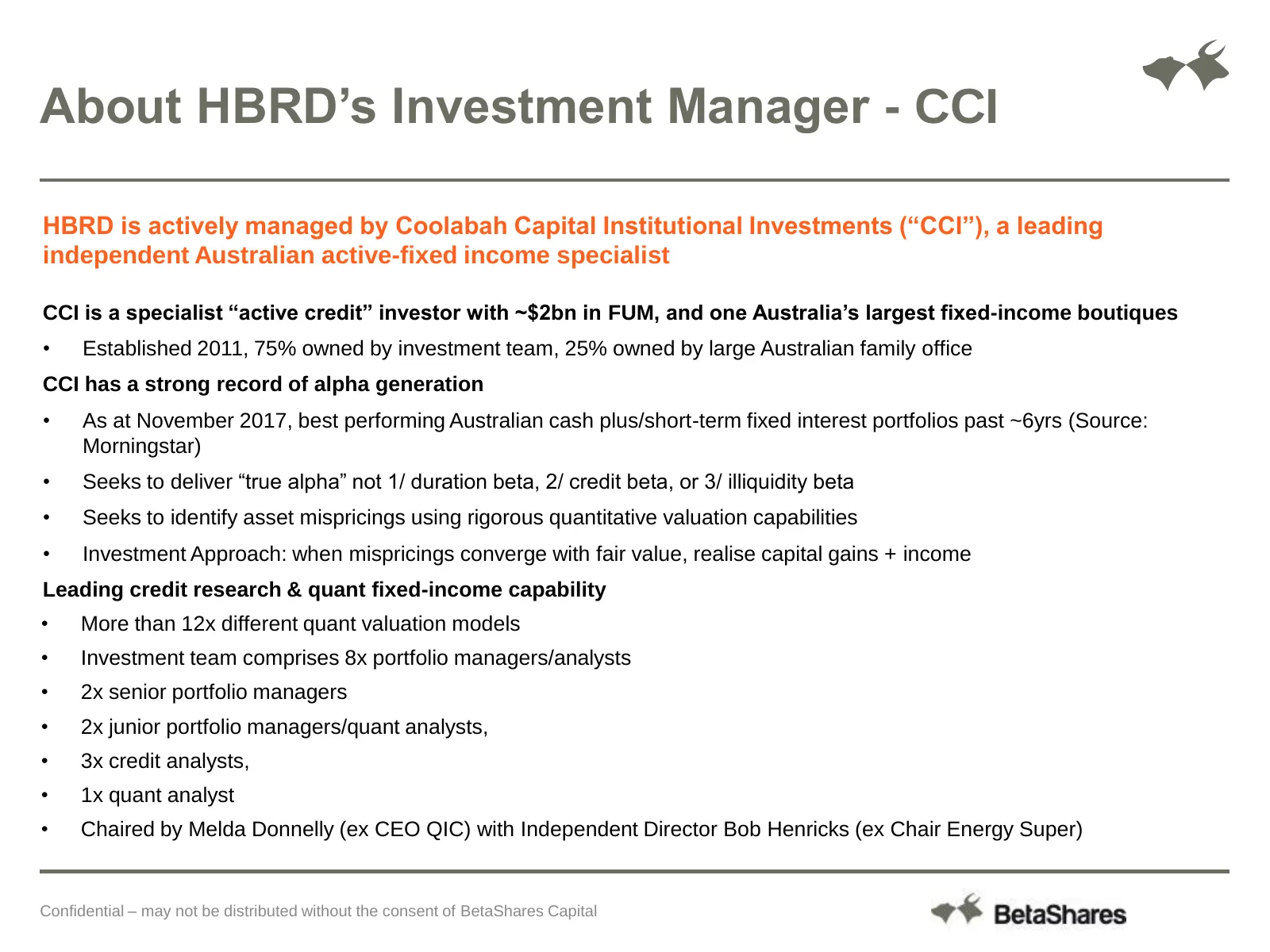
About HBRD’s Investment Manager - CCI HBRD is actively managed by Coolabah Capital Institutional Investments (“CCI”), a leading independent Australian active-fixed income specialist CCI is a specialist “active credit” investor with ~$2bn in FUM, and one Australia’s largest fixed-income boutiques • E
Slide 28: Investment Strategy for HBRD (III)
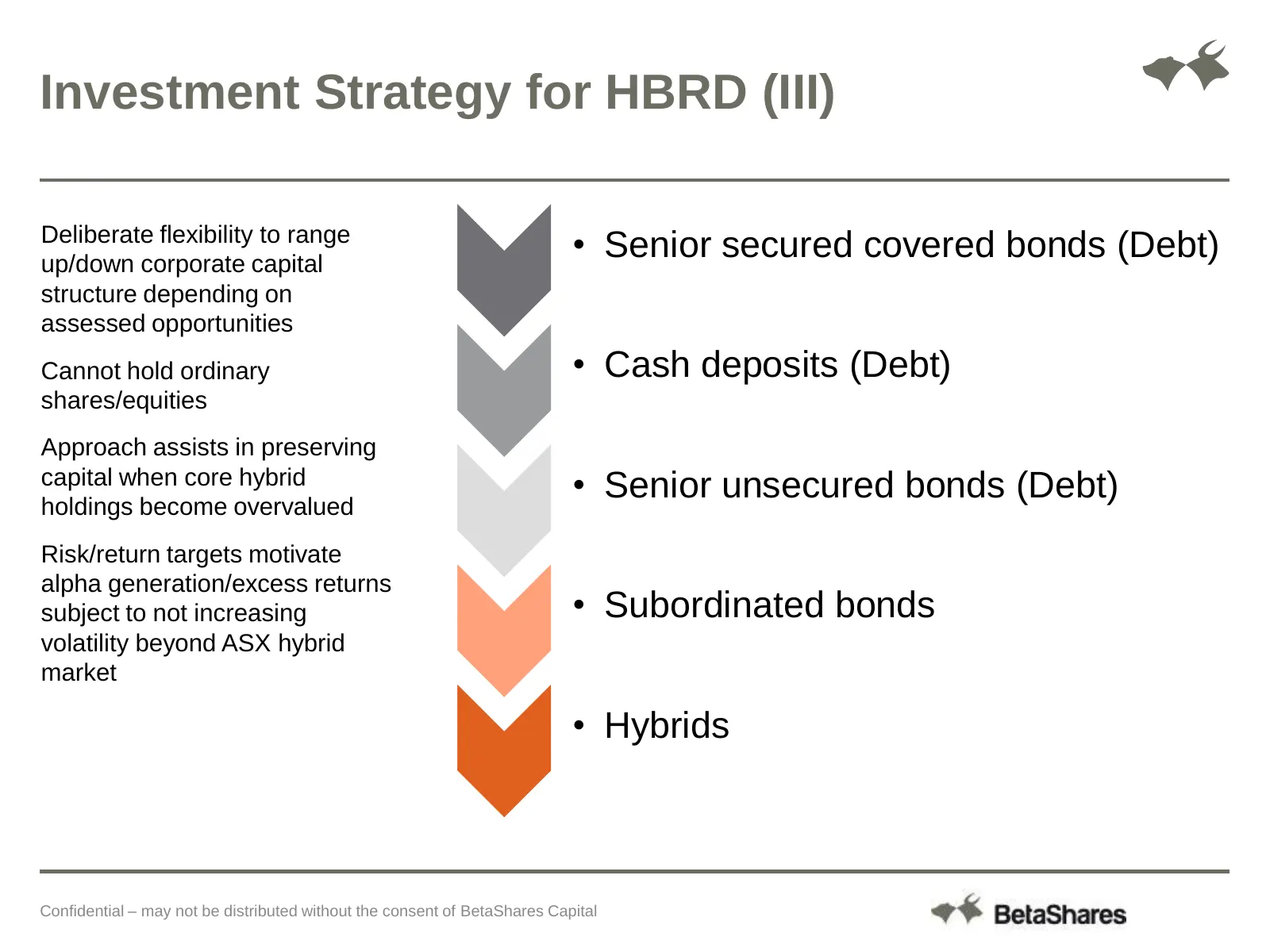
Investment Strategy for HBRD (III) Deliberate flexibility to range up/down corporate capital • Senior secured covered bonds (Debt) structure depending on assessed opportunities Cannot hold ordinary • Cash deposits (Debt) shares/equities Approach assists in preserving capital when core hybrid holding
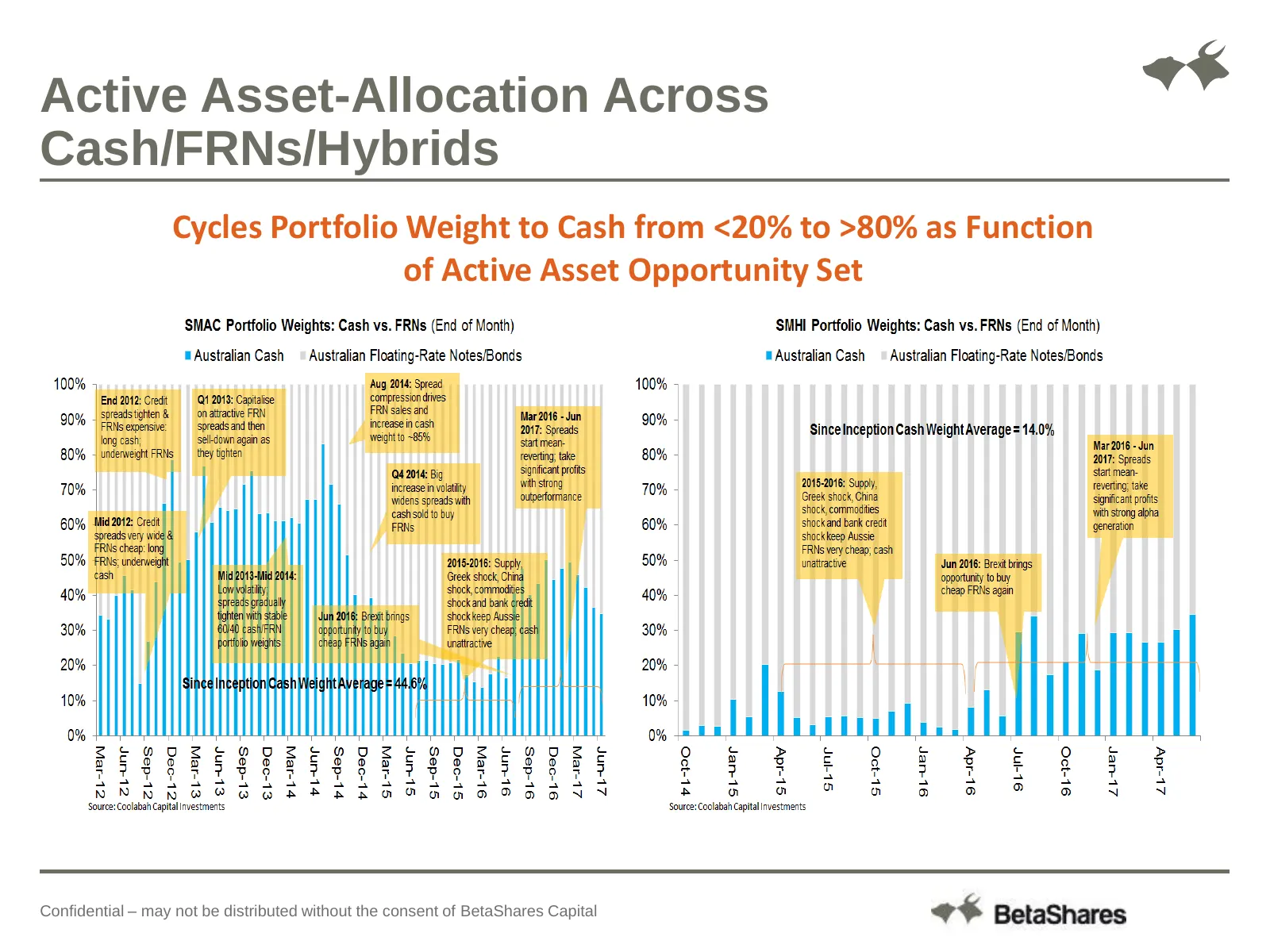
Slide 29: Active Asset-Allocation Across Cash/FRNs/Hybrids
Active Asset-Allocation Across Cash/FRNs/Hybrids Cycles Portfolio Weight to Cash from <20% to >80% as Function of Active Asset Opportunity Set Confidential – may not be distributed without the consent of BetaShares Capital
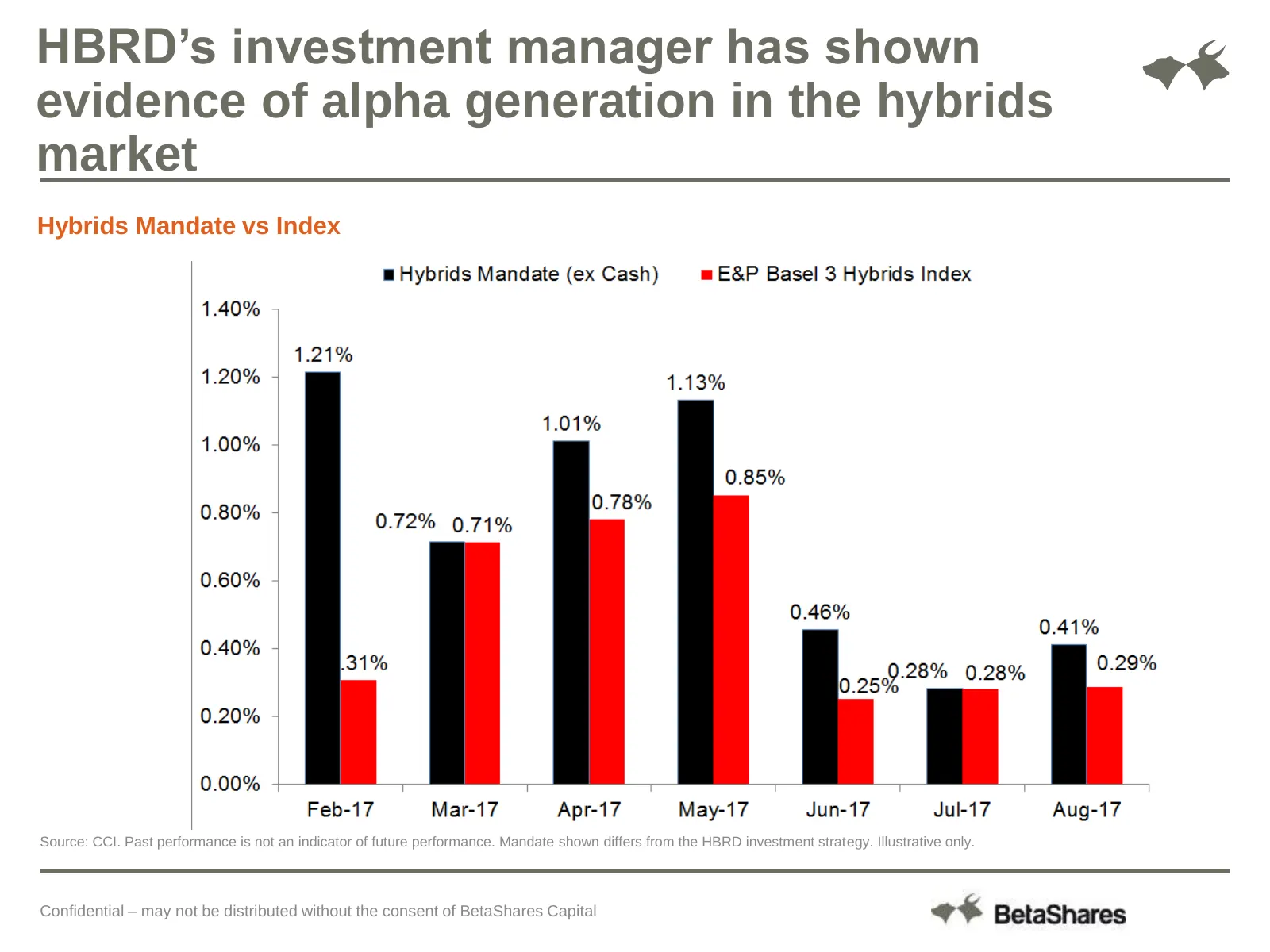
Slide 30: HBRD's investment manager has shown evidence of alpha generation in the hybrids market
HBRD’s investment manager has shown evidence of alpha generation in the hybrids market Hybrids Mandate vs Index Source: CCI. Past performance is not an indicator of future performance. Mandate shown differs from the HBRD investment strategy. Illustrative only. Confidential – may not be distributed w
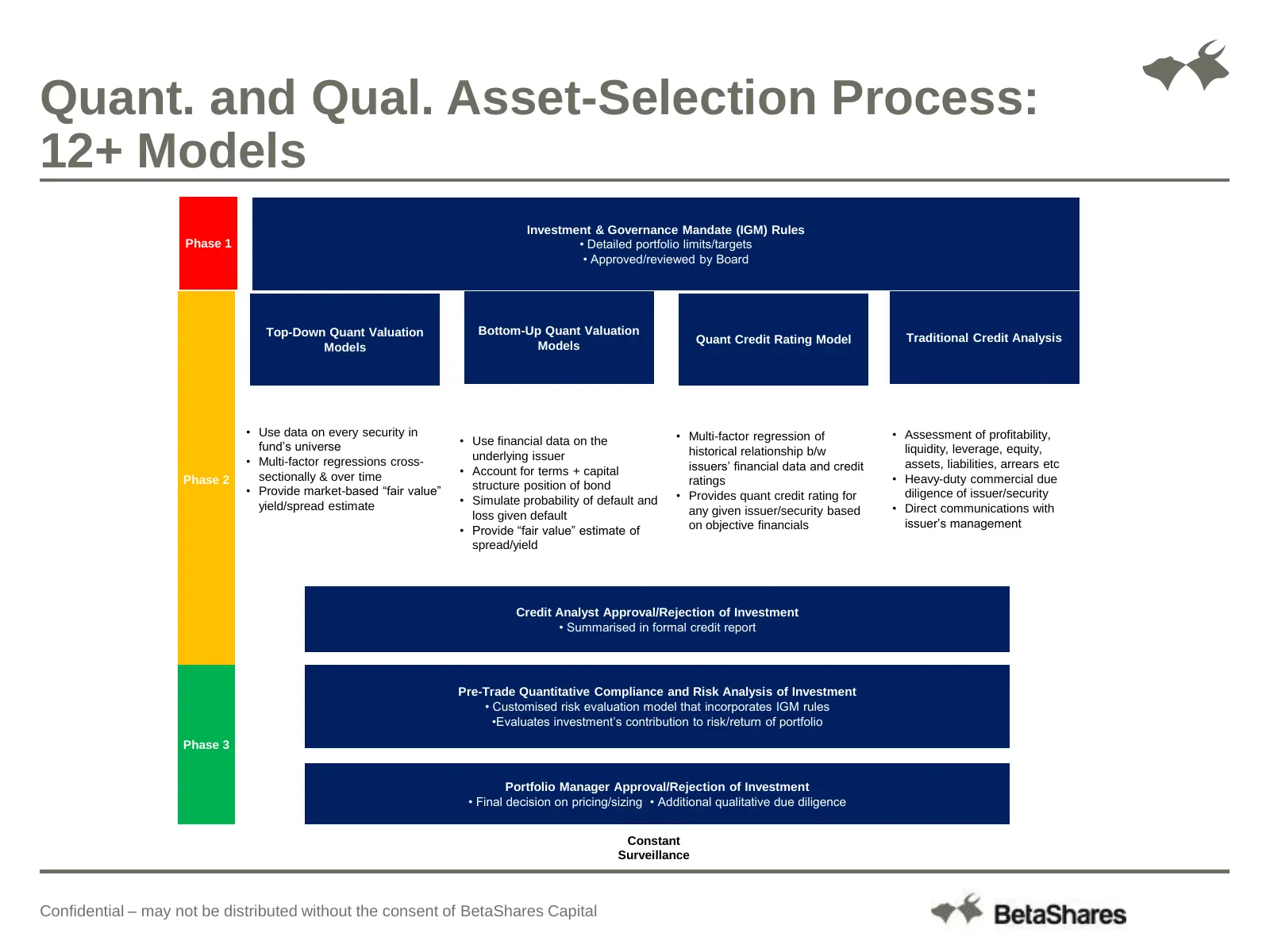
Slide 31: Quant. and Qual. Asset-Selection Process: 12+ Models
Quant. and Qual. Asset-Selection Process: 12+ Models Investment & Governance Mandate (IGM) Rules Phase 1 • Detailed portfolio limits/targets • Approved/reviewed by Board Top-Down Quant Valuation Bottom-Up Quant Valuation Quant Credit Rating Model Traditional Credit Analysis Models Models • Use data
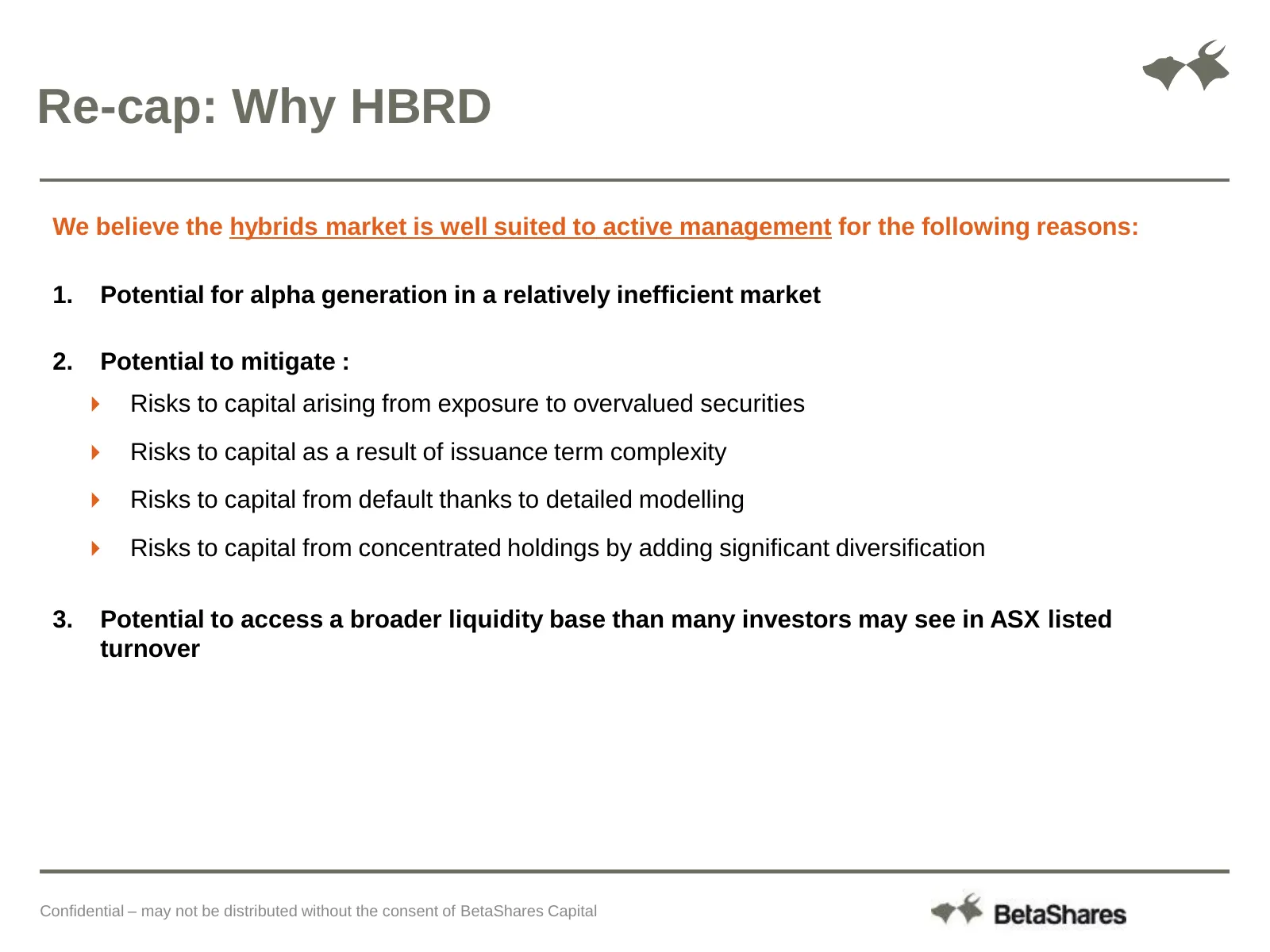
Slide 32: Re-cap: Why HBRD
Re-cap: Why HBRD We believe the hybrids market is well suited to active management for the following reasons: 1. Potential for alpha generation in a relatively inefficient market 2. Potential to mitigate : Risks to capital arising from exposure to overvalued securities Risks to capital as a resu
Slide 33: Things to keep in mind
Things to keep in mind Investment risk: Investment returns are uncertain and will be influenced by the performance of the markets as a whole and other risks. Income payments are variable. If interest rates fall, HBRD’s income payments can be expected to fall. Hybrids are, by their nature, pred
Slide 34: Stay informed
Stay informed Visit our website Sign up for Follow us on regular insight LinkedIn and Twitter Call Us 1300 487 577 Confidential – may not be distributed without the consent of BetaShares Capital
Source: Internet Archive copy of betashares.com.au
More decks from BetaShares FTSE 100 ETF
 Navigating Trump 2.0, geopolitical risk and the new global order webinar (November 2024)39 slides · Nov 21, 2024
 BetaShares Capital — 2112 CRYP webinar (December 2021)27 slides · December 2021
 BetaShares ATEC webinar: Investing in Australia's dynamic tech sector (June 2020)28 slides · Jun 23, 2020
 BetaShares Capital — Hybrids Webinar (December 2017)37 slides · December 2017
 BetaShares Educational Webinar (June 2017)34 slides · June 2017
 Investor Presentation (May 2017)44 slides · May 2017