Opthea Limited · ASX:OPT
Opthea — Investor Presentation (August 2022)
37 slides from Opthea's investor presentation, August 2022

Slide 1: Leading Therapeutic Innovation in Retinal Diseases
Leading Therapeutic Innovation in Retinal Diseases OPTHEA.COM | @OptheaLimited | NASDAQ (OPT): ASX (OPT.AX) Corporate Presentation August 2022
Slide 2: Disclaimer
Disclaimer This presentation includes general background information about the activities of Opthea Limited (ABN 32 006 340 567) (‘Opthea’ or ‘Company’) and its affiliates and subsidiaries (together, the ‘Opthea Group’). The information contained in this presentation is in summary form and does not
Slide 3: OPT-302 has the potential to revolutionize the treatment of wet AMD
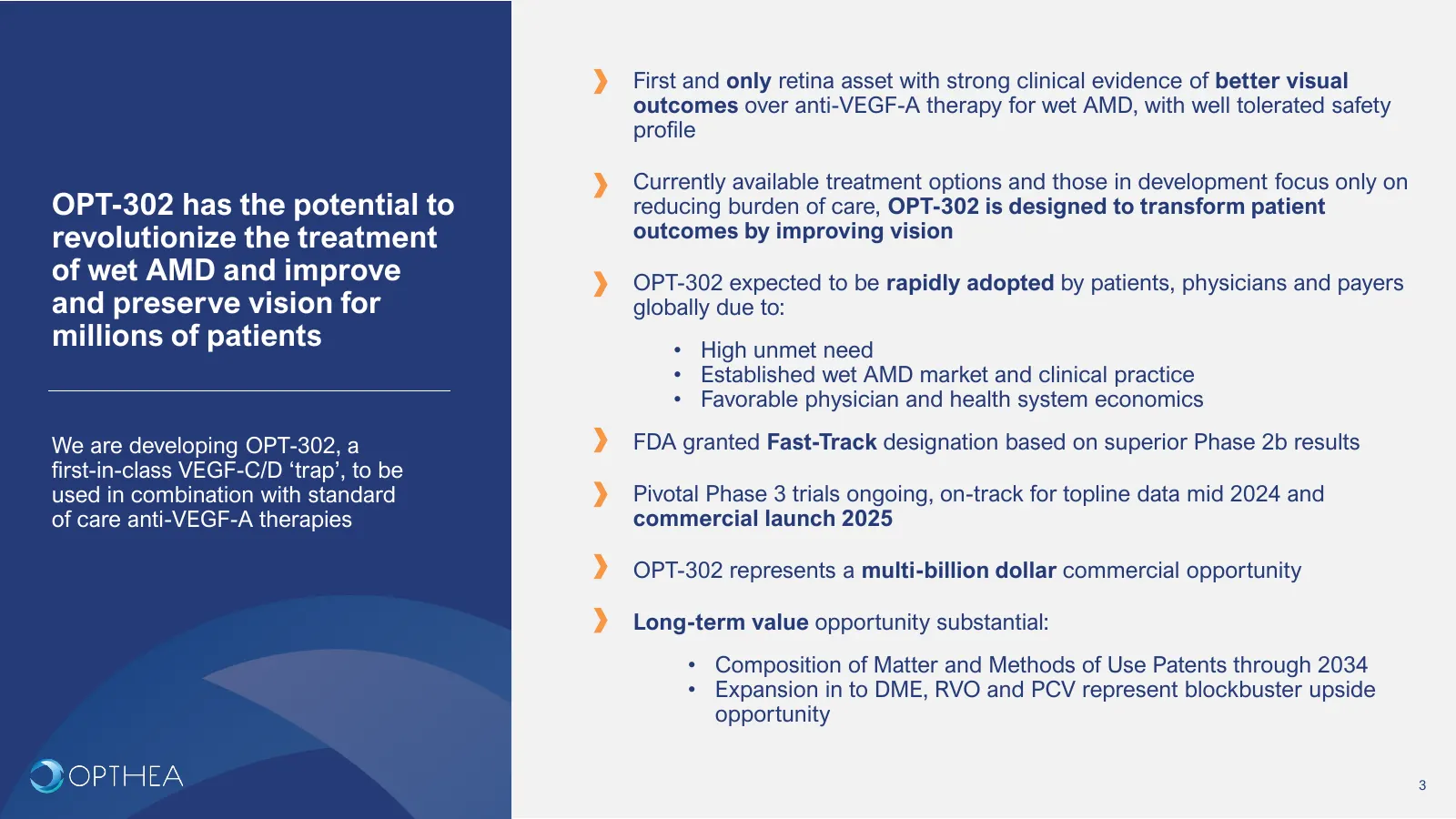
First and only retina asset with strong clinical evidence of better visual outcomes over anti-VEGF-A therapy for wet AMD, with well tolerated safety profile Currently available treatment options and those in development focus only on OPT-302 has the potential to reducing burden of care, OPT-302 is d
Slide 4: Wet AMD & DME are the leading causes of vision loss in the elderly
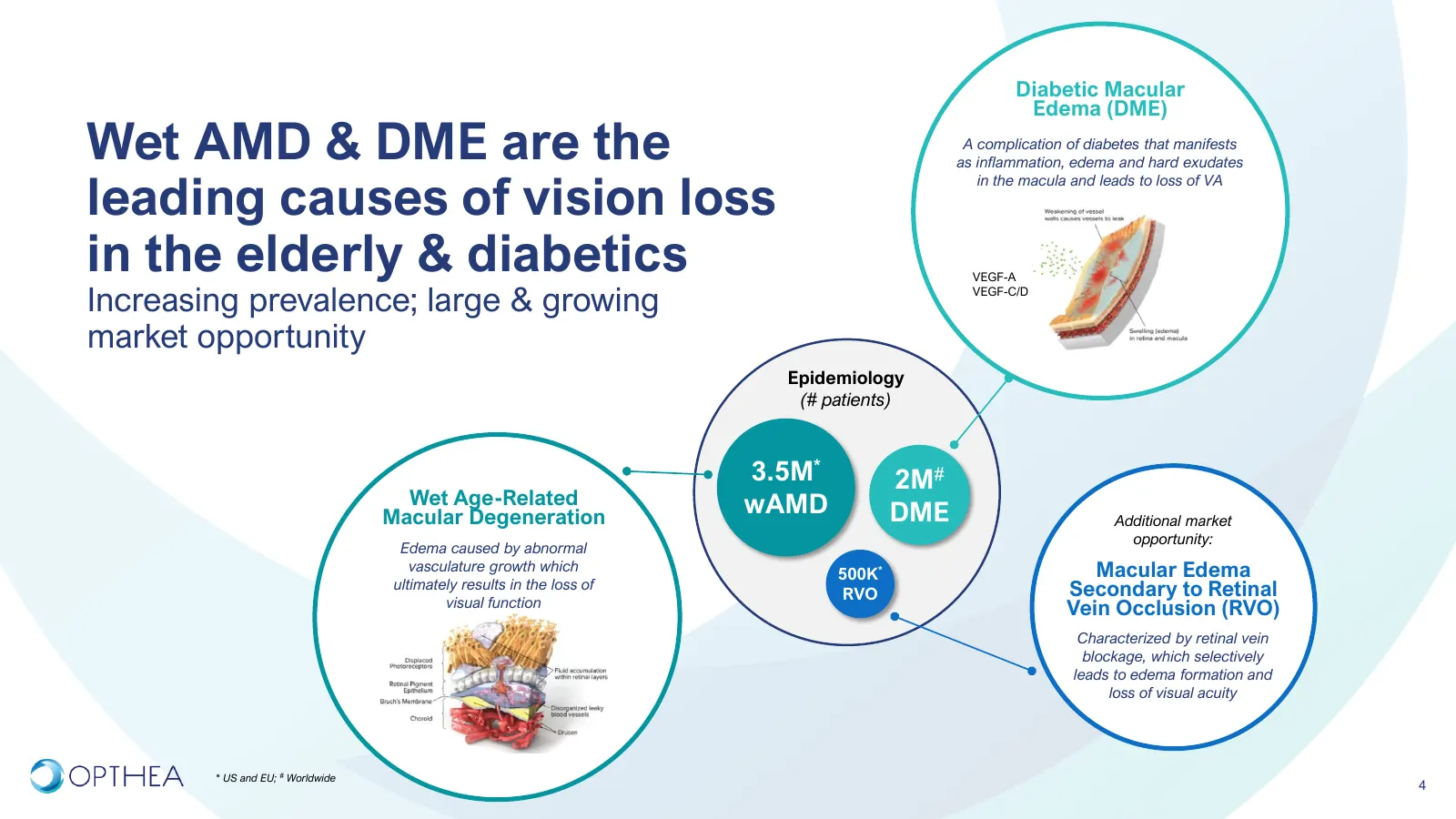
Diabetic Macular Edema (DME) Wet AMD & DME are the A complication of diabetes that manifests as inflammation, edema and hard exudates leading causes of vision loss in the macula and leads to loss of VA in the elderly & diabetics VEGF-A Increasing prevalence; large & growing VEGF-C/D market opportuni
Slide 5: The Problem, The Cause, The Solution
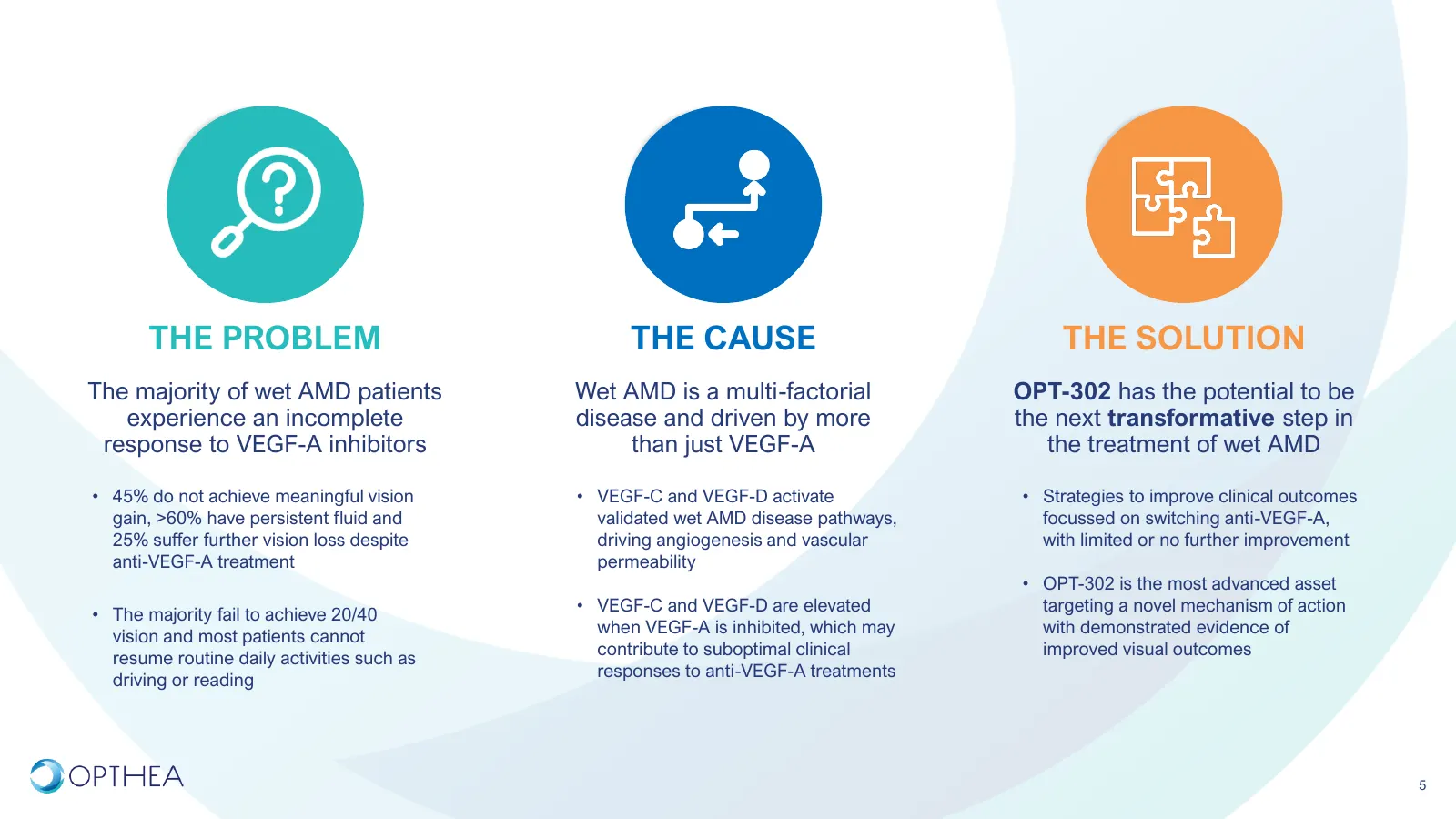
THE PROBLEM THE CAUSE THE SOLUTION The majority of wet AMD patients Wet AMD is a multi-factorial OPT-302 has the potential to be experience an incomplete disease and driven by more the next transformative step in response to VEGF-A inhibitors than just VEGF-A the treatment of wet AMD • 45% do not ac
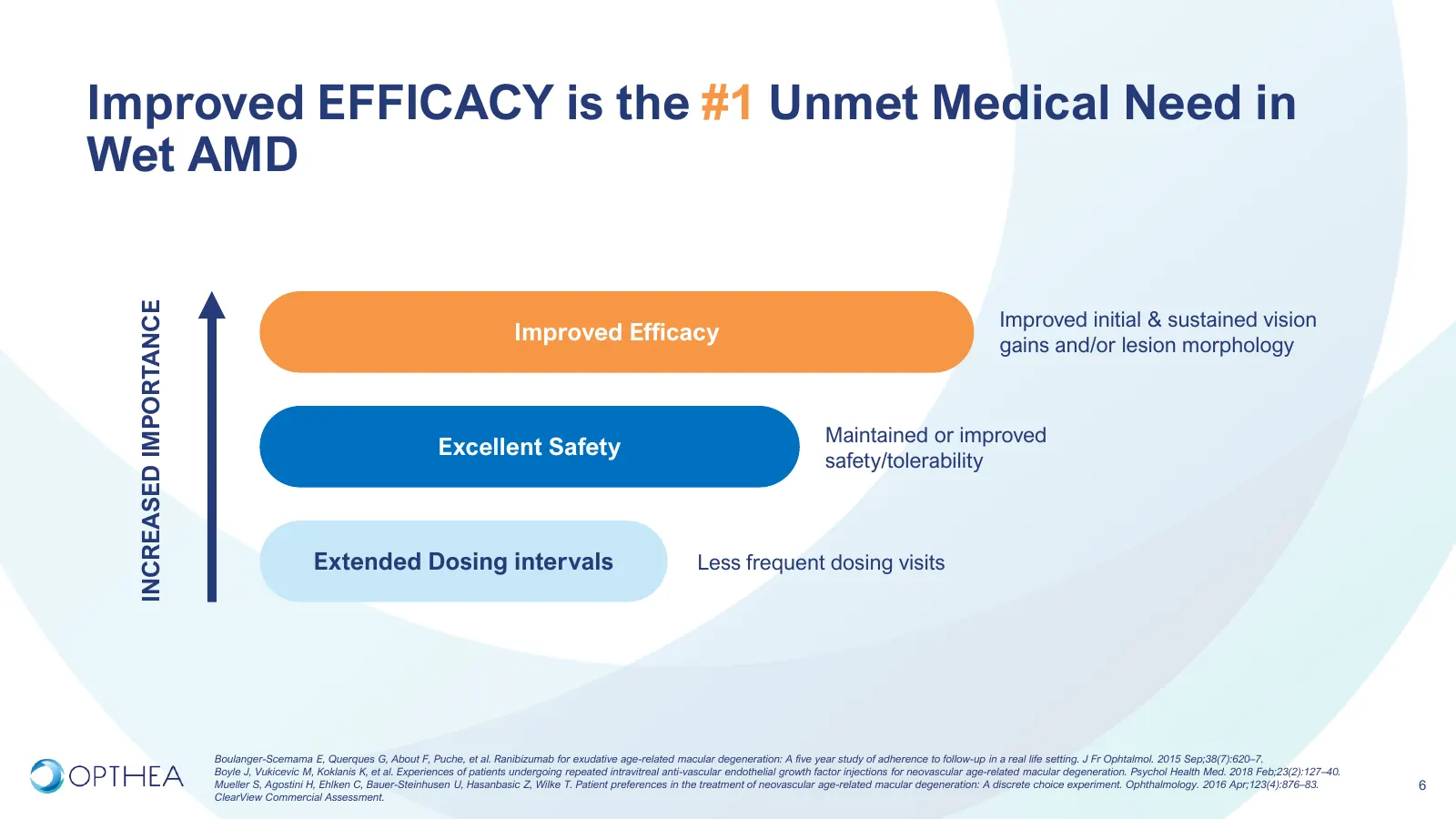
Slide 6: Improved Efficacy is the #1 Unmet Medical Need in Wet AMD
Improved EFFICACY is the #1 Unmet Medical Need in Wet AMD INCREASED IMPORTANCE Improved initial & sustained vision Improved Efficacy gains and/or lesion morphology Maintained or improved Excellent Safety safety/tolerability Extended Dosing intervals Less frequent dosing visits Boulanger-Scemama E, Q
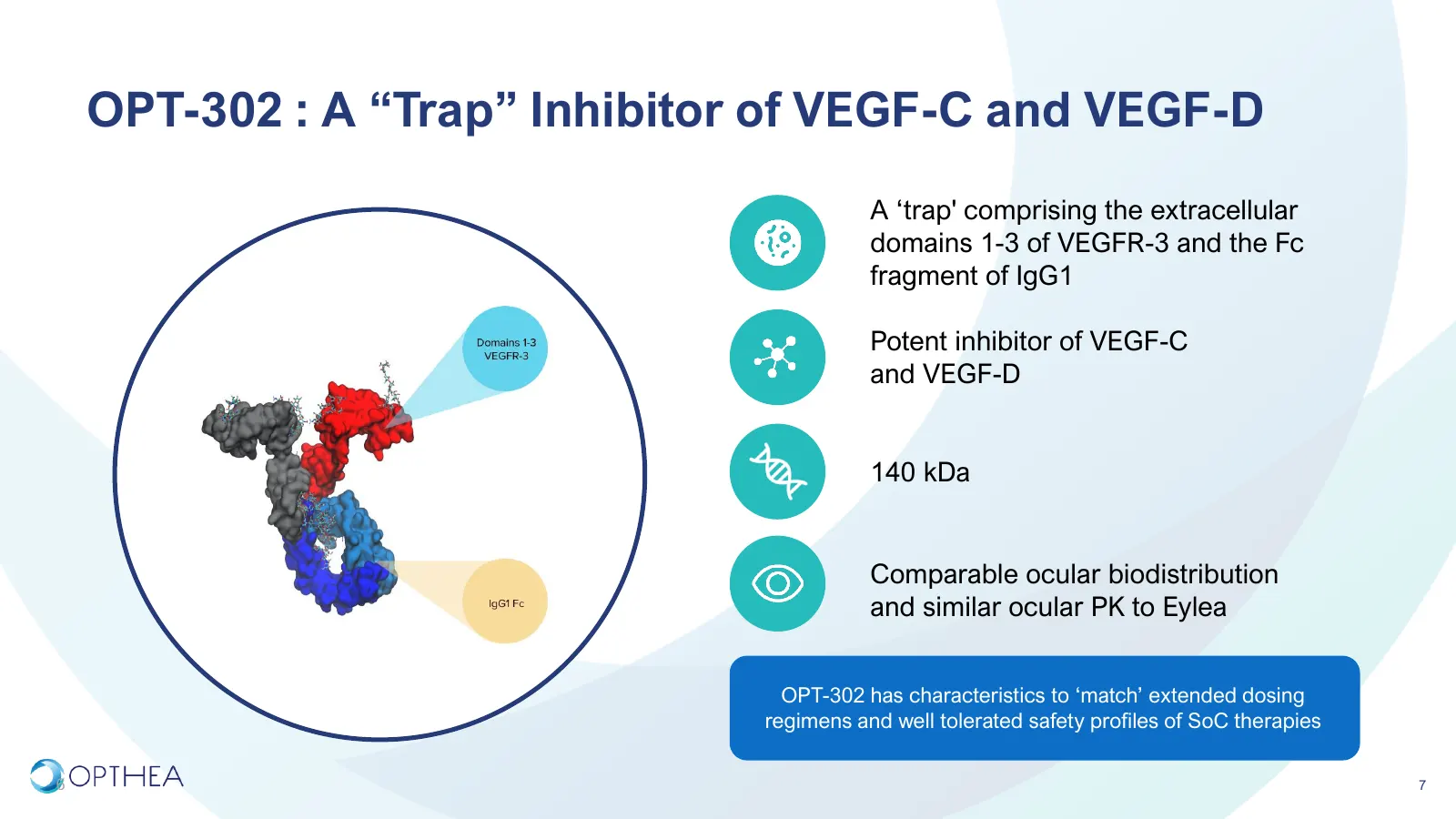
Slide 7: OPT-302: A Trap Inhibitor of VEGF-C and VEGF-D
OPT-302 : A “Trap” Inhibitor of VEGF-C and VEGF-D A ‘trap' comprising the extracellular domains 1-3 of VEGFR-3 and the Fc fragment of IgG1 Potent inhibitor of VEGF-C and VEGF-D 140 kDa Comparable ocular biodistribution and similar ocular PK to Eylea OPT-302 has characteristics to ‘match’ extended do
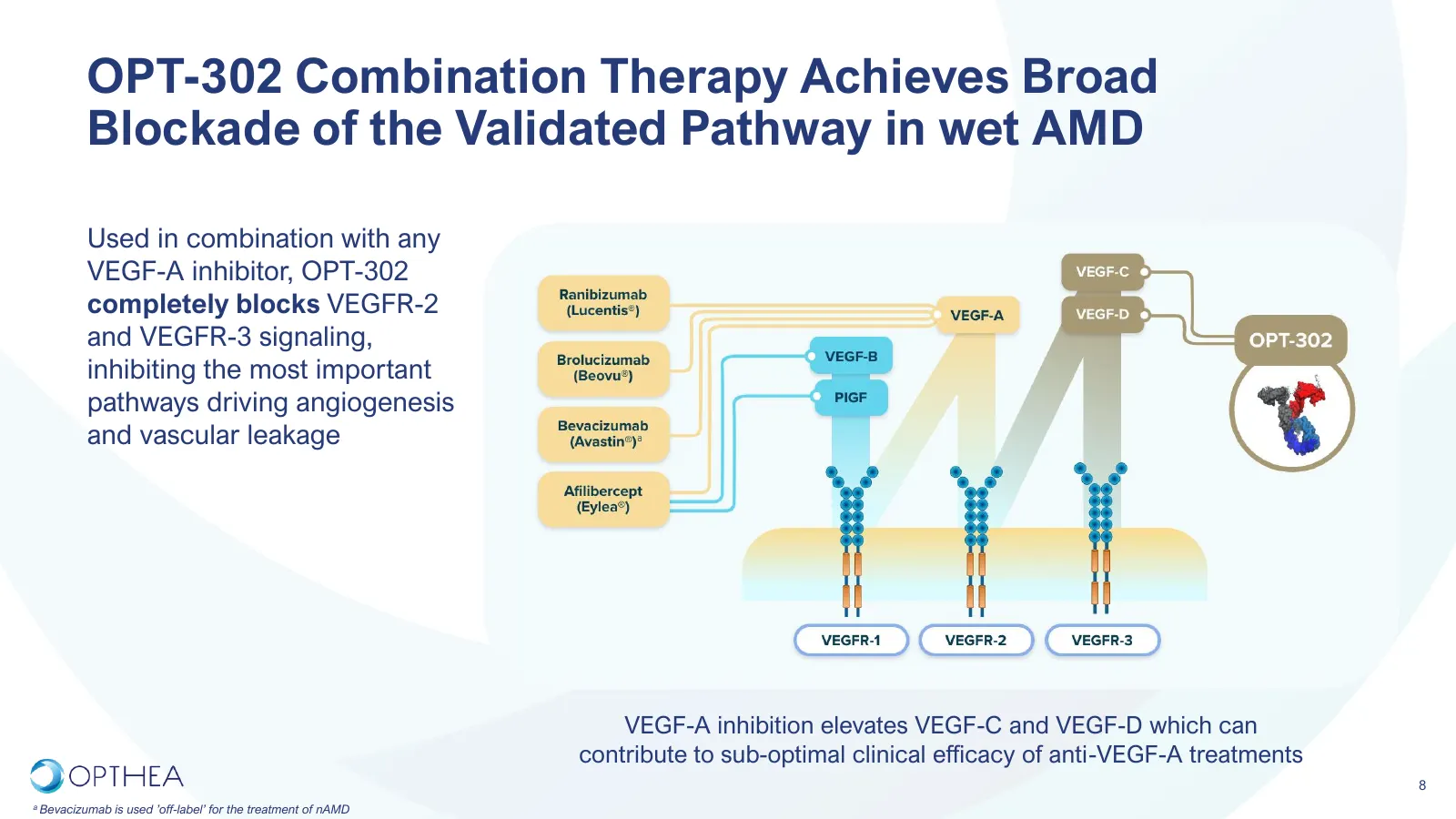
Slide 8: OPT-302 Combination Therapy Achieves Broad Blockade of the Validated Pathway in wet AMD
OPT-302 Combination Therapy Achieves Broad Blockade of the Validated Pathway in wet AMD Used in combination with any VEGF-A inhibitor, OPT-302 completely blocks VEGFR-2 and VEGFR-3 signaling, inhibiting the most important pathways driving angiogenesis and vascular leakage VEGF-A inhibition elevates
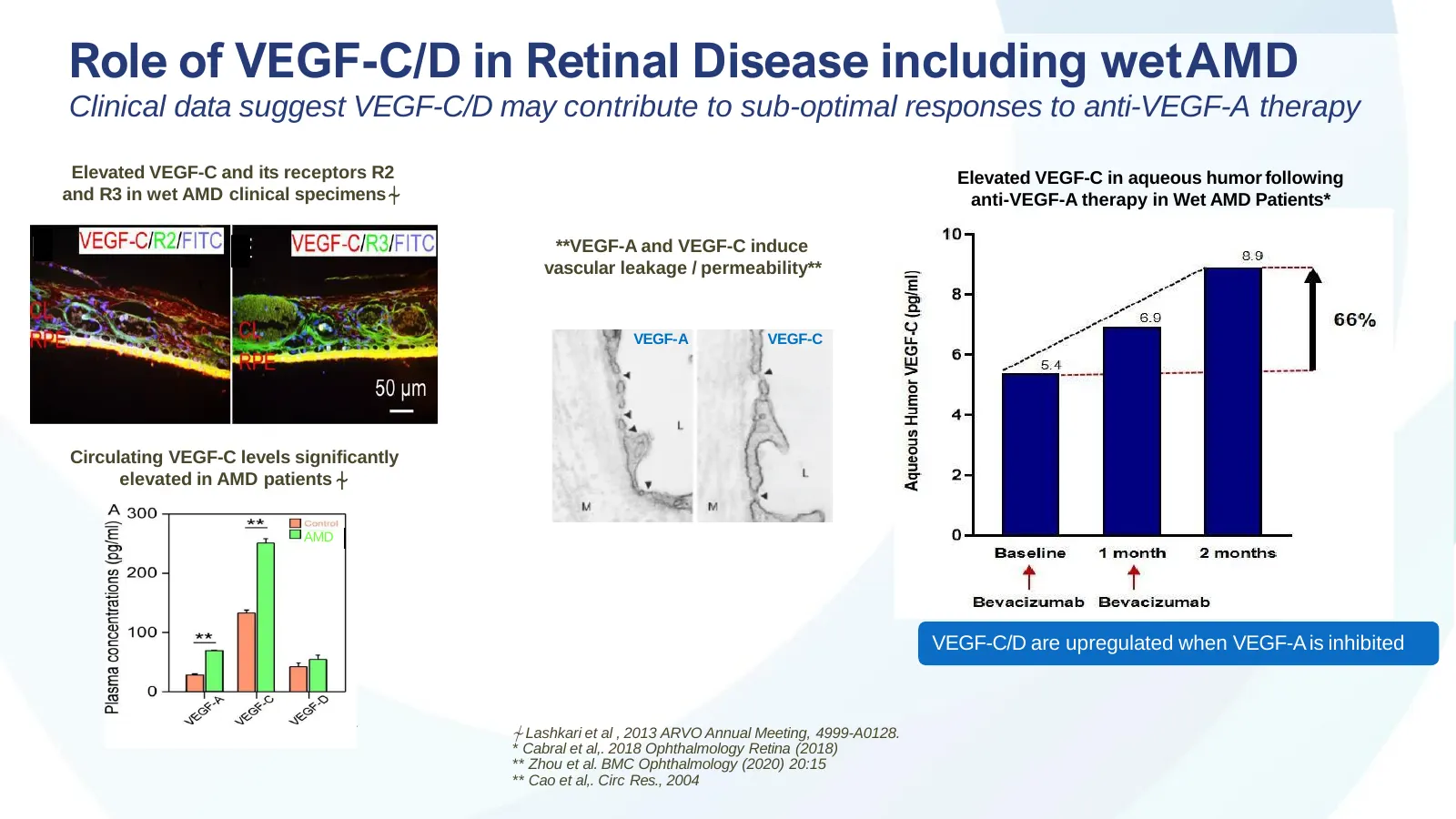
Slide 9: Role of VEGF-C/D in Retinal Disease including wetAMD
Role of VEGF-C/D in Retinal Disease including wetAMD Clinical data suggest VEGF-C/D may contribute to sub-optimal responses to anti-VEGF-A therapy Elevated VEGF-C and its receptors R2 Elevated VEGF-C in aqueous humor following and R3 in wet AMD clinical specimens⍭ anti-VEGF-A therapy in Wet AMD Pati
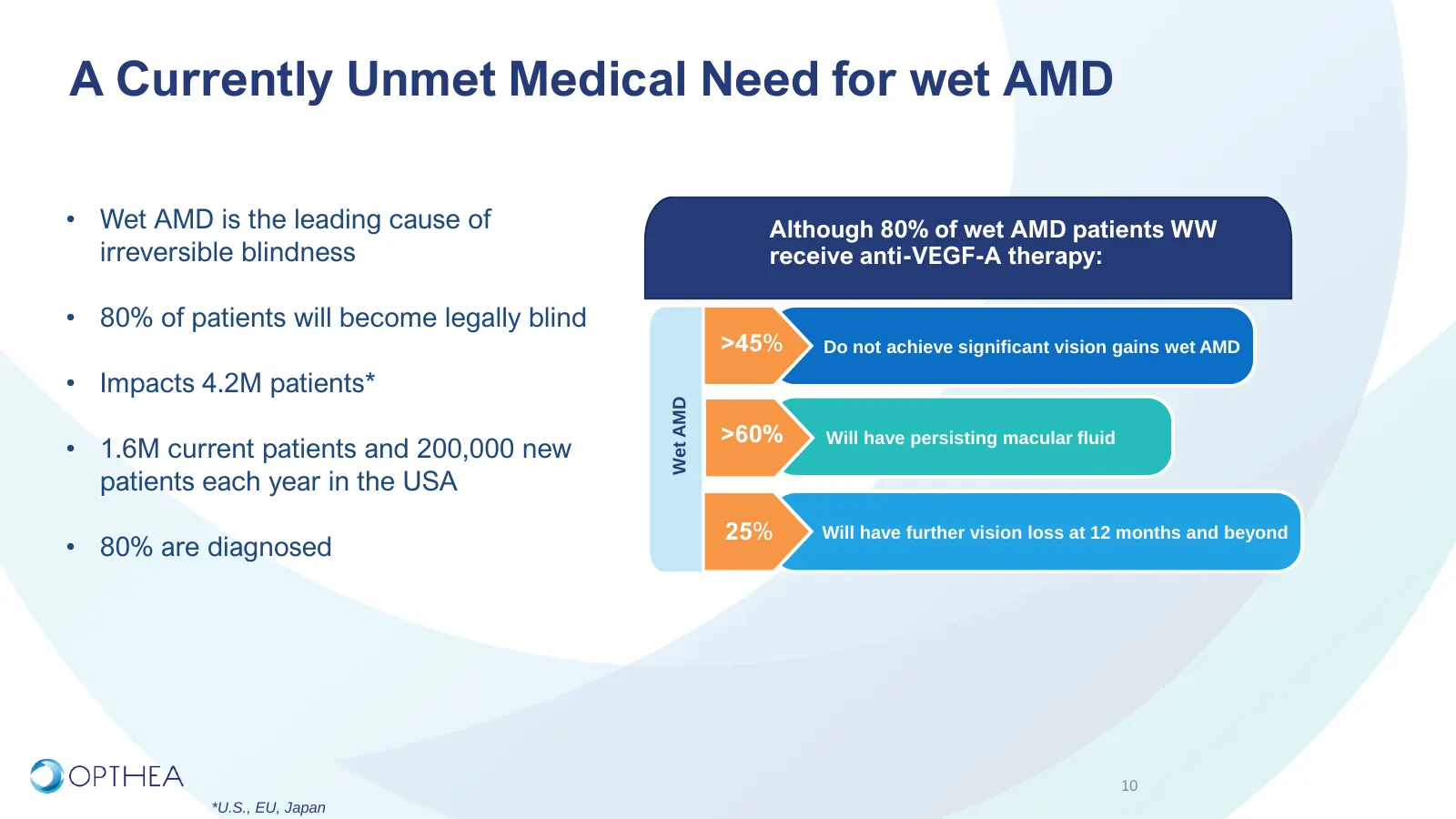
Slide 10: A Currently Unmet Medical Need for wet AMD
A Currently Unmet Medical Need for wet AMD • Wet AMD is the leading cause of Although 80% of wet AMD patients WW irreversible blindness receive anti-VEGF-A therapy: • 80% of patients will become legally blind >45% Do not achieve significant vision gains wet AMD • Impacts 4.2M patients* Wet AMD >60%
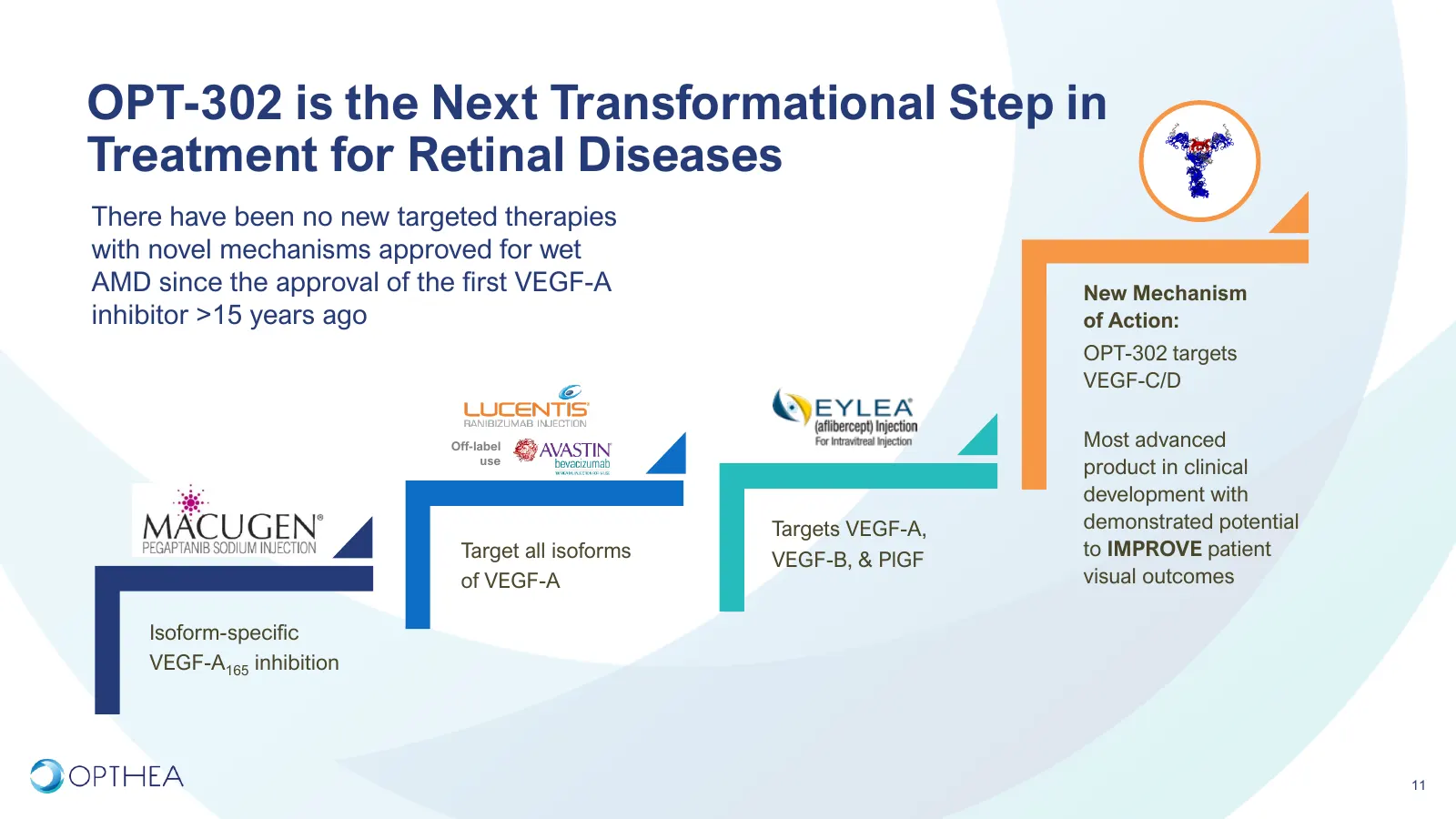
Slide 11: OPT-302 is the Next Transformational Step in Treatment for Retinal Diseases
OPT-302 is the Next Transformational Step in Treatment for Retinal Diseases There have been no new targeted therapies with novel mechanisms approved for wet AMD since the approval of the first VEGF-A New Mechanism inhibitor >15 years ago of Action: OPT-302 targets VEGF-C/D Off-label Most advanced us
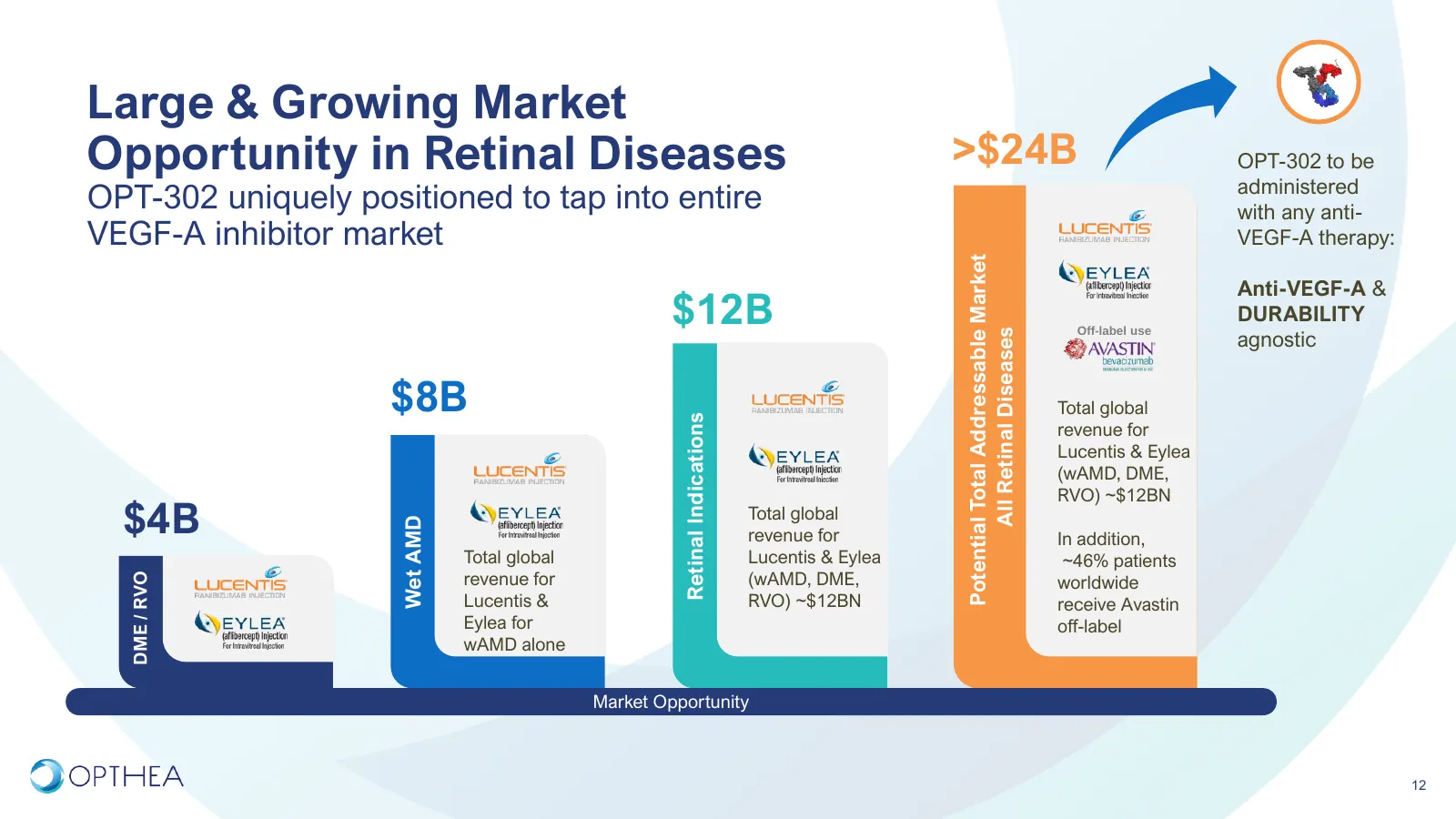
Slide 12: Potential Total Addressable Market
Large & Growing Market Opportunity in Retinal Diseases >$24B OPT-302 to be administered OPT-302 uniquely positioned to tap into entire with any anti- VEGF-A inhibitor market VEGF-A therapy: Potential Total Addressable Market Anti-VEGF-A & $12B Off-label use DURABILITY agnostic All Retinal Diseases $
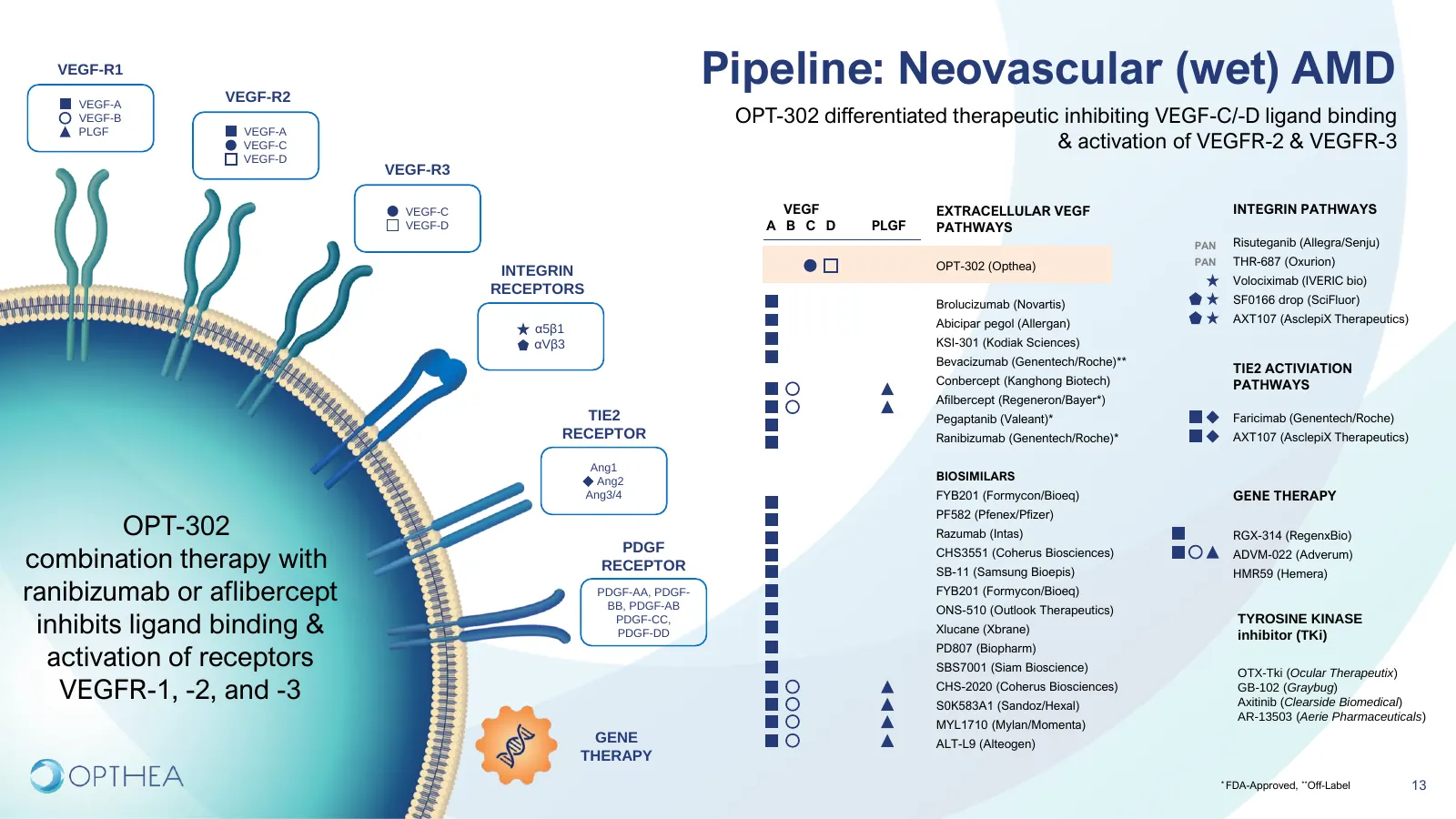
Slide 13: Pipeline: Neovascular (wet) AMD
VEGF-R1 VEGF-R2 Pipeline: Neovascular (wet) AMD VEGF-A VEGF-B OPT-302 differentiated therapeutic inhibiting VEGF-C/-D ligand binding PLGF VEGF-A VEGF-C & activation of VEGFR-2 & VEGFR-3 VEGF-D VEGF-R3 VEGF-C VEGF EXTRACELLULAR VEGF INTEGRIN PATHWAYS VEGF-D A B C D PLGF PATHWAYS PAN Risuteganib (Alle
Slide 14: Strong OPT-302 Commercial Value Drivers
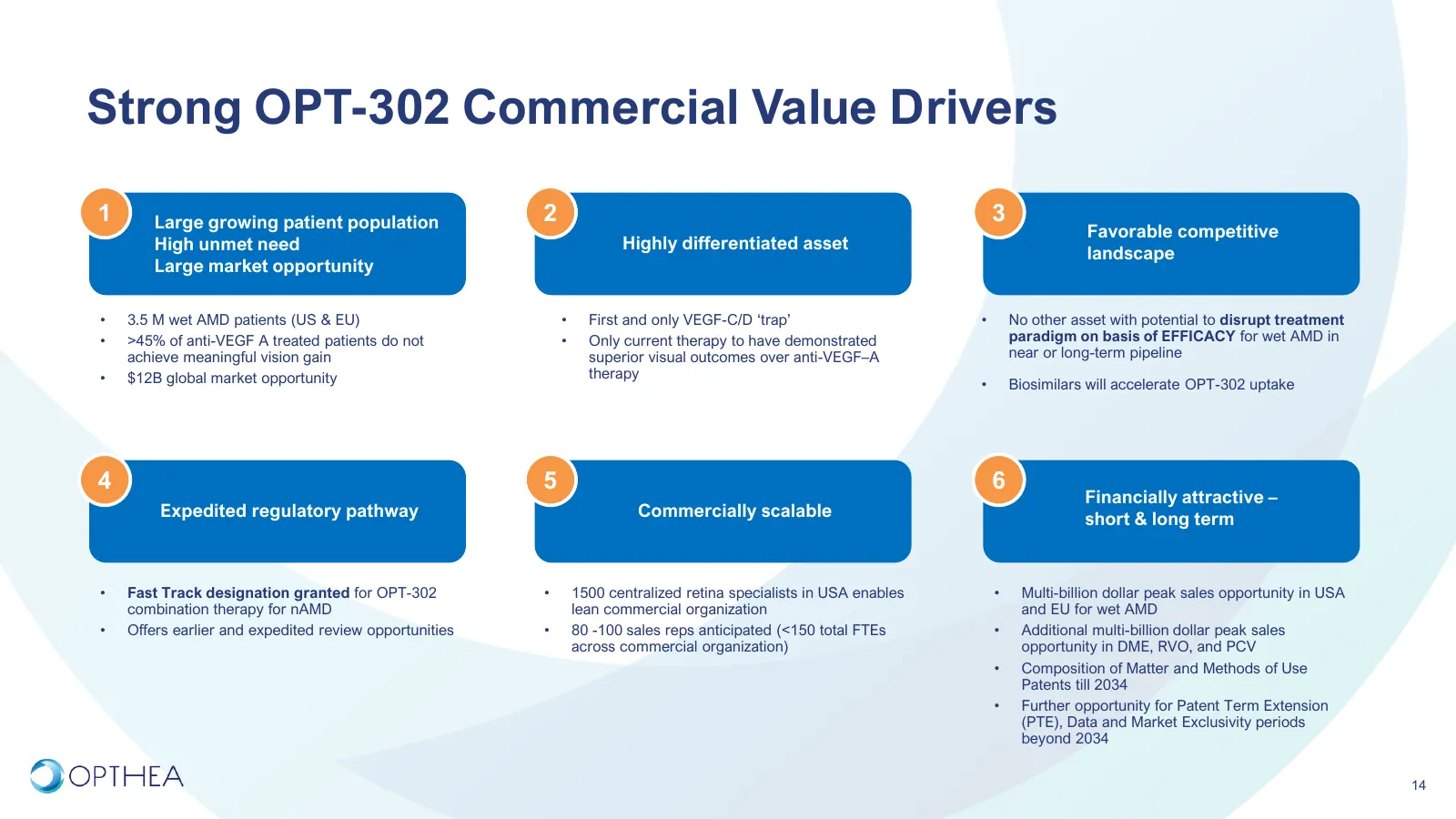
Strong OPT-302 Commercial Value Drivers 1 Large growing patient population 2 3 Favorable competitive High unmet need Highly differentiated asset landscape Large market opportunity • 3.5 M wet AMD patients (US & EU) • First and only VEGF-C/D ‘trap’ • No other asset with potential to disrupt treatment
Slide 15: Strong OPT-302 Stakeholder Value Drivers
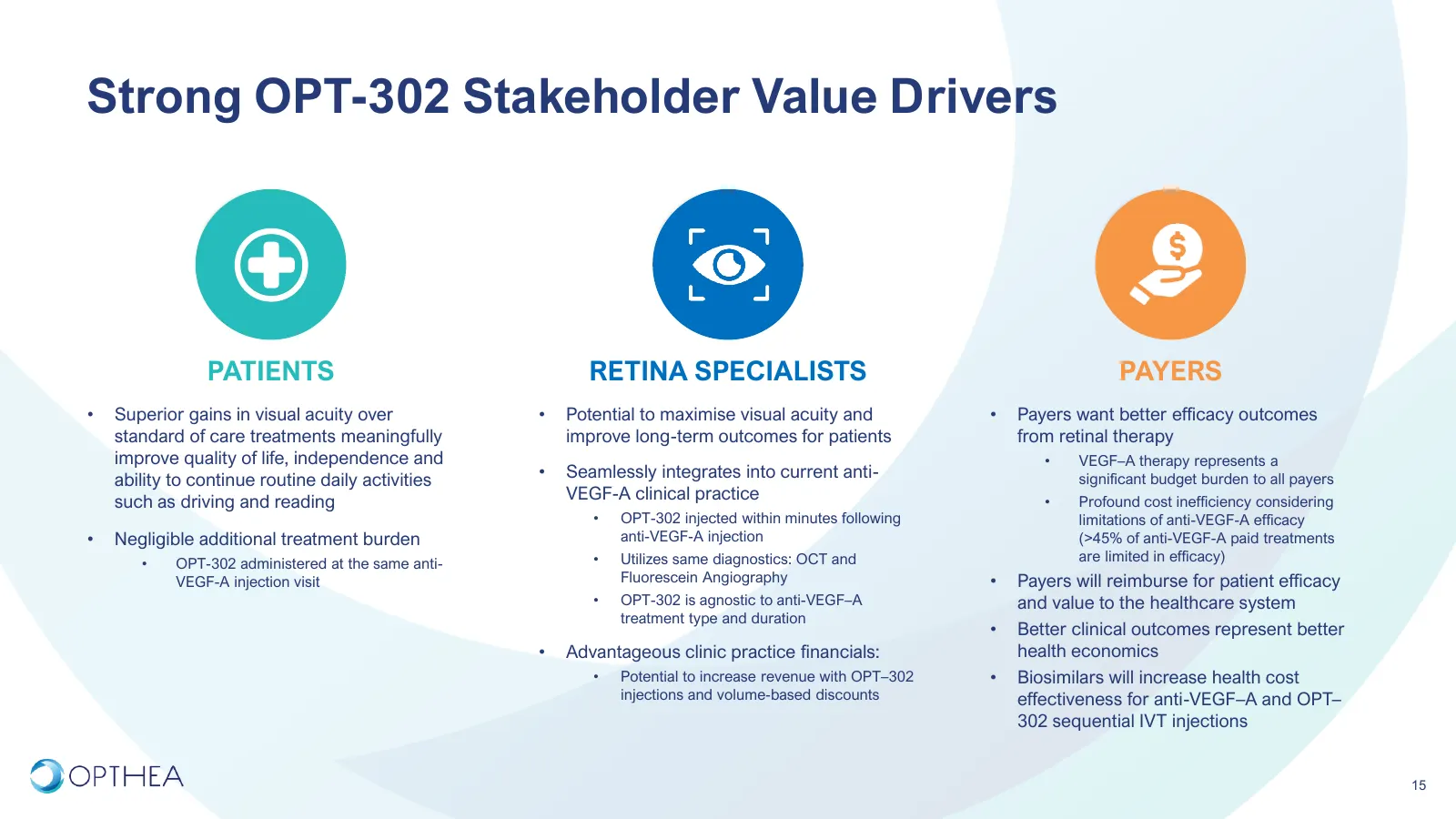
Strong OPT-302 Stakeholder Value Drivers PATIENTS RETINA SPECIALISTS PAYERS • Superior gains in visual acuity over • Potential to maximise visual acuity and • Payers want better efficacy outcomes standard of care treatments meaningfully improve long-term outcomes for patients from retinal therapy im
Slide 16: Clinical Data
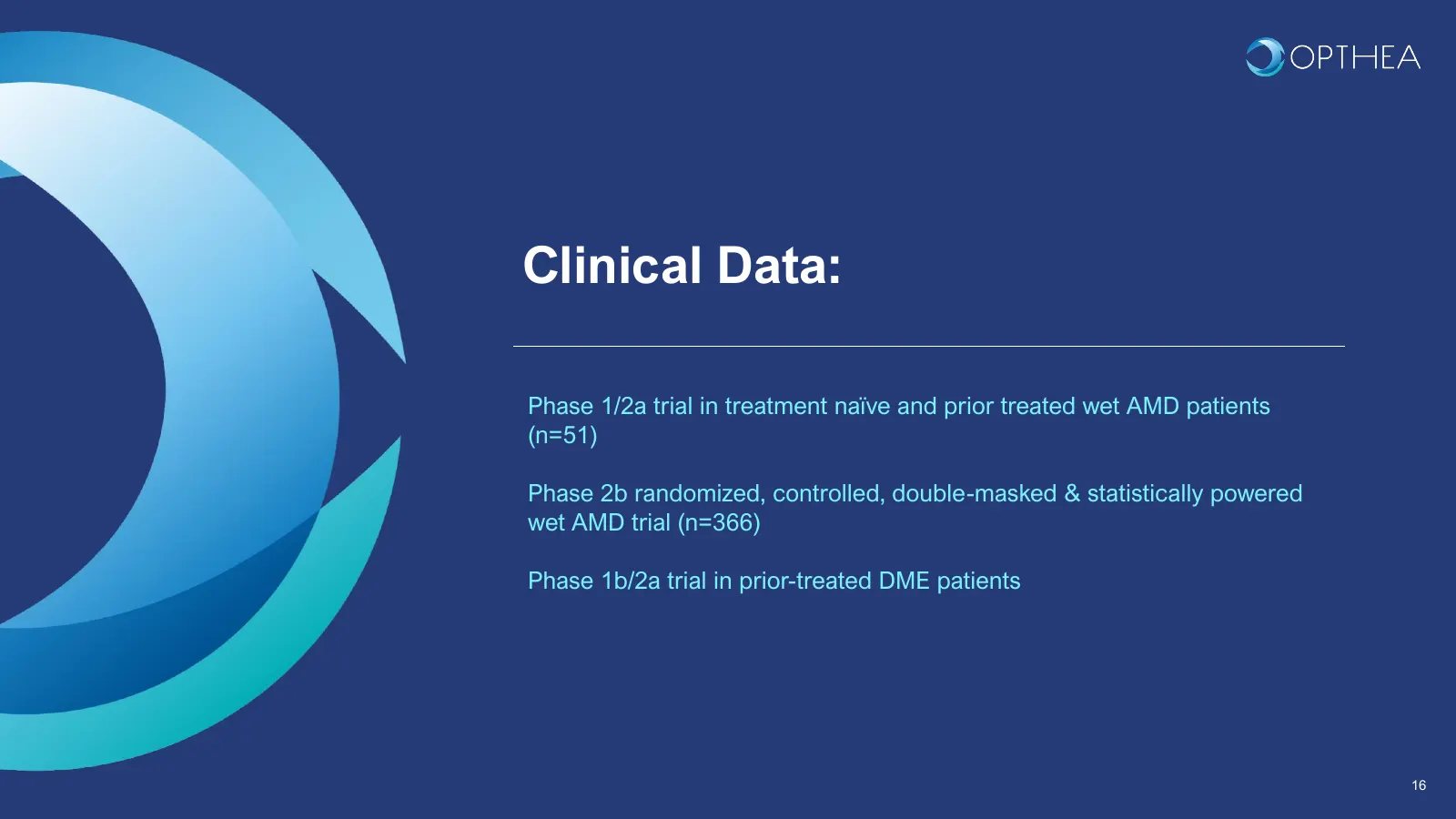
Clinical Data: Phase 1/2a trial in treatment naïve and prior treated wet AMD patients (n=51) Phase 2b randomized, controlled, double-masked & statistically powered wet AMD trial (n=366) Phase 1b/2a trial in prior-treated DME patients 16
Slide 17: OPT-302 Combination Therapy – Clinical Program
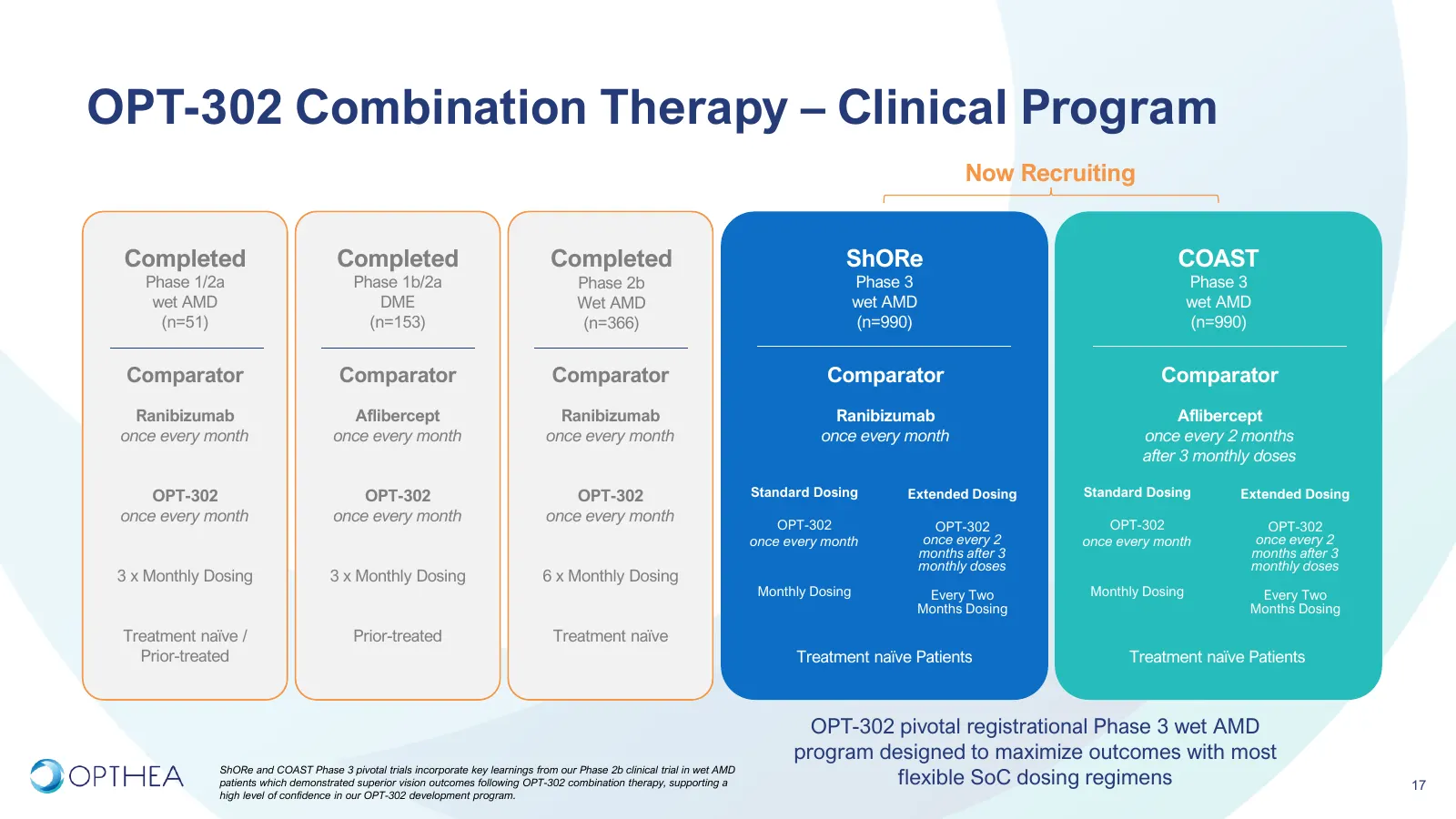
OPT-302 Combination Therapy – Clinical Program Now Recruiting Completed Completed Completed ShORe COAST Phase 1/2a Phase 1b/2a Phase 2b Phase 3 Phase 3 wet AMD DME Wet AMD wet AMD wet AMD (n=51) (n=153) (n=366) (n=990) (n=990) Comparator Comparator Comparator Comparator Comparator Ranibizumab Aflibe
Slide 18: Phase 2b
Phase 2b A multicenter, randomized, double-masked, sham controlled study of intravitreal OPT-302 in combination with ranibizumab, in participants with neovascular (wet) AMD Conducted at 109 sites across 10 countries: US, EU, Israel OPT-302-1002; NCT ClinicalTrials.gov Identifier: NCT03345082 18
Slide 19: Study Overview
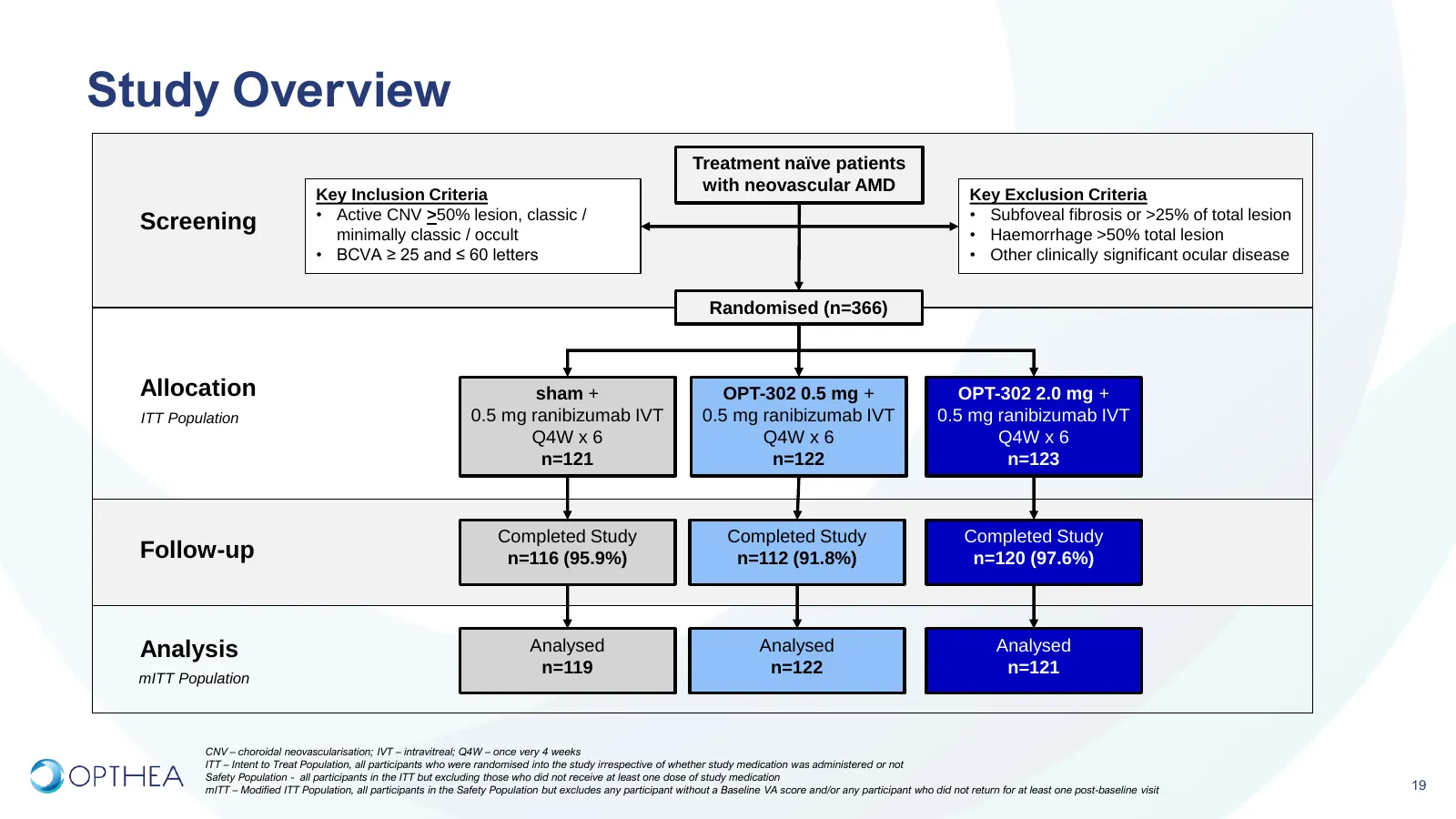
Study Overview Treatment naïve patients Key Inclusion Criteria with neovascular AMD Key Exclusion Criteria • Active CNV >50% lesion, classic / • Subfoveal fibrosis or >25% of total lesion Screening minimally classic / occult • Haemorrhage >50% total lesion • BCVA ≥ 25 and ≤ 60 letters • Other clinic
Slide 20: Study Demographics and Baseline Characteristics
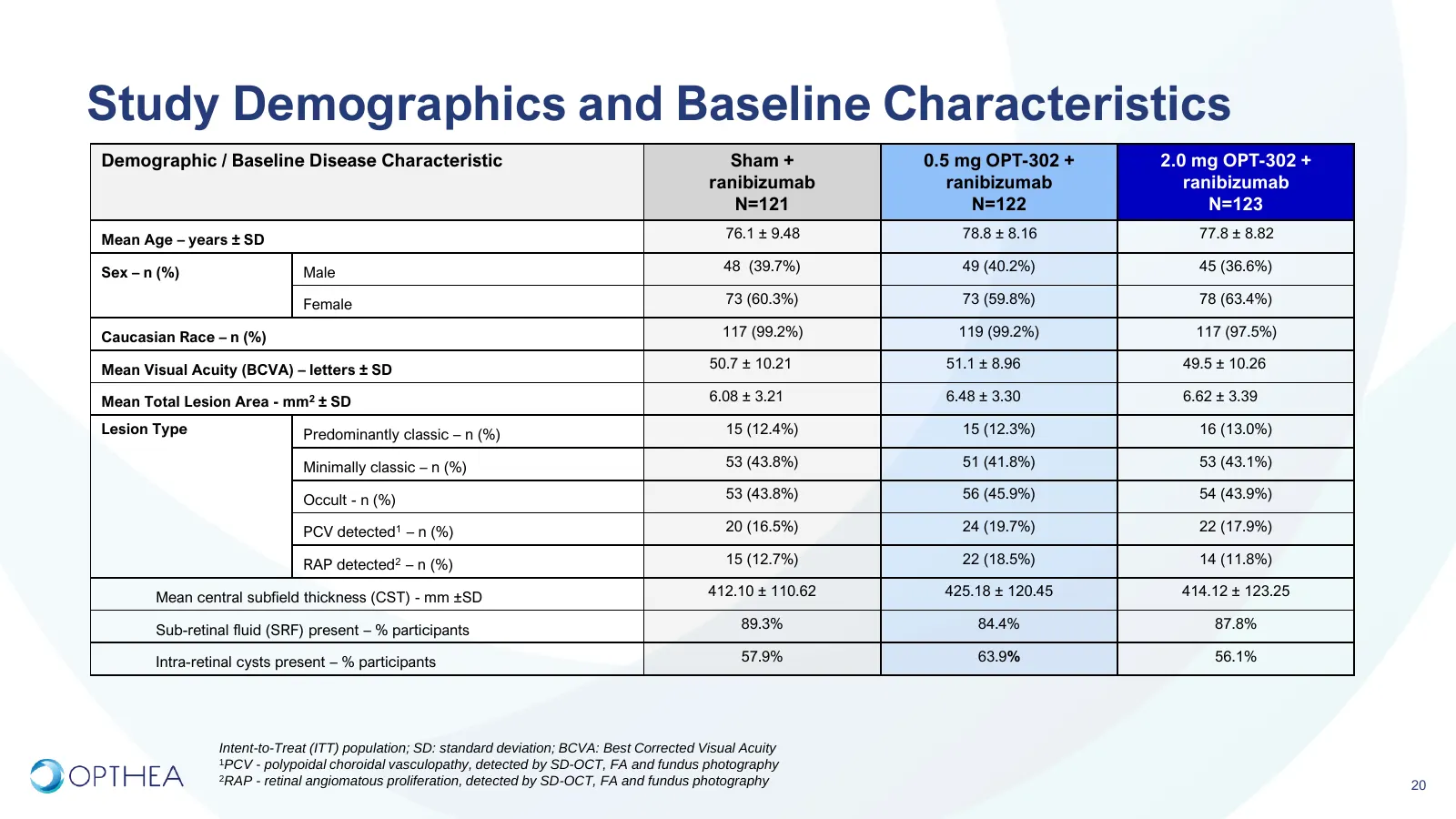
Study Demographics and Baseline Characteristics Demographic / Baseline Disease Characteristic Sham + 0.5 mg OPT-302 + 2.0 mg OPT-302 + ranibizumab ranibizumab ranibizumab N=121 N=122 N=123 Mean Age – years ± SD 76.1 ± 9.48 78.8 ± 8.16 77.8 ± 8.82 Sex – n (%) Male 48 (39.7%) 49 (40.2%) 45 (36.6%) Fem
Slide 21: Mean Change in Best Corrected Visual Acuity Baseline to Week 24
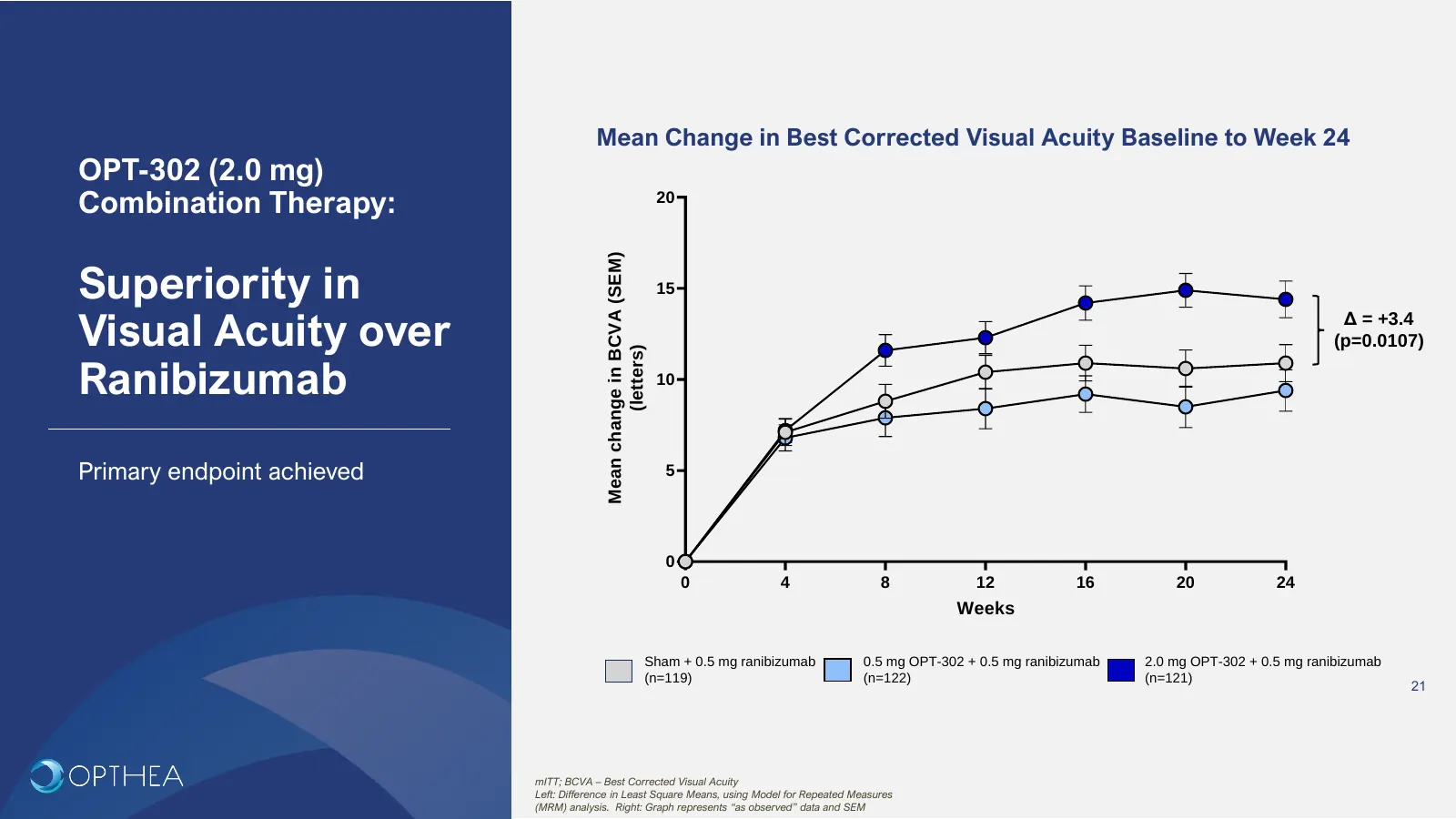
Mean Change in Best Corrected Visual Acuity Baseline to Week 24 OPT-302 (2.0 mg) Combination Therapy: 20 Mean change in BCVA (SEM) Superiority in 15 Visual Acuity over Δ = +3.4 (p=0.0107) (letters) Ranibizumab 10 Primary endpoint achieved 5 0 0 4 8 12 16 20 24 Weeks Sham + 0.5 mg ranibizumab 0.5 mg
Slide 22: Comparison with Other Trials
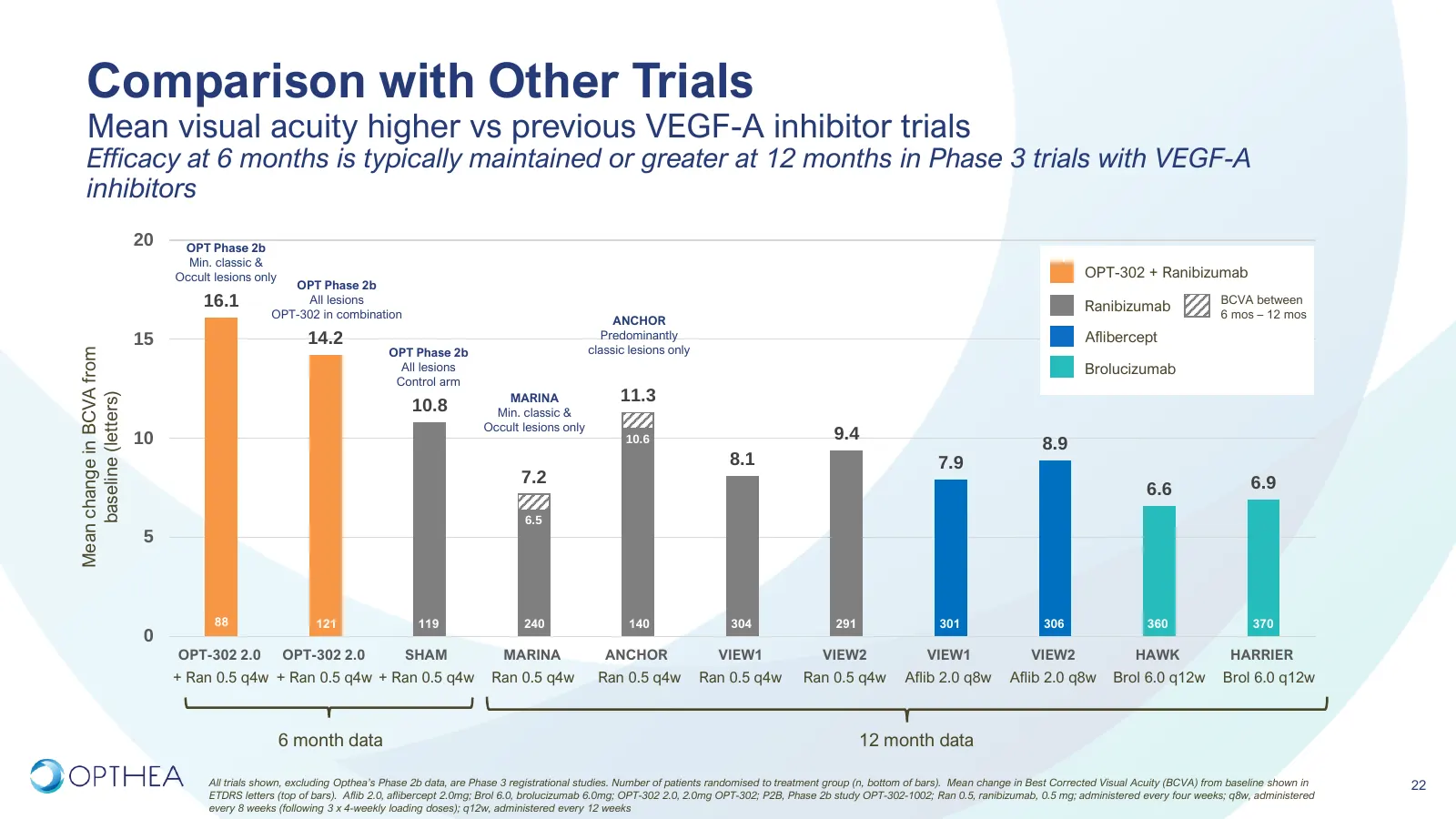
Comparison with Other Trials Mean visual acuity higher vs previous VEGF-A inhibitor trials Efficacy at 6 months is typically maintained or greater at 12 months in Phase 3 trials with VEGF-A inhibitors 20 OPT Phase 2b Min. classic & Occult lesions only OPT-302 + Ranibizumab OPT Phase 2b 16.1 All lesi
Slide 23: Secondary Endpoints Supportive of Visual Acuity Improvement
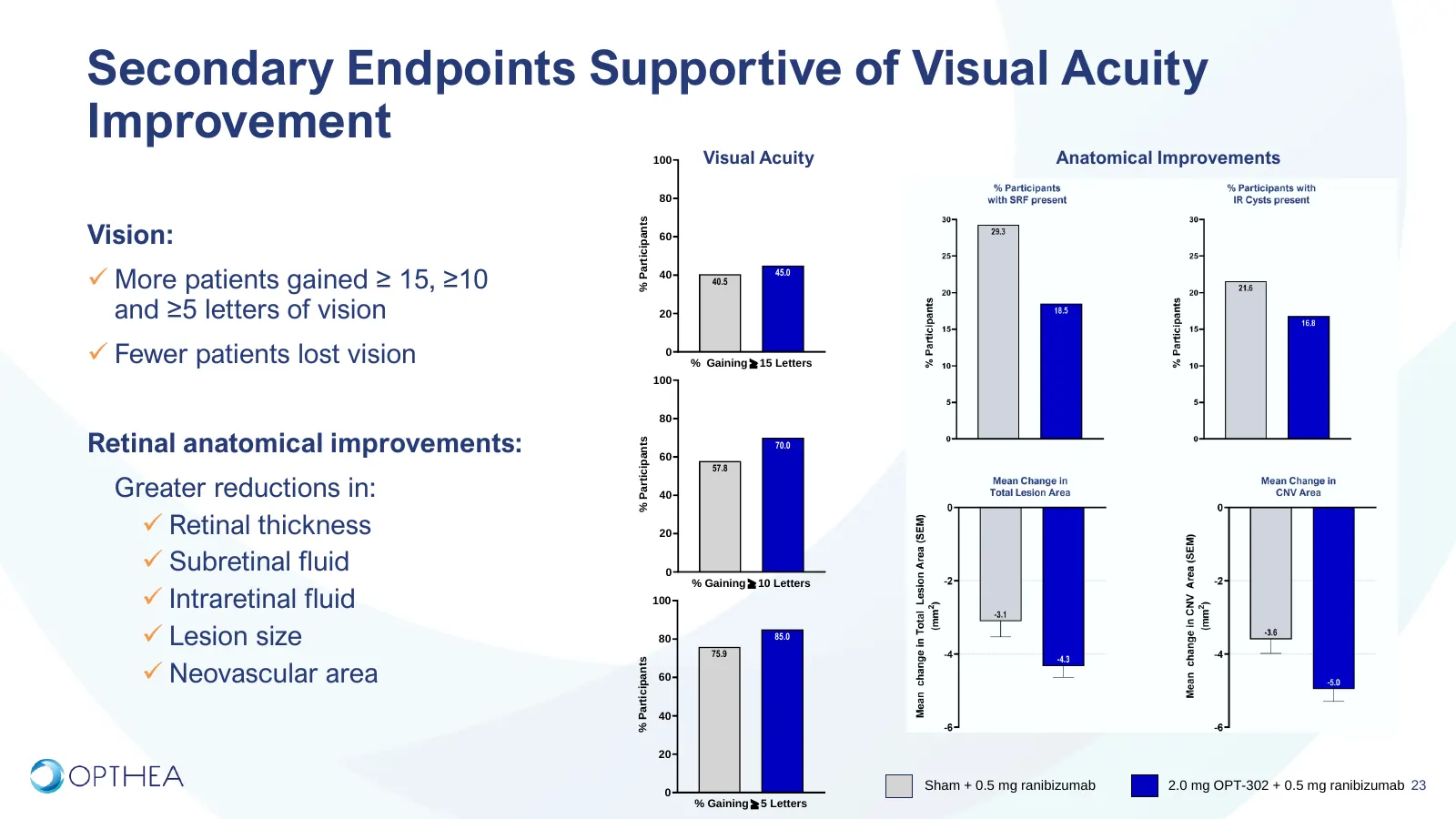
Secondary Endpoints Supportive of Visual Acuity Improvement 100 Visual Acuity Anatomical Improvements 80 % Participants Vision: 60 ✓ More patients gained ≥ 15, ≥10 40 40.5 45.0 and ≥5 letters of vision 20 ✓ Fewer patients lost vision 0 % Gaining 15 Letters 100 80 Retinal anatomical improvements: %
Slide 24: Neovascular (wet) AMD Lesion Types
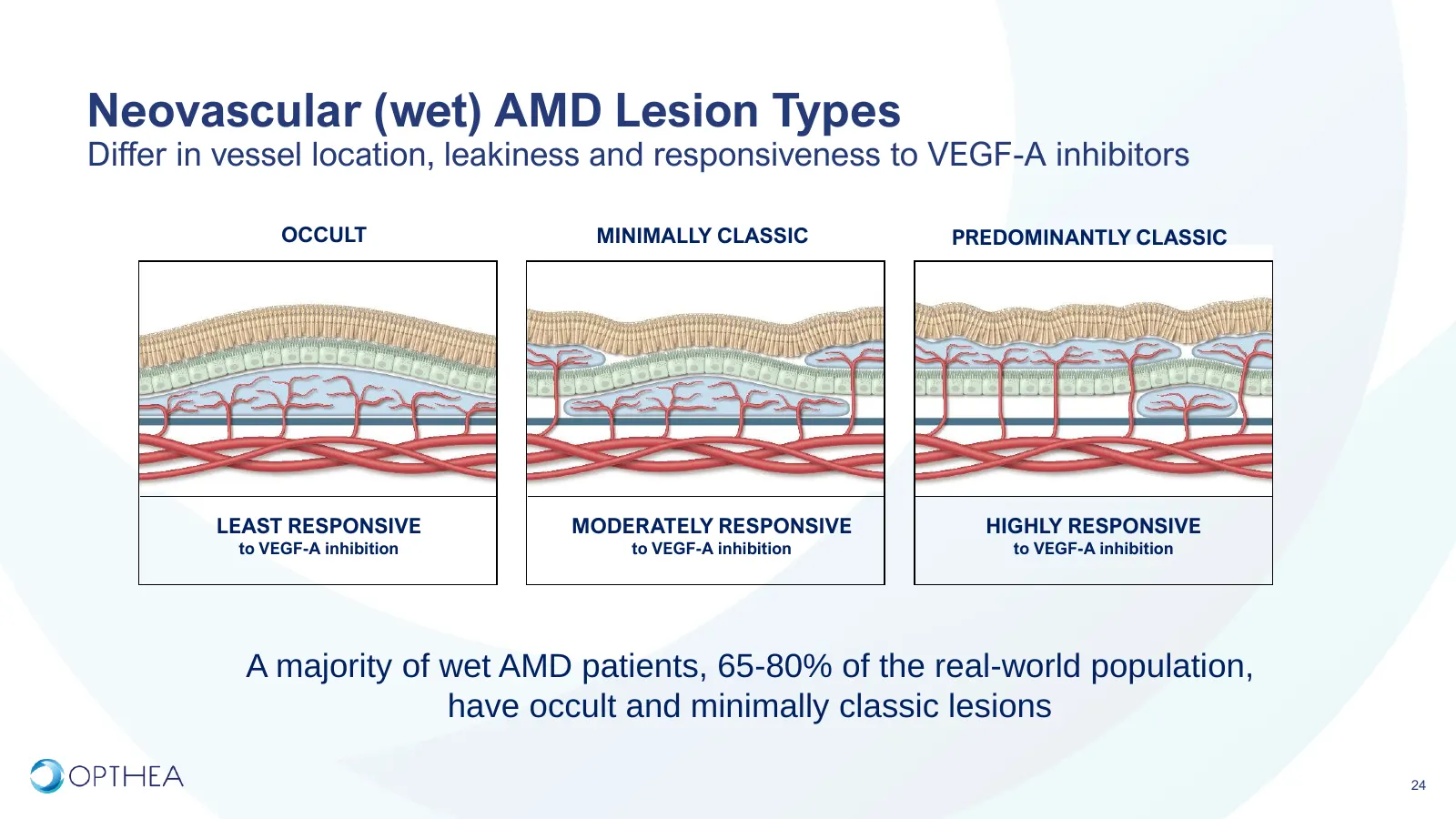
Neovascular (wet) AMD Lesion Types Differ in vessel location, leakiness and responsiveness to VEGF-A inhibitors OCCULT MINIMALLY CLASSIC PREDOMINANTLY CLASSIC LEAST RESPONSIVE MODERATELY RESPONSIVE HIGHLY RESPONSIVE to VEGF-A inhibition to VEGF-A inhibition to VEGF-A inhibition A majority of wet AMD
Slide 25: Baseline CNV Features Influence Clinical Outcomes in Eyes with nAMD
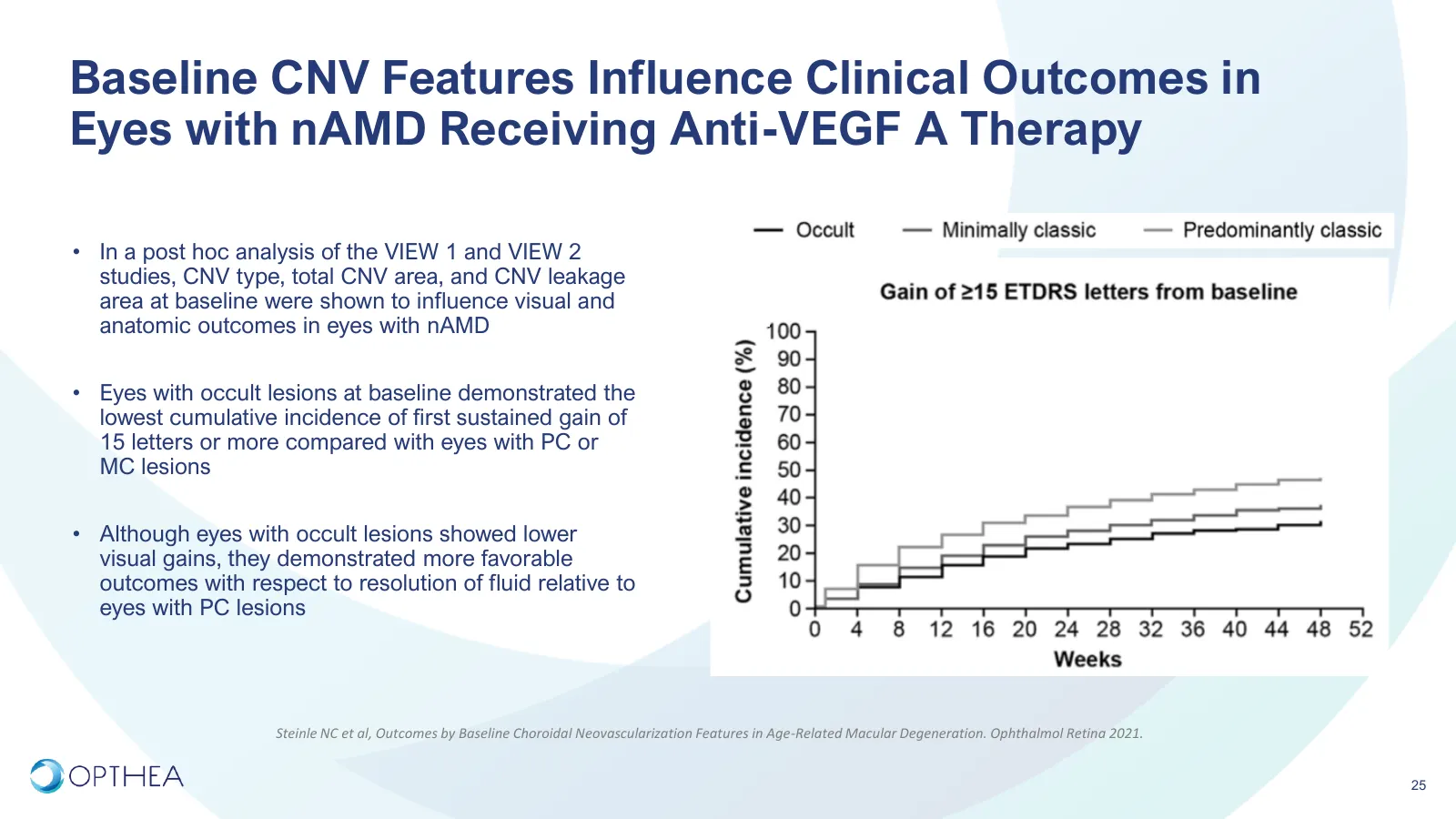
Baseline CNV Features Influence Clinical Outcomes in Eyes with nAMD Receiving Anti-VEGF A Therapy • In a post hoc analysis of the VIEW 1 and VIEW 2 studies, CNV type, total CNV area, and CNV leakage area at baseline were shown to influence visual and anatomic outcomes in eyes with nAMD • Eyes with o
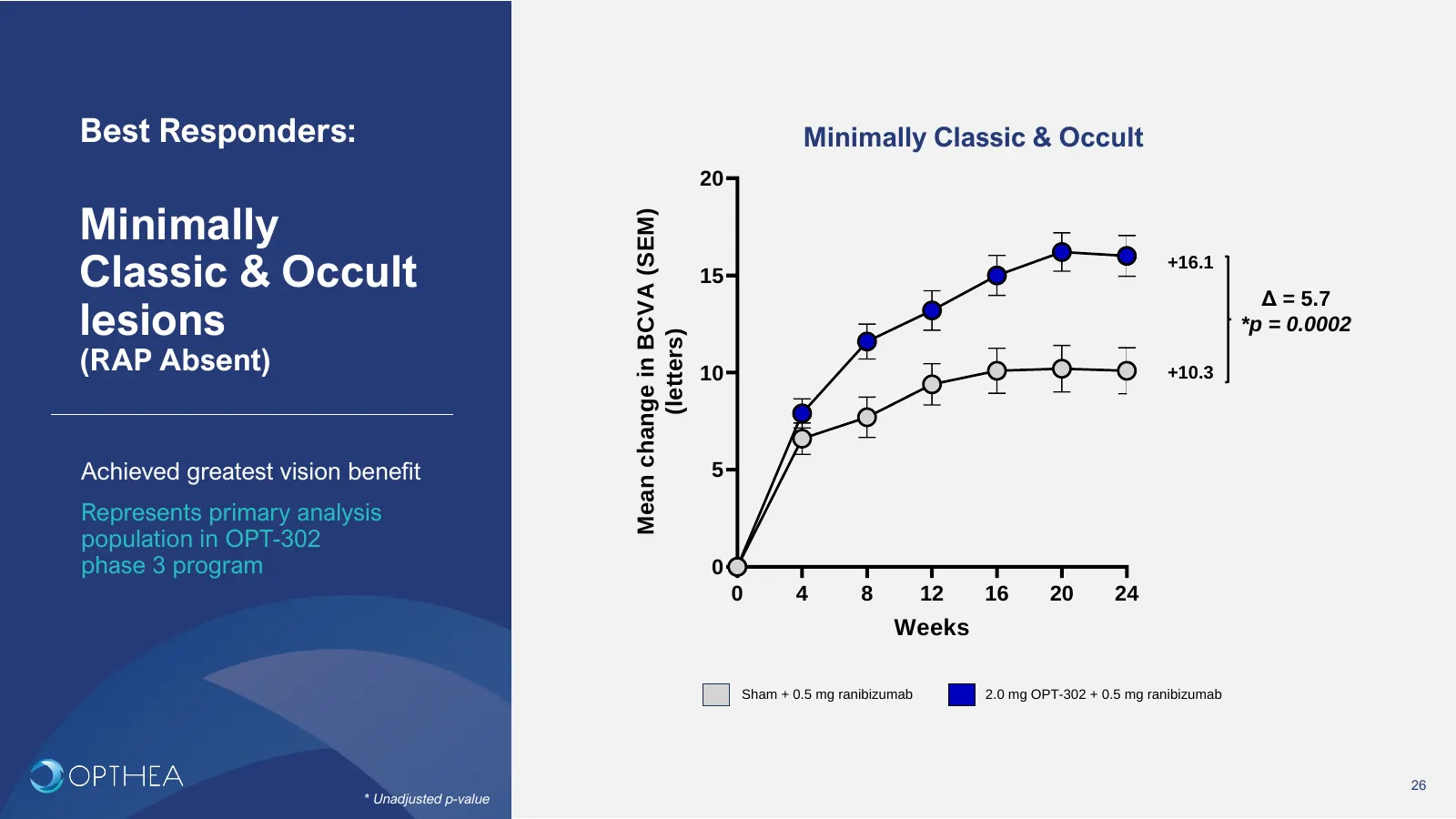
Slide 26: Best Responders: Minimally Classic & Occult
Best Responders: Minimally Classic & Occult 20 Minimally Mean change in BCVA (SEM) Classic & Occult 15 +16.1 Δ = 5.7 lesions *p = 0.0002 (letters) (RAP Absent) 10 +10.3 Achieved greatest vision benefit 5 Represents primary analysis population in OPT-302 phase 3 program 0 0 4 8 12 16 20 24 Weeks Sham
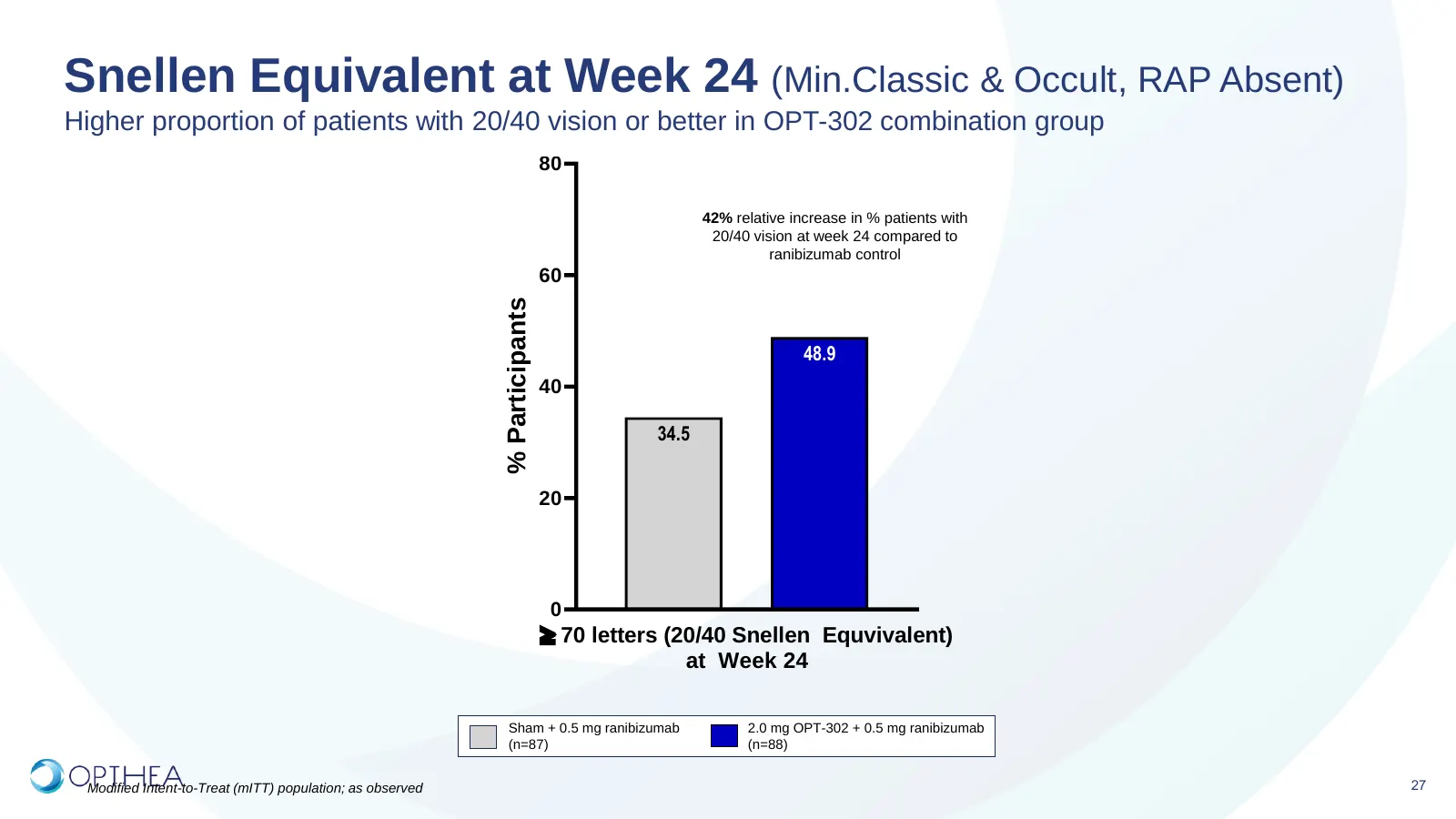
Slide 27: Snellen Equivalent at Week 24
Snellen Equivalent at Week 24 (Min.Classic & Occult, RAP Absent) Higher proportion of patients with 20/40 vision or better in OPT-302 combination group 80 42% relative increase in % patients with 20/40 vision at week 24 compared to ranibizumab control 60 % Participants 48.9 40 34.5 20 0 70 letters
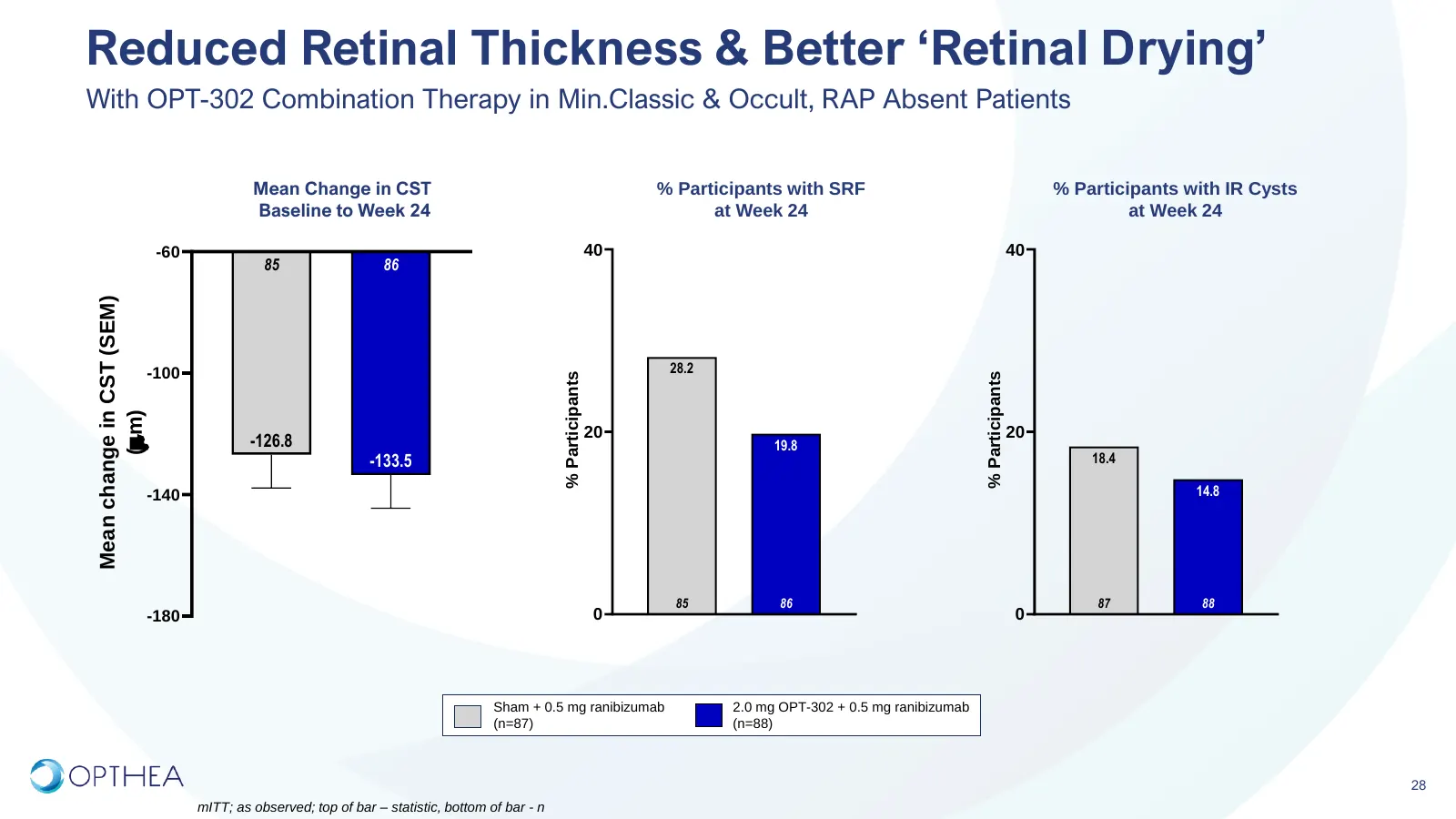
Slide 28: Reduced Retinal Thickness & Better Retinal Drying
Reduced Retinal Thickness & Better ‘Retinal Drying’ With OPT-302 Combination Therapy in Min.Classic & Occult, RAP Absent Patients Mean Change in CST % Participants with SRF % Participants with IR Cysts Baseline to Week 24 at Week 24 at Week 24 -60 40 40 85 86 Mean change in CST (SEM) -100 28.2 % Par
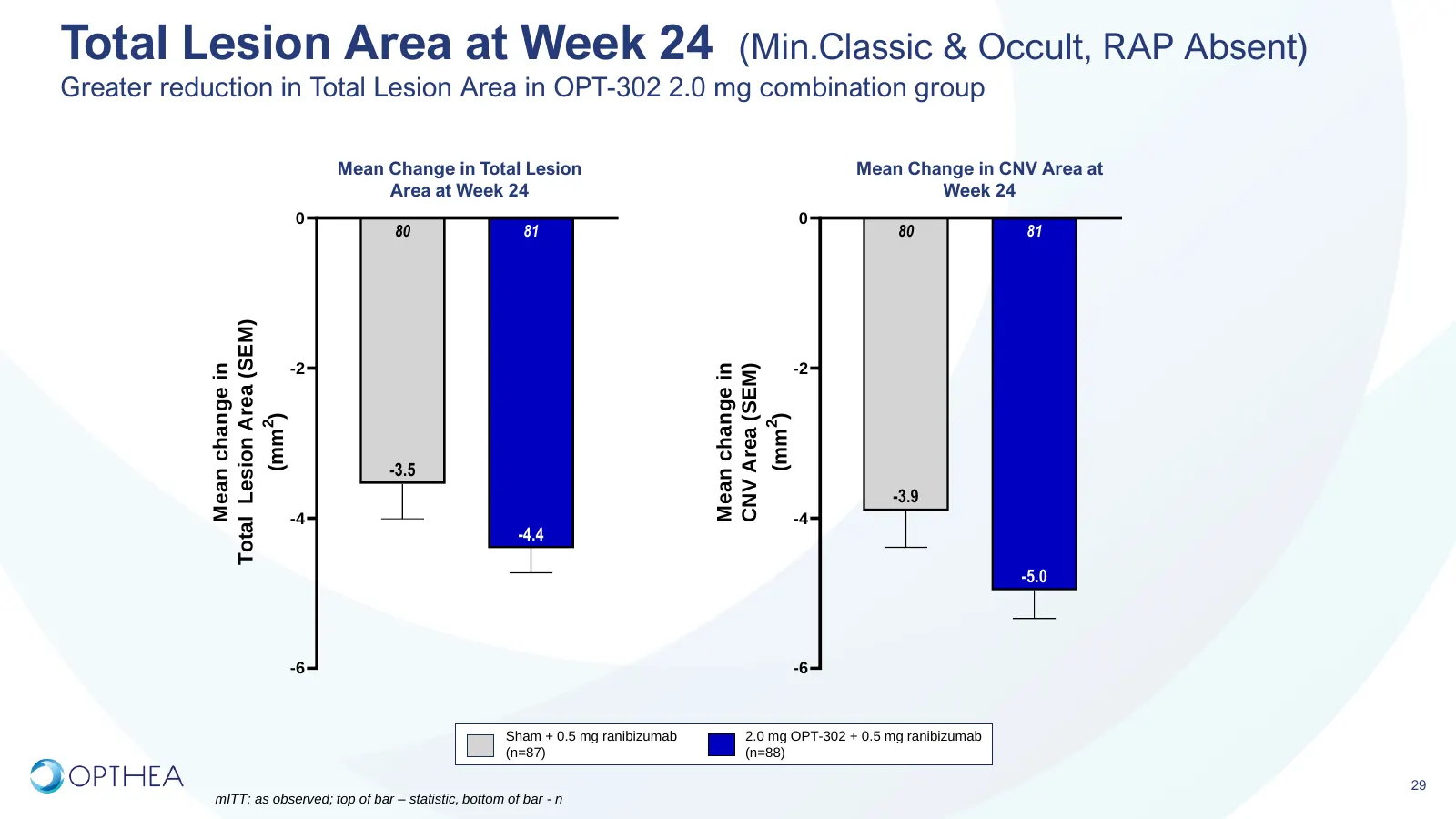
Slide 29: Greater reduction in Total Lesion Area in OPT-302 2.0 mg group
Total Lesion Area at Week 24 (Min.Classic & Occult, RAP Absent) Greater reduction in Total Lesion Area in OPT-302 2.0 mg combination group Mean Change in Total Lesion Mean Change in CNV Area at Area at Week 24 Week 24 0 0 80 81 80 81 Total Lesion Area (SEM) -2 -2 Mean change in Mean change in CNV Ar
Slide 30: Polypoidal Choroidal Vasculopathy (PCV)
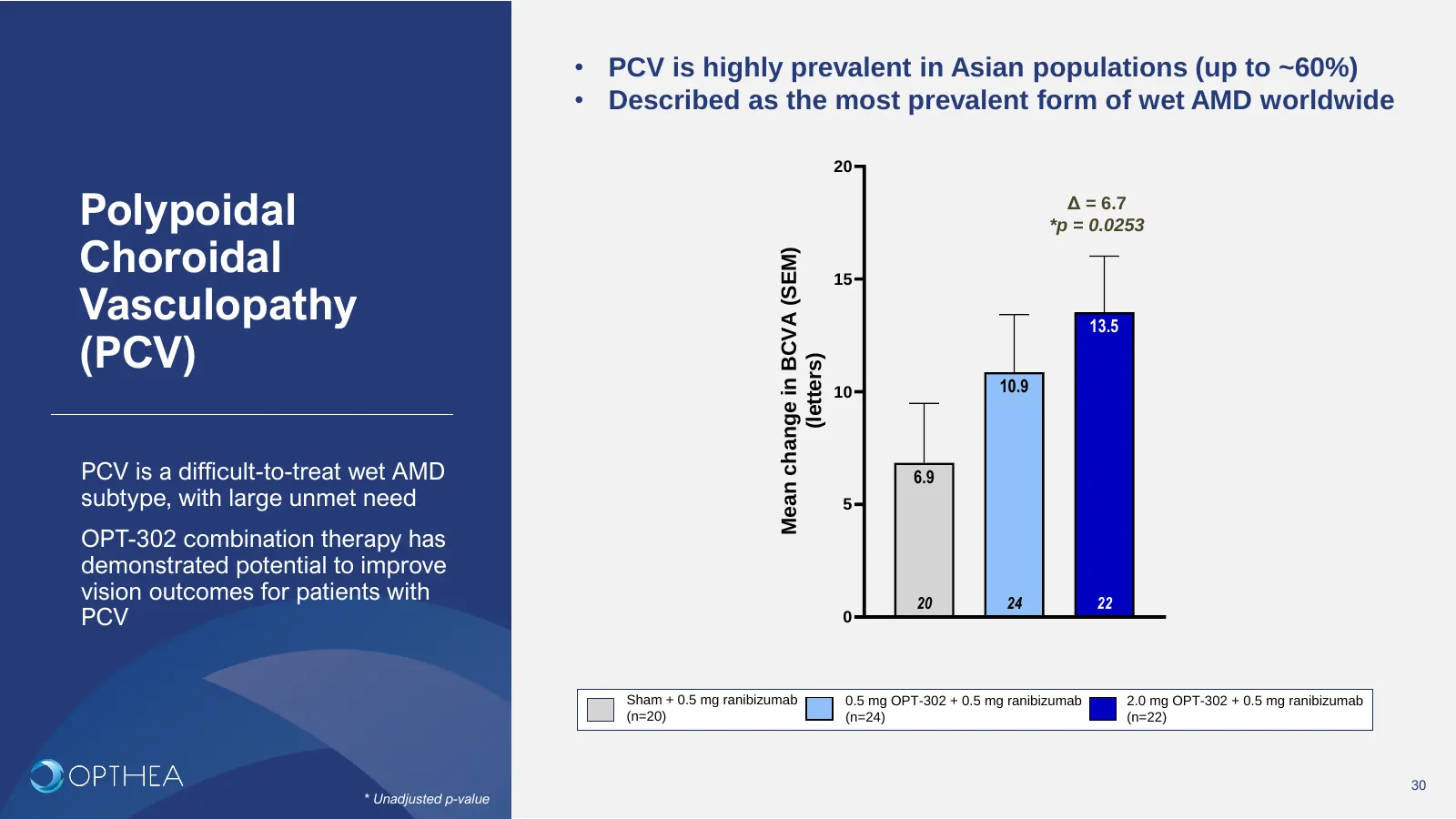
• PCV is highly prevalent in Asian populations (up to ~60%) • Described as the most prevalent form of wet AMD worldwide 20 Polypoidal Δ = 6.7 *p = 0.0253 Choroidal Mean change in BCVA (SEM) 15 Vasculopathy 13.5 (PCV) (letters) 10 10.9 PCV is a difficult-to-treat wet AMD 6.9 subtype, with large unmet
Slide 31: Safety
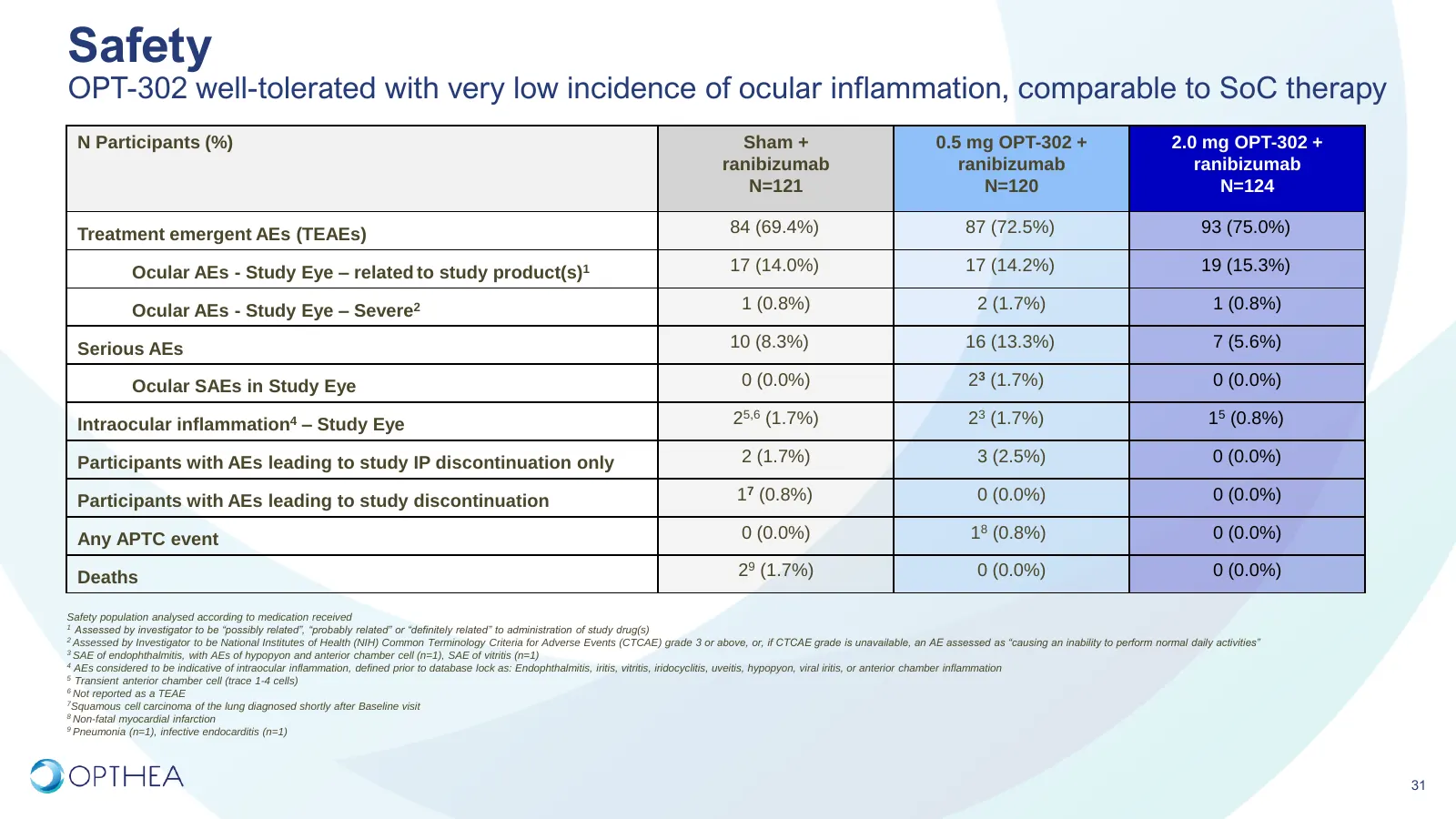
Safety OPT-302 well-tolerated with very low incidence of ocular inflammation, comparable to SoC therapy N Participants (%) Sham + 0.5 mg OPT-302 + 2.0 mg OPT-302 + ranibizumab ranibizumab ranibizumab N=121 N=120 N=124 Treatment emergent AEs (TEAEs) 84 (69.4%) 87 (72.5%) 93 (75.0%) Ocular AEs - Study
Slide 32: Conclusions
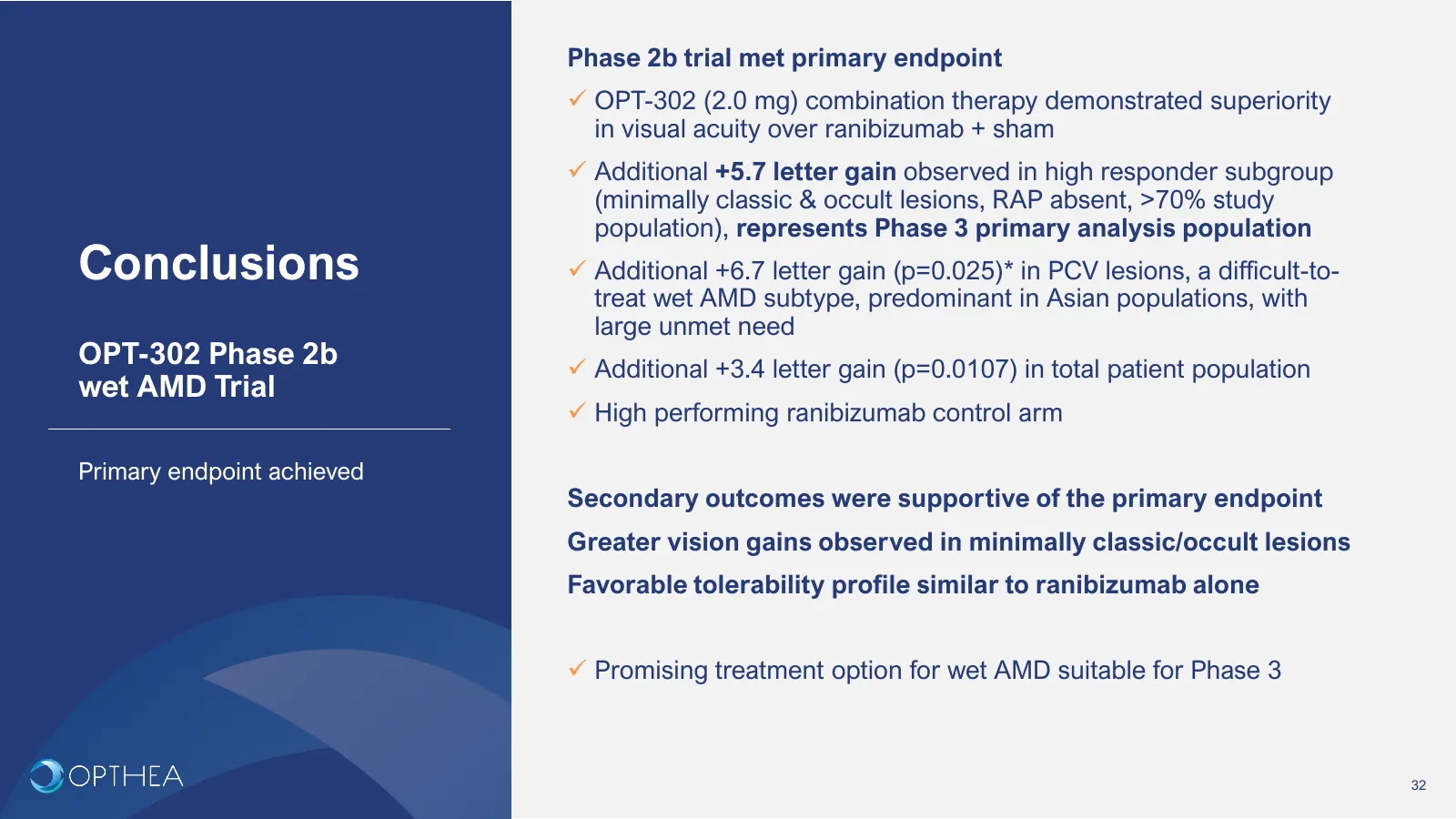
Phase 2b trial met primary endpoint ✓ OPT-302 (2.0 mg) combination therapy demonstrated superiority in visual acuity over ranibizumab + sham ✓ Additional +5.7 letter gain observed in high responder subgroup (minimally classic & occult lesions, RAP absent, >70% study population), represents Phase 3 p
Slide 33: Phase 3 Pivotal Trials
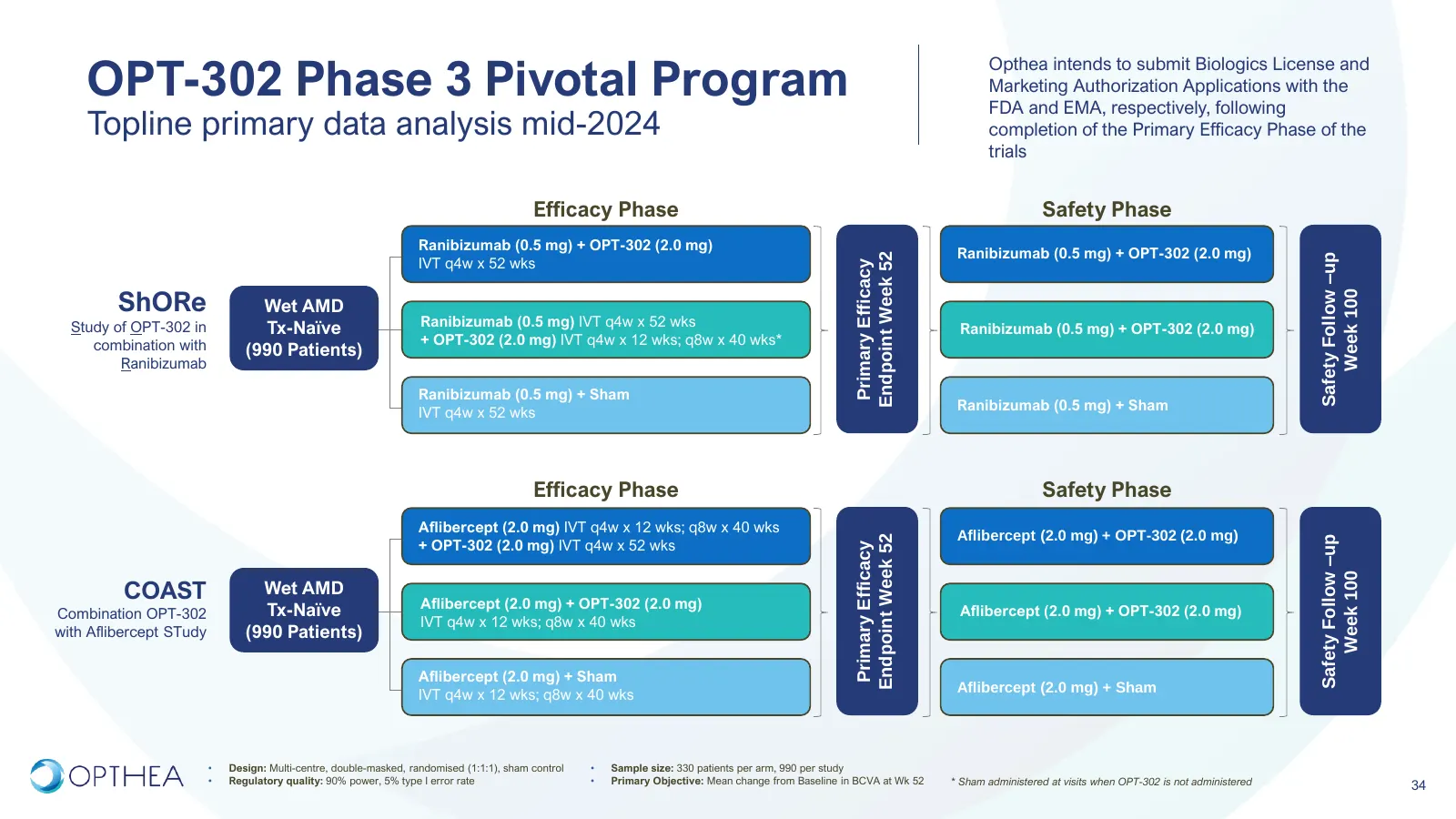
Phase 3 Pivotal Trials Two concurrent, randomized, controlled, 3-arm Phase 3 studies investigating OPT-302 administered every four-weeks and every- eight weeks in combination with standard of care anti-VEGF-A therapy: ShORe: Study of OPT-302 in combination with Ranibizumab (Study OPT-302-1004) COAST
Slide 34: OPT-302 Phase 3 Pivotal Program
OPT-302 Phase 3 Pivotal Program Opthea intends to submit Biologics License and Marketing Authorization Applications with the FDA and EMA, respectively, following Topline primary data analysis mid-2024 completion of the Primary Efficacy Phase of the trials Efficacy Phase Safety Phase Ranibizumab (0.5
Slide 35: Phase 3 Program Informed by Phase 2b & Optimized for Success
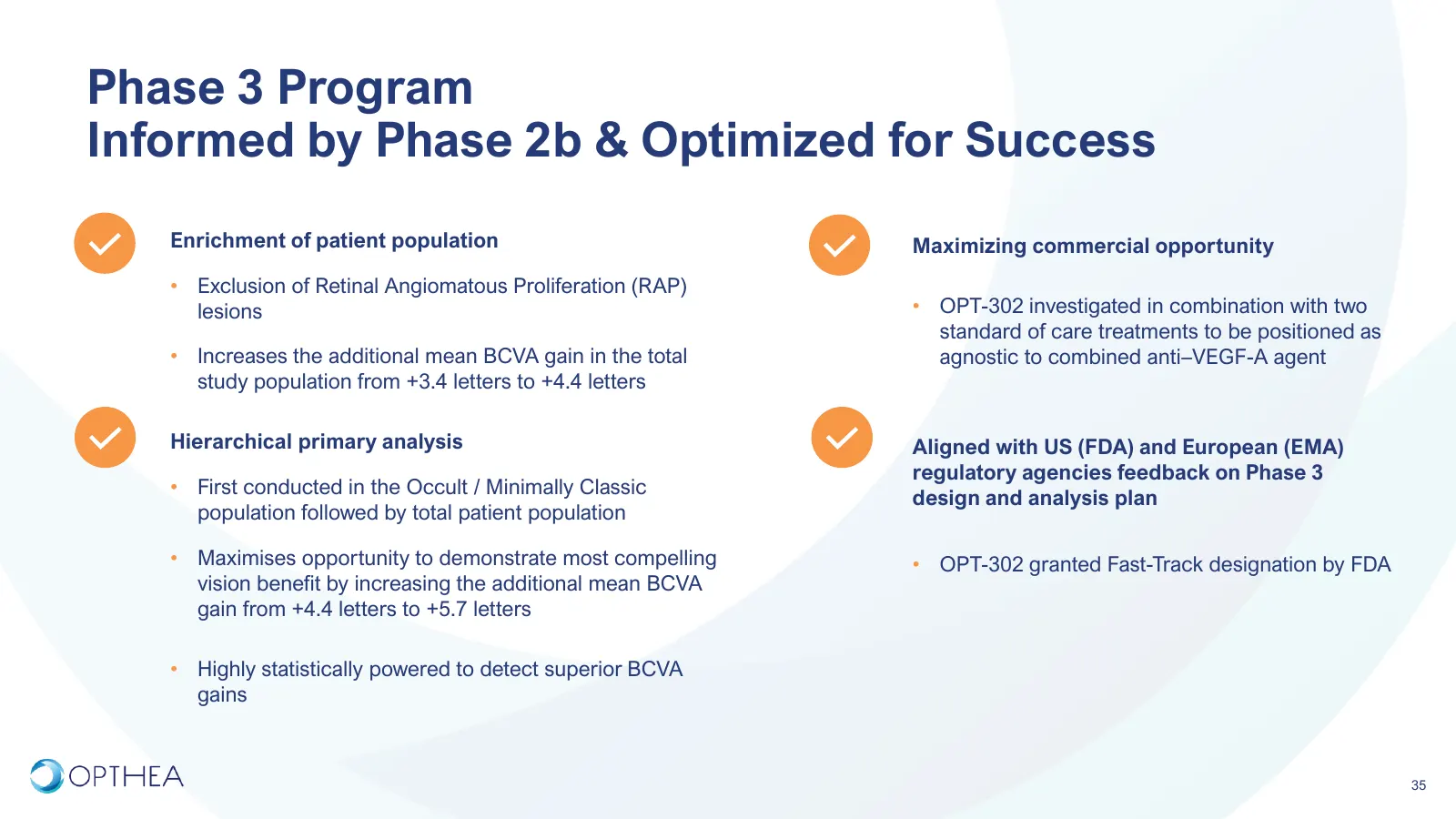
Phase 3 Program Informed by Phase 2b & Optimized for Success Enrichment of patient population Maximizing commercial opportunity • Exclusion of Retinal Angiomatous Proliferation (RAP) lesions • OPT-302 investigated in combination with two standard of care treatments to be positioned as • Increases th
Slide 36: OPT-302: The potential to revolutionize the treatment of wet AMD
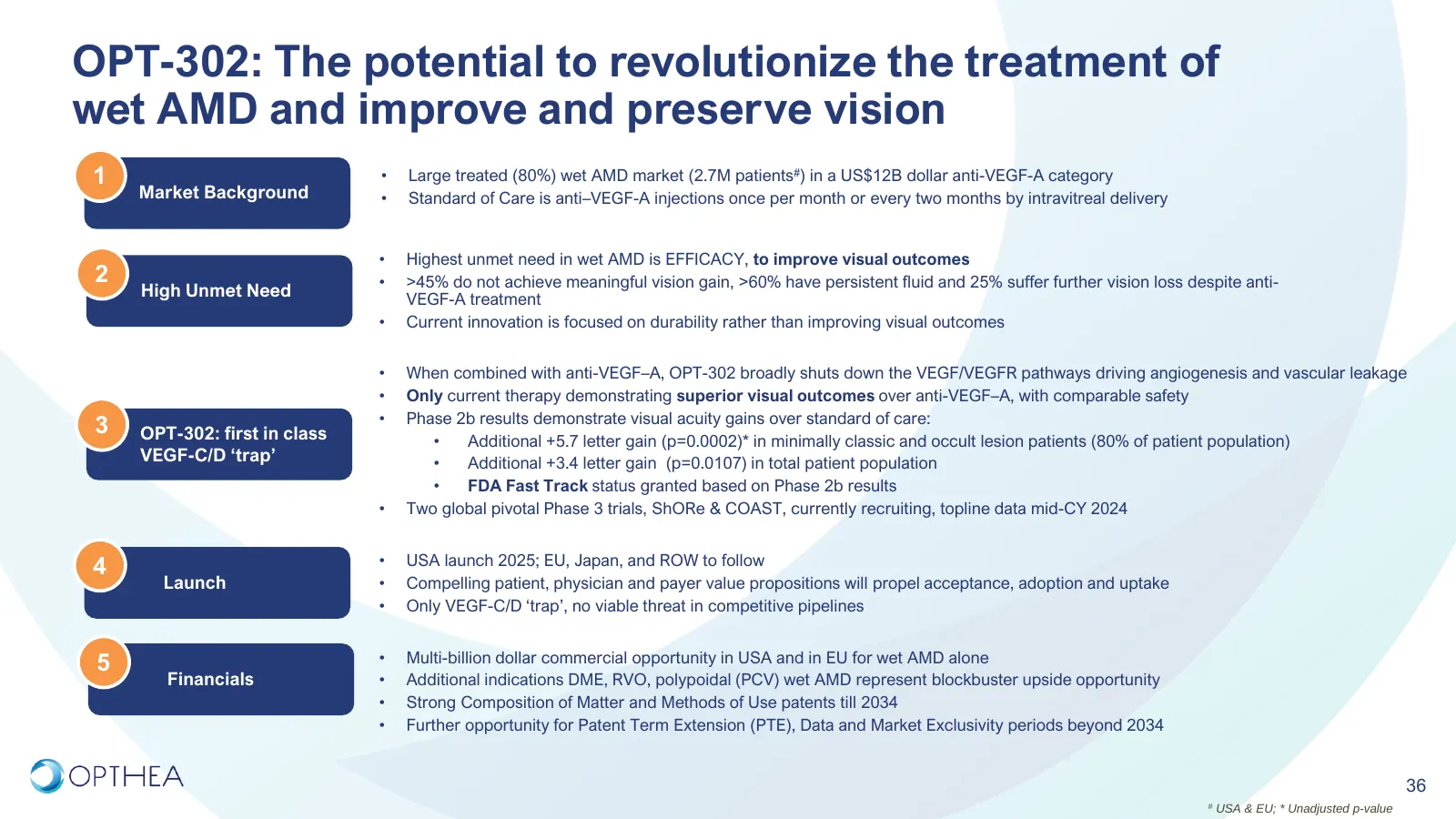
OPT-302: The potential to revolutionize the treatment of wet AMD and improve and preserve vision 1 2 • Large treated (80%) wet AMD market (2.7M patients#) in a US$12B dollar anti-VEGF-A category Market Background • Standard of Care is anti–VEGF-A injections once per month or every two months by intr
Slide 37: Megan Baldwin, PhD, CEO & Managing Director, Opthea Limited
Megan Baldwin, PhD CEO & Managing Director Opthea Limited Level 4, 650 Chapel Street South Yarra 3141 Victoria Australia P: +61 9826 0399 M: +61 447 788 674 E: megan.baldwin@opthea.com 37
Source: Internet Archive copy of opthea.com
More decks from Opthea Limited
 Investor Presentation (June 2026)27 slides · Jun 12, 2026
 Corporate Update (December 2025)20 slides · Dec 17, 2025
 Corporate Update (August 2025)31 slides · Aug 20, 2025
 Investor Day (January 2025)53 slides · Jan 29, 2025
 Investor Presentation (January 2025)33 slides · Jan 14, 2025
 Investor Presentation (November 2024)30 slides · Nov 19, 2024