BioLineRX Ltd. · TASE:BLRX
BioLineRX — Investor Presentation (September 2011)
53 slides from BioLineRX's investor presentation, September 2011
Slide 1: Company Presentation
Company Presentation September 2011
Slide 2: Forward Looking Statements
Forward Looking Statements This presentation contains "forward-looking statements." These statements include words like "may," "expects," "believes," “plans,” “scheduled," and "intends," and describe opinions about future events. These forward-looking statements involve known and unknown risks and u

Slide 3: Overview
OVERVIEW 3
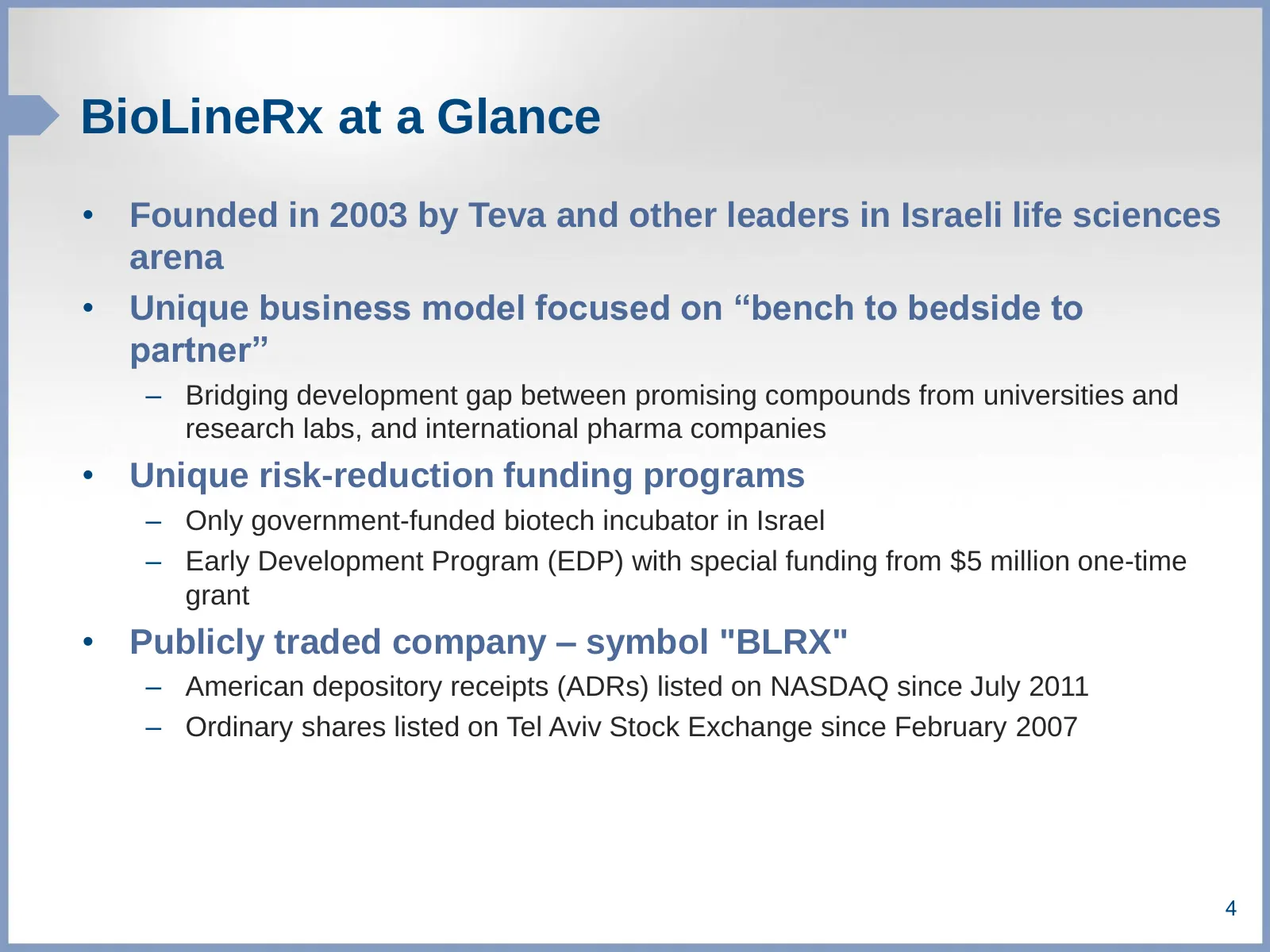
Slide 4: BioLineRx at a Glance
BioLineRx at a Glance • Founded in 2003 by Teva and other leaders in Israeli life sciences arena • Unique business model focused on “bench to bedside to partner” – Bridging development gap between promising compounds from universities and research labs, and international pharma companies • Unique ri
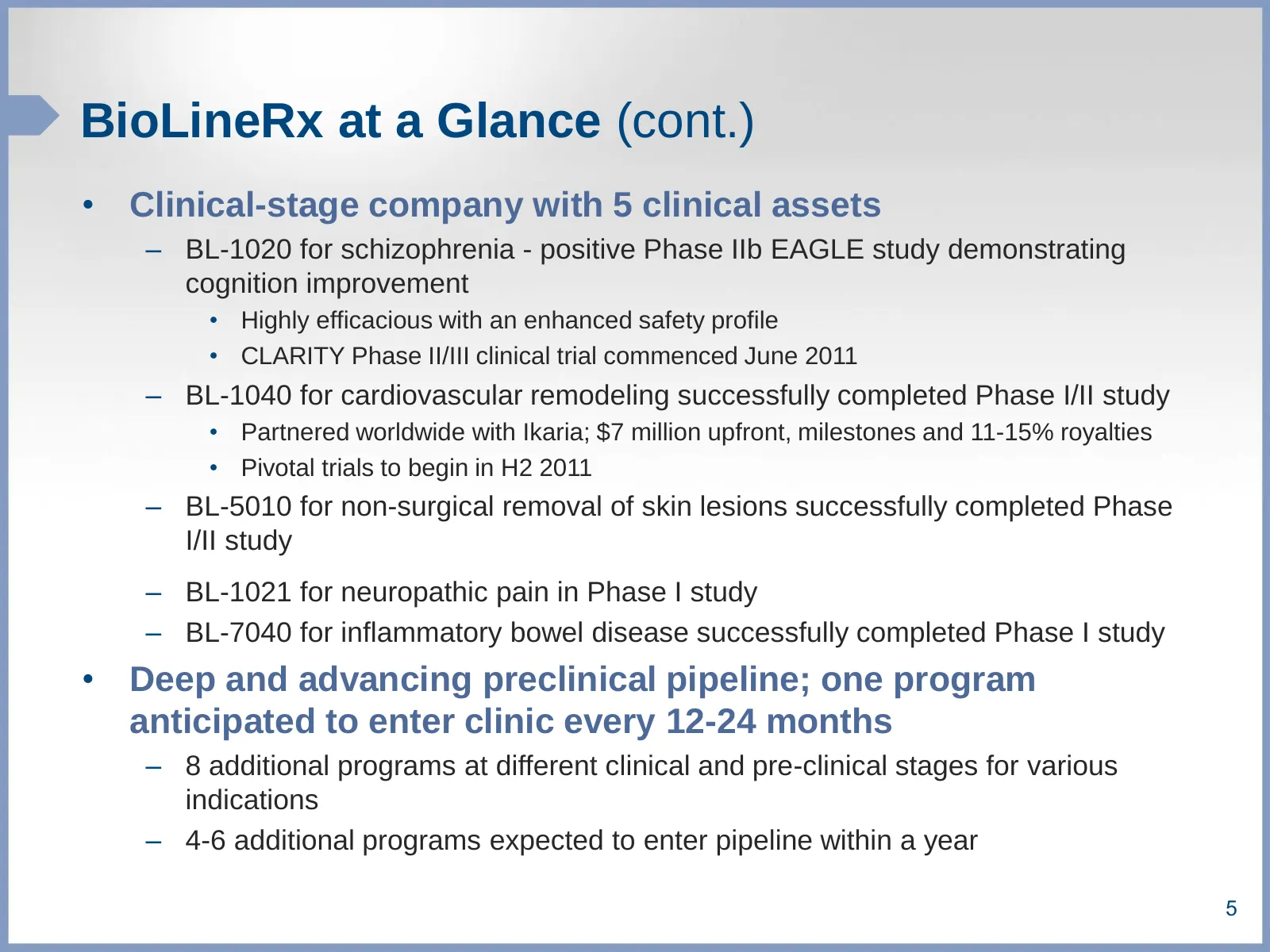
Slide 5: BioLineRx at a Glance (cont.)
BioLineRx at a Glance (cont.) • Clinical-stage company with 5 clinical assets – BL-1020 for schizophrenia - positive Phase IIb EAGLE study demonstrating cognition improvement • Highly efficacious with an enhanced safety profile • CLARITY Phase II/III clinical trial commenced June 2011 – BL-1040 for
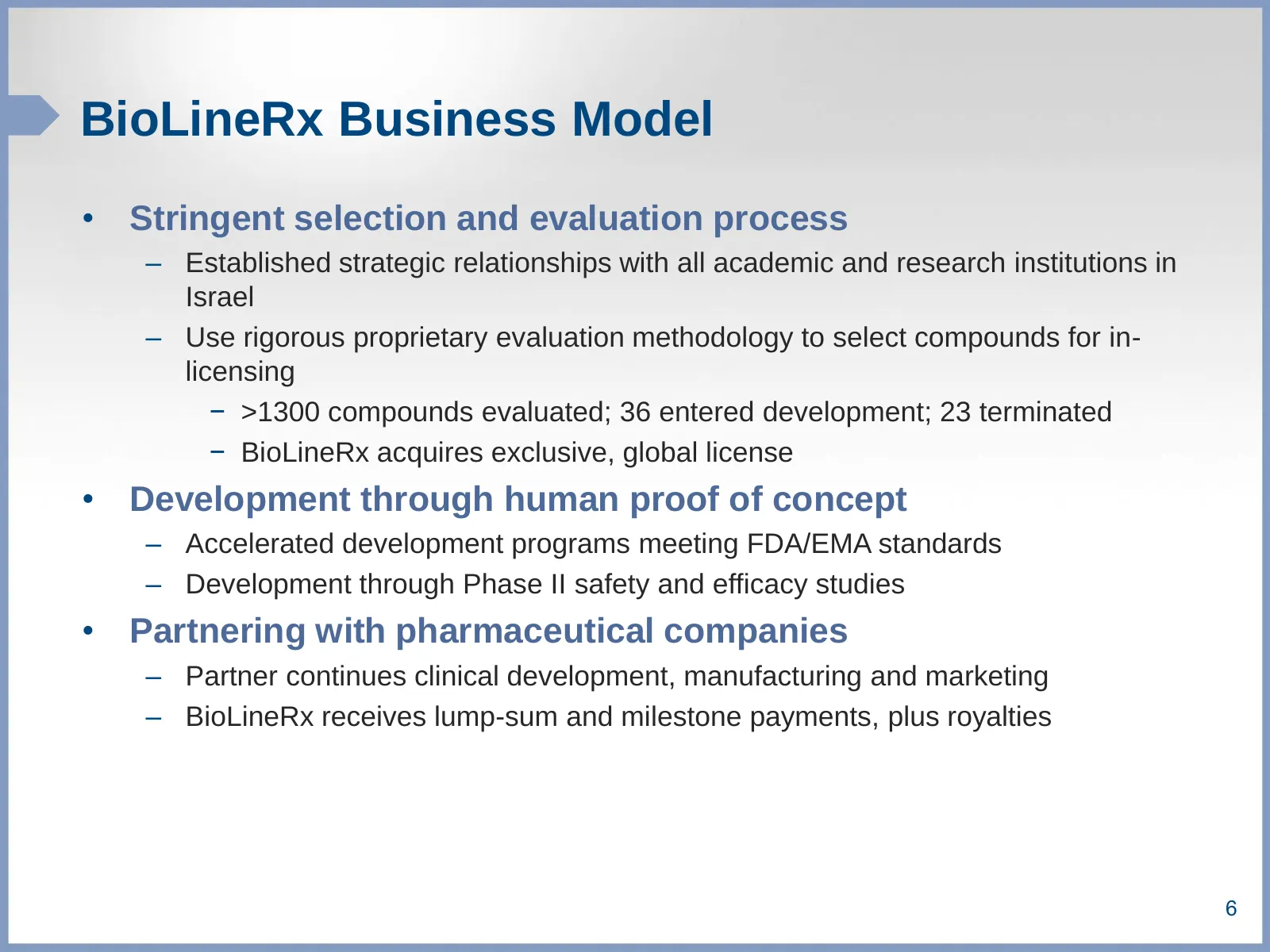
Slide 6: BioLineRx Business Model
BioLineRx Business Model • Stringent selection and evaluation process – Established strategic relationships with all academic and research institutions in Israel – Use rigorous proprietary evaluation methodology to select compounds for in- licensing − >1300 compounds evaluated; 36 entered developmen
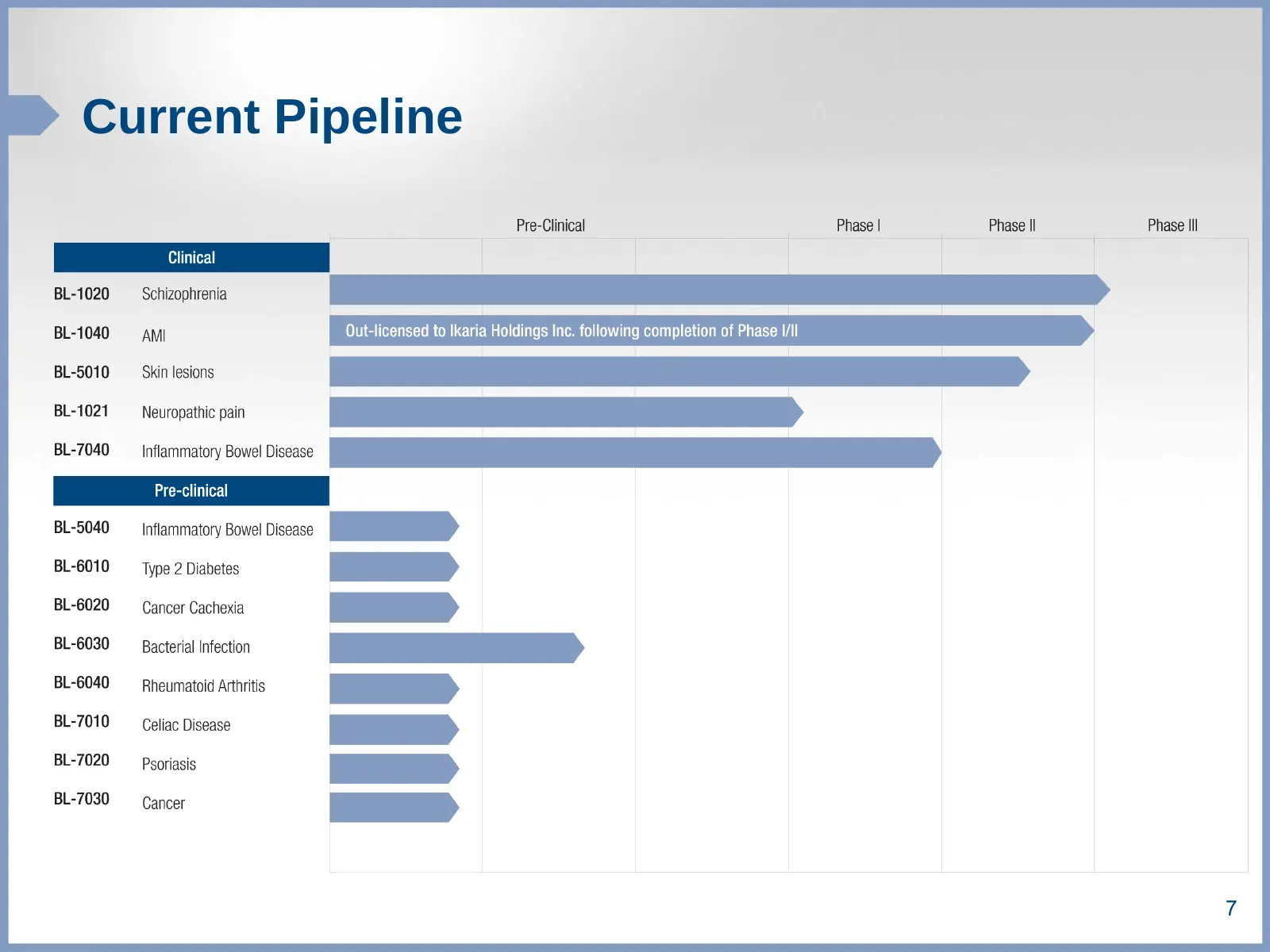
Slide 7: Current Pipeline
Current Pipeline BL-1020 BL-1040 BL-5010 BL-1021 BL-7040 Pre-clinical BL-5040 BL-6010 BL-6020 BL-6030 BL-6040 BL-7010 BL-7020 BL-7030 Pre-Clinical Phase Ill Clinical Schizophrenia SS AM Out-licensed to Ikaria Holdings Inc. following completion of Phase I/II a Skin lesions Neuropathic pain Inflammato
Slide 8: BL-1020: First in Class GABA-Enhanced Antipsychotic for Schizophrenia
BL-1020: FIRST IN CLASS GABA- ENHANCED ANTIPSYCHOTIC FOR SCHIZOPHRENIA 8
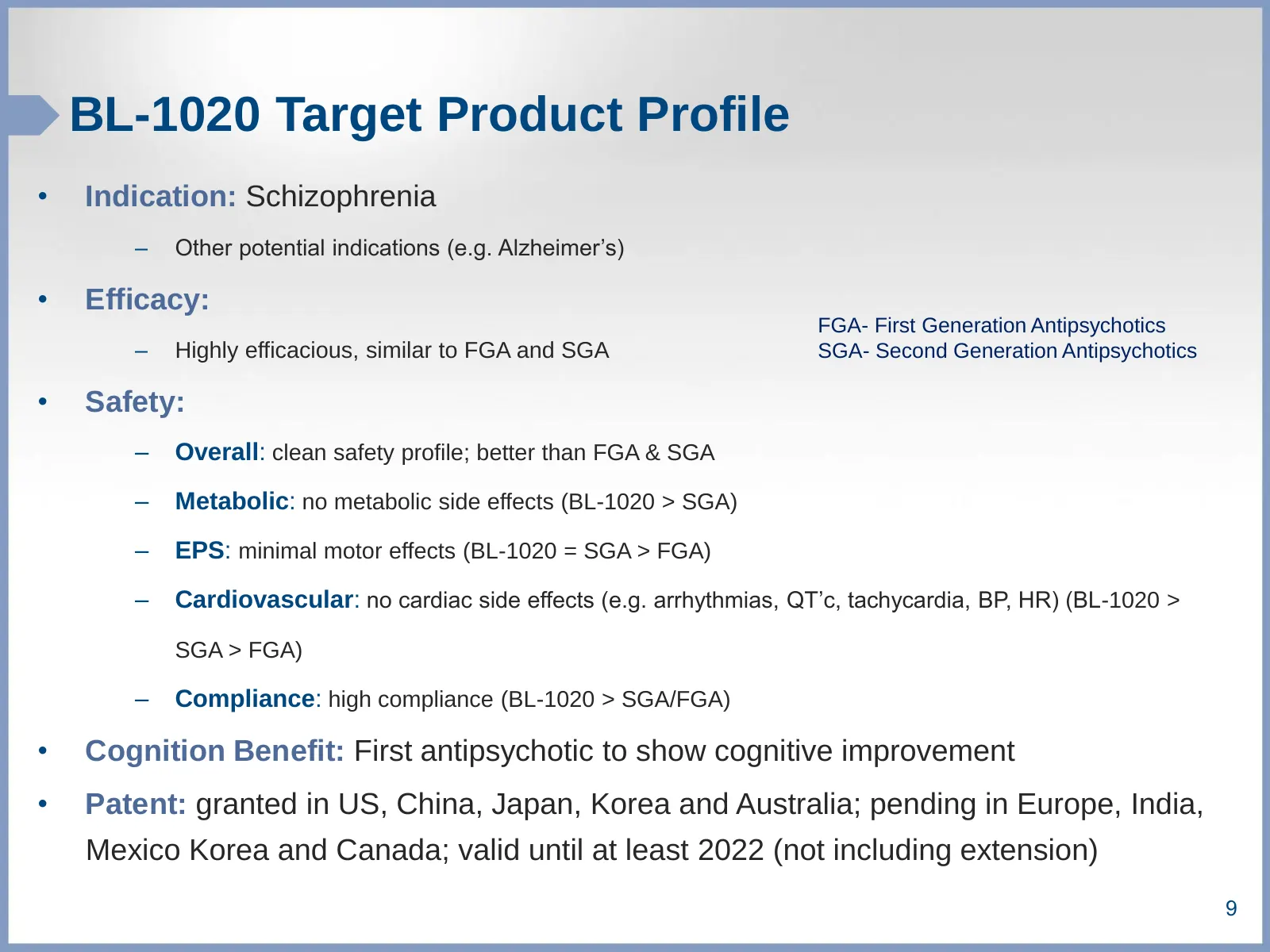
Slide 9: BL-1020 Target Product Profile
BL-1020 Target Product Profile • Indication: Schizophrenia – Other potential indications (e.g. Alzheimer’s) • Efficacy: FGA- First Generation Antipsychotics – Highly efficacious, similar to FGA and SGA SGA- Second Generation Antipsychotics • Safety: – Overall: clean safety profile; better than FGA &
Slide 10: Schizophrenia Market and Unmet Medical Need
Schizophrenia Market and Unmet Medical Need • Chronic, severe, and disabling brain disorder affecting ~1% of the U.S. adult population* • Antipsychotic therapeutics recorded $13.6 billion in US sales in 2008 – Projected to stay stable through 2018** • Nearly all patients with schizophrenia qualify a
Slide 11: BL-1020 Mode Of Action
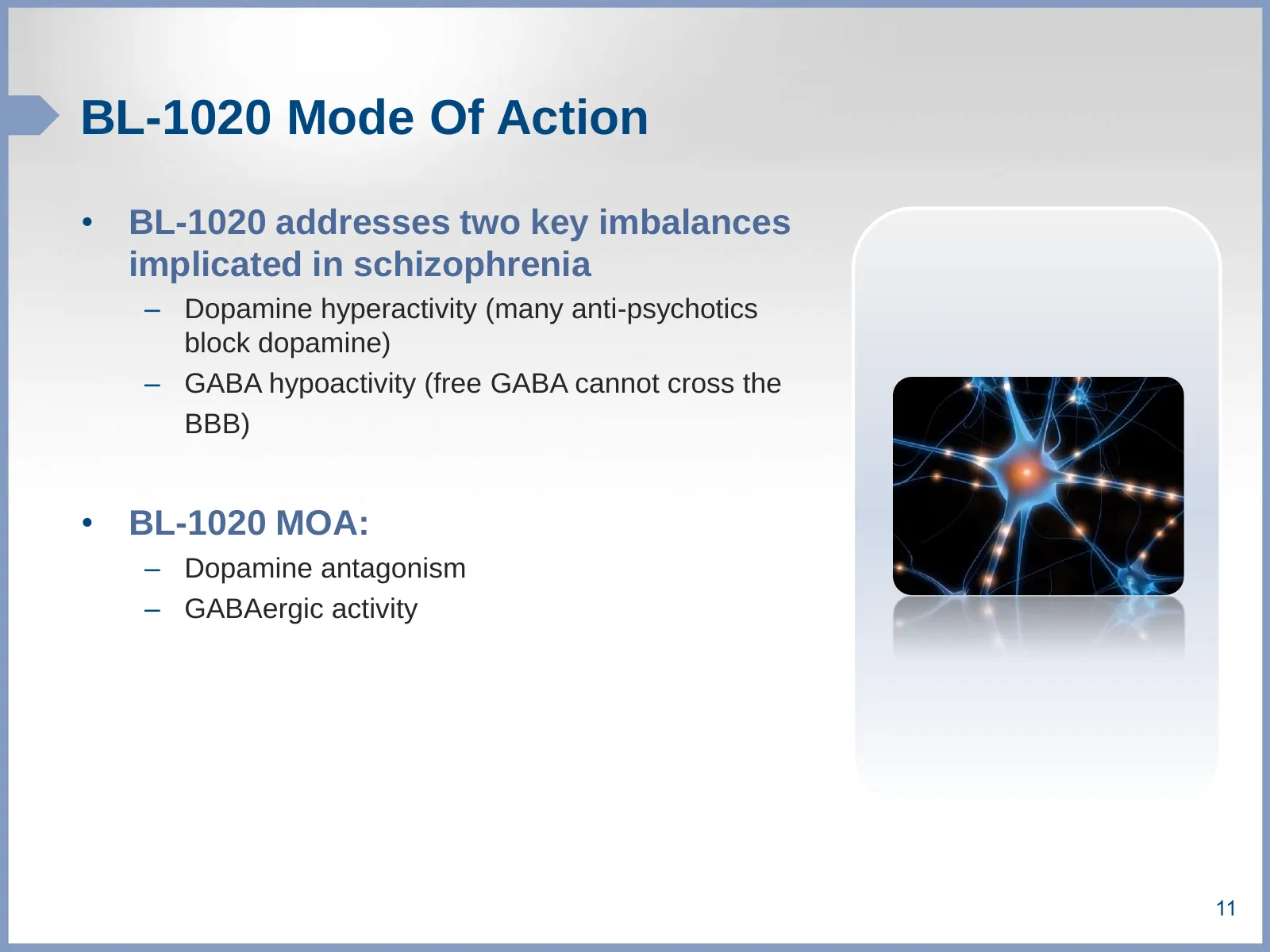
BL-1020 Mode Of Action • BL-1020 addresses two key imbalances implicated in schizophrenia – Dopamine hyperactivity (many anti-psychotics block dopamine) – GABA hypoactivity (free GABA cannot cross the BBB) • BL-1020 MOA: – Dopamine antagonism – GABAergic activity 11
Slide 12: Phase IIb EAGLE Trial Overview
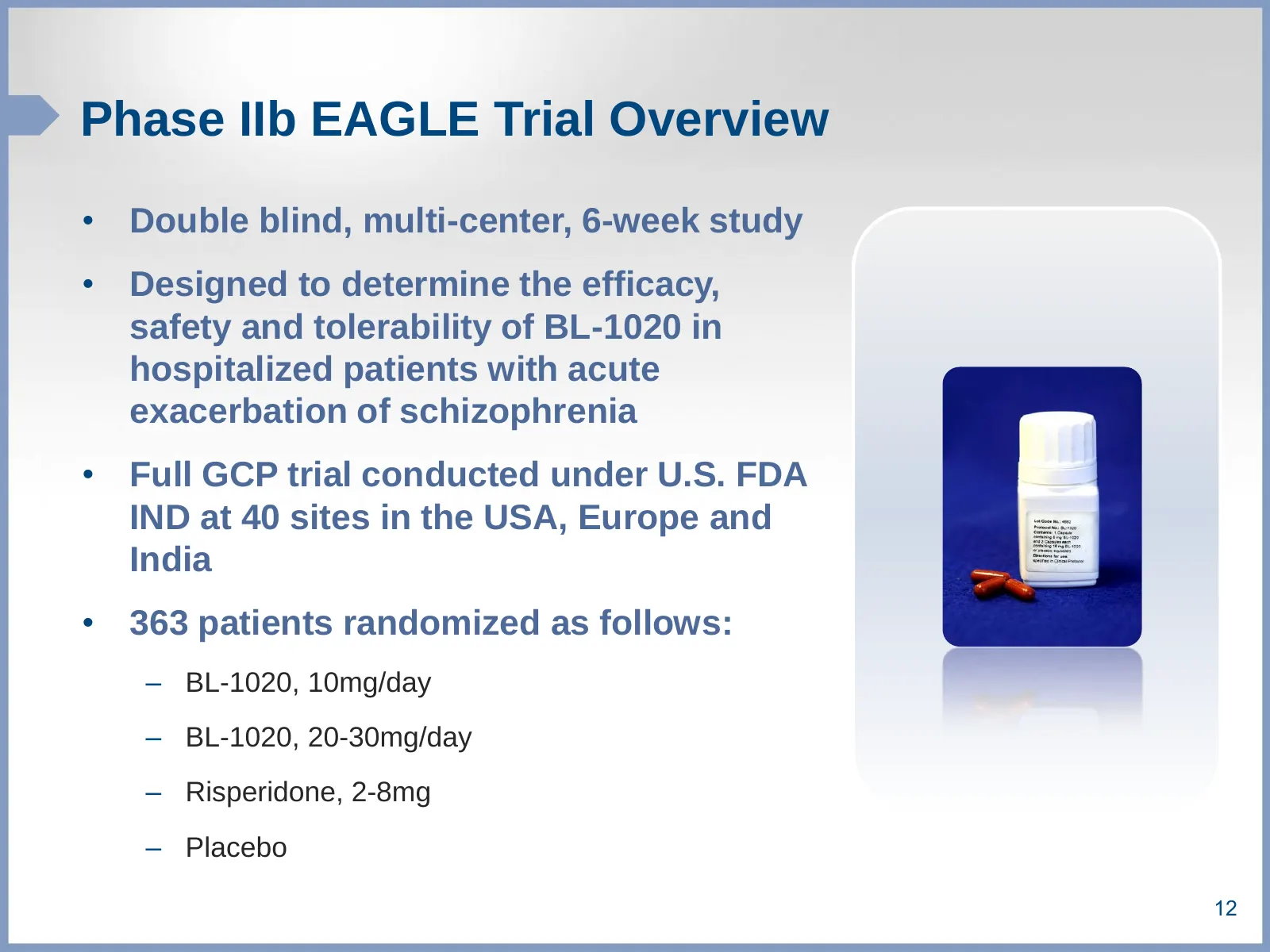
Phase IIb EAGLE Trial Overview • Double blind, multi-center, 6-week study • Designed to determine the efficacy, safety and tolerability of BL-1020 in hospitalized patients with acute exacerbation of schizophrenia • Full GCP trial conducted under U.S. FDA IND at 40 sites in the USA, Europe and India
Slide 13: EAGLE Trial Endpoints
EAGLE Trial Endpoints Efficacy endpoints comprised mean change from baseline in total score of: • Primary: − PANSS (Positive and Negative Symptom Scale) • Secondary: − CGI-S and CGI-C (Clinical Global Impression of Severity or Change) − Readiness to Discharge Questionnaire (RDQ) − Strauss Carpenter
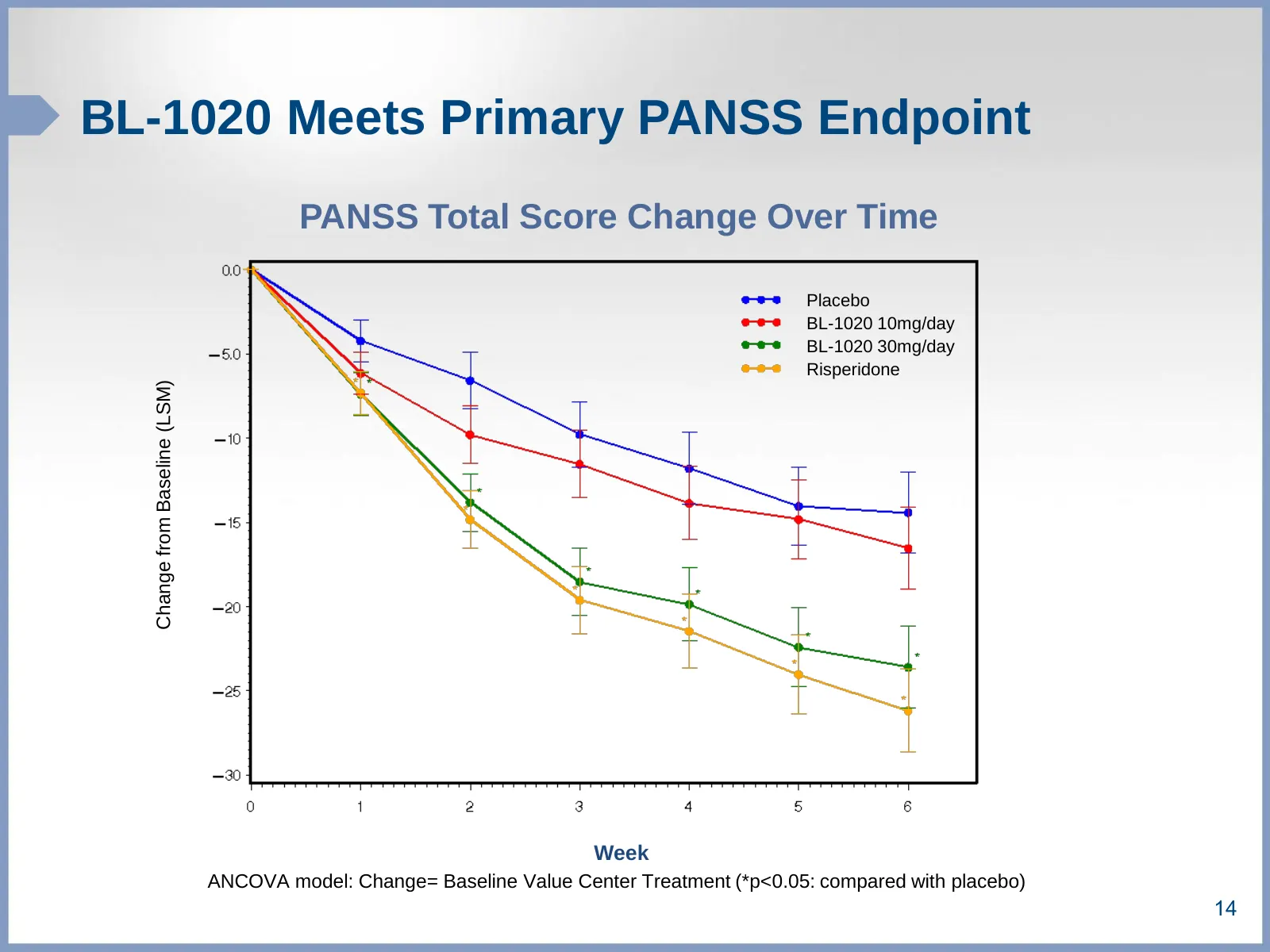
Slide 14: BL-1020 Meets Primary PANSS Endpoint
BL-1020 Meets Primary PANSS Endpoint PANSS Total Score Change Over Time Placebo BL-1020 10mg/day BL-1020 30mg/day Risperidone Change from Baseline (LSM) Week ANCOVA model: Change= Baseline Value Center Treatment (*p<0.05: compared with placebo) 14
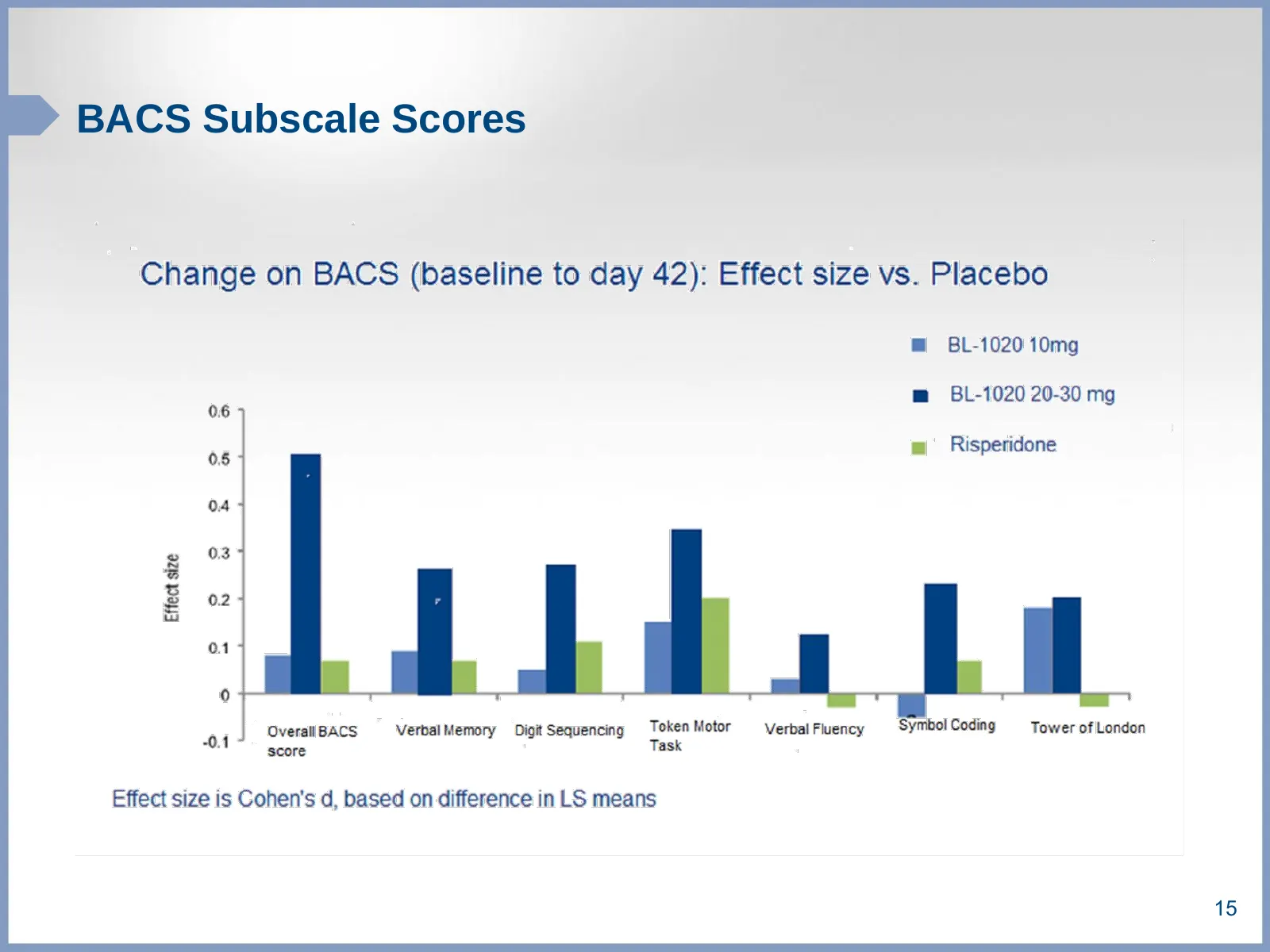
Slide 15: BACS Subscale Scores
BACS Subscale Scores “Change on BACS (baseline to day 42): Effect size vs. Placebo m BL-1020 10mg m BL-1020 20-30 mg m Risperidone rerN OverallBACS "Verbal Memory Digit Sequencing Token Motor Verbal Fluency S Coding Tower of London Effect size is Cohen's d, based on difference in LS means
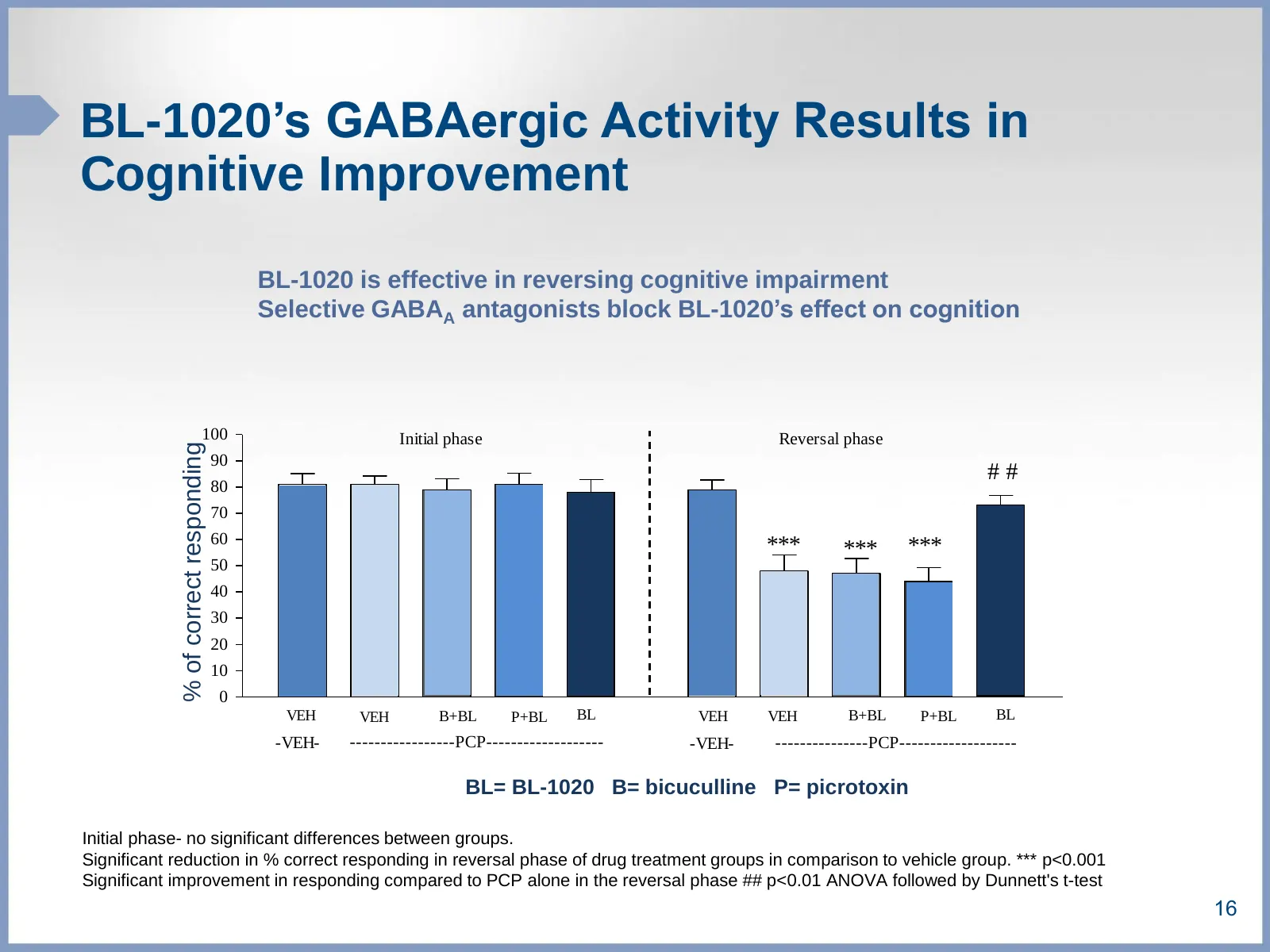
Slide 16: BL-1020's GABAergic Activity Results in Cognitive Improvement
BL-1020’s GABAergic Activity Results in Cognitive Improvement BL-1020 is effective in reversing cognitive impairment Selective GABAA antagonists block BL-1020’s effect on cognition 100 Initial phase Reversal phase responding 90 ## correct responding 80 70 60 *** *** *** 50 % of%correct 40 30 20 10 0
Slide 17: Next Clinical Study – CLARITY Study
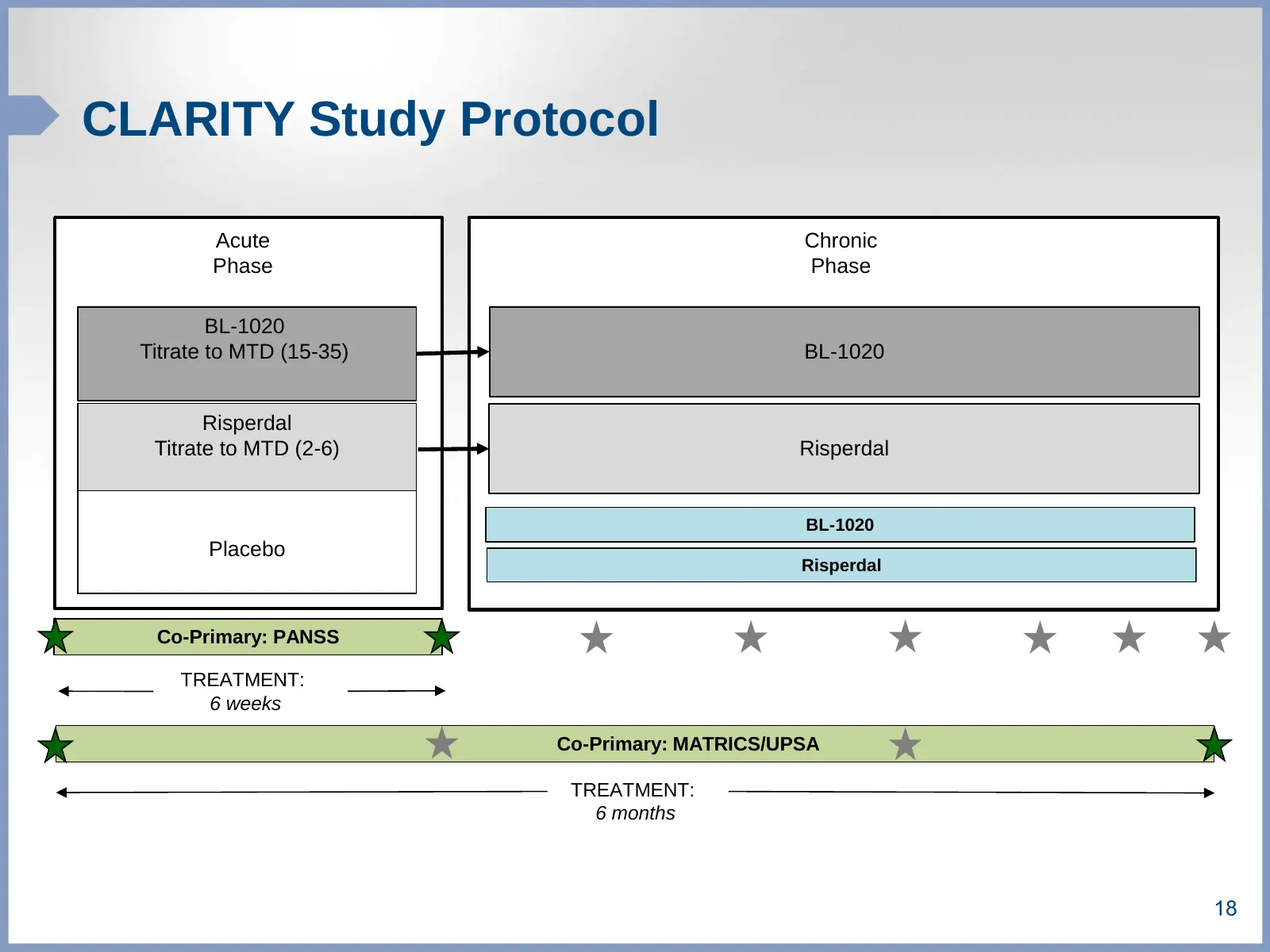
Next Clinical Study – CLARITY Study • CLARITY Phase II/III trial commenced June 2011 – Randomized, double-blind, placebo-controlled – Aimed at determining acute (6 weeks) and long-term (6 months) anti-psychotic and cognitive efficacy, safety and tolerability of BL-1020 compared with placebo and Risp
Slide 18: CLARITY Study Protocol
CLARITY Study Protocol Acute Chronic Phase Phase BL-1020 Titrate to MTD (15-35) BL-1020 Risperdal Titrate to MTD (2-6) Risperdal BL-1020 Placebo Risperdal Co-Primary: PANSS TREATMENT: 6 weeks Co-Primary: MATRICS/UPSA TREATMENT: 6 months 18
Slide 19: BL-1020 Partnership Update
BL-1020 Partnership Update • Reacquired North American rights from Cypress Bioscience – BioLineRx now holds all global rights to BL-1020 – Cypress to receive 1% royalty on global sales up to total cumulative amount of $80 million – Cypress to receive 10% of future one-time payments from out-licensin
Slide 20: BL-1040: First-in-Class Myocardial Implant for Tissue Damaged by AMI
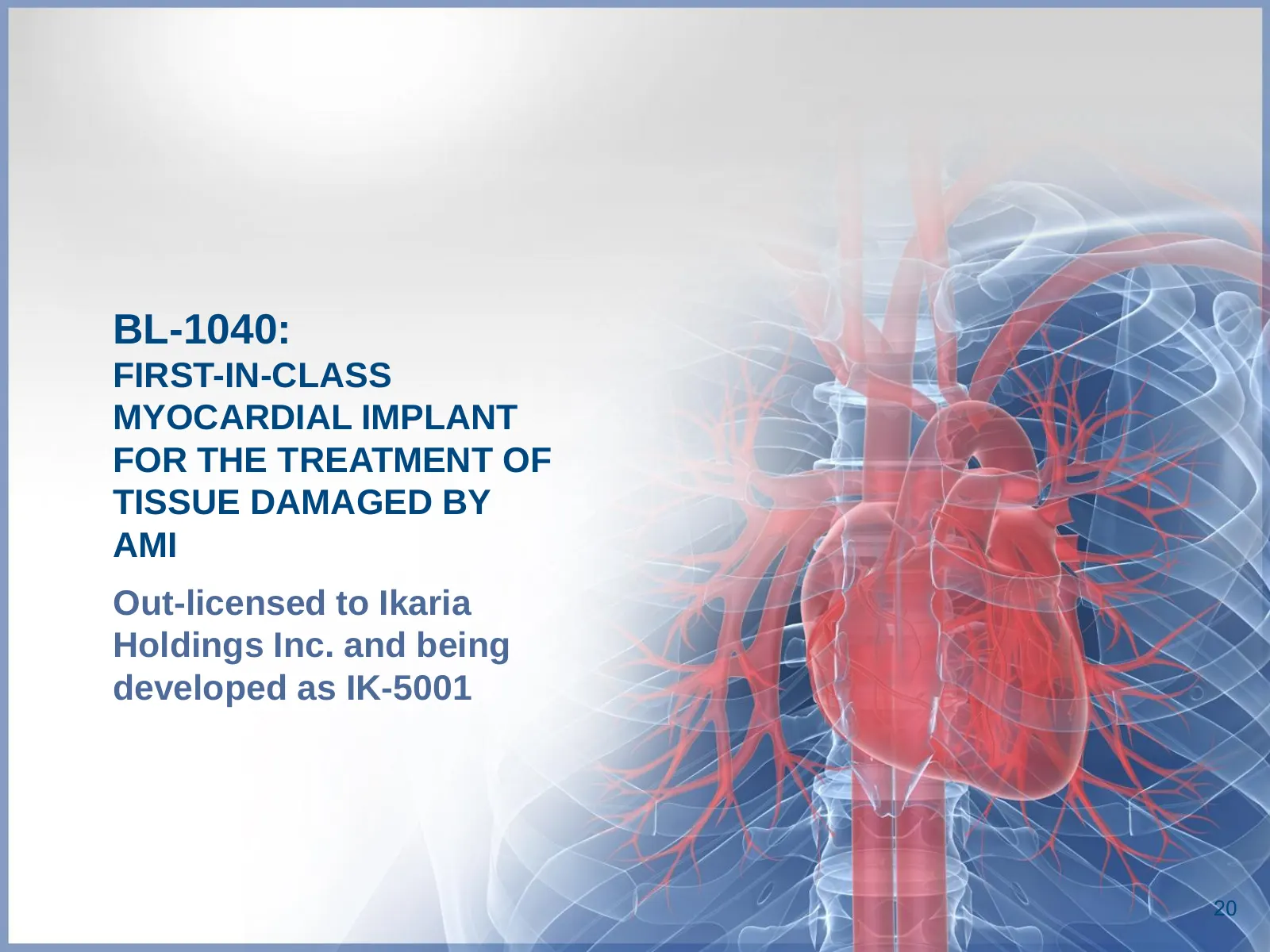
BL-1040: FIRST-IN-CLASS MYOCARDIAL IMPLANT FOR THE TREATMENT OF TISSUE DAMAGED BY AMI Out-licensed to Ikaria Holdings Inc. and being developed as IK-5001 20
Slide 21: Current Treatment Methodologies and Unmet Medical Need
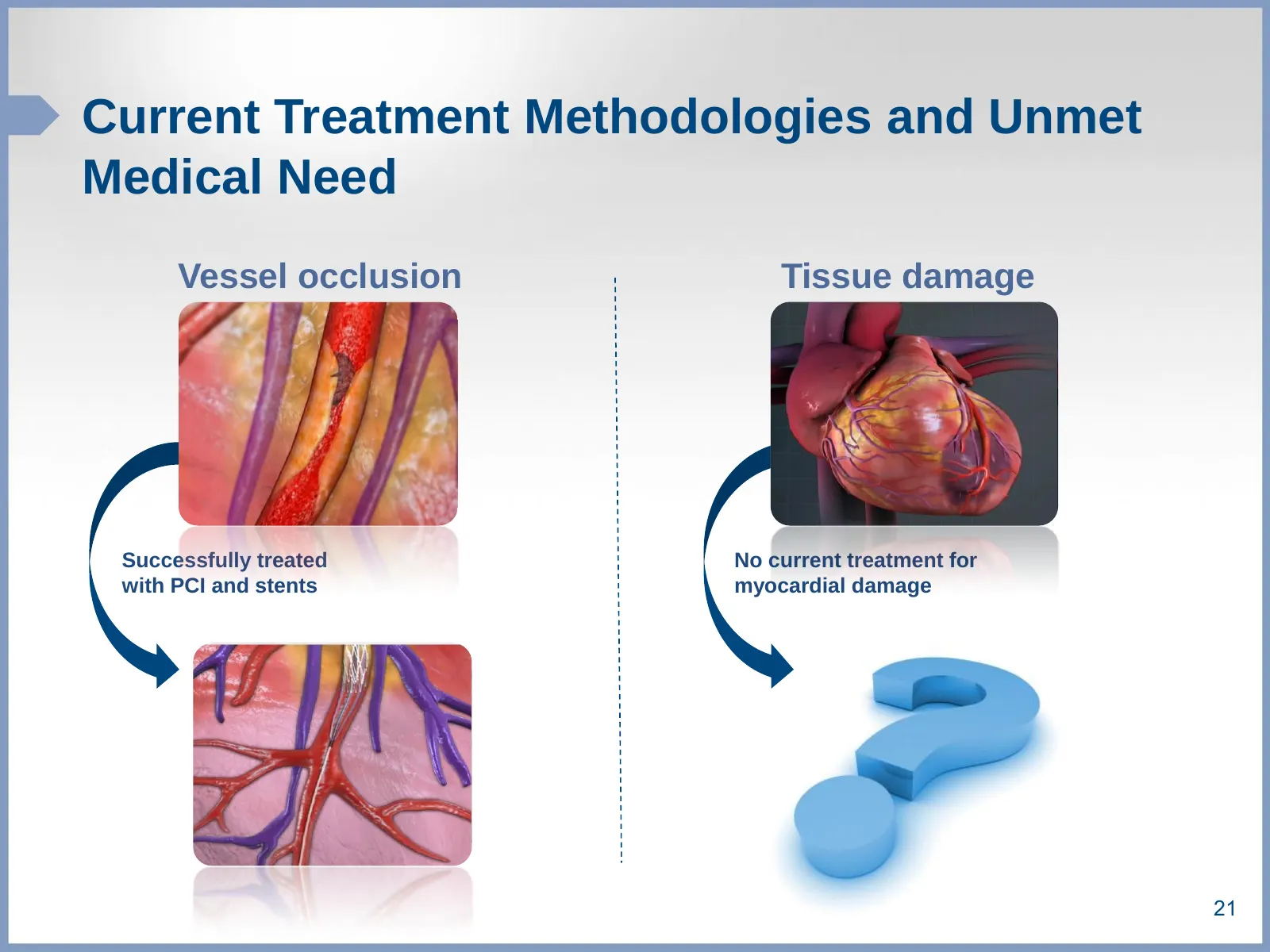
Current Treatment Methodologies and Unmet Medical Need Vessel occlusion Tissue damage Successfully treated No current treatment for with PCI and stents myocardial damage 21
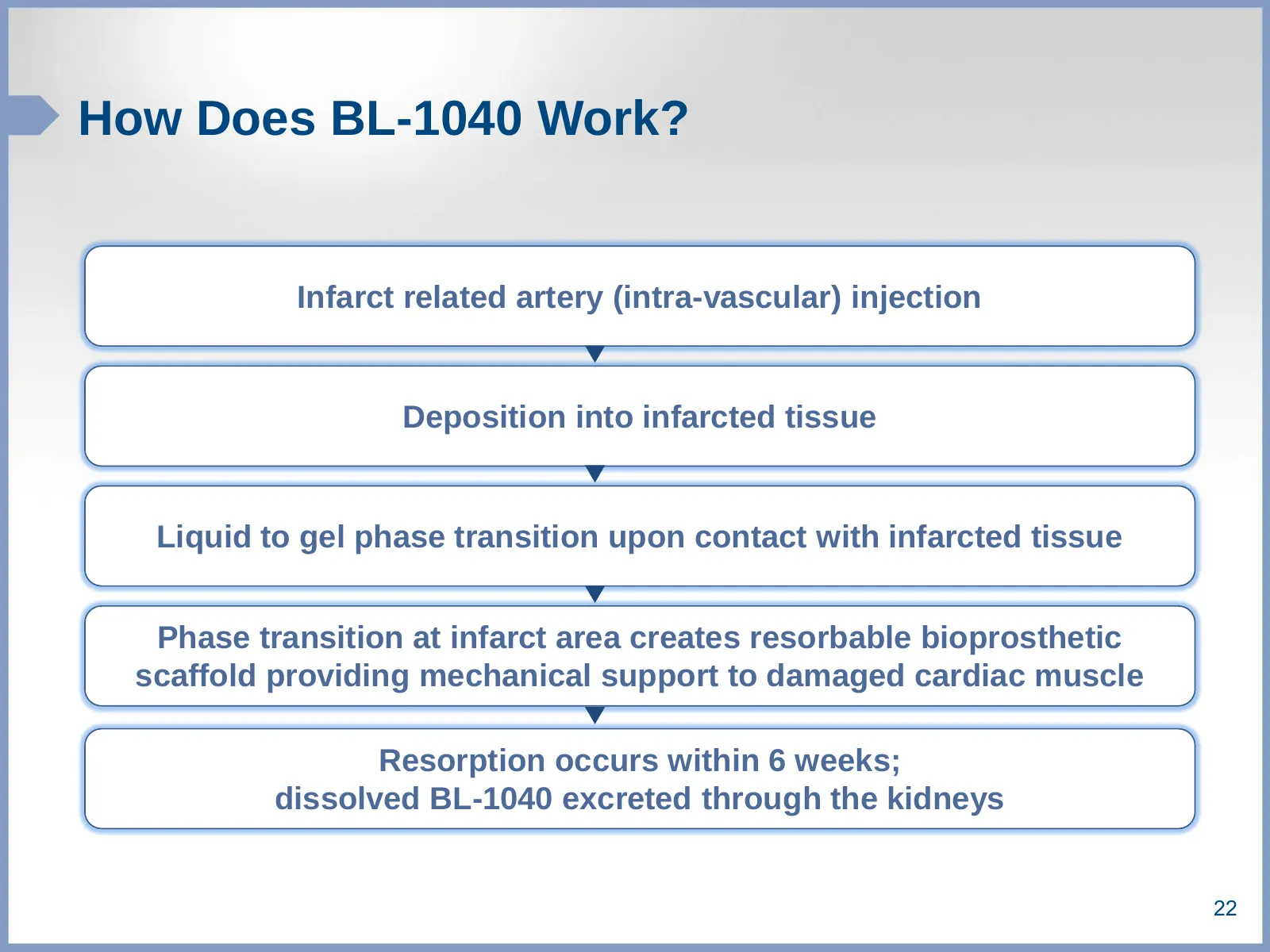
Slide 22: How Does BL-1040 Work?
How Does BL-1040 Work? Infarct related artery (intra-vascular) injection Deposition into infarcted tissue Liquid to gel phase transition upon contact with infarcted tissue Phase transition at infarct area creates resorbable bioprosthetic scaffold providing mechanical support to damaged cardiac muscl
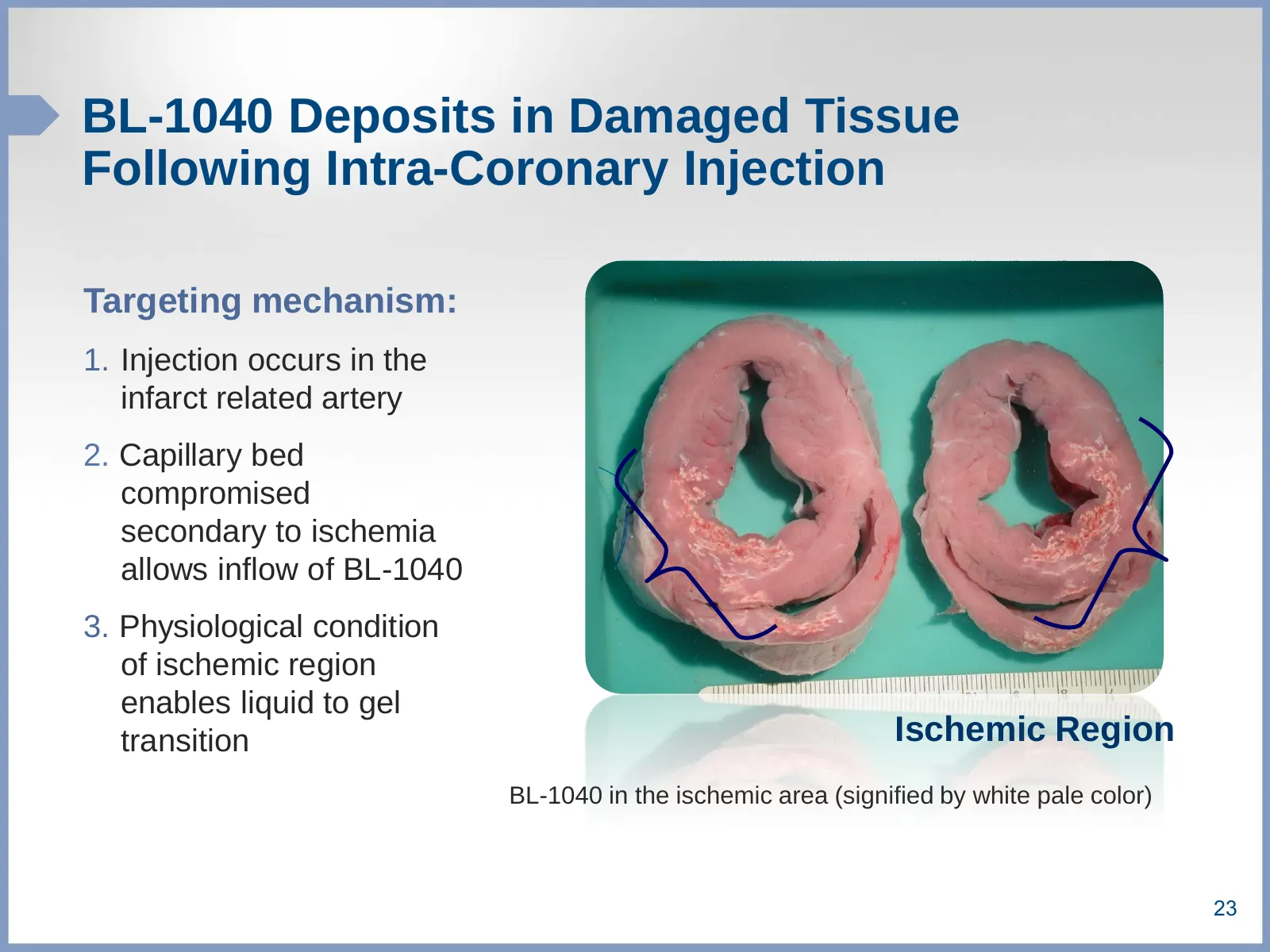
Slide 23: BL-1040 Deposits in Damaged Tissue Following Intra-Coronary Injection
BL-1040 Deposits in Damaged Tissue Following Intra-Coronary Injection Targeting mechanism: 1. Injection occurs in the infarct related artery 2. Capillary bed compromised secondary to ischemia allows inflow of BL-1040 3. Physiological condition of ischemic region enables liquid to gel transition Isch
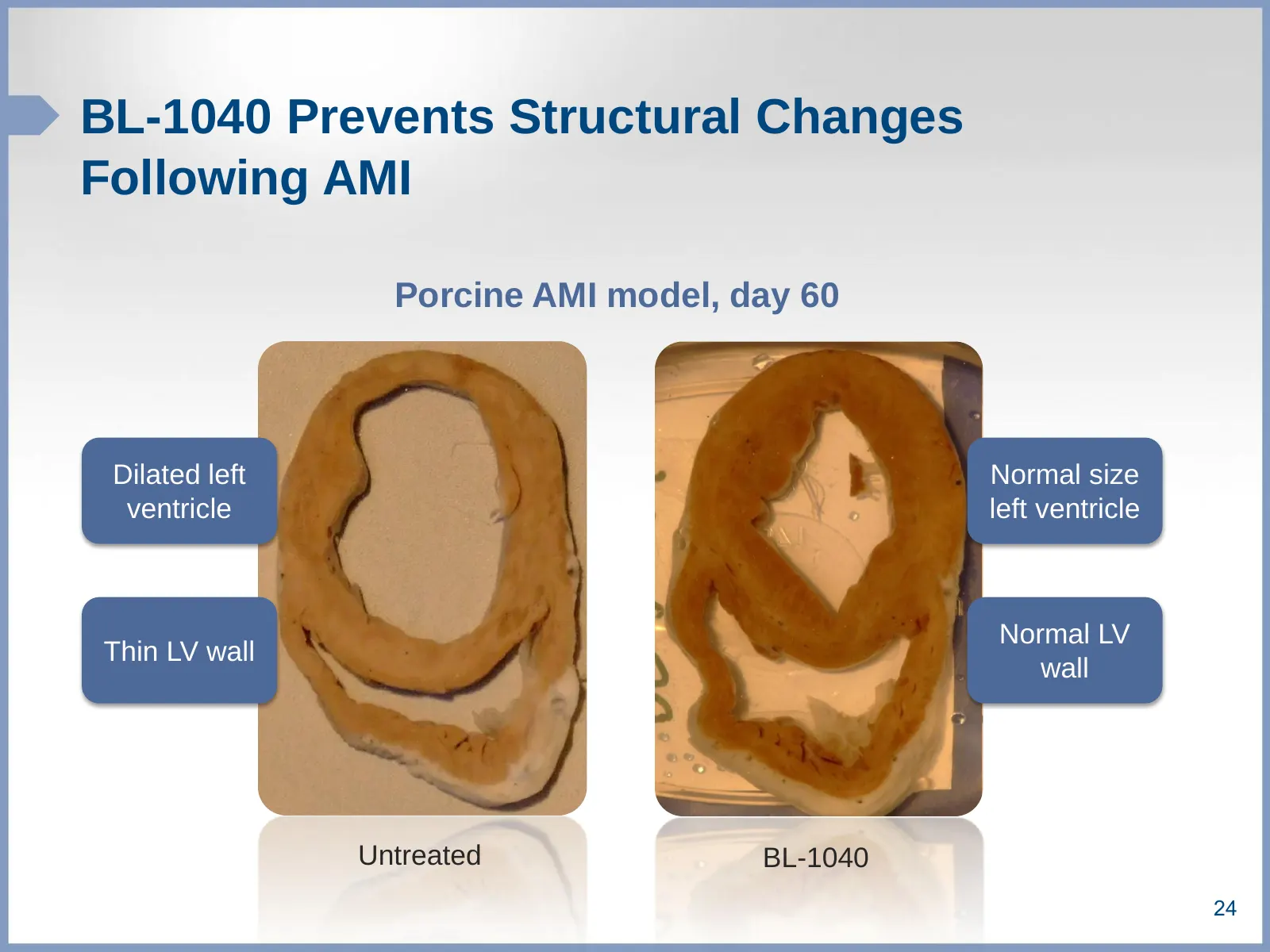
Slide 24: BL-1040 Prevents Structural Changes Following AMI
BL-1040 Prevents Structural Changes Following AMI Porcine AMI model, day 60 Dilated left Normal size ventricle left ventricle Normal LV Thin LV wall wall Untreated BL-1040 24
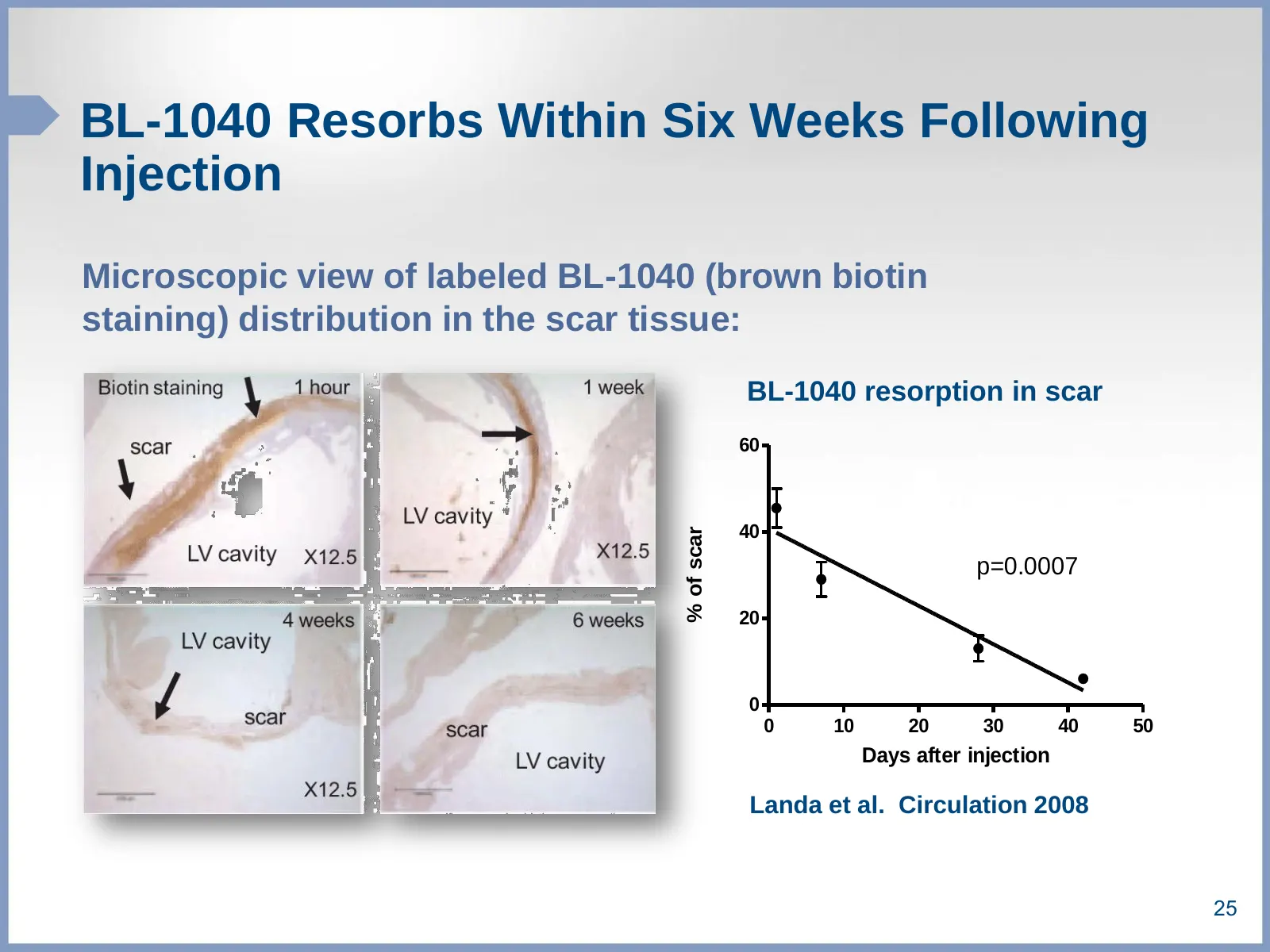
Slide 25: BL-1040 Resorbs Within Six Weeks Following Injection
BL-1040 Resorbs Within Six Weeks Following Injection Microscopic view of labeled BL-1040 (brown biotin staining) distribution in the scar tissue: BL-1040 resorption in scar Alginate resorption in the scar 60 40 % of scar p=0.0007 20 0 0 10 20 30 40 50 Days after injection Landa et al. Circulation 20
Slide 26: BL-1040 Safe and Well-Tolerated in Pilot Clinical Trial Results
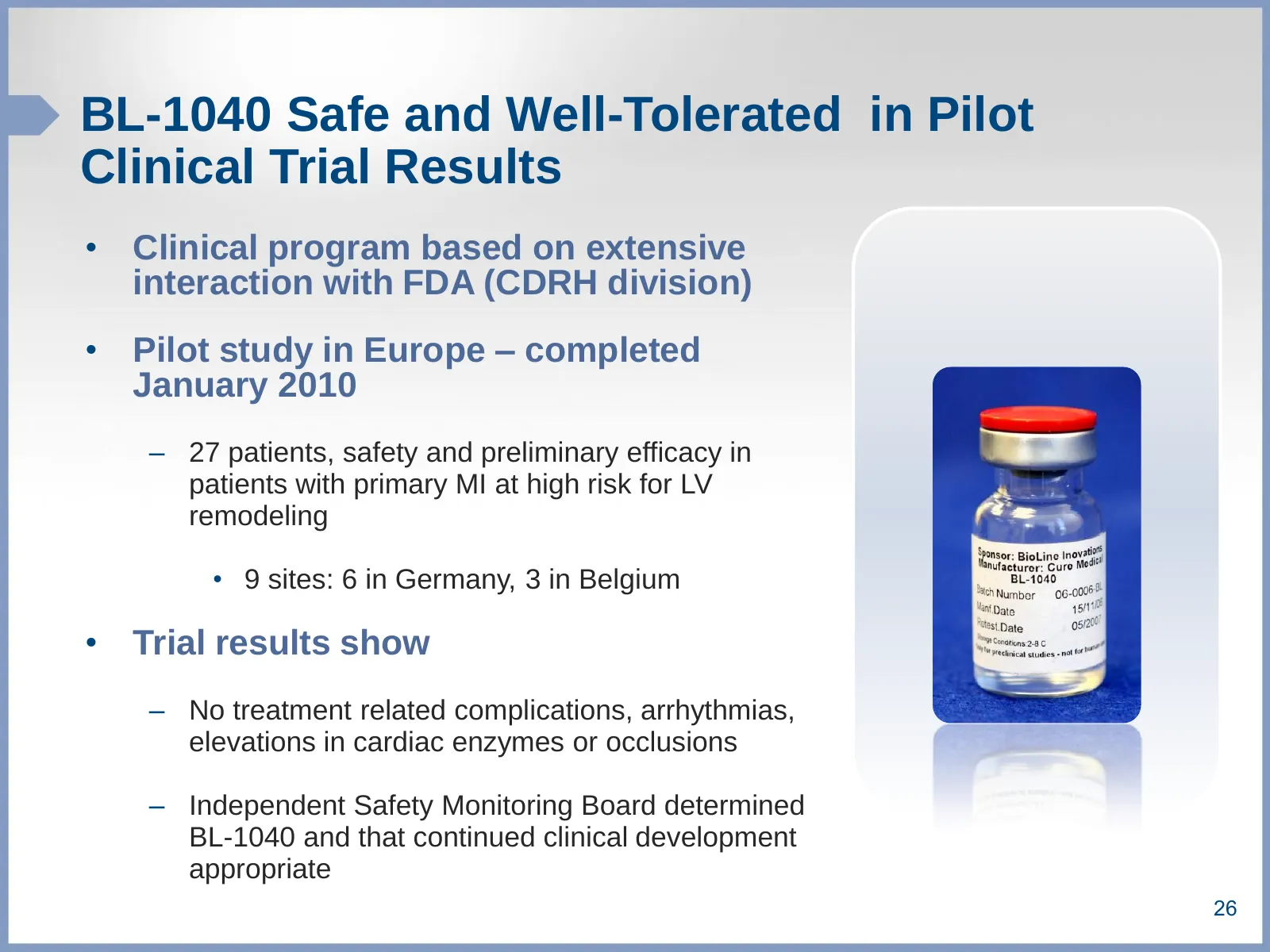
BL-1040 Safe and Well-Tolerated in Pilot Clinical Trial Results • Clinical program based on extensive interaction with FDA (CDRH division) • Pilot study in Europe – completed January 2010 – 27 patients, safety and preliminary efficacy in patients with primary MI at high risk for LV remodeling • 9 si
Slide 27: Ikaria BL-1040 Out-Licensing Transaction
Ikaria BL-1040 Out-Licensing Transaction • Ikaria - proven expertise in drug and medical device development and singular focus on acute care • Terms: – $7 million upfront - received – $10 million first milestone - received February 2010 upon successful completion of pilot study – ~$115 million in ad
Slide 28: BL-1040 Active Trial Program: Current Status and Next Steps
BL-1040 Active Trial Program: Current Status and Next Steps Two partially overlapping trials, expected to commence in H2 2011 • First pivotal trial • Second pivotal trial − Protocol finalized − Meeting held with FDA to discuss protocol − Overall design − Overall design − Placebo controlled − Placebo

Slide 29: BL-5010: Novel Formulation for Non-Surgical Removal of Benign Skin Lesions
BL-5010: NOVEL FORMULATION FOR NON-SURGICAL REMOVAL OF BENIGN SKIN LESIONS Phase I/II Complete 29
Slide 30: BL-5010: Novel Formulation for Non-Surgical Removal of Skin Lesions
BL-5010: Novel Formulation for Non-Surgical Removal of Skin Lesions • Positioning – Novel formulation for non-surgical removal of skin lesions • Status – Phase I/II clinical trial completed - positive results • Product highlights – Novel formulation of components in use in cosmetics and dermatology
Slide 31: BL-5010 Phase I/II Clinical Trial Results Highlights
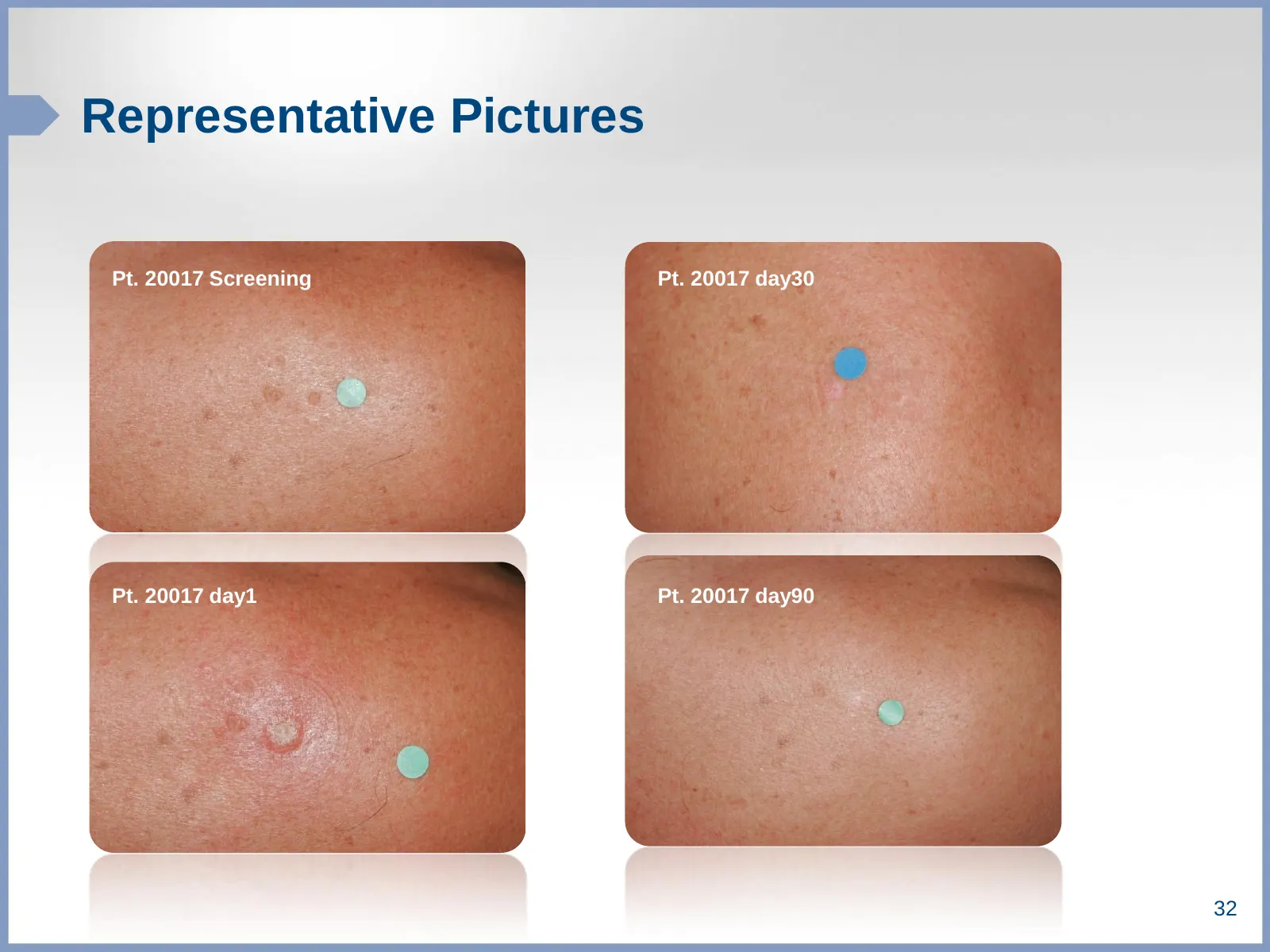
BL-5010 Phase I/II Clinical Trial Results Highlights • Safety – Good safety profile: no persistent irreversible adverse effects were observed at treated site • Efficacy – Lesion removal - the lesion fell off by day 30 in 96.7% of patients – Cosmetic outcome - most PIs and patients very satisfied wit
Slide 32: Representative Pictures
Representative Pictures Pt. 20017 Screening Pt. 20017 day30 Pt. 20017 day1 Pt. 20017 day90 32
Slide 33: BL-1021: New Chemical Entity for Neuropathic Pain
BL-1021: NEW CHEMICAL ENTITY FOR NEUROPATHIC PAIN 33
Slide 34: BL-1021: New Chemical Entity for Treatment of Neuropathic Pain
BL-1021: New Chemical Entity for Treatment of Neuropathic Pain • Indication: Neuropathic pain • Status: Phase I clinical trial to commence July 2011 • Product highlights: – Orally available small molecule – Anti-neuropathic profile demonstrated in vitro and in various animal models – Enhanced safety
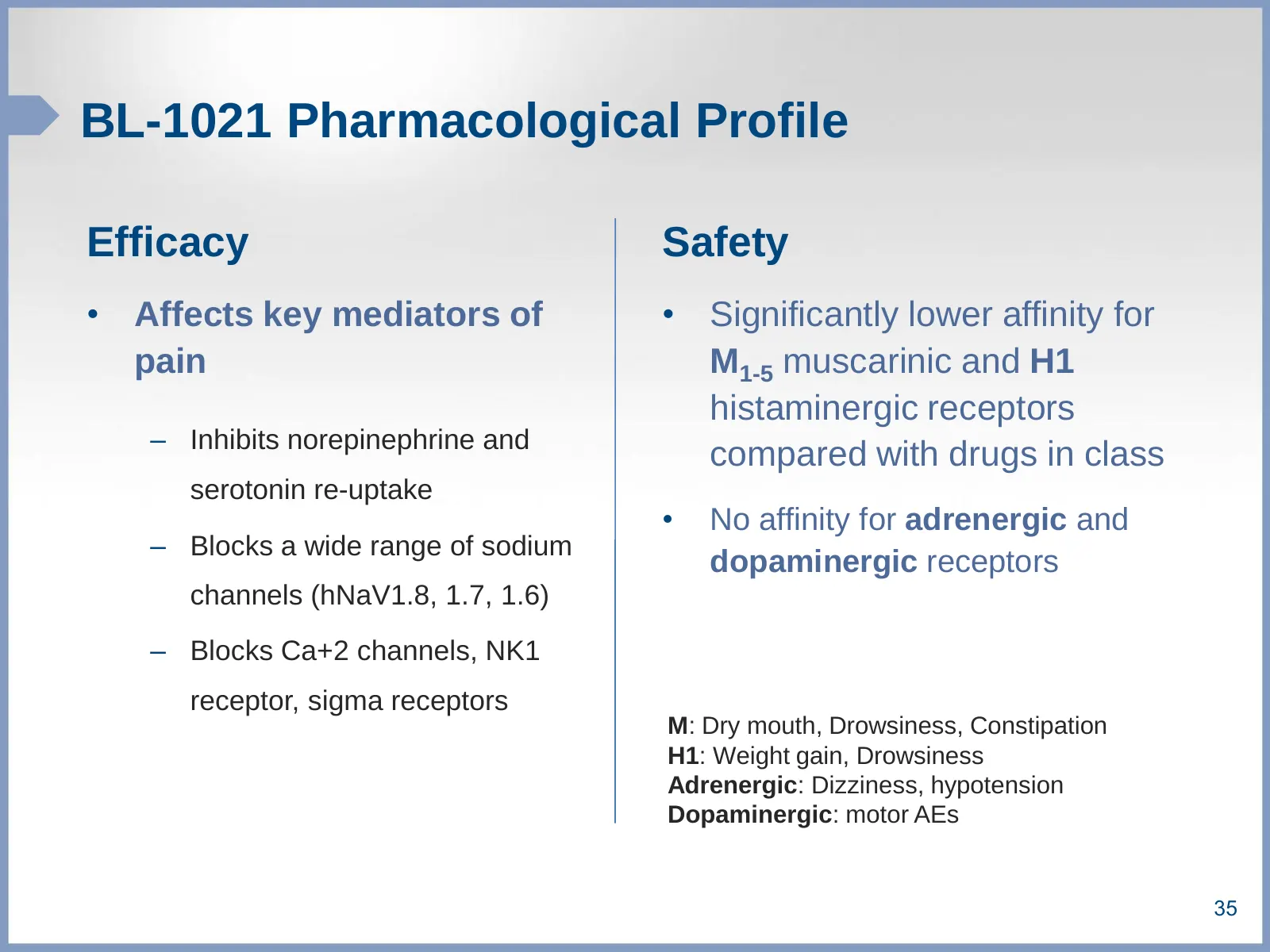
Slide 35: BL-1021 Pharmacological Profile
BL-1021 Pharmacological Profile Efficacy Safety • Affects key mediators of • Significantly lower affinity for pain M1-5 muscarinic and H1 histaminergic receptors – Inhibits norepinephrine and compared with drugs in class serotonin re-uptake • No affinity for adrenergic and – Blocks a wide range of s
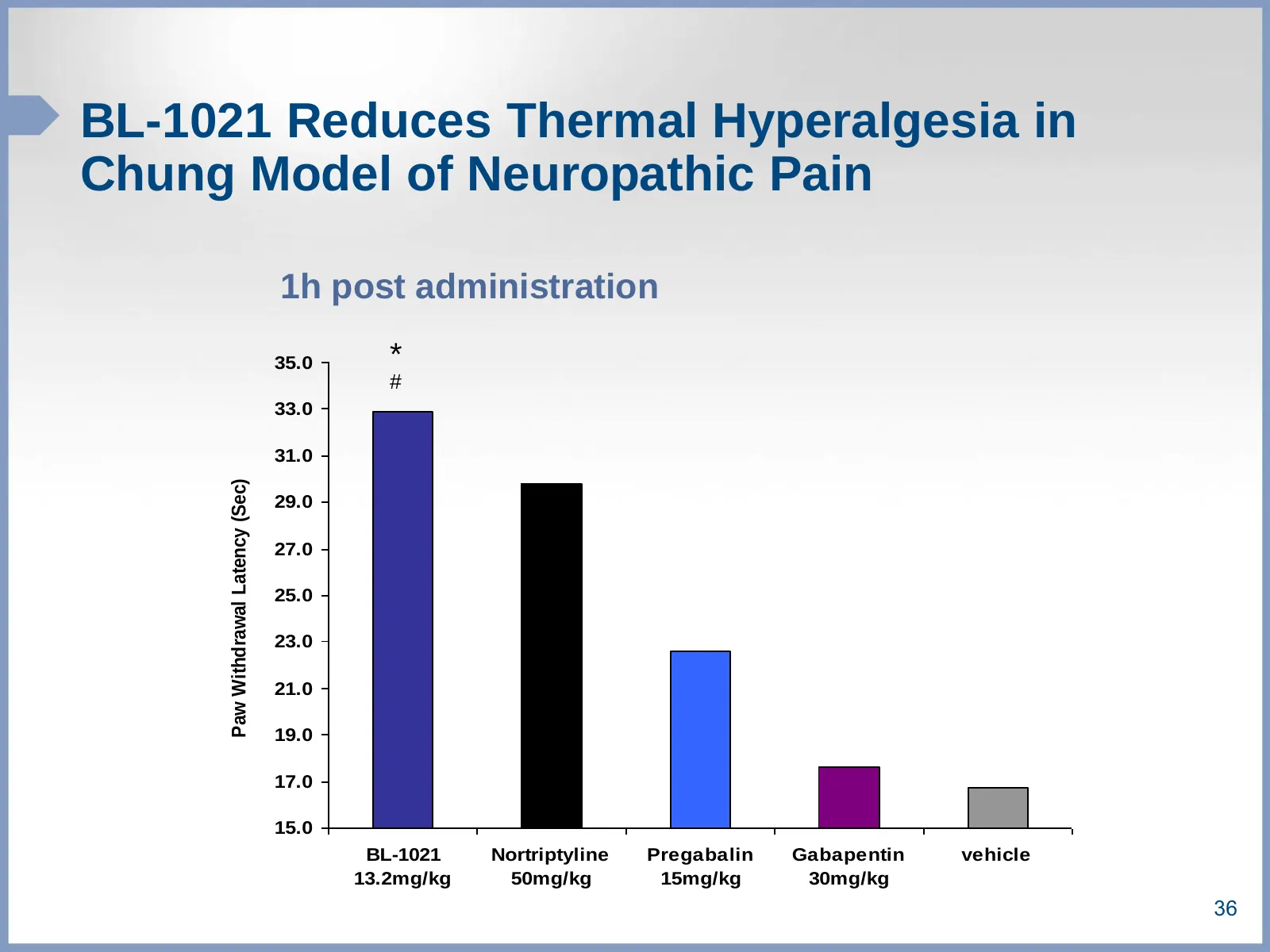
Slide 36: BL-1021 Reduces Thermal Hyperalgesia in Chung Model of Neuropathic Pain
BL-1021 Reduces Thermal Hyperalgesia in Chung Model of Neuropathic Pain 1h post administration 35.0 * # 33.0 31.0 Paw Withdrawal Latency (Sec) 29.0 27.0 25.0 23.0 21.0 19.0 17.0 15.0 BL-1021 Nortriptyline Pregabalin Gabapentin vehicle 13.2mg/kg 50mg/kg 15mg/kg 30mg/kg 36
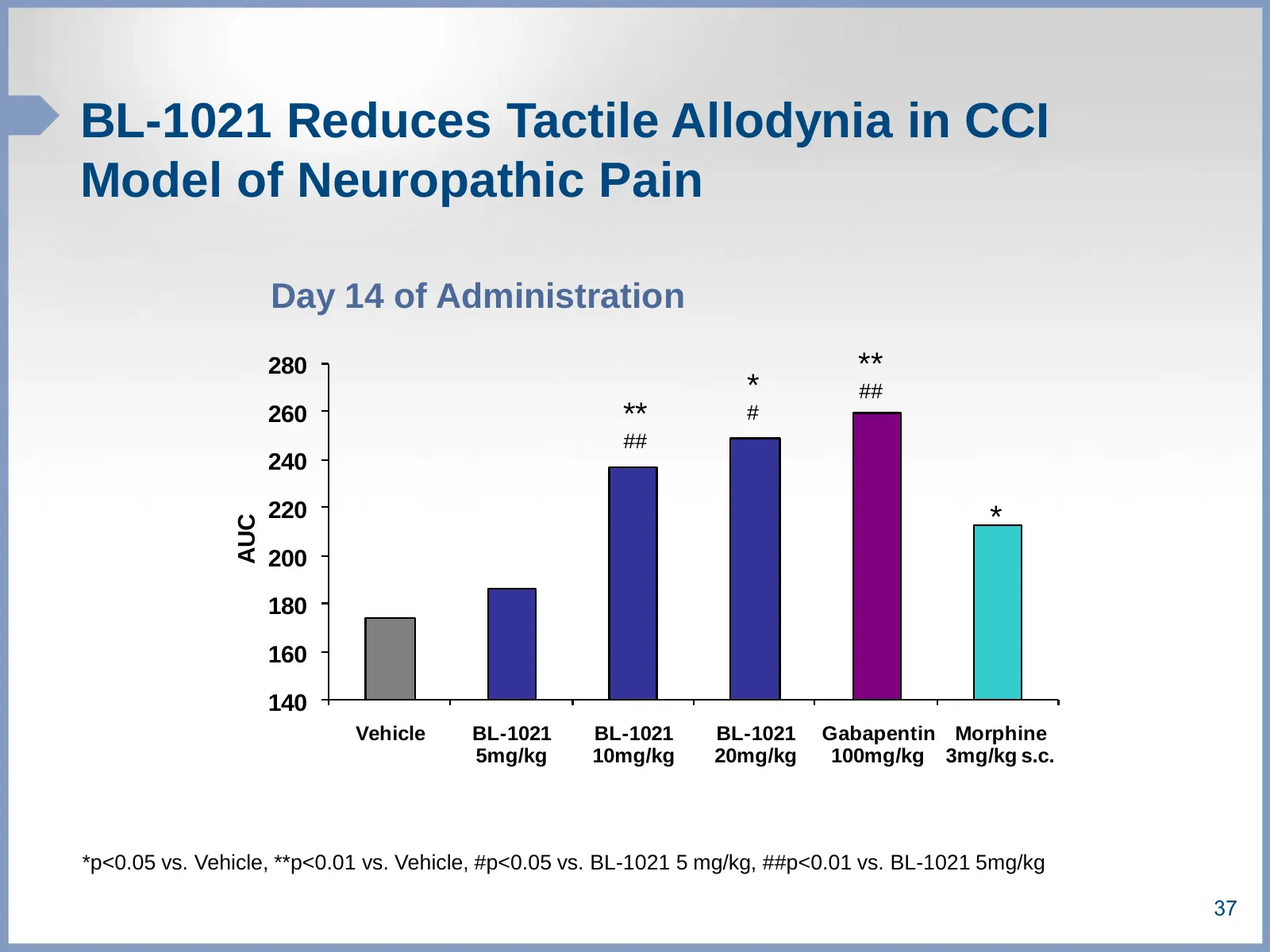
Slide 37: BL-1021 Reduces Tactile Allodynia in CCI Model of Neuropathic Pain
BL-1021 Reduces Tactile Allodynia in CCI Model of Neuropathic Pain Day 14 of Administration 280 ** * ## 260 ** # ## 240 220 * AUC 200 180 160 140 Vehicle BL-1021 BL-1021 BL-1021 Gabapentin Morphine 5mg/kg 10mg/kg 20mg/kg 100mg/kg 3mg/kg s.c. *p<0.05 vs. Vehicle, **p<0.01 vs. Vehicle, #p<0.05 vs. BL-
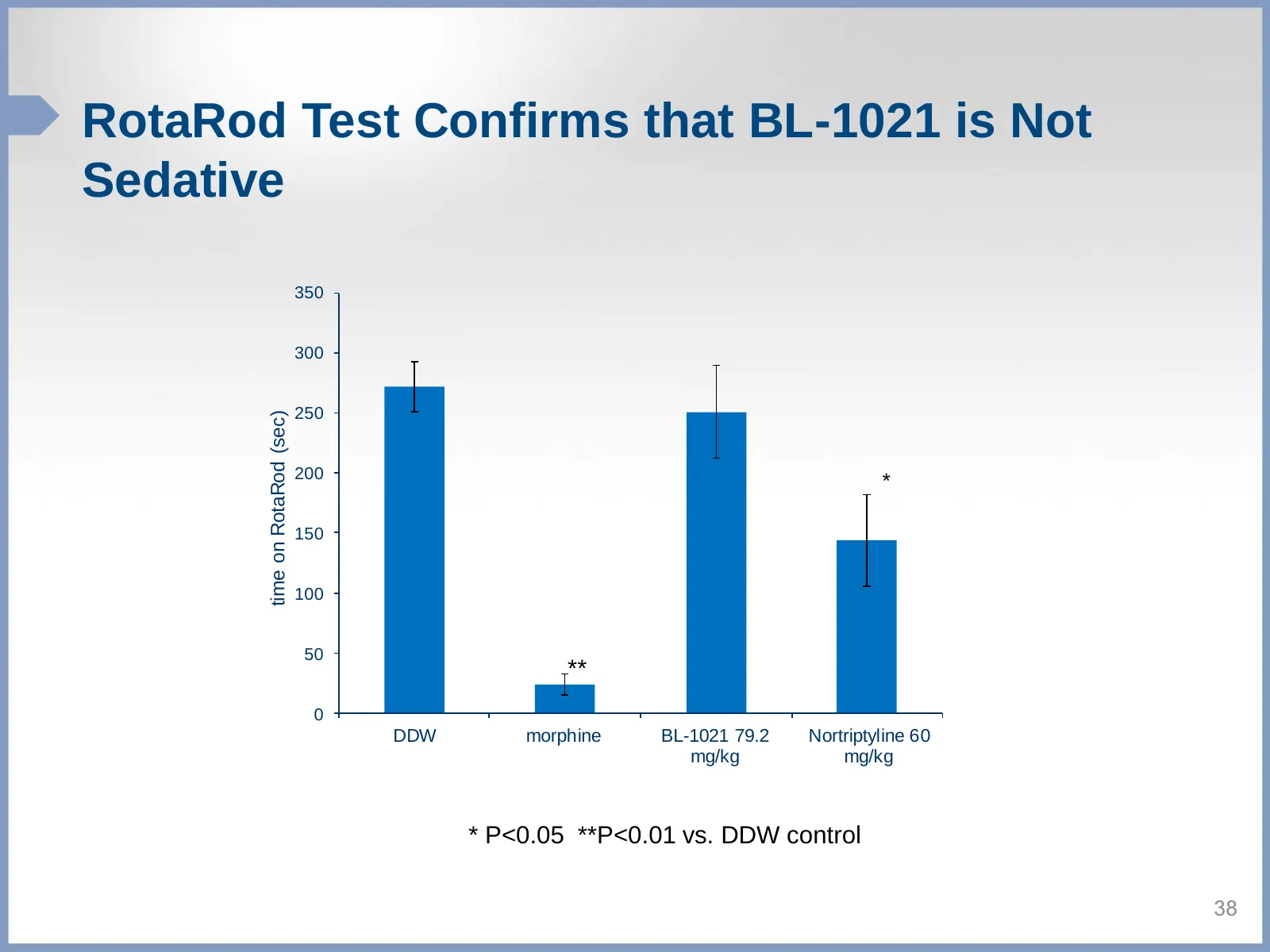
Slide 38: RotaRod Test Confirms that BL-1021 is Not Sedative
RotaRod Test Confirms that BL-1021 is Not Sedative 350 300 250 time on RotaRod (sec) 200 * 150 100 50 ** 0 DDW morphine BL-1021 79.2 Nortriptyline 60 mg/kg mg/kg * P<0.05 **P<0.01 vs. DDW control 38
Slide 39: Clinical Trial Update
Clinical Trial Update • Phase I – FPI June 2011 • Study objectives: to assess the safety, tolerability and pharmacokinetics in healthy volunteers • Design: randomized, double-blind, placebo-controlled, single center study • Will be conducted in two stages: – Single ascending dose study (4 cohorts: 1
Slide 40: BL-7040: Oligonucleotide for Inflammatory Bowel Disease
BL-7040: OLIGONUCLEOTIDE FOR INFLAMMATORY BOWEL DISEASE 40
Slide 41: BL-7040: Oligonucleotide for Treatment of Inflammatory Bowel Disease
BL-7040: Oligonucleotide for Treatment of Inflammatory Bowel Disease • Indication: Inflammatory Bowel Disease (IBD) • Status: Phase II clinical trial expected to begin Q1 2012 • Product highlights: – Orally available oligonucleotide – Anti-inflammatory effect demonstrated in vitro and in various ani
Slide 42: Unique Funding Programs
UNIQUE FUNDING PROGRAMS 42
Slide 43: Unique Risk-Reduction Funding Programs
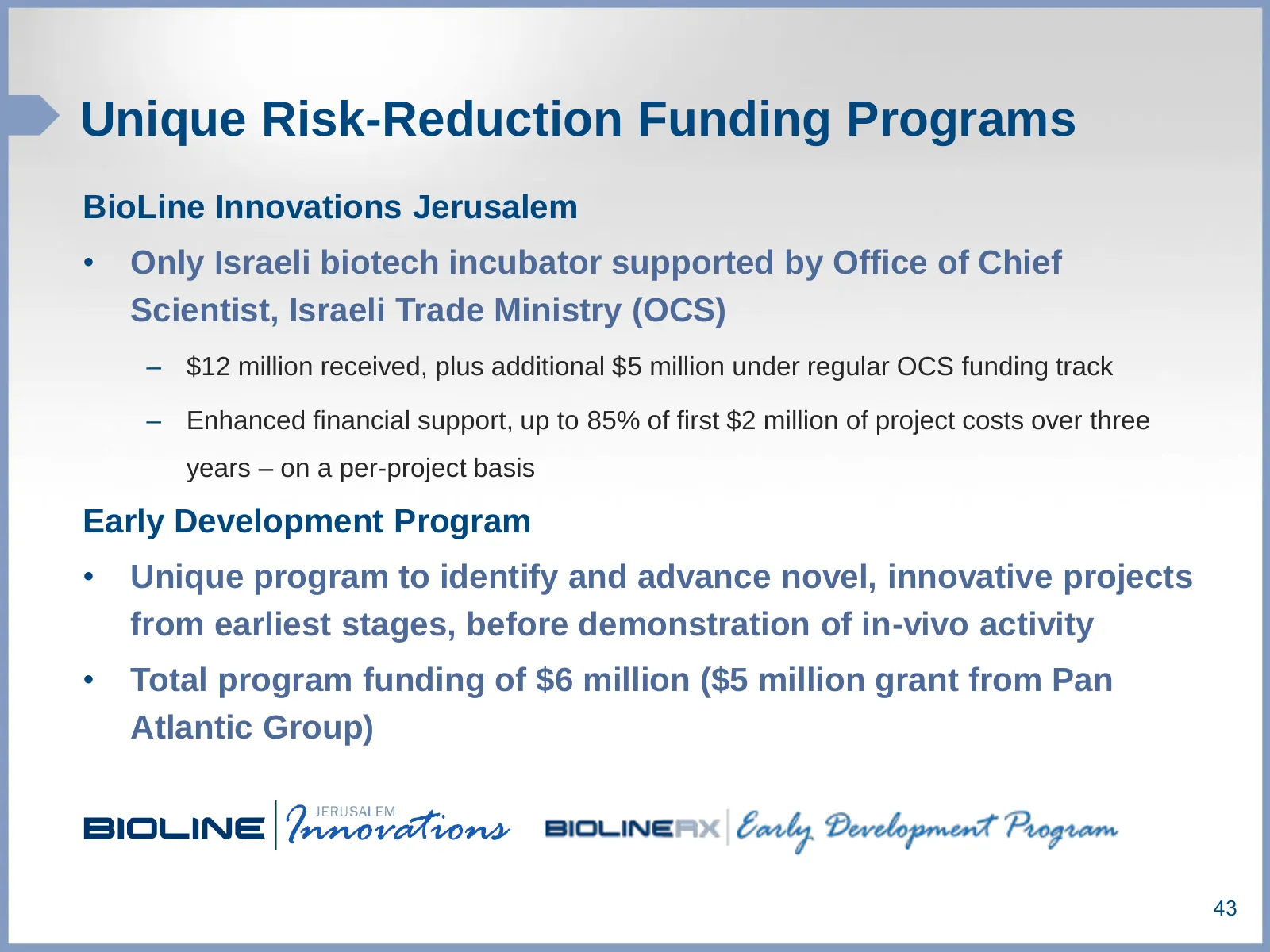
Unique Risk-Reduction Funding Programs BioLine Innovations Jerusalem • Only Israeli biotech incubator supported by Office of Chief Scientist, Israeli Trade Ministry (OCS) – $12 million received, plus additional $5 million under regular OCS funding track – Enhanced financial support, up to 85% of fir
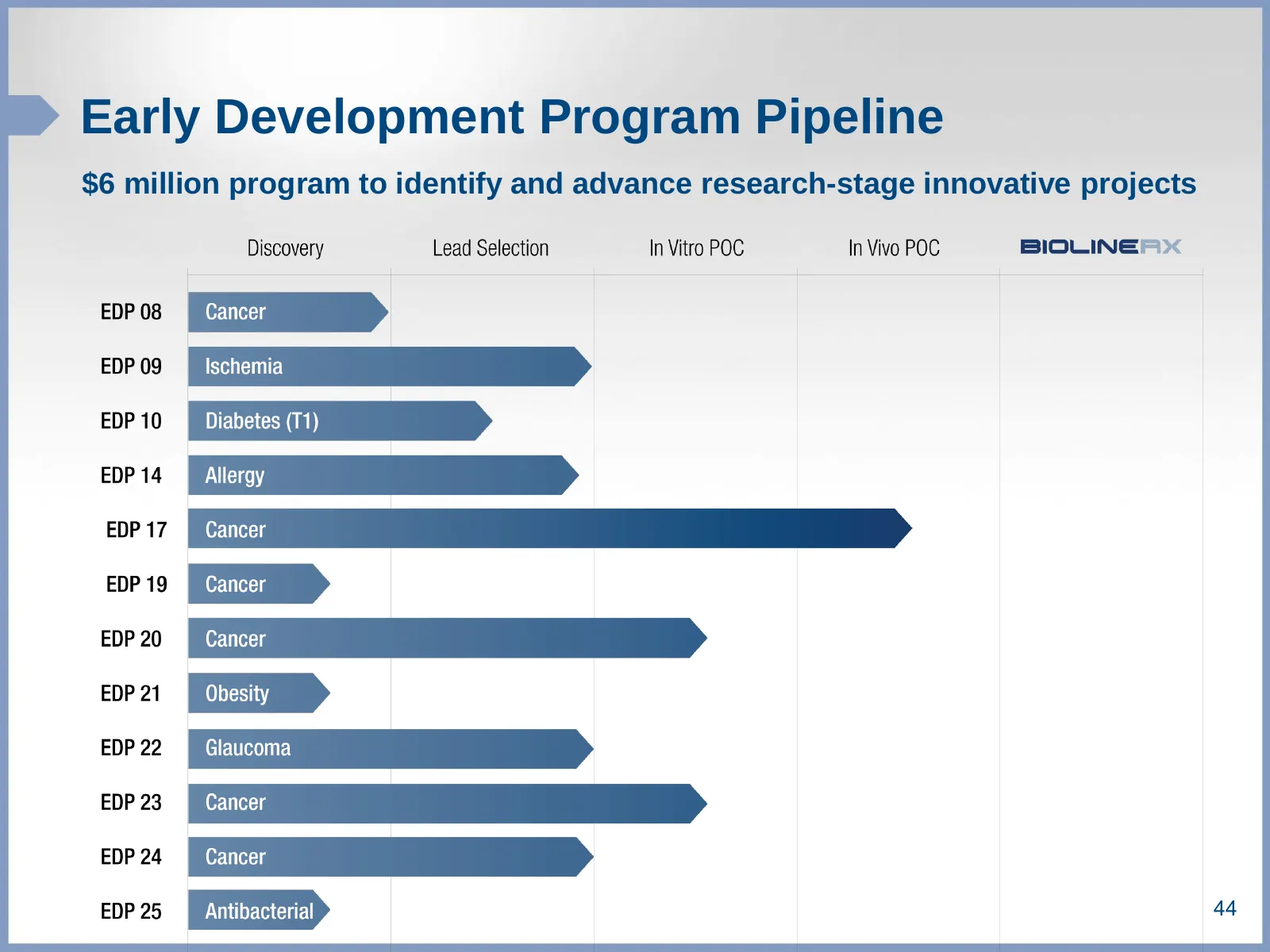
Slide 44: Early Development Program Pipeline
Early Development Program Pipeline $6 million program to identify and advance research-stage innovative projects 44

Slide 45: Corporate
CORPORATE 45
Slide 46: Financial Summary
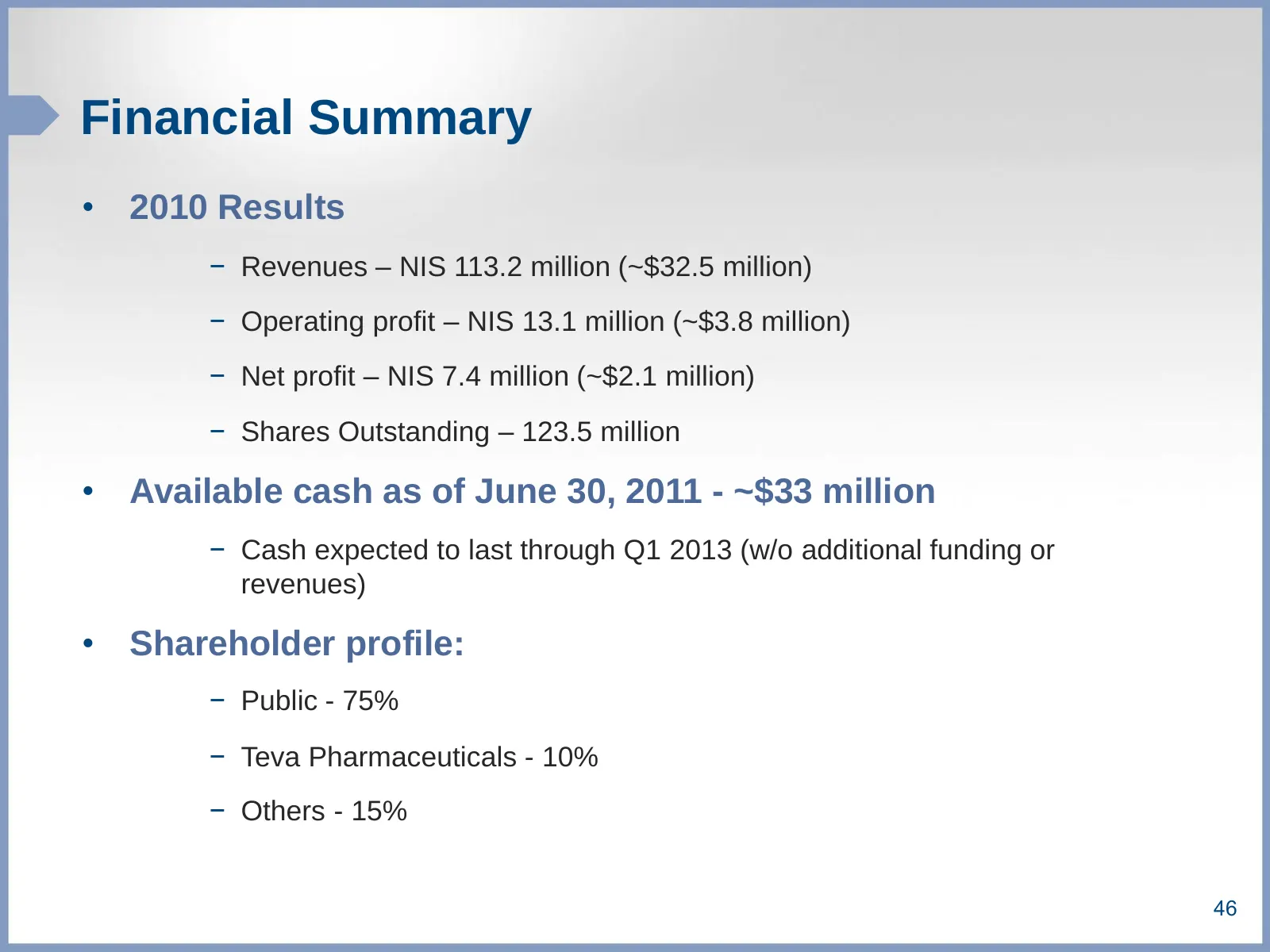
Financial Summary • 2010 Results − Revenues – NIS 113.2 million (~$32.5 million) − Operating profit – NIS 13.1 million (~$3.8 million) − Net profit – NIS 7.4 million (~$2.1 million) − Shares Outstanding – 123.5 million • Available cash as of June 30, 2011 - ~$33 million − Cash expected to last throu
Slide 47: IP Portfolio and Strategy
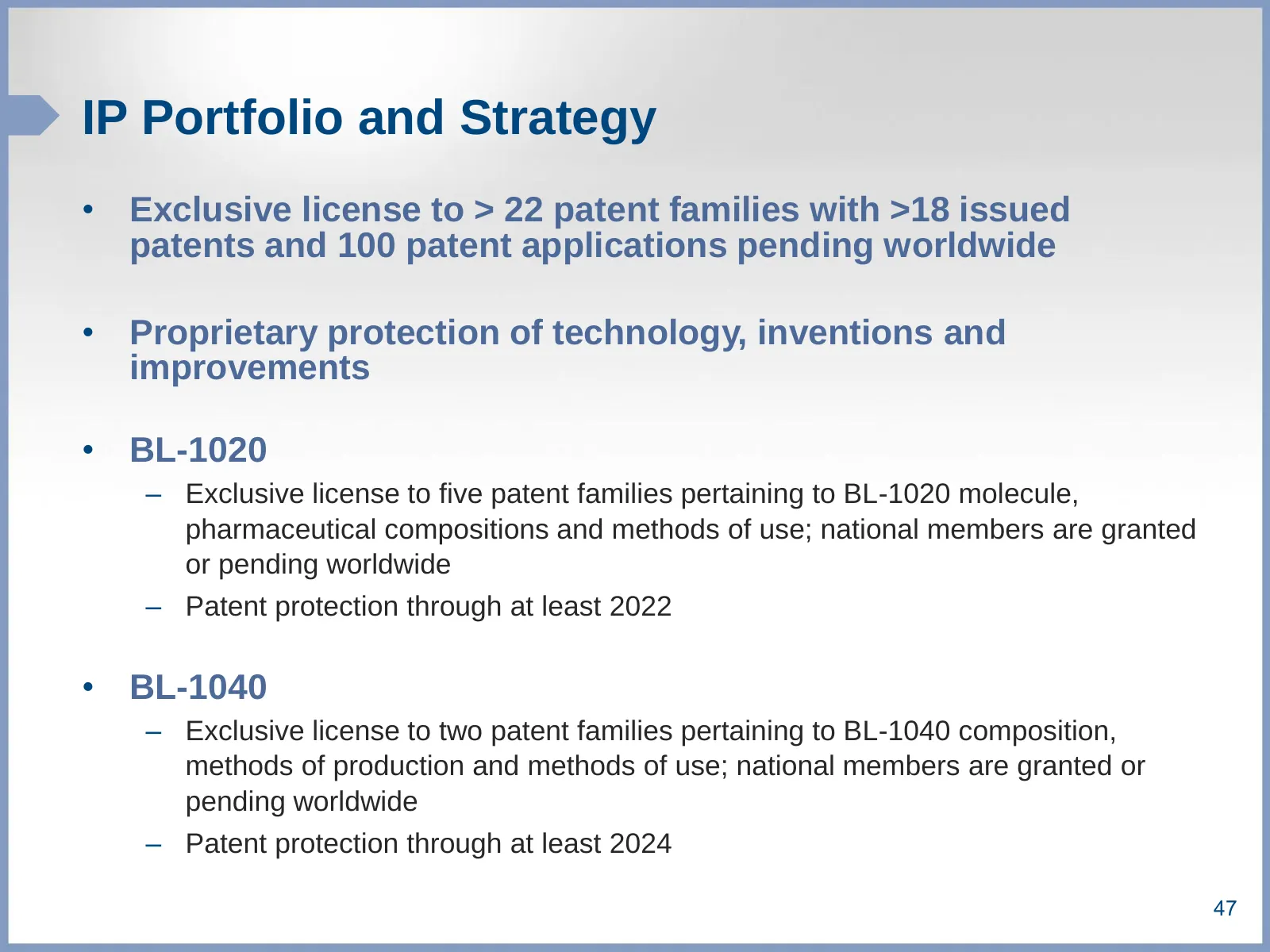
IP Portfolio and Strategy • Exclusive license to > 22 patent families with >18 issued patents and 100 patent applications pending worldwide • Proprietary protection of technology, inventions and improvements • BL-1020 – Exclusive license to five patent families pertaining to BL-1020 molecule, pharma
Slide 48: IP Portfolio and Strategy (cont.)
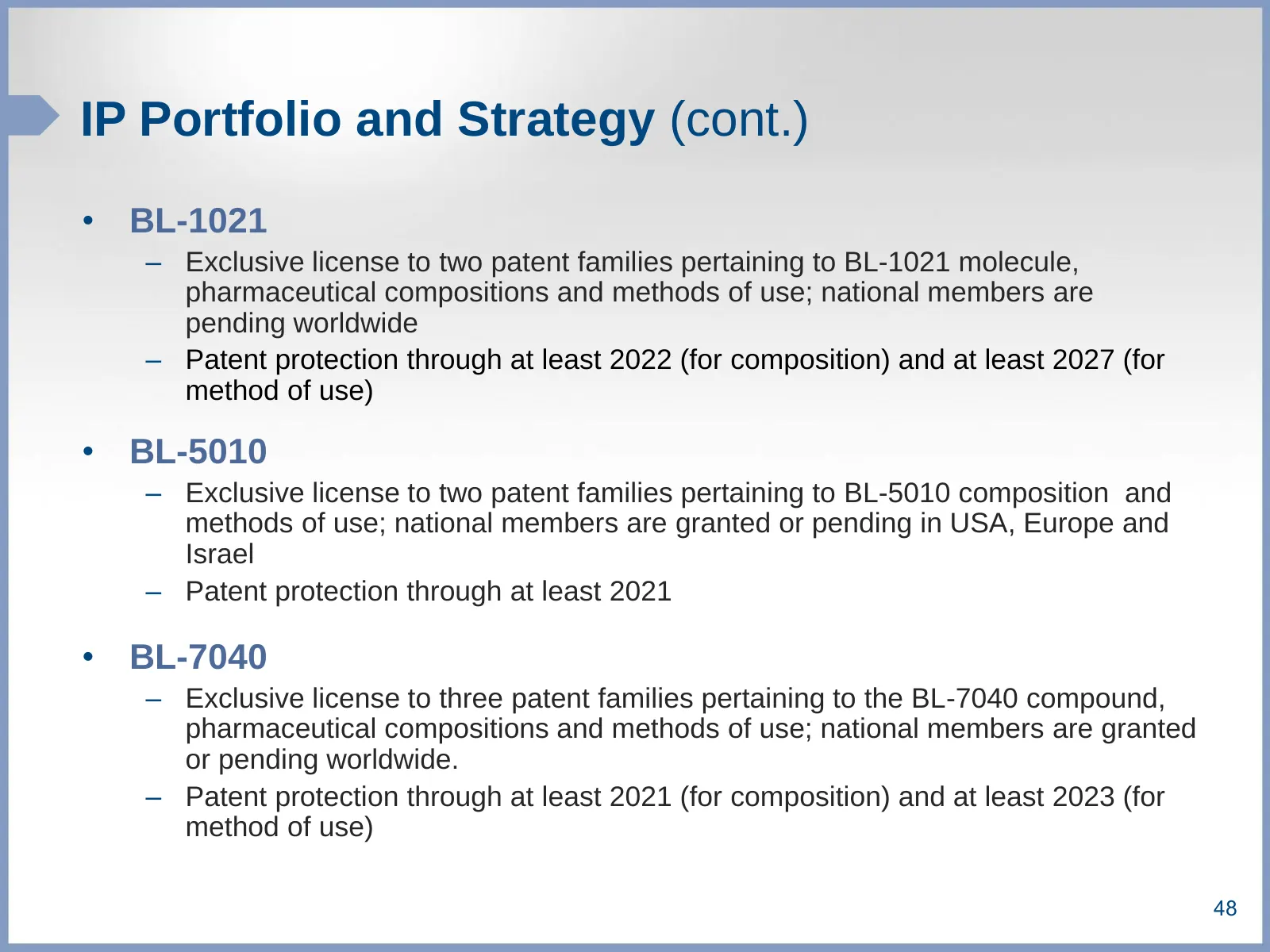
IP Portfolio and Strategy (cont.) • BL-1021 – Exclusive license to two patent families pertaining to BL-1021 molecule, pharmaceutical compositions and methods of use; national members are pending worldwide – Patent protection through at least 2022 (for composition) and at least 2027 (for method of u
Slide 49: Management Team
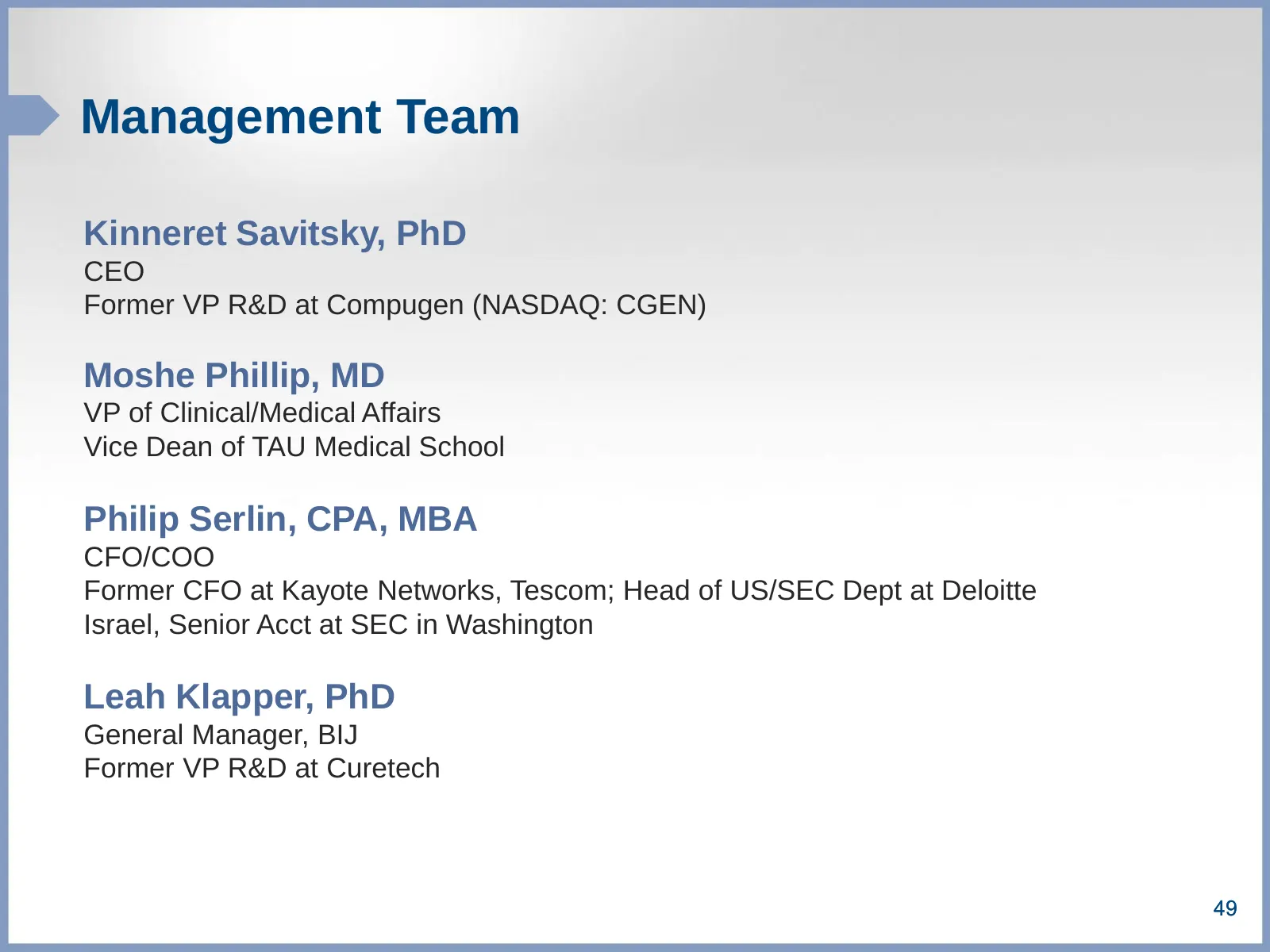
Management Team Kinneret Savitsky, PhD CEO Former VP R&D at Compugen (NASDAQ: CGEN) Moshe Phillip, MD VP of Clinical/Medical Affairs Vice Dean of TAU Medical School Philip Serlin, CPA, MBA CFO/COO Former CFO at Kayote Networks, Tescom; Head of US/SEC Dept at Deloitte Israel, Senior Acct at SEC in Wa
Slide 50: Scientific Advisory Board
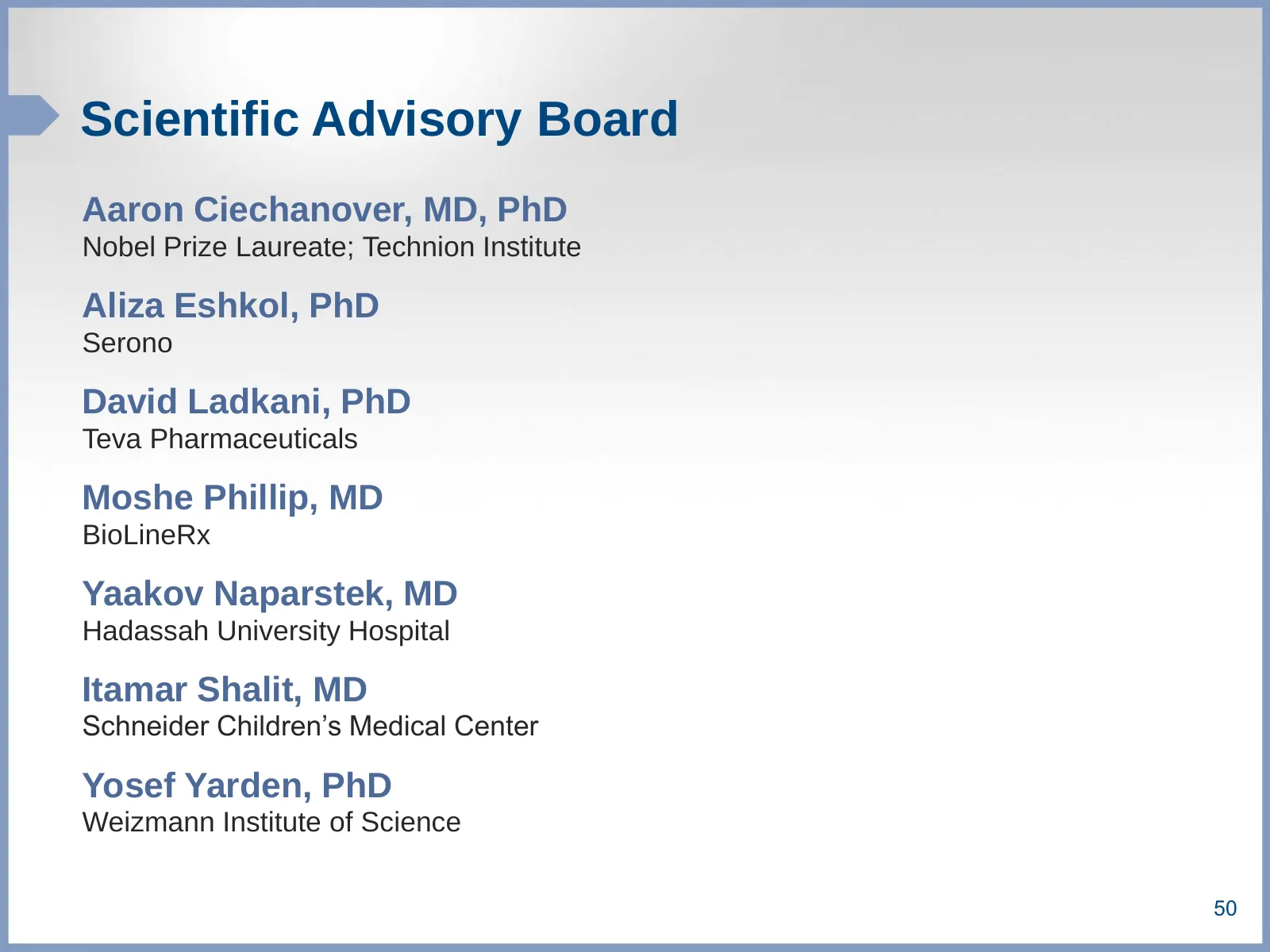
Scientific Advisory Board Aaron Ciechanover, MD, PhD Nobel Prize Laureate; Technion Institute Aliza Eshkol, PhD Serono David Ladkani, PhD Teva Pharmaceuticals Moshe Phillip, MD BioLineRx Yaakov Naparstek, MD Hadassah University Hospital Itamar Shalit, MD Schneider Children’s Medical Center Yosef Yar
Slide 51: Company Milestones Through End of 2013
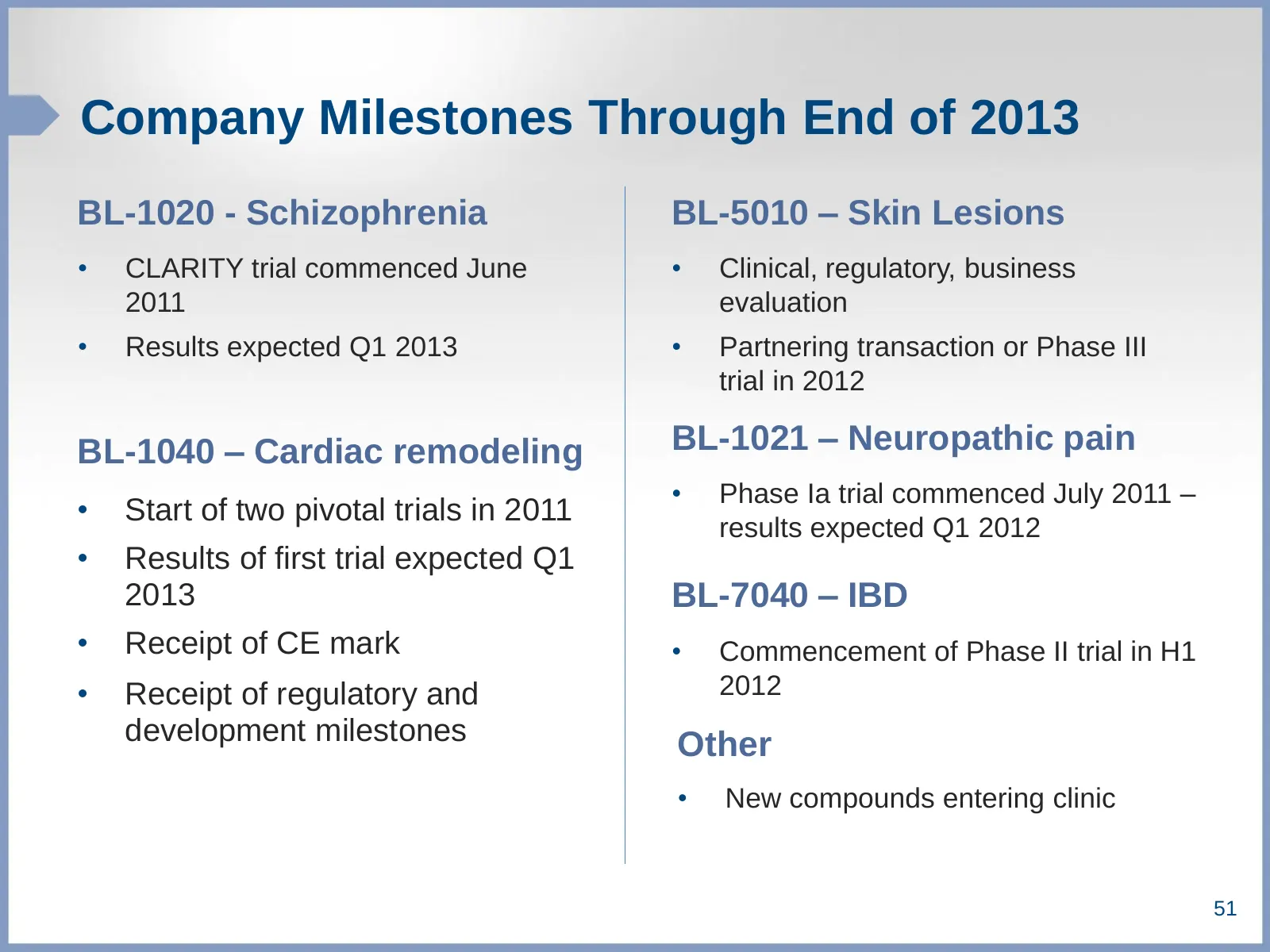
Company Milestones Through End of 2013 BL-1020 - Schizophrenia BL-5010 – Skin Lesions • CLARITY trial commenced June • Clinical, regulatory, business 2011 evaluation • Results expected Q1 2013 • Partnering transaction or Phase III trial in 2012 BL-1040 – Cardiac remodeling BL-1021 – Neuropathic pain
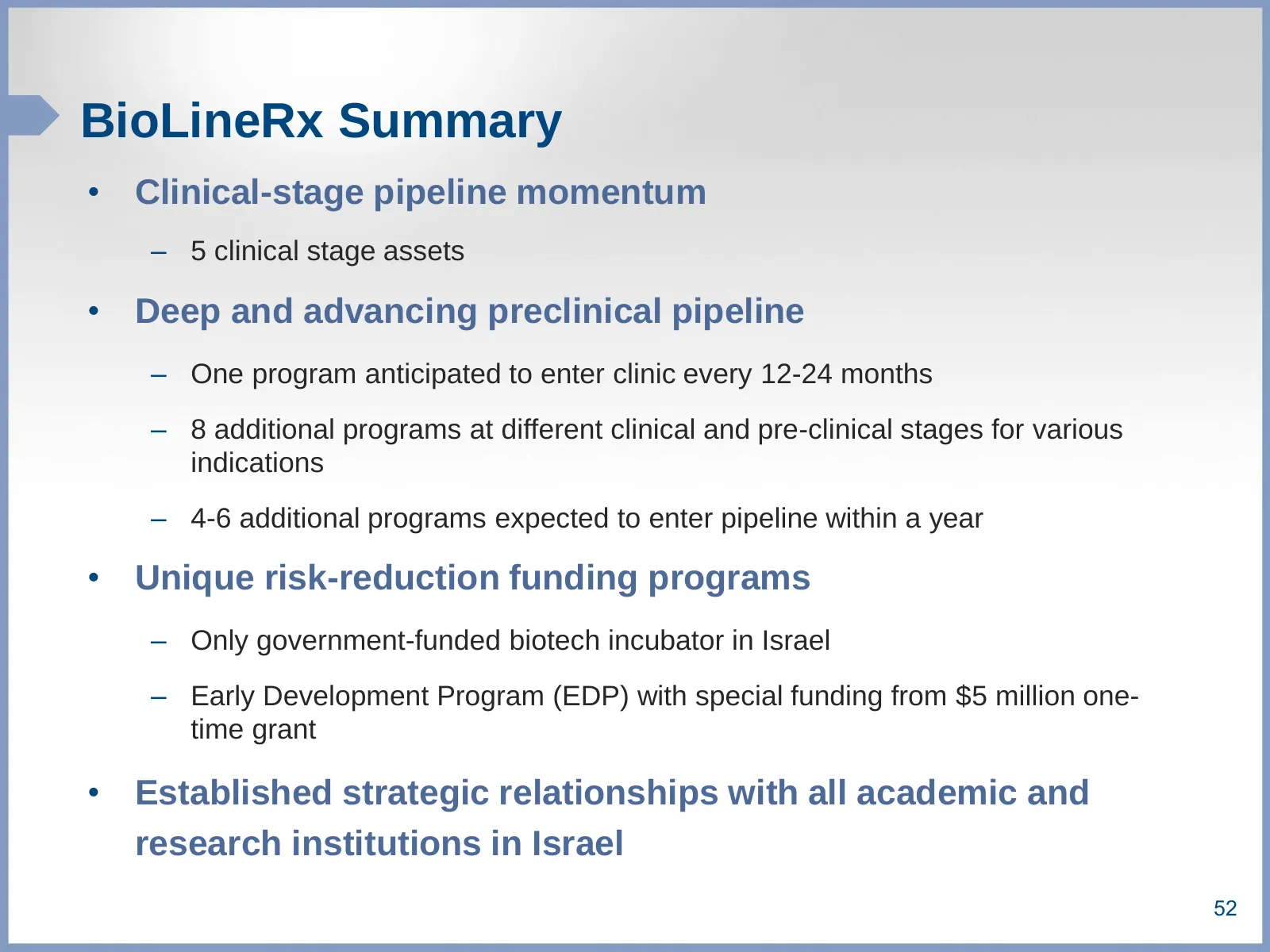
Slide 52: BioLineRx Summary
BioLineRx Summary • Clinical-stage pipeline momentum – 5 clinical stage assets • Deep and advancing preclinical pipeline – One program anticipated to enter clinic every 12-24 months – 8 additional programs at different clinical and pre-clinical stages for various indications – 4-6 additional program

Slide 53: Bench to Bedside to Partner
Benchto Beduideto Patner BIOLINEM><
Source: Internet Archive copy of biolinerx.com
More decks from BioLineRX Ltd.
 Investor Presentation (July 2026)39 slides · July 2026
 Q1 2026 Earnings Presentation28 slides · May 27, 2026
 Technical Presentation (December 2020)14 slides · Dec 16, 2020
 Technical Presentation (December 2020)49 slides · Dec 16, 2020
 Investor Presentation (February 2019)31 slides · Feb 4, 2019
 Investor Presentation (October 2018)30 slides · Oct 1, 2018