National Securities Depository Limited · BSE:NSDL
National Securities Depository — Investor Presentation
24 slides from National Securities Depository's investor presentation
Slide 1: Introduction to REITs and InvITs
Introduction to REITS and InvITs
Slide 2: Disclaimer
DISCLAIMER The information contained in this material is for only educational and awareness purposes related to securities market and shall be used for non-profitable educational and awareness activities for general public. No part of this material can be reproduced or copied in any form or by a
Slide 3: Real Estate Investment Trust (REITs)
Real Estate Investment Trust (REITs) 3
Slide 4: What is a REIT? - Overview
What is a REIT ?- Overview REIT stands for ‘Real Estate Investment Trust’. REITs own, operate and manage a portfolio of income generating real estate assets. REITs give investors access to the benefits of owning high-quality real estate assets in small ticket sizes. REITs are listed on the s
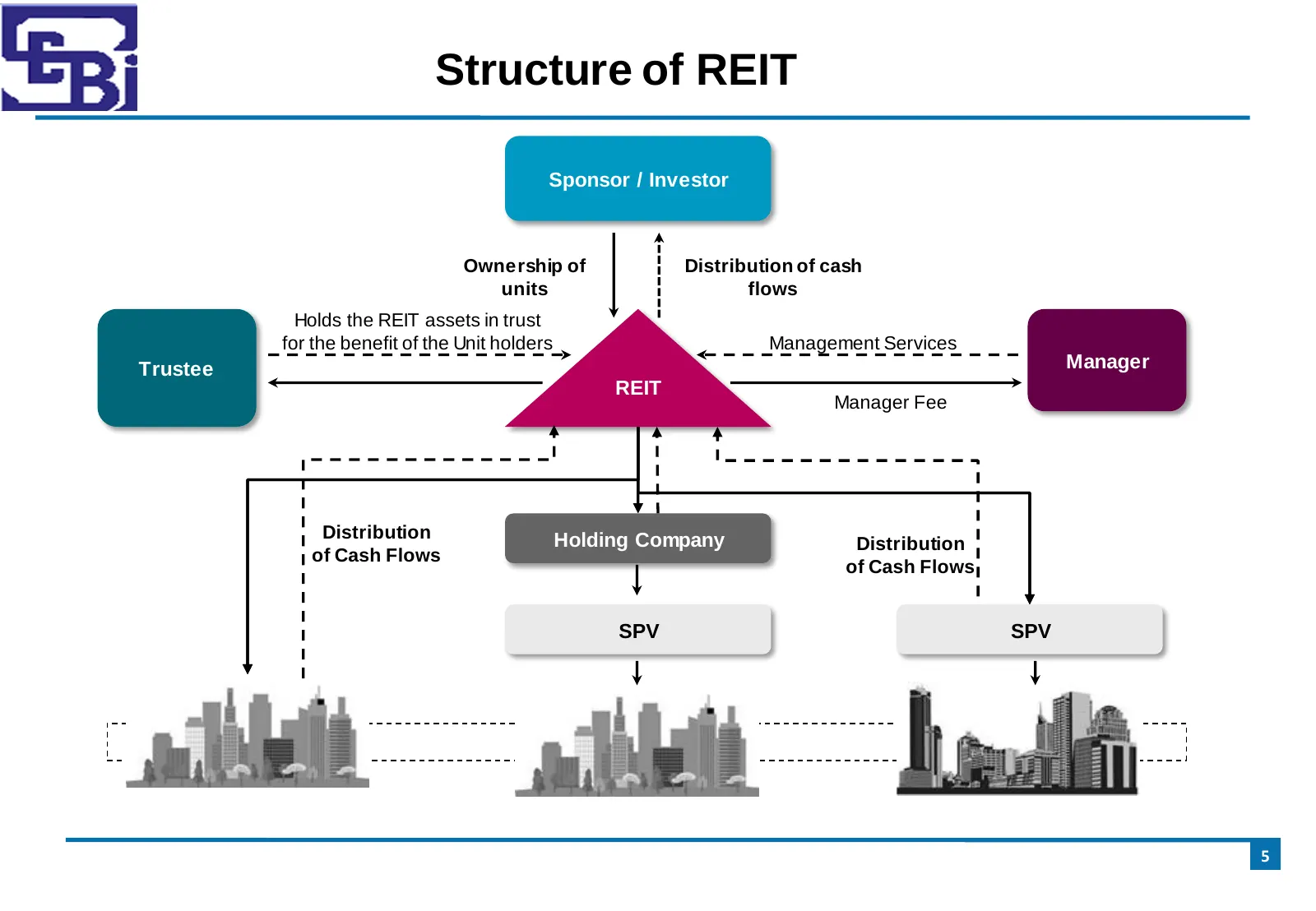
Slide 5: Structure of REIT
Structure of REIT Sponsor / Investor Ownership of Distribution of cash units flows Holds the REIT assets in trust for the benefit of the Unit holders Management Services Trustee Manager REIT Manager Fee Distribution Holding Company Distribution of Cash Flows of Cash Flows SPV SPV 5
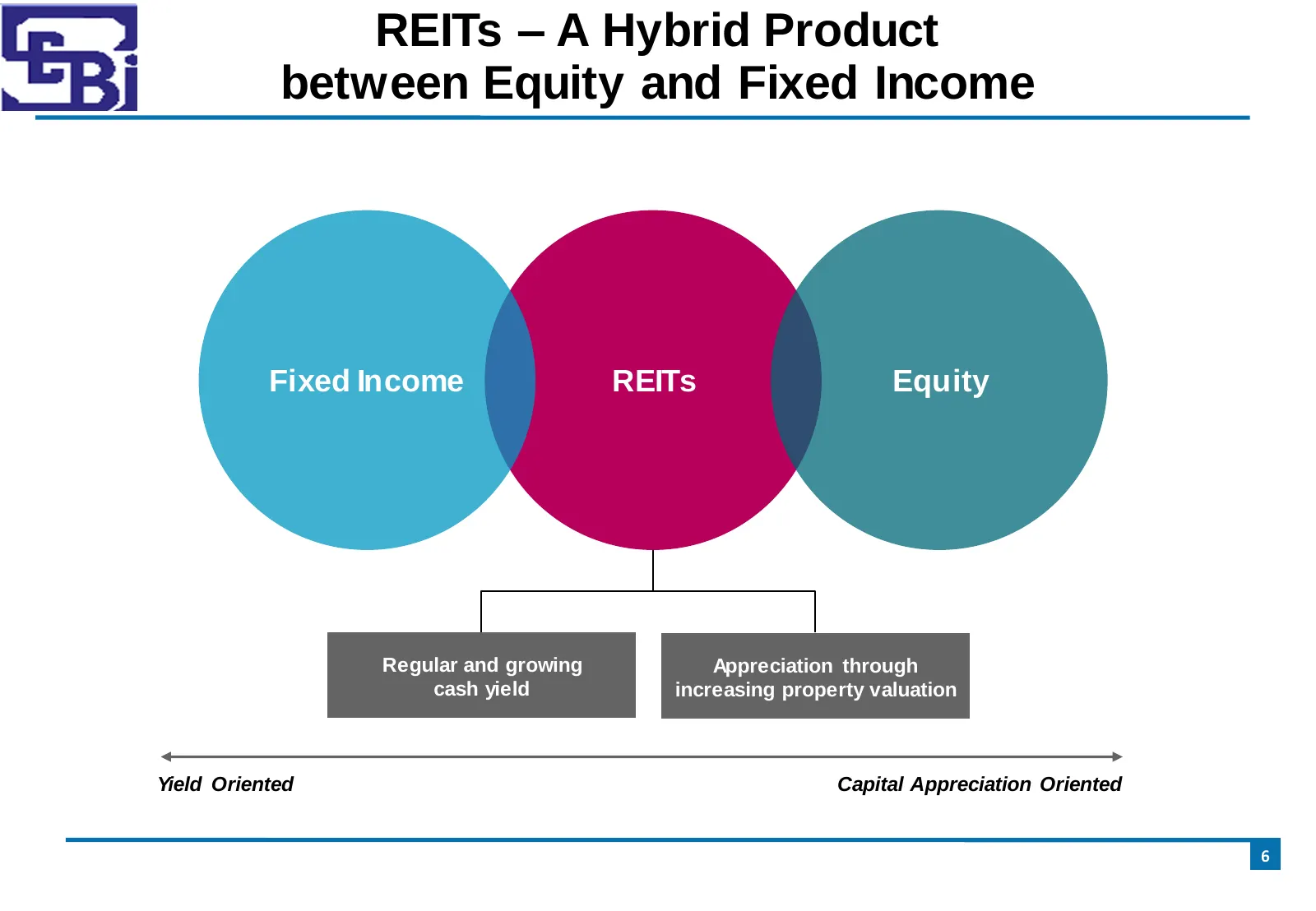
Slide 6: REITs – A Hybrid Product
REITs – A Hybrid Product between Equity and Fixed Income Fixed Income REITs Equity Regular and growing Appreciation through cash yield increasing property valuation Yield Oriented Capital Appreciation Oriented 6
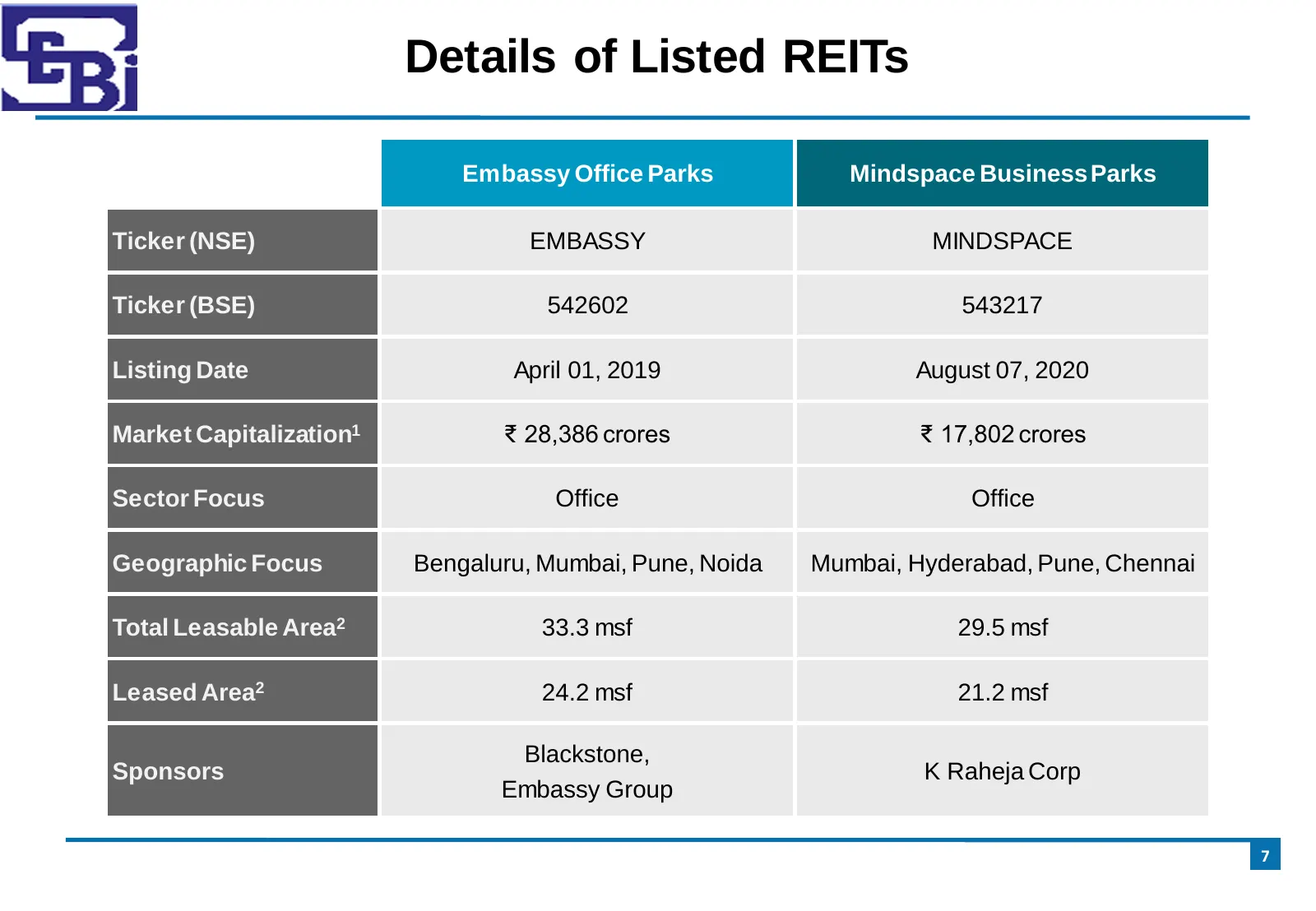
Slide 7: Details of Listed REITs
Details of Listed REITs Embassy Office Parks Mindspace Business Parks Ticker (NSE) EMBASSY MINDSPACE Ticker (BSE) 542602 543217 Listing Date April 01, 2019 August 07, 2020 Market Capitalization1 ₹ 28,386 crores ₹ 17,802 crores Sector Focus Office Office Geographic Focus Bengaluru, Mumbai, Pune, Noid
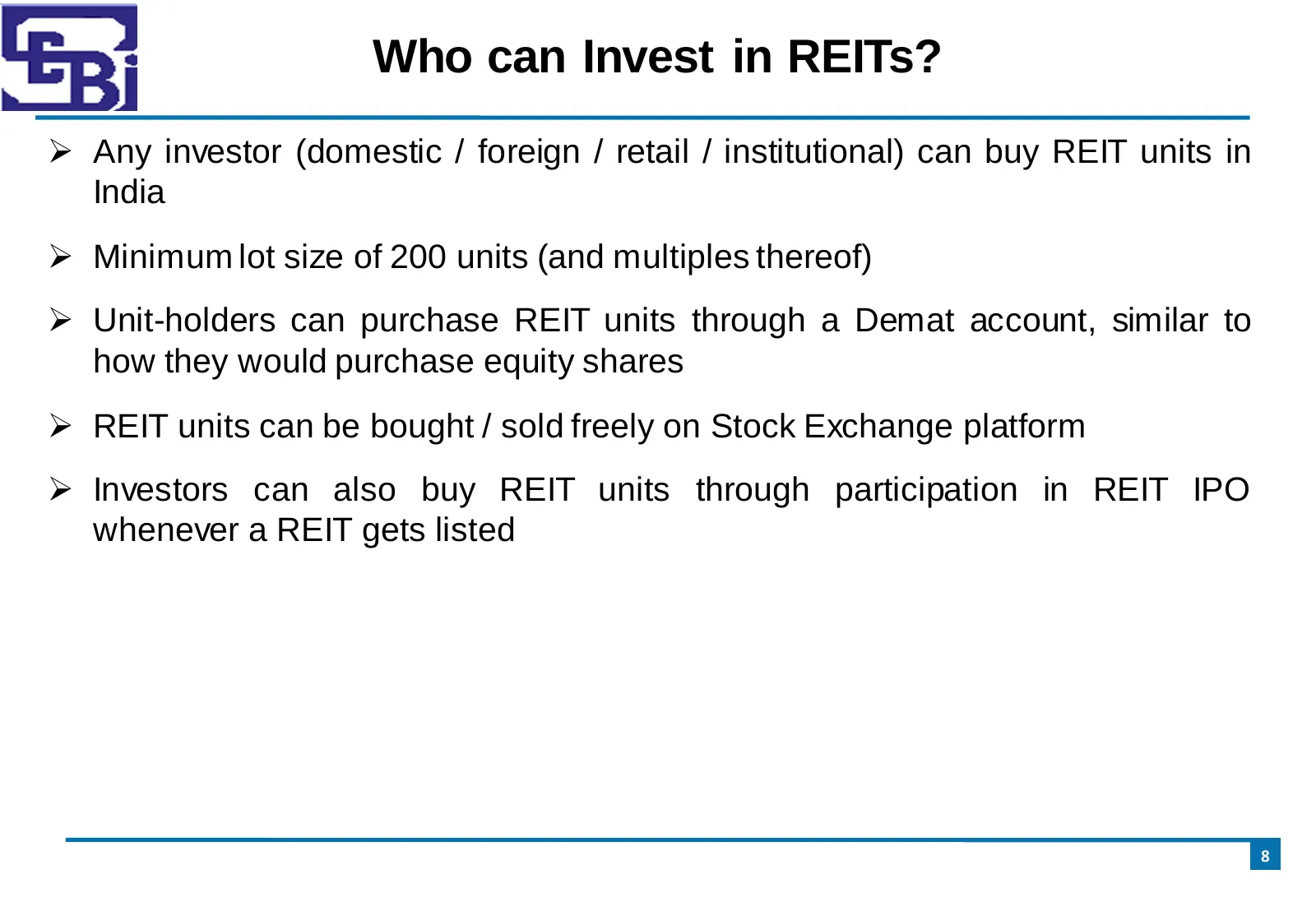
Slide 8: Who can Invest in REITs?
Who can Invest in REITs? Any investor (domestic / foreign / retail / institutional) can buy REIT units in India Minimum lot size of 200 units (and multiples thereof) Unit-holders can purchase REIT units through a Demat account, similar to how they would purchase equity shares REIT units can
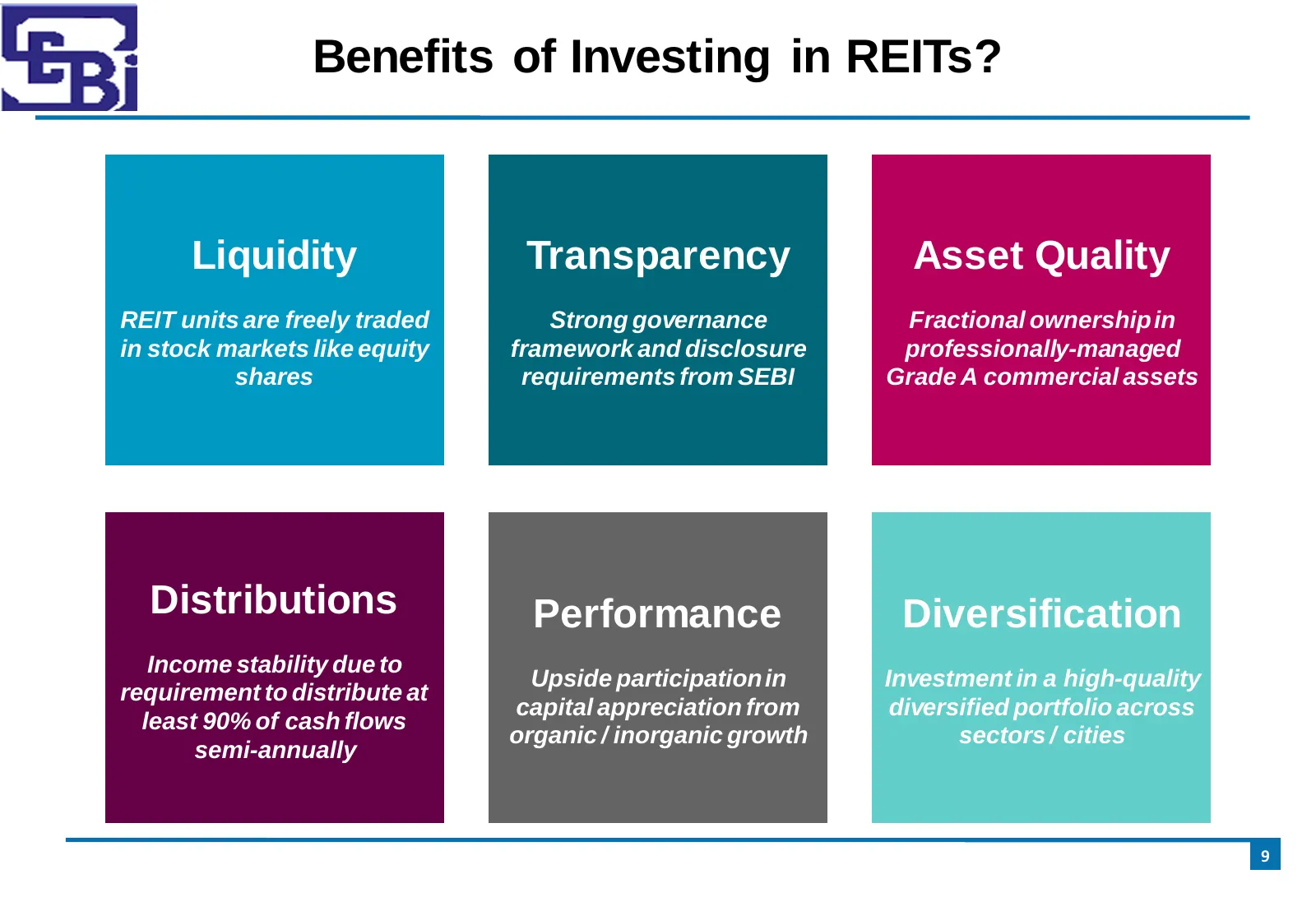
Slide 9: Benefits of Investing in REITs?
Benefits of Investing in REITs? Liquidity Transparency Asset Quality REIT units are freely traded Strong governance Fractional ownership in in stock markets like equity framework and disclosure professionally-managed shares requirements from SEBI Grade A commercial assets Distributions Performance D
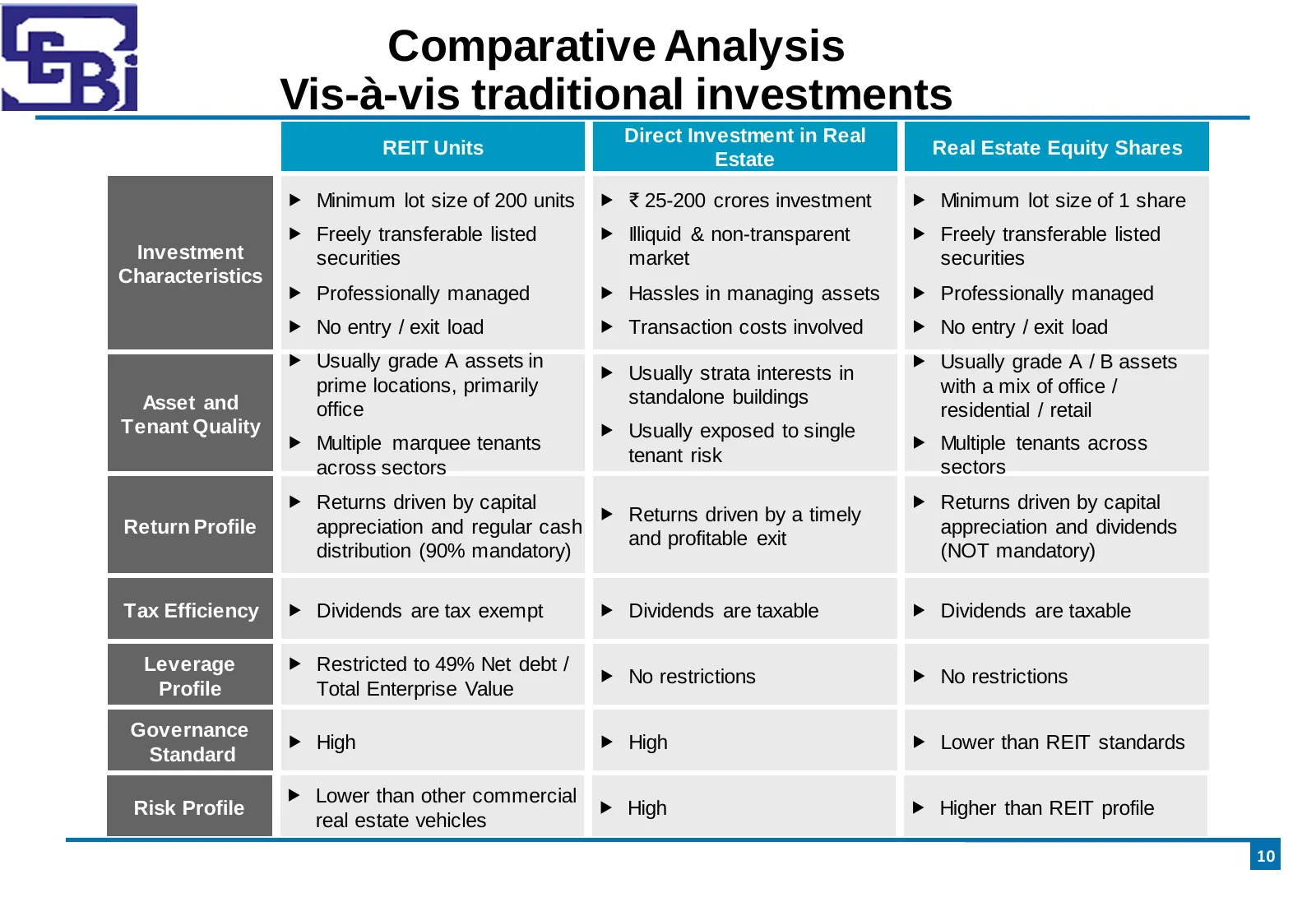
Slide 10: Comparative Analysis Vis-à-vis traditional investments
Comparative Analysis Vis-à-vis traditional investments Direct Investment in Real REIT Units Real Estate Equity Shares Estate Minimum lot size of 200 units ₹ 25-200 crores investment Minimum lot size of 1 share Freely transferable listed Illiquid & non-transparent Freely transferable list
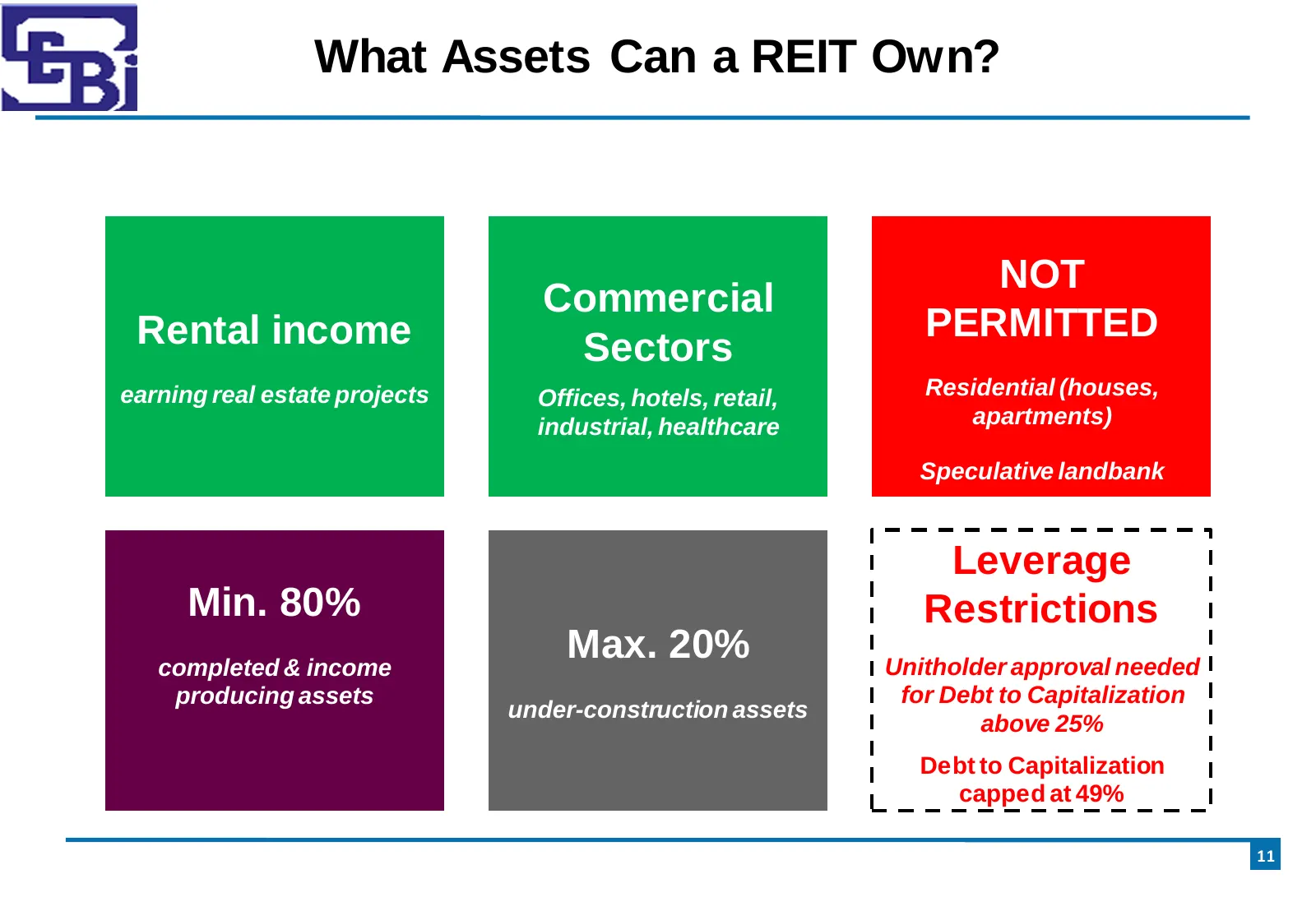
Slide 11: What Assets Can a REIT Own?
What Assets Can a REIT Own? NOT Commercial Rental income PERMITTED Sectors earning real estate projects Offices, hotels, retail, Residential (houses, industrial, healthcare apartments) Speculative landbank Leverage Min. 80% Restrictions completed & income Max. 20% Unitholder approval needed producin
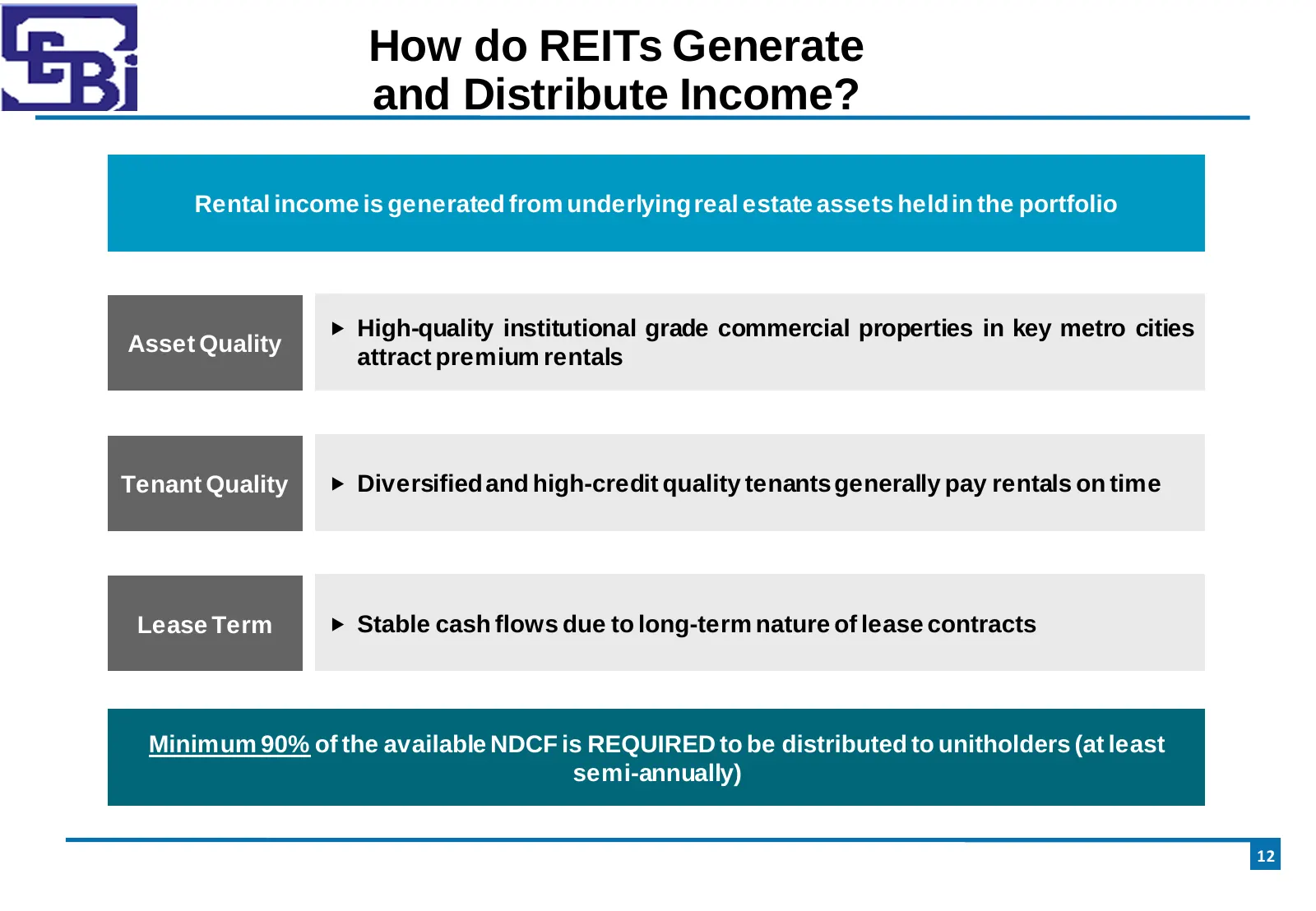
Slide 12: How do REITs Generate and Distribute Income?
How do REITs Generate and Distribute Income? Rental income is generated from underlying real estate assets held in the portfolio High-quality institutional grade commercial properties in key metro cities Asset Quality attract premium rentals Tenant Quality Diversified and high-credit quality ten
Slide 13: Disclosures to Unit-holders by the REIT
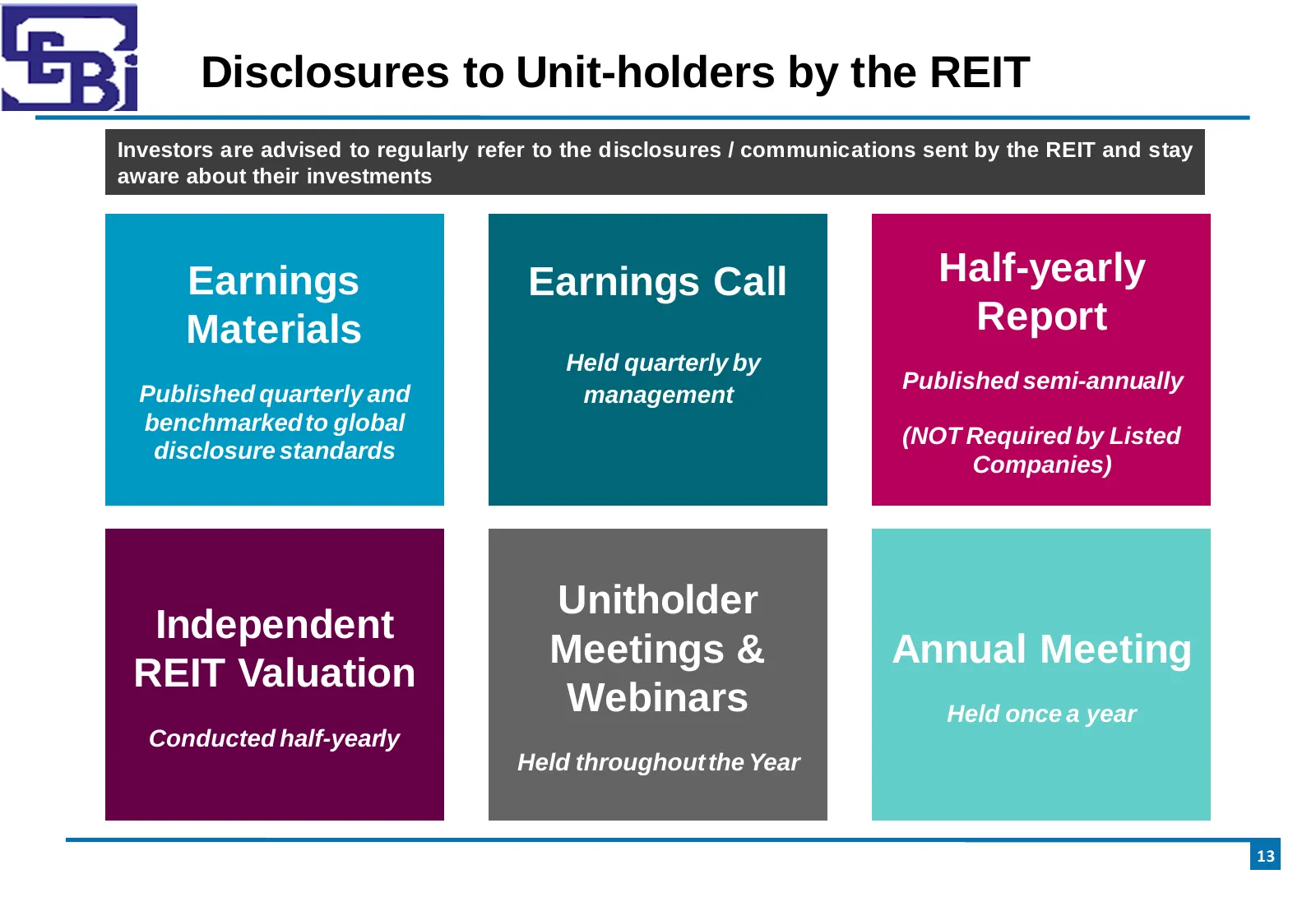
Disclosures to Unit-holders by the REIT Investors are advised to regularly refer to the disclosures / communications sent by the REIT and stay aware about their investments Earnings Earnings Call Half-yearly Materials Report Held quarterly by Published semi-annually Published quarterly and managemen
Slide 14: Infrastructure Investment Trusts (InvITs)
Infrastructure Investment Trusts (InvITs) 14
Slide 15: What are InvITs
What are InvITs Purpose : encouraging and providing additional financing for investment in the infrastructure sector in India Supports diversification of ownership of infrastructure assets such as power transmission, roads, ports, renewable projects The trust is created by the Sponsor, the own
Slide 16: Benefits of investing in InvITs
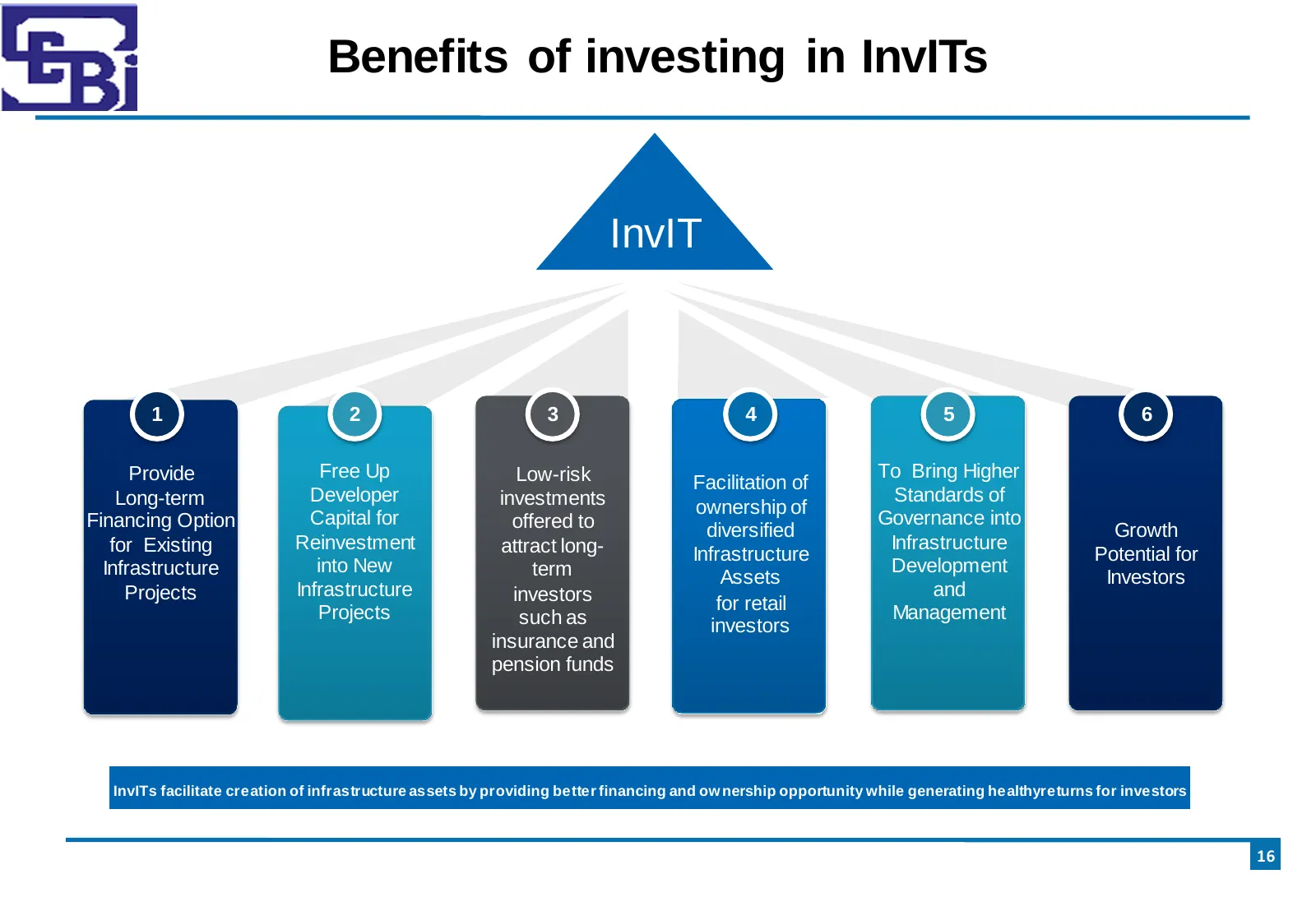
Benefits of investing in InvITs InvIT 1 2 3 4 5 6 Provide Free Up Low-risk To Bring Higher Facilitation of Long-term Developer investments Standards of ownership of Financing Option Capital for offered to Governance into diversified Growth for Existing Reinvestment attract long- Infrastructure Infra
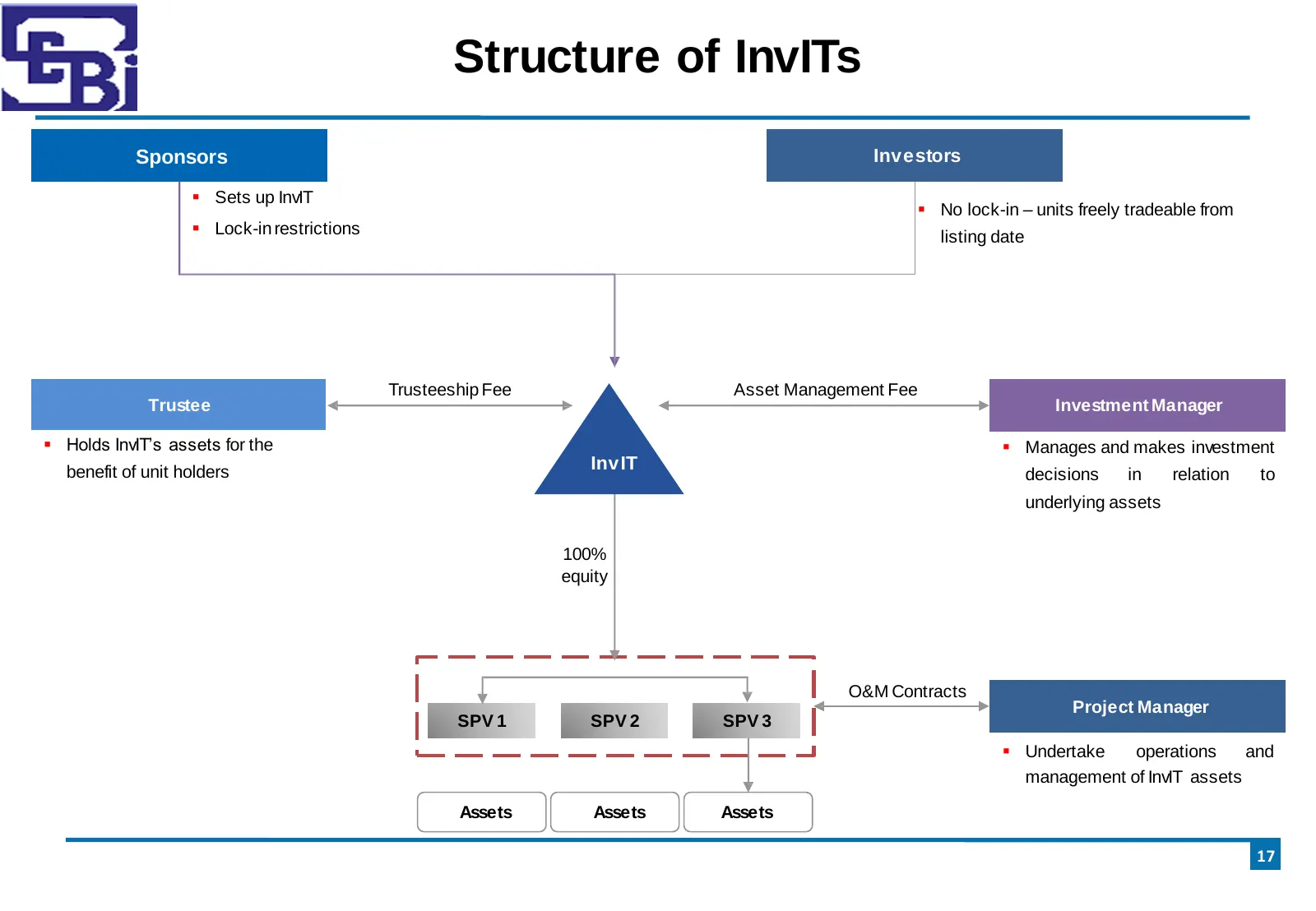
Slide 17: Structure of InvITs
Structure of InvITs Sponsors Investors Sets up InvIT No lock-in – units freely tradeable from Lock-in restrictions listing date Trusteeship Fee Asset Management Fee Trustee Investment Manager InvIT Holds InvIT’s assets for the Manages and makes investment benefit of unit holders InvIT deci
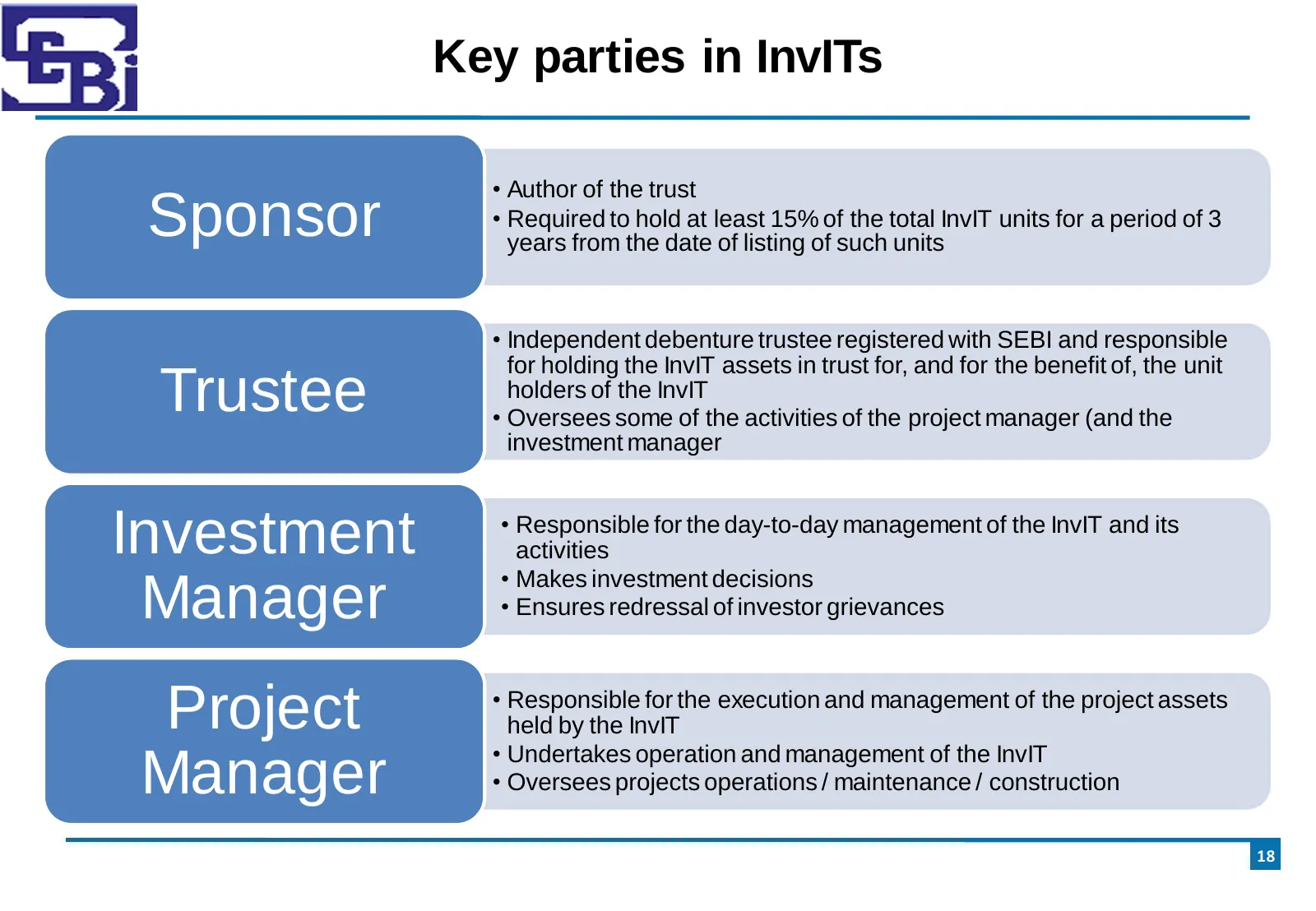
Slide 18: Key parties in InvITs
Key parties in InvITs • Author of the trust Sponsor • Required to hold at least 15% of the total InvIT units for a period of 3 years from the date of listing of such units • Independent debenture trustee registered with SEBI and responsible for holding the InvIT assets in trust for, and for the bene
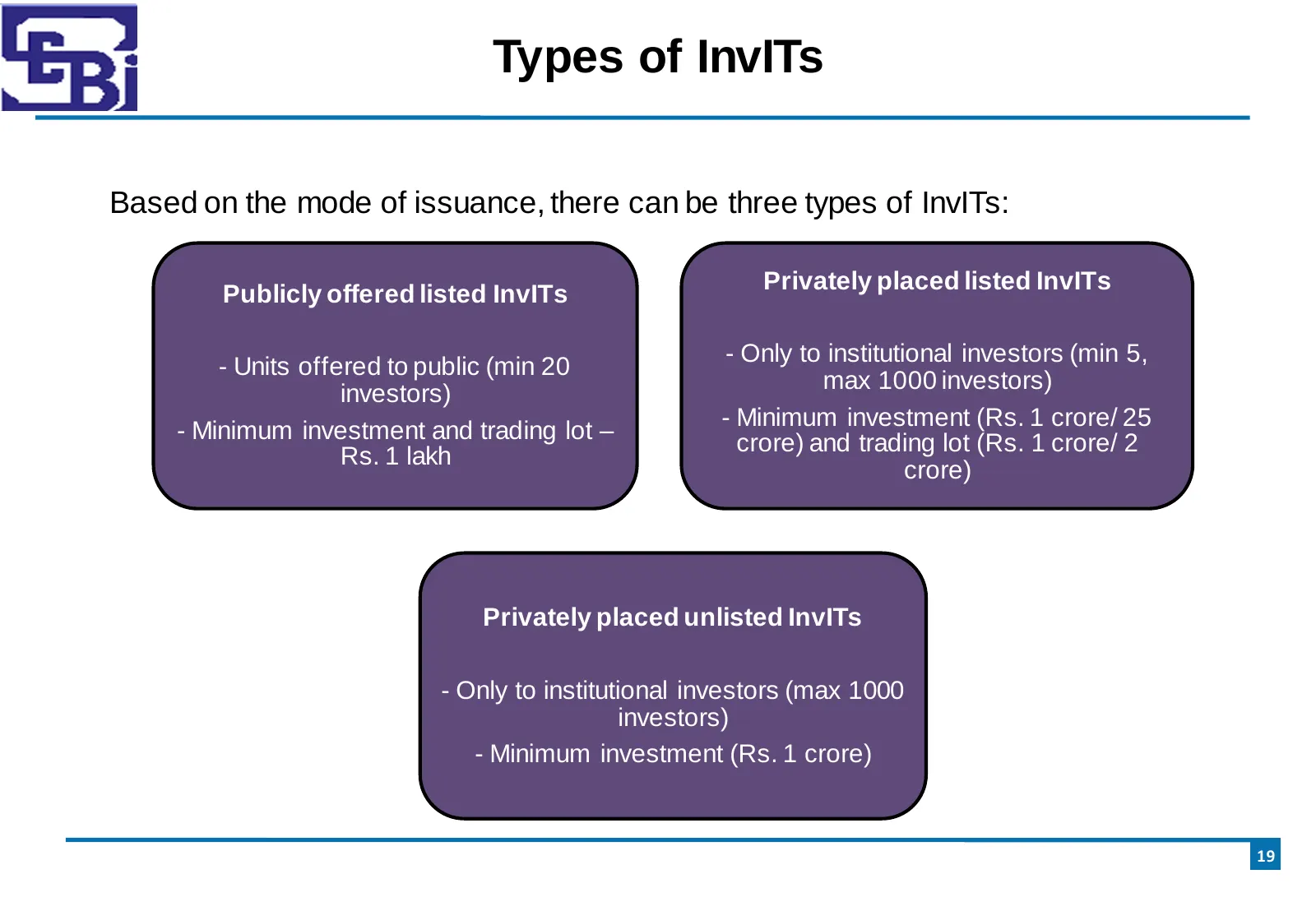
Slide 19: Types of InvITs
Types of InvITs Based on the mode of issuance, there can be three types of InvITs: Privately placed listed InvITs Publicly offered listed InvITs - Only to institutional investors (min 5, - Units offered to public (min 20 max 1000 investors) investors) - Minimum investment (Rs. 1 crore/ 25 - Minimum
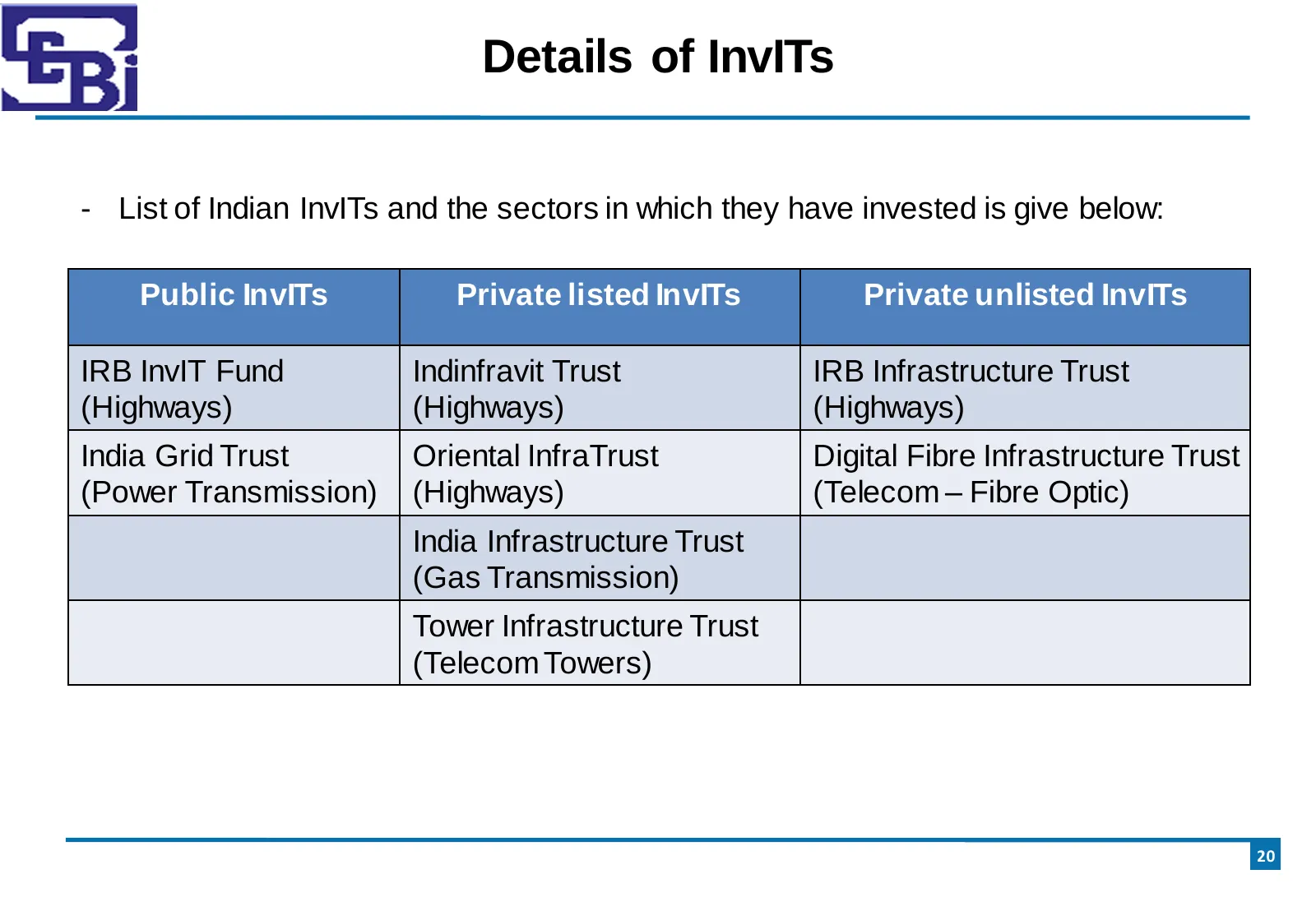
Slide 20: Details of InvITs
Details of InvITs - List of Indian InvITs and the sectors in which they have invested is give below: Public InvITs Private listed InvITs Private unlisted InvITs IRB InvIT Fund Indinfravit Trust IRB Infrastructure Trust (Highways) (Highways) (Highways) India Grid Trust Oriental InfraTrust Digital Fib
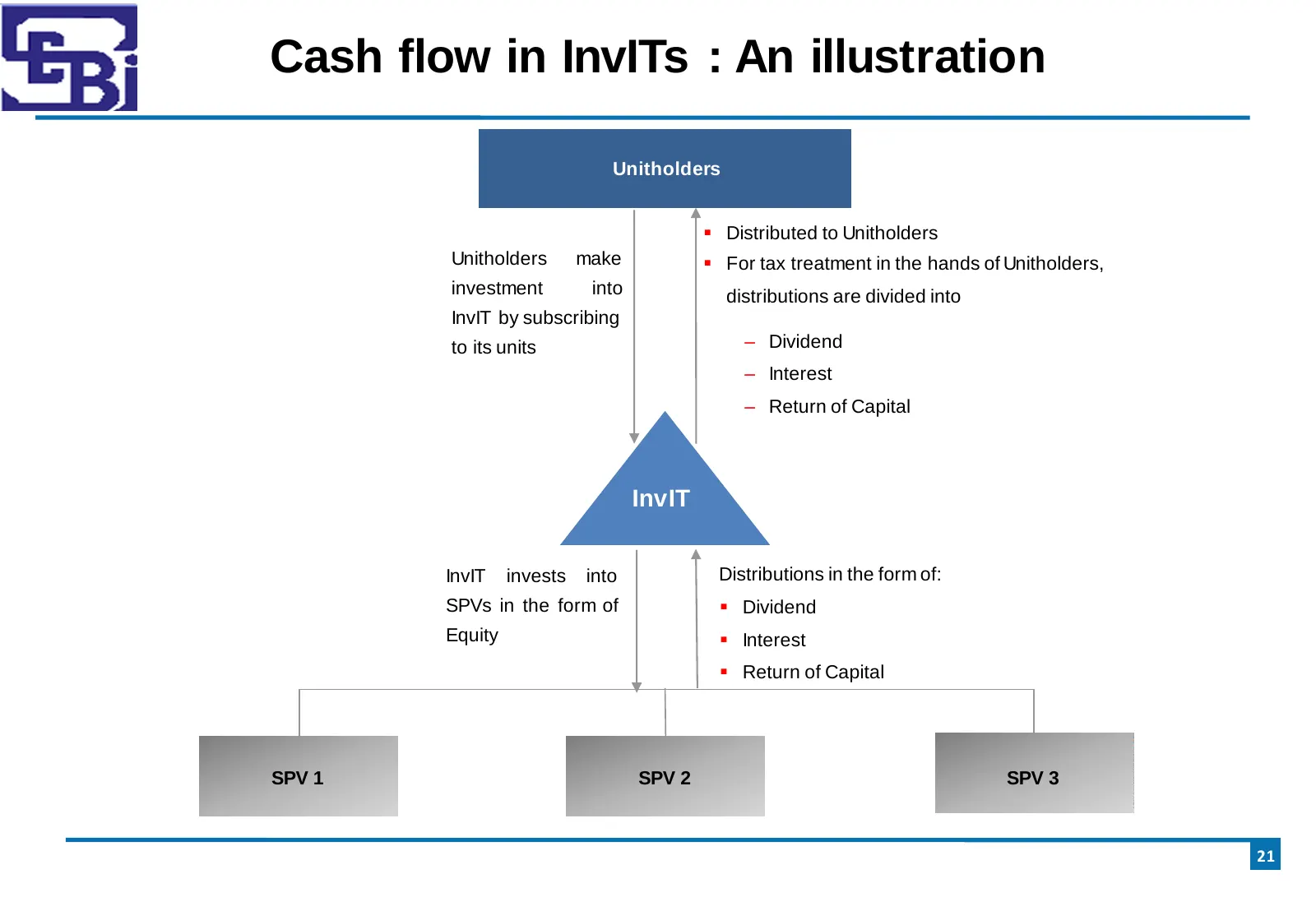
Slide 21: Cash flow in InvITs: An illustration
Cash flow in InvITs : An illustration Unitholders Distributed to Unitholders Unitholders make For tax treatment in the hands of Unitholders, investment into distributions are divided into InvIT by subscribing to its units – Dividend – Interest – Return of Capital InvIT InvIT InvIT invests into D
Slide 22: Where can an InvIT invest its funds?
Where can an InvIT invest its funds ? At least 80% of the value of a public InvIT to be invested in ‘completed and revenue-generating’ infrastructure projects. A maximum of 20% of the total value of InvITs can be from: • Under construction infrastructure projects • Listed or unlisted debt of the
Slide 23: Rights of unit holders in InvITs
Rights of unit holders in InvITs Right to receive returns through cash distributions made by the trust Rights to vote on matters pertaining to acquisition of new assets or borrowing Right to vote on related party matters Right to vote on matters such as appointment or change of the Investmen

Slide 24: Thank You
Thank You 24
Source: Internet Archive copy of nsdl.co.in
More decks from National Securities Depository Limited
 Q3 FY26 Earnings Presentation27 slides · Jan 29, 2026
 Q2 FY26 Earnings Presentation25 slides · Nov 14, 2025
 Q1 FY2026 Earnings Presentation18 slides · Aug 12, 2025
 Q1 FY2026 Earnings Presentation17 slides · 2025
 NSDL e-Governance Infrastructure — Investor Presentation (July 2024)48 slides · July 2024
 Investor Presentation (2024)43 slides · May 7, 2024