RepliCel Life Sciences Inc. · OTC:REPCF
RepliCel Life Sciences — Investor Presentation (December 2012)
27 slides from RepliCel Life Sciences's investor presentation, December 2012
Slide 1: Developing a cell-based solution to hair loss
Developing a cell-based solution to hair loss Investor Presentation December 2012
Slide 2: Forward Looking Statements
Forward Looking Statements The information in this presentation contains forward-looking statements, as that term is defined under applicable securities laws. Statements in this presentation, which are not purely historical, are forward-looking statements and can include, without limitation, stateme
Slide 3: Advancing the Science of Hair Loss
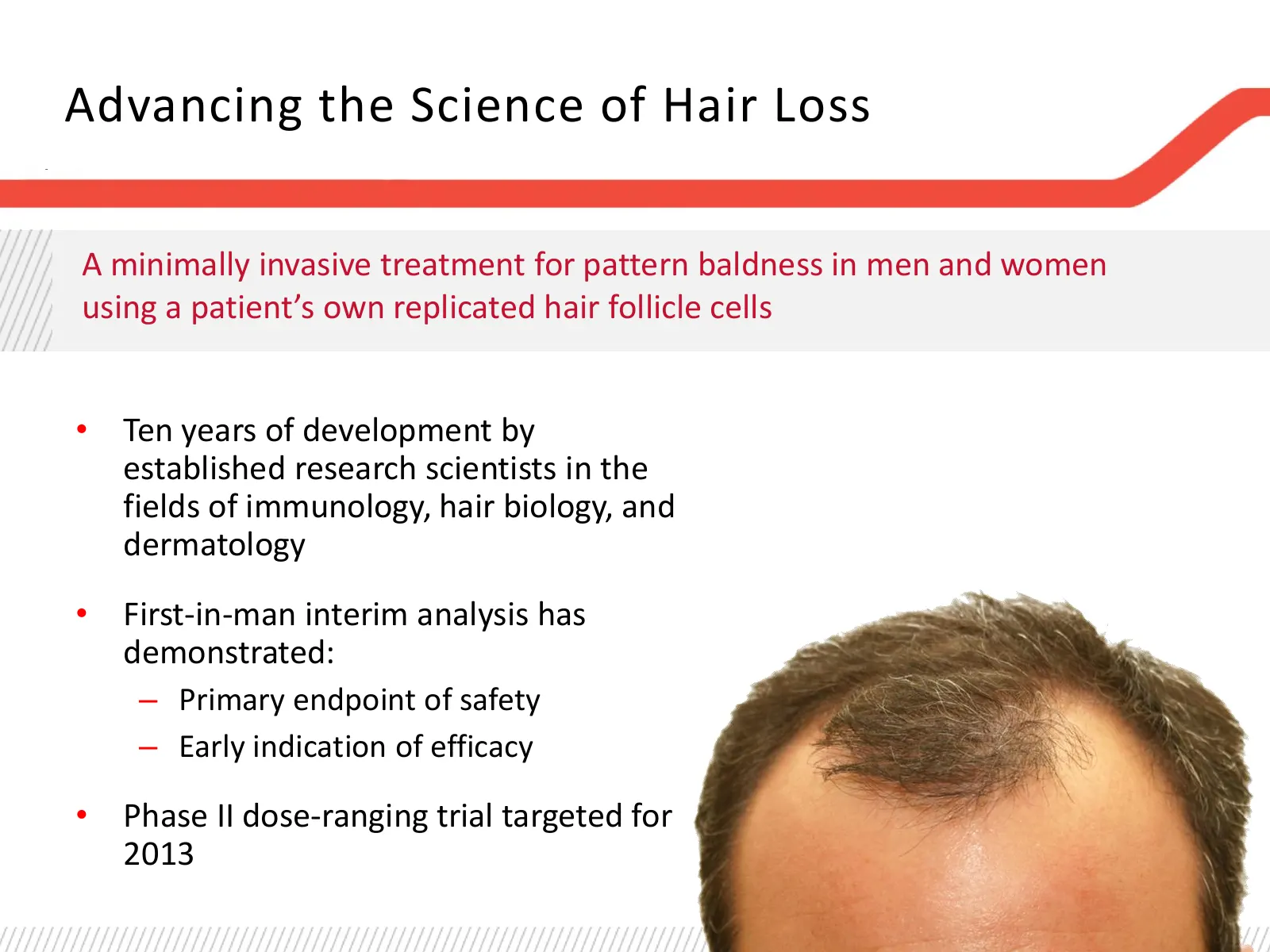
Advancing the Science of Hair Loss A minimally invasive treatment for pattern baldness in men and women using a patient’s own replicated hair follicle cells • Ten years of development by established research scientists in the fields of immunology, hair biology, and dermatology • First-in-man interim
Slide 4: Origins of the Science
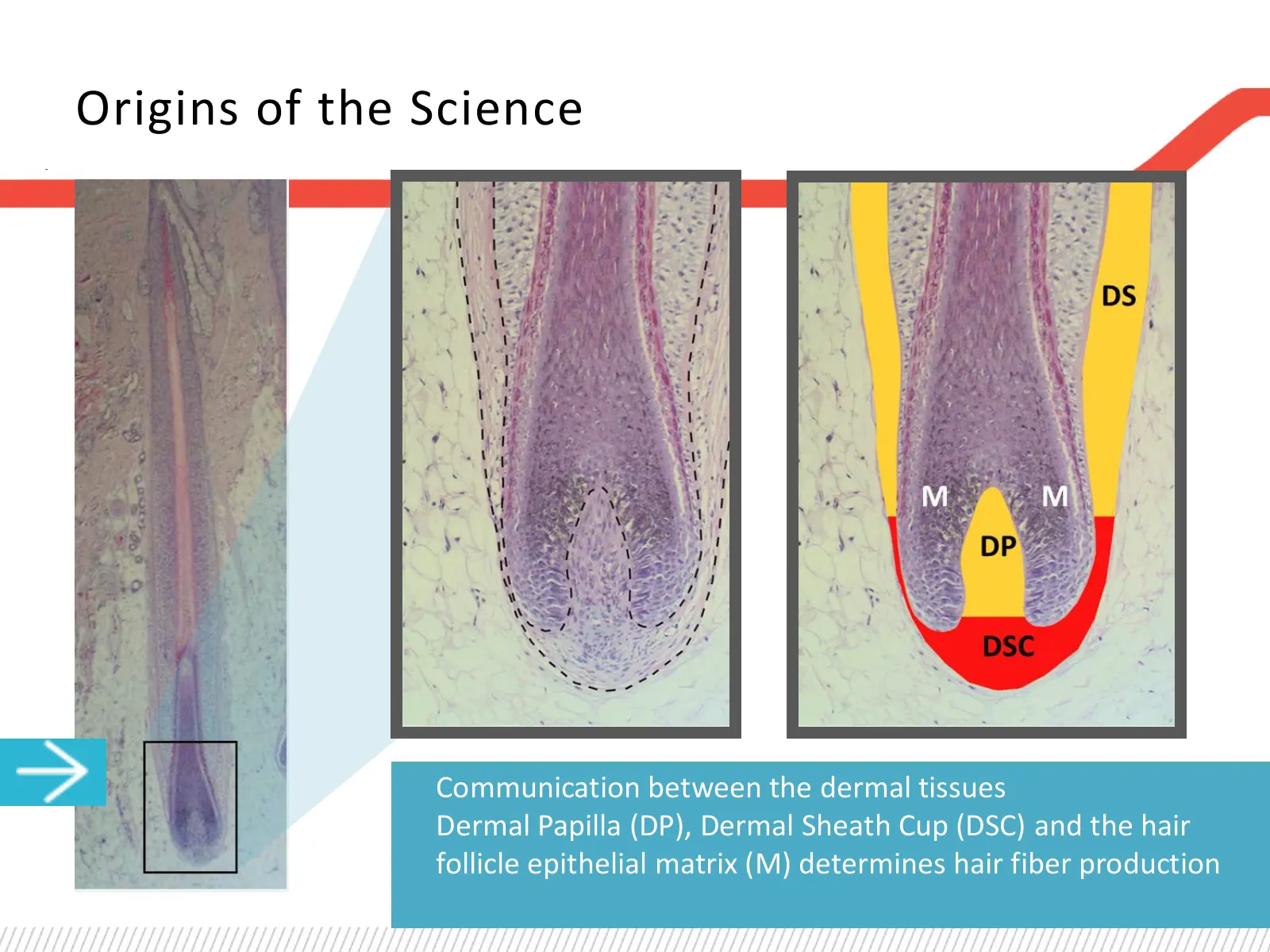
Origins of the Science Communication between the dermal tissues Dermal Papilla (DP), Dermal Sheath Cup (DSC) and the hair follicle epithelial matrix (M) determines hair fiber production
Slide 5: Pre-Clinical Confirmation of Thesis
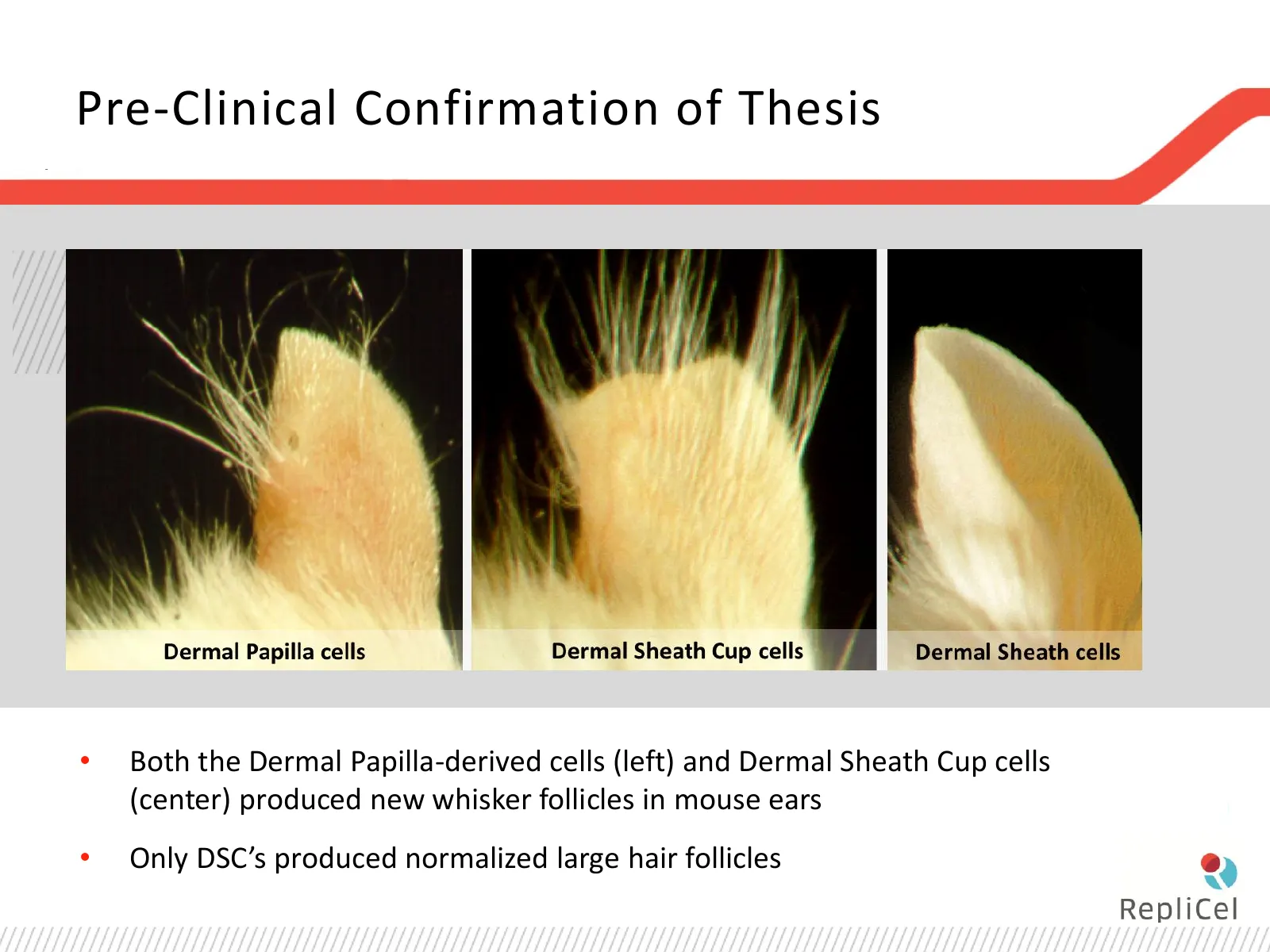
Pre-Clinical Confirmation of Thesis • Both the Dermal Papilla-derived cells (left) and Dermal Sheath Cup cells (center) produced new whisker follicles in mouse ears • Only DSC’s produced normalized large hair follicles
Slide 6: DSCC Cell Migration
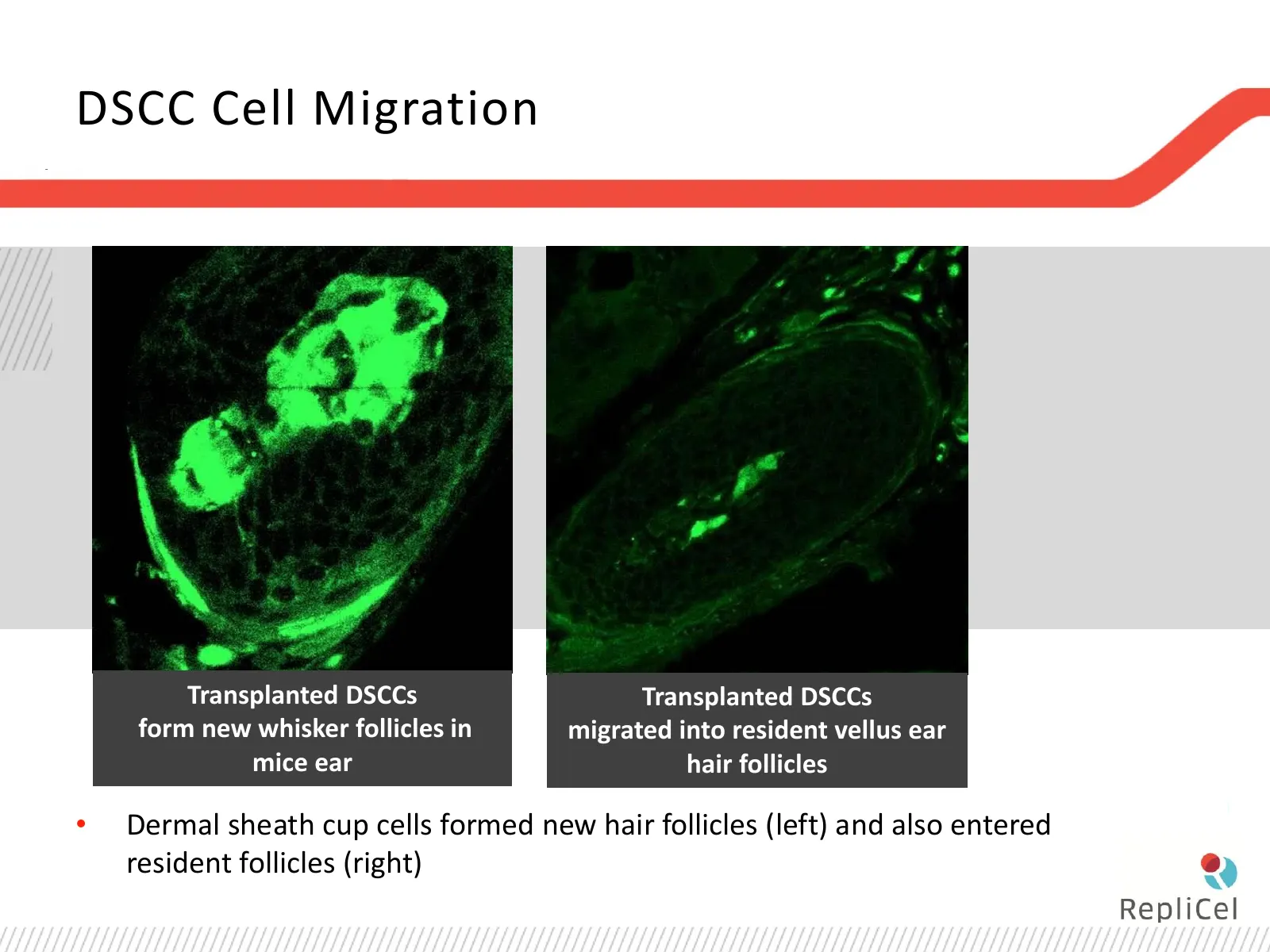
DSCC Cell Migration Transplanted DSCCs Transplanted DSCCs form new whisker follicles in migrated into resident vellus ear mice ear hair follicles • Dermal sheath cup cells formed new hair follicles (left) and also entered resident follicles (right)
Slide 7: RepliCel Conducts First-in-man Trial
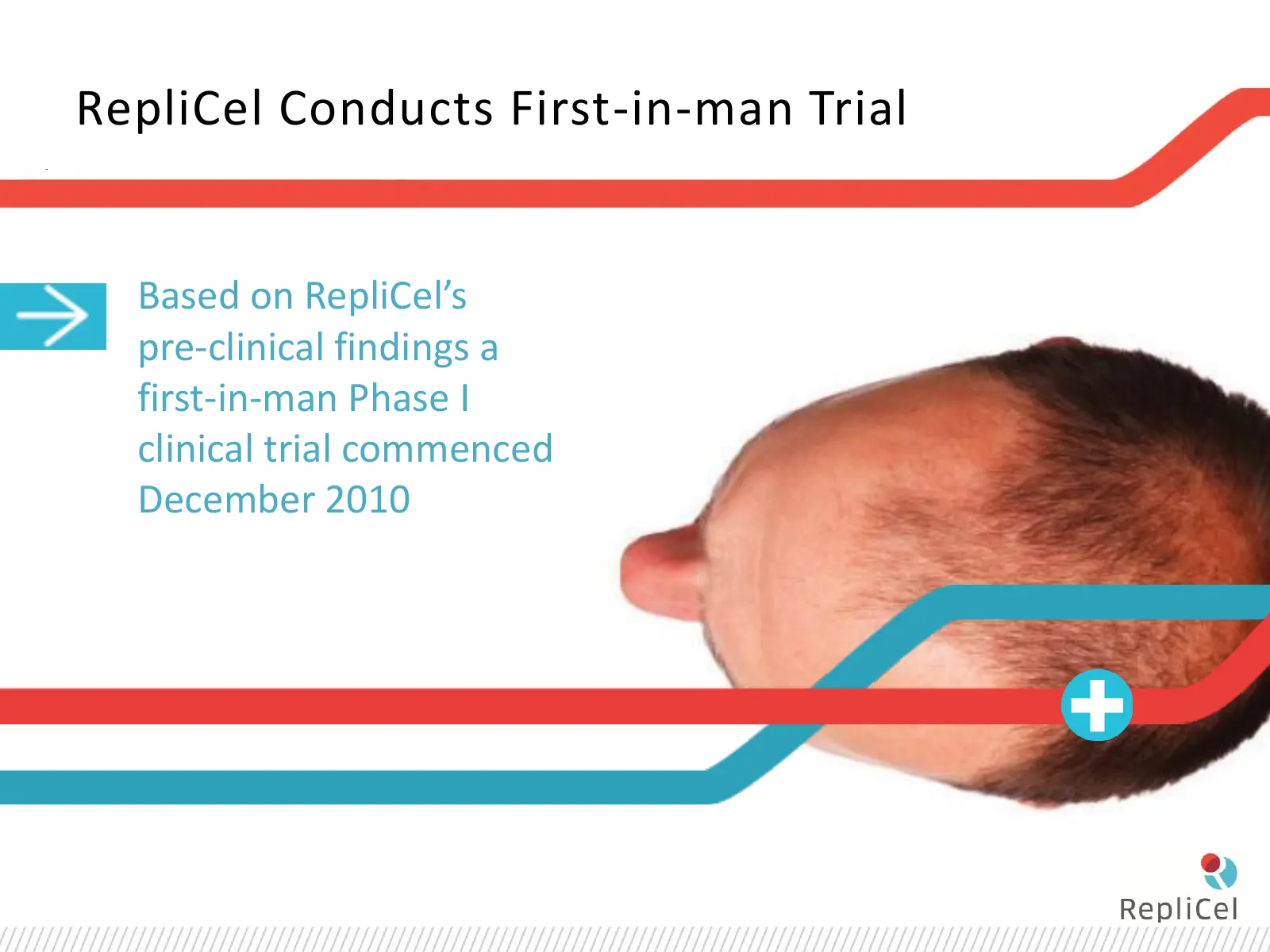
RepliCel Conducts First-in-man Trial Based on RepliCel’s pre-clinical findings a first-in-man Phase I clinical trial commenced December 2010
Slide 8: RepliCel Procedure Video
RepliCel™ Procedure Video Please click here to watch our technology video http://youtu.be/cCe5mg7X6zg
Slide 9: Phase I - Treatment Procedure: 6-month Interim Results
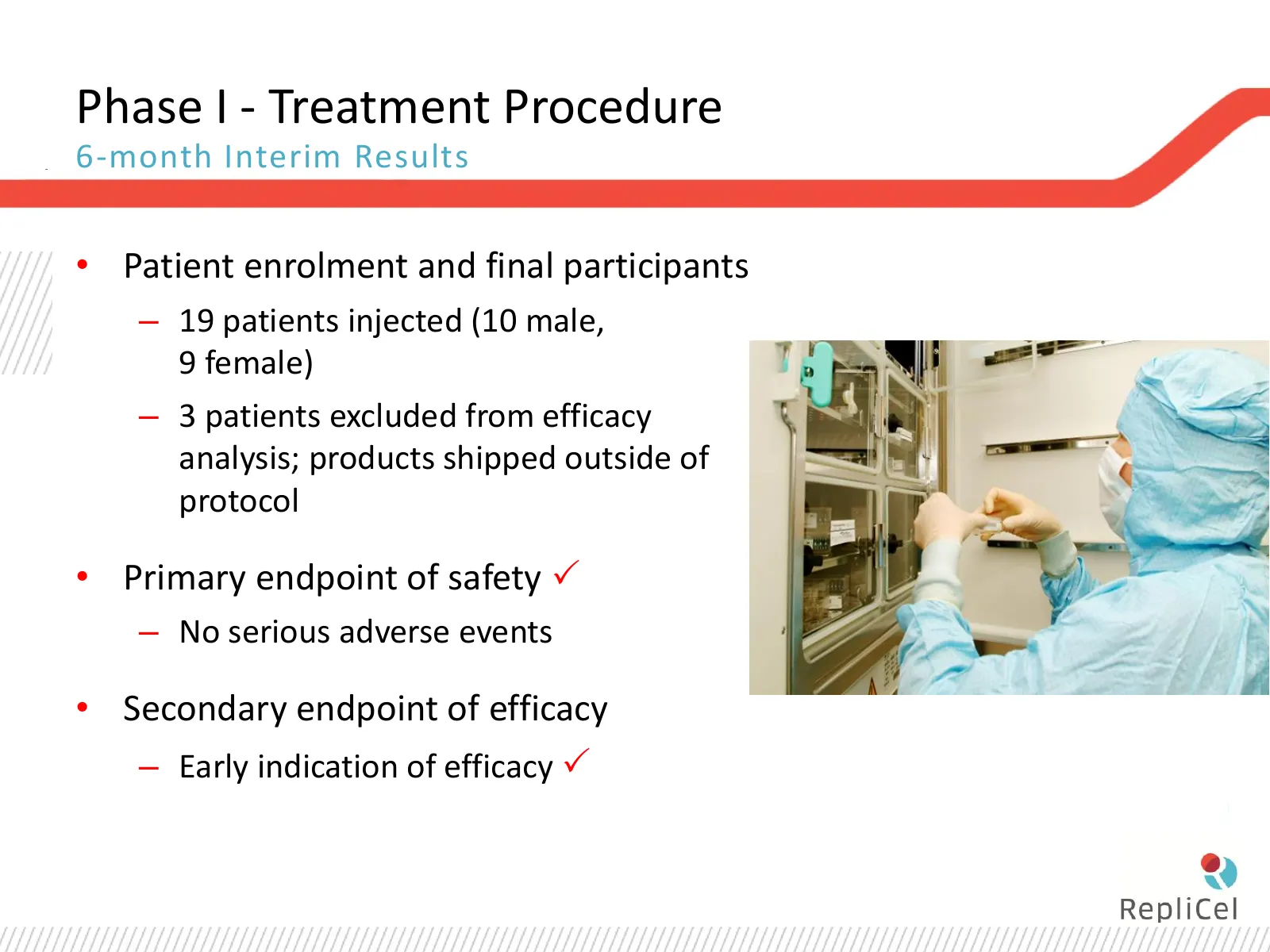
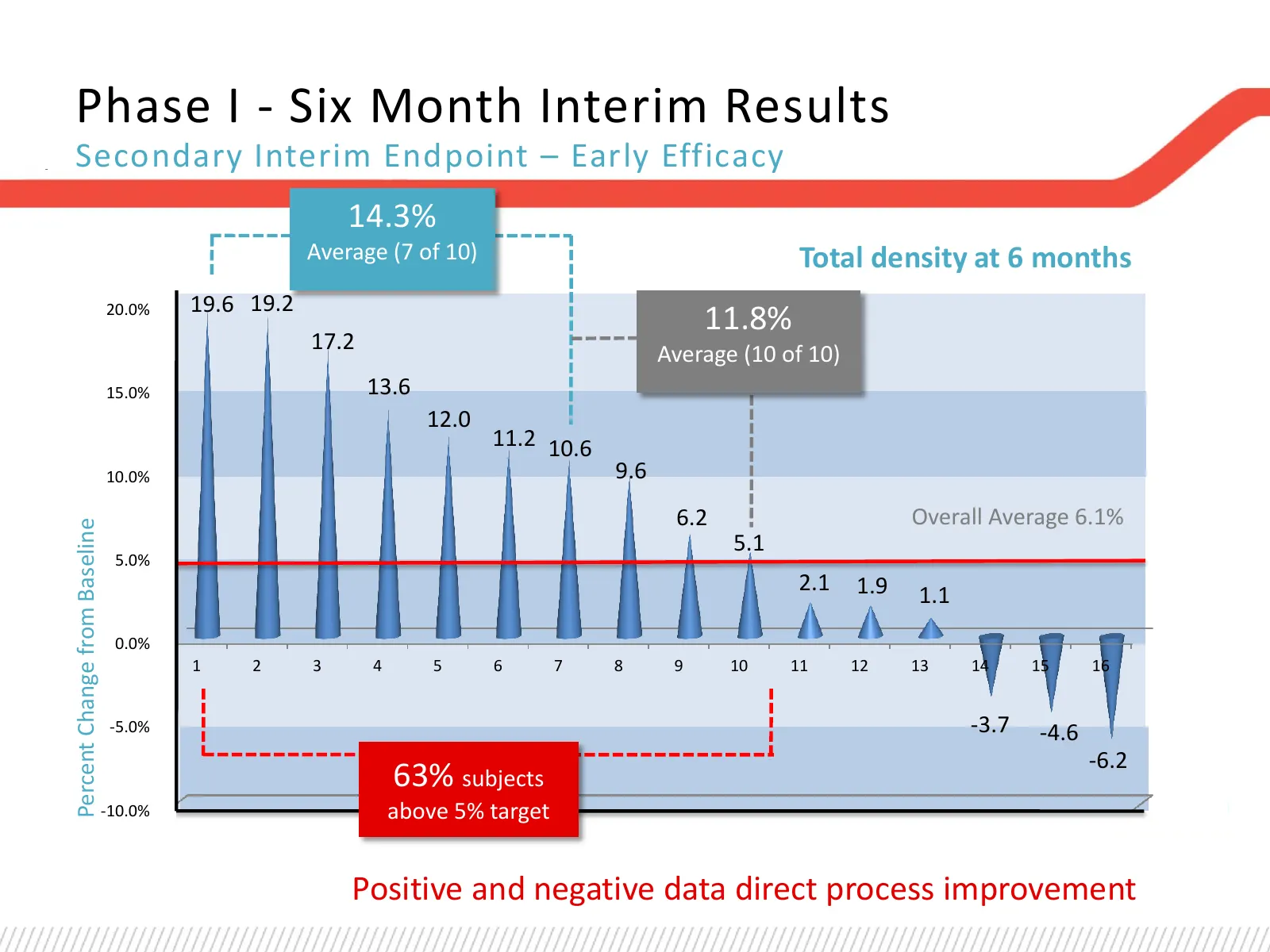
Phase I - Treatment Procedure 6-month Interim Results • Patient enrolment and final participants – 19 patients injected (10 male, 9 female) – 3 patients excluded from efficacy analysis; products shipped outside of protocol • Primary endpoint of safety – No serious adverse events • Secondary endpoi
Slide 10: Phase I - Treatment Procedure: Step 1
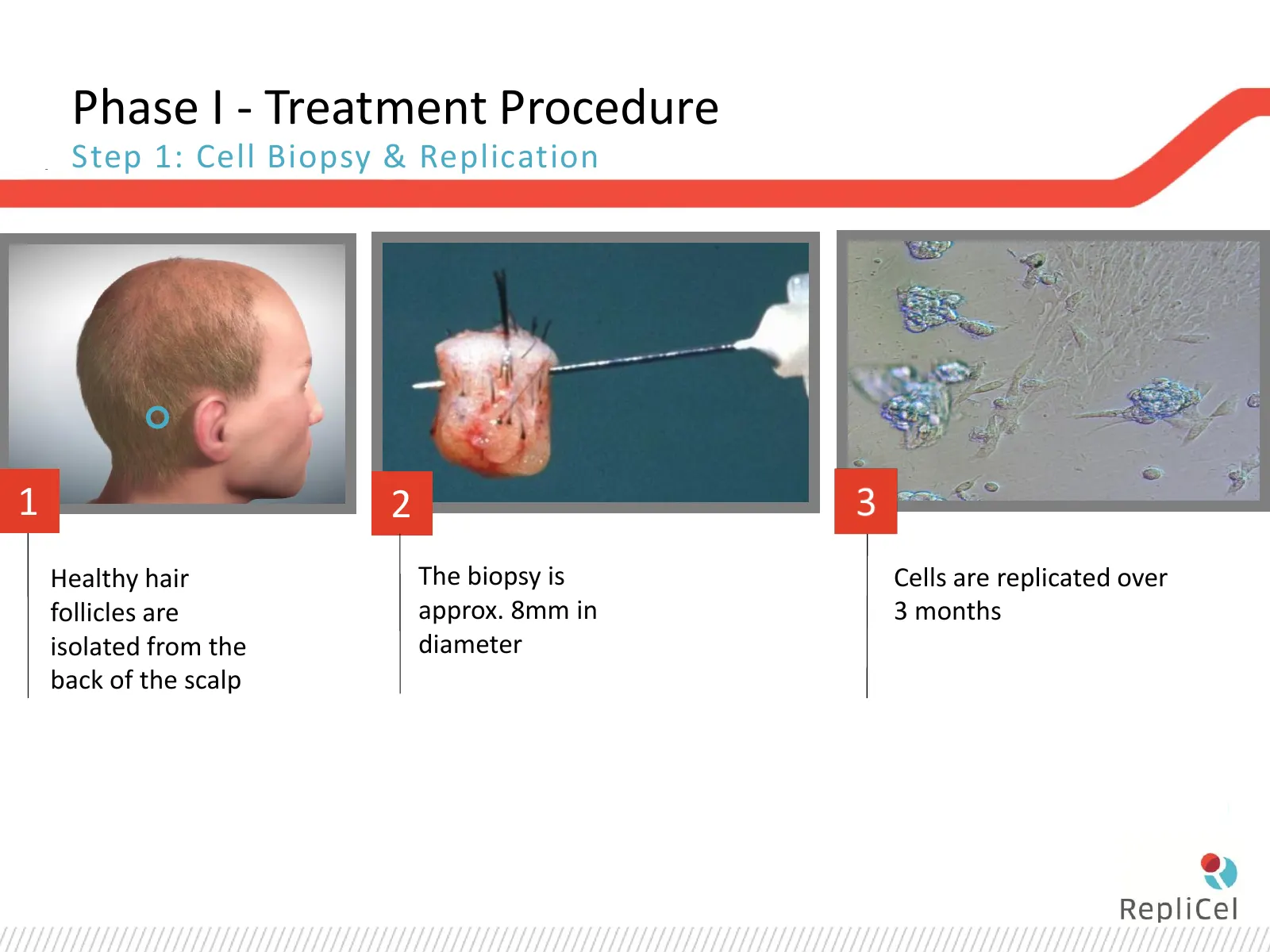
Phase I - Treatment Procedure Step 1: Cell Biopsy & Replication 1 2 Healthy hair The biopsy is Cells are replicated over follicles are approx. 8mm in 3 months isolated from the diameter back of the scalp
Slide 11: Phase I - Treatment Procedure: Step 2
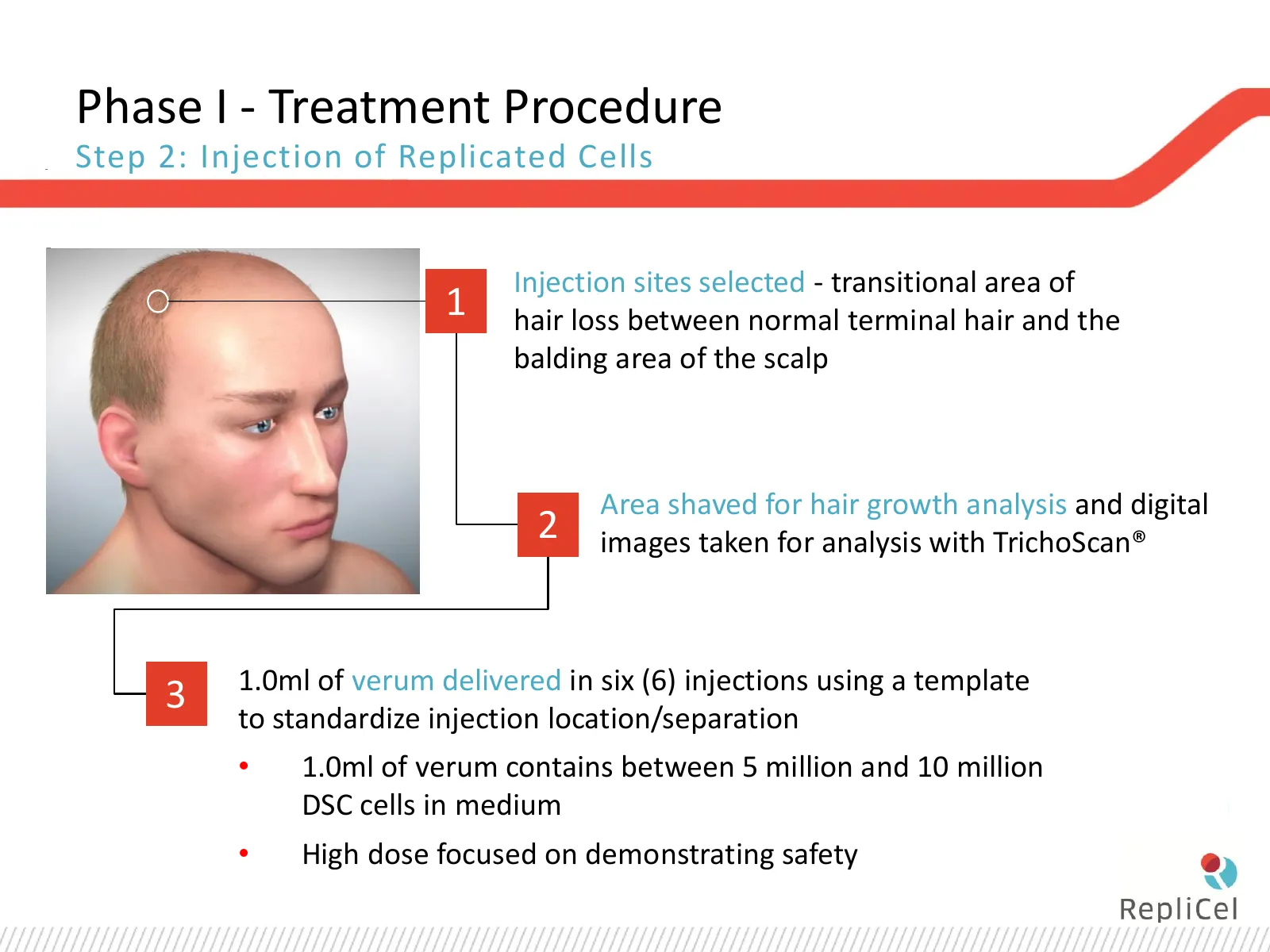
Phase I - Treatment Procedure Step 2: Injection of Replicated Cells Injection sites selected - transitional area of 1 hair loss between normal terminal hair and the balding area of the scalp Area shaved for hair growth analysis and digital 2 images taken for analysis with TrichoScan® 1.0ml of verum
Slide 12: Percent Change from Baseline
Phase I - Six Month Interim Results Secondary Interim Endpoint – Early Efficacy 14.3% Average (7 of 10) Total density at 6 months 20.0% 19.6 19.2 11.8% 17.2 Average (10 of 10) 15.0% 13.6 12.0 11.2 10.6 10.0% 9.6 6.2 Overall Average 6.1% Percent Change from Baseline 5.1 5.0% 2.1 1.9 1.1 0.0% 1 2 3 4
Slide 13: Phase I Month Post Injection Image from One Patient
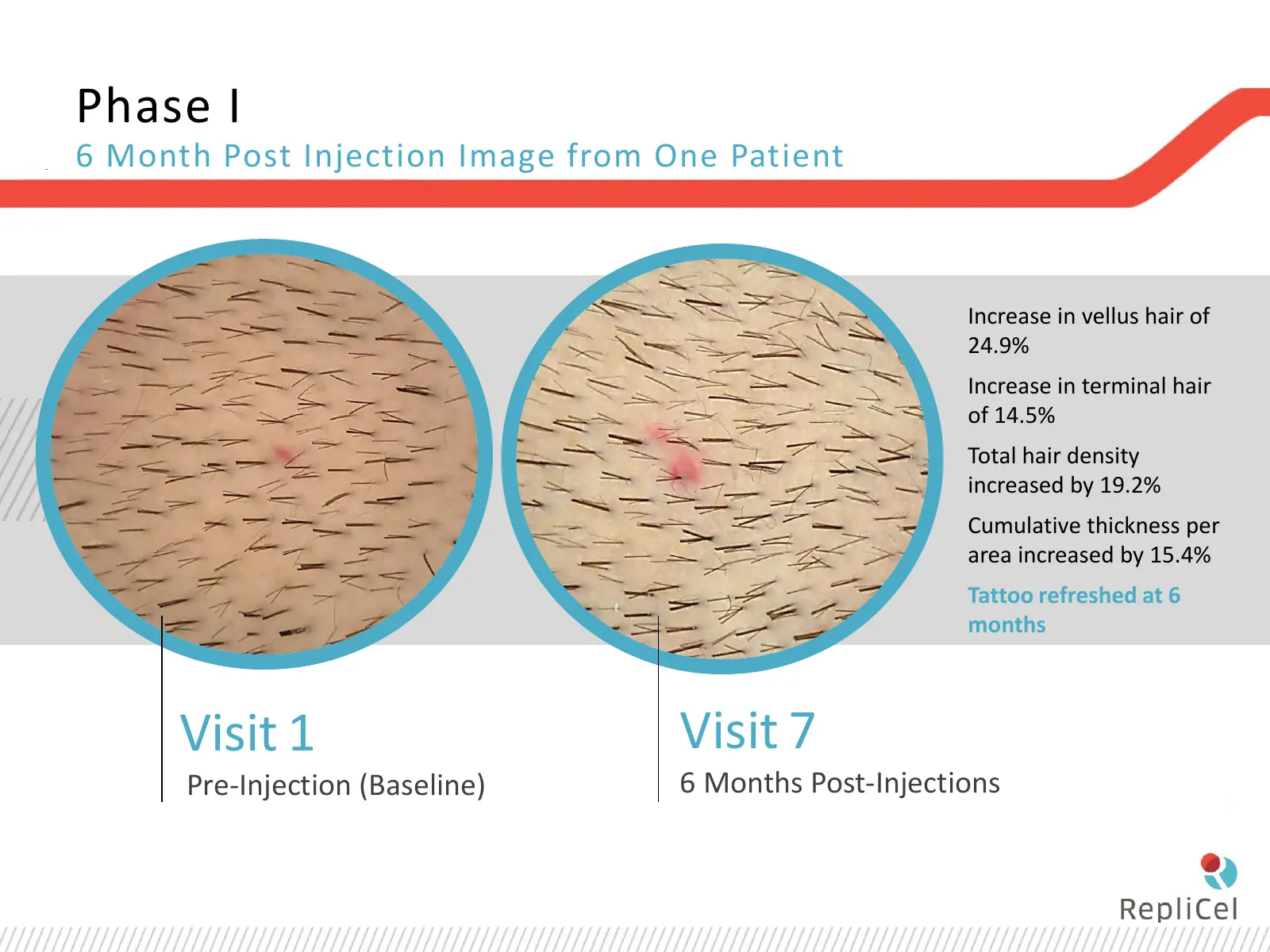
Phase I 6 Month Post Injection Image from One Patient Increase in vellus hair of 24.9% Increase in terminal hair of 14.5% Total hair density increased by 19.2% Cumulative thickness per area increased by 15.4% Tattoo refreshed at 6 months Visit 1 Visit 7 Pre-Injection (Baseline) 6 Months Post-Injecti
Slide 14: Current Standard of Care
Current Standard of Care • Micro-transplant Surgery – It is currently the gold standard for hair replacement, however, the results are subject to the skill of the surgeon • Rogaine also known as (Minoxidil) – Is a well-known topical solution – At 12-24 months users can experience 10-15% density incr
Slide 15: Phase I Observations
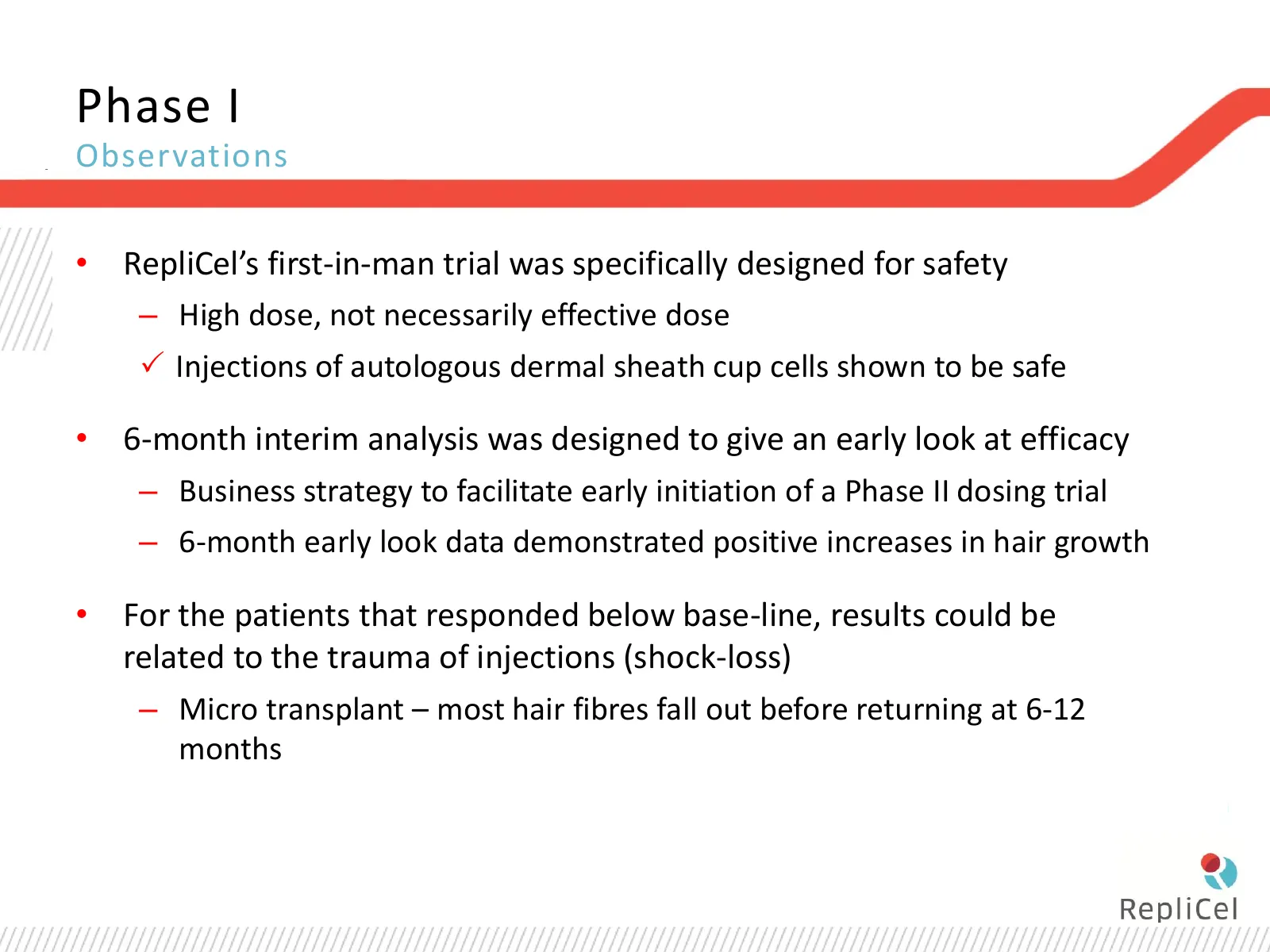
Phase I Observations • RepliCel’s first-in-man trial was specifically designed for safety – High dose, not necessarily effective dose Injections of autologous dermal sheath cup cells shown to be safe • 6-month interim analysis was designed to give an early look at efficacy – Business strategy to f
Slide 16: Pre-Phase II Activities
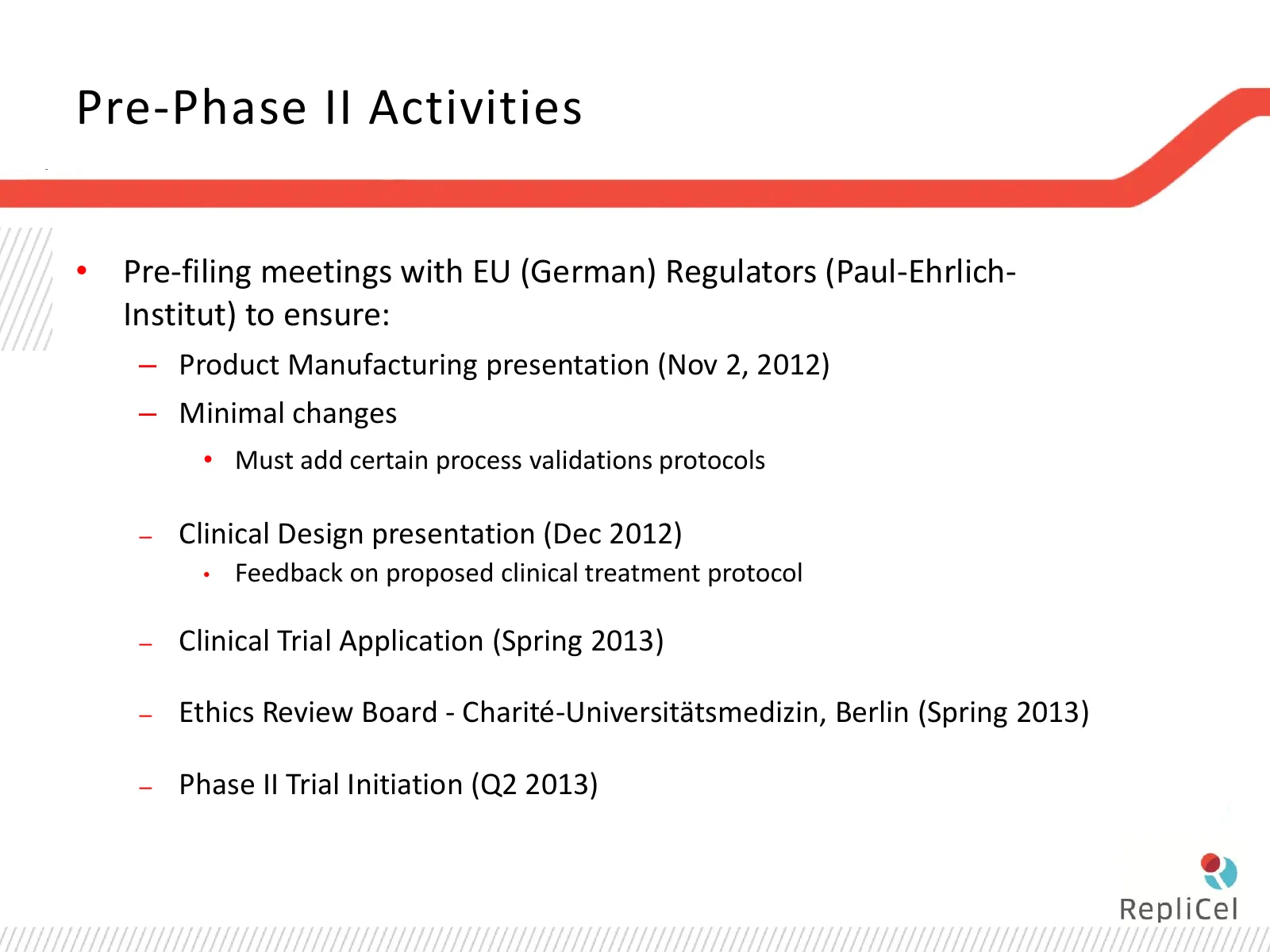
Pre-Phase II Activities • Pre-filing meetings with EU (German) Regulators (Paul-Ehrlich- Institut) to ensure: – Product Manufacturing presentation (Nov 2, 2012) – Minimal changes • Must add certain process validations protocols – Clinical Design presentation (Dec 2012) • Feedback on proposed clinica
Slide 17: Proposed Phase II
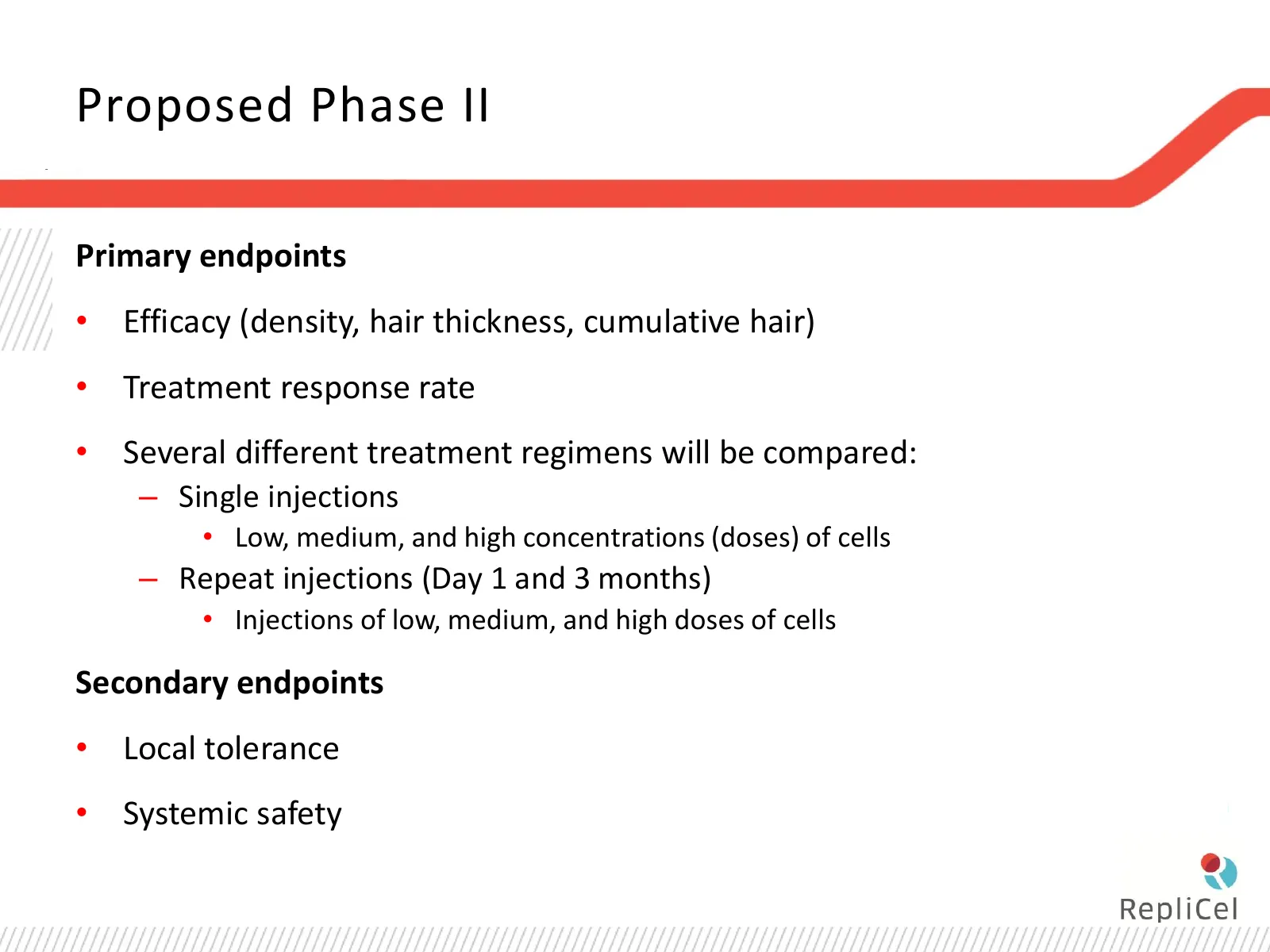
Proposed Phase II Primary endpoints • Efficacy (density, hair thickness, cumulative hair) • Treatment response rate • Several different treatment regimens will be compared: – Single injections • Low, medium, and high concentrations (doses) of cells – Repeat injections (Day 1 and 3 months) • Injectio
Slide 18: Proposed Phase II
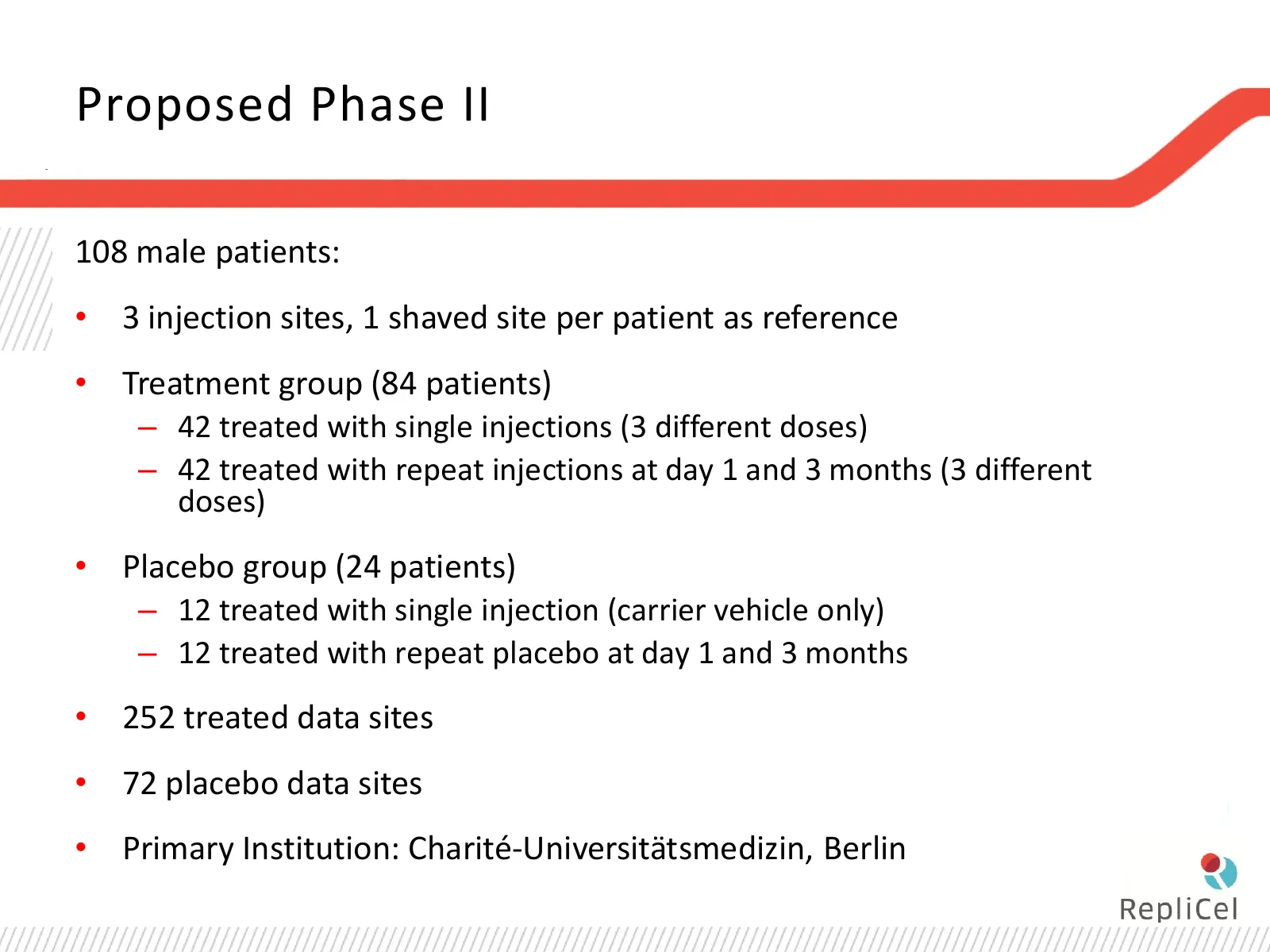
Proposed Phase II 108 male patients: • 3 injection sites, 1 shaved site per patient as reference • Treatment group (84 patients) – 42 treated with single injections (3 different doses) – 42 treated with repeat injections at day 1 and 3 months (3 different doses) • Placebo group (24 patients) – 12 tr
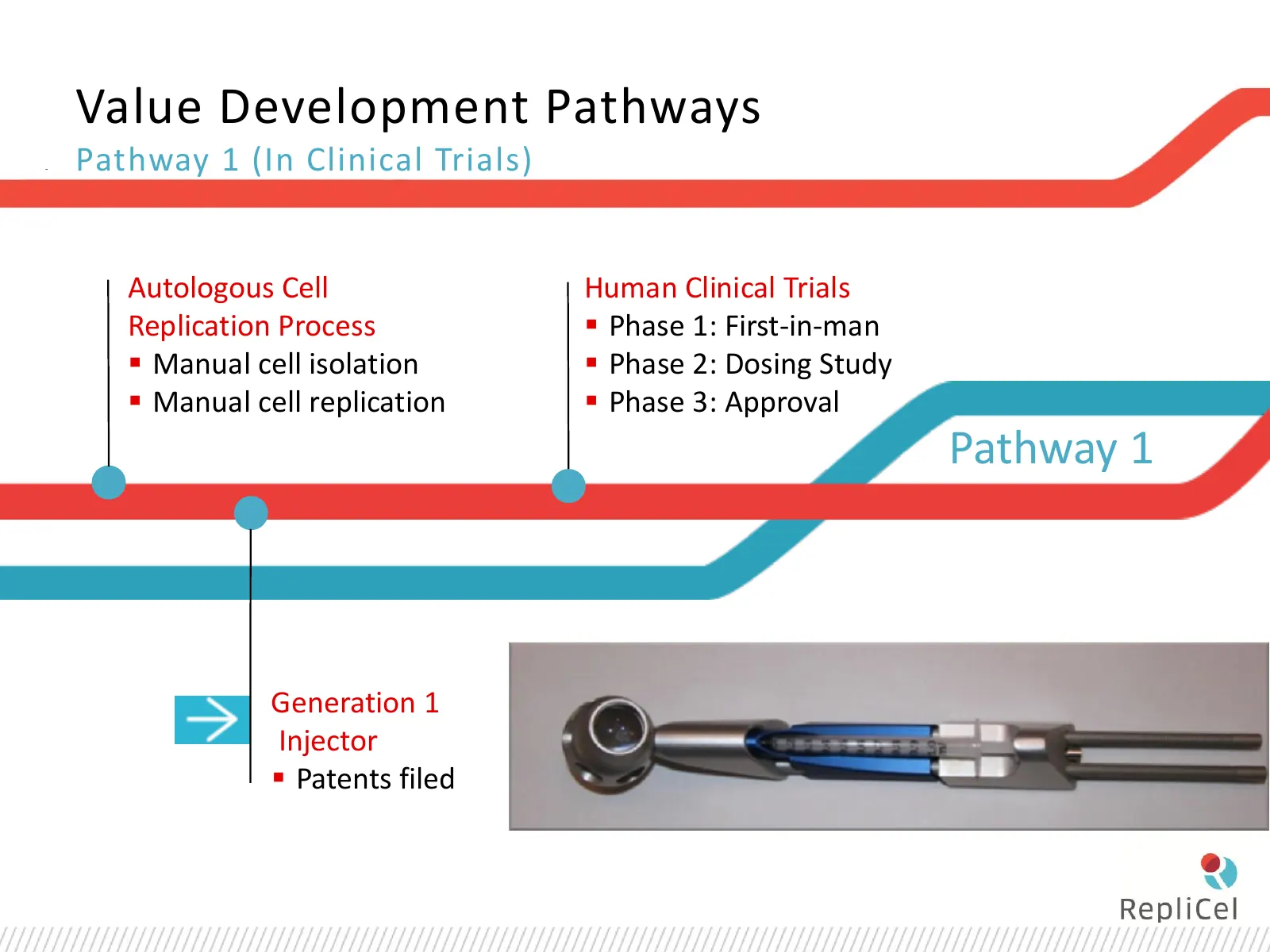
Slide 19: Value Development Pathways Pathway 1
Value Development Pathways Pathway 1 (In Clinical Trials) Autologous Cell Human Clinical Trials Replication Process Phase 1: First-in-man Manual cell isolation Phase 2: Dosing Study Manual cell replication Phase 3: Approval Pathway 1 Generation 1 Injector Patents filed
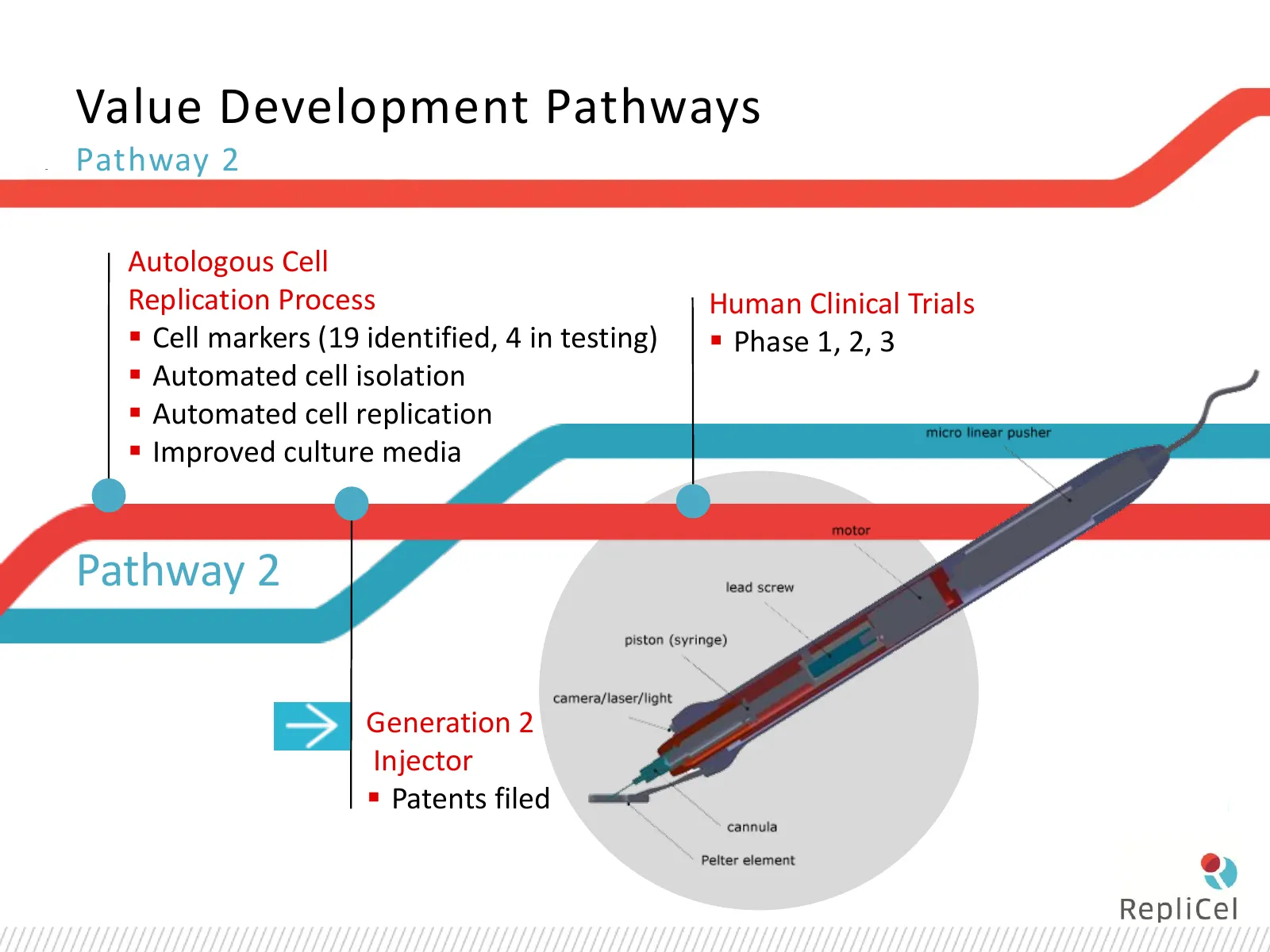
Slide 20: Value Development Pathways Pathway 2
Value Development Pathways Pathway 2 Autologous Cell Replication Process Human Clinical Trials Cell markers (19 identified, 4 in testing) Phase 1, 2, 3 Automated cell isolation Automated cell replication Improved culture media Pathway 2 Generation 2 Injector Patents filed
Slide 21: Comparative Development Advantages
Comparative Development Advantages • Requires regulatory approval of procedure • Does not require: – Comparative studies – Pharmacoeconomic studies • Product is a consumer decision • New customers appear every year • Treatment is not complicated • Cost of care will be at least equivalent to micro-tr
Slide 22: Competition
Competition Aderans Research • Private (100% owned by Aderans of Japan) • 350 plus on going US Phase 2 • Utilizes Dermal Papillae and keratinocytes – Ji-Gami cell culture process Histogen • Uses a formulation of Wnt proteins and growth factors Follica • Based on a wound healing response
Slide 23: Key Management
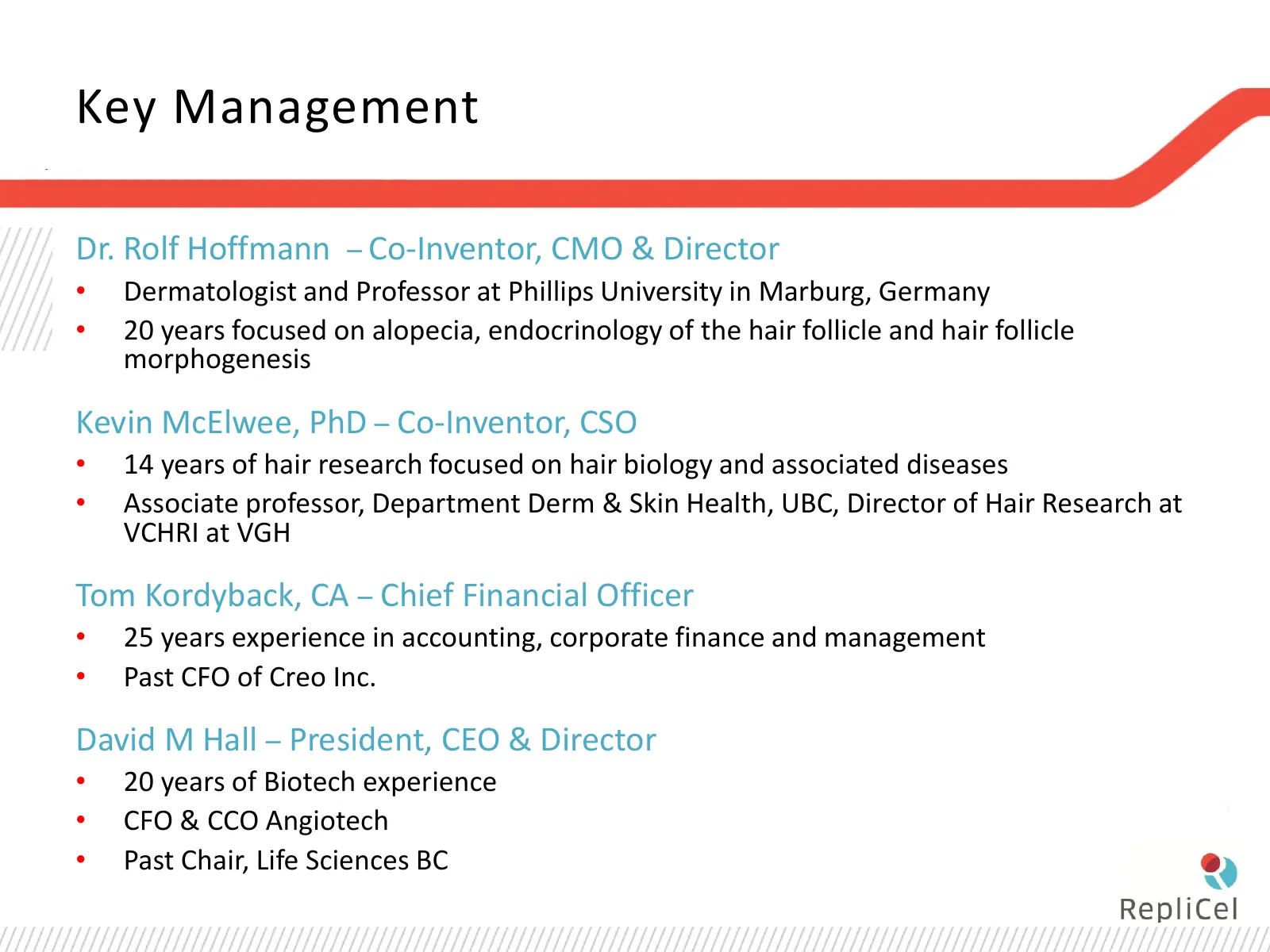
Key Management Dr. Rolf Hoffmann – Co-Inventor, CMO & Director • Dermatologist and Professor at Phillips University in Marburg, Germany • 20 years focused on alopecia, endocrinology of the hair follicle and hair follicle morphogenesis Kevin McElwee, PhD – Co-Inventor, CSO • 14 years of hair research
Slide 24: Balance Sheet
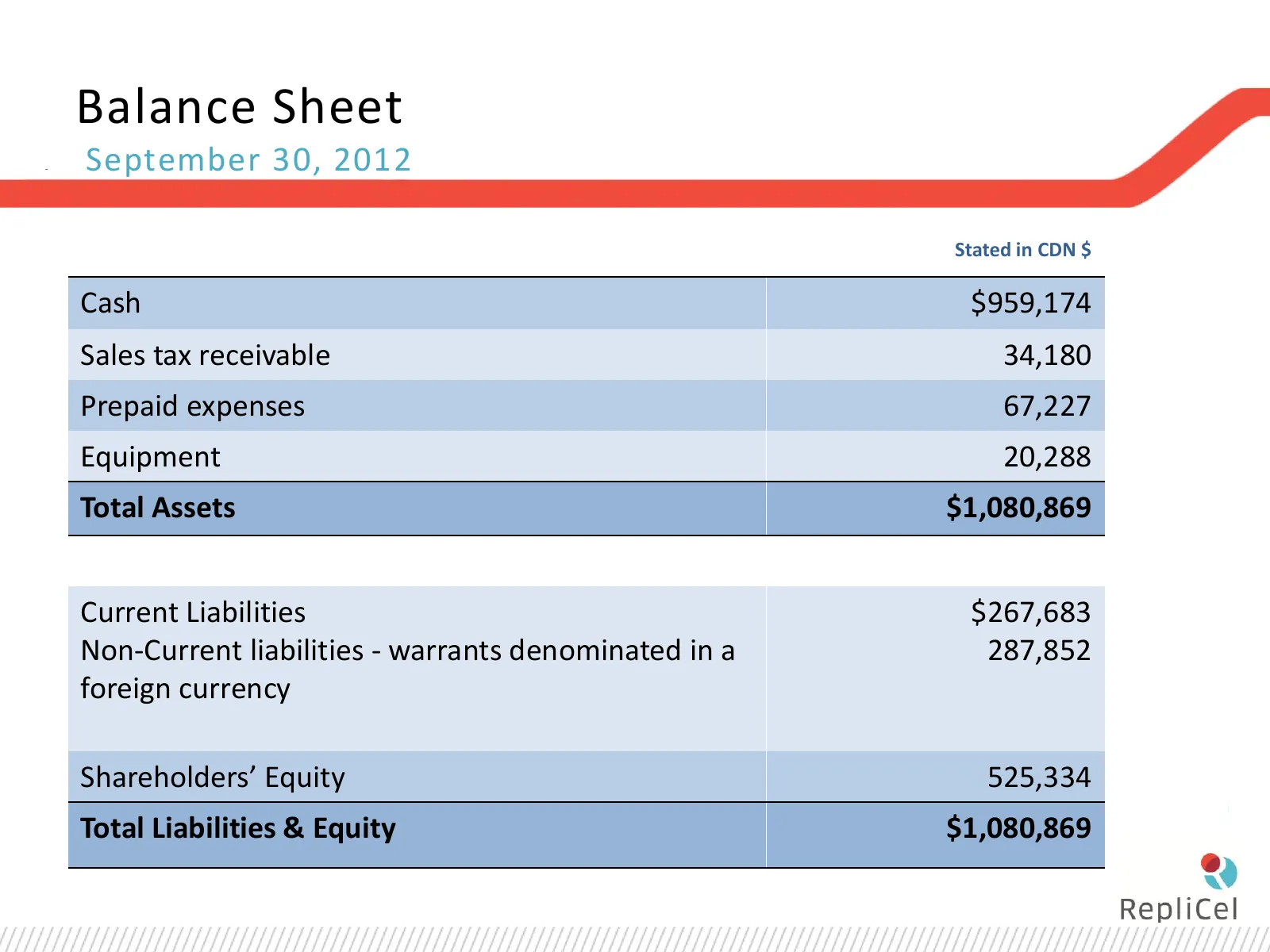
Balance Sheet September 30, 2012 Stated in CDN $ Cash $959,174 Sales tax receivable 34,180 Prepaid expenses 67,227 Equipment 20,288 Total Assets $1,080,869 Current Liabilities $267,683 Non-Current liabilities - warrants denominated in a 287,852 foreign currency Shareholders’ Equity 525,334 Total Lia
Slide 25: Stock Capitalization
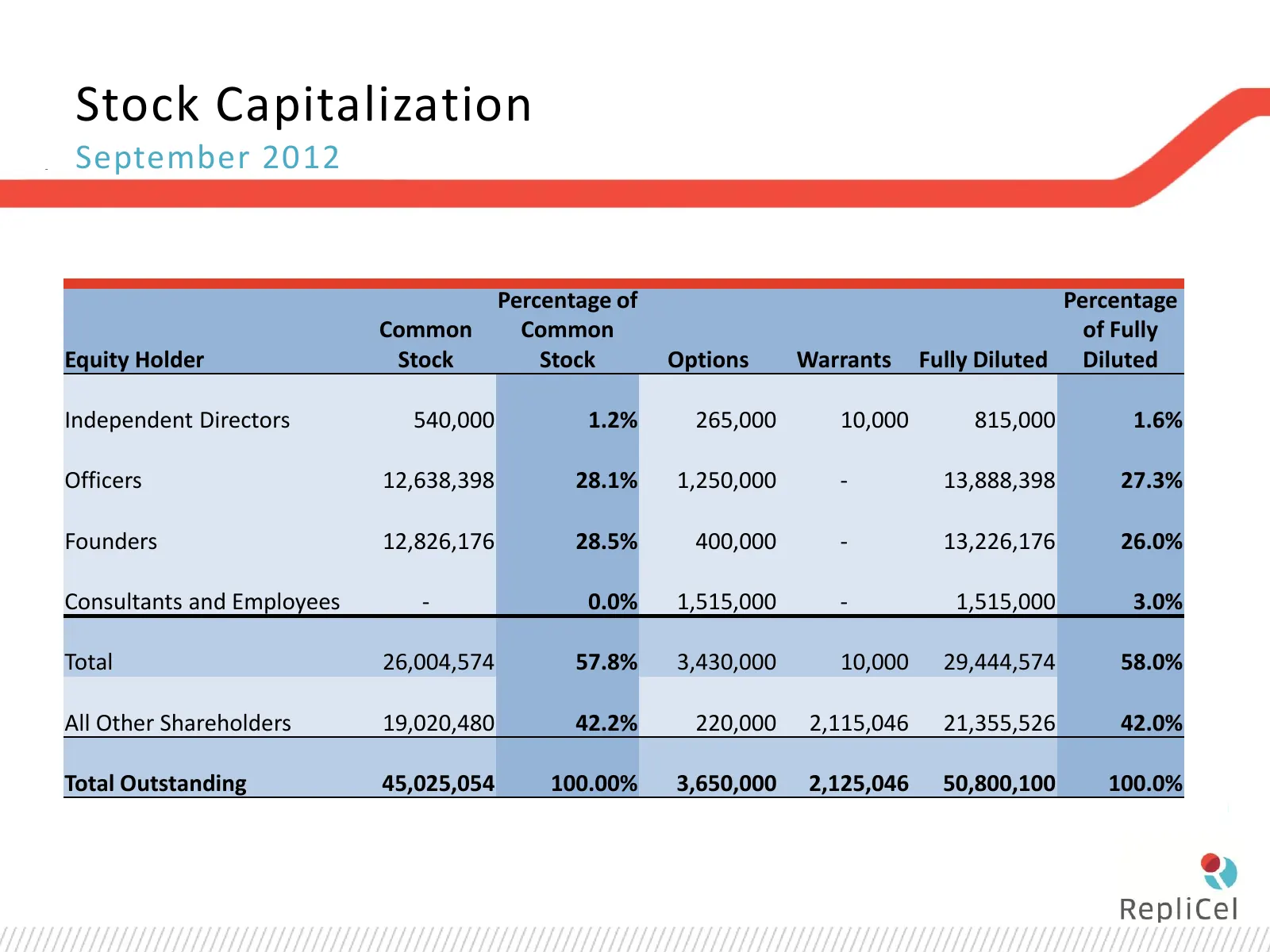
Stock Capitalization September 2012 Percentage of Percentage Common Common of Fully Equity Holder Stock Stock Options Warrants Fully Diluted Diluted Independent Directors 540,000 1.2% 265,000 10,000 815,000 1.6% Officers 12,638,398 28.1% 1,250,000 - 13,888,398 27.3% Founders 12,826,176 28.5% 400,000
Slide 26: Summary
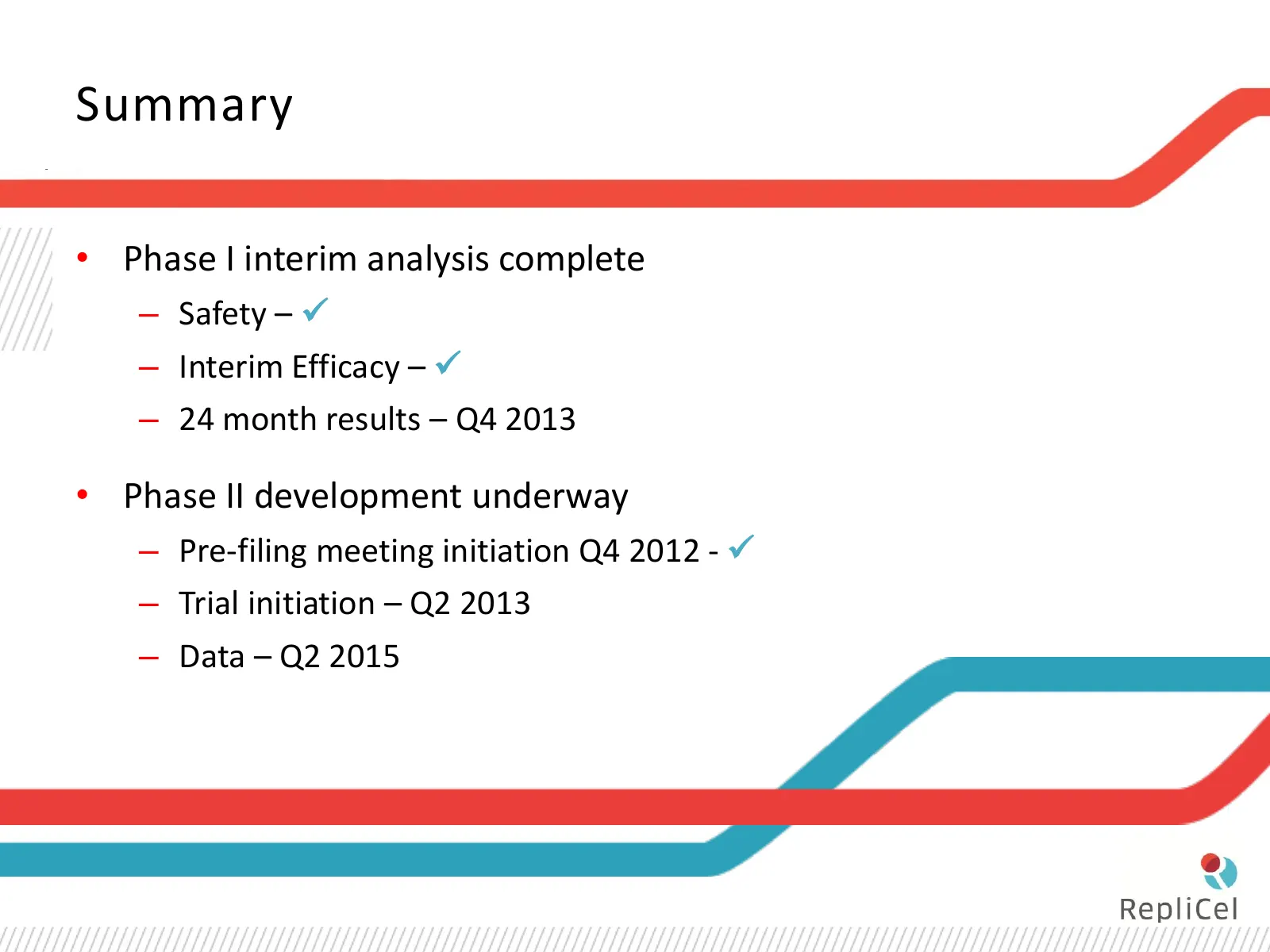
Summary • Phase I interim analysis complete – Safety – – Interim Efficacy – – 24 month results – Q4 2013 • Phase II development underway – Pre-filing meeting initiation Q4 2012 - – Trial initiation – Q2 2013 – Data – Q2 2015
Slide 27: Thank-you
RepliCel Life Sciences Inc. OTCBB: REPCF CNSX: RP Thank-you
Source: Internet Archive copy of replicel.com