Active Biotech AB · OMXSTO:ACTI
Active Biotech AB — Investor Presentation (August 2021)
26 slides from Active Biotech AB's investor presentation, August 2021
Slide 1: Active Biotech

Slide 2: Disclaimer
Disclaimer • Certain statements made during the course of this presentation are forward-looking statements. Such forward-looking statements involve known and unknown risks, uncertainties and other important factors that could cause the actual results, performance or achievements of the company, or i
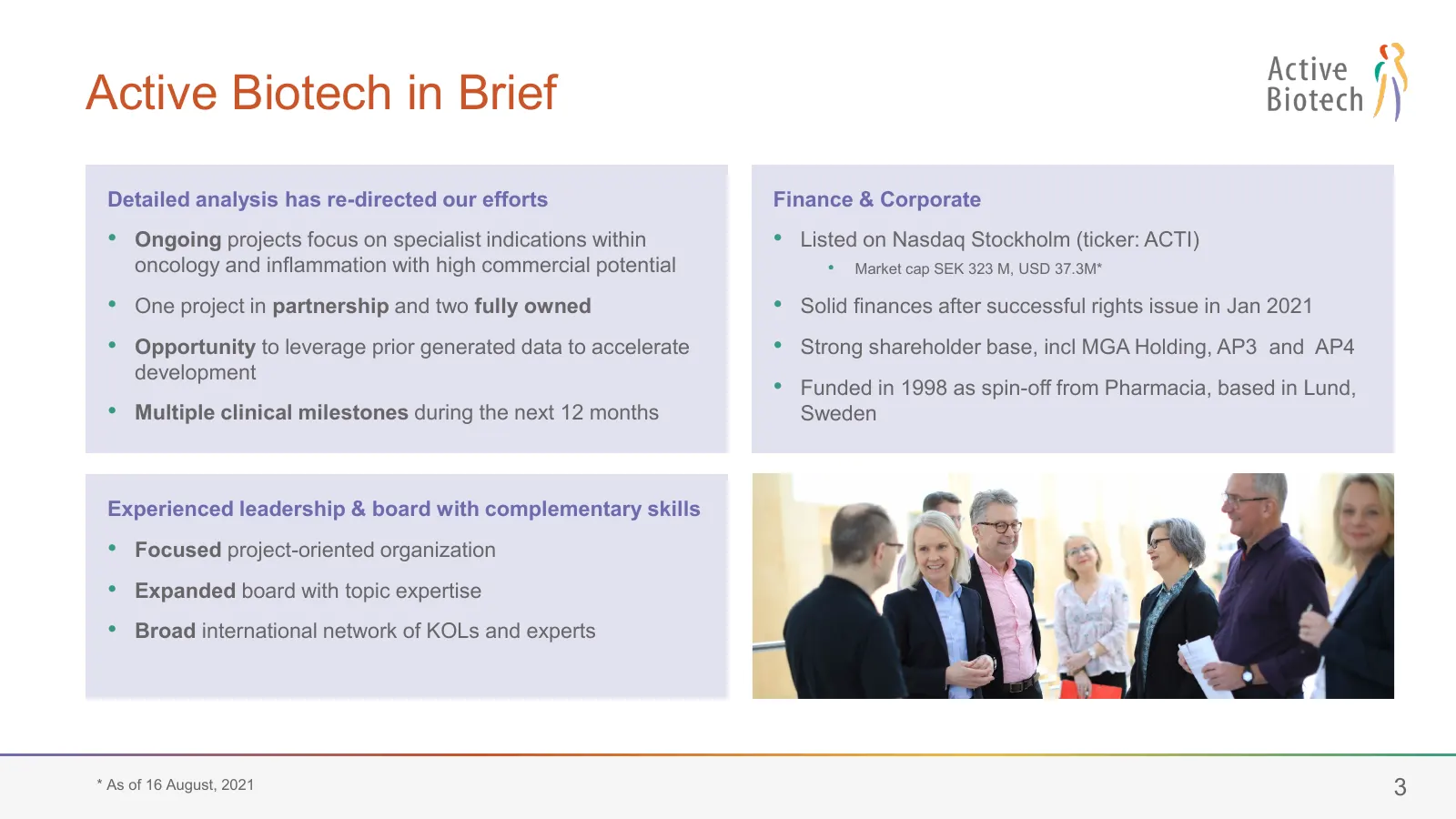
Slide 3: Active Biotech in Brief
Active Biotech in Brief Detailed analysis has re-directed our efforts Finance & Corporate • Ongoing projects focus on specialist indications within • Listed on Nasdaq Stockholm (ticker: ACTI) oncology and inflammation with high commercial potential • Market cap SEK 323 M, USD 37.3M* • One project in
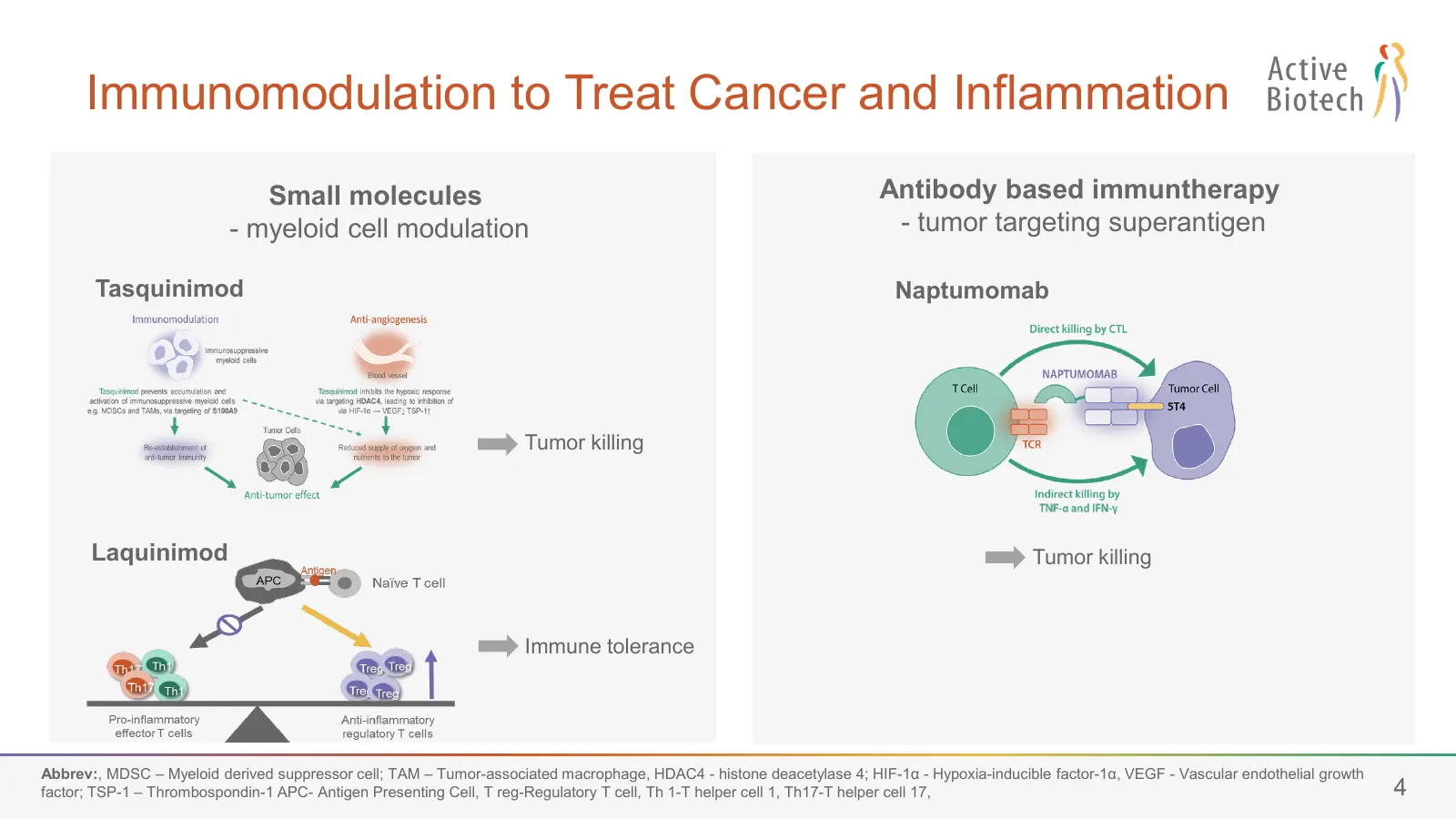
Slide 4: Immunomodulation to Treat Cancer and Inflammation
Immunomodulation to Treat Cancer and Inflammation Small molecules Antibody based immuntherapy - myeloid cell modulation - tumor targeting superantigen Tasquinimod Naptumomab Tumor killing Laquinimod Tumor killing Immune tolerance Abbrev:, MDSC – Myeloid derived suppressor cell; TAM – Tumor-associate
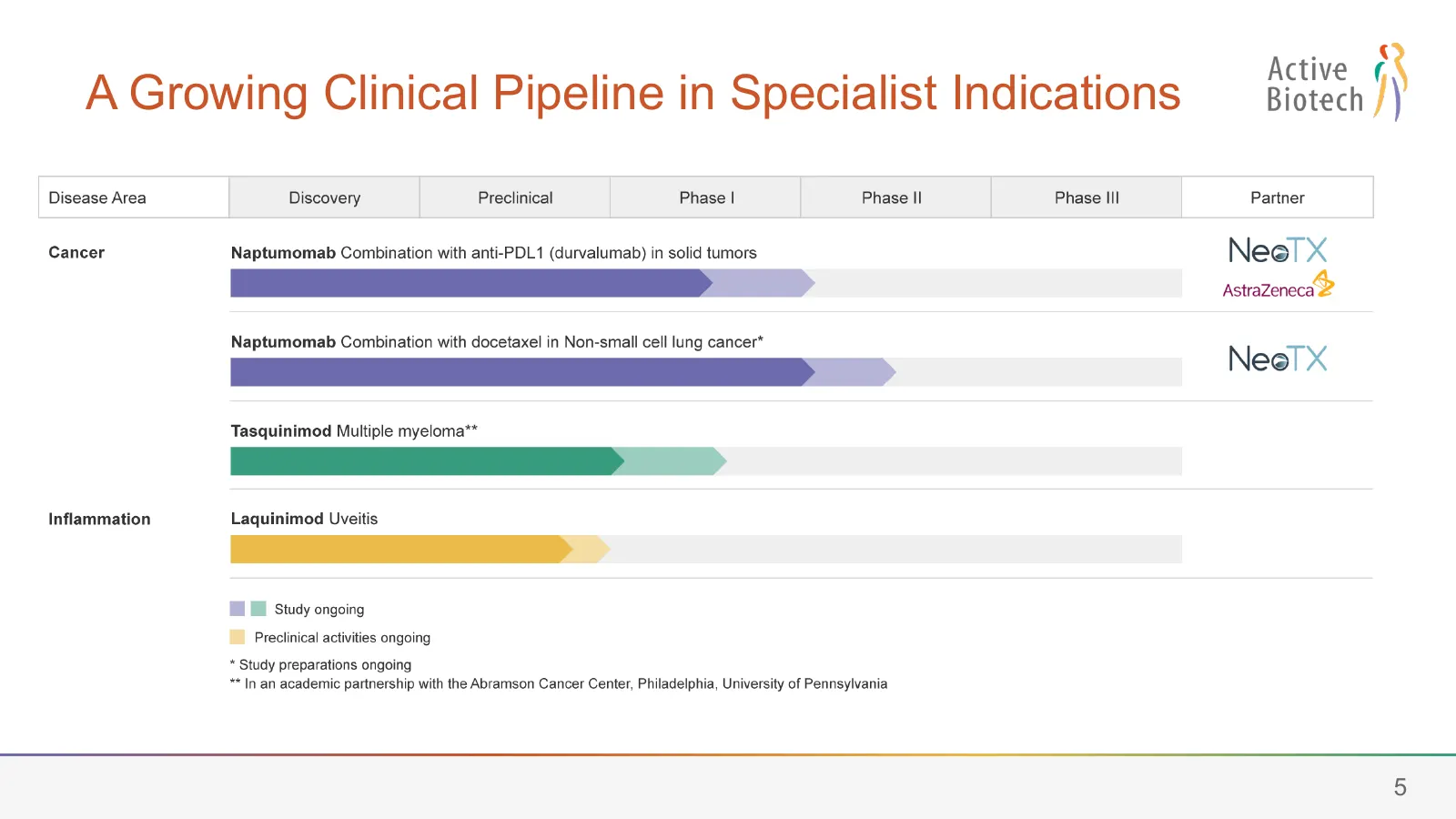
Slide 5: A Growing Clinical Pipeline in Specialist Indications
A Growing Clinical Pipeline in Specialist Indications 5
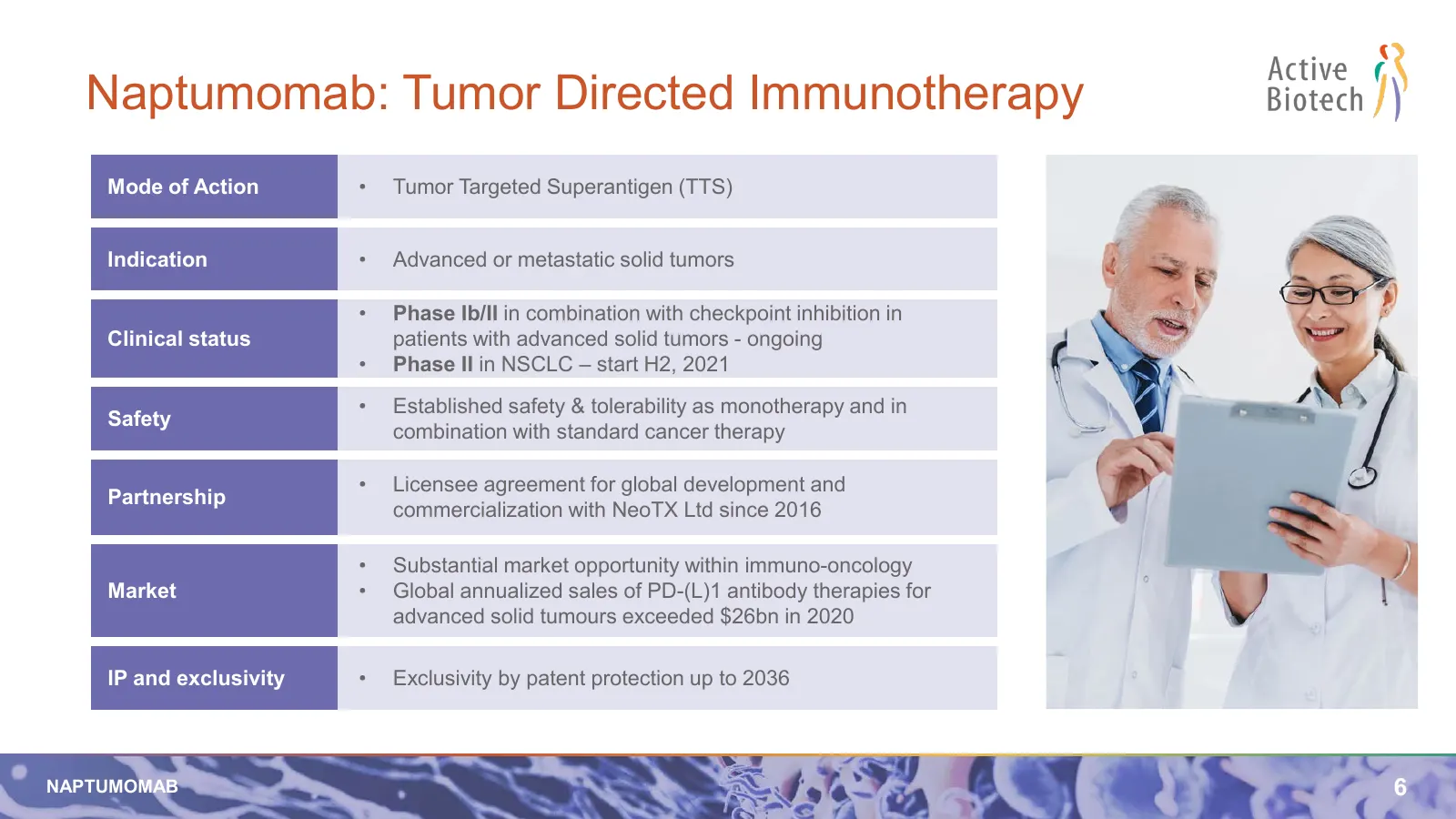
Slide 6: Naptumomab: Tumor Directed Immunotherapy
Naptumomab: Tumor Directed Immunotherapy Mode of Action • Tumor Targeted Superantigen (TTS) Indication • Advanced or metastatic solid tumors • Phase Ib/II in combination with checkpoint inhibition in Clinical status patients with advanced solid tumors - ongoing • Phase II in NSCLC – start H2, 2021 •
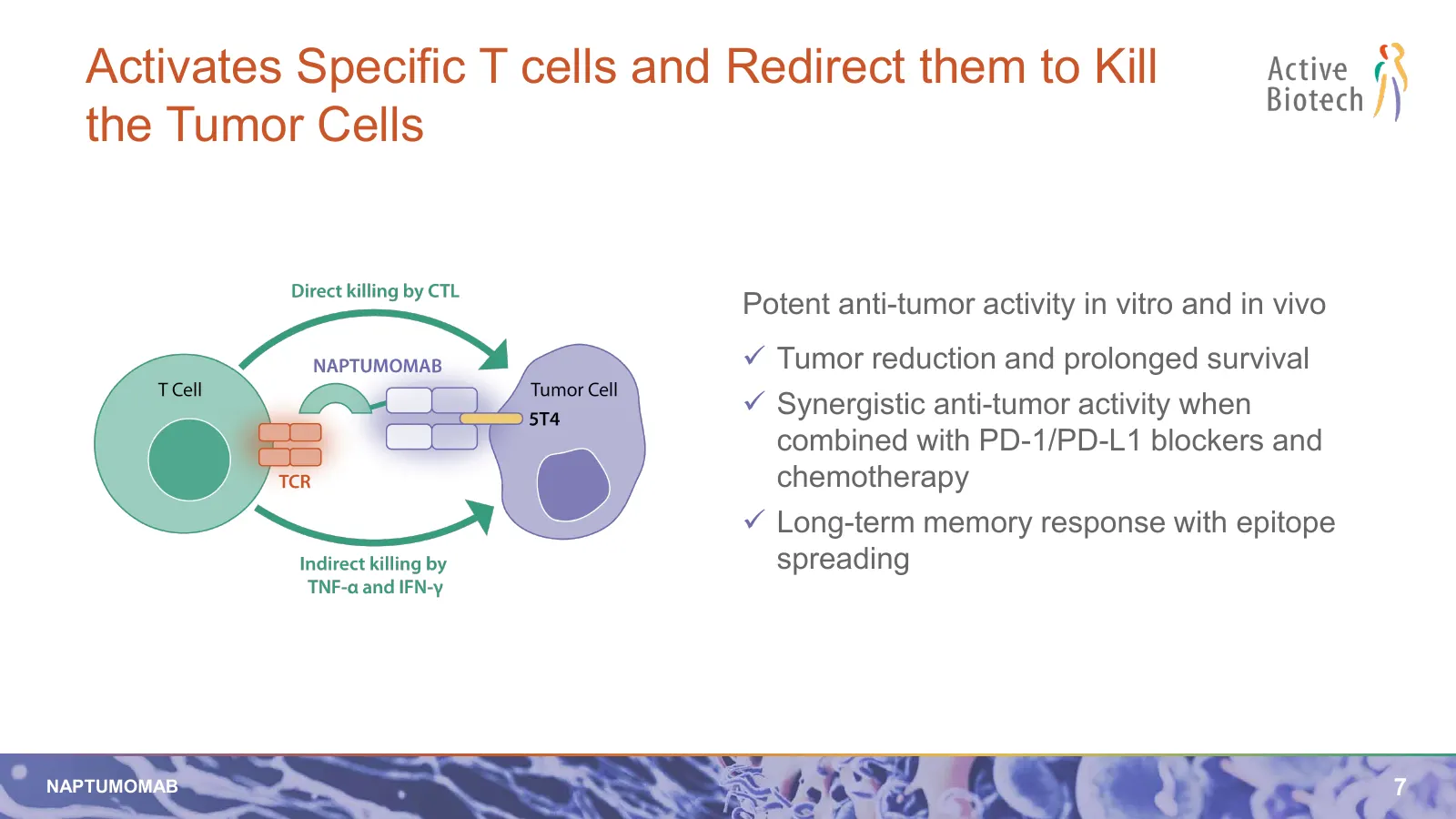
Slide 7: Activates Specific T cells and Redirect them to Kill the Tumor Cells
Activates Specific T cells and Redirect them to Kill the Tumor Cells Potent anti-tumor activity in vitro and in vivo Tumor reduction and prolonged survival Synergistic anti-tumor activity when combined with PD-1/PD-L1 blockers and chemotherapy Long-term memory response with epitope spreading N
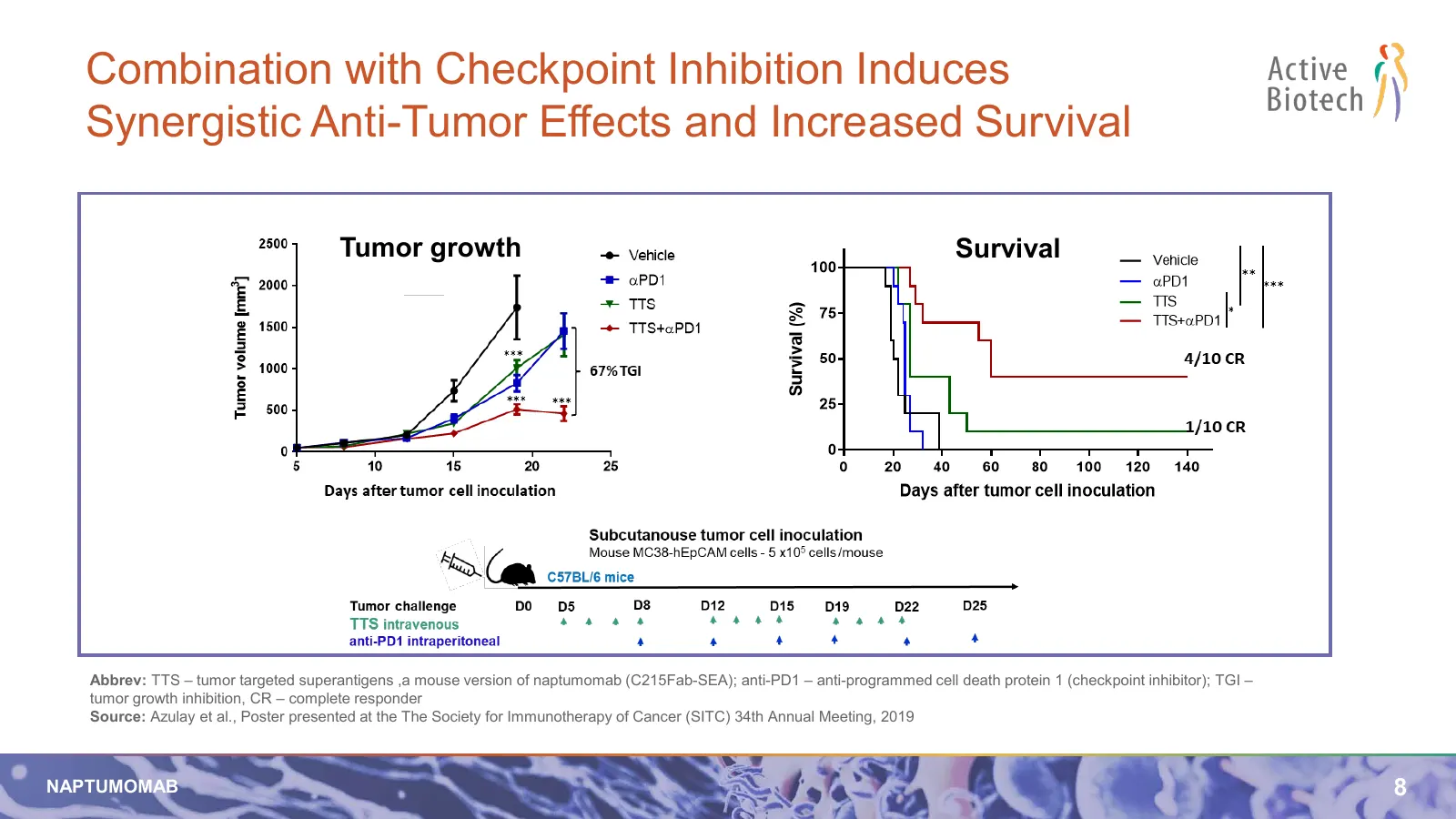
Slide 8: Combination with Checkpoint Inhibition Induces Synergistic Anti-Tumor Effects and Increased Survival
Combination with Checkpoint Inhibition Induces Synergistic Anti-Tumor Effects and Increased Survival Tumor growth Survival Abbrev: TTS – tumor targeted superantigens ,a mouse version of naptumomab (C215Fab-SEA); anti-PD1 – anti-programmed cell death protein 1 (checkpoint inhibitor); TGI – tumor grow
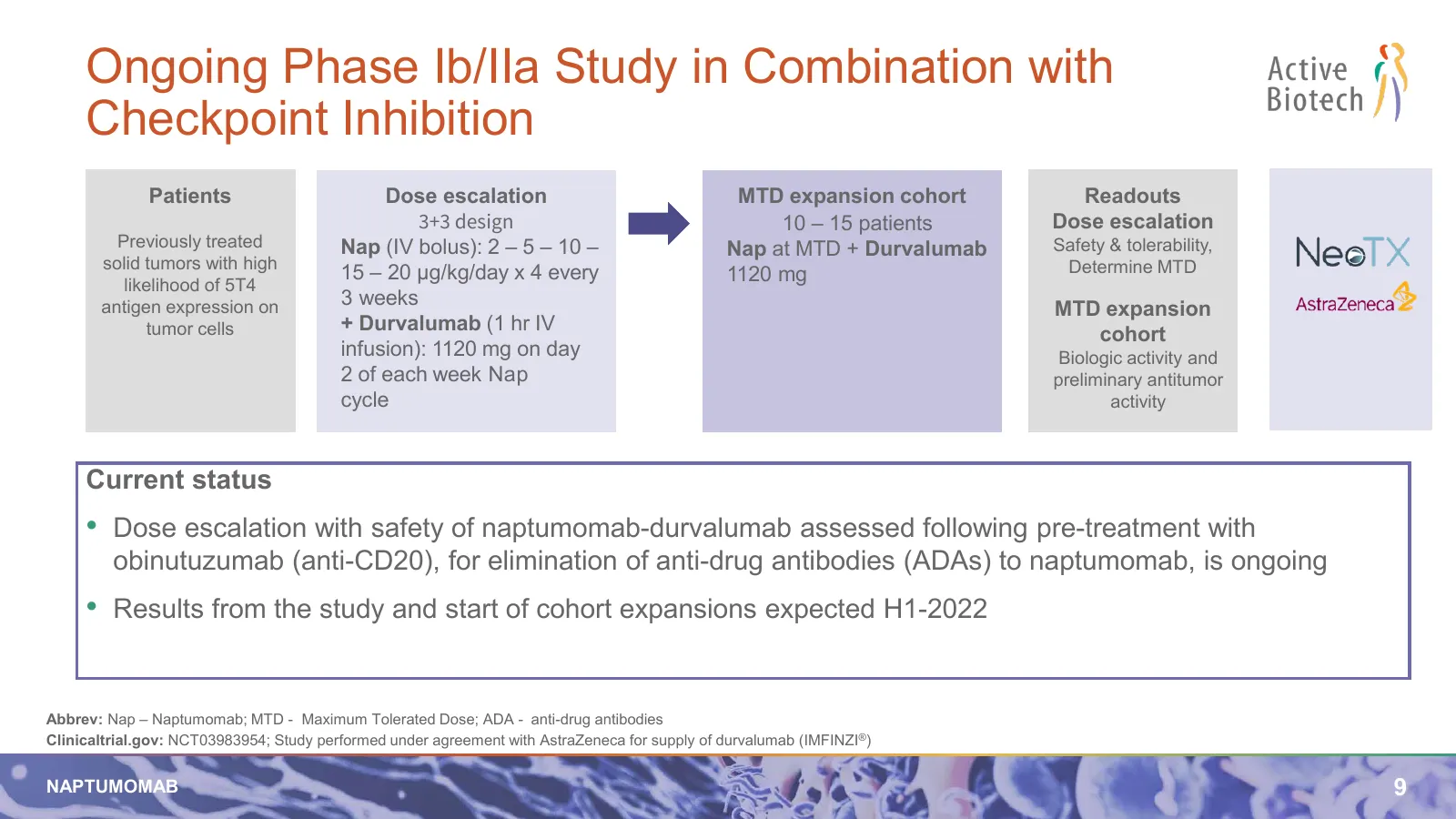
Slide 9: Ongoing Phase Ib/IIa Study in Combination with Checkpoint Inhibition
Ongoing Phase Ib/IIa Study in Combination with Checkpoint Inhibition Patients Dose escalation MTD expansion cohort Readouts 3+3 design 10 – 15 patients Dose escalation Previously treated Nap (IV bolus): 2 – 5 – 10 – Nap at MTD + Durvalumab Safety & tolerability, solid tumors with high Determine MTD
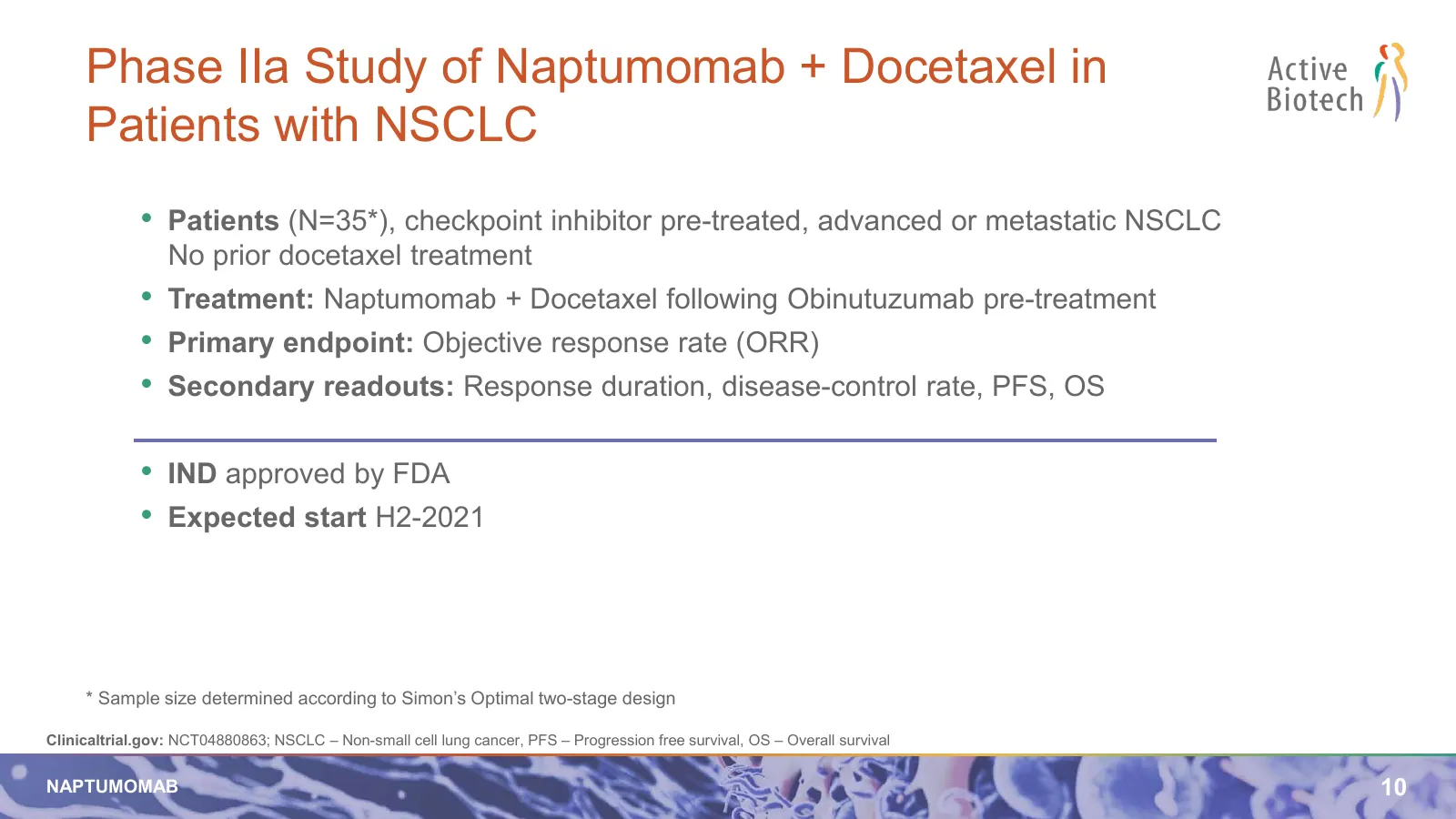
Slide 10: Phase IIa Study of Naptumomab + Docetaxel in Patients with NSCLC
Phase IIa Study of Naptumomab + Docetaxel in Patients with NSCLC • Patients (N=35*), checkpoint inhibitor pre-treated, advanced or metastatic NSCLC No prior docetaxel treatment • Treatment: Naptumomab + Docetaxel following Obinutuzumab pre-treatment • Primary endpoint: Objective response rate (ORR)
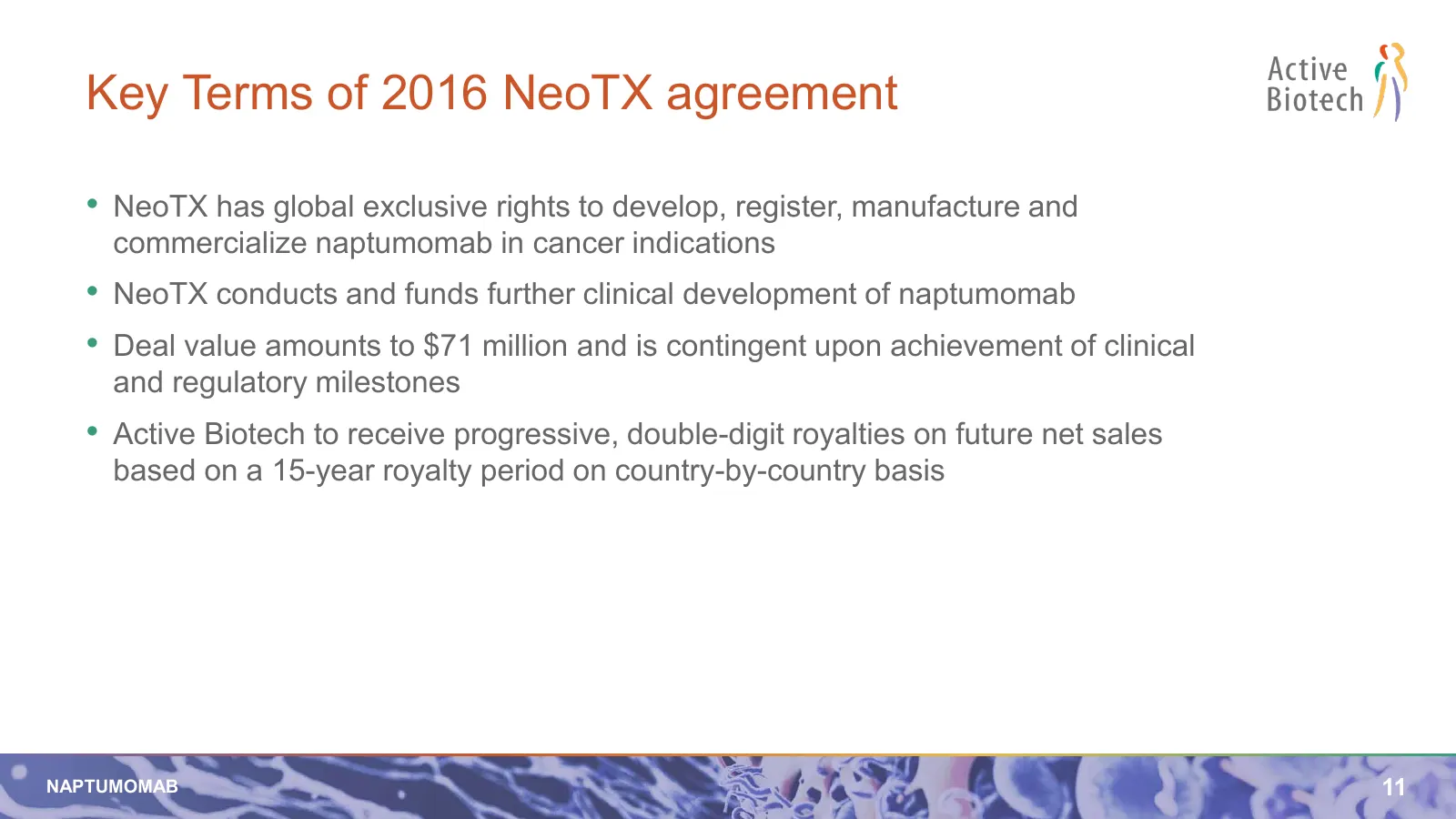
Slide 11: Key Terms of 2016 NeoTX agreement
Key Terms of 2016 NeoTX agreement • NeoTX has global exclusive rights to develop, register, manufacture and commercialize naptumomab in cancer indications • NeoTX conducts and funds further clinical development of naptumomab • Deal value amounts to $71 million and is contingent upon achievement of c
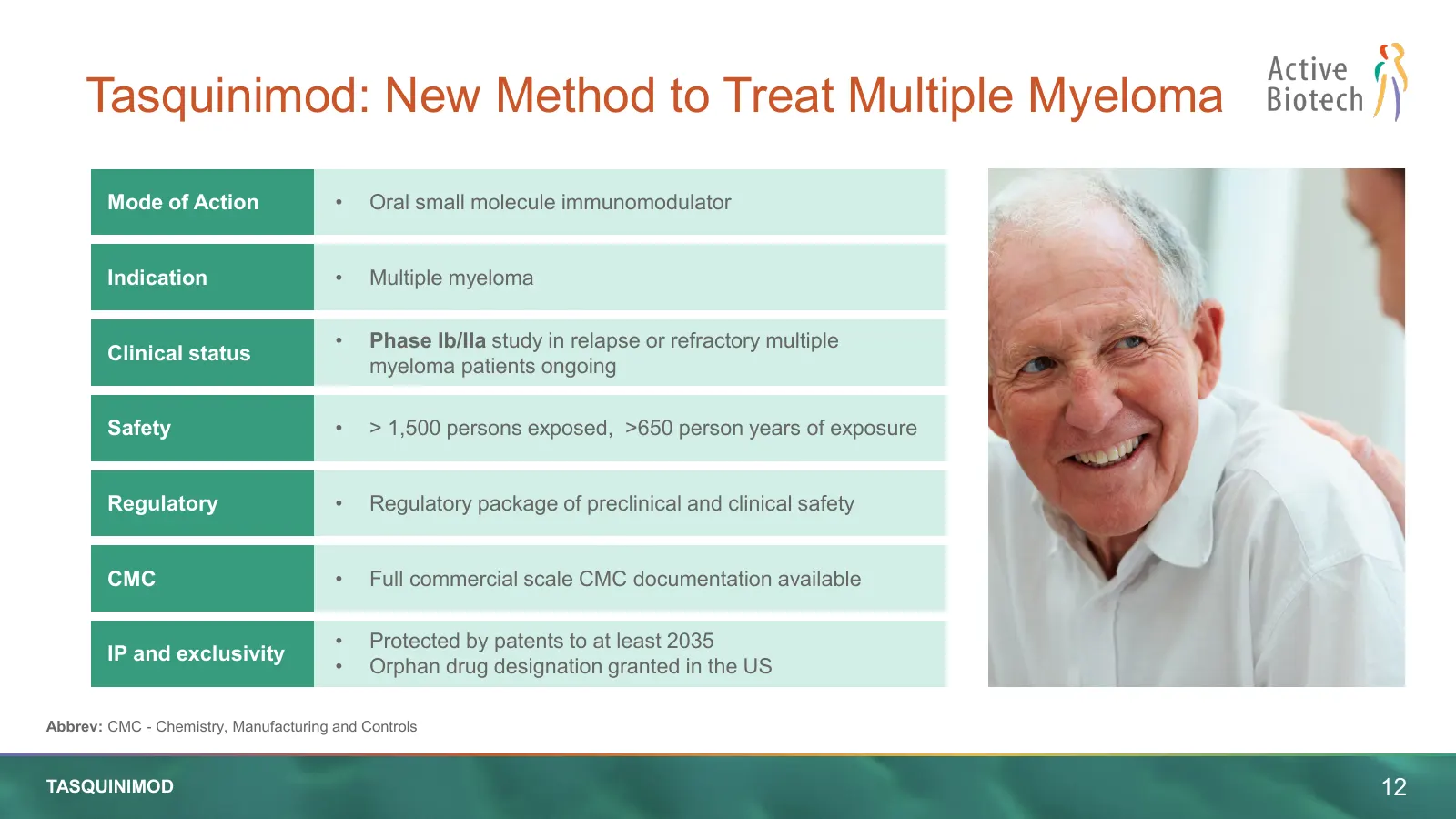
Slide 12: Tasquinimod: New Method to Treat Multiple Myeloma
Tasquinimod: New Method to Treat Multiple Myeloma Mode of Action • Oral small molecule immunomodulator Indication • Multiple myeloma • Phase Ib/IIa study in relapse or refractory multiple Clinical status myeloma patients ongoing Safety • > 1,500 persons exposed, >650 person years of exposure Regulat
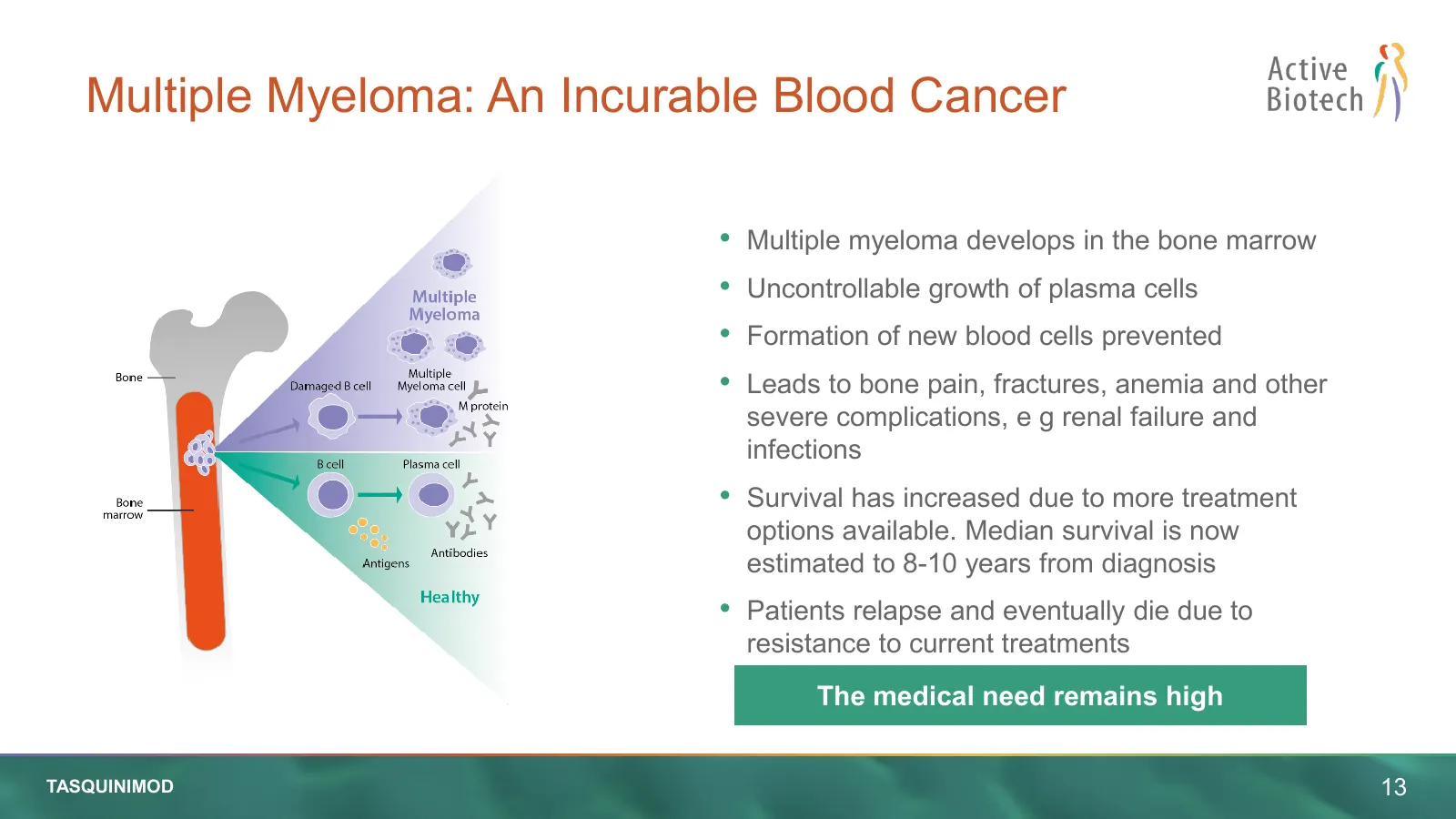
Slide 13: Multiple Myeloma: An Incurable Blood Cancer
Multiple Myeloma: An Incurable Blood Cancer • Multiple myeloma develops in the bone marrow • Uncontrollable growth of plasma cells • Formation of new blood cells prevented • Leads to bone pain, fractures, anemia and other severe complications, e g renal failure and infections • Survival has increase
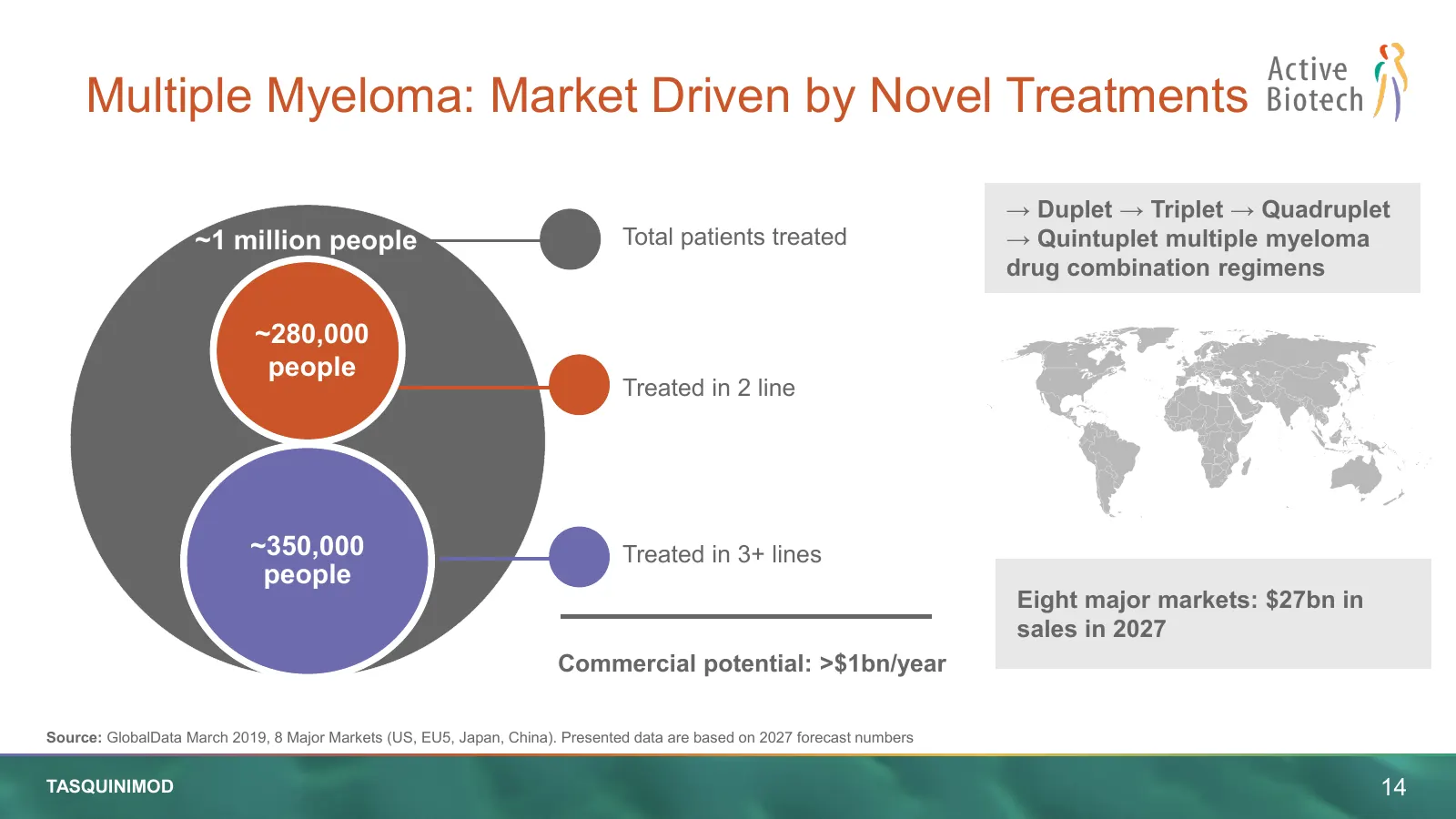
Slide 14: Multiple Myeloma: Market Driven by Novel Treatments
Multiple Myeloma: Market Driven by Novel Treatments → Duplet → Triplet → Quadruplet ~1 million people Total patients treated → Quintuplet multiple myeloma drug combination regimens ~280,000 people Treated in 2 line ~350,000 Treated in 3+ lines people Eight major markets: $27bn in sales in 2027 Comme
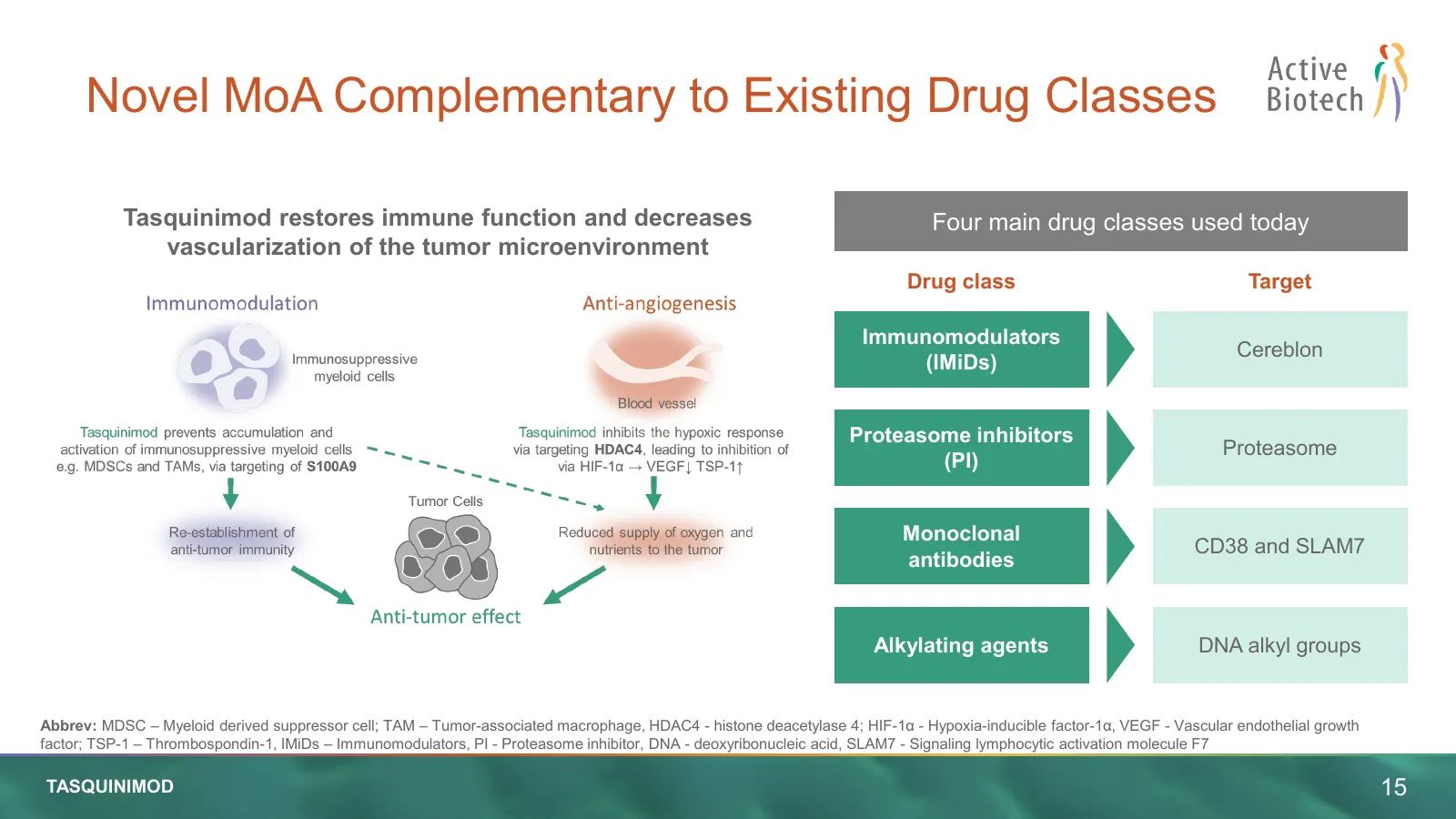
Slide 15: Novel MoA Complementary to Existing Drug Classes
Novel MoA Complementary to Existing Drug Classes Tasquinimod restores immune function and decreases Four main drug classes used today vascularization of the tumor microenvironment Drug class Target Immunomodulators Cereblon (IMiDs) Proteasome inhibitors Proteasome (PI) Monoclonal CD38 and SLAM7 anti
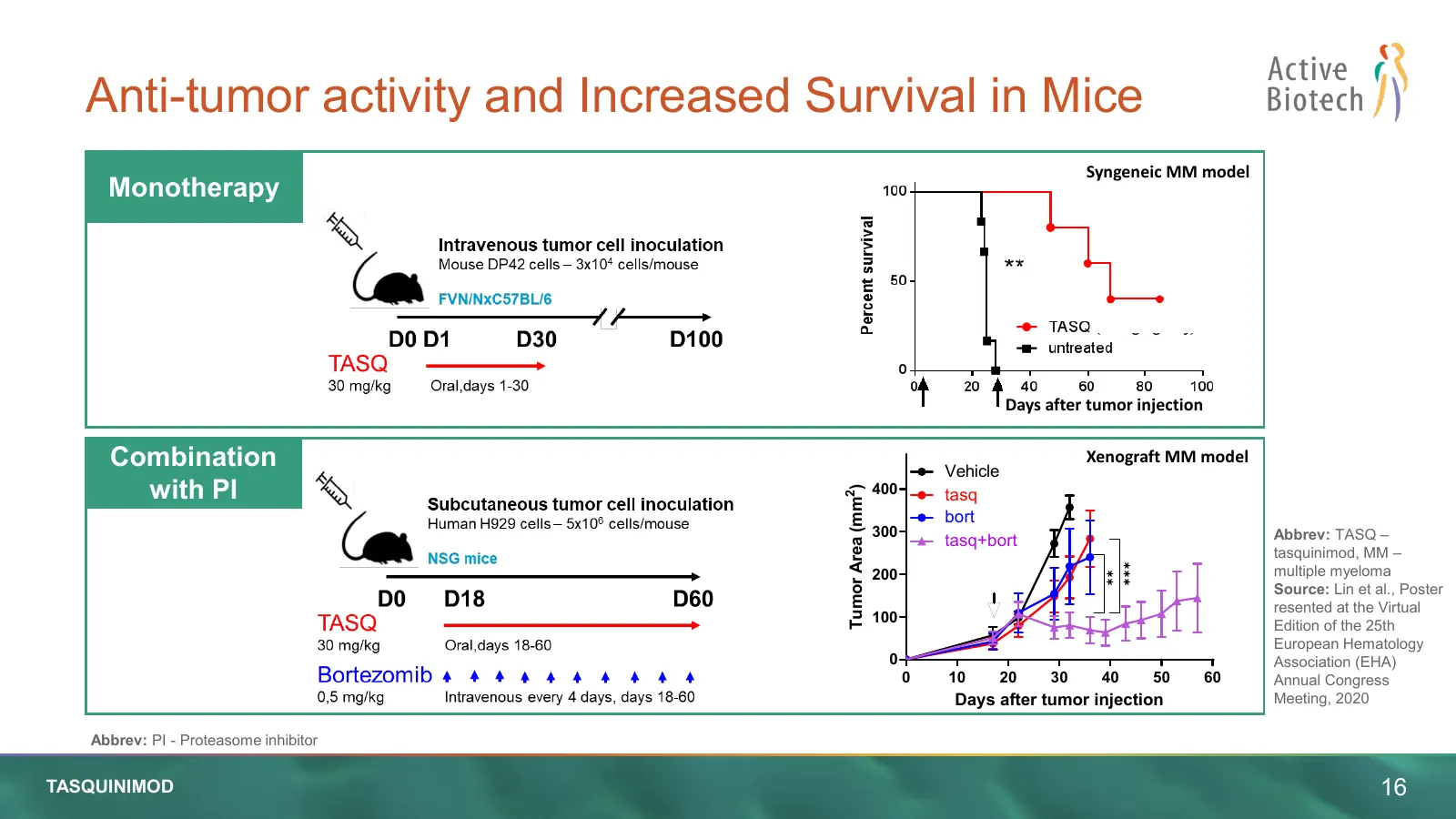
Slide 16: Anti-tumor activity and Increased Survival in Mice
Anti-tumor activity and Increased Survival in Mice Syngeneic MM model Monotherapy Days after tumor injection Combination Vehicle Xenograft MM model with PI 400 tasq Tumor Area (mm2) bort 300 Abbrev: TASQ – tasq+bort tasquinimod, MM – multiple myeloma ✱✱✱ 200 ✱✱ Source: Lin et al., Poster resented at
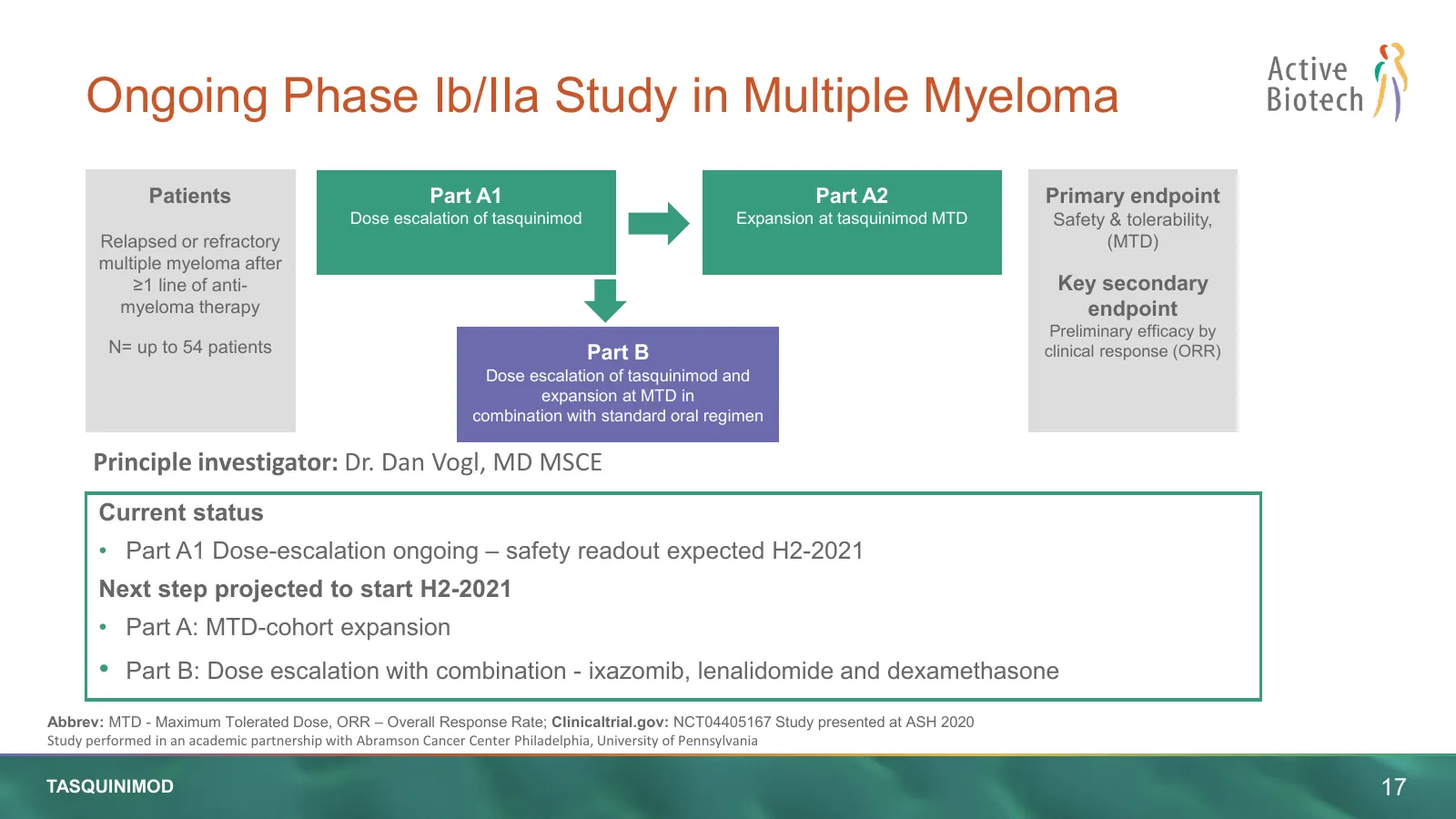
Slide 17: Ongoing Phase Ib/IIa Study in Multiple Myeloma
Ongoing Phase Ib/IIa Study in Multiple Myeloma Patients Part A1 Part A2 Primary endpoint Dose escalation of tasquinimod Expansion at tasquinimod MTD Safety & tolerability, Relapsed or refractory (MTD) multiple myeloma after ≥1 line of anti- Key secondary myeloma therapy endpoint Preliminary efficacy
Slide 18: Laquinimod: Treatment of Inflammatory Eye Disorders
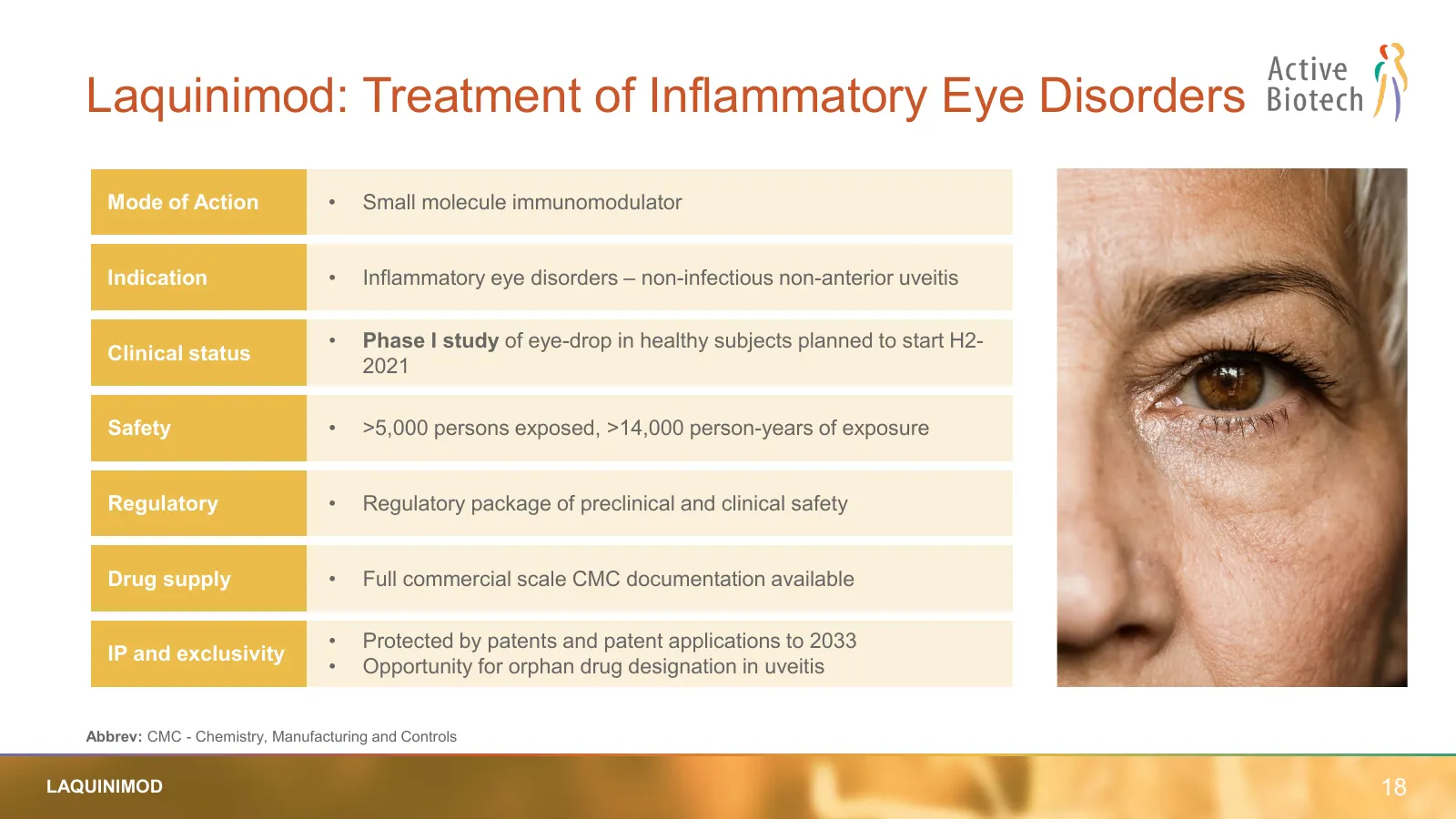
Laquinimod: Treatment of Inflammatory Eye Disorders Mode of Action • Small molecule immunomodulator Indication • Inflammatory eye disorders – non-infectious non-anterior uveitis • Phase I study of eye-drop in healthy subjects planned to start H2- Clinical status 2021 Safety • >5,000 persons exposed,
Slide 19: Non-anterior Uveitis: A Serious Eye Disorder
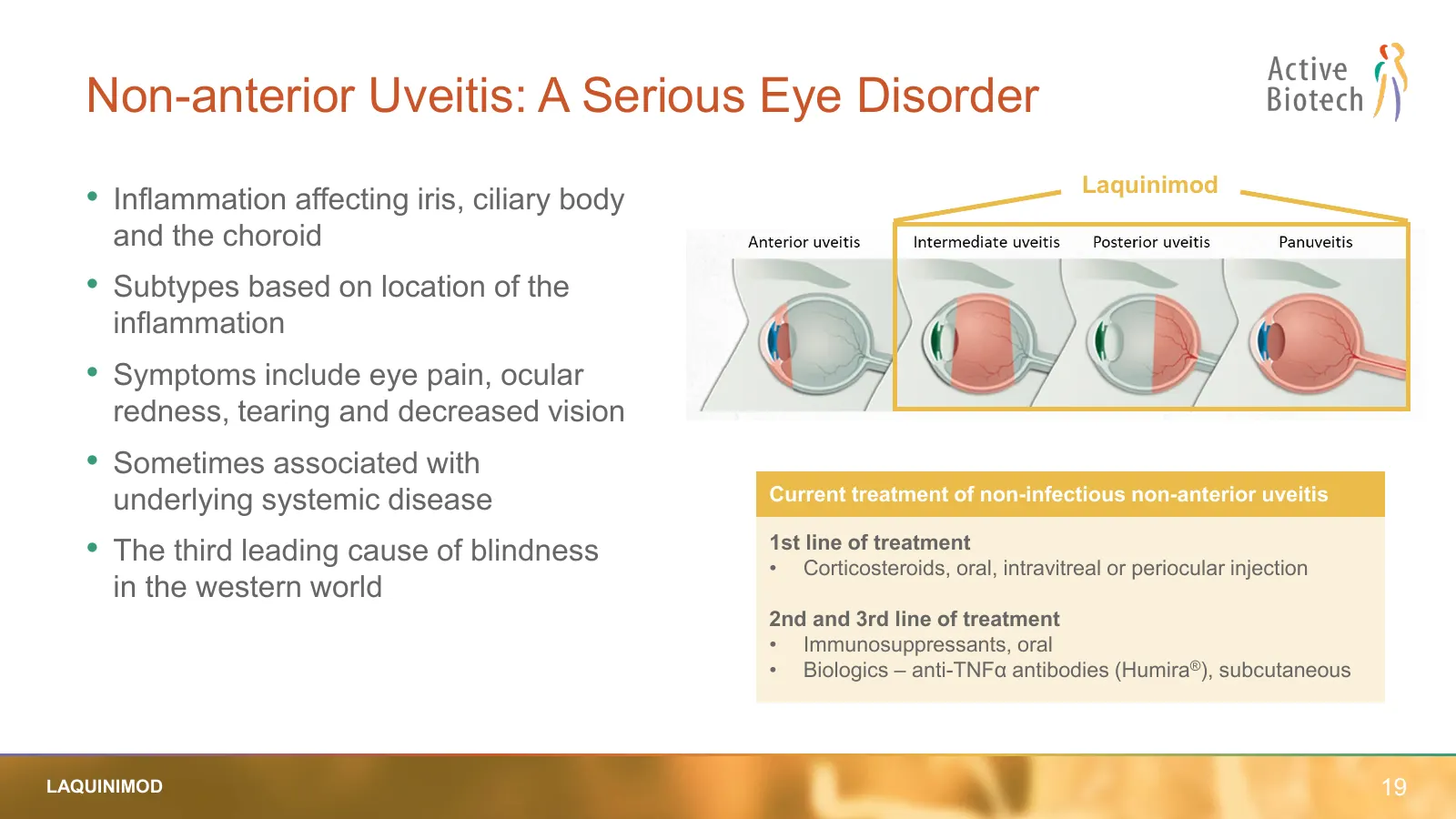
Non-anterior Uveitis: A Serious Eye Disorder Laquinimod • Inflammation affecting iris, ciliary body and the choroid • Subtypes based on location of the inflammation • Symptoms include eye pain, ocular redness, tearing and decreased vision • Sometimes associated with underlying systemic disease Curre
Slide 20: Non-Anterior Uveitis: High Unmet Need
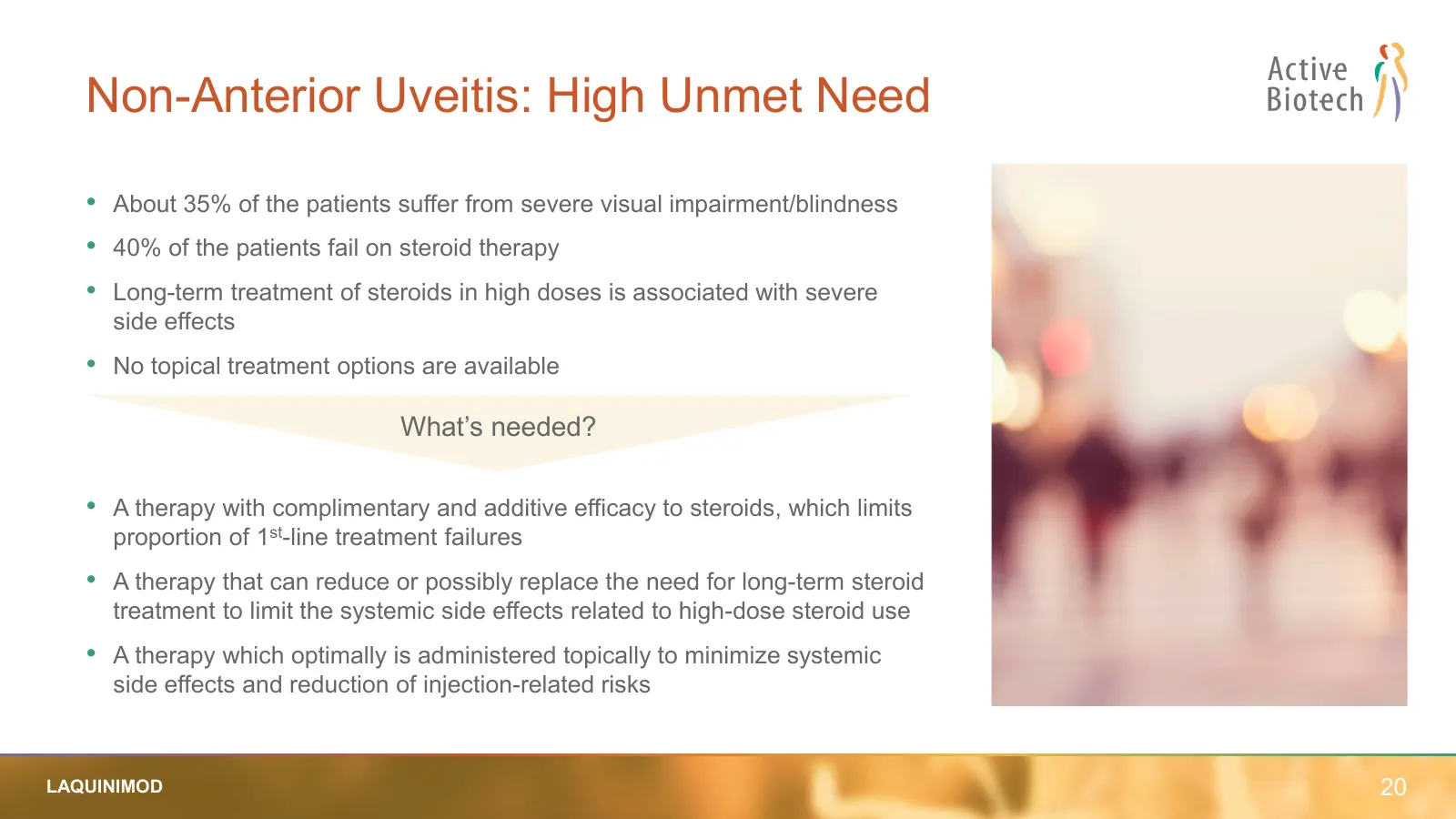
Non-Anterior Uveitis: High Unmet Need • About 35% of the patients suffer from severe visual impairment/blindness • 40% of the patients fail on steroid therapy • Long-term treatment of steroids in high doses is associated with severe side effects • No topical treatment options are available What’s ne
Slide 21: …and a Significant Orphan Opportunity
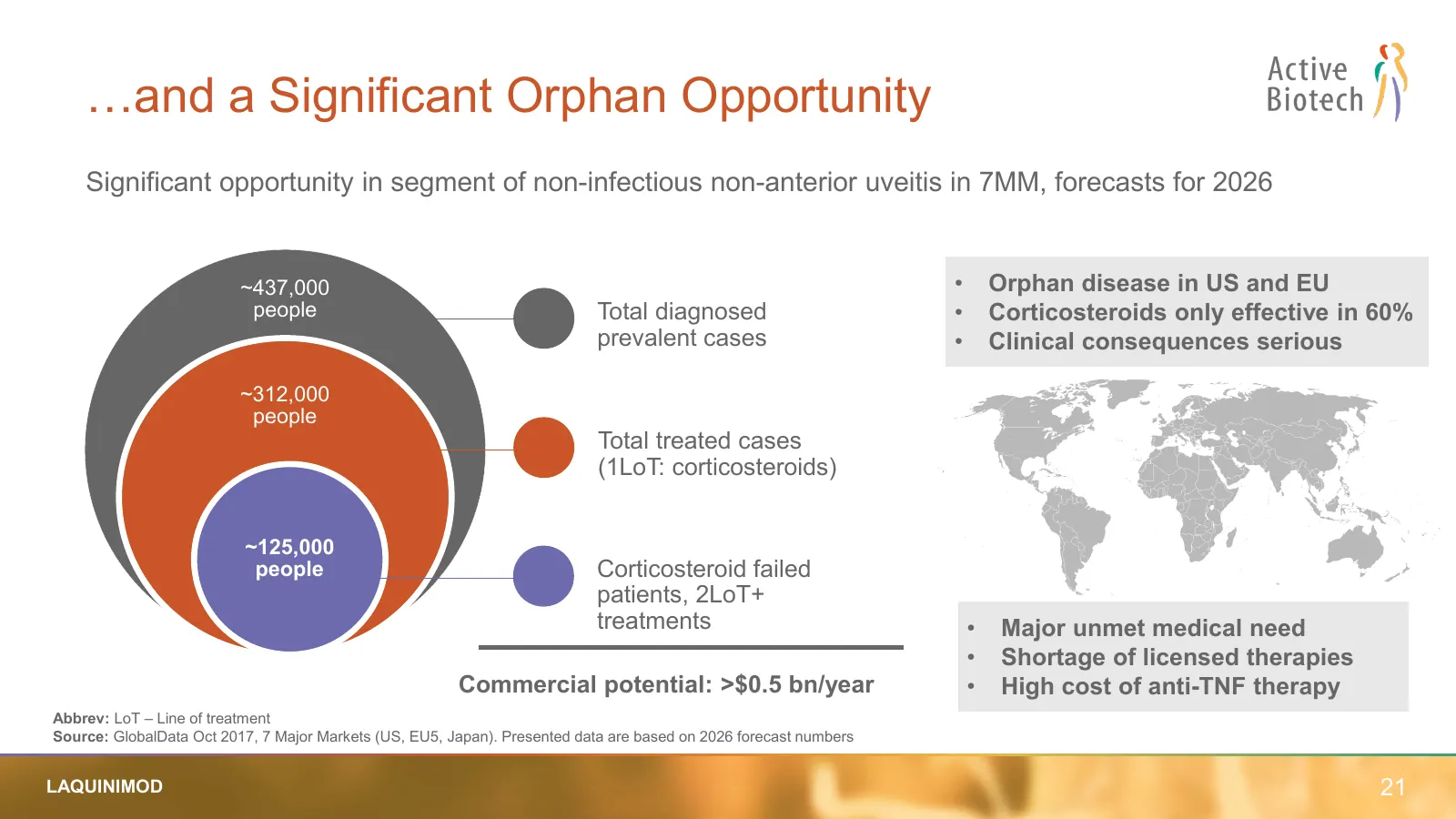
…and a Significant Orphan Opportunity Significant opportunity in segment of non-infectious non-anterior uveitis in 7MM, forecasts for 2026 ~437,000 • Orphan disease in US and EU people Total diagnosed • Corticosteroids only effective in 60% prevalent cases • Clinical consequences serious ~312,000 pe
Slide 22: Laquinimod Induces Immune Tolerance
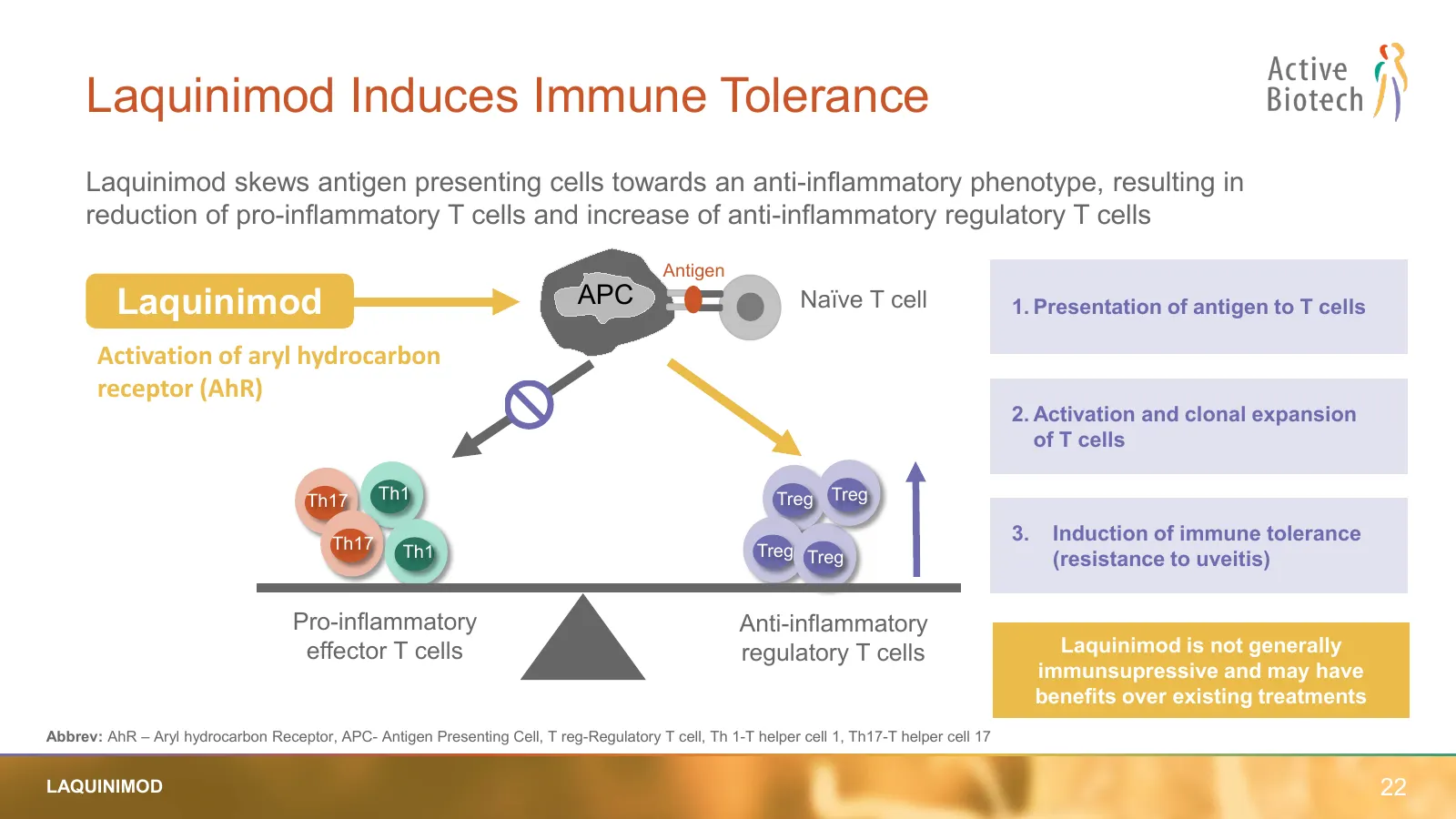
Laquinimod Induces Immune Tolerance Laquinimod skews antigen presenting cells towards an anti-inflammatory phenotype, resulting in reduction of pro-inflammatory T cells and increase of anti-inflammatory regulatory T cells Antigen Laquinimod APC Naїve T cell 1. Presentation of antigen to T cells Acti
Slide 23: Laquinimod Works Both Topically and Orally
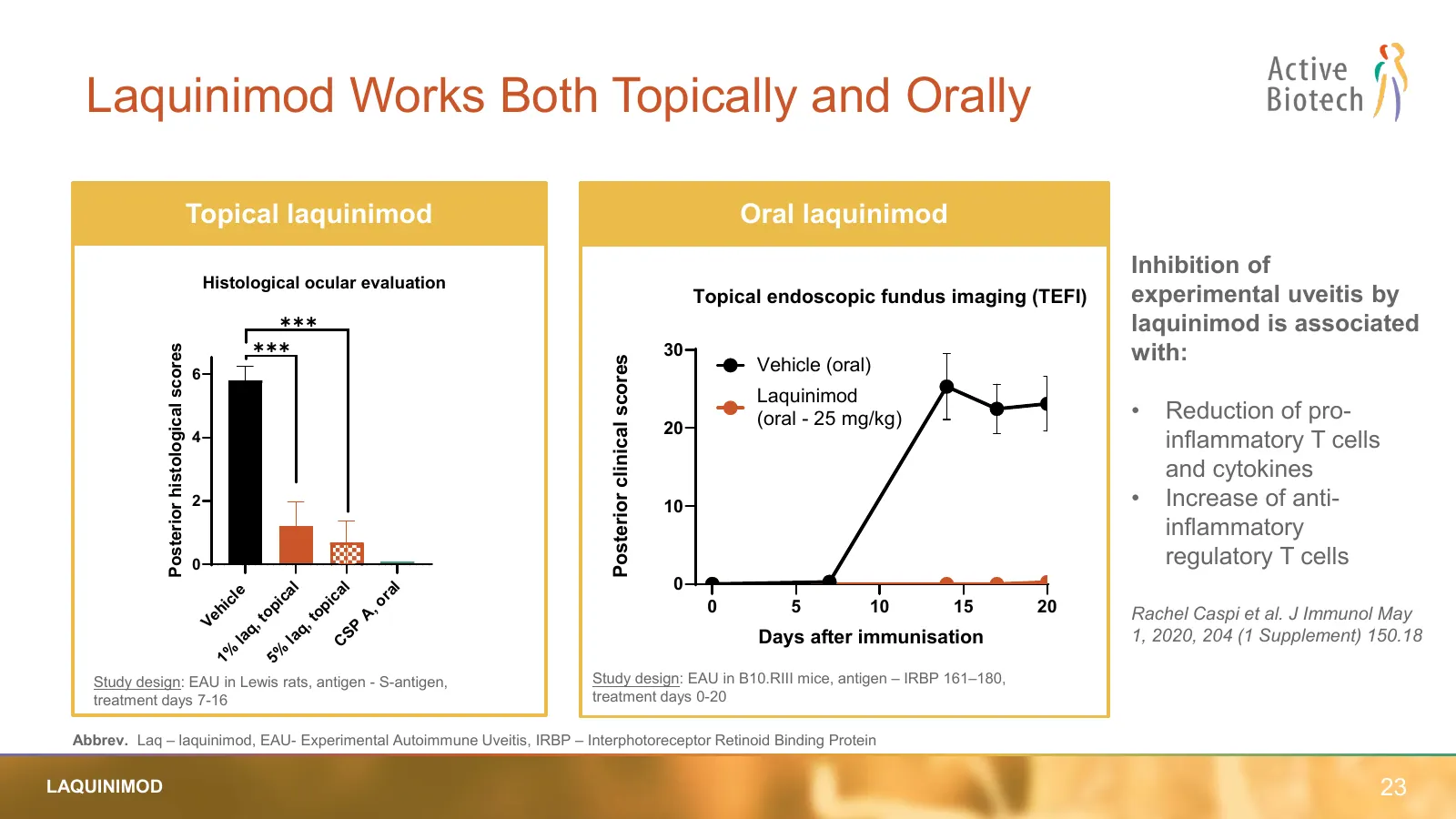
Laquinimod Works Both Topically and Orally Topical laquinimod Oral laquinimod Inhibition of Histological ocular evaluation Topical endoscopic fundus imaging (TEFI) experimental uveitis by ✱✱✱ laquinimod is associated ✱✱✱ 30 with: Posterior histological scores Vehicle (oral) Posterior clinical scores
Slide 24: Phase I Study of Laquinimod Eye-drops in Healthy Subjects
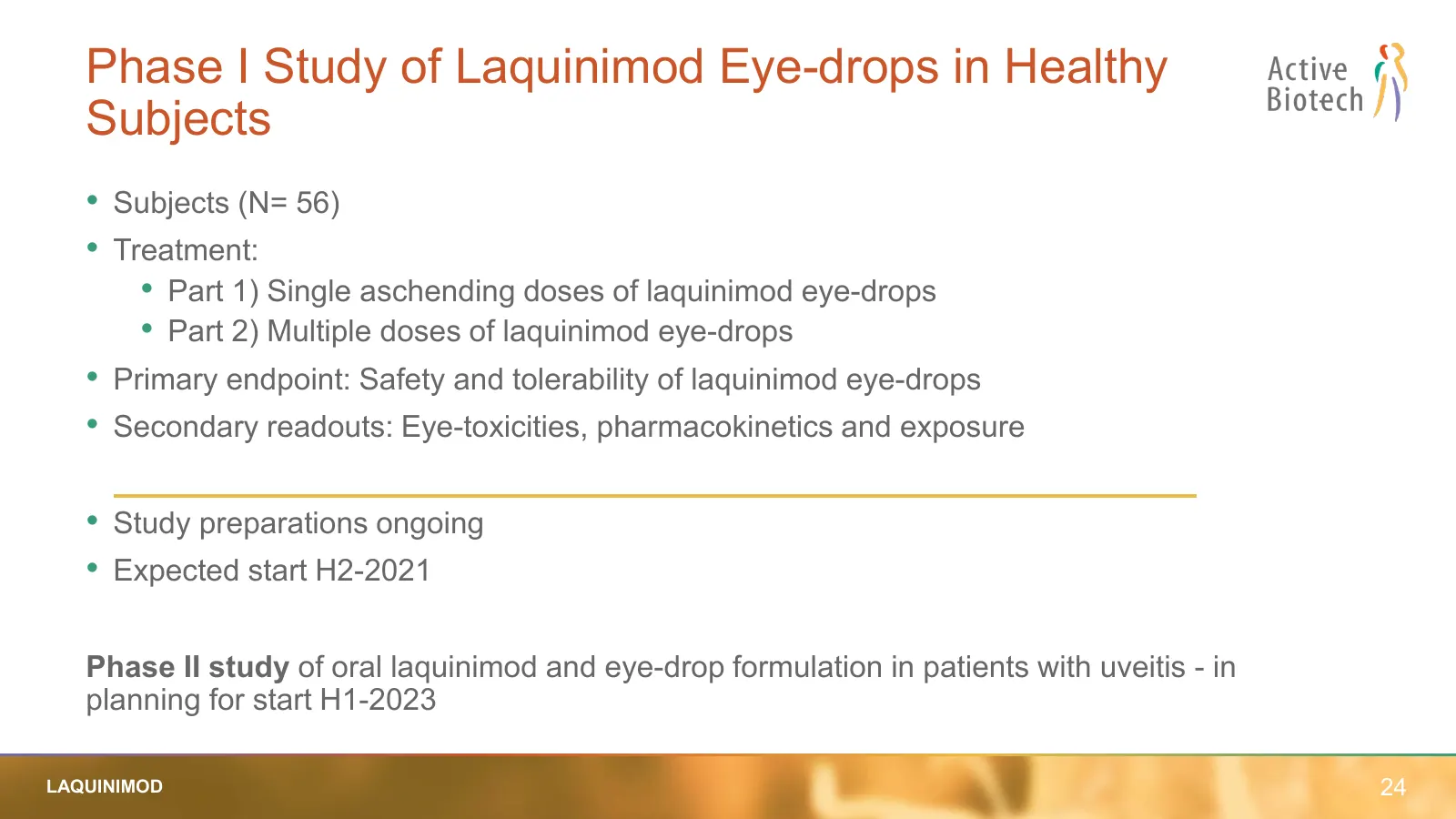
Phase I Study of Laquinimod Eye-drops in Healthy Subjects • Subjects (N= 56) • Treatment: • Part 1) Single aschending doses of laquinimod eye-drops • Part 2) Multiple doses of laquinimod eye-drops • Primary endpoint: Safety and tolerability of laquinimod eye-drops • Secondary readouts: Eye-toxicitie
Slide 25: Upcoming Clinical Milestones through H1-2022
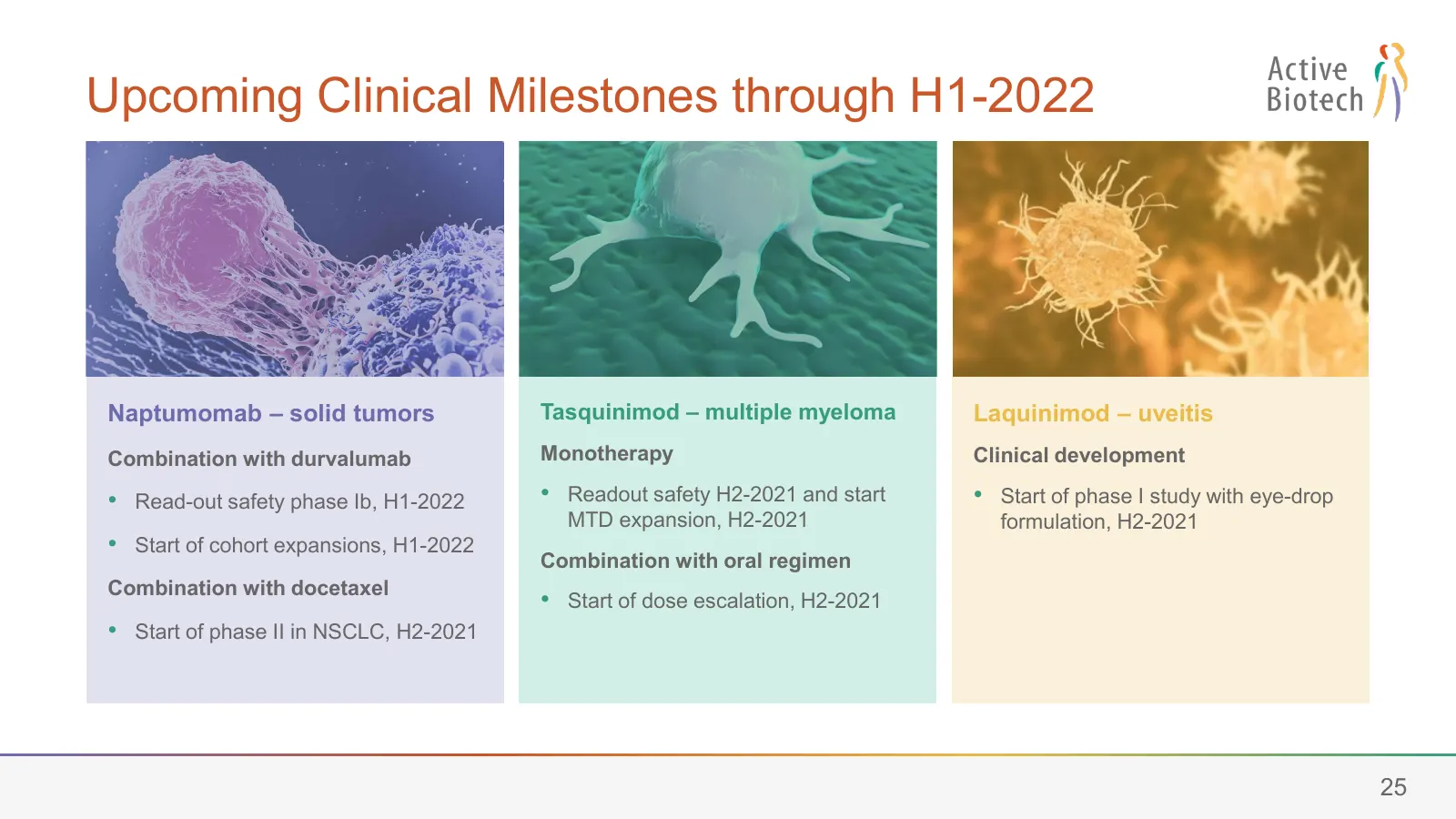
Upcoming Clinical Milestones through H1-2022 Naptumomab – solid tumors Tasquinimod – multiple myeloma Laquinimod – uveitis Combination with durvalumab Monotherapy Clinical development • Read-out safety phase Ib, H1-2022 • Readout safety H2-2021 and start • Start of phase I study with eye-drop MTD ex

Slide 26: www.activebiotech.com
www.activebiotech.com Active Biotech i 26
Source: Internet Archive copy of activebiotech.com
More decks from Active Biotech AB
 Investor Presentation (November 2026)23 slides · Nov 5, 2026
 Investor Presentation (August 2026)25 slides · Aug 31, 2026
 Investor Presentation (July 2026)25 slides · July 2026
 Investor Presentation (April 2026)25 slides · April 2026
 Investor Presentation (November 2025)30 slides · Nov 4, 2025
 Investor Presentation (March 2024)29 slides · March 2024