Repros Therapeutics — Investor Day (October 2014)
119 slides from Repros Therapeutics's investor day presentation, Oct 31, 2014
Slide 1: Androxal Analyst Day October 31, 2014
Androxal ® Analyst Day October 31, 2014 A Mechanistically Consistent Approach to the Treatment of Secondary Hypogonadism
Slide 2: Repros Disclaimer
Repros Disclaimer Any statements made by the Company that are not historical facts contained in these slides (or in any oral accompanying discussion) are forward - looking statements within the meaning of the Private Securities Litigation Reform Act of 1995 and are subject to various risks, uncertai
Slide 3: Androxal Analyst Day Agenda
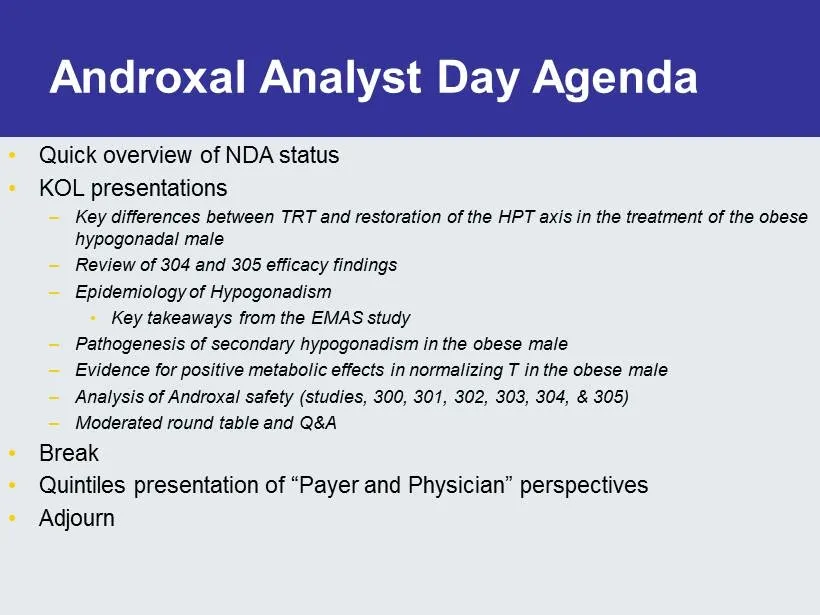
Androxal Analyst Day Agenda • Quick overview of NDA status • KOL presentations – Key differences between TRT and restoration of the HPT axis in the treatment of the obese hypogonadal male – Review of 304 and 305 efficacy findings – Epidemiology of Hypogonadism • Key takeaways from the EMAS study – P
Slide 4: Androxal NDA Status
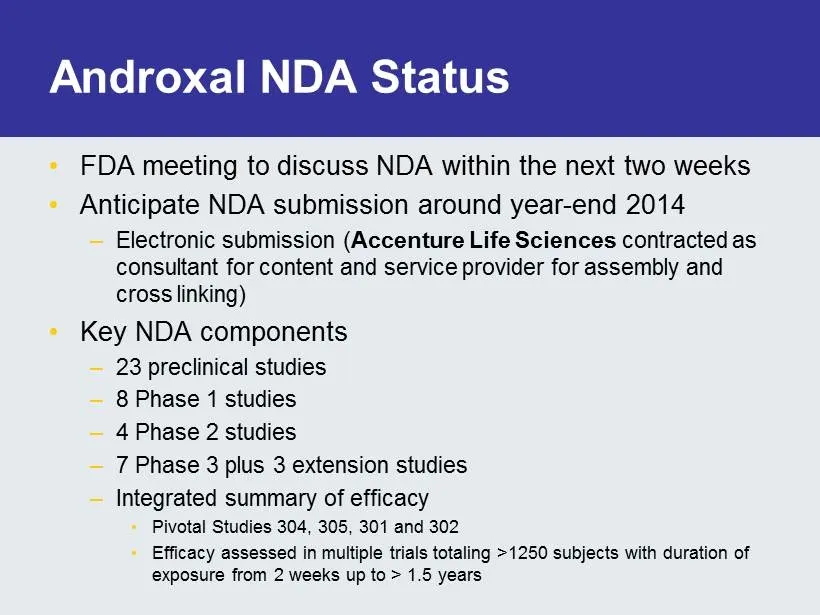
Androxal NDA Status • FDA meeting to discuss NDA within the next two weeks • Anticipate NDA submission around year - end 2014 – Electronic submission ( Accenture Life Sciences contracted as consultant for content and service provider for assembly and cross linking) • Key NDA components – 23 preclini
Slide 5: Androxal NDA Status (cont'd)
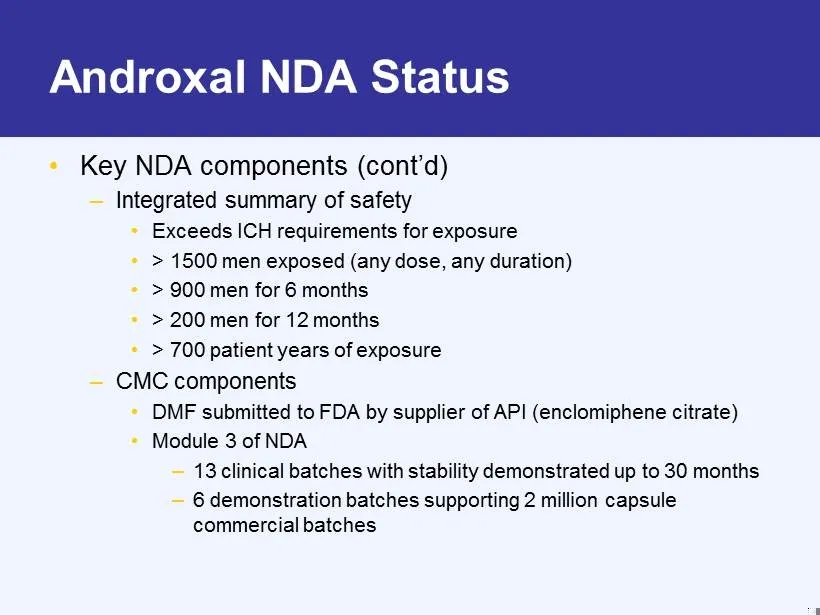
Androxal NDA Status • Key NDA components (cont’d) – Integrated summary of safety • Exceeds ICH requirements for exposure • > 1500 men exposed (any dose, any duration) • > 900 men for 6 months • > 200 men for 12 months • > 700 patient years of exposure – CMC components • DMF submitted to FDA by suppl
Slide 6: The Changing Dynamic of the Treatment of Secondary Hypogonadism
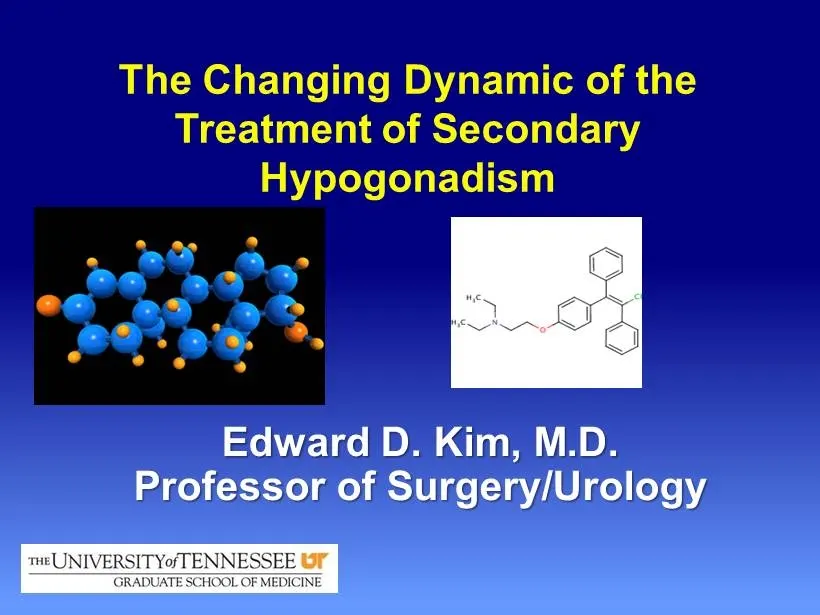
Edward D. Kim, M.D. Professor of Surgery/Urology The Changing Dynamic of the Treatment of Secondary Hypogonadism
Slide 7: Testosterone therapy suppresses pituitary function
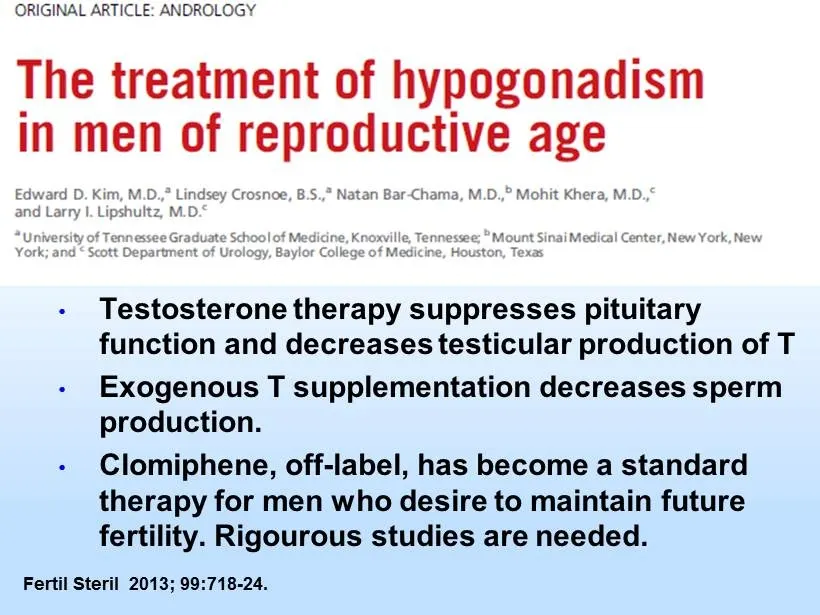
• Testosterone therapy suppresses pituitary function and decreases testicular production of T • Exogenous T supplementation decreases sperm production. • Clomiphene, off - label, has become a standard therapy for men who desire to maintain future fertility. Rigourous studies are needed. Fertil Steri
Slide 8: Age Distribution of T initiation
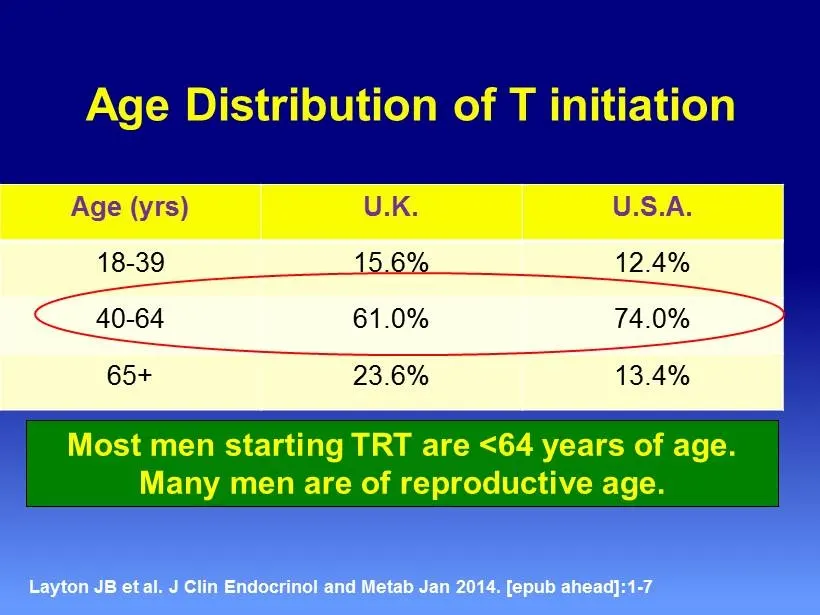
Age Distribution of T initiation Age ( yrs ) U.K. U.S.A. 18 - 39 15.6% 12.4% 40 - 64 61.0% 74.0% 65+ 23.6% 13.4% Layton JB et al. J Clin Endocrinol and Metab Jan 2014 . [ epub ahead ]:1 - 7 Most men starting TRT are <64 years of age. Many men are of reproductive age.
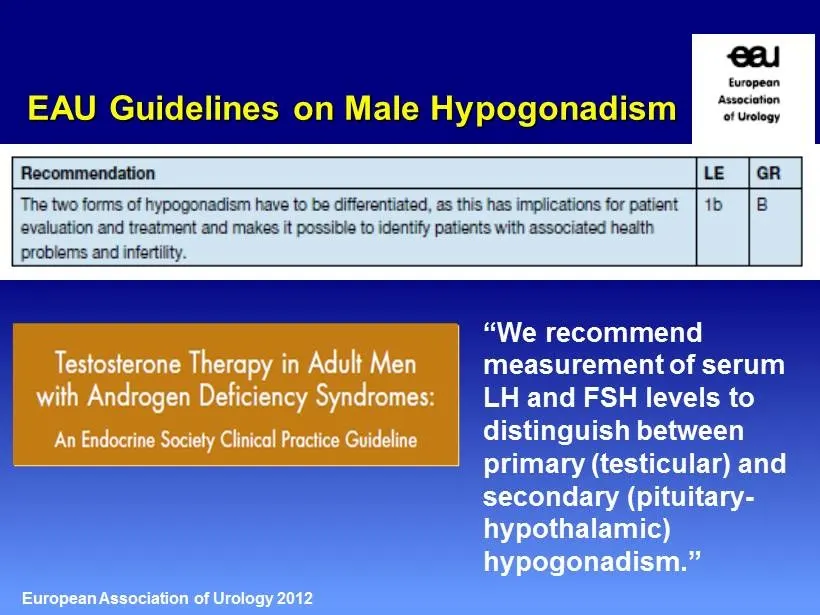
Slide 9: EAU Guidelines on Male Hypogonadism
EAU Guidelines on Male Hypogonadism European Association of Urology 2012 “We recommend measurement of serum LH and FSH levels to distinguish between primary (testicular) and secondary (pituitary - hypothalamic) hypogonadism .”
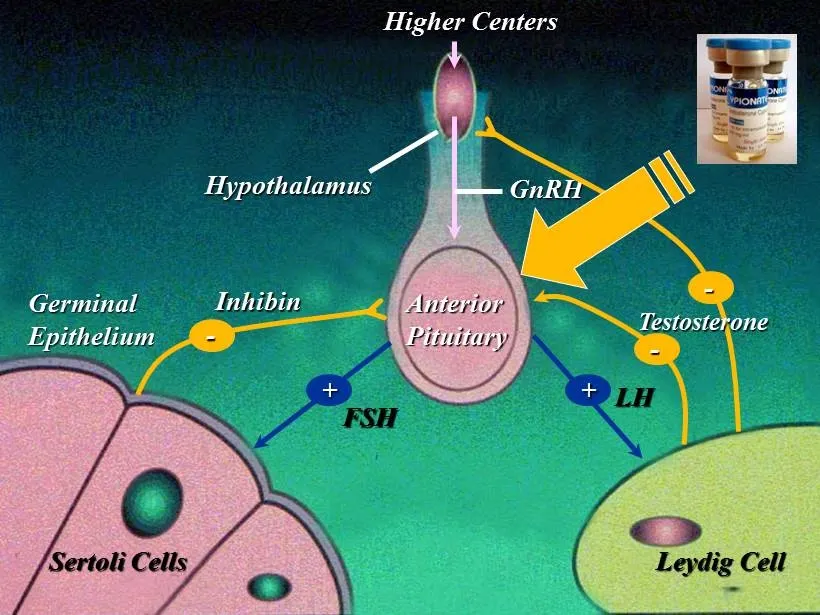
Slide 10: Hypothalamic-pituitary-testicular axis
Higher Centers Hypothalamus Anterior Pituitary Sertoli Cells Leydig Cell Germinal Epithelium GnRH FSH LH + + Inhibin - - - Testosterone
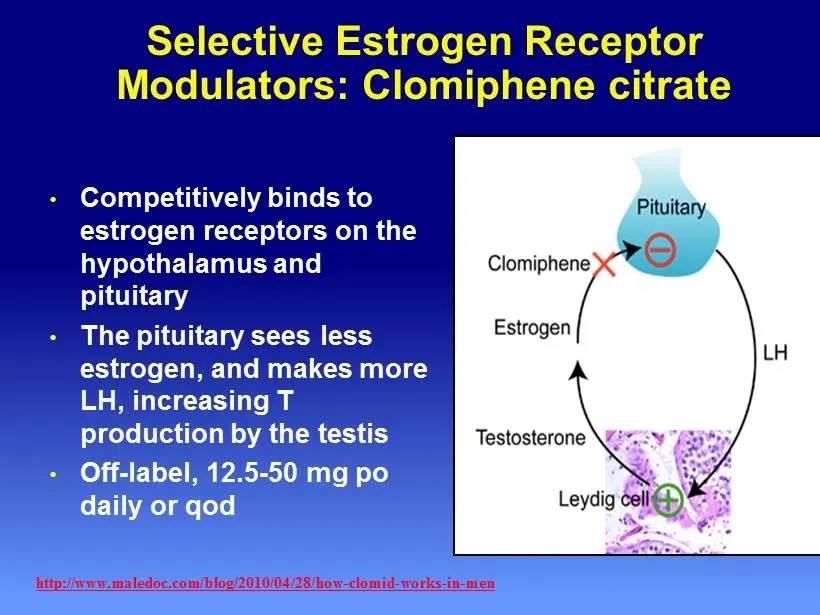
Slide 11: Selective Estrogen Receptor Modulators: Clomiphene citrate
Selective Estrogen Receptor Modulators: Clomiphene citrate • Competitively binds to estrogen receptors on the hypothalamus and pituitary • The pituitary sees less estrogen, and makes more LH, increasing T production by the testis • Off - label, 12.5 - 50 mg po daily or qod http://www.maledoc.com/blo
Slide 12: Key Clinical Findings from Androxal Studies
Key Clinical Findings from Androxal Studies
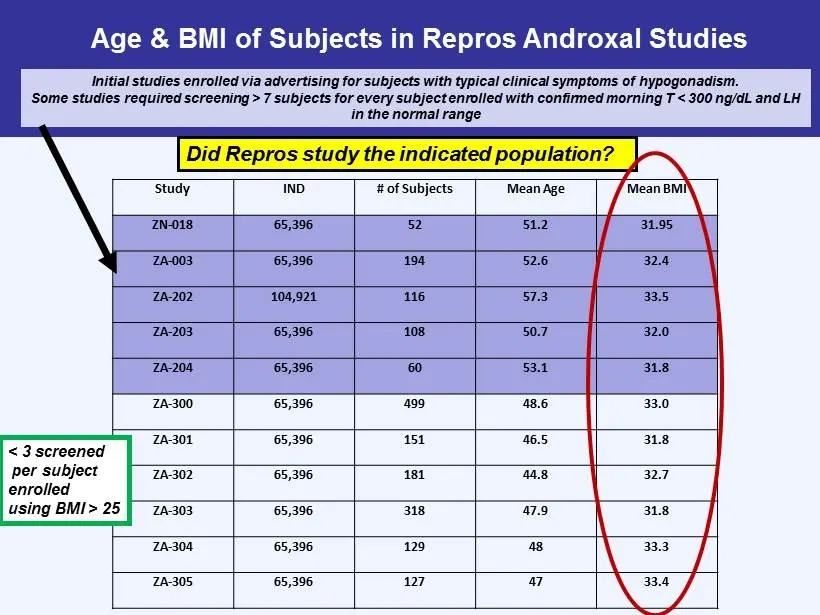
Slide 13: Age & BMI of Subjects in Repros Androxal Studies
Age & BMI of Subjects in Repros Androxal Studies Study IND # of Subjects Mean Age Mean BMI ZN - 018 65,396 52 51.2 31.95 ZA - 003 65,396 194 52.6 32.4 ZA - 202 104,921 116 57.3 33.5 ZA - 203 65,396 108 50.7 32.0 ZA - 204 65,396 60 53.1 31.8 ZA - 300 65,396 499 48.6 33.0 ZA - 301 65,396 151 46.5 31.8
Slide 14: Androxal Indication Statement
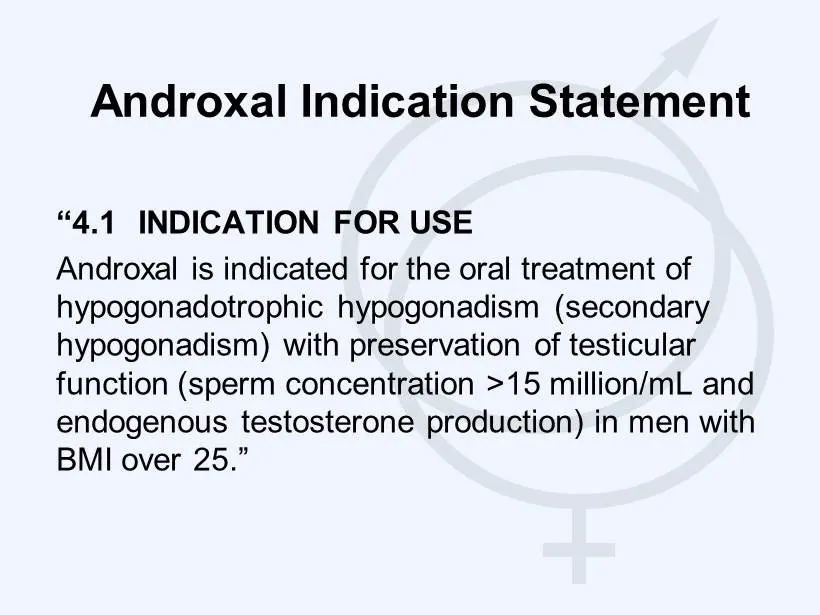
Androxal Indication Statement “4.1 INDICATION FOR USE Androxal is indicated for the oral treatment of hypogonadotrophic hypogonadism (secondary hypogonadism) with preservation of testicular function (sperm concentration >15 million/mL and endogenous testosterone production) in men with BMI over 25.”
Slide 15: ZA-304/305 study design
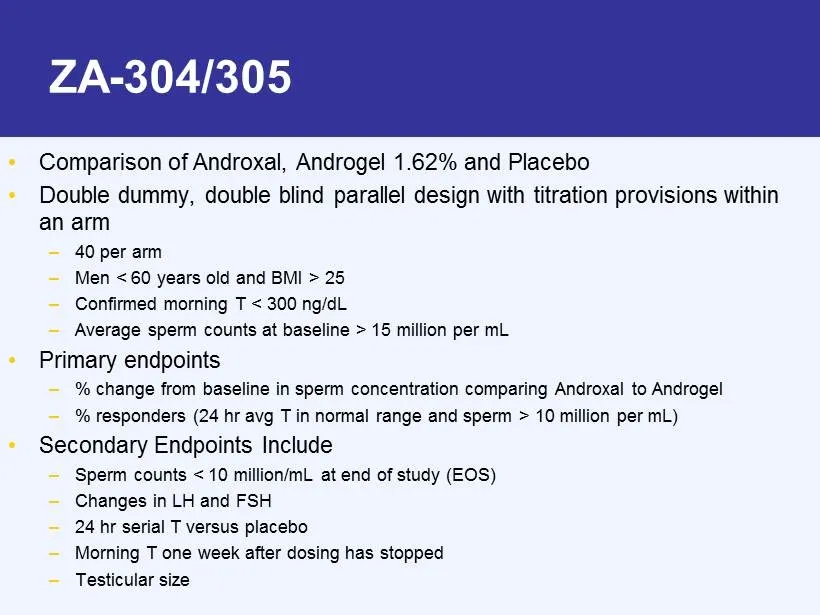
ZA - 304/305 • Comparison of Androxal, Androgel 1.62% and Placebo • Double dummy, double blind parallel design with titration provisions within an arm – 40 per arm – Men < 60 years old and BMI > 25 – Confirmed morning T < 300 ng/dL – Average sperm counts at baseline > 15 million per mL • Primary end
Slide 16: Androxal Preserves the HPT Axis
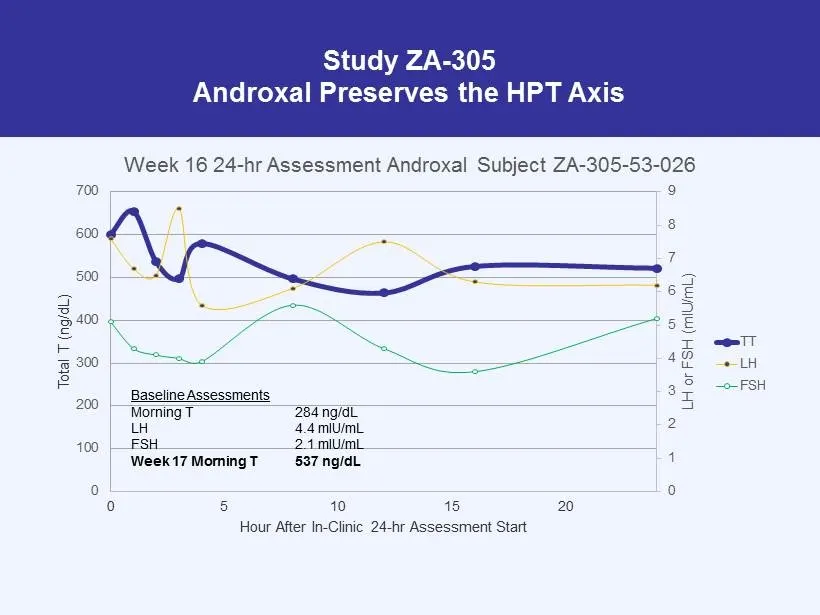
Study ZA - 305 Androxal Preserves the HPT Axis 0 1 2 3 4 5 6 7 8 9 0 100 200 300 400 500 600 700 0 5 10 15 20 LH or FSH ( mIU /mL) Total T (ng/dL) Hour After In - Clinic 24 - hr Assessment Start Week 16 24 - hr Assessment Androxal Subject ZA - 305 - 53 - 026 TT LH FSH Baseline Assessments Morning T
Slide 17: Exogenous T Disrupts the HPT Axis
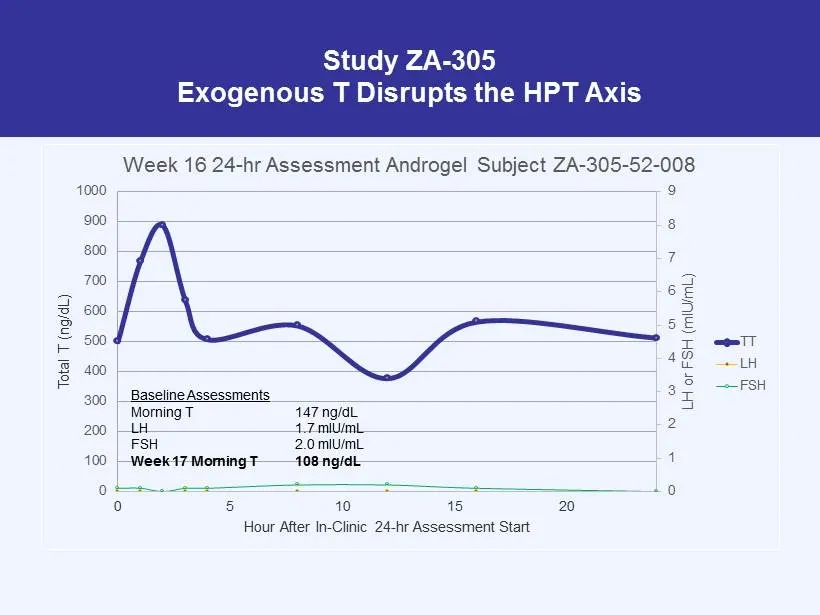
Study ZA - 305 Exogenous T Disrupts the HPT Axis 0 1 2 3 4 5 6 7 8 9 0 100 200 300 400 500 600 700 800 900 1000 0 5 10 15 20 LH or FSH ( mIU /mL) Total T (ng/dL) Hour After In - Clinic 24 - hr Assessment Start Week 16 24 - hr Assessment Androgel Subject ZA - 305 - 52 - 008 TT LH FSH Baseline Assessm
Slide 18: Impact on LH and FSH Consistent in all Comparator Studies
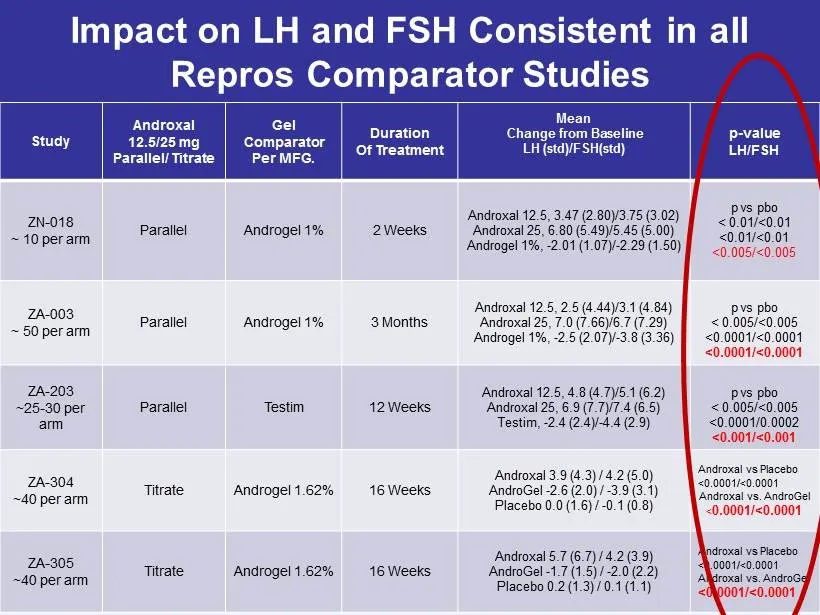
Impact on LH and FSH Consistent in all Repros Comparator Studies Study Androxal 12.5/25 mg Parallel/ Titrate Gel Comparator Per MFG. Duration Of Treatment Mean Change from Baseline LH ( std )/FSH( std ) p - value LH/FSH ZN - 018 ~ 10 per arm Parallel Androgel 1% 2 Weeks Androxal 12.5, 3.47 (2.80)/3.
Slide 19: Androxal Averages % of Men Studied in Normal Range
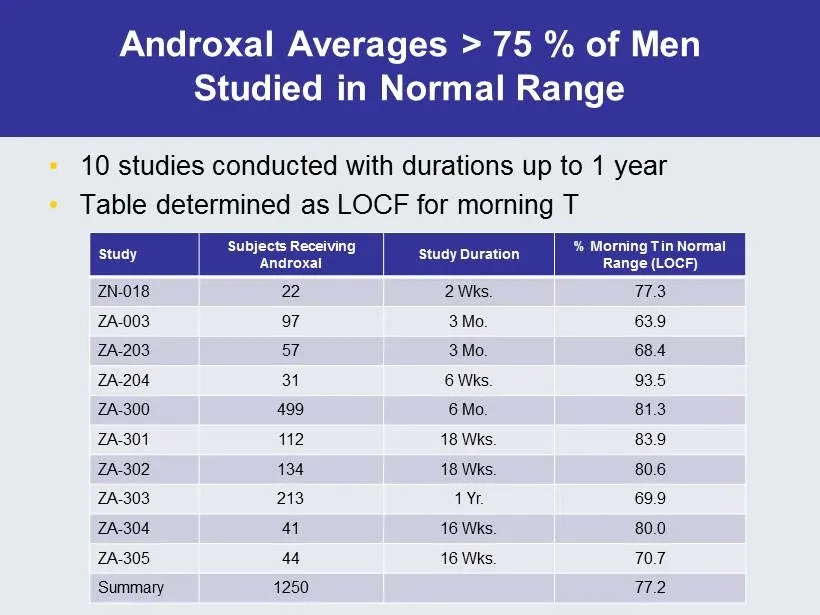
Androxal Averages > 75 % of Men Studied in Normal Range • 10 studies conducted with durations up to 1 year • Table determined as LOCF for morning T Study Subjects Receiving Androxal Study Duration % Morning T in Normal Range (LOCF) ZN - 018 22 2 Wks. 77.3 ZA - 003 97 3 Mo. 63.9 ZA - 203 57 3 Mo. 68.
Slide 20: What Predicts Response?
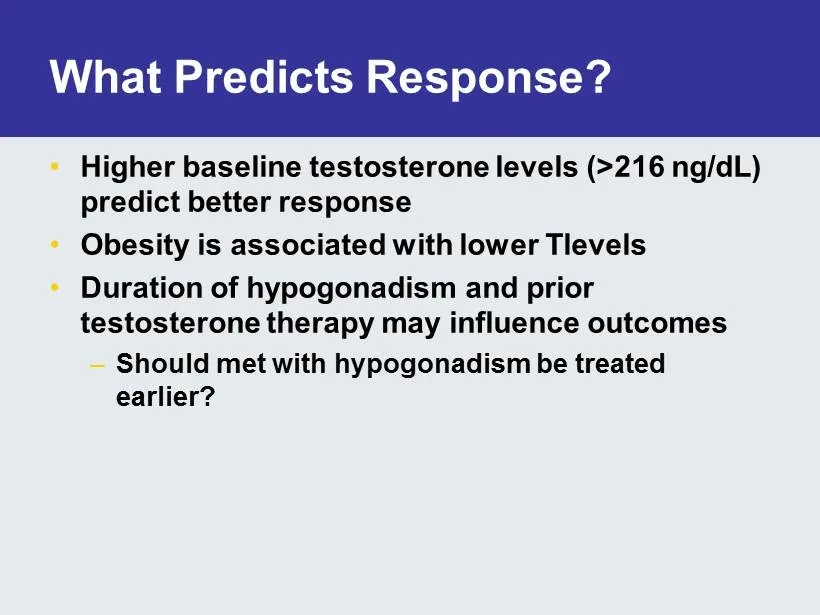
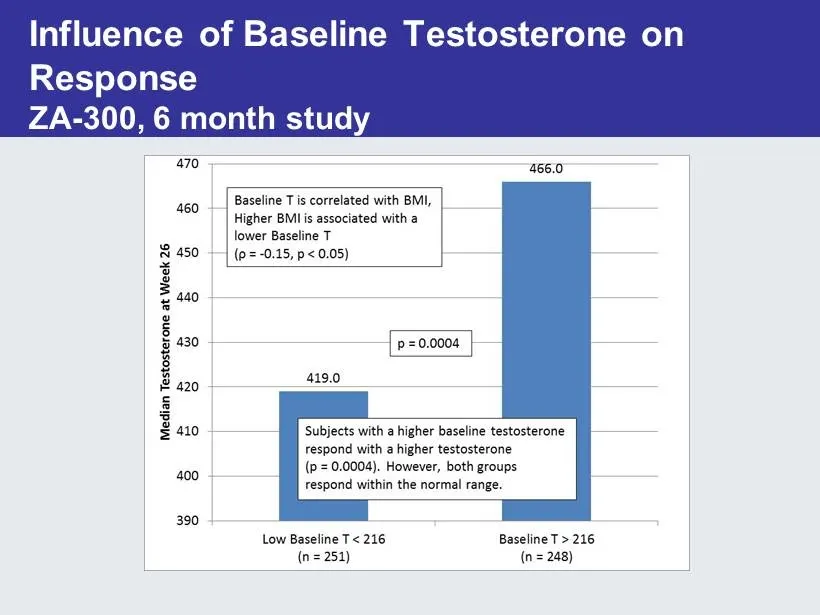
What Predicts Response? • Higher baseline testosterone levels (>216 ng/dL) predict better response • Obesity is associated with lower Tlevels • Duration of hypogonadism and prior testosterone therapy may influence outcomes – Should met with hypogonadism be treated earlier?
Slide 21: Influence of Baseline Testosterone on Response
Influence of Baseline Testosterone on Response ZA - 300, 6 month study
Slide 22: Primary and Secondary Endpoints and Overall NDA Efficacy Findings
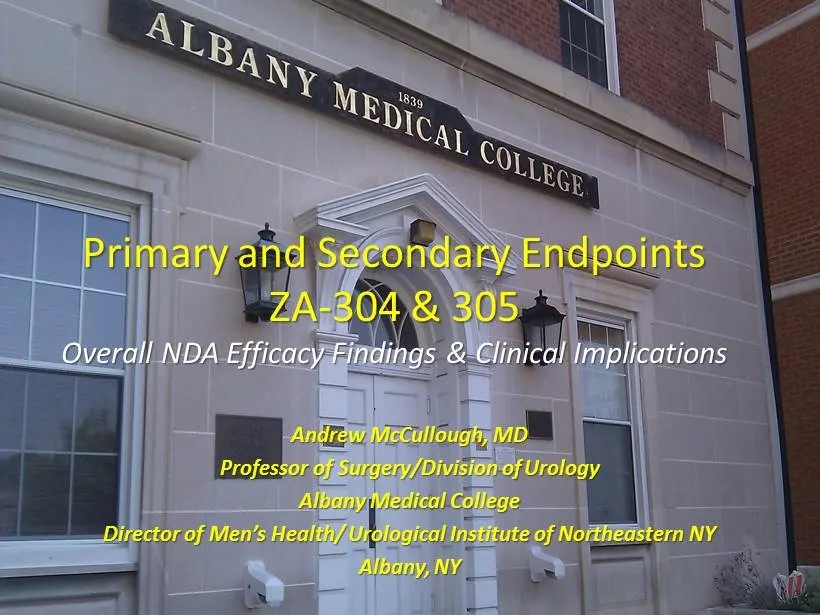
Primary and Secondary Endpoints ZA - 304 & 305 Overall NDA Efficacy Findings & Clinical Implications Andrew McCullough, MD Professor of Surgery/Division of Urology Albany Medical College Director of Men’s Health/ Urological Institute of Northeastern NY Albany, NY
Slide 23: Co-Primary Endpoint: Change in Sperm Concentration
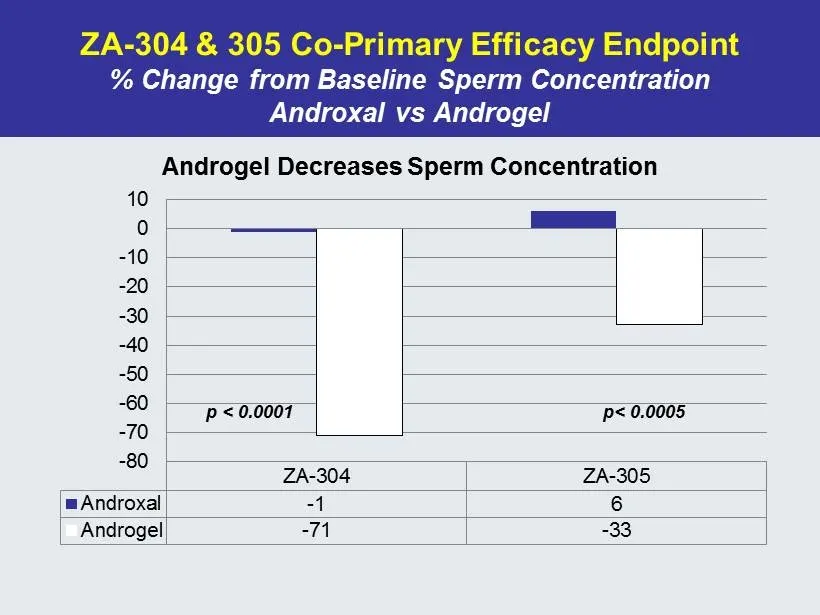
ZA - 304 & 305 Co - Primary Efficacy Endpoint % Change from Baseline Sperm Concentration Androxal vs Androgel ZA-304 ZA-305 Androxal -1 6 Androgel -71 -33 -80 -70 -60 -50 -40 -30 -20 -10 0 10 Androgel Decreases Sperm Concentration p < 0.0001 p< 0.0005
Slide 24: Co-Primary Endpoint: Normal T and Sperm Concentration
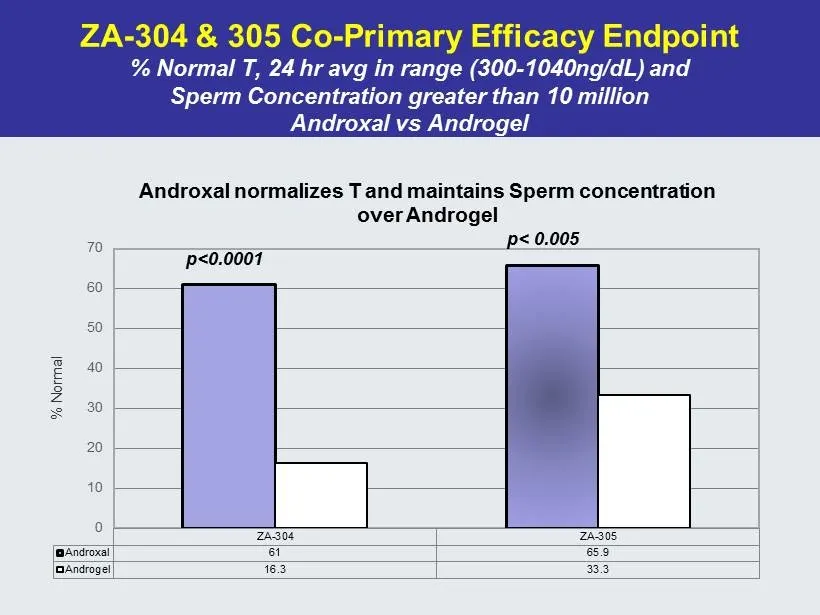
ZA - 304 & 305 Co - Primary Efficacy Endpoint % Normal T, 24 hr avg in range (300 - 1040ng/ dL ) and Sperm Concentration greater than 10 million Androxal vs Androgel ZA-304 ZA-305 Androxal 61 65.9 Androgel 16.3 33.3 0 10 20 30 40 50 60 70 % Normal Androxal normalizes T and maintains Sperm concentrat
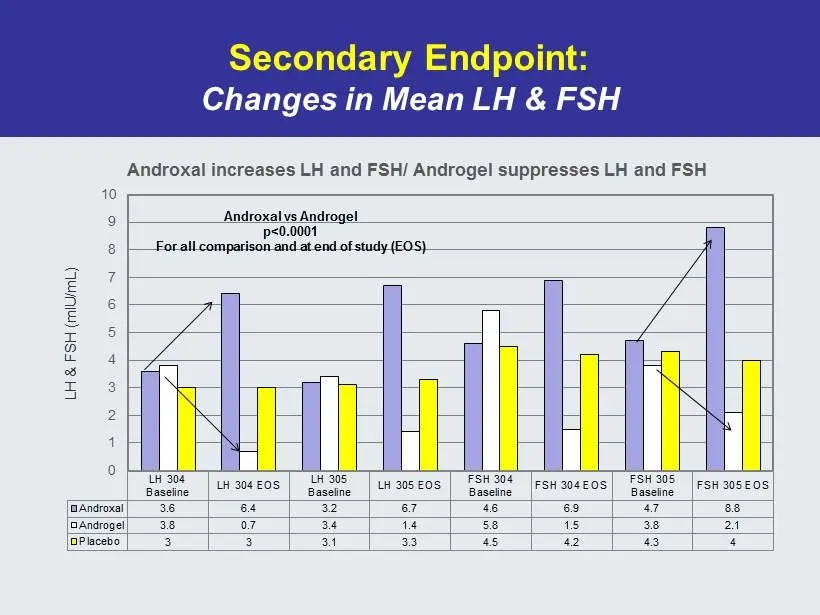
Slide 25: Secondary Endpoint: Changes in Mean LH & FSH
Secondary Endpoint: Changes in Mean LH & FSH LH 304 Baseline LH 304 EOS LH 305 Baseline LH 305 EOS FSH 304 Baseline FSH 304 EOS FSH 305 Baseline FSH 305 EOS Androxal 3.6 6.4 3.2 6.7 4.6 6.9 4.7 8.8 Androgel 3.8 0.7 3.4 1.4 5.8 1.5 3.8 2.1 Placebo 3 3 3.1 3.3 4.5 4.2 4.3 4 0 1 2 3 4 5 6 7 8 9 10 LH &
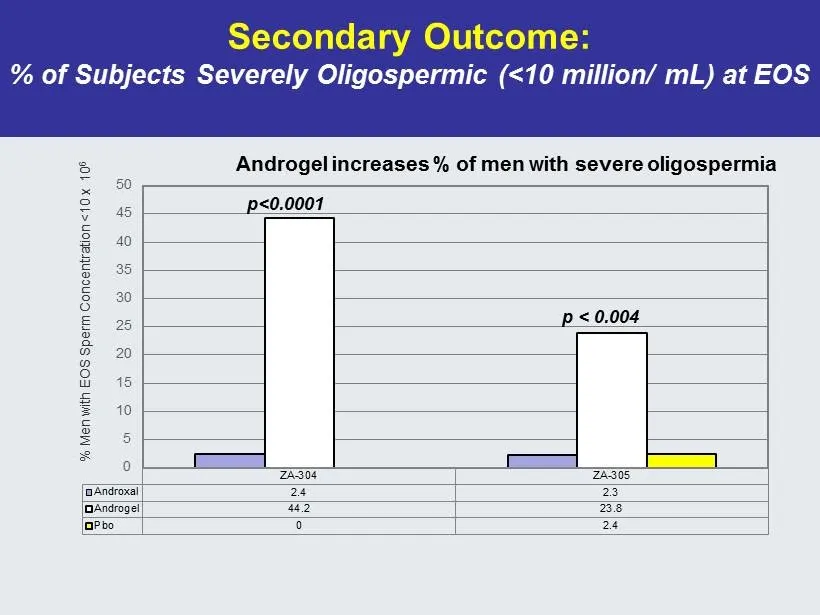
Slide 26: Severely Oligospermic Subjects at End of Study
Secondary Outcome: % of Subjects Severely Oligospermic (<10 million/ mL) at EOS ZA-304 ZA-305 Androxal 2.4 2.3 Androgel 44.2 23.8 Pbo 0 2.4 0 5 10 15 20 25 30 35 40 45 50 % Men with EOS Sperm Concentration <10 x 10 6 Androgel increases % of men with severe oligospermia p<0.0001 p < 0.004
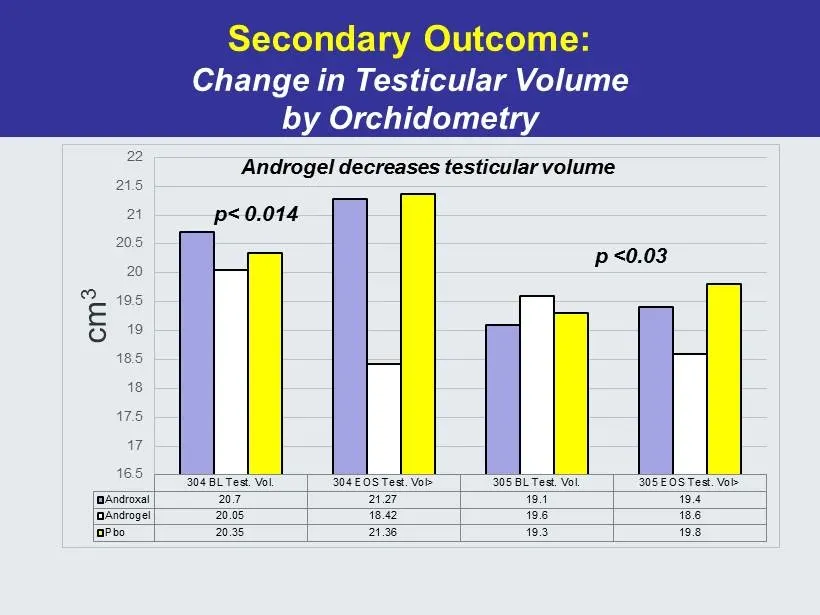
Slide 27: Change in Testicular Volume
Secondary Outcome: Change in Testicular Volume by Orchidometry 304 BL Test. Vol. 304 EOS Test. Vol> 305 BL Test. Vol. 305 EOS Test. Vol> Androxal 20.7 21.27 19.1 19.4 Androgel 20.05 18.42 19.6 18.6 Pbo 20.35 21.36 19.3 19.8 16.5 17 17.5 18 18.5 19 19.5 20 20.5 21 21.5 22 cm 3 p< 0.014 p <0.03 Androg
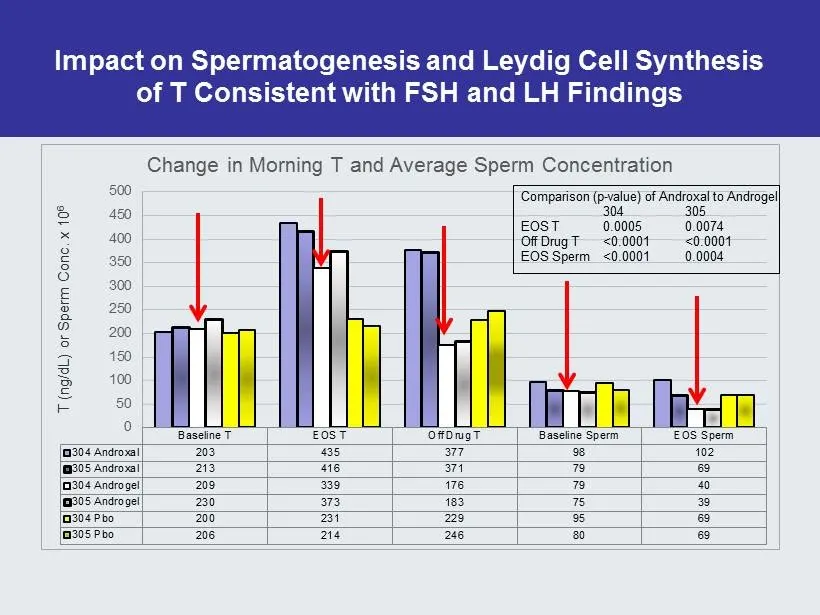
Slide 28: Impact on Spermatogenesis and Leydig Cell Synthesis of T
Impact on Spermatogenesis and Leydig Cell Synthesis of T Consistent with FSH and LH Findings Baseline T EOS T Off Drug T Baseline Sperm EOS Sperm 304 Androxal 203 435 377 98 102 305 Androxal 213 416 371 79 69 304 Androgel 209 339 176 79 40 305 Androgel 230 373 183 75 39 304 Pbo 200 231 229 95 69 305
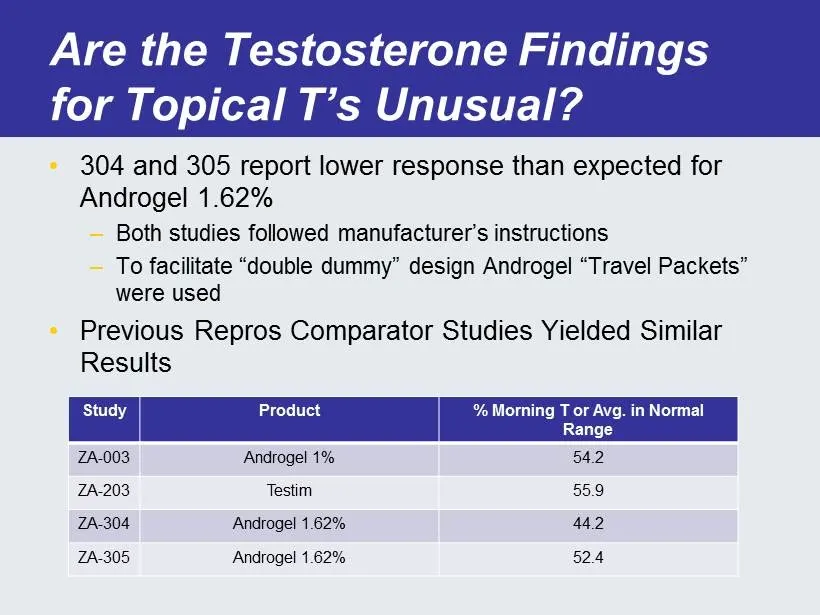
Slide 29: Are the Testosterone Findings for Topical T's Unusual?
Are the Testosterone Findings for Topical T’s Unusual? • 304 and 305 report lower response than expected for Androgel 1.62% – Both studies followed manufacturer’s instructions – To facilitate “double dummy” design Androgel “Travel Packets” were used • Previous Repros Comparator Studies Yielded Simil
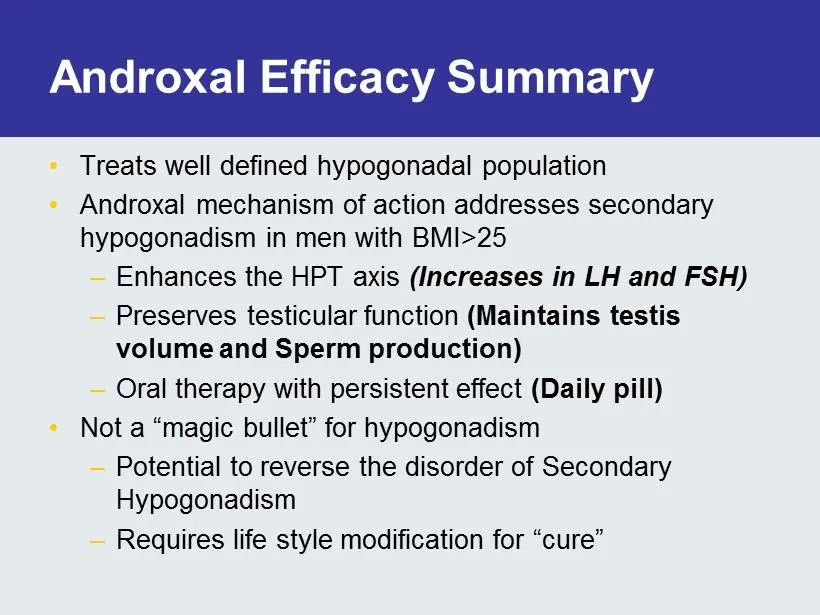
Slide 30: Androxal Efficacy Summary
Androxal Efficacy Summary • Treats well defined hypogonadal population • Androxal mechanism of action addresses secondary hypogonadism in men with BMI>25 – Enhances the HPT axis (Increases in LH and FSH) – Preserves testicular function (Maintains testis volume and Sperm production) – Oral therapy wi
Slide 31: Prevalence of Hypogonadism in Middle-aged and Older Men
Glenn R. Cunningham, MD Professor of Medicine Molecular and Cellular Biology Baylor College of Medicine St. Luke’s - Baylor Diabetes Program Houston, Texas Prevalence of Hypogonadism in Middle - aged and Older Men & Implications for Clinical Management
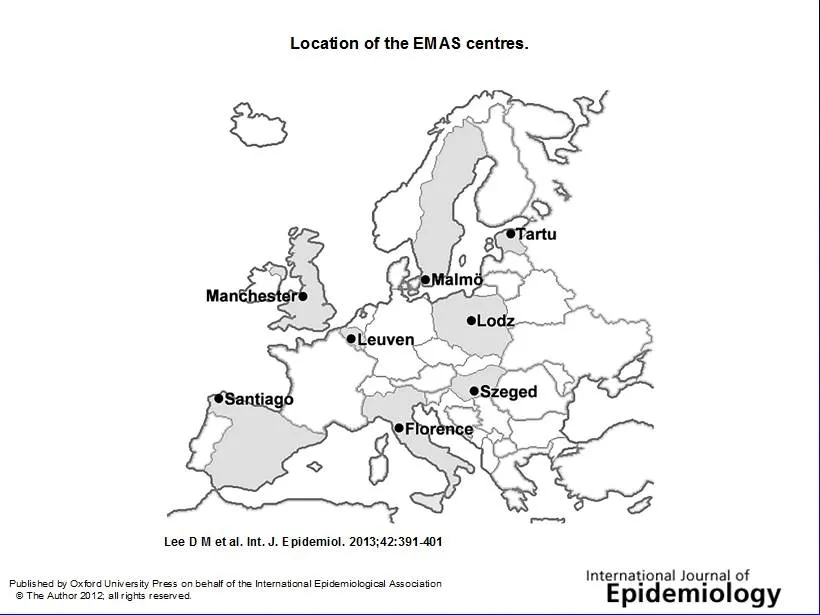
Slide 32: Location of the EMAS centres
Location of the EMAS centres. Lee D M et al. Int. J. Epidemiol. 2013;42:391-401 Published by Oxford University Press on behalf of the International Epidemiological Association ©The Author 2012; all rights reserved.
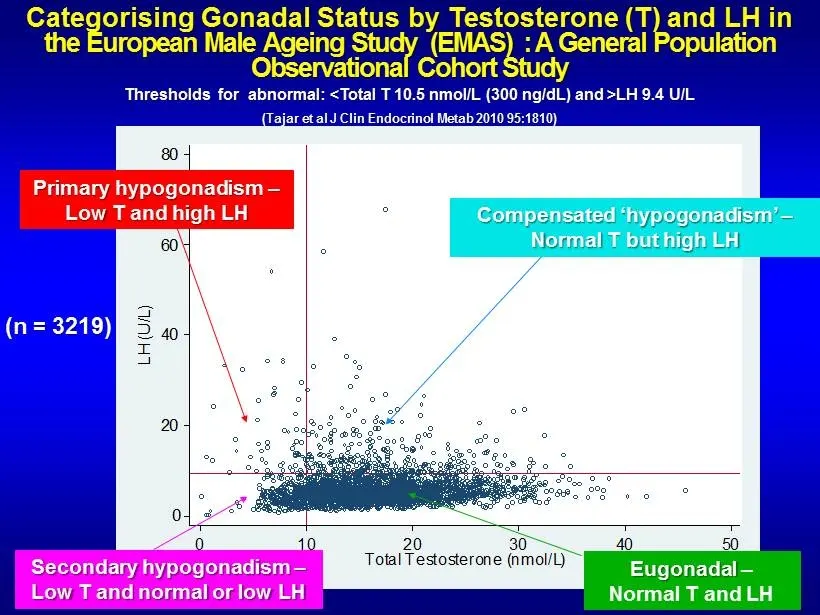
Slide 33: Categorising Gonadal Status in EMAS
Categorising Gonadal Status by Testosterone (T) and LH in the European Male Ageing Study (EMAS) : A General Population Observational Cohort Study Thresholds for abnormal: <Total T 10.5 nmol /L (300 ng/ dL ) and >LH 9.4 U/L (Tajar et al J Clin Endocrinol Metab 2010 95:1810) 0 20 40 60 80 LH (U/L) 0 1
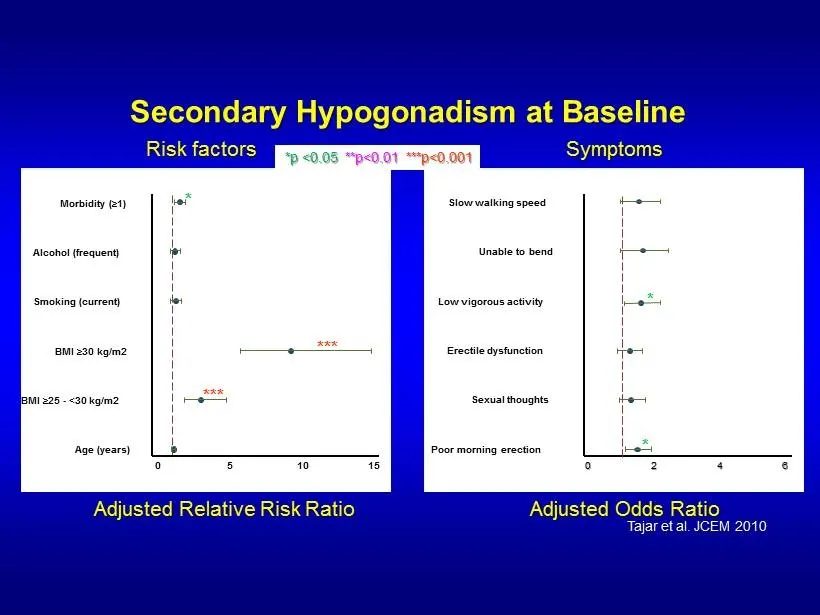
Slide 34: Secondary Hypogonadism at Baseline
Secondary Hypogonadism at Baseline Age (years) BMI ≥ 25 - <30 kg/m2 BMI ≥ 30 kg/m2 Smoking (current) Alcohol (frequent) Morbidity ( ≥ 1) 0 5 10 15 *** *** * Poor morning erection Sexual thoughts Erectile dysfunction Low vigorous activity Unable to bend Slow walking speed 0 2 4 6 * * Adjusted Relativ
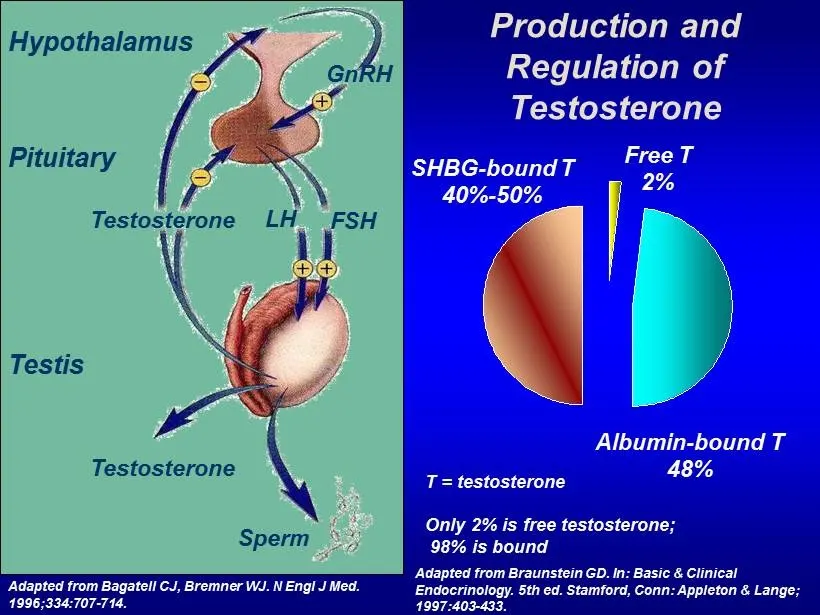
Slide 35: Production and Regulation of Testosterone
Production and Regulation of Testosterone T = testosterone Only 2% is free testosterone; 98% is bound Free T 2% SHBG - bound T 40% - 50% Albumin - bound T 48% Adapted from Bagatell CJ, Bremner WJ. N Engl J Med. 1996;334:707 - 714. GnRH LH FSH Testosterone Testosterone Sperm Hypothalamus Pituitary Te
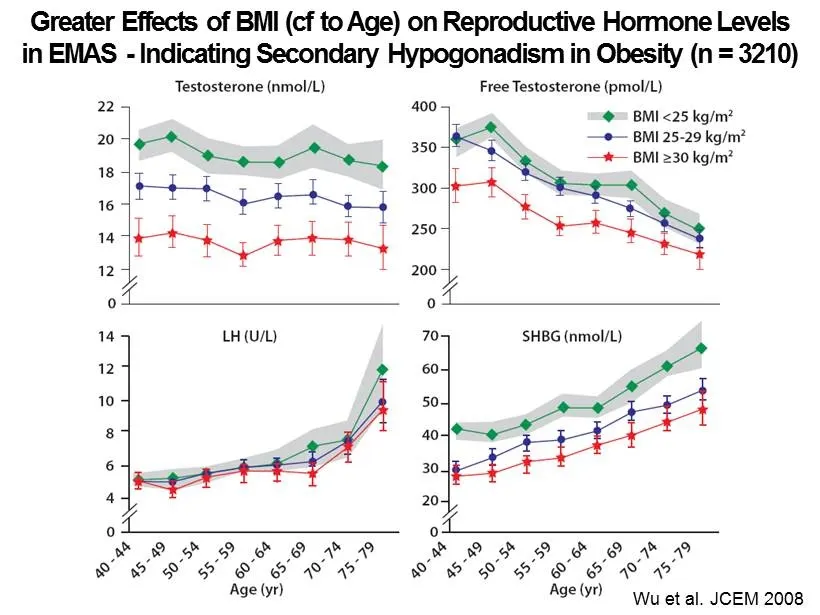
Slide 36: Greater Effects of BMI on Reproductive Hormone Levels in EMAS
Wu et al. JCEM 2008 Greater Effects of BMI ( cf to Age) on Reproductive Hormone Levels in EMAS - Indicating Secondary Hypogonadism in Obesity (n = 3210)
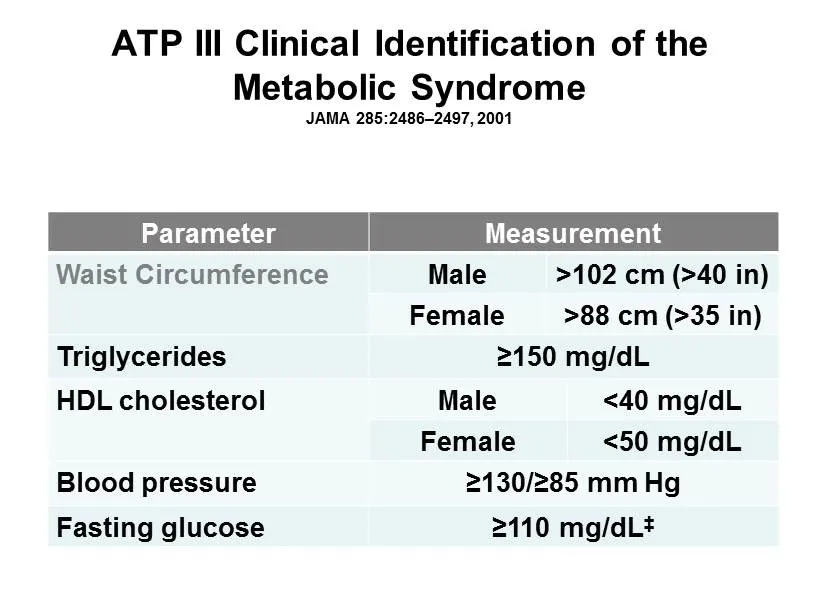
Slide 37: ATP III Clinical Identification of the Metabolic Syndrome
ATP III Clinical Identification of the Metabolic Syndrome JAMA 285:2486 – 2497, 2001 Parameter Measurement Waist Circumference Male >102 cm (>40 in) Female >88 cm (>35 in) Triglycerides ≥150 mg/dL HDL cholesterol Male <40 mg/dL Female <50 mg/dL Blood pressure ≥130/≥85 mm Hg Fasting glucose ≥110 mg/d
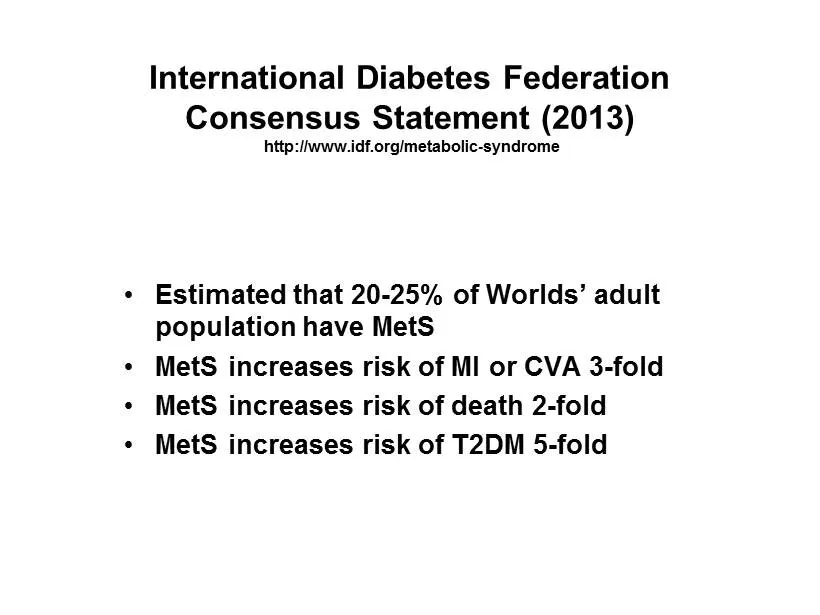
Slide 38: International Diabetes Federation Consensus Statement
International Diabetes Federation Consensus Statement (2013) http://www.idf.org/metabolic - syndrome • Estimated that 20 - 25% of Worlds’ adult population have MetS • MetS increases risk of MI or CVA 3 - fold • MetS increases risk of death 2 - fold • MetS increases risk of T2DM 5 - fold
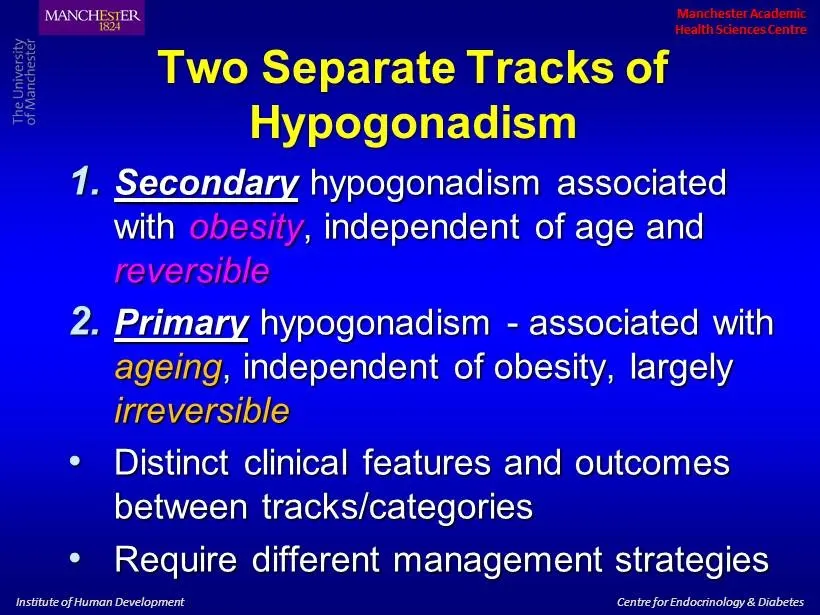
Slide 39: Two Separate Tracks of Hypogonadism
Institute of Human Development Centre for Endocrinology & Diabetes Manchester Academic Health Sciences Centre Institute of Human Development Centre for Endocrinology & Diabetes Manchester Academic Health Sciences Centre Two Separate Tracks of Hypogonadism 1. Secondary hypogonadism associated with ob
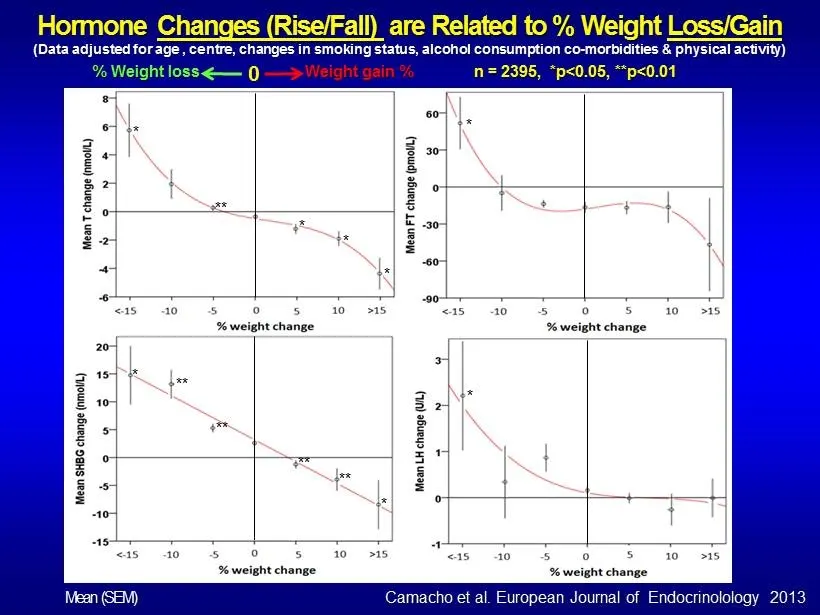
Slide 40: Hormone Changes Related to Weight Loss/Gain
Hormone Changes (Rise/Fall) are Related to % Weight Loss/Gain (Data adjusted for age , centre, changes in smoking status, alcohol consumption co - morbidities & physical activity) n = 2395, *p<0.05, **p<0.01 % Weight loss Weight gain % 0 * ** * * * * * * ** ** ** ** * Camacho et al. European Journal
Slide 41: Clinical Implications
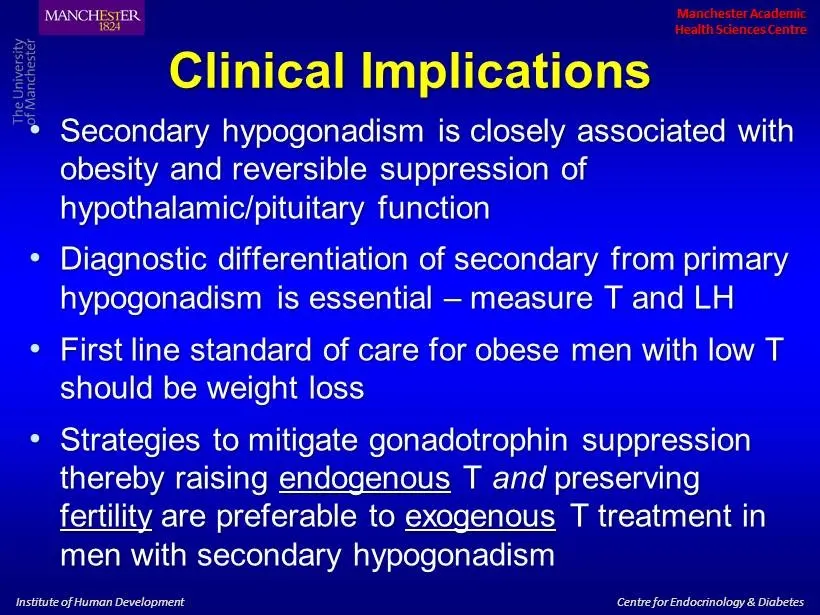
Institute of Human Development Centre for Endocrinology & Diabetes Manchester Academic Health Sciences Centre Institute of Human Development Centre for Endocrinology & Diabetes Manchester Academic Health Sciences Centre Clinical Implications • Secondary hypogonadism is closely associated with obesit
Slide 42: Male hypogonadism and its relationship with obesity and the metabolic syndrome
Male hypogonadism and its relationship with obesity and the metabolic syndrome Prof. Nelly Pitteloud Andrew Dwyer Lausanne, Switzerland
Slide 43: Decrease in Total & Free Testosterone with Increasing BMI
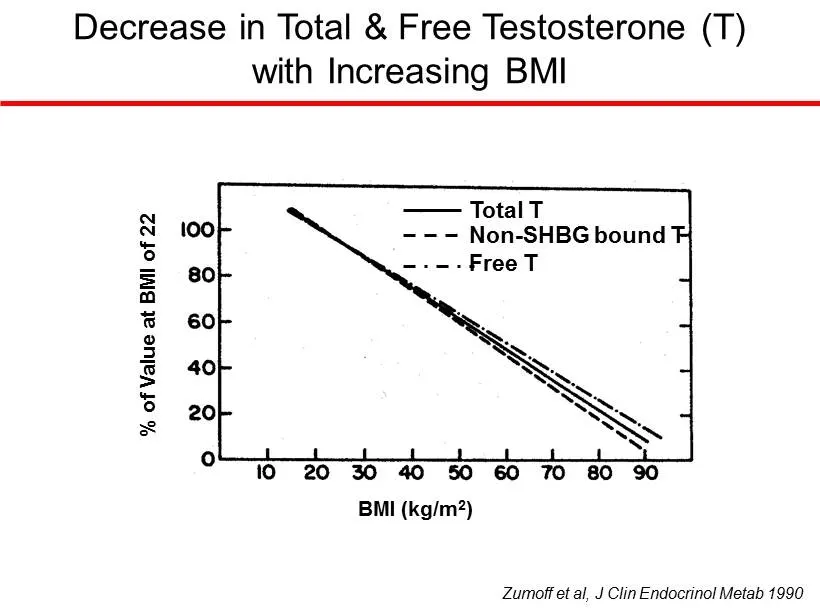
Total T Non - SHBG bound T Free T BMI (kg/m 2 ) % of Value at BMI of 22 Zumoff et al, J Clin Endocrinol Metab 1990 Decrease in Total & Free Testosterone (T) with Increasing BMI
Slide 44: Impact of Hypogonadism on Insulin Sensitivity
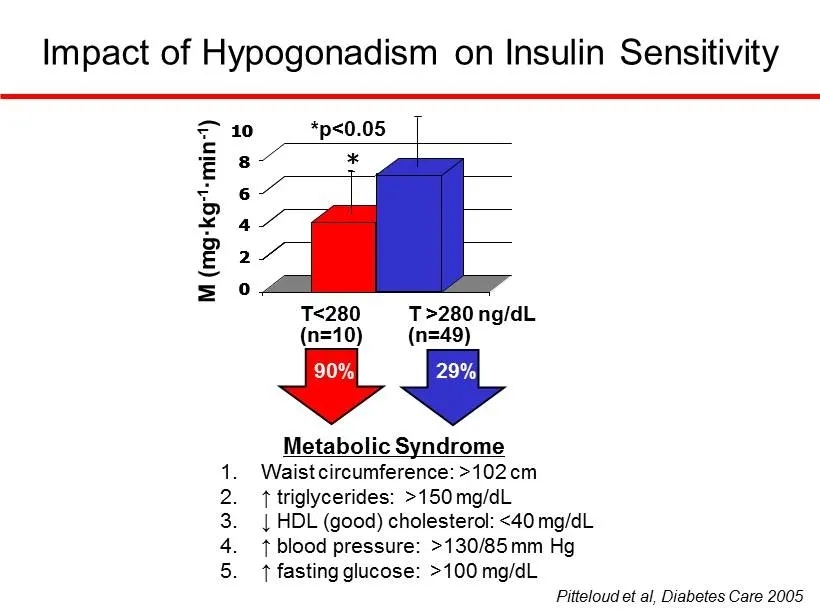
Impact of Hypogonadism on Insulin Sensitivity Metabolic Syndrome 1. Waist circumference: >102 cm 2. ↑ triglycerides: >150 mg/dL 3. ↓ HDL (good) cholesterol: <40 mg/dL 4. ↑ blood pressure: >130/85 mm Hg 5. ↑ fasting glucose: >100 mg/dL *p<0.05 0 2 4 6 8 10 * T<280 * 0 2 4 6 8 10 0 2 4 6 8 10 T >280 n
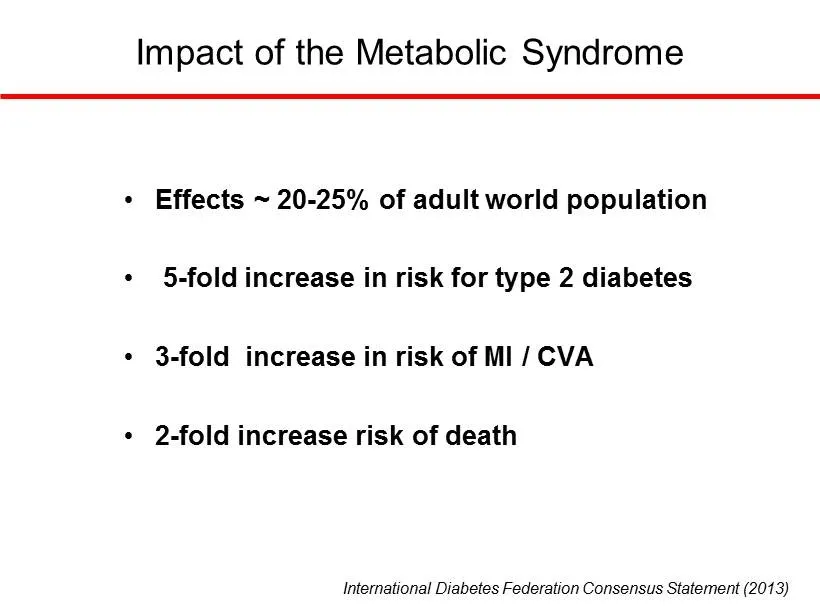
Slide 45: Impact of the Metabolic Syndrome
International Diabetes Federation Consensus Statement (2013) • Effects ~ 20 - 25% of adult world population • 5 - fold increase in risk for type 2 diabetes • 3 - fold increase in risk of MI / CVA • 2 - fold increase risk of death Impact of the Metabolic Syndrome
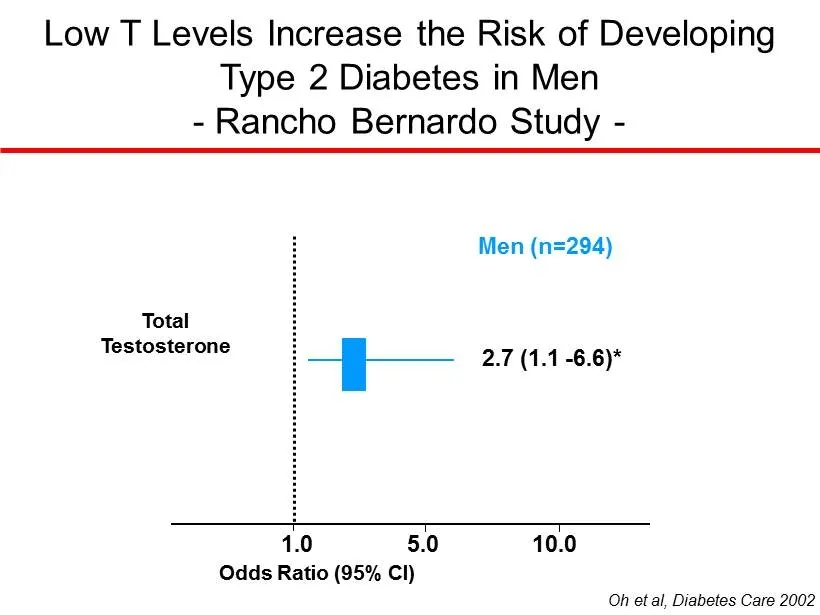
Slide 46: Low T Levels Increase the Risk of Developing Type 2 Diabetes
Low T Levels Increase the Risk of Developing Type 2 Diabetes in Men - Rancho Bernardo Study - 1.0 5.0 10.0 Oh et al, Diabetes Care 2002 Odds Ratio (95% CI) 2.7 (1.1 - 6.6)* Total Testosterone Men (n=294)
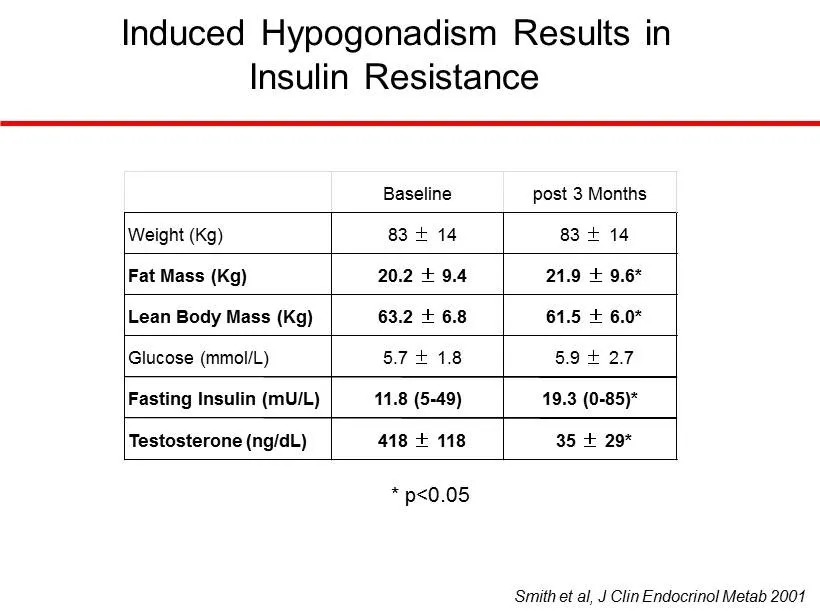
Slide 47: Induced Hypogonadism Results in Insulin Resistance
Induced Hypogonadism Results in Insulin Resistance Smith et al, J Clin Endocrinol Metab 2001 * p<0.05 Baseline post 3 Months Weight (Kg) 83 ± 14 83 ± 14 Fat Mass (Kg) 20.2 ± 9.4 21.9 ± 9.6* Lean Body Mass (Kg) 63.2 ± 6.8 61.5 ± 6.0* Glucose (mmol/L) 5.7 ± 1.8 5.9 ± 2.7 Fasting Insulin (mU/L) 11.8 (5
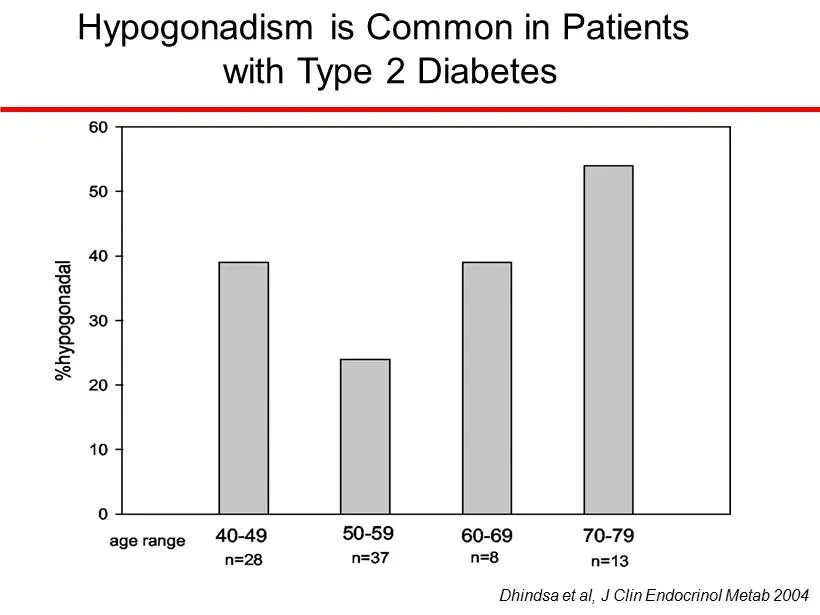
Slide 48: Hypogonadism is Common in Patients with Type 2 Diabetes
Hypogonadism is Common in Patients with Type 2 Diabetes Dhindsa et al, J Clin Endocrinol Metab 2004
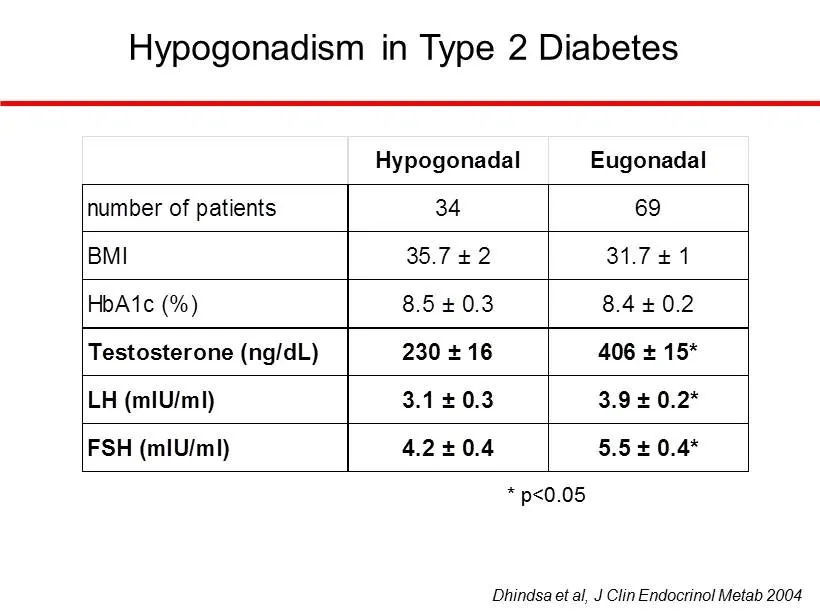
Slide 49: Hypogonadism in Type 2 Diabetes
Hypogonadism in Type 2 Diabetes Hypogonadal Eugonadal number of patients 34 69 BMI 35.7 ± 2 31.7 ± 1 Testosterone (ng/dL) 230 ± 16 406 ± 15* LH (mIU/ml) 3.1 ± 0.3 3.9 ± 0.2* FSH (mIU/ml) 4.2 ± 0.4 5.5 ± 0.4* HbA1c (%) 8.5 ± 0.3 8.4 ± 0.2 Dhindsa et al, J Clin Endocrinol Metab 2004 * p<0.05 Hypogonad
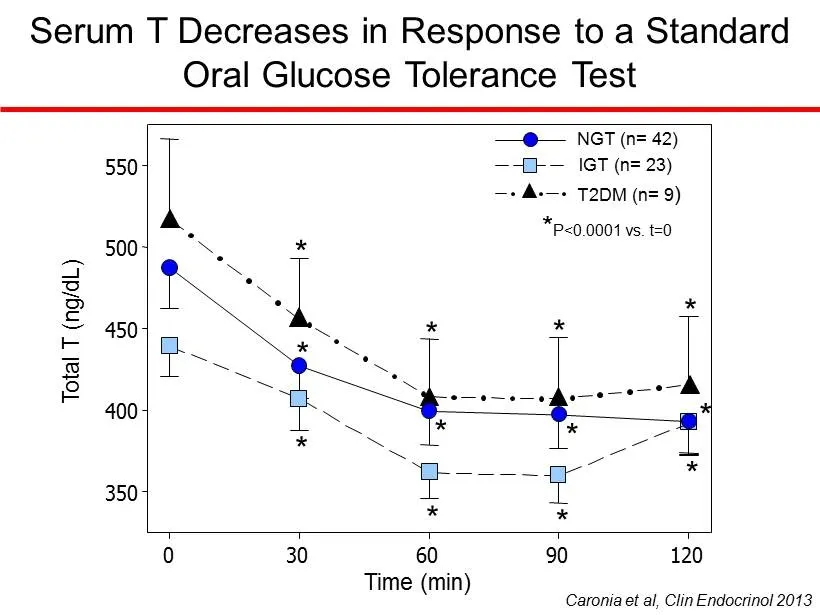
Slide 50: Serum T Decreases in Response to Glucose Tolerance Test
Serum T Decreases in Response to a Standard Oral Glucose Tolerance Test Total T (ng/dL) 350 400 450 500 550 * * * * * * * * * * * * Time (min) 0 30 60 90 120 NGT (n= 42) IGT (n= 23) T2DM (n= 9 ) * P<0.0001 vs. t=0 Caronia et al, Clin Endocrinol 2013
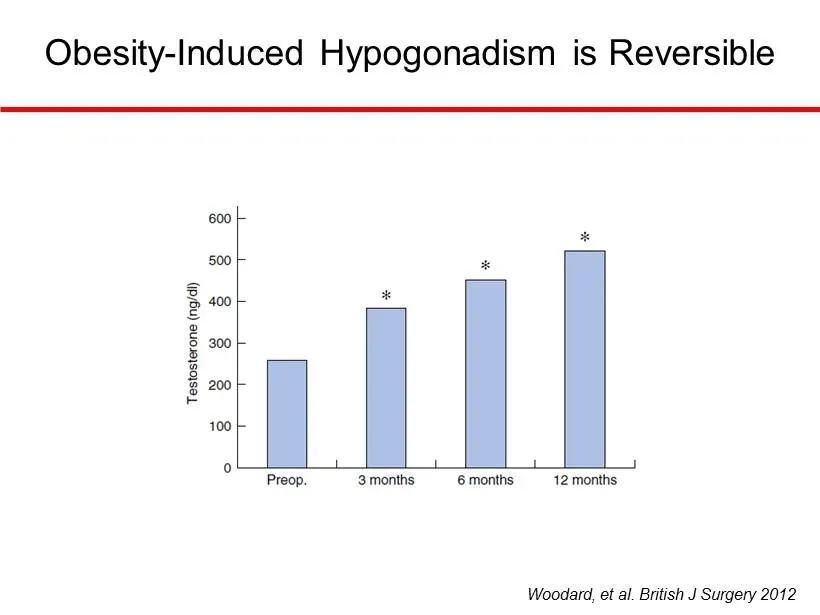
Slide 51: Obesity-Induced Hypogonadism is Reversible
Woodard, et al. British J Surgery 2012 Obesity - Induced Hypogonadism is Reversible
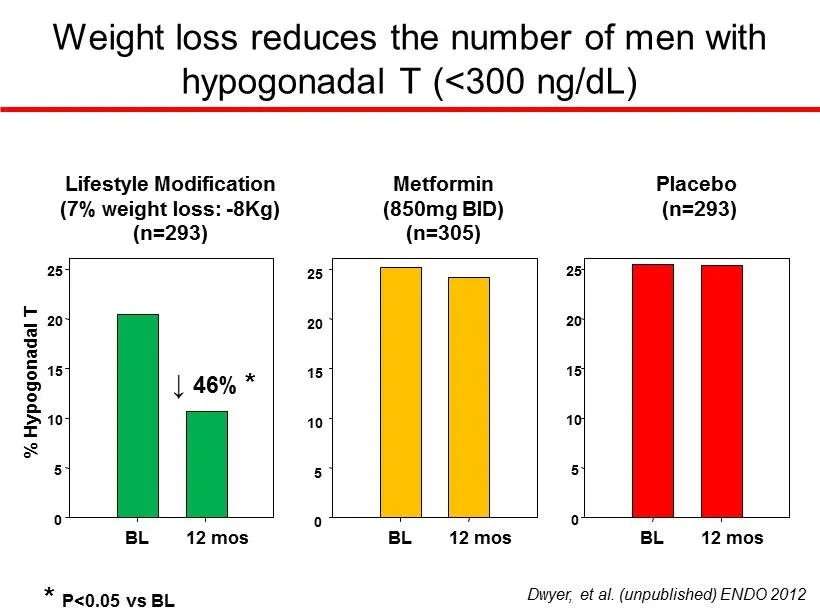
Slide 52: Weight loss reduces the number of men with hypogonadal T
Weight loss reduces the number of men with hypogonadal T (<300 ng/dL) BL 12 mos % Hypogonadal T 0 5 10 15 20 25 BL 12 mos BL 12 mos 0 5 10 15 20 25 0 5 10 15 20 25 Lifestyle Modification (7% weight loss: - 8Kg) (n=293) Metformin (850mg BID) (n=305) Placebo (n=293) * P<0.05 vs BL ↓ 46% * Dwyer, et al
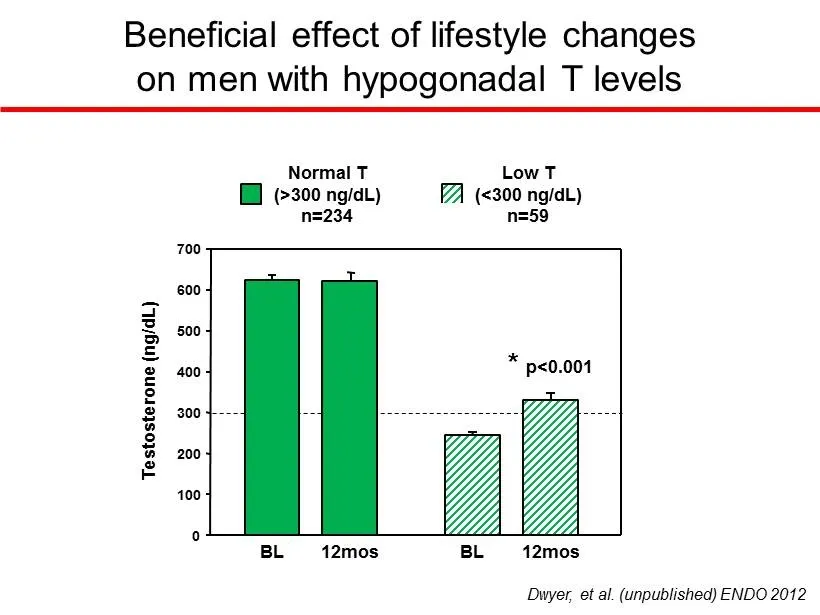
Slide 53: Beneficial effect of lifestyle changes on men with hypogonadal T levels
Beneficial effect of lifestyle changes on men with hypogonadal T levels 0 100 200 300 400 500 600 700 Normal T (>300 ng/dL) n=234 BL 12mos Low T (<300 ng/dL) n=59 BL 12mos Testosterone (ng/dL) Dwyer, et al. (unpublished) ENDO 2012 * p<0.001
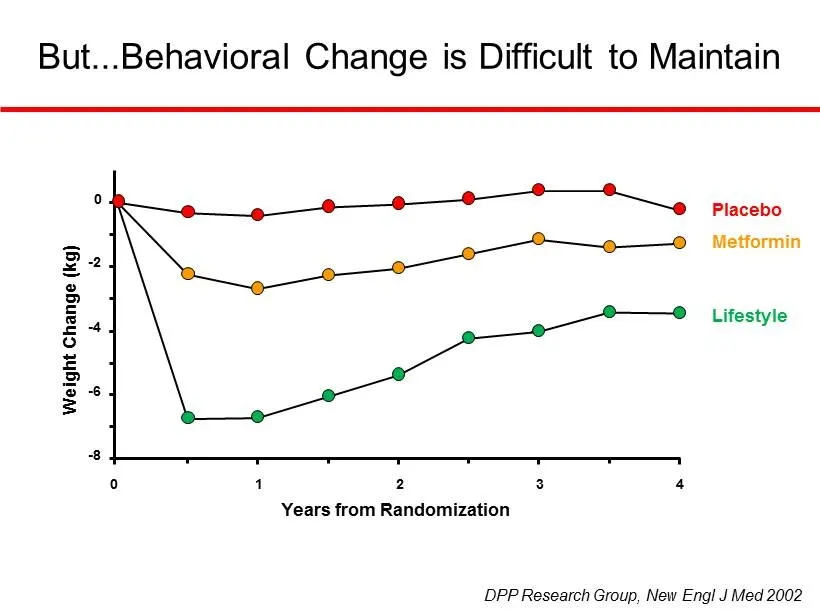
Slide 54: Behavioral Change is Difficult to Maintain
But...Behavioral Change is Difficult to Maintain Placebo Metformin Lifestyle DPP Research Group, New Engl J Med 2002 - 8 - 6 - 4 - 2 0 0 1 2 3 4 Years from Randomization Weight Change (kg)
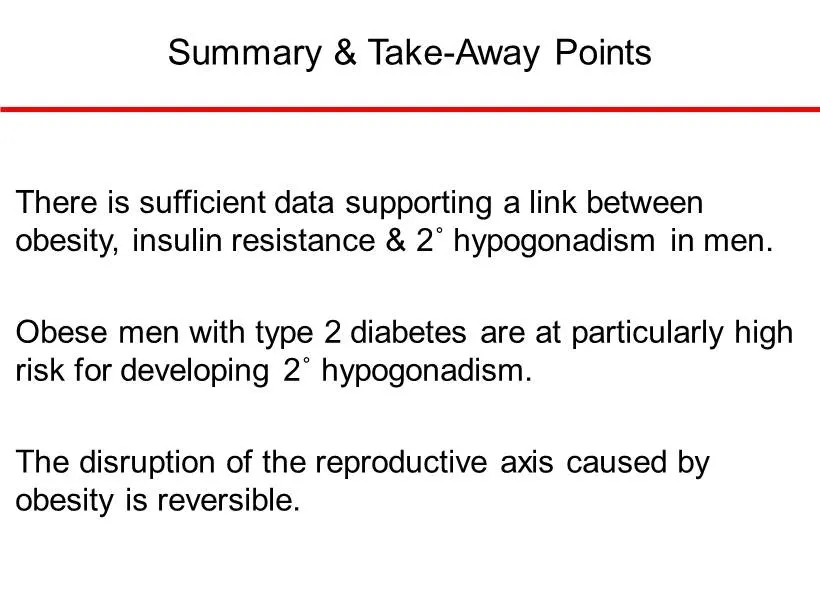
Slide 55: Summary & Take-Away Points
There is sufficient data supporting a link between obesity, insulin resistance & 2˚ hypogonadism in men. The disruption of the reproductive axis caused by obesity is reversible. Obese men with type 2 diabetes are at particularly high risk for developing 2˚ hypogonadism. Summary & Take - Away Points

Slide 56: Thank you
Thank you
Slide 57: Effects of Long-Term Testosterone Therapy in Obese Hypogonadal Men
Effects of Long - Term Testosterone Therapy in Obese Hypogonadal Men Analyst’s Day at The Waldorf Astoria, New York, New York, October 31, 2014 Prof . h.c . Dr. Farid Saad, Global Medical Affairs Andrology, Bayer Pharma AG , Berlin, Germany, Gulf Medical University, Research Department, Ajman, Unite
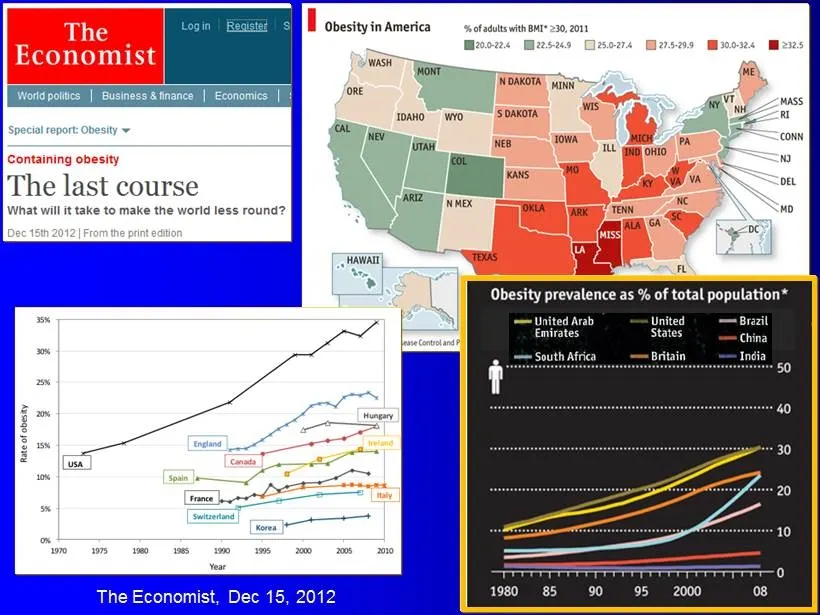
Slide 58: Obesity in America
The Reaistet 9) | Obesity in America of adults with BMI* 230, 2011 - Mao. muse Economist con ore . —_ =i wo foes nana aney Ss The last course be m- phe What will it take to make the world less round? Os a N AWA >
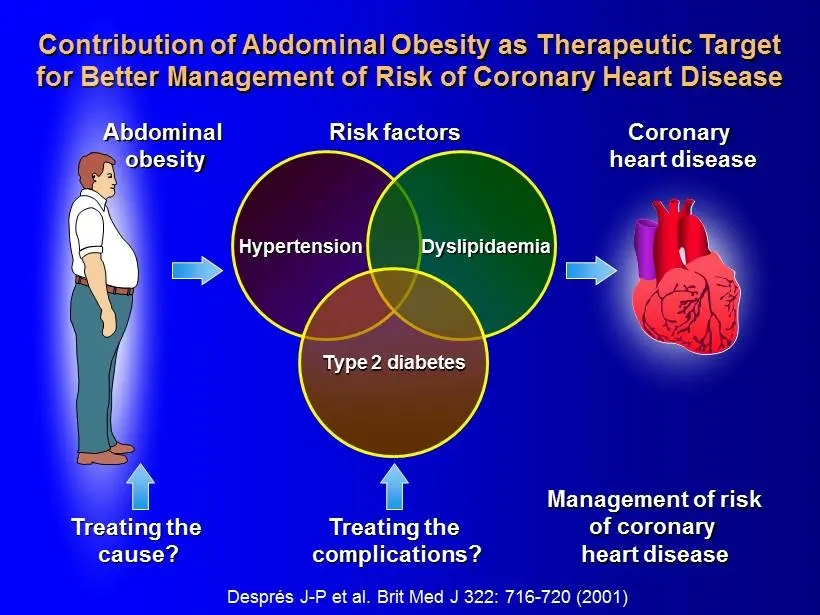
Slide 59: Abdominal Obesity as Therapeutic Target for Coronary Heart Disease Risk
Després J - P et al. Brit Med J 322: 716 - 720 (2001) Contribution of Abdominal Obesity as Therapeutic Target for Better Management of Risk of Coronary Heart Disease Risk factors Coronary heart disease Abdominal obesity Treating the complications? Management of risk of coronary heart disease Treatin
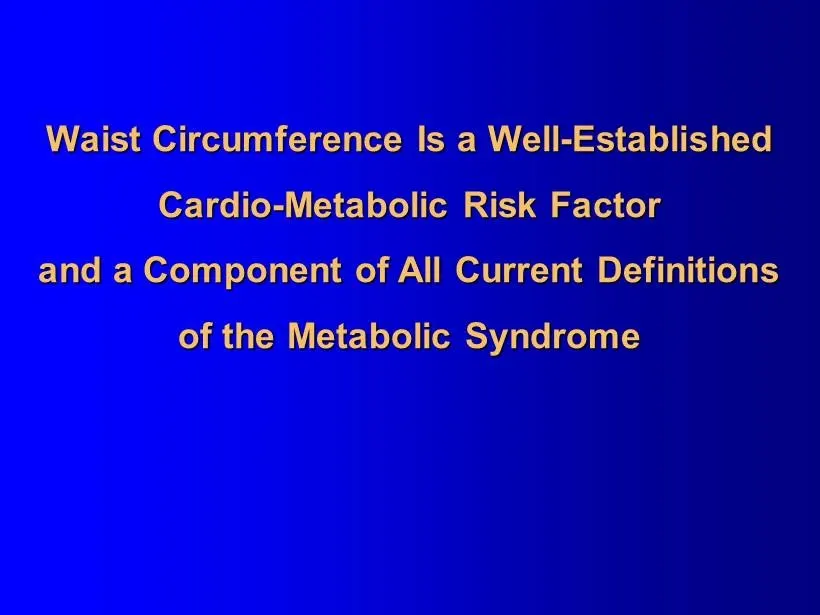
Slide 60: Waist Circumference Is a Cardio-Metabolic Risk Factor
Waist Circumference Is a Well - Established Cardio - Metabolic Risk Factor and a Component of All Current Definitions of the Metabolic Syndrome
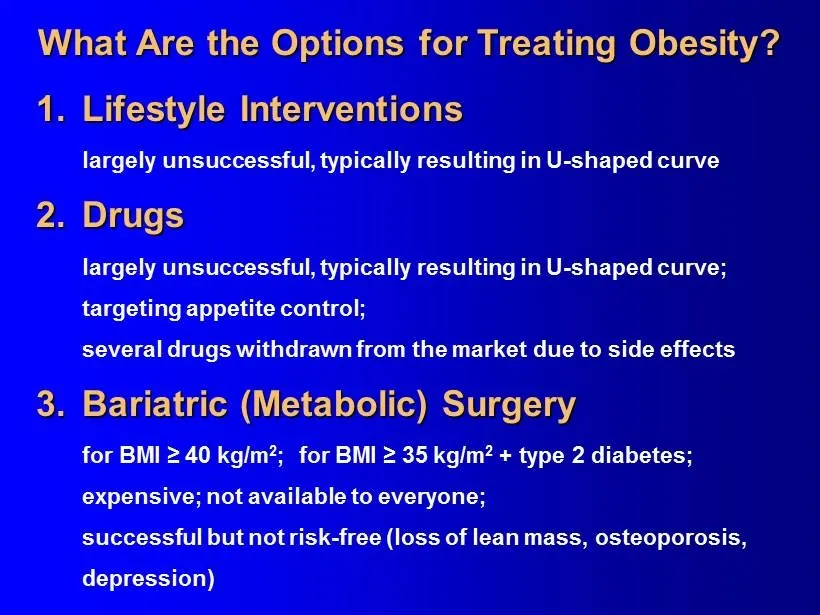
Slide 61: What Are the Options for Treating Obesity?
What Are the Options for Treating Obesity ? 1. Lifestyle Interventions largely unsuccessful , typically resulting in U - shaped curve 2. Drugs largely unsuccessful , typically resulting in U - shaped curve ; targeting appetite control ; several drugs withdrawn from the market due to side effects 3.
Slide 62: Approximately 50% of Obese Men Are Hypogonadal
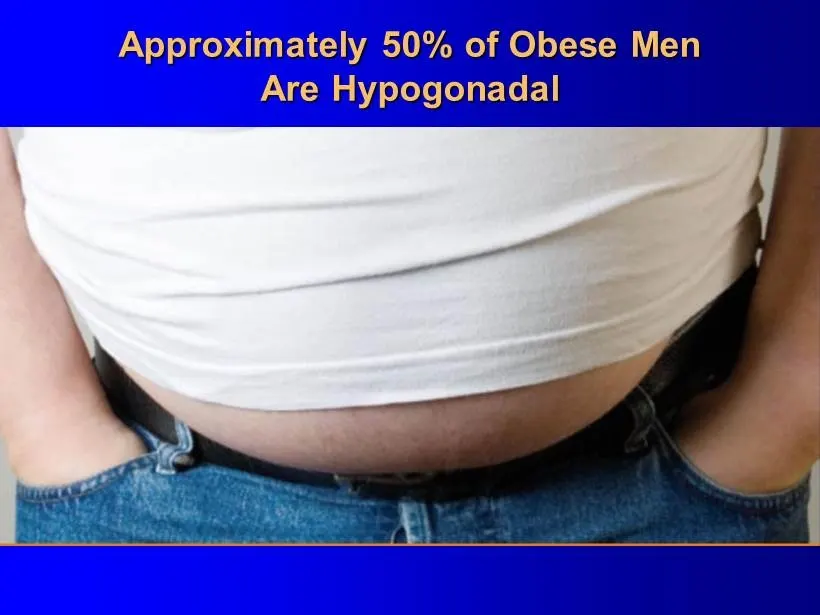
Approximately 50% of Obese Men Are Hypogonadal

Slide 63: Observational Registry Studies from Germany
Observational Registry Studies from Germany
Slide 64: Hypogonadal Men with Different Grades of Obesity from Registry Studies
362 Hypogonadal Men with Different Grades of Obesity from Two Ongoing Registry Studies
Slide 65: Waist Circumference in 362 Hypogonadal Men
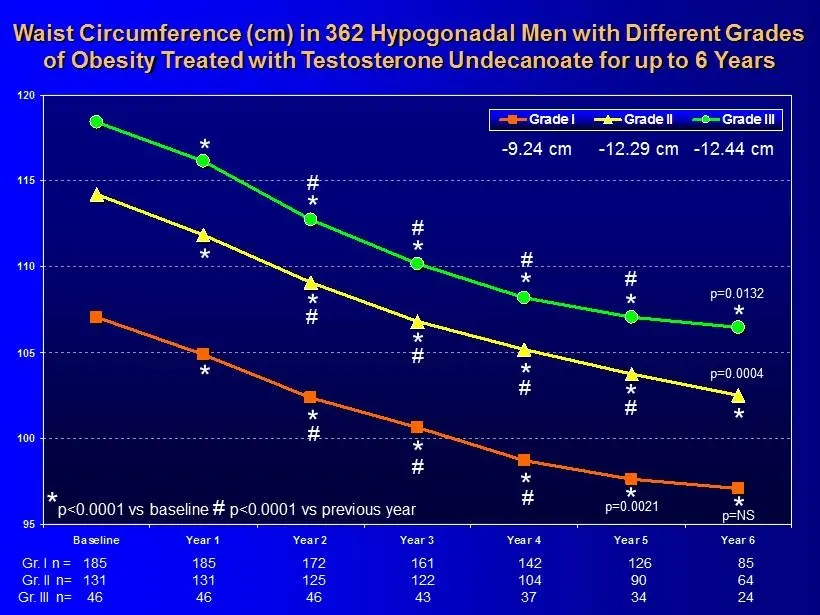
95 100 105 110 115 120 Baseline Year 1 Year 2 Year 3 Year 4 Year 5 Year 6 Grade I Grade II Grade III * * * * 185 161 142 126 85 185 172 * * 131 122 104 90 64 131 125 46 43 37 34 24 46 46 * * * * * * * * * * * * # # # # # # # # # # # p=0.0132 p=0.0004 p=0.0021 p=NS - 9.24 cm - 12.29 cm - 12.44 cm * p
Slide 66: Weight in 362 Hypogonadal Men
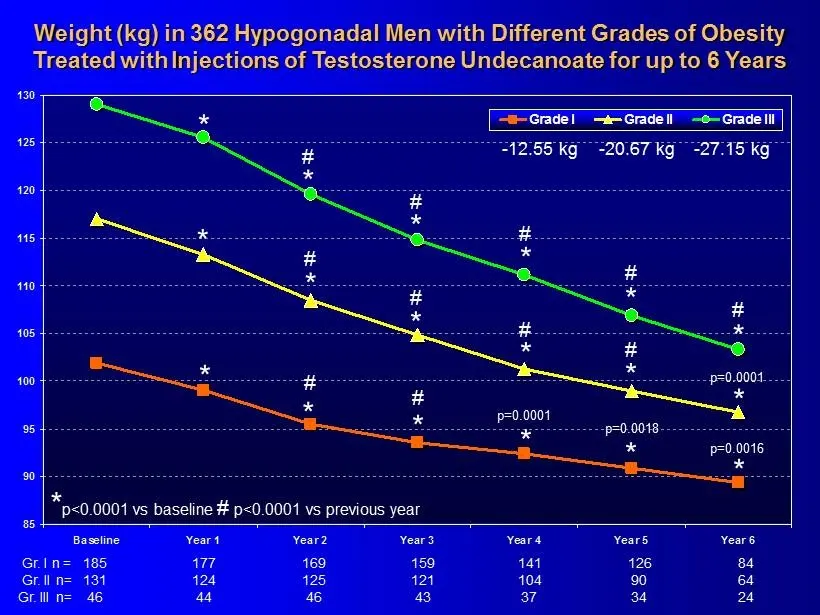
85 90 95 100 105 110 115 120 125 130 Baseline Year 1 Year 2 Year 3 Year 4 Year 5 Year 6 Grade I Grade II Grade III Weight (kg ) in 362 Hypogonadal Men with Different Grades of Obesity Treated with Injections of Testosterone Undecanoate for up to 6 Years * * * * 185 159 141 126 84 177 169 Gr. I n = *
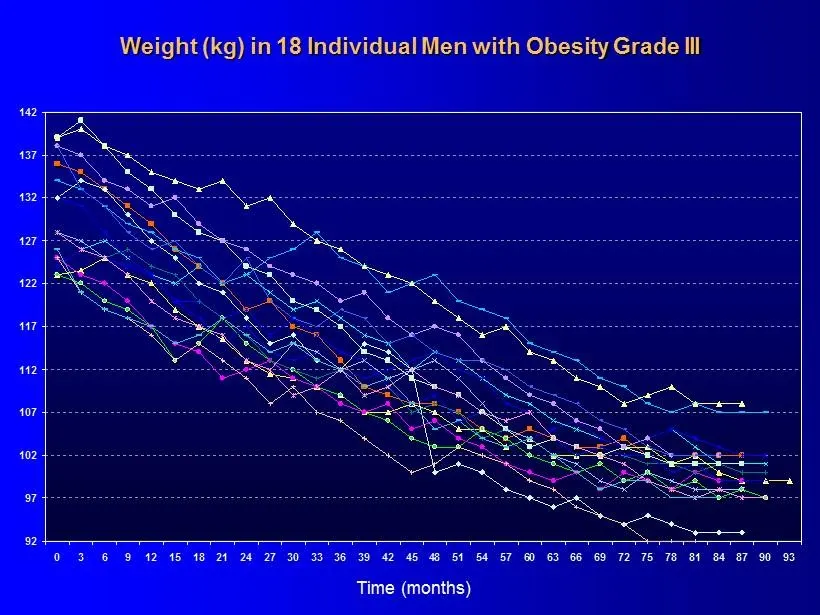
Slide 67: Weight in 18 Individual Men with Obesity Grade III
92 97 102 107 112 117 122 127 132 137 142 0 3 6 9 12 15 18 21 24 27 30 33 36 39 42 45 48 51 54 57 60 63 66 69 72 75 78 81 84 87 90 93 Weight (kg) in 18 Individual Men with Obesity Grade III Time ( months )
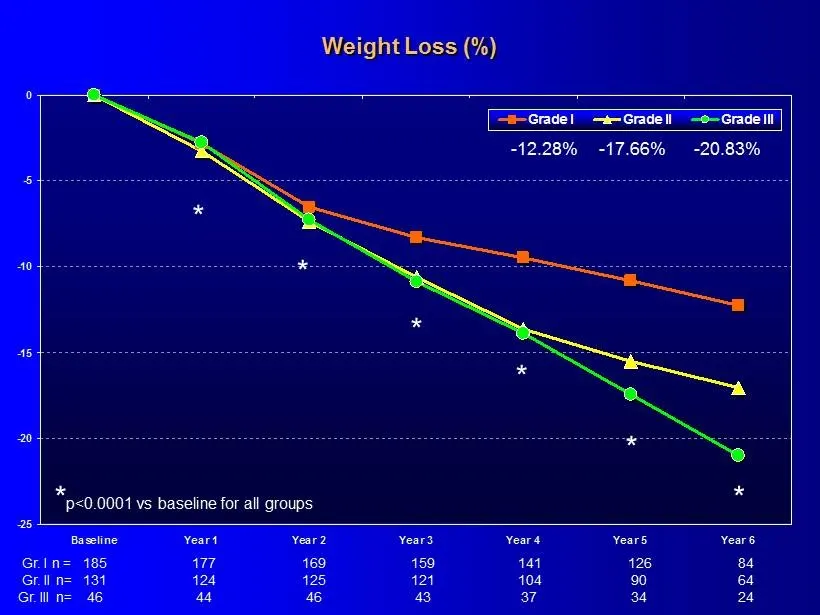
Slide 68: Weight Loss (%)
-25 -20 -15 -10 -5 0 Baseline Year 1 Year 2 Year 3 Year 4 Year 5 Year 6 Grade I Grade II Grade III * p<0.0001 vs baseline for all groups * * * * * * - 12.28% - 17.66% - 20.83% Weight Loss (%) 185 159 141 126 84 177 169 Gr. I n = 131 121 104 90 64 124 125 Gr. II n= 46 43 37 34 24 44 46 Gr. III n=
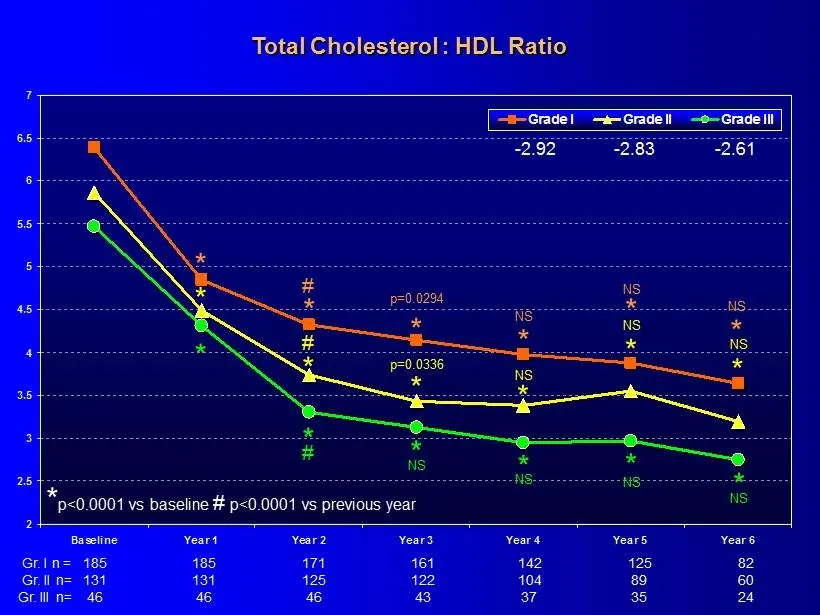
Slide 69: Total Cholesterol:HDL Ratio
2 2.5 3 3.5 4 4.5 5 5.5 6 6.5 7 Baseline Year 1 Year 2 Year 3 Year 4 Year 5 Year 6 Grade I Grade II Grade III Total Cholesterol : HDL Ratio 185 161 142 125 82 185 171 131 122 104 89 60 131 125 46 43 37 35 24 46 46 - 2.92 - 2.83 - 2.61 * * * * * * * * p<0.0001 vs baseline # p<0.0001 vs previous year
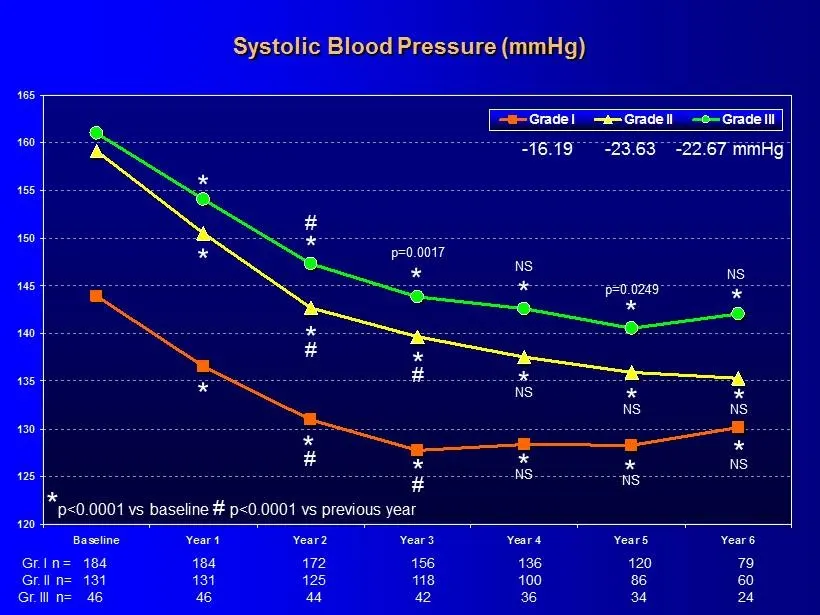
Slide 70: Systolic Blood Pressure
120 125 130 135 140 145 150 155 160 165 Baseline Year 1 Year 2 Year 3 Year 4 Year 5 Year 6 Grade I Grade II Grade III Systolic Blood Pressure (mmHg) * * * * 184 156 136 120 79 184 172 * * 131 118 100 86 60 131 125 46 42 36 34 24 46 44 * * * * * * * # # # # NS - 16.19 - 23.63 - 22.67 mmHg * p<0.0001
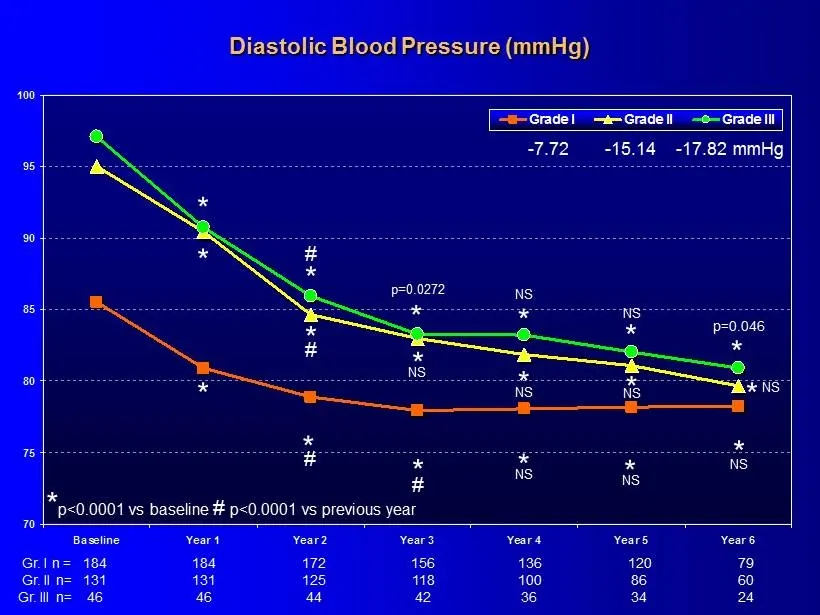
Slide 71: Diastolic Blood Pressure
70 75 80 85 90 95 100 Baseline Year 1 Year 2 Year 3 Year 4 Year 5 Year 6 Grade I Grade II Grade III Diastolic Blood Pressure (mmHg) * * * * * * * * * * * * * # # # # NS - 7.72 - 15.14 - 17.82 mmHg * p<0.0001 vs baseline # p<0.0001 vs previous year p=0.0272 NS NS p =0.046 * NS * NS * NS * NS * NS NS
Slide 72: Hypogonadal Men with Type 2 Diabetes Mellitus from a Registry Study
120 Hypogonadal Men with Type 2 Diabetes Mellitus (T2DM) from an Ongoing Registry Study
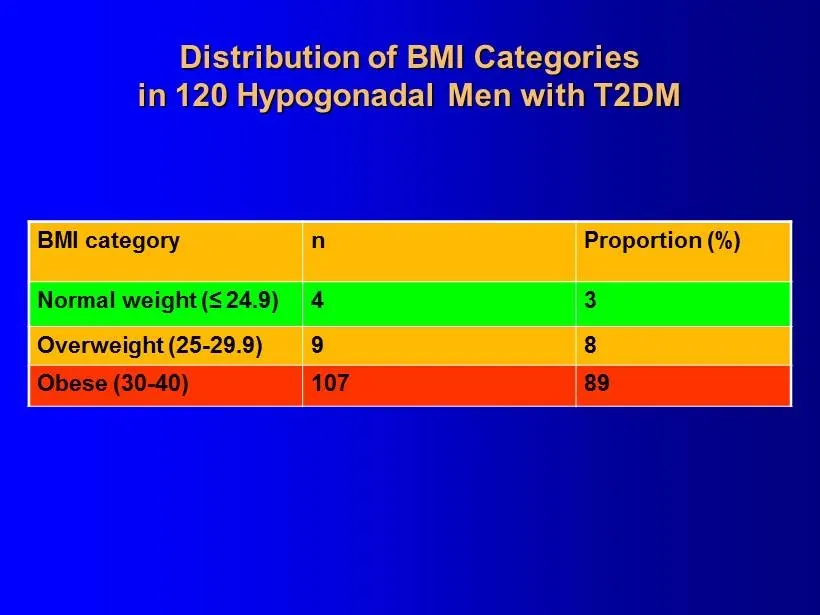
Slide 73: Distribution of BMI Categories in Hypogonadal Men with T2DM
Distribution of BMI Categories in 120 Hypogonadal Men with T2DM BMI category n Proportion (%) Normal weight (≤ 24.9) 4 3 Overweight (25 - 29.9) 9 8 Obese (30 - 40) 107 89
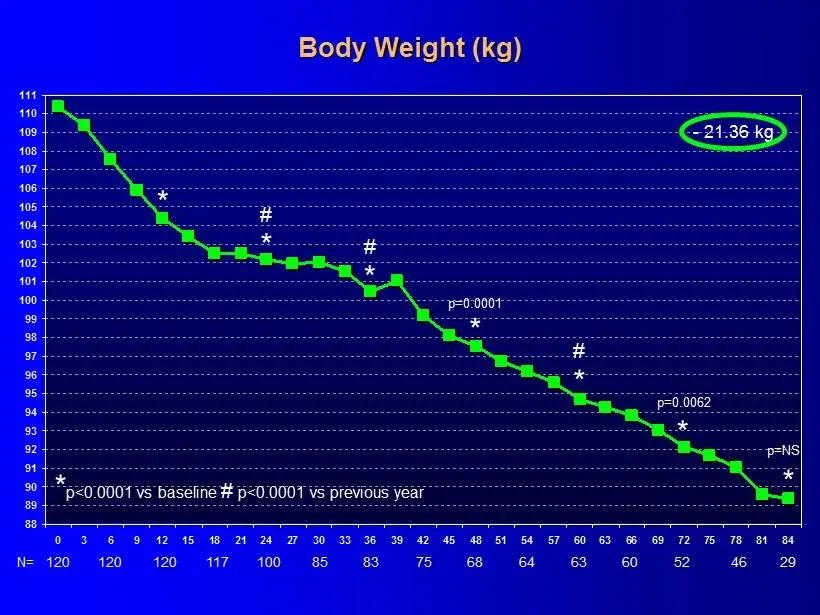
Slide 74: Body Weight
88 89 90 91 92 93 94 95 96 97 98 99 100 101 102 103 104 105 106 107 108 109 110 111 0 3 6 9 12 15 18 21 24 27 30 33 36 39 42 45 48 51 54 57 60 63 66 69 72 75 78 81 84 * p<0.0001 vs baseline # p<0.0001 vs previous year * * # - 21.36 kg * p = NS 120 N= 120 120 117 100 85 83 75 68 64 63 60 29 52 46 * #
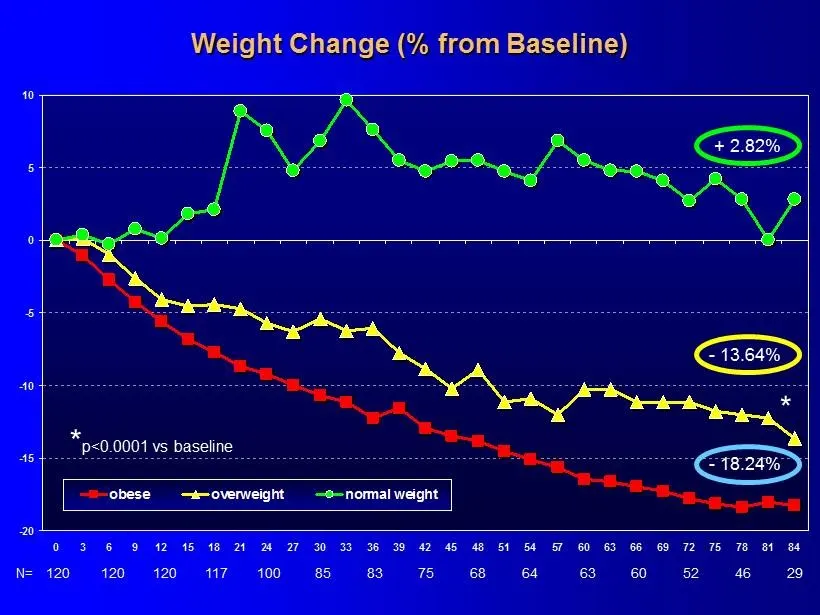
Slide 75: Weight Change from Baseline
-20 -15 -10 -5 0 5 10 0 3 6 9 12 15 18 21 24 27 30 33 36 39 42 45 48 51 54 57 60 63 66 69 72 75 78 81 84 obese overweight normal weight Weight Change (% from Baseline) * p<0.0001 vs baseline + 2.82% * 120 N= 120 120 117 100 85 83 75 68 64 63 60 29 52 46 - 13.64% - 18.24%
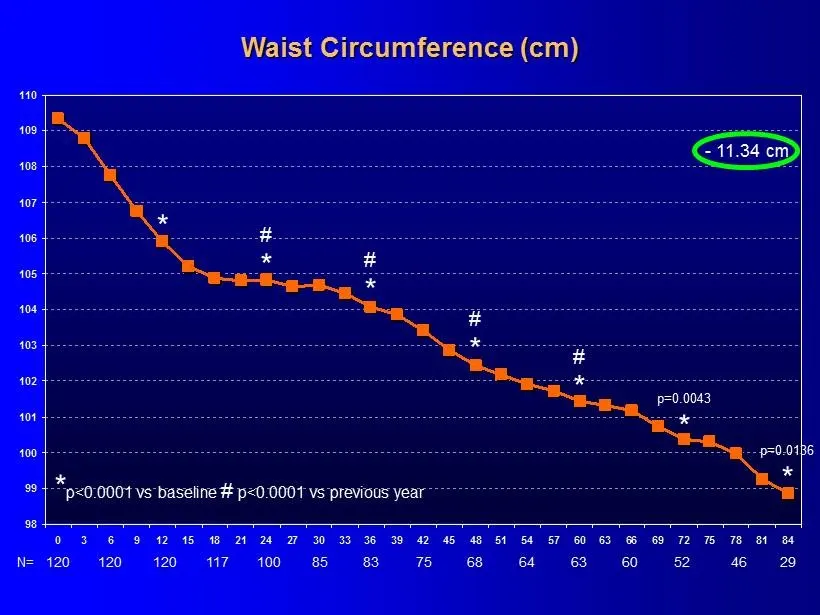
Slide 76: Waist Circumference
98 99 100 101 102 103 104 105 106 107 108 109 110 0 3 6 9 12 15 18 21 24 27 30 33 36 39 42 45 48 51 54 57 60 63 66 69 72 75 78 81 84 * p<0.0001 vs baseline # p<0.0001 vs previous year Waist Circumference (cm) * * # * - 11.34 cm p = 0.0043 120 N= 120 120 117 100 85 83 75 68 64 63 60 29 52 46 * # * #
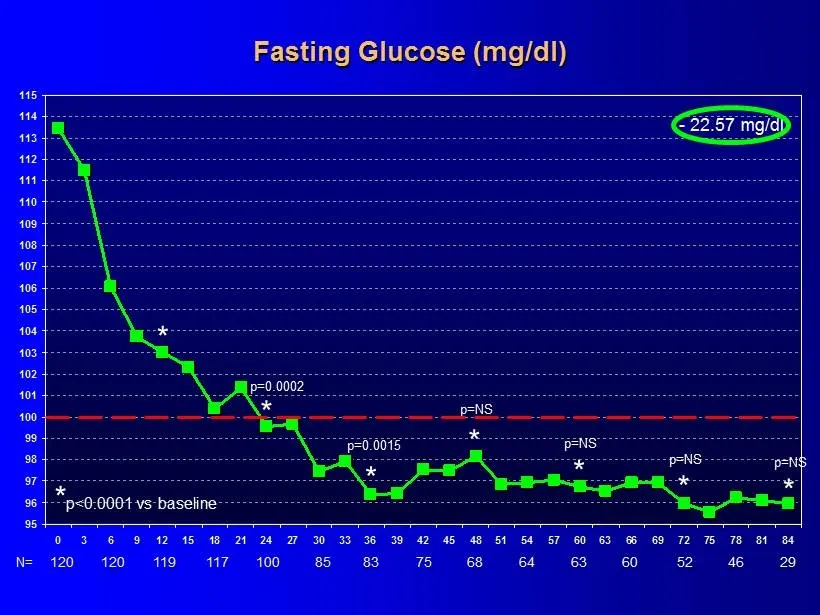
Slide 77: Fasting Glucose
95 96 97 98 99 100 101 102 103 104 105 106 107 108 109 110 111 112 113 114 115 0 3 6 9 12 15 18 21 24 27 30 33 36 39 42 45 48 51 54 57 60 63 66 69 72 75 78 81 84 * p<0.0001 vs baseline * * - 22.57 mg/dl Fasting Glucose (mg/dl) p = 0.0002 * * p = NS 120 N= 120 119 117 100 85 83 75 68 64 63 60 29 52 4
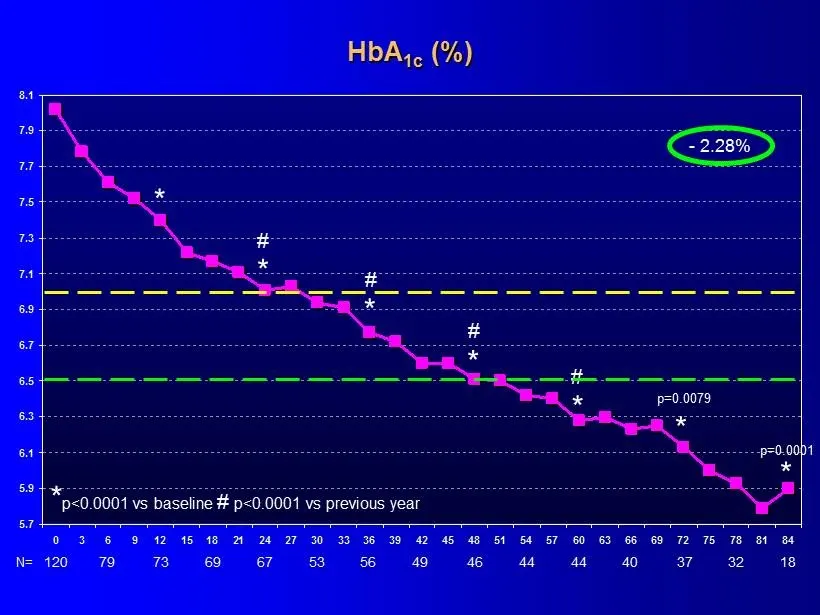
Slide 78: HbA1c (%)
5.7 5.9 6.1 6.3 6.5 6.7 6.9 7.1 7.3 7.5 7.7 7.9 8.1 0 3 6 9 12 15 18 21 24 27 30 33 36 39 42 45 48 51 54 57 60 63 66 69 72 75 78 81 84 - 2.28% * p<0.0001 vs baseline # p<0.0001 vs previous year * * # * * * * * HbA 1c (%) 120 N= 79 73 69 67 53 56 49 46 44 44 40 18 37 32 # # # p = 0.0079 p = 0.0001
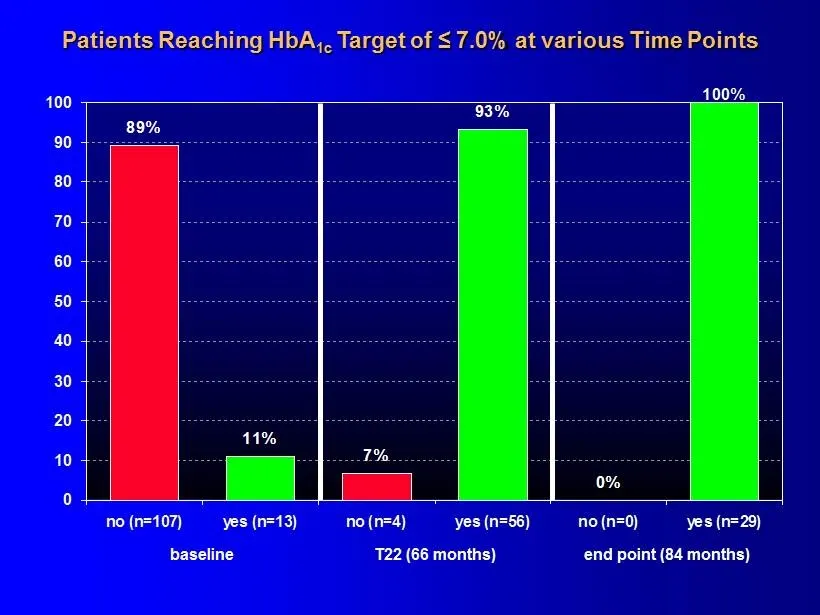
Slide 79: Patients Reaching HbA1c Target of 7.0% or Less
Patients Reaching HbA 1c Target of ≤ 7.0% at various Time Points 0% 100% 93% 7% 11% 89% 0 10 20 30 40 50 60 70 80 90 100 no (n=107) yes (n=13) no (n=4) yes (n=56) no (n=0) yes (n=29) baseline end point (84 months) T22 (66 months)
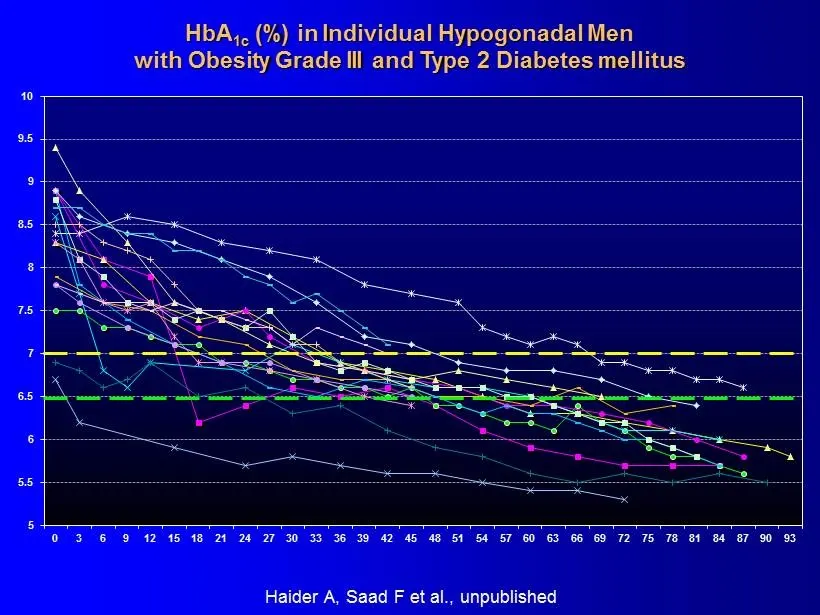
Slide 80: HbA1c in Individual Hypogonadal Men with Obesity Grade III and T2DM
5 5.5 6 6.5 7 7.5 8 8.5 9 9.5 10 0 3 6 9 12 15 18 21 24 27 30 33 36 39 42 45 48 51 54 57 60 63 66 69 72 75 78 81 84 87 90 93 HbA 1c (%) in Individual Hypogonadal Men with Obesity Grade III and Type 2 Diabetes mellitus Haider A, Saad F et al ., unpublished
Slide 81: Observational Data Confirmed by A Controlled Study
Observational Data Confirmed by A Controlled Study
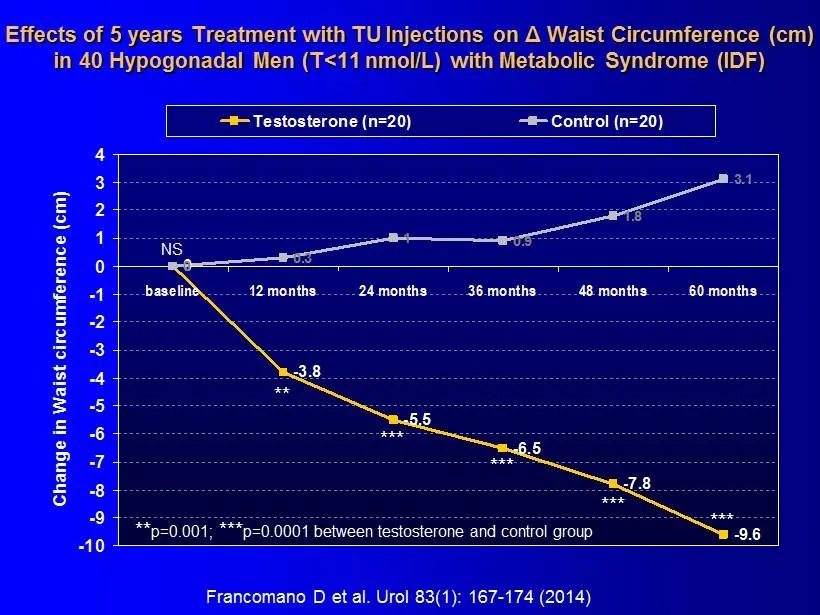
Slide 82: Effects of Treatment with TU Injections on Waist Circumference
Effects of 5 years Treatment with TU Injections on Δ Waist Circumference (cm) in 40 Hypogonadal Men (T<11 nmol/L) with Metabolic Syndrome (IDF) 0 -3.8 -5.5 -6.5 -7.8 -9.6 0 0.3 1 0.9 1.8 3.1 -10 -9 -8 -7 -6 -5 -4 -3 -2 -1 0 1 2 3 4 baseline 12 months 24 months 36 months 48 months 60 months Change in
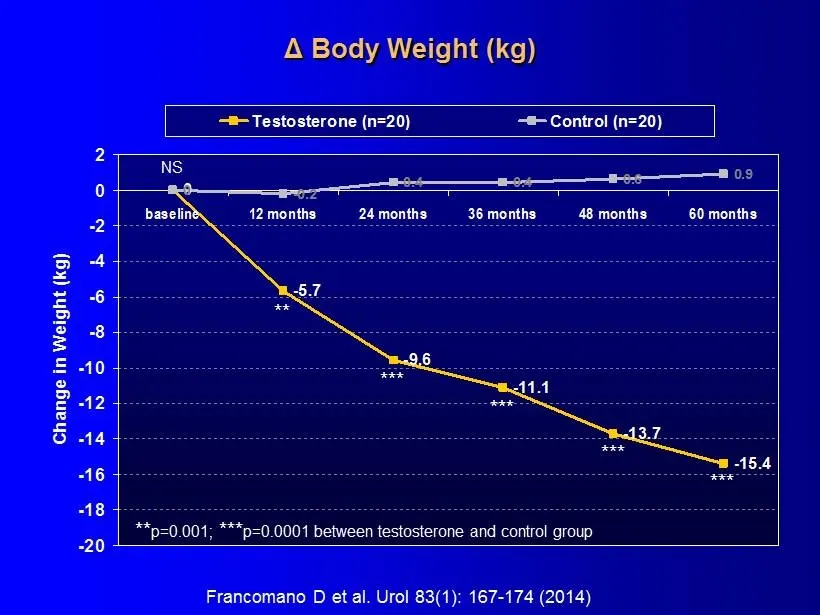
Slide 83: Change in Body Weight
Δ Body Weight (kg) 0 -5.7 -9.6 -11.1 -13.7 -15.4 0 -0.2 0.4 0.4 0.6 0.9 -20 -18 -16 -14 -12 -10 -8 -6 -4 -2 0 2 baseline 12 months 24 months 36 months 48 months 60 months Change in Weight (kg) Testosterone (n=20) Control (n=20) ** *** *** *** *** ** p=0.001; *** p=0.0001 between testosterone and con
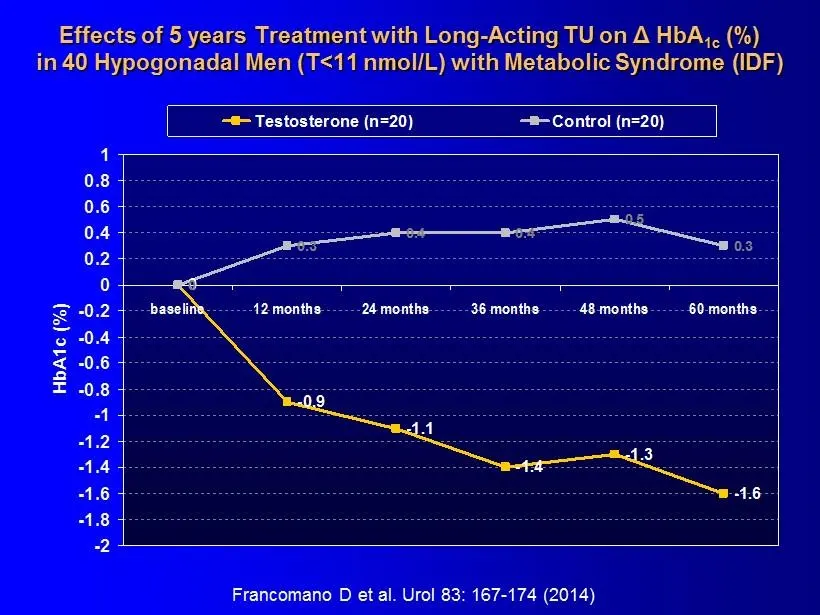
Slide 84: Effects of Long-Acting TU on HbA1c
Effects of 5 years Treatment with Long - Acting TU on Δ HbA 1c (%) in 40 Hypogonadal Men (T<11 nmol/L) with Metabolic Syndrome (IDF) 0 -0.9 -1.1 -1.4 -1.3 -1.6 0 0.3 0.4 0.4 0.5 0.3 -2 -1.8 -1.6 -1.4 -1.2 -1 -0.8 -0.6 -0.4 -0.2 0 0.2 0.4 0.6 0.8 1 baseline 12 months 24 months 36 months 48 months 60
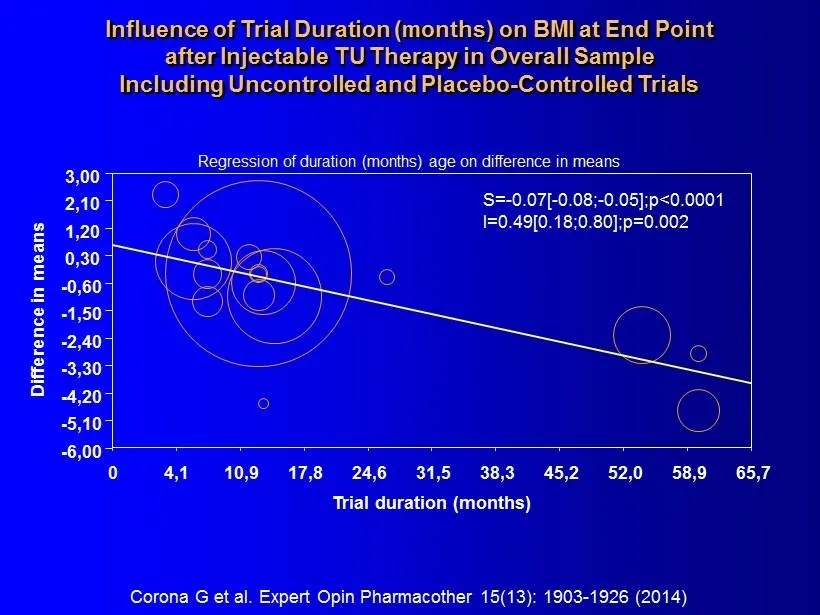
Slide 85: Influence of Trial Duration on BMI after Injectable TU Therapy
S= - 0.07[ - 0.08; - 0.05];p<0.0001 I=0.49[0.18;0.80];p=0.002 Trial duration (months) Difference in means 0 4,1 10,9 17,8 24,6 31,5 38,3 45,2 52,0 58,9 65,7 3,00 2,10 1,20 0,30 - 0,60 - 1,50 - 2,40 - 3,30 - 4,20 - 5,10 - 6,00 Corona G et al. Expert Opin Pharmacother 15(13): 1903 - 1926 (2014) Regres
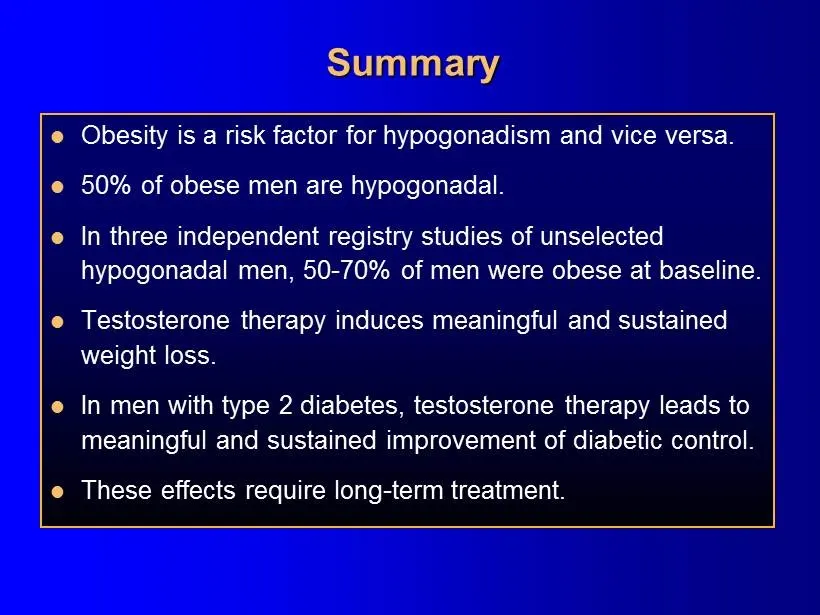
Slide 86: Summary
Summary Obesity is a risk factor for hypogonadism and vice versa. 50% of obese men are hypogonadal. In three independent registry studies of unselected hypogonadal men, 50 - 70% of men were obese at baseline. Testosterone therapy induces meaningful and sustained weight loss. In men with ty
Slide 87: Androxal Safety Review October 2014
Androxal Safety Review 31 October 2014 ▪ Discontinuation due to Adverse Events (DCAEs) ▪ Treatment Emergent Adverse Events ( TEAEs) ▪ Thrombotic events ▪ Prostate Specific Antigen (PSA) ▪ Other Safety Issues Related to Testosterone Therapy
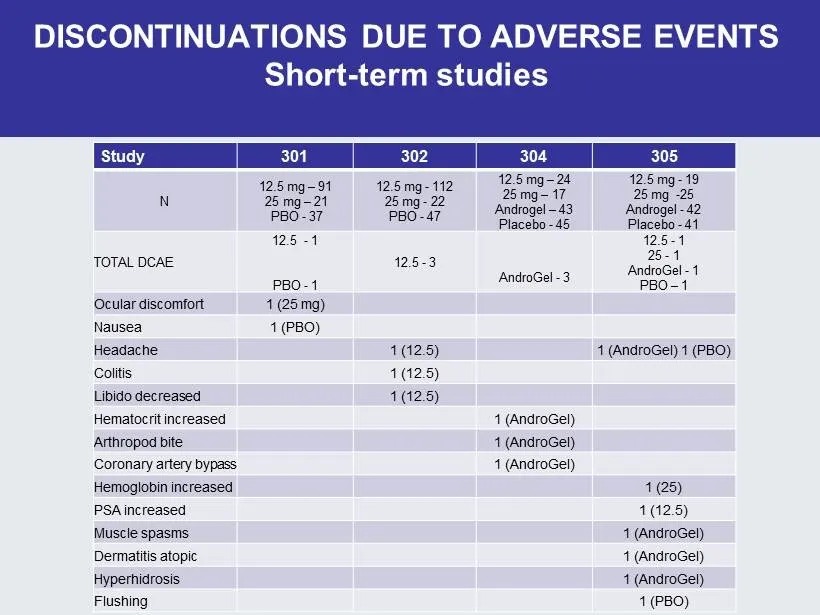
Slide 88: Discontinuations Due to Adverse Events: Short-term studies
DISCONTINUATIONS DUE TO ADVERSE EVENTS Short - term studies Study 301 302 304 305 N 12.5 mg – 91 25 mg – 21 PBO - 37 12.5 mg - 112 25 mg - 22 PBO - 47 12.5 mg – 24 25 mg – 17 Androgel – 43 Placebo - 45 12.5 mg - 19 25 mg - 25 Androgel - 42 Placebo - 41 TOTAL DCAE 12.5 - 1 PBO - 1 12.5 - 3 AndroGel -
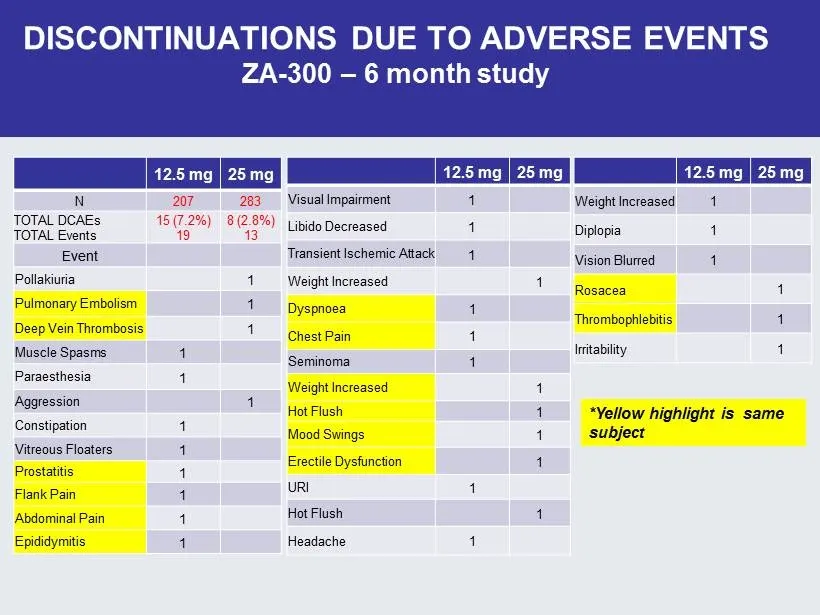
Slide 89: Discontinuations Due to Adverse Events: ZA-300 6-month study
DISCONTINUATIONS DUE TO ADVERSE EVENTS ZA - 300 – 6 month study 12.5 mg 25 mg N 207 283 TOTAL DCAEs TOTAL Events 15 (7.2%) 19 8 (2.8%) 13 Event Pollakiuria 1 Pulmonary Embolism 1 Deep Vein Thrombosis 1 Muscle Spasms 1 Paraesthesia 1 Aggression 1 Constipation 1 Vitreous Floaters 1 Prostatitis 1 Flank
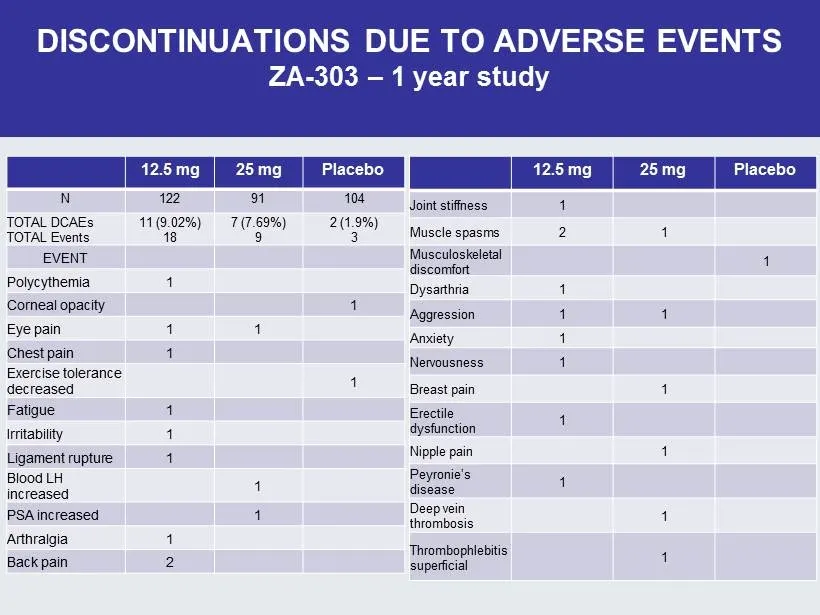
Slide 90: Discontinuations Due to Adverse Events: ZA-303 1-year study
DISCONTINUATIONS DUE TO ADVERSE EVENTS ZA - 303 – 1 year study 12.5 mg 25 mg Placebo N 122 91 104 TOTAL DCAEs TOTAL Events 11 (9.02%) 18 7 (7.69%) 9 2 (1.9%) 3 EVENT Polycythemia 1 Corneal opacity 1 Eye pain 1 1 Chest pain 1 Exercise tolerance decreased 1 Fatigue 1 Irritability 1 Ligament rupture 1
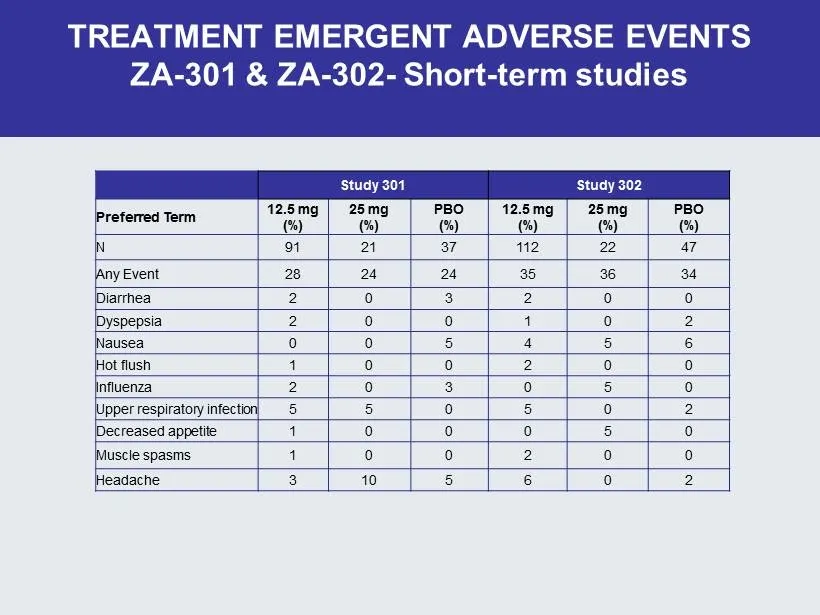
Slide 91: Treatment Emergent Adverse Events: Short-term studies 301 & 302
TREATMENT EMERGENT ADVERSE EVENTS ZA - 301 & ZA - 302 - Short - term studies Study 301 Study 302 Preferred Term 12.5 mg (%) 25 mg (%) PBO (%) 12.5 mg (%) 25 mg (%) PBO (%) N 91 21 37 112 22 47 Any Event 28 24 24 35 36 34 Diarrhea 2 0 3 2 0 0 Dyspepsia 2 0 0 1 0 2 Nausea 0 0 5 4 5 6 Hot flush 1 0 0 2
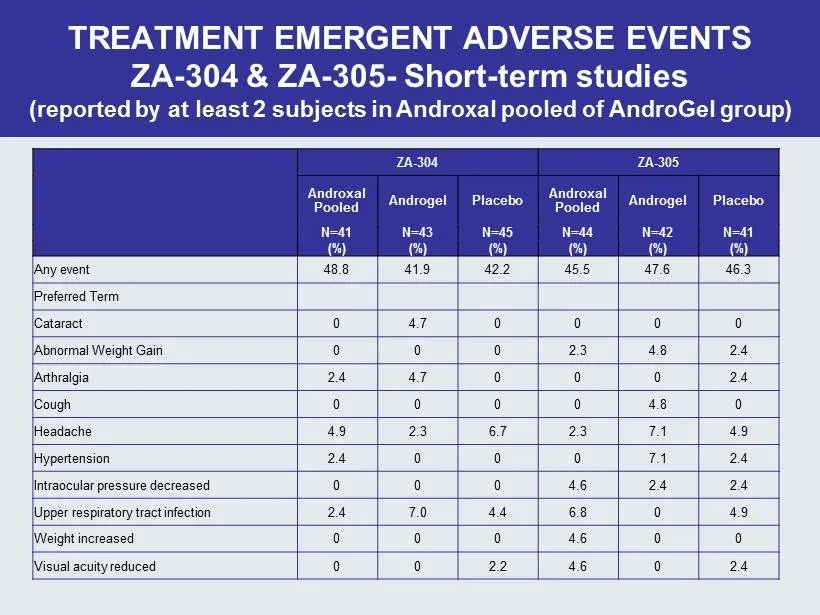
Slide 92: Treatment Emergent Adverse Events: ZA-304 & ZA-305
ZA - 304 ZA - 305 Androxal Pooled Androgel Placebo Androxal Pooled Androgel Placebo N=41 N=43 N=45 N=44 N=42 N=41 (%) (%) (%) (%) (%) (%) Any event 48.8 41.9 42.2 45.5 47.6 46.3 Preferred Term Cataract 0 4 .7 0 0 0 0 Abnormal Weight Gain 0 0 0 2.3 4.8 2.4 Arthralgia 2.4 4.7 0 0 0 2.4 Cough 0 0 0 0 4
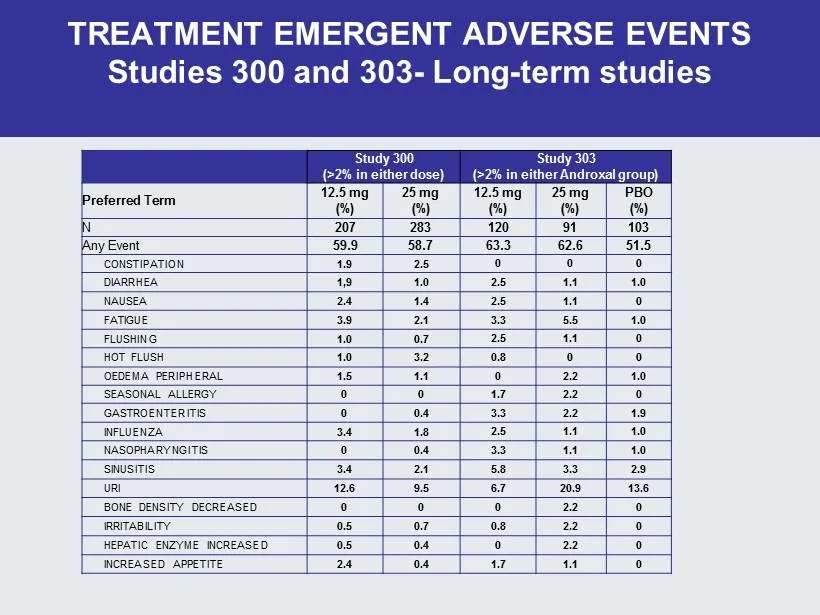
Slide 93: Treatment Emergent Adverse Events: Long-term studies
TREATMENT EMERGENT ADVERSE EVENTS Studies 300 and 303 - Long - term studies Study 300 (>2% in either dose) Study 303 (>2% in either Androxal group ) Preferred Term 12.5 mg (%) 25 mg (%) 12.5 mg (%) 25 mg (%) PBO (%) N 207 283 120 91 103 Any Event 59.9 58.7 63.3 62.6 51.5 CONSTIPATION 1.9 2.5 0 0 0 D
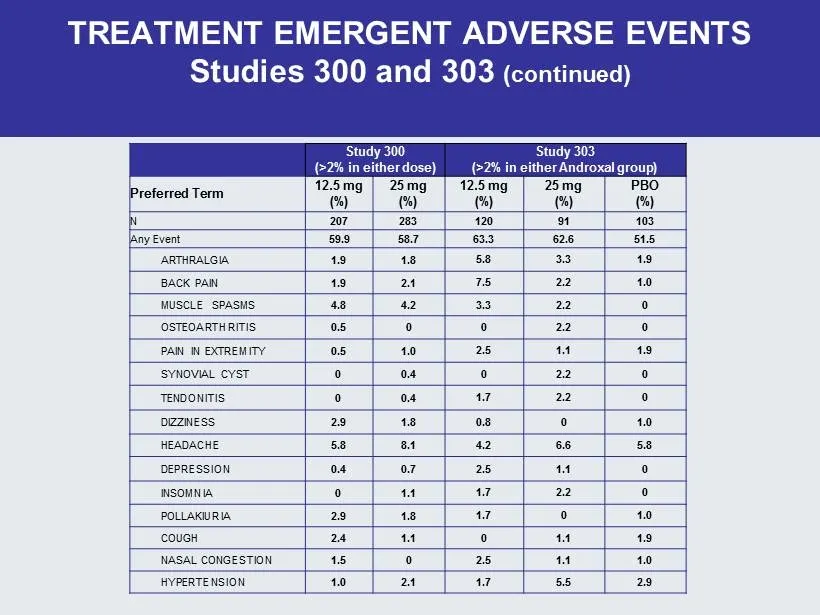
Slide 94: Treatment Emergent Adverse Events (continued)
TREATMENT EMERGENT ADVERSE EVENTS Studies 300 and 303 (continued) Study 300 (>2% in either dose) Study 303 (>2% in either Androxal group ) Preferred Term 12.5 mg (%) 25 mg (%) 12.5 mg (%) 25 mg (%) PBO (%) N 207 283 120 91 103 Any Event 59.9 58.7 63.3 62.6 51.5 ARTHRALGIA 1.9 1.8 5.8 3.3 1.9 BACK PA
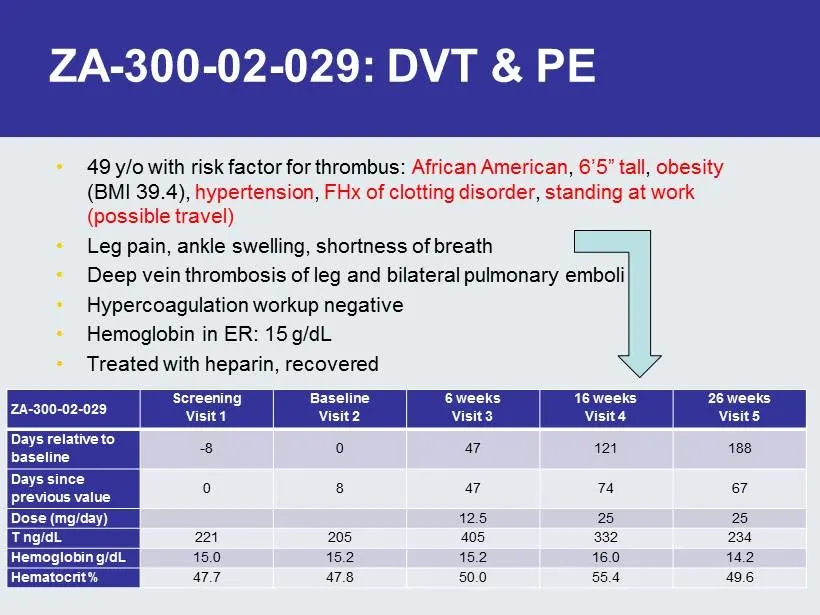
Slide 95: ZA-300-02-029: DVT & PE
ZA - 300 - 02 - 029: DVT & PE • 49 y/o with risk factor for thrombus: African American , 6’5” tall , obesity (BMI 39.4), hypertension , FHx of clotting disorder , standing at work (possible travel) • Leg pain, ankle swelling, shortness of breath • Deep vein thrombosis of leg and bilateral pulmonary
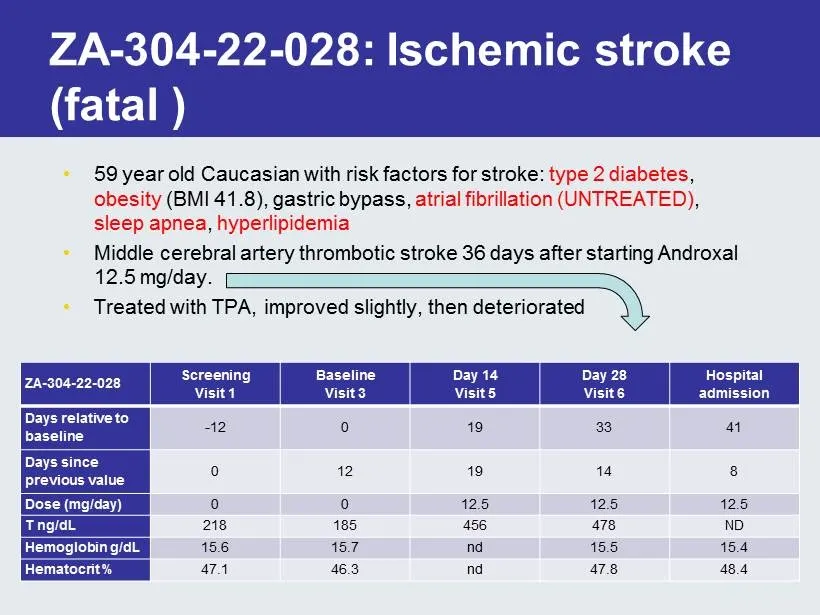
Slide 96: ZA-304-22-028: Ischemic stroke (fatal)
ZA - 304 - 22 - 028: Ischemic stroke (fatal ) • 59 year old Caucasian with risk factors for stroke: type 2 diabetes , obesity (BMI 41.8), gastric bypass, atrial fibrillation (UNTREATED) , sleep apnea , hyperlipidemia • Middle cerebral artery thrombotic stroke 36 days after starting Androxal 12.5 mg/
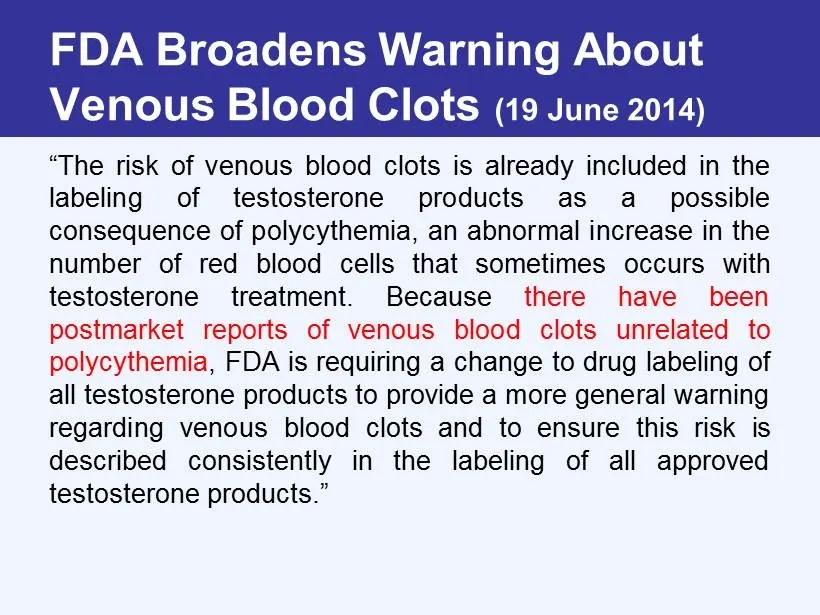
Slide 97: FDA Broadens Warning About Venous Blood Clots
FDA Broadens Warning About Venous Blood Clots (19 June 2014) “The risk of venous blood clots is already included in the labeling of testosterone products as a possible consequence of polycythemia, an abnormal increase in the number of red blood cells that sometimes occurs with testosterone treatment
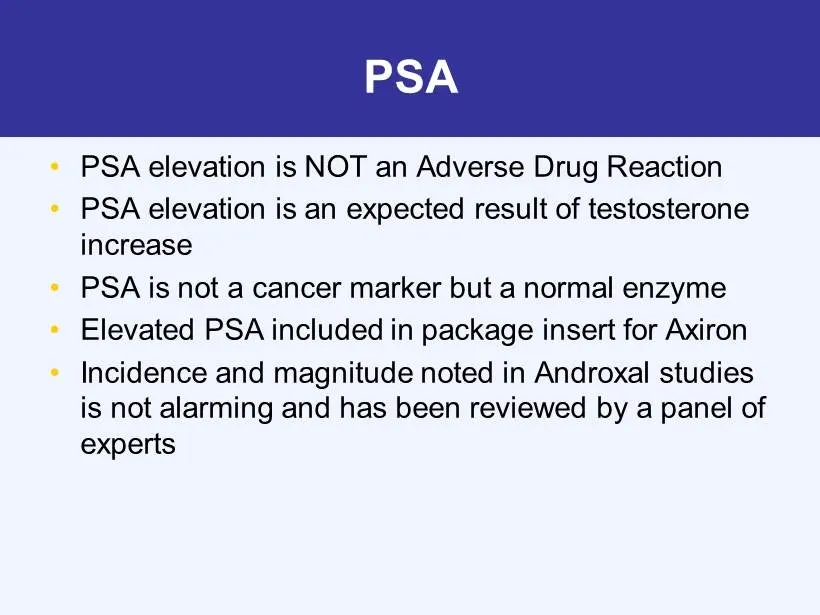
Slide 98: PSA
PSA • PSA elevation is NOT an Adverse Drug Reaction • PSA elevation is an expected result of testosterone increase • PSA is not a cancer marker but a normal enzyme • Elevated PSA included in package insert for Axiron • Incidence and magnitude noted in Androxal studies is not alarming and has been re
Slide 99: Other Safety Issues Related to Testosterone Therapy
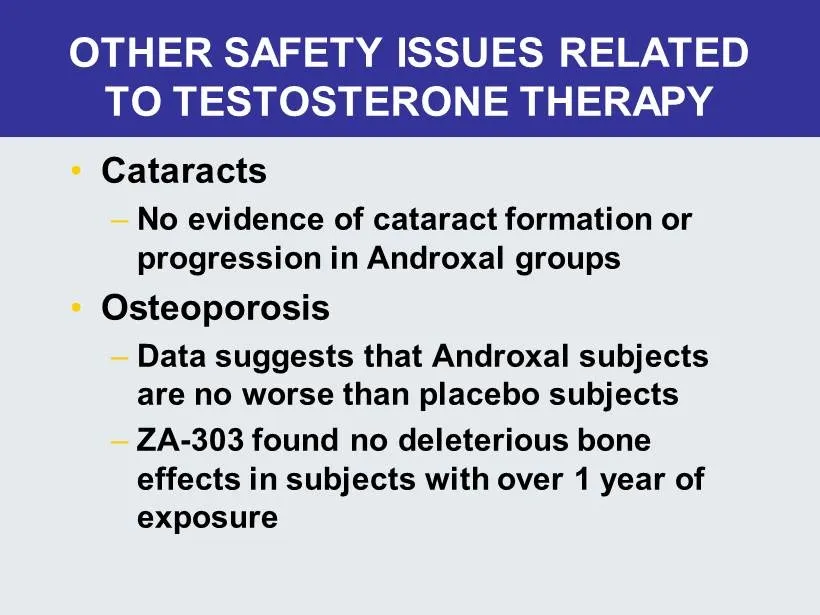
OTHER SAFETY ISSUES RELATED TO TESTOSTERONE THERAPY • Cataracts – No evidence of cataract formation or progression in Androxal groups • Osteoporosis – Data suggests that Androxal subjects are no worse than placebo subjects – ZA - 303 found no deleterious bone effects in subjects with over 1 year of
Slide 100: Conclusions
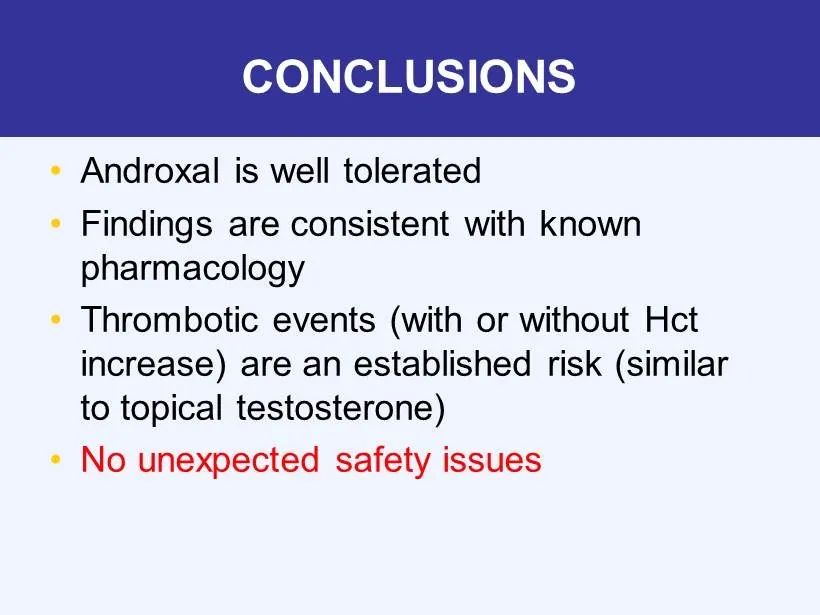
CONCLUSIONS • Androxal is well tolerated • Findings are consistent with known pharmacology • Thrombotic events (with or without Hct increase) are an established risk (similar to topical testosterone) • No unexpected safety issues
Slide 101: Preview of Commercial Findings
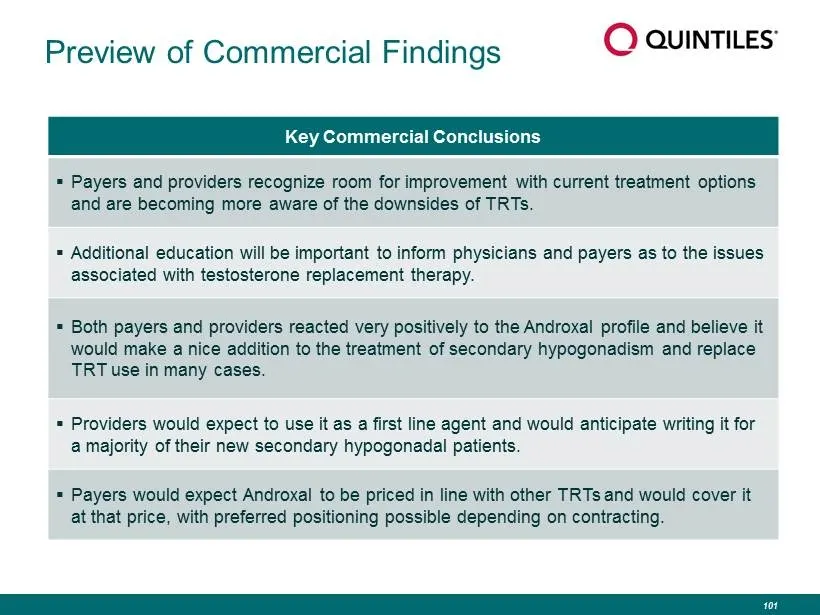
Preview of Commercial Findings Key Commercial Conclusions ▪ Payers and providers recognize room for improvement with current treatment options and are becoming more aware of the downsides of TRTs. ▪ Additional education will be important to inform physicians and payers as to the issues associated wi

Slide 102: Q & A
Q & A

Slide 103: Summary of Provider and Payer Perspectives Regarding Androxal
Summary of Provider and Payer Perspectives Regarding Androxal October 31, 2014
Slide 104: Research Background Key Topics
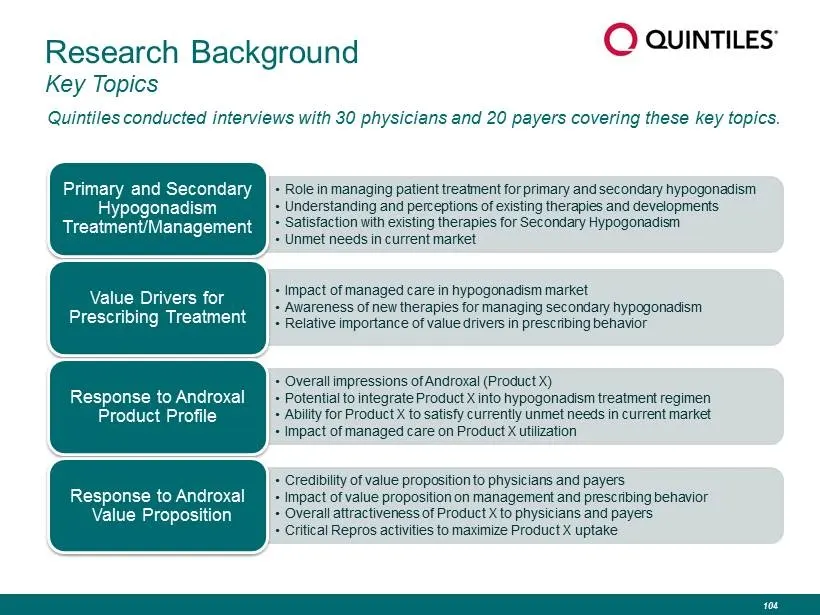
Research Background Key Topics Quintiles conducted interviews with 30 physicians and 20 payers covering these key topics. • Role in managing patient treatment for primary and secondary hypogonadism • Understanding and perceptions of existing therapies and developments • Satisfaction with existing th
Slide 105: Providers
) QUINTILES’ Providers
Slide 106: Secondary Hypogonadism TRT Usage
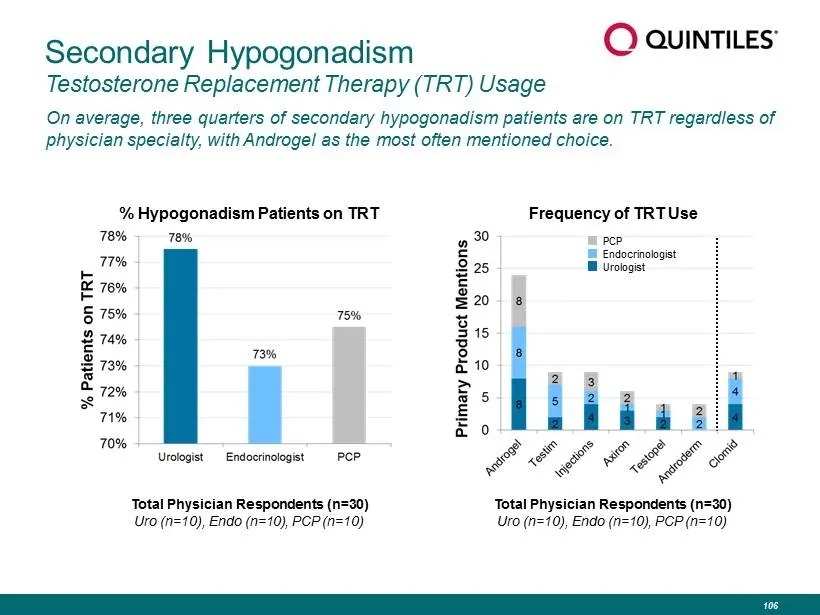
Secondary Hypogonadism Testosterone Replacement Therapy (TRT) Usage On average, three quarters of secondary hypogonadism patients are on TRT regardless of physician specialty, with Androgel as the most often mentioned choice. Total Physician Respondents (n=30) Uro (n=10), Endo (n=10), PCP (n=10) Fre
Slide 107: Current Satisfaction with Available Treatments
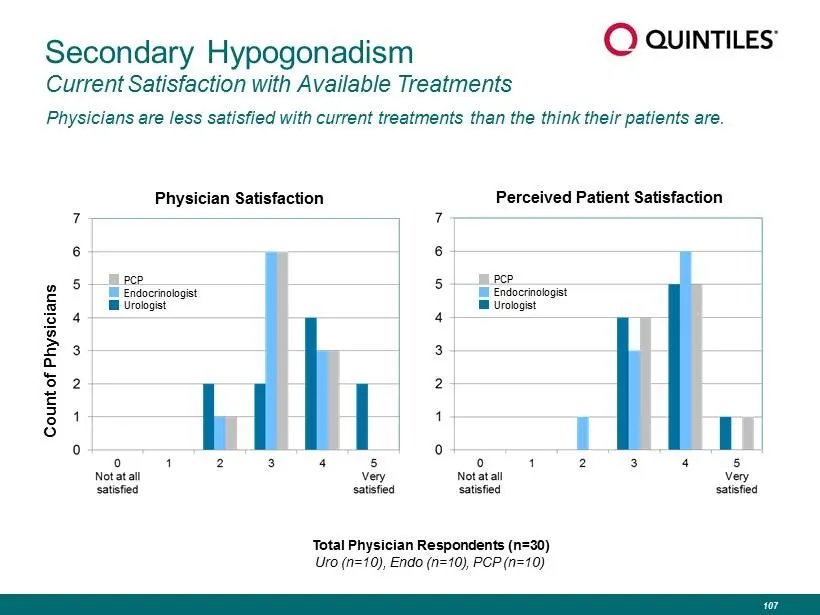
Secondary Hypogonadism Current Satisfaction with Available Treatments Physicians are less satisfied with current treatments than the think their patients are. Physician Satisfaction Perceived Patient Satisfaction Count of Physicians Total Physician Respondents (n=30) Uro (n=10), Endo (n=10), PCP (n=
Slide 108: Secondary Hypogonadism Unmet Needs
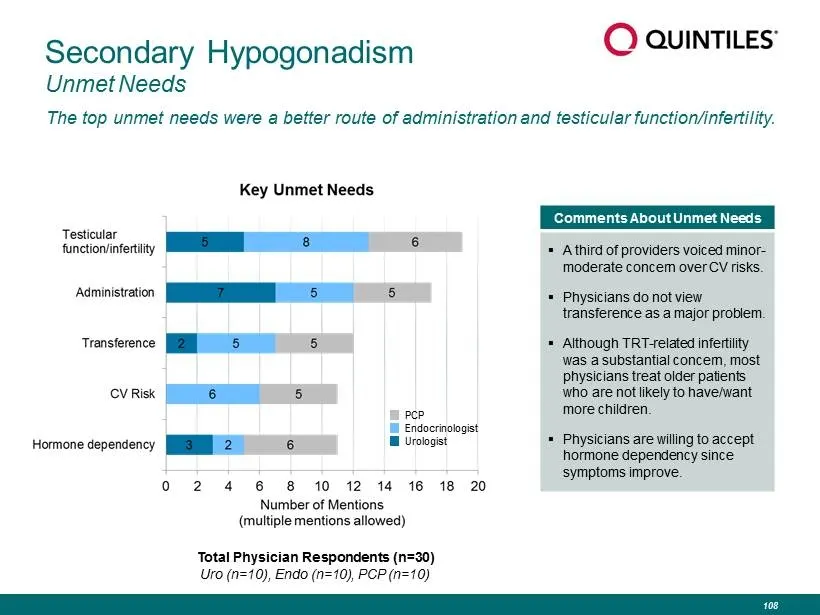
Secondary Hypogonadism Unmet Needs The top unmet needs were a better route of administration and testicular function/infertility. Comments About Unmet Needs ▪ A third of providers voiced minor - moderate concern over CV risks. ▪ Physicians do not view transference as a major problem. ▪ Although TRT
Slide 109: Androxal Review: Advantages and Disadvantages
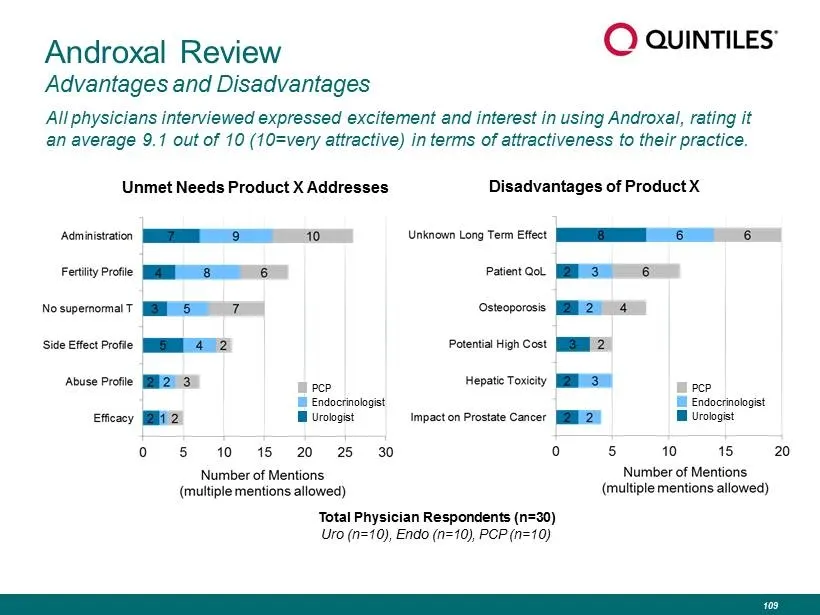
Androxal Review Advantages and Disadvantages All physicians interviewed expressed excitement and interest in using Androxal, rating it an average 9.1 out of 10 (10=very attractive) in terms of attractiveness to their practice. Unmet Needs Product X Addresses PCP Endocrinologist Urologist Total Physi
Slide 110: Androxal Review: Expected Physician Usage
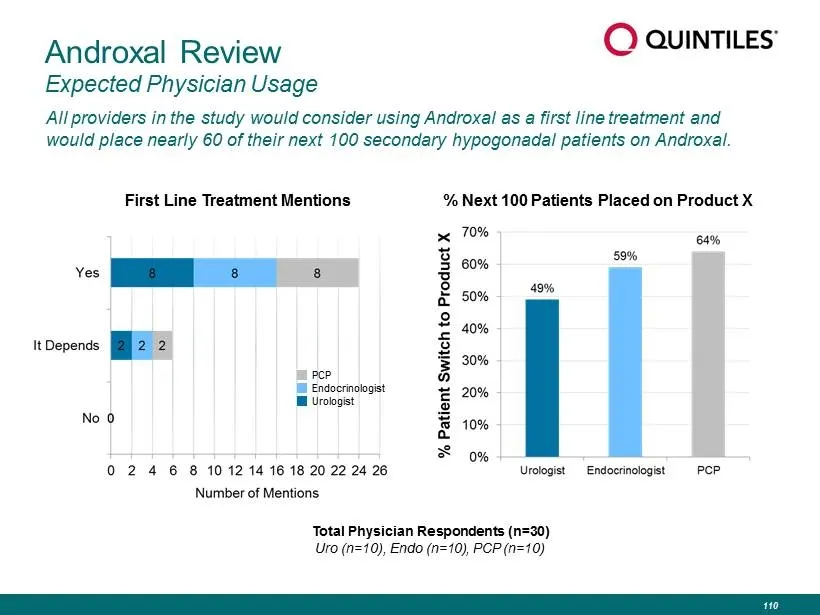
Androxal Review Expected Physician Usage All providers in the study would consider using Androxal as a first line treatment and would place nearly 60 of their next 100 secondary hypogonadal patients on Androxal. First Line Treatment Mentions Total Physician Respondents (n=30) Uro (n=10), Endo (n=10)
Slide 111: Payers
) QUINTILES’
Slide 112: Secondary Hypogonadism Current Budget Impact
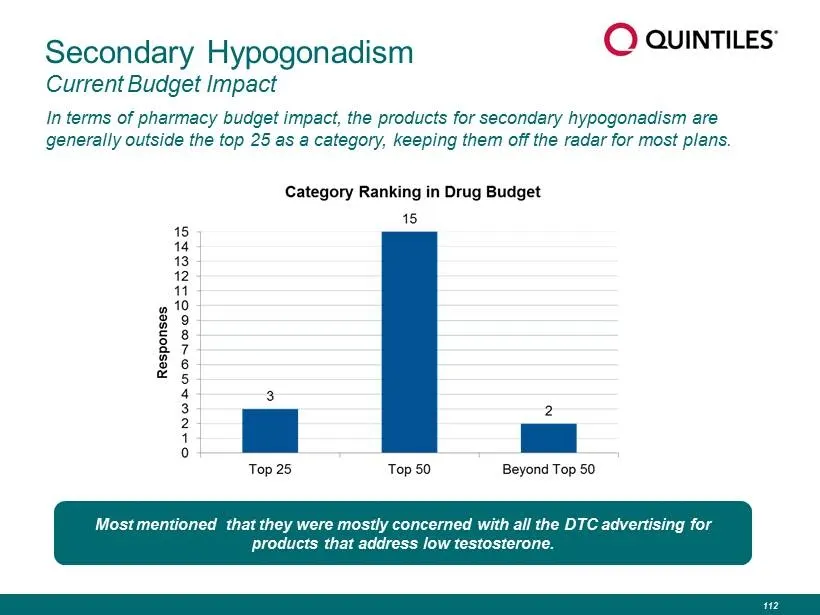
Secondary Hypogonadism Current Budget Impact In terms of pharmacy budget impact, the products for secondary hypogonadism are generally outside the top 25 as a category, keeping them off the radar for most plans. Most mentioned that they were mostly concerned with all the DTC advertising for products
Slide 113: Secondary Hypogonadism Current Satisfaction
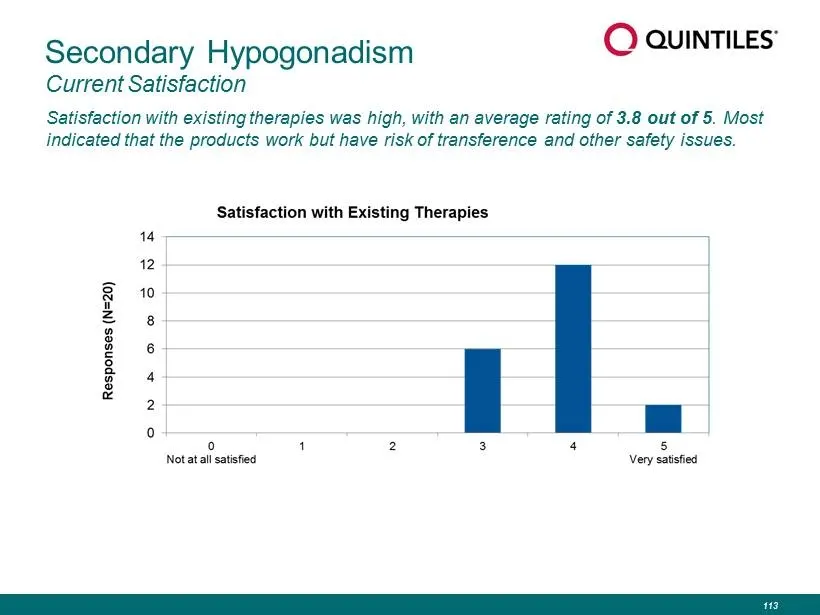
Secondary Hypogonadism Current Satisfaction Satisfaction with existing therapies was high, with an average rating of 3.8 out of 5 . Most indicated that the products work but have risk of transference and other safety issues. 113
Slide 114: Secondary Hypogonadism Unmet Needs
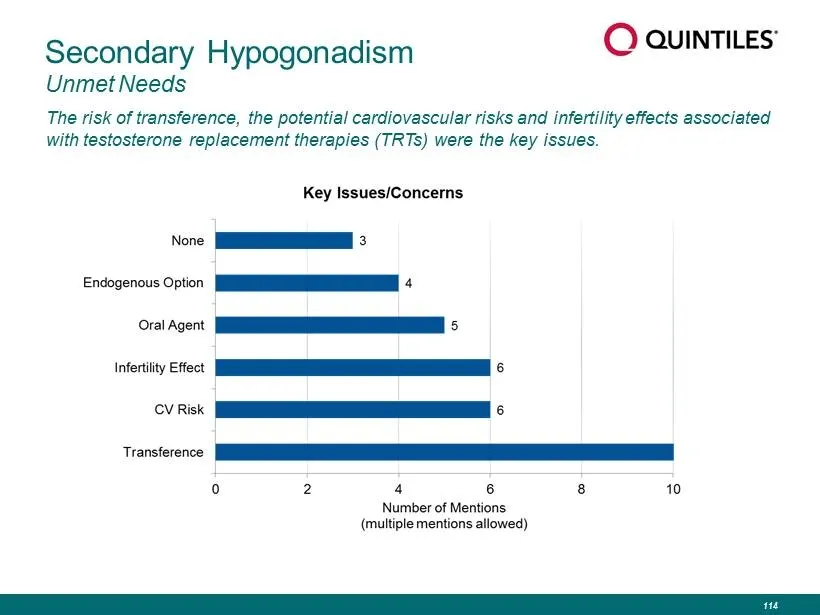
Secondary Hypogonadism Unmet Needs The risk of transference, the potential cardiovascular risks and infertility effects associated with testosterone replacement therapies (TRTs) were the key issues. 114
Slide 115: Current Product Formulary Positions – Commercial
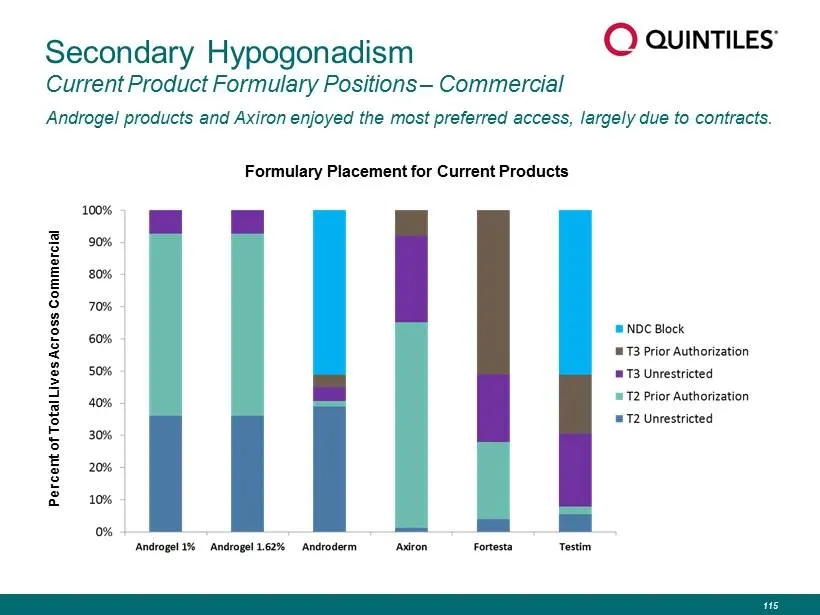
Secondary Hypogonadism Current Product Formulary Positions – Commercial Androgel products and Axiron enjoyed the most preferred access, largely due to contracts. Percent of Total Lives Across Commercial Formulary Placement for Current Products 115
Slide 116: Androxal Review: Positives and Negatives
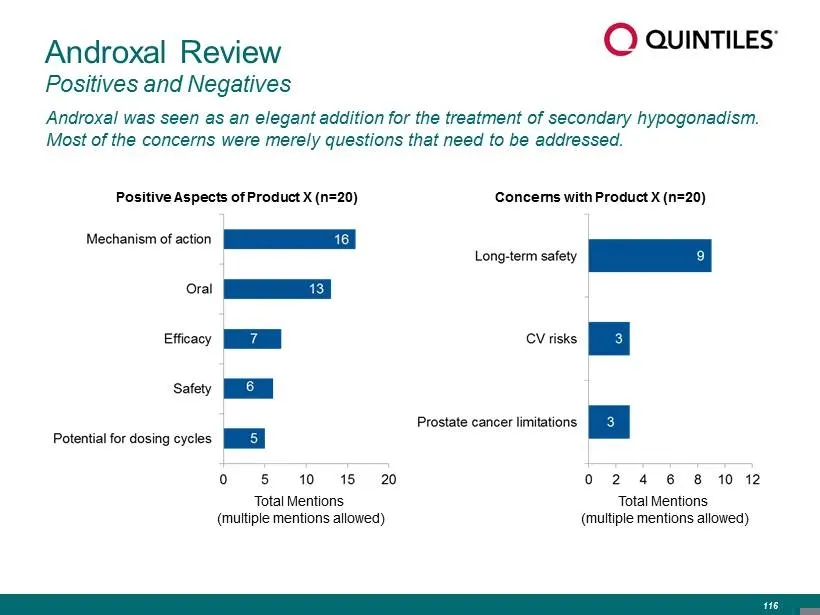
Androxal Review Positives and Negatives Androxal was seen as an elegant addition for the treatment of secondary hypogonadism. Most of the concerns were merely questions that need to be addressed. Total Mentions (multiple mentions allowed) Positive Aspects of Product X (n=20) Total Mentions (multiple
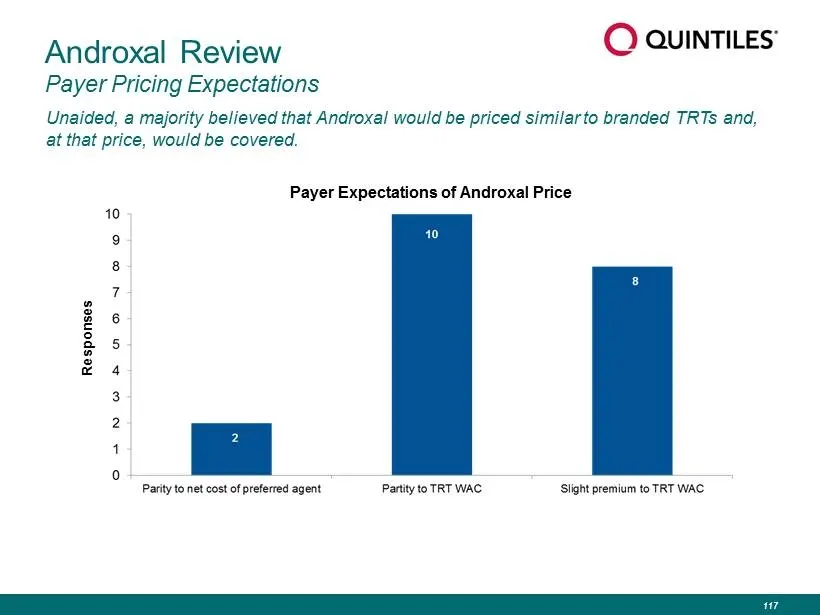
Slide 117: Androxal Review: Payer Pricing Expectations
Unaided, a majority believed that Androxal would be priced similar to branded TRTs and, at that price, would be covered. Androxal Review Payer Pricing Expectations Responses Payer Expectations of Androxal Price 117
Slide 118: Conclusions
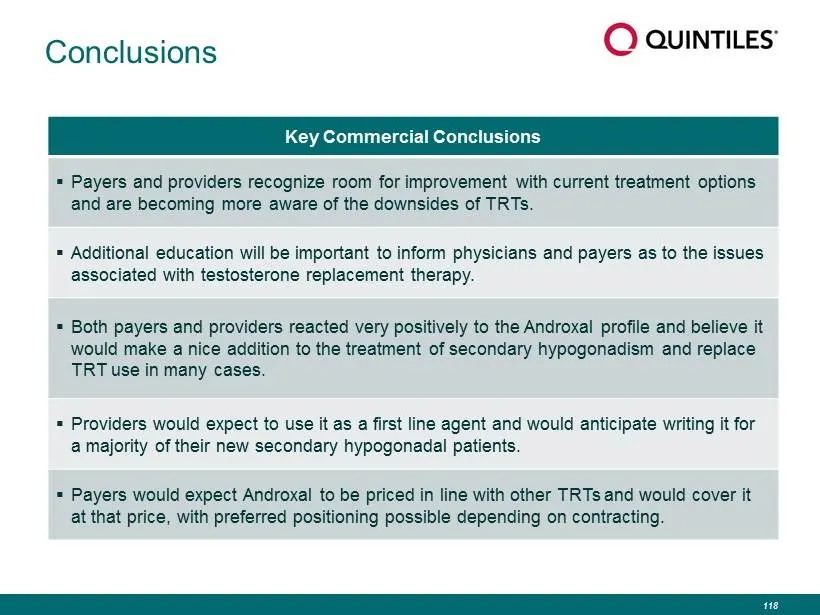
Conclusions Key Commercial Conclusions ▪ Payers and providers recognize room for improvement with current treatment options and are becoming more aware of the downsides of TRTs. ▪ Additional education will be important to inform physicians and payers as to the issues associated with testosterone rep
Slide 119: Thank you
Thank you For further information and review of this presentation, please visit www.reprosrx.com
Source: SEC EDGAR · 8-K filed Oct 31, 2014
More decks from Repros Therapeutics
 Investor Presentation (September 2017)16 slides · Sep 11, 2017
 Investor Presentation (May 2017)16 slides · May 17, 2017
 Investor Presentation (May 2017)16 slides · May 2, 2017
 Investor Presentation (November 2016)37 slides · Nov 15, 2016
 Investor Presentation (September 2016)26 slides · Sep 12, 2016
 Investor Presentation (August 2016)34 slides · Aug 18, 2016