Nanobiotix SA · EURONEXT:NANO
Nanobiotix SA — Investor Presentation (September 2021)
66 slides from Nanobiotix SA's investor presentation, September 2021

Slide 1: Corporate Presentation
‘a | (a he : aw PP fie Al) CORPORATE PRESENTA NA ~JOBIOTIX

Slide 2: Important Notice and Disclaimer
IMPORTANT NOTICE AND DISCLAIMER IMPORTANT: You must read the following before continuing. In accessing this document, you agree to be bound by the following terms and conditions. References herein to this presentation (the “Presentation”) shall mean and include this document, the oral presentation a
Slide 3: Developing disruptive, physics-based treatment solutions
Developing disruptive, physics-based treatment solutions to revolutionize treatment for millions of patients 3
Slide 4: Potential First-in-Class Product with opportunity to address >10M patients
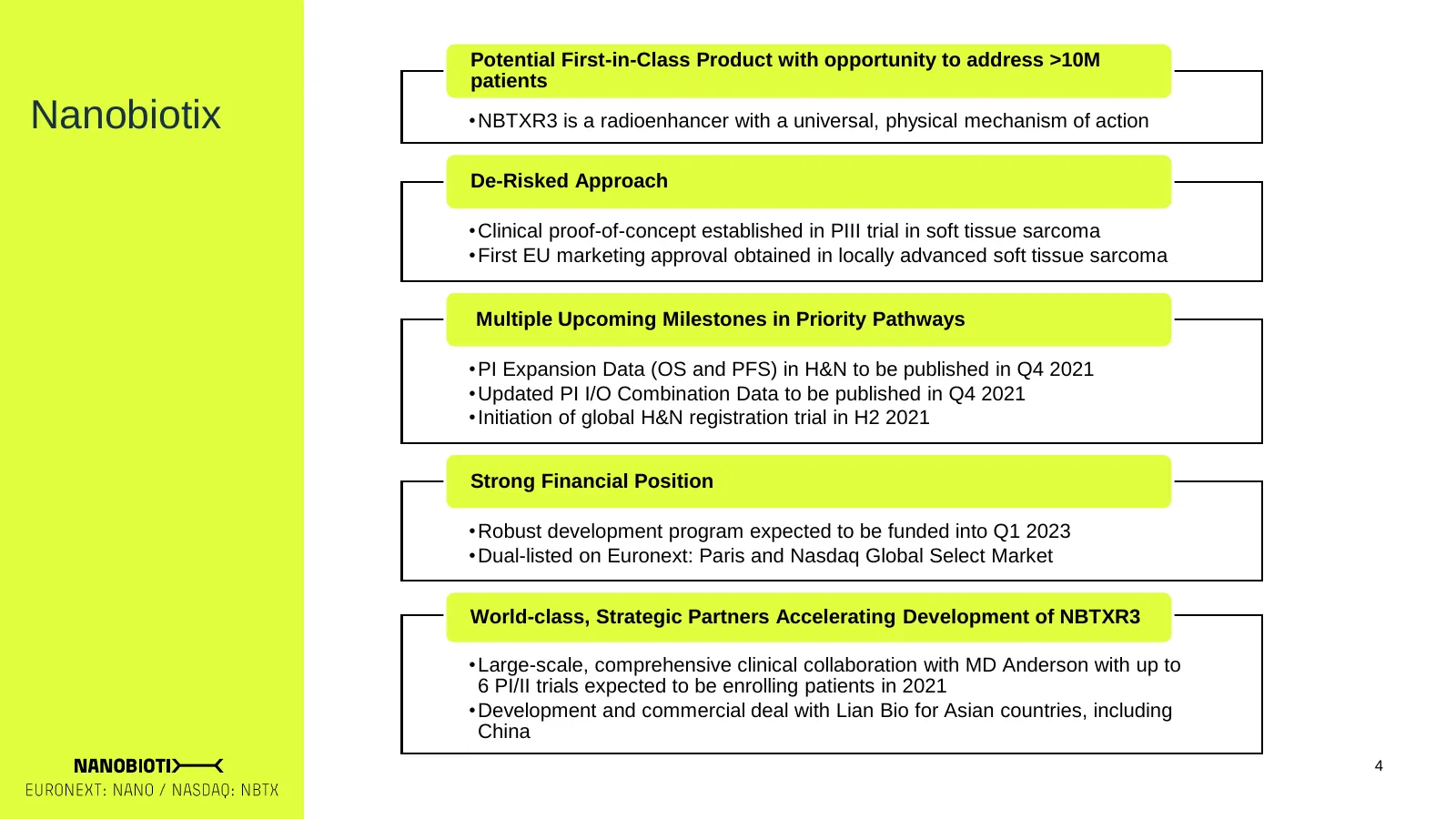
Potential First-in-Class Product with opportunity to address >10M patients Nanobiotix • NBTXR3 is a radioenhancer with a universal, physical mechanism of action De-Risked Approach • Clinical proof-of-concept established in PIII trial in soft tissue sarcoma • First EU marketing approval obtained in l
Slide 5: Oncology Huge Market Dominated by a Small Number of Products
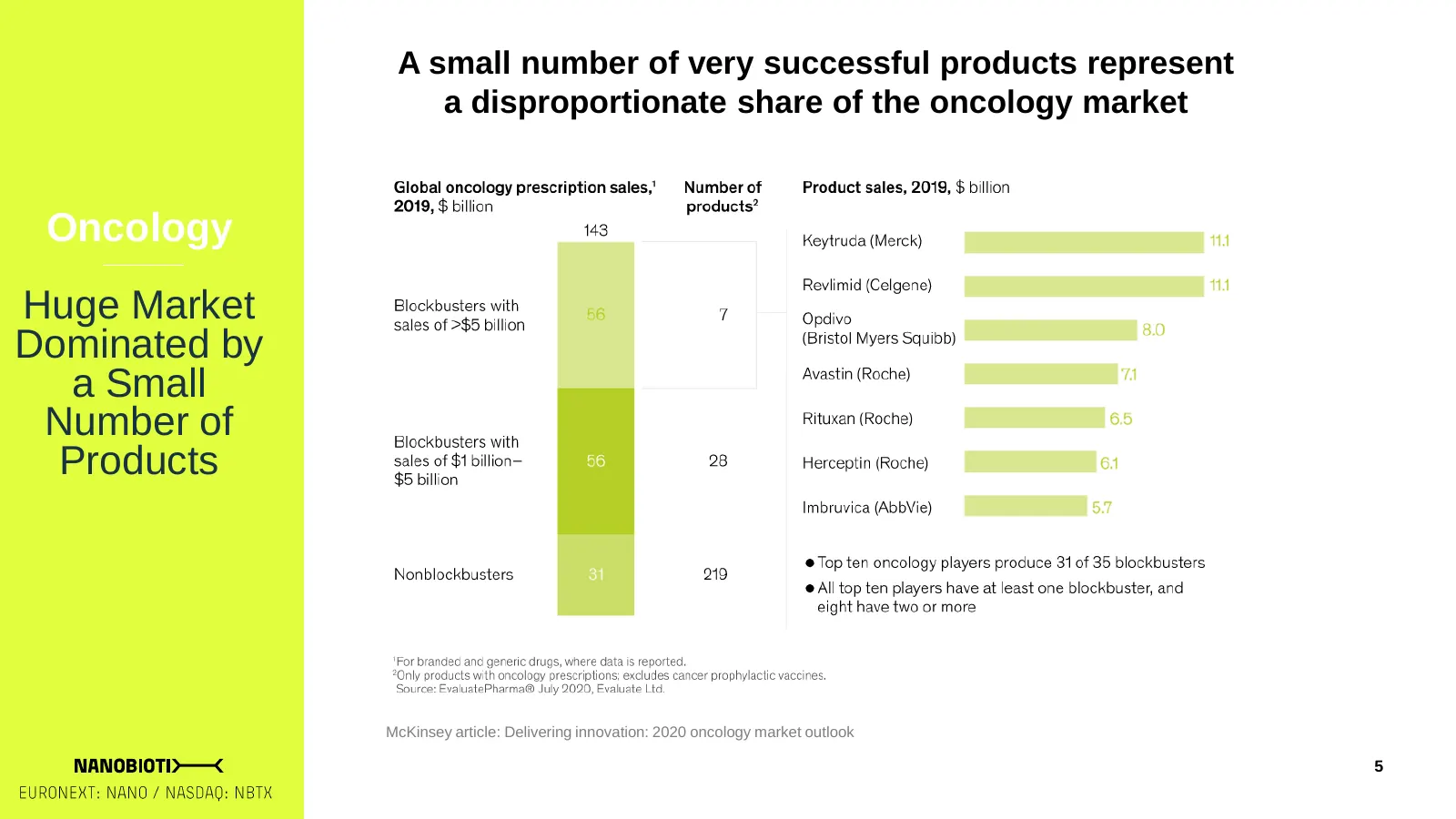
A small number of very successful products represent a disproportionate share of the oncology market Oncology Huge Market Dominated by a Small Number of Products McKinsey article: Delivering innovation: 2020 oncology market outlook 5
Slide 6: Radiation Remains the Most Widely Used Oncology Treatment
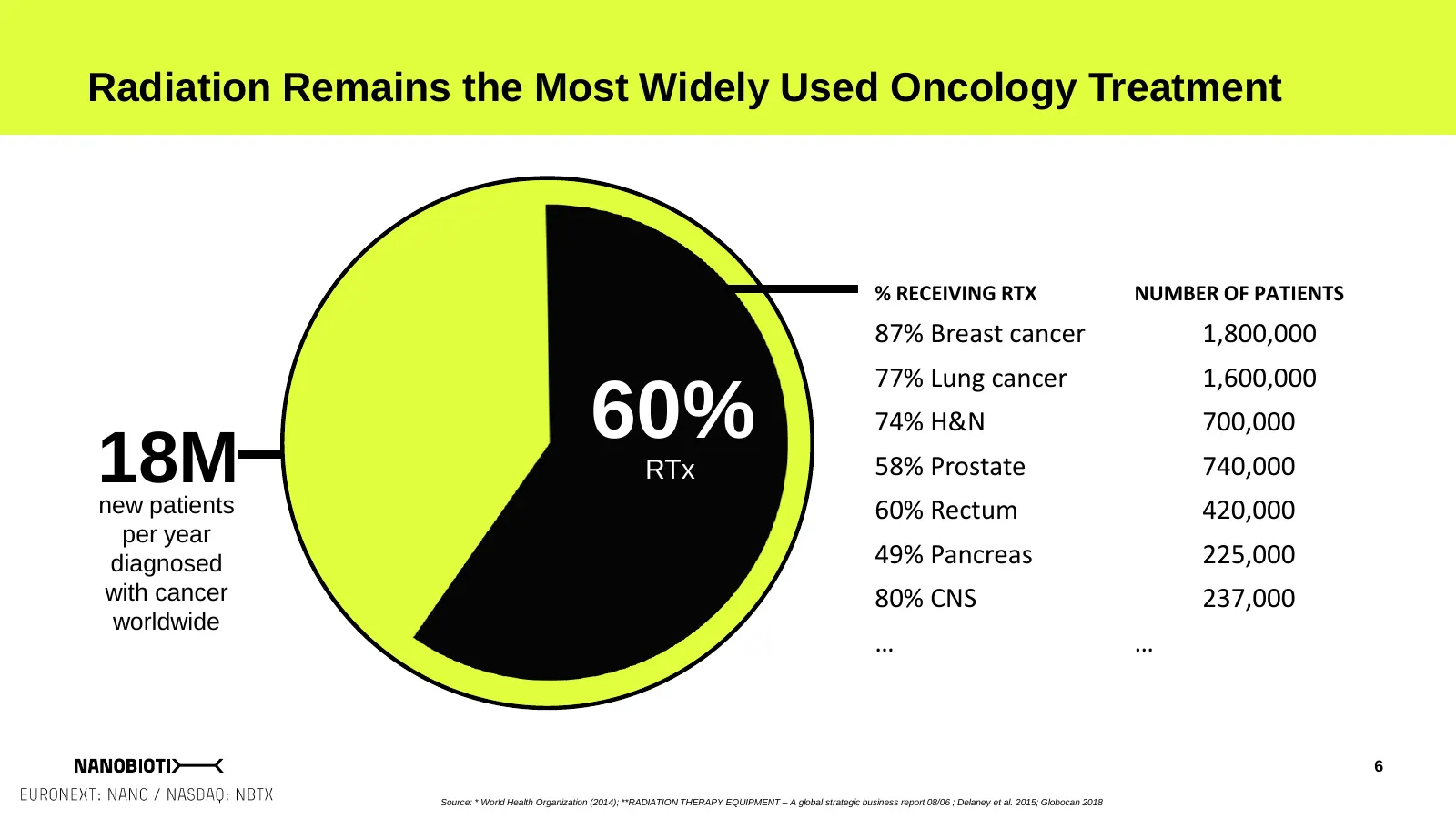
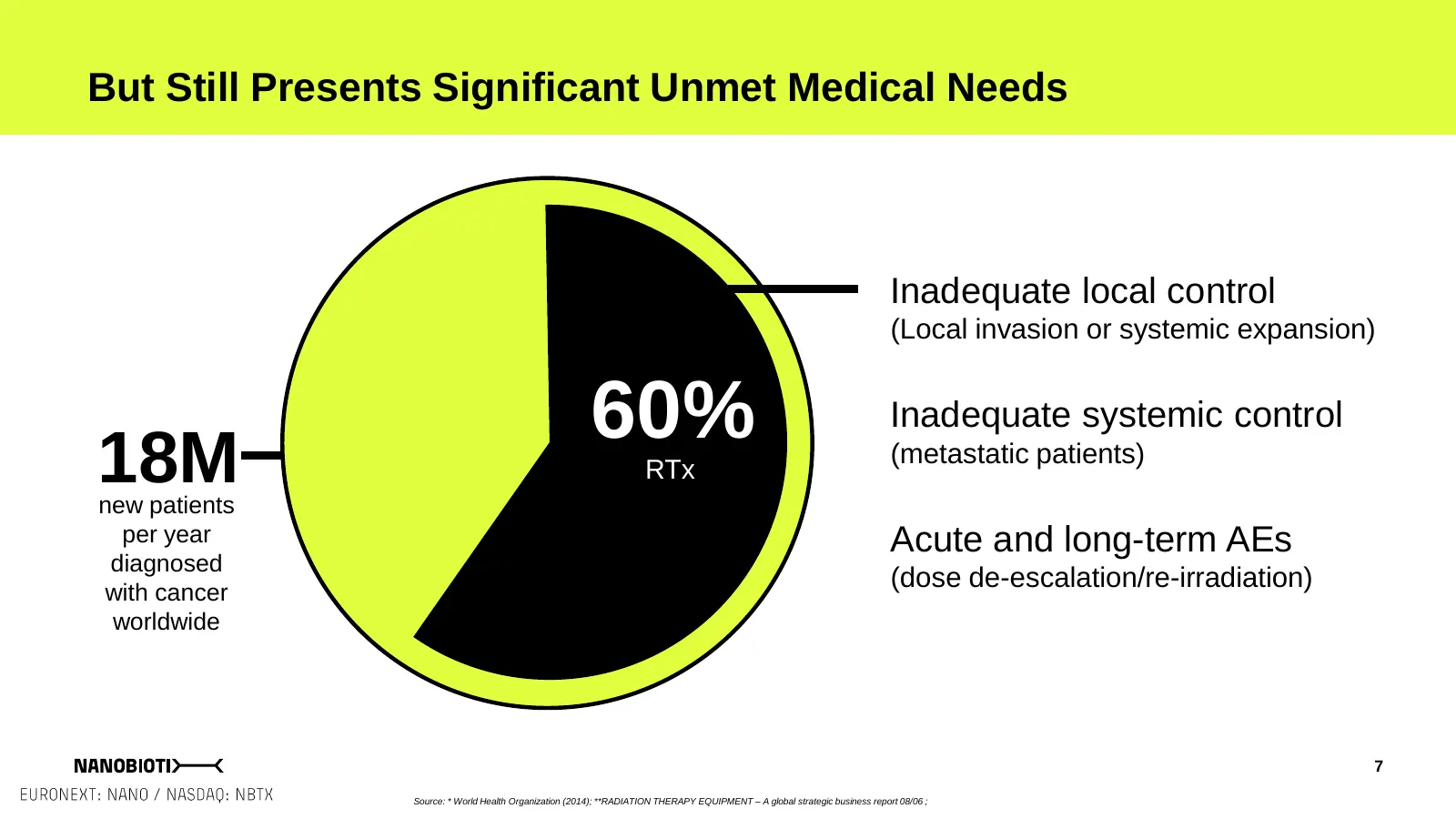
Radiation Remains the Most Widely Used Oncology Treatment Radiotherapy Is the most common treatment… % RECEIVING RTX NUMBER OF PATIENTS 87% Breast cancer 1,800,000 77% Lung cancer 1,600,000 60% 74% H&N 700,000 18M new patients RTx 58% Prostate 740,000 60% Rectum 420,000 per year diagnosed 49% Pancre
Slide 7: But Still Presents Significant Unmet Medical Needs
But Still Presents Significant Unmet Medical Needs ...But still presents significant unmet medical needs Inadequate local control (Local invasion or systemic expansion) 60% Inadequate systemic control 18M new patients RTx (metastatic patients) per year Acute and long-term AEs diagnosed with cancer (
Slide 8: NBTXR3: Potential First-In-Class, Tumor Agnostic, Combination Agnostic Radioenhancer
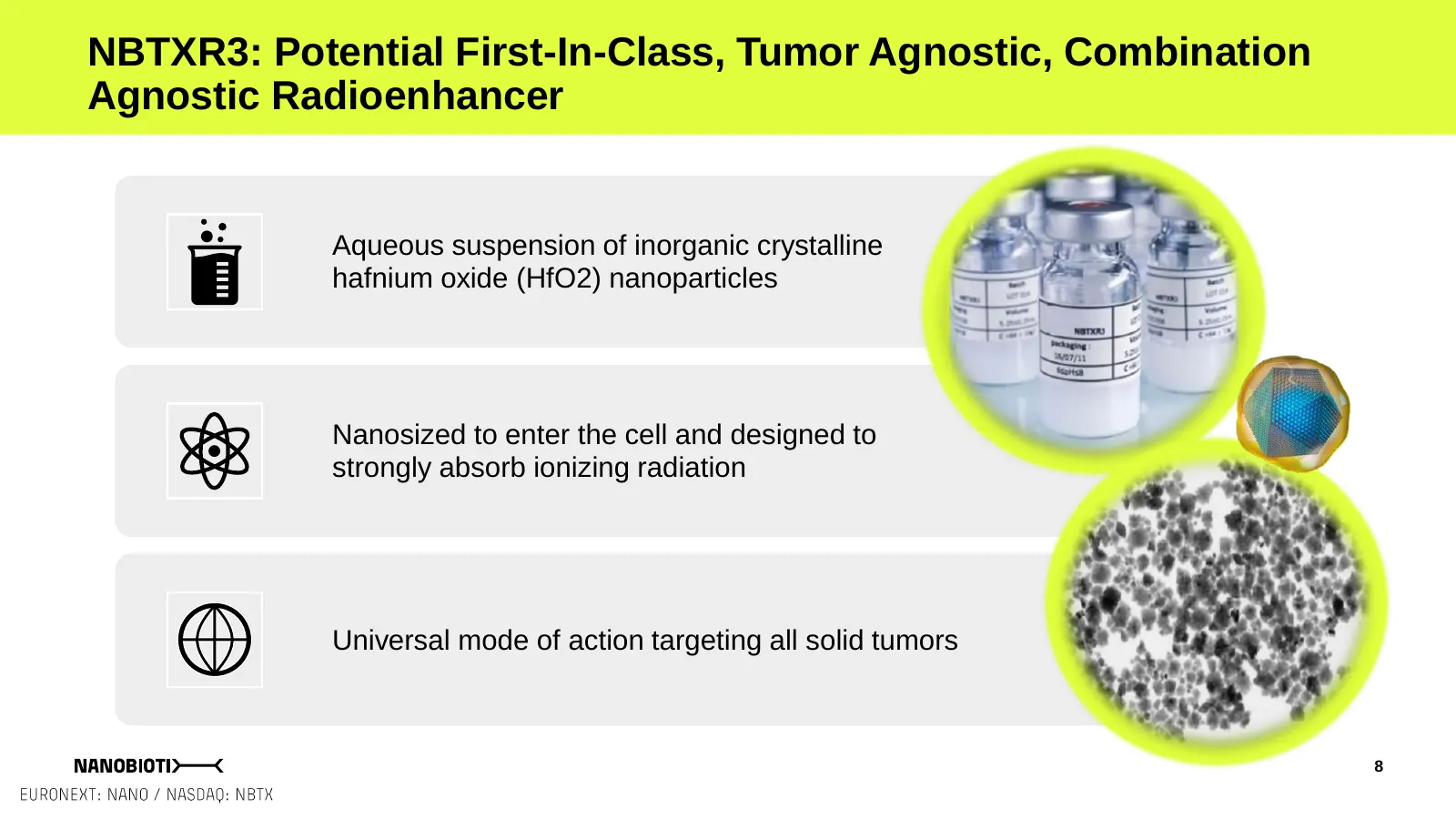
NBTXR3: Potential First-In-Class, Tumor Agnostic, Combination Agnostic Radioenhancer Aqueous suspension of inorganic crystalline hafnium oxide (HfO2) nanoparticles Nanosized to enter the cell and designed to strongly absorb ionizing radiation Universal mode of action targeting all solid tumors 8
Slide 9: NBTXR3: Potential First-In-Class, Tumor Agnostic, Combination Agnostic Radioenhancer
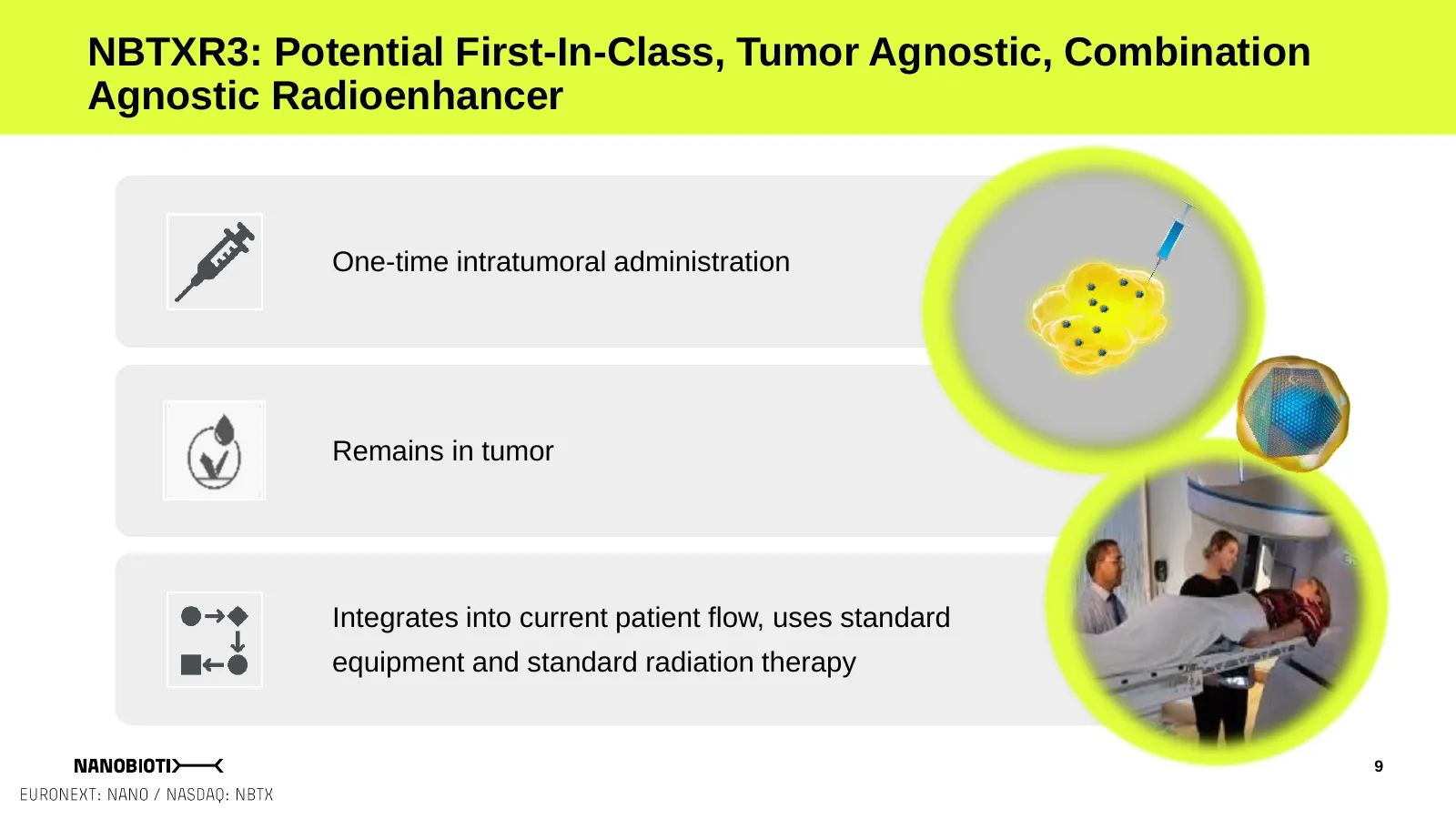
NBTXR3: Potential First-In-Class, Tumor Agnostic, Combination Agnostic Radioenhancer One-time intratumoral administration Remains in tumor Integrates into current patient flow, uses standard equipment and standard radiation therapy 9
Slide 10: Radiotherapy Alone vs NBTXR3 Activated by RT
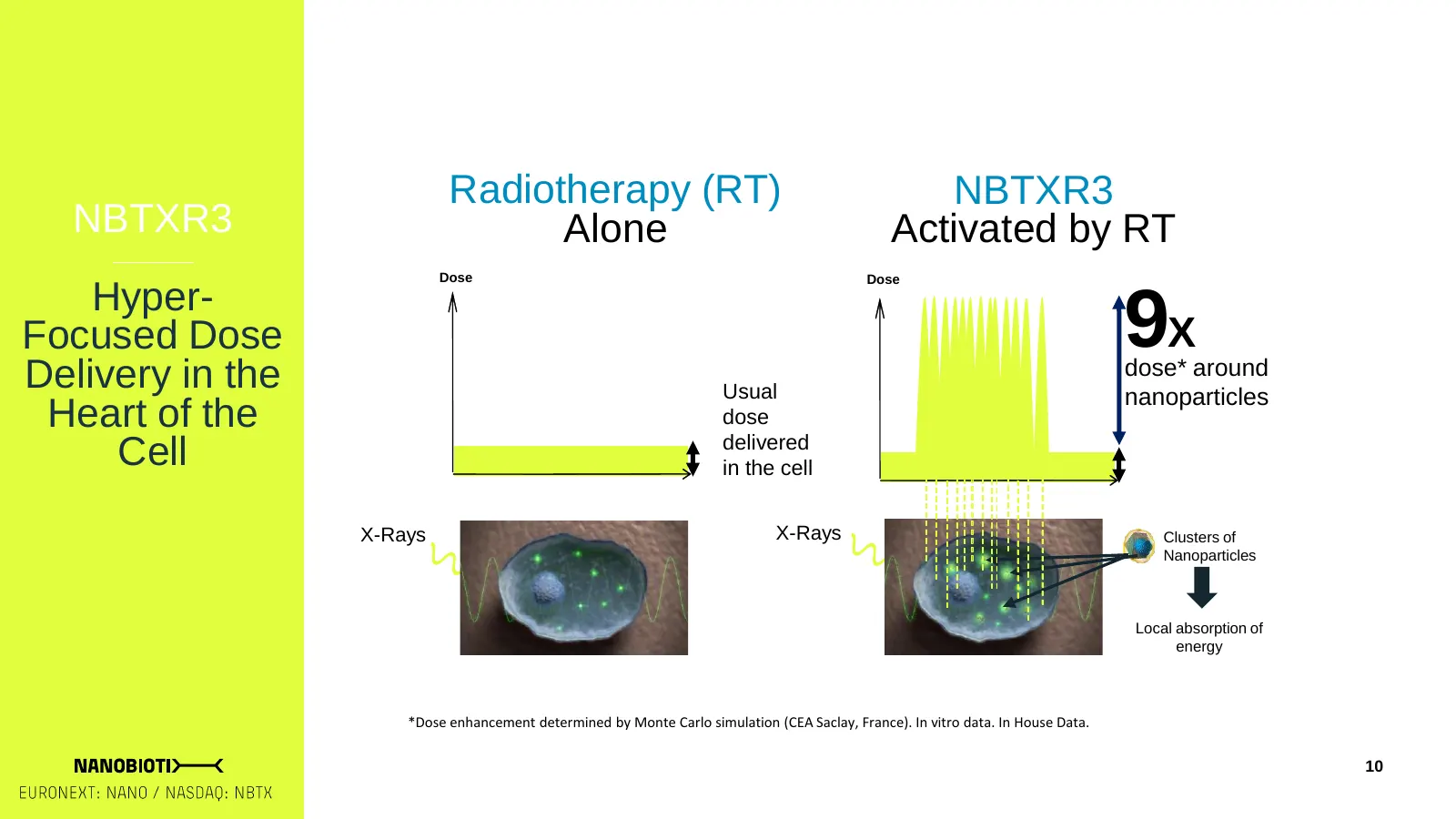
Radiotherapy (RT) NBTXR3 NBTXR3 Alone Activated by RT Dose Dose Hyper- Focused Dose Delivery in the 9X dose* around Usual nanoparticles Heart of the dose delivered Cell Radiotherapy in the cell X-Rays X-Rays Clusters of Nanoparticles Local absorption of energy *Dose enhancement determined by Monte C
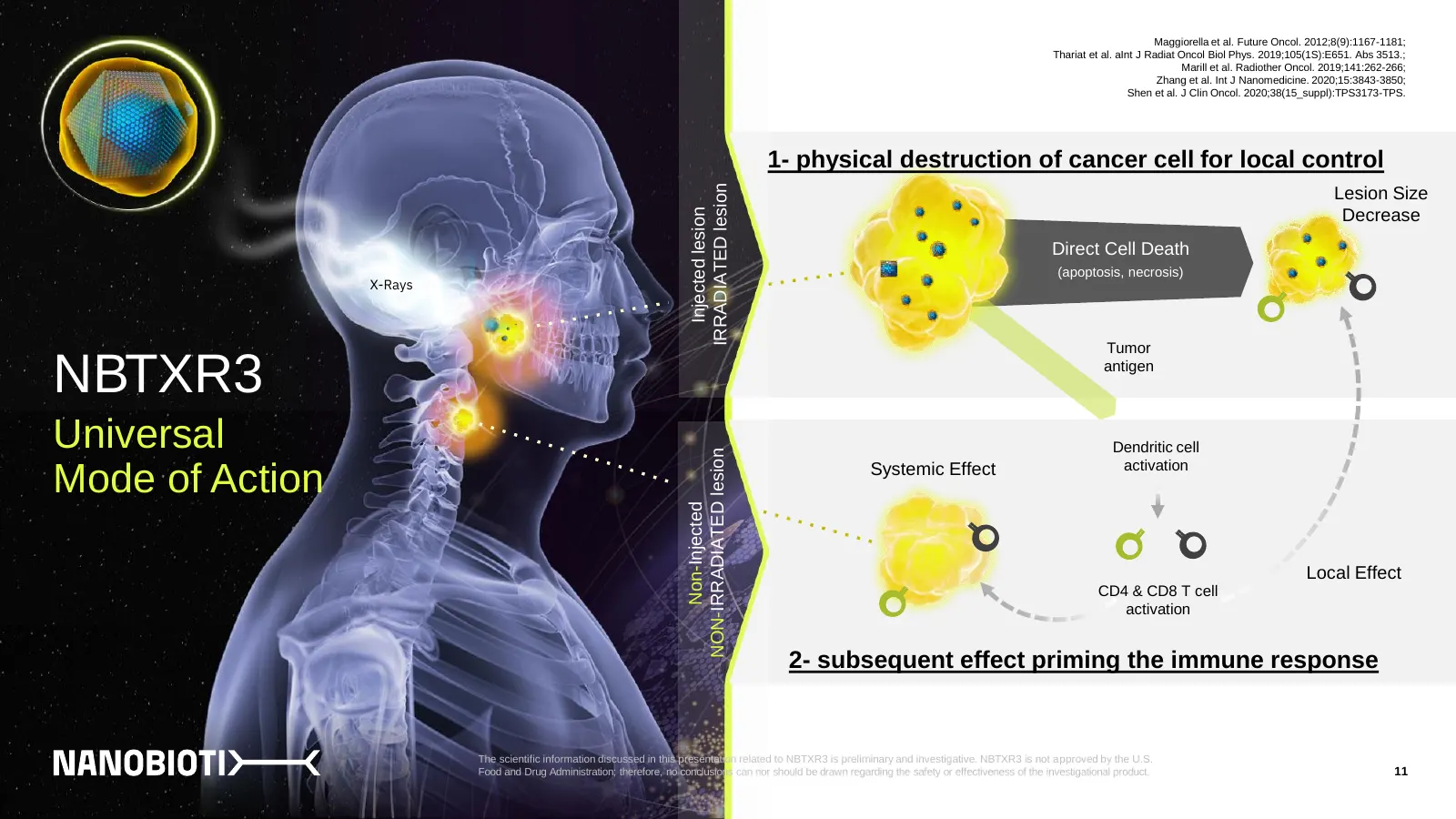
Slide 11: Universal Mode of Action
Maggiorella et al. Future Oncol. 2012;8(9):1167-1181; Thariat et al. aInt J Radiat Oncol Biol Phys. 2019;105(1S):E651. Abs 3513.; Marill et al. Radiother Oncol. 2019;141:262-266; Zhang et al. Int J Nanomedicine. 2020;15:3843-3850; Shen et al. J Clin Oncol. 2020;38(15_suppl):TPS3173-TPS. 1- physical
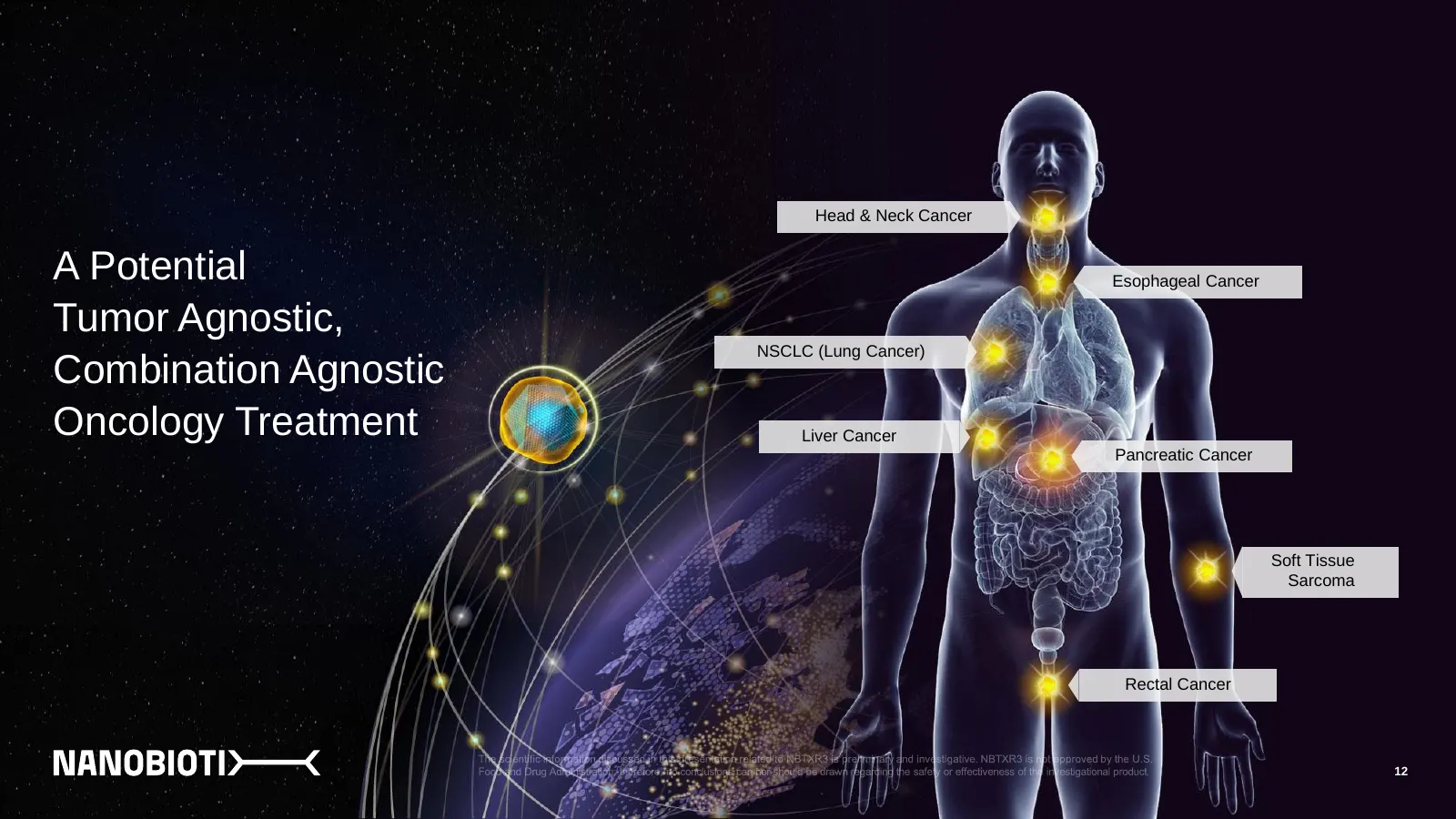
Slide 12: A Potential Tumor Agnostic, Combination Agnostic Oncology Treatment
Head & Neck Cancer A Potential Esophageal Cancer Tumor Agnostic, NSCLC (Lung Cancer) Combination Agnostic Oncology Treatment Liver Cancer Pancreatic Cancer Soft Tissue Sarcoma Rectal Cancer 12
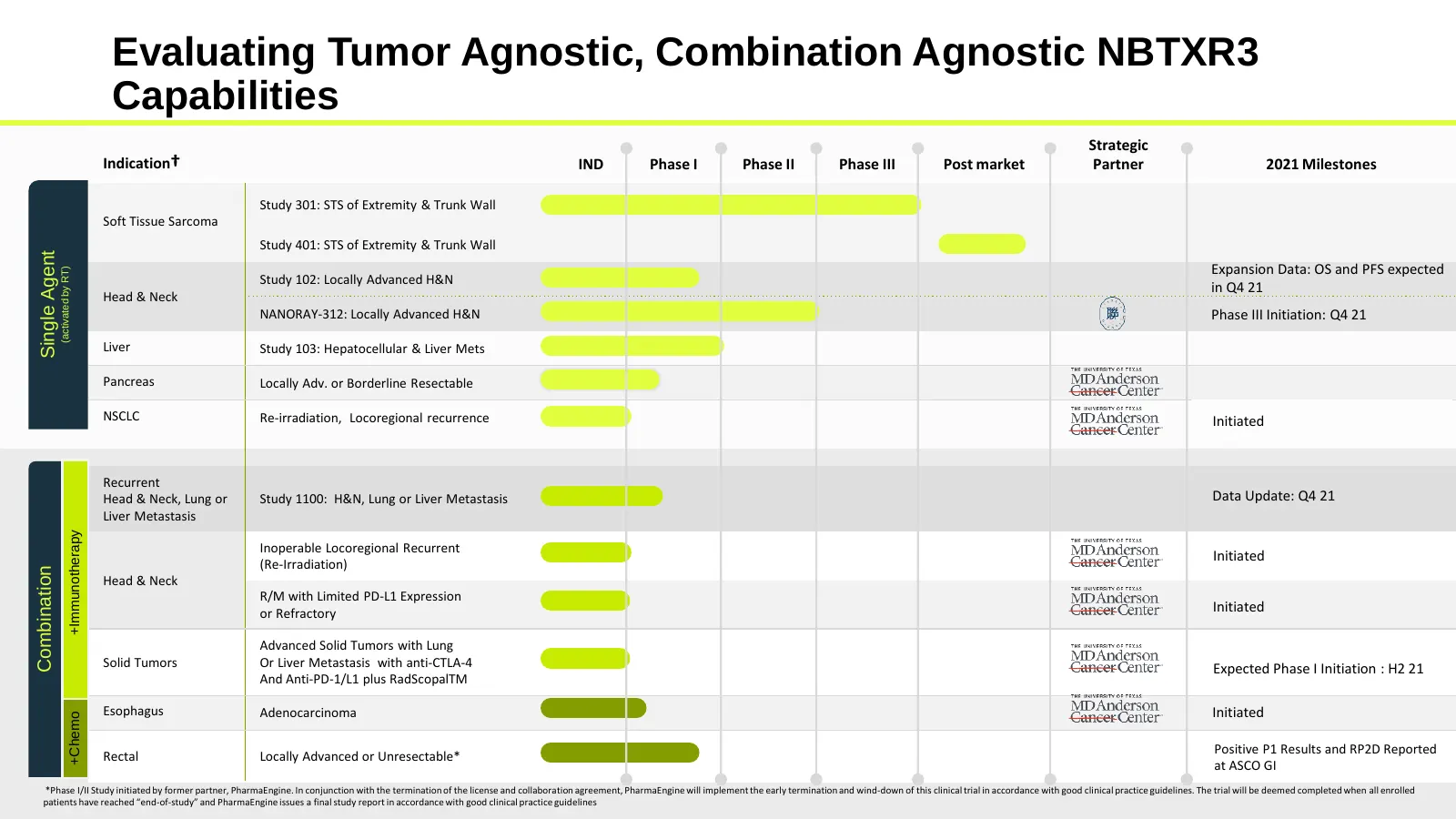
Slide 13: Evaluating Tumor Agnostic, Combination Agnostic NBTXR3 Capabilities
Evaluating Tumor Agnostic, Combination Agnostic NBTXR3 Capabilities Strategic Indication† IND Phase I Phase II Phase III Post market Partner 2021 Milestones Study 301: STS of Extremity & Trunk Wall Soft Tissue Sarcoma Study 401: STS of Extremity & Trunk Wall Single Agent Expansion Data: OS and PFS e
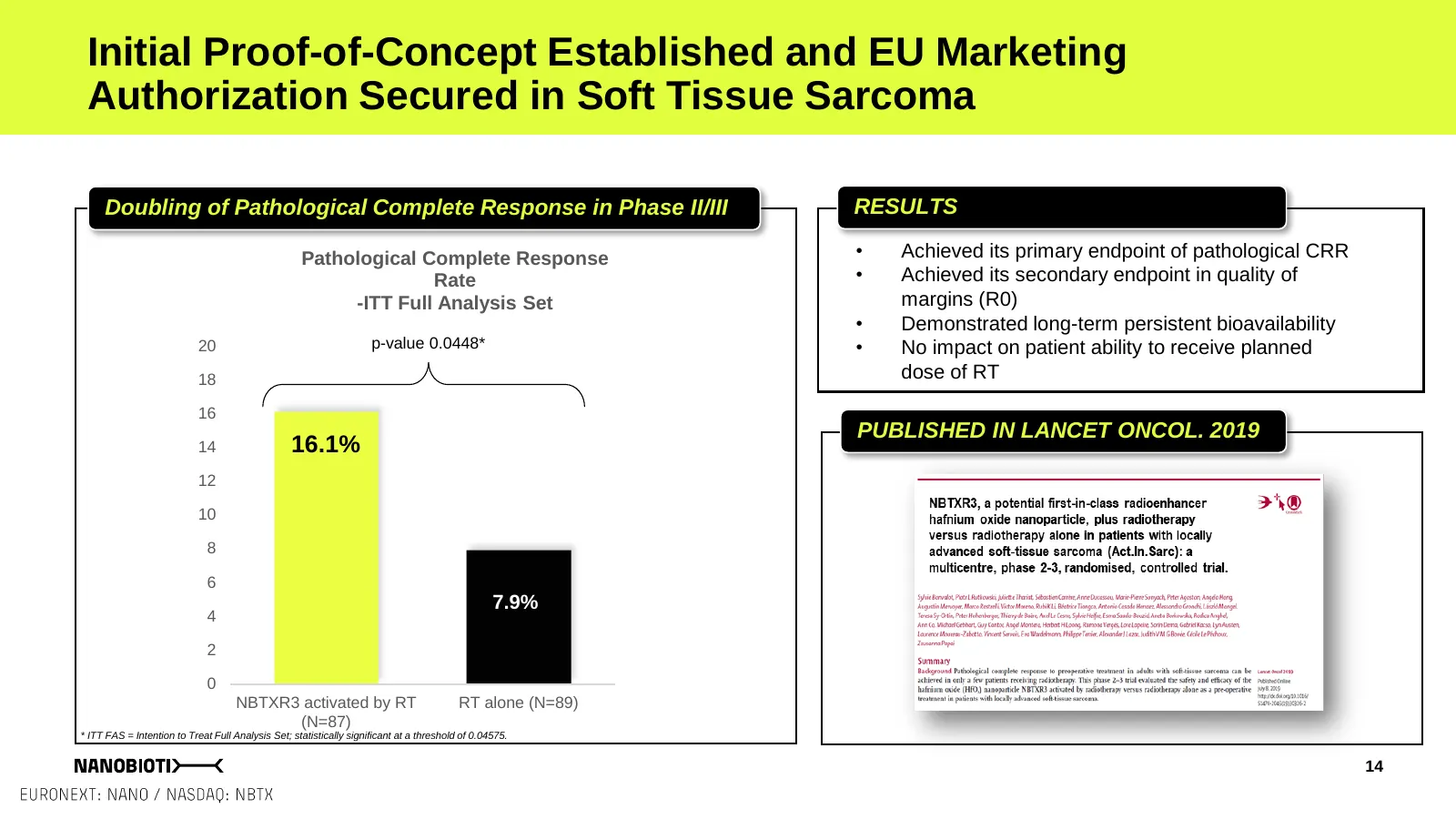
Slide 14: Proof-of-Concept and EU Marketing Authorization in Soft Tissue Sarcoma
Initial Proof-of-Concept Established and EU Marketing Authorization Secured in Soft Tissue Sarcoma Doubling of Pathological Complete Response in Phase II/III RESULTS Pathological Complete Response • Achieved its primary endpoint of pathological CRR Rate • Achieved its secondary endpoint in quality o
Slide 15: Focused Development Strategy
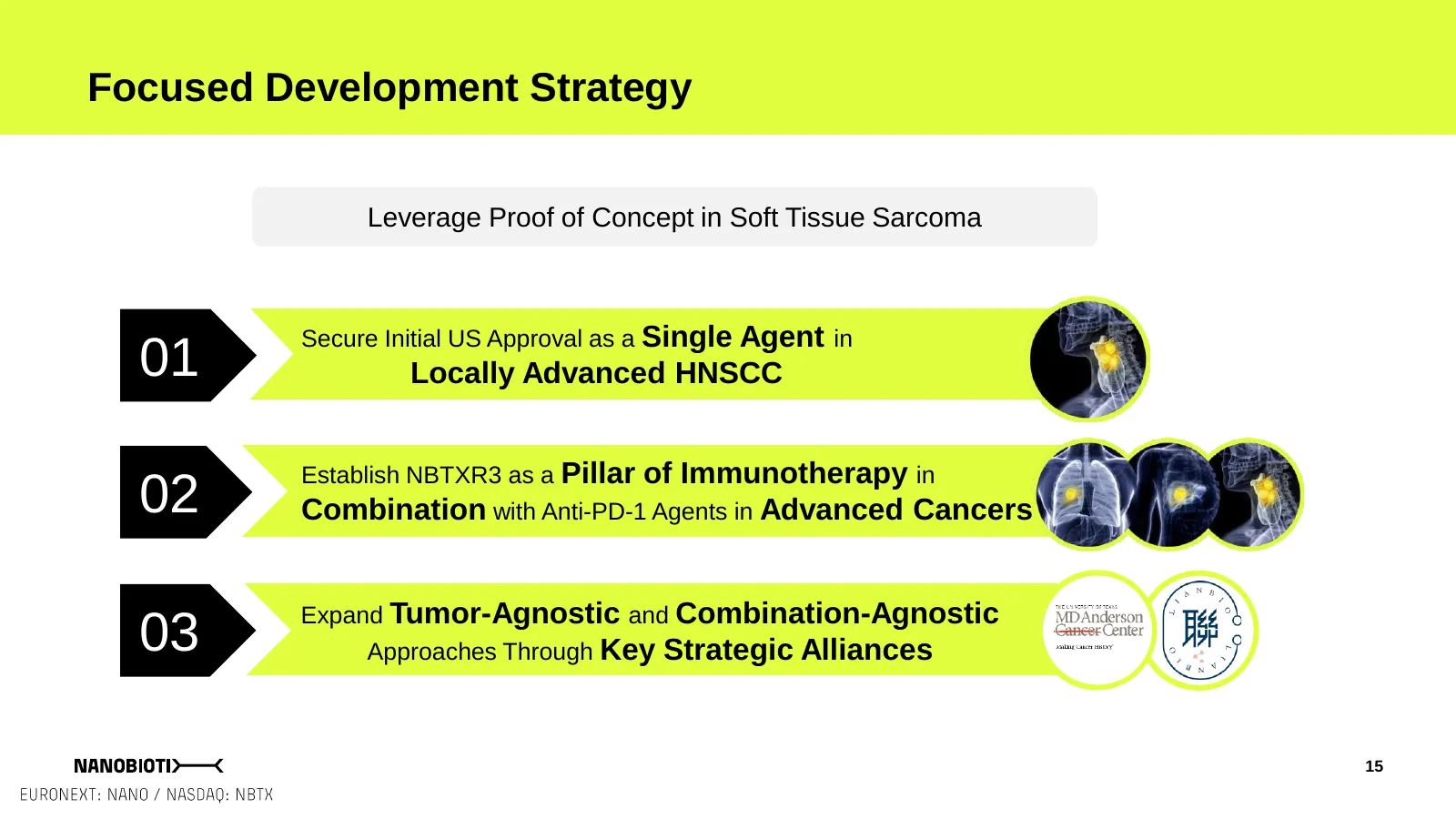
Focused Development Strategy Leverage Proof of Concept in Soft Tissue Sarcoma Secure Initial US Approval as a Single Agent in 01 Locally Advanced HNSCC Establish NBTXR3 as a Pillar of Immunotherapy in 02 Combination with Anti-PD-1 Agents in Advanced Cancers Expand Tumor-Agnostic and Combination-Agno

Slide 16: Secure Initial US Approval as a Single Agent in Locally Advanced HNSCC
Secure Initial US Approval as a Single Agent in Locally Advanced HNSCC 16
Slide 17: Leveraging PoC in Pursuit of 1st US Approval in Head & Neck Cancer
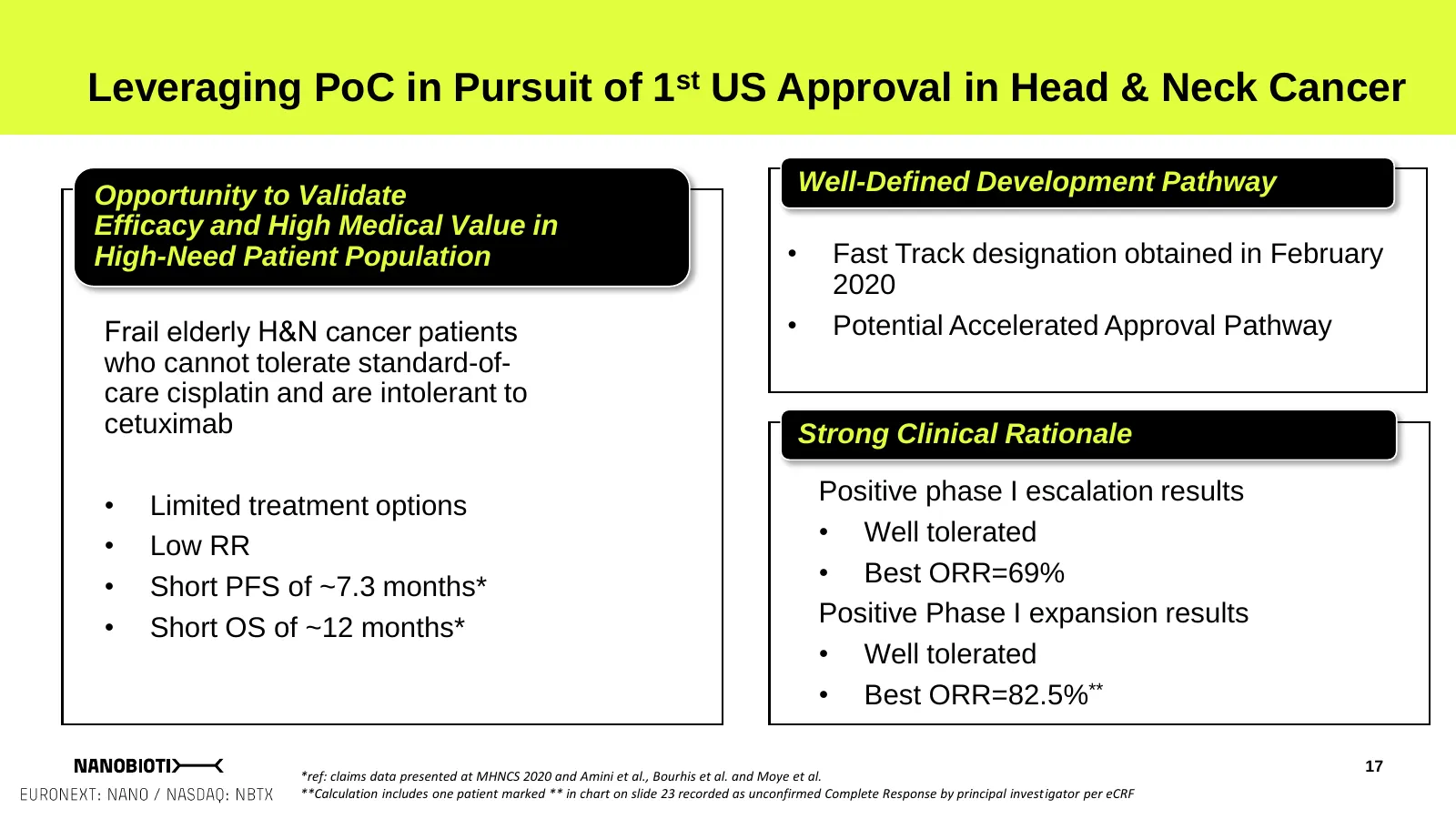
Leveraging PoC in Pursuit of 1st US Approval in Head & Neck Cancer Opportunity to Validate Well-Defined Development Pathway Efficacy and High Medical Value in High-Need Patient Population • Fast Track designation obtained in February 2020 Frail elderly H&N cancer patients • Potential Accelerated Ap
Slide 18: Expansion study targets elderly and frail patients
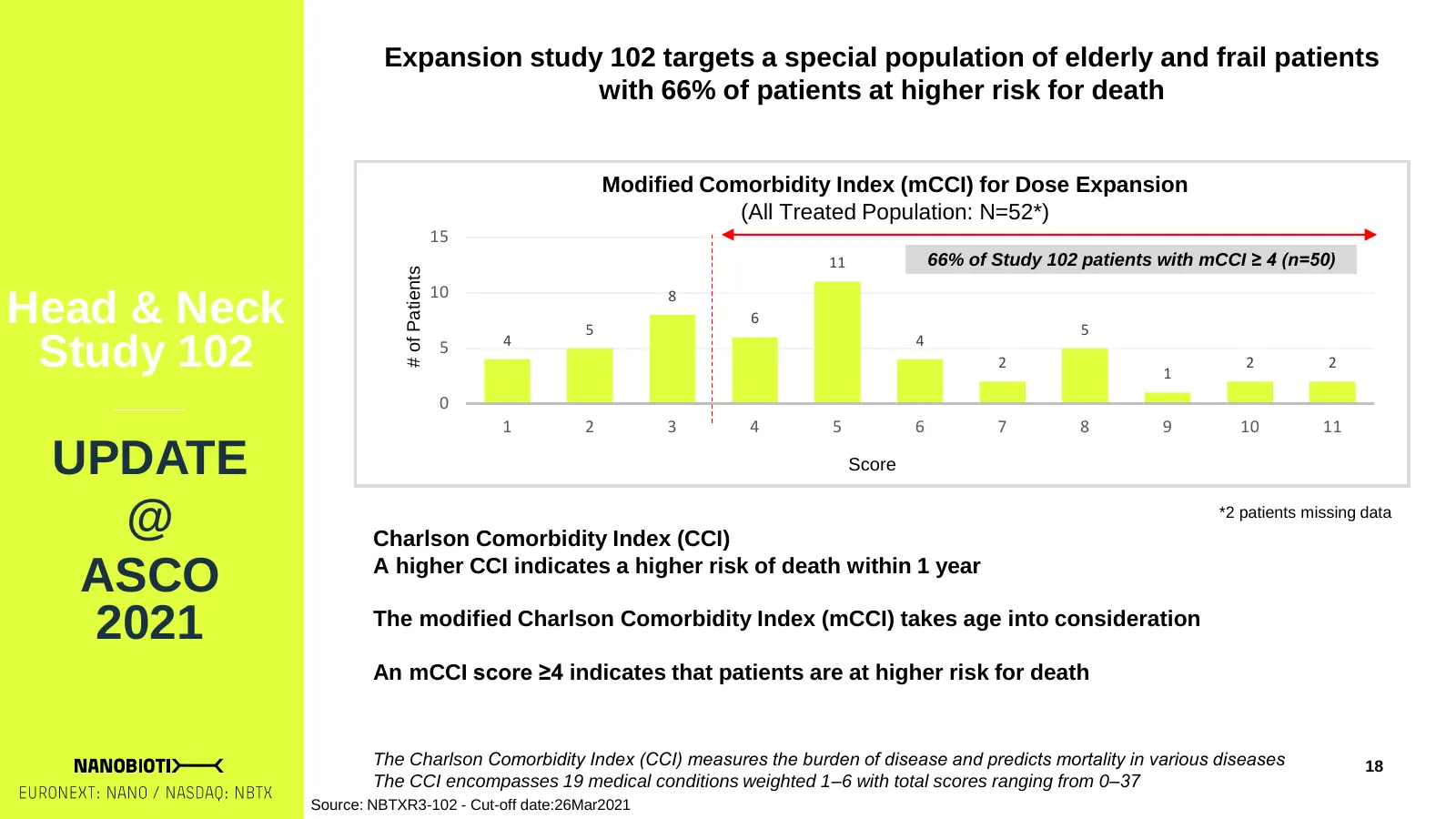
Expansion study 102 targets a special population of elderly and frail patients with 66% of patients at higher risk for death Modified Comorbidity Index (mCCI) for Dose Expansion (All Treated Population: N=52*) 15 11 66% of Study 102 patients with mCCI ≥ 4 (n=50) # of Patients 10 8 Head & Neck 4 5 6
Slide 19: Head & Neck Study 102 Adverse Events Summary
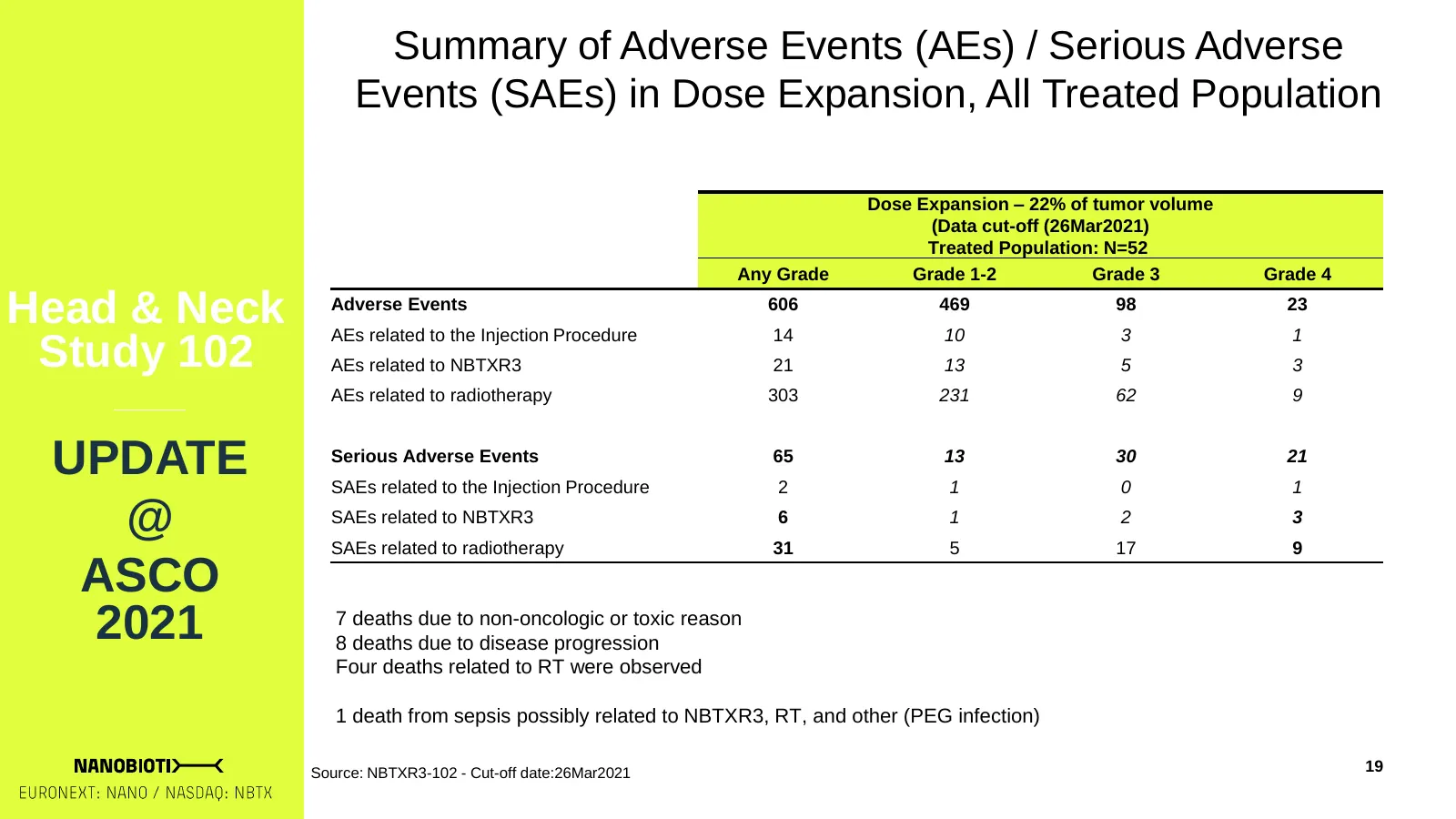
Summary of Adverse Events (AEs) / Serious Adverse Events (SAEs) in Dose Expansion, All Treated Population Dose Expansion – 22% of tumor volume (Data cut-off (26Mar2021) Treated Population: N=52 Any Grade Grade 1-2 Grade 3 Grade 4 Head & Neck Adverse Events AEs related to the Injection Procedure 606
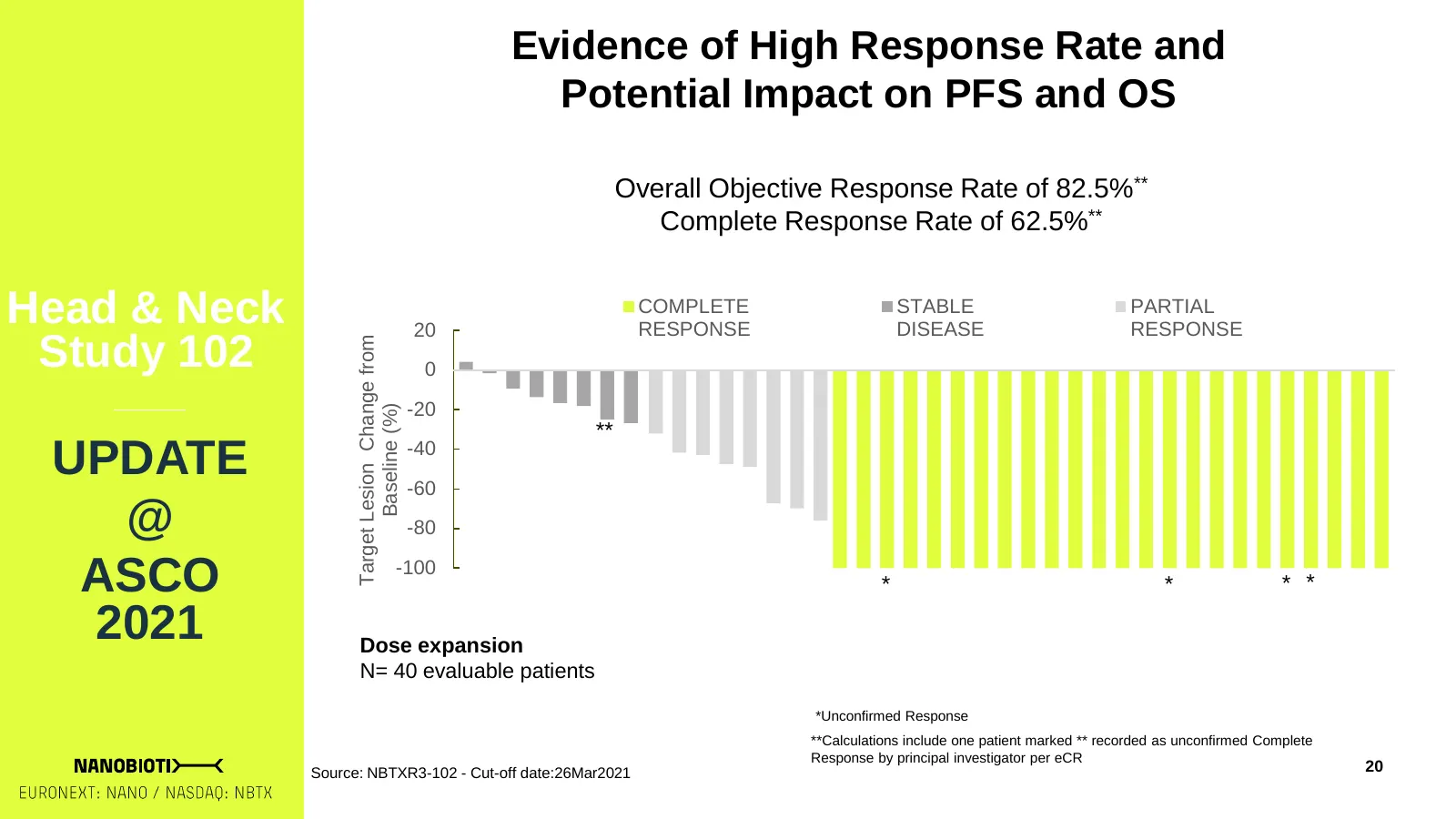
Slide 20: Evidence of High Response Rate and Potential Impact on PFS and OS
Evidence of High Response Rate and Potential Impact on PFS and OS Overall Objective Response Rate of 82.5%** Complete Response Rate of 62.5%** Head & Neck 20 COMPLETE RESPONSE STABLE DISEASE PARTIAL RESPONSE Study 102 Target Lesion Change from 0 -20 Baseline (%) ** UPDATE -40 -60 @ -80 ASCO -100 * *
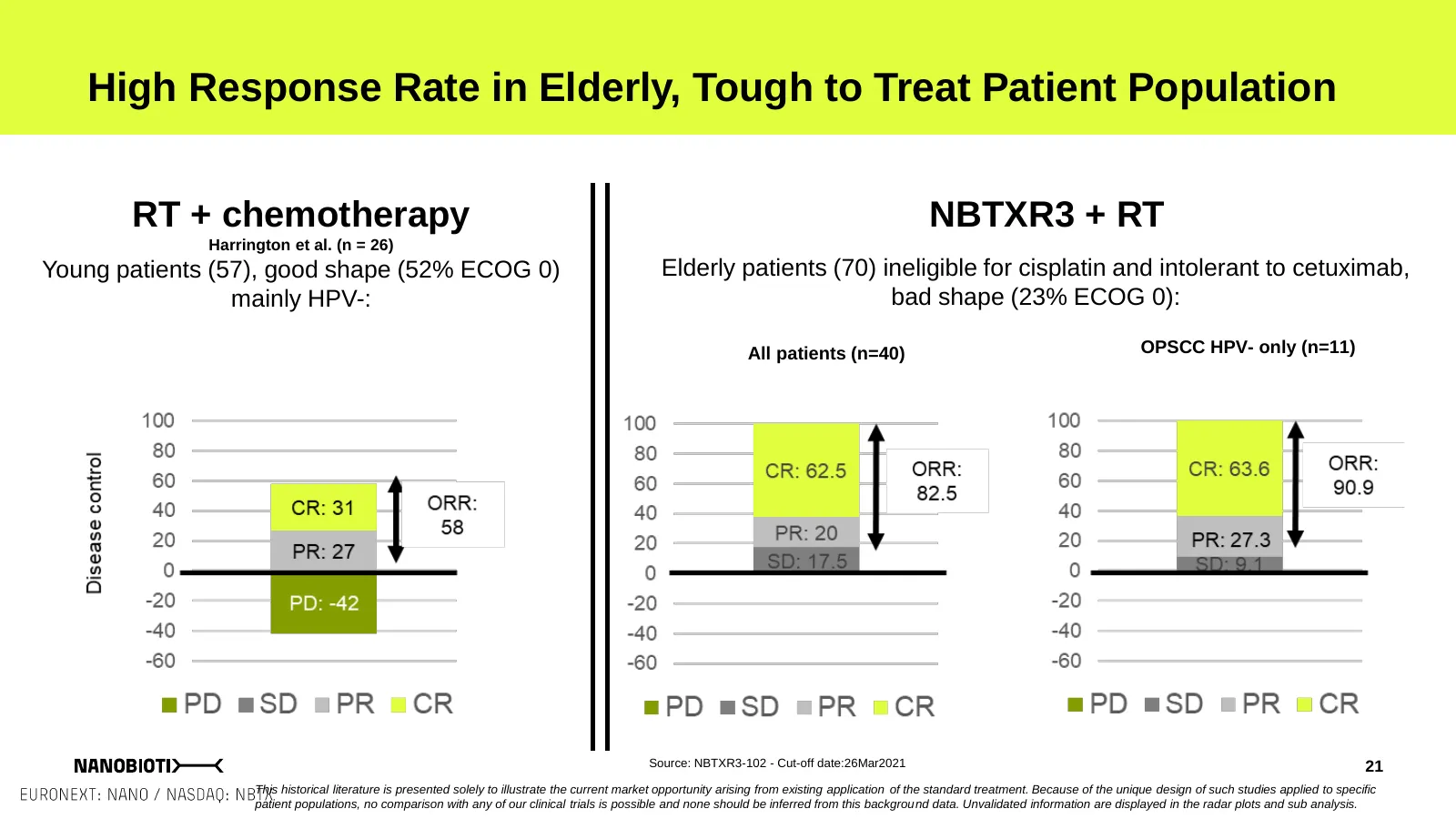
Slide 21: High Response Rate in Elderly, Tough to Treat Patient Population
High Response Rate in Elderly, Tough to Treat Patient Population RT + chemotherapy NBTXR3 + RT Harrington et al. (n = 26) Young patients (57), good shape (52% ECOG 0) Elderly patients (70) ineligible for cisplatin and intolerant to cetuximab, mainly HPV-: bad shape (23% ECOG 0): All patients (n=40)
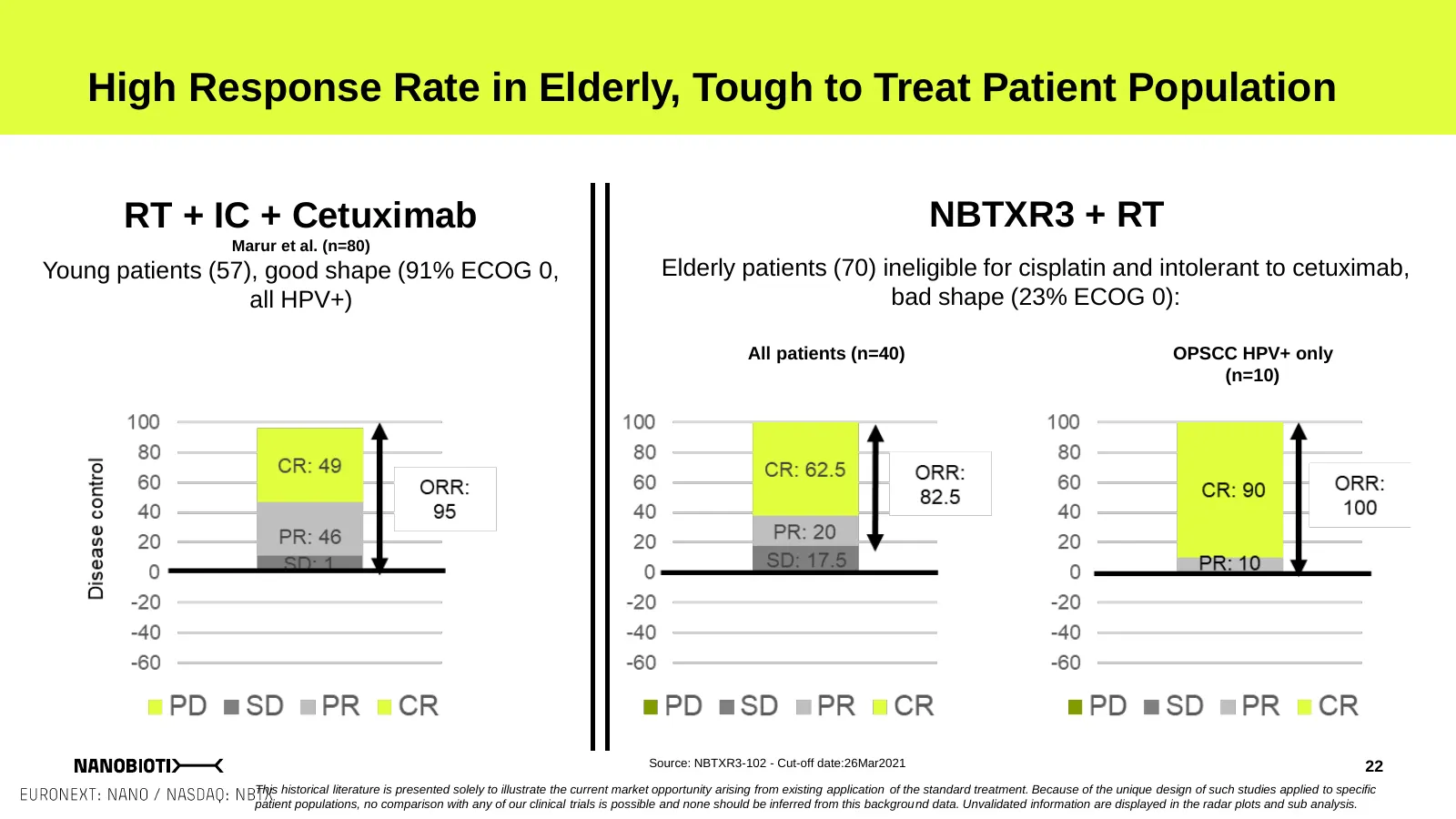
Slide 22: High Response Rate in Elderly, Tough to Treat Patient Population
High Response Rate in Elderly, Tough to Treat Patient Population RT + IC + Cetuximab NBTXR3 + RT Marur et al. (n=80) Young patients (57), good shape (91% ECOG 0, Elderly patients (70) ineligible for cisplatin and intolerant to cetuximab, all HPV+) bad shape (23% ECOG 0): All patients (n=40) OPSCC HP
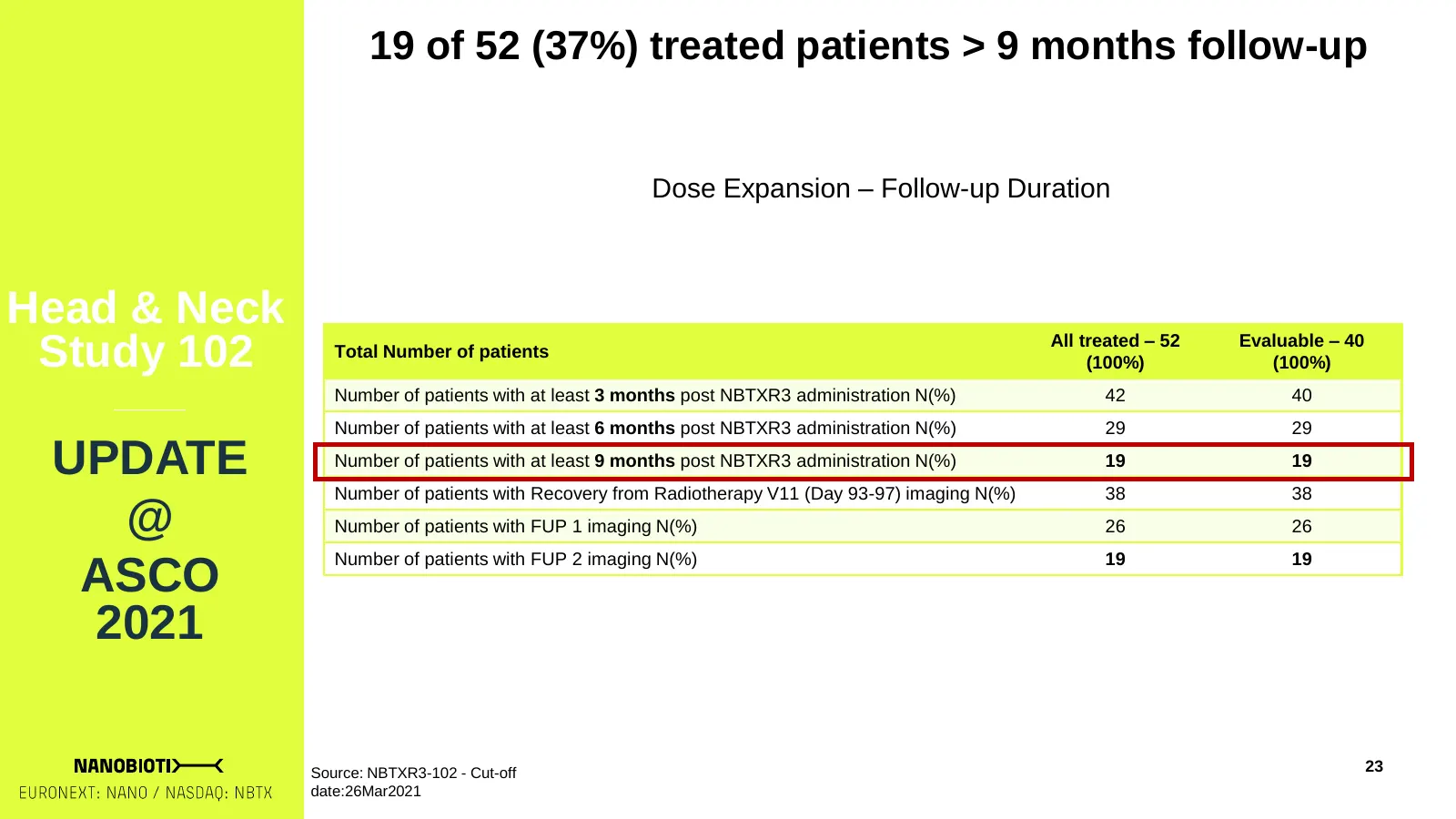
Slide 23: Dose Expansion Follow-up Duration
19 of 52 (37%) treated patients > 9 months follow-up Dose Expansion – Follow-up Duration Head & Neck All treated – 52 Evaluable – 40 Study 102 Total Number of patients (100%) (100%) Number of patients with at least 3 months post NBTXR3 administration N(%) 42 40 Number of patients with at least 6 mon
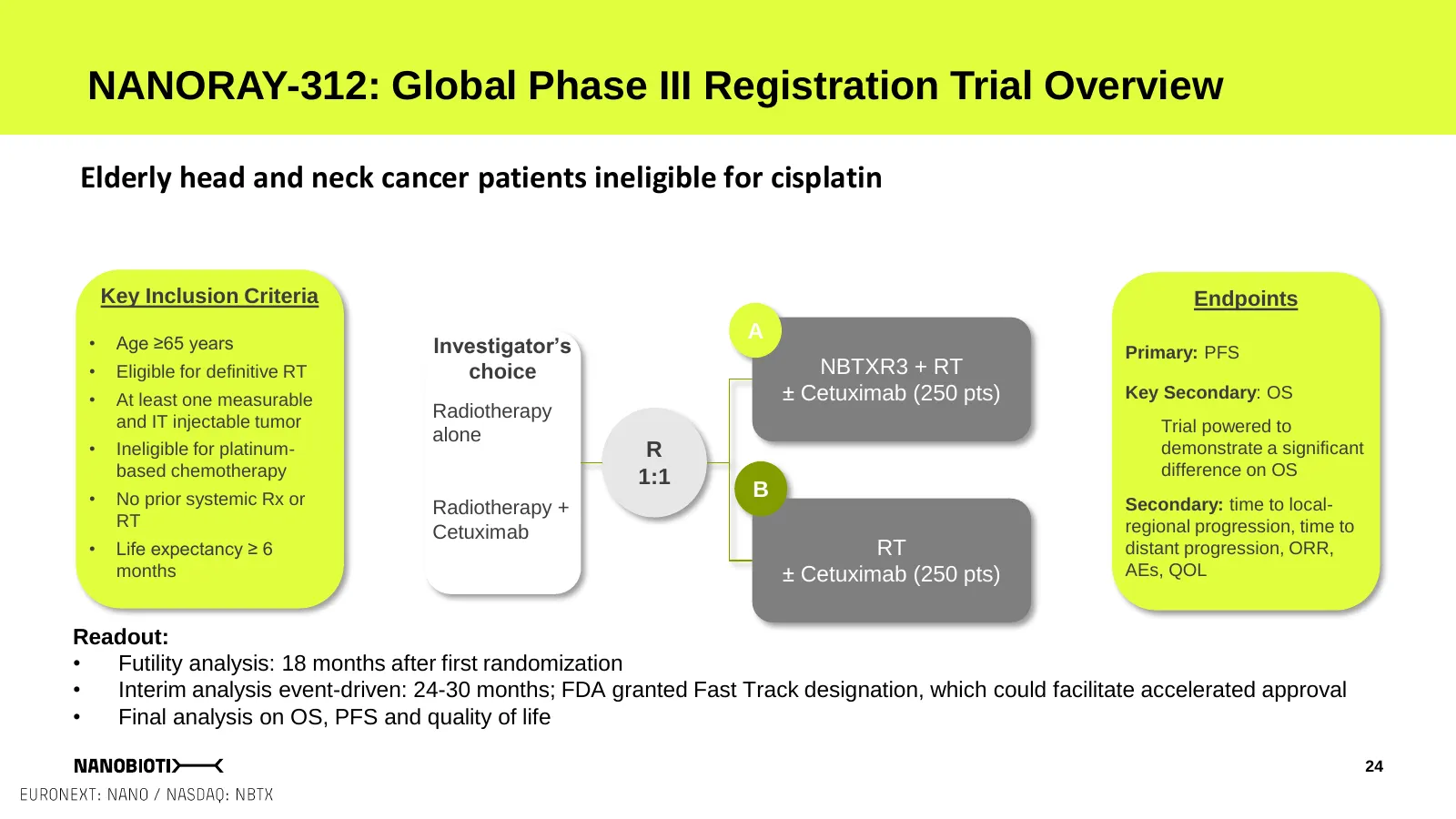
Slide 24: NANORAY-312: Global Phase III Registration Trial Overview
NANORAY-312: Global Phase III Registration Trial Overview Elderly head and neck cancer patients ineligible for cisplatin Key Inclusion Criteria Endpoints A • Age ≥65 years Investigator’s Primary: PFS • Eligible for definitive RT choice NBTXR3 + RT • At least one measurable ± Cetuximab (250 pts) Key
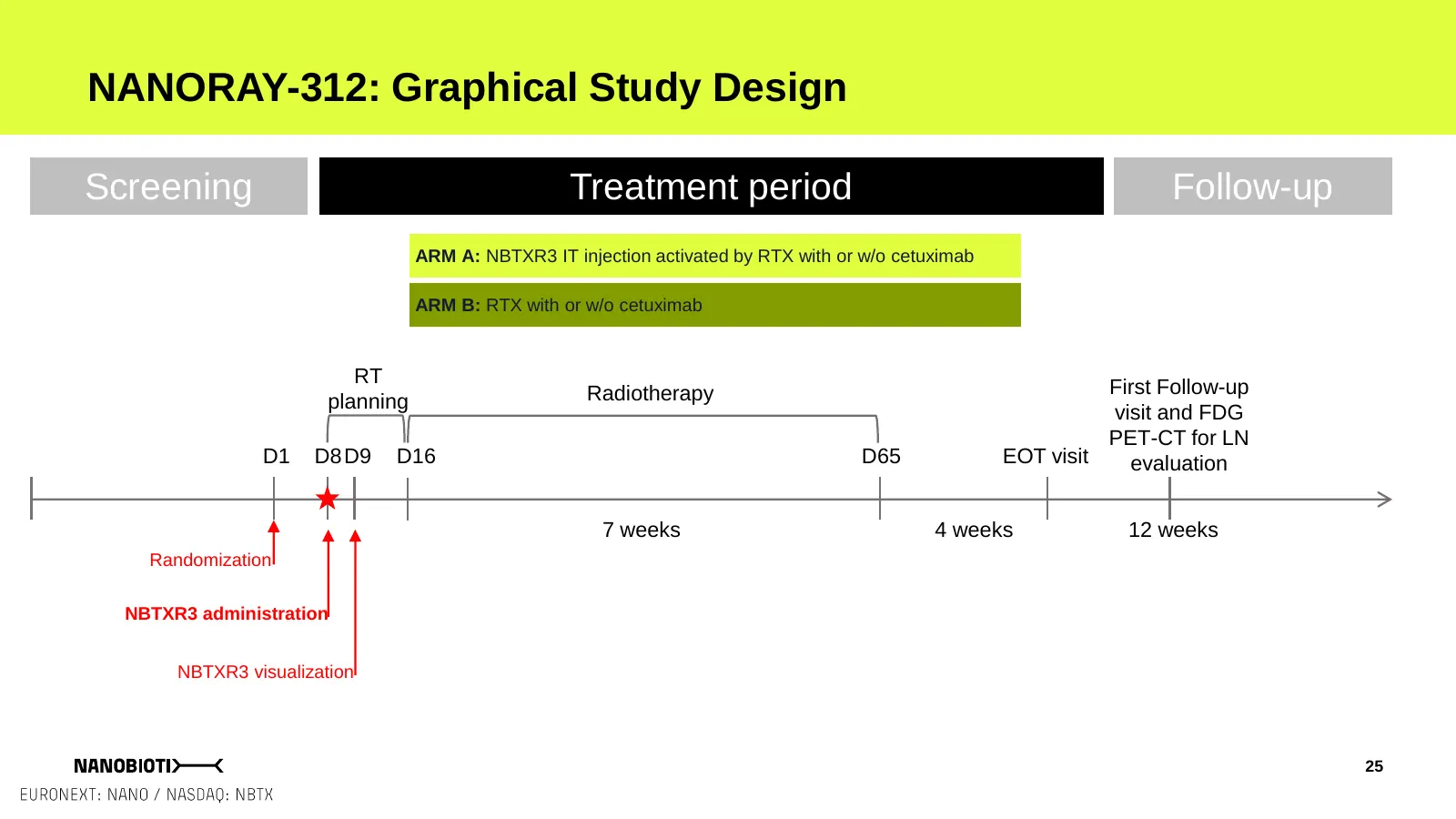
Slide 25: NANORAY-312: Graphical Study Design
NANORAY-312: Graphical Study Design Screening Treatment period Follow-up ARM A: NBTXR3 IT injection activated by RTX with or w/o cetuximab ARM B: RTX with or w/o cetuximab RT First Follow-up planning Radiotherapy visit and FDG PET-CT for LN D1 D8 D9 D16 D65 EOT visit evaluation 7 weeks 4 weeks 12 we
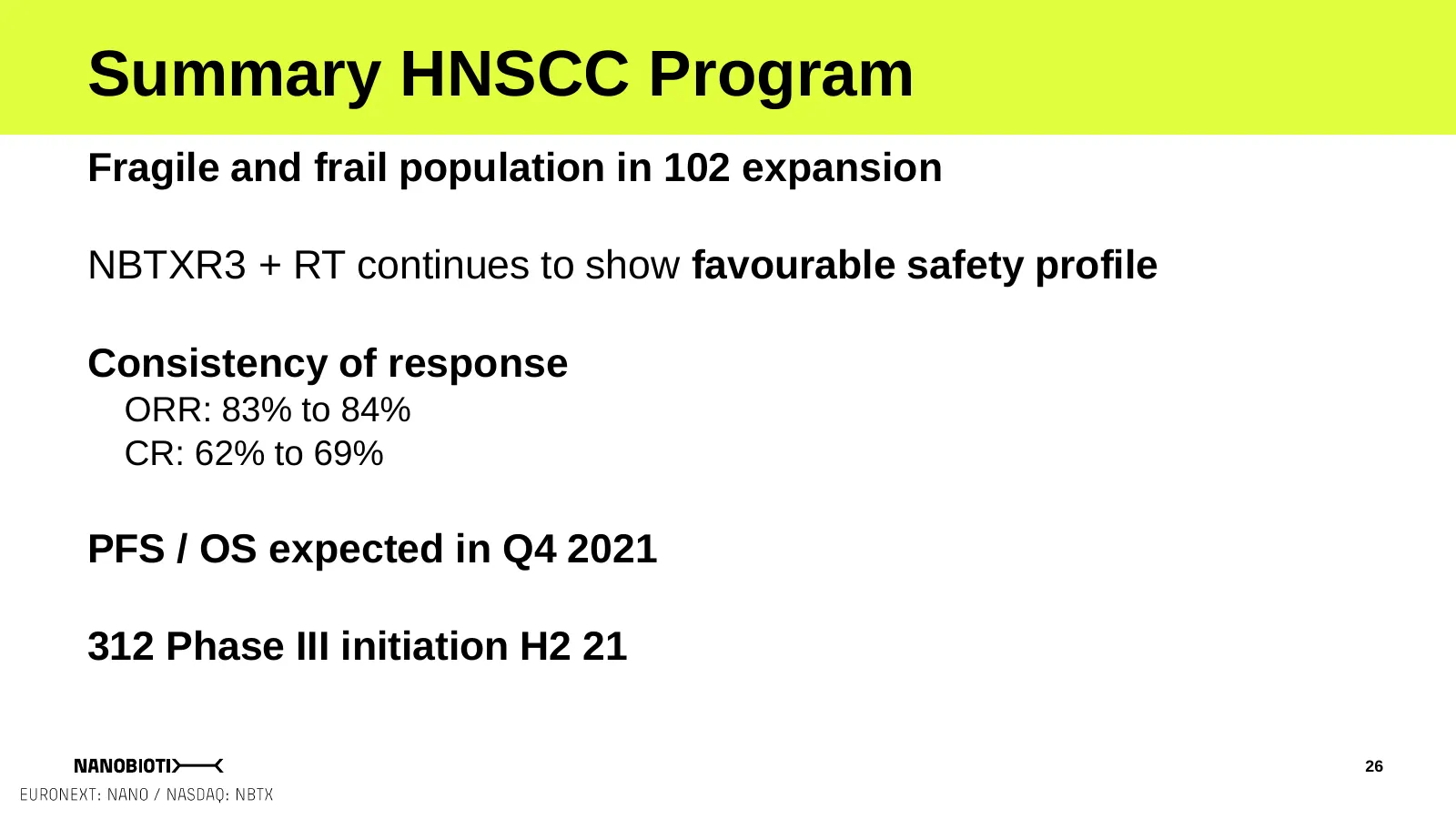
Slide 26: Summary HNSCC Program
Summary HNSCC Program Fragile and frail population in 102 expansion NBTXR3 + RT continues to show favourable safety profile Consistency of response ORR: 83% to 84% CR: 62% to 69% PFS / OS expected in Q4 2021 312 Phase III initiation H2 21 26
Slide 27: Establish NBTXR3 as a Pillar in Immunotherapy in Combination with Anti-PD-1
Establish NBTXR3 as a Pillar in Immunotherapy in Combination with Anti-PD-1 Agents in Advanced Cancers 27
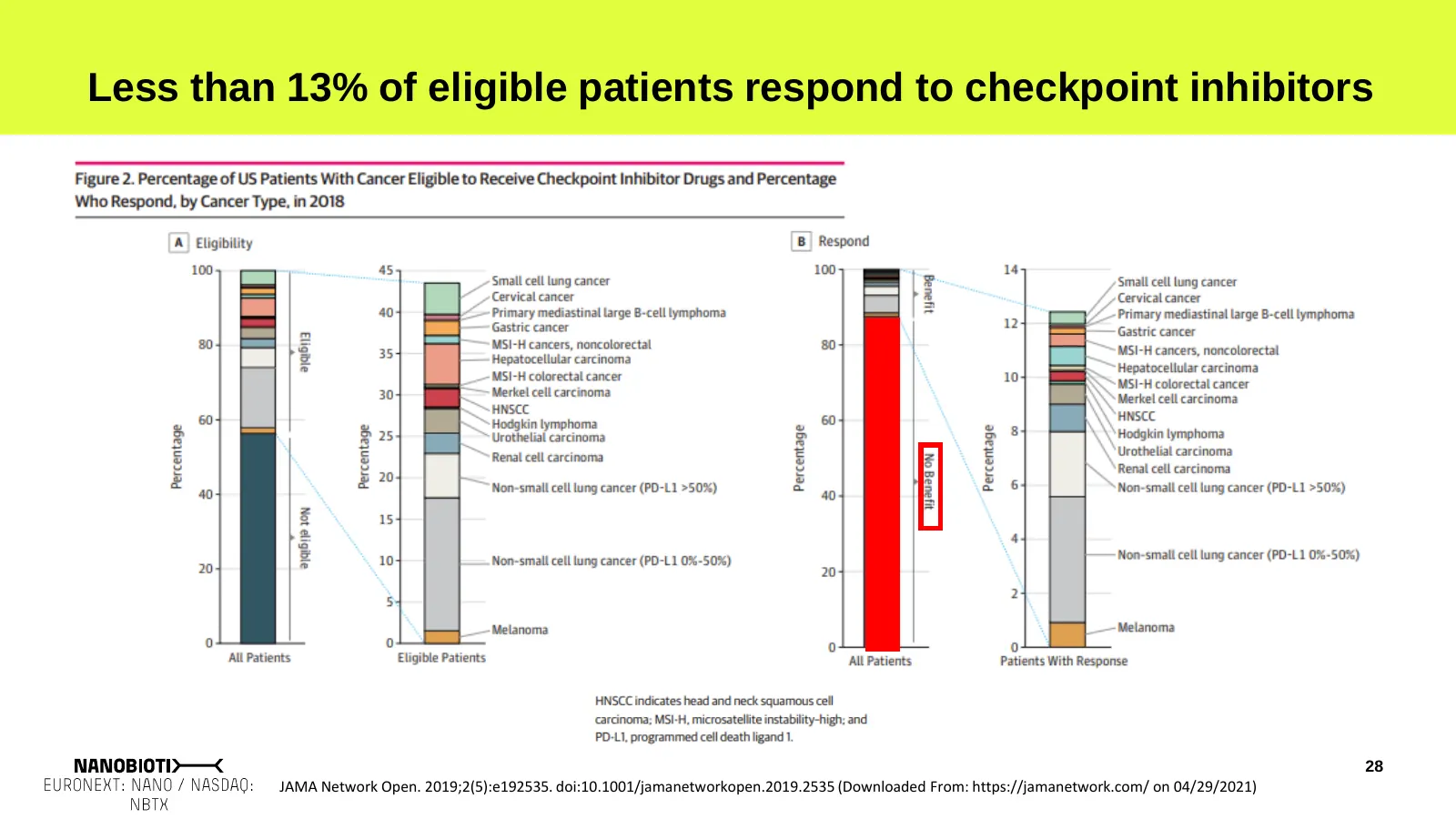
Slide 28: Less than 13% of eligible patients respond to checkpoint inhibitors
Less than 13% of eligible patients respond to checkpoint inhibitors 28 JAMA Network Open. 2019;2(5):e192535. doi:10.1001/jamanetworkopen.2019.2535 (Downloaded From: https://jamanetwork.com/ on 04/29/2021)
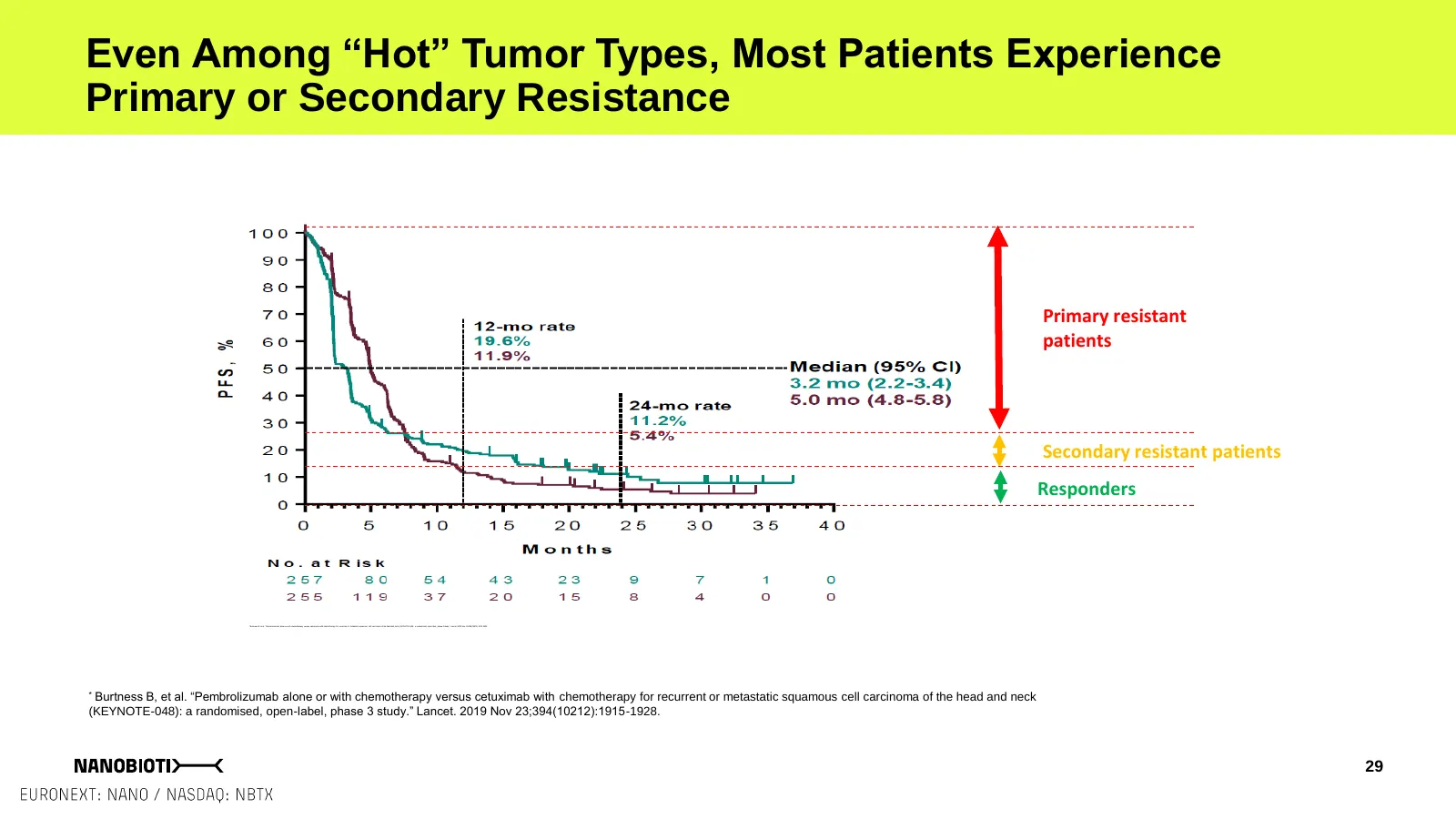
Slide 29: Even Among Hot Tumor Types, Most Patients Experience Resistance
Even Among “Hot” Tumor Types, Most Patients Experience Primary or Secondary Resistance Primary resistant patients Secondary resistant patients Responders * Burtness B, et al. “Pembrolizumab alone or with chemotherapy versus cetuximab with chemotherapy for recurrent or metastatic squamous cell carcin
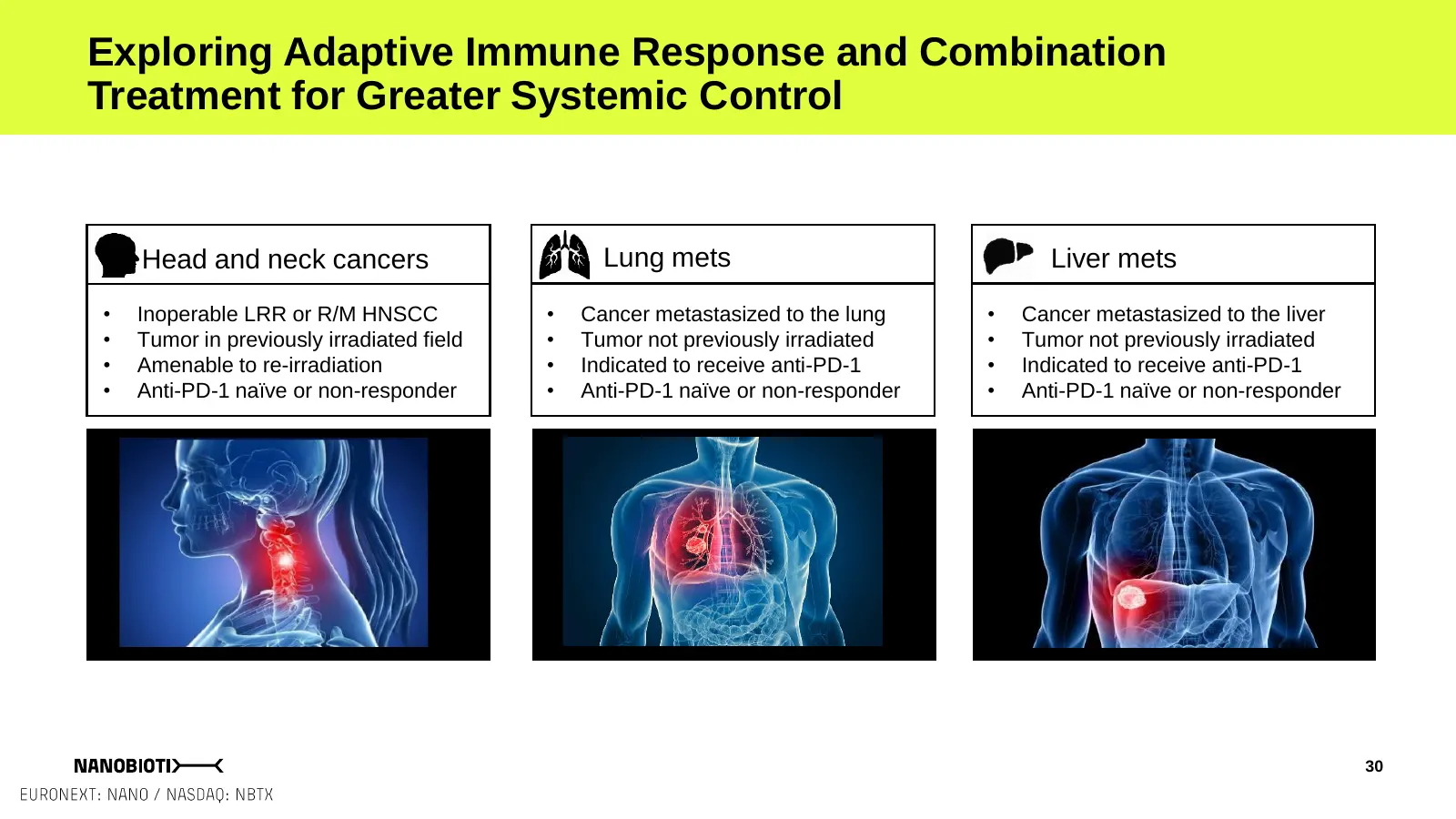
Slide 30: Exploring Adaptive Immune Response and Combination Treatment
Exploring Adaptive Immune Response and Combination Treatment for Greater Systemic Control HNSCC Head – Cohort and neck 1 cancers Lung Mets – Cohort 2 Lung mets Liver mets– Cohort 3 Liver Mets • Inoperable LRR or R/M HNSCC • Cancer metastasized to the lung • Cancer metastasized to the liver • Tumor i
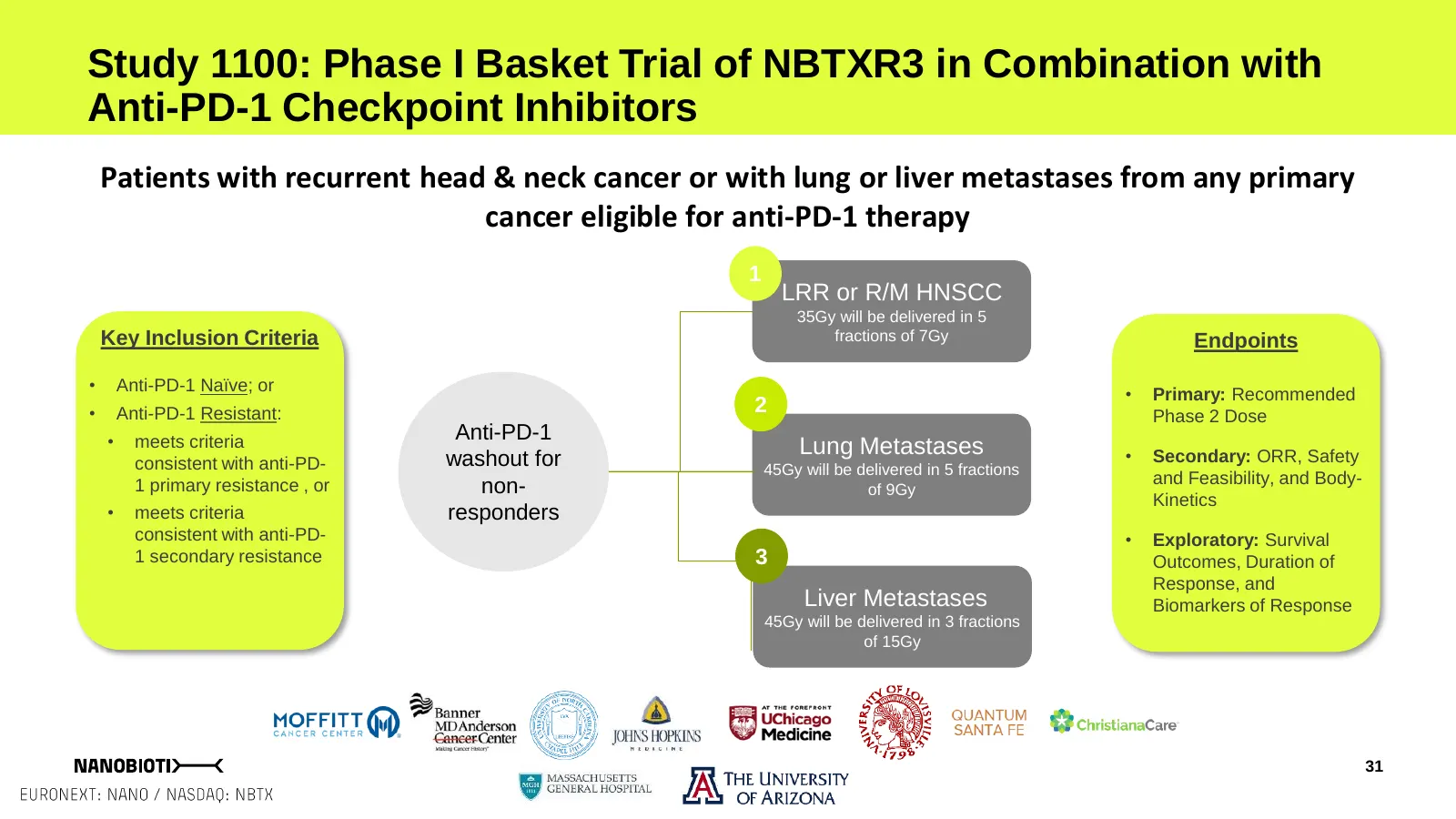
Slide 31: Study 1100: Phase I Basket Trial with Anti-PD-1
Study 1100: Phase I Basket Trial of NBTXR3 in Combination with Anti-PD-1 Checkpoint Inhibitors Patients with recurrent head & neck cancer or with lung or liver metastases from any primary cancer eligible for anti-PD-1 therapy 1 LRR or R/M HNSCC 35Gy will be delivered in 5 Key Inclusion Criteria frac
Slide 32: Study 1100: Graphical Study Design
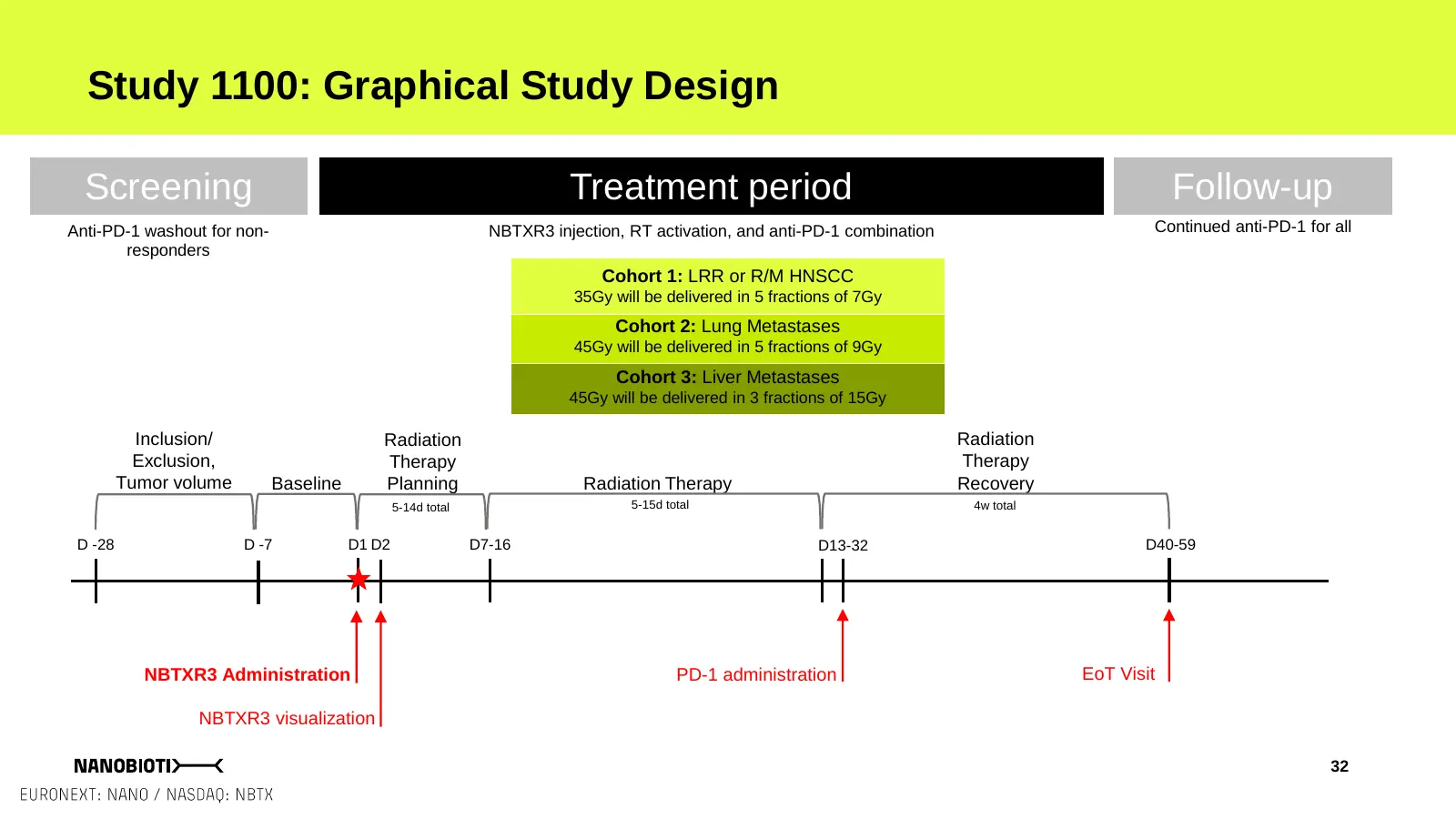
Study 1100: Graphical Study Design Screening Treatment period Follow-up Anti-PD-1 washout for non- NBTXR3 injection, RT activation, and anti-PD-1 combination Continued anti-PD-1 for all responders Cohort 1: LRR or R/M HNSCC 35Gy will be delivered in 5 fractions of 7Gy Cohort 2: Lung Metastases 45Gy
Slide 33: 16 patients treated across 3 cohorts
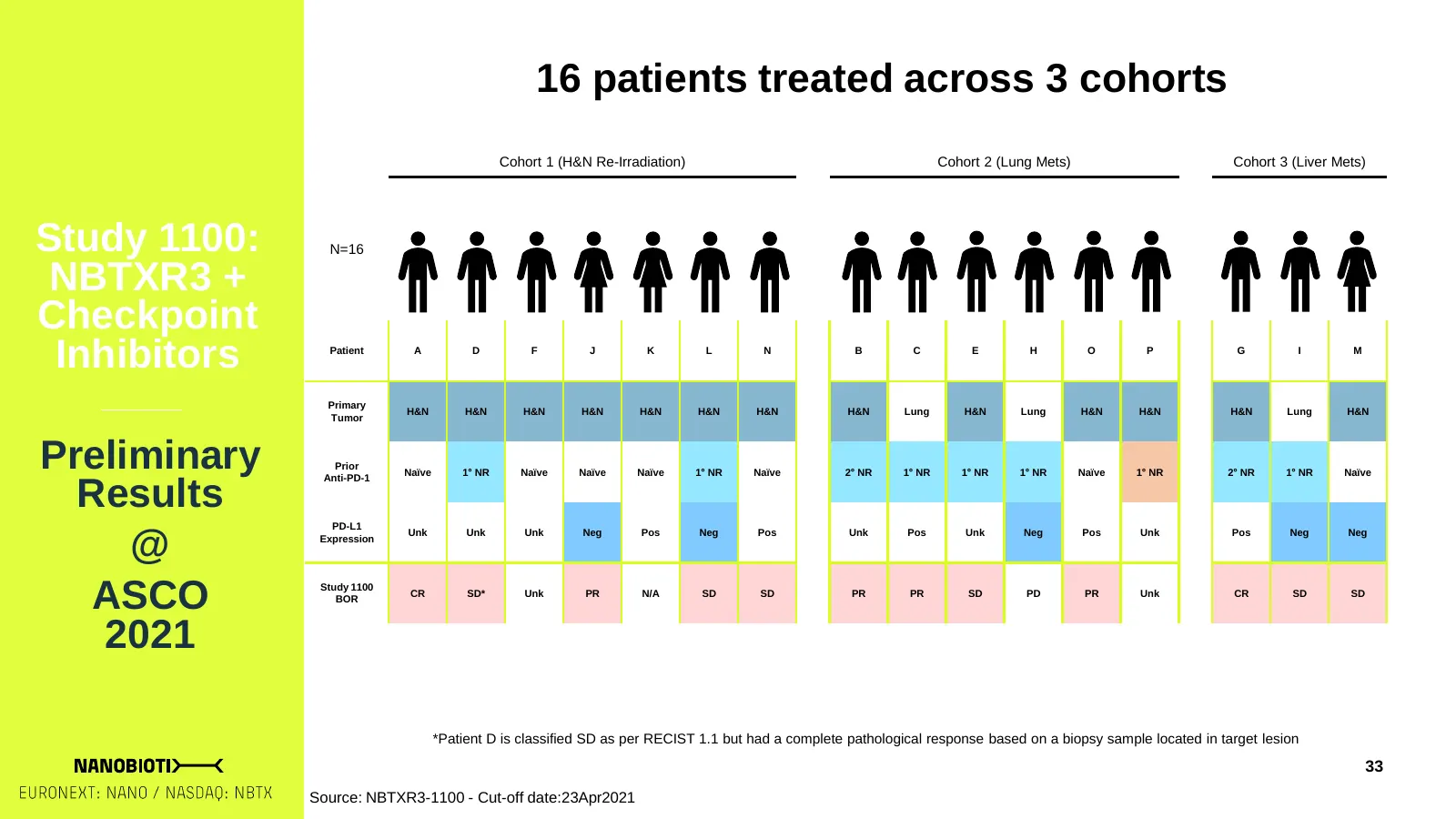
16 patients treated across 3 cohorts Cohort 1 (H&N Re-Irradiation) Cohort 2 (Lung Mets) Cohort 3 (Liver Mets) Study 1100: N=16 NBTXR3 + Checkpoint Inhibitors Patient A D F J K L N B C E H O P G I M Primary H&N H&N H&N H&N H&N H&N H&N H&N Lung H&N Lung H&N H&N H&N Lung H&N Tumor Preliminary Prior Ant
Slide 34: AE profile has not differed from what is expected with RT or anti-PD-1
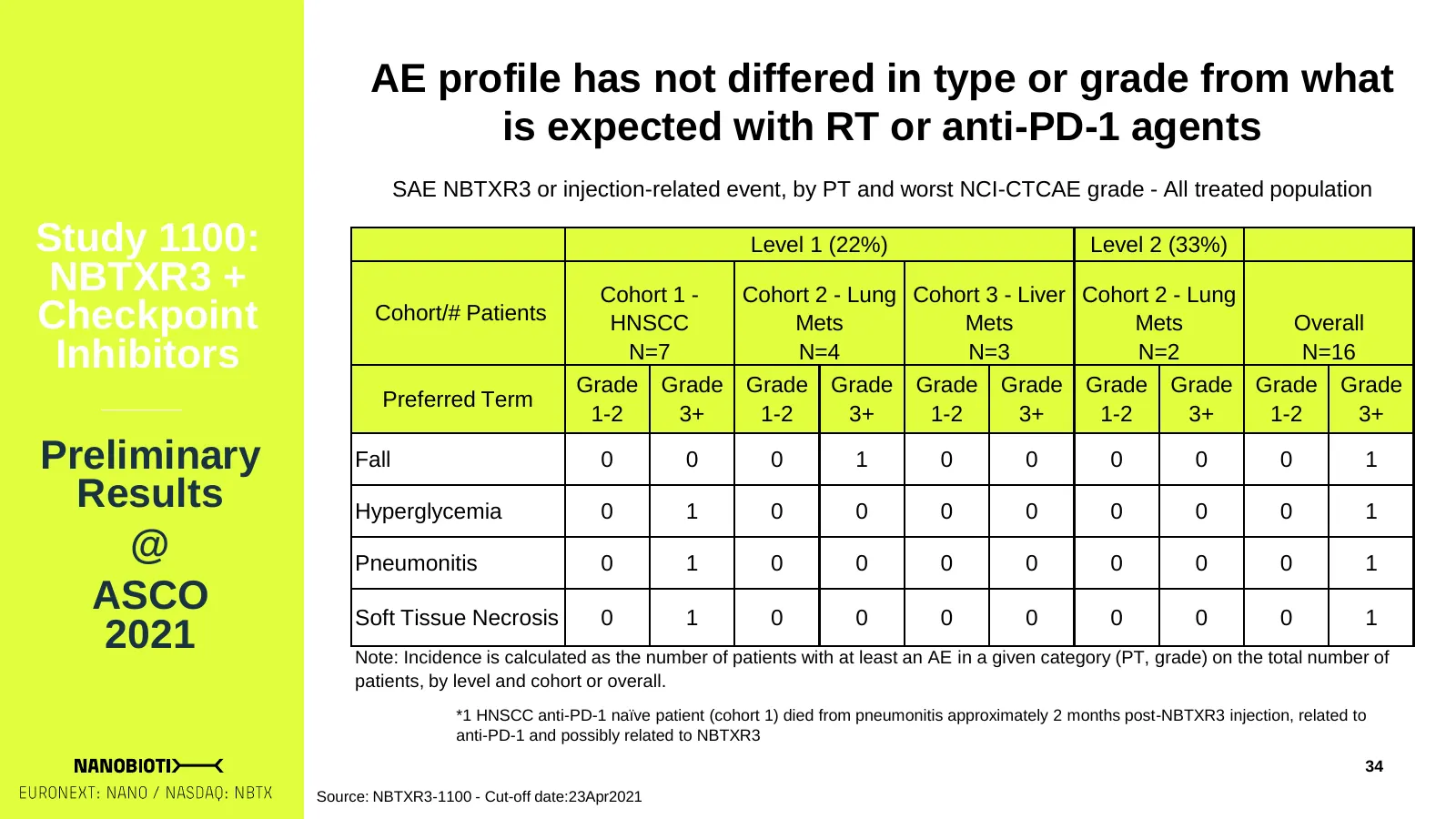
AE profile has not differed in type or grade from what is expected with RT or anti-PD-1 agents SAE NBTXR3 or injection-related event, by PT and worst NCI-CTCAE grade - All treated population Study 1100: Level 1 (22%) Level 2 (33%) NBTXR3 + Cohort 1 - Cohort 2 - Lung Cohort 3 - Liver Cohort 2 - Lung
Slide 35: Tumor regression regardless of prior anti-PD-1 exposure
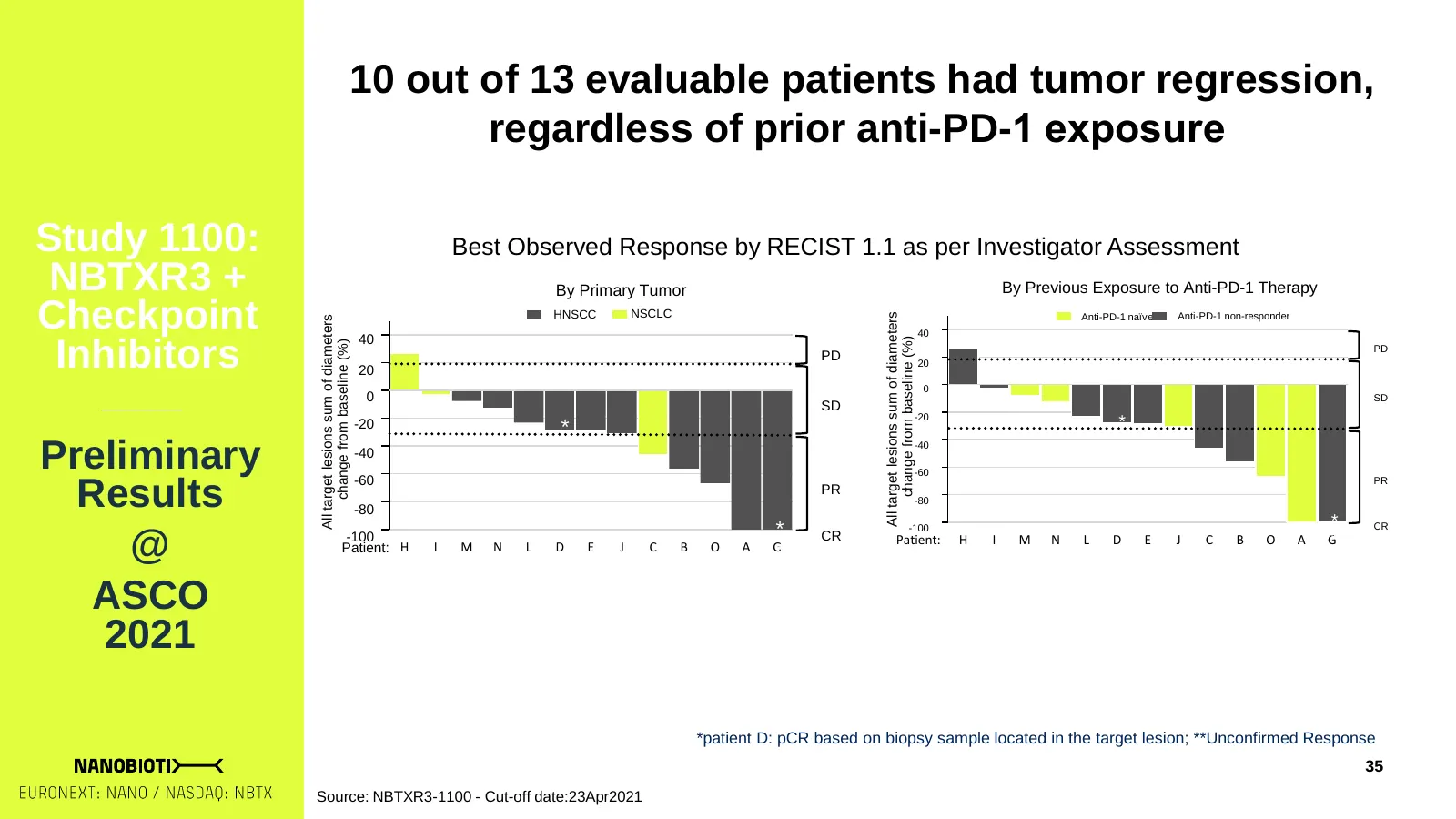
10 out of 13 evaluable patients had tumor regression, regardless of prior anti-PD-1 exposure Study 1100: Best Observed Response by RECIST 1.1 as per Investigator Assessment NBTXR3 + By Primary Tumor By Previous Exposure to Anti-PD-1 Therapy Checkpoint HNSCC NSCLC All target lesions sum of diameter
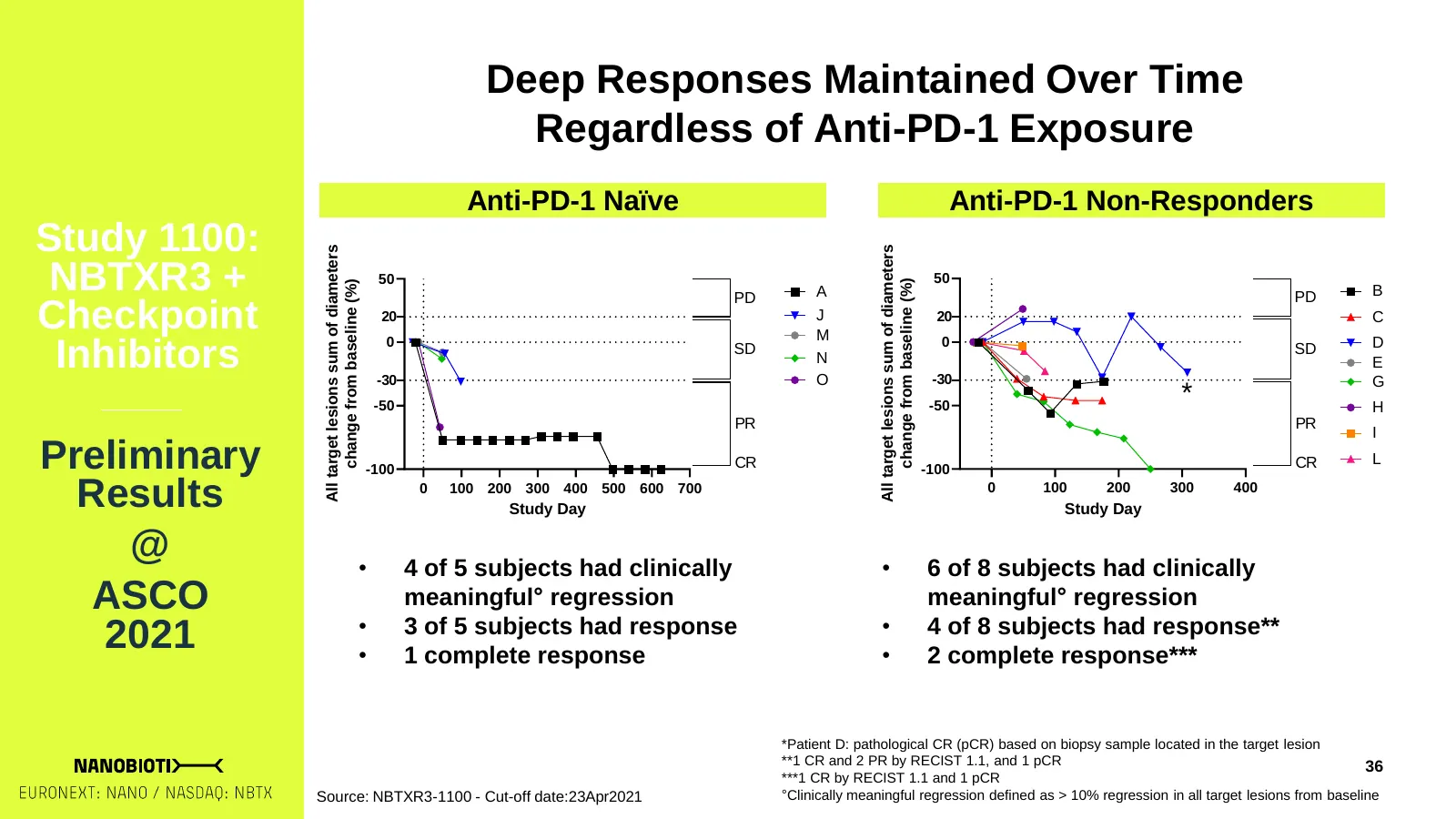
Slide 36: Deep Responses Maintained Over Time
Deep Responses Maintained Over Time Regardless of Anti-PD-1 Exposure Anti-PD-1 Naïve PD-1 Naive (ASCO 2021 Data) Anti-PD-1 Non-Responders PD-1 Non-Responders (ASCO 2021 Data) Study 1100: All target lesions sum of diameters All target lesions sum of diameters NBTXR3 + 50 50 change from baseline (%) c
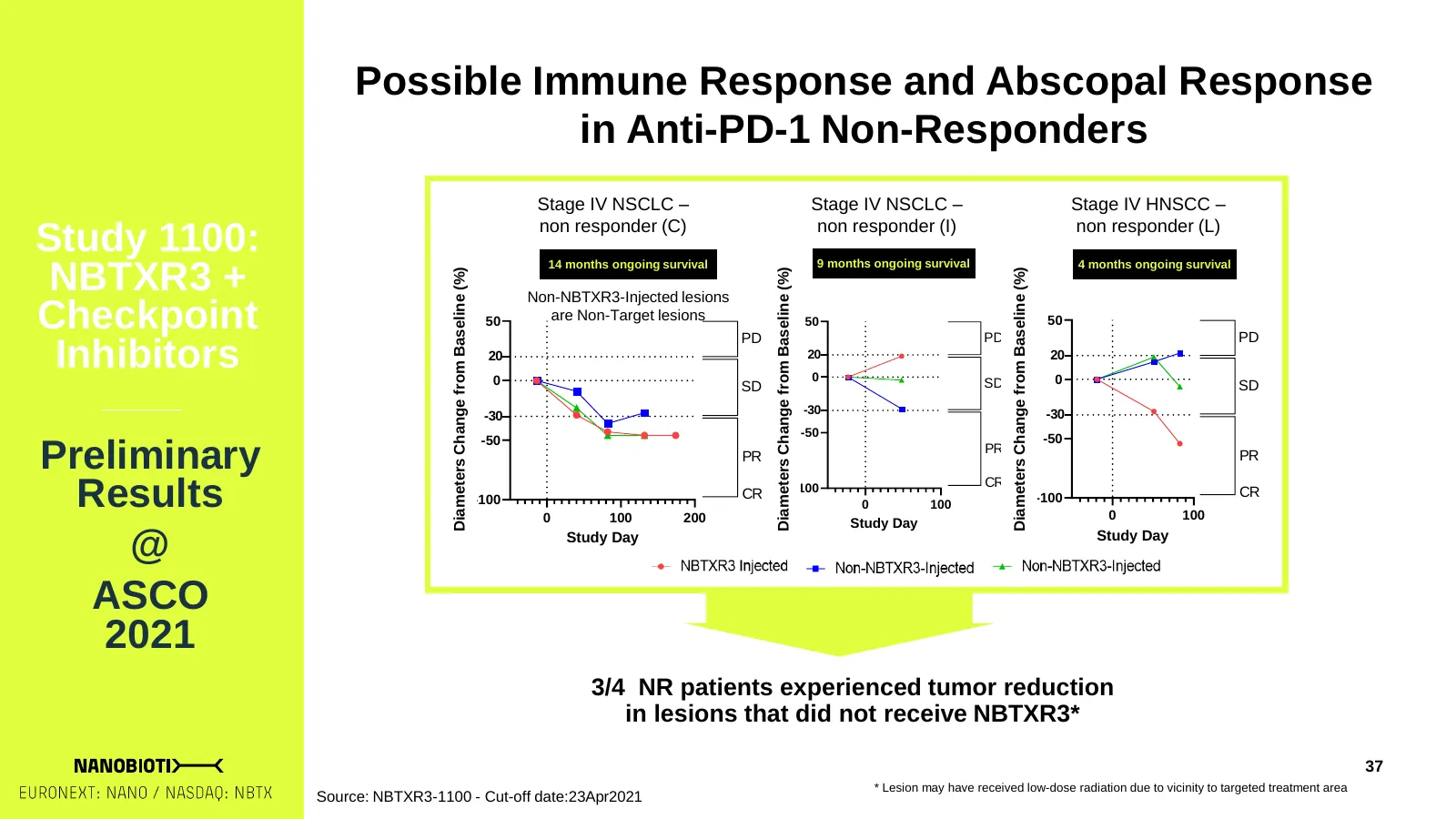
Slide 37: Possible Immune Response and Abscopal Response in Non-Responders
Possible Immune Response and Abscopal Response in Anti-PD-1 Non-Responders Stage IV NSCLC – Stage IV NSCLC – Stage IV HNSCC – non responder (C) non responder (I) non responder (L) Study 1100: 14 months ongoing survival 9 months ongoing survival 4 months ongoing survival NBTXR3 + %(%) % (%) Baseline%
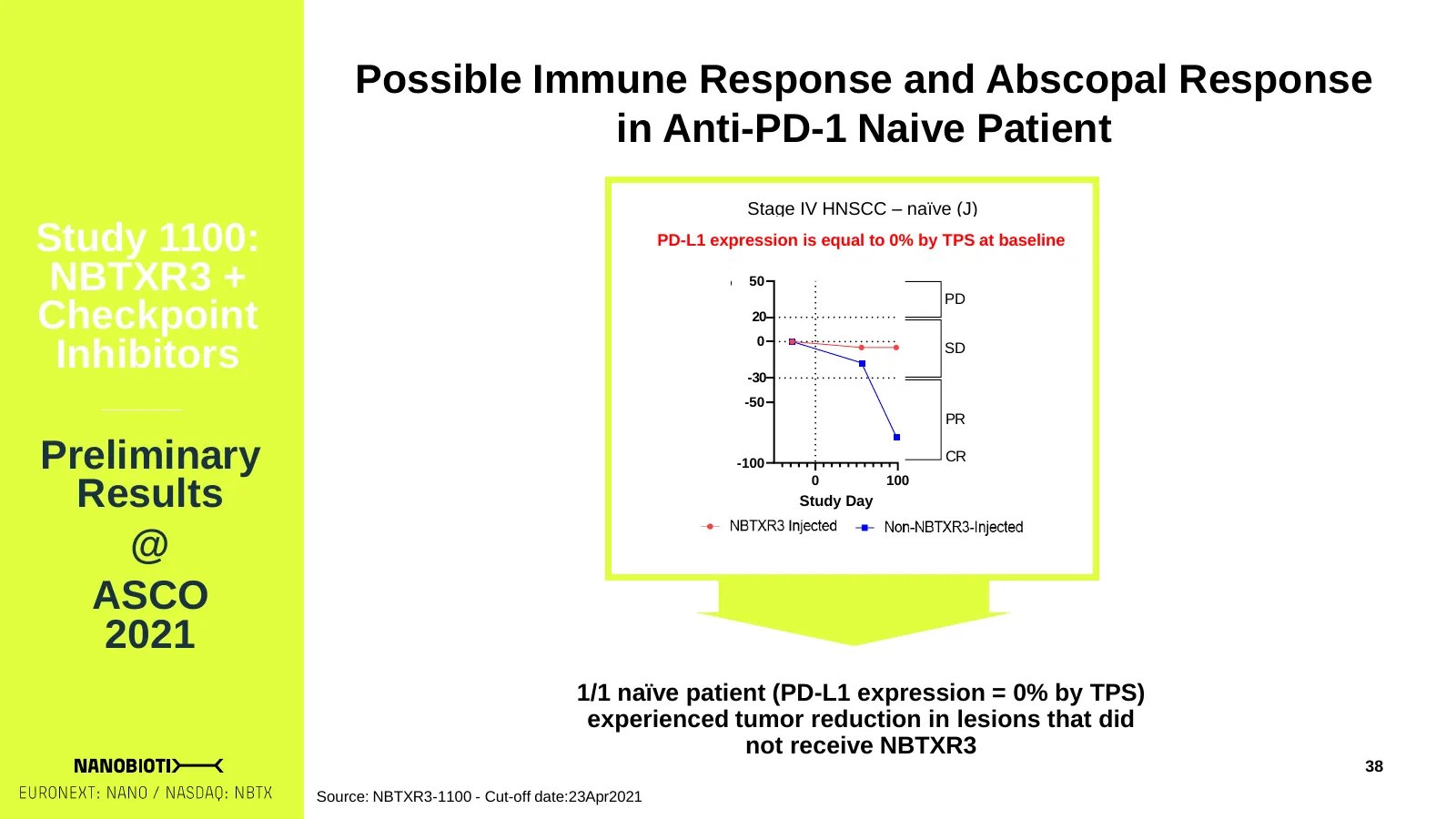
Slide 38: Possible Immune Response and Abscopal Response in Naive Patient
Possible Immune Response and Abscopal Response in Anti-PD-1 Naive Patient Stage IV HNSCC – naïve (J) Study 1100: PD-L1 expression is equal to 0% by TPS at baseline All Measurable Lesions Change, % NBTXR3 + 50 50 Best Overall Change, % PD PD NBTXR3 Injected Checkpoint 20 0 20 0 Non-NBTXR3-Injected In
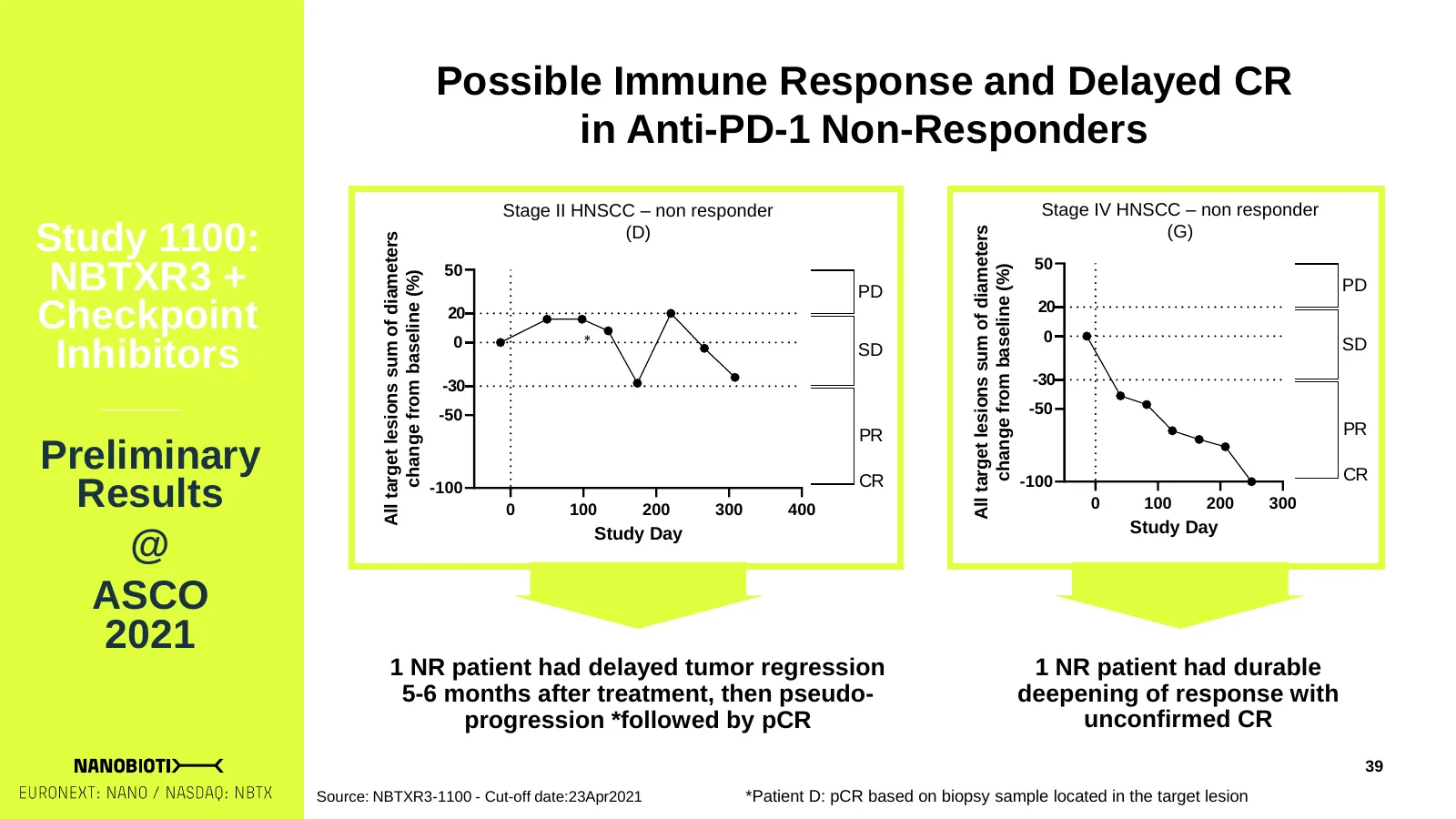
Slide 39: Possible Immune Response and Delayed CR in Non-Responders
Possible Immune Response and Delayed CR in Anti-PD-1 Non-Responders Stage II HNSCC – non responder Stage IV HNSCC – non responder Study 1100: All target lesions sum of diameters (D) (G) All target lesions sum of diameters 50 NBTXR3 + change from baseline (%) 50 change from baseline (%) PD PD Checkpo
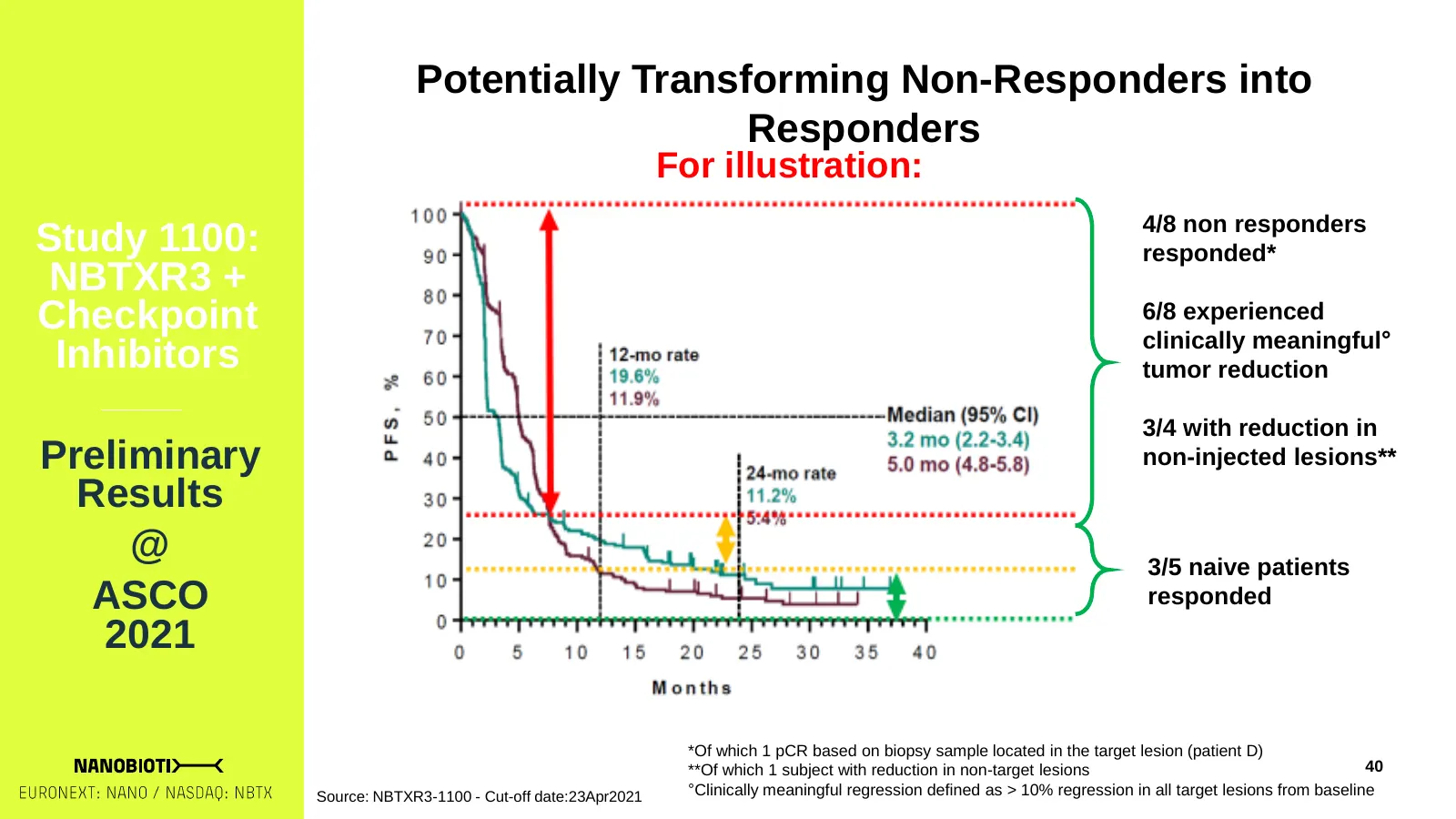
Slide 40: Potentially Transforming Non-Responders into Responders
Potentially Transforming Non-Responders into Responders For illustration: 4/8 non responders Study 1100: responded* NBTXR3 + Checkpoint 6/8 experienced clinically meaningful° Inhibitors tumor reduction 3/4 with reduction in Preliminary non-injected lesions** Results @ 3/5 naive patients ASCO respond
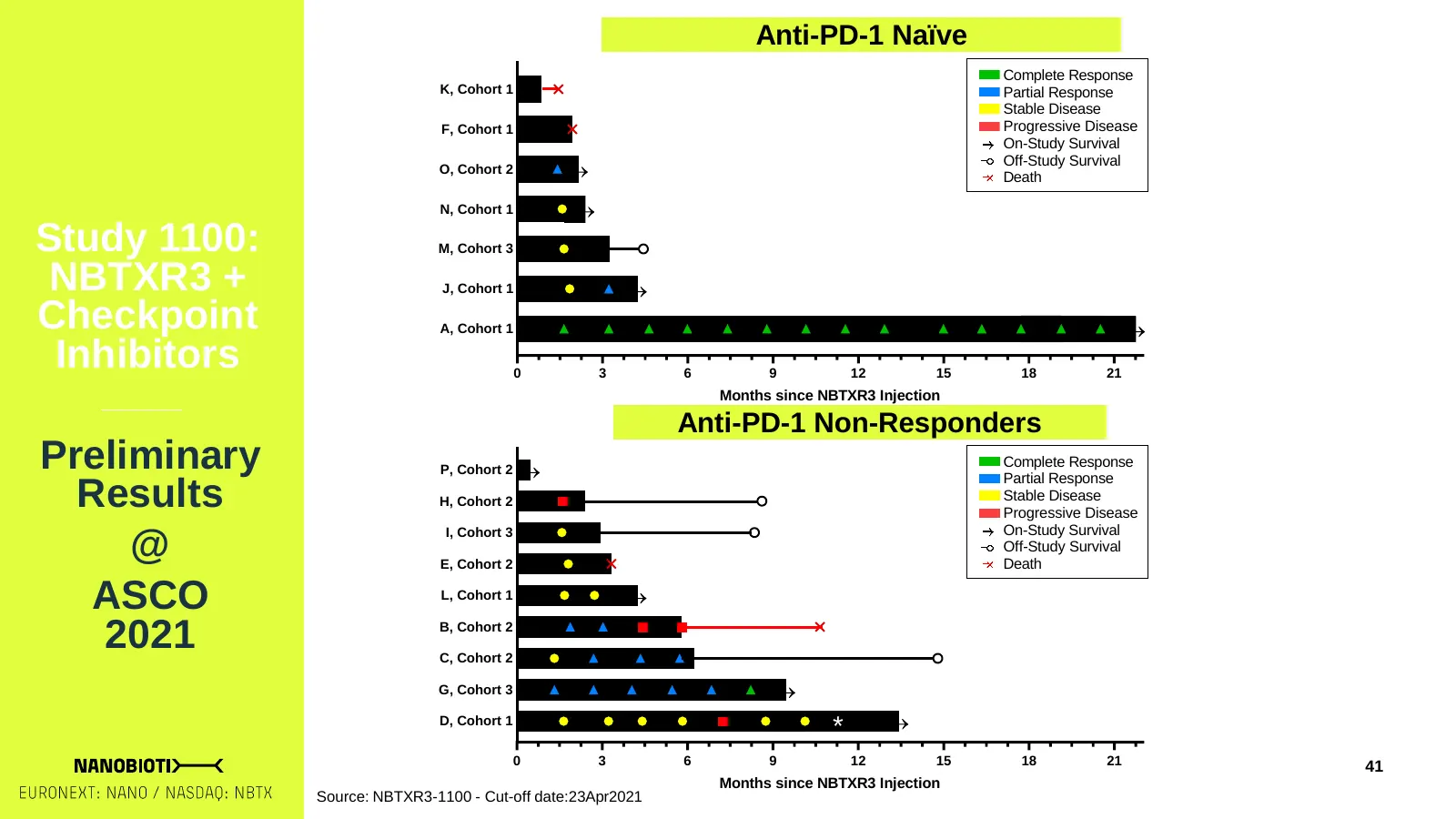
Slide 41: Study 1100: Survival by Months since Injection
Anti-PD-1 Naïve Complete Response K, Cohort 1 Partial Response Stable Disease F, Cohort 1 Progressive Disease On-Study Survival Off-Study Survival O, Cohort 2 Death N, Cohort 1 Study 1100: M, Cohort 3 NBTXR3 + J, Cohort 1 Checkpoint A, Cohort 1 Inhibitors 0 3 6 9 12 15 18 21 Months since NBTXR3 Inje
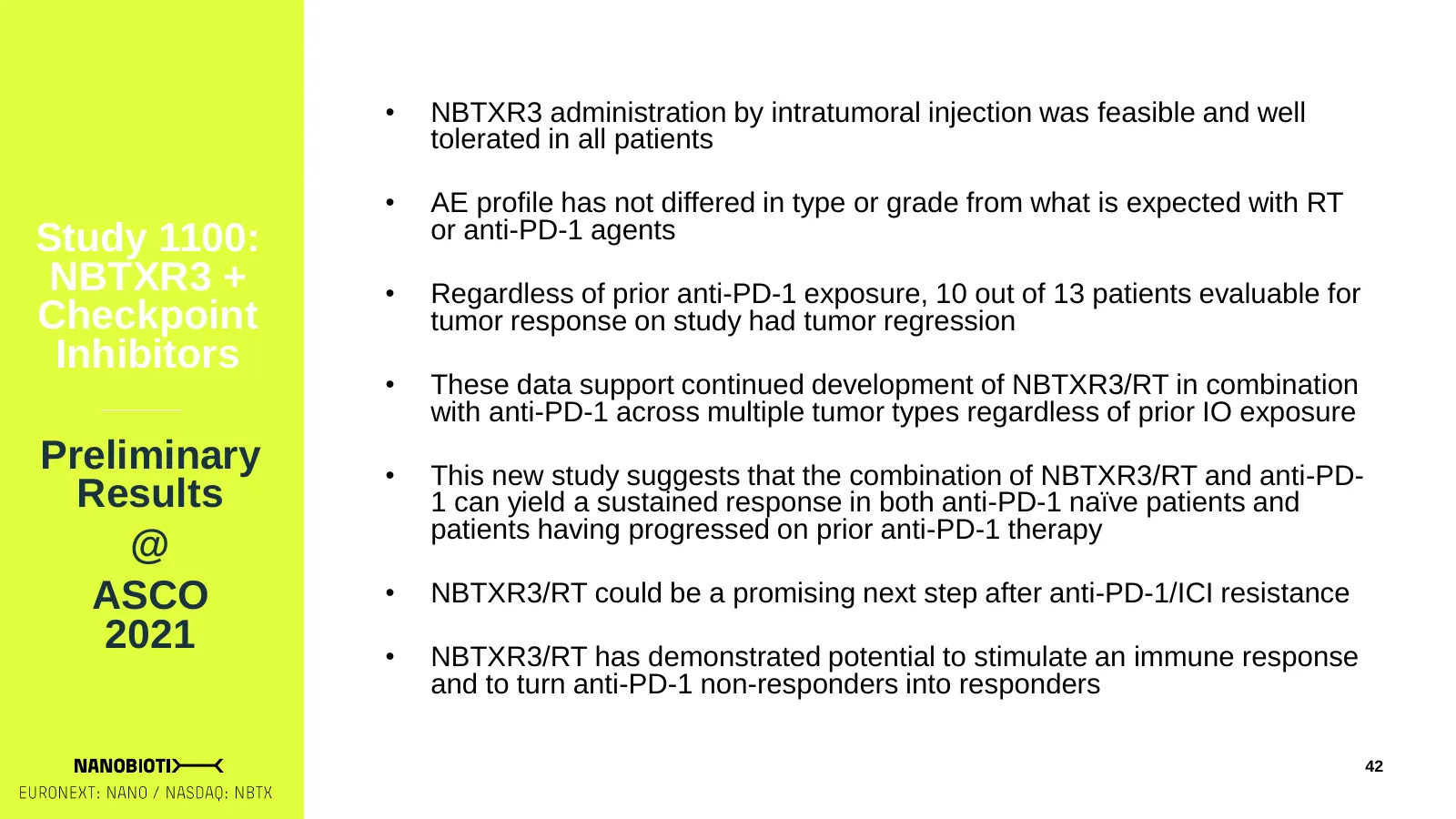
Slide 42: Study 1100: NBTXR3 + Checkpoint Inhibitors Conclusions
• NBTXR3 administration by intratumoral injection was feasible and well tolerated in all patients • AE profile has not differed in type or grade from what is expected with RT Study 1100: or anti-PD-1 agents NBTXR3 + • Regardless of prior anti-PD-1 exposure, 10 out of 13 patients evaluable for Checkp

Slide 43: Expanding NBTXR3 Opportunity With World-Class Partners
Expanding NBTXR3 Opportunity With World-Class Partners 43
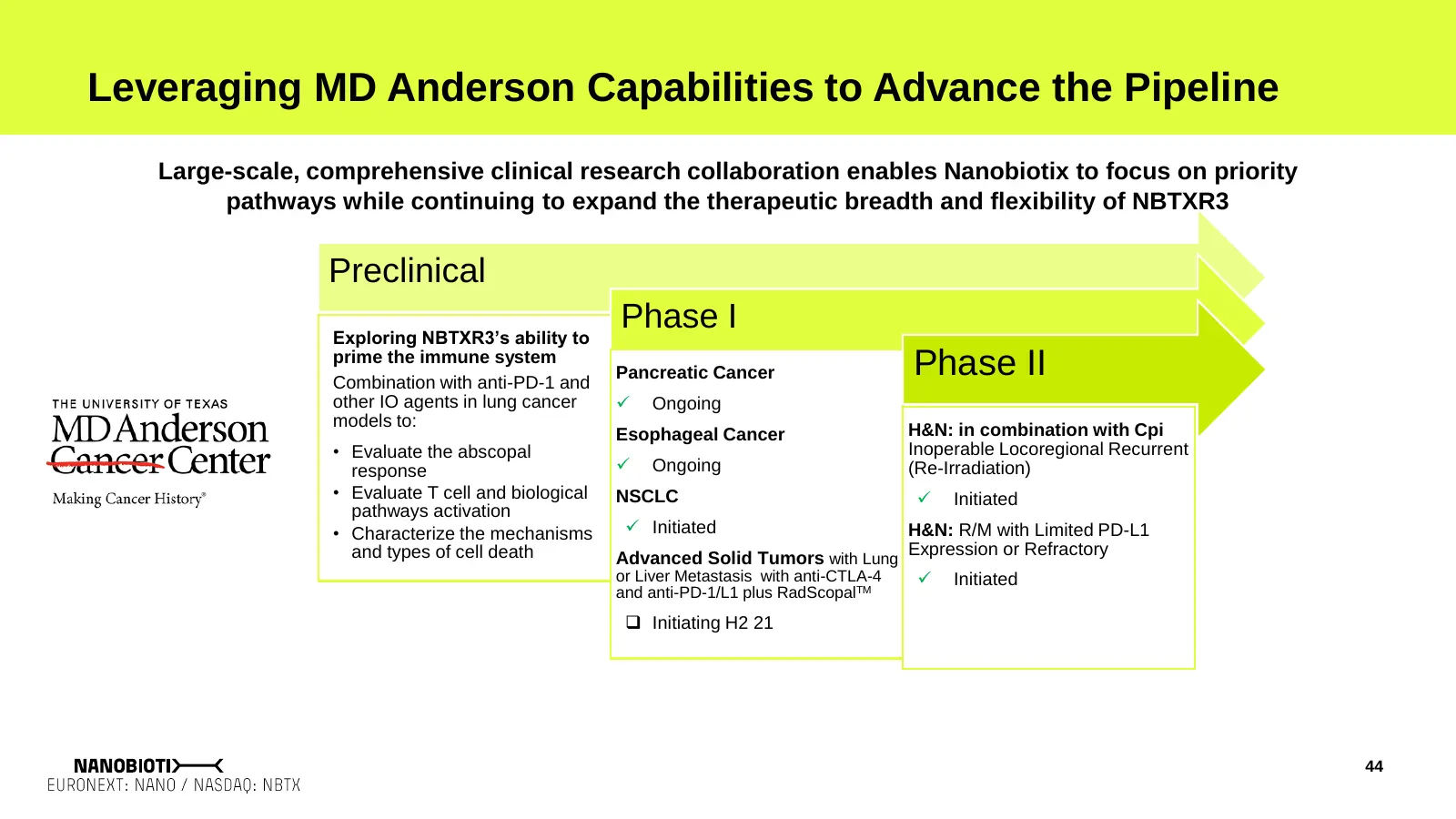
Slide 44: Leveraging MD Anderson Capabilities to Advance the Pipeline
Leveraging MD Anderson Capabilities to Advance the Pipeline Large-scale, comprehensive clinical research collaboration enables Nanobiotix to focus on priority pathways while continuing to expand the therapeutic breadth and flexibility of NBTXR3 Preclinical Exploring NBTXR3’s ability to Phase I prime
Slide 45: Committed Strategic Partner Expanding NBTXR3 Opportunity in Greater China
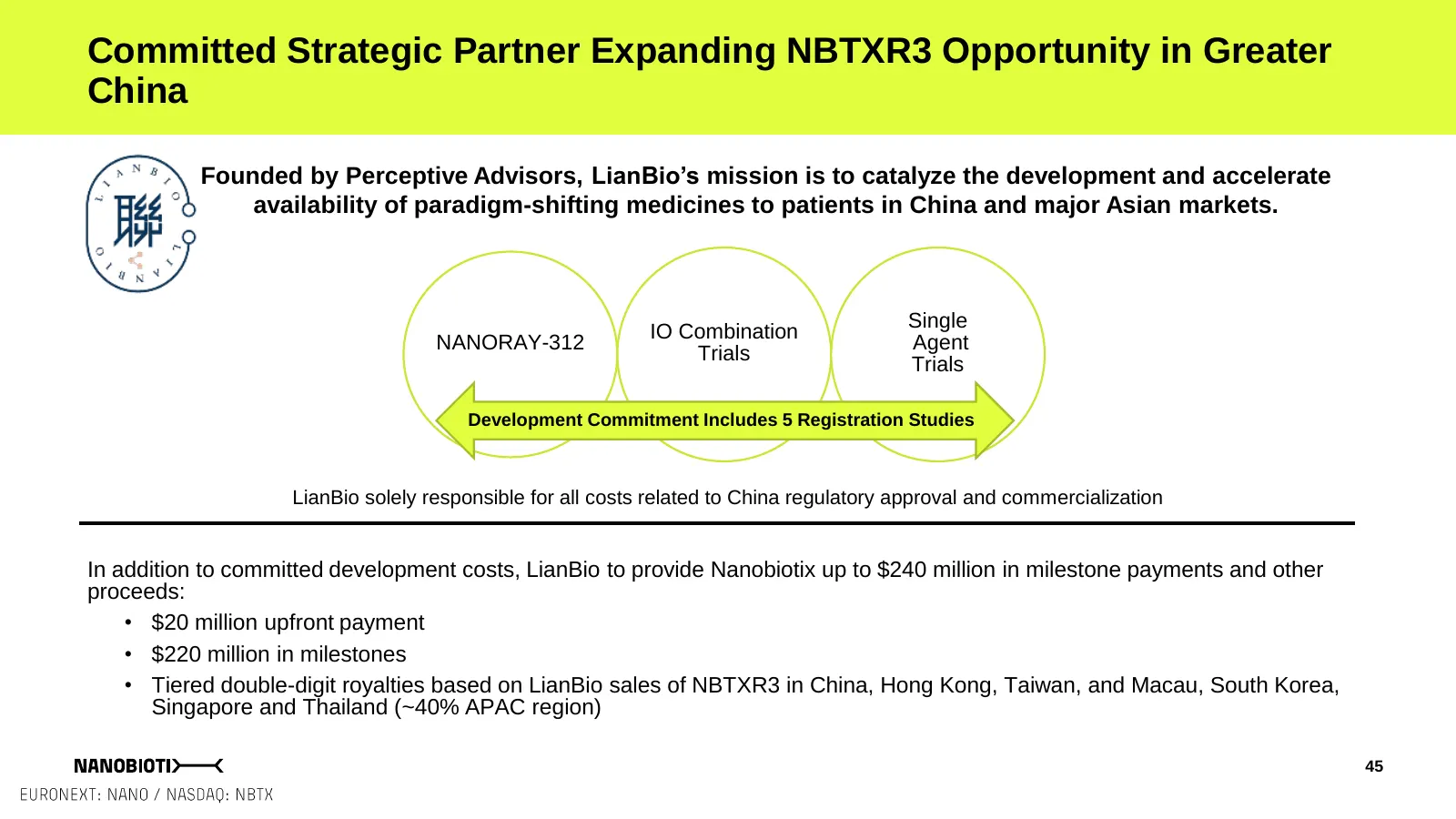
Committed Strategic Partner Expanding NBTXR3 Opportunity in Greater China Founded by Perceptive Advisors, LianBio’s mission is to catalyze the development and accelerate availability of paradigm-shifting medicines to patients in China and major Asian markets. Single IO Combination NANORAY-312 Agent

Slide 46: Beyond Oncology
NANOBIOTD—< EURONEXT: NANO / NASDAQ: NBTX 46
Slide 47: Leveraging Nanophysics Expertise to Expand Beyond Oncology
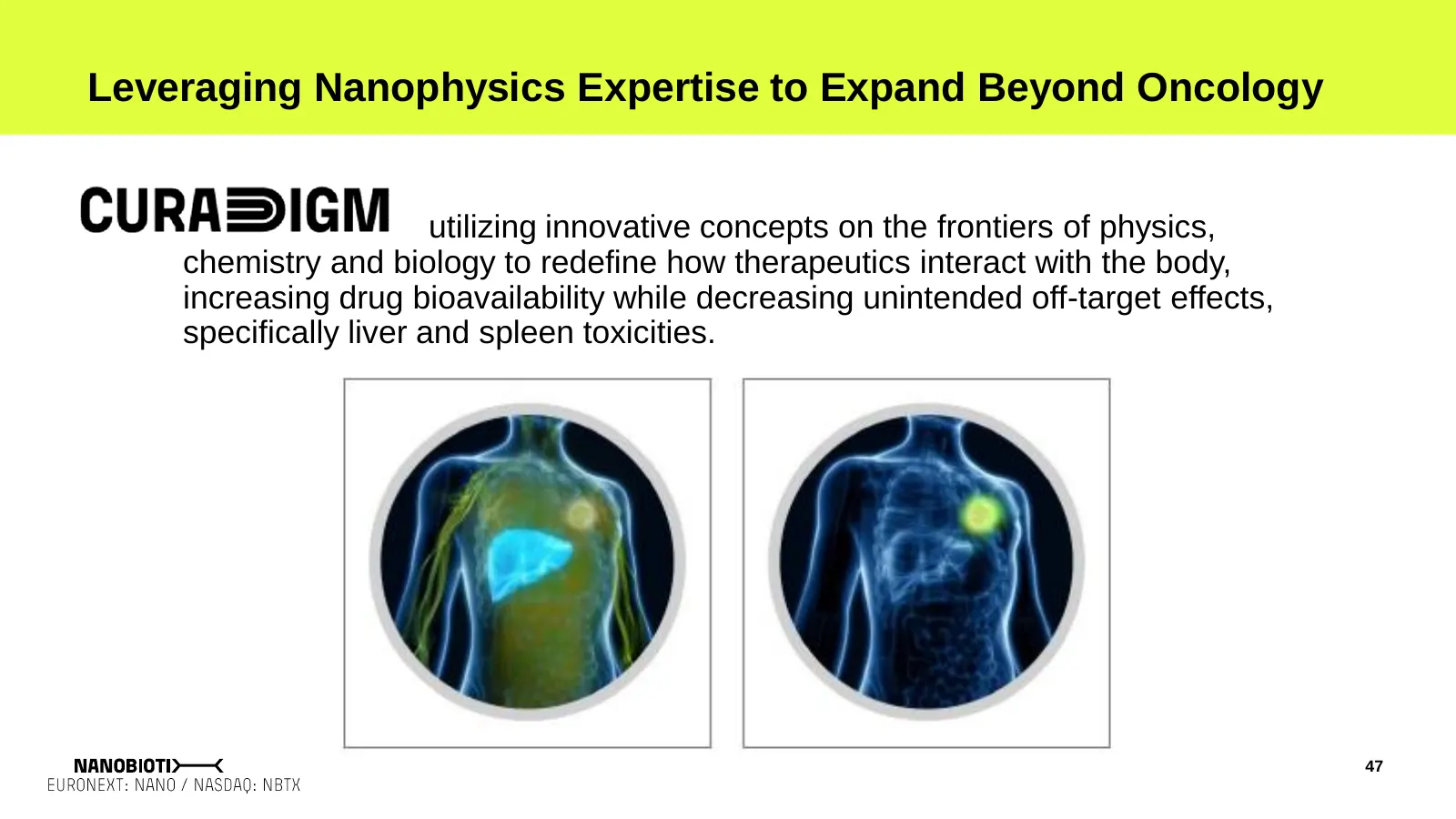
Leveraging Nanophysics Expertise to Expand Beyond Oncology utilizing innovative concepts on the frontiers of physics, chemistry and biology to redefine how therapeutics interact with the body, increasing drug bioavailability while decreasing unintended off-target effects, specifically liver and sple

Slide 48: Corporate Summary
Corpora NANOBIOTD—< EURONEXT: NANO / NASDAQ: NBTX 48
Slide 49: Key Financial Highlights
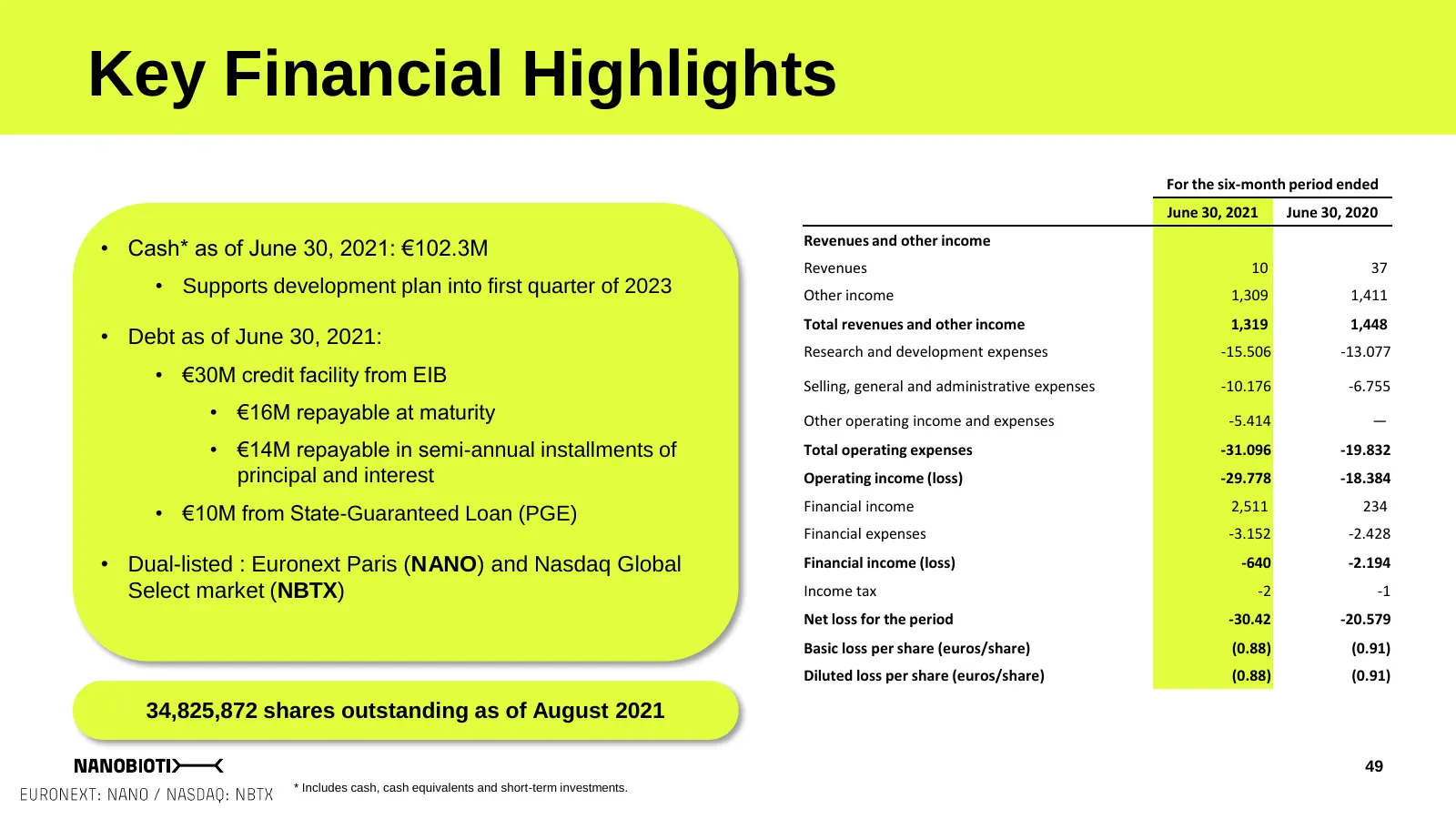
Key Financial Highlights For the six-month period ended June 30, 2021 June 30, 2020 Revenues and other income • Cash* as of June 30, 2021: €102.3M Revenues 10 37 • Supports development plan into first quarter of 2023 Other income 1,309 1,411 Total revenues and other income 1,319 1,448 • Debt as of J
Slide 50: Key takeaways and upcoming milestones
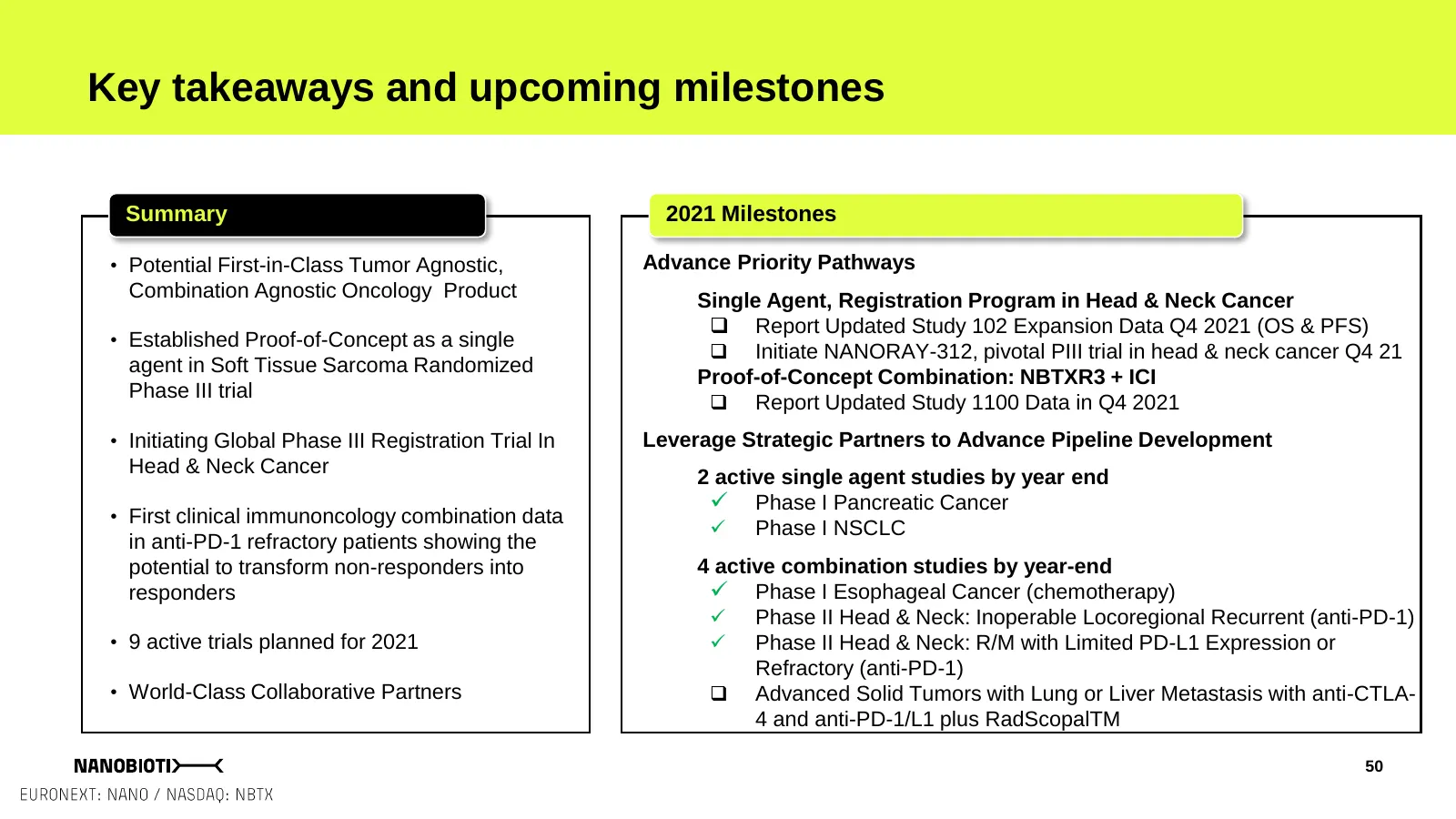
Key takeaways and upcoming milestones Summary 2021 Milestones • Potential First-in-Class Tumor Agnostic, Advance Priority Pathways Combination Agnostic Oncology Product Single Agent, Registration Program in Head & Neck Cancer ❑ Report Updated Study 102 Expansion Data Q4 2021 (OS & PFS) • Established

Slide 51: Appendix
NANOBIOTD—< EURONEXT: NANO / NASDAQ: NBTX 51
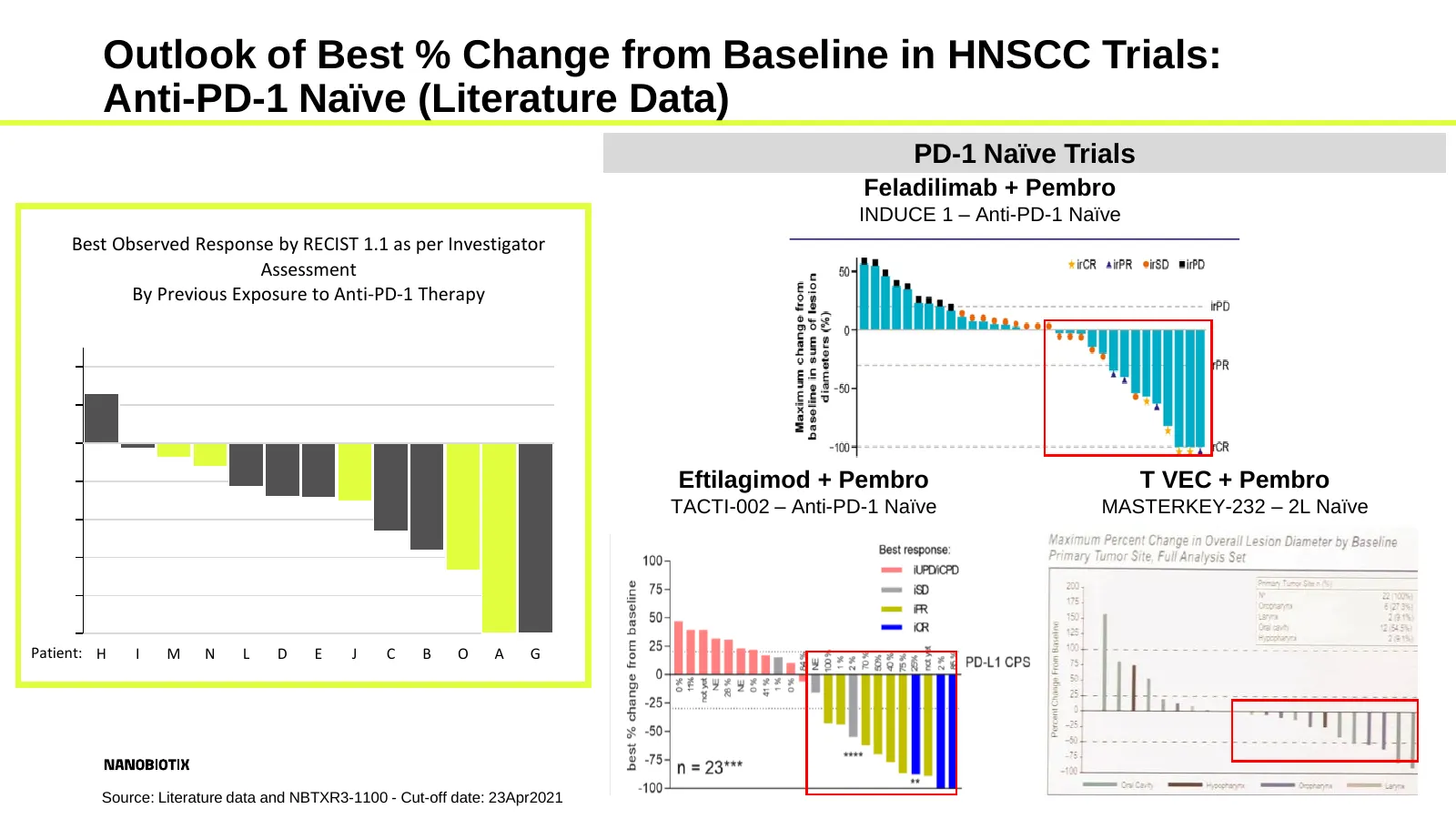
Slide 52: Best % Change from Baseline in HNSCC Trials: Anti-PD-1 Naive (Literature)
Outlook of Best % Change from Baseline in HNSCC Trials: Anti-PD-1 Naïve (Literature Data) PD-1 Naïve Trials Feladilimab + Pembro INDUCE 1 – Anti-PD-1 Naïve Best Observed Response by RECIST 1.1 as per Investigator Assessment By Previous Exposure to Anti-PD-1 Therapy Eftilagimod + Pembro T VEC + Pembr
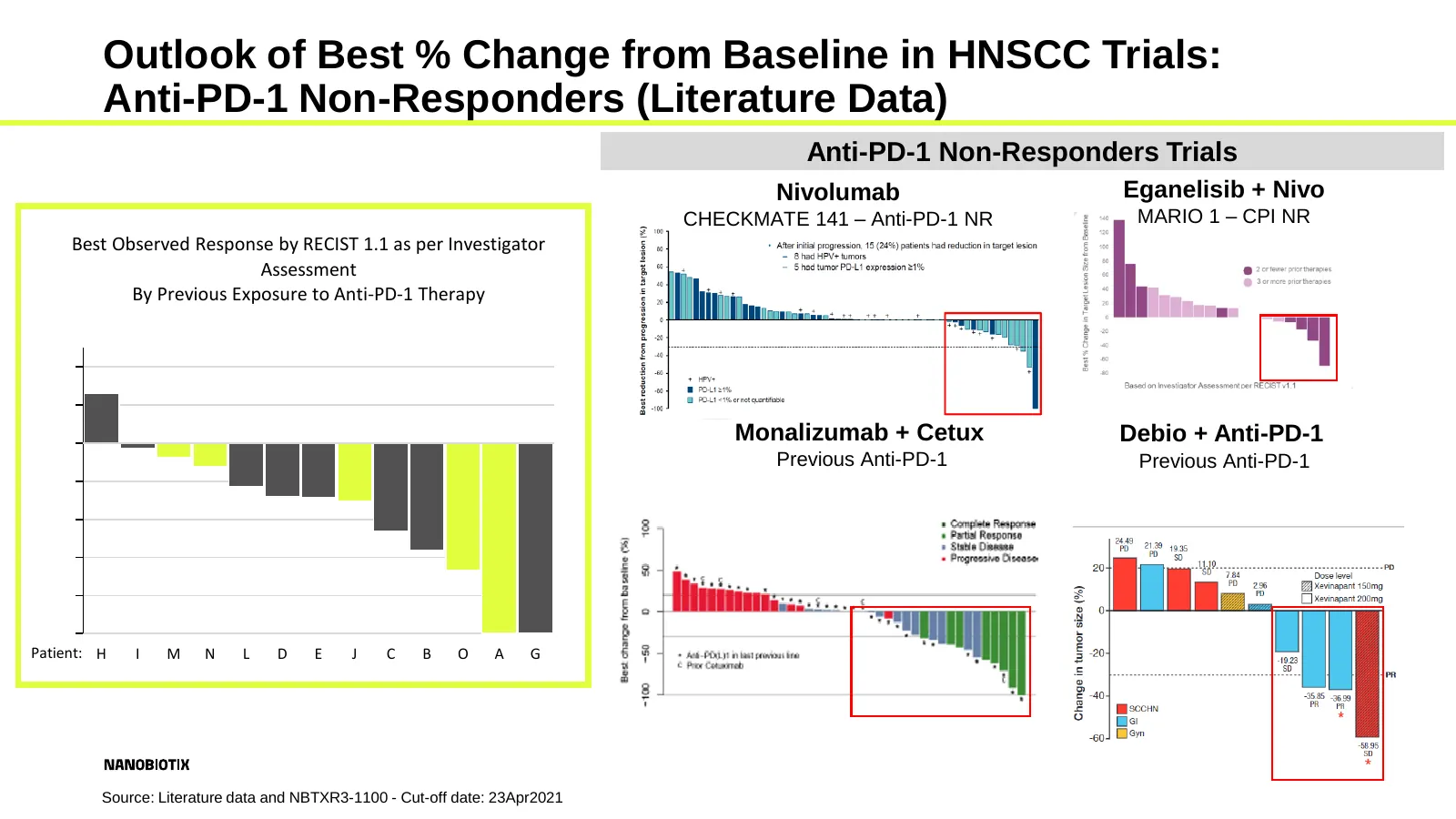
Slide 53: Best % Change from Baseline in HNSCC Trials: Non-Responders (Literature)
Outlook of Best % Change from Baseline in HNSCC Trials: Anti-PD-1 Non-Responders (Literature Data) Anti-PD-1 Non-Responders Trials Nivolumab Eganelisib + Nivo CHECKMATE 141 – Anti-PD-1 NR MARIO 1 – CPI NR Best Observed Response by RECIST 1.1 as per Investigator Assessment By Previous Exposure to Ant

Slide 54: ASCO 2021: Case Studies
STUDY 1100: ASCO 2021: Case Studies 54
Slide 55: Anti-PD-1 Naive patients
Anti-PD-1 Naïve patients 55
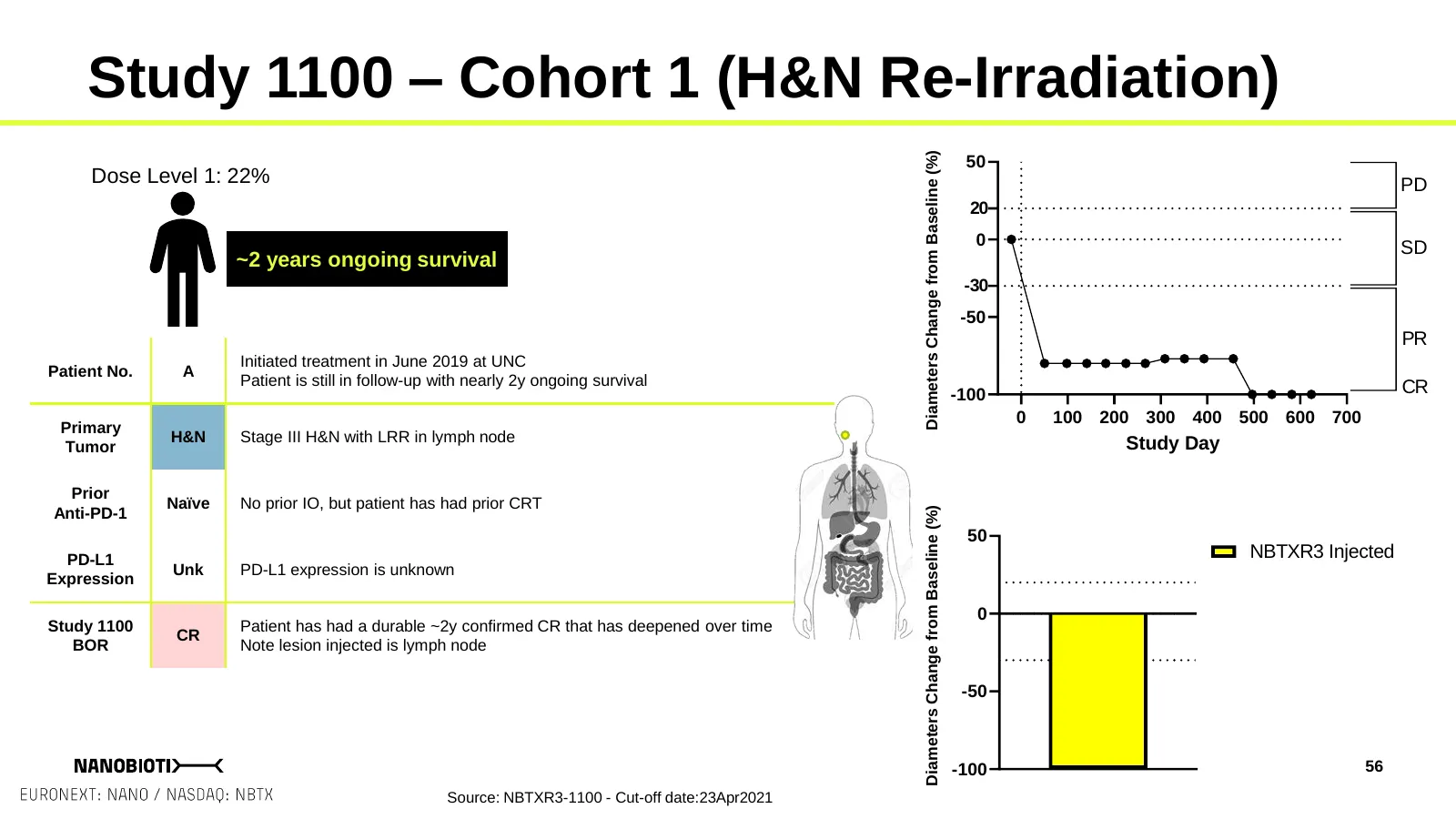
Slide 56: Study 1100 Patient A (H&N Re-Irradiation)
Study 1100 – Cohort 1 (H&N Re-Irradiation) Baseline%(%) 50 Dose Level 1: 22% PD Change, 20 0 SD from ~2 years ongoing survival Overall -30 BestChange -50 PR Diameters Initiated treatment in June 2019 at UNC Patient No. A Patient is still in follow-up with nearly 2y ongoing survival CR -100 0 100 200
Slide 57: Study 1100 Patient J (H&N Re-Irradiation)
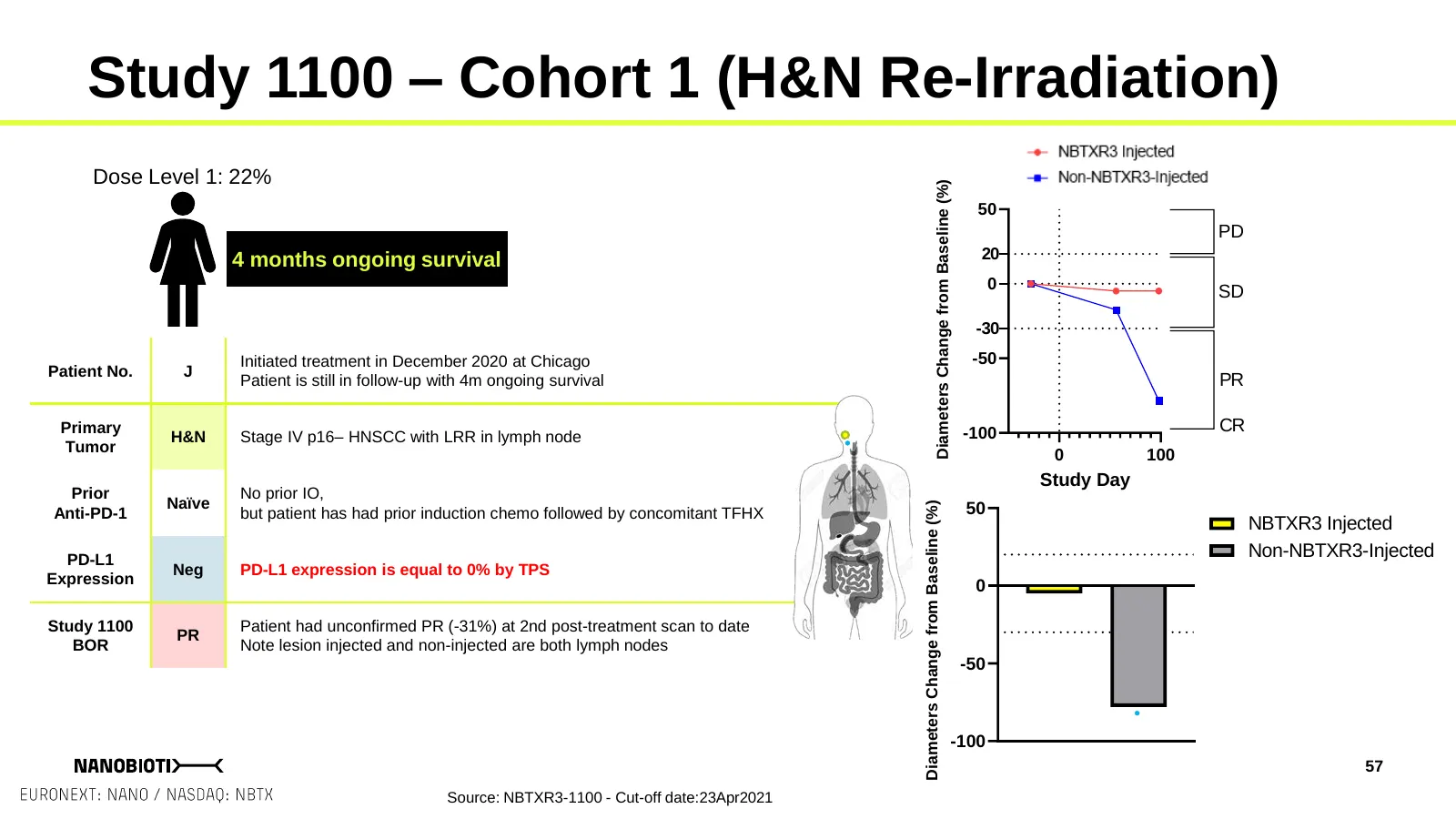
Study 1100 – Cohort 1 (H&N Re-Irradiation) 50 Best Overall Change, % PD Dose Level 1: 22% (%)% 20 Change, 50 050 from Baseline Best Overall Change, % PD SD NBTXR3 Injected PD 20 -3020 Non-NBTXR3-Inje 4 months ongoing survival Lesions 0 SD -50 0 SD PR Change -30 -30 Measurable Initiated treatment in
Slide 58: Anti-PD-1 resistant patients
Anti-PD-1 resistant patients 58
Slide 59: Study 1100 Patient B (Lung Mets)
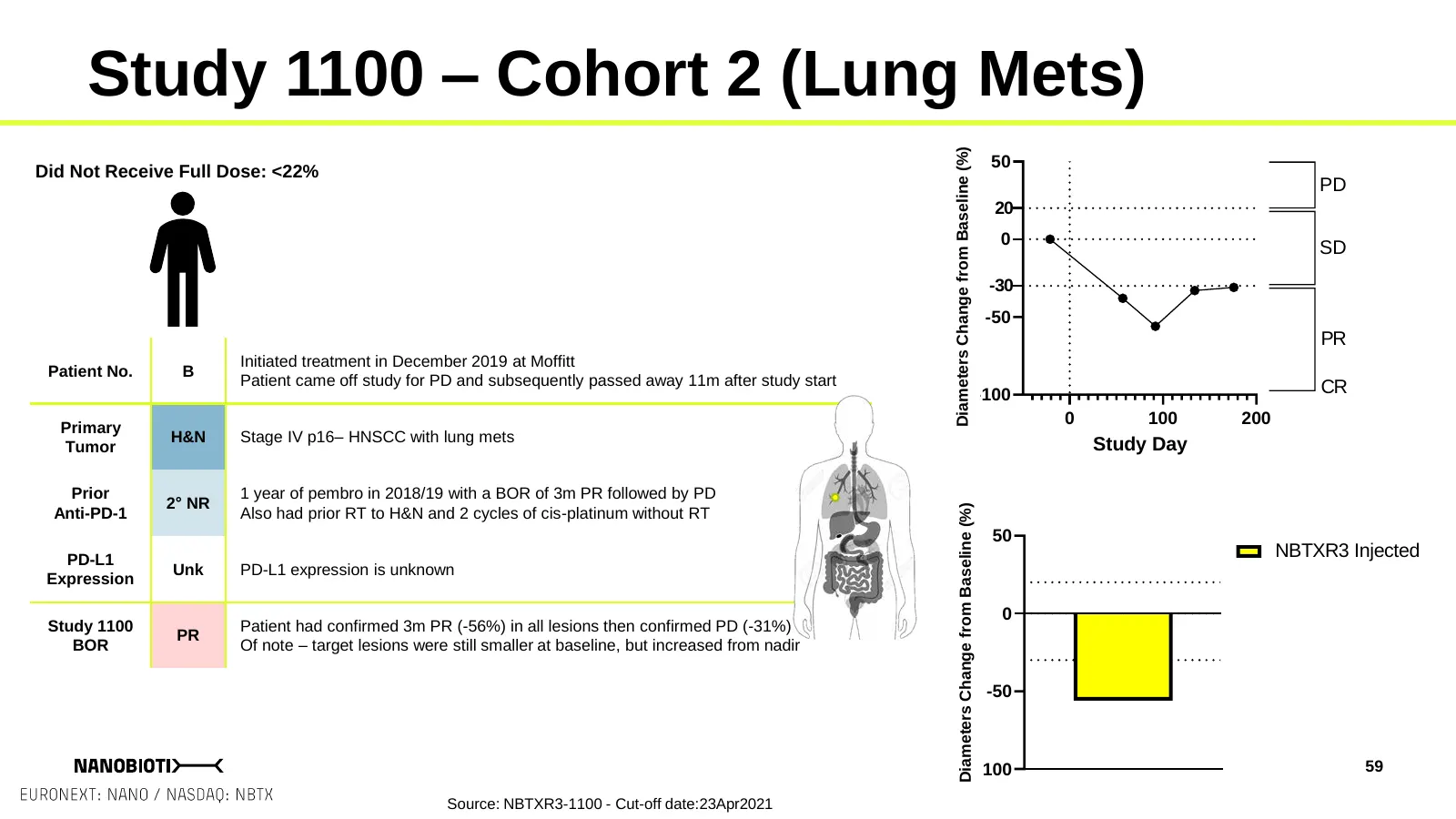
Study 1100 – Cohort 2 (Lung Mets) %(%) 50 Did Not Receive Full Dose: <22% Baseline PD Change, 20 0 SD Overallfrom -30 BestChange -50 PR Diameters Initiated treatment in December 2019 at Moffitt Patient No. B Patient came off study for PD and subsequently passed away 11m after study start CR -100 0 1
Slide 60: Study 1100 Patient D (H&N Re-Irradiation)
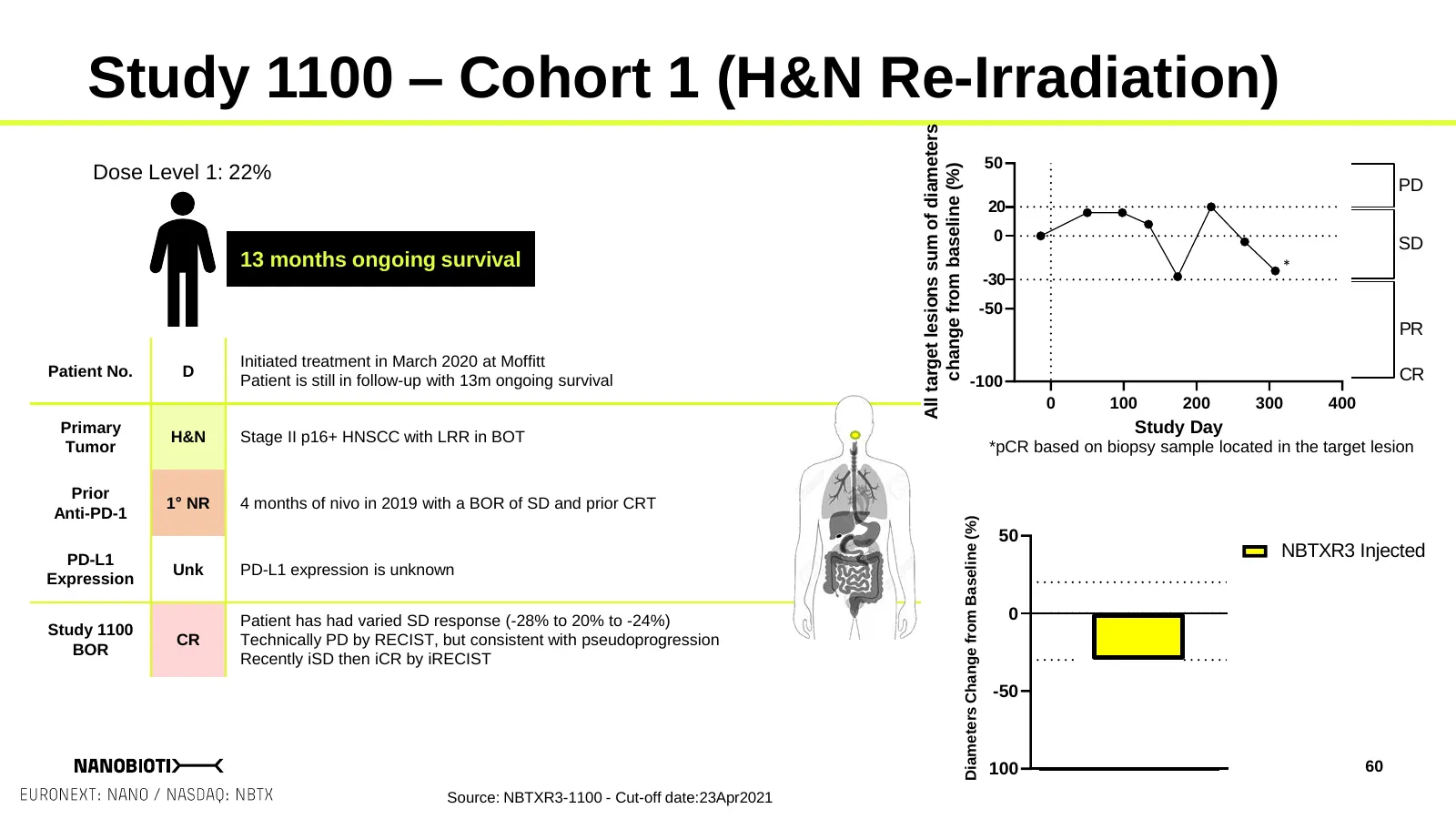
Study 1100 – Cohort 1 (H&N Re-Irradiation) All target lesions sum of diameters 50 50 (%)% Dose Level 1: 22% PD PD Change, 20 baseline 20 0 SD 0 SD Overall -30 13 months ongoing survival * -50 -30 from PR Best -50 change -100 CR PR Initiated treatment in March 2020 at Moffitt 0 100 200 300 400 Patien
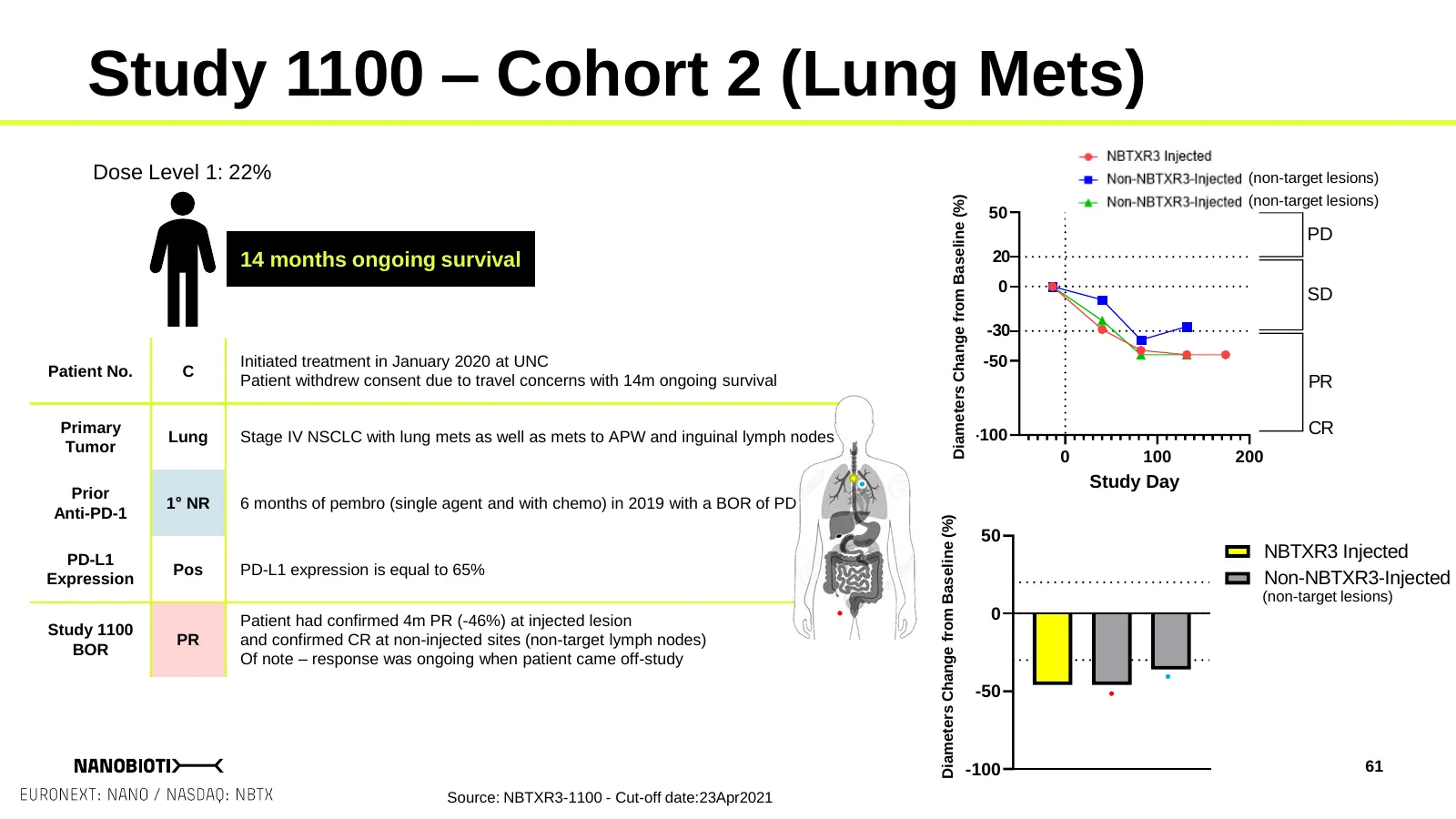
Slide 61: Study 1100 Patient C (Lung Mets)
Study 1100 – Cohort 2 (Lung Mets) 50 Dose Level 1: 22% Best Overall Change, % (non-target lesions) (%) % PD Change, 50 (non-target lesions) 20 50 Best Overall Change, % PD NB from Baseline 0 PD 20 20 SD No 14 months ongoing survival Lesions 0 SD -300 SD No -30 -50 -30 Change PR Measurable Initiated
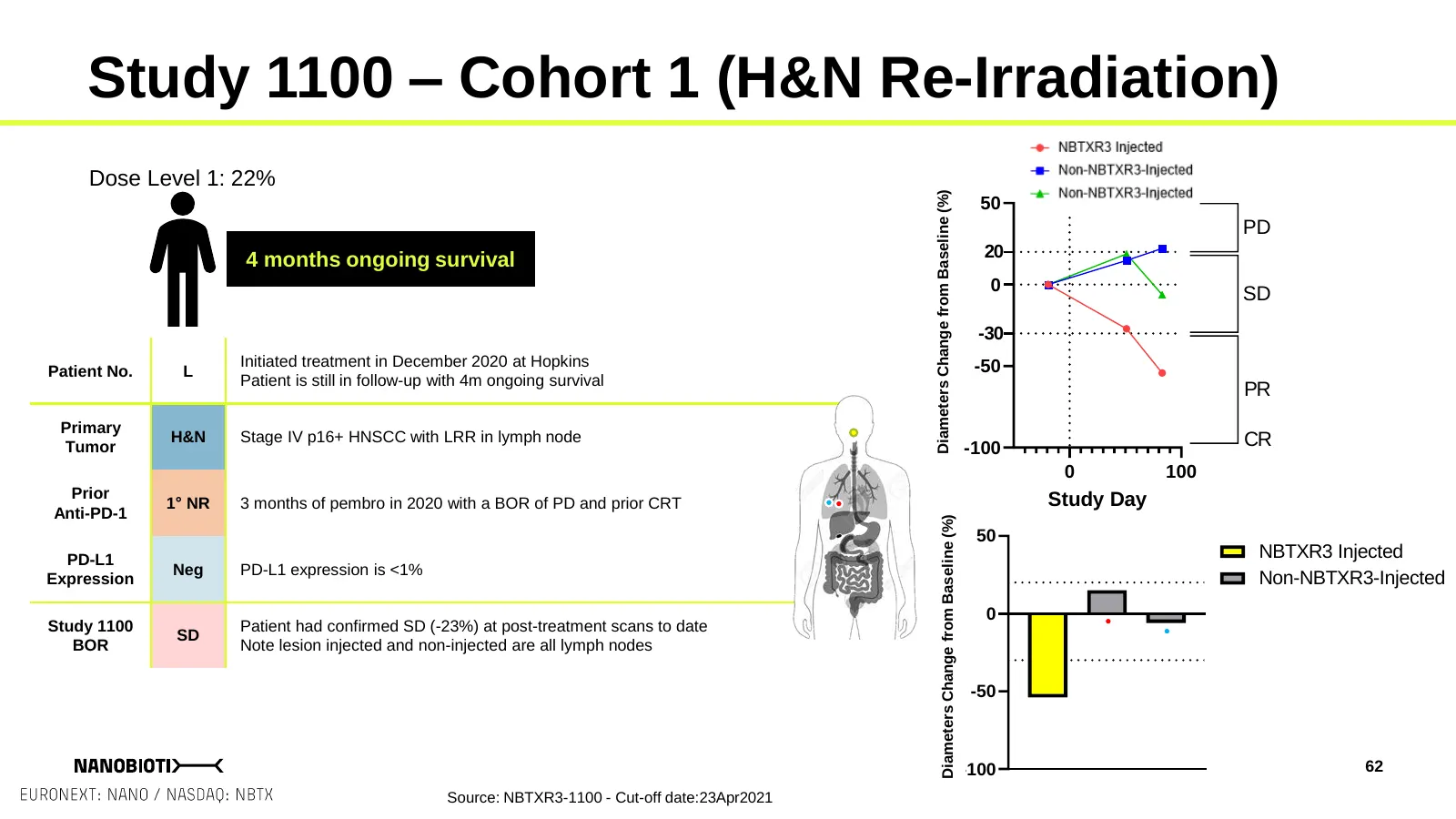
Slide 62: Study 1100 Patient L (H&N Re-Irradiation)
Study 1100 – Cohort 1 (H&N Re-Irradiation) 50 % (%) % Dose Level 1: 22% PD Change, 50 Change, 50 20 Best Overall Change, % PD NBTXR3 Inj from Baseline PD 20 0 SD 4 months ongoing survival 20 Non-NBTXR Lesions 0 Overall SD -300 SD Non-NBTXR -30 -50 Change -30 PR DiametersBest All Measurable -50 Initi
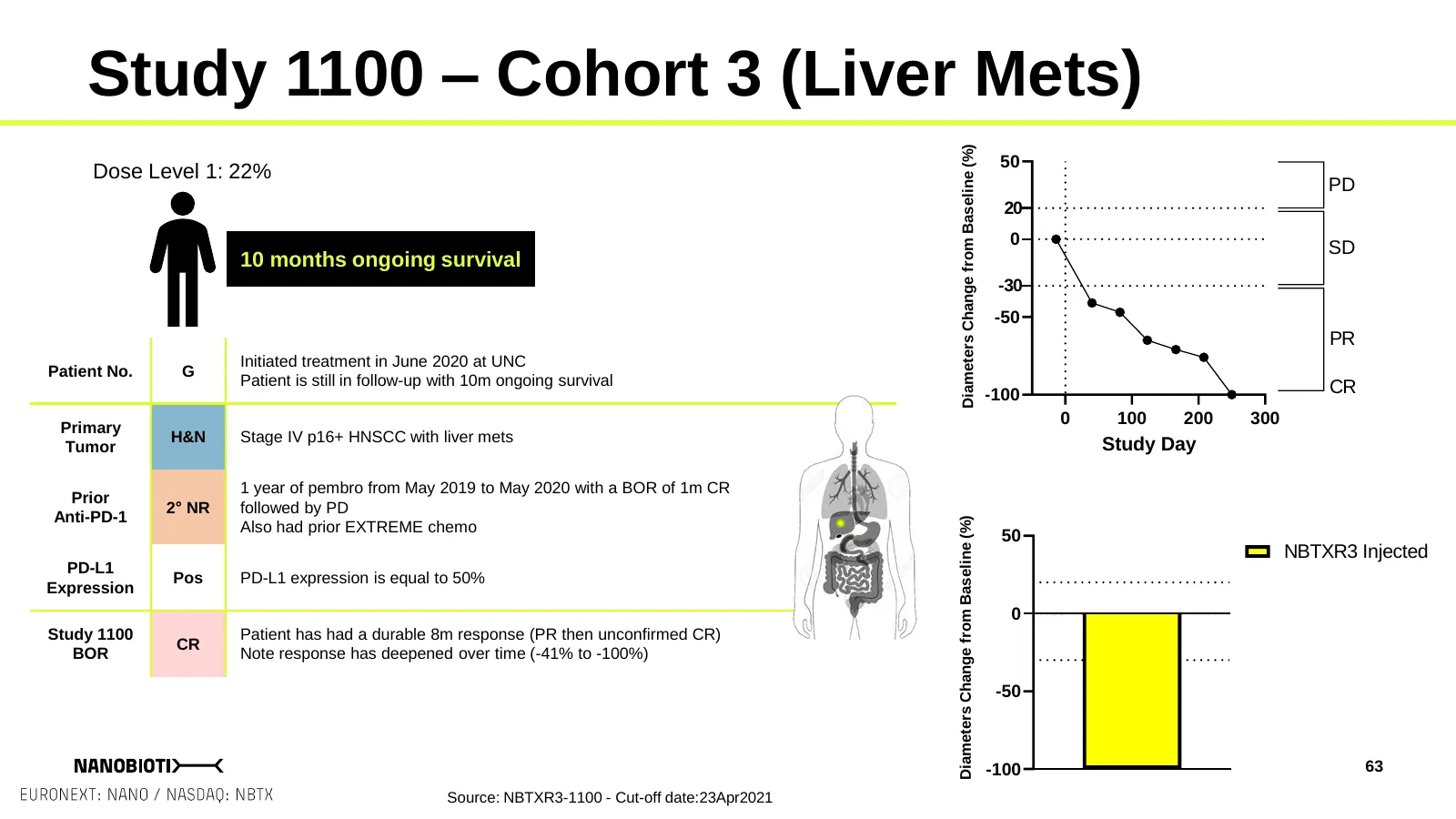
Slide 63: Study 1100 Patient G (Liver Mets)
Study 1100 – Cohort 3 (Liver Mets) % (%) 50 Dose Level 1: 22% Baseline PD Change, 20 0 Change from SD 10 months ongoing survival Best Overall -30 -50 PR Diameters Initiated treatment in June 2020 at UNC Patient No. G Patient is still in follow-up with 10m ongoing survival CR -100 0 100 200 300 Prima
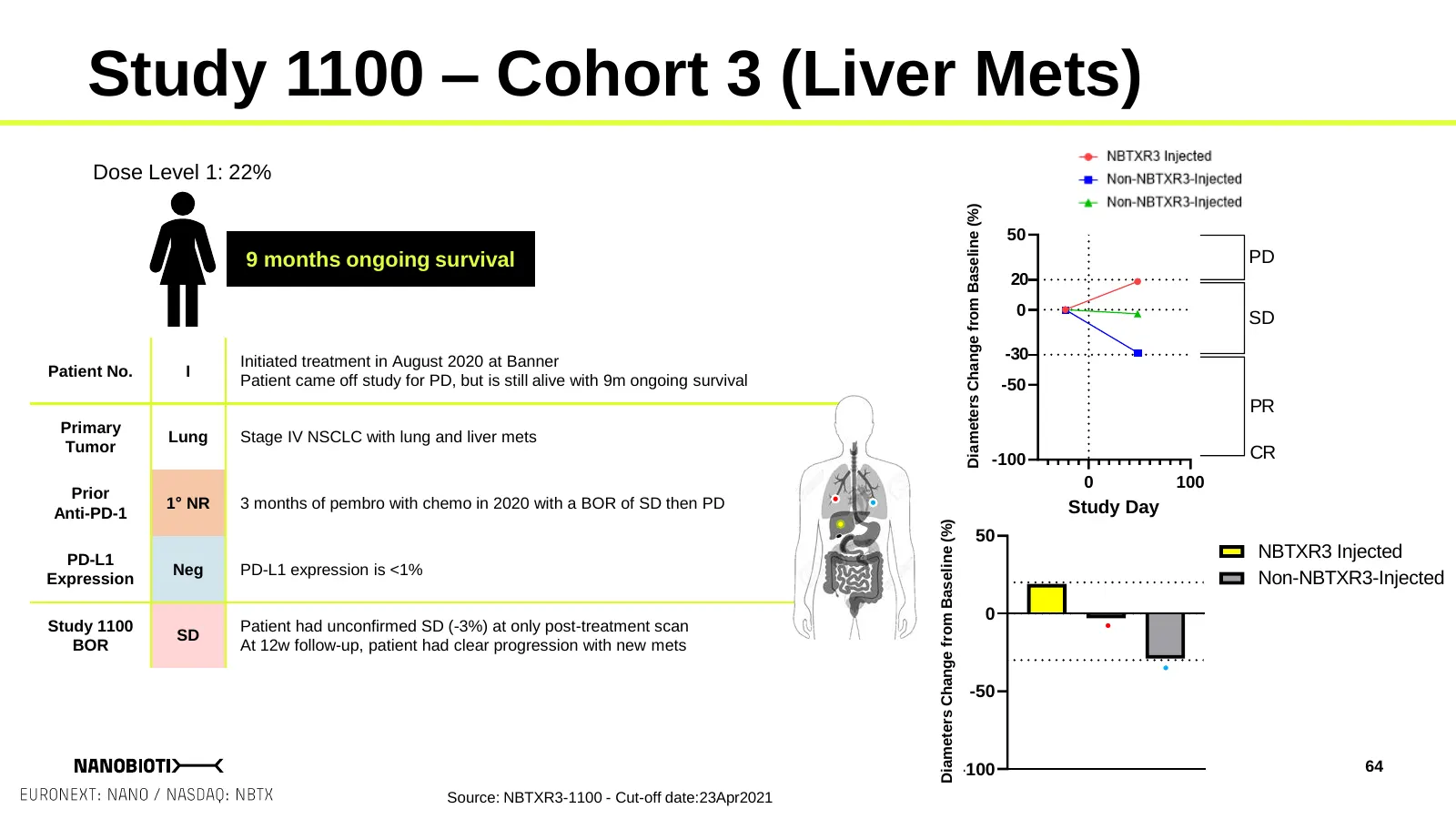
Slide 64: Study 1100 Patient I (Liver Mets)
Study 1100 – Cohort 3 (Liver Mets) 50 Dose Level 1: 22% Best Overall Change, % PD % 20 Change, (%) 50 0 50 from Baseline Best Overall Change, % PD SDPD NBTXR3 Injecte 9 months ongoing survival 20 -30 20 Non-NBTXR3-In Lesions 0 SD -50 0 SD Non-NBTXR3-In PR Diameters Change -30 Initiated treatment in
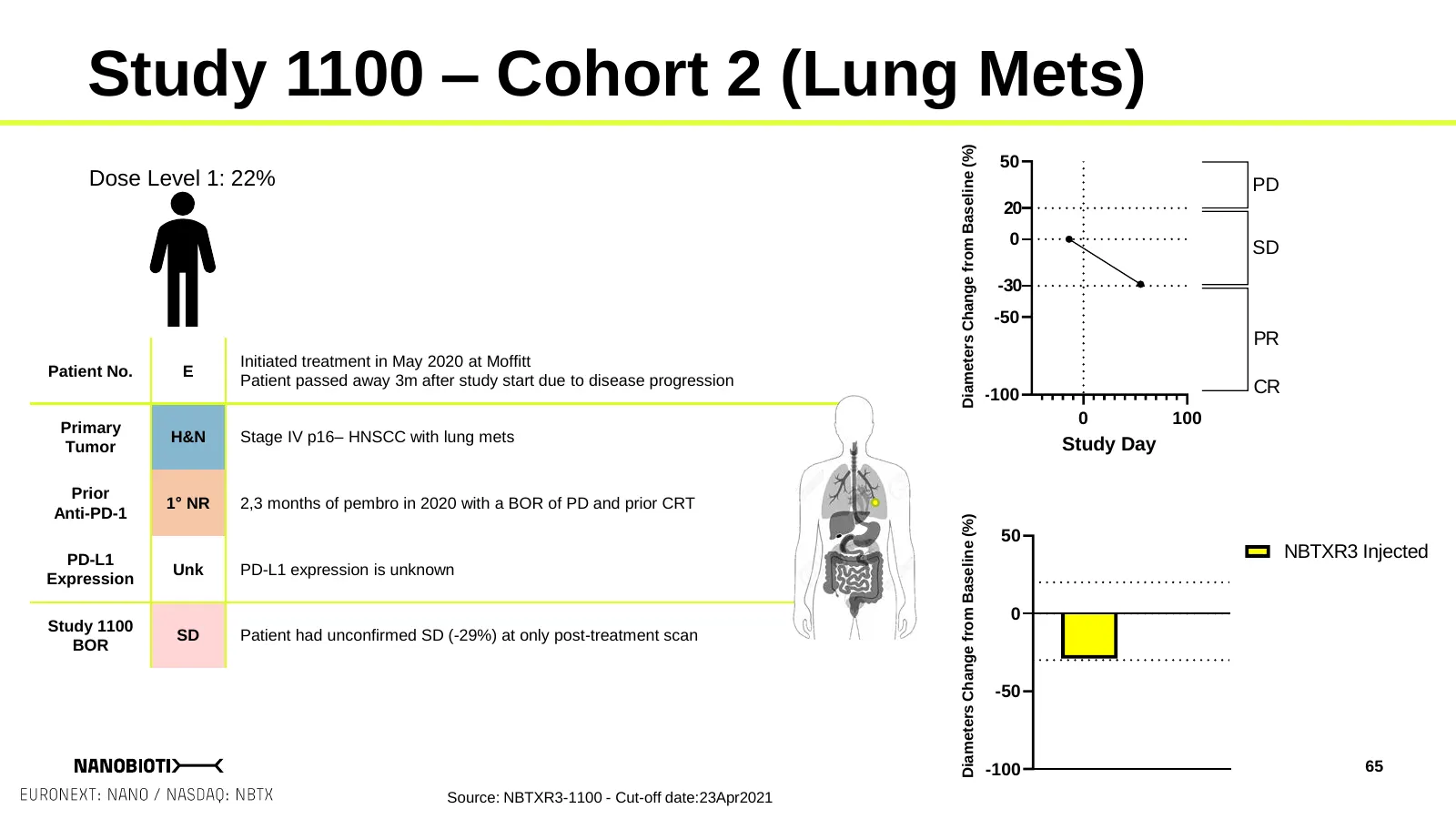
Slide 65: Study 1100 Patient E (Lung Mets)
Study 1100 – Cohort 2 (Lung Mets) % (%) 50 Dose Level 1: 22% Baseline PD Change, 20 0 Change from SD Best Overall -30 -50 PR Diameters Initiated treatment in May 2020 at Moffitt Patient No. E Patient passed away 3m after study start due to disease progression CR -100 0 100 Primary H&N Stage IV p16–
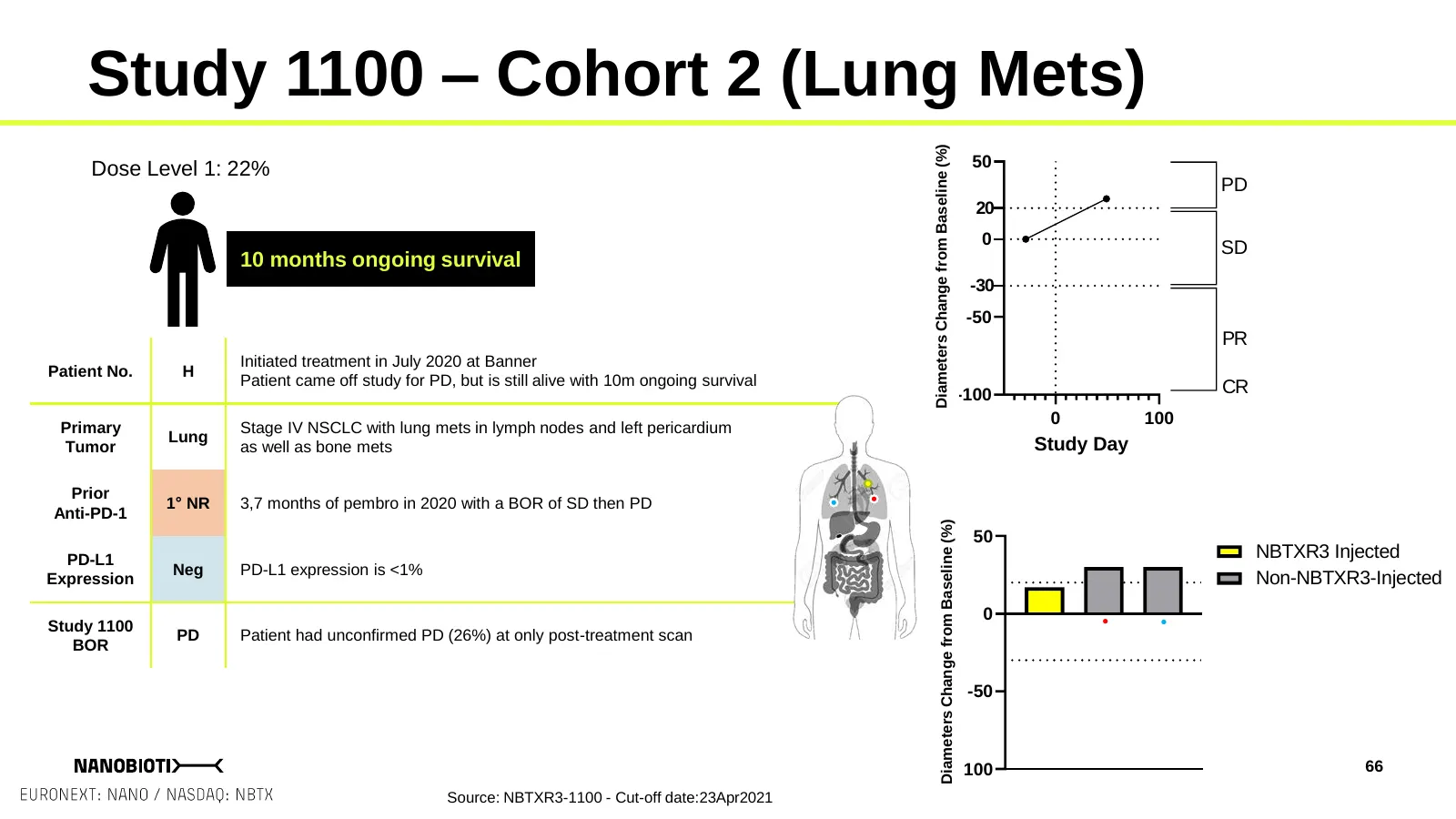
Slide 66: Study 1100 Patient H (Lung Mets)
Study 1100 – Cohort 2 (Lung Mets) % (%) Dose Level 1: 22% 50 Baseline PD Change, 20 0 Change from SD 10 months ongoing survival Best Overall -30 -50 PR Diameters Initiated treatment in July 2020 at Banner Patient No. H Patient came off study for PD, but is still alive with 10m ongoing survival CR -1
Source: Internet Archive copy of nanobiotix.com
More decks from Nanobiotix SA
 Q4 2025 Earnings Presentation50 slides · Apr 1, 2026
 Investor Presentation (January 2025)43 slides · Jan 6, 2025
 Investor Presentation (June 2023)36 slides · Jun 9, 2023
 Investor Presentation (April 2023)36 slides · April 2023
 Investor Presentation (April 2023)36 slides · April 2023
 Investor Presentation (November 2022)36 slides · November 2022