Basler AG · XETR:BSL
Basler — Technical Presentation (October 2023)
35 slides from Basler's technical presentation, October 2023
Slide 1: Basler Webinar | October 2023
Speaker: Benjamin Ho Basler Webinar | October 2023 Public | © Basler AG
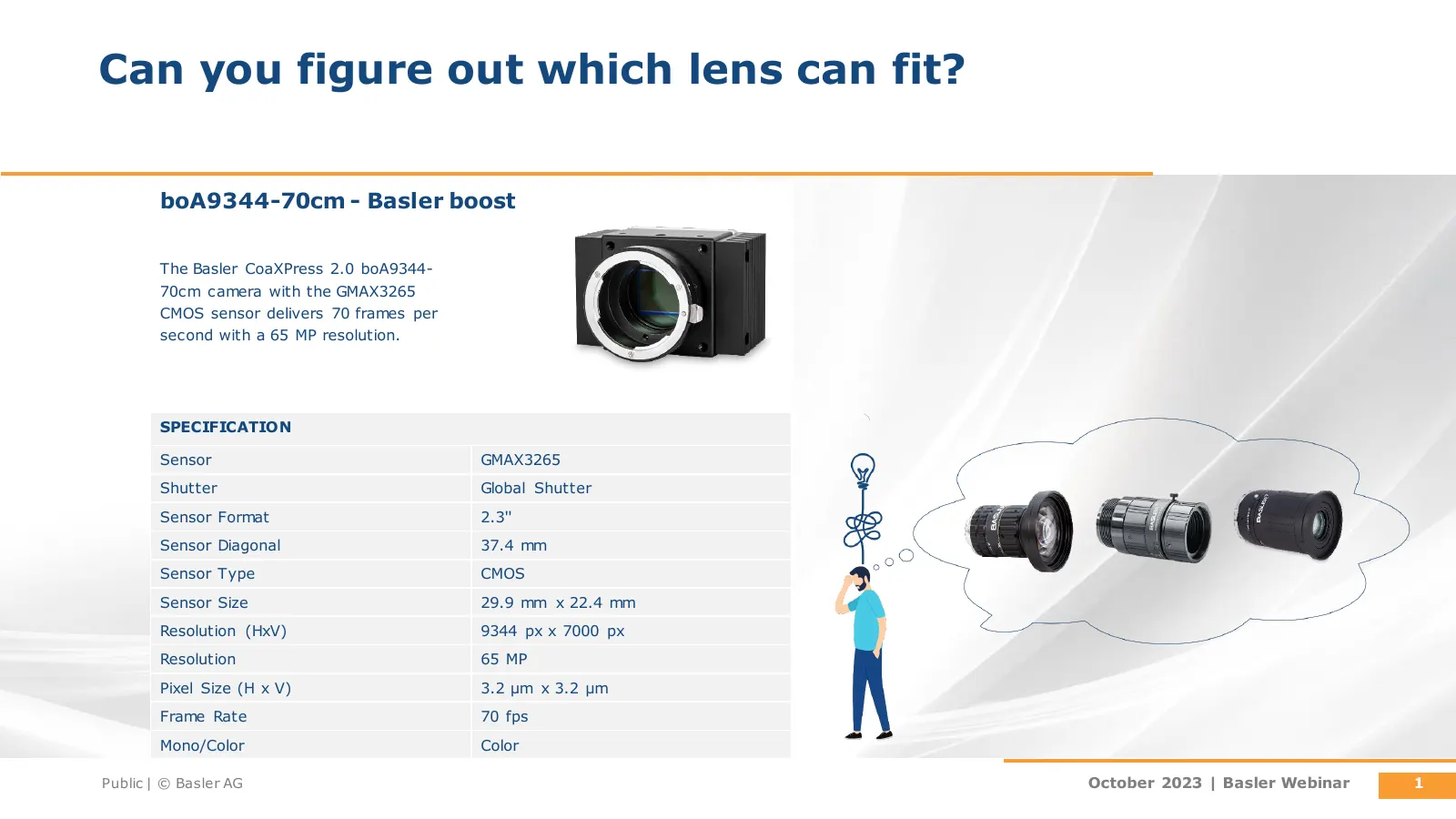
Slide 2: Can you figure out which lens can fit?
Can you figure out which lens can fit? boA9344-70cm - Basler boost The Basler CoaXPress 2.0 boA9344- 70cm camera with the GMAX3265 CMOS sensor delivers 70 frames per second with a 65 MP resolution. SPECIFICATION Sensor GMAX3265 Shutter Global Shutter Sensor Format 2.3'' Sensor Diagonal 37.4 mm Senso
Slide 3: Agenda
Agenda Agenda 1. Key steps to find the right lens for your machine vision camera 2. A little history to start with… 3. How to tell lens performance? 4. How to balance cost and performance? 5. Key takeaways Public | © Basler AG 2
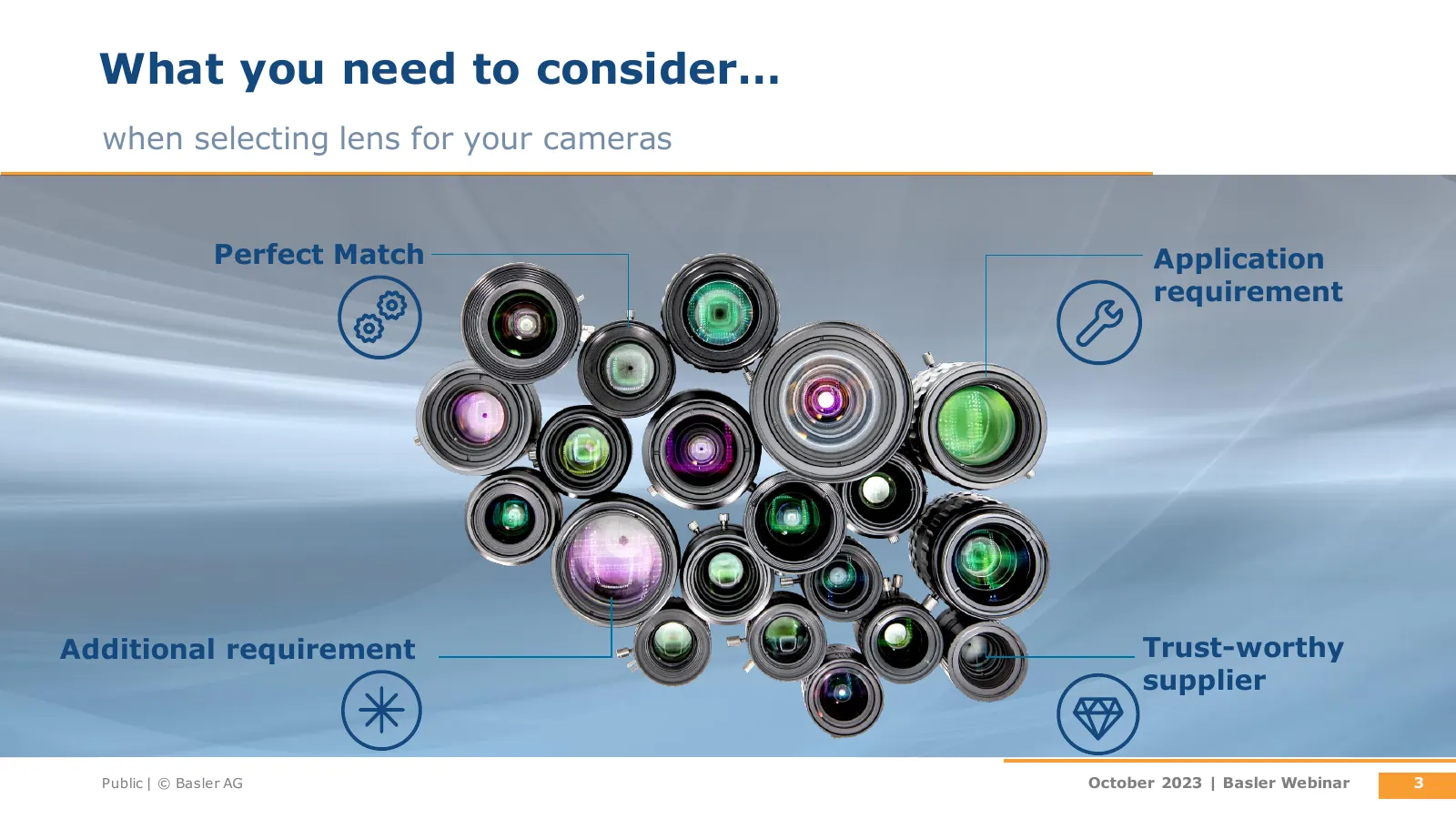
Slide 4: What you need to consider
What you need to consider… when selecting lens for your cameras Perfect Match Application requirement Additional requirement Trust-worthy supplier Public | © Basler AG October 2023 | Basler Webinar 3
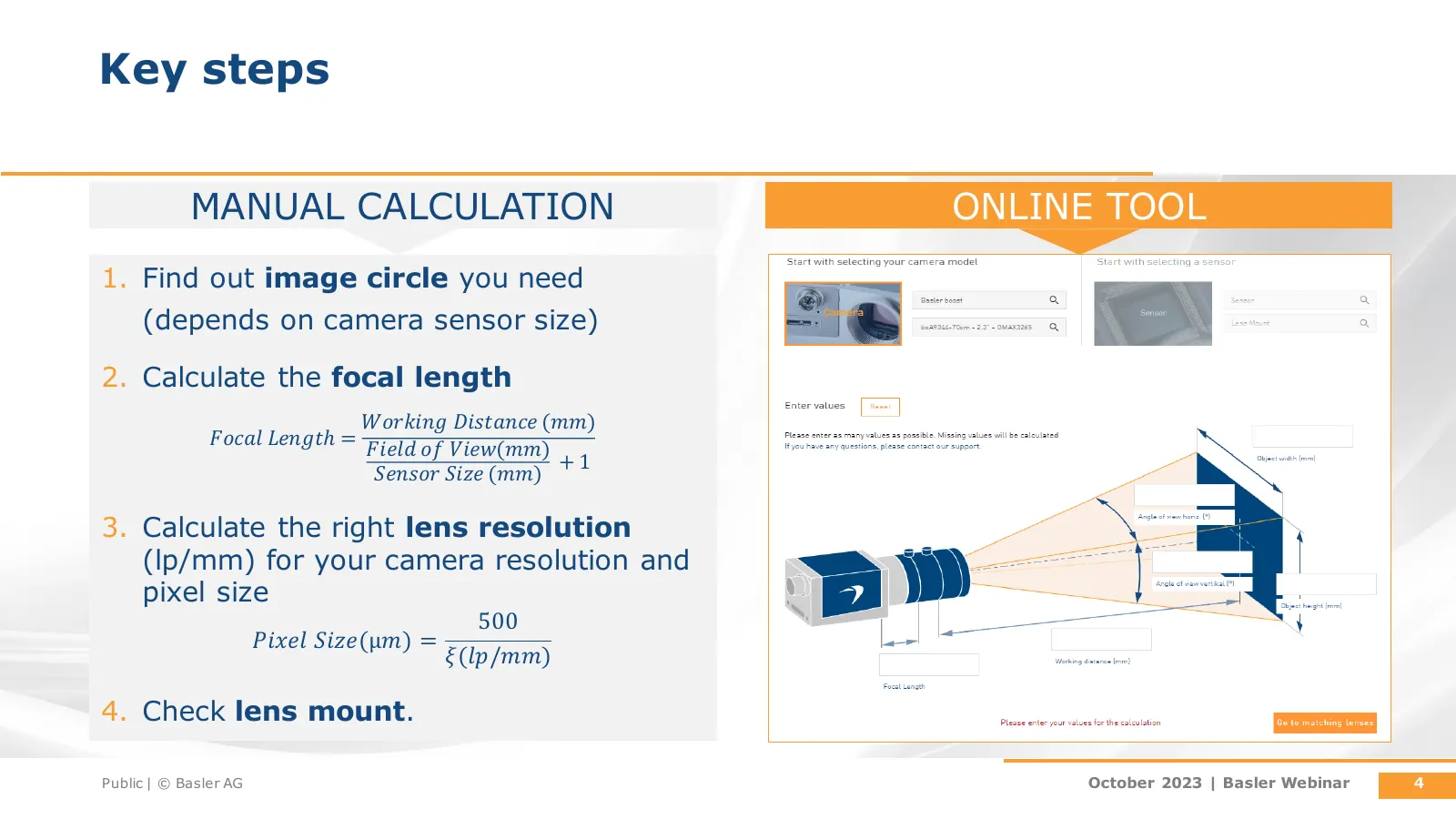
Slide 5: Key steps
Key steps MANUAL CALCULATION ONLINE TOOL 1. Find out image circle you need (depends on camera sensor size) 2. Calculate the focal length 𝑊𝑜𝑟𝑘𝑖𝑛𝑔 𝐷𝑖𝑠𝑡𝑎𝑛𝑐𝑒 (𝑚𝑚) 𝐹𝑜𝑐𝑎𝑙 𝐿𝑒𝑛𝑔𝑡ℎ = 𝐹𝑖𝑒𝑙𝑑 𝑜𝑓 𝑉𝑖𝑒𝑤(𝑚𝑚) +1 𝑆𝑒𝑛𝑠𝑜𝑟 𝑆𝑖𝑧𝑒 (𝑚𝑚) 3. Calculate the right lens…
Slide 6: BUT…..
BUT….. What if when you have: ▪ No ideal focal length ▪ More than one recommendation ▪ No recommendation ▪ …… ▪ …… Public | © Basler AG October 2023 | Basler Webinar 5
Slide 7: History of lens design
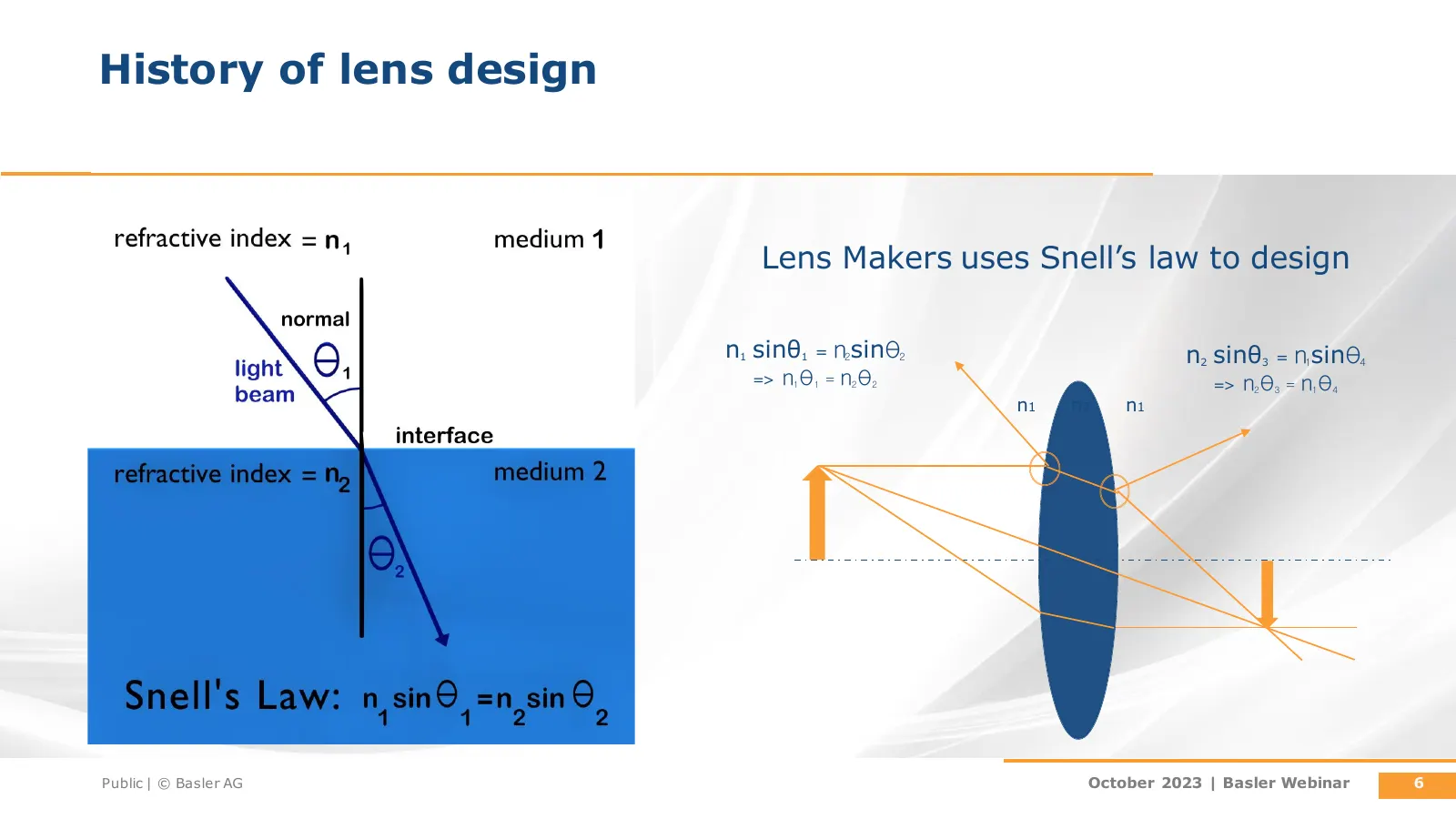
History of lens design Snell’s Law (Law of diffraction) Lens Makers uses Snell’s law to design n1 sinθ1 = n2sinθ2 n2 sinθ3 = n1sinθ4 => n1 θ1 = n2 θ2 => n2θ3 = n1θ4 n1 n2 n1 Public | © Basler AG October 2023 | Basler Webinar 6
Slide 8: History of lens design
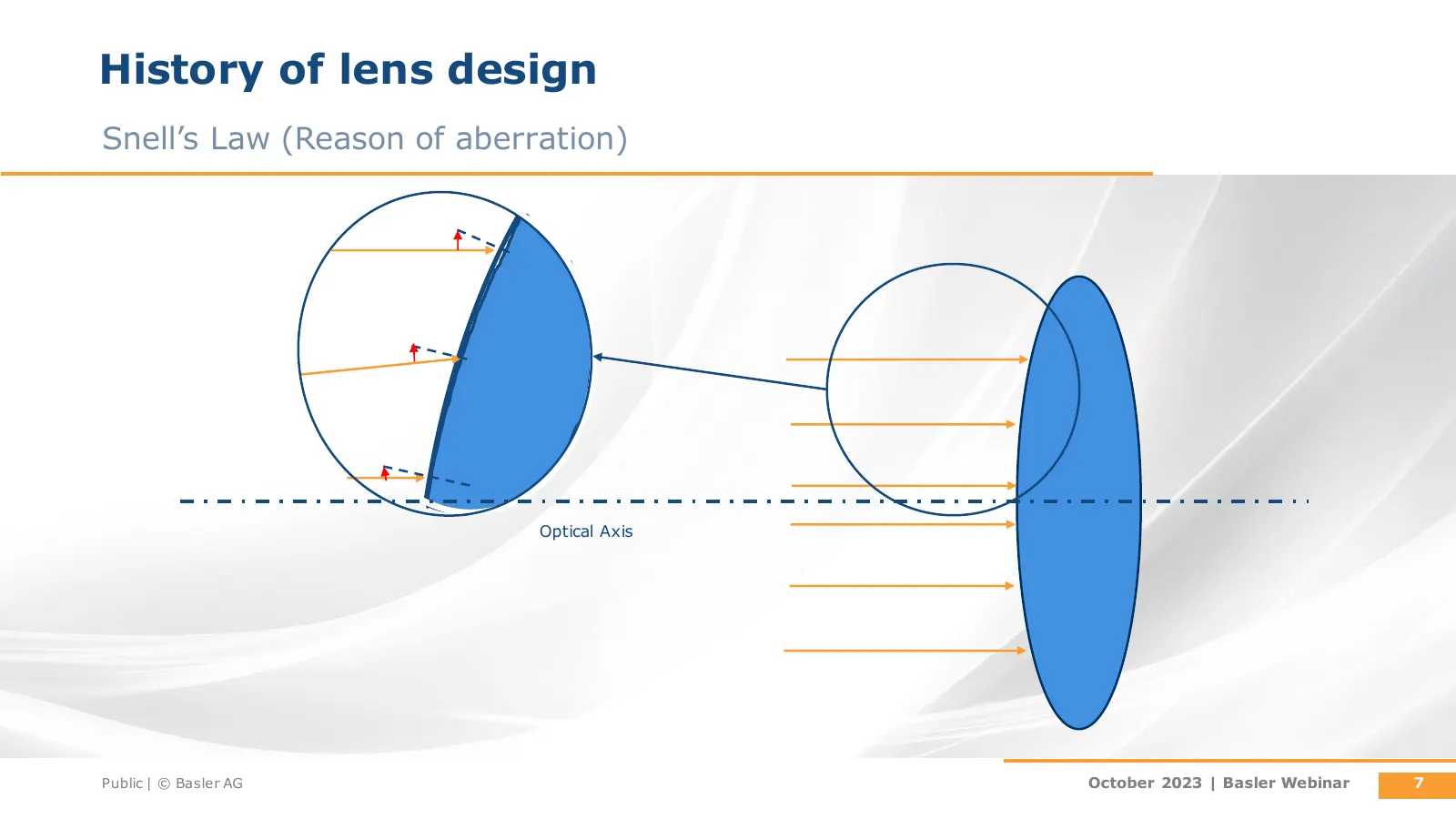
History of lens design Snell’s Law (Reason of aberration) Optical Axis Public | © Basler AG October 2023 | Basler Webinar 7
Slide 9: Questions
Questions Is the following statement correct or wrong? “Lens works better near the optical axis, so I can reduce the aperture for better image quality.” Public | © Basler AG October 2023 | Basler Webinar 8
Slide 10: How to tell lens performance?
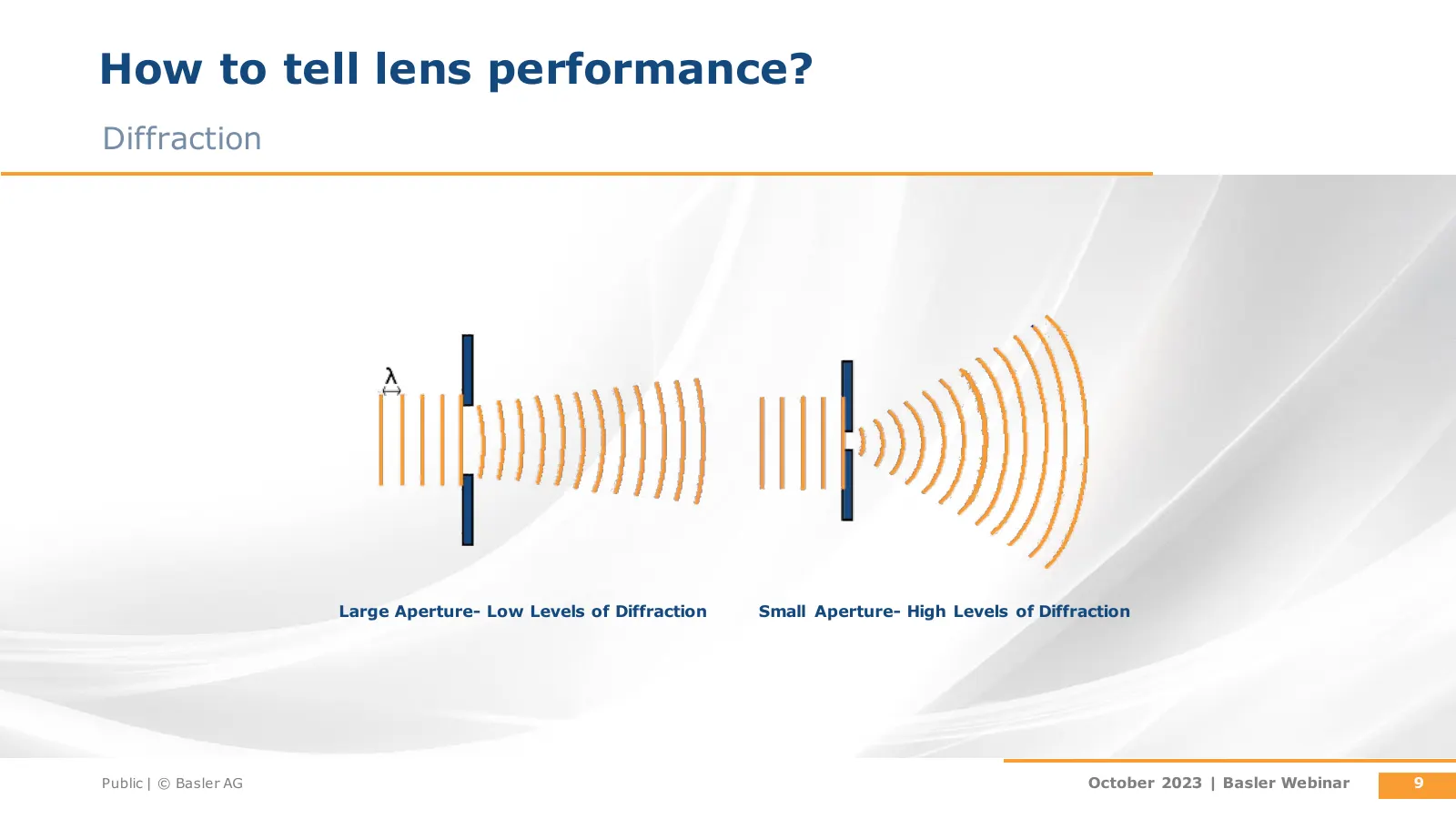
How to tell lens performance? Diffraction Large Aperture- Low Levels of Diffraction Small Aperture- High Levels of Diffraction Public | © Basler AG October 2023 | Basler Webinar 9
Slide 11: How to tell lens performance?
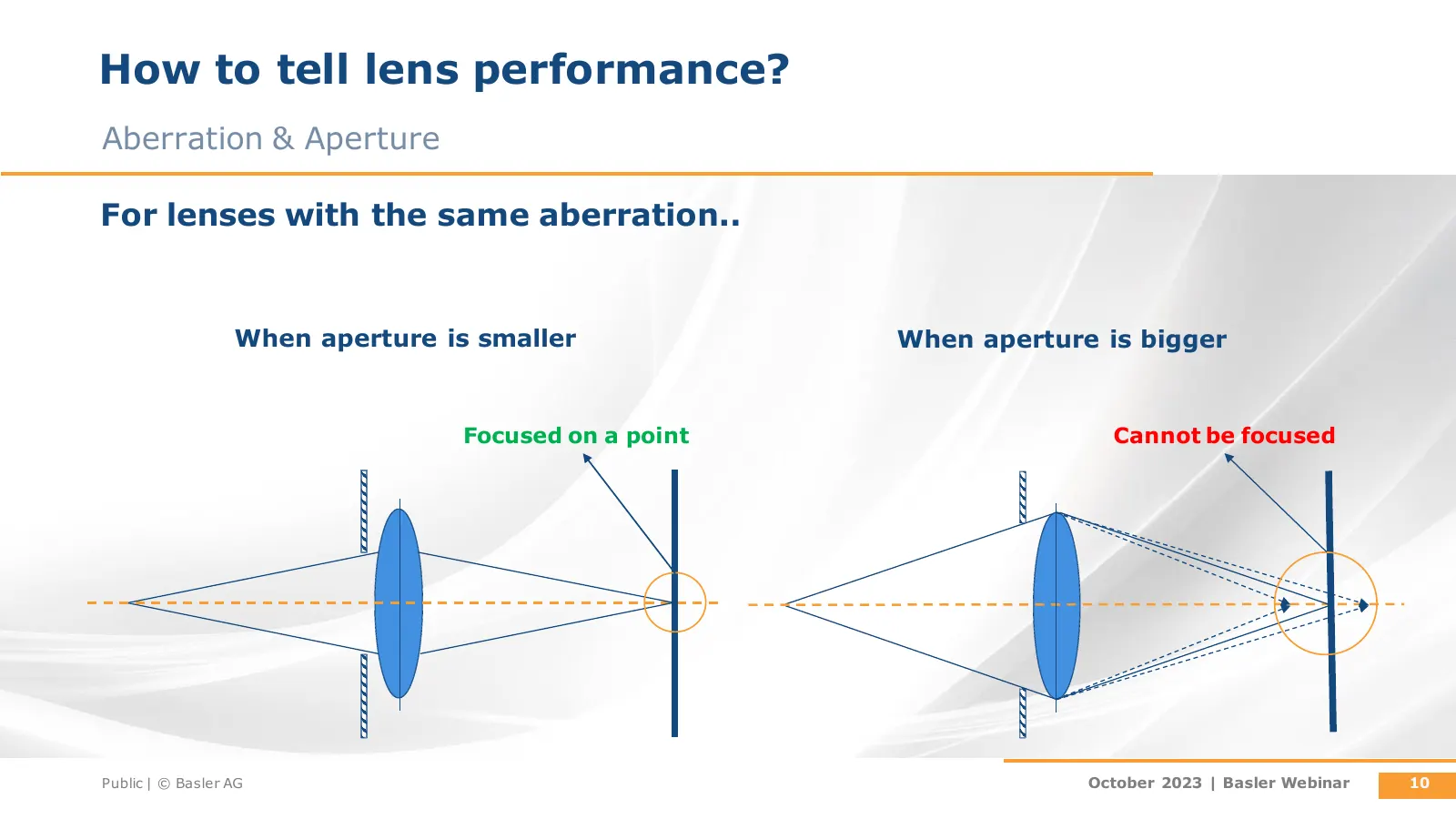
How to tell lens performance? Aberration & Aperture For lenses with the same aberration.. When aperture is smaller When aperture is bigger Focused on a point Cannot be focused Public | © Basler AG October 2023 | Basler Webinar 10
Slide 12: How to tell lens performance?
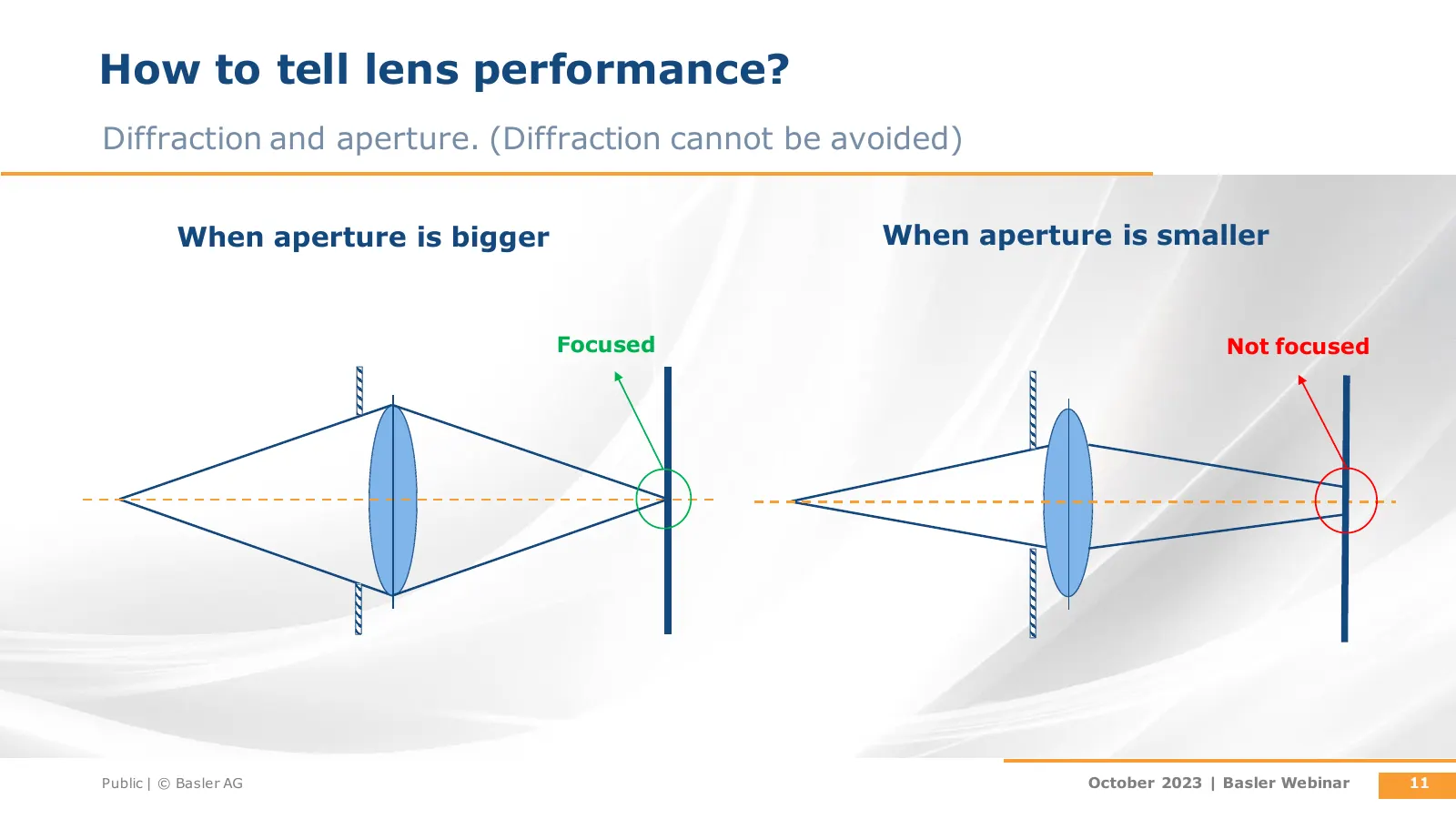
How to tell lens performance? Diffraction and aperture. (Diffraction cannot be avoided) When aperture is bigger When aperture is smaller Focused Not focused Public | © Basler AG October 2023 | Basler Webinar 11
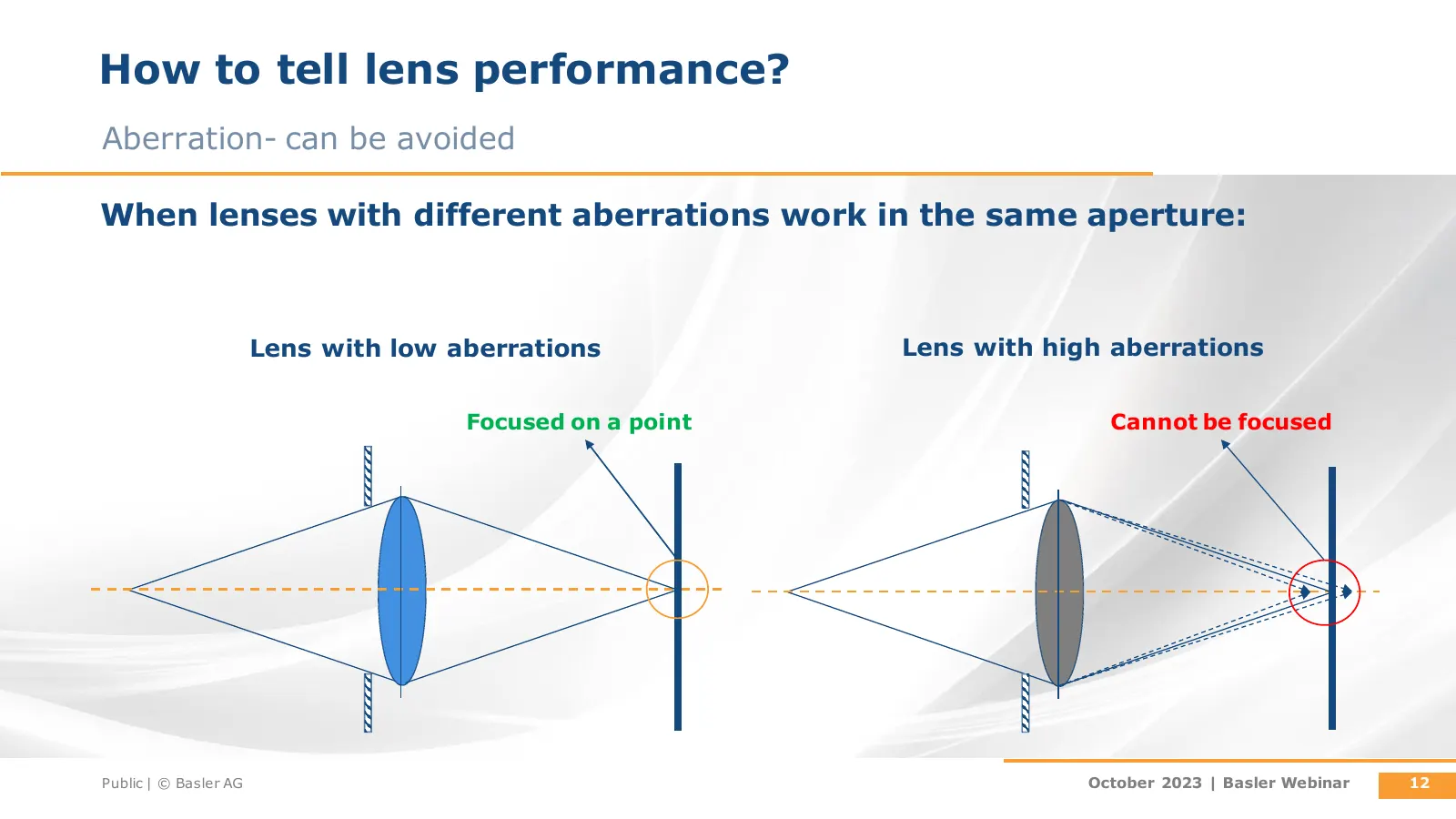
Slide 13: How to tell lens performance?
How to tell lens performance? Aberration- can be avoided When lenses with different aberrations work in the same aperture: Lens with low aberrations Lens with high aberrations Focused on a point Cannot be focused Public | © Basler AG October 2023 | Basler Webinar 12
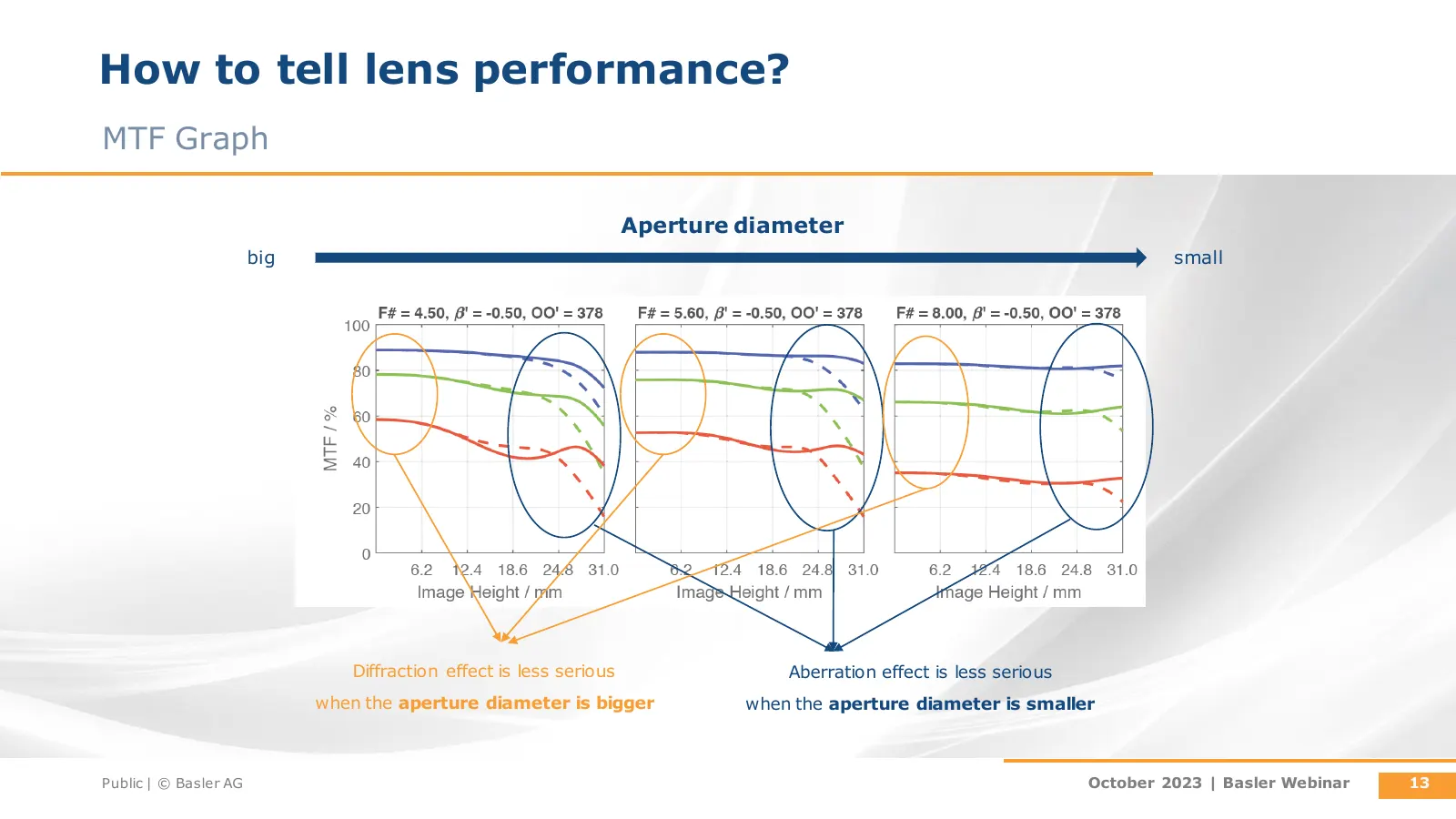
Slide 14: How to tell lens performance?
How to tell lens performance? MTF Graph Aperture diameter big small Diffraction effect is less serious Aberration effect is less serious when the aperture diameter is bigger when the aperture diameter is smaller Public | © Basler AG October 2023 | Basler Webinar 13
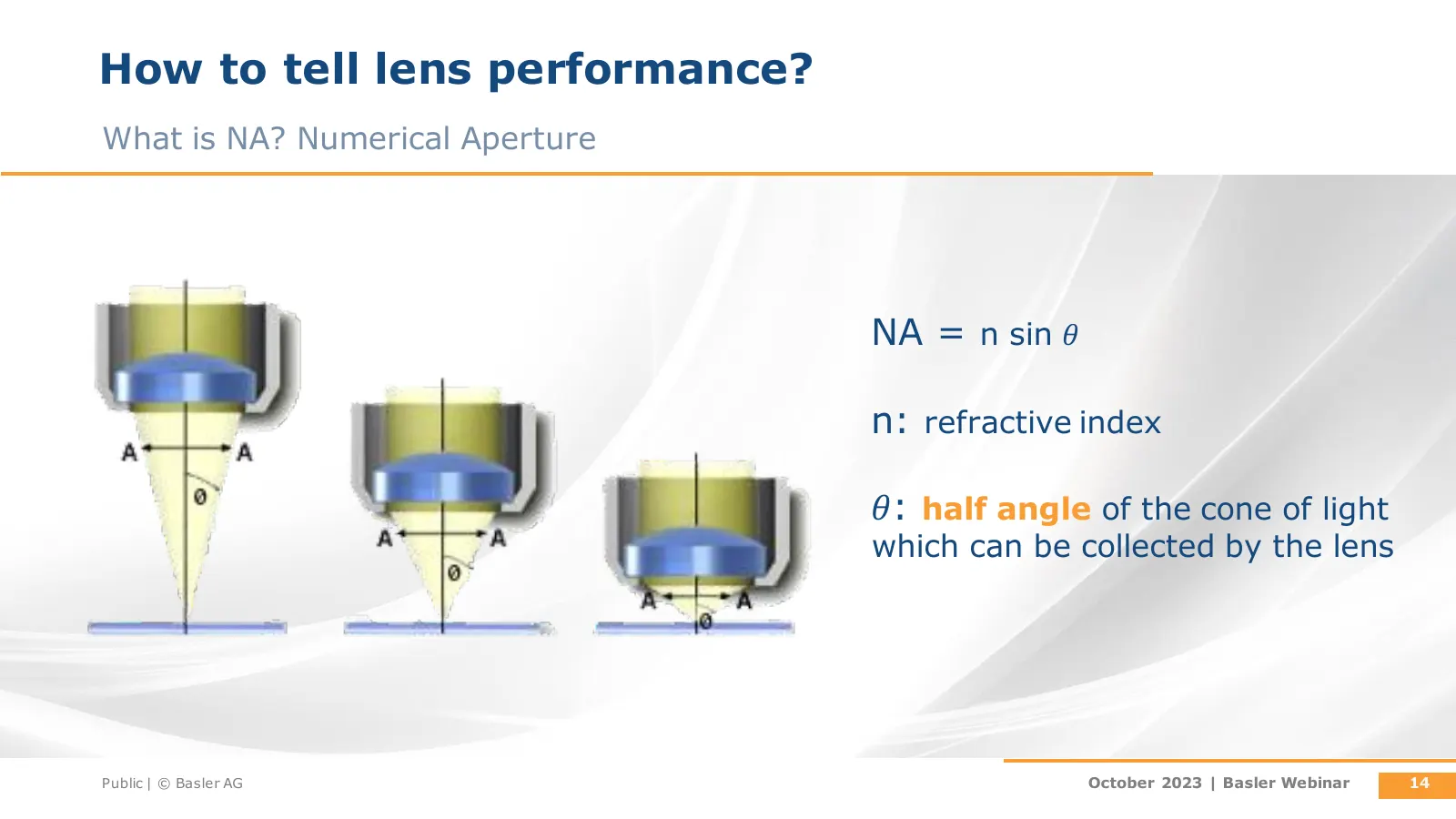
Slide 15: How to tell lens performance?
How to tell lens performance? What is NA? Numerical Aperture NA = n sin 𝜃 n: refractive index 𝜃: half angle of the cone of light which can be collected by the lens Public | © Basler AG October 2023 | Basler Webinar 14
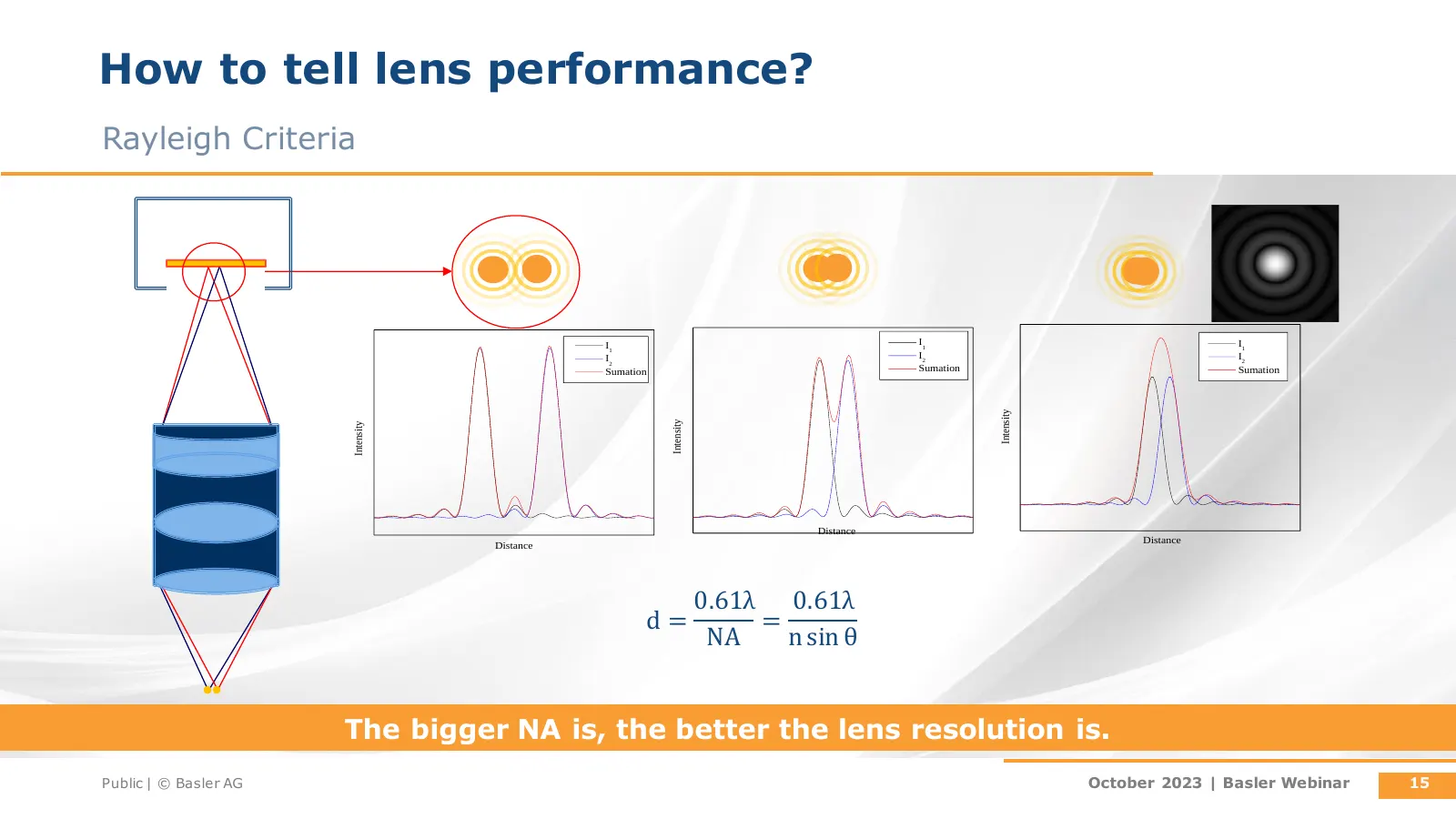
Slide 16: How to tell lens performance?
How to tell lens performance? Rayleigh Criteria I1 I1 I1 I2 I2 I2 Sumation Sumation Sumation Intensity Intensity Intensity Distance Distance Distance 0.61λ 0.61λ d= = NA n sin θ The bigger NA is, the better the lens resolution is. Public | © Basler AG October 2023 | Basler Webinar 15
Slide 17: How to tell lens performance?
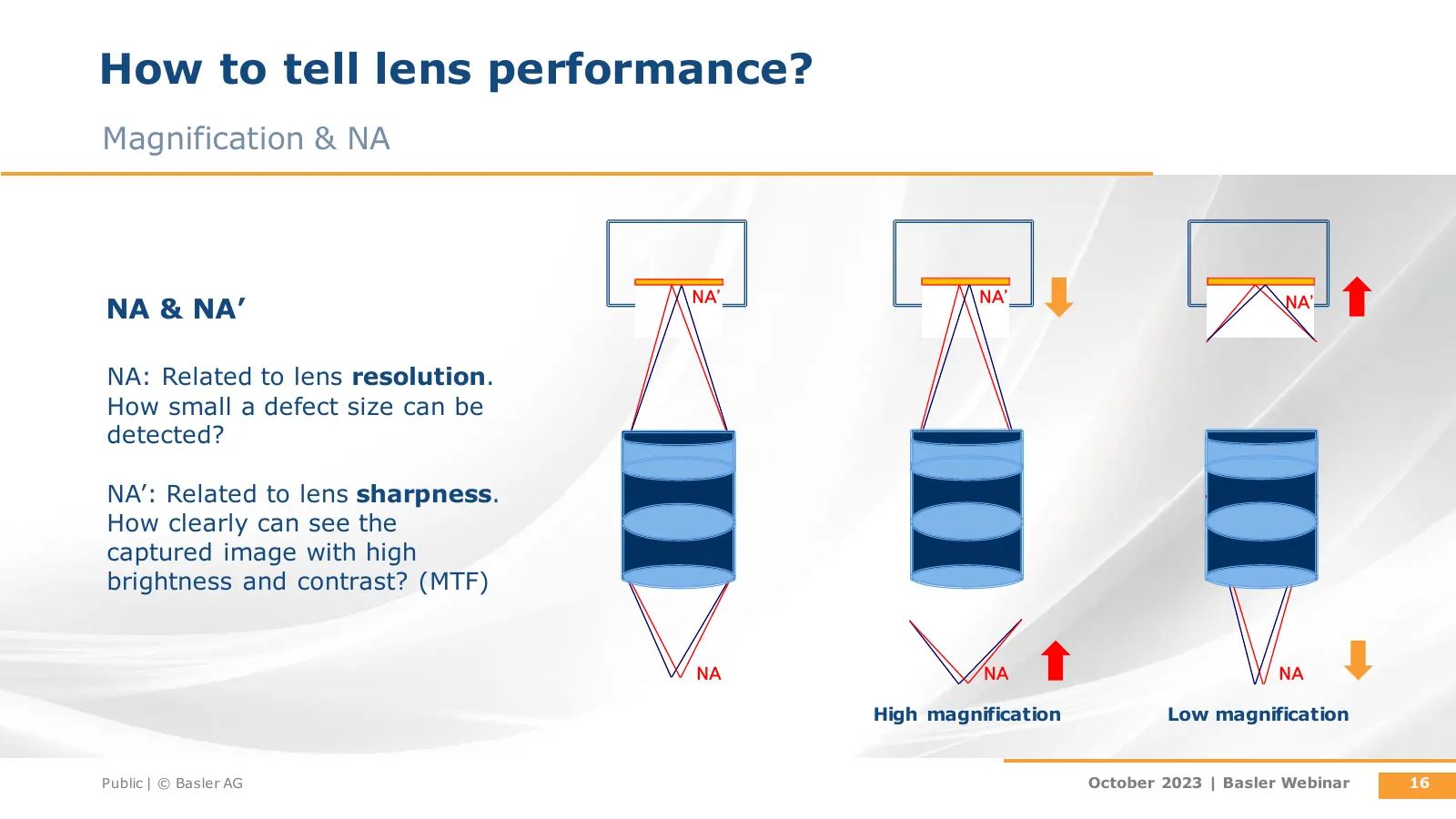
How to tell lens performance? Magnification & NA NA’ NA’ NA & NA’ NA’ NA: Related to lens resolution. How small a defect size can be detected? NA’: Related to lens sharpness. How clearly can see the captured image with high brightness and contrast? (MTF) NA NA NA High magnification Low magnification
Slide 18: How to tell lens performance?
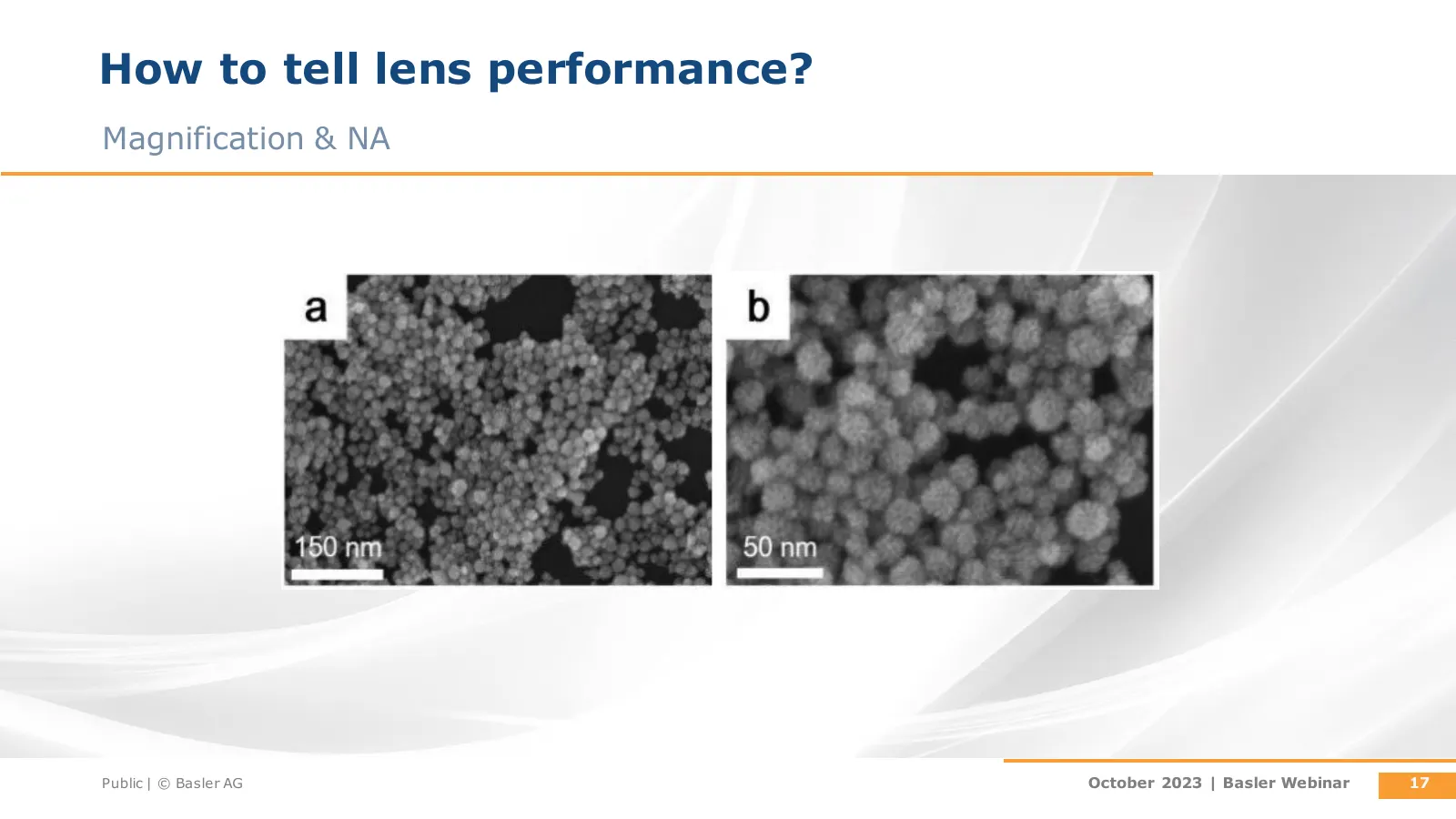
How to tell lens performance? Magnification & NA Public | © Basler AG October 2023 | Basler Webinar 17
Slide 19: How to tell lens performance?
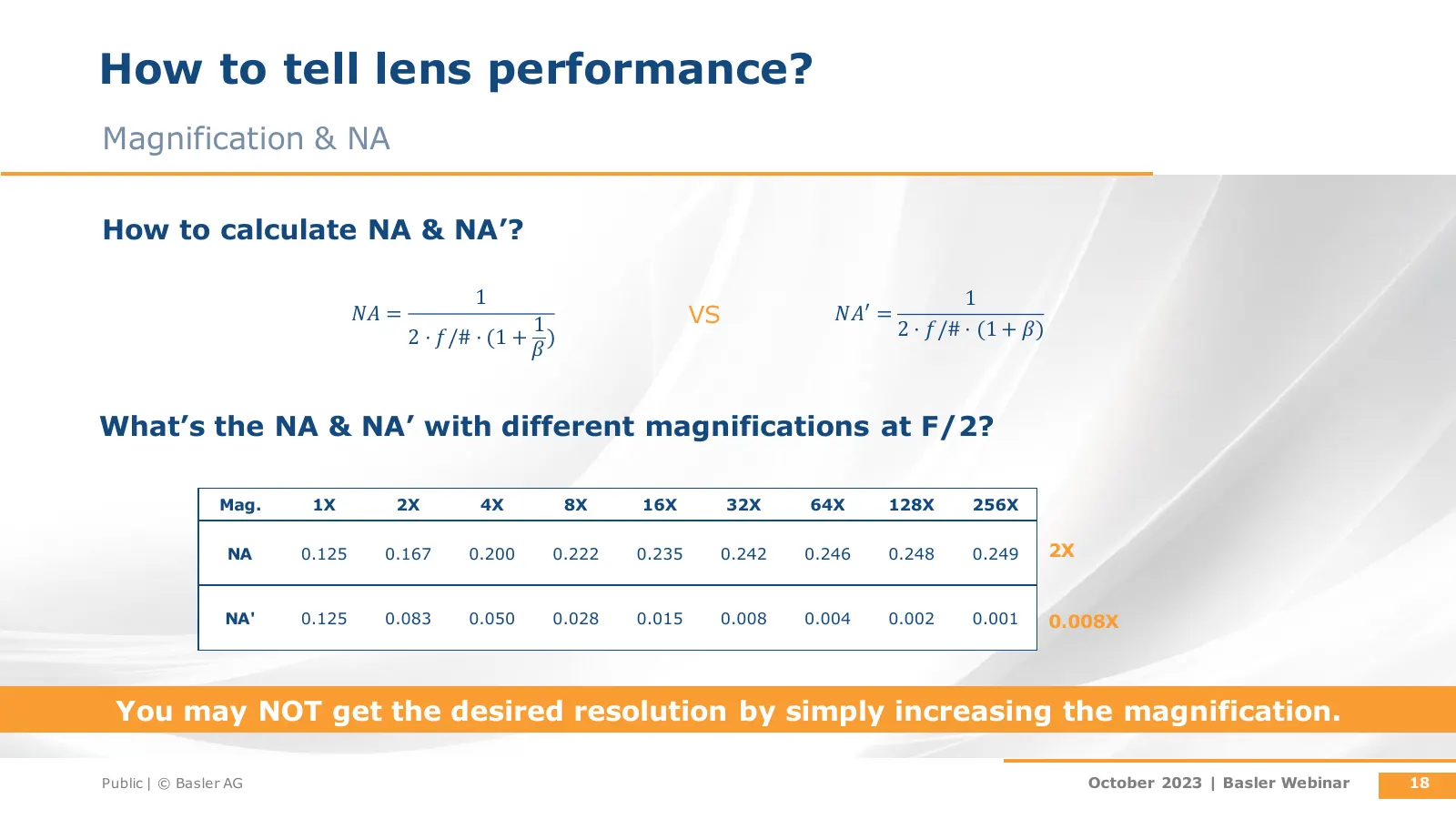
How to tell lens performance? Magnification & NA How to calculate NA & NA’? 1 1 𝑁𝐴 = 1 VS 𝑁𝐴′ = 2 ⋅ 𝑓/# ⋅ (1 + ) 2 ⋅ 𝑓/# ⋅ (1 + 𝛽) 𝛽 What’s the NA & NA’ with different magnifications at F/2? Mag. 1X 2X 4X 8X 16X 32X 64X 128X 256X NA 0.125 0.167 0.200 0.222 0.235 0.242 0.246 0.248 0.249 2X…
Slide 20: How to tell lens performance?
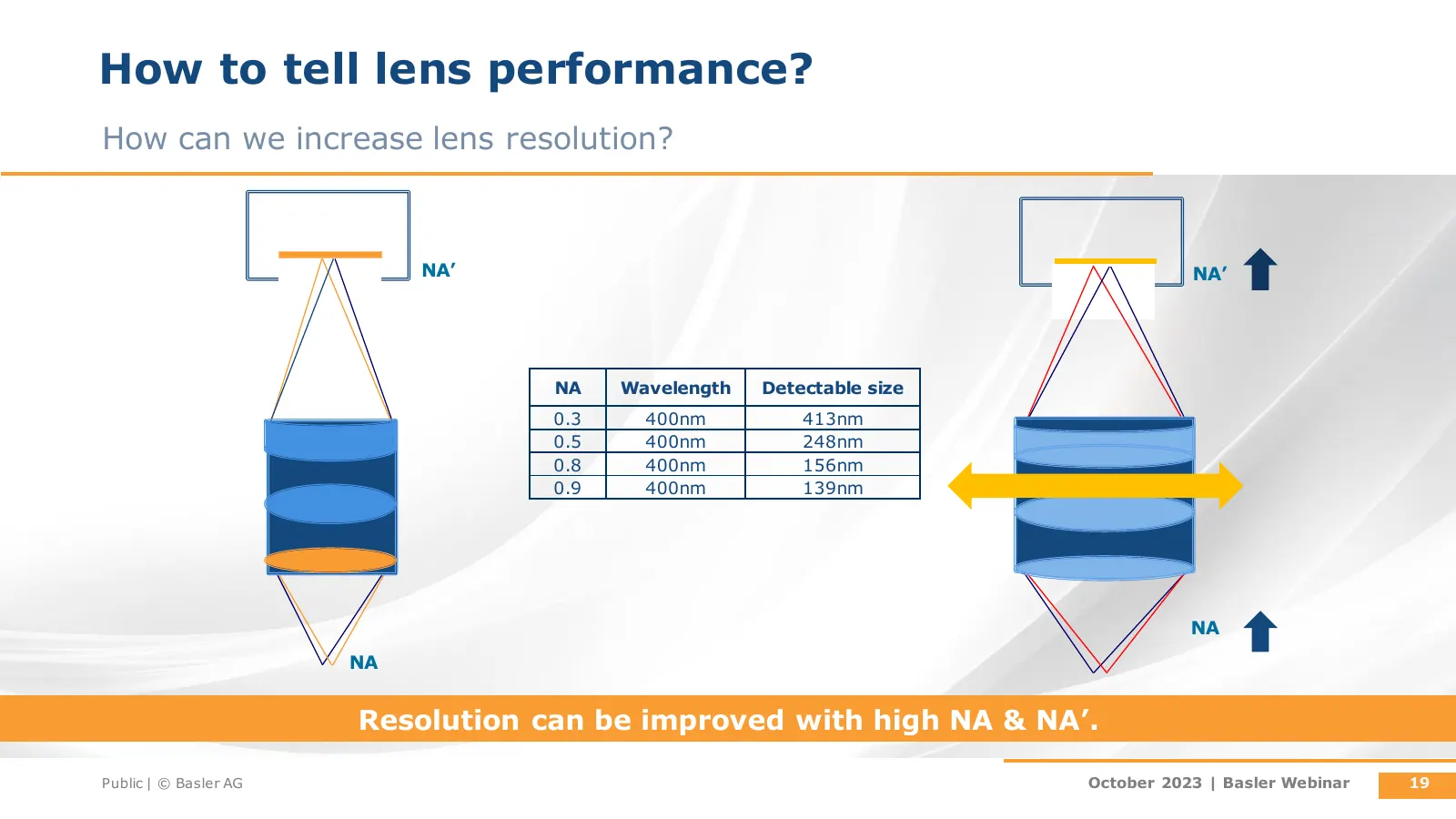
How to tell lens performance? How can we increase lens resolution? NA’ NA’ NA Wavelength Detectable size 0.3 400nm 413nm 0.5 400nm 248nm 0.8 400nm 156nm 0.9 400nm 139nm NA NA Resolution can be improved with high NA & NA’. Public | © Basler AG October 2023 | Basler Webinar 19
Slide 21: How to tell lens performance?
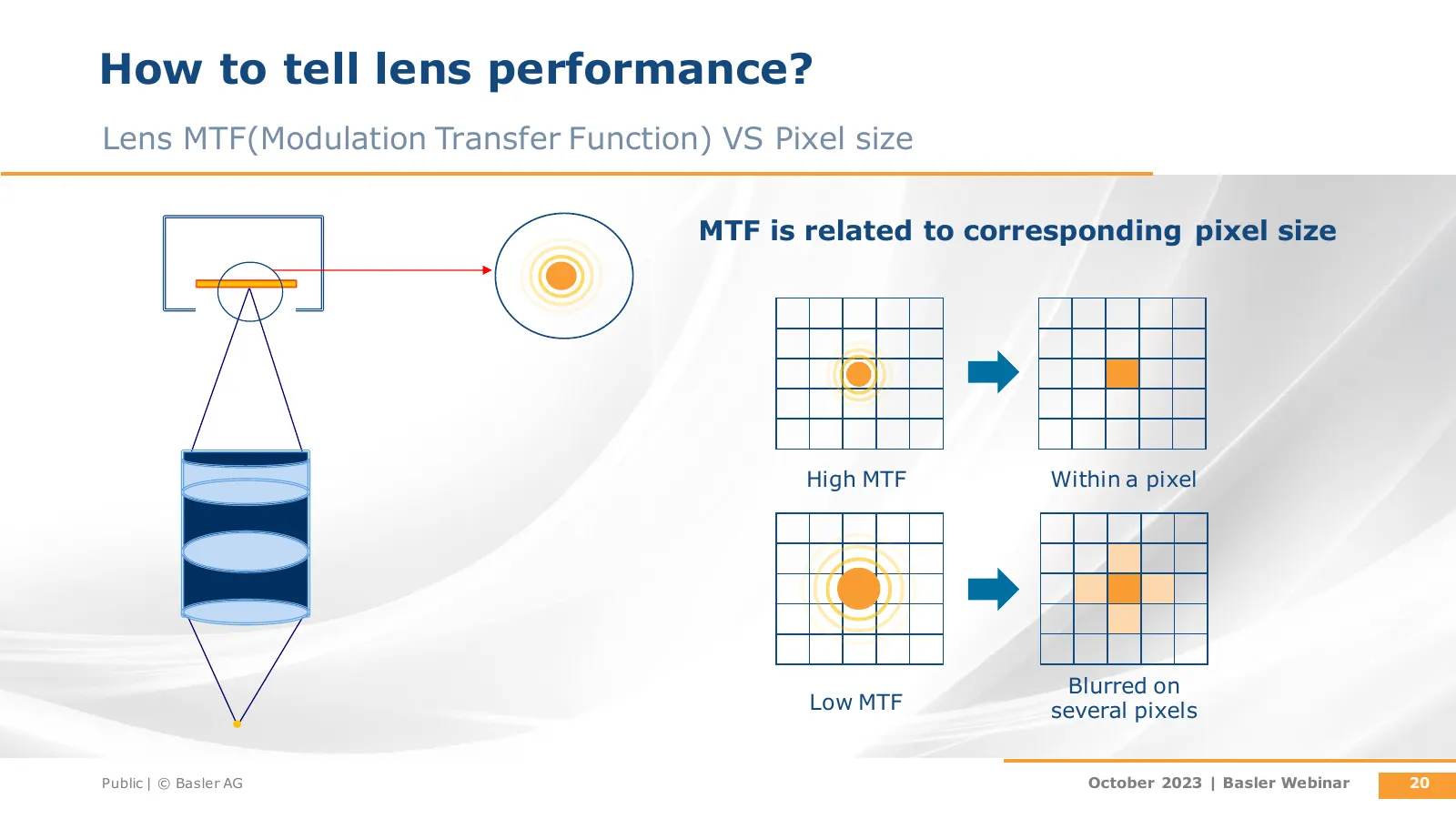
How to tell lens performance? Lens MTF(Modulation Transfer Function) VS Pixel size MTF is related to corresponding pixel size High MTF Within a pixel Blurred on Low MTF several pixels Public | © Basler AG October 2023 | Basler Webinar 20
Slide 22: How to tell lens performance?
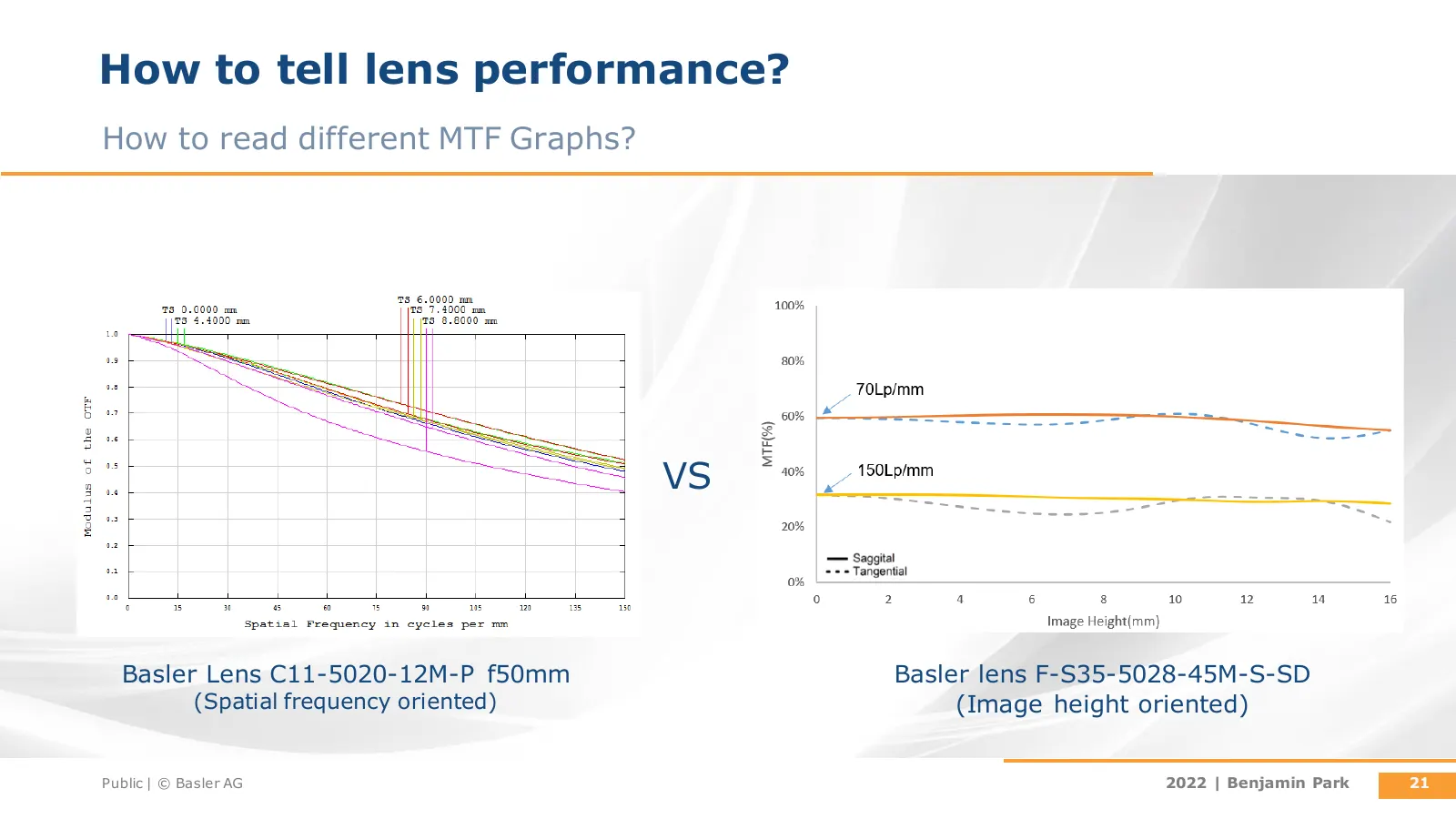
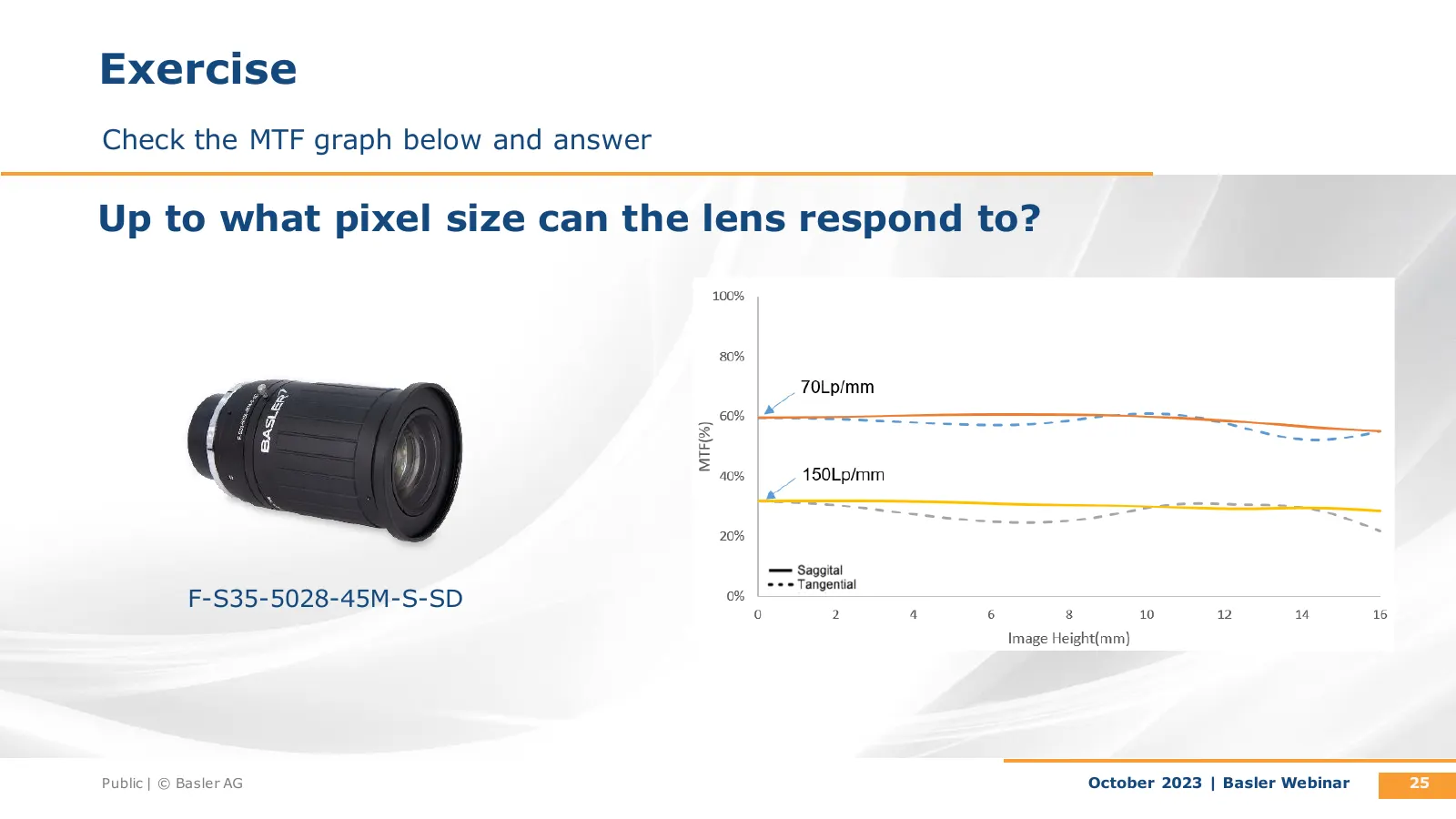
How to tell lens performance? How to read different MTF Graphs? VS Basler Lens C11-5020-12M-P f50mm Basler lens F-S35-5028-45M-S-SD (Spatial frequency oriented) (Image height oriented) Public | © Basler AG 2022 | Benjamin Park 21
Slide 23: Nyquist Frequency
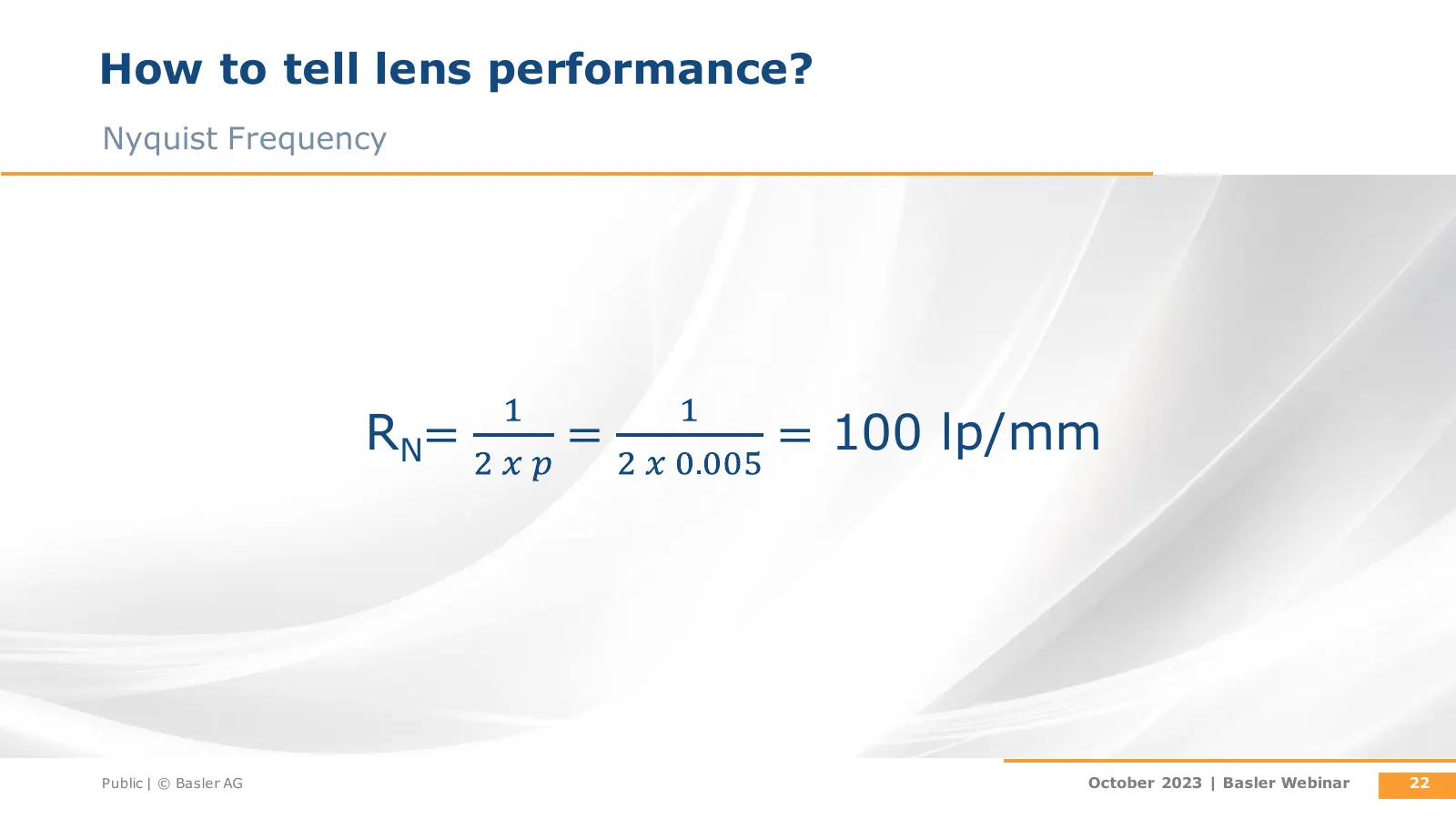
How to tell lens performance? Nyquist Frequency 1 1 RN= = = 100 lp/mm 2𝑥𝑝 2 𝑥 0.005 Public | © Basler AG October 2023 | Basler Webinar 22
Slide 24: Resolution of Lens
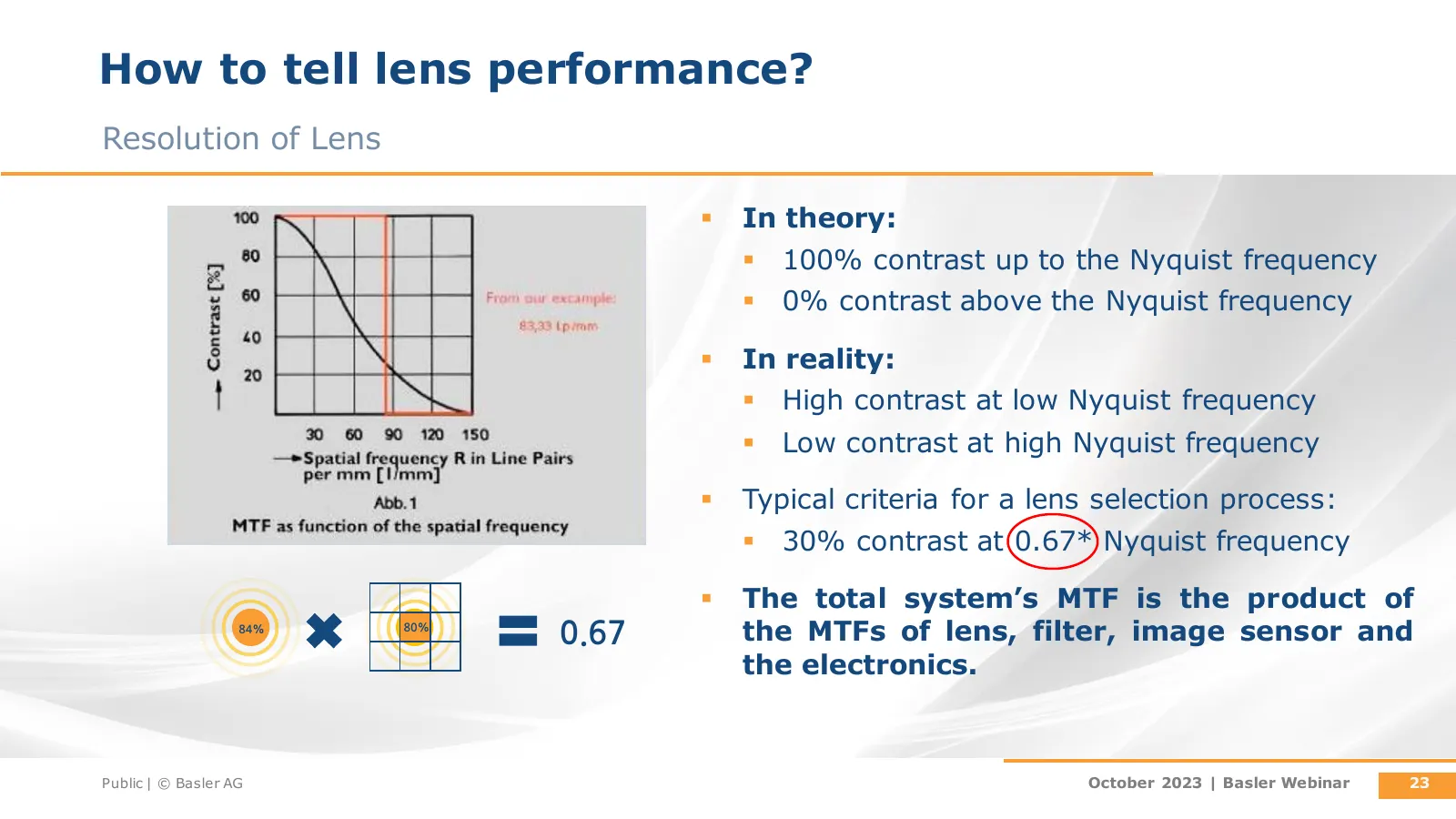
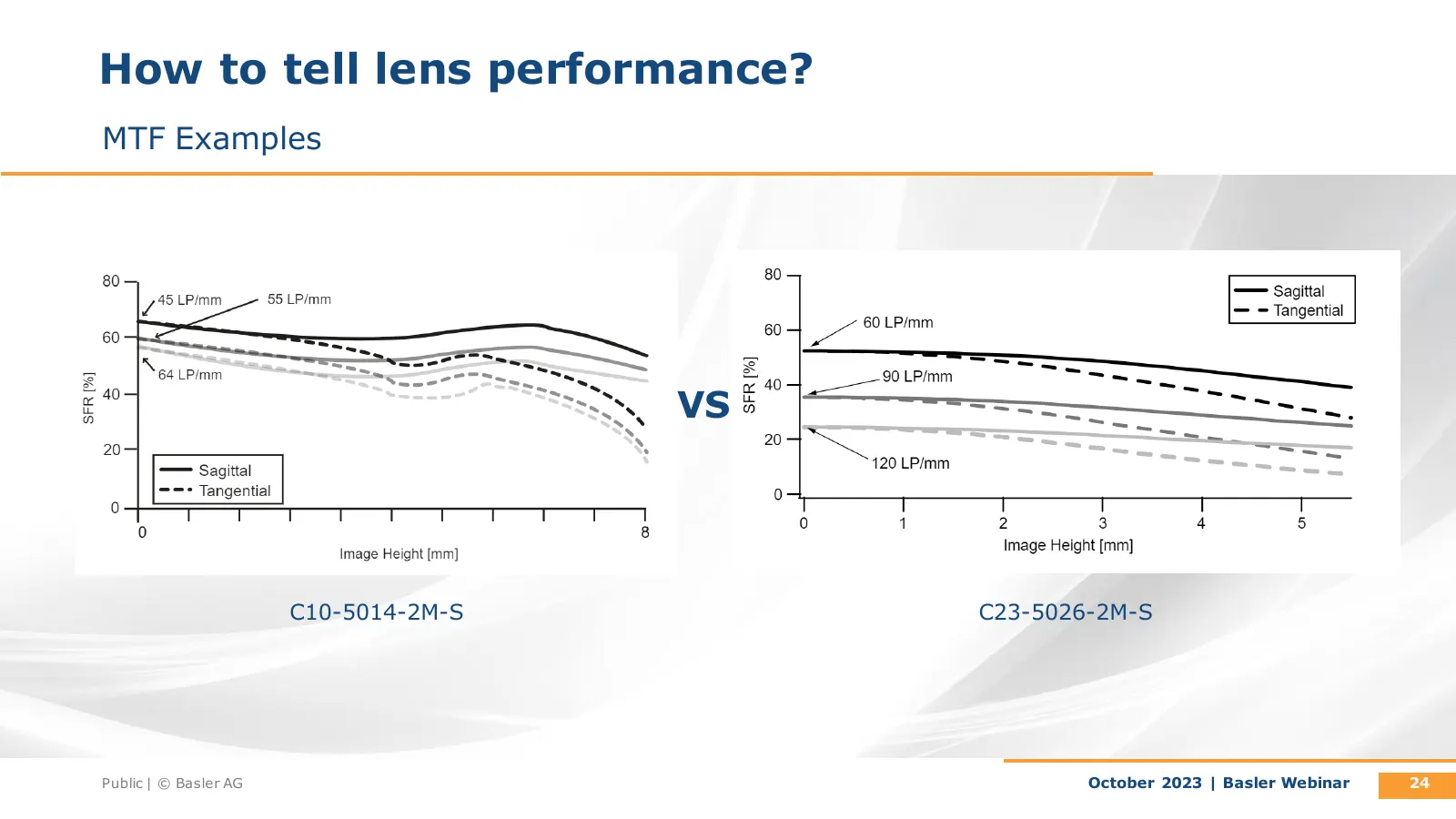
How to tell lens performance? Resolution of Lens ▪ In theory: ▪ 100% contrast up to the Nyquist frequency ▪ 0% contrast above the Nyquist frequency ▪ In reality: ▪ High contrast at low Nyquist frequency ▪ Low contrast at high Nyquist frequency ▪ Typical criteria for a lens selection process: ▪ 30% c
Slide 25: MTF Examples
How to tell lens performance? MTF Examples VS C10-5014-2M-S C23-5026-2M-S Public | © Basler AG October 2023 | Basler Webinar 24
Slide 26: Exercise
Exercise Check the MTF graph below and answer Up to what pixel size can the lens respond to? F-S35-5028-45M-S-SD Public | © Basler AG October 2023 | Basler Webinar 25
Slide 27: How to balance cost and performance?
How to balance cost and performance? ▪ There is NO universal rule to find the best cost-performance lens. ▪ It always depends on your application requirements ▪ Can rely on your vision expert Public | © Basler AG October 2023 | Basler Webinar 26
Slide 28: Use Case 1
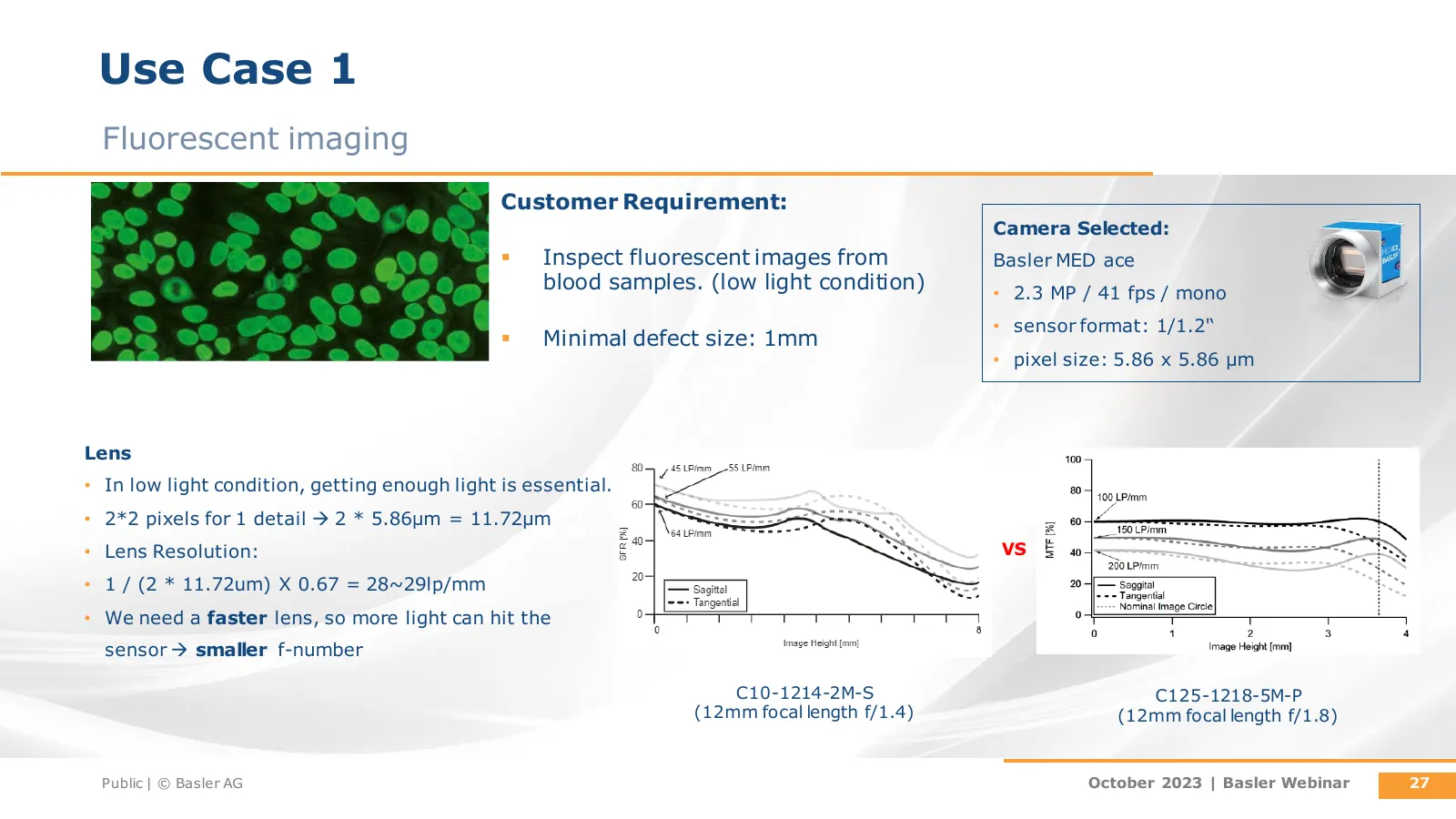
Use Case 1 Fluorescent imaging Customer Requirement: Camera Selected: ▪ Inspect fluorescent images from Basler MED ace blood samples. (low light condition) • 2.3 MP / 41 fps / mono • sensor format: 1/1.2'‘ ▪ Minimal defect size: 1mm • pixel size: 5.86 x 5.86 µm Lens • In low light condition, getting
Slide 29: Use Case 2
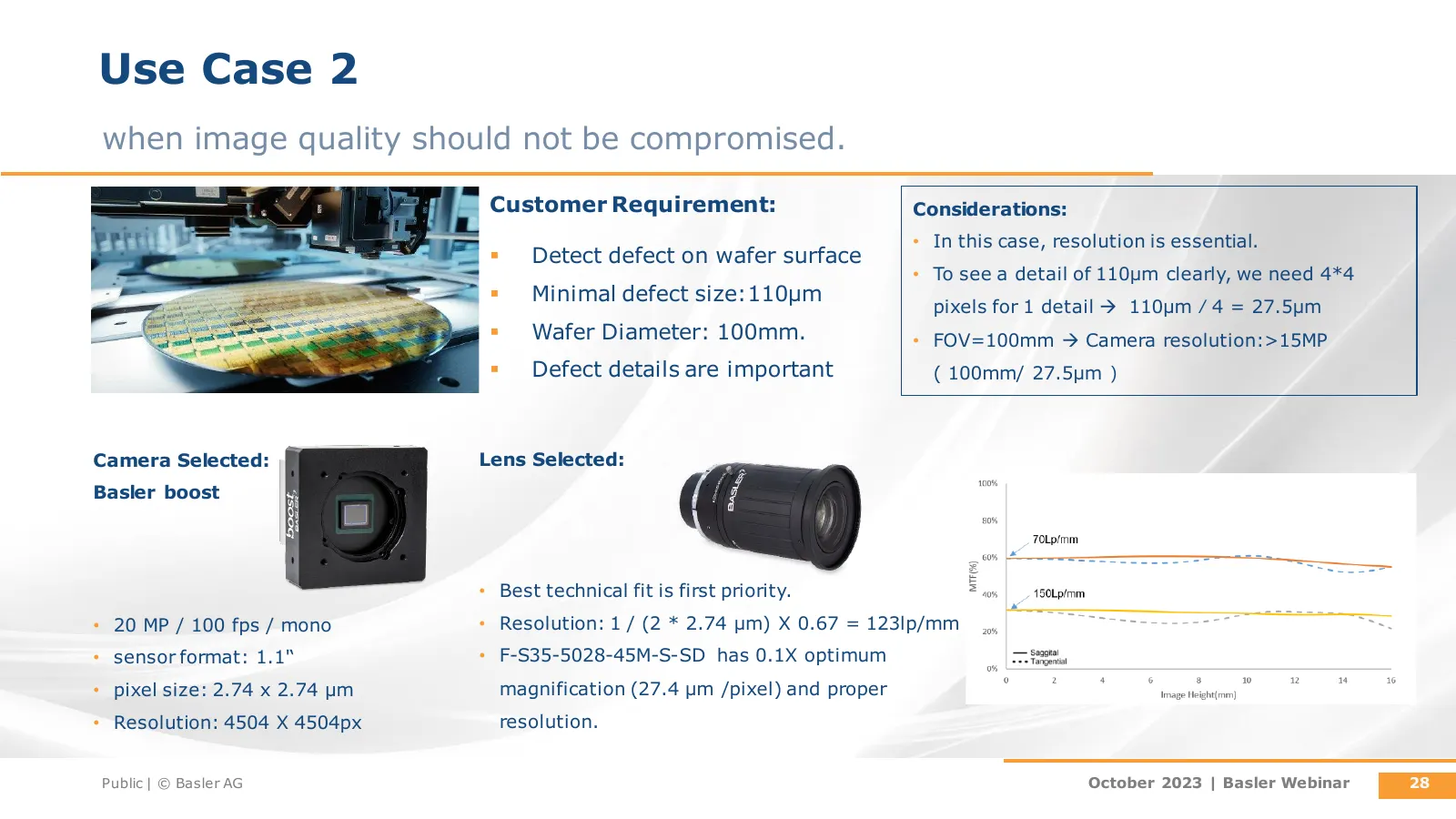
Use Case 2 when image quality should not be compromised. Customer Requirement: Considerations: • In this case, resolution is essential. ▪ Detect defect on wafer surface • To see a detail of 110µm clearly, we need 4*4 ▪ Minimal defect size:110µm pixels for 1 detail → 110µm ⁄ 4 = 27.5µm ▪ Wafer Diamet
Slide 30: Success Story
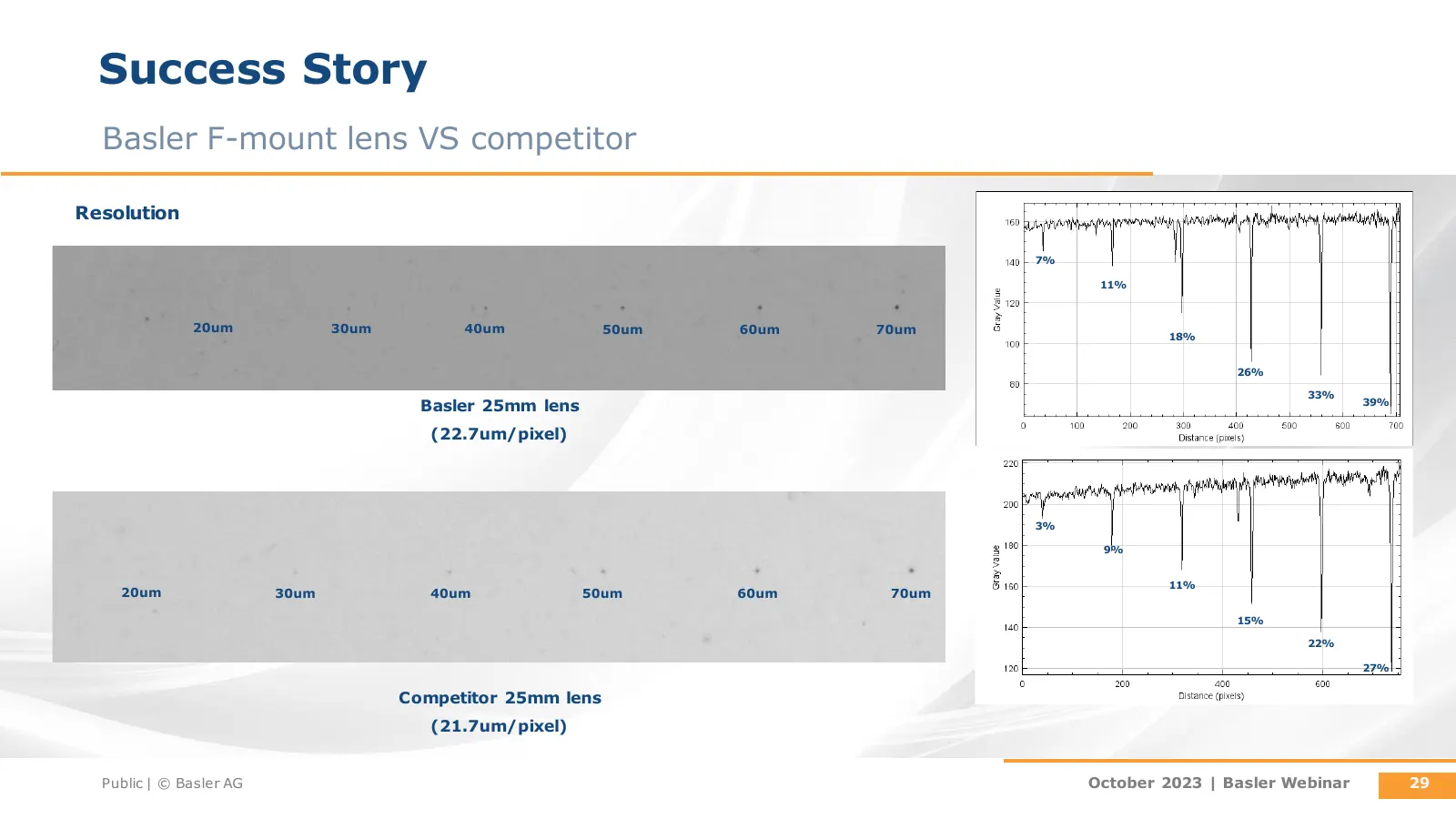
Success Story Basler F-mount lens VS competitor Resolution 7% 11% 20um 30um 40um 50um 60um 70um 18% 26% 33% Basler 25mm lens 39% (22.7um/pixel) 3% 9% 11% 20um 30um 40um 50um 60um 70um 15% 22% 27% Competitor 25mm lens (21.7um/pixel) Public | © Basler AG October 2023 | Basler Webinar 29
Slide 31: Basler Machine Vision Lenses Portfolio
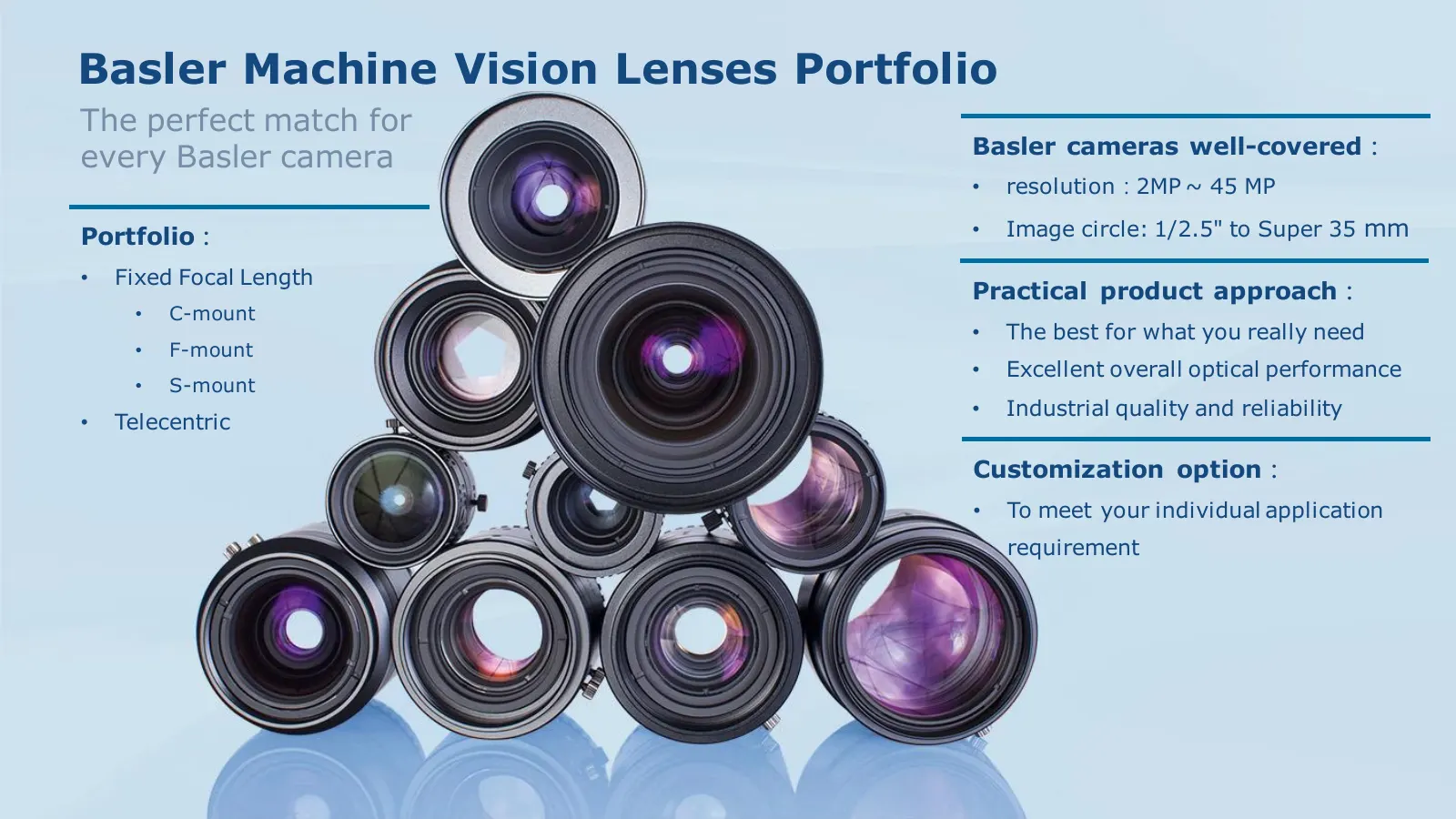
Basler Machine Vision Lenses Portfolio The perfect match for Basler cameras well-covered: every Basler camera • resolution:2MP ~ 45 MP Portfolio: • Image circle: 1/2.5" to Super 35 mm • Fixed Focal Length Practical product approach: • C-mount • The best for what you really need • F-mount • Excellent
Slide 32: Basler Machine Vision Lens Portfolio
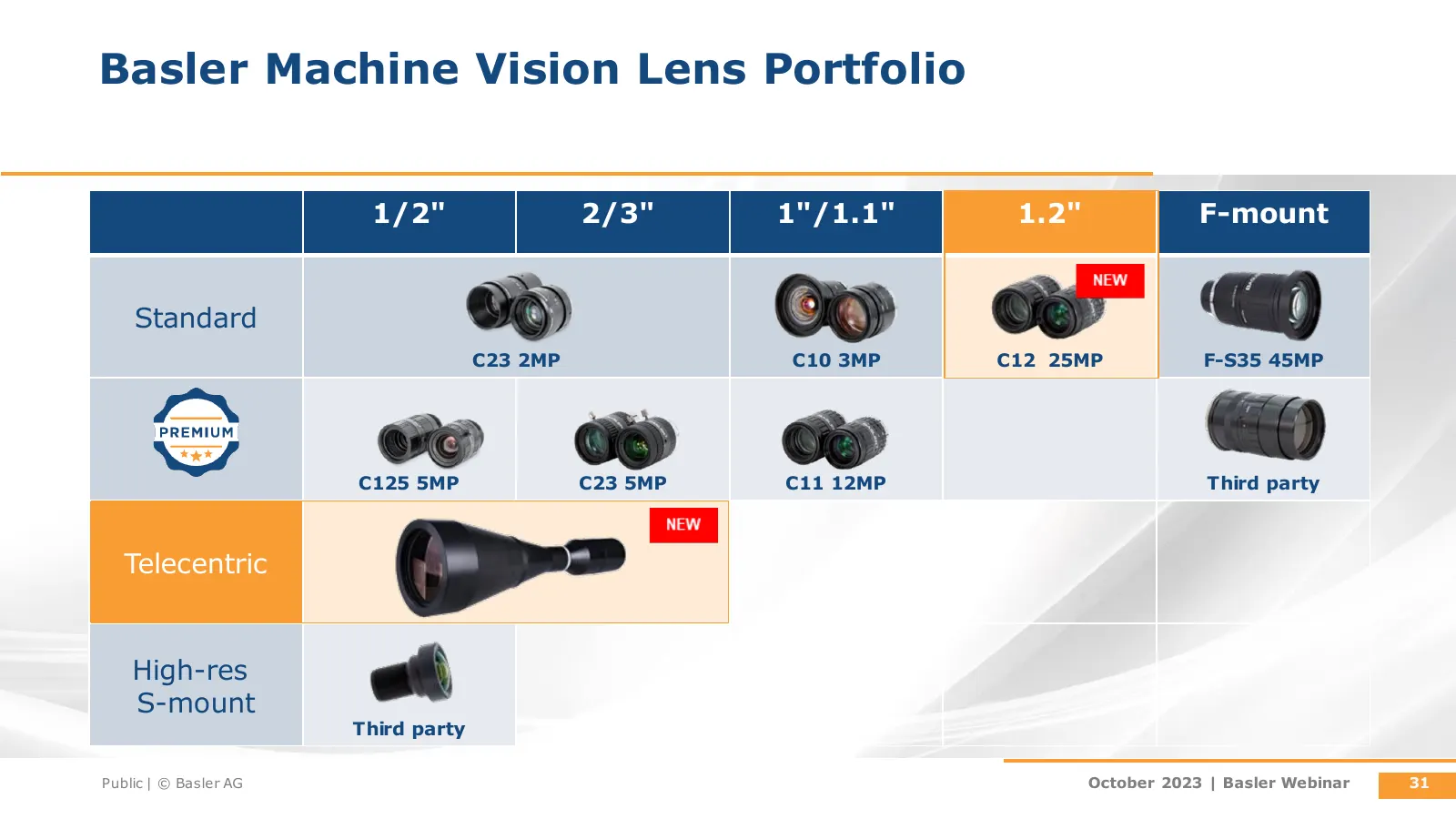
Basler Machine Vision Lens Portfolio 1/2" 2/3" 1"/1.1" 1.2" F-mount Standard C23 2MP C10 3MP C12 25MP F-S35 45MP C125 5MP C23 5MP C11 12MP Third party Telecentric High-res S-mount Third party Public | © Basler AG October 2023 | Basler Webinar 31
Slide 33: Basler Lenses Portfolio
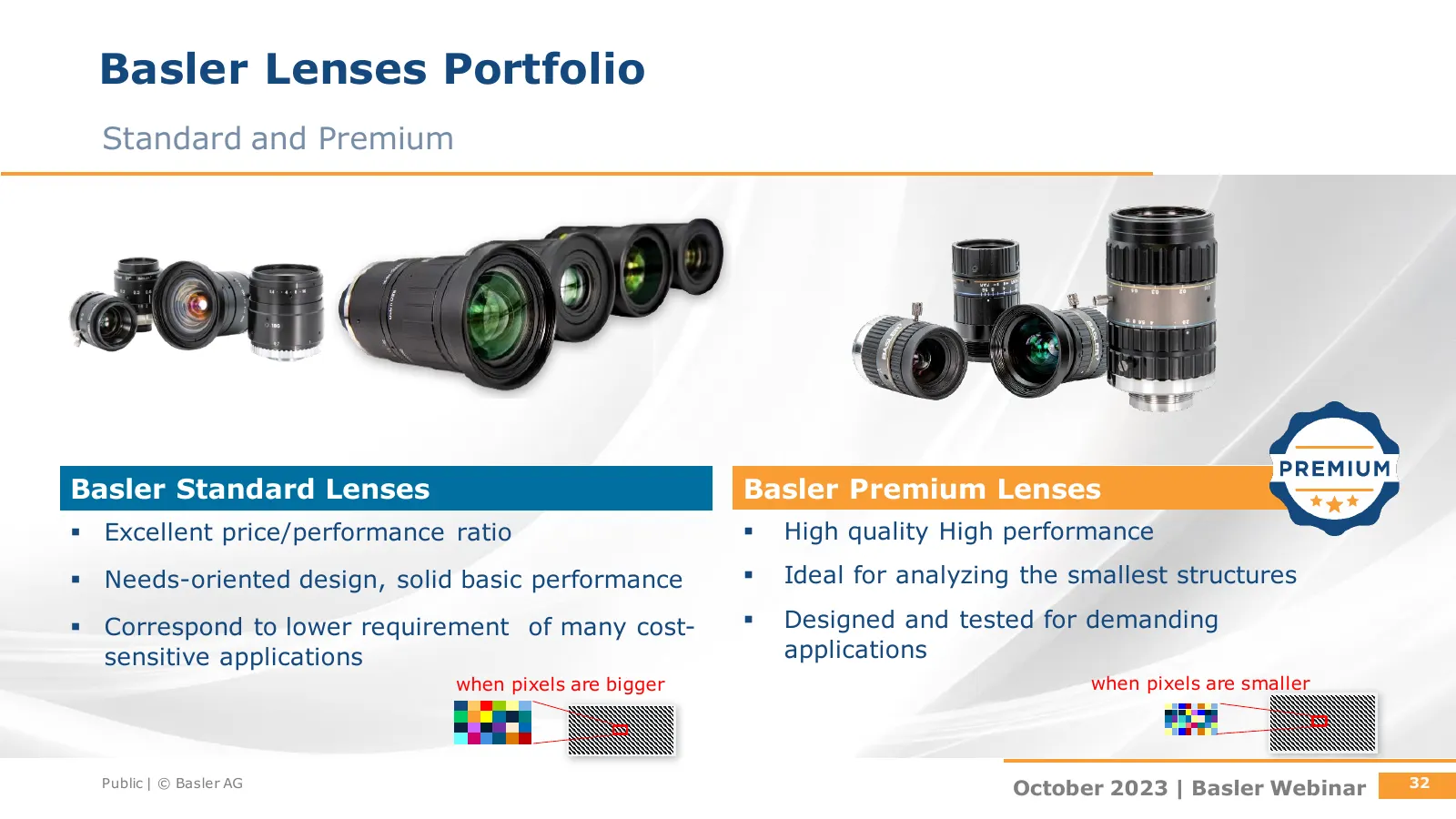
Basler Lenses Portfolio Standard and Premium Basler Standard Lenses Basler Premium Lenses ▪ Excellent price/performance ratio ▪ High quality High performance ▪ Needs-oriented design, solid basic performance ▪ Ideal for analyzing the smallest structures ▪ Correspond to lower requirement of many cost-
Slide 34: Key Takeaways
Key Takeaways 1. Basic lens selection for simple vision tasks can usually be done by using free online tools (Lens Selector) by Basler. This approach takes lens as a final component to be selected for the whole vision system. 2. Advanced lens selection for demanding vision tasks needs a holistic app

Slide 35: Questions & Answers
Questions & Answers Benjamin Ho Team Leader – Application Engineering Services support.apac@baslerweb.com Public | © Basler AG October 2023 | Basler Webinar 34
Source: Internet Archive copy of assets-ctf.baslerweb.com
More decks from Basler AG
 H1 2026 Earnings Presentation24 slides · Aug 5, 2026
 Q1 2026 Earnings Presentation24 slides · May 6, 2026
 9M 2025 Earnings Presentation27 slides · Nov 6, 2025
 H1 2025 Earnings Presentation28 slides · Aug 7, 2025
 Q1 2025 Earnings Presentation28 slides · May 8, 2025
 9M 2024 Earnings Presentation26 slides · Nov 7, 2024