QUALCOMM Incorporated · NASDAQ:QCOM
QUALCOMM — Technical Presentation (July 2021)
35 slides from QUALCOMM's technical presentation, Jul 14, 2021
Slide 1: How AI research is enabling next-gen codecs
July 14, 2021 @QCOMResearch How AI research is enabling next-gen codecs Qualcomm Technologies, Inc.
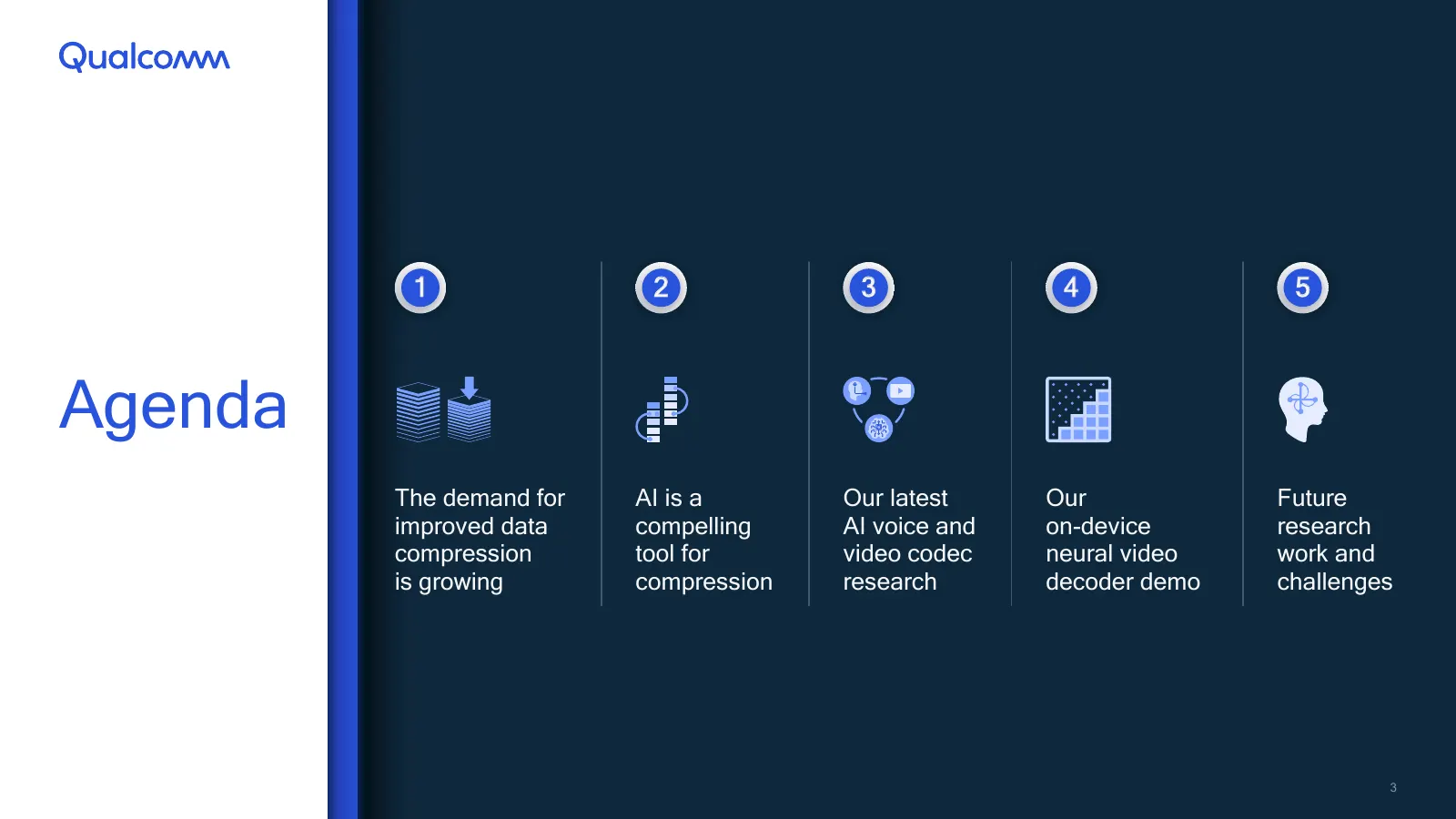
Slide 2: Agenda
1 2 3 4 5 Agenda The demand for AI is a Our latest Our Future improved data compelling AI voice and on-device research compression tool for video codec neural video work and is growing compression research decoder demo challenges 3
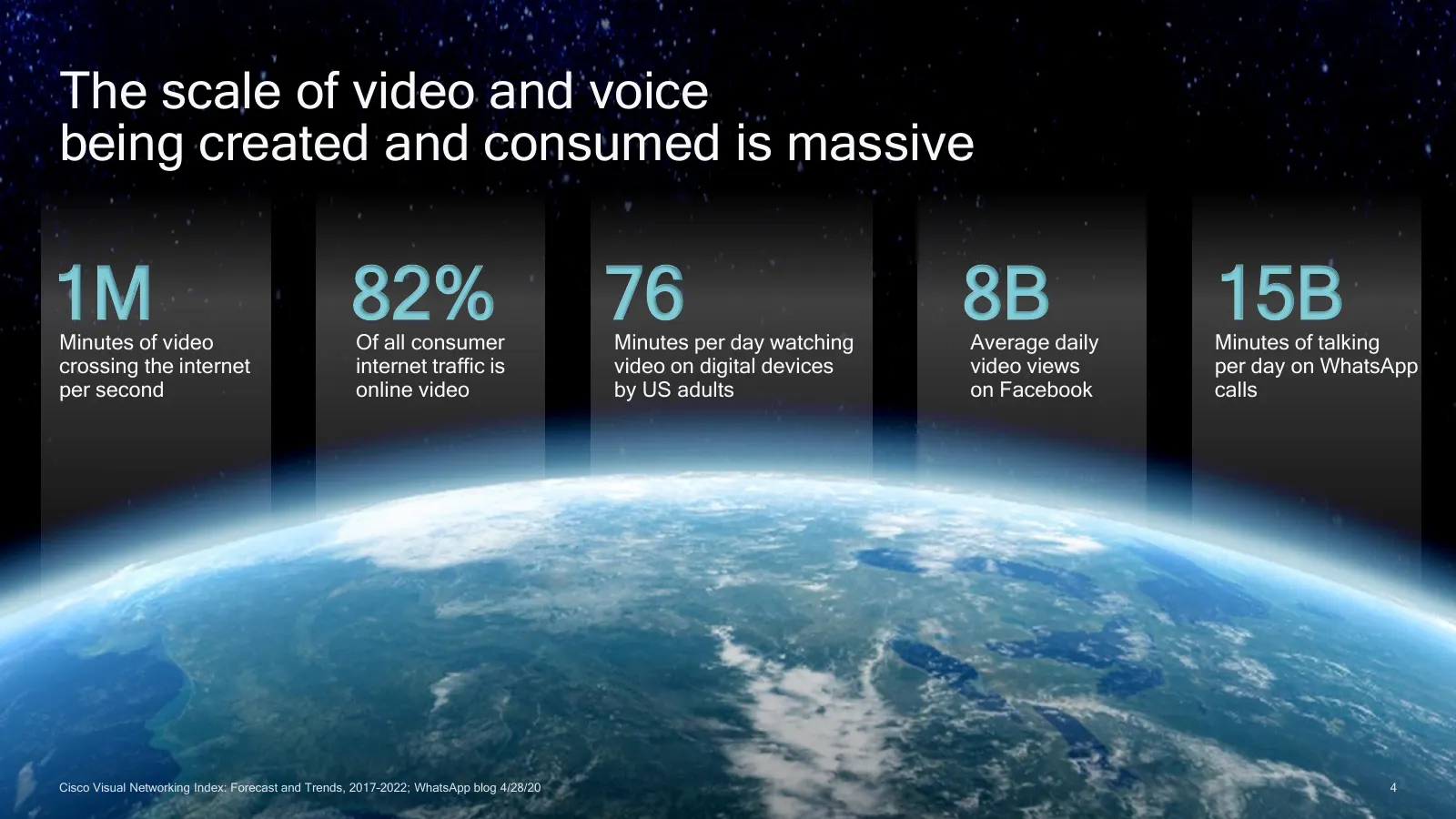
Slide 3: The scale of video and voice being created and consumed is massive
The scale of video and voice being created and consumed is massive 1M Minutes of video 82% Of all consumer 76 Minutes per day watching 8B Average daily 15B Minutes of talking crossing the internet internet traffic is video on digital devices video views per day on WhatsApp per second online video by
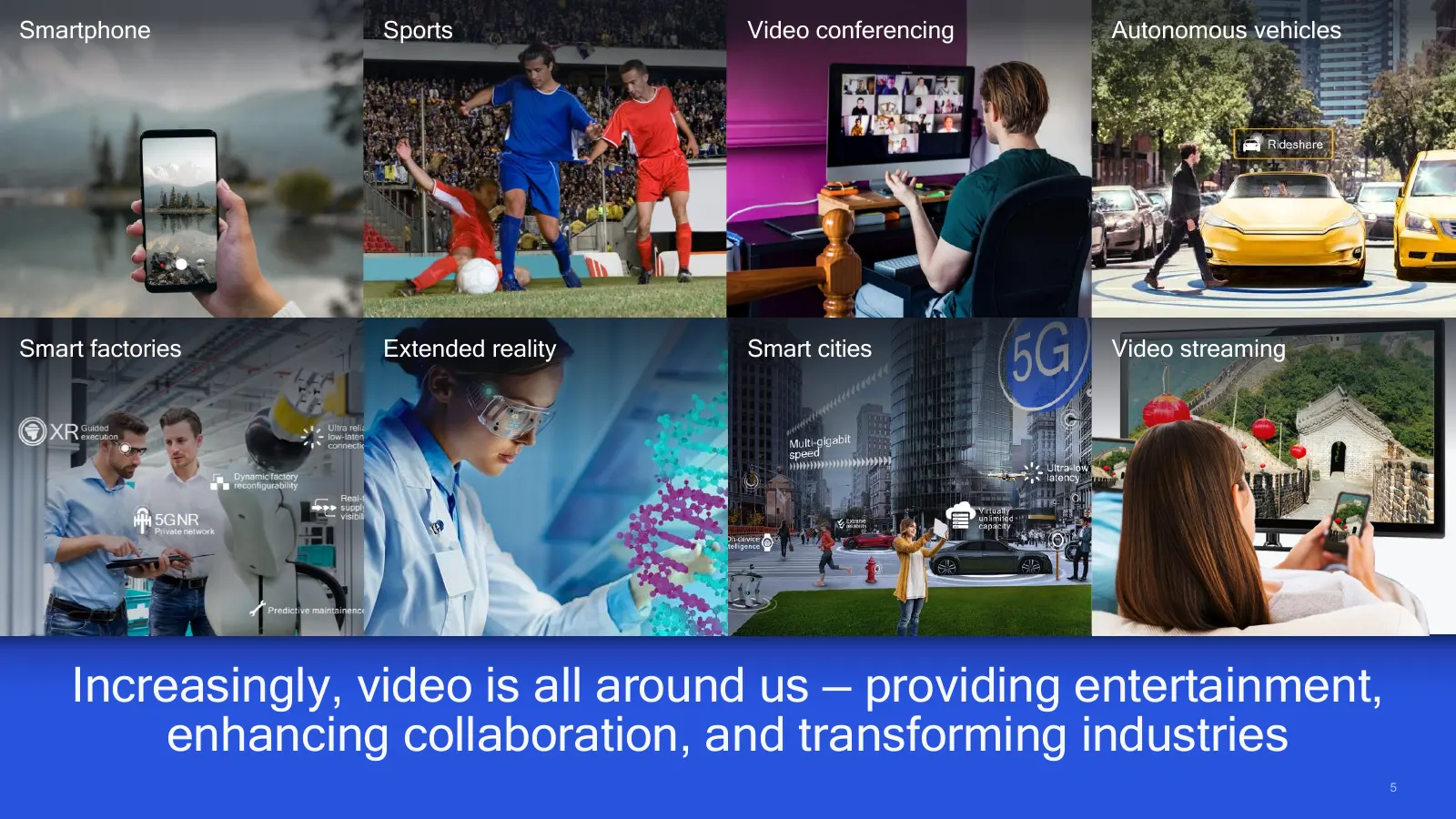
Slide 4: Increasingly, video is all around us
Smartphone Sports Video conferencing Autonomous vehicles Smart factories Extended reality Smart cities Video streaming Increasingly, video is all around us — providing entertainment, enhancing collaboration, and transforming industries 5
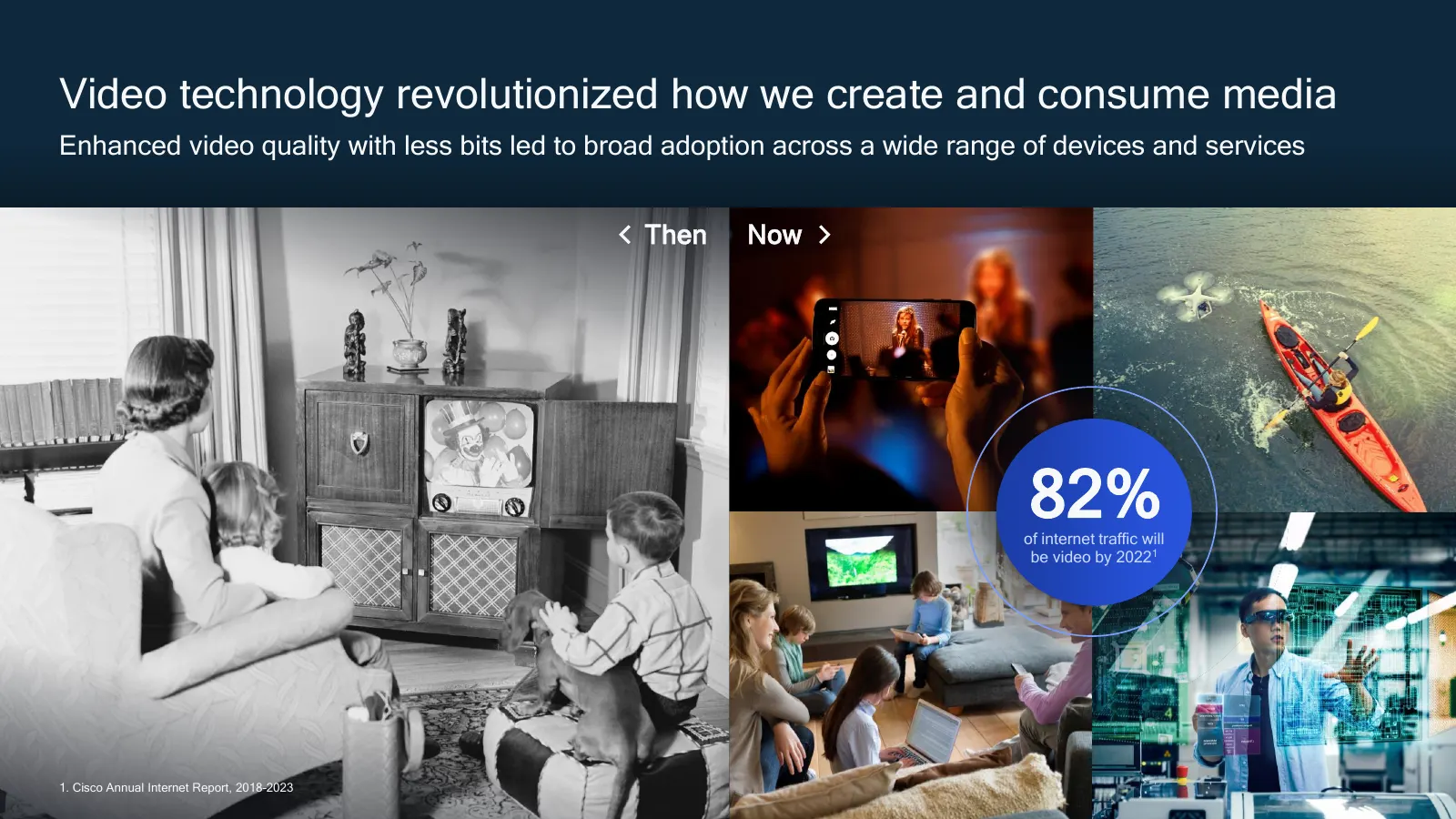
Slide 5: Video technology revolutionized how we create and consume media
Video technology revolutionized how we create and consume media Enhanced video quality with less bits led to broad adoption across a wide range of devices and services of internet traffic will be video by 20221 1. Cisco Annual Internet Report, 2018–2023 6
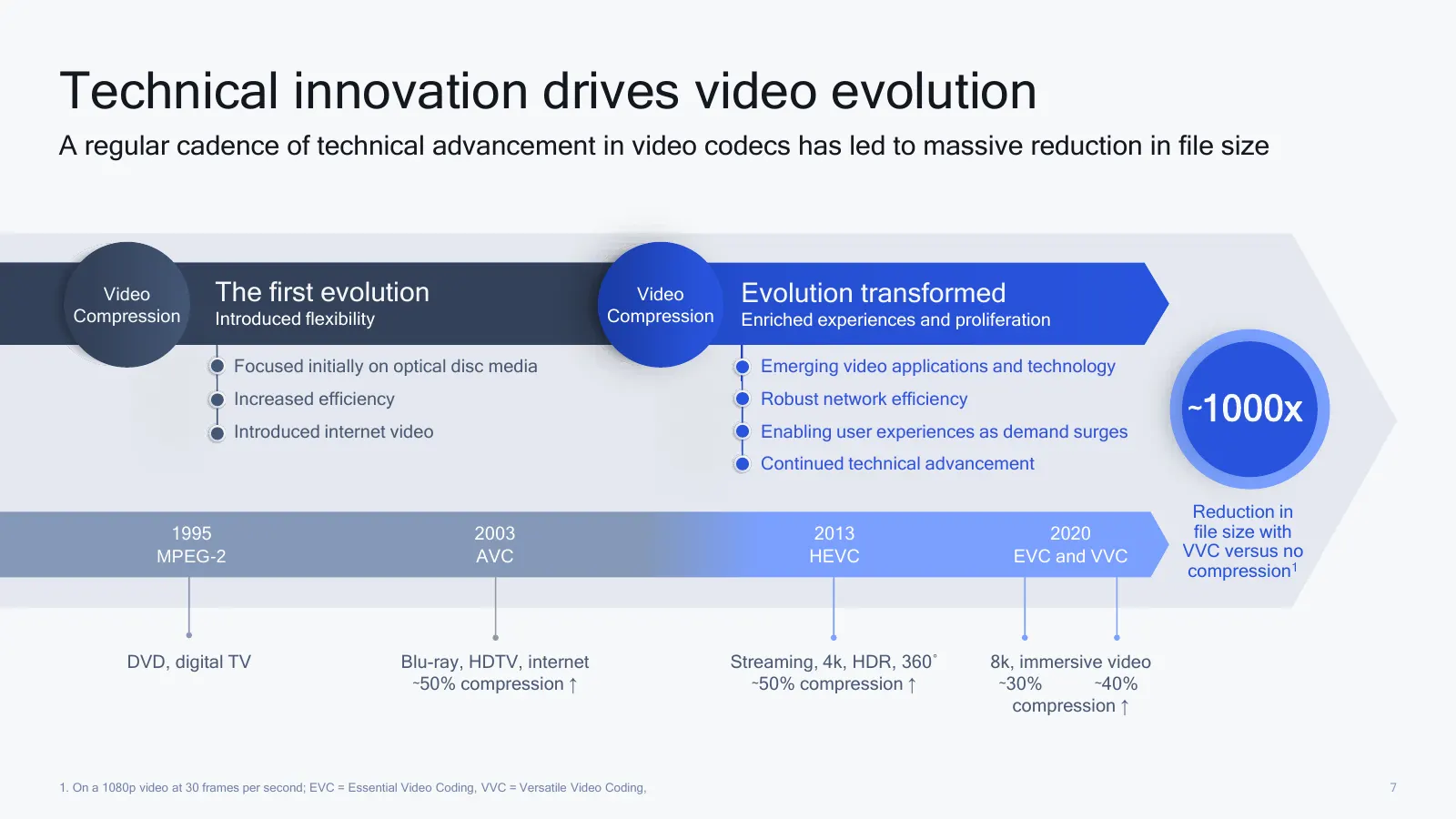
Slide 6: Technical innovation drives video evolution
Technical innovation drives video evolution A regular cadence of technical advancement in video codecs has led to massive reduction in file size Video The first evolution Video Evolution transformed Compression Introduced flexibility Compression Enriched experiences and proliferation Focused initial
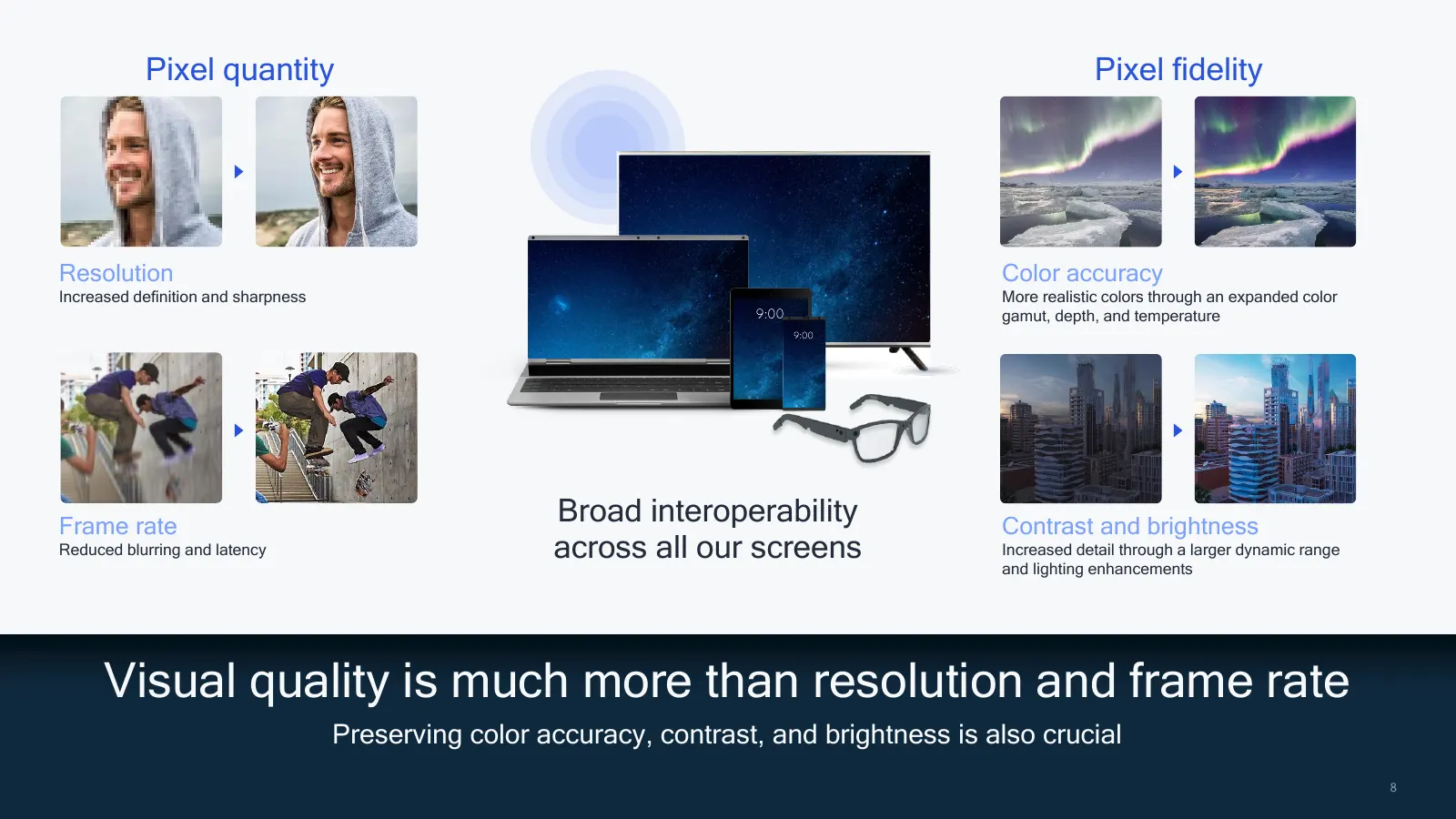
Slide 7: Visual quality is much more than resolution and frame rate
Pixel quantity Pixel fidelity Resolution Color accuracy Increased definition and sharpness More realistic colors through an expanded color gamut, depth, and temperature Frame rate Broad interoperability Contrast and brightness Reduced blurring and latency across all our screens Increased detail thro
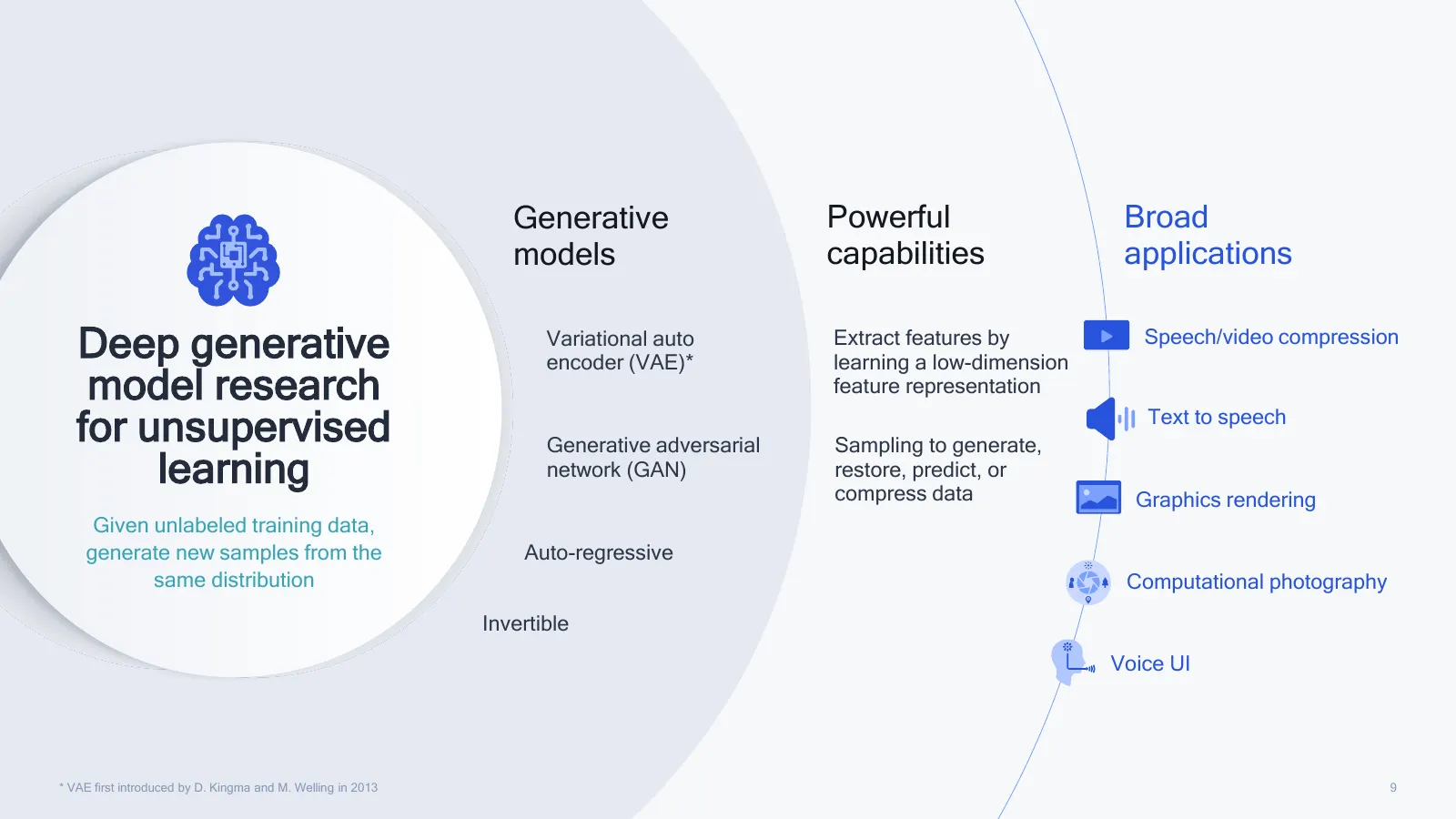
Slide 8: Deep generative model research for unsupervised learning
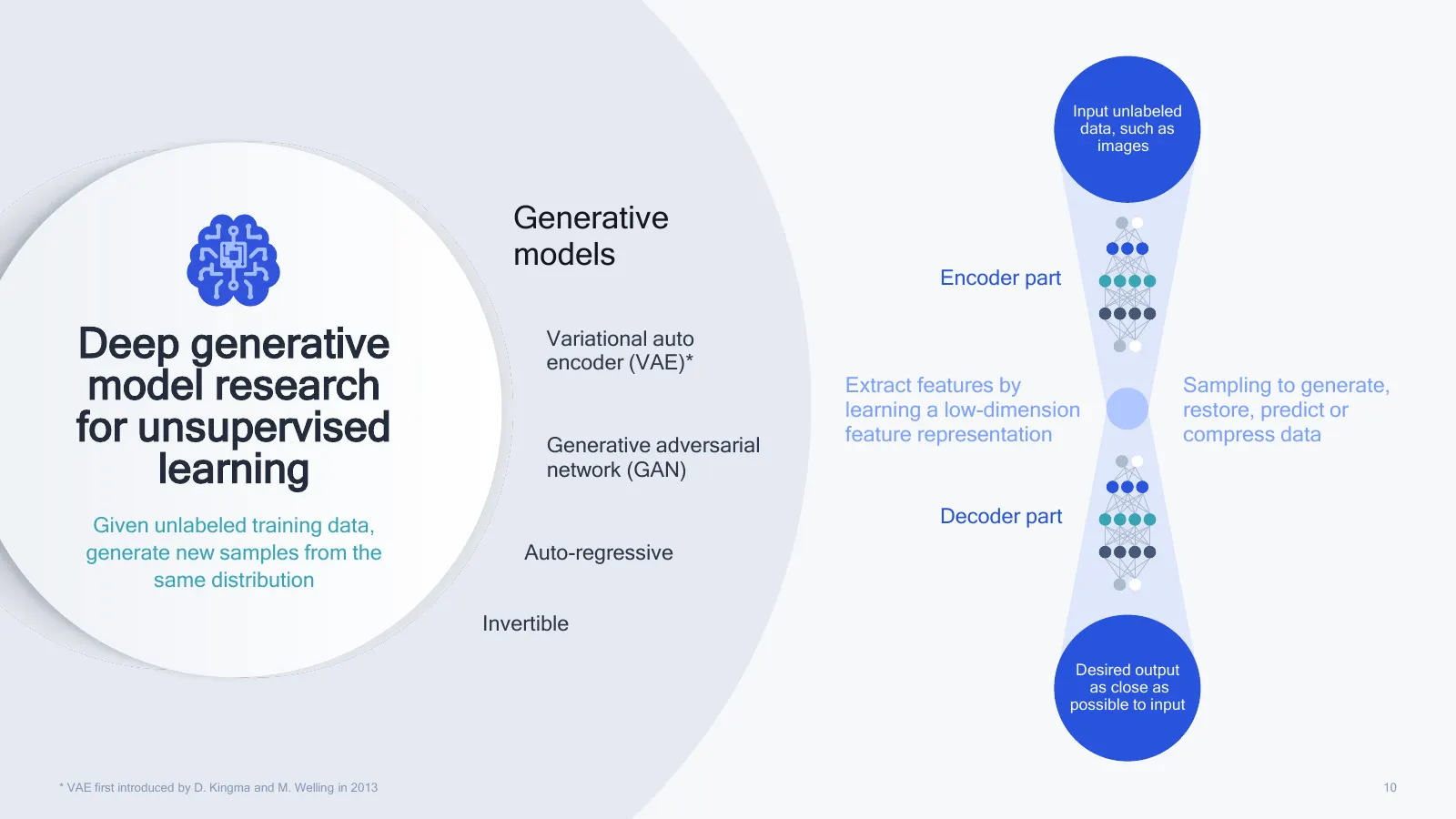
Generative Powerful Broad models capabilities applications Deep generative Variational auto encoder (VAE)* Extract features by learning a low-dimension Speech/video compression model research feature representation for unsupervised Generative adversarial Sampling to generate, Text to speech learning
Slide 9: Deep generative model research for unsupervised learning
Input unlabeled data, such as images Generative models Encoder part Deep generative Variational auto encoder (VAE)* model research Extract features by learning a low-dimension Sampling to generate, restore, predict or for unsupervised Generative adversarial feature representation compress data learn
Slide 10: AI-based compression has compelling benefits
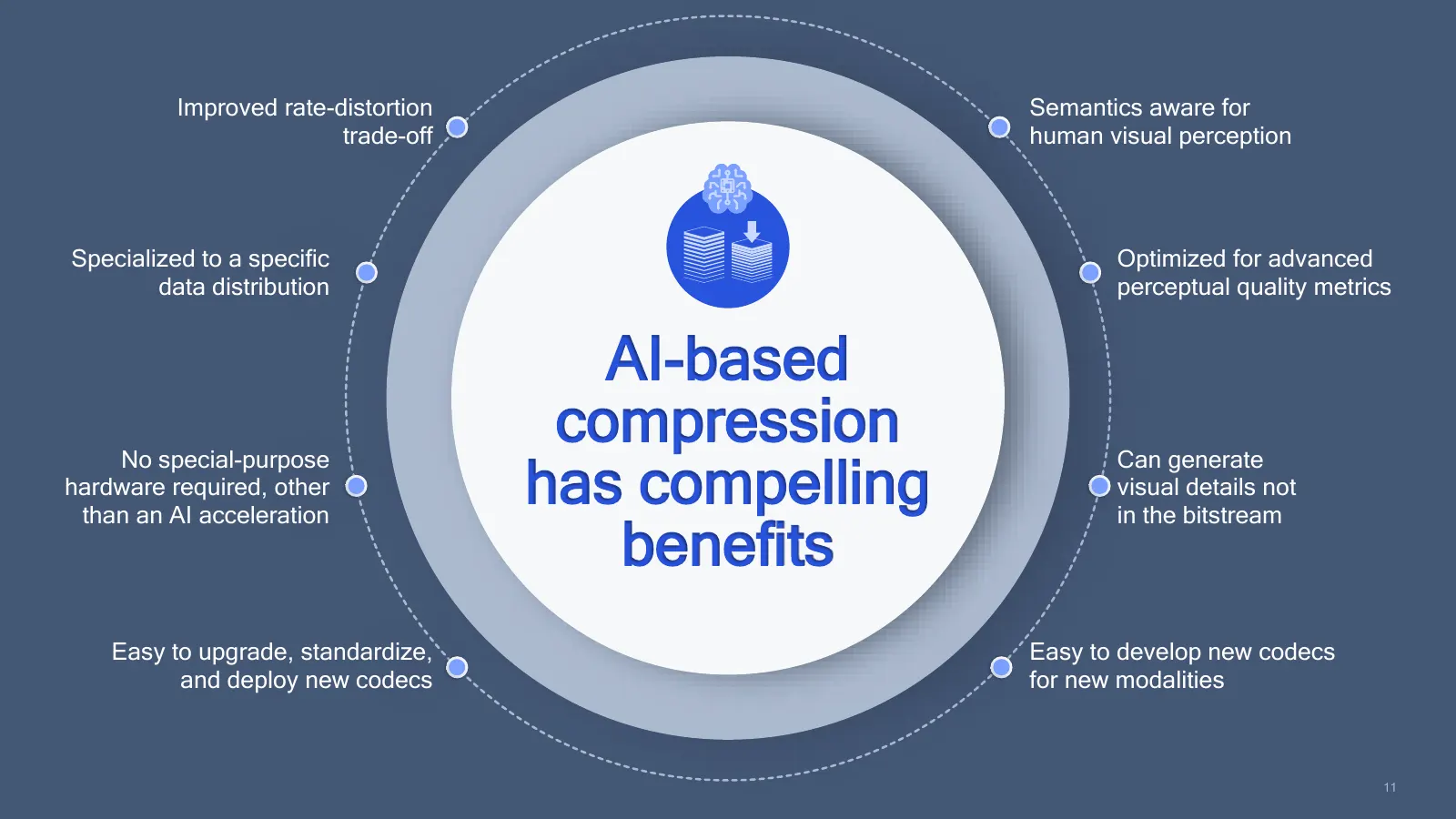
Improved rate-distortion Semantics aware for trade-off human visual perception Specialized to a specific Optimized for advanced data distribution perceptual quality metrics AI-based No special-purpose compression Can generate hardware required, other than an AI acceleration has compelling visual det
Slide 11: Achieving state-of-the-art data compression with AI
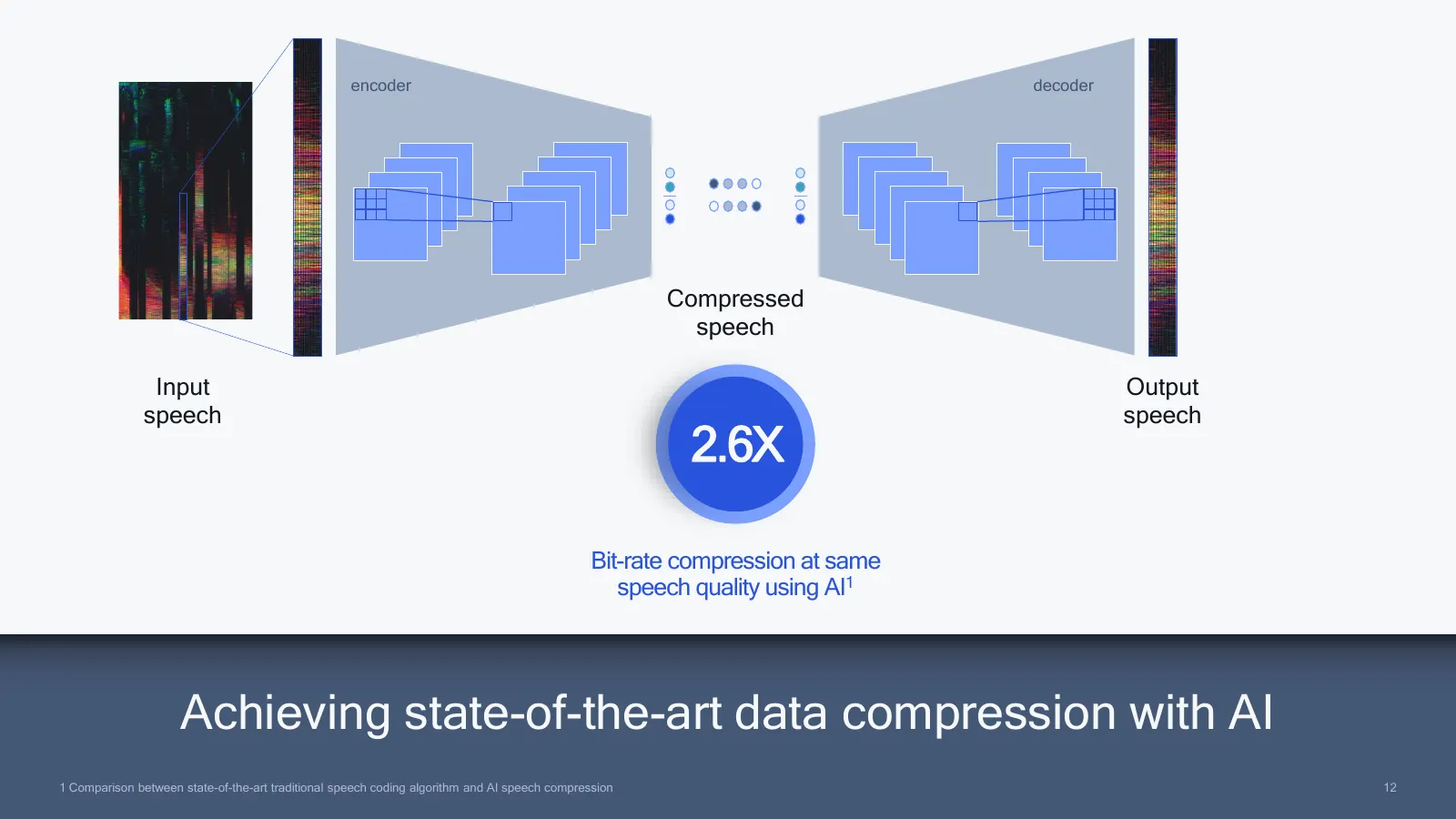
encoder decoder Compressed speech Input Output speech speech 2.6X Bit-rate compression at same speech quality using AI1 Achieving state-of-the-art data compression with AI 1 Comparison between state-of-the-art traditional speech coding algorithm and AI speech compression 12
Slide 12: Novel machine learning-based video codec research
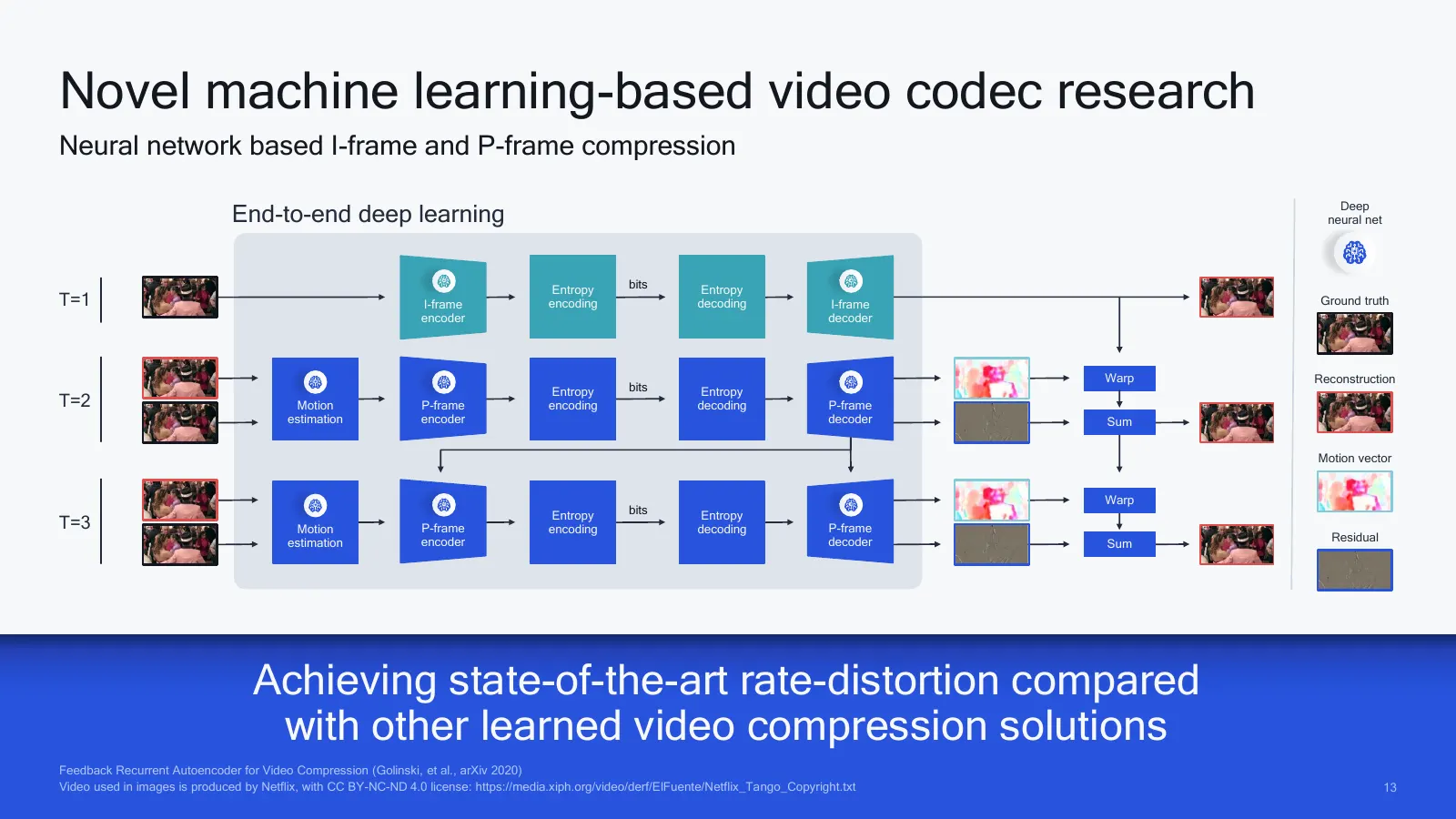
Novel machine learning-based video codec research Neural network based I-frame and P-frame compression Deep End-to-end deep learning neural net Entropy bits Entropy T=1 I-frame encoding decoding I-frame Ground truth encoder decoder Warp Reconstruction Entropy bits Entropy T=2 Motion P-frame encoding
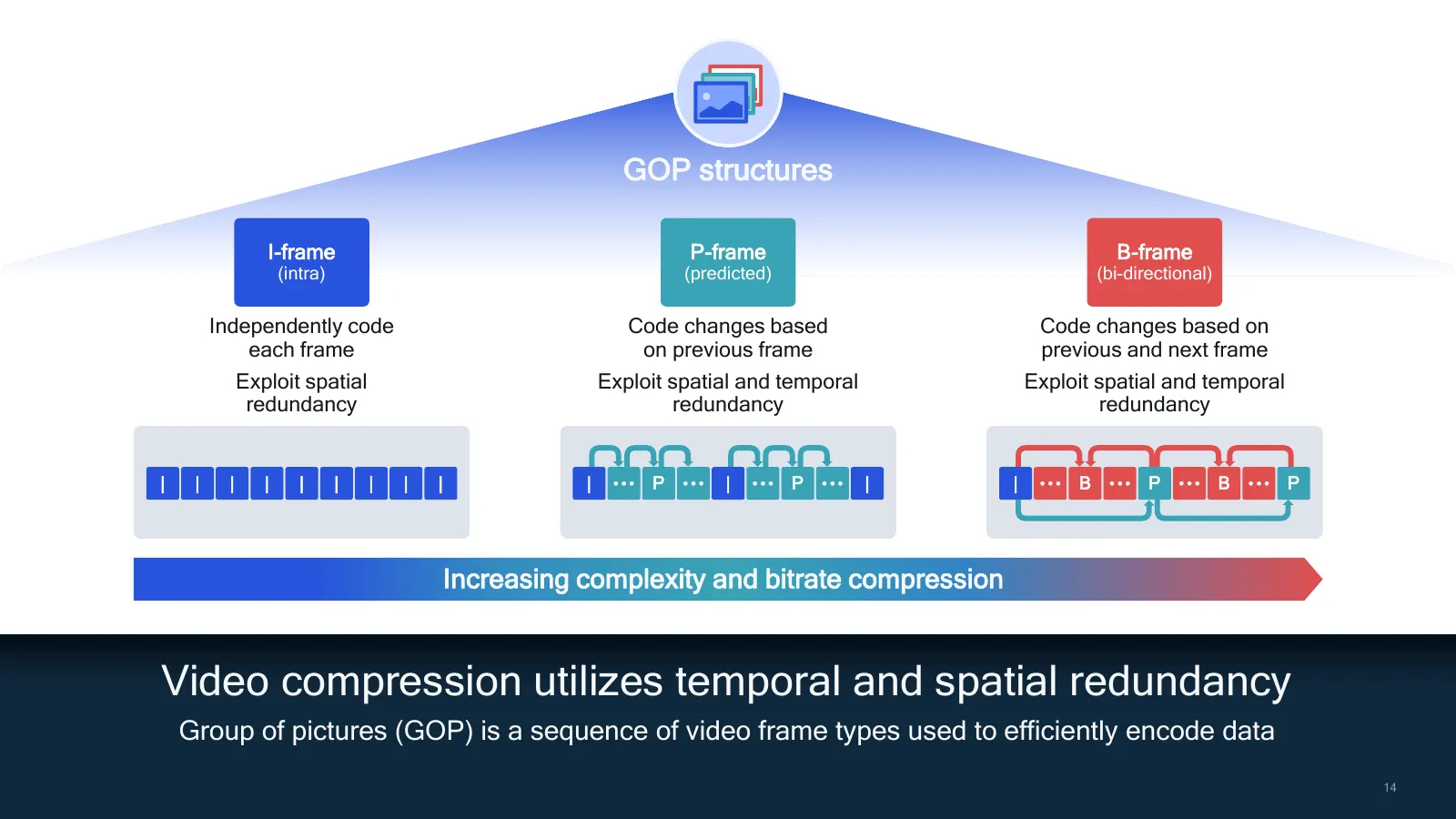
Slide 13: Video compression utilizes temporal and spatial redundancy
GOP structures I-frame P-frame B-frame (intra) (predicted) (bi-directional) Independently code Code changes based Code changes based on each frame on previous frame previous and next frame Exploit spatial Exploit spatial and temporal Exploit spatial and temporal redundancy redundancy redundancy | |
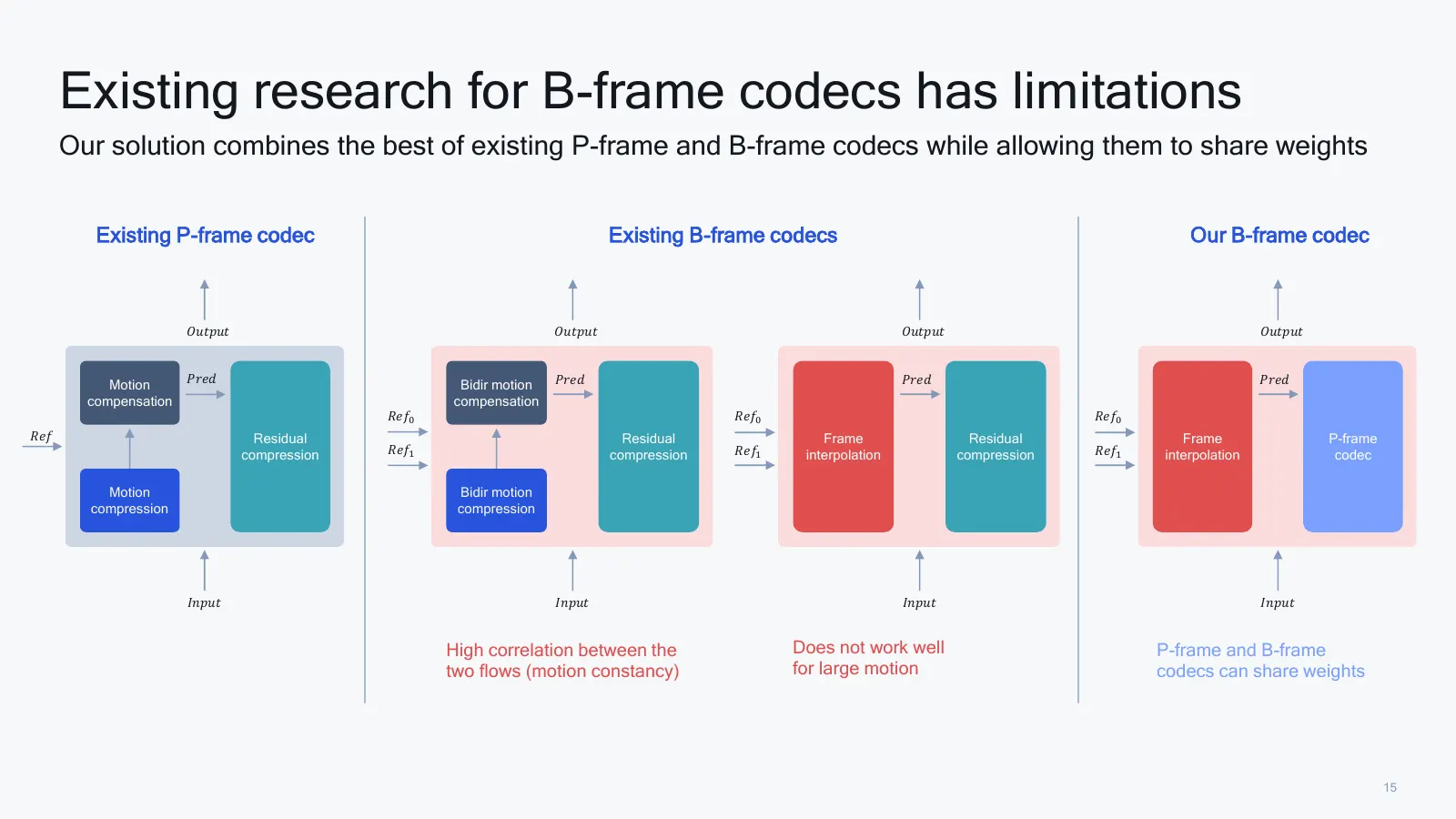
Slide 14: Existing research for B-frame codecs has limitations
Existing research for B-frame codecs has limitations Our solution combines the best of existing P-frame and B-frame codecs while allowing them to share weights Existing P-frame codec Existing B-frame codecs Our B-frame codec 𝑂𝑢𝑡𝑝𝑢𝑡 𝑂𝑢𝑡𝑝𝑢𝑡 𝑂𝑢𝑡𝑝𝑢𝑡 𝑂𝑢𝑡𝑝𝑢𝑡 Motion 𝑃𝑟𝑒𝑑 Bidir…
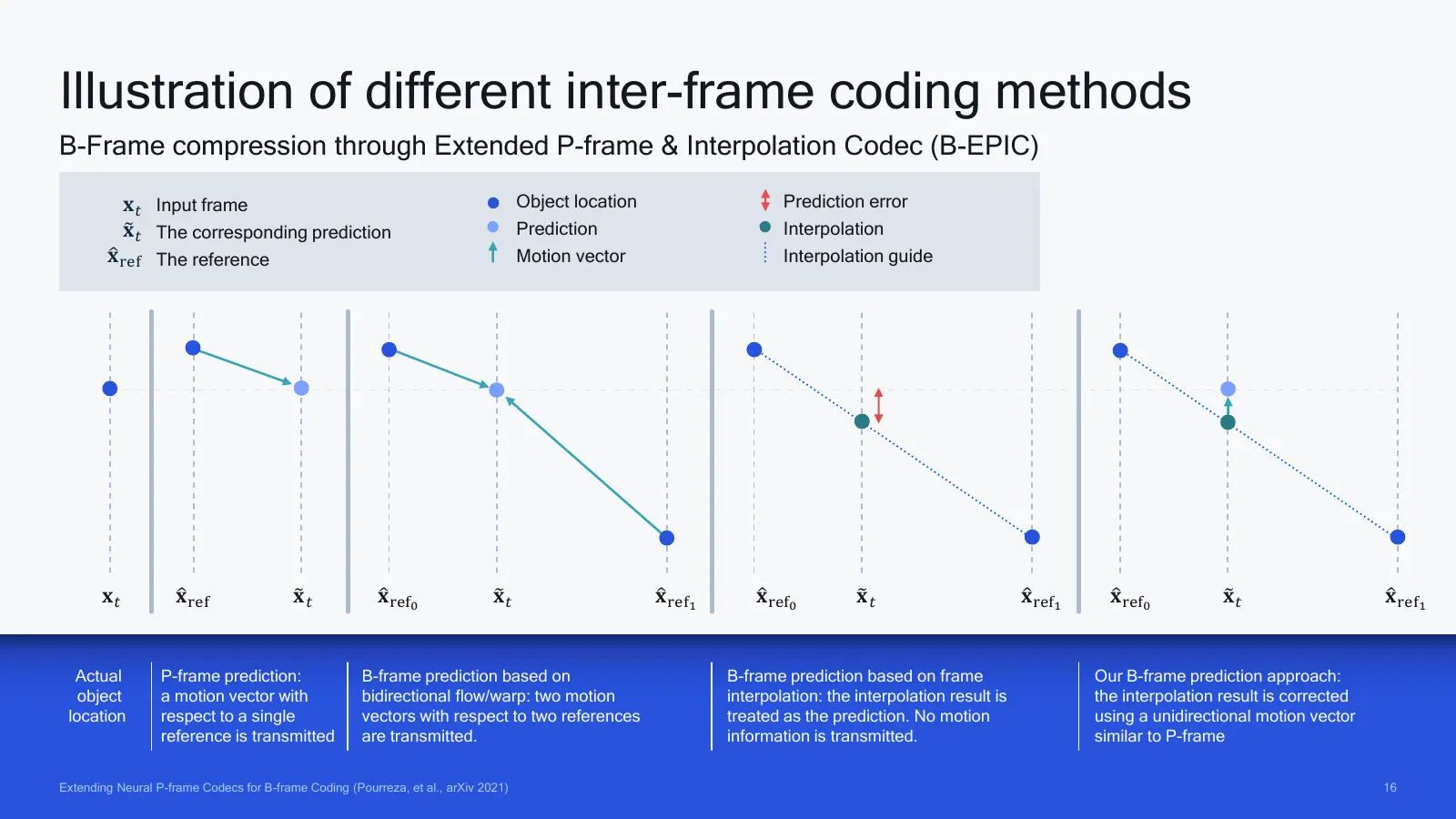
Slide 15: Illustration of different inter-frame coding methods
Illustration of different inter-frame coding methods B-Frame compression through Extended P-frame & Interpolation Codec (B-EPIC) 𝐱𝑡 Input frame Object location Prediction error 𝐱 𝑡 The corresponding prediction Prediction Interpolation 𝐱ො ref The reference Motion vector Interpolation guide…
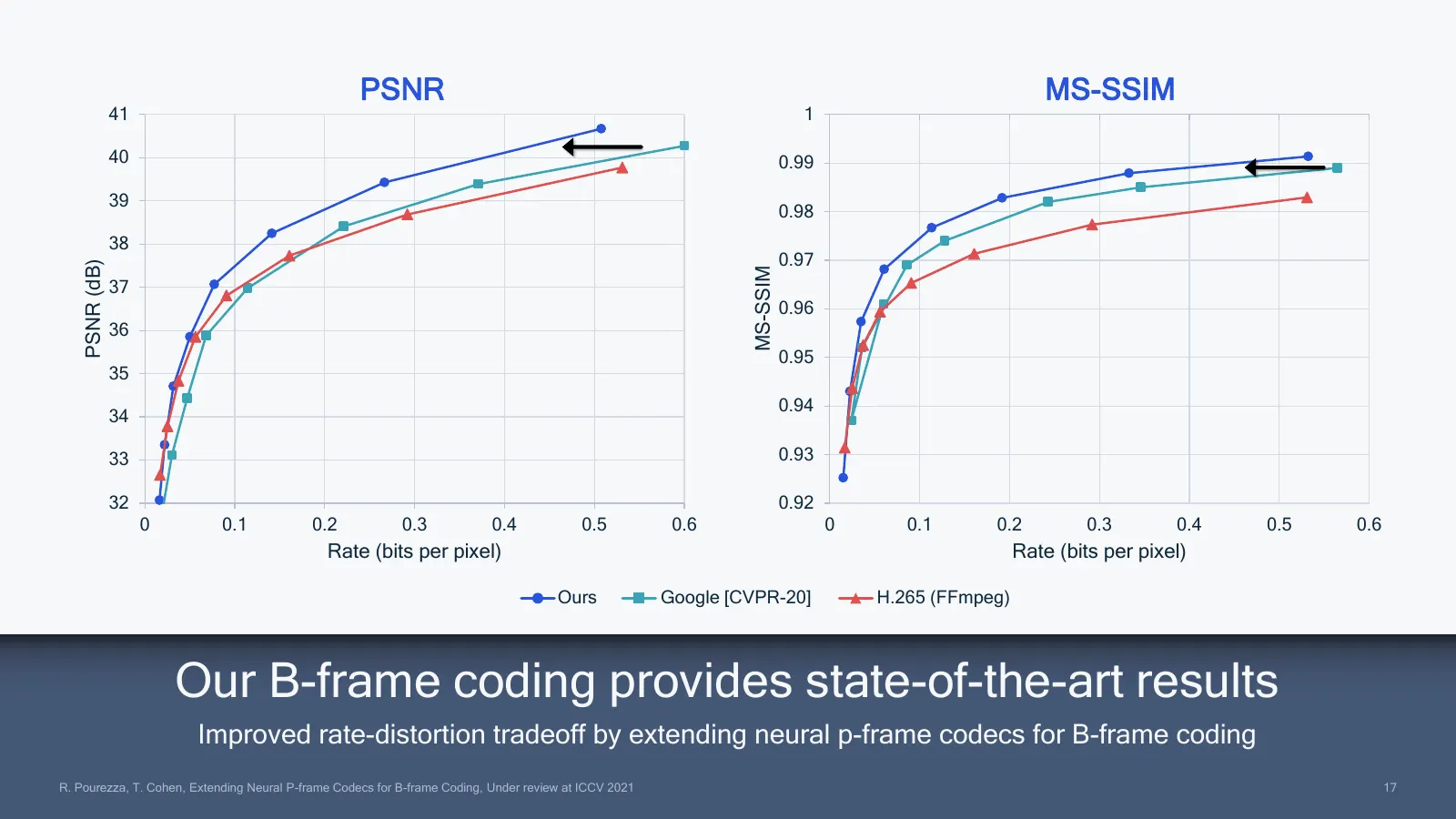
Slide 16: Our B-frame coding provides state-of-the-art results
PSNR MS-SSIM 41 1 40 0.99 39 0.98 38 0.97 PSNR (dB) MS-SSIM 37 0.96 36 0.95 35 0.94 34 33 0.93 32 0.92 0 0.1 0.2 0.3 0.4 0.5 0.6 0 0.1 0.2 0.3 0.4 0.5 0.6 Rate (bits per pixel) Rate (bits per pixel) Ours Google [CVPR-20] H.265 (FFmpeg) Our B-frame coding provides state-of-the-art results Improved ra
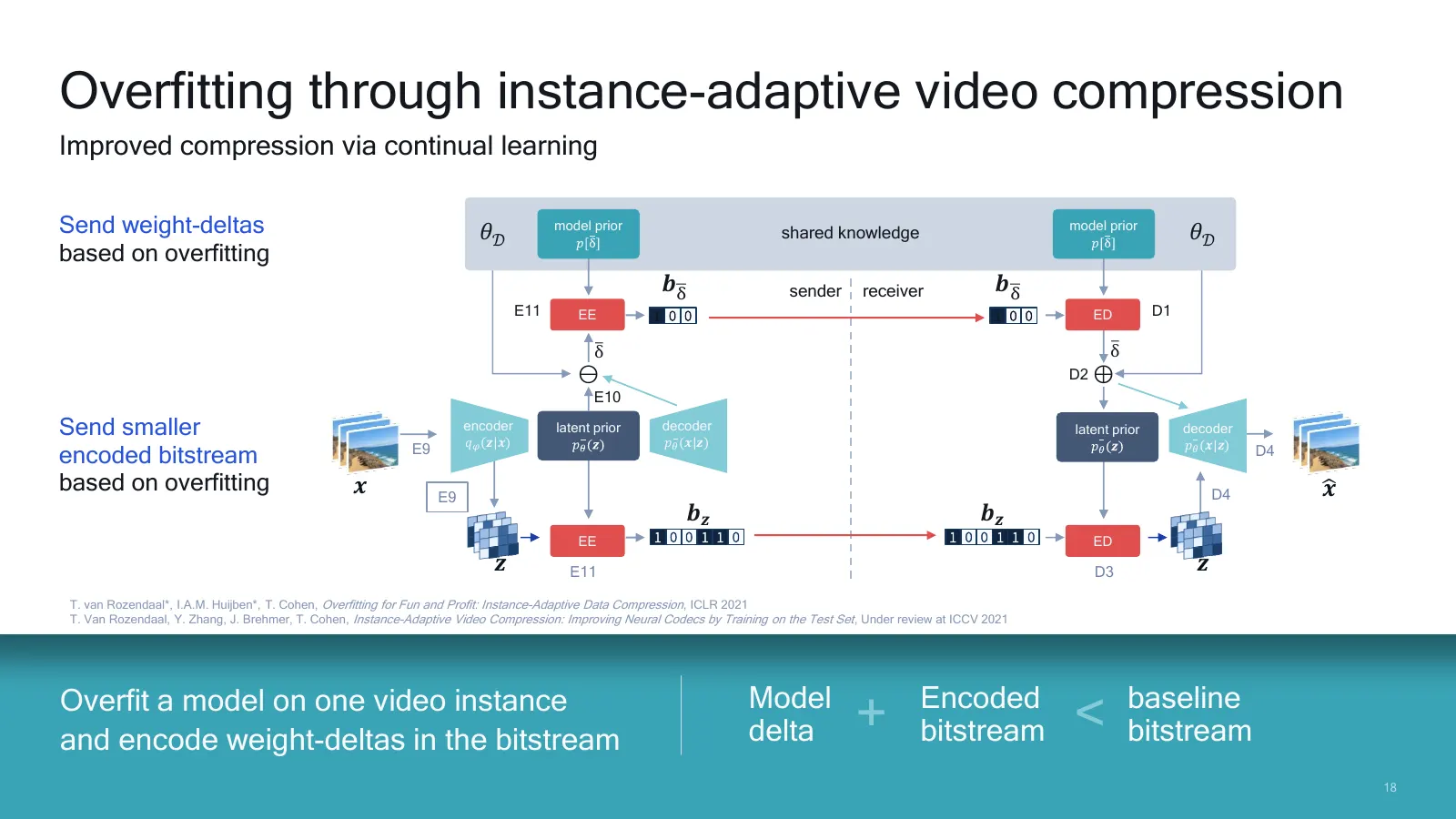
Slide 17: Overfitting through instance-adaptive video compression
Overfitting through instance-adaptive video compression Improved compression via continual learning Send weight-deltas 𝜃𝒟 model prior shared knowledge model prior 𝜃𝒟 based on overfitting 𝒃δഥ sender receiver 𝒃δഥ E11 EE 1 0 0 1 0 0 ED D1 δത δത ⊖ D2 ⊕ E10 Send smaller encoder 𝑞𝜑 (𝒛|𝒙) latent…
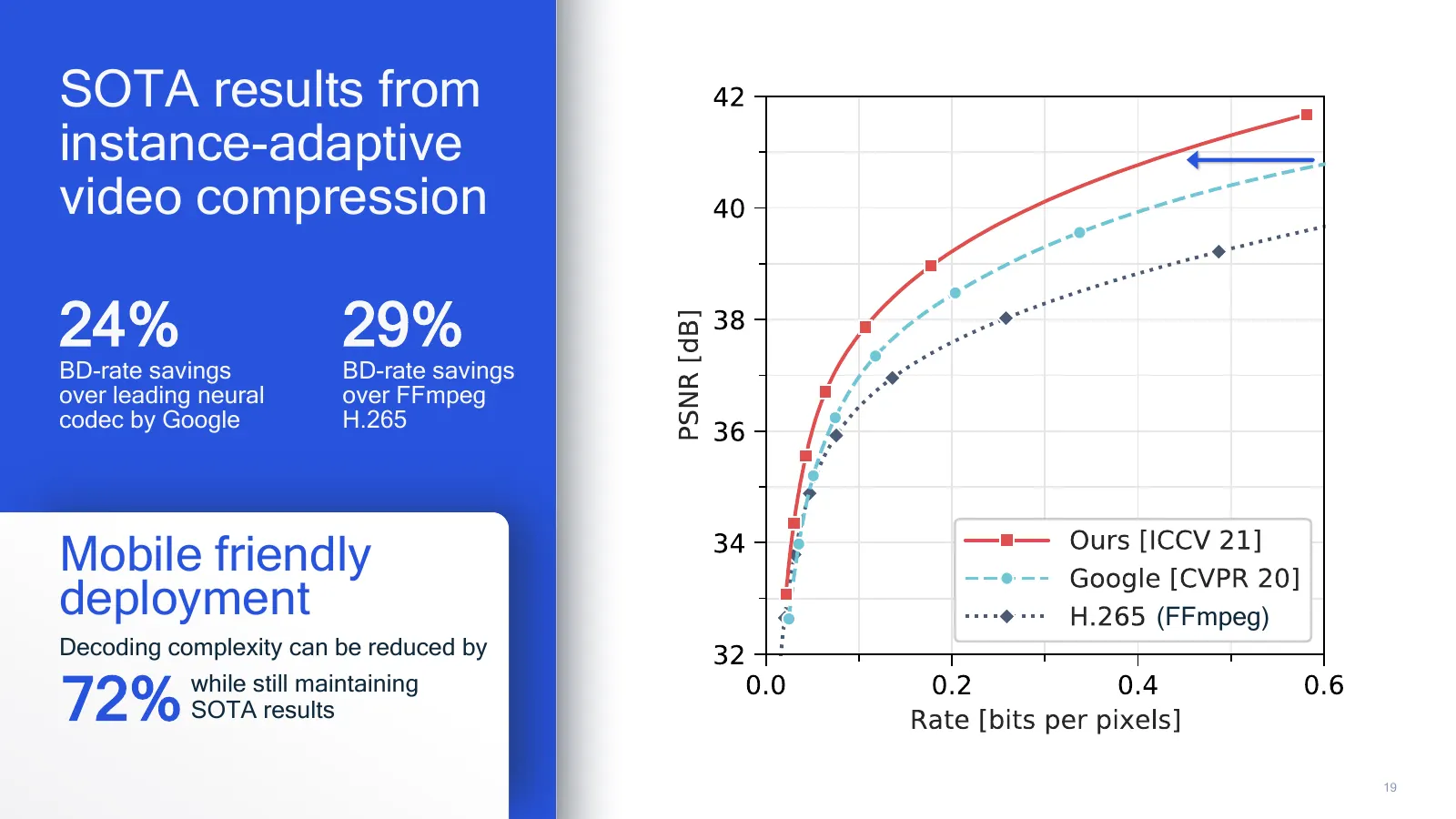
Slide 18: SOTA results from instance-adaptive video compression
SOTA results from instance-adaptive video compression 24% 29% BD-rate savings BD-rate savings over leading neural over FFmpeg codec by Google H.265 Mobile friendly deployment (FFmpeg) Decoding complexity can be reduced by 72% while still maintaining SOTA results 19
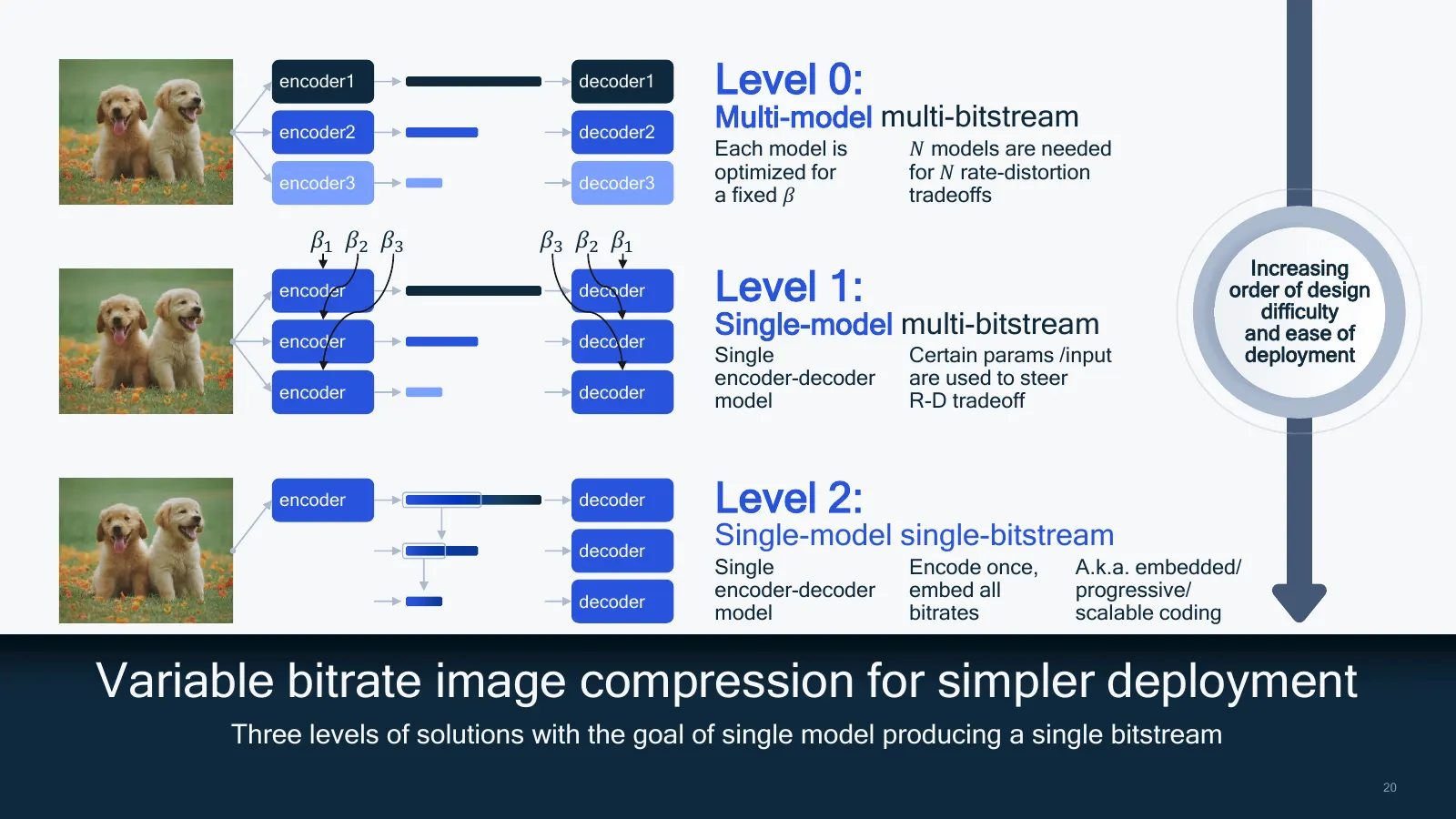
Slide 19: Variable bitrate image compression for simpler deployment
encoder1 decoder1 Level 0: encoder2 decoder2 Multi-model multi-bitstream Each model is 𝑁 models are needed encoder3 decoder3 optimized for for 𝑁 rate-distortion a fixed 𝛽 tradeoffs 𝛽1 𝛽2 𝛽3 𝛽3 𝛽2 𝛽1 Increasing encoder decoder Level 1: order of design difficulty encoder decoder Single-model…
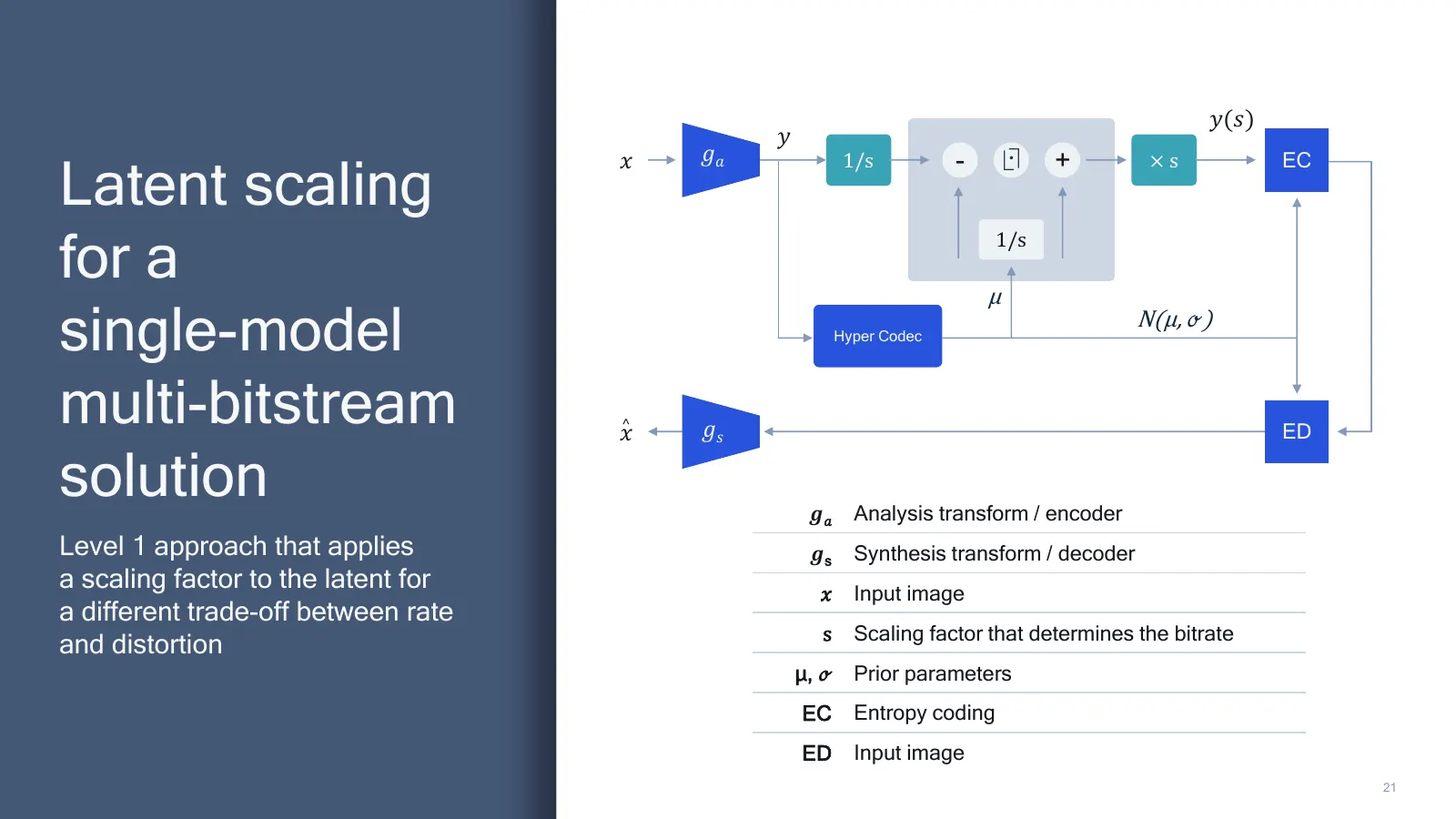
Slide 20: Latent scaling for a single-model multi-bitstream solution
𝑦(𝑠) 𝑦 𝑔𝑎 - ⎿• + EC Latent scaling 𝑥 1/s ⎿ ×s for a 1/s µ single-model Hyper Codec N(µ, ℴ) multi-bitstream 𝑥^ 𝑔𝑠 ED solution 𝒈𝑎 Analysis transform / encoder Level 1 approach that applies 𝒈s Synthesis transform / decoder a scaling factor to the latent for 𝑥 Input image a different…
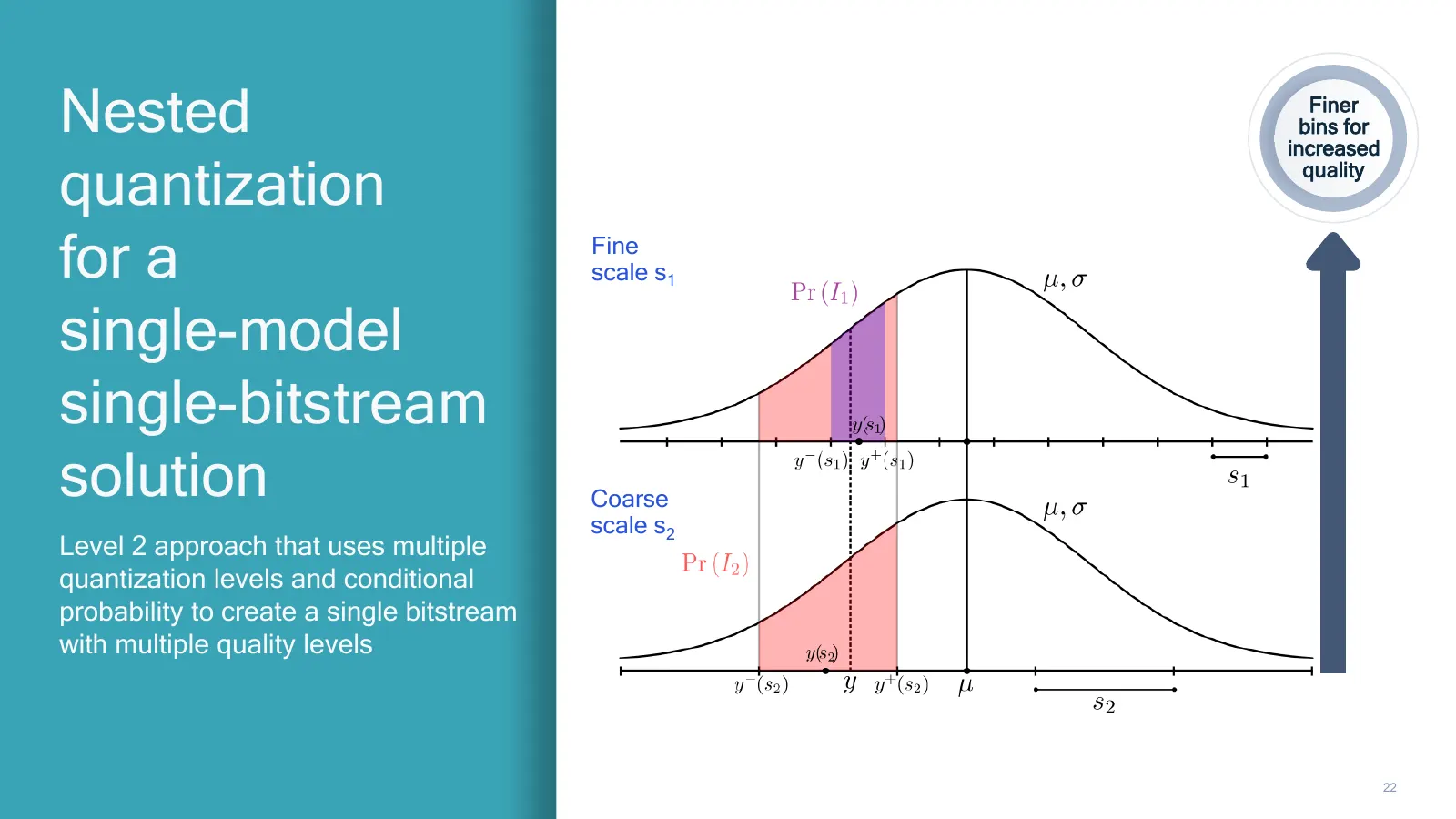
Slide 21: Nested quantization for a single-model single-bitstream solution
Nested Finer bins for increased quantization quality for a Fine scale s1 single-model single-bitstream solution Coarse scale s2 Level 2 approach that uses multiple quantization levels and conditional probability to create a single bitstream with multiple quality levels 22
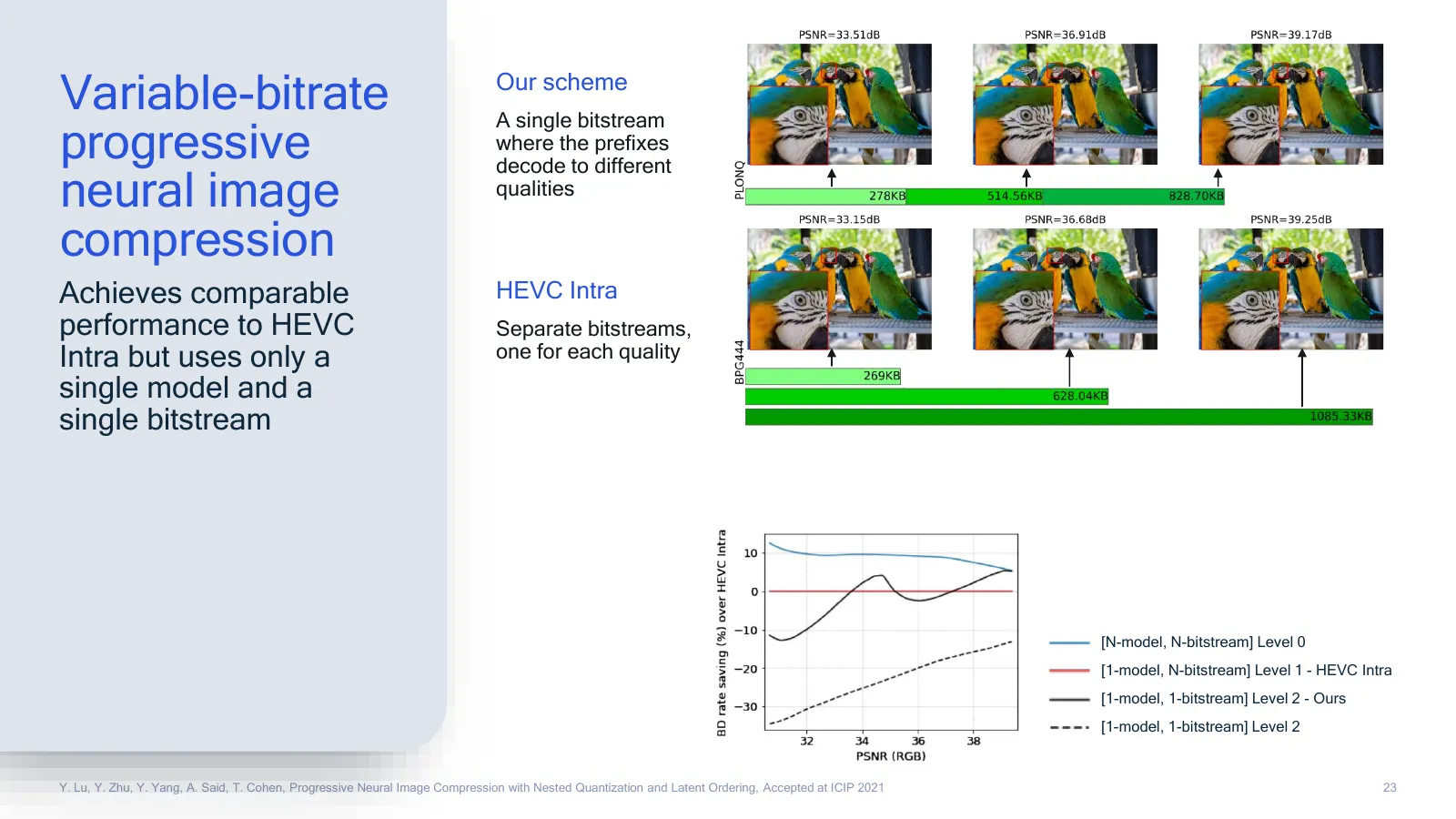
Slide 22: Variable-bitrate progressive neural image compression
Variable-bitrate Our scheme A single bitstream progressive where the prefixes decode to different neural image qualities compression Achieves comparable HEVC Intra performance to HEVC Separate bitstreams, Intra but uses only a one for each quality single model and a single bitstream [N-model, N-bits
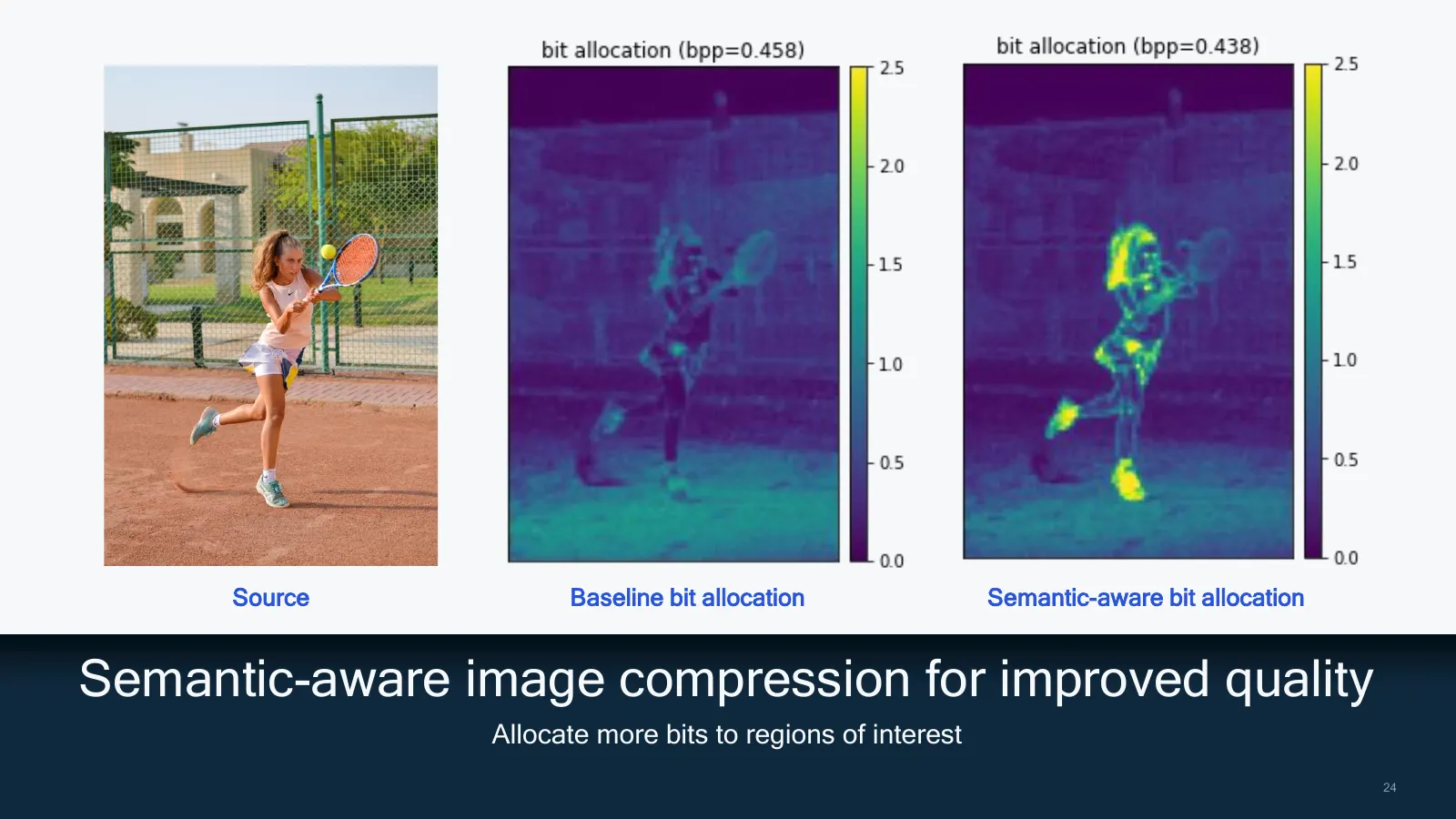
Slide 23: Semantic-aware image compression for improved quality
Source Baseline bit allocation Semantic-aware bit allocation Semantic-aware image compression for improved quality Allocate more bits to regions of interest 24
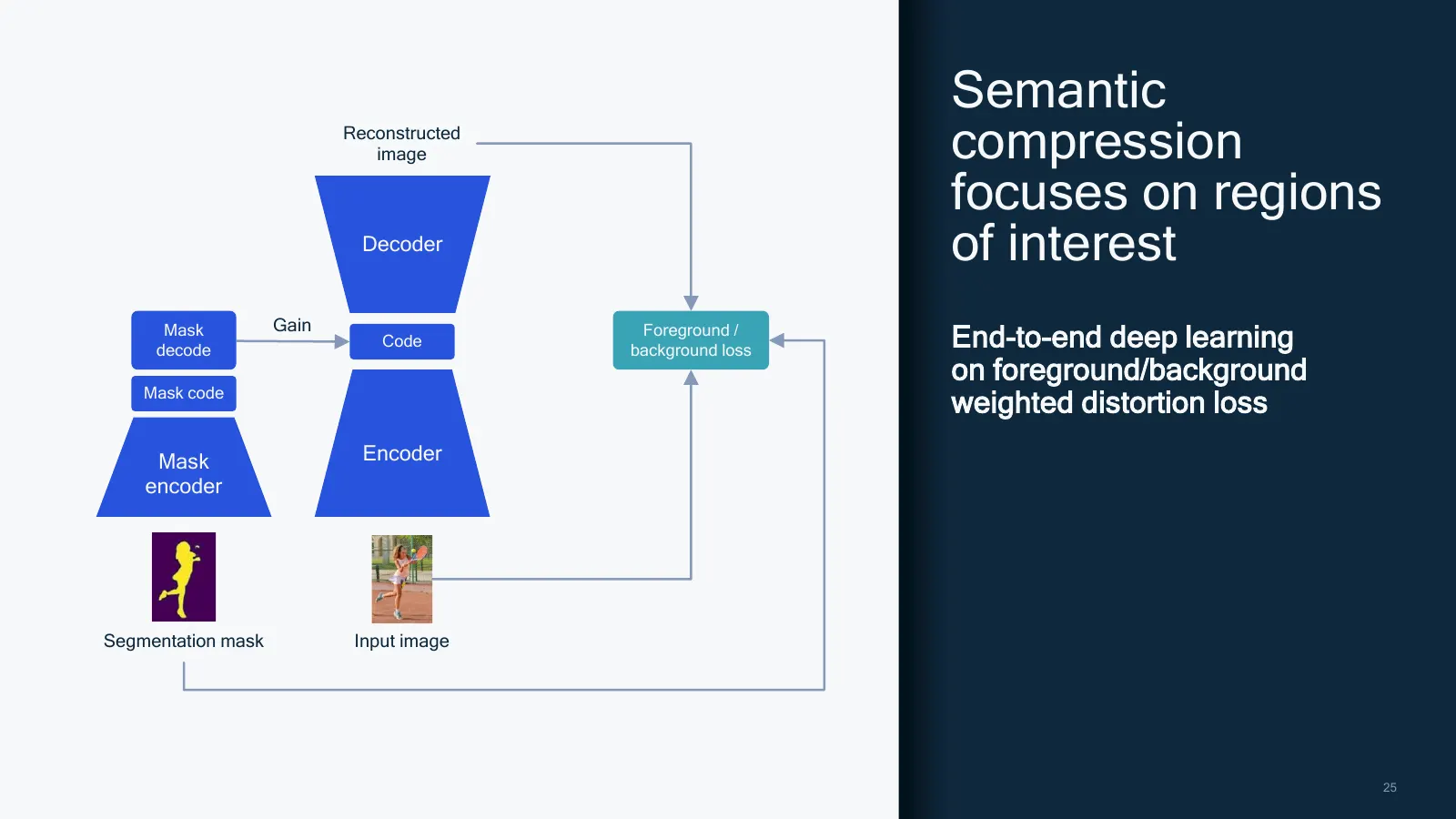
Slide 24: Semantic compression focuses on regions of interest
Semantic Reconstructed image compression focuses on regions Decoder of interest Gain Mask decode Code Foreground / background loss End-to-end deep learning on foreground/background Mask code weighted distortion loss Mask Encoder encoder Segmentation mask Input image 25
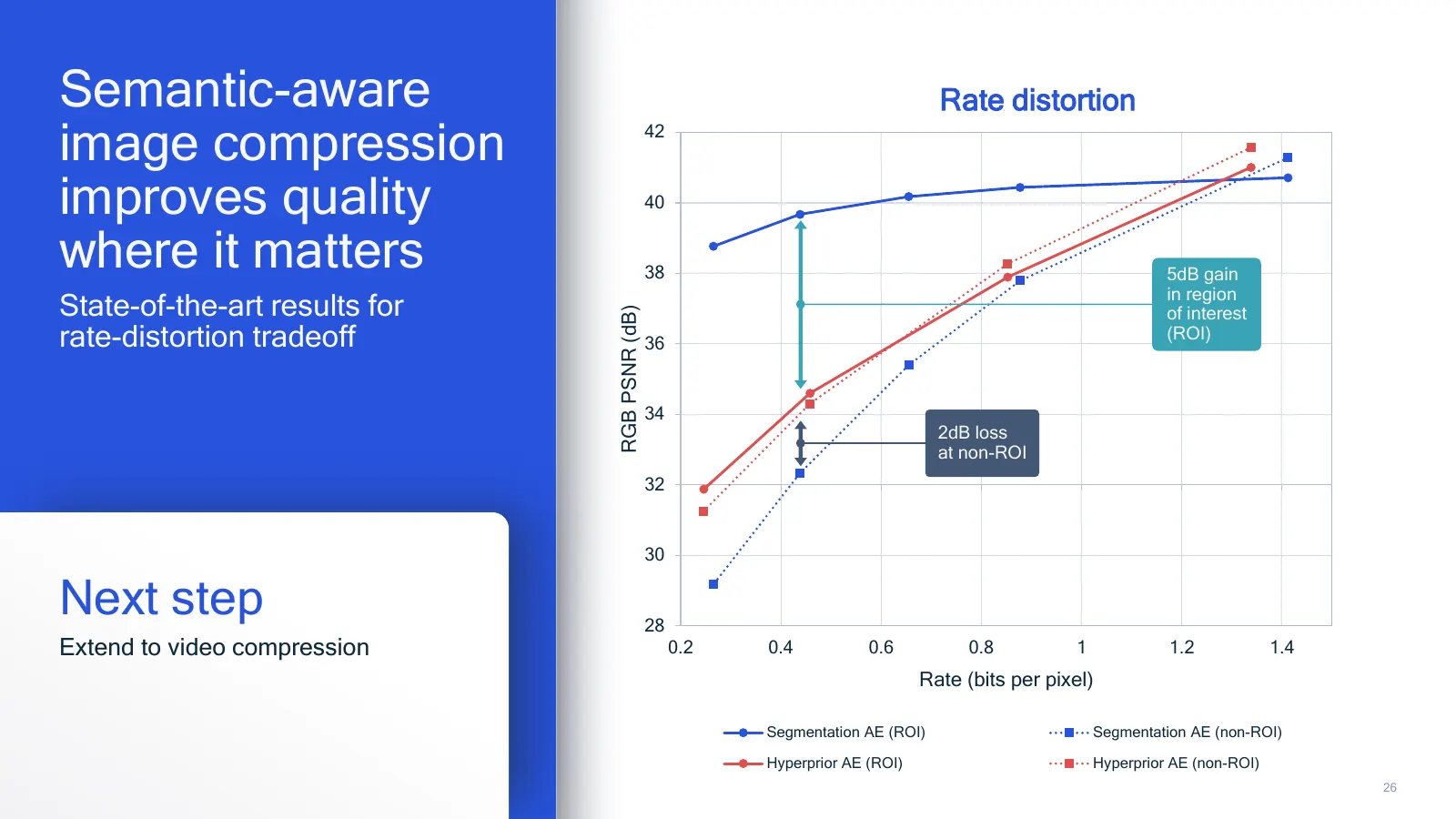
Slide 25: Semantic-aware image compression improves quality where it matters
Semantic-aware Rate distortion image compression 42 improves quality 40 where it matters 38 5dB gain in region State-of-the-art results for of interest RGB PSNR (dB) rate-distortion tradeoff 36 (ROI) 34 2dB loss at non-ROI 32 30 Next step 28 Extend to video compression 0.2 0.4 0.6 0.8 1 1.2 1.4 Rate
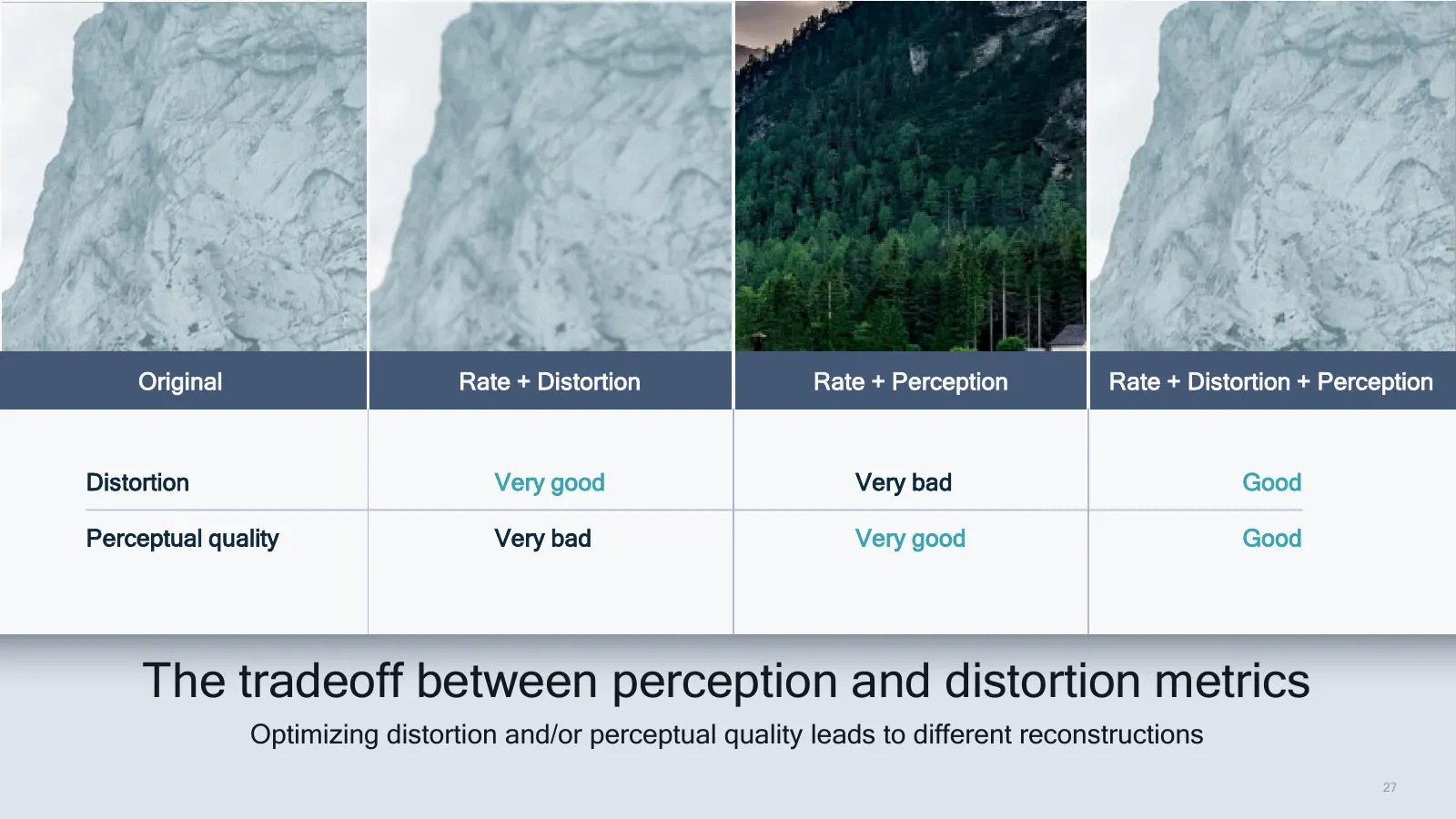
Slide 26: The tradeoff between perception and distortion metrics
Original Rate + Distortion Rate + Perception Rate + Distortion + Perception Distortion Very good Very bad Good Perceptual quality Very bad Very good Good The tradeoff between perception and distortion metrics Optimizing distortion and/or perceptual quality leads to different reconstructions 27
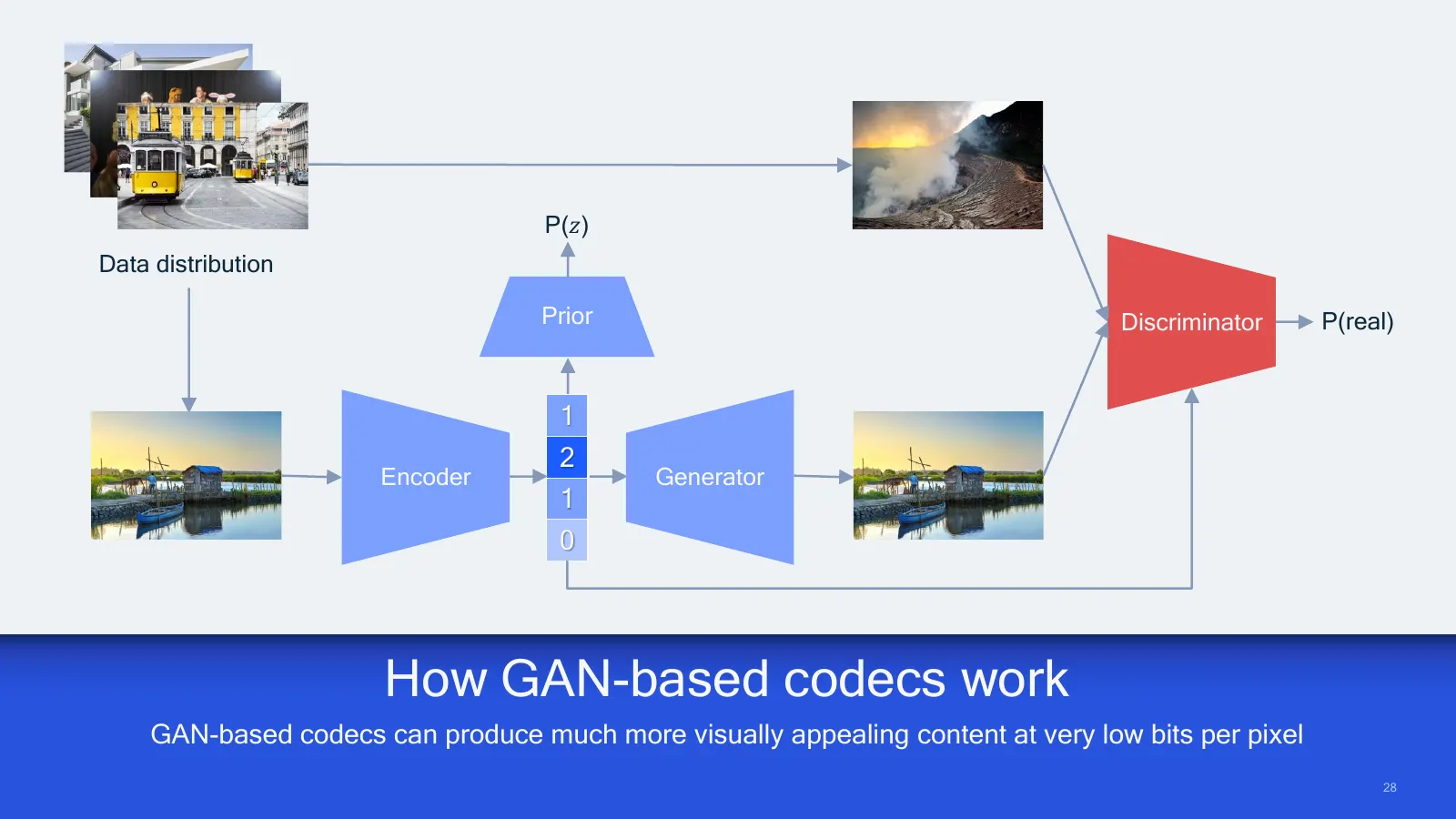
Slide 27: How GAN-based codecs work
P(𝑧) Data distribution Prior Discriminator P(real | 𝑧) P(real) 1 2 Encoder Generator 1 0 How GAN-based codecs work GAN-based codecs can produce much more visually appealing content at very low bits per pixel 28
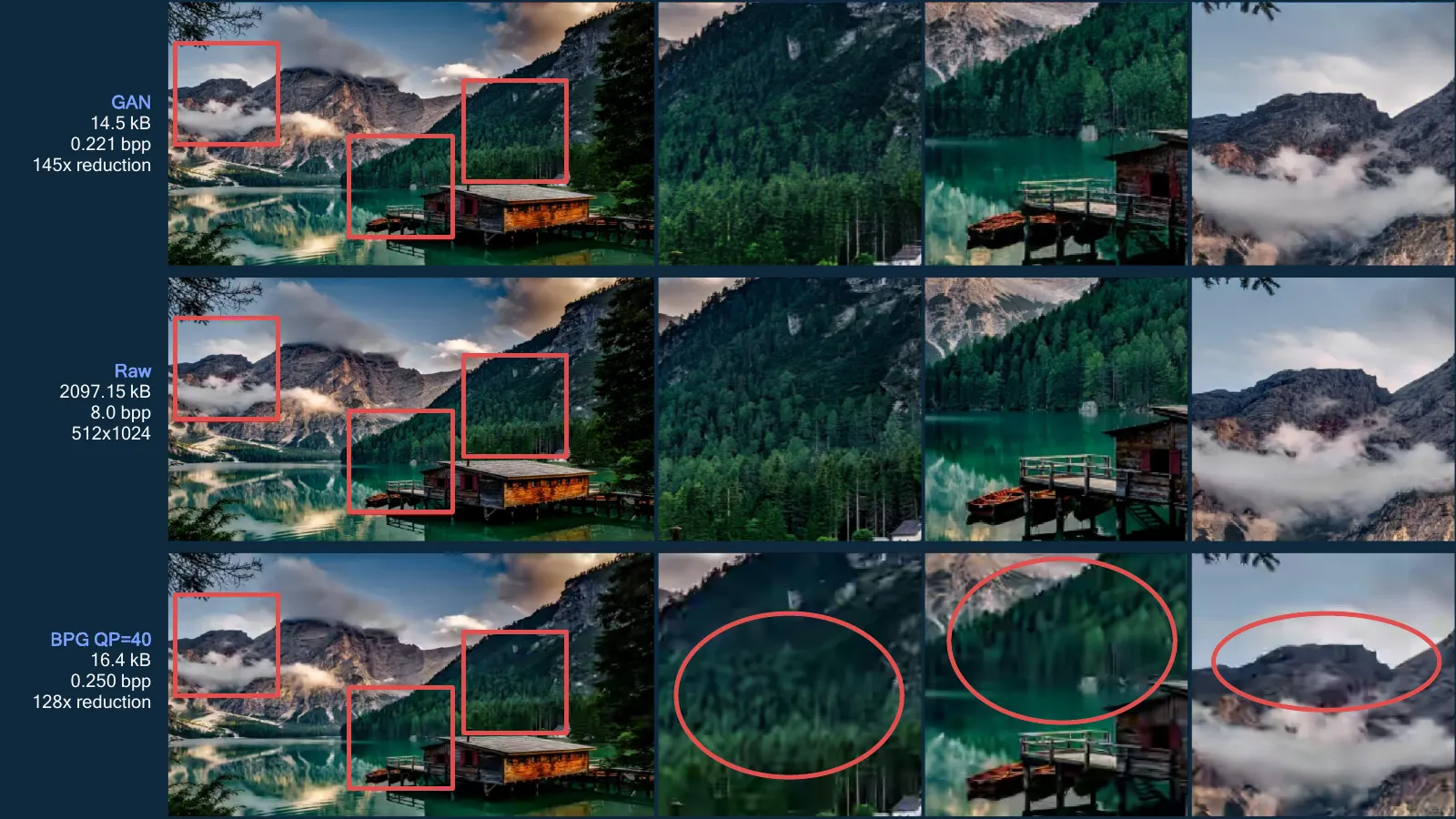
Slide 28: GAN codec 145x reduction example
GAN 14.5 kB 0.221 bpp 145x reduction Raw 2097.15 kB 8.0 bpp 512x1024 BPG QP=40 16.4 kB 0.250 bpp 128x reduction 29
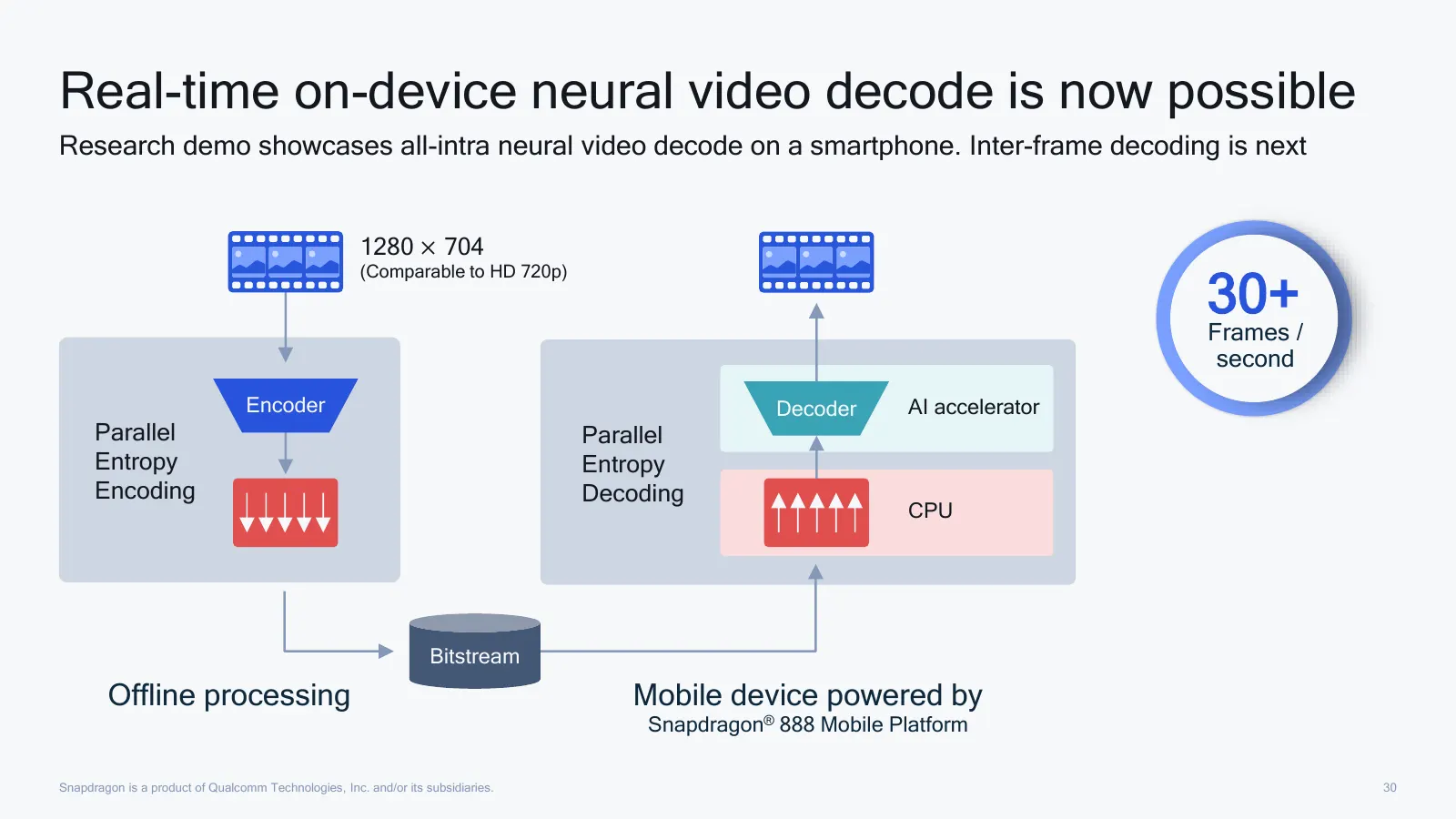
Slide 29: Real-time on-device neural video decode is now possible
Real-time on-device neural video decode is now possible Research demo showcases all-intra neural video decode on a smartphone. Inter-frame decoding is next 1280 × 704 (Comparable to HD 720p) 30+ Frames / second Encoder Decoder AI accelerator Parallel Parallel Entropy Entropy Encoding Decoding CPU Bi
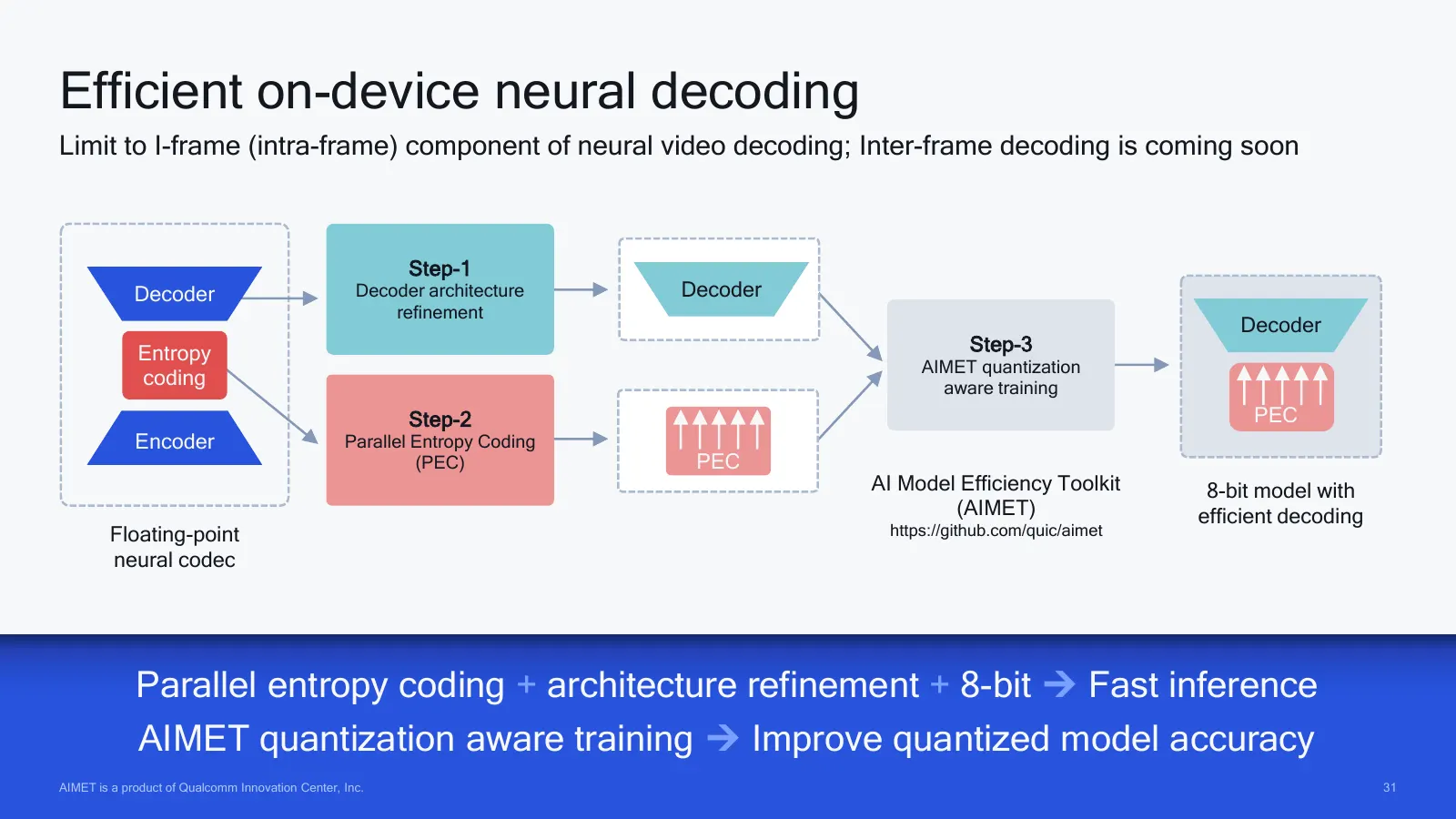
Slide 30: Efficient on-device neural decoding
Efficient on-device neural decoding Limit to I-frame (intra-frame) component of neural video decoding; Inter-frame decoding is coming soon Step-1 Decoder Decoder architecture Decoder refinement Decoder Entropy Step-3 AIMET quantization coding aware training Step-2 PEC Encoder Parallel Entropy Coding
Slide 31: Real-time neural video decoding on a mobile device
Real-time neural video decoding on a mobile device demo video Qualcomm AI Research is an initiative of Qualcomm Technologies, Inc. 32
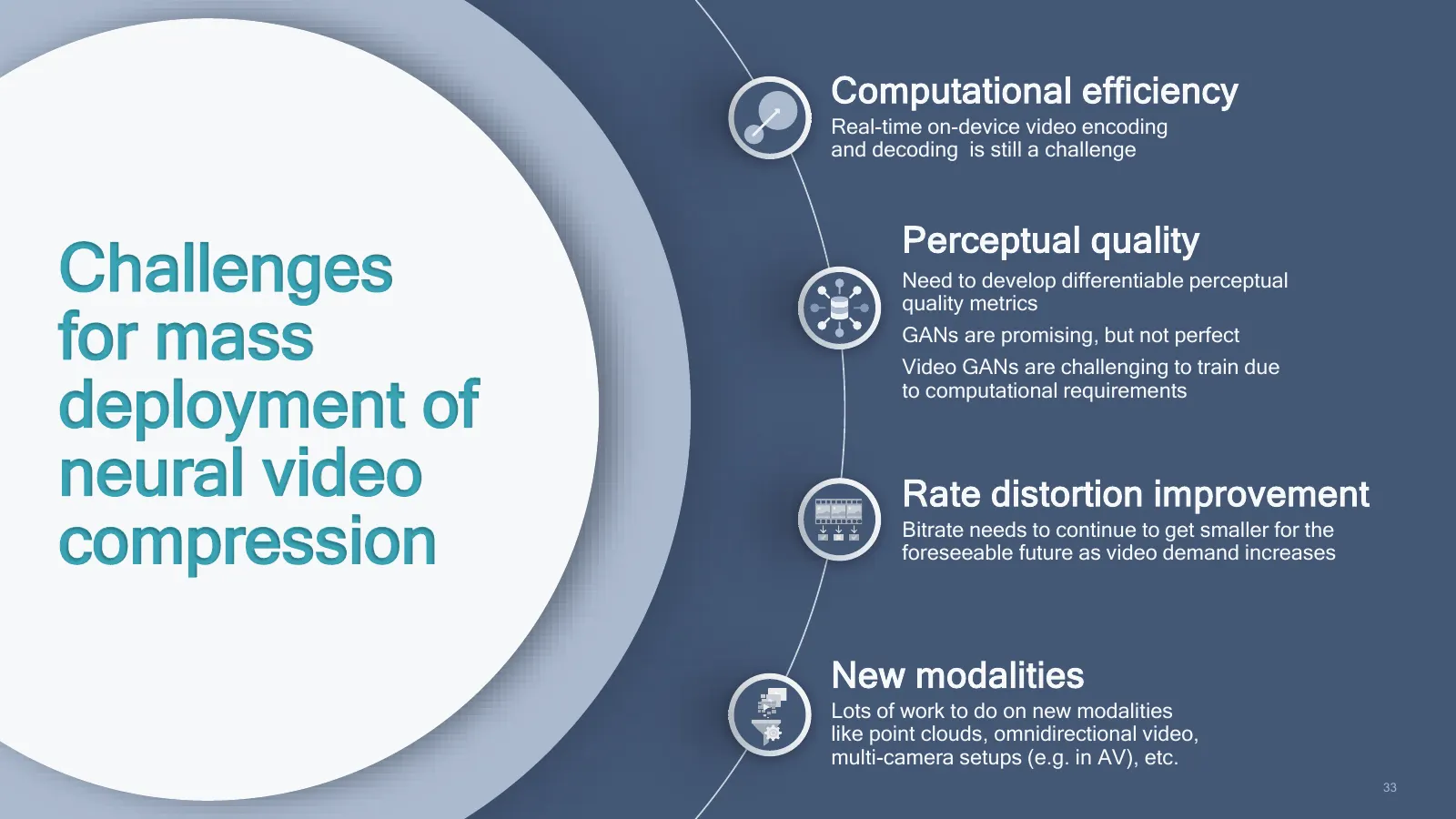
Slide 32: Challenges for mass deployment of neural video compression
Computational efficiency Real-time on-device video encoding and decoding is still a challenge Perceptual quality Challenges Need to develop differentiable perceptual quality metrics for mass GANs are promising, but not perfect Video GANs are challenging to train due deployment of to computational re
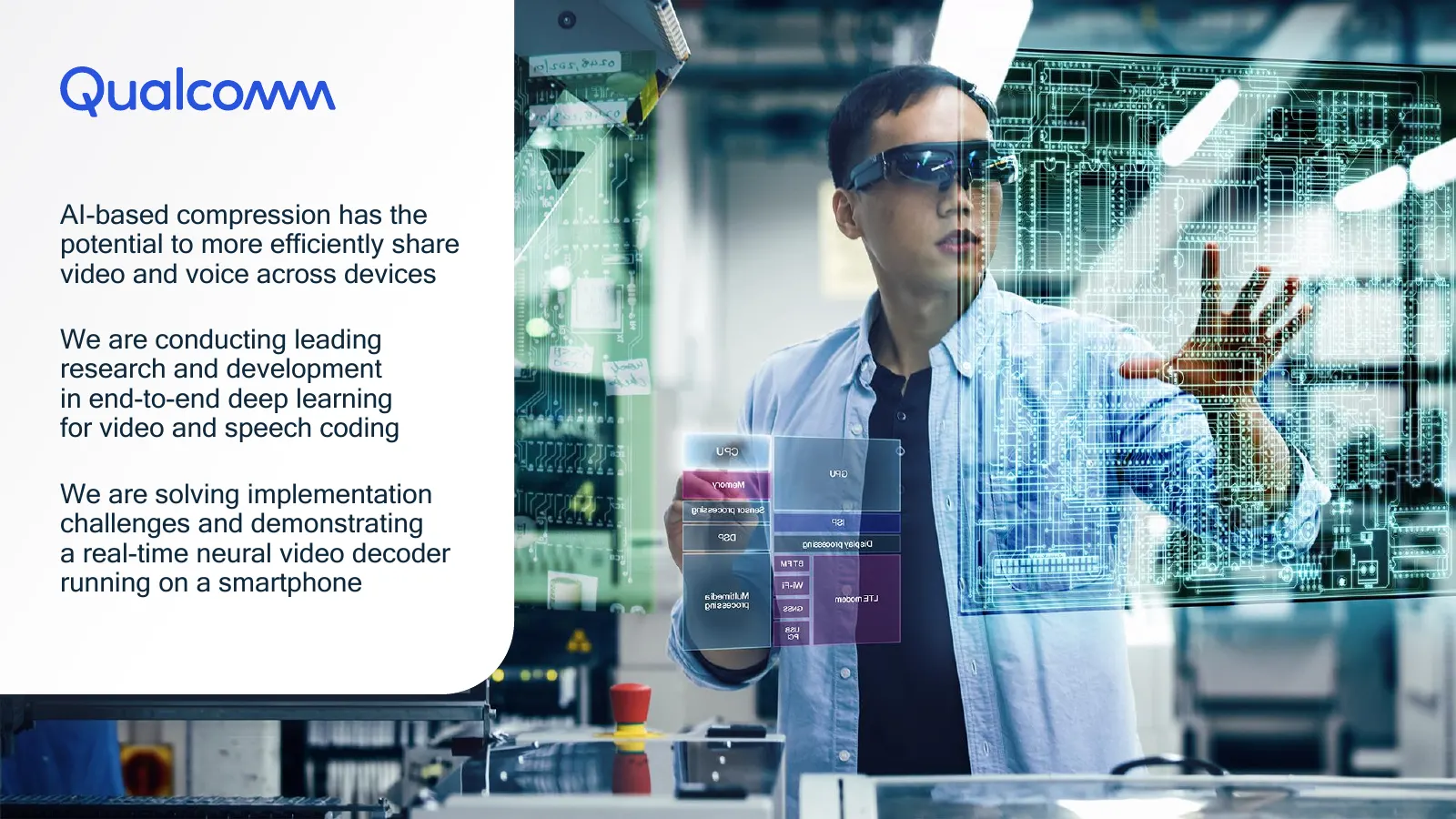
Slide 33: AI-based compression has the potential to more efficiently share video and voice
AI-based compression has the potential to more efficiently share video and voice across devices We are conducting leading research and development in end-to-end deep learning for video and speech coding We are solving implementation challenges and demonstrating a real-time neural video decoder runni

Slide 34: Questions?
www.qualcomm.com/ai www.qualcomm.com/news/onq Questions? @QCOMResearch Connect with Us https://www.youtube.com/qualcomm? http://www.slideshare.net/qualcommwirelessevolution 35
Slide 35: Thank you
Thank you Follow us on: For more information, visit us at: www.qualcomm.com & www.qualcomm.com/blog Nothing in these materials is an offer to sell any of the References in this presentation to “Qualcomm” may mean Qualcomm components or devices referenced herein. Incorporated, Qualcomm Technologies,
Source: Internet Archive copy of qualcomm.com
More decks from QUALCOMM Incorporated
 Q4 FY2026 Earnings Presentation27 slides · Nov 4, 2026
 Technical Presentation (October 2026)34 slides · October 2026
 Q3 FY2026 Earnings Presentation32 slides · Jul 29, 2026
 Investor Day (June 2026)29 slides · Jun 24, 2026
 Q2 FY2026 Earnings Presentation25 slides · Apr 29, 2026
 Q1 2026 Earnings Presentation23 slides · Feb 4, 2026