Sanofi SA · EURONEXT:SAN
Sanofi SA — Investor Day (December 2023)
154 slides from Sanofi SA's investor day presentation, Dec 7, 2023
Slide 1: R&D Day: Play to Win
R&D Day Play to Win New York, NY December 7, 2023
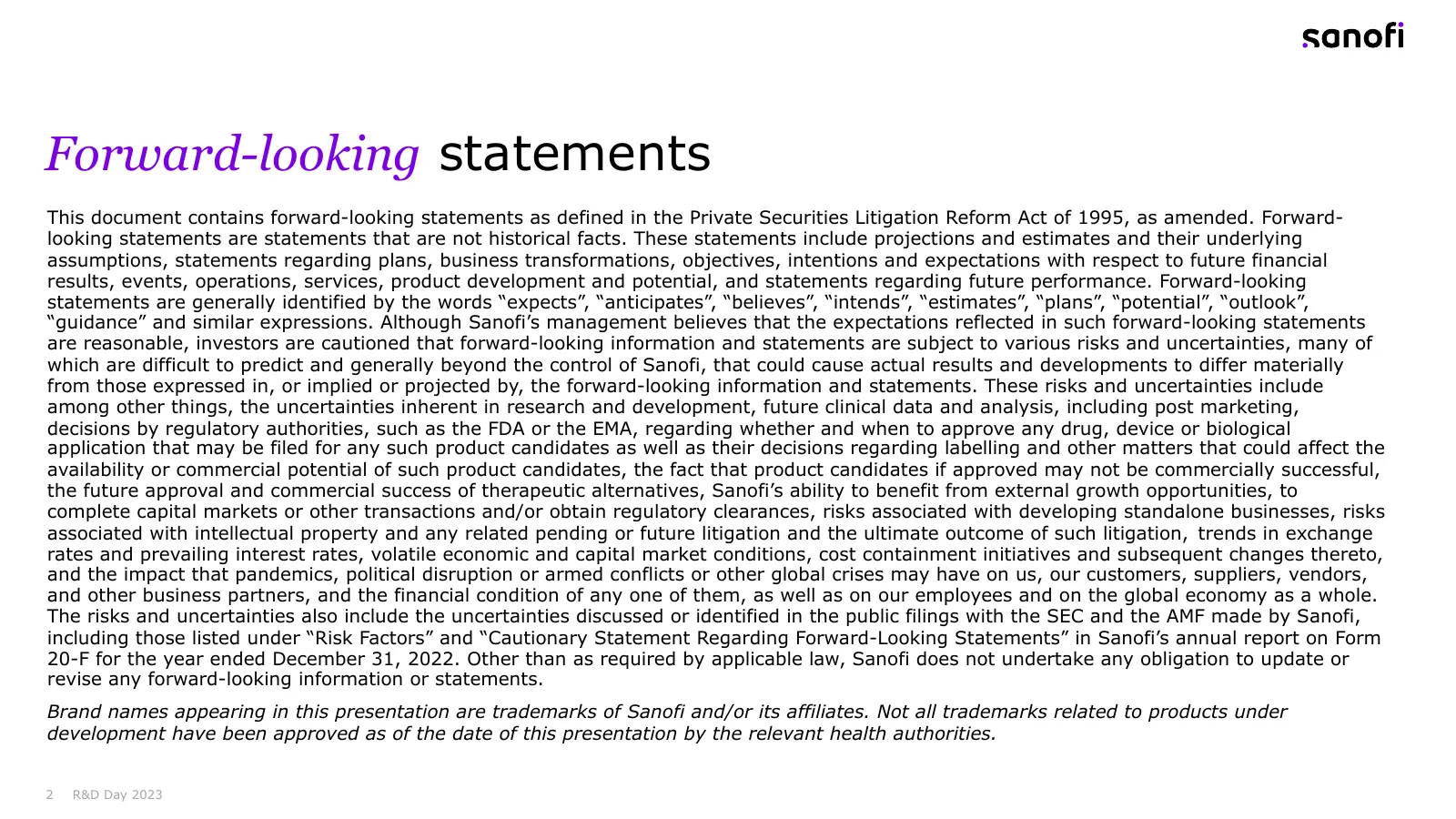
Slide 2: Forward-looking statements
Forward-looking statements This document contains forward-looking statements as defined in the Private Securities Litigation Reform Act of 1995, as amended. Forward- looking statements are statements that are not historical facts. These statements include projections and estimates and their underlyi
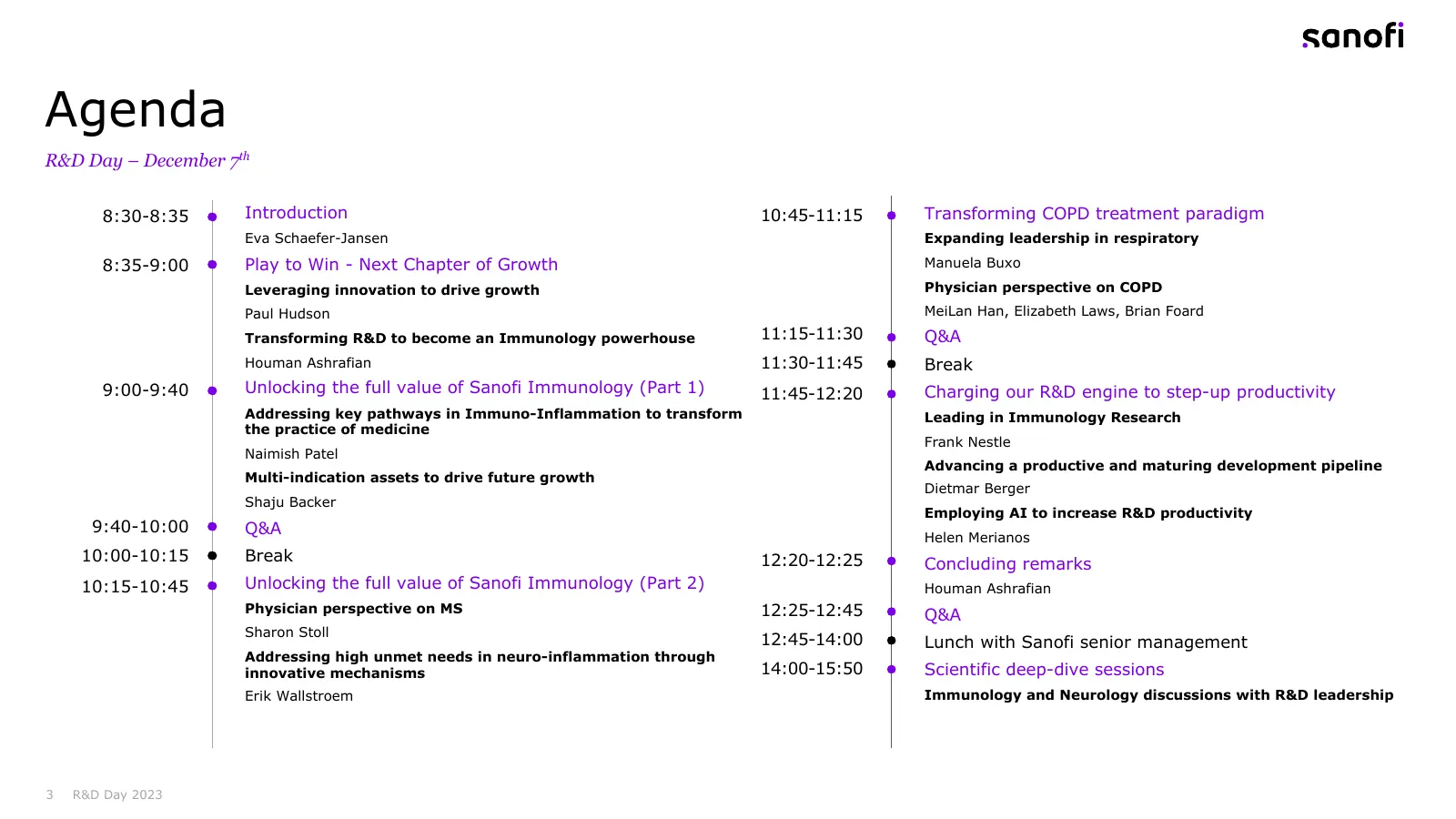
Slide 3: Agenda
Agenda R&D Day – December 7th 8:30-8:35 Introduction 10:45-11:15 Transforming COPD treatment paradigm Eva Schaefer-Jansen Expanding leadership in respiratory 8:35-9:00 Play to Win - Next Chapter of Growth Manuela Buxo Leveraging innovation to drive growth Physician perspective on COPD Paul Hudson Me

Slide 4: Leveraging innovation to drive growth
Leveraging innovation to drive growth Paul Hudson Chief Executive Officer
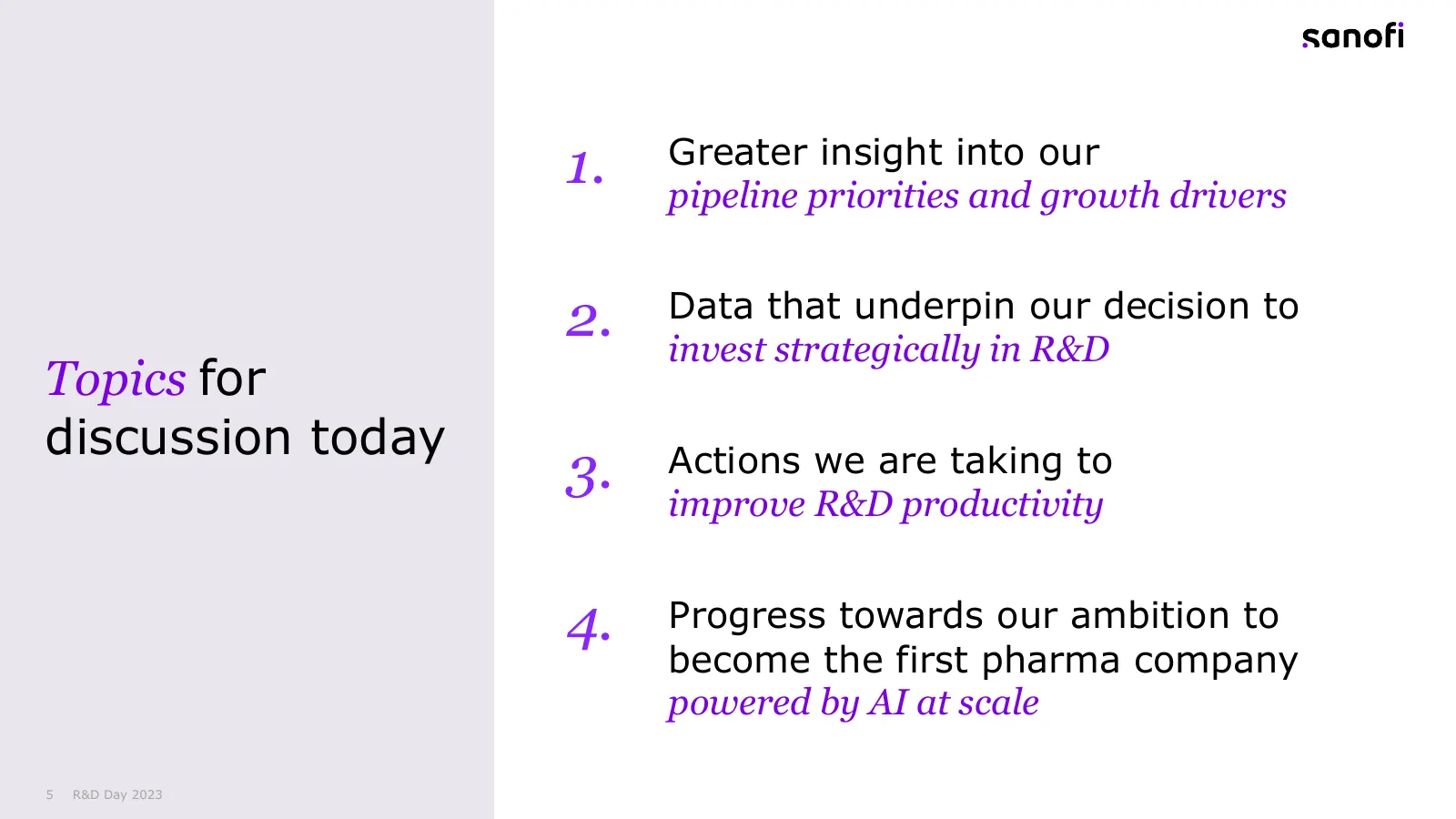
Slide 5: Topics for discussion today
Greater insight into our 1. pipeline priorities and growth drivers 2. Data that underpin our decision to invest strategically in R&D Topics for discussion today 3. Actions we are taking to improve R&D productivity 4. Progress towards our ambition to become the first pharma company powered by AI at s
Slide 6: A development-driven, tech-powered biopharma company committed to serving patients
We are a development-driven, tech-powered biopharma company committed to serving patients and accelerating growth. 6 R&D Day 2023
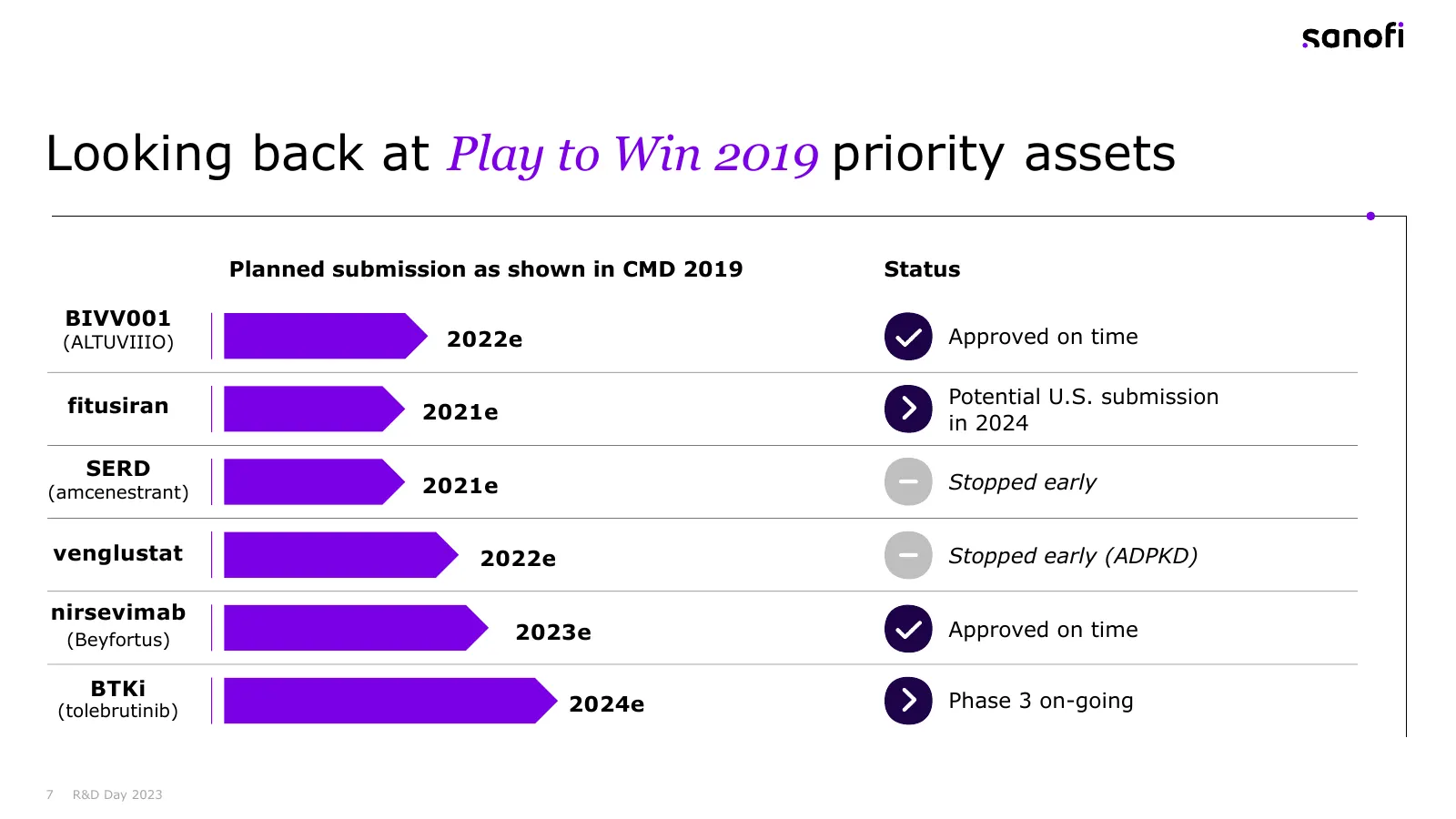
Slide 7: Looking back at Play to Win 2019 priority assets
Looking back at Play to Win 2019 priority assets Planned submission as shown in CMD 2019 Status BIVV001 (ALTUVIIIO) 2022e Approved on time fitusiran Potential U.S. submission 2021e in 2024 SERD (amcenestrant) 2021e Stopped early venglustat 2022e Stopped early (ADPKD) nirsevimab (Beyfortus) 2023e App
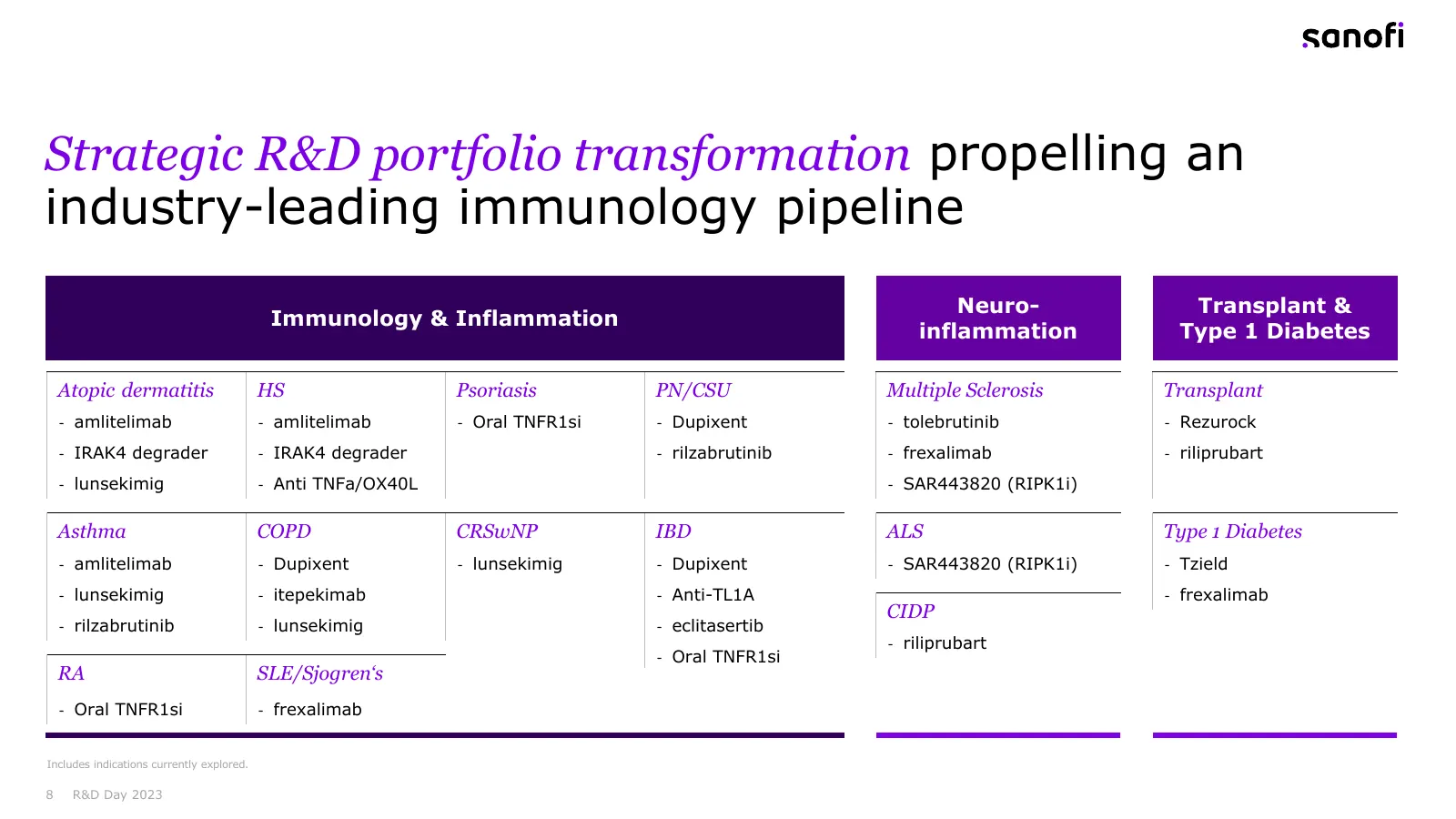
Slide 8: Strategic R&D portfolio transformation propelling an industry-leading immunology pipeline
Strategic R&D portfolio transformation propelling an industry-leading immunology pipeline Neuro- Transplant & Immunology & Inflammation inflammation Type 1 Diabetes Atopic dermatitis HS Psoriasis PN/CSU Multiple Sclerosis Transplant - amlitelimab - amlitelimab - Oral TNFR1si - Dupixent - tolebrutini
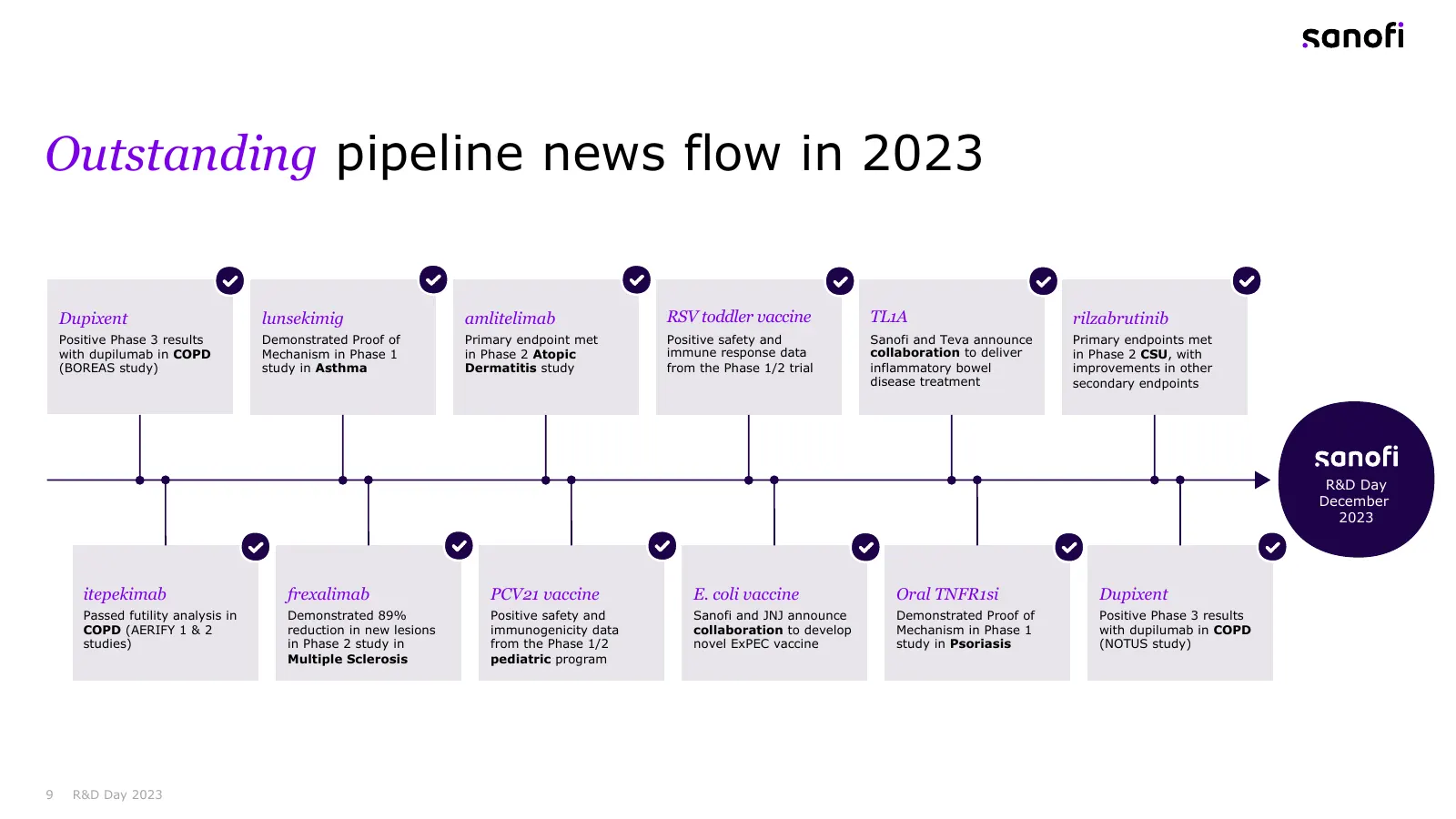
Slide 9: Outstanding pipeline news flow in 2023
Outstanding pipeline news flow in 2023 Dupixent lunsekimig amlitelimab RSV toddler vaccine TL1A rilzabrutinib Positive Phase 3 results Demonstrated Proof of Primary endpoint met Positive safety and Sanofi and Teva announce Primary endpoints met with dupilumab in COPD Mechanism in Phase 1 in Phase 2
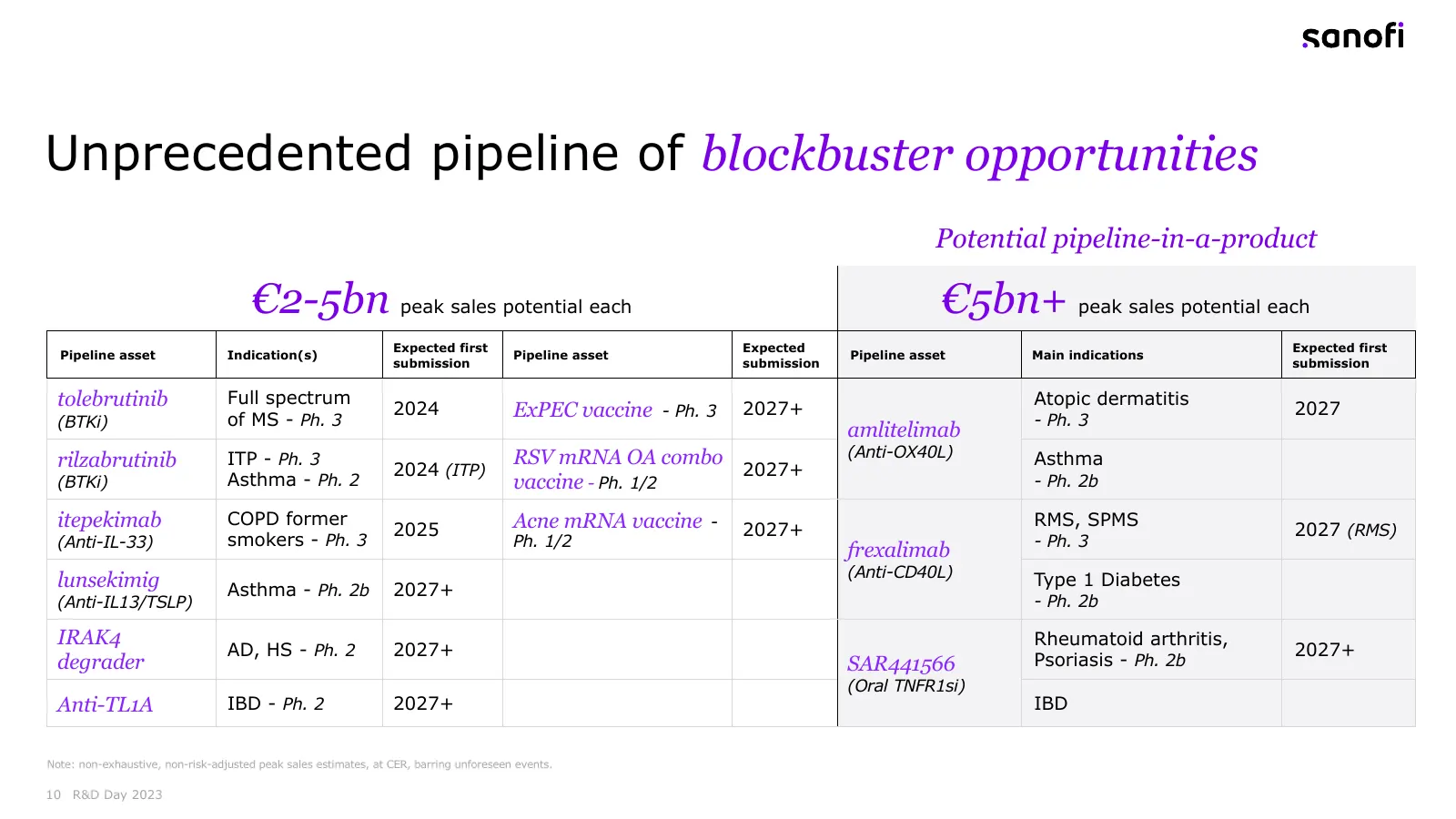
Slide 10: Unprecedented pipeline of blockbuster opportunities
Unprecedented pipeline of blockbuster opportunities Potential pipeline-in-a-product €2-5bn peak sales potential each €5bn+ peak sales potential each Expected first Expected Expected first Pipeline asset Indication(s) Pipeline asset Pipeline asset Main indications submission submission submission tol
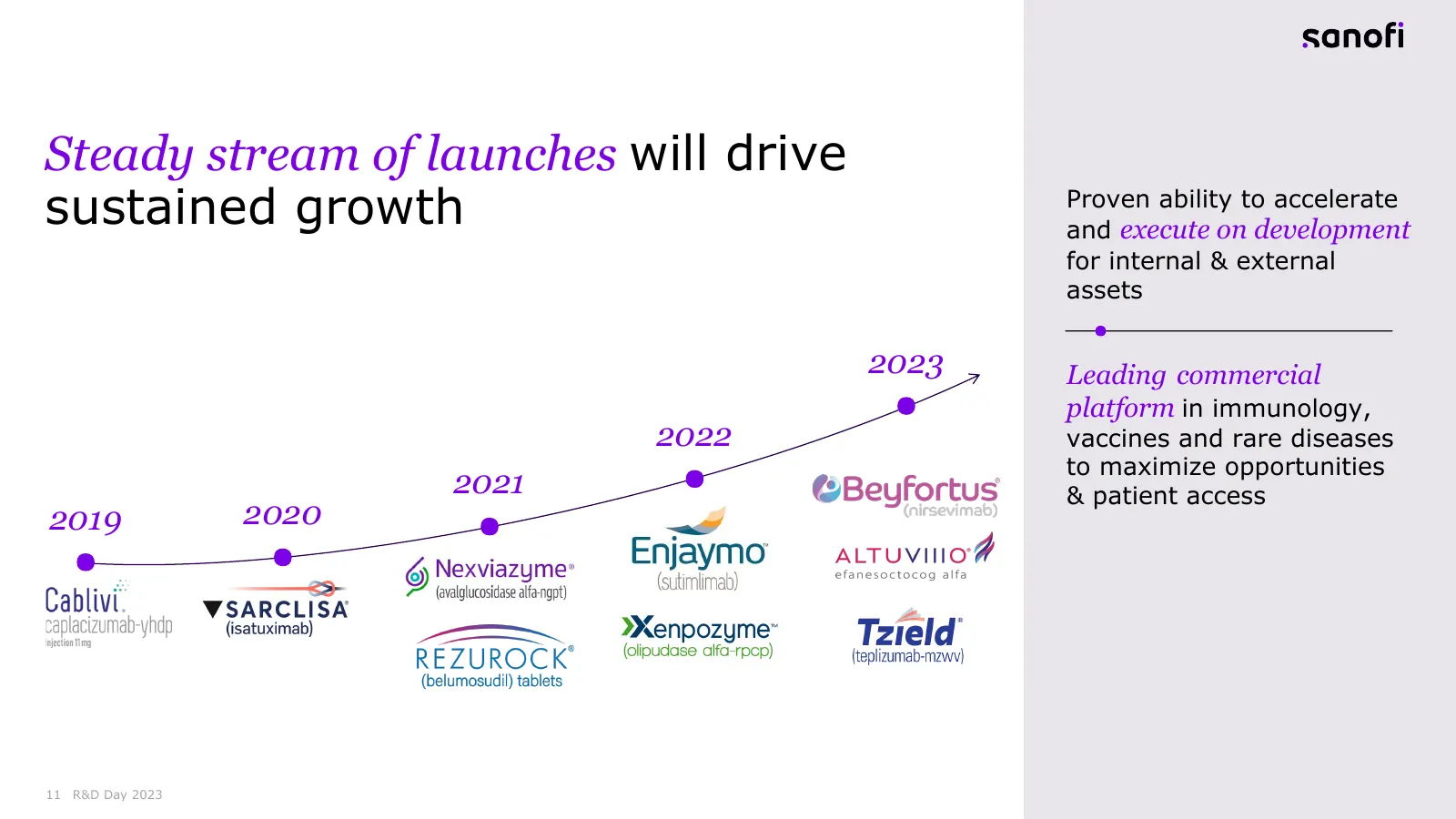
Slide 11: Steady stream of launches will drive sustained growth
Steady stream of launches will drive sustained growth Proven ability to accelerate and execute on development for internal & external assets 2023 Leading commercial platform in immunology, 2022 vaccines and rare diseases to maximize opportunities 2021 & patient access 2019 2020 11 R&D Day 2023
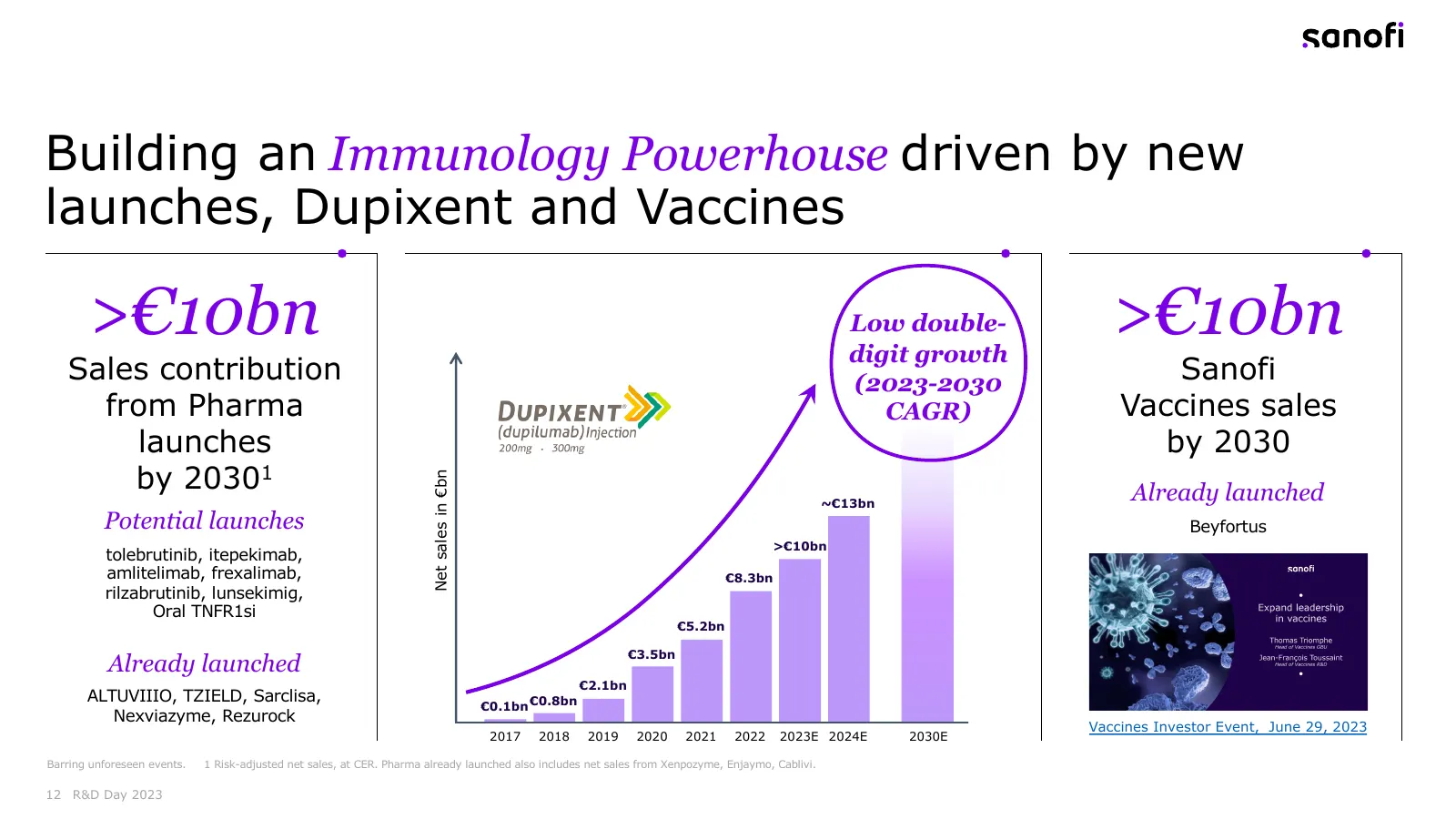
Slide 12: Building an Immunology Powerhouse driven by new launches, Dupixent and Vaccines
Building an Immunology Powerhouse driven by new launches, Dupixent and Vaccines >€10bn Low double- digit growth >€10bn Sales contribution (2023-2030 Sanofi from Pharma CAGR) Vaccines sales launches by 2030 by 20301 Net sales in €bn ~€13bn Already launched Potential launches Beyfortus >€10bn tolebrut
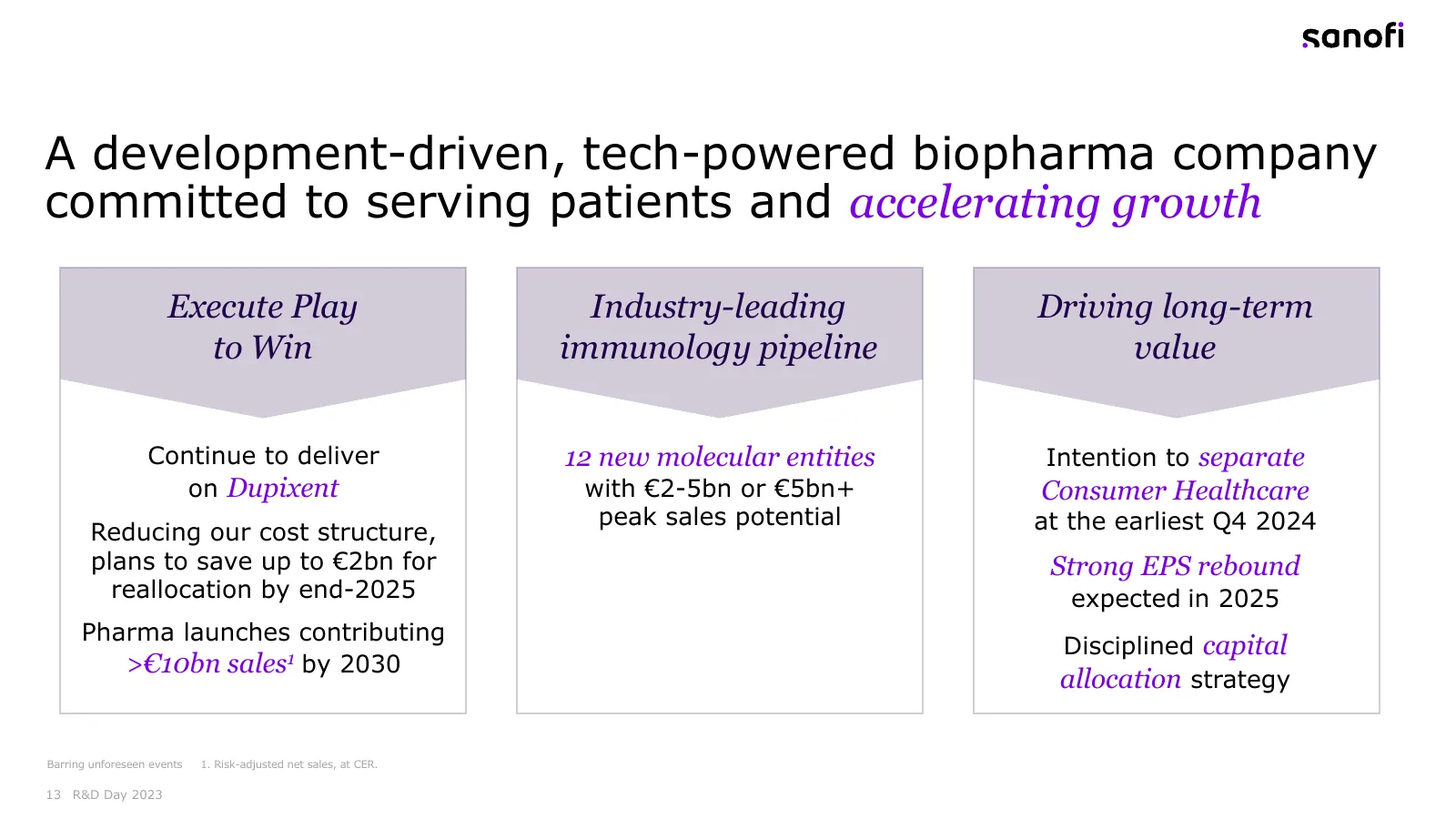
Slide 13: A development-driven, tech-powered biopharma company committed to serving patients and accelerating growth
A development-driven, tech-powered biopharma company committed to serving patients and accelerating growth Execute Play Industry-leading Driving long-term to Win immunology pipeline value Continue to deliver 12 new molecular entities Intention to separate on Dupixent with €2-5bn or €5bn+ Consumer He

Slide 14: Transforming R&D to become an Immunology powerhouse
Transforming R&D to become an Immunology powerhouse Houman Ashrafian Head of Research and Development

Slide 15: Introducing the team
Introducing the team Houman Ashrafian Naimish Patel Shaju Backer Erik Wallstroem Head of Global Global Franchise Head Head of Development, Head of R&D Development for I&I of Immunology Neurology Manuela Buxo Frank Nestle Dietmar Berger Helen Merianos Global Head of Global Head of Research, Global He
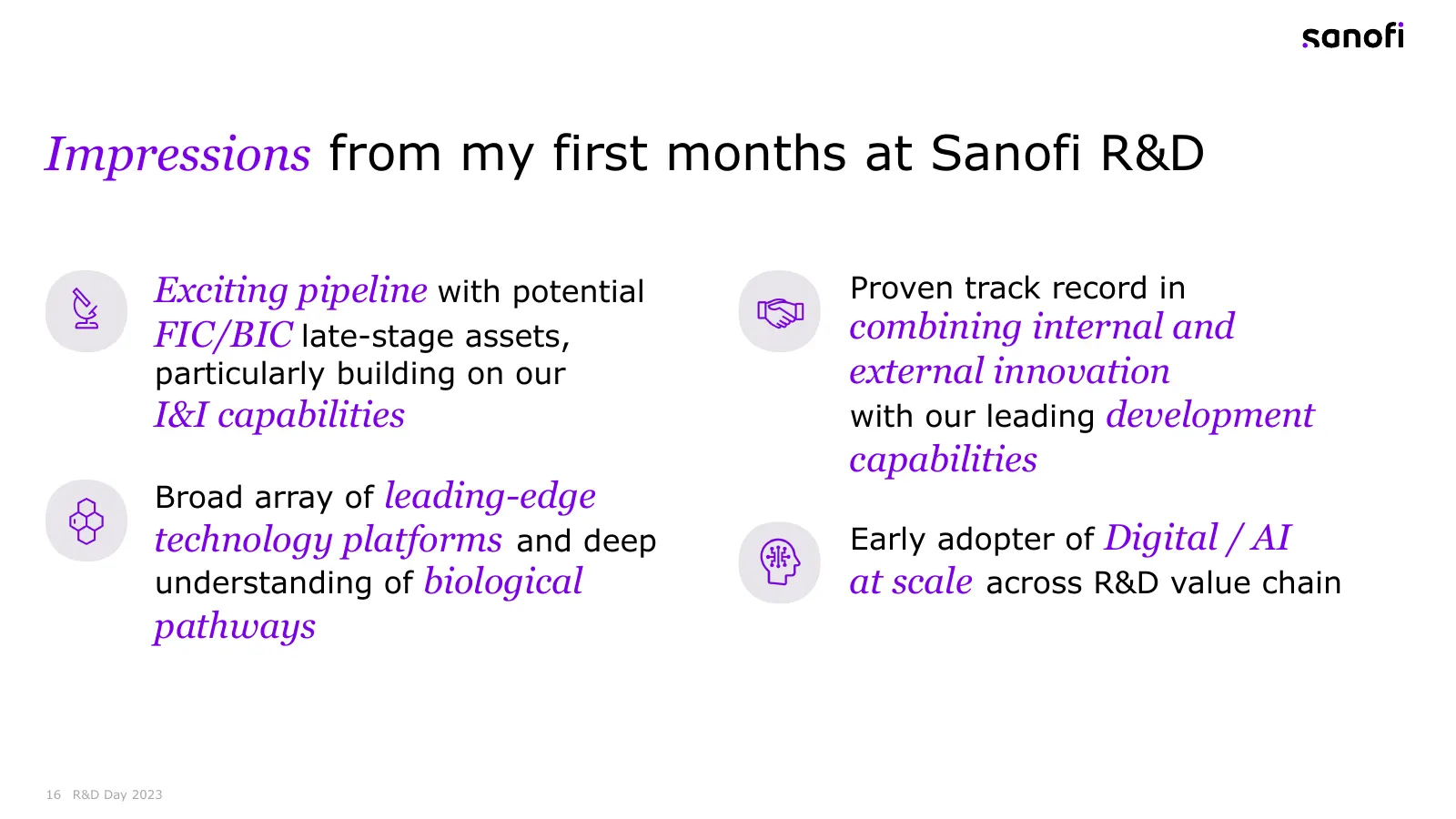
Slide 16: Impressions from my first months at Sanofi R&D
Impressions from my first months at Sanofi R&D Exciting pipeline with potential Proven track record in FIC/BIC late-stage assets, combining internal and particularly building on our external innovation I&I capabilities with our leading development capabilities Broad array of leading-edge technology
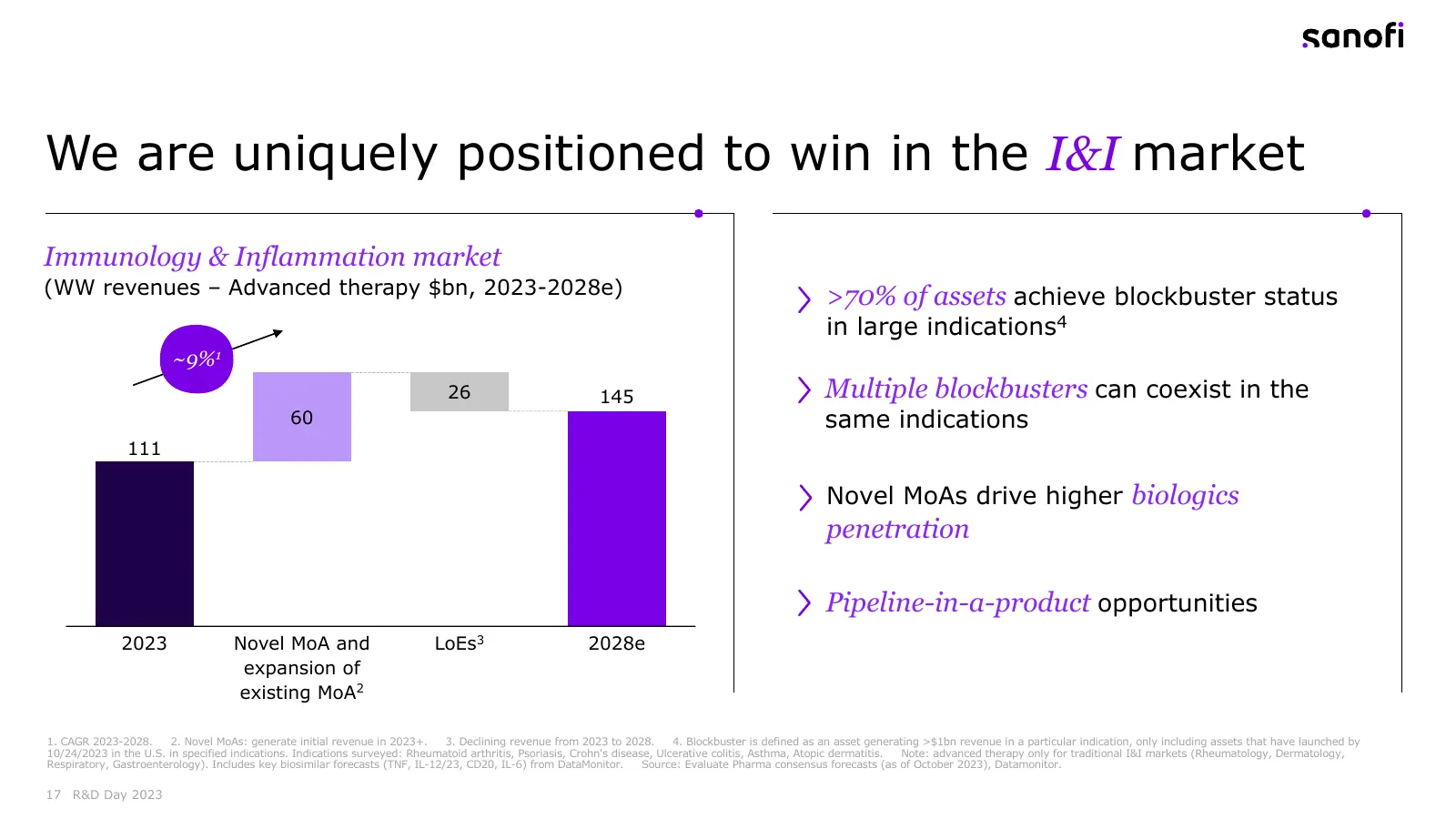
Slide 17: We are uniquely positioned to win in the I&I market
We are uniquely positioned to win in the I&I market Immunology & Inflammation market (WW revenues – Advanced therapy $bn, 2023-2028e) >70% of assets achieve blockbuster status in large indications4 ~9%1 26 145 Multiple blockbusters can coexist in the 60 same indications 111 Novel MoAs drive higher b
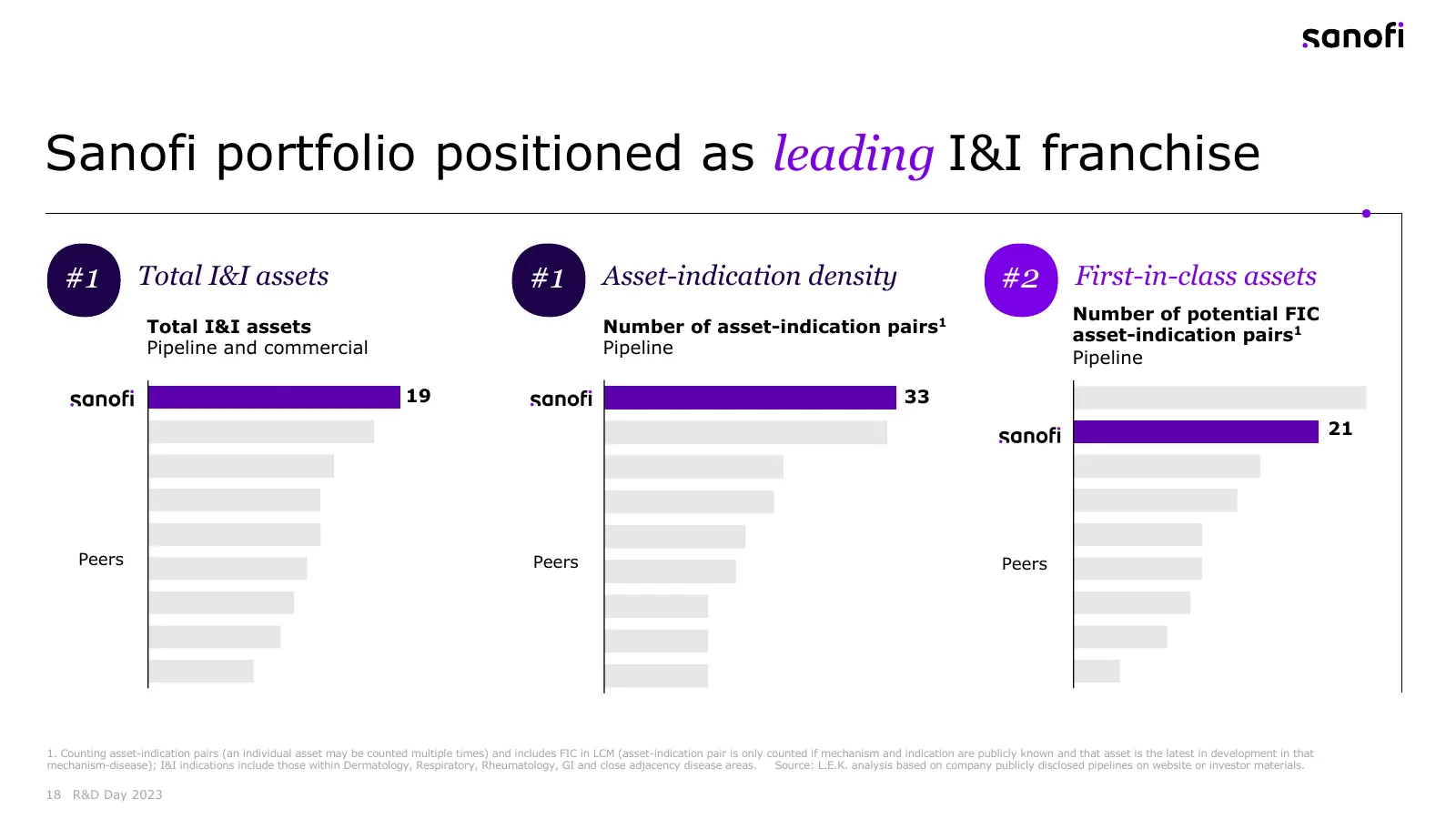
Slide 18: Sanofi portfolio positioned as leading I&I franchise
Sanofi portfolio positioned as leading I&I franchise #1 Total I&I assets #1 Asset-indication density #2 First-in-class assets Number of potential FIC Total I&I assets Number of asset-indication pairs1 asset-indication pairs1 Pipeline and commercial Pipeline Pipeline 19 33 21 Peers Peers Peers 1. Cou
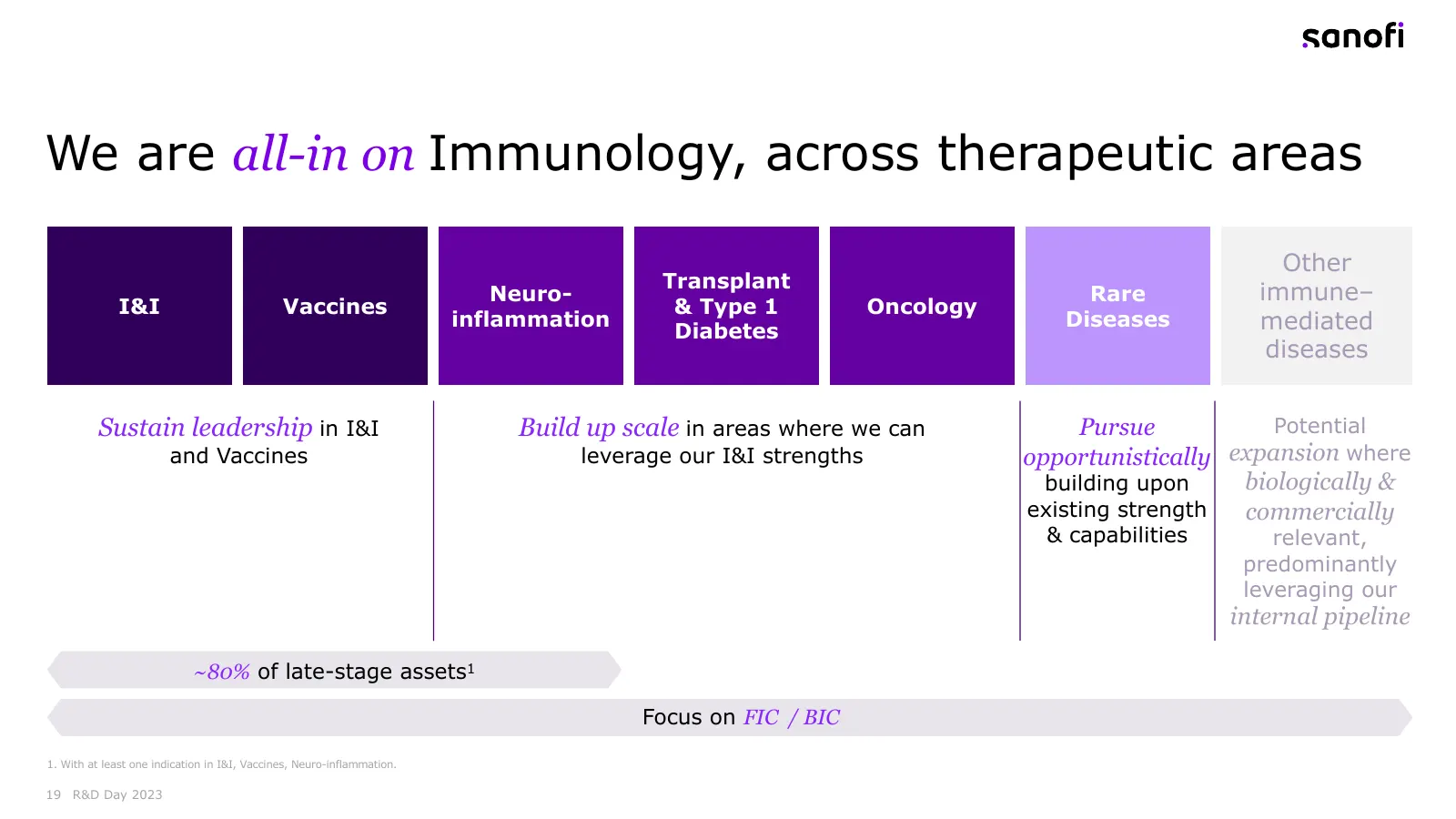
Slide 19: We are all-in on Immunology, across therapeutic areas
We are all-in on Immunology, across therapeutic areas Other Transplant Neuro- Rare immune– I&I Vaccines & Type 1 Oncology inflammation Diabetes Diseases mediated diseases Sustain leadership in I&I Build up scale in areas where we can Pursue Potential and Vaccines leverage our I&I strengths opportuni
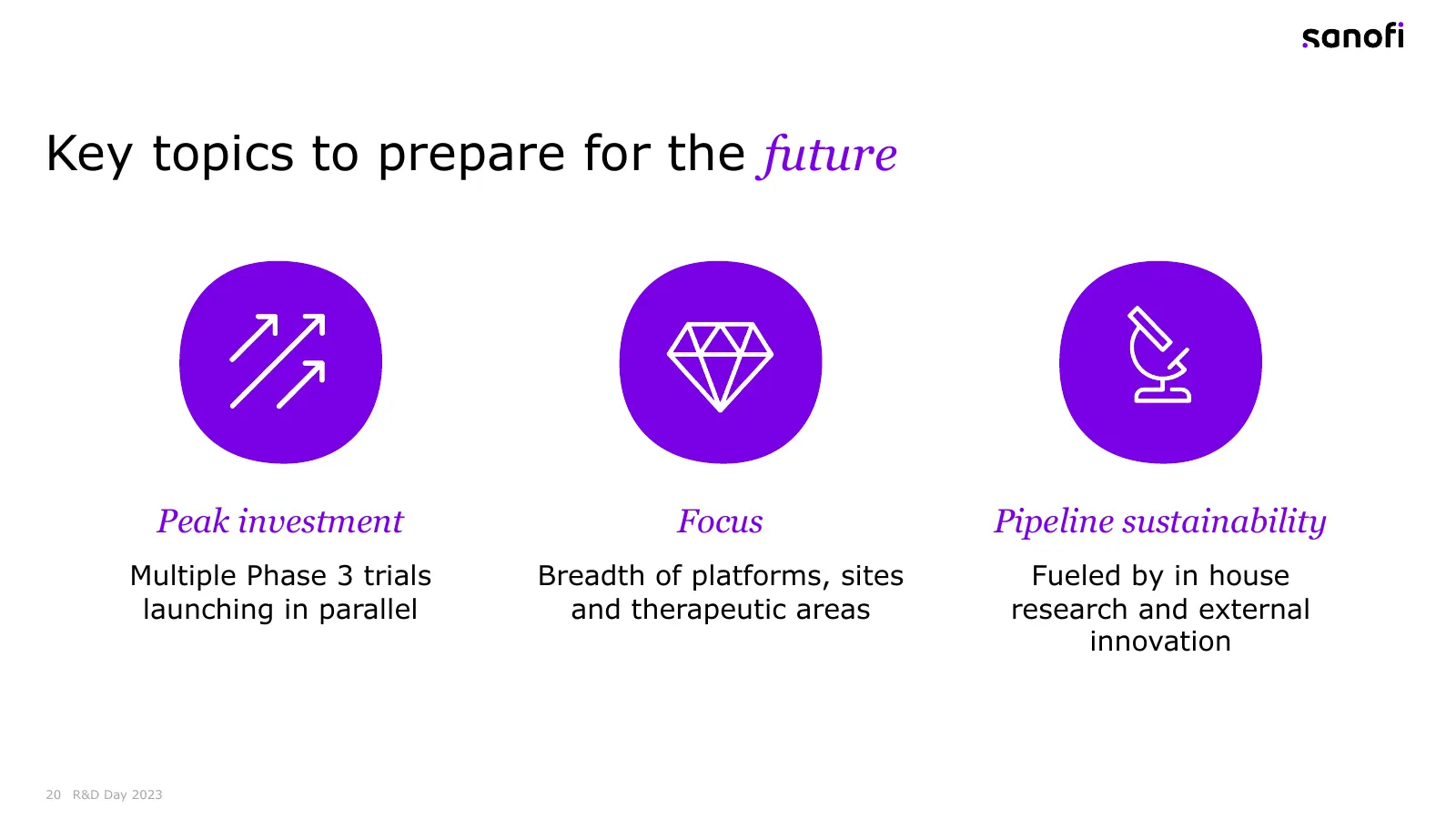
Slide 20: Key topics to prepare for the future
Key topics to prepare for the future Peak investment Focus Pipeline sustainability Multiple Phase 3 trials Breadth of platforms, sites Fueled by in house launching in parallel and therapeutic areas research and external innovation 20 R&D Day 2023
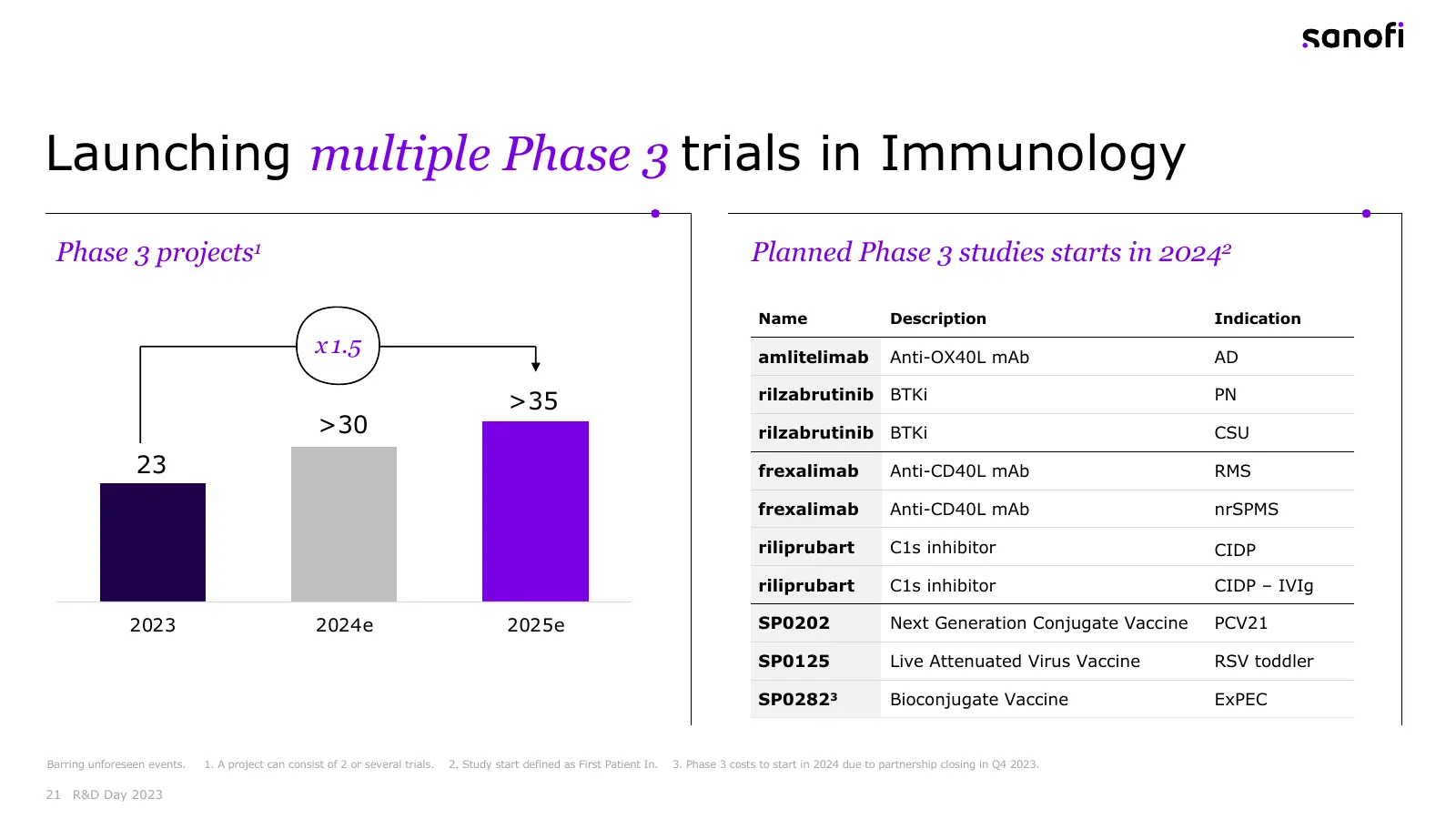
Slide 21: Launching multiple Phase 3 trials in Immunology
Launching multiple Phase 3 trials in Immunology Phase 3 projects1 Planned Phase 3 studies starts in 20242 Name Description Indication x 1.5 amlitelimab Anti-OX40L mAb AD rilzabrutinib BTKi PN >35 >30 rilzabrutinib BTKi CSU 23 frexalimab Anti-CD40L mAb RMS frexalimab Anti-CD40L mAb nrSPMS riliprubart
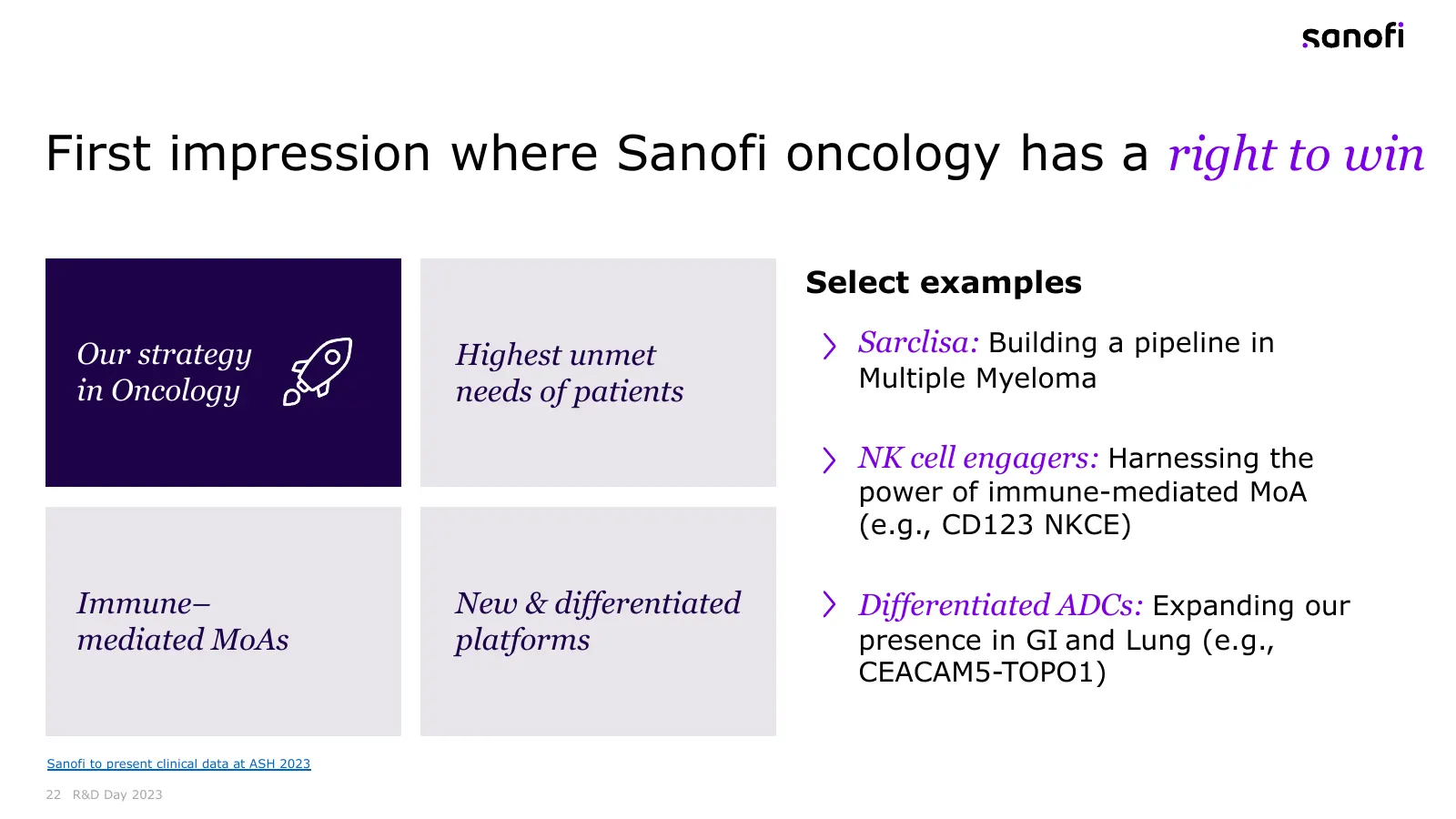
Slide 22: First impression where Sanofi oncology has a right to win
First impression where Sanofi oncology has a right to win Select examples Our strategy Highest unmet Sarclisa: Building a pipeline in Multiple Myeloma in Oncology needs of patients NK cell engagers: Harnessing the power of immune-mediated MoA (e.g., CD123 NKCE) Immune– New & differentiated Different
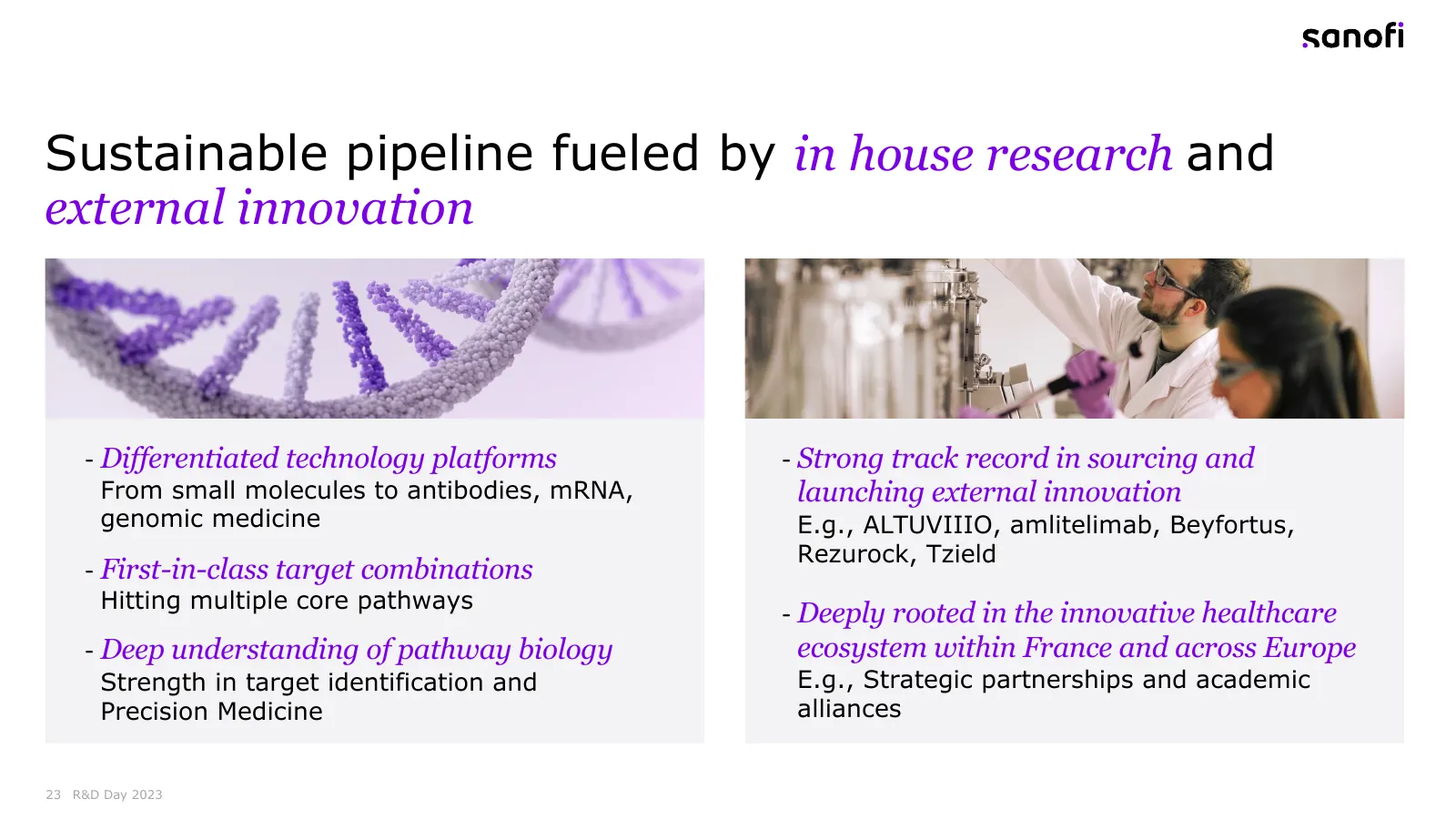
Slide 23: Sustainable pipeline fueled by in house research and external innovation
Sustainable pipeline fueled by in house research and external innovation - Differentiated technology platforms - Strong track record in sourcing and From small molecules to antibodies, mRNA, launching external innovation genomic medicine E.g., ALTUVIIIO, amlitelimab, Beyfortus, Rezurock, Tzield - Fi
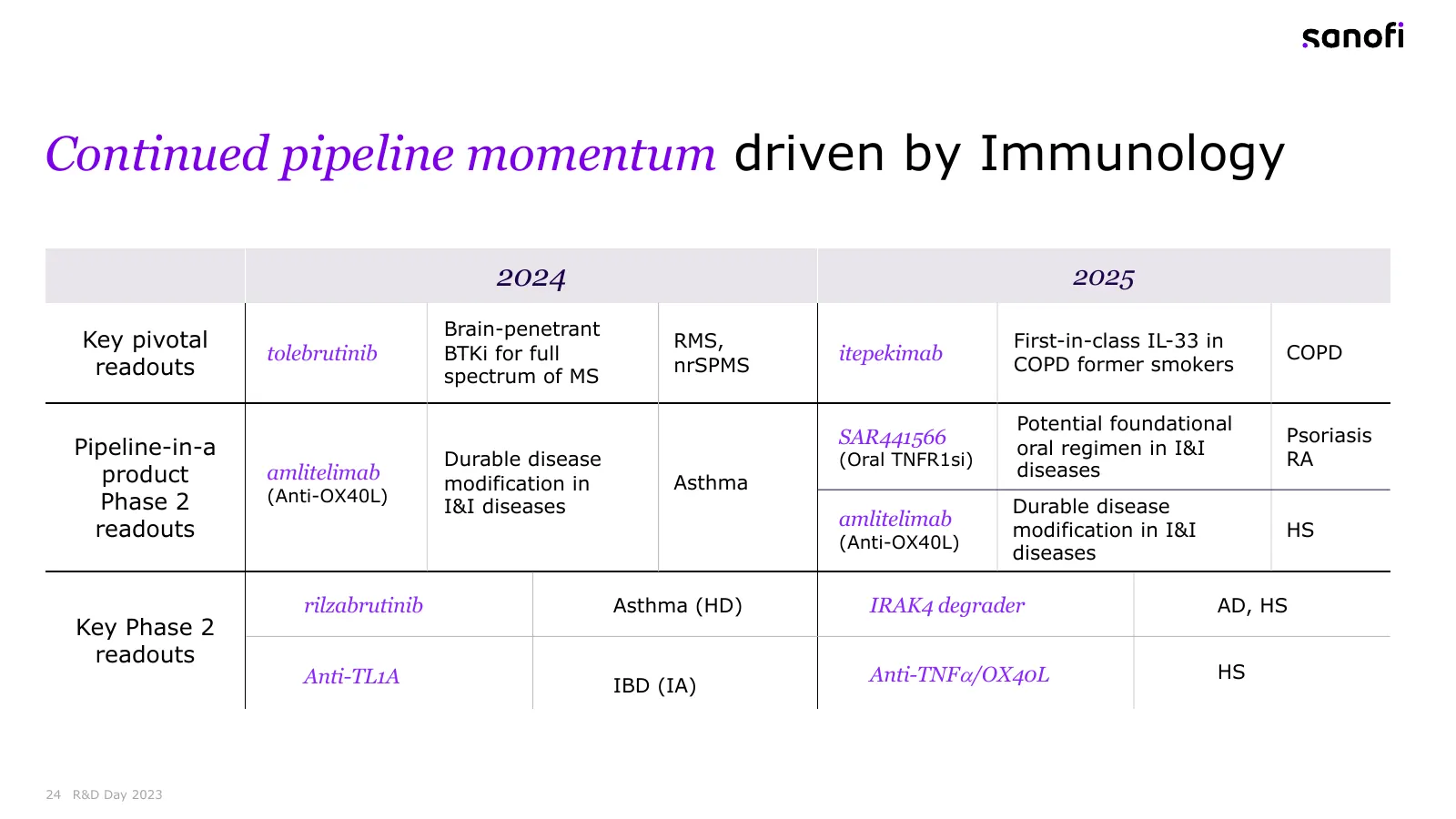
Slide 24: Continued pipeline momentum driven by Immunology
Continued pipeline momentum driven by Immunology 2024 2025 Brain-penetrant Key pivotal RMS, First-in-class IL-33 in COPD tolebrutinib BTKi for full itepekimab readouts nrSPMS COPD former smokers spectrum of MS Potential foundational SAR441566 Psoriasis Pipeline-in-a Durable disease (Oral TNFR1si) or

Slide 25: Addressing key pathways in Immuno-Inflammation to transform the practice of medicine
Addressing key pathways in Immuno-Inflammation to transform the practice of medicine Naimish Patel Global Head of Development for Immunology and Inflammation
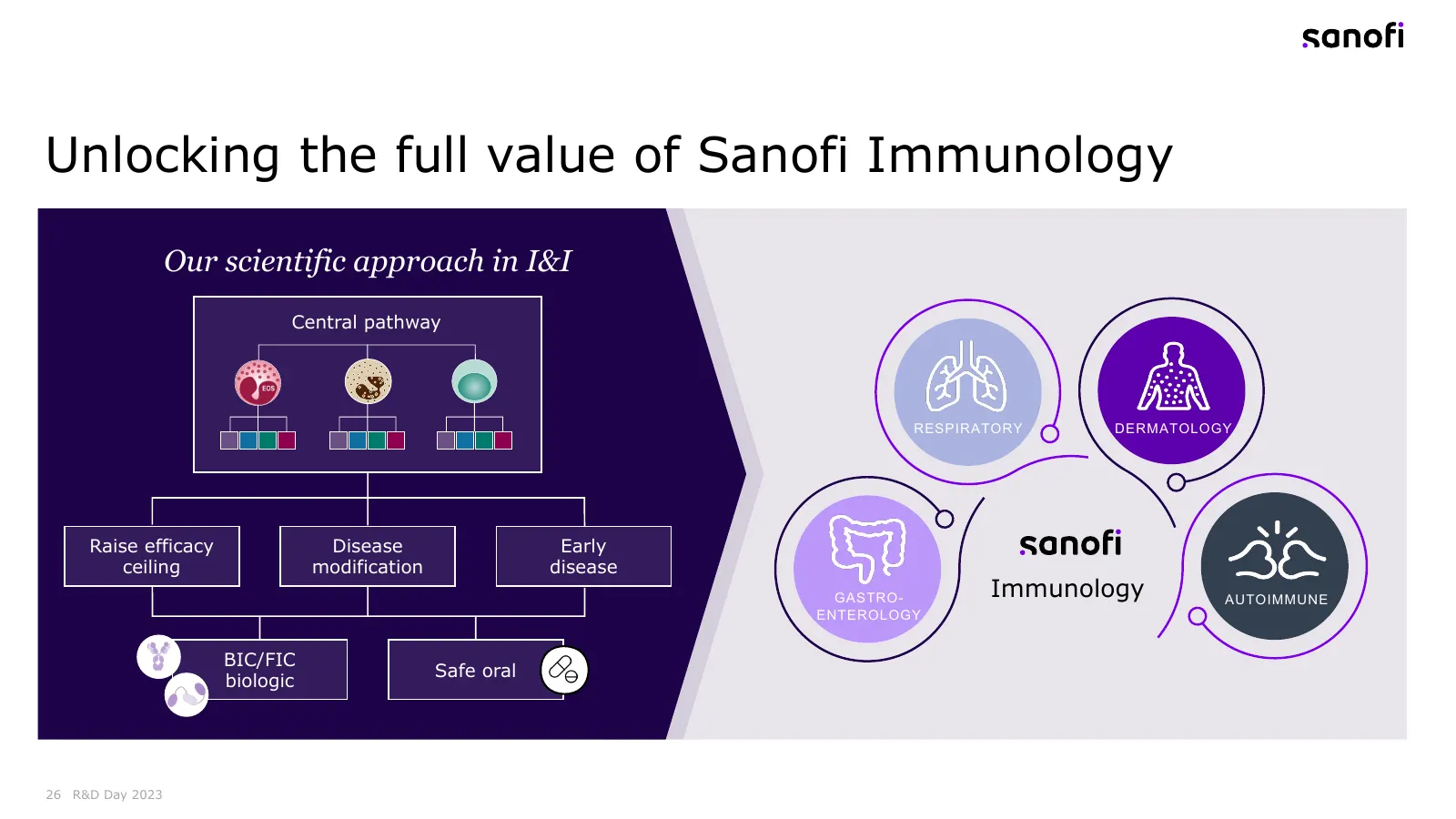
Slide 26: Unlocking the full value of Sanofi Immunology
Unlocking the full value of Sanofi Immunology Our scientific approach in I&I Central pathway RESPIRATORY DERMATOLOGY Raise efficacy Disease Early ceiling modification disease GASTRO- Immunology AUTOIMMUNE ENTEROLOGY BIC/FIC Safe oral biologic 26 R&D Day 2023
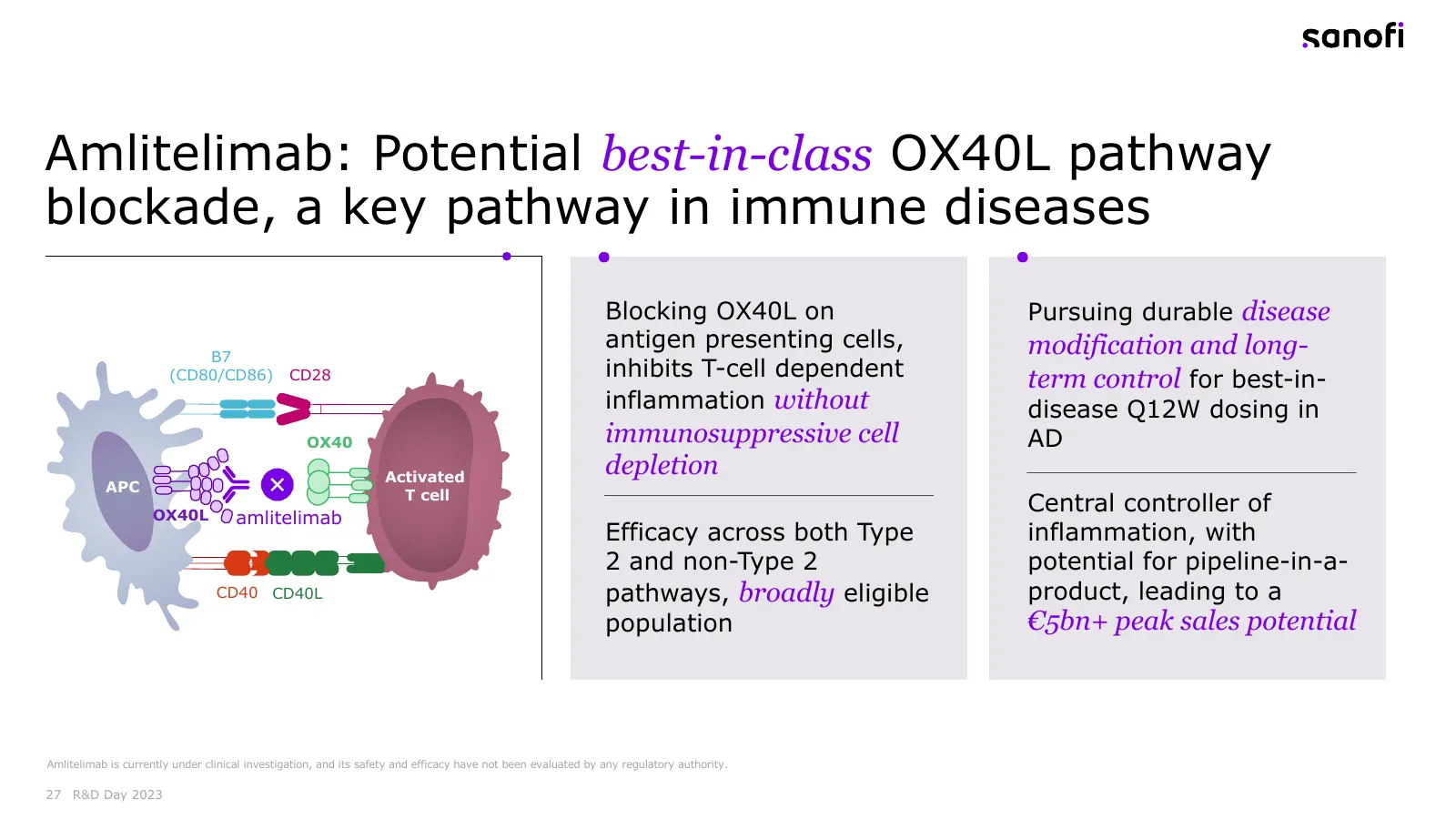
Slide 27: Amlitelimab: Potential best-in-class OX40L pathway blockade
Amlitelimab: Potential best-in-class OX40L pathway blockade, a key pathway in immune diseases Blocking OX40L on Pursuing durable disease antigen presenting cells, modification and long- B7 (CD80/CD86) CD28 inhibits T-cell dependent term control for best-in- inflammation without disease Q12W dosing i
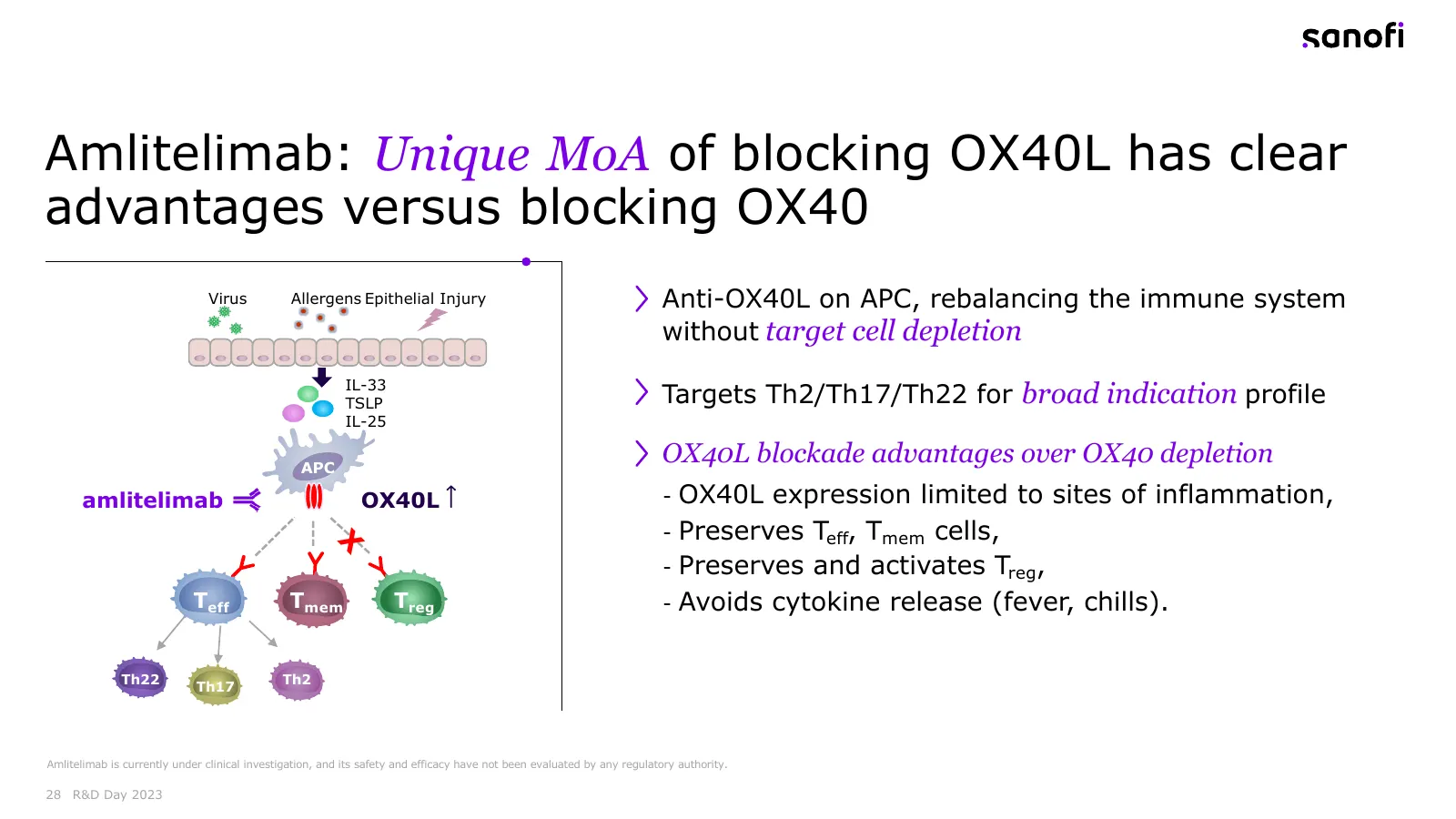
Slide 28: Amlitelimab: Unique MoA of blocking OX40L
Amlitelimab: Unique MoA of blocking OX40L has clear advantages versus blocking OX40 Virus Allergens Epithelial Injury Anti-OX40L on APC, rebalancing the immune system without target cell depletion IL-33 TSLP Targets Th2/Th17/Th22 for broad indication profile IL-25 APC OX40L blockade advantages over
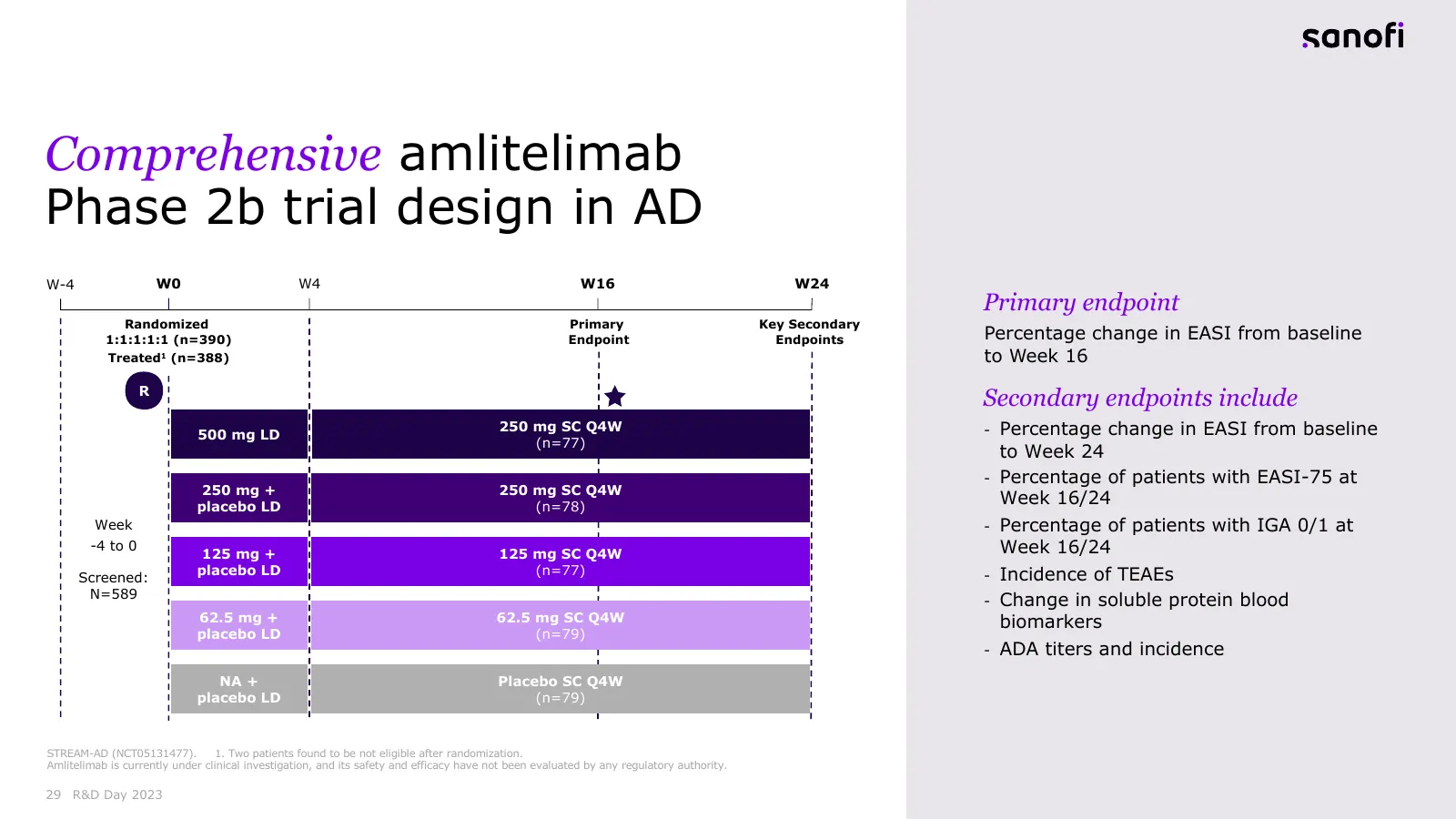
Slide 29: Comprehensive amlitelimab Phase 2b trial design in AD
Comprehensive amlitelimab Phase 2b trial design in AD W-4 W0 W4 W16 W24 Primary endpoint Randomized Primary Key Secondary 1:1:1:1:1 (n=390) Endpoint Endpoints Percentage change in EASI from baseline Treated1 (n=388) to Week 16 R Secondary endpoints include 500 mg LD 250 mg SC Q4W - Percentage change
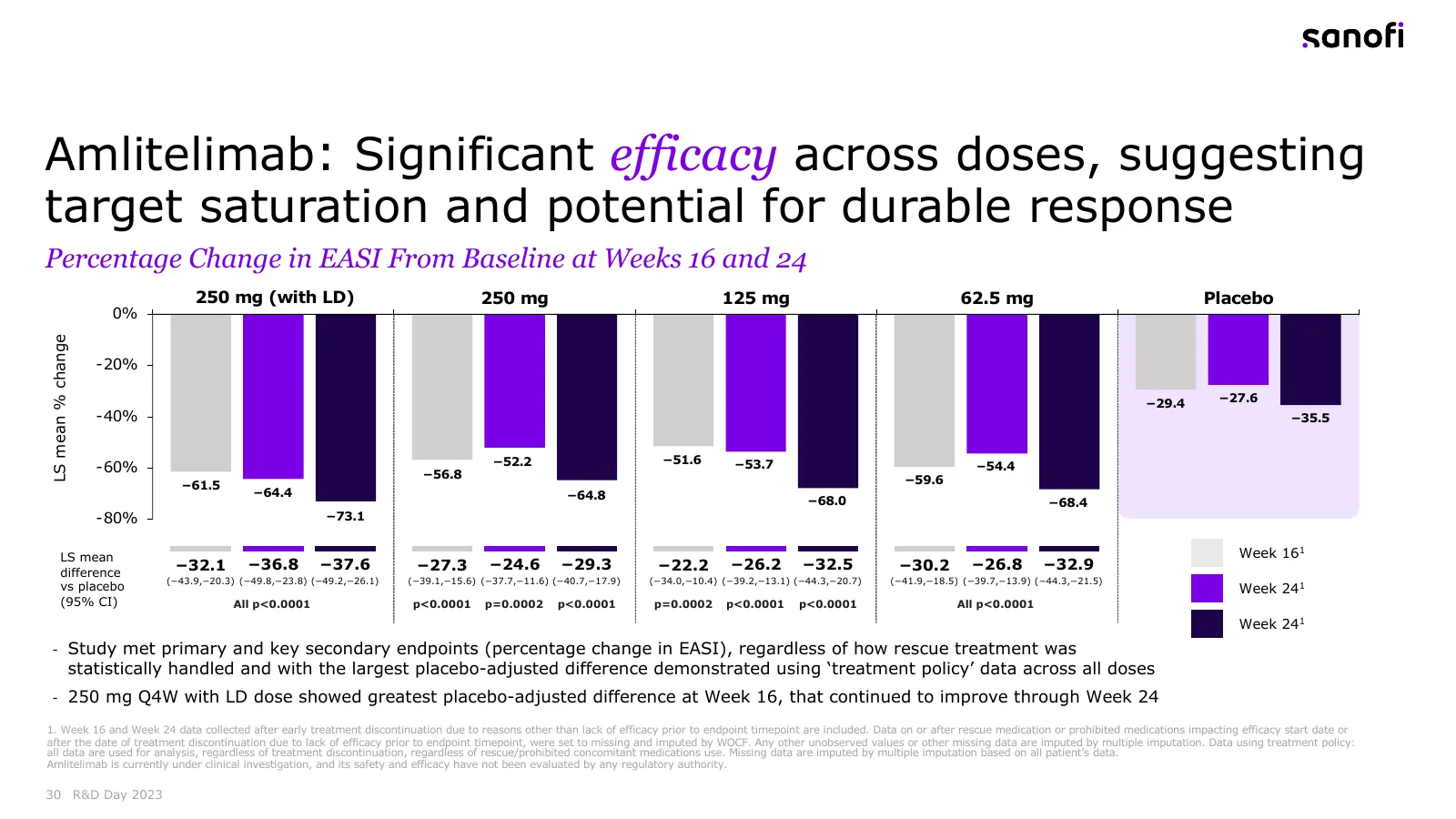
Slide 30: Amlitelimab: Significant efficacy across doses
Amlitelimab: Significant efficacy across doses, suggesting target saturation and potential for durable response Percentage Change in EASI From Baseline at Weeks 16 and 24 250 mg (with LD) 250 mg 125 mg 62.5 mg Placebo 0% LS mean % change -20% −29.4 −27.6 -40% −35.5 −52.2 −51.6 −53.7 -60% −56.8 −54.4
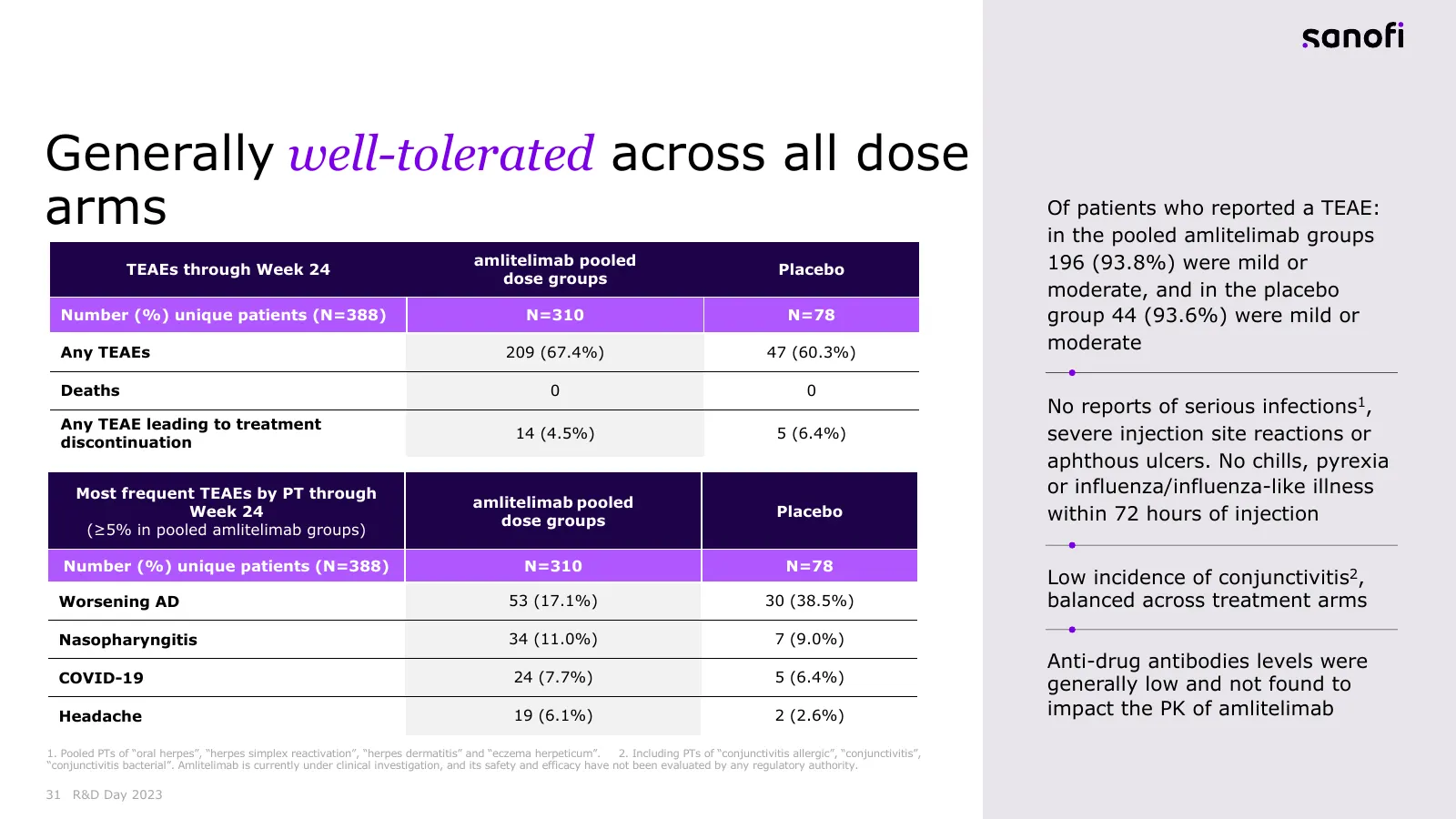
Slide 31: Generally well-tolerated across all dose arms
Generally well-tolerated across all dose arms Of patients who reported a TEAE: in the pooled amlitelimab groups TEAEs through Week 24 amlitelimab pooled Placebo 196 (93.8%) were mild or dose groups moderate, and in the placebo Number (%) unique patients (N=388) N=310 N=78 group 44 (93.6%) were mild
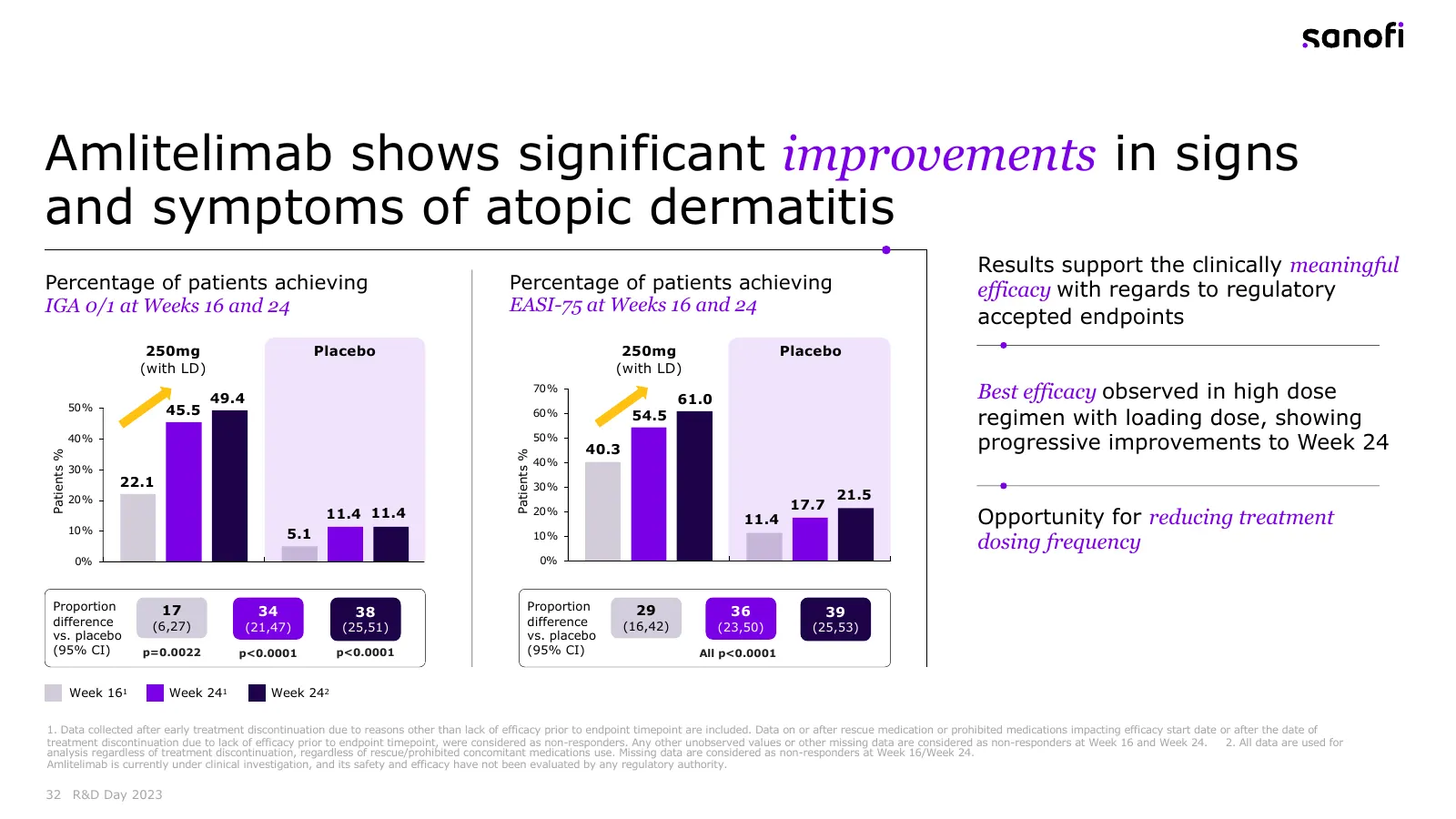
Slide 32: Amlitelimab shows significant improvements in atopic dermatitis
Amlitelimab shows significant improvements in signs and symptoms of atopic dermatitis Results support the clinically meaningful Percentage of patients achieving Percentage of patients achieving efficacy with regards to regulatory IGA 0/1 at Weeks 16 and 24 EASI-75 at Weeks 16 and 24 accepted endpoin
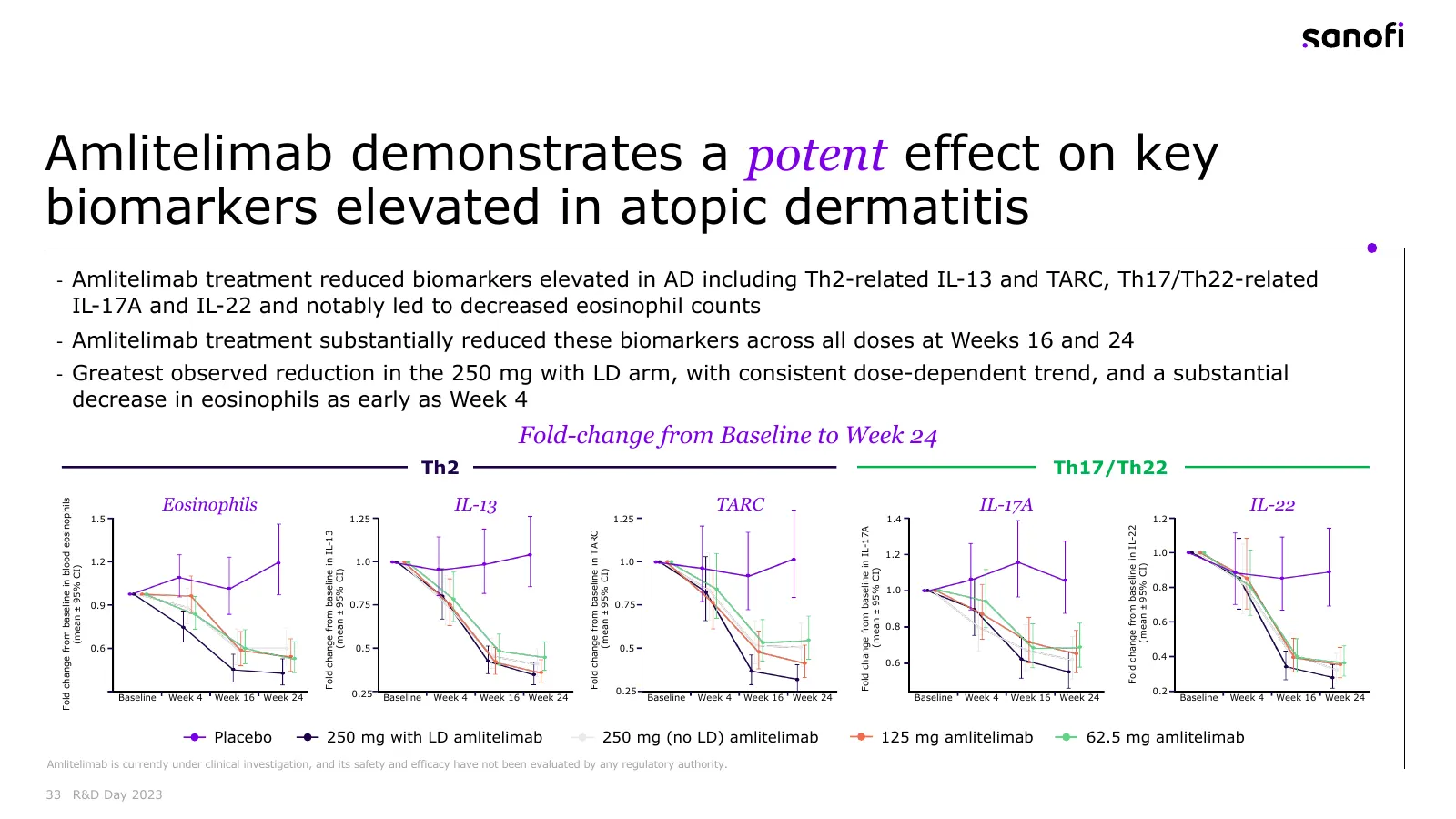
Slide 33: Amlitelimab potent effect on key biomarkers
Amlitelimab demonstrates a potent effect on key biomarkers elevated in atopic dermatitis - Amlitelimab treatment reduced biomarkers elevated in AD including Th2-related IL-13 and TARC, Th17/Th22-related IL-17A and IL-22 and notably led to decreased eosinophil counts - Amlitelimab treatment substanti
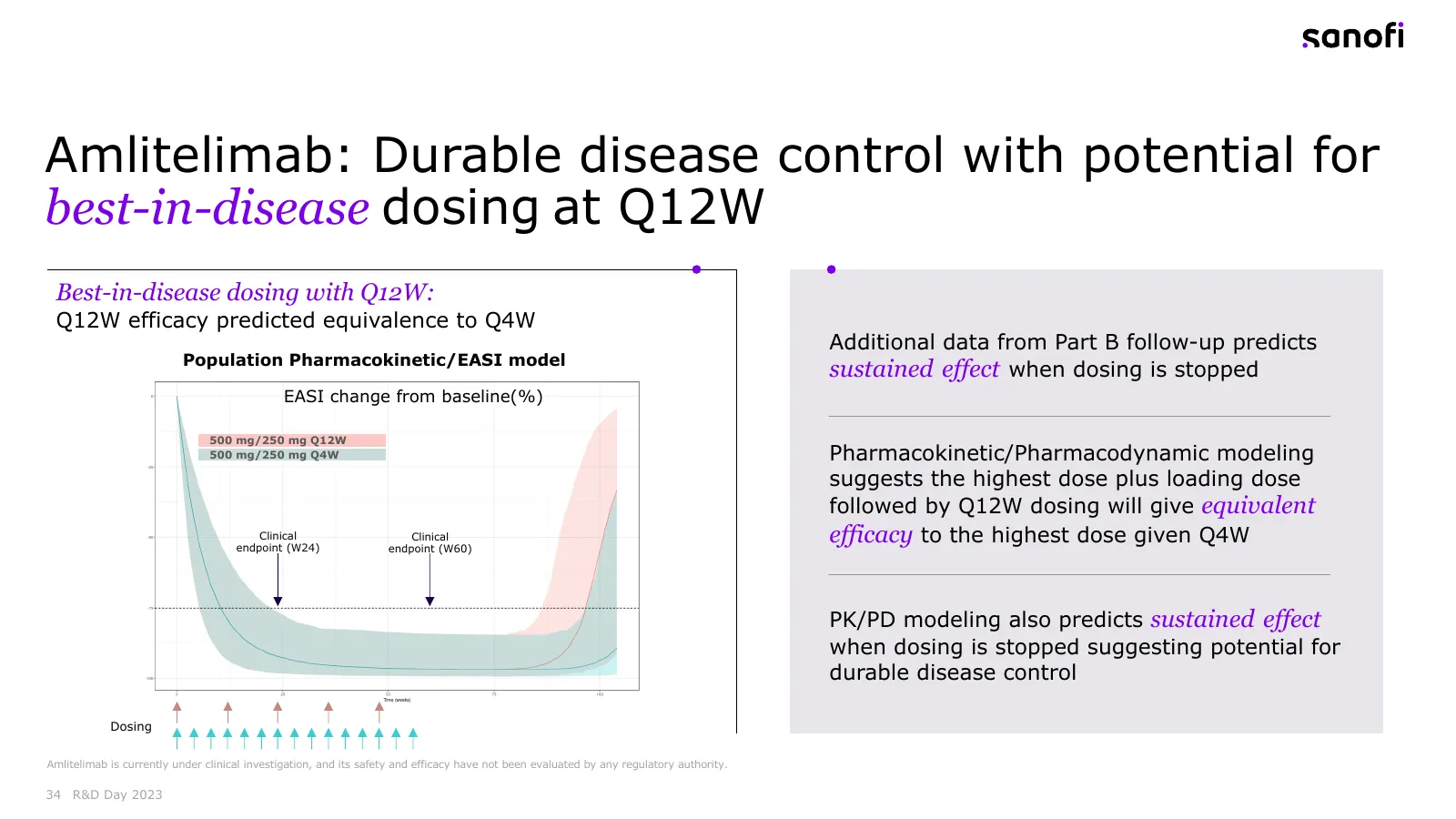
Slide 34: Amlitelimab: Durable disease control with Q12W dosing
Amlitelimab: Durable disease control with potential for best-in-disease dosing at Q12W Best-in-disease dosing with Q12W: Q12W efficacy predicted equivalence to Q4W Additional data from Part B follow-up predicts Population Pharmacokinetic/EASI model sustained effect when dosing is stopped EASI change
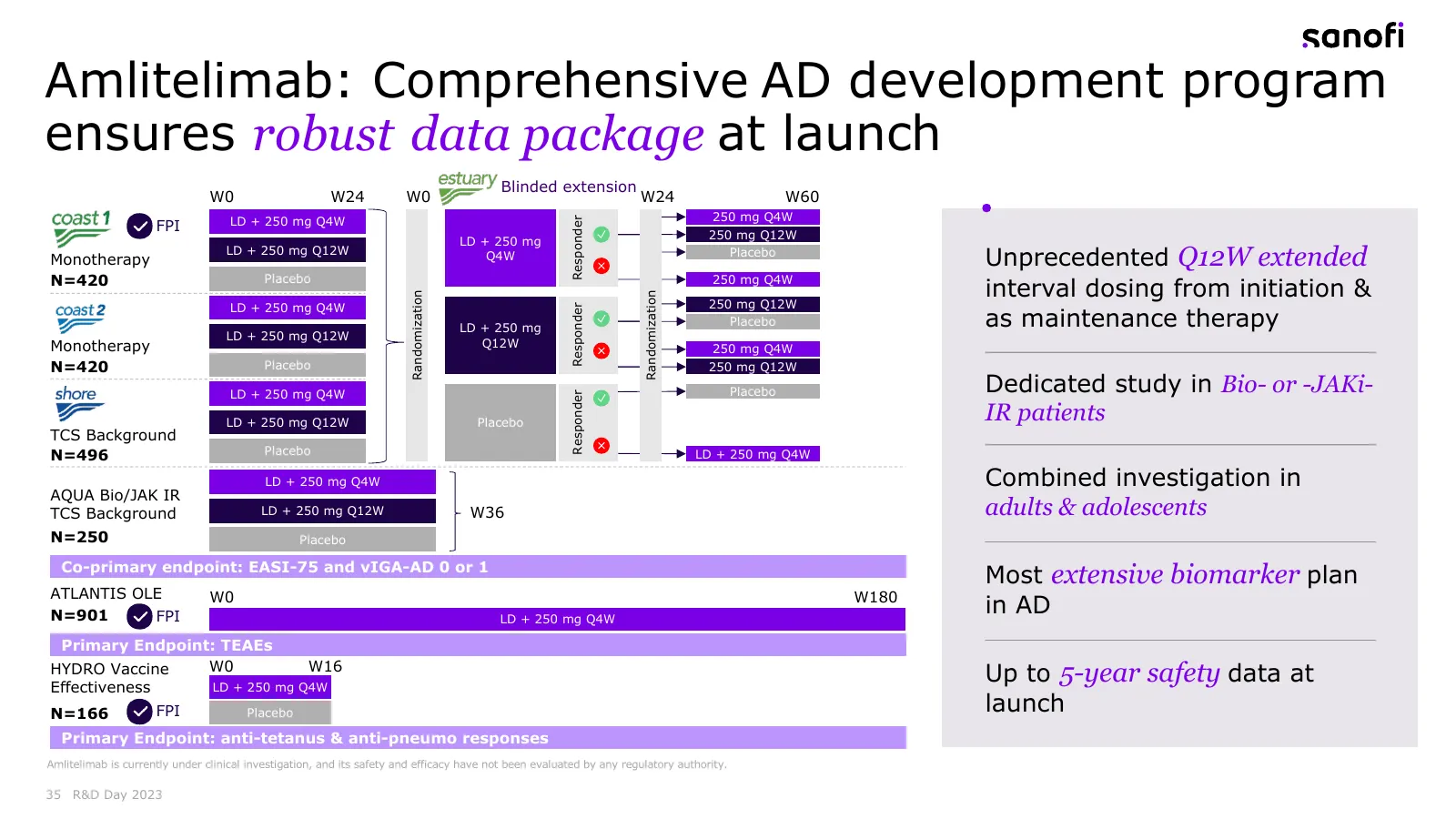
Slide 35: Amlitelimab: Comprehensive AD development program
Amlitelimab: Comprehensive AD development program ensures robust data package at launch Blinded extension W0 W24 W0 W24 W60 LD + 250 mg Q4W 250 mg Q4W FPI Responder 250 mg Q12W LD + 250 mg Monotherapy LD + 250 mg Q12W Q4W Placebo Unprecedented Q12W extended N=420 Placebo 250 mg Q4W interval dosing f
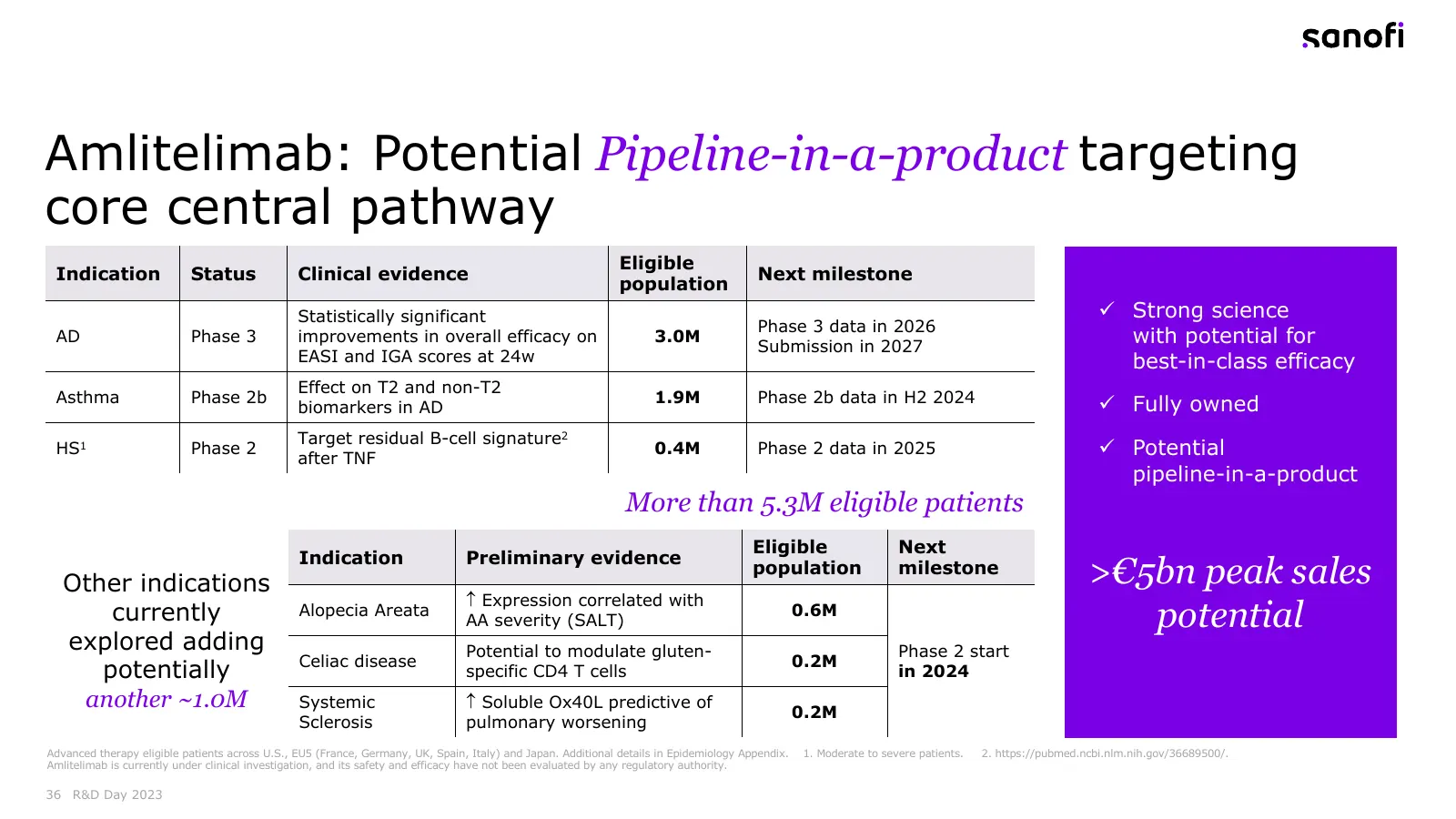
Slide 36: Amlitelimab: Potential Pipeline-in-a-product
Amlitelimab: Potential Pipeline-in-a-product targeting core central pathway Eligible Indication Status Clinical evidence Next milestone population Statistically significant ü Strong science Phase 3 data in 2026 AD Phase 3 improvements in overall efficacy on 3.0M Submission in 2027 with potential for
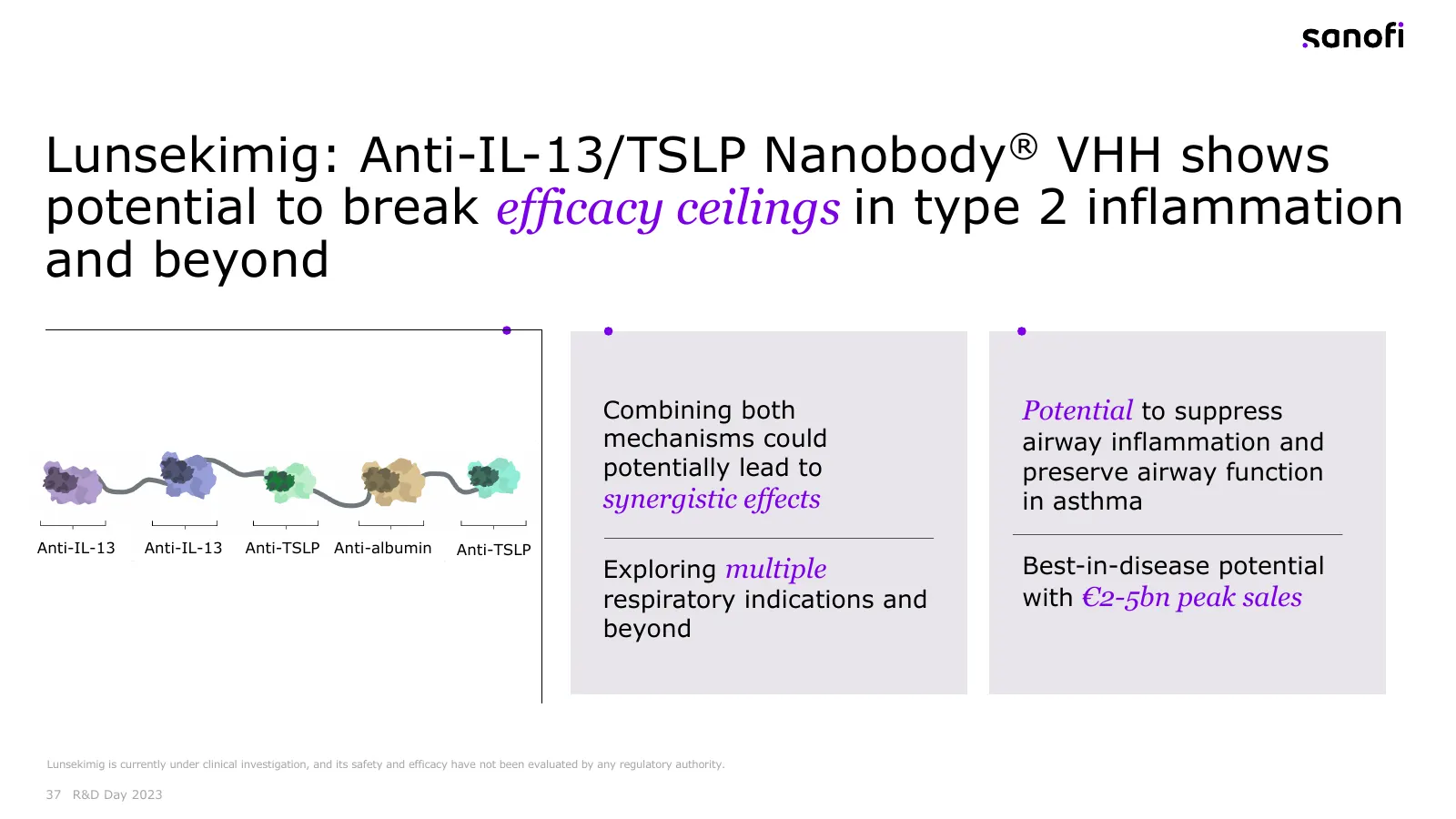
Slide 37: Lunsekimig: Anti-IL-13/TSLP Nanobody VHH
Lunsekimig: Anti-IL-13/TSLP Nanobody® VHH shows potential to break efficacy ceilings in type 2 inflammation and beyond Combining both Potential to suppress mechanisms could airway inflammation and potentially lead to preserve airway function synergistic effects in asthma Anti-IL-13 Anti-IL-13 Anti-T
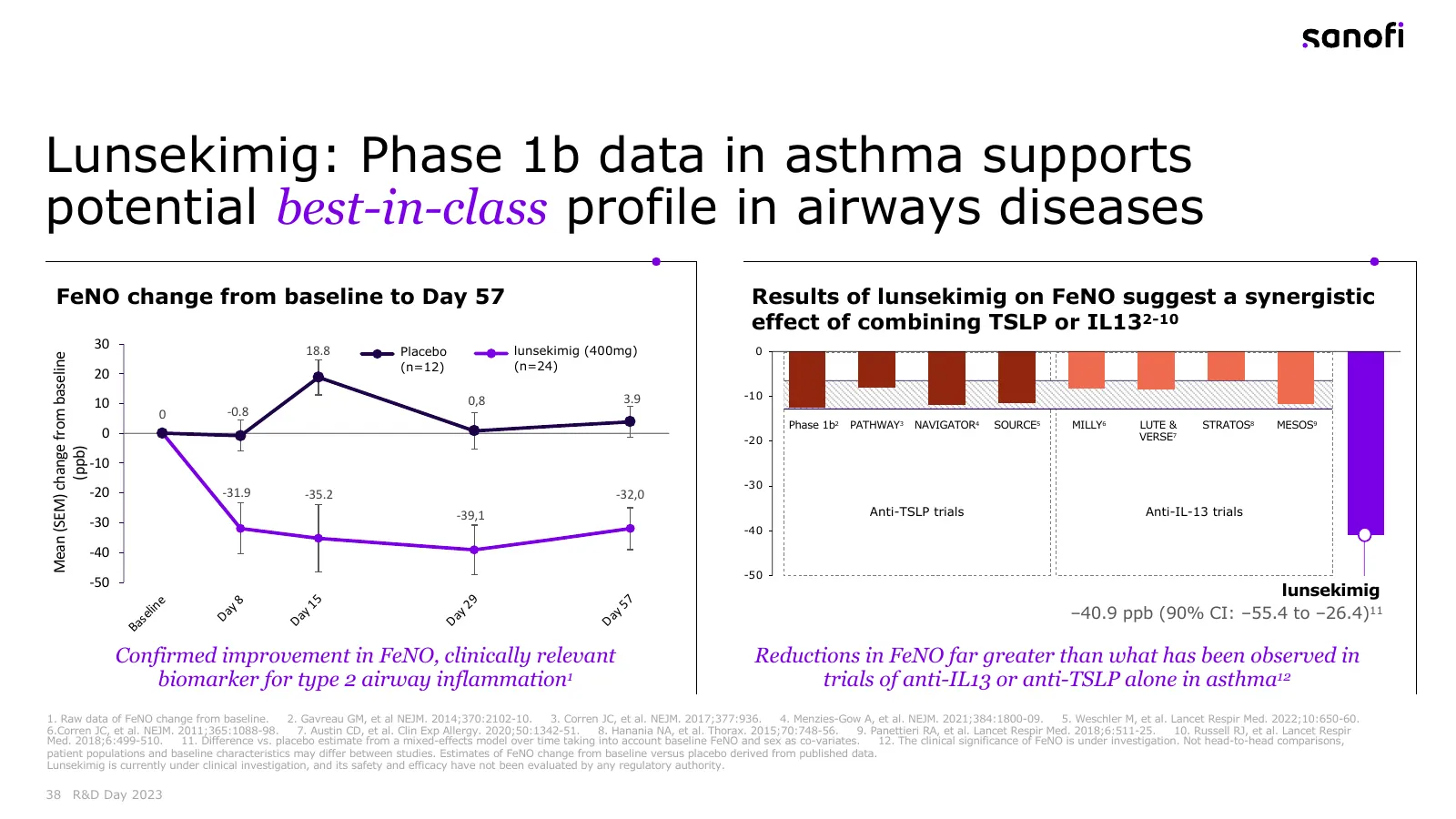
Slide 38: Lunsekimig: Phase 1b data in asthma
Lunsekimig: Phase 1b data in asthma supports potential best-in-class profile in airways diseases FeNO change from baseline to Day 57 Results of lunsekimig on FeNO suggest a synergistic effect of combining TSLP or IL132-10 30 18.8 Placebo lunsekimig (400mg) 0 Ga v re a u Co r re n 2 017 MG 2 0 21 We
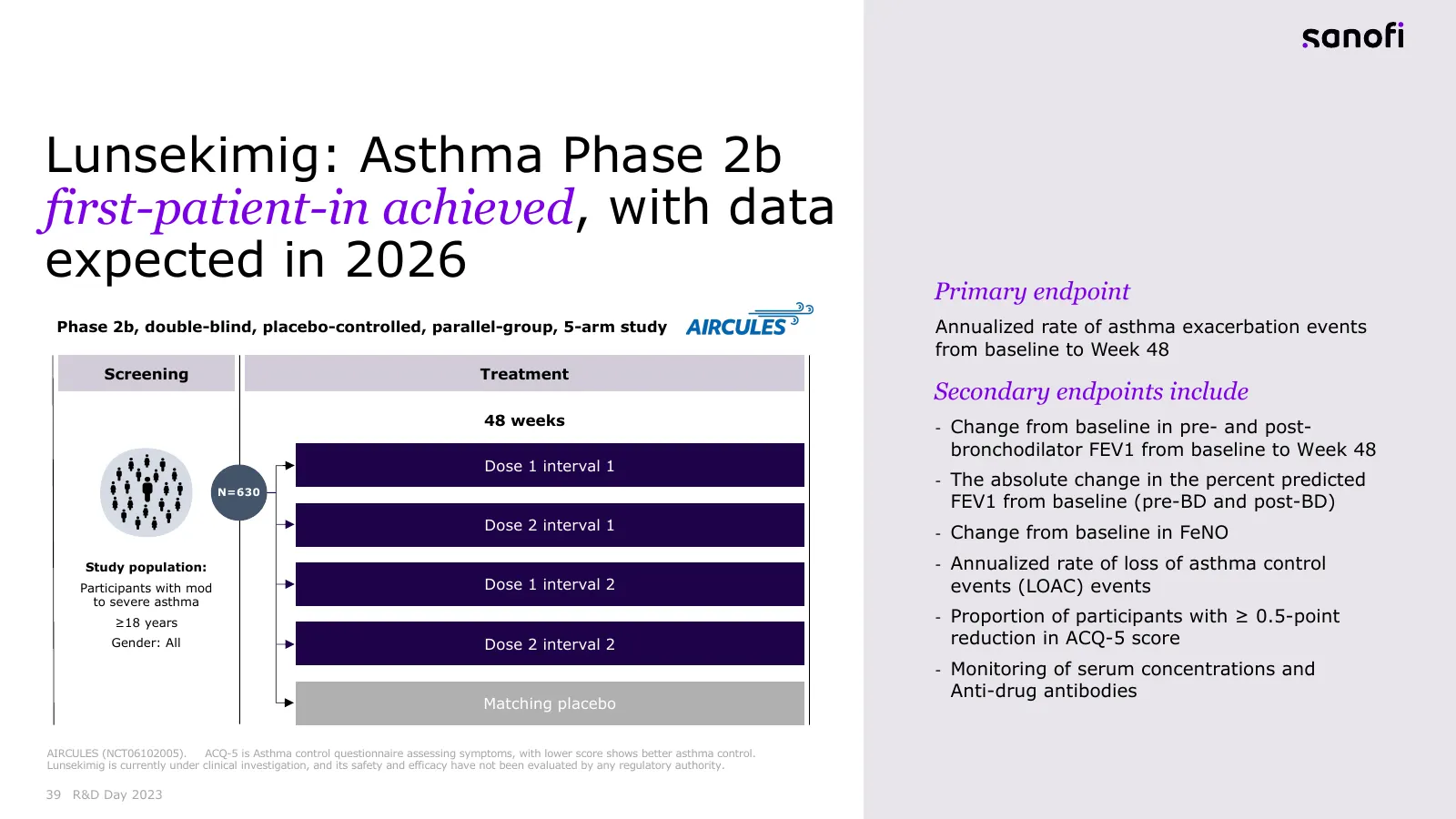
Slide 39: Lunsekimig: Asthma Phase 2b first-patient-in achieved
Lunsekimig: Asthma Phase 2b first-patient-in achieved, with data expected in 2026 Primary endpoint Phase 2b, double-blind, placebo-controlled, parallel-group, 5-arm study Annualized rate of asthma exacerbation events from baseline to Week 48 Screening Treatment Secondary endpoints include 48 weeks -
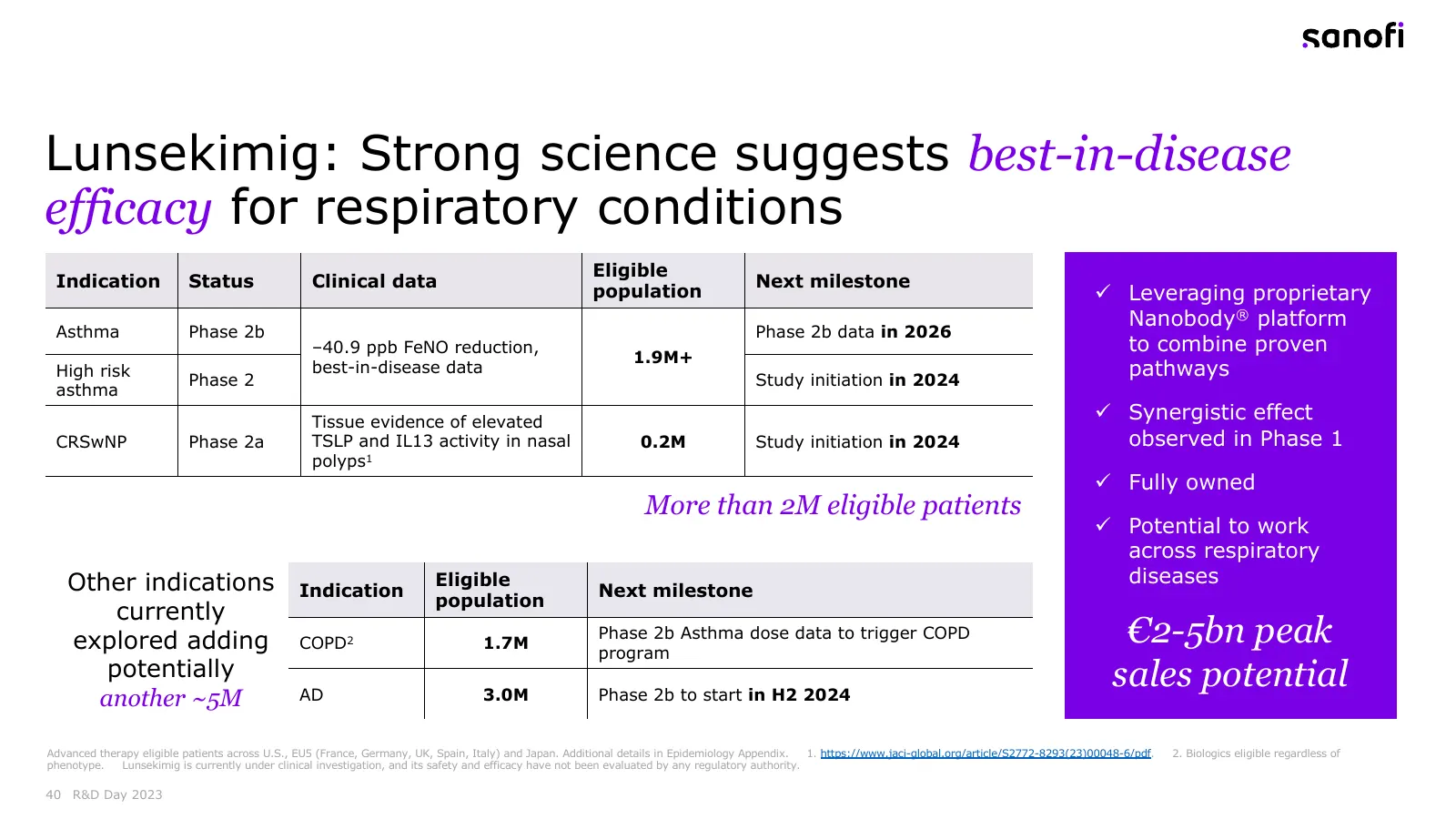
Slide 40: Lunsekimig: Strong science suggests best-in-disease efficacy
Lunsekimig: Strong science suggests best-in-disease efficacy for respiratory conditions Eligible Indication Status Clinical data Next milestone population ü Leveraging proprietary Nanobody® platform Asthma Phase 2b Phase 2b data in 2026 –40.9 ppb FeNO reduction, to combine proven 1.9M+ High risk Pha
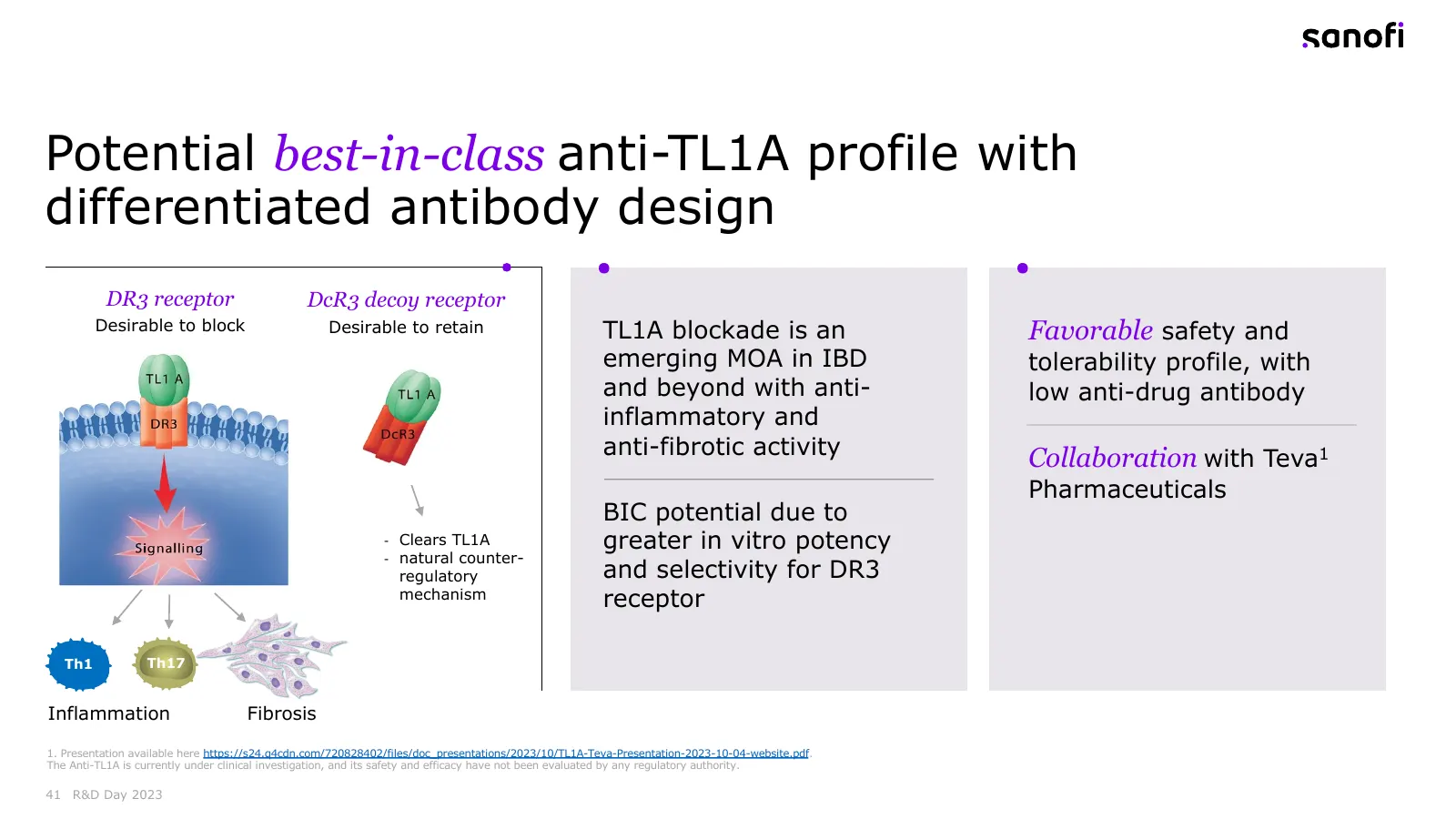
Slide 41: Potential best-in-class anti-TL1A profile
Potential best-in-class anti-TL1A profile with differentiated antibody design DR3 receptor DcR3 decoy receptor Desirable to block Desirable to retain TL1A blockade is an Favorable safety and emerging MOA in IBD tolerability profile, with and beyond with anti- low anti-drug antibody inflammatory and
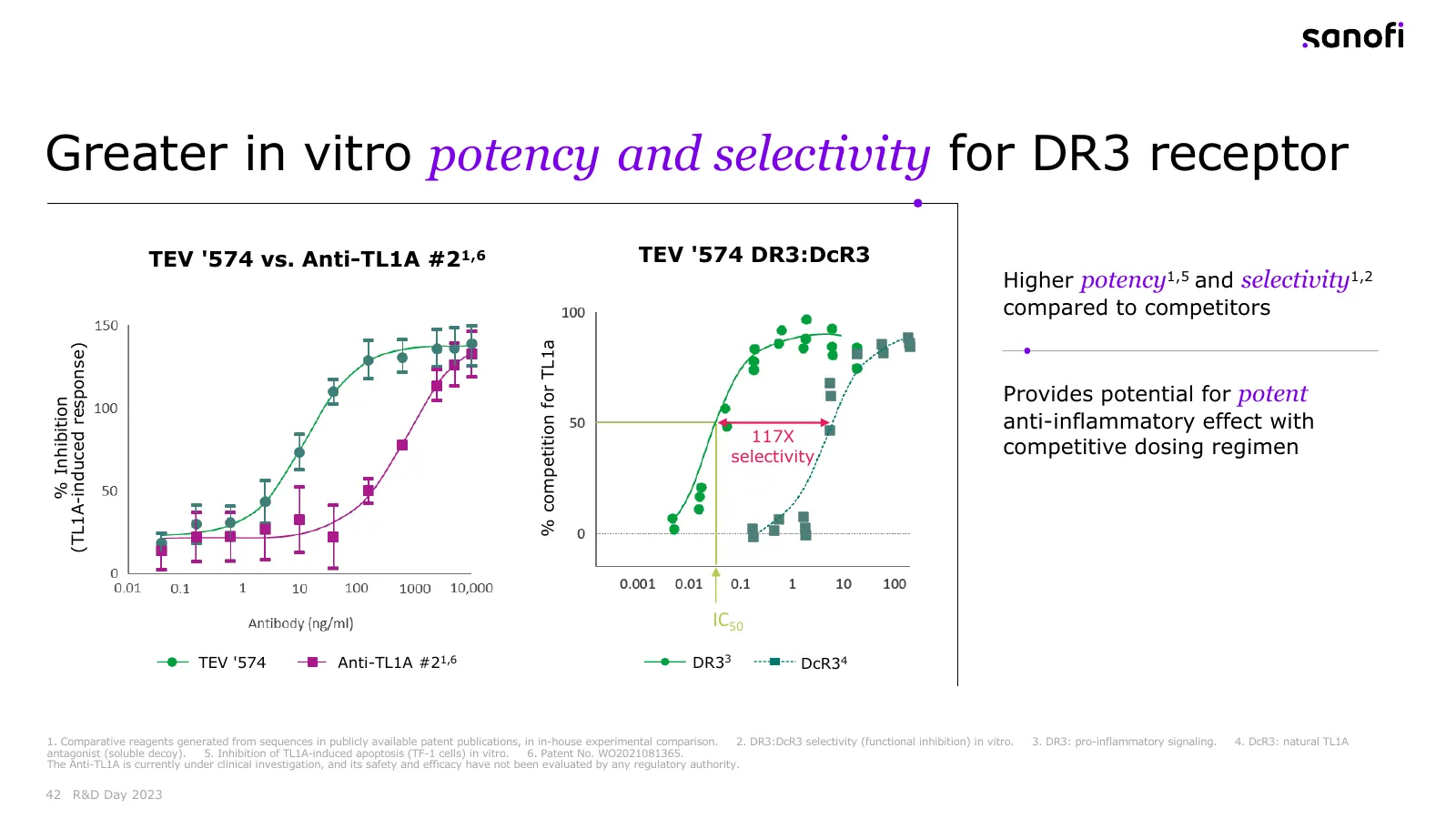
Slide 42: Greater in vitro potency and selectivity for DR3 receptor
Greater in vitro potency and selectivity for DR3 receptor TEV '574 vs. Anti-TL1A #21,6 TEV '574 DR3:DcR3 Higher potency1,5 and selectivity1,2 compared to competitors % competition for TL1a (TL1A-induced response) Provides potential for potent % Inhibition anti-inflammatory effect with 117X selectivi
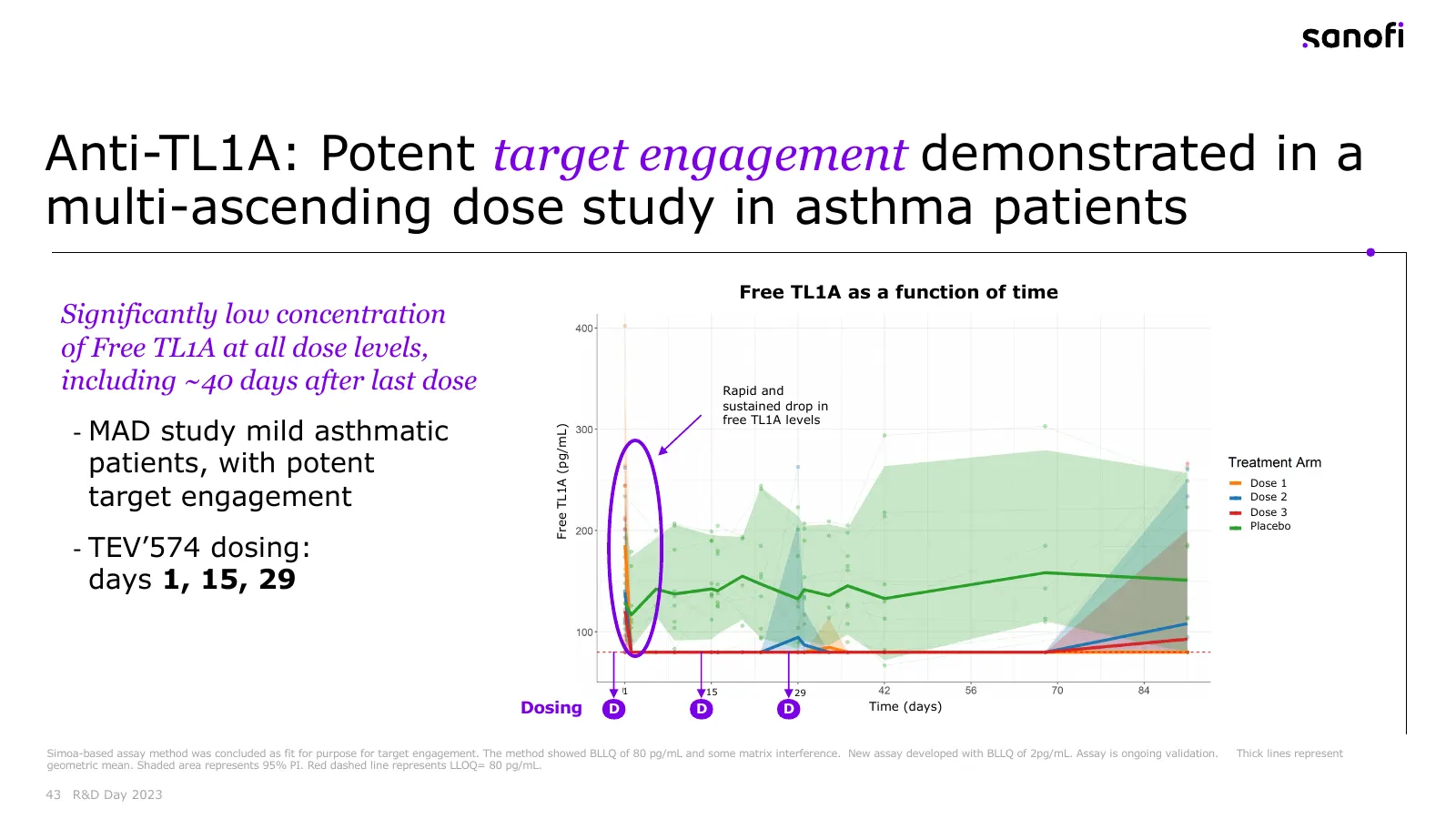
Slide 43: Anti-TL1A: Potent target engagement in multi-ascending dose study
Anti-TL1A: Potent target engagement demonstrated in a multi-ascending dose study in asthma patients Free TL1A as a function of time Significantly low concentration of Free TL1A at all dose levels, including ~40 days after last dose Rapid and sustained drop in free TL1A levels - MAD study mild asthma
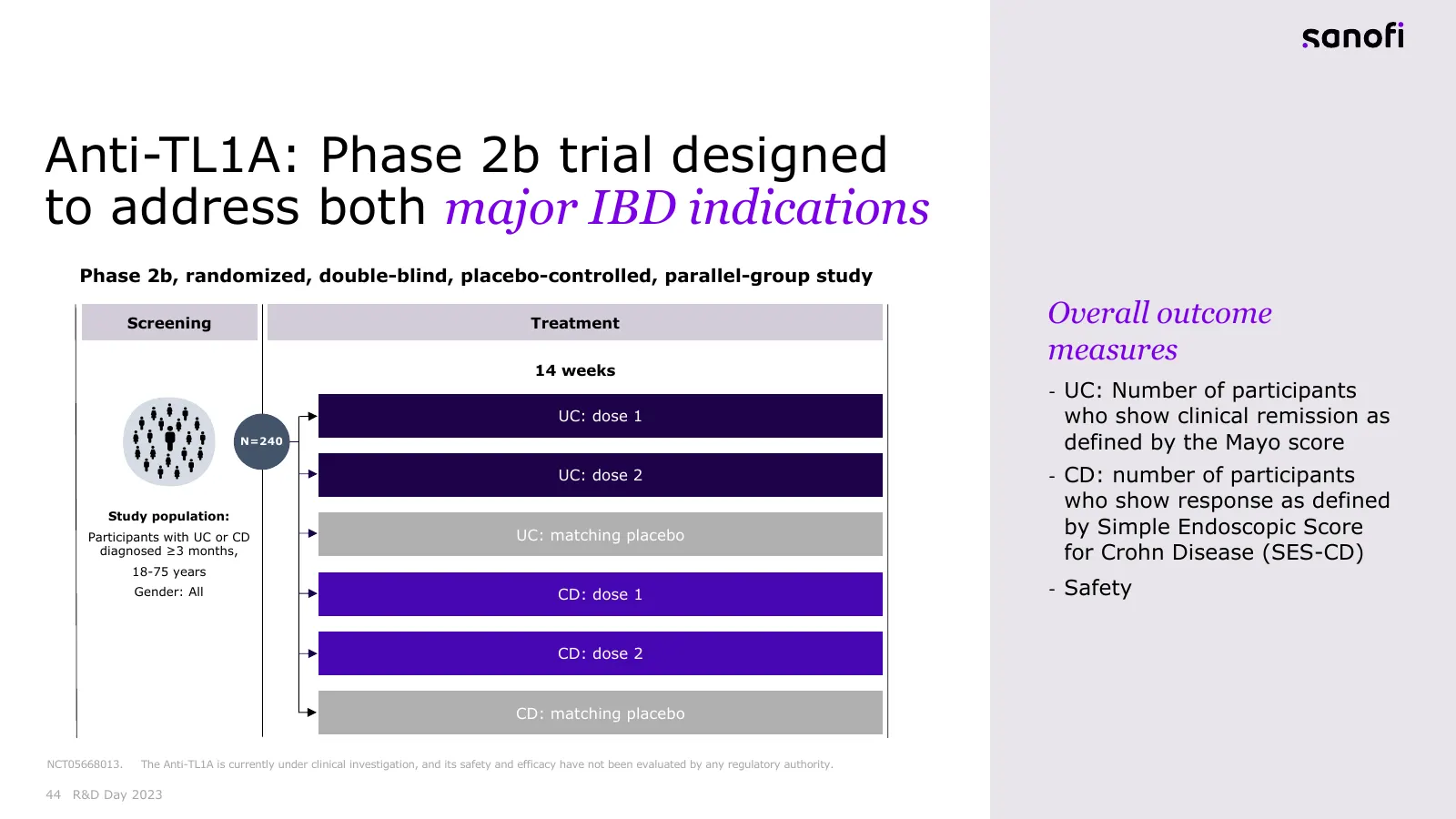
Slide 44: Anti-TL1A: Phase 2b trial in IBD
Anti-TL1A: Phase 2b trial designed to address both major IBD indications Phase 2b, randomized, double-blind, placebo-controlled, parallel-group study Screening Treatment Overall outcome measures 14 weeks - UC: Number of participants UC: dose 1 who show clinical remission as N=240 defined by the Mayo
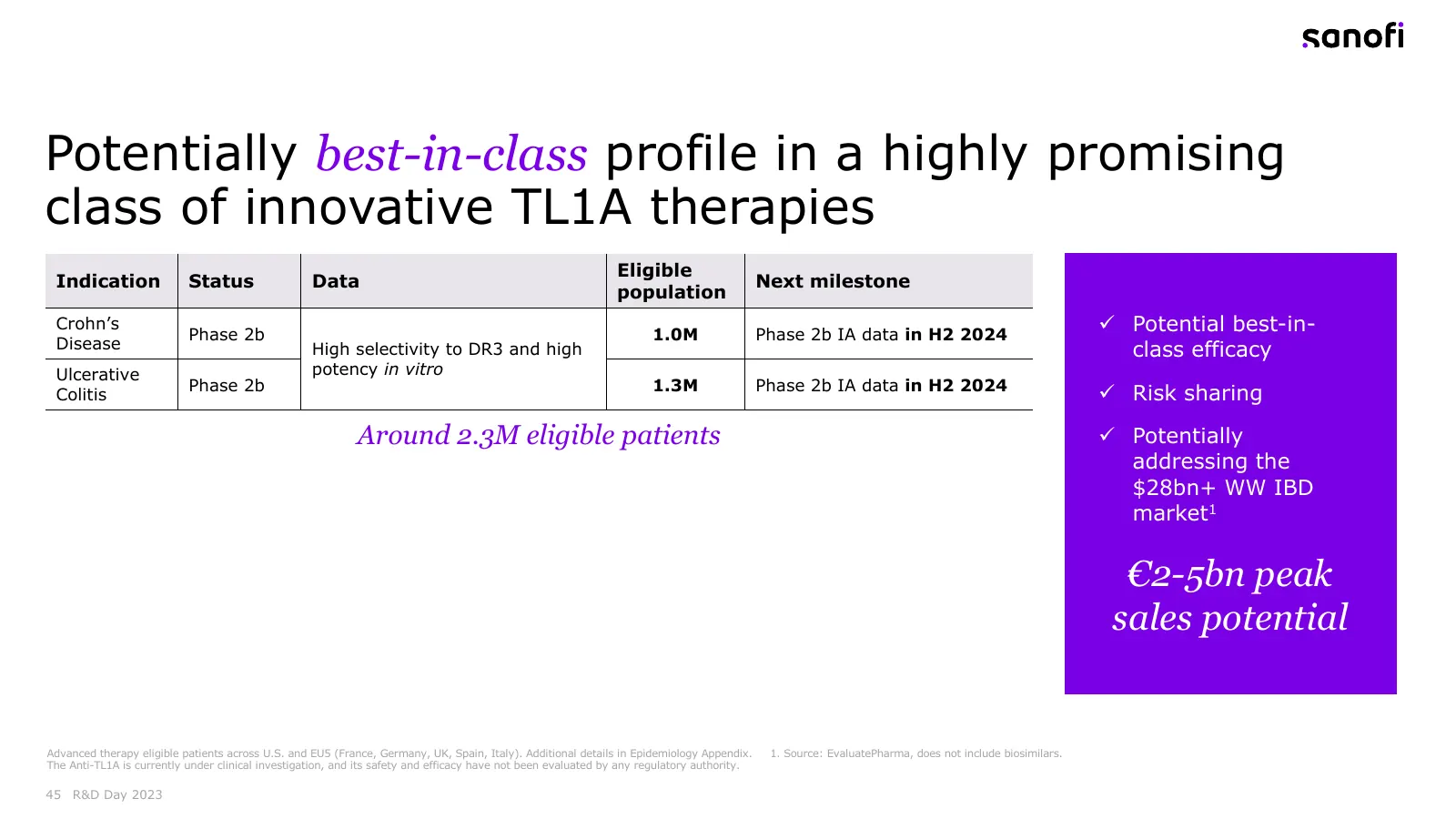
Slide 45: Potentially best-in-class profile in TL1A therapies
Potentially best-in-class profile in a highly promising class of innovative TL1A therapies Eligible Indication Status Data Next milestone population Crohn’s Phase 2b 1.0M Phase 2b IA data in H2 2024 ü Potential best-in- Disease High selectivity to DR3 and high class efficacy Ulcerative potency in vi
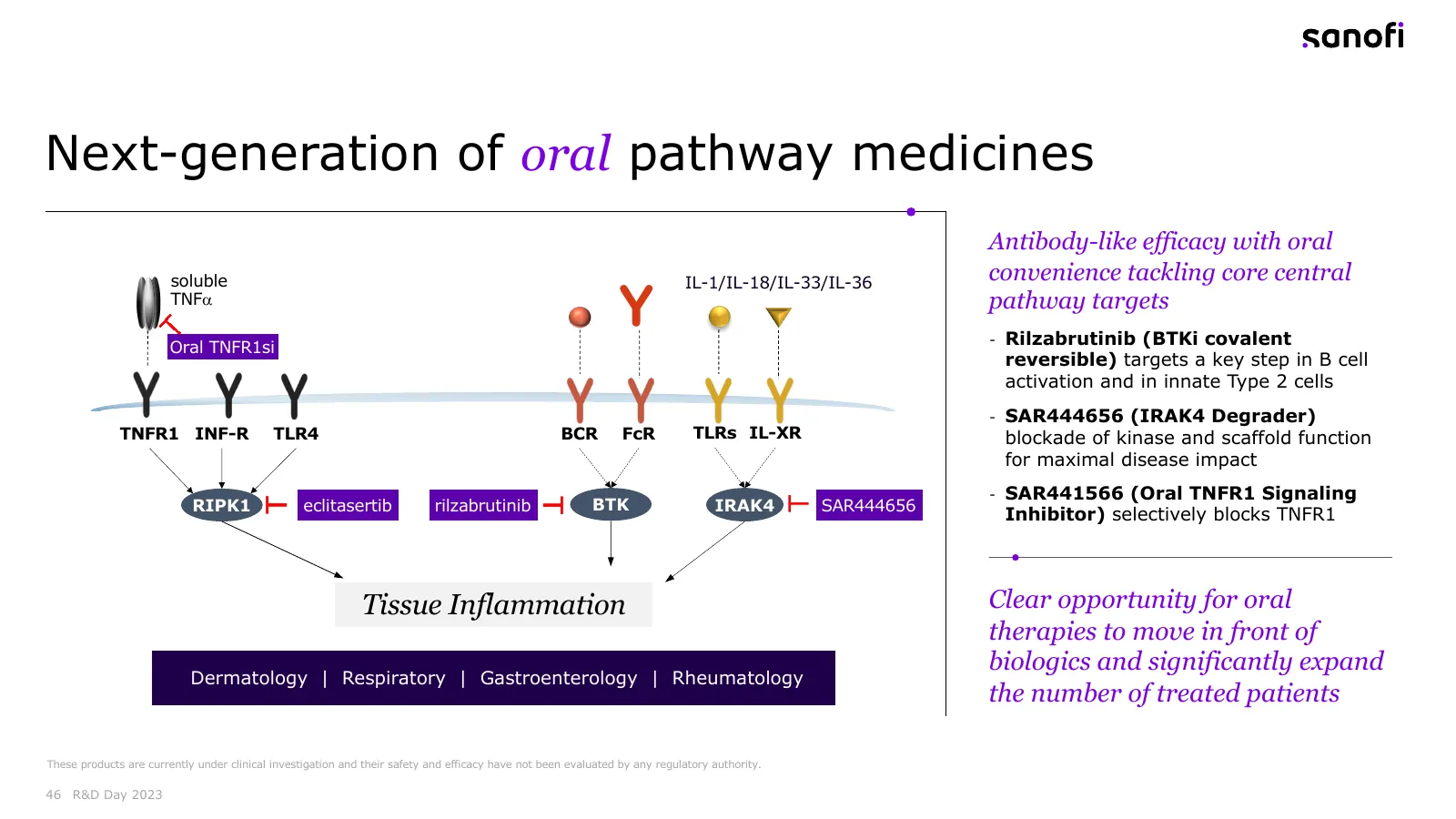
Slide 46: Next-generation of oral pathway medicines
Next-generation of oral pathway medicines Antibody-like efficacy with oral soluble IL-1/IL-18/IL-33/IL-36 convenience tackling core central TNFa Oral TNFR1si Y pathway targets - Rilzabrutinib (BTKi covalent reversible) targets a key step in B cell activation and in innate Type 2 cells - SAR444656 (I
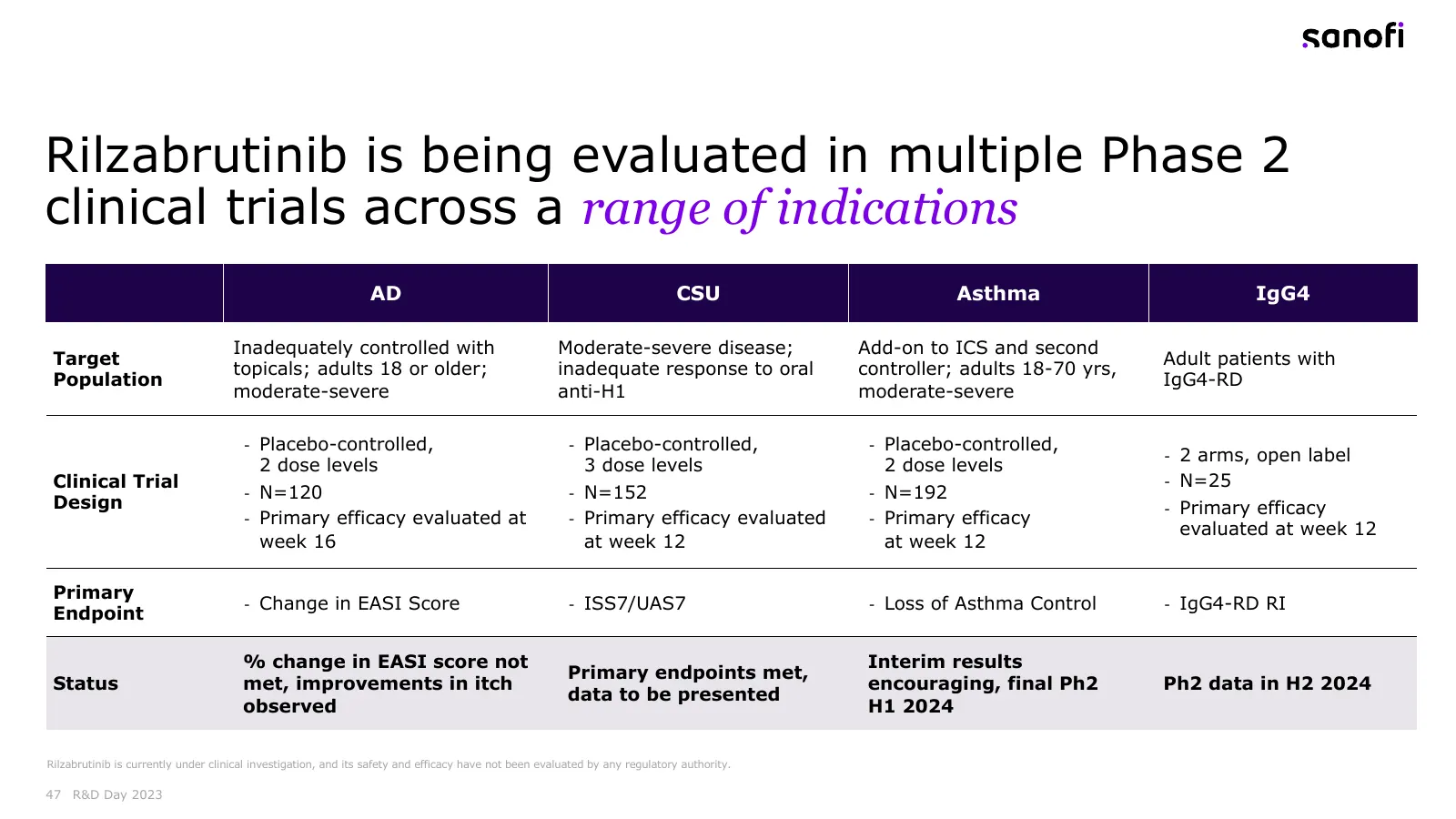
Slide 47: Rilzabrutinib evaluated in multiple Phase 2 trials
Rilzabrutinib is being evaluated in multiple Phase 2 clinical trials across a range of indications AD CSU Asthma IgG4 Inadequately controlled with Moderate-severe disease; Add-on to ICS and second Target Adult patients with topicals; adults 18 or older; inadequate response to oral controller; adults
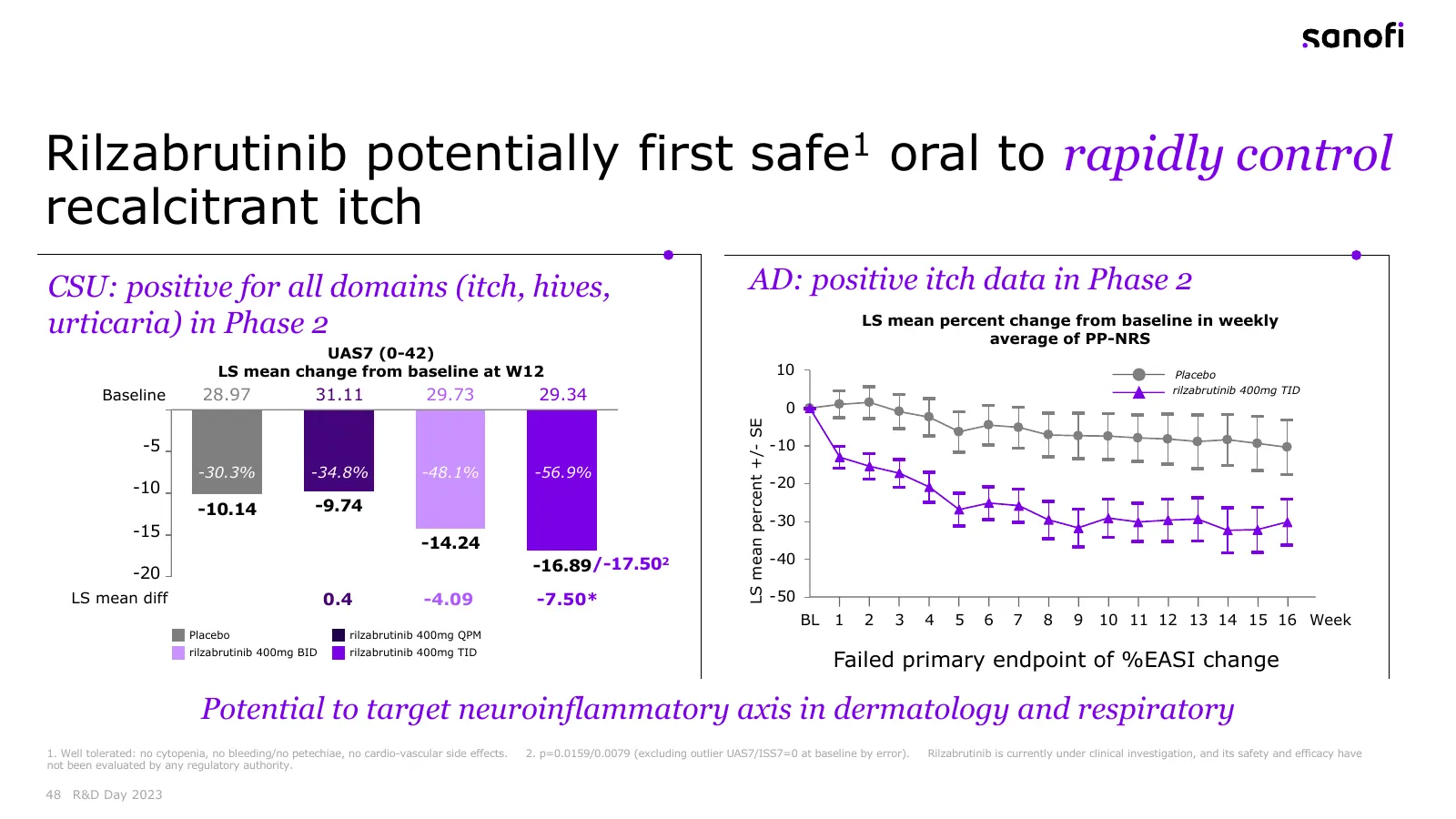
Slide 48: Rilzabrutinib potentially first safe oral to control recalcitrant itch
Rilzabrutinib potentially first safe1 oral to rapidly control recalcitrant itch CSU: positive for all domains (itch, hives, AD: positive itch data in Phase 2 urticaria) in Phase 2 LS mean percent change from baseline in weekly average of PP-NRS UAS7 (0-42) LS mean change from baseline at W12 10 Plac
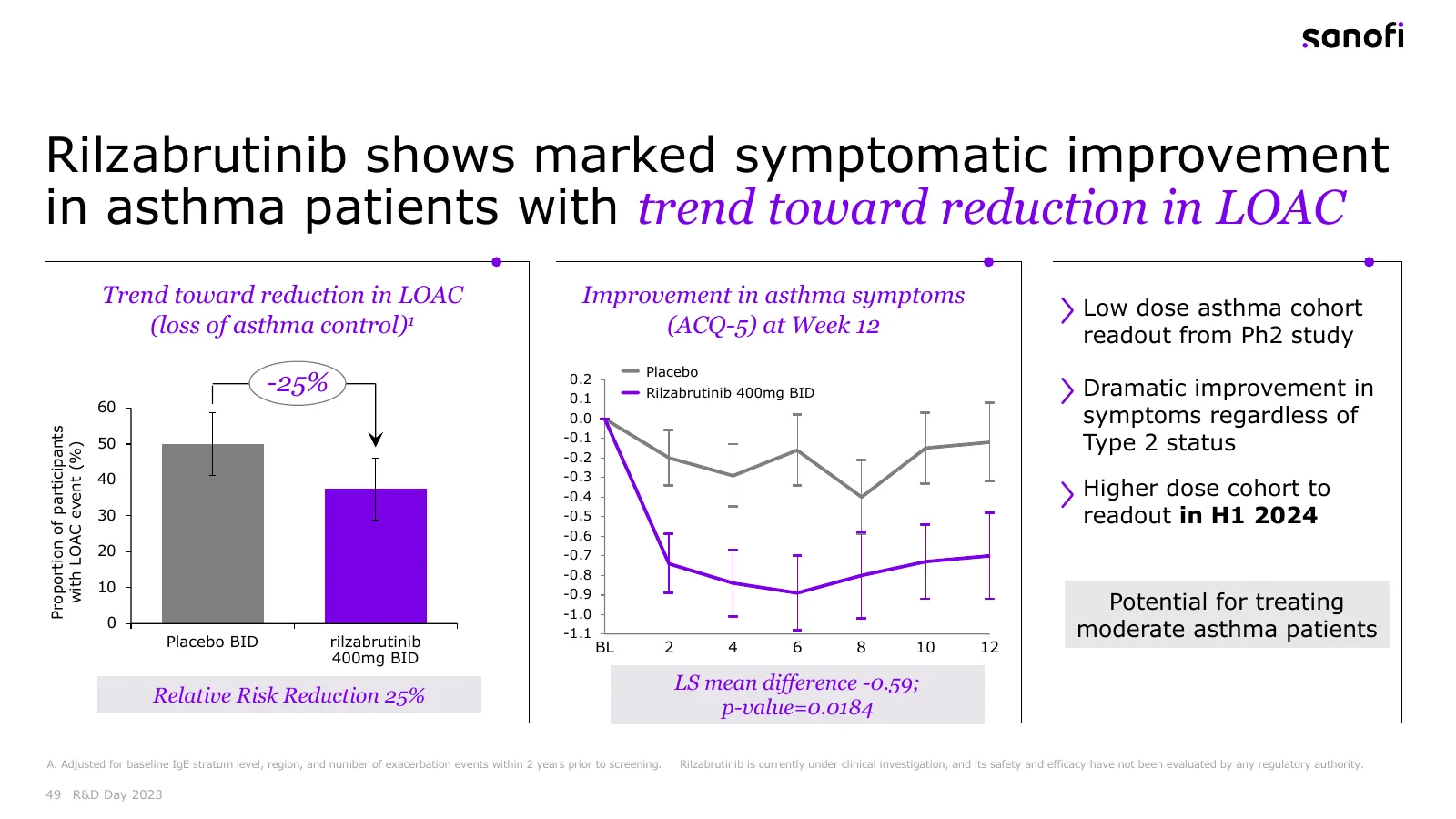
Slide 49: Rilzabrutinib improvement in asthma patients
Rilzabrutinib shows marked symptomatic improvement in asthma patients with trend toward reduction in LOAC Trend toward reduction in LOAC Improvement in asthma symptoms Low dose asthma cohort (loss of asthma control)1 (ACQ-5) at Week 12 readout from Ph2 study Placebo -25% 0.2 0.1 Rilzabrutinib 400mg
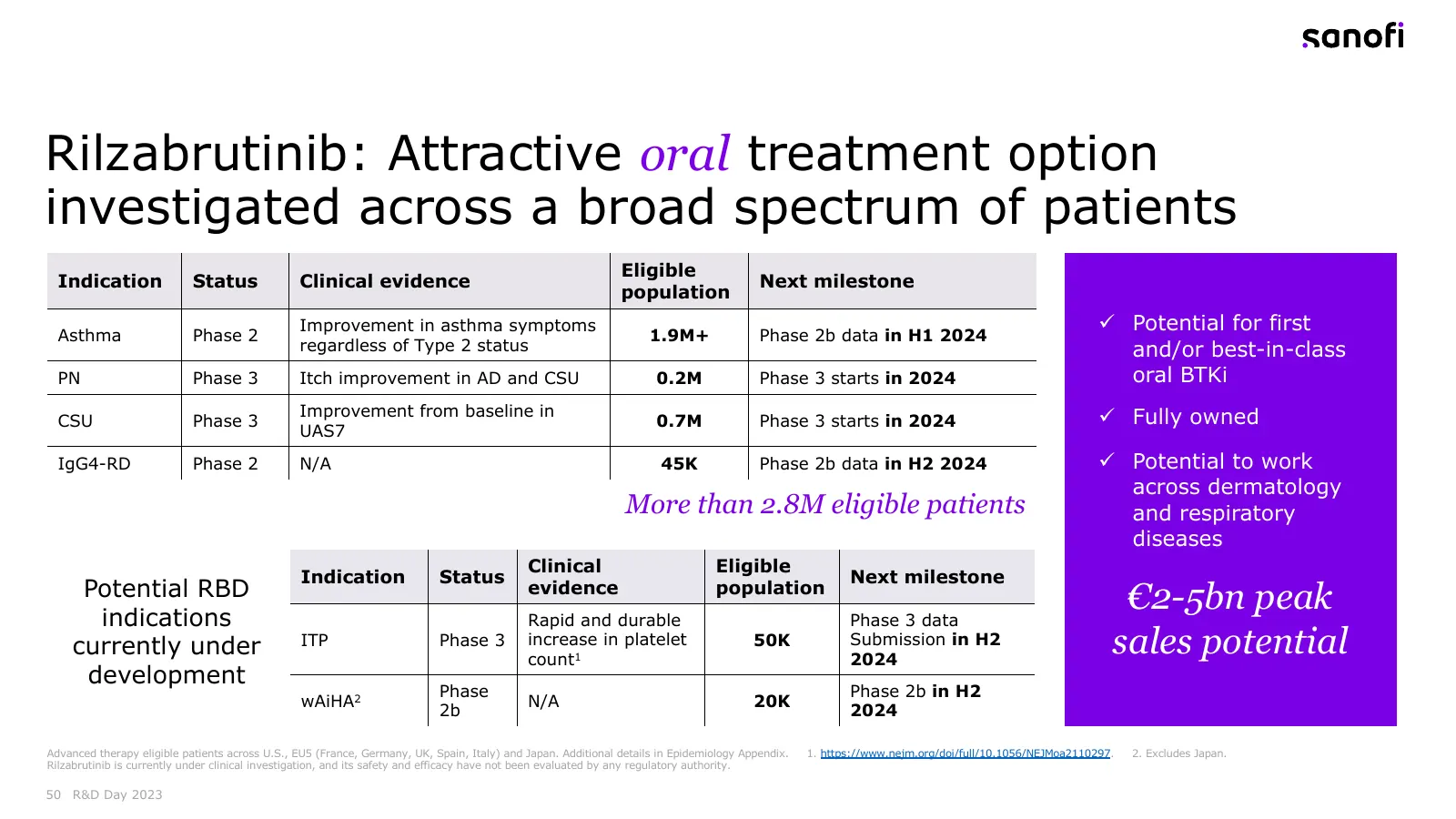
Slide 50: Rilzabrutinib: Attractive oral treatment option
Rilzabrutinib: Attractive oral treatment option investigated across a broad spectrum of patients Eligible Indication Status Clinical evidence Next milestone population Asthma Phase 2 Improvement in asthma symptoms 1.9M+ Phase 2b data in H1 2024 ü Potential for first regardless of Type 2 status and/o
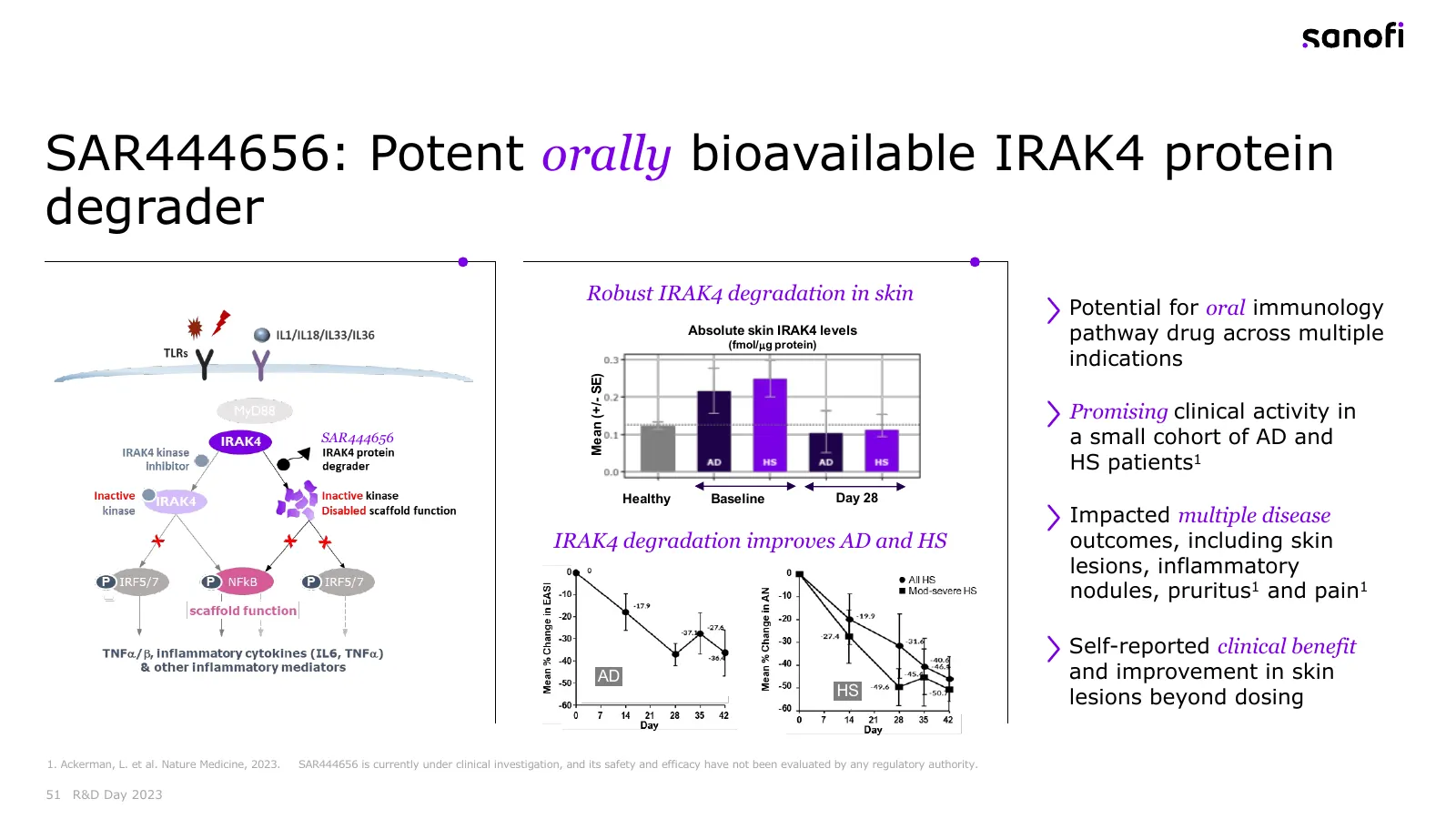
Slide 51: SAR444656: Potent orally bioavailable IRAK4 protein degrader
SAR444656: Potent orally bioavailable IRAK4 protein degrader Robust IRAK4 degradation in skin Potential for oral immunology Absolute skin IRAK4 levels (fmol/µg protein) pathway drug across multiple indications Mean (+/- SE) Promising clinical activity in SAR444656 a small cohort of AD and HS patient
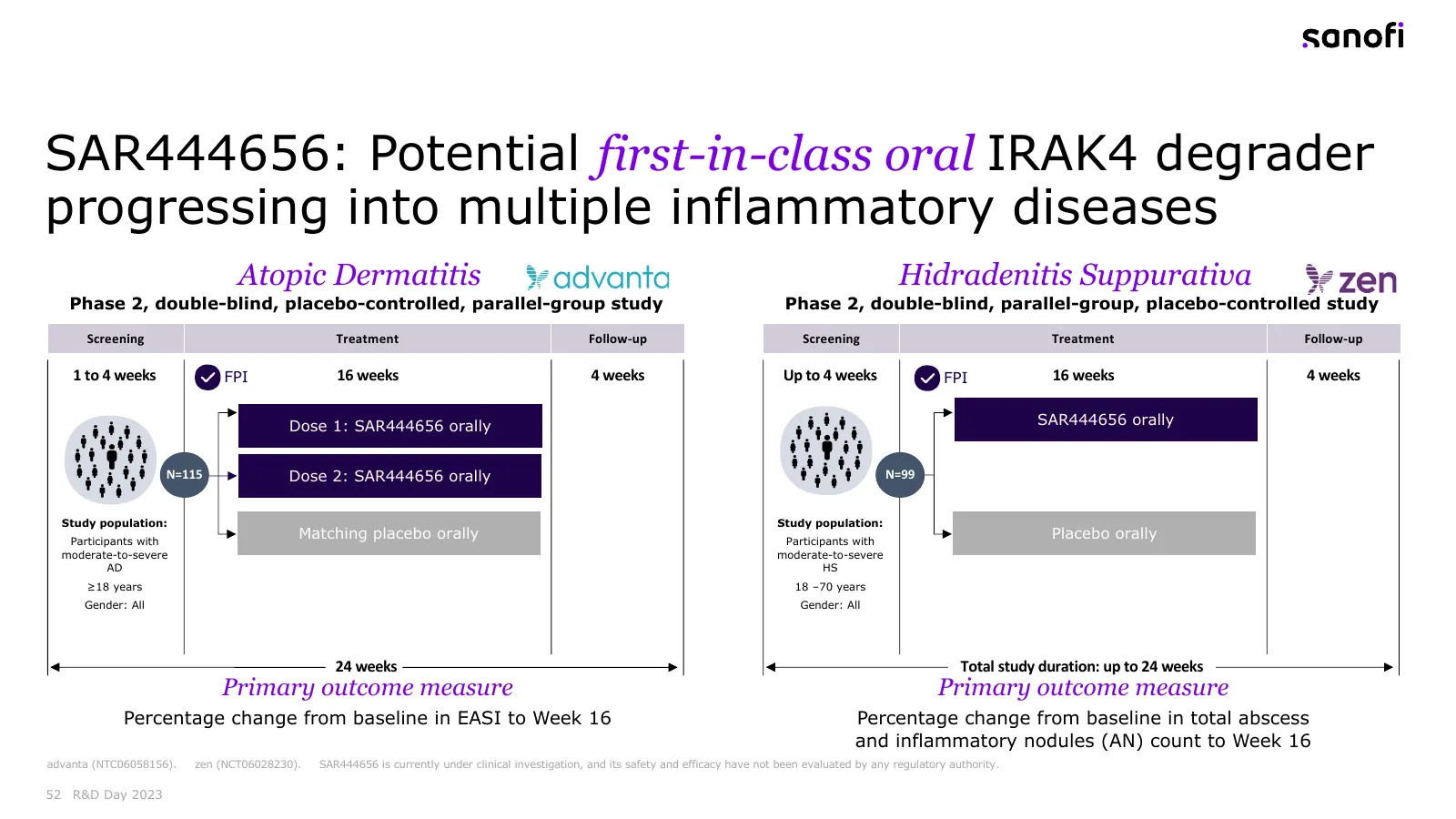
Slide 52: SAR444656: Progressing into multiple inflammatory diseases
SAR444656: Potential first-in-class oral IRAK4 degrader progressing into multiple inflammatory diseases Atopic Dermatitis Hidradenitis Suppurativa Phase 2, double-blind, placebo-controlled, parallel-group study Phase 2, double-blind, parallel-group, placebo-controlled study Screening Treatment Follo
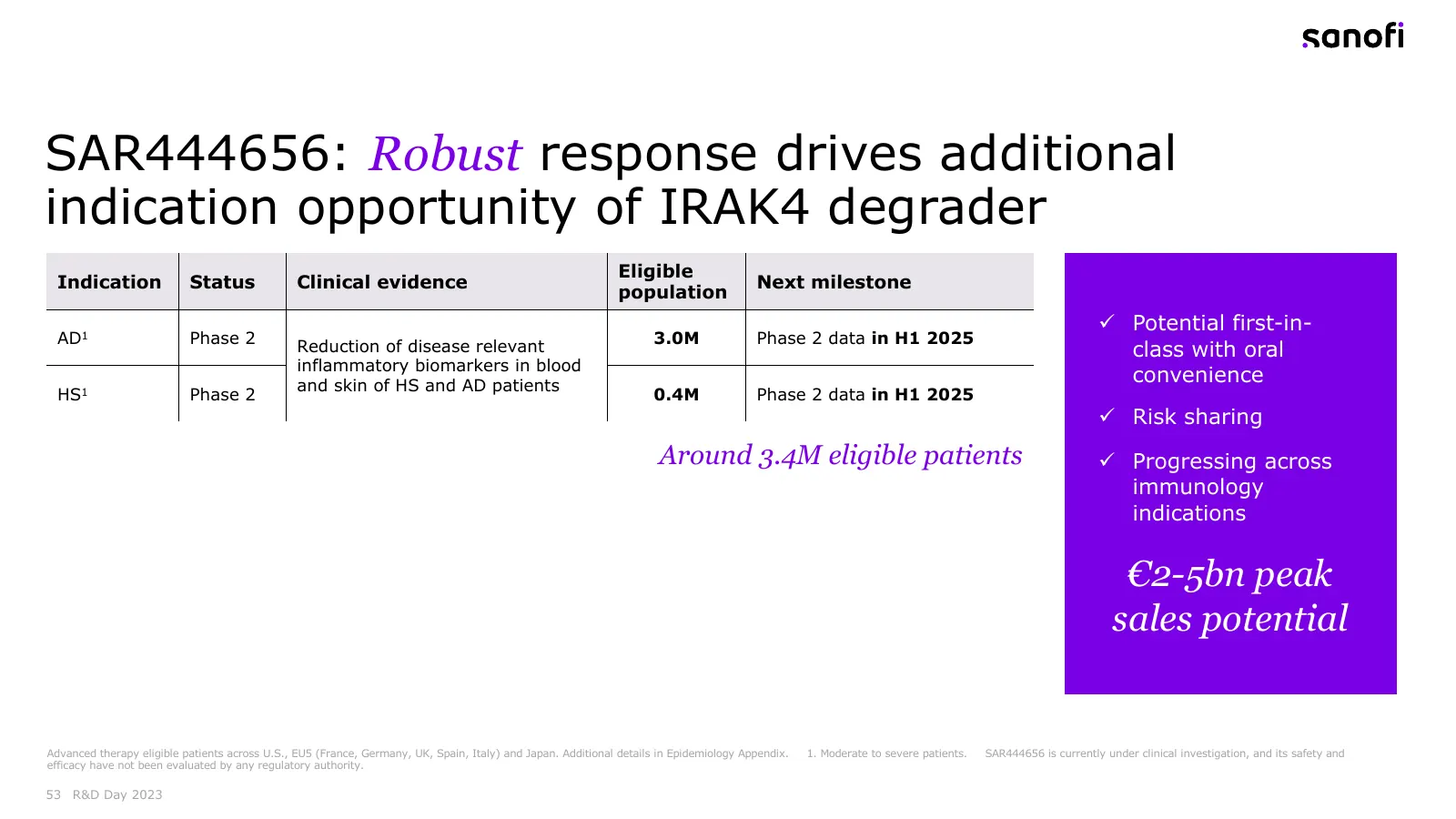
Slide 53: SAR444656: Additional indication opportunity
SAR444656: Robust response drives additional indication opportunity of IRAK4 degrader Eligible Indication Status Clinical evidence Next milestone population ü Potential first-in- AD1 Phase 2 3.0M Phase 2 data in H1 2025 Reduction of disease relevant class with oral inflammatory biomarkers in blood a
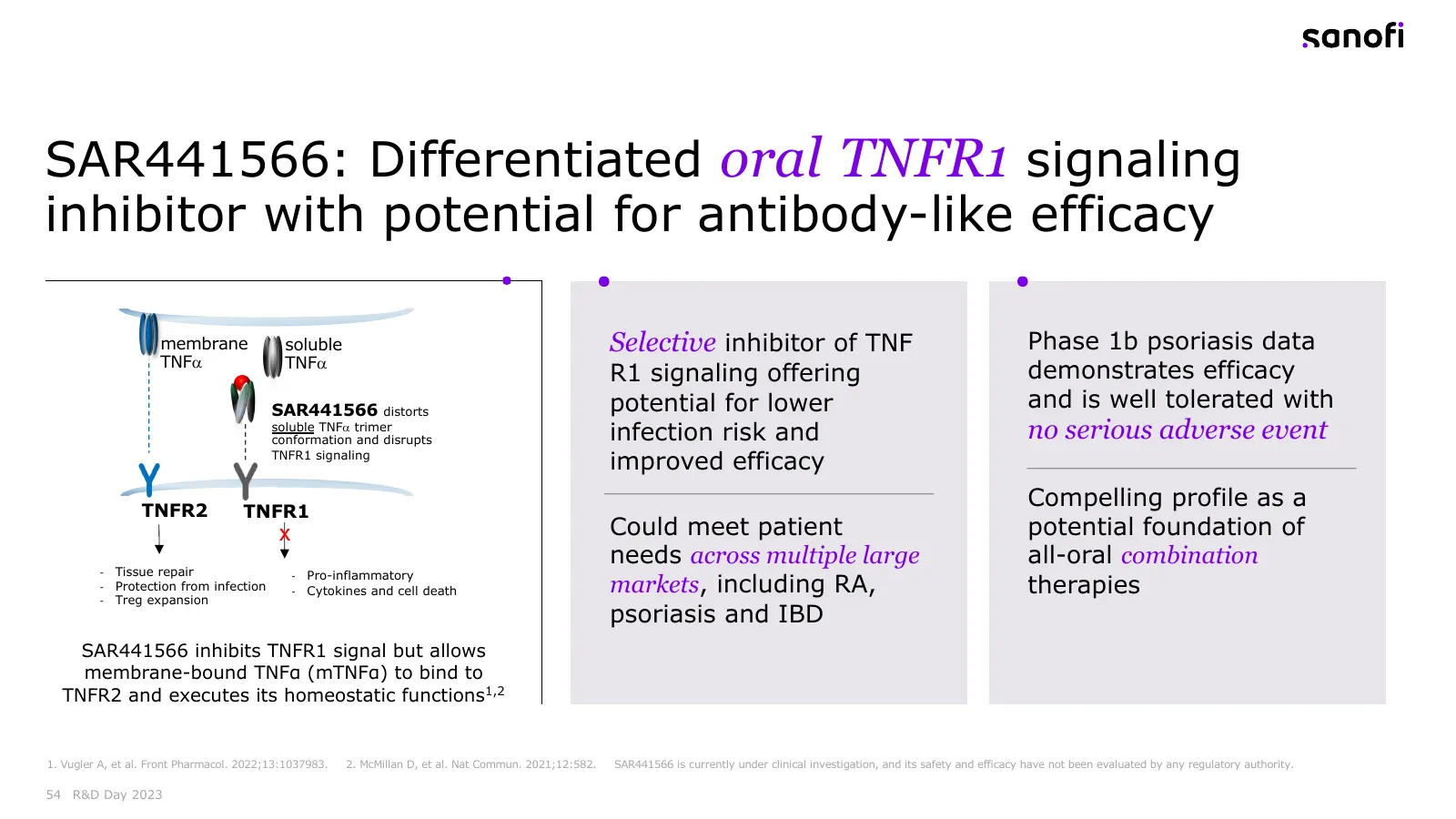
Slide 54: SAR441566: Differentiated oral TNFR1 signaling inhibitor
SAR441566: Differentiated oral TNFR1 signaling inhibitor with potential for antibody-like efficacy membrane soluble Selective inhibitor of TNF Phase 1b psoriasis data TNFa TNFa R1 signaling offering demonstrates efficacy SAR441566 distorts potential for lower and is well tolerated with soluble TNFa
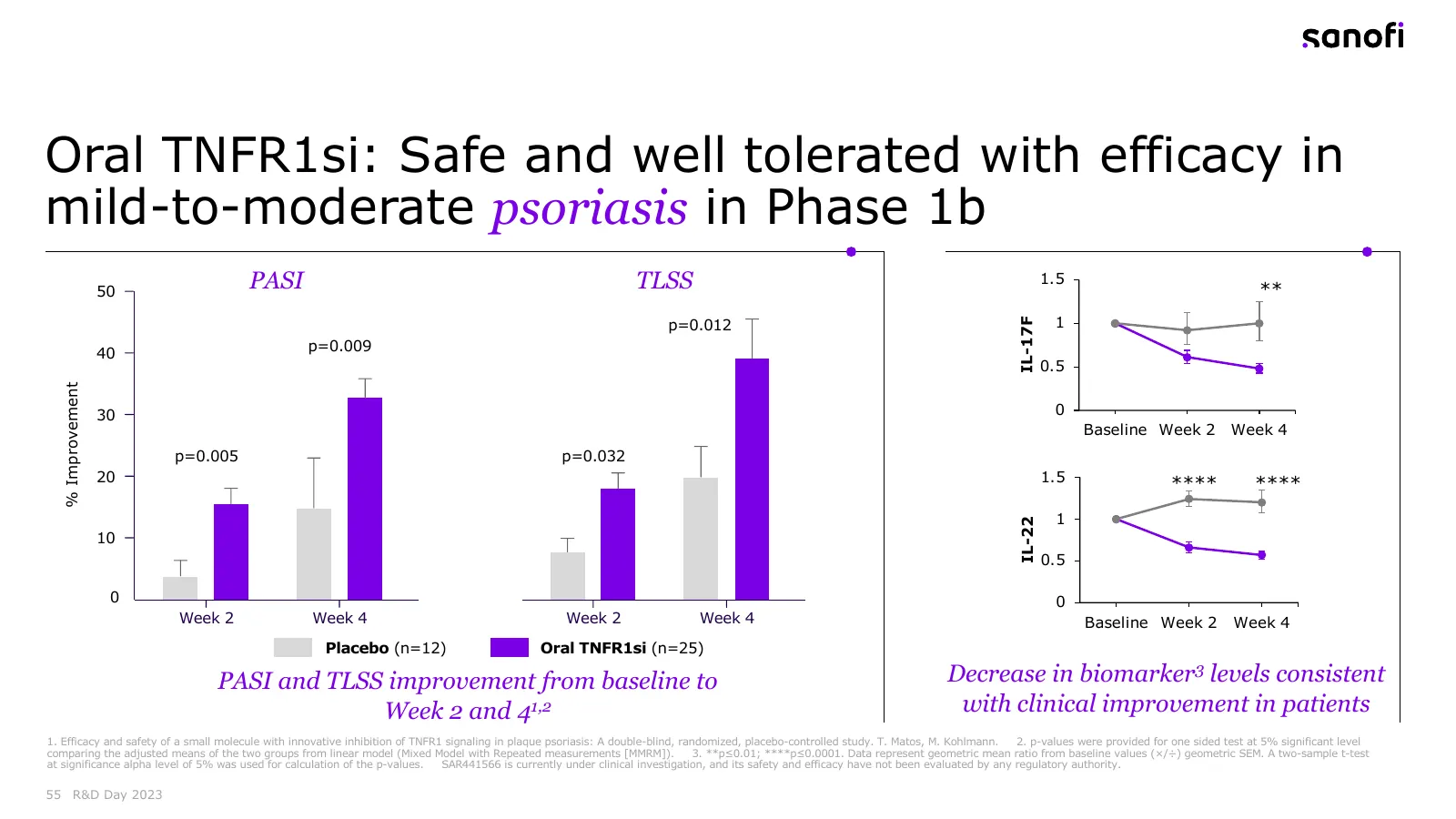
Slide 55: Oral TNFR1si: Efficacy in psoriasis in Phase 1b
Oral TNFR1si: Safe and well tolerated with efficacy in mild-to-moderate psoriasis in Phase 1b 50 PASI TLSS 1.5 ** p=0.012 1 IL-17F p=0.009 40 0.5 % Improvement 30 0 Baseline Week 2 Week 4 p=0.005 p=0.032 20 1.5 **** **** 1 IL-22 10 0.5 0 0 Week 2 Week 4 Week 2 Week 4 Baseline Week 2 Week 4 Placebo (
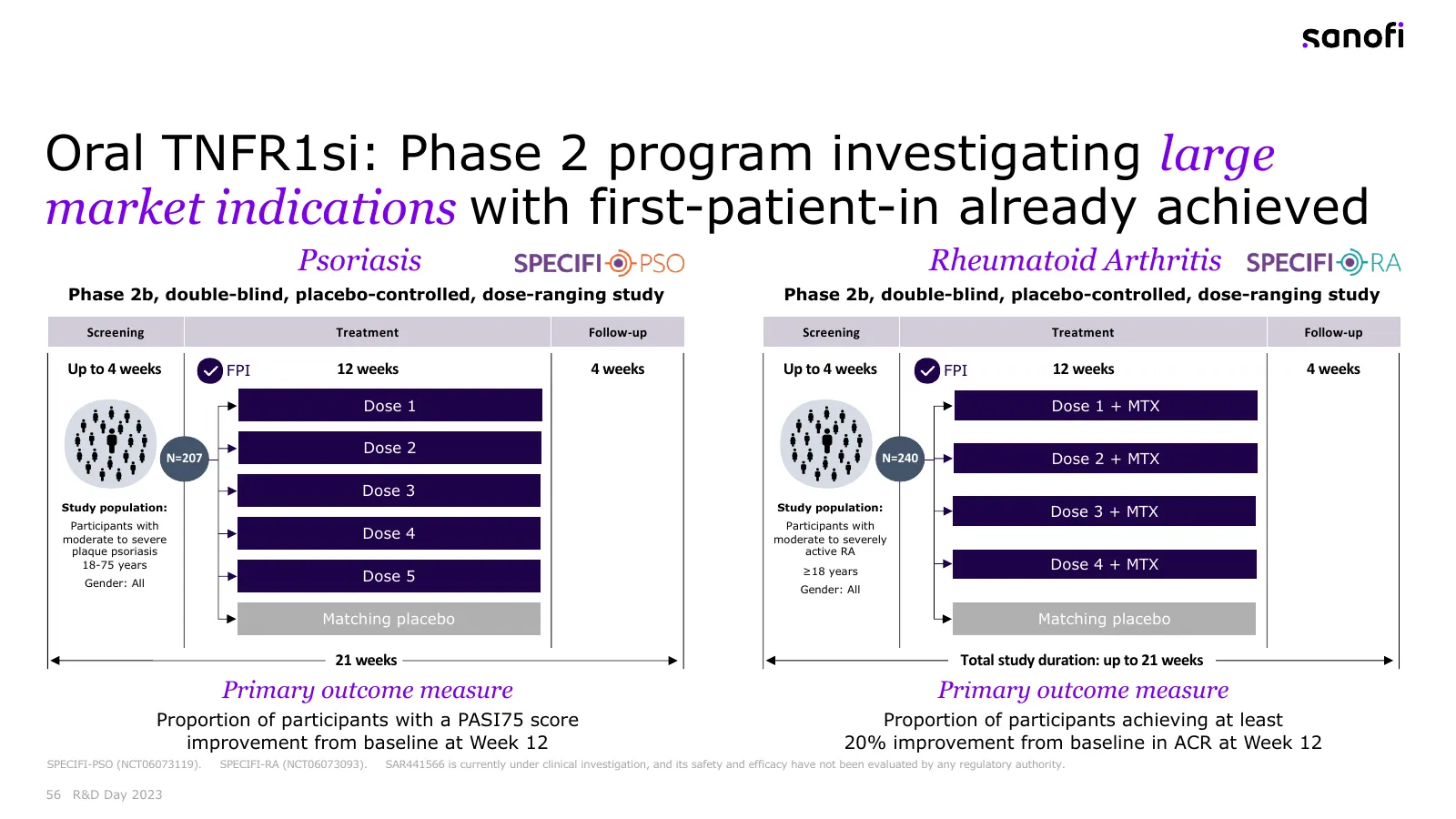
Slide 56: Oral TNFR1si: Phase 2 program
Oral TNFR1si: Phase 2 program investigating large market indications with first-patient-in already achieved Psoriasis Rheumatoid Arthritis Phase 2b, double-blind, placebo-controlled, dose-ranging study Phase 2b, double-blind, placebo-controlled, dose-ranging study Screening Treatment Follow-up Scree
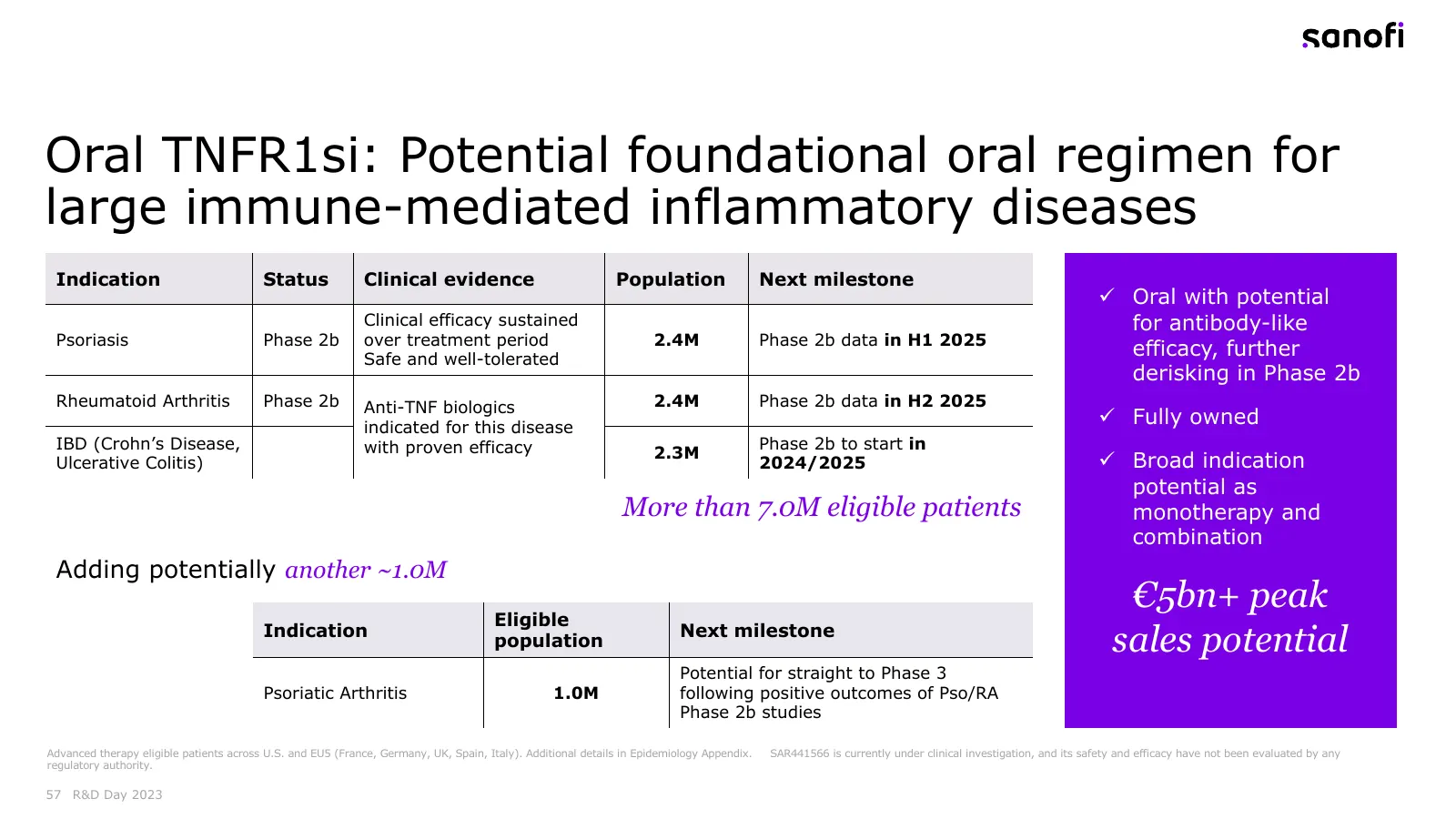
Slide 57: Oral TNFR1si: Potential foundational oral regimen
Oral TNFR1si: Potential foundational oral regimen for large immune-mediated inflammatory diseases Indication Status Clinical evidence Population Next milestone ü Oral with potential Clinical efficacy sustained for antibody-like Psoriasis Phase 2b over treatment period 2.4M Phase 2b data in H1 2025 S

Slide 58: Multi-indication assets to drive future growth
Multi-indication assets to drive future growth Shaju Backer Global Head of Immunology Franchise
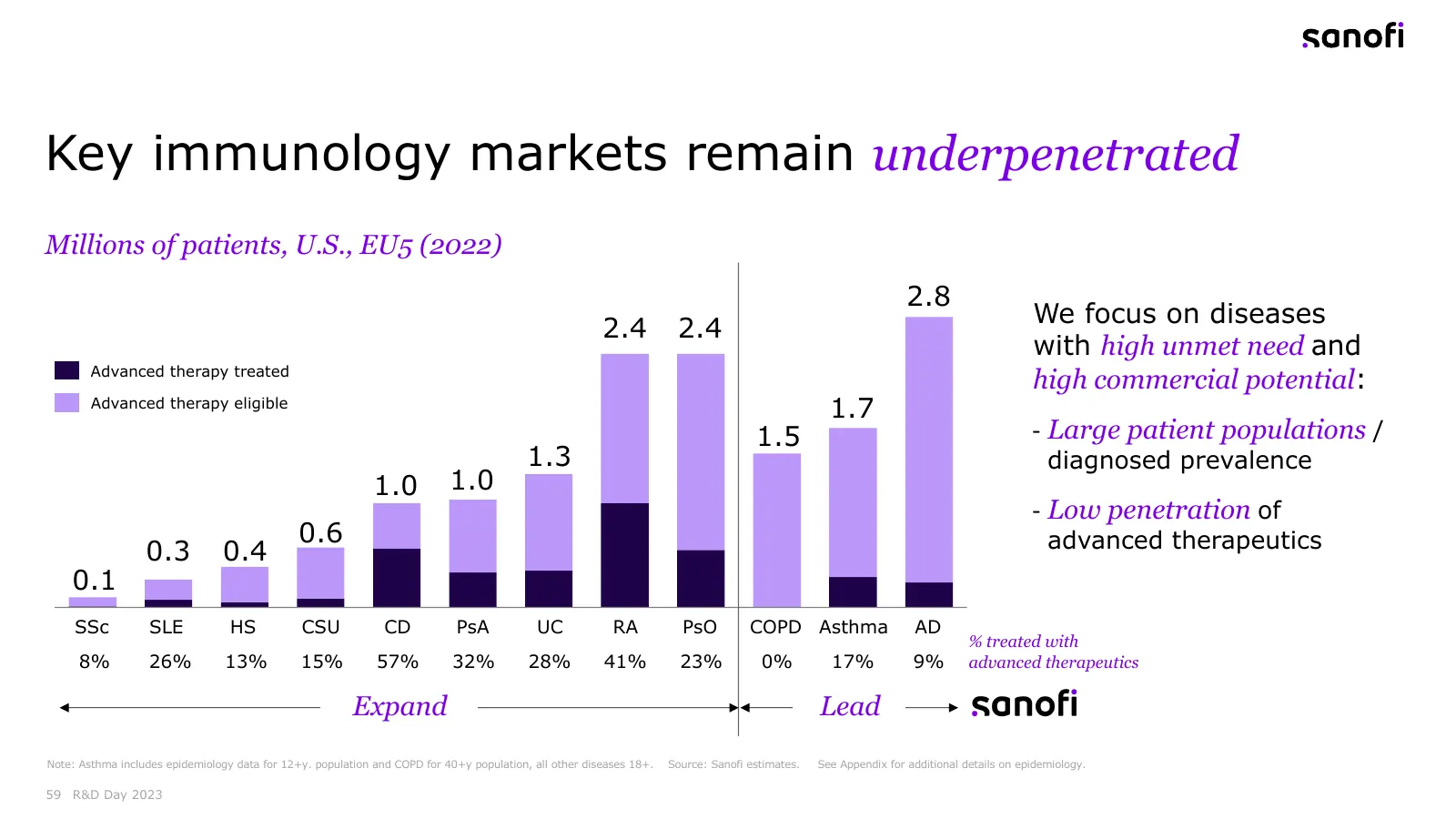
Slide 59: Key immunology markets remain underpenetrated
Key immunology markets remain underpenetrated Millions of patients, U.S., EU5 (2022) 2.8 We focus on diseases 2.4 2.4 with high unmet need and Advanced therapy treated high commercial potential: Advanced therapy eligible 1.7 1.5 - Large patient populations / 1.3 diagnosed prevalence 1.0 1.0 - Low pe
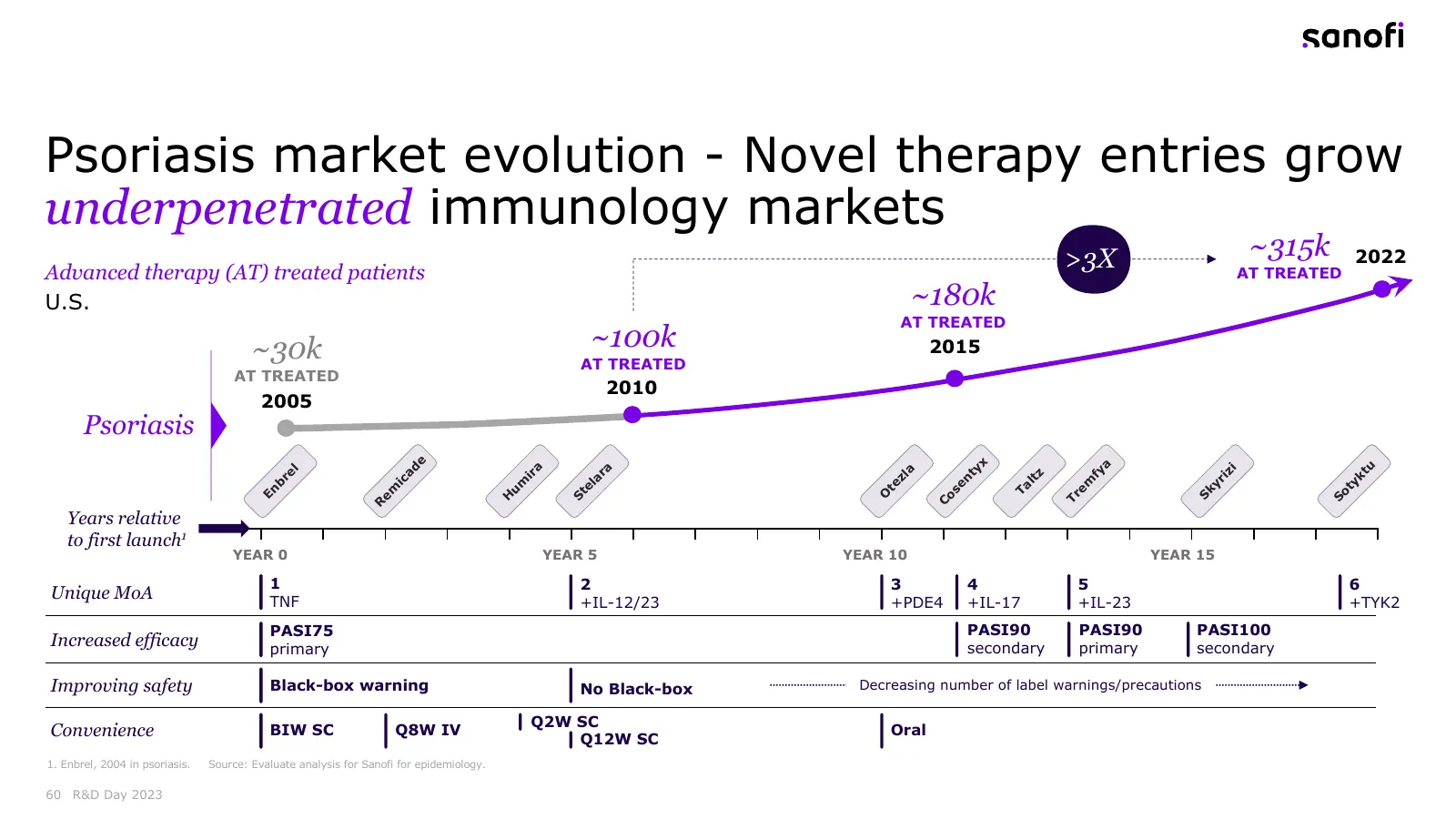
Slide 60: Psoriasis market evolution
Psoriasis market evolution - Novel therapy entries grow underpenetrated immunology markets >3X ~315k 2022 Advanced therapy (AT) treated patients AT TREATED U.S. ~180k AT TREATED ~30k ~100k 2015 AT TREATED AT TREATED 2010 2005 Psoriasis e x a tu ad a a ty zi el a fy ir z ar zl k ri en br lt ic em m t
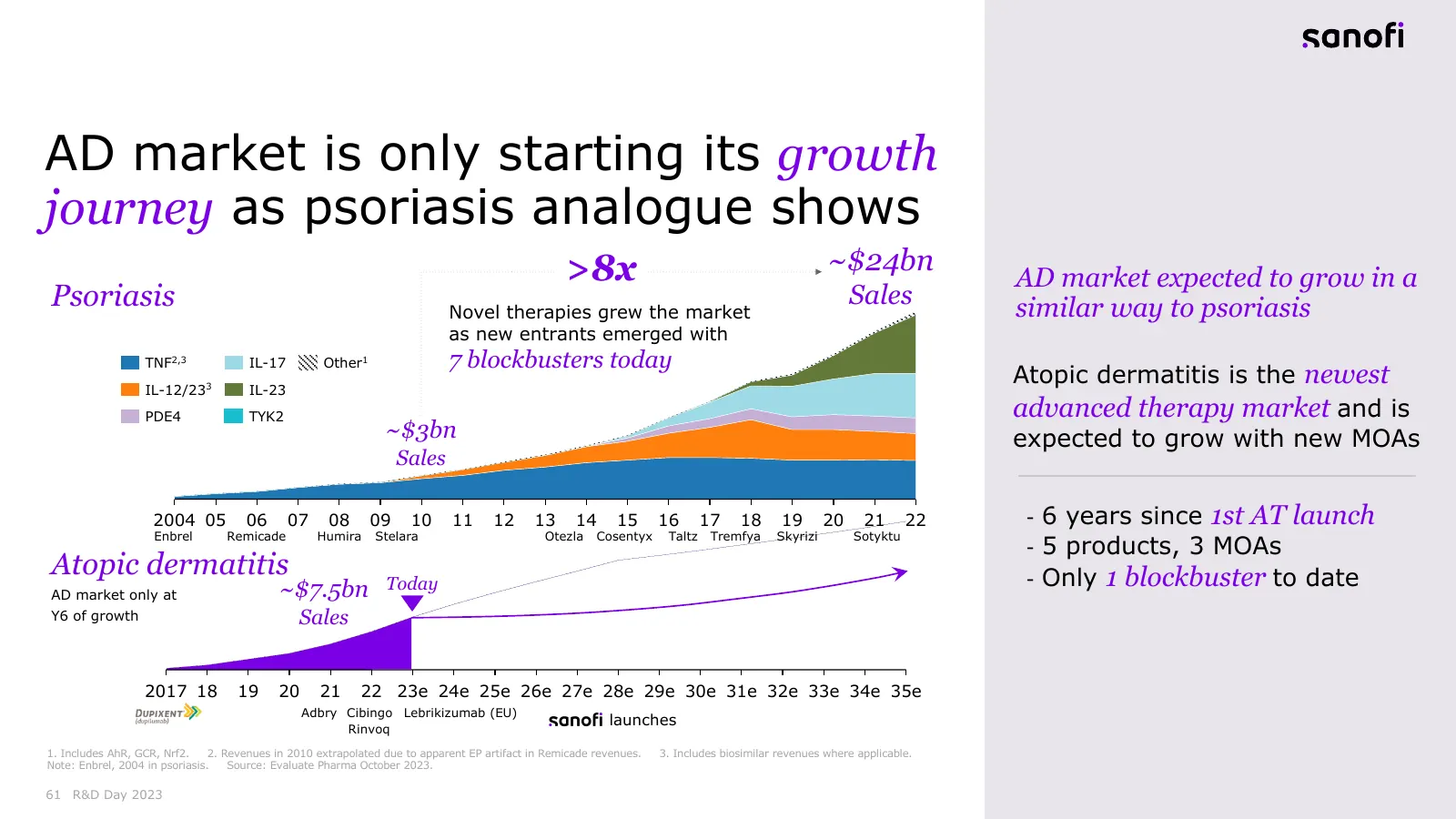
Slide 61: AD market is only starting its growth journey
AD market is only starting its growth journey as psoriasis analogue shows >8x ~$24bn AD market expected to grow in a Psoriasis Novel therapies grew the market Sales similar way to psoriasis as new entrants emerged with TNF2,3 IL-17 Other1 7 blockbusters today IL-12/233 IL-23 Atopic dermatitis is the
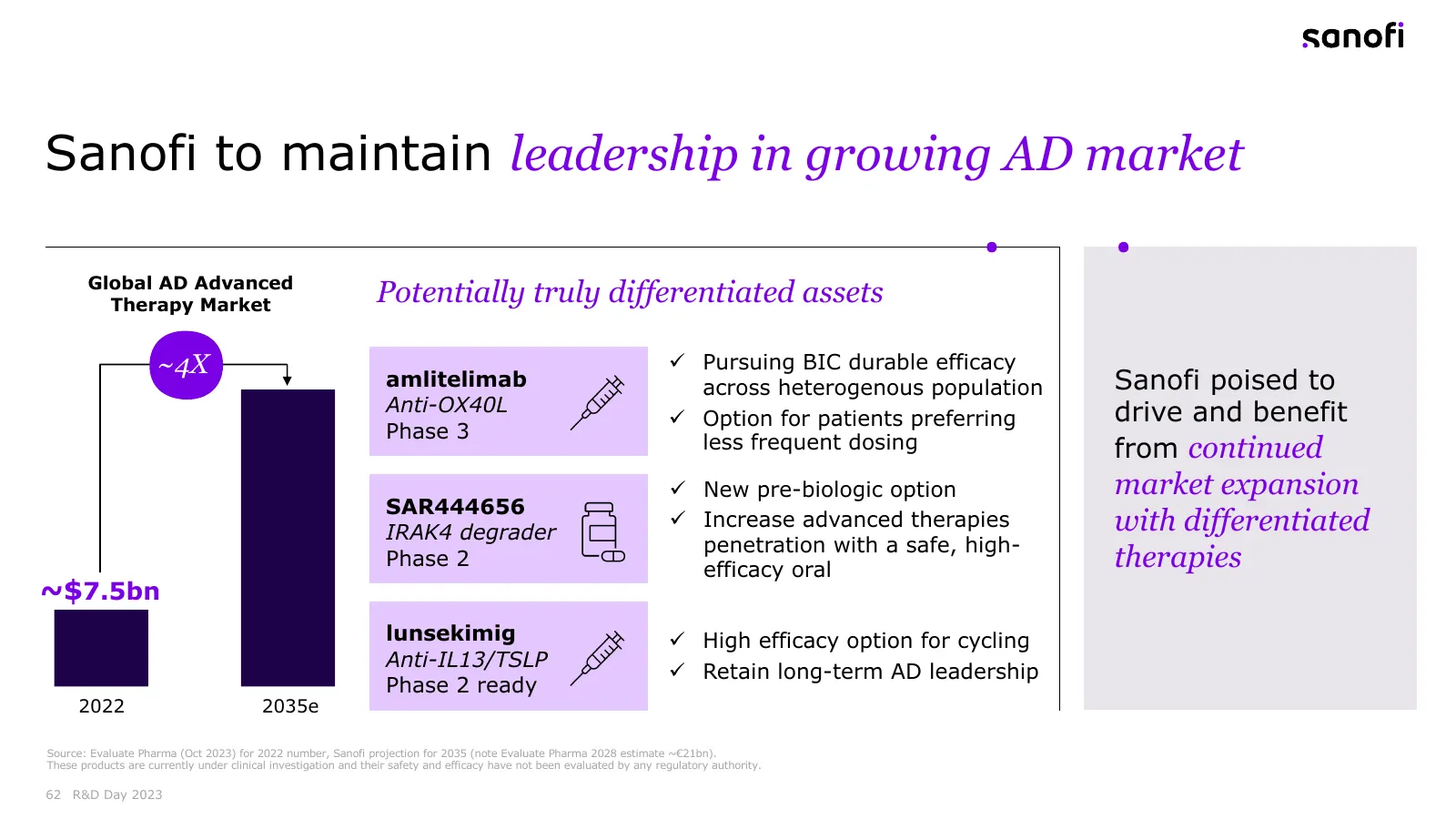
Slide 62: Sanofi to maintain leadership in growing AD market
Sanofi to maintain leadership in growing AD market Global AD Advanced Therapy Market Potentially truly differentiated assets ~4X ü Pursuing BIC durable efficacy amlitelimab across heterogenous population Sanofi poised to Anti-OX40L drive and benefit ü Option for patients preferring Phase 3 less freq
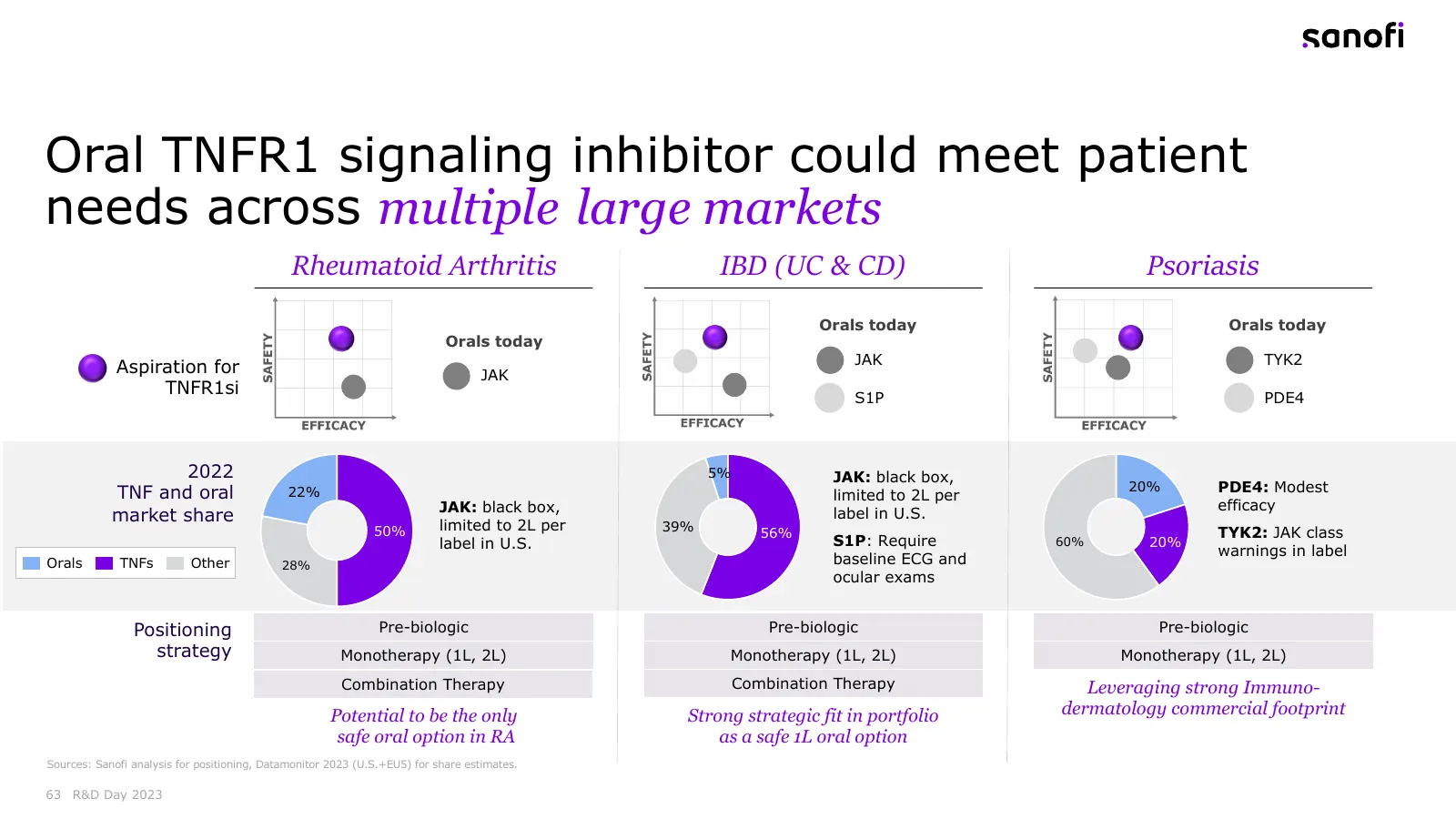
Slide 63: Oral TNFR1 inhibitor could meet needs across large markets
Oral TNFR1 signaling inhibitor could meet patient needs across multiple large markets Rheumatoid Arthritis IBD (UC & CD) Psoriasis Orals today Orals today Orals today JAK TYK2 Aspiration for JAK TNFR1si S1P PDE4 2022 5% JAK: black box, TNF and oral 22% 20% PDE4: Modest limited to 2L per JAK: black b
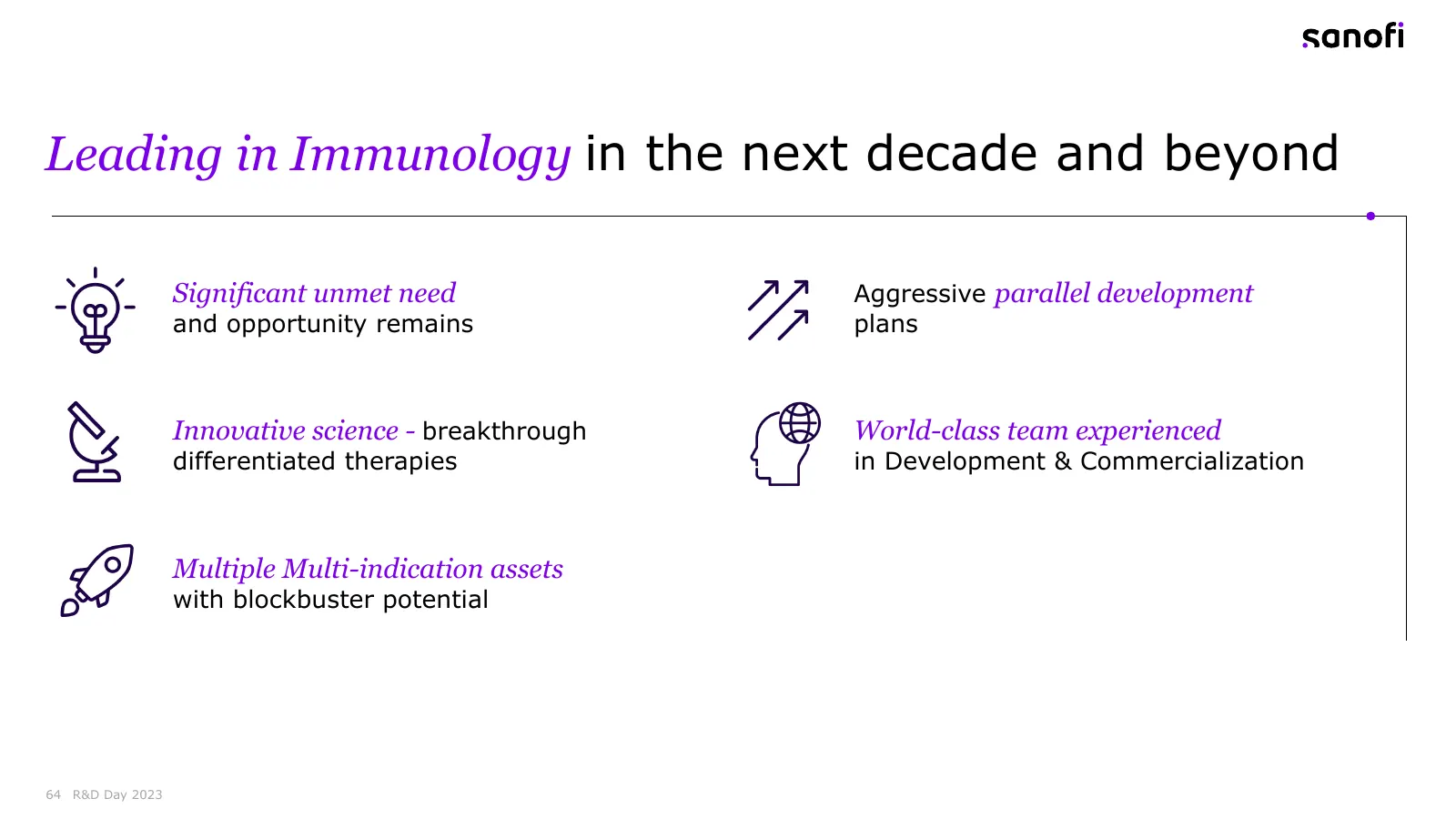
Slide 64: Leading in Immunology in the next decade and beyond
Leading in Immunology in the next decade and beyond Significant unmet need Aggressive parallel development and opportunity remains plans Innovative science - breakthrough World-class team experienced differentiated therapies in Development & Commercialization Multiple Multi-indication assets with bl

Slide 65: Q&A session (Part 1)
Q&A session (Part 1)

Slide 66: Break
Break

Slide 67: Physician perspective on MS
Physician perspective on MS Sharon Stoll, DO, MS Director of Neurology Stoll Medical Group
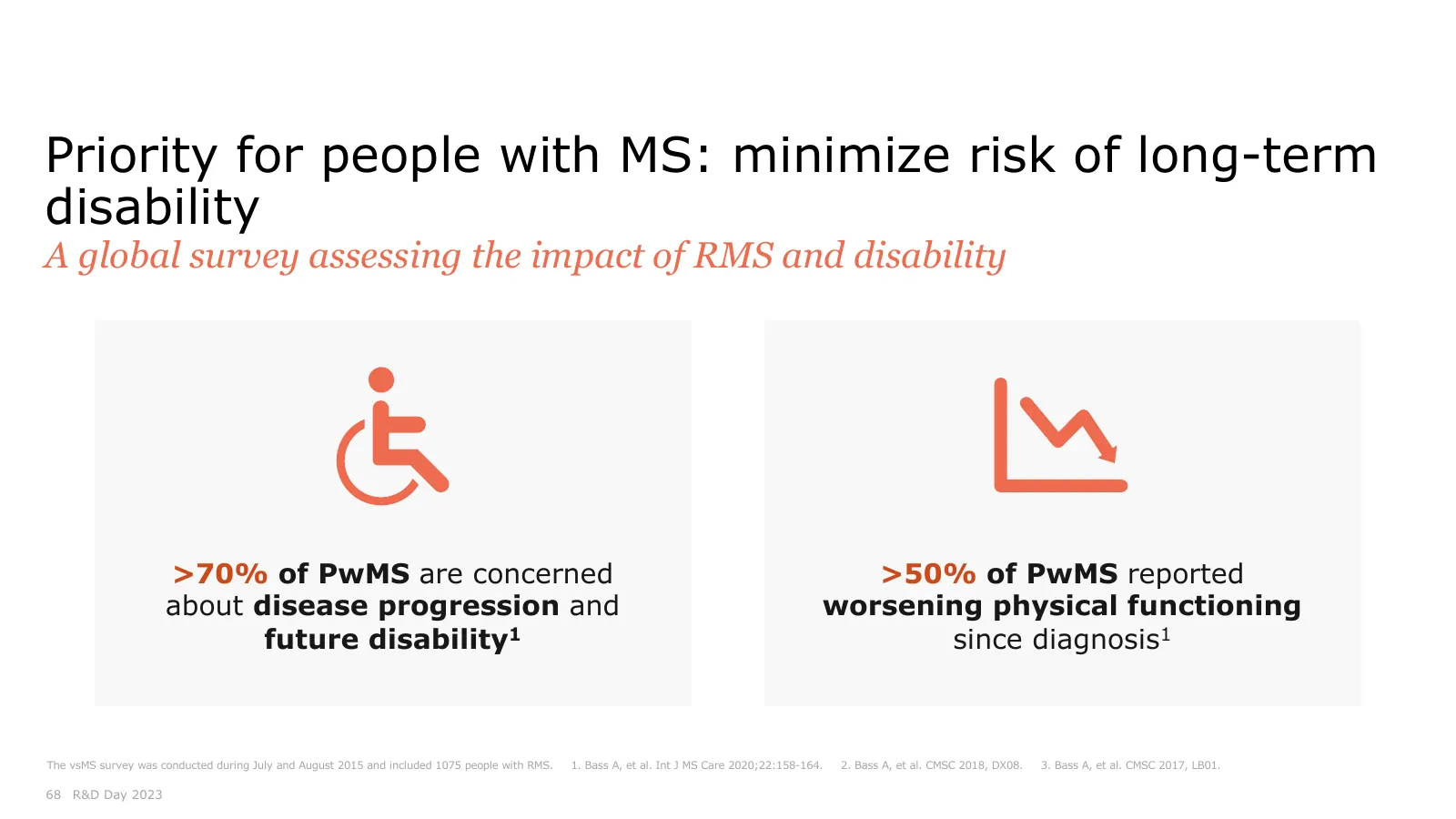
Slide 68: Priority for people with MS: minimize risk of long-term disability
Priority for people with MS: minimize risk of long-term disability A global survey assessing the impact of RMS and disability >70% of PwMS are concerned >50% of PwMS reported about disease progression and worsening physical functioning future disability1 since diagnosis1 The vsMS survey was conducte
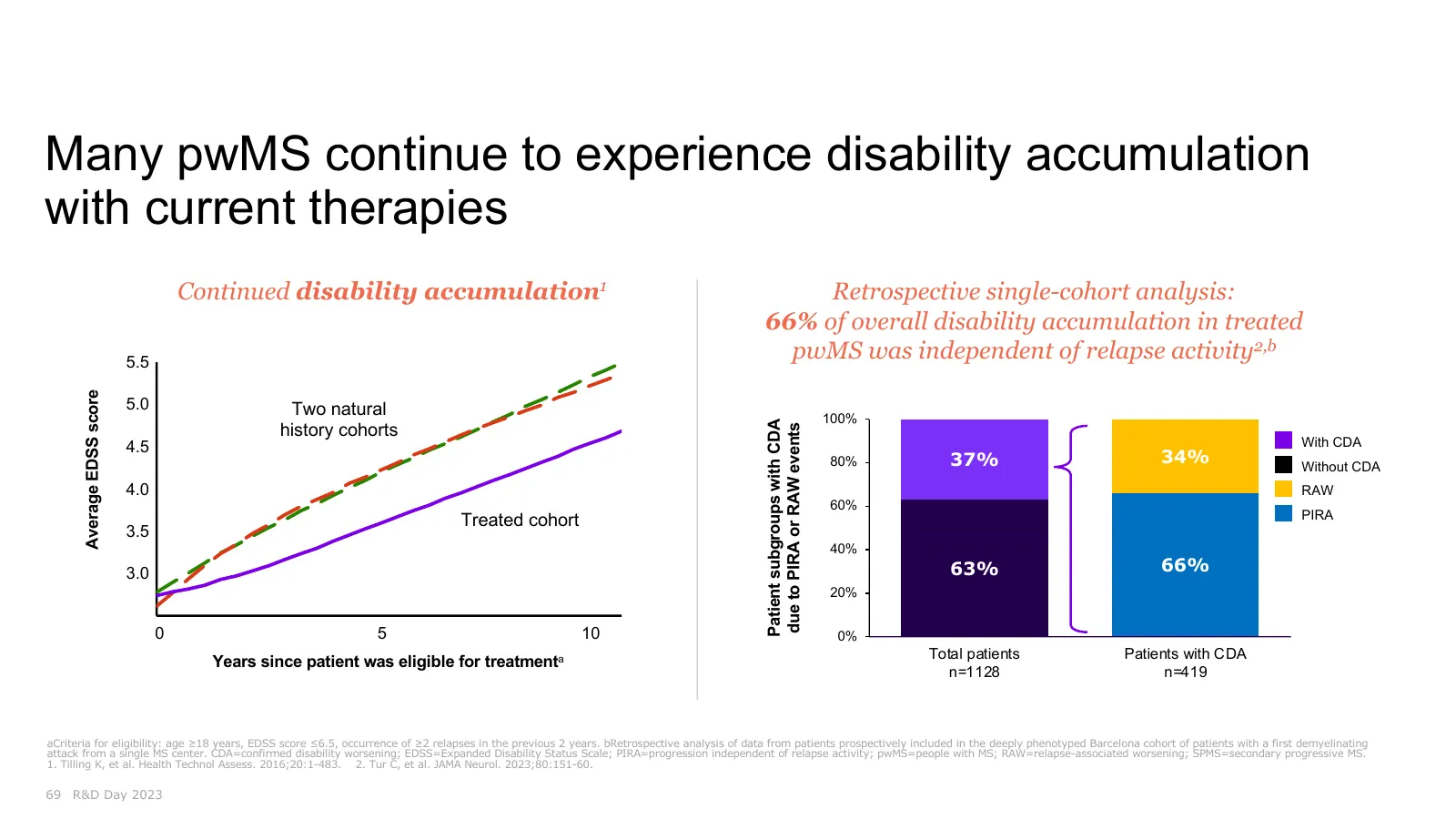
Slide 69: Many pwMS continue to experience disability accumulation
Many pwMS continue to experience disability accumulation with current therapies Continued disability accumulation1 Retrospective single-cohort analysis: 66% of overall disability accumulation in treated 5.5 pwMS was independent of relapse activity2,b Average EDSS score 5.0 Two natural 100% Patient s
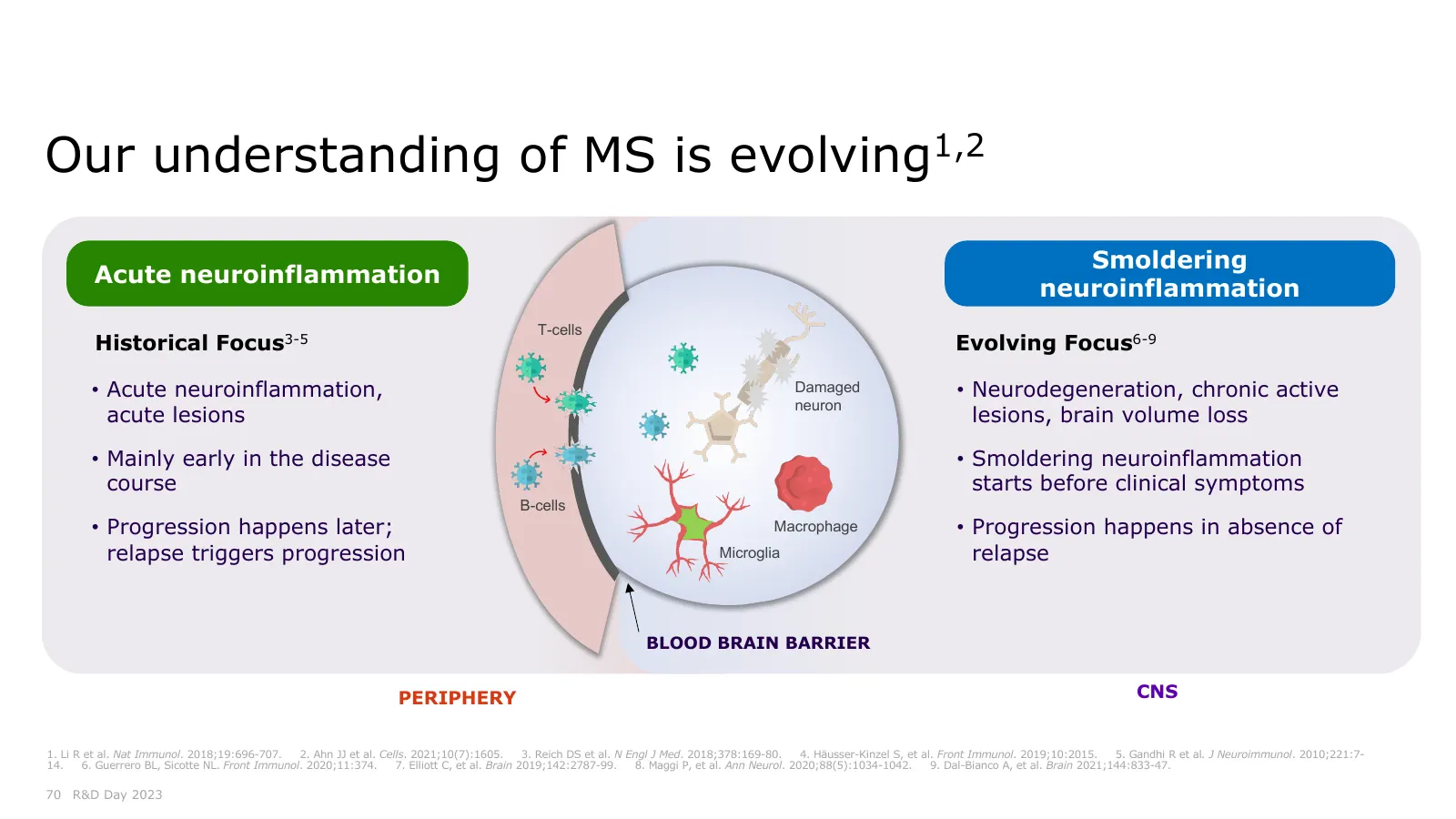
Slide 70: Our understanding of MS is evolving
Our understanding of MS is evolving1,2 Smoldering Acute neuroinflammation neuroinflammation T-cells Historical Focus3-5 Evolving Focus6-9 • Acute neuroinflammation, Damaged • Neurodegeneration, chronic active neuron acute lesions lesions, brain volume loss • Mainly early in the disease • Smoldering
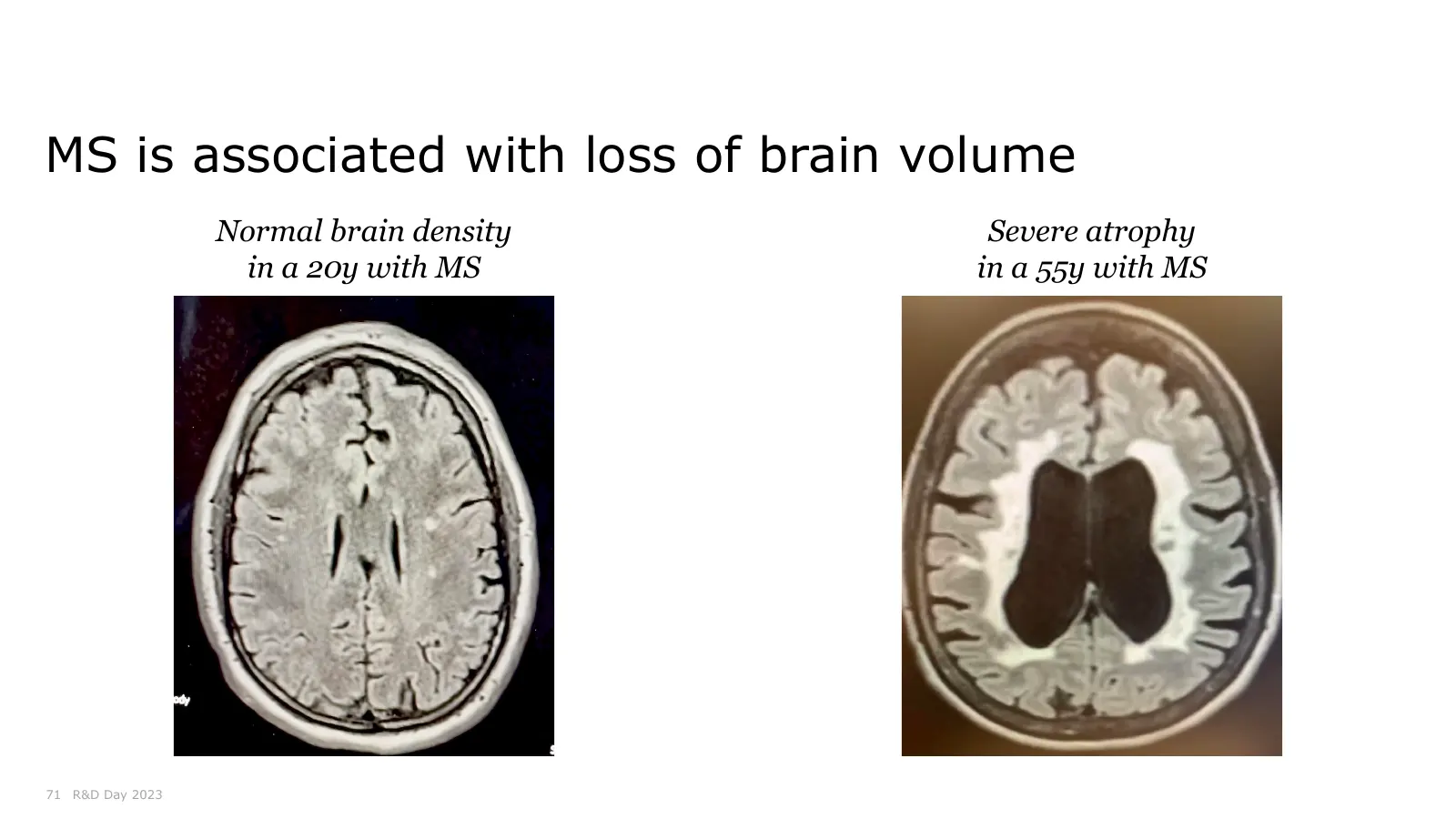
Slide 71: MS is associated with loss of brain volume
MS is associated with loss of brain volume Normal brain density Severe atrophy in a 20y with MS in a 55y with MS 71 R&D Day 2023
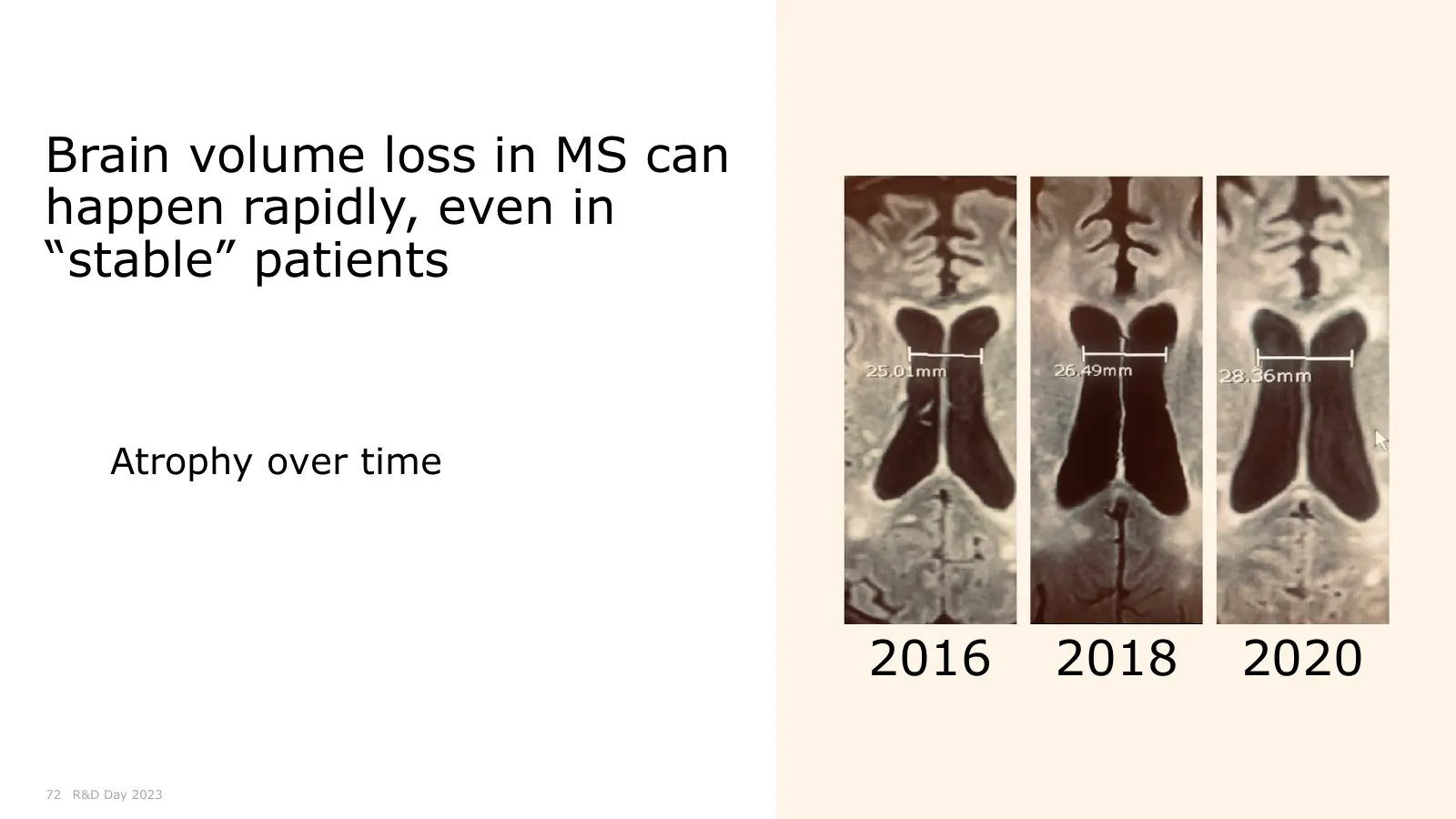
Slide 72: Brain volume loss in MS can happen rapidly
Brain volume loss in MS can happen rapidly, even in “stable” patients Atrophy over time 2016 2018 2020 72 R&D Day 2023
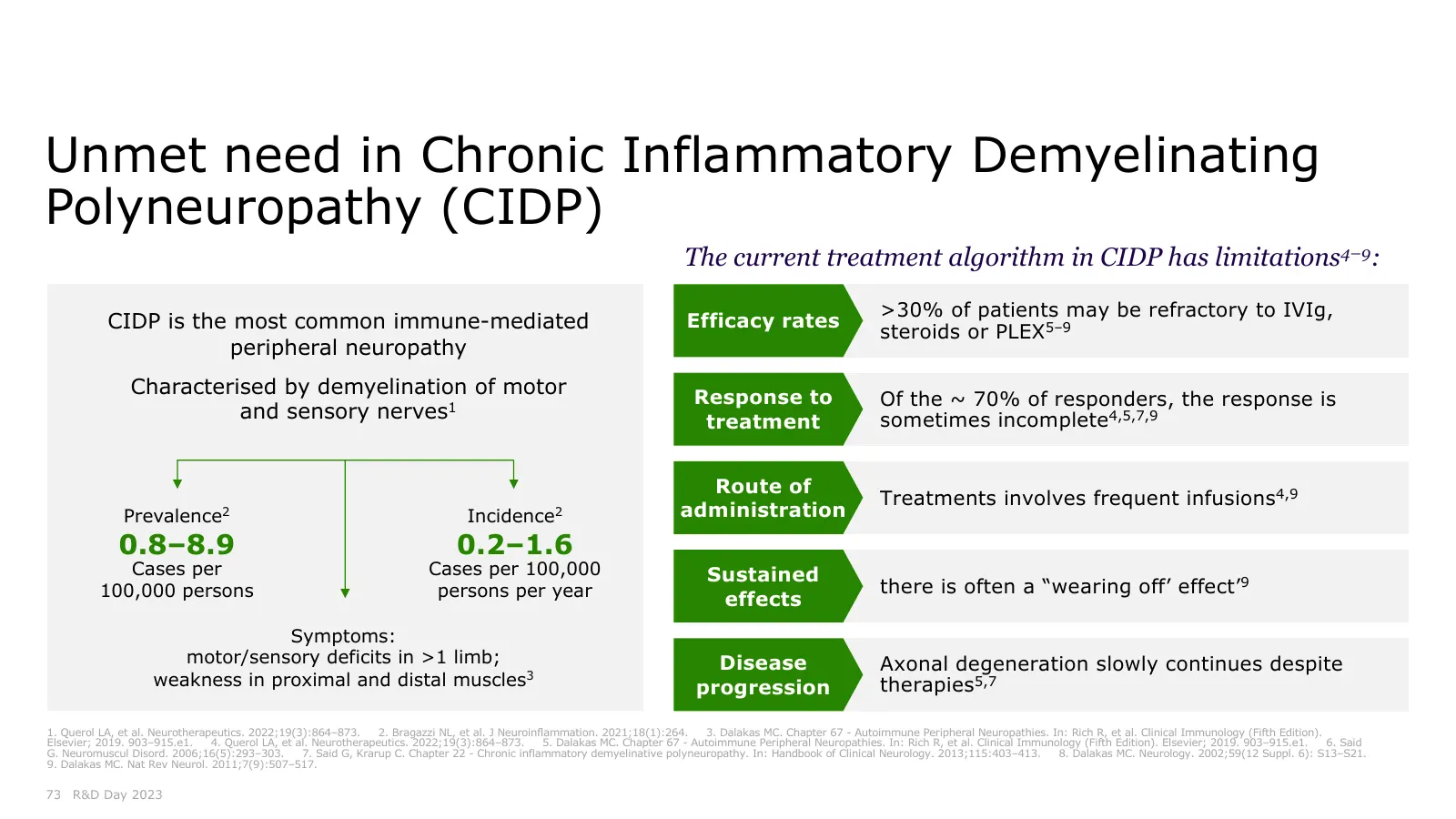
Slide 73: Unmet need in CIDP
Unmet need in Chronic Inflammatory Demyelinating Polyneuropathy (CIDP) The current treatment algorithm in CIDP has limitations4–9: >30% of patients may be refractory to IVIg, CIDP is the most common immune-mediated Efficacy rates steroids or PLEX5–9 peripheral neuropathy Characterised by demyelinati

Slide 74: Addressing high unmet needs in neuro-inflammation
Addressing high unmet needs in neuro-inflammation through innovative mechanisms Erik Wallstroem Head of Development, Neurology
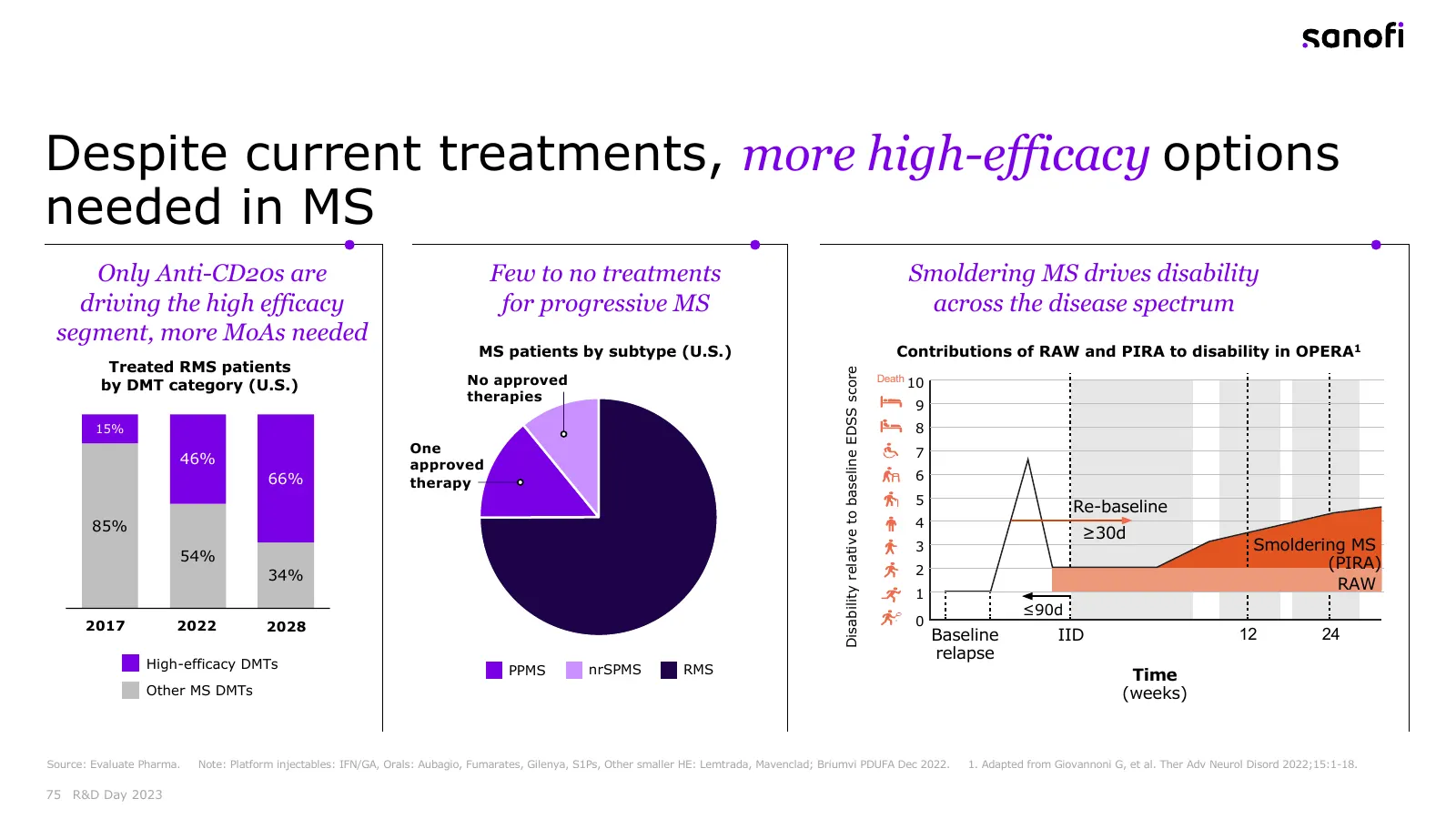
Slide 75: More high-efficacy options needed in MS
Despite current treatments, more high-efficacy options needed in MS Only Anti-CD20s are Few to no treatments Smoldering MS drives disability driving the high efficacy for progressive MS across the disease spectrum segment, more MoAs needed MS patients by subtype (U.S.) Contributions of RAW and PIRA
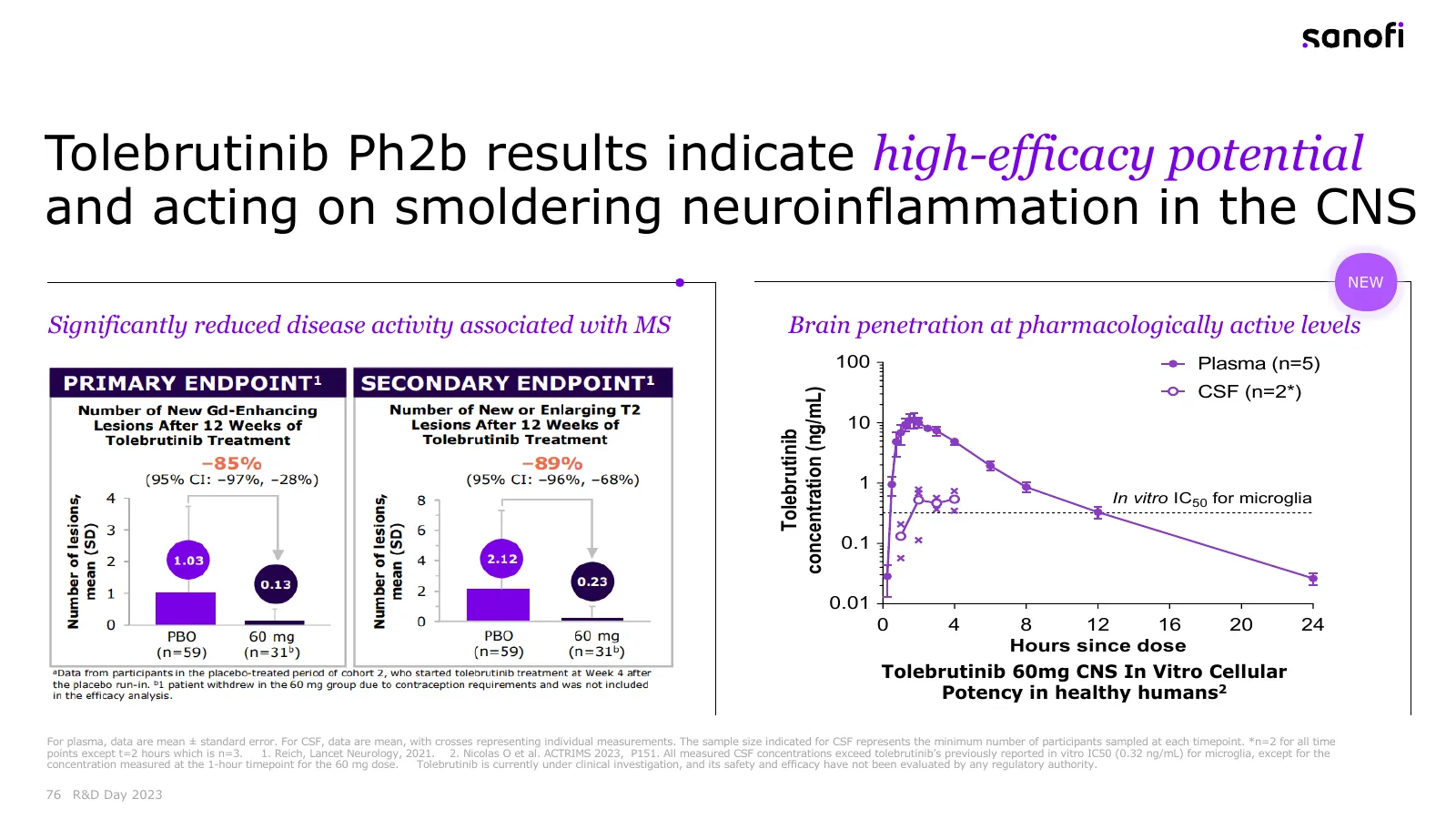
Slide 76: Tolebrutinib Ph2b results indicate high-efficacy potential
Tolebrutinib Ph2b results indicate high-efficacy potential and acting on smoldering neuroinflammation in the CNS NEW Significantly reduced disease activity associated with MS Brain penetration at pharmacologically Tolebrutinib 60 mg active levels 100 Plasma (n=5) CSF (n=2*) concentration (ng/mL) 10
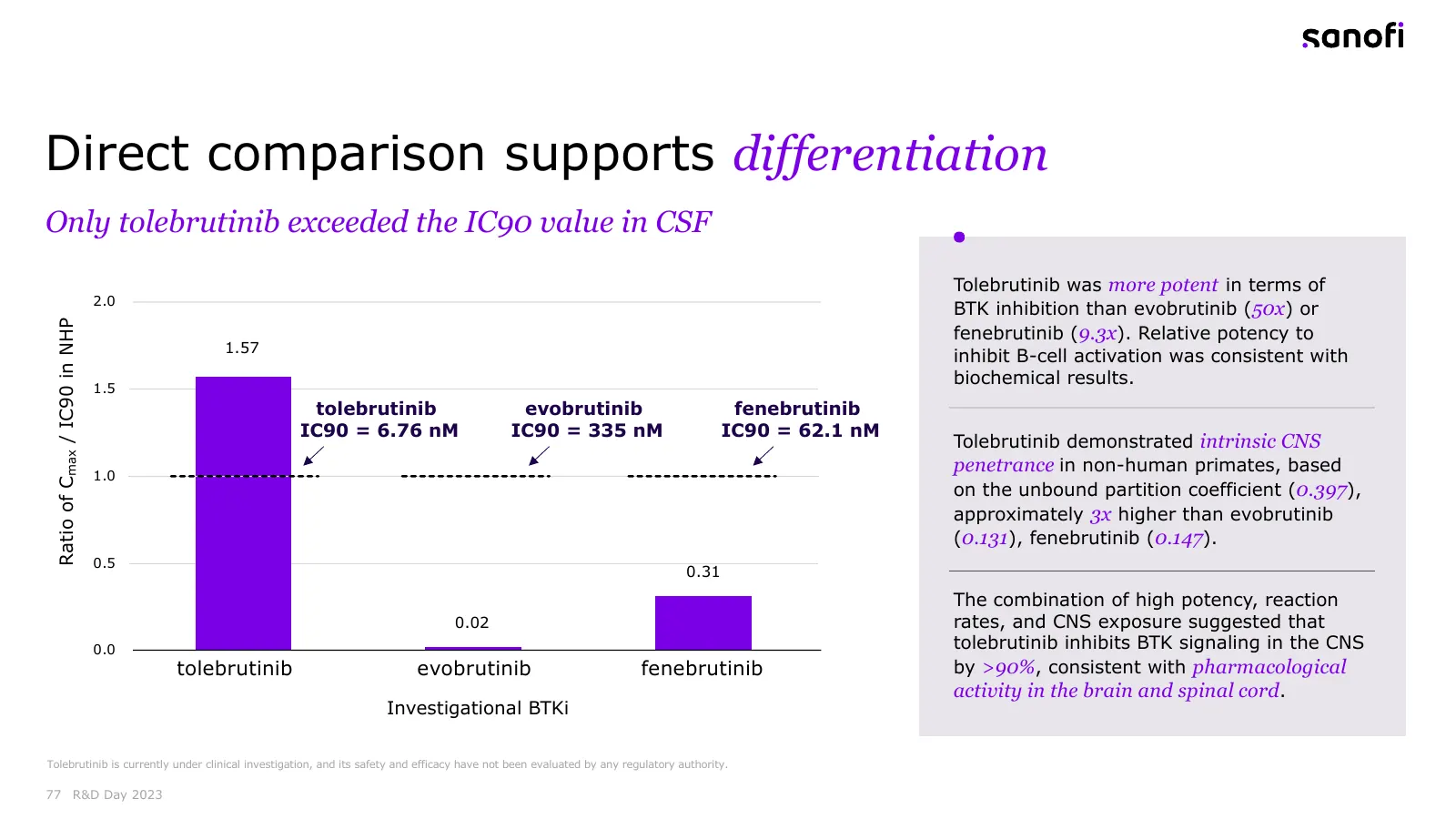
Slide 77: Direct comparison supports differentiation
Direct comparison supports differentiation Only tolebrutinib exceeded the IC90 value in CSF Tolebrutinib was more potent in terms of 2.0 BTK inhibition than evobrutinib (50x) or Ratio of Cmax / IC90 in NHP fenebrutinib (9.3x). Relative potency to 1.57 inhibit B-cell activation was consistent with bi
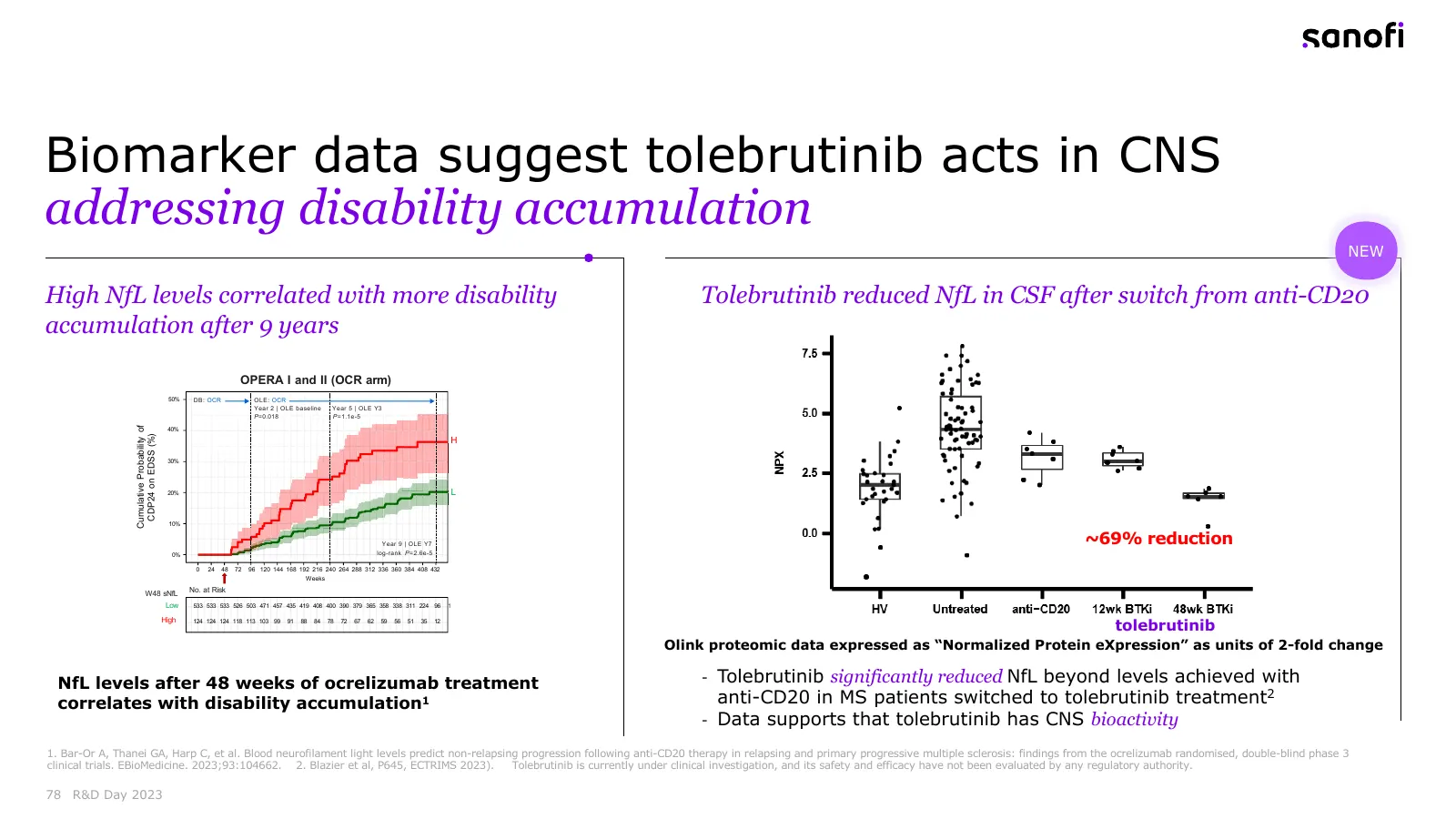
Slide 78: Biomarker data suggest tolebrutinib acts in CNS
Biomarker data suggest tolebrutinib acts in CNS addressing disability accumulation NEW High NfL levels correlated with more disability Tolebrutinib reduced NfL in CSF after switch from anti-CD20 accumulation after 9 years OPERA I and II (OCR arm) 50% DB: OCR OLE: OCR Year 2 | OLE baseline Year 5 | O
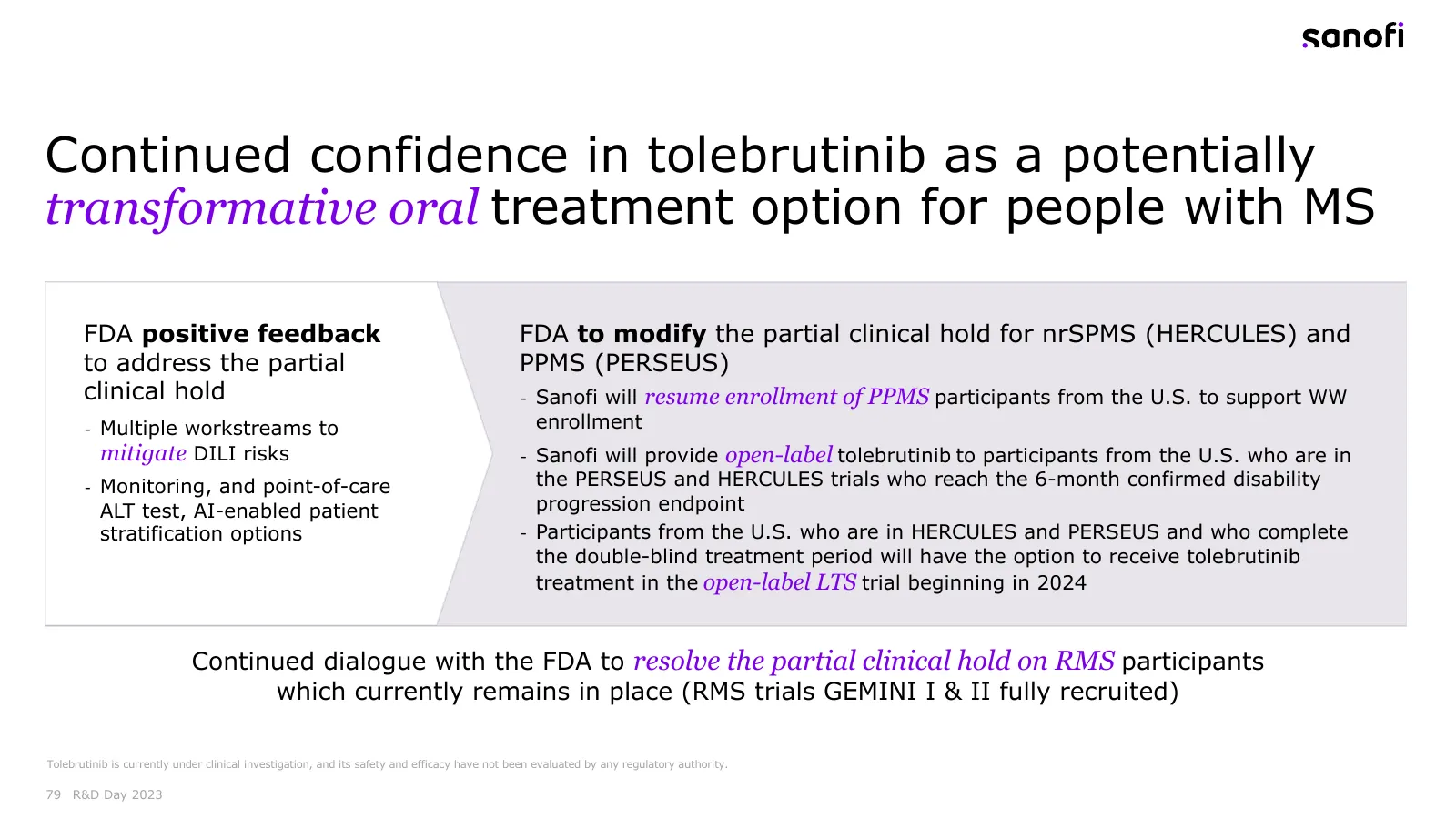
Slide 79: Continued confidence in tolebrutinib
Continued confidence in tolebrutinib as a potentially transformative oral treatment option for people with MS FDA positive feedback FDA to modify the partial clinical hold for nrSPMS (HERCULES) and to address the partial PPMS (PERSEUS) clinical hold - Sanofi will resume enrollment of PPMS participan
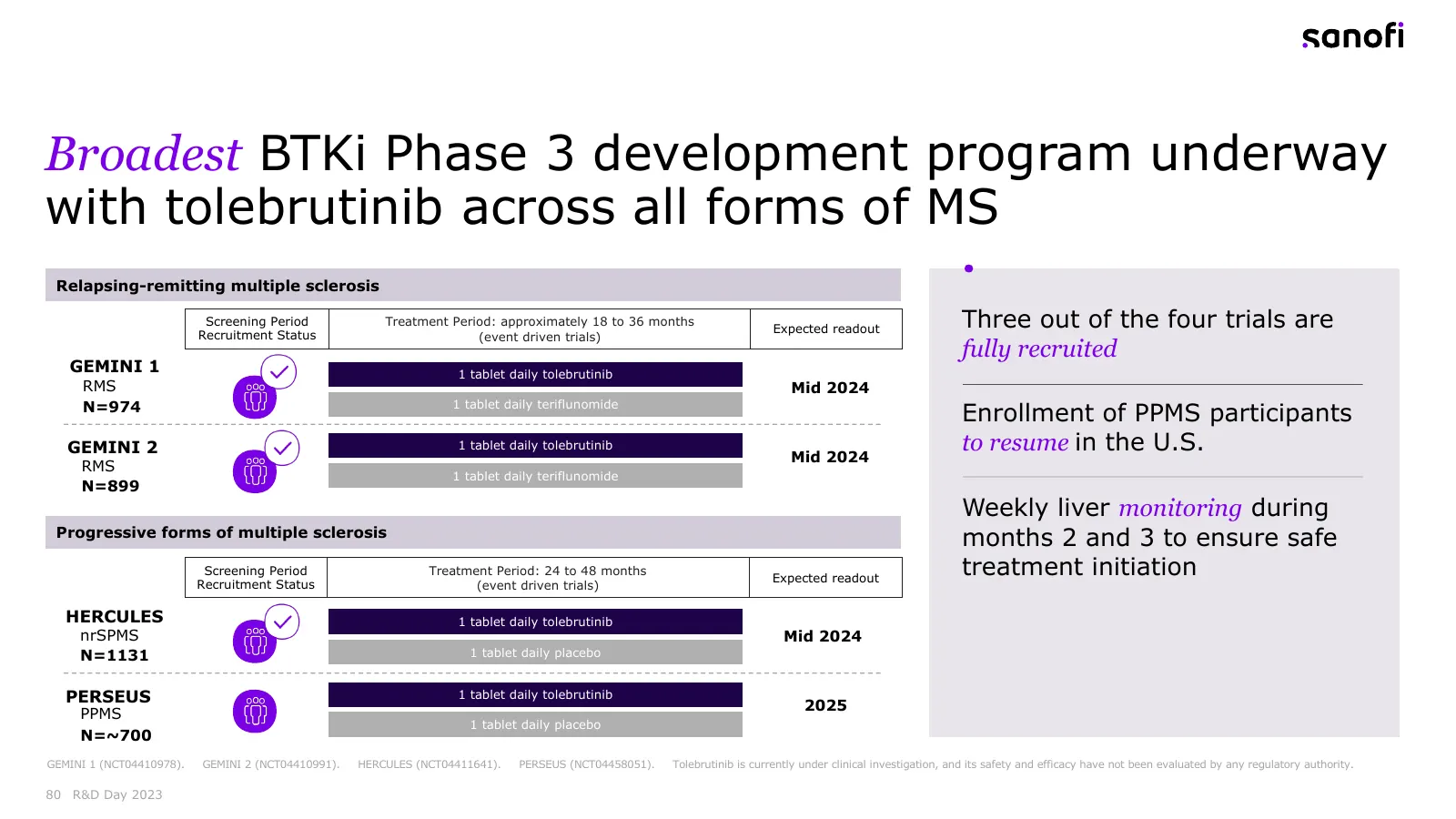
Slide 80: Broadest BTKi Phase 3 program with tolebrutinib
Broadest BTKi Phase 3 development program underway with tolebrutinib across all forms of MS Relapsing-remitting multiple sclerosis Screening Period Recruitment Status Treatment Period: approximately 18 to 36 months Expected readout Three out of the four trials are (event driven trials) fully recruit
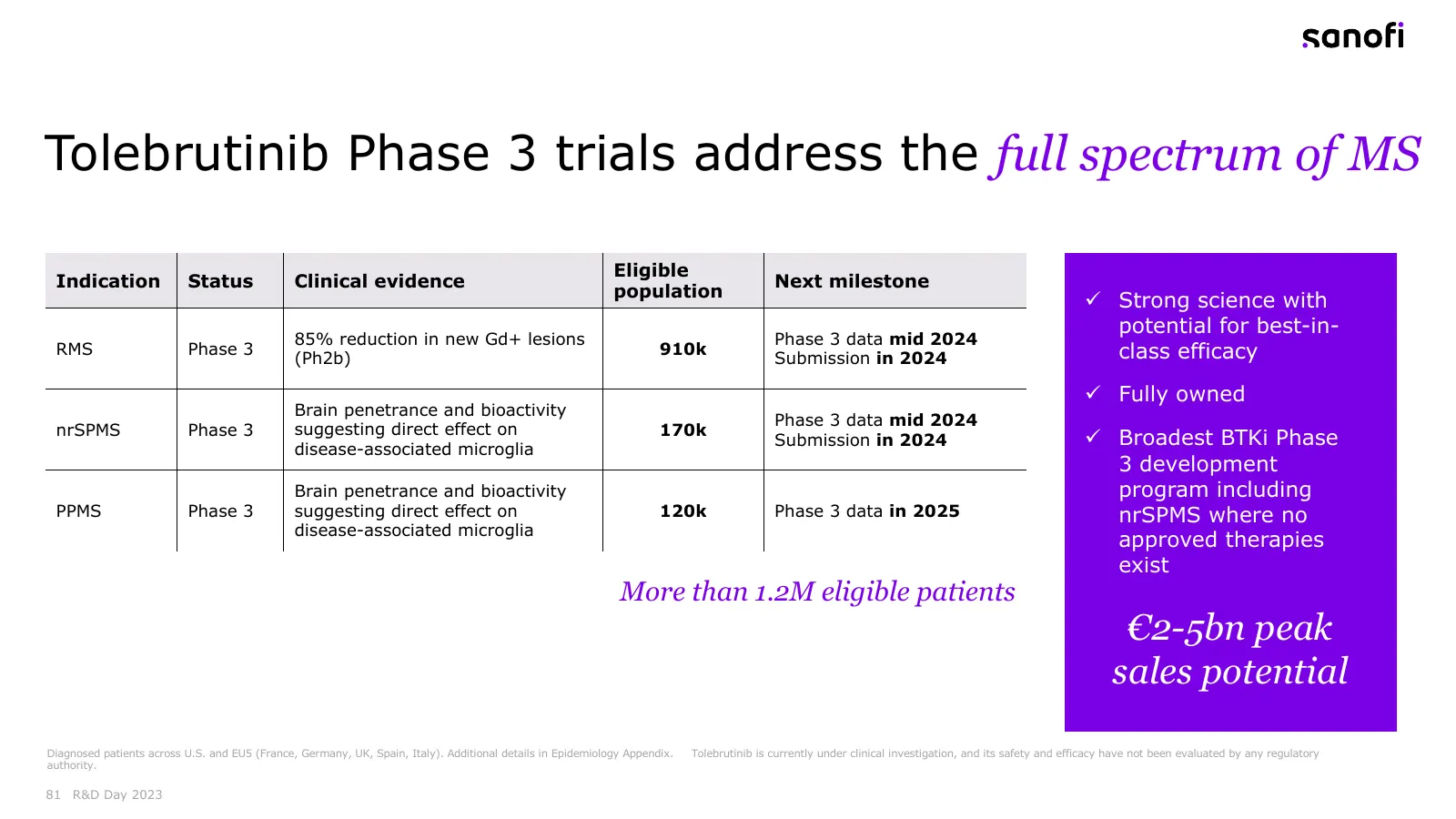
Slide 81: Tolebrutinib Phase 3 trials address full spectrum of MS
Tolebrutinib Phase 3 trials address the full spectrum of MS Eligible Indication Status Clinical evidence Next milestone population ü Strong science with potential for best-in- 85% reduction in new Gd+ lesions Phase 3 data mid 2024 RMS Phase 3 (Ph2b) 910k Submission in 2024 class efficacy ü Fully own
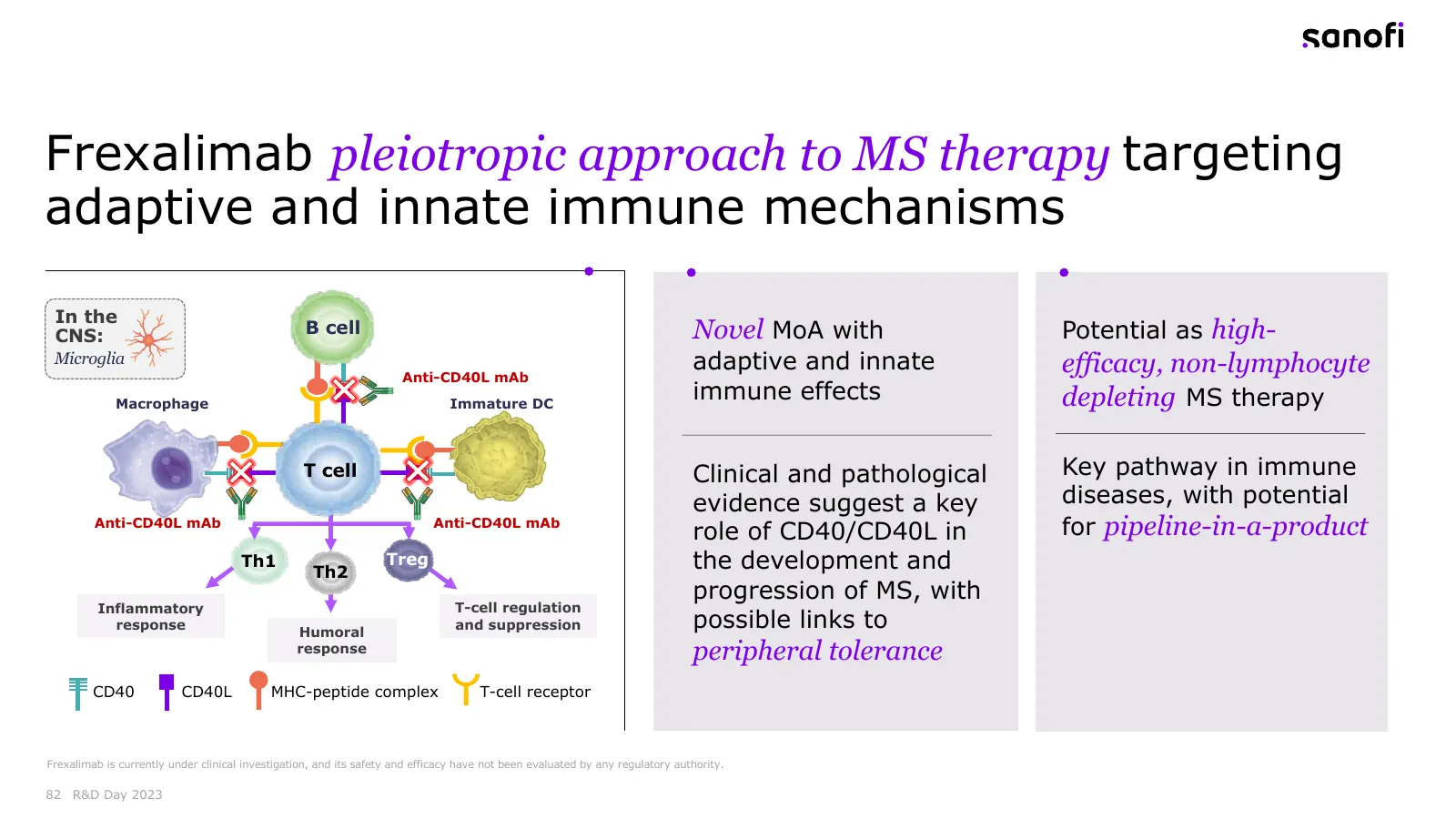
Slide 82: Frexalimab pleiotropic approach to MS therapy
Frexalimab pleiotropic approach to MS therapy targeting adaptive and innate immune mechanisms In the CNS: B cell Novel MoA with Potential as high- Microglia adaptive and innate efficacy, non-lymphocyte Anti-CD40L mAb Macrophage Immature DC immune effects depleting MS therapy T cell Clinical and path
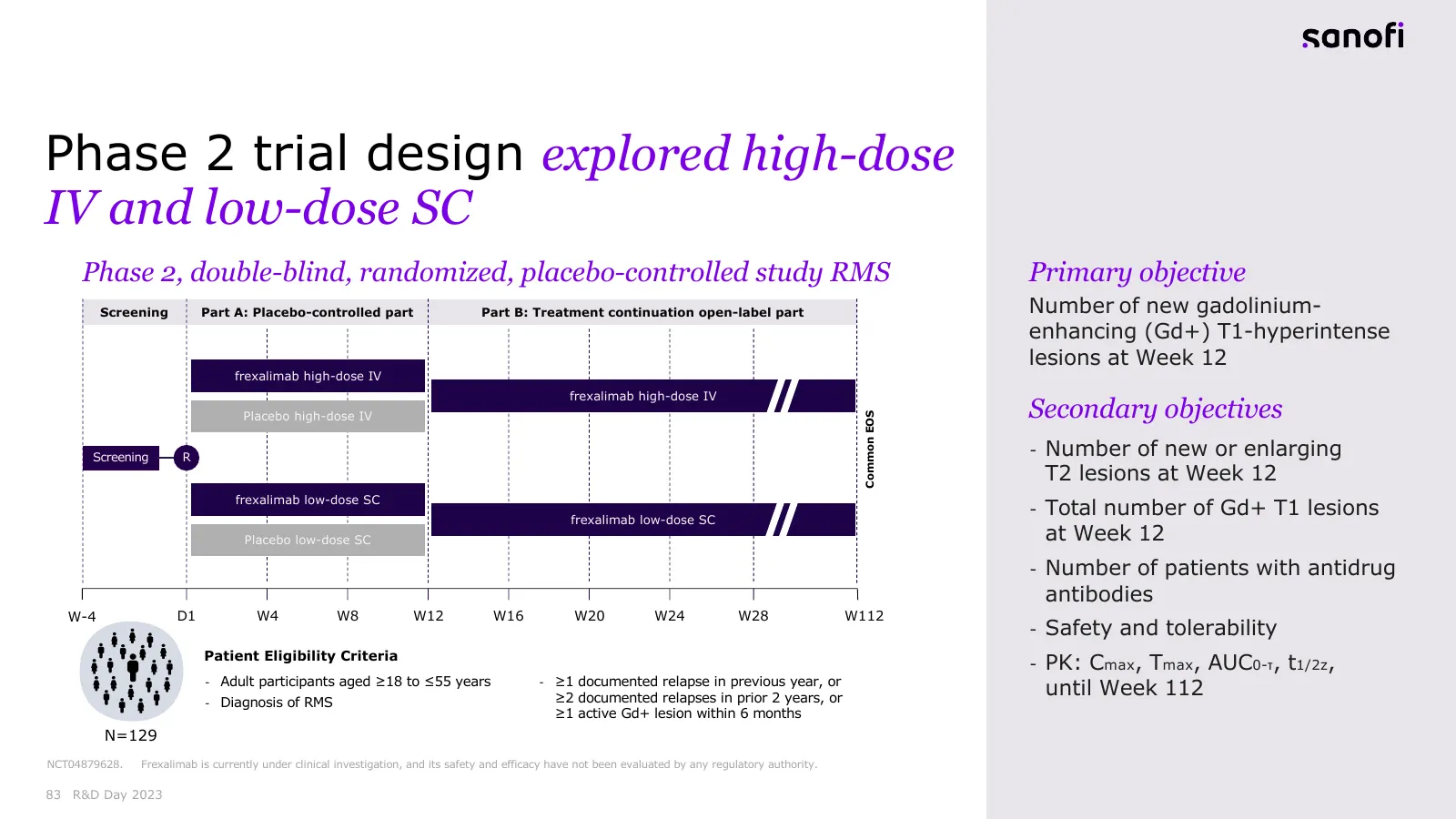
Slide 83: Phase 2 trial design explored high-dose IV and low-dose SC
Phase 2 trial design explored high-dose IV and low-dose SC Phase 2, double-blind, randomized, placebo-controlled study RMS Primary objective Screening Part A: Placebo-controlled part Part B: Treatment continuation open-label part Number of new gadolinium- enhancing (Gd+) T1-hyperintense lesions at W
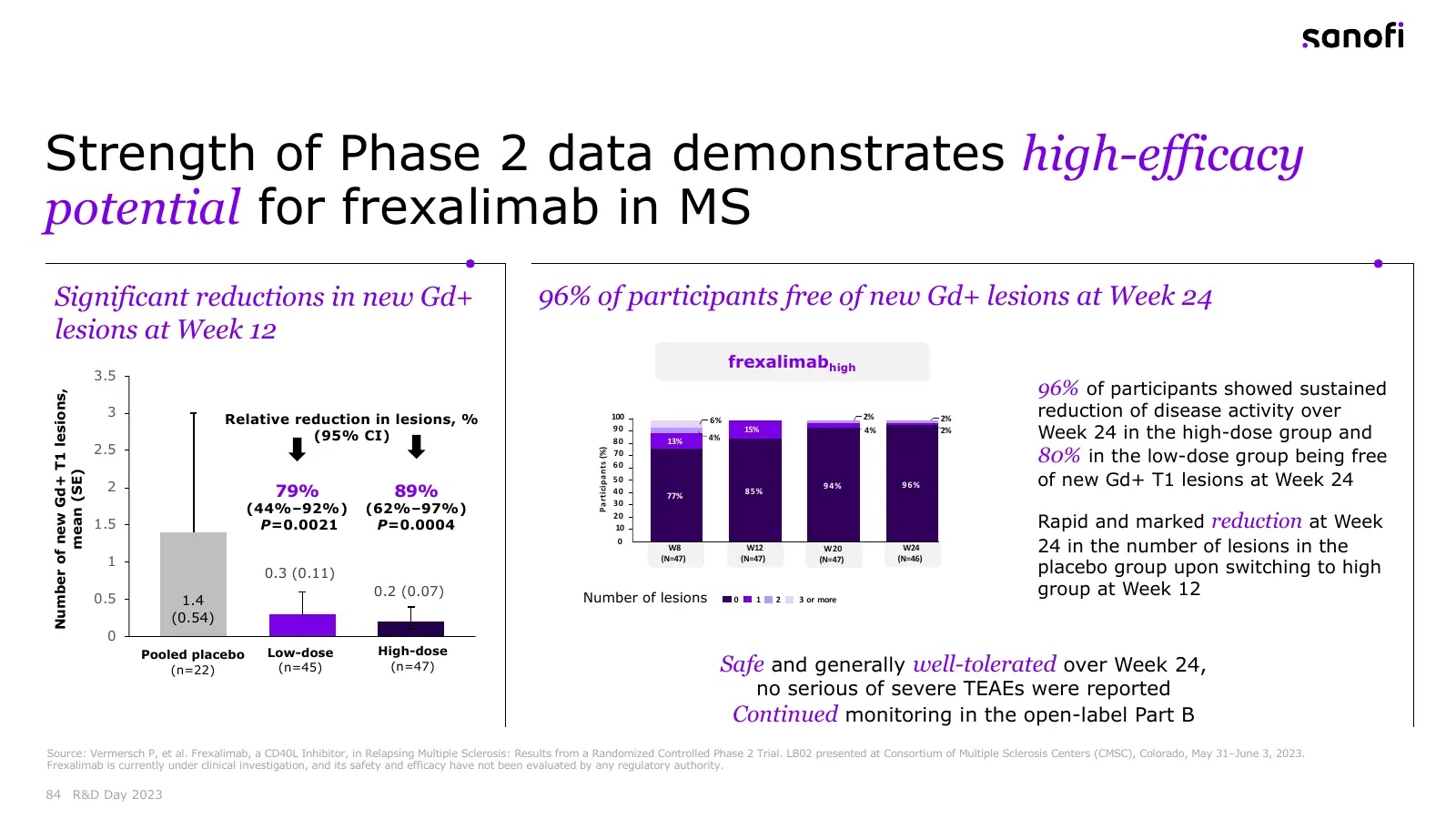
Slide 84: Strength of Phase 2 data for frexalimab in MS
Strength of Phase 2 data demonstrates high-efficacy potential for frexalimab in MS Significant reductions in new Gd+ 96% of participants free of new Gd+ lesions at Week 24 lesions at Week 12 frexalimabhigh 3.5 96% of participants showed sustained Number of new Gd+ T1 lesions, 3 Relative reduction in
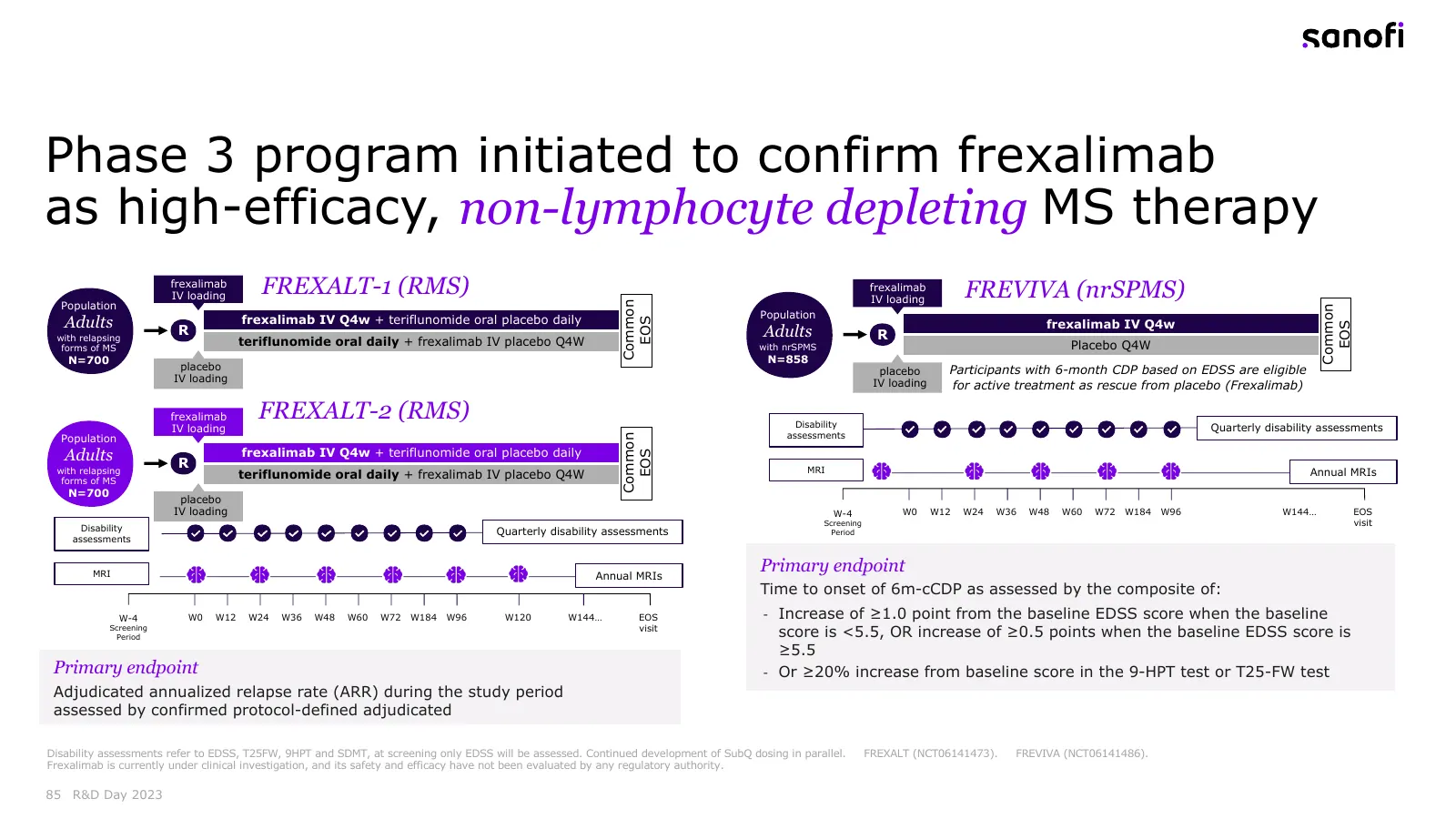
Slide 85: Phase 3 program for frexalimab
Phase 3 program initiated to confirm frexalimab as high-efficacy, non-lymphocyte depleting MS therapy frexalimab IV loading FREXALT-1 (RMS) frexalimab IV loading FREVIVA (nrSPMS) Population Common Common Population Adults frexalimab IV Q4w + teriflunomide oral placebo daily EOS frexalimab IV Q4w EOS
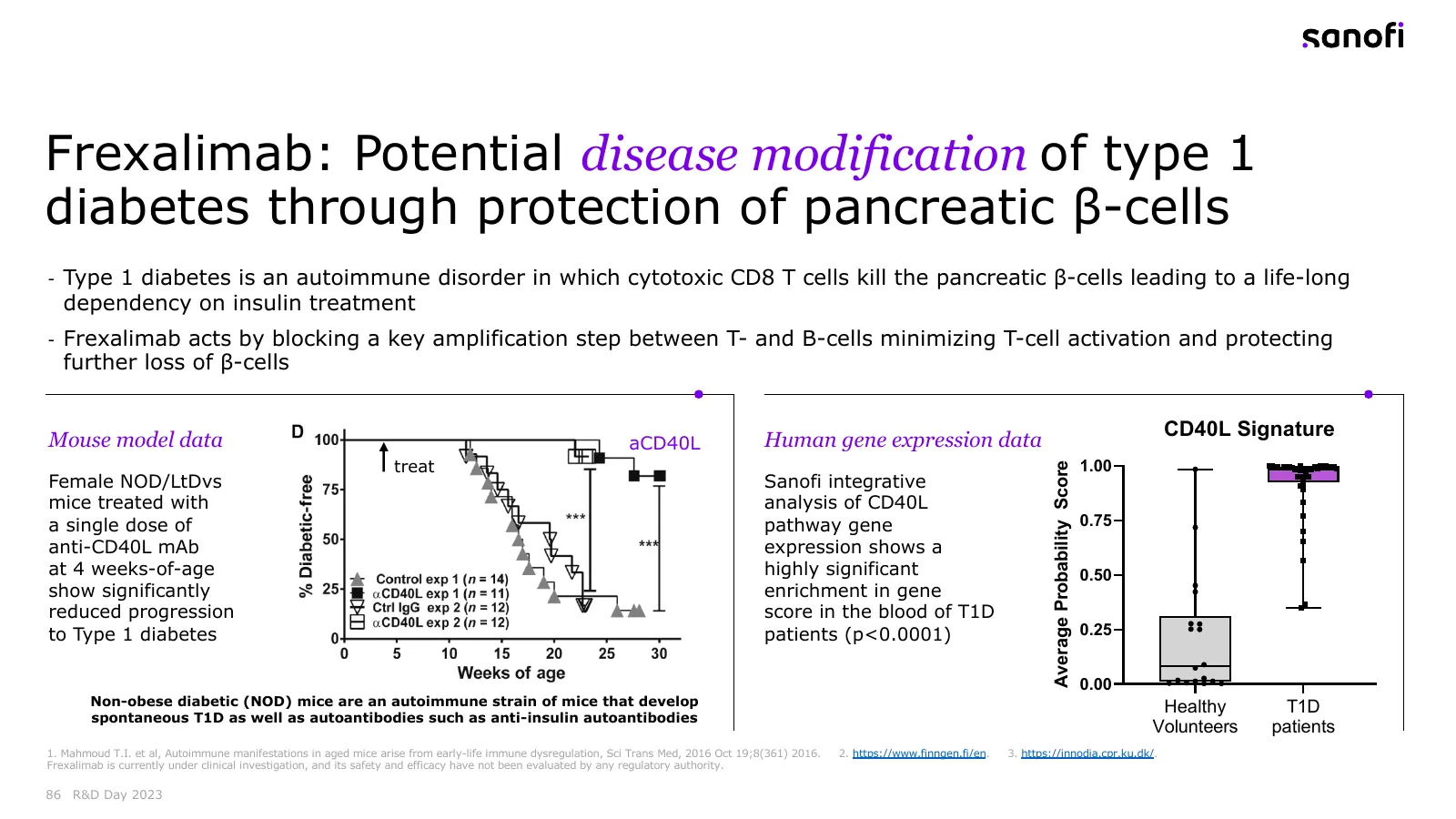
Slide 86: Frexalimab in type 1 diabetes
Frexalimab: Potential disease modification of type 1 diabetes through protection of pancreatic β-cells - Type 1 diabetes is an autoimmune disorder in which cytotoxic CD8 T cells kill the pancreatic β-cells leading to a life-long dependency on insulin treatment - Frexalimab acts by blocking a key amp
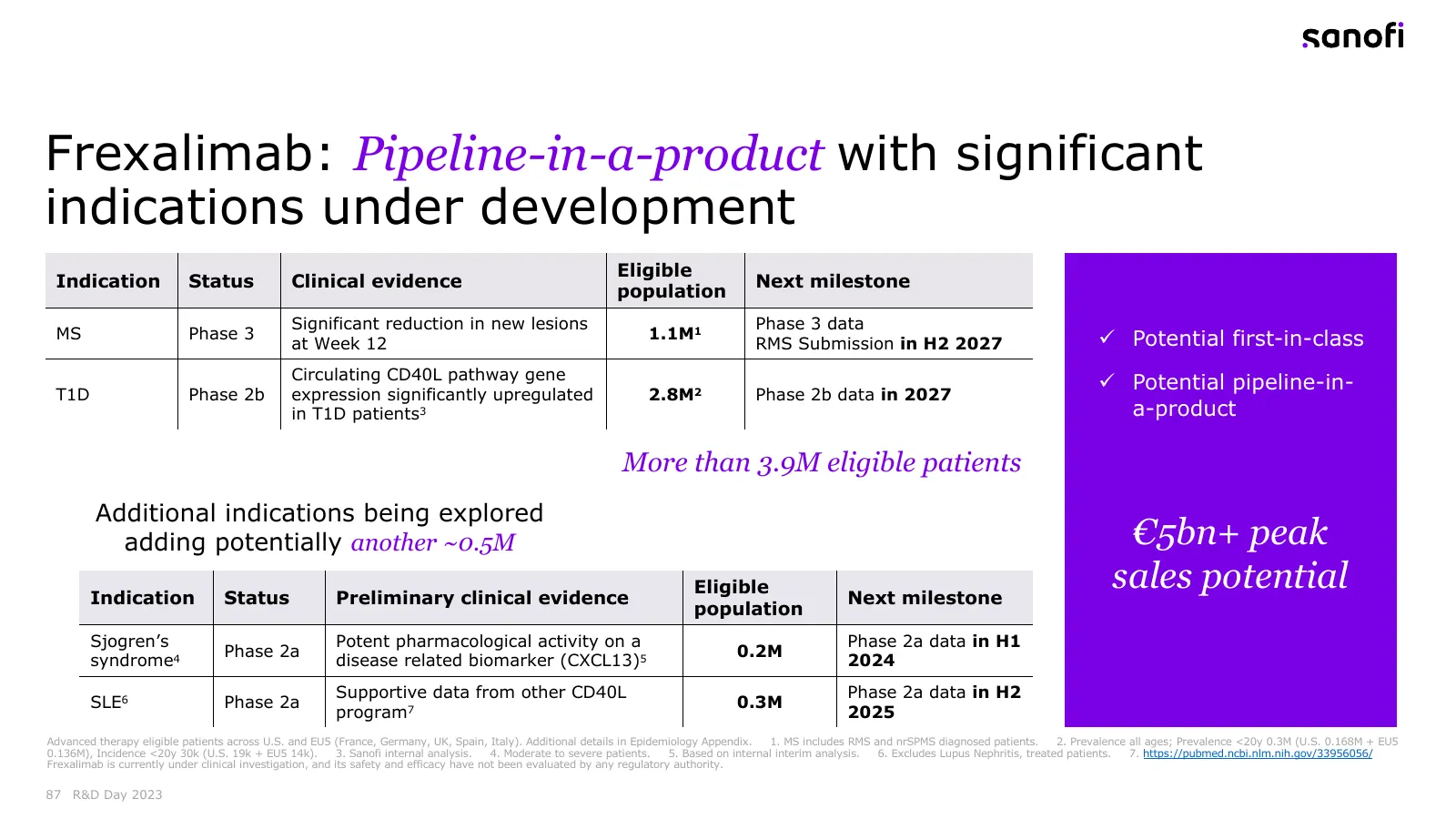
Slide 87: Frexalimab: Pipeline-in-a-product
Frexalimab: Pipeline-in-a-product with significant indications under development Eligible Indication Status Clinical evidence Next milestone population Significant reduction in new lesions Phase 3 data MS Phase 3 1.1M1 ü Potential first-in-class at Week 12 RMS Submission in H2 2027 Circulating CD40L
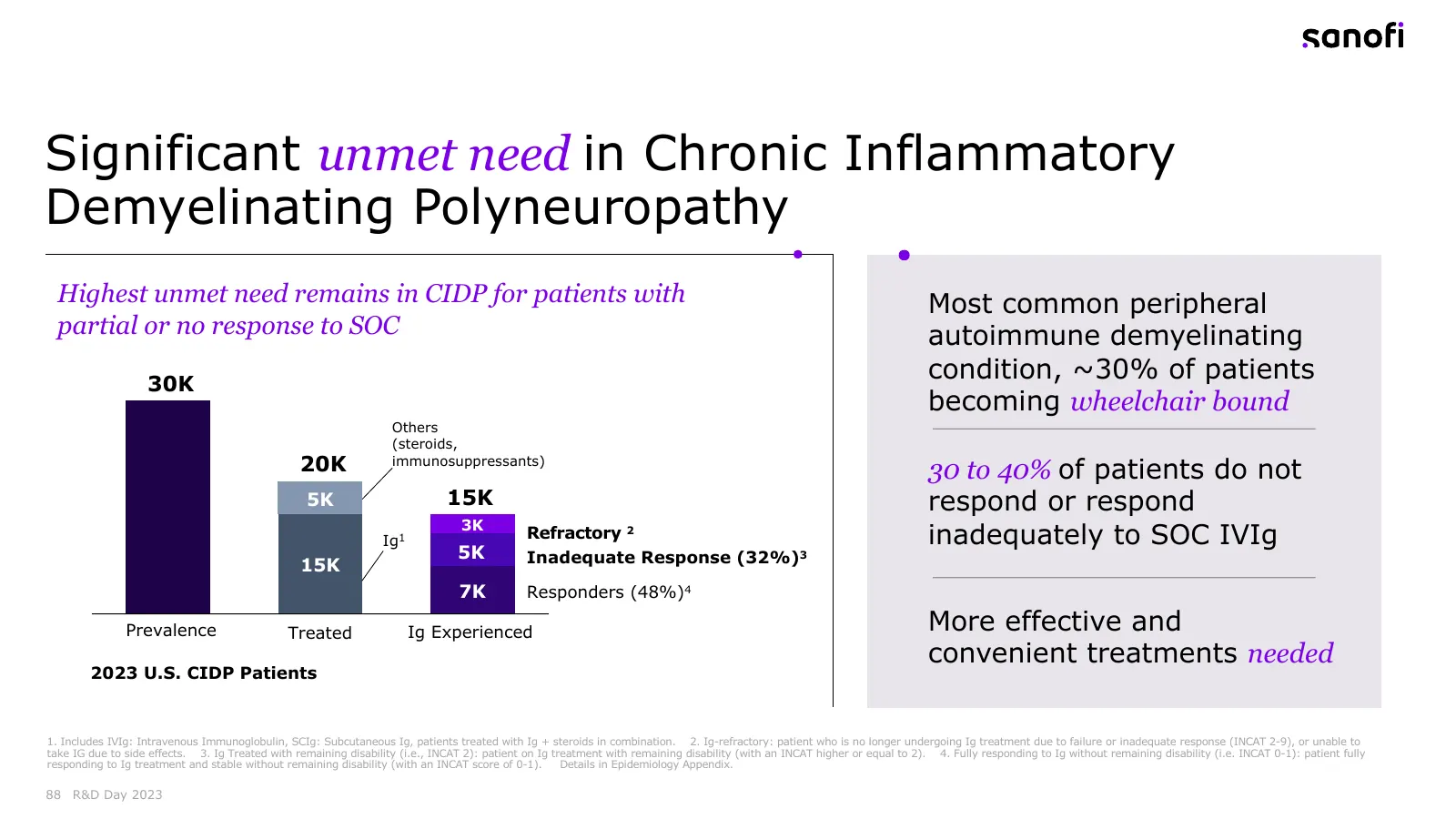
Slide 88: Significant unmet need in CIDP
Significant unmet need in Chronic Inflammatory Demyelinating Polyneuropathy Highest unmet need remains in CIDP for patients with Most common peripheral partial or no response to SOC autoimmune demyelinating 30K condition, ~30% of patients becoming wheelchair bound Others (steroids, 20K immunosuppres
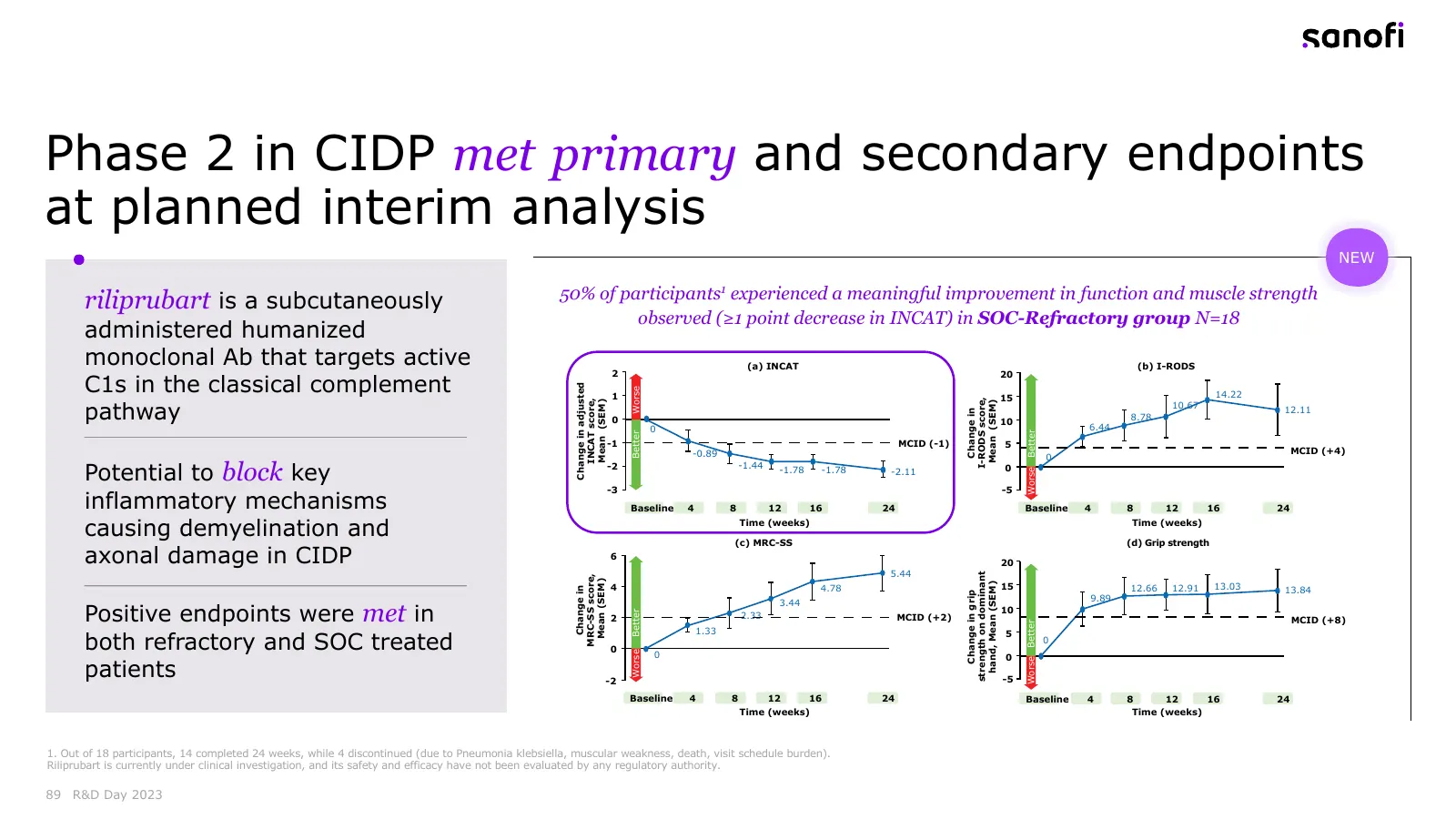
Slide 89: Phase 2 in CIDP met primary and secondary endpoints
Phase 2 in CIDP met primary and secondary endpoints at planned interim analysis NEW riliprubart is a subcutaneously 50% of participants1 experienced a meaningful improvement in function and muscle strength observed (≥1 point decrease in INCAT) in SOC-Refractory group N=18 administered humanized mono
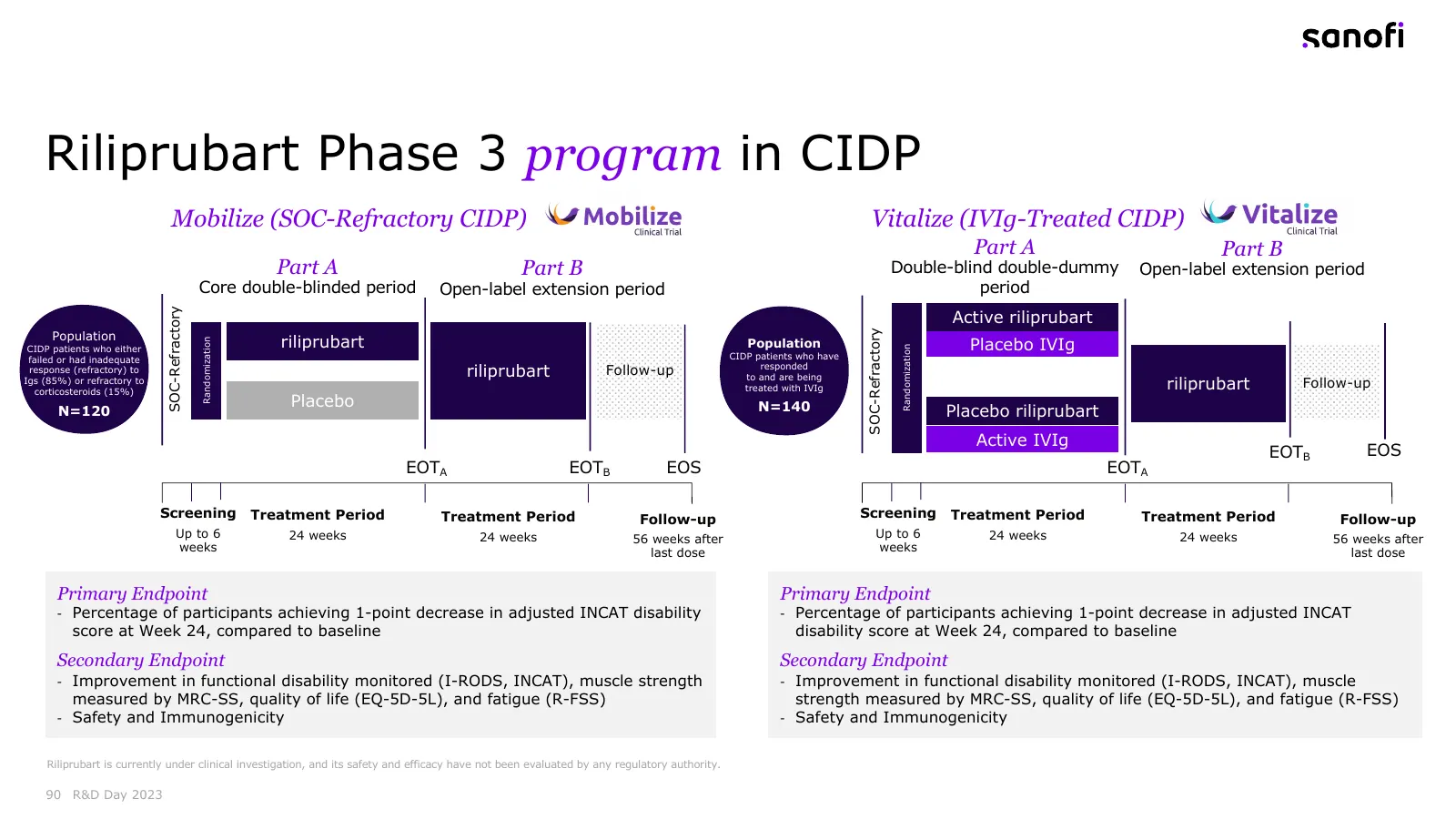
Slide 90: Riliprubart Phase 3 program in CIDP
Riliprubart Phase 3 program in CIDP Mobilize (SOC-Refractory CIDP) Vitalize (IVIg-Treated CIDP) Part A Part B Part A Part B Double-blind double-dummy Open-label extension period Core double-blinded period Open-label extension period period SOC-Refractory Active riliprubart SOC-Refractory Population
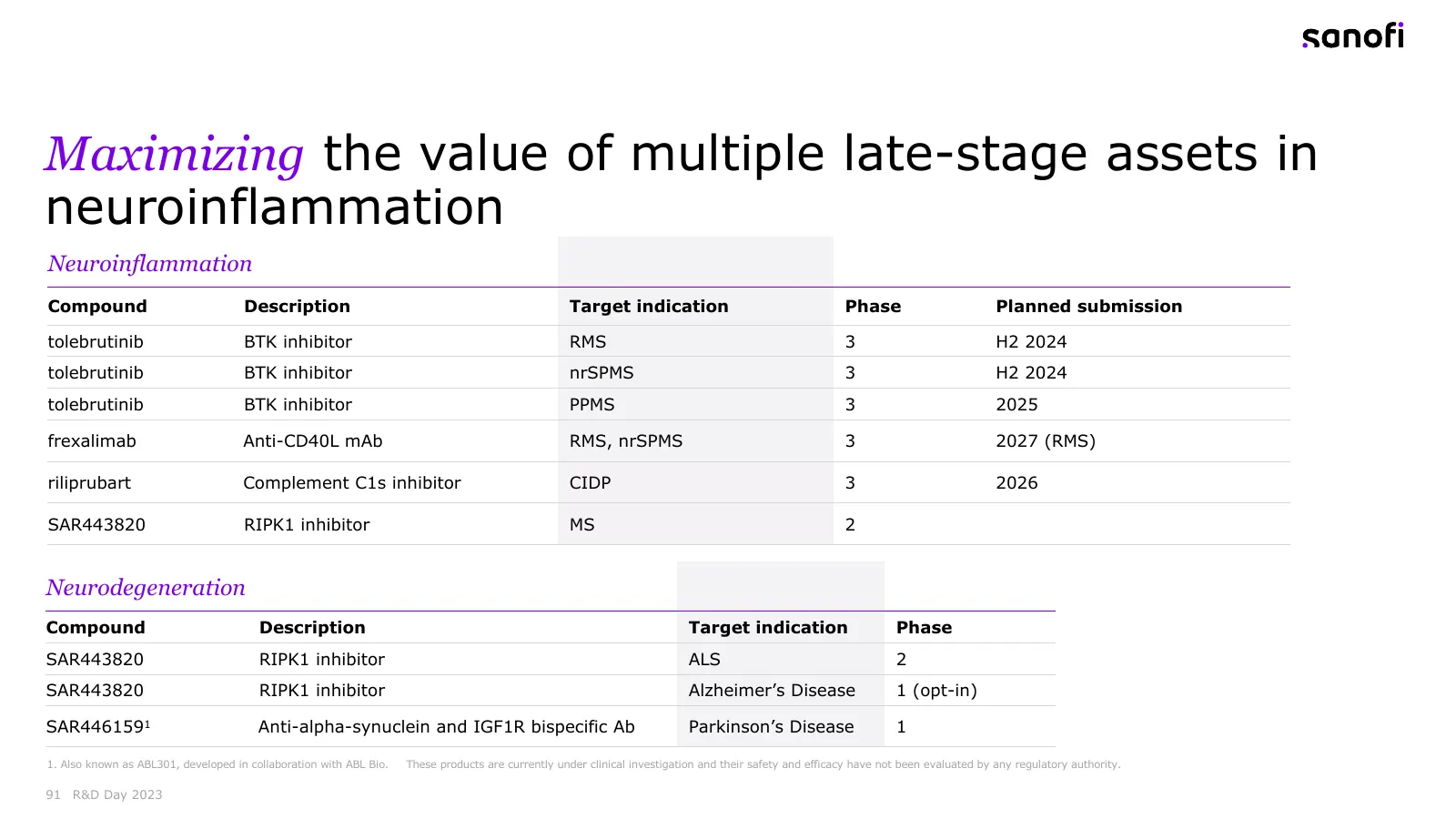
Slide 91: Maximizing value of late-stage assets in neuroinflammation
Maximizing the value of multiple late-stage assets in neuroinflammation Neuroinflammation Compound Description Target indication Phase Planned submission tolebrutinib BTK inhibitor RMS 3 H2 2024 tolebrutinib BTK inhibitor nrSPMS 3 H2 2024 tolebrutinib BTK inhibitor PPMS 3 2025 frexalimab Anti-CD40L

Slide 92: Expanding leadership in respiratory
Expanding leadership in respiratory Manuela Buxo Global Head of Dupixent Franchise
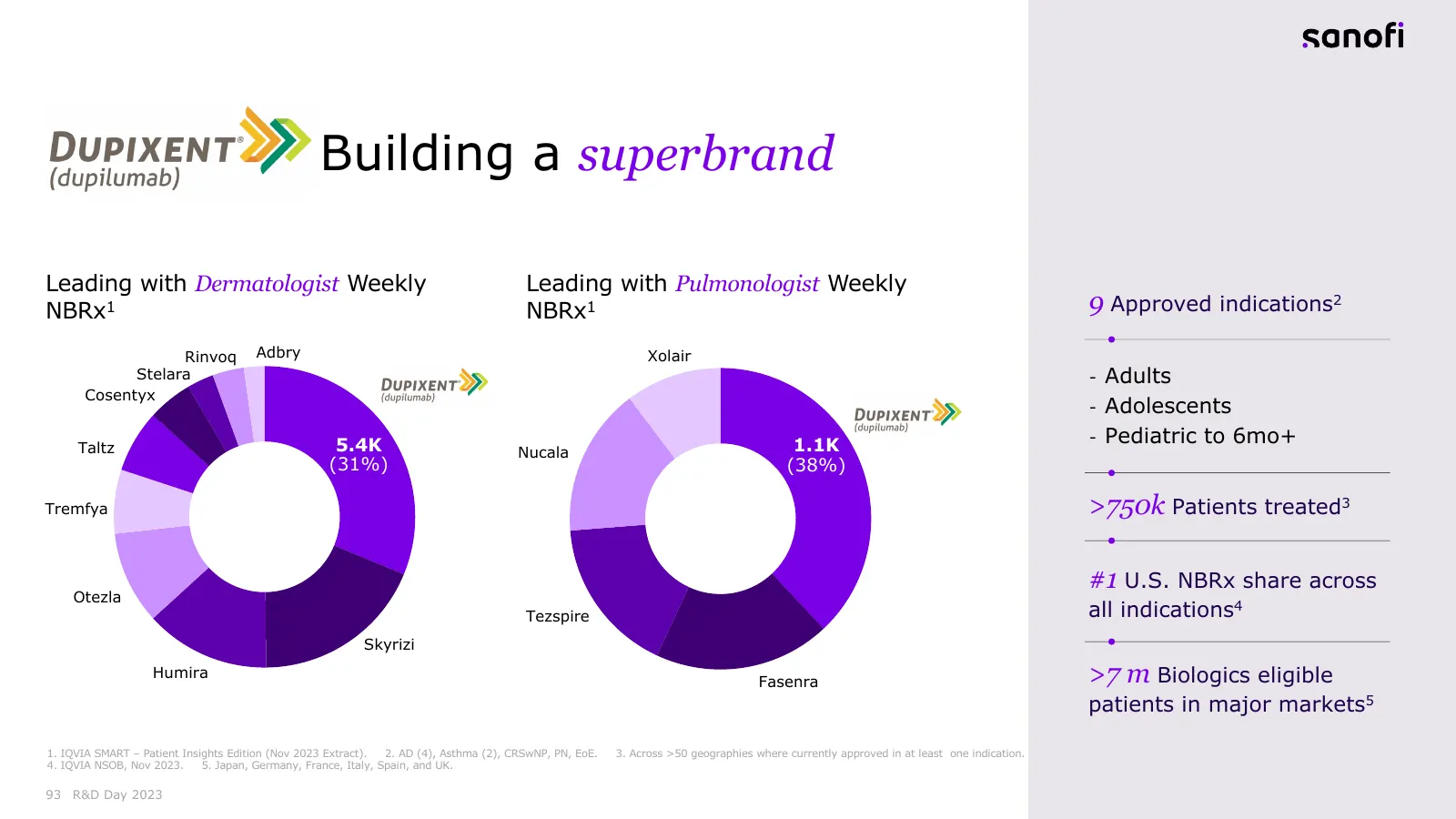
Slide 93: Dupixent - Building a superbrand
Dupixent - Building a superbrand Leading with Dermatologist Weekly Leading with Pulmonologist Weekly NBRx1 NBRx1 9 Approved indications2 Rinvoq Adbry Xolair Stelara - Adults Cosentyx - Adolescents Taltz 5.4K 1.1K - Pediatric to 6mo+ Nucala (31%) (38%) Tremfya >750k Patients treated3 #1 U.S. NBRx sha
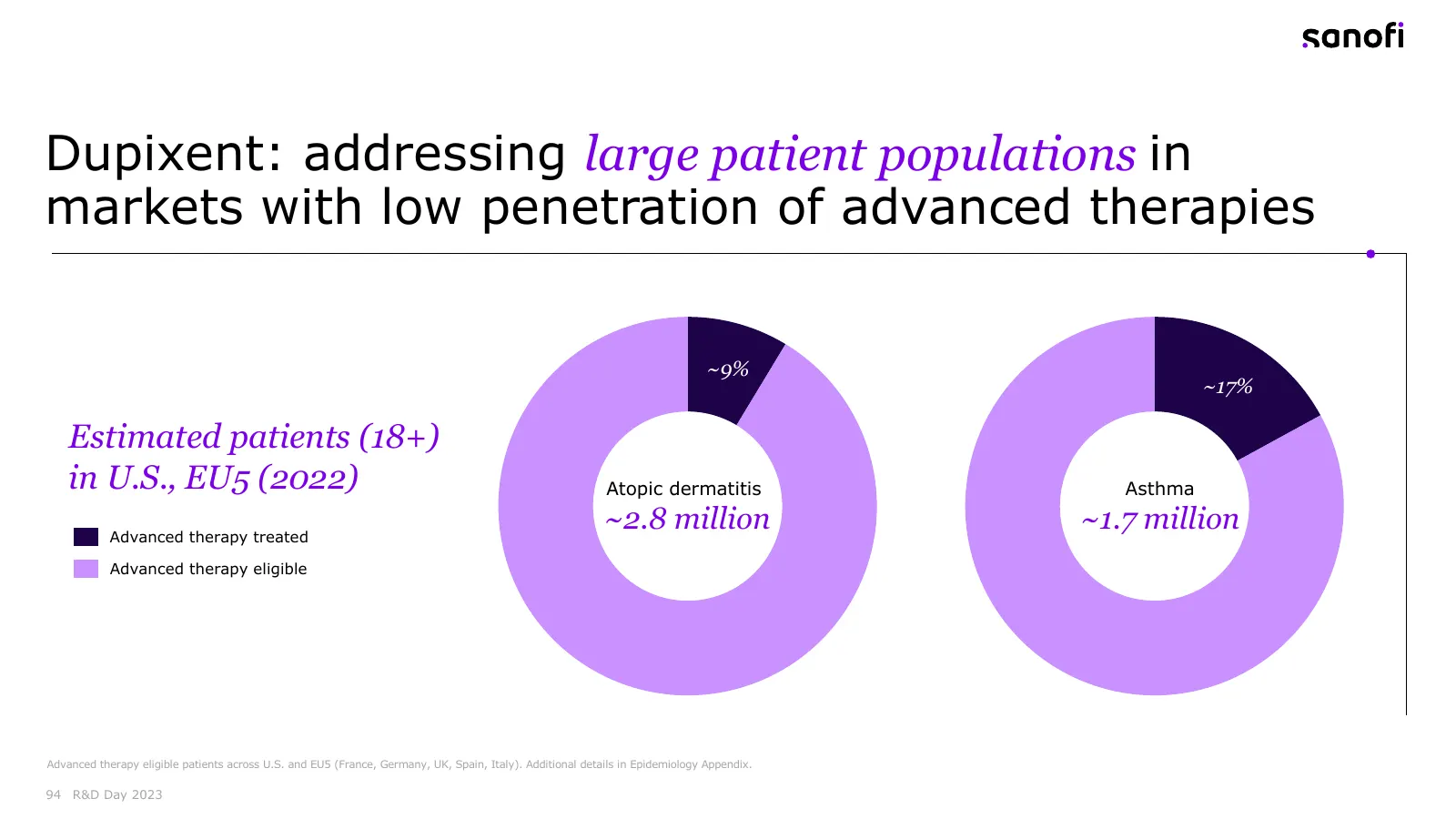
Slide 94: Dupixent: large patient populations with low penetration
Dupixent: addressing large patient populations in markets with low penetration of advanced therapies ~9% ~17% Estimated patients (18+) in U.S., EU5 (2022) Atopic dermatitis Asthma Advanced therapy treated ~2.8 million ~1.7 million Advanced therapy eligible Advanced therapy eligible patients across U
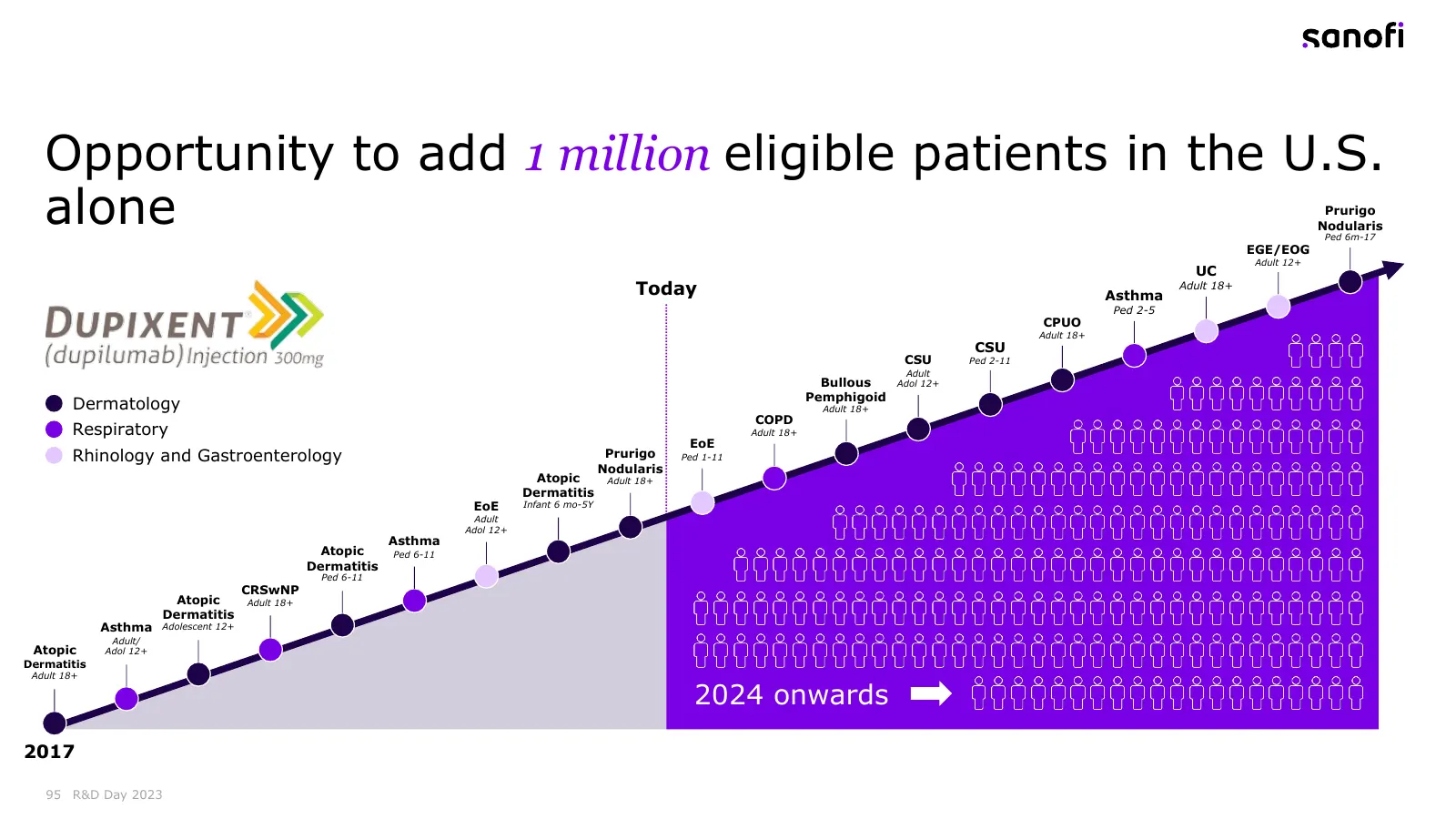
Slide 95: Opportunity to add 1 million eligible patients in the U.S.
Opportunity to add 1 million eligible patients in the U.S. alone Prurigo Nodularis Ped 6m-17 EGE/EOG Adult 12+ UC Today Asthma Adult 18+ Ped 2-5 CPUO Adult 18+ CSU CSU Ped 2-11 Adult Bullous Adol 12+ Pemphigoid Dermatology Adult 18+ COPD Respiratory Adult 18+ EoE Rhinology and Gastroenterology Pruri
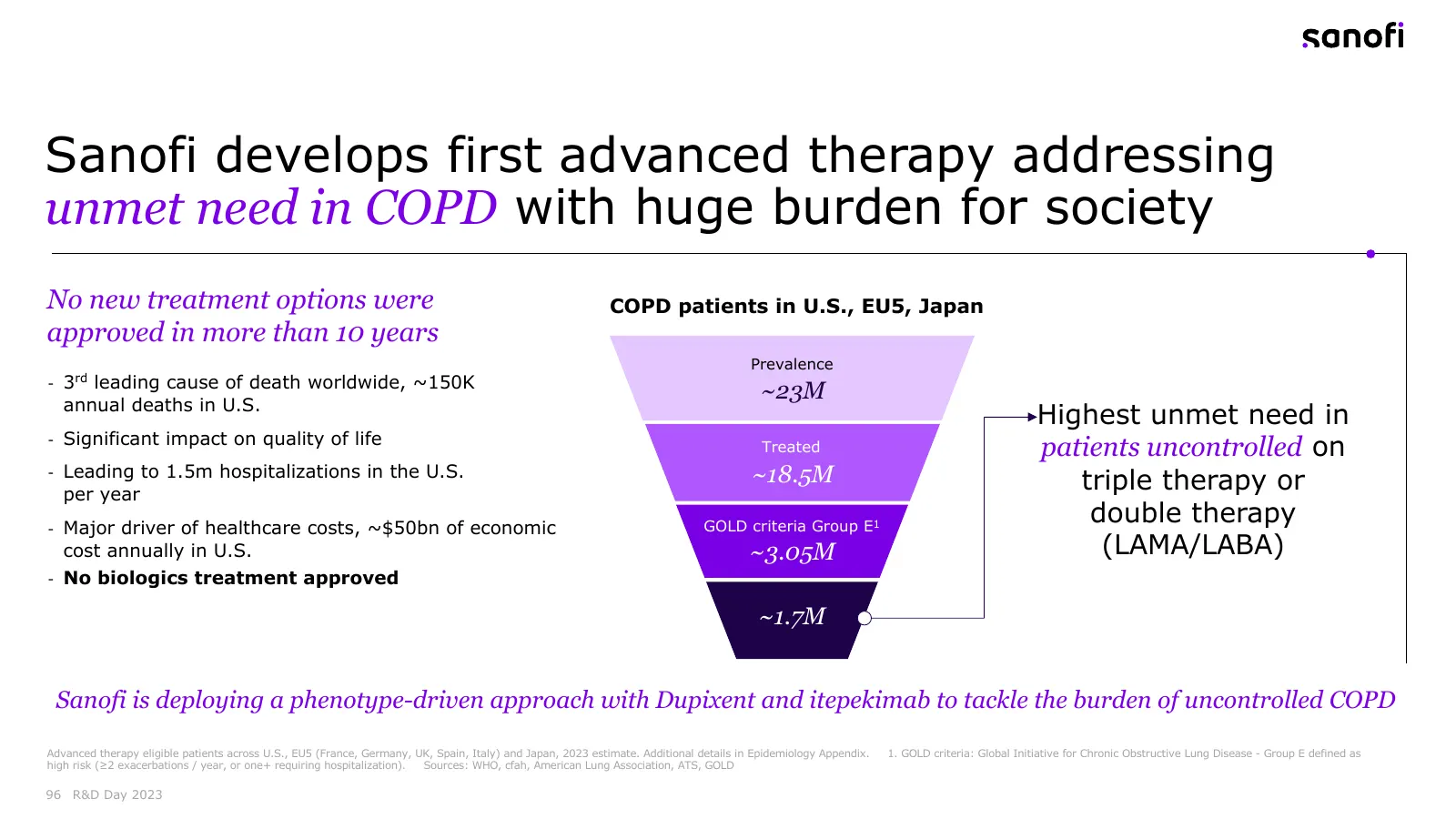
Slide 96: First advanced therapy addressing unmet need in COPD
Sanofi develops first advanced therapy addressing unmet need in COPD with huge burden for society No new treatment options were COPD patients in U.S., EU5, Japan approved in more than 10 years Prevalence - 3rd leading cause of death worldwide, ~150K ~23M annual deaths in U.S. Highest unmet need in -
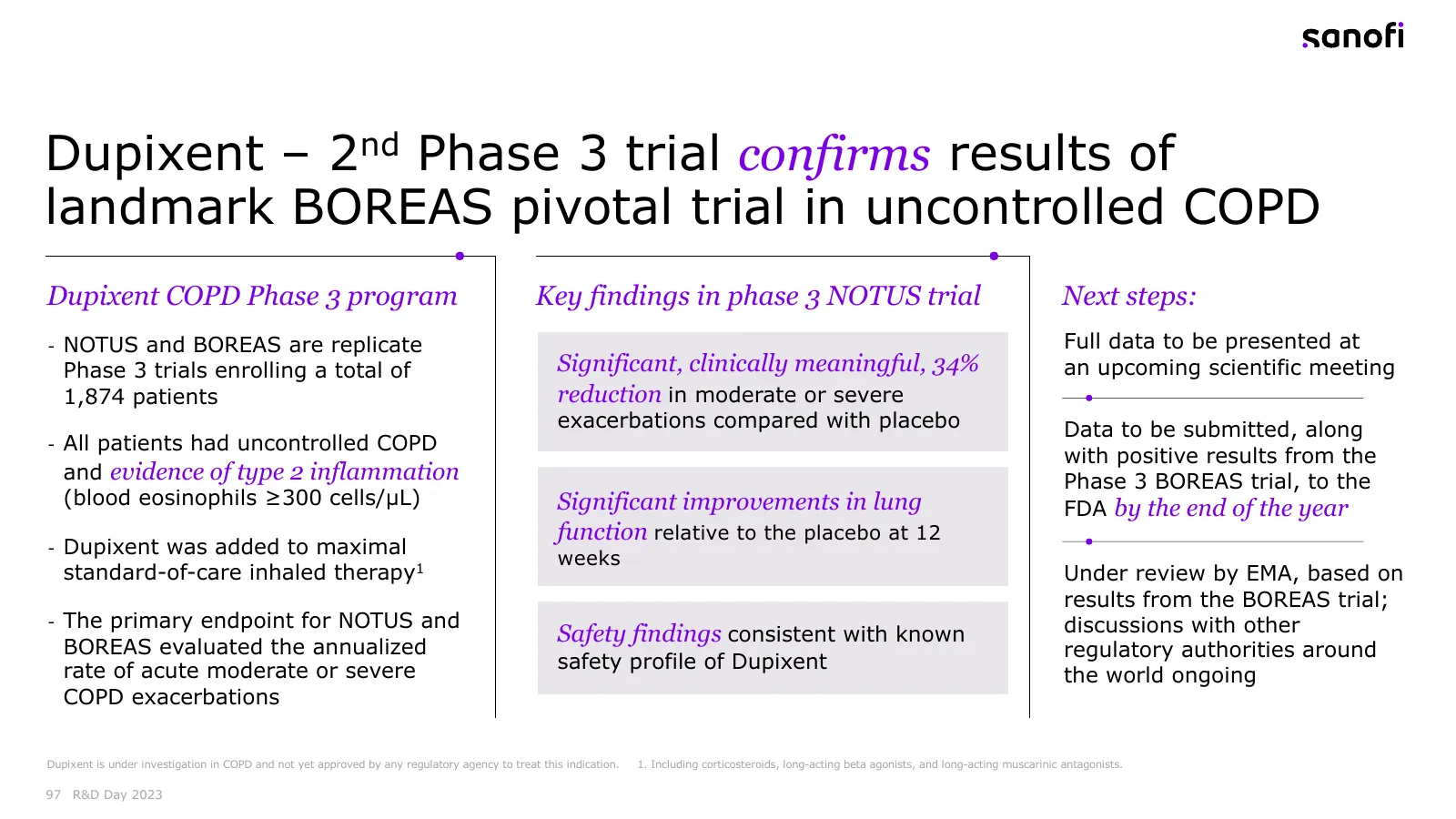
Slide 97: Dupixent: 2nd Phase 3 trial confirms BOREAS results
Dupixent – 2nd Phase 3 trial confirms results of landmark BOREAS pivotal trial in uncontrolled COPD Dupixent COPD Phase 3 program Key findings in phase 3 NOTUS trial Next steps: - NOTUS and BOREAS are replicate Full data to be presented at Phase 3 trials enrolling a total of Significant, clinically
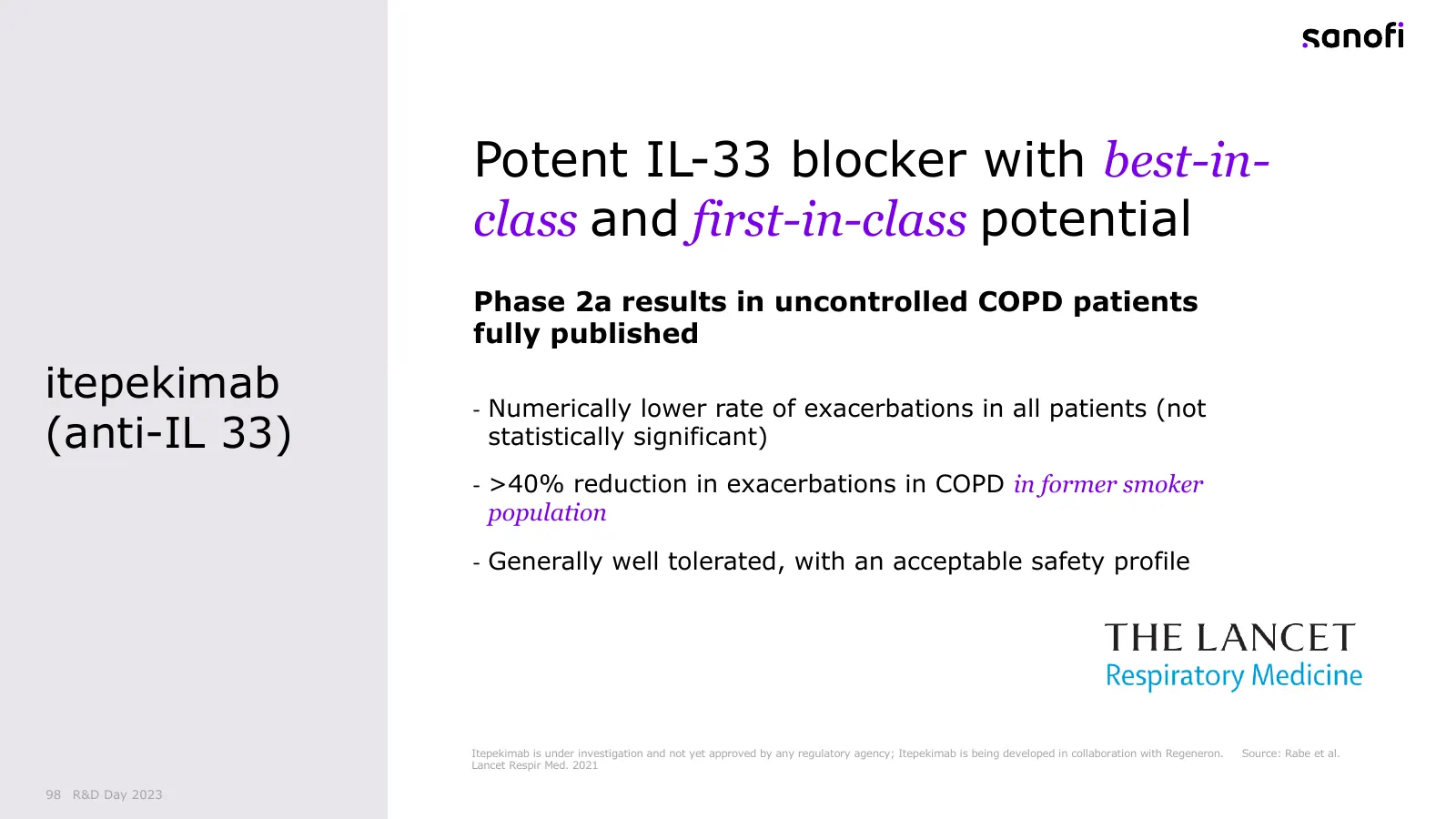
Slide 98: Potent IL-33 blocker with best-in-class potential
Potent IL-33 blocker with best-in- class and first-in-class potential Phase 2a results in uncontrolled COPD patients fully published itepekimab - Numerically lower rate of exacerbations in all patients (not (anti-IL 33) statistically significant) - >40% reduction in exacerbations in COPD in former s
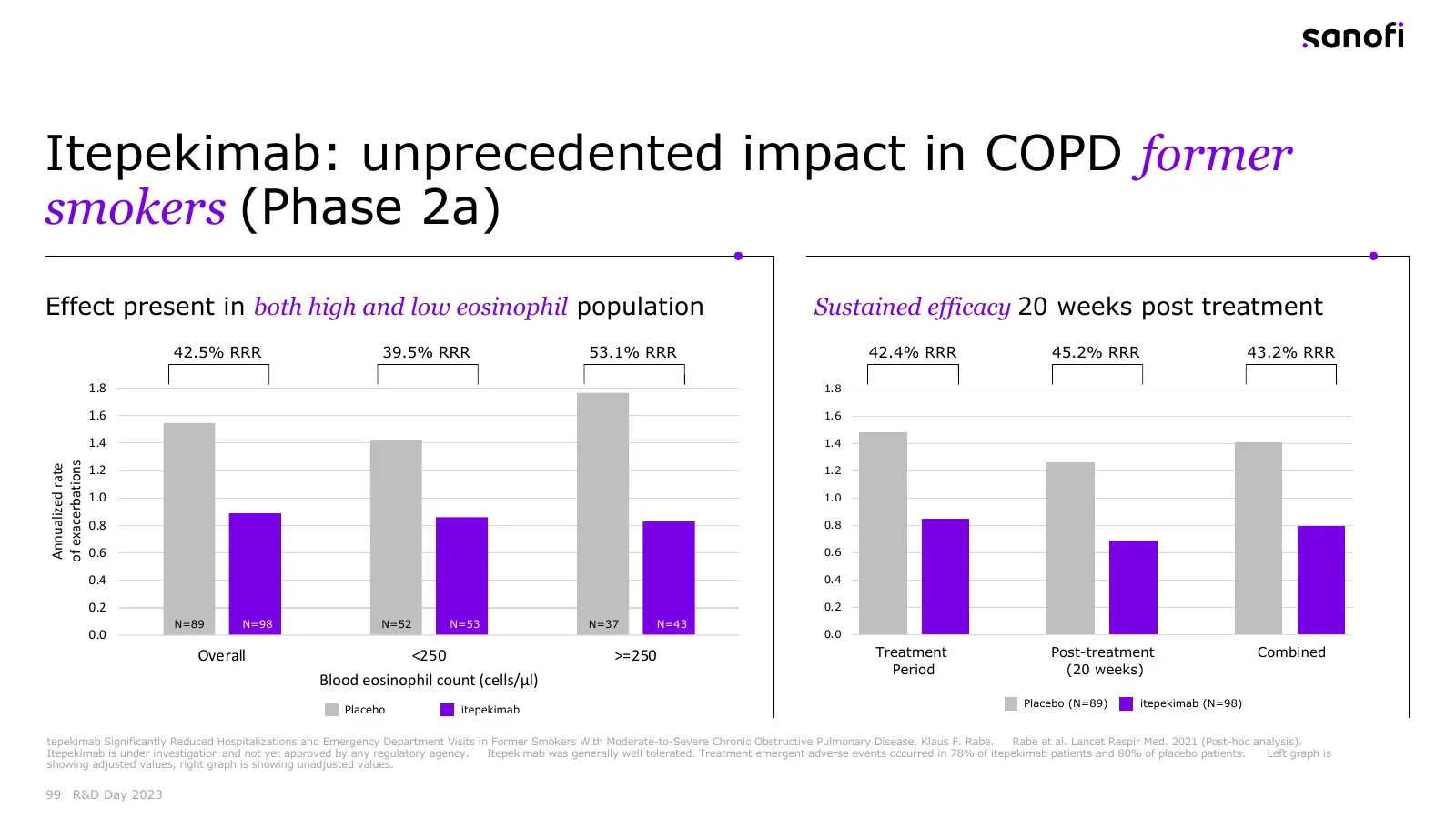
Slide 99: Itepekimab: impact in COPD former smokers
Itepekimab: unprecedented impact in COPD former smokers (Phase 2a) Effect present in both high and low eosinophil population Sustained efficacy 20 weeks post treatment 42.5% RRR 39.5% RRR 53.1% RRR 42.4% RRR 45.2% RRR 43.2% RRR 1.8 1.8 1.6 1.6 1.4 1.4 of exacerbations 1.2 Annualized rate 1.2 1.0 1.0
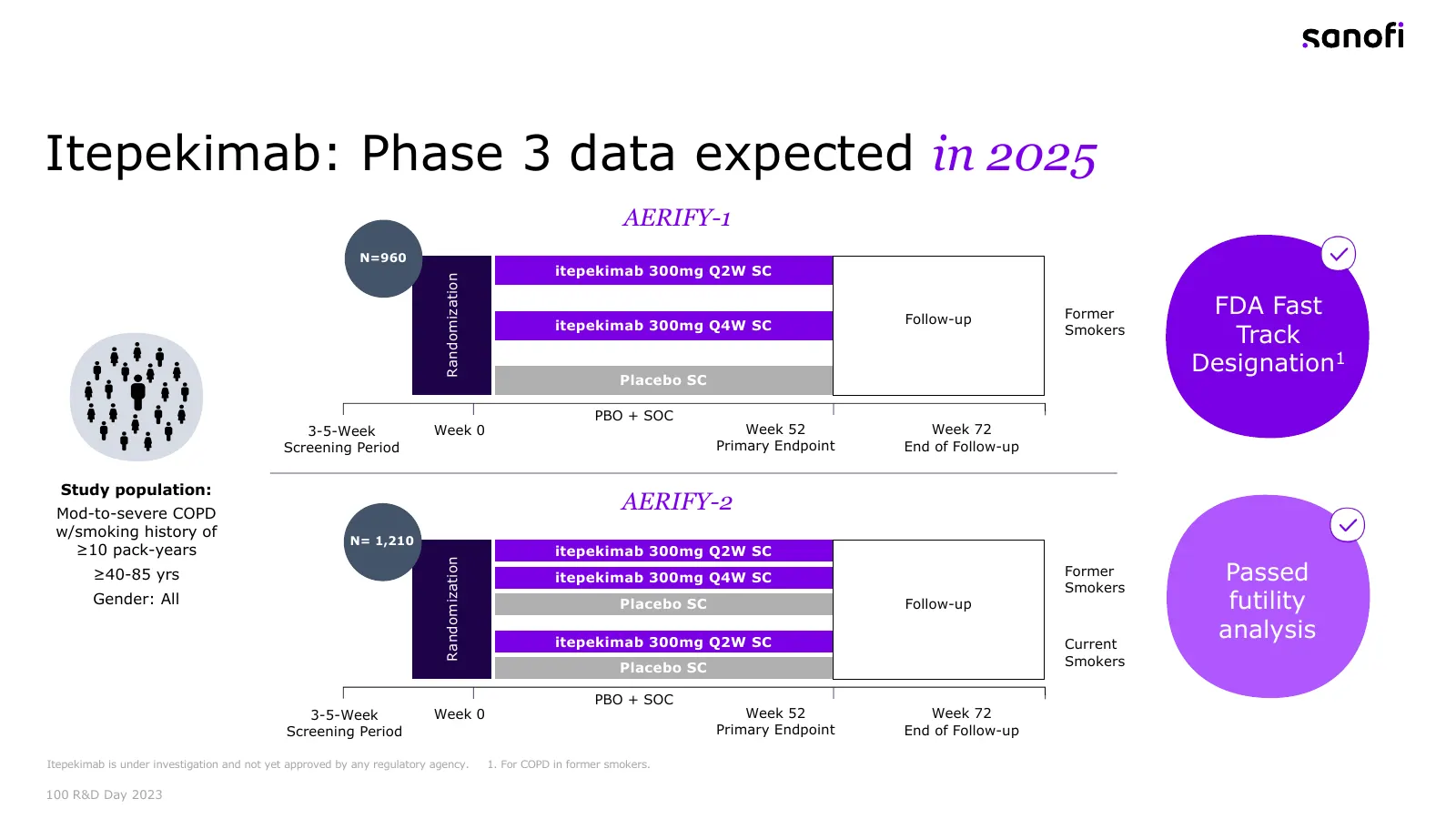
Slide 100: Itepekimab: Phase 3 data expected in 2025
Itepekimab: Phase 3 data expected in 2025 AERIFY-1 N=960 itepekimab 300mg Q2W SC Randomization Follow-up Former FDA Fast itepekimab 300mg Q4W SC Smokers Track Designation1 Placebo SC PBO + SOC 3-5-Week Week 0 Week 52 Week 72 Screening Period Primary Endpoint End of Follow-up Study population: Mod-to
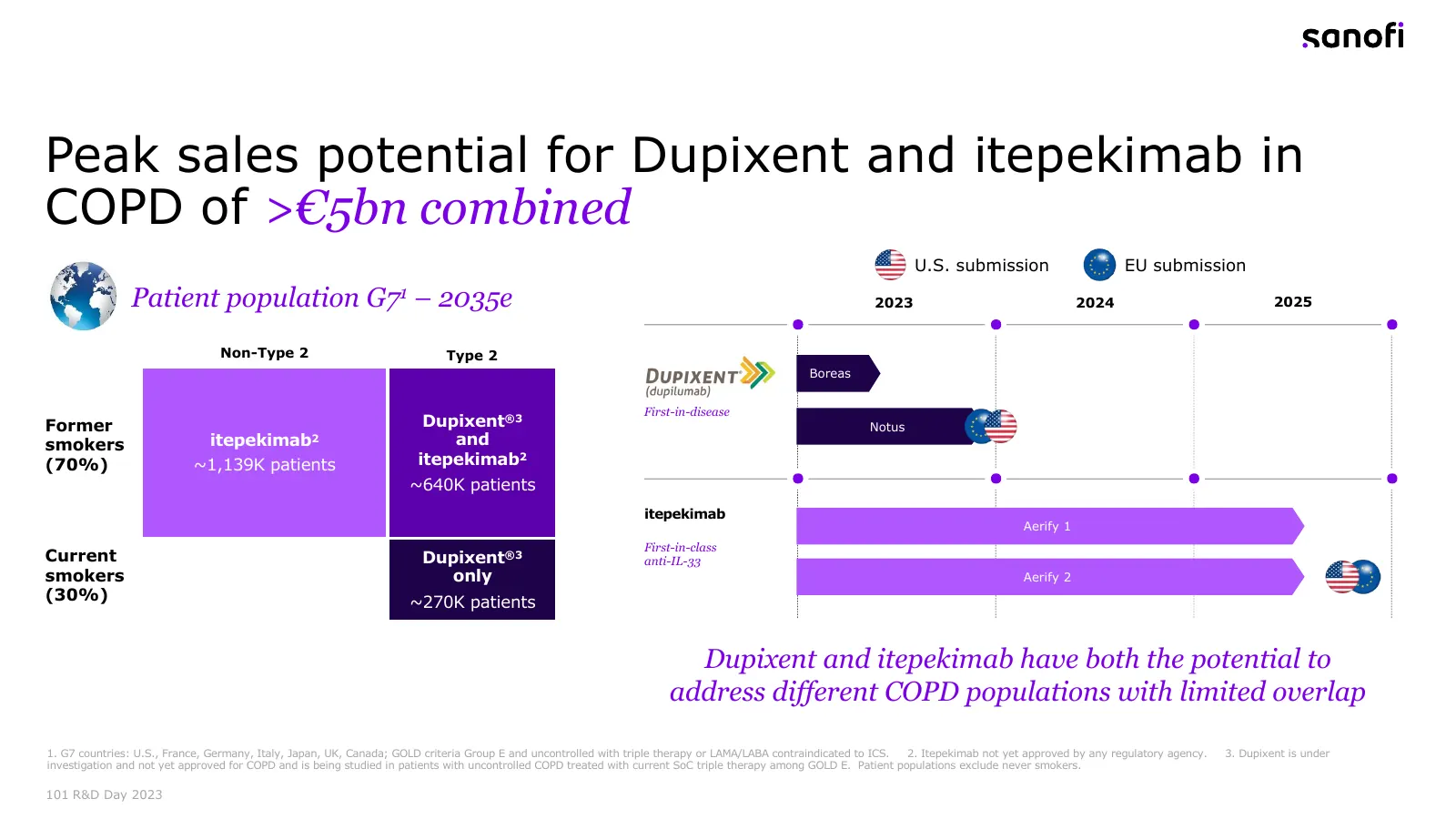
Slide 101: Peak sales potential for Dupixent and itepekimab in COPD
Peak sales potential for Dupixent and itepekimab in COPD of >€5bn combined U.S. submission EU submission Patient population G71 – 2035e 2023 2024 2025 Non-Type 2 Type 2 Boreas First-in-disease Former Dupixent®3 Notus smokers itepekimab2 and (70%) ~1,139K patients itepekimab2 ~640K patients itepekima

Slide 102: Physician perspective on COPD
Physician perspective on COPD Brian Foard Global Head of Specialty Care ad interim Elizabeth Laws Global Program Head, Dupixent MeiLan Han Chief, Division of Pulmonary & Critical Care at the University of Michigan

Slide 103: Q&A session (Part 2)
Q&A session (Part 2)

Slide 104: Break
Break

Slide 105: Leading in Immunology Research
Leading in Immunology Research Frank Nestle Global Head of Research, Chief Scientific Officer
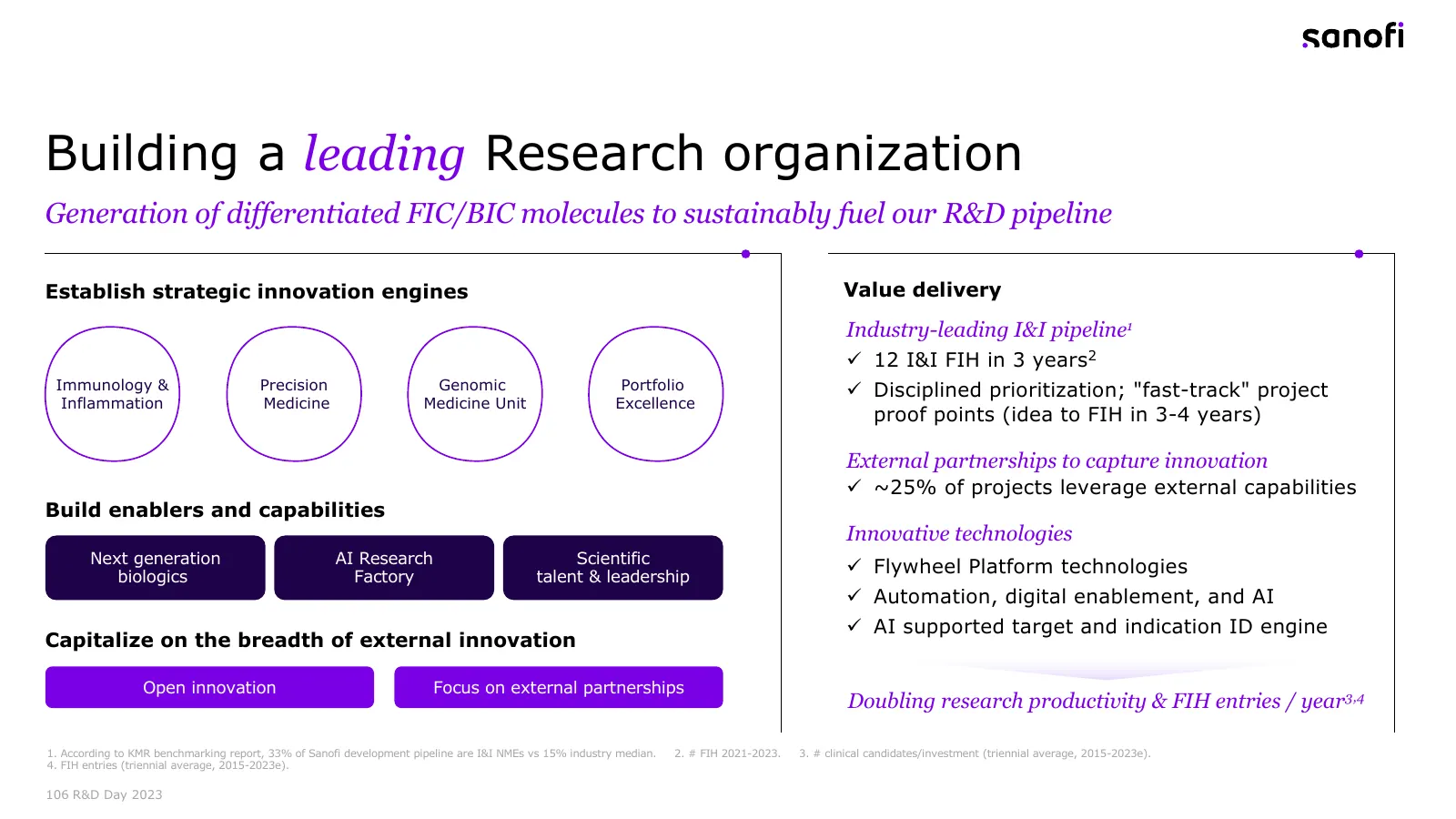
Slide 106: Building a leading Research organization
Building a leading Research organization Generation of differentiated FIC/BIC molecules to sustainably fuel our R&D pipeline Establish strategic innovation engines Value delivery Industry-leading I&I pipeline1 ü 12 I&I FIH in 3 years2 Immunology & Precision Genomic Portfolio ü Disciplined prioritiza
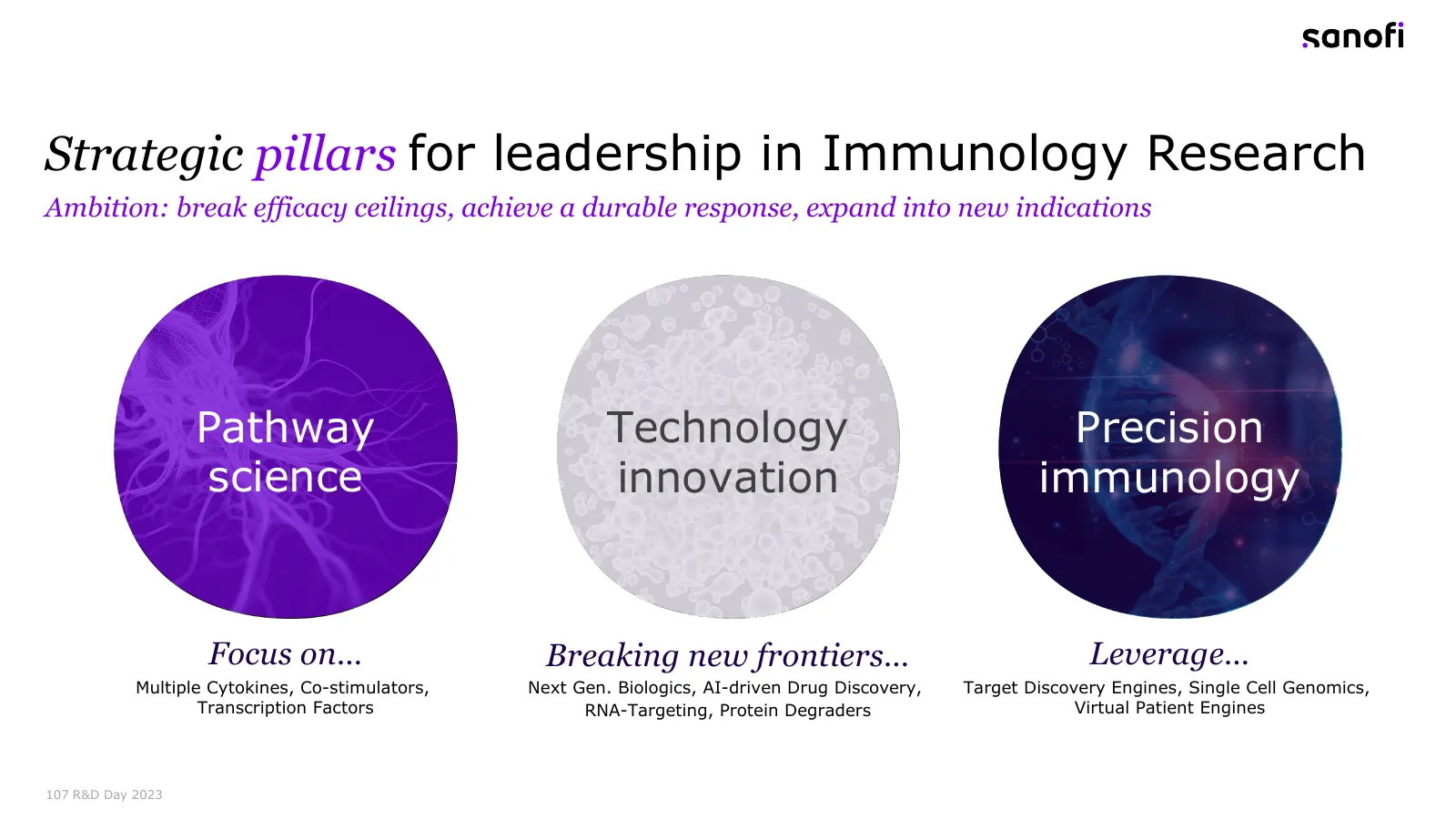
Slide 107: Strategic pillars for leadership in Immunology Research
Strategic pillars for leadership in Immunology Research Ambition: break efficacy ceilings, achieve a durable response, expand into new indications Pathway Technology Precision science innovation immunology Focus on… Breaking new frontiers… Leverage… Multiple Cytokines, Co-stimulators, Next Gen. Biol
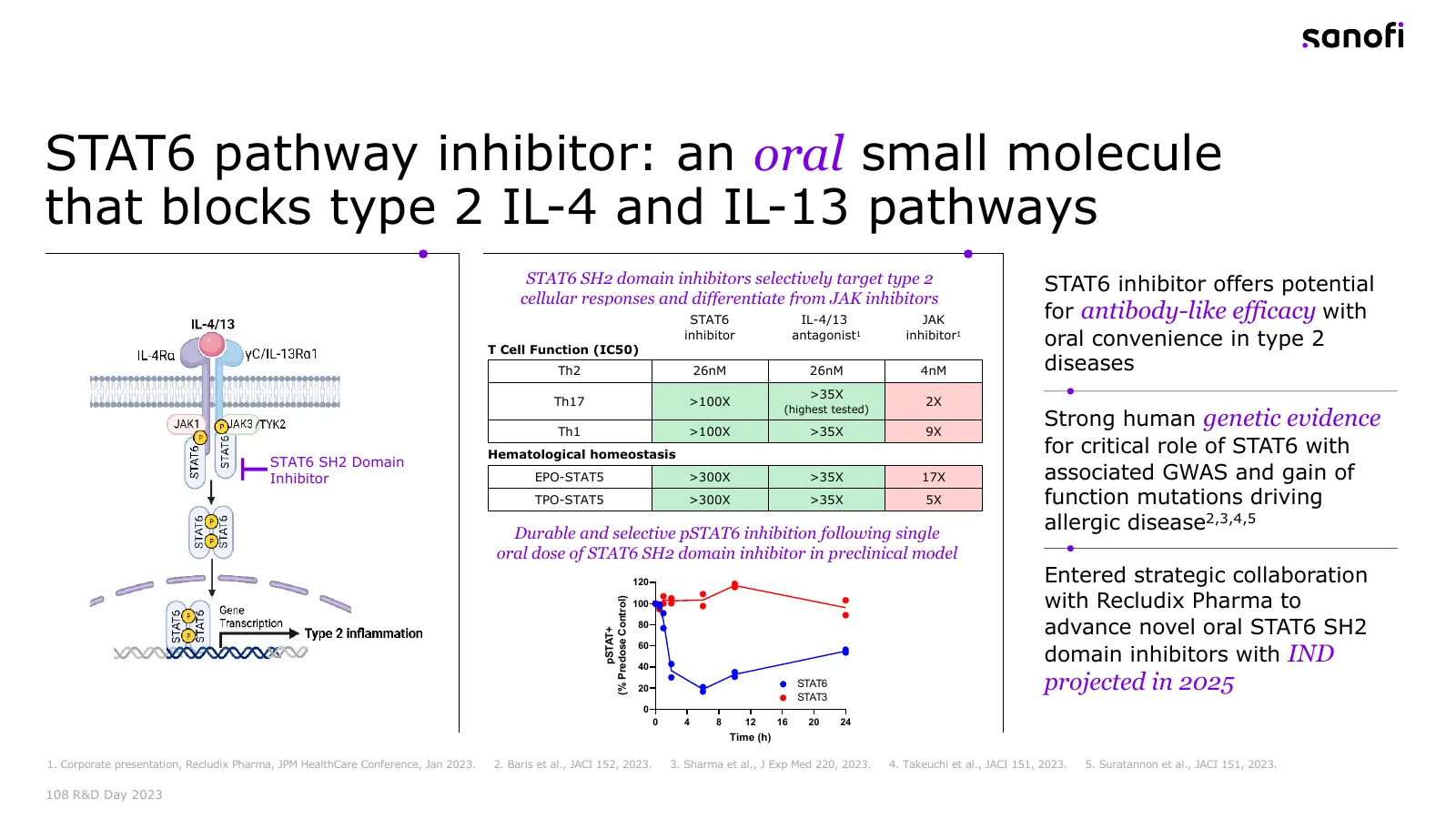
Slide 108: STAT6 pathway inhibitor
STAT6 pathway inhibitor: an oral small molecule that blocks type 2 IL-4 and IL-13 pathways STAT6 SH2 domain inhibitors selectively target type 2 STAT6 inhibitor offers potential cellular responses and differentiate from JAK inhibitors STAT6 IL-4/13 JAK for antibody-like efficacy with T Cell Function
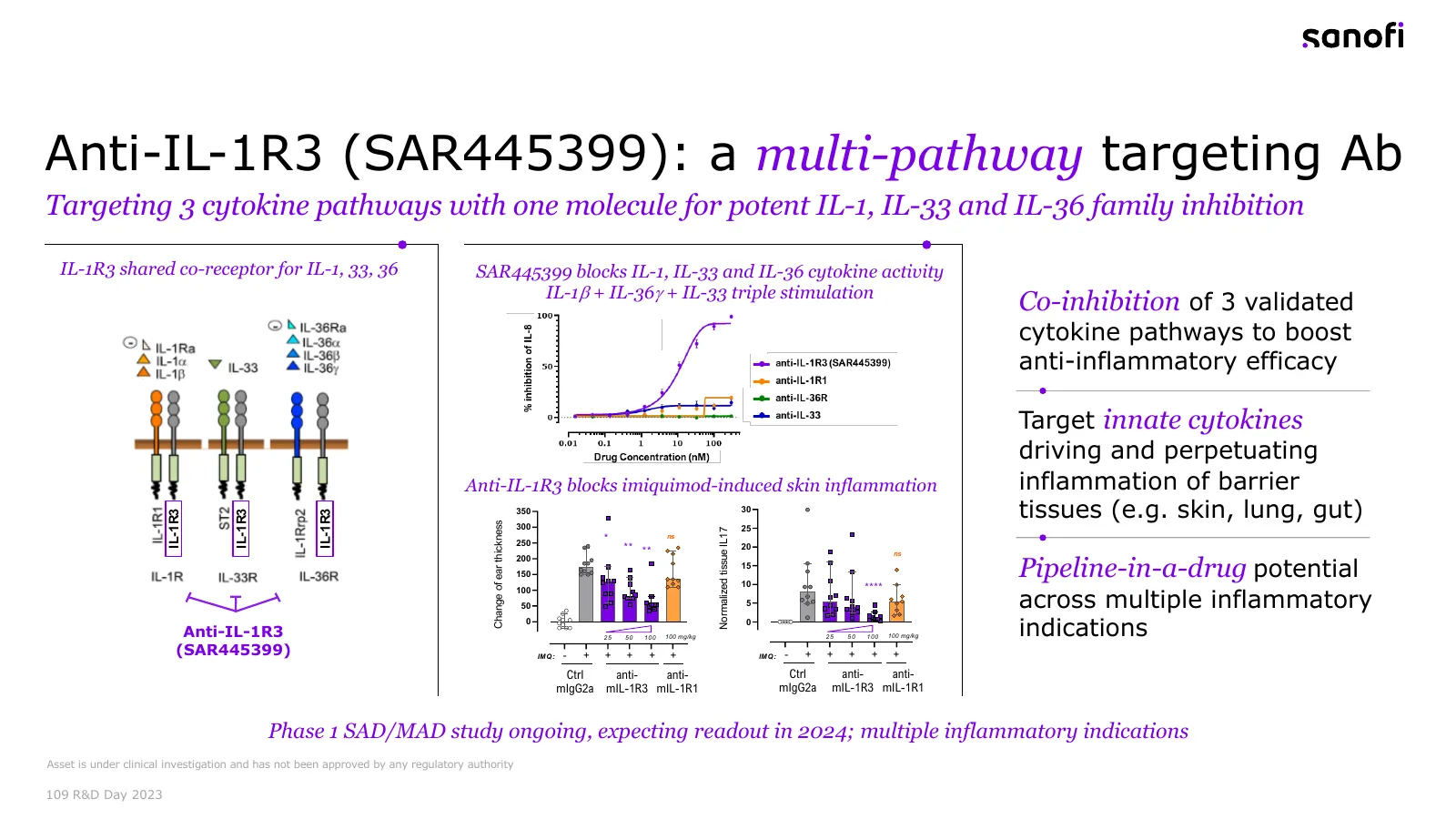
Slide 109: Anti-IL-1R3 (SAR445399): a multi-pathway targeting Ab
Anti-IL-1R3 (SAR445399): a multi-pathway targeting Ab Targeting 3 cytokine pathways with one molecule for potent IL-1, IL-33 and IL-36 family inhibition IL-1R3 shared co-receptor for IL-1, 33, 36 SAR445399 blocks IL-1, IL-33 and IL-36 cytokine activity IL-1b + IL-36g + IL-33 triple stimulation Co-in
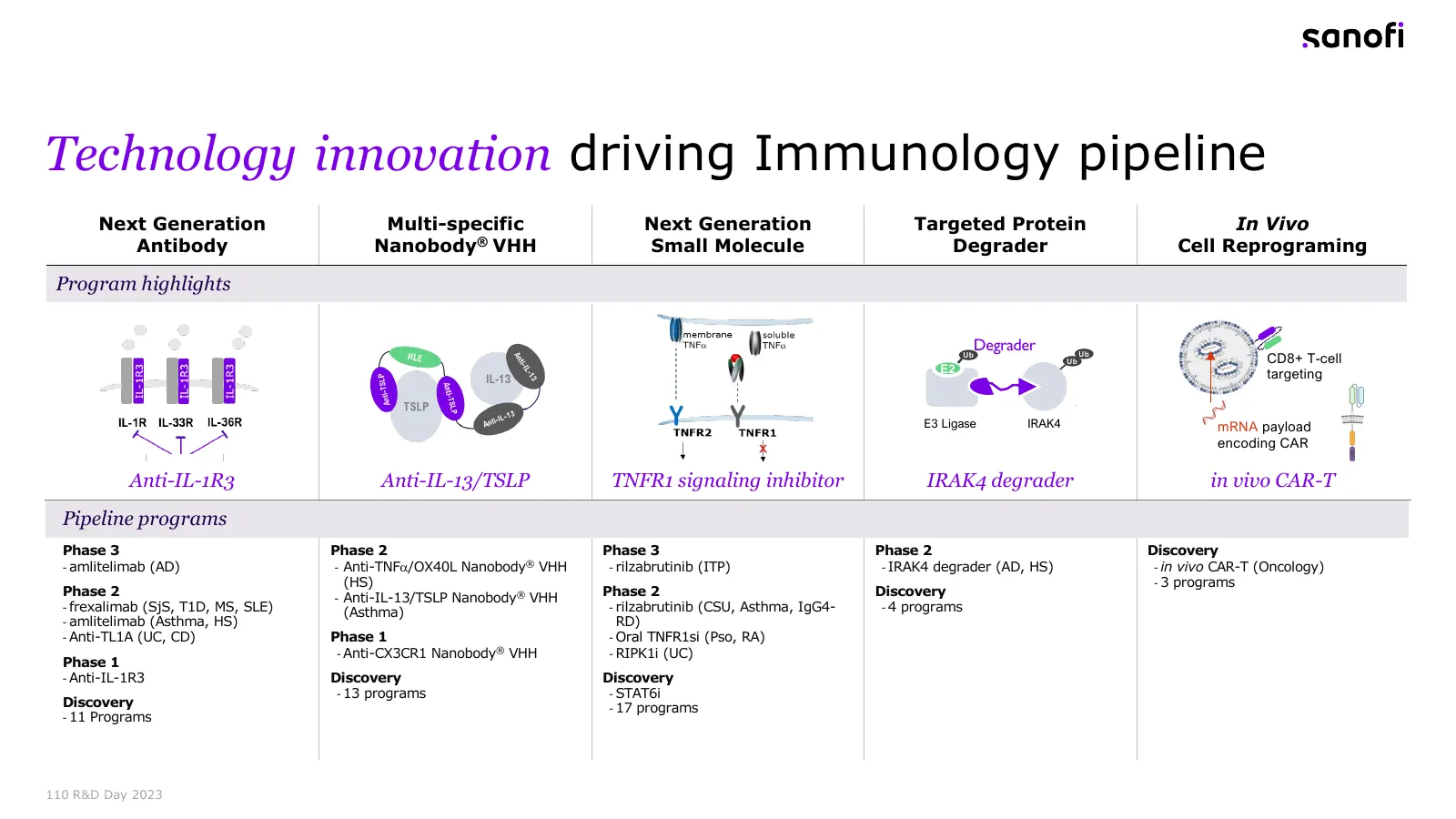
Slide 110: Technology innovation driving Immunology pipeline
Technology innovation driving Immunology pipeline Next Generation Multi-specific Next Generation Targeted Protein In Vivo Antibody Nanobody® VHH Small Molecule Degrader Cell Reprograming Program highlights Degrader Ub Ub Ub CD8+ T-cell E2 targeting E3 Ligase IRAK4 mRNA payload encoding CAR Anti-IL-1
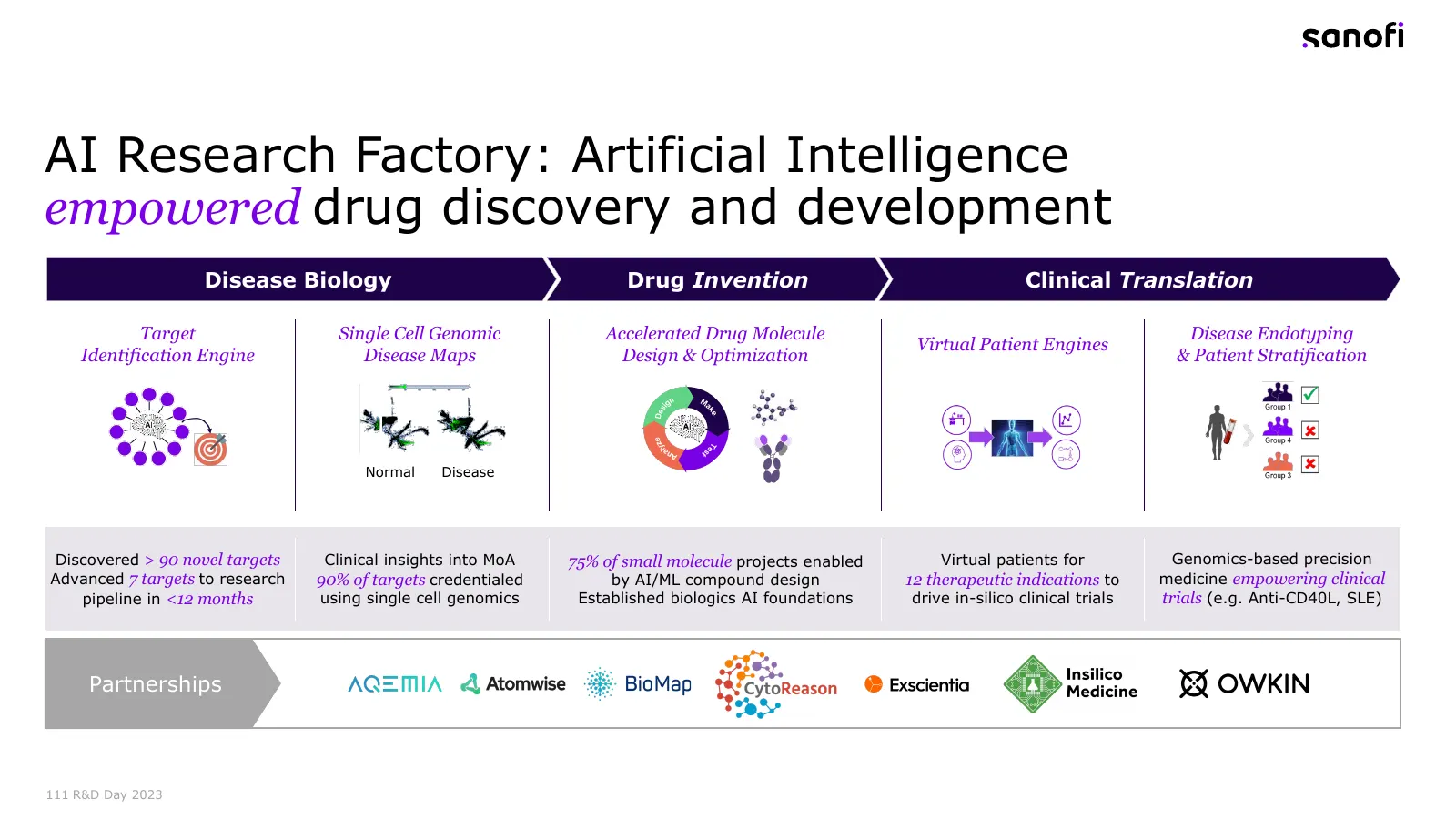
Slide 111: AI Research Factory
AI Research Factory: Artificial Intelligence empowered drug discovery and development Disease Biology Drug Invention Clinical Translation Target Single Cell Genomic Accelerated Drug Molecule Disease Endotyping Virtual Patient Engines Identification Engine Disease Maps Design & Optimization & Patient
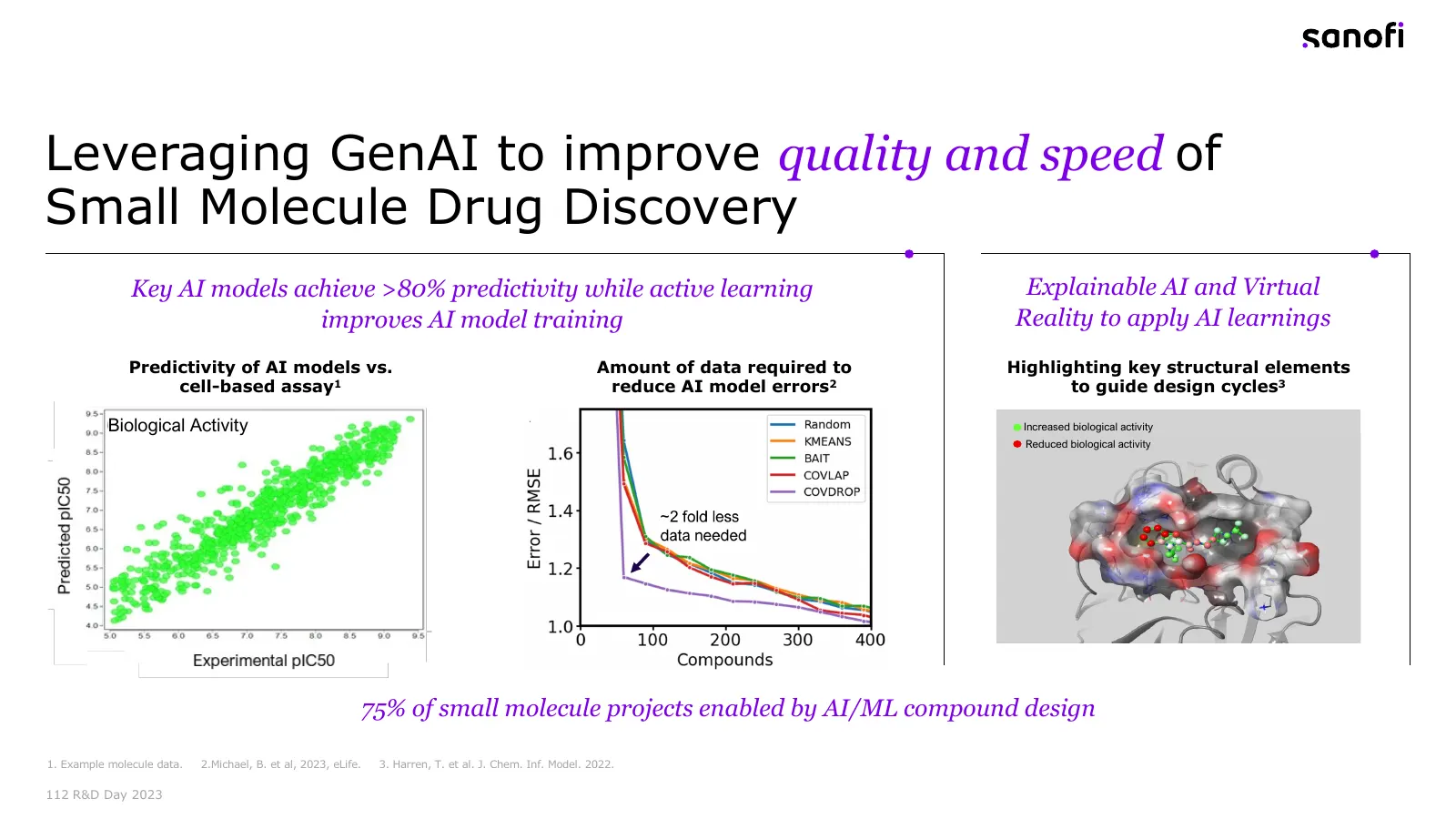
Slide 112: Leveraging GenAI in Small Molecule Drug Discovery
Leveraging GenAI to improve quality and speed of Small Molecule Drug Discovery Key AI models achieve >80% predictivity while active learning Explainable AI and Virtual improves AI model training Reality to apply AI learnings Predictivity of AI models vs. Amount of data required to Highlighting key s
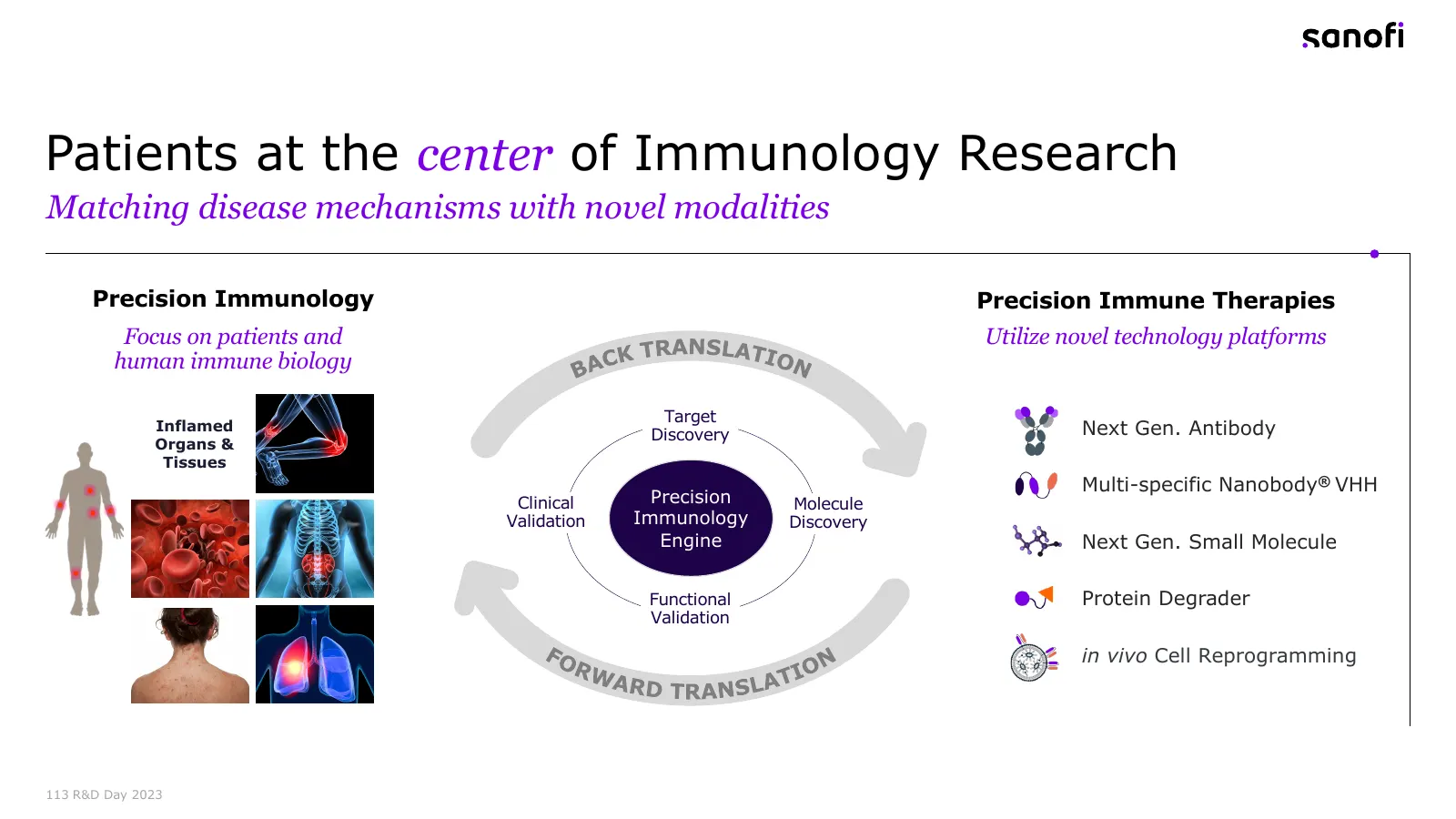
Slide 113: Patients at the center of Immunology Research
Patients at the center of Immunology Research Matching disease mechanisms with novel modalities Precision Immunology Precision Immune Therapies Focus on patients and Utilize novel technology platforms human immune biology Target Inflamed Discovery Next Gen. Antibody Organs & Tissues Multi-specific N
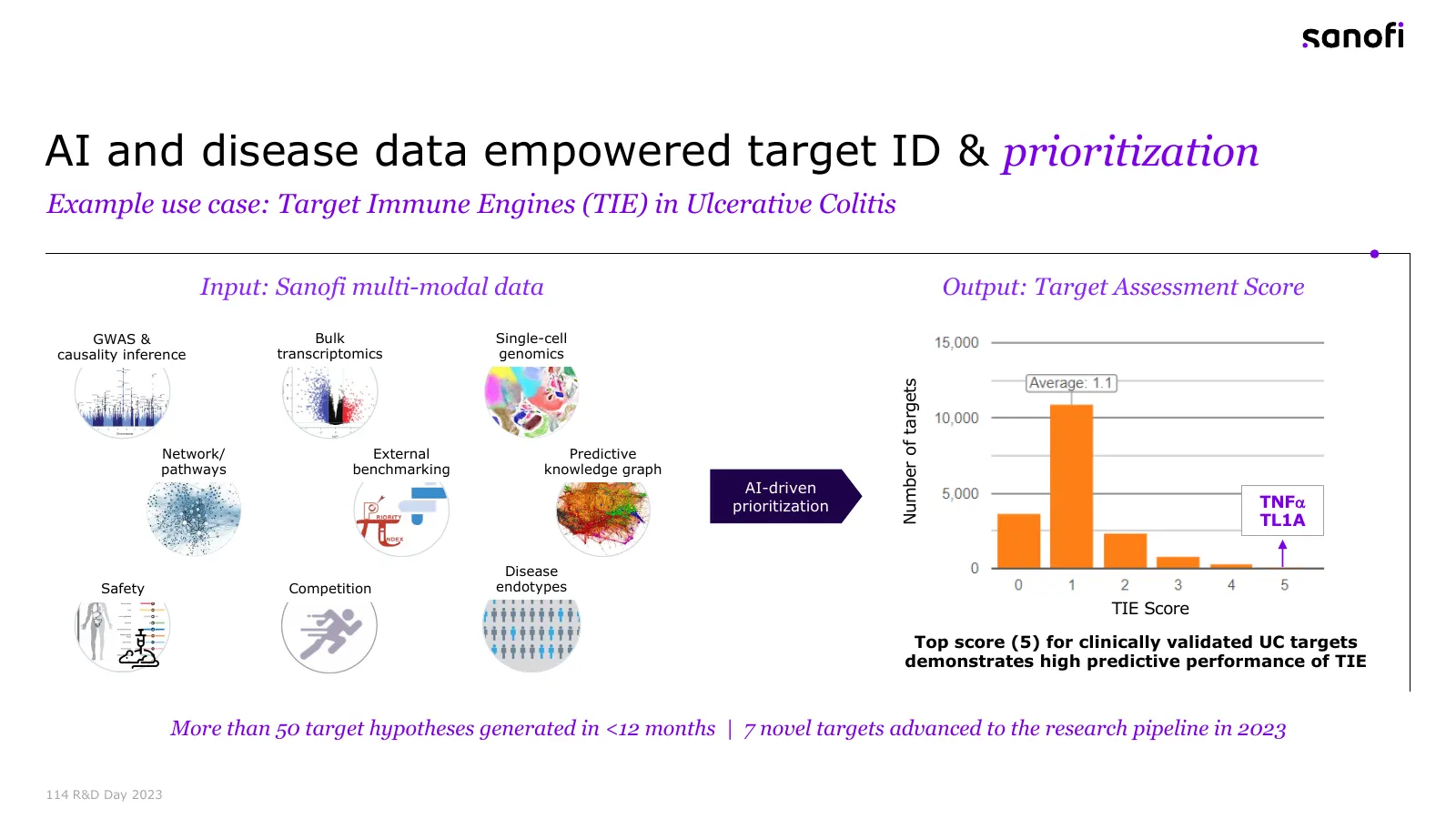
Slide 114: AI and disease data empowered target ID
AI and disease data empowered target ID & prioritization Example use case: Target Immune Engines (TIE) in Ulcerative Colitis Input: Sanofi multi-modal data Output: Target Assessment Score GWAS & Bulk Single-cell causality inference transcriptomics genomics Number of targets Network/ External Predict
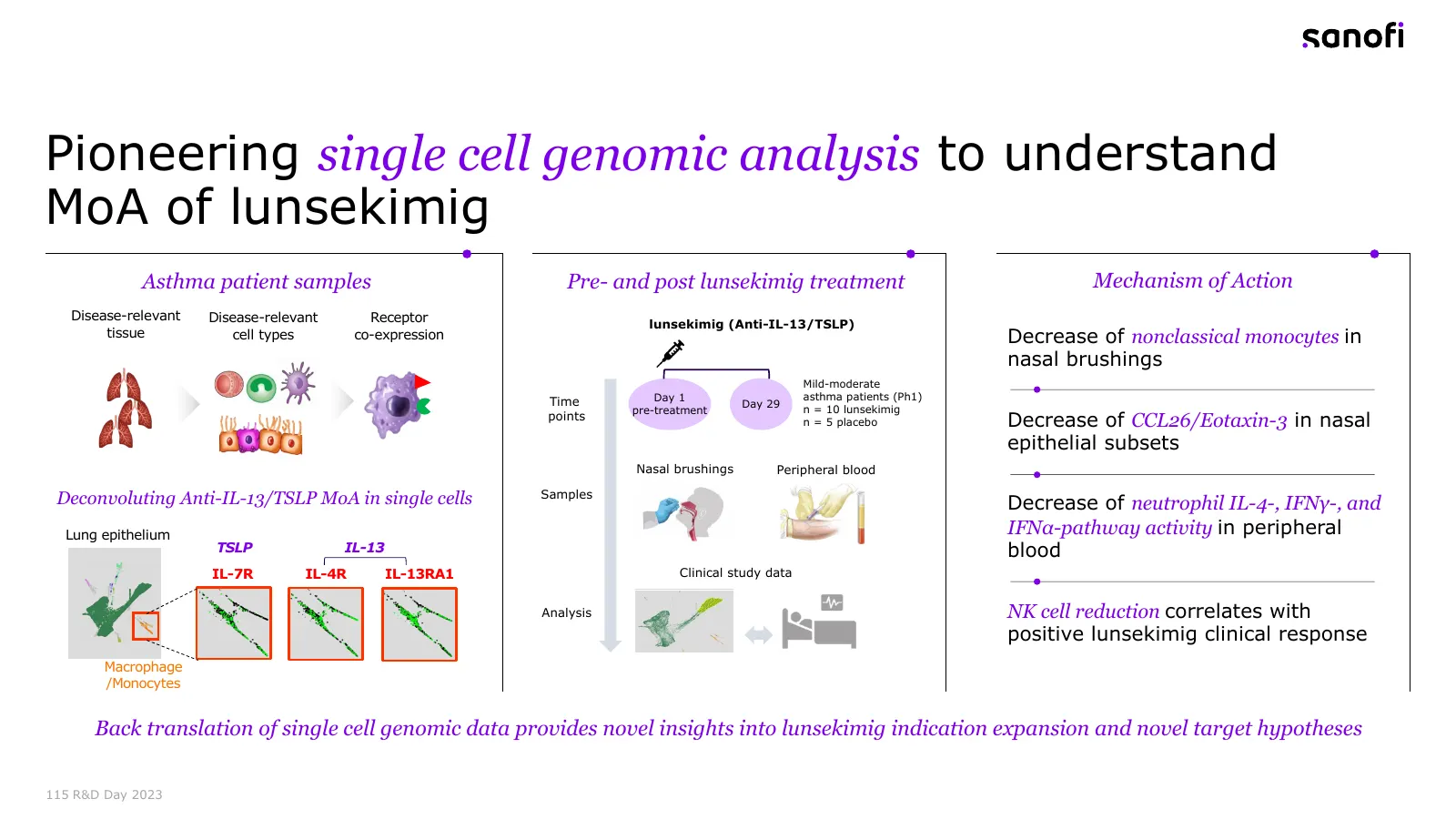
Slide 115: Single cell genomic analysis to understand MoA of lunsekimig
Pioneering single cell genomic analysis to understand MoA of lunsekimig Asthma patient samples Pre- and post lunsekimig treatment Mechanism of Action Disease-relevant Disease-relevant Receptor lunsekimig (Anti-IL-13/TSLP) tissue cell types co-expression Decrease of nonclassical monocytes in nasal br
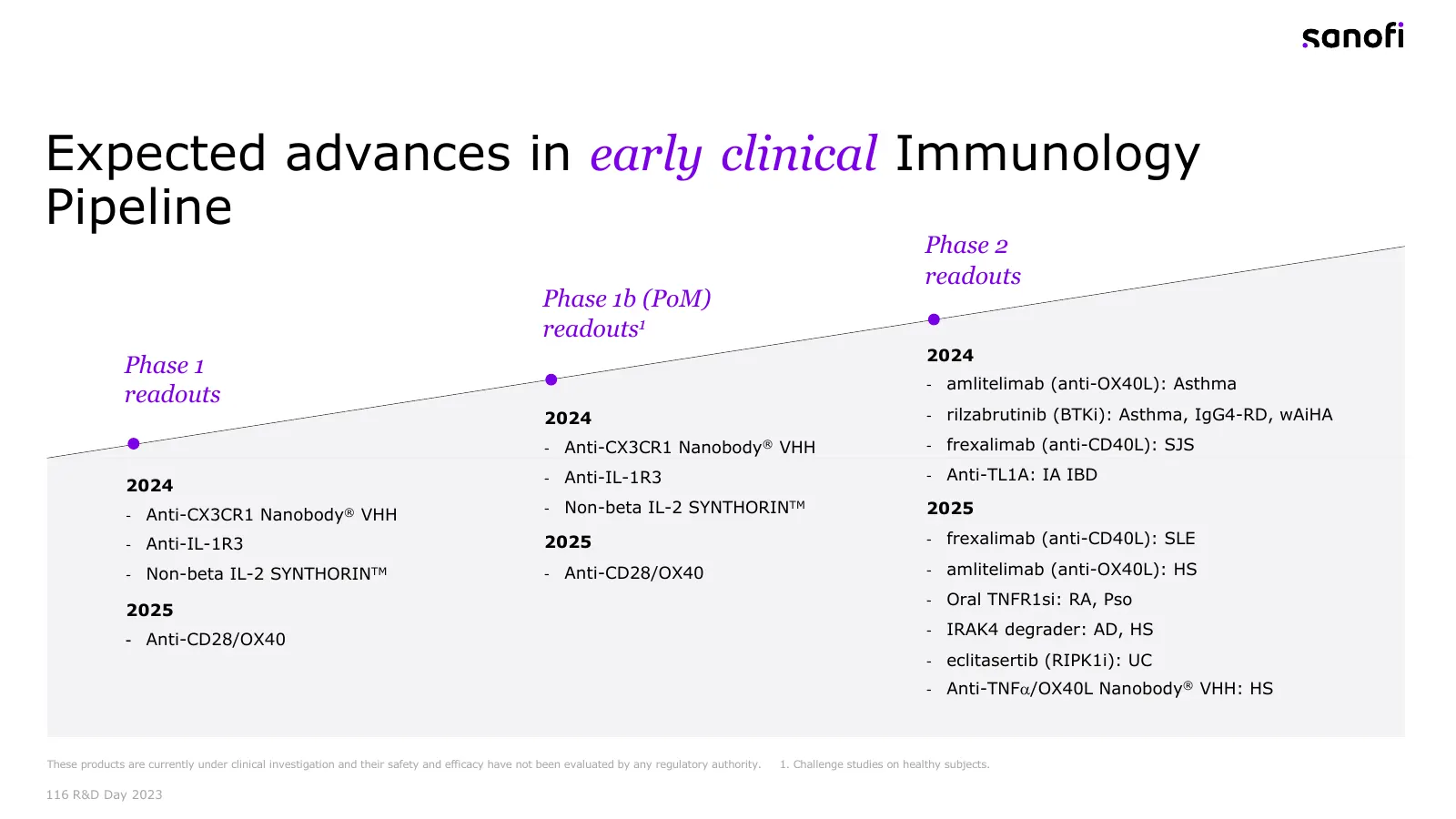
Slide 116: Expected advances in early clinical Immunology Pipeline
Expected advances in early clinical Immunology Pipeline Phase 2 readouts Phase 1b (PoM) readouts1 2024 Phase 1 - amlitelimab (anti-OX40L): Asthma readouts 2024 - rilzabrutinib (BTKi): Asthma, IgG4-RD, wAiHA - Anti-CX3CR1 Nanobody® VHH - frexalimab (anti-CD40L): SJS - Anti-IL-1R3 - Anti-TL1A: IA IBD

Slide 117: Advancing a productive and maturing development pipeline
Advancing a productive and maturing development pipeline Dietmar Berger Global Head of Development, Chief Medical Officer
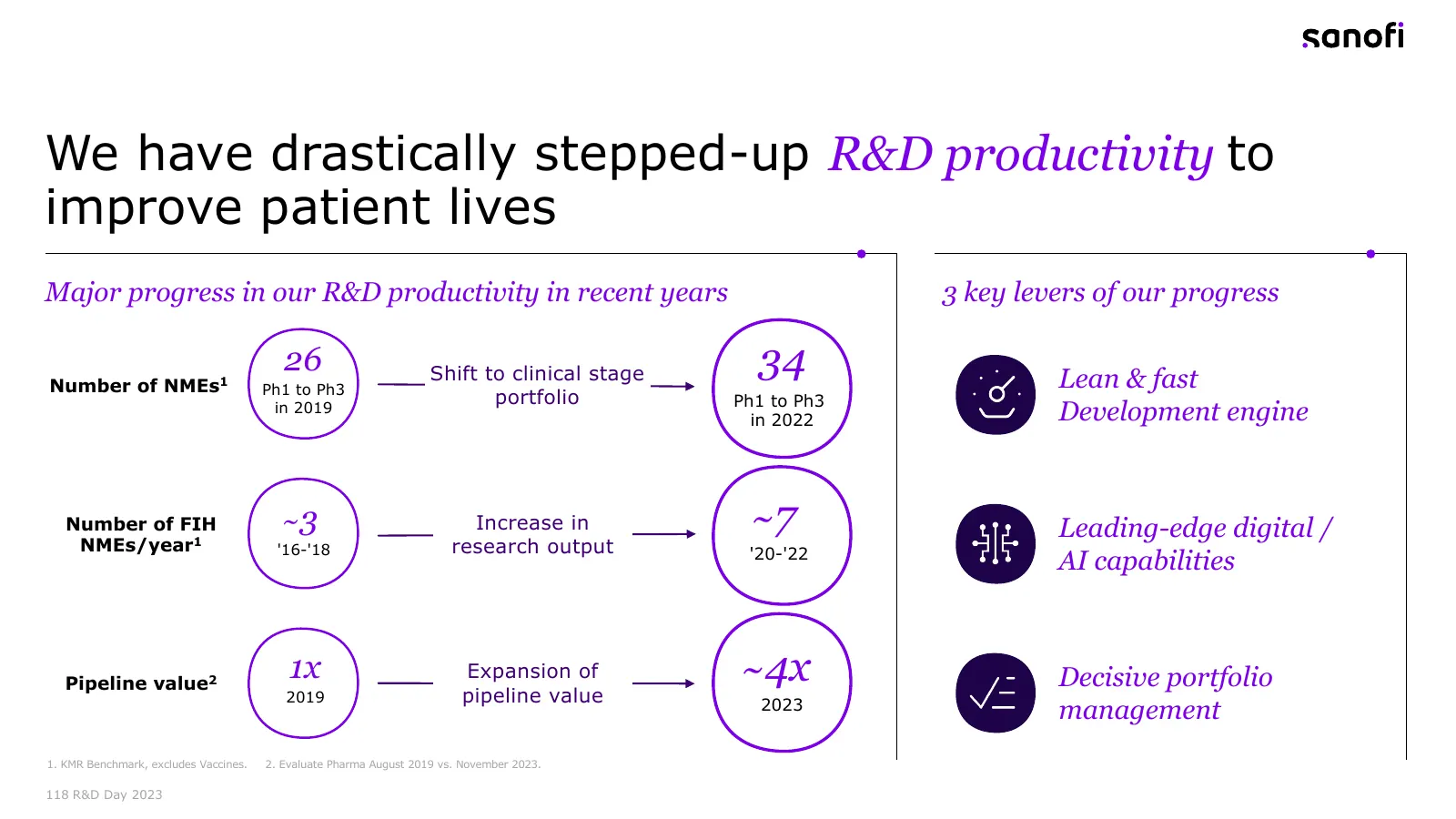
Slide 118: Drastically stepped-up R&D productivity
We have drastically stepped-up R&D productivity to improve patient lives Major progress in our R&D productivity in recent years 3 key levers of our progress Number of NMEs1 26 Shift to clinical stage 34 Lean & fast Ph1 to Ph3 portfolio Ph1 to Ph3 in 2019 in 2022 Development engine Number of FIH ~3 I
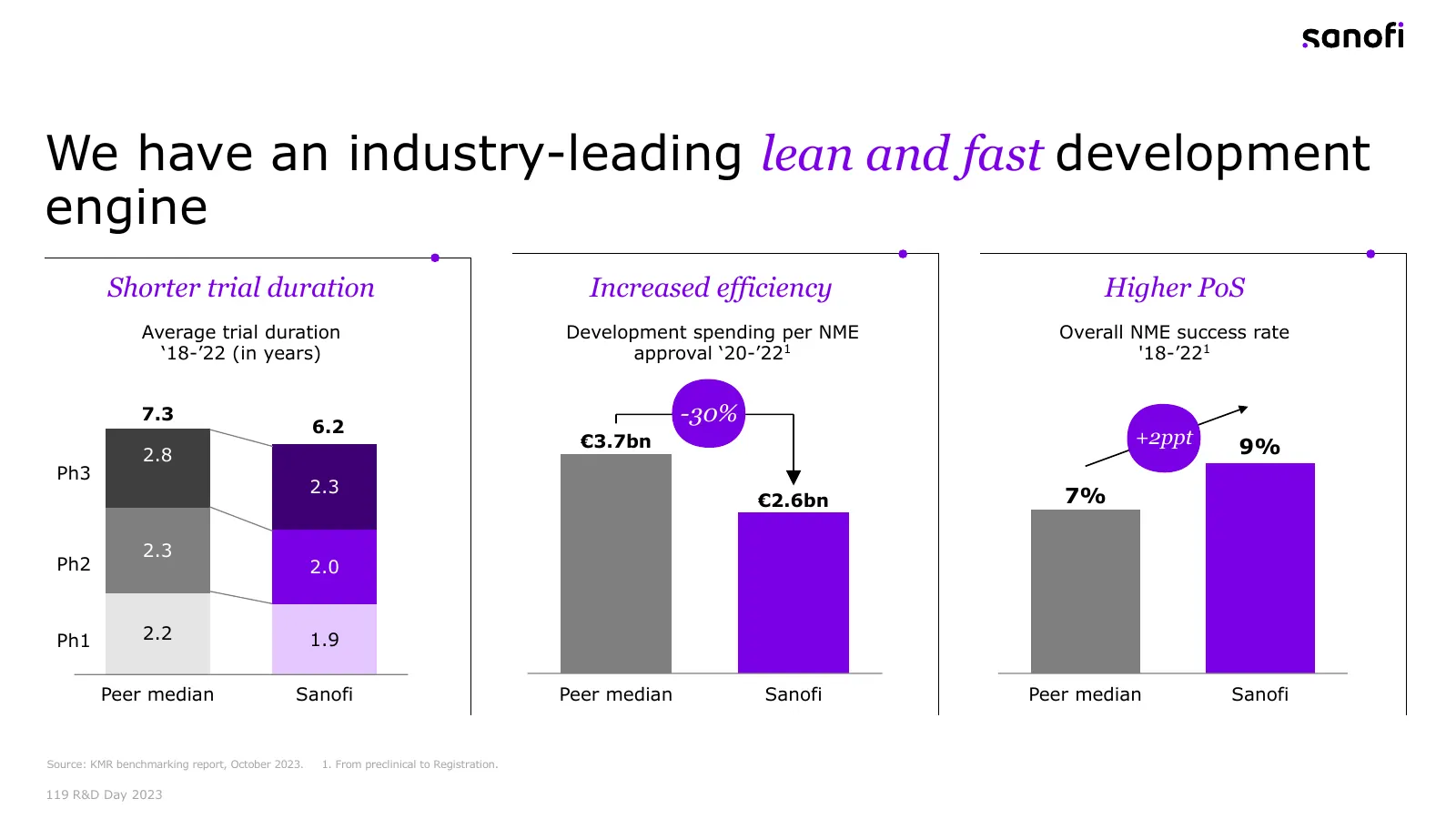
Slide 119: Industry-leading lean and fast development engine
We have an industry-leading lean and fast development engine Shorter trial duration Increased efficiency Higher PoS Average trial duration Development spending per NME Overall NME success rate ‘18-’22 (in years) approval ‘20-’221 '18-’221 7.3 -30% 6.2 €3.7bn +2ppt 9% 2.8 Ph3 2.3 €2.6bn 7% 2.3 Ph2 2.
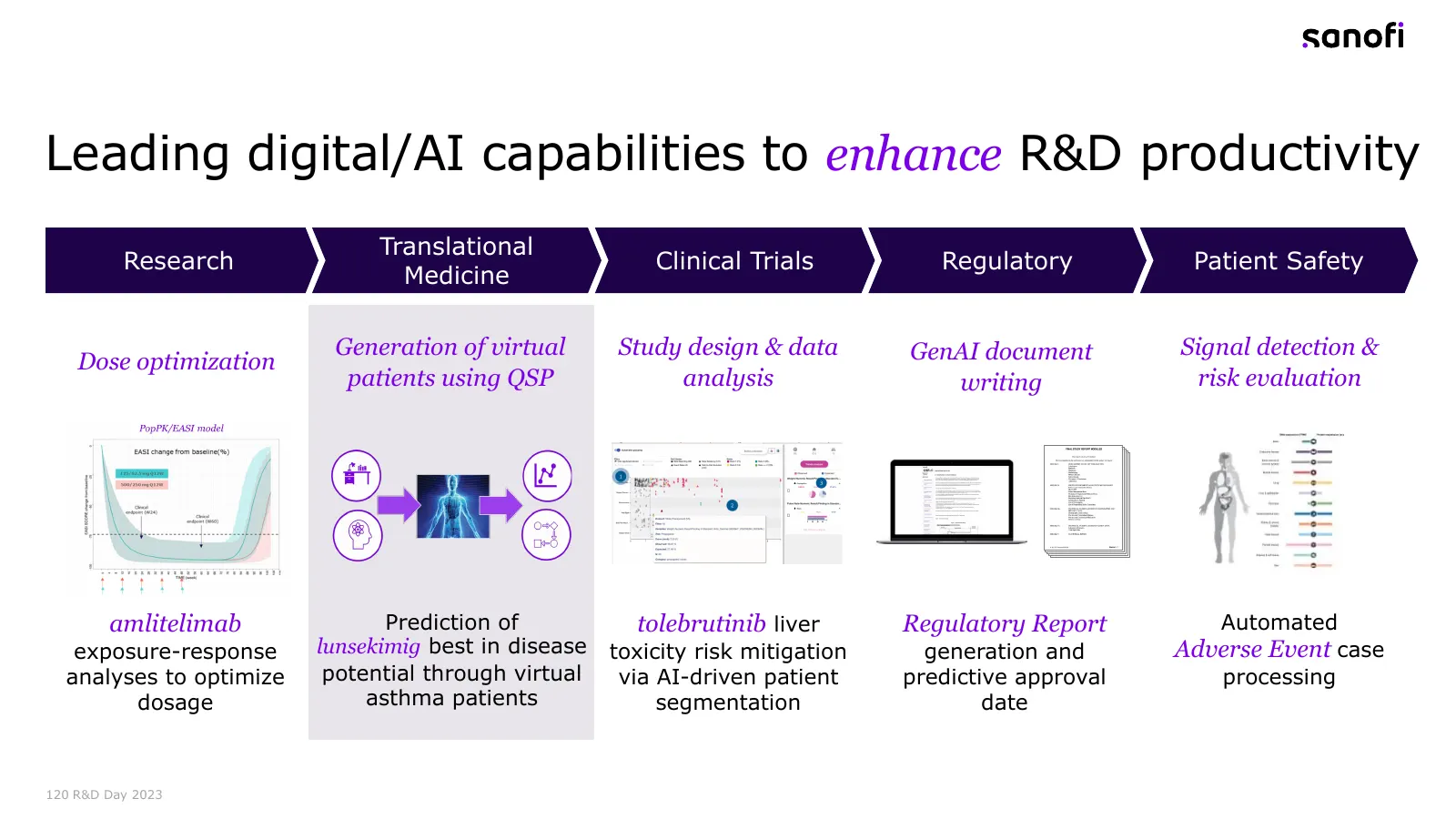
Slide 120: Leading digital/AI capabilities to enhance R&D productivity
Leading digital/AI capabilities to enhance R&D productivity Translational Research Clinical Trials Regulatory Patient Safety Medicine Generation of virtual Study design & data GenAI document Signal detection & Dose optimization patients using QSP analysis writing risk evaluation amlitelimab Predicti
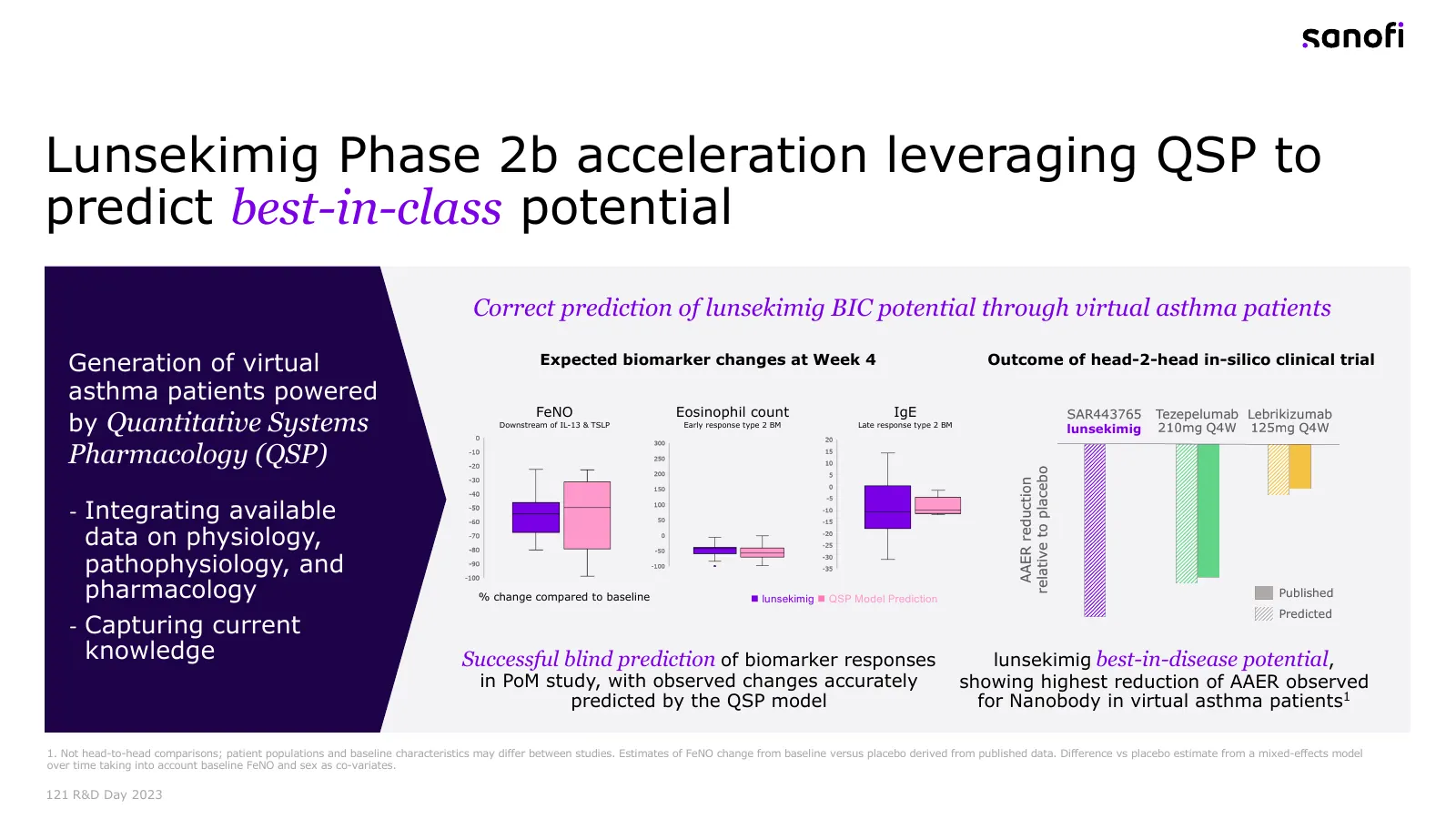
Slide 121: Lunsekimig Phase 2b acceleration leveraging QSP
Lunsekimig Phase 2b acceleration leveraging QSP to predict best-in-class potential Correct prediction of lunsekimig BIC potential through virtual asthma patients Generation of virtual Expected biomarker changes at Week 4 Outcome of head-2-head in-silico clinical trial asthma patients powered FeNO Eo
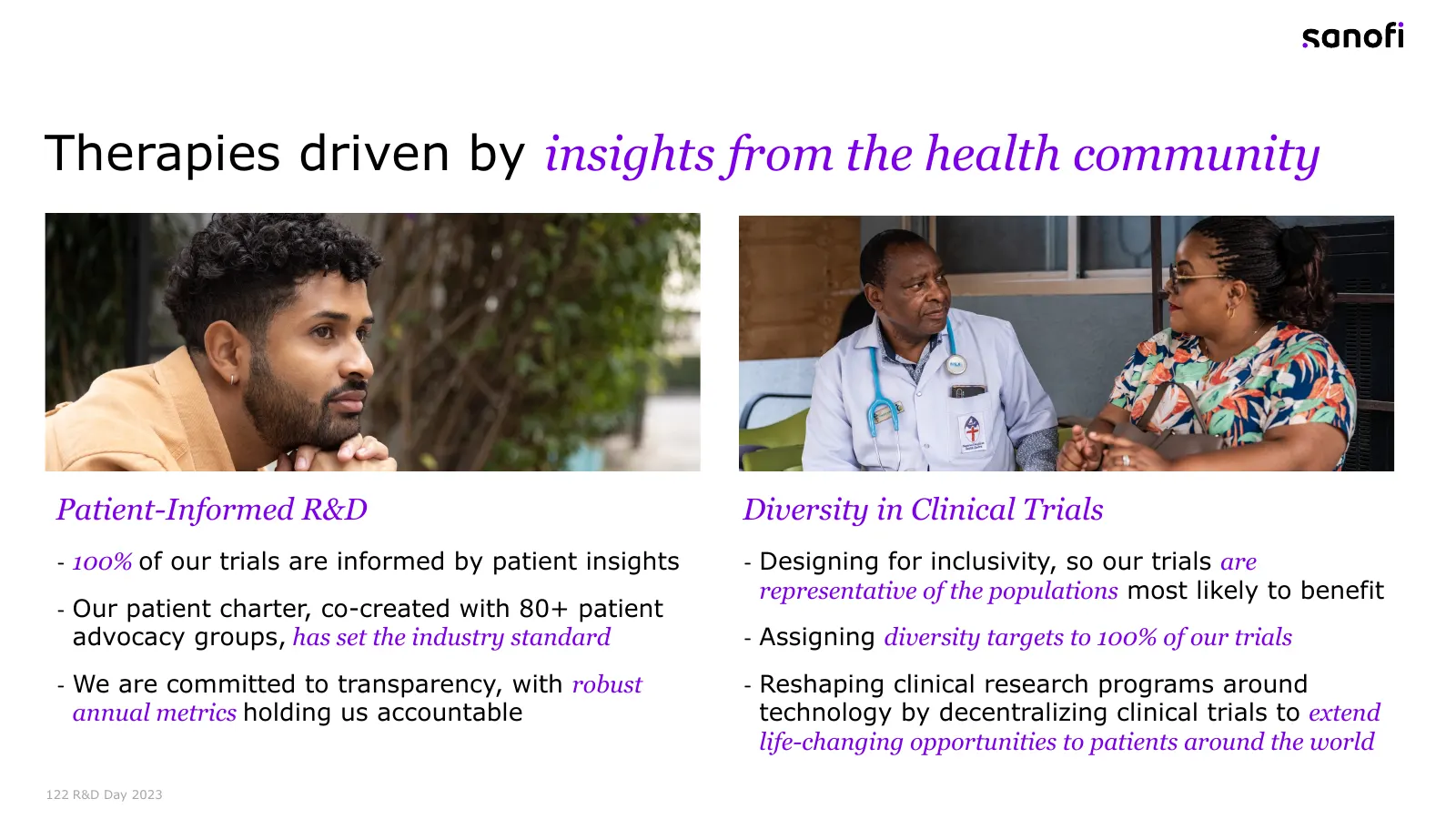
Slide 122: Therapies driven by insights from the health community
Therapies driven by insights from the health community Patient-Informed R&D Diversity in Clinical Trials - 100% of our trials are informed by patient insights - Designing for inclusivity, so our trials are representative of the populations most likely to benefit - Our patient charter, co-created wit
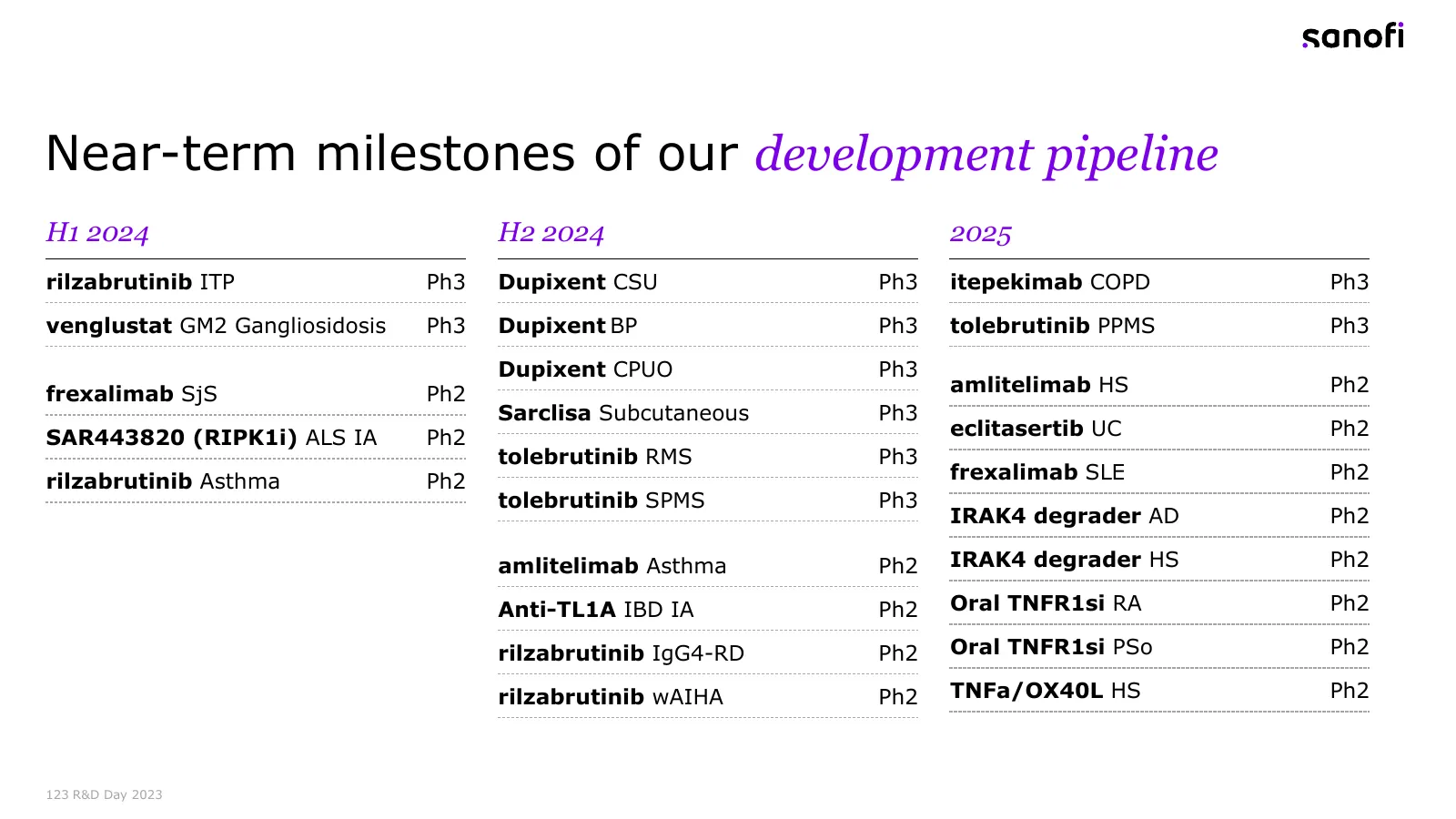
Slide 123: Near-term milestones of our development pipeline
Near-term milestones of our development pipeline H1 2024 H2 2024 2025 rilzabrutinib ITP Ph3 Dupixent CSU Ph3 itepekimab COPD Ph3 venglustat GM2 Gangliosidosis Ph3 Dupixent BP Ph3 tolebrutinib PPMS Ph3 Dupixent CPUO Ph3 frexalimab SjS Ph2 amlitelimab HS Ph2 Sarclisa Subcutaneous Ph3 SAR443820 (RIPK1i
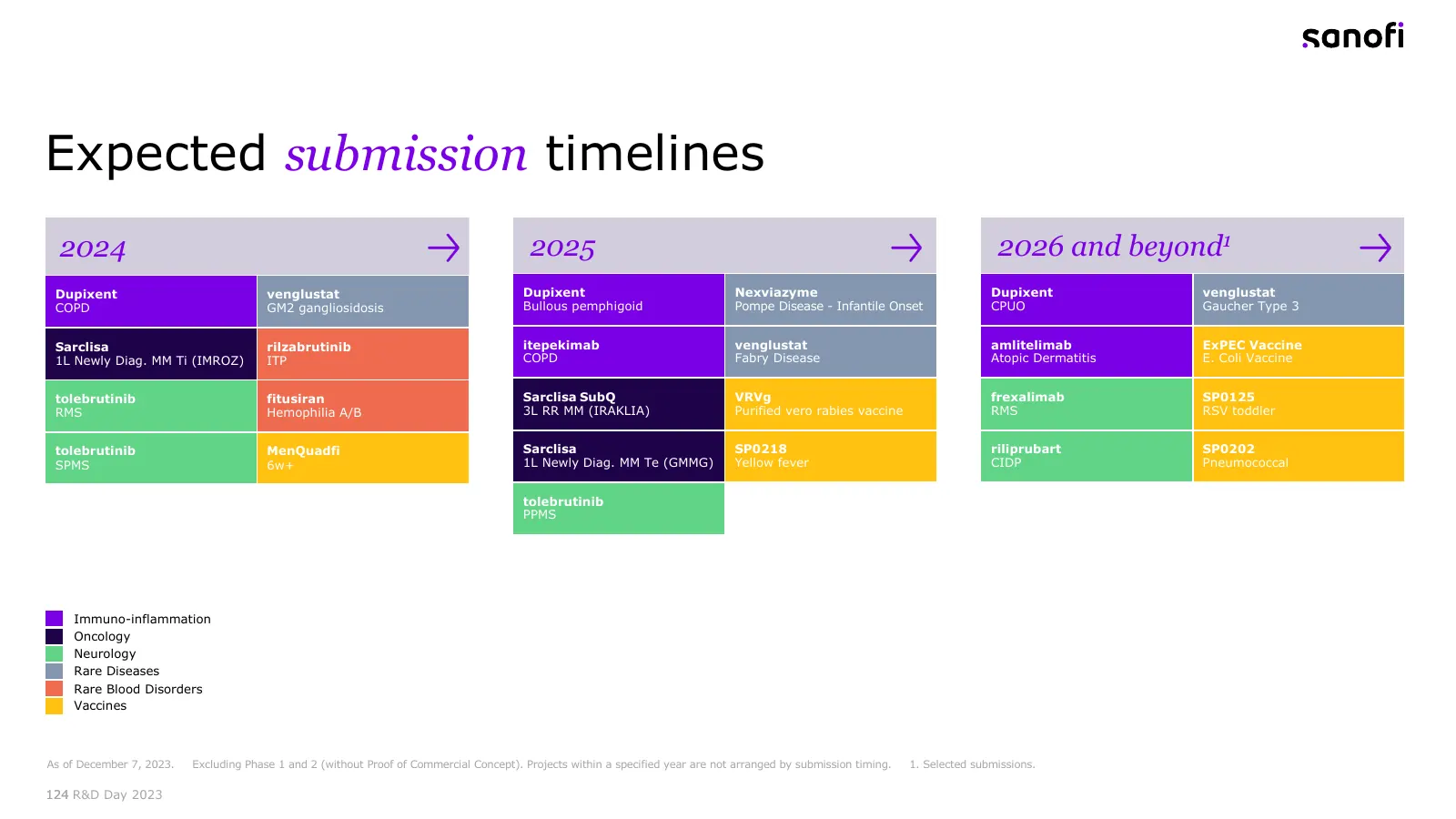
Slide 124: Expected submission timelines
Expected submission timelines 2024 2025 2026 and beyond1 Dupixent venglustat Dupixent Nexviazyme Dupixent venglustat COPD GM2 gangliosidosis Bullous pemphigoid Pompe Disease - Infantile Onset CPUO Gaucher Type 3 Sarclisa rilzabrutinib itepekimab venglustat amlitelimab ExPEC Vaccine 1L Newly Diag. MM

Slide 125: Employing AI to increase R&D productivity
Employing AI to increase R&D productivity Helen Merianos Global Head of R&D Portfolio Strategy
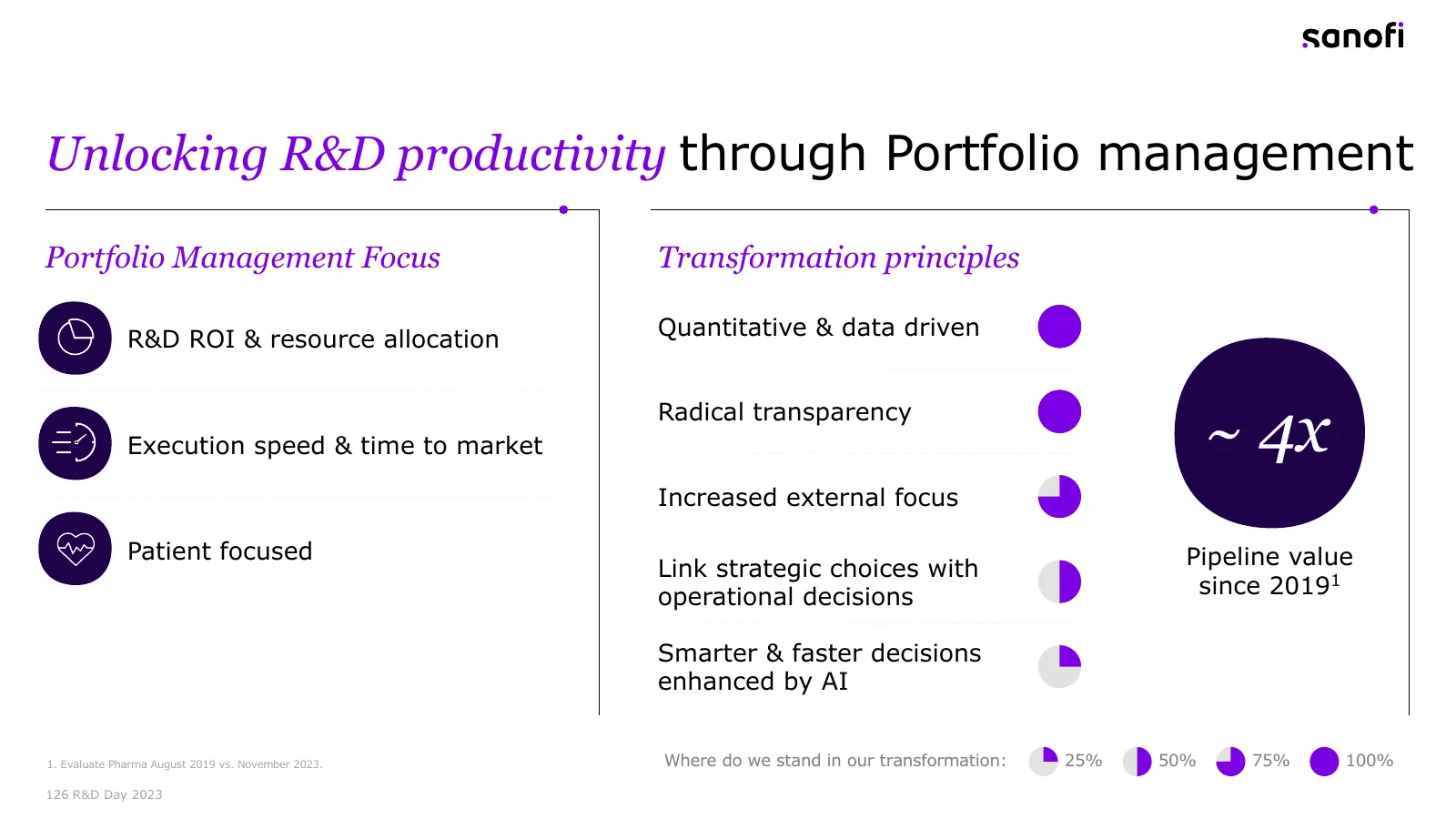
Slide 126: Unlocking R&D productivity through Portfolio management
Unlocking R&D productivity through Portfolio management Portfolio Management Focus Transformation principles Quantitative & data driven R&D ROI & resource allocation Execution speed & time to market Radical transparency ~ 4x Increased external focus Patient focused Pipeline value Link strategic choi
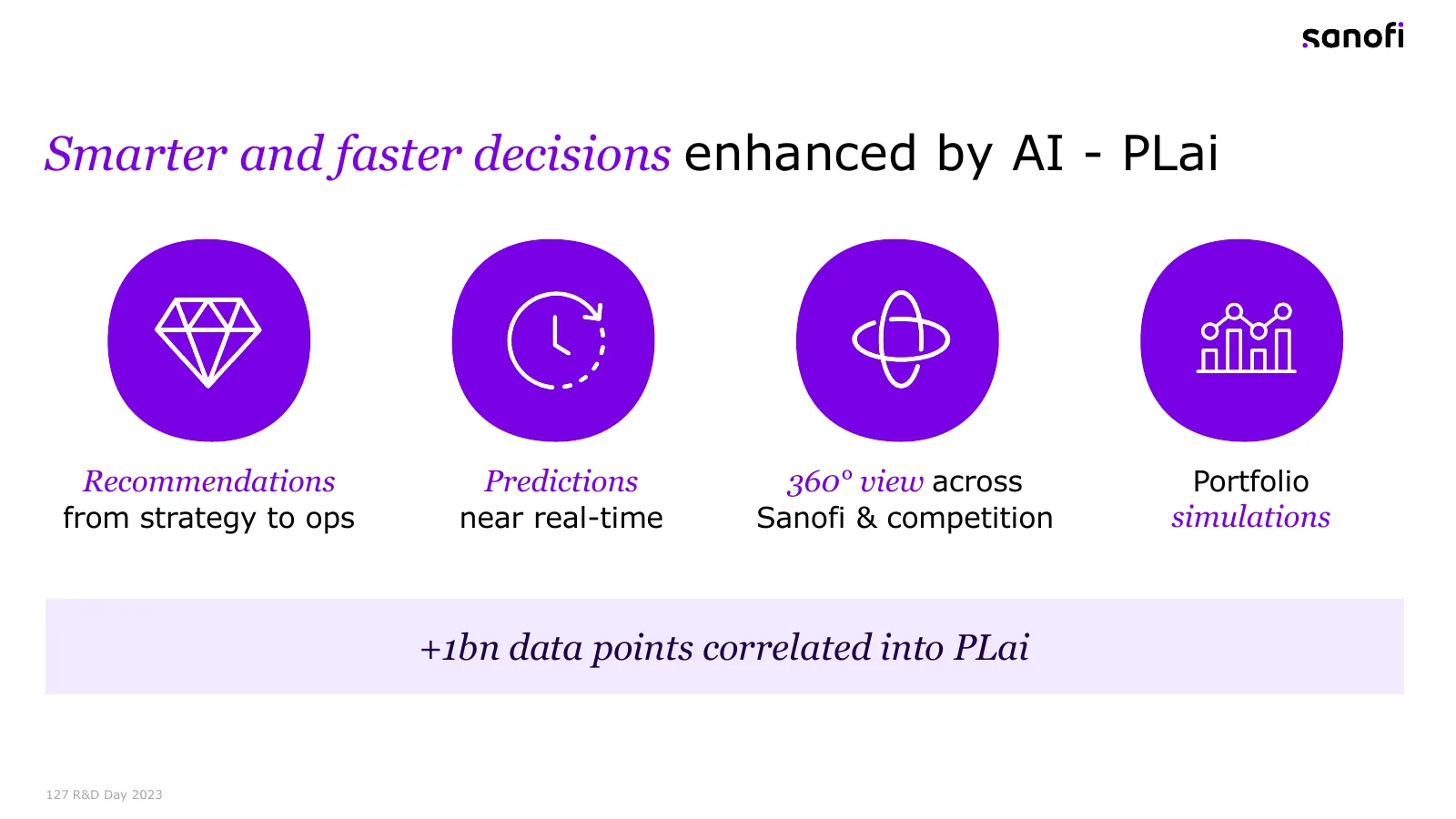
Slide 127: Smarter and faster decisions enhanced by AI - PLai
Smarter and faster decisions enhanced by AI - PLai Recommendations Predictions 360° view across Portfolio from strategy to ops near real-time Sanofi & competition simulations +1bn data points correlated into PLai 127 R&D Day 2023
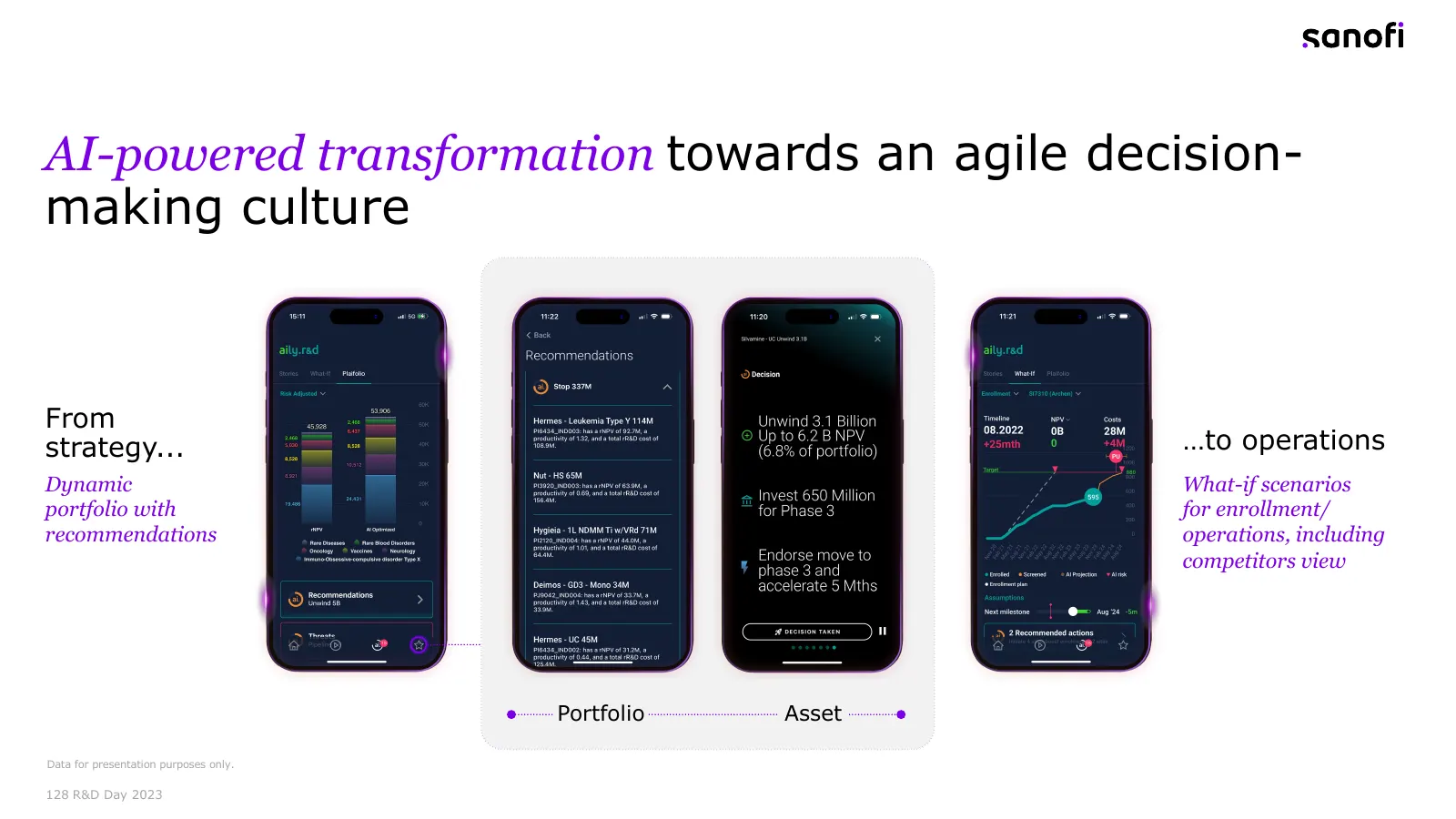
Slide 128: AI-powered transformation towards agile decision-making
AI-powered transformation towards an agile decision- making culture From strategy... …to operations Dynamic What-if scenarios portfolio with for enrollment/ recommendations operations, including competitors view Portfolio Asset Data for presentation purposes only. 128 R&D Day 2023
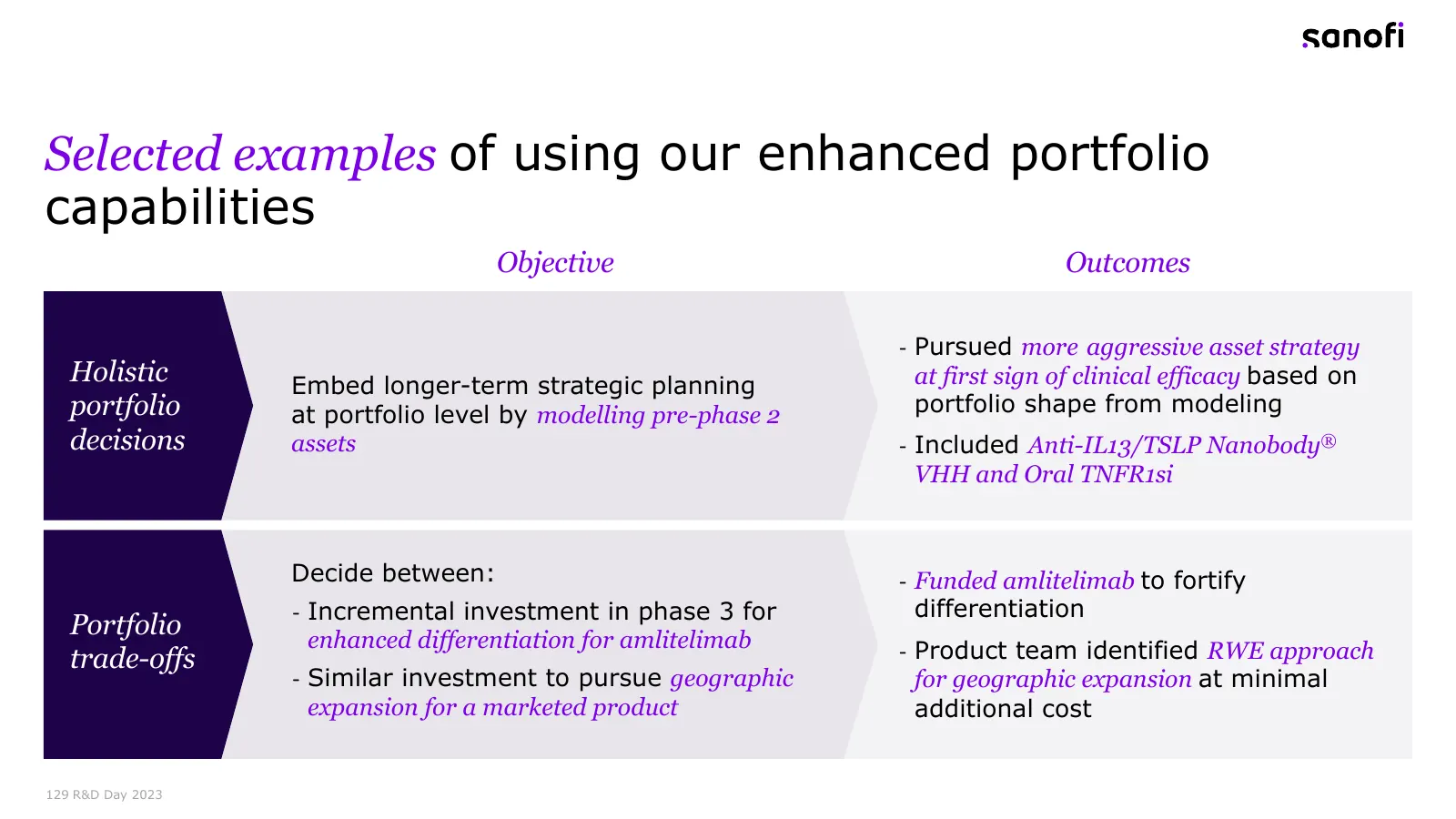
Slide 129: Selected examples of using enhanced portfolio capabilities
Selected examples of using our enhanced portfolio capabilities Objective Outcomes - Pursued more aggressive asset strategy Holistic Embed longer-term strategic planning at first sign of clinical efficacy based on portfolio at portfolio level by modelling pre-phase 2 portfolio shape from modeling dec

Slide 130: Concluding remarks
Concluding remarks Houman Ashrafian Head of Research and Development
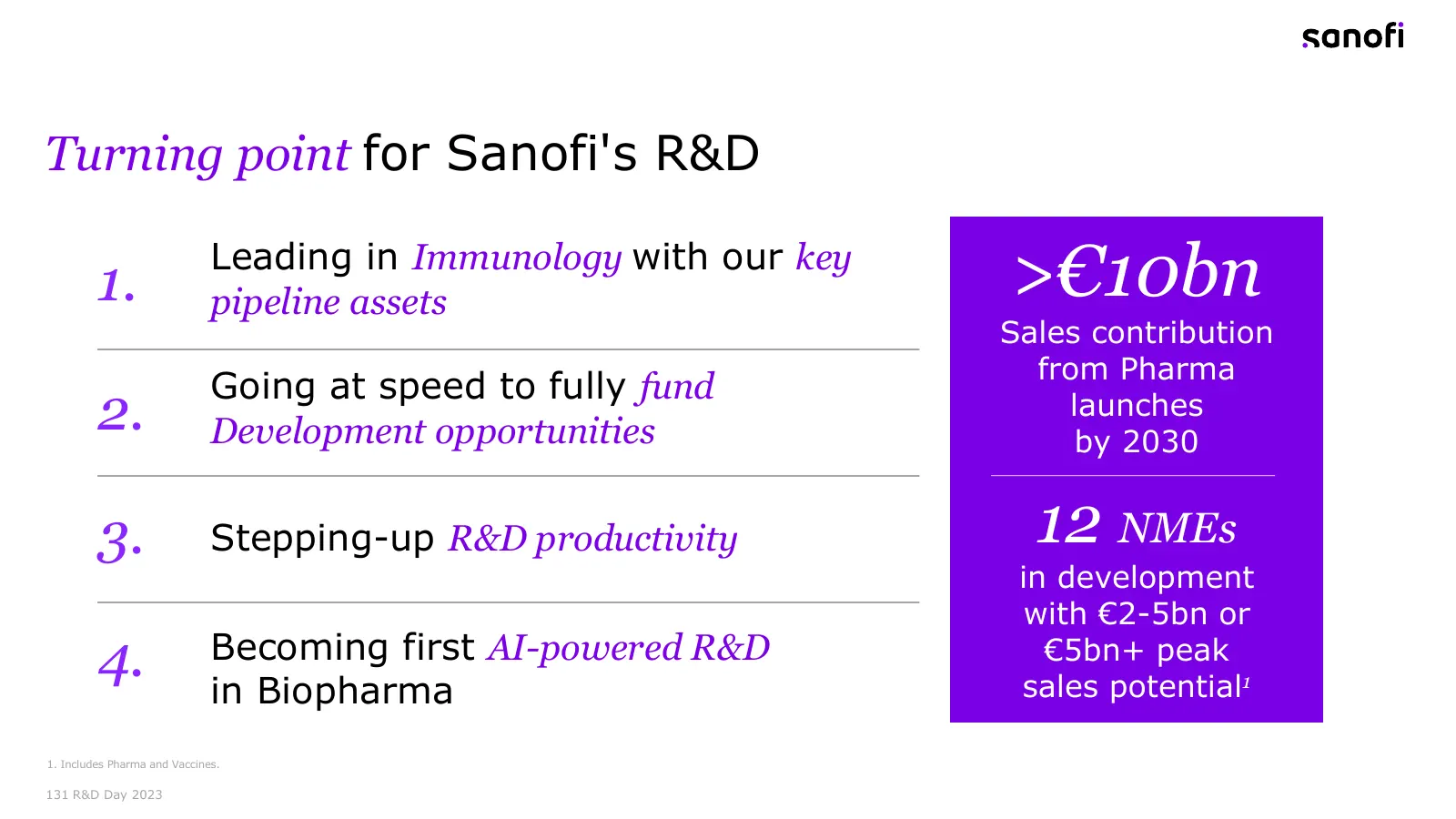
Slide 131: Turning point for Sanofi's R&D
Turning point for Sanofi's R&D 1. Leading in Immunology with our key pipeline assets >€10bn Sales contribution from Pharma Going at speed to fully fund 2. Development opportunities launches by 2030 3. Stepping-up R&D productivity 12 NMEs in development with €2-5bn or 4. Becoming first AI-powered R&D

Slide 132: Q&A session (Part 3)
Q&A session (Part 3)

Slide 133: Scientific deep-dives
Scientific deep-dives
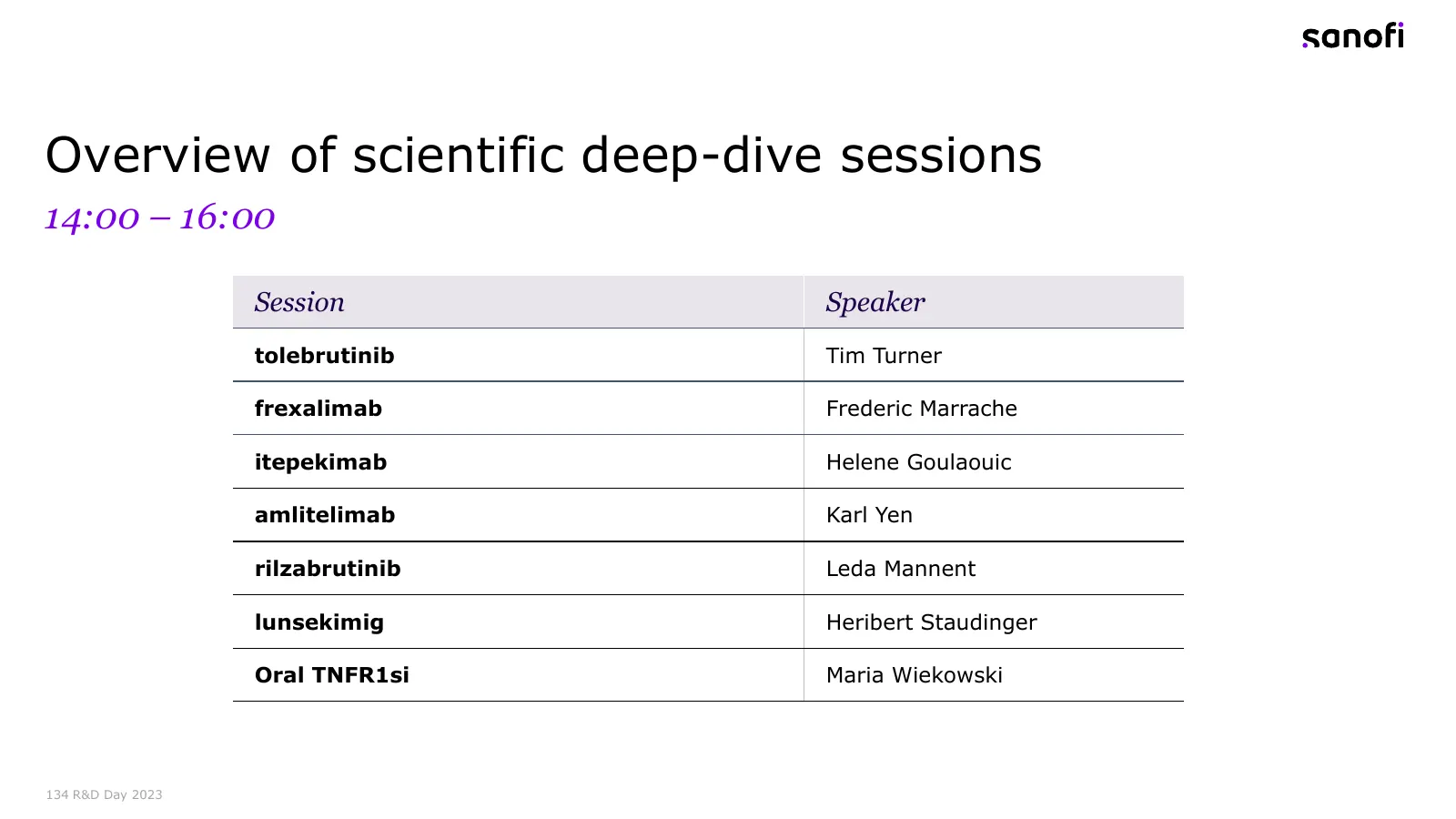
Slide 134: Overview of scientific deep-dive sessions
Overview of scientific deep-dive sessions 14:00 – 16:00 Session Speaker tolebrutinib Tim Turner frexalimab Frederic Marrache itepekimab Helene Goulaouic amlitelimab Karl Yen rilzabrutinib Leda Mannent lunsekimig Heribert Staudinger Oral TNFR1si Maria Wiekowski 134 R&D Day 2023

Slide 135: Appendix
Appendix
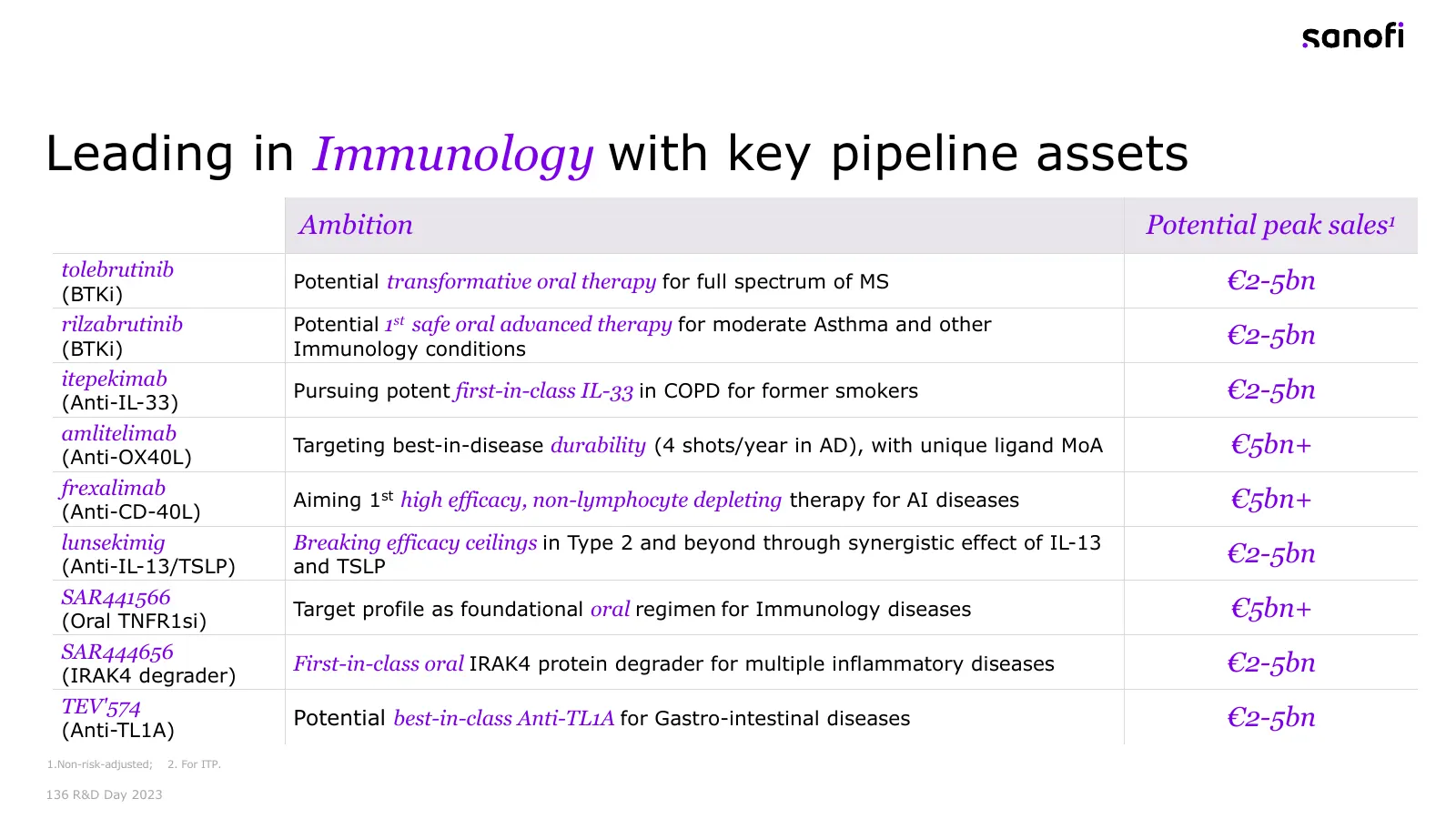
Slide 136: Leading in Immunology with key pipeline assets
Leading in Immunology with key pipeline assets Ambition Potential peak sales1 tolebrutinib (BTKi) Potential transformative oral therapy for full spectrum of MS €2-5bn rilzabrutinib Potential 1st safe oral advanced therapy for moderate Asthma and other (BTKi) Immunology conditions €2-5bn itepekimab (
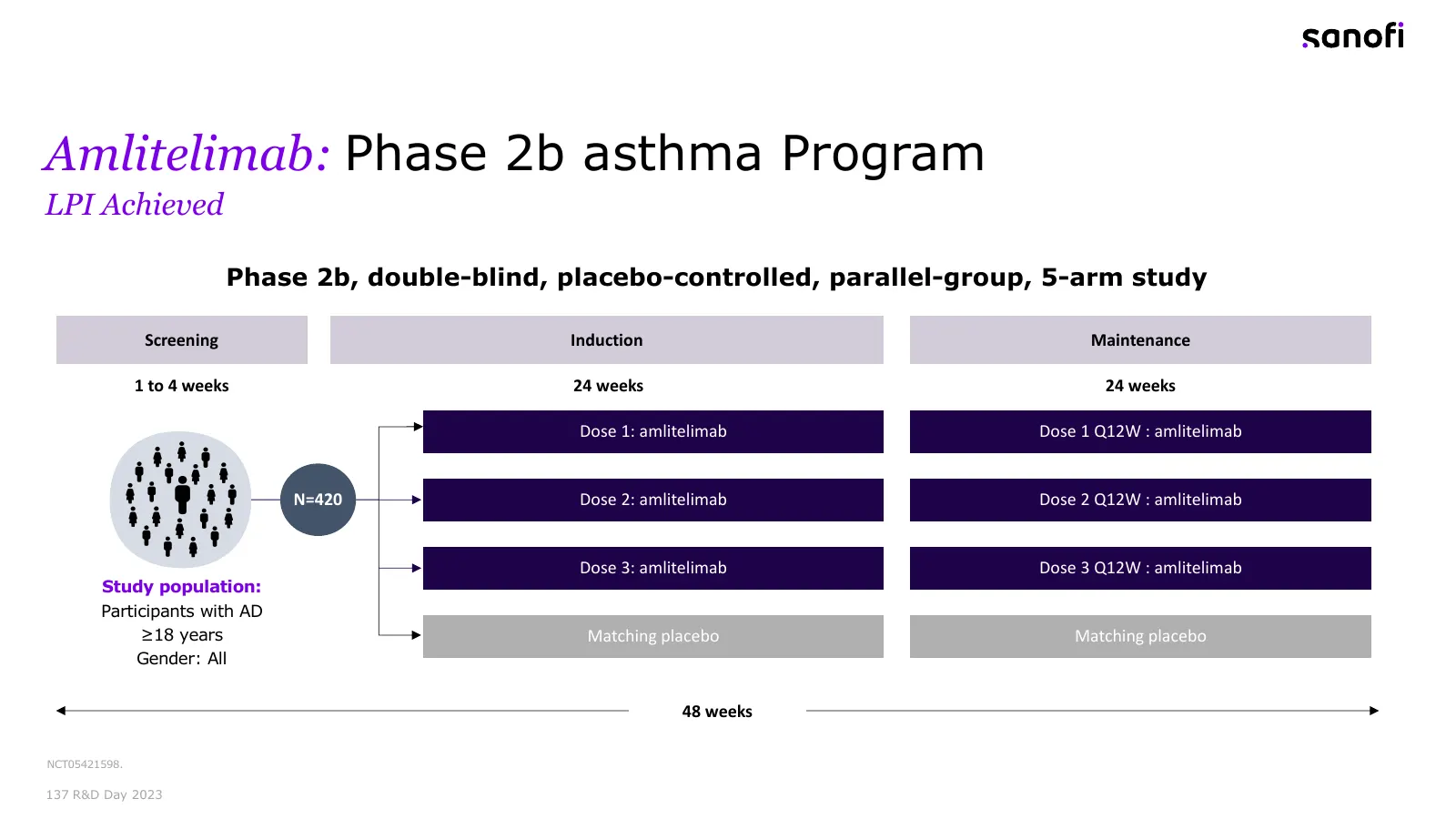
Slide 137: Amlitelimab: Phase 2b asthma Program
Amlitelimab: Phase 2b asthma Program LPI Achieved Phase 2b, double-blind, placebo-controlled, parallel-group, 5-arm study Screening Induction Maintenance 1 to 4 weeks 24 weeks 24 weeks Dose 1: amlitelimab Dose 1 Q12W : amlitelimab N=420 Dose 2: amlitelimab Dose 2 Q12W : amlitelimab Dose 3: amlitelim
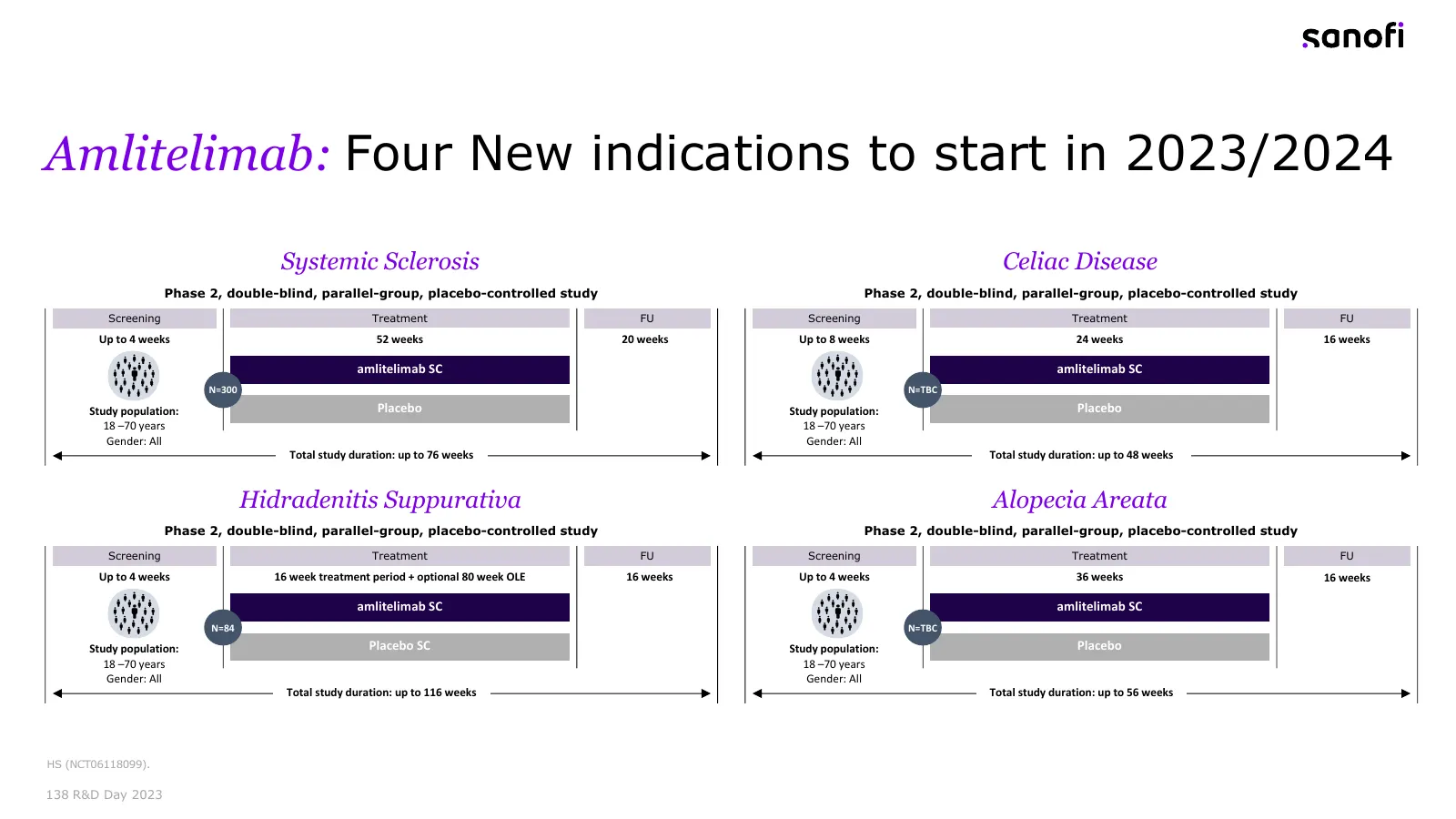
Slide 138: Amlitelimab: Four New indications
Amlitelimab: Four New indications to start in 2023/2024 Systemic Sclerosis Celiac Disease Phase 2, double-blind, parallel-group, placebo-controlled study Phase 2, double-blind, parallel-group, placebo-controlled study Screening Treatment FU Screening Treatment FU Up to 4 weeks 52 weeks 20 weeks Up t
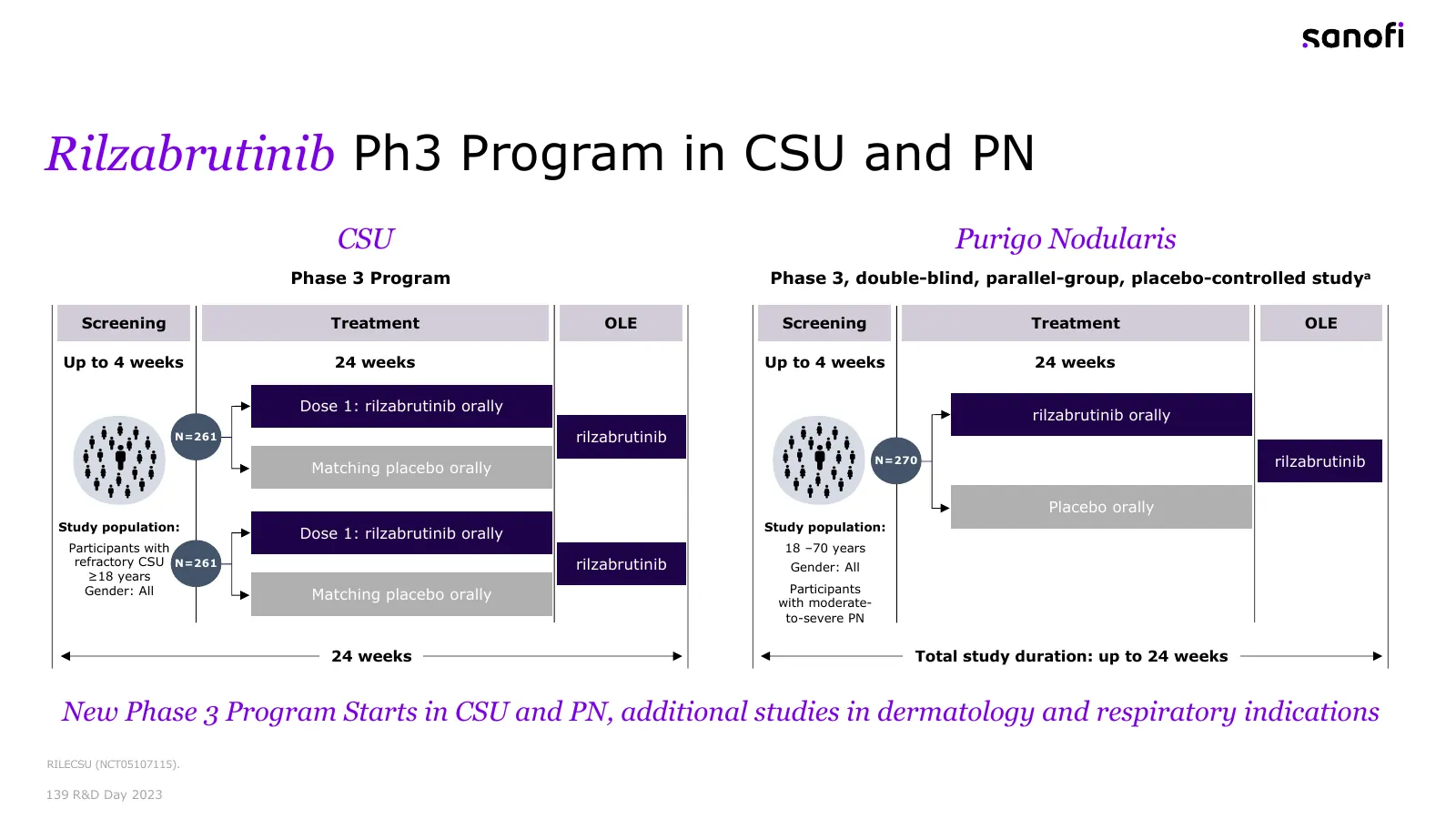
Slide 139: Rilzabrutinib Ph3 Program in CSU and PN
Rilzabrutinib Ph3 Program in CSU and PN CSU Purigo Nodularis Phase 3 Program Phase 3, double-blind, parallel-group, placebo-controlled studya Screening Treatment OLE Screening Treatment OLE Up to 4 weeks 24 weeks Up to 4 weeks 24 weeks Dose 1: rilzabrutinib orally rilzabrutinib orally N=261 rilzabru
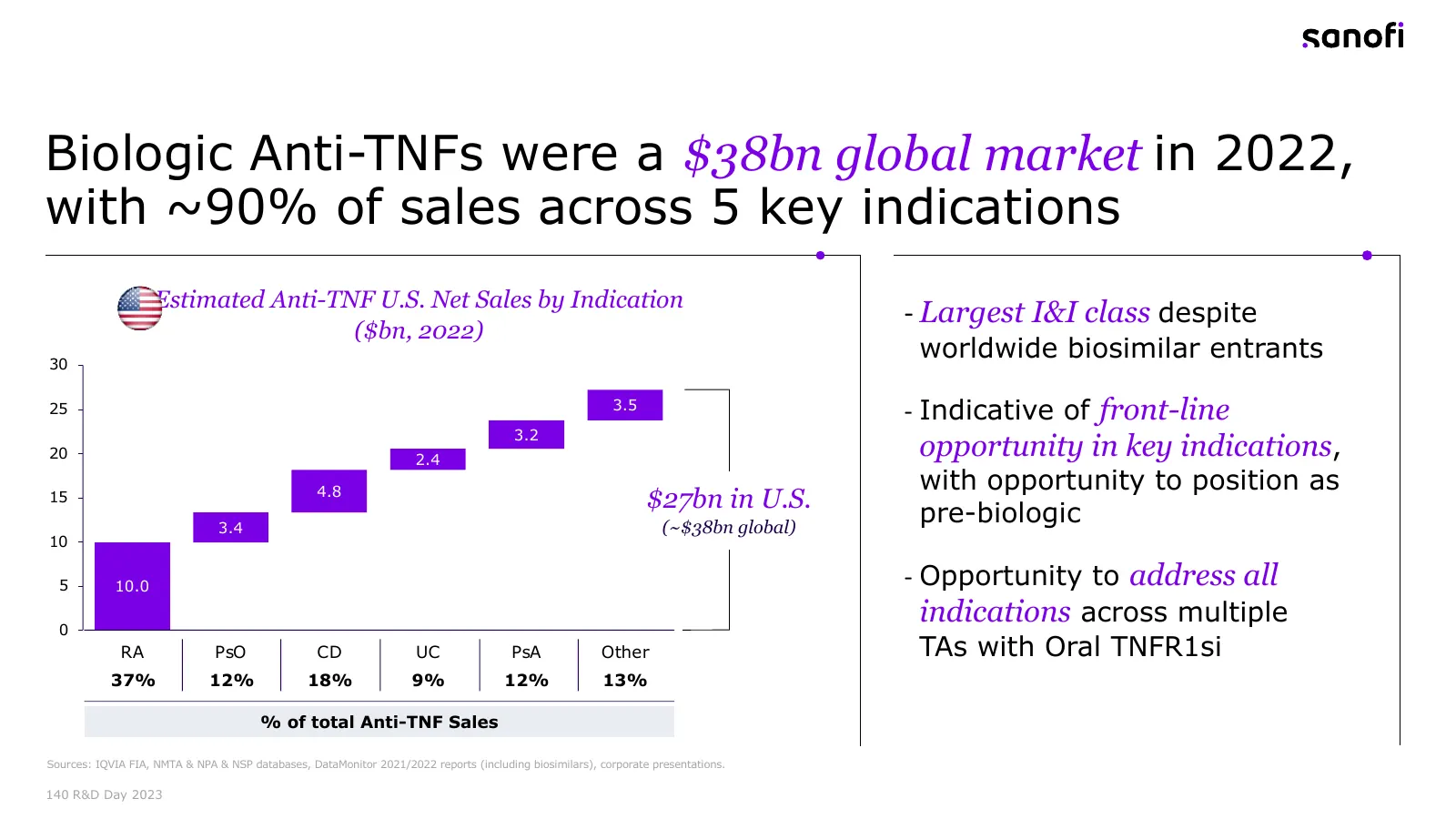
Slide 140: Biologic Anti-TNFs were a $38bn global market in 2022
Biologic Anti-TNFs were a $38bn global market in 2022, with ~90% of sales across 5 key indications Estimated Anti-TNF U.S. Net Sales by Indication - Largest I&I class despite ($bn, 2022) 30 worldwide biosimilar entrants 25 3.5 - Indicative of front-line 3.2 20 2.4 opportunity in key indications, 4.8
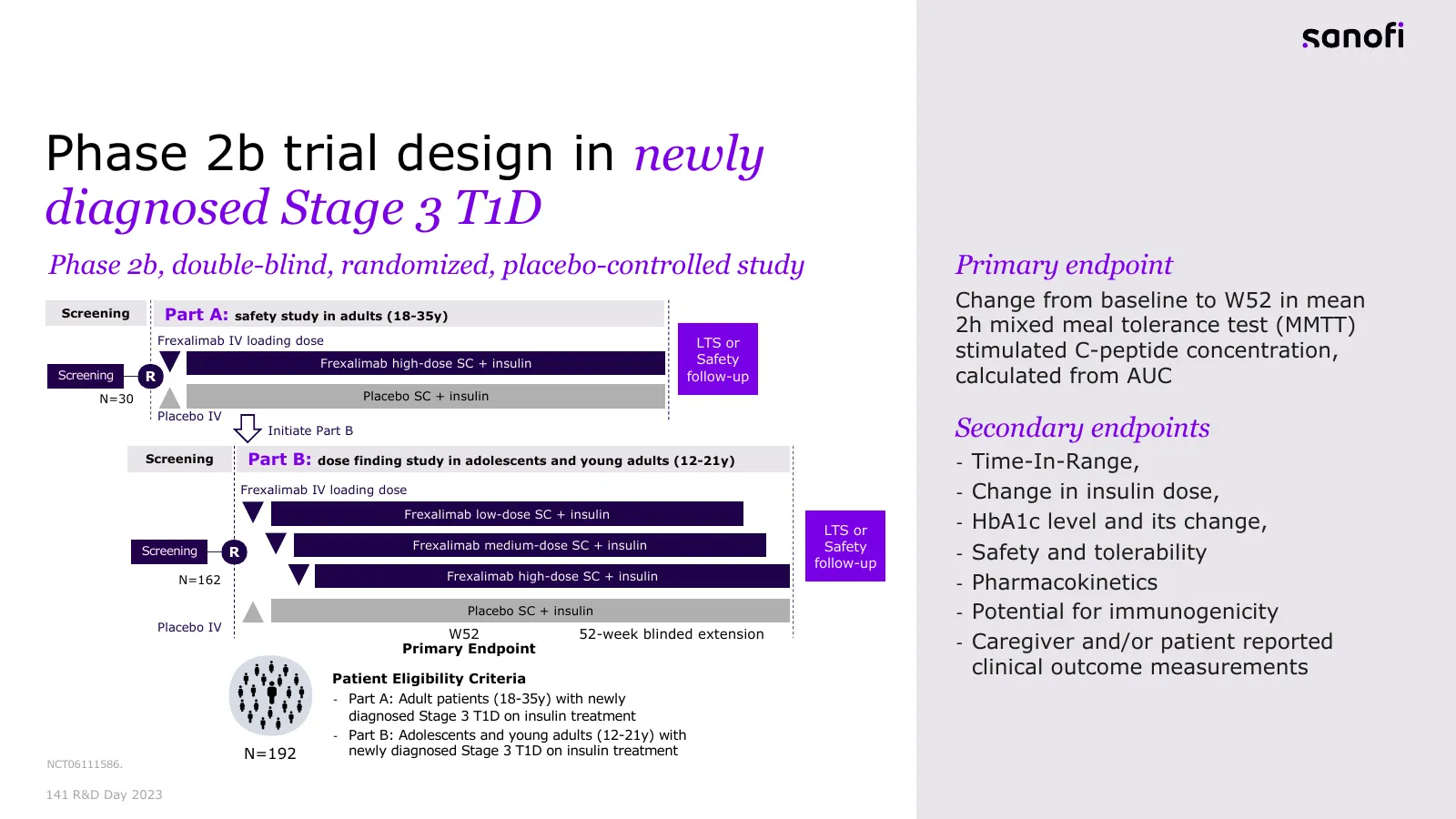
Slide 141: Phase 2b trial design in newly diagnosed Stage 3 T1D
Phase 2b trial design in newly diagnosed Stage 3 T1D Phase 2b, double-blind, randomized, placebo-controlled study Primary endpoint Change from baseline to W52 in mean Screening Part A: safety study in adults (18-35y) 2h mixed meal tolerance test (MMTT) Frexalimab IV loading dose LTS or Frexalimab hi
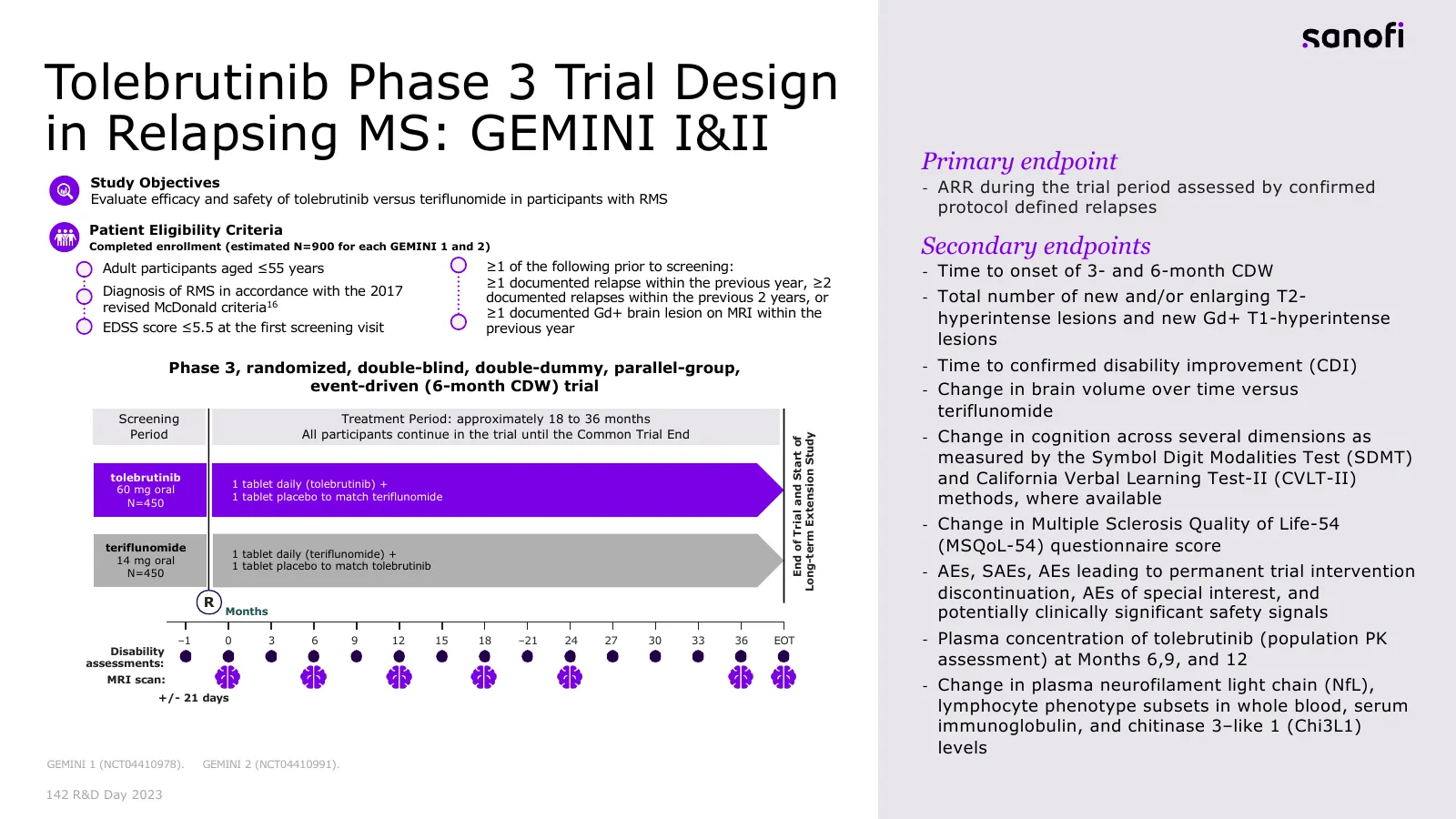
Slide 142: Tolebrutinib Phase 3 Trial Design in Relapsing MS: GEMINI
Tolebrutinib Phase 3 Trial Design in Relapsing MS: GEMINI I&II Primary endpoint Study Objectives - ARR during the trial period assessed by confirmed Evaluate efficacy and safety of tolebrutinib versus teriflunomide in participants with RMS protocol defined relapses Patient Eligibility Criteria Compl
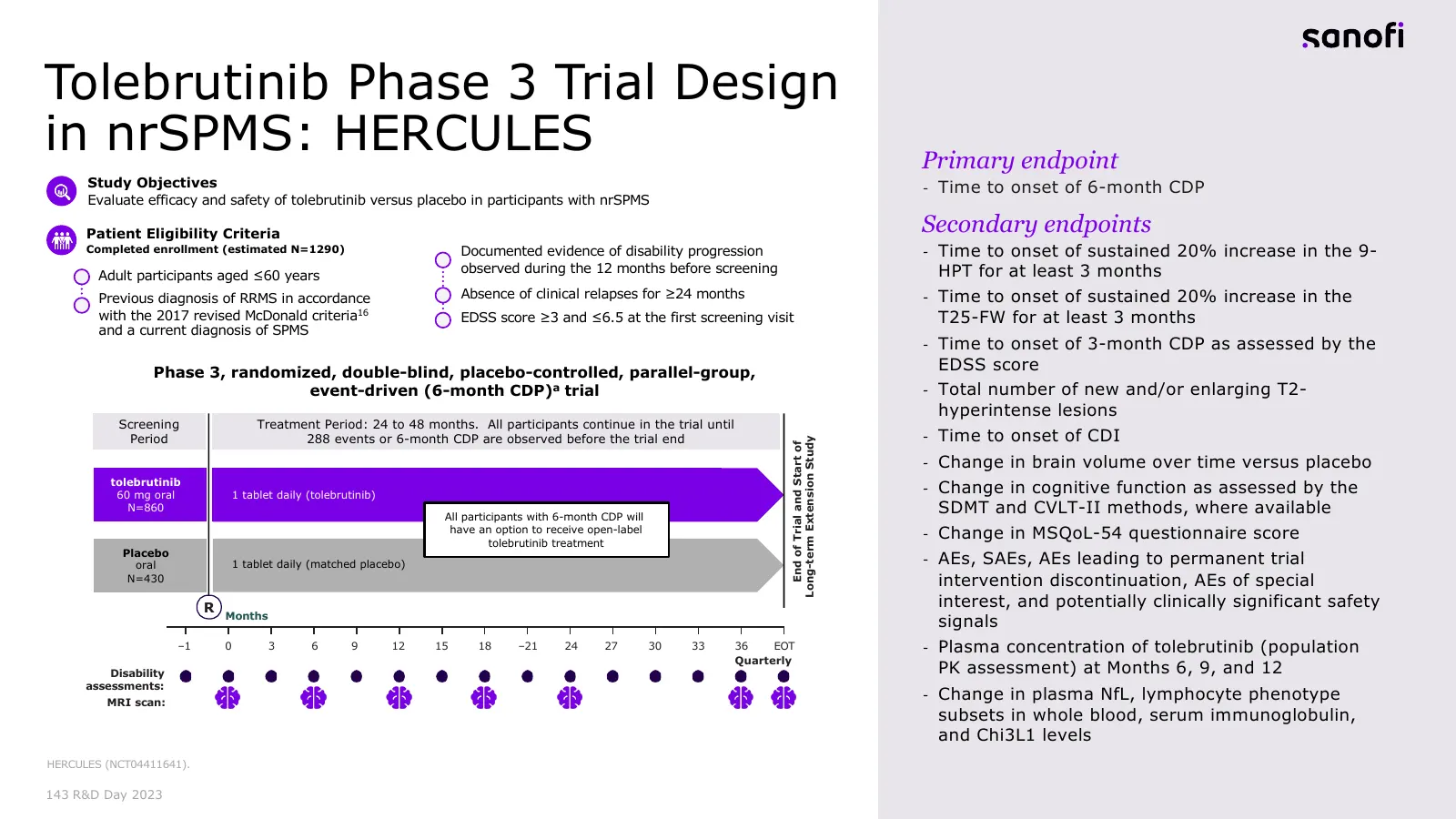
Slide 143: Tolebrutinib Phase 3 Trial Design in nrSPMS: HERCULES
Tolebrutinib Phase 3 Trial Design in nrSPMS: HERCULES Primary endpoint Study Objectives - Time to onset of 6-month CDP Evaluate efficacy and safety of tolebrutinib versus placebo in participants with nrSPMS Patient Eligibility Criteria Secondary endpoints Completed enrollment (estimated N=1290) Docu
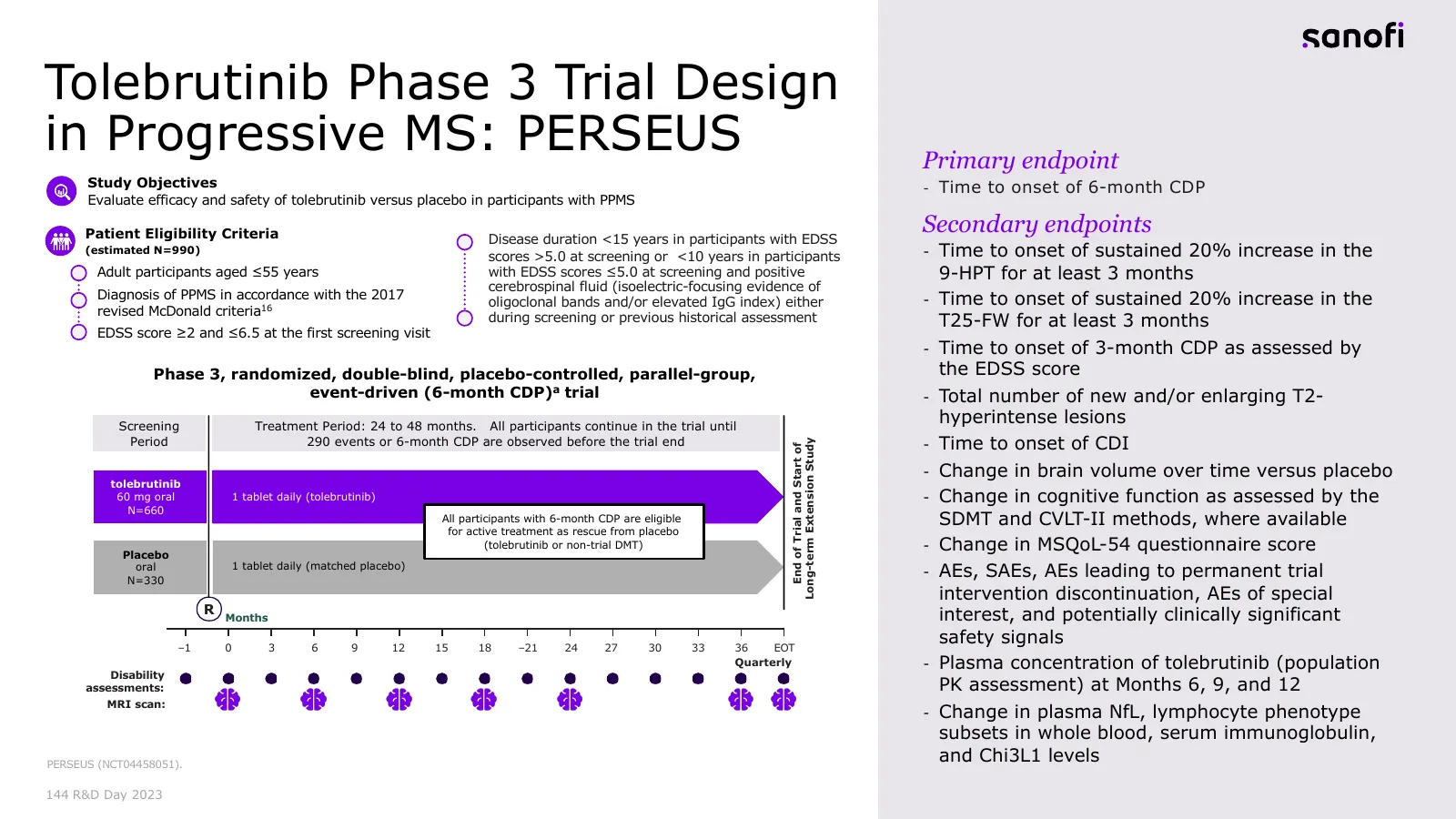
Slide 144: Tolebrutinib Phase 3 Trial Design in Progressive MS: PERSEUS
Tolebrutinib Phase 3 Trial Design in Progressive MS: PERSEUS Primary endpoint Study Objectives - Time to onset of 6-month CDP Evaluate efficacy and safety of tolebrutinib versus placebo in participants with PPMS Patient Eligibility Criteria Disease duration <15 years in participants with EDSS Second
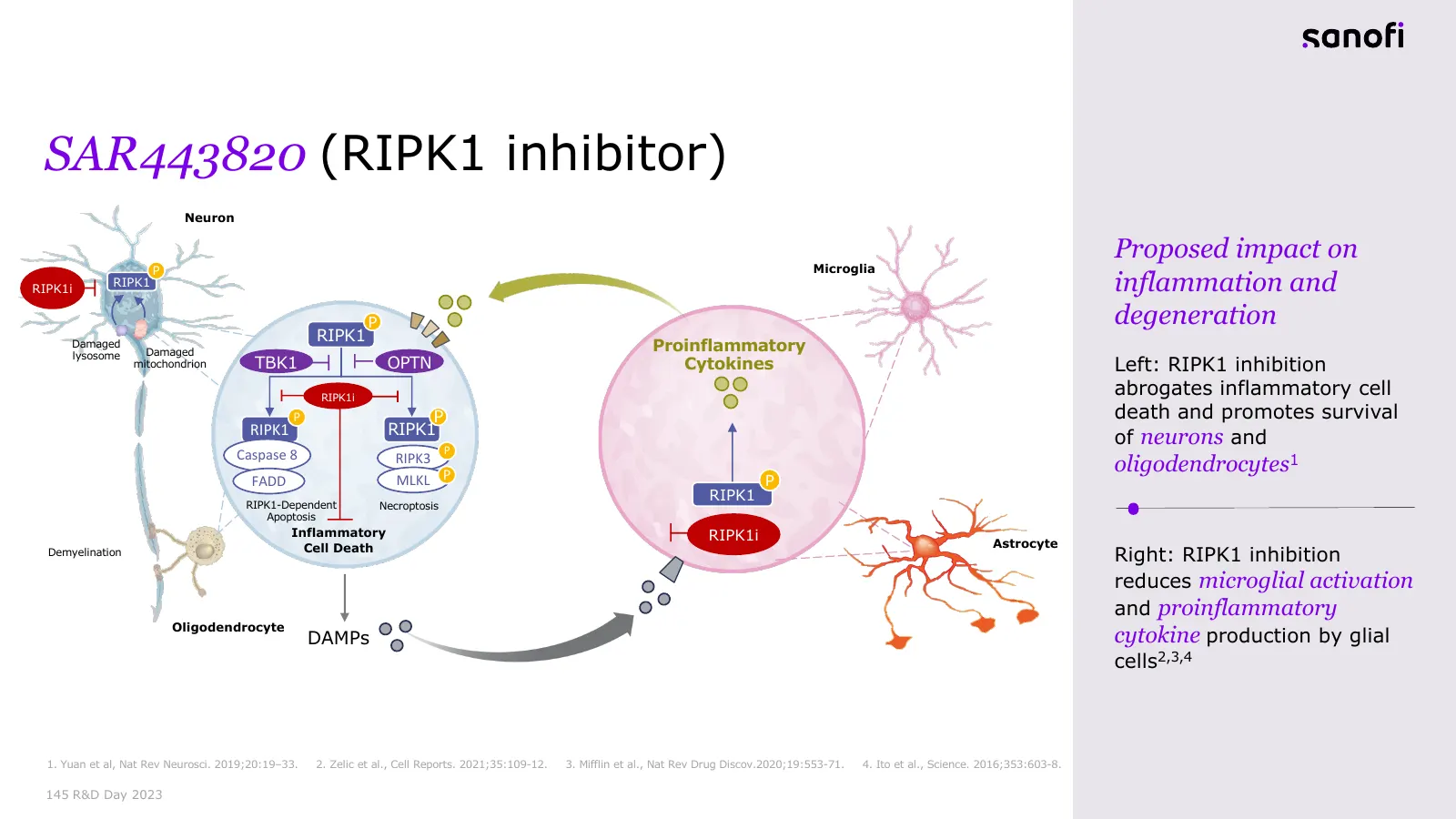
Slide 145: SAR443820 (RIPK1 inhibitor)
SAR443820 (RIPK1 inhibitor) Neuron Proposed impact on P Microglia RIPK1i RIPK1 inflammation and P degeneration RIPK1 Damaged Damaged Proinflammatory lysosome mitochondrion TBK1 OPTN Cytokines Left: RIPK1 inhibition RIPK1i abrogates inflammatory cell P P death and promotes survival RIPK1 RIPK1 P of n
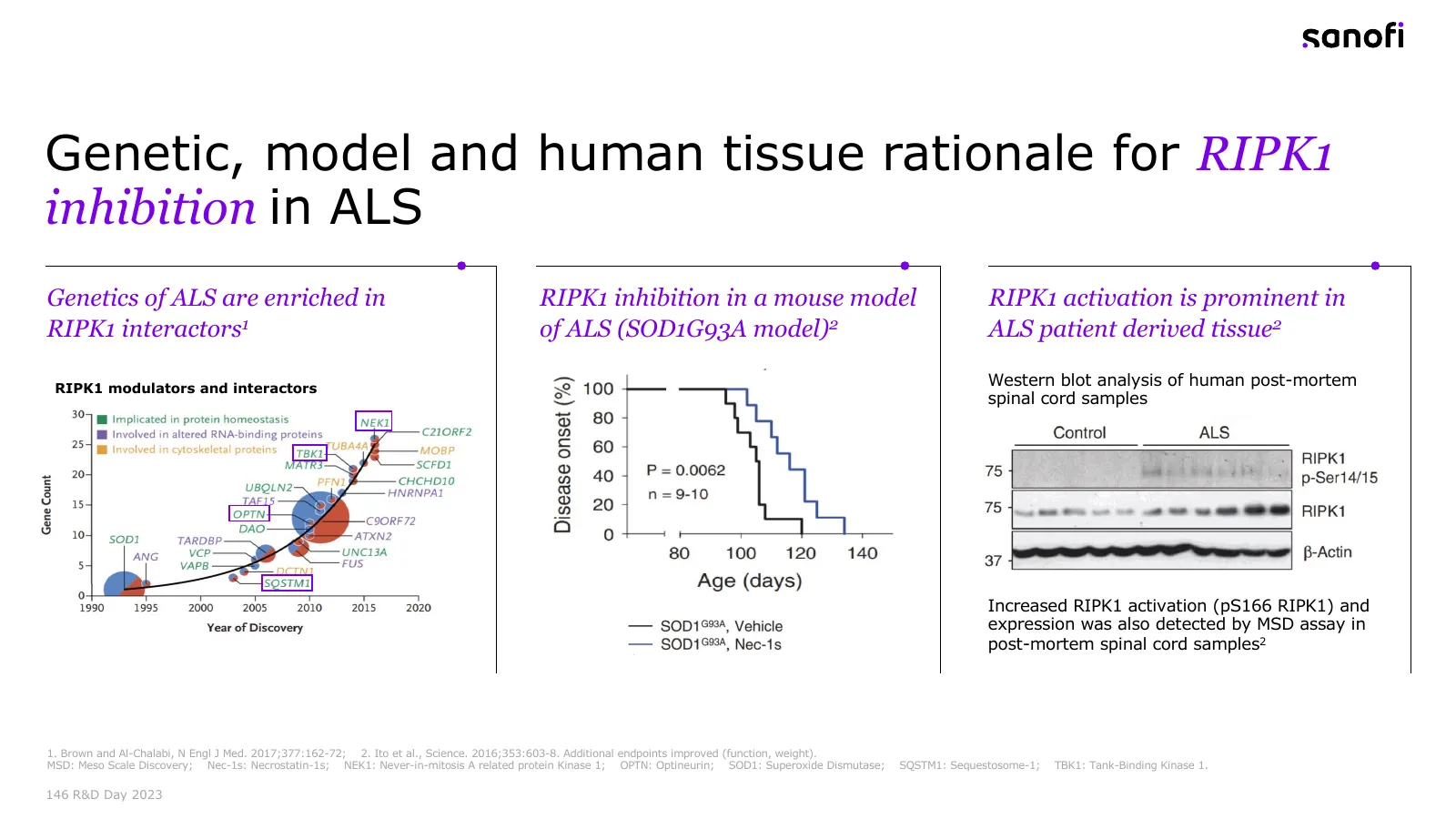
Slide 146: Rationale for RIPK1 inhibition in ALS
Genetic, model and human tissue rationale for RIPK1 inhibition in ALS Genetics of ALS are enriched in RIPK1 inhibition in a mouse model RIPK1 activation is prominent in RIPK1 interactors1 of ALS (SOD1G93A model)2 ALS patient derived tissue2 RIPK1 modulators and interactors Western blot analysis of h
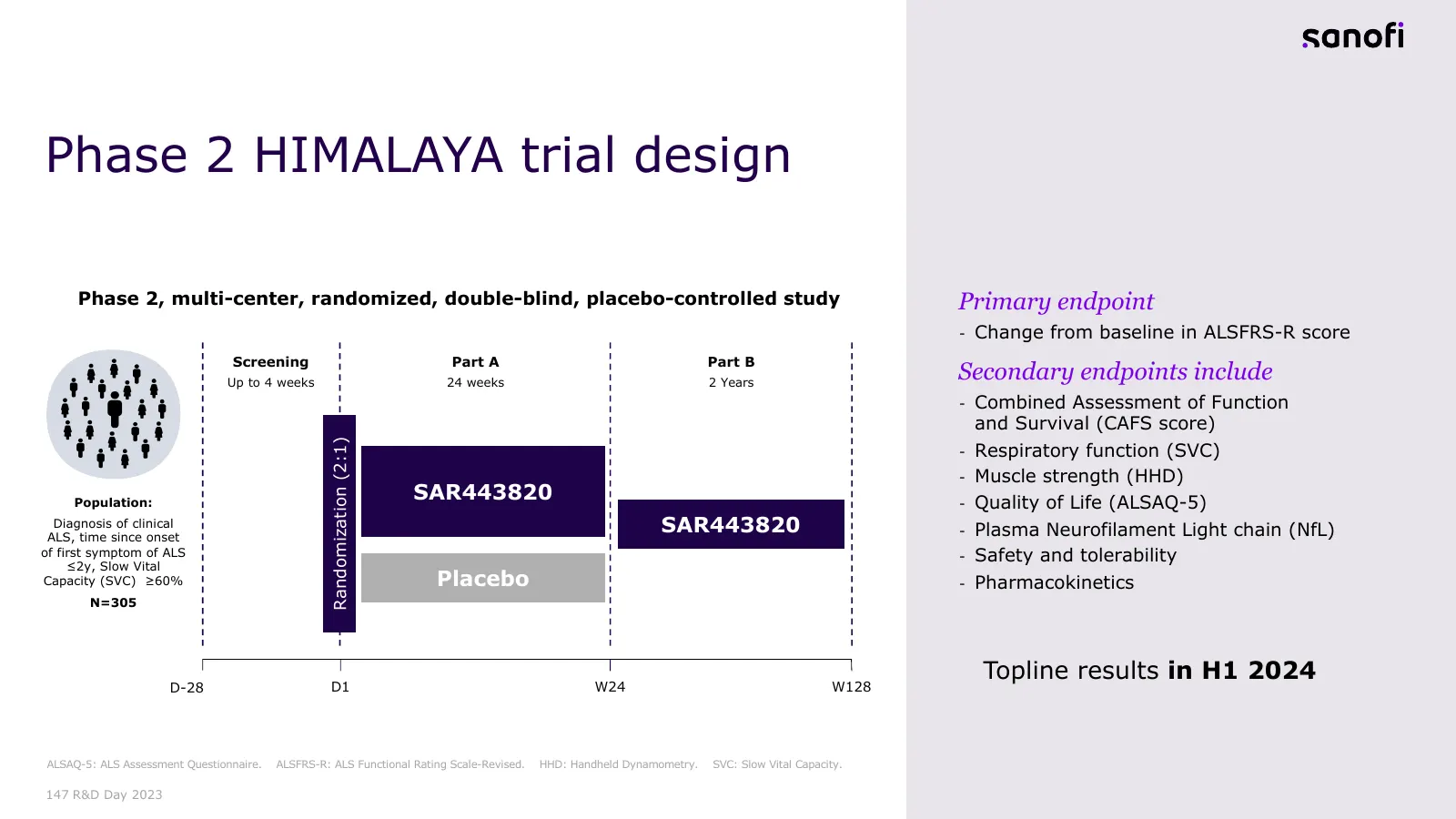
Slide 147: Phase 2 HIMALAYA trial design
Phase 2 HIMALAYA trial design Phase 2, multi-center, randomized, double-blind, placebo-controlled study Primary endpoint - Change from baseline in ALSFRS-R score Screening Part A Part B Up to 4 weeks 24 weeks 2 Years Secondary endpoints include - Combined Assessment of Function and Survival (CAFS sc

Slide 148: Expand leadership in vaccines
Expand leadership in vaccines Thomas Triomphe Head of Vaccines GBU Jean-François Toussaint Head of Vaccines R&D
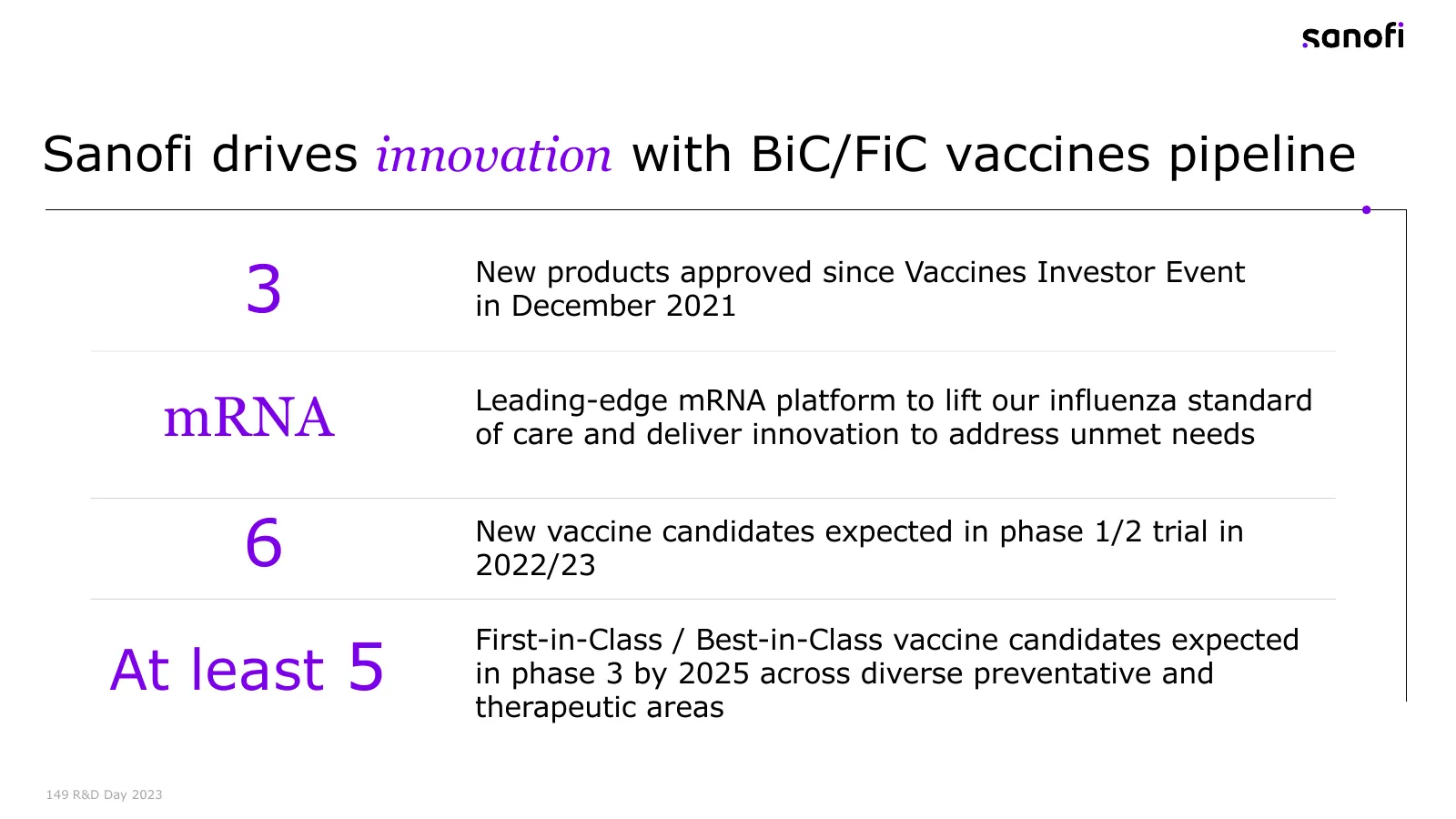
Slide 149: Sanofi drives innovation with BiC/FiC vaccines pipeline
Sanofi drives innovation with BiC/FiC vaccines pipeline 3 New products approved since Vaccines Investor Event in December 2021 Leading-edge mRNA platform to lift our influenza standard mRNA of care and deliver innovation to address unmet needs 6 New vaccine candidates expected in phase 1/2 trial in
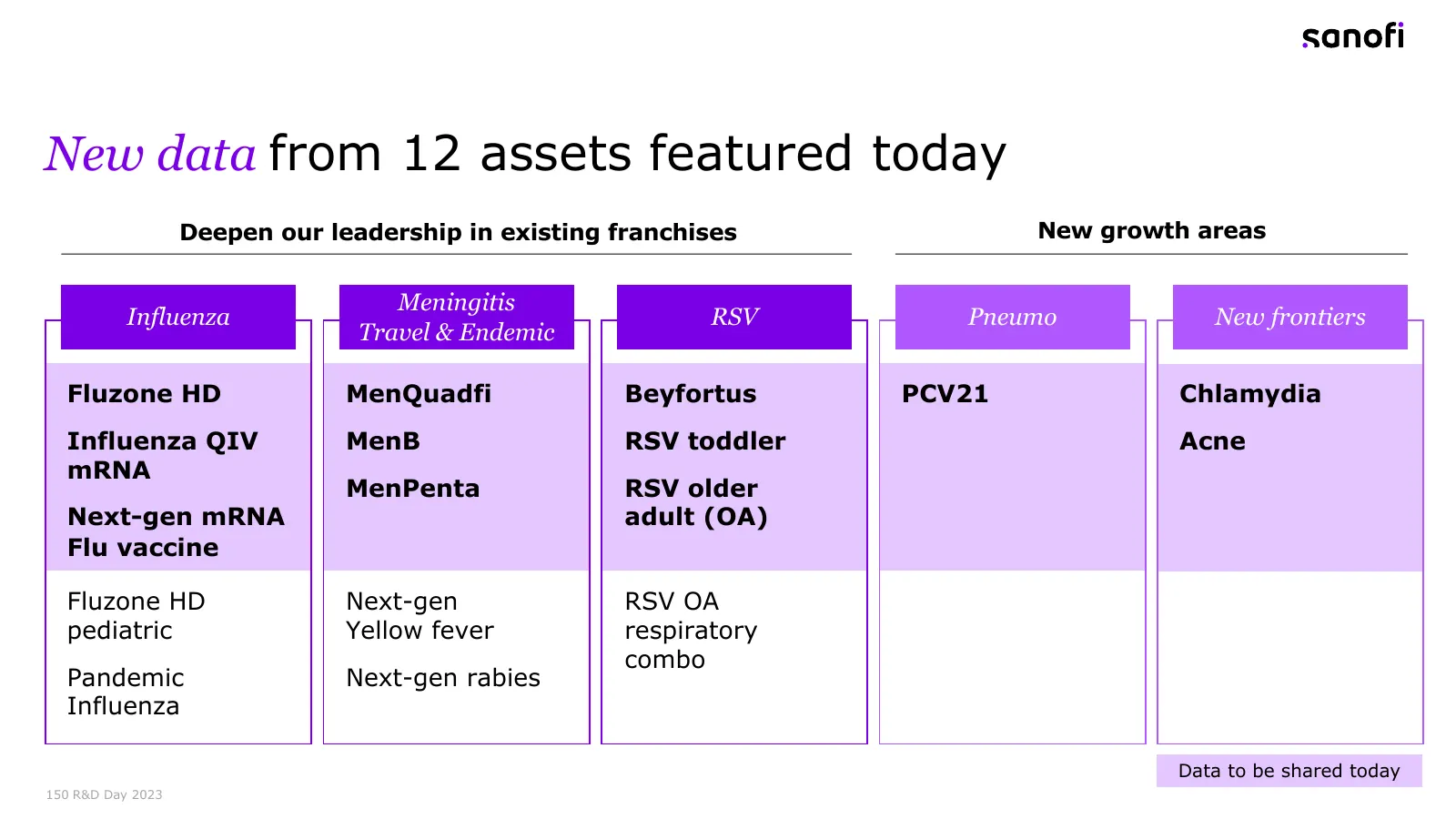
Slide 150: New data from 12 assets featured today
New data from 12 assets featured today Deepen our leadership in existing franchises New growth areas Meningitis Influenza RSV Pneumo New frontiers Travel & Endemic Fluzone HD MenQuadfi Beyfortus PCV21 Chlamydia Influenza QIV MenB RSV toddler Acne mRNA MenPenta RSV older Next-gen mRNA adult (OA) Flu
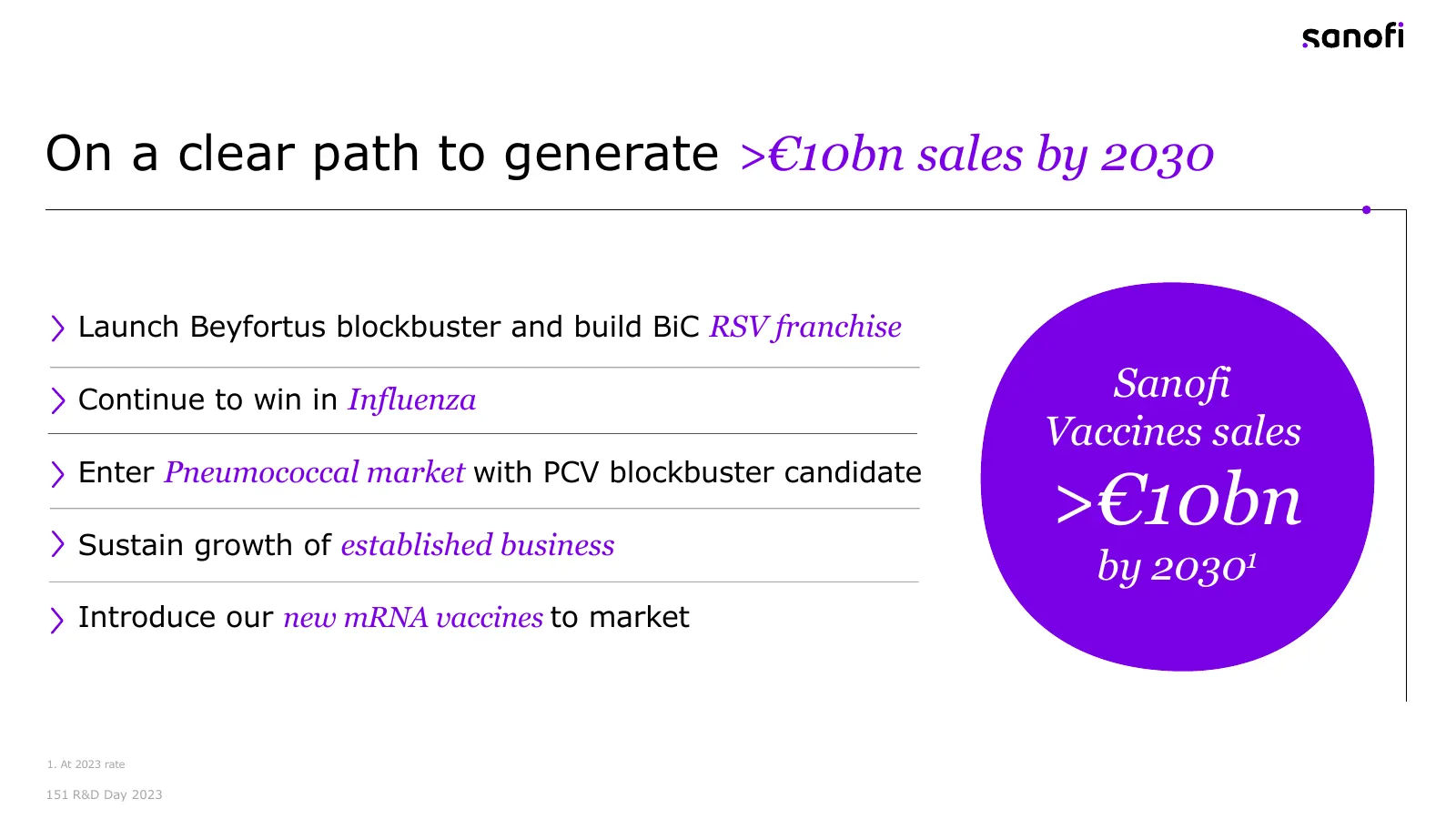
Slide 151: On a clear path to generate >€10bn sales by 2030
On a clear path to generate >€10bn sales by 2030 Launch Beyfortus blockbuster and build BiC RSV franchise Continue to win in Influenza Sanofi Vaccines sales Enter Pneumococcal market with PCV blockbuster candidate Sustain growth of established business >€10bn by 20301 Introduce our new mRNA vaccines
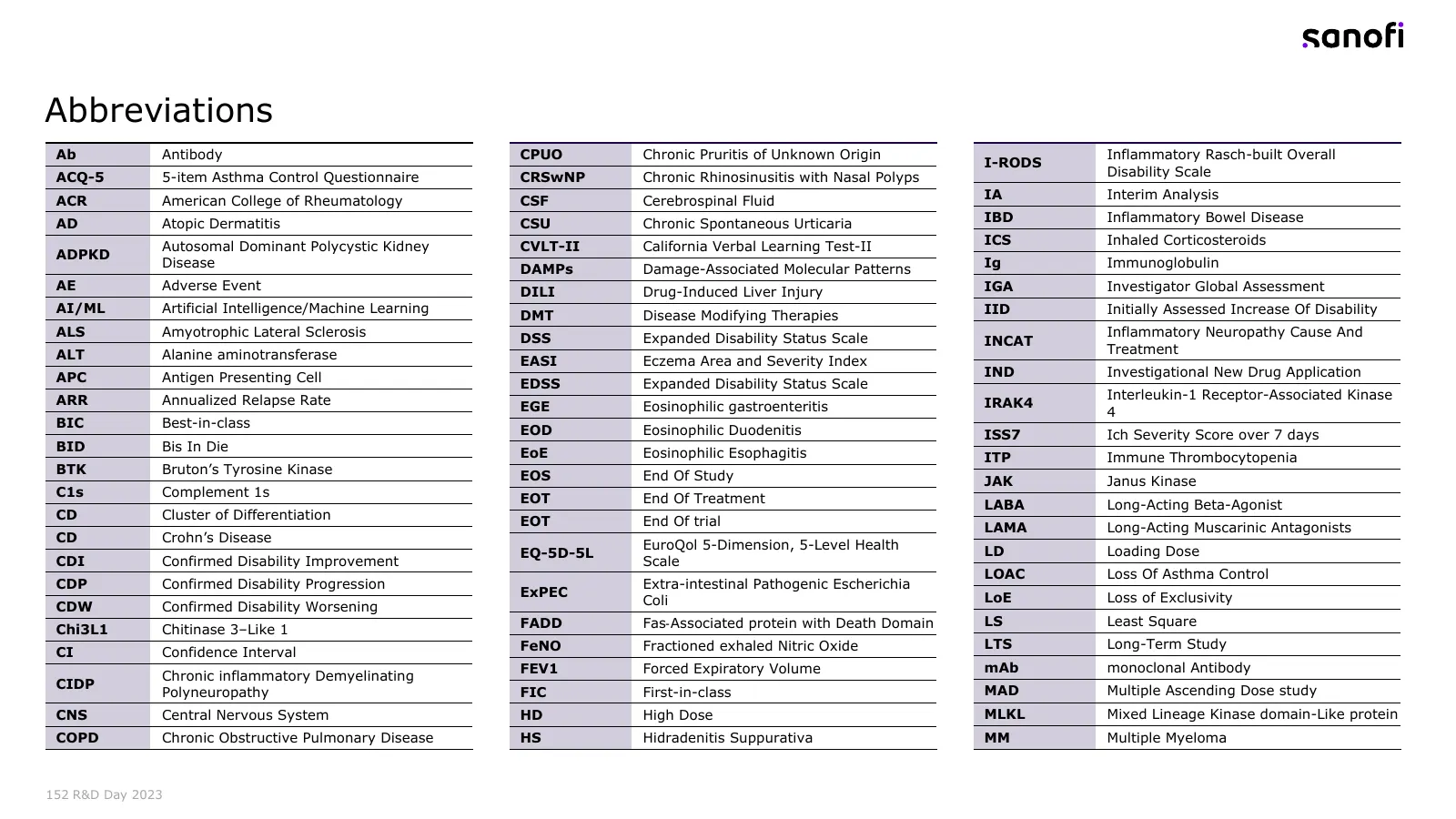
Slide 152: Abbreviations
Abbreviations Ab Antibody CPUO Chronic Pruritis of Unknown Origin Inflammatory Rasch-built Overall I-RODS ACQ-5 5-item Asthma Control Questionnaire CRSwNP Chronic Rhinosinusitis with Nasal Polyps Disability Scale ACR American College of Rheumatology CSF Cerebrospinal Fluid IA Interim Analysis AD Ato
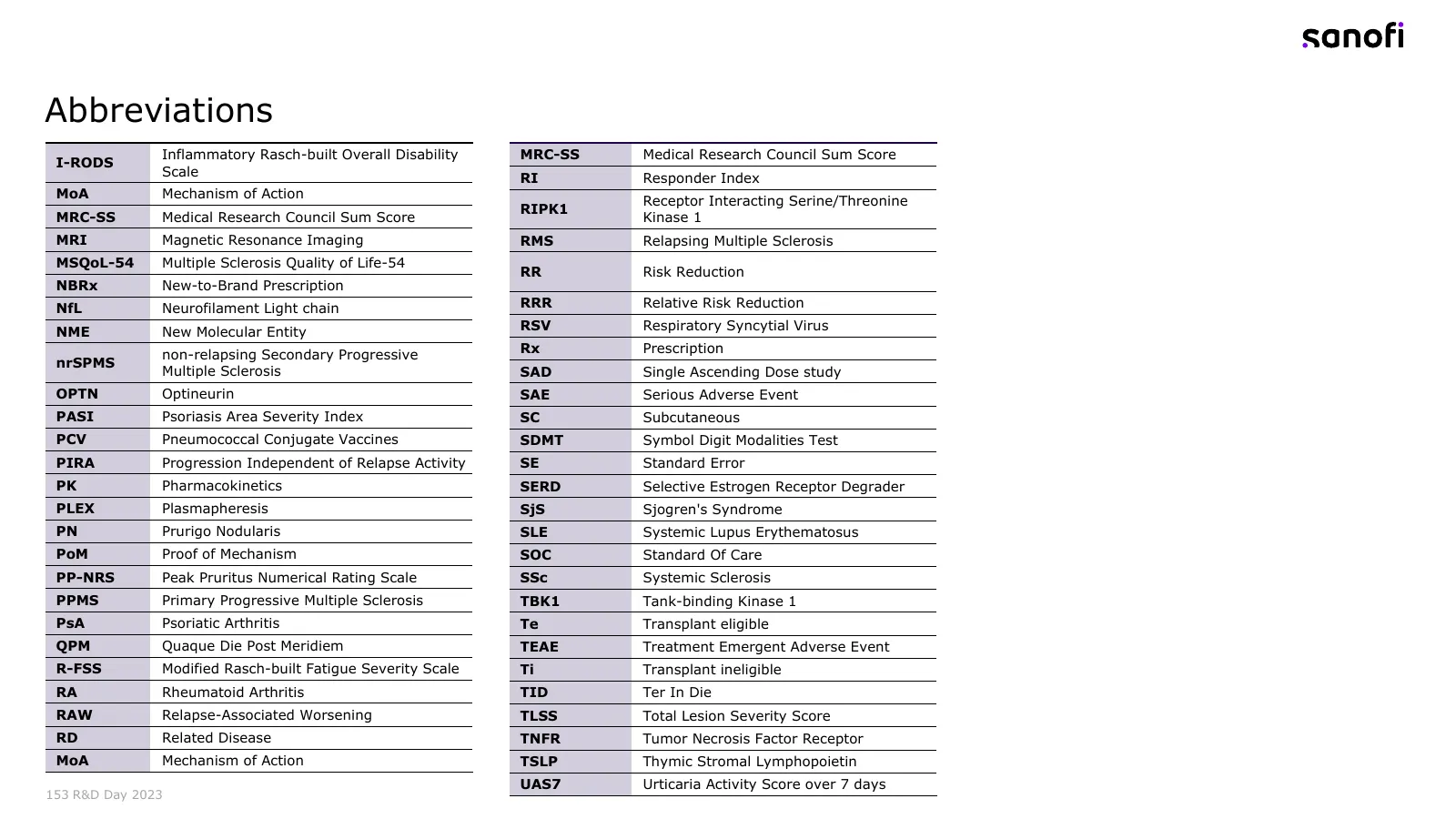
Slide 153: Abbreviations
Abbreviations Inflammatory Rasch-built Overall Disability MRC-SS Medical Research Council Sum Score I-RODS Scale RI Responder Index MoA Mechanism of Action Receptor Interacting Serine/Threonine RIPK1 MRC-SS Medical Research Council Sum Score Kinase 1 MRI Magnetic Resonance Imaging RMS Relapsing Mult
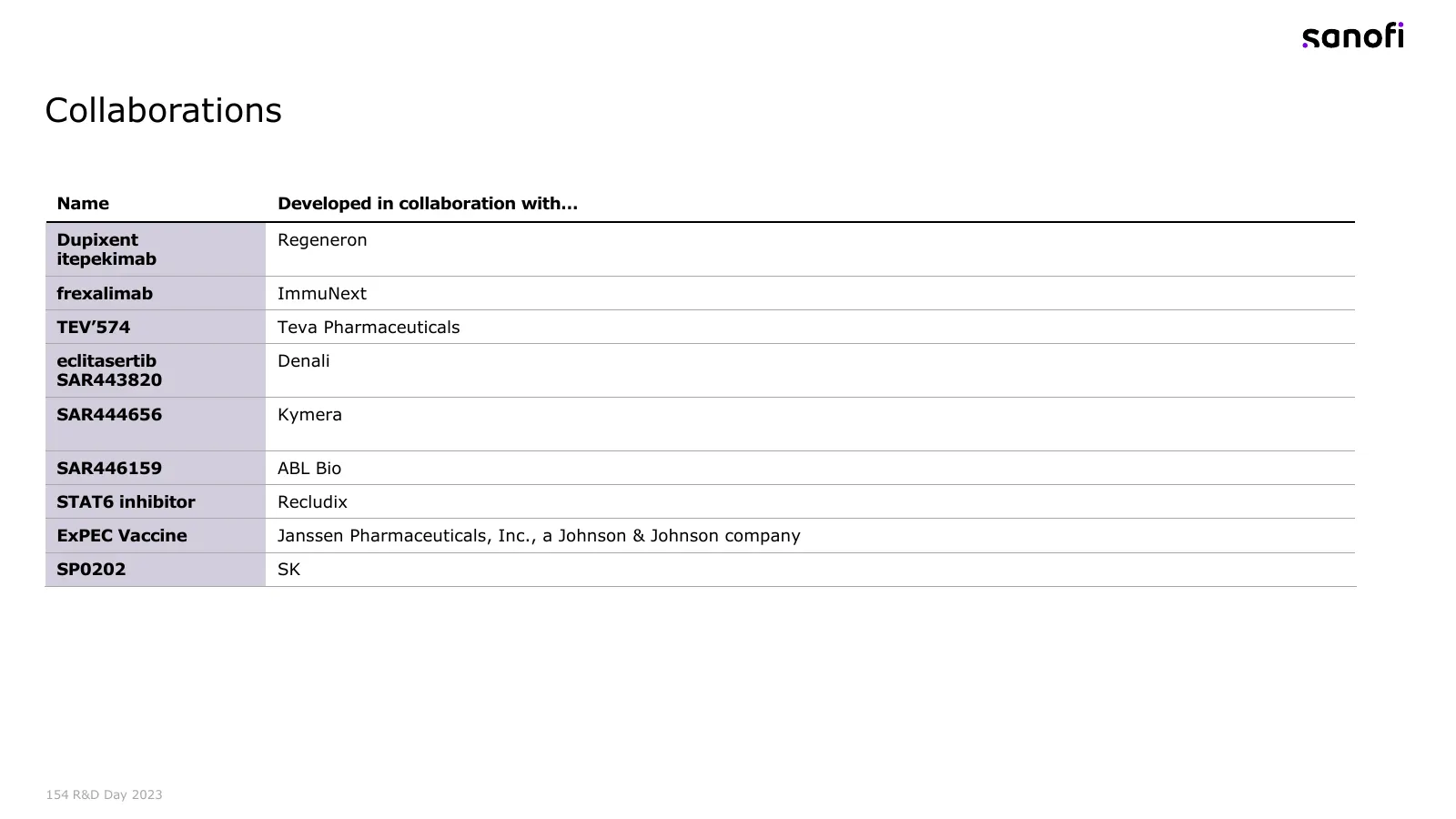
Slide 154: Collaborations
Collaborations Name Developed in collaboration with… Dupixent Regeneron itepekimab frexalimab ImmuNext TEV’574 Teva Pharmaceuticals eclitasertib Denali SAR443820 SAR444656 Kymera SAR446159 ABL Bio STAT6 inhibitor Recludix ExPEC Vaccine Janssen Pharmaceuticals, Inc., a Johnson & Johnson company SP020
Source: Internet Archive copy of sanofi.com
More decks from Sanofi SA
 Q3 2026 Earnings Presentation51 slides · Oct 30, 2026
 Merger or Acquisition (October 2026)21 slides · Oct 1, 2026
 Q2 2026 Earnings Presentation52 slides · Jul 30, 2026
 Q1 2026 Earnings Presentation45 slides · Apr 23, 2026
 Q4 2025 Earnings Presentation49 slides · Jan 29, 2026
 44th Annual J.P. Morgan Healthcare Conference 20267 slides · Jan 12, 2026