NeoGenomics, Inc. · NASDAQ:NEO
NeoGenomics — Technical Presentation (November 2021)
11 slides from NeoGenomics's technical presentation, November 2021
Slide 1: Gene fusion calling from RNA sequencing data: An ensemble learning approach
AACR Abstract Number 240 Gene fusion calling from RNA sequencing data: An ensemble learning approach Kenneth Brad Thomas, Yanglong Mou, Christophe Magnan, Tibor Gyuris, Eve Shinbrot, Fernando Lopez Diaz, Steven Lau- Rivera, Segun Jung, Vincent Funari, Lawrence M. Weiss.
Slide 2: Abstract
Abstract Introduction: Our goal is to improve gene fusion detection via RNA sequencing by combining multiple fusion callers through machine learning techniques. Background: Gene Fusion events are important drivers of malignancy. RNA sequencing (RNAseq) methods for detection of fusions have the advan
Slide 3: Background
Background • Our work is intended to improve the utility of RNA sequencing as a means of detecting gene fusions. • Available fusion calling algorithms were found to be sensitive, but prone to high false positive rates. • There is a need for an alternative to time-intensive manual review as a means o
Slide 4: Evidence of fusions in paired-end RNA sequencing data
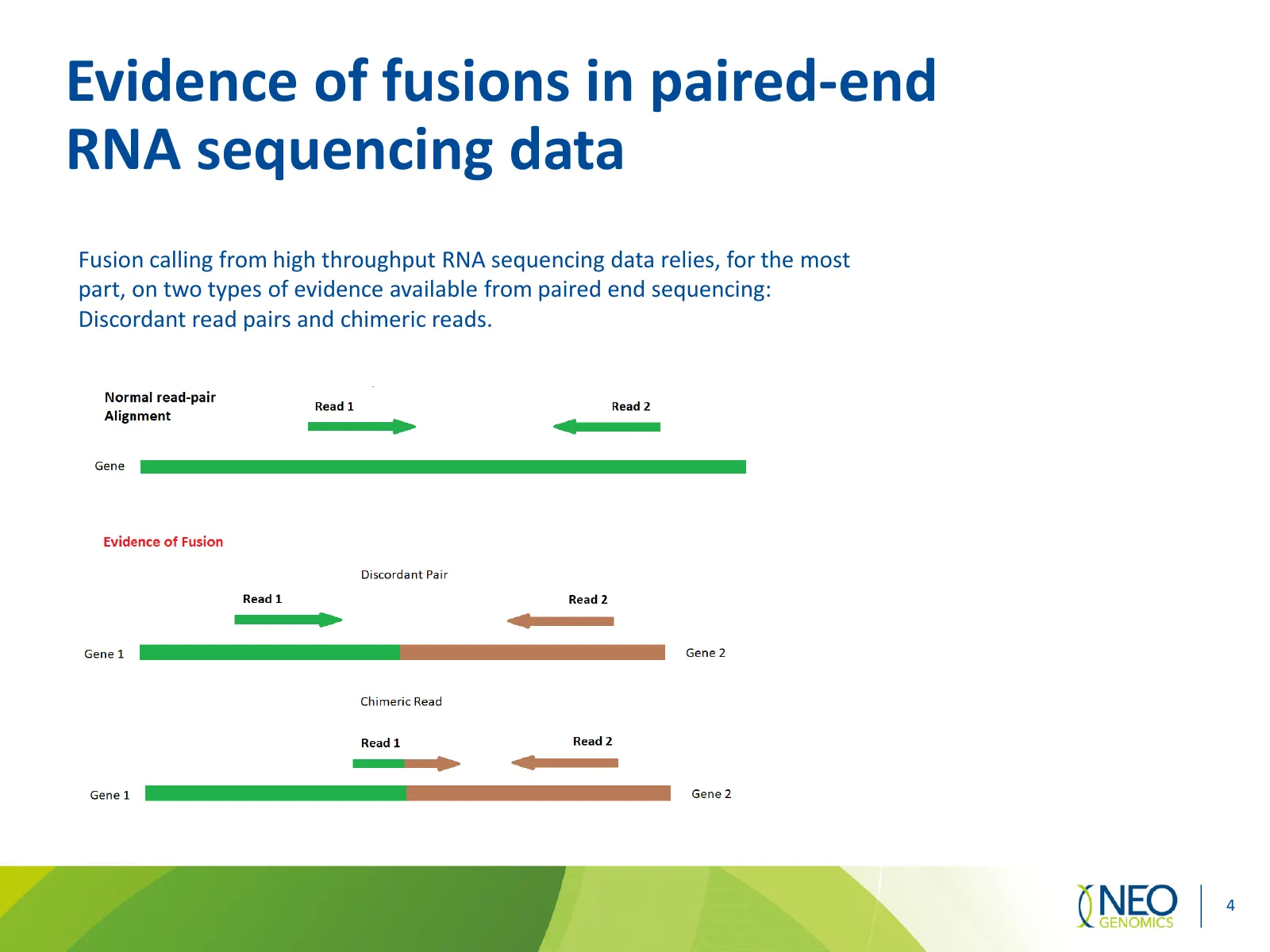
Evidence of fusions in paired-end RNA sequencing data Fusion calling from high throughput RNA sequencing data relies, for the most part, on two types of evidence available from paired end sequencing: Discordant read pairs and chimeric reads. 4
Slide 5: Methods (1)
Methods (1) • RNA sequencing data was generated by paired-end sequencing of samples from a wide variety of solid tumors from many sites. RNA templates were pulled down using capture probes of a new panel, the Solid Tumor Gene Fusion RNA-Seq panel developed by NeoGenomics. The panel includes baits fo
Slide 6: Methods (2)
Methods (2) • Software for modeling consisted of the R application randomForest, which was run within the caret optimization environment. • Training employed 1500 trees (ntrees) with 10-fold cross-validation. • Training Data comprised - candidate fusion calls – each made by at least two of the fusio
Slide 7: Contribution of importance to model development
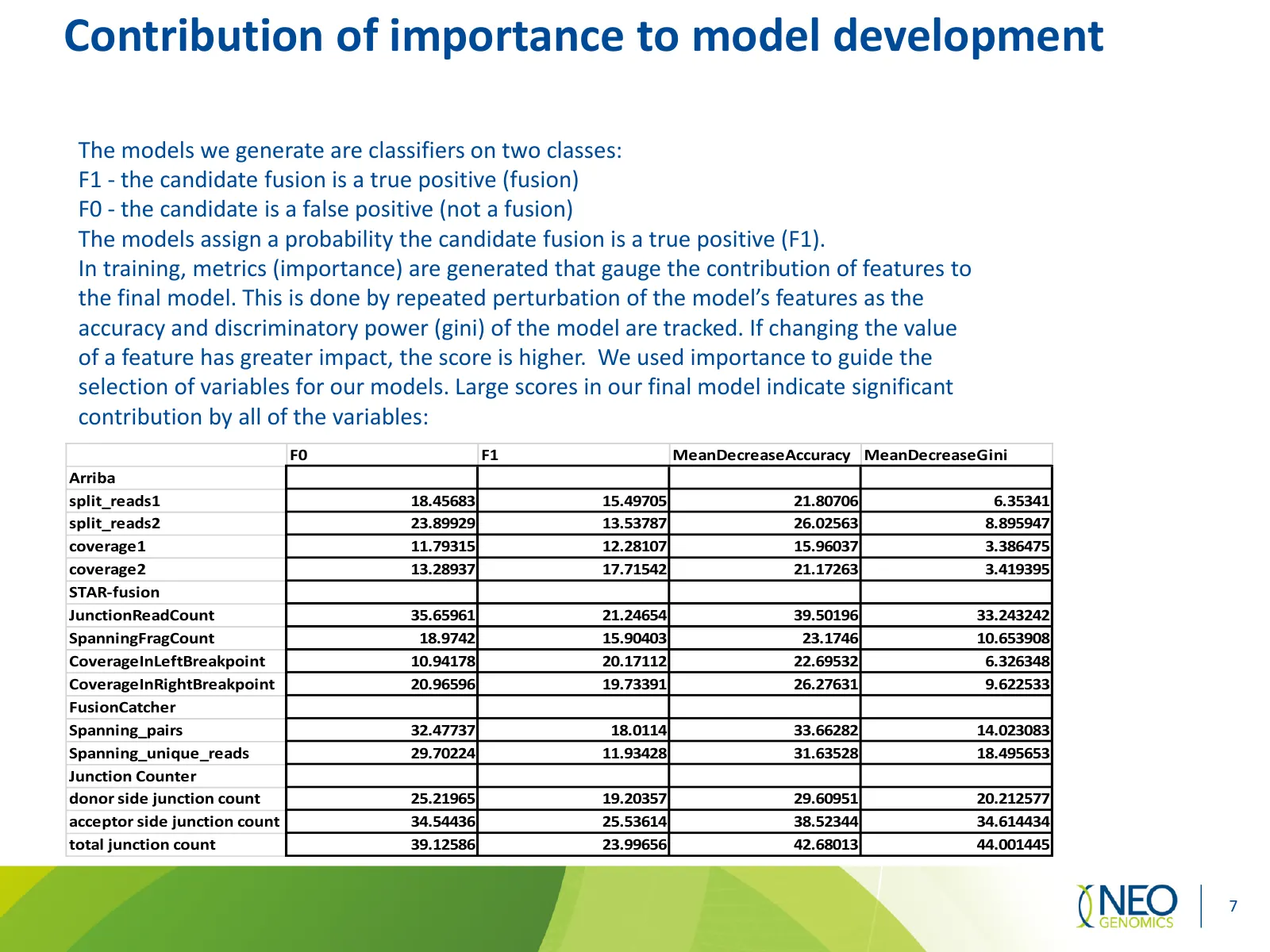
Contribution of importance to model development The models we generate are classifiers on two classes: F1 - the candidate fusion is a true positive (fusion) F0 - the candidate is a false positive (not a fusion) The models assign a probability the candidate fusion is a true positive (F1). In training
Slide 8: Performance of our final model
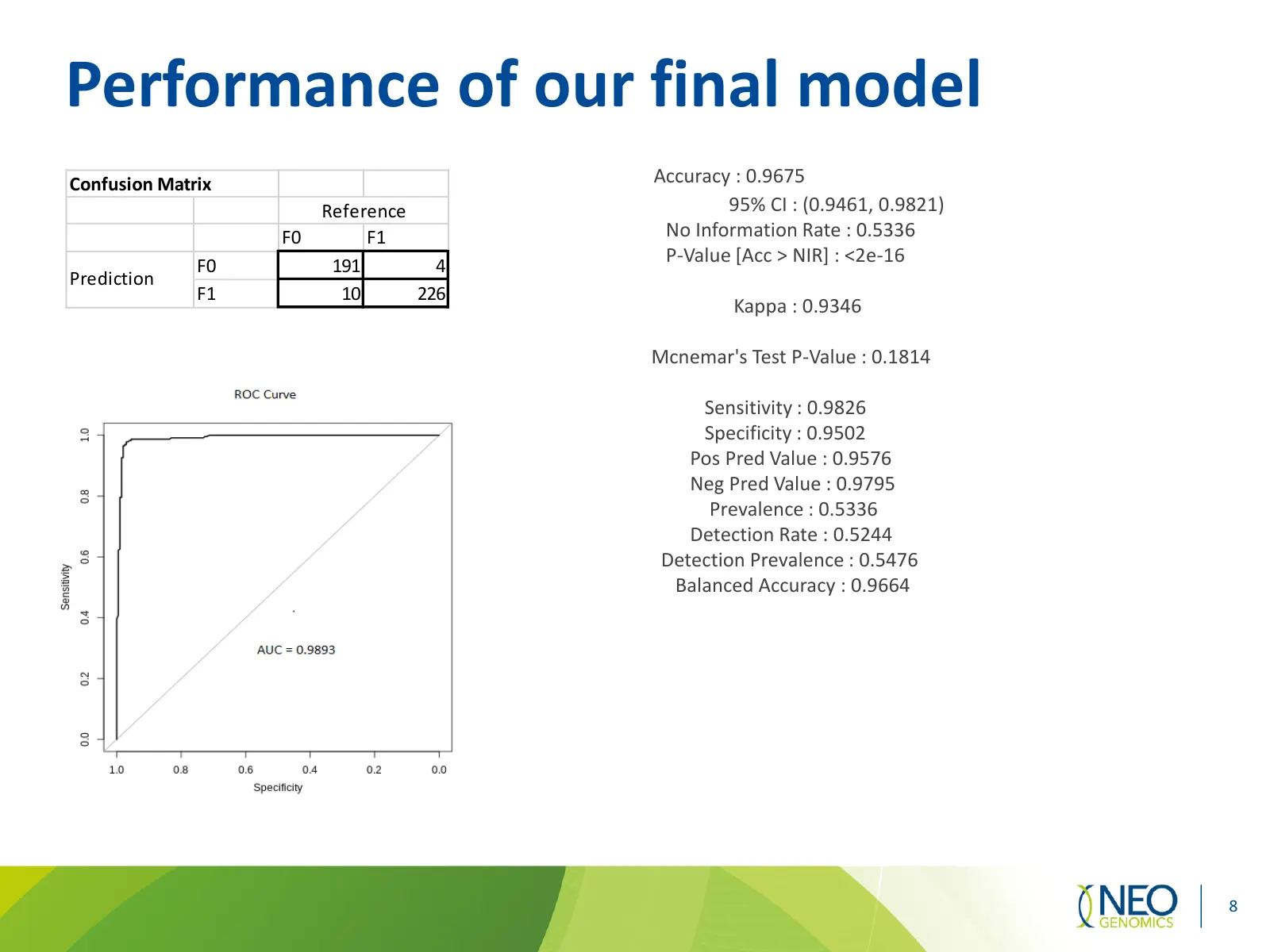
Performance of our final model Confusion Matrix Accuracy : 0.9675 Reference 95% CI : (0.9461, 0.9821) F0 F1 No Information Rate : 0.5336 F0 191 4 P-Value [Acc > NIR] : <2e-16 Prediction F1 10 226 Kappa : 0.9346 Mcnemar's Test P-Value : 0.1814 Sensitivity : 0.9826 Specificity : 0.9502 Pos Pred Value
Slide 9: Conclusion
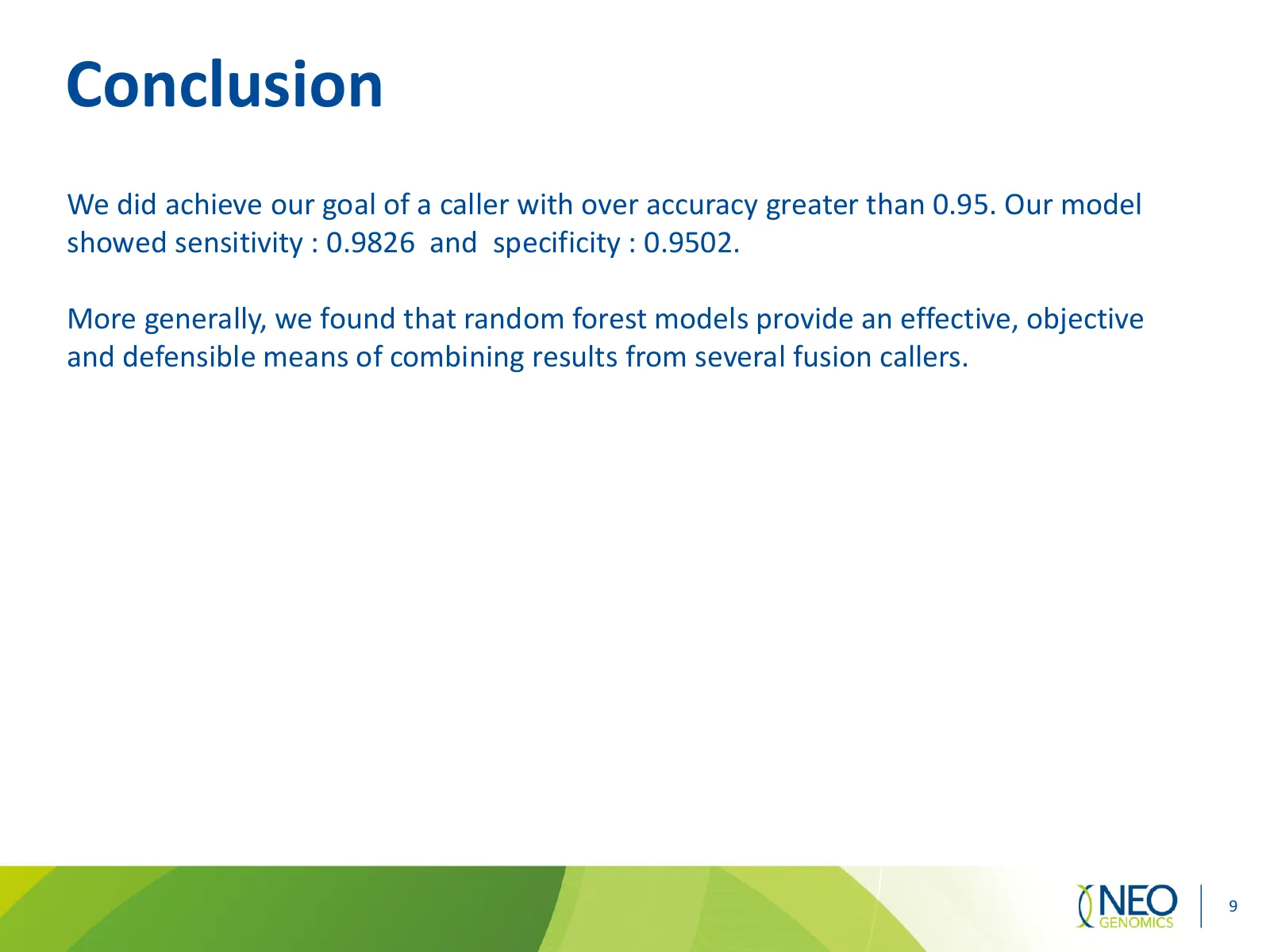
Conclusion We did achieve our goal of a caller with over accuracy greater than 0.95. Our model showed sensitivity : 0.9826 and specificity : 0.9502. More generally, we found that random forest models provide an effective, objective and defensible means of combining results from several fusion caller
Slide 10: Software List
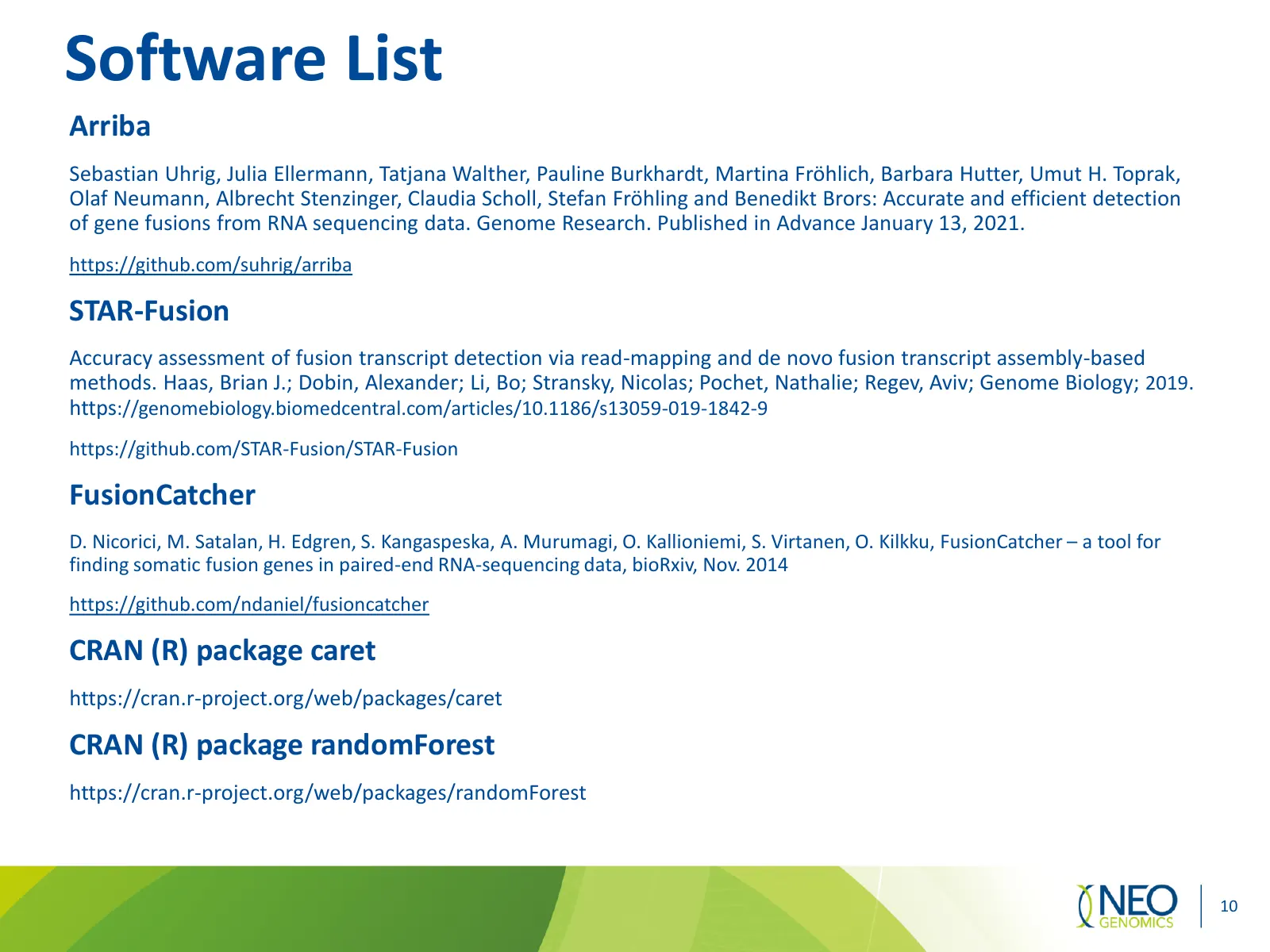
Software List Arriba Sebastian Uhrig, Julia Ellermann, Tatjana Walther, Pauline Burkhardt, Martina Fröhlich, Barbara Hutter, Umut H. Toprak, Olaf Neumann, Albrecht Stenzinger, Claudia Scholl, Stefan Fröhling and Benedikt Brors: Accurate and efficient detection of gene fusions from RNA sequencing dat

Slide 11: NeoGenomics
(NEO GENOMICS
Source: Internet Archive copy of neogenomics.com
More decks from NeoGenomics, Inc.
 Q3 2026 Earnings Presentation26 slides · Oct 28, 2026
 Q2 2026 Earnings Presentation24 slides · Jul 28, 2026
 Q1 2026 Earnings Presentation27 slides · Apr 28, 2026
 Q4 2025 Earnings Presentation15 slides · Feb 17, 2026
 Q3 2025 Earnings Presentation17 slides · Oct 28, 2025
 Q2 2025 Earnings Presentation17 slides · Jul 29, 2025