QUALCOMM Incorporated · NASDAQ:QCOM
QUALCOMM — Technical Presentation (March 2022)
33 slides from QUALCOMM's technical presentation, Mar 15, 2022
Slide 1: AI firsts: Leading from research to proof-of-concepts
San Diego March 15, 2022 AI firsts: Leading from research to proof-of-concepts Jilei Hou Vice President, Engineering Qualcomm Technologies, Inc. @QCOMResearch
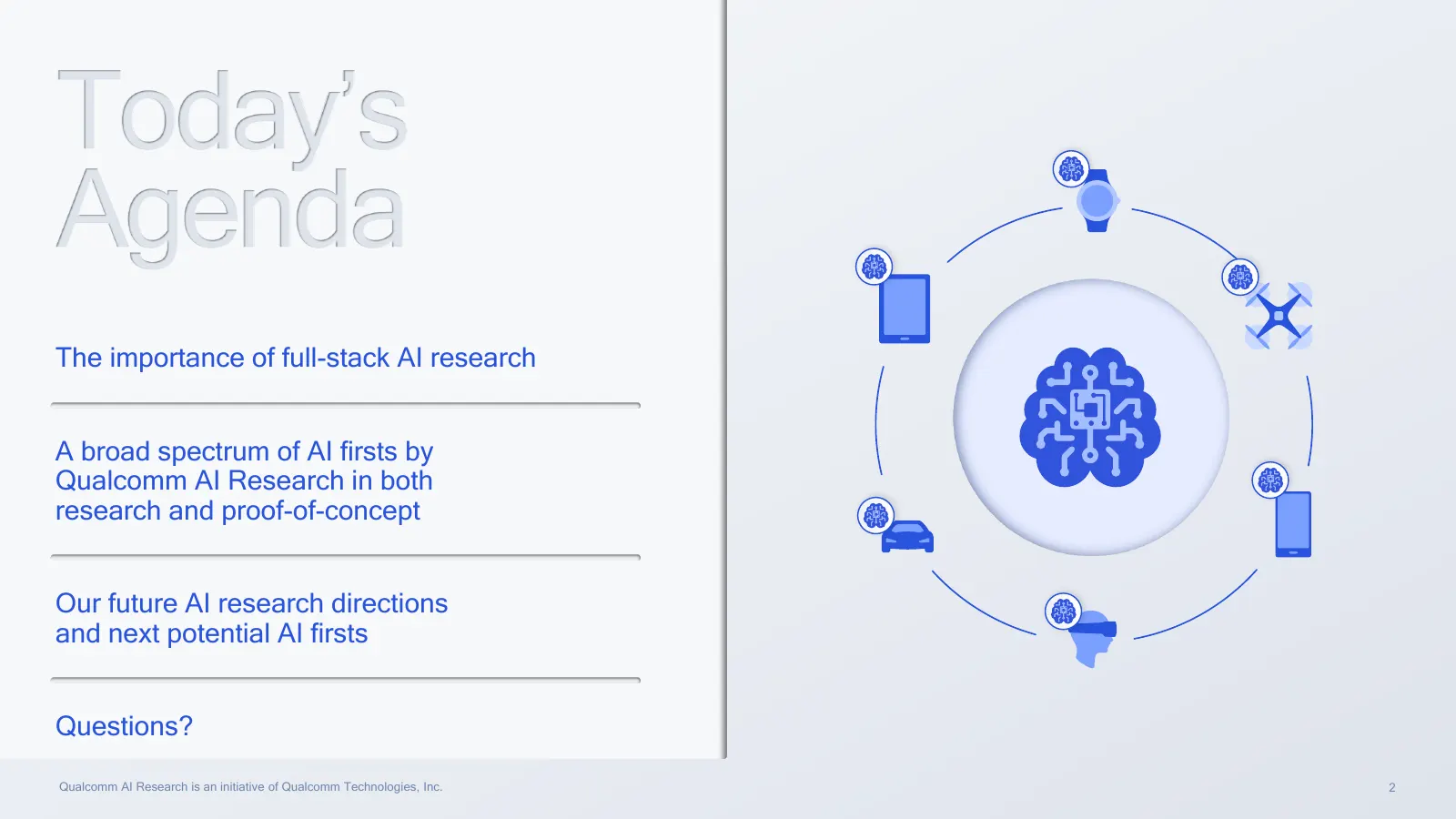
Slide 2: Today's Agenda
Today’s Agenda The importance of full-stack AI research A broad spectrum of AI firsts by Qualcomm AI Research in both research and proof-of-concept Our future AI research directions and next potential AI firsts Questions? Qualcomm AI Research is an initiative of Qualcomm Technologies, Inc. 2
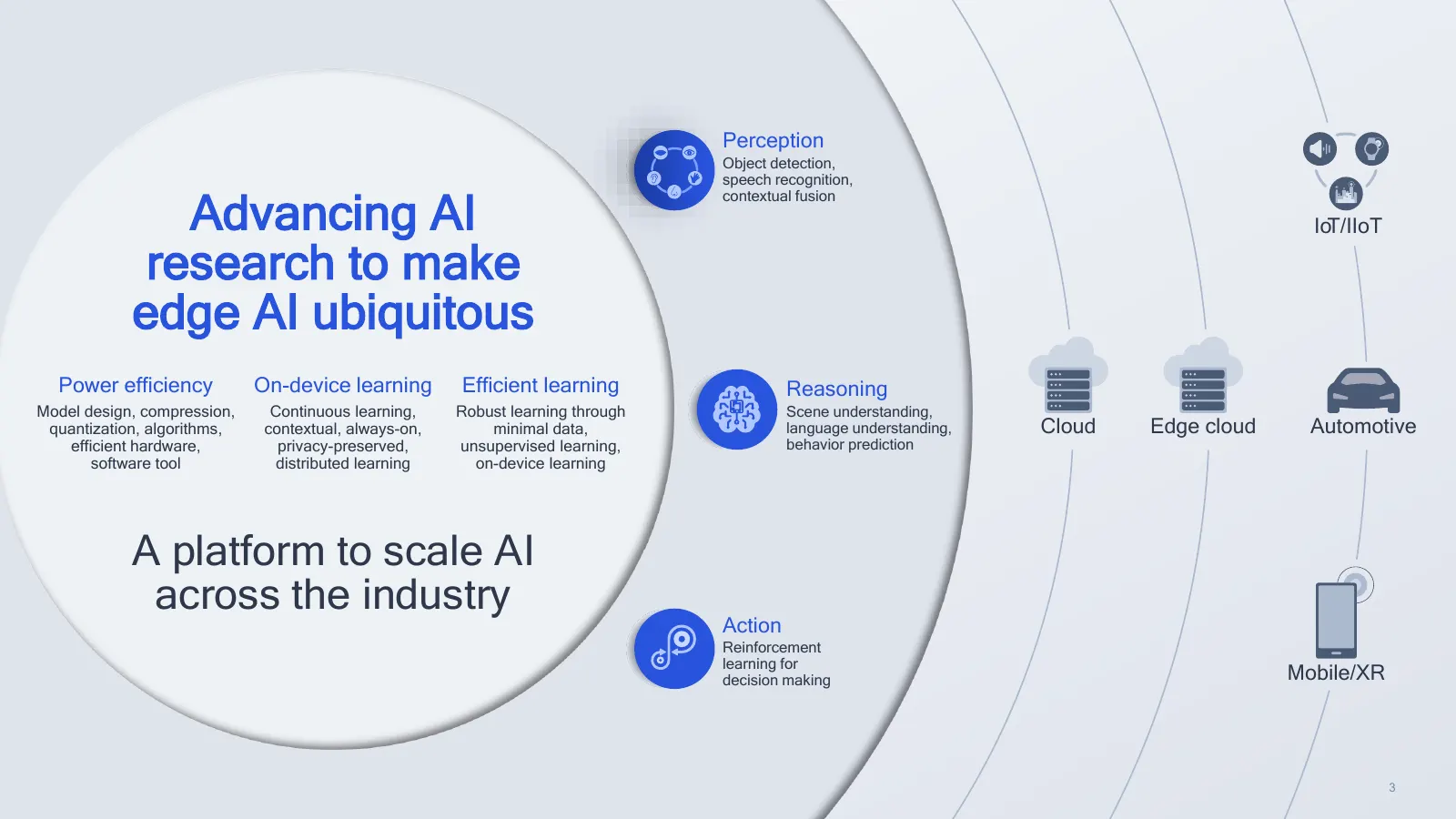
Slide 3: Advancing AI research to make edge AI ubiquitous
Perception Object detection, speech recognition, Advancing AI contextual fusion IoT/IIoT research to make edge AI ubiquitous Power efficiency On-device learning Efficient learning Reasoning Model design, compression, Continuous learning, Robust learning through Scene understanding, quantization, alg
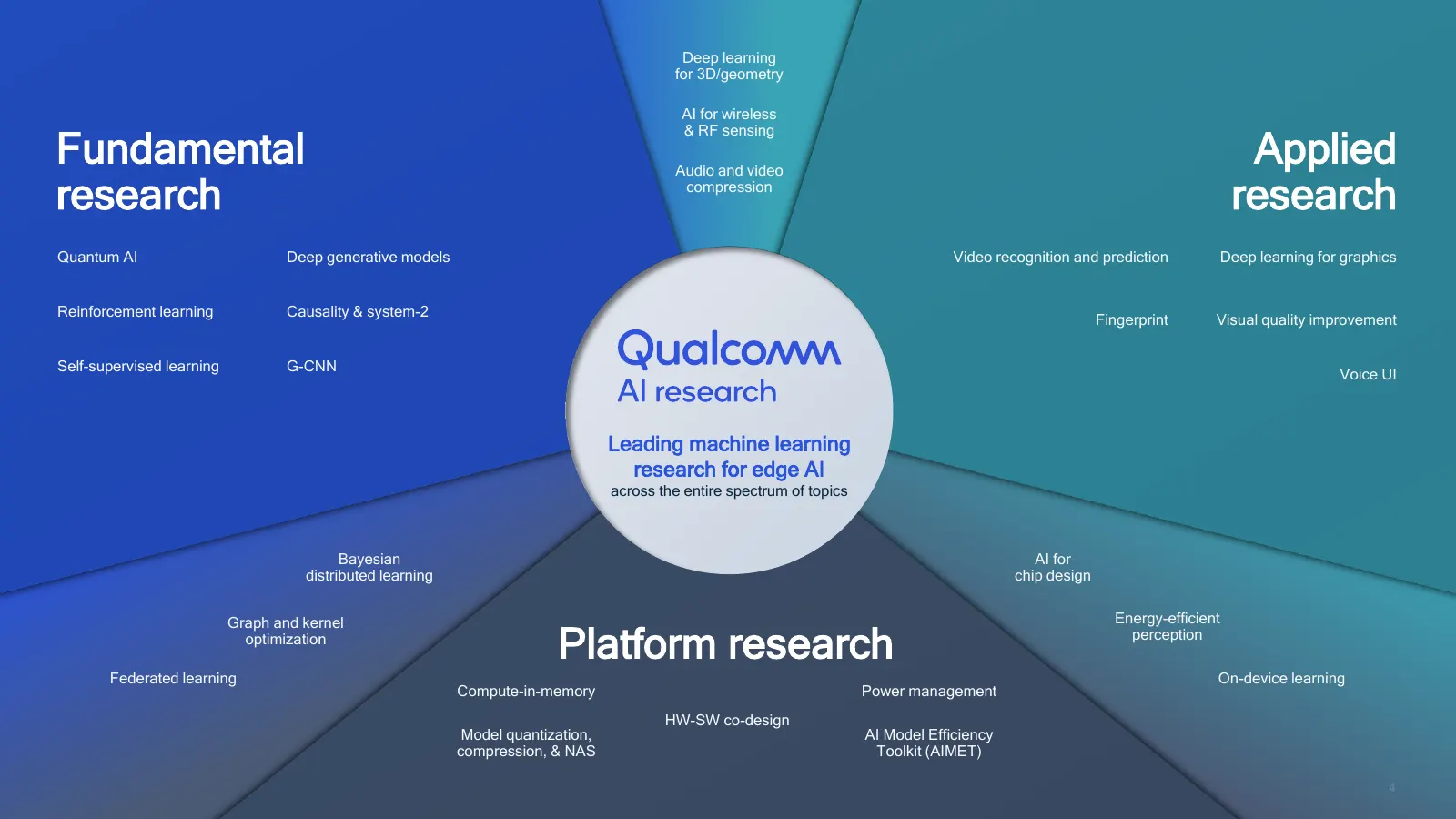
Slide 4: Leading machine learning research for edge AI
Deep learning for 3D/geometry AI for wireless & RF sensing Fundamental Audio and video Applied research compression research Quantum AI Deep generative models Video recognition and prediction Deep learning for graphics Reinforcement learning Causality & system-2 Fingerprint Visual quality improvemen
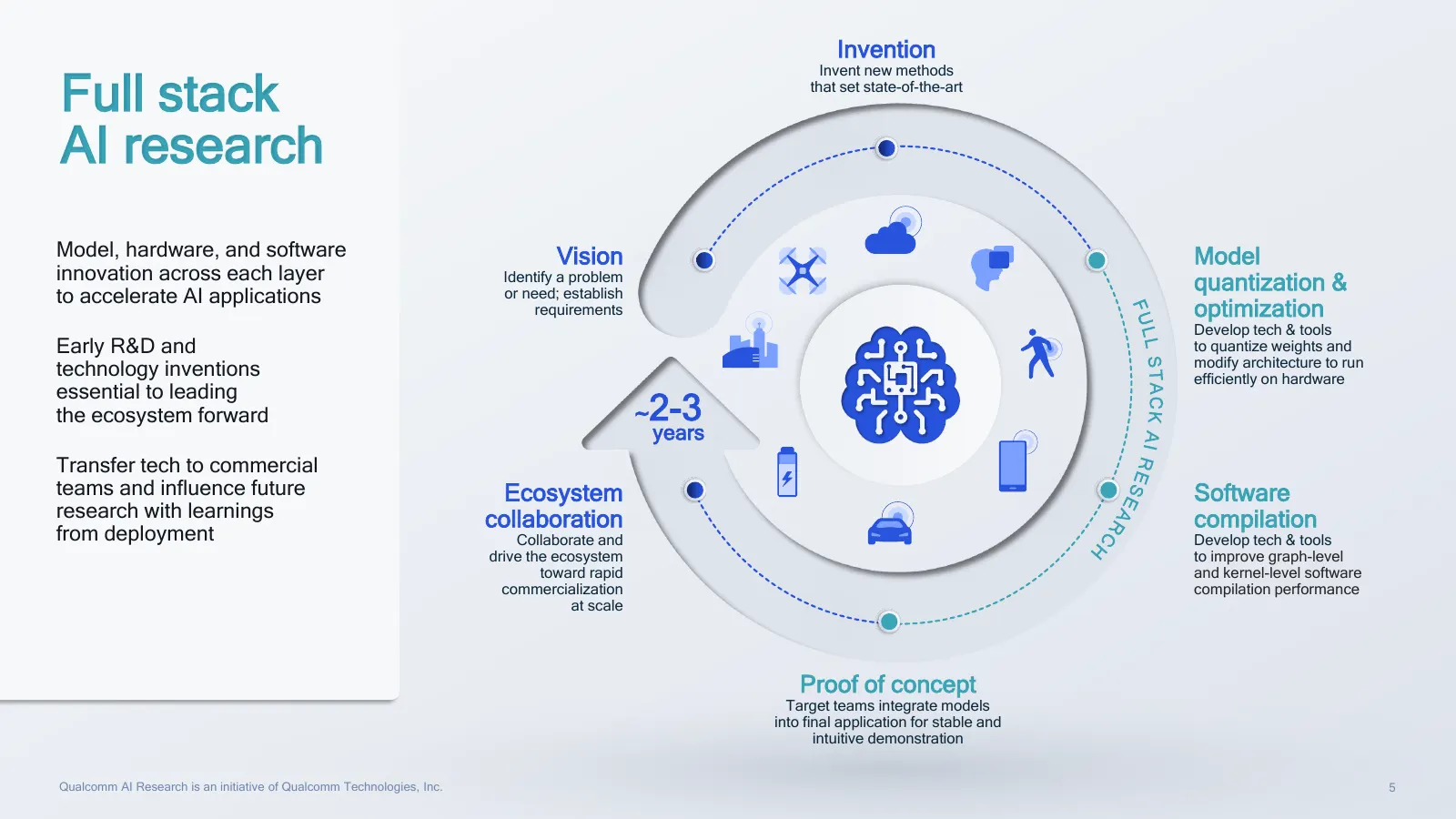
Slide 5: Full stack AI research
Invention Invent new methods Full stack that set state-of-the-art AI research Model, hardware, and software Vision Model innovation across each layer Identify a problem quantization & to accelerate AI applications or need; establish requirements optimization Develop tech & tools Early R&D and to qua
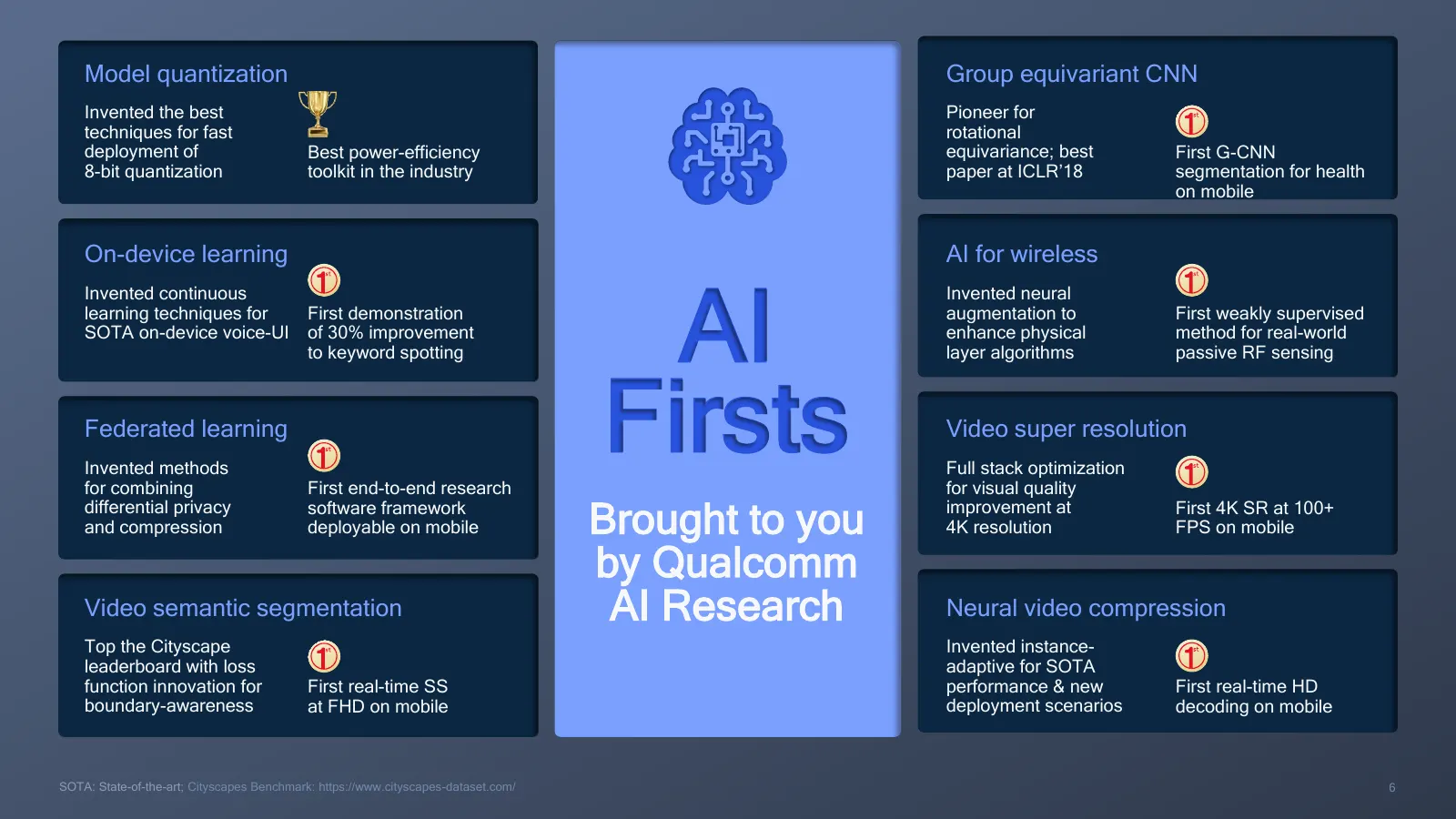
Slide 6: AI Firsts
Model quantization Group equivariant CNN Invented the best Pioneer for techniques for fast rotational deployment of Best power-efficiency equivariance; best First G-CNN 8-bit quantization toolkit in the industry paper at ICLR’18 segmentation for health on mobile On-device learning AI for wireless AI
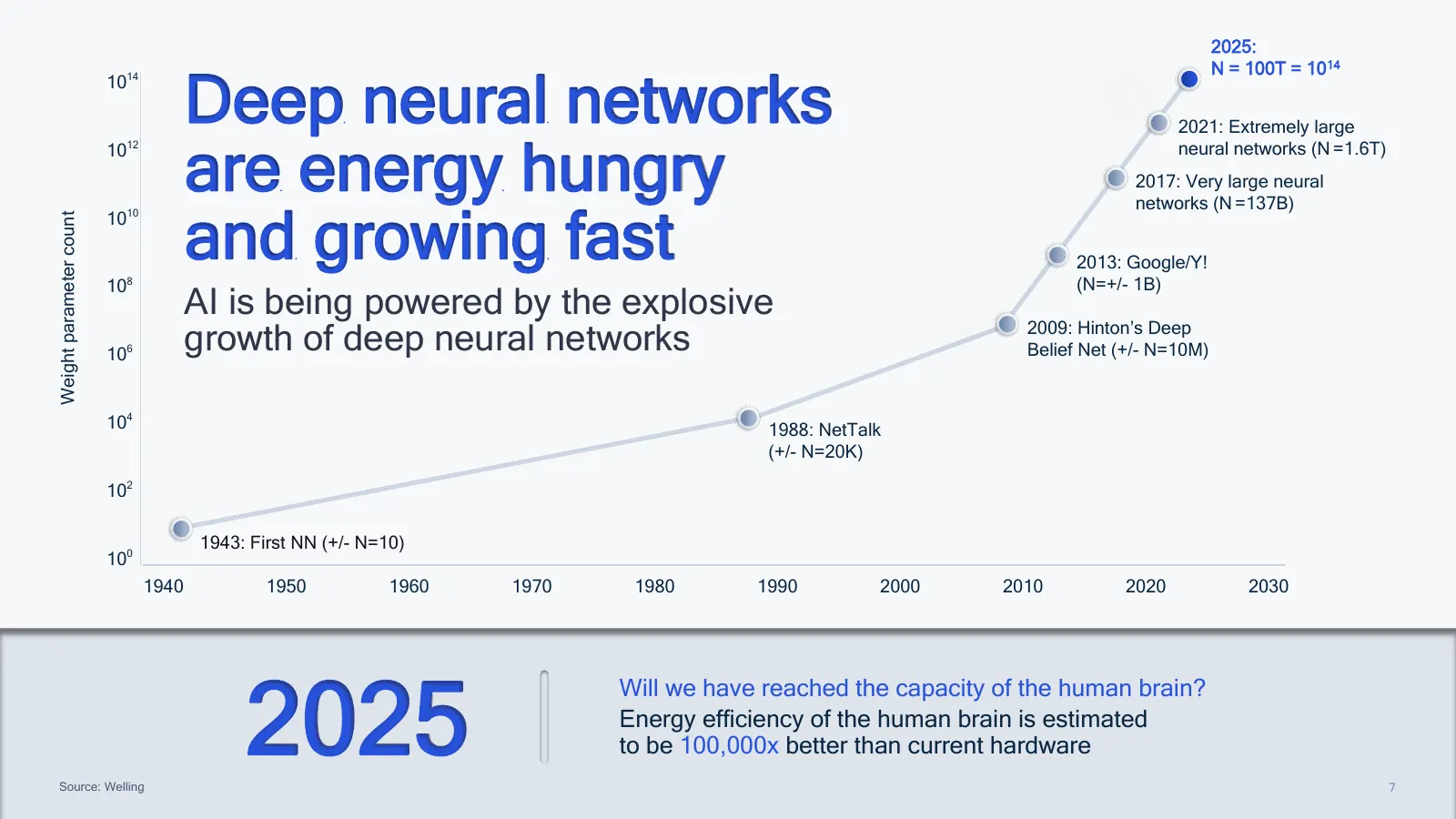
Slide 7: Deep neural networks are energy hungry and growing fast
2025: N = 100T = 1014 Deep neural networks 1014 2021: Extremely large are energy hungry 1012 neural networks (N =1.6T) 2017: Very large neural networks (N =137B) and growing fast 1010 Weight parameter count 2013: Google/Y! 108 (N=+/- 1B) AI is being powered by the explosive 106 growth of deep neural
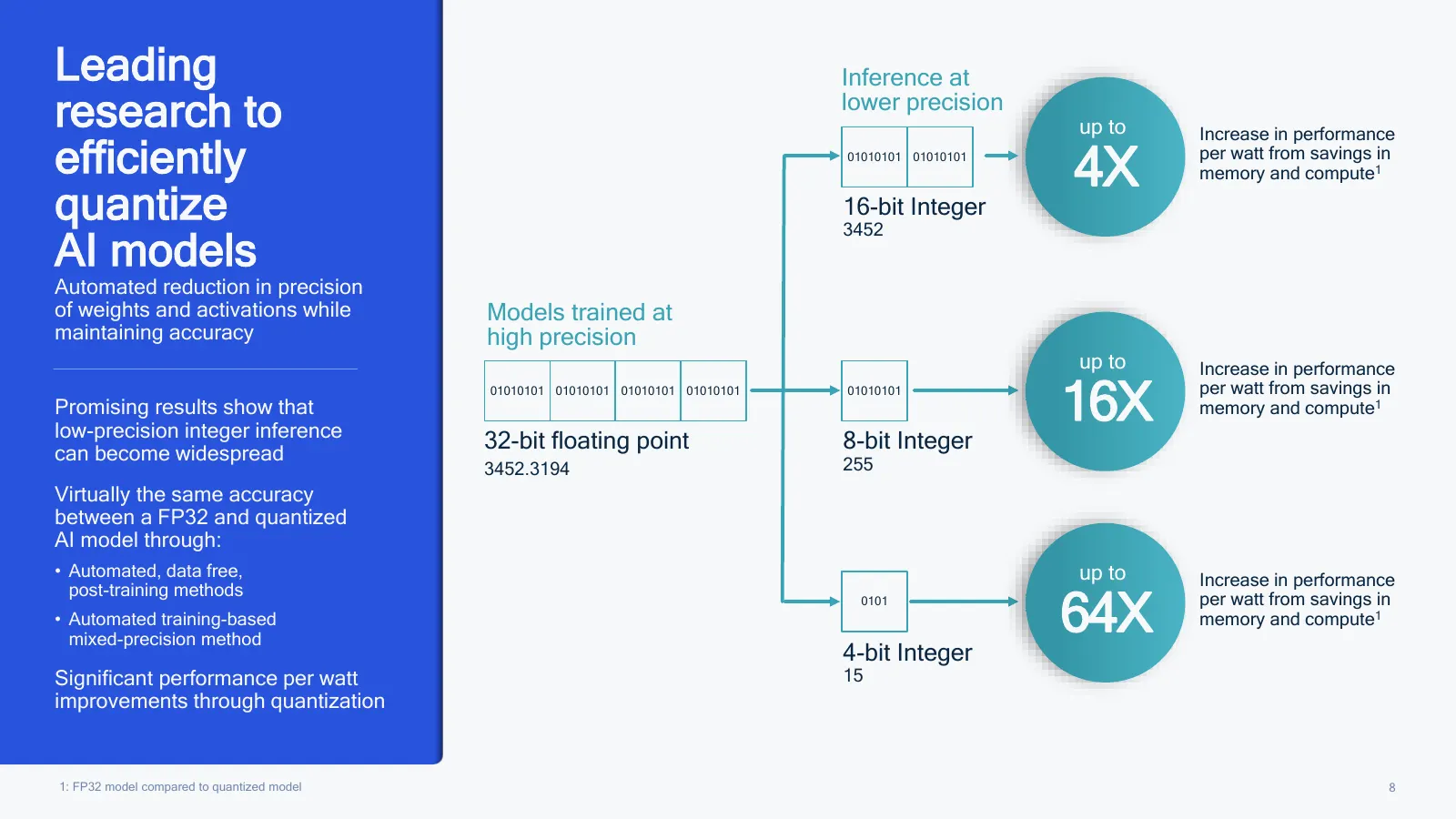
Slide 8: Leading research to efficiently quantize AI models
Leading Inference at research to lower precision up to Increase in performance efficiently 01010101 01010101 4X per watt from savings in memory and compute1 quantize 16-bit Integer 3452 AI models Automated reduction in precision of weights and activations while Models trained at maintaining accuracy
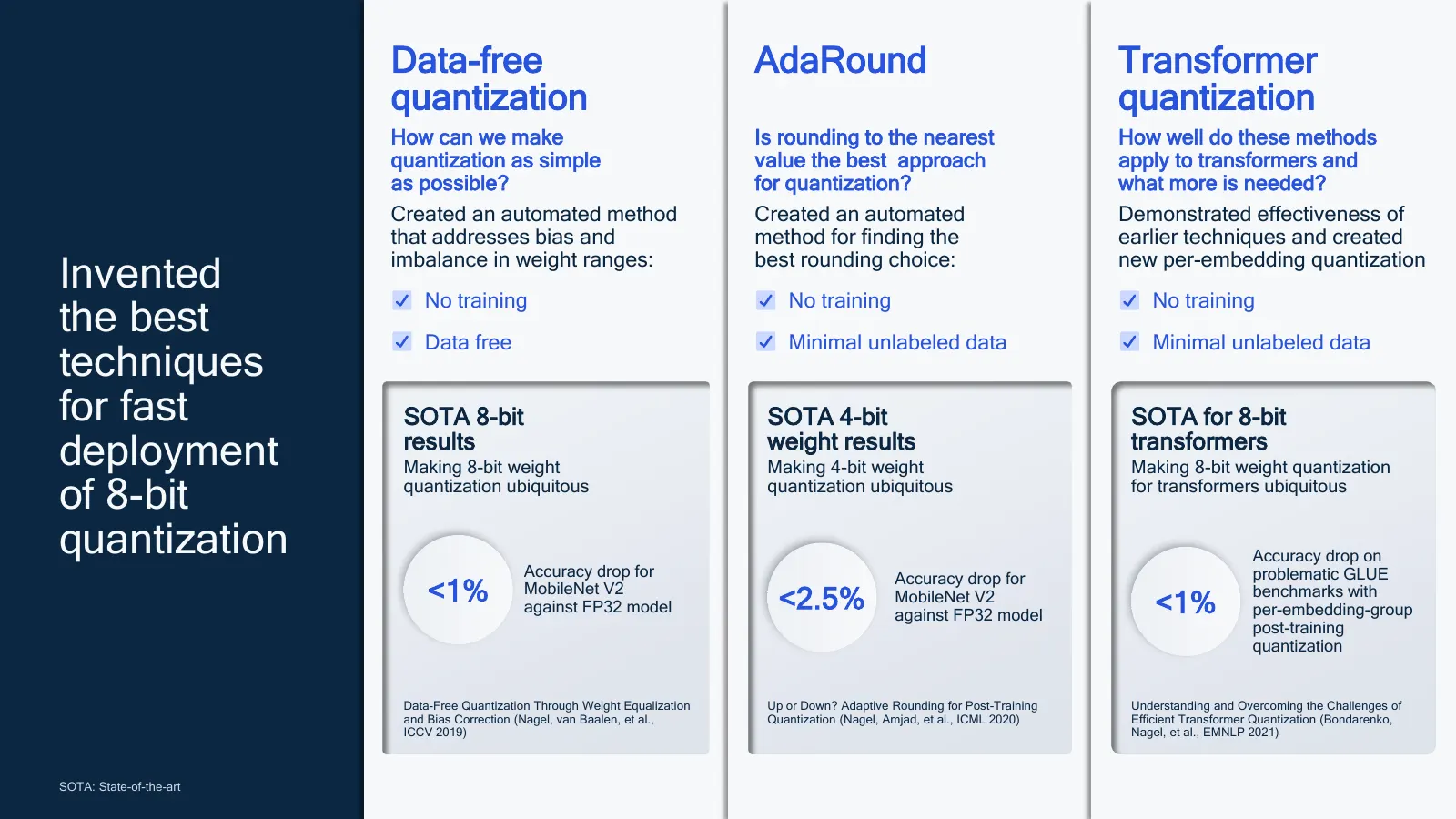
Slide 9: Invented the best techniques for fast deployment of 8-bit quantization
Data-free AdaRound Transformer quantization quantization How can we make Is rounding to the nearest How well do these methods quantization as simple value the best approach apply to transformers and as possible? for quantization? what more is needed? Created an automated method Created an automated
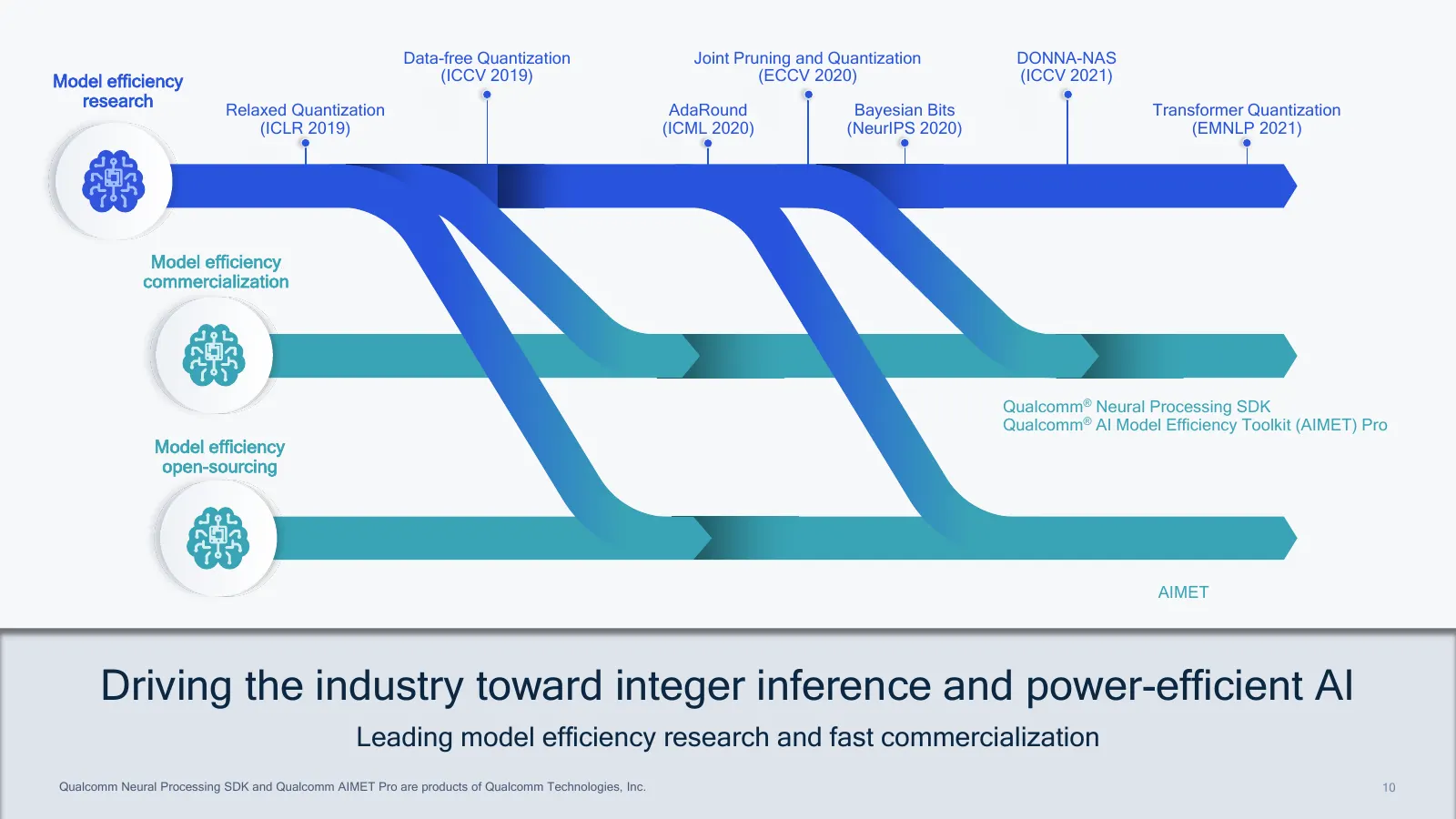
Slide 10: Driving the industry toward integer inference and power-efficient AI
Data-free Quantization Joint Pruning and Quantization DONNA-NAS Model efficiency (ICCV 2019) (ECCV 2020) (ICCV 2021) research Relaxed Quantization AdaRound Bayesian Bits Transformer Quantization (ICLR 2019) (ICML 2020) (NeurIPS 2020) (EMNLP 2021) Model efficiency commercialization Qualcomm® Neural P
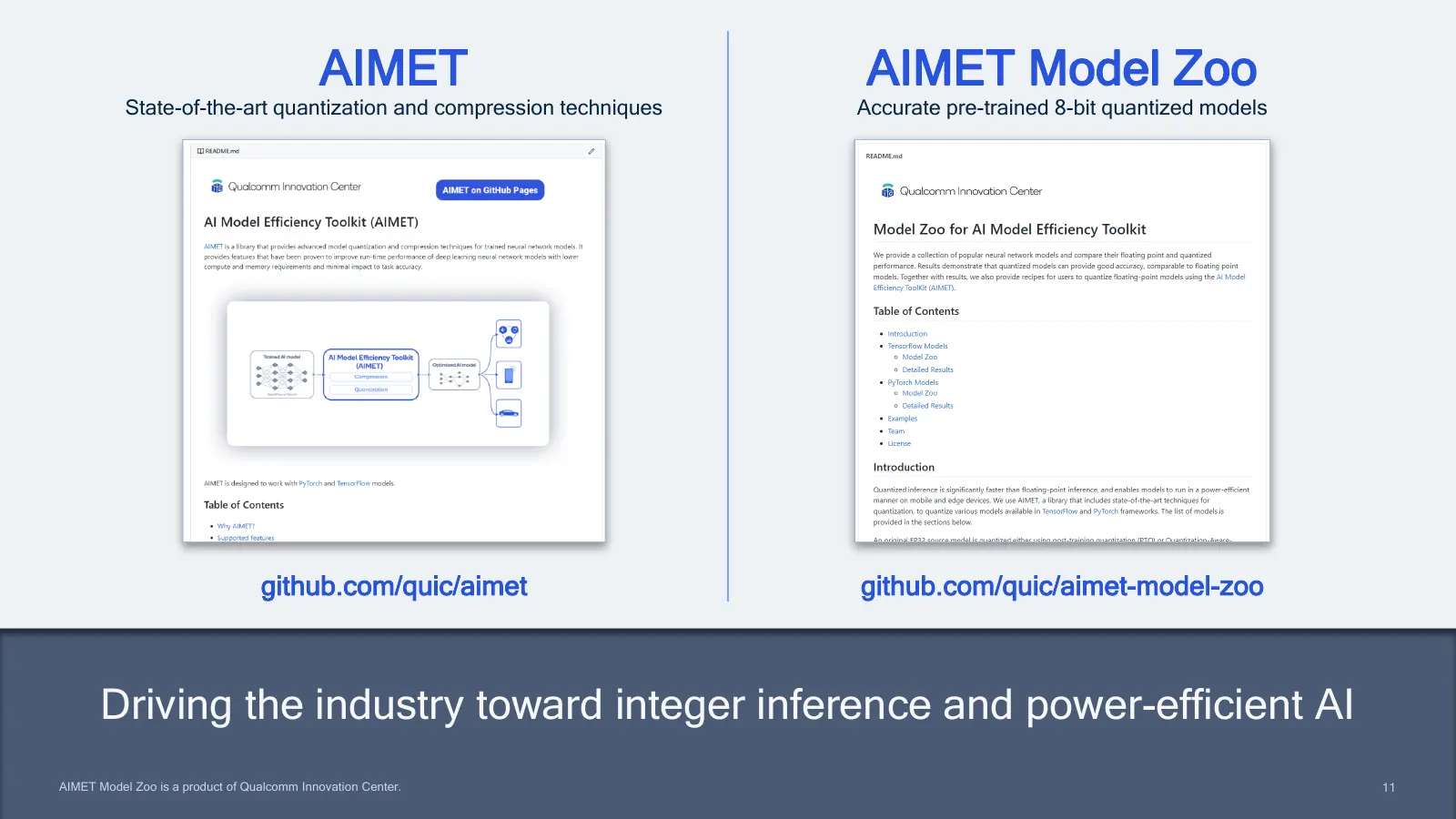
Slide 11: AIMET and AIMET Model Zoo
AIMET AIMET Model Zoo State-of-the-art quantization and compression techniques Accurate pre-trained 8-bit quantized models github.com/quic/aimet github.com/quic/aimet-model-zoo Driving the industry toward integer inference and power-efficient AI AIMET Model Zoo is a product of Qualcomm Innovation Ce
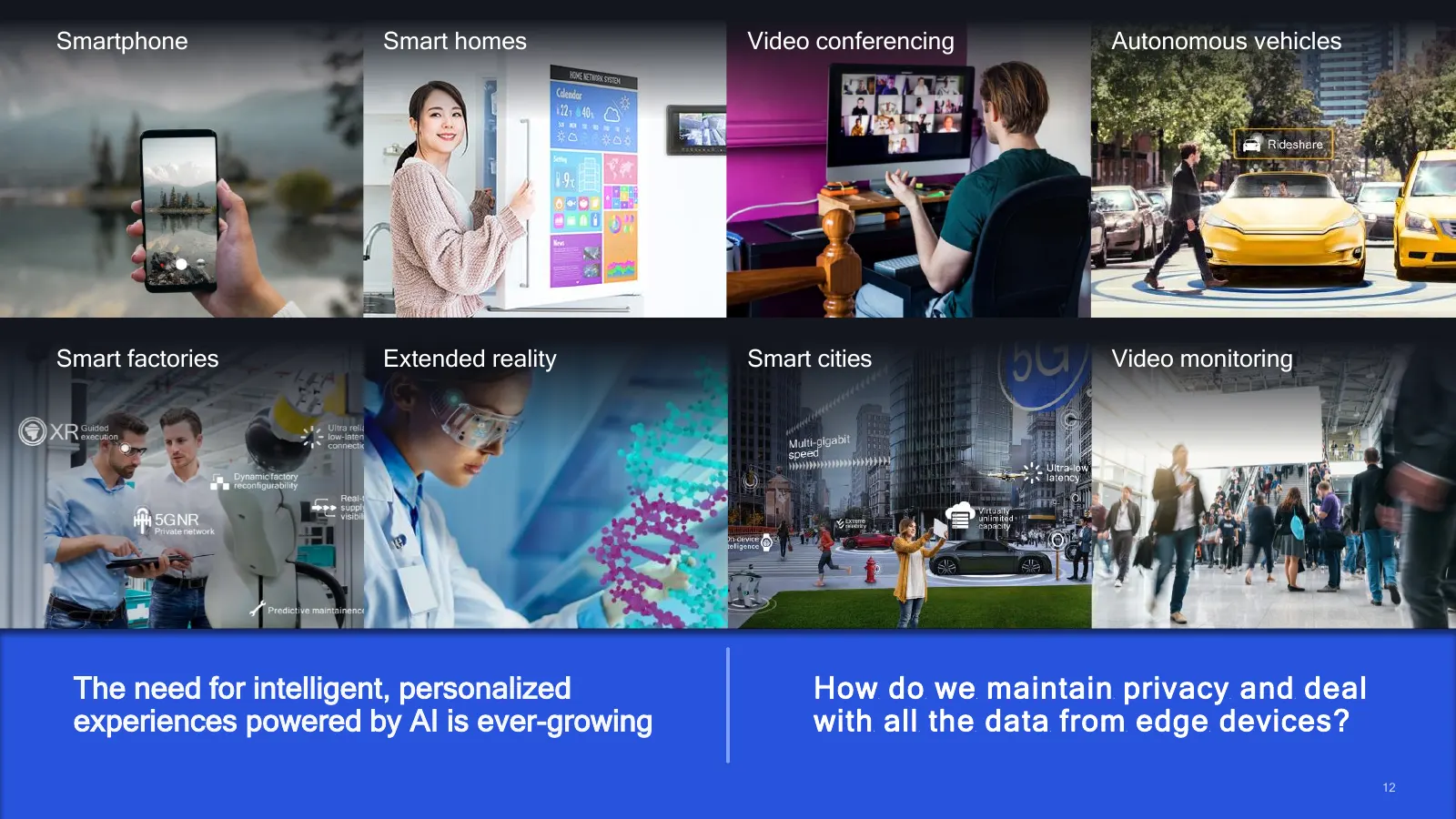
Slide 12: The need for intelligent, personalized experiences powered by AI is ever-growing
Smartphone Smart homes Video conferencing Autonomous vehicles Smart factories Extended reality Smart cities Video monitoring The need for intelligent, personalized How do we maintain privacy and deal experiences powered by AI is ever-growing with all the data from edge devices? 12
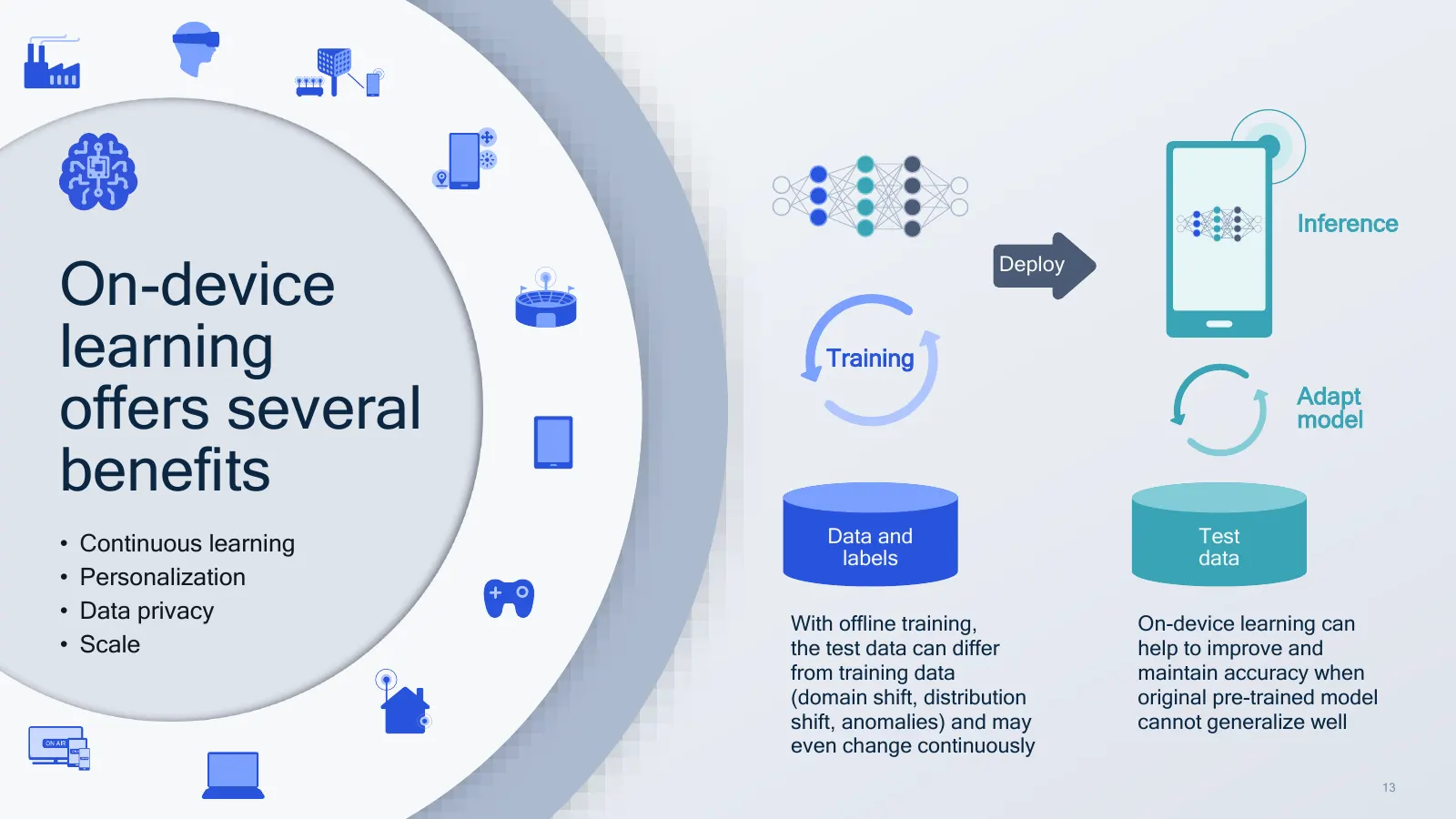
Slide 13: On-device learning offers several benefits
Inference On-device Deploy learning Training offers several Adapt model benefits • Continuous learning Data and Test labels data • Personalization • Data privacy With offline training, On-device learning can • Scale the test data can differ help to improve and from training data maintain accuracy wh
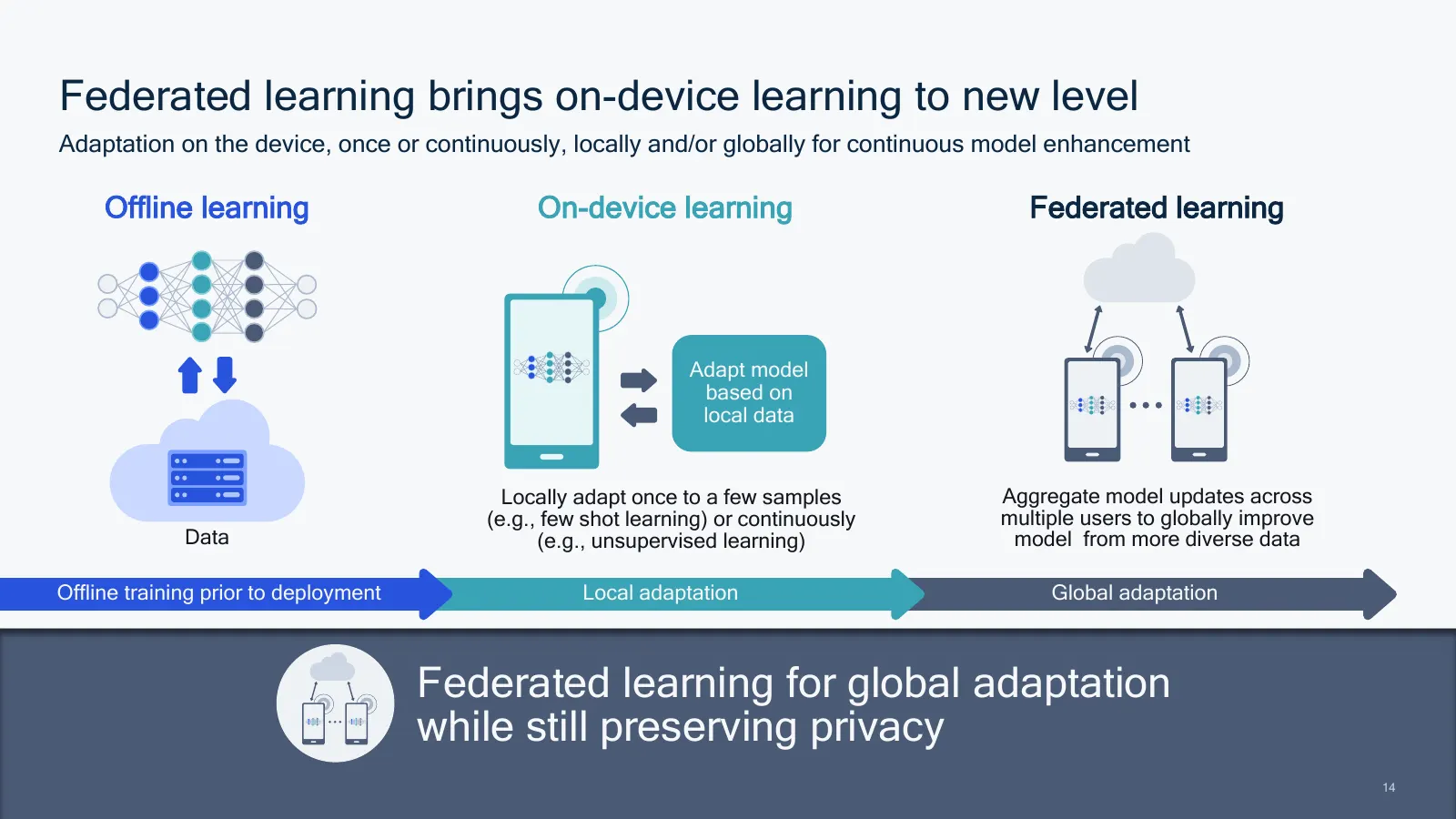
Slide 14: Federated learning brings on-device learning to new level
Federated learning brings on-device learning to new level Adaptation on the device, once or continuously, locally and/or globally for continuous model enhancement Offline learning On-device learning Federated learning Adapt model based on local data Locally adapt once to a few samples Aggregate mode
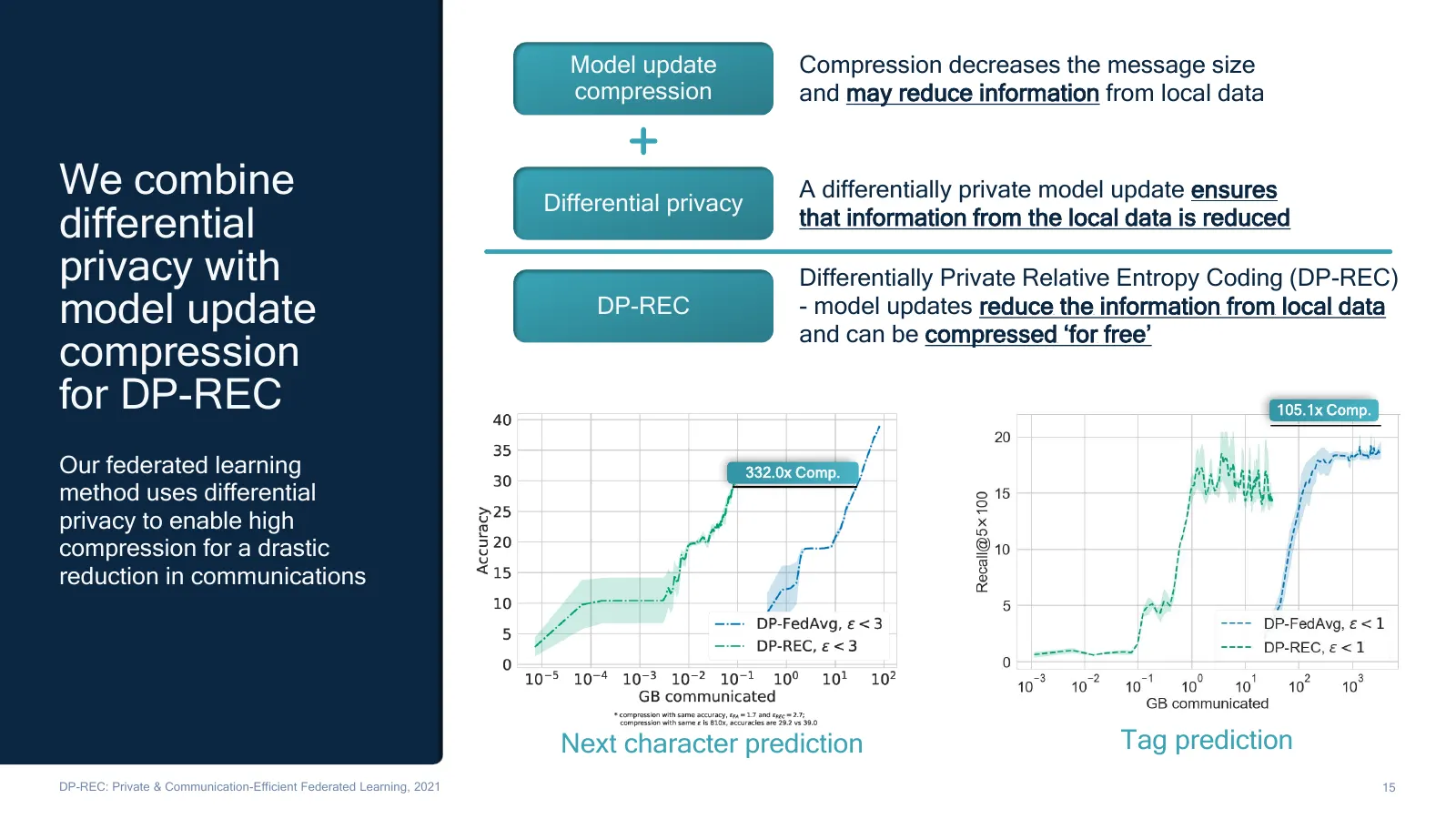
Slide 15: We combine differential privacy with model update compression
Model update Compression decreases the message size compression and may reduce information from local data We combine Differential privacy A differentially private model update ensures differential that information from the local data is reduced privacy with Differentially Private Relative Entropy C
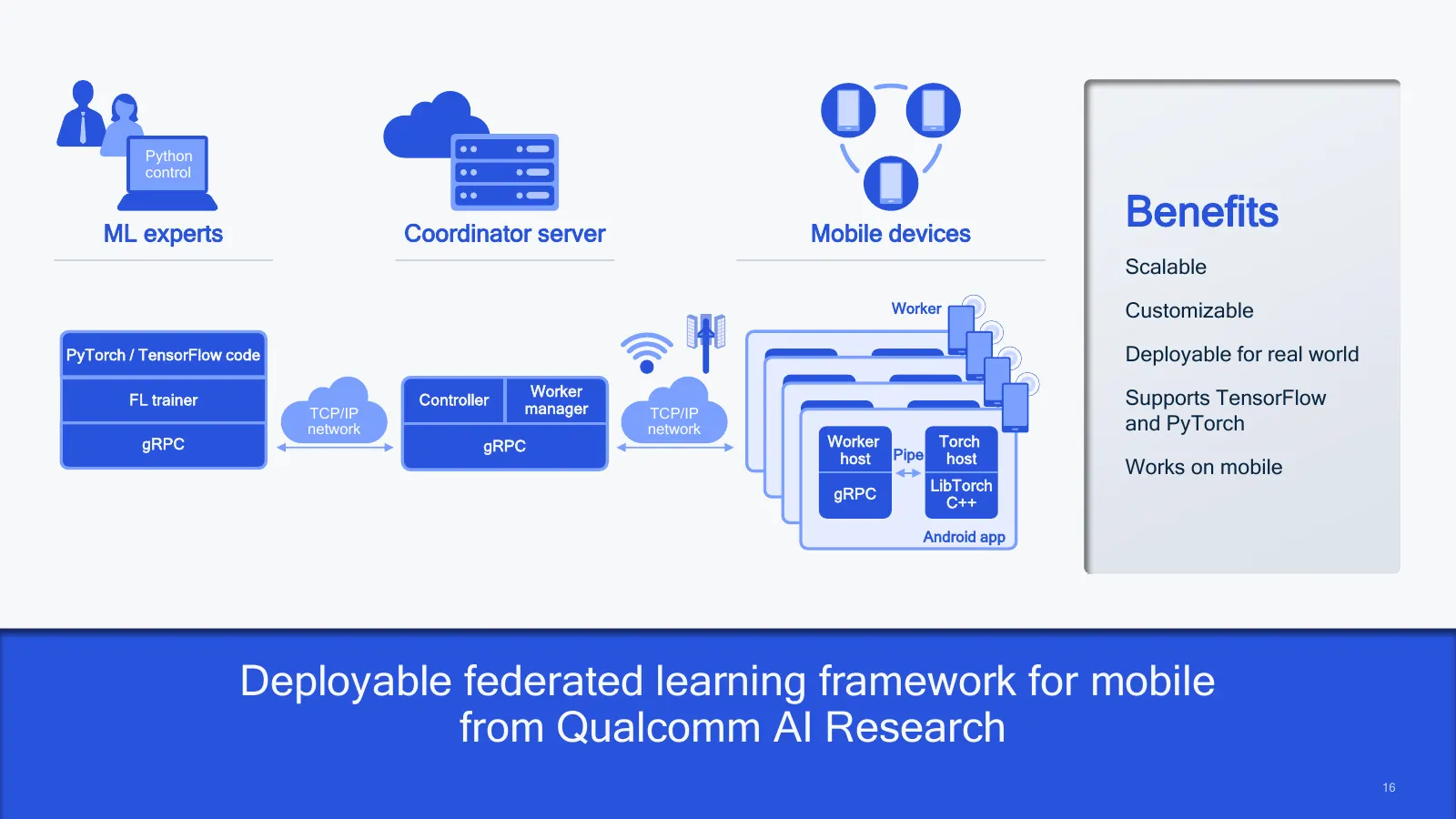
Slide 16: Deployable federated learning framework for mobile
Python control ML experts Coordinator server Mobile devices Benefits Scalable Worker Customizable PyTorch / TensorFlow code Worker Torch Deployable for real world host Pipe host Worker Worker Torch FL trainer Controller manager host Pipe host LibTorch Supports TensorFlow TCP/IP TCP/IP gRPCWorker Tor
Slide 17: First federated learning framework for mobile devices
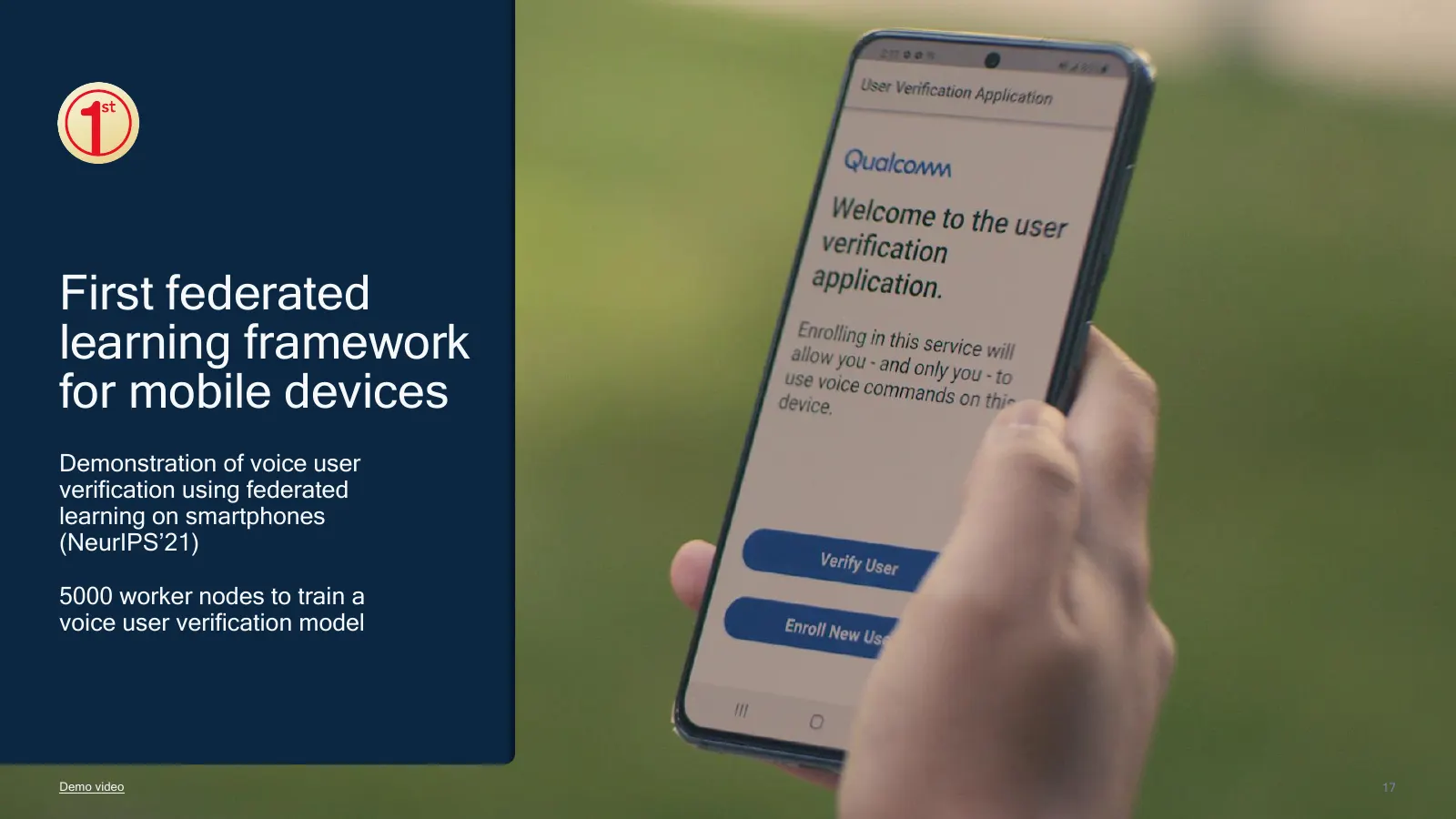
First federated learning framework for mobile devices Demonstration of voice user verification using federated learning on smartphones (NeurIPS’21) 5000 worker nodes to train a voice user verification model Demo video 17
Slide 18: The scale of video and voice being created and consumed is massive
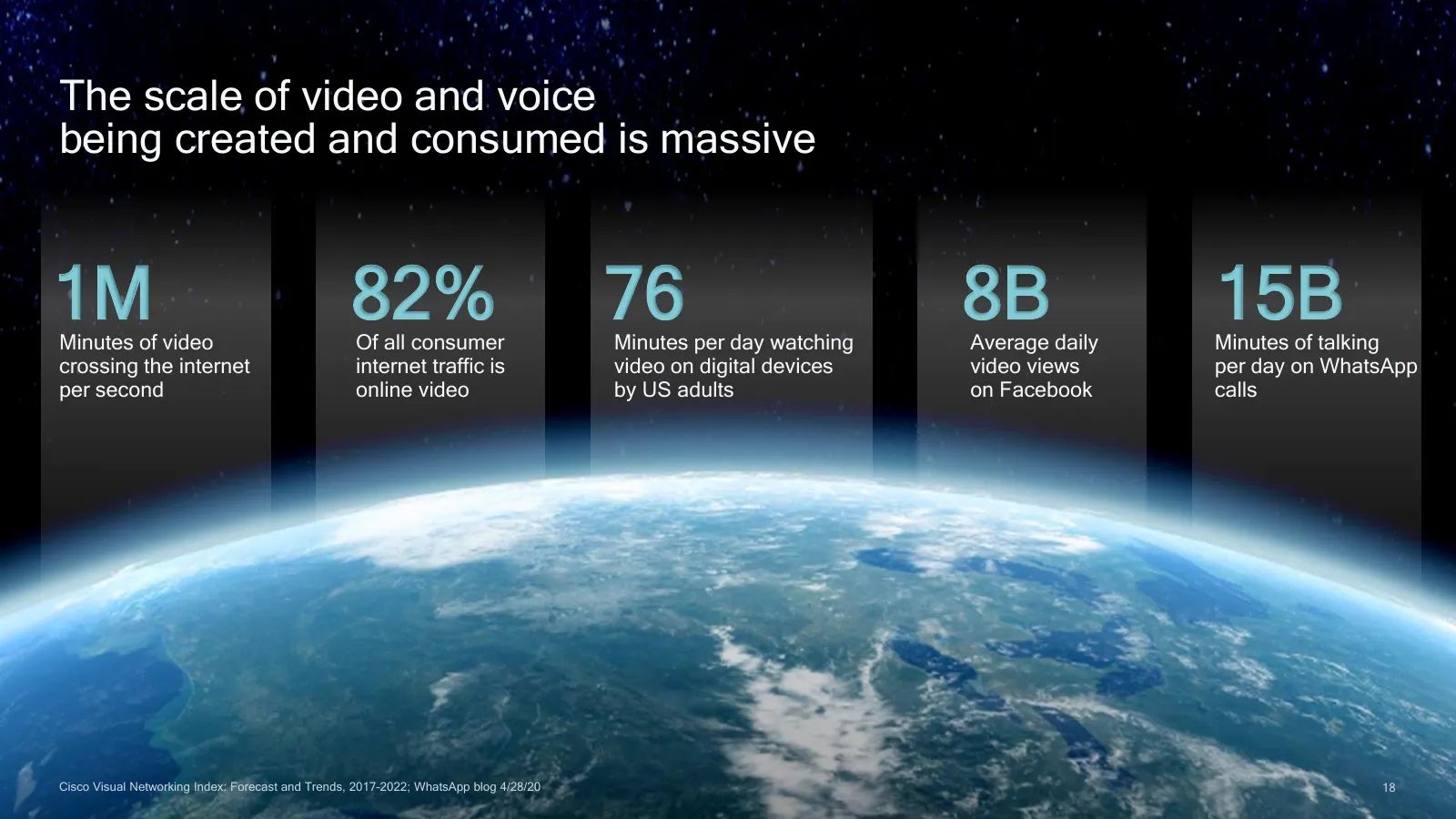
The scale of video and voice being created and consumed is massive 1M Minutes of video 82% Of all consumer 76 Minutes per day watching 8B Average daily 15B Minutes of talking crossing the internet internet traffic is video on digital devices video views per day on WhatsApp per second online video by
Slide 19: AI-based compression has compelling benefits
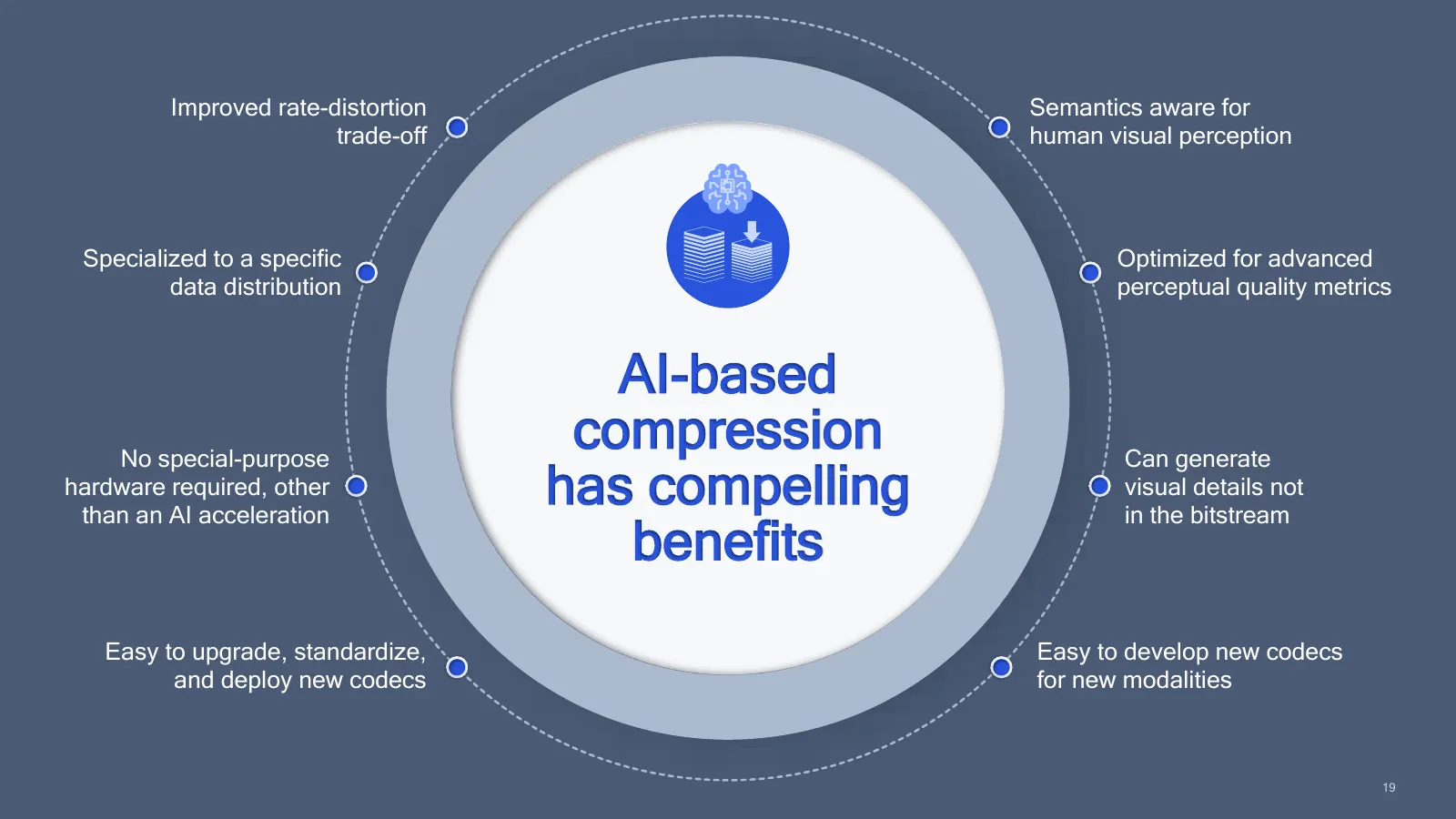
Improved rate-distortion Semantics aware for trade-off human visual perception Specialized to a specific Optimized for advanced data distribution perceptual quality metrics AI-based No special-purpose compression Can generate hardware required, other than an AI acceleration has compelling visual det
Slide 20: Neural video codec research shows promising results
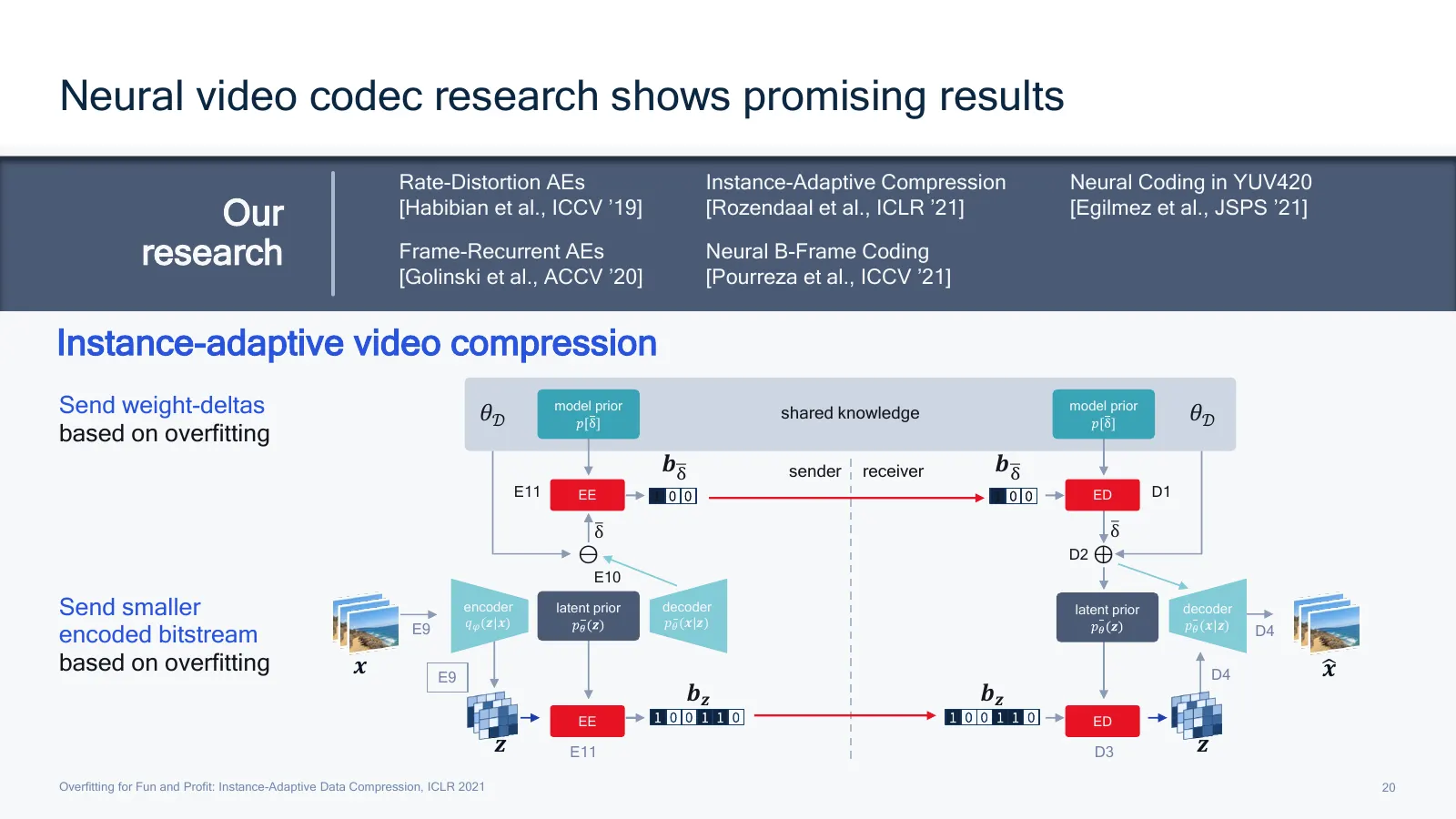
Neural video codec research shows promising results Rate-Distortion AEs Instance-Adaptive Compression Neural Coding in YUV420 Our [Habibian et al., ICCV ’19] [Rozendaal et al., ICLR ’21] [Egilmez et al., JSPS ’21] research Frame-Recurrent AEs Neural B-Frame Coding [Golinski et al., ACCV ’20] [Pourre
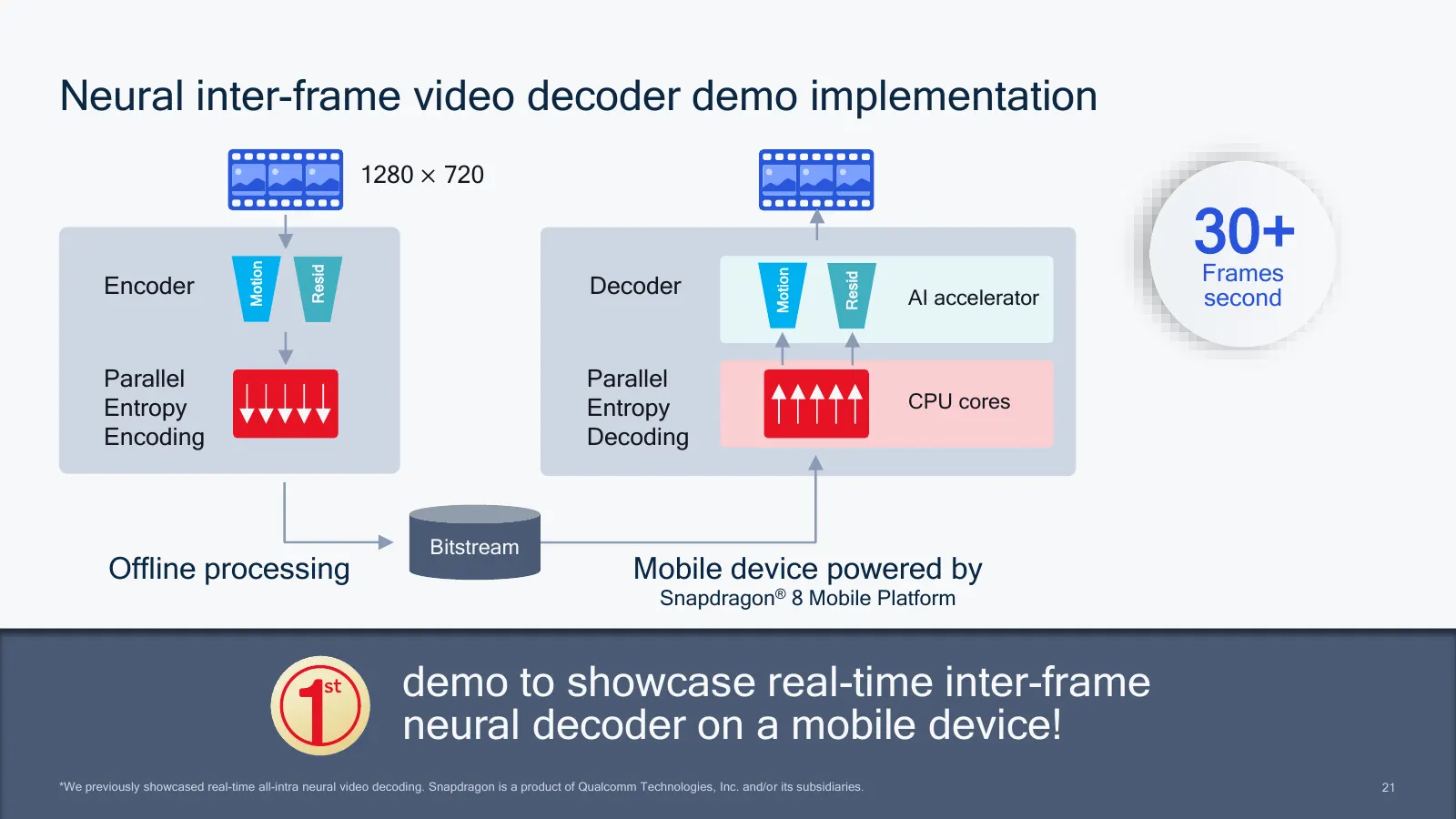
Slide 21: Neural inter-frame video decoder demo implementation
Neural inter-frame video decoder demo implementation 1280 × 720 Motion 30+ Frames Resid Motion Resid Encoder Decoder AI accelerator second Parallel Parallel Entropy Entropy CPU cores Encoding Decoding Bitstream Offline processing Mobile device powered by Snapdragon® 8 Mobile Platform demo to showcas
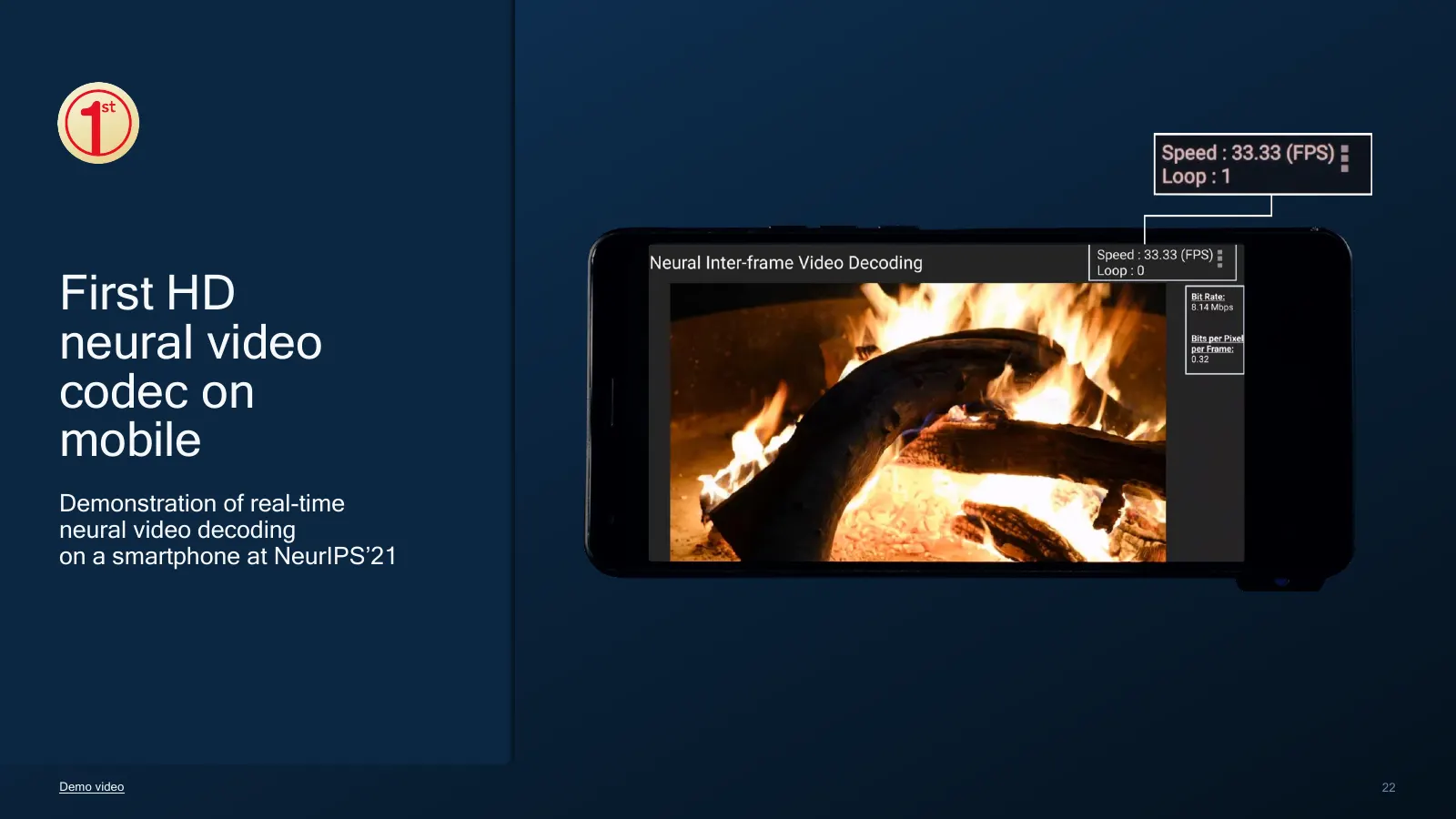
Slide 22: First HD neural video codec on mobile
First HD neural video codec on mobile Demonstration of real-time neural video decoding on a smartphone at NeurIPS’21 Demo video 22
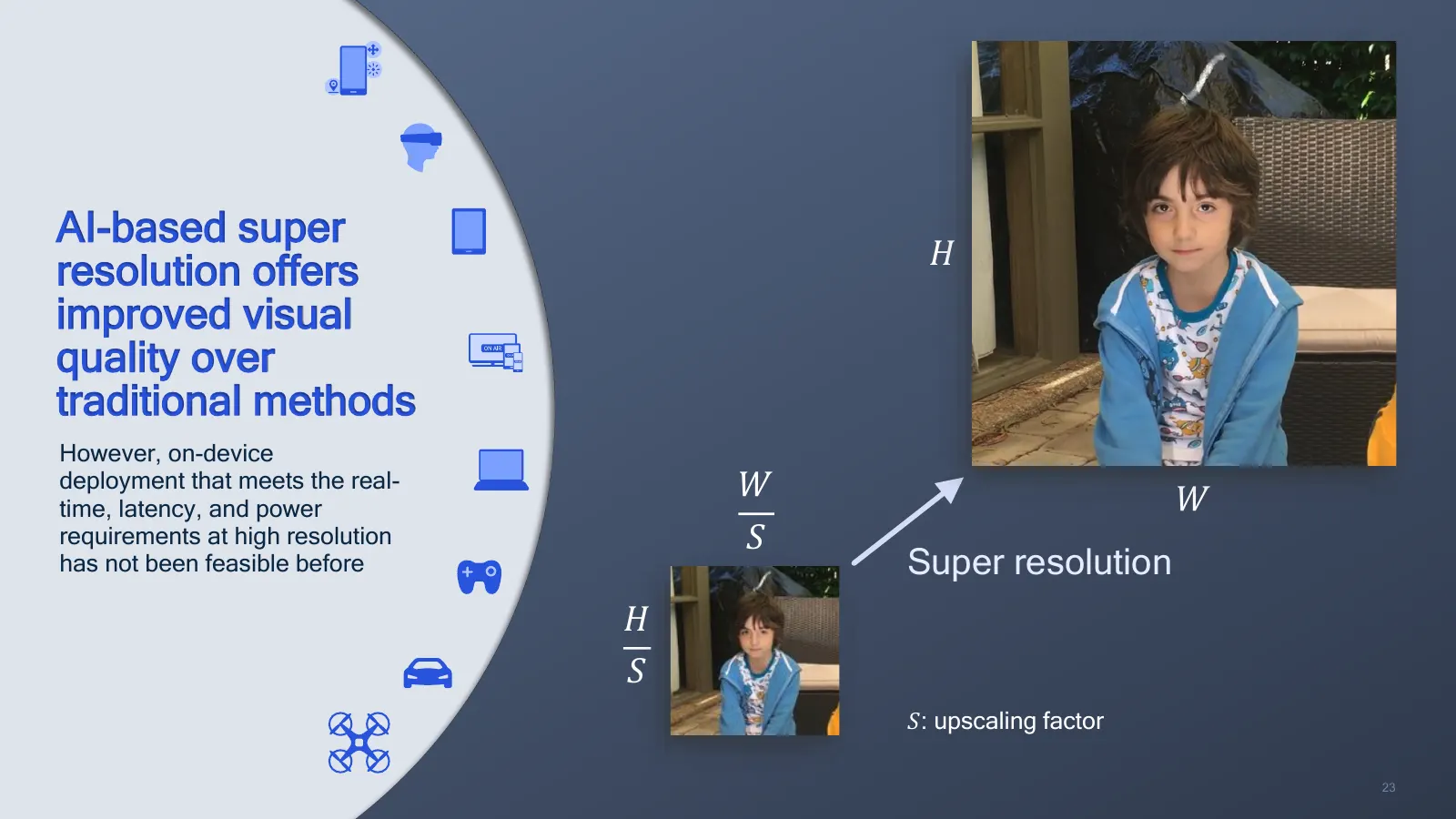
Slide 23: AI-based super resolution offers improved visual quality
AI-based super 𝐻 resolution offers improved visual quality over traditional methods However, on-device deployment that meets the real- 𝑊 time, latency, and power 𝑊 requirements at high resolution 𝑆 has not been feasible before Super resolution 𝐻 𝑆 𝑆: upscaling factor 23
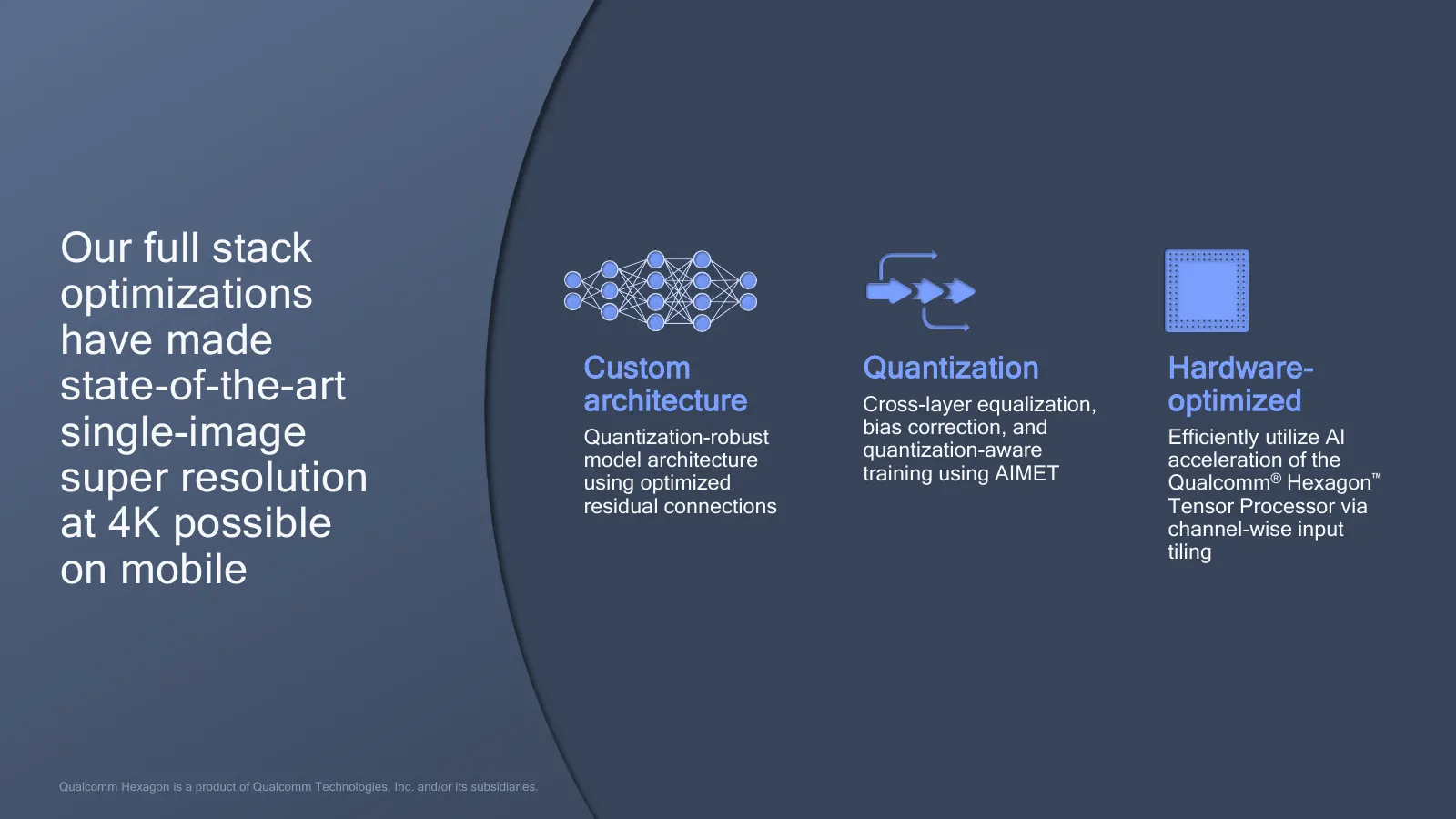
Slide 24: Our full stack optimizations have made state-of-the-art super resolution possible on mobile
Our full stack optimizations have made Custom Quantization Hardware- state-of-the-art architecture Cross-layer equalization, optimized single-image Quantization-robust bias correction, and quantization-aware Efficiently utilize AI model architecture acceleration of the super resolution using optimiz
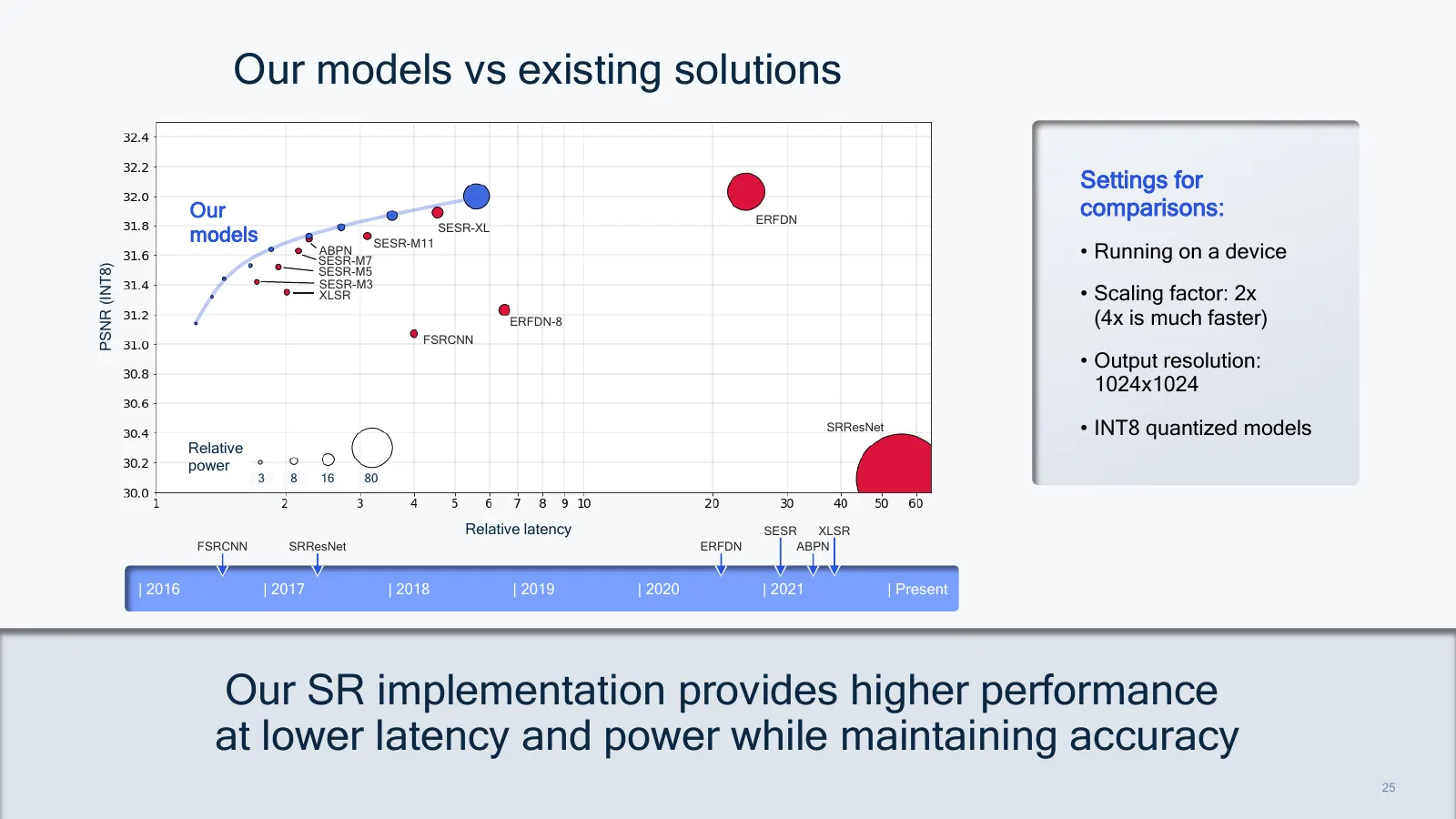
Slide 25: Our models vs existing solutions
Our models vs existing solutions Settings for Our ERFDN comparisons: SESR-XL models SESR-M11 ABPN SESR-M7 • Running on a device PSNR (INT8) SESR-M5 SESR-M3 XLSR • Scaling factor: 2x ERFDN-8 (4x is much faster) FSRCNN • Output resolution: 1024x1024 SRResNet • INT8 quantized models Relative power 3 8
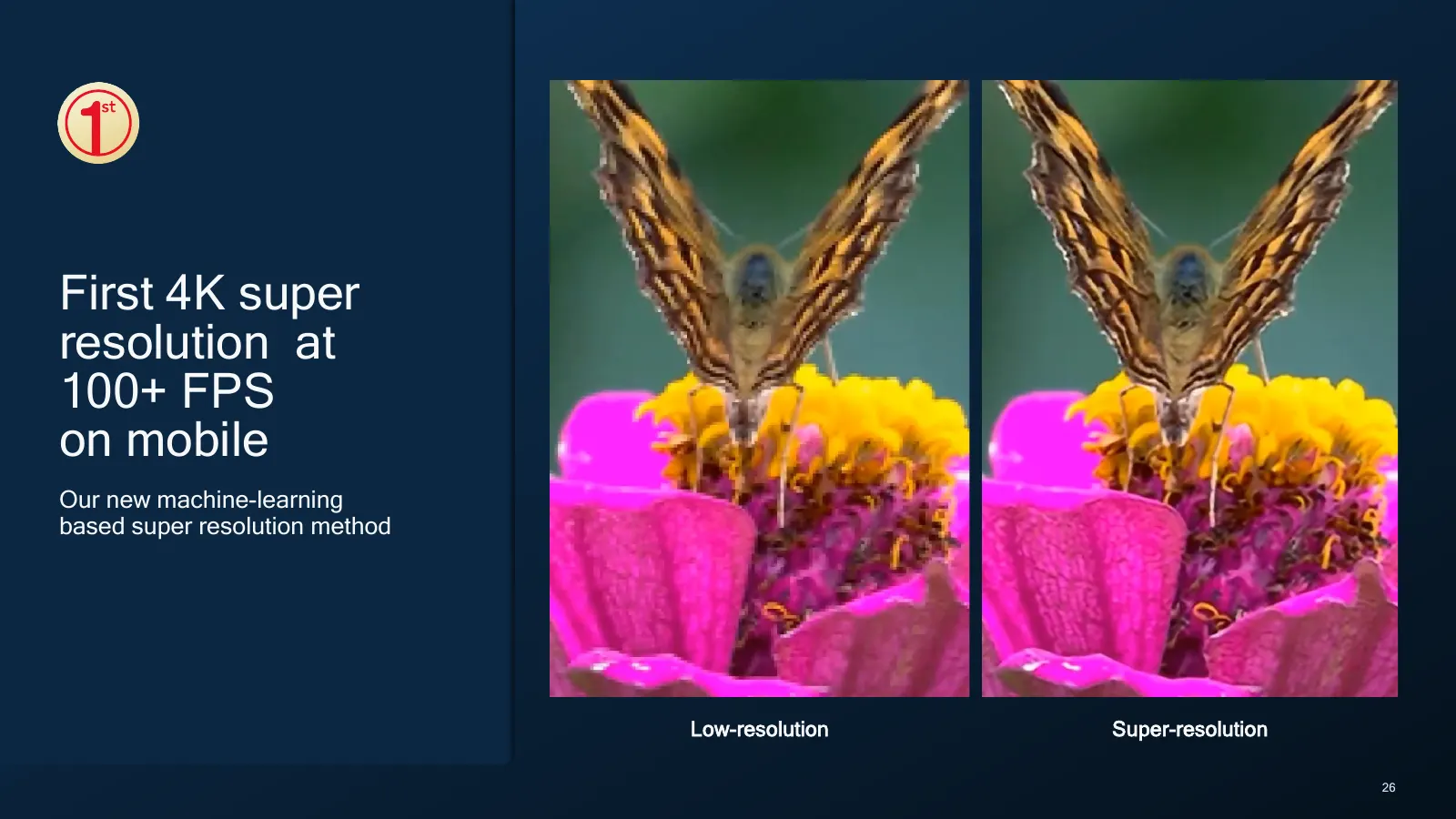
Slide 26: First 4K super resolution at 100+ FPS on mobile
First 4K super resolution at 100+ FPS on mobile Our new machine-learning based super resolution method Low-resolution Super-resolution 26
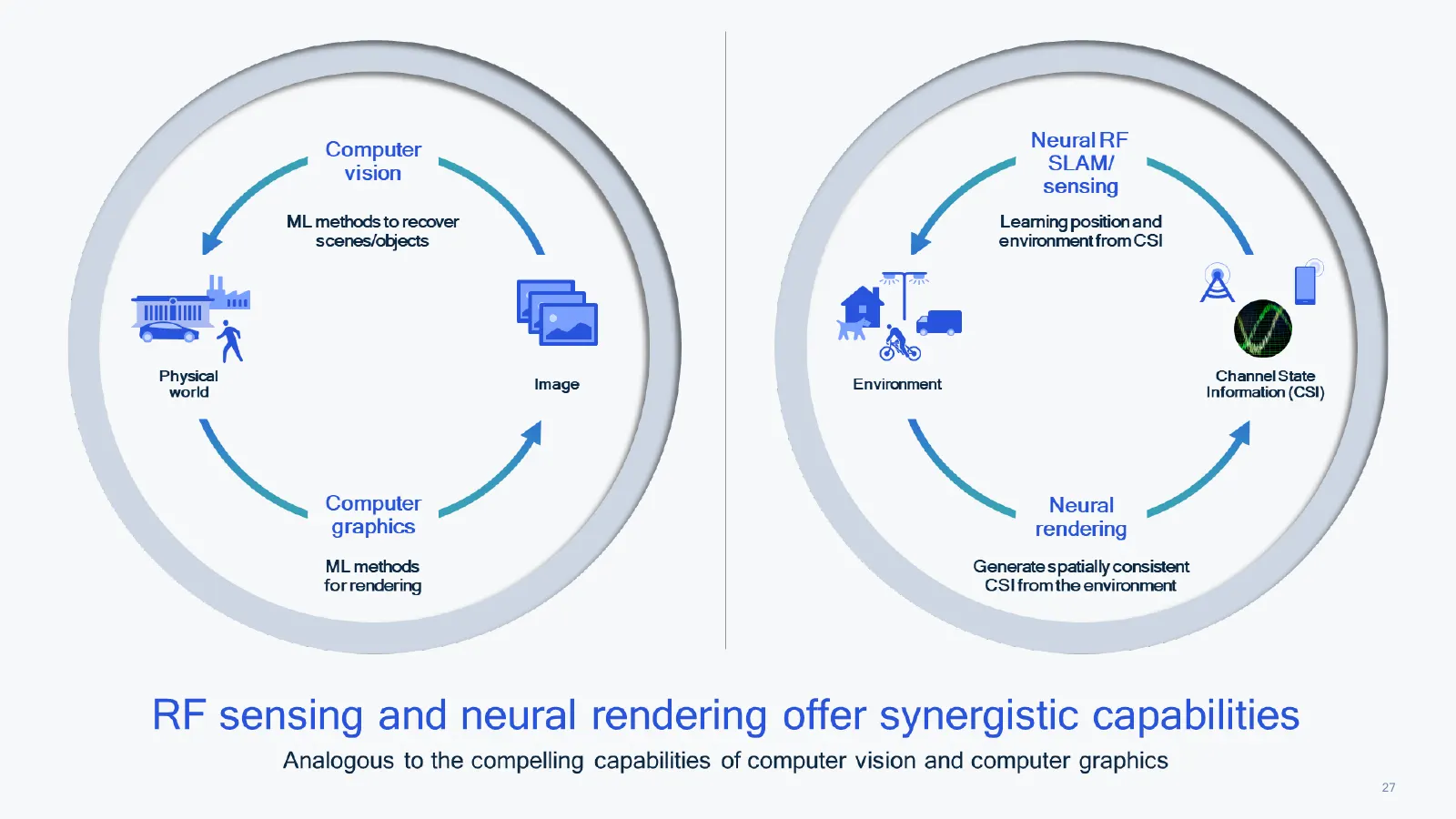
Slide 27: RF sensing and neural rendering
Computer Neh vision 0 sensing ML methods to recover Leaming position and sscenes/objects environment from CSI Ta ti ft | an LU = *K Xe Physical Channel State ory Image Erie’ Information (CSI) Computer Neural graphics rendering ML methods 7 Generate spatially consistent forrendering - CSl fromthe env
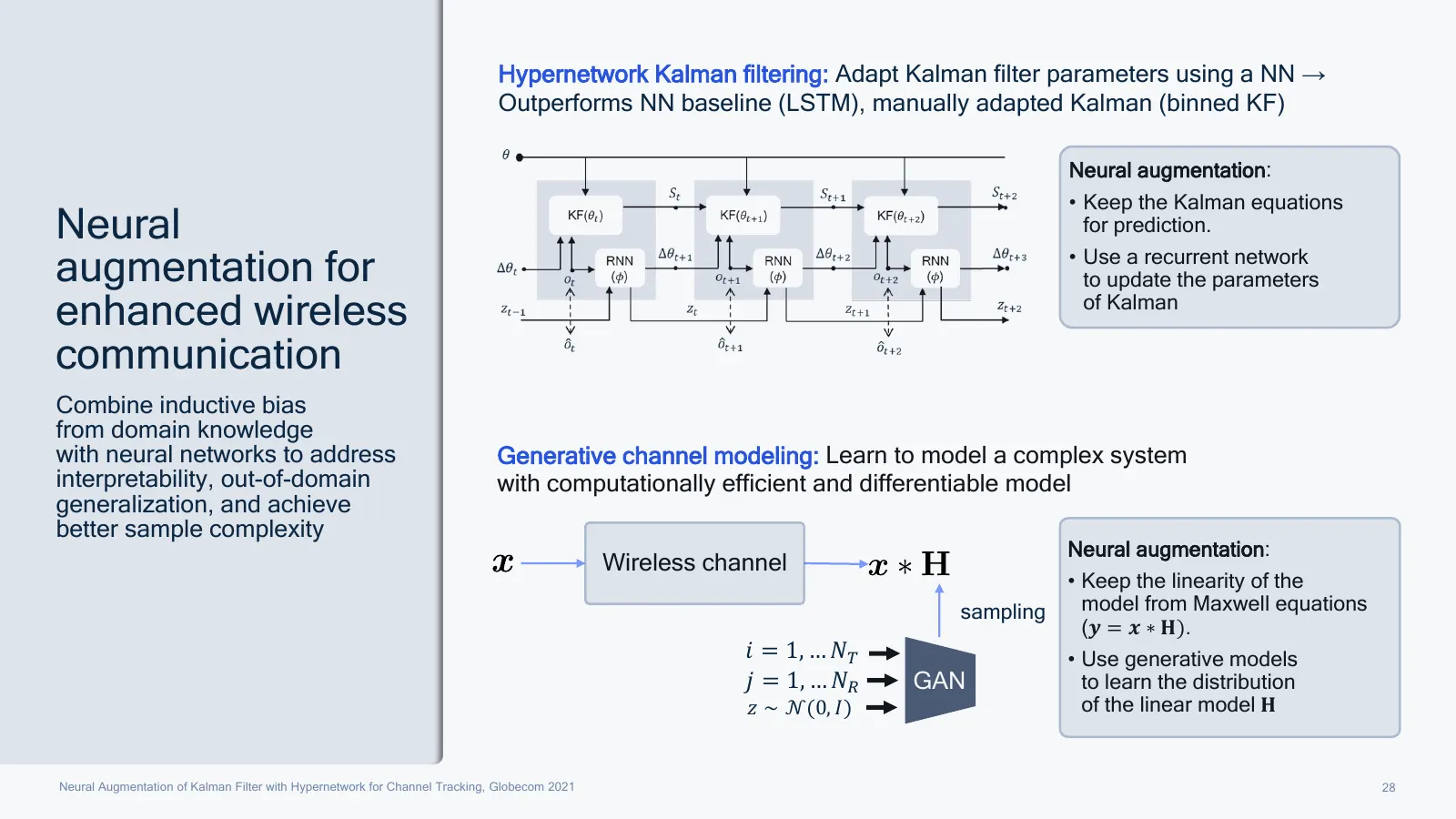
Slide 28: Neural augmentation for enhanced wireless communication
Hypernetwork Kalman filtering: Adapt Kalman filter parameters using a NN → Outperforms NN baseline (LSTM), manually adapted Kalman (binned KF) Neural augmentation: • Keep the Kalman equations Neural for prediction. augmentation for • Use a recurrent network to update the parameters enhanced wireless
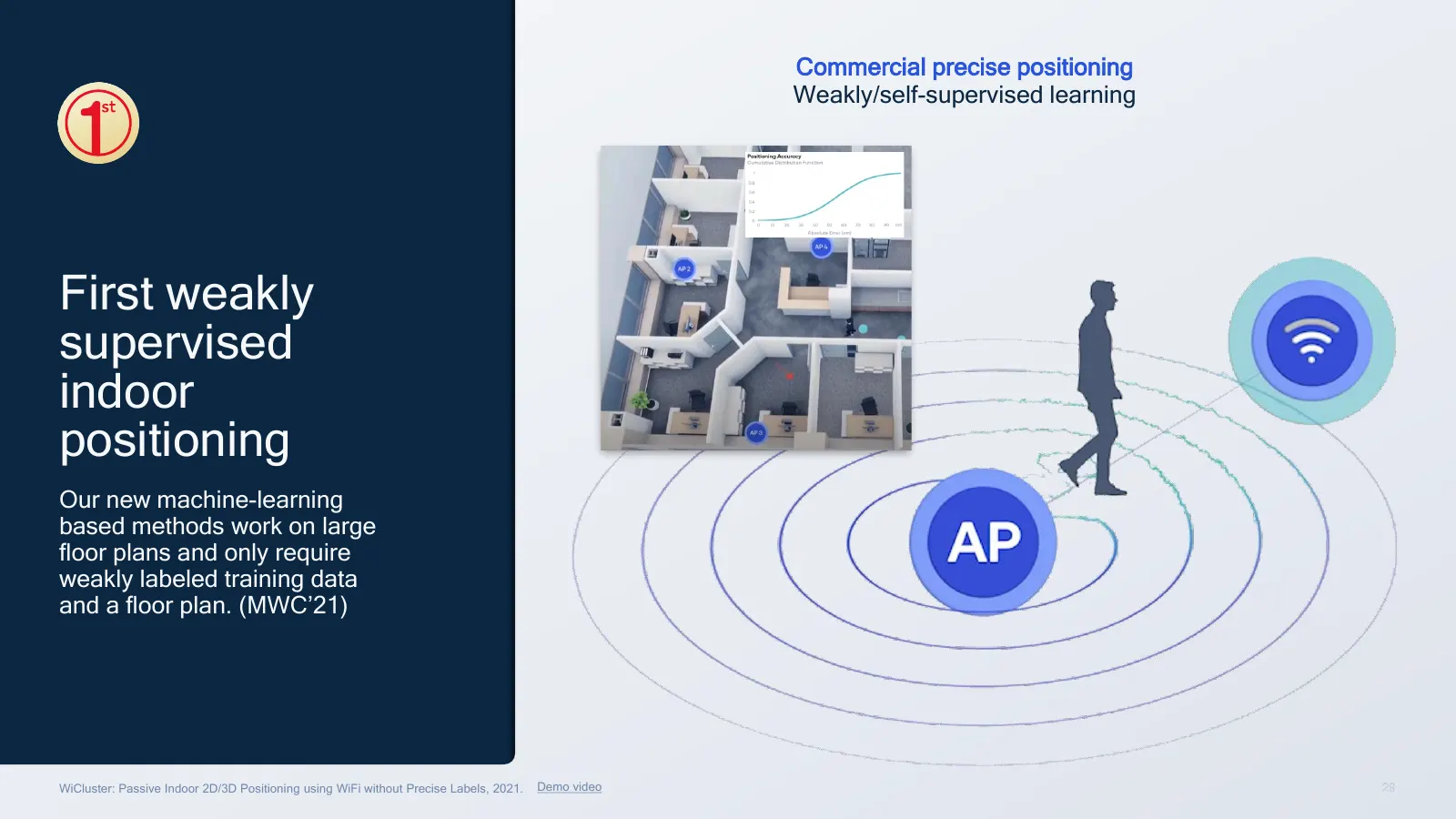
Slide 29: First weakly supervised indoor positioning
Commercial precise positioning Weakly/self-supervised learning First weakly supervised indoor positioning Our new machine-learning based methods work on large floor plans and only require weakly labeled training data and a floor plan. (MWC’21) WiCluster: Passive Indoor 2D/3D Positioning using WiFi w
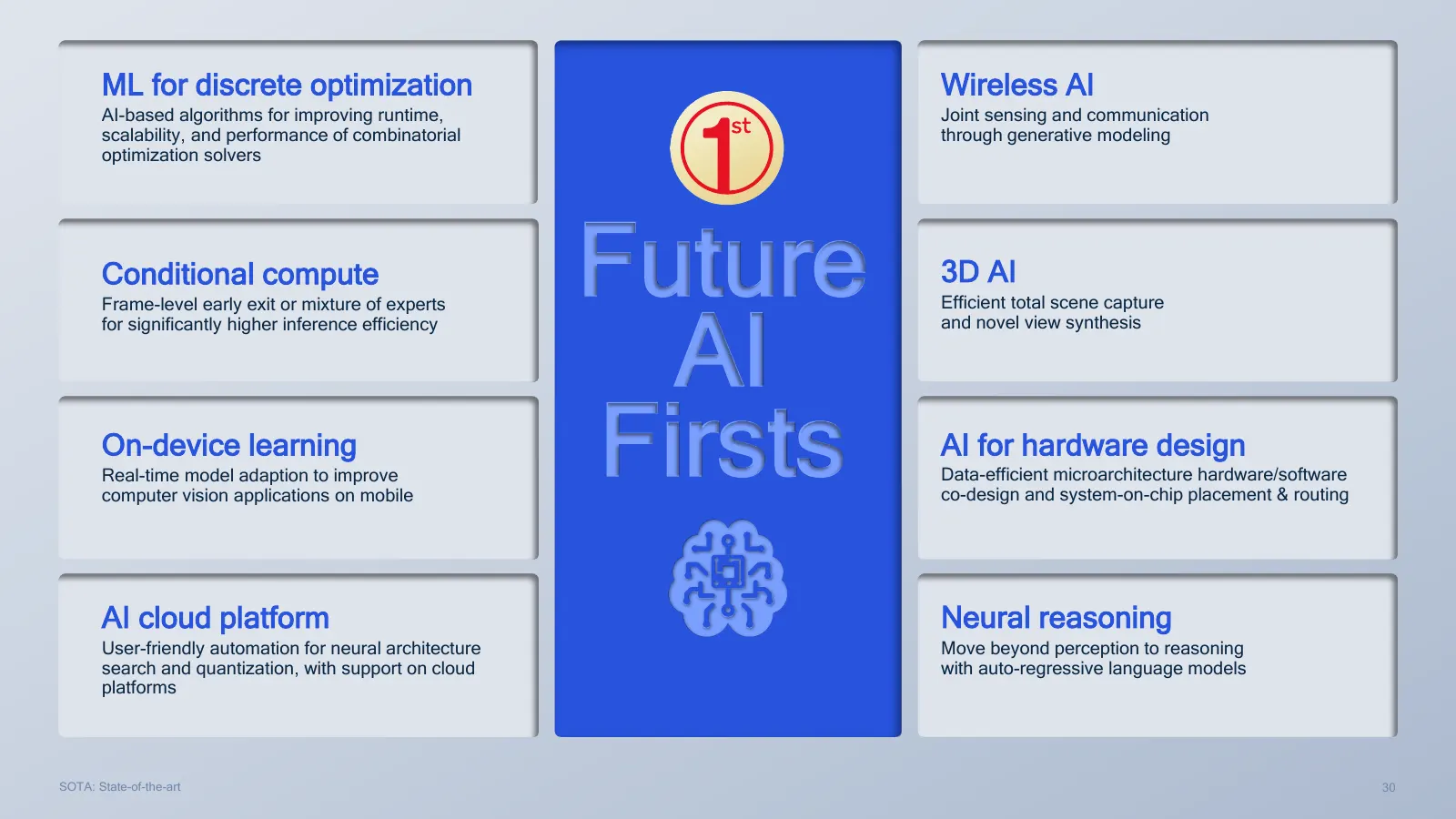
Slide 30: Future AI Firsts
ML for discrete optimization Wireless AI AI-based algorithms for improving runtime, Joint sensing and communication scalability, and performance of combinatorial through generative modeling optimization solvers Conditional compute Future 3D AI Efficient total scene capture AI Frame-level early exit

Slide 31: We are conducting leading research to enable edge AI
We are conducting leading research to enable edge AI Due to our full-stack AI research, we are first to demonstrate proof-of-concepts on mobile devices We are solving system and feasibility challenges to move from research to commercialization 31
Slide 32: Questions
Questions Connect with Us www.qualcomm.com/ai www.qualcomm.com/news/onq @QCOMResearch https://www.youtube.com/qualcomm? http://www.slideshare.net/qualcommwirelessevolution 32
Slide 33: Thank you
Thank you Nothing in these materials is an offer to sell any of the components References in this presentation to “Qualcomm” may mean Qualcomm or devices referenced herein. Incorporated, Qualcomm Technologies, Inc., and/or other subsidiaries or ©2018-2022 Qualcomm Technologies, Inc. and/or its affil
Source: Internet Archive copy of qualcomm.com
More decks from QUALCOMM Incorporated
 Q4 FY2026 Earnings Presentation27 slides · Nov 4, 2026
 Technical Presentation (October 2026)34 slides · October 2026
 Q3 FY2026 Earnings Presentation32 slides · Jul 29, 2026
 Investor Day (June 2026)29 slides · Jun 24, 2026
 Q2 FY2026 Earnings Presentation25 slides · Apr 29, 2026
 Q1 2026 Earnings Presentation23 slides · Feb 4, 2026