Nektar Therapeutics · NASDAQ:NKTR
Nektar Therapeutics — Jefferies 2018 Healthcare Conference
32 slides from Nektar Therapeutics's conference presentation, Jun 6, 2018

Slide 1: Jefferies 2018 Healthcare Conference
Jefferies 2018 Healthcare Conference z June 6, 2018
Slide 2: Forward-looking statements
This presentation includes forward-looking statements regarding Nektar’s proprietary drug candidates, the timing of the start and conclusion of ongoing or planned clinical trials, the timing and outcome of regulatory decisions, and future availability of clinical trial data. Actual results could dif
Slide 3: Focus of Nektar Pipeline
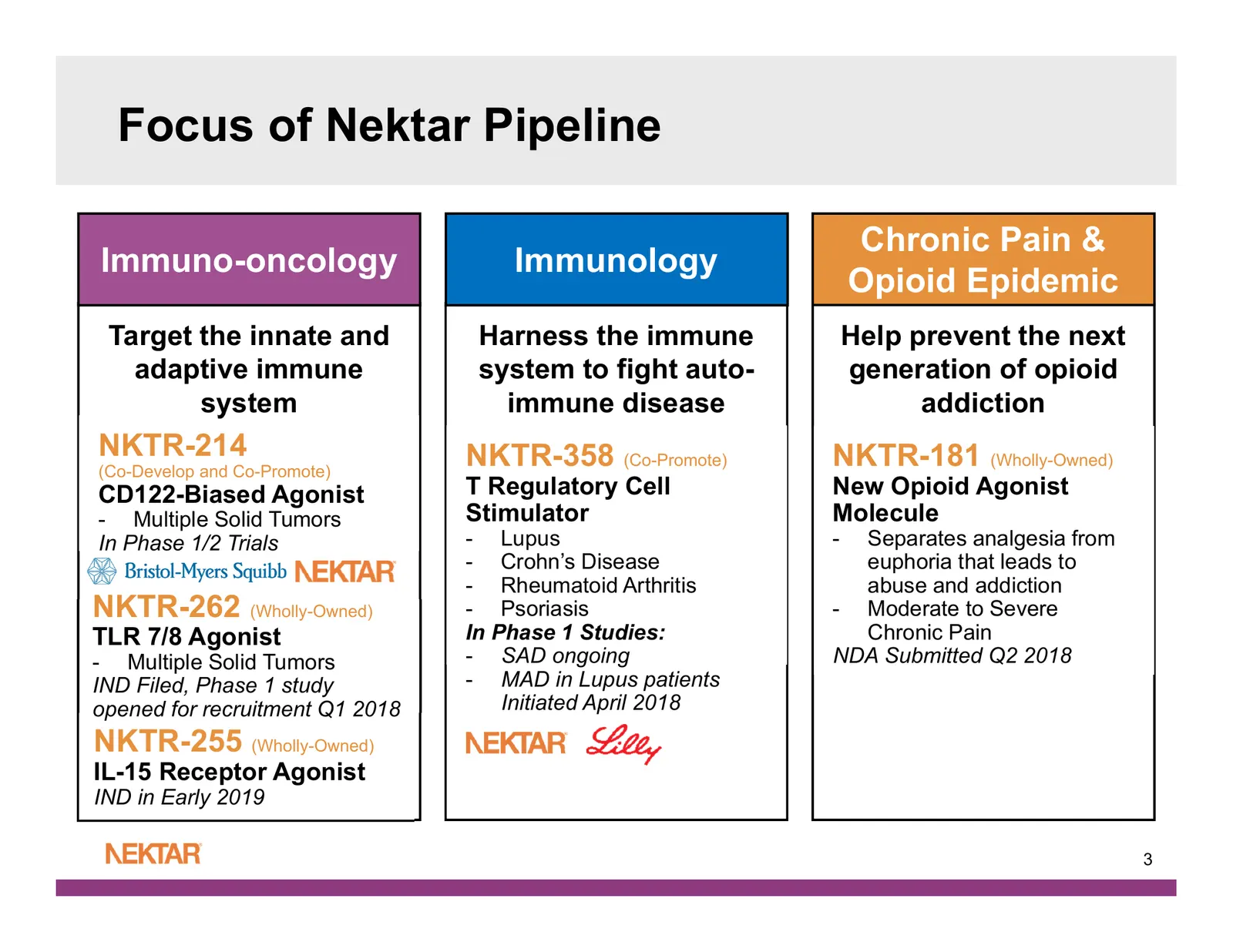
Focus of Nektar Pipeline Chronic Pain & Immuno-oncology Immunology Opioid Epidemic Target the innate and Harness the immune Help prevent the next adaptive immune system to fight auto- generation of opioid system immune disease addiction NKTR-214 NKTR-358 (Co-Promote) NKTR-181 (Wholly-Owned) (Co-Deve
Slide 4: NKTR-181: Poised to Help Address the Opioid Epidemic and Transform the Chronic Pain Market
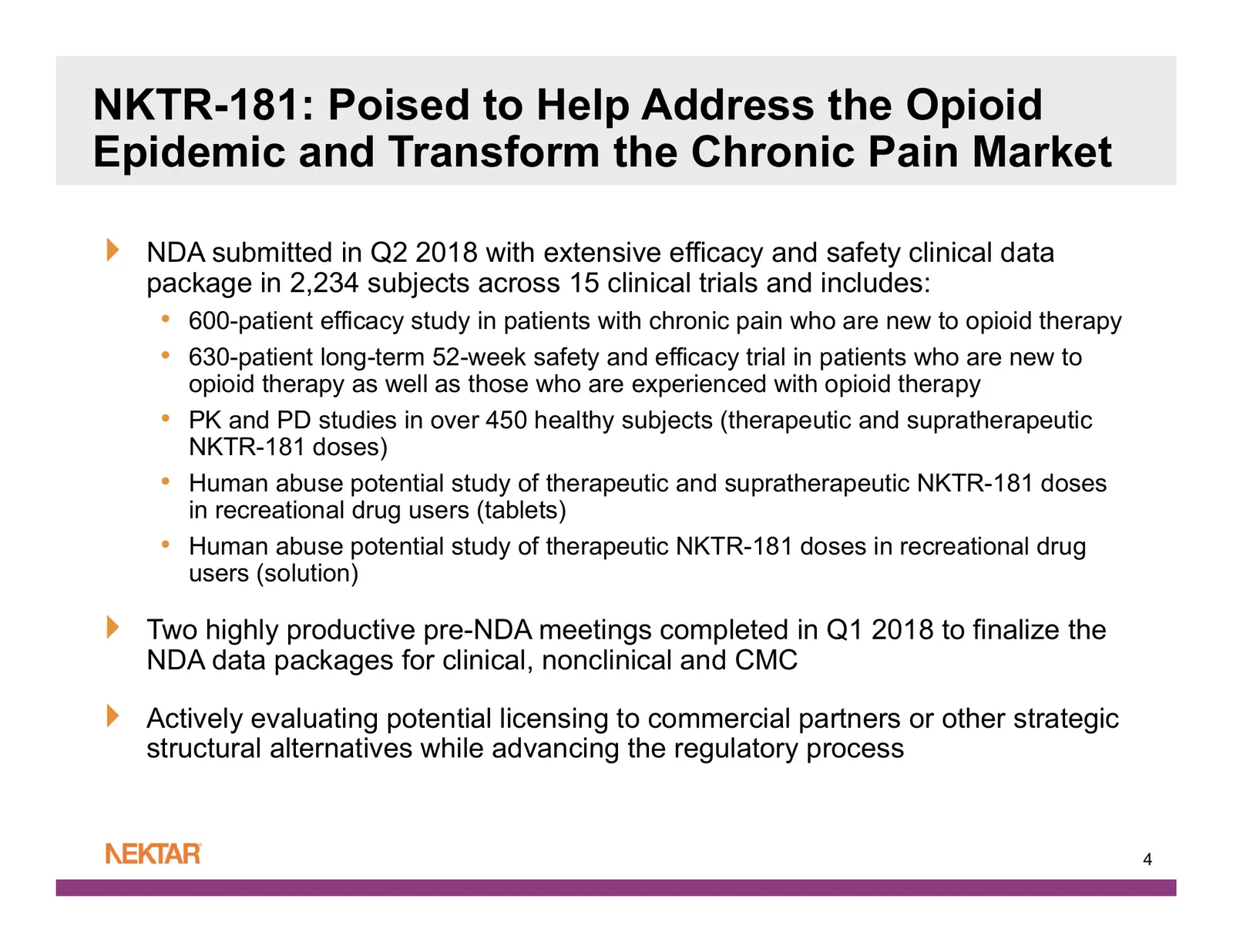
NKTR-181: Poised to Help Address the Opioid Epidemic and Transform the Chronic Pain Market NDA submitted in Q2 2018 with extensive efficacy and safety clinical data package in 2,234 subjects across 15 clinical trials and includes: • 600-patient efficacy study in patients with chronic pain who are
Slide 5: Nektar's Immuno-Oncology Strategy to Create Therapies that Cover the Immunity Cycle
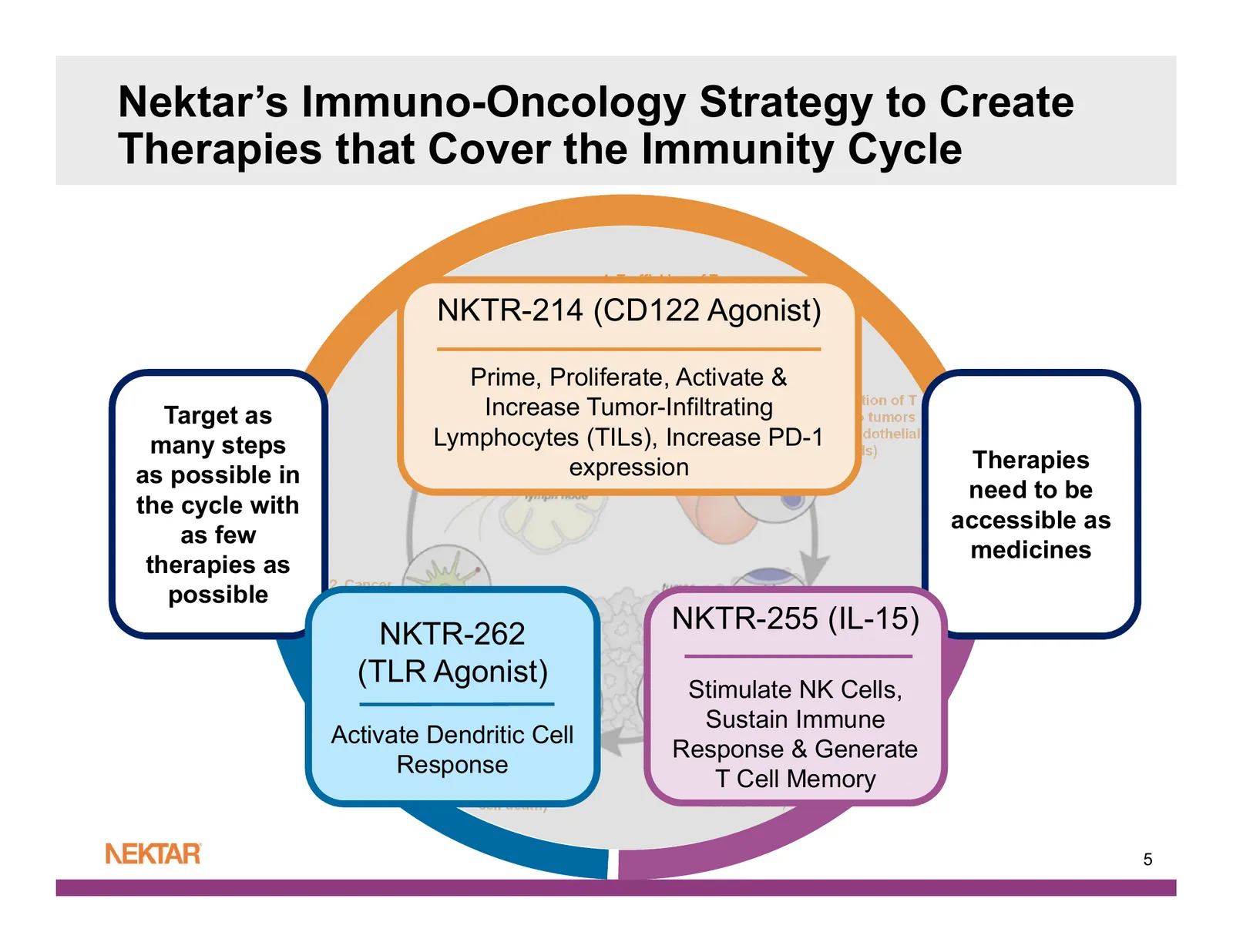
Nektar’s Immuno-Oncology Strategy to Create Therapies that Cover the Immunity Cycle 4. Trafficking of T cells to tumor (CTLs) NKTR-214 (CD122 Agonist) 3. Priming and Prime, Proliferate, Activate & activation Target as (APCs & T Increase Tumor-Infiltrating 5.cells Infiltration of T into tumors many s
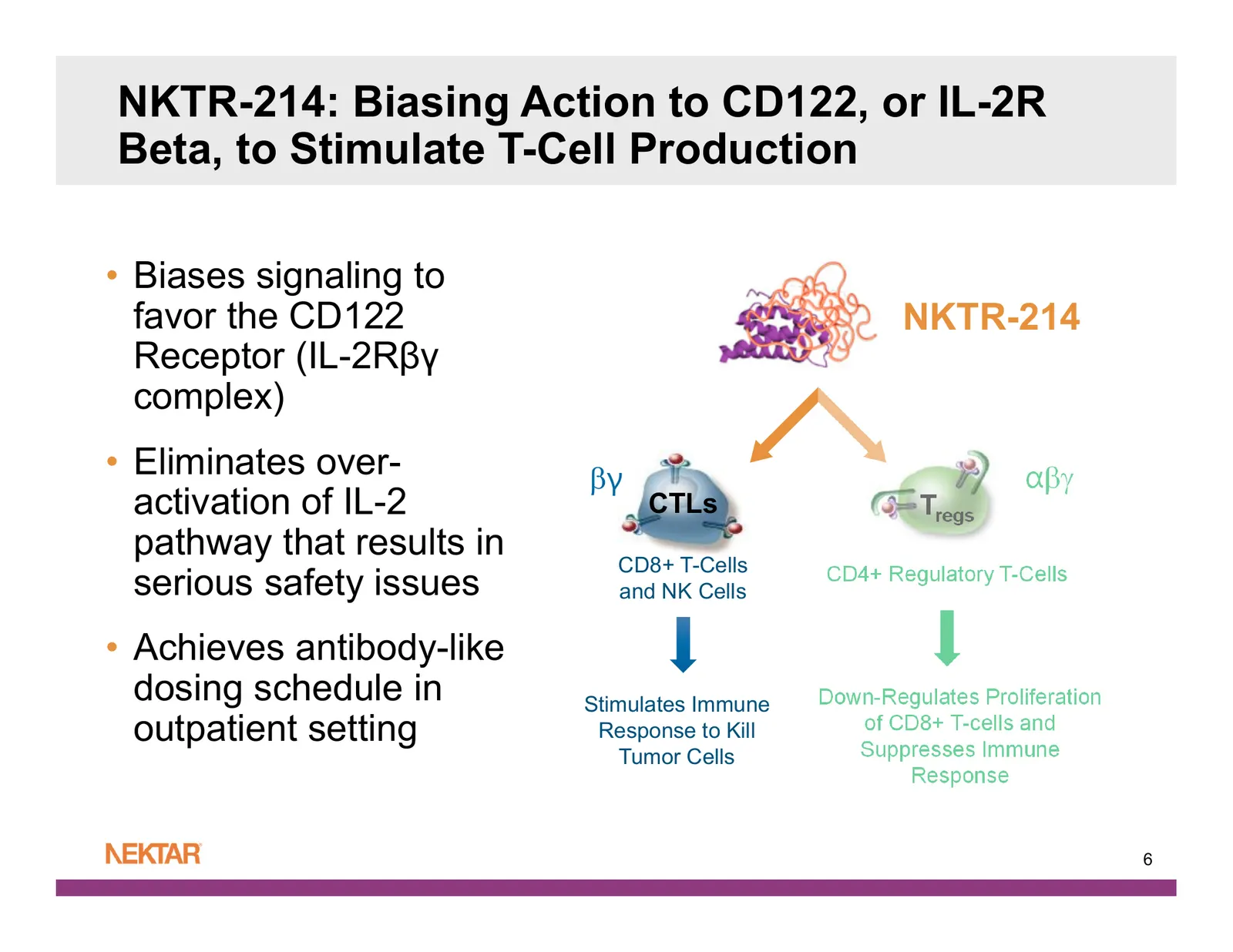
Slide 6: NKTR-214: Biasing Action to CD122, or IL-2R Beta, to Stimulate T-Cell Production
NKTR-214: Biasing Action to CD122, or IL-2R Beta, to Stimulate T-Cell Production • Biases signaling to favor the CD122 NKTR-214 Receptor (IL-2Rβγ complex) • Eliminates over- γ α activation of IL-2 CTLs Tregs pathway that results in CD8+ T-Cells serious safety issues and NK Cells CD4+ Regulatory T
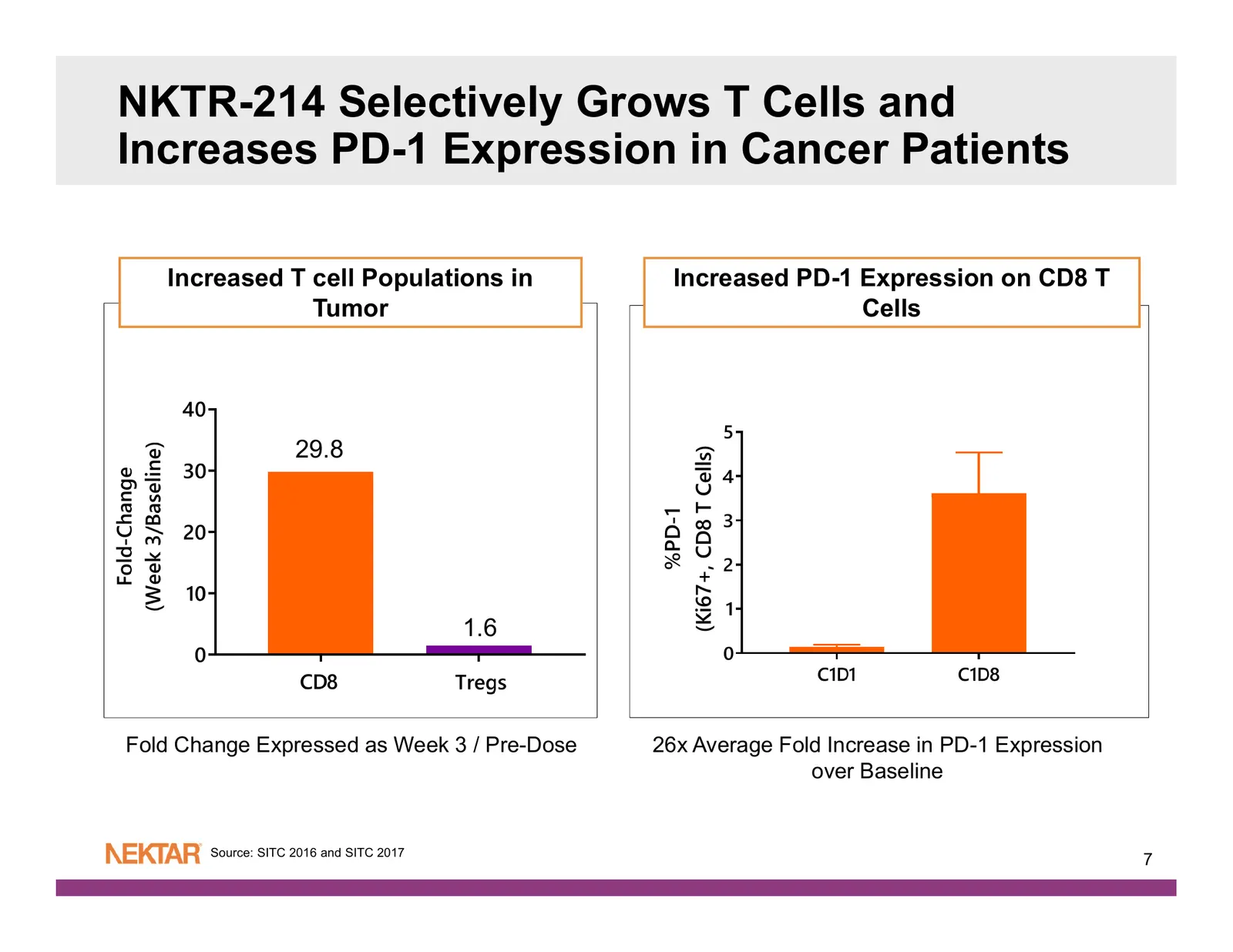
Slide 7: NKTR-214 Selectively Grows T Cells and Increases PD-1 Expression in Cancer Patients
NKTR-214 Selectively Grows T Cells and Increases PD-1 Expression in Cancer Patients Increased T cell Populations in Increased PD-1 Expression on CD8 T Tumor Cells 29.8 (Ki67+, CD8 T Cells) %PD-1 1.6 Fold Change Expressed as Week 3 / Pre-Dose 26x Average Fold Increase in PD-1 Expression over Baseline
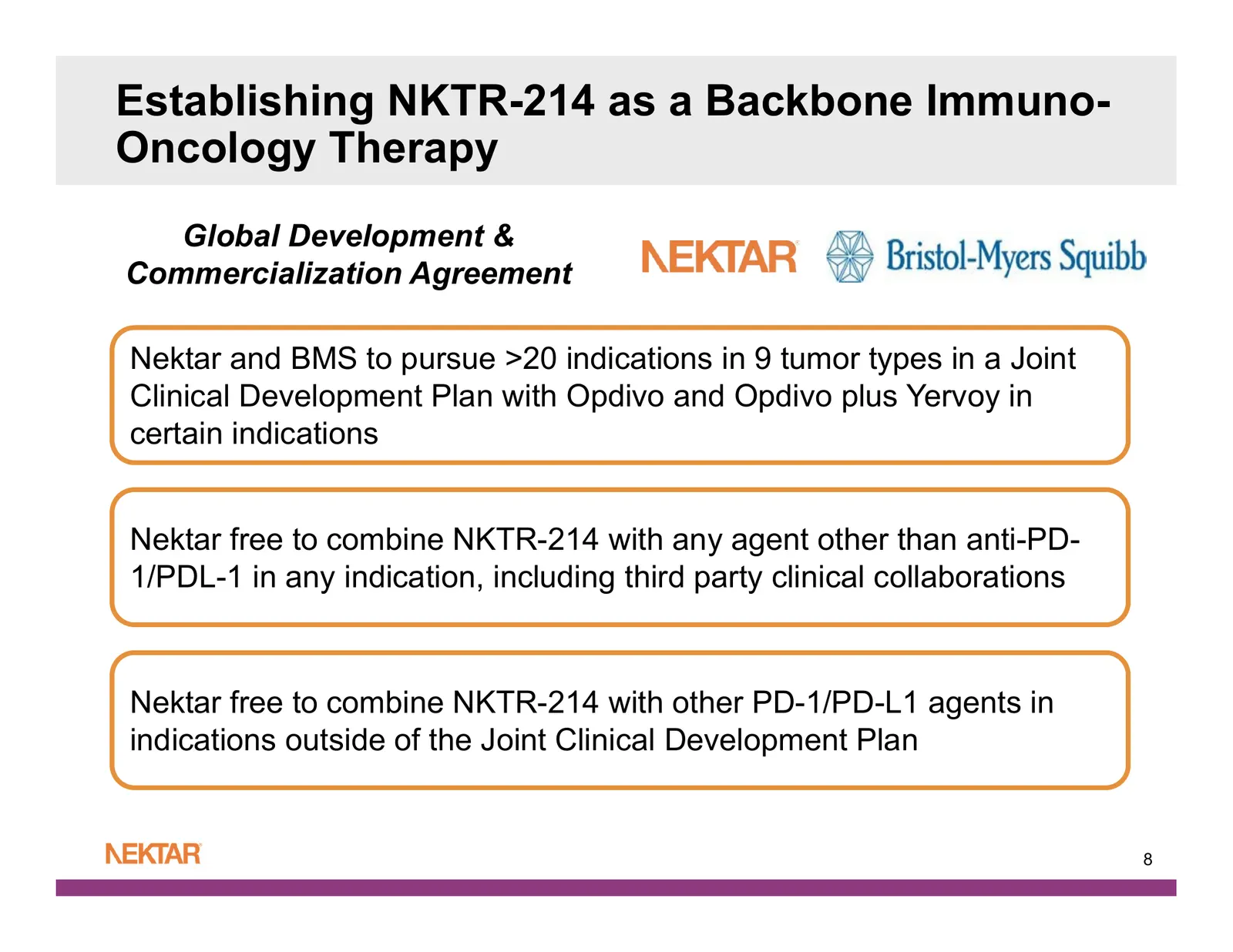
Slide 8: Establishing NKTR-214 as a Backbone Immuno-Oncology Therapy
Establishing NKTR-214 as a Backbone Immuno- Oncology Therapy Global Development & Commercialization Agreement Nektar and BMS to pursue >20 indications in 9 tumor types in a Joint Clinical Development Plan with Opdivo and Opdivo plus Yervoy in certain indications Nektar free to combine NKTR-214 with
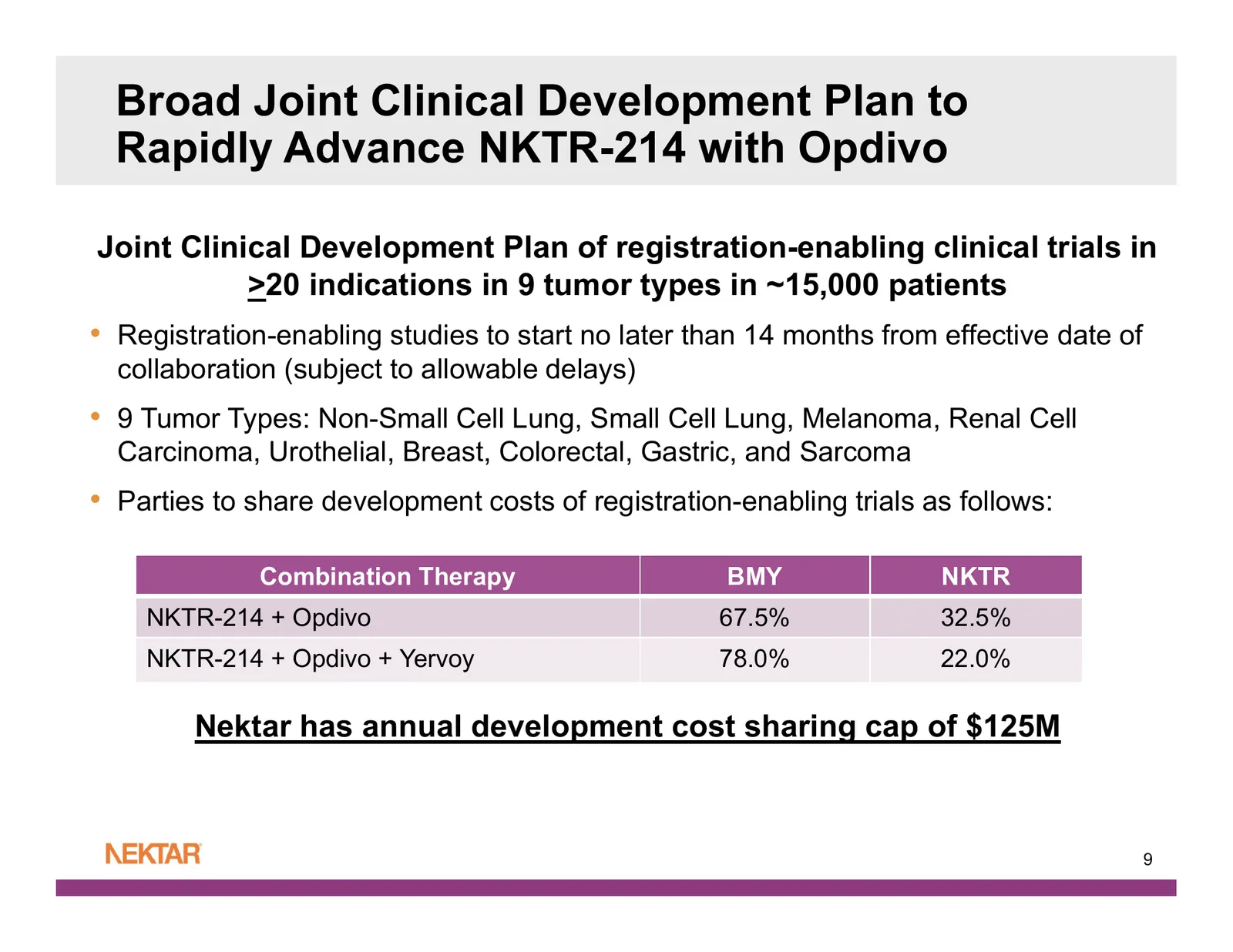
Slide 9: Broad Joint Clinical Development Plan to Rapidly Advance NKTR-214 with Opdivo
Broad Joint Clinical Development Plan to Rapidly Advance NKTR-214 with Opdivo Joint Clinical Development Plan of registration-enabling clinical trials in >20 indications in 9 tumor types in ~15,000 patients • Registration-enabling studies to start no later than 14 months from effective date of colla
Slide 10: ASCO 2018: PIVOT-02 Preliminary Data Conclusions
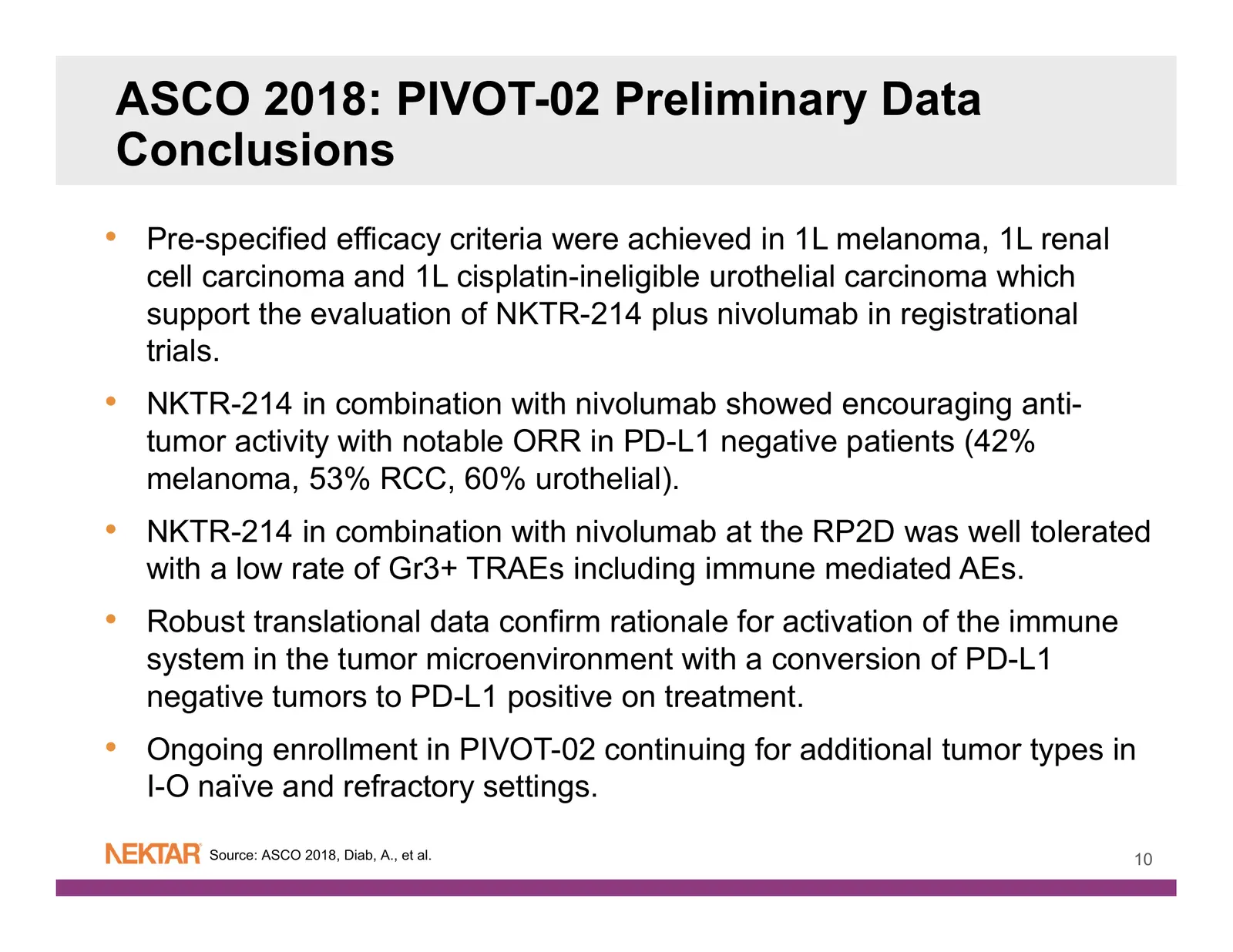
ASCO 2018: PIVOT-02 Preliminary Data Conclusions • Pre-specified efficacy criteria were achieved in 1L melanoma, 1L renal cell carcinoma and 1L cisplatin-ineligible urothelial carcinoma which support the evaluation of NKTR-214 plus nivolumab in registrational trials. • NKTR-214 in combination with n
Slide 11: Conversion of PD-L1(-) to PD-L1(+) in Tumor Biopsies from Baseline to Week 3
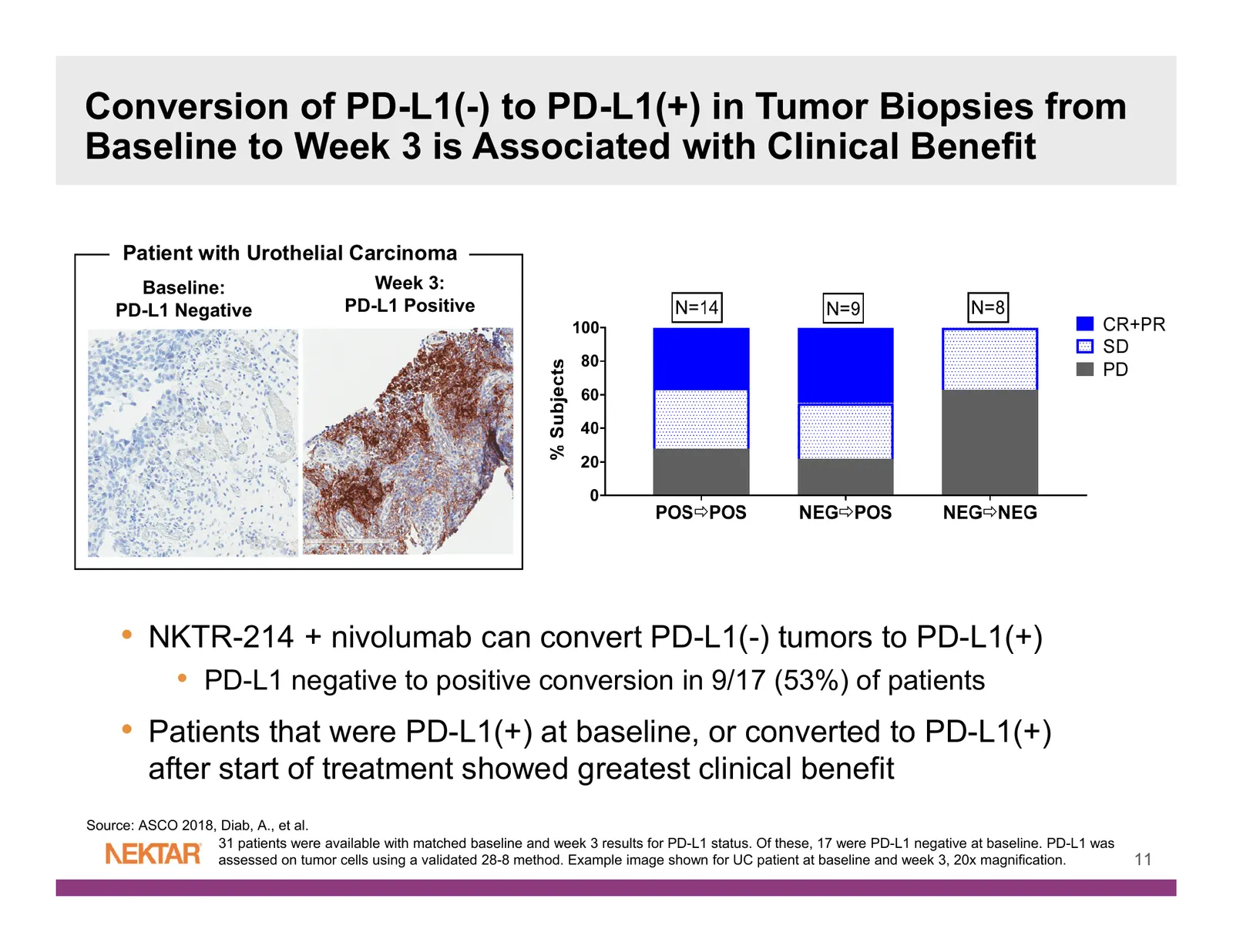
Conversion of PD-L1(-) to PD-L1(+) in Tumor Biopsies from Baseline to Week 3 is Associated with Clinical Benefit Patient with Urothelial Carcinoma Baseline: Week 3: PD-L1 Negative PD-L1 Positive • NKTR-214 + nivolumab can convert PD-L1(-) tumors to PD-L1(+) • PD-L1 negative to positive conversion in
Slide 12: PIVOT-02 Study Dose-Escalation in I-O Treatment-Naïve Patients: Enrollment Complete
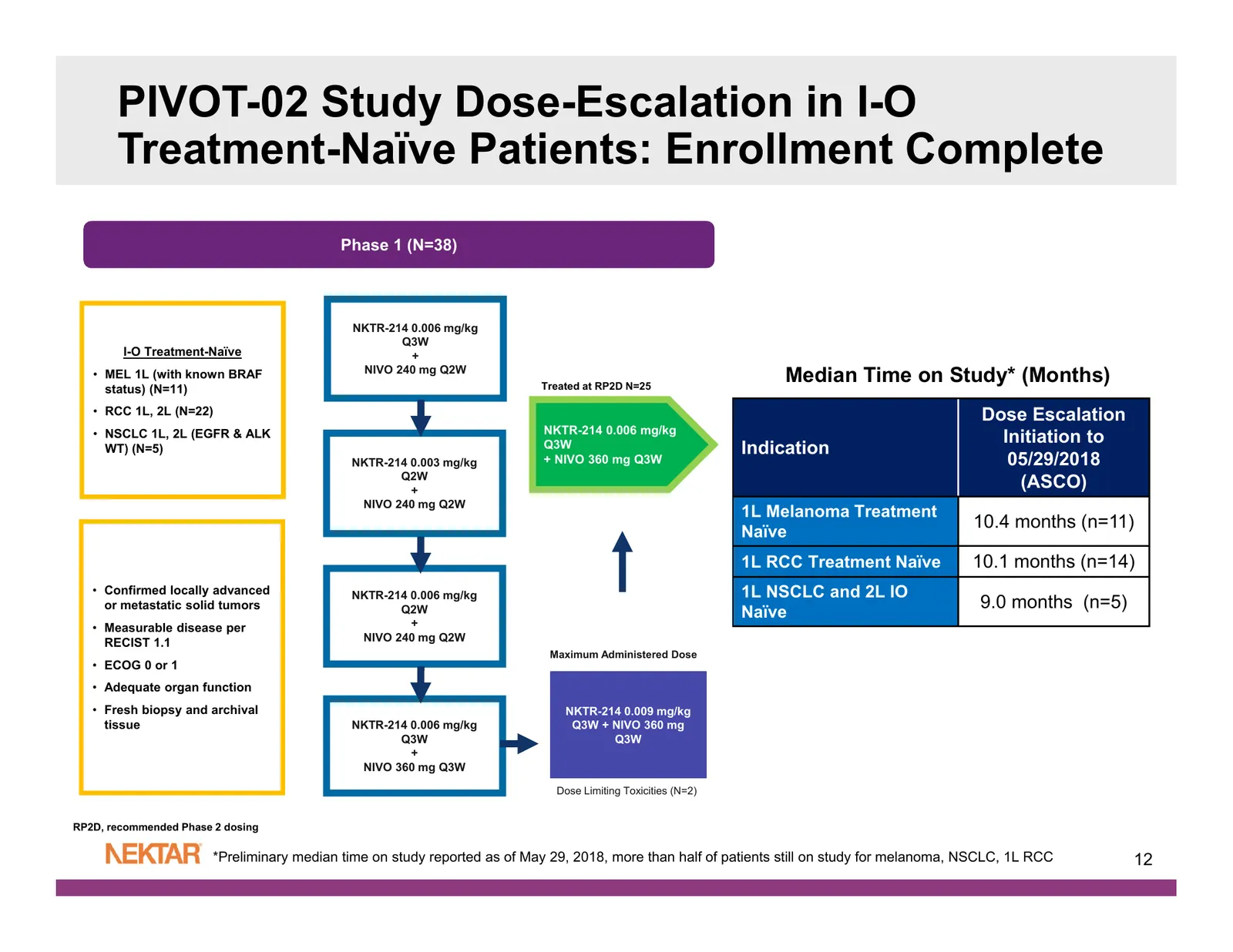
PIVOT-02 Study Dose-Escalation in I-O Treatment-Naïve Patients: Enrollment Complete Phase 1 (N=38) NKTR-214 0.006 mg/kg Q3W I-O Treatment-Naïve + • MEL 1L (with known BRAF NIVO 240 mg Q2W Treated at RP2D N=25 Median Time on Study* (Months) status) (N=11) • RCC 1L, 2L (N=22) Dose Escalation NKTR-214
Slide 13: Stage IV I-O Naïve 1L Melanoma Dose Escalation Cohort: Deepening of Responses
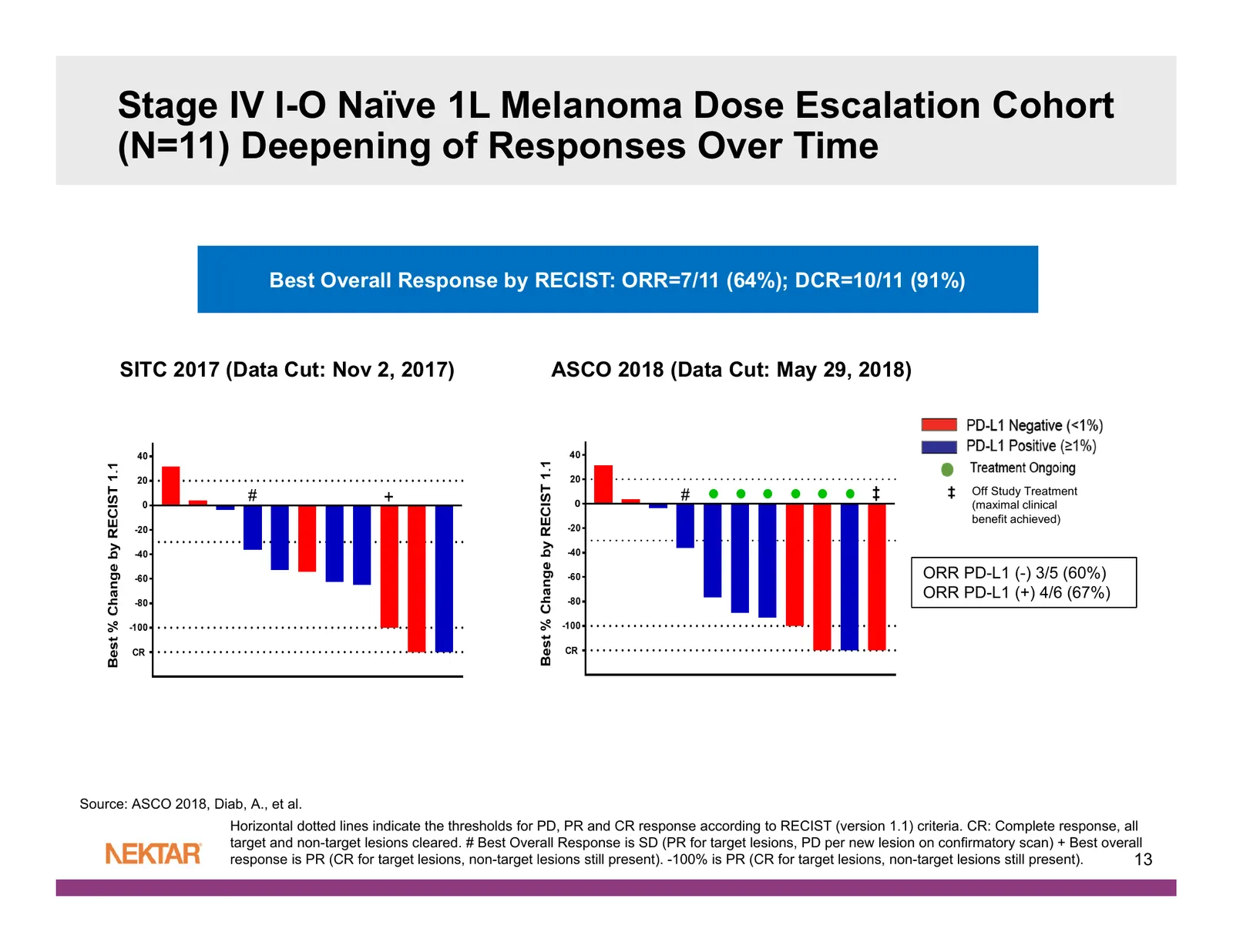
Stage IV I-O Naïve 1L Melanoma Dose Escalation Cohort (N=11) Deepening of Responses Over Time Best Overall Response by RECIST: ORR=7/11 (64%); DCR=10/11 (91%) SITC 2017 (Data Cut: Nov 2, 2017) ASCO 2018 (Data Cut: May 29, 2018) ‡ ‡ Off Study Treatment (maximal clinical benefit achieved) ORR PD-L1 (-
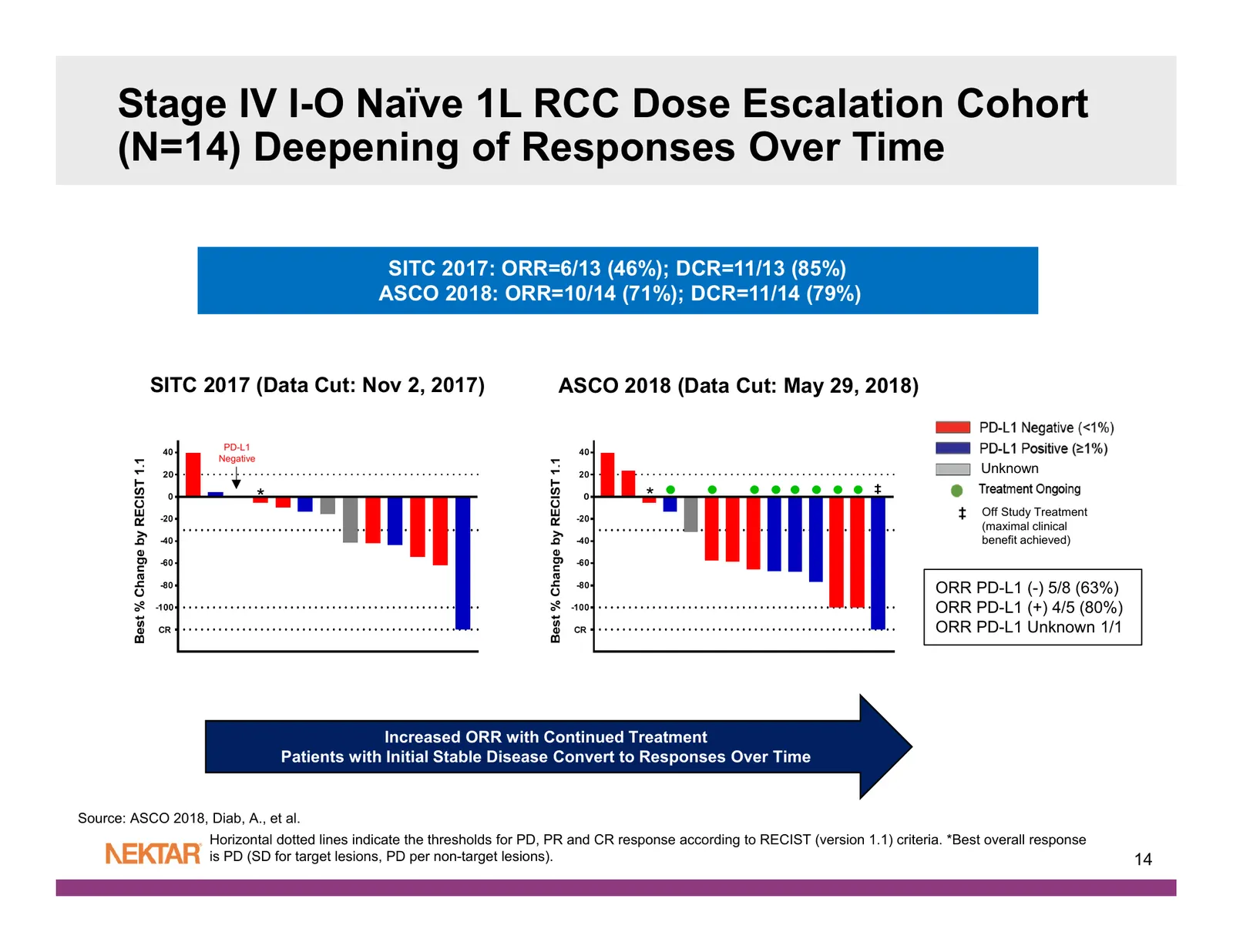
Slide 14: Stage IV I-O Naïve 1L RCC Dose Escalation Cohort: Deepening of Responses
Stage IV I-O Naïve 1L RCC Dose Escalation Cohort (N=14) Deepening of Responses Over Time SITC 2017: ORR=6/13 (46%); DCR=11/13 (85%) ASCO 2018: ORR=10/14 (71%); DCR=11/14 (79%) SITC 2017 (Data Cut: Nov 2, 2017) ASCO 2018 (Data Cut: May 29, 2018) PD-L1 Negative Unknown ‡ ‡ Off Study Treatment (maximal
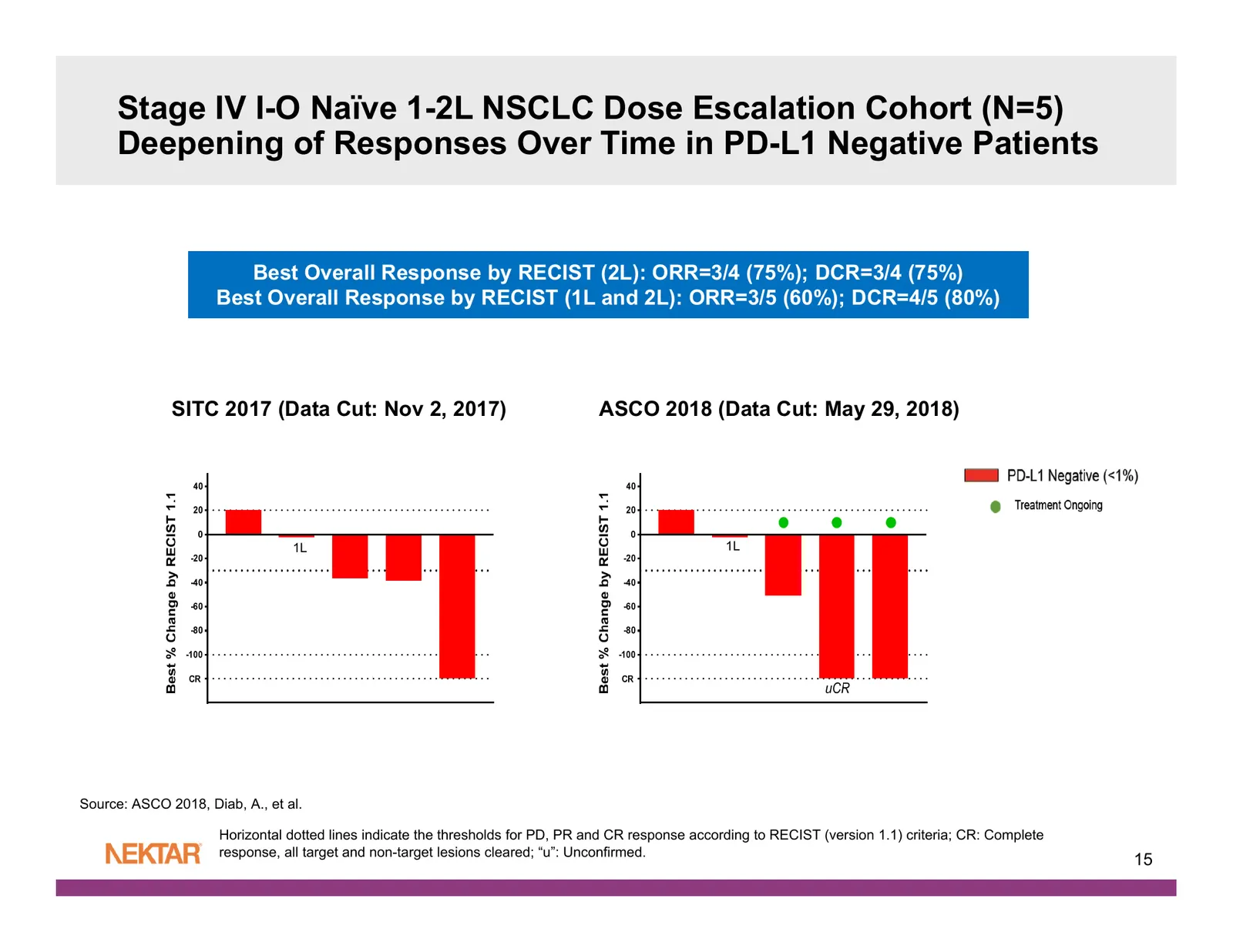
Slide 15: Stage IV I-O Naïve 1-2L NSCLC Dose Escalation Cohort
Stage IV I-O Naïve 1-2L NSCLC Dose Escalation Cohort (N=5) Deepening of Responses Over Time in PD-L1 Negative Patients Best Overall Response by RECIST (2L): ORR=3/4 (75%); DCR=3/4 (75%) Best Overall Response by RECIST (1L and 2L): ORR=3/5 (60%); DCR=4/5 (80%) SITC 2017 (Data Cut: Nov 2, 2017) ASCO 2
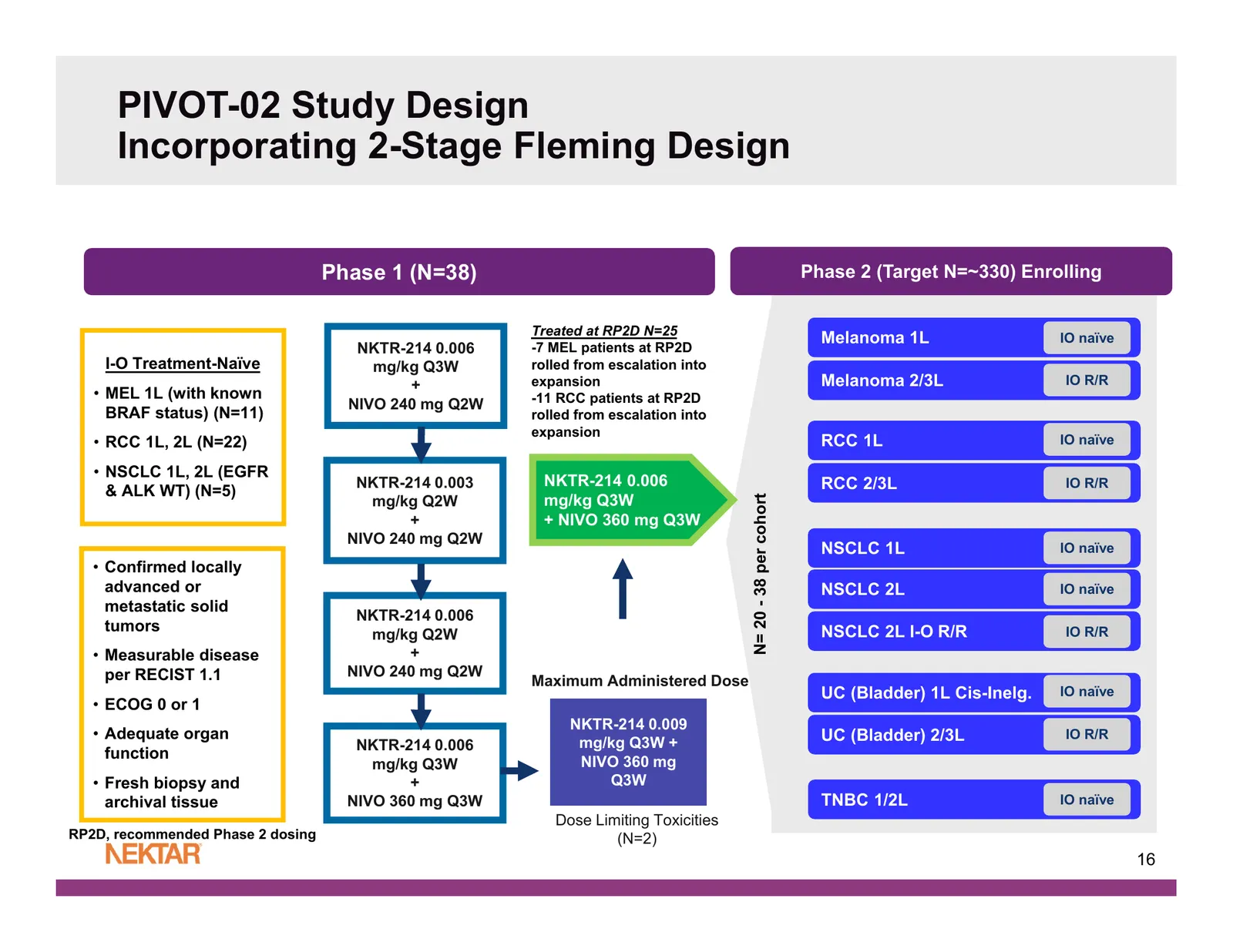
Slide 16: PIVOT-02 Study Design Incorporating 2-Stage Fleming Design
PIVOT-02 Study Design Incorporating 2-Stage Fleming Design Phase 1 (N=38) Phase 2 (Target N=~330) Enrolling Treated at RP2D N=25 Melanoma 1L IO naïve NKTR-214 0.006 -7 MEL patients at RP2D I-O Treatment-Naïve mg/kg Q3W rolled from escalation into + expansion Melanoma 2/3L IO R/R • MEL 1L (with known
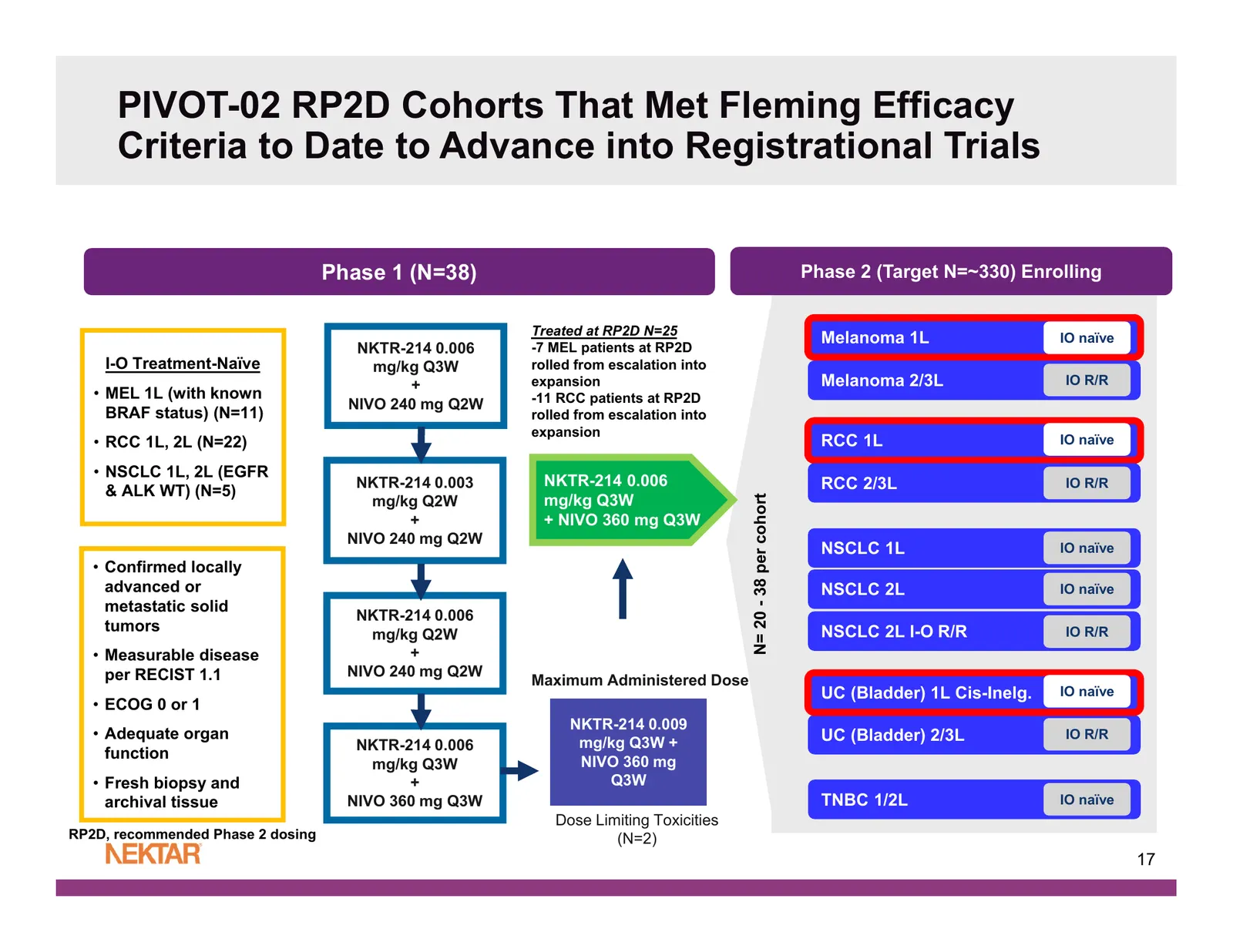
Slide 17: PIVOT-02 RP2D Cohorts That Met Fleming Efficacy Criteria
PIVOT-02 RP2D Cohorts That Met Fleming Efficacy Criteria to Date to Advance into Registrational Trials Phase 1 (N=38) Phase 2 (Target N=~330) Enrolling Treated at RP2D N=25 Melanoma 1L IO naïve NKTR-214 0.006 -7 MEL patients at RP2D I-O Treatment-Naïve mg/kg Q3W rolled from escalation into + expansi
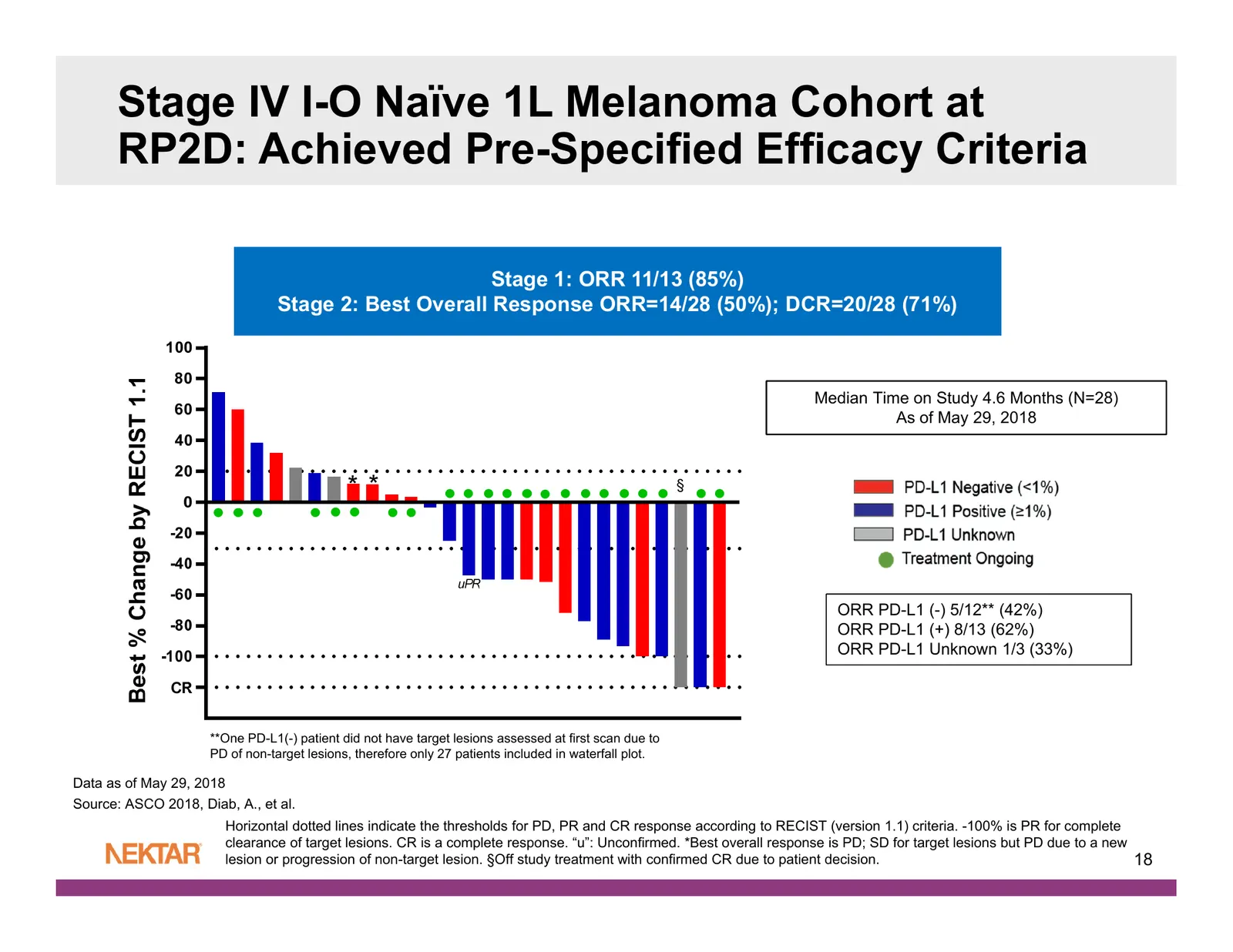
Slide 18: Stage IV I-O Naïve 1L Melanoma Cohort at RP2D: Achieved Pre-Specified Efficacy Criteria
Stage IV I-O Naïve 1L Melanoma Cohort at RP2D: Achieved Pre-Specified Efficacy Criteria Stage 1: ORR 11/13 (85%) Stage 2: Best Overall Response ORR=14/28 (50%); DCR=20/28 (71%) Median Time on Study 4.6 Months (N=28) As of May 29, 2018 § ORR PD-L1 (-) 5/12** (42%) ORR PD-L1 (+) 8/13 (62%) ORR PD-L1 U
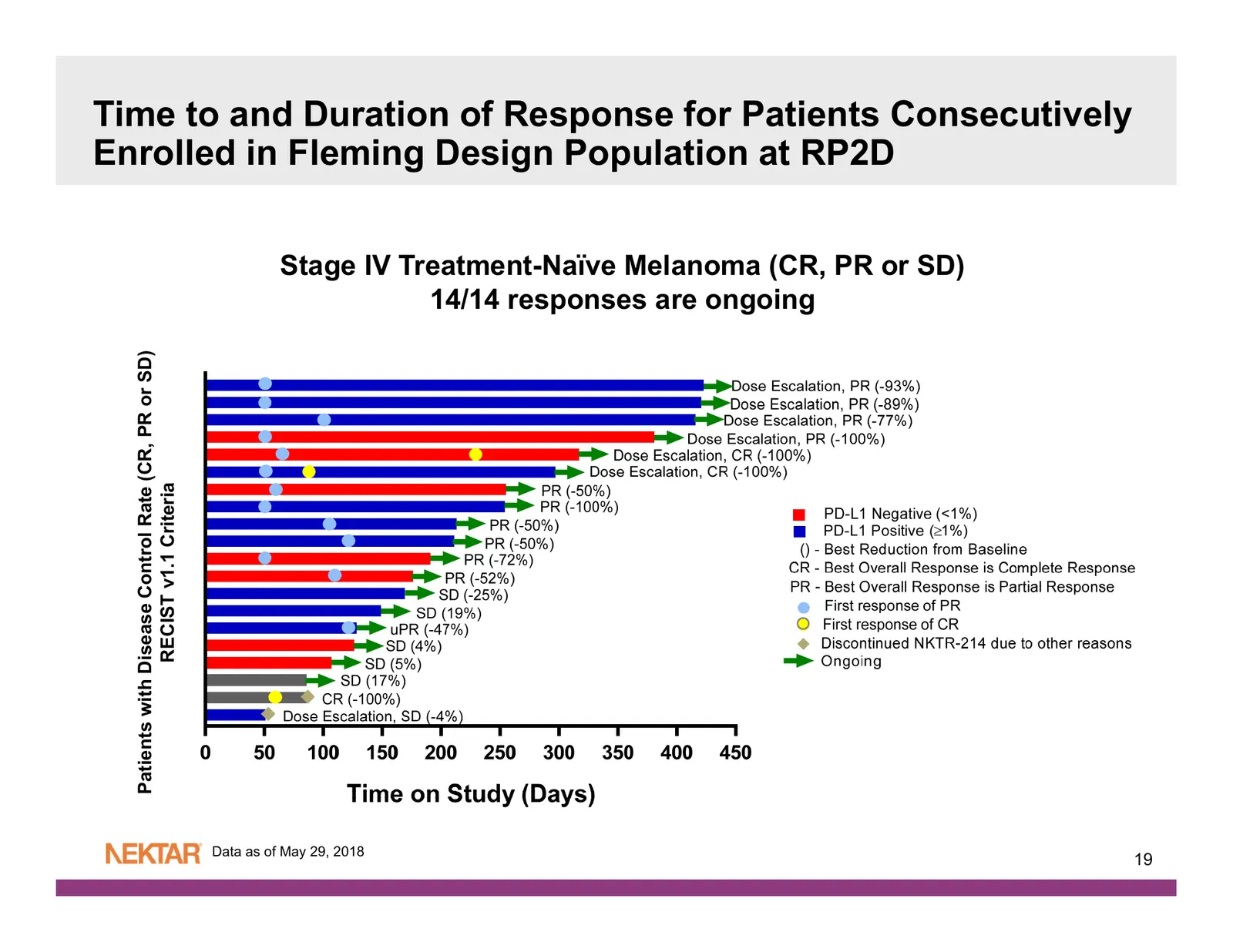
Slide 19: Time to and Duration of Response, Melanoma at RP2D
Time to and Duration of Response for Patients Consecutively Enrolled in Fleming Design Population at RP2D Stage IV Treatment-Naïve Melanoma (CR, PR or SD) 14/14 responses are ongoing Patients with Disease Control Rate (CR, PR or SD) RECIST v1.1 Criteria Data as of May 29, 2018 19
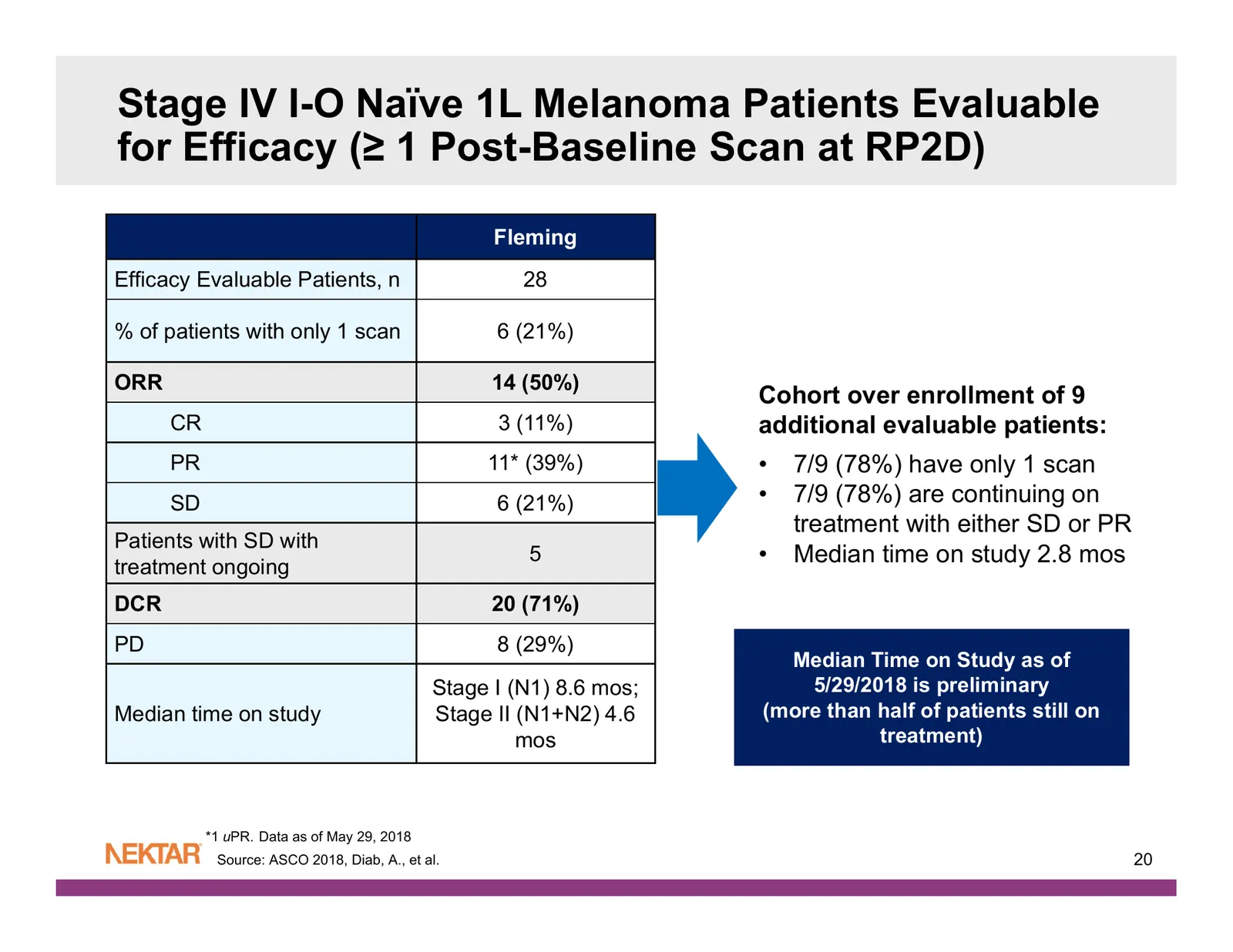
Slide 20: Stage IV I-O Naïve 1L Melanoma Patients Evaluable for Efficacy
Stage IV I-O Naïve 1L Melanoma Patients Evaluable for Efficacy (≥ 1 Post-Baseline Scan at RP2D) Fleming Efficacy Evaluable Patients, n 28 % of patients with only 1 scan 6 (21%) ORR 14 (50%) Cohort over enrollment of 9 CR 3 (11%) additional evaluable patients: PR 11* (39%) • 7/9 (78%) have only 1 sca
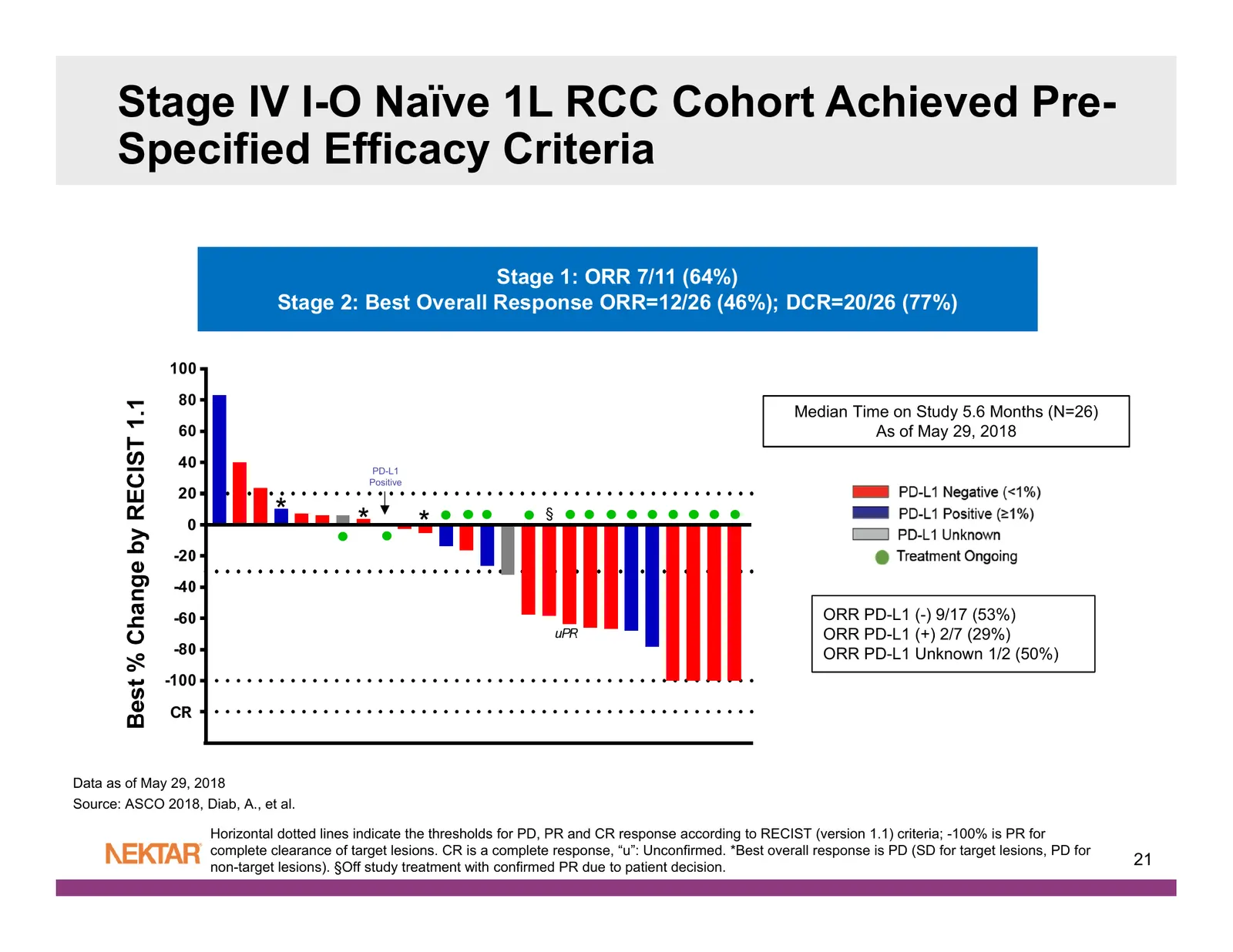
Slide 21: Stage IV I-O Naïve 1L RCC Cohort Achieved Pre-Specified Efficacy Criteria
Stage IV I-O Naïve 1L RCC Cohort Achieved Pre- Specified Efficacy Criteria Stage 1: ORR 7/11 (64%) Stage 2: Best Overall Response ORR=12/26 (46%); DCR=20/26 (77%) Median Time on Study 5.6 Months (N=26) As of May 29, 2018 PD-L1 Positive § ORR PD-L1 (-) 9/17 (53%) ORR PD-L1 (+) 2/7 (29%) ORR PD-L1 Unk
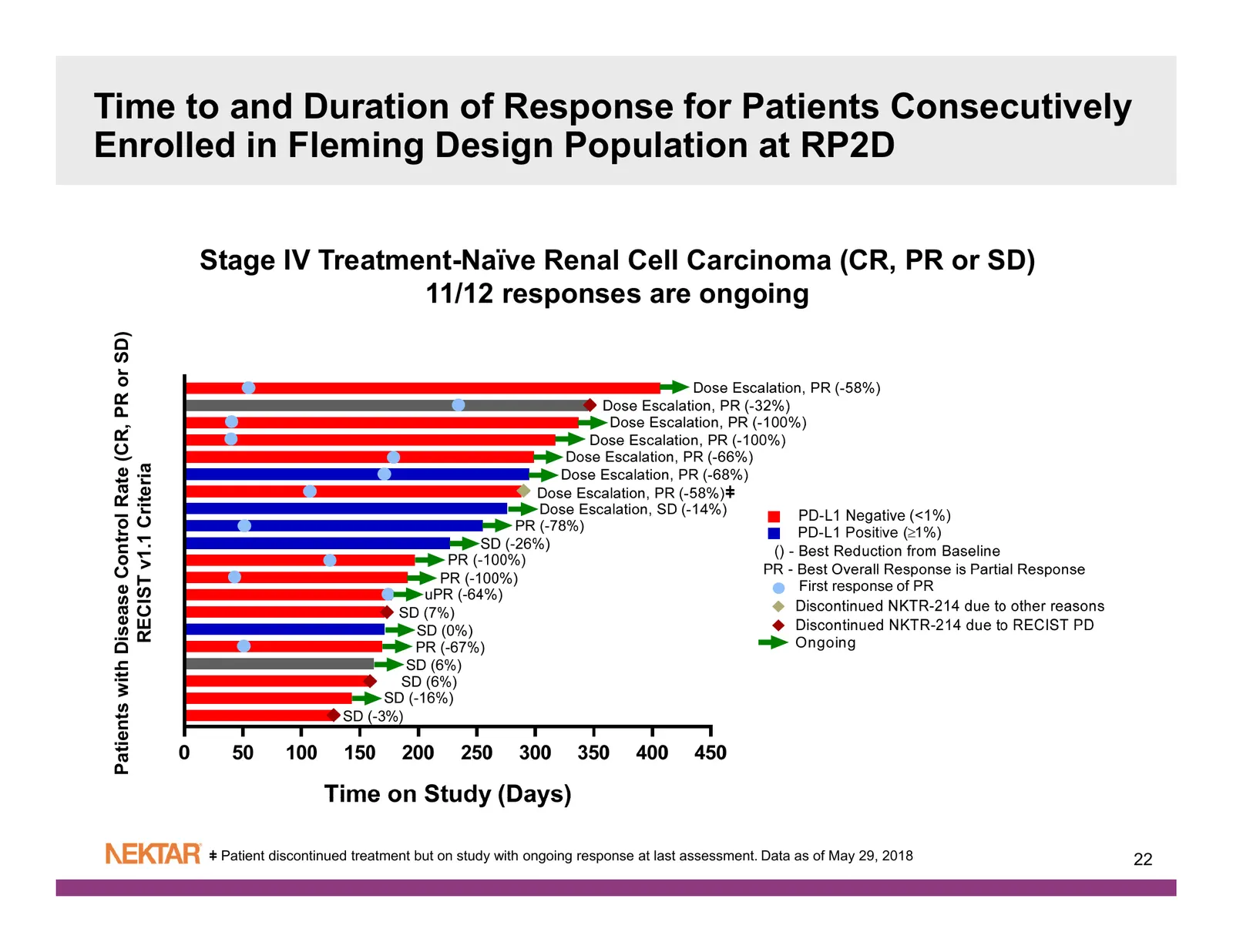
Slide 22: Time to and Duration of Response, RCC at RP2D
Time to and Duration of Response for Patients Consecutively Enrolled in Fleming Design Population at RP2D Stage IV Treatment-Naïve Renal Cell Carcinoma (CR, PR or SD) 11/12 responses are ongoing Patients with Disease Control Rate (CR, PR or SD) RECIST v1.1 Criteria ǂ ǂ Patient discontinued treatment
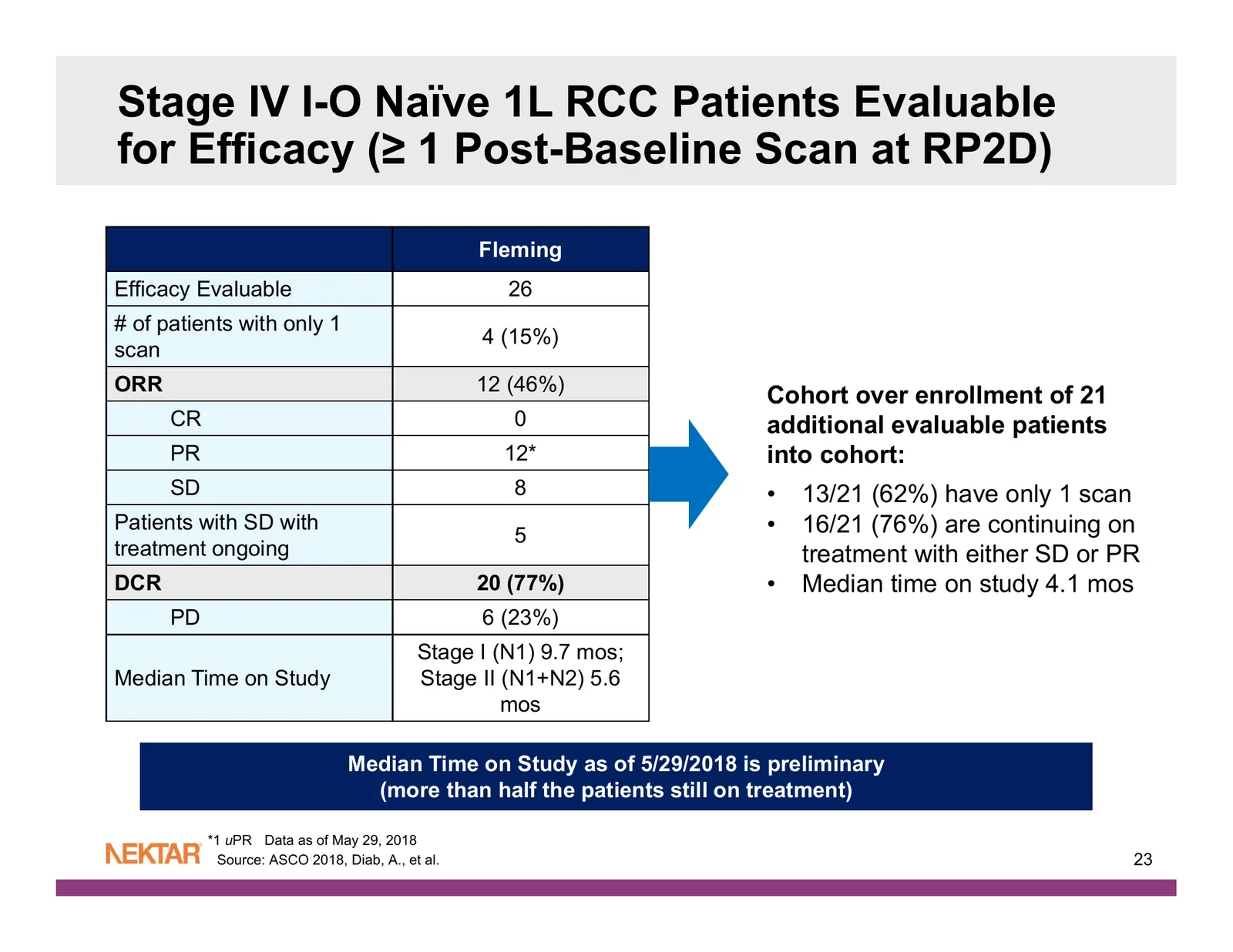
Slide 23: Stage IV I-O Naïve 1L RCC Patients Evaluable for Efficacy
Stage IV I-O Naïve 1L RCC Patients Evaluable for Efficacy (≥ 1 Post-Baseline Scan at RP2D) Fleming Efficacy Evaluable 26 # of patients with only 1 4 (15%) scan ORR 12 (46%) Cohort over enrollment of 21 CR 0 additional evaluable patients PR 12* into cohort: SD 8 • 13/21 (62%) have only 1 scan Patient
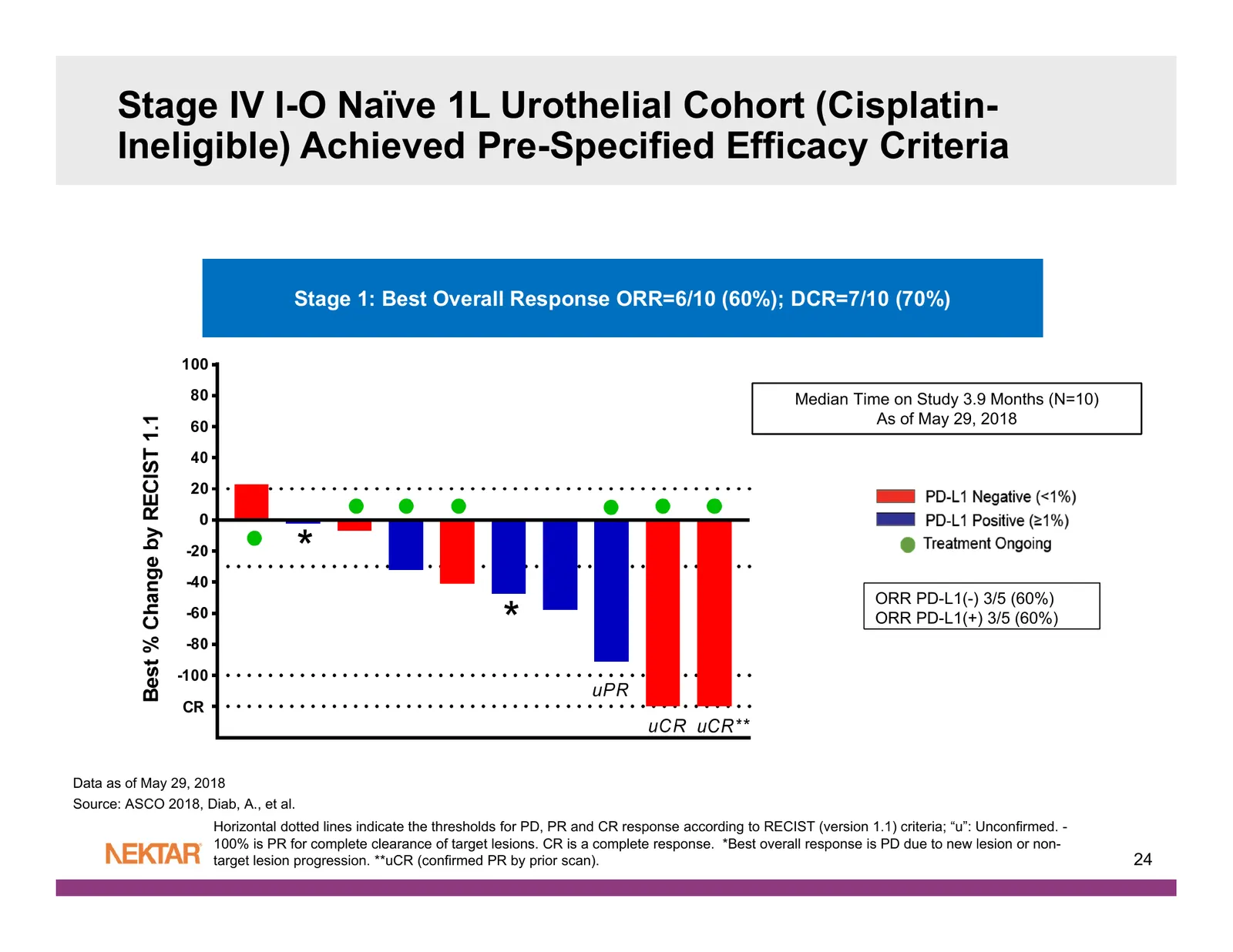
Slide 24: Stage IV I-O Naïve 1L Urothelial Cohort Achieved Pre-Specified Efficacy Criteria
Stage IV I-O Naïve 1L Urothelial Cohort (Cisplatin- Ineligible) Achieved Pre-Specified Efficacy Criteria Stage 1: Best Overall Response ORR=6/10 (60%); DCR=7/10 (70%) Median Time on Study 3.9 Months (N=10) As of May 29, 2018 ORR PD-L1(-) 3/5 (60%) ORR PD-L1(+) 3/5 (60%) Data as of May 29, 2018 Sourc
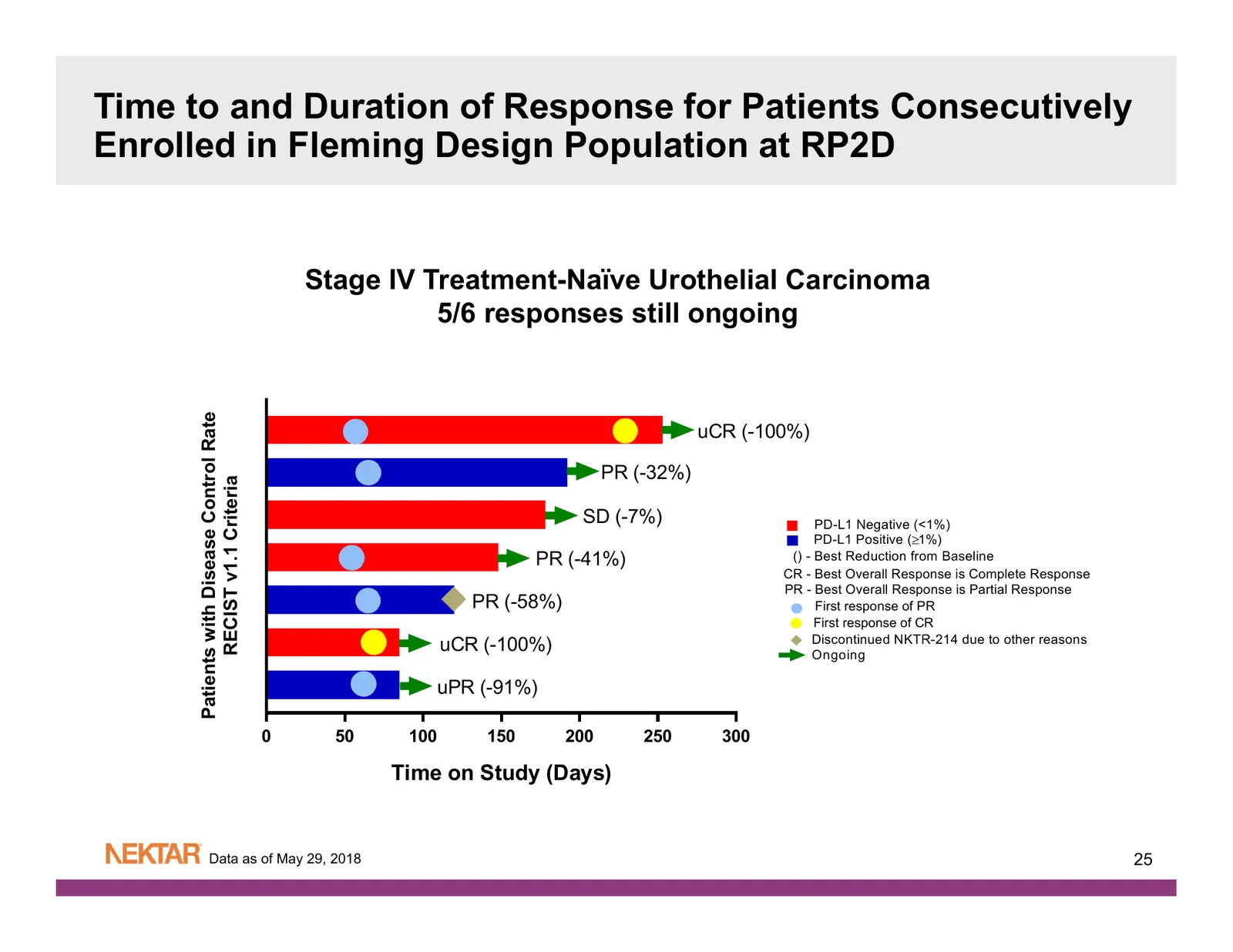
Slide 25: Time to and Duration of Response, Urothelial Carcinoma
Time to and Duration of Response for Patients Consecutively Enrolled in Fleming Design Population at RP2D Stage IV Treatment-Naïve Urothelial Carcinoma 5/6 responses still ongoing Patients with Disease Control Rate uCR (-100%) PR (-32%) RECIST v1.1 Criteria SD (-7%) PD-L1 Negative (<1%) PD-L1 Positi
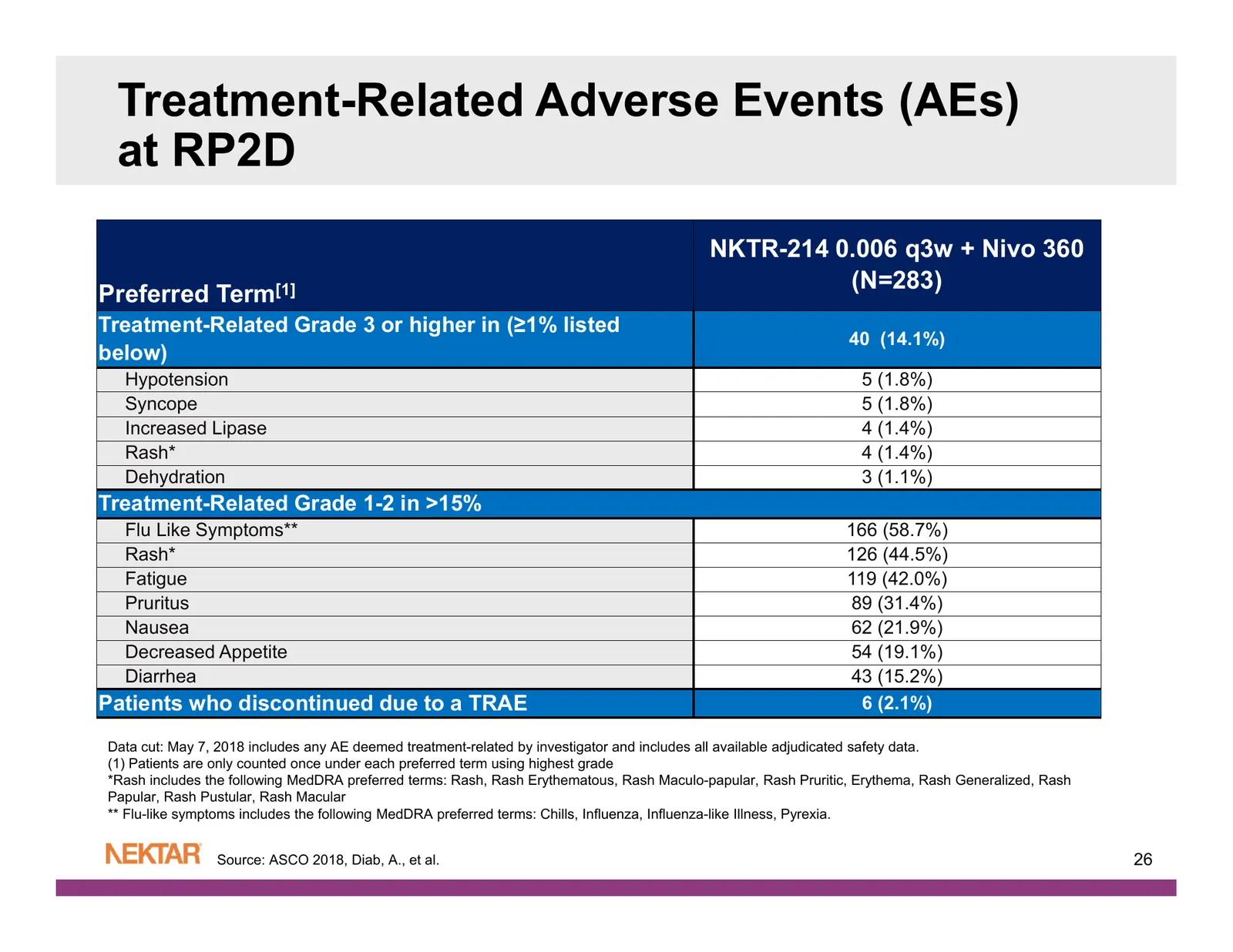
Slide 26: Treatment-Related Adverse Events (AEs) at RP2D
Treatment-Related Adverse Events (AEs) at RP2D NKTR-214 0.006 q3w + Nivo 360 (N=283) Preferred Term[1] Treatment-Related Grade 3 or higher in (≥1% listed 40 (14.1%) below) Hypotension 5 (1.8%) Syncope 5 (1.8%) Increased Lipase 4 (1.4%) Rash* 4 (1.4%) Dehydration 3 (1.1%) Treatment-Related Grade 1-2
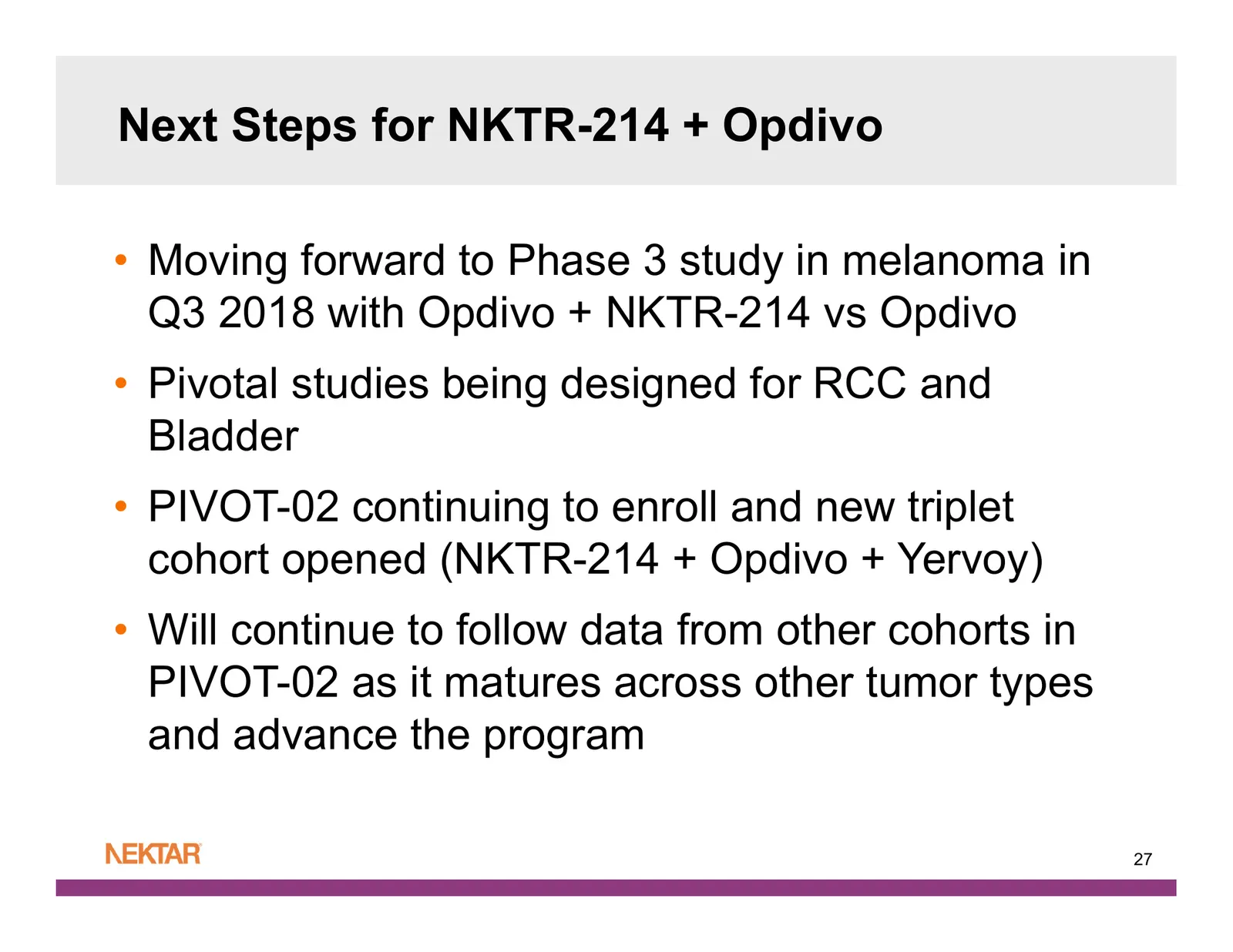
Slide 27: Next Steps for NKTR-214 + Opdivo
Next Steps for NKTR-214 + Opdivo • Moving forward to Phase 3 study in melanoma in Q3 2018 with Opdivo + NKTR-214 vs Opdivo • Pivotal studies being designed for RCC and Bladder • PIVOT-02 continuing to enroll and new triplet cohort opened (NKTR-214 + Opdivo + Yervoy) • Will continue to follow data fr
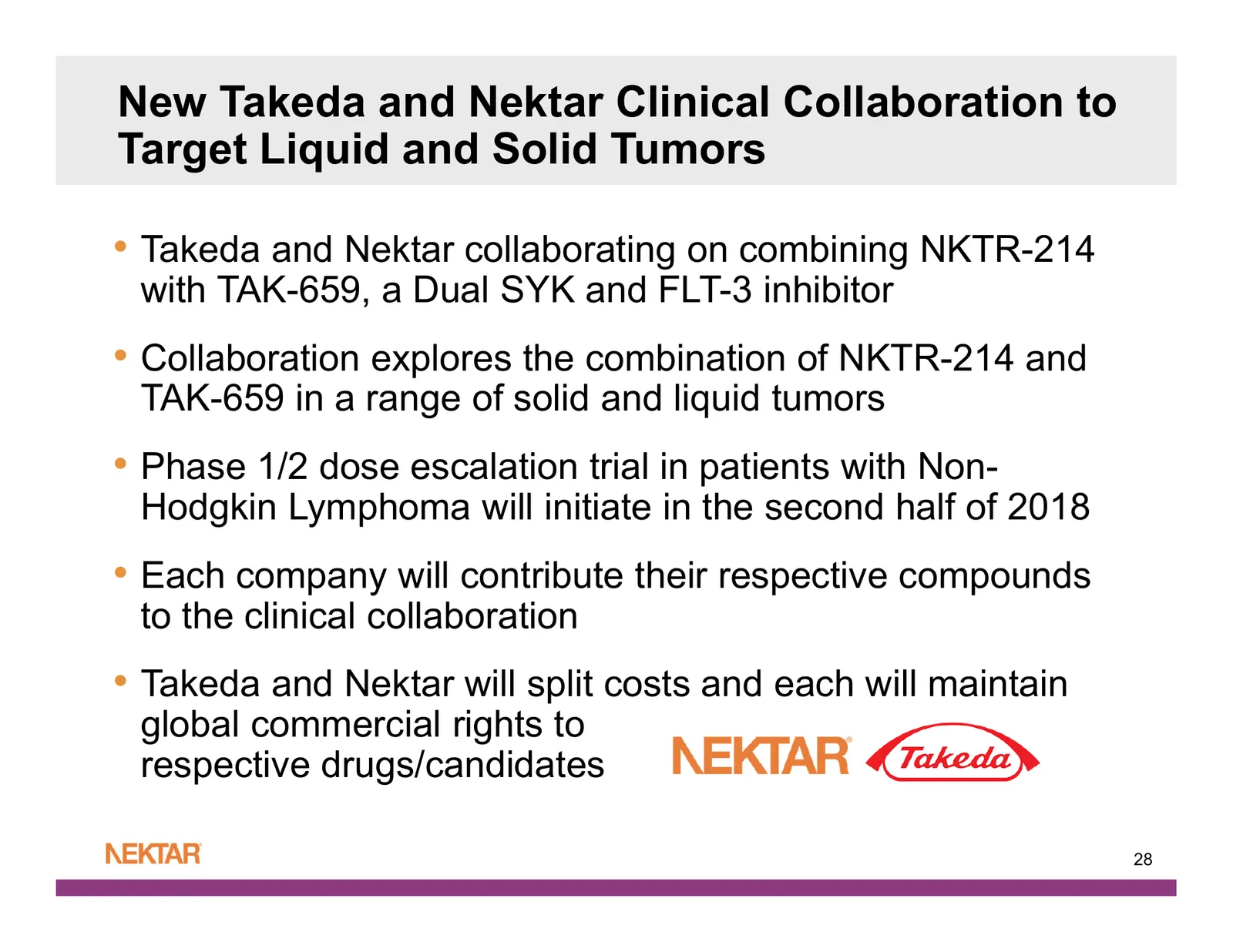
Slide 28: New Takeda and Nektar Clinical Collaboration to Target Liquid and Solid Tumors
New Takeda and Nektar Clinical Collaboration to Target Liquid and Solid Tumors • Takeda and Nektar collaborating on combining NKTR-214 with TAK-659, a Dual SYK and FLT-3 inhibitor • Collaboration explores the combination of NKTR-214 and TAK-659 in a range of solid and liquid tumors • Phase 1/2 dose
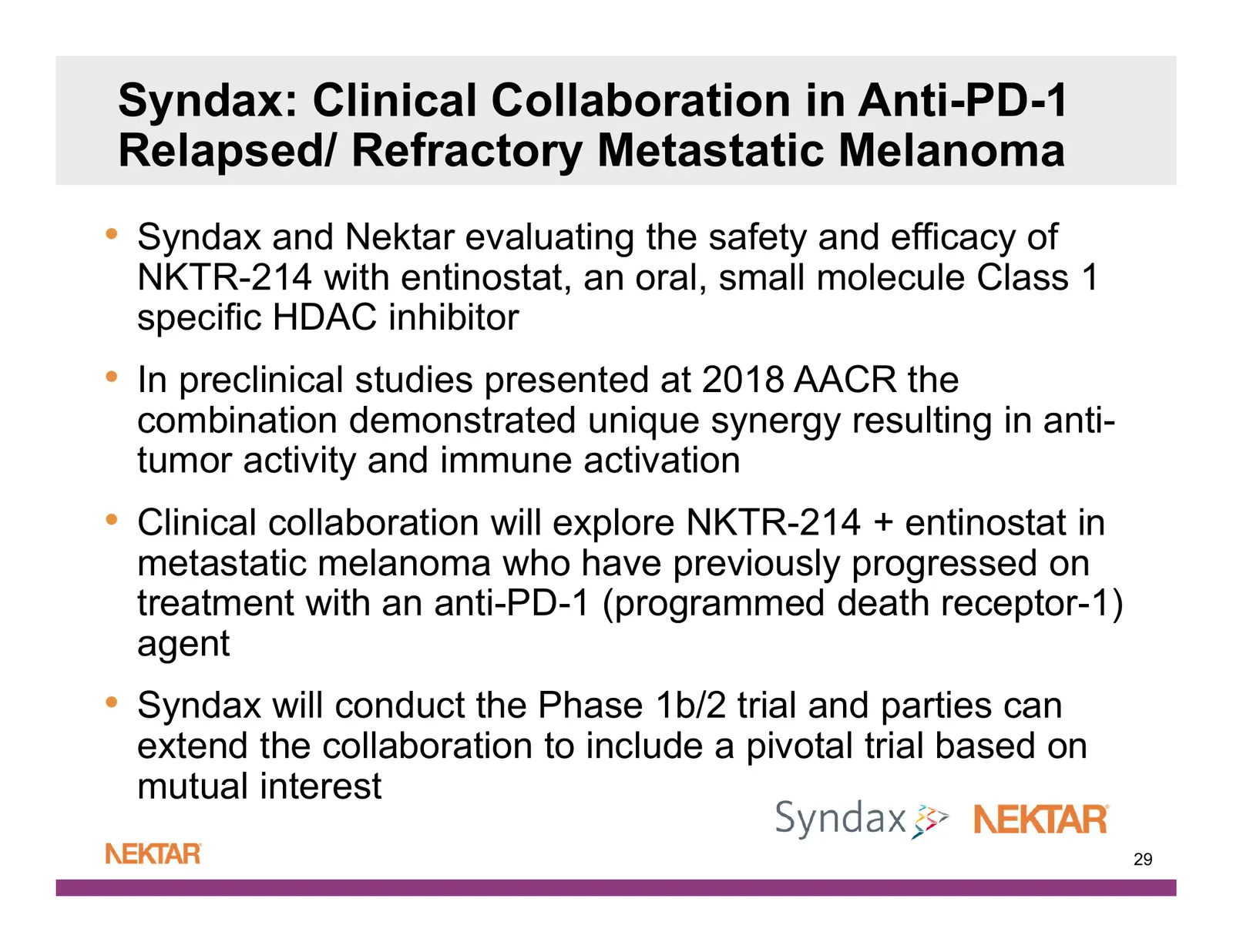
Slide 29: Syndax: Clinical Collaboration in Anti-PD-1 Relapsed/Refractory Metastatic Melanoma
Syndax: Clinical Collaboration in Anti-PD-1 Relapsed/ Refractory Metastatic Melanoma • Syndax and Nektar evaluating the safety and efficacy of NKTR-214 with entinostat, an oral, small molecule Class 1 specific HDAC inhibitor • In preclinical studies presented at 2018 AACR the combination demonstrate
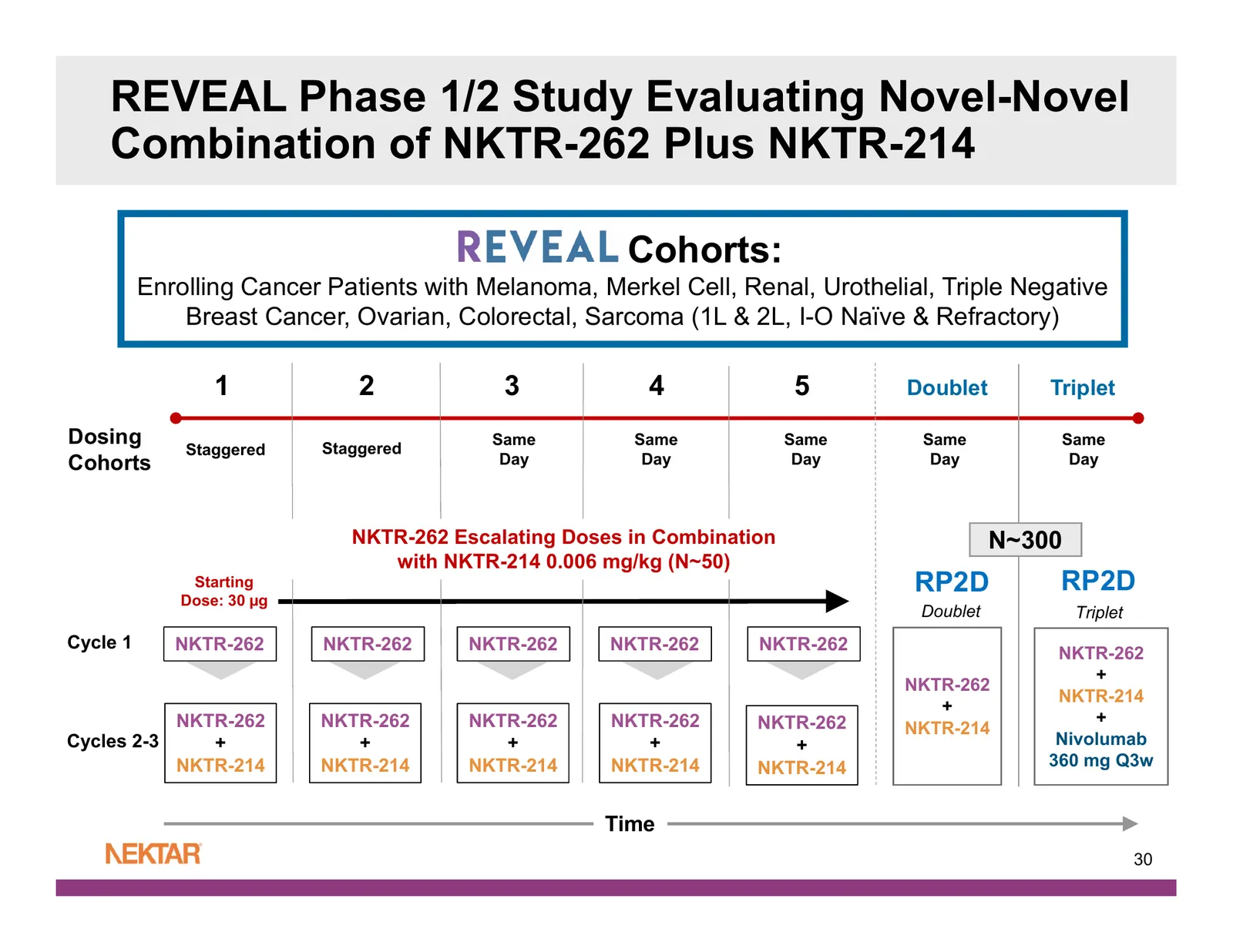
Slide 30: REVEAL Phase 1/2 Study Evaluating Novel-Novel Combination of NKTR-262 Plus NKTR-214
REVEAL Phase 1/2 Study Evaluating Novel-Novel Combination of NKTR-262 Plus NKTR-214 Cohorts: Enrolling Cancer Patients with Melanoma, Merkel Cell, Renal, Urothelial, Triple Negative Breast Cancer, Ovarian, Colorectal, Sarcoma (1L & 2L, I-O Naïve & Refractory) 1 2 3 4 5 Doublet Triplet Dosing Stagger
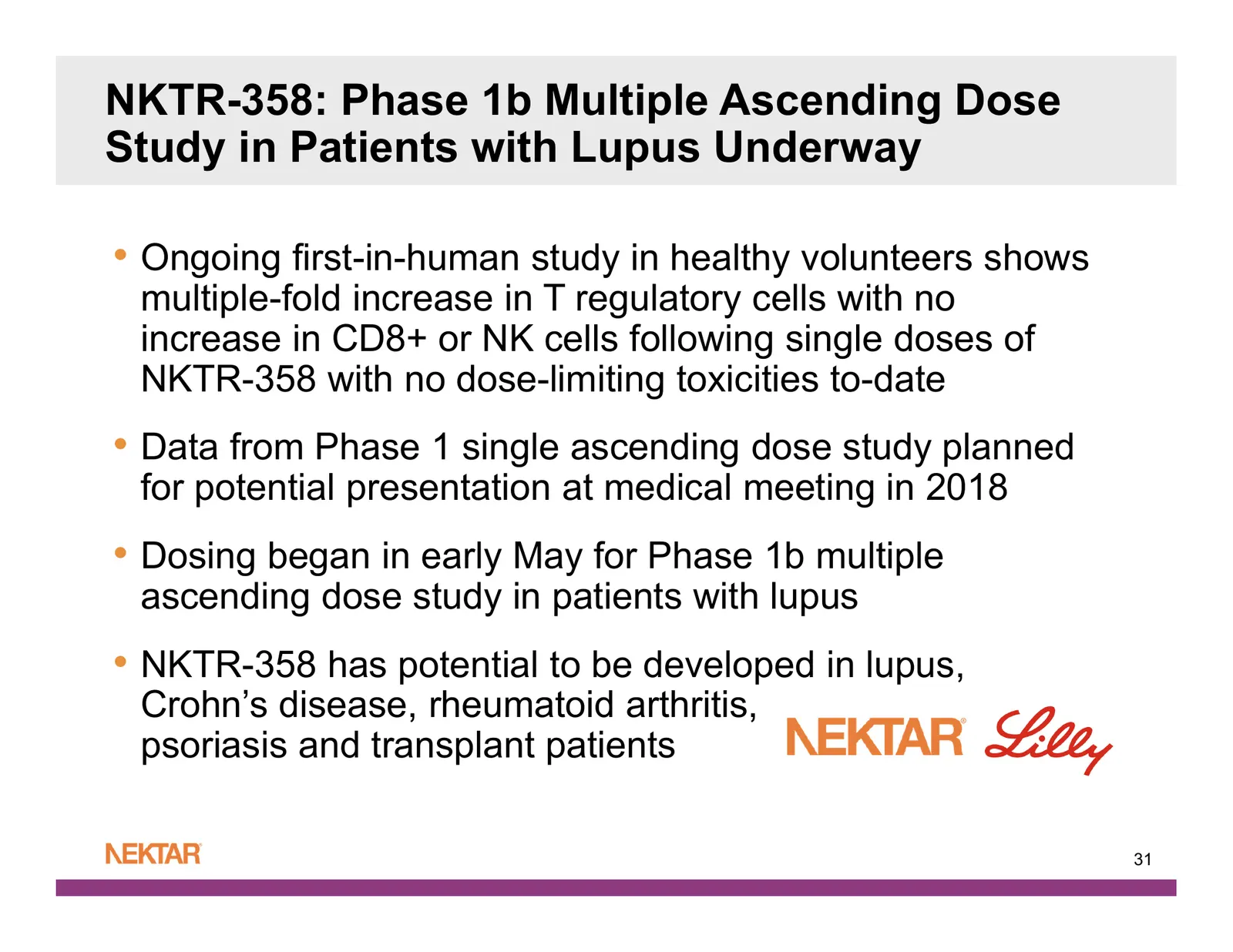
Slide 31: NKTR-358: Phase 1b Multiple Ascending Dose Study in Patients with Lupus Underway
NKTR-358: Phase 1b Multiple Ascending Dose Study in Patients with Lupus Underway • Ongoing first-in-human study in healthy volunteers shows multiple-fold increase in T regulatory cells with no increase in CD8+ or NK cells following single doses of NKTR-358 with no dose-limiting toxicities to-date •

Slide 32: Jefferies 2018 Healthcare Conference
Jefferies 2018 Healthcare Conference z June 6, 2018
Source: Internet Archive copy of nektar.com
More decks from Nektar Therapeutics
 EADV Analyst and Investor Event 202638 slides · Oct 1, 2026
 Investor Presentation (September 2026)70 slides · September 2026
 Investor Presentation (April 2026)36 slides · Apr 20, 2026
 Technical Presentation (February 2026)37 slides · Feb 10, 2026
 Technical Presentation (December 2025)38 slides · Dec 16, 2025
 ACAAI Annual Scientific Meeting 202515 slides · Nov 8, 2025