Saniona AB · OMXSTO:SANION
Saniona AB — Investor Presentation (June 2020)
26 slides from Saniona AB's investor presentation, June 2020
Slide 1: Pioneering Ion Channel Development For The Treatment of Rare Diseases
Saniona Pioneering Ion Channel Development For The Treatment of Rare Diseases Corporate presentation, June 2020 1|
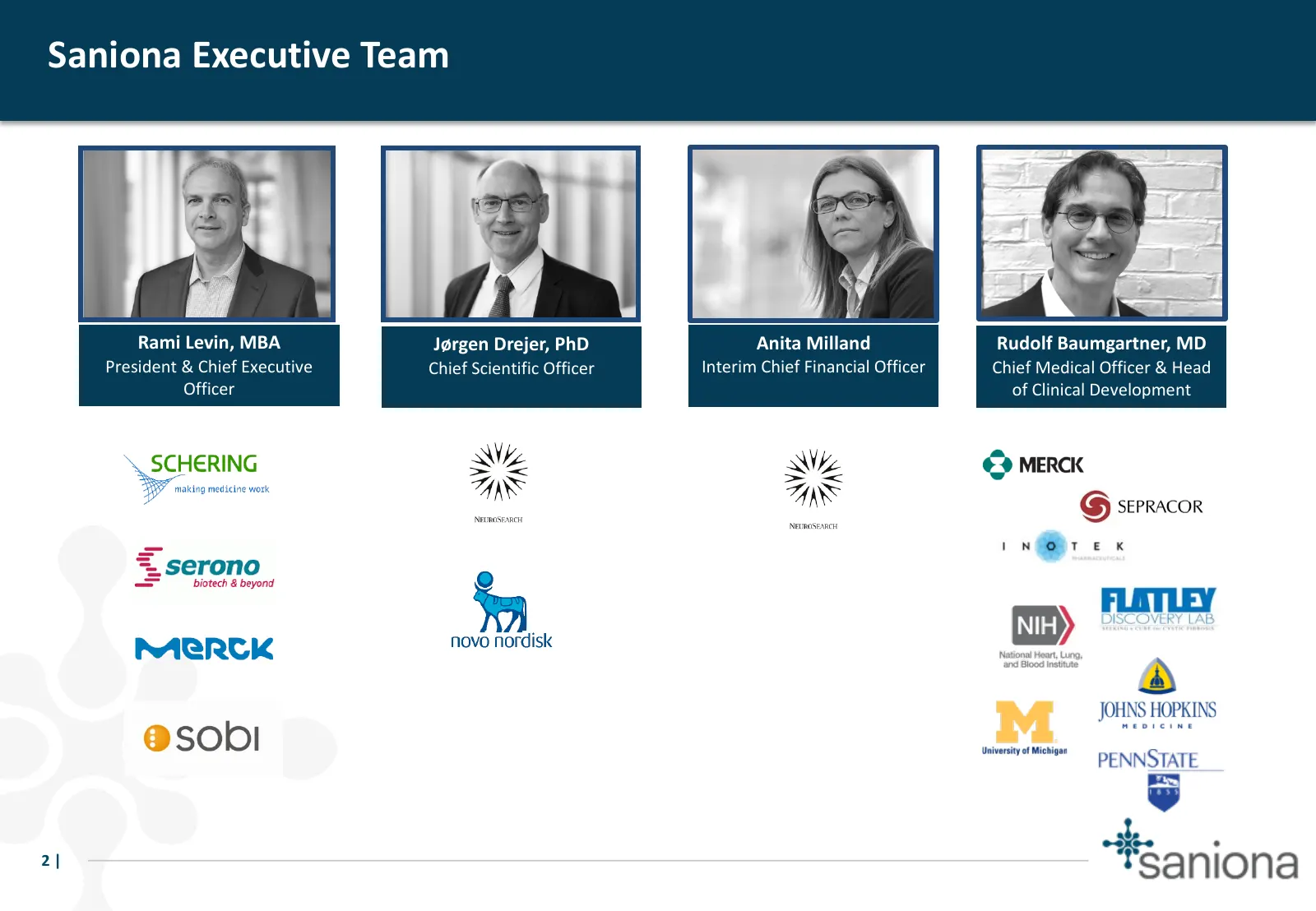
Slide 2: Saniona Executive Team
Saniona Executive Team Rami Levin, MBA Jørgen Drejer, PhD Anita Milland Rudolf Baumgartner, MD President & Chief Executive Chief Scientific Officer Interim Chief Financial Officer Chief Medical Officer & Head Officer of Clinical Development 2|
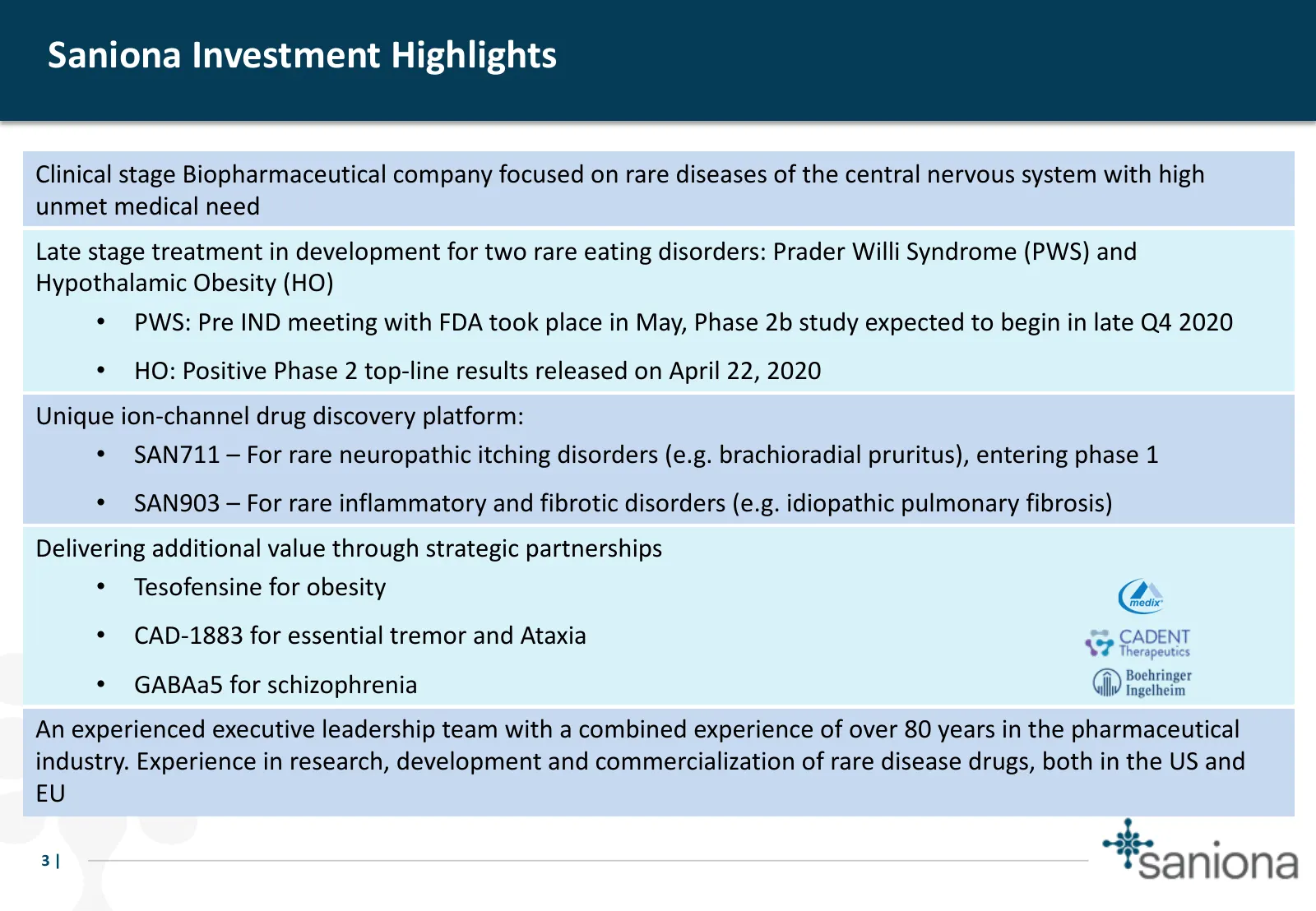
Slide 3: Saniona Investment Highlights
Saniona Investment Highlights Clinical stage Biopharmaceutical company focused on rare diseases of the central nervous system with high unmet medical need Late stage treatment in development for two rare eating disorders: Prader Willi Syndrome (PWS) and Hypothalamic Obesity (HO) • PWS: Pre IND meeti

Slide 4: Unique Ion-Channel Drug Discovery Platform
Unique Ion-Channel Drug Discovery Platform 4|
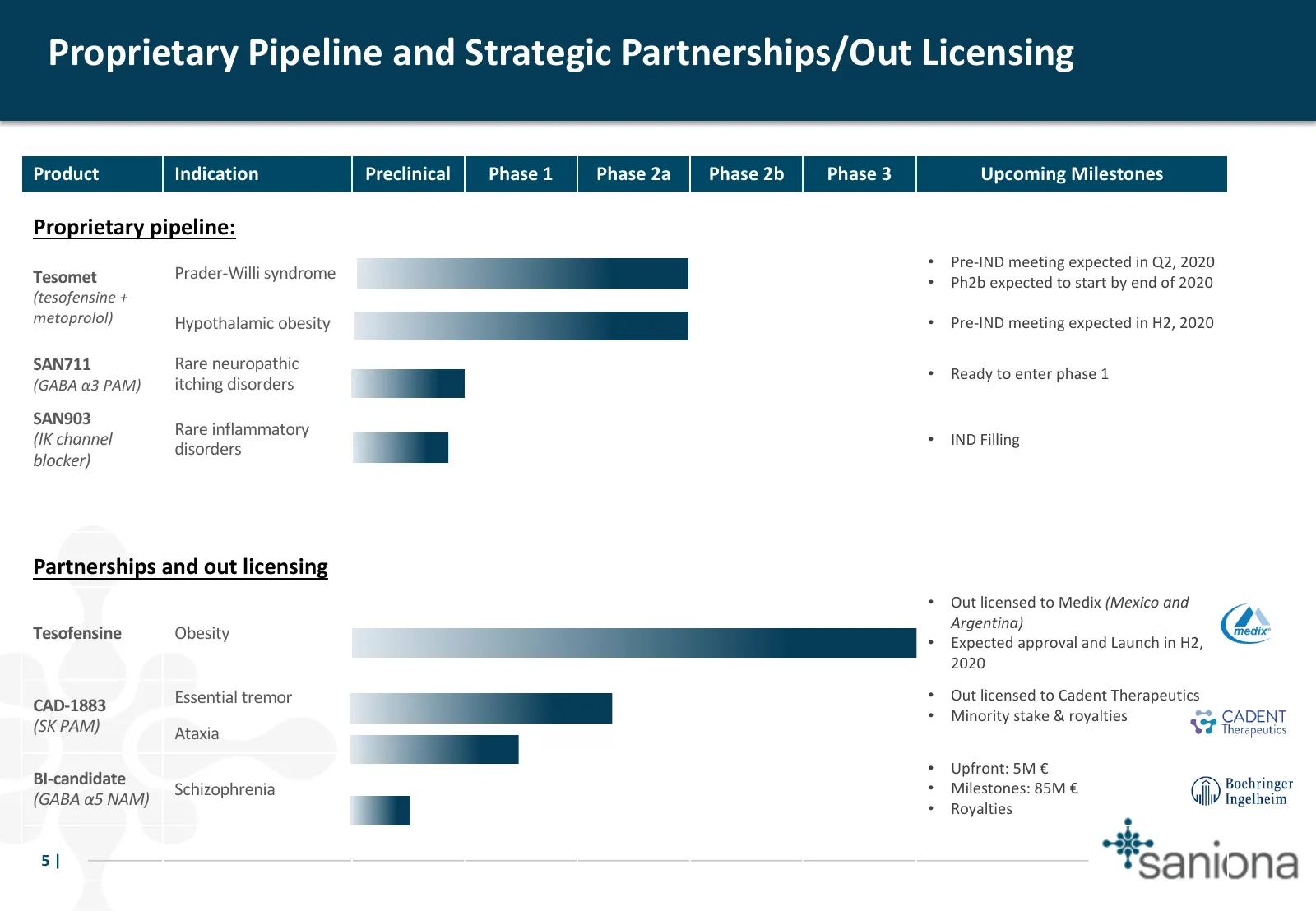
Slide 5: Proprietary Pipeline and Strategic Partnerships/Out Licensing
Proprietary Pipeline and Strategic Partnerships/Out Licensing Product Indication Preclinical Phase 1 Phase 2a Phase 2b Phase 3 Upcoming Milestones Proprietary pipeline: • Pre-IND meeting expected in Q2, 2020 Tesomet Prader-Willi syndrome • Ph2b expected to start by end of 2020 (tesofensine + metopro
Slide 6: Tesomet – a true Triple Monoamine re-uptake Inhibitor Controls Eating
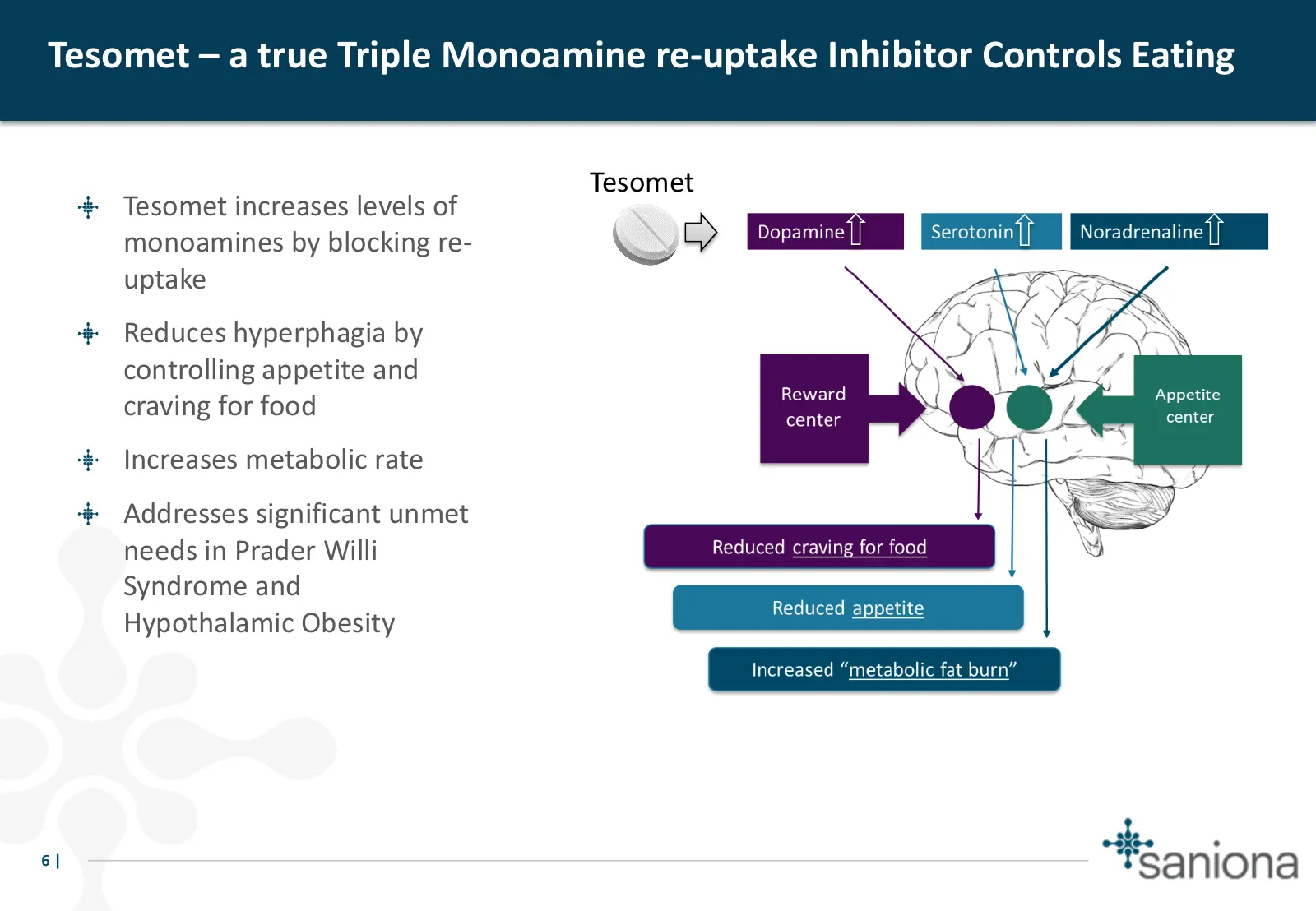
Tesomet – a true Triple Monoamine re-uptake Inhibitor Controls Eating Tesomet Tesomet increases levels of monoamines by blocking re- uptake Reduces hyperphagia by controlling appetite and craving for food Increases metabolic rate Addresses significant unmet needs in Prader Willi Syndrome and Hypotha
Slide 7: Prader-Willi Syndrome (PWS)
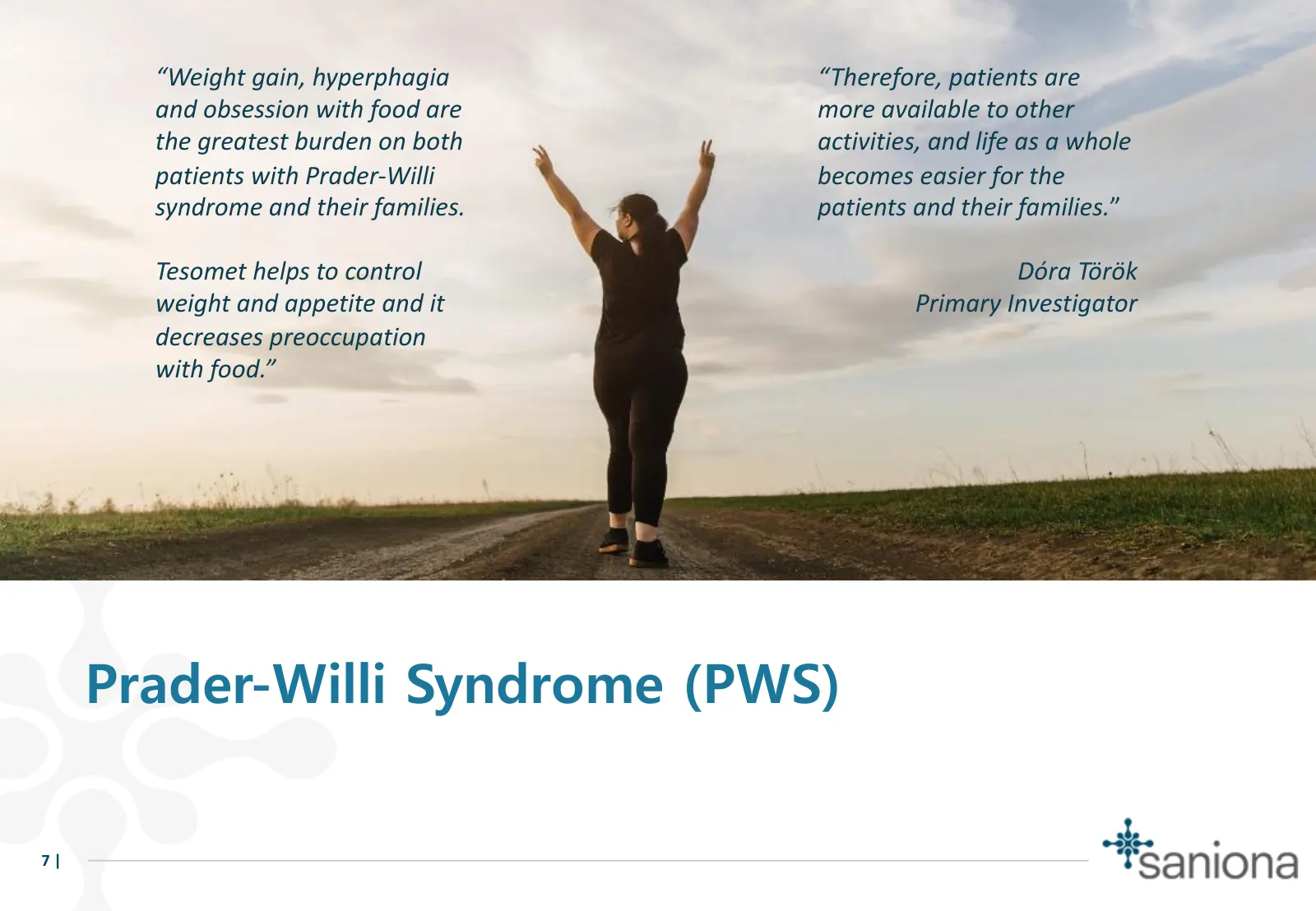
“Weight gain, hyperphagia “Therefore, patients are and obsession with food are more available to other the greatest burden on both activities, and life as a whole patients with Prader-Willi becomes easier for the syndrome and their families. patients and their families.” Tesomet helps to control Dór
Slide 8: Prader-Willi Syndrome, a Debilitating, Rare Genetic Disorder
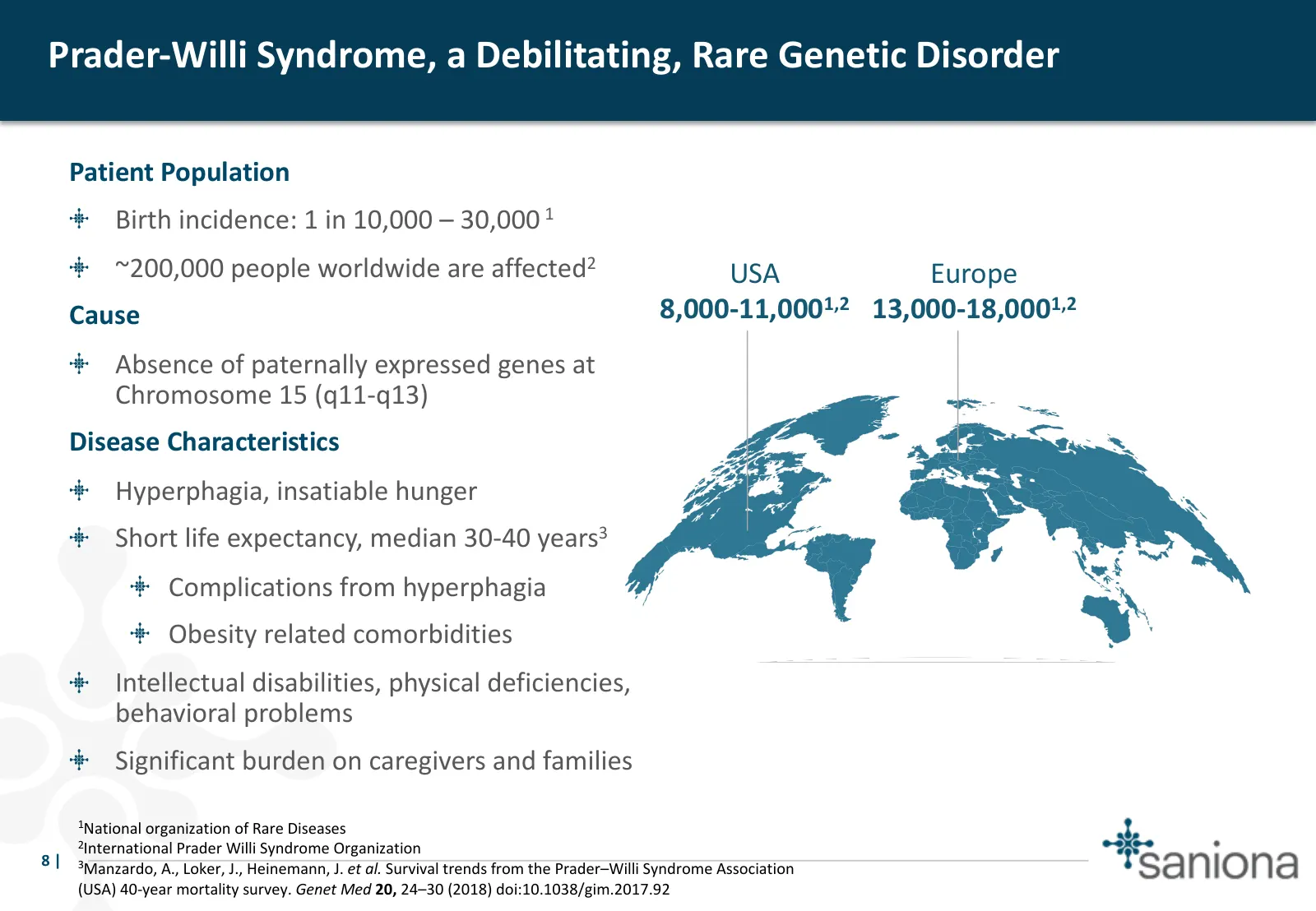
Prader-Willi Syndrome, a Debilitating, Rare Genetic Disorder Patient Population Birth incidence: 1 in 10,000 – 30,000 1 ~200,000 people worldwide are affected2 USA Europe Cause 8,000-11,000 1,2 13,000-18,0001,2 Absence of paternally expressed genes at Chromosome 15 (q11-q13) Disease Characteristics
Slide 9: Tesomet: Phase 2a Study Design in Prader-Willi Syndrome
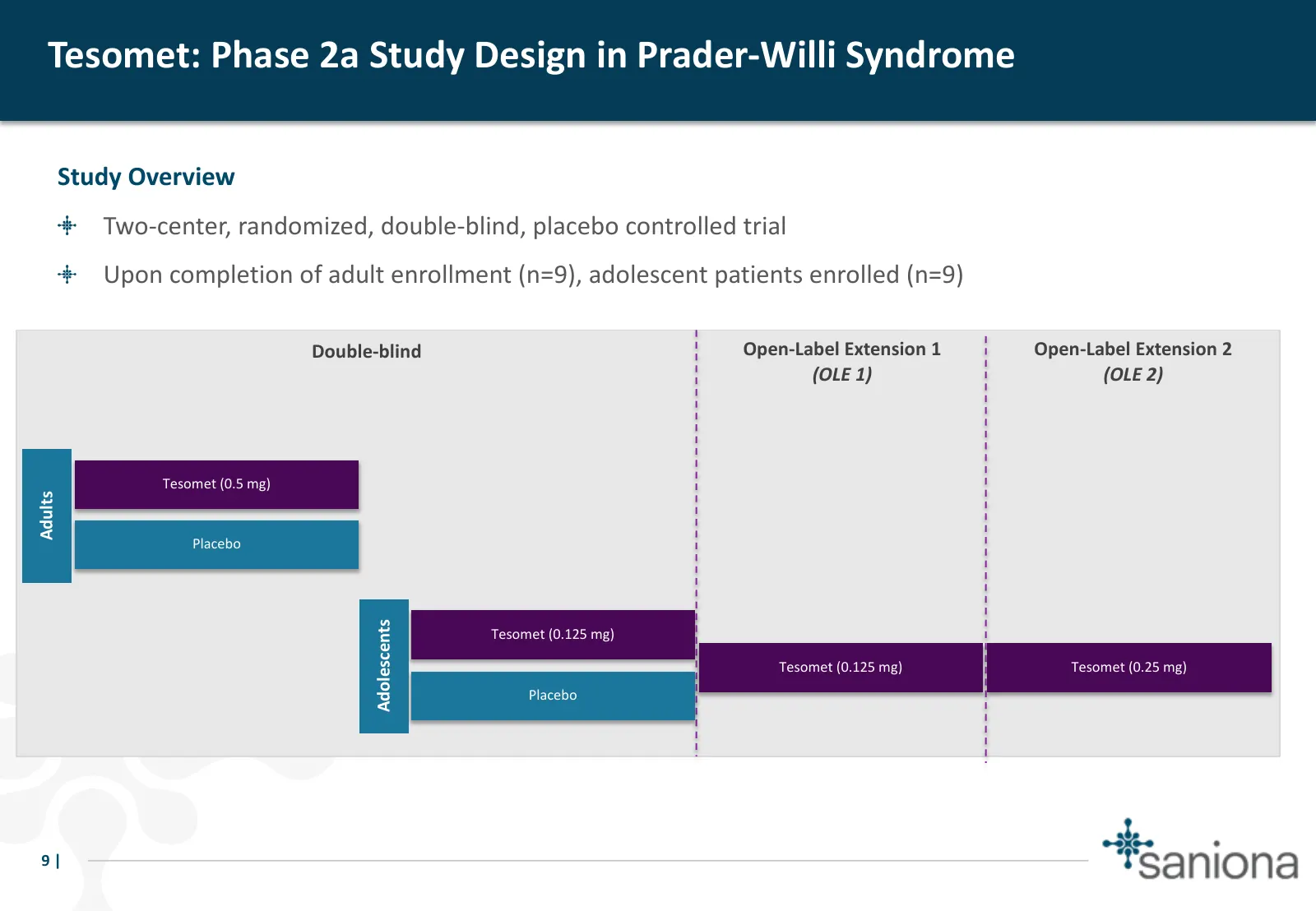
Tesomet: Phase 2a Study Design in Prader-Willi Syndrome Study Overview Two-center, randomized, double-blind, placebo controlled trial Upon completion of adult enrollment (n=9), adolescent patients enrolled (n=9) Double-blind Open-Label Extension 1 Open-Label Extension 2 (OLE 1) (OLE 2) Tesomet (0.5
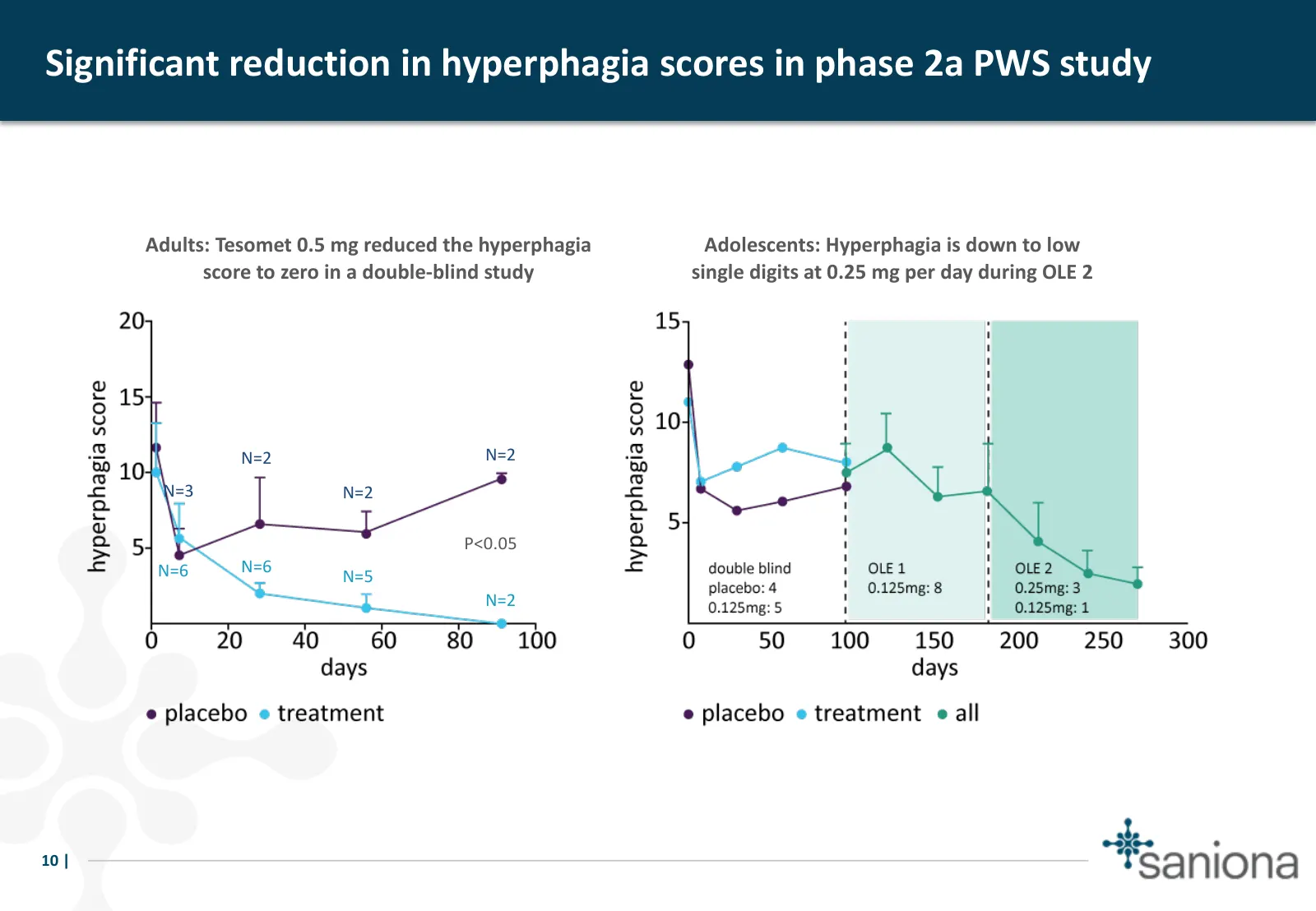
Slide 10: Significant reduction in hyperphagia scores in phase 2a PWS study
Significant reduction in hyperphagia scores in phase 2a PWS study Adults: Tesomet 0.5 mg reduced the hyperphagia Adolescents: Hyperphagia is down to low score to zero in a double-blind study single digits at 0.25 mg per day during OLE 2 N=2 N=2 N=3 N=2 P<0.05 N=6 N=6 N=5 N=2 10 |
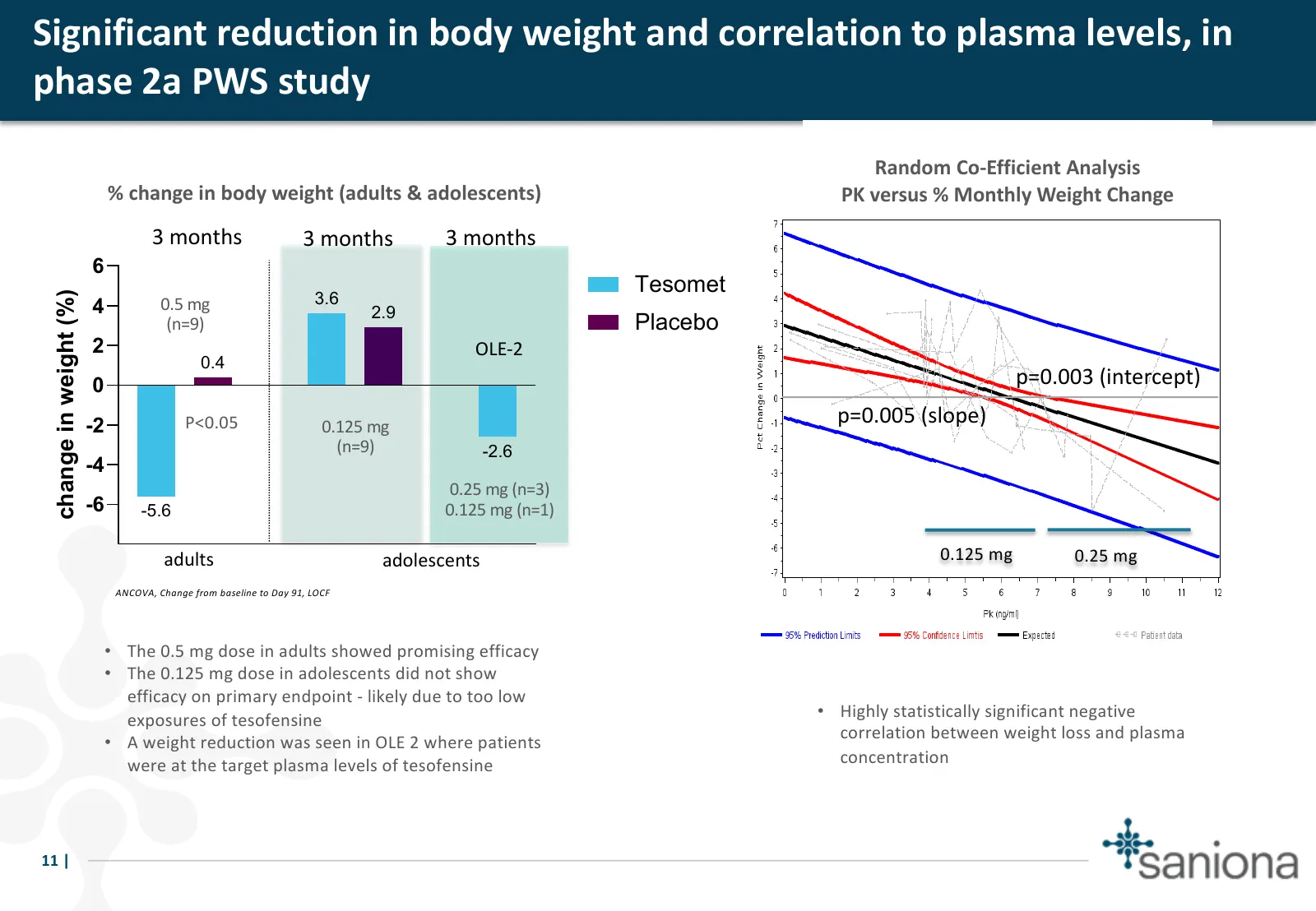
Slide 11: Significant reduction in body weight and correlation to plasma levels
Significant reduction in body weight and correlation to plasma levels, in phase 2a PWS study Random Co-Efficient Analysis % change in body % change weight in body (adults weight (adults & adolescents) & adolescents) PK versus % Monthly Weight Change 3 months 3 months 3 months 6 Tesomet 3.6 change in
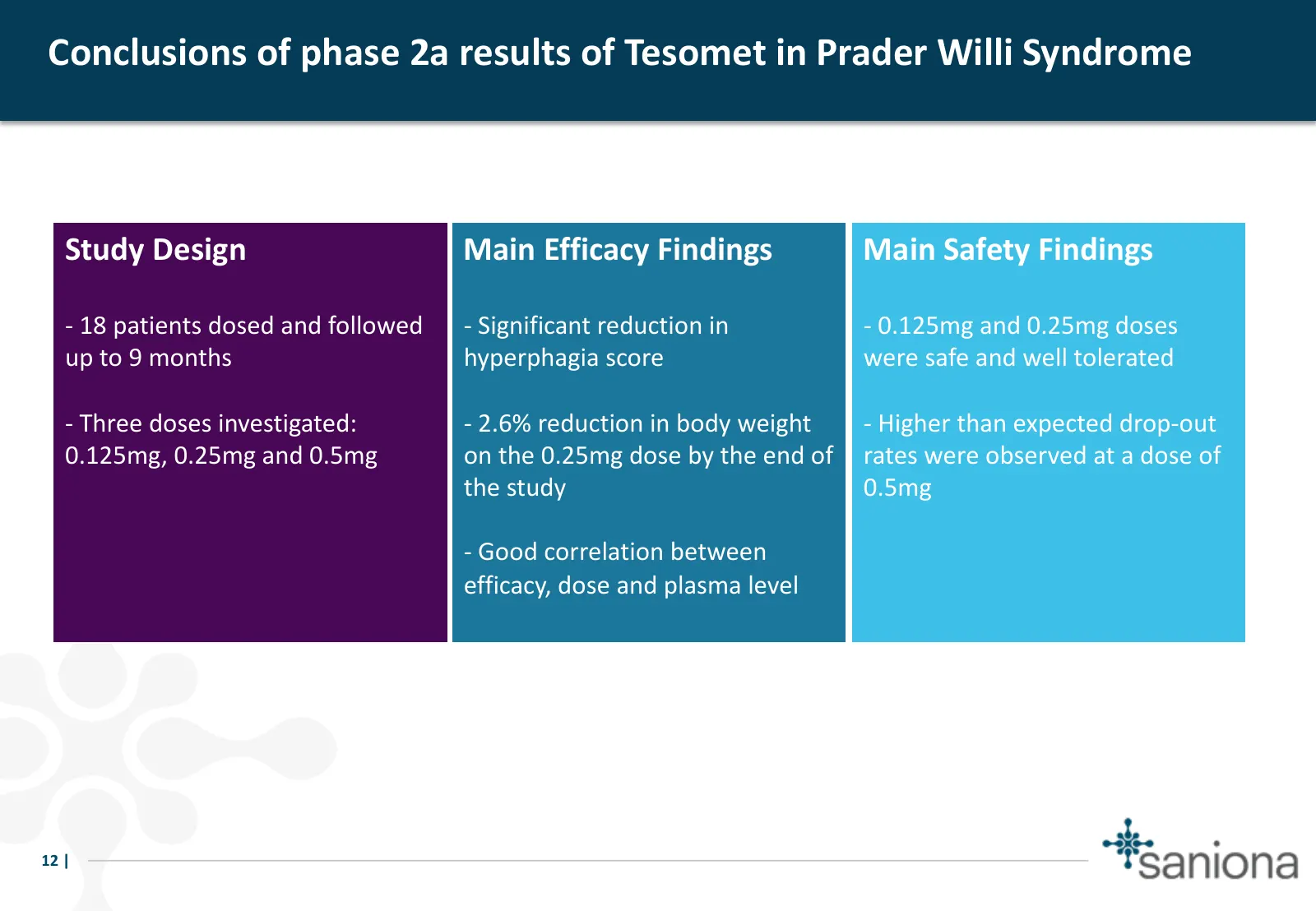
Slide 12: Conclusions of phase 2a results of Tesomet in Prader Willi Syndrome
Conclusions of phase 2a results of Tesomet in Prader Willi Syndrome Study Design Main Efficacy Findings Main Safety Findings - 18 patients dosed and followed - Significant reduction in - 0.125mg and 0.25mg doses up to 9 months hyperphagia score were safe and well tolerated - Three doses investigated
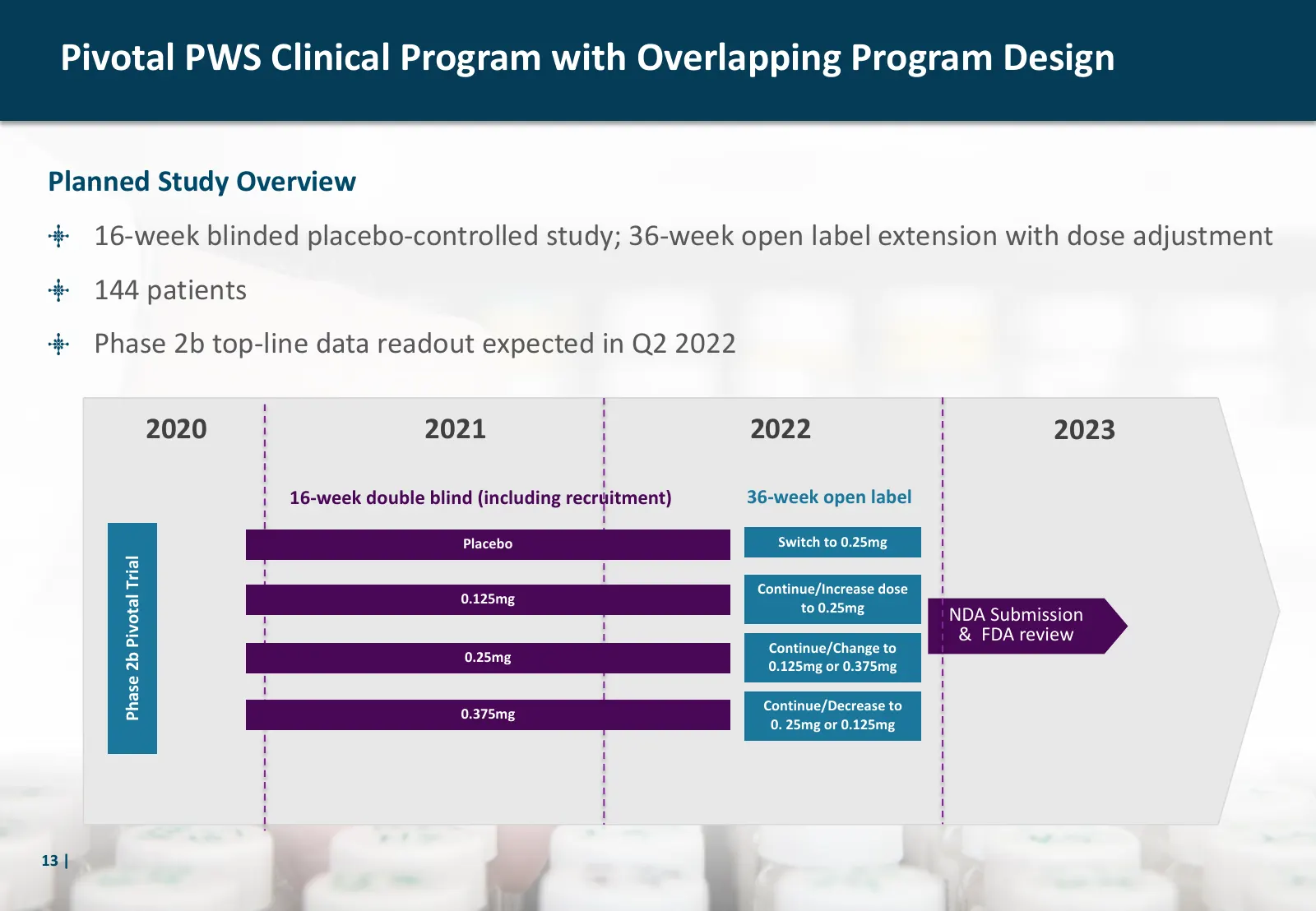
Slide 13: Pivotal PWS Clinical Program with Overlapping Program Design
Pivotal PWS Clinical Program with Overlapping Program Design Planned Study Overview 16-week blinded placebo-controlled study; 36-week open label extension with dose adjustment 144 patients Phase 2b top-line data readout expected in Q2 2022 2020 2021 2022 2023 16-week double blind (including recruitm
Slide 14: Competitive Landscape: PWS Clinical Trials Targeting Hyperphagia
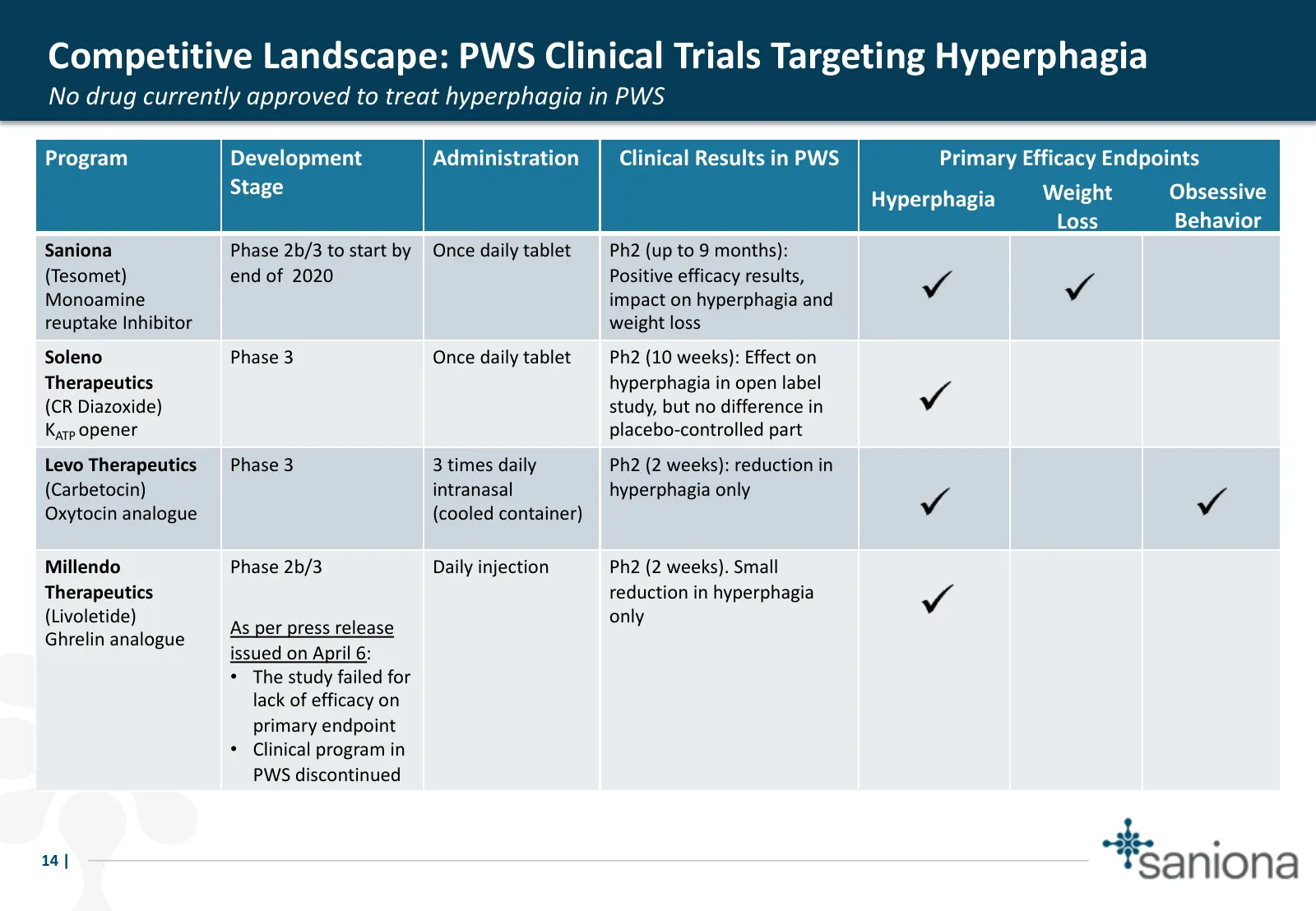
Competitive Landscape: PWS Clinical Trials Targeting Hyperphagia No drug currently approved to treat hyperphagia in PWS Program Development Administration Clinical Results in PWS Primary Efficacy Endpoints Stage Weight Obsessive Hyperphagia Loss Behavior Saniona Phase 2b/3 to start by Once daily tab

Slide 15: Hypothalamic Obesity (HO)
Hypothalamic Obesity (HO) 15 |
Slide 16: Hypothalamic Obesity, an Acquired Eating Disorder
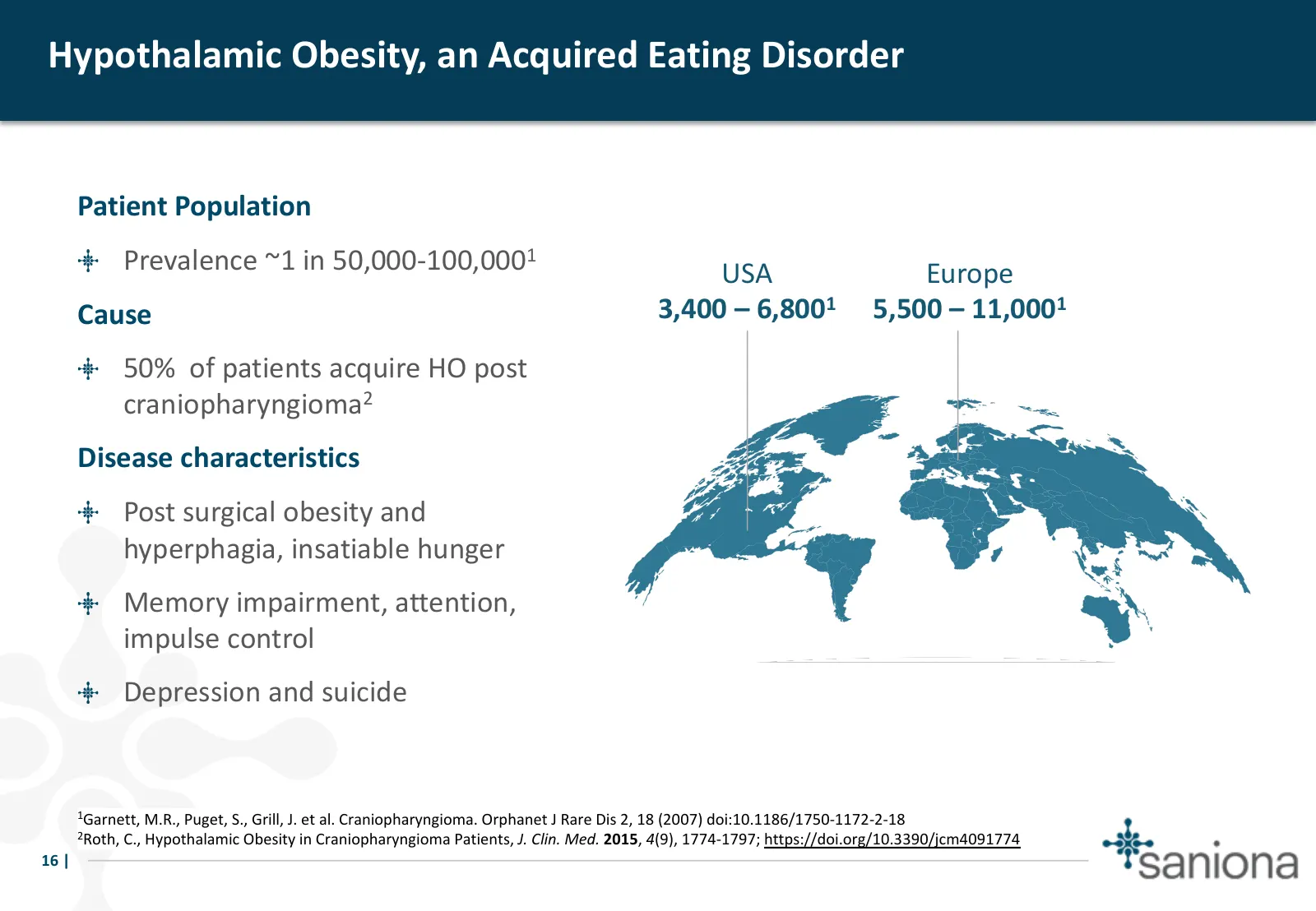
Hypothalamic Obesity, an Acquired Eating Disorder Patient Population Prevalence ~1 in 50,000-100,0001 USA Europe Cause 3,400 – 6,8001 5,500 – 11,0001 50% of patients acquire HO post craniopharyngioma2 Disease characteristics Post surgical obesity and hyperphagia, insatiable hunger Memory impairment,
Slide 17: Tesomet: Phase 2 Study in Hypothalamic Obesity
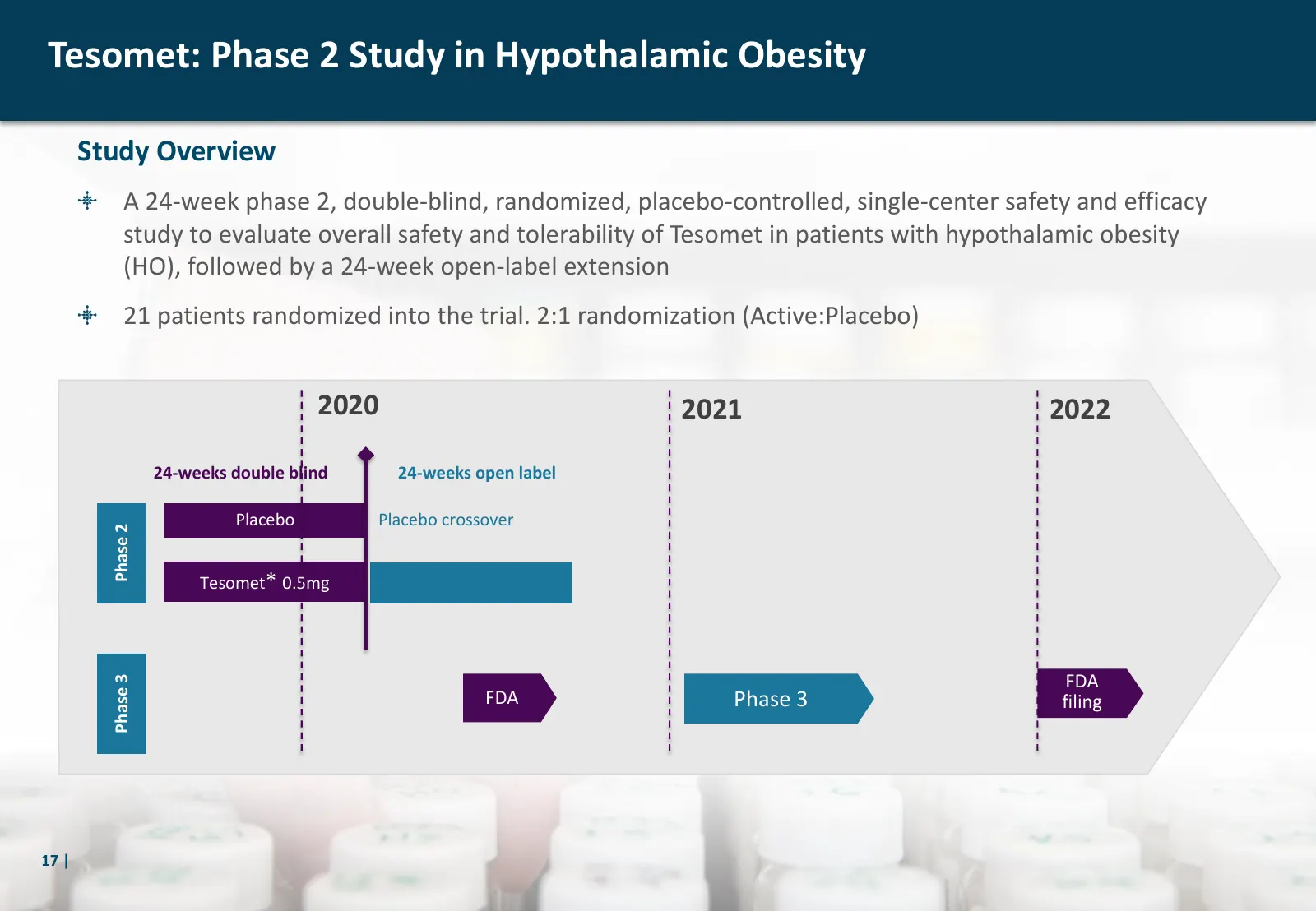
Tesomet: Phase 2 Study in Hypothalamic Obesity Study Overview A 24-week phase 2, double-blind, randomized, placebo-controlled, single-center safety and efficacy study to evaluate overall safety and tolerability of Tesomet in patients with hypothalamic obesity (HO), followed by a 24-week open-label e
Slide 18: Primary and Secondary Endpoints
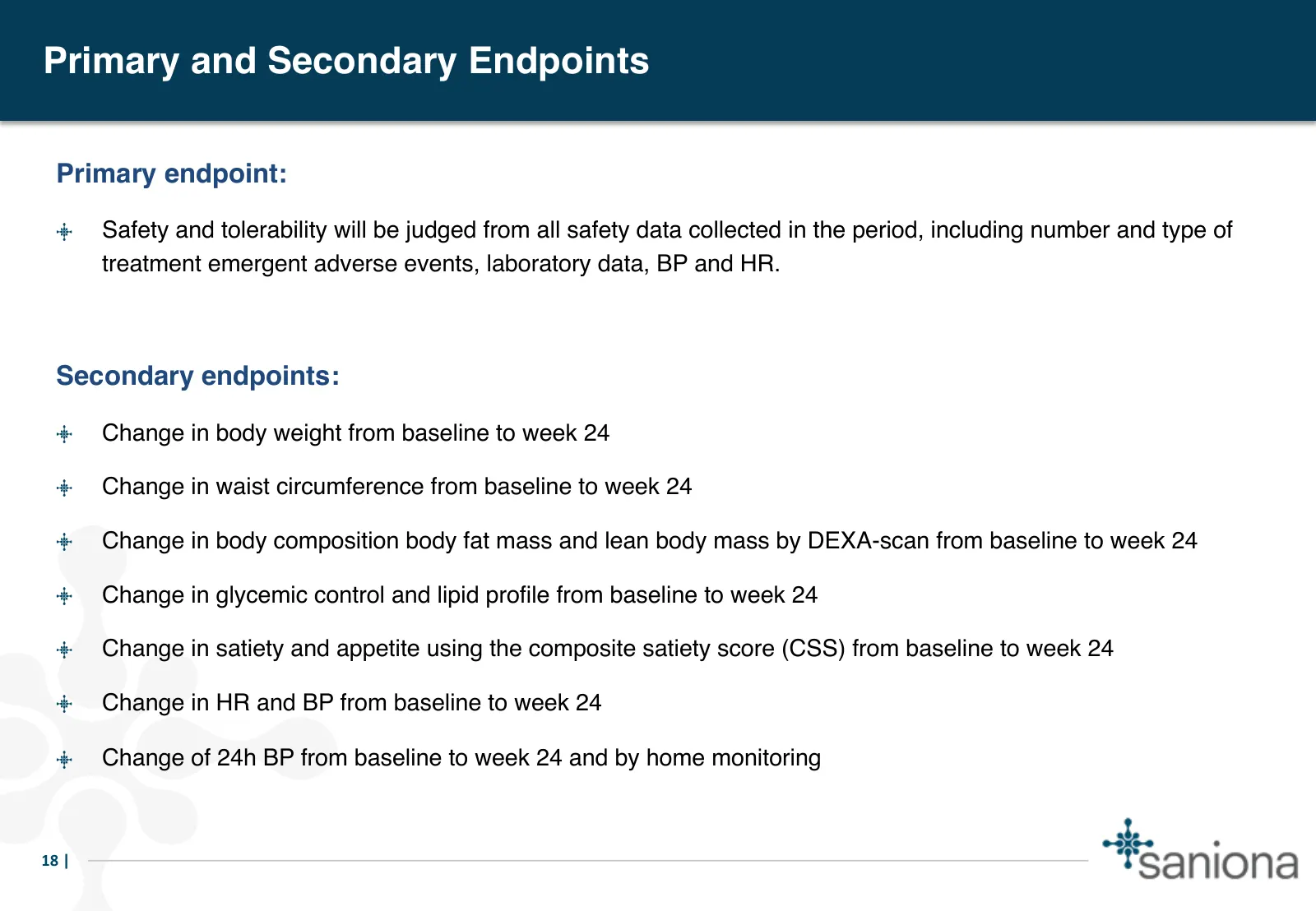
Primary and Secondary Endpoints Primary endpoint: Safety and tolerability will be judged from all safety data collected in the period, including number and type of treatment emergent adverse events, laboratory data, BP and HR. Secondary endpoints: Change in body weight from baseline to week 24 Chang
Slide 19: Subject disposition
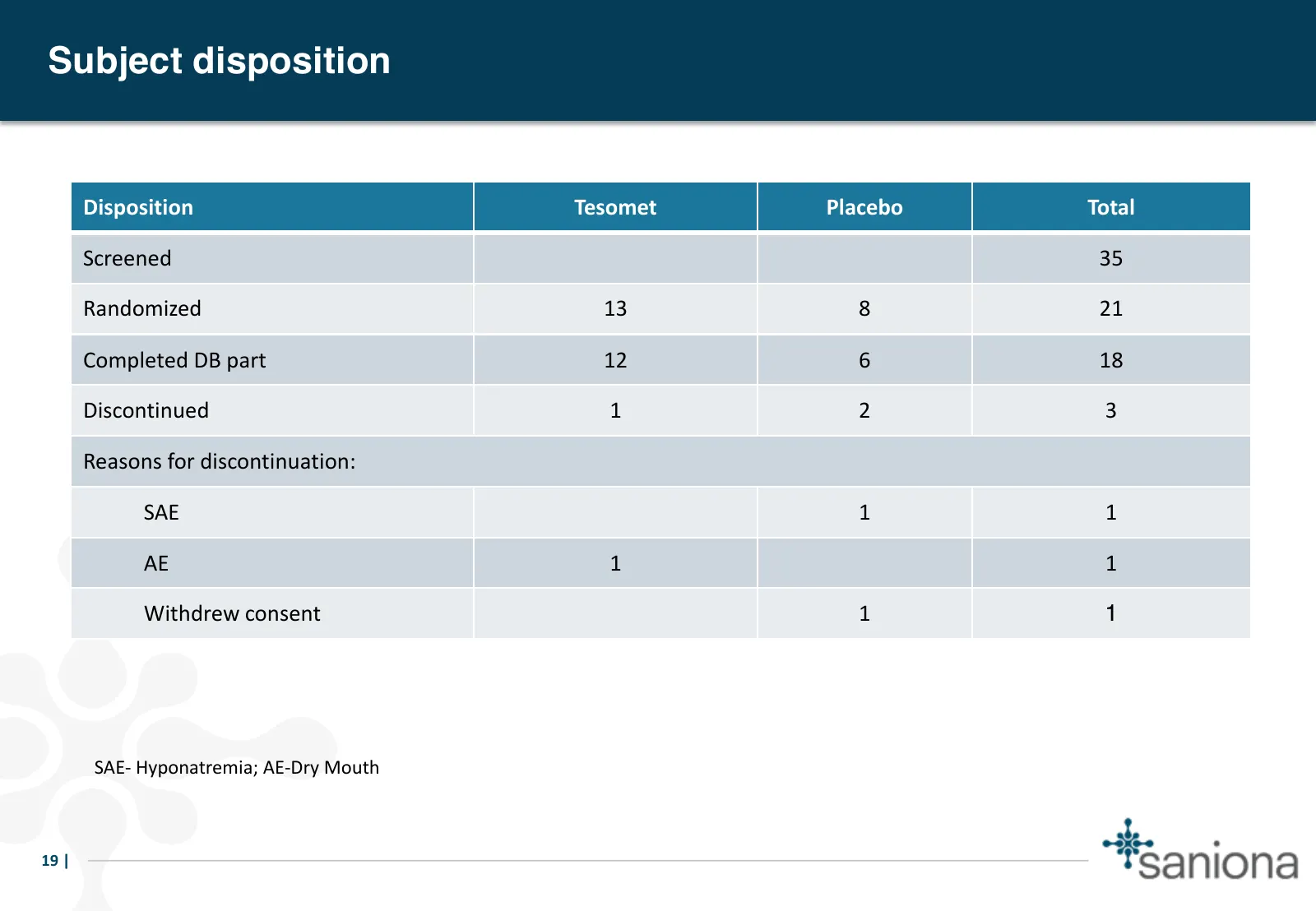
Subject disposition Disposition Tesomet Placebo Total Screened 35 Randomized 13 8 21 Completed DB part 12 6 18 Discontinued 1 2 3 Reasons for discontinuation: SAE 1 1 AE 1 1 Withdrew consent 1 1 SAE- Hyponatremia; AE-Dry Mouth 19 |
Slide 20: Safety and Tolerability
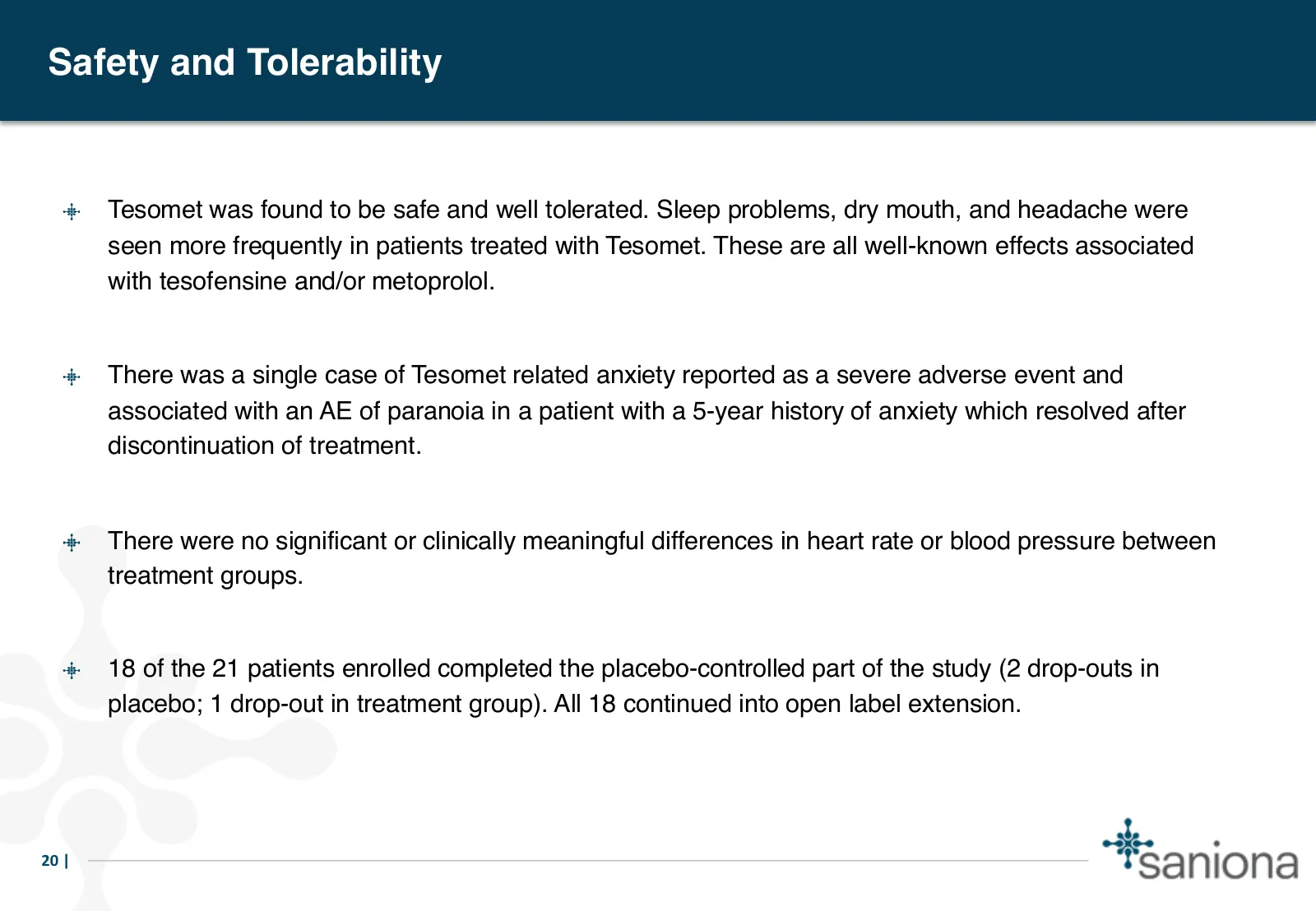
Safety and Tolerability Tesomet was found to be safe and well tolerated. Sleep problems, dry mouth, and headache were seen more frequently in patients treated with Tesomet. These are all well-known effects associated with tesofensine and/or metoprolol. There was a single case of Tesomet related anxi
Slide 21: Change in Weight From Baseline to Week 24
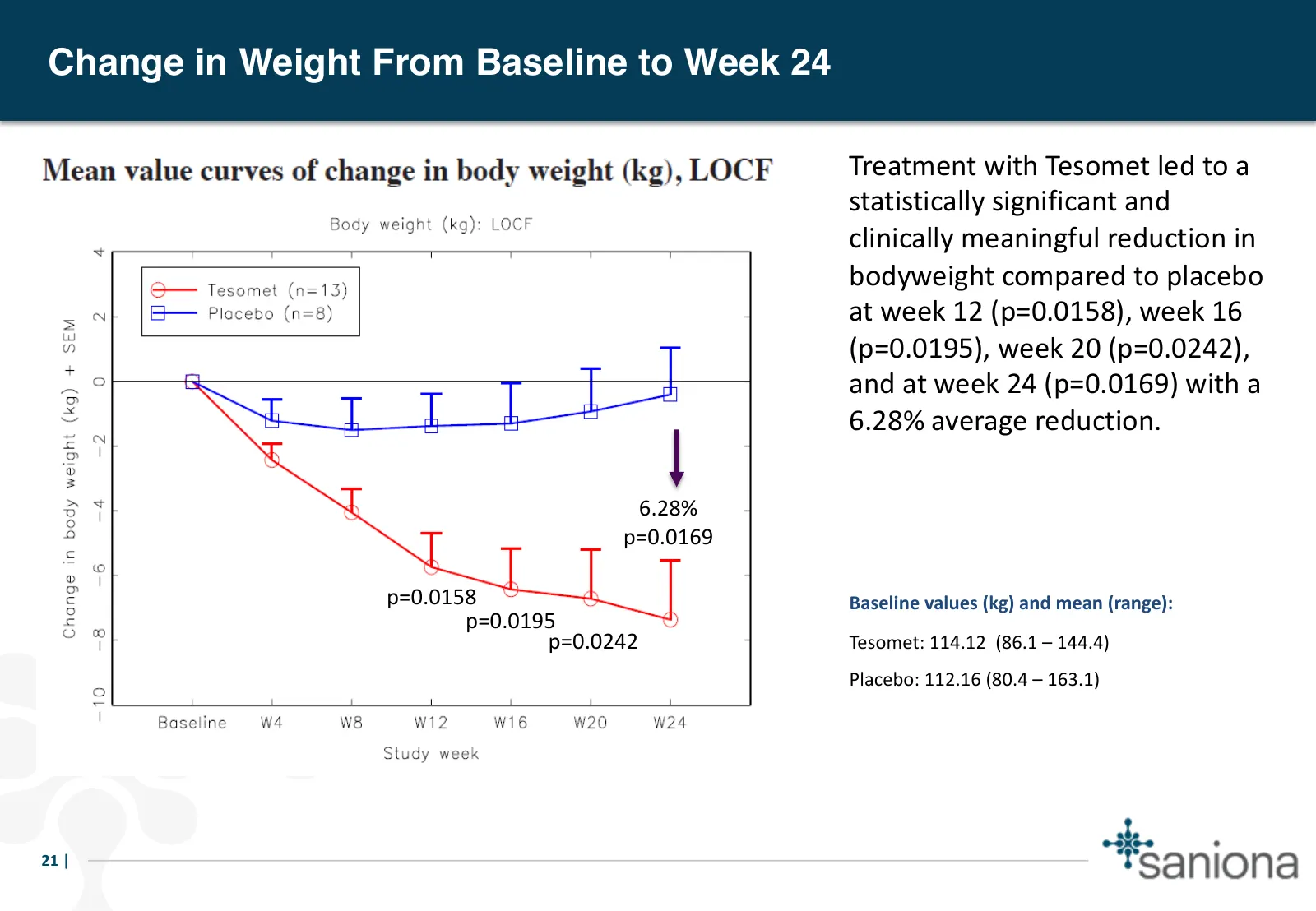
Change in Weight From Baseline to Week 24 Treatment with Tesomet led to a statistically significant and clinically meaningful reduction in bodyweight compared to placebo at week 12 (p=0.0158), week 16 (p=0.0195), week 20 (p=0.0242), and at week 24 (p=0.0169) with a 6.28% average reduction. 6.28% p=0
Slide 22: Proportion of Patients with >5% and >10% weight loss at week 24
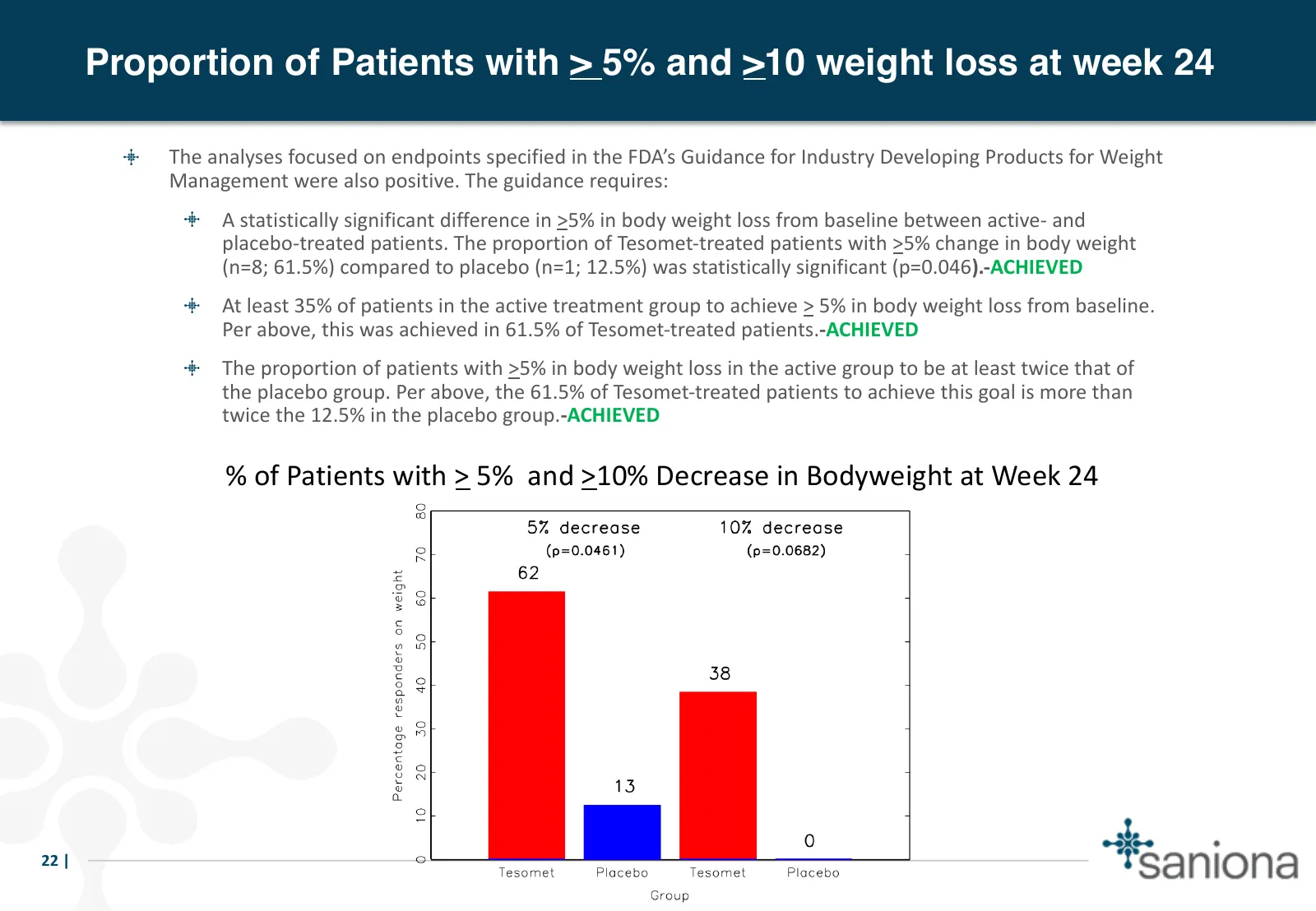
Proportion of Patients with > 5% and >10 weight loss at week 24 The analyses focused on endpoints specified in the FDA’s Guidance for Industry Developing Products for Weight Management were also positive. The guidance requires: A statistically significant difference in >5% in body weight loss from b
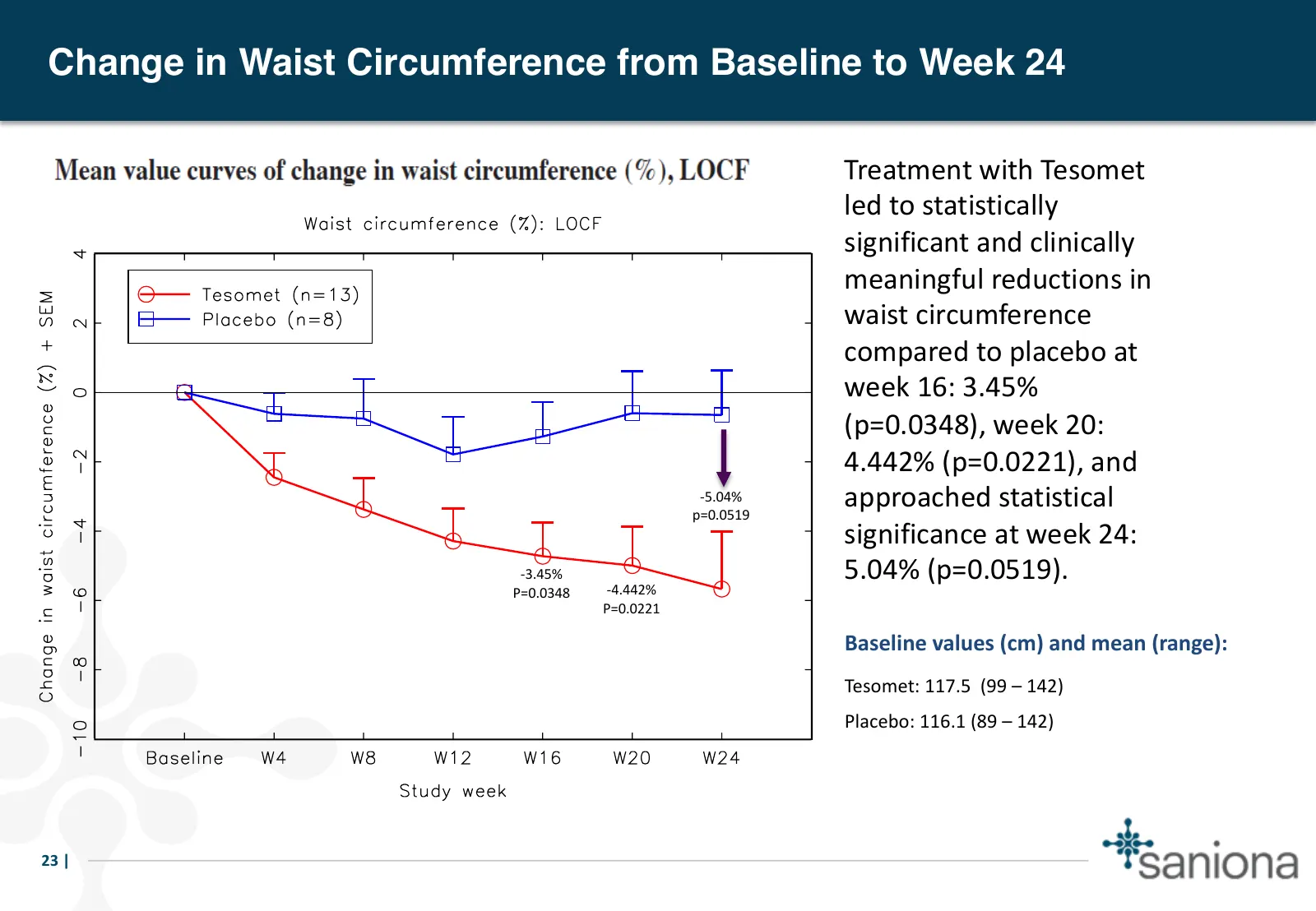
Slide 23: Change in Waist Circumference from Baseline to Week 24
Week 20 Tesomet -5.43 Tesomet vs Placebo -4.68 (-9.07, -0.29) 0.0382 Placebo -0.75 Change Week 24 in Waist-6.16Circumference Tesomet Tesomet vs Placebo -5.32from (-11.43,Baseline 0.80) 0.0837 to Week 24 Placebo -0.84 ANCOVA model with treatment as factor and baseline as covariate Treatment with Teso
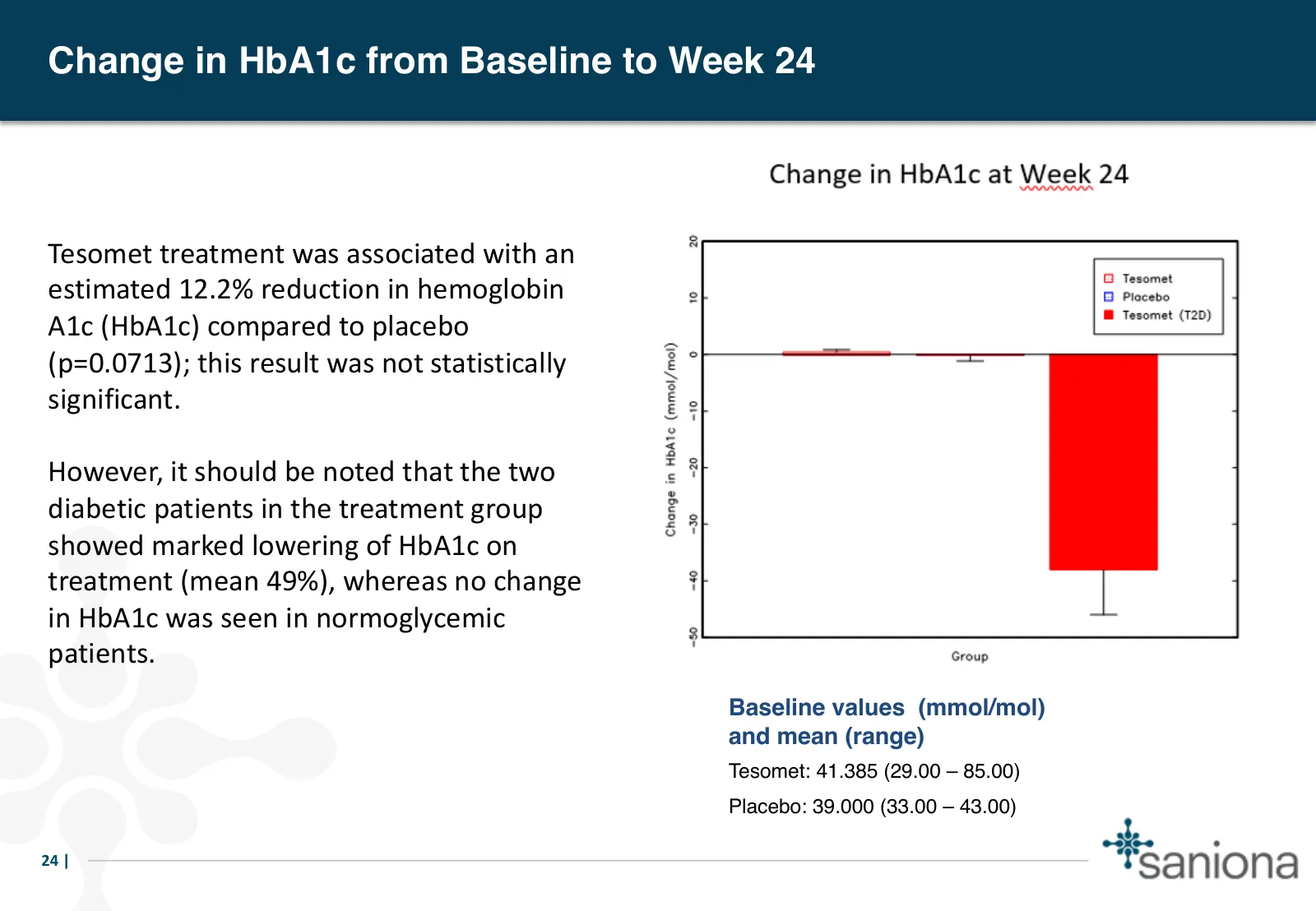
Slide 24: Change in HbA1c from Baseline to Week 24
Change in HbA1c from Baseline to Week 24 Tesomet treatment was associated with an estimated 12.2% reduction in hemoglobin A1c (HbA1c) compared to placebo (p=0.0713); this result was not statistically significant. However, it should be noted that the two diabetic patients in the treatment group showe
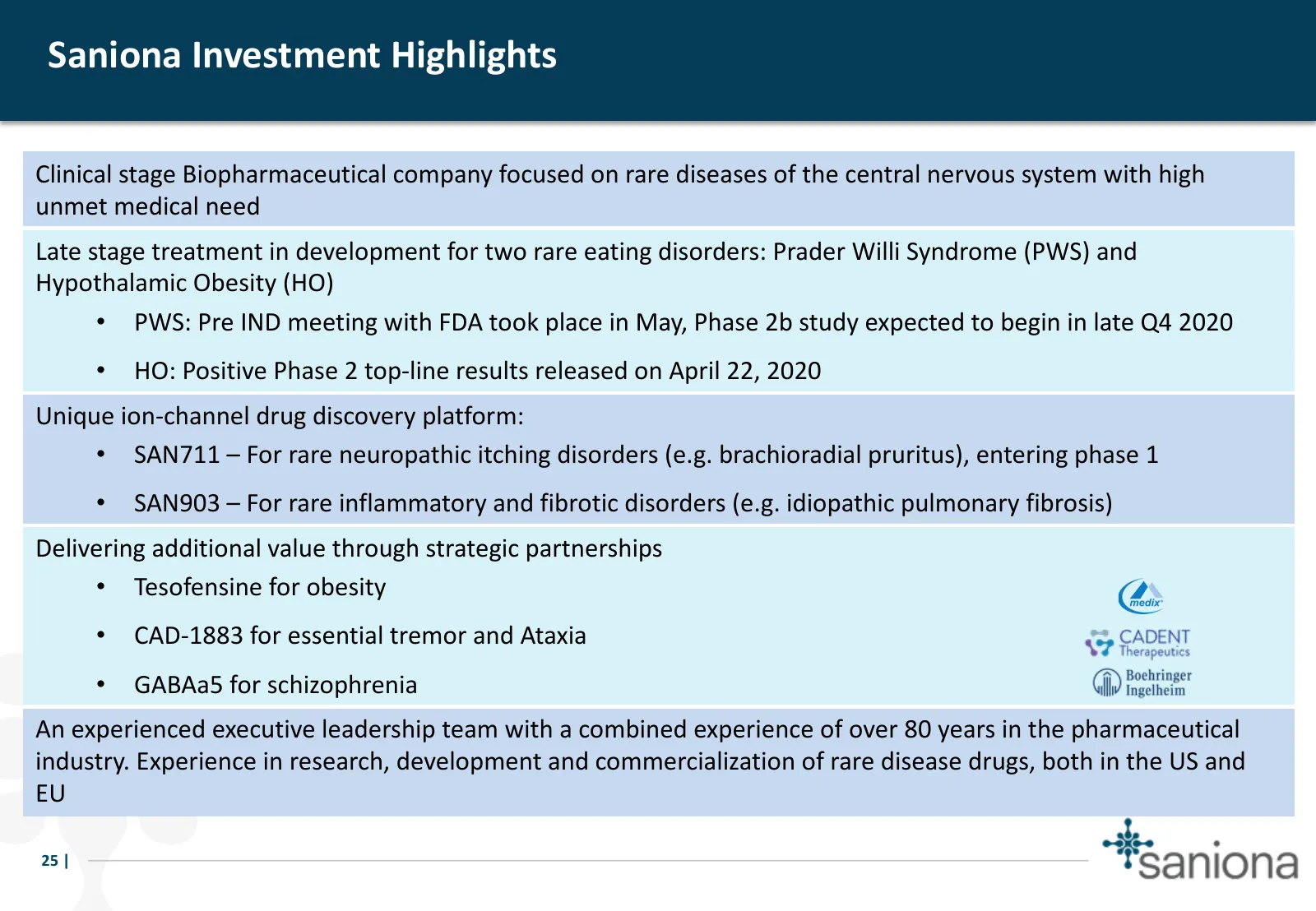
Slide 25: Saniona Investment Highlights
Saniona Investment Highlights Clinical stage Biopharmaceutical company focused on rare diseases of the central nervous system with high unmet medical need Late stage treatment in development for two rare eating disorders: Prader Willi Syndrome (PWS) and Hypothalamic Obesity (HO) • PWS: Pre IND meeti

Slide 26: Saniona
s “¥Saniona
Source: Internet Archive copy of saniona.com
More decks from Saniona AB
 Investor Presentation (October 2026)32 slides · October 2026
 Investor Presentation (September 2026)29 slides · September 2026
 Technical Presentation (June 2026)39 slides · Jun 17, 2026
 Investor Presentation (May 2026)65 slides · May 2026
 Investor Presentation (March 2026)63 slides · March 2026
 Investor Presentation (January 2026)29 slides · January 2026