National Grid plc · LSE:NG.
National Grid — National Grid Electricity Transmission — Investor Presentation (October 2018)
73 slides from National Grid's investor presentation, Oct 23, 2018
Slide 1: National Grid Electricity Transmission Resilience Stakeholder Workshop
National Grid Electricity Transmission Resilience Stakeholder Workshop 23 October 2018
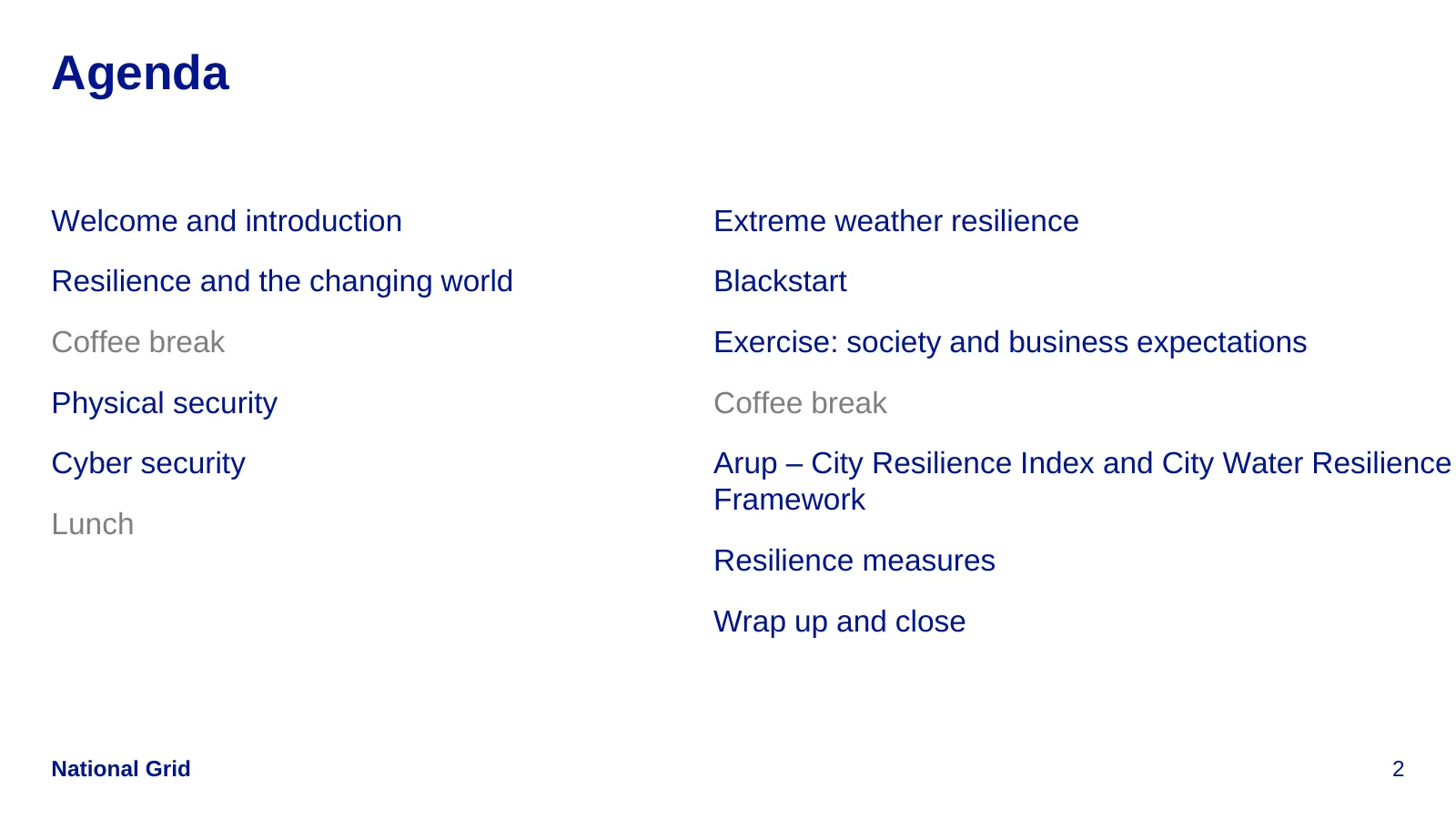
Slide 2: Agenda
Agenda Welcome and introduction Extreme weather resilience Resilience and the changing world Blackstart Coffee break Exercise: society and business expectations Physical security Coffee break Cyber security Arup – City Resilience Index and City Water Resilience Framework Lunch Resilience measures Wr
Slide 3: Introduction to National Grid
Introduction to National Grid
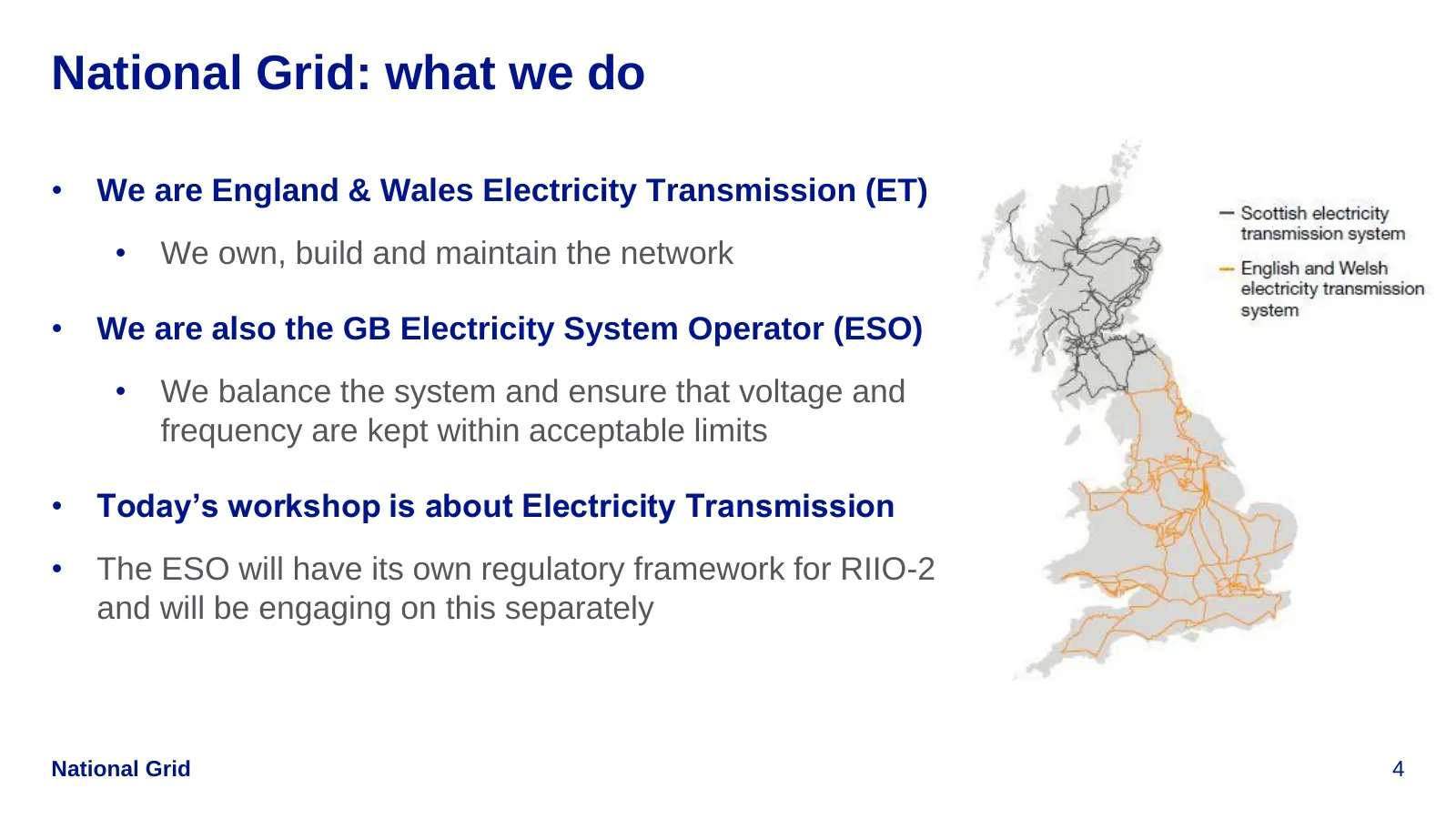
Slide 4: National Grid: what we do
National Grid: what we do • We are England & Wales Electricity Transmission (ET) • We own, build and maintain the network • We are also the GB Electricity System Operator (ESO) • We balance the system and ensure that voltage and frequency are kept within acceptable limits • Today’s workshop is about
Slide 5: Some context about today
Some context about today • Today is part of a wider programme of stakeholder engagement to help us build our business plans for RIIO-2 (and this will become our business-as-usual) • Based on what we’ve heard so far, we’ve split our plans into eight areas for engagement: • The environment • The futur
Slide 6: Our stakeholder-led approach for RIIO-2
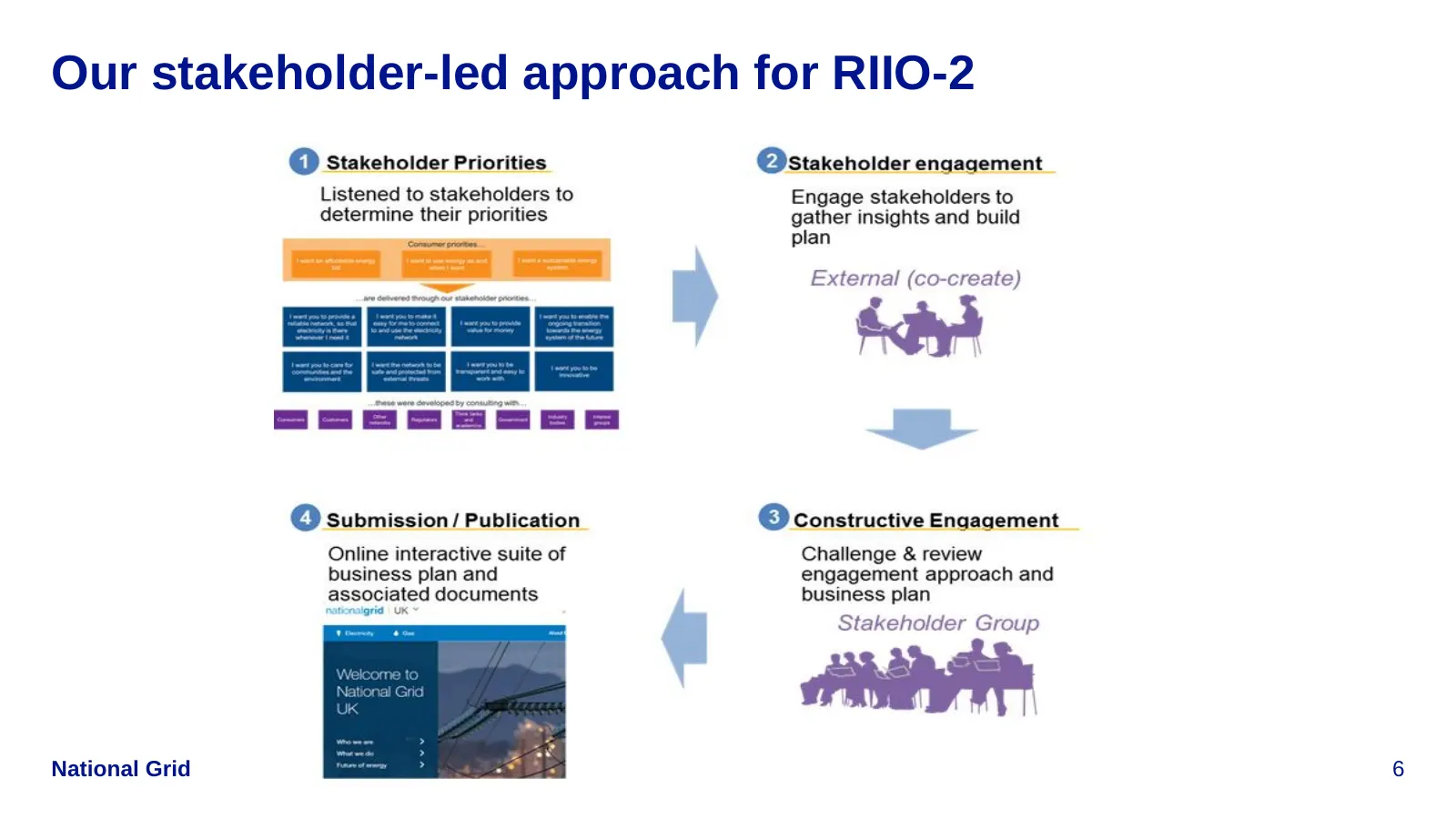
Our stakeholder-led approach for RIIO-2 National Grid 6
Slide 7: Current RIIO-T1 outputs
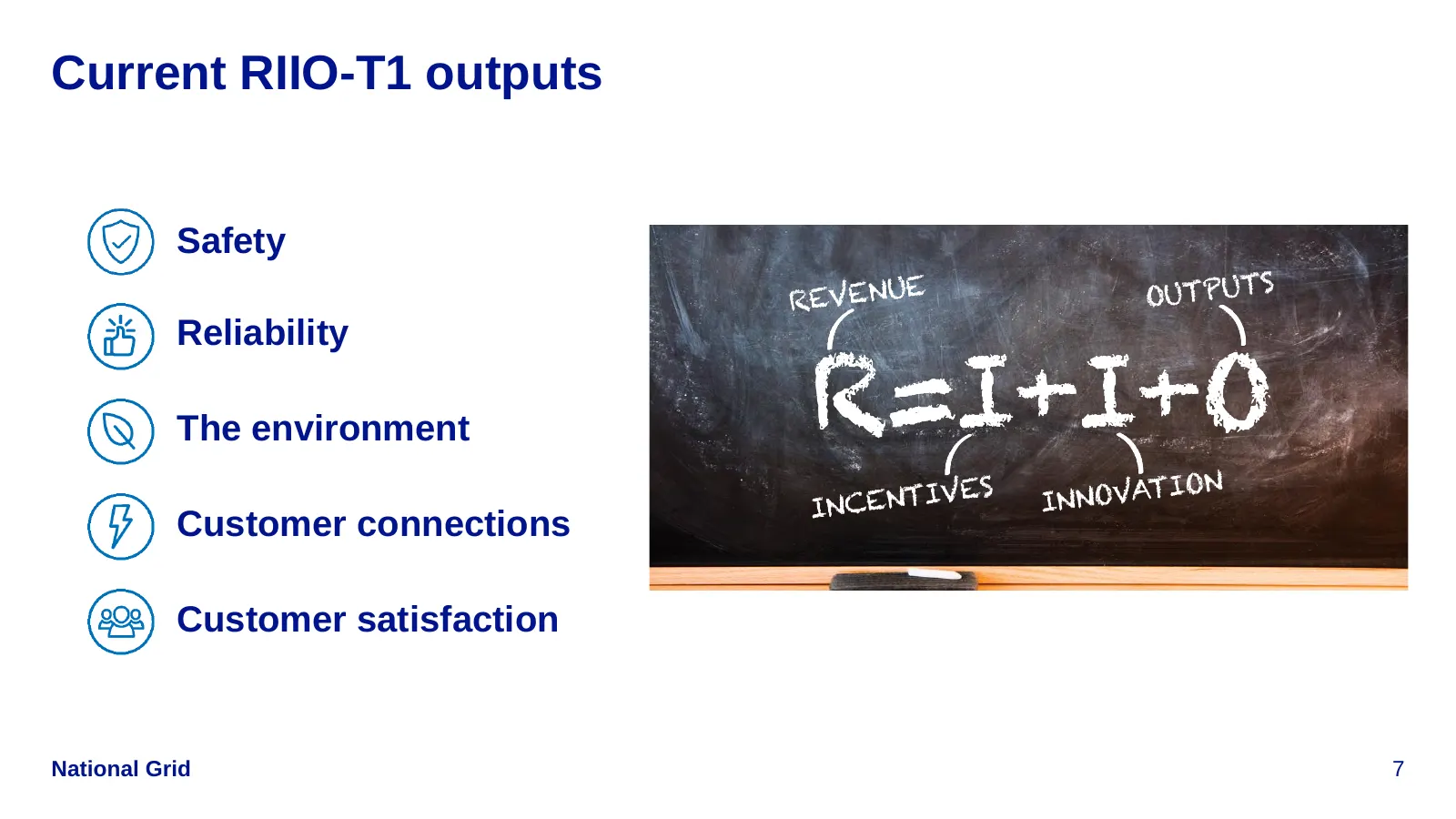
Current RIIO-T1 outputs Safety Reliability The environment Customer connections Customer satisfaction National Grid 7
Slide 8: Household bill impact: Electricity Transmission
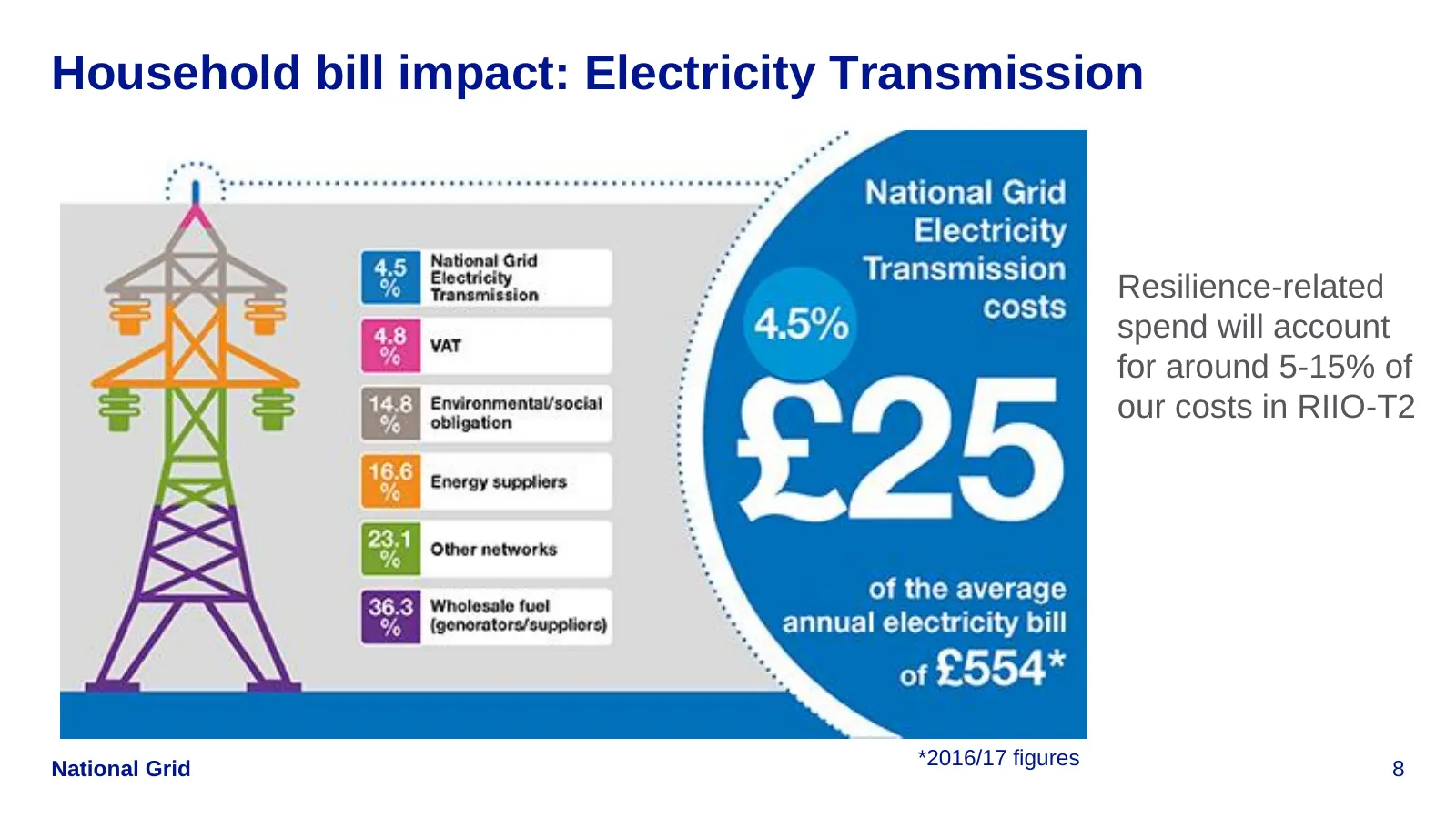
Household bill impact: Electricity Transmission Resilience-related spend will account for around 5-15% of our costs in RIIO-T2 National Grid *2016/17 figures 8
Slide 9: Why resilience?
Why resilience? Ursula Bryan Head of Engineering and Asset Management
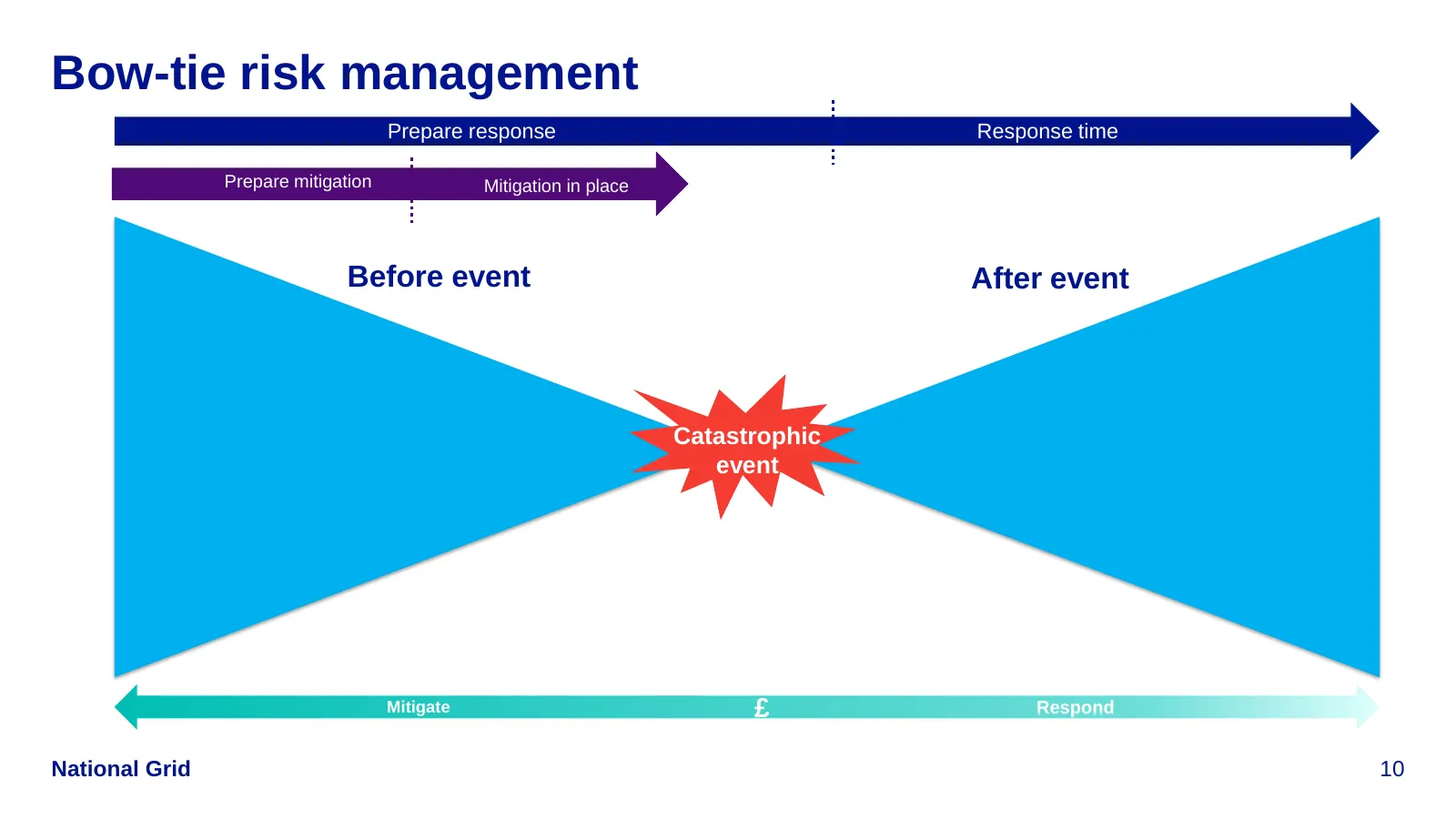
Slide 10: Bow-tie risk management
Bow-tie risk management Prepare response Response time Prepare mitigation Mitigation in place Before event After event Catastrophic event Mitigate £ Respond National Grid 10
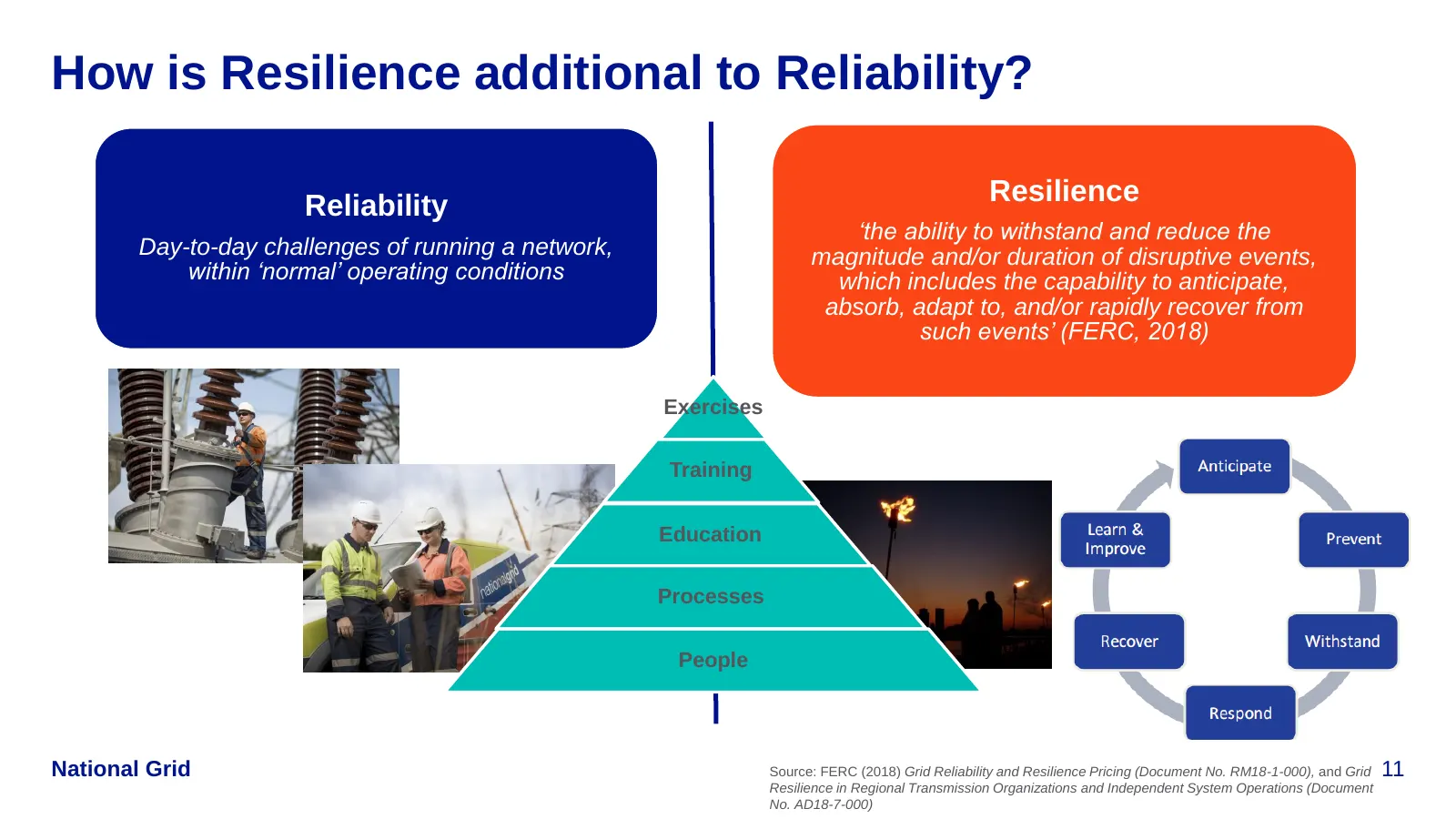
Slide 11: How is Resilience additional to Reliability?
How is Resilience additional to Reliability? Resilience Reliability ‘the ability to withstand and reduce the Day-to-day challenges of running a network, magnitude and/or duration of disruptive events, within ‘normal’ operating conditions which includes the capability to anticipate, absorb, adapt to,
Slide 12: Resilient future
Resilient future Neil Carter CEng MIET Electricity Transmission Future Strategy Manager
Slide 13: Threats to infrastructure are changing
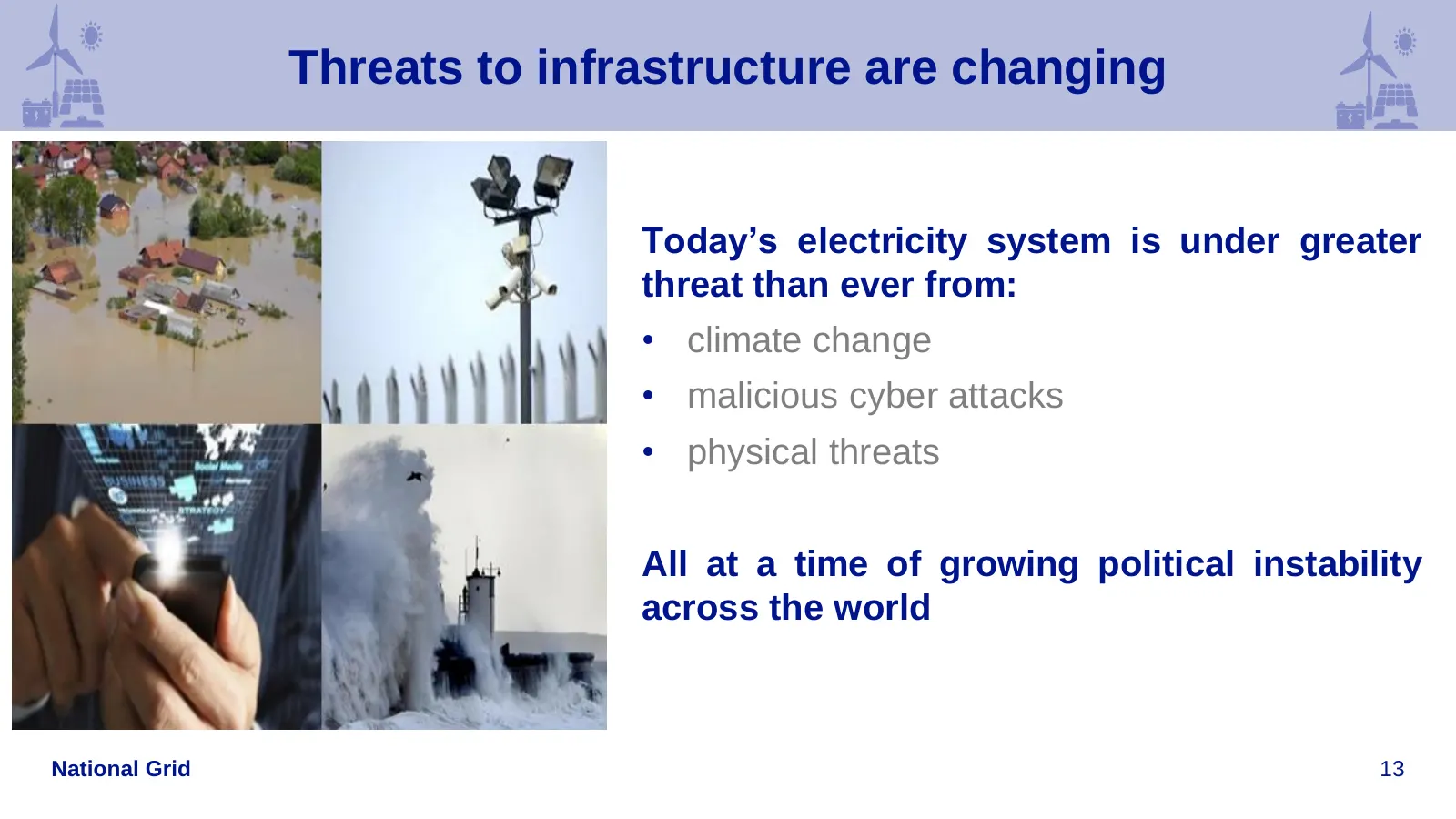
Threats to infrastructure are changing Today’s electricity system is under greater threat than ever from: • climate change • malicious cyber attacks • physical threats All at a time of growing political instability across the world National Grid 13
Slide 14: Flooding, physical, cyber and black start
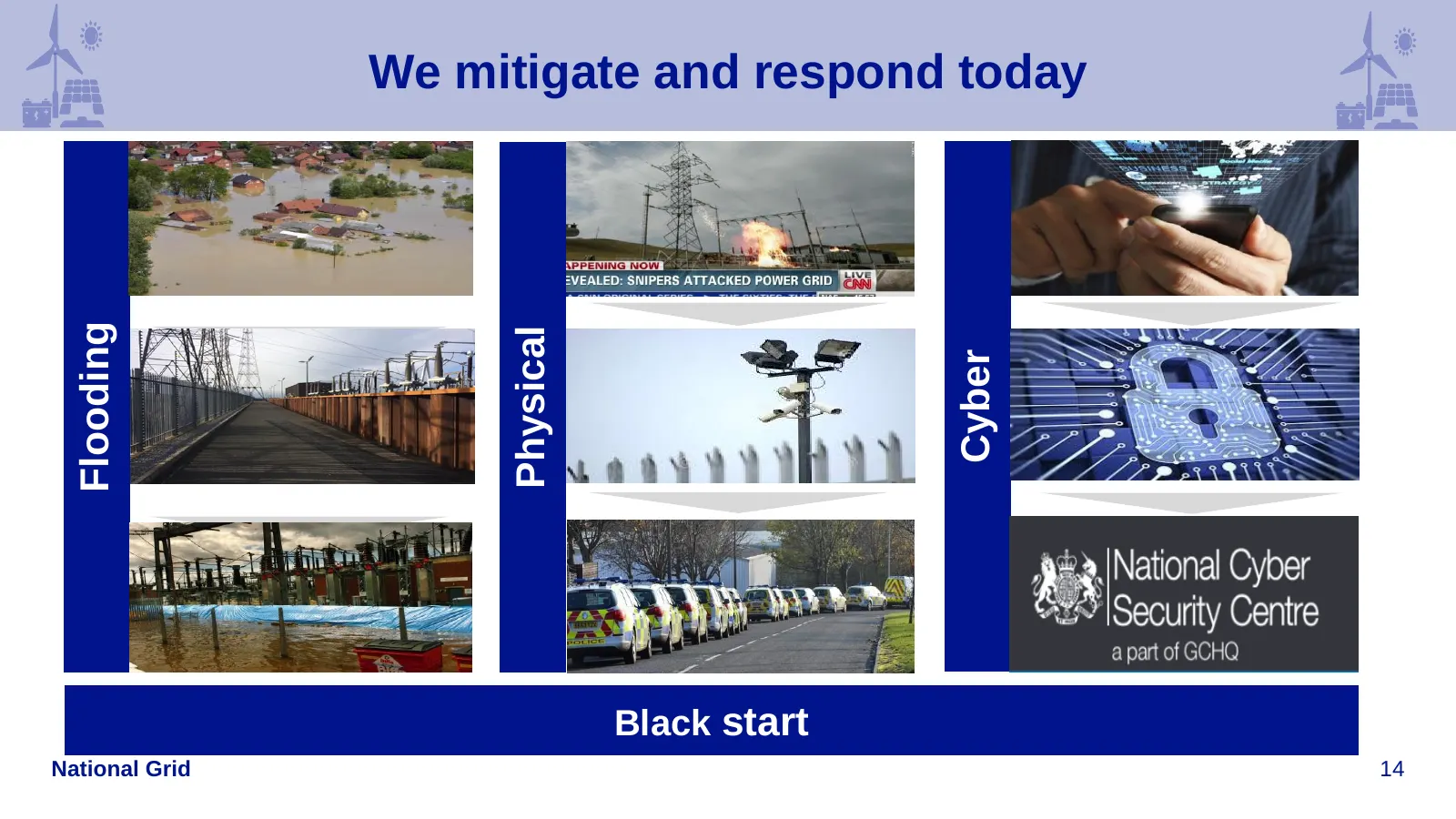
Flooding We mitigate and respond today Physical Cyber Black start National Grid 14
Slide 15: Reliance on electricity is growing
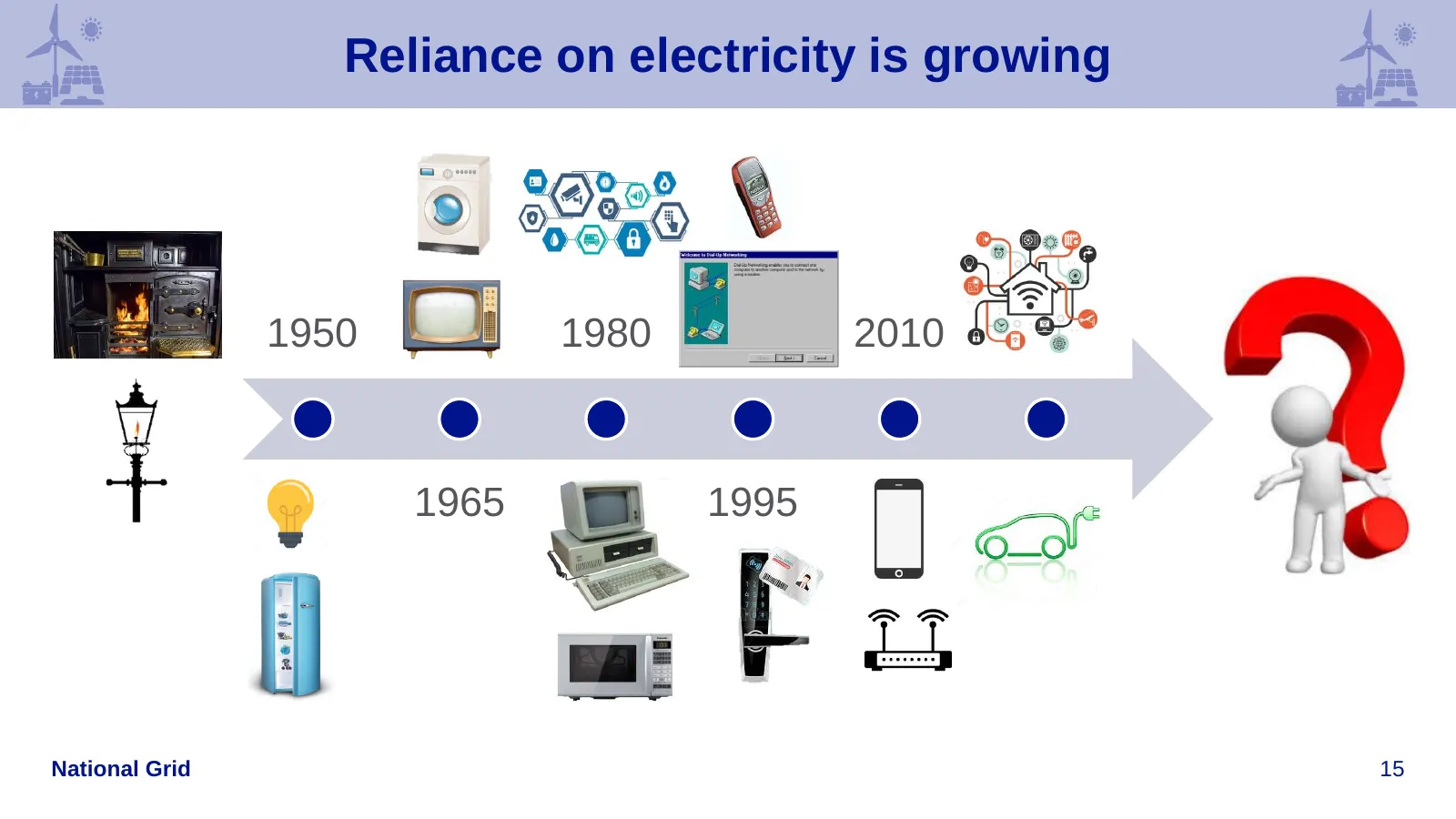
Reliance on electricity is growing 1950 1980 2010 1965 1995 National Grid 15
Slide 16: Driving change in resilience needs
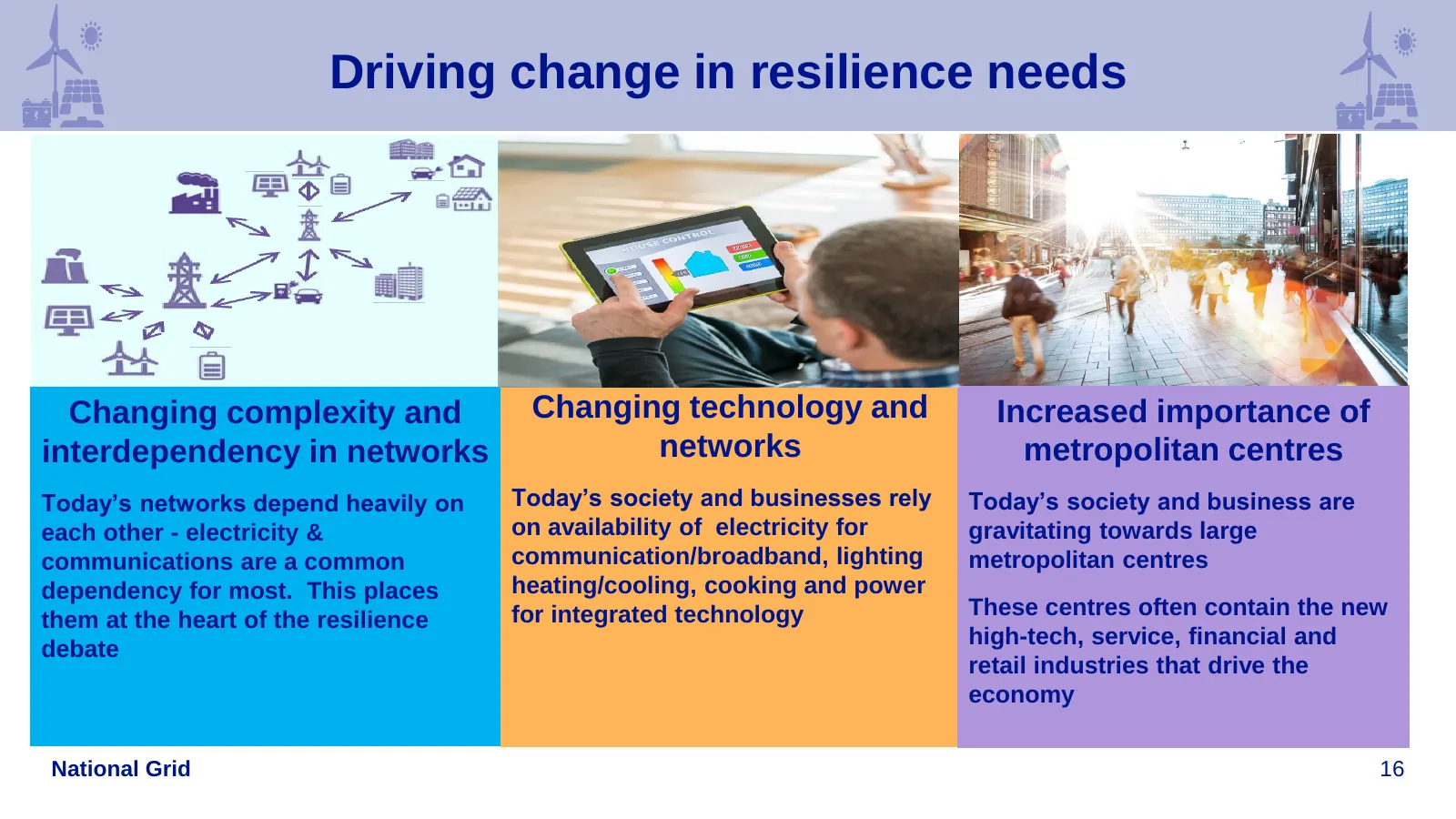
Driving change in resilience needs Changing complexity and Changing technology and Increased importance of interdependency in networks networks metropolitan centres Today’s networks depend heavily on Today’s society and businesses rely Today’s society and business are each other - electricity & on a
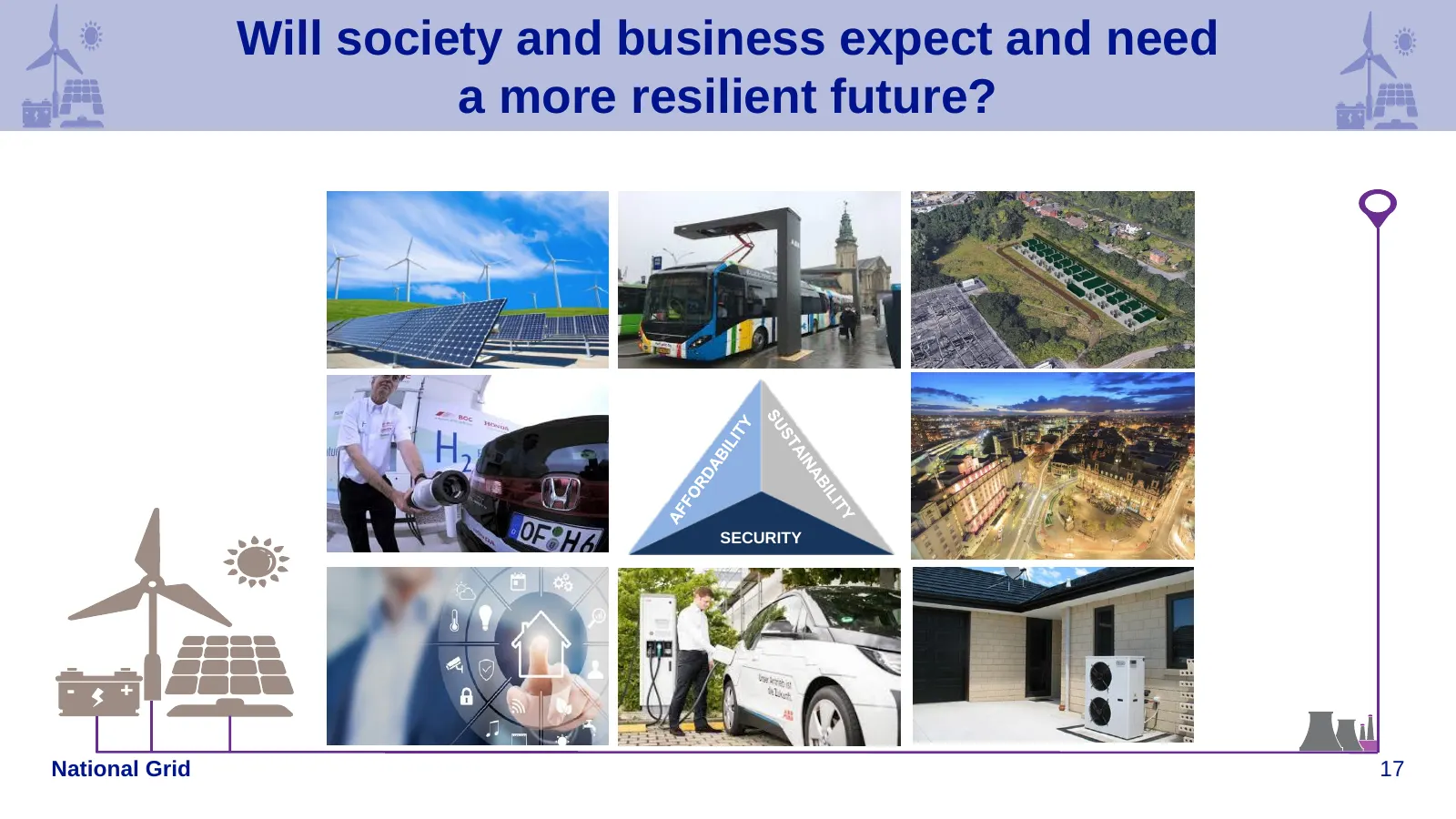
Slide 17: Will society and business expect and need a more resilient future?
Will society and business expect and need a more resilient future? SECURITY National Grid 17
Slide 18: Energy Research Partnership (ERP) – Resilience Working Group
Energy Research Partnership (ERP) – Resilience Working Group The ‘Energy Research Partnership’ was formed across Government, industry and academia, to provide high-level leadership for, and to enhance the coherence of, energy research and innovation activities in the UK, set within an international
Slide 19: Resilience and the changing world
Resilience and the changing world How do you think the resilience of the electricity transmission system could impact the operations of your business and/or personal life? What are the threats that we should be resilient against in the future? Which of these are the most important/where should we fo
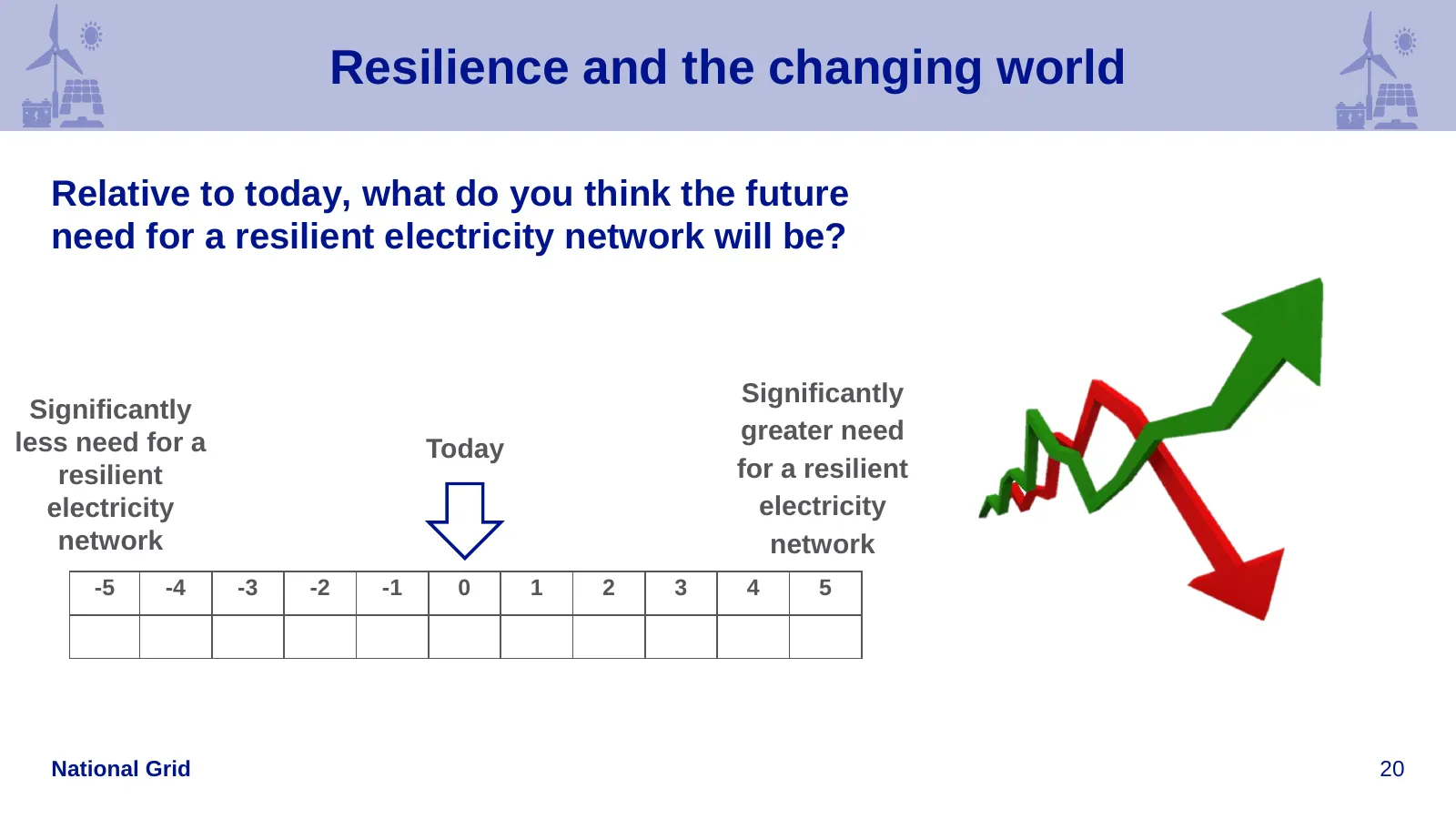
Slide 20: Resilience and the changing world
Resilience and the changing world Relative to today, what do you think the future need for a resilient electricity network will be? Significantly Significantly less need for a greater need Today resilient for a resilient electricity electricity network network -5 -4 -3 -2 -1 0 1 2 3 4 5 National Gri

Slide 21: Physical security
Physical security Lee Warren Asset Policy Engineer
Slide 22: NGET and Critical National Infrastructure (CNI)
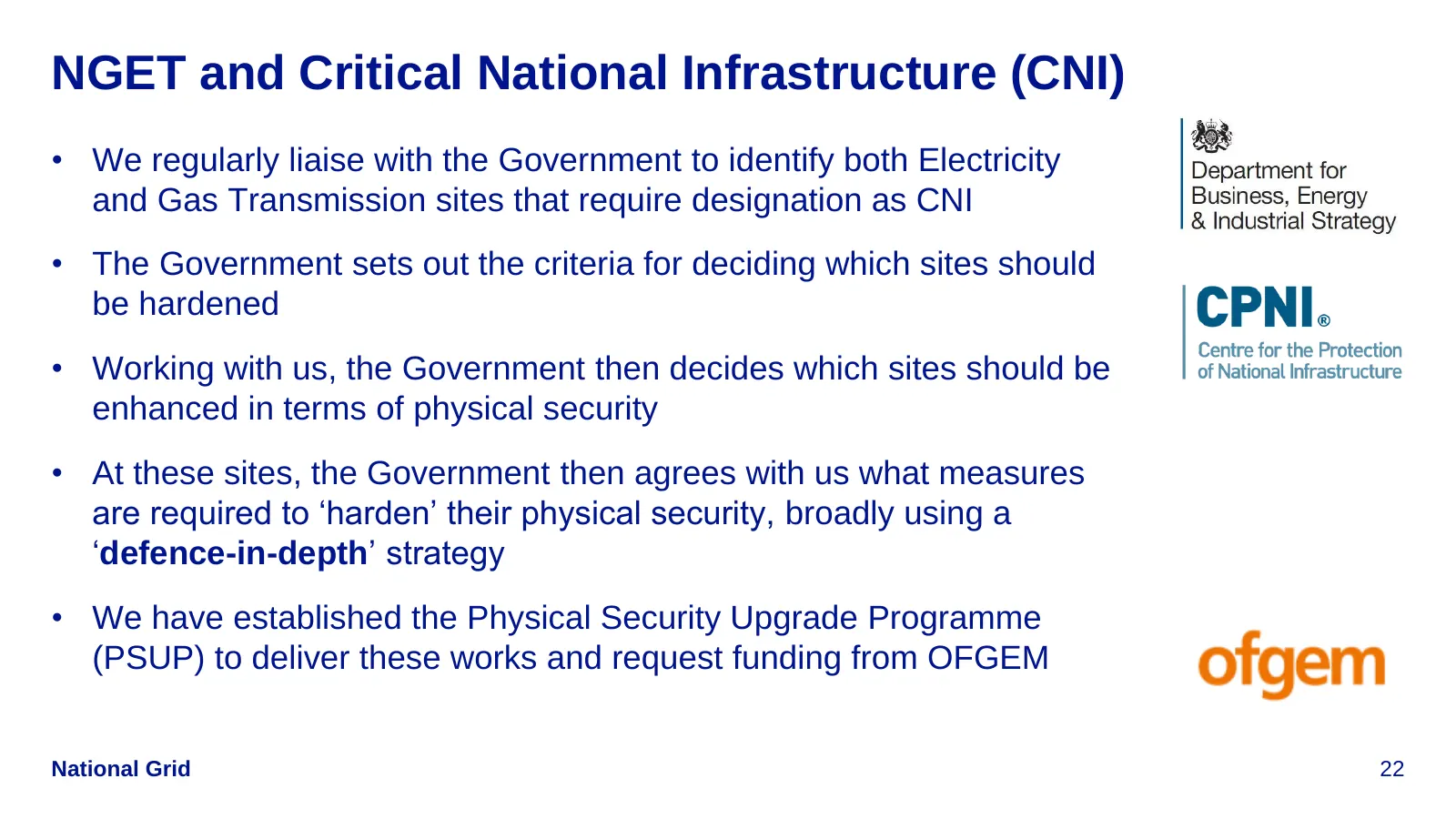
NGET and Critical National Infrastructure (CNI) • We regularly liaise with the Government to identify both Electricity and Gas Transmission sites that require designation as CNI • The Government sets out the criteria for deciding which sites should be hardened • Working with us, the Government then
Slide 23: Physical security: our current approach
Physical security: our current approach We have invested significant capital and operational expenditure during the RIIO- T1 period (circa £350m) to ensure physical security resilience is provided at key Electricity Transmission sites across England and Wales. Our investment during RIIO-T1 has ensur
Slide 24: Discussion questions
Discussion questions • What are your views on whether our current approach goes far enough? • What other aspects do we need to be considering in our approach? National Grid 24

Slide 25: Cyber security
Cyber security Jason Bewley Technology Application Engineer
Slide 26: There is a growing cyber threat: this has happened
There is a growing cyber threat: this has happened “The cyber operation was highly synchronized and the adversary was willing to maliciously operate a SCADA system to cause power outages, followed by destructive attacks to disable SCADA and communications to the field. The destructive element is the
Slide 27: We need to be ahead of the threat
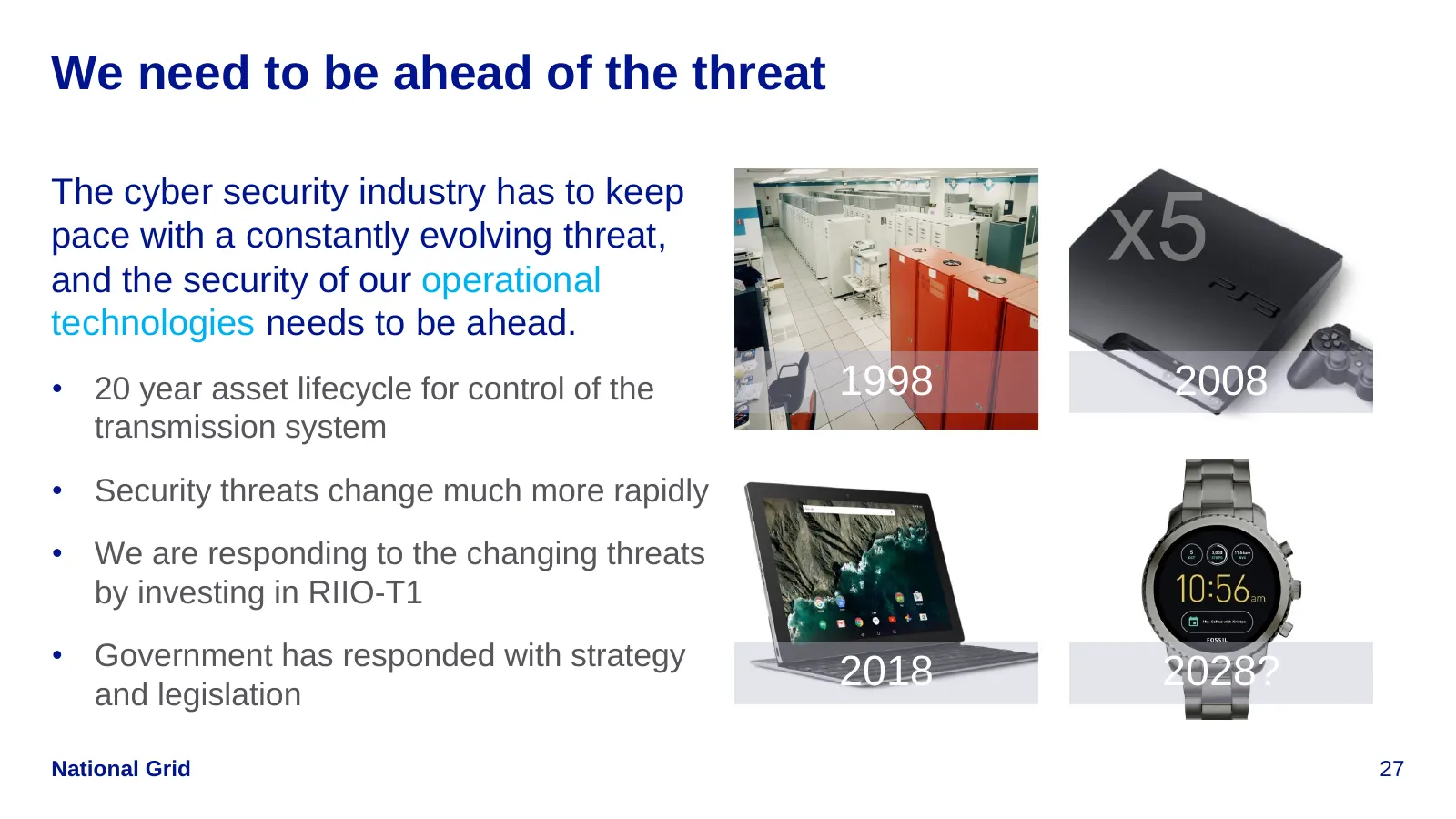
We need to be ahead of the threat The cyber security industry has to keep pace with a constantly evolving threat, and the security of our operational technologies needs to be ahead. • 20 year asset lifecycle for control of the 1998 2008 transmission system • Security threats change much more rapidly
Slide 28: The Network and Information Systems Regulations 2018
The Network and Information Systems Regulations 2018 Introduced in May 2018 to improve the security of network and information systems (NIS) across the UK, with a particular focus on essential services Top level objectives: • A: Managing security risk • B: Protecting against cyber attack • C: Detect
Slide 29: Options for RIIO-2 cyber specific investment
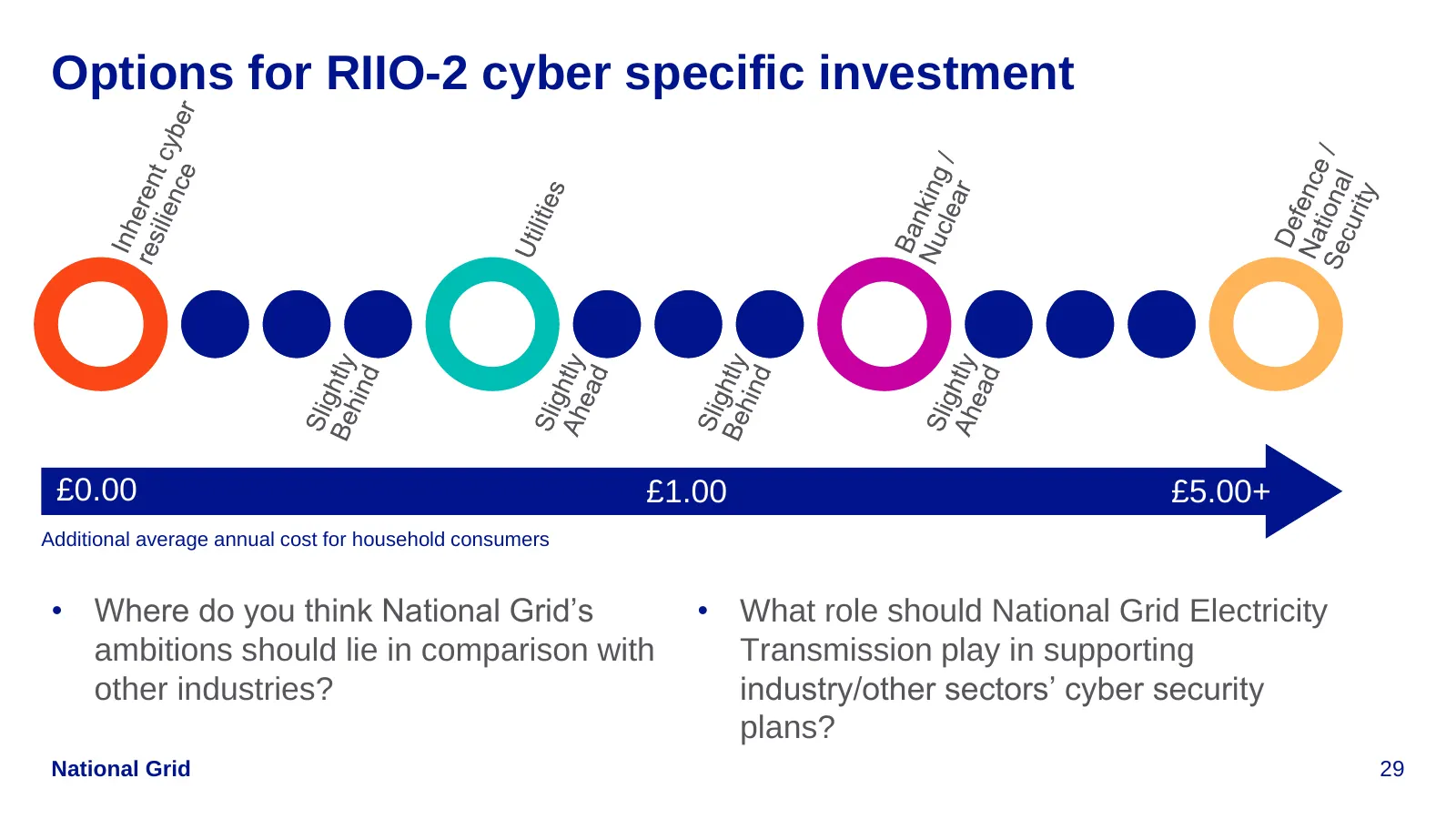
Options for RIIO-2 cyber specific investment £0.00 £1.00 £5.00+ Additional average annual cost for household consumers • Where do you think National Grid’s • What role should National Grid Electricity ambitions should lie in comparison with Transmission play in supporting other industries? industry/
Slide 30: Extreme weather resilience
Extreme weather resilience Doug Dodds Environmental Engineering
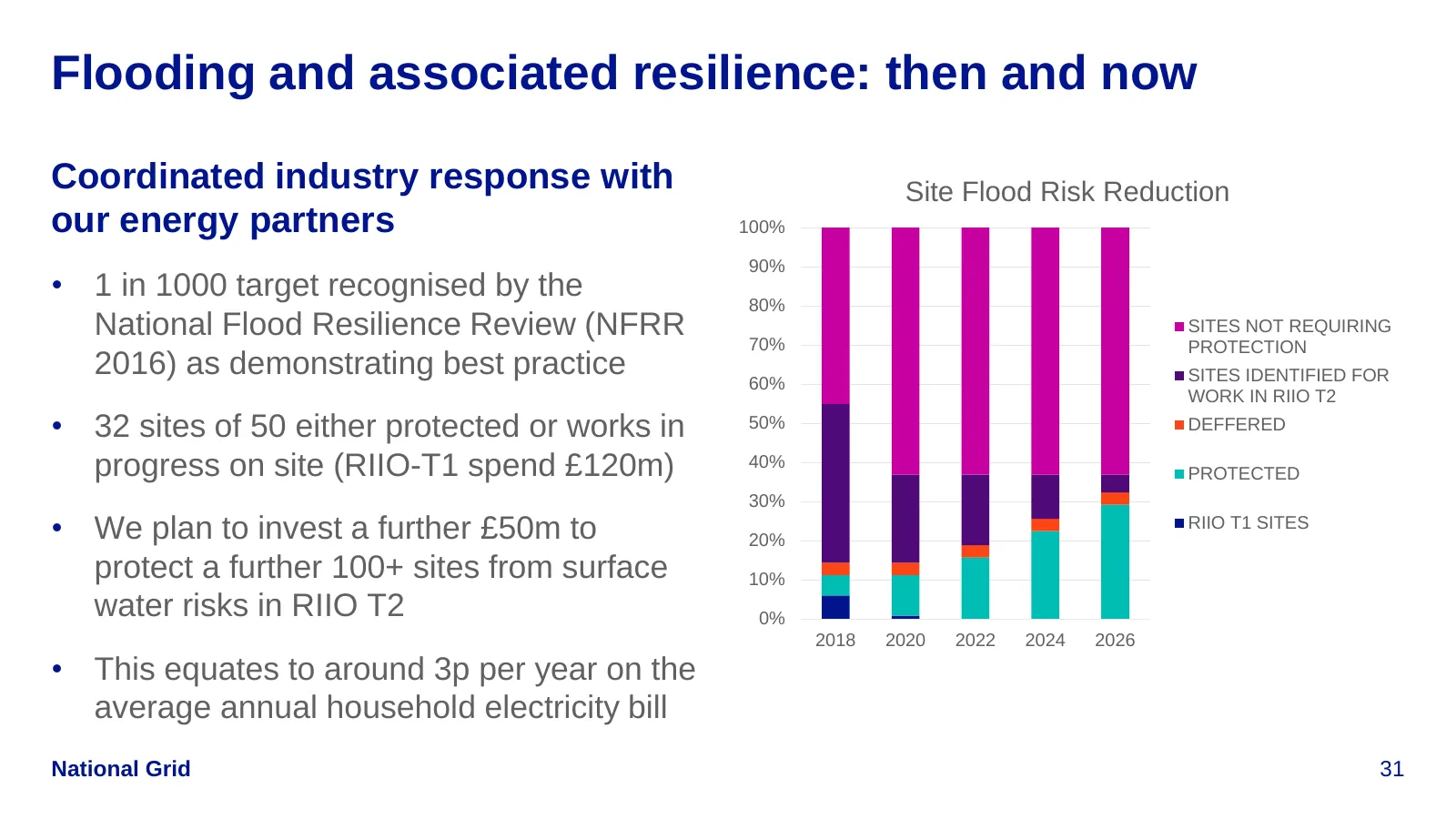
Slide 31: Flooding and associated resilience: then and now
Flooding and associated resilience: then and now Coordinated industry response with Site Flood Risk Reduction our energy partners 100% 90% • 1 in 1000 target recognised by the 80% National Flood Resilience Review (NFRR 70% SITES NOT REQUIRING PROTECTION 2016) as demonstrating best practice 60% SITES
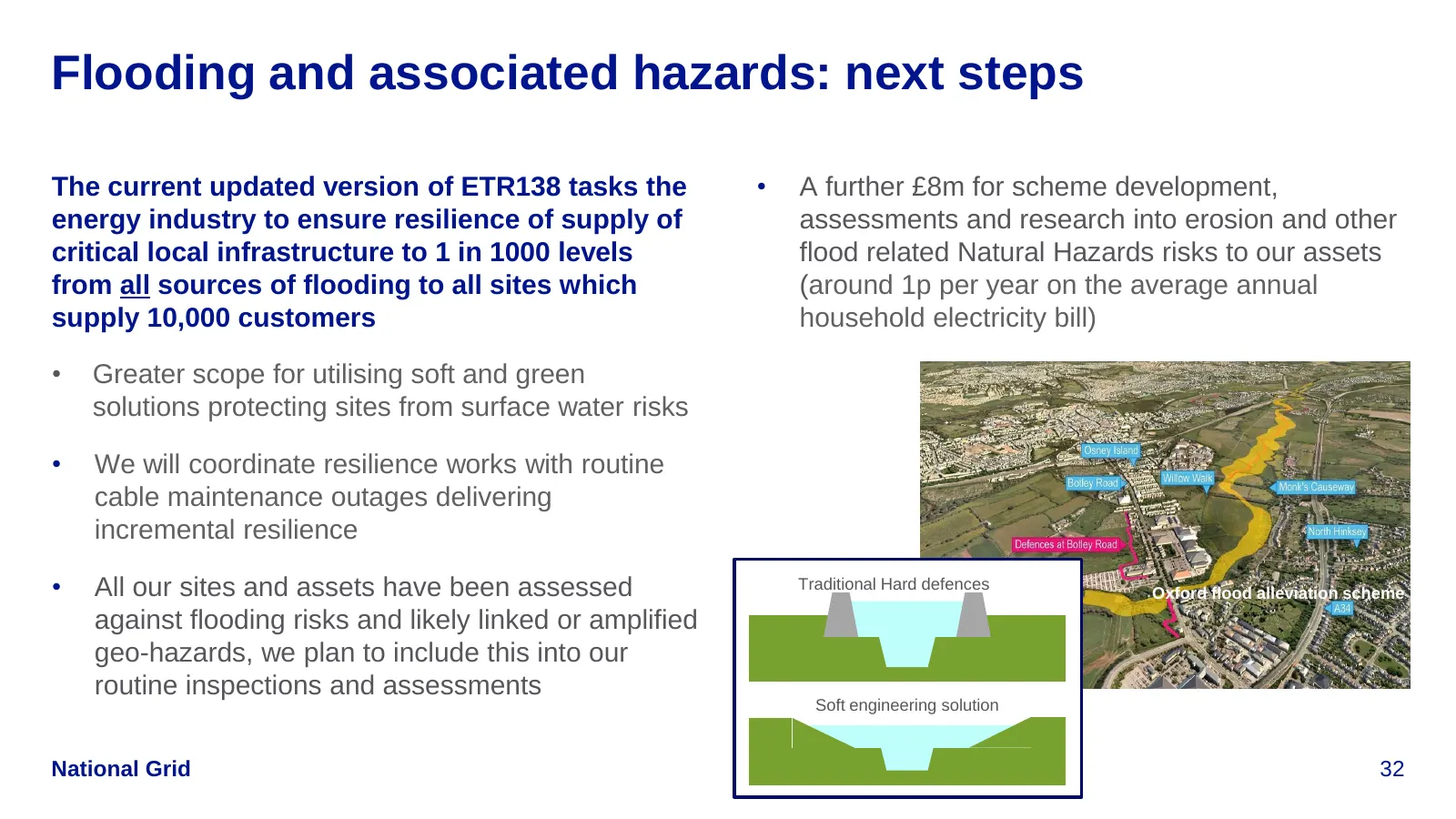
Slide 32: Flooding and associated hazards: next steps
Flooding and associated hazards: next steps The current updated version of ETR138 tasks the • A further £8m for scheme development, energy industry to ensure resilience of supply of assessments and research into erosion and other critical local infrastructure to 1 in 1000 levels flood related Natura
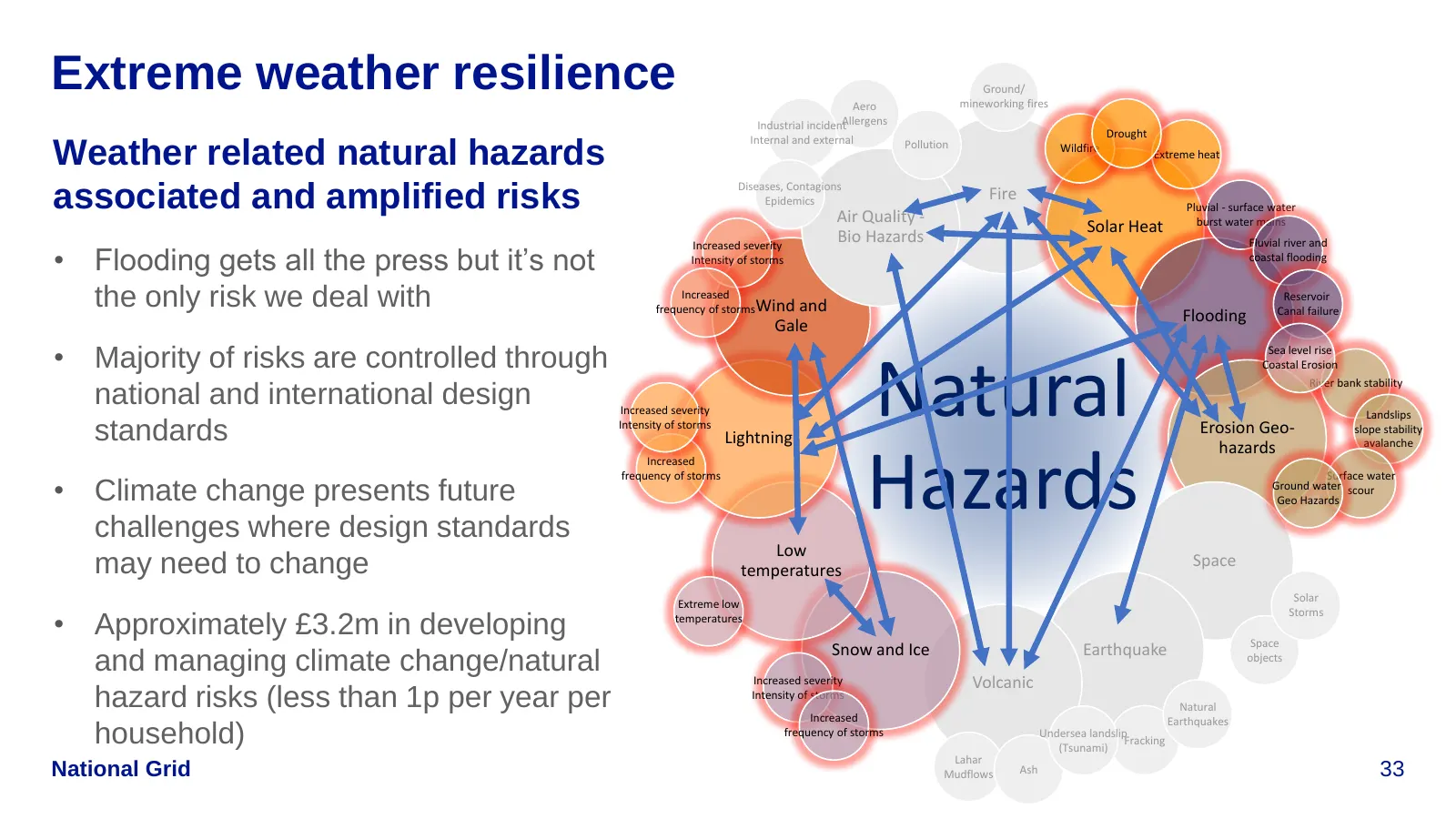
Slide 33: Natural Hazards
Extreme weather resilience Aero Ground/ mineworking fires Industrial incidentAllergens Drought Internal and external Weather related natural hazards Pollution Wildfire Extreme heat Diseases, Contagions associated and amplified risks Epidemics Air Quality - Fire Pluvial - surface water burst water ma
Slide 34: Discussion questions
Discussion questions • Is this the right approach, or should we be considering a different one? • What areas have we missed? • What hazards or combined hazards could we coordinate with you on to find solutions? National Grid 34

Slide 35: Black start: our role
Black start: our role Richard Earp Site Management Policy Assurance Manager
Slide 36: What and why
What and why ‘Black Start’ is the condition where the electricity system has shut down Our network is de-energised, and there is therefore no ‘mains’ electricity to end consumers Black start could be nationwide (all of GB), or regional following a ‘system split’ National Grid 36
Slide 37: What and why
What and why What could cause it? • Random coincident faults, beyond normal security standards • Weather-related damage (or sabotage) to multiple sites/circuits • ‘Normal’ faults coincident with other operational failures, e.g. failure to manage transmission constraints • Sudden large scale generati
Slide 38: Can it really happen?
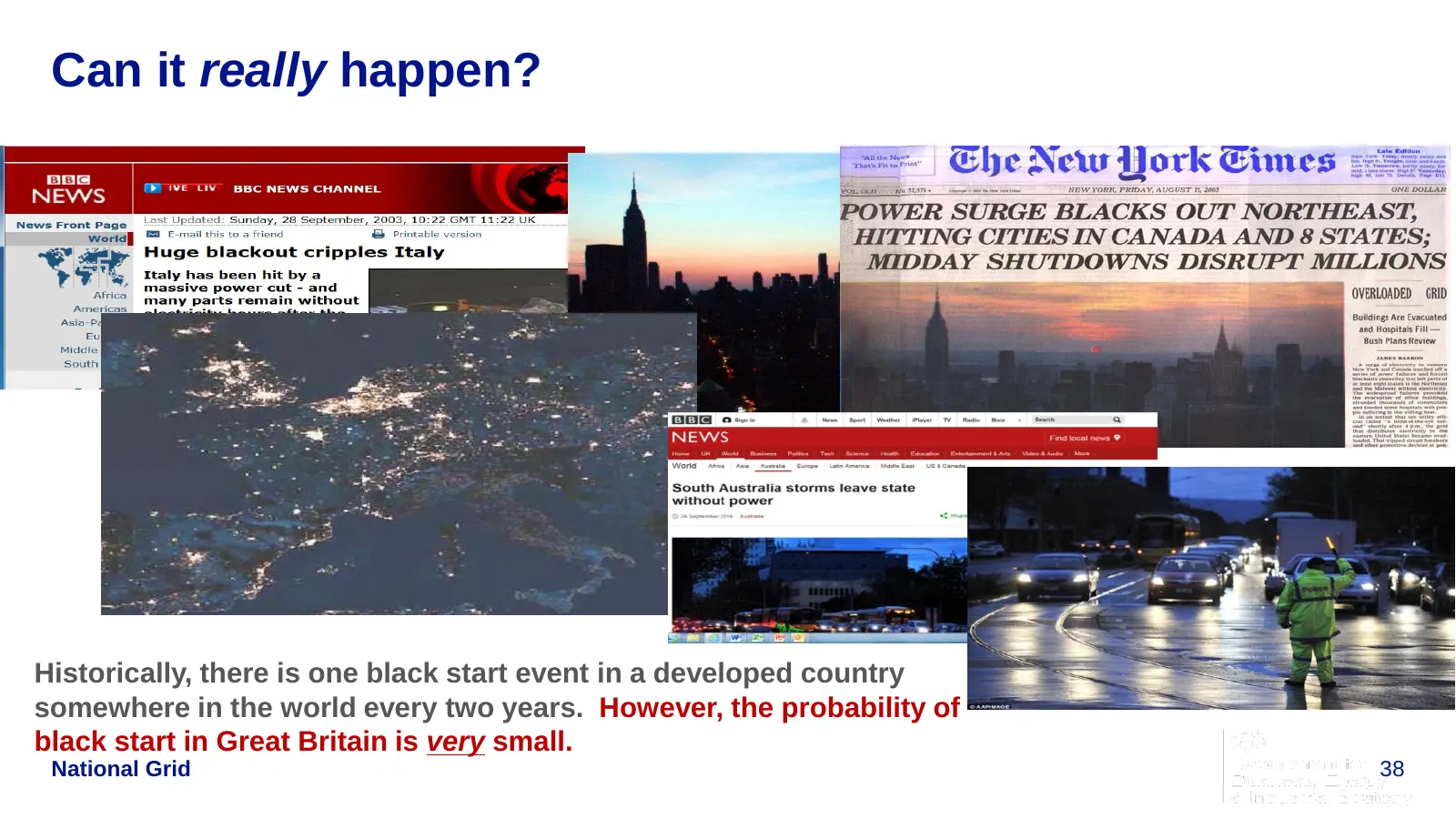
Can it really happen? Historically, there is one black start event in a developed country somewhere in the world every two years. However, the probability of black start in Great Britain is very small. National Grid 38
Slide 39: Consequences: Government's perspective
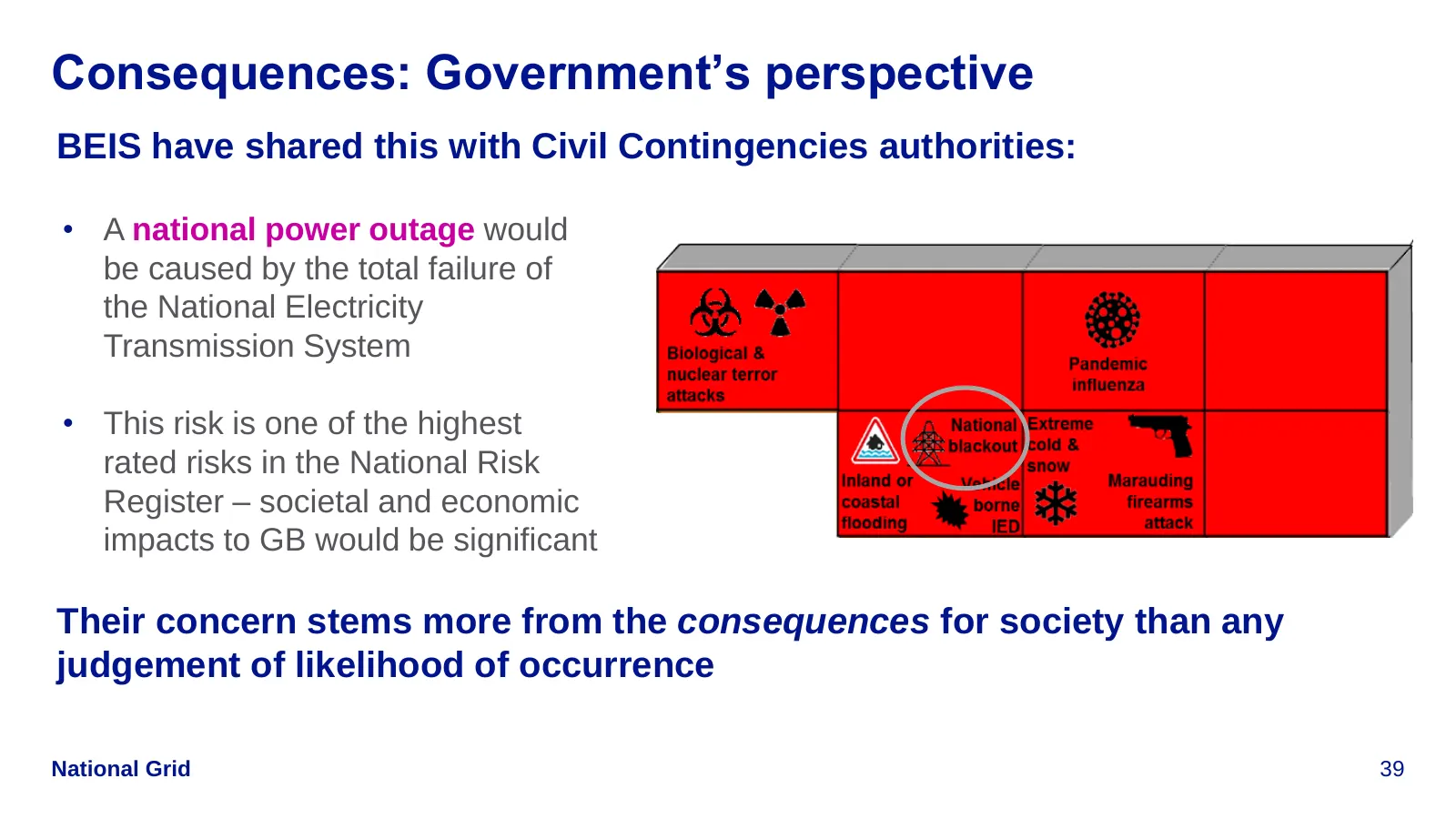
Consequences: Government’s perspective BEIS have shared this with Civil Contingencies authorities: • A national power outage would be caused by the total failure of the National Electricity Transmission System • This risk is one of the highest rated risks in the National Risk Register – societal and
Slide 40: Impacts: a Government view
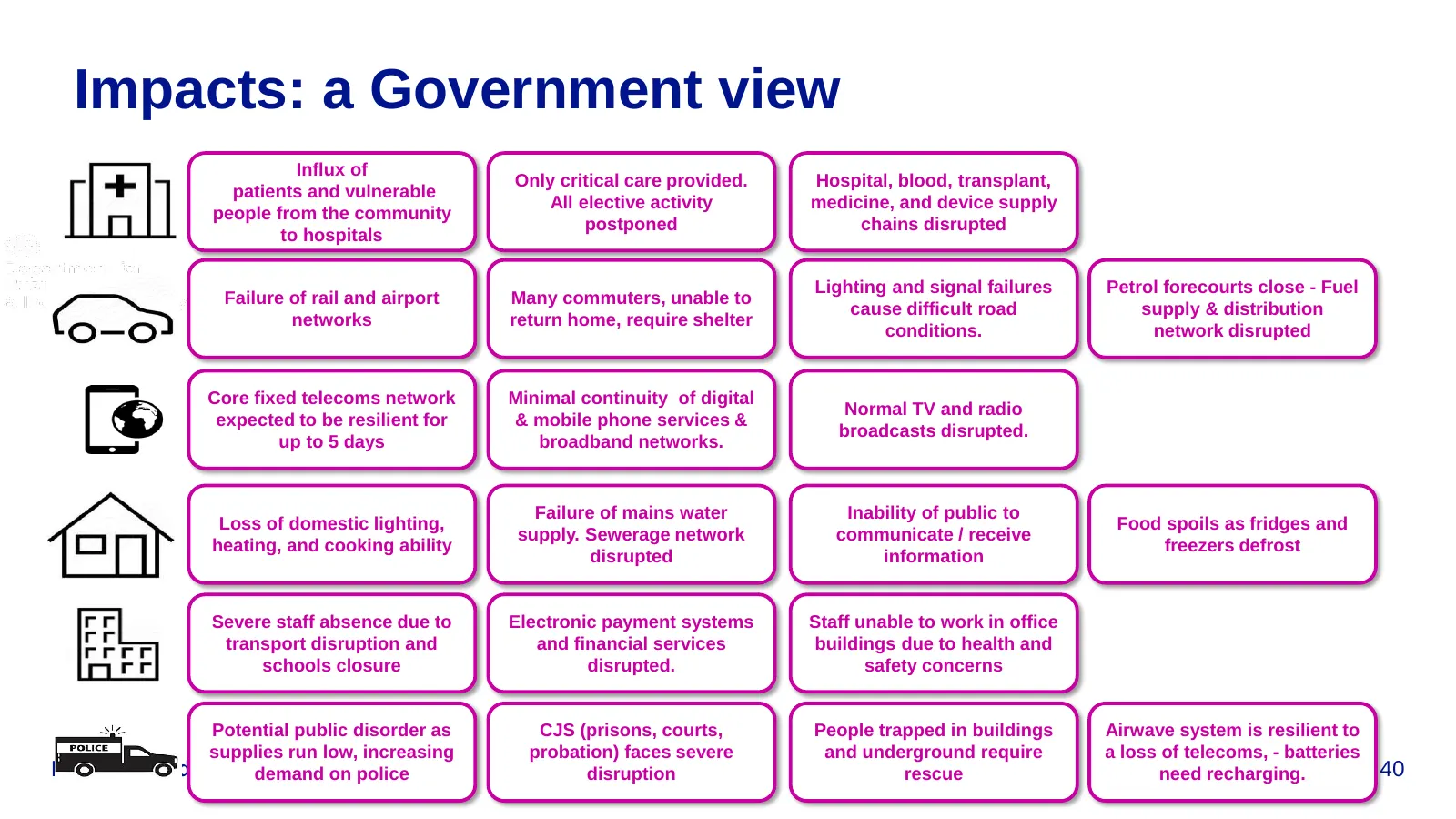
Impacts: a Government view Influx of Only critical care provided. Hospital, blood, transplant, patients and vulnerable All elective activity medicine, and device supply people from the community postponed chains disrupted to hospitals Lighting and signal failures Petrol forecourts close - Fuel Failu
Slide 41: System restoration: overview
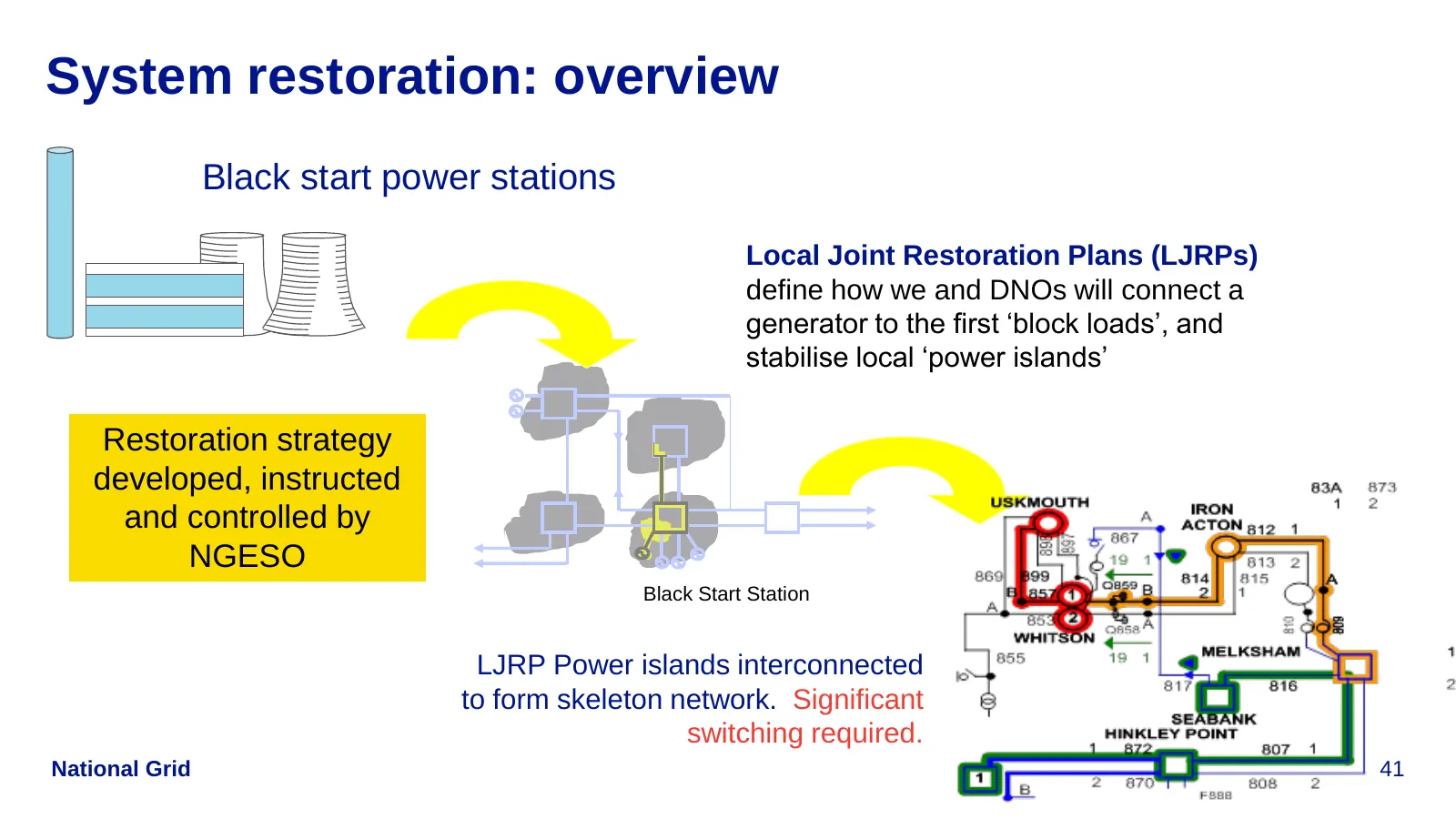
System restoration: overview Black start power stations Local Joint Restoration Plans (LJRPs) define how we and DNOs will connect a generator to the first ‘block loads’, and stabilise local ‘power islands’ Restoration strategy developed, instructed and controlled by NGESO Black Start Station LJRP Po
Slide 42: NGET TO's role
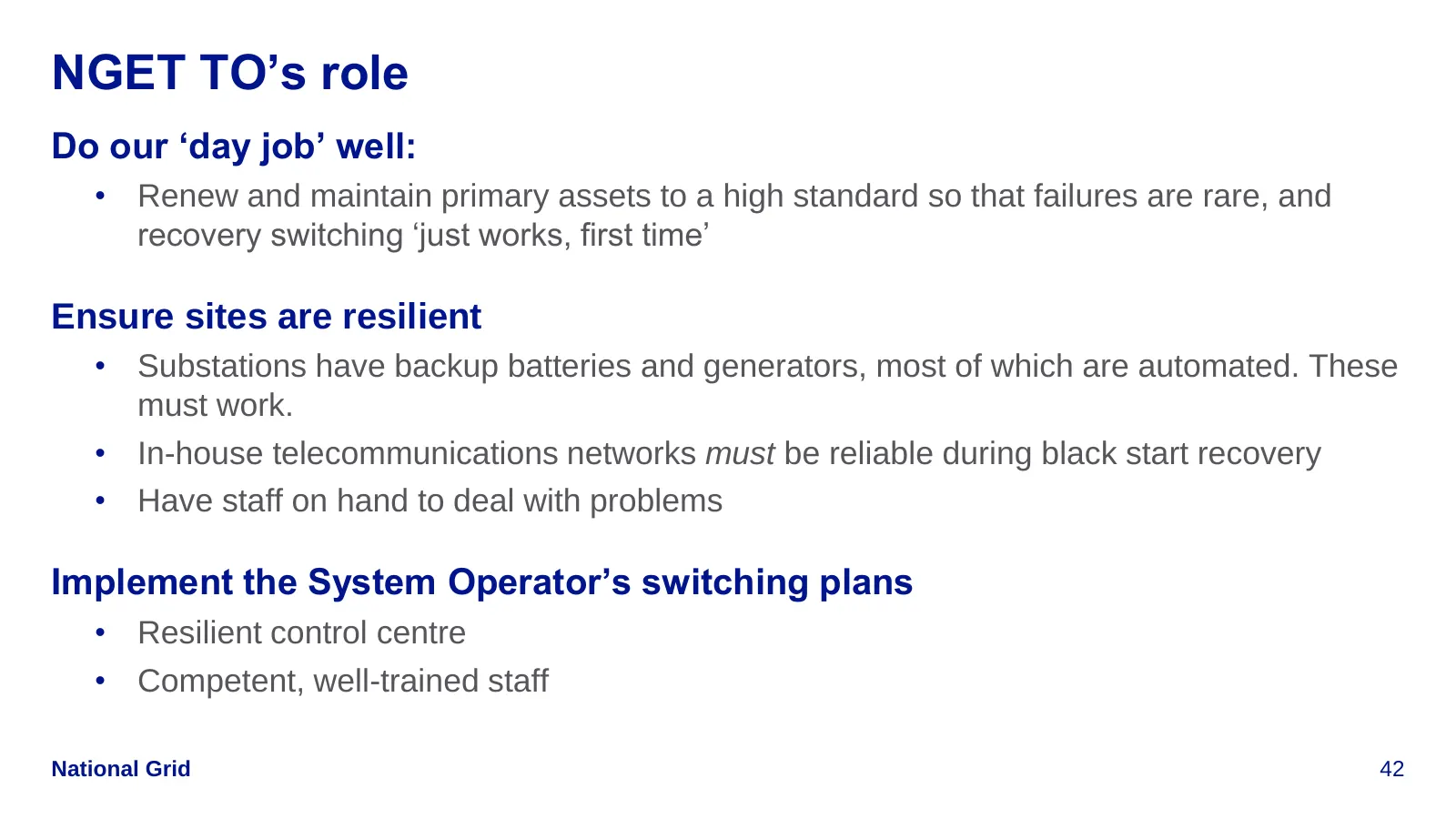
NGET TO’s role Do our ‘day job’ well: • Renew and maintain primary assets to a high standard so that failures are rare, and recovery switching ‘just works, first time’ Ensure sites are resilient • Substations have backup batteries and generators, most of which are automated. These must work. • In-ho
Slide 43: During the next Price Control period
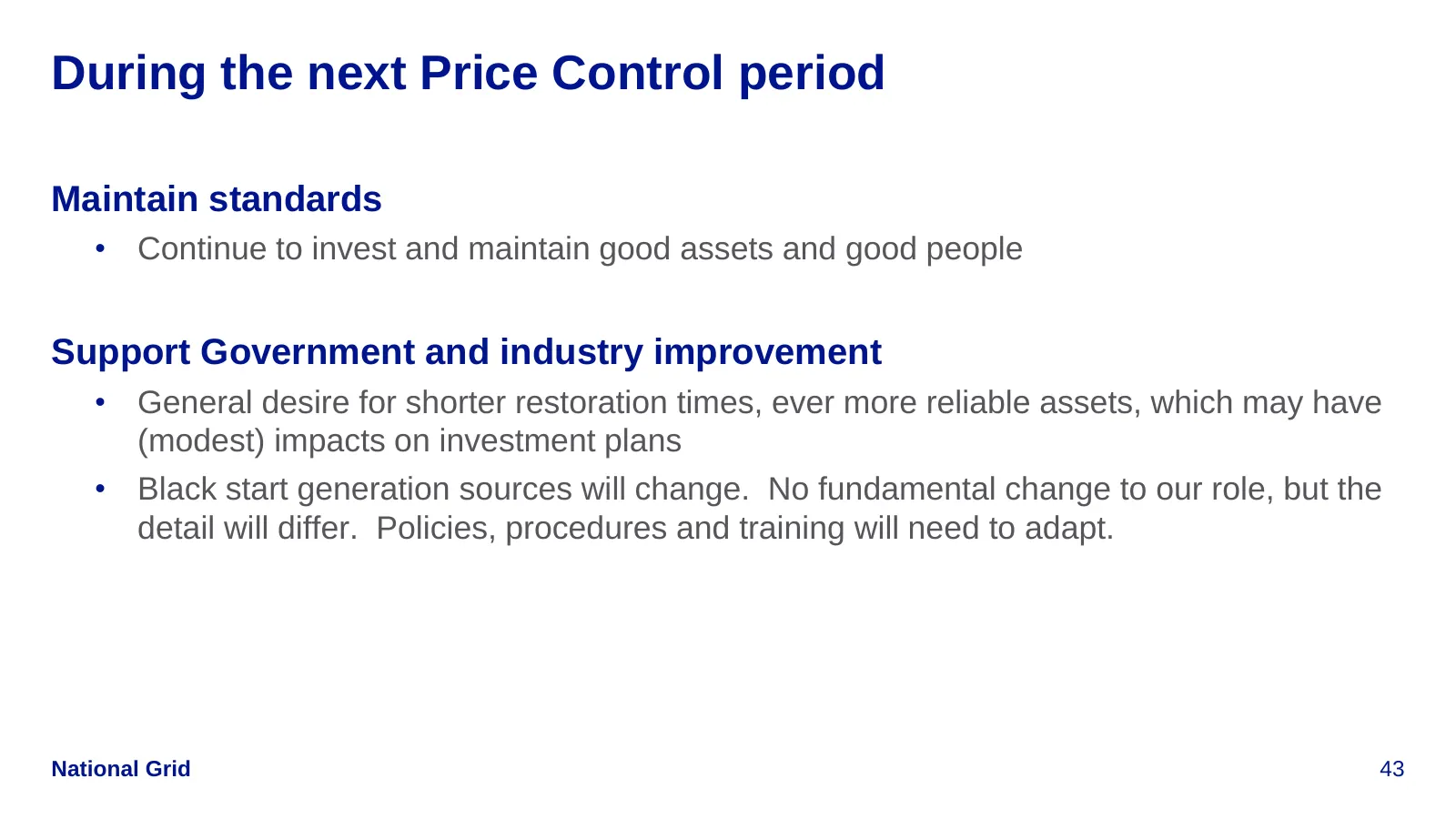
During the next Price Control period Maintain standards • Continue to invest and maintain good assets and good people Support Government and industry improvement • General desire for shorter restoration times, ever more reliable assets, which may have (modest) impacts on investment plans • Black sta
Slide 44: Discussion questions
Discussion questions • How self-sufficient should National Grid be to recover from a black start scenario? • What are your views on the appropriateness of our plans to remove barriers to restoration? National Grid 44
Slide 45: Exercise: society and business expectations
Exercise: society and business expectations
Slide 46: Society and business expectations
Society and business expectations Under exceptional circumstances, which result in • Heavy industry the loss of power over a wide geographical area or • Cities nationally, how long do you think society and business could expect to be without power for • Towns different types of location? • Villages
Slide 47: Juliet Mian, Arup
Juliet Mian Arup
Slide 48: Transferring learning between sectors
National Grid | Electricity Transmission Resilience Workshop Transferring learning between sectors The City Resilience Framework and the City Water Resilience Framework Dr Juliet Mian Infrastructure resilience | Arup October 2018 National Grid Electricity Transmission Resilience Workshop
Slide 49: City Resilience Framework
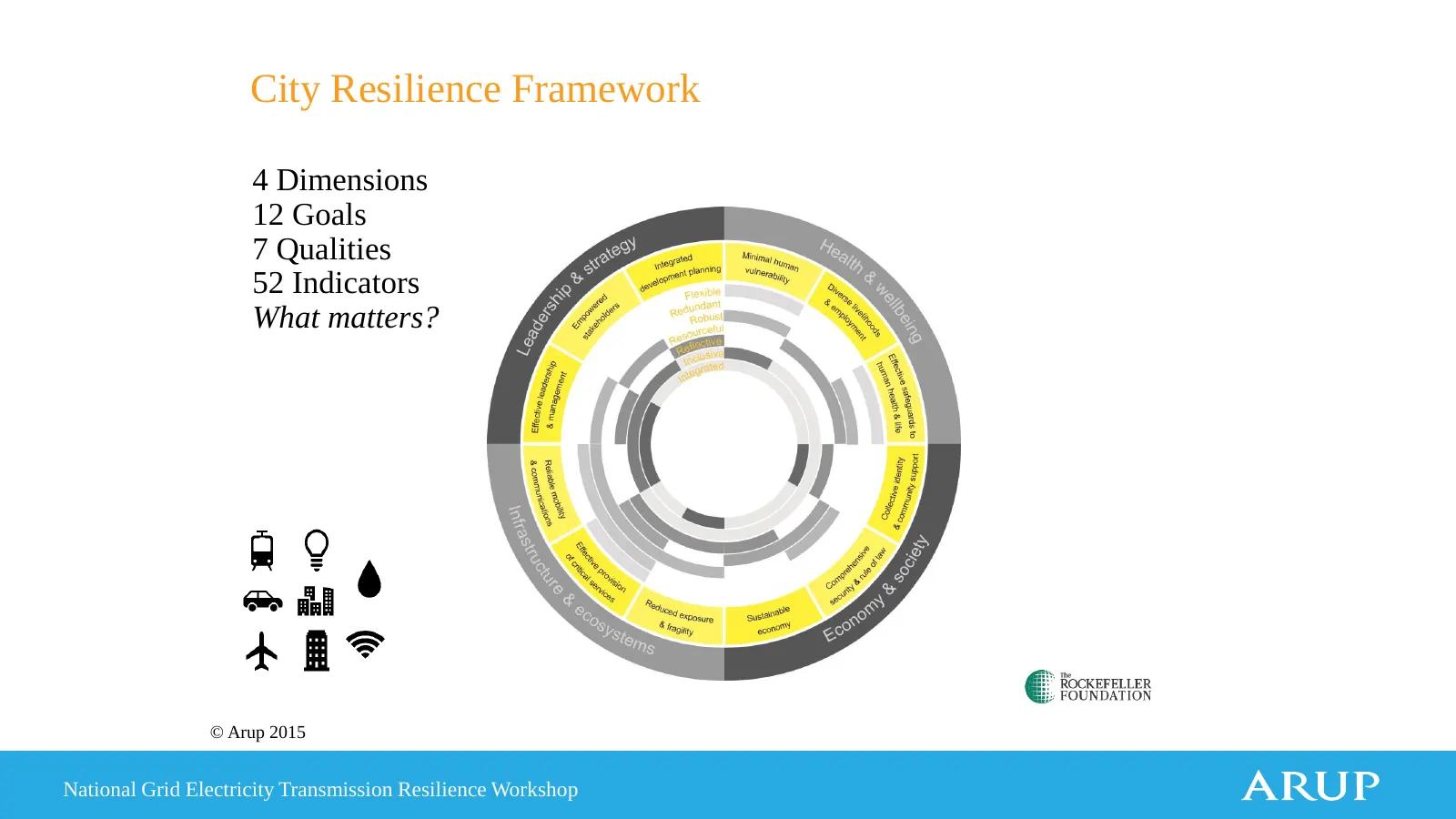
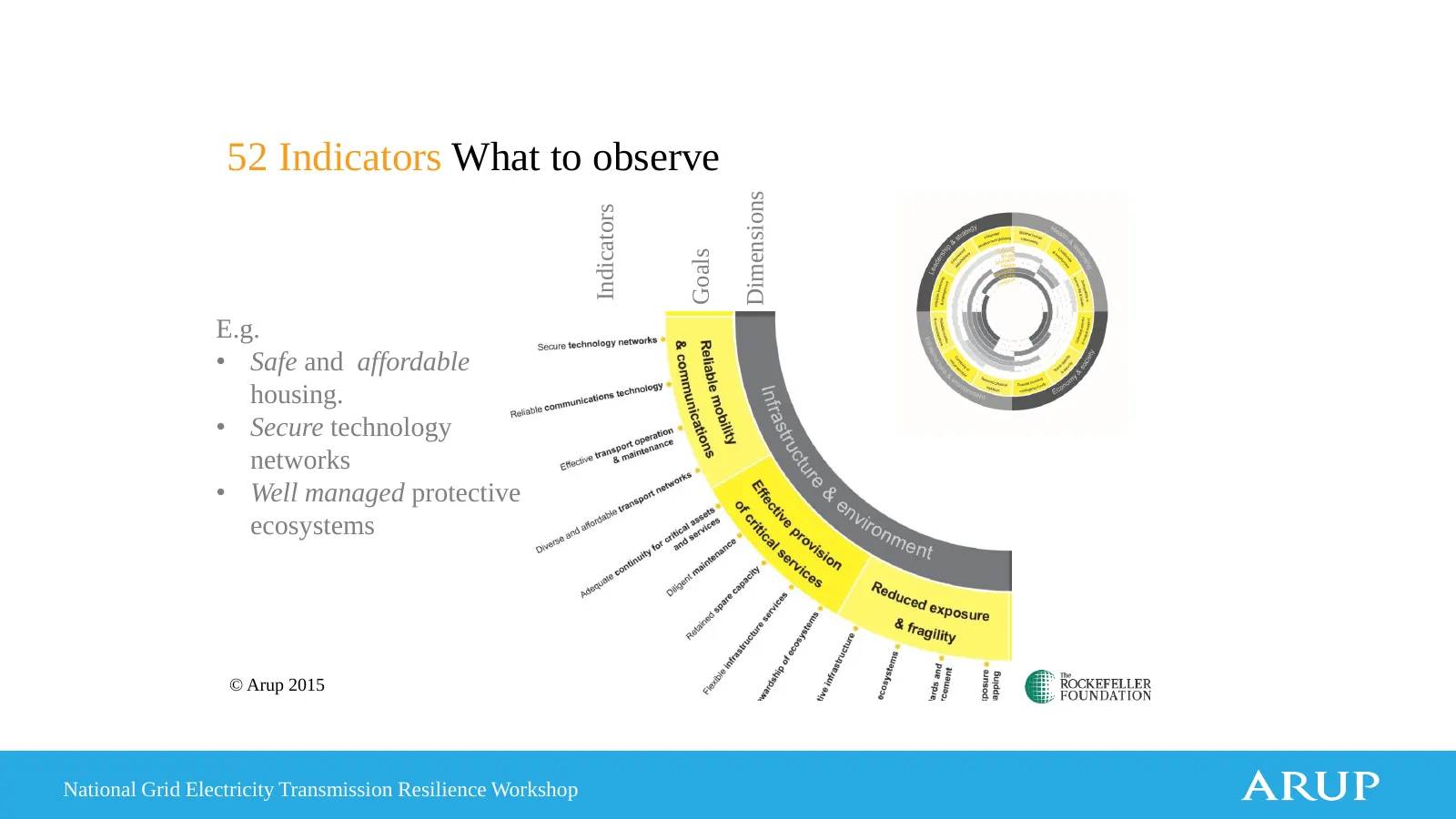
City Resilience Framework 4 Dimensions 12 Goals 7 Qualities 52 Indicators What matters? © Arup 2015 National Grid Electricity Transmission Resilience Workshop
Slide 50: Definition of urban resilience
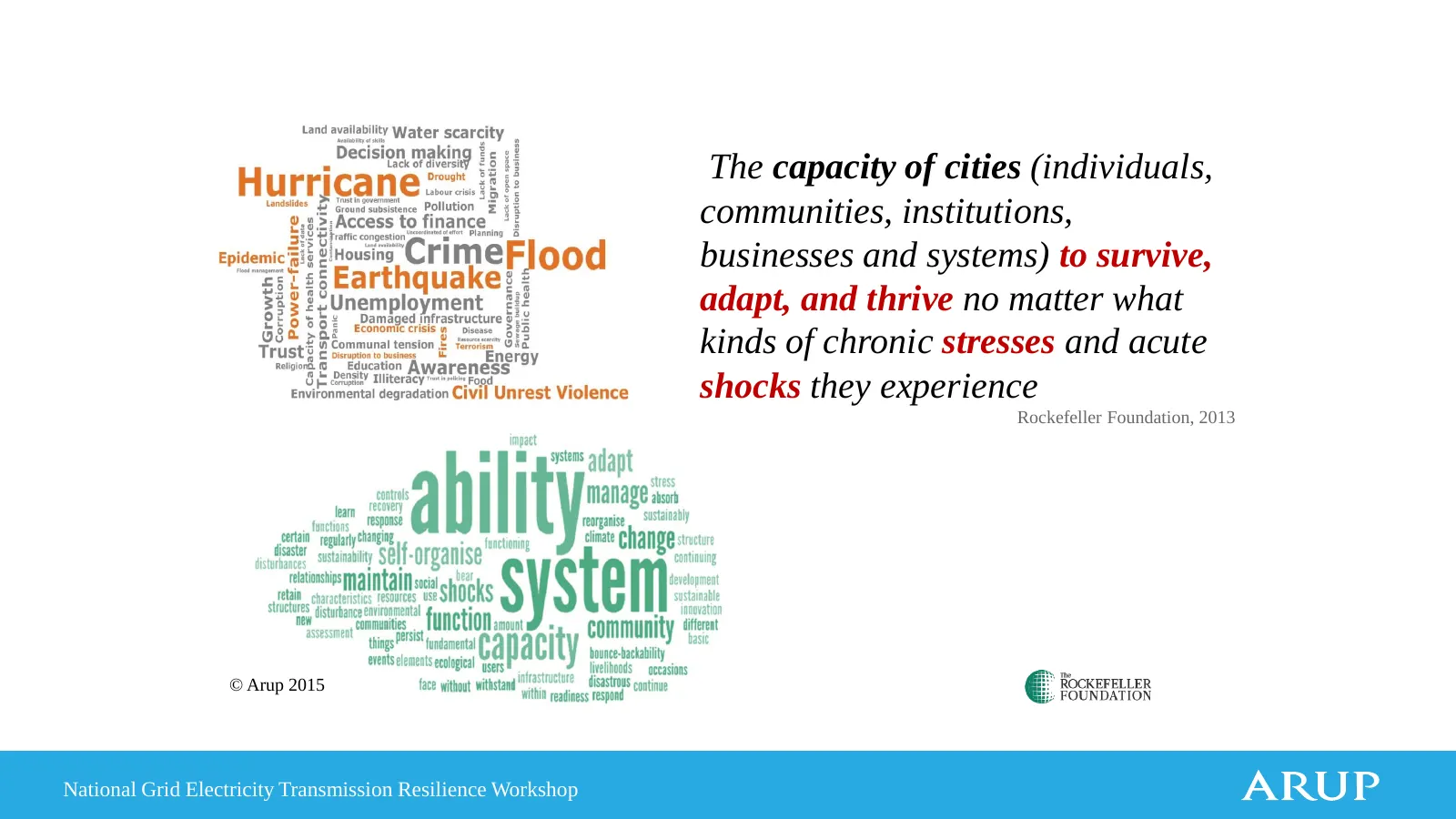
The capacity of cities (individuals, communities, institutions, businesses and systems) to survive, adapt, and thrive no matter what kinds of chronic stresses and acute shocks they experience Rockefeller Foundation, 2013 © Arup 2015 National Grid Electricity Transmission Resilience Workshop
Slide 51: Research
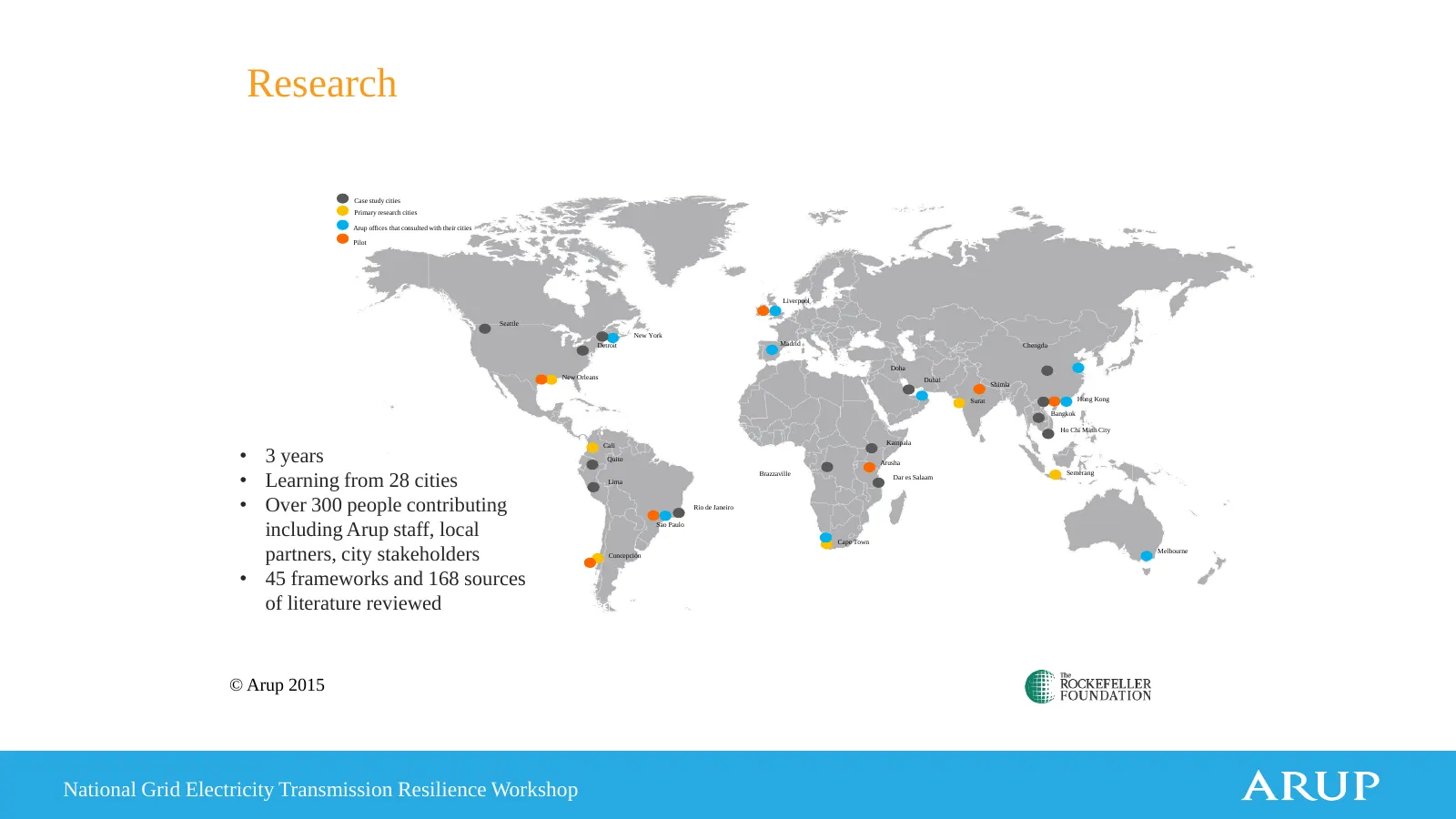
Research Case study cities Primary research cities Arup offices that consulted with their cities Pilot Liverpool Seattle New York Detroit Madrid Chengdu Doha New Orleans Dubai Shimla Surat Hong Kong Bangkok Ho Chi Minh City Cali Kampala • 3 years Quito Arusha • Learning from 28 cities Brazzaville Se
Slide 52: Health & Well Being
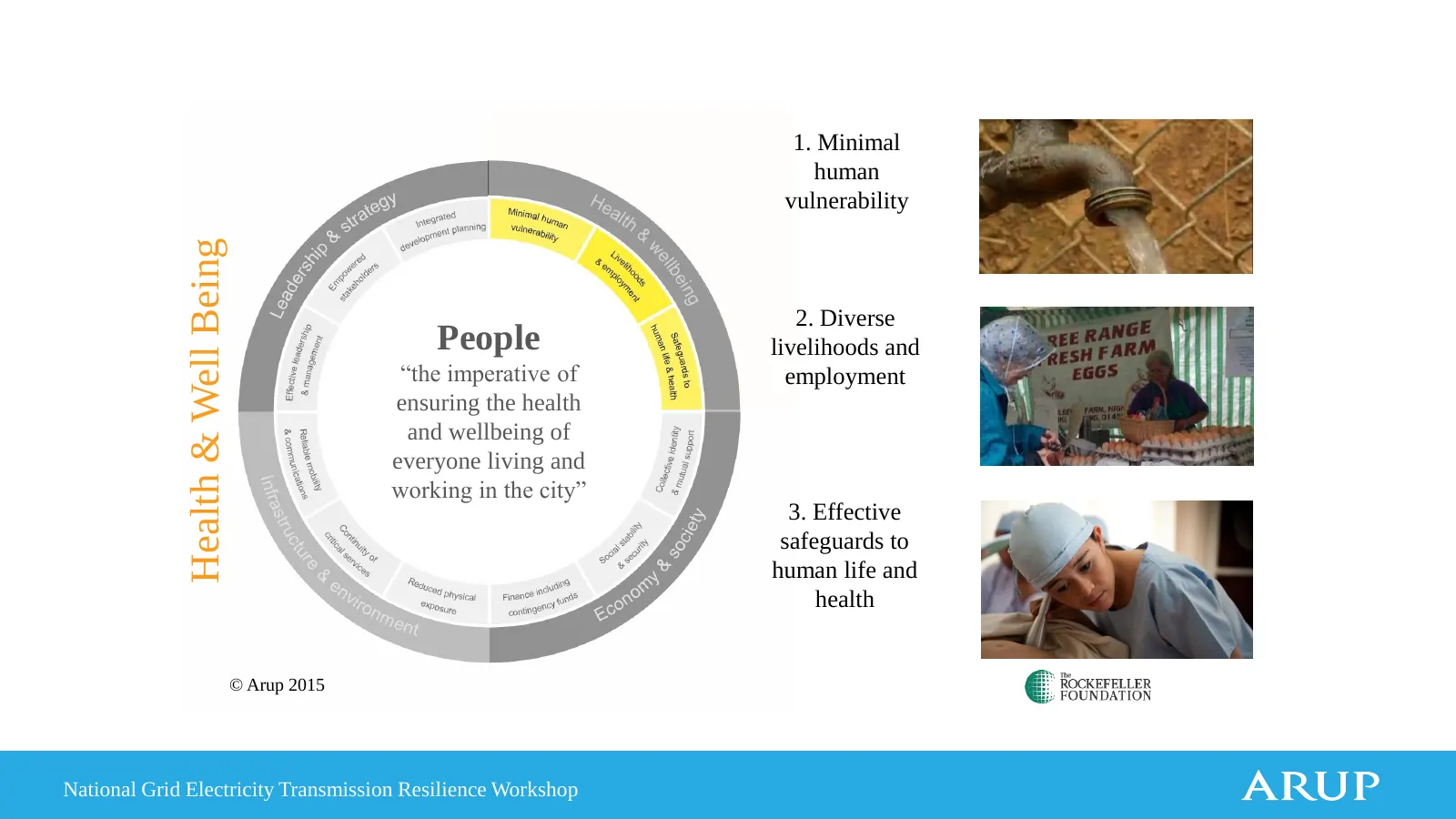
1. Minimal human Health & Well Being vulnerability 2. Diverse People livelihoods and “the imperative of employment ensuring the health and wellbeing of everyone living and working in the city” 3. Effective safeguards to human life and health © Arup 2015 National Grid Electricity Transmission Resilie
Slide 53: Economy & Society
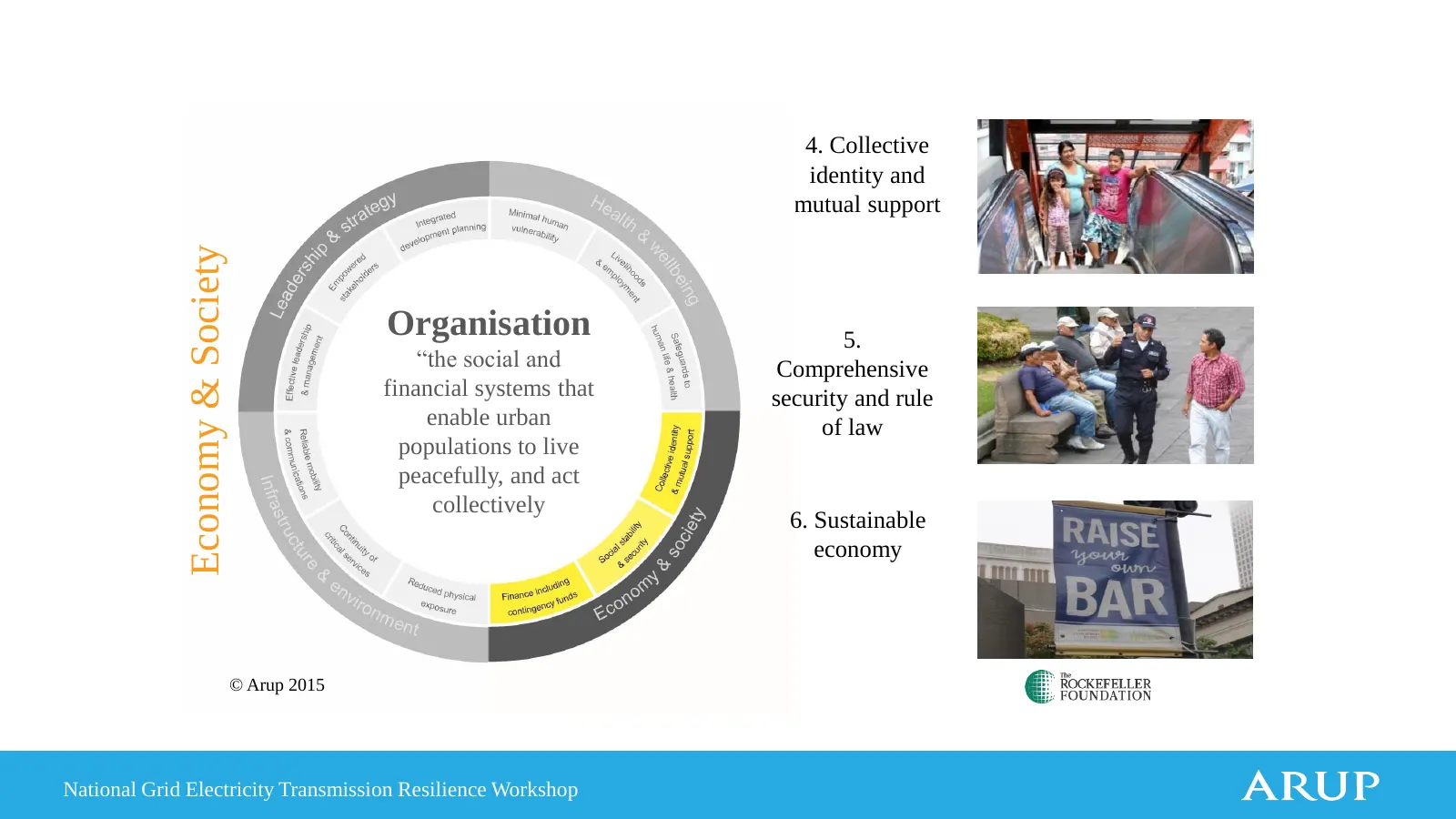
4. Collective identity and Economy & Society mutual support Organisation 5. “the social and Comprehensive financial systems that security and rule enable urban of law populations to live peacefully, and act collectively 6. Sustainable economy © Arup 2015 National Grid Electricity Transmission Resili
Slide 54: Infrastructure & Environment
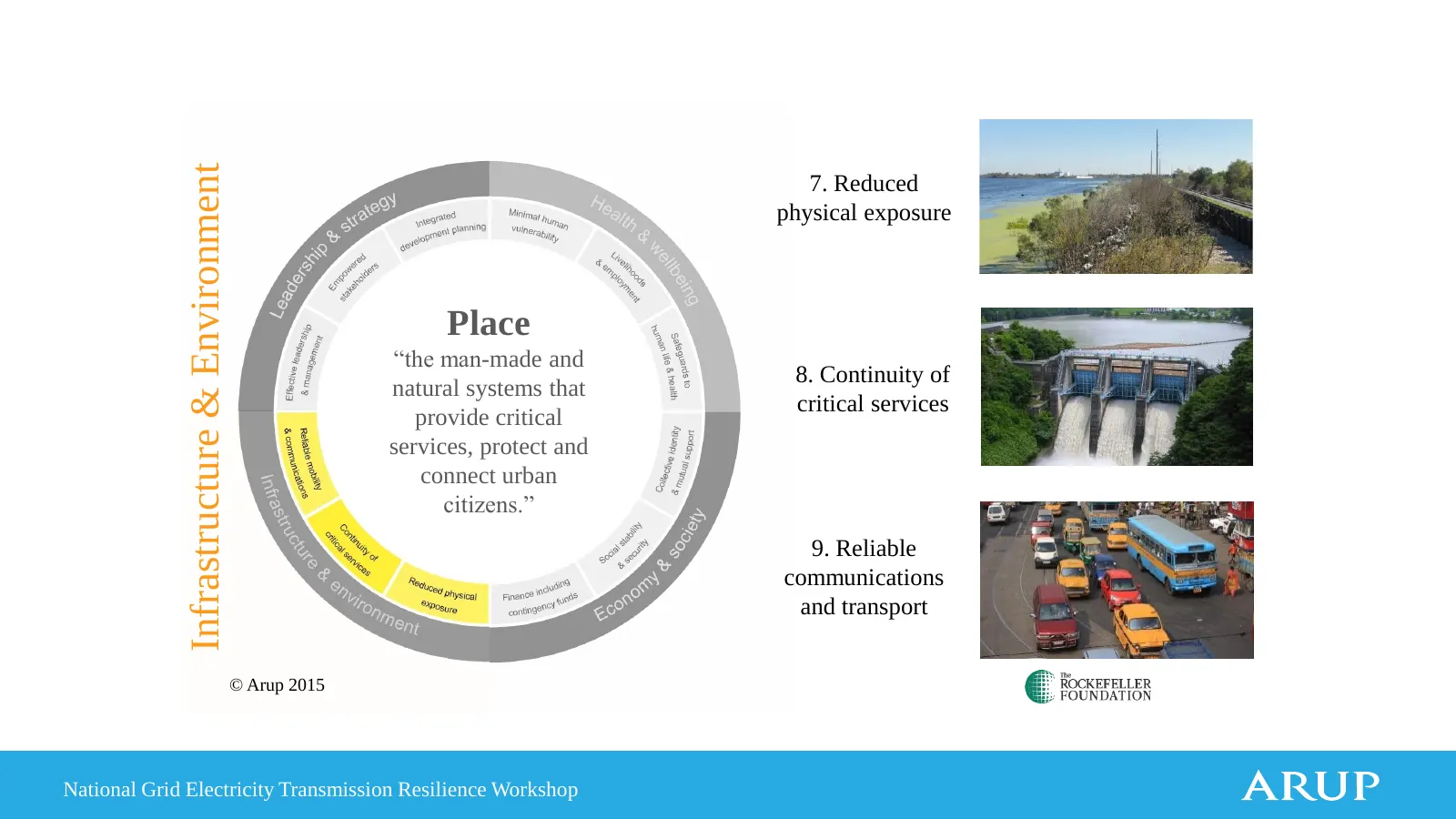
Infrastructure & Environment 7. Reduced physical exposure Place “the man-made and 8. Continuity of natural systems that critical services provide critical services, protect and connect urban citizens.” 9. Reliable communications and transport © Arup 2015 National Grid Electricity Transmission Resili
Slide 55: Leadership & Strategy
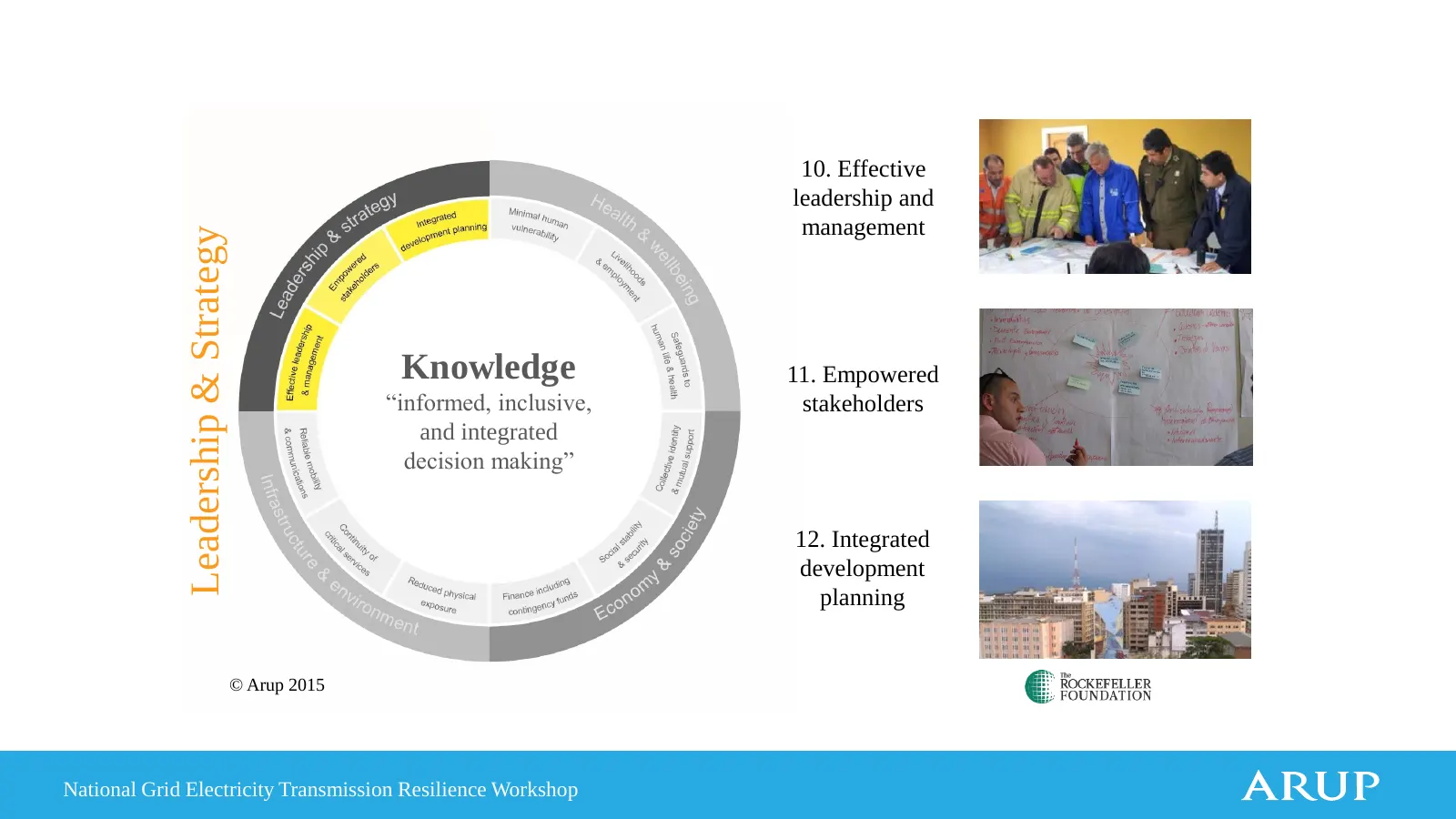
10. Effective leadership and management Leadership & Strategy Knowledge 11. Empowered “informed, inclusive, stakeholders and integrated decision making” 12. Integrated development planning © Arup 2015 National Grid Electricity Transmission Resilience Workshop
Slide 56: Dimensions
52 Indicators What to observe Dimensions Indicators Goals E.g. • Safe and affordable housing. • Secure technology networks • Well managed protective ecosystems © Arup 2015 National Grid Electricity Transmission Resilience Workshop
Slide 57: 156 Variables
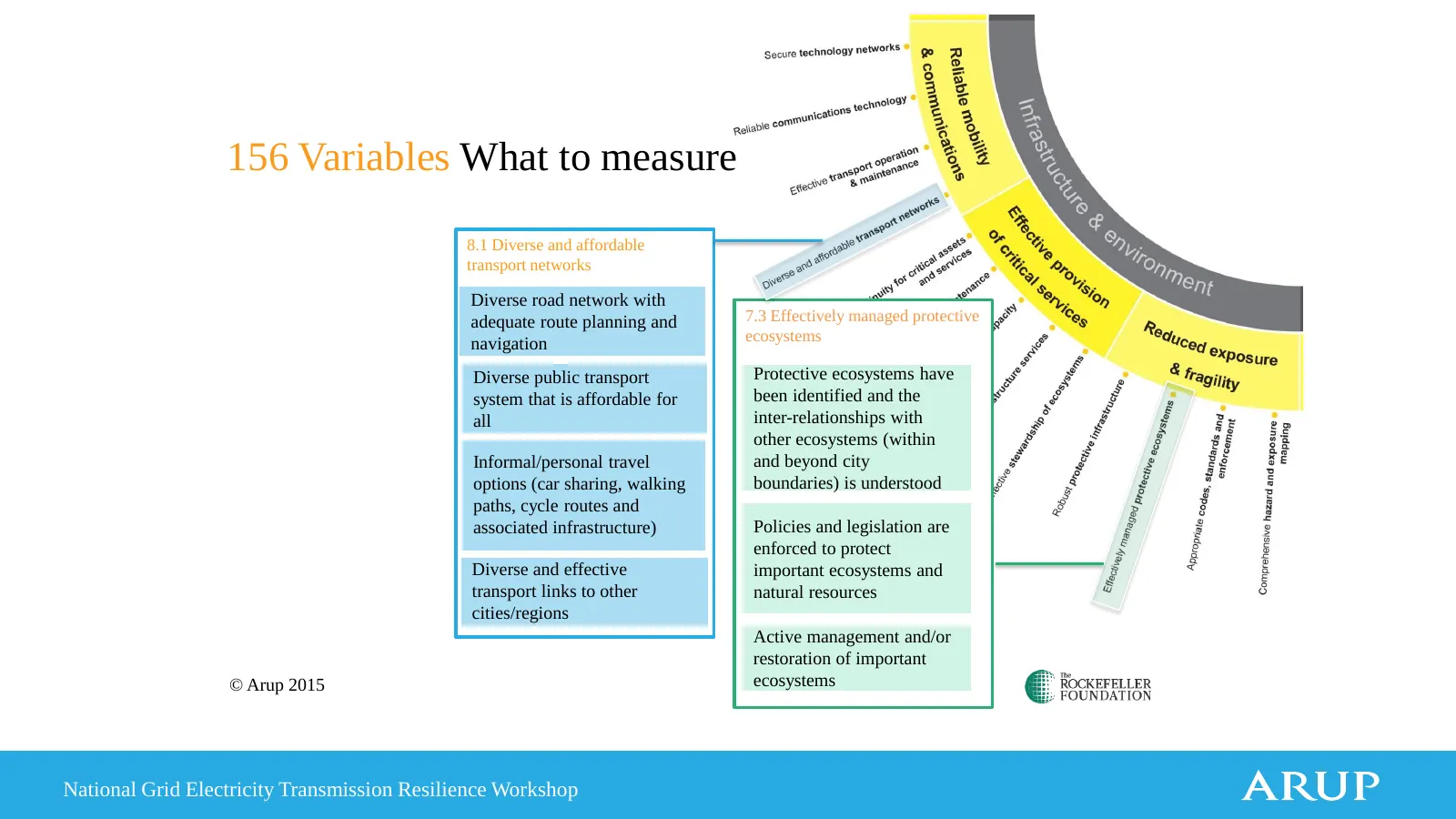
156 Variables What to measure 8.1 Diverse and affordable transport networks Diverse road network with adequate route planning and 7.3 Effectively managed protective navigation ecosystems Diverse public transport Protective ecosystems have system that is affordable for been identified and the all int
Slide 58: Qualitative scenarios assess adequacy of mechanisms
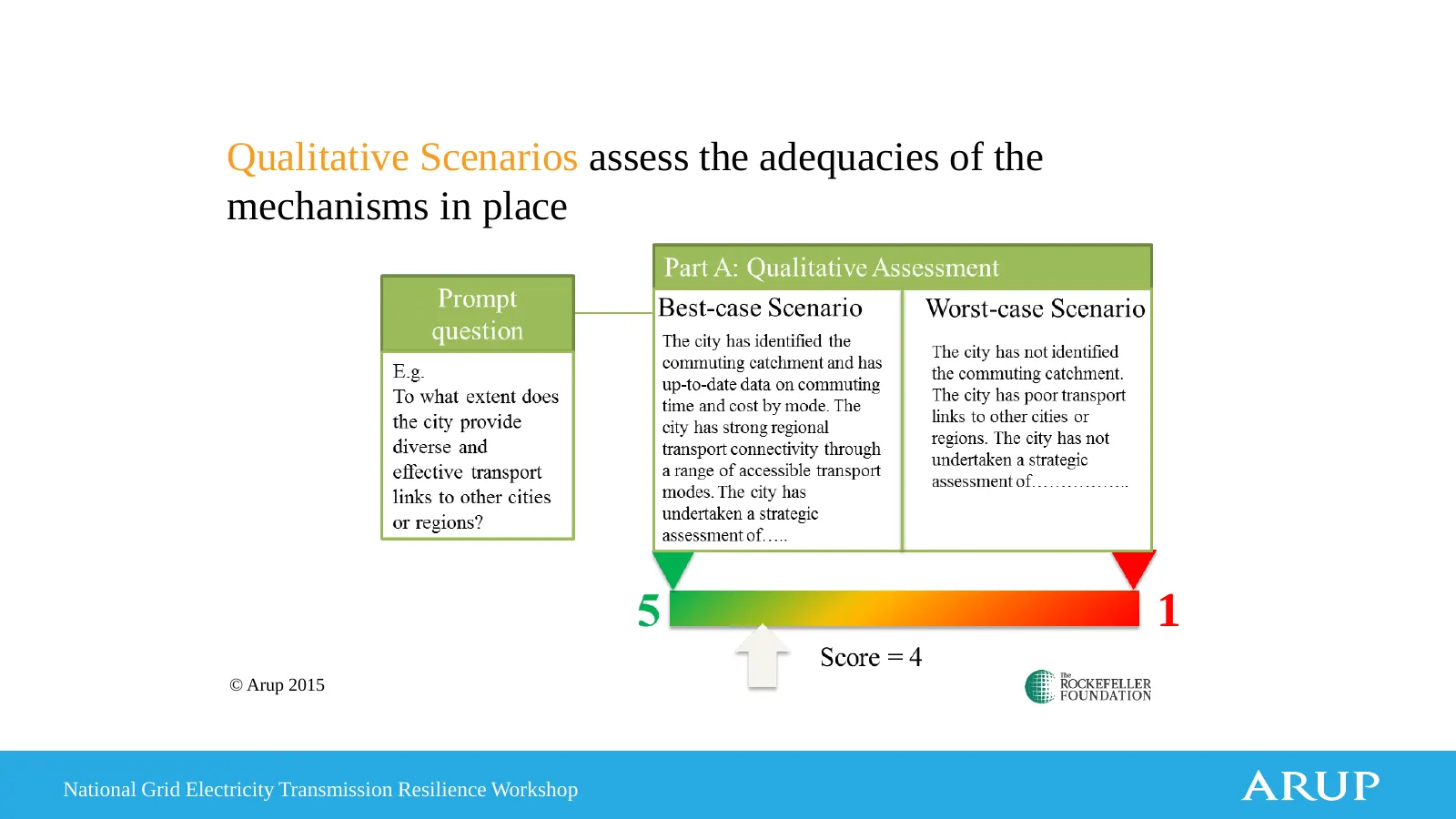
Qualitative Scenarios assess the adequacies of the mechanisms in place 1 © Arup 2015 National Grid Electricity Transmission Resilience Workshop
Slide 59: Visual Outputs
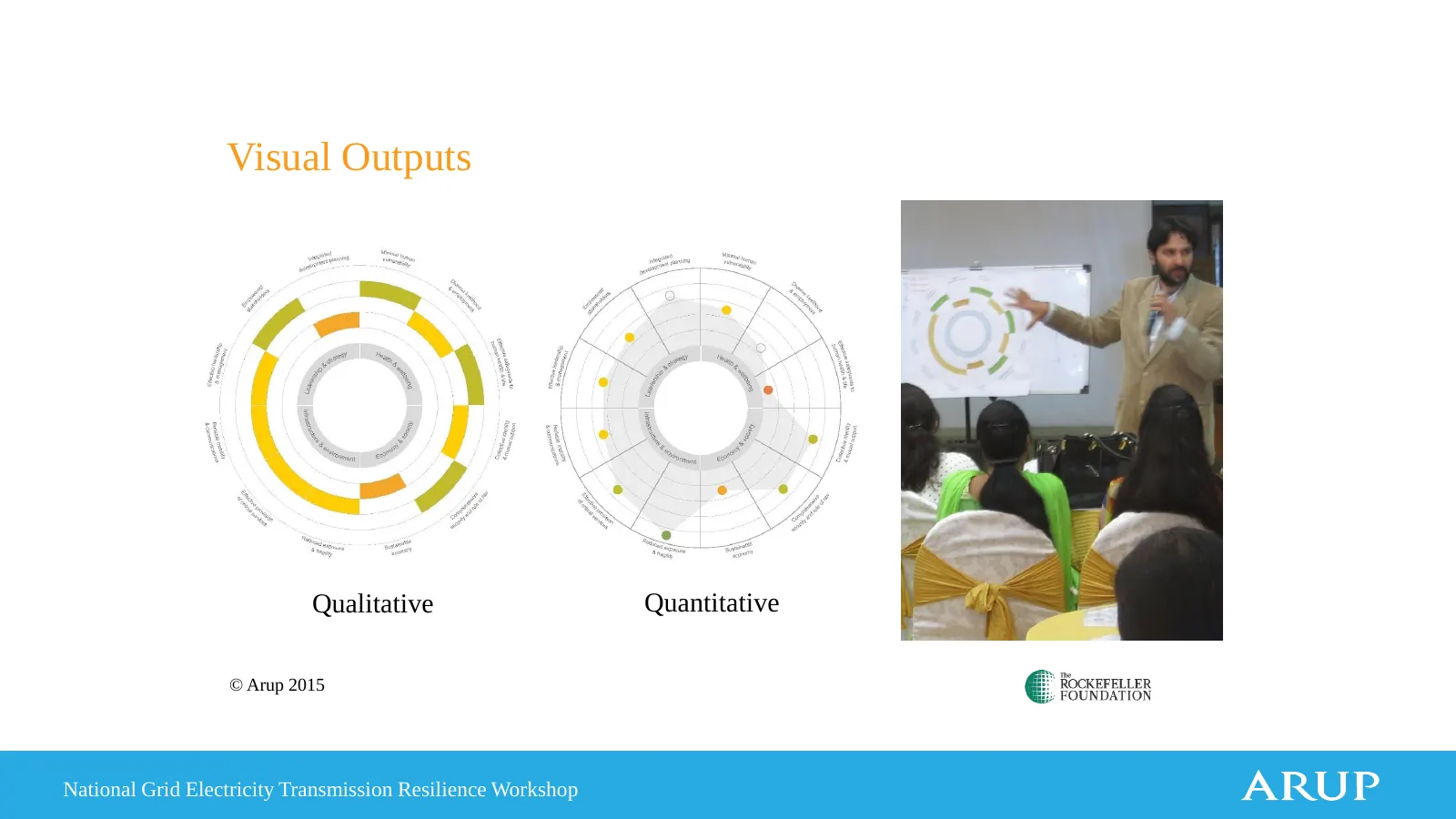
Visual Outputs Qualitative Quantitative © Arup 2015 National Grid Electricity Transmission Resilience Workshop
Slide 60: Dissemination of Research
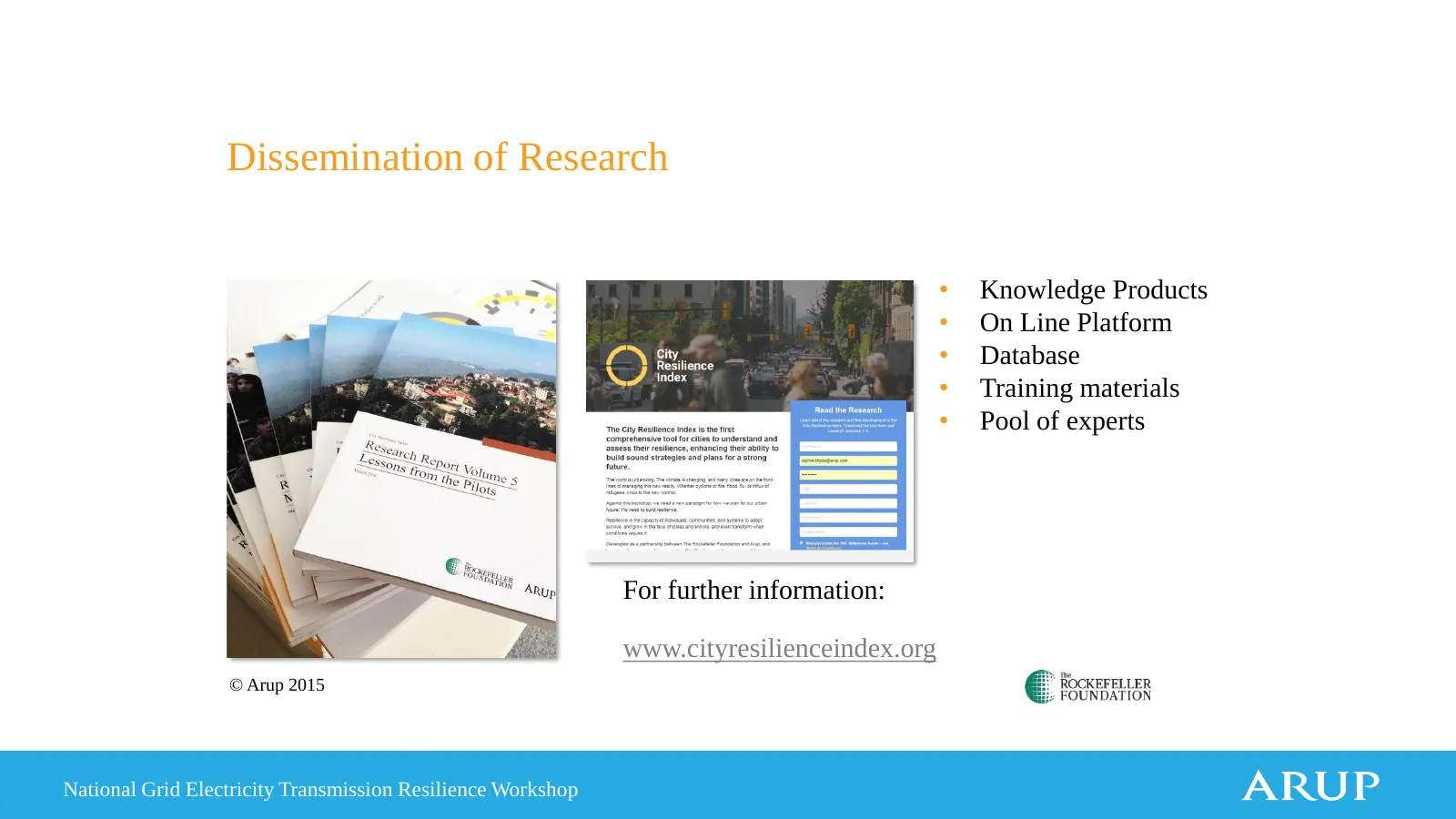
Dissemination of Research • Knowledge Products • On Line Platform • Database • Training materials • Pool of experts For further information: www.cityresilienceindex.org © Arup 2015 National Grid Electricity Transmission Resilience Workshop
Slide 61: City Water Resilience Framework cities
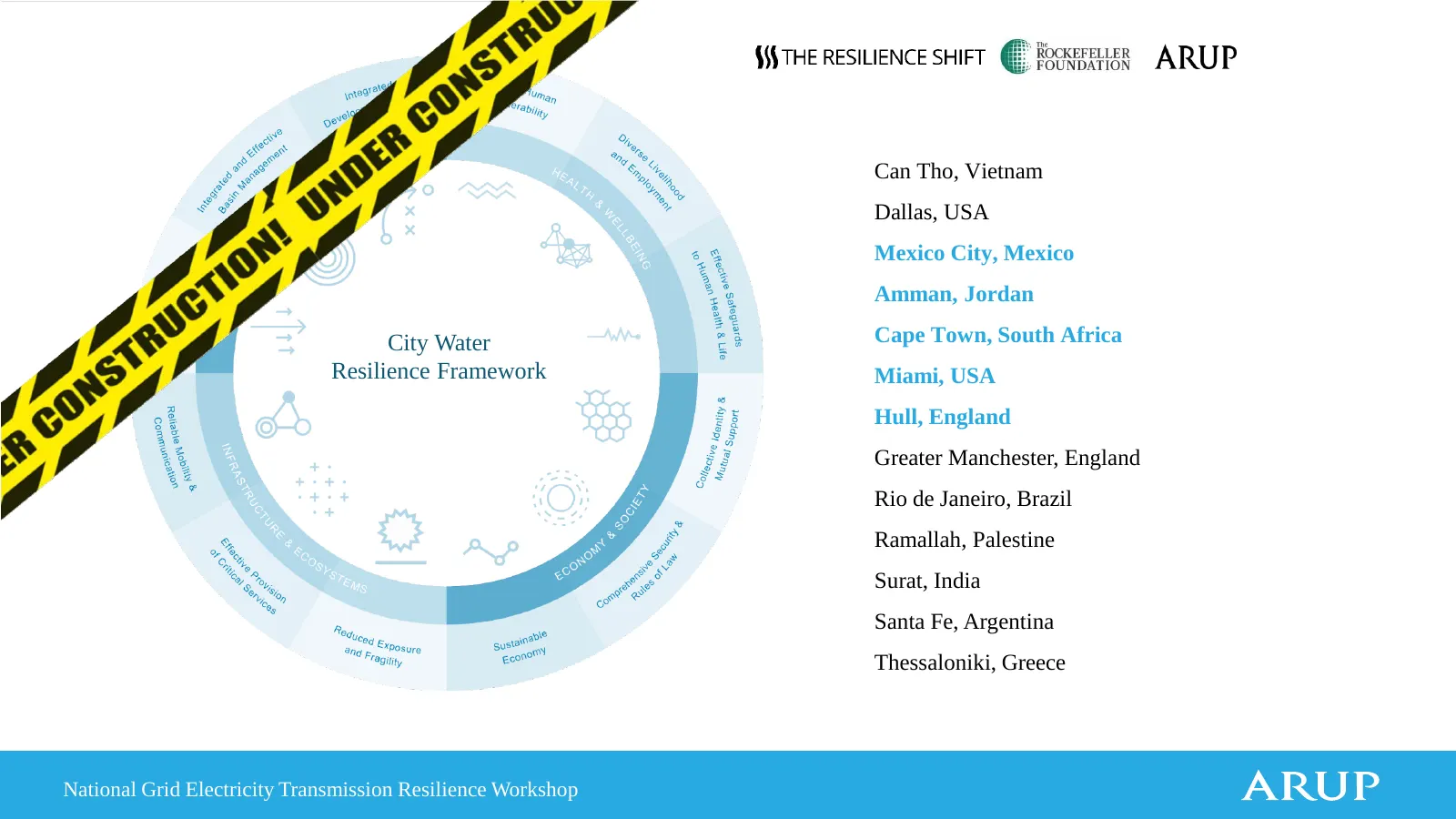
Can Tho, Vietnam Dallas, USA Mexico City, Mexico Amman, Jordan City Water Cape Town, South Africa Resilience Framework Miami, USA Hull, England Greater Manchester, England Rio de Janeiro, Brazil Ramallah, Palestine Surat, India Santa Fe, Argentina Thessaloniki, Greece National Grid Electricity Trans
Slide 62: Urban Water Resilience
Urban Water Resilience “the capacity of the urban water system - including the human, social, political, economic, physical and natural assets - to anticipate, absorb, adapt, respond to, and learn from shocks and stresses, in order to protect public health, wellbeing, the natural environment and min
Slide 63: City Water Resilience Framework: Our principles
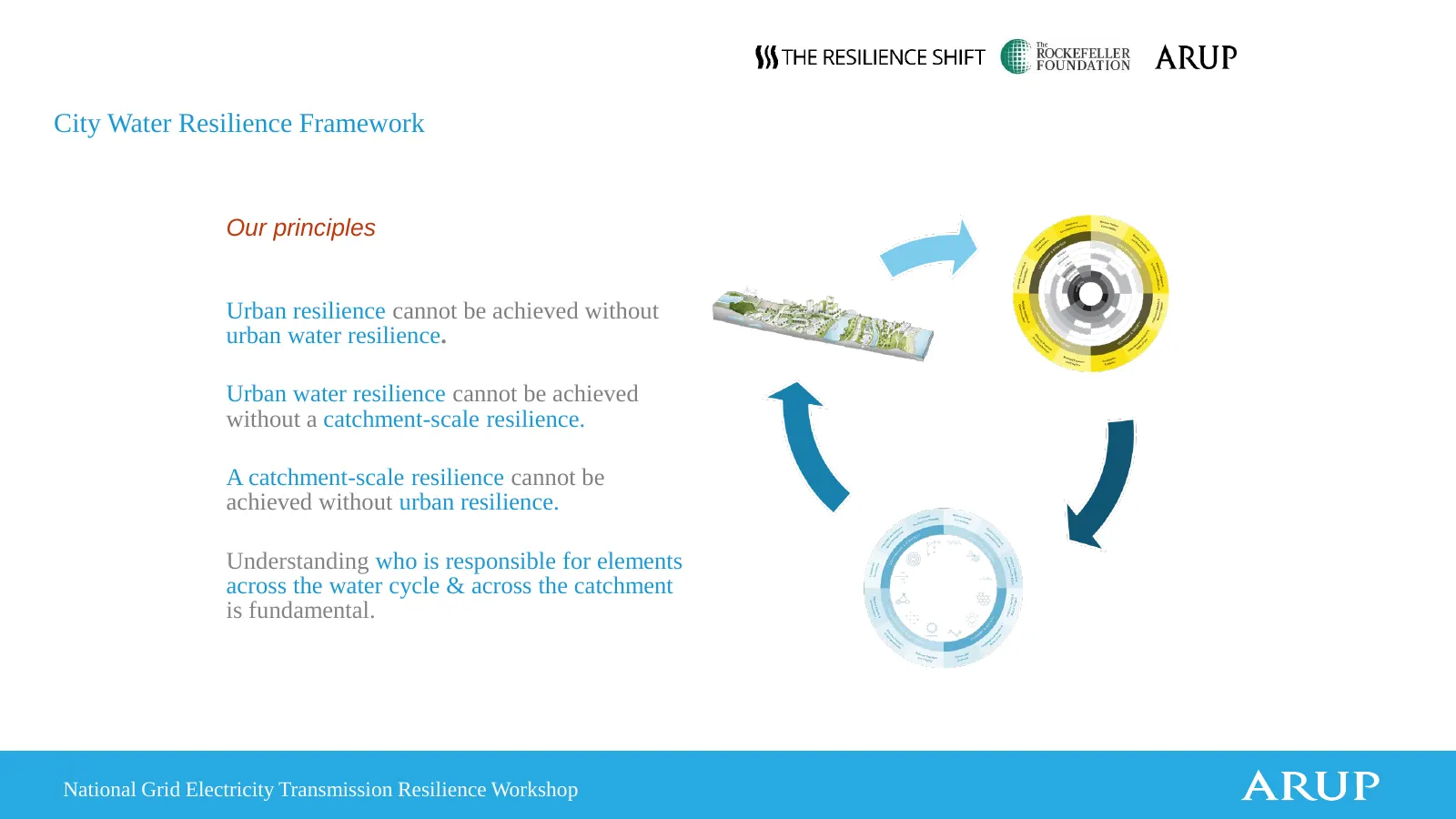
City Water Resilience Framework Our principles Urban resilience cannot be achieved without urban water resilience. Urban water resilience cannot be achieved without a catchment-scale resilience. A catchment-scale resilience cannot be achieved without urban resilience. Understanding who is responsibl
Slide 64: Key findings from the Research
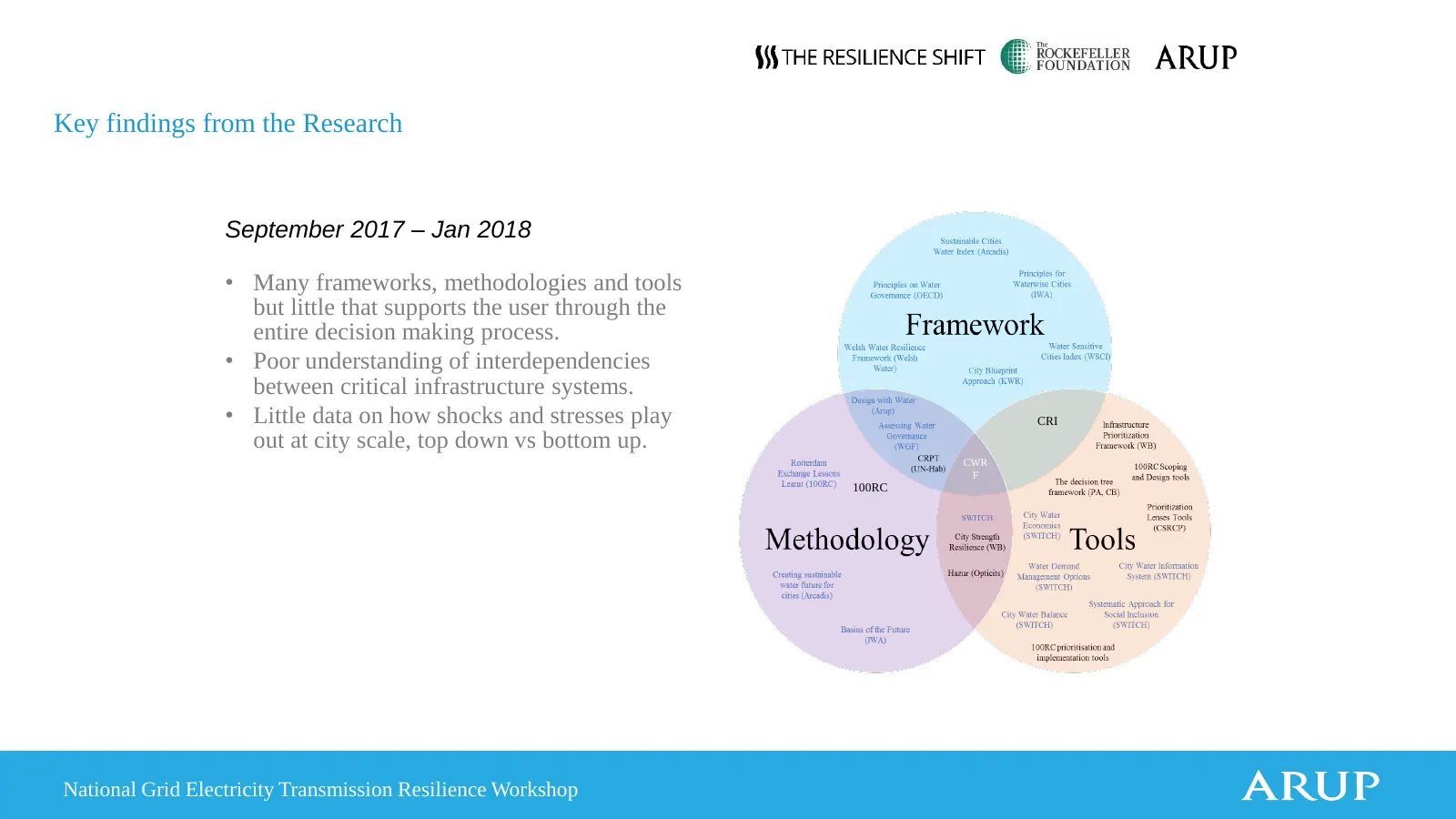
Key findings from the Research September 2017 – Jan 2018 • Many frameworks, methodologies and tools but little that supports the user through the entire decision making process. • Poor understanding of interdependencies between critical infrastructure systems. • Little data on how shocks and stresse
Slide 65: City Water Resilience Framework: decision support framework
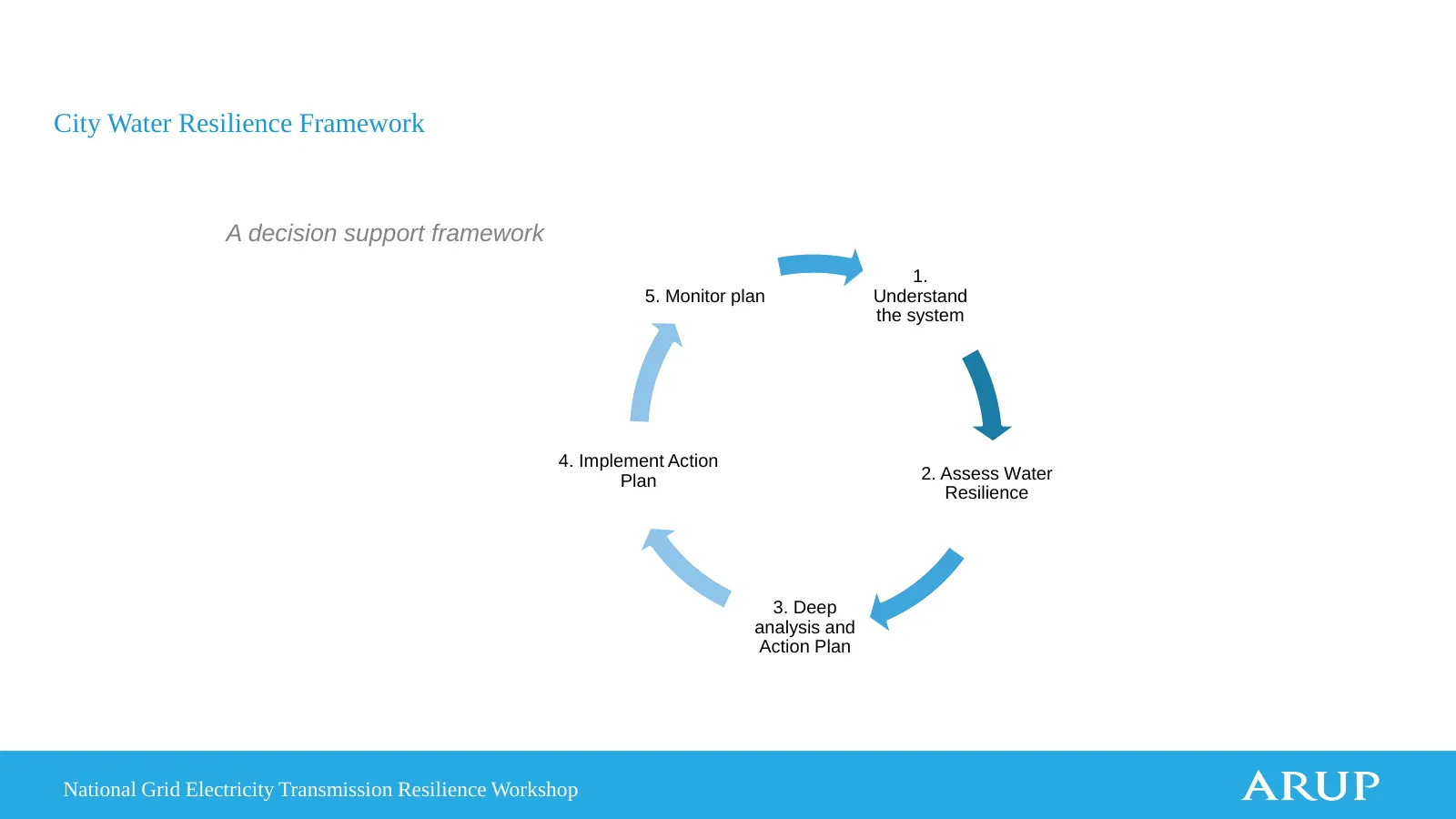
City Water Resilience Framework A decision support framework 1. 5. Monitor plan Understand the system 4. Implement Action Plan 2. Assess Water Resilience 3. Deep analysis and Action Plan National Grid Electricity Transmission Resilience Workshop
Slide 66: A tiered approach for tools and models
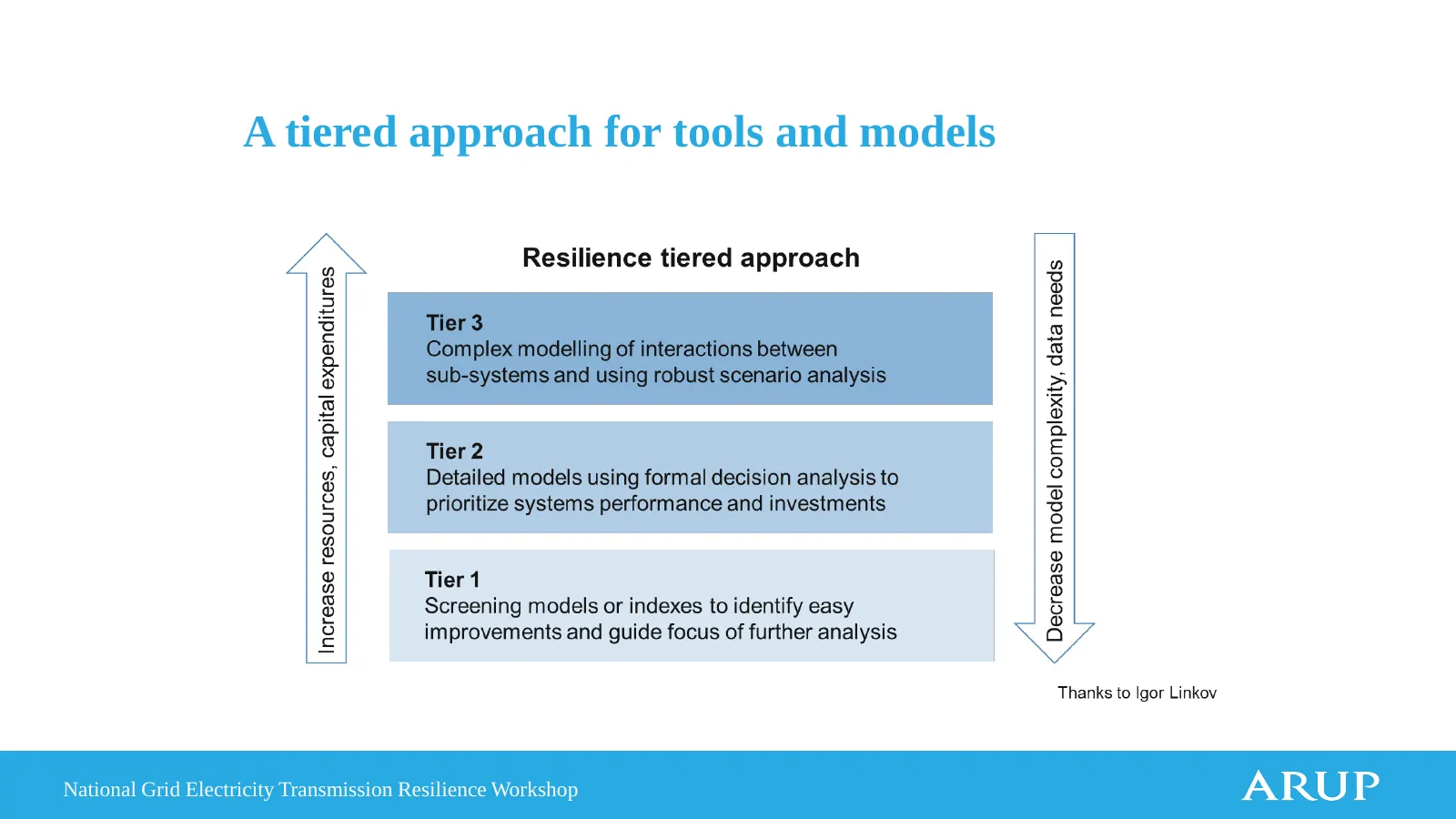
A tiered approach for tools and models National Grid Electricity Transmission Resilience Workshop
Slide 67: Buying down risk
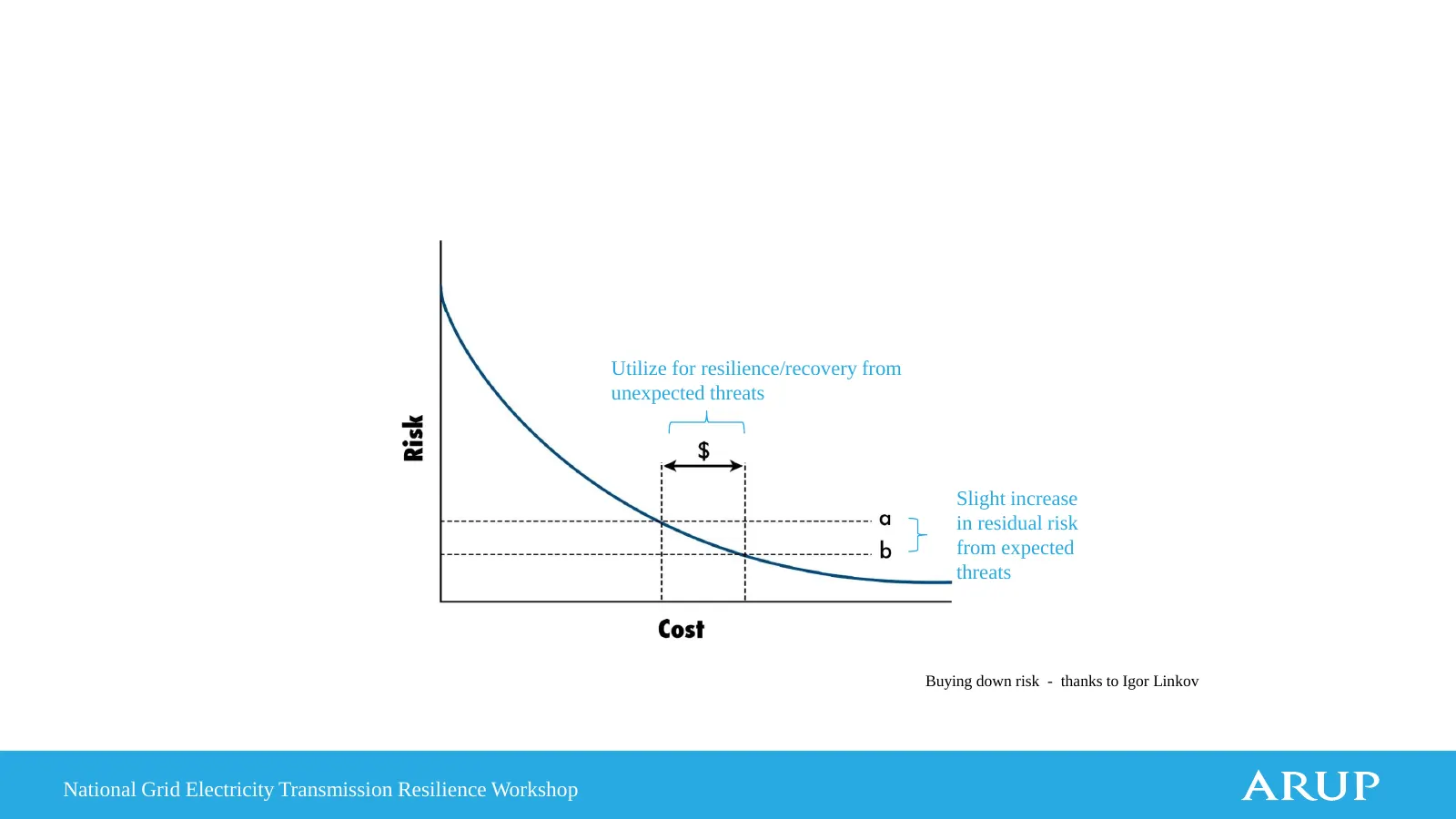
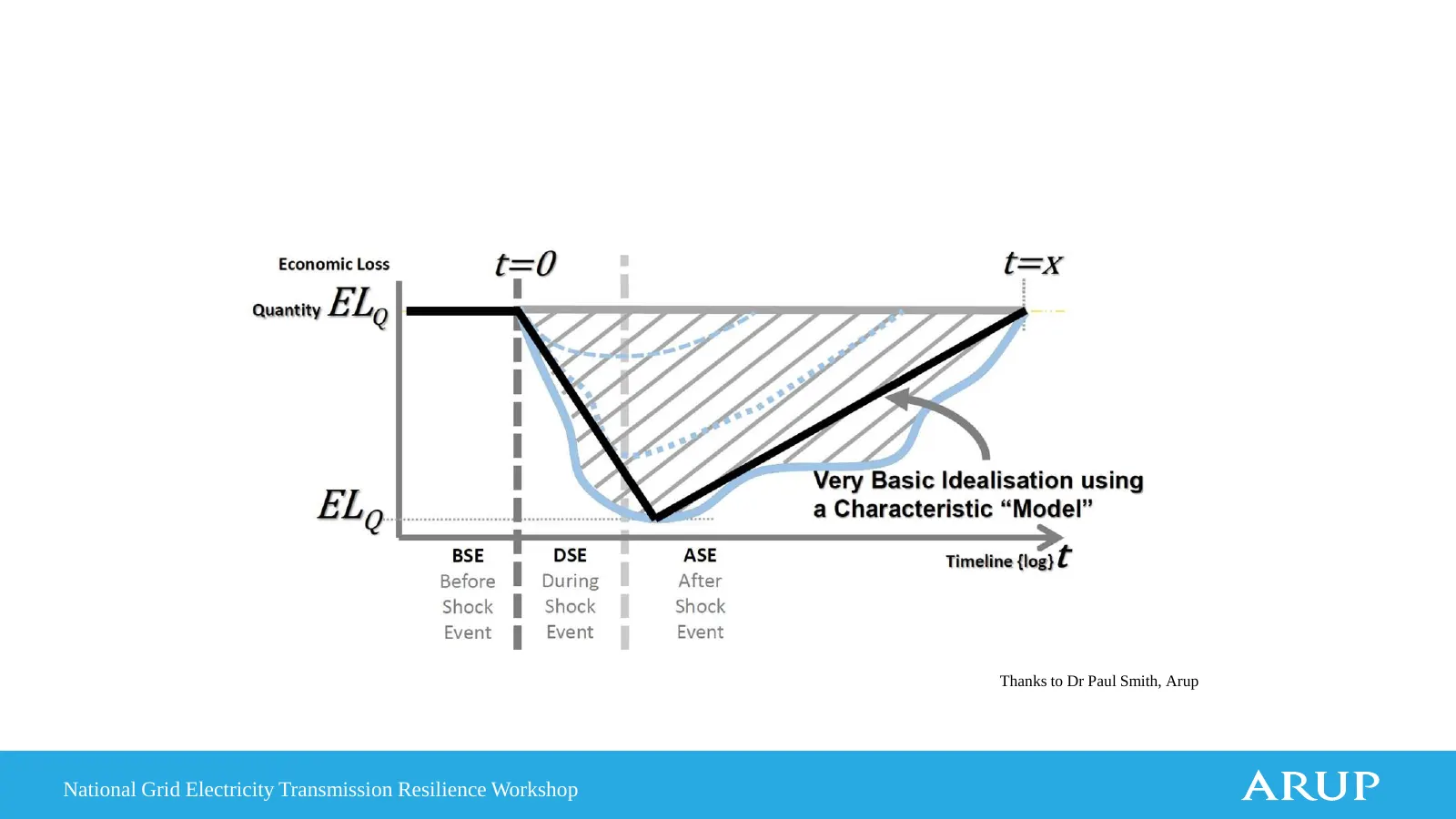
Utilize for resilience/recovery from unexpected threats Slight increase in residual risk from expected threats Buying down risk - thanks to Igor Linkov National Grid Electricity Transmission Resilience Workshop
Slide 68: National Grid Electricity Transmission Resilience Workshop
Bostick et al., 2018 Thanks to Dr Paul Smith, Arup National Grid Electricity Transmission Resilience Workshop
Slide 69: Thank you
Thank you juliet.mian@arup.com CRI: sachin.bhoite@arup.com CWRF: martin.shouler@arup.com www.resilienceshift.org National Grid Electricity Transmission Resilience Workshop
Slide 70: Resilience measures
Resilience measures Ursula Bryan
Slide 71: Resilience measures
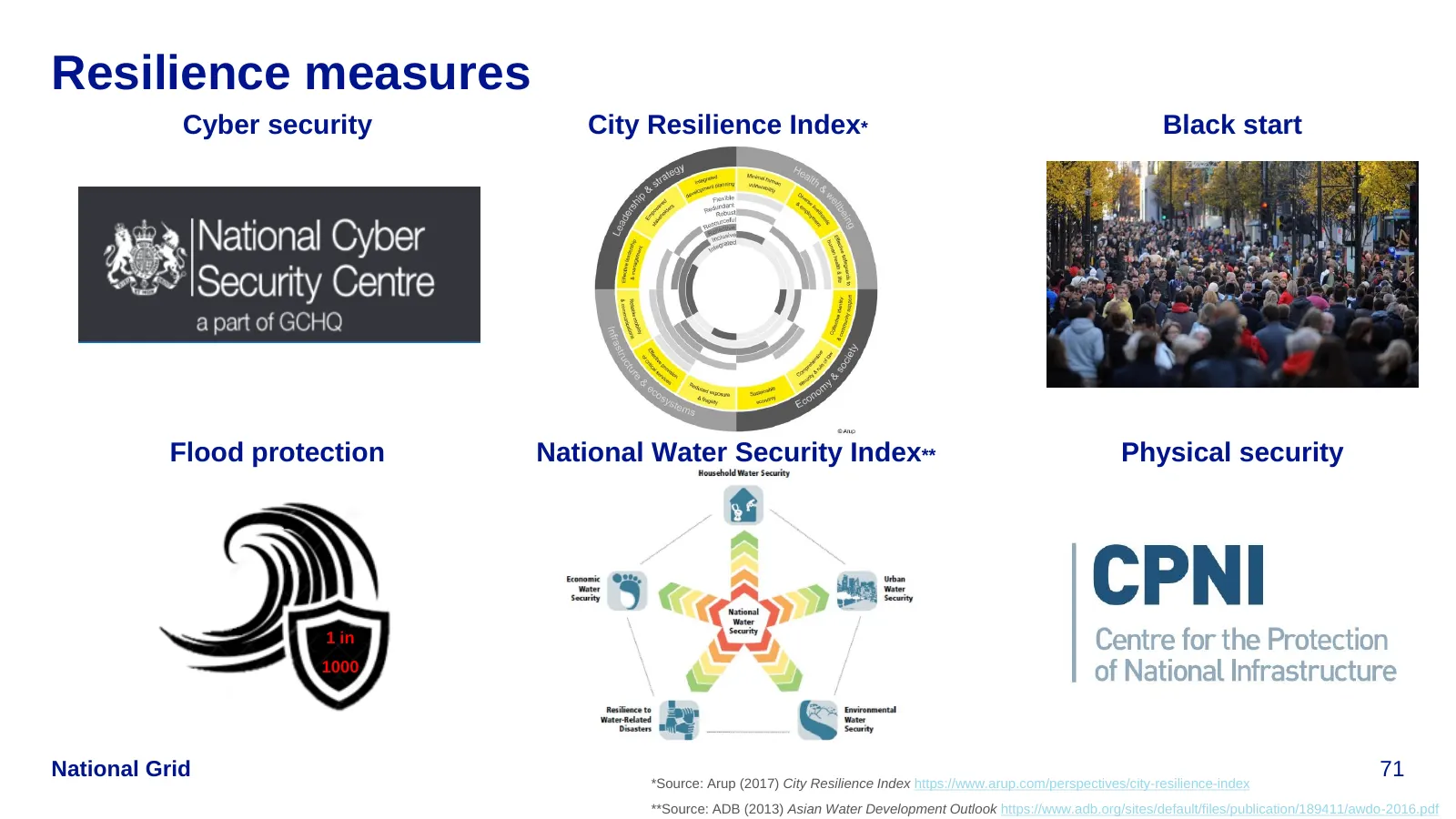
Resilience measures Cyber security City Resilience Index* Black start Flood protection National Water Security Index** Physical security 1 in 1000 National Grid 71 *Source: Arup (2017) City Resilience Index https://www.arup.com/perspectives/city-resilience-index **Source: ADB (2013) Asian Water Deve
Slide 72: What happens next
What happens next Our commitment • We’ll process everything you’ve told us today • We’ll summarise today’s event and send it to you • We’ll use your comments to plan our future engagement activities • We will present your comments to our stakeholder group • We’ll keep you informed www.yourenergyfutu

Slide 73: nationalgrid
nationalgrid
Source: Internet Archive copy of nationalgrid.com
More decks from National Grid plc
 H1 2026/27 Earnings Presentation35 slides · Nov 5, 2026
 FY2026 Earnings Presentation52 slides · May 14, 2026
 Debt Investor Presentation (November 2025)21 slides · Nov 6, 2025
 Q2 2026 Earnings Presentation34 slides · Nov 6, 2025
 Technical Presentation (August 2025)20 slides · Aug 8, 2025
 Debt Investor Presentation (May 2025)22 slides · May 16, 2025