Amgen Inc. · NASDAQ:AMGN
Amgen — Technical Presentation (September 2007)
75 slides from Amgen's technical presentation, Sep 11, 2007
Slide 1: Erythropoiesis-Stimulating Agent (ESA) Therapy in Chronic Renal Failure (CRF)
Erythropoiesis-Stimulating Agent (ESA) Therapy in Chronic Renal Failure (CRF) Joint Meeting Between the Cardiovascular and Renal Drugs & Drug Safety and Risk Management Advisory Committees 11 September 2007 CC-1
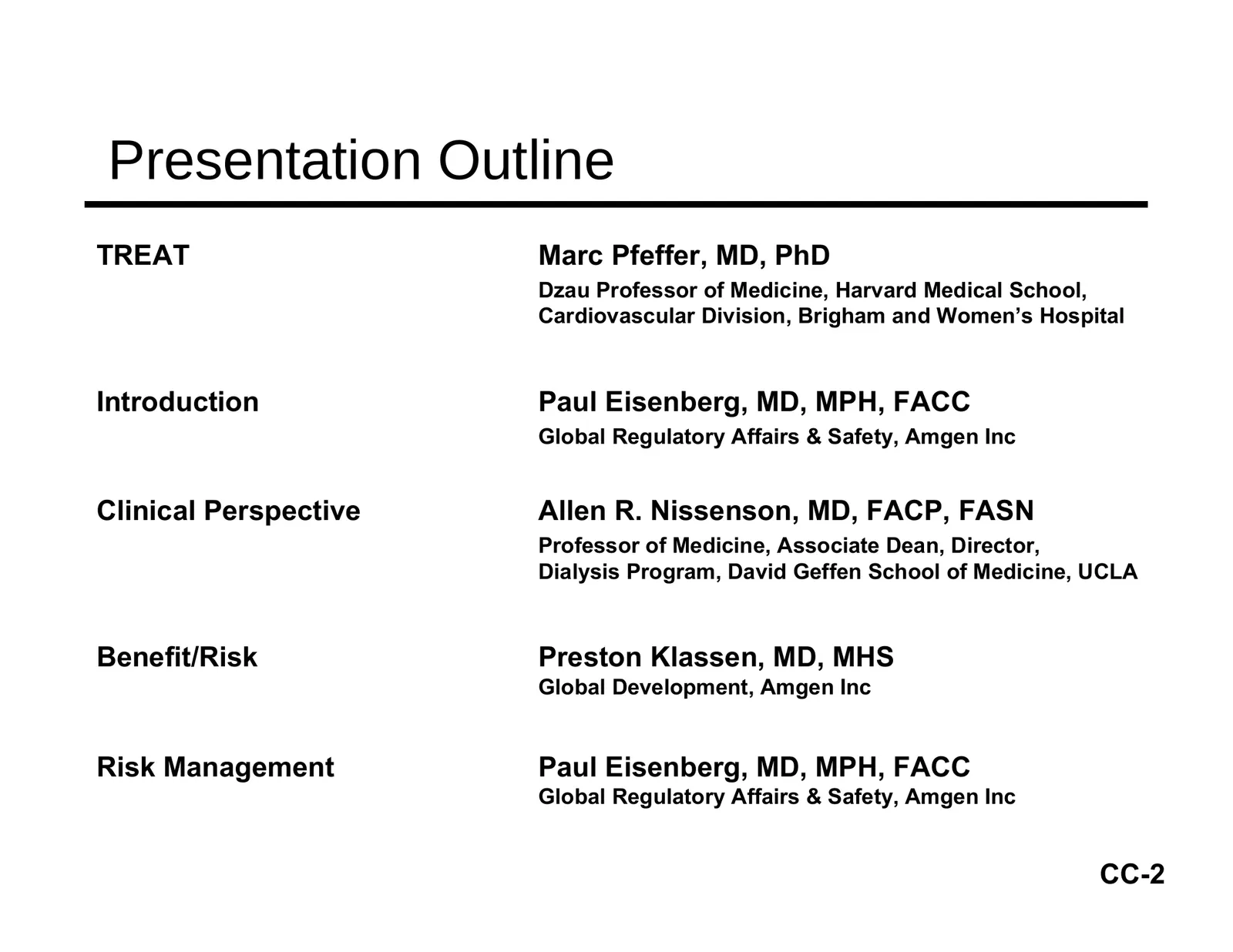
Slide 2: Presentation Outline
Presentation Outline TREAT Marc Pfeffer, MD, PhD Dzau Professor of Medicine, Harvard Medical School, Cardiovascular Division, Brigham and Women’s Hospital Introduction Paul Eisenberg, MD, MPH, FACC Global Regulatory Affairs & Safety, Amgen Inc Clinical Perspective Allen R. Nissenson, MD, FACP, FASN
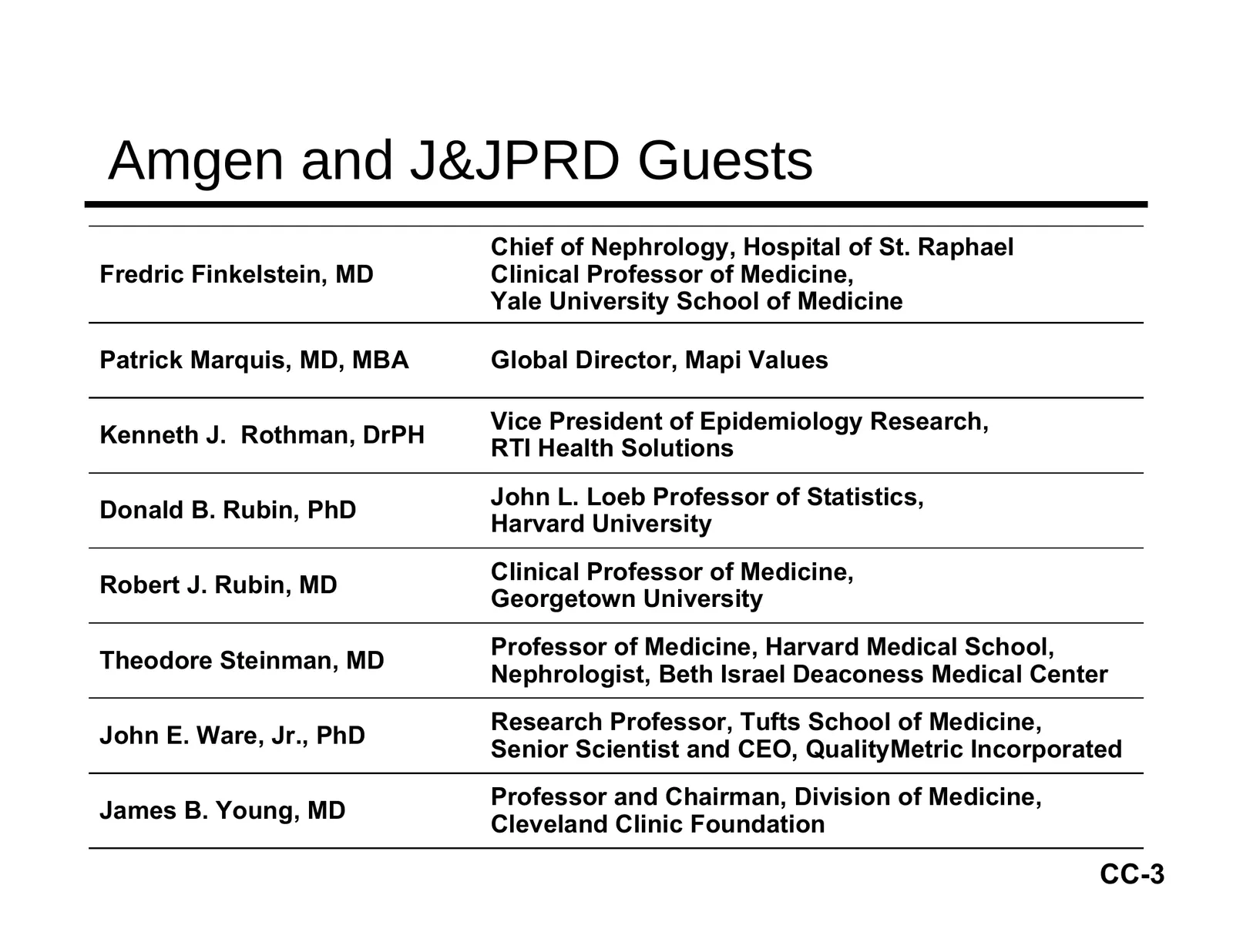
Slide 3: Amgen and J&JPRD Guests
Amgen and J&JPRD Guests Chief of Nephrology, Hospital of St. Raphael Fredric Finkelstein, MD Clinical Professor of Medicine, Yale University School of Medicine Patrick Marquis, MD, MBA Global Director, Mapi Values Vice President of Epidemiology Research, Kenneth J. Rothman, DrPH RTI Health Solutions
Slide 4: Presentation Outline
Presentation Outline TREAT Marc Pfeffer, MD, PhD Dzau Professor of Medicine, Harvard Medical School, Cardiovascular Division, Brigham and Women’s Hospital Introduction Paul Eisenberg, MD, MPH, FACC Global Regulatory Affairs & Safety, Amgen Inc Clinical Perspective Allen R. Nissenson, MD, FACP, FASN
Slide 5: Randomized Trials of ESAs in CRF
Randomized Trials of ESAs in CRF Marc A. Pfeffer MD, PhD Dzau Professor of Medicine Harvard Medical School, Cardiovascular Division, Brigham and Women’s Hospital Chair, TREAT Executive Committee CC-5
Slide 6: TREAT: Executive Committee and DSMC
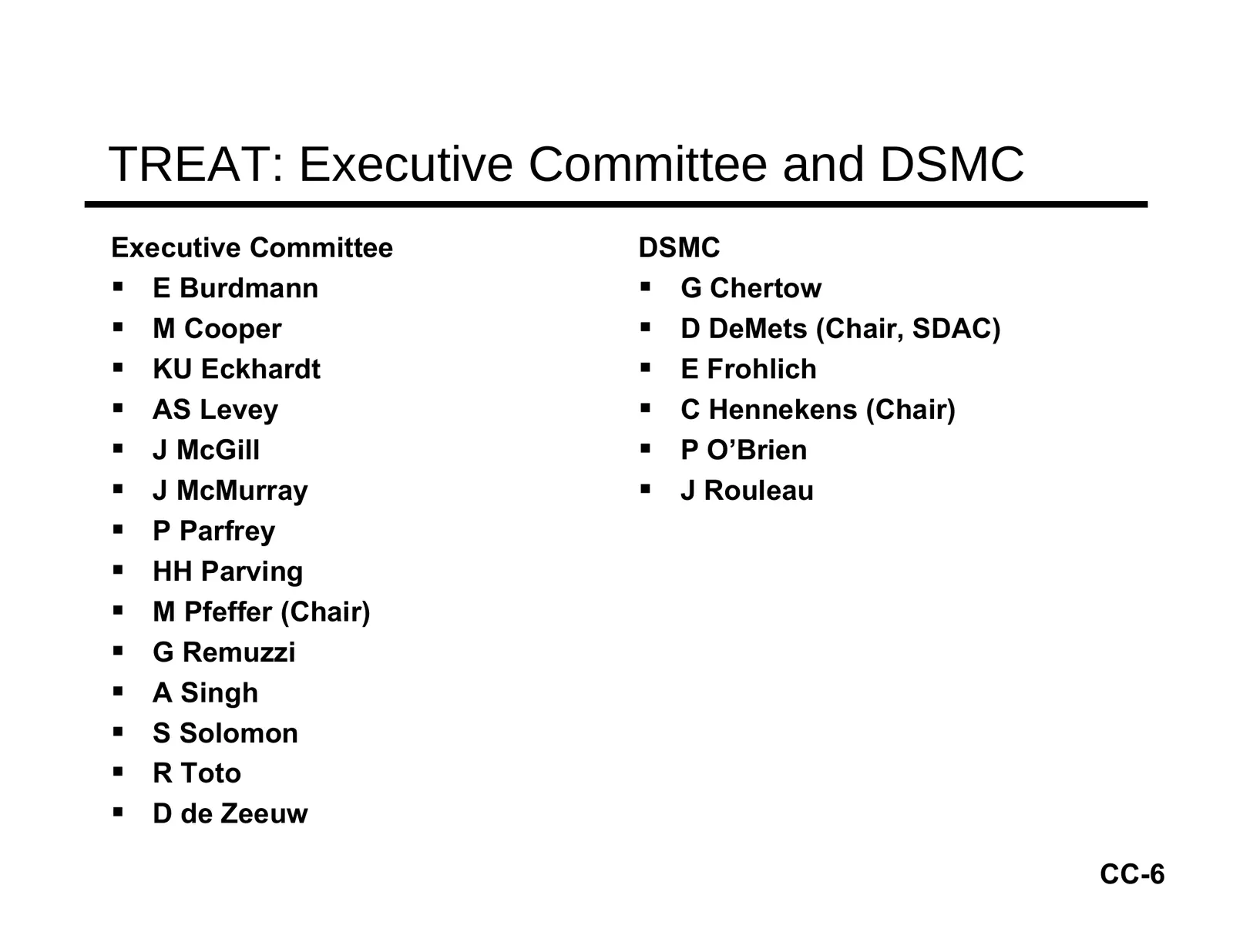
TREAT: Executive Committee and DSMC Executive Committee DSMC E Burdmann G Chertow M Cooper D DeMets (Chair, SDAC) KU Eckhardt E Frohlich AS Levey C Hennekens (Chair) J McGill P O’Brien J McMurray J Rouleau P Parfrey HH Parving M Pfeffer (Chair) G Remuzzi A Singh S
Slide 7: ESA RCTs in CRF
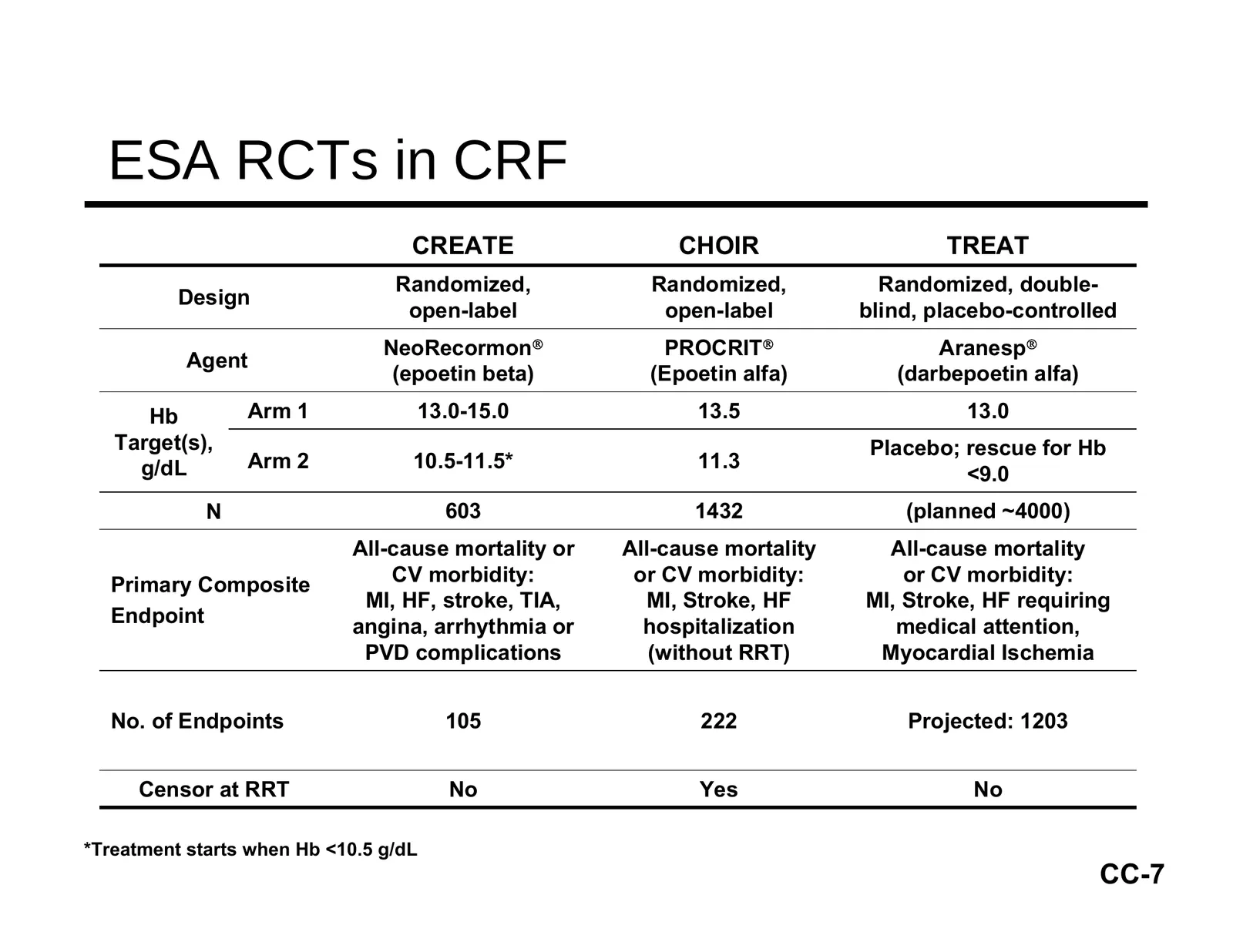
ESA RCTs in CRF CREATE CHOIR TREAT Randomized, Randomized, Randomized, double- Design open-label open-label blind, placebo-controlled NeoRecormon® PROCRIT® Aranesp® Agent (epoetin beta) (Epoetin alfa) (darbepoetin alfa) Hb Arm 1 13.0-15.0 13.5 13.0 Target(s), Placebo; rescue for Hb g/dL Arm 2 10.5-1
Slide 8: TREAT: Trial to Reduce Cardiovascular Events with Aranesp Therapy
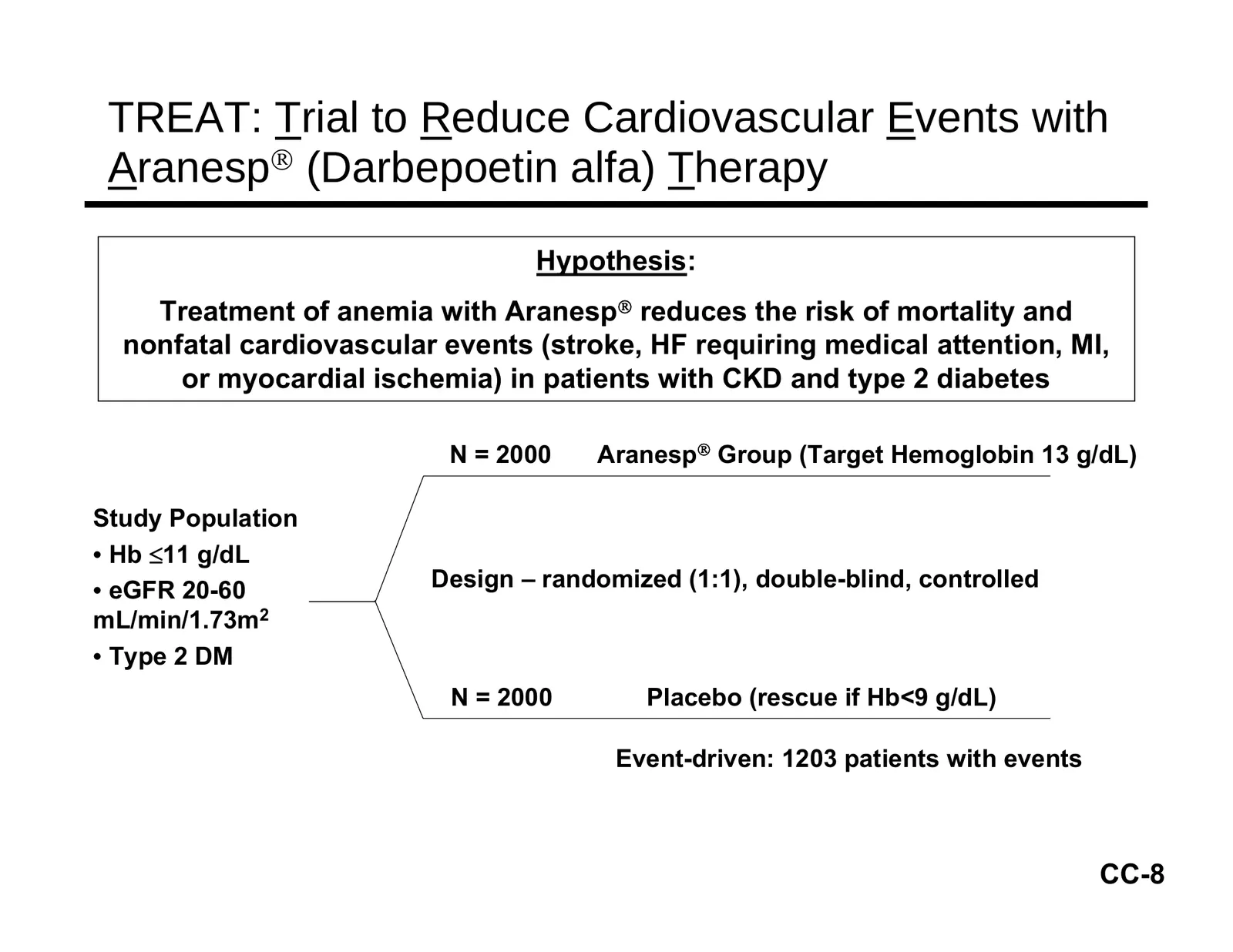
TREAT: Trial to Reduce Cardiovascular Events with Aranesp® (Darbepoetin alfa) Therapy Hypothesis: Treatment of anemia with Aranesp® reduces the risk of mortality and nonfatal cardiovascular events (stroke, HF requiring medical attention, MI, or myocardial ischemia) in patients with CKD and type 2 di
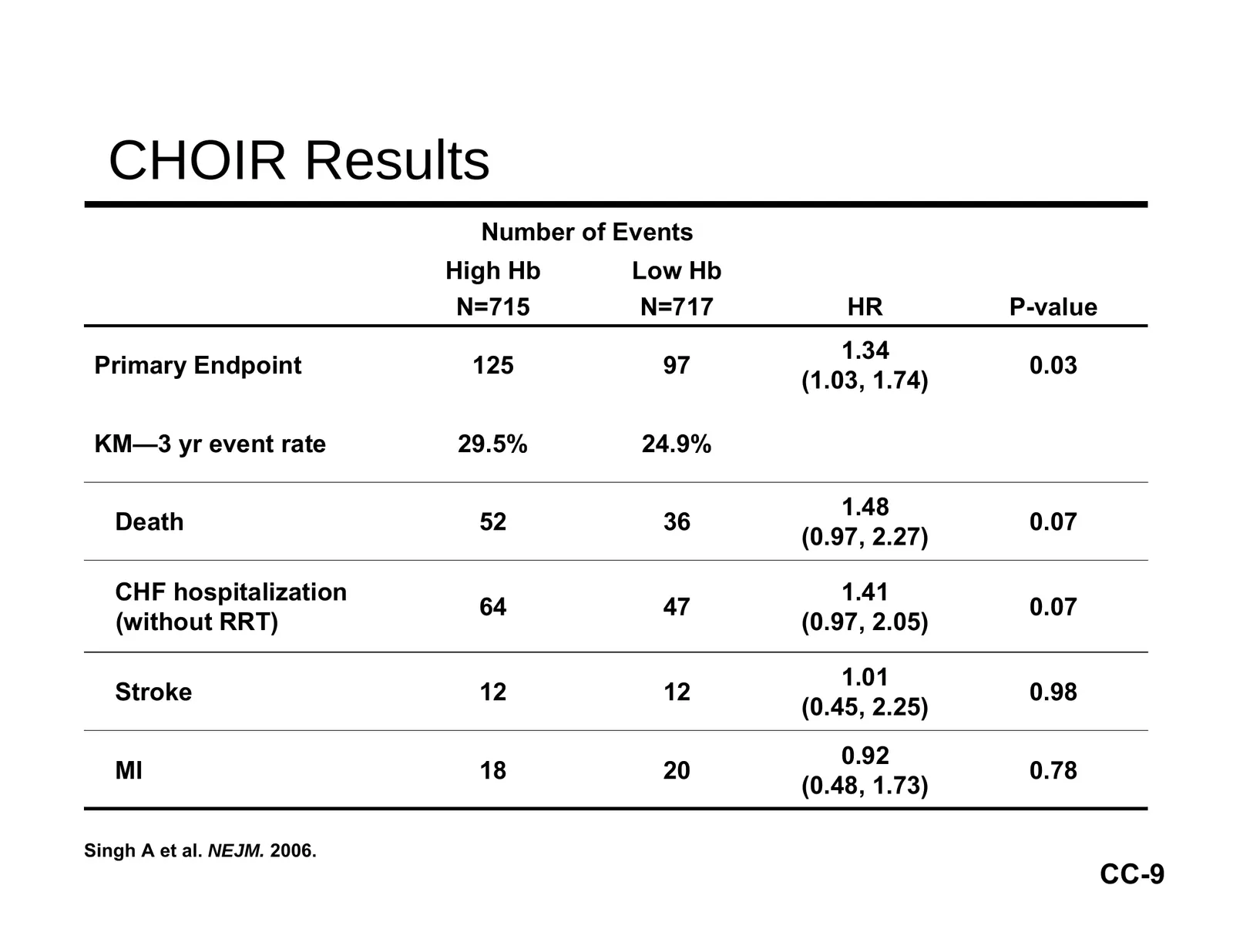
Slide 9: CHOIR Results
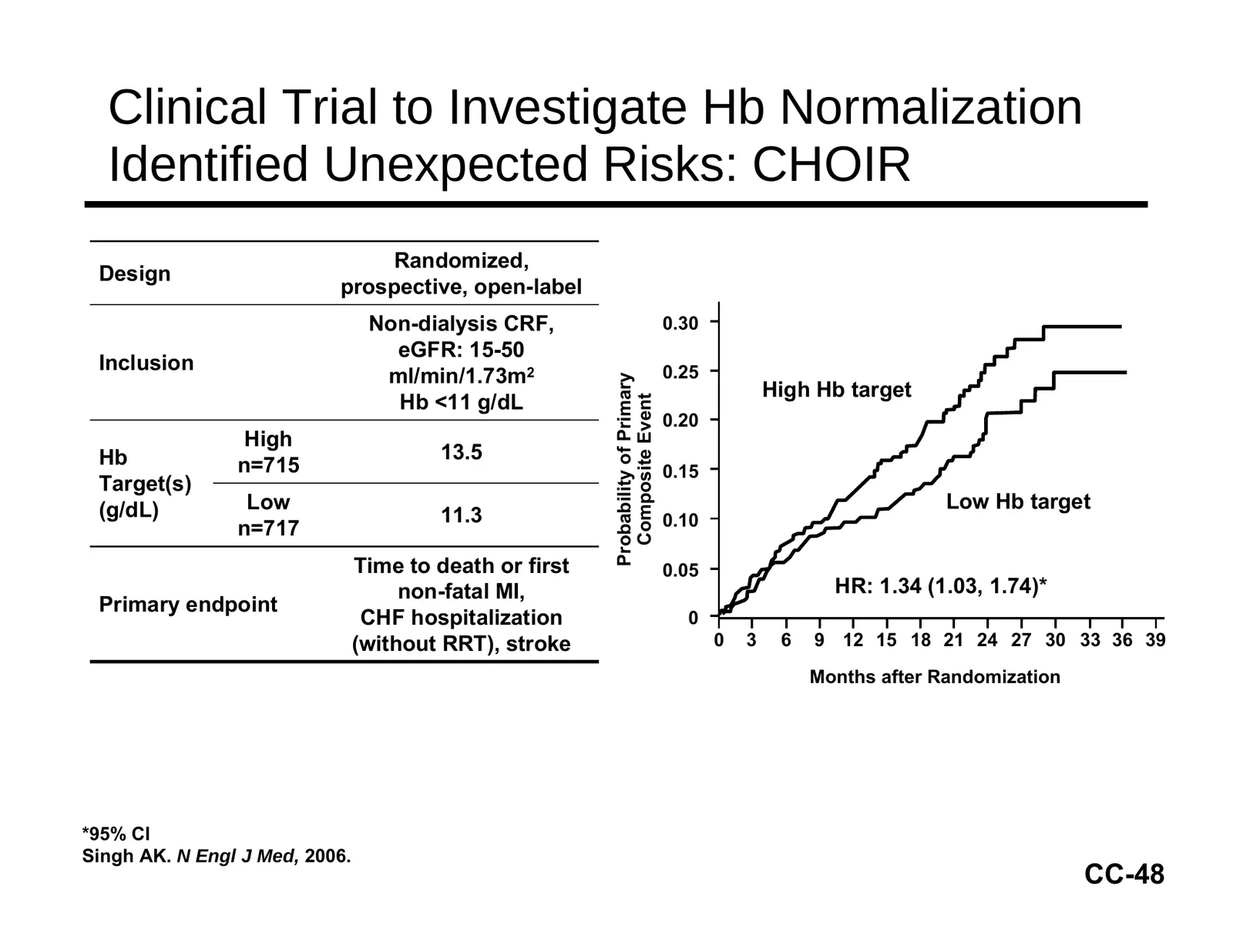
CHOIR Results Number of Events High Hb Low Hb N=715 N=717 HR P-value 1.34 Primary Endpoint 125 97 0.03 (1.03, 1.74) KM—3 yr event rate 29.5% 24.9% 1.48 Death 52 36 0.07 (0.97, 2.27) CHF hospitalization 1.41 64 47 0.07 (without RRT) (0.97, 2.05) 1.01 Stroke 12 12 0.98 (0.45, 2.25) 0.92 MI 18 20 0.78
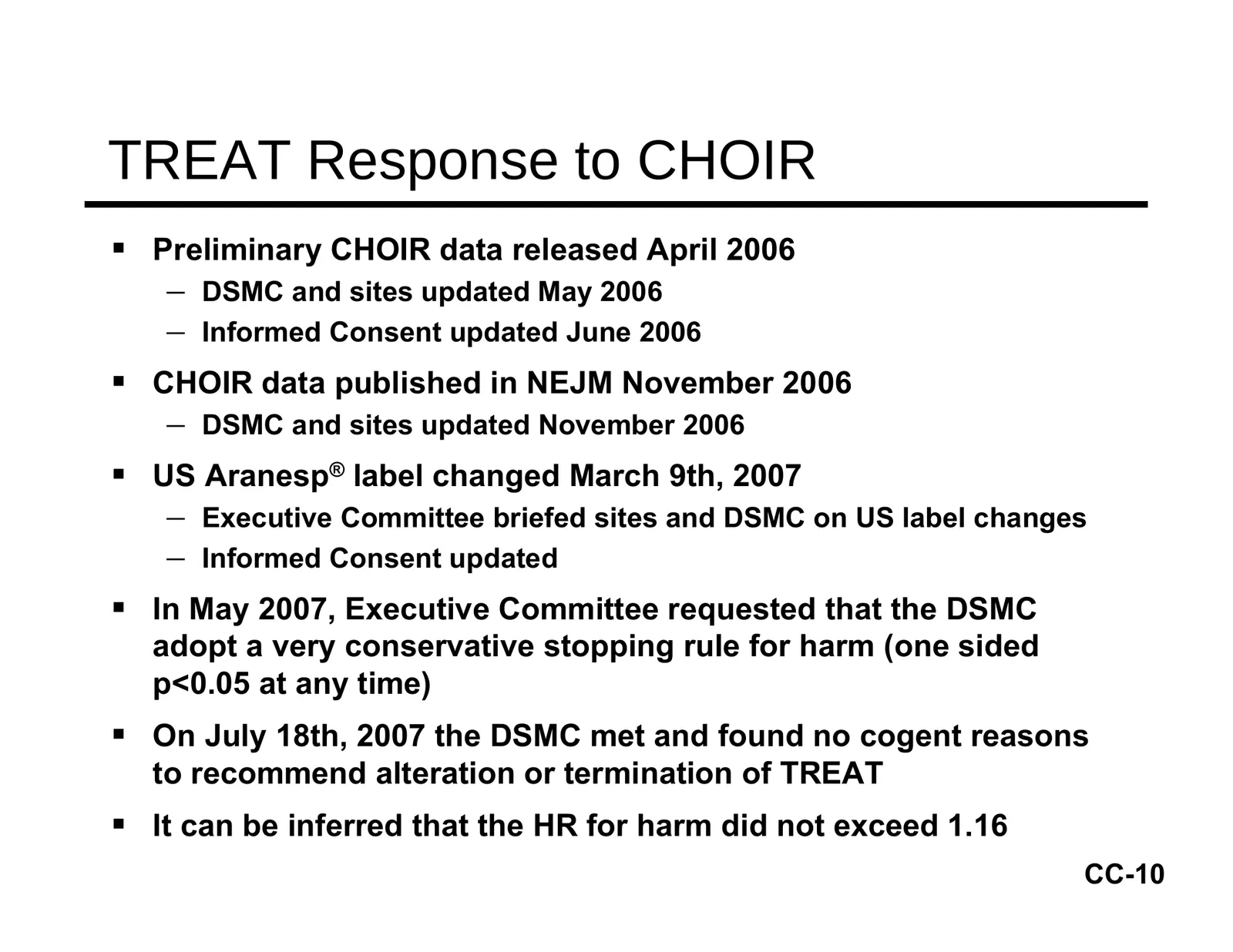
Slide 10: TREAT Response to CHOIR
TREAT Response to CHOIR Preliminary CHOIR data released April 2006 – DSMC and sites updated May 2006 – Informed Consent updated June 2006 CHOIR data published in NEJM November 2006 – DSMC and sites updated November 2006 US Aranesp® label changed March 9th, 2007 – Executive Committee briefed si
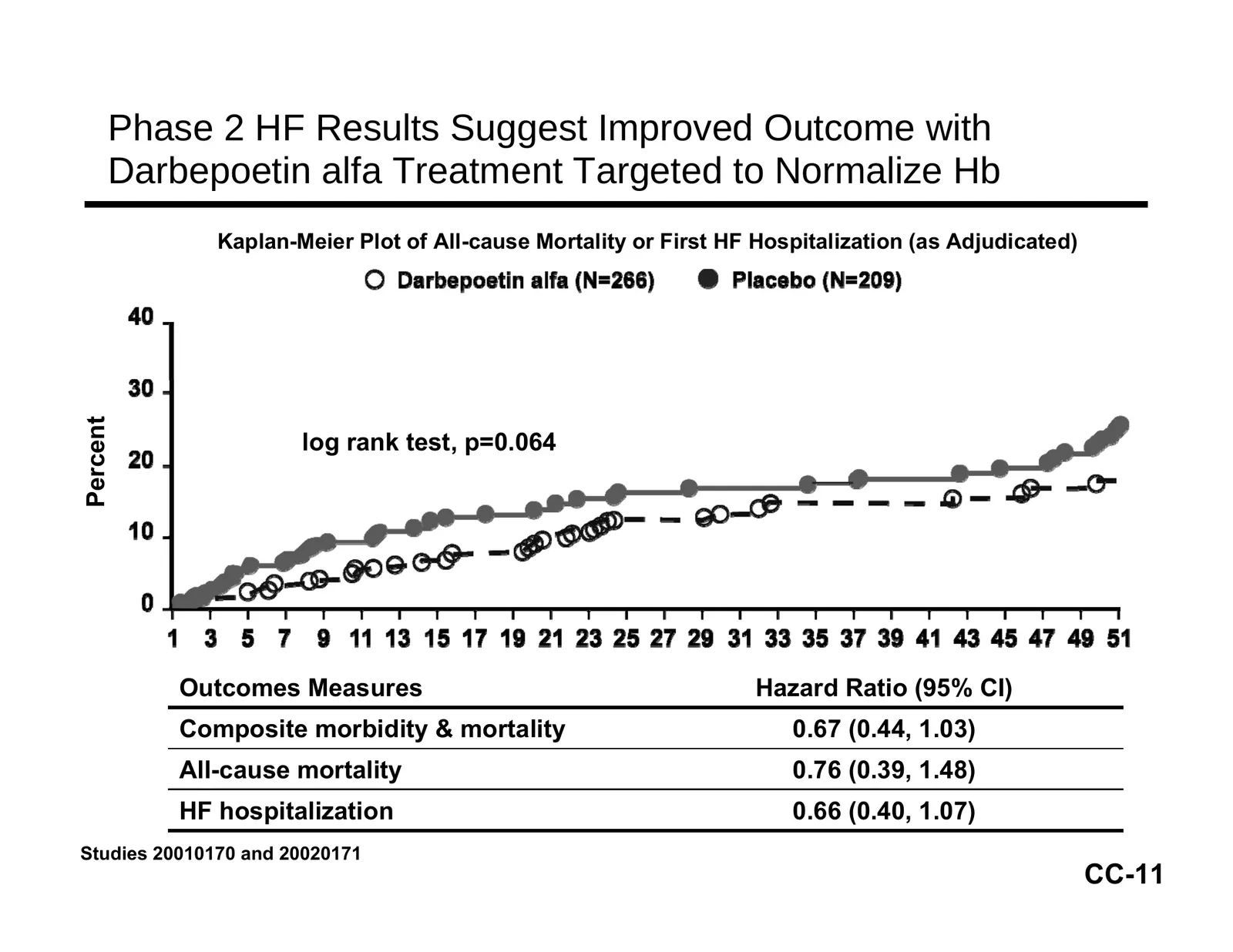
Slide 11: Phase HF Results Suggest Improved Outcome with Darbepoetin alfa
Phase 2 HF Results Suggest Improved Outcome with Darbepoetin alfa Treatment Targeted to Normalize Hb Kaplan-Meier Plot of All-cause Mortality or First HF Hospitalization (as Adjudicated) Percent log rank test, p=0.064 Outcomes Measures Hazard Ratio (95% CI) Composite morbidity & mortality 0.67 (0.44
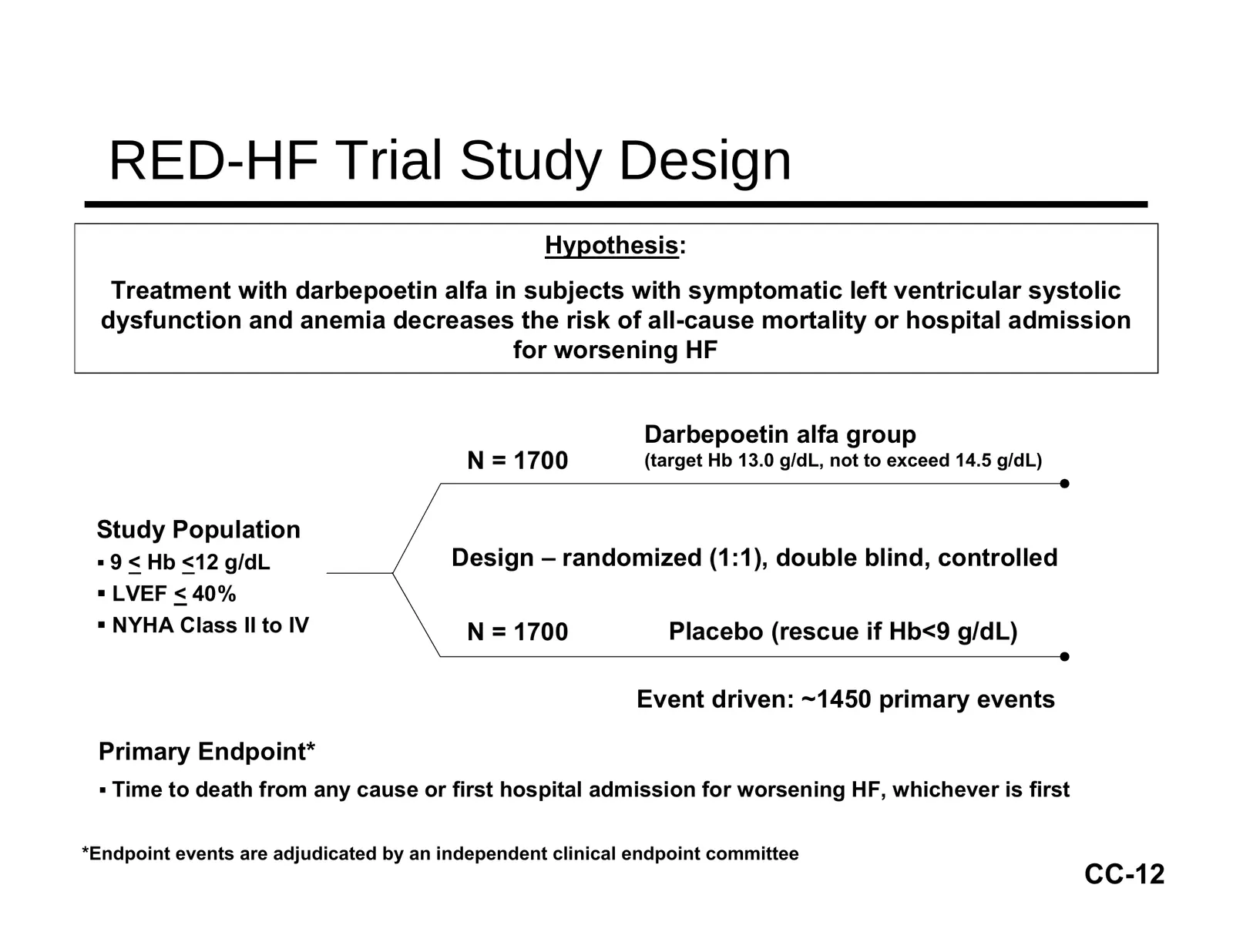
Slide 12: RED-HF Trial Study Design
RED-HF Trial Study Design Hypothesis: Treatment with darbepoetin alfa in subjects with symptomatic left ventricular systolic dysfunction and anemia decreases the risk of all-cause mortality or hospital admission for worsening HF Darbepoetin alfa group N = 1700 (target Hb 13.0 g/dL, not to exceed 14.
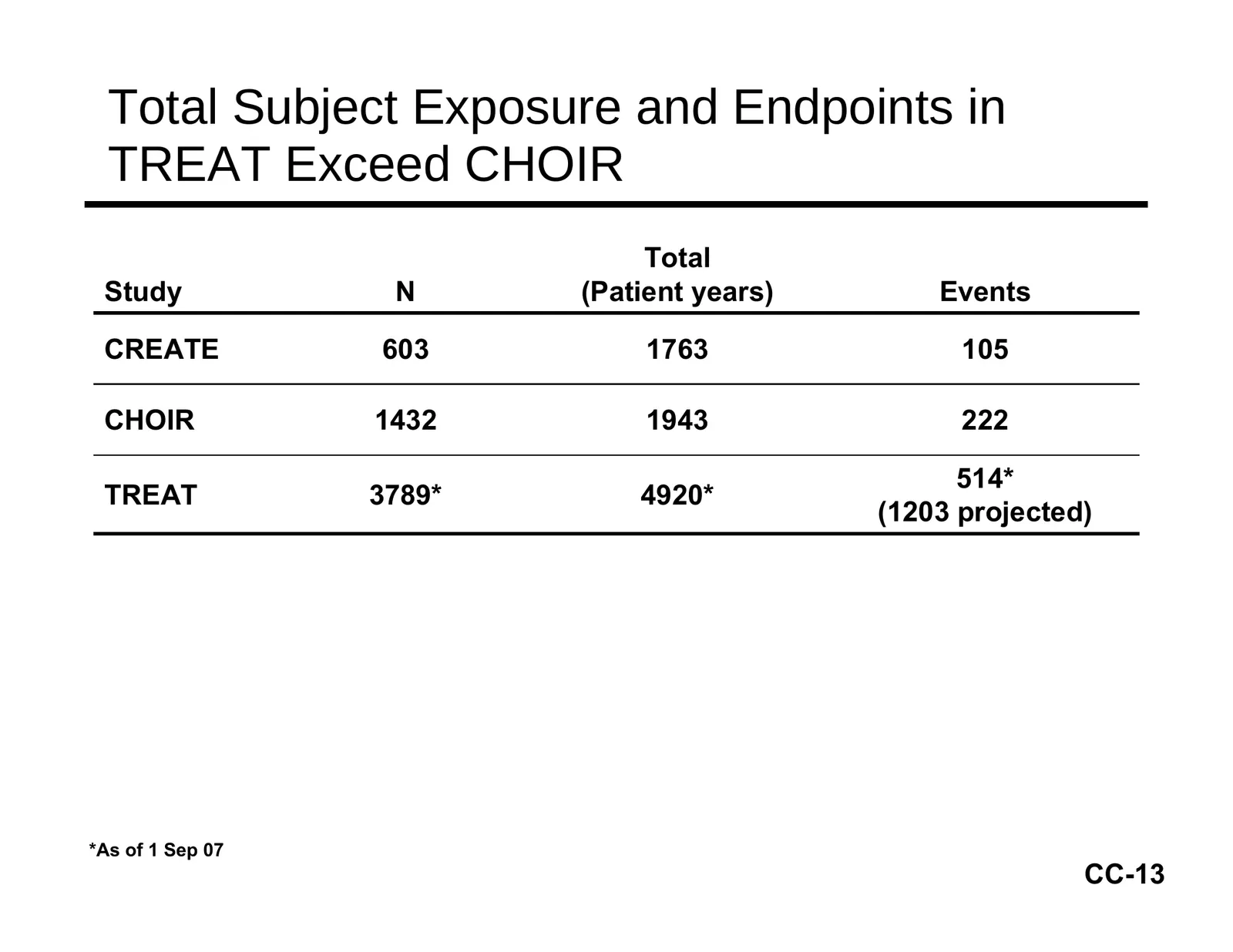
Slide 13: Total Subject Exposure and Endpoints in TREAT Exceed CHOIR
Total Subject Exposure and Endpoints in TREAT Exceed CHOIR Total Study N (Patient years) Events CREATE 603 1763 105 CHOIR 1432 1943 222 514* TREAT 3789* 4920* (1203 projected) *As of 1 Sep 07 CC-13
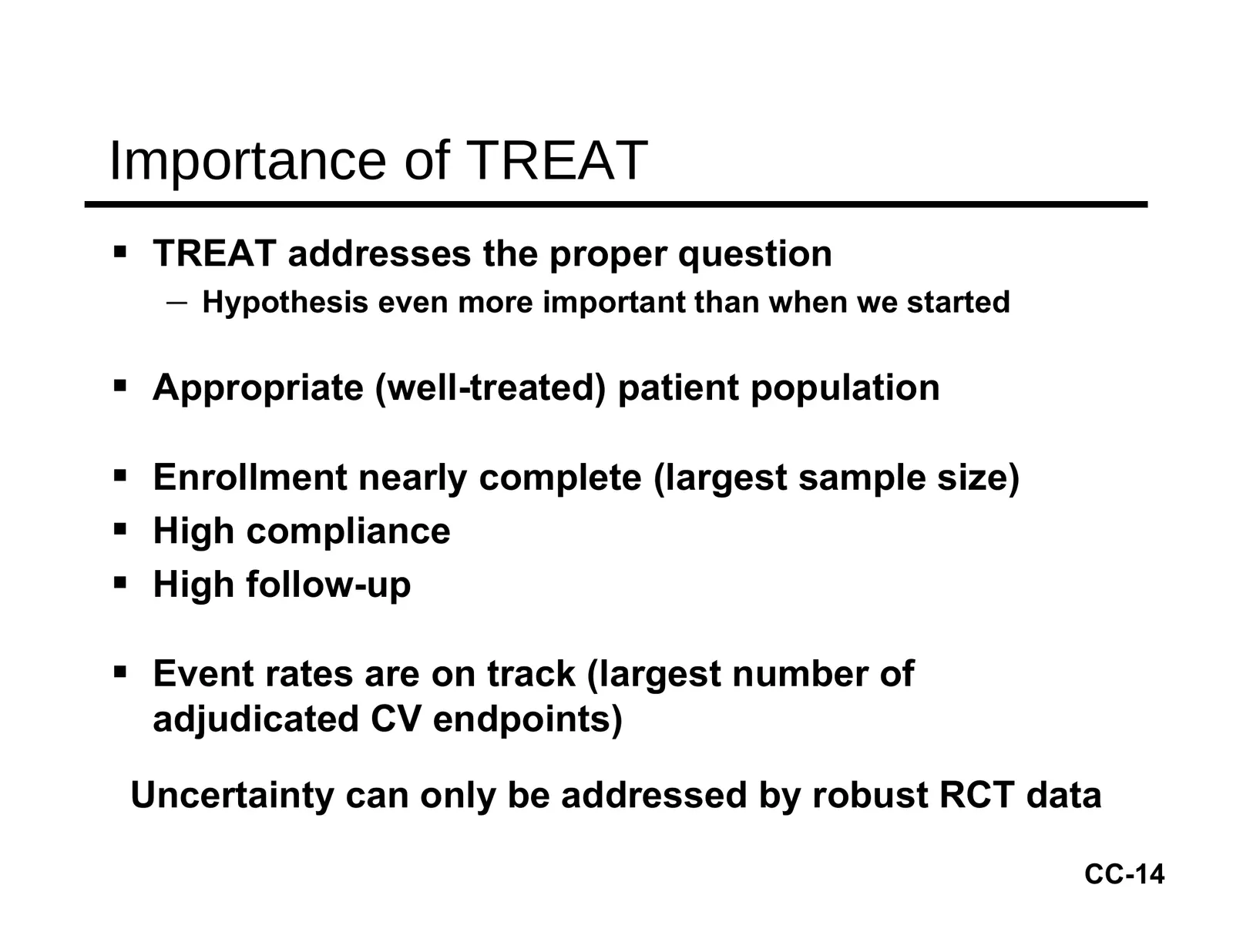
Slide 14: Importance of TREAT
Importance of TREAT TREAT addresses the proper question – Hypothesis even more important than when we started Appropriate (well-treated) patient population Enrollment nearly complete (largest sample size) High compliance High follow-up Event rates are on track (largest number of adjudica
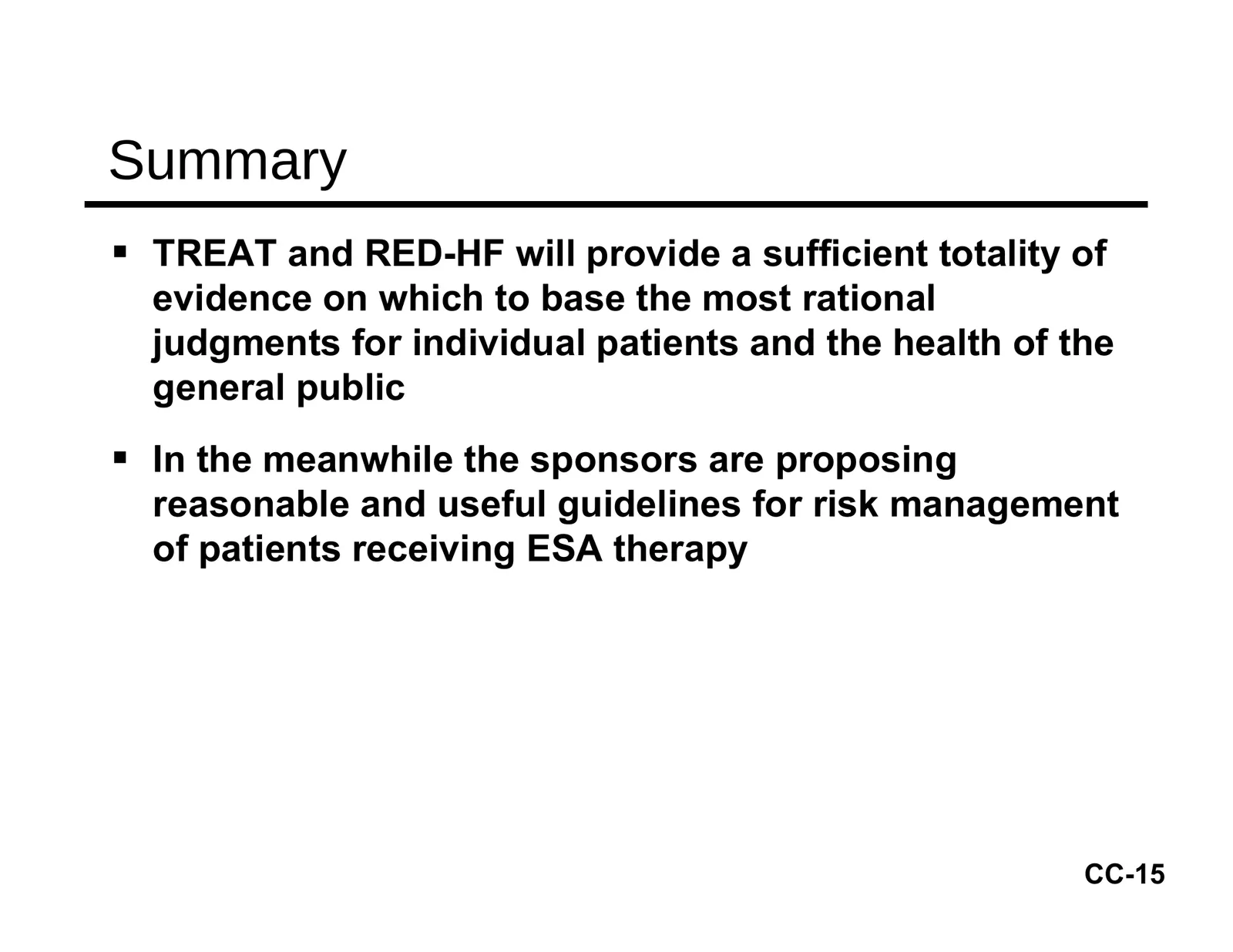
Slide 15: Summary
Summary TREAT and RED-HF will provide a sufficient totality of evidence on which to base the most rational judgments for individual patients and the health of the general public In the meanwhile the sponsors are proposing reasonable and useful guidelines for risk management of patients receiving
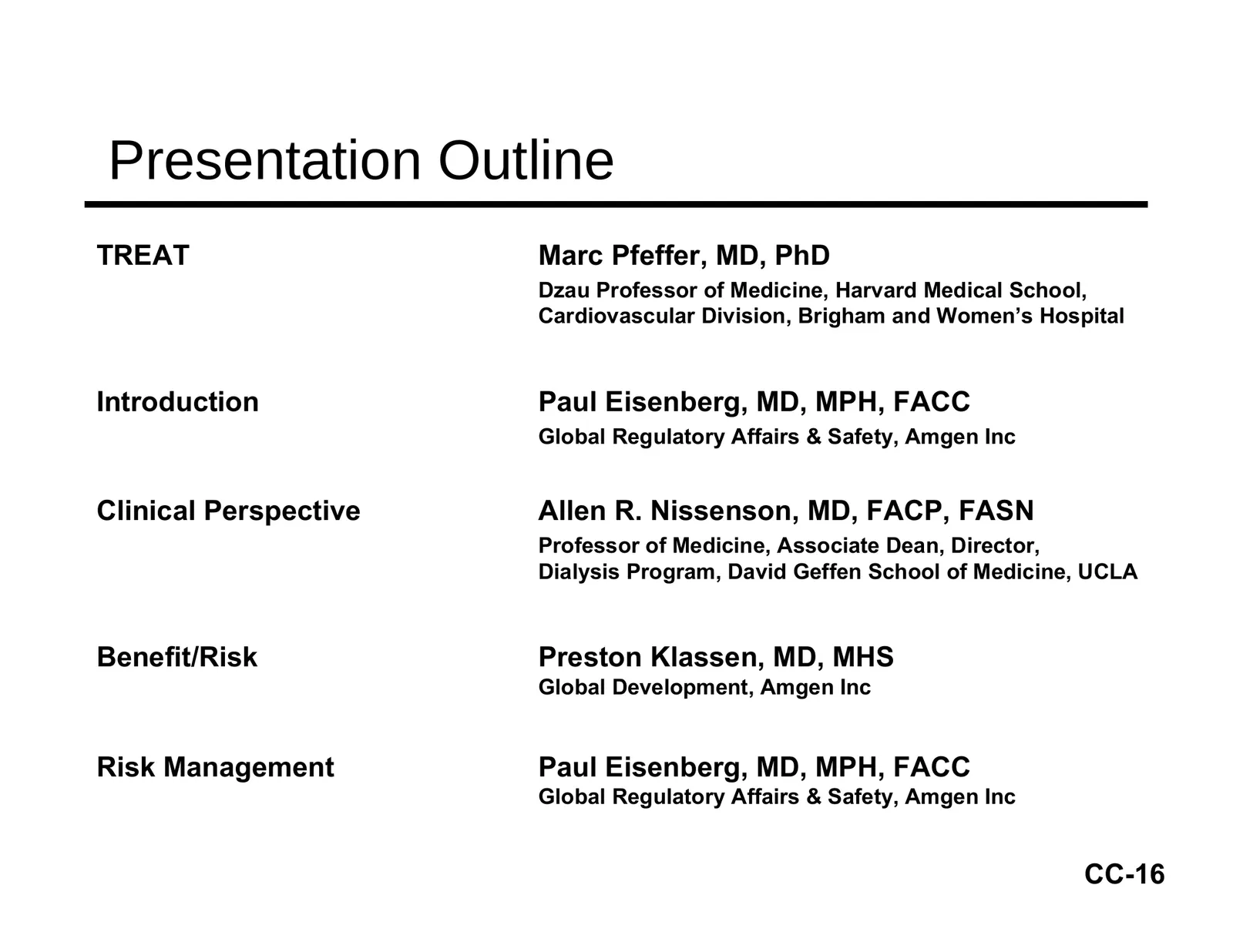
Slide 16: Presentation Outline
Presentation Outline TREAT Marc Pfeffer, MD, PhD Dzau Professor of Medicine, Harvard Medical School, Cardiovascular Division, Brigham and Women’s Hospital Introduction Paul Eisenberg, MD, MPH, FACC Global Regulatory Affairs & Safety, Amgen Inc Clinical Perspective Allen R. Nissenson, MD, FACP, FASN
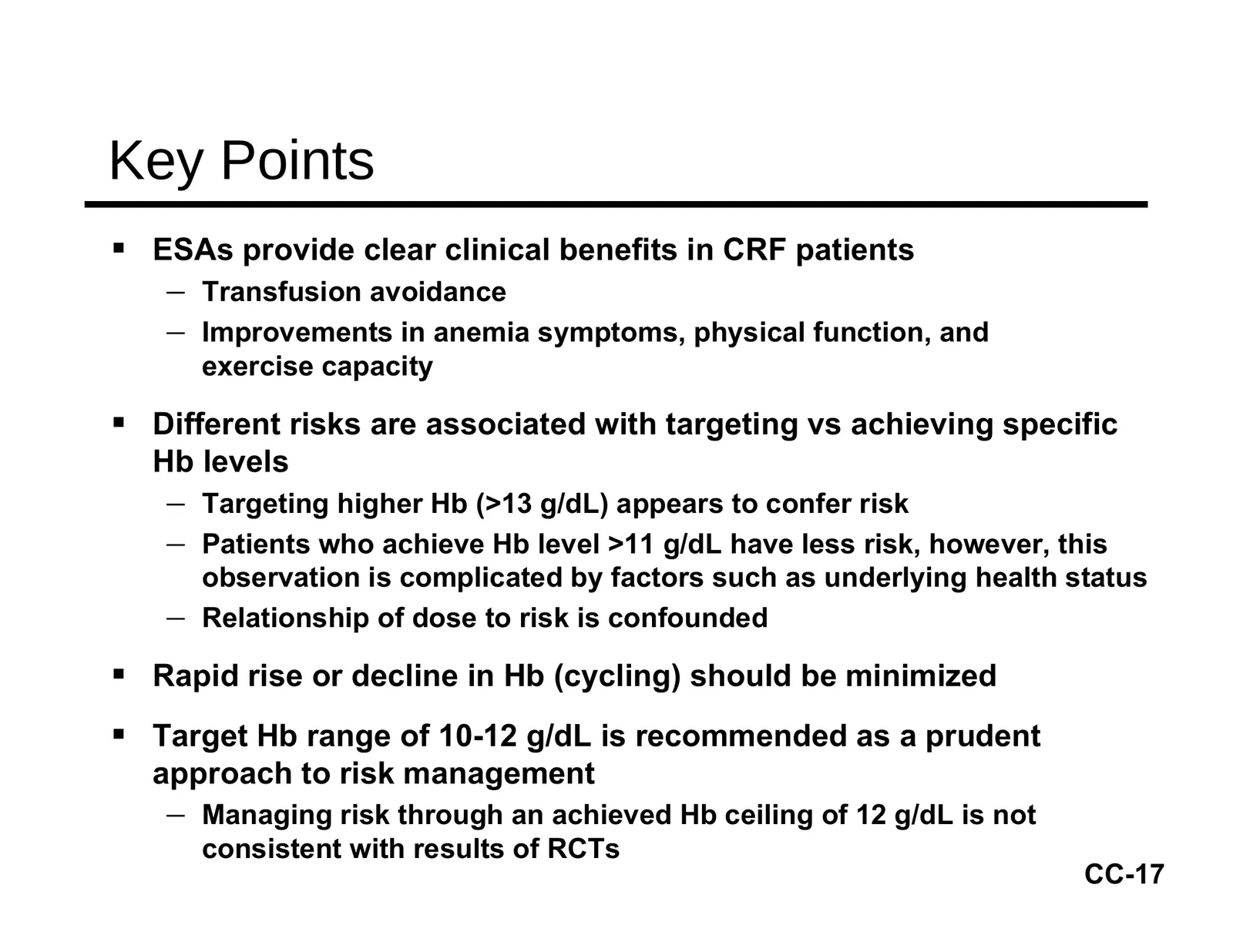
Slide 17: Key Points
Key Points ESAs provide clear clinical benefits in CRF patients – Transfusion avoidance – Improvements in anemia symptoms, physical function, and exercise capacity Different risks are associated with targeting vs achieving specific Hb levels – Targeting higher Hb (>13 g/dL) appears to confer ris
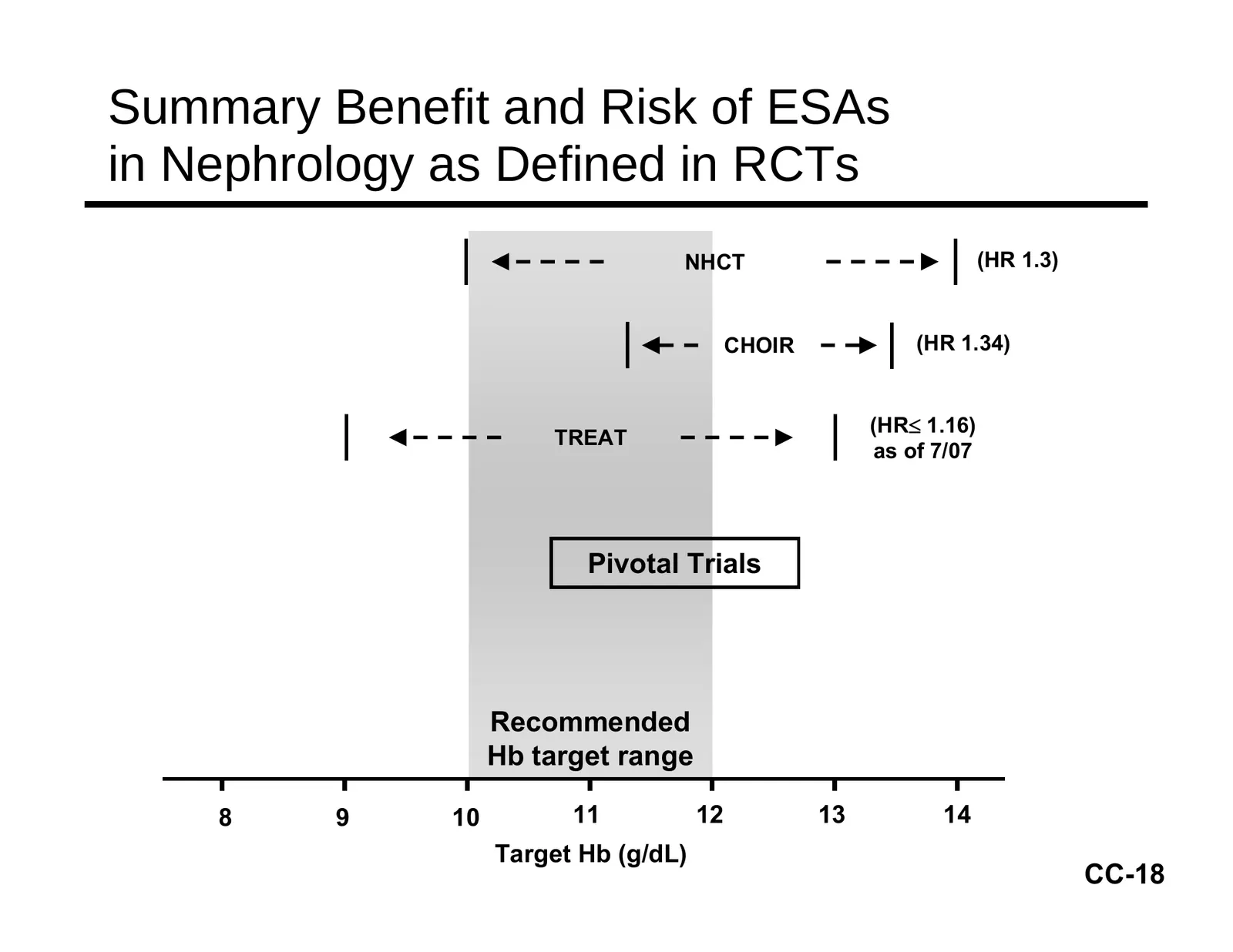
Slide 18: Summary Benefit and Risk of ESAs in Nephrology as Defined in RCTs
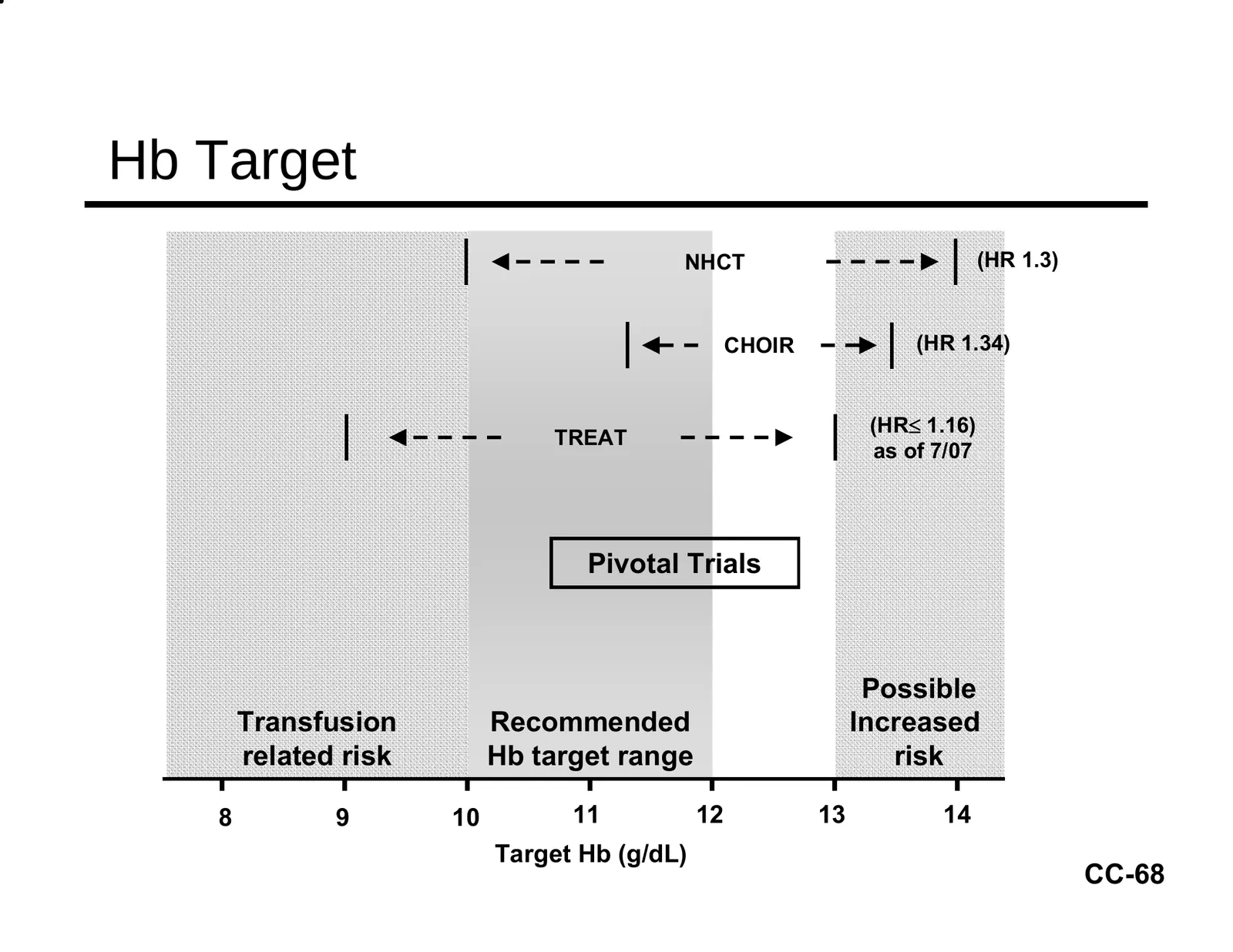
Summary Benefit and Risk of ESAs in Nephrology as Defined in RCTs NHCT (HR 1.3) CHOIR (HR 1.34) (HR≤ 1.16) TREAT as of 7/07 Pivotal Trials Recommended Hb target range 8 9 10 11 12 13 14 Target Hb (g/dL) CC-18
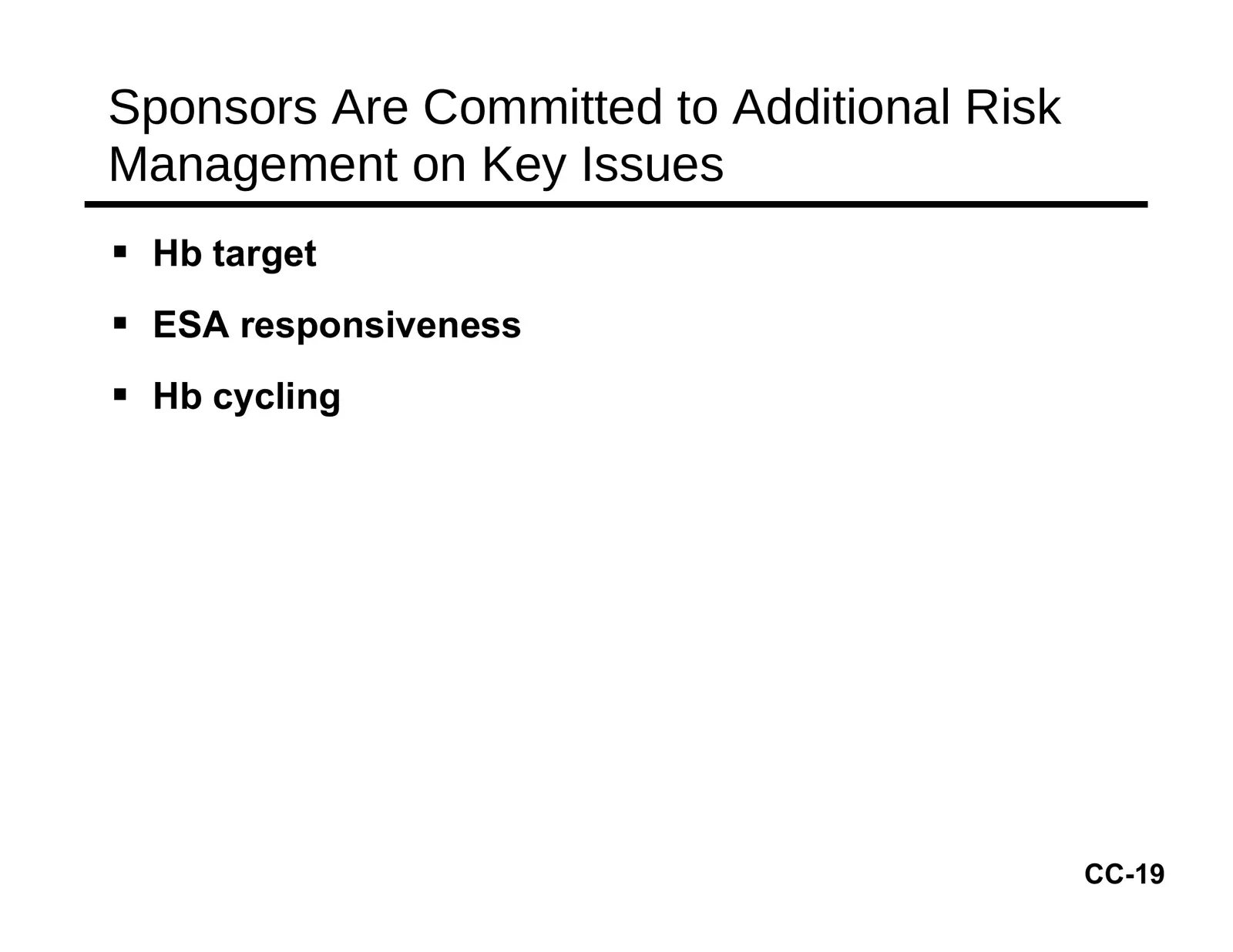
Slide 19: Sponsors Are Committed to Additional Risk Management on Key Issues
Sponsors Are Committed to Additional Risk Management on Key Issues Hb target ESA responsiveness Hb cycling CC-19
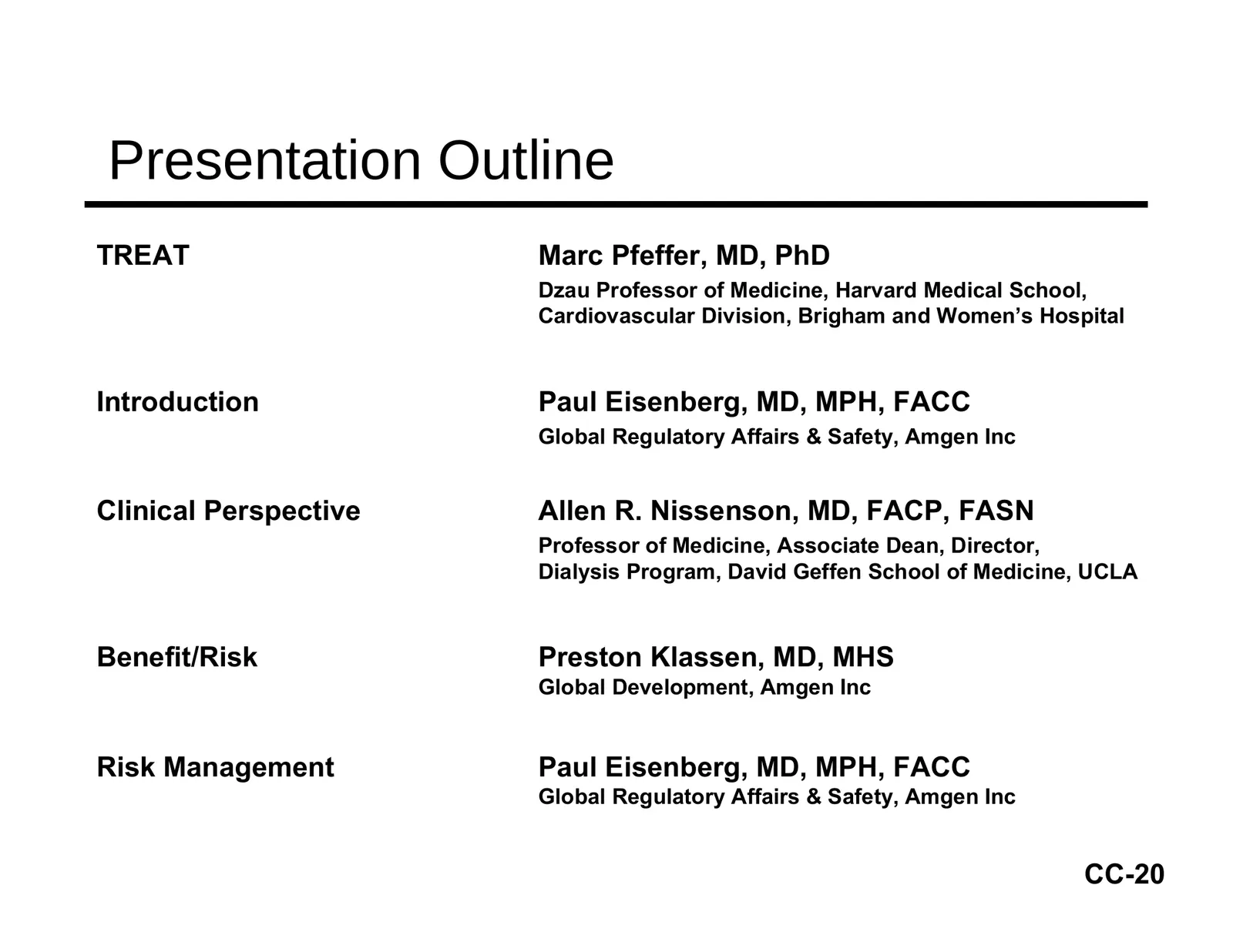
Slide 20: Presentation Outline
Presentation Outline TREAT Marc Pfeffer, MD, PhD Dzau Professor of Medicine, Harvard Medical School, Cardiovascular Division, Brigham and Women’s Hospital Introduction Paul Eisenberg, MD, MPH, FACC Global Regulatory Affairs & Safety, Amgen Inc Clinical Perspective Allen R. Nissenson, MD, FACP, FASN
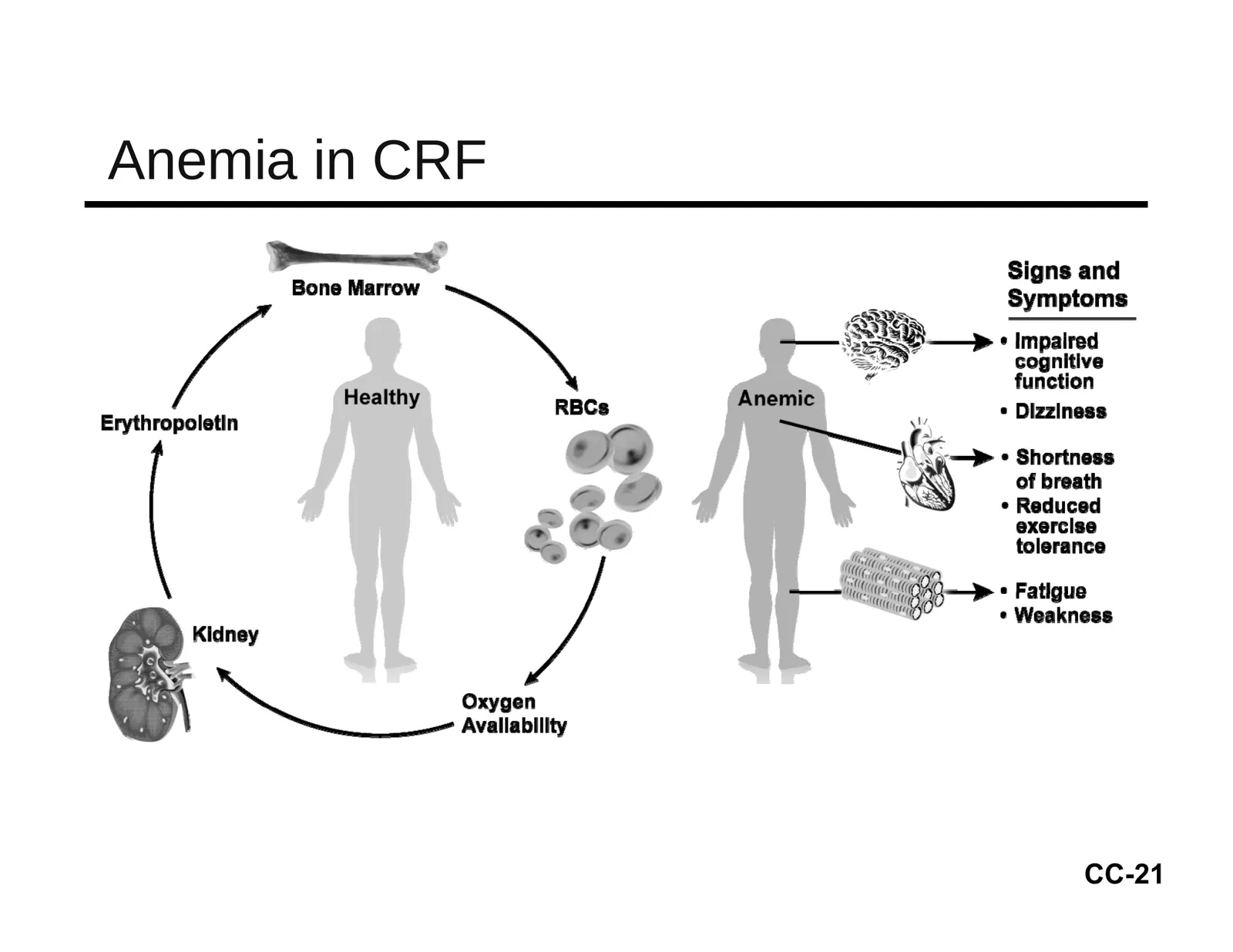
Slide 21: Anemia in CRF
Anemia in CRF Bone Marrow —_ \ Va Healthy Erythropoletin RBCs ty e@oO @ ee Kidney Oxygen Avallabllity Signs and Symptoms A__» * Impalred cognitive function * Dizziness \\ So —% © Shortness \ of breath ¢ Reduced exercise tolerance —} * Fatigue at a z 0 ¢ Weakness CC-21
Slide 22: Anemia Treatment was a Rescue Therapy in Pre-ESA Era
Anemia Treatment was a Rescue Therapy in Pre-ESA Era Anemia of CRF was major source of functional impairment Treatment of anemia was important unmet medical need – Available options were inadequate • Blood transfusions (average 6-8 units per patient/yr) • Parenteral iron therapy • Androgen thera
Slide 23: Complications of Blood Transfusions in Patients with CRF
Complications of Blood Transfusions in Patients with CRF Volume overload and pulmonary edema is common and requires concomitant dialysis therapy Allo-immunization increases with transfusion and reduces opportunity for kidney transplantation Iron overload Hyperkalemia Infection CC-23
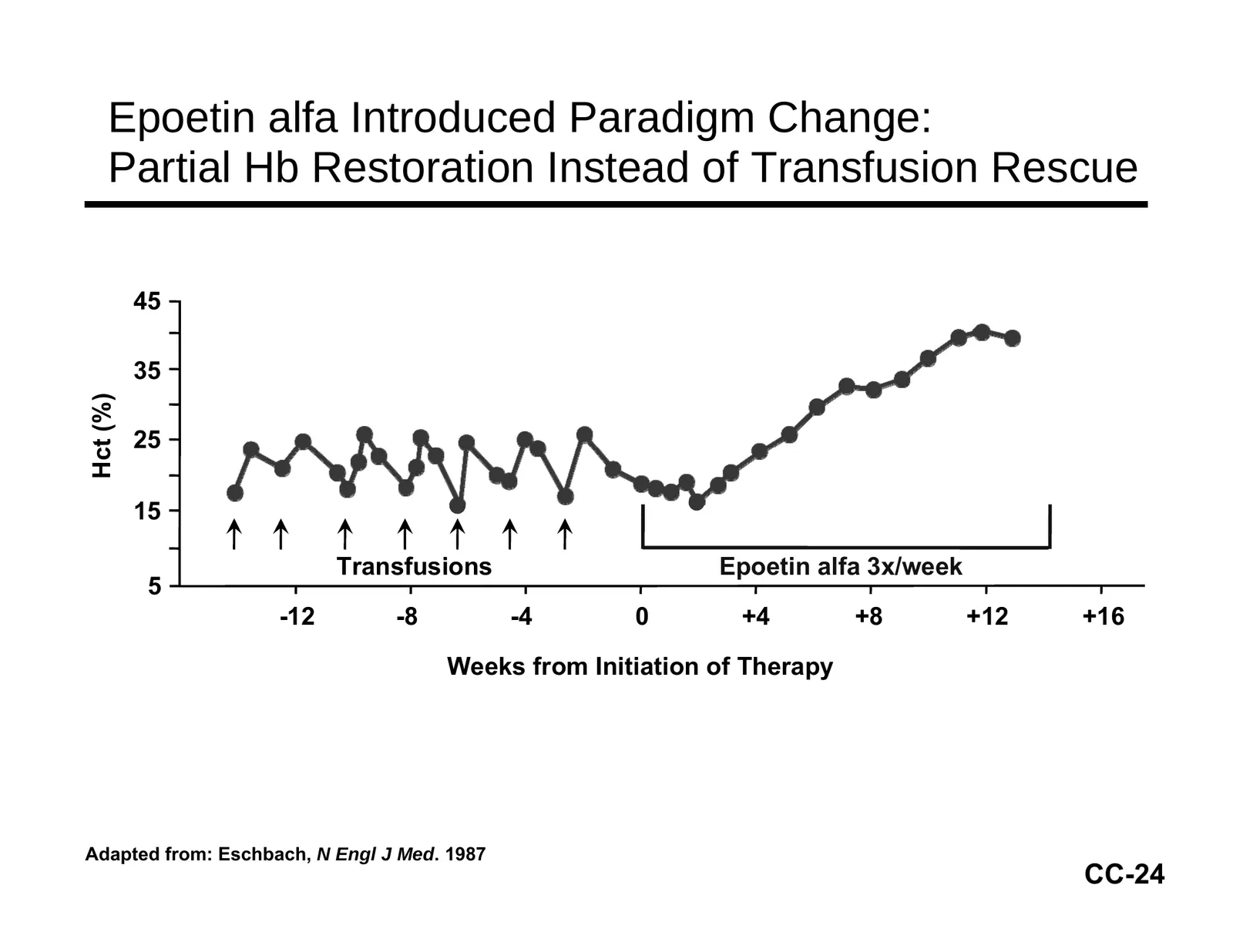
Slide 24: Epoetin alfa Introduced Paradigm Change: Partial Hb Restoration
Epoetin alfa Introduced Paradigm Change: Partial Hb Restoration Instead of Transfusion Rescue 45 35 Hct (%) 25 15 Transfusions Epoetin alfa 3x/week 5 -12 -8 -4 0 +4 +8 +12 +16 Weeks from Initiation of Therapy Adapted from: Eschbach, N Engl J Med. Med. 1987 CC-24
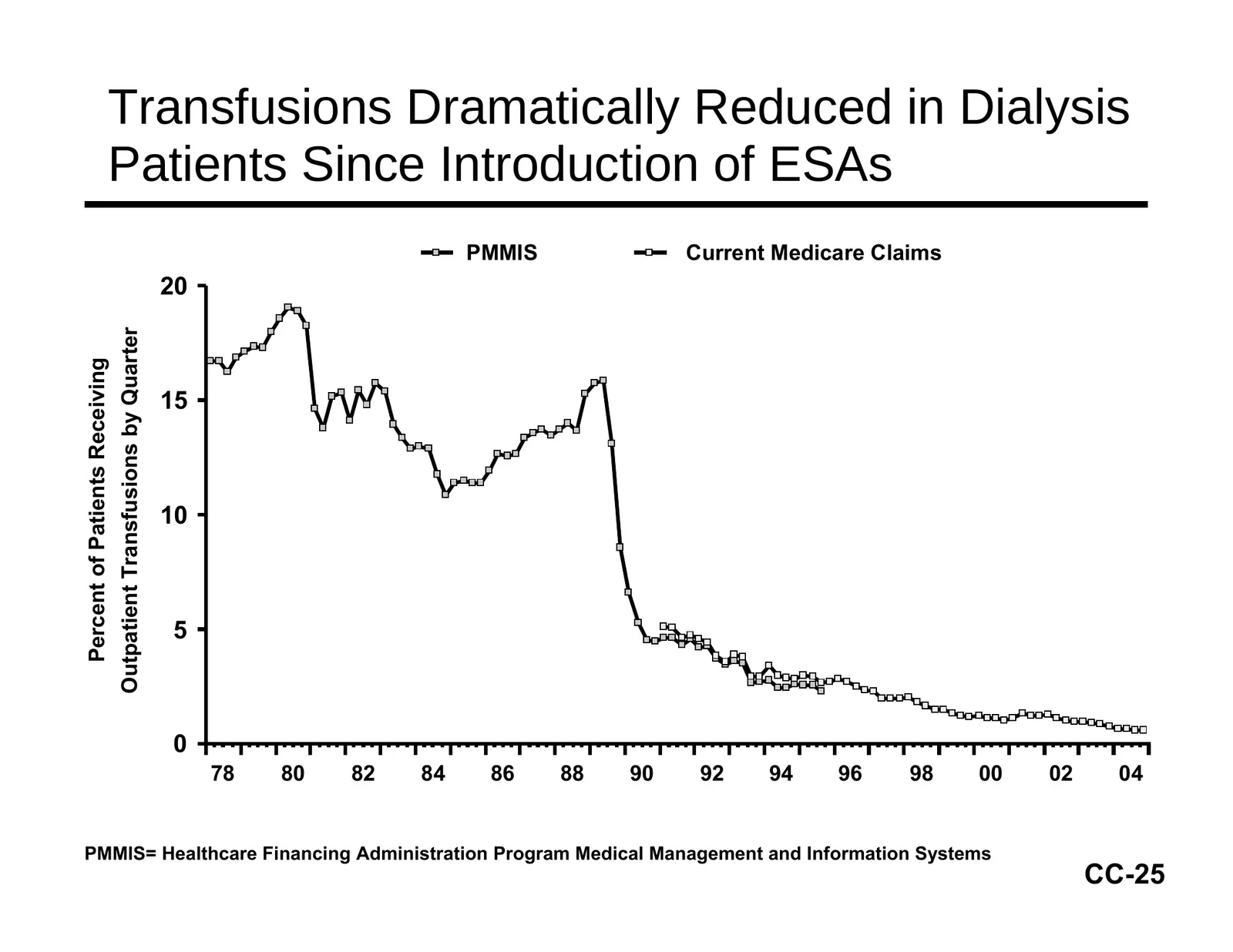
Slide 25: Transfusions Dramatically Reduced in Dialysis Patients Since Introduction of ESAs
Transfusions Dramatically Reduced in Dialysis Patients Since Introduction of ESAs PMMIS Current Medicare Claims 20 Outpatient Transfusions by Quarter Percent of Patients Receiving 15 10 5 0 78 80 82 84 86 88 90 92 94 96 98 00 02 04 PMMIS= Healthcare Financing Administration Program Medical Managemen
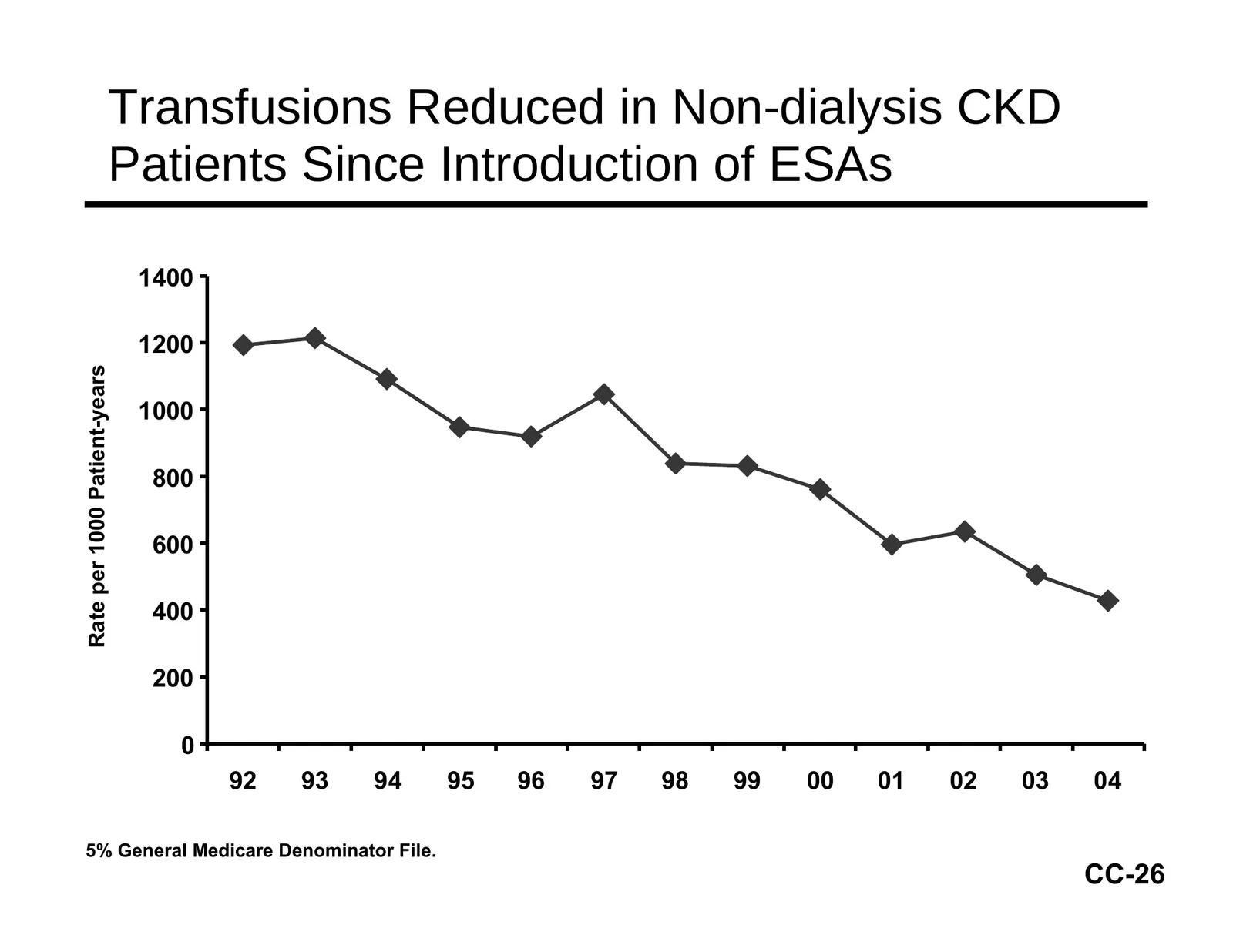
Slide 26: Transfusions Reduced in Non-dialysis CKD Patients Since Introduction of ESAs
Transfusions Reduced in Non-dialysis CKD Patients Since Introduction of ESAs 1400 1200 Rate per 1000 Patient-years 1000 800 600 400 200 0 92 93 94 95 96 97 98 99 00 01 02 03 04 5% General Medicare Denominator File. CC-26
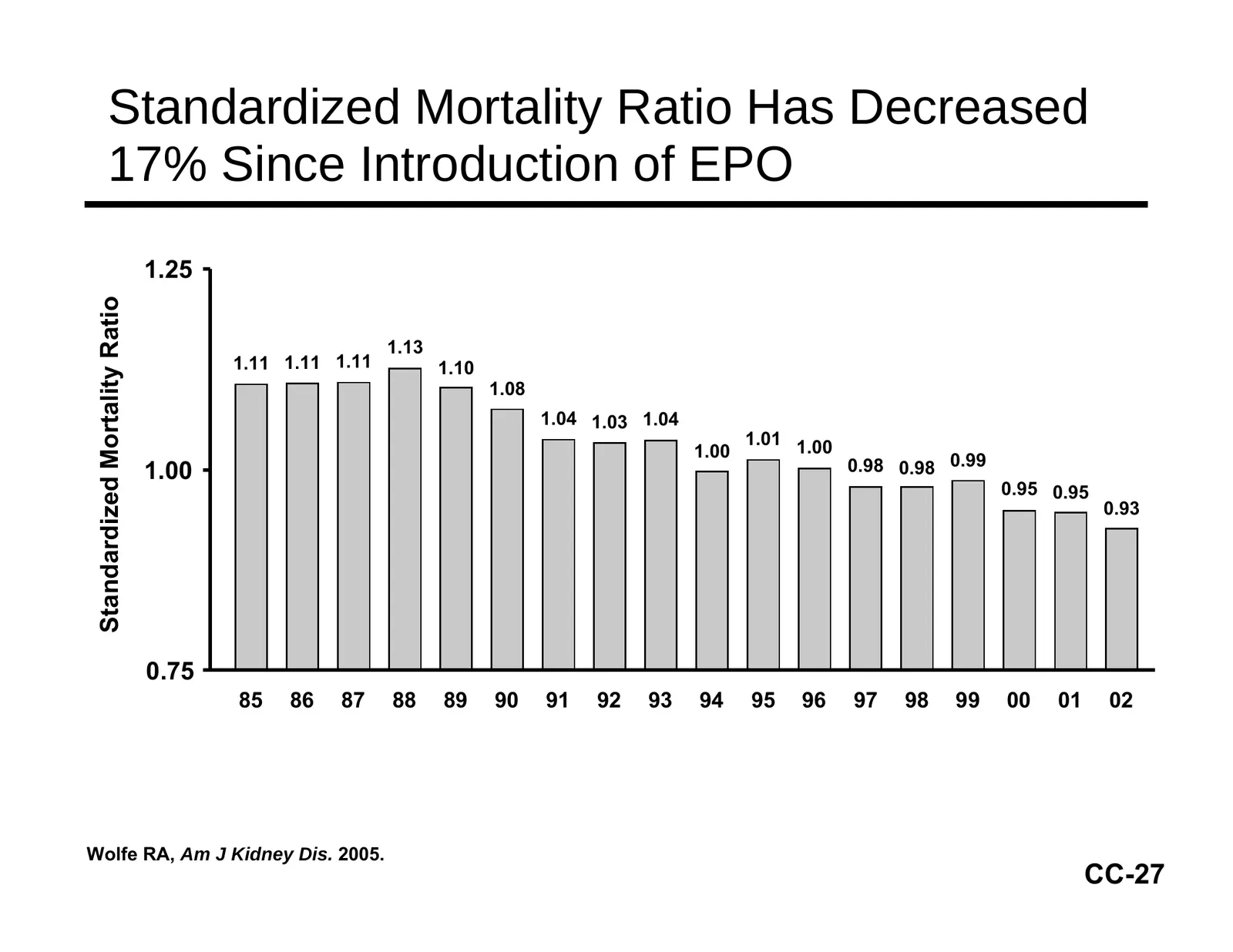
Slide 27: Standardized Mortality Ratio Has Decreased 17% Since Introduction of EPO
Standardized Mortality Ratio Has Decreased 17% Since Introduction of EPO 1.25 Standardized Mortality Ratio 1.13 1.11 1.11 1.11 1.10 1.08 1.04 1.03 1.04 1.01 1.00 1.00 1.00 0.98 0.98 0.99 0.95 0.95 0.93 0.75 85 86 87 88 89 90 91 92 93 94 95 96 97 98 99 00 01 02 Wolfe RA, Am J Kidney Dis. 2005. CC-27
Slide 28: Patient Well-Being: The Clinician's Journey
Patient Well-Being: The Clinician’s Journey Initial patient reports of dramatic improvements Patient requests to come off transplant lists and not to pursue home dialysis Patient reported outcomes studies Functional capacity studies CC-28
Slide 29: Nephrology Community Has Over 18 Years of Experience with ESAs
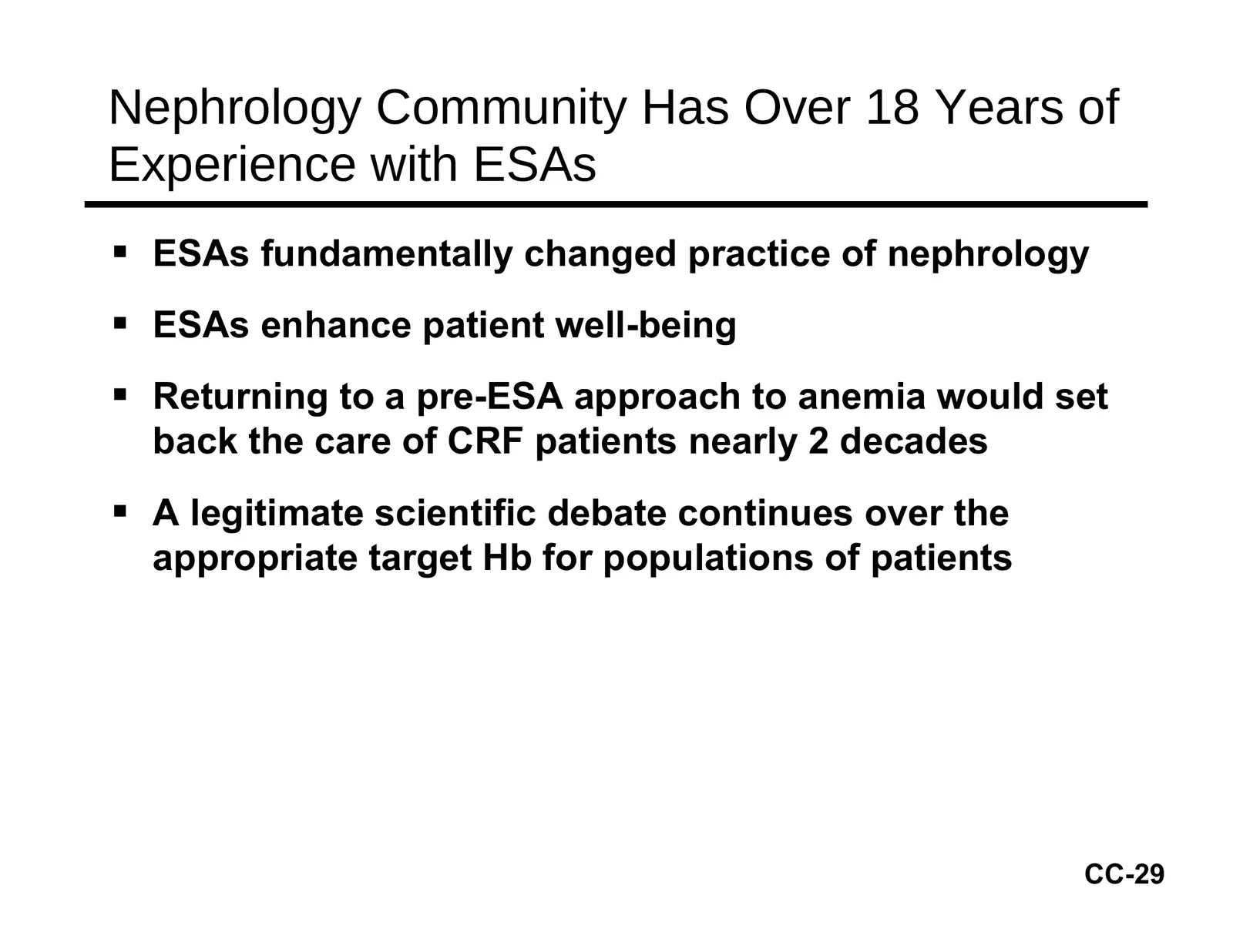
Nephrology Community Has Over 18 Years of Experience with ESAs ESAs fundamentally changed practice of nephrology ESAs enhance patient well-being Returning to a pre-ESA approach to anemia would set back the care of CRF patients nearly 2 decades A legitimate scientific debate continues over th
Slide 30: Nephrology Community Has Over 18 Years of Experience with ESAs
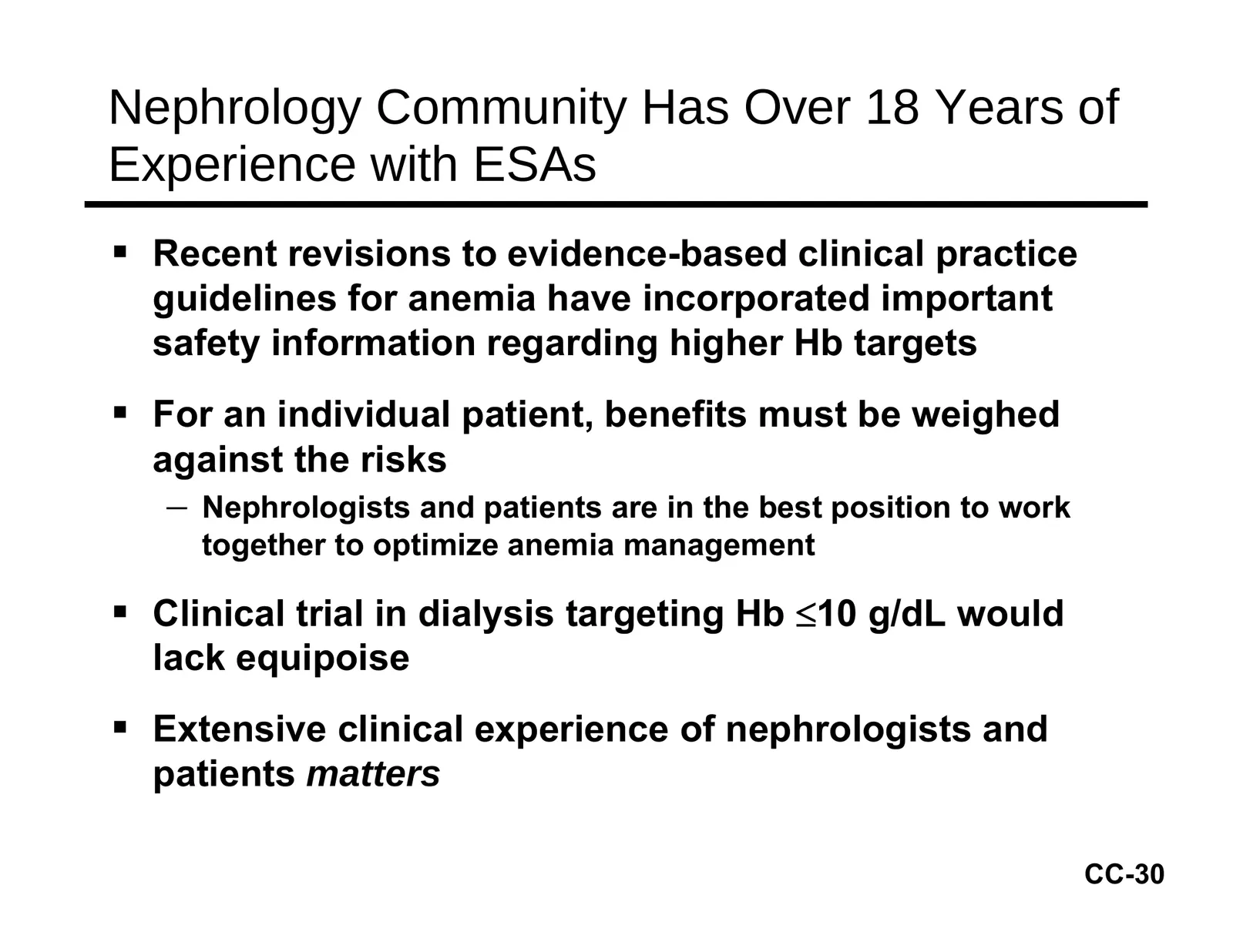
Nephrology Community Has Over 18 Years of Experience with ESAs Recent revisions to evidence-based clinical practice guidelines for anemia have incorporated important safety information regarding higher Hb targets For an individual patient, benefits must be weighed against the risks – Nephrologis
Slide 31: Presentation Outline
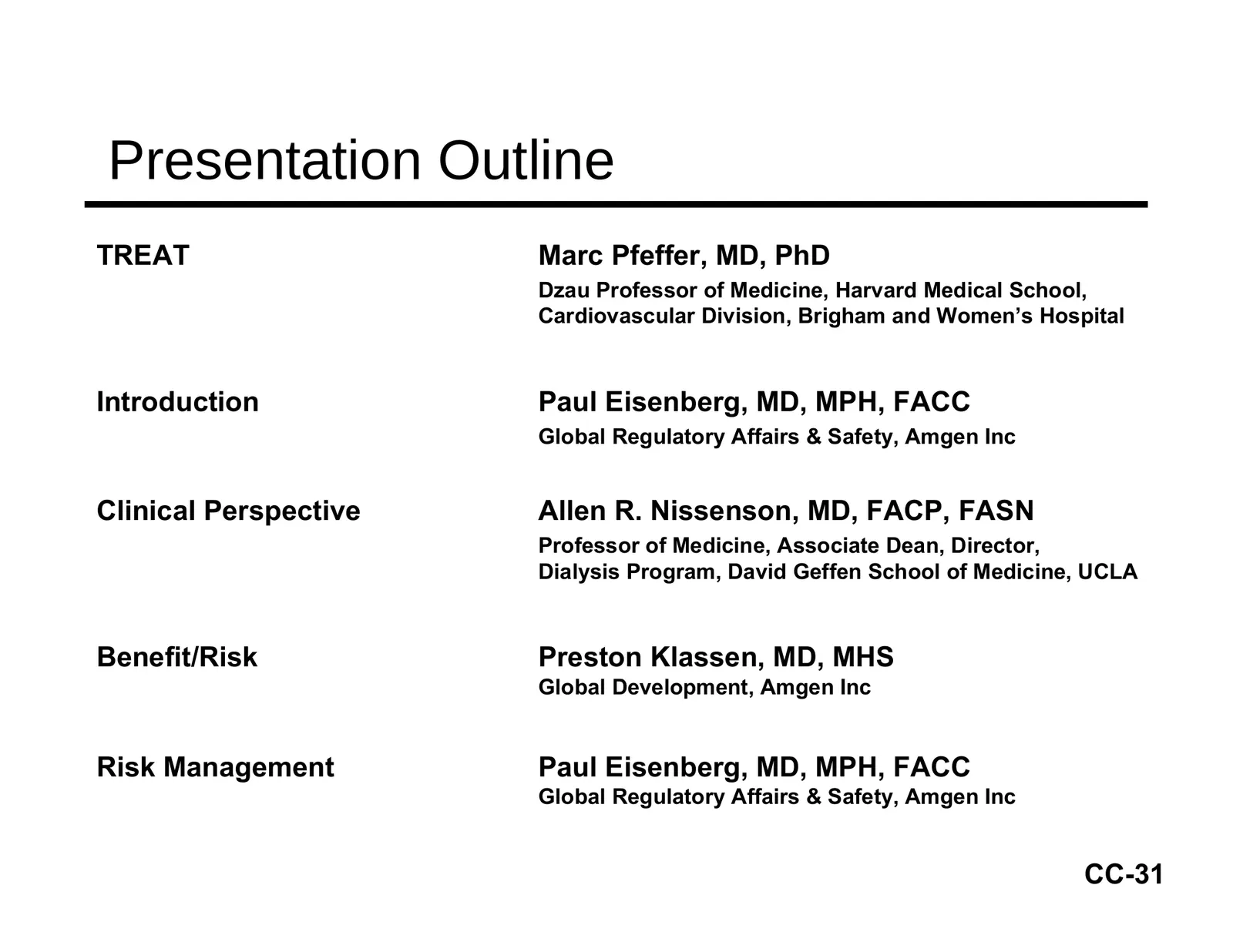
Presentation Outline TREAT Marc Pfeffer, MD, PhD Dzau Professor of Medicine, Harvard Medical School, Cardiovascular Division, Brigham and Women’s Hospital Introduction Paul Eisenberg, MD, MPH, FACC Global Regulatory Affairs & Safety, Amgen Inc Clinical Perspective Allen R. Nissenson, MD, FACP, FASN
Slide 32: Appropriate Use of ESAs in CRF
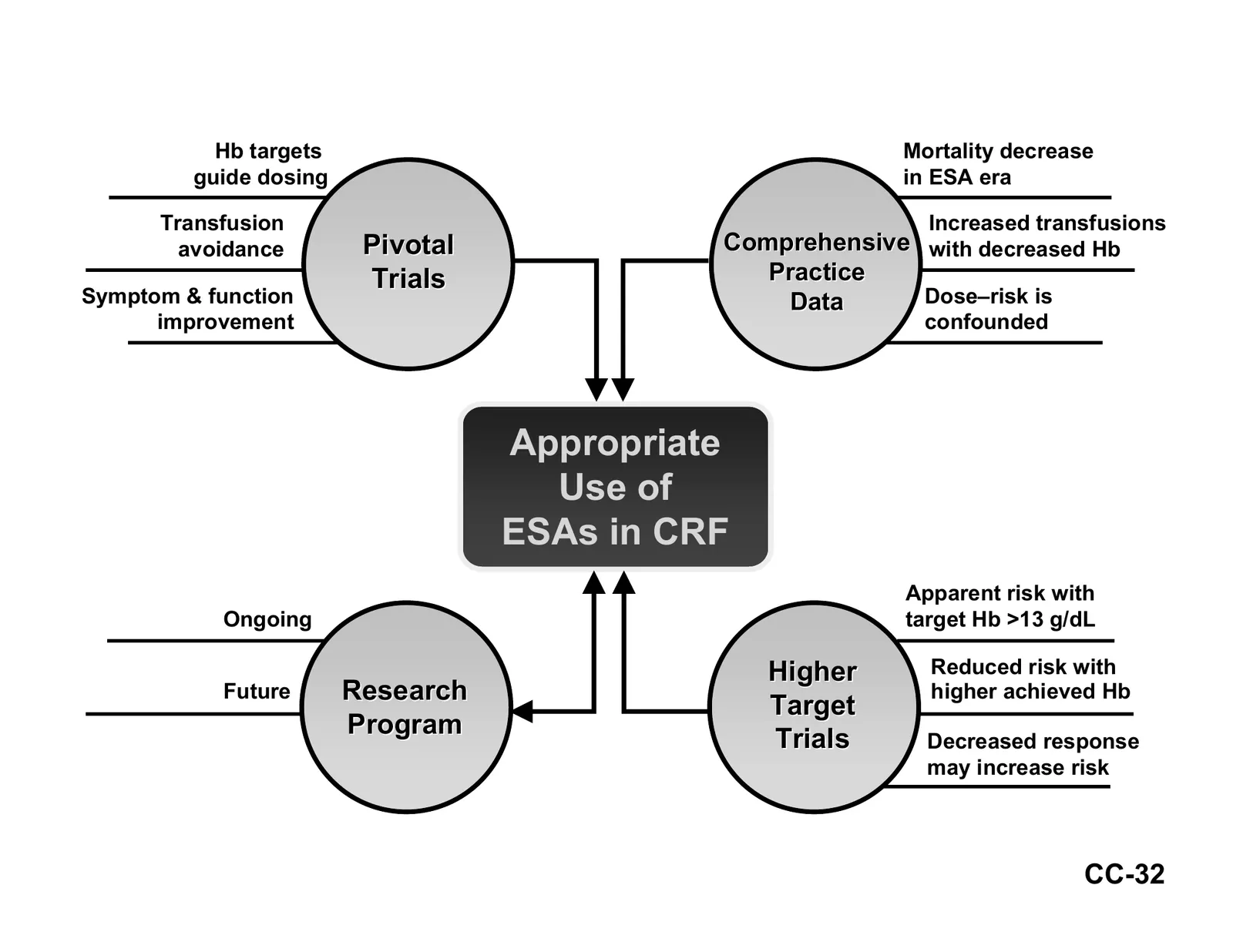
Hb targets Mortality decrease guide dosing in ESA era Transfusion Increased transfusions avoidance Pivotal Comprehensive with decreased Hb Trials Practice Symptom & function Data Dose–risk is improvement confounded Appropriate Use of ESAs in CRF Apparent risk with Ongoing target Hb >13 g/dL Higher R
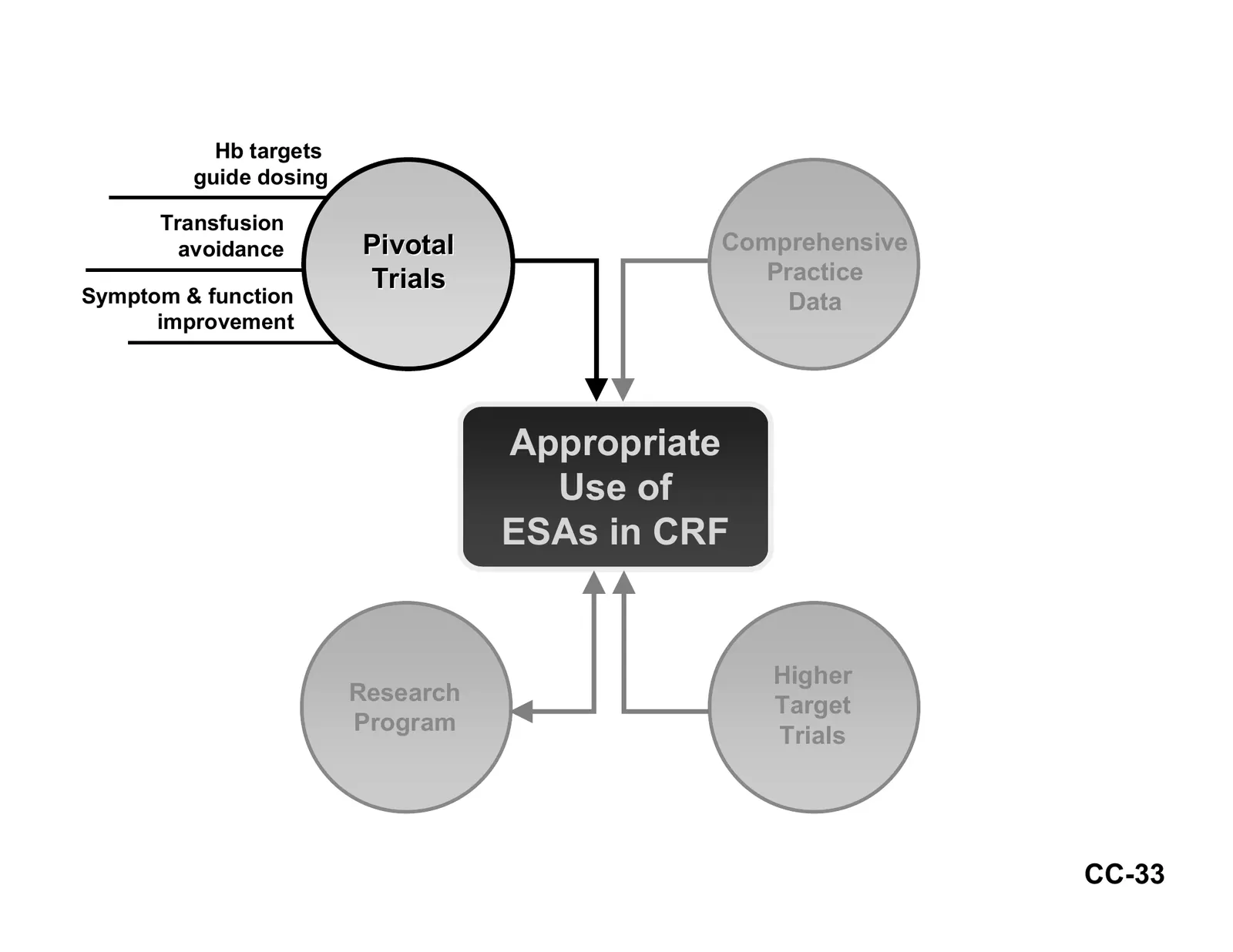
Slide 33: Appropriate Use of ESAs in CRF
Hb targets guide dosing Transfusion avoidance Pivotal Pivotal Comprehensive Trials Trials Practice Symptom & function Data improvement Appropriate Use of ESAs in CRF Higher Research Target Program Trials CC-33
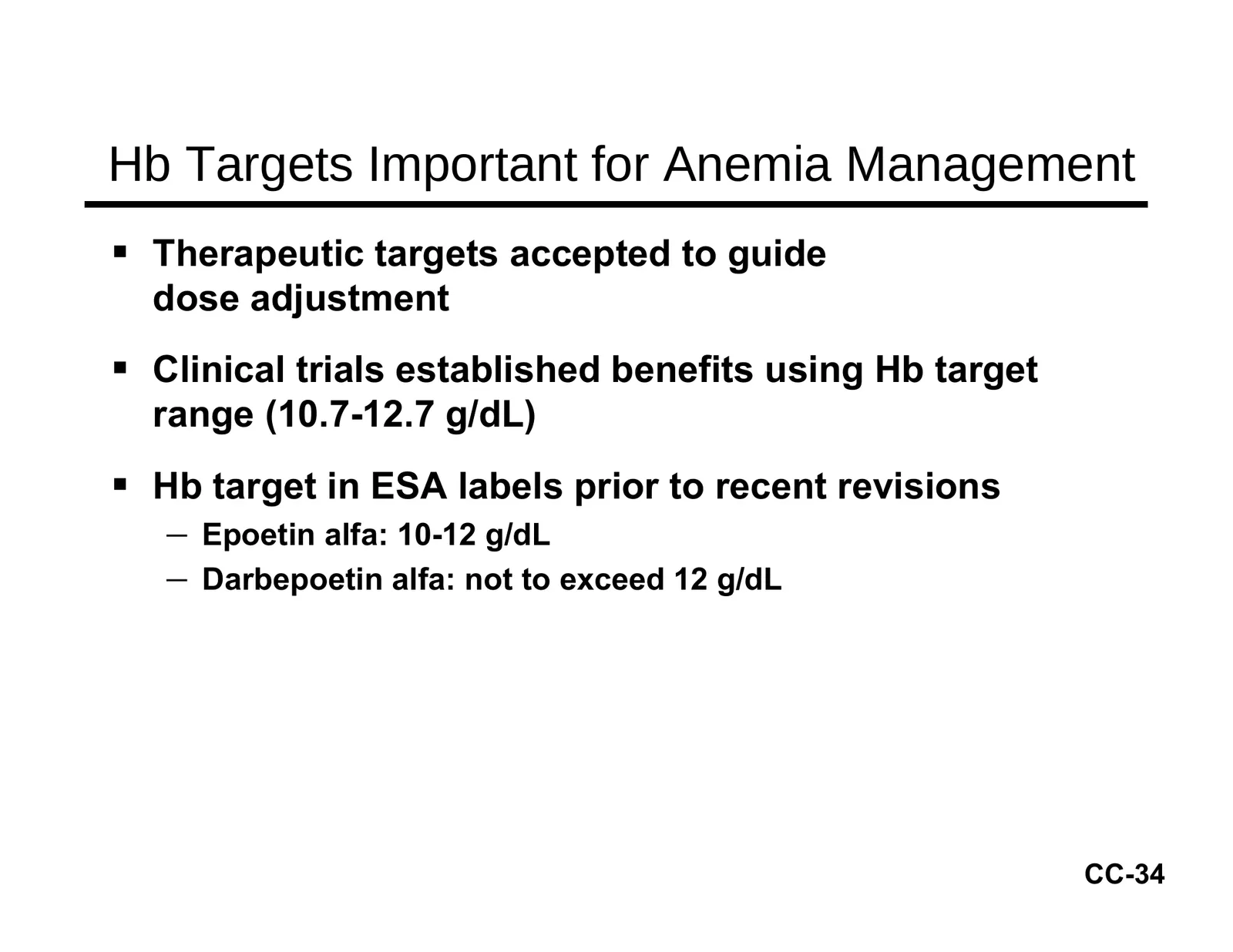
Slide 34: Hb Targets Important for Anemia Management
Hb Targets Important for Anemia Management Therapeutic targets accepted to guide dose adjustment Clinical trials established benefits using Hb target range (10.7-12.7 g/dL) Hb target in ESA labels prior to recent revisions – Epoetin alfa: 10-12 g/dL – Darbepoetin alfa: not to exceed 12 g/dL CC
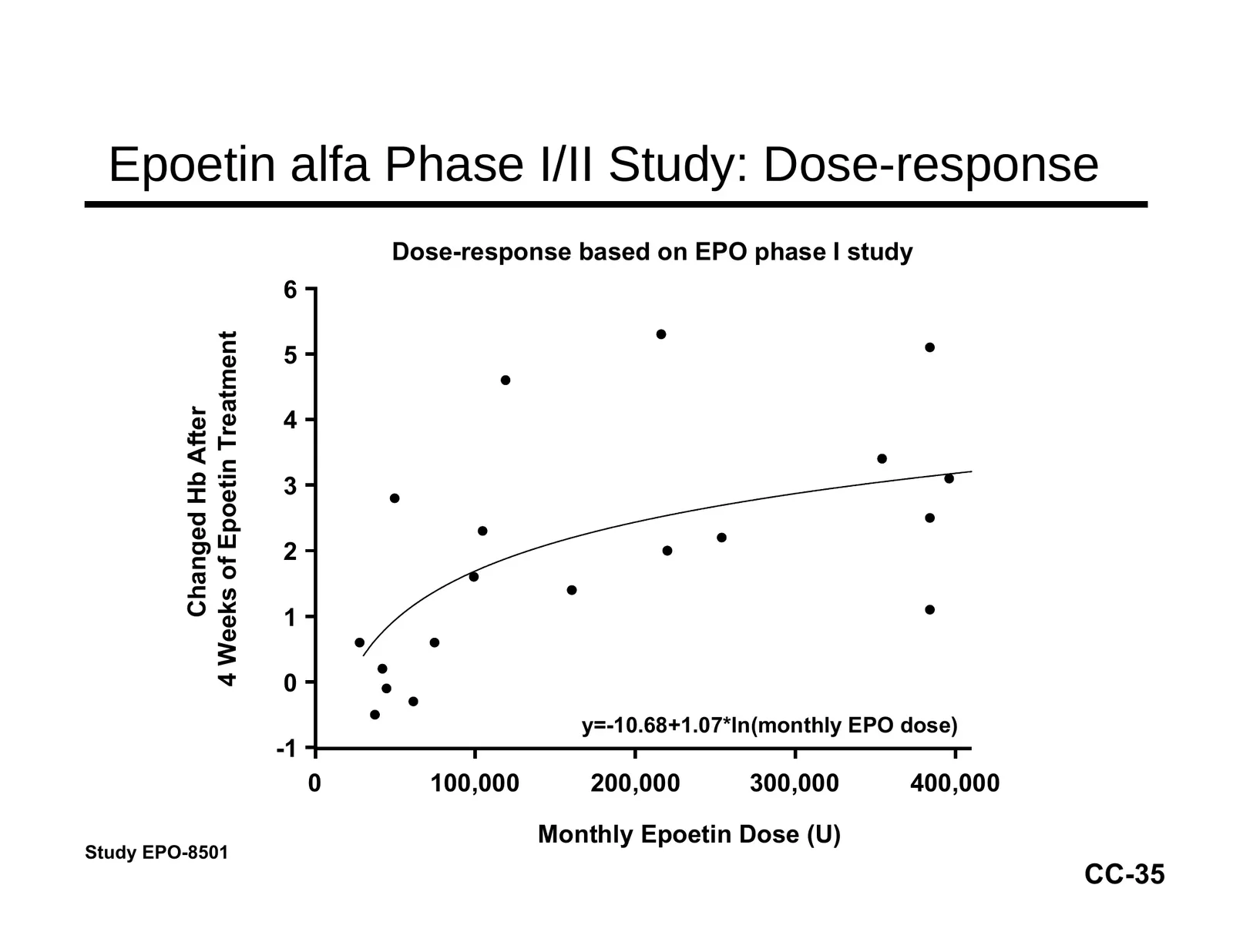
Slide 35: Epoetin alfa Phase I/II Study: Dose-response
Epoetin alfa Phase I/II Study: Dose-response Dose-response based on EPO phase I study 6 4 Weeks of Epoetin Treatment 5 4 Changed Hb After 3 2 1 0 y=-10.68+1.07*ln(monthly EPO dose) -1 0 100,000 200,000 300,000 400,000 Monthly Epoetin Dose (U) Study EPO-8501 CC-35
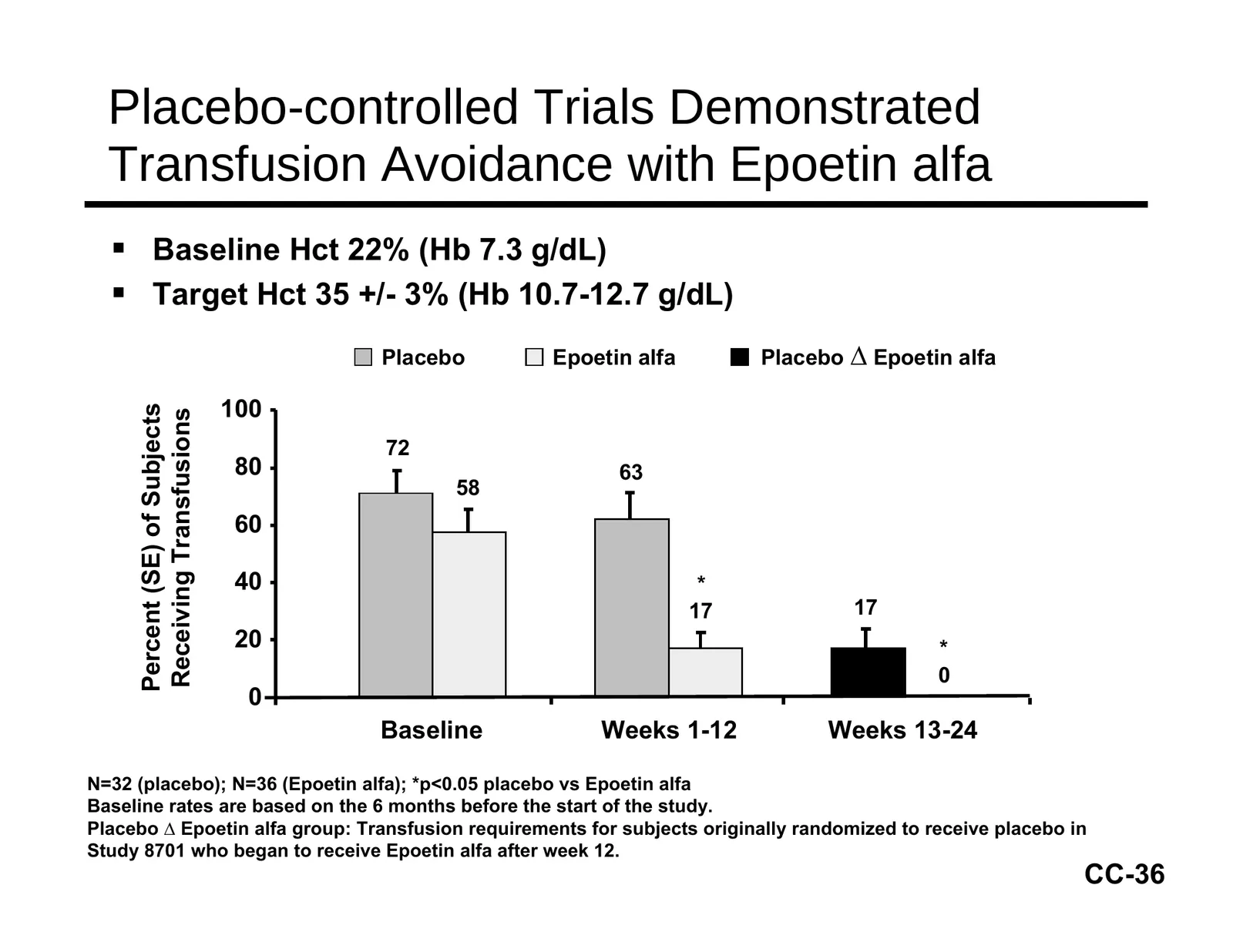
Slide 36: Placebo-controlled Trials Demonstrated Transfusion Avoidance with Epoetin alfa
Placebo-controlled Trials Demonstrated Transfusion Avoidance with Epoetin alfa Baseline Hct 22% (Hb 7.3 g/dL) Target Hct 35 +/- 3% (Hb 10.7-12.7 g/dL) Placebo Epoetin alfa Placebo ∆ Epoetin alfa 100 Percent (SE) of Subjects Receiving Transfusions 72 80 63 58 60 40 * 17 17 20 * 0 0 Baseline Weeks
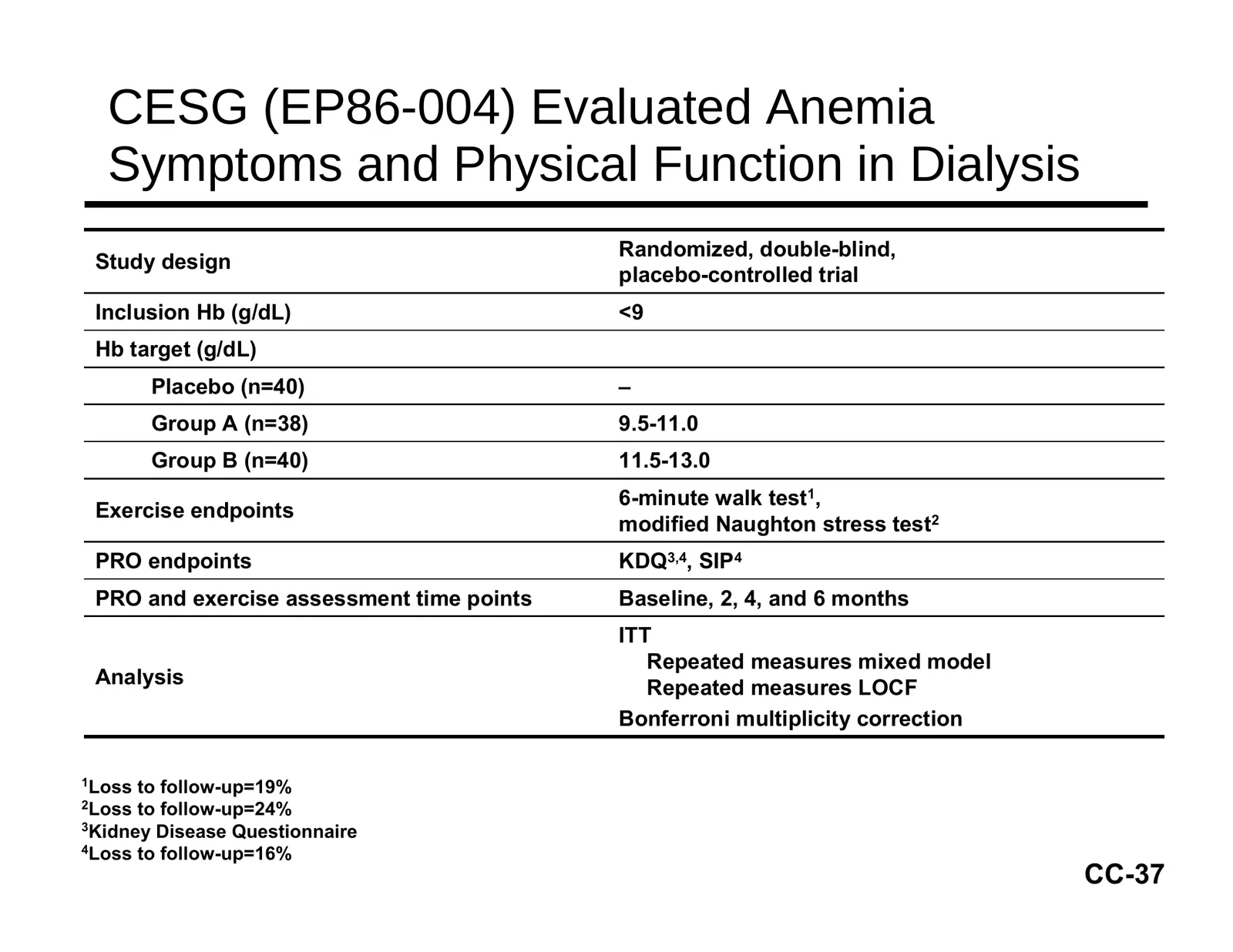
Slide 37: CESG Evaluated Anemia Symptoms and Physical Function in Dialysis
CESG (EP86-004) Evaluated Anemia Symptoms and Physical Function in Dialysis Randomized, double-blind, Study design placebo-controlled trial Inclusion Hb (g/dL) <9 Hb target (g/dL) Placebo (n=40) – Group A (n=38) 9.5-11.0 Group B (n=40) 11.5-13.0 6-minute walk test1, Exercise endpoints modified Naugh
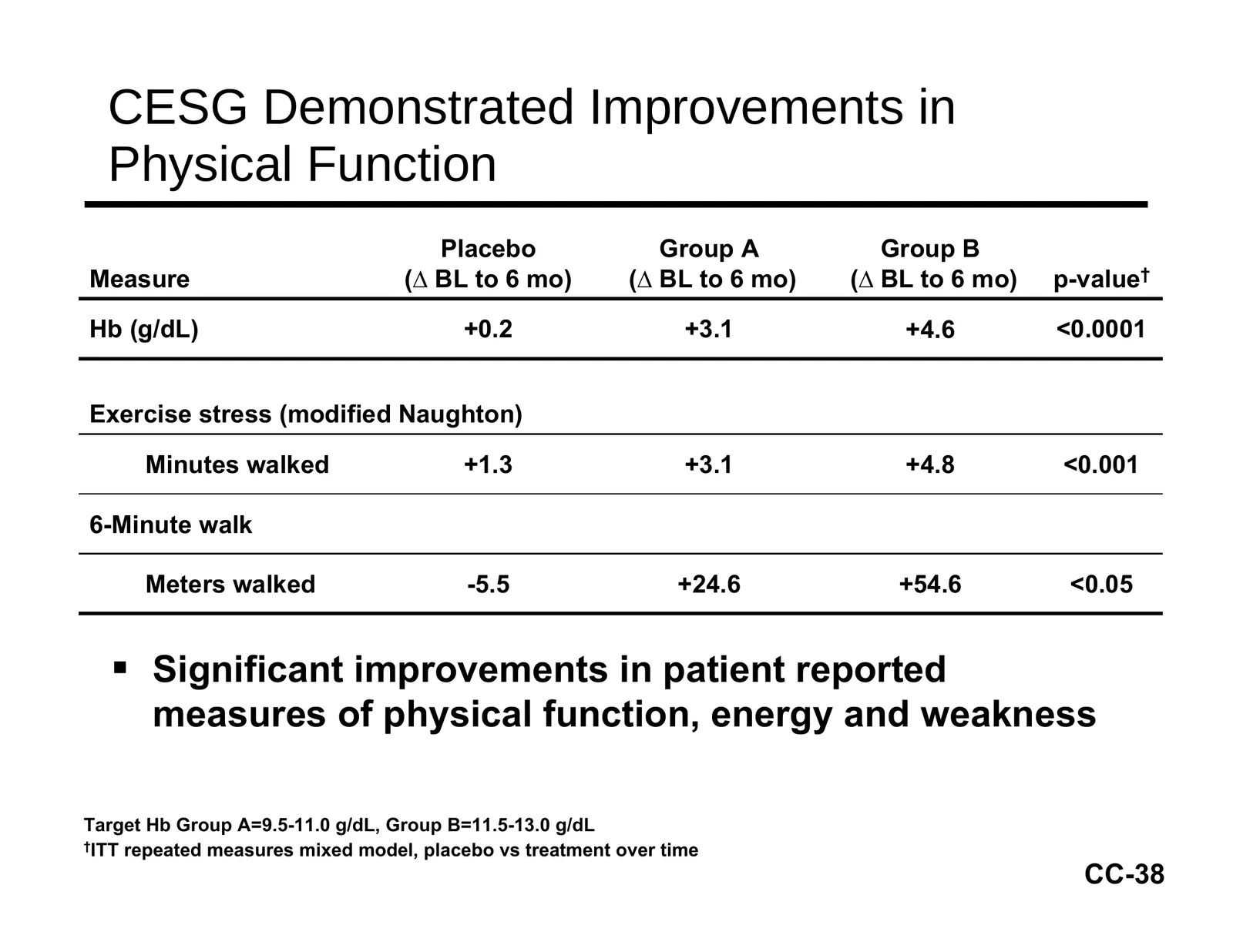
Slide 38: CESG Demonstrated Improvements in Physical Function
CESG Demonstrated Improvements in Physical Function Placebo Group A Group B Measure (∆ BL to 6 mo) (∆ BL to 6 mo) (∆ BL to 6 mo) p-value† Hb (g/dL) +0.2 +3.1 +4.6 <0.0001 Exercise stress (modified Naughton) Minutes walked +1.3 +3.1 +4.8 <0.001 6-Minute walk Meters walked -5.5 +24.6 +54.6 <0.05 Sig
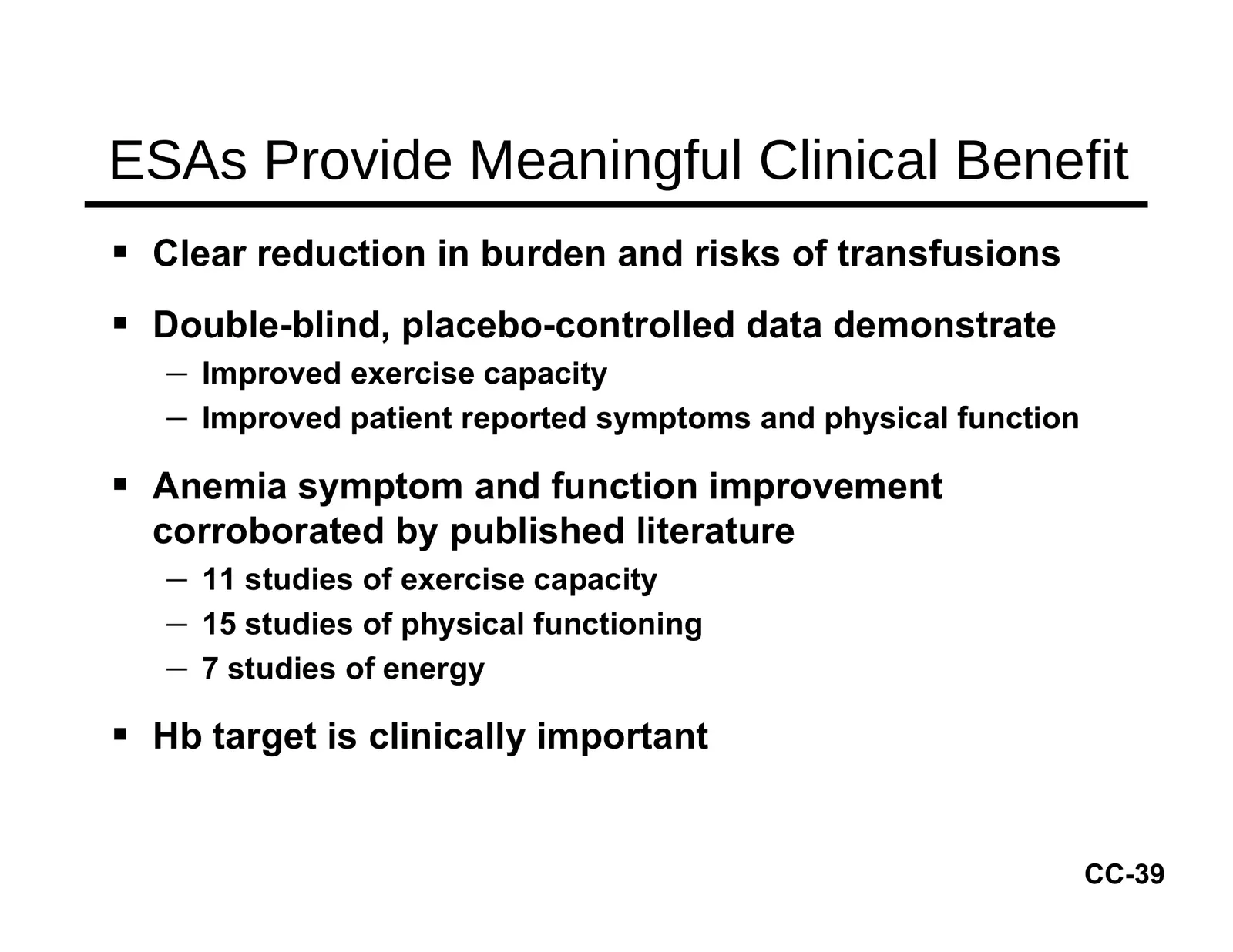
Slide 39: ESAs Provide Meaningful Clinical Benefit
ESAs Provide Meaningful Clinical Benefit Clear reduction in burden and risks of transfusions Double-blind, placebo-controlled data demonstrate – Improved exercise capacity – Improved patient reported symptoms and physical function Anemia symptom and function improvement corroborated by publish
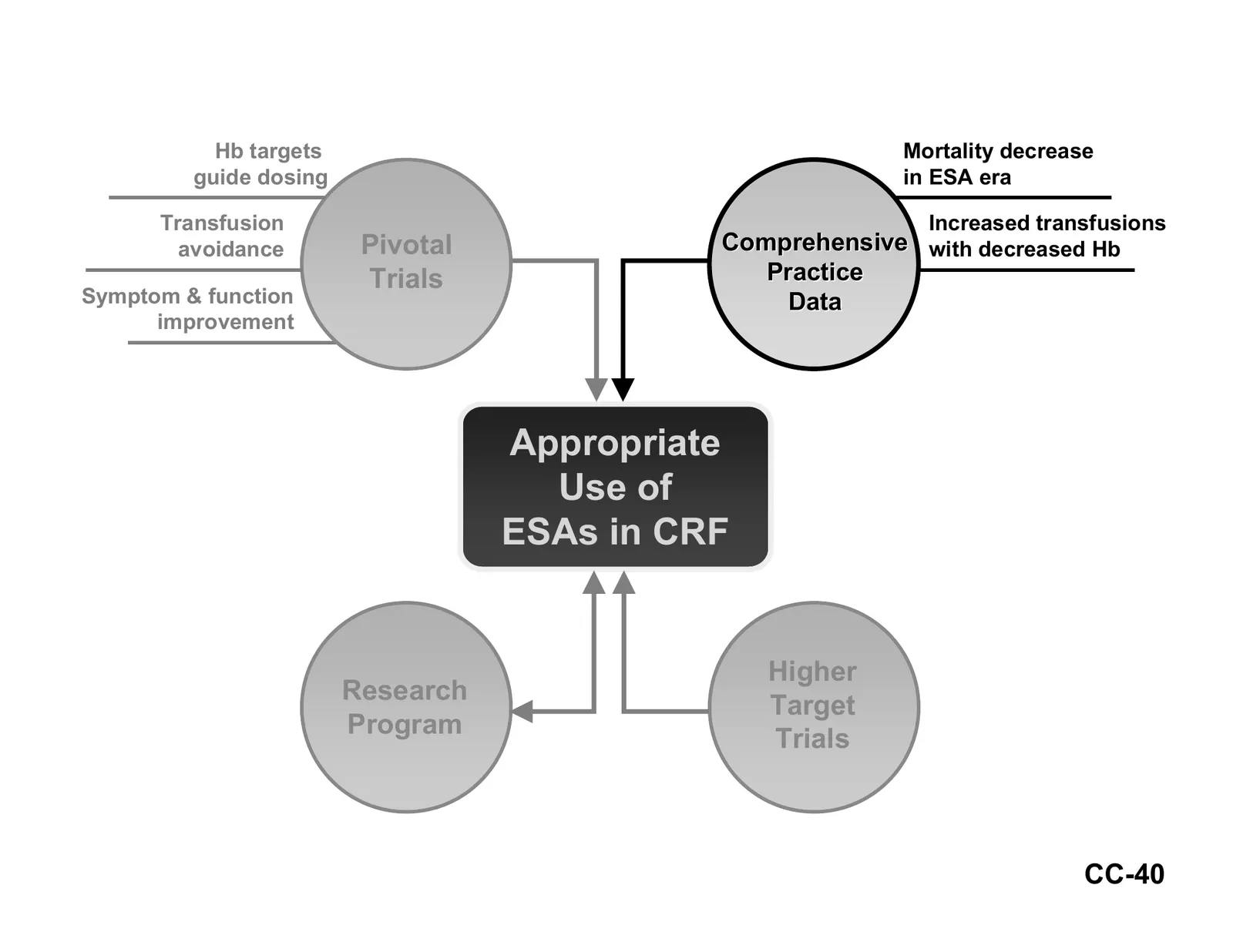
Slide 40: Appropriate Use of ESAs in CRF
Hb targets Mortality decrease guide dosing in ESA era Transfusion Increased transfusions avoidance Pivotal Comprehensive with decreased Hb Trials Practice Symptom & function Data improvement Appropriate Use of ESAs in CRF Higher Research Target Program Trials CC-40
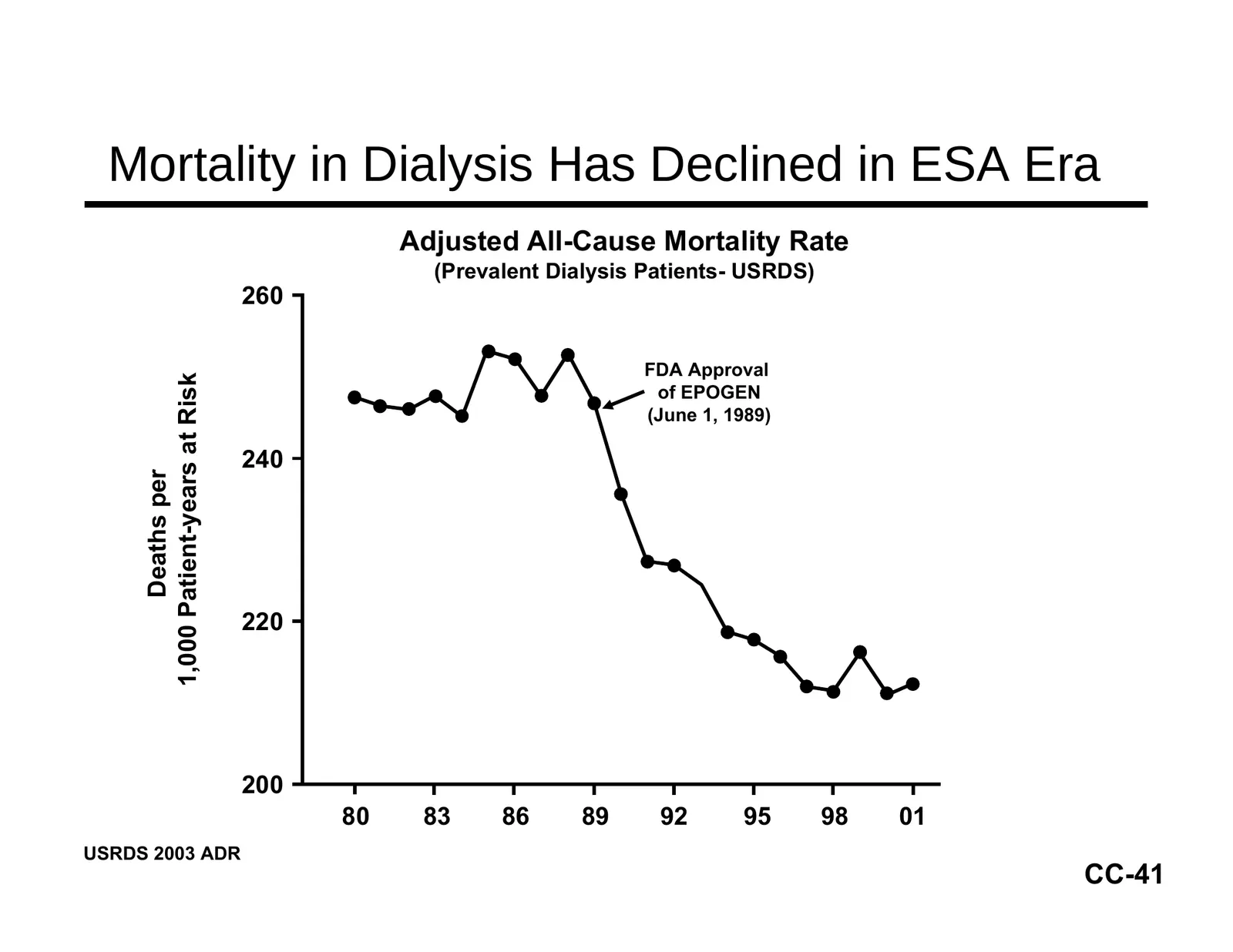
Slide 41: Mortality in Dialysis Has Declined in ESA Era
Mortality in Dialysis Has Declined in ESA Era Adjusted All-Cause Mortality Rate (Prevalent Dialysis Patients- USRDS) 260 FDA Approval 1,000 Patient-years at Risk of EPOGEN (June 1, 1989) 240 Deaths per 220 200 80 83 86 89 92 95 98 01 USRDS 2003 ADR CC-41
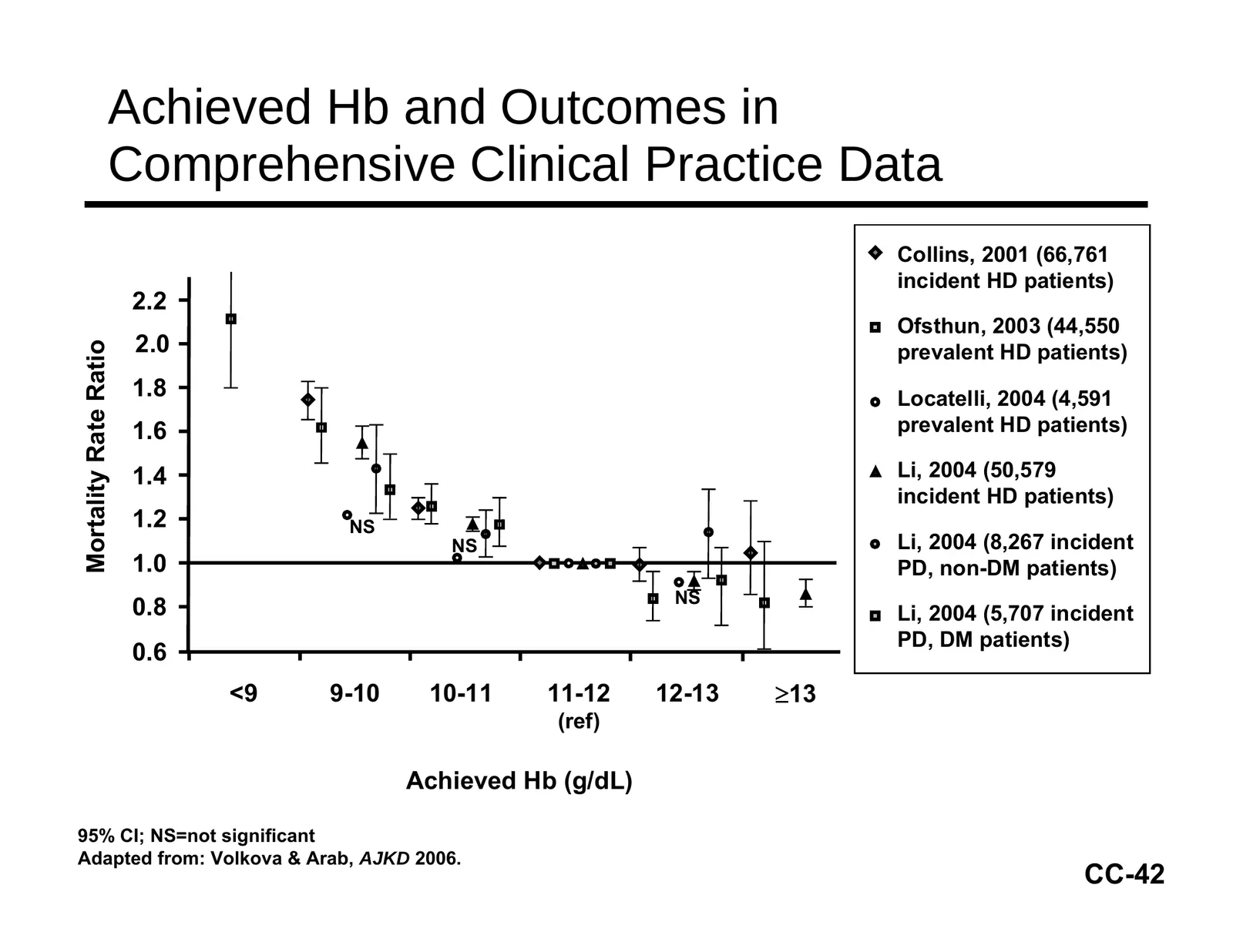
Slide 42: Achieved Hb and Outcomes in Comprehensive Clinical Practice Data
Achieved Hb and Outcomes in Comprehensive Clinical Practice Data Collins, 2001 (66,761 incident HD patients) 2.2 Ofsthun, 2003 (44,550 2.0 Mortality Rate Ratio prevalent HD patients) 1.8 Locatelli, 2004 (4,591 1.6 prevalent HD patients) 1.4 Li, 2004 (50,579 incident HD patients) 1.2 NS NS Li, 2004 (
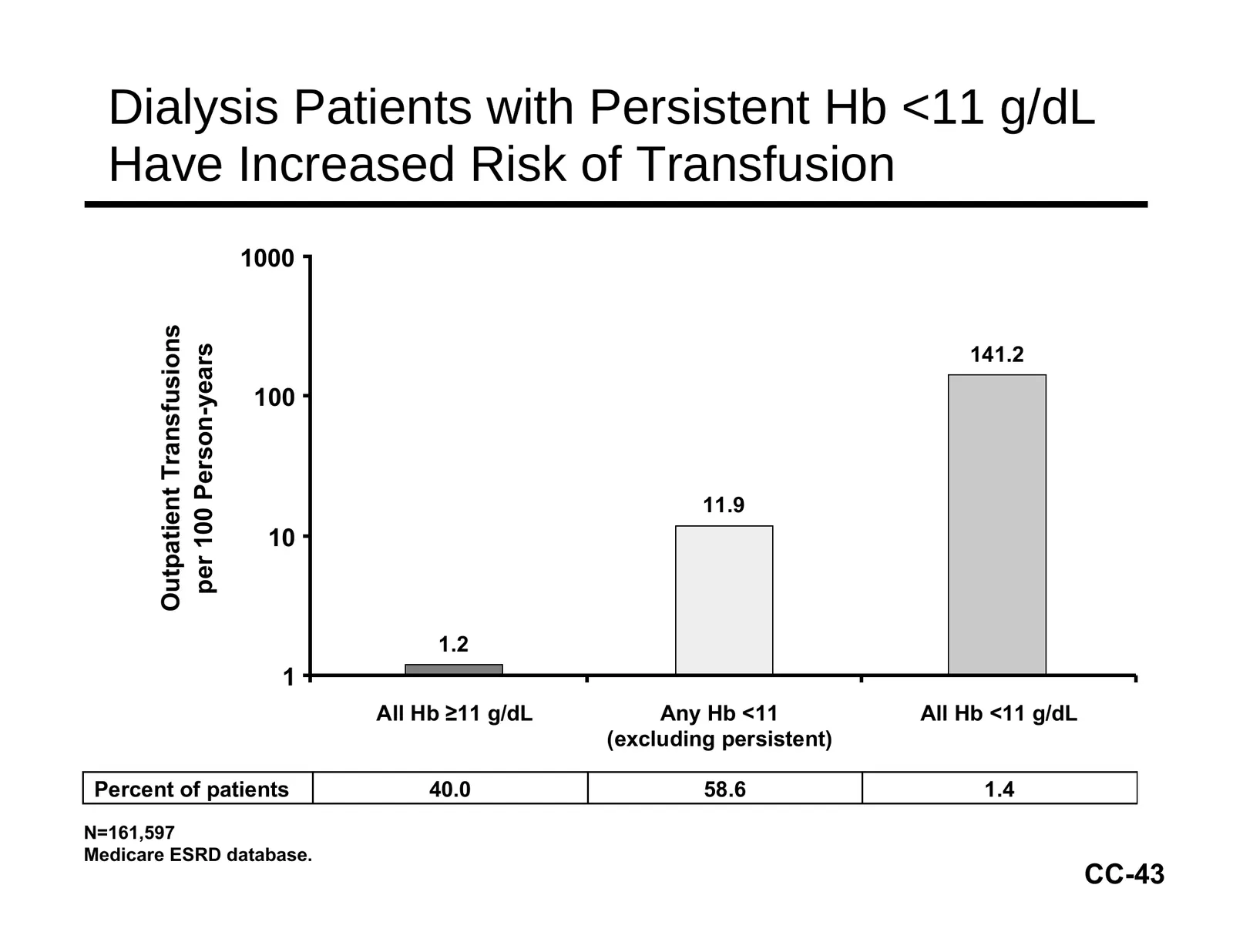
Slide 43: Dialysis Patients with Persistent Hb <11 g/dL Have Increased Risk of Transfusion
Dialysis Patients with Persistent Hb <11 g/dL Have Increased Risk of Transfusion 1000 Outpatient Transfusions 141.2 per 100 Person-years 100 11.9 10 1.2 1 All Hb ≥11 g/dL Any Hb <11 All Hb <11 g/dL (excluding persistent) Percent of patients 40.0 58.6 1.4 N=161,597 Medicare ESRD database. CC-43
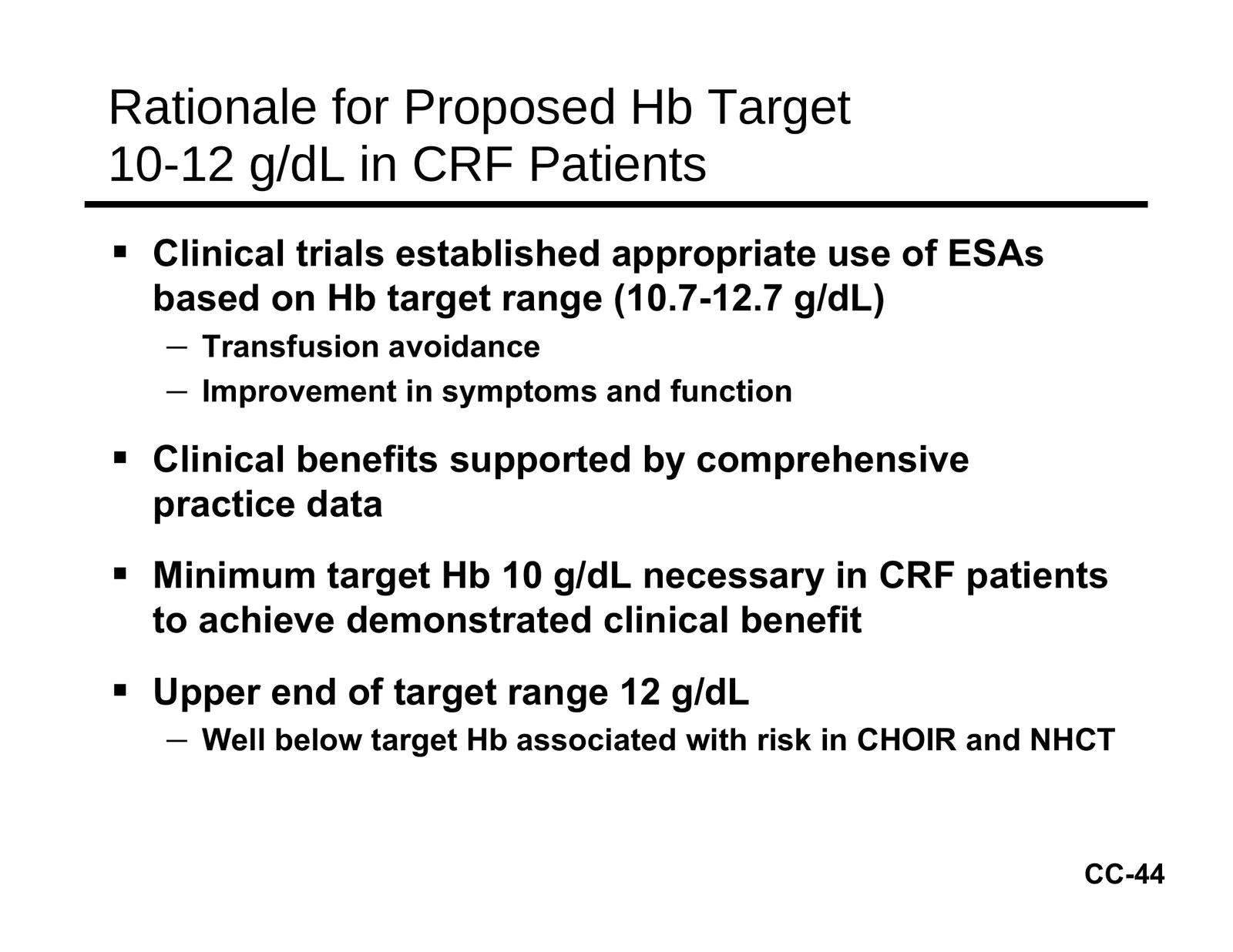
Slide 44: Rationale for Proposed Hb Target 10-12 g/dL in CRF Patients
Rationale for Proposed Hb Target 10-12 g/dL in CRF Patients Clinical trials established appropriate use of ESAs based on Hb target range (10.7-12.7 g/dL) – Transfusion avoidance – Improvement in symptoms and function Clinical benefits supported by comprehensive practice data Minimum target Hb
Slide 45: Appropriate Use of ESAs in CRF
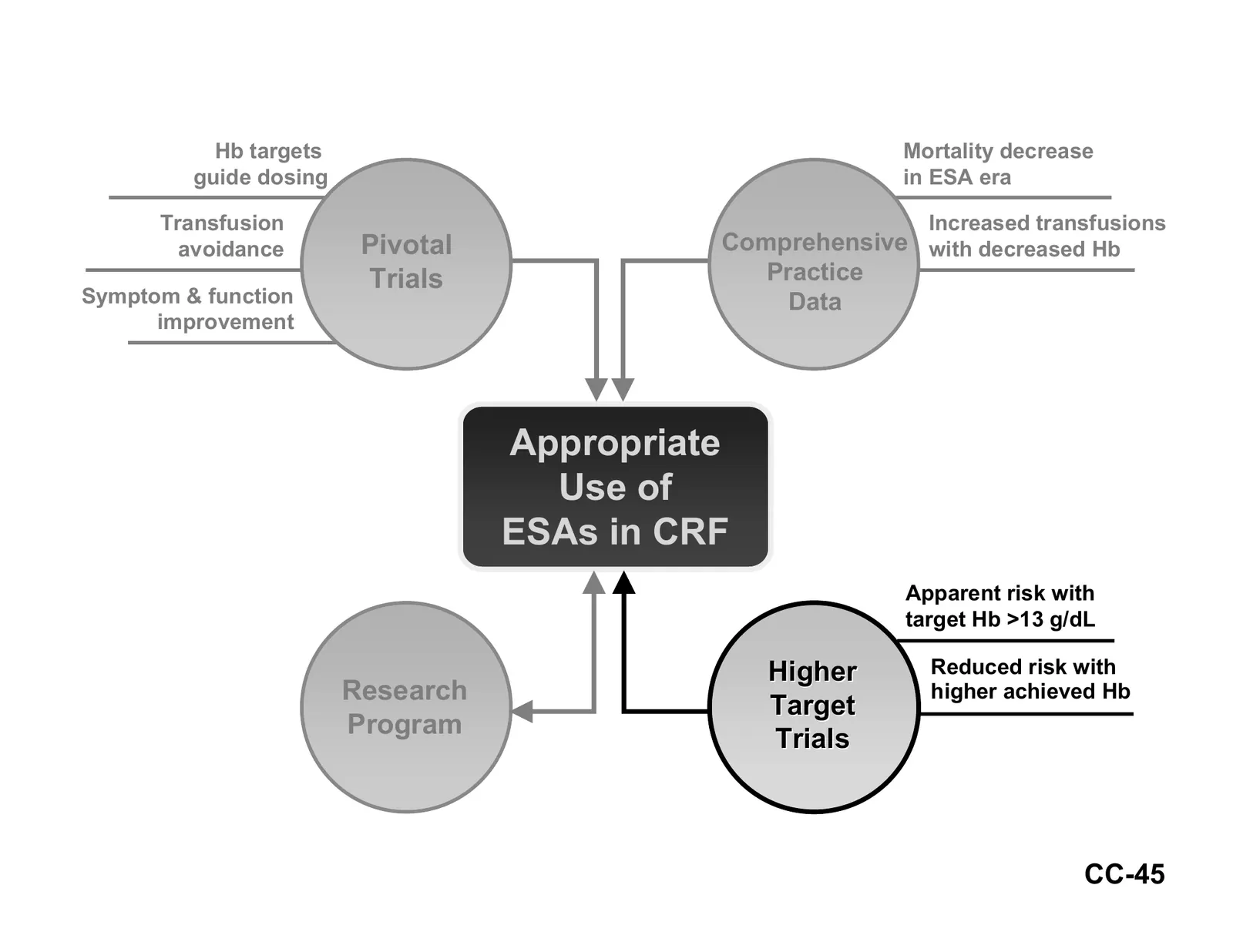
Hb targets Mortality decrease guide dosing in ESA era Transfusion Increased transfusions avoidance Pivotal Comprehensive with decreased Hb Trials Practice Symptom & function Data improvement Appropriate Use of ESAs in CRF Apparent risk with target Hb >13 g/dL Higher Reduced risk with Research higher
Slide 46: Complete vs Partial Correction of Anemia
Complete vs Partial Correction of Anemia Partial correction demonstrated clinical benefits Principal question in the nephrology community following the adoption of ESAs was whether greater clinical benefit would result from complete correction CC-46
Slide 47: Clinical Trial to Investigate Hb Normalization Identified Unexpected Risks: NHCT
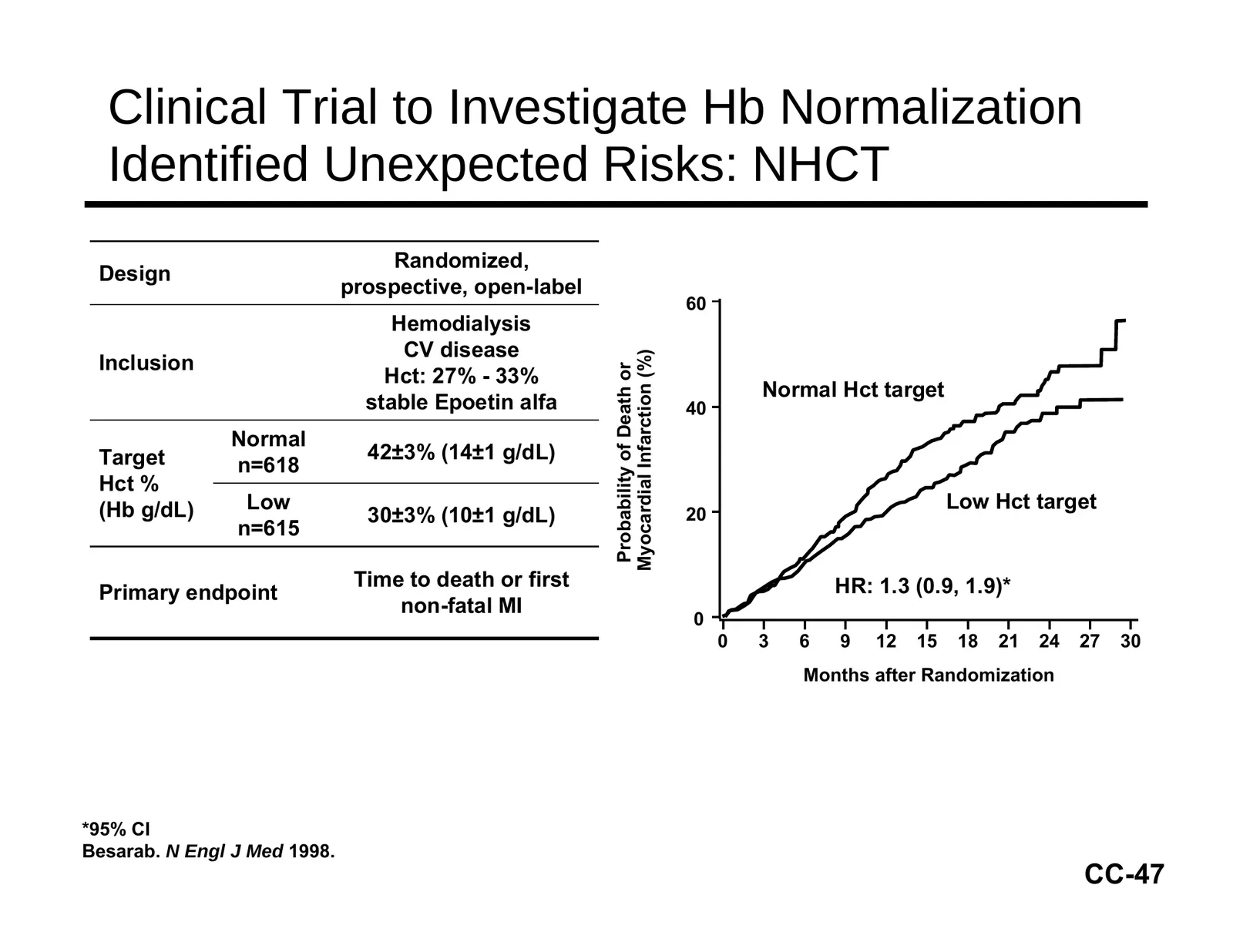
Clinical Trial to Investigate Hb Normalization Identified Unexpected Risks: NHCT Randomized, Design prospective, open-label 60 Hemodialysis CV disease Myocardial Infarction (%) Inclusion Probability of Death or Hct: 27% - 33% Normal Hct target stable Epoetin alfa 40 Normal Target 42±3% (14±1 g/dL) n
Slide 48: Clinical Trial to Investigate Hb Normalization Identified Unexpected Risks: CHOIR
Clinical Trial to Investigate Hb Normalization Identified Unexpected Risks: CHOIR Randomized, Design prospective, open-label Non-dialysis CRF, 0.30 eGFR: 15-50 Inclusion 0.25 ml/min/1.73m2 Probability of Primary High Hb target Hb <11 g/dL Composite Event 0.20 High Hb 13.5 n=715 0.15 Target(s) (g/dL)
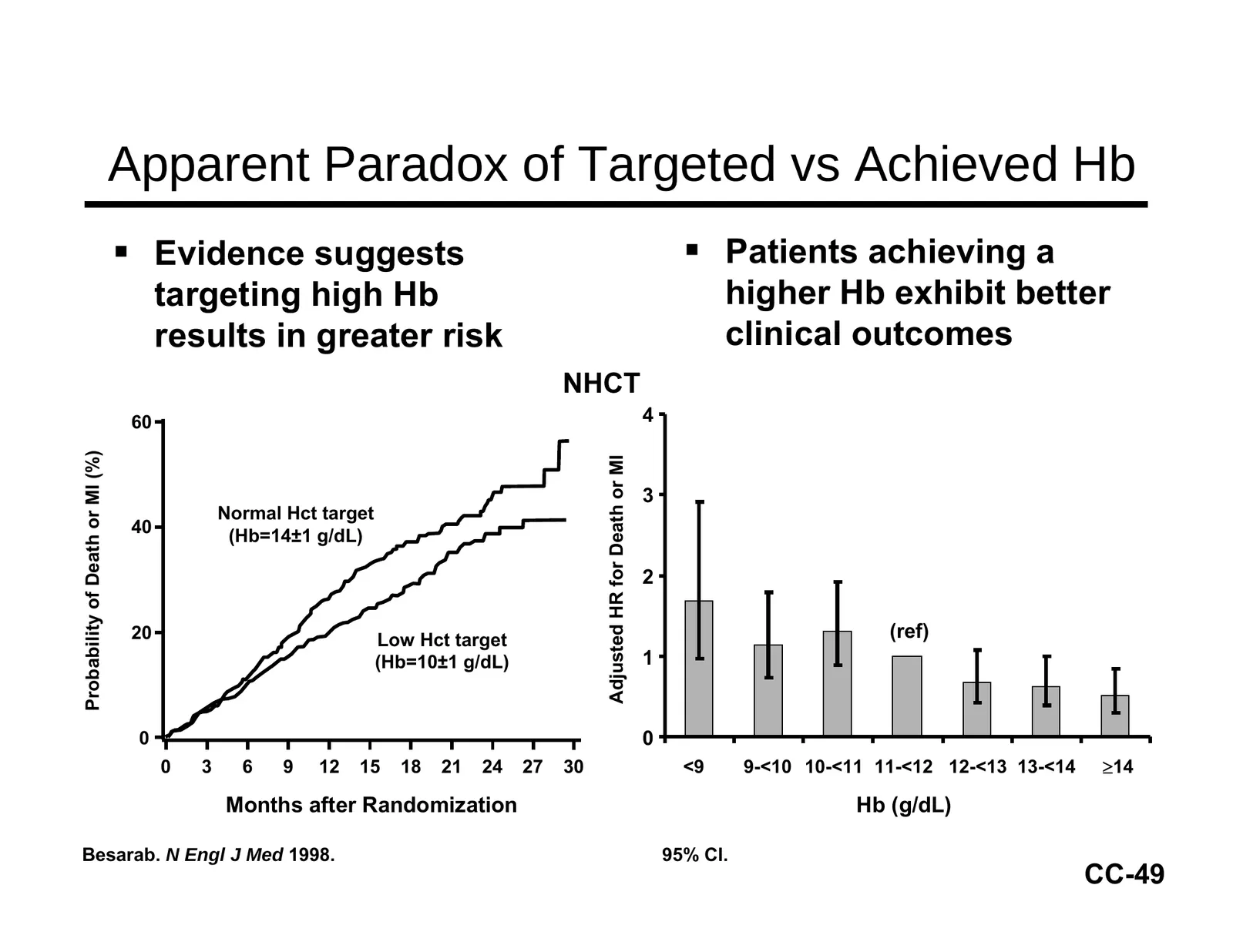
Slide 49: Apparent Paradox of Targeted vs Achieved Hb
Apparent Paradox of Targeted vs Achieved Hb Evidence suggests Patients achieving a targeting high Hb higher Hb exhibit better results in greater risk clinical outcomes NHCT 60 4 Probability of Death or MI (%) Adjusted HR for Death or MI 3 Normal Hct target 40 (Hb=14±1 g/dL) 2 20 Low Hct target (
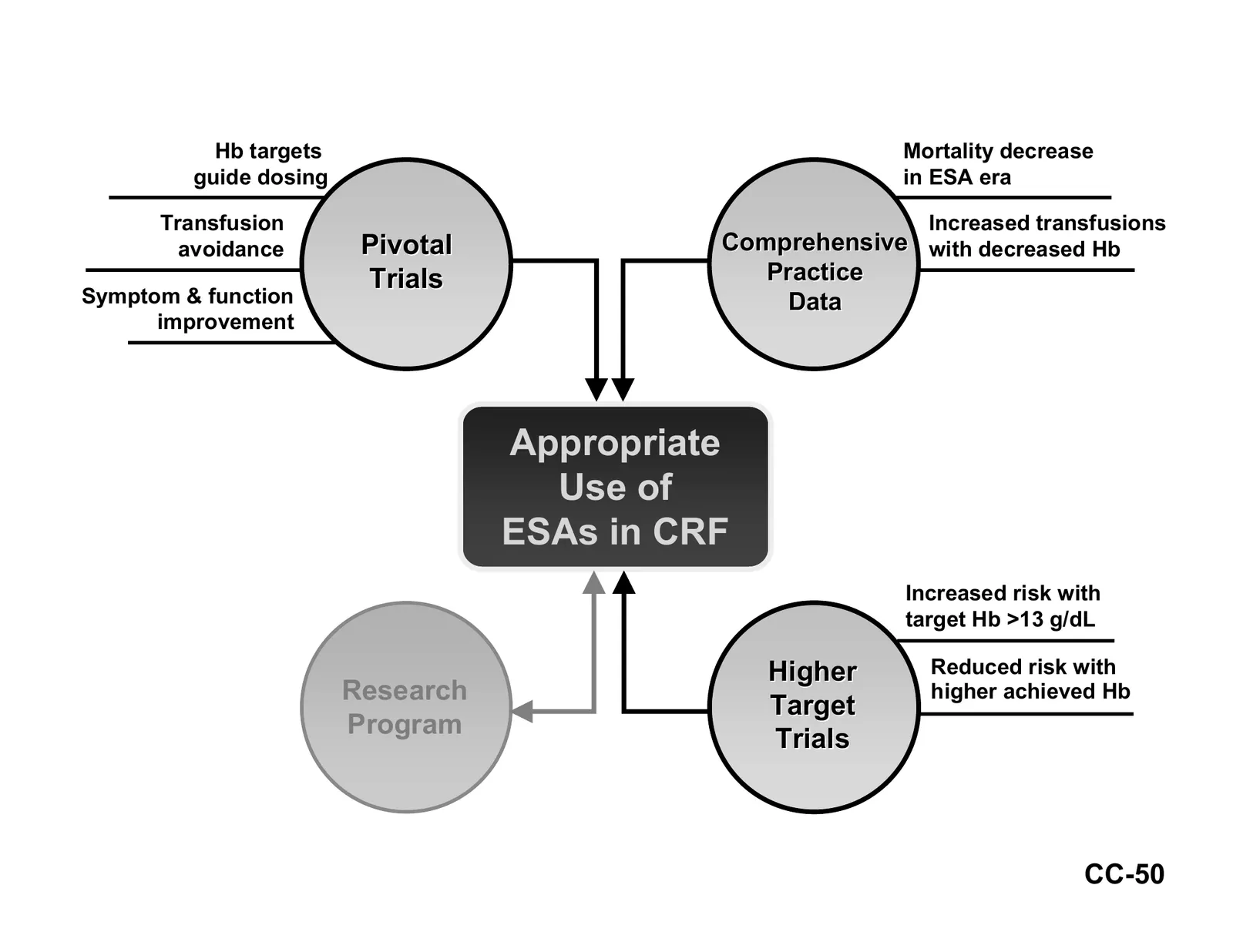
Slide 50: Appropriate Use of ESAs in CRF
Hb targets Mortality decrease guide dosing in ESA era Transfusion Increased transfusions avoidance Pivotal Comprehensive with decreased Hb Trials Practice Symptom & function Data improvement Appropriate Use of ESAs in CRF Increased risk with target Hb >13 g/dL Higher Reduced risk with Research highe
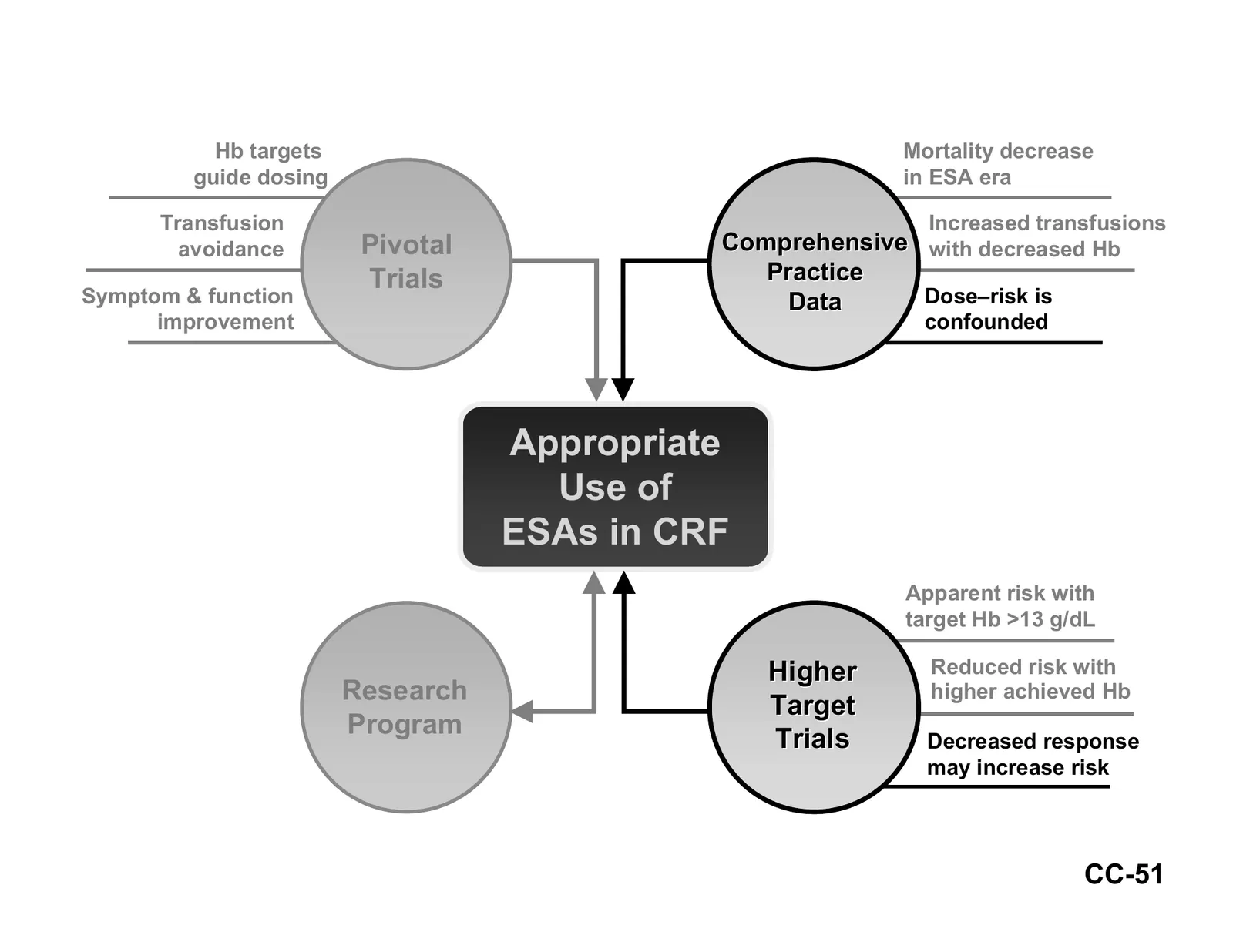
Slide 51: Appropriate Use of ESAs in CRF
Hb targets Mortality decrease guide dosing in ESA era Transfusion Increased transfusions avoidance Pivotal Comprehensive with decreased Hb Trials Practice Symptom & function Data Dose–risk is improvement confounded Appropriate Use of ESAs in CRF Apparent risk with target Hb >13 g/dL Higher Reduced r
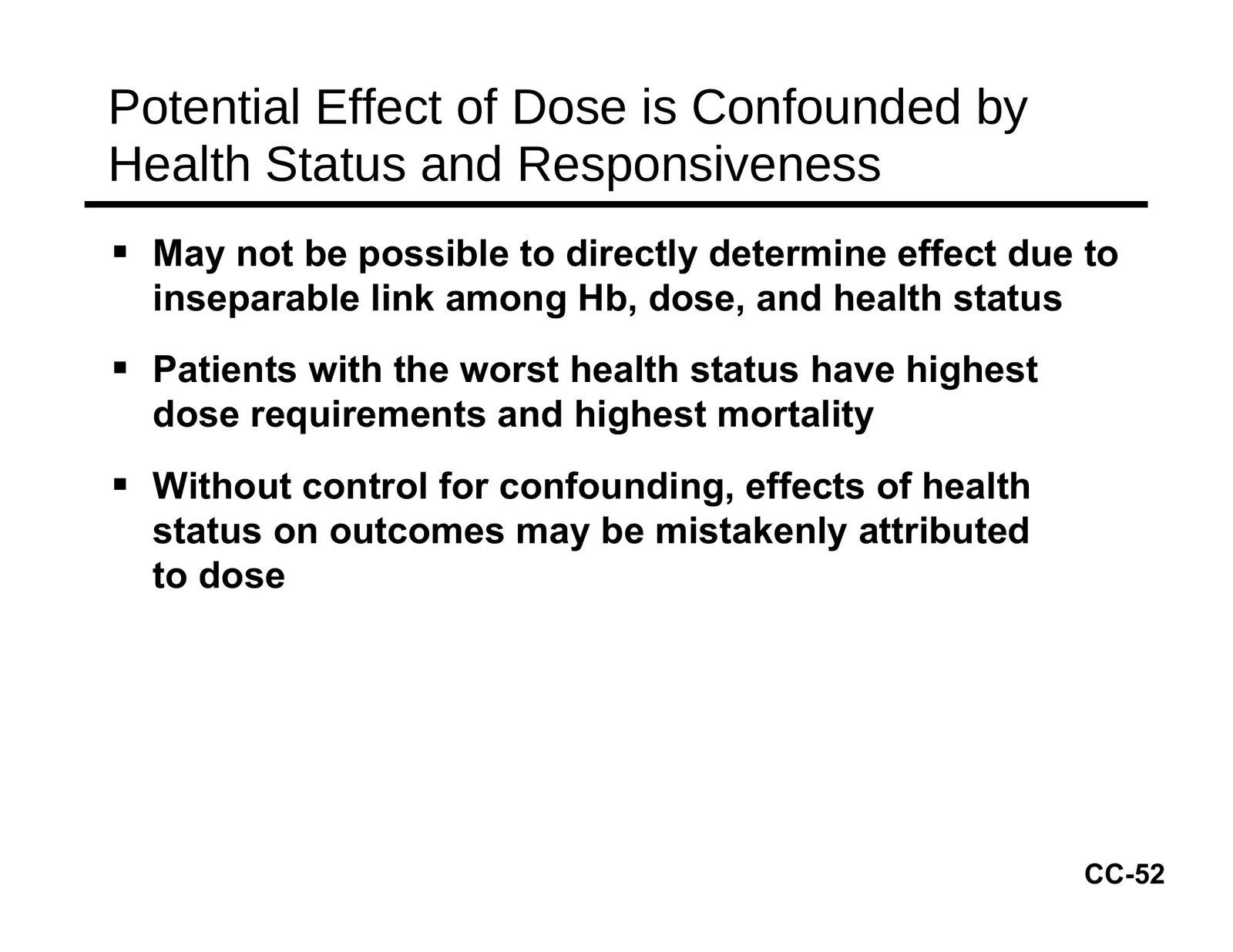
Slide 52: Potential Effect of Dose is Confounded by Health Status and Responsiveness
Potential Effect of Dose is Confounded by Health Status and Responsiveness May not be possible to directly determine effect due to inseparable link among Hb, dose, and health status Patients with the worst health status have highest dose requirements and highest mortality Without control for c
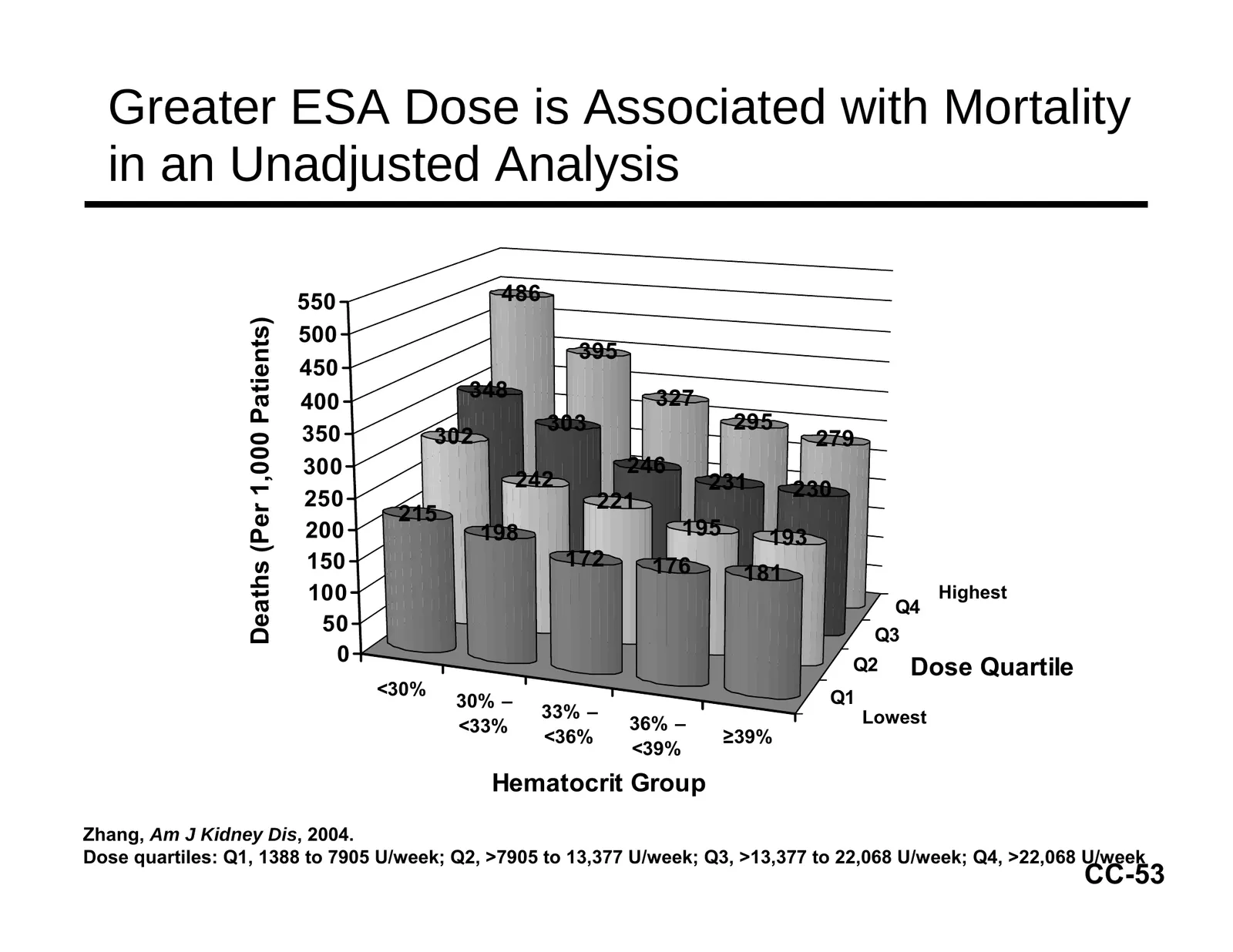
Slide 53: Greater ESA Dose is Associated with Mortality in an Unadjusted Analysis
Greater ESA Dose is Associated with Mortality in an Unadjusted Analysis 550 486 Deaths (Per 1,000 Patients) 500 395 450 348 327 400 303 295 350 302 279 300 246 242 231 230 250 221 215 200 198 195 193 150 172 176 181 100 Highest Q4 50 Q3 0 Q2 Dose Quartile <30% Q1 30% – 33% – Lowest <33% 36% – <36% ≥
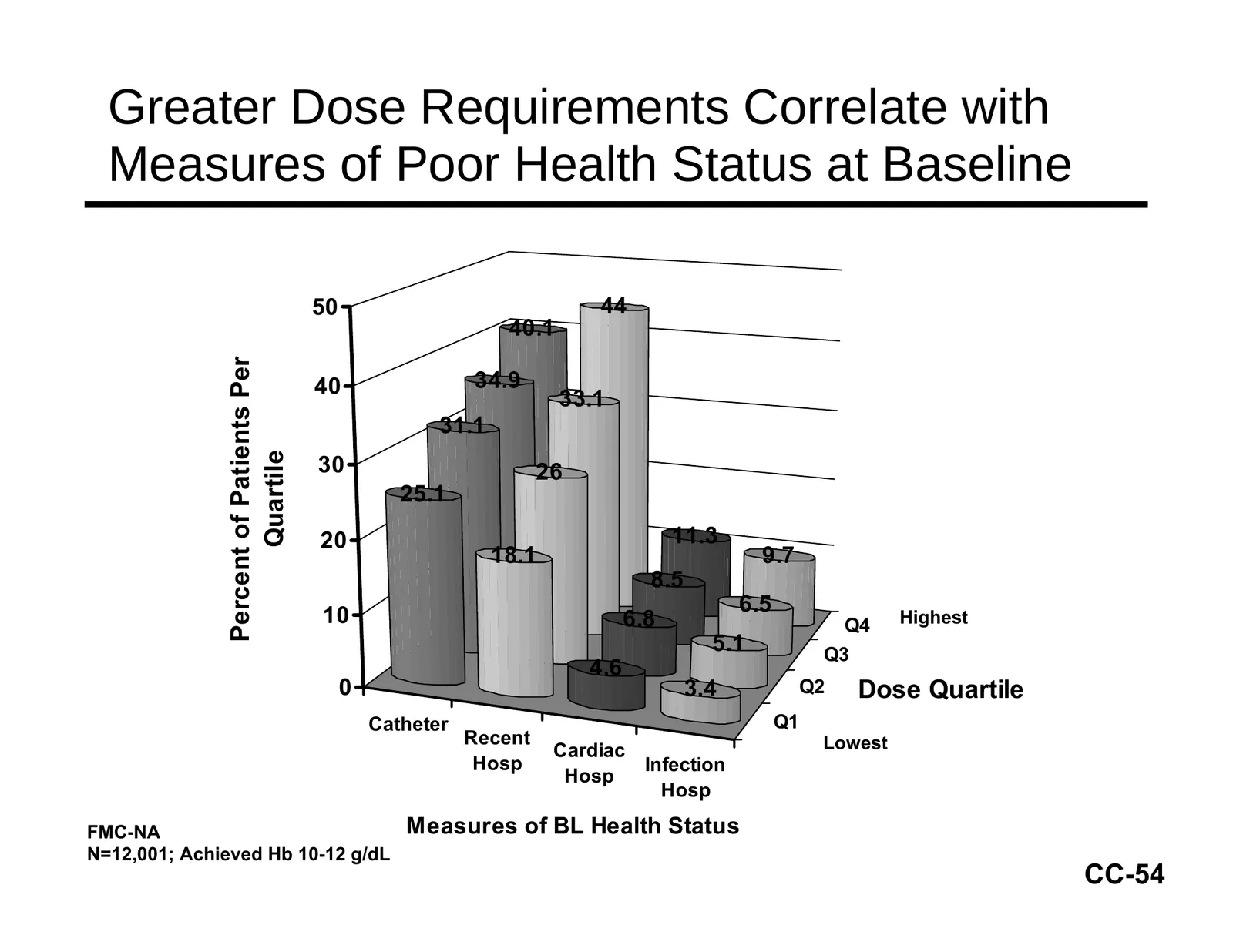
Slide 54: Greater Dose Requirements Correlate with Measures of Poor Health Status
Greater Dose Requirements Correlate with Measures of Poor Health Status at Baseline 50 44 40.1 Percent of Patients Per 40 34.9 33.1 31.1 Quartile 30 26 25.1 20 11.3 18.1 9.7 8.5 10 6.5 6.8 Q4 Highest 5.1 Q3 4.6 0 3.4 Q2 Dose Quartile Catheter Q1 Recent Lowest Cardiac Hosp Infection Hosp Hosp FMC-NA
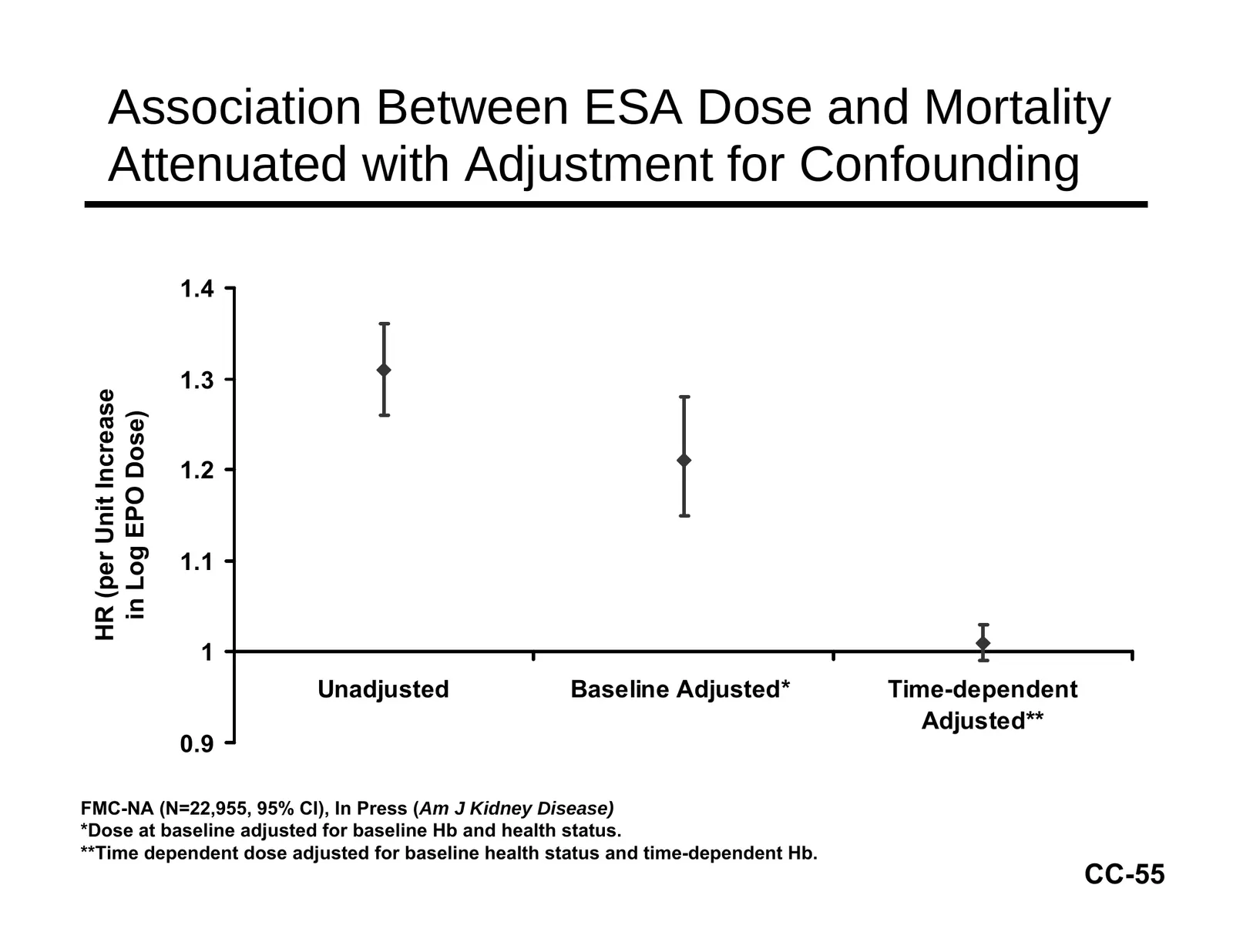
Slide 55: Association Between ESA Dose and Mortality Attenuated with Adjustment for Confounding
Association Between ESA Dose and Mortality Attenuated with Adjustment for Confounding 1.4 1.3 HR (per Unit Increase in Log EPO Dose) 1.2 1.1 1 Unadjusted Baseline Adjusted* Time-dependent Adjusted** 0.9 FMC-NA (N=22,955, 95% CI), In Press (Am J Kidney Disease) *Dose at baseline adjusted for baseline
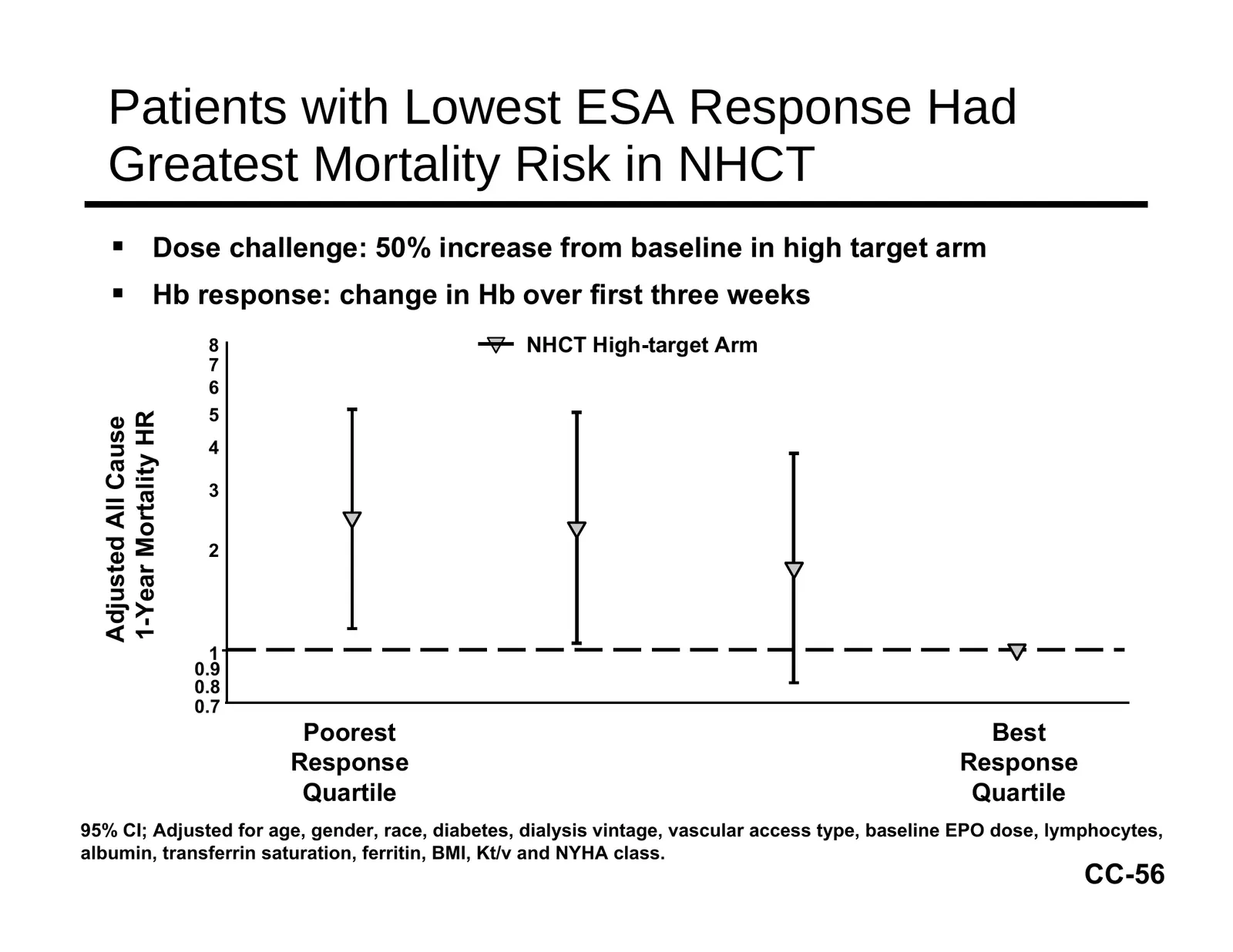
Slide 56: Patients with Lowest ESA Response Had Greatest Mortality Risk in NHCT
Patients with Lowest ESA Response Had Greatest Mortality Risk in NHCT Dose challenge: 50% increase from baseline in high target arm Hb response: change in Hb over first three weeks 8 NHCT High-target Arm 7 6 5 1-Year Mortality HR Adjusted All Cause 4 3 2 1 0.9 0.8 0.7 Poorest Best Response Respo
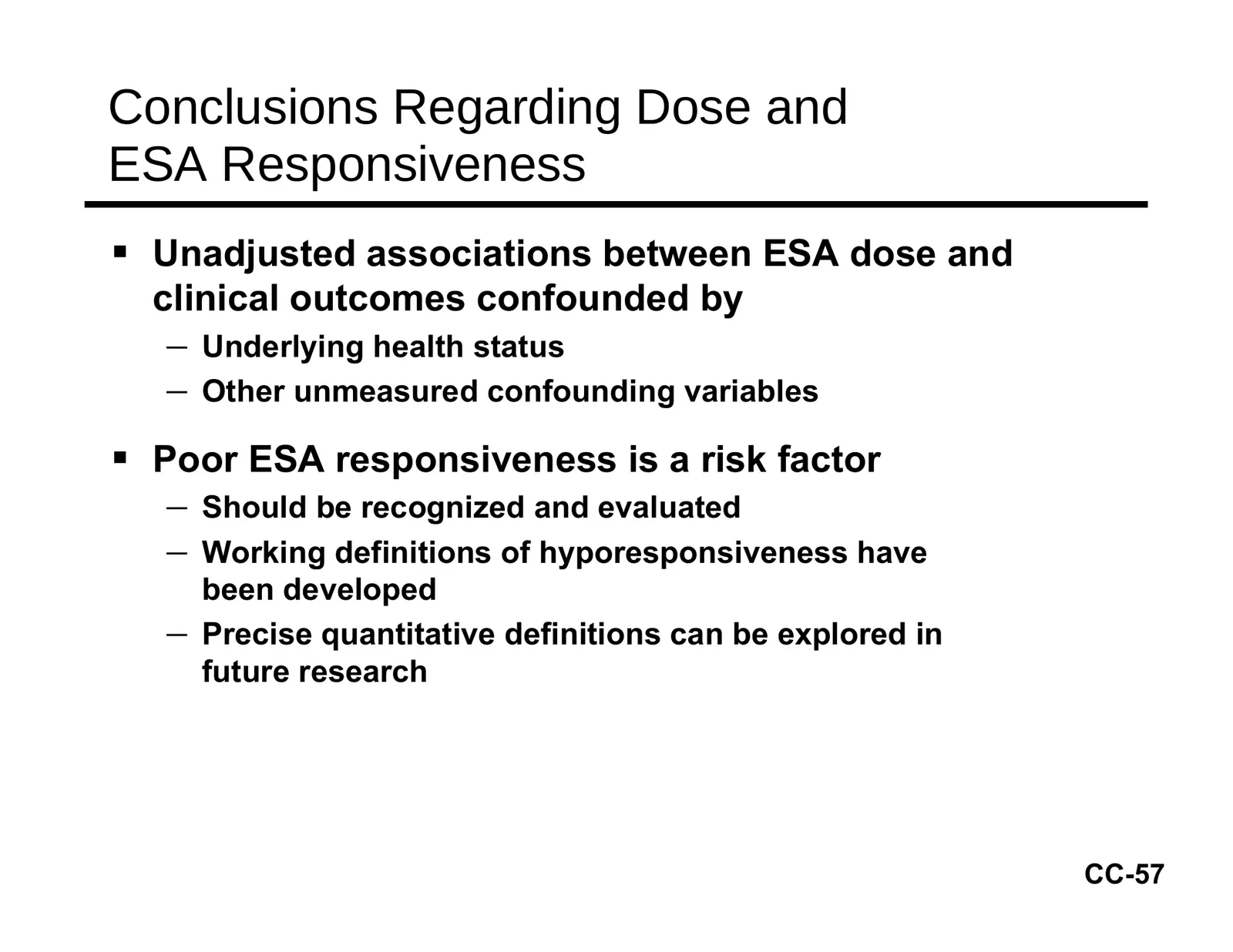
Slide 57: Conclusions Regarding Dose and ESA Responsiveness
Conclusions Regarding Dose and ESA Responsiveness Unadjusted associations between ESA dose and clinical outcomes confounded by – Underlying health status – Other unmeasured confounding variables Poor ESA responsiveness is a risk factor – Should be recognized and evaluated – Working definitions o
Slide 58: Appropriate Use of ESAs in CRF
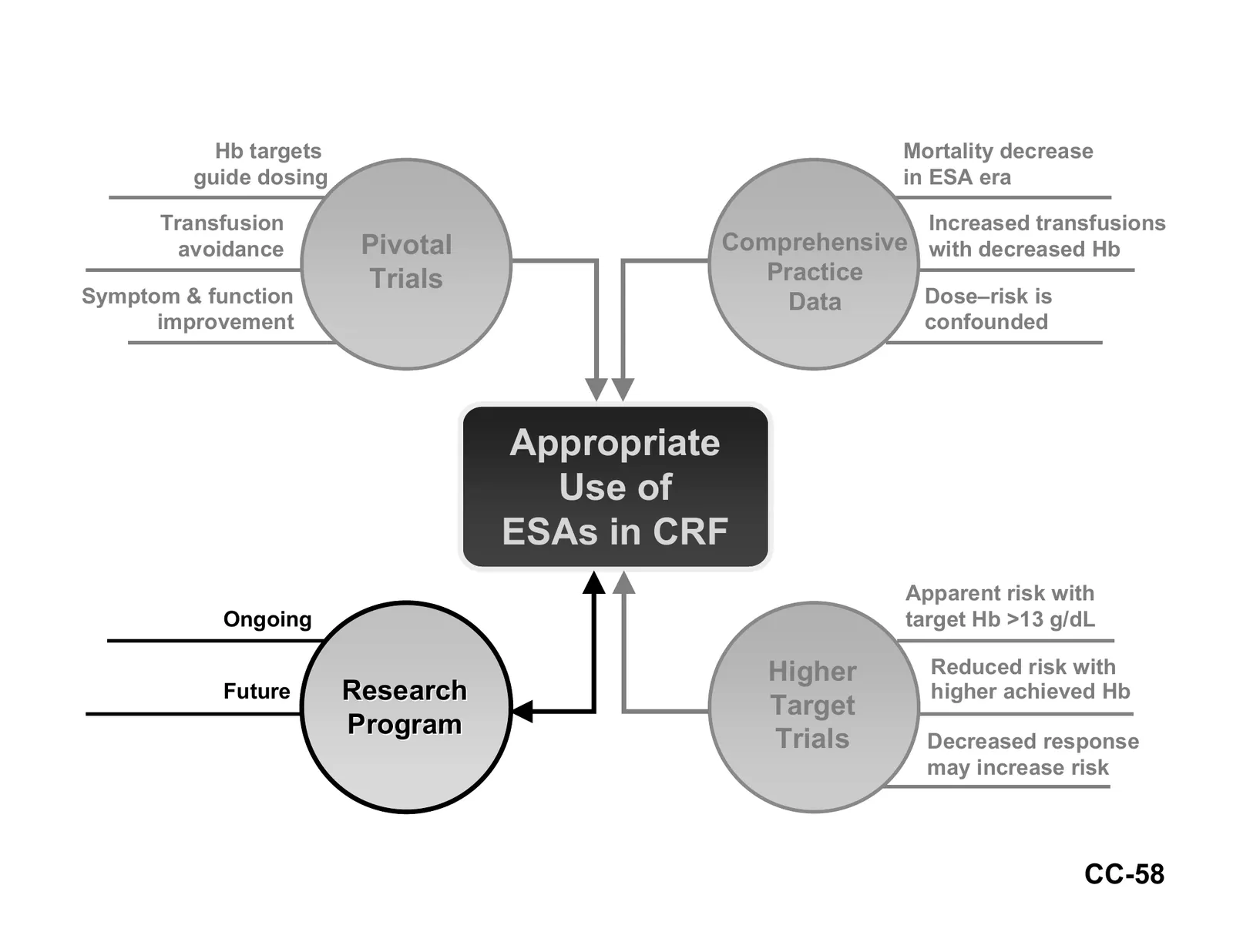
Hb targets Mortality decrease guide dosing in ESA era Transfusion Increased transfusions avoidance Pivotal Comprehensive with decreased Hb Trials Practice Symptom & function Data Dose–risk is improvement confounded Appropriate Use of ESAs in CRF Apparent risk with Ongoing target Hb >13 g/dL Higher R
Slide 59: Sponsors Are Committed to Additional Research to Address Key Issues
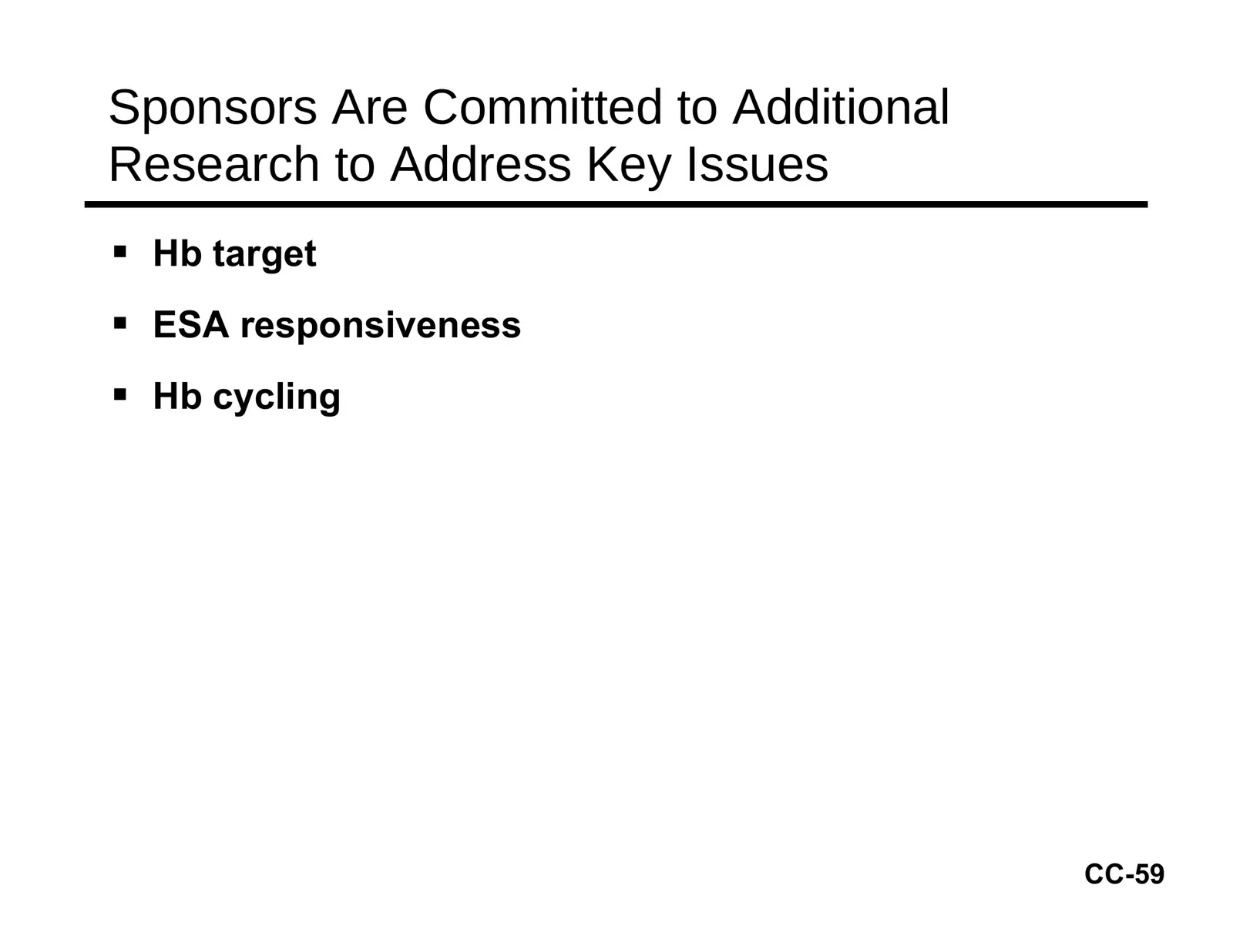
Sponsors Are Committed to Additional Research to Address Key Issues Hb target ESA responsiveness Hb cycling CC-59
Slide 60: TREAT Will Inform Future Research
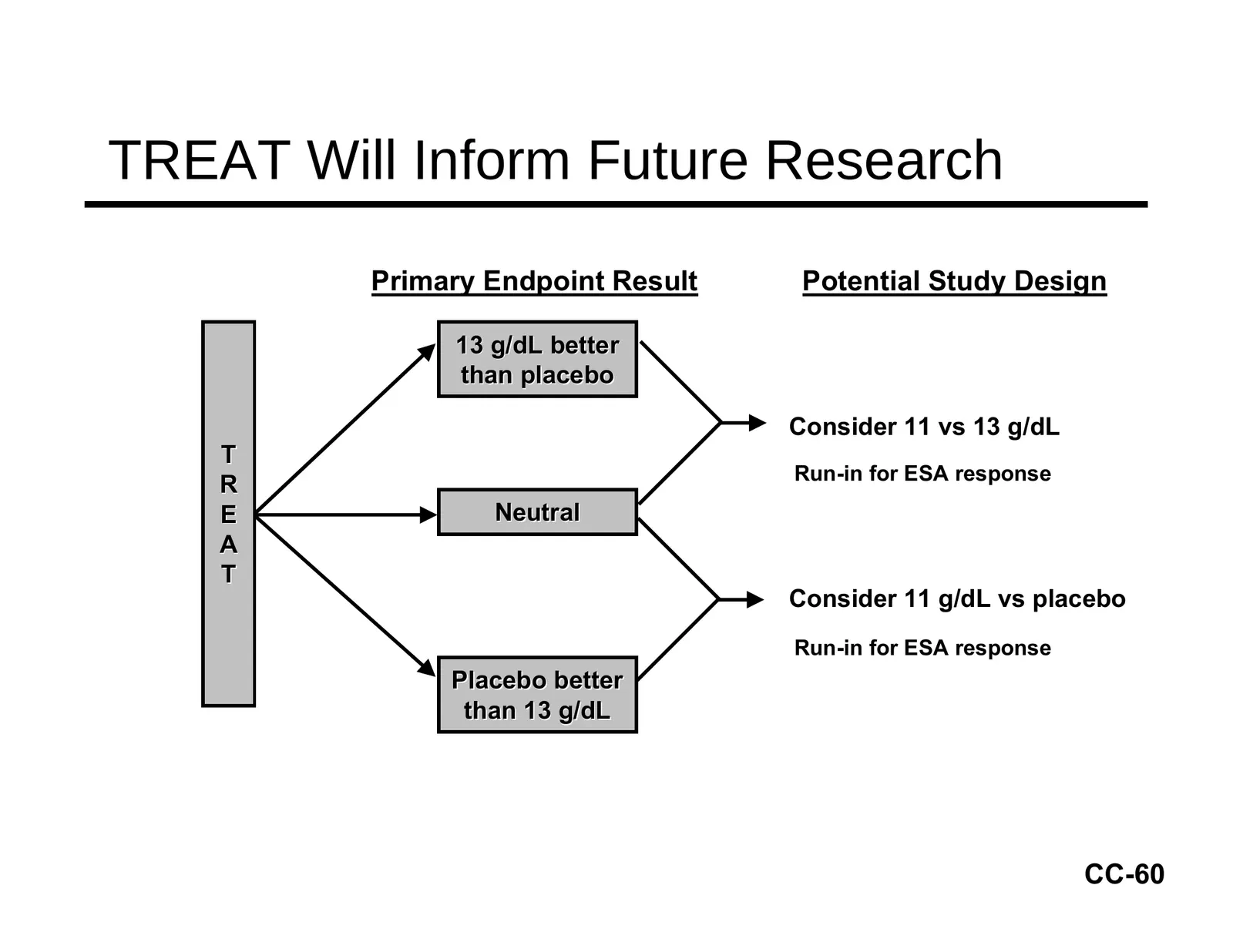
TREAT Will Inform Future Research Primary Endpoint Result Potential Study Design 13 g/dL better than placebo Consider 11 vs 13 g/dL T Run-in for ESA response R E Neutral A T Consider 11 g/dL vs placebo Run-in for ESA response Placebo better than 13 g/dL CC-60
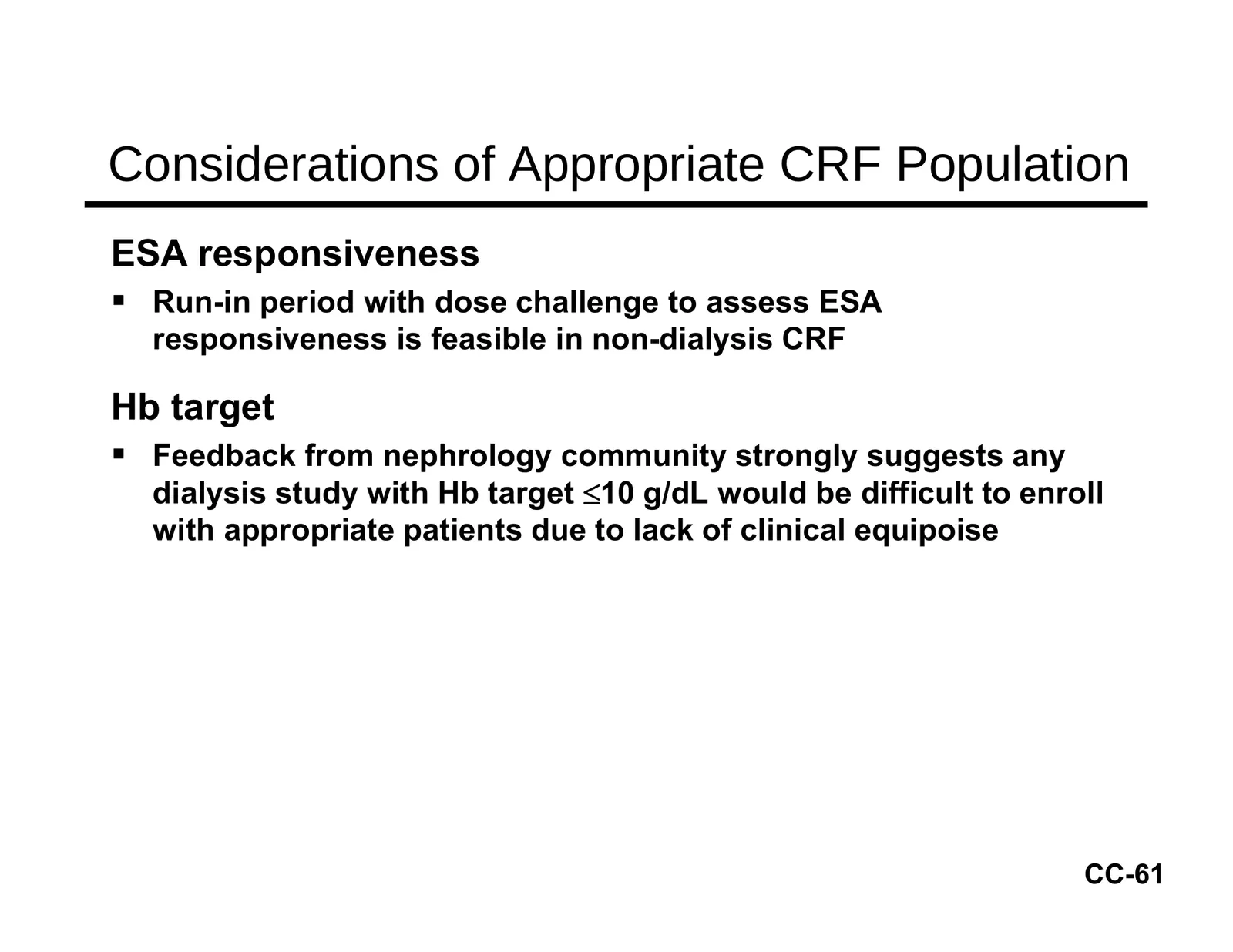
Slide 61: Considerations of Appropriate CRF Population
Considerations of Appropriate CRF Population ESA responsiveness Run-in period with dose challenge to assess ESA responsiveness is feasible in non-dialysis CRF Hb target Feedback from nephrology community strongly suggests any dialysis study with Hb target ≤10 g/dL would be difficult to enroll wi
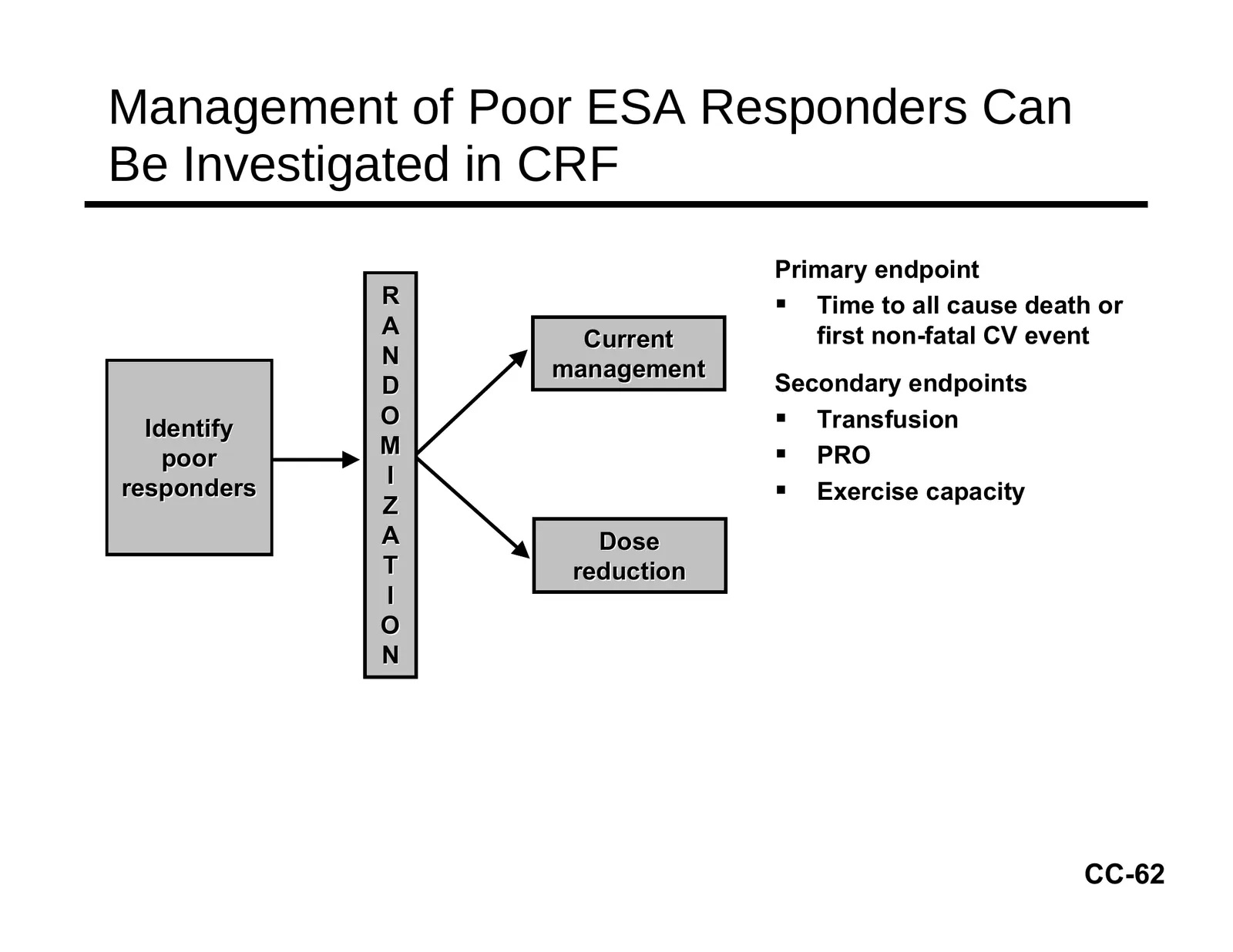
Slide 62: Management of Poor ESA Responders Can Be Investigated in CRF
Management of Poor ESA Responders Can Be Investigated in CRF Primary endpoint R Time to all cause death or A first non-fatal CV event Current N management D Secondary endpoints O Transfusion Identify M PRO poor I responders Exercise capacity Z A Dose T reduction I O N CC-62
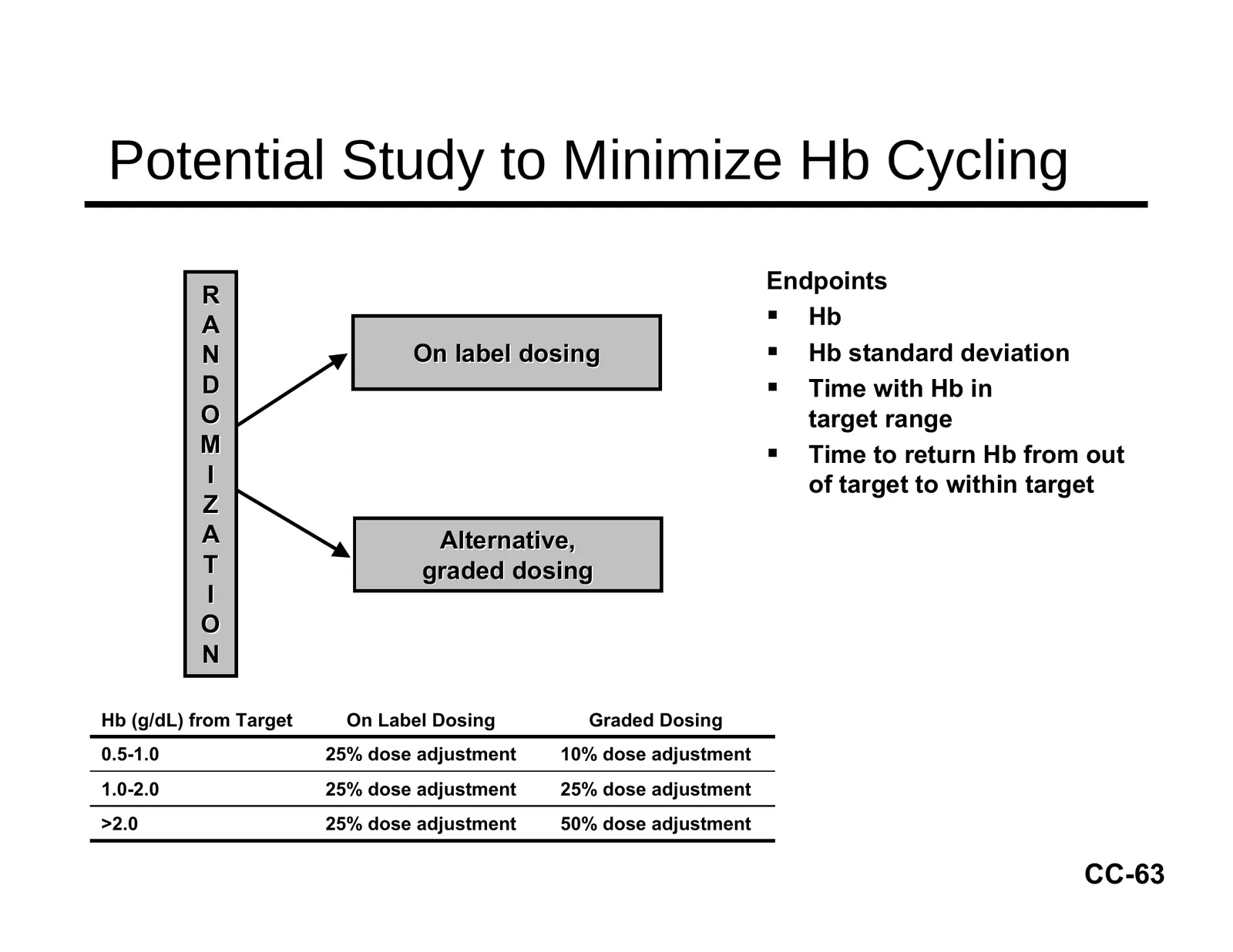
Slide 63: Potential Study to Minimize Hb Cycling
Potential Study to Minimize Hb Cycling Endpoints R A Hb N On label dosing Hb standard deviation D Time with Hb in O target range M Time to return Hb from out I of target to within target Z A Alternative, T graded dosing I O N Hb (g/dL) from Target On Label Dosing Graded Dosing 0.5-1.0 25% do
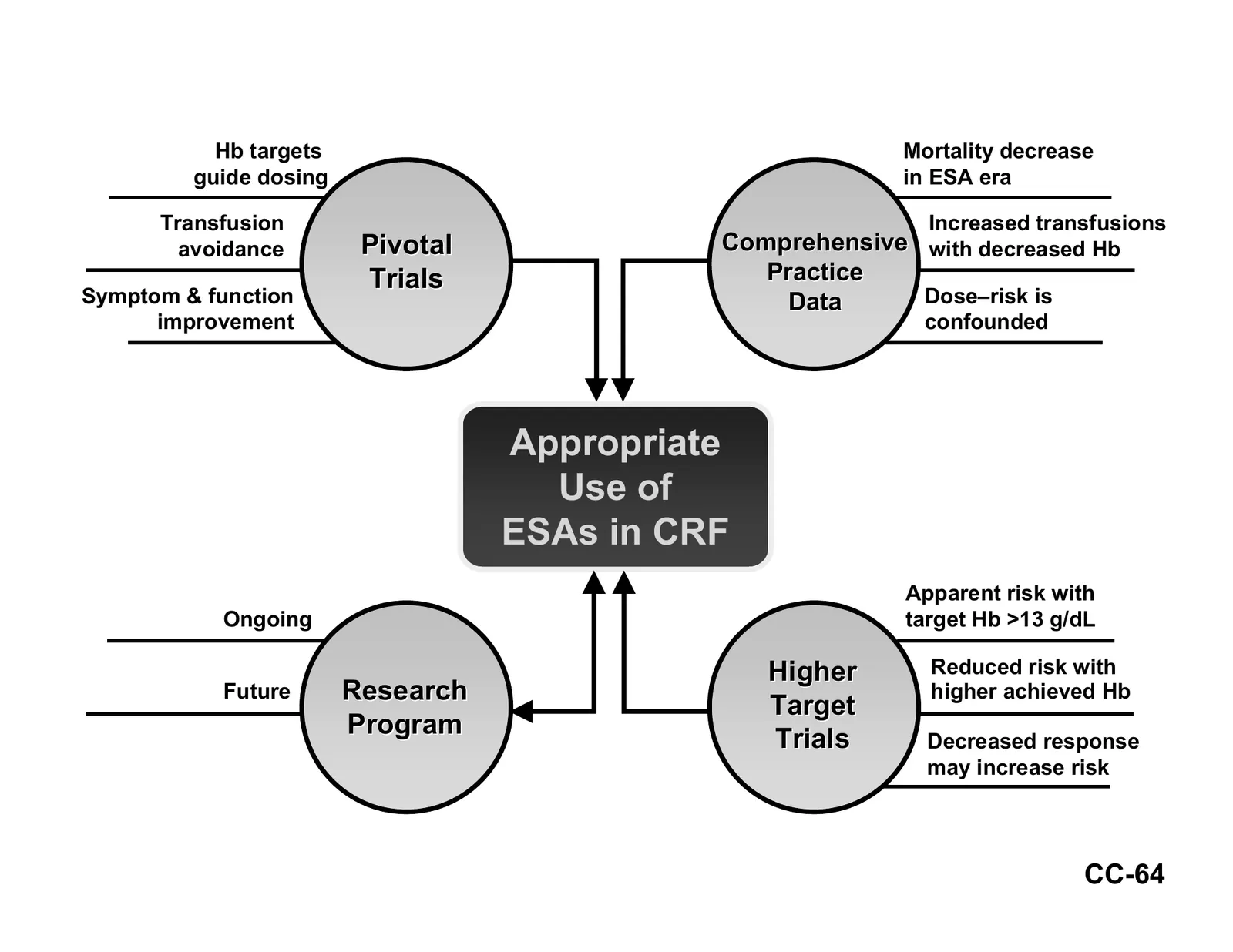
Slide 64: Appropriate Use of ESAs in CRF
Hb targets Mortality decrease guide dosing in ESA era Transfusion Increased transfusions avoidance Pivotal Comprehensive with decreased Hb Trials Practice Symptom & function Data Dose–risk is improvement confounded Appropriate Use of ESAs in CRF Apparent risk with Ongoing target Hb >13 g/dL Higher R
Slide 65: Comprehensive Evidence Supports Appropriate Use of ESAs in CRF
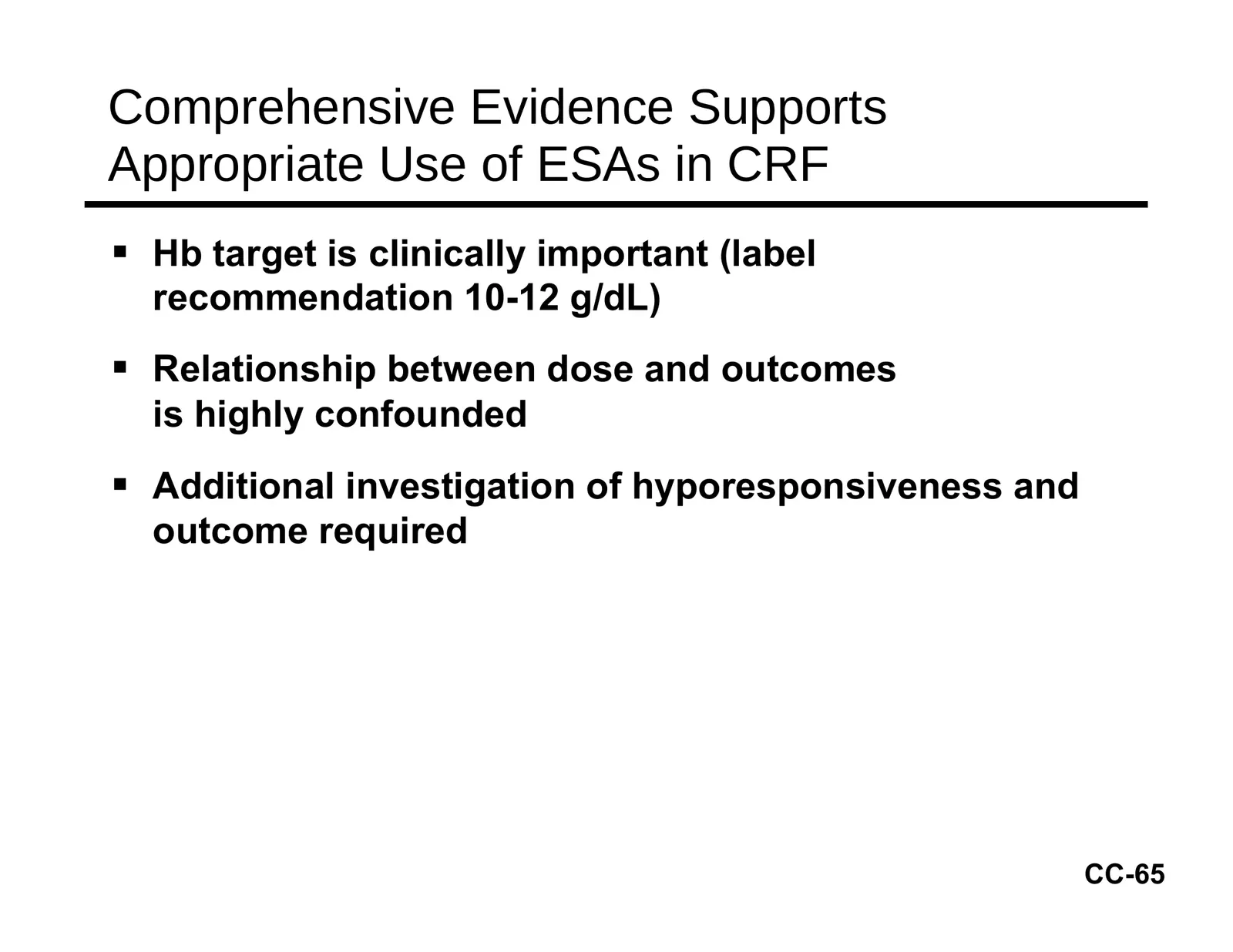
Comprehensive Evidence Supports Appropriate Use of ESAs in CRF Hb target is clinically important (label recommendation 10-12 g/dL) Relationship between dose and outcomes is highly confounded Additional investigation of hyporesponsiveness and outcome required CC-65
Slide 66: Presentation Outline
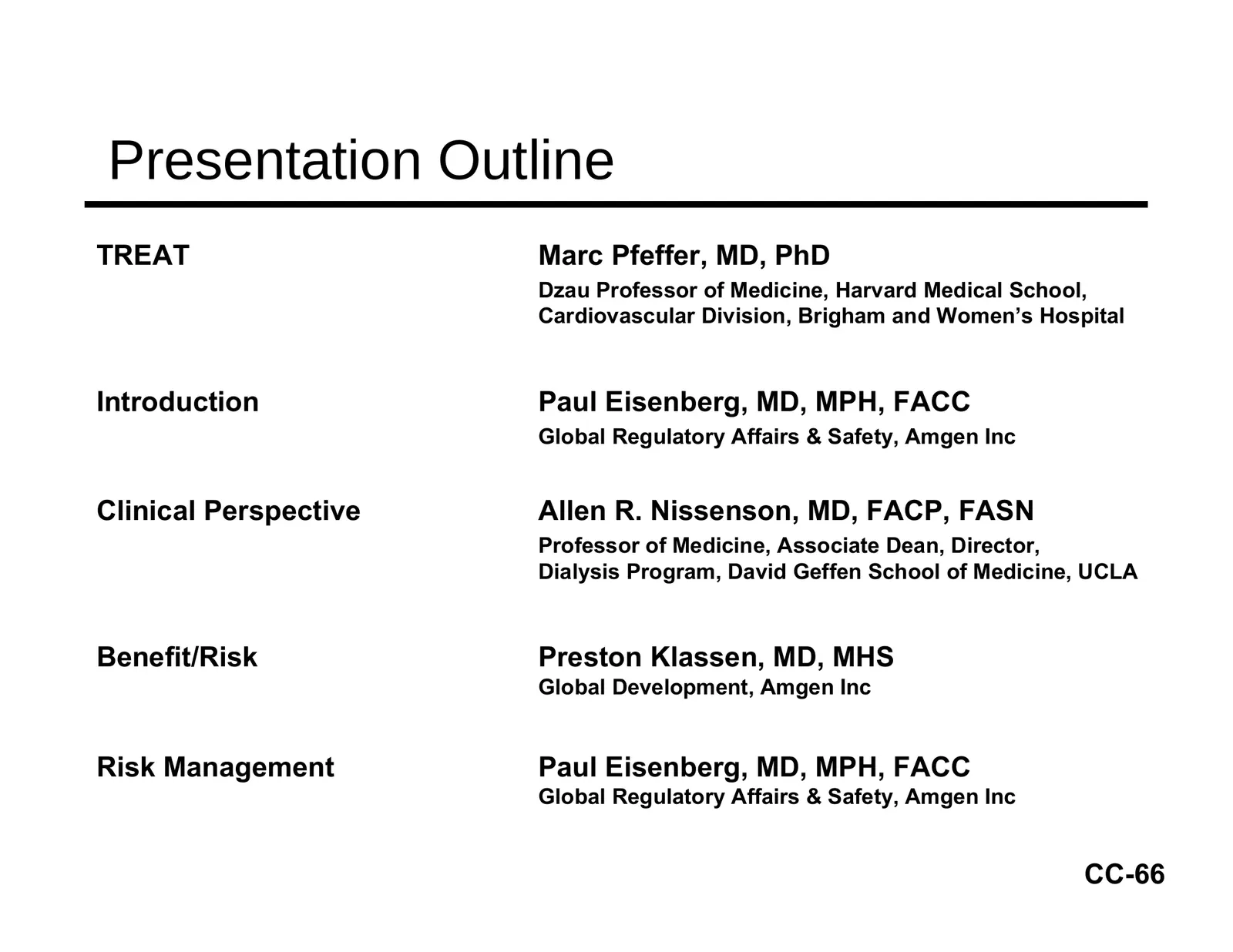
Presentation Outline TREAT Marc Pfeffer, MD, PhD Dzau Professor of Medicine, Harvard Medical School, Cardiovascular Division, Brigham and Women’s Hospital Introduction Paul Eisenberg, MD, MPH, FACC Global Regulatory Affairs & Safety, Amgen Inc Clinical Perspective Allen R. Nissenson, MD, FACP, FASN
Slide 67: Sponsors Are Committed to Additional Risk Management on Key Issues
Sponsors Are Committed to Additional Risk Management on Key Issues Hb target ESA responsiveness Hb cycling CC-67
Slide 68: Hb Target
Hb Target NHCT (HR 1.3) CHOIR (HR 1.34) (HR≤ 1.16) TREAT as of 7/07 Pivotal Trials Possible Transfusion Recommended Increased related risk Hb target range risk 8 9 10 11 12 13 14 Target Hb (g/dL) CC-68
Slide 69: Risk Management Summary
Risk Management Summary Hb target ESA responsiveness Hb cycling CC-69
Slide 70: Risk Management Summary
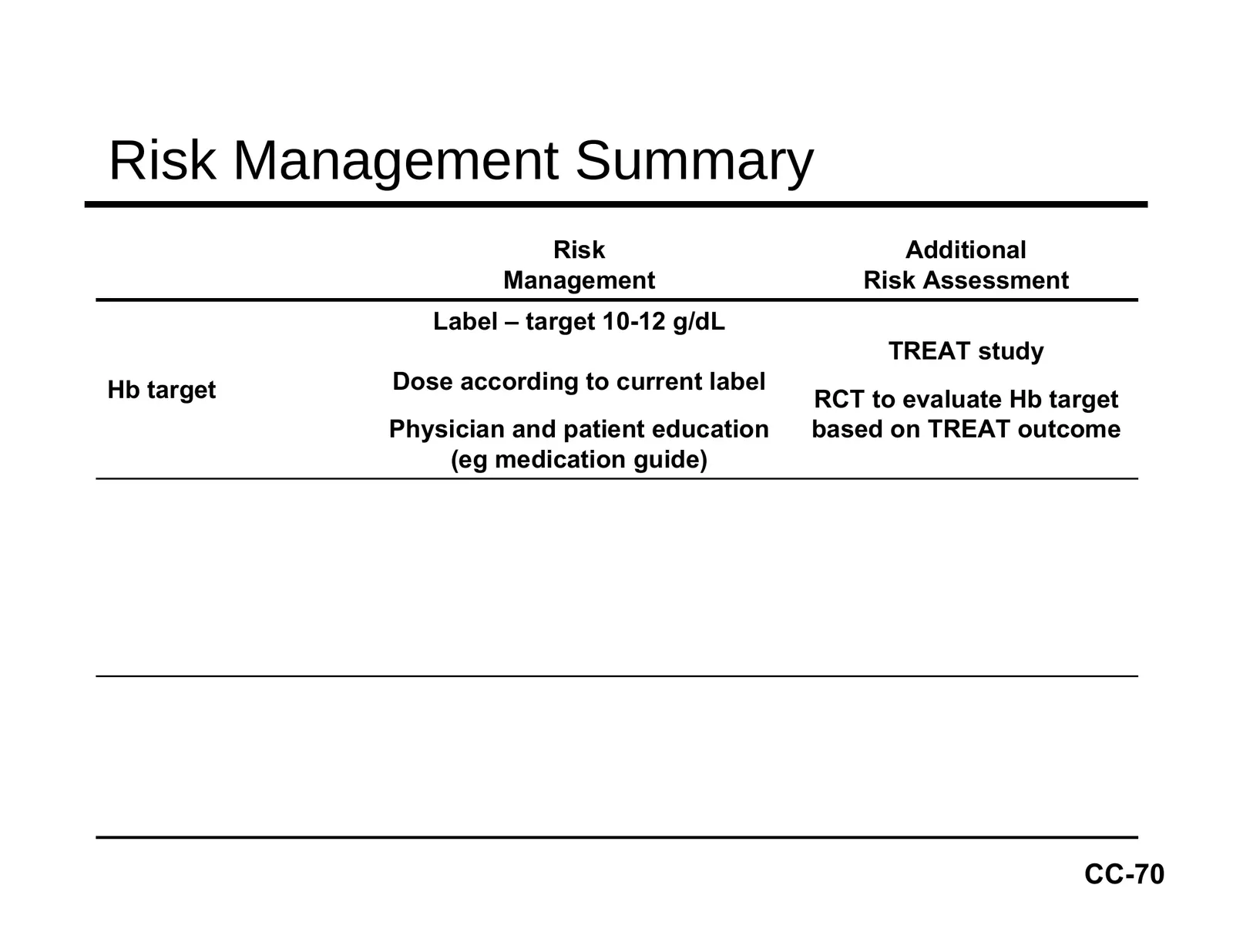
Risk Management Summary Risk Additional Management Risk Assessment Label – target 10-12 g/dL TREAT study Hb target Dose according to current label RCT to evaluate Hb target Physician and patient education based on TREAT outcome (eg medication guide) CC-70
Slide 71: Risk Management Summary
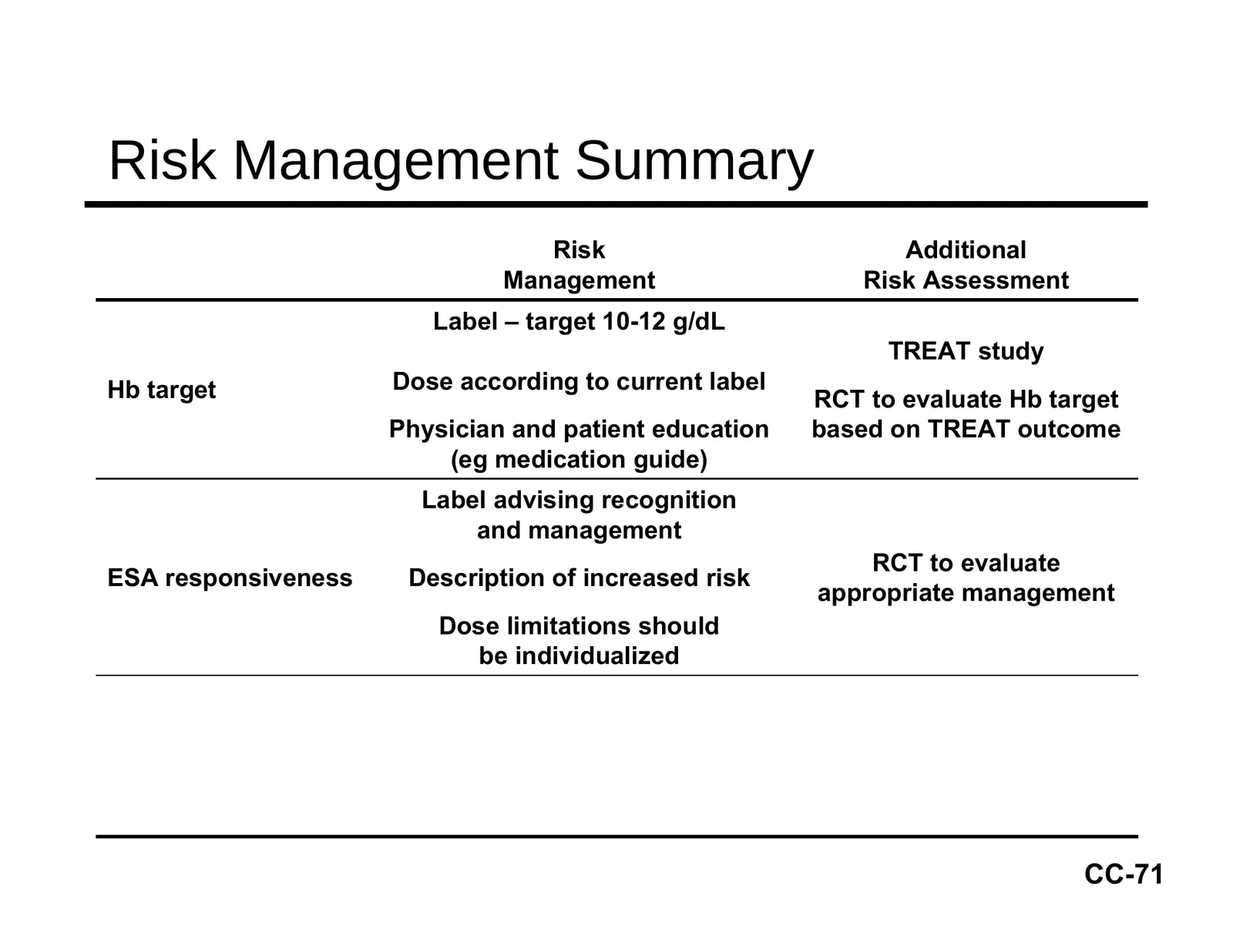
Risk Management Summary Risk Additional Management Risk Assessment Label – target 10-12 g/dL TREAT study Hb target Dose according to current label RCT to evaluate Hb target Physician and patient education based on TREAT outcome (eg medication guide) Label advising recognition and management RCT to e
Slide 72: ESA Responsiveness
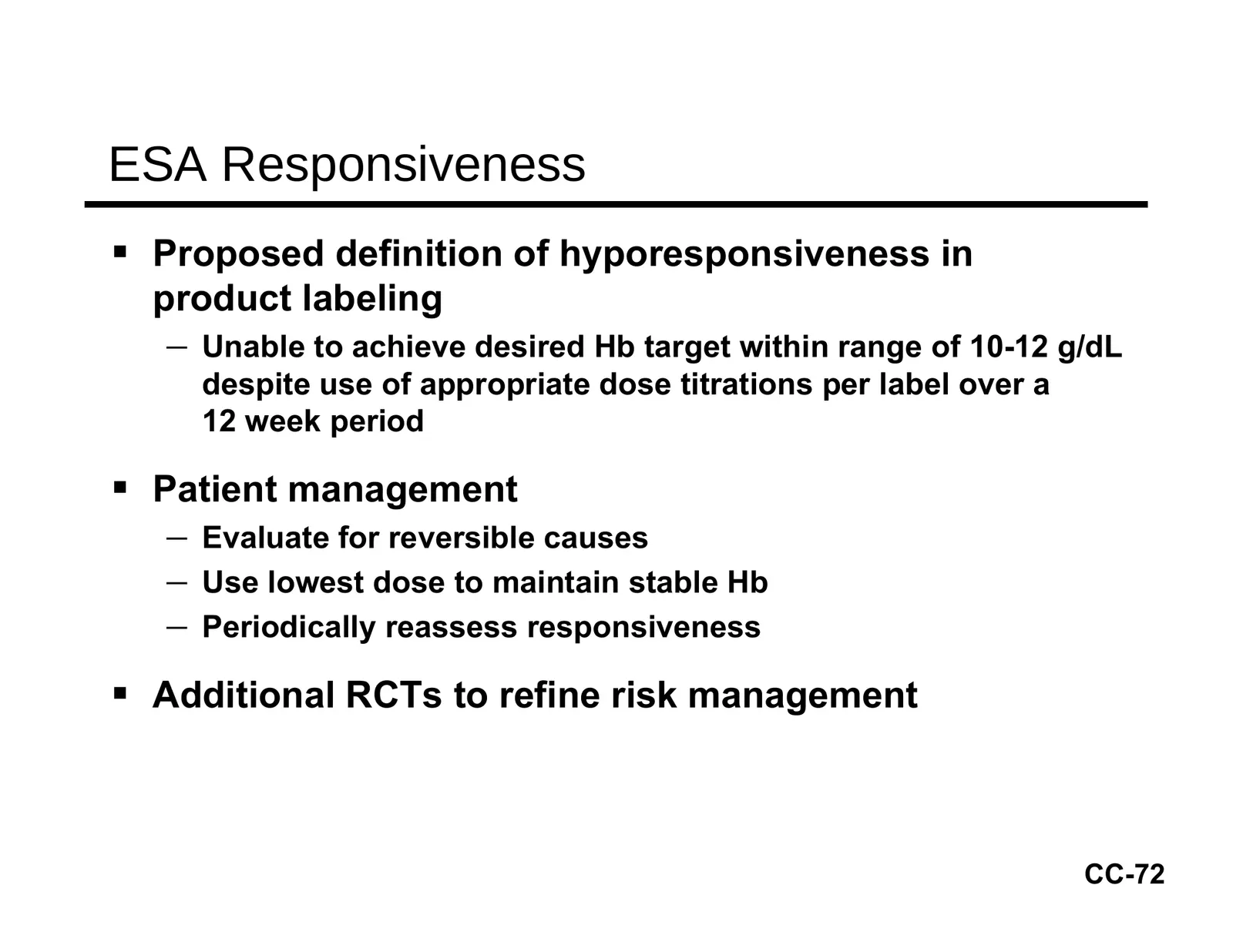
ESA Responsiveness Proposed definition of hyporesponsiveness in product labeling – Unable to achieve desired Hb target within range of 10-12 g/dL despite use of appropriate dose titrations per label over a 12 week period Patient management – Evaluate for reversible causes – Use lowest dose to ma
Slide 73: Risk Management Summary
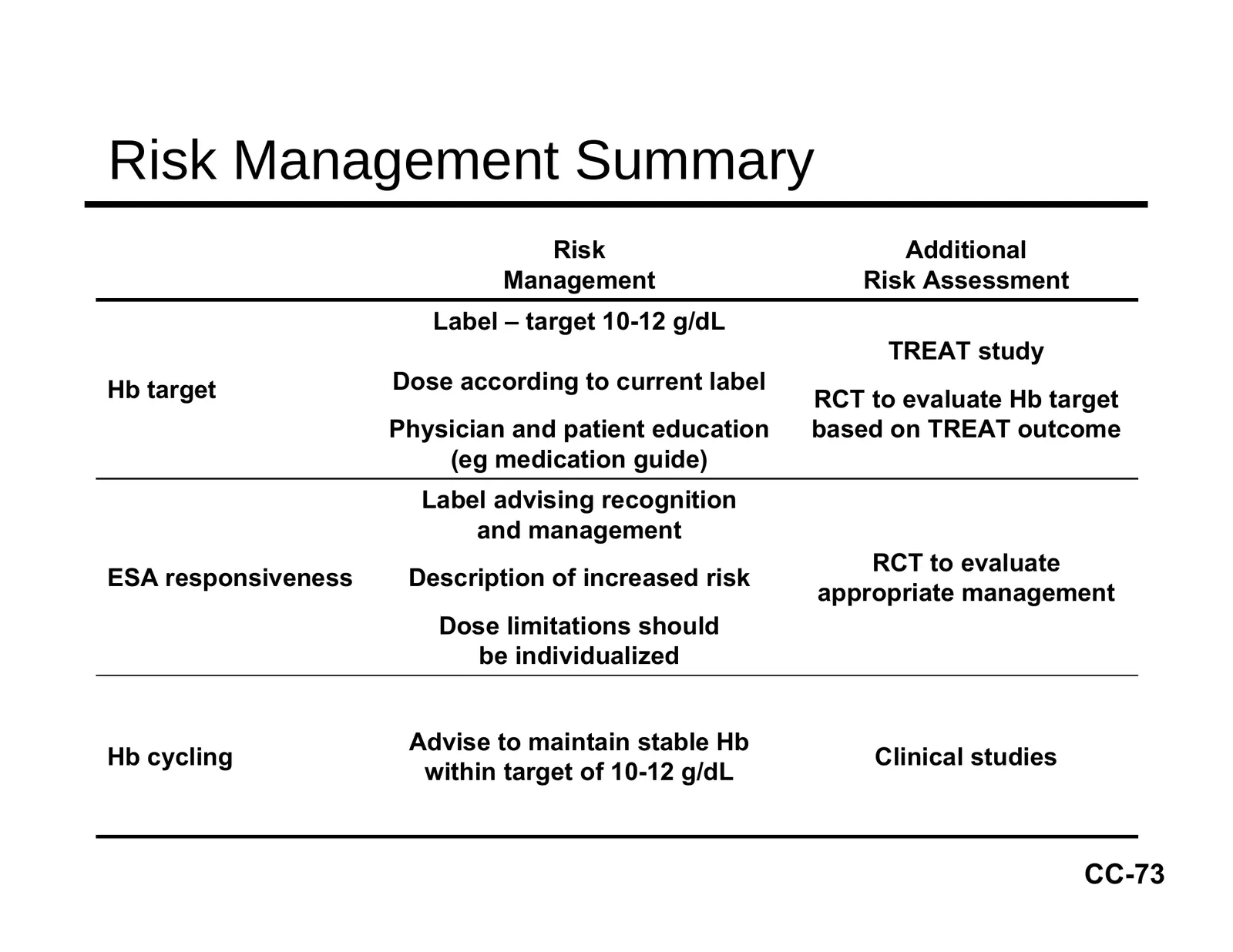
Risk Management Summary Risk Additional Management Risk Assessment Label – target 10-12 g/dL TREAT study Hb target Dose according to current label RCT to evaluate Hb target Physician and patient education based on TREAT outcome (eg medication guide) Label advising recognition and management RCT to e
Slide 74: Risk Management Summary
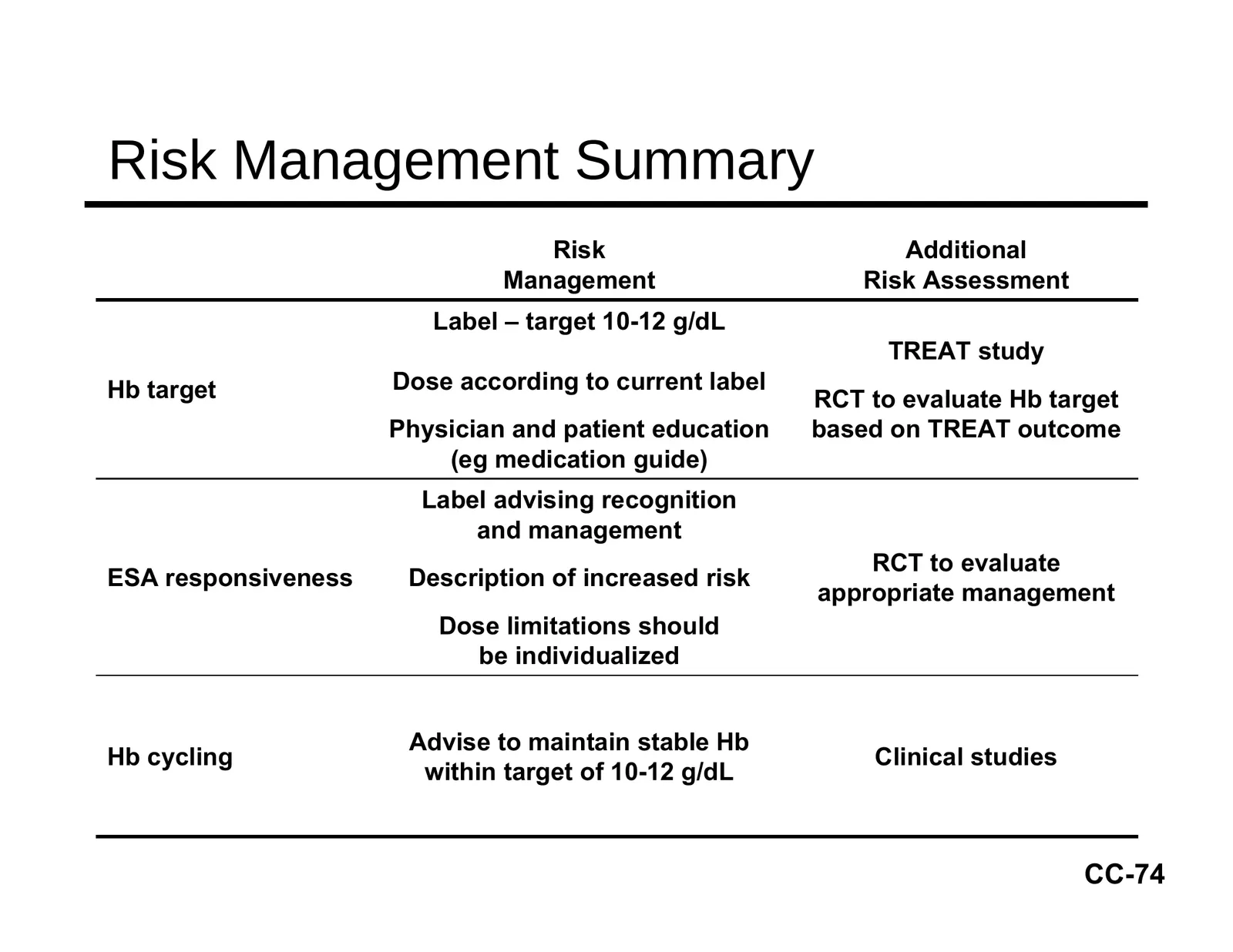
Risk Management Summary Risk Additional Management Risk Assessment Label – target 10-12 g/dL TREAT study Hb target Dose according to current label RCT to evaluate Hb target Physician and patient education based on TREAT outcome (eg medication guide) Label advising recognition and management RCT to e
Slide 75: Erythropoiesis-Stimulating Agent (ESA) Therapy in Chronic Renal Failure (CRF)
Erythropoiesis-Stimulating Agent (ESA) Therapy in Chronic Renal Failure (CRF) Joint Meeting Between the Cardiovascular and Renal Drugs & Drug Safety and Risk Management Advisory Committees 11 September 2007 CC-75
Source: Internet Archive copy of amgen.com
More decks from Amgen Inc.
 Q3 2026 Earnings Presentation28 slides · Nov 3, 2026
 ESMO 202632 slides · Oct 24, 2026
 Q2 2026 Earnings Presentation29 slides · Aug 4, 2026
 Q1 2026 Earnings Presentation27 slides · Apr 30, 2026
 Q4 2025 Earnings Presentation47 slides · Feb 3, 2026
 44th Annual J.P. Morgan Healthcare Conference (January 2026)23 slides · Jan 12, 2026