DBV Technologies SA · EURONEXT:DBV
DBV Technologies SA — Investor Presentation (April 2018)
53 slides from DBV Technologies SA's investor presentation, April 2018
Slide 1: The Epicutaneous Immunotherapy Company
The Epicutaneous Immunotherapy Company ©Genoskin April 2018
Slide 2: Safe Harbor
Safe Harbor This presentation contains forward looking statements including, but not limited to, statements concerning the outcome or success of DBV’s clinical trials; its ability to successfully gain regulatory approvals and commercialize products; its ability to successfully advance its pipeline o
Slide 3: DBV Technologies: Pioneering a New Class of Immunotherapy
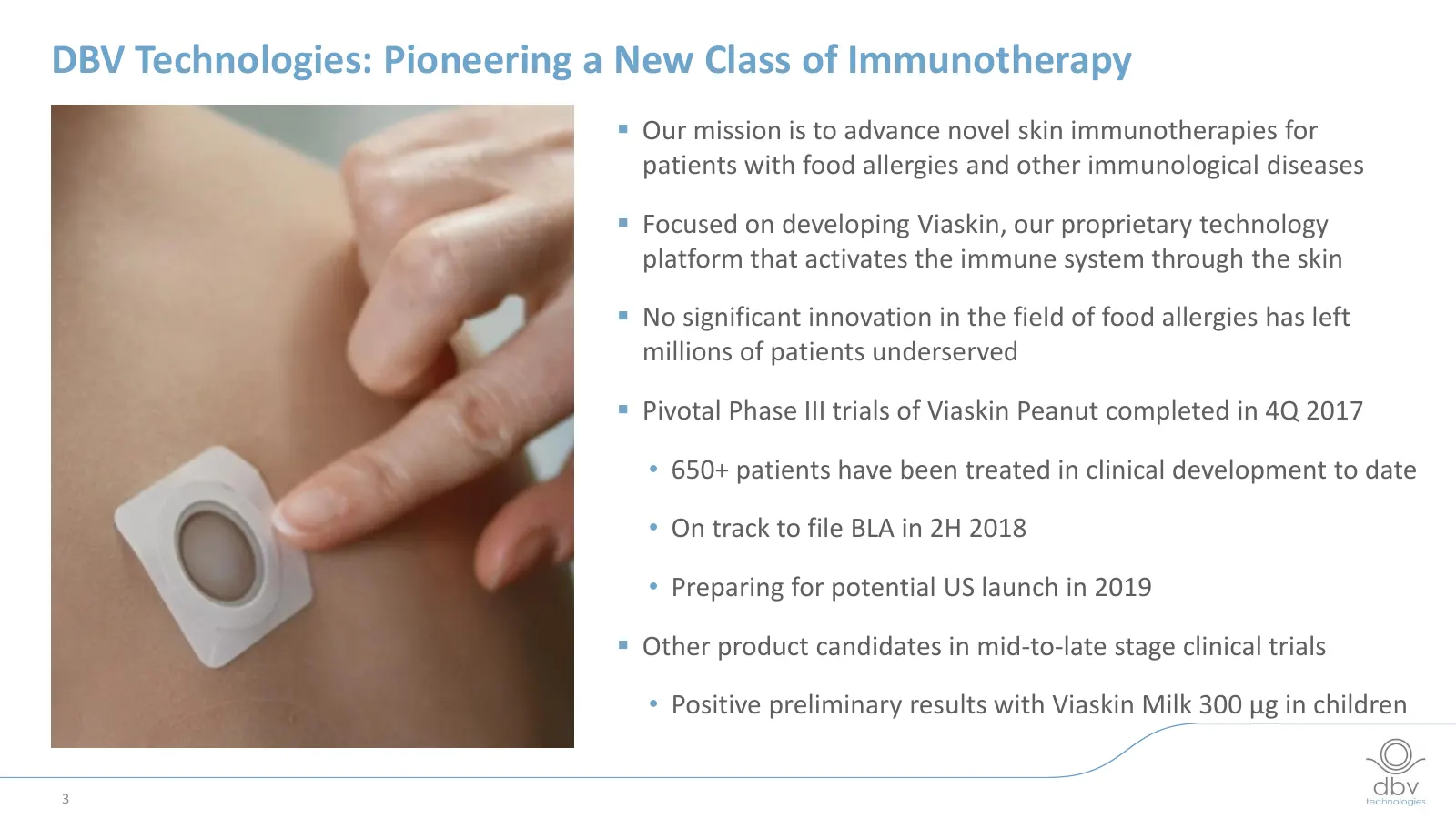
DBV Technologies: Pioneering a New Class of Immunotherapy ▪ Our mission is to advance novel skin immunotherapies for patients with food allergies and other immunological diseases ▪ Focused on developing Viaskin, our proprietary technology platform that activates the immune system through the skin ▪
Slide 4: Product Candidates: Phase III Results for Viaskin Peanut Reported in 4Q17
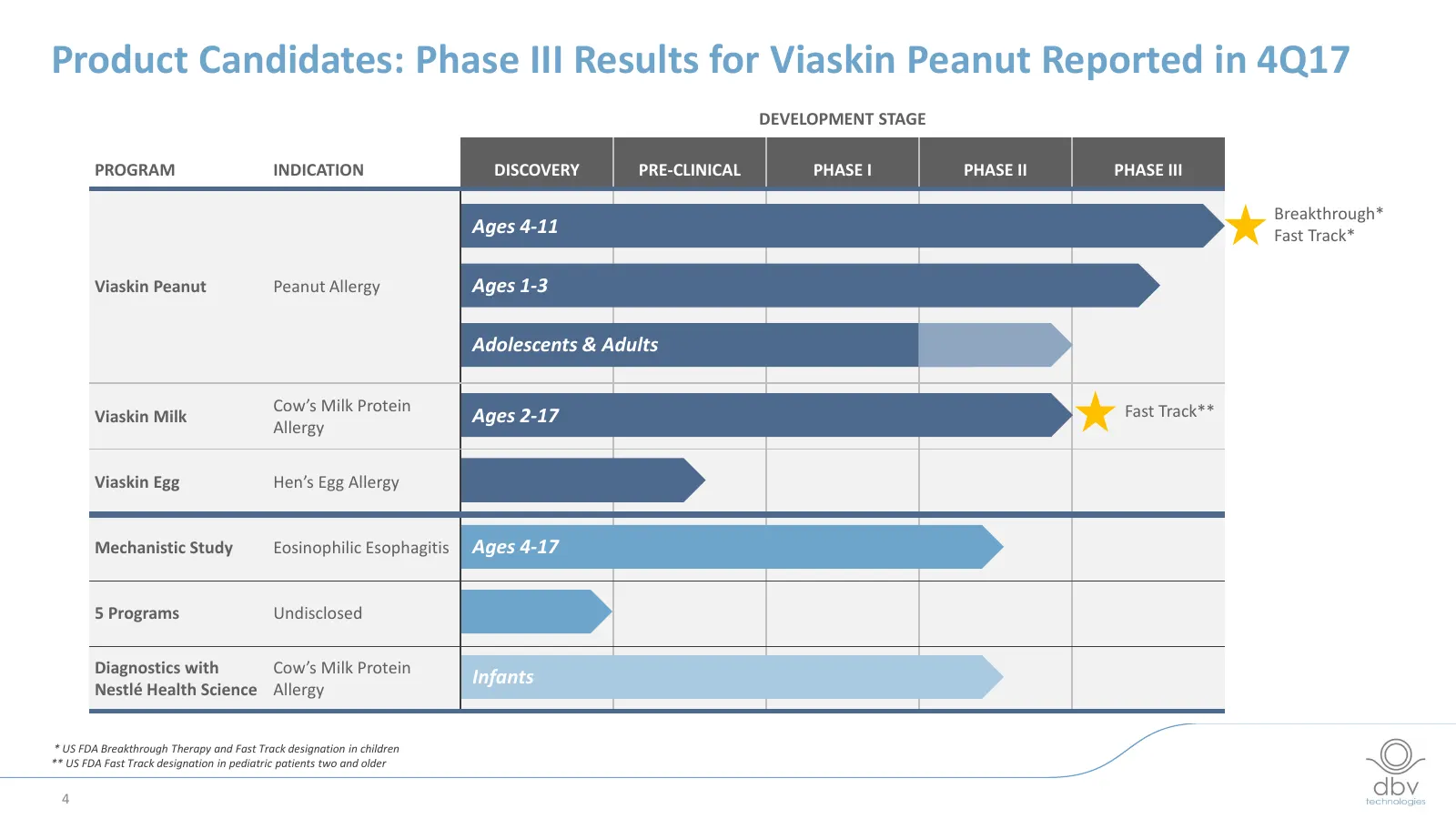
Product Candidates: Phase III Results for Viaskin Peanut Reported in 4Q17 DEVELOPMENT STAGE PROGRAM INDICATION DISCOVERY PRE-CLINICAL PHASE I PHASE II PHASE III Breakthrough* Ages 4-11 Fast Track* Viaskin Peanut Peanut Allergy Ages 1-3 Adolescents & Adults Cow’s Milk Protein Fast Track** Viaskin Mil
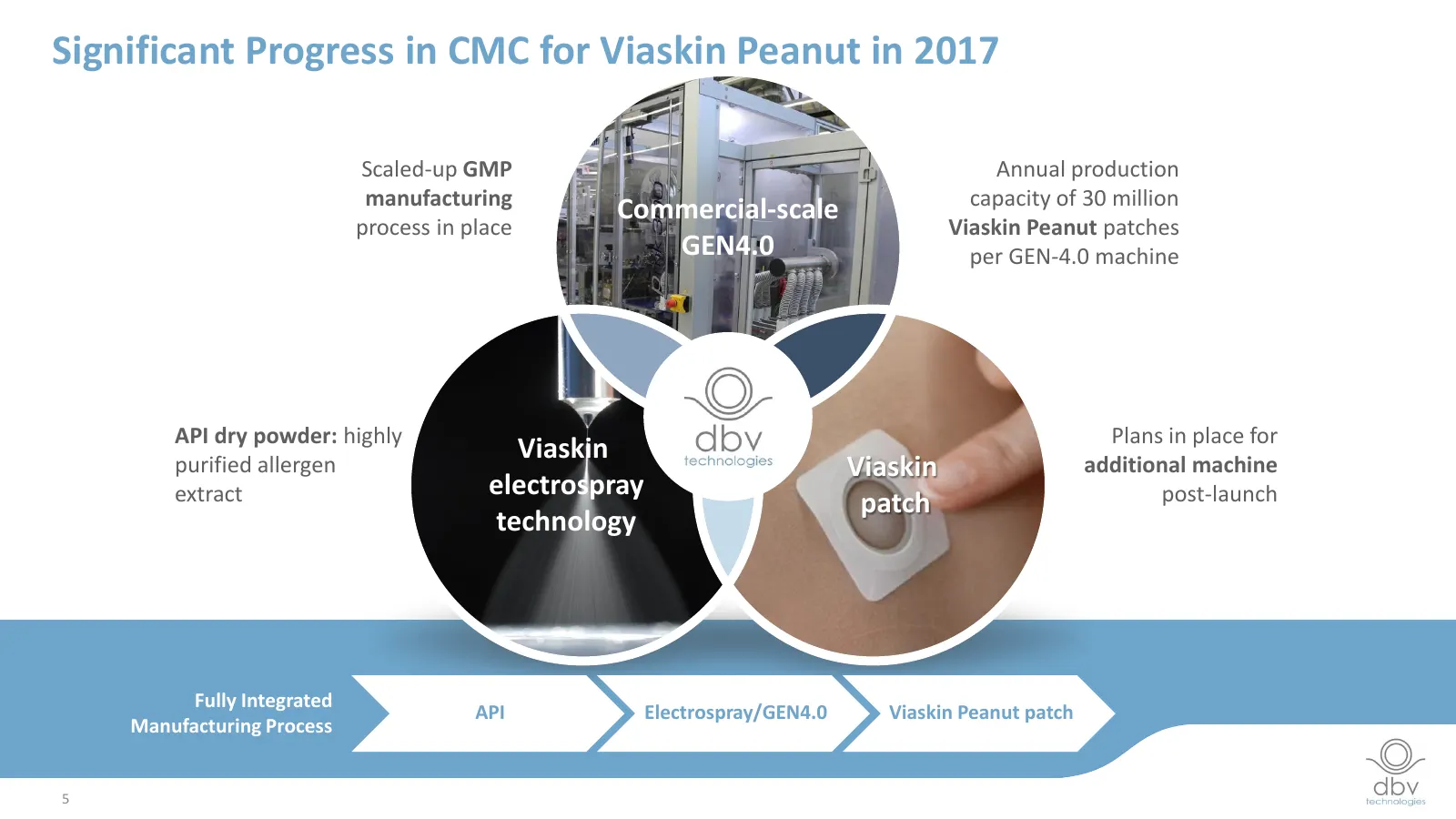
Slide 5: Significant Progress in CMC for Viaskin Peanut in 2017
Significant Progress in CMC for Viaskin Peanut in 2017 Scaled-up GMP Annual production manufacturing capacity of 30 million Commercial-scale process in place Viaskin Peanut patches GEN4.0 per GEN-4.0 machine API dry powder: highly Plans in place for Viaskin purified allergen Viaskin additional machi
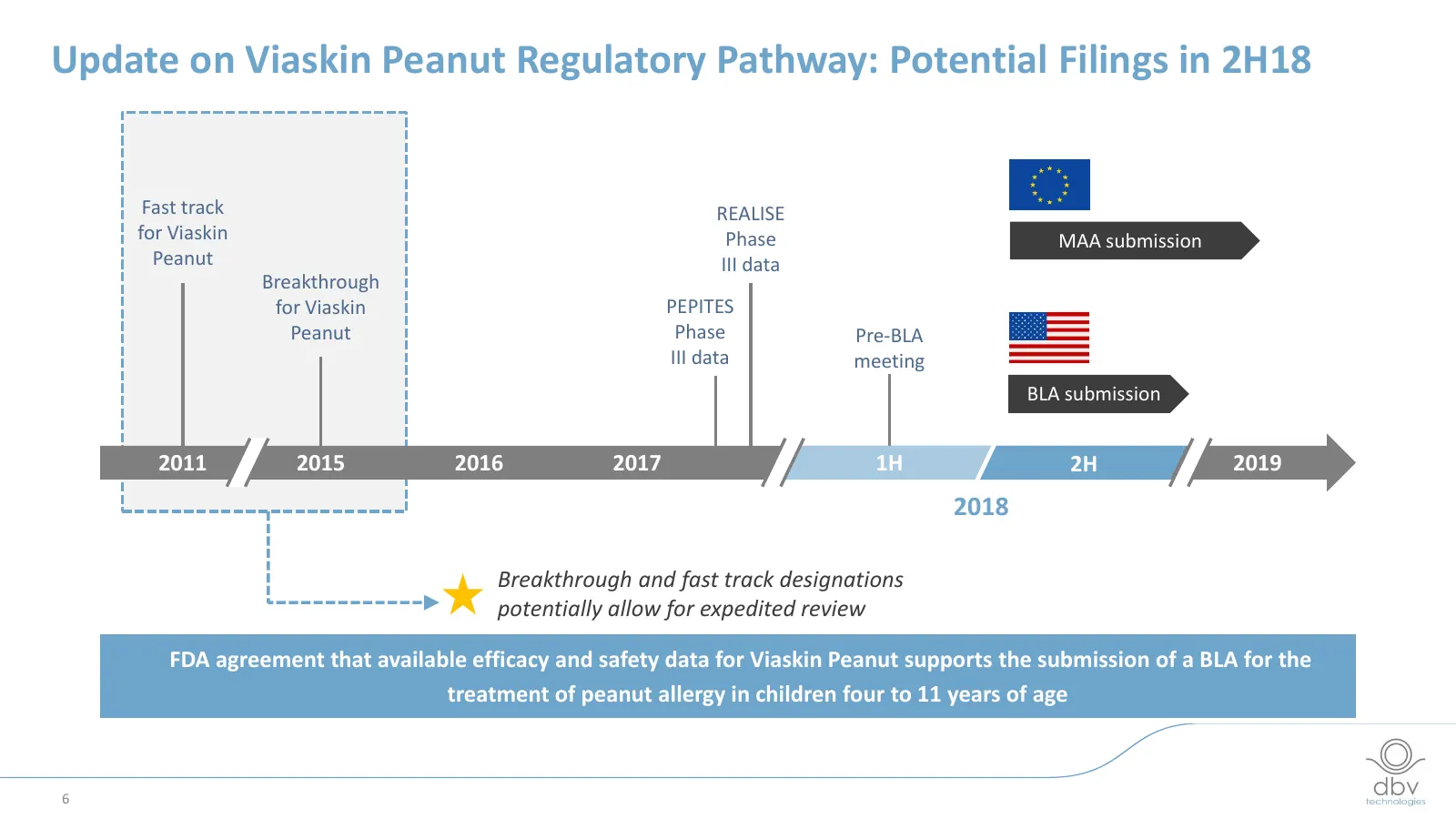
Slide 6: Update on Viaskin Peanut Regulatory Pathway: Potential Filings in 2H18
Update on Viaskin Peanut Regulatory Pathway: Potential Filings in 2H18 Fast track REALISE for Viaskin Phase MAA submission Peanut III data Breakthrough for Viaskin PEPITES Peanut Phase Pre-BLA III data meeting BLA submission 2011 2015 2016 2017 1H 2H 2019 2018 Breakthrough and fast track designation
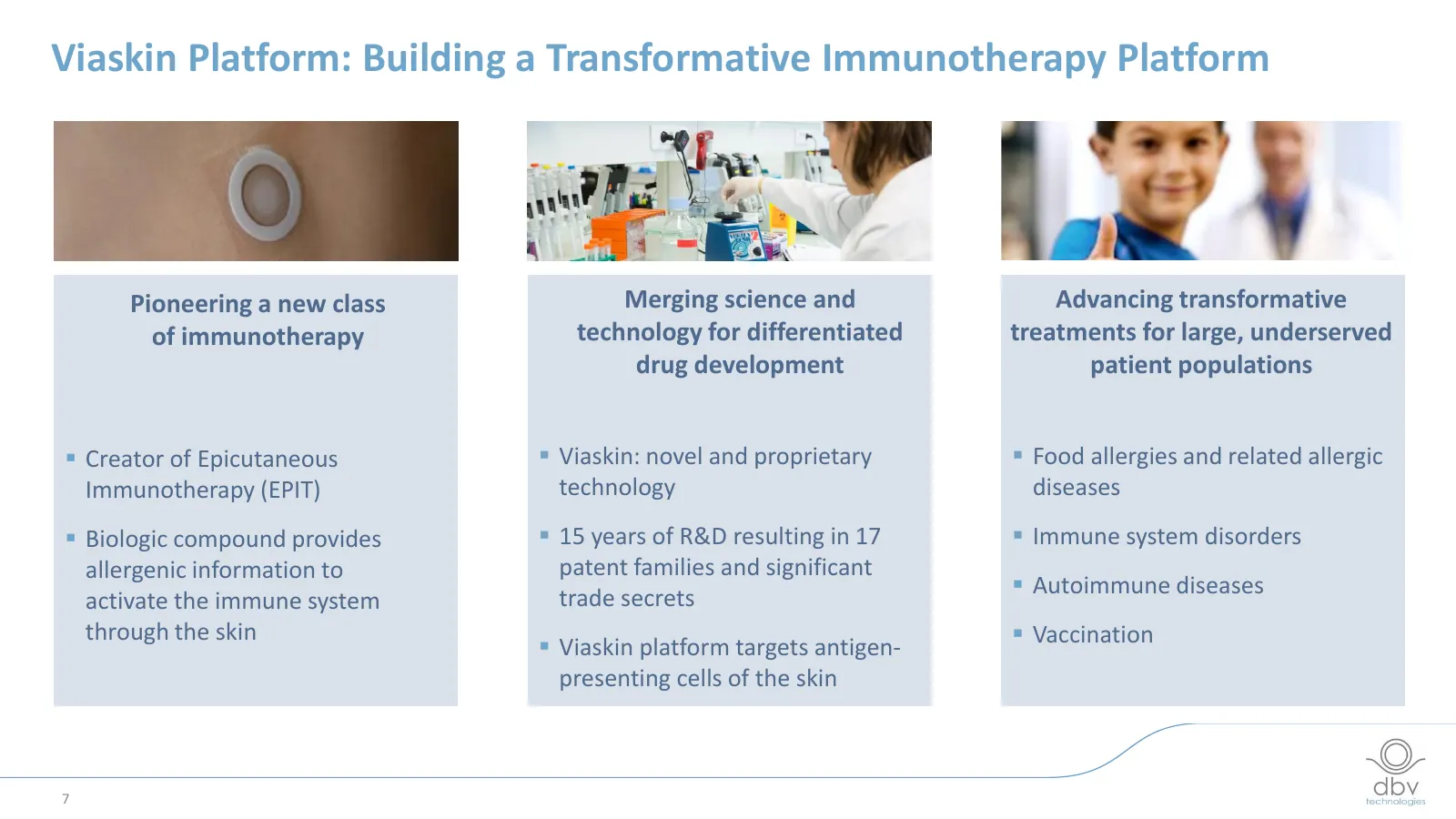
Slide 7: Viaskin Platform: Building a Transformative Immunotherapy Platform
Viaskin Platform: Building a Transformative Immunotherapy Platform Pioneering a new class Merging science and Advancing transformative of immunotherapy technology for differentiated treatments for large, underserved drug development patient populations ▪ Creator of Epicutaneous ▪ Viaskin: novel and
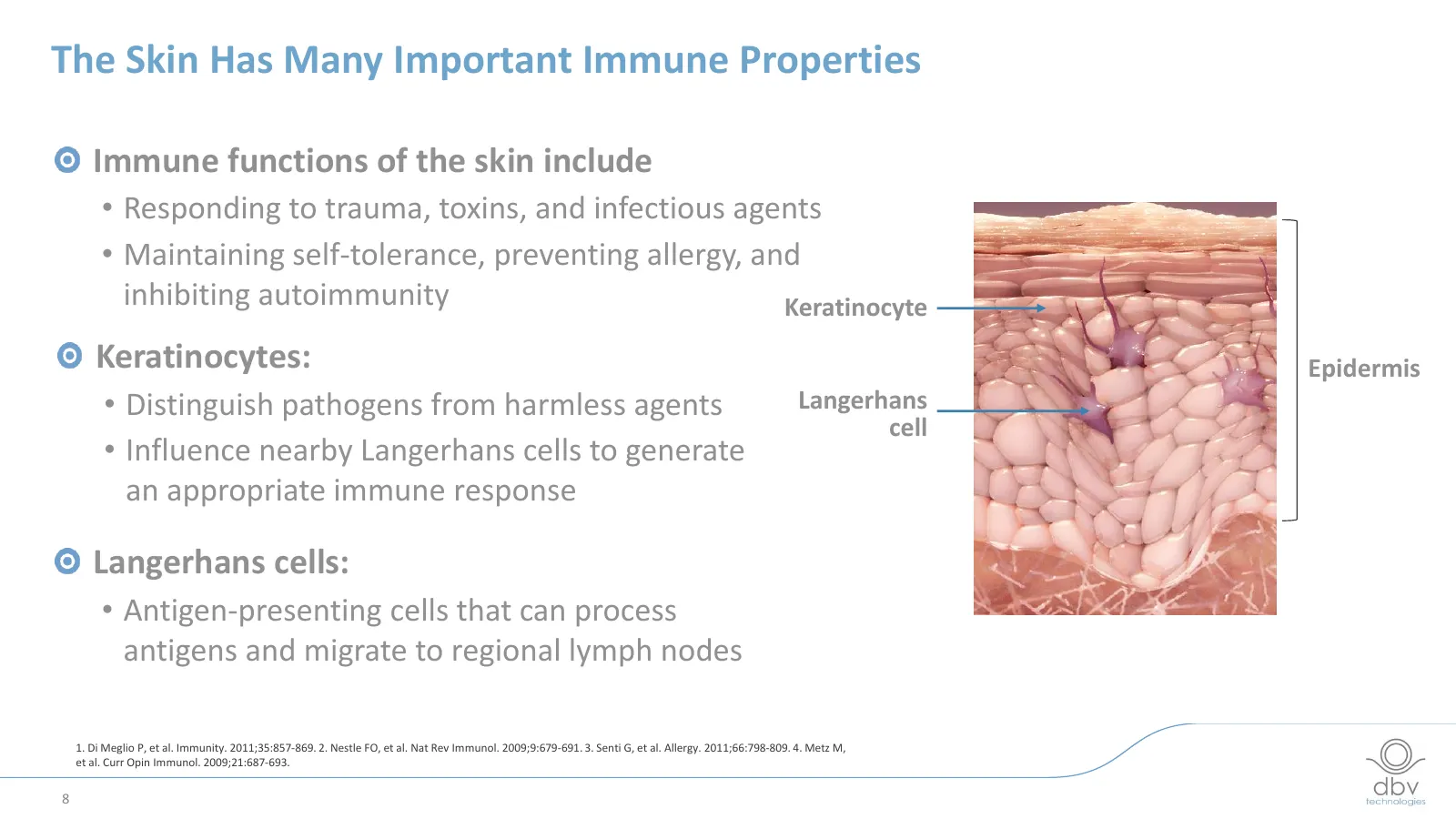
Slide 8: The Skin Has Many Important Immune Properties
The Skin Has Many Important Immune Properties Immune functions of the skin include • Responding to trauma, toxins, and infectious agents • Maintaining self-tolerance, preventing allergy, and inhibiting autoimmunity Keratinocyte Keratinocytes: Epidermis • Distinguish pathogens from harmless agents La
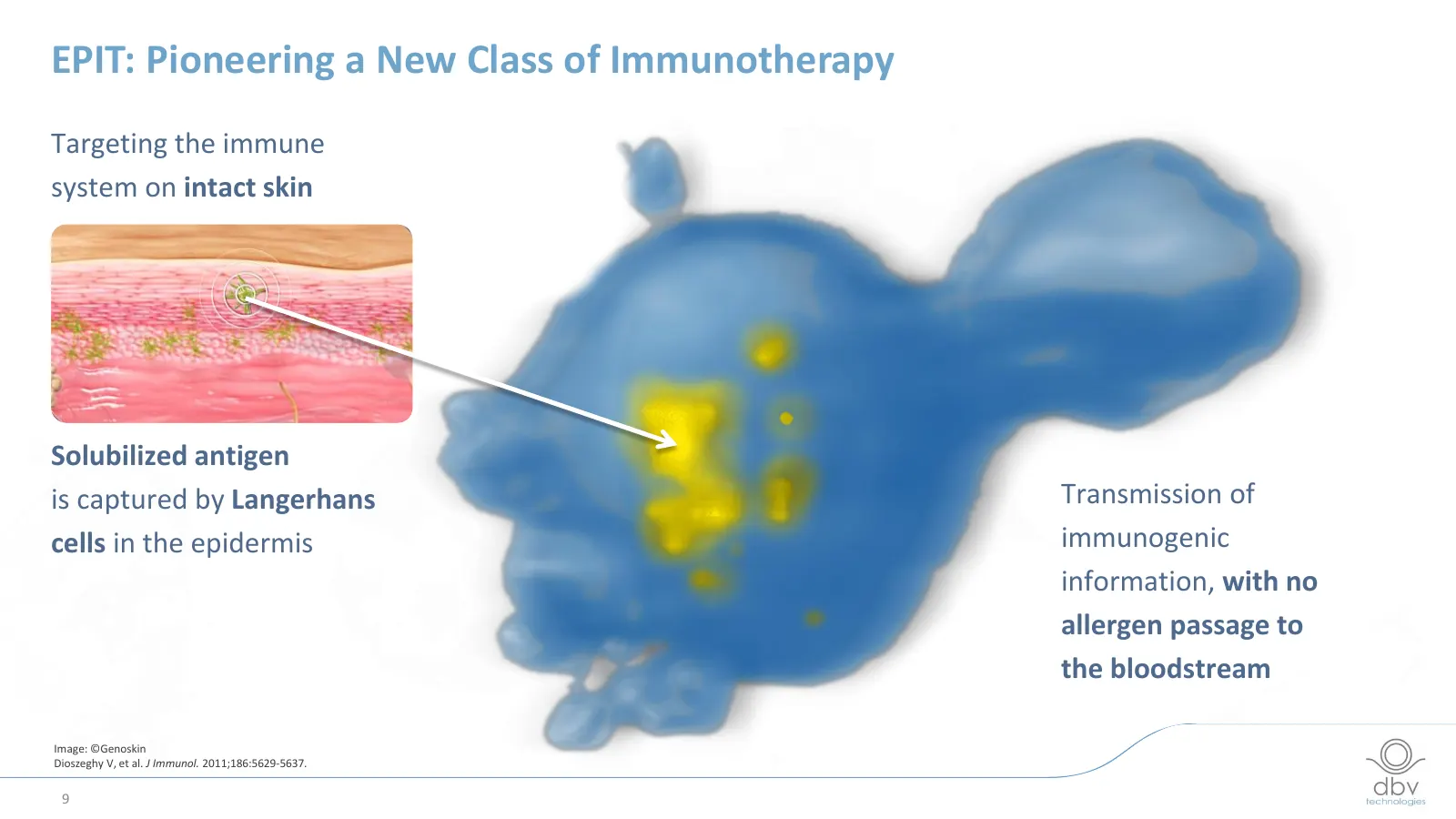
Slide 9: EPIT: Pioneering a New Class of Immunotherapy
EPIT: Pioneering a New Class of Immunotherapy Targeting the immune system on intact skin Solubilized antigen is captured by Langerhans Transmission of cells in the epidermis immunogenic information, with no allergen passage to the bloodstream Image: ©Genoskin Dioszeghy V, et al. J Immunol. 2011;186:
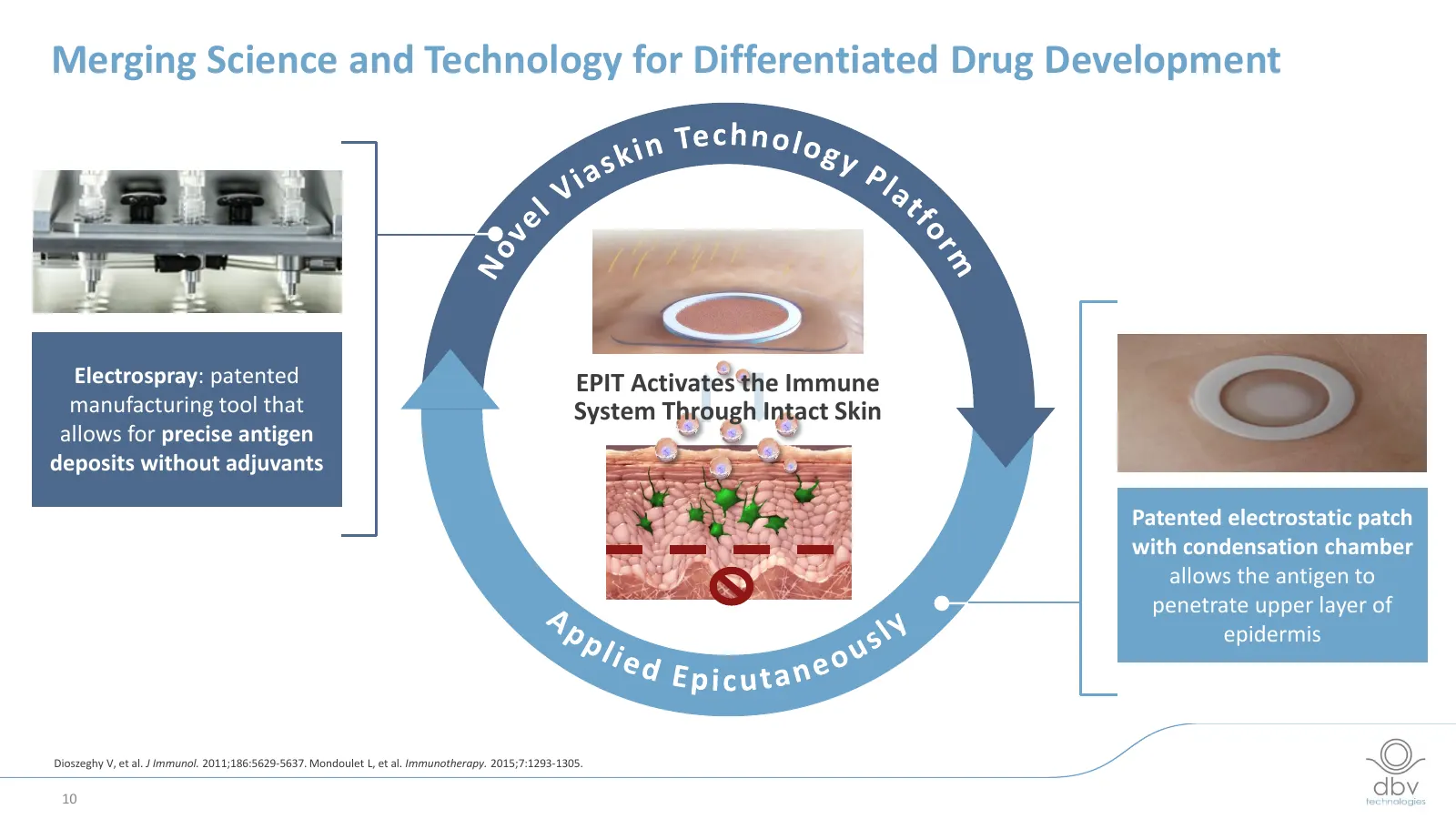
Slide 10: Merging Science and Technology for Differentiated Drug Development
Merging Science and Technology for Differentiated Drug Development Electrospray: patented EPIT Activates the Immune manufacturing tool that System Through Intact Skin allows for precise antigen deposits without adjuvants Patented electrostatic patch with condensation chamber allows the antigen to pe
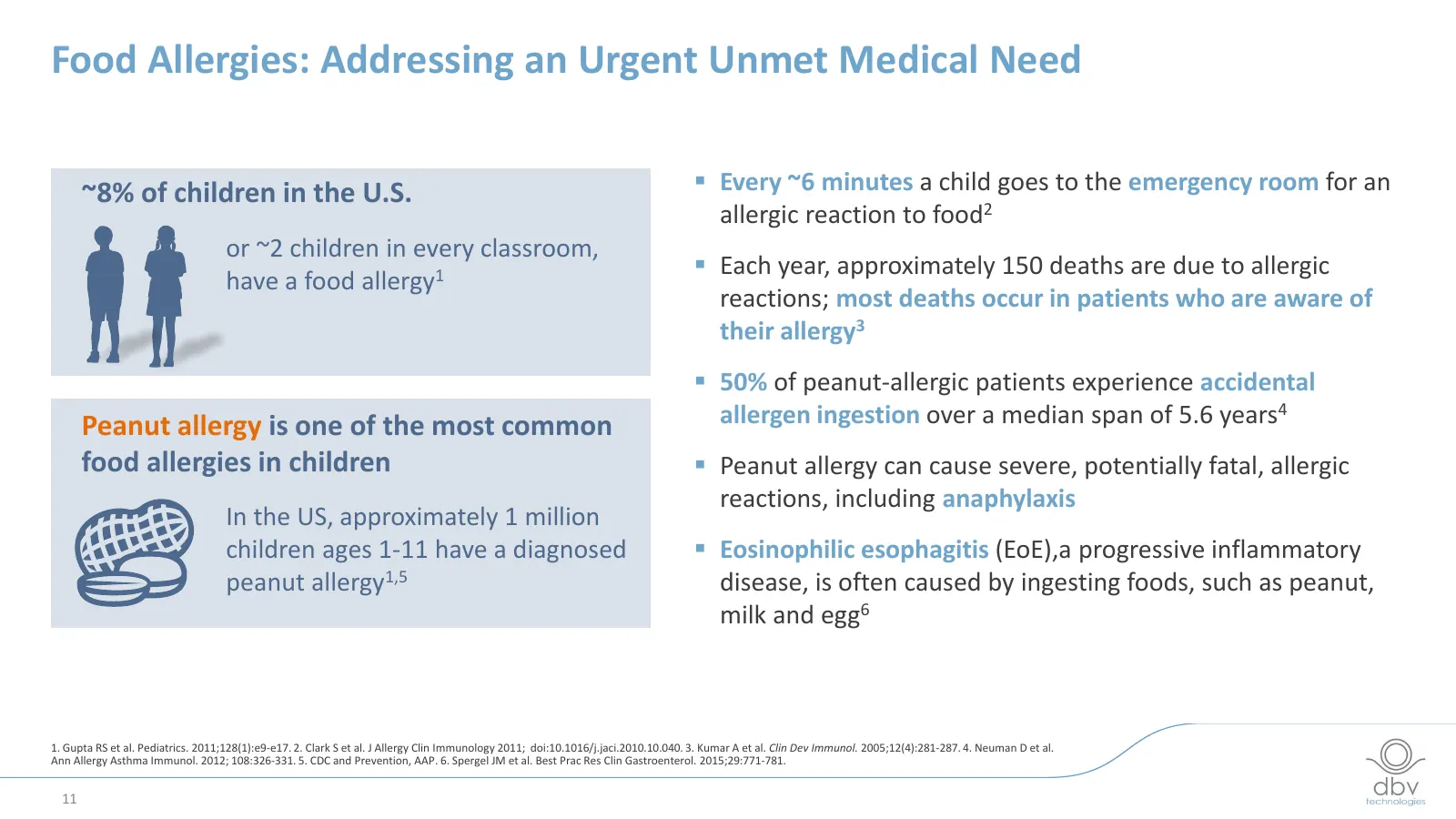
Slide 11: Food Allergies: Addressing an Urgent Unmet Medical Need
Food Allergies: Addressing an Urgent Unmet Medical Need ~8% of children in the U.S. ▪ Every ~6 minutes a child goes to the emergency room for an allergic reaction to food2 or ~2 children in every classroom, ▪ Each year, approximately 150 deaths are due to allergic have a food allergy1 reactions; mos
Slide 12: No Significant Innovation in Food Allergy Immunotherapy in Last Several Decades
No Significant Innovation in Food Allergy Immunotherapy in Last Several Decades There is NO margin for error when exposing patients to a potentially life-threatening allergen ▪ Safety is paramount: ingesting small quantities of offending allergen can cause life-threatening reactions ▪ After several
Slide 13: Our Solution for a Hard-to-Treat Disease
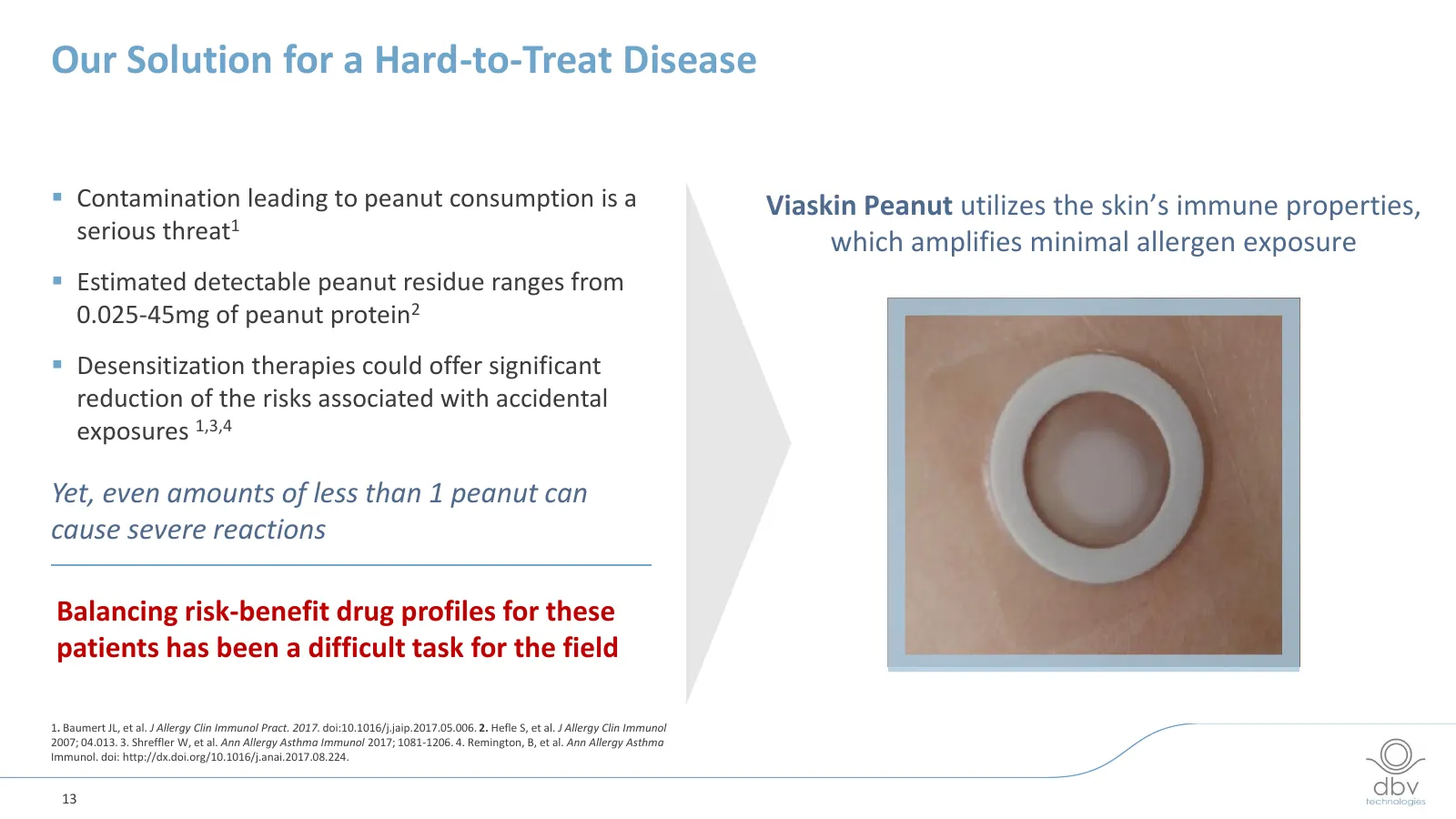
Our Solution for a Hard-to-Treat Disease ▪ Contamination leading to peanut consumption is a Viaskin Peanut utilizes the skin’s immune properties, serious threat1 which amplifies minimal allergen exposure ▪ Estimated detectable peanut residue ranges from 0.025-45mg of peanut protein2 ▪ Desensitizatio
Slide 14: PEPITES Pivotal Phase III Trial Topline Results Reported in October 2017
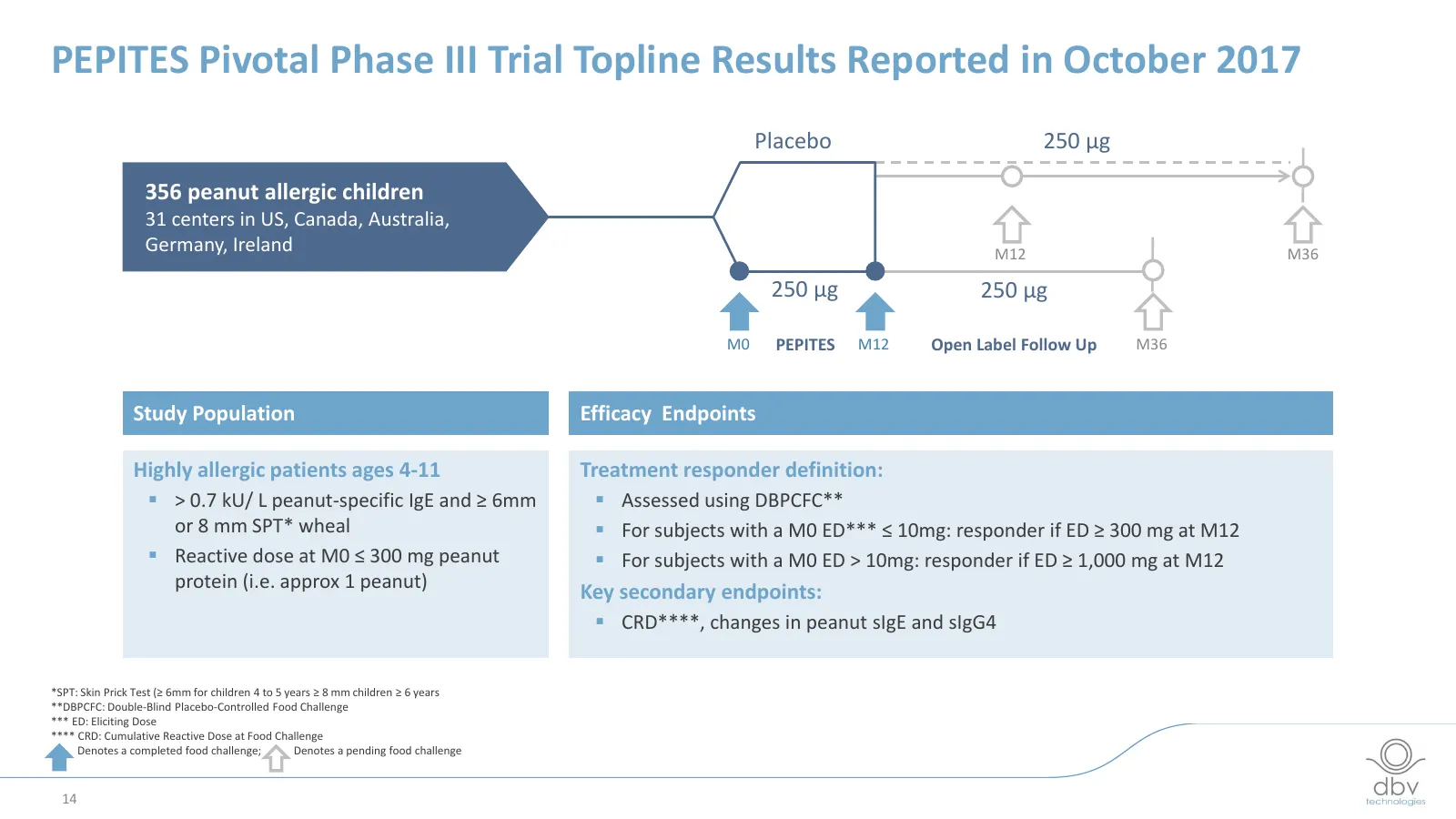
PEPITES Pivotal Phase III Trial Topline Results Reported in October 2017 Placebo 250 µg 356 peanut allergic children 31 centers in US, Canada, Australia, Germany, Ireland M12 M36 250 µg 250 µg M0 PEPITES M12 Open Label Follow Up M36 Study Population Efficacy Endpoints Highly allergic patients ages 4
Slide 15: PEPITES Baseline Characteristics: Highly Allergic Patient Population
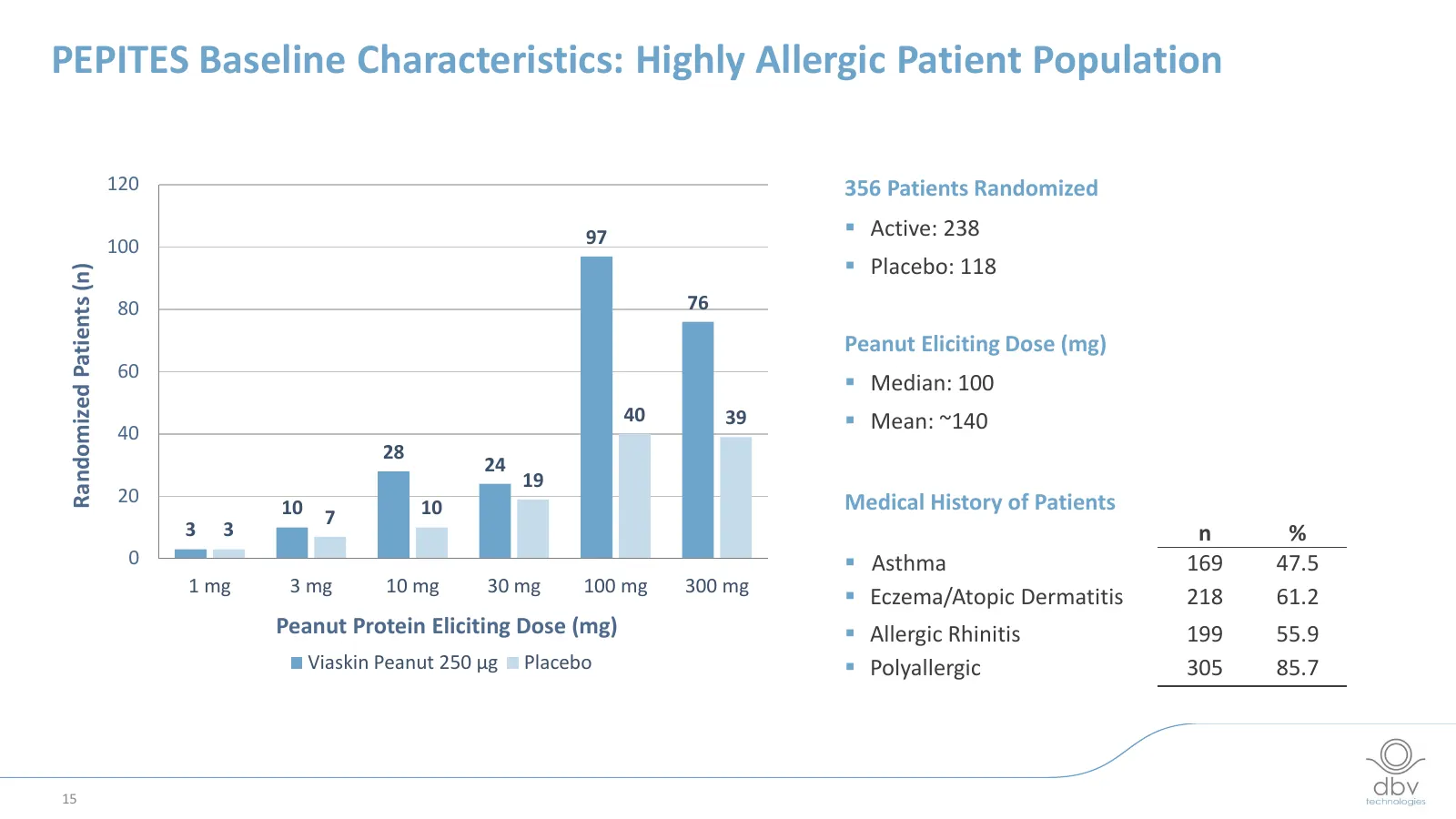
PEPITES Baseline Characteristics: Highly Allergic Patient Population 120 356 Patients Randomized 97 ▪ Active: 238 100 ▪ Placebo: 118 Randomized Patients (n) 80 76 Peanut Eliciting Dose (mg) 60 ▪ Median: 100 40 39 ▪ Mean: ~140 40 28 24 19 20 Medical History of Patients 10 7 10 3 3 n % 0 ▪ Asthma 169
Slide 16: PEPITES Results: Primary Efficacy Endpoint Shows Significant Treatment Benefit
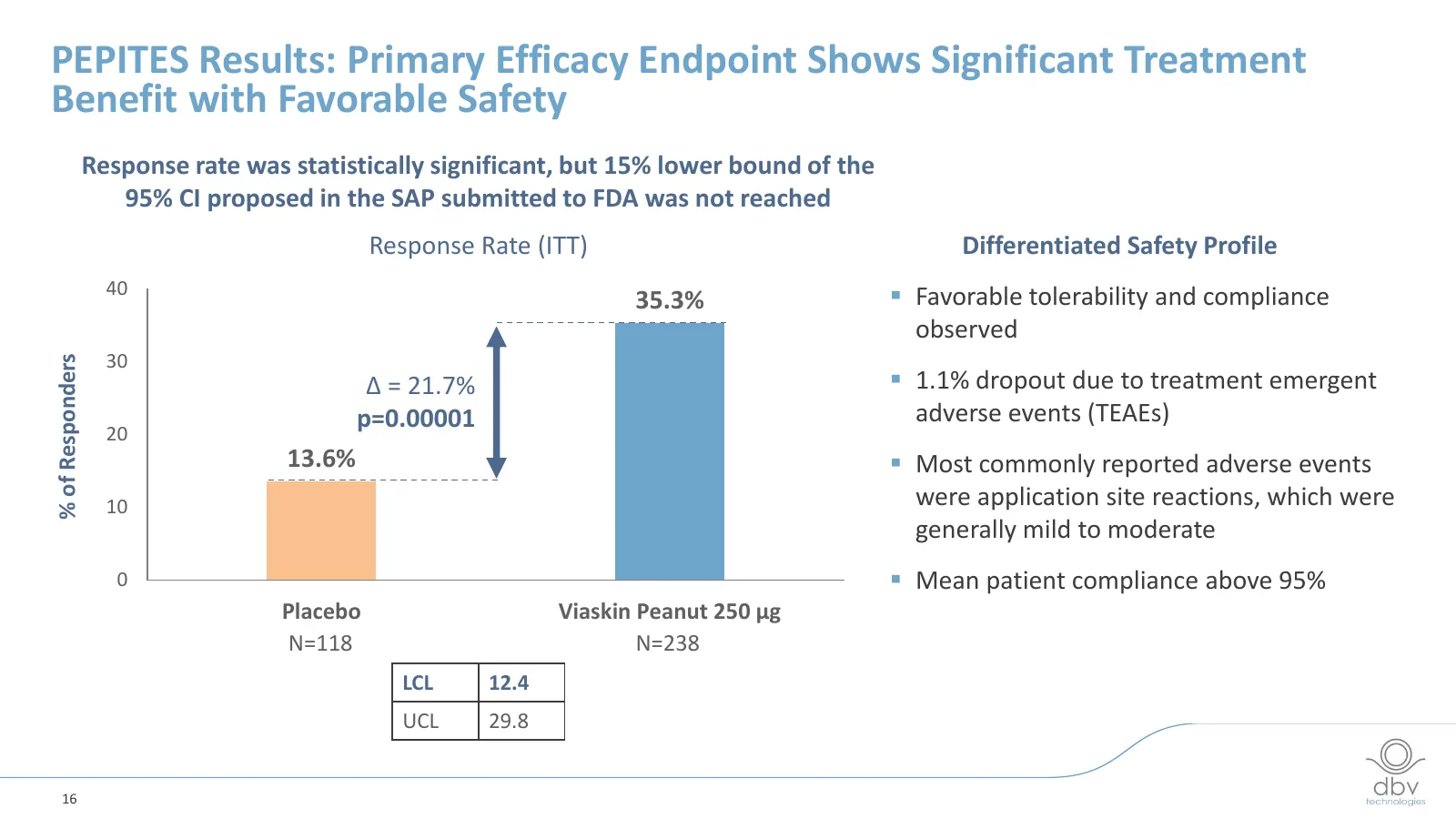
PEPITES Results: Primary Efficacy Endpoint Shows Significant Treatment Benefit with Favorable Safety Response rate was statistically significant, but 15% lower bound of the 95% CI proposed in the SAP submitted to FDA was not reached Response Rate (ITT) Differentiated Safety Profile 40 ▪ Favorable to
Slide 17: PEPITES Results: Significant Increase in Threshold Reactivity to Peanut Protein
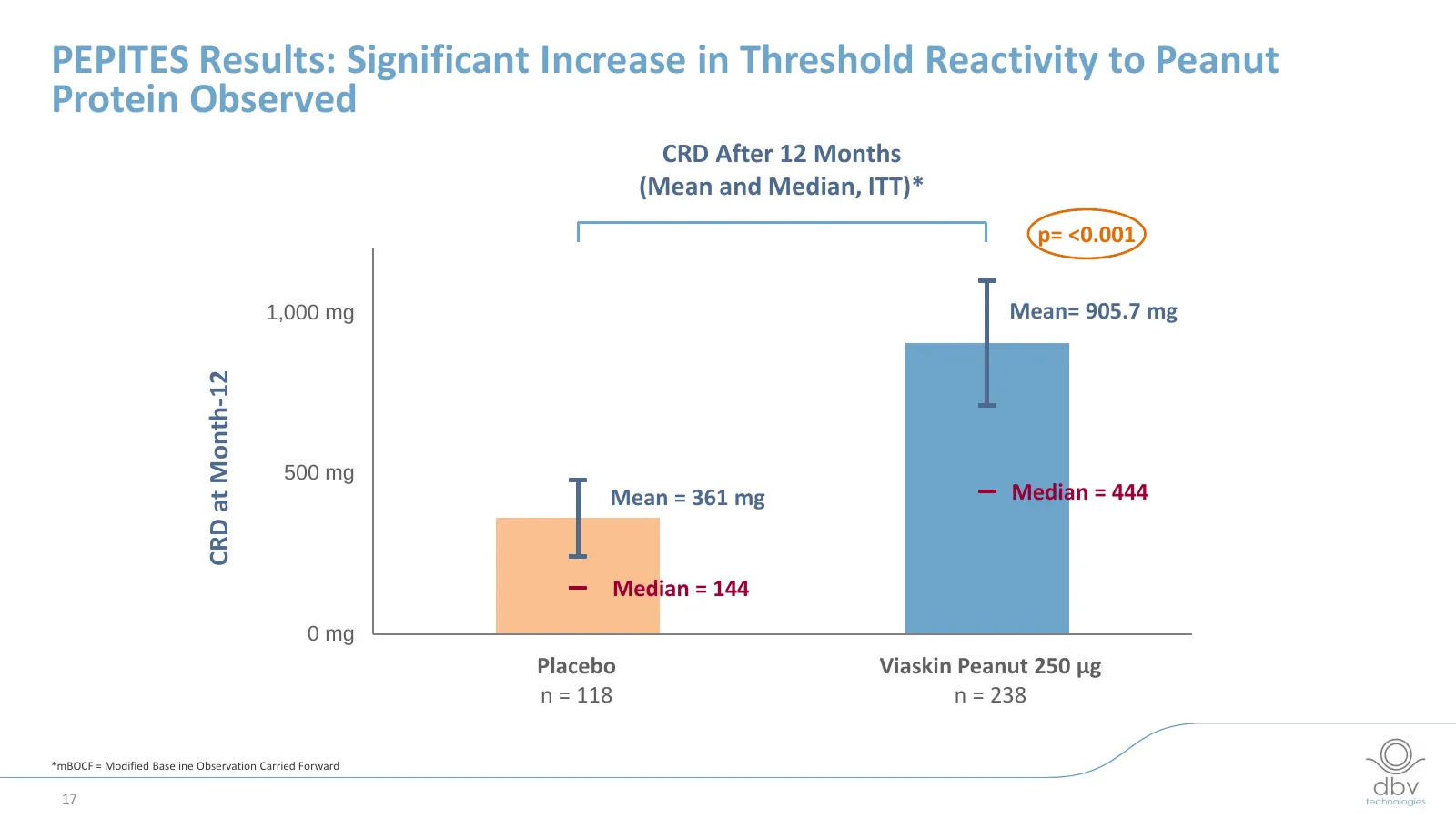
PEPITES Results: Significant Increase in Threshold Reactivity to Peanut Protein Observed CRD After 12 Months (Mean and Median, ITT)* p= <0.001 1,000 mg Mean= 905.7 mg CRD at Month-12 500 mg Mean = 361 mg Median = 444 Median = 144 0 mg Placebo Viaskin Peanut 250 μg n = 118 n = 238 *mBOCF = Modified B
Slide 18: PEPITES Results: Immunological Changes Support Treatment Effect
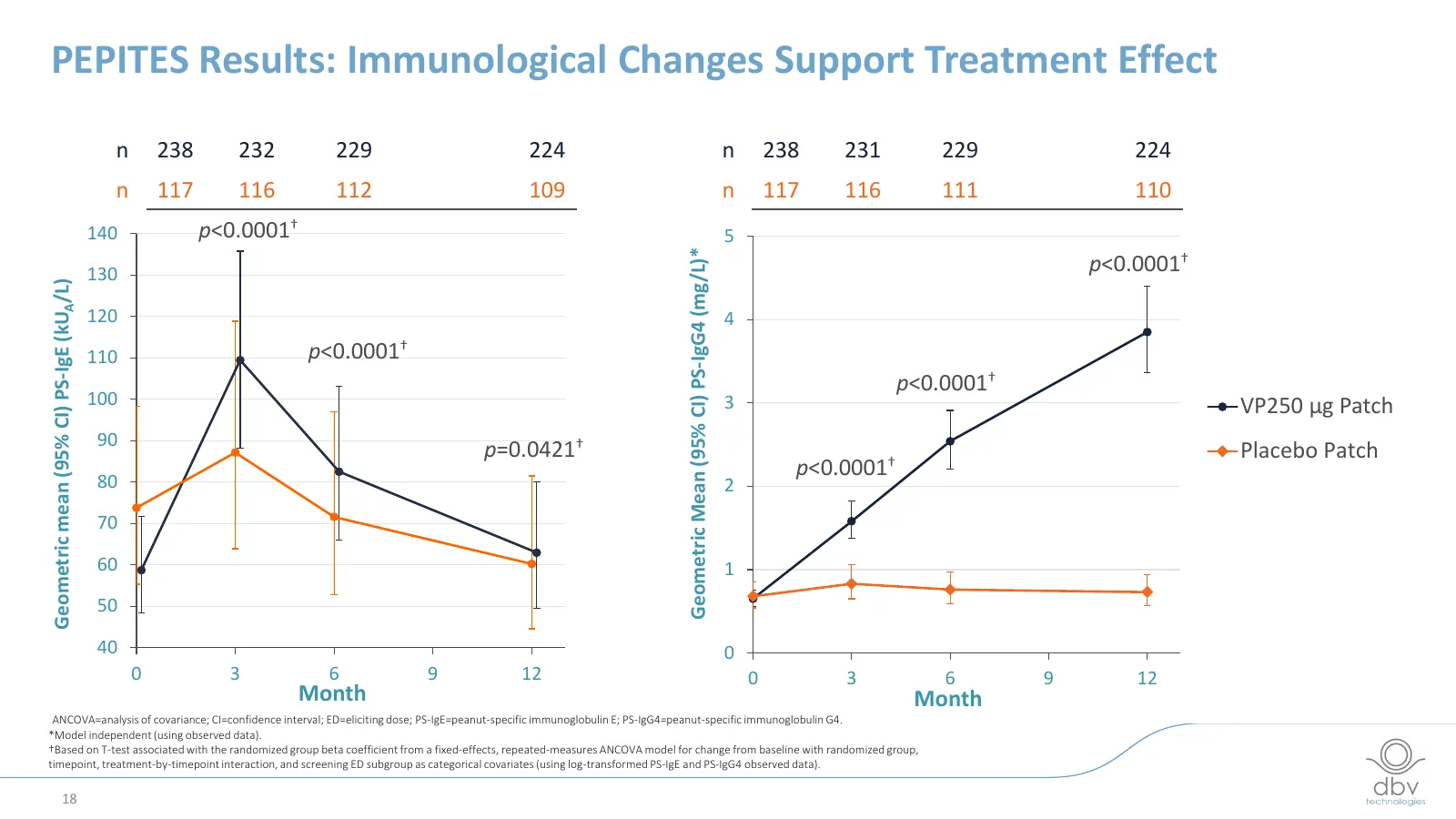
PEPITES Results: Immunological Changes Support Treatment Effect n 238 232 229 224 n 238 231 229 224 n 117 116 112 109 n 117 116 111 110 140 p<0.0001† 5 Geometric Mean (95% CI) PS-IgG4 (mg/L)* 130 p<0.0001† Geometric mean (95% CI) PS-IgE (kUA/L) 120 4 110 p<0.0001† p<0.0001† 100 3 VP250 μg Patch 90 p
Slide 19: PEPITES Post-Hoc Analysis Using VIPES Responder Definition
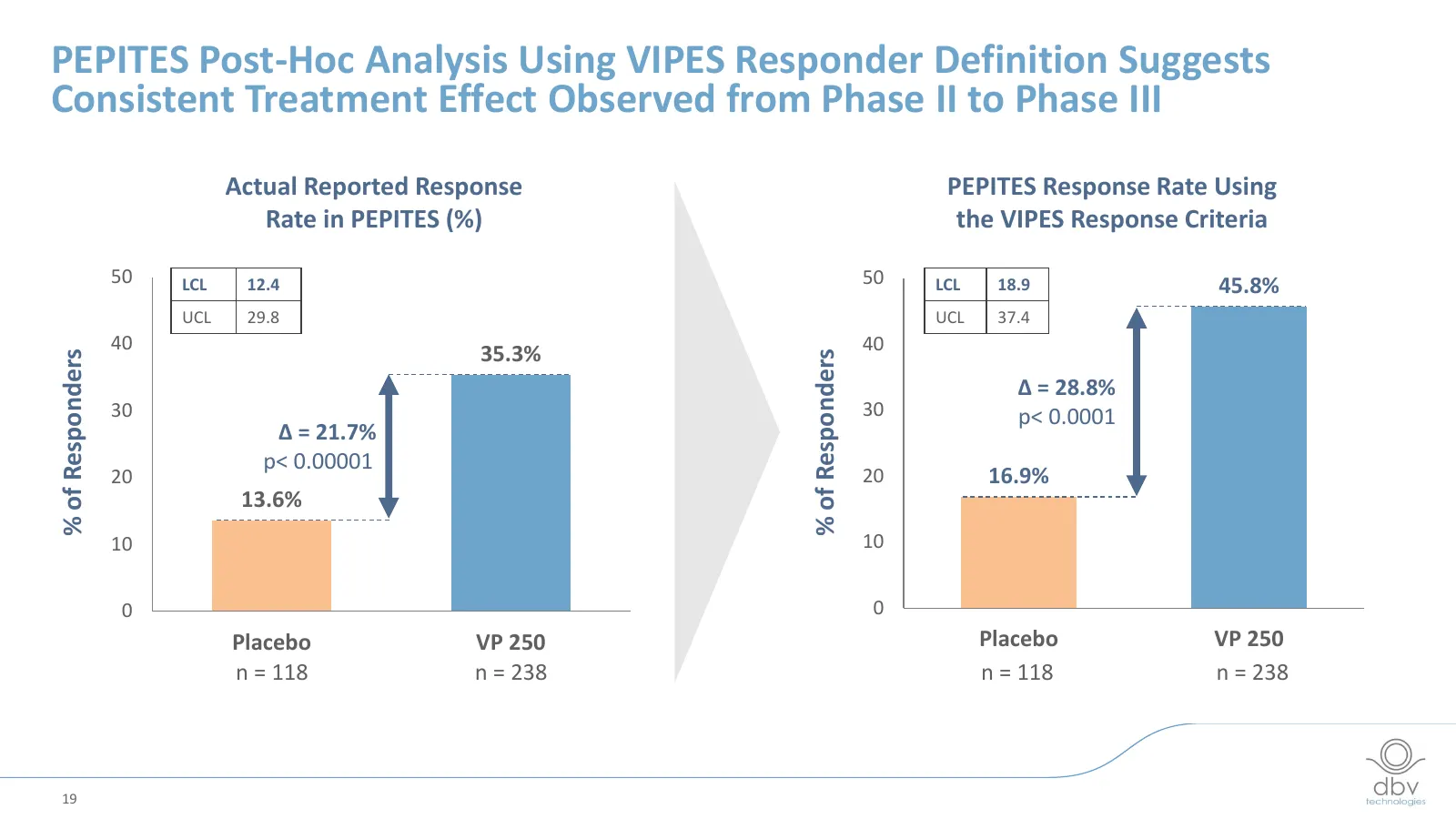
PEPITES Post-Hoc Analysis Using VIPES Responder Definition Suggests Consistent Treatment Effect Observed from Phase II to Phase III Actual Reported Response PEPITES Response Rate Using Rate in PEPITES (%) the VIPES Response Criteria 50 LCL 12.4 50 LCL 18.9 45.8% UCL 29.8 UCL 37.4 40 40 35.3% % of Re
Slide 20: JAMA Publication 2017: Long-term Extension Data Shows Treatment Benefit Increases
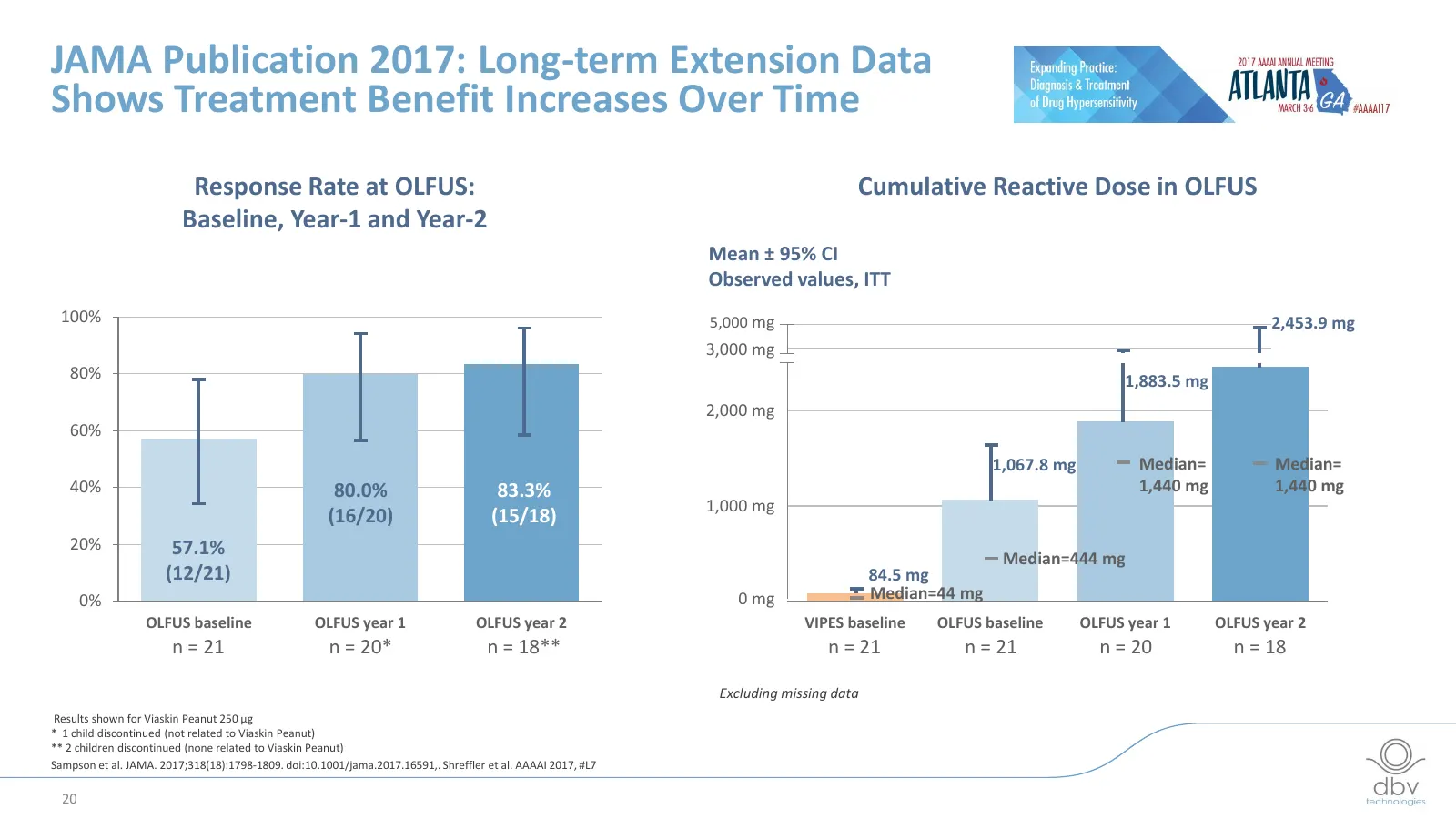
JAMA Publication 2017: Long-term Extension Data Shows Treatment Benefit Increases Over Time Response Rate at OLFUS: Cumulative Reactive Dose in OLFUS Baseline, Year-1 and Year-2 Mean ± 95% CI Observed values, ITT 100% 5,000 mg 2,453.9 mg 3,000 mg 80% 1,883.5 mg 2,000 mg 60% 1,067.8 mg Median= Median
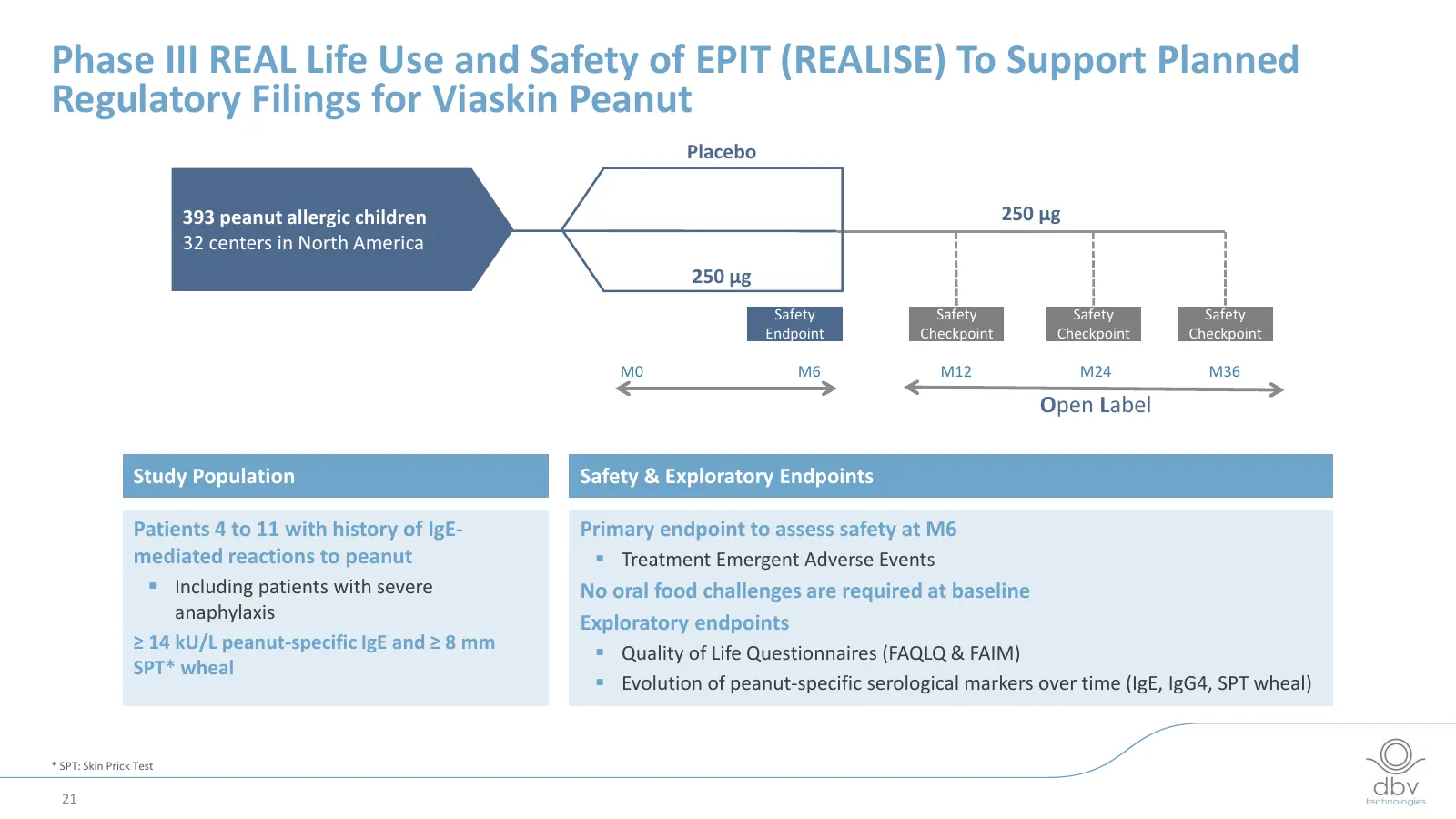
Slide 21: Phase III REAL Life Use and Safety of EPIT (REALISE)
Phase III REAL Life Use and Safety of EPIT (REALISE) To Support Planned Regulatory Filings for Viaskin Peanut Placebo 393 peanut allergic children 250 µg 32 centers in North America 250 µg Safety Safety Safety Safety Endpoint Checkpoint Checkpoint Checkpoint M0 M6 M12 M24 M36 Open Label Study Popula
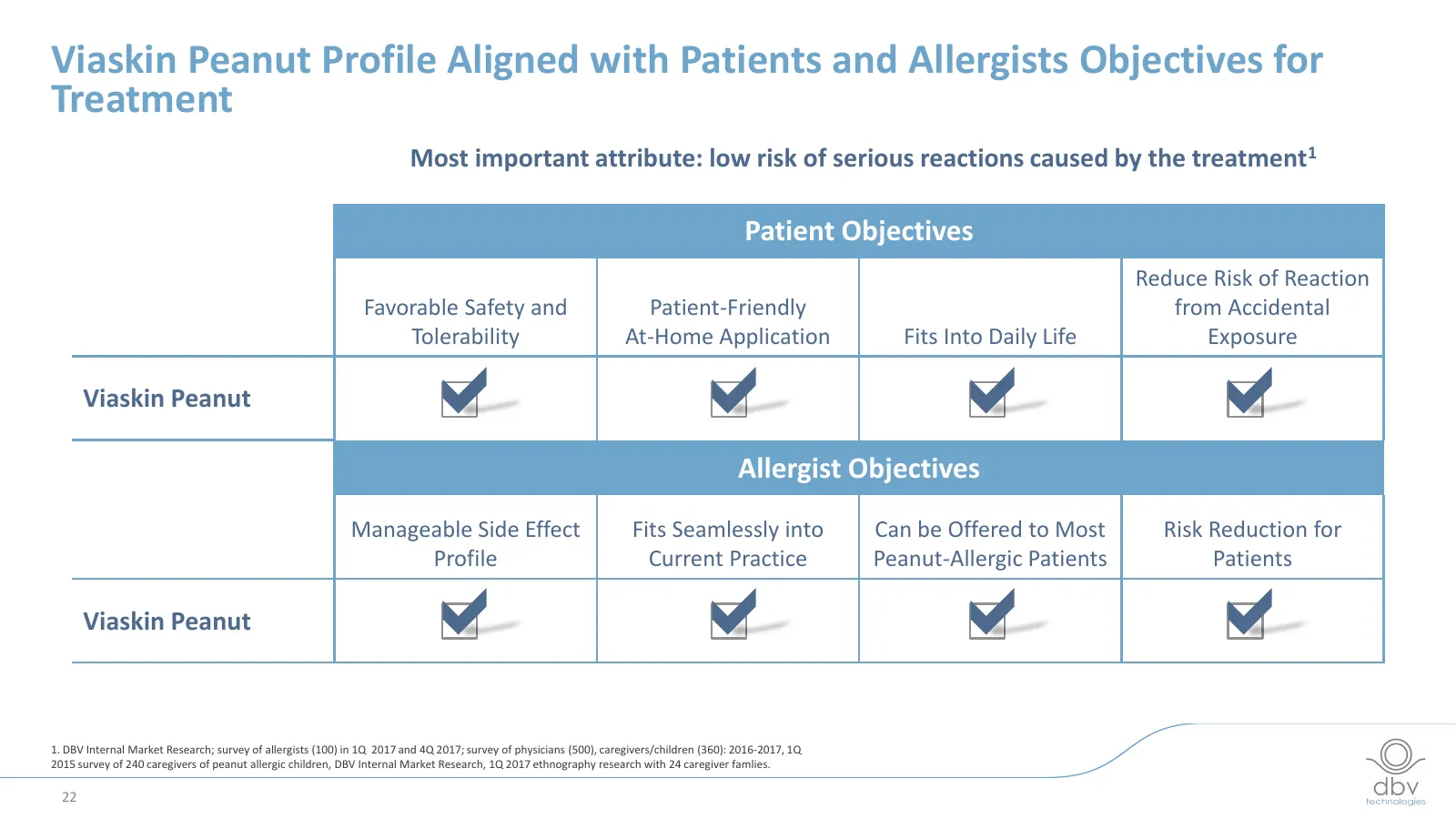
Slide 22: Viaskin Peanut Profile Aligned with Patients and Allergists Objectives
Viaskin Peanut Profile Aligned with Patients and Allergists Objectives for Treatment Most important attribute: low risk of serious reactions caused by the treatment1 Patient Objectives Reduce Risk of Reaction Favorable Safety and Patient-Friendly from Accidental Tolerability At-Home Application Fits
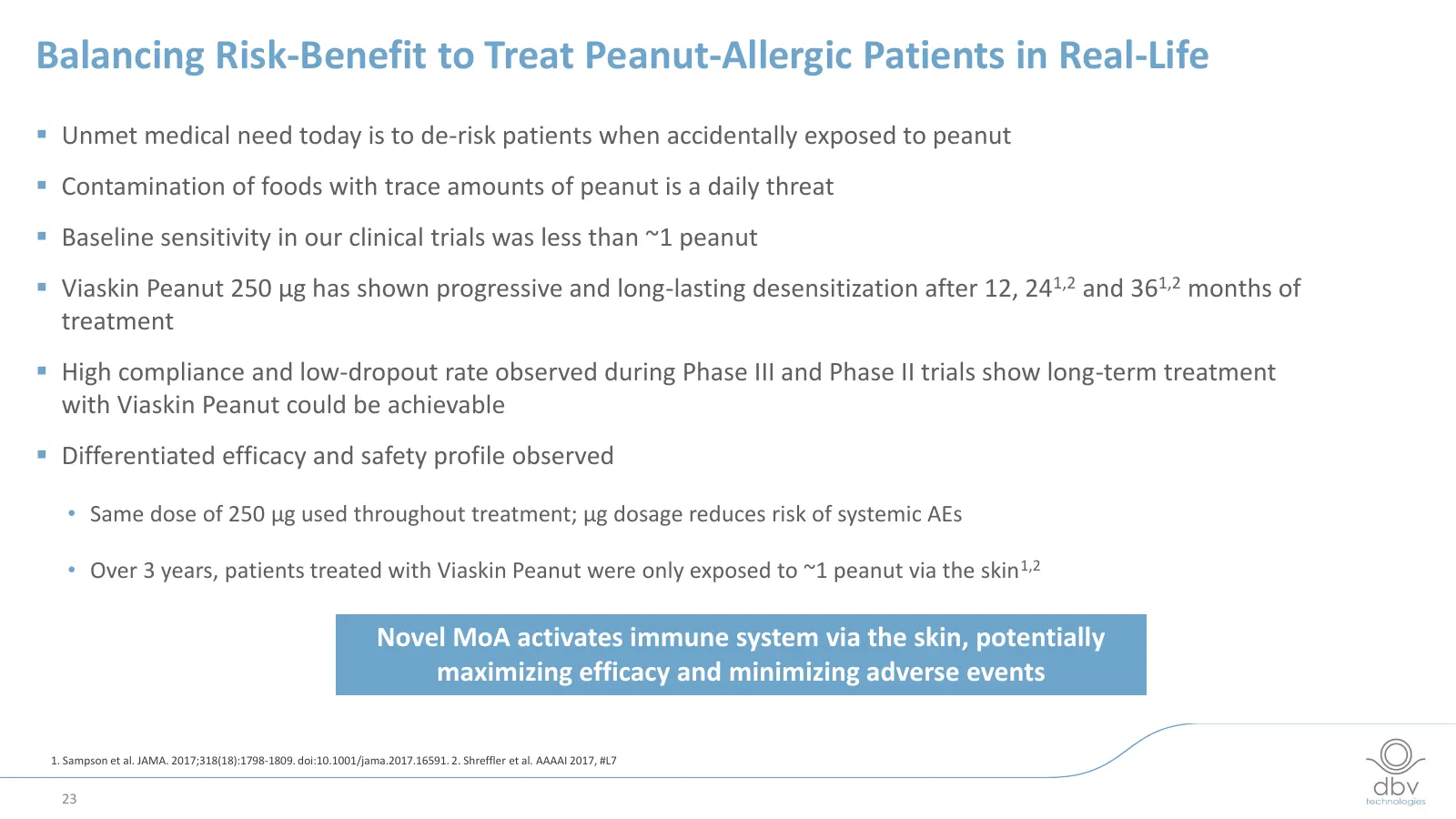
Slide 23: Balancing Risk-Benefit to Treat Peanut-Allergic Patients in Real-Life
Balancing Risk-Benefit to Treat Peanut-Allergic Patients in Real-Life ▪ Unmet medical need today is to de-risk patients when accidentally exposed to peanut ▪ Contamination of foods with trace amounts of peanut is a daily threat ▪ Baseline sensitivity in our clinical trials was less than ~1 peanut ▪
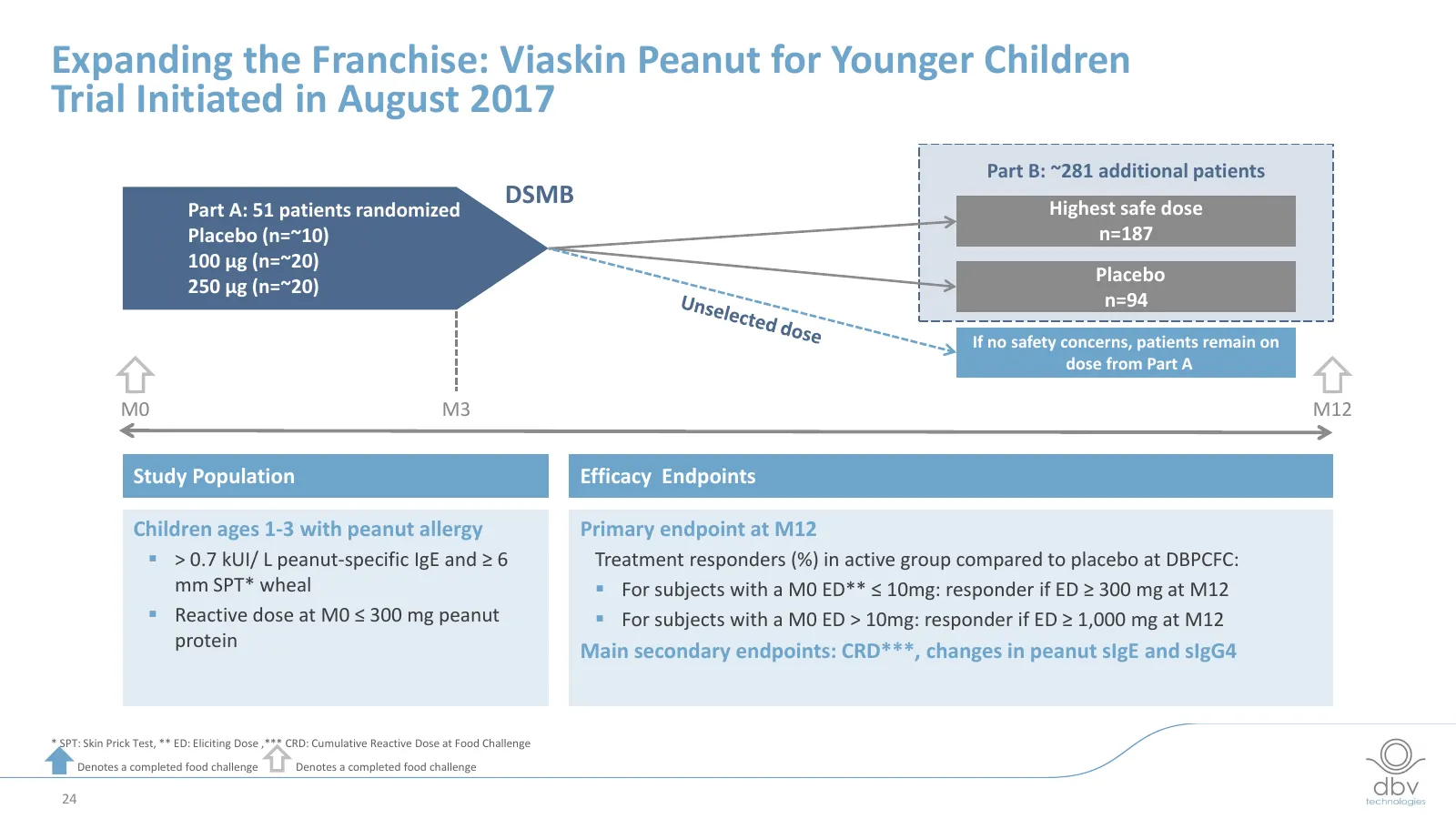
Slide 24: Expanding the Franchise: Viaskin Peanut for Younger Children
Expanding the Franchise: Viaskin Peanut for Younger Children Trial Initiated in August 2017 Part B: ~281 additional patients DSMB Highest safe dose Part A: 51 patients randomized Placebo (n=~10) n=187 100 µg (n=~20) Placebo 250 µg (n=~20) n=94 If no safety concerns, patients remain on dose from Part
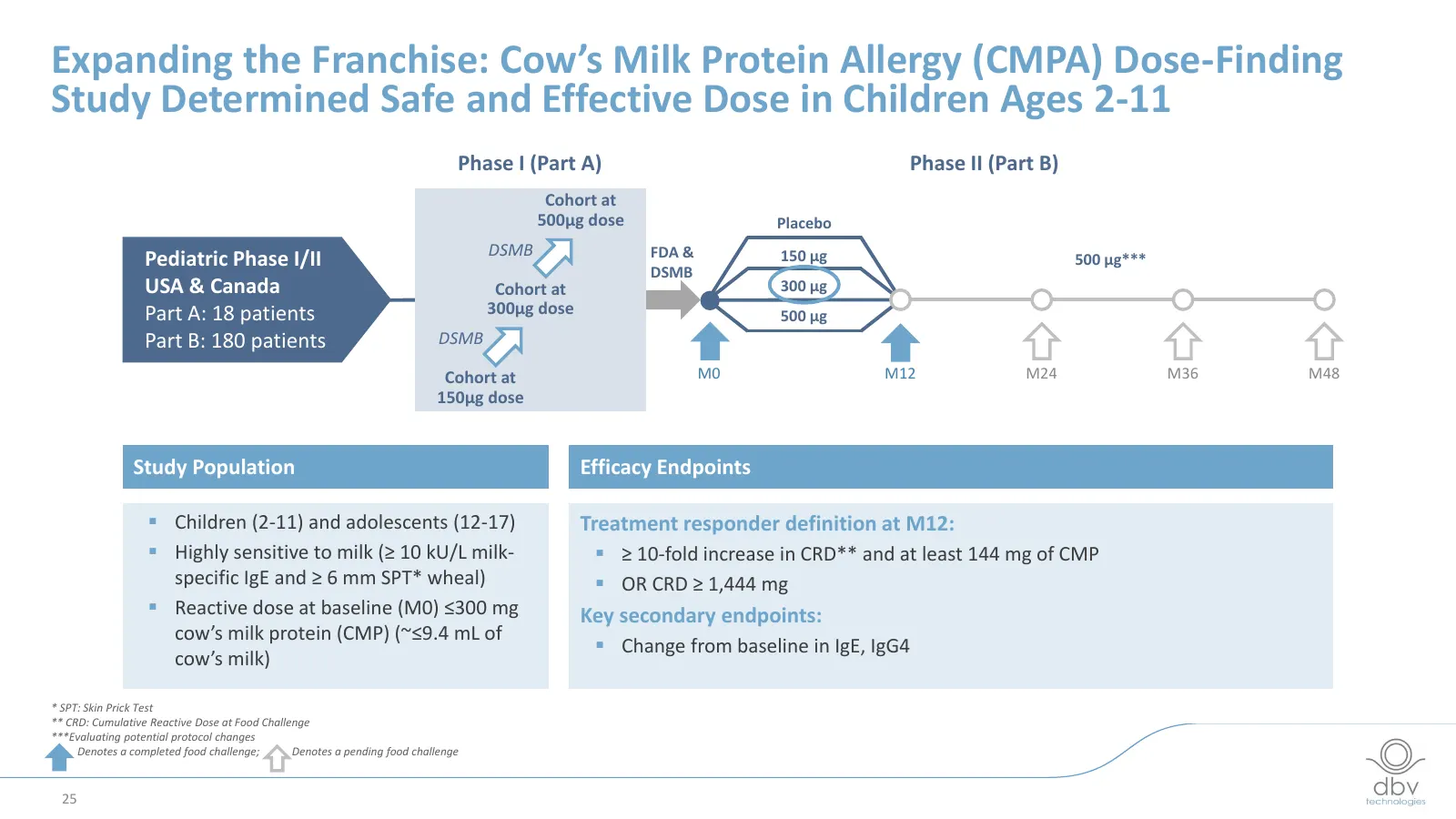
Slide 25: Expanding the Franchise: Cow's Milk Protein Allergy Dose-Finding Study
Expanding the Franchise: Cow’s Milk Protein Allergy (CMPA) Dose-Finding Study Determined Safe and Effective Dose in Children Ages 2-11 Phase I (Part A) Phase II (Part B) Cohort at 500µg dose Placebo DSMB FDA & 150 µg Pediatric Phase I/II 500 µg*** DSMB USA & Canada Cohort at 300 µg Part A: 18 patien
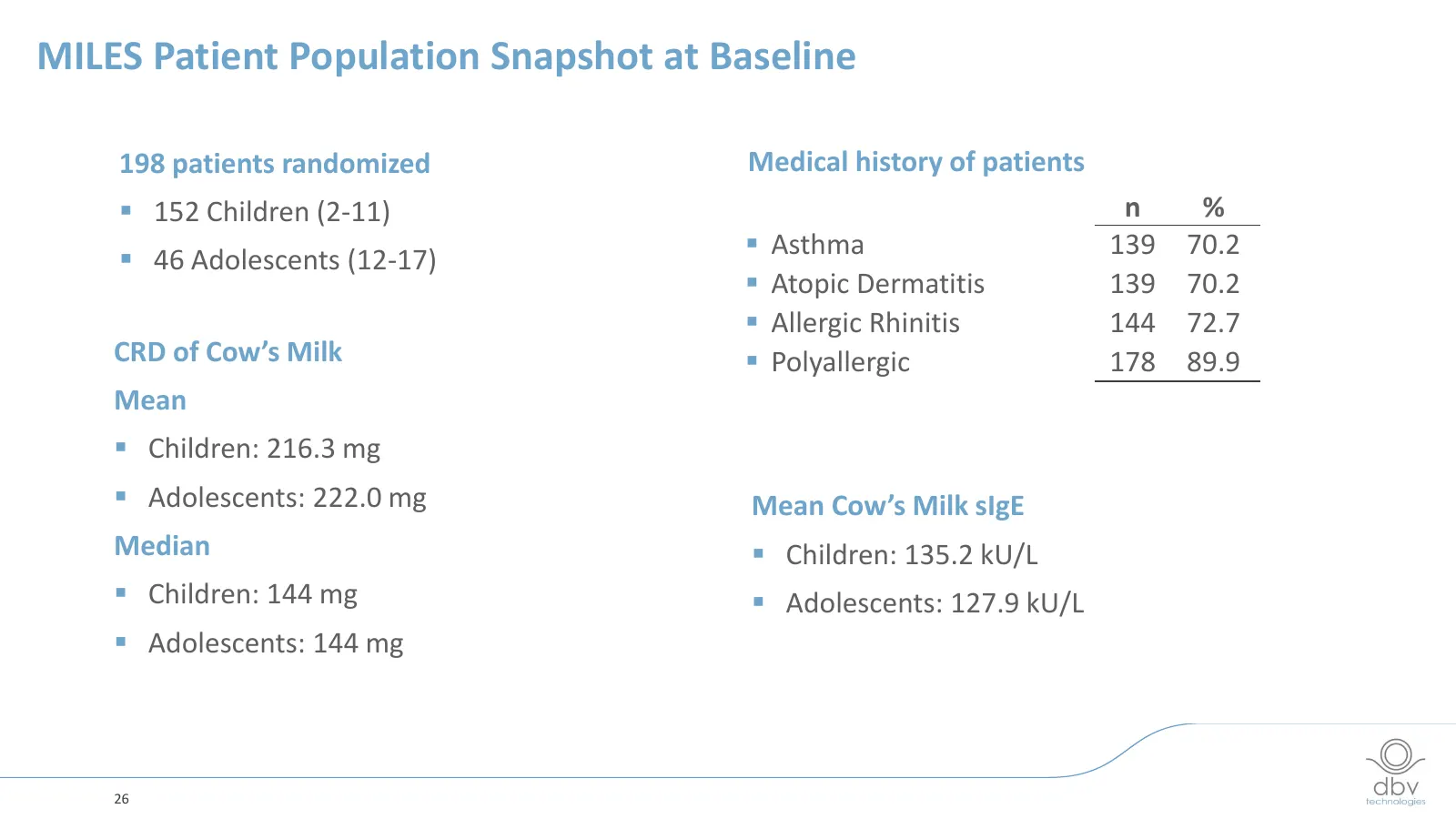
Slide 26: MILES Patient Population Snapshot at Baseline
MILES Patient Population Snapshot at Baseline 198 patients randomized Medical history of patients ▪ 152 Children (2-11) n % ▪ Asthma 139 70.2 ▪ 46 Adolescents (12-17) ▪ Atopic Dermatitis 139 70.2 ▪ Allergic Rhinitis 144 72.7 CRD of Cow’s Milk ▪ Polyallergic 178 89.9 Mean ▪ Children: 216.3 mg ▪ Adole
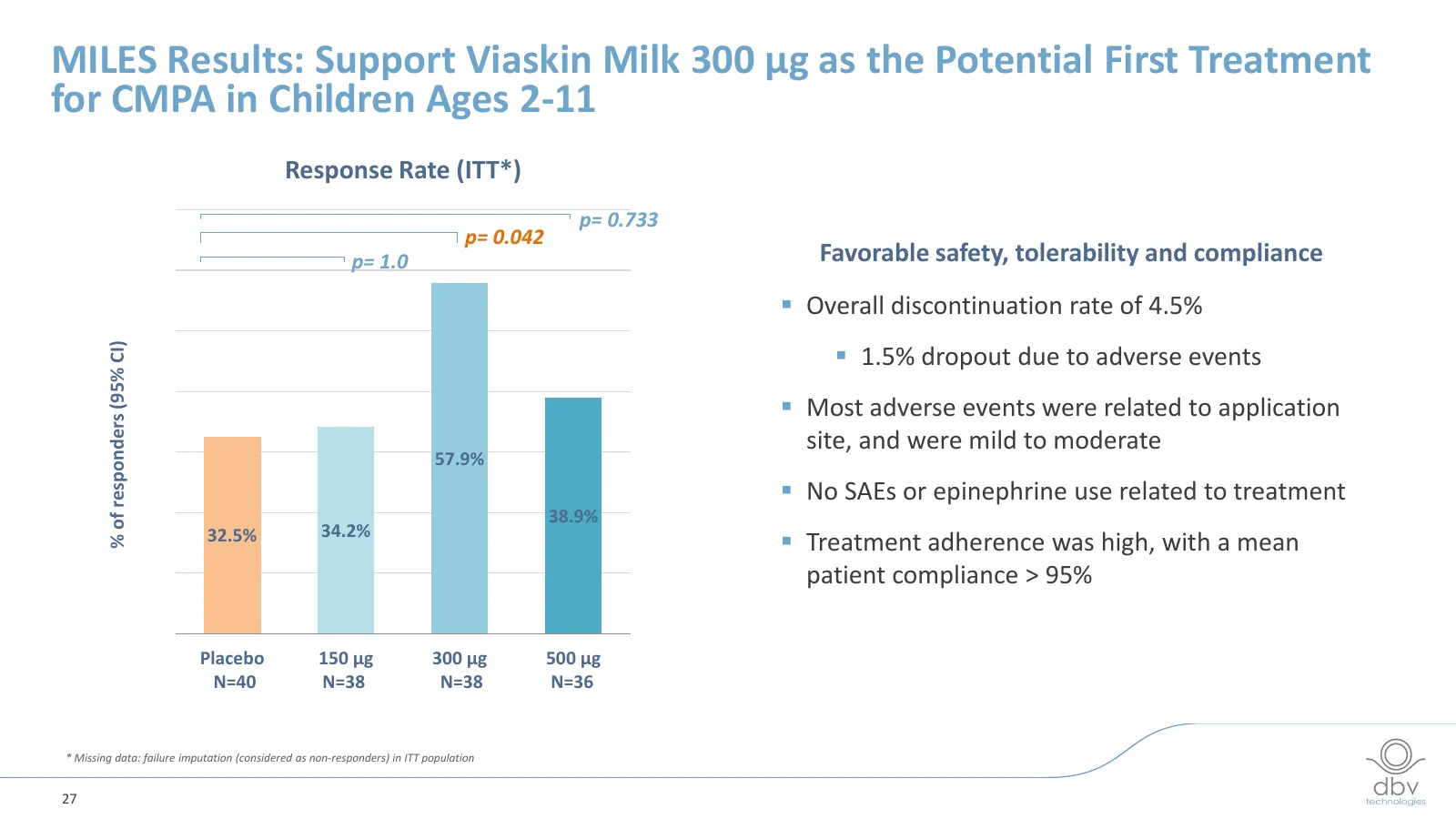
Slide 27: MILES Results: Support Viaskin Milk as Potential First Treatment for CMPA
MILES Results: Support Viaskin Milk 300 µg as the Potential First Treatment for CMPA in Children Ages 2-11 Response Rate (ITT*) p= 0.733 p= 0.042 p= 1.0 Favorable safety, tolerability and compliance ▪ Overall discontinuation rate of 4.5% ▪ 1.5% dropout due to adverse events % of responders (95% CI)
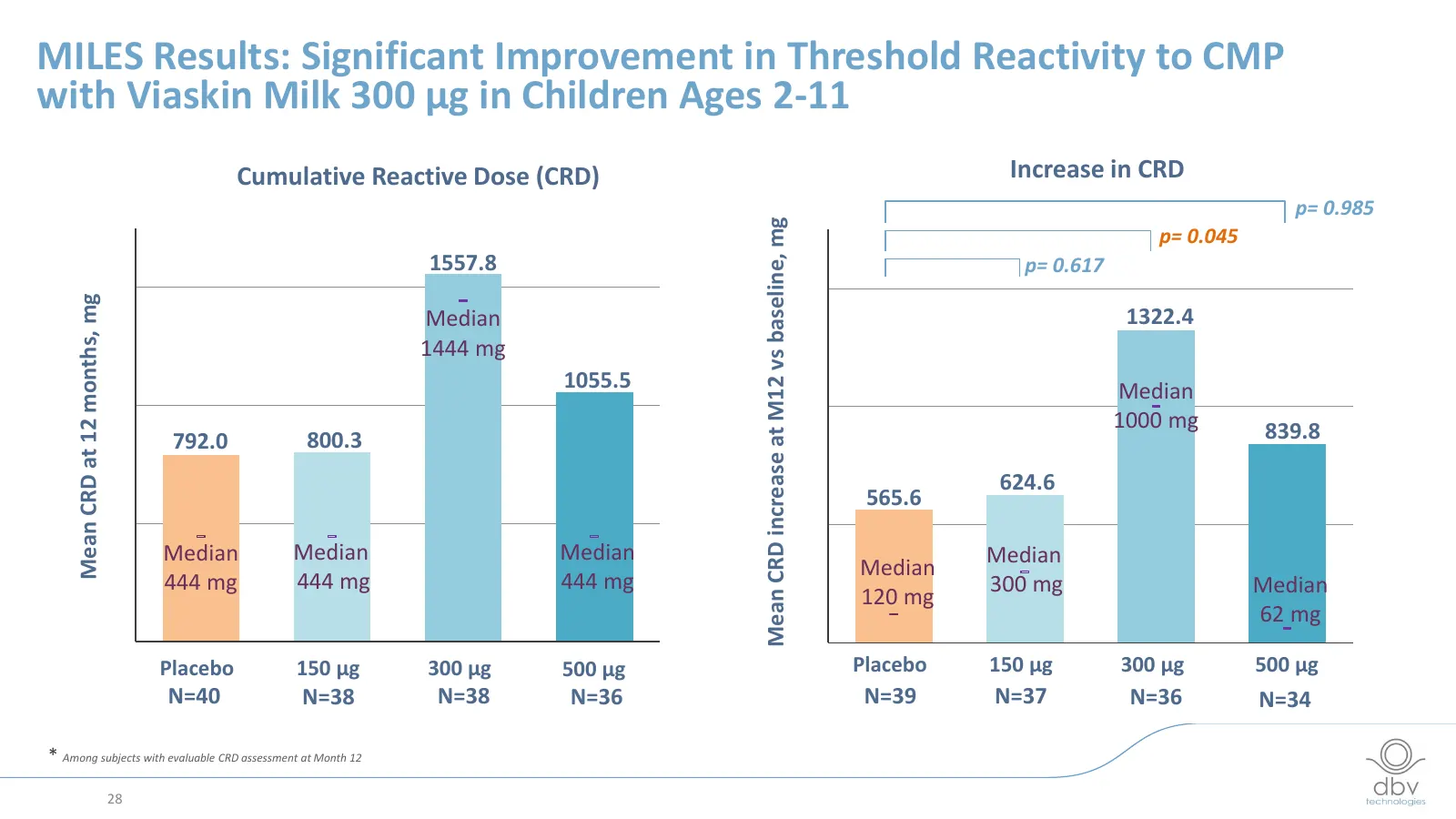
Slide 28: MILES Results: Significant Improvement in Threshold Reactivity to CMP
MILES Results: Significant Improvement in Threshold Reactivity to CMP with Viaskin Milk 300 µg in Children Ages 2-11 Cumulative Reactive Dose (CRD) Increase in CRD p= 0.985 Mean CRD increase at M12 vs baseline, mg p= 0.045 1557.8 p= 0.617 Mean CRD at 12 months, mg Median 1322.4 1444 mg 1055.5 Median
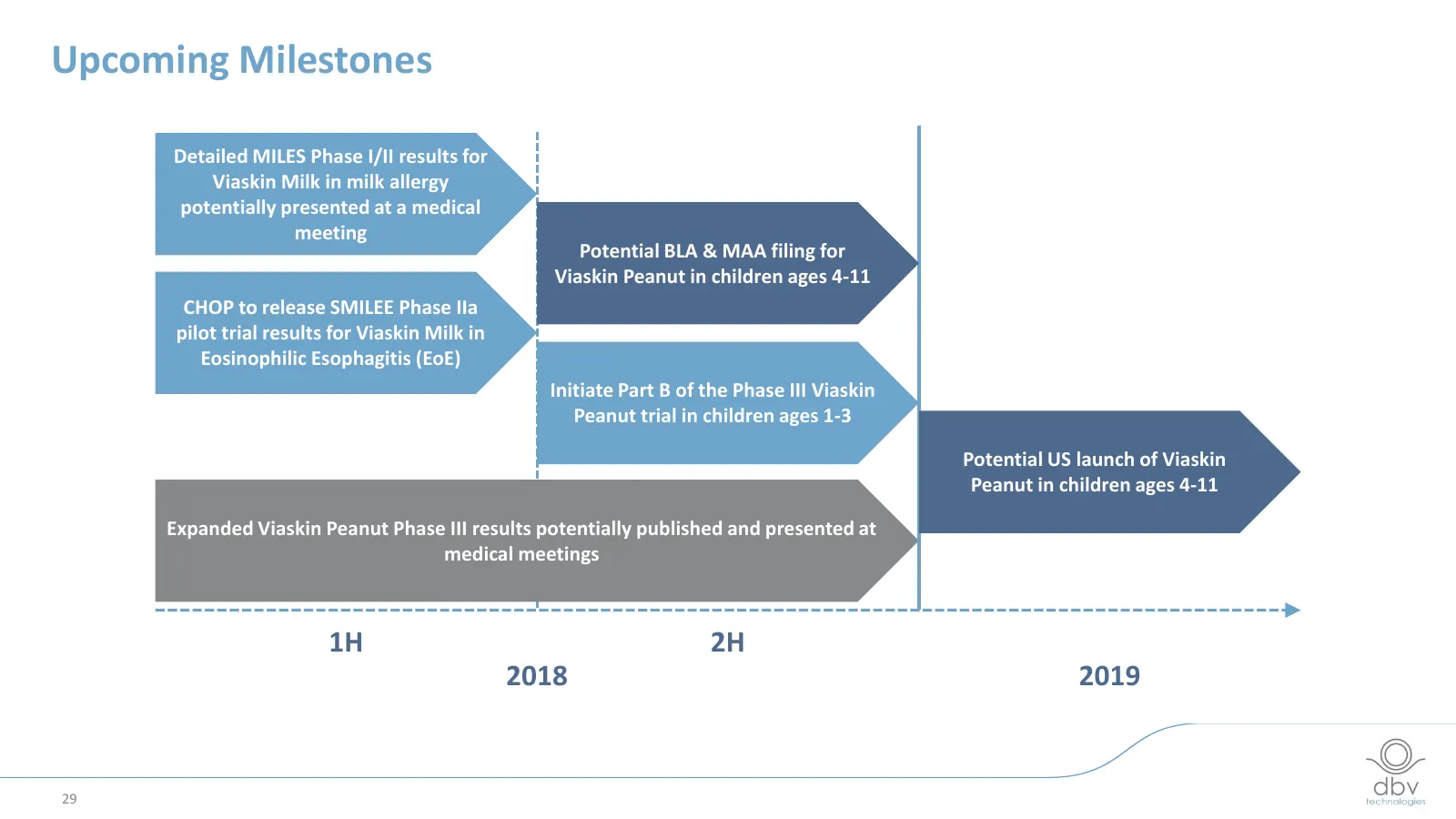
Slide 29: Upcoming Milestones
Upcoming Milestones Detailed MILES Phase I/II results for Viaskin Milk in milk allergy potentially presented at a medical meeting Potential BLA & MAA filing for Viaskin Peanut in children ages 4-11 CHOP to release SMILEE Phase IIa pilot trial results for Viaskin Milk in Eosinophilic Esophagitis (EoE
Slide 30: DBV Technologies: Pioneering a New Class of Immunotherapy
DBV Technologies: Pioneering a New Class of Immunotherapy ▪ Topline results from Viaskin Peanut Phase III clinical trials: PEPITES & REALISE ▪ Planned Viaskin Peanut BLA filing in 2H18; targeting 2019 U.S. launch ▪ Fully-scalable, launch-ready manufacturing capabilities in place for Viaskin Peanut ▪

Slide 31: 31
31
Slide 32: Measuring Efficacy: Double-Blind Placebo-Controlled Food Challenge
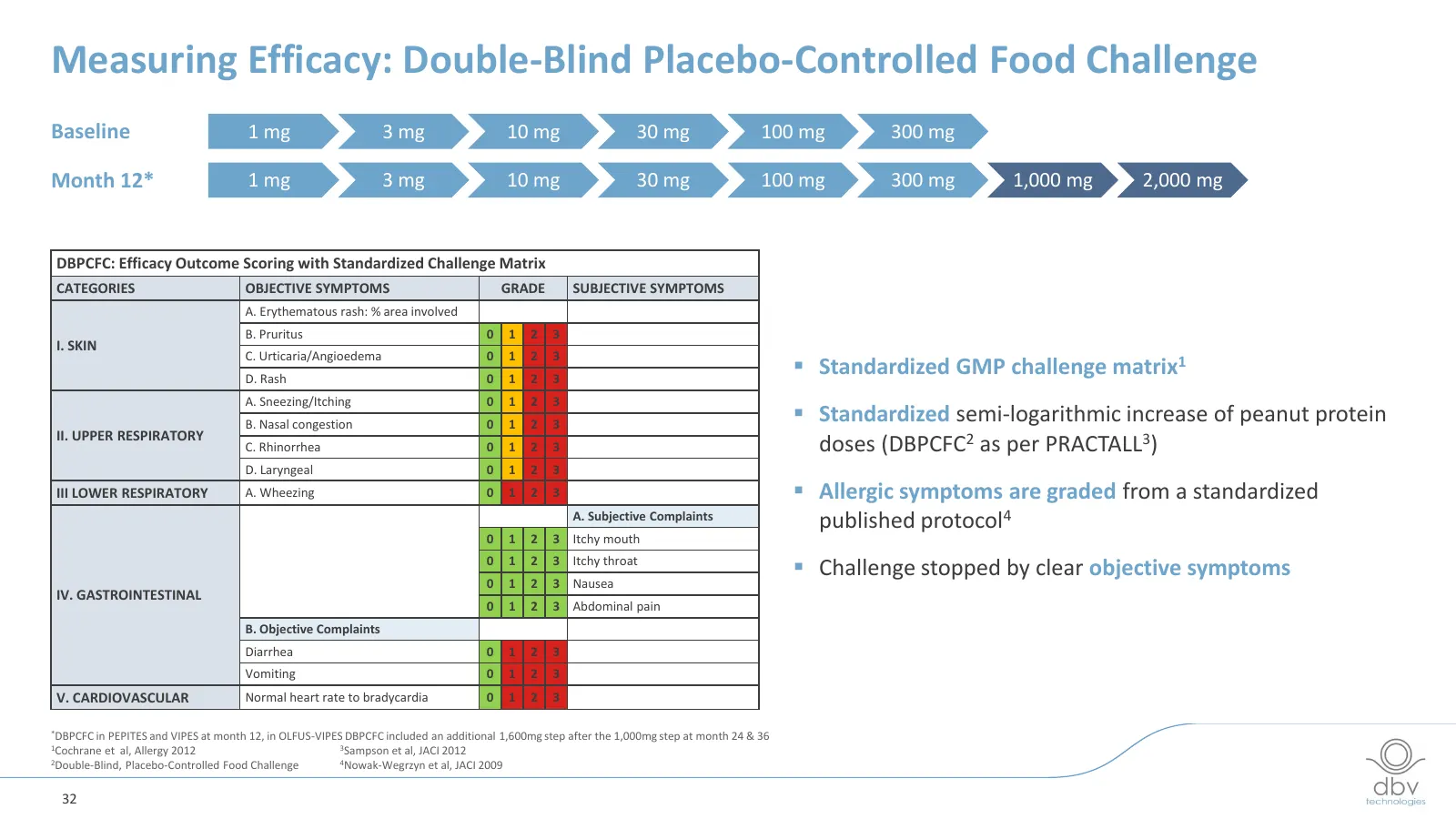
Measuring Efficacy: Double-Blind Placebo-Controlled Food Challenge Baseline 1 mg 3 mg 10 mg 30 mg 100 mg 300 mg Month 12* 1 mg 3 mg 10 mg 30 mg 100 mg 300 mg 1,000 mg 2,000 mg DBPCFC: Efficacy Outcome Scoring with Standardized Challenge Matrix CATEGORIES OBJECTIVE SYMPTOMS GRADE SUBJECTIVE SYMPTOMS
Slide 33: VIPES: Dose-Finding Phase IIb Efficacy and Safety Trial
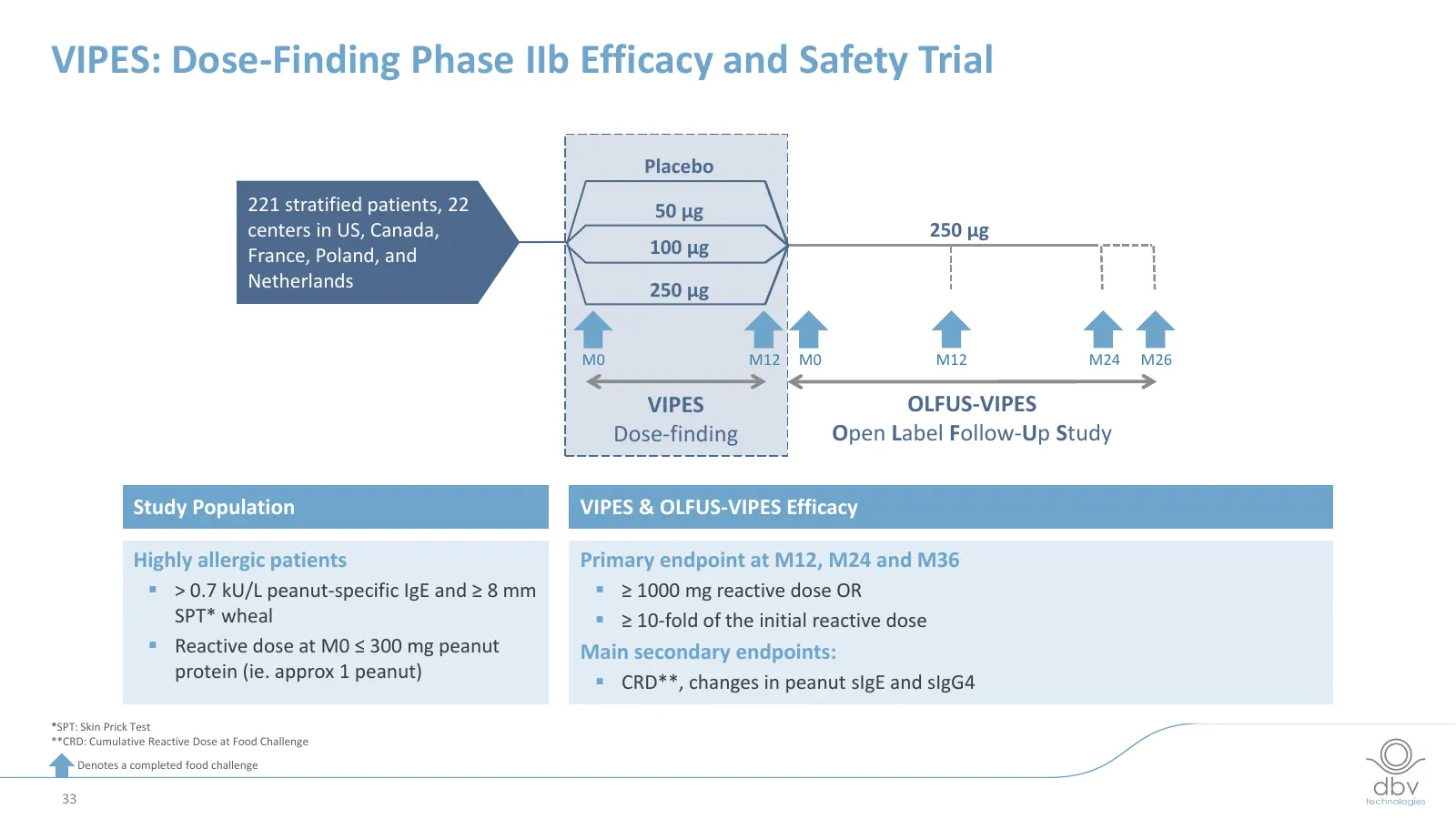
VIPES: Dose-Finding Phase IIb Efficacy and Safety Trial Placebo 221 stratified patients, 22 50 µg centers in US, Canada, 250 µg France, Poland, and 100 µg Netherlands 250 µg M0 M12 M0 M12 M24 M26 VIPES OLFUS-VIPES Dose-finding Open Label Follow-Up Study Study Population VIPES & OLFUS-VIPES Efficacy
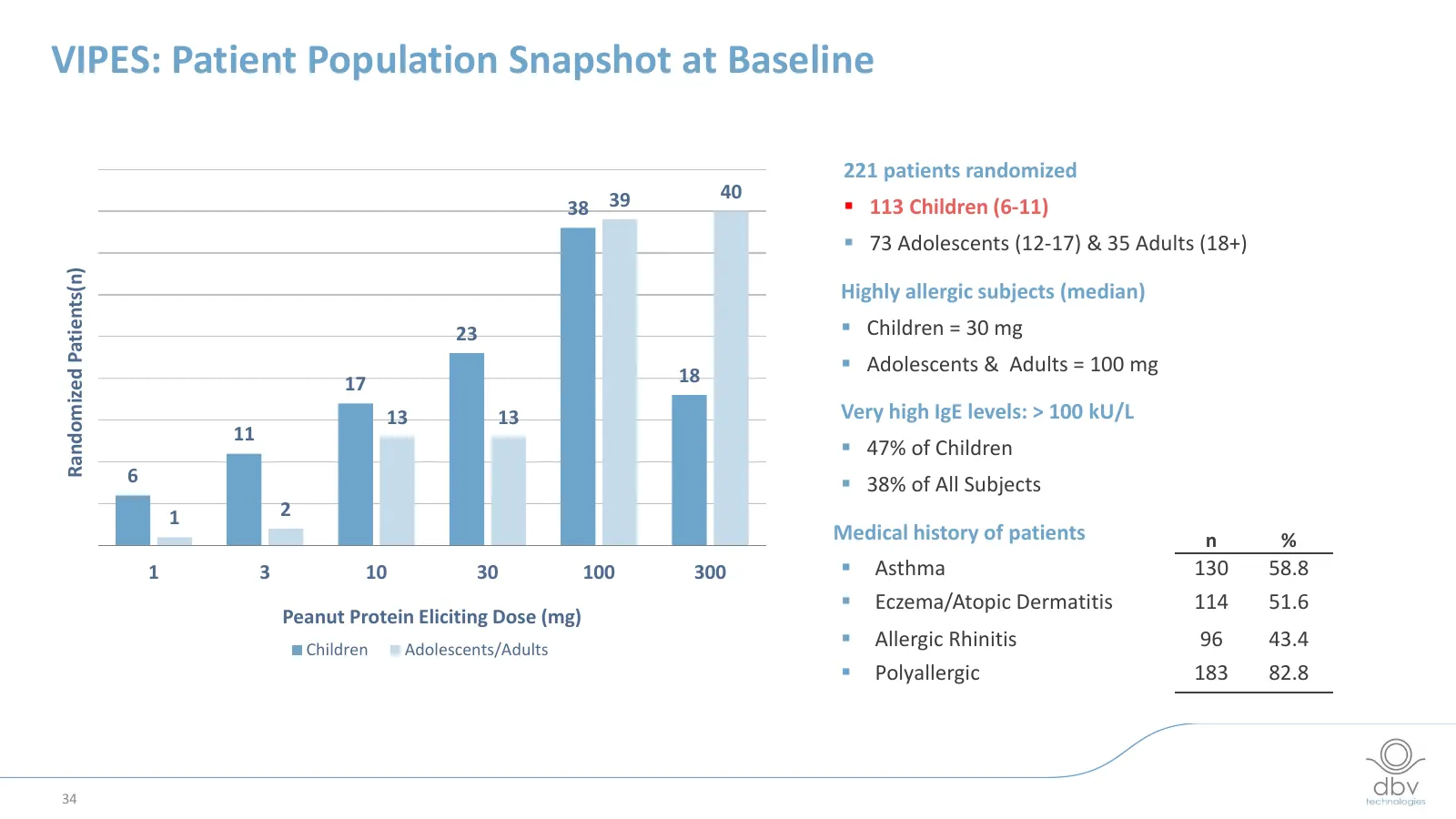
Slide 34: VIPES: Patient Population Snapshot at Baseline
VIPES: Patient Population Snapshot at Baseline 221 patients randomized 40 38 39 ▪ 113 Children (6-11) ▪ 73 Adolescents (12-17) & 35 Adults (18+) Randomized Patients(n) Highly allergic subjects (median) 23 ▪ Children = 30 mg 18 ▪ Adolescents & Adults = 100 mg 17 13 13 Very high IgE levels: > 100 kU/L
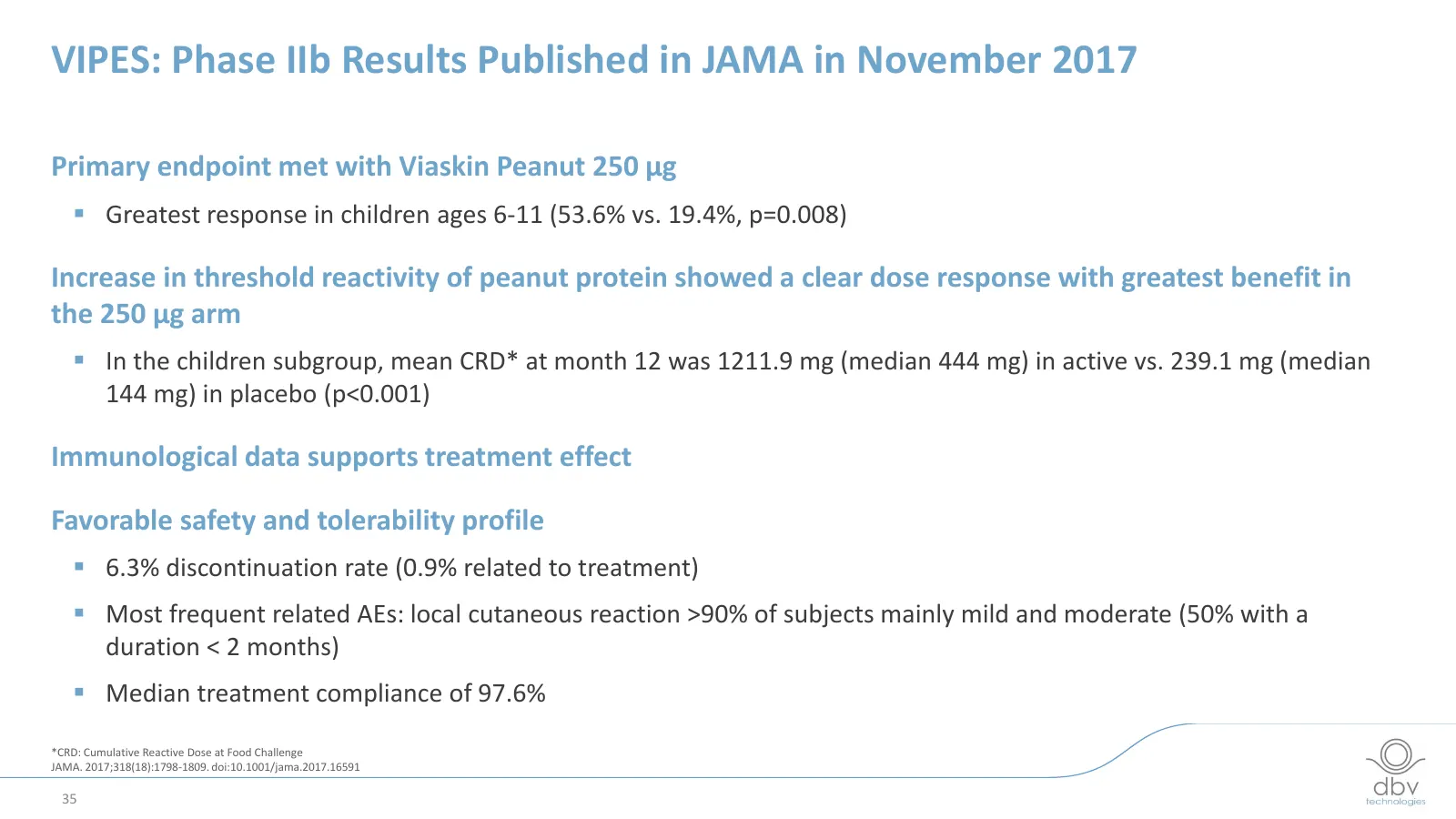
Slide 35: VIPES: Phase IIb Results Published in JAMA in November 2017
VIPES: Phase IIb Results Published in JAMA in November 2017 Primary endpoint met with Viaskin Peanut 250 µg ▪ Greatest response in children ages 6-11 (53.6% vs. 19.4%, p=0.008) Increase in threshold reactivity of peanut protein showed a clear dose response with greatest benefit in the 250 µg arm ▪ I
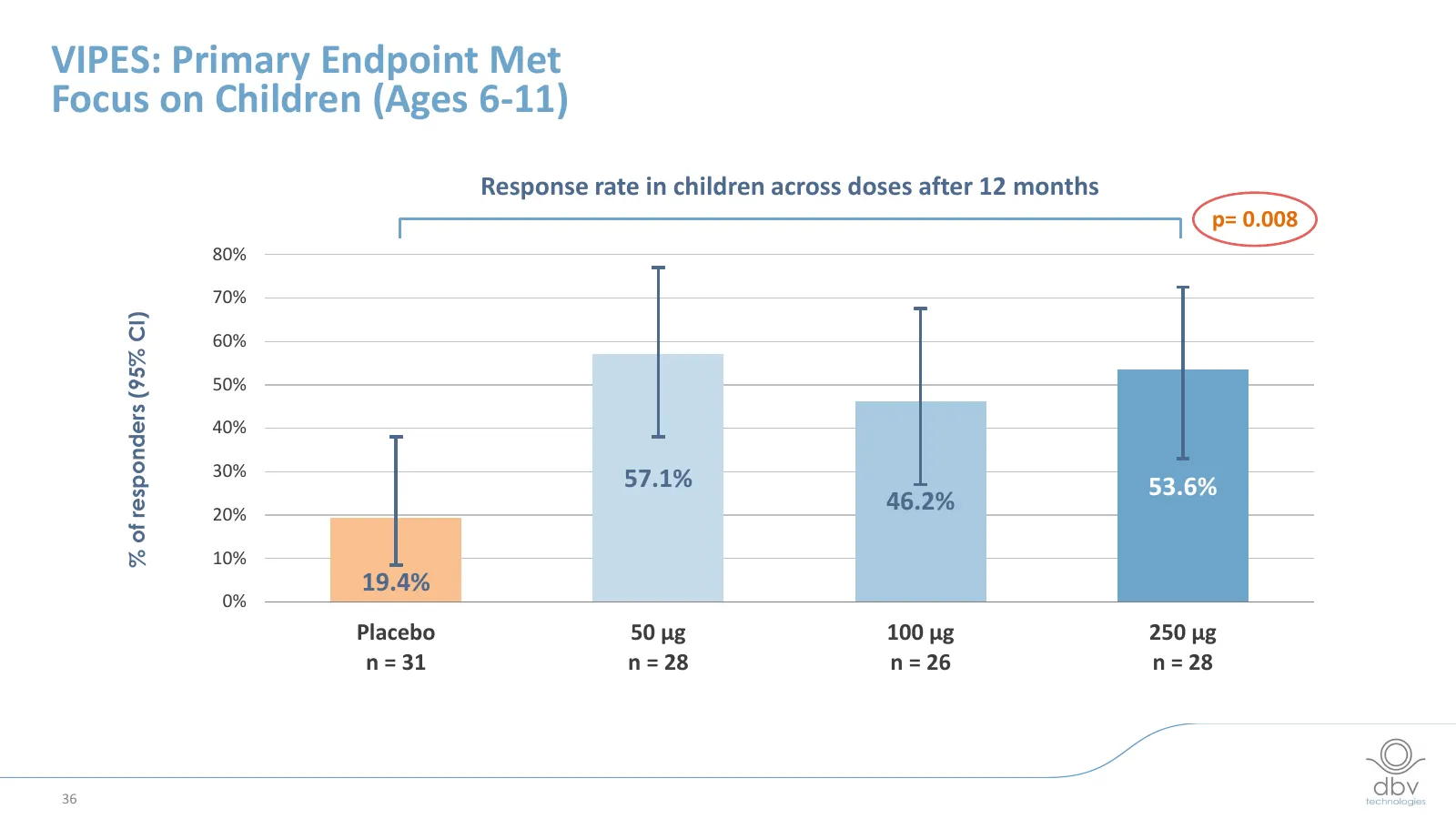
Slide 36: VIPES: Primary Endpoint Met, Focus on Children
VIPES: Primary Endpoint Met Focus on Children (Ages 6-11) Response rate in children across doses after 12 months p= 0.008 80% 70% % of responders (95% CI) 60% 50% 40% 30% 57.1% 53.6% 20% 46.2% 10% 19.4% 0% Placebo 50 µg 100 µg 250 µg n = 31 n = 28 n = 26 n = 28 36
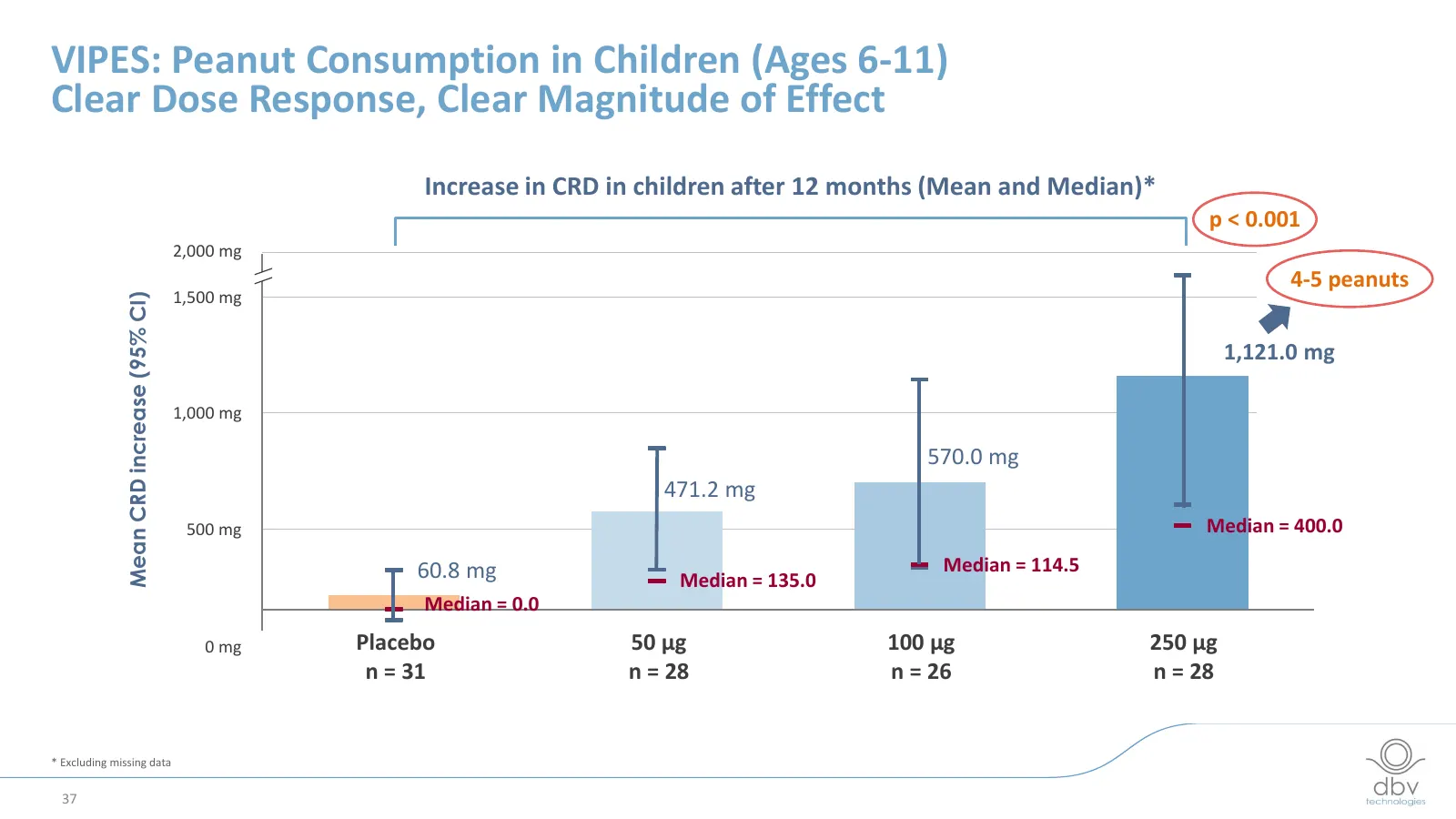
Slide 37: VIPES: Peanut Consumption in Children (Ages 6-11)
VIPES: Peanut Consumption in Children (Ages 6-11) Clear Dose Response, Clear Magnitude of Effect Increase in CRD in children after 12 months (Mean and Median)* p < 0.001 2,000 mg 4-5 peanuts 1,500 mg Mean CRD increase (95% CI) 1,121.0 mg 1,000 mg 570.0 mg 471.2 mg 500 mg Median = 400.0 60.8 mg Media
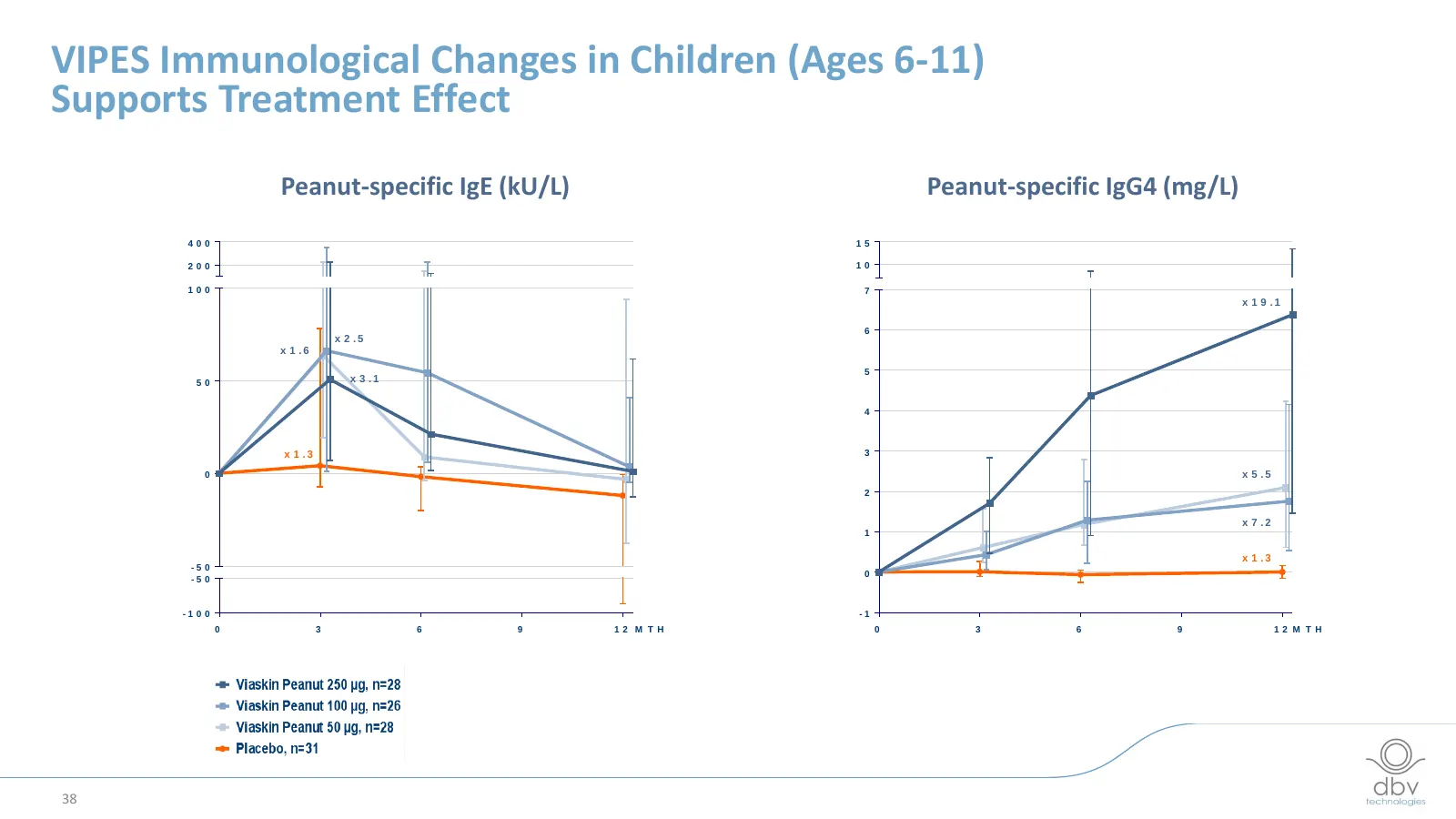
Slide 38: VIPES Immunological Changes in Children Supports Treatment Effect
VIPES Immunological Changes in Children (Ages 6-11) Supports Treatment Effect Peanut-specific IgE (kU/L) Peanut-specific IgG4 (mg/L) 400 15 200 10 100 7 x 1 9 .1 6 x 2 .5 x 1 .6 5 50 x 3 .1 4 x 1 .3 3 0 x 5 .5 2 x 7 .2 1 x 1 .3 -5 0 0 -5 0 -1 0 0 -1 0 3 6 9 12 M T H 0 3 6 9 12 M T H 38
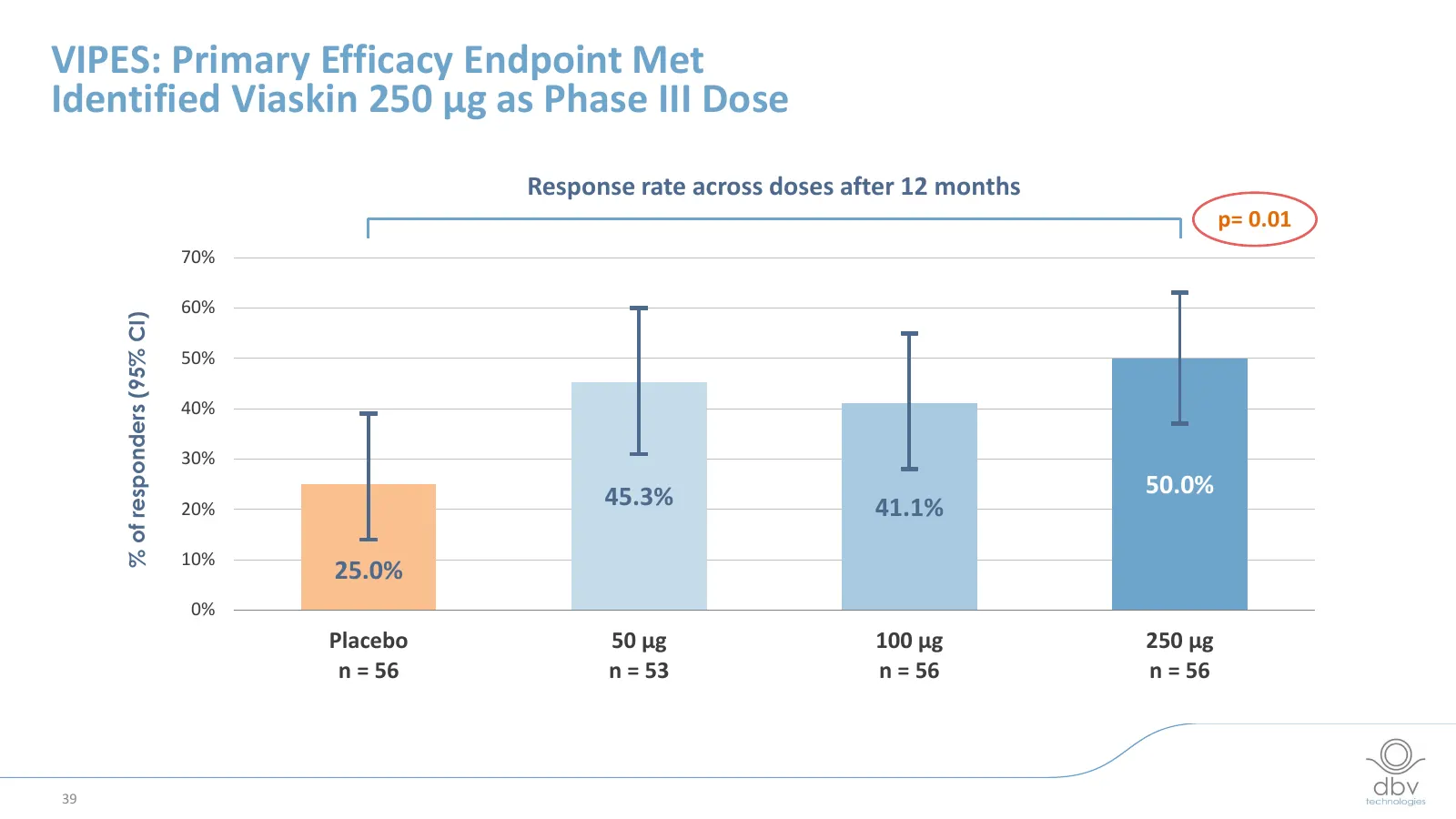
Slide 39: VIPES: Primary Efficacy Endpoint Met
VIPES: Primary Efficacy Endpoint Met Identified Viaskin 250 µg as Phase III Dose Response rate across doses after 12 months p= 0.01 70% 60% % of responders (95% CI) 50% 40% 30% 45.3% 50.0% 20% 41.1% 10% 25.0% 0% Placebo 50 µg 100 µg 250 µg n = 56 n = 53 n = 56 n = 56 39
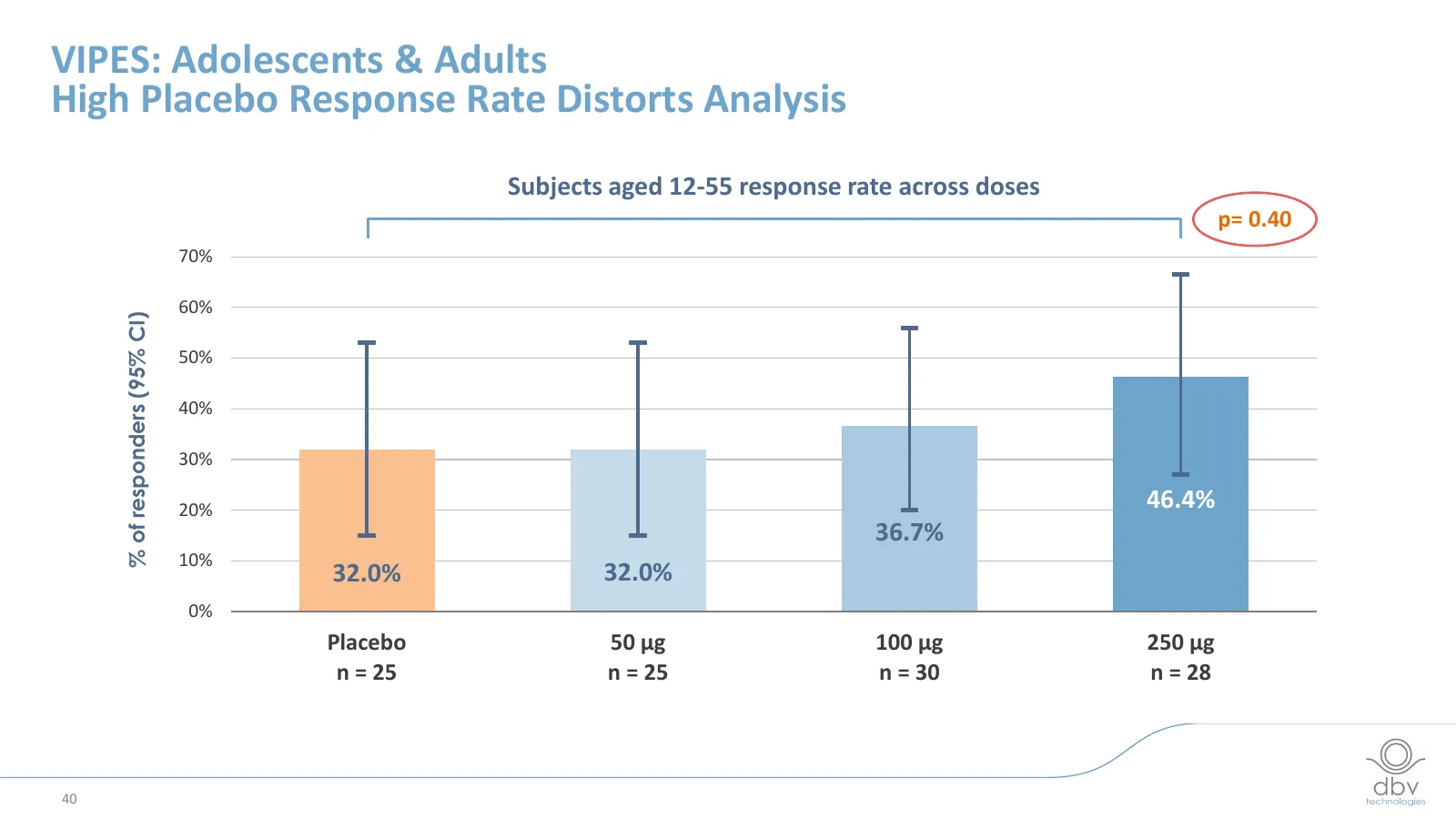
Slide 40: VIPES: Adolescents & Adults, High Placebo Response Rate
VIPES: Adolescents & Adults High Placebo Response Rate Distorts Analysis Subjects aged 12-55 response rate across doses p= 0.40 70% 60% % of responders (95% CI) 50% 40% 30% 20% 46.4% 36.7% 10% 32.0% 32.0% 0% Placebo 50 µg 100 µg 250 µg n = 25 n = 25 n = 30 n = 28 40
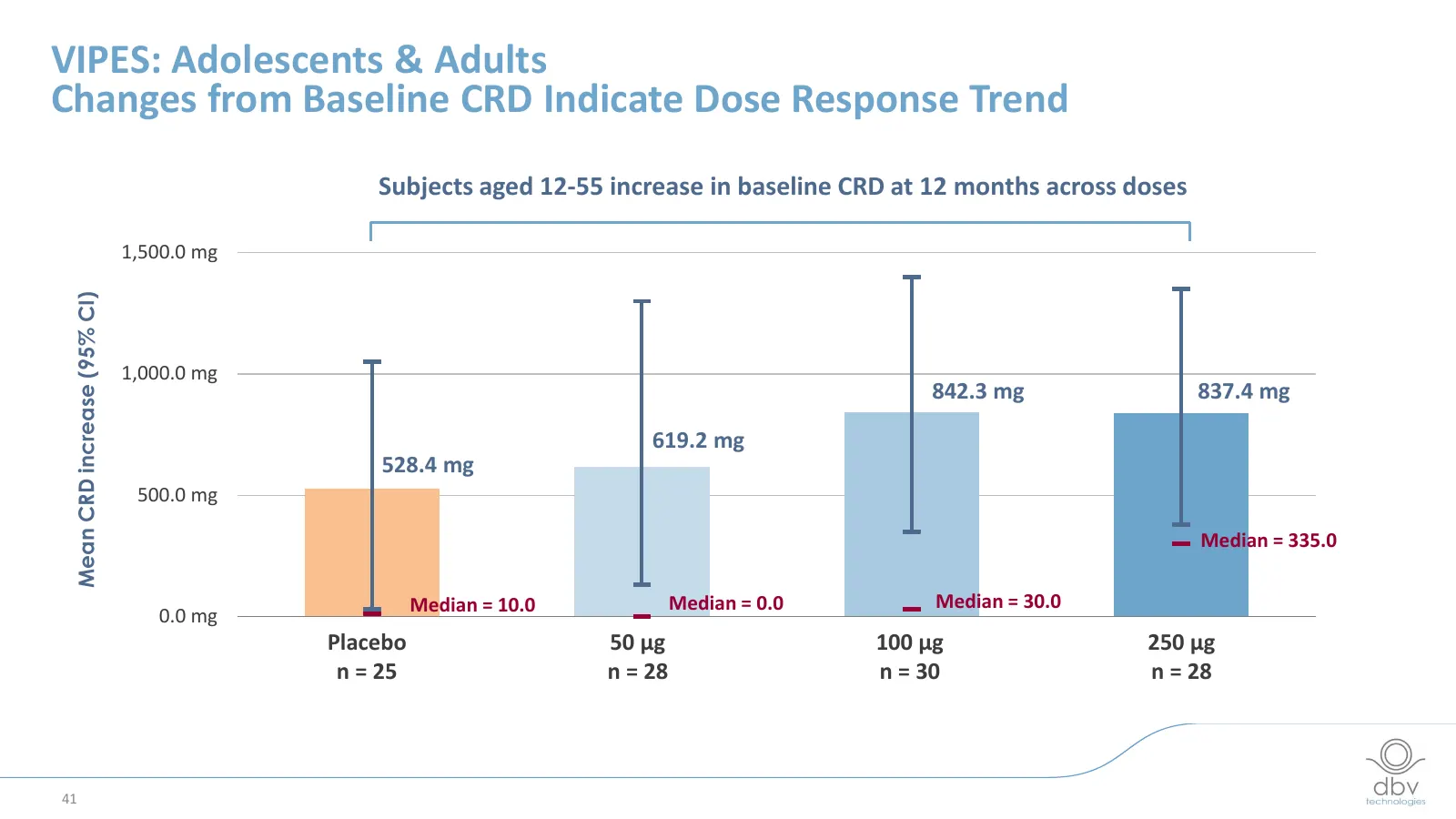
Slide 41: VIPES: Adolescents & Adults, Changes from Baseline CRD
VIPES: Adolescents & Adults Changes from Baseline CRD Indicate Dose Response Trend Subjects aged 12-55 increase in baseline CRD at 12 months across doses 1,500.0 mg Mean CRD increase (95% CI) 1,000.0 mg 842.3 mg 837.4 mg 619.2 mg 528.4 mg 500.0 mg Median = 335.0 Median = 10.0 Median = 0.0 Median = 3
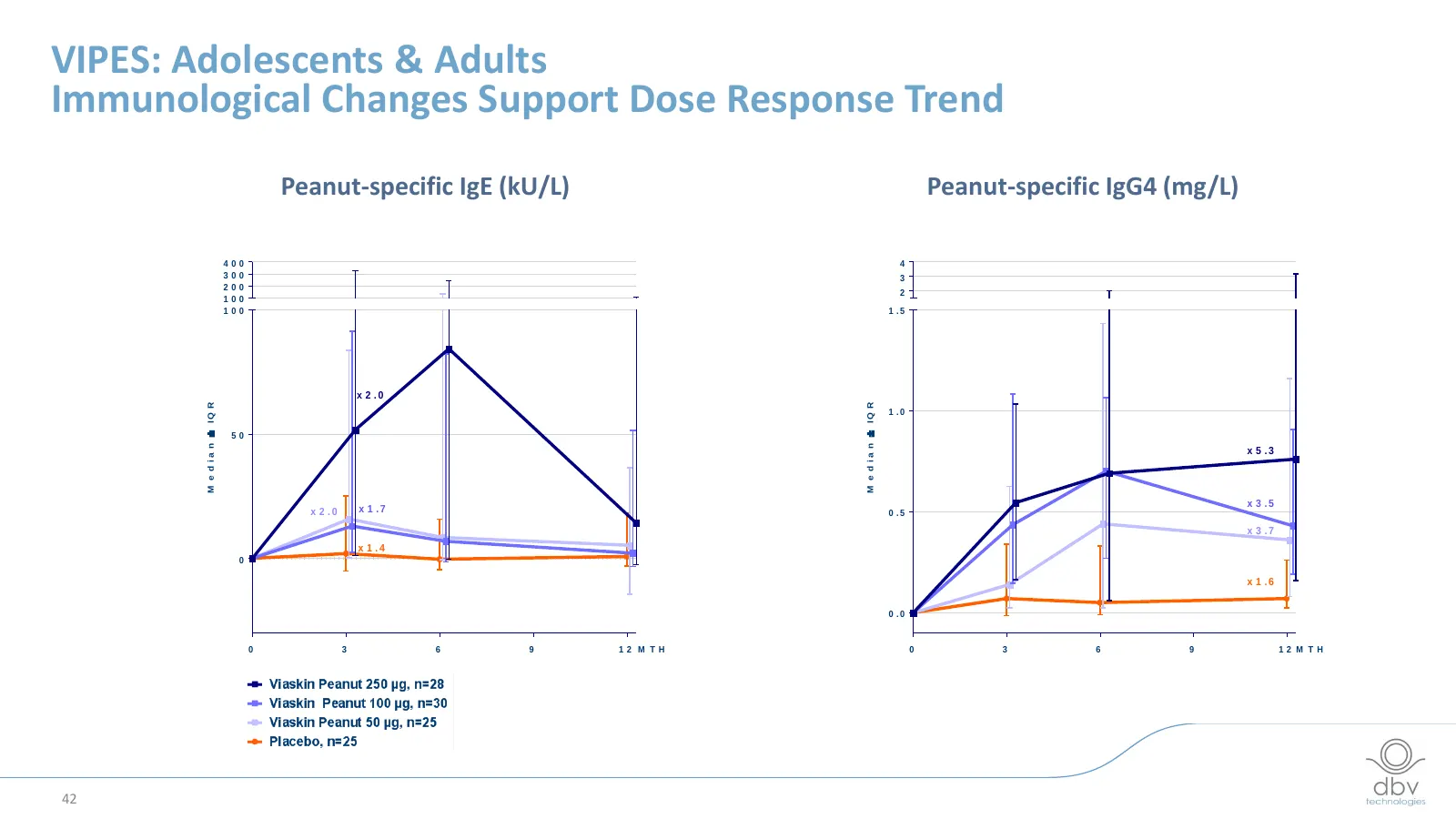
Slide 42: VIPES: Adolescents & Adults Immunological Changes
VIPES: Adolescents & Adults Immunological Changes Support Dose Response Trend Peanut-specific IgE (kU/L) Peanut-specific IgG4 (mg/L) 400 4 300 3 200 2 100 100 1 .5 x 2 .0 M e d ia n IQ R M e d ia n IQ R 1 .0 50 x 5 .3 x 3 .5 x 2 .0 x 1 .7 0 .5 x 3 .7 x 1 .4 0 x 1 .6 0 .0 0 3 6 9 12 M TH 0 3 6 9
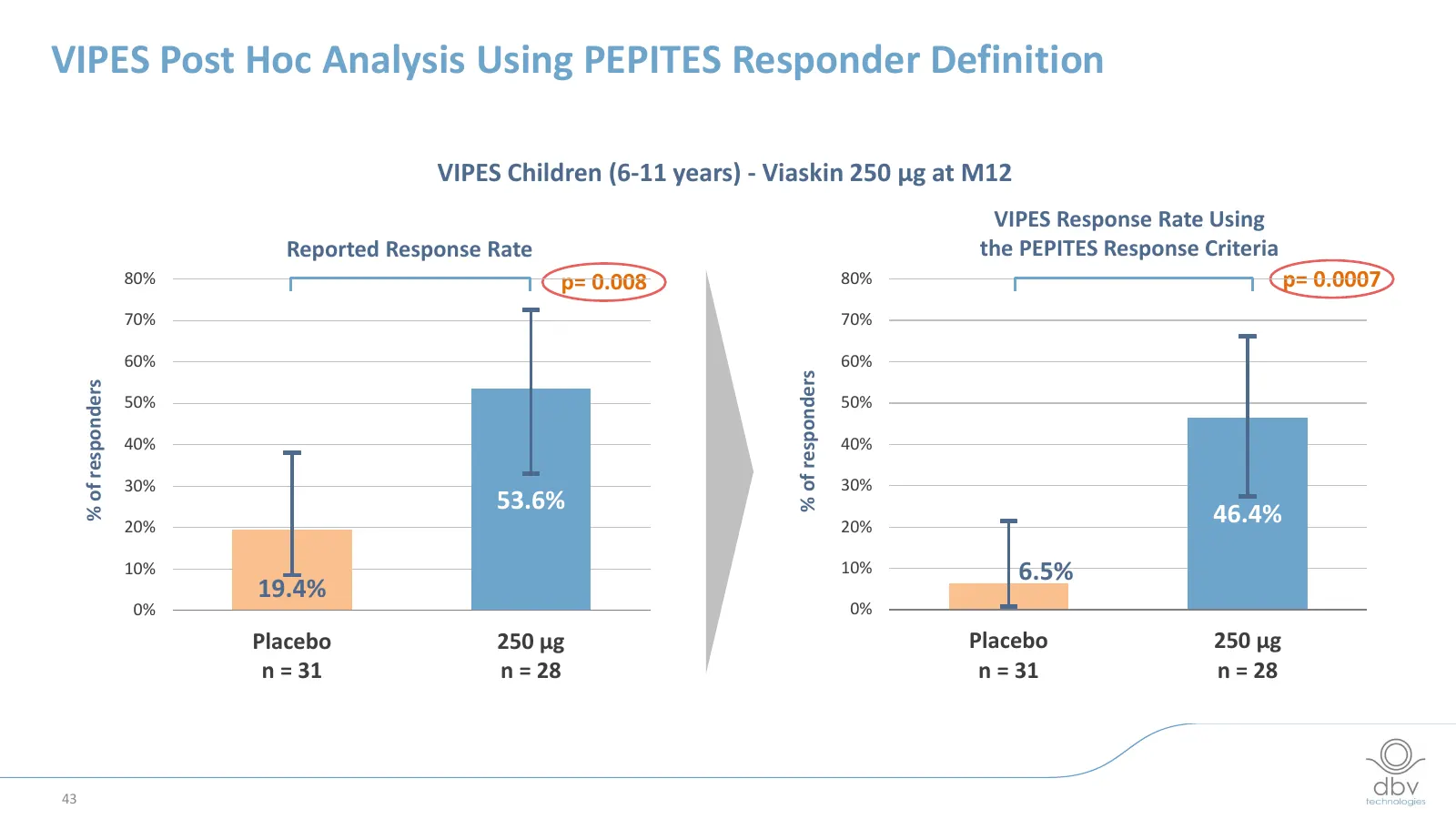
Slide 43: VIPES Post Hoc Analysis Using PEPITES Responder Definition
VIPES Post Hoc Analysis Using PEPITES Responder Definition VIPES Children (6-11 years) - Viaskin 250 μg at M12 VIPES Response Rate Using Reported Response Rate the PEPITES Response Criteria 80% p= 0.008 80% p= 0.0007 70% 70% 60% 60% % of responders % of responders 50% 50% 40% 40% 30% 30% 53.6% 20% 2
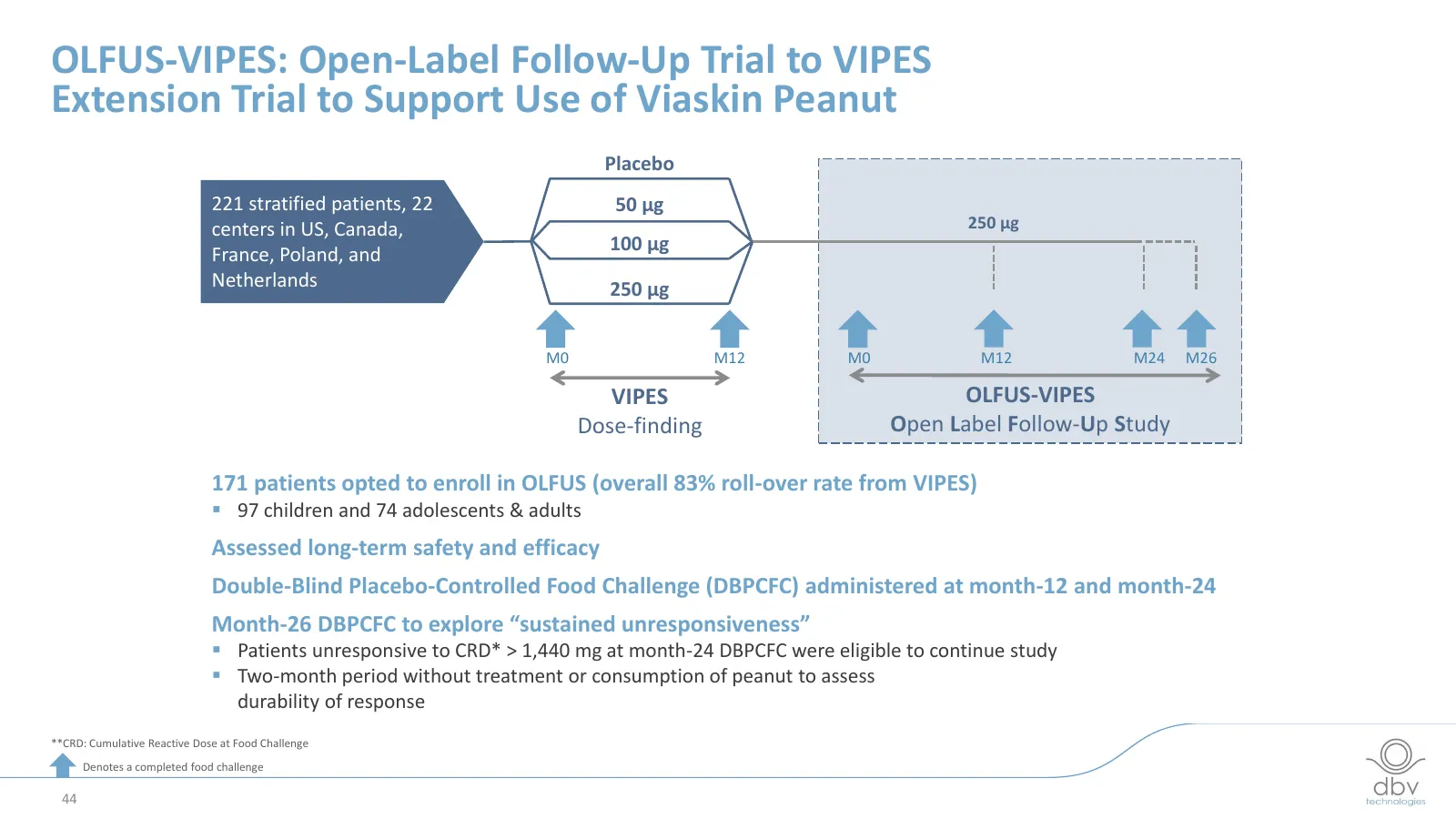
Slide 44: OLFUS-VIPES: Open-Label Follow-Up Trial to VIPES
OLFUS-VIPES: Open-Label Follow-Up Trial to VIPES Extension Trial to Support Use of Viaskin Peanut Placebo 221 stratified patients, 22 50 µg centers in US, Canada, 250 µg 100 µg France, Poland, and Netherlands 250 µg M0 M12 M0 M12 M24 M26 VIPES OLFUS-VIPES Dose-finding Open Label Follow-Up Study 171
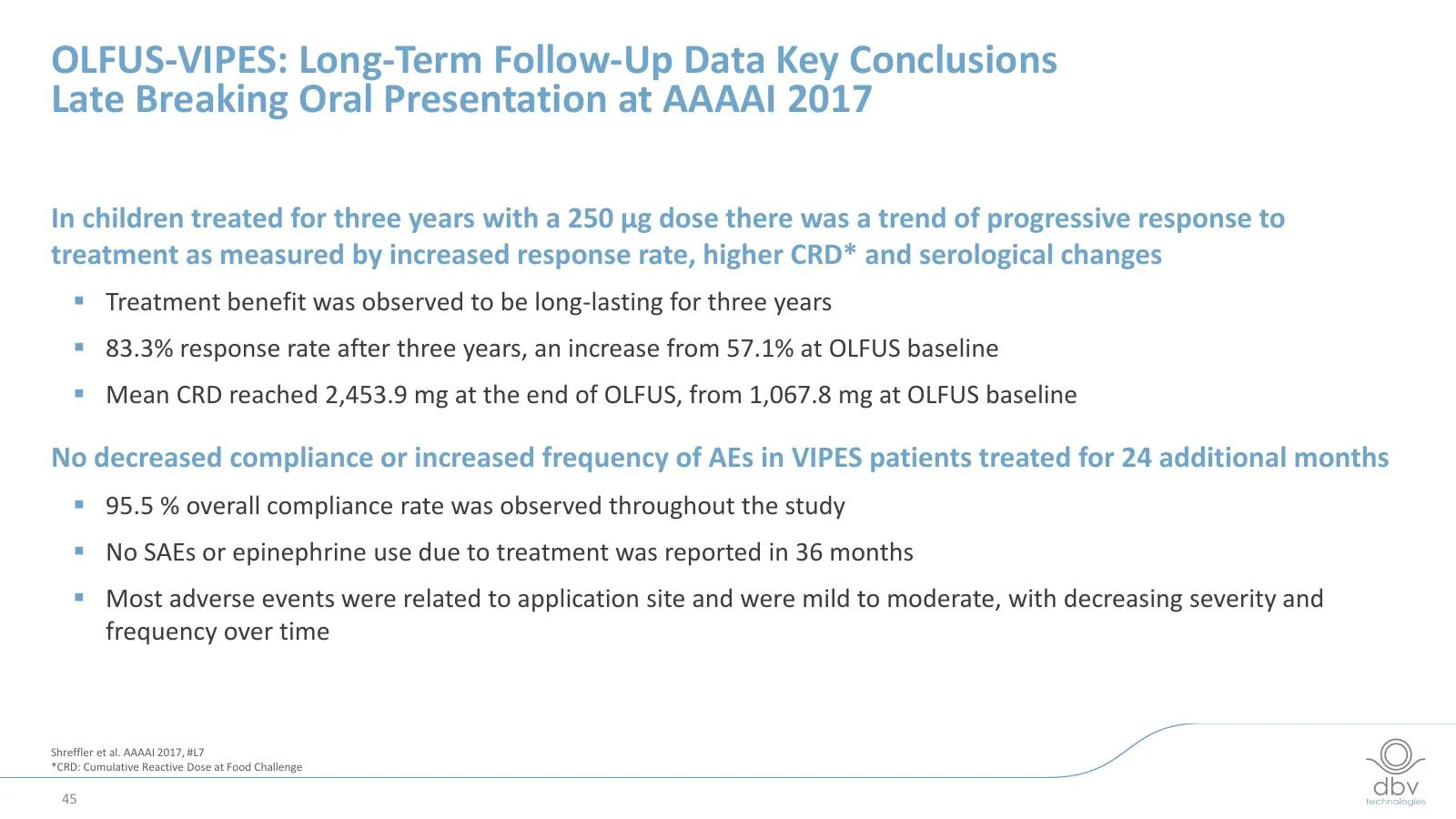
Slide 45: OLFUS-VIPES: Long-Term Follow-Up Data Key Conclusions
OLFUS-VIPES: Long-Term Follow-Up Data Key Conclusions Late Breaking Oral Presentation at AAAAI 2017 In children treated for three years with a 250 µg dose there was a trend of progressive response to treatment as measured by increased response rate, higher CRD* and serological changes ▪ Treatment be
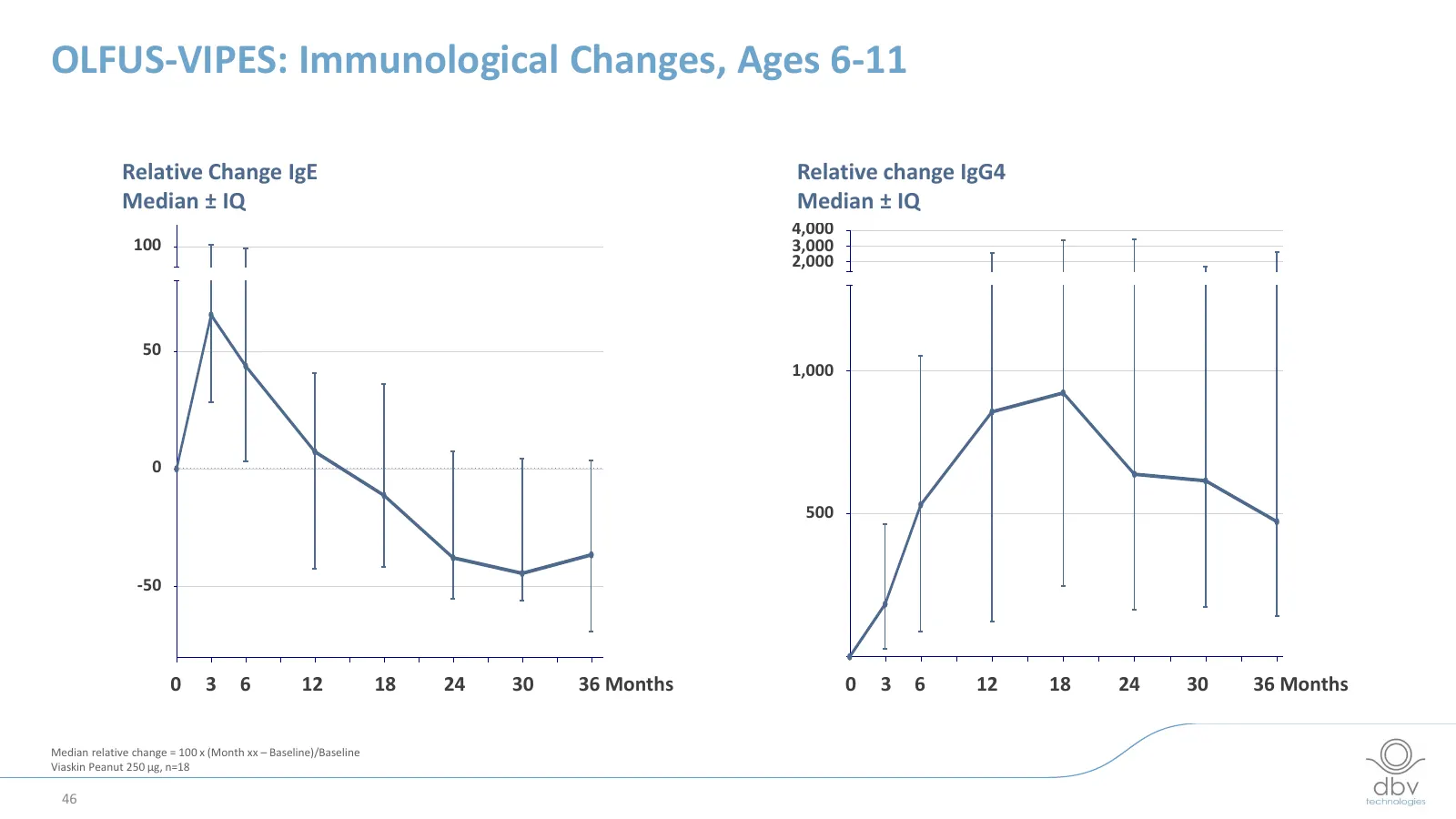
Slide 46: OLFUS-VIPES: Immunological Changes, Ages 6-11
OLFUS-VIPES: Immunological Changes, Ages 6-11 Relative Change IgE Relative change IgG4 R e la tiv e c h a n g e Ig E R e la tiv e C h a n g e Ig G 4 M e d ia n Median IQ ± IQ M e d ia n Median IQ ± IQ 4,000 4 ,0 0 0 1001 0 0 3,000 3 ,0 0 0 2,000 2 ,0 0 0 505 0 1,000 1 ,0 0 0 00 5005 0 0 -50-5 0
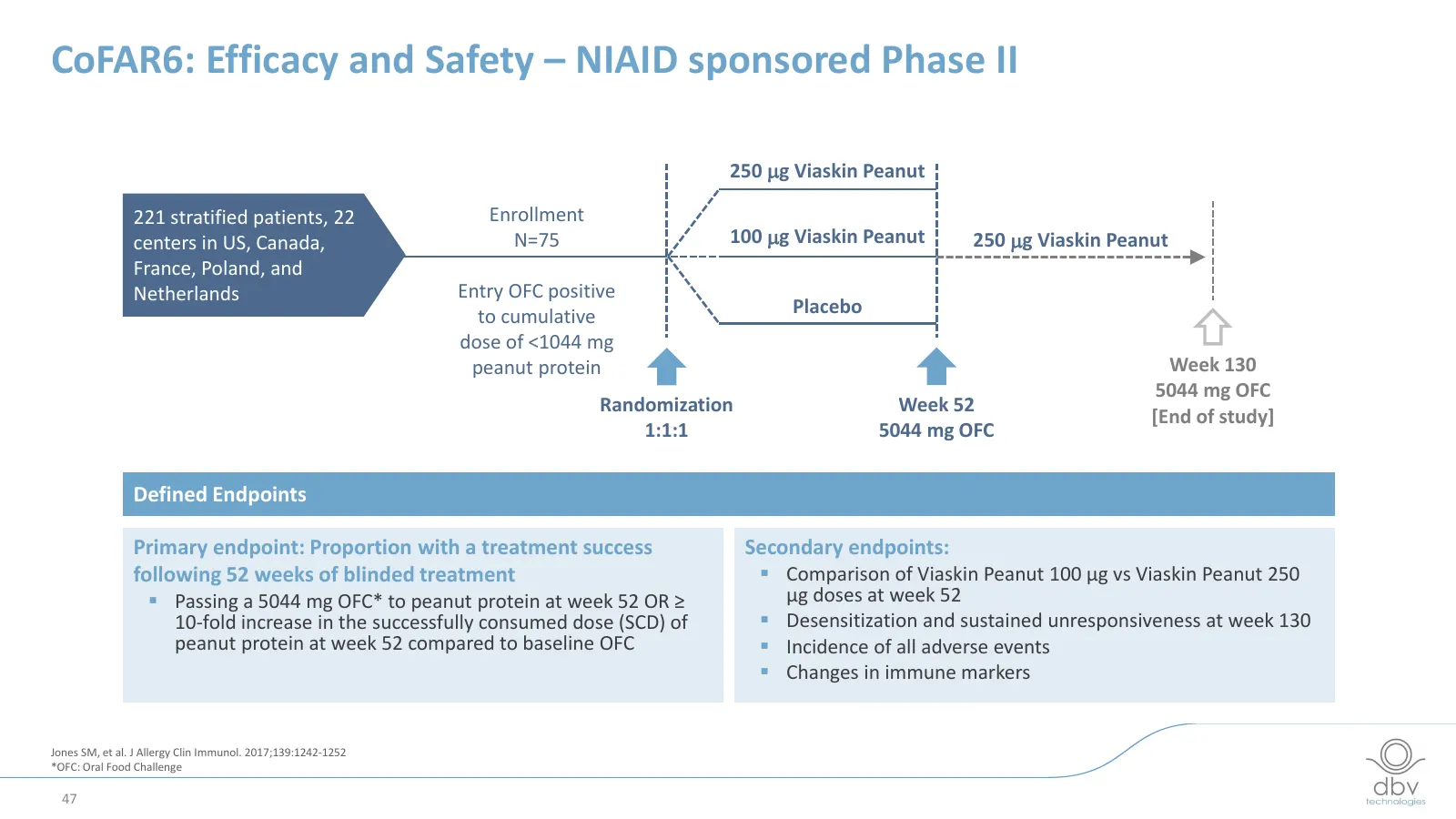
Slide 47: CoFAR6: Efficacy and Safety – NIAID sponsored Phase II
CoFAR6: Efficacy and Safety – NIAID sponsored Phase II 250 mg Viaskin Peanut 221 stratified patients, 22 Enrollment centers in US, Canada, N=75 100 mg Viaskin Peanut 250 mg Viaskin Peanut France, Poland, and Netherlands Entry OFC positive to cumulative Placebo dose of <1044 mg peanut protein Week 13
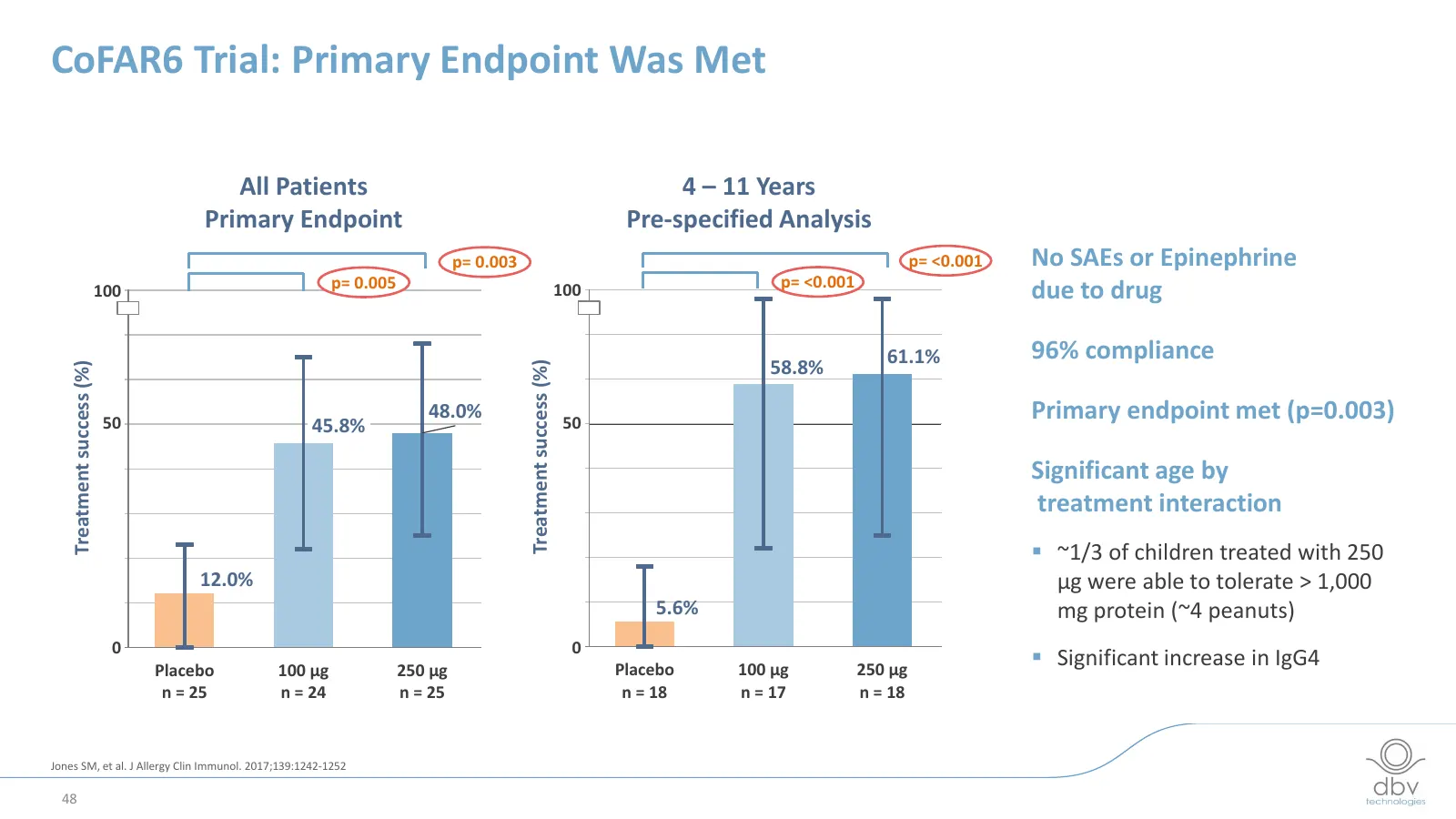
Slide 48: CoFAR6 Trial: Primary Endpoint Was Met
CoFAR6 Trial: Primary Endpoint Was Met All Patients 4 – 11 Years Primary Endpoint Pre-specified Analysis p= 0.003 p= <0.001 No SAEs or Epinephrine p= 0.005 p= <0.001 100 100 due to drug 61.1% 96% compliance 58.8% Treatment success (%) Treatment success (%) 50 48.0% 50 Primary endpoint met (p=0.003)
Slide 49: Unmet Need in Cow's Milk Protein Allergy (CMPA)
Unmet Need in Cow’s Milk Protein Allergy (CMPA) ▪ Milk allergy is one of the most common food allergies in infants and young children, 2% prevalence in children younger than 5 in the U.S.1 ▪ A significant amount of children will eventually outgrow their milk allergy2, 3 ▪ The majority of children su
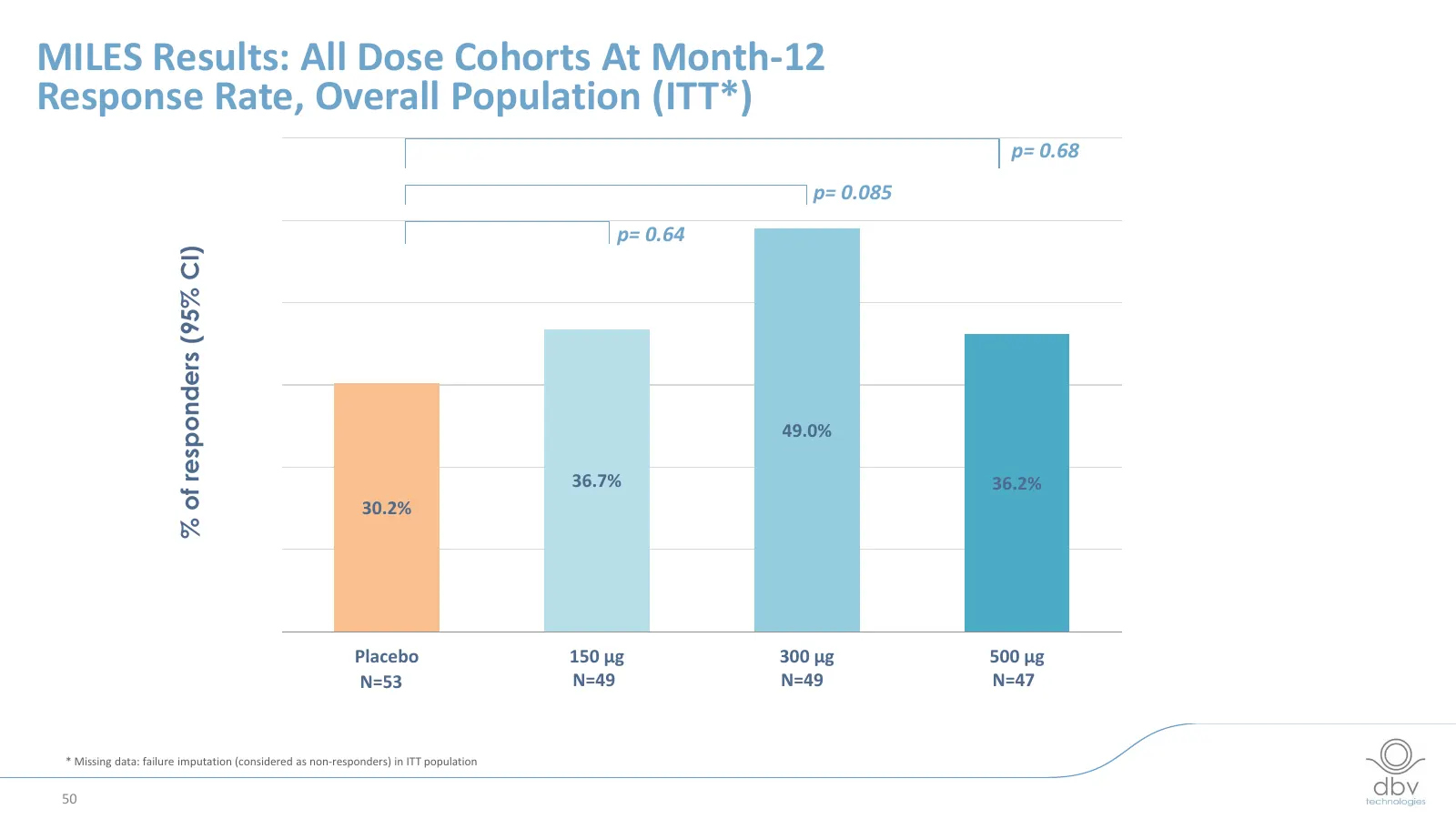
Slide 50: MILES Results: All Dose Cohorts At Month-12
MILES Results: All Dose Cohorts At Month-12 Response Rate, Overall Population (ITT*) p= 0.68 p= 0.085 p= 0.64 % of responders (95% CI) 49.0% 36.7% 36.2% 30.2% Placebo 150 µg 300 µg 500 µg N=53 N=49 N=49 N=47 * Missing data: failure imputation (considered as non-responders) in ITT population 50
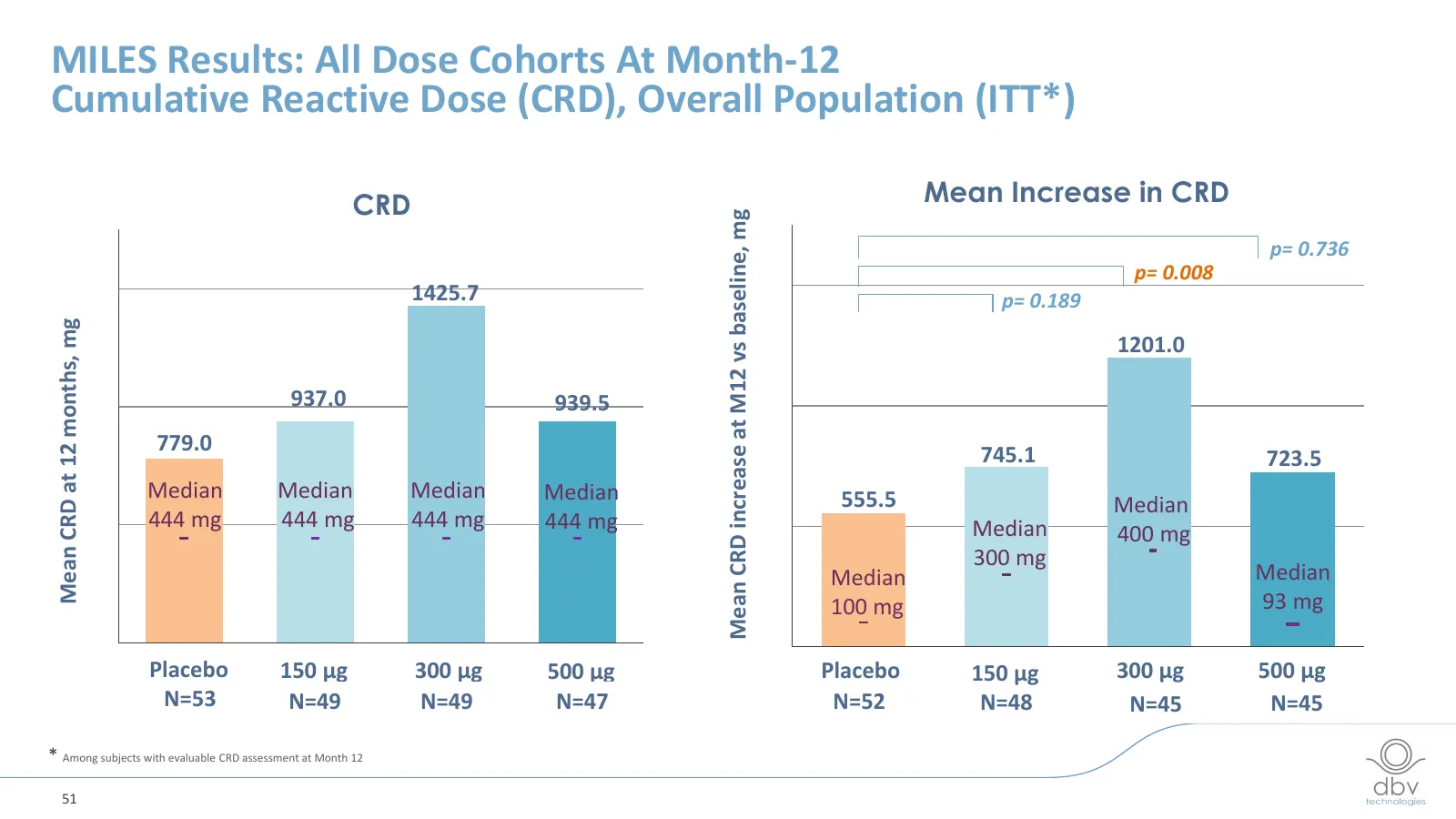
Slide 51: MILES Results: All Dose Cohorts, Cumulative Reactive Dose
MILES Results: All Dose Cohorts At Month-12 Cumulative Reactive Dose (CRD), Overall Population (ITT*) CRD Mean Increase in CRD Mean CRD increase at M12 vs baseline, mg p= 0.736 p= 0.008 1425.7 p= 0.189 Mean CRD at 12 months, mg 1201.0 937.0 939.5 779.0 745.1 723.5 Median Median Median Median 555.5 M
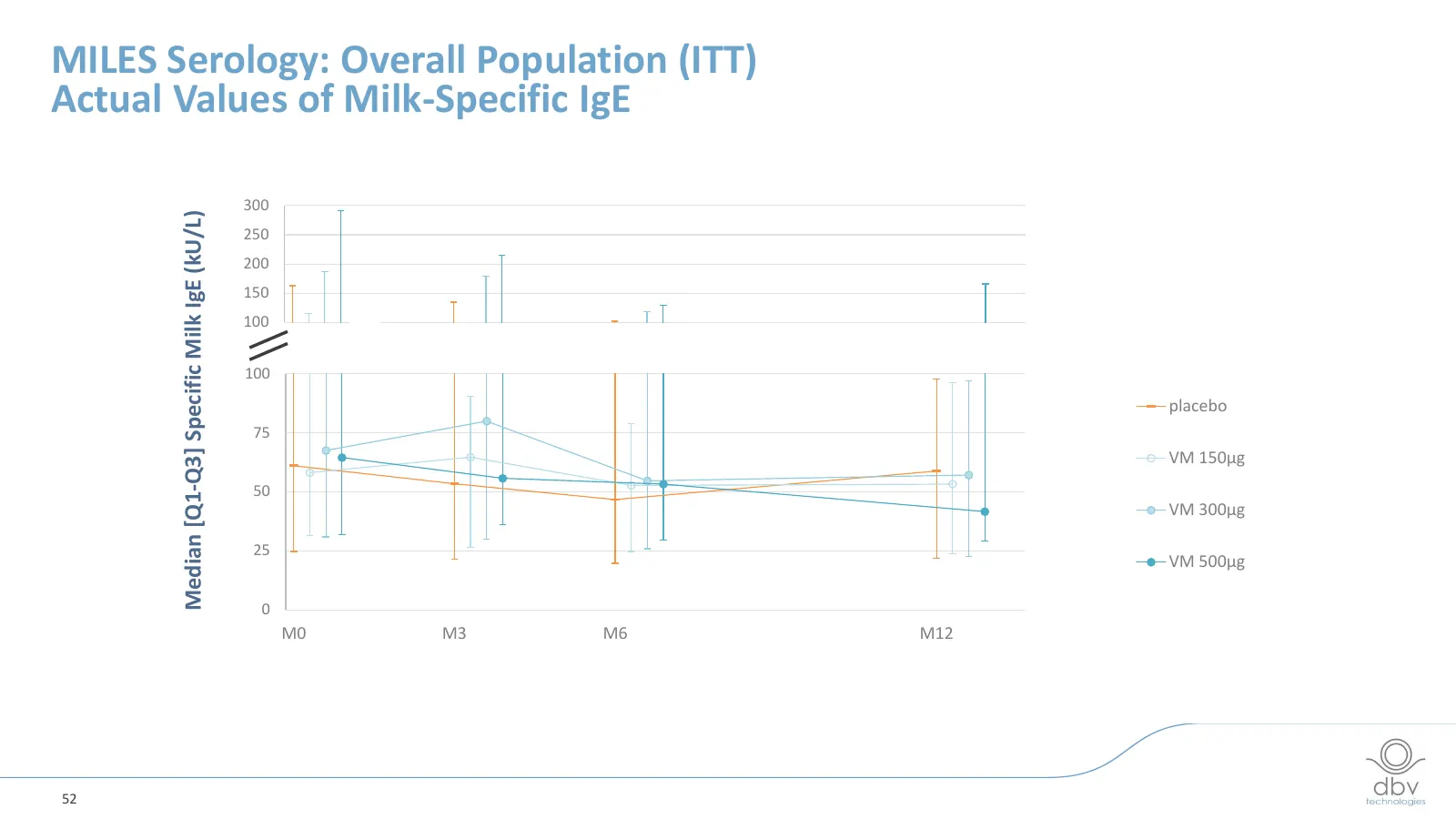
Slide 52: MILES Serology: Overall Population
MILES Serology: Overall Population (ITT) Actual Values of Milk-Specific IgE 300 Median [Q1-Q3] Specific Milk IgE (kU/L) 250 200 150 100 M0 M3 M6 M9 M12 100 placebo 75 VM 150µg 50 VM 300µg 25 VM 500µg 0 M0 M3 M6 M12 52
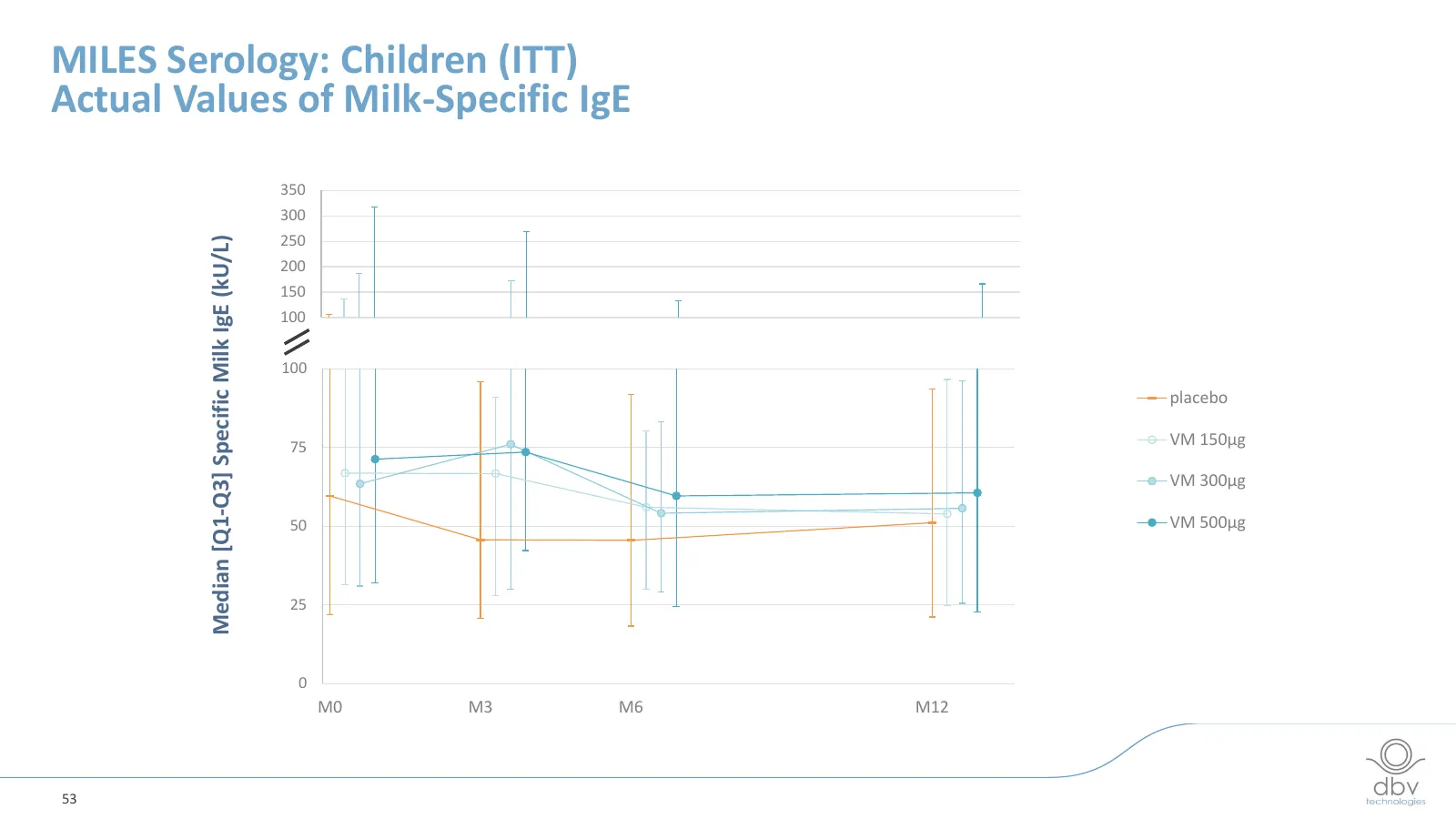
Slide 53: MILES Serology: Children
MILES Serology: Children (ITT) Actual Values of Milk-Specific IgE 350 300 250 Median [Q1-Q3] Specific Milk IgE (kU/L) 200 150 100 M0 M3 M6 M12 100 placebo 75 VM 150µg VM 300µg 50 VM 500µg 25 0 M0 M3 M6 M12 53
Source: Internet Archive copy of dbv-technologies.com
More decks from DBV Technologies SA
 Investor Presentation (November 2026)45 slides · November 2026
 Investor Presentation (July 2026)45 slides · July 2026
 Technical Presentation (June 2026)10 slides · June 2026
 Technical Presentation (June 2026)11 slides · June 2026
 Investor Presentation (May 2026)39 slides · May 2026
 Investor Presentation (April 2026)39 slides · April 2026