Fennec Pharmaceuticals Inc. · NASDAQ:FENC
Fennec Pharmaceuticals — Investor Presentation
23 slides from Fennec Pharmaceuticals's investor presentation
Slide 1: Eniluracil Summary
Eniluracil Summary - : ~ ohh
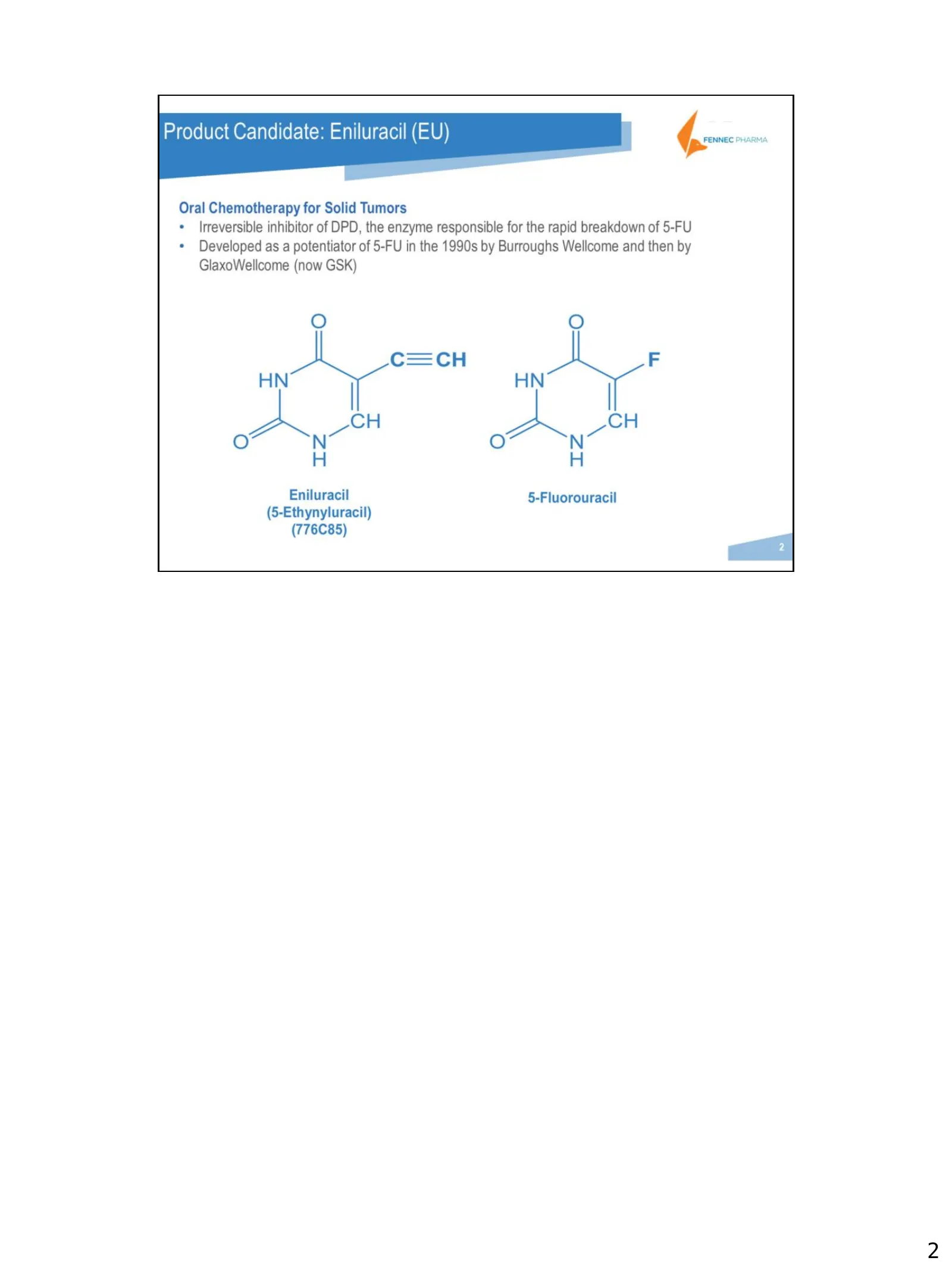
Slide 2: Eniluracil (5-Ethynyluracil)
Eniluracil (5-Ethynyluracil) (776C85) Product Candidate: Eniluracil (EU) Oral Chemotherapy for Solid Tumors + Irreversible inhibitor of DPD, the enzyme responsible for the rapid breakdown of 5-FU + Developed as a potentiator of 5-FU in the 1990s by Burroughs Wellcome and then by GlaxoWellcome (now G
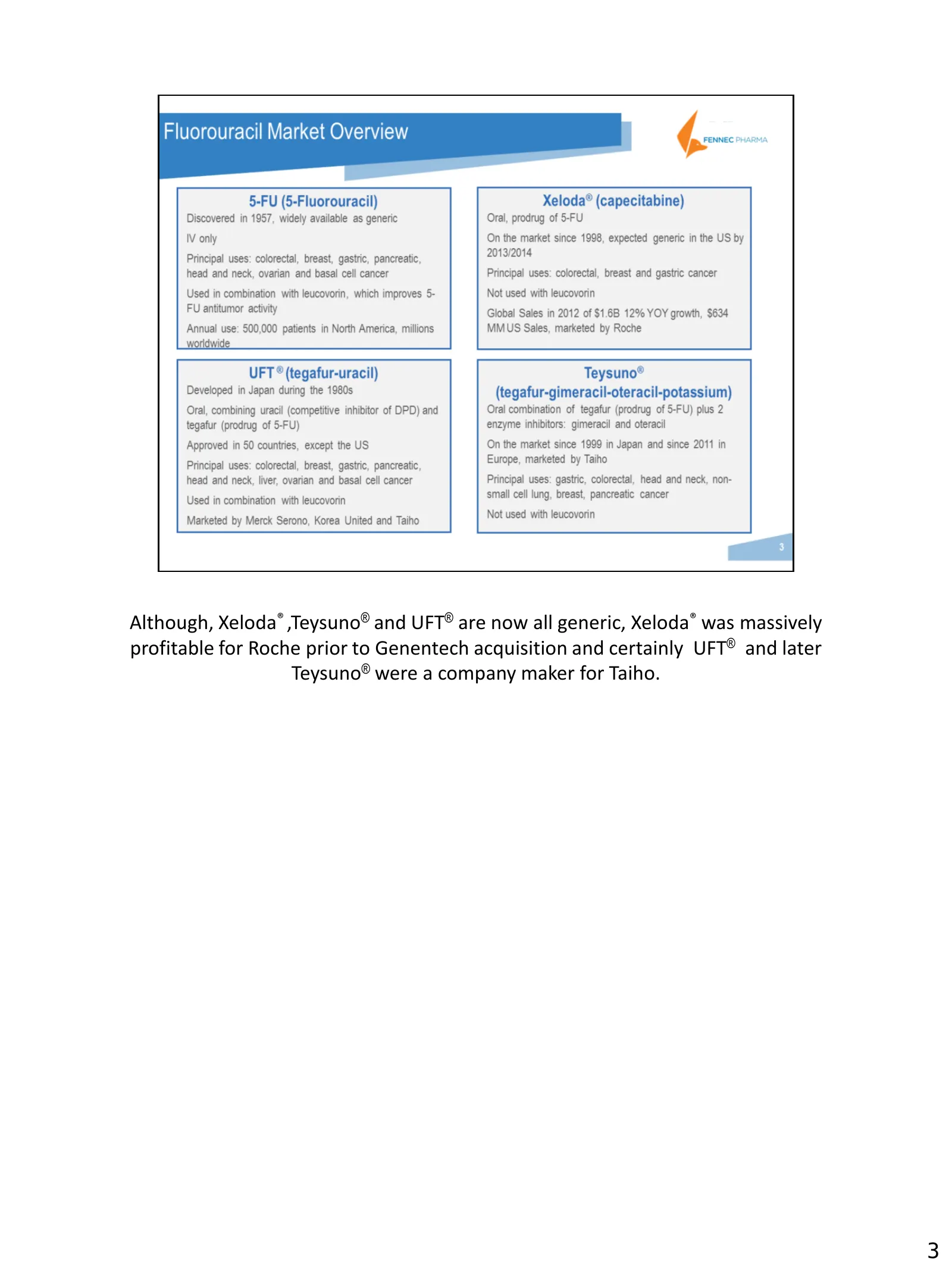
Slide 3: Xeloda, Teysuno and UFT now generic
Although, Xeloda® ,Teysuno® and UFT® are now all generic, Xeloda® was massively profitable for Roche prior to Genentech acquisition and certainly UFT® and later Teysuno® were a company maker for Taiho. 3
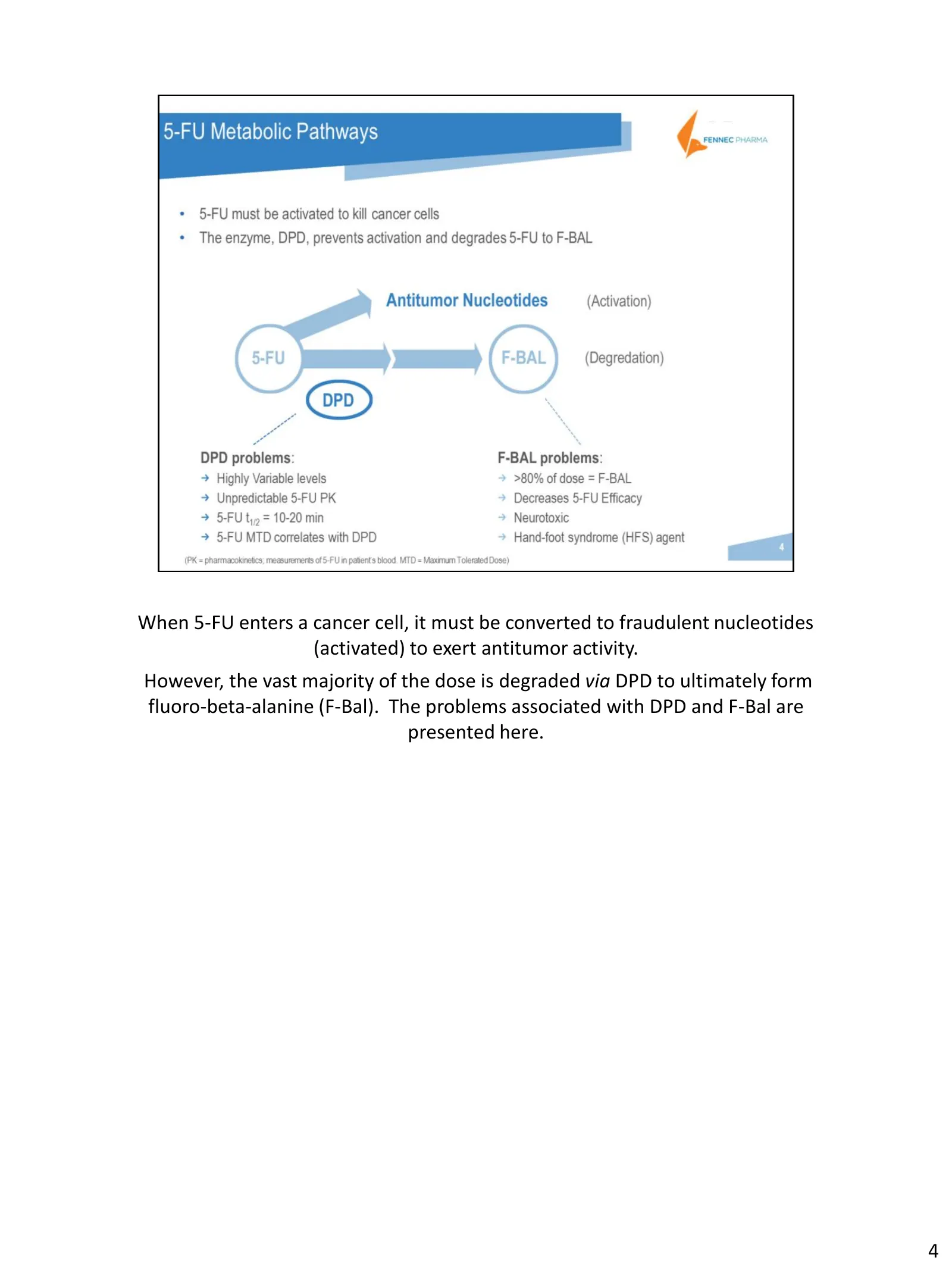
Slide 4: 5-FU activation and DPD degradation
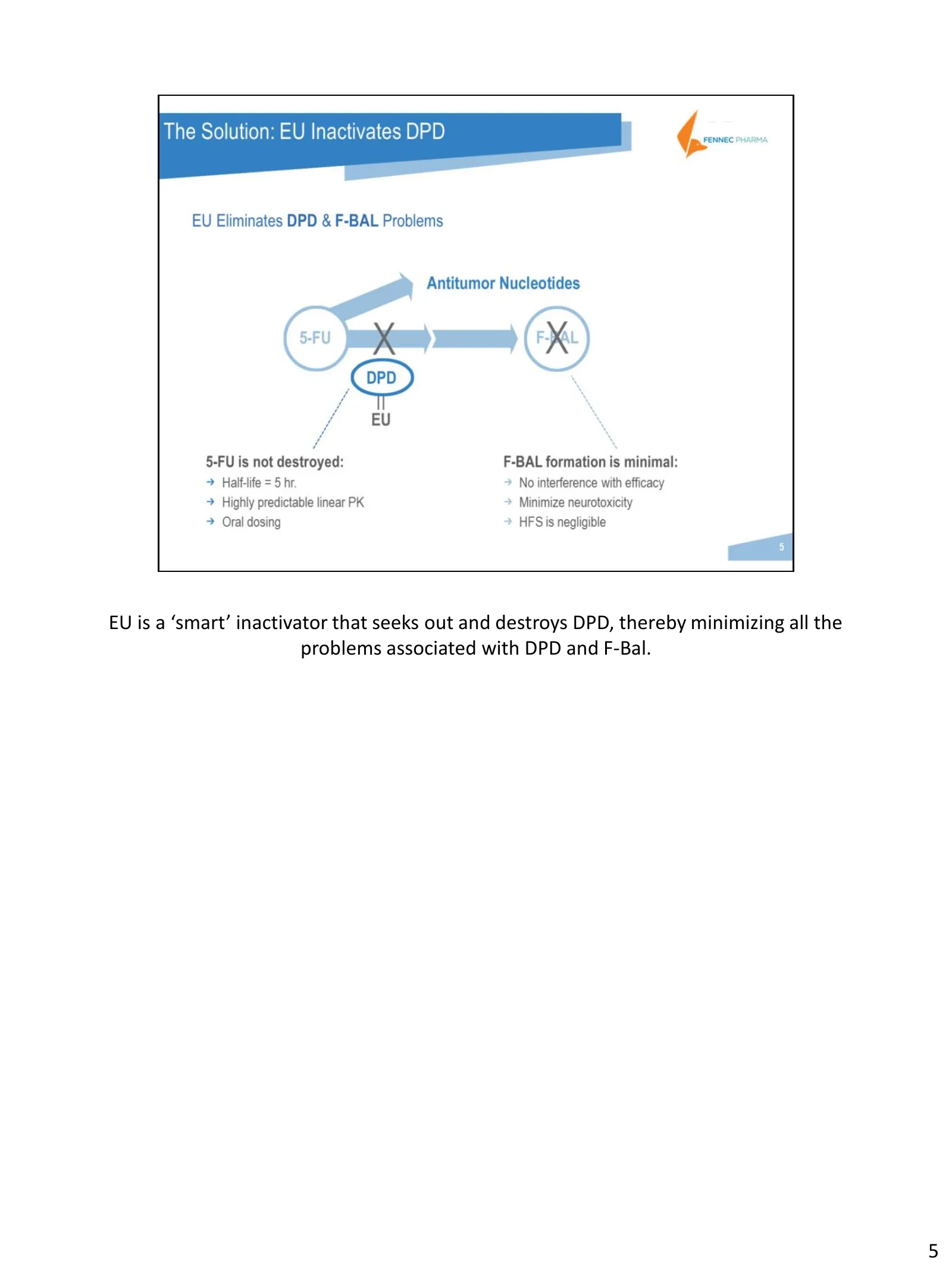
When 5-FU enters a cancer cell, it must be converted to fraudulent nucleotides (activated) to exert antitumor activity. However, the vast majority of the dose is degraded via DPD to ultimately form fluoro-beta-alanine (F-Bal). The problems associated with DPD and F-Bal are presented here. 4
Slide 5: EU as a smart inactivator of DPD
EU is a ‘smart’ inactivator that seeks out and destroys DPD, thereby minimizing all the problems associated with DPD and F-Bal. 5
Slide 6: EU improves anti-tumor activity and therapeutic index of 5-FU
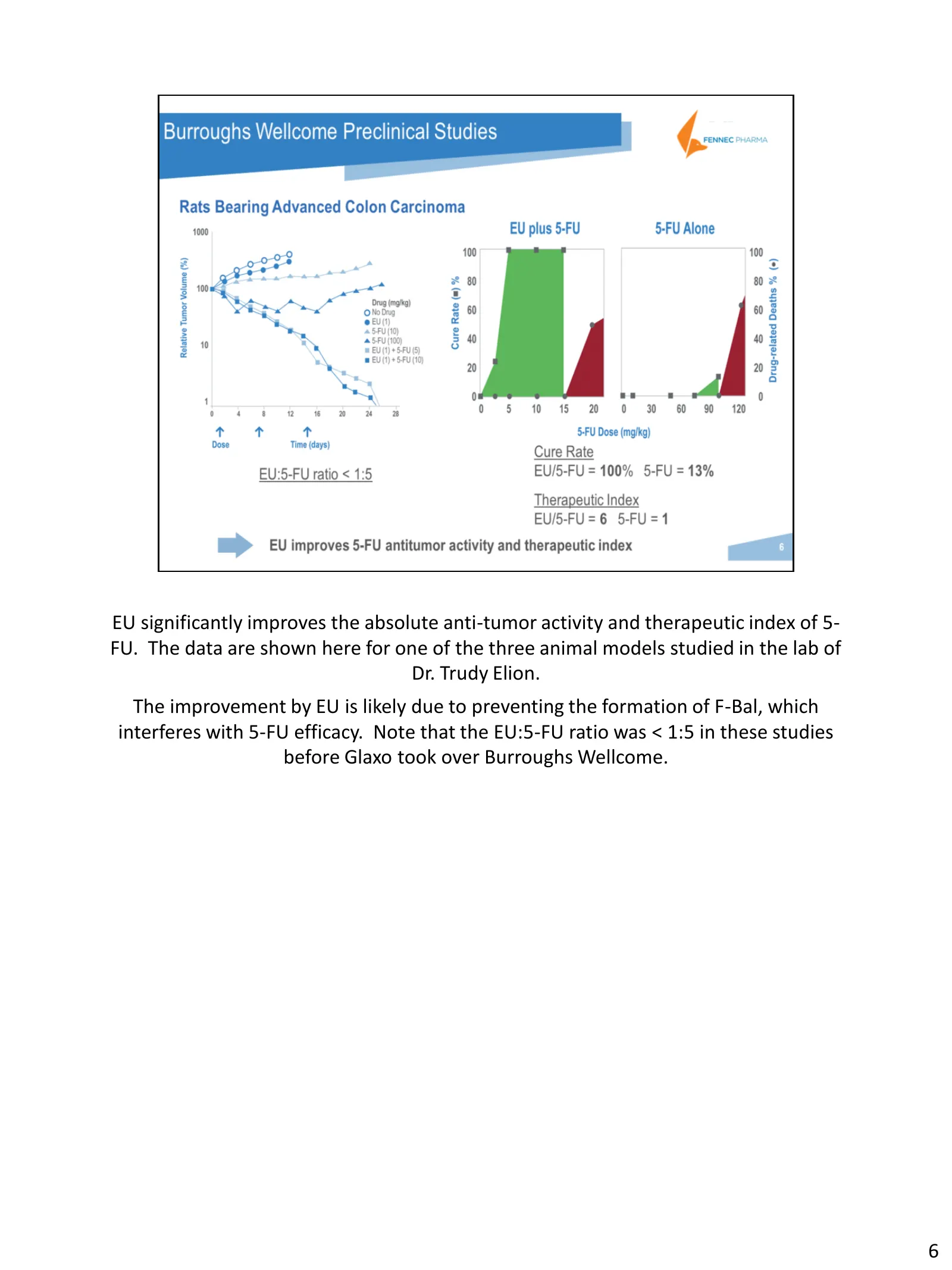
EU significantly improves the absolute anti-tumor activity and therapeutic index of 5- FU. The data are shown here for one of the three animal models studied in the lab of Dr. Trudy Elion. The improvement by EU is likely due to preventing the formation of F-Bal, which interferes with 5-FU efficacy.
Slide 7: Early clinical studies of EU
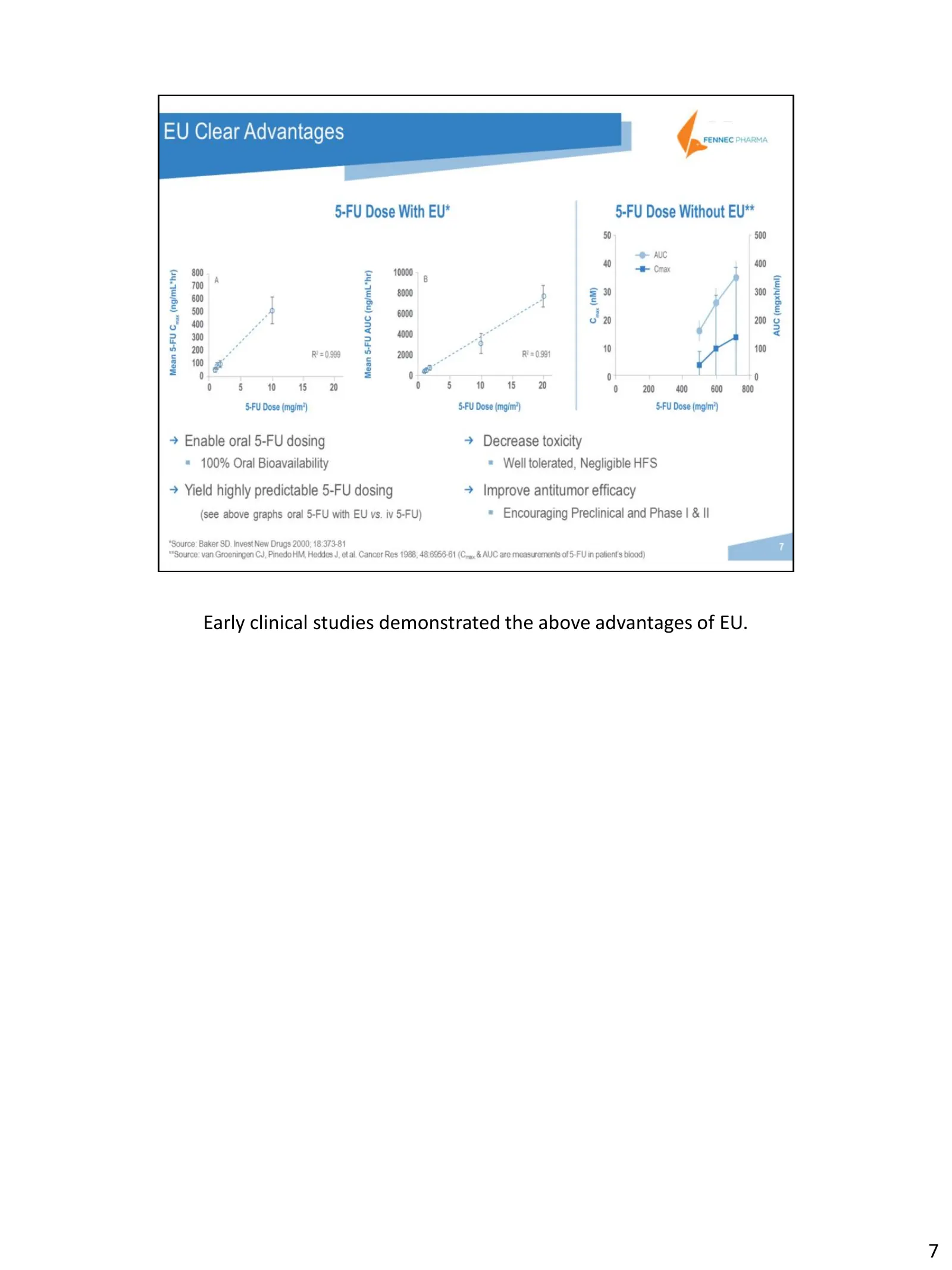
Early clinical studies demonstrated the above advantages of EU. 7
Slide 8: Phase III oral eniluracil/5-FU results
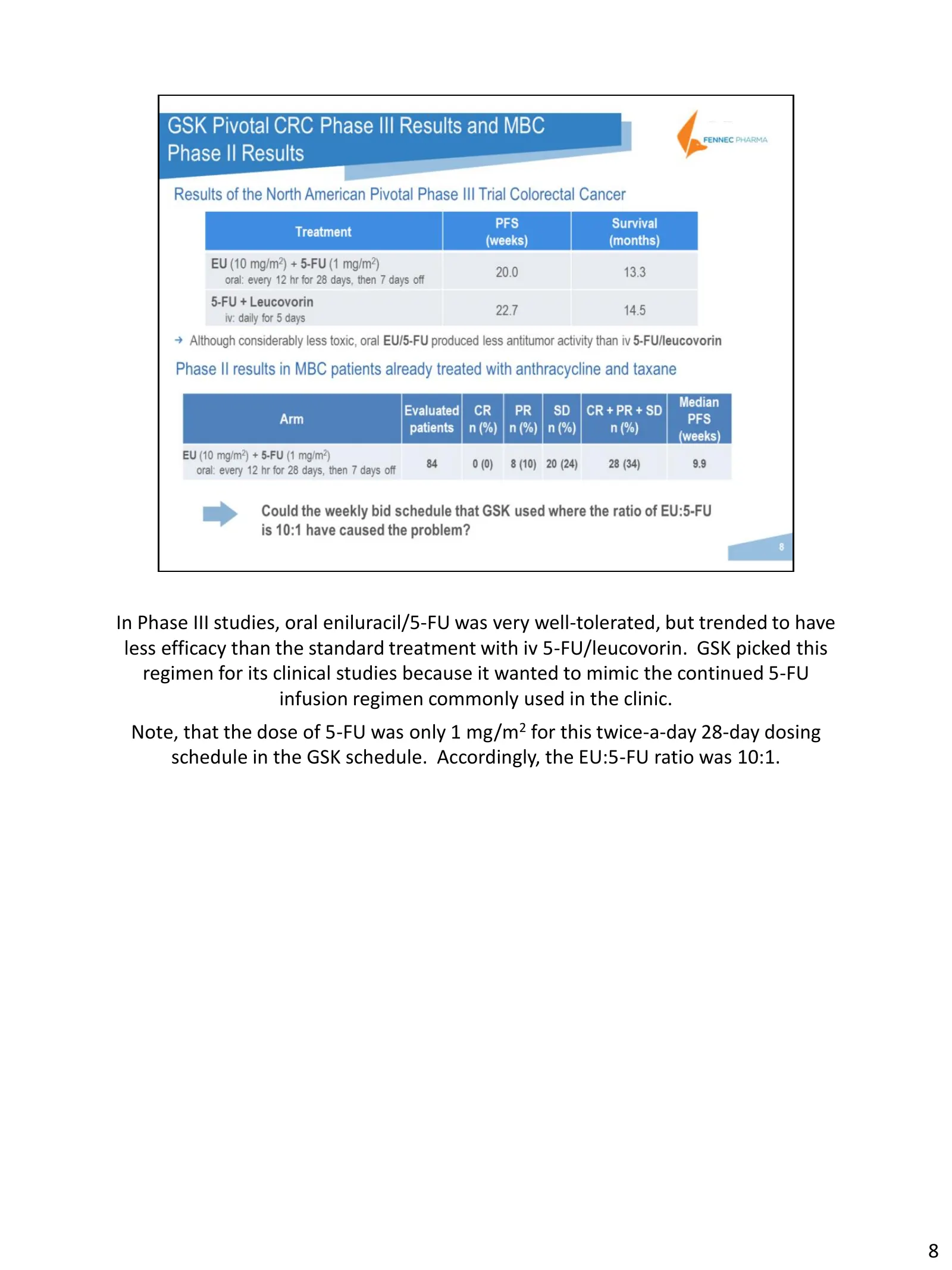
In Phase III studies, oral eniluracil/5-FU was very well-tolerated, but trended to have less efficacy than the standard treatment with iv 5-FU/leucovorin. GSK picked this regimen for its clinical studies because it wanted to mimic the continued 5-FU infusion regimen commonly used in the clinic. Note
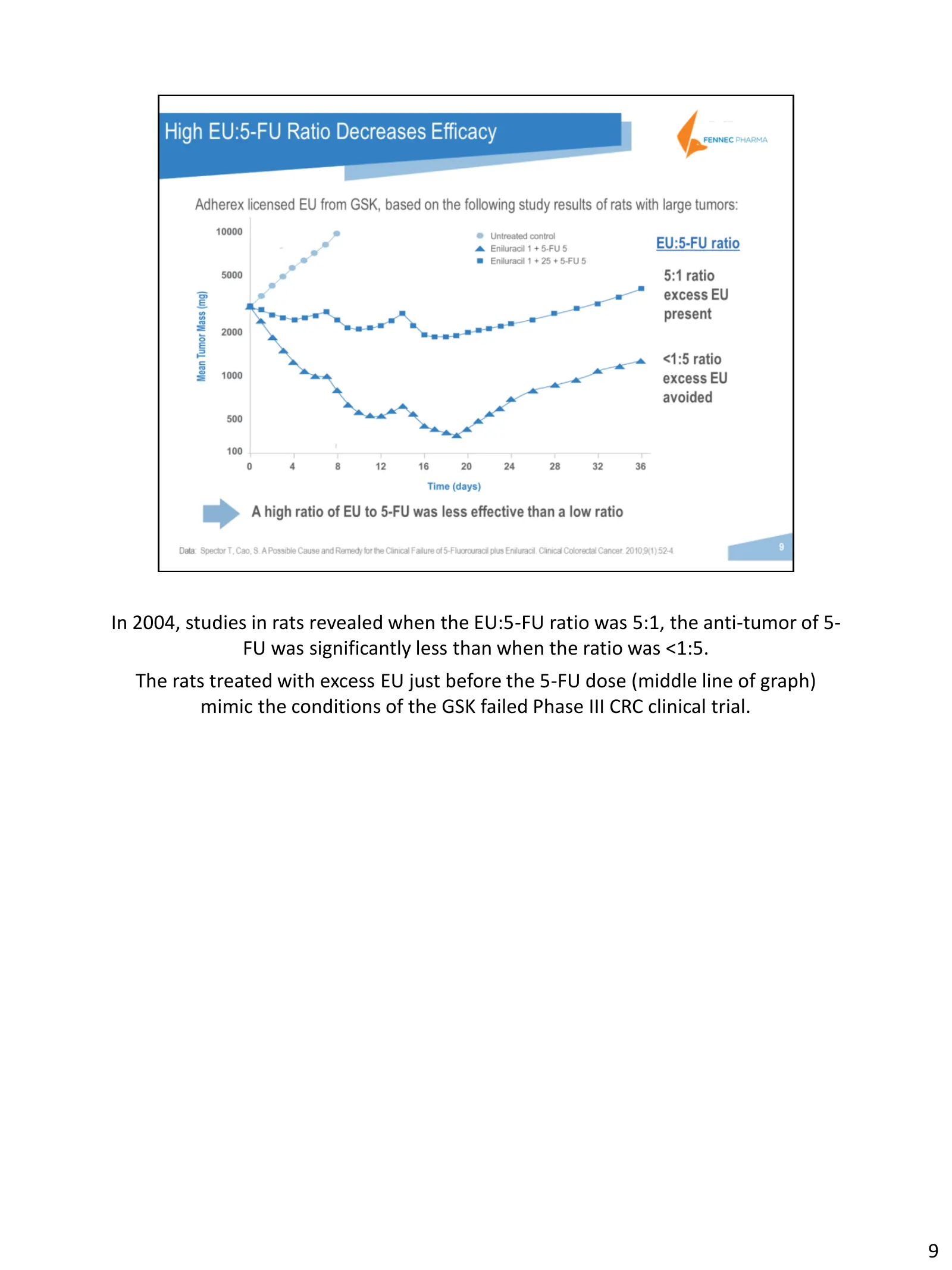
Slide 9: 2004 rat studies on EU:5-FU ratio
In 2004, studies in rats revealed when the EU:5-FU ratio was 5:1, the anti-tumor of 5- FU was significantly less than when the ratio was <1:5. The rats treated with excess EU just before the 5-FU dose (middle line of graph) mimic the conditions of the GSK failed Phase III CRC clinical trial. 9
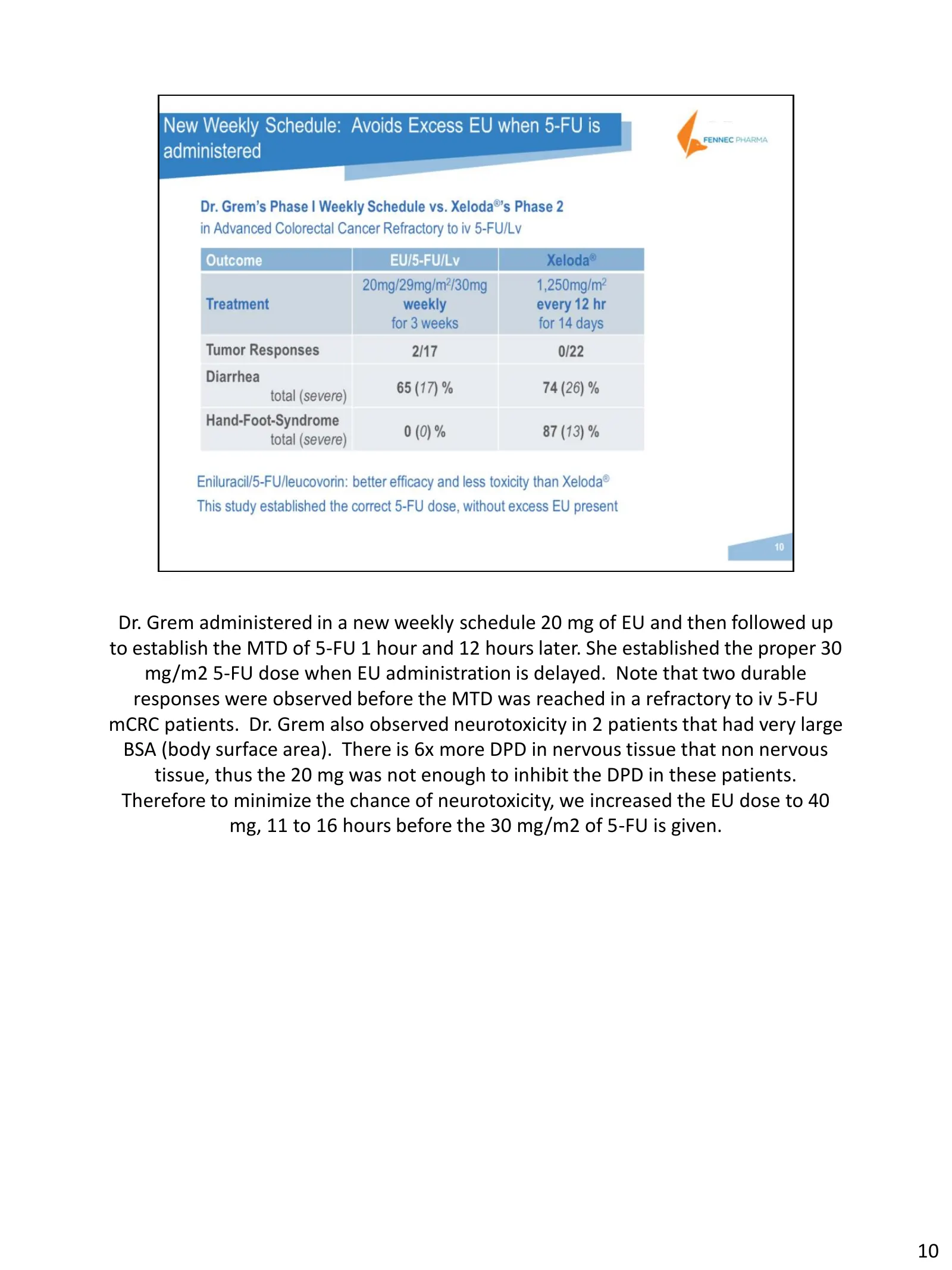
Slide 10: Dr. Grem weekly schedule and MTD of 5-FU
Dr. Grem administered in a new weekly schedule 20 mg of EU and then followed up to establish the MTD of 5-FU 1 hour and 12 hours later. She established the proper 30 mg/m2 5-FU dose when EU administration is delayed. Note that two durable responses were observed before the MTD was reached in a refra
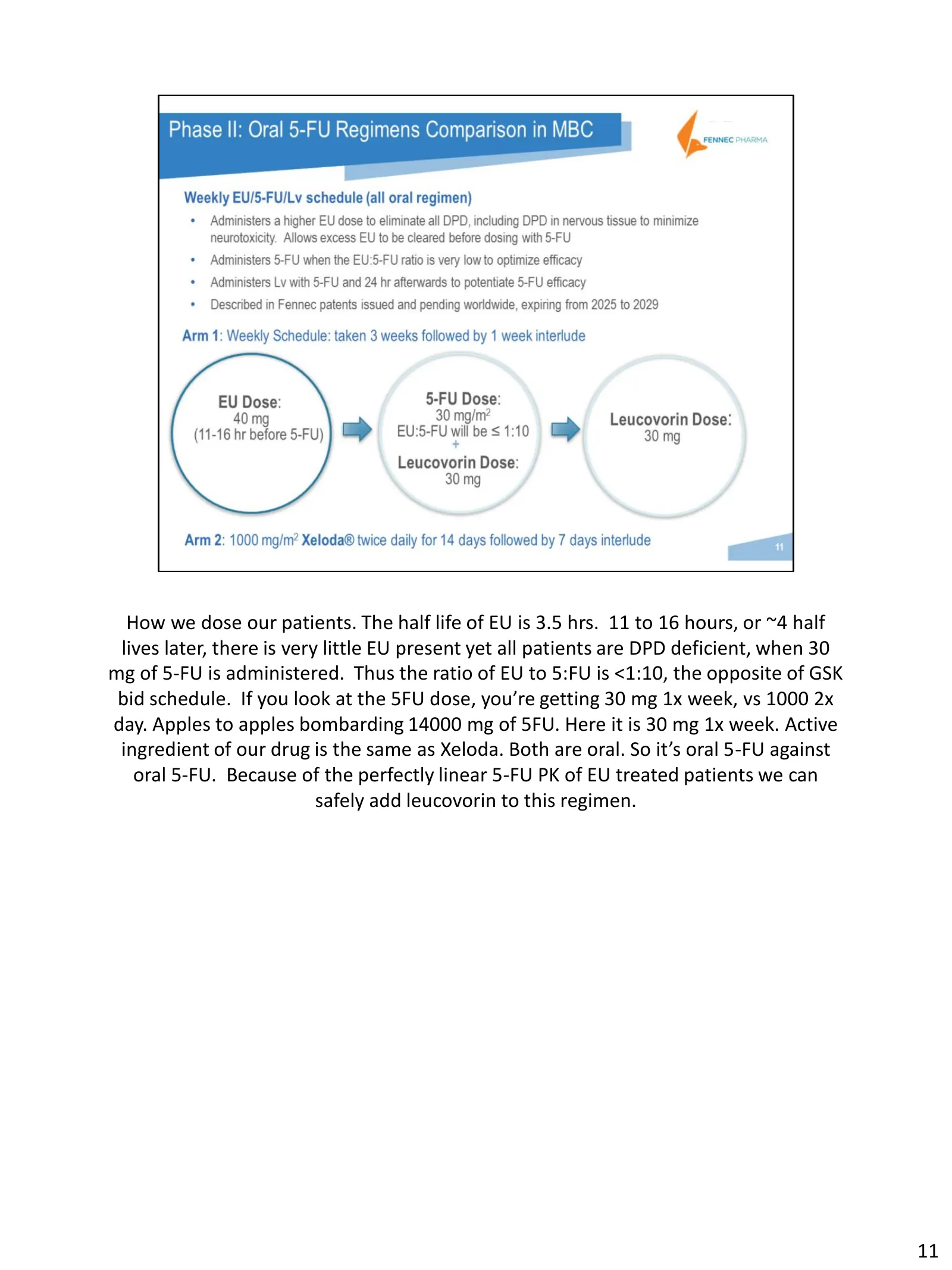
Slide 11: How we dose our patients
How we dose our patients. The half life of EU is 3.5 hrs. 11 to 16 hours, or ~4 half lives later, there is very little EU present yet all patients are DPD deficient, when 30 mg of 5-FU is administered. Thus the ratio of EU to 5:FU is <1:10, the opposite of GSK bid schedule. If you look at the 5FU do
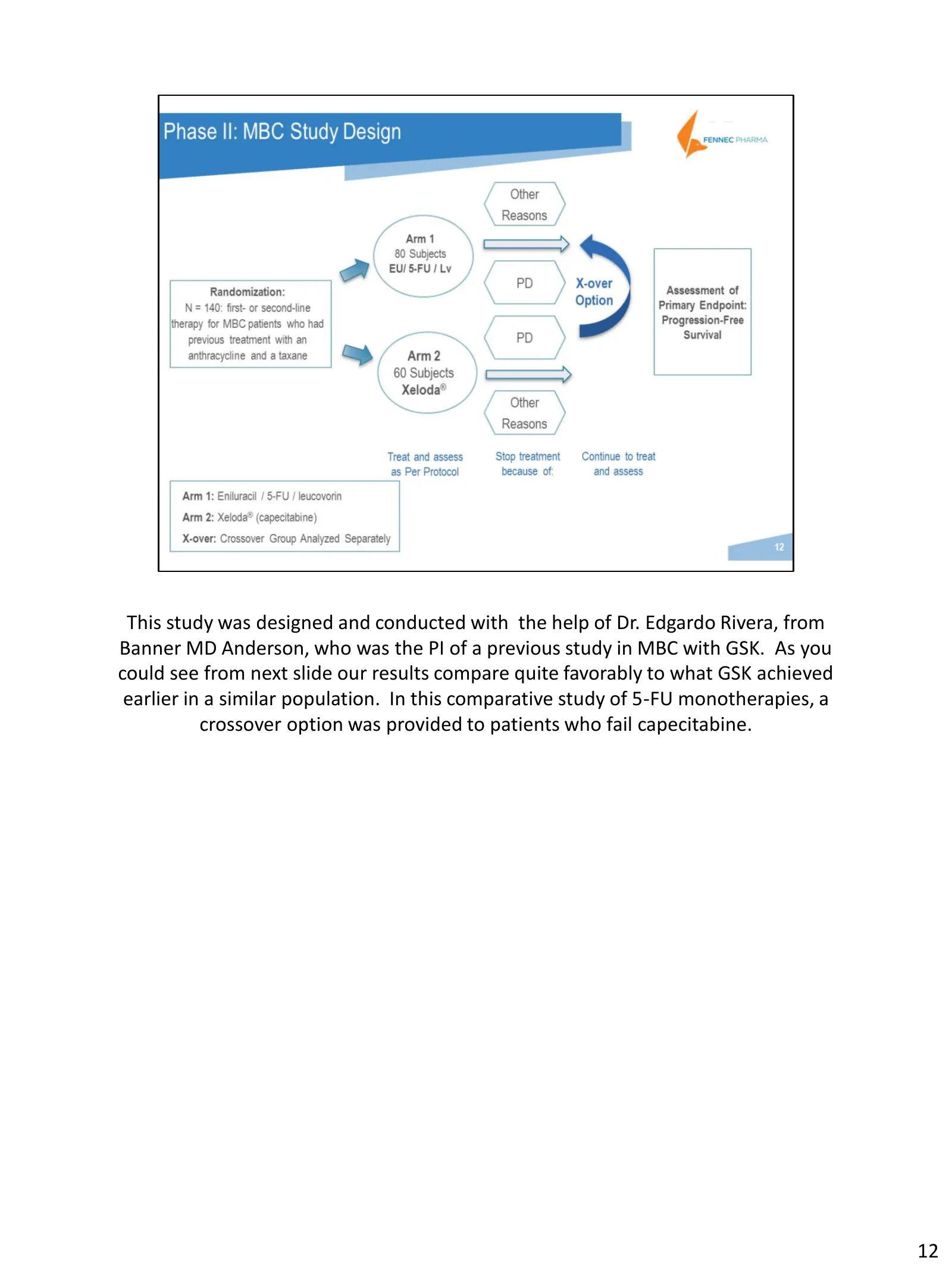
Slide 12: Metastatic breast cancer study design
This study was designed and conducted with the help of Dr. Edgardo Rivera, from Banner MD Anderson, who was the PI of a previous study in MBC with GSK. As you could see from next slide our results compare quite favorably to what GSK achieved earlier in a similar population. In this comparative study
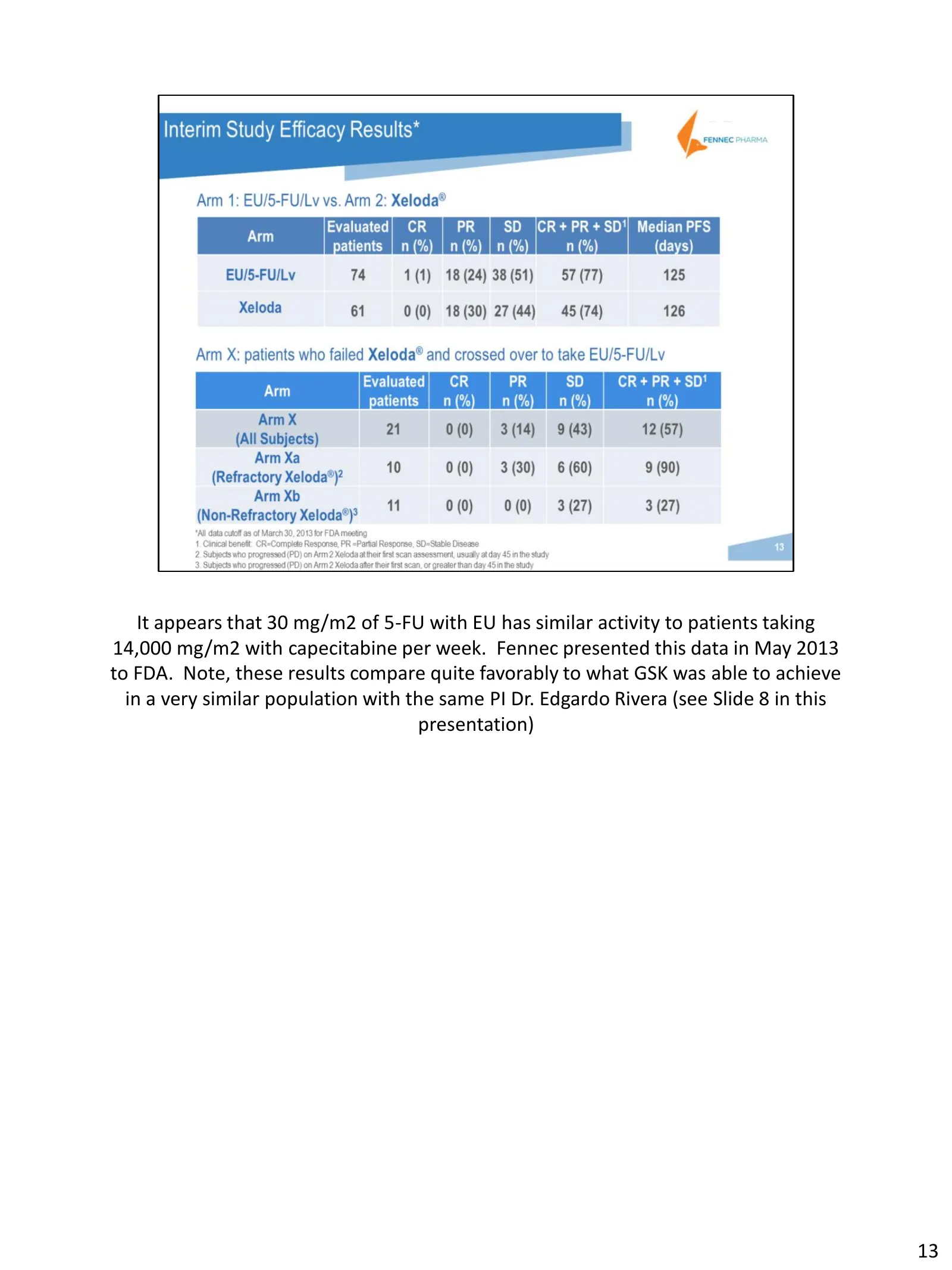
Slide 13: EU with 5-FU activity compared with capecitabine
It appears that 30 mg/m2 of 5-FU with EU has similar activity to patients taking 14,000 mg/m2 with capecitabine per week. Fennec presented this data in May 2013 to FDA. Note, these results compare quite favorably to what GSK was able to achieve in a very similar population with the same PI Dr. Edgar
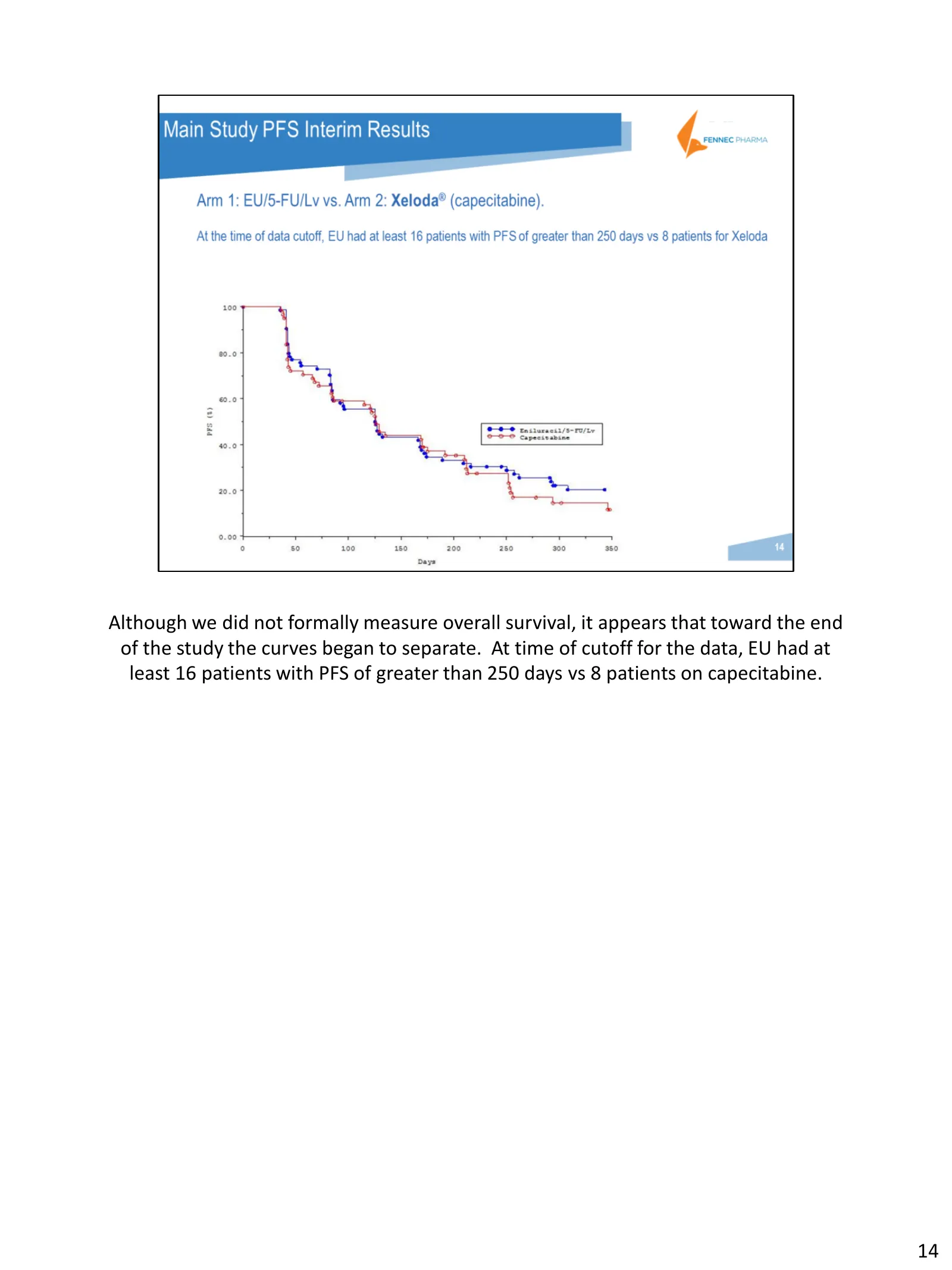
Slide 14: Progression-free survival curves
Although we did not formally measure overall survival, it appears that toward the end of the study the curves began to separate. At time of cutoff for the data, EU had at least 16 patients with PFS of greater than 250 days vs 8 patients on capecitabine. 14
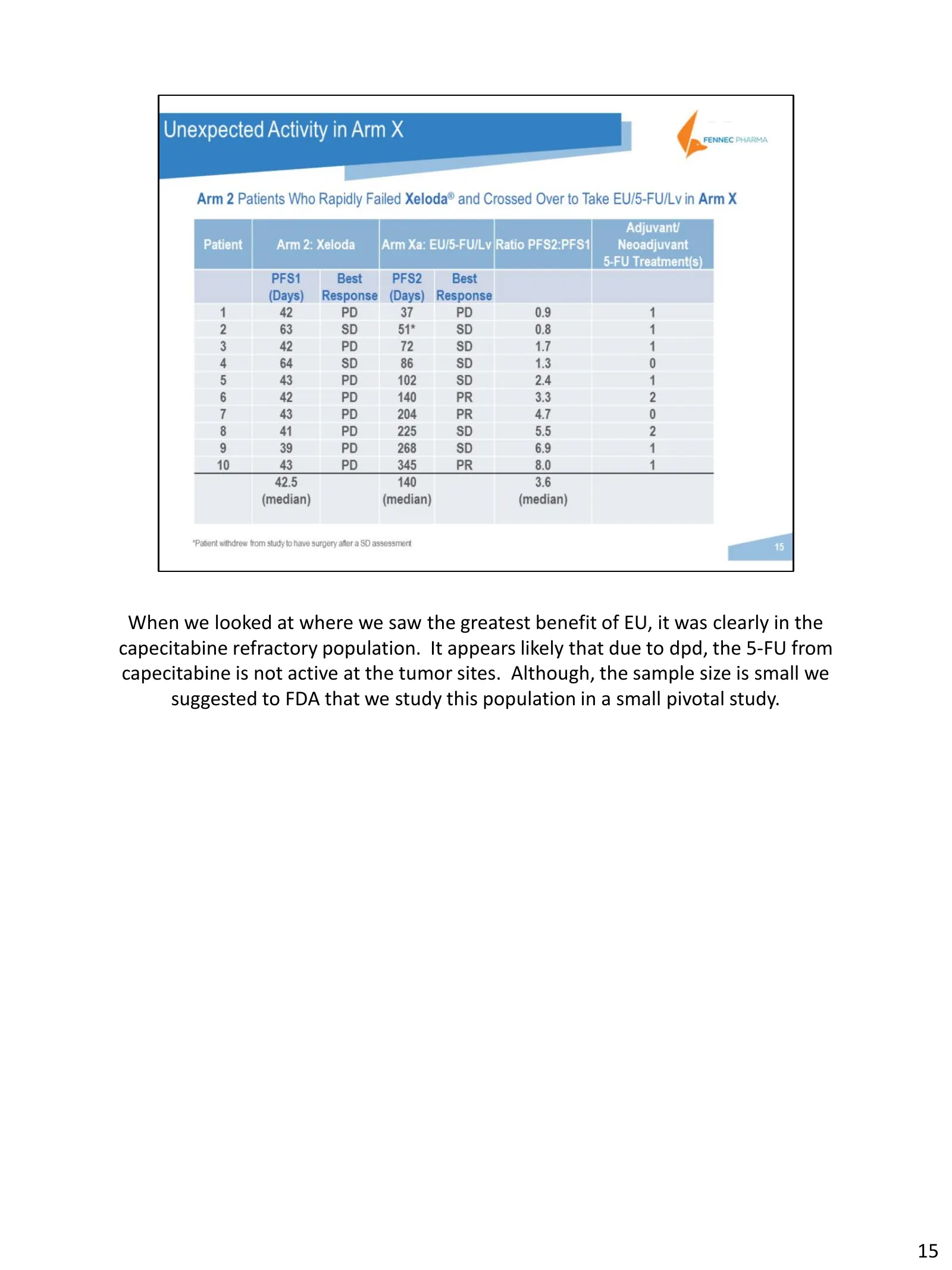
Slide 15: Benefit in capecitabine-refractory population
When we looked at where we saw the greatest benefit of EU, it was clearly in the capecitabine refractory population. It appears likely that due to dpd, the 5-FU from capecitabine is not active at the tumor sites. Although, the sample size is small we suggested to FDA that we study this population in
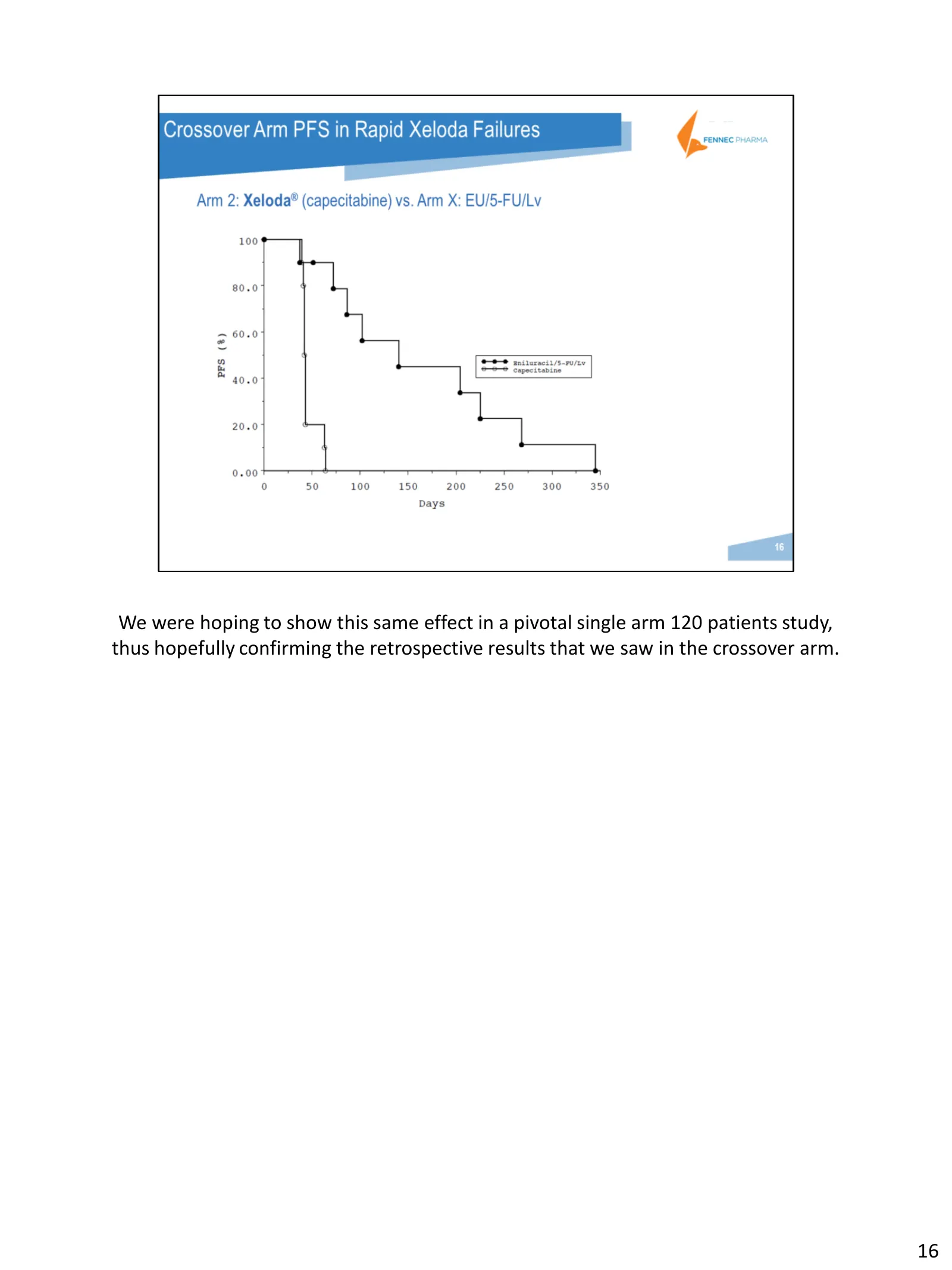
Slide 16: Proposed pivotal single-arm study
We were hoping to show this same effect in a pivotal single arm 120 patients study, thus hopefully confirming the retrospective results that we saw in the crossover arm. 16
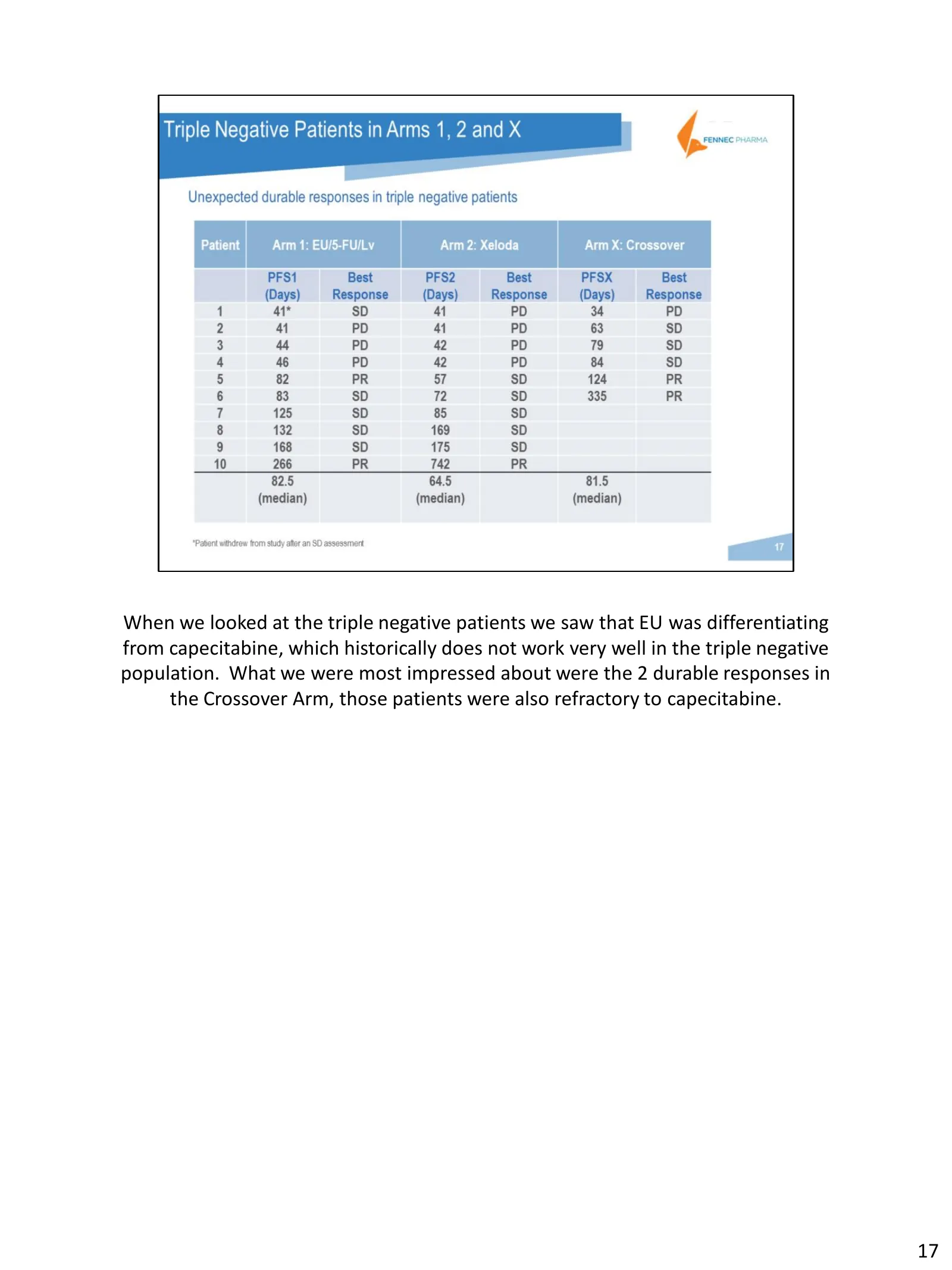
Slide 17: Triple negative patients and crossover responses
When we looked at the triple negative patients we saw that EU was differentiating from capecitabine, which historically does not work very well in the triple negative population. What we were most impressed about were the 2 durable responses in the Crossover Arm, those patients were also refractory
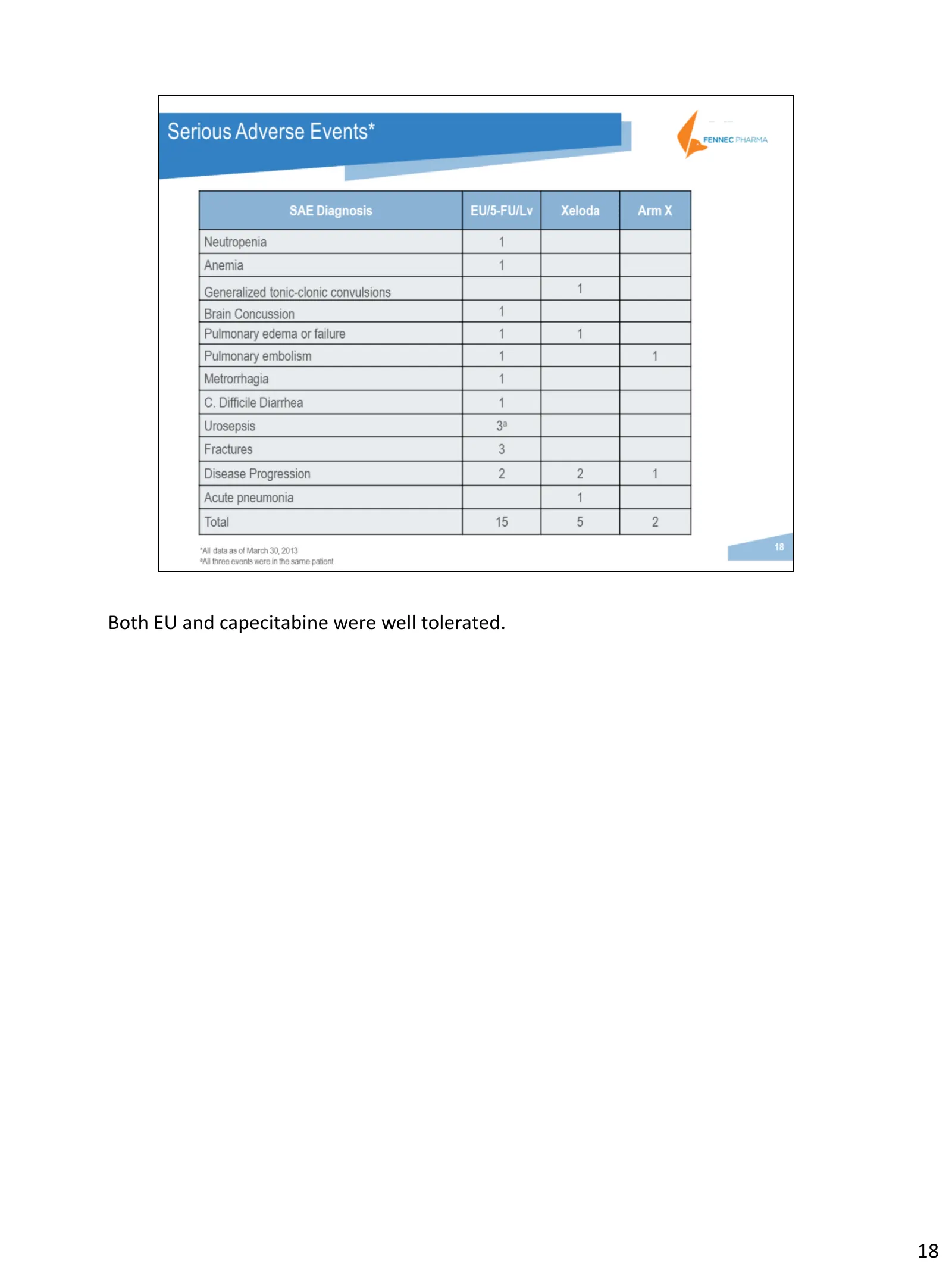
Slide 18: Tolerability of EU and capecitabine
Both EU and capecitabine were well tolerated. 18
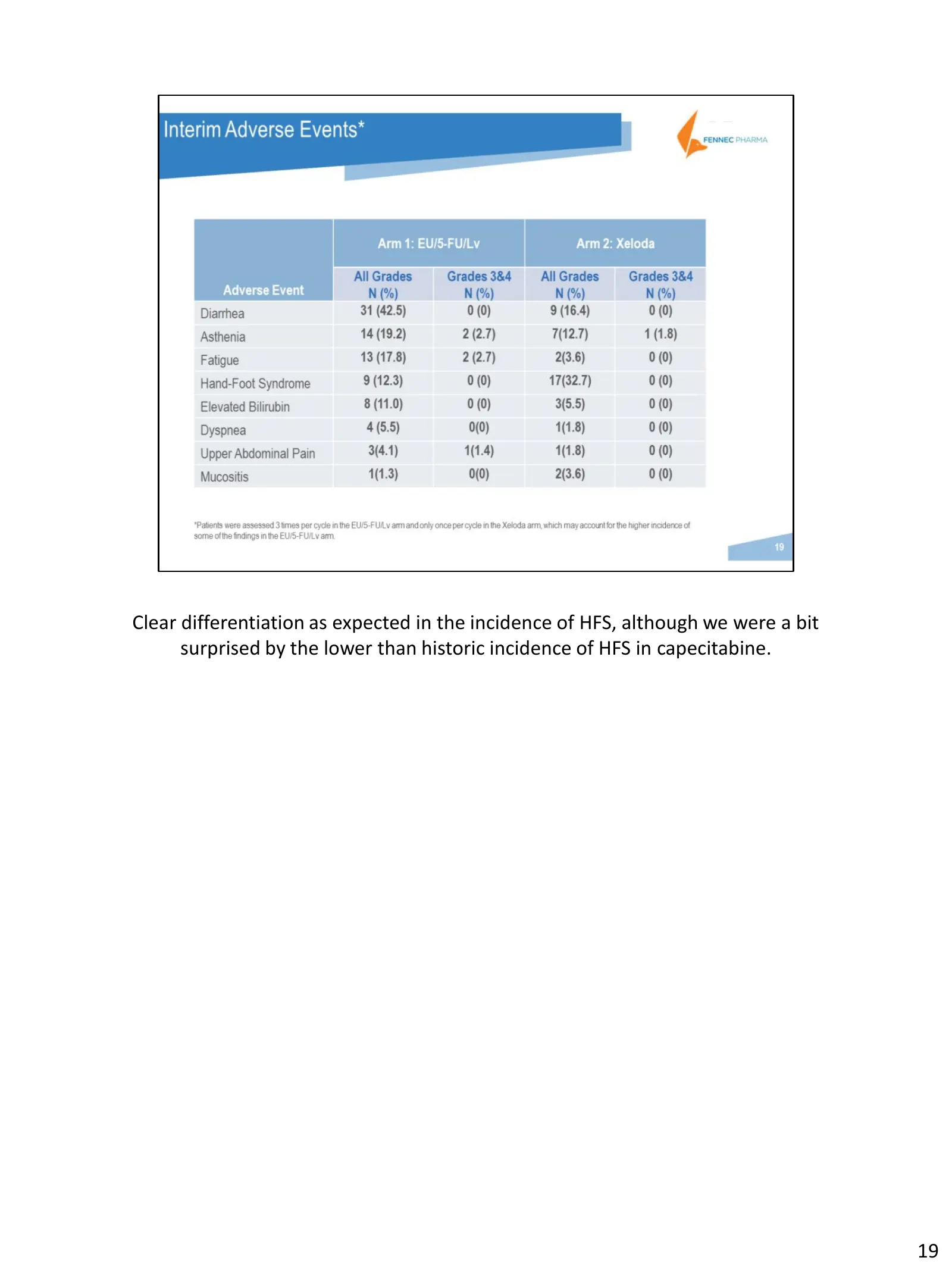
Slide 19: Incidence of HFS
Clear differentiation as expected in the incidence of HFS, although we were a bit surprised by the lower than historic incidence of HFS in capecitabine. 19
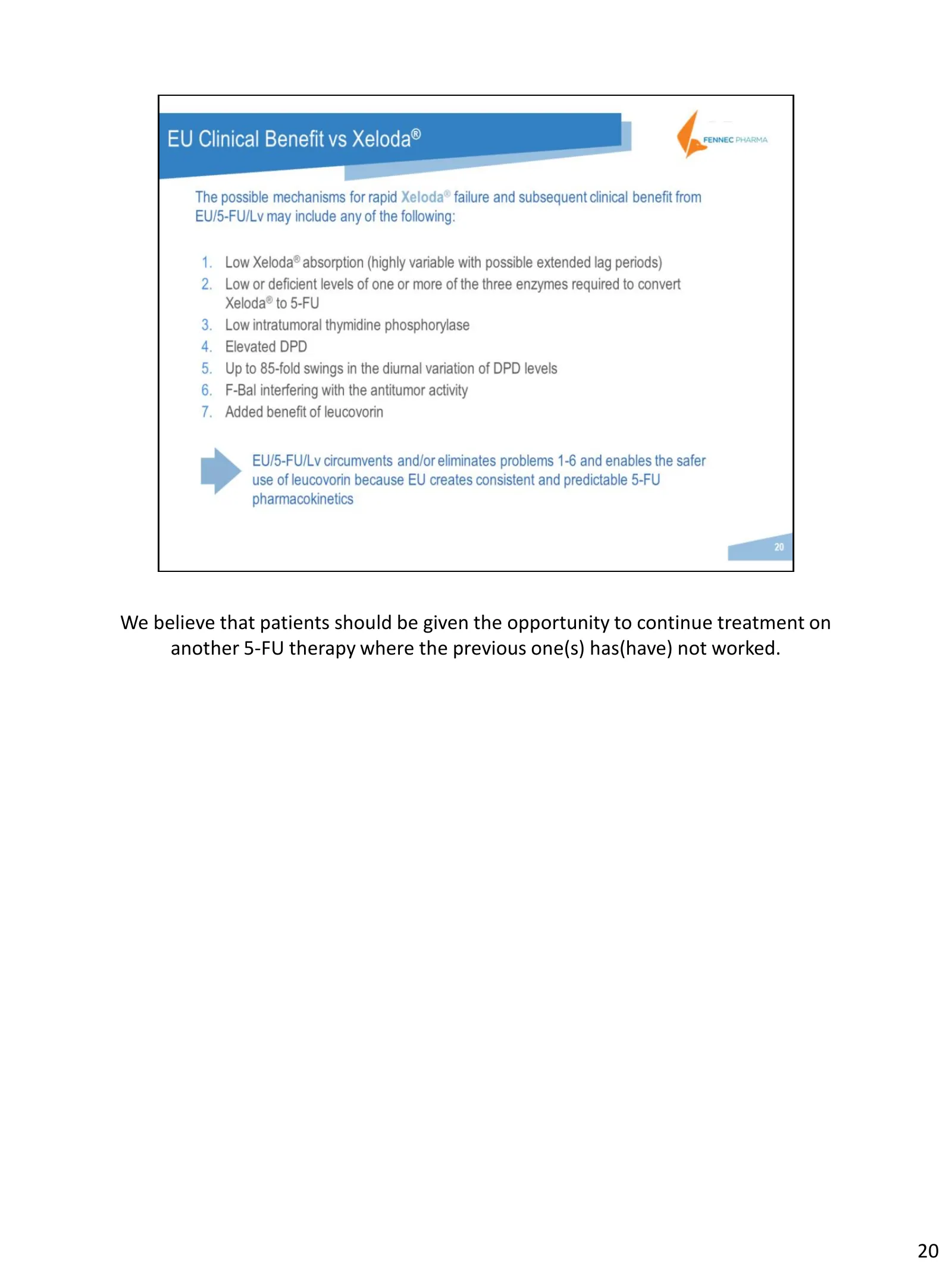
Slide 20: Continuing treatment on another 5-FU therapy
We believe that patients should be given the opportunity to continue treatment on another 5-FU therapy where the previous one(s) has(have) not worked. 20
Slide 21: Risk of leucovorin with S-1 for Taiho
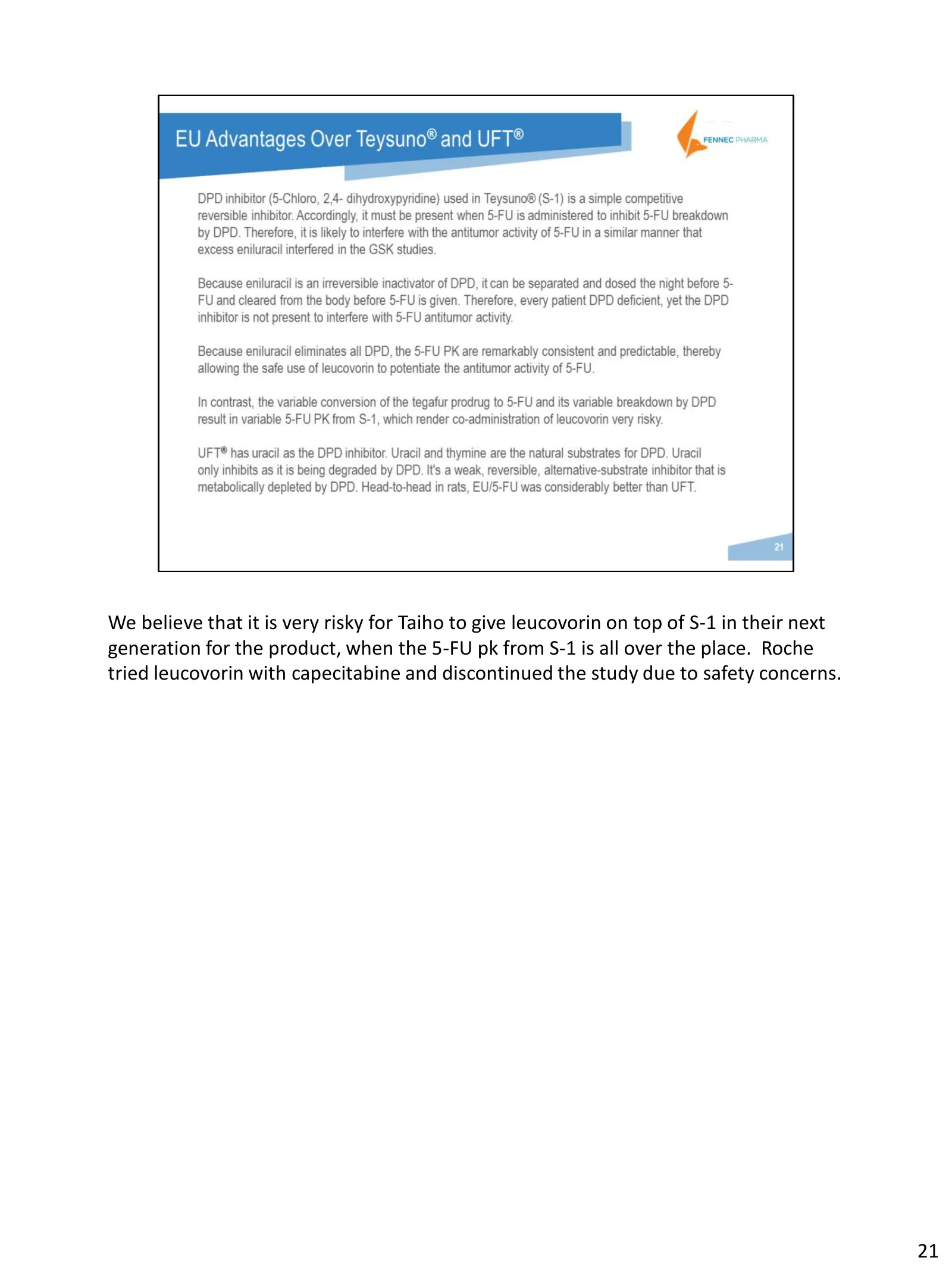
We believe that it is very risky for Taiho to give leucovorin on top of S-1 in their next generation for the product, when the 5-FU pk from S-1 is all over the place. Roche tried leucovorin with capecitabine and discontinued the study due to safety concerns. 21
Slide 22: FDA feedback on pivotal study design
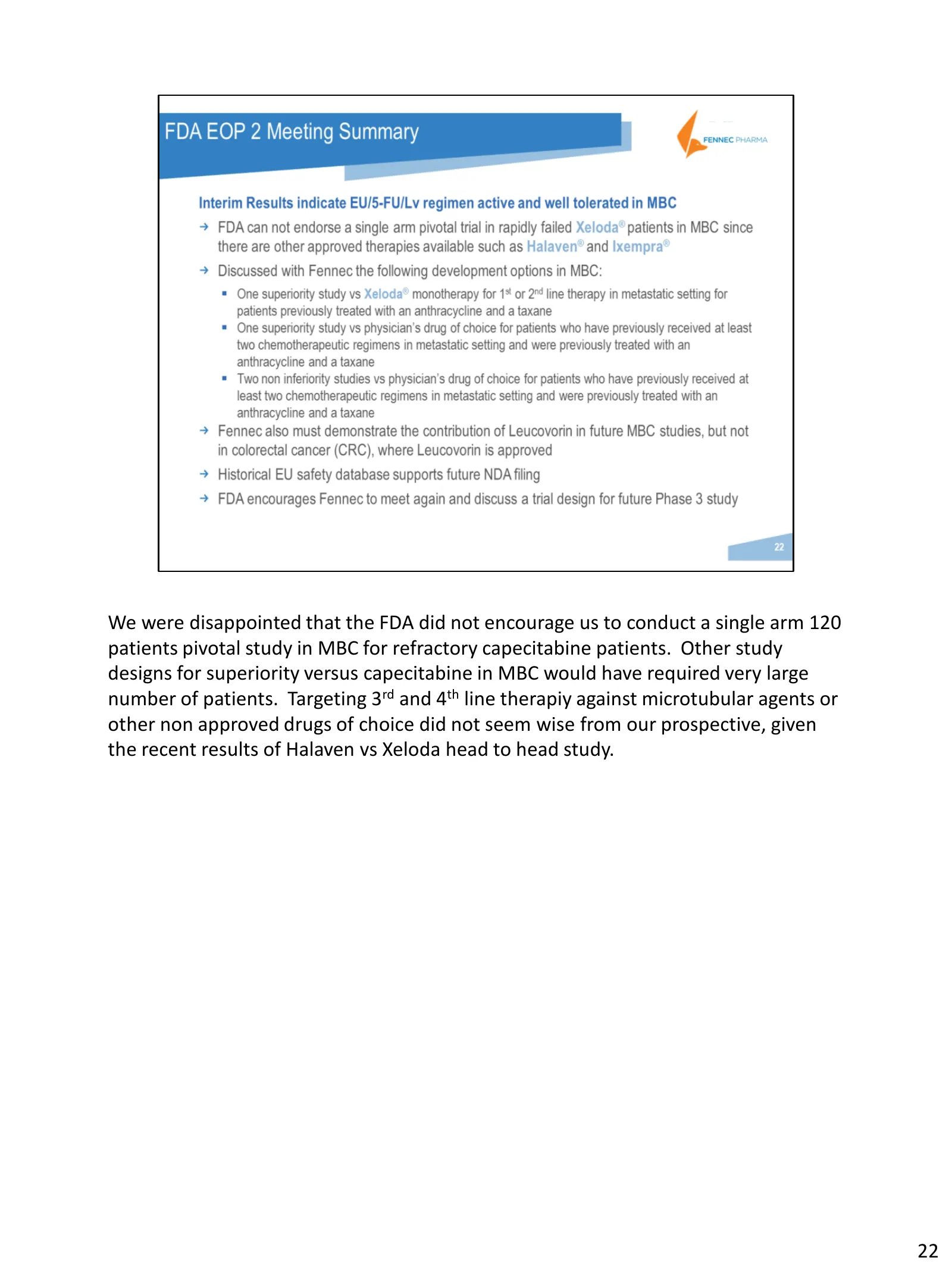
We were disappointed that the FDA did not encourage us to conduct a single arm 120 patients pivotal study in MBC for refractory capecitabine patients. Other study designs for superiority versus capecitabine in MBC would have required very large number of patients. Targeting 3rd and 4th line therapiy
Slide 23: Targeting regorafenib-failed colorectal patients
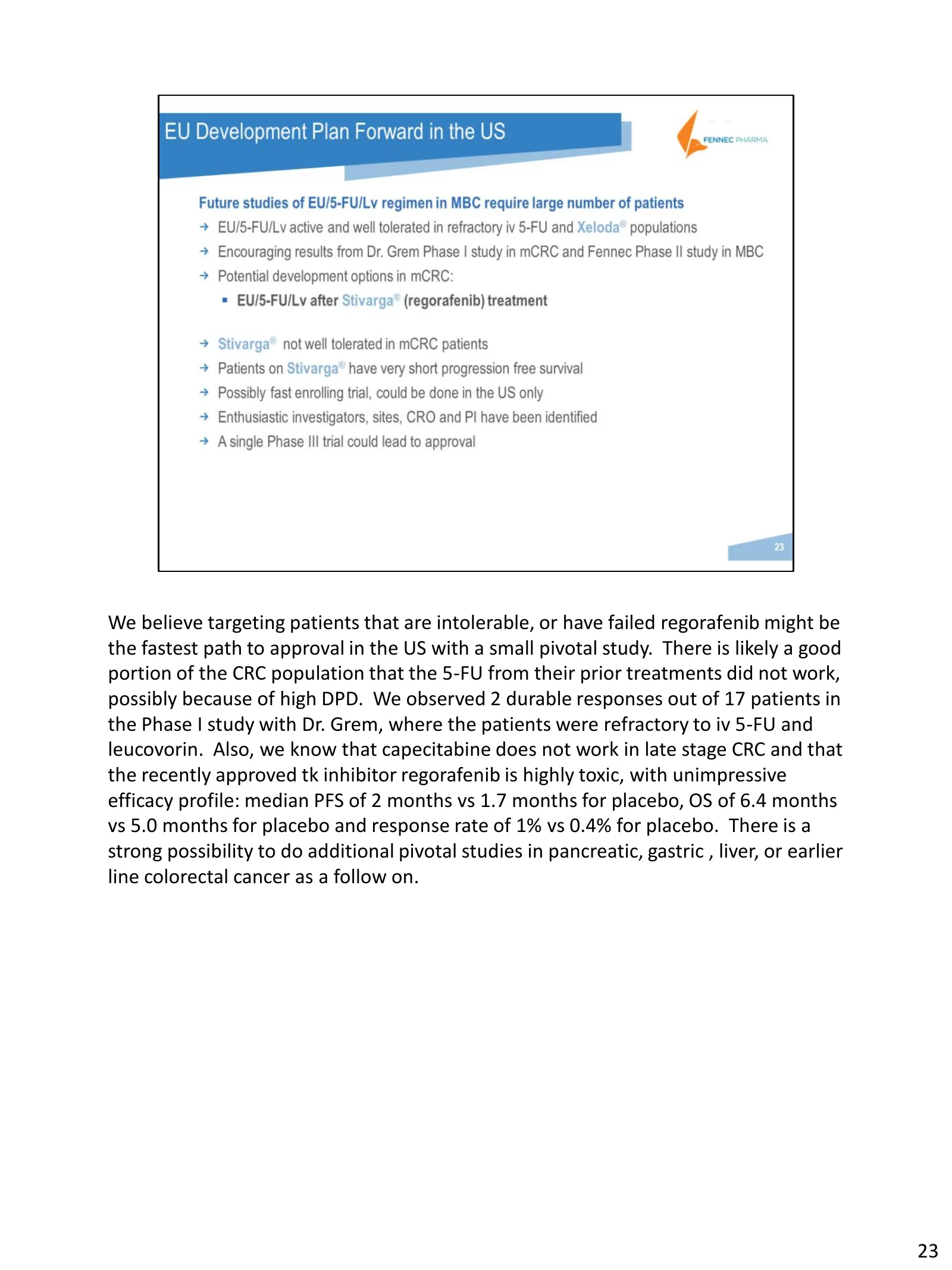
We believe targeting patients that are intolerable, or have failed regorafenib might be the fastest path to approval in the US with a small pivotal study. There is likely a good portion of the CRC population that the 5-FU from their prior treatments did not work, possibly because of high DPD. We obs
Source: company website
More decks from Fennec Pharmaceuticals Inc.
 Investor Presentation (August 2026)31 slides · August 2026
 Investor Presentation (August 2022)31 slides · August 2022
 Investor Presentation (February 2022)31 slides · February 2022
 Investor Presentation (January 2022)31 slides · January 2022
 Investor Presentation (November 2021)31 slides · November 2021
 Investor Presentation (August 2021)31 slides · August 2021