Almirall SA · BME:ALM
Almirall SA — American Thoracic Society (ATS) Congress 2008
24 slides from Almirall SA's conference presentation, 2008
Slide 1: Aclidinium bromide, a novel, long-acting anticholinergic in Phase III development for COPD
Aclidinium bromide, a novel, long-acting anticholinergic in Phase III development for maintenance treatment of COPD Data presented at the American Thoracic Society (ATS) 2008 Per-Olof Andersson Executive Director, Research & Development Almirall, Barcelona, Spain Lawrence S. Olanoff President and Ch
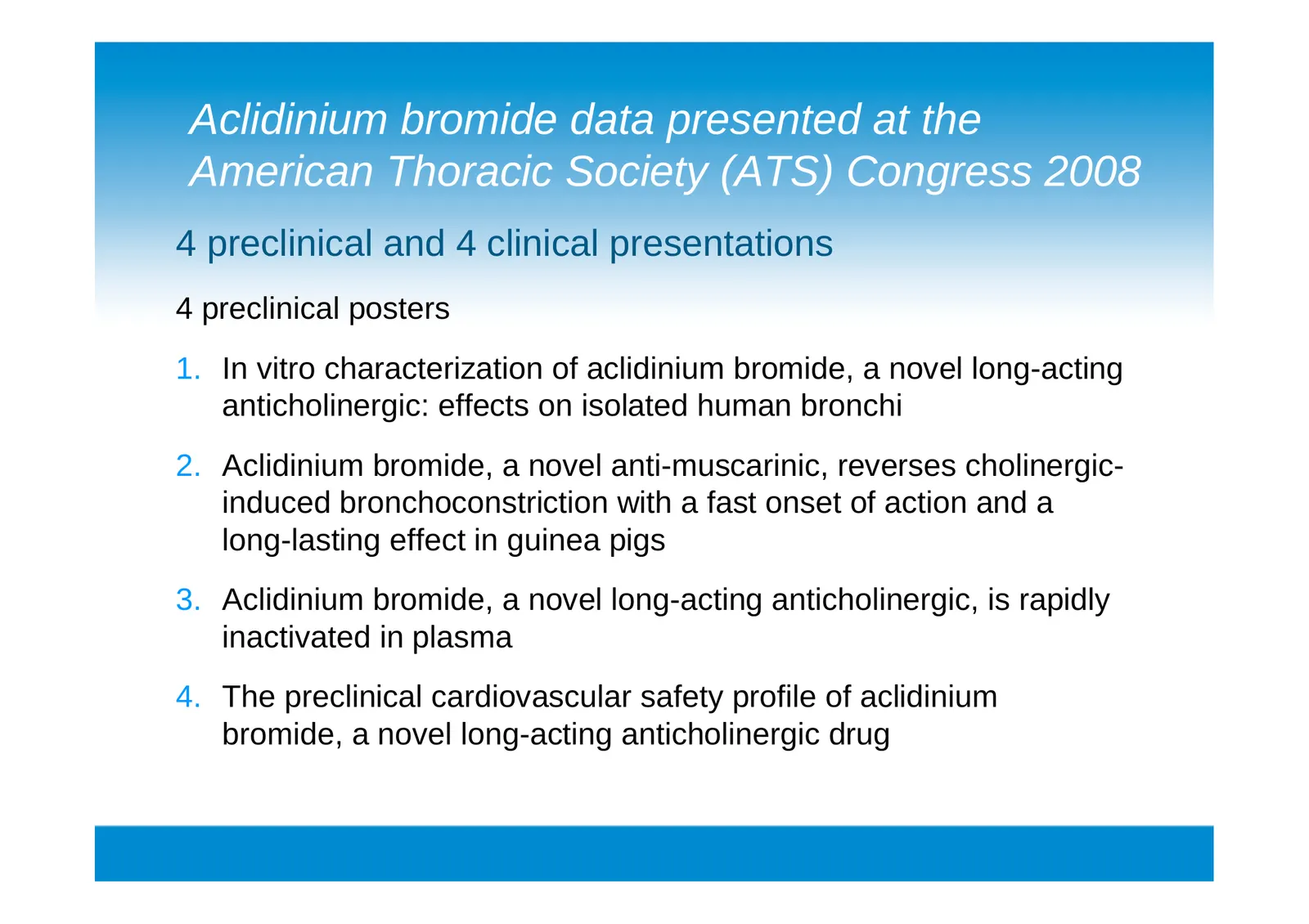
Slide 2: Aclidinium bromide data presented at ATS 2008: preclinical posters
Aclidinium bromide data presented at the American Thoracic Society (ATS) Congress 2008 4 preclinical and 4 clinical presentations 4 preclinical posters 1. In vitro characterization of aclidinium bromide, a novel long-acting anticholinergic: effects on isolated human bronchi 2. Aclidinium bromide, a
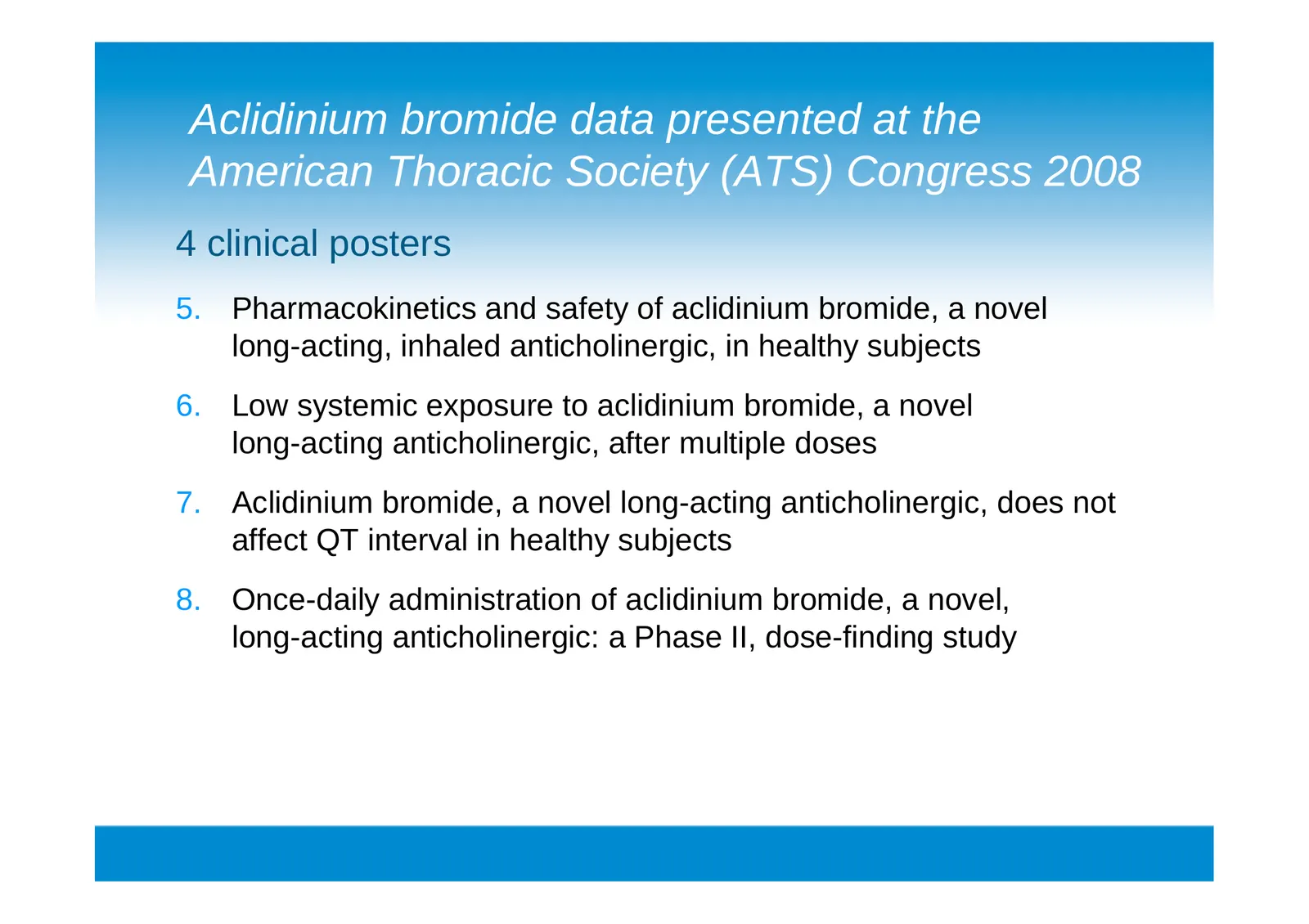
Slide 3: Aclidinium bromide data presented at ATS 2008: clinical posters
Aclidinium bromide data presented at the American Thoracic Society (ATS) Congress 2008 4 clinical posters 5. Pharmacokinetics and safety of aclidinium bromide, a novel long-acting, inhaled anticholinergic, in healthy subjects 6. Low systemic exposure to aclidinium bromide, a novel long-acting antich
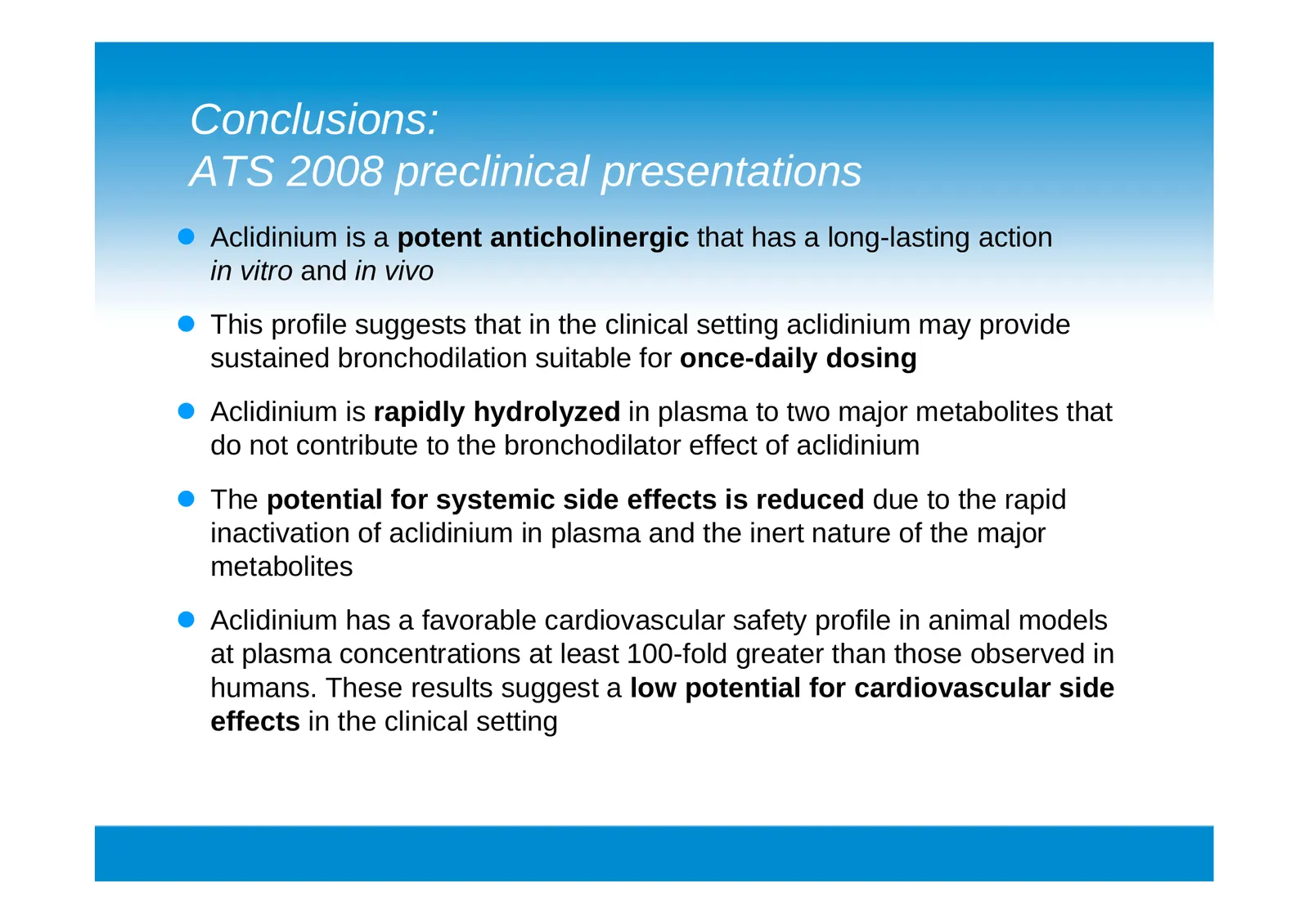
Slide 4: Conclusions: ATS 2008 preclinical presentations
Conclusions: ATS 2008 preclinical presentations z Aclidinium is a potent anticholinergic that has a long-lasting action in vitro and in vivo z This profile suggests that in the clinical setting aclidinium may provide sustained bronchodilation suitable for once-daily dosing z Aclidinium is rapidly hy
Slide 5: Presentation 5: Pharmacokinetics and safety in healthy subjects
Presentation 5: Pharmacokinetics and safety of aclidinium bromide, a novel long-acting, inhaled anticholinergic, in healthy subjects P Ferrer,1 JM Jansat,2 E Garcia Gil2 1Centre Hospitalier de la Polynésie française, Papeete, French Polynesia 2Almirall, Barcelona, Spain
Slide 6: Objectives
Objectives 5 z This Phase I, placebo-controlled study assessed the pharmacokinetics, safety, tolerability, and maximum tolerated dose (MTD) of single doses of aclidinium in healthy male subjects | MTD was defined as the highest dose that does not cause at least 50% of subjects to experience function
Slide 7: Aclidinium well tolerated at 600-6000 µg
Results summary 5 z Aclidinium in the dose range of 600-6000 µg was well tolerated z No AEs were judged to be treatment related for doses up to 1800 µg | AEs were mild to moderate in severity and the overall incidence for aclidinium was comparable to placebo | There were no serious AEs z The MTD cou
Slide 8: Aclidinium detectable in plasma only up to 1 hour post-dose
Results summary 5 cont z Aclidinium was only detectable in plasma up to 1 hour post-dose for the 600 µg, 1200 µg, and 1800 µg doses in the majority of subjects | This limited and transient systemic exposure suggests a low potential for anticholinergic systemic adverse events (intended clinical dose
Slide 9: Presentation 6: Low systemic exposure after multiple doses
Presentation 6: Low systemic exposure to aclidinium bromide, a novel long-acting anticholinergic, after multiple doses G de Miquel,1 A Schrödter,2 B Miletzki,2 M Gurniak,2 C Serra,1 JM Jansat1 1Almirall, Barcelona, Spain 2FOCUS Clinical Drug Development GmbH, Neuss, Germany
Slide 10: Objectives
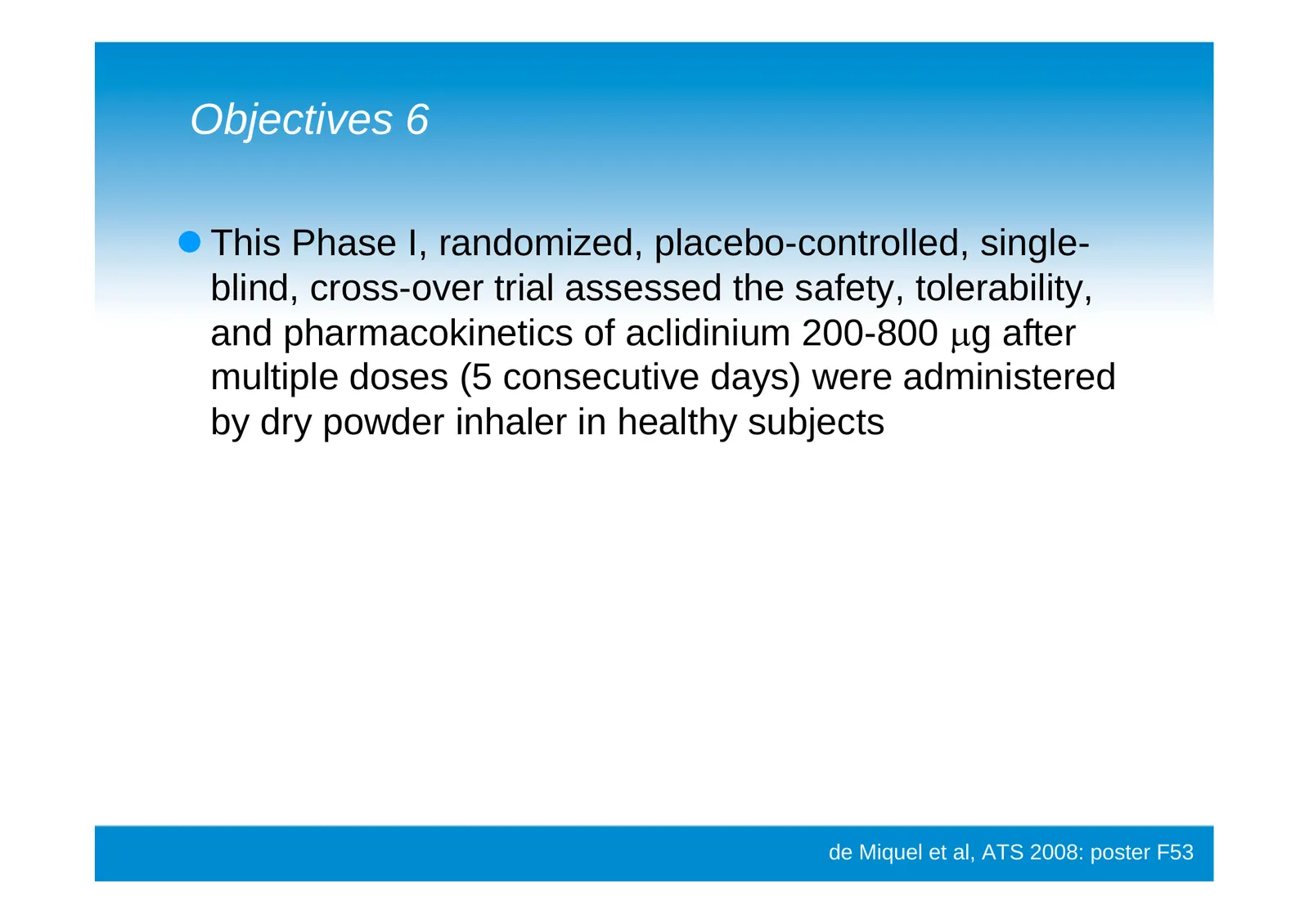
Objectives 6 z This Phase I, randomized, placebo-controlled, single- blind, cross-over trial assessed the safety, tolerability, and pharmacokinetics of aclidinium 200-800 µg after multiple doses (5 consecutive days) were administered by dry powder inhaler in healthy subjects de Miquel et al, ATS 200
Slide 11: Multiple doses well tolerated, low plasma levels
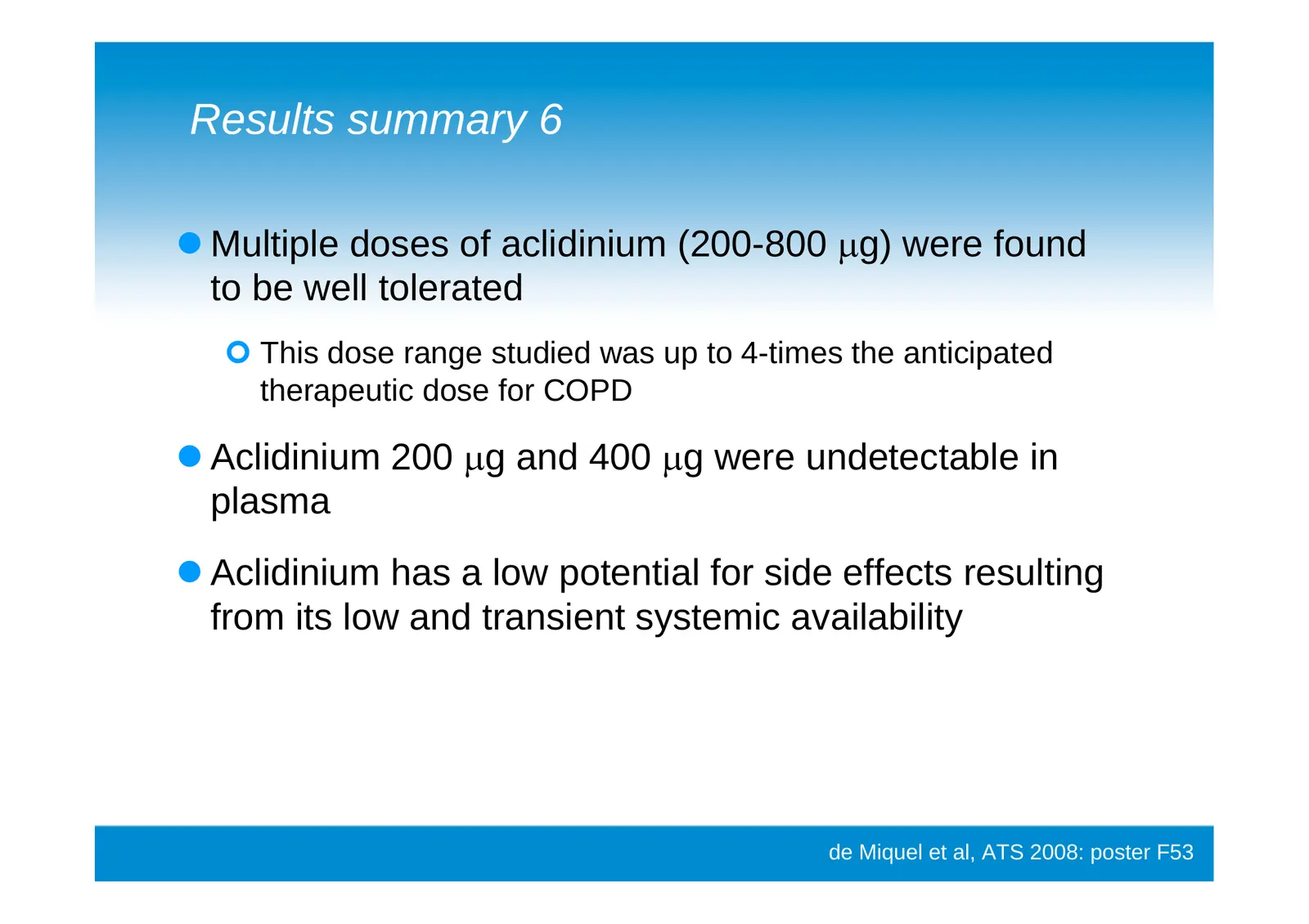
Results summary 6 z Multiple doses of aclidinium (200-800 µg) were found to be well tolerated | This dose range studied was up to 4-times the anticipated therapeutic dose for COPD z Aclidinium 200 µg and 400 µg were undetectable in plasma z Aclidinium has a low potential for side effects resulting f
Slide 12: Presentation 7: Aclidinium does not affect QT interval
Presentation 7: Aclidinium bromide, a novel long-acting anticholinergic, does not affect QT interval in healthy subjects KC Lasseter,1 J Aubets,2 E Garcia Gil2 1PharmaNet Development Group, Miami, FL, USA 2Almirall, Barcelona, Spain
Slide 13: Objectives
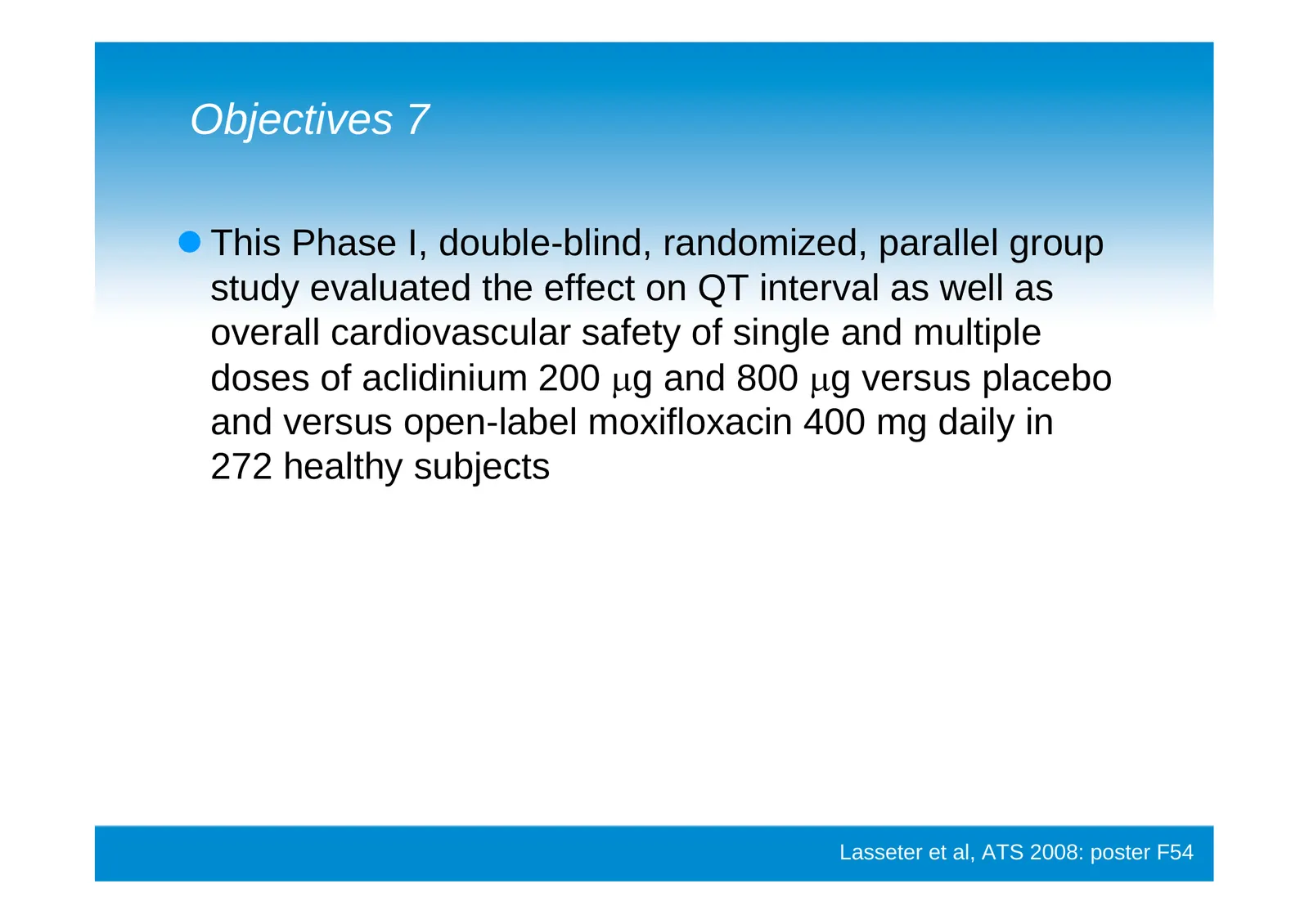
Objectives 7 z This Phase I, double-blind, randomized, parallel group study evaluated the effect on QT interval as well as overall cardiovascular safety of single and multiple doses of aclidinium 200 µg and 800 µg versus placebo and versus open-label moxifloxacin 400 mg daily in 272 healthy subjects
Slide 14: No effect on QT interval versus placebo
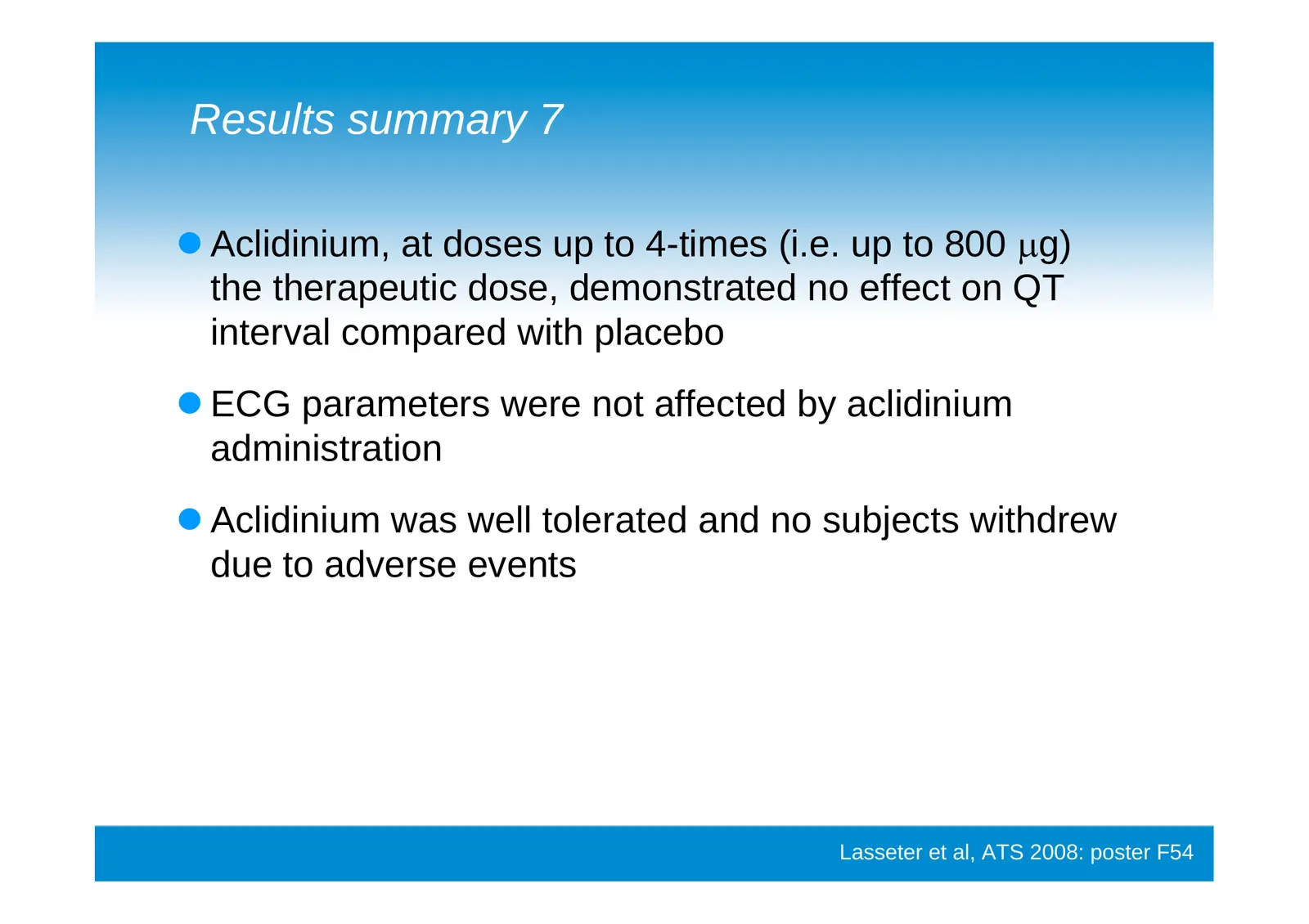
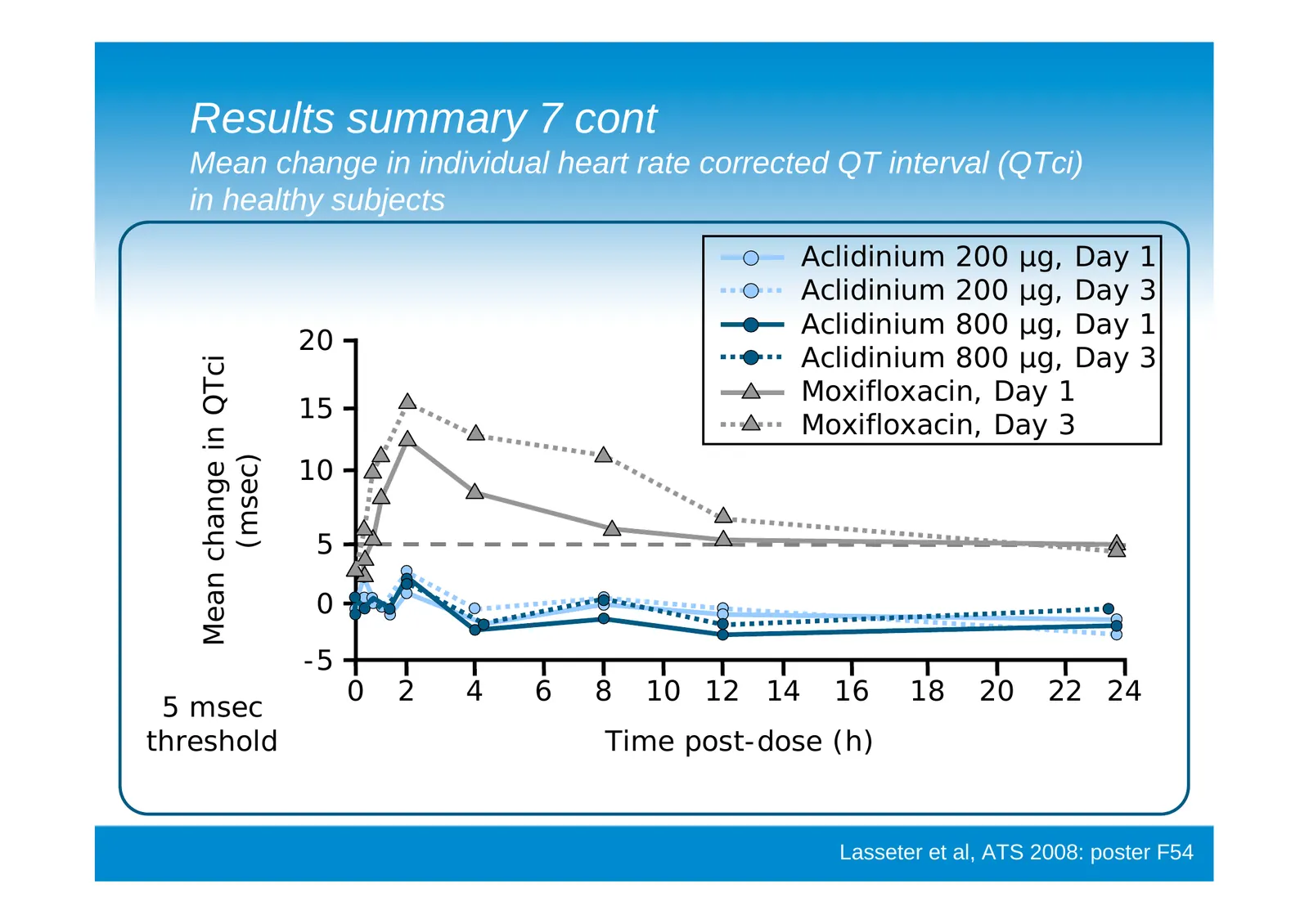
Results summary 7 z Aclidinium, at doses up to 4-times (i.e. up to 800 µg) the therapeutic dose, demonstrated no effect on QT interval compared with placebo z ECG parameters were not affected by aclidinium administration z Aclidinium was well tolerated and no subjects withdrew due to adverse events
Slide 15: Mean change in individual heart rate corrected QT interval
Results summary 7 cont Mean change in individual heart rate corrected QT interval (QTci) in healthy subjects Aclidinium 200 µg, Day 1 Aclidinium 200 µg, Day 3 Aclidinium 800 µg, Day 1 20 Aclidinium 800 µg, Day 3 Mean change in QTci Moxifloxacin, Day 1 15 Moxifloxacin, Day 3 (msec) 10 5 0 -5 0 2 4 6
Slide 16: Presentation 8: Once-daily aclidinium, Phase II dose-finding study
Presentation 8: Once-daily administration of aclidinium bromide, a novel, long-acting anticholinergic: a Phase II, dose-finding study P Chanez,1 S Burge,2 R Dahl,3 J Creemers,4 R Lamarca,5 E Garcia Gil5 1Université de la Méditerranée AP-HM, Marseille, France 2Birmingham Heartlands Hospital, Birmingh
Slide 17: Objectives
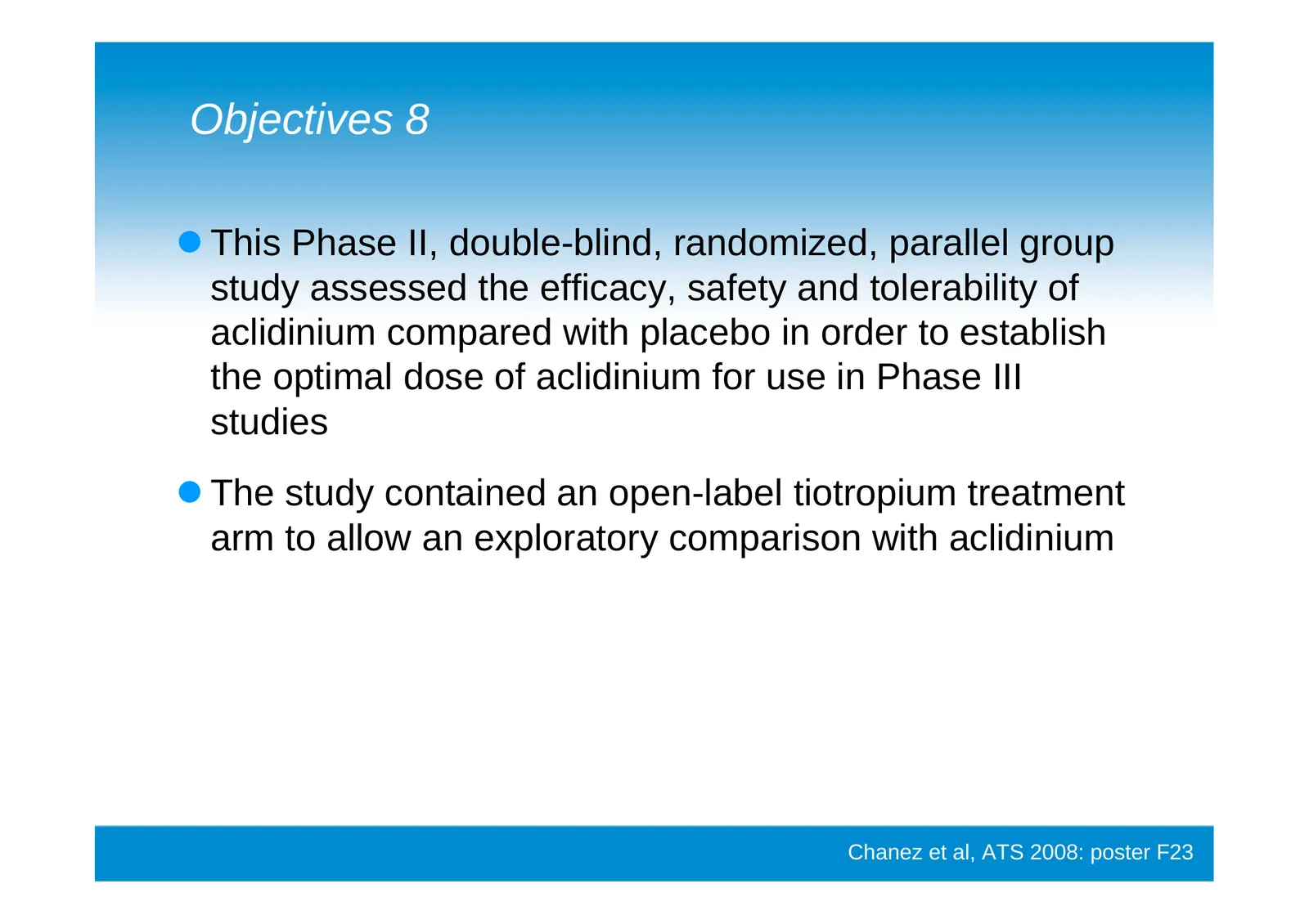
Objectives 8 z This Phase II, double-blind, randomized, parallel group study assessed the efficacy, safety and tolerability of aclidinium compared with placebo in order to establish the optimal dose of aclidinium for use in Phase III studies z The study contained an open-label tiotropium treatment a
Slide 18: Bronchodilatory effects sustained over 24 hours
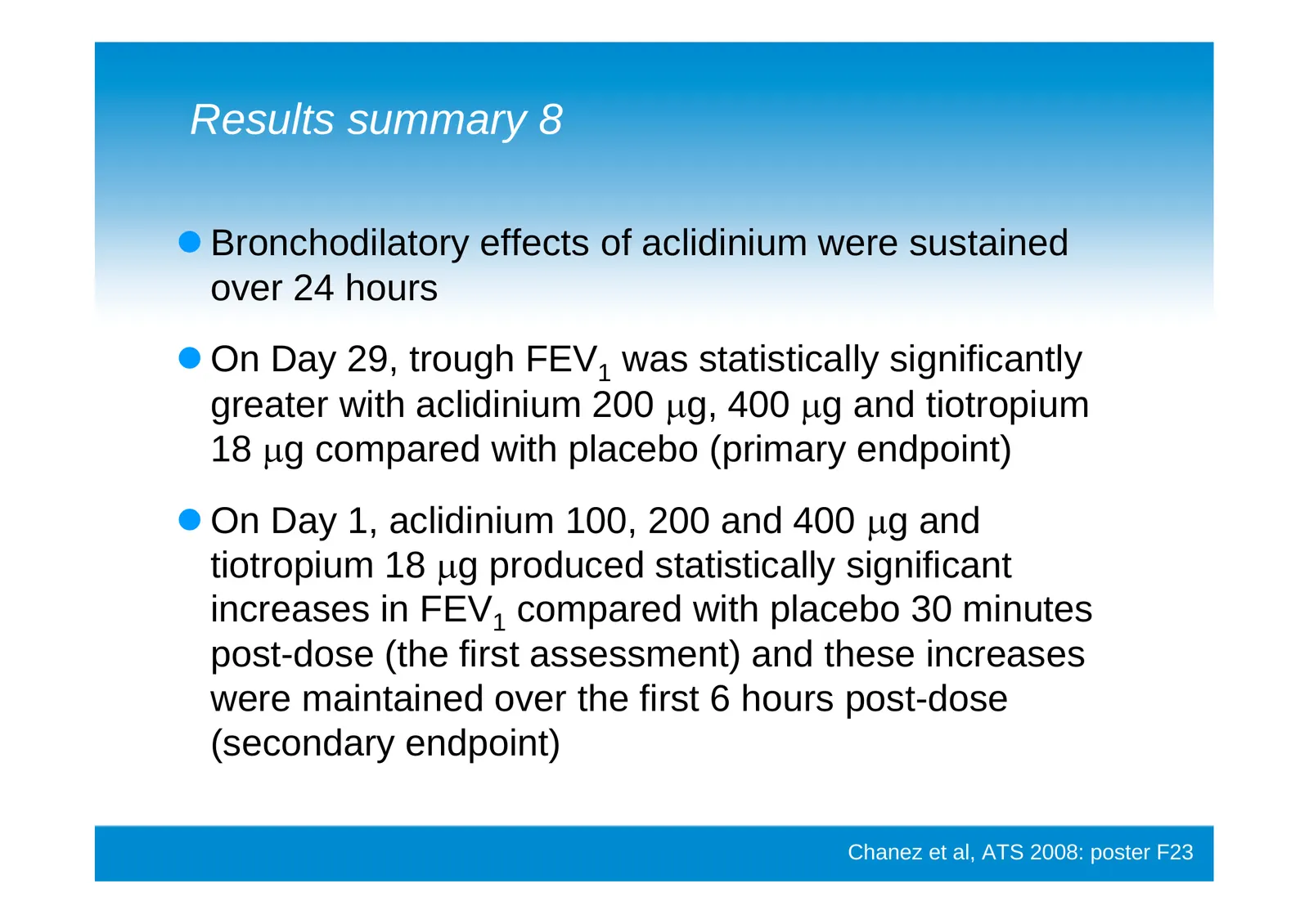
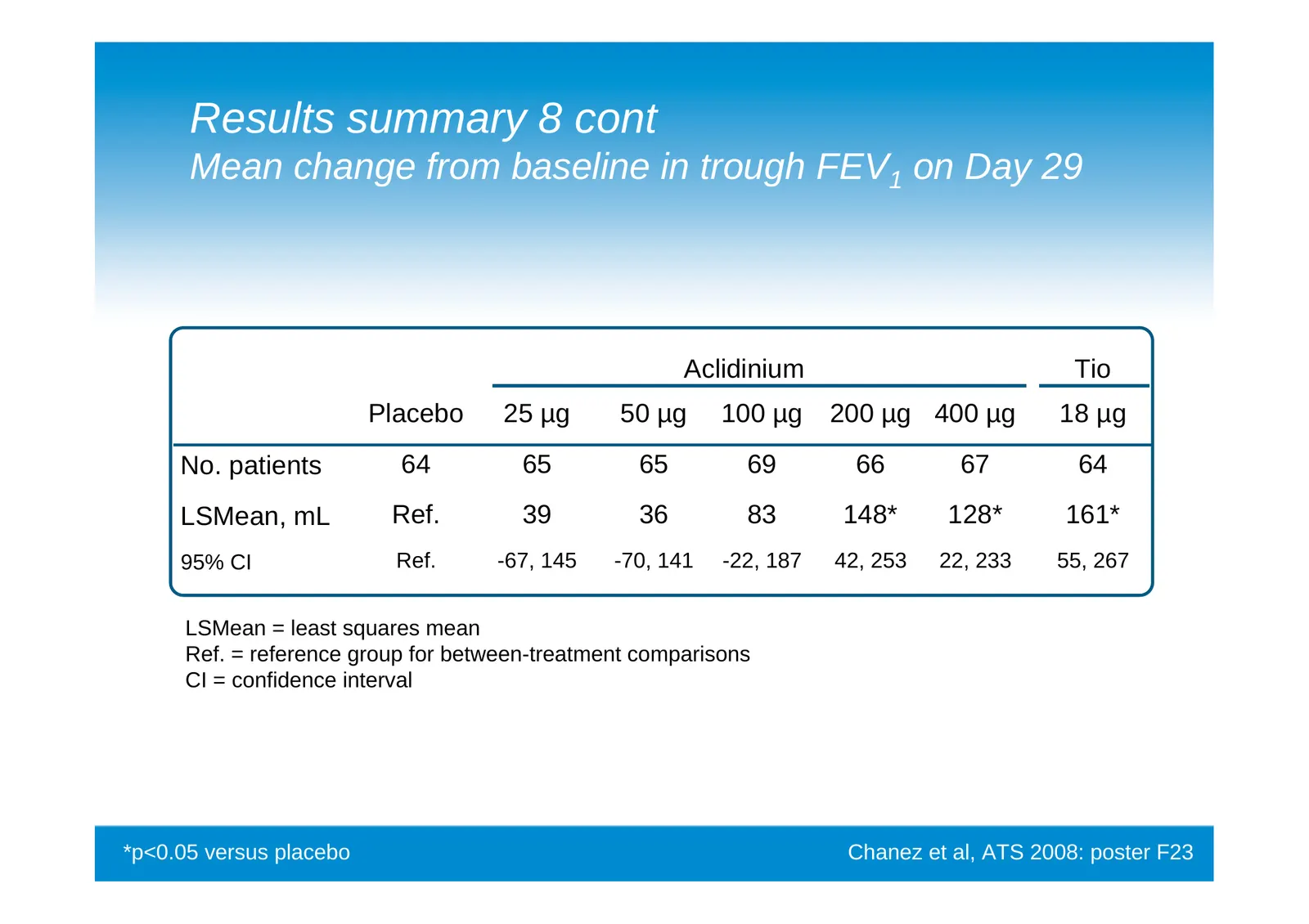
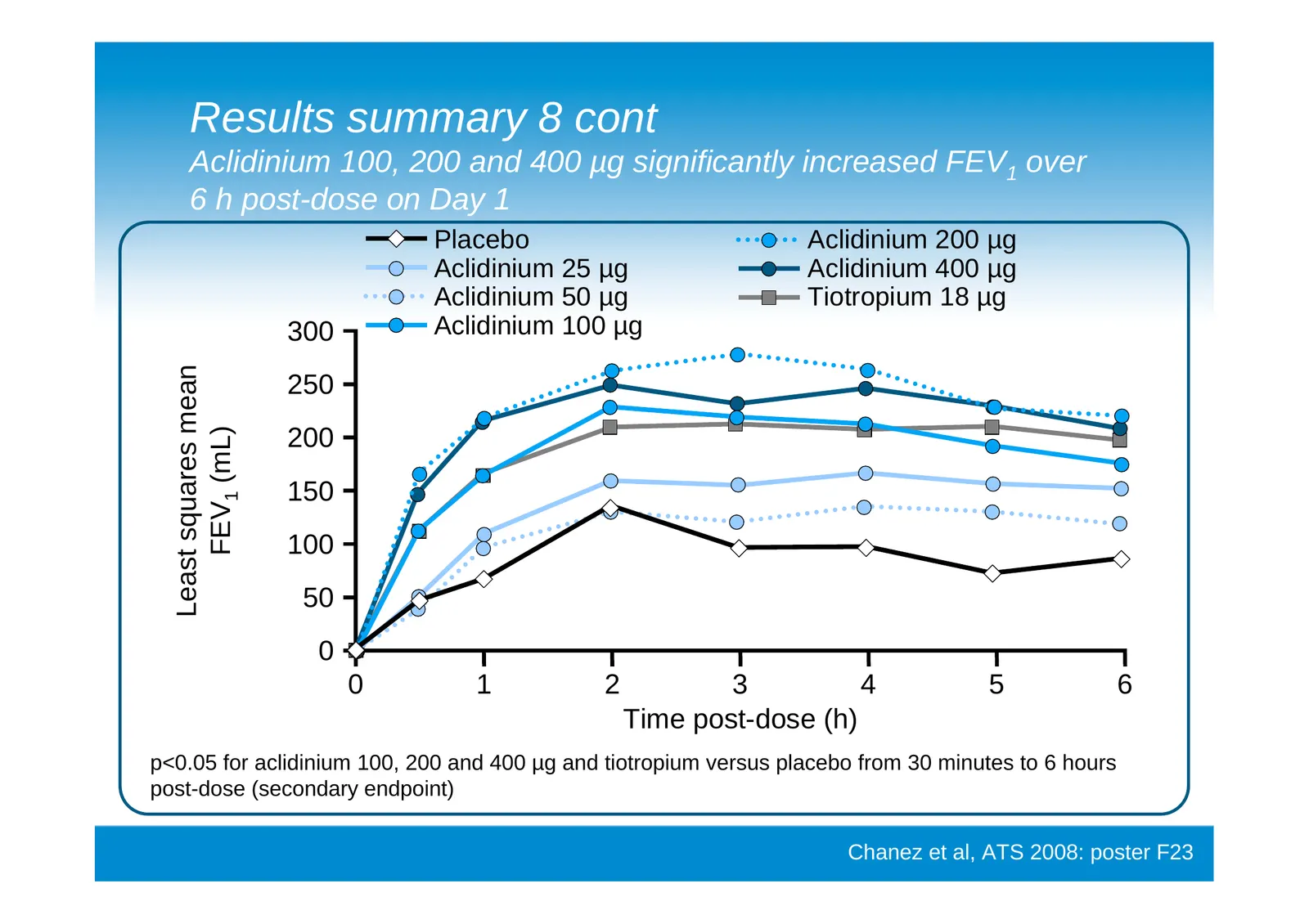
Results summary 8 z Bronchodilatory effects of aclidinium were sustained over 24 hours z On Day 29, trough FEV1 was statistically significantly greater with aclidinium 200 µg, 400 µg and tiotropium 18 µg compared with placebo (primary endpoint) z On Day 1, aclidinium 100, 200 and 400 µg and tiotropi
Slide 19: Results summary: mean change from baseline in trough FEV1
Results summary 8 cont Mean change from baseline in trough FEV1 on Day 29 Aclidinium Tio Placebo 25 µg 50 µg 100 µg 200 µg 400 µg 18 µg No. patients 64 65 65 69 66 67 64 LSMean, mL Ref. 39 36 83 148* 128* 161* 95% CI Ref. -67, 145 -70, 141 -22, 187 42, 253 22, 233 55, 267 LSMean = least squares mean
Slide 20: Aclidinium significantly increased FEV1 over 6 h post-dose on Day 1
Results summary 8 cont Aclidinium 100, 200 and 400 µg significantly increased FEV1 over 6 h post-dose on Day 1 Placebo Aclidinium 200 µg Aclidinium 25 µg Aclidinium 400 µg Aclidinium 50 µg Tiotropium 18 µg 300 Aclidinium 100 µg Least squares mean 250 FEV1 (mL) 200 150 100 50 0 0 1 2 3 4 5 6 Time pos
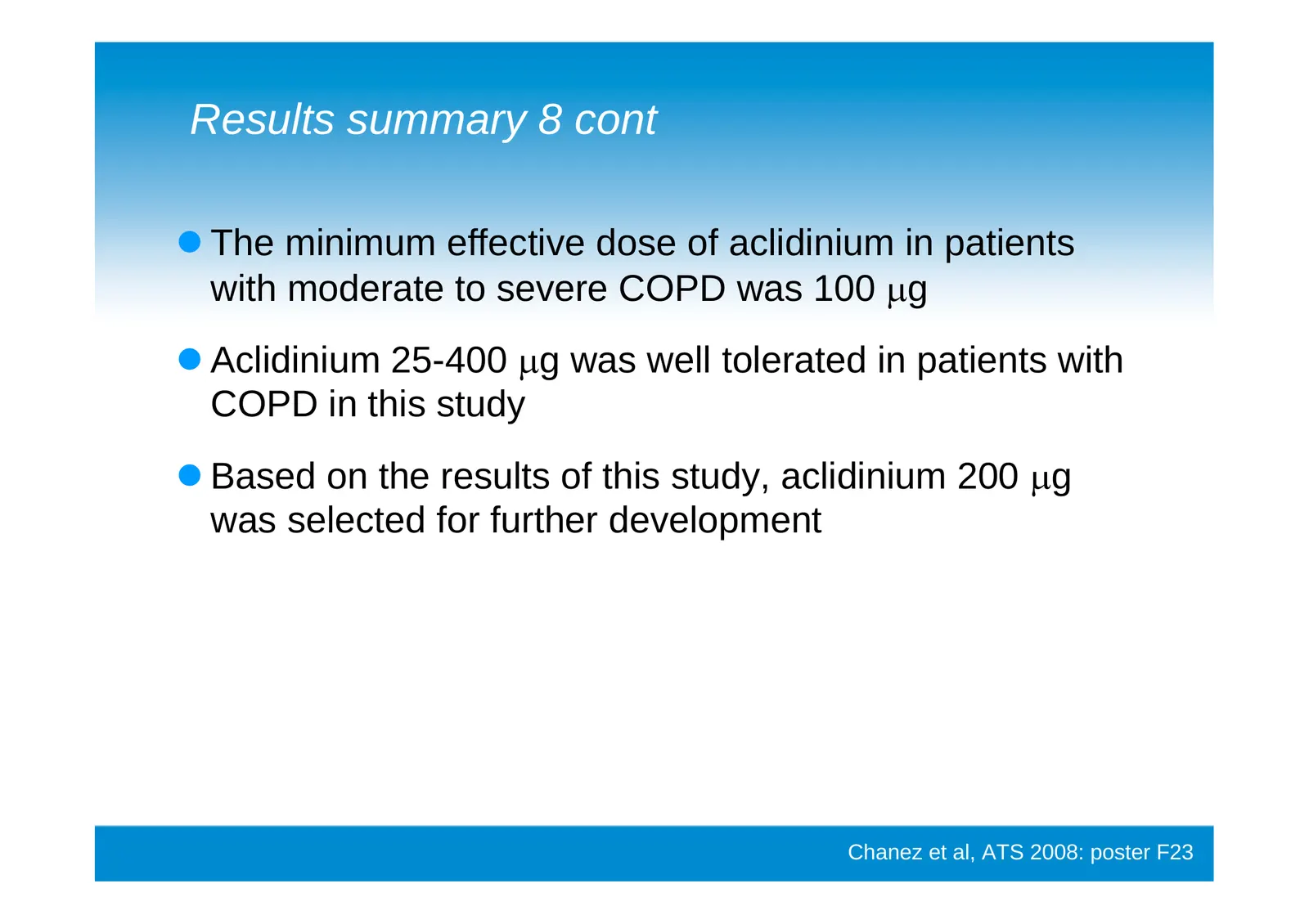
Slide 21: Minimum effective dose of aclidinium was 100 µg
Results summary 8 cont z The minimum effective dose of aclidinium in patients with moderate to severe COPD was 100 µg z Aclidinium 25-400 µg was well tolerated in patients with COPD in this study z Based on the results of this study, aclidinium 200 µg was selected for further development Chanez et a
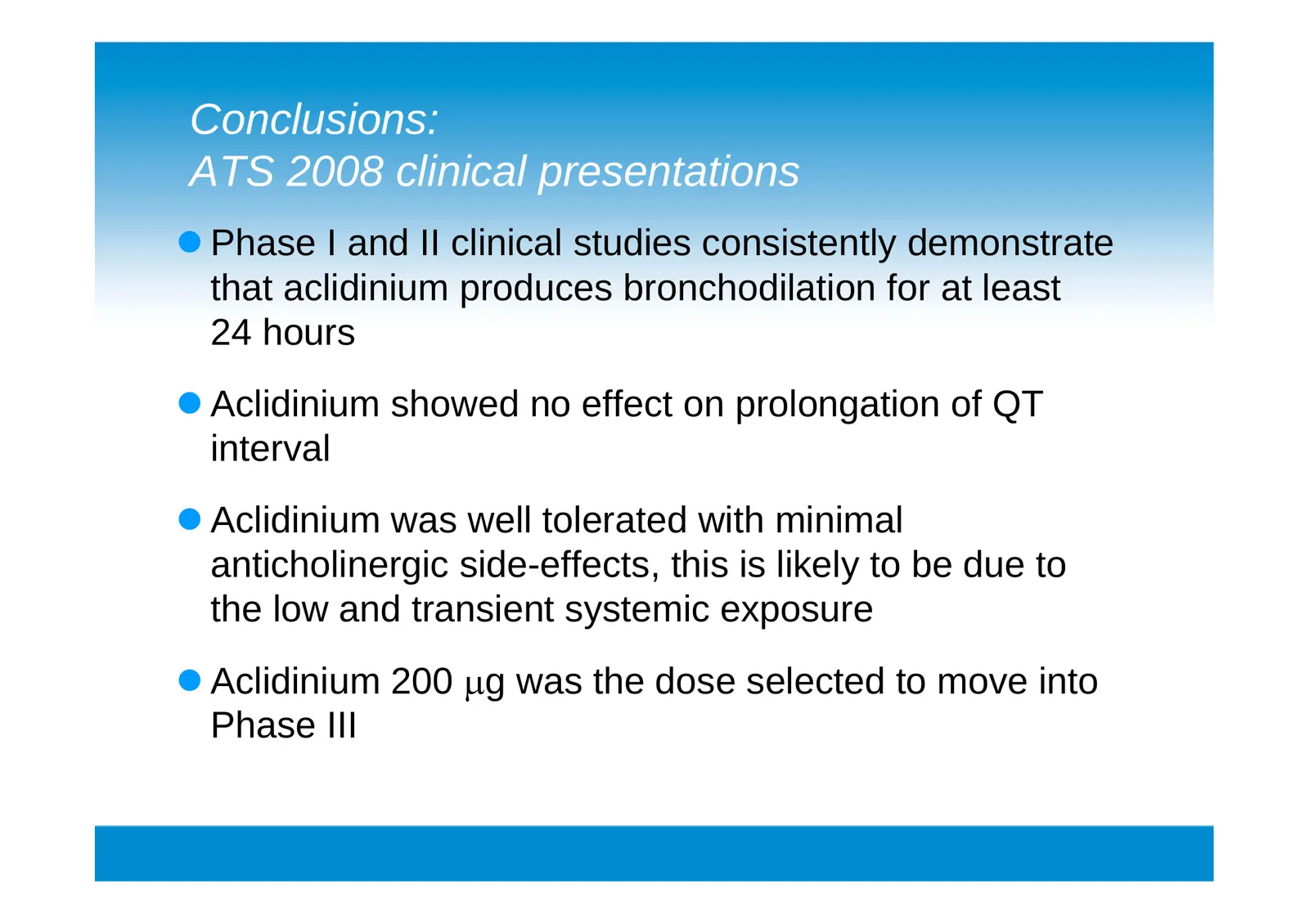
Slide 22: Conclusions: ATS 2008 clinical presentations
Conclusions: ATS 2008 clinical presentations z Phase I and II clinical studies consistently demonstrate that aclidinium produces bronchodilation for at least 24 hours z Aclidinium showed no effect on prolongation of QT interval z Aclidinium was well tolerated with minimal anticholinergic side-effect
Slide 23: Aclidinium bromide: moving forward
Aclidinium bromide: moving forward z Phase III trials on track, top-line results available second half of 2008 z Combination products development ongoing
Slide 24: Thank you
Thank you gS . G Almirall KB Forest Laboratories, Inc.
Source: Internet Archive copy of almirall.com
More decks from Almirall SA
 H1 2026 Earnings Presentation30 slides · Jul 24, 2026
 Q1 2026 Earnings Presentation29 slides · May 11, 2026
 FY 2025 Earnings Presentation34 slides · Feb 23, 2026
 Q1 2025 Earnings Presentation28 slides · May 12, 2025
 FY2024 Earnings Presentation41 slides · Feb 24, 2025
 H1 2024 Earnings Presentation33 slides · Jul 22, 2024