KraneShares Global Carbon Strategy ETF · AMEX:KRBN
KraneShares Global Carbon Strategy ETF — Quadratic Capital Management — Investor Presentation (October 2019)
19 slides from KraneShares Global Carbon Strategy ETF's investor presentation, Oct 10, 2019
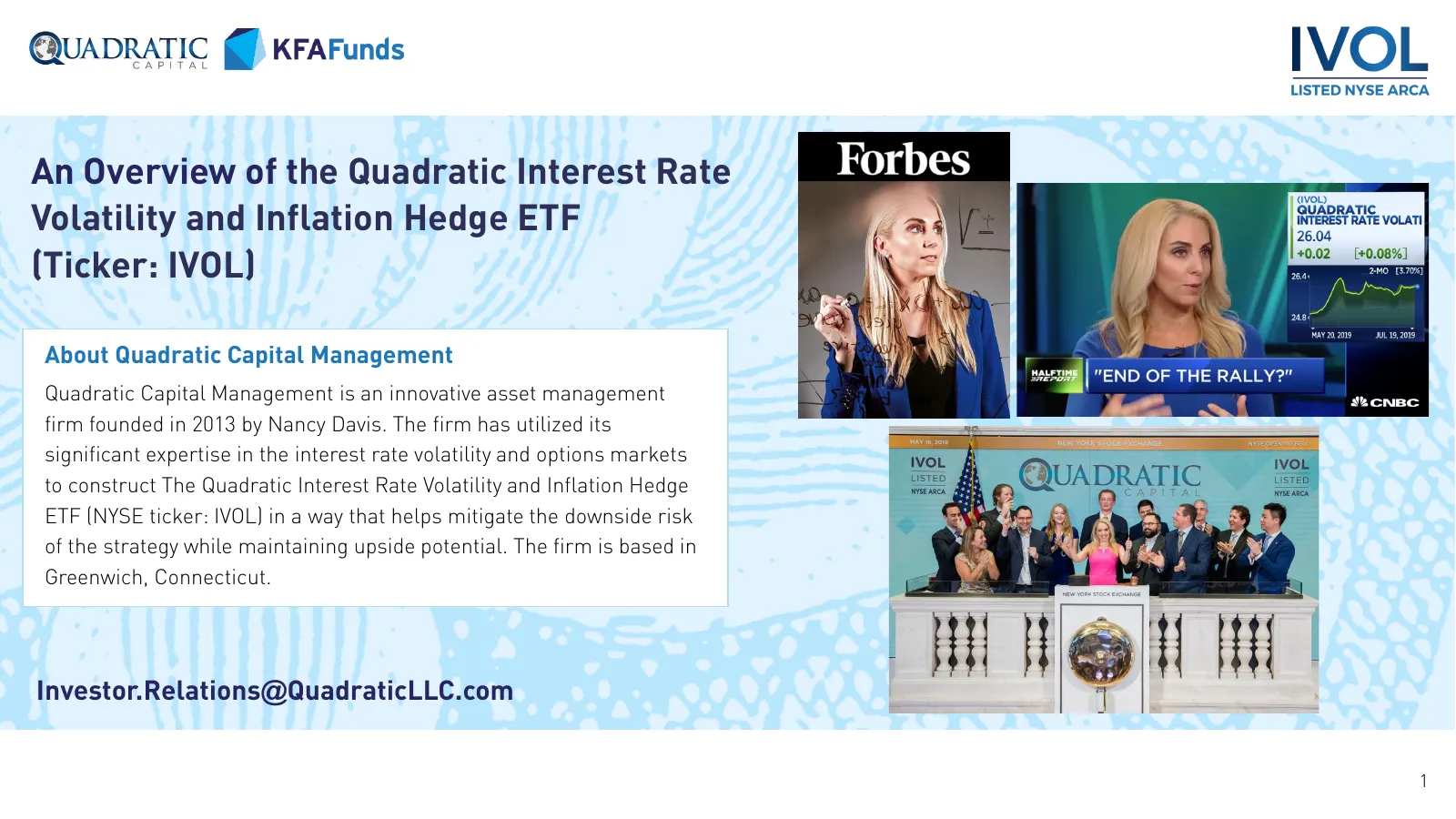
Slide 1: An Overview of the Quadratic Interest Rate Volatility and Inflation Hedge ETF
An Overview of the Quadratic Interest Rate Volatility and Inflation Hedge ETF (Ticker: IVOL) About Quadratic Capital Management Quadratic Capital Management is an innovative asset management firm founded in 2013 by Nancy Davis. The firm has utilized its significant expertise in the interest rate vol
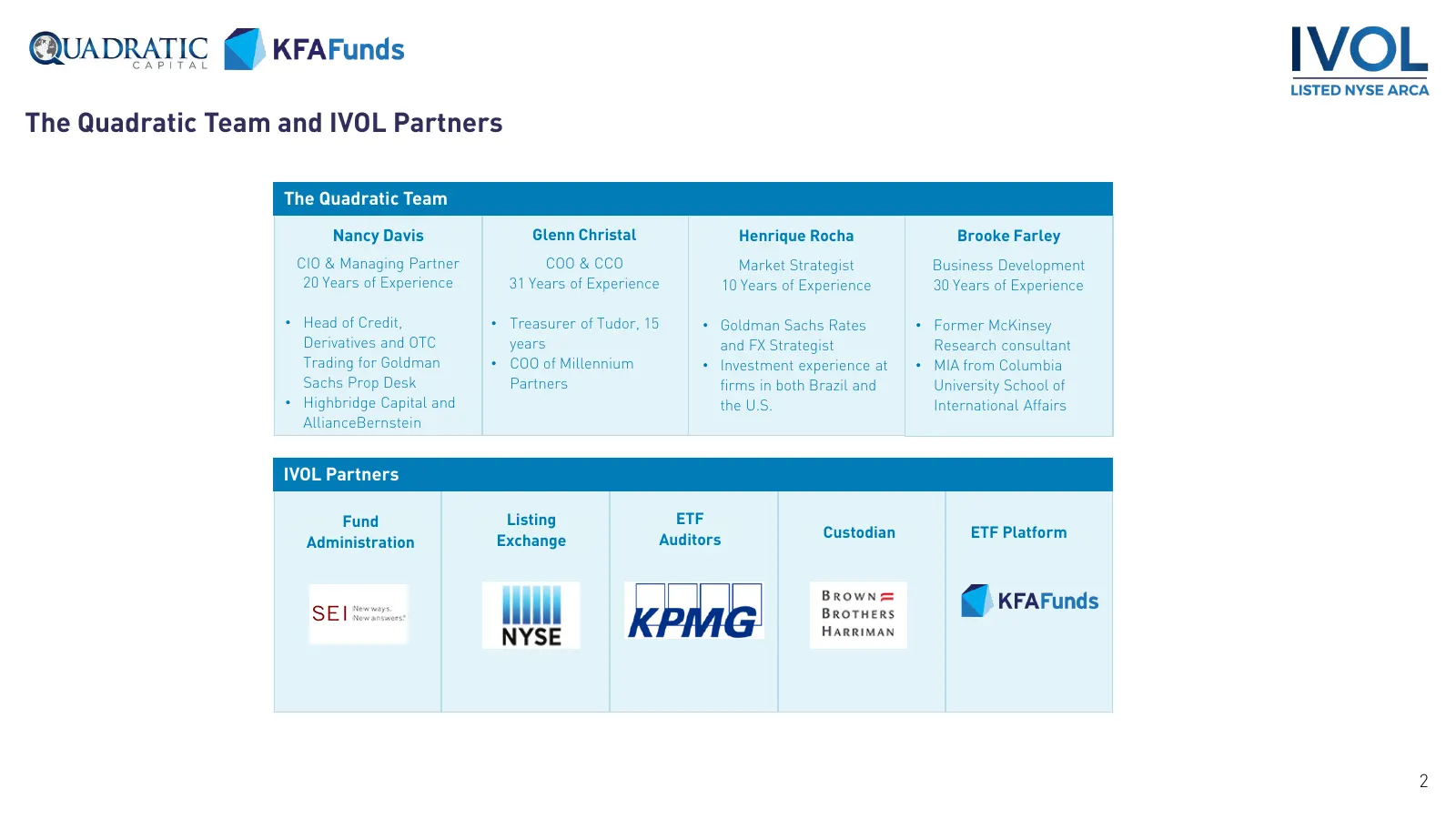
Slide 2: The Quadratic Team and IVOL Partners
The Quadratic Team and IVOL Partners The Quadratic Team Nancy Davis Glenn Christal Henrique Rocha Brooke Farley CIO & Managing Partner COO & CCO Market Strategist Business Development 20 Years of Experience 31 Years of Experience 10 Years of Experience 30 Years of Experience • Head of Credit, • Trea
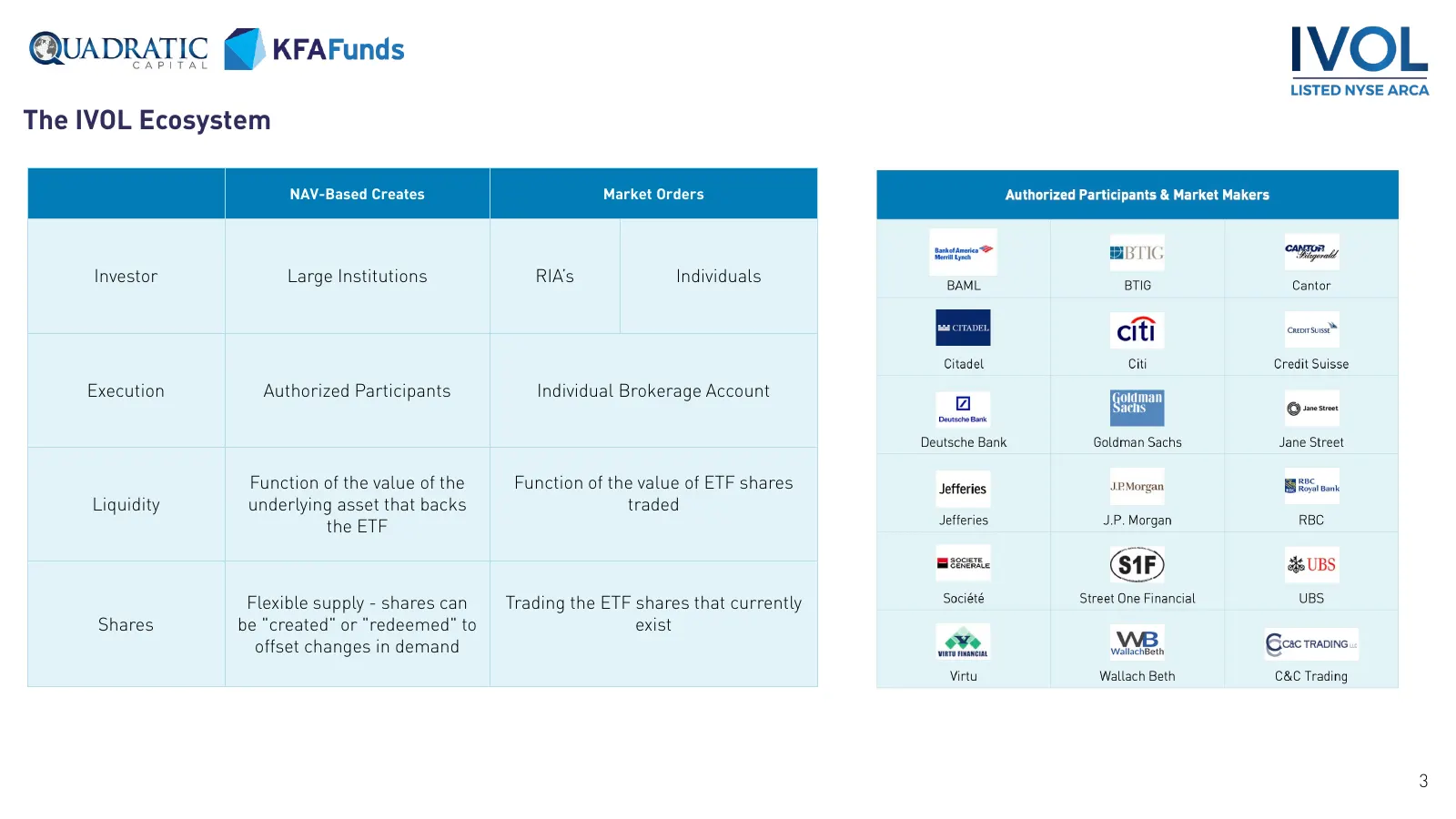
Slide 3: The IVOL Ecosystem
The IVOL Ecosystem NAV-Based Creates Market Orders Investor Large Institutions RIA’s Individuals Execution Authorized Participants Individual Brokerage Account Function of the value of the Function of the value of ETF shares Liquidity underlying asset that backs traded the ETF Flexible supply - shar
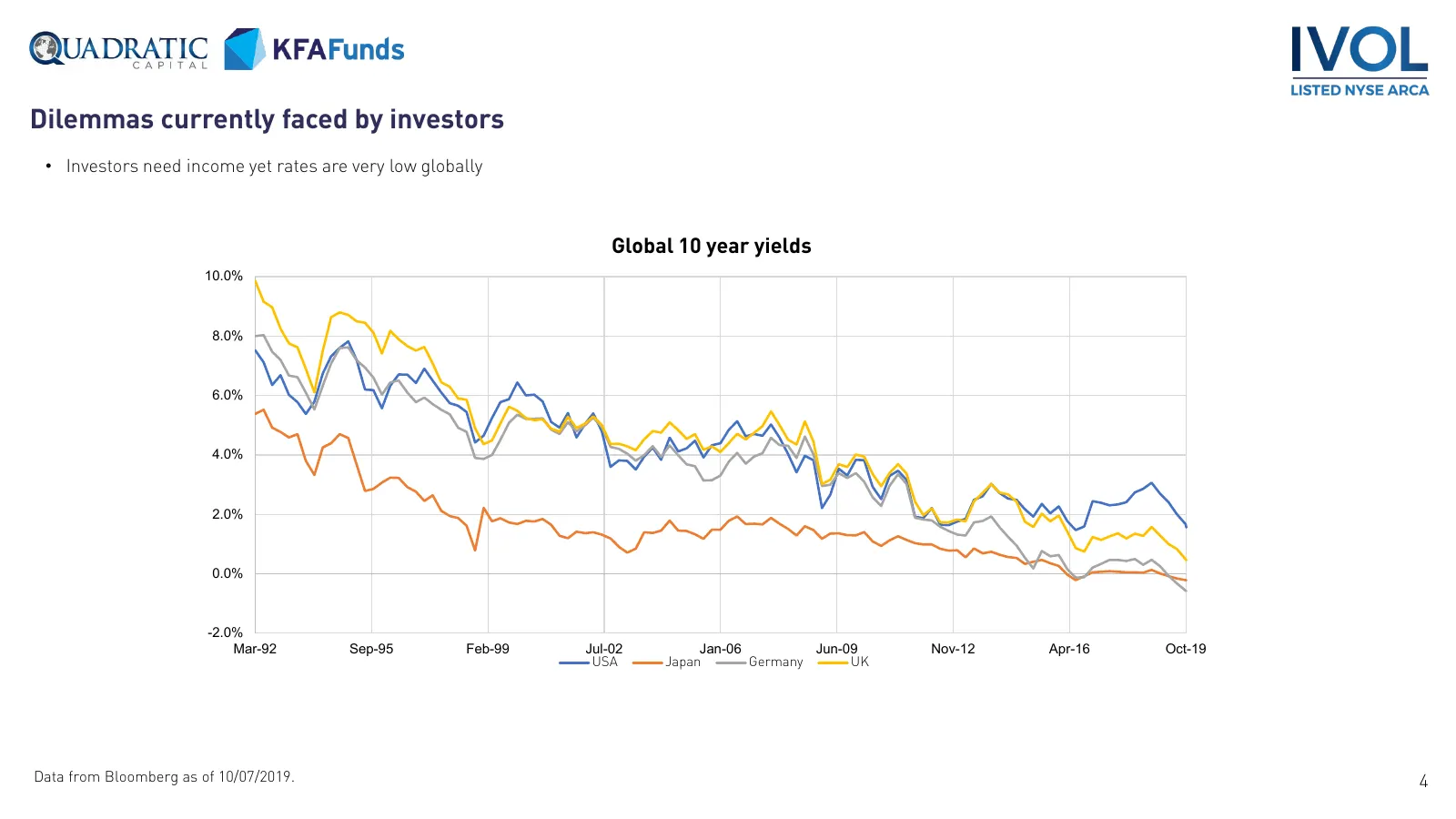
Slide 4: Dilemmas currently faced by investors
Dilemmas currently faced by investors • Investors need income yet rates are very low globally Global 10 year yields 10.0% 8.0% 6.0% 4.0% 2.0% 0.0% -2.0% Mar-92 Sep-95 Feb-99 Jul-02 Jan-06 Jun-09 Nov-12 Apr-16 Oct-19 USA Japan Germany UK Data from Bloomberg as of 10/07/2019. 4
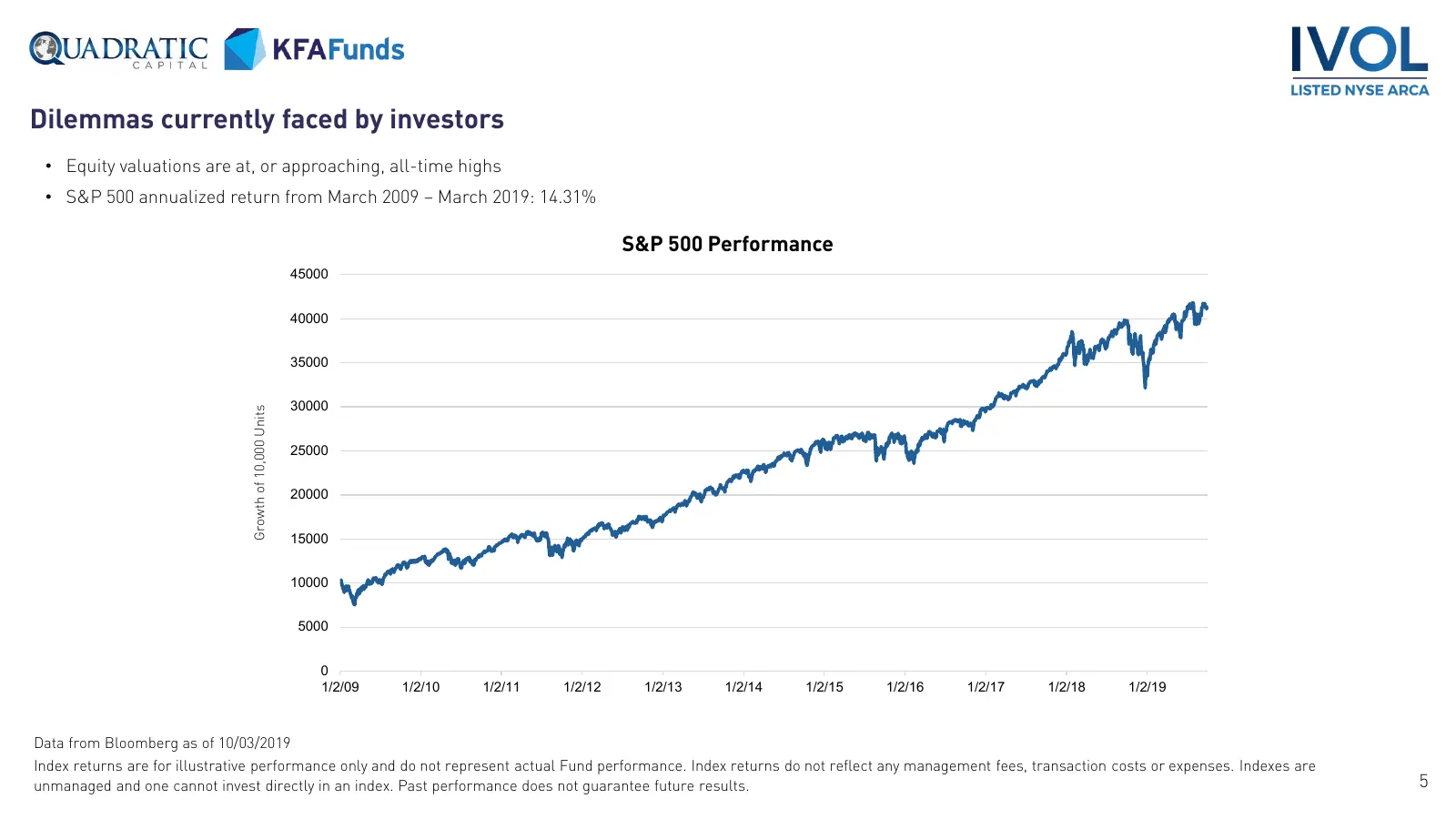
Slide 5: Dilemmas currently faced by investors: equity valuations
Dilemmas currently faced by investors • Equity valuations are at, or approaching, all-time highs • S&P 500 annualized return from March 2009 – March 2019: 14.31% S&P 500 Performance 45000 40000 35000 30000 Growth of 10,000 Units 25000 20000 15000 10000 5000 0 1/2/09 1/2/10 1/2/11 1/2/12 1/2/13 1/2/1
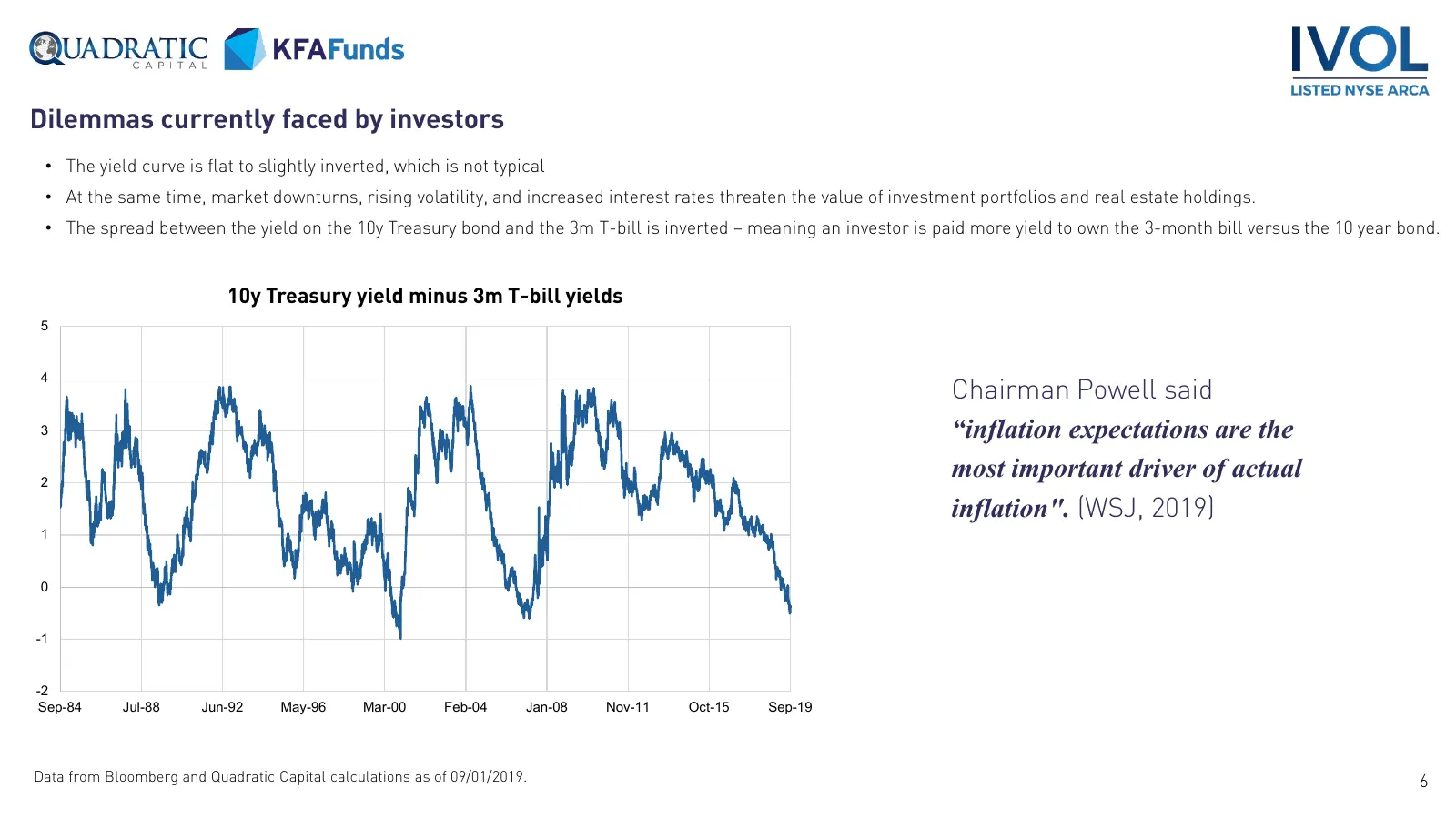
Slide 6: Dilemmas currently faced by investors: yield curve
Dilemmas currently faced by investors • The yield curve is flat to slightly inverted, which is not typical • At the same time, market downturns, rising volatility, and increased interest rates threaten the value of investment portfolios and real estate holdings. • The spread between the yield on the
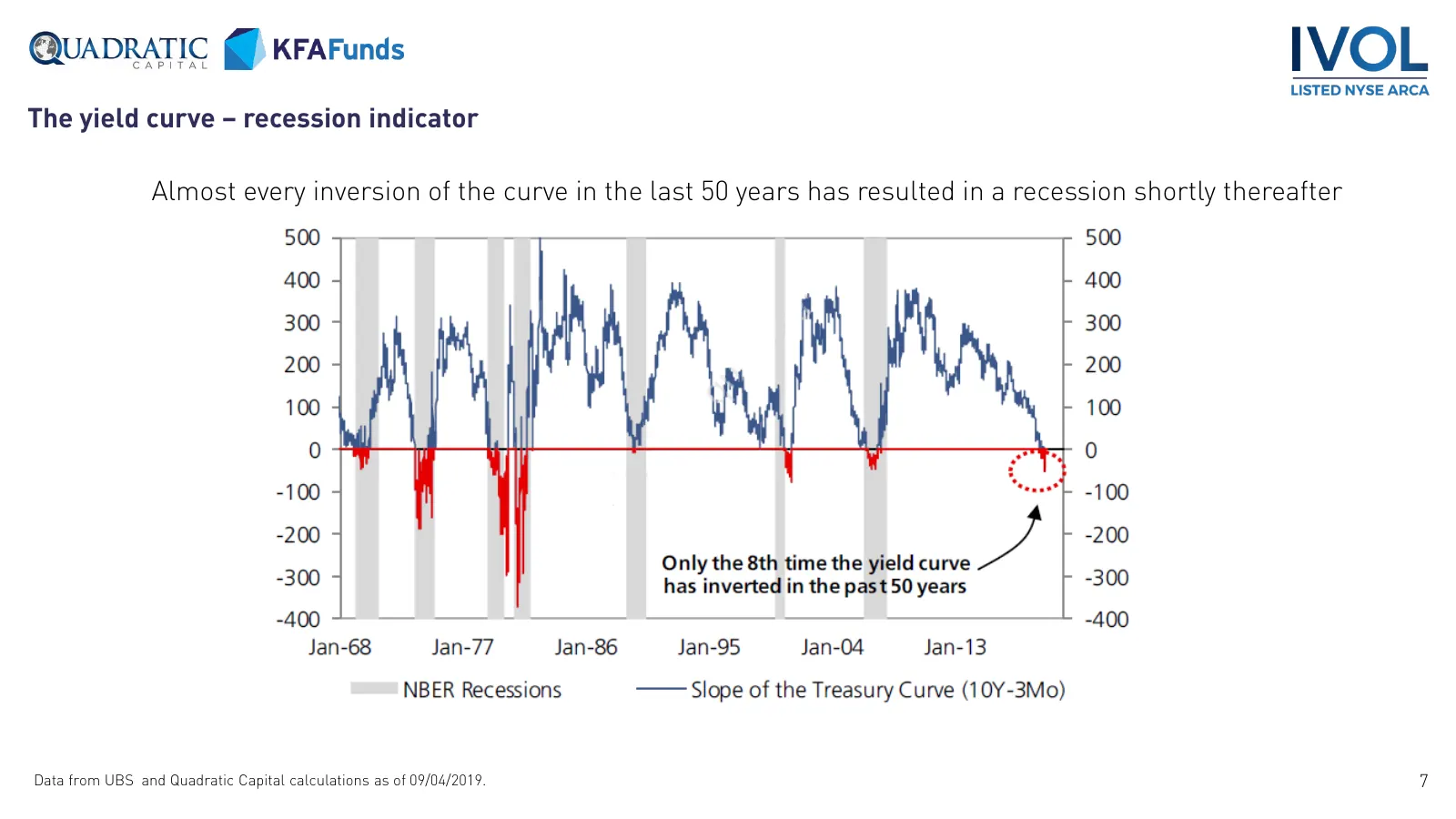
Slide 7: The yield curve – recession indicator
The yield curve – recession indicator Almost every inversion of the curve in the last 50 years has resulted in a recession shortly thereafter Data from UBS and Quadratic Capital calculations as of 09/04/2019. 7
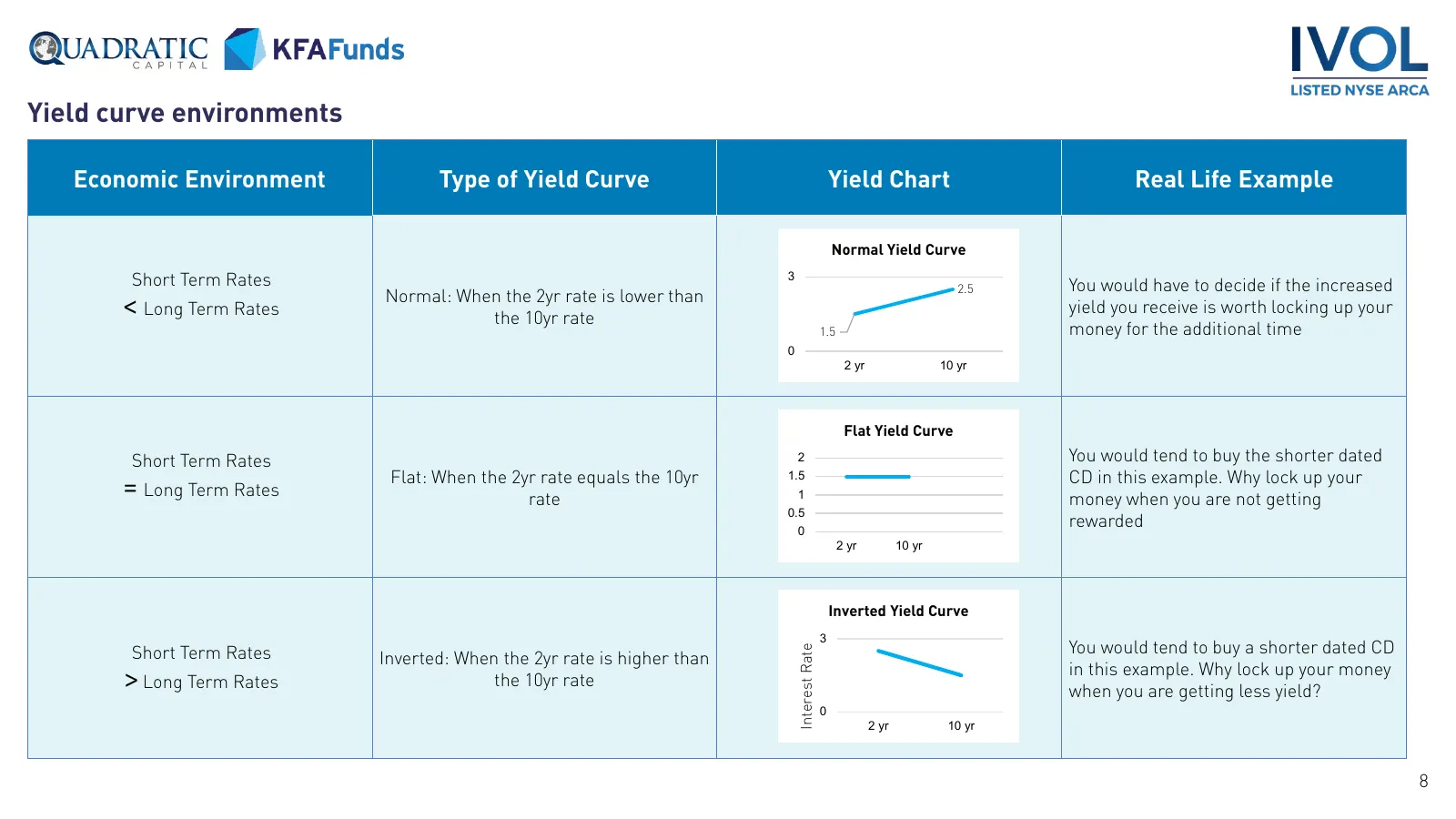
Slide 8: Yield curve environments
Yield curve environments Economic Environment Type of Yield Curve Yield Chart Real Life Example Normal Yield Curve Short Term Rates 3 2.5 You would have to decide if the increased Normal: When the 2yr rate is lower than < Long Term Rates the 10yr rate yield you receive is worth locking up your 1.5 m
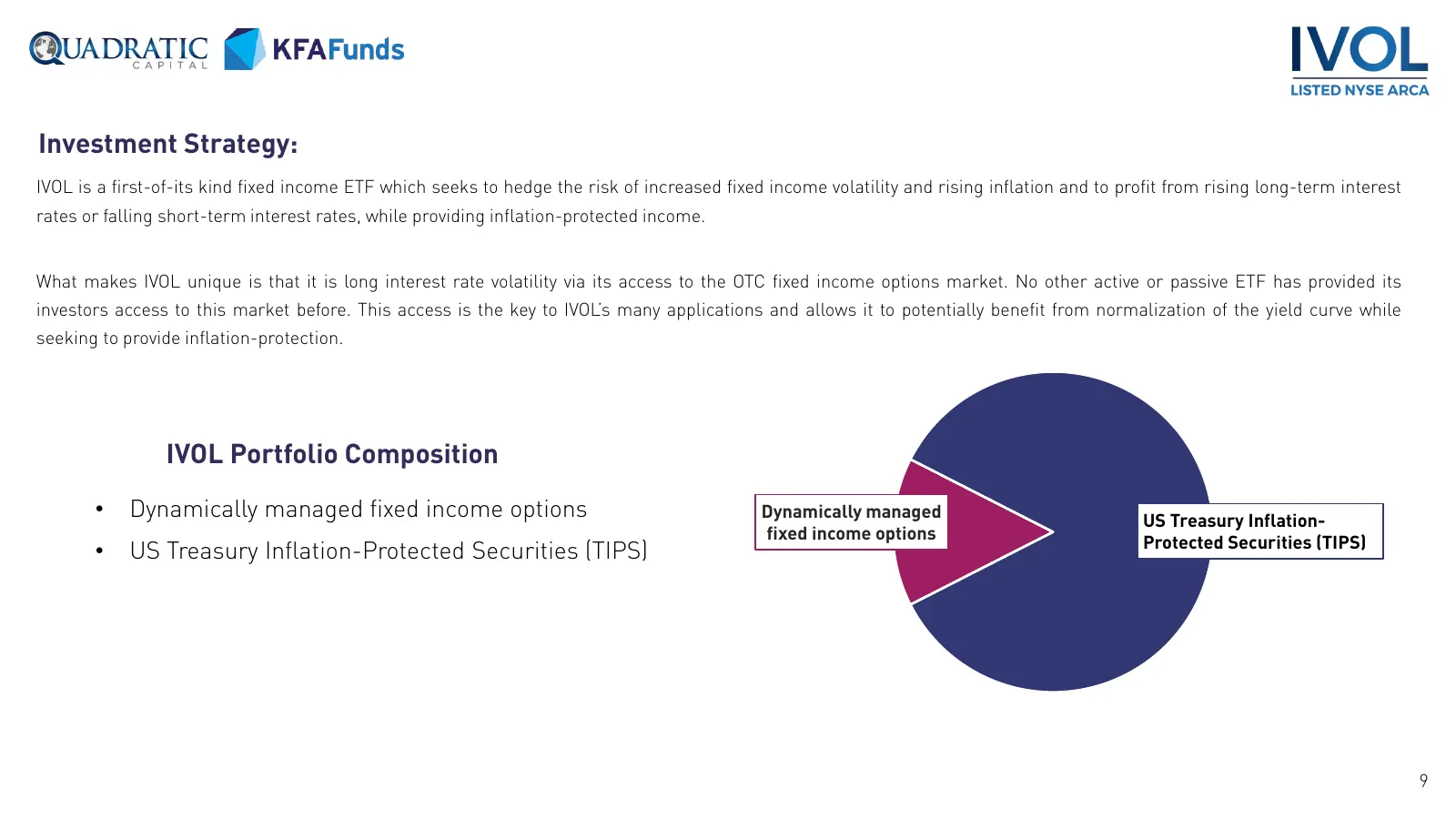
Slide 9: Investment Strategy: IVOL Portfolio Composition
Investment Strategy: IVOL is a first-of-its kind fixed income ETF which seeks to hedge the risk of increased fixed income volatility and rising inflation and to profit from rising long-term interest rates or falling short-term interest rates, while providing inflation-protected income. What makes IV
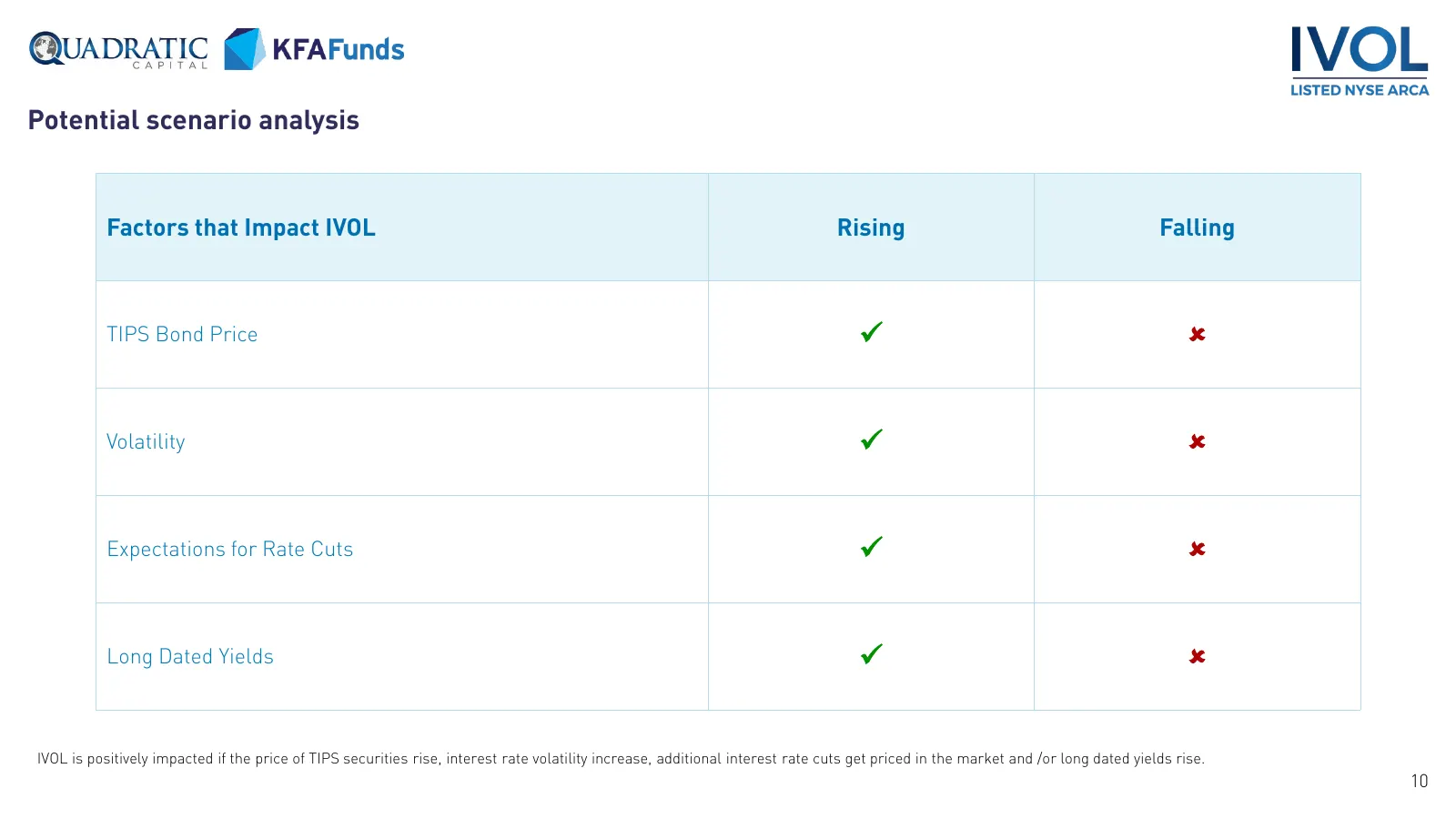
Slide 10: Potential scenario analysis
Potential scenario analysis Factors that Impact IVOL Rising Falling TIPS Bond Price Volatility Expectations for Rate Cuts Long Dated Yields IVOL is positively impacted if the price of TIPS securities rise, interest rate volatility increase, additional interest rate cuts get priced in
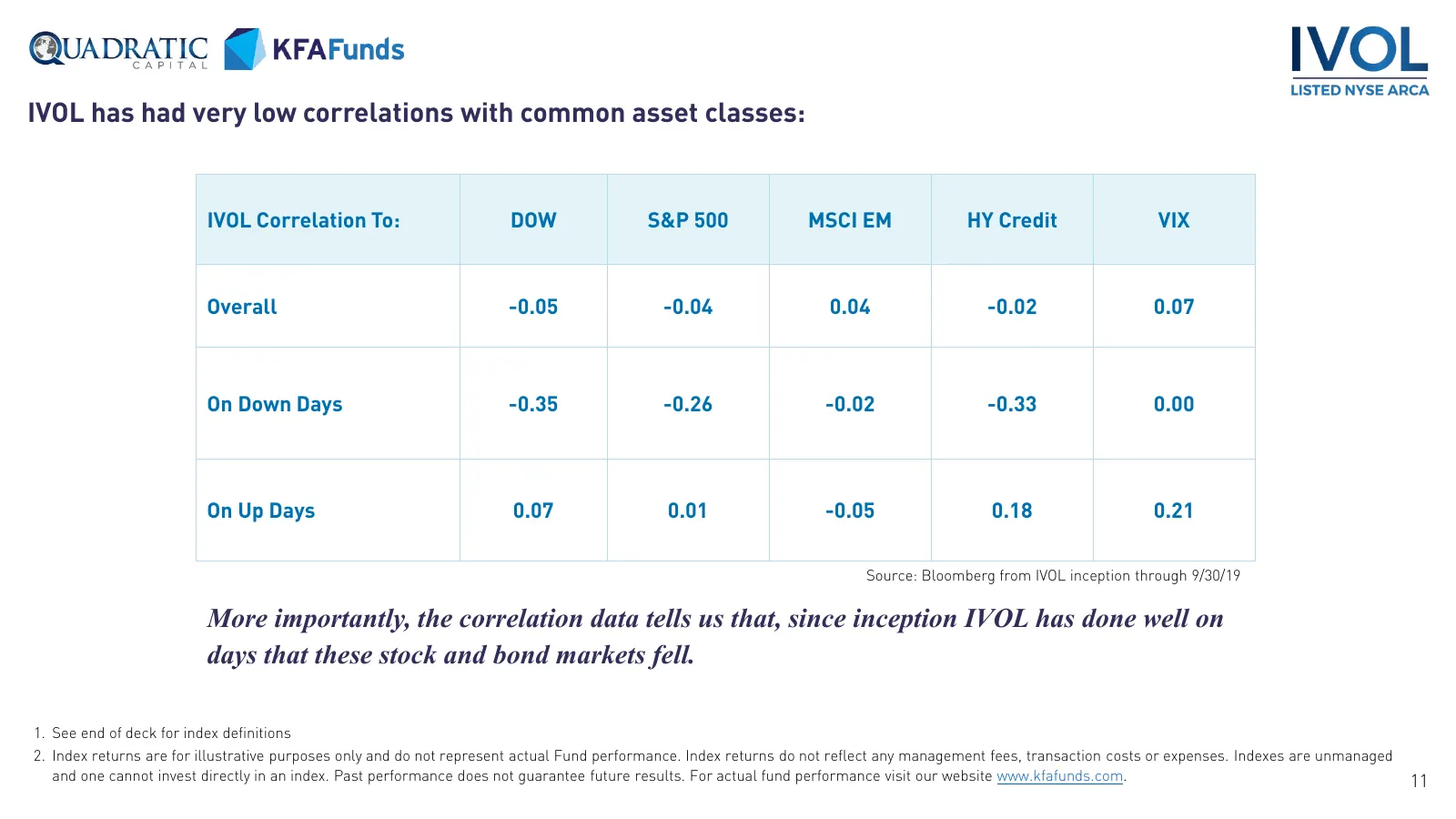
Slide 11: IVOL has had very low correlations with common asset classes
IVOL has had very low correlations with common asset classes: IVOL Correlation To: DOW S&P 500 MSCI EM HY Credit VIX Overall -0.05 -0.04 0.04 -0.02 0.07 On Down Days -0.35 -0.26 -0.02 -0.33 0.00 On Up Days 0.07 0.01 -0.05 0.18 0.21 Source: Bloomberg from IVOL inception through 9/30/19 More important
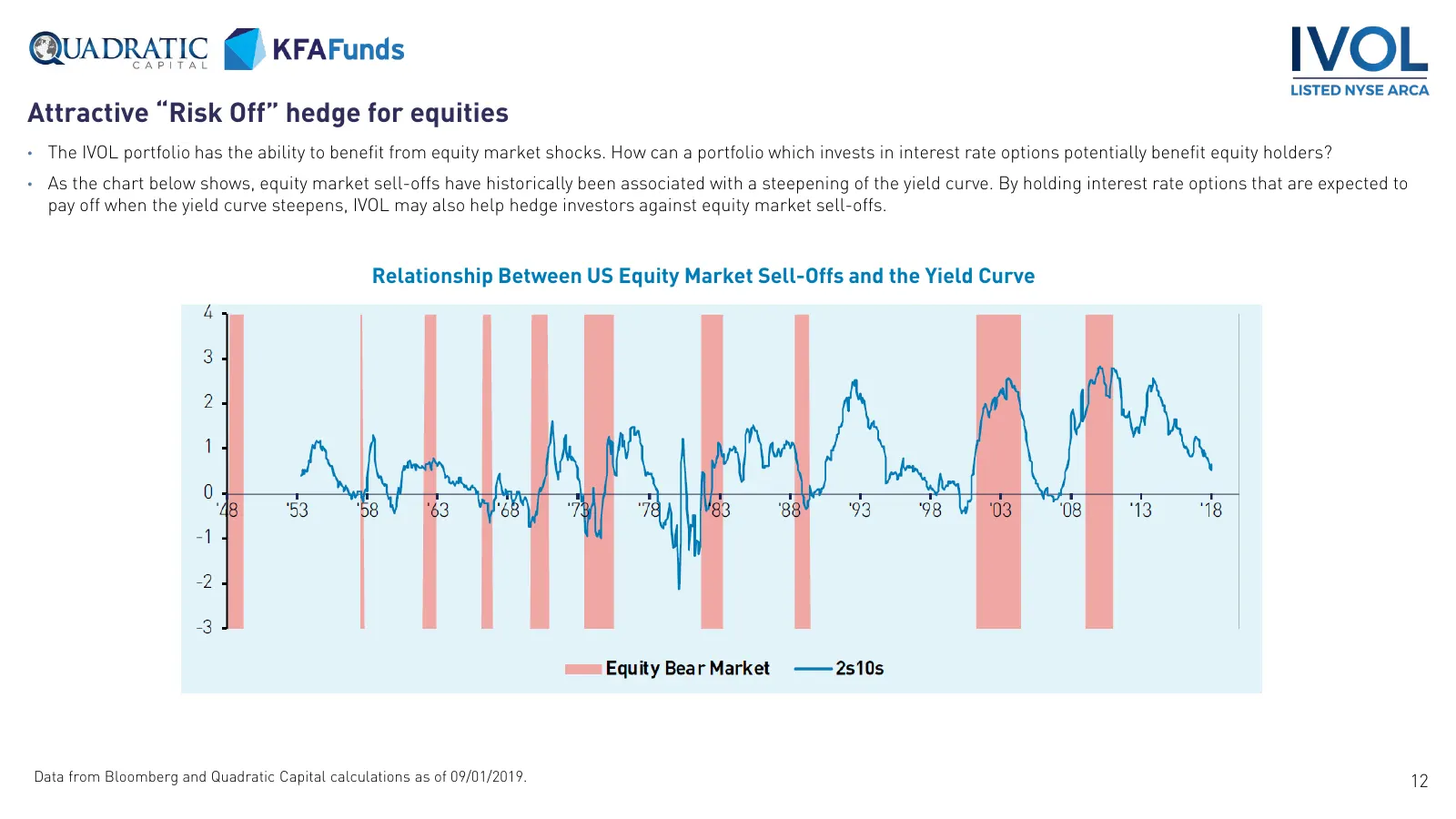
Slide 12: Attractive “Risk Off” hedge for equities
Attractive “Risk Off” hedge for equities • The IVOL portfolio has the ability to benefit from equity market shocks. How can a portfolio which invests in interest rate options potentially benefit equity holders? • As the chart below shows, equity market sell-offs have historically been associated wit
Slide 13: IVOL may complement a variety of portfolios
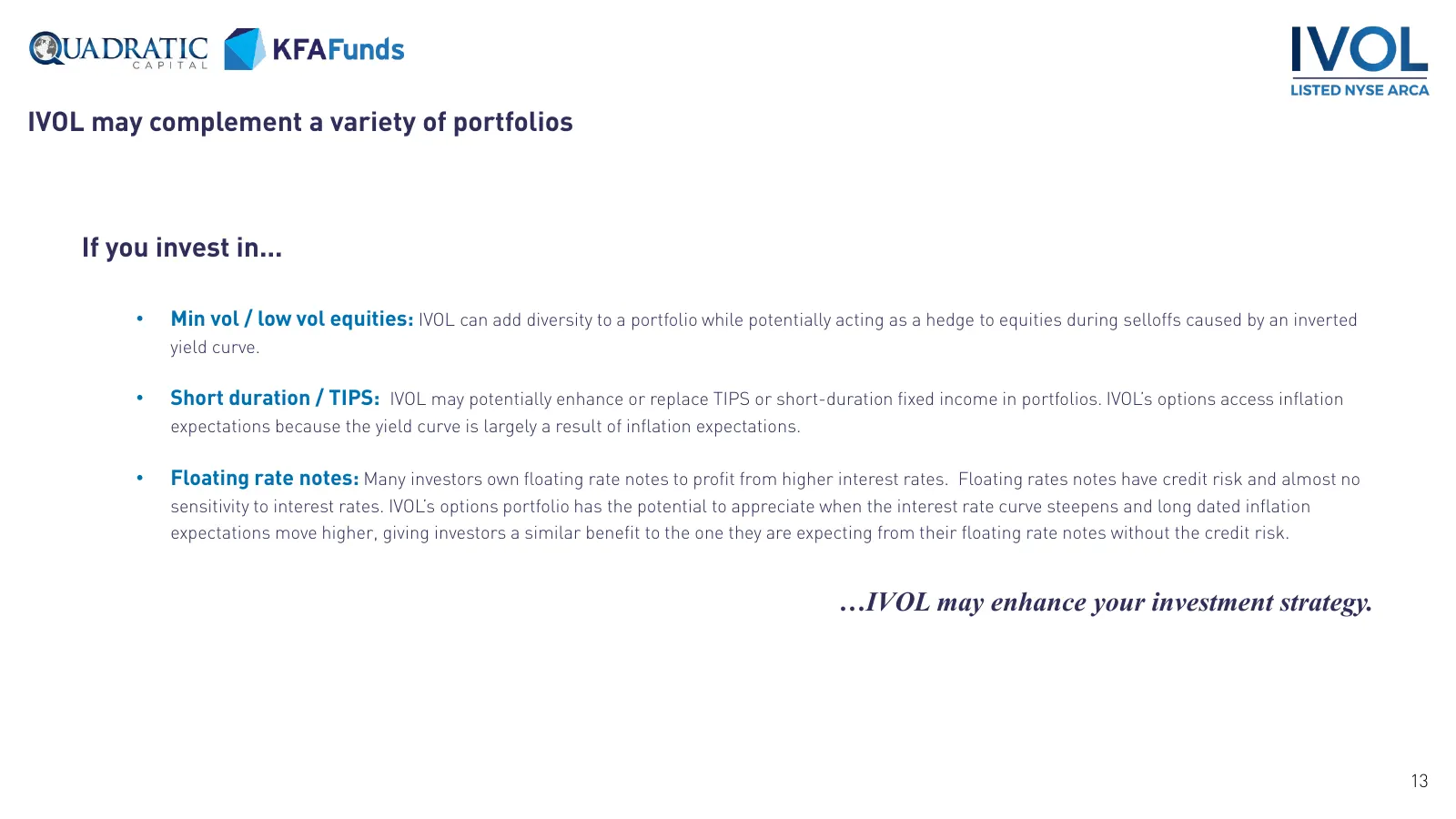
IVOL may complement a variety of portfolios If you invest in... • Min vol / low vol equities: IVOL can add diversity to a portfolio while potentially acting as a hedge to equities during selloffs caused by an inverted yield curve. • Short duration / TIPS: IVOL may potentially enhance or replace TIPS
Slide 14: The IVOL Solution
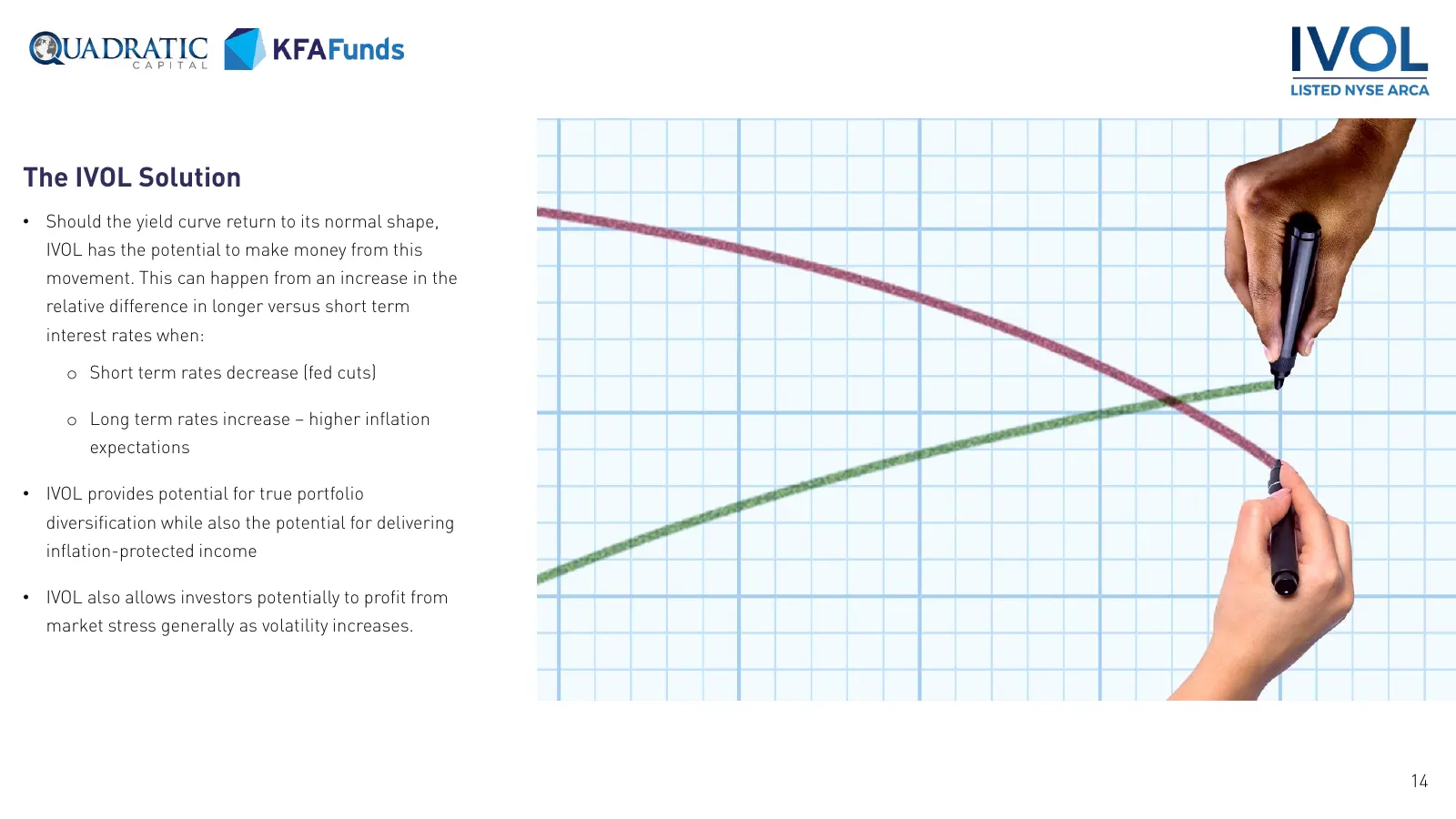
The IVOL Solution • Should the yield curve return to its normal shape, IVOL has the potential to make money from this movement. This can happen from an increase in the relative difference in longer versus short term interest rates when: o Short term rates decrease (fed cuts) o Long term rates increa
Slide 15: The Quadratic Interest Rate Volatility and Inflation Hedge ETF
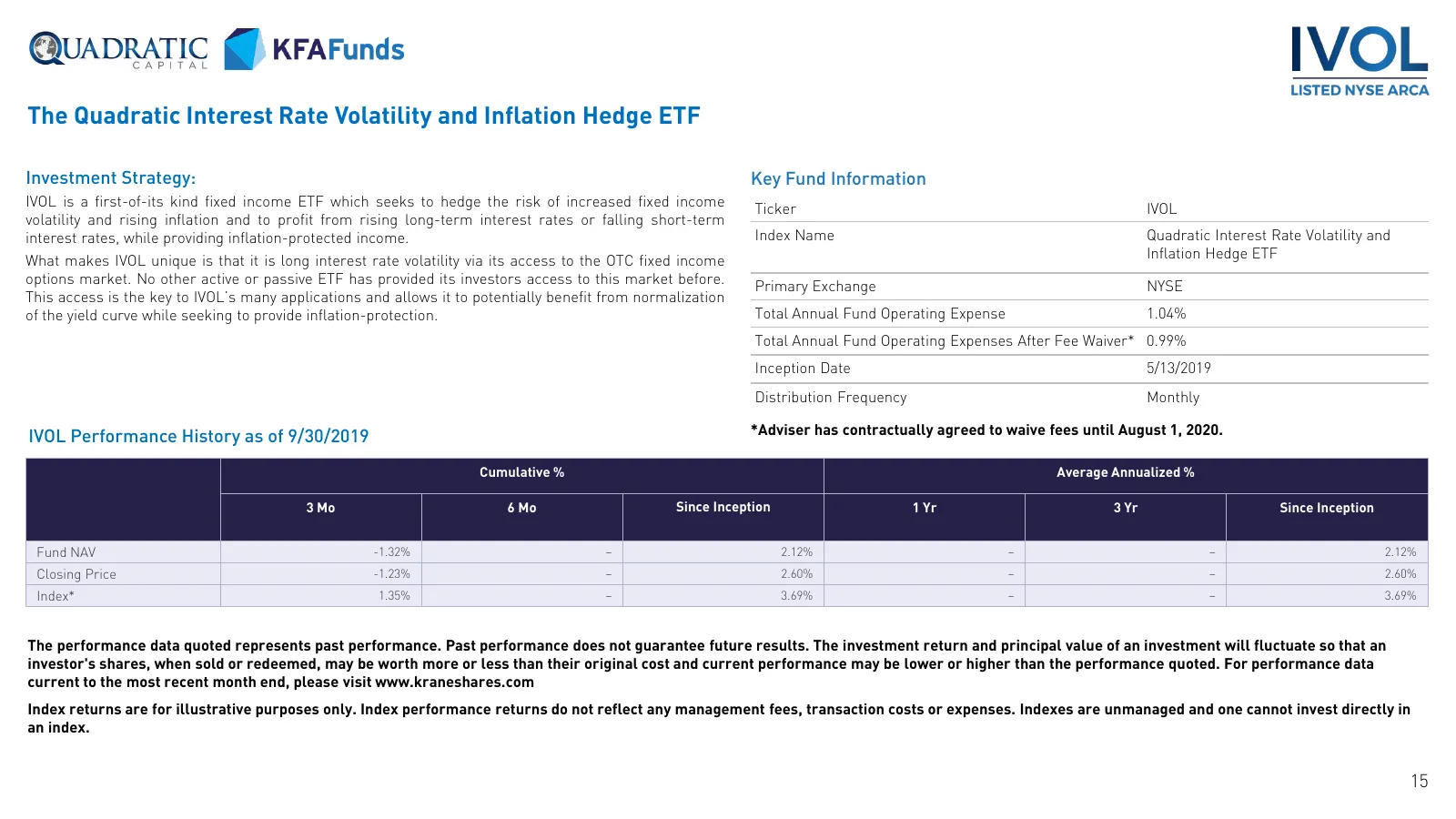
The Quadratic Interest Rate Volatility and Inflation Hedge ETF Investment Strategy: Key Fund Information IVOL is a first-of-its kind fixed income ETF which seeks to hedge the risk of increased fixed income Ticker IVOL volatility and rising inflation and to profit from rising long-term interest rates
Slide 16: Index Definitions and Important Notes
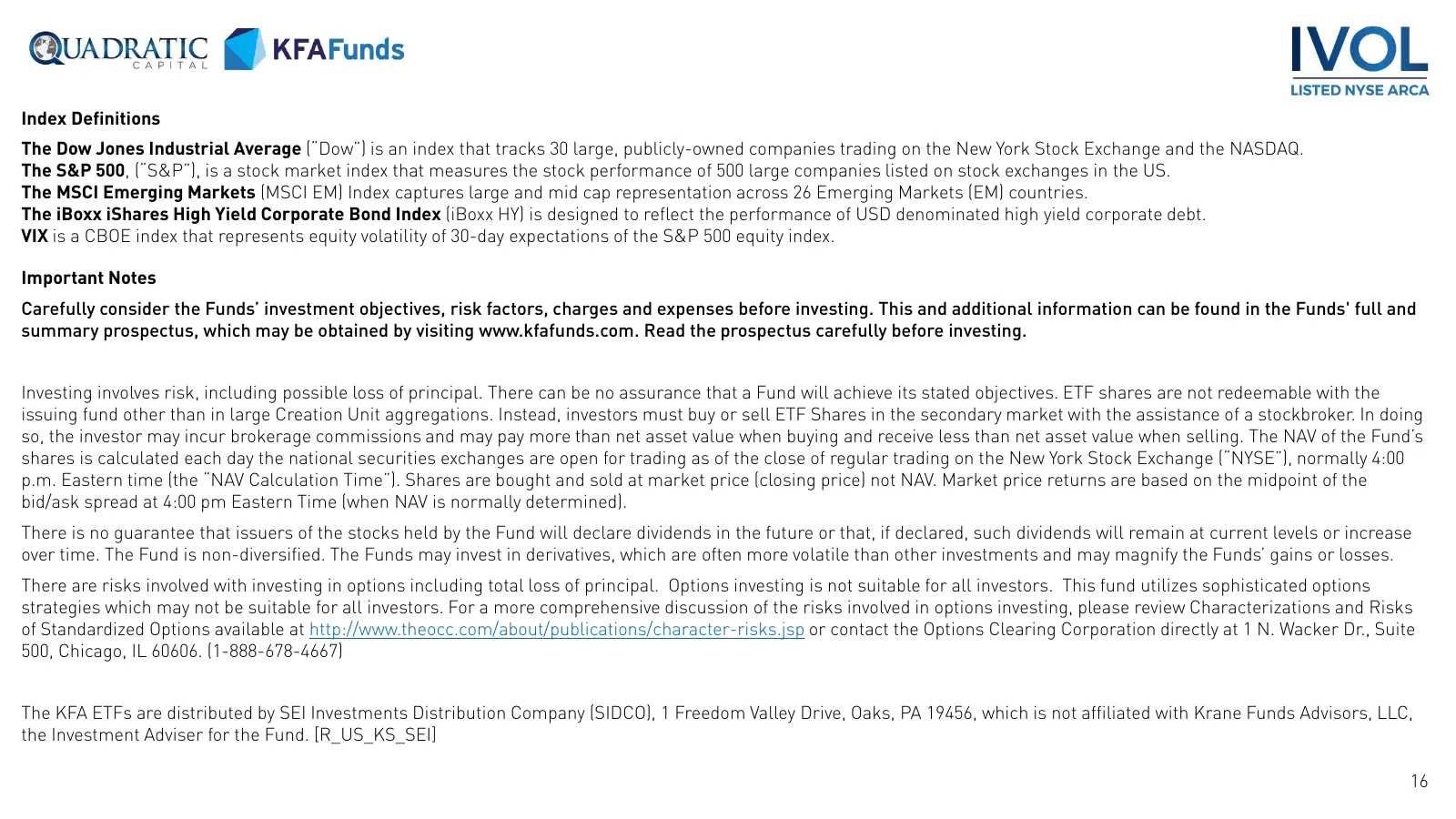
Index Definitions The Dow Jones Industrial Average (“Dow”) is an index that tracks 30 large, publicly-owned companies trading on the New York Stock Exchange and the NASDAQ. The S&P 500, (“S&P”), is a stock market index that measures the stock performance of 500 large companies listed on stock exchan
Slide 17: Appendix
QUADRATIC @J KFAFunds IVOL LISTED NYSE ARCA Appendix 17
Slide 18: AUM doesn’t matter
AUM doesn’t matter 1. Look at the overall ownership, not the fund ownership • Exchange-traded funds (ETFs) are a wrapper, and although an investor may hold a large percentage of an ETF, one must look at the percentage owned of the underlying asset class. 2. Not impacted by other investors • The ETF
Slide 19: ETF Liquidity
ETF Liquidity 1. An ETF isn’t a stock • If an ETF doesn’t trade a certain number of shares per day, is the fund illiquid? No. It’s a plausible assumption from a single-stock perspective, but with ETFs, we need to go a level deeper. The key is to understand the difference between the primary and seco
Source: company website
More decks from KraneShares Global Carbon Strategy ETF
 Quadratic Interest Rate Volatility and Inflation Hedge ETF (IVOL) — Investor Presentation (September 2023)25 slides · Sep 30, 2023
 Quadratic Interest Rate Volatility and Inflation Hedge ETF (IVOL) — Investor Presentation (June 2023)25 slides · Jun 30, 2023
 Quadratic Interest Rate Volatility and Inflation Hedge ETF (IVOL) — Investor Presentation (March 2023)24 slides · Mar 31, 2023
 Quadratic Interest Rate Volatility and Inflation Hedge ETF (IVOL) — Investor Presentation (2023)24 slides · Mar 11, 2023
 Quadratic Interest Rate Volatility and Inflation Hedge ETF (IVOL) — Investor Presentation (September 2022)24 slides · Sep 30, 2022
 Quadratic Interest Rate Volatility and Inflation Hedge ETF (IVOL) — Investor Presentation (June 2022)24 slides · Jun 30, 2022