Cognition Therapeutics, Inc. · NASDAQ:CGTX
Cognition Therapeutics — Investor Presentation (November 2026)
33 slides from Cognition Therapeutics's investor presentation, November 2026
Slide 1: Zervimesine: Disease Modifying in Alzheimer's and DLB
COGNITION THERAPEUTICS · NASDAQ: CGTX Zervimesine: Disease Modifying in Alzheimer’s and DLB November 2026 · Corporate Presentation https://cogrx.com
Slide 2: Forward-Looking Statements
FORWARD-LOOKING STATEMENTS This presentation contains forward-looking statements within the meaning of The Private Securities Litigation Reform Act of 1995. All statements contained in this presentation, other than statements of historical facts or statements that relate to present facts or current
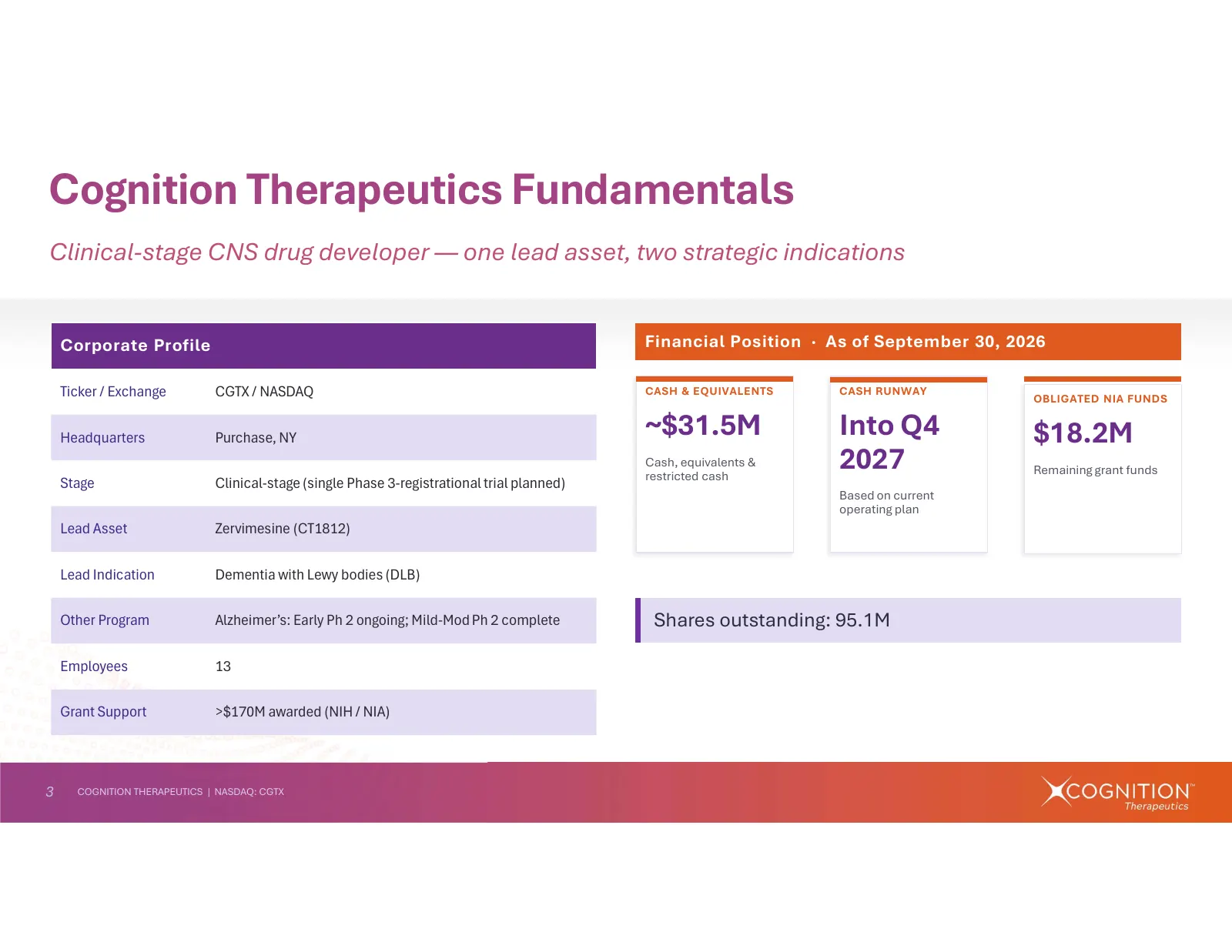
Slide 3: Cognition Therapeutics Fundamentals
Cognition Therapeutics Fundamentals Clinical-stage CNS drug developer — one lead asset, two strategic indications Corporate Profile Financial Position · As of September 30, 2026 Ticker / Exchange CGTX / NASDAQ CASH & EQUIVALENTS CASH RUNWAY OBLIGATED NIA FUNDS Headquarters Purchase, NY ~$31.5M Into
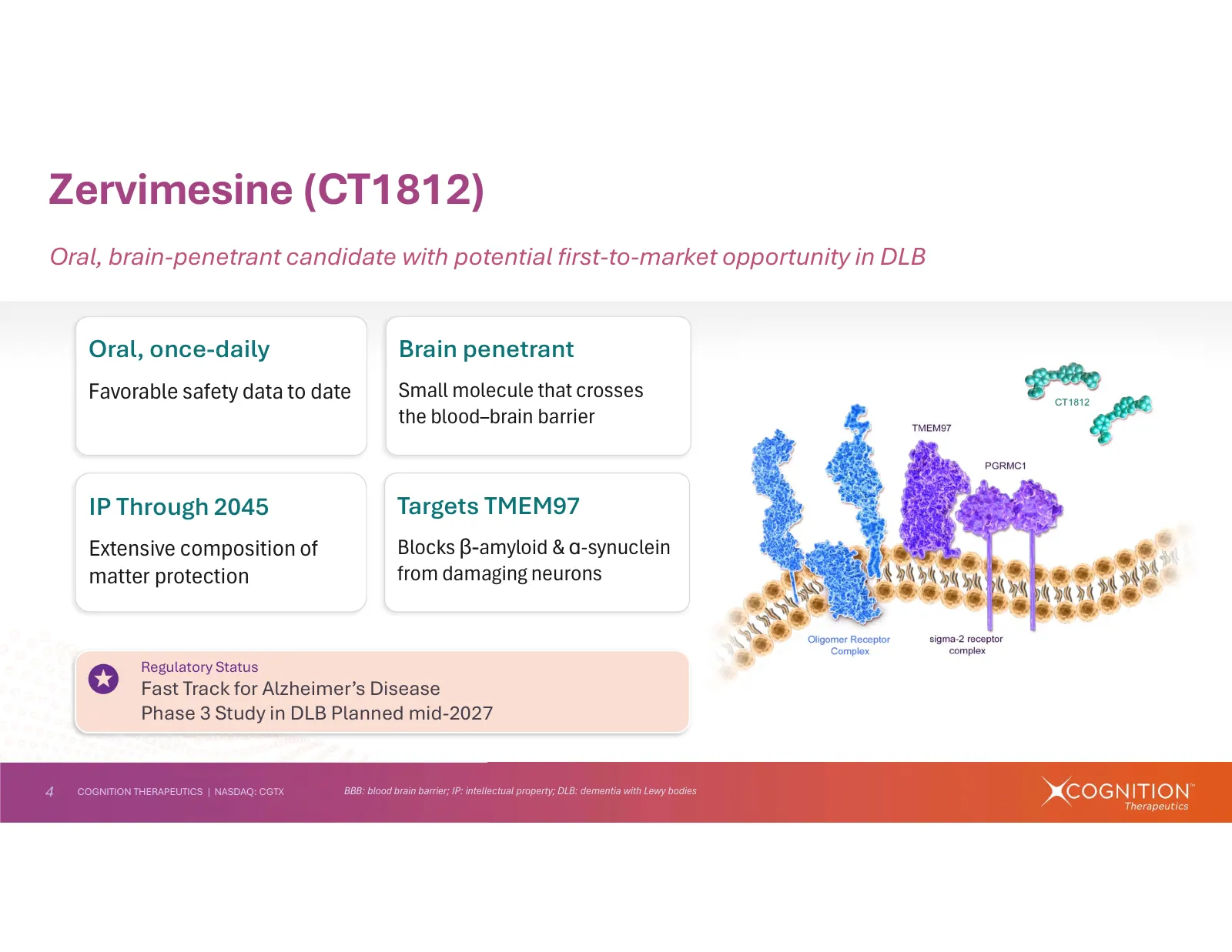
Slide 4: Zervimesine (CT1812)
Zervimesine (CT1812) Oral, brain-penetrant candidate with potential first-to-market opportunity in DLB Oral, once-daily Brain penetrant Favorable safety data to date Small molecule that crosses the blood–brain barrier IP Through 2045 Targets TMEM97 Extensive composition of Blocks β-amyloid & ɑ-synuc
Slide 5: Robust Patent Estate with Exclusivity Through 2045
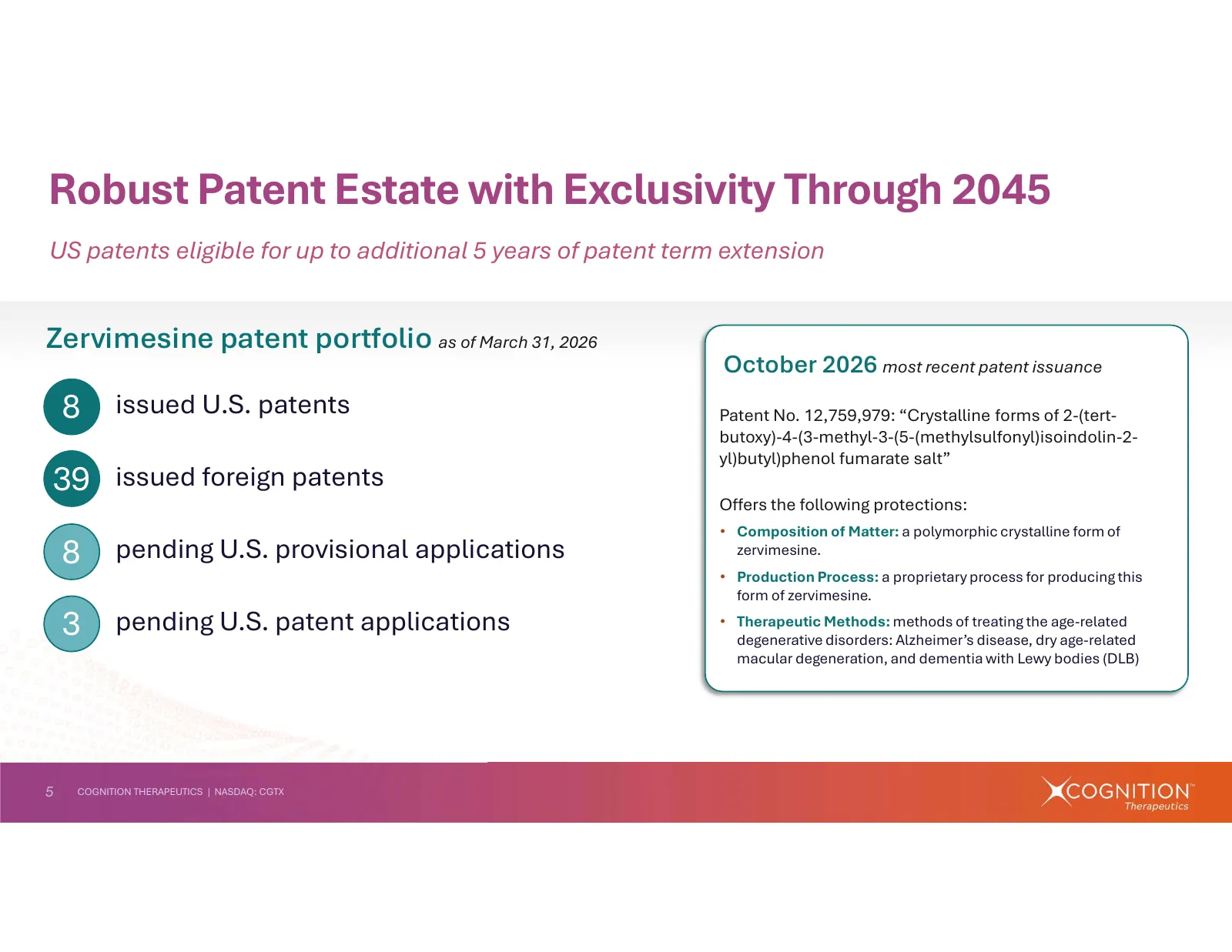
Robust Patent Estate with Exclusivity Through 2045 US patents eligible for up to additional 5 years of patent term extension Zervimesine patent portfolio as of March 31, 2026 October 2026 most recent patent issuance 8 issued U.S. patents Patent No. 12,759,979: “Crystalline forms of 2-(tert- butoxy)-
Slide 6: Zervimesine Acts on the Biology of Neurodegenerative Diseases
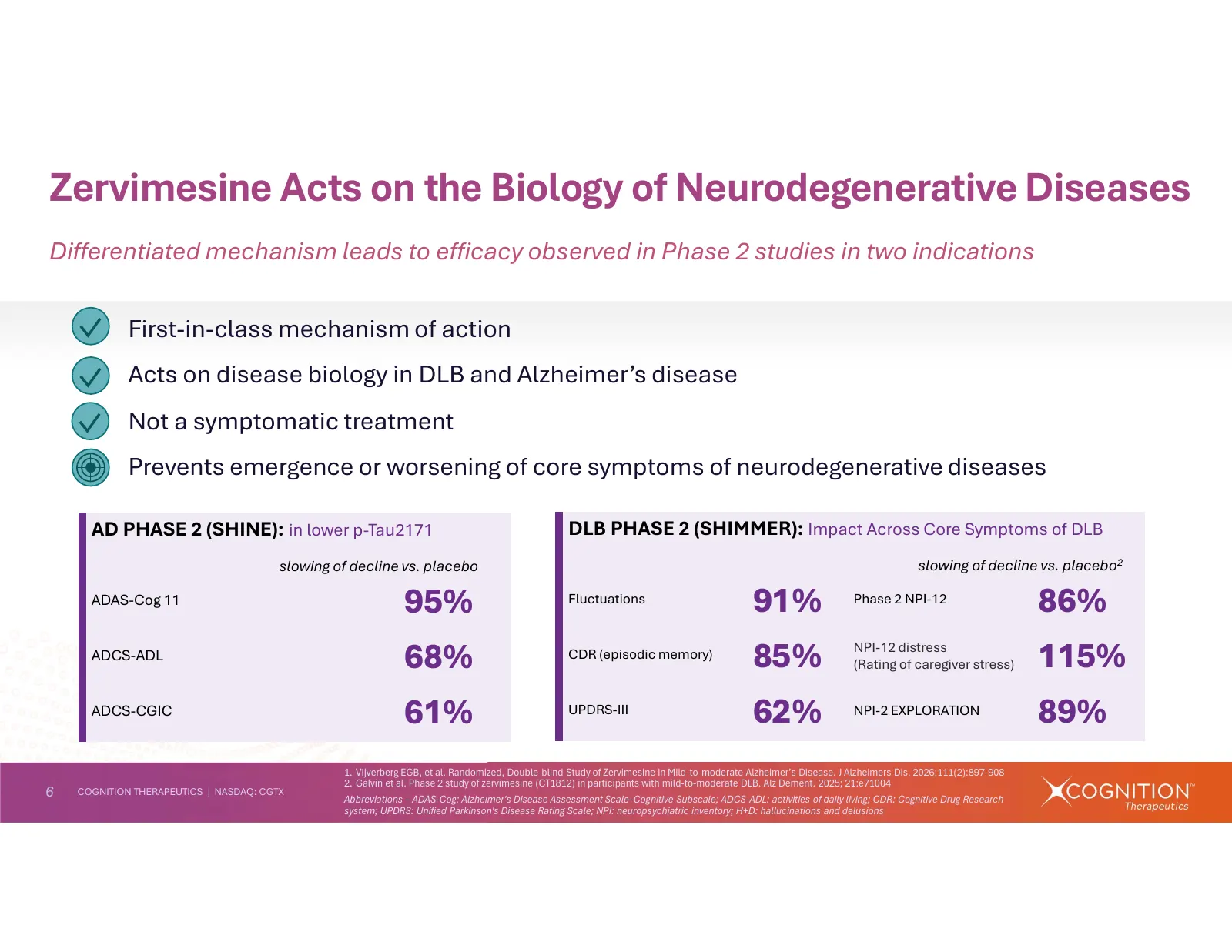
Zervimesine Acts on the Biology of Neurodegenerative Diseases Differentiated mechanism leads to efficacy observed in Phase 2 studies in two indications ✓ First-in-class mechanism of action ✓ Acts on disease biology in DLB and Alzheimer’s disease ✓ Not a symptomatic treatment Prevents emergence or wo
Slide 7: Epidemiology of Dementia with Lewy Bodies
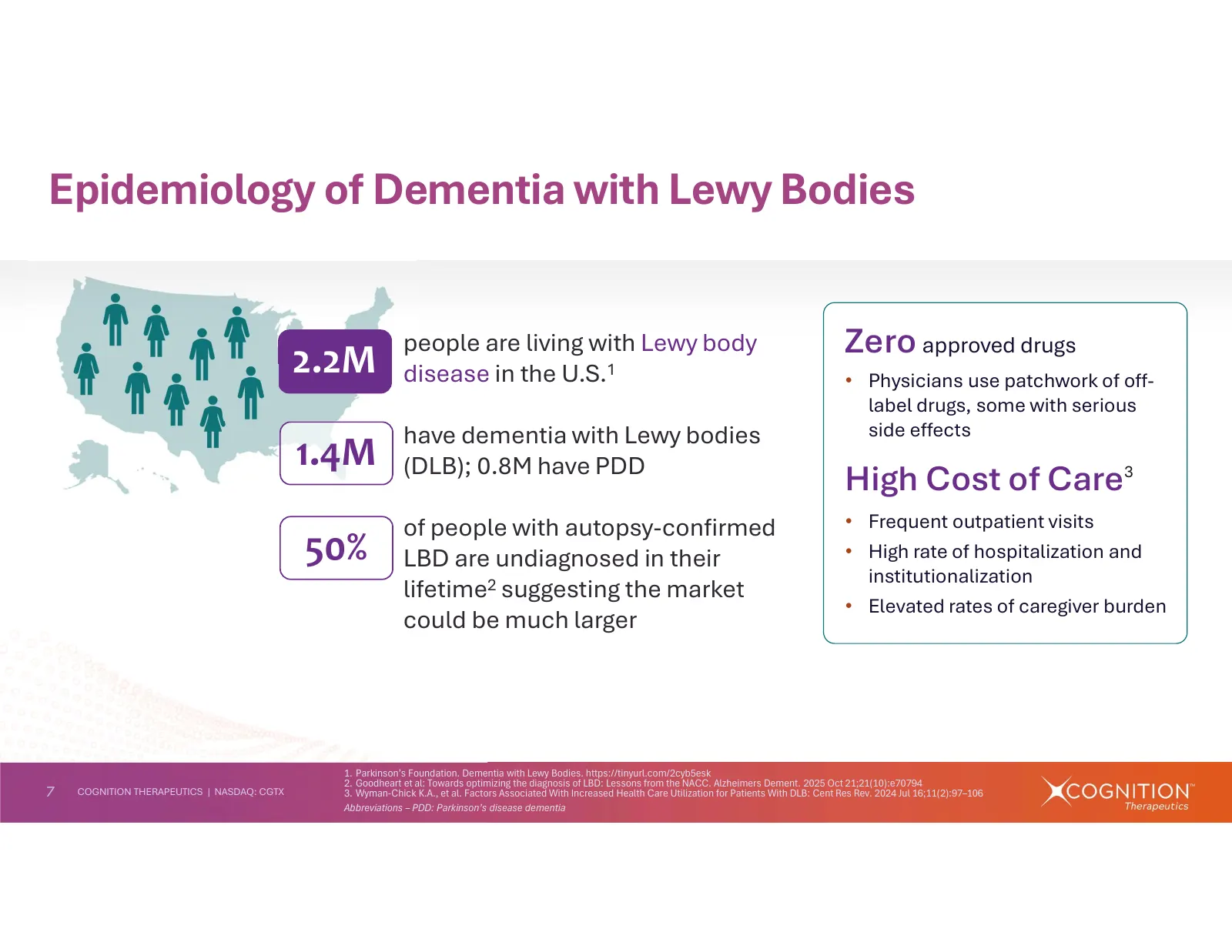
Epidemiology of Dementia with Lewy Bodies people are living with Lewy body Zero approved drugs 2.2M disease in the U.S.1 • Physicians use patchwork of off- label drugs, some with serious have dementia with Lewy bodies side effects 1.4M (DLB); 0.8M have PDD High Cost of Care3 of people with autopsy-c
Slide 8: Landscape of Approved Drugs in Alzheimer's and DLB
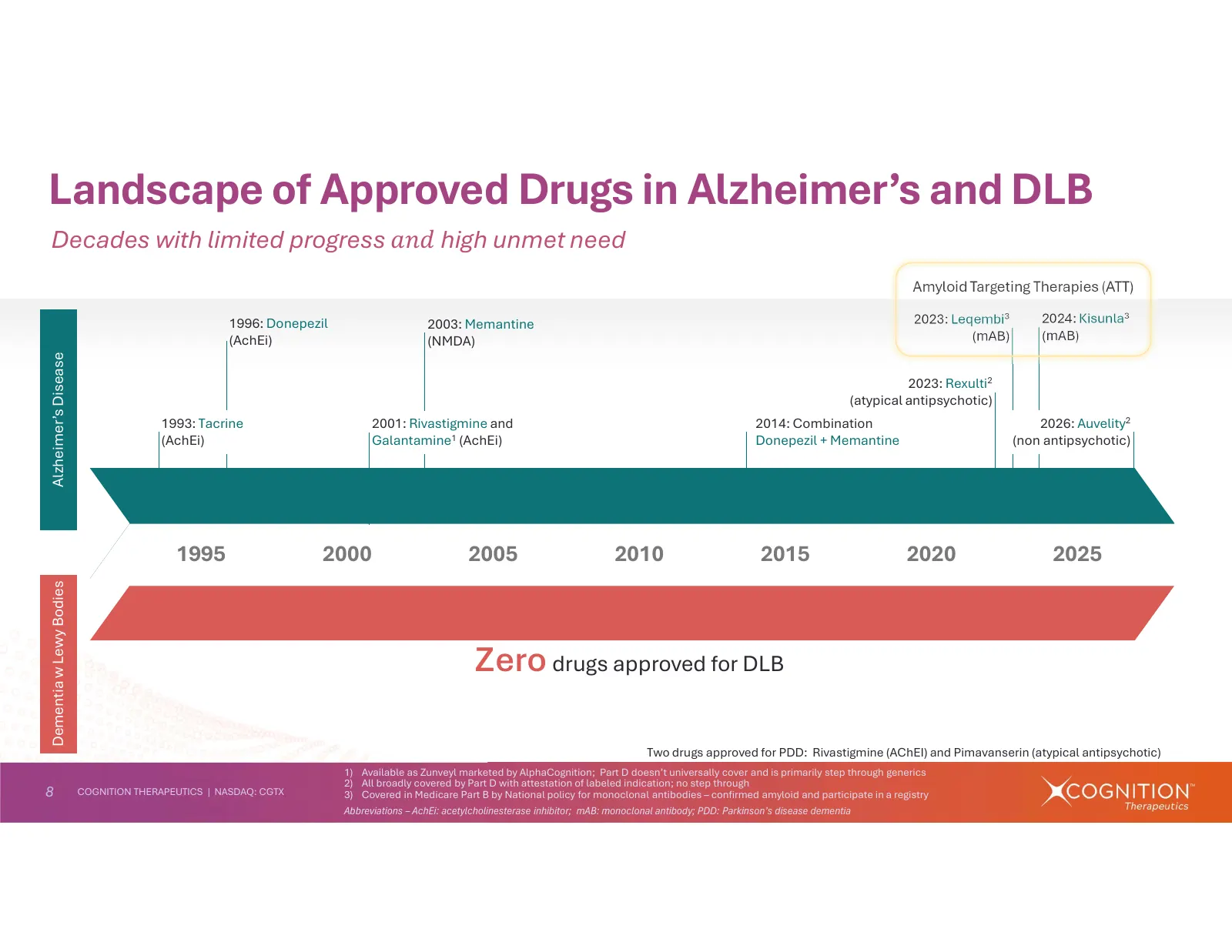
Landscape of Approved Drugs in Alzheimer’s and DLB Decades with limited progress 𝑎𝑛𝑑 high unmet need Amyloid Targeting Therapies (ATT) 1996: Donepezil 2003: Memantine 2023: Leqembi3 2024: Kisunla3 (AchEi) (NMDA) (mAB) (mAB) Alzheimer’s Disease 2023: Rexulti2 (atypical antipsychotic) 1993…
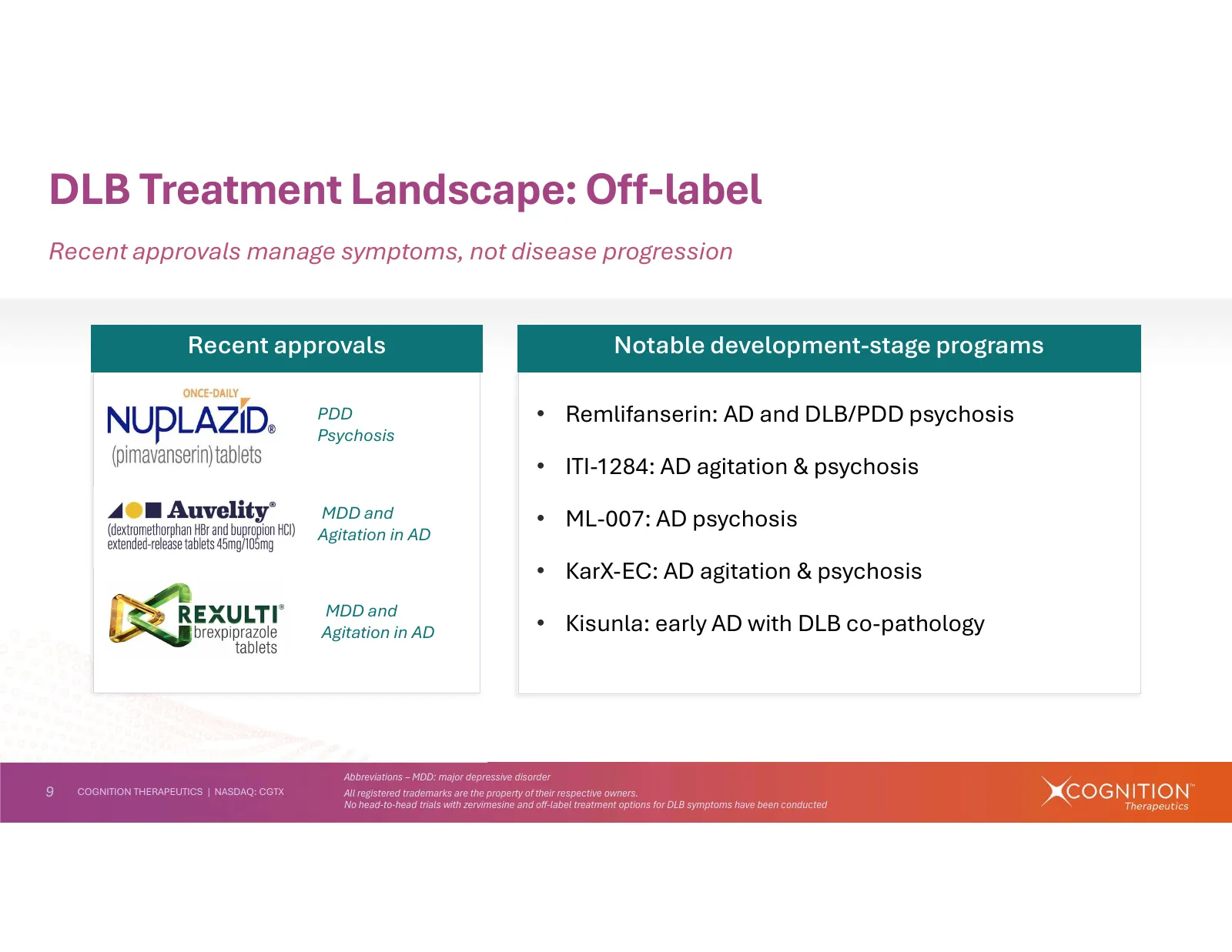
Slide 9: DLB Treatment Landscape: Off-label
DLB Treatment Landscape: Off-label Recent approvals manage symptoms, not disease progression Recent approvals Notable development-stage programs PDD • Remlifanserin: AD and DLB/PDD psychosis Psychosis • ITI-1284: AD agitation & psychosis MDD and • ML-007: AD psychosis Agitation in AD • KarX-EC: AD a
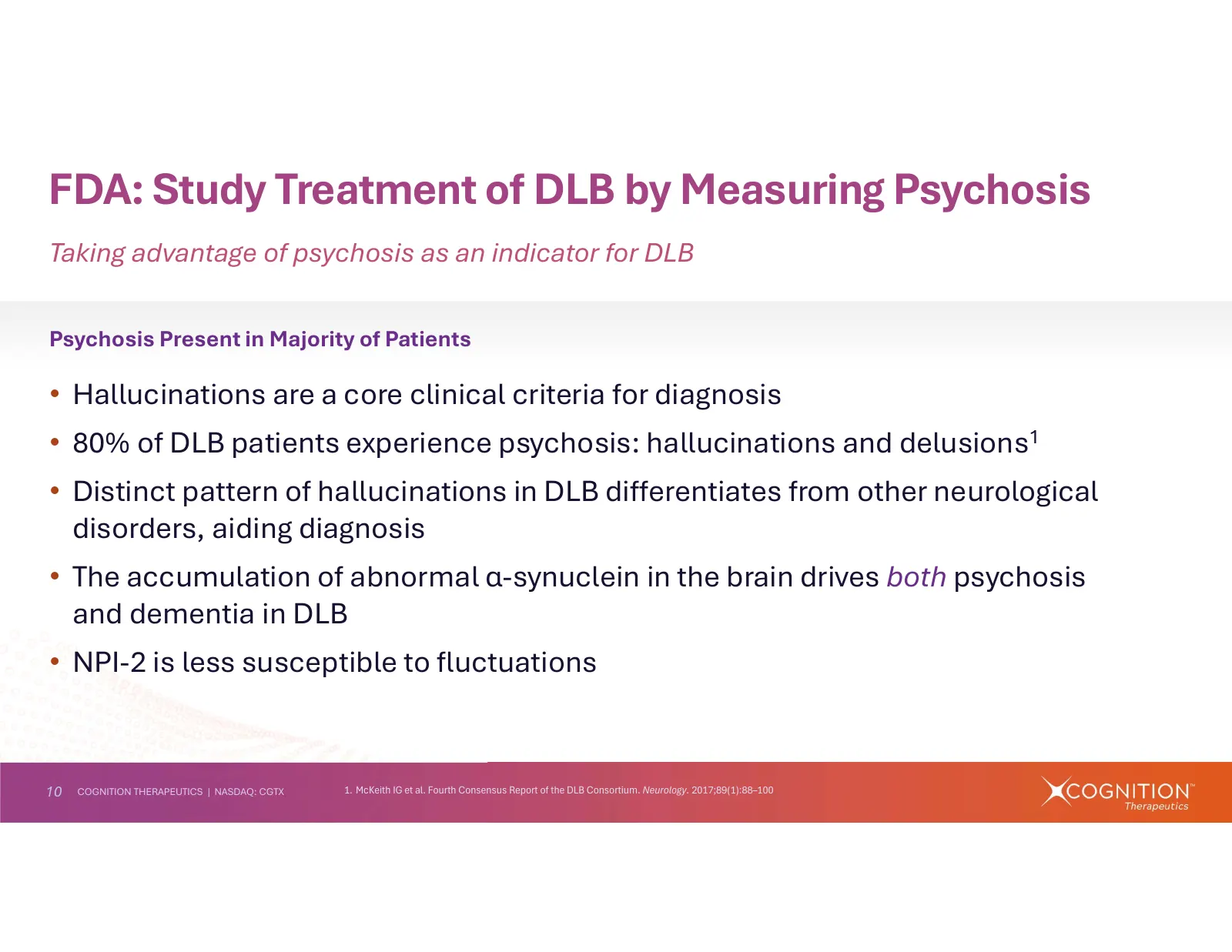
Slide 10: FDA: Study Treatment of DLB by Measuring Psychosis
FDA: Study Treatment of DLB by Measuring Psychosis Taking advantage of psychosis as an indicator for DLB Psychosis Present in Majority of Patients • Hallucinations are a core clinical criteria for diagnosis • 80% of DLB patients experience psychosis: hallucinations and delusions1 • Distinct pattern
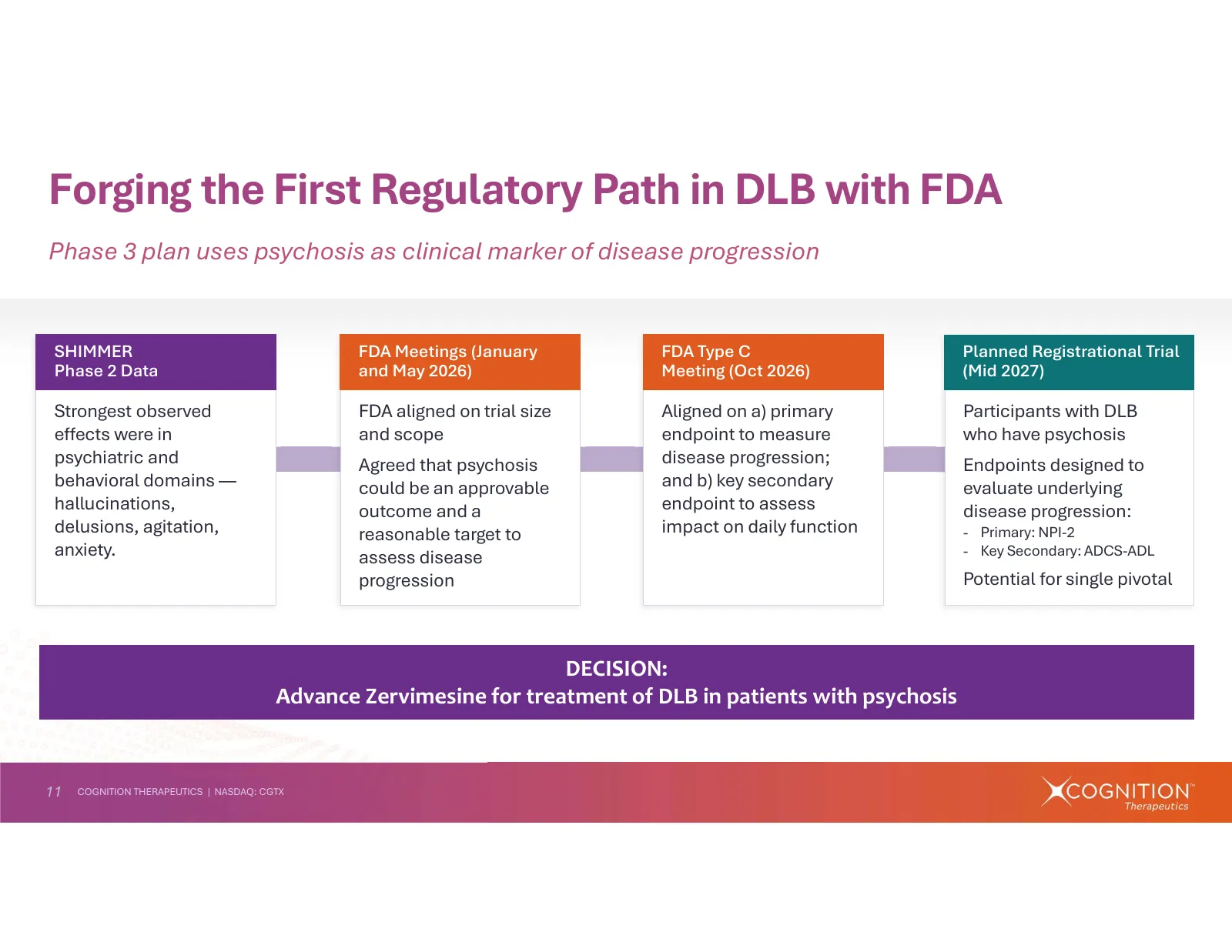
Slide 11: Forging the First Regulatory Path in DLB with FDA
Forging the First Regulatory Path in DLB with FDA Phase 3 plan uses psychosis as clinical marker of disease progression SHIMMER FDA Meetings (January FDA Type C 03 Planned Registrational Trial Phase 2 Data and May 2026) Meeting (Oct 2026) (Mid 2027) Strongest observed FDA aligned on trial size Align
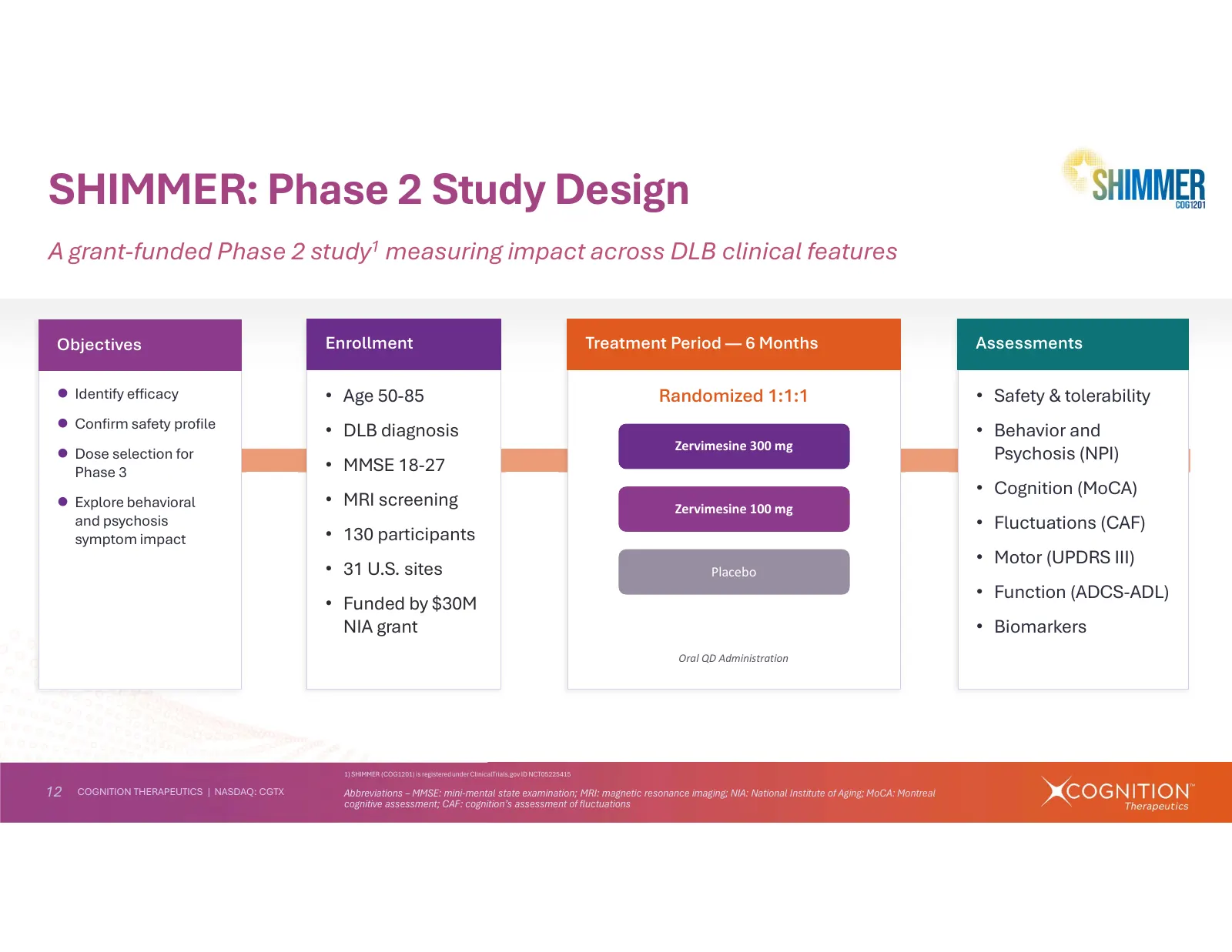
Slide 12: SHIMMER: Phase 2 Study Design
SHIMMER: Phase 2 Study Design A grant-funded Phase 2 study1 measuring impact across DLB clinical features Objectives Enrollment Treatment Period — 6 Months Assessments Identify efficacy • Age 50-85 Randomized 1:1:1 • Safety & tolerability Confirm safety profile • DLB diagnosis • Behavior and Zer
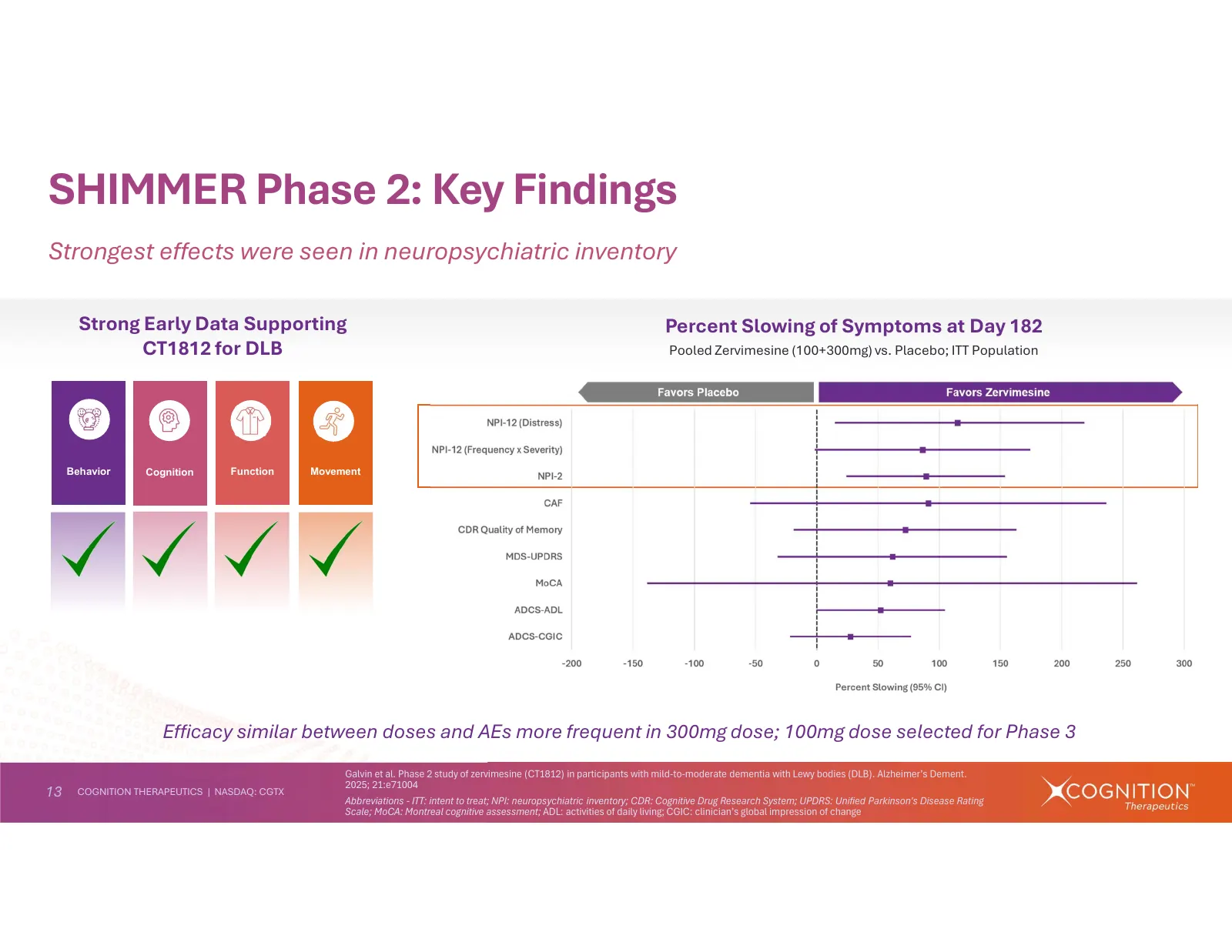
Slide 13: SHIMMER Phase 2: Key Findings
SHIMMER Phase 2: Key Findings Strongest effects were seen in neuropsychiatric inventory Strong Early Data Supporting Percent Slowing of Symptoms at Day 182 CT1812 for DLB Pooled Zervimesine (100+300mg) vs. Placebo; ITT Population Behavior Cognition Function Movement Efficacy similar between doses an
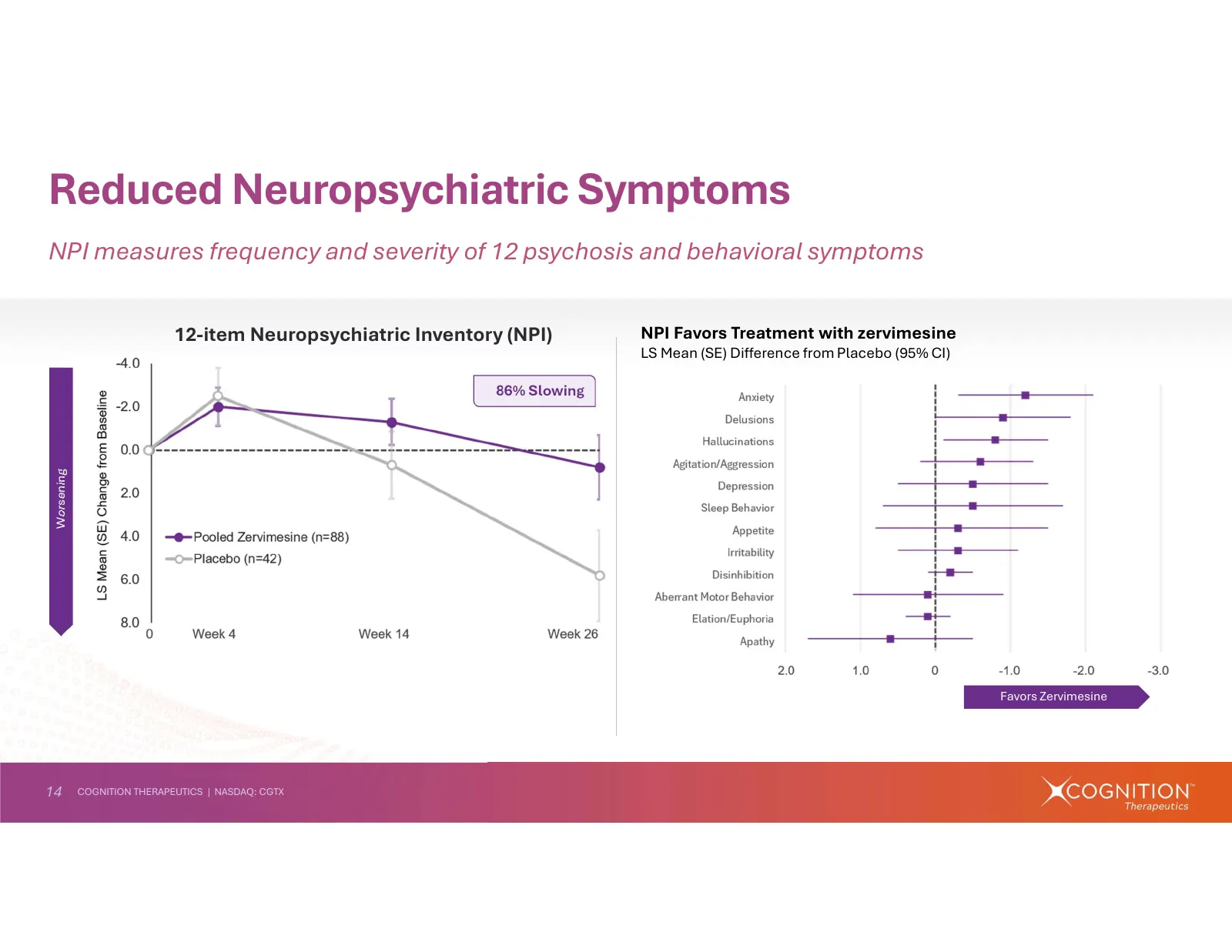
Slide 14: Reduced Neuropsychiatric Symptoms
Reduced Neuropsychiatric Symptoms NPI measures frequency and severity of 12 psychosis and behavioral symptoms 12-item Neuropsychiatric Inventory (NPI) NPI Favors Treatment with zervimesine LS Mean (SE) Difference from Placebo (95% CI) 86% Slowing Worsening p=0.055 Favors Zervimesine 14 COGNITION THE
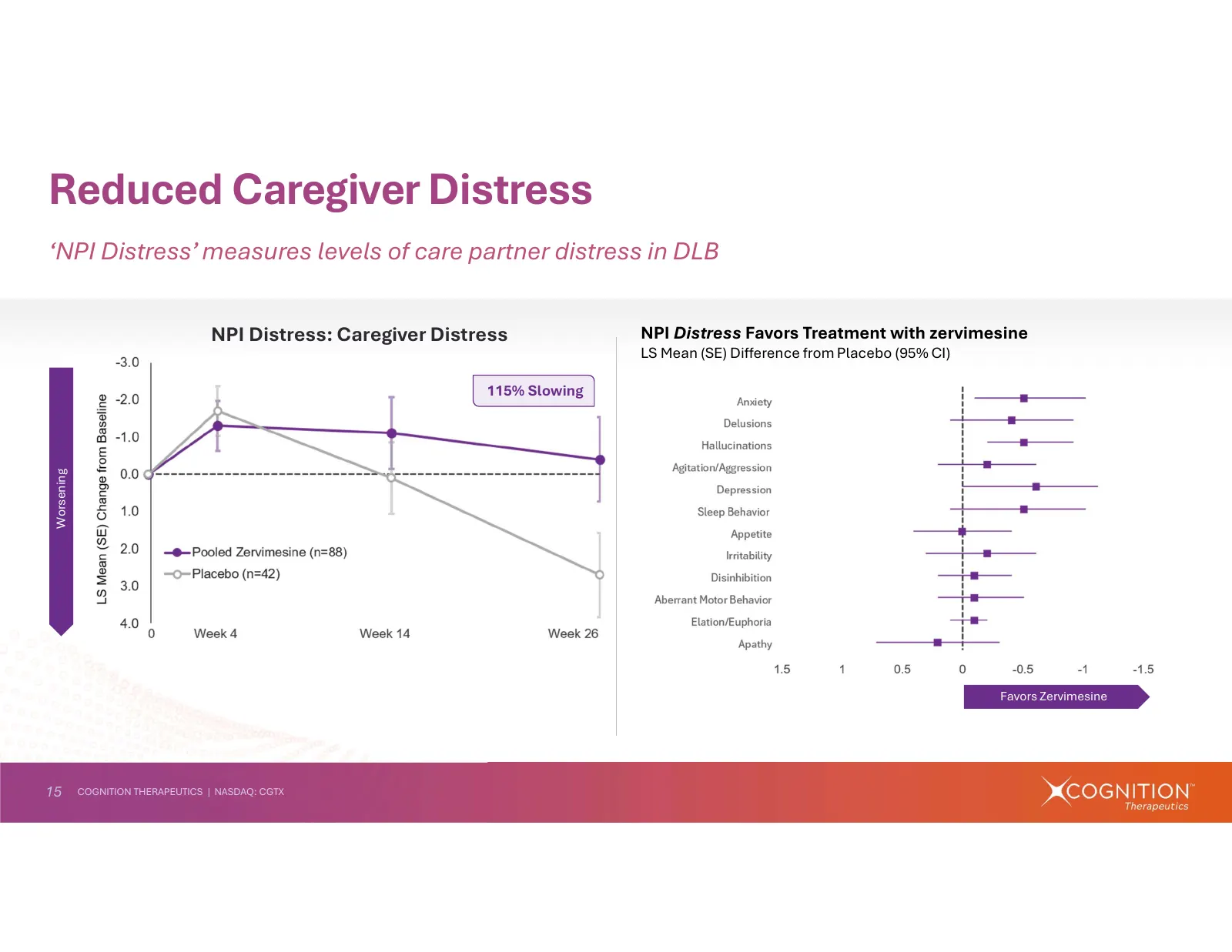
Slide 15: Reduced Caregiver Distress
Reduced Caregiver Distress ‘NPI Distress’ measures levels of care partner distress in DLB NPI Distress: Caregiver Distress NPI Distress Favors Treatment with zervimesine LS Mean (SE) Difference from Placebo (95% CI) 115% Slowing Worsening p=0.025 Favors Zervimesine 15 COGNITION THERAPEUTICS | NASDAQ
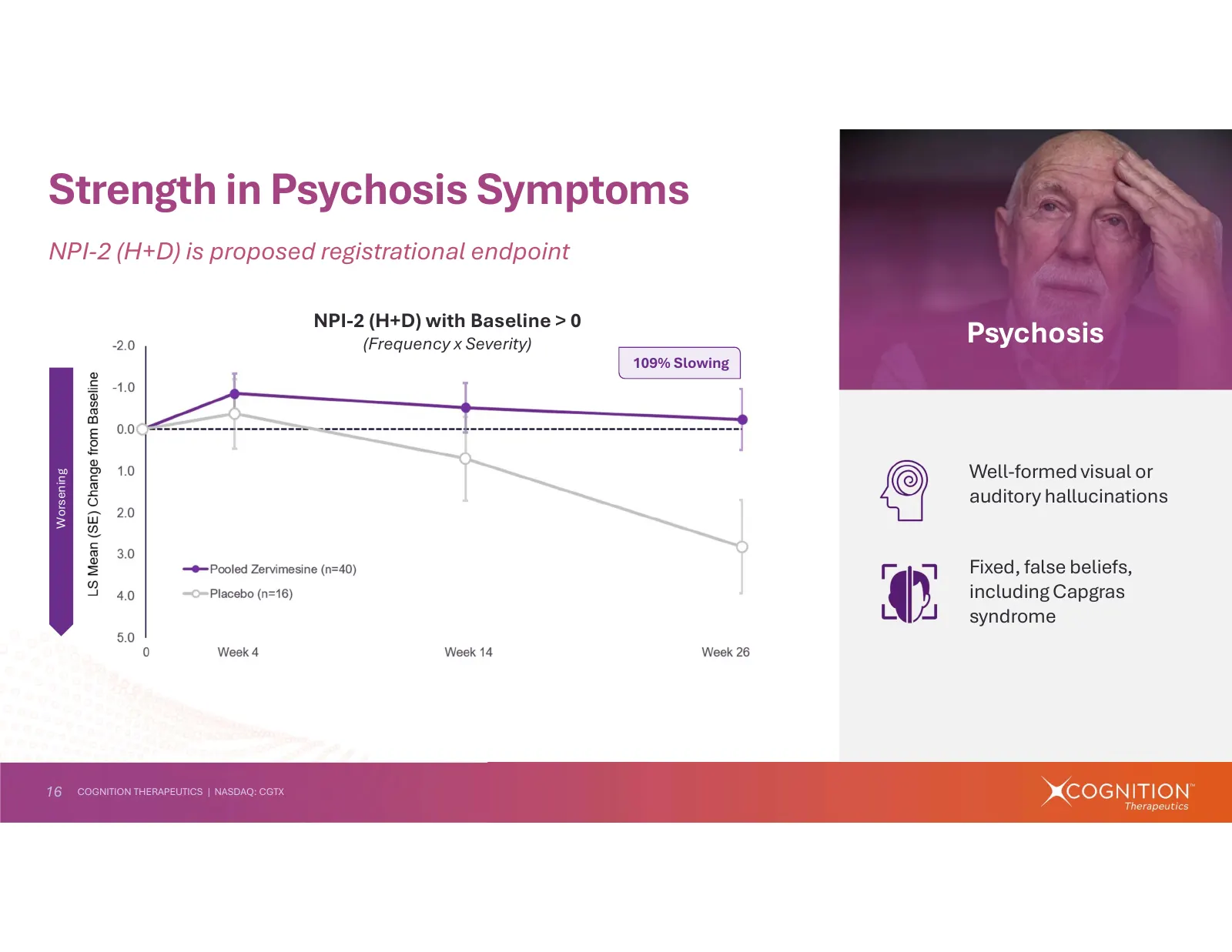
Slide 16: Strength in Psychosis Symptoms
Strength in Psychosis Symptoms NPI-2 (H+D) is proposed registrational endpoint NPI-2 (H+D) with Baseline > 0 (Frequency x Severity) Psychosis 109% Slowing Well-formed visual or Worsening auditory hallucinations Fixed, false beliefs, including Capgras syndrome p=0.028 16 COGNITION THERAPEUTICS | NASD
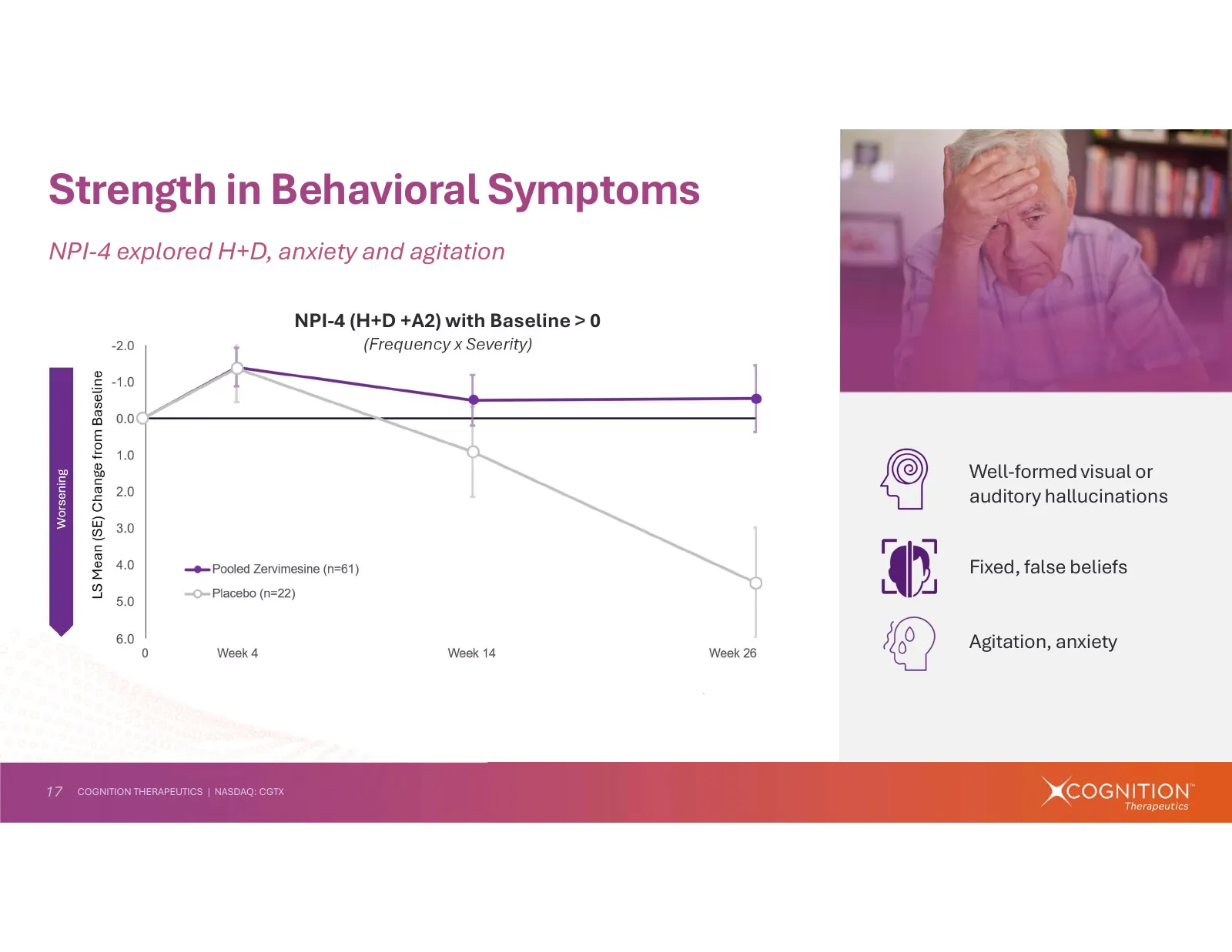
Slide 17: Strength in Behavioral Symptoms
Strength in Behavioral Symptoms NPI-4 explored H+D, anxiety and agitation NPI-4 (H+D +A2) with Baseline > 0 (Frequency x Severity) Behavior Well-formed visual or Worsening auditory hallucinations Fixed, false beliefs Agitation, anxiety p=0.001 17 COGNITION THERAPEUTICS | NASDAQ: CGTX
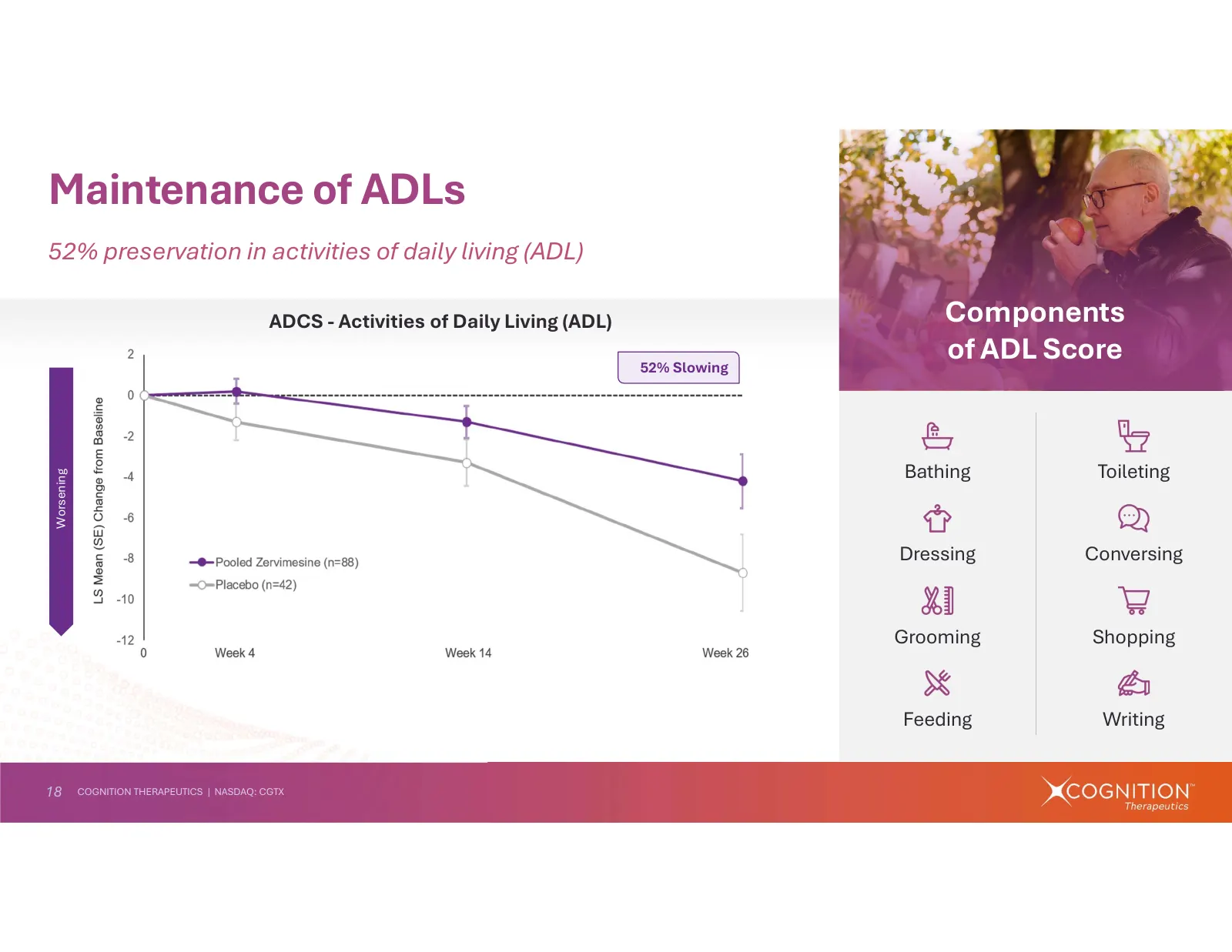
Slide 18: Maintenance of ADLs
Maintenance of ADLs 52% preservation in activities of daily living (ADL) ADCS - Activities of Daily Living (ADL) Components 52% Slowing of ADL Score Bathing Toileting Worsening Dressing Conversing Grooming Shopping p=0.050 Feeding Writing 18 COGNITION THERAPEUTICS | NASDAQ: CGTX
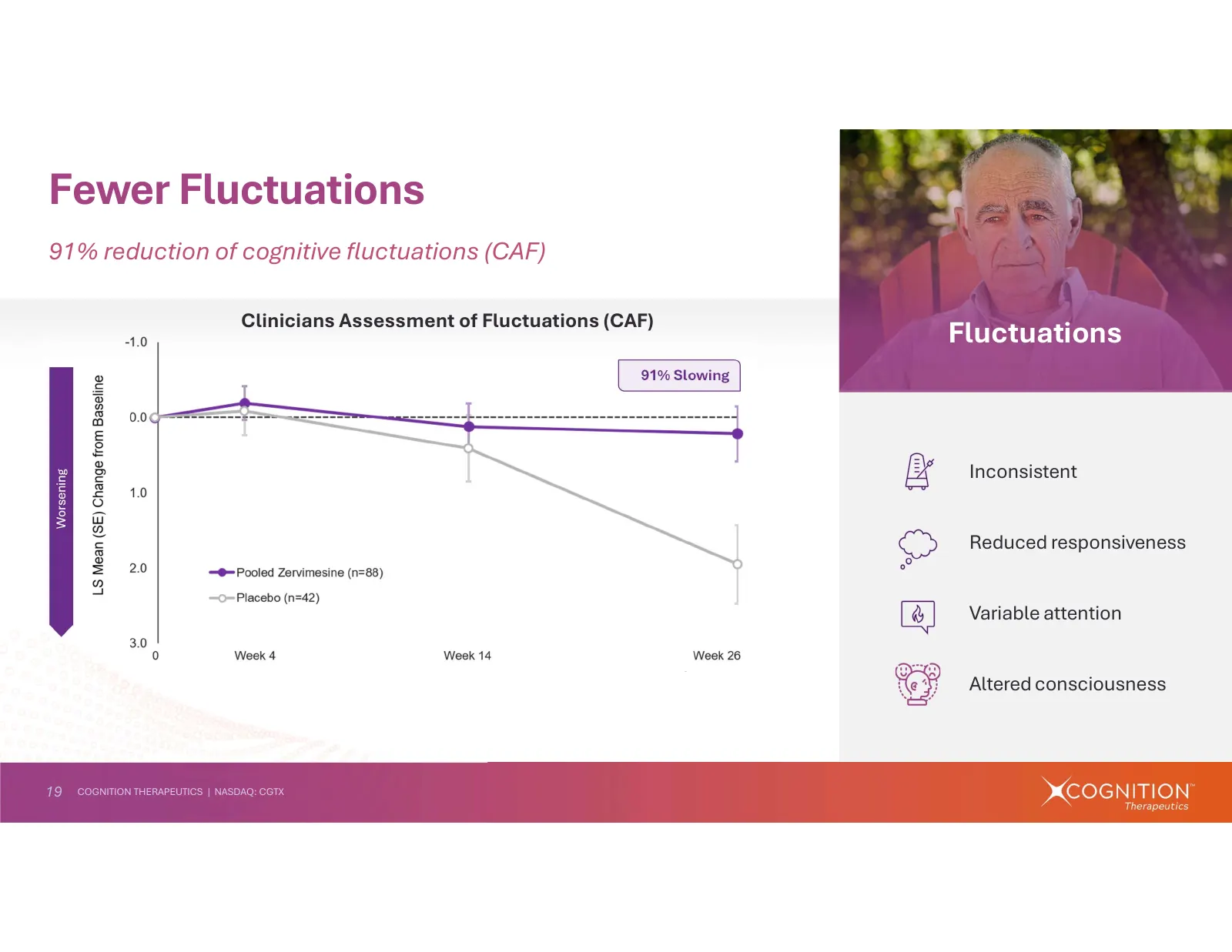
Slide 19: Fewer Fluctuations
Fewer Fluctuations 91% reduction of cognitive fluctuations (CAF) Clinicians Assessment of Fluctuations (CAF) Fluctuations 91% Slowing Inconsistent Worsening Reduced responsiveness Variable attention p=0.210 Altered consciousness 19 COGNITION THERAPEUTICS | NASDAQ: CGTX
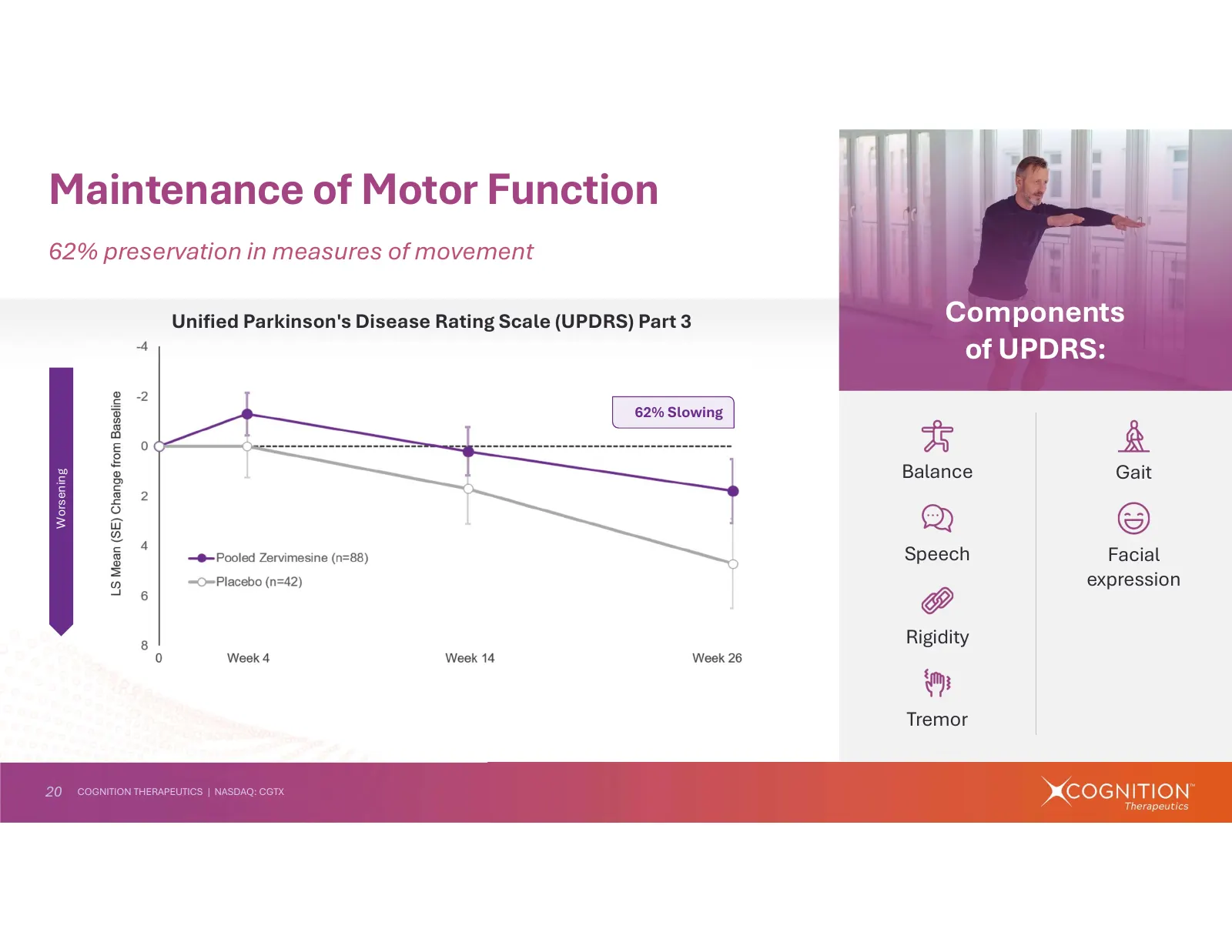
Slide 20: Maintenance of Motor Function
Maintenance of Motor Function 62% preservation in measures of movement Unified Parkinson's Disease Rating Scale (UPDRS) Part 3 Components of UPDRS: 62% Slowing Balance Gait Worsening Speech Facial expression Rigidity p=0.191 Tremor 20 COGNITION THERAPEUTICS | NASDAQ: CGTX
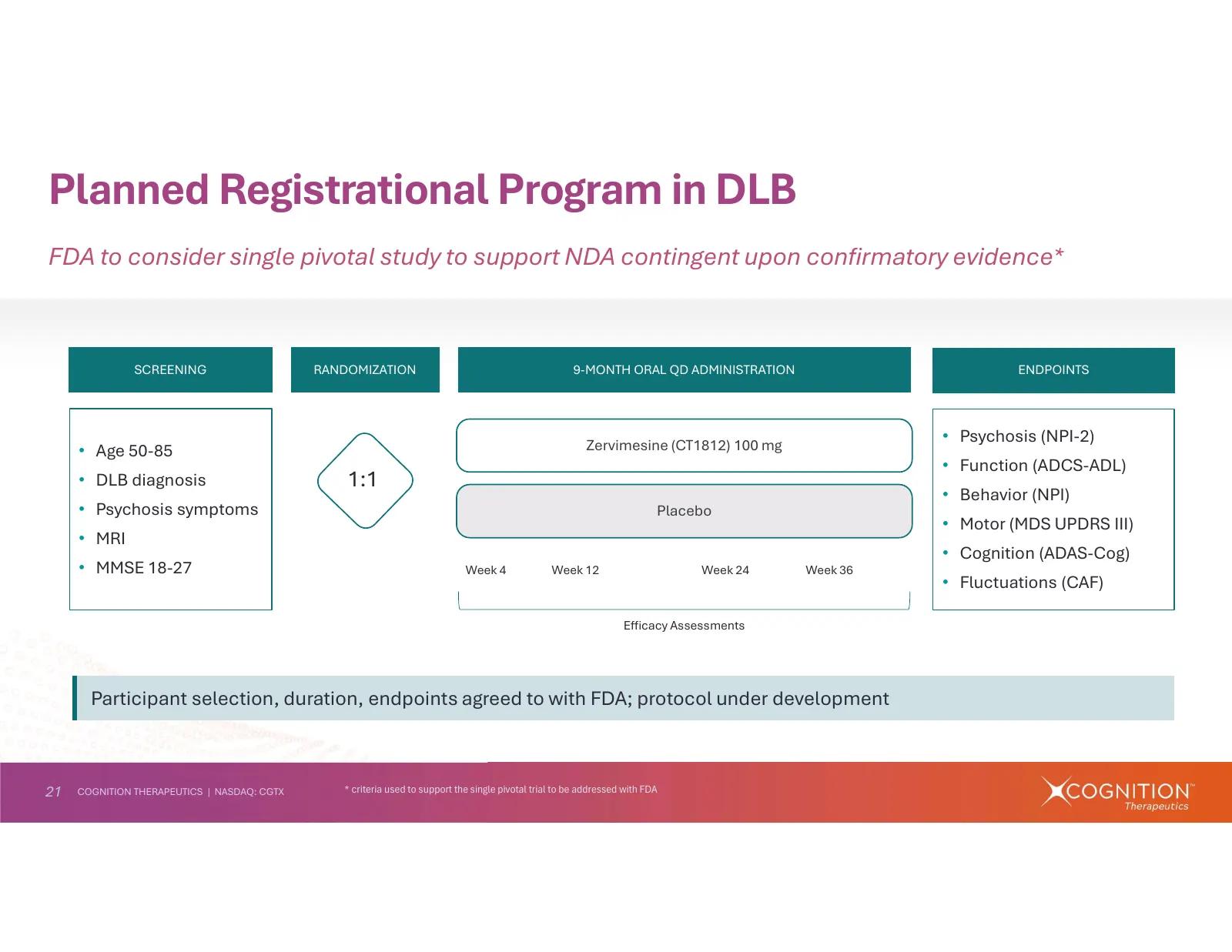
Slide 21: Planned Registrational Program in DLB
Planned Registrational Program in DLB FDA to consider single pivotal study to support NDA contingent upon confirmatory evidence* SCREENING RANDOMIZATION 9-MONTH ORAL QD ADMINISTRATION ENDPOINTS Zervimesine (CT1812) 100 mg • Psychosis (NPI-2) • Age 50-85 • Function (ADCS-ADL) • DLB diagnosis 1:1 • Be
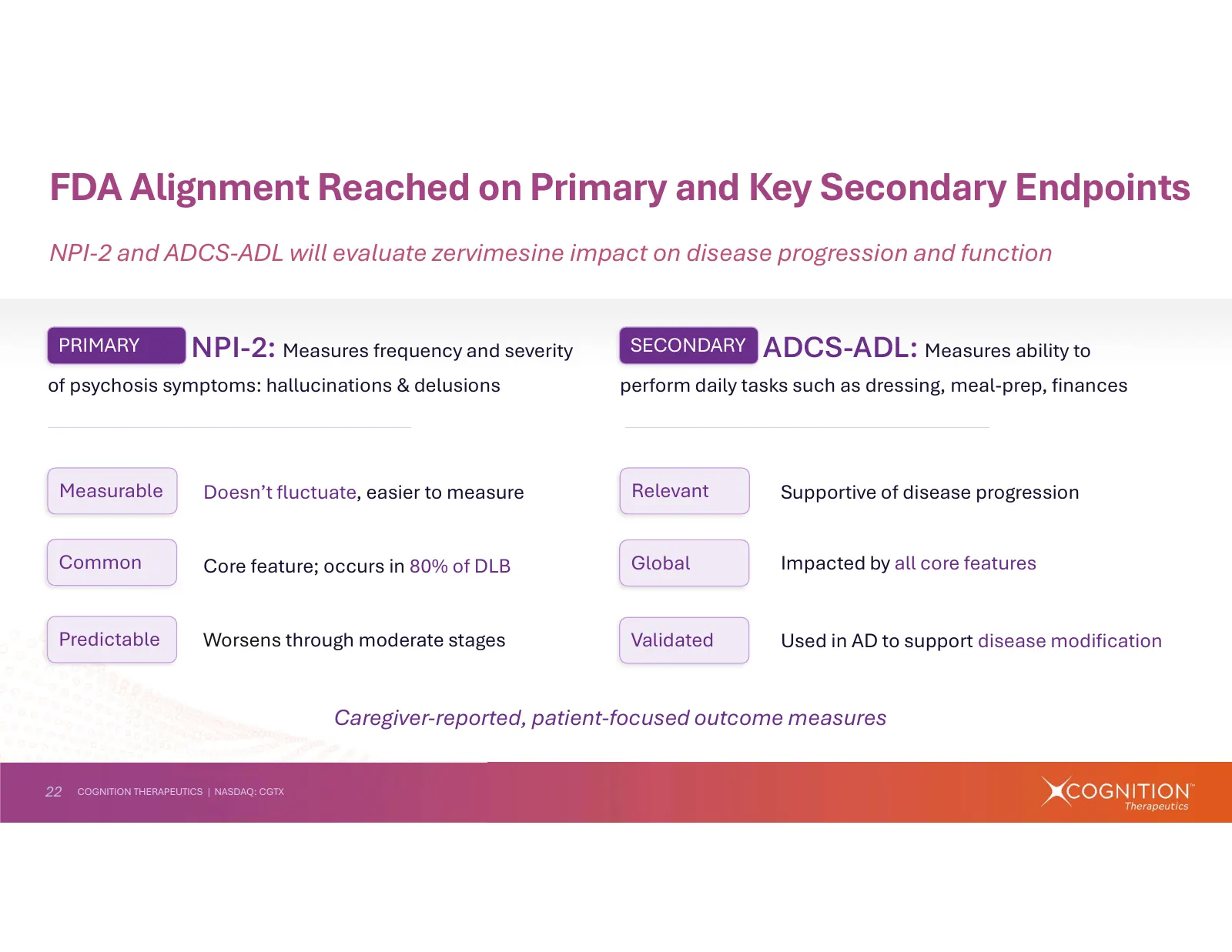
Slide 22: FDA Alignment Reached on Primary and Key Secondary Endpoints
FDA Alignment Reached on Primary and Key Secondary Endpoints NPI-2 and ADCS-ADL will evaluate zervimesine impact on disease progression and function PRIMARY NPI-2: Measures frequency and severity SECONDARY ADCS-ADL: Measures ability to of psychosis symptoms: hallucinations & delusions perform daily
Slide 23: Alzheimer's Program
Alzheimer’s Program Phase 2 Studies: SHINE: Mild-to-moderate AD (complete) START: MCI and early AD (ongoing)
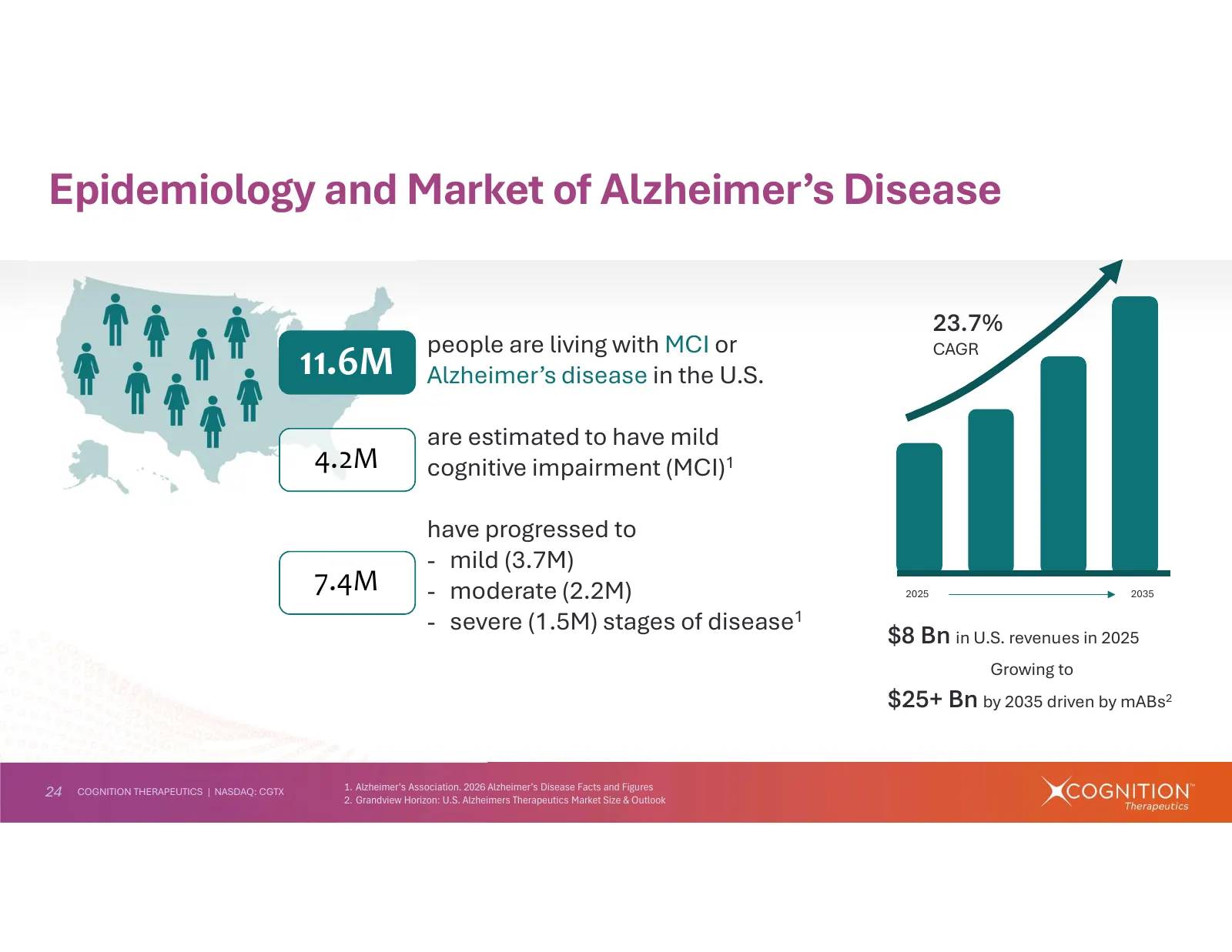
Slide 24: Epidemiology and Market of Alzheimer's Disease
Epidemiology and Market of Alzheimer’s Disease 23.7% people are living with MCI or 11.6M Alzheimer’s disease in the U.S. CAGR are estimated to have mild 4.2M cognitive impairment (MCI)1 have progressed to - mild (3.7M) 7.4M - moderate (2.2M) 2025 2035 - severe (1.5M) stages of disease1 $8 Bn in U.S.
Slide 25: Clinical Studies in Alzheimer's Disease
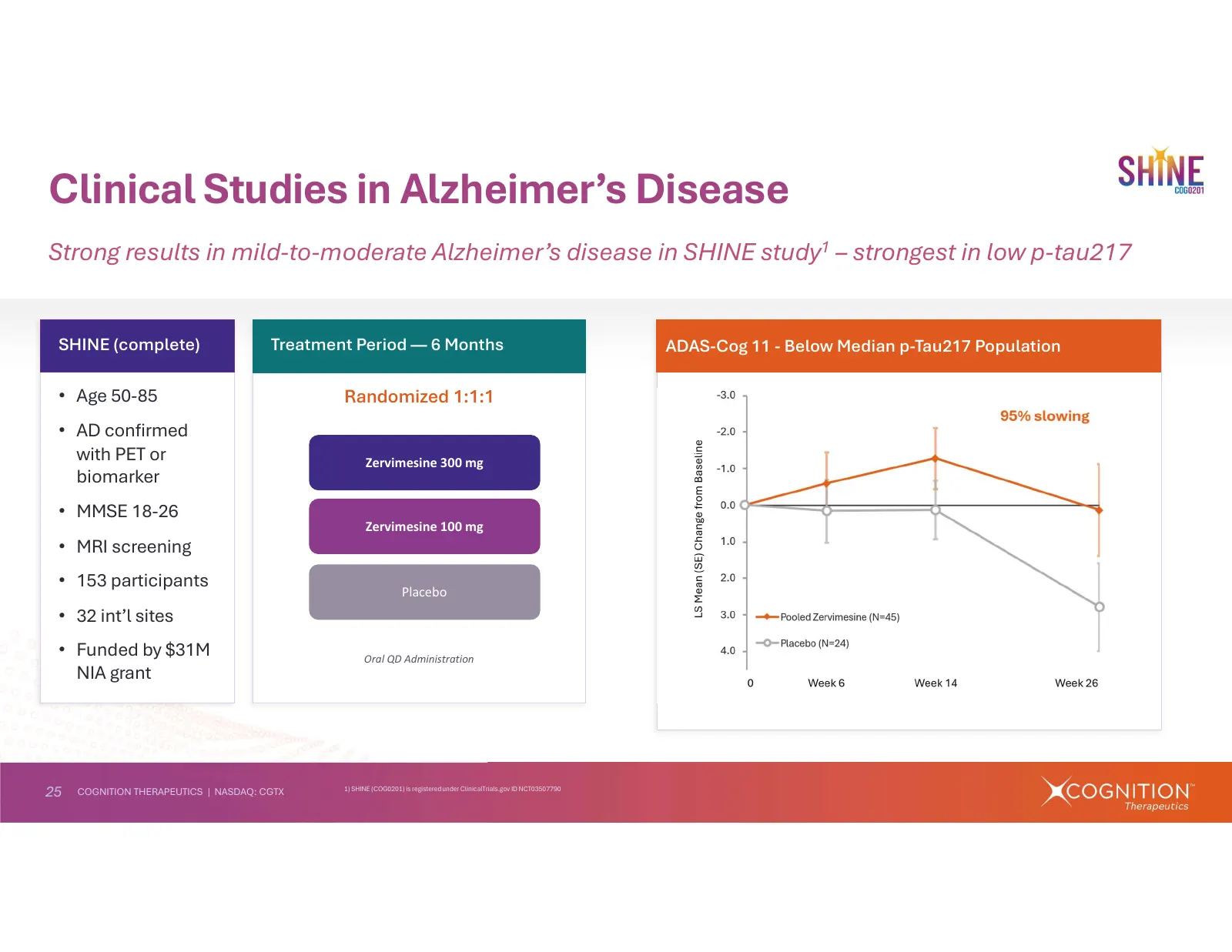
Clinical Studies in Alzheimer’s Disease Strong results in mild-to-moderate Alzheimer’s disease in SHINE study1 – strongest in low p-tau217 SHINE (complete) Treatment Period — 6 Months ADAS-Cog 11 - Below Median p-Tau217 Population • Age 50-85 Randomized 1:1:1 • AD confirmed with PET or Zervimesine 3
Slide 26: SHINE Cognitive Endpoints: ADAS-Cog 11
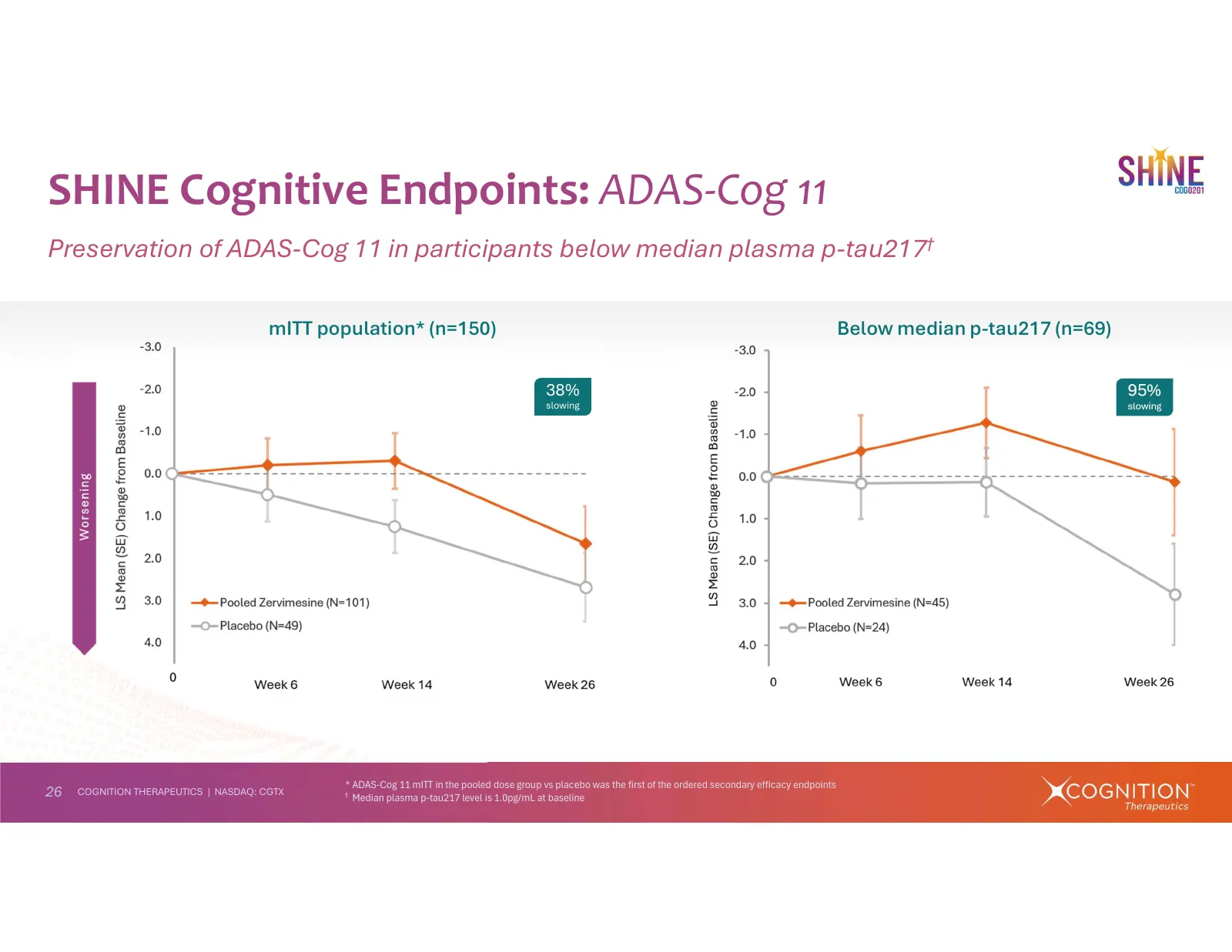
SHINE Cognitive Endpoints: ADAS-Cog 11 Preservation of ADAS-Cog 11 in participants below median plasma p-tau217† mITT population* (n=150) Below median p-tau217 (n=69) 38% 95% slowing slowing p=0.310 p=0.080 * ADAS-Cog 11 mITT in the pooled dose group vs placebo was the first of the ordered secondary
Slide 27: SHINE Cognitive Endpoints: MMSE
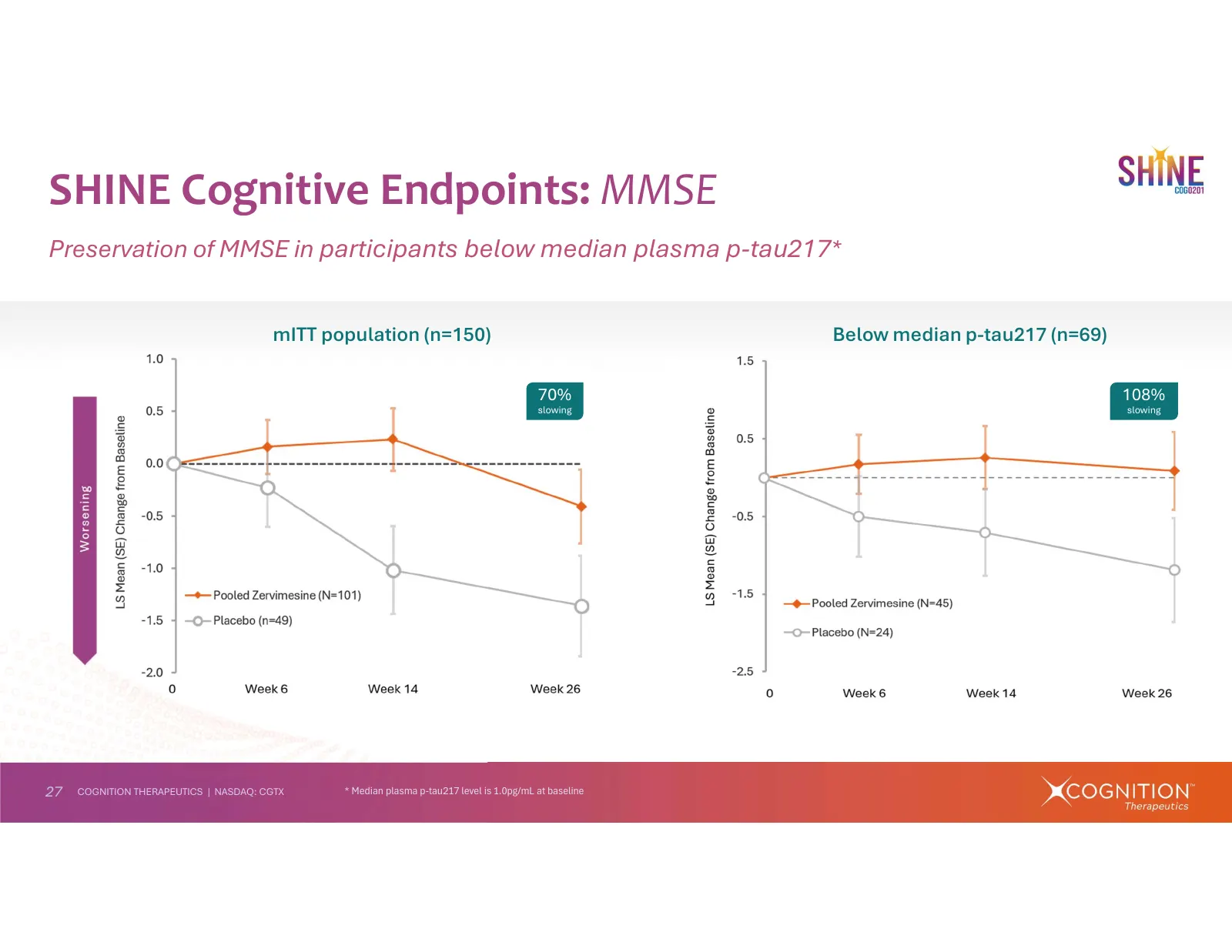
SHINE Cognitive Endpoints: MMSE Preservation of MMSE in participants below median plasma p-tau217* mITT population (n=150) Below median p-tau217 (n=69) 70% 108% slowing slowing p=0.111 p=0.126 27 COGNITION THERAPEUTICS | NASDAQ: CGTX * Median plasma p-tau217 level is 1.0pg/mL at baseline
Slide 28: SHINE Functional Endpoints: ADCS-ADL and -CGIC
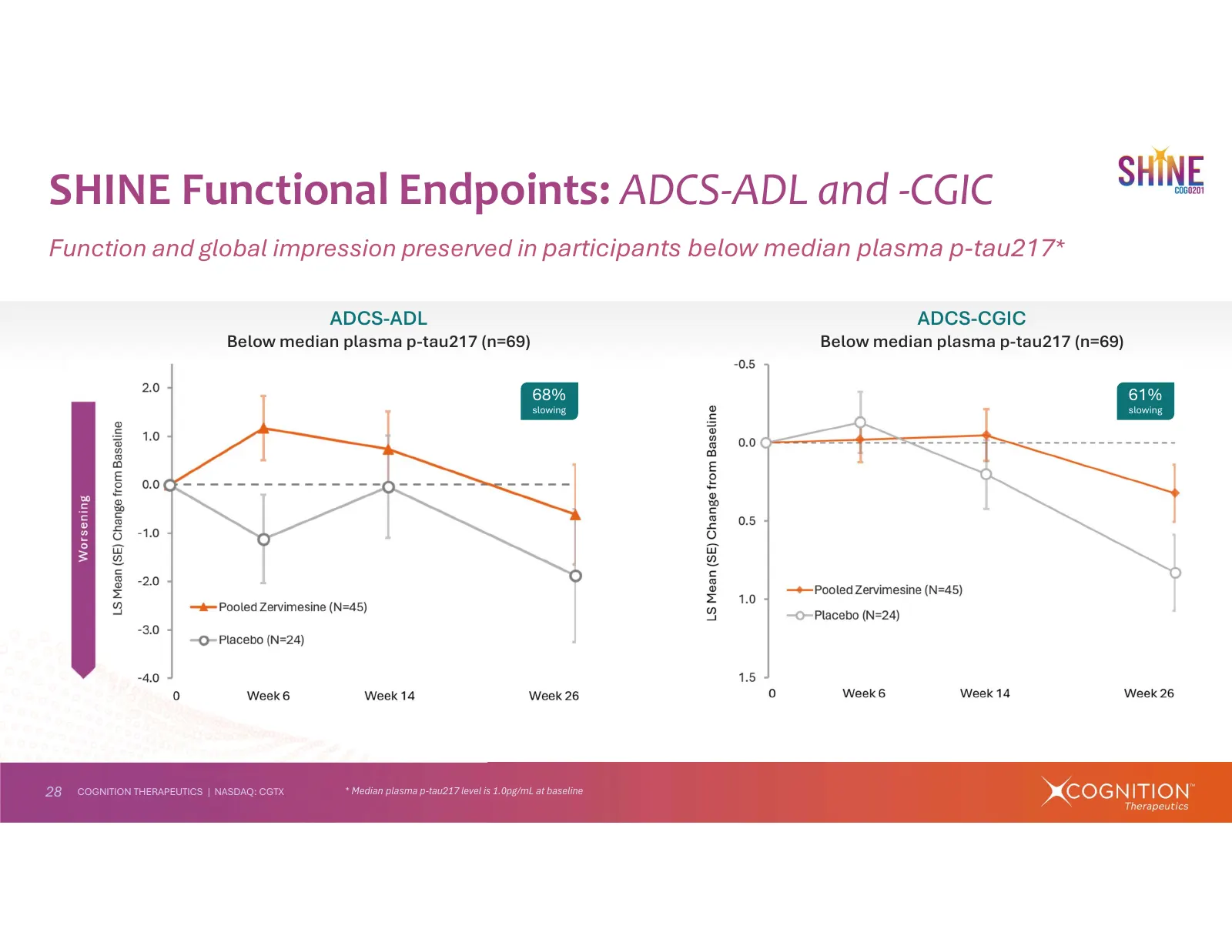
SHINE Functional Endpoints: ADCS-ADL and -CGIC Function and global impression preserved in participants below median plasma p-tau217* ADCS-ADL ADCS-CGIC Below median plasma p-tau217 (n=69) Below median plasma p-tau217 (n=69) 68% 61% slowing slowing p=0.463 p=0.093 28 COGNITION THERAPEUTICS | NASDAQ:
Slide 29: Cognition Preserved Across MMSE Range in 'Lower' p-Tau Group
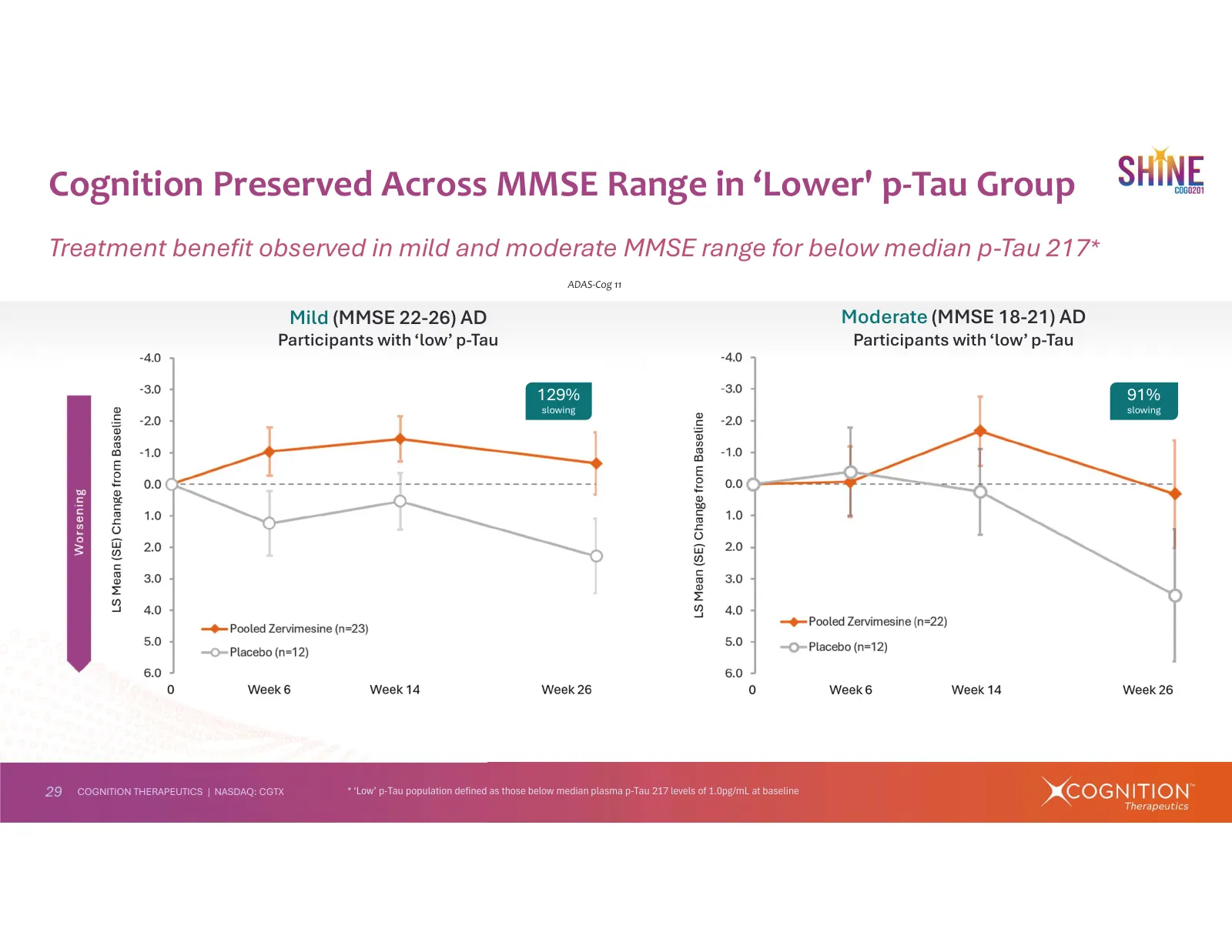
Cognition Preserved Across MMSE Range in ‘Lower' p-Tau Group Treatment benefit observed in mild and moderate MMSE range for below median p-Tau 217* ADAS-Cog 11 Mild (MMSE 22-26) AD Moderate (MMSE 18-21) AD Participants with ‘low’ p-Tau Participants with ‘low’ p-Tau 129% 91% slowing slowing p=0.069 p
Slide 30: START Trial: through Mild Alzheimer's Disease
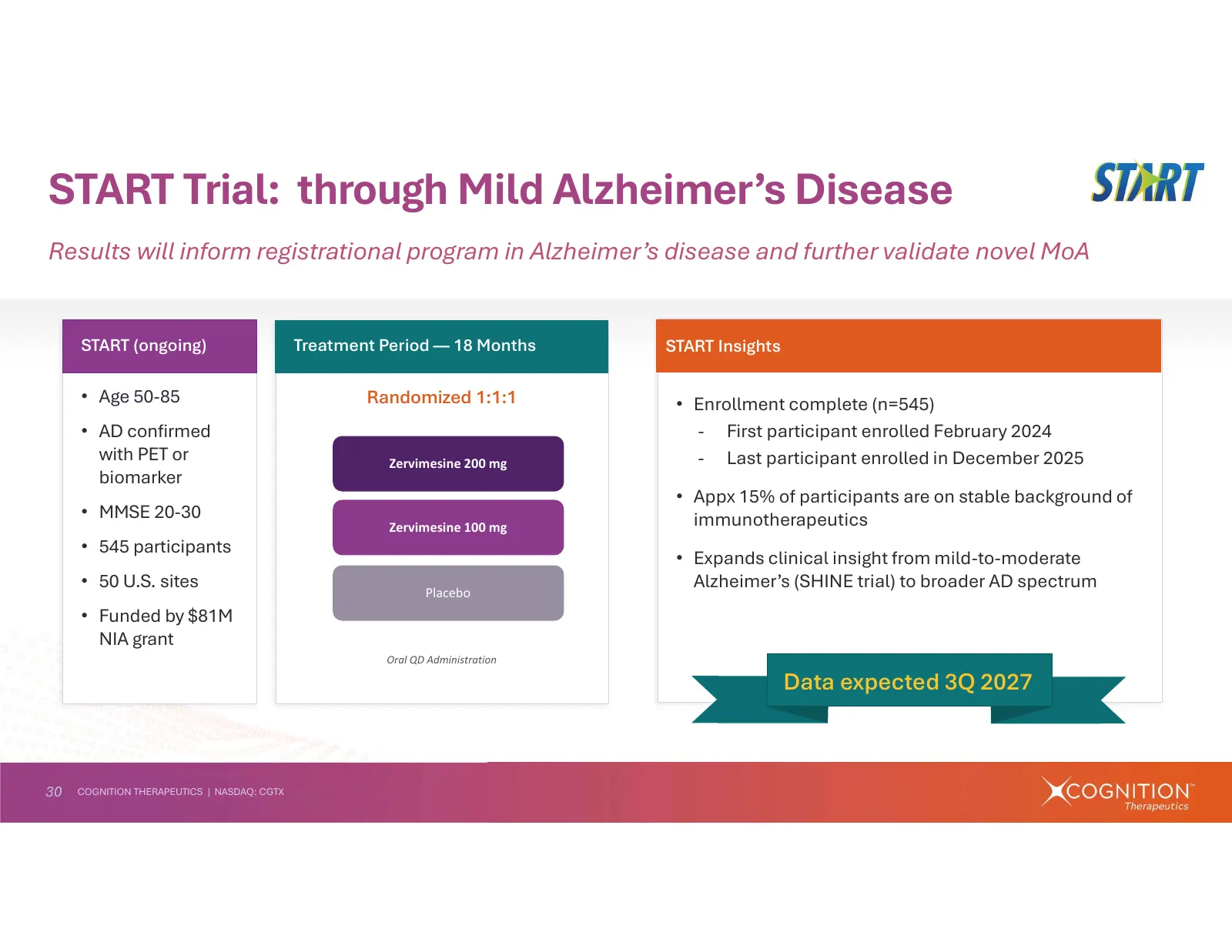
START Trial: through Mild Alzheimer’s Disease Results will inform registrational program in Alzheimer’s disease and further validate novel MoA START (ongoing) Treatment Period — 18 Months START Insights • Age 50-85 Randomized 1:1:1 • Enrollment complete (n=545) • AD confirmed - First participant enr
Slide 31: FDA Guidance on Phase 3 Plan in Alzheimer's Disease
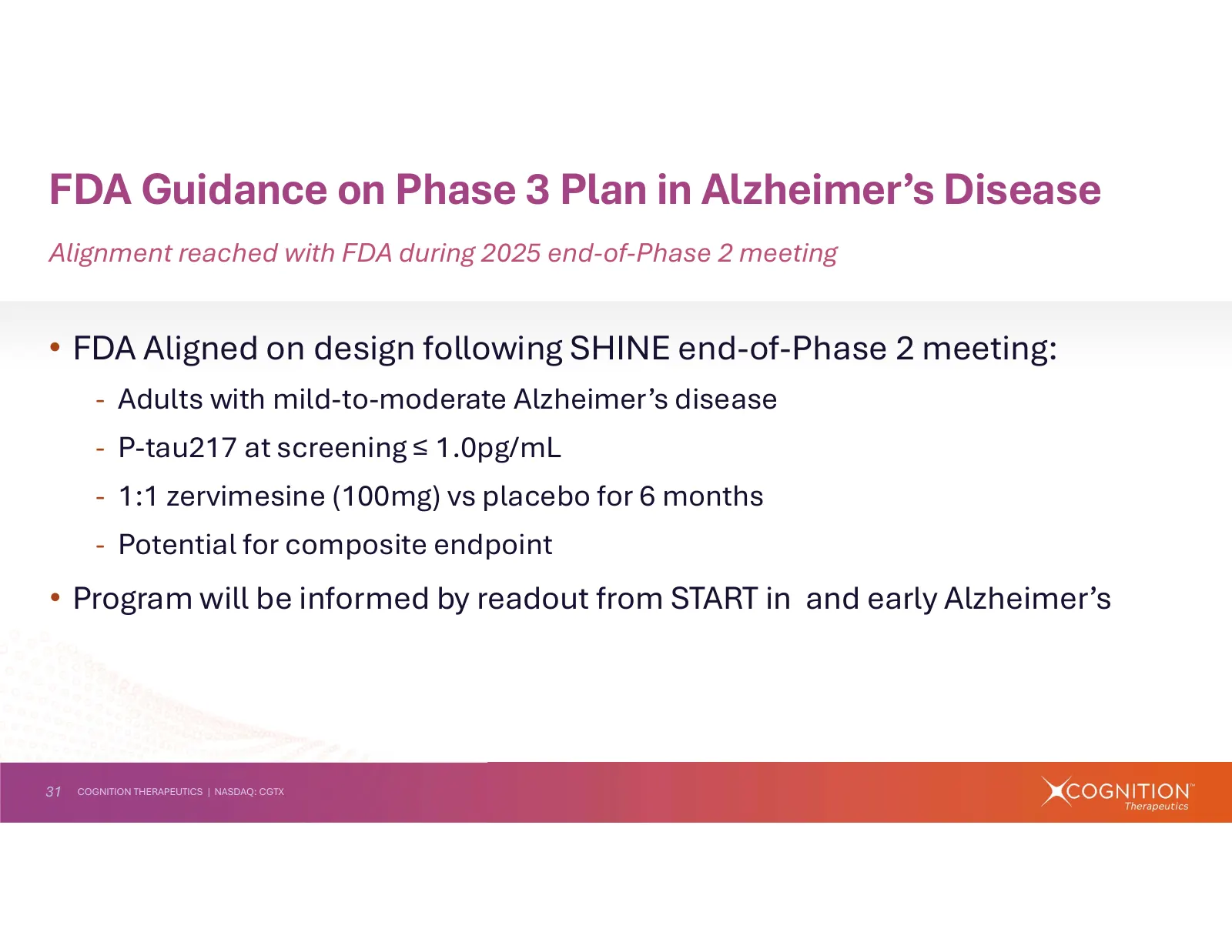
FDA Guidance on Phase 3 Plan in Alzheimer’s Disease Alignment reached with FDA during 2025 end-of-Phase 2 meeting • FDA Aligned on design following SHINE end-of-Phase 2 meeting: - Adults with mild-to-moderate Alzheimer’s disease - P-tau217 at screening ≤ 1.0pg/mL - 1:1 zervimesine (100mg) vs placebo
Slide 32: Highly Experienced Management Team Coupled with External Support
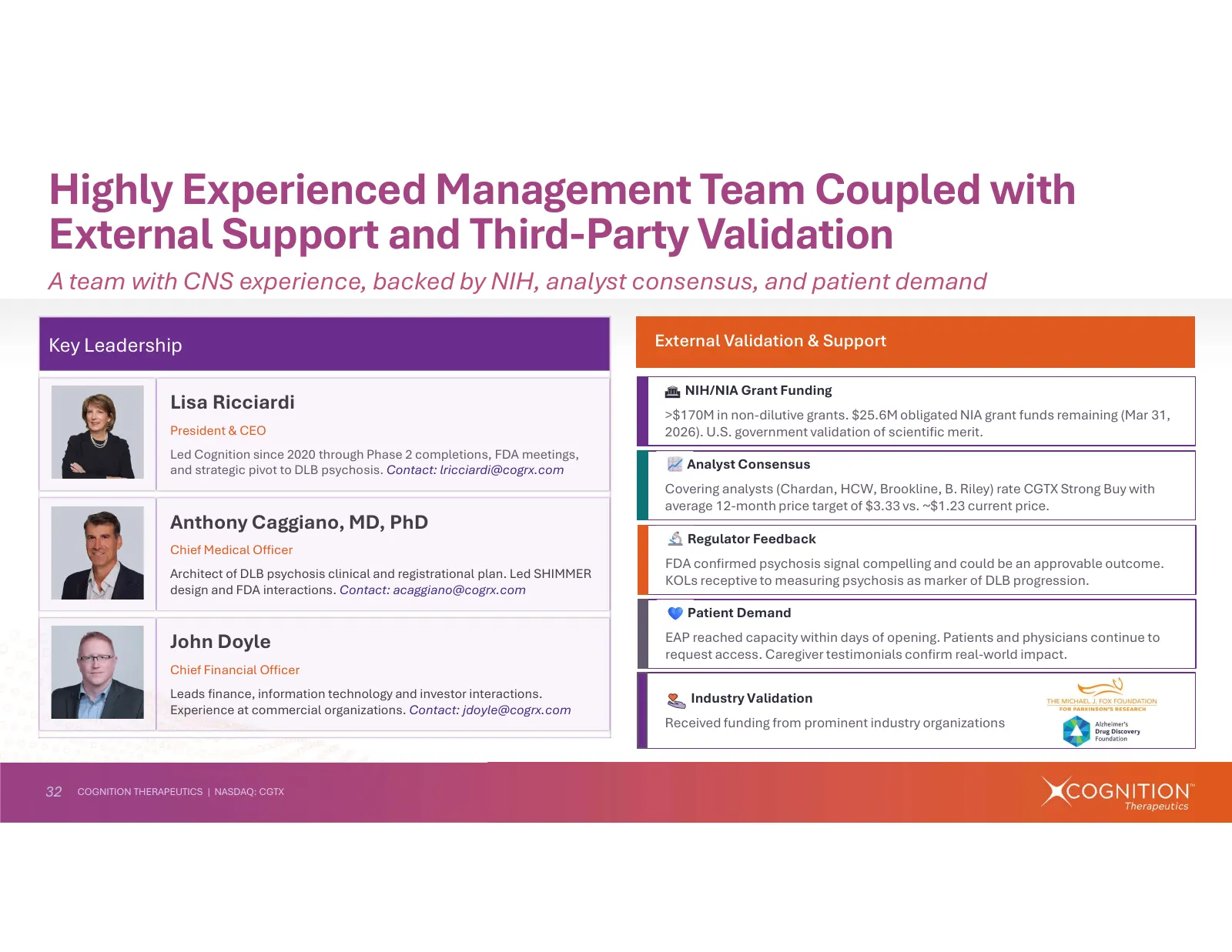
Highly Experienced Management Team Coupled with External Support and Third-Party Validation A team with CNS experience, backed by NIH, analyst consensus, and patient demand Key Leadership External Validation & Support NIH/NIA Grant Funding Lisa Ricciardi >$170M in non-dilutive grants. $25.6M obligat

Slide 33: Thank You
THANK YOU We invite your questions Lisa Ricciardi, CEO Anthony Caggiano, MD, PhD, CMO
Source: company website
More decks from Cognition Therapeutics, Inc.
 Investor Presentation (August 2026)19 slides · August 2026
 Jefferies Global Healthcare Conference 202617 slides · Jun 4, 2026
 Investor Presentation (March 2026)31 slides · Mar 26, 2026
 Investor Presentation (March 2026)31 slides · March 2026
 Investor Presentation (January 2026)36 slides · January 2026
 Investor Presentation (December 2025)34 slides · December 2025