Blueprint Medicines — Connective Tissue Oncology Society 2018 Annual Meeting
16 slides from Blueprint Medicines's conference presentation, Nov 15, 2018
Slide 1: Avapritinib is Highly Active and Well-tolerated in Patients With Advanced GIST
Avapritinib is Highly Active and Well-tolerated in Patients With Advanced GIST Driven by a Diverse Variety of Oncogenic Mutations in KIT and PDGFRA Michael Heinrich, Margaret von Mehren, Robin L. Jones, Sebastian Bauer, Yoon-Koo Kang, Patrick Schöffski, Ferry Eskens, César Serrano, Philippe A. Cassi
Slide 2: Disclosures
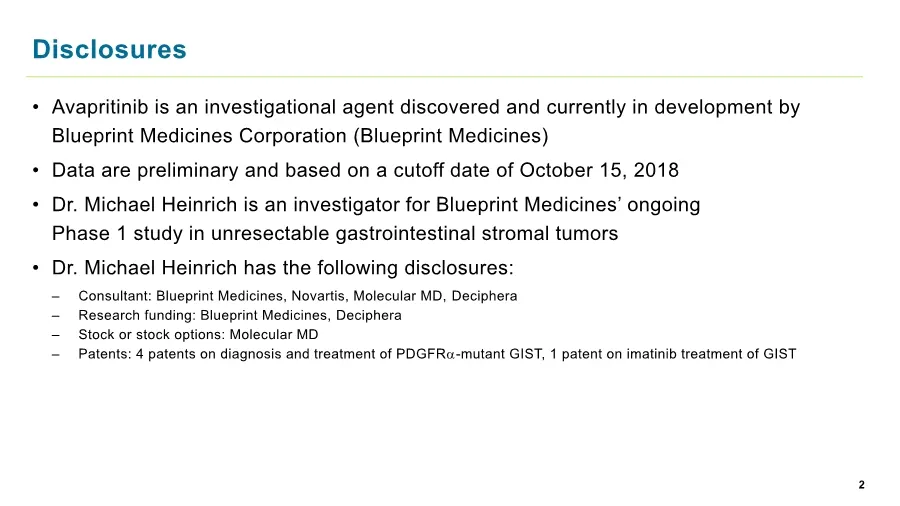
Disclosures • Avapritinib is an investigational agent discovered and currently in development by Blueprint Medicines Corporation (Blueprint Medicines) • Data are preliminary and based on a cutoff date of October 15, 2018 • Dr. Michael Heinrich is an investigator for Blueprint Medicines’ ongoing Phas
Slide 3: Avapritinib kinome selectivity
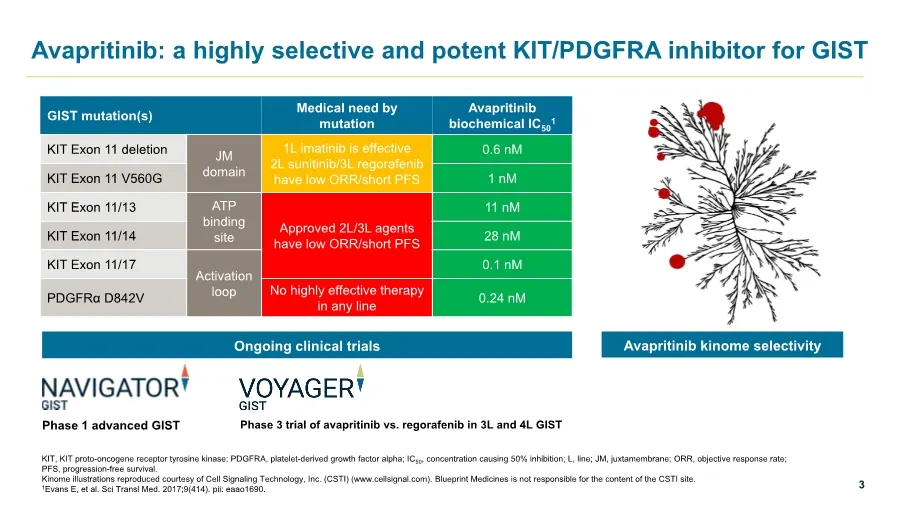
Avapritinib kinome selectivity Avapritinib: a highly selective and potent KIT/PDGFRA inhibitor for GIST 3 GIST mutation(s) Medical need by mutation Avapritinib biochemical IC50 1 KIT Exon 11 deletion JM domain 1L imatinib is effective 2L sunitinib/3L regorafenib have low ORR/short PFS 0.6 nM KIT Exo
Slide 4: NAVIGATOR Phase 1 study design
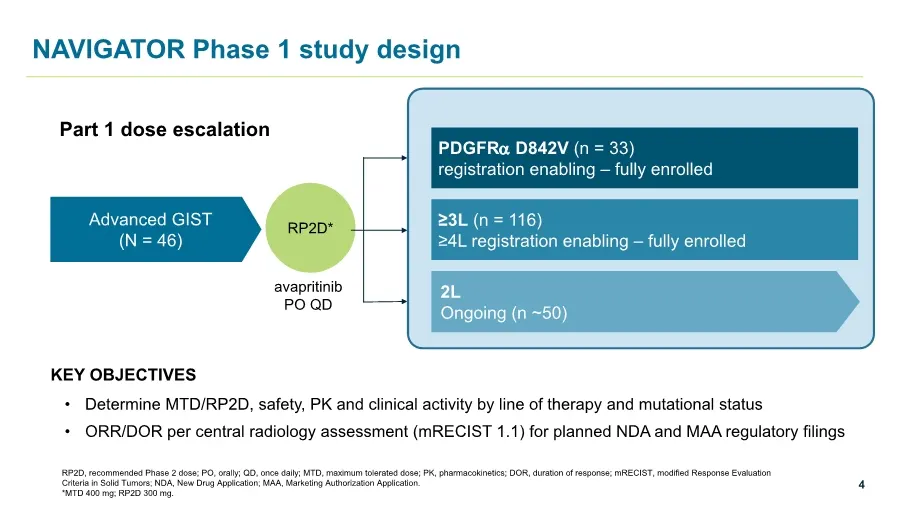
NAVIGATOR Phase 1 study design 4 Advanced GIST (N = 46) Part 1 dose escalation Part 2 dose expansion RP2D* KEY OBJECTIVES • Determine MTD/RP2D, safety, PK and clinical activity by line of therapy and mutational status • ORR/DOR per central radiology assessment (mRECIST 1.1) for planned NDA and MAA r
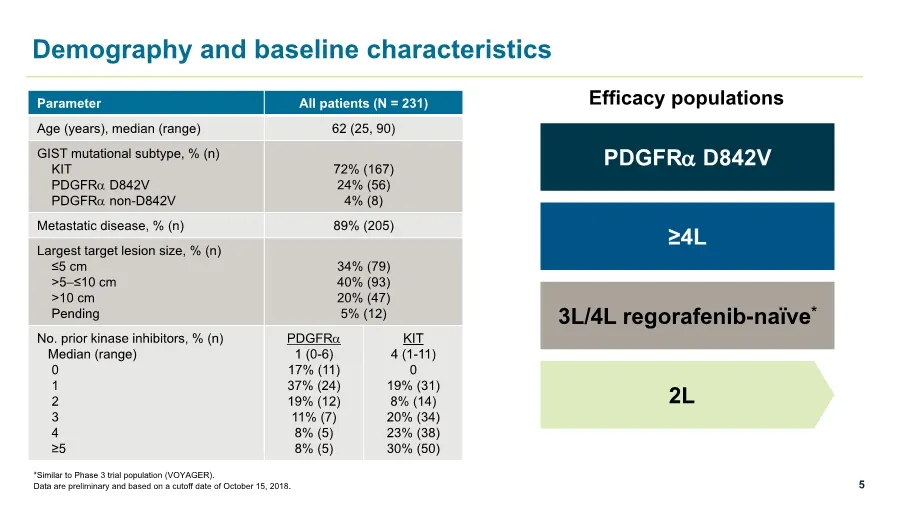
Slide 5: Demography and baseline characteristics
Demography and baseline characteristics 5 Parameter All patients (N = 231) Age (years), median (range) 62 (25, 90) GIST mutational subtype, %(n) KIT PDGFR D842V PDGFR non-D842V 72% (167) 24% (56) 4% (8) Metastatic disease, % (n) 89% (205) Largest target lesion size, %(n) ≤5 cm >5–≤10 cm >10 cm Pen
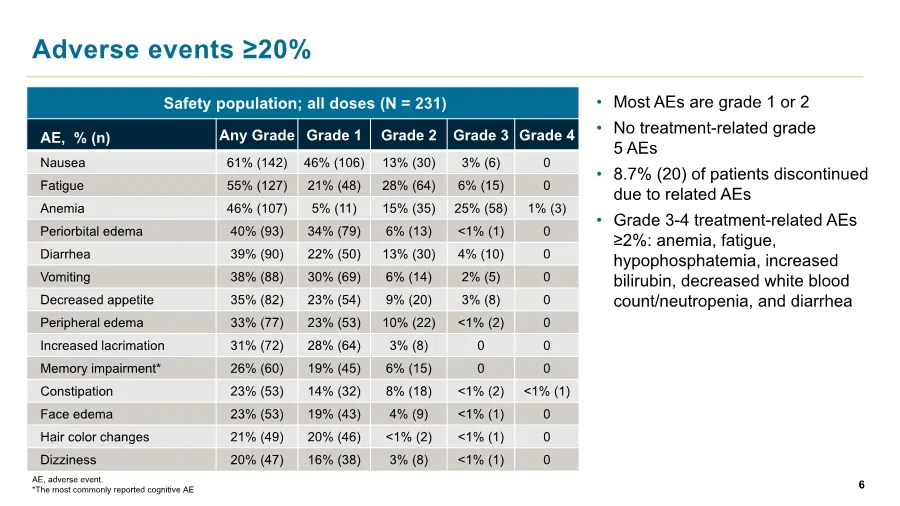
Slide 6: Adverse events ≥20%
Adverse events ≥20% 6 Safety population; all doses (N = 231) AE, % (n) Any Grade Grade 1 Grade 2 Grade 3 Grade 4 Nausea 61% (142) 46% (106) 13% (30) 3% (6) 0 Fatigue 55% (127) 21% (48) 28% (64) 6% (15) 0 Anemia 46% (107) 5% (11) 15% (35) 25% (58) 1% (3) Periorbital edema 40% (93) 34% (79) 6% (13) <1
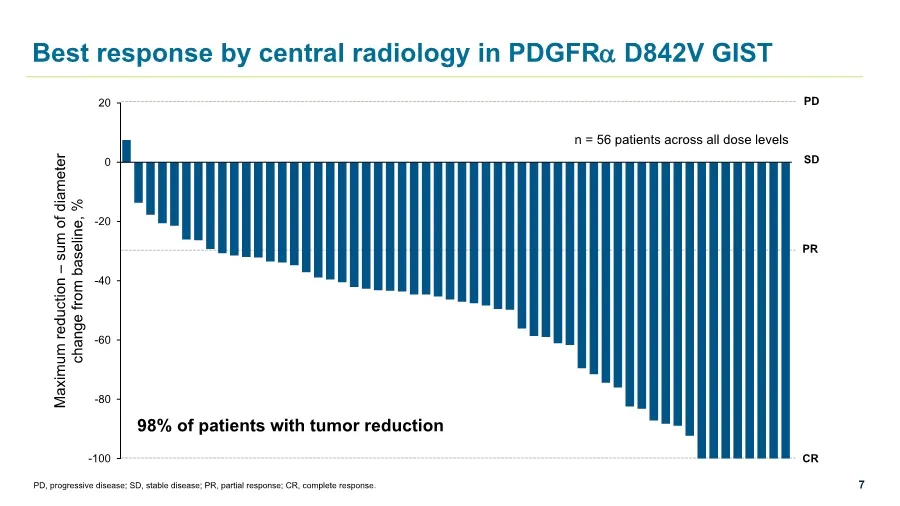
Slide 7: Best response in PDGFR D842V GIST
Best response by central radiology in PDGFR D842V GIST 7 98% of patients with tumor reduction PD SD PR CR-100 -80 -60 -40 -20 0 20 Maximum reduction – sum of diameter change from baseline, % n = 56 patients across all dose levels PD, progressive disease; SD, stable disease; PR, partial response; CR
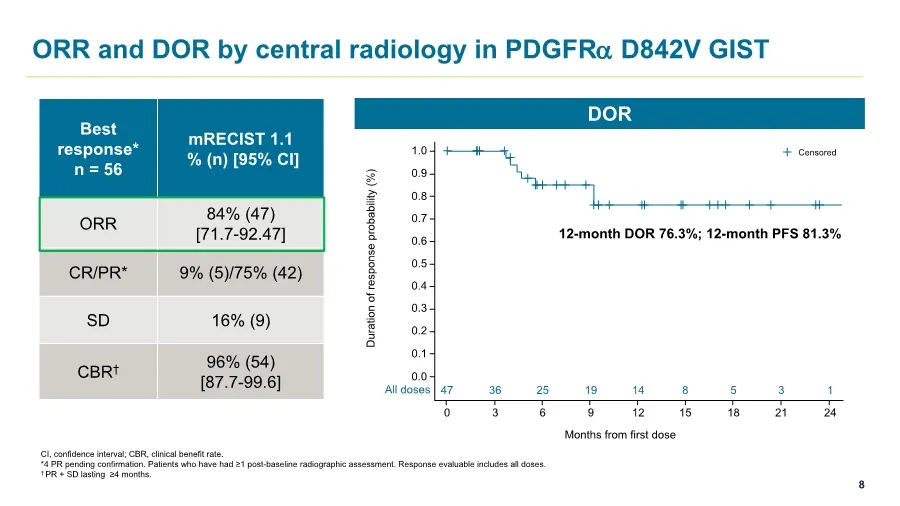
Slide 8: ORR and DOR in PDGFR D842V GIST
ORR and DOR by central radiology in PDGFR D842V GIST 8 Best response* n = 56 mRECIST 1.1 %(n) [95% CI] ORR 84% (47) [71.7-92.47] CR/PR* 9% (5)/75% (42) SD 16% (9) CBR† 96% (54) [87.7-99.6] DOR 12-month DOR 76.3%; 12-month PFS 81.3% 0 3 6 9 12 15 18 21 24 0.0 0.1 0.2 0.3 0.4 0.5 0.6 0.7 0.8 0.9 1.0
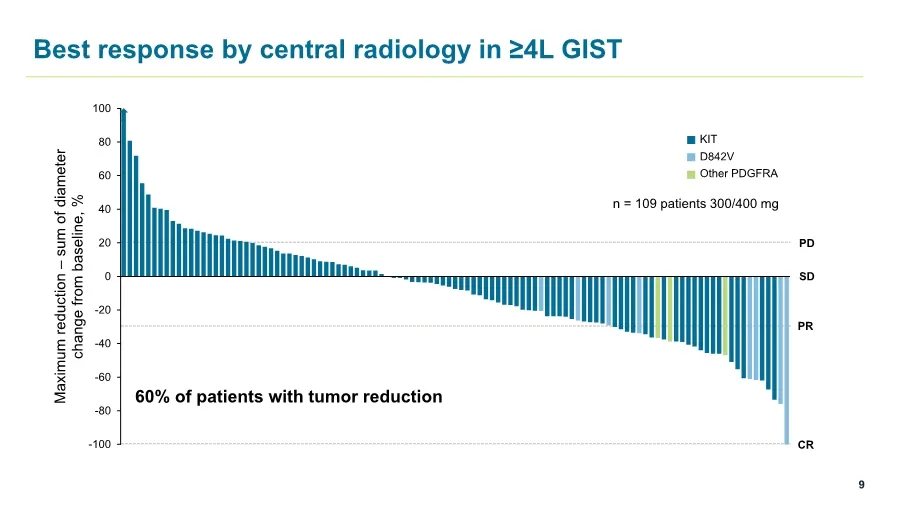
Slide 9: Best response in ≥4L GIST
Best response by central radiology in ≥4L GIST 9 PD SD PR CR KIT D842V Other PDGFRA 60% of patients with tumor reduction n = 109 patients 300/400 mg -100 -80 -60 -40 -20 0 20 40 60 80 100 Maximum reduction – sum of diameter change from baseline, %
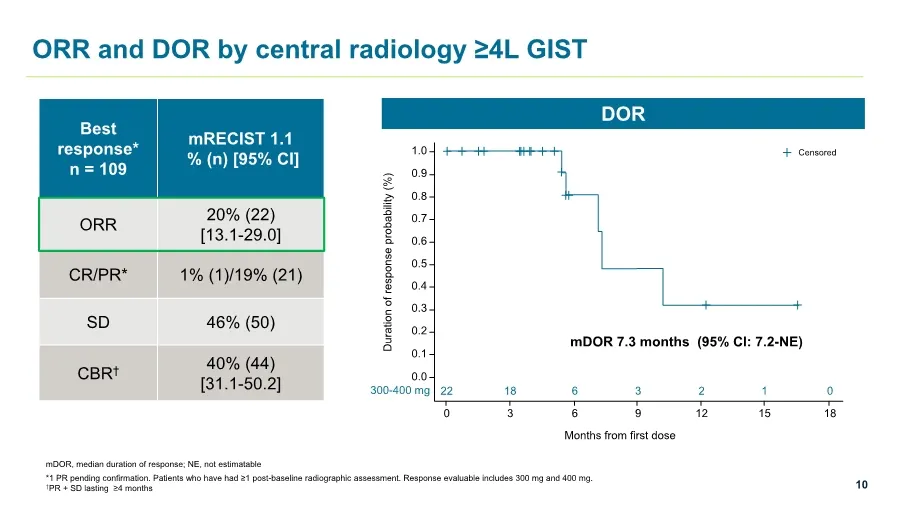
Slide 10: ORR and DOR ≥4L GIST
ORR and DOR by central radiology ≥4L GIST 10 mDOR, median duration of response; NE, not estimatable *1 PR pending confirmation. Patients who have had ≥1 post-baseline radiographic assessment. Response evaluable includes 300 mg and 400 mg. †PR + SD lasting ≥4 months Best response* n = 109 mRECIST 1.1
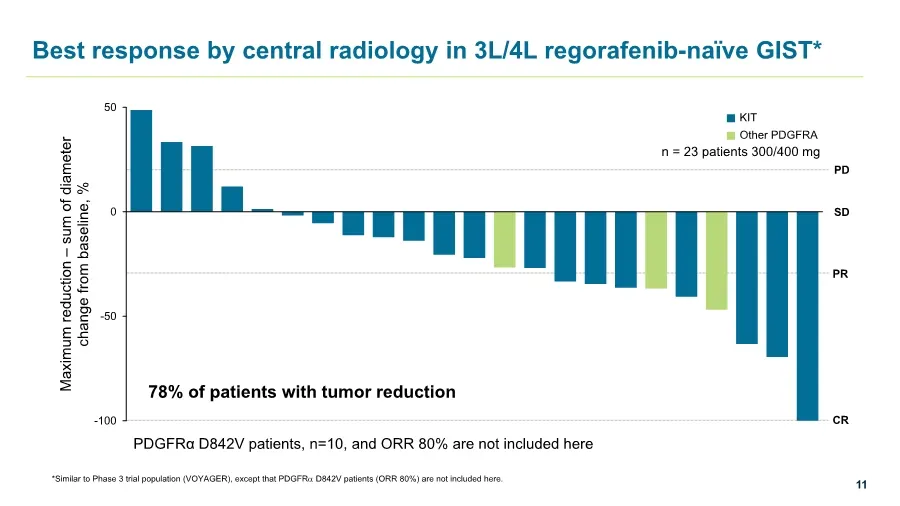
Slide 11: Best response in 3L/4L regorafenib-naïve GIST
Best response by central radiology in 3L/4L regorafenib-naïve GIST* 11 PD SD PR CR-100 -50 0 50 Maximum reduction – sum of diameter change from baseline, % n = 23 patients 300/400 mg 78% of patients with tumor reduction KIT Other PDGFRA *Similar to Phase 3 trial population (VOYAGER), except that PDG
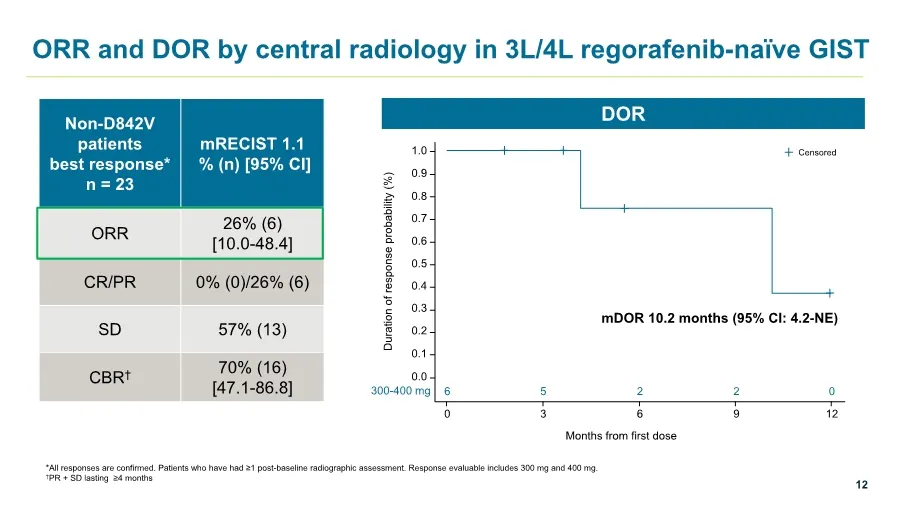
Slide 12: ORR and DOR in 3L/4L regorafenib-naïve GIST
ORR and DOR by central radiology in 3L/4L regorafenib-naïve GIST 12 mDOR 10.2 months (95% CI: 4.2-NE) *All responses are confirmed. Patients who have had ≥1 post-baseline radiographic assessment. Response evaluable includes 300 mg and 400 mg. †PR + SD lasting ≥4 months Non-D842V patients best respon
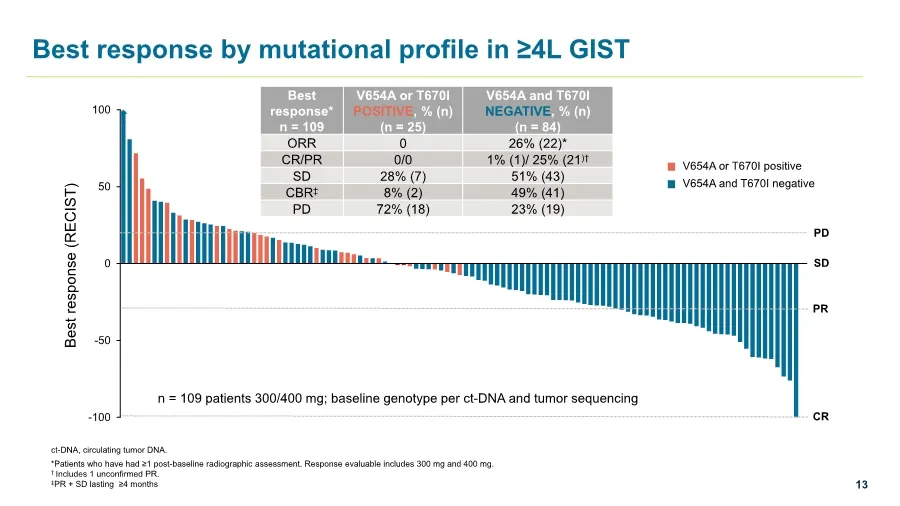
Slide 13: Best response by mutational profile in ≥4L GIST
Best response by mutational profile in ≥4L GIST 13 -100 -50 0 50 100 Best response (RECIST) PD SD CR PR V654A or T670I positive V654A and T670I negative n = 109 patients 300/400 mg; baseline genotype per ct-DNA and tumor sequencing Best response* n = 109 V654A or T670I POSITIVE, % (n) (n = 25) V654A
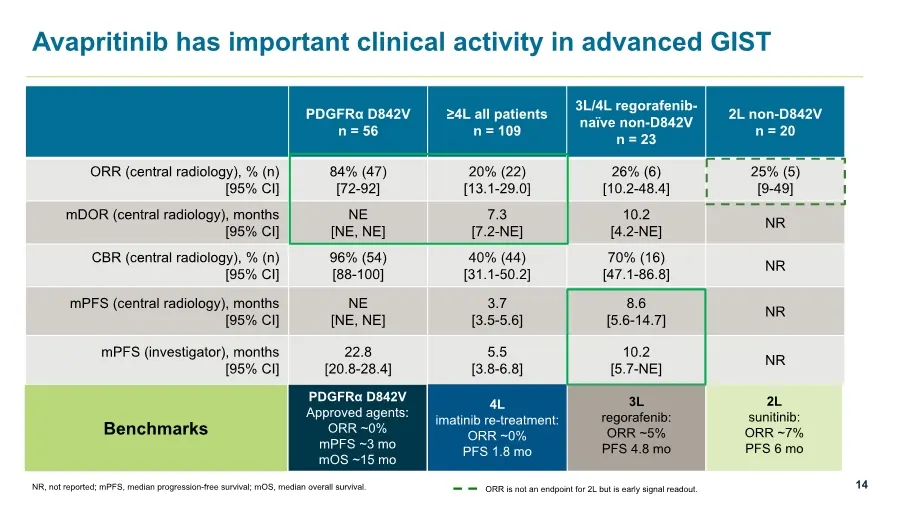
Slide 14: Avapritinib has important clinical activity in advanced GIST
Avapritinib has important clinical activity in advanced GIST 14 PDGFRα D842V n = 56 ≥4L all patients n = 109 3L/4L regorafenib- naïve non-D842V n = 23 2L non-D842V n = 20 ORR (central radiology), % (n) [95% CI] 84% (47) [72-92] 20% (22) [13.1-29.0] 26% (6) [10.2-48.4] 25% (5) [9-49] mDOR (central ra
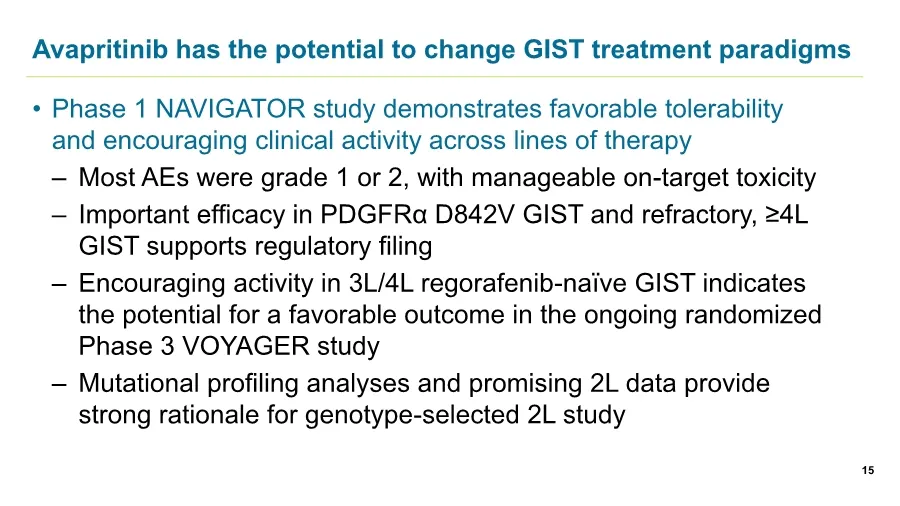
Slide 15: Avapritinib has the potential to change GIST treatment paradigms
• Phase 1 NAVIGATOR study demonstrates favorable tolerability and encouraging clinical activity across lines of therapy – Most AEs were grade 1 or 2, with manageable on-target toxicity – Important efficacy in PDGFRα D842V GIST and refractory, ≥4L GIST supports regulatory filing – Encouraging activit
Slide 16: Acknowledgments
Acknowledgments 16 We would like to thank the participating patients, their families, all study co-investigators, and research coordinators at the following institutions: • OHSU Knight Cancer Institute • Fox Chase Cancer Center • Royal Marsden Hospital/Institute of Cancer Research • University of Du
Source: SEC EDGAR · 8-K filed Nov 15, 2018
More decks from Blueprint Medicines Corp
 Q1 2025 Earnings Presentation14 slides · May 1, 2025
 Q4 2024 Earnings Presentation12 slides · Feb 13, 2025
 J.P. Morgan Healthcare Conference 202525 slides · Jan 13, 2025
 Technical Presentation (April 2024)19 slides · Apr 25, 2024
 J.P. Morgan Healthcare Conference 202425 slides · Jan 8, 2024
 AAAAI 2023 Annual Meeting35 slides · Feb 27, 2023