EcoSynthetix Inc. · TSX:ECO
EcoSynthetix — Technical Presentation (2012)
34 slides from EcoSynthetix's technical presentation, 2012
Slide 1: Rheological Properties of Starch Latex Dispersions and Starch Latex-Containing Coating Colors
Rheological Properties of Starch Latex Dispersions and Starch Latex- Containing Coating Colors 1Jae Y. Shin, 2Nathan Jones, 1,3Do Ik Lee, 1Paul D. Fleming, 1Margaret K. Joyce, 3Ralph DeJong, and 3Steven Bloembergen 1) Department of Paper Engineering, Chemical Engineering and Imaging, Western Michiga
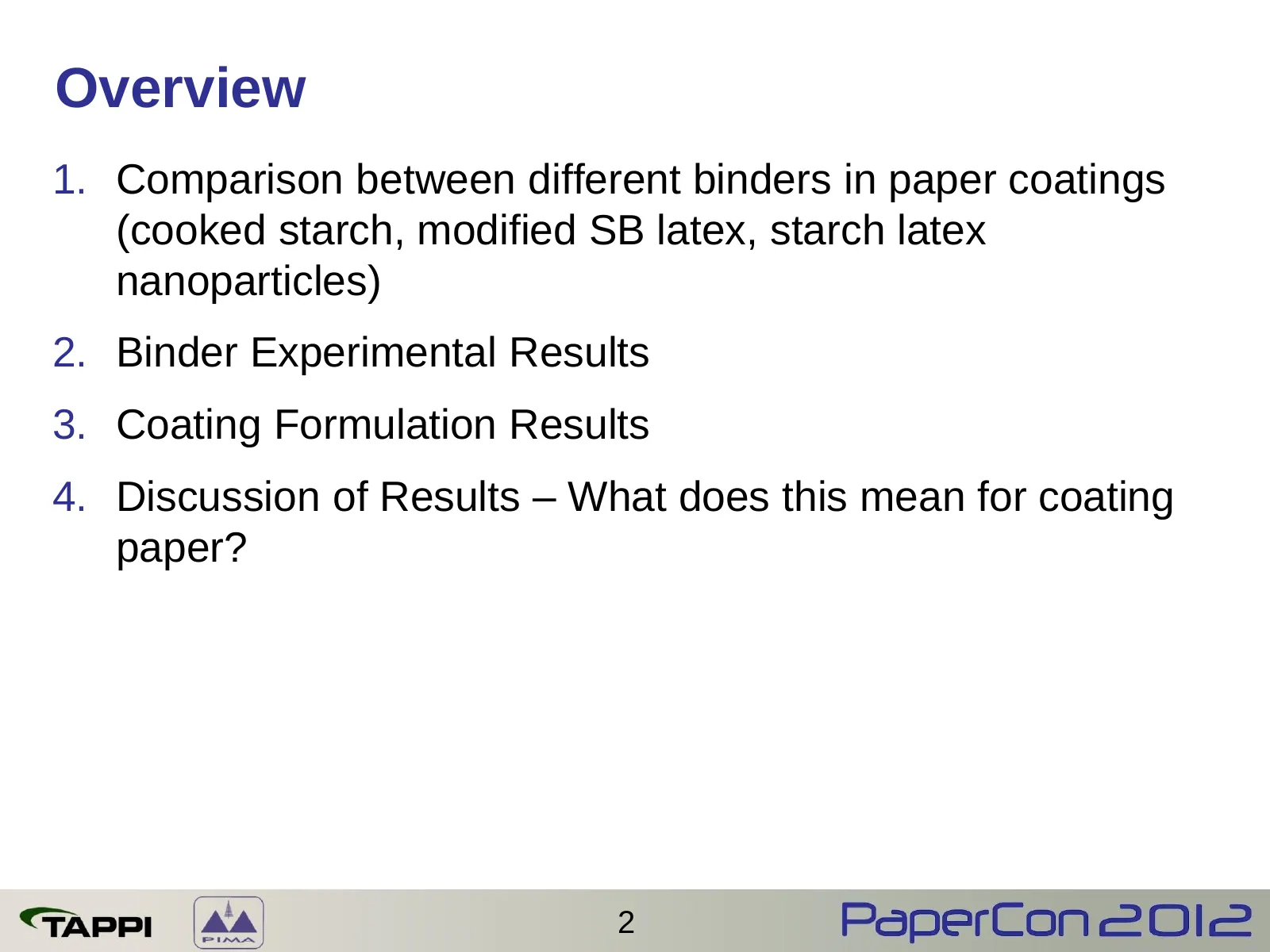
Slide 2: Overview
Overview 1. Comparison between different binders in paper coatings (cooked starch, modified SB latex, starch latex nanoparticles) 2. Binder Experimental Results 3. Coating Formulation Results 4. Discussion of Results – What does this mean for coating paper? 2
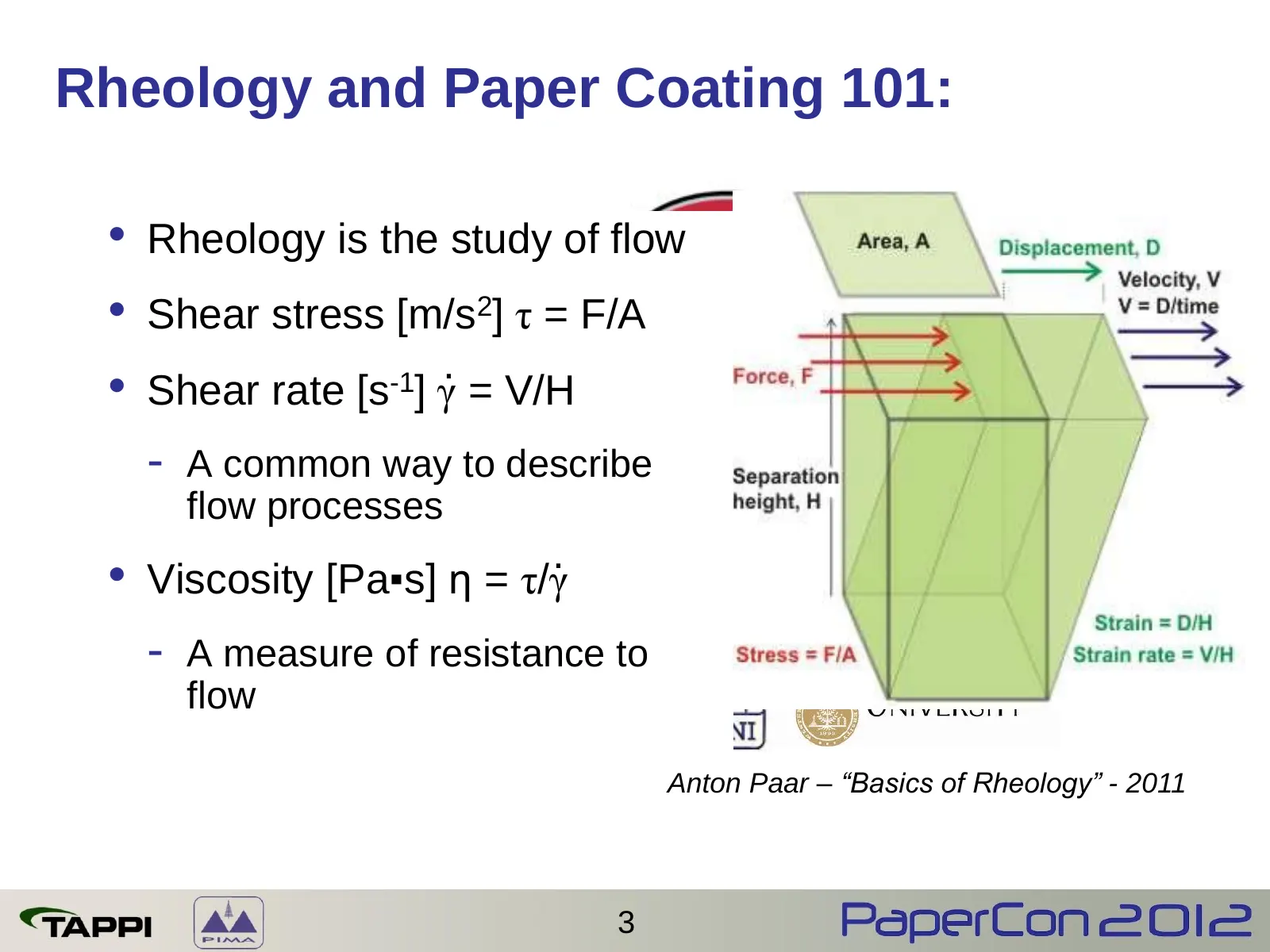
Slide 3: Rheology and Paper Coating 101
Rheology and Paper Coating 101: • Rheology is the study of flow • Shear stress [m/s2] τ = F/A . • Shear rate [s ] γ = V/H -1 - A common way to describe flow processes . • Viscosity [Pa▪s] η = τ/γ - A measure of resistance to flow Anton Paar – “Basics of Rheology” - 2011 3
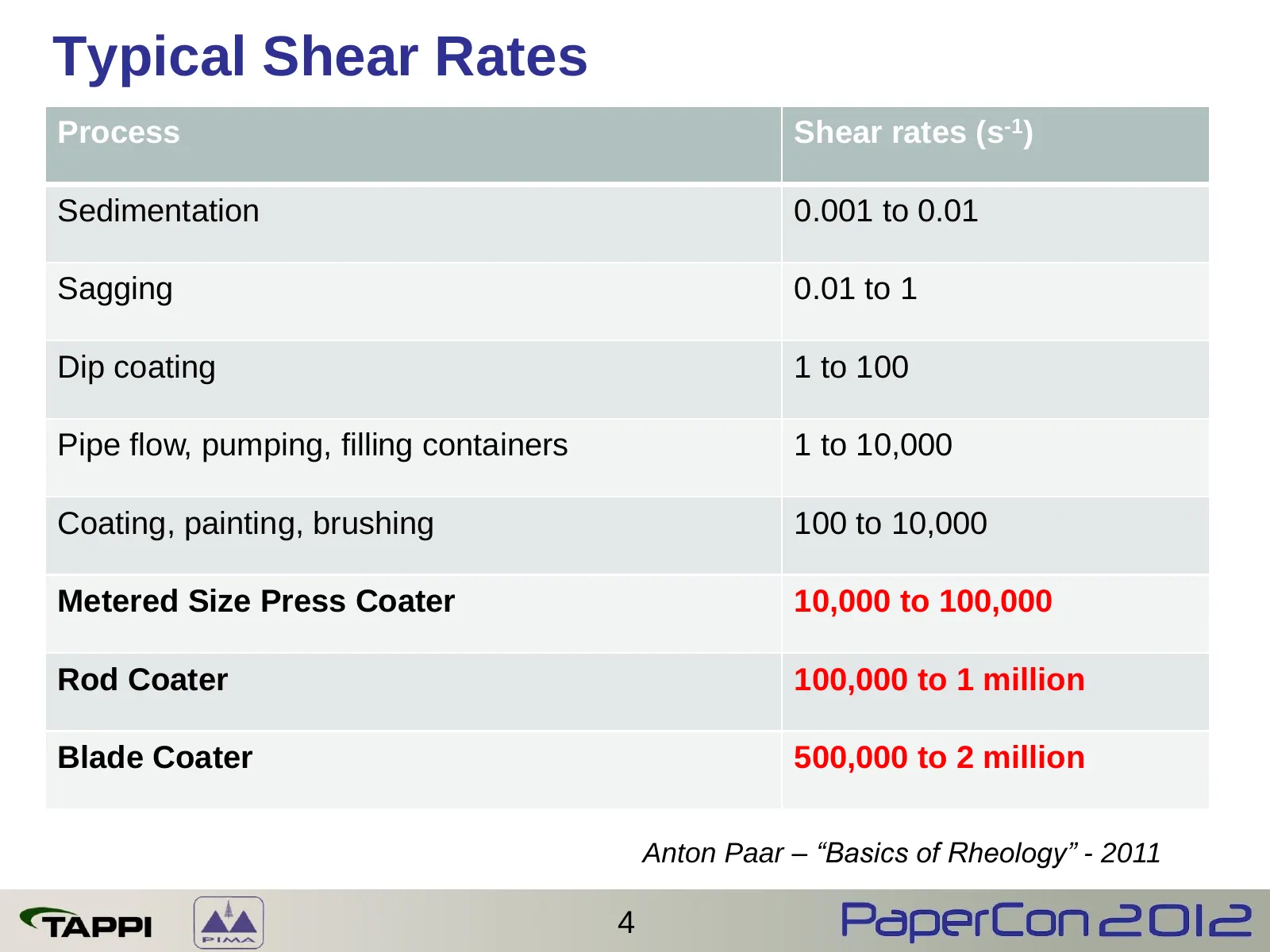
Slide 4: Typical Shear Rates
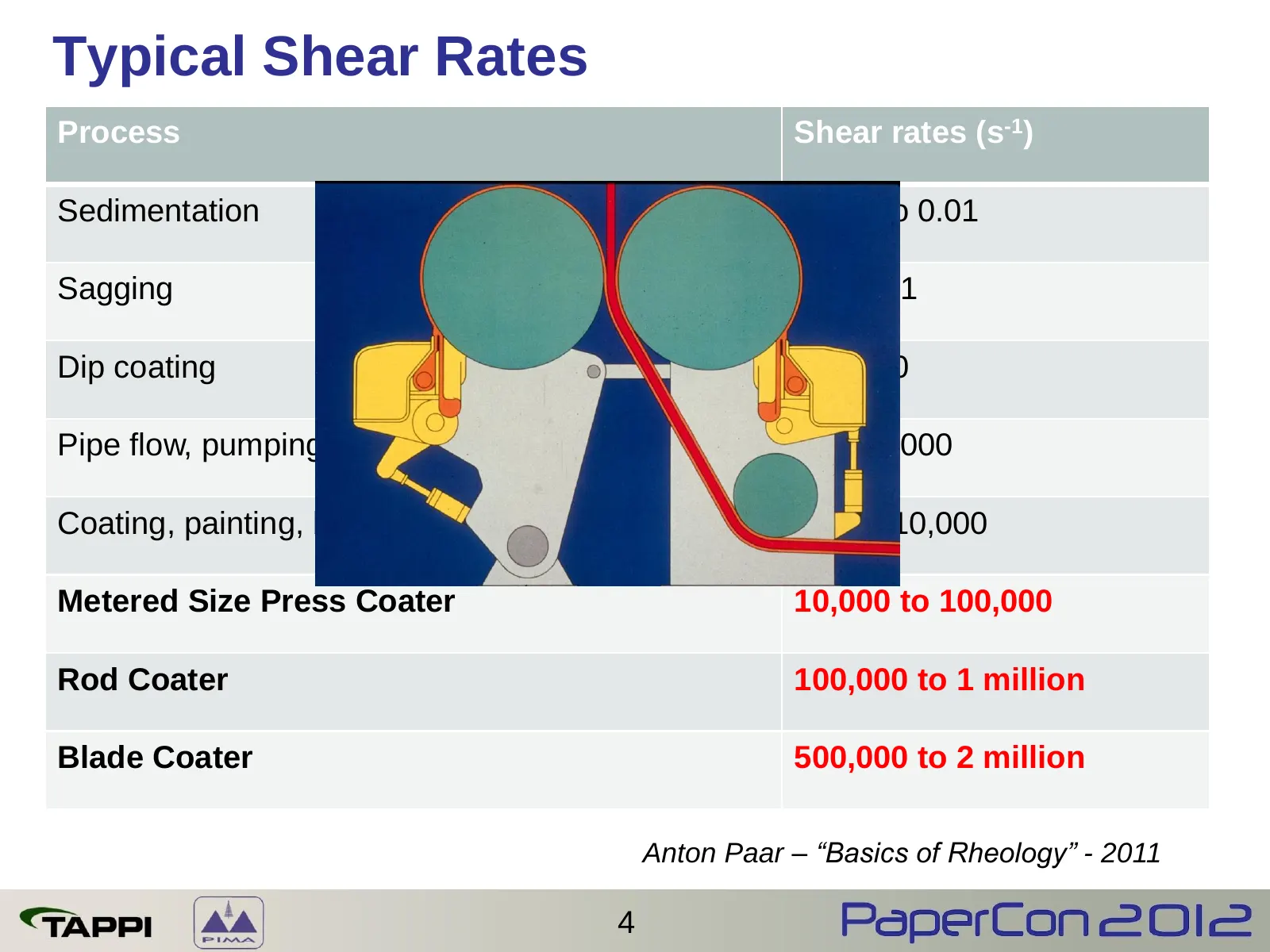
Typical Shear Rates Process Shear rates (s-1) Sedimentation 0.001 to 0.01 Sagging 0.01 to 1 Dip coating 1 to 100 Pipe flow, pumping, filling containers 1 to 10,000 Coating, painting, brushing 100 to 10,000 Metered Size Press Coater 10,000 to 100,000 Rod Coater 100,000 to 1 million Blade Coater 500,0
Slide 5: Typical Shear Rates
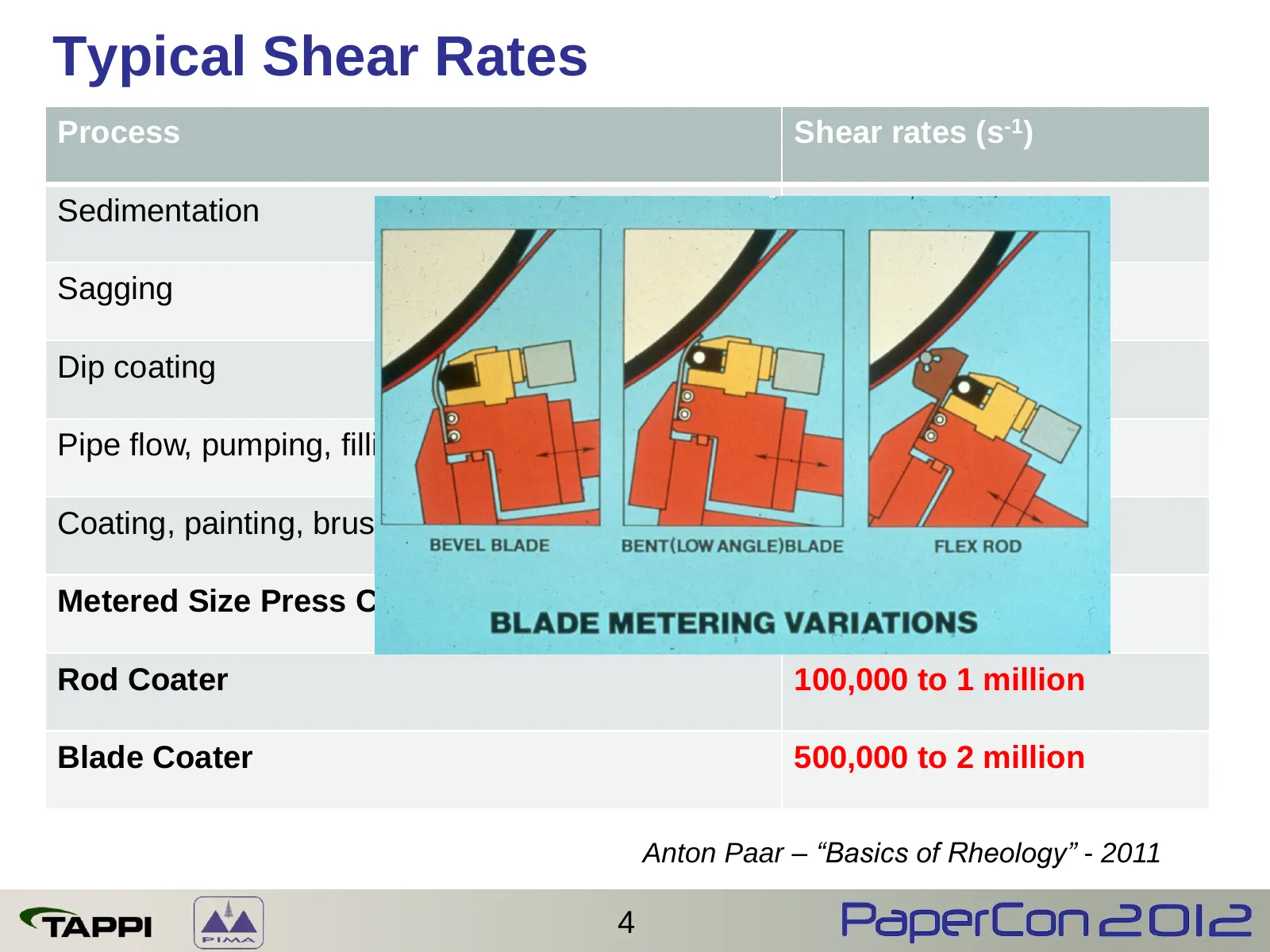
Typical Shear Rates Process Shear rates (s-1) Sedimentation 0.001 to 0.01 Sagging 0.01 to 1 Dip coating 1 to 100 Pipe flow, pumping, filling containers 1 to 10,000 Coating, painting, brushing 100 to 10,000 Metered Size Press Coater 10,000 to 100,000 Rod Coater 100,000 to 1 million Blade Coater 500,0
Slide 6: Typical Shear Rates
Typical Shear Rates Process Shear rates (s-1) Sedimentation 0.001 to 0.01 Sagging 0.01 to 1 Dip coating 1 to 100 Pipe flow, pumping, filling containers 1 to 10,000 Coating, painting, brushing 100 to 10,000 Metered Size Press Coater 10,000 to 100,000 Rod Coater 100,000 to 1 million Blade Coater 500,0
Slide 7: Shear Properties
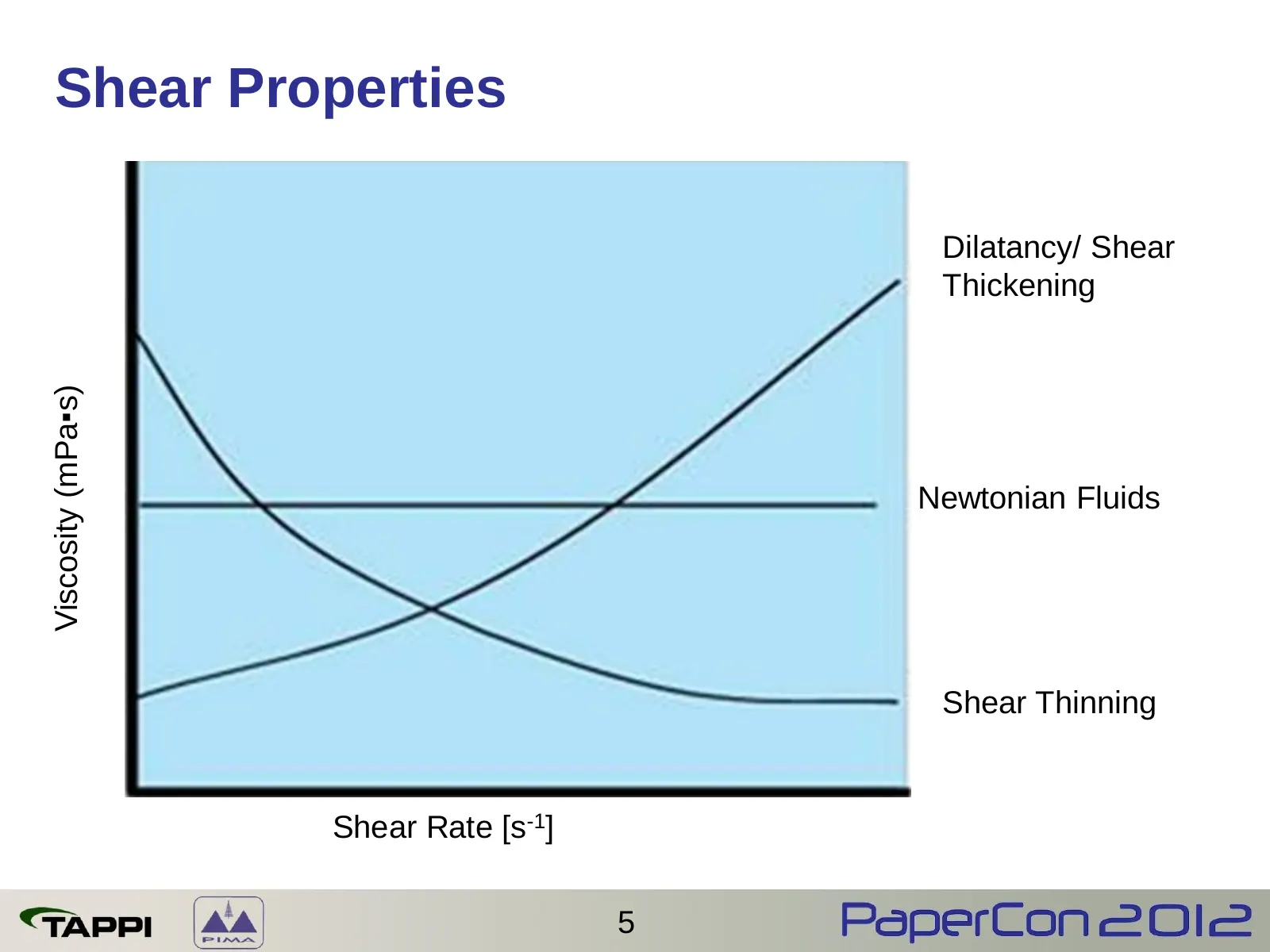
Shear Properties Dilatancy/ Shear Thickening Viscosity (mPa▪s) Newtonian Fluids Shear Thinning Shear Rate [s-1] 5
Slide 8: Internally Crosslinked Starch-based Nanoparticle Latex
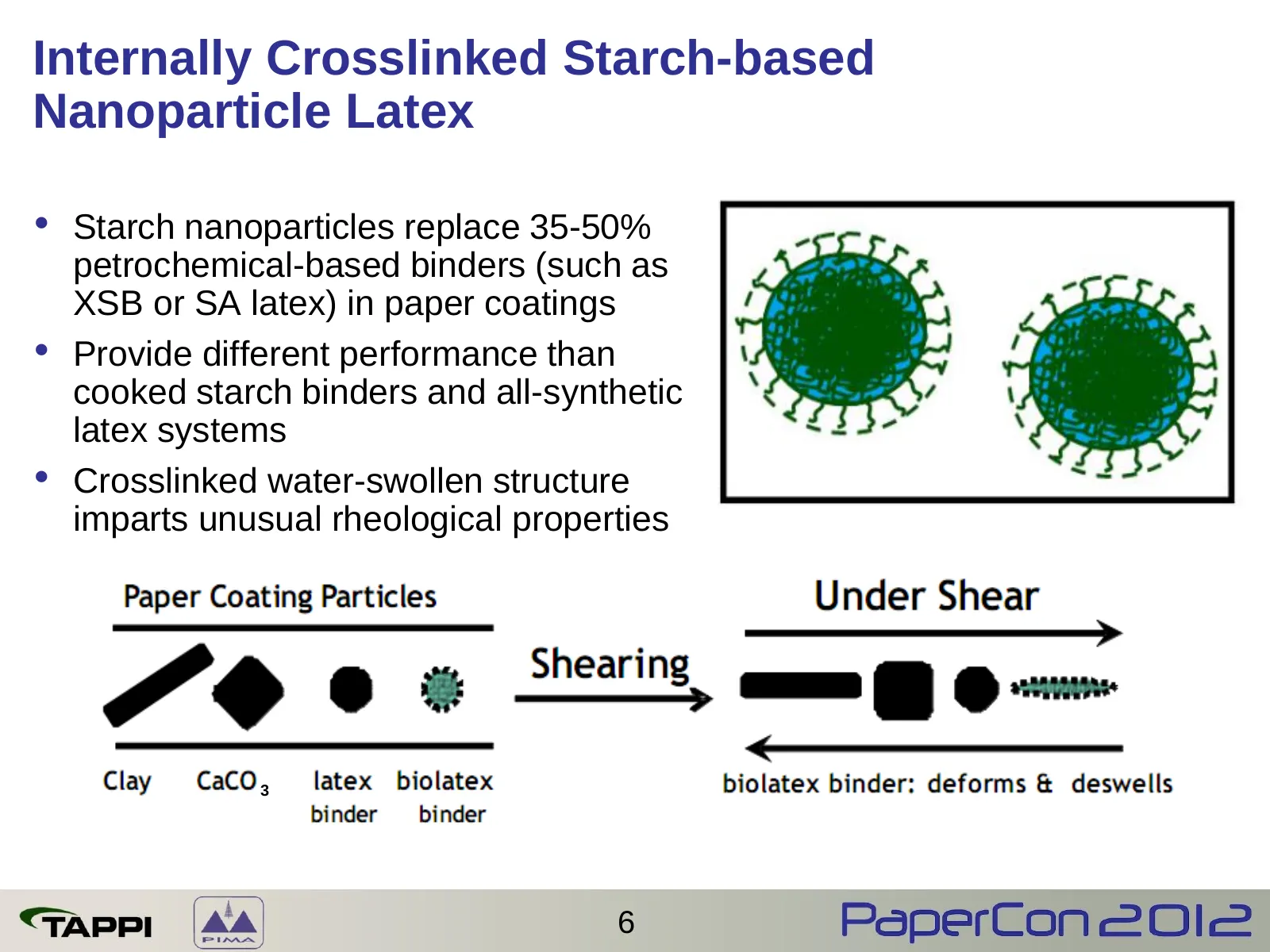
Internally Crosslinked Starch-based Nanoparticle Latex • Starch nanoparticles replace 35-50% petrochemical-based binders (such as XSB or SA latex) in paper coatings • Provide different performance than cooked starch binders and all-synthetic latex systems • Crosslinked water-swollen structure impart
Slide 9: Determination of Volume Swell Ratios
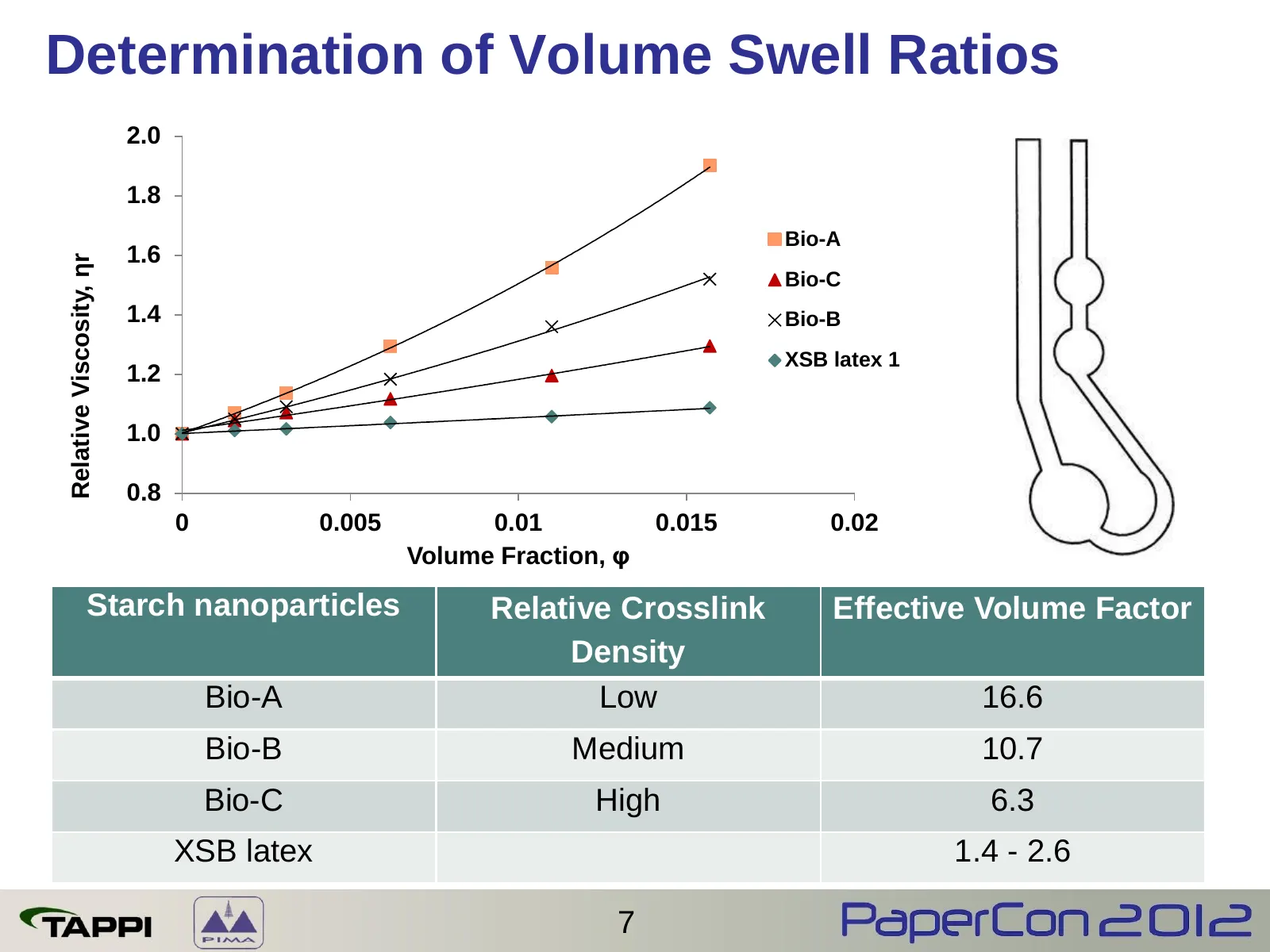
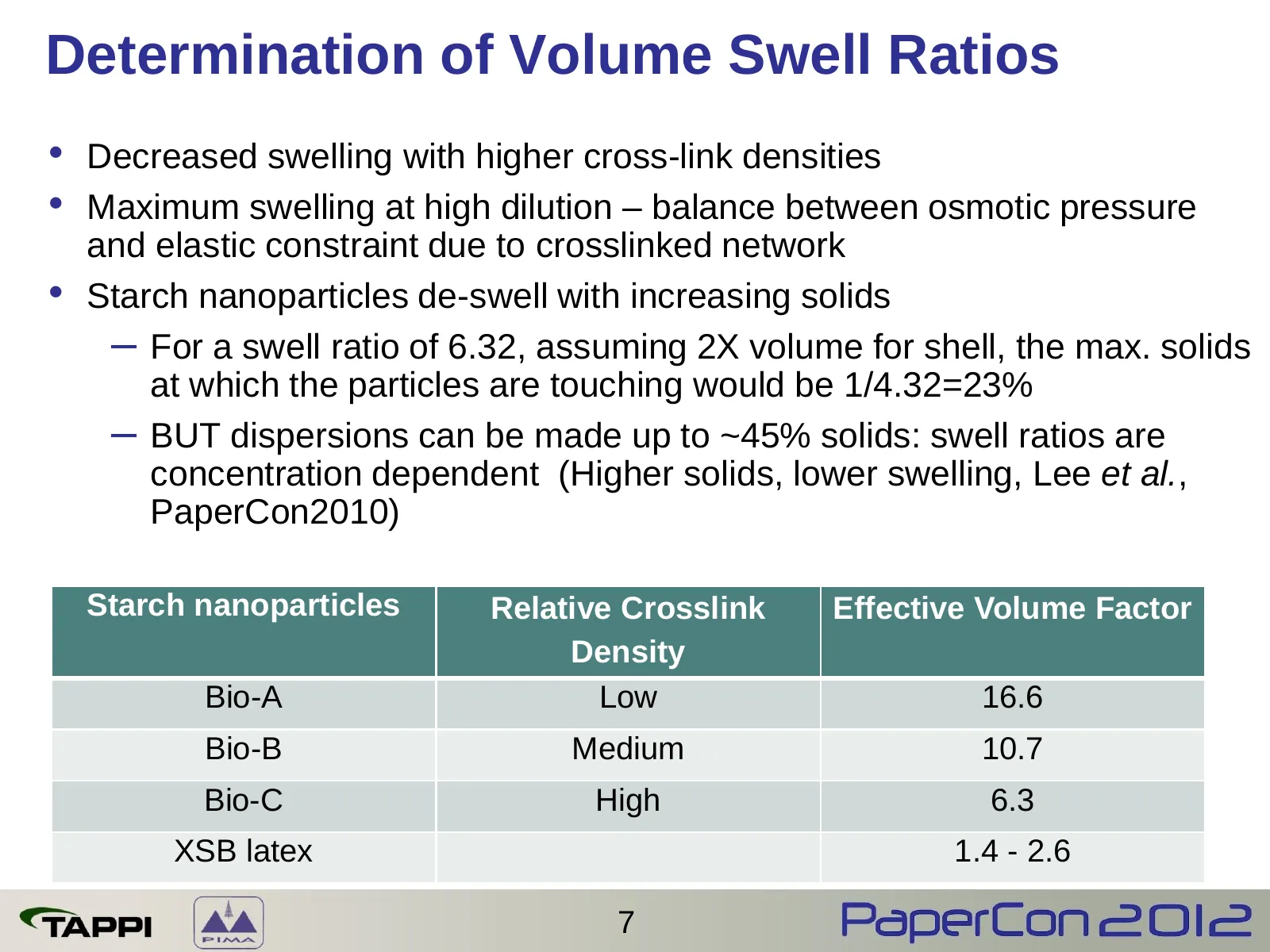
Determination of Volume Swell Ratios 2.0 1.8 Bio-A 1.6 Relative Viscosity, ηr Bio-C 1.4 Bio-B XSB latex 1 1.2 1.0 0.8 0 0.005 0.01 0.015 0.02 Volume Fraction, φ Starch nanoparticles Relative Crosslink Effective Volume Factor Density Bio-A Low 16.6 Bio-B Medium 10.7 Bio-C High 6.3 XSB latex 1.4 - 2.6
Slide 10: Determination of Volume Swell Ratios
Determination of Volume Swell Ratios 2.0 • Decreased swelling with higher cross-link densities • Maximum 1.8 swelling at high dilution – balance between osmotic pressure Bio-A and 1.6elastic constraint due to crosslinked network Relative Viscosity, ηr • Starch 1.4 nanoparticles de-swell with increas
Slide 11: Low Shear Viscosity Measurements
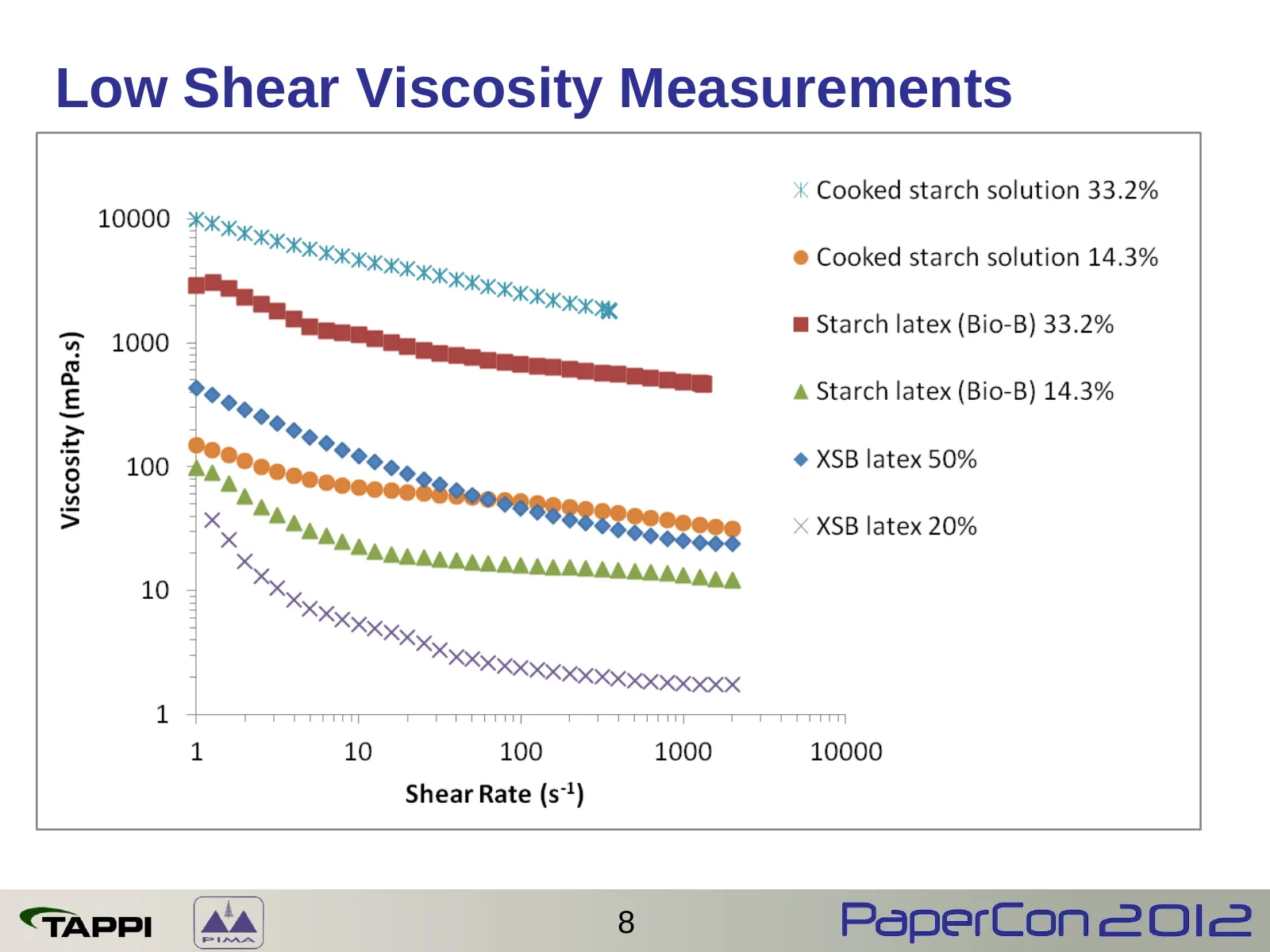
Low Shear Viscosity Measurements 8
Slide 12: Hercules "High" Shear Viscosity Measurements
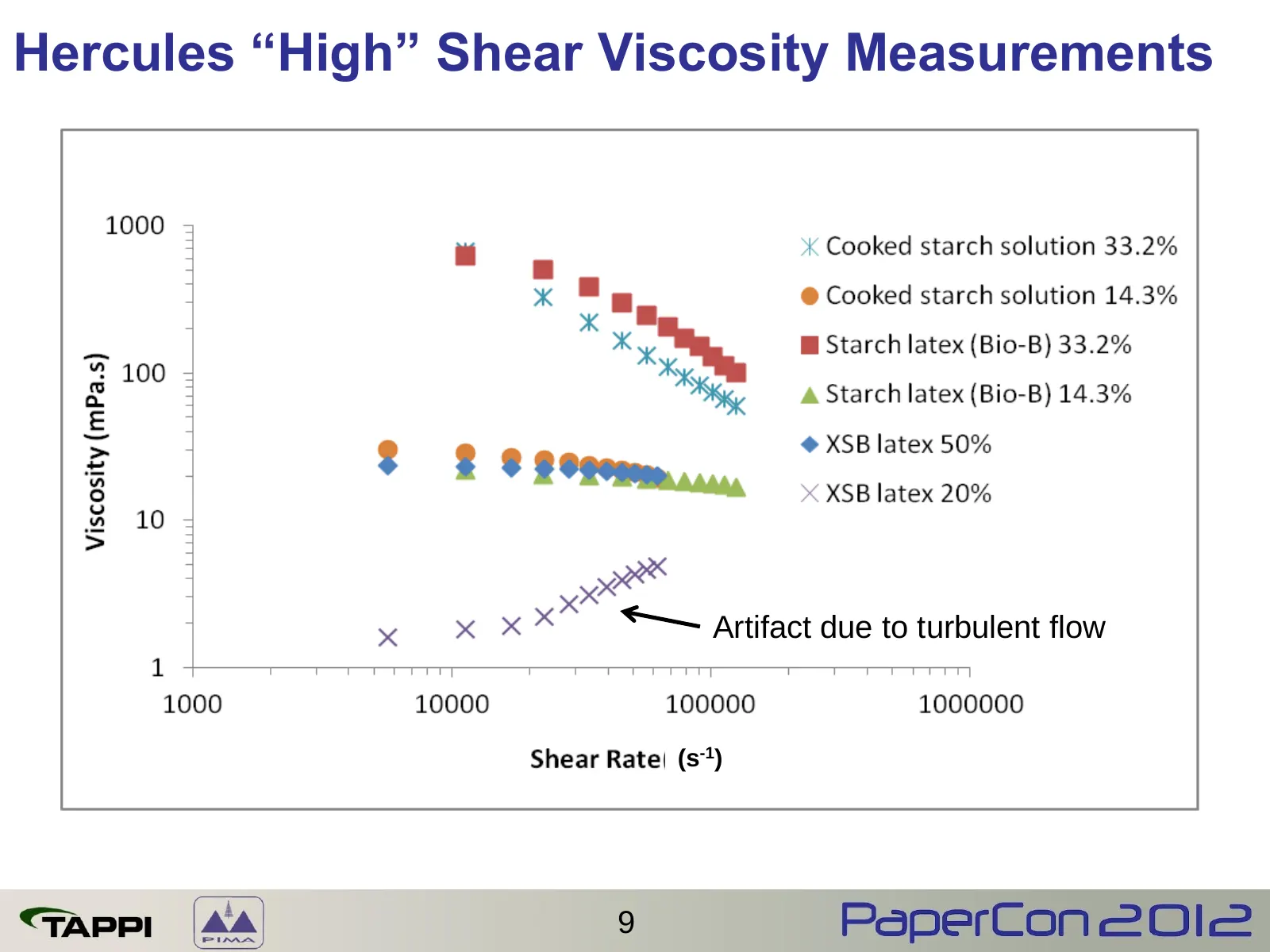
Hercules “High” Shear Viscosity Measurements Artifact due to turbulent flow (s-1) 9
Slide 13: Turbulence (Shear Thickening) of XSB at Low Concentration
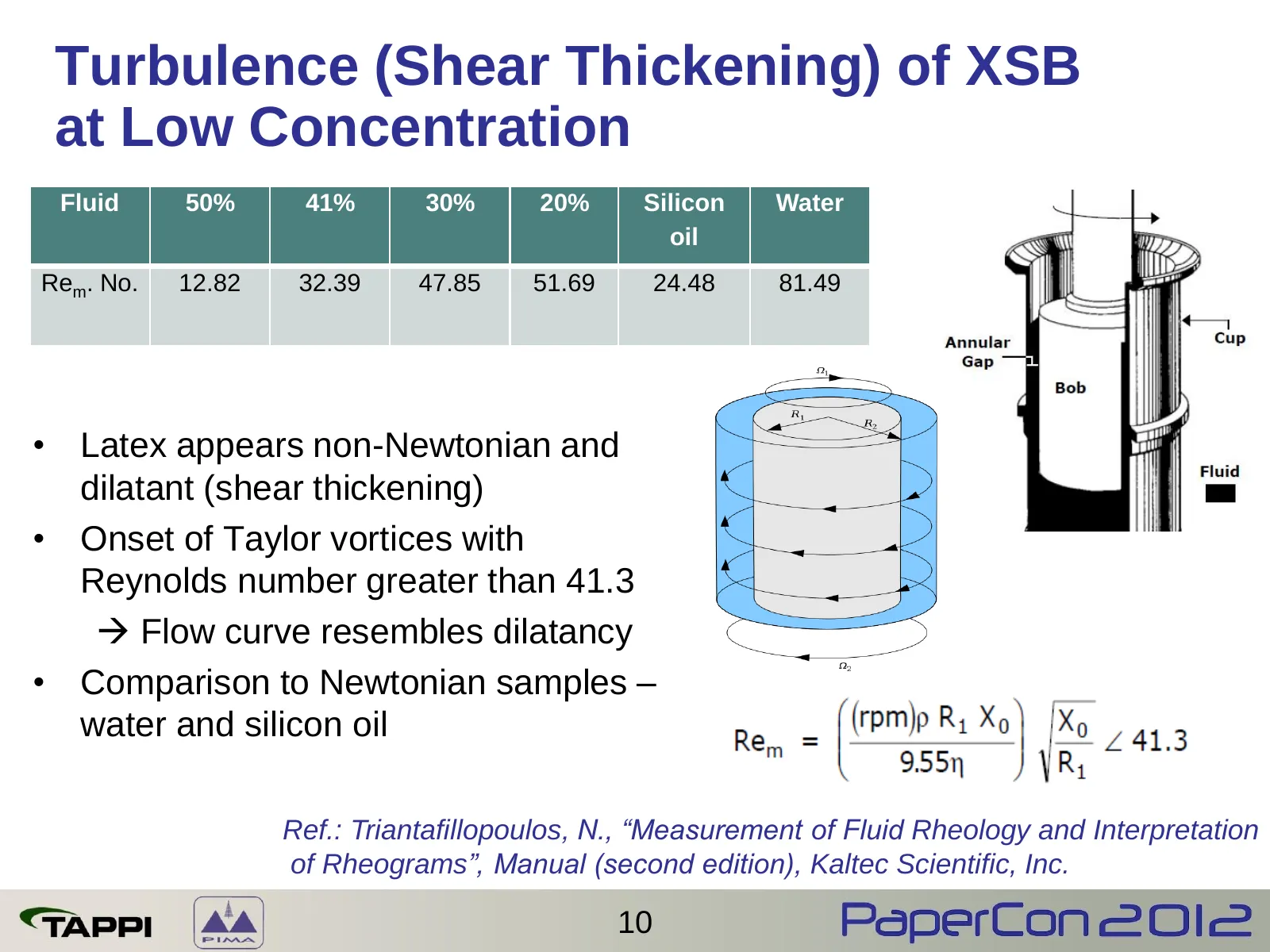
Turbulence (Shear Thickening) of XSB at Low Concentration Fluid 50% 41% 30% 20% Silicon Water oil Rem. No. 12.82 32.39 47.85 51.69 24.48 81.49 • Latex appears non-Newtonian and dilatant (shear thickening) • Onset of Taylor vortices with Reynolds number greater than 41.3 Flow curve resembles dilata
Slide 14: ACAV Ultra-High Shear Viscosity Measurements
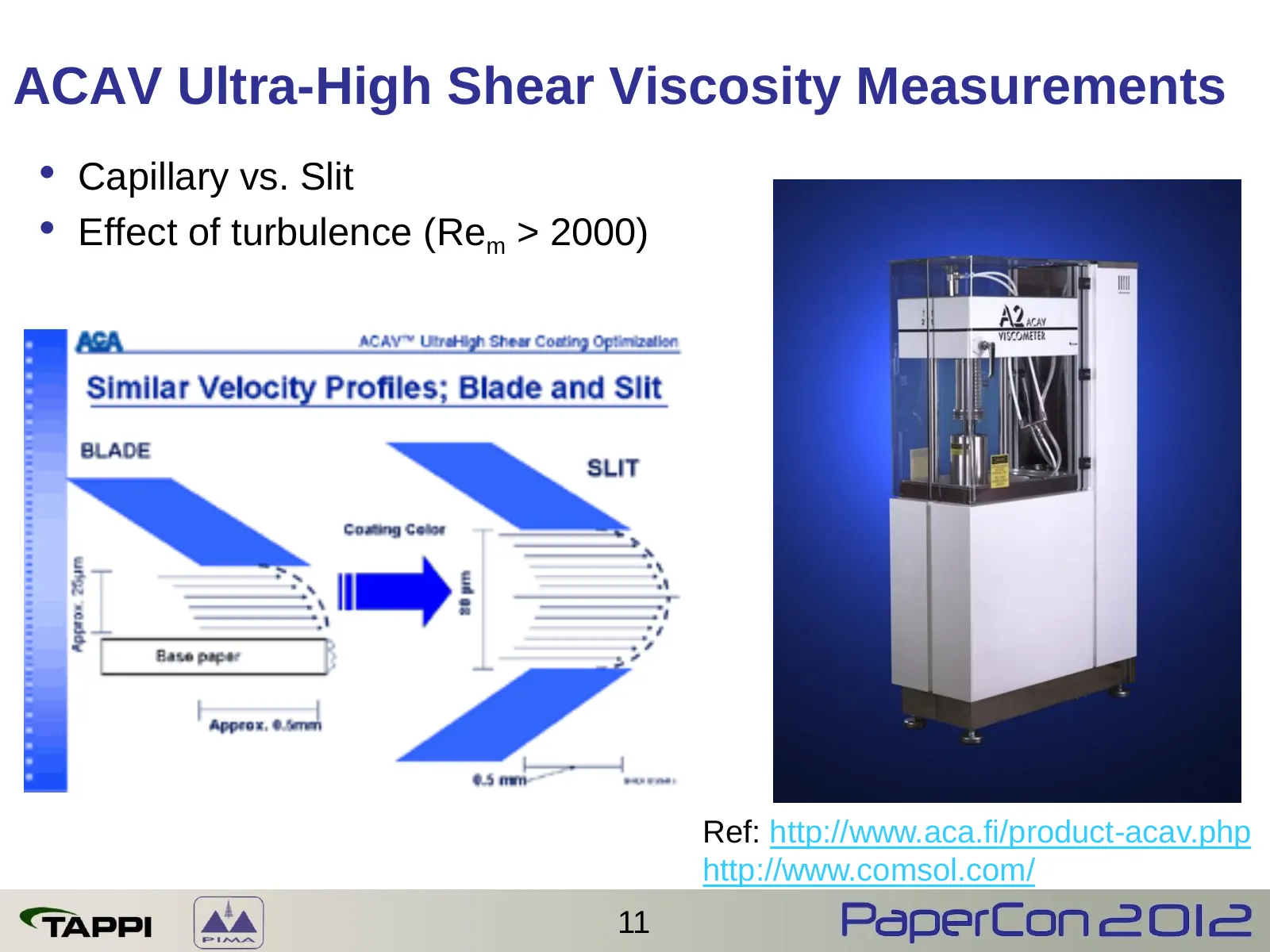
ACAV Ultra-High Shear Viscosity Measurements • Capillary vs. Slit • Effect of turbulence (Rem > 2000) Ref: http://www.aca.fi/product-acav.php http://www.comsol.com/ 11
Slide 15: ACAV Ultra-High Shear Viscosity Measurements
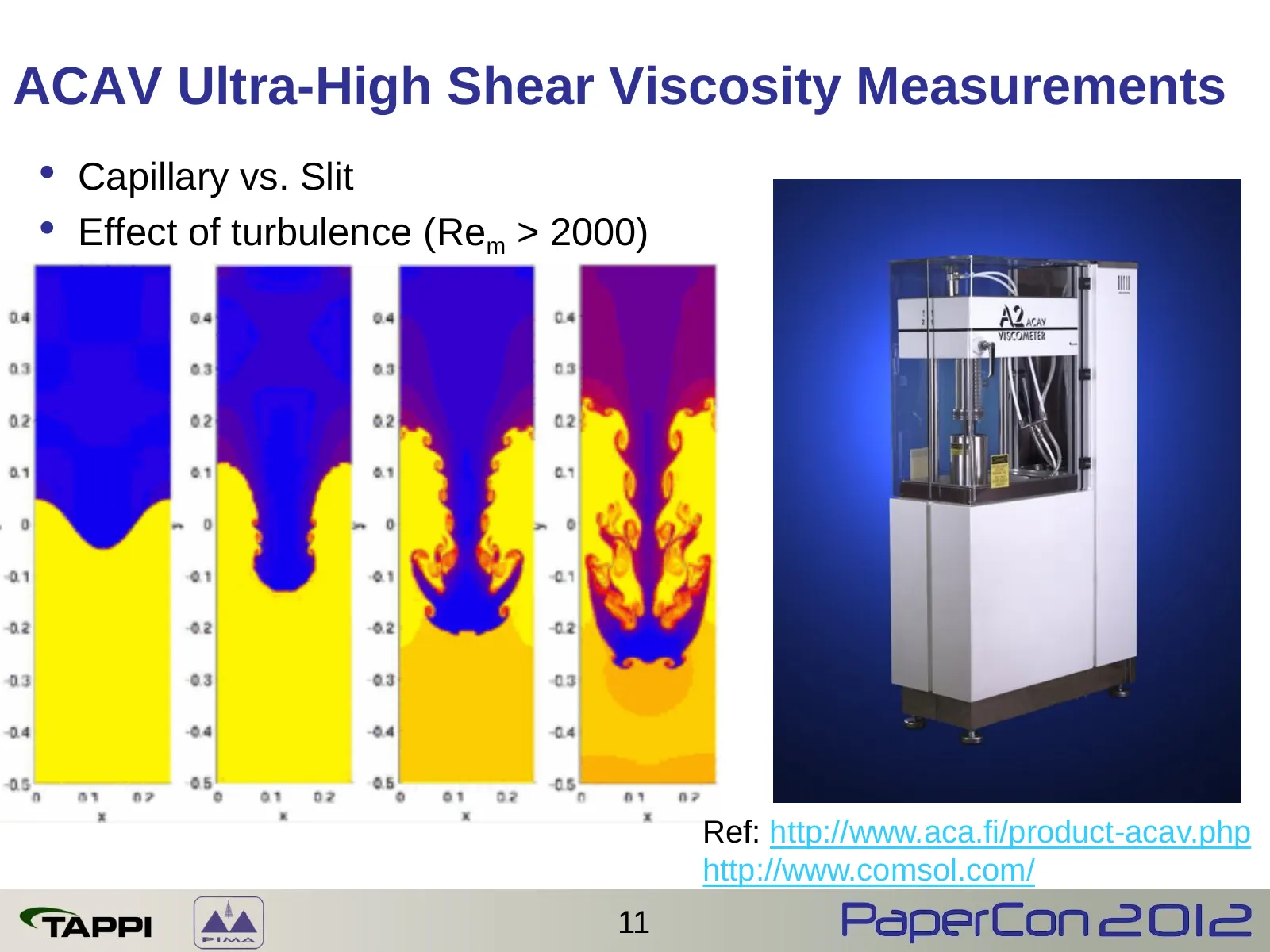
ACAV Ultra-High Shear Viscosity Measurements • Capillary vs. Slit • Effect of turbulence (Rem > 2000) Ref: http://www.aca.fi/product-acav.php http://www.comsol.com/ 11
Slide 16: ACAV Results
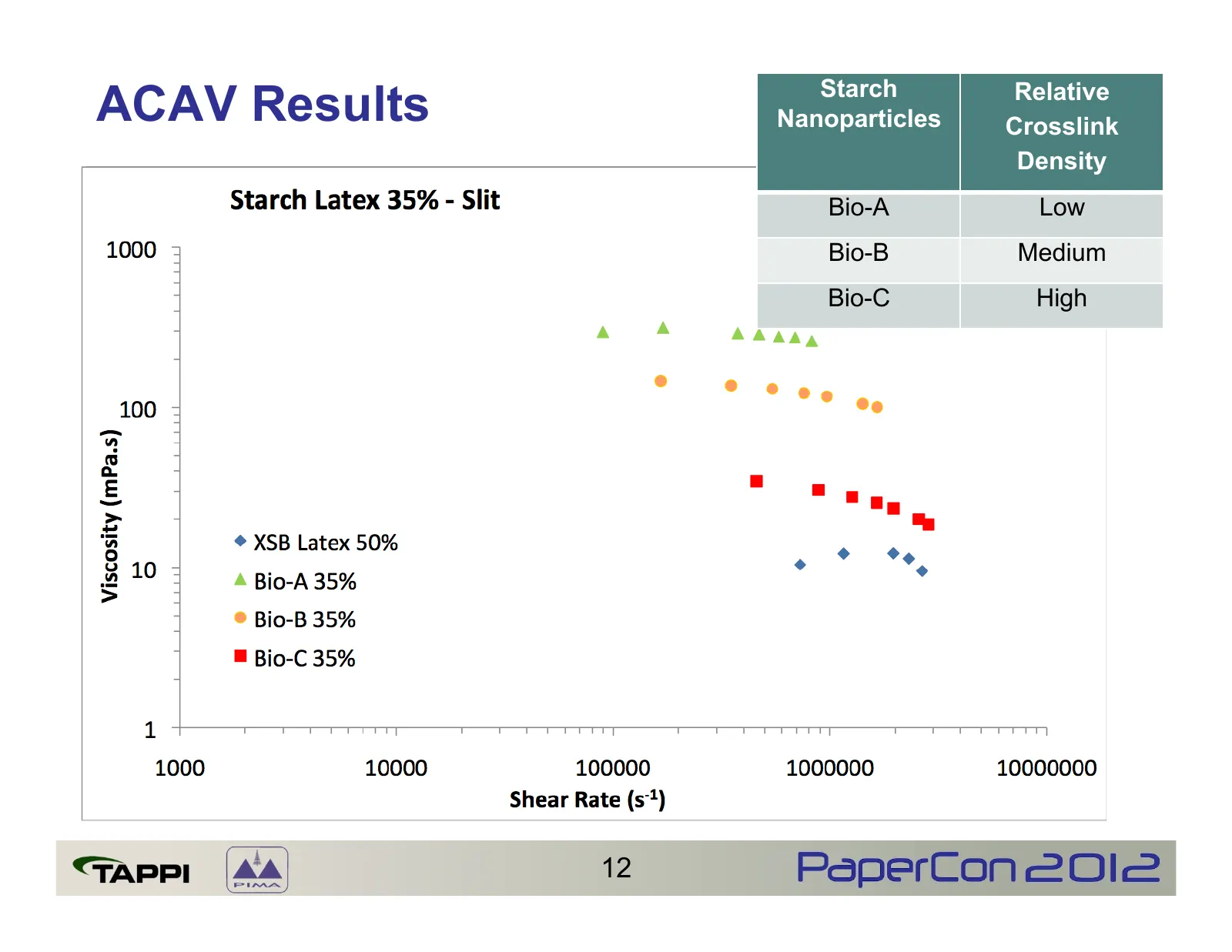
Starch ACAV Results Nanoparticles Relative Crosslink Density Bio-A Low Bio-B Medium Bio-C High 12
Slide 17: Coating Trial Plan
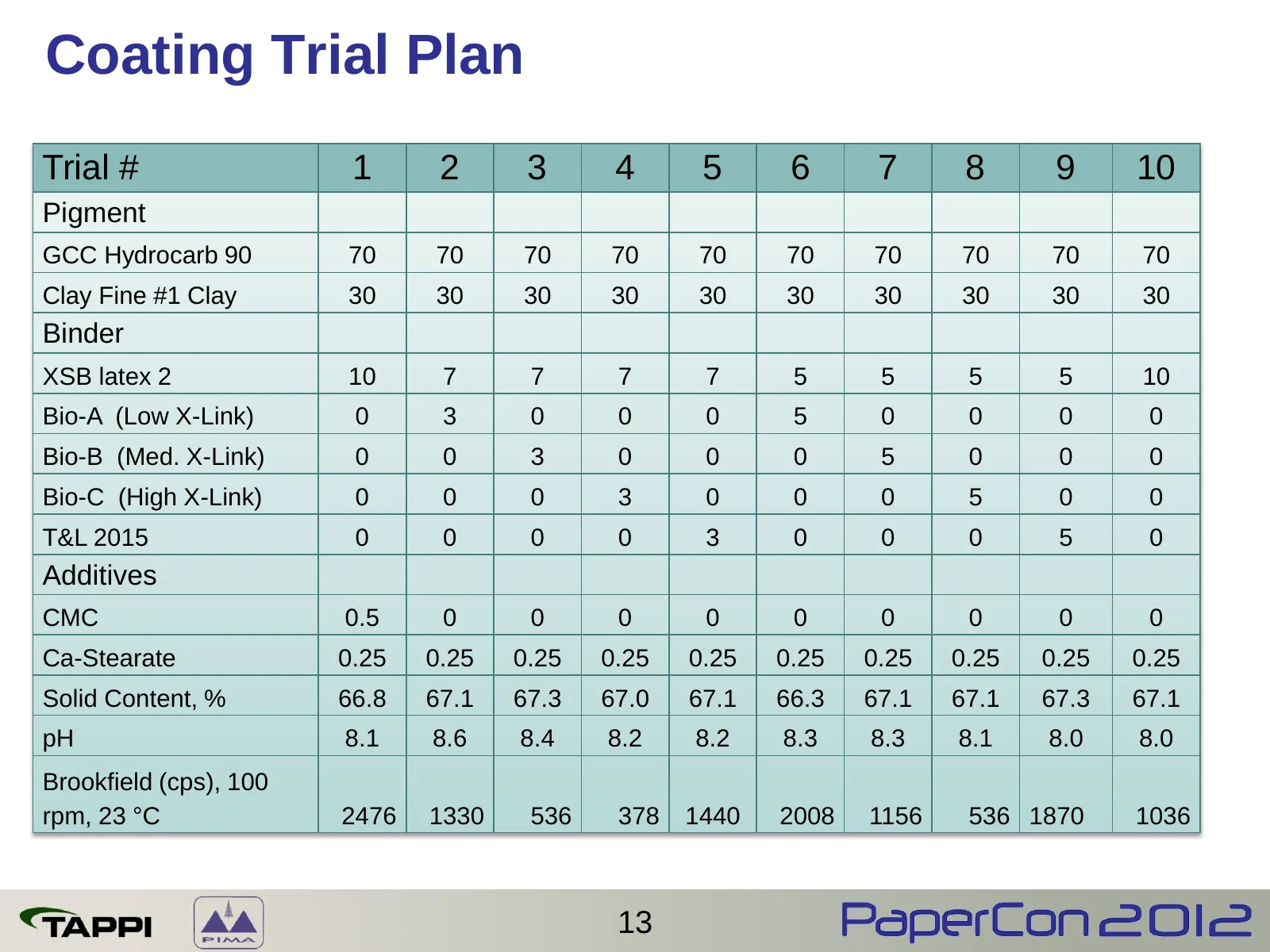
Coating Trial Plan Trial # 1 2 3 4 5 6 7 8 9 10 Pigment GCC Hydrocarb 90 70 70 70 70 70 70 70 70 70 70 Clay Fine #1 Clay 30 30 30 30 30 30 30 30 30 30 Binder XSB latex 2 10 7 7 7 7 5 5 5 5 10 Bio-A (Low X-Link) 0 3 0 0 0 5 0 0 0 0 Bio-B (Med. X-Link) 0 0 3 0 0 0 5 0 0 0 Bio-C (High X-Link) 0 0 0 3 0
Slide 18: Coating Trial Plan
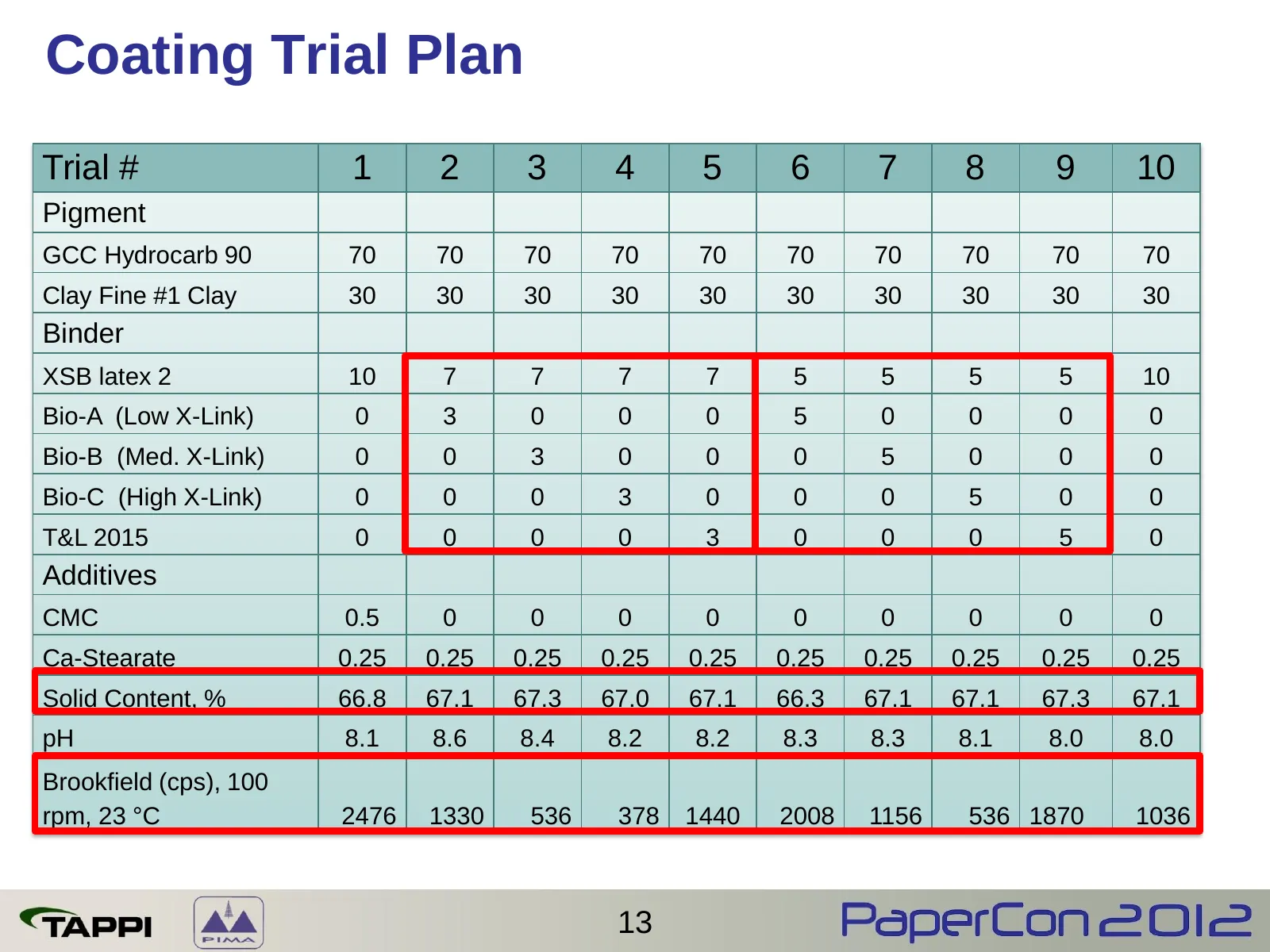
Coating Trial Plan Trial # 1 2 3 4 5 6 7 8 9 10 Pigment GCC Hydrocarb 90 70 70 70 70 70 70 70 70 70 70 Clay Fine #1 Clay 30 30 30 30 30 30 30 30 30 30 Binder XSB latex 2 10 7 7 7 7 5 5 5 5 10 Bio-A (Low X-Link) 0 3 0 0 0 5 0 0 0 0 Bio-B (Med. X-Link) 0 0 3 0 0 0 5 0 0 0 Bio-C (High X-Link) 0 0 0 3 0
Slide 19: Low Shear Coating Measurements
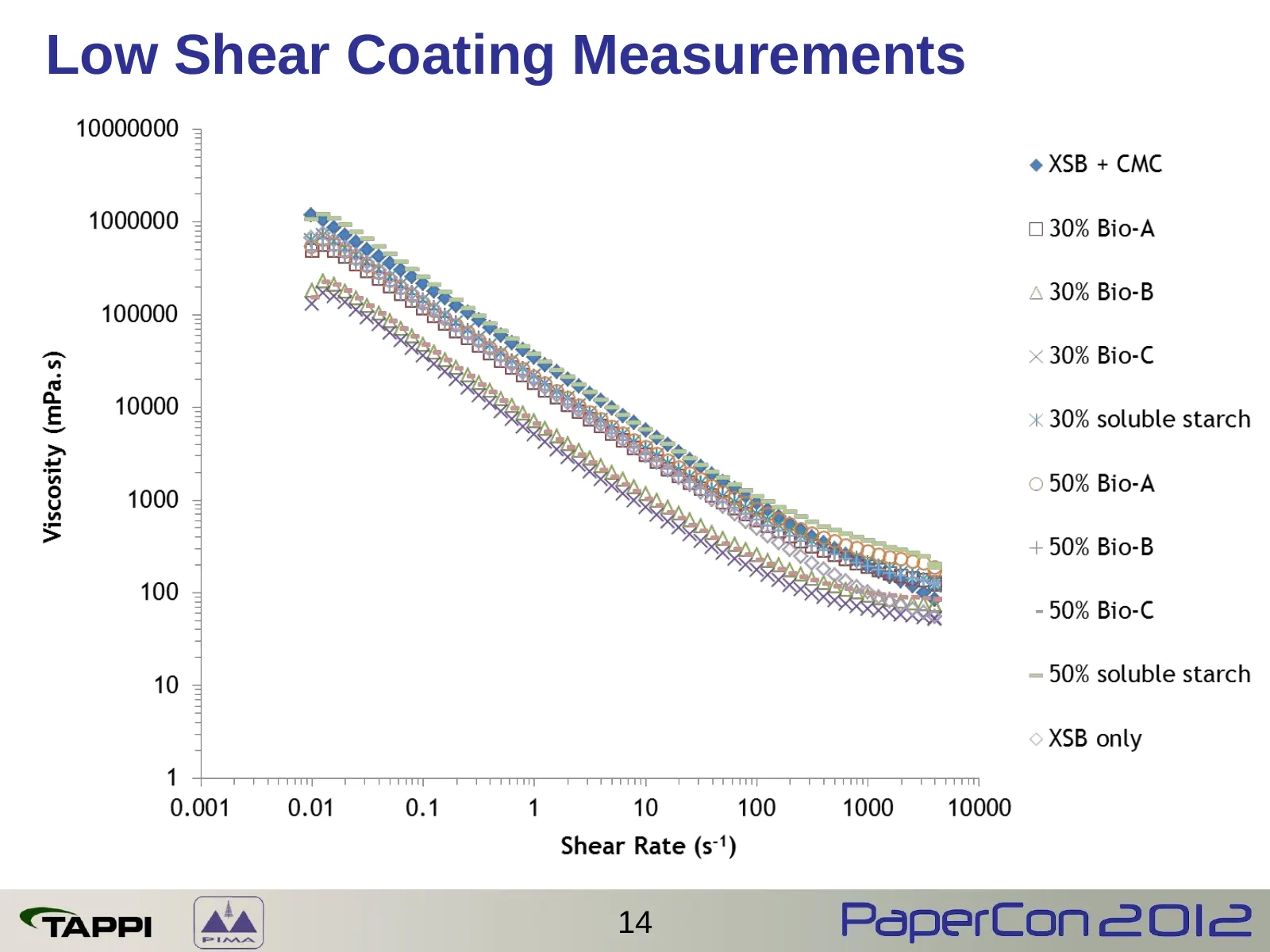
Low Shear Coating Measurements 14
Slide 20: Hercules "High" Shear Coating Viscosities
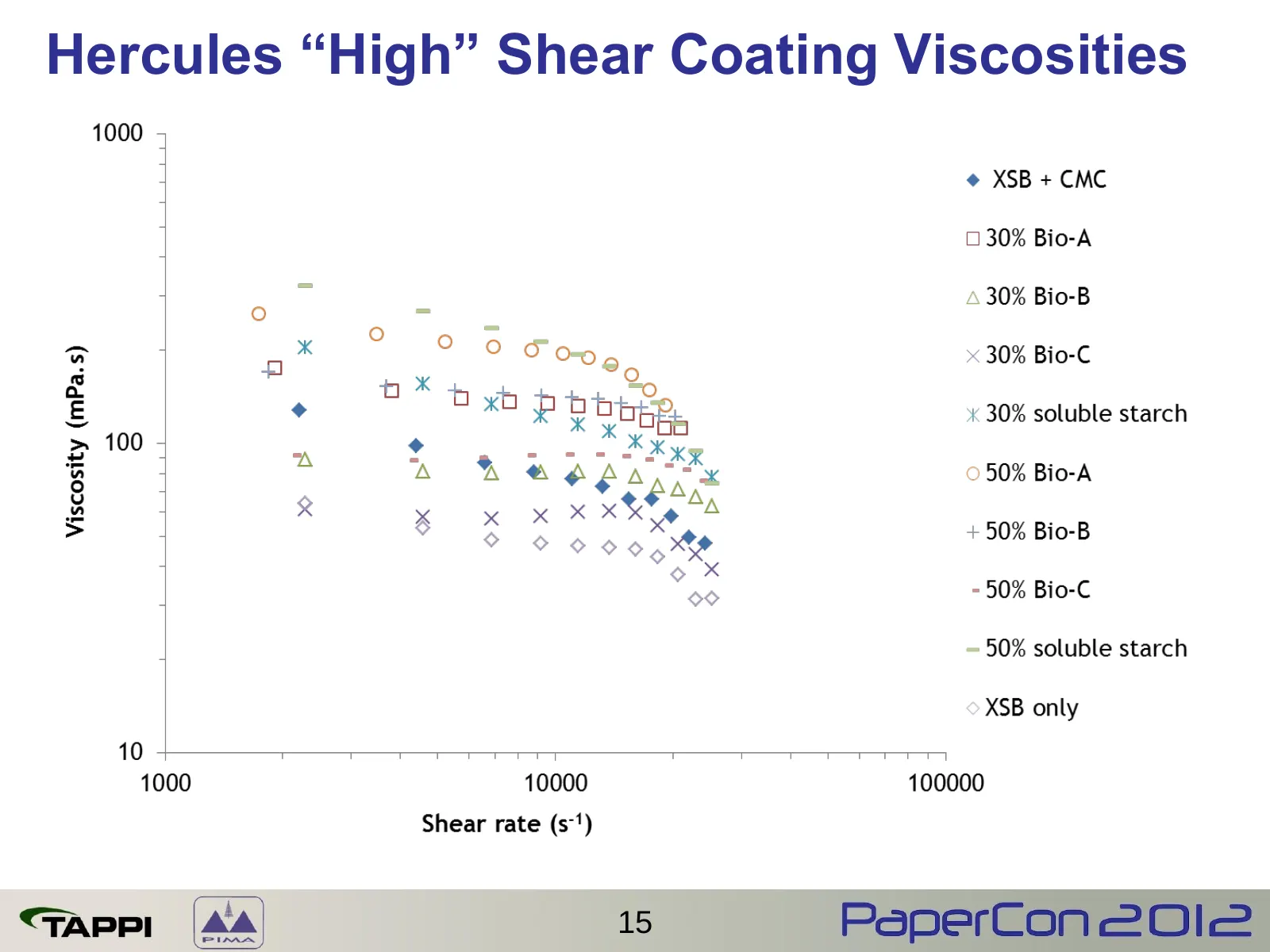
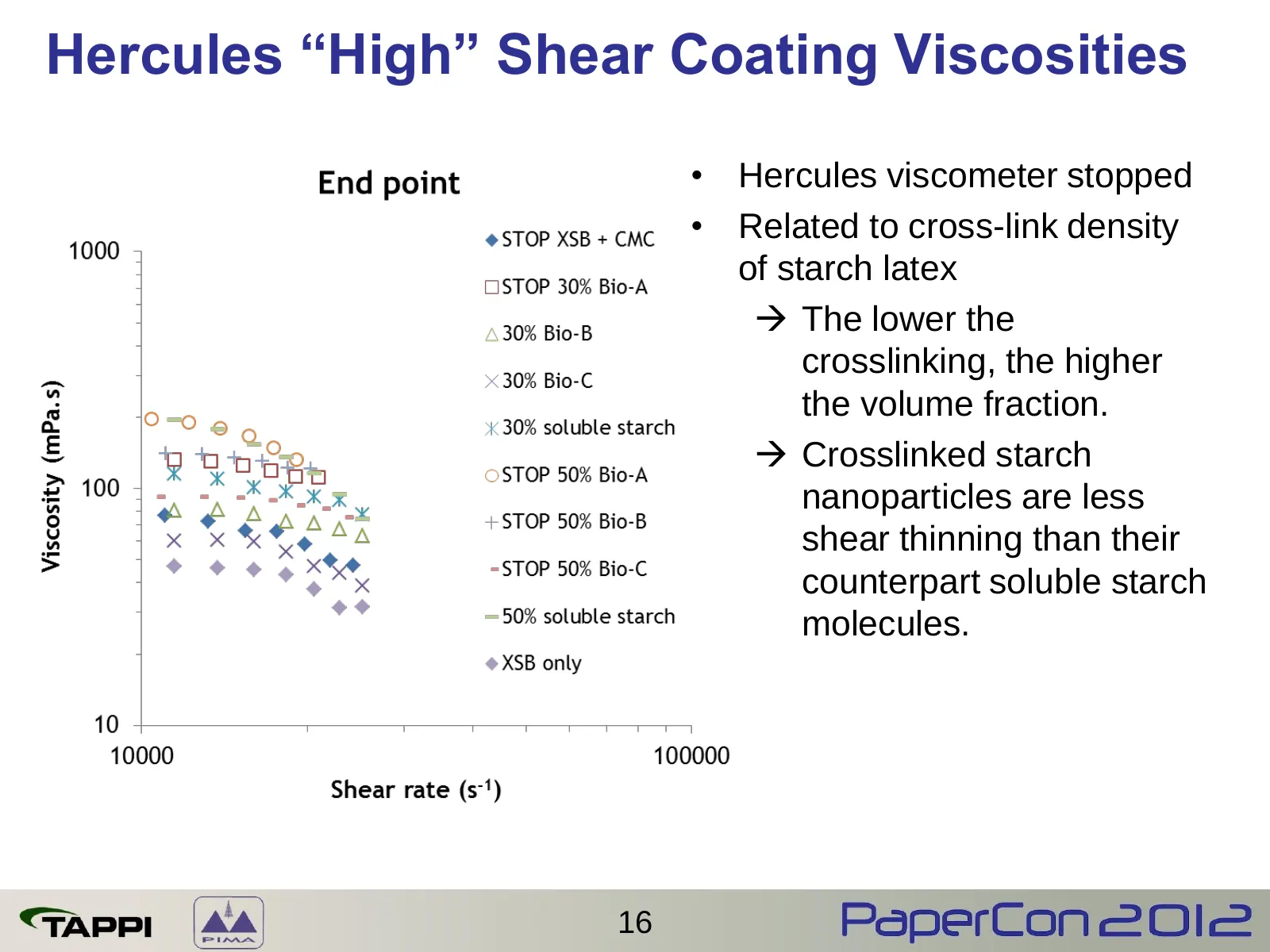
Hercules “High” Shear Coating Viscosities 15
Slide 21: Hercules "High" Shear Coating Viscosities
Hercules “High” Shear Coating Viscosities • Hercules viscometer stopped • Related to cross-link density of starch latex The lower the crosslinking, the higher the volume fraction. Crosslinked starch nanoparticles are less shear thinning than their counterpart soluble starch molecules. 16
Slide 22: ACAV Capillary Ultra-High Shear Coating Viscosities
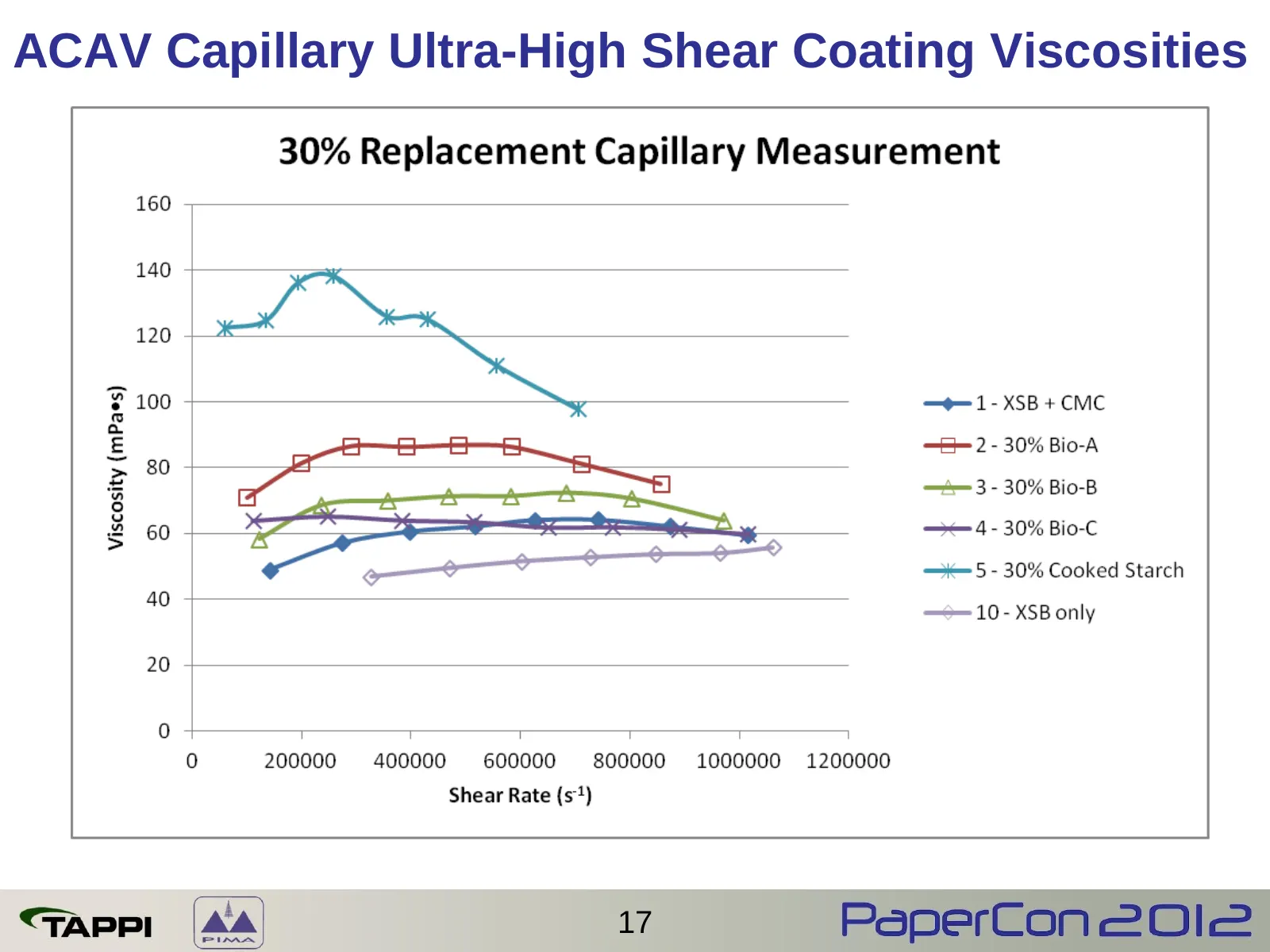
ACAV Capillary Ultra-High Shear Coating Viscosities 17
Slide 23: ACAV Capillary Ultra-High Shear Coating Viscosities
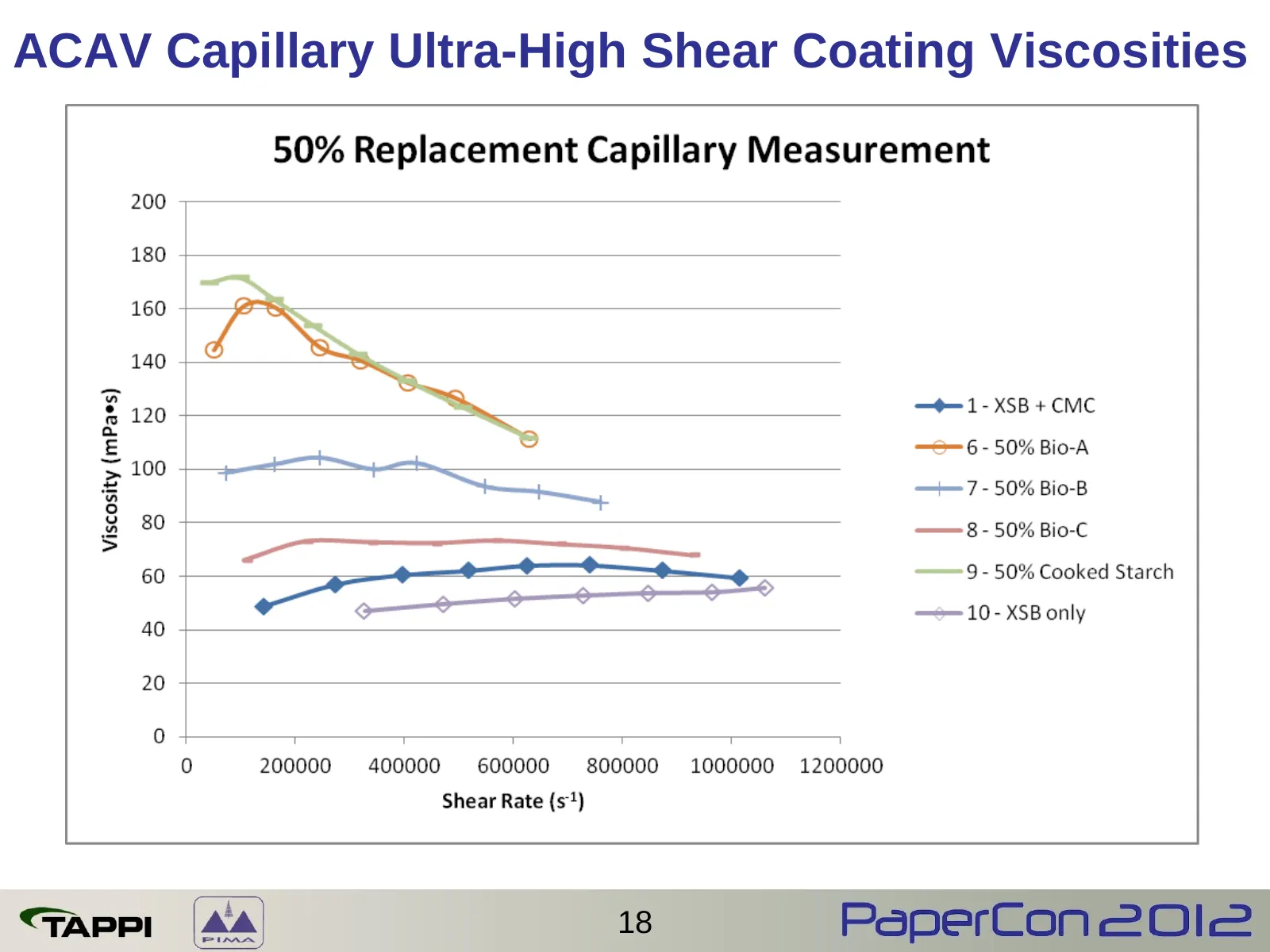
ACAV Capillary Ultra-High Shear Coating Viscosities 18
Slide 24: ACAV Slit Ultra-High Shear Coating Viscosities
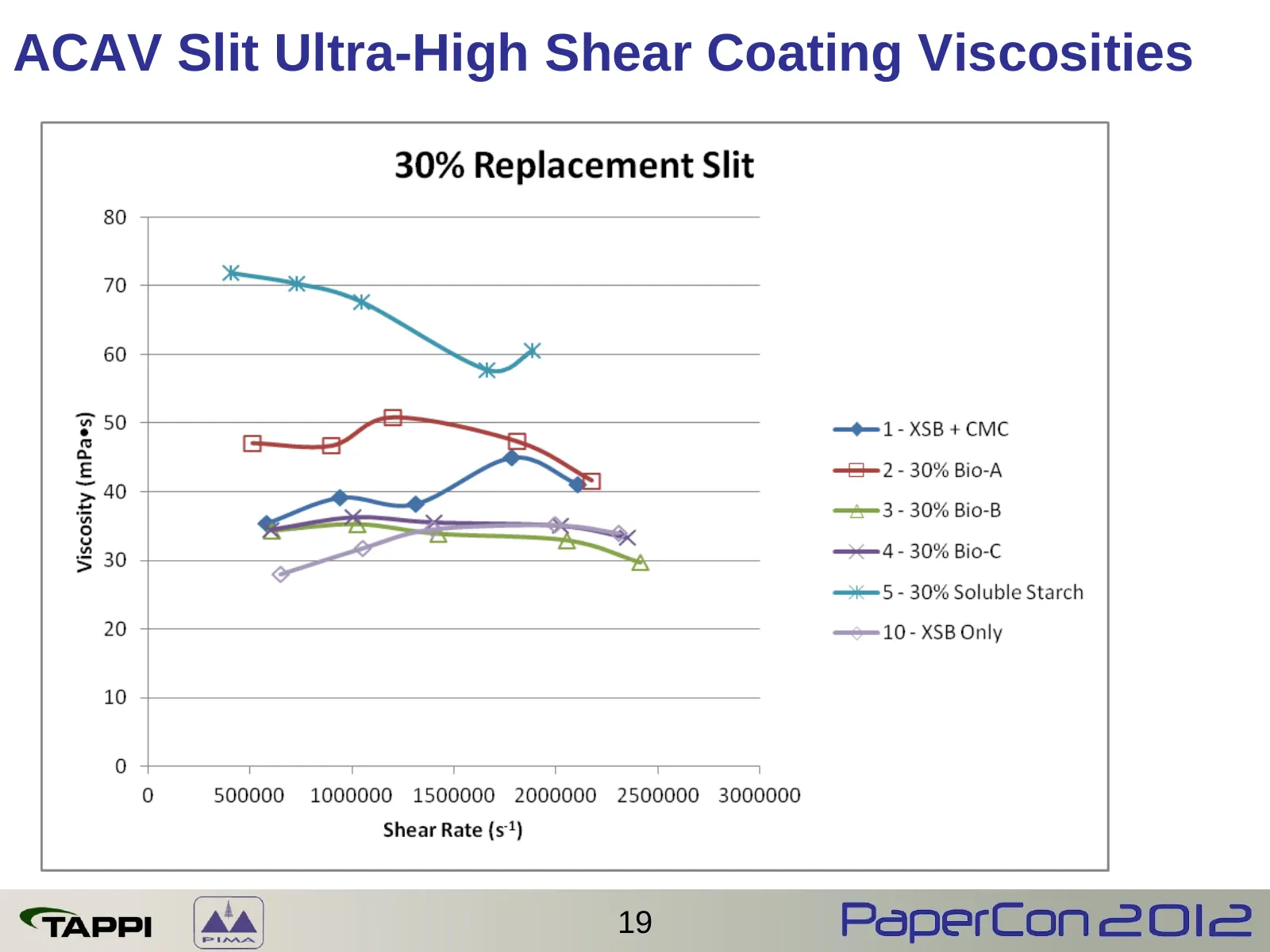
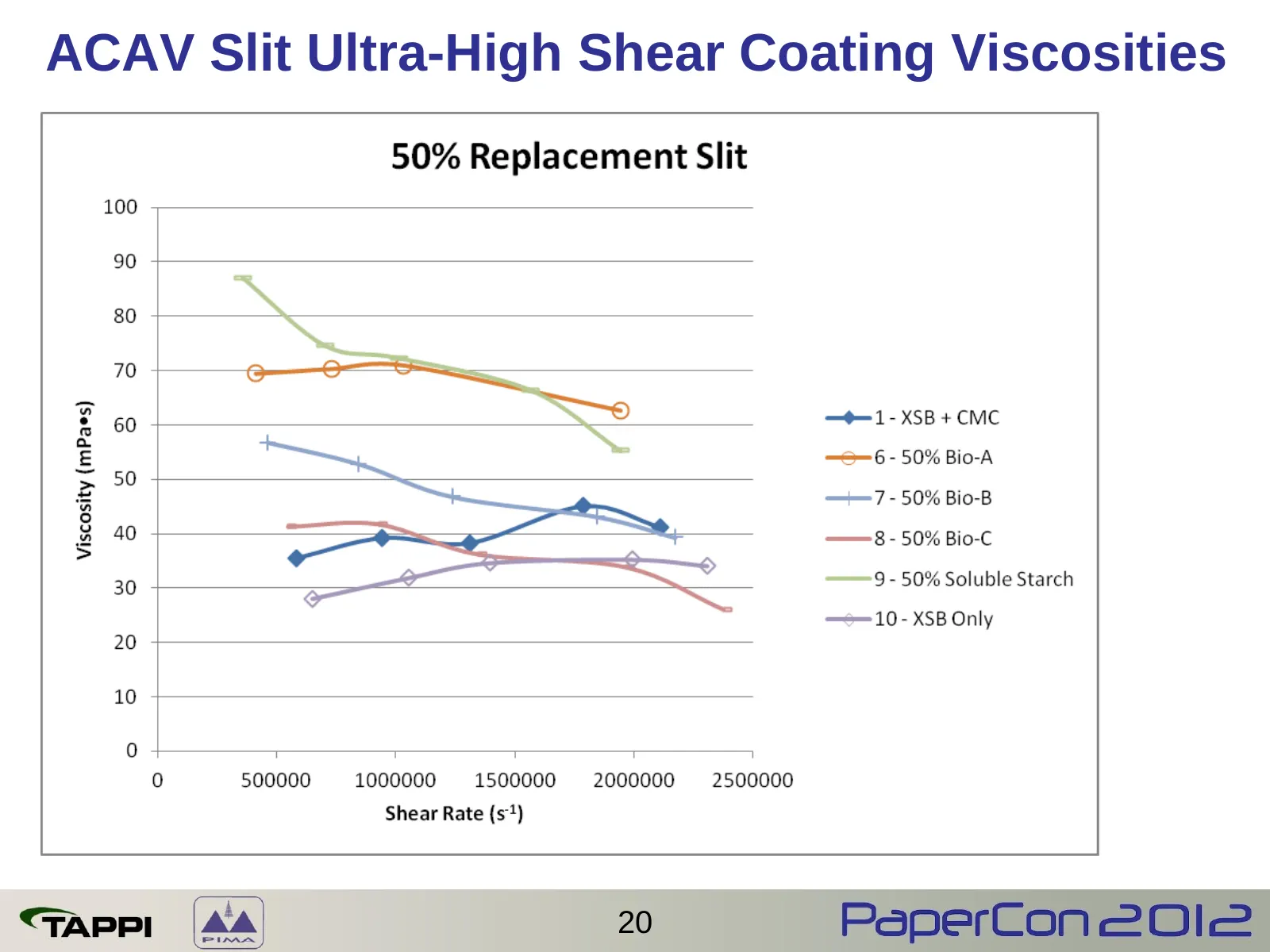
ACAV Slit Ultra-High Shear Coating Viscosities 19
Slide 25: ACAV Slit Ultra-High Shear Coating Viscosities
ACAV Slit Ultra-High Shear Coating Viscosities 20
Slide 26: Composite Rheogram – 30% Replacement
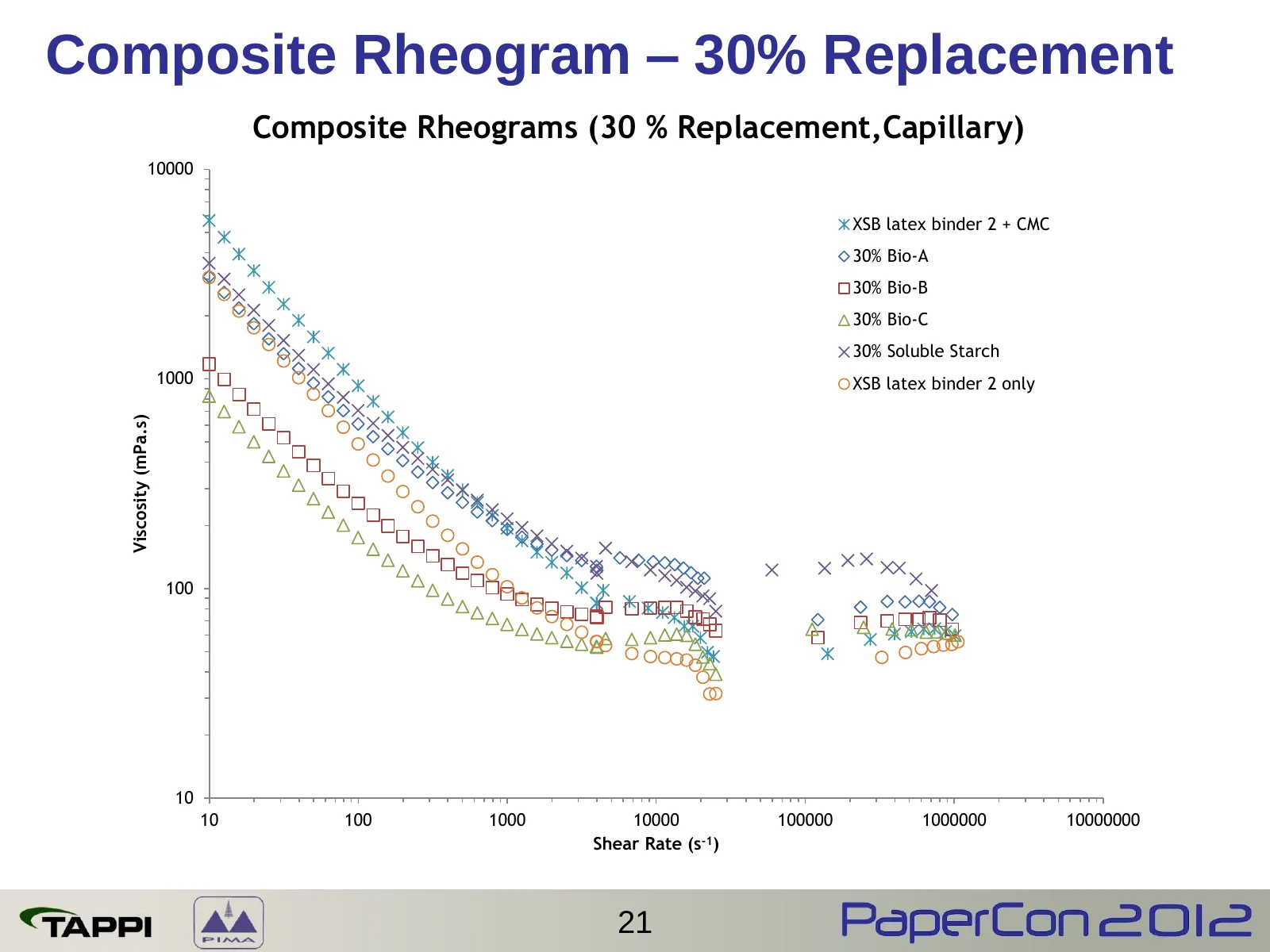
Composite Rheogram – 30% Replacement Composite Rheograms (30 % Replacement,Capillary) 10000 XSB latex binder 2 + CMC 30% Bio-A 30% Bio-B 30% Bio-C 30% Soluble Starch 1000 XSB latex binder 2 only Viscosity (mPa.s) 100 10 10 100 1000 10000 100000 1000000 10000000 Shear Rate (s-1) 21
Slide 27: Composite Rheogram – 30% Replacement
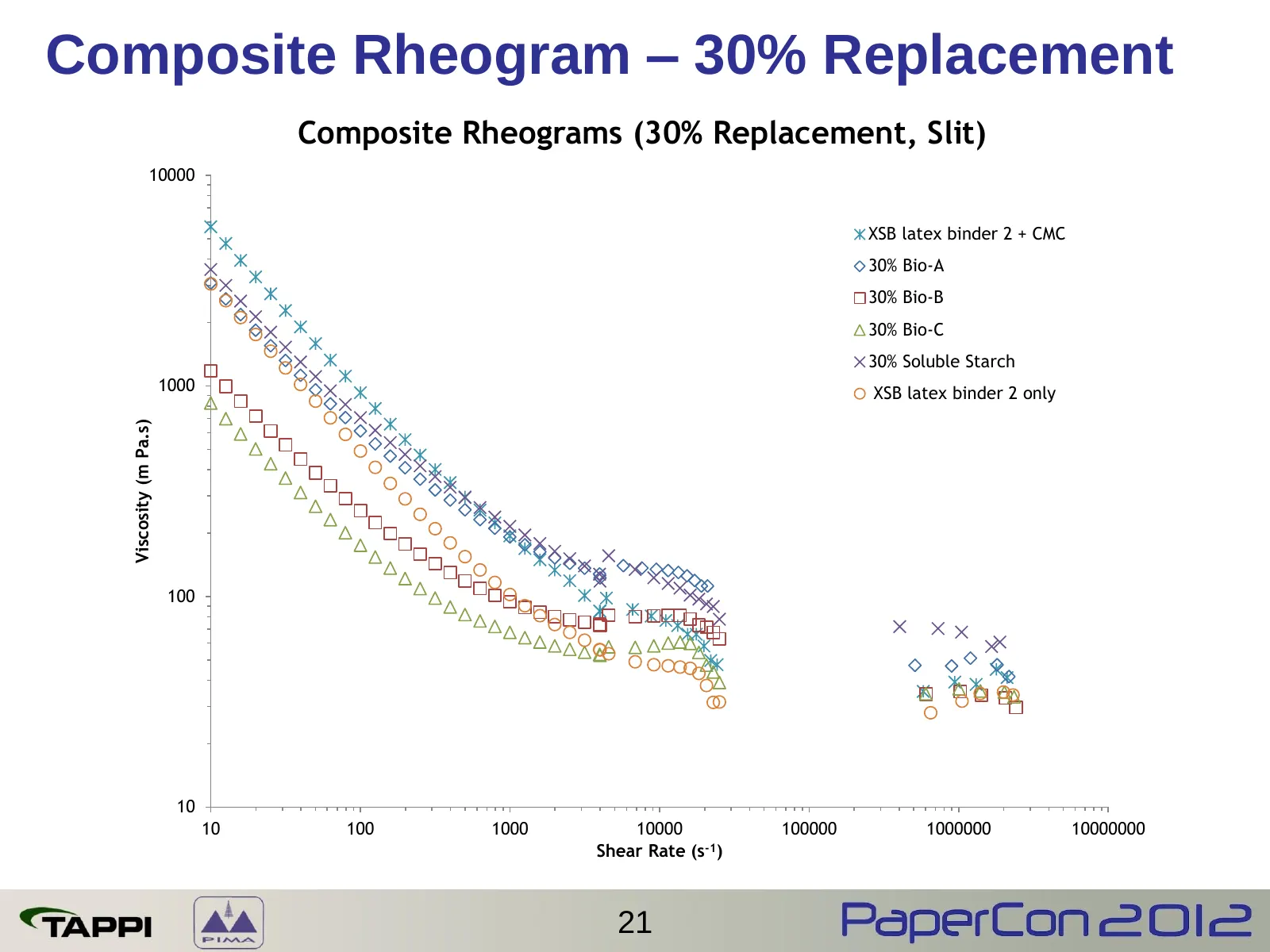
Composite Rheogram – 30% Replacement Composite Rheograms (30% Replacement, Slit) 10000 XSB latex binder 2 + CMC 30% Bio-A 30% Bio-B 30% Bio-C 30% Soluble Starch 1000 XSB latex binder 2 only Viscosity (m Pa.s) 100 10 10 100 1000 10000 100000 1000000 10000000 Shear Rate (s-1) 21
Slide 28: Composite Rheogram – 50% Replacement
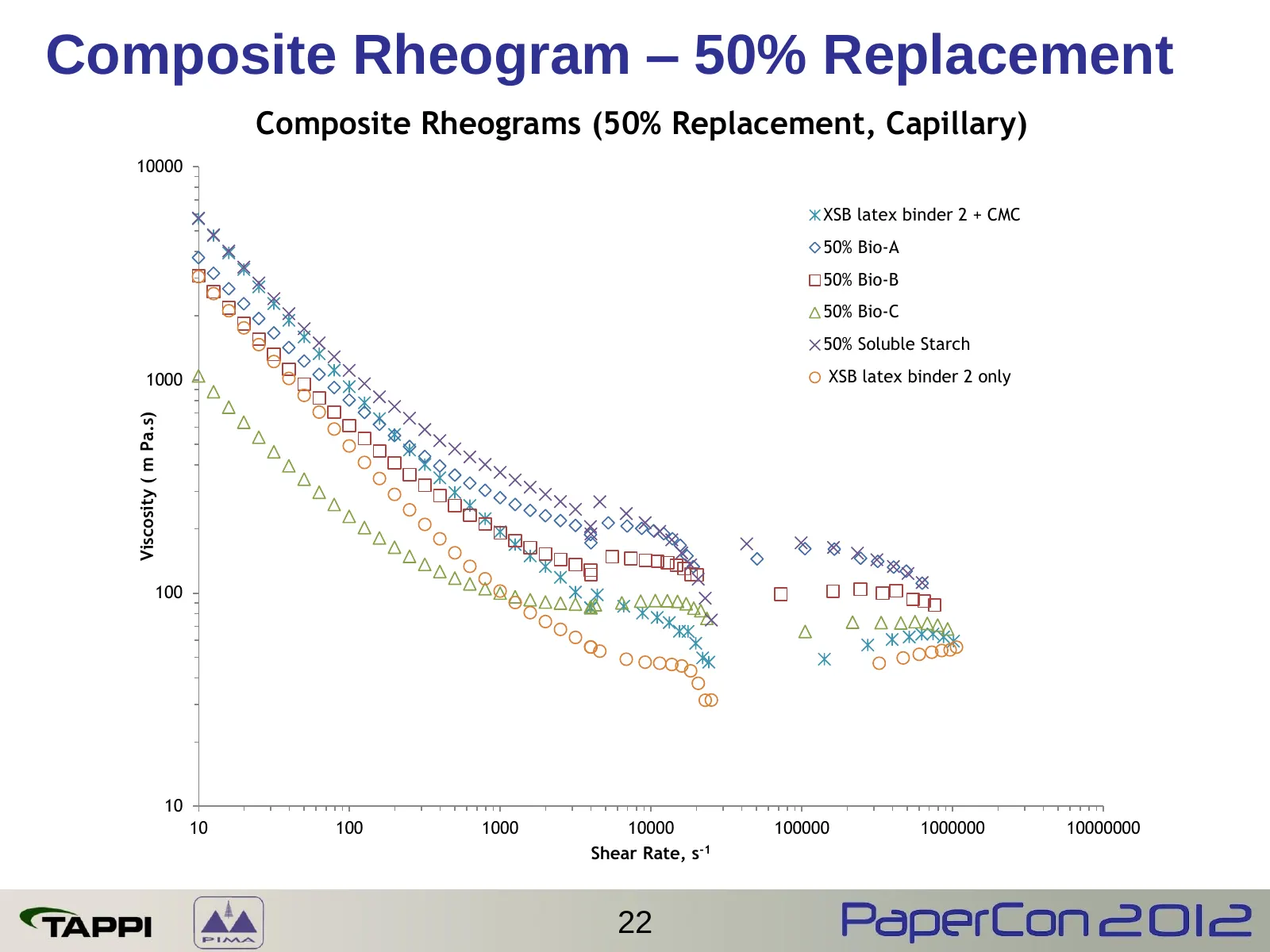
Composite Rheogram – 50% Replacement Composite Rheograms (50% Replacement, Capillary) 10000 XSB latex binder 2 + CMC 50% Bio-A 50% Bio-B 50% Bio-C 50% Soluble Starch 1000 XSB latex binder 2 only Viscosity ( m Pa.s) 100 10 10 100 1000 10000 100000 1000000 10000000 Shear Rate, s-1 22
Slide 29: Composite Rheogram – 50% Replacement
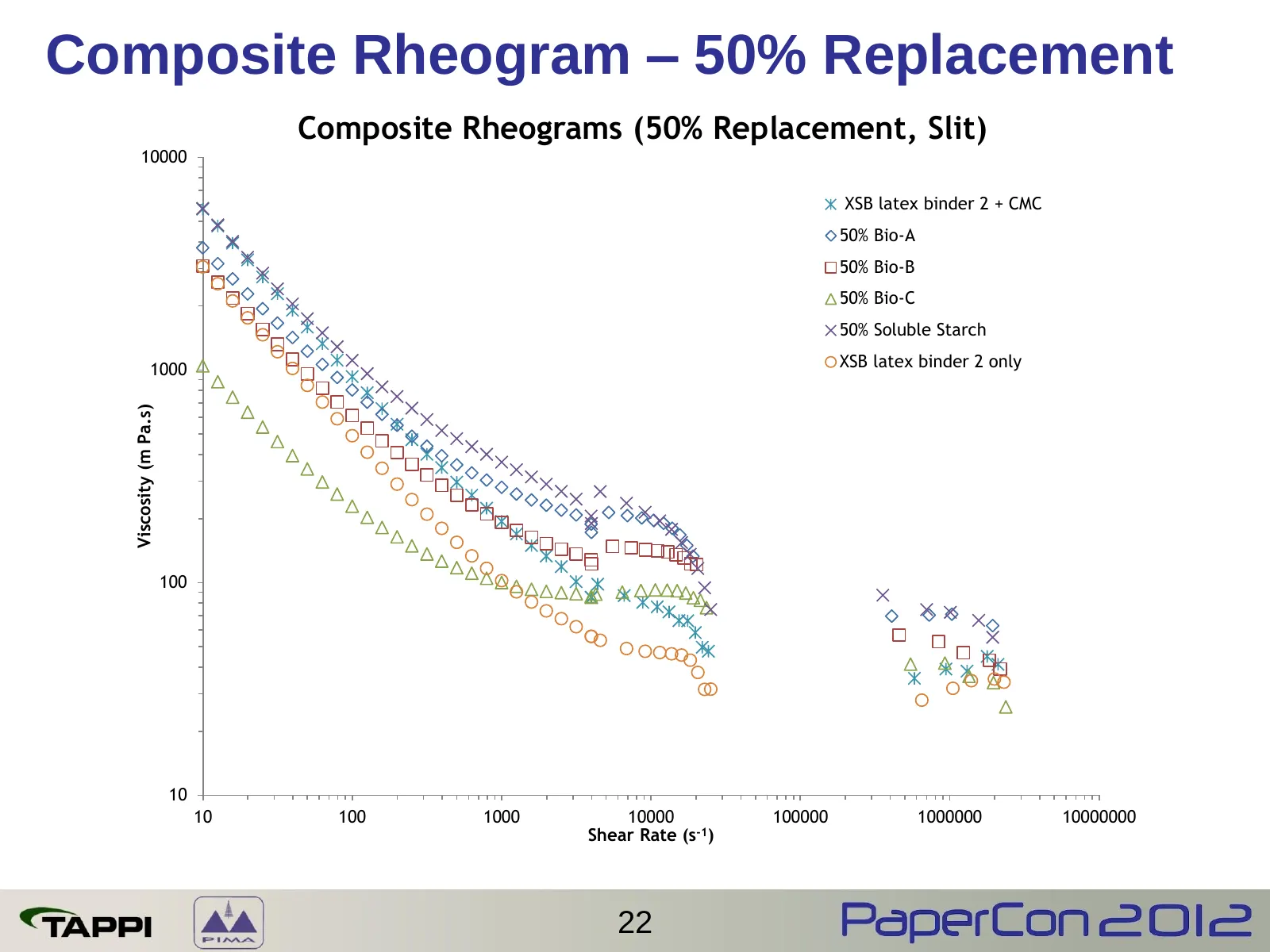
Composite Rheogram – 50% Replacement Composite Rheograms (50% Replacement, Slit) 10000 XSB latex binder 2 + CMC 50% Bio-A 50% Bio-B 50% Bio-C 50% Soluble Starch 1000 XSB latex binder 2 only Viscosity (m Pa.s) 100 10 10 100 1000 10000 100000 1000000 10000000 Shear Rate (s-1) 22
Slide 30: Discussion: Generalized Rheogram for High Solids Paper Coating Colors
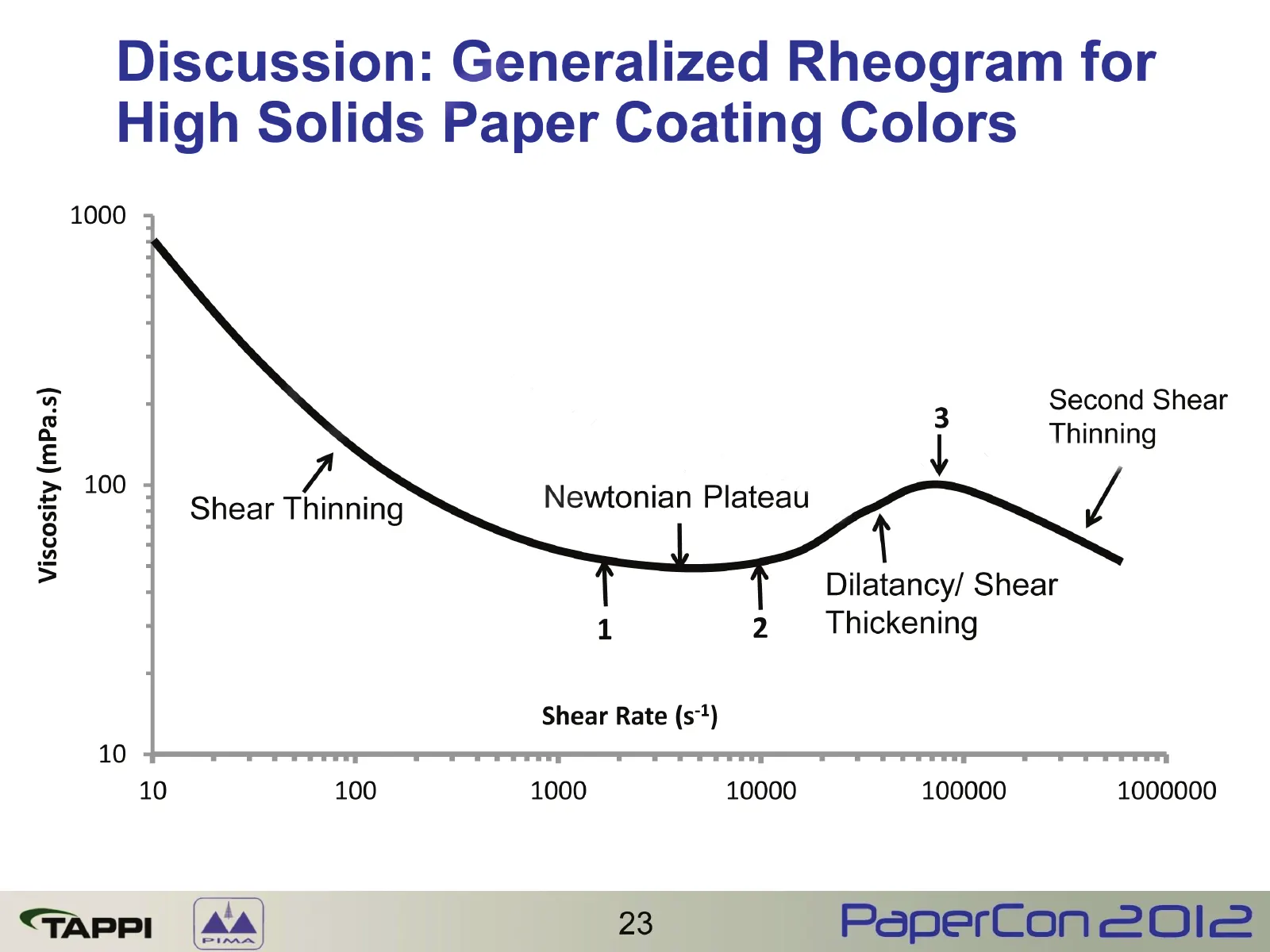
Discussion: Generalized Rheogram for High Solids Paper Coating Colors 1000 Second Shear & i Thinning > 100 { : g | Shear Thinning Newtonian Plateau J g t = Dilatancy/ Shear 1 2 Thickening Shear Rate (s“) 10 10 100 1000 10000 100000 1000000
Slide 31: Proposed Model for XSB Latex
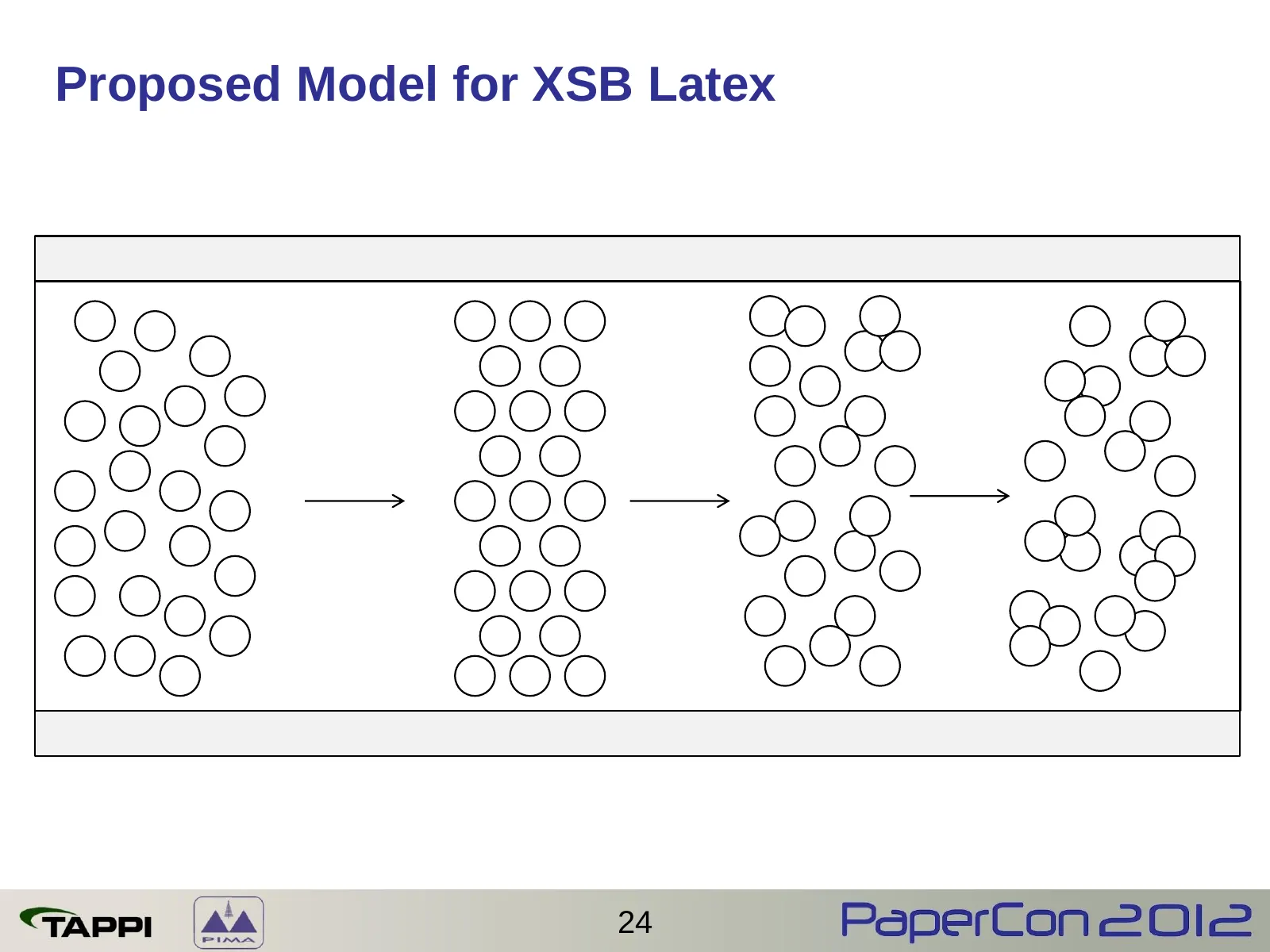
Proposed Model for XSB Latex 24
Slide 32: Proposed Model for Bio-based Starch Latex
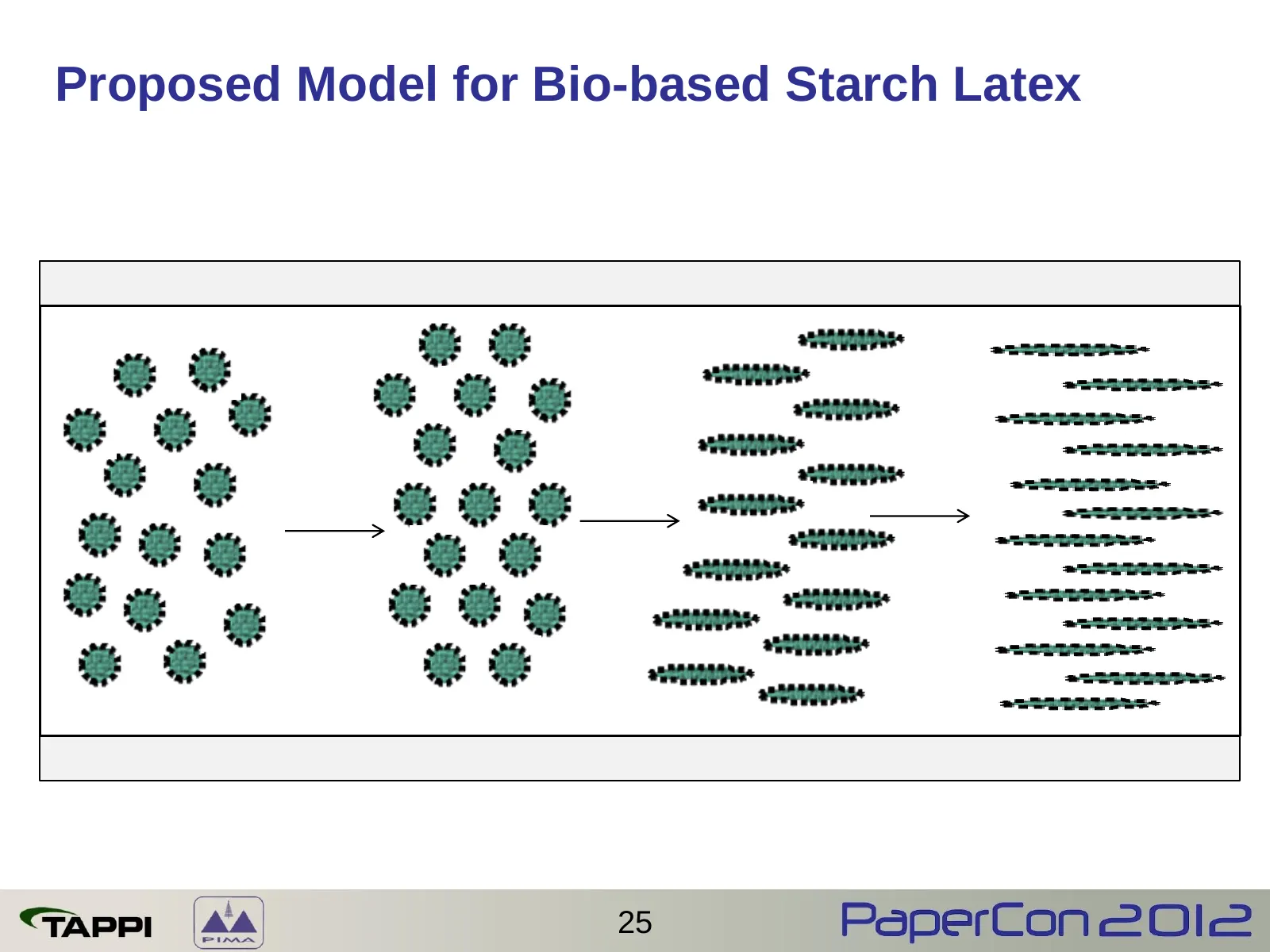
Proposed Model for Bio-based Starch Latex 25
Slide 33: The Impact of Rheology on Runnability
The Impact of Rheology on Runnability • Significant difference between low and high shear viscosities • Use of Ultra-High shear equipment (e.g. ACAV) to understand what occurs on industrial scale coaters • Internally cross-linked starch based latex: - Unique rheological properties - Deformable water
Slide 34: Thank you!
Thank you! Acknowledgements: The contributions made by Dr. Ian McLennan, Turn Lu and Omkar Chandorkar of ECOSYNTHETIX INC. are gratefully acknowledged. We would also like to acknowledge the member companies of the Western Michigan Paper Technology Foundation for their financial support. 27
Source: Internet Archive copy of ecosynthetix.com
More decks from EcoSynthetix Inc.
 Q2 2026 Earnings Presentation16 slides · Jul 29, 2026
 Shareholder Meeting (May 2026)30 slides · May 21, 2026
 Q1 2026 Earnings Presentation18 slides · May 6, 2026
 Investor Presentation (March 2026)27 slides · March 2026
 Q4 2025 Earnings Presentation16 slides · Feb 20, 2026
 Q3 2025 Earnings Presentation15 slides · Nov 7, 2025