Arcus Biosciences, Inc. · NYSE:RCUS
Arcus Biosciences — Q3 2023 Earnings Presentation
70 slides from Arcus Biosciences's earnings presentation, Nov 7, 2023

Slide 1: Combining to Cure: 3Q23 Earnings Corporate Presentation
COMBINING TO CURE ® Arcus is at the forefront of designing precision combinations in the pursuit of cures for patients living with cancer. 3Q23 EARNINGS | CORPORATE PRESENTATION November 2023
Slide 2: Forward-looking Statements/Safe Harbor
Forward-looking Statements/Safe Harbor This presentation contains forward-looking statements about Arcus Biosciences, Inc. (“we,” “Arcus” or the “Company”) made pursuant to the safe harbor provisions of the Private Securities Litigation Reform Act of 1995. All statements regarding events or results
Slide 3: Late-stage Portfolio of Differentiated Assets, Productive R&D Engine
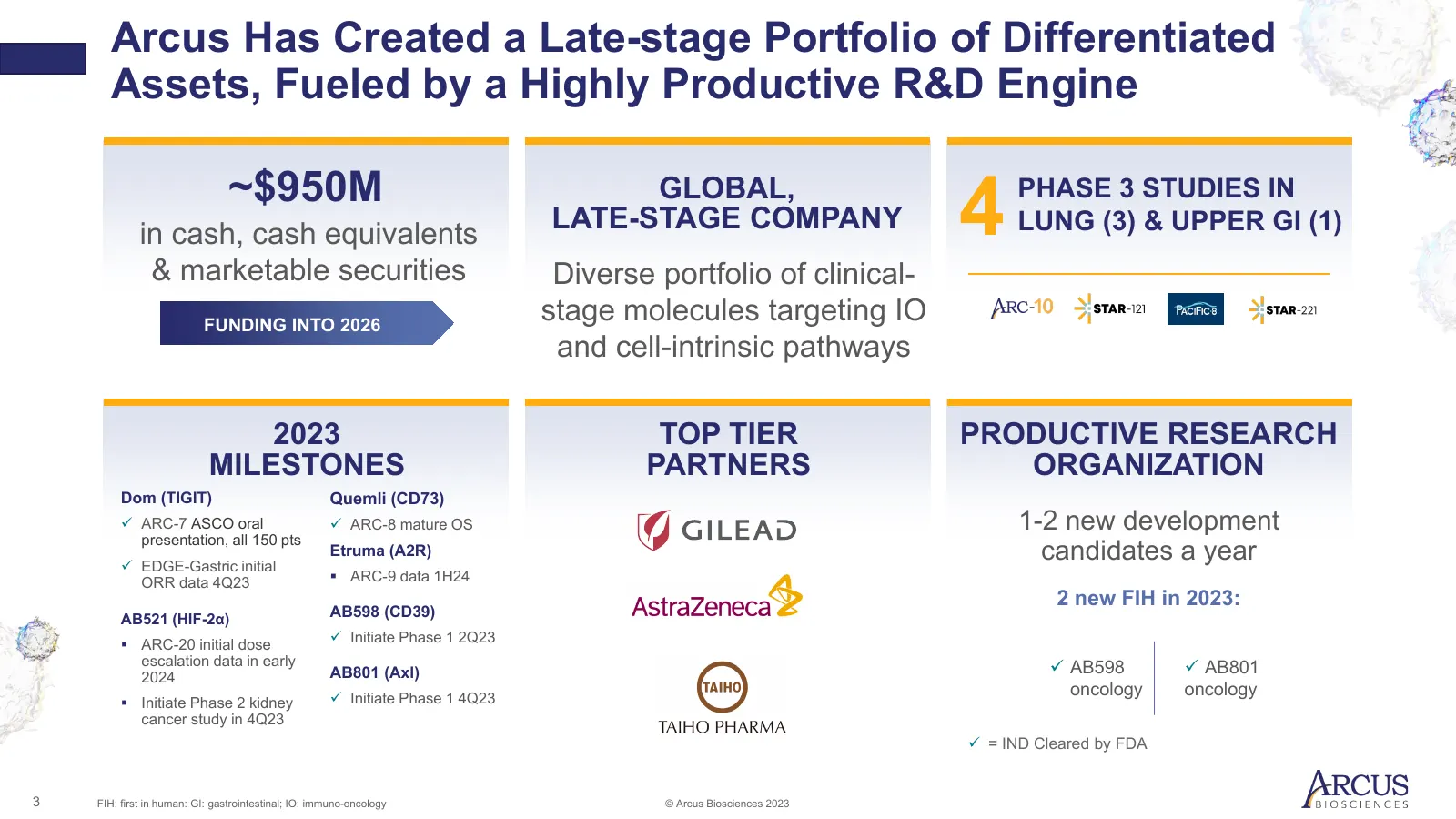
Arcus Has Created a Late-stage Portfolio of Differentiated Assets, Fueled by a Highly Productive R&D Engine ~$950M in cash, cash equivalents GLOBAL, LATE-STAGE COMPANY 4 PHASE 3 STUDIES IN LUNG (3) & UPPER GI (1) & marketable securities Diverse portfolio of clinical- FUNDING INTO 2026 stage molecule
Slide 4: Broad Portfolio of Investigational Molecules with Best-in-Class Potential
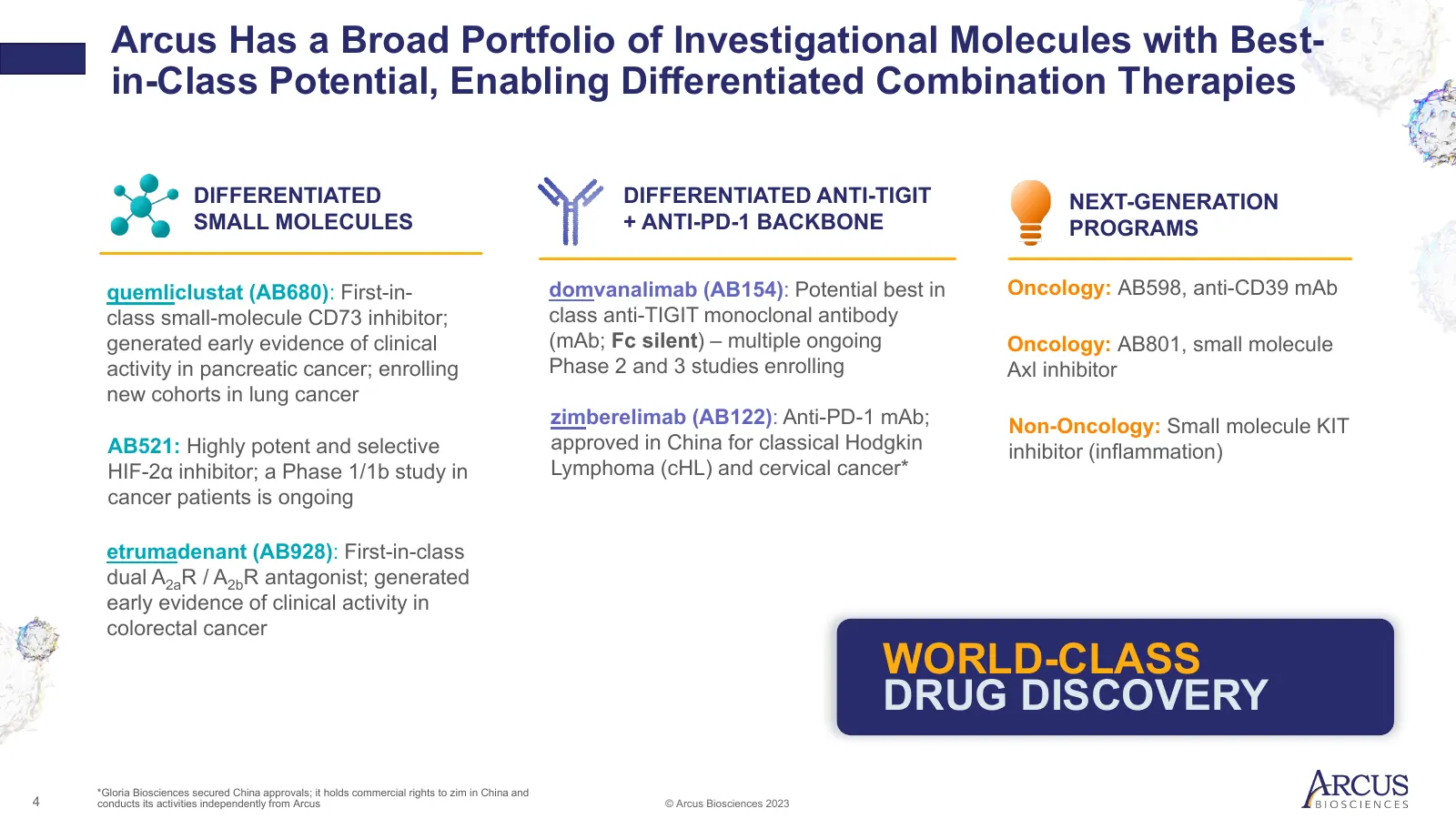
Arcus Has a Broad Portfolio of Investigational Molecules with Best- in-Class Potential, Enabling Differentiated Combination Therapies DIFFERENTIATED DIFFERENTIATED ANTI-TIGIT NEXT-GENERATION SMALL MOLECULES + ANTI-PD-1 BACKBONE PROGRAMS quemliclustat (AB680): First-in- domvanalimab (AB154): Potentia
Slide 5: Four Phase 3 Studies Initiated in Lung and Upper GI Cancers
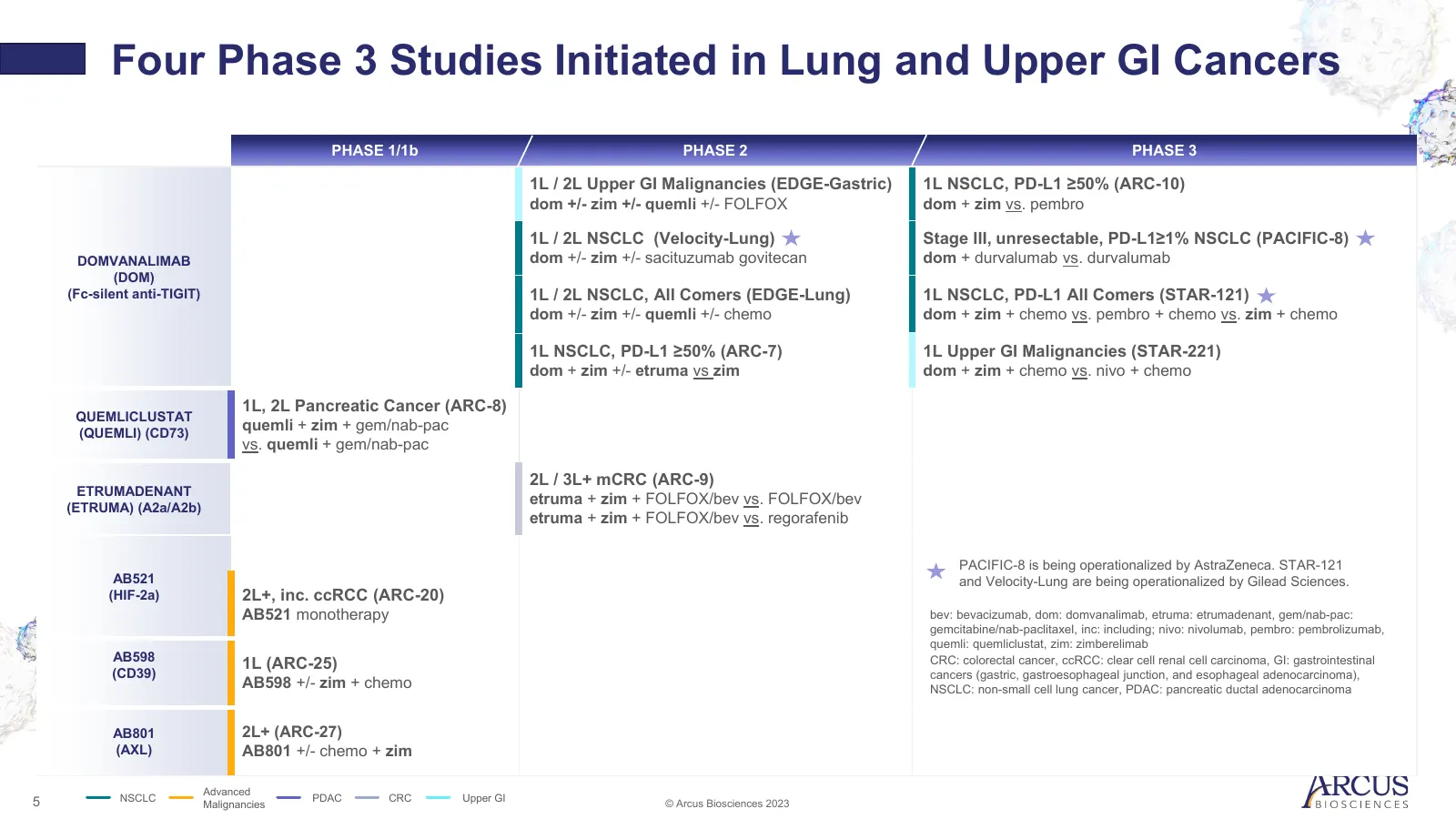
Four Phase 3 Studies Initiated in Lung and Upper GI Cancers PHASE 1/1b PHASE 2 PHASE 3 1L / 2L Upper GI Malignancies (EDGE-Gastric) 1L NSCLC, PD-L1 ≥50% (ARC-10) dom +/- zim +/- quemli +/- FOLFOX dom + zim vs. pembro 1L / 2L NSCLC (Velocity-Lung) Stage III, unresectable, PD-L1≥1% NSCLC (PACIFIC-8) D
Slide 6: Our Partnerships Expand & Accelerate Opportunities
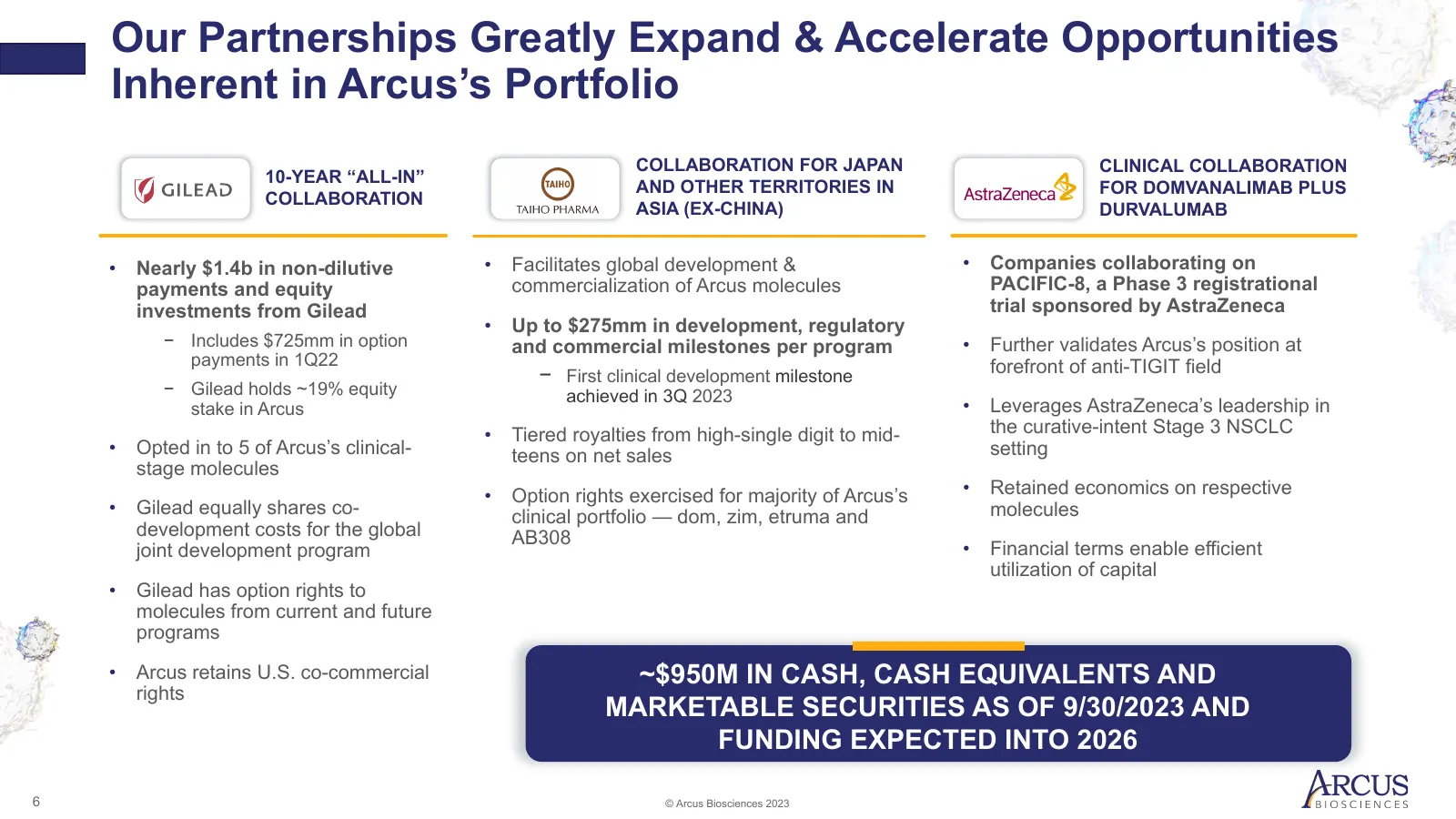
Our Partnerships Greatly Expand & Accelerate Opportunities Inherent in Arcus’s Portfolio COLLABORATION FOR JAPAN CLINICAL COLLABORATION 10-YEAR “ALL-IN” AND OTHER TERRITORIES IN FOR DOMVANALIMAB PLUS COLLABORATION ASIA (EX-CHINA) DURVALUMAB • Nearly $1.4b in non-dilutive • Facilitates global develop
Slide 7: Multiple Readouts Expected in 2023
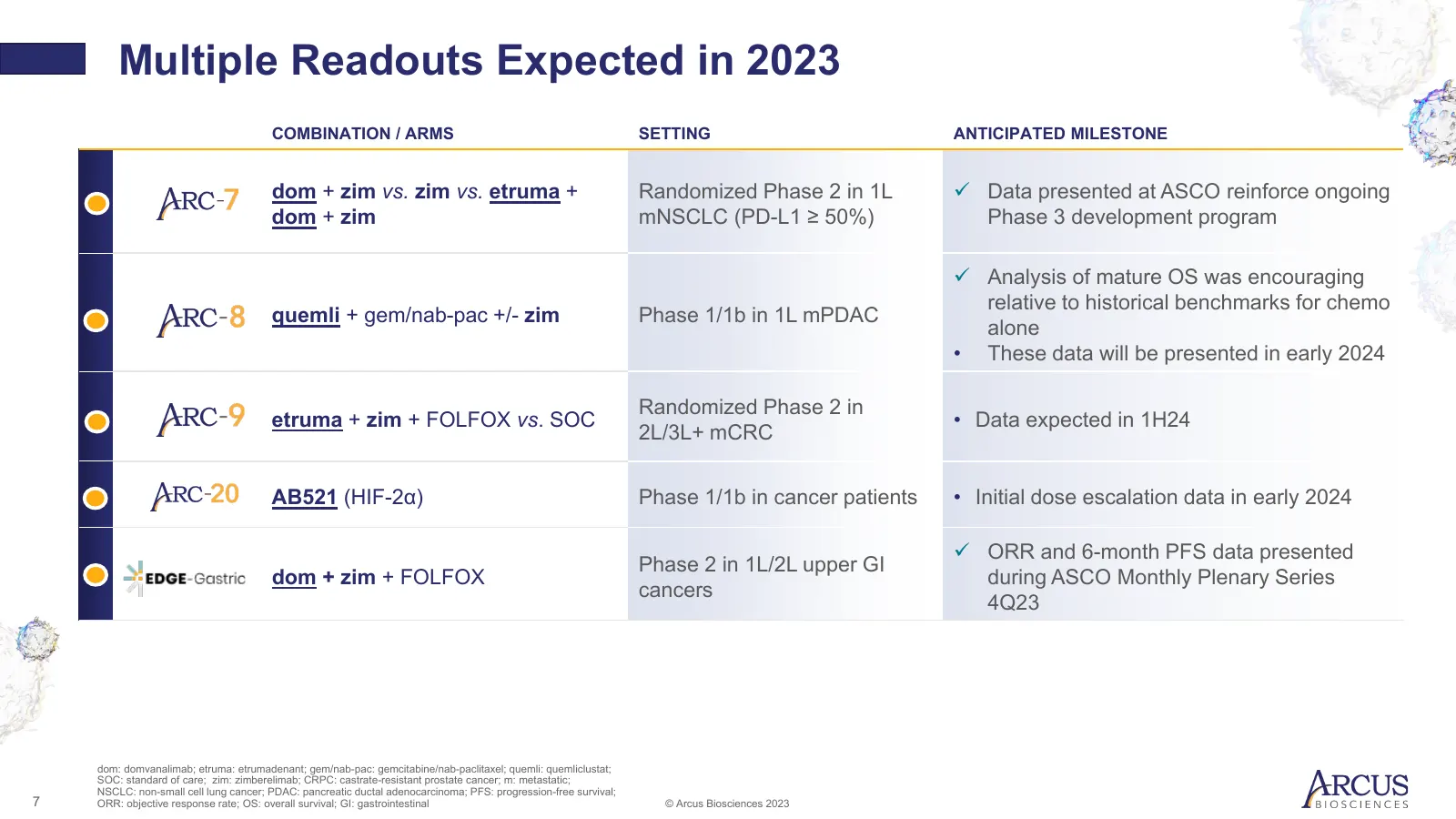
Multiple Readouts Expected in 2023 COMBINATION / ARMS SETTING ANTICIPATED MILESTONE dom + zim vs. zim vs. etruma + Randomized Phase 2 in 1L Data presented at ASCO reinforce ongoing dom + zim mNSCLC (PD-L1 ≥ 50%) Phase 3 development program Analysis of mature OS was encouraging relative to histor
Slide 8: Summary of EDGE-Gastric Arm-A1 Results and Domvanalimab Clinical Program in Upper GI Cancers
Summary of EDGE-Gastric Arm-A1 Results and Domvanalimab Clinical Program in Upper GI Cancers Data presented at the November 2023 ASCO Plenary Series, based on data cut off of September 4, 2023. 8 © Arcus Biosciences 2023
Slide 9: Phase 2 Trial to Evaluate Dom + Zim + Chemo in Upper GI Malignancies
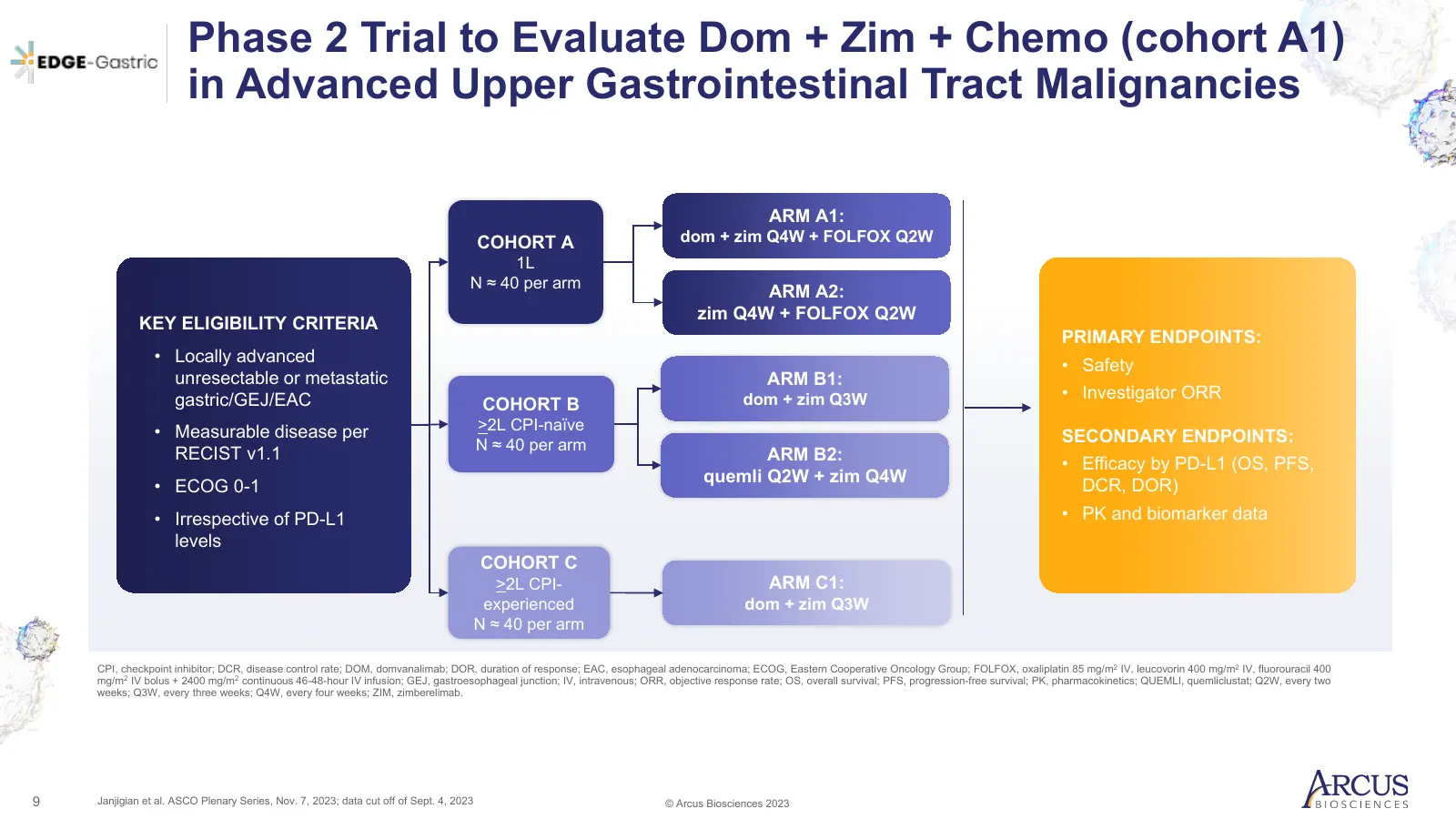
Phase 2 Trial to Evaluate Dom + Zim + Chemo (cohort A1) in Advanced Upper Gastrointestinal Tract Malignancies ARM A1: COHORT A dom + zim Q4W + FOLFOX Q2W 1L N ≈ 40 per arm ARM A2: zim Q4W + FOLFOX Q2W KEY ELIGIBILITY CRITERIA PRIMARY ENDPOINTS: • Locally advanced • Safety unresectable or metastatic
Slide 10: Arm A1 - First-Line Metastatic Gastric/GEJ/EAC Cohort
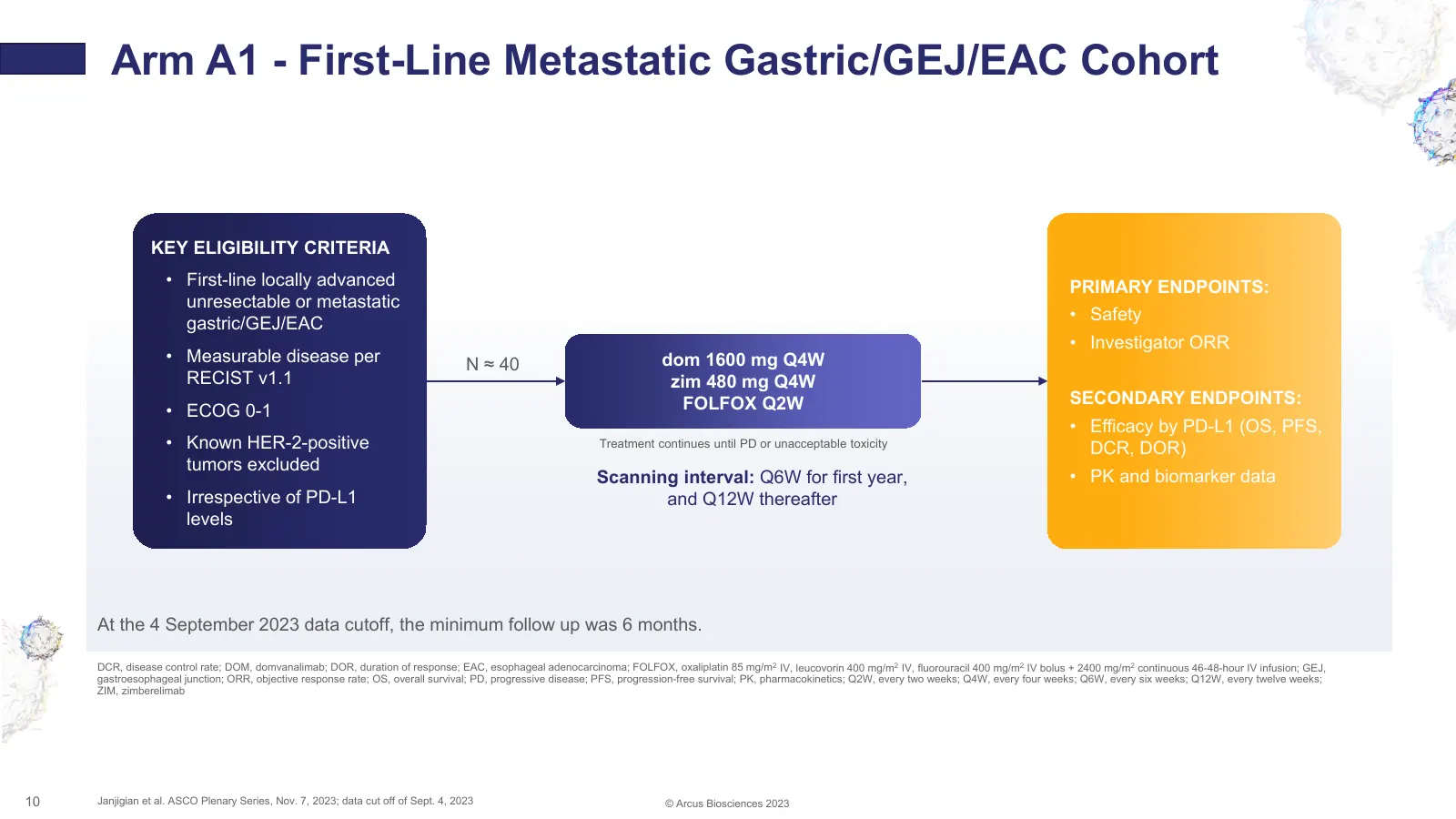
Arm A1 - First-Line Metastatic Gastric/GEJ/EAC Cohort KEY ELIGIBILITY CRITERIA • First-line locally advanced PRIMARY ENDPOINTS: unresectable or metastatic gastric/GEJ/EAC • Safety • Investigator ORR • Measurable disease per N ≈ 40 dom 1600 mg Q4W RECIST v1.1 zim 480 mg Q4W FOLFOX Q2W SECONDARY ENDPO
Slide 11: Baseline Characteristics Consistent With Expectations
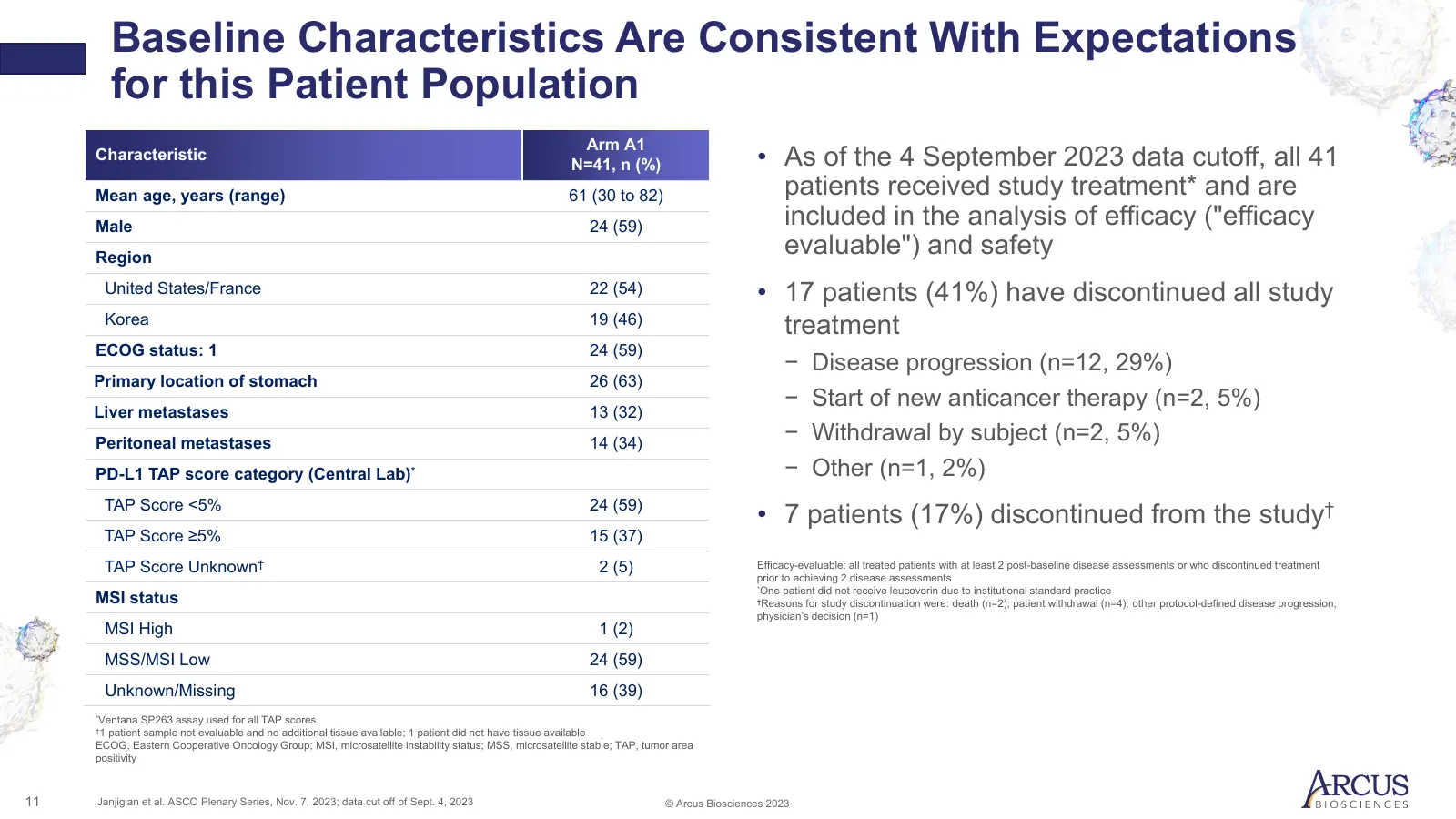
Baseline Characteristics Are Consistent With Expectations for this Patient Population Arm A1 Characteristic N=41, n (%) • As of the 4 September 2023 data cutoff, all 41 Mean age, years (range) 61 (30 to 82) patients received study treatment* and are Male 24 (59) included in the analysis of efficacy
Slide 12: Objective Response Rate per RECIST v1.1
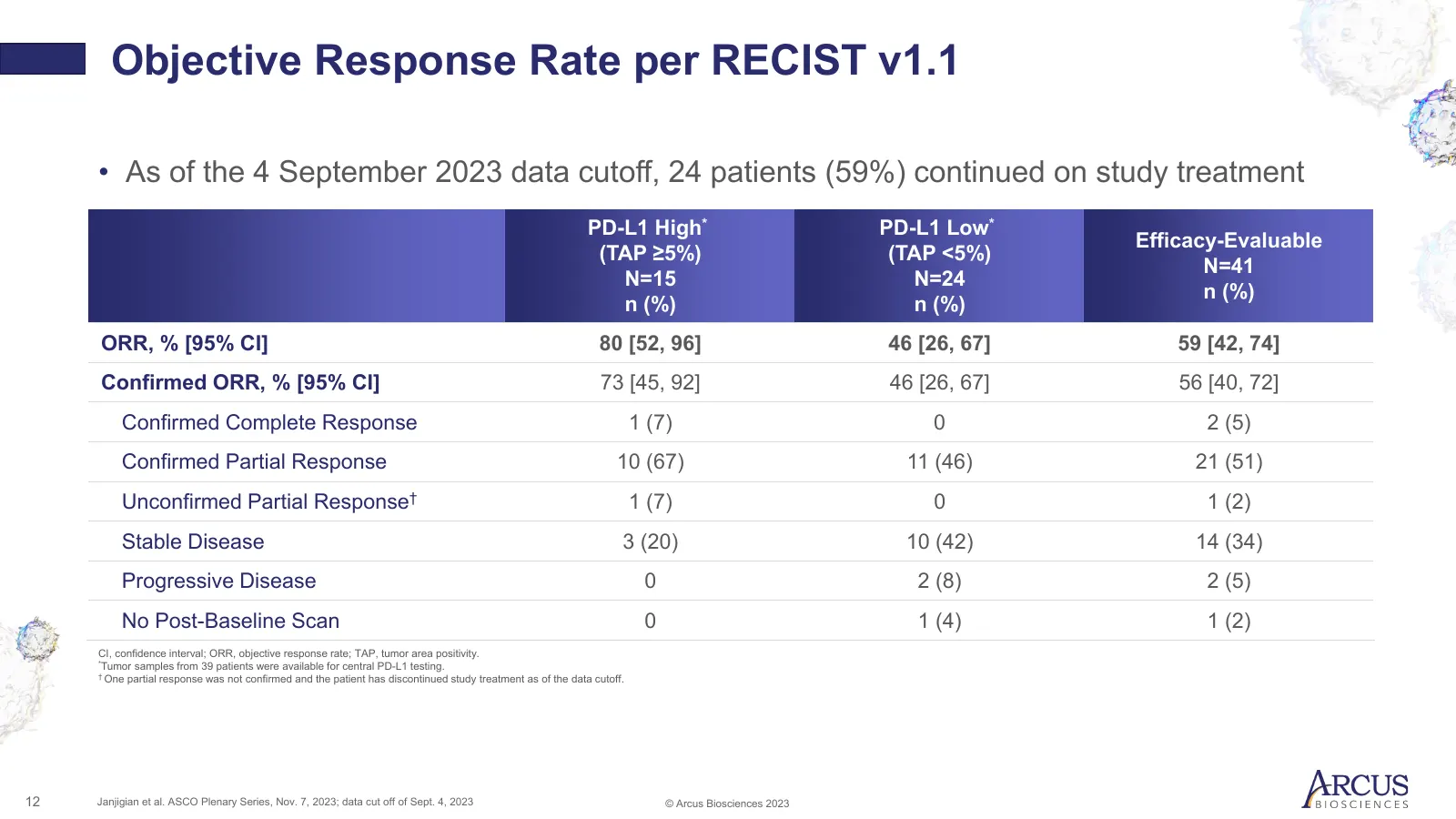
Objective Response Rate per RECIST v1.1 • As of the 4 September 2023 data cutoff, 24 patients (59%) continued on study treatment PD-L1 High* PD-L1 Low* Efficacy-Evaluable (TAP ≥5%) (TAP <5%) N=41 N=15 N=24 n (%) n (%) n (%) ORR, % [95% CI] 80 [52, 96] 46 [26, 67] 59 [42, 74] Confirmed ORR, % [95% CI
Slide 13: Almost All Patients Experience Some Benefit
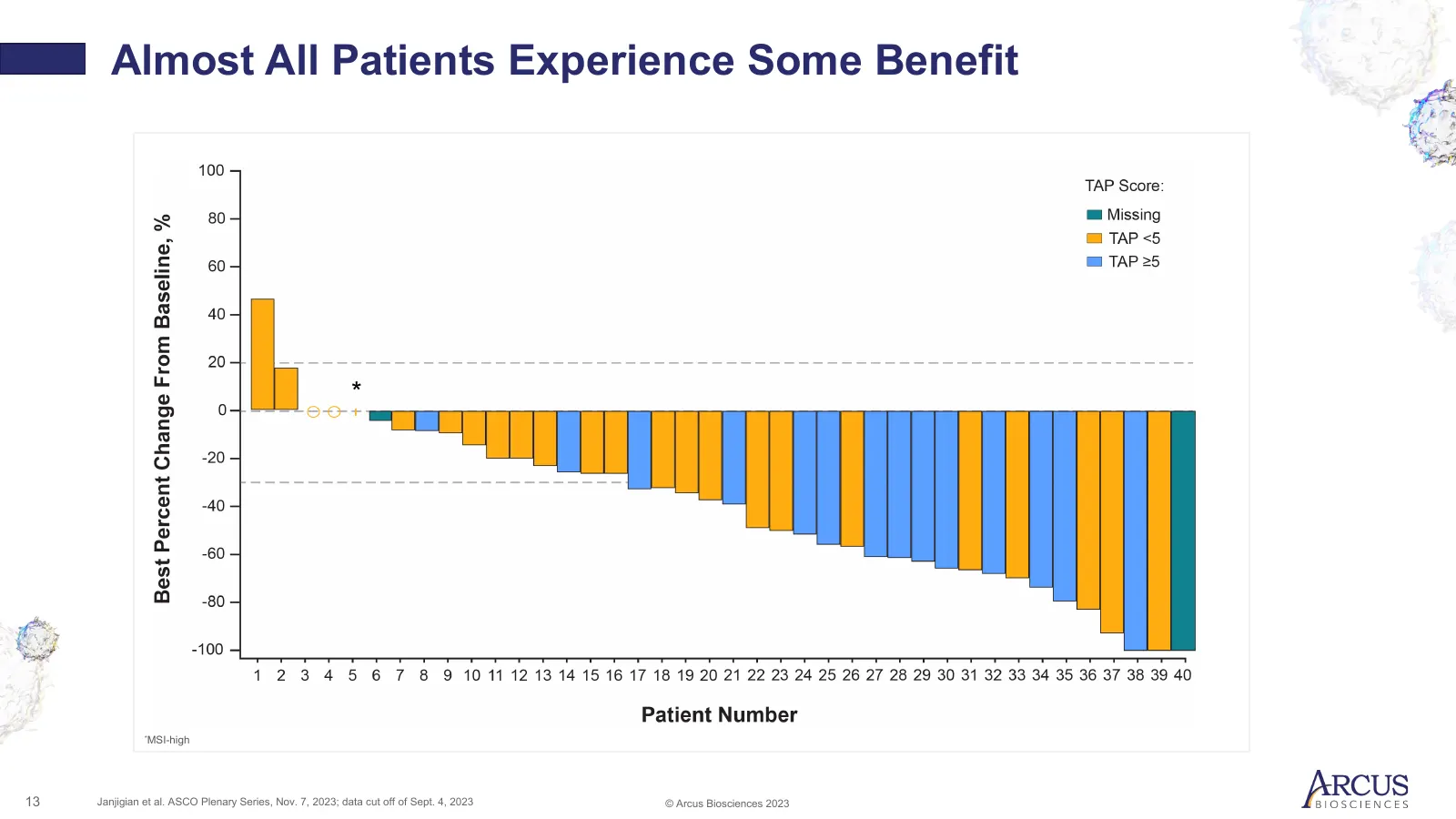
Almost All Patients Experience Some Benefit * *MSI-high 13 Janjigian et al. ASCO Plenary Series, Nov. 7, 2023; data cut off of Sept. 4, 2023 © Arcus Biosciences 2023
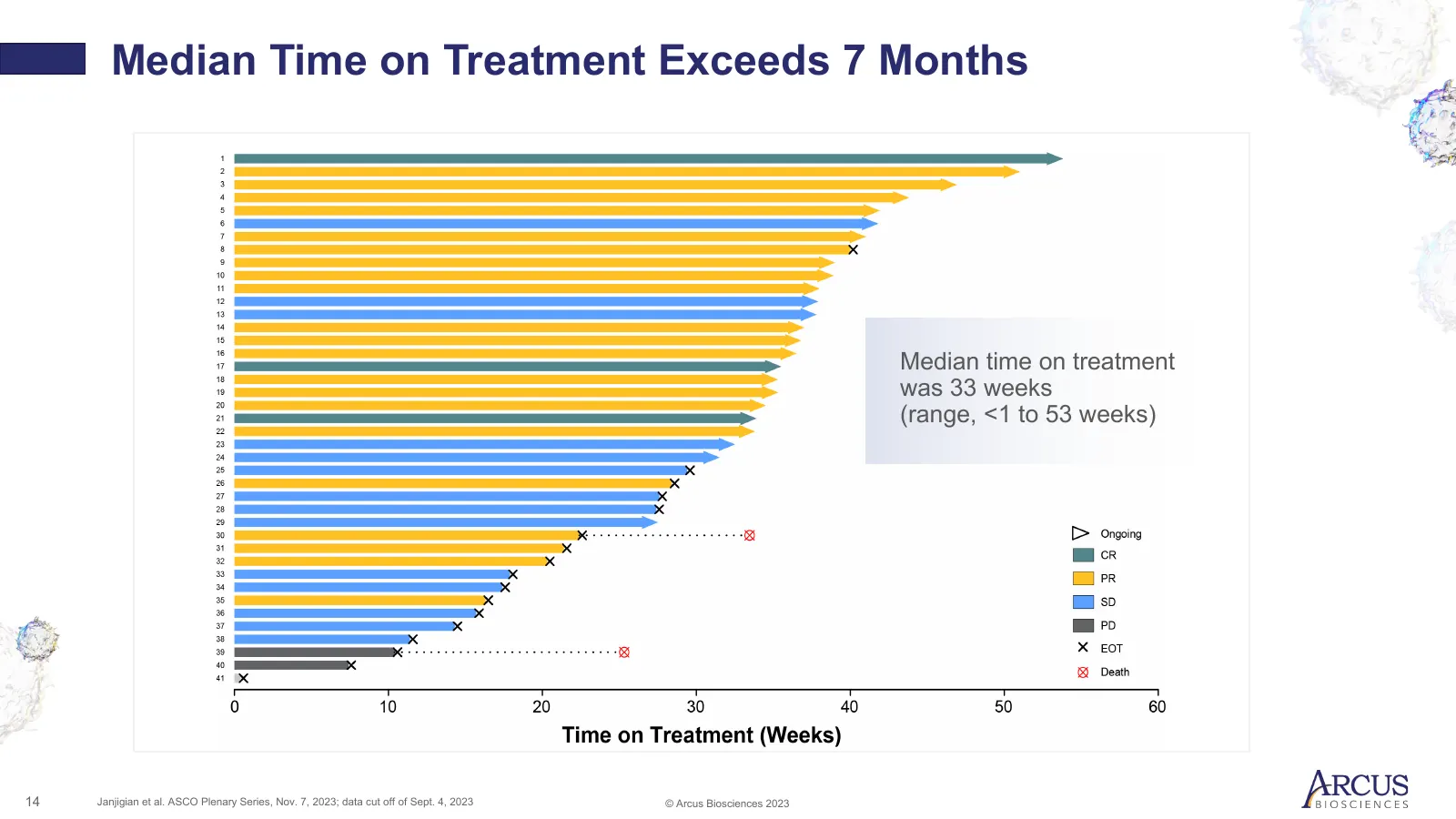
Slide 14: Median Time on Treatment Exceeds 7 Months
Median Time on Treatment Exceeds 7 Months Median time on treatment was 33 weeks (range, <1 to 53 weeks) 14 Janjigian et al. ASCO Plenary Series, Nov. 7, 2023; data cut off of Sept. 4, 2023 © Arcus Biosciences 2023
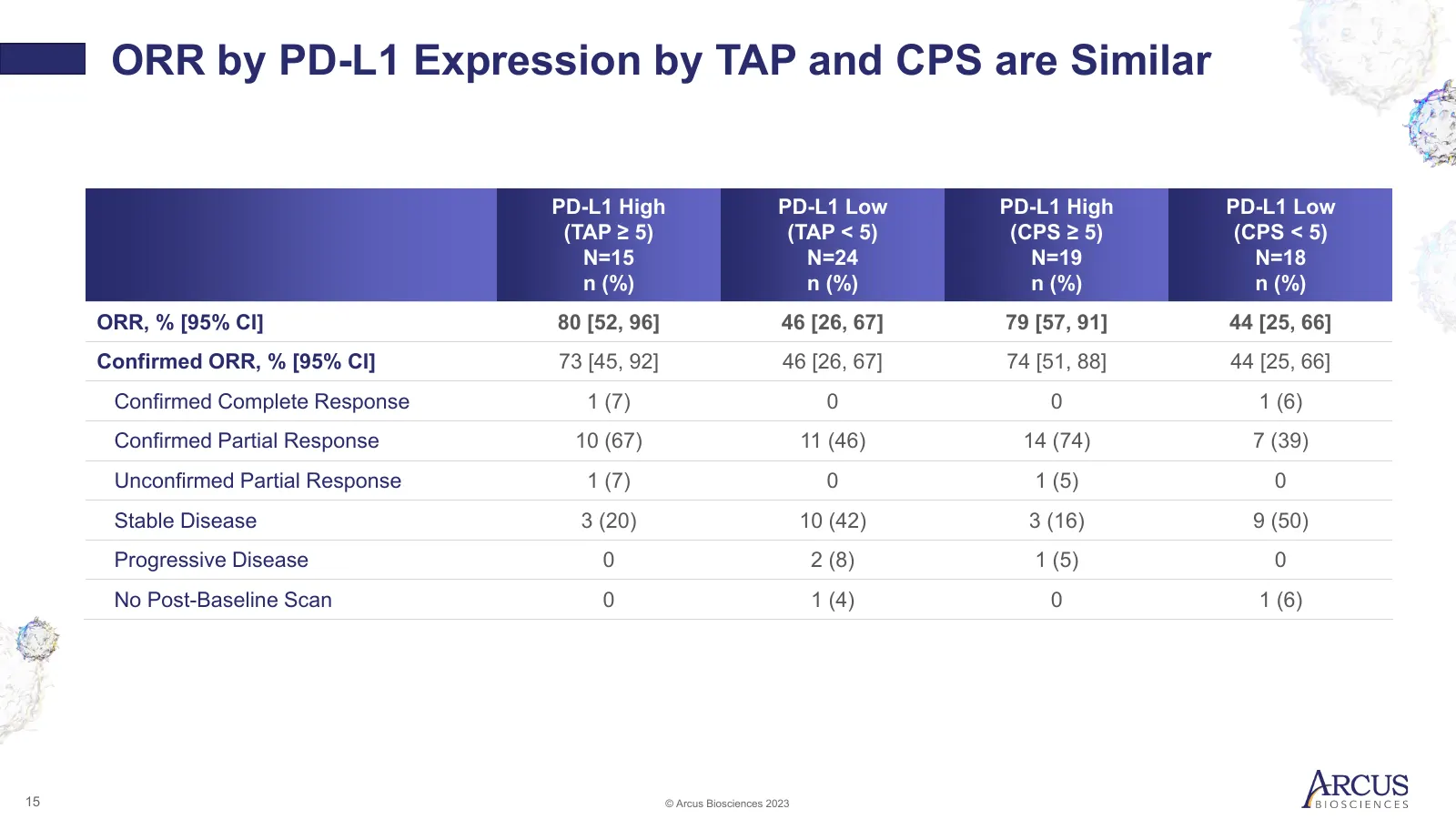
Slide 15: ORR by PD-L1 Expression by TAP and CPS are Similar
ORR by PD-L1 Expression by TAP and CPS are Similar PD-L1 High PD-L1 Low PD-L1 High PD-L1 Low (TAP ≥ 5) (TAP < 5) (CPS ≥ 5) (CPS < 5) N=15 N=24 N=19 N=18 n (%) n (%) n (%) n (%) ORR, % [95% CI] 80 [52, 96] 46 [26, 67] 79 [57, 91] 44 [25, 66] Confirmed ORR, % [95% CI] 73 [45, 92] 46 [26, 67] 74 [51, 8
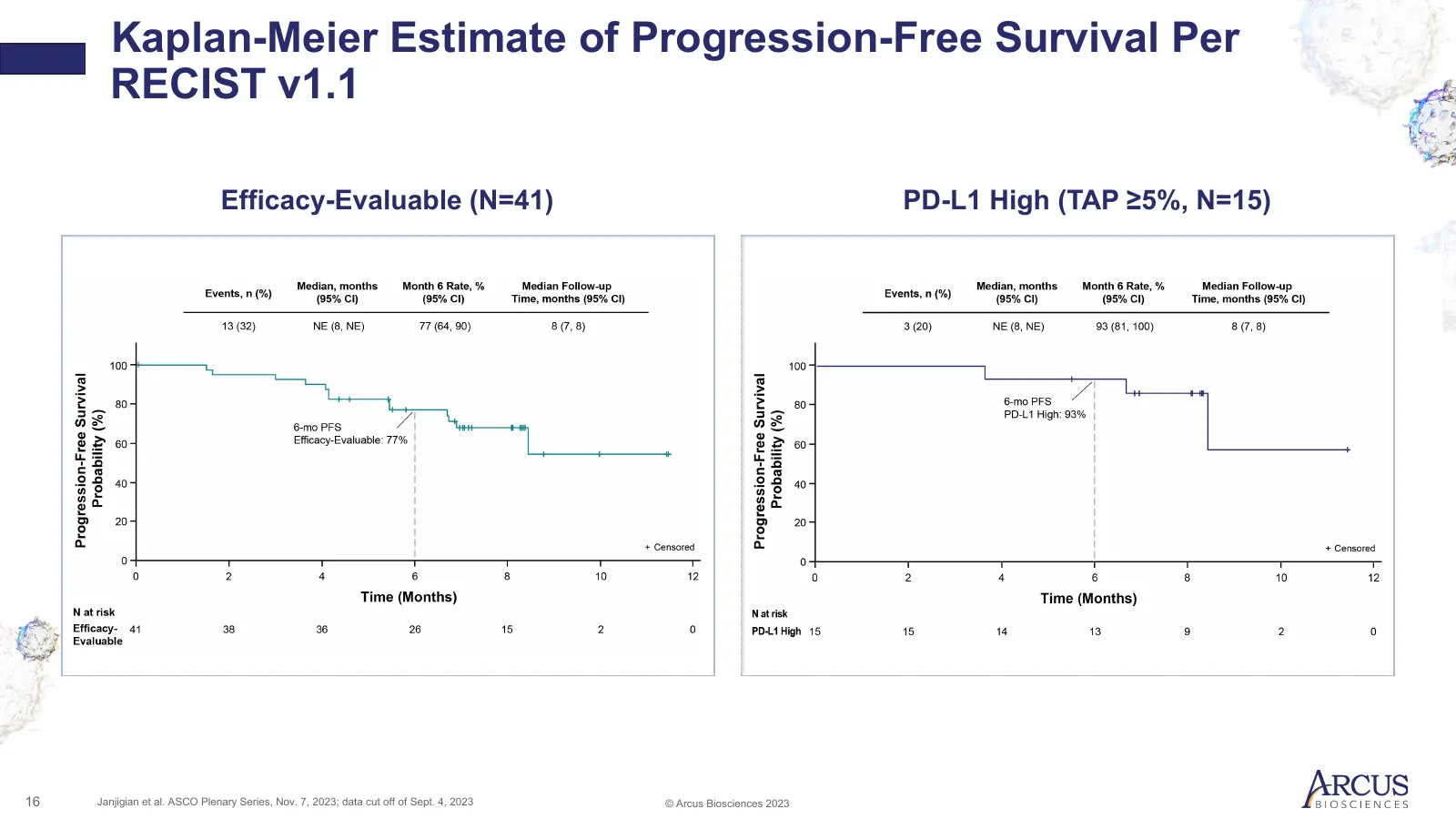
Slide 16: Kaplan-Meier Estimate of Progression-Free Survival
Kaplan-Meier Estimate of Progression-Free Survival Per RECIST v1.1 Efficacy-Evaluable (N=41) PD-L1 High (TAP ≥5%, N=15) 16 Janjigian et al. ASCO Plenary Series, Nov. 7, 2023; data cut off of Sept. 4, 2023 © Arcus Biosciences 2023
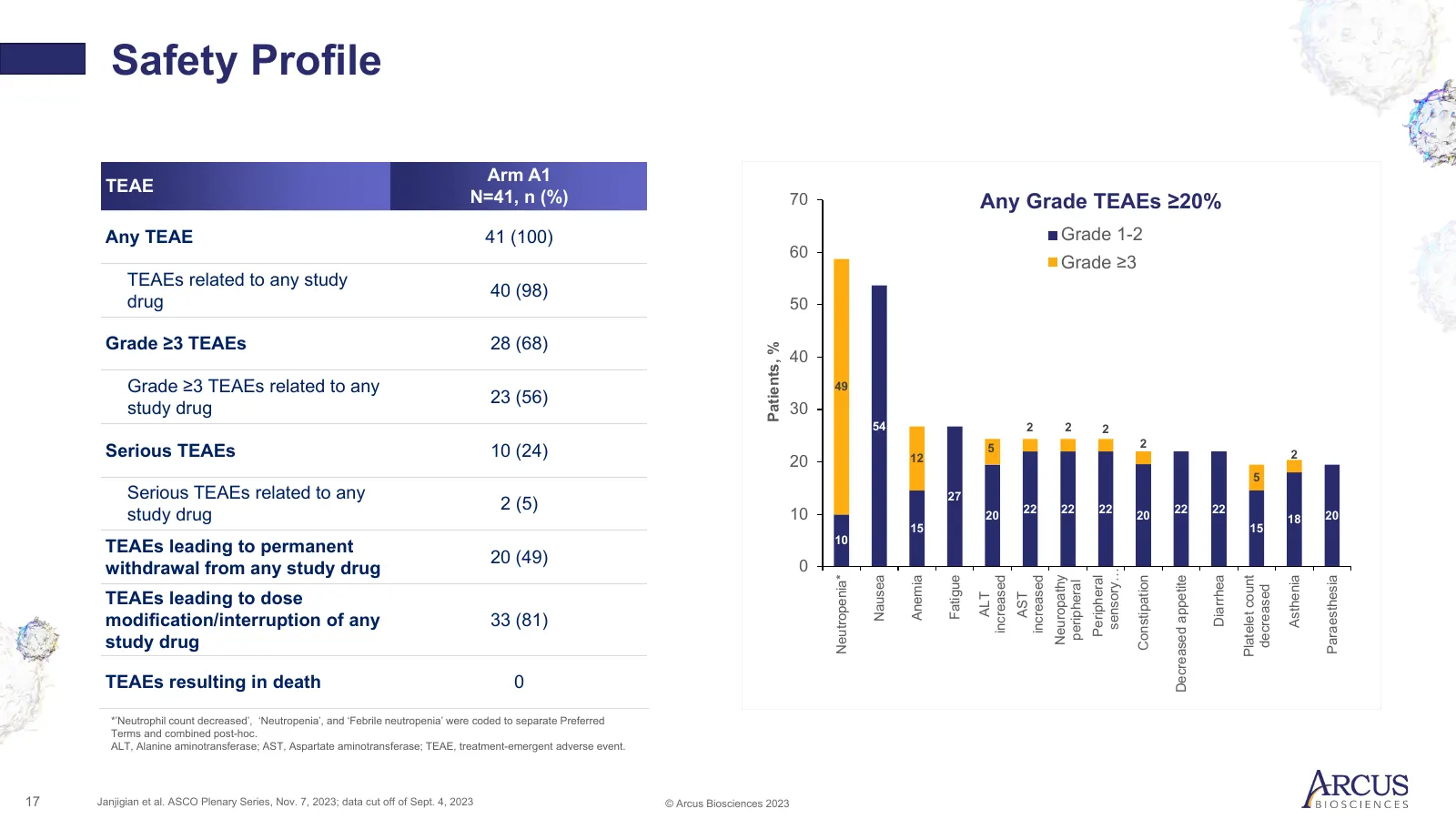
Slide 17: Safety Profile
Safety Profile Arm A1 TEAE N=41, n (%) 70 Any Grade TEAEs ≥20% Any TEAE 41 (100) Grade 1-2 60 Grade ≥3 TEAEs related to any study 40 (98) drug 50 Grade ≥3 TEAEs 28 (68) Patients, % 40 Grade ≥3 TEAEs related to any 49 23 (56) study drug 30 54 2 2 2 2 Serious TEAEs 10 (24) 5 2 20 12 5 Serious TEAEs re
Slide 18: Infusion-Related Reactions and Immune-Mediated AEs
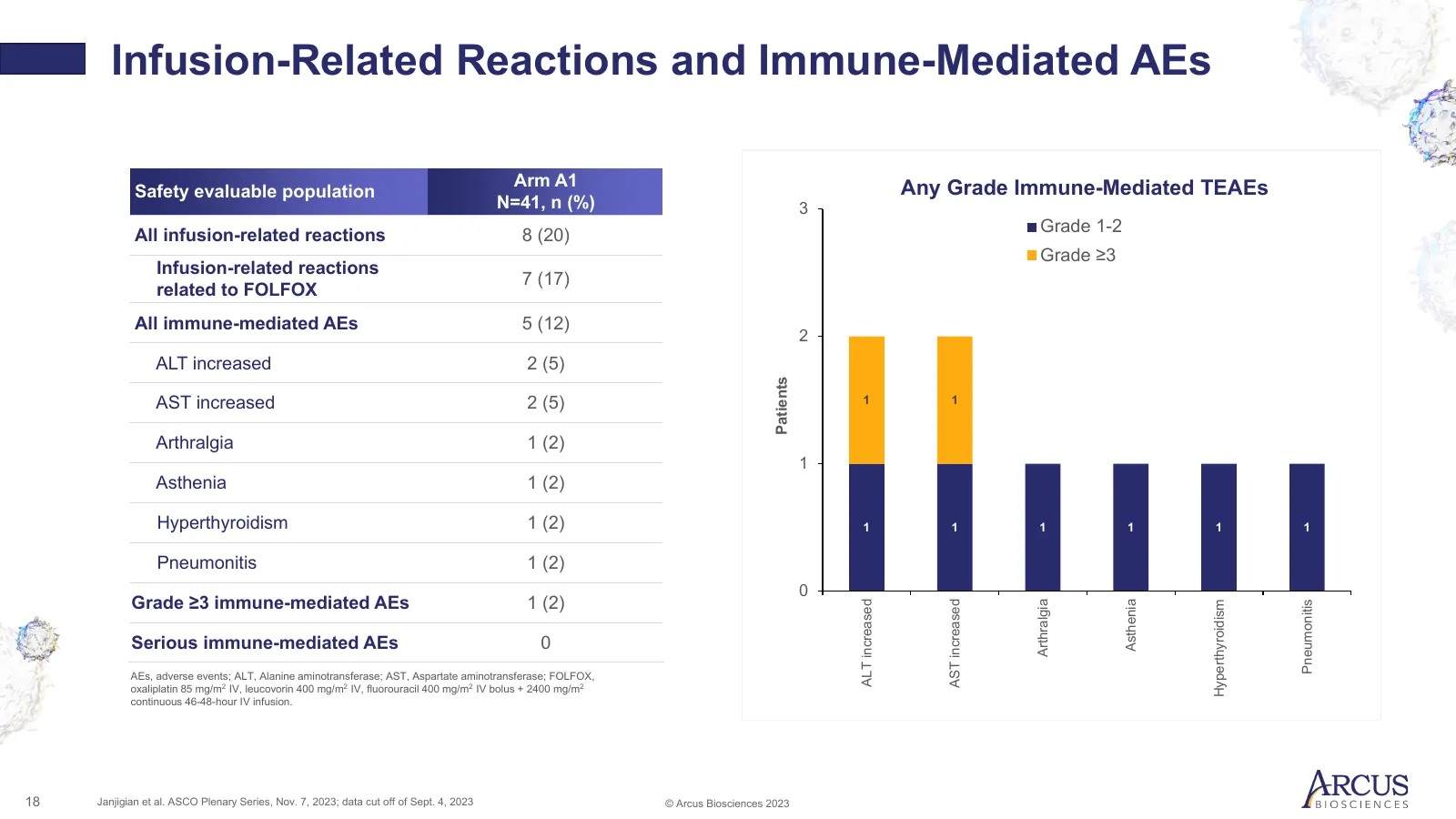
Infusion-Related Reactions and Immune-Mediated AEs Arm A1 Any Grade Immune-Mediated TEAEs Safety evaluable population N=41, n (%) 3 All infusion-related reactions 8 (20) Grade 1-2 Grade ≥3 Infusion-related reactions 7 (17) related to FOLFOX All immune-mediated AEs 5 (12) 2 ALT increased 2 (5) Patien
Slide 19: Conclusions
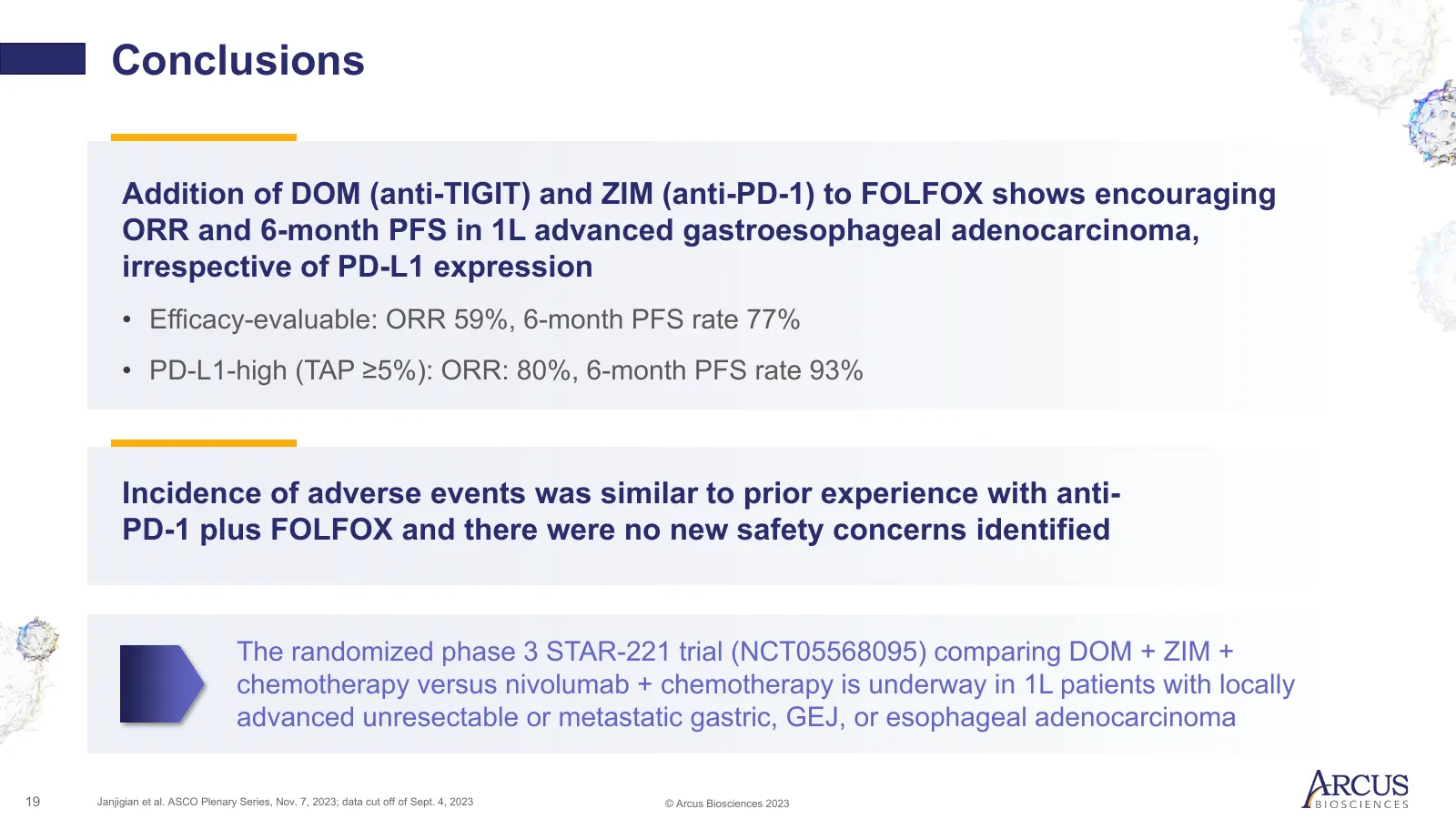
Conclusions Addition of DOM (anti-TIGIT) and ZIM (anti-PD-1) to FOLFOX shows encouraging ORR and 6-month PFS in 1L advanced gastroesophageal adenocarcinoma, irrespective of PD-L1 expression • Efficacy-evaluable: ORR 59%, 6-month PFS rate 77% • PD-L1-high (TAP ≥5%): ORR: 80%, 6-month PFS rate 93% Inc
Slide 20: Phase 3 Dom + Zim + Chemo vs Nivo + Chemo in 1L Gastric
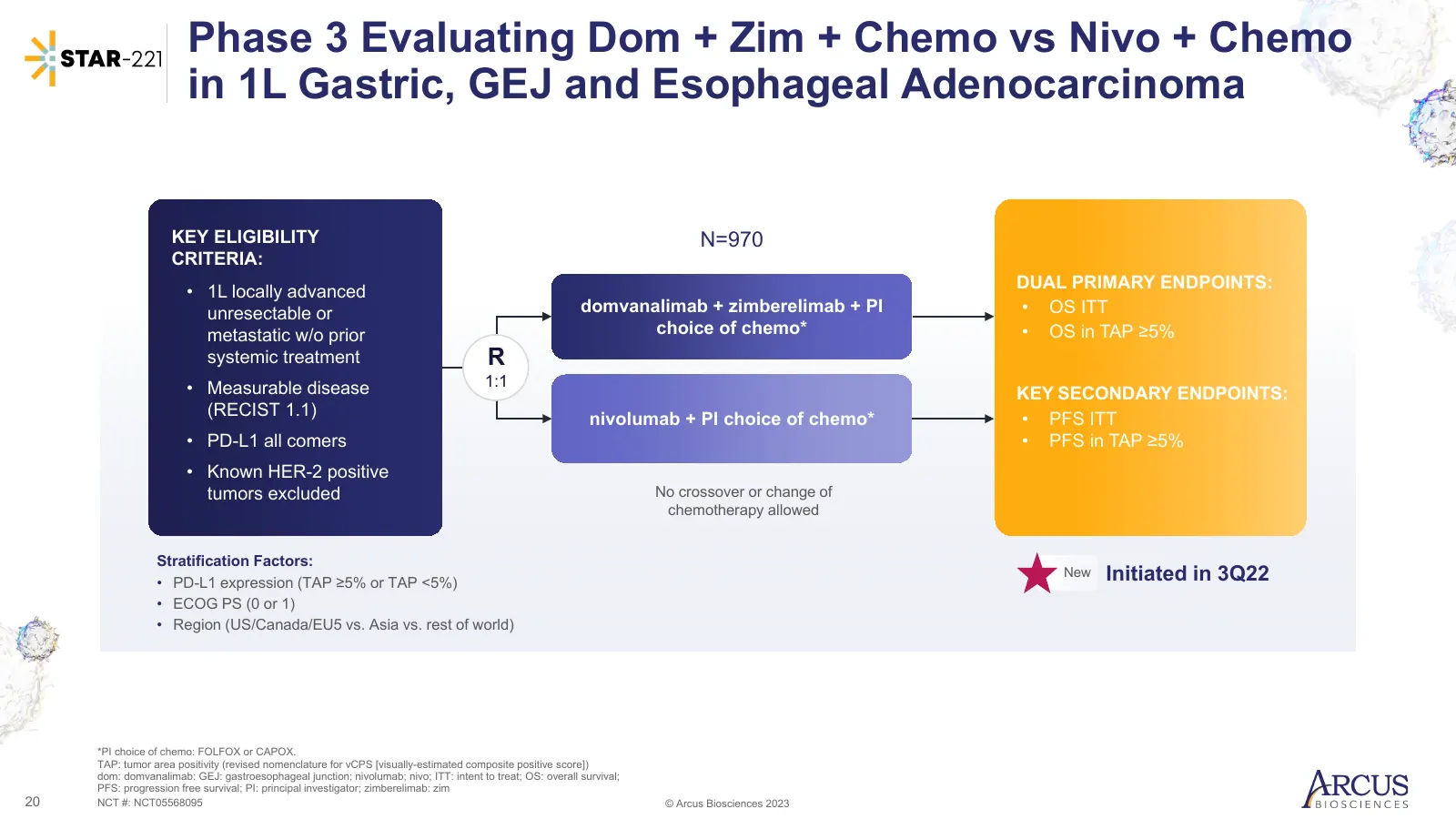
Phase 3 Evaluating Dom + Zim + Chemo vs Nivo + Chemo in 1L Gastric, GEJ and Esophageal Adenocarcinoma KEY ELIGIBILITY N=970 CRITERIA: DUAL PRIMARY ENDPOINTS: • 1L locally advanced unresectable or domvanalimab + zimberelimab + PI • OS ITT metastatic w/o prior choice of chemo* • OS in TAP ≥5% systemic
Slide 21: Summary of ARC-7 Results and Domvanalimab Clinical Program in NSCLC
Summary of ARC-7 Results and Domvanalimab Clinical Program in Non-Small Cell Lung Cancer Data presented at the 2023 ASCO Annual Meeting, based on data cut off of Feb. 7, 2023. 21 © Arcus Biosciences 2023
Slide 22: ARC-7 Evaluates Combinations of Domvanalimab, an Fc-Silent anti-TIGIT
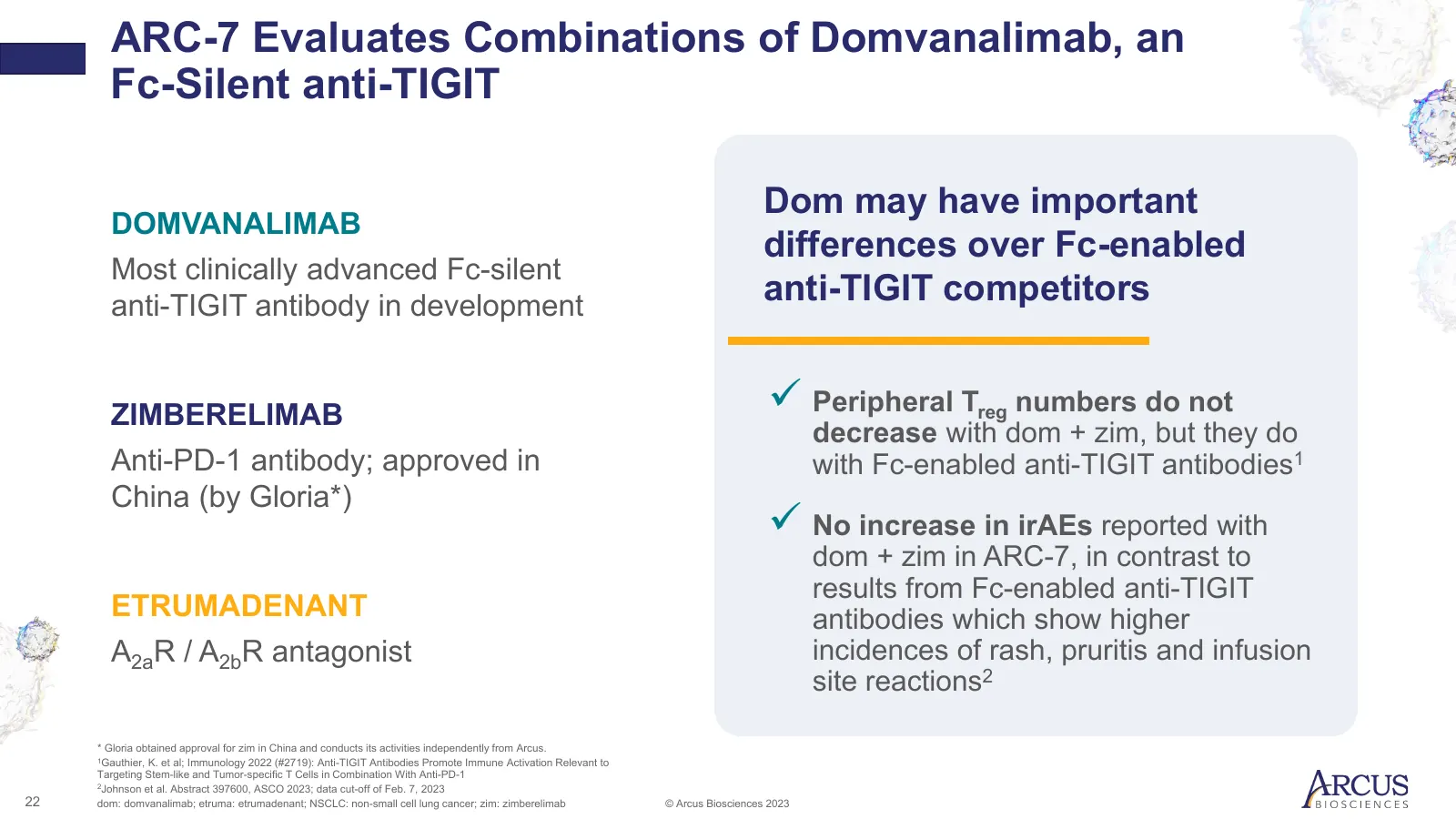
ARC-7 Evaluates Combinations of Domvanalimab, an Fc-Silent anti-TIGIT Dom may have important DOMVANALIMAB differences over Fc-enabled Most clinically advanced Fc-silent anti-TIGIT antibody in development anti-TIGIT competitors ZIMBERELIMAB Peripheral Treg numbers do not decrease with dom + zim, bu
Slide 23: Randomized Phase 2 Study in First-Line PD-L1-High NSCLC
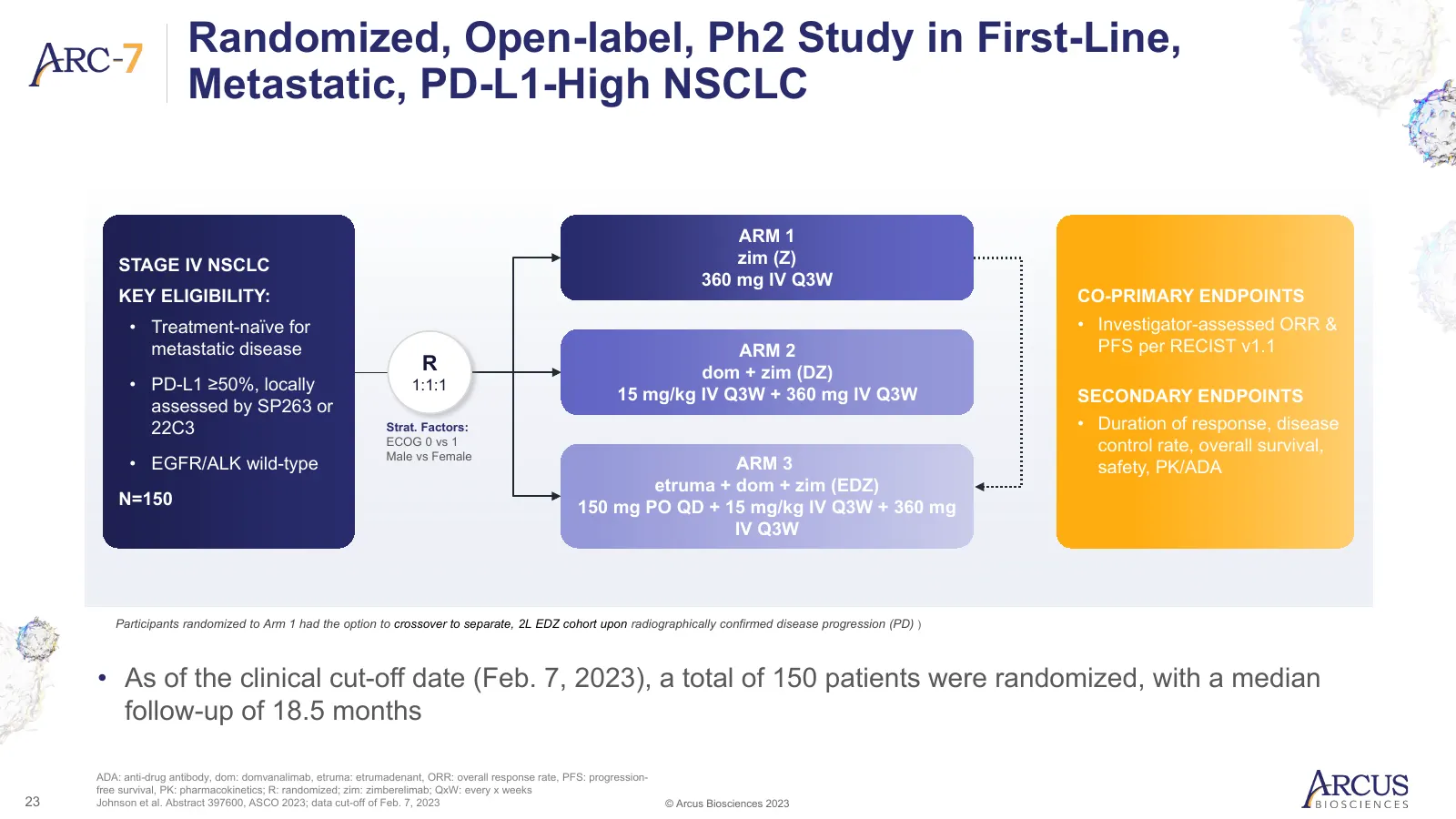
Randomized, Open-label, Ph2 Study in First-Line, Metastatic, PD-L1-High NSCLC ARM 1 STAGE IV NSCLC zim (Z) 360 mg IV Q3W KEY ELIGIBILITY: CO-PRIMARY ENDPOINTS • Treatment-naïve for • Investigator-assessed ORR & metastatic disease ARM 2 PFS per RECIST v1.1 R dom + zim (DZ) • PD-L1 ≥50%, locally 1:1:1
Slide 24: Baseline Characteristics Relatively Balanced
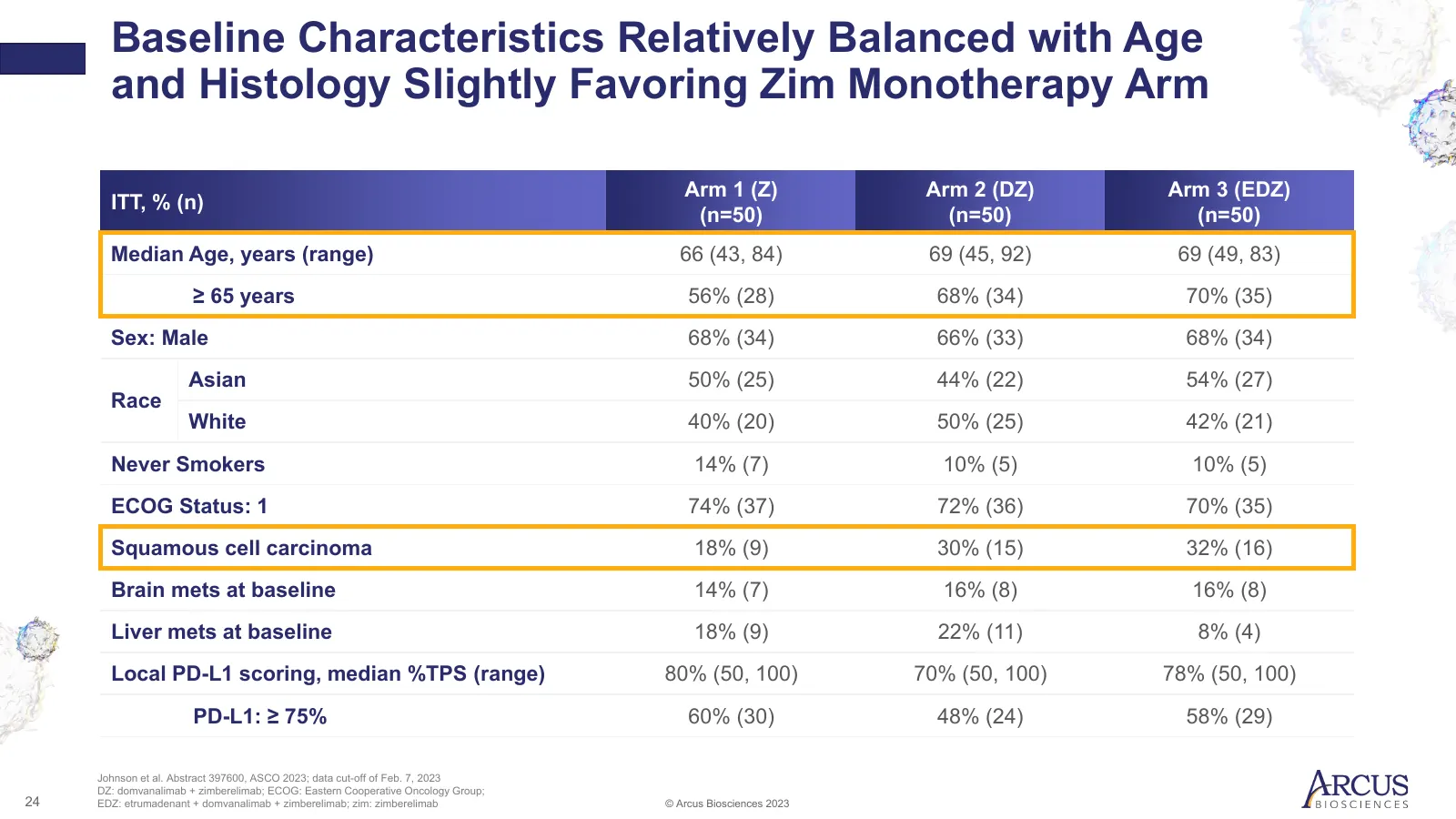
Baseline Characteristics Relatively Balanced with Age and Histology Slightly Favoring Zim Monotherapy Arm Arm 1 (Z) Arm 2 (DZ) Arm 3 (EDZ) ITT, % (n) (n=50) (n=50) (n=50) Median Age, years (range) 66 (43, 84) 69 (45, 92) 69 (49, 83) ≥ 65 years 56% (28) 68% (34) 70% (35) Sex: Male 68% (34) 66% (33) 6
Slide 25: Dom-containing Arms Improved ORRs vs Zim Monotherapy
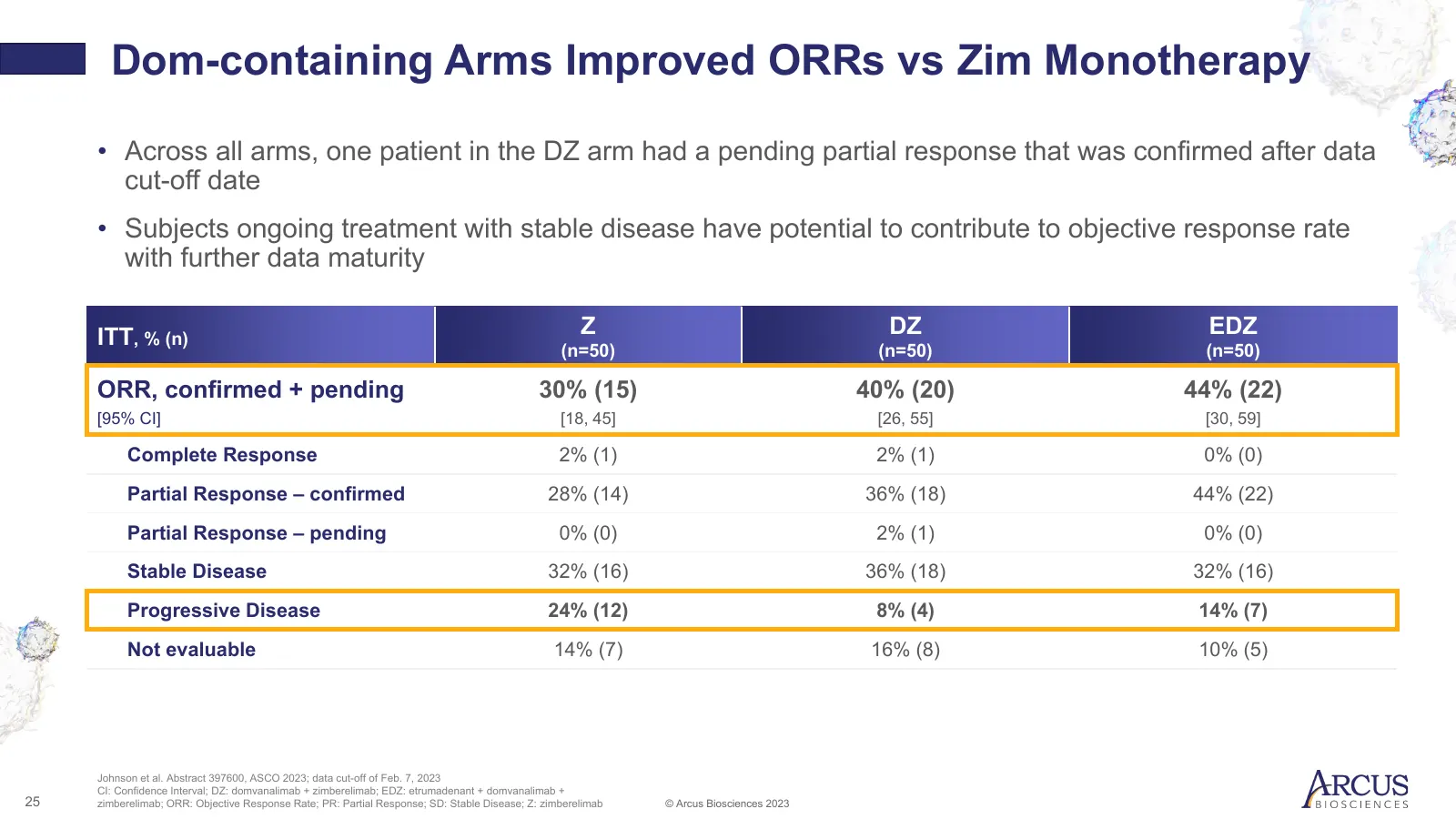
Dom-containing Arms Improved ORRs vs Zim Monotherapy • Across all arms, one patient in the DZ arm had a pending partial response that was confirmed after data cut-off date • Subjects ongoing treatment with stable disease have potential to contribute to objective response rate with further data matur
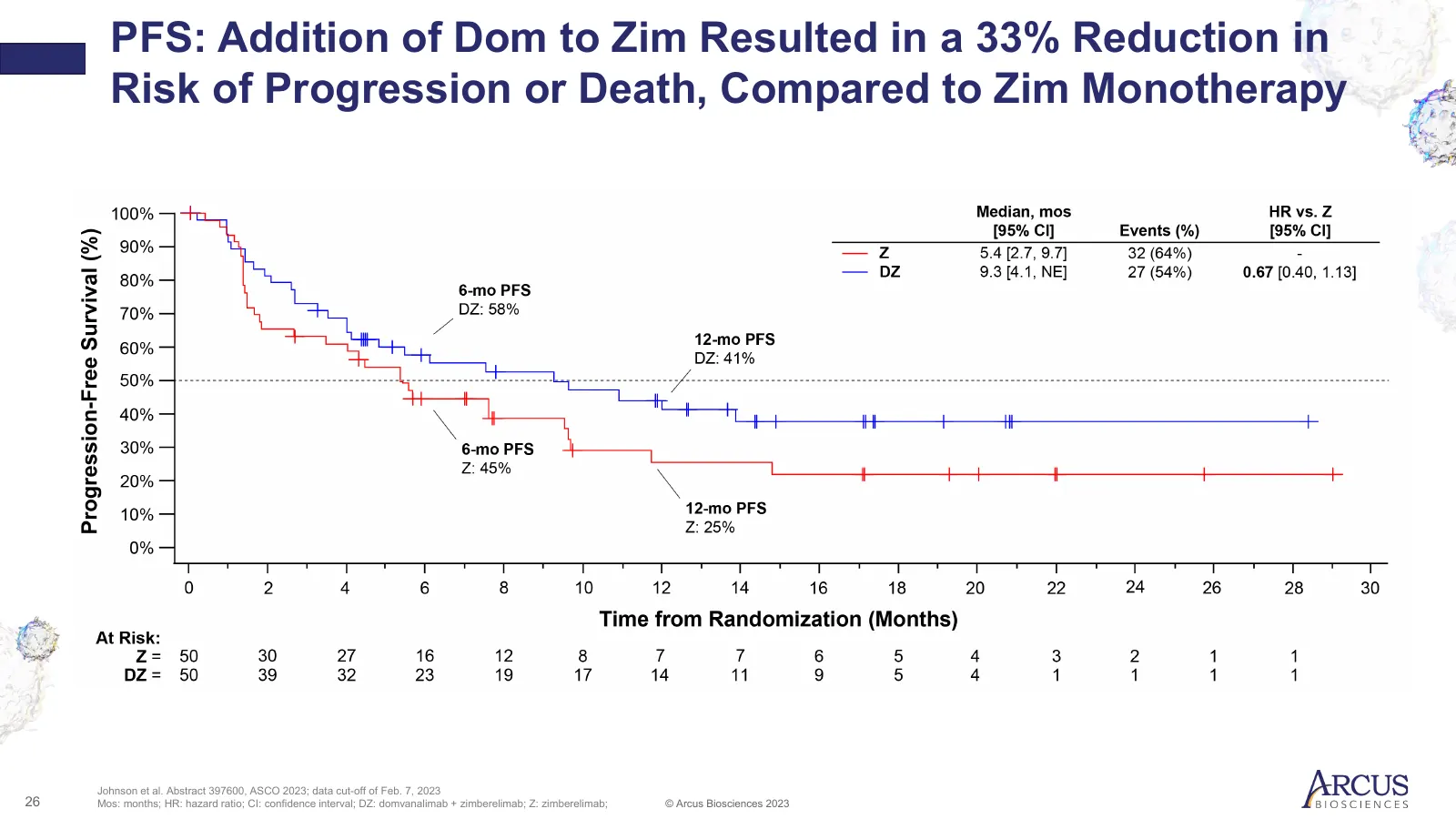
Slide 26: PFS: Addition of Dom to Zim Reduced Risk of Progression
PFS: Addition of Dom to Zim Resulted in a 33% Reduction in Risk of Progression or Death, Compared to Zim Monotherapy Johnson et al. Abstract 397600, ASCO 2023; data cut-off of Feb. 7, 2023 26 Mos: months; HR: hazard ratio; CI: confidence interval; DZ: domvanalimab + zimberelimab; Z: zimberelimab; ©
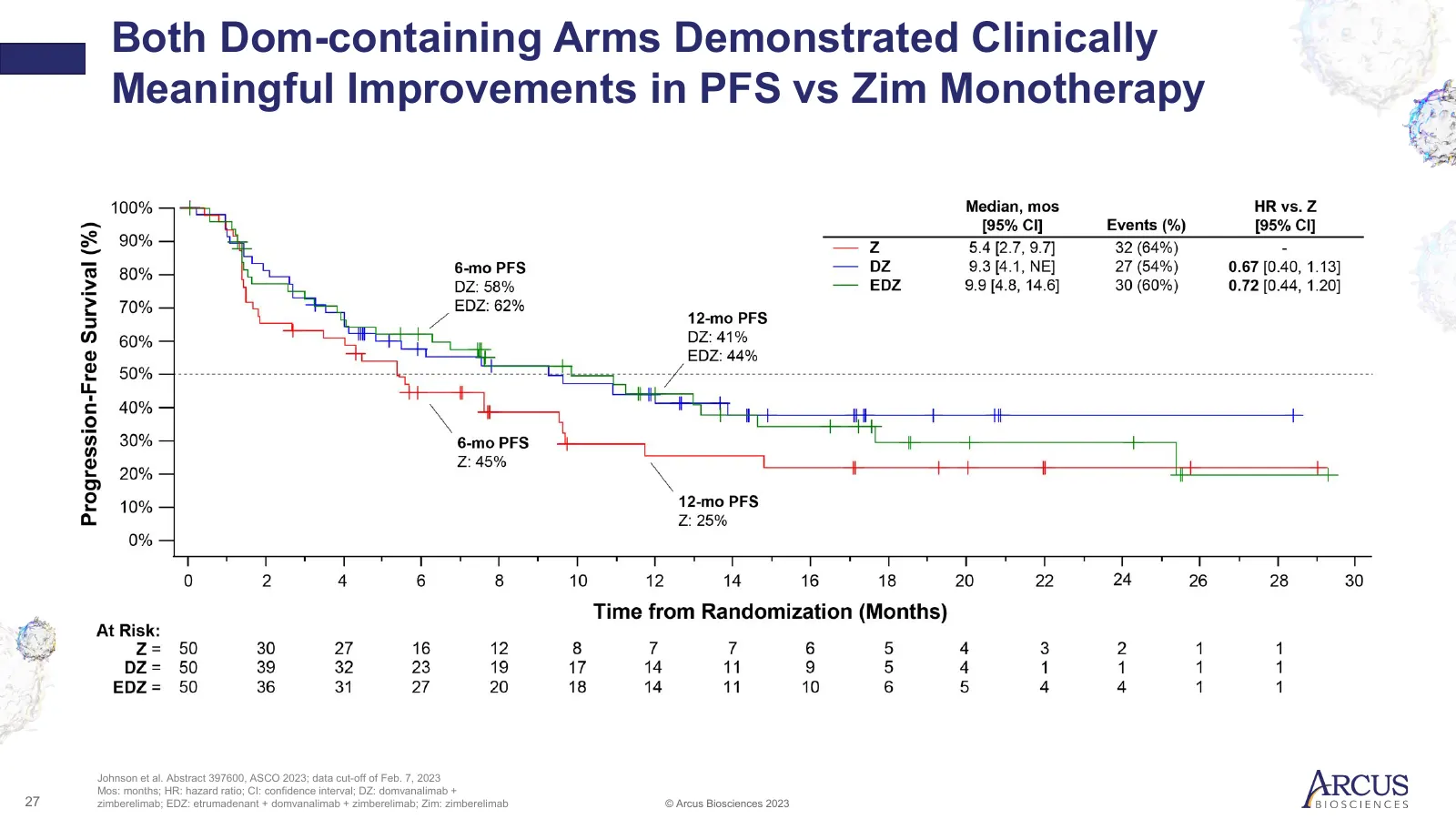
Slide 27: Both Dom-containing Arms Improved PFS vs Zim Monotherapy
Both Dom-containing Arms Demonstrated Clinically Meaningful Improvements in PFS vs Zim Monotherapy Johnson et al. Abstract 397600, ASCO 2023; data cut-off of Feb. 7, 2023 Mos: months; HR: hazard ratio; CI: confidence interval; DZ: domvanalimab + 27 zimberelimab; EDZ: etrumadenant + domvanalimab + zi
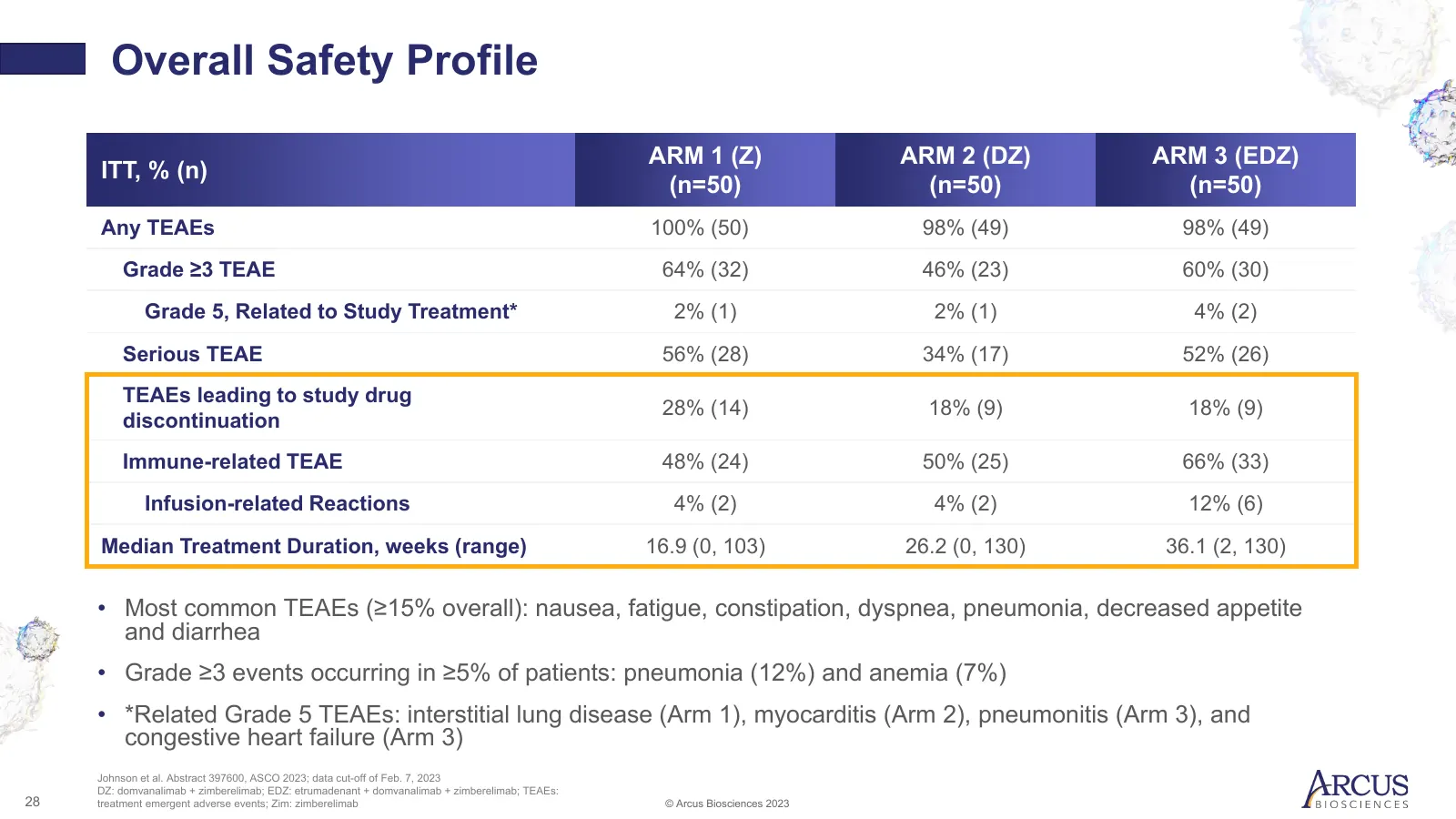
Slide 28: Overall Safety Profile
Overall Safety Profile ARM 1 (Z) ARM 2 (DZ) ARM 3 (EDZ) ITT, % (n) (n=50) (n=50) (n=50) Any TEAEs 100% (50) 98% (49) 98% (49) Grade ≥3 TEAE 64% (32) 46% (23) 60% (30) Grade 5, Related to Study Treatment* 2% (1) 2% (1) 4% (2) Serious TEAE 56% (28) 34% (17) 52% (26) TEAEs leading to study drug 28% (14
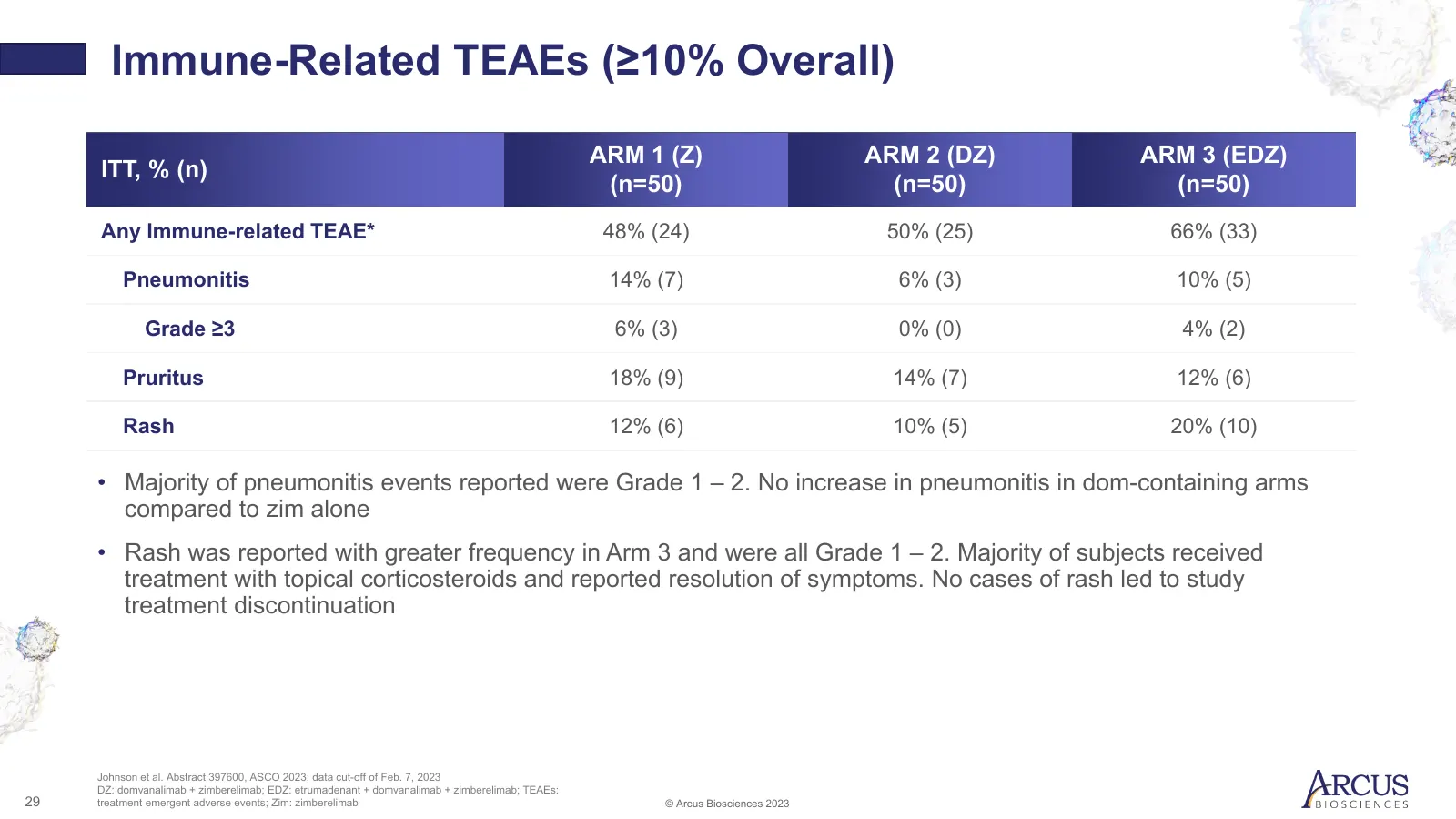
Slide 29: Immune-Related TEAEs
Immune-Related TEAEs (≥10% Overall) ARM 1 (Z) ARM 2 (DZ) ARM 3 (EDZ) ITT, % (n) (n=50) (n=50) (n=50) Any Immune-related TEAE* 48% (24) 50% (25) 66% (33) Pneumonitis 14% (7) 6% (3) 10% (5) Grade ≥3 6% (3) 0% (0) 4% (2) Pruritus 18% (9) 14% (7) 12% (6) Rash 12% (6) 10% (5) 20% (10) • Majority of pneum
Slide 30: ARC-7 Key Highlights from ASCO 2023
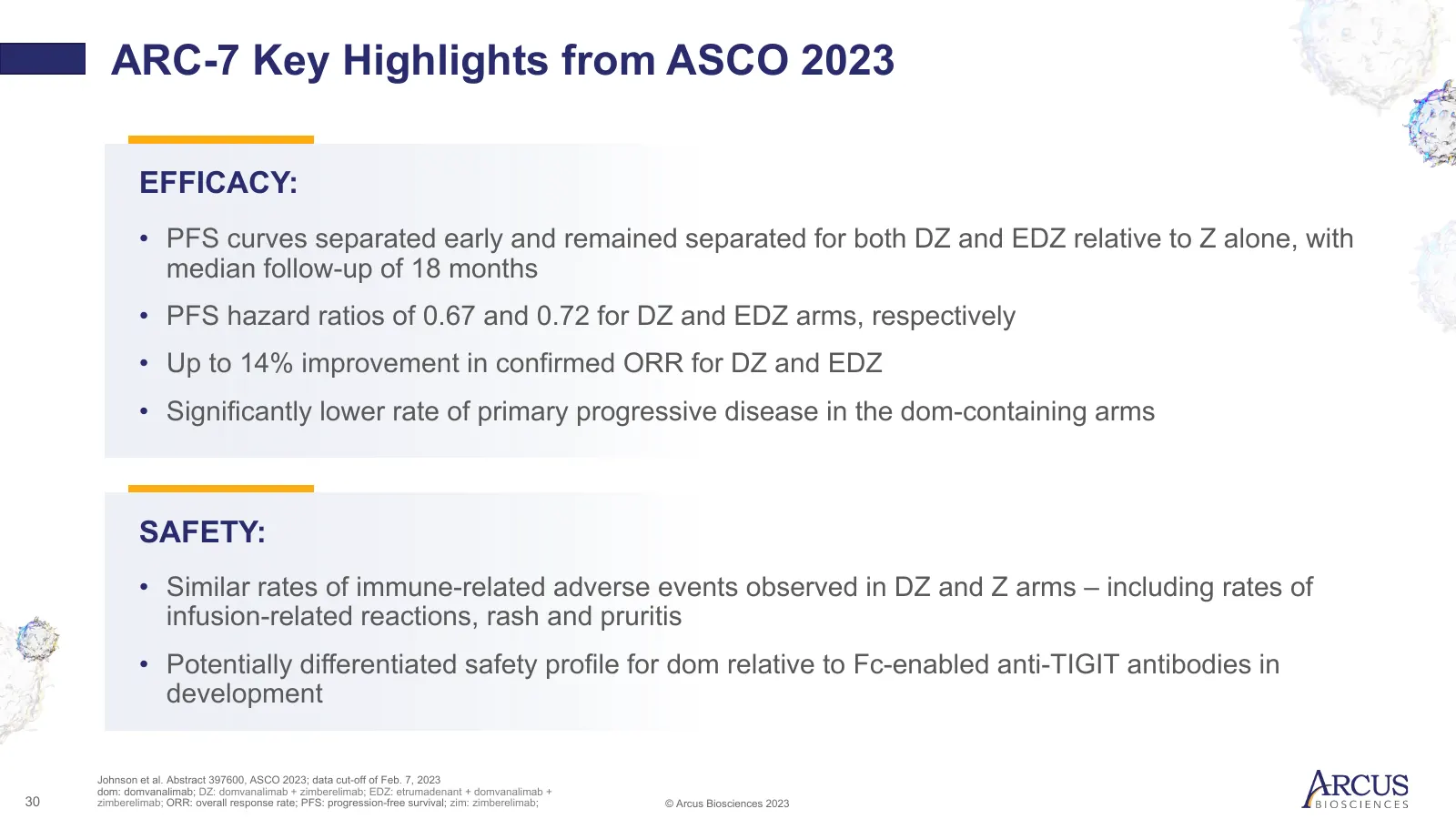
ARC-7 Key Highlights from ASCO 2023 EFFICACY: • PFS curves separated early and remained separated for both DZ and EDZ relative to Z alone, with median follow-up of 18 months • PFS hazard ratios of 0.67 and 0.72 for DZ and EDZ arms, respectively • Up to 14% improvement in confirmed ORR for DZ and EDZ
Slide 31: Phase 3 Dom + Zim vs. Pembro, 1L NSCLC
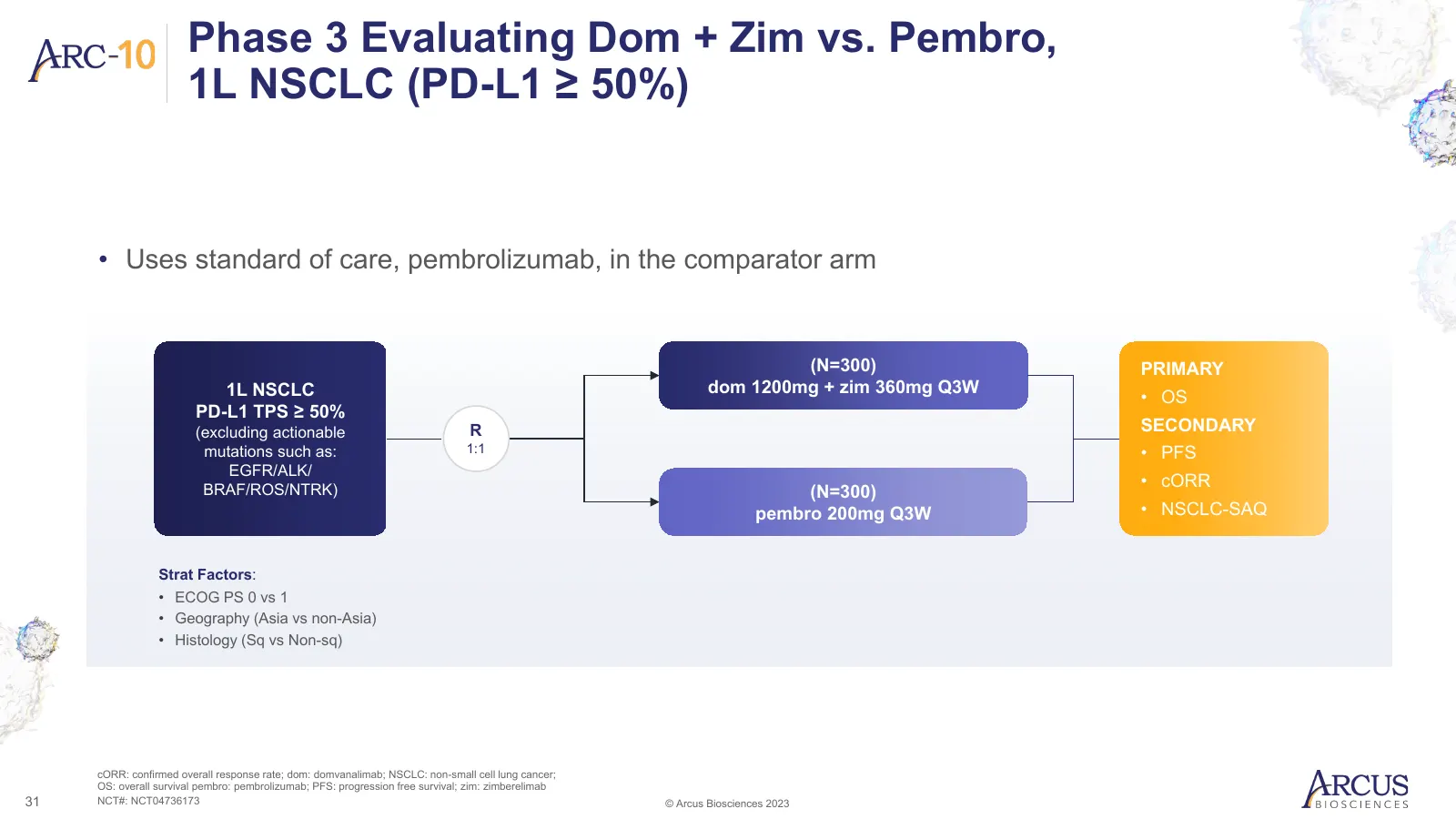
Phase 3 Evaluating Dom + Zim vs. Pembro, 1L NSCLC (PD-L1 ≥ 50%) • Uses standard of care, pembrolizumab, in the comparator arm (N=300) PRIMARY 1L NSCLC dom 1200mg + zim 360mg Q3W • OS PD-L1 TPS ≥ 50% (excluding actionable R SECONDARY mutations such as: 1:1 • PFS EGFR/ALK/ BRAF/ROS/NTRK) • cORR (N=300
Slide 32: Phase 3 Dom + Zim + Chemo vs. Pembro + Chemo in 1L NSCLC
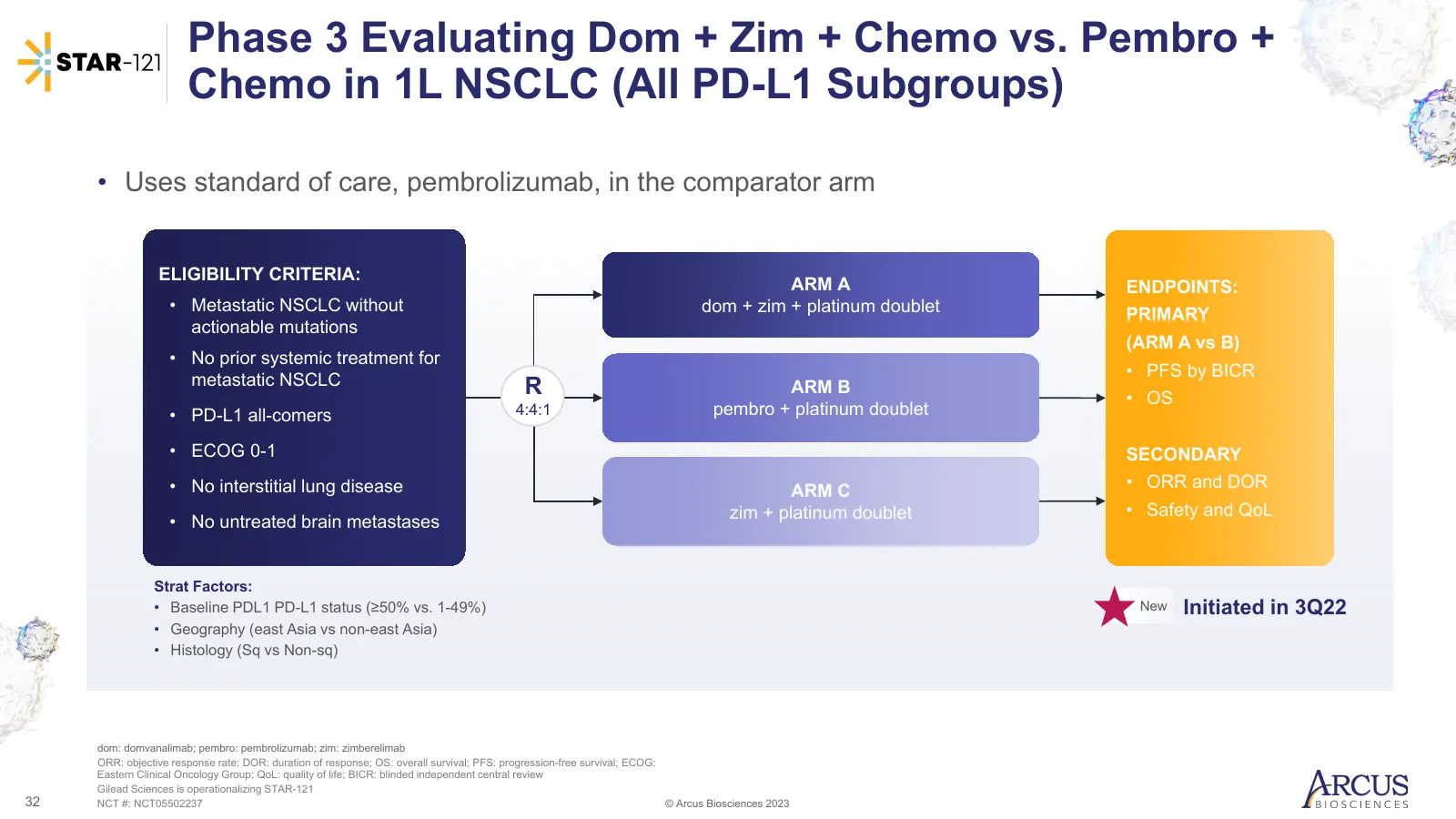
Phase 3 Evaluating Dom + Zim + Chemo vs. Pembro + Chemo in 1L NSCLC (All PD-L1 Subgroups) • Uses standard of care, pembrolizumab, in the comparator arm ELIGIBILITY CRITERIA: ARM A ENDPOINTS: • Metastatic NSCLC without dom + zim + platinum doublet PRIMARY actionable mutations (ARM A vs B) • No prior
Slide 33: Phase 3 Dom + Durva vs Placebo + Durva in Stage III NSCLC
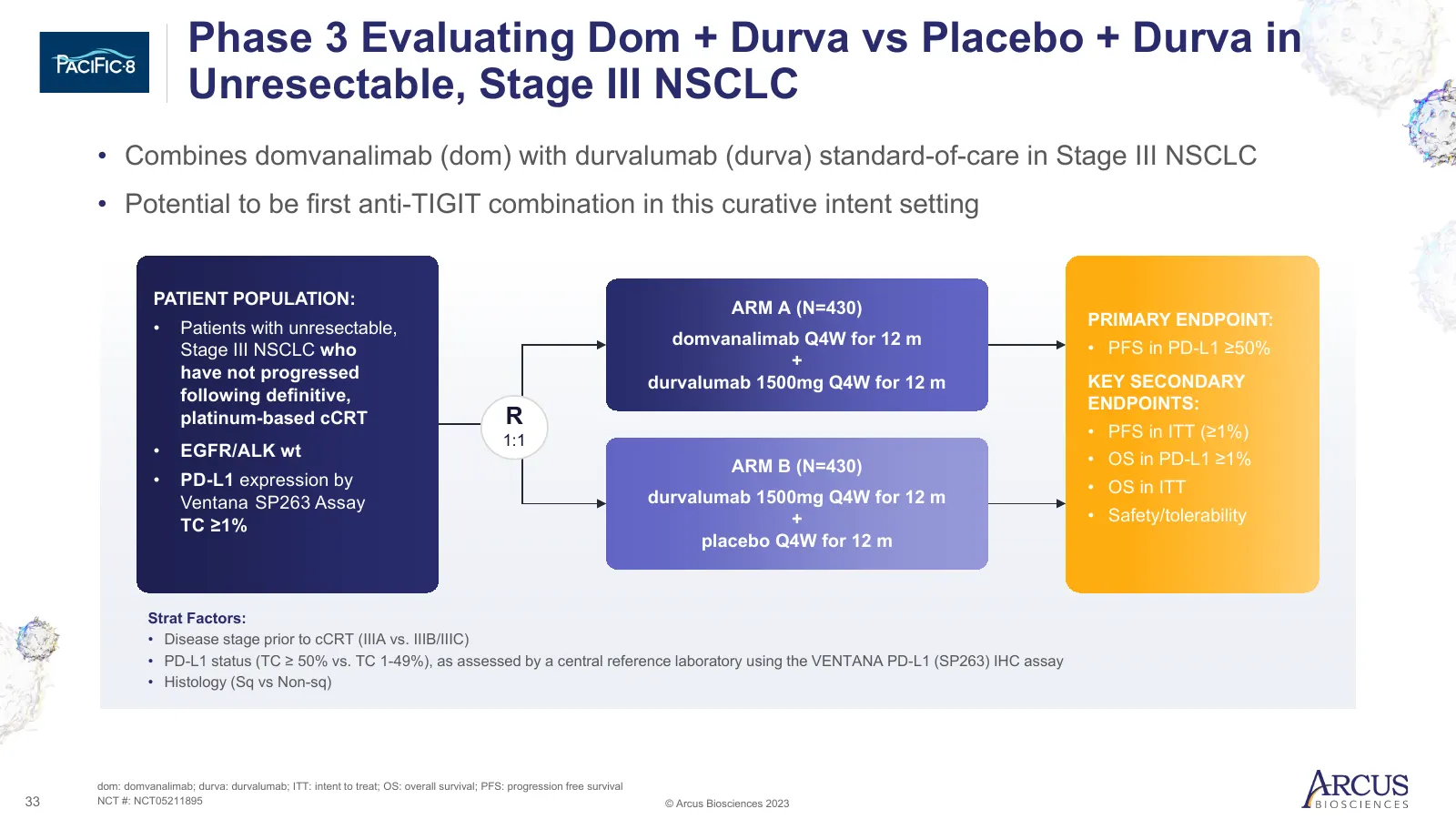
Phase 3 Evaluating Dom + Durva vs Placebo + Durva in Unresectable, Stage III NSCLC • Combines domvanalimab (dom) with durvalumab (durva) standard-of-care in Stage III NSCLC • Potential to be first anti-TIGIT combination in this curative intent setting PATIENT POPULATION: ARM A (N=430) • Patients wit

Slide 34: Domvanalimab Market Opportunity
Domvanalimab Market Opportunity 34 © Arcus Biosciences 2023
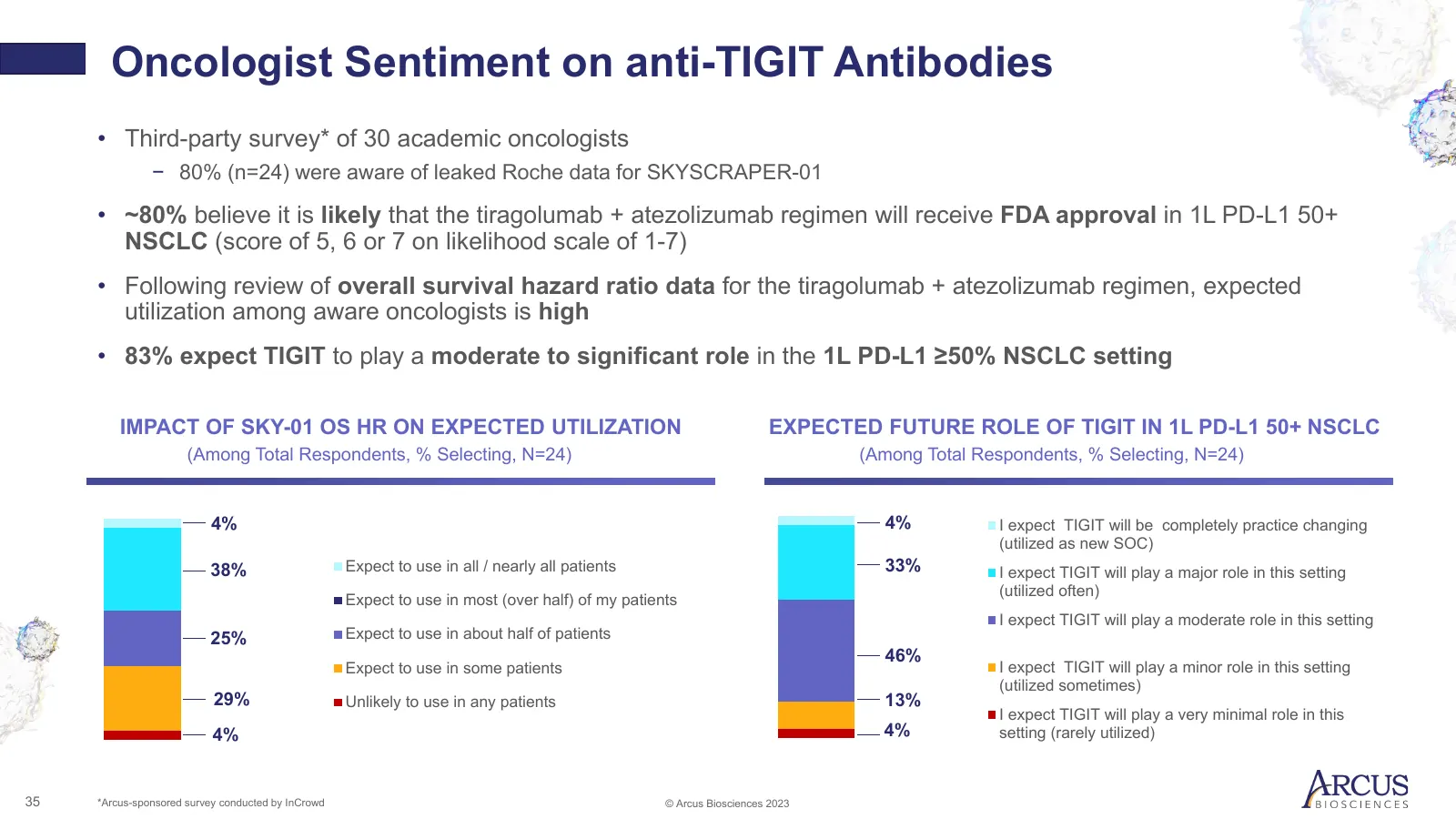
Slide 35: Oncologist Sentiment on anti-TIGIT Antibodies
Oncologist Sentiment on anti-TIGIT Antibodies • Third-party survey* of 30 academic oncologists − 80% (n=24) were aware of leaked Roche data for SKYSCRAPER-01 • ~80% believe it is likely that the tiragolumab + atezolizumab regimen will receive FDA approval in 1L PD-L1 50+ NSCLC (score of 5, 6 or 7 on
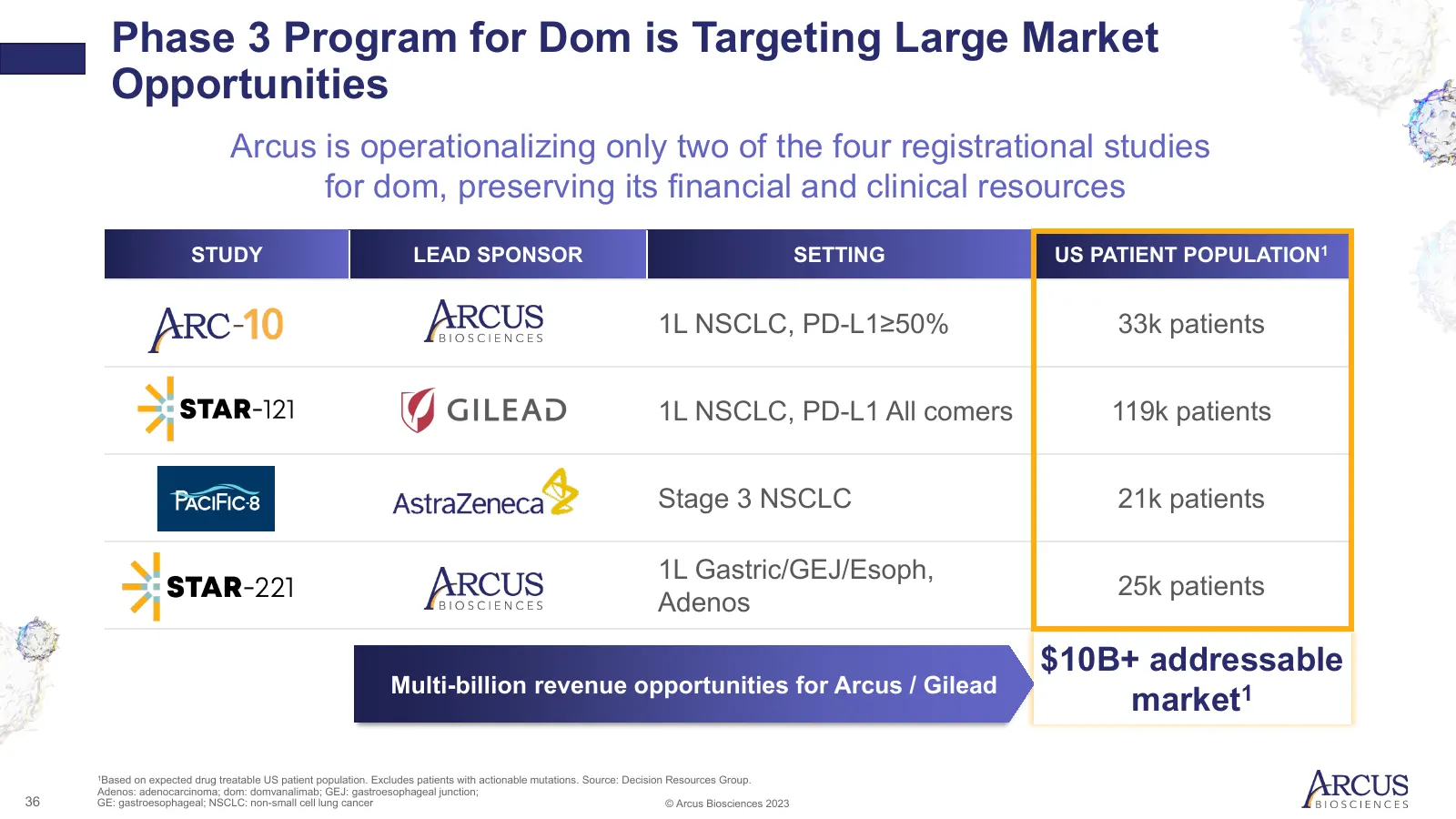
Slide 36: Phase 3 Program for Dom is Targeting Large Market Opportunities
Phase 3 Program for Dom is Targeting Large Market Opportunities Arcus is operationalizing only two of the four registrational studies for dom, preserving its financial and clinical resources STUDY LEAD SPONSOR SETTING US PATIENT POPULATION1 1L NSCLC, PD-L1≥50% 33k patients 1L NSCLC, PD-L1 All comers
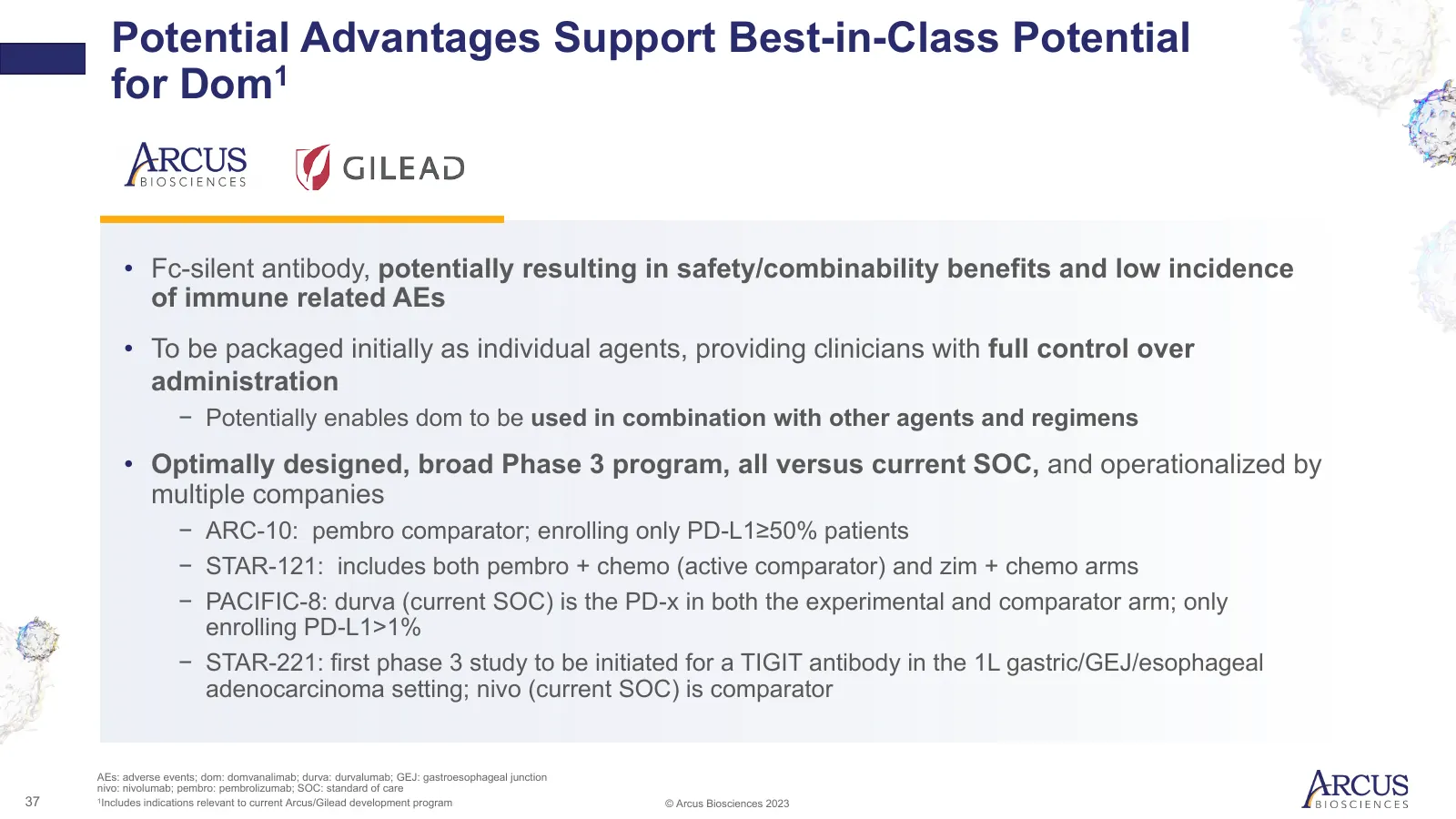
Slide 37: Potential Advantages Support Best-in-Class Potential for Dom
Potential Advantages Support Best-in-Class Potential for Dom1 • Fc-silent antibody, potentially resulting in safety/combinability benefits and low incidence of immune related AEs • To be packaged initially as individual agents, providing clinicians with full control over administration − Potentially
Slide 38: CD73-Adenosine Axis Programs
CD73-Adenosine Axis Programs 38 © Arcus Biosciences 2023
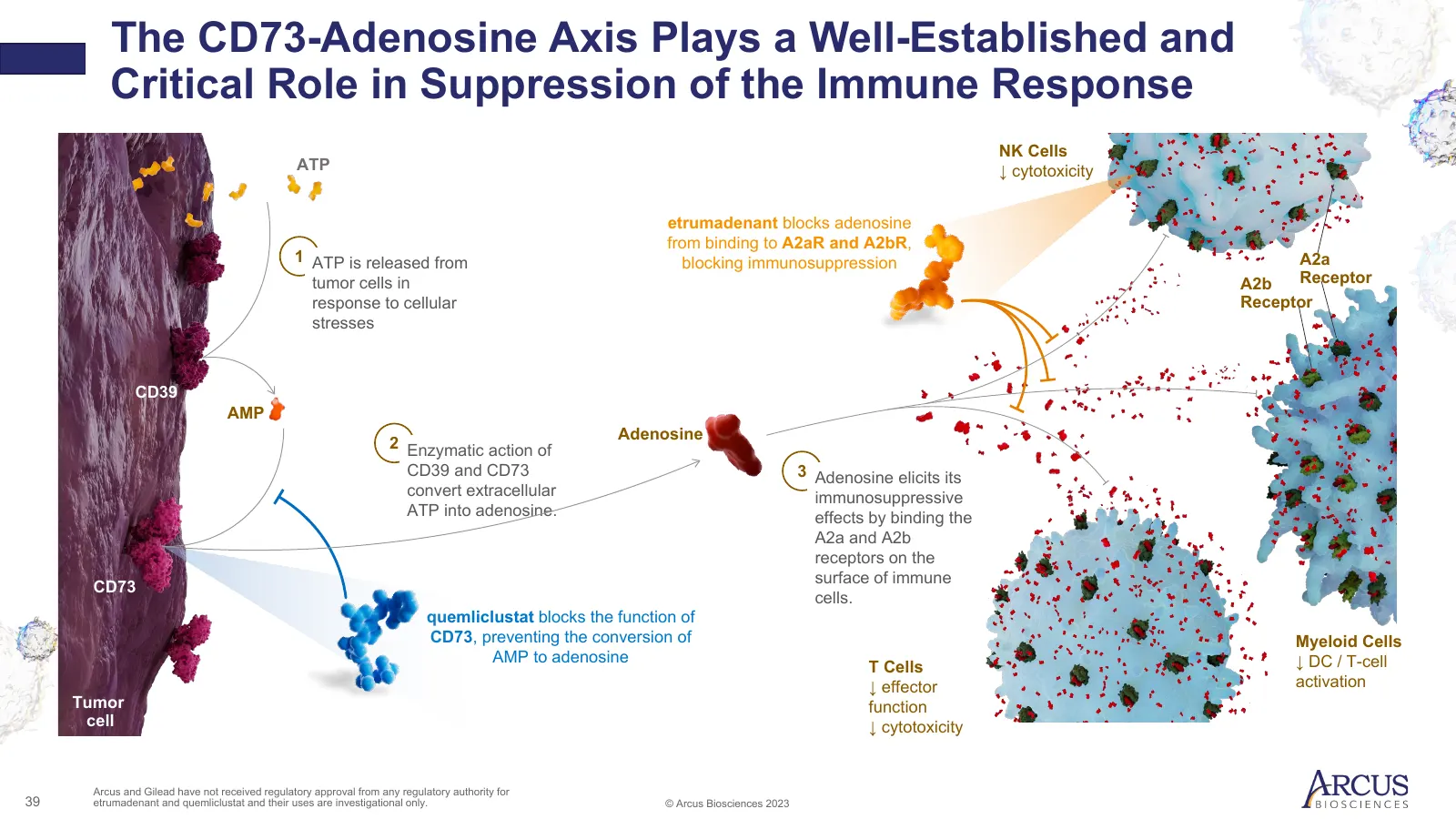
Slide 39: CD73-Adenosine Axis Role in Suppression of Immune Response
The CD73-Adenosine Axis Plays a Well-Established and Critical Role in Suppression of the Immune Response NK Cells ATP ↓ cytotoxicity etrumadenant blocks adenosine from binding to A2aR and A2bR, 1 ATP is released from blocking immunosuppression A2a tumor cells in A2b Receptor response to cellular Rec
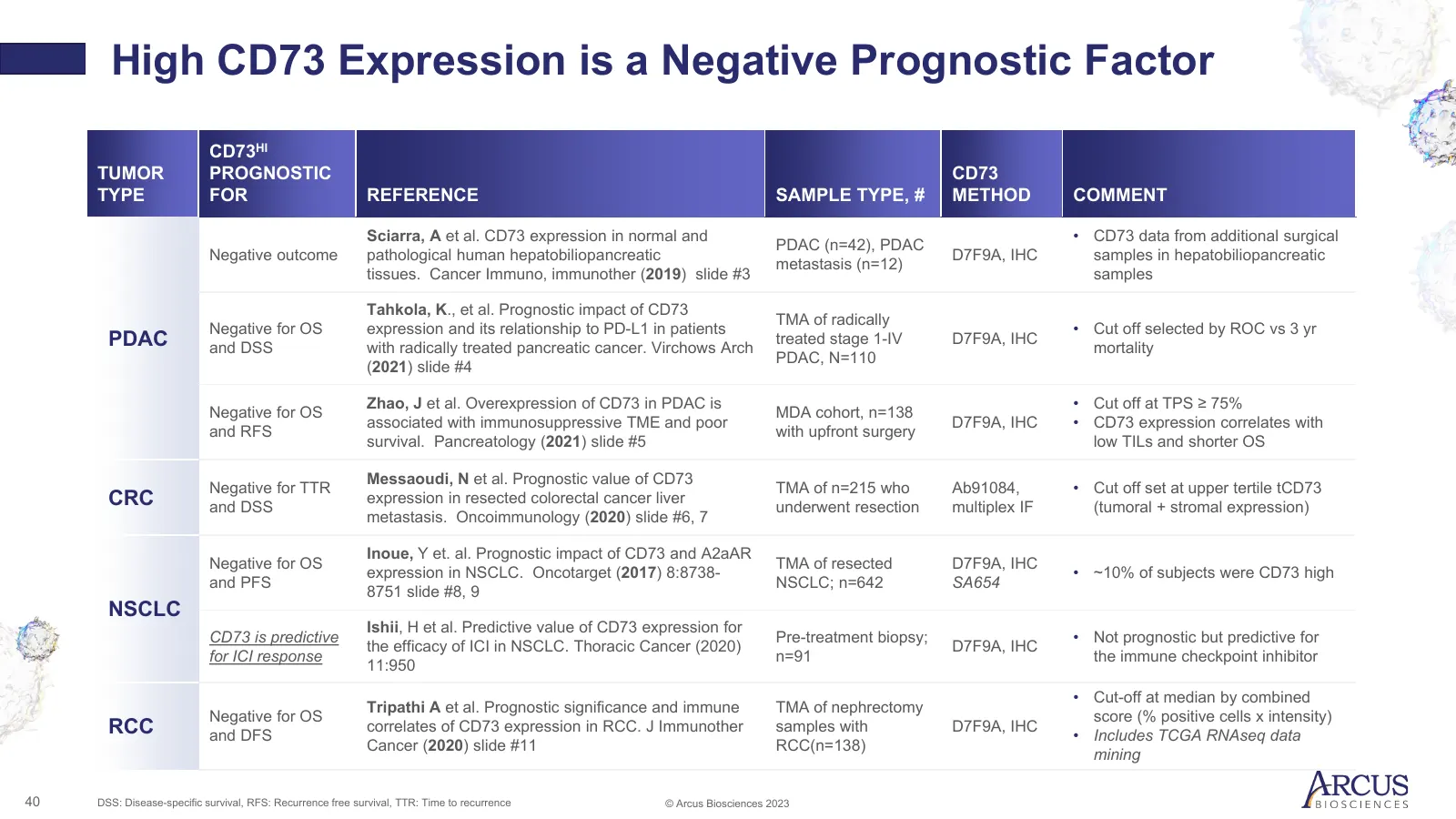
Slide 40: High CD73 Expression is a Negative Prognostic Factor
High CD73 Expression is a Negative Prognostic Factor CD73HI TUMOR PROGNOSTIC CD73 TYPE FOR REFERENCE SAMPLE TYPE, # METHOD COMMENT Sciarra, A et al. CD73 expression in normal and • CD73 data from additional surgical PDAC (n=42), PDAC Negative outcome pathological human hepatobiliopancreatic D7F9A, I
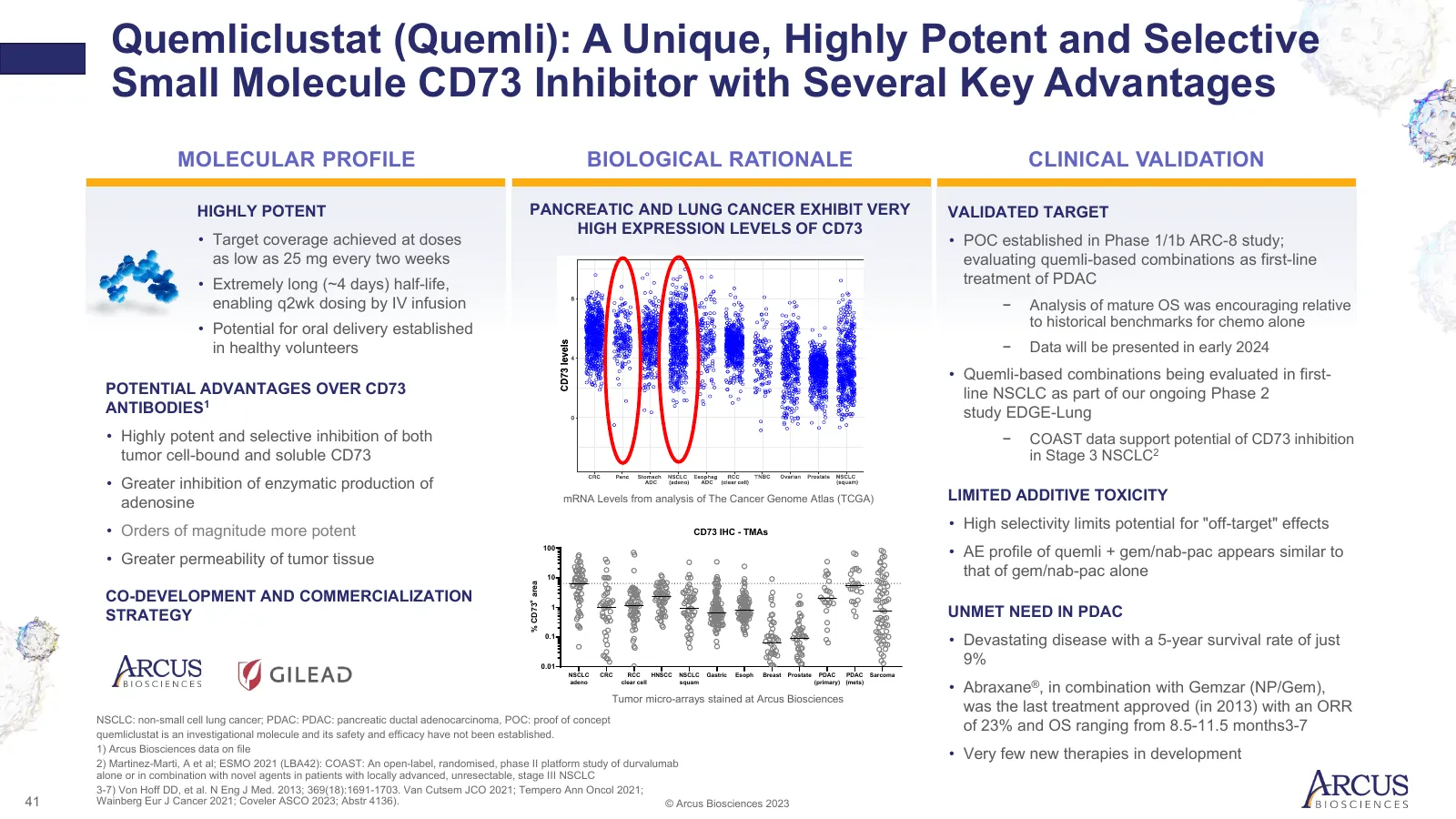
Slide 41: Quemliclustat: Unique, Highly Potent, Selective CD73 Inhibitor
Quemliclustat (Quemli): A Unique, Highly Potent and Selective Small Molecule CD73 Inhibitor with Several Key Advantages MOLECULAR PROFILE BIOLOGICAL RATIONALE CLINICAL VALIDATION HIGHLY POTENT PANCREATIC AND LUNG CANCER EXHIBIT VERY VALIDATED TARGET HIGH EXPRESSION LEVELS OF CD73 • Target coverage a
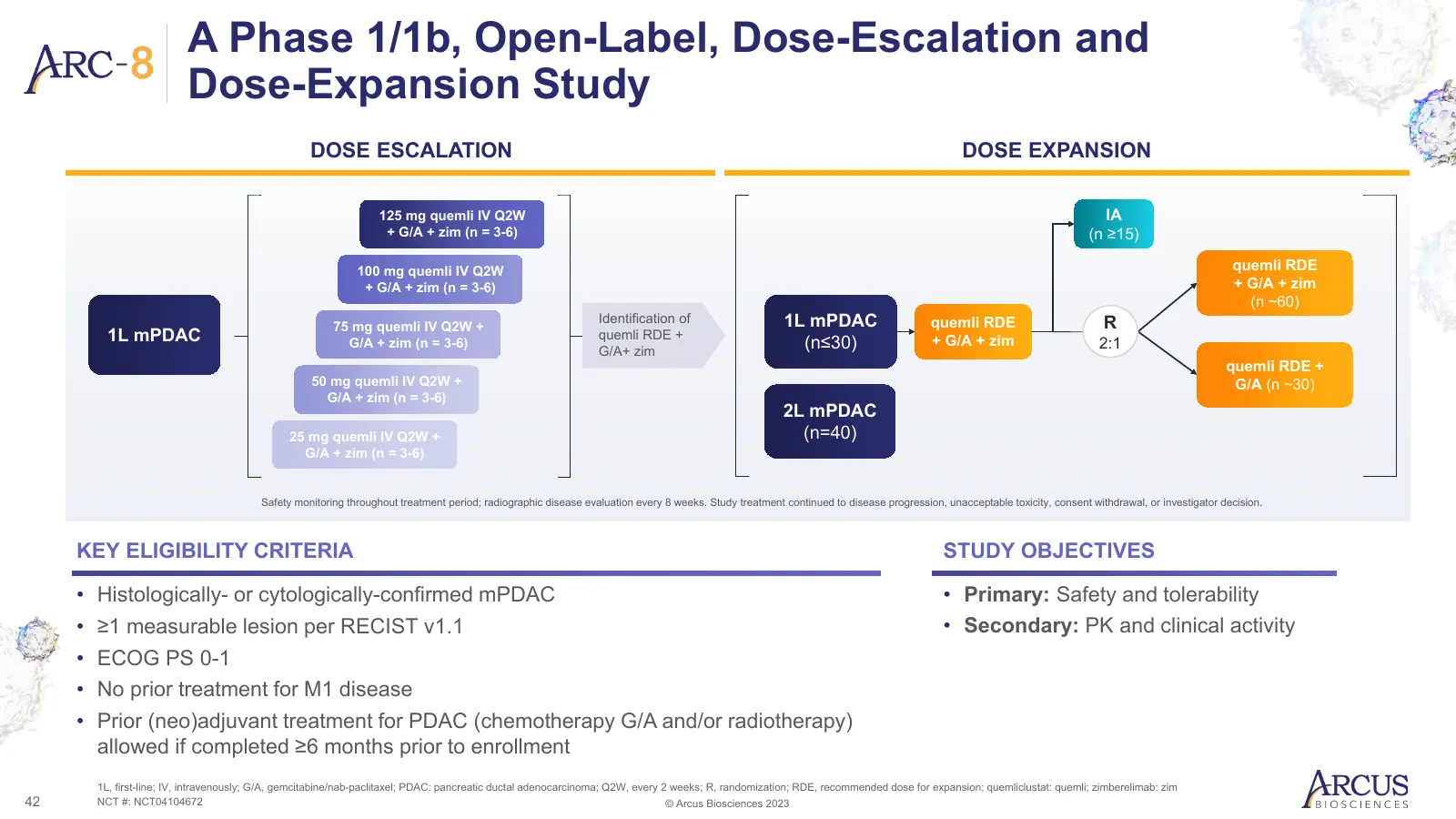
Slide 42: Phase 1/1b Dose-Escalation and Dose-Expansion Study
A Phase 1/1b, Open-Label, Dose-Escalation and Dose-Expansion Study DOSE ESCALATION DOSE EXPANSION 125 mg quemli IV Q2W IA + G/A + zim (n = 3-6) (n ≥15) 100 mg quemli IV Q2W quemli RDE + G/A + zim (n = 3-6) + G/A + zim (n ~60) 75 mg quemli IV Q2W + Identification of 1L mPDAC quemli RDE R 1L mPDAC G/A
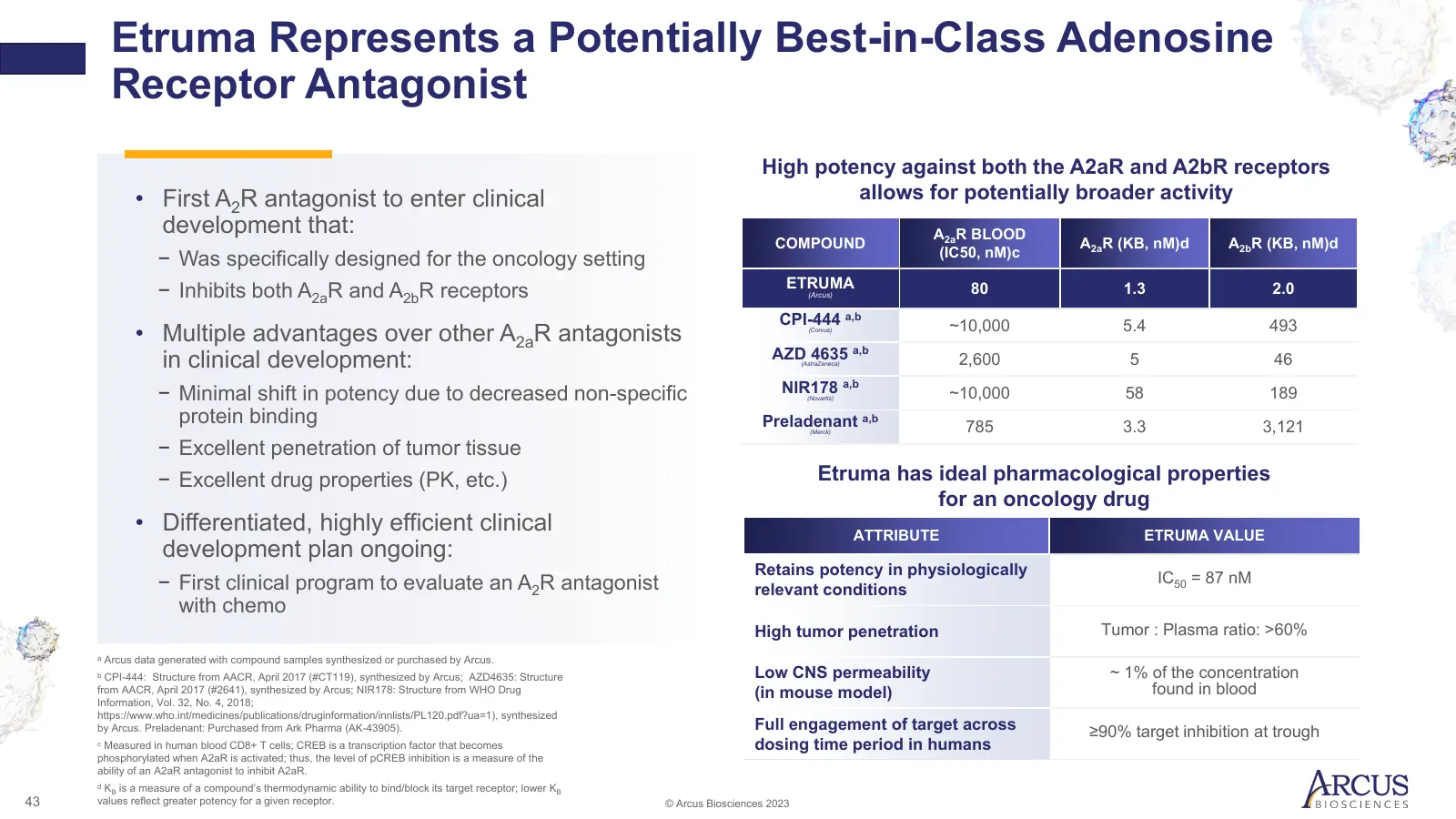
Slide 43: Etruma: Potentially Best-in-Class Adenosine Receptor Antagonist
Etruma Represents a Potentially Best-in-Class Adenosine Receptor Antagonist High potency against both the A2aR and A2bR receptors • First A2R antagonist to enter clinical allows for potentially broader activity development that: A2aR BLOOD COMPOUND A2aR (KB, nM)d A2bR (KB, nM)d (IC50, nM)c − Was spe
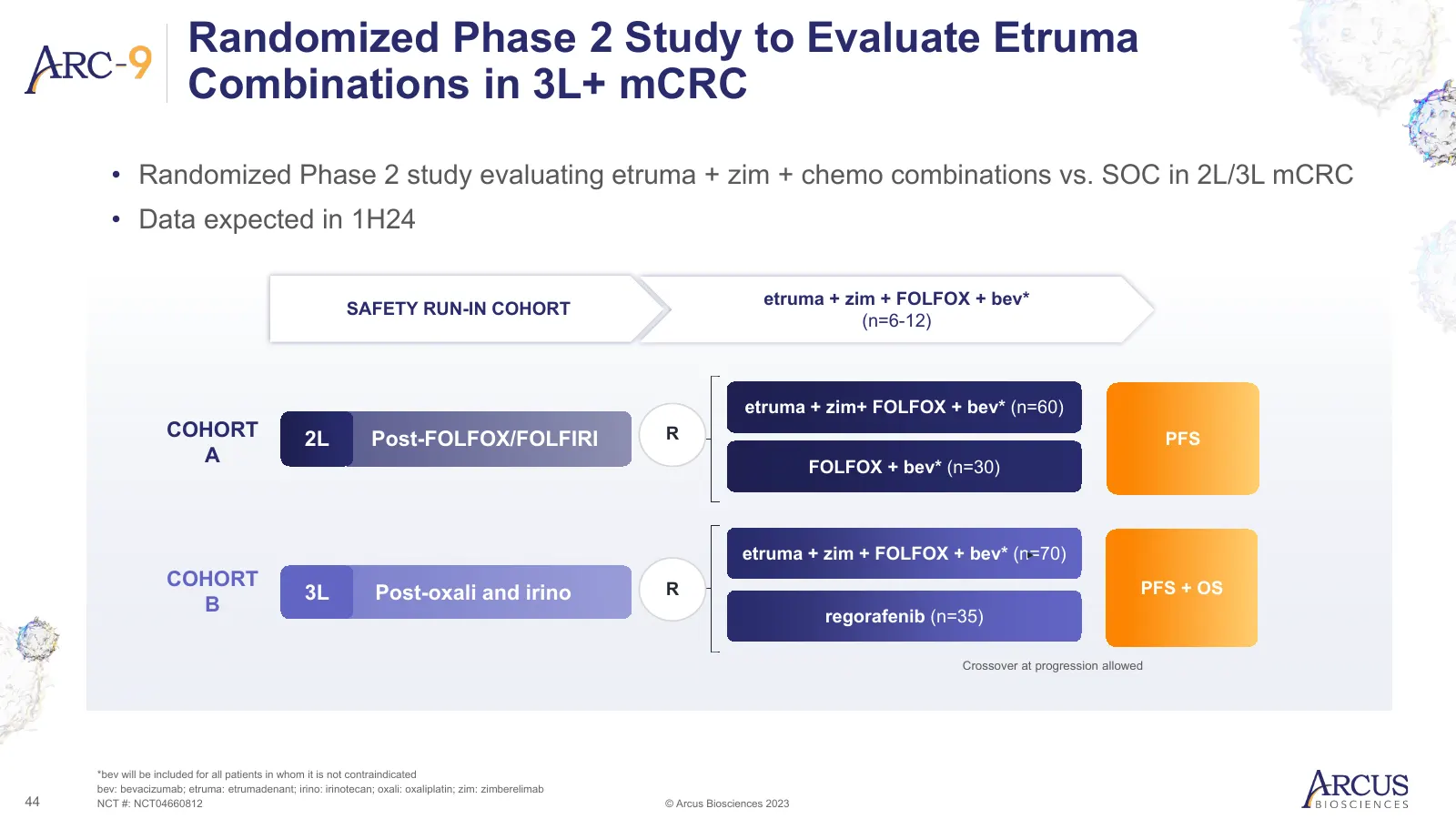
Slide 44: Randomized Phase 2 Study of Etruma Combinations in 3L+ mCRC
Randomized Phase 2 Study to Evaluate Etruma Combinations in 3L+ mCRC • Randomized Phase 2 study evaluating etruma + zim + chemo combinations vs. SOC in 2L/3L mCRC • Data expected in 1H24 etruma + zim + FOLFOX + bev* SAFETY RUN-IN COHORT (n=6-12) etruma + zim+ FOLFOX + bev* (n=60) COHORT 2L Post-FOLF

Slide 45: HIF-2α Program
HIF-2α Program 45 © Arcus Biosciences 2023
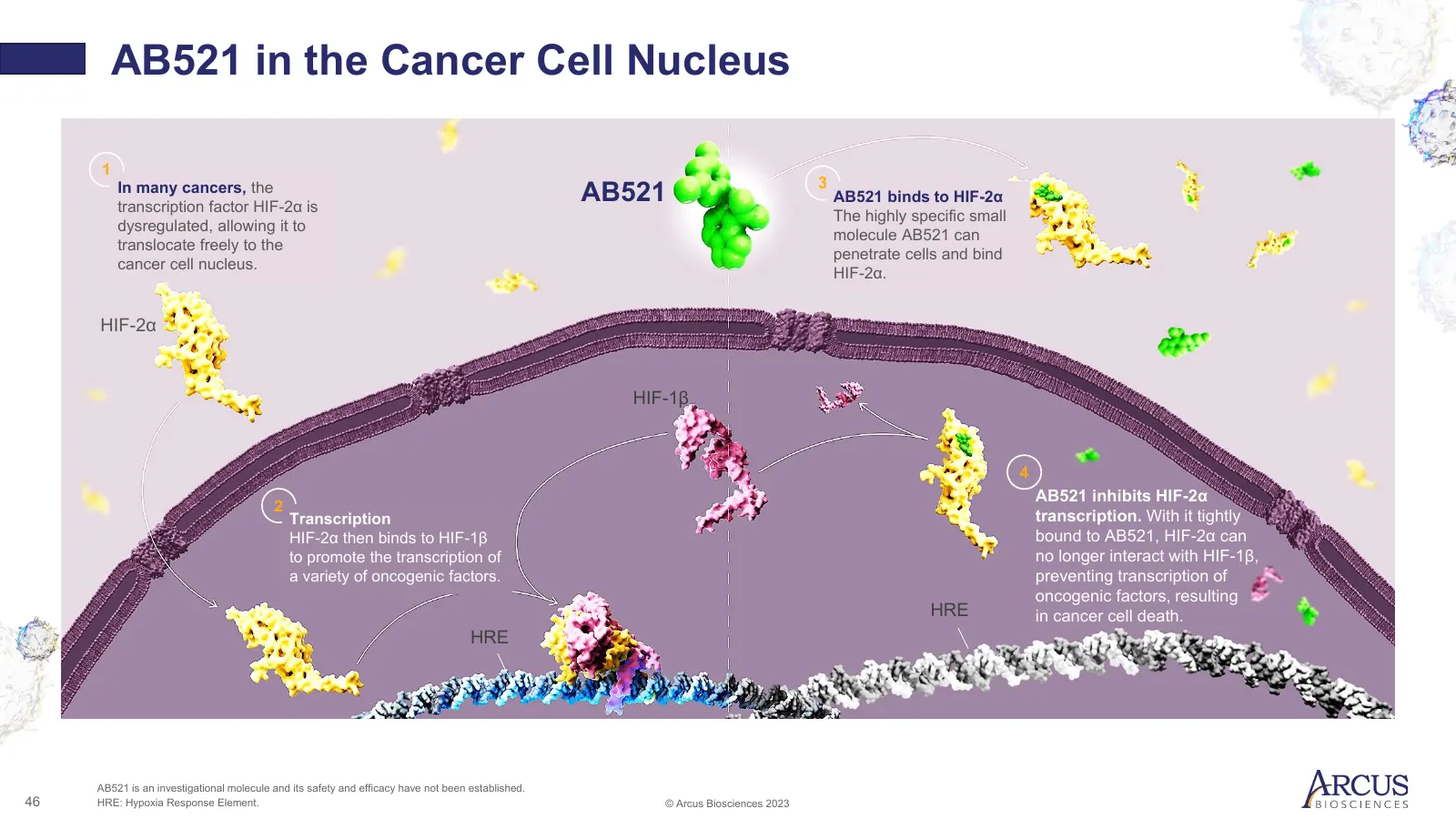
Slide 46: AB521 in the Cancer Cell Nucleus
AB521 in the Cancer Cell Nucleus 1 3 In many cancers, the transcription factor HIF-2α is AB521 AB521 binds to HIF-2α The highly specific small dysregulated, allowing it to molecule AB521 can translocate freely to the penetrate cells and bind cancer cell nucleus. HIF-2α. HIF-2α HIF-1β 4 AB521 inhibit
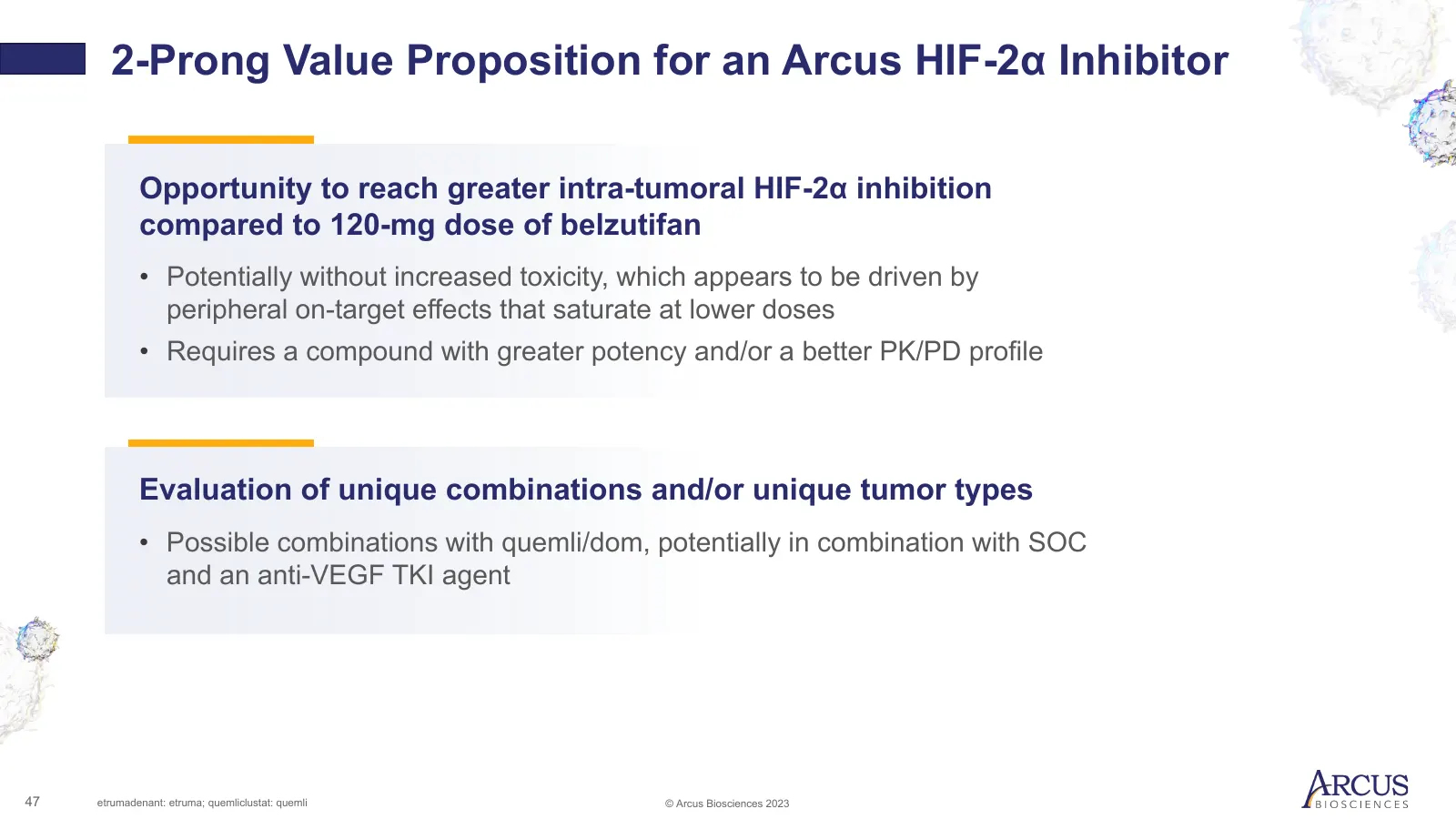
Slide 47: 2-Prong Value Proposition for an Arcus HIF-2α Inhibitor
2-Prong Value Proposition for an Arcus HIF-2α Inhibitor Opportunity to reach greater intra-tumoral HIF-2α inhibition compared to 120-mg dose of belzutifan • Potentially without increased toxicity, which appears to be driven by peripheral on-target effects that saturate at lower doses • Requires a co
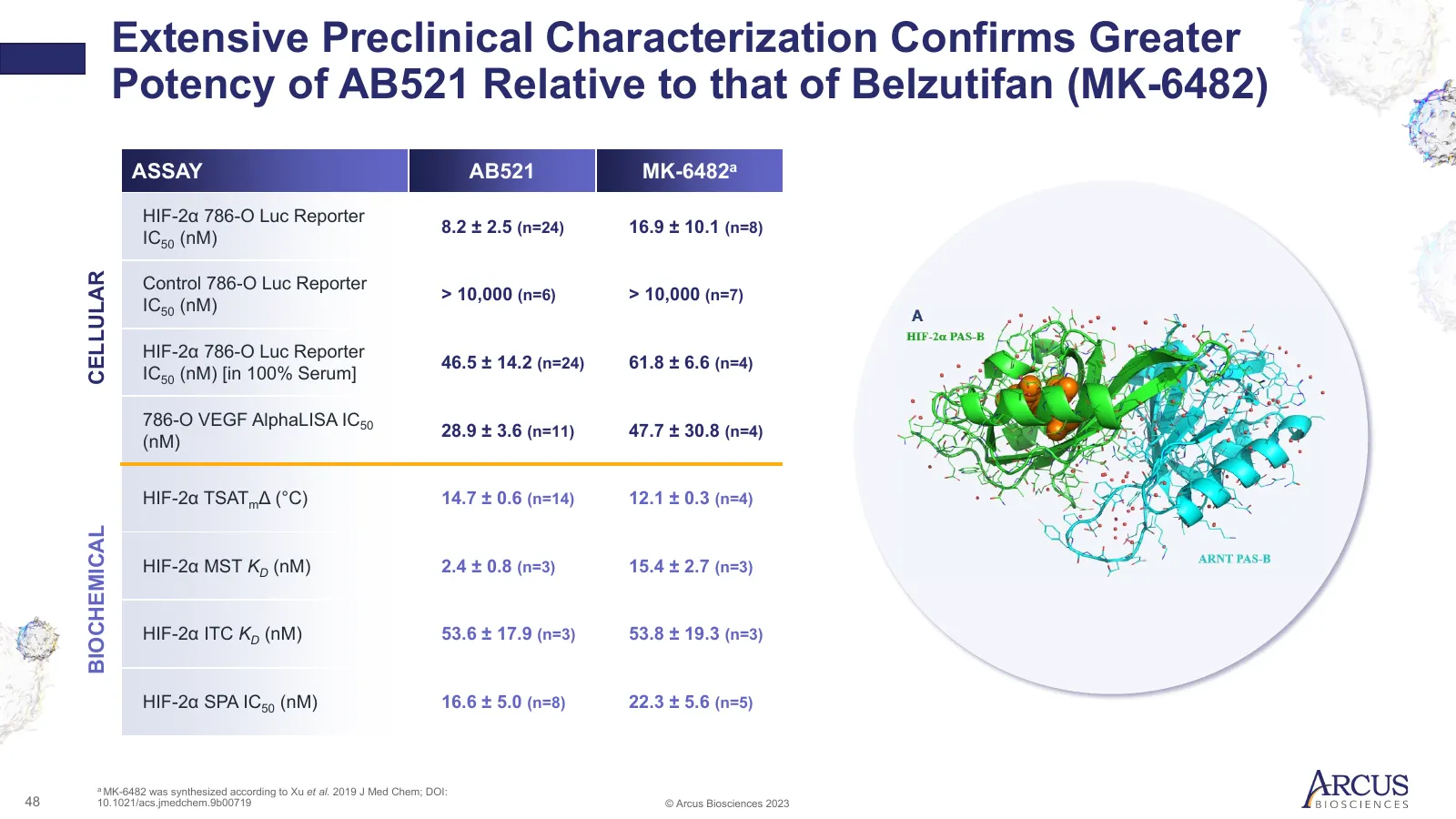
Slide 48: Preclinical Characterization Confirms Greater Potency of AB521 vs Belzutifan
Extensive Preclinical Characterization Confirms Greater Potency of AB521 Relative to that of Belzutifan (MK-6482) ASSAY AB521 MK-6482a HIF-2α 786-O Luc Reporter 8.2 ± 2.5 (n=24) 16.9 ± 10.1 (n=8) IC50 (nM) CELLULAR Control 786-O Luc Reporter > 10,000 (n=6) > 10,000 (n=7) IC50 (nM) HIF-2α 786-O Luc R
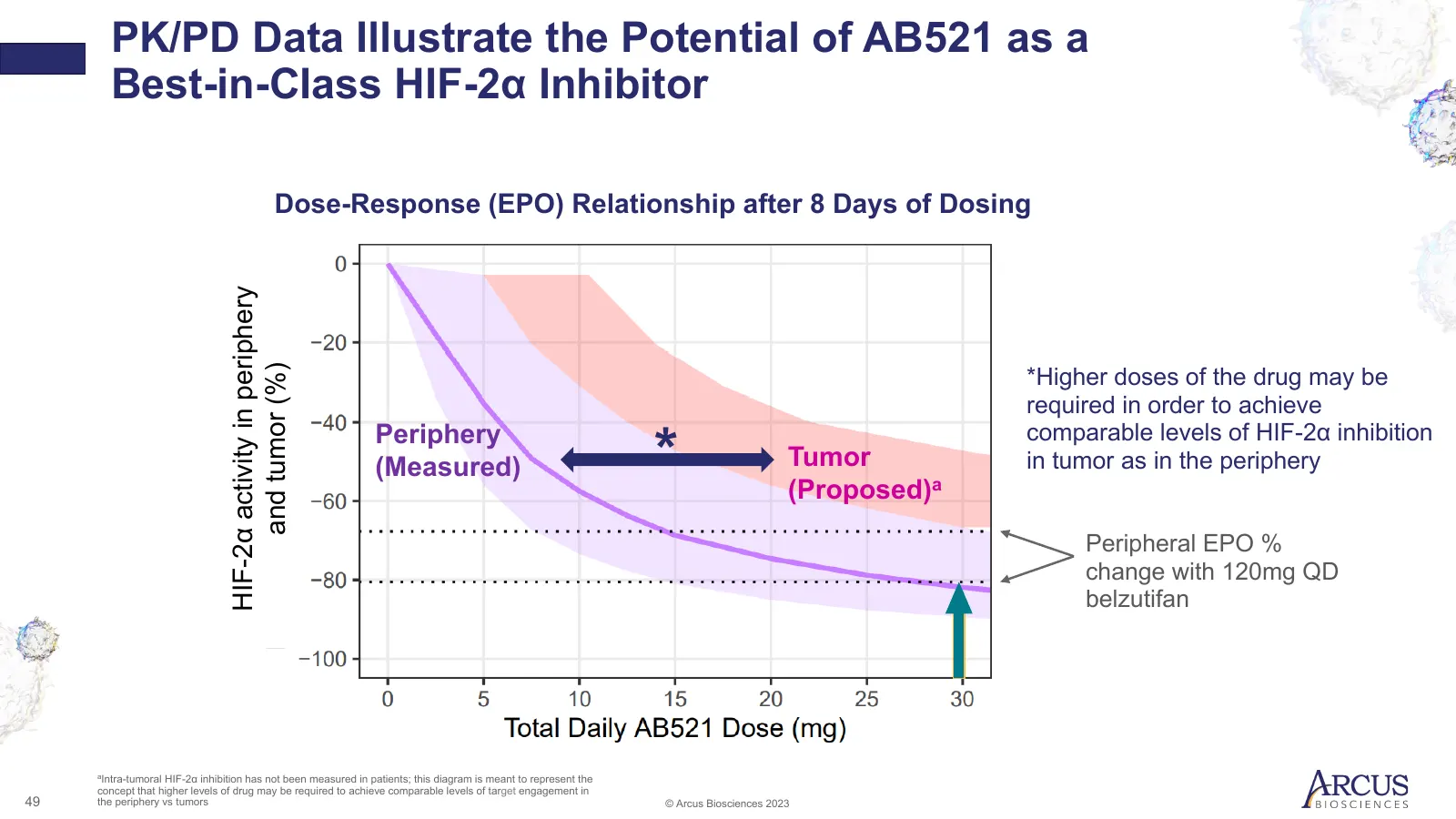
Slide 49: PK/PD Data Illustrate Potential of AB521
PK/PD Data Illustrate the Potential of AB521 as a Best-in-CIass HIF-2α Inhibitor Dose-Response (EPO) Relationship after 8 Days of Dosing HIF-2α activity in periphery *Higher doses of the drug may be and tumor (%) required in order to achieve Periphery * comparable levels of HIF-2α inhibition (Measur
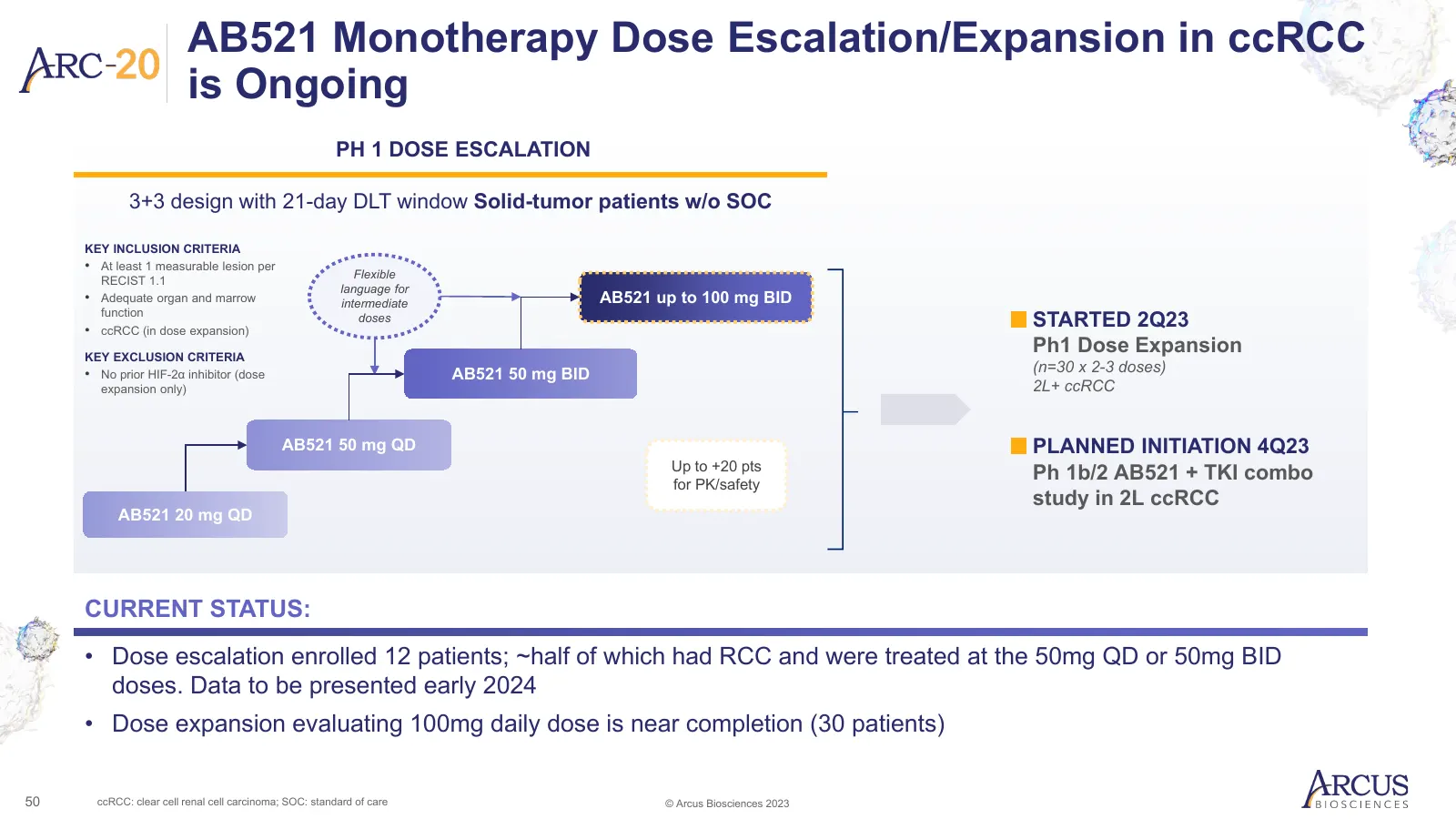
Slide 50: AB521 Monotherapy Dose Escalation/Expansion in ccRCC
AB521 Monotherapy Dose Escalation/Expansion in ccRCC is Ongoing PH 1 DOSE ESCALATION 3+3 design with 21-day DLT window Solid-tumor patients w/o SOC KEY INCLUSION CRITERIA • At least 1 measurable lesion per Flexible RECIST 1.1 language for • Adequate organ and marrow intermediate AB521 up to 100 mg B

Slide 51: Early Programs
Early Programs 51 © Arcus Biosciences 2023
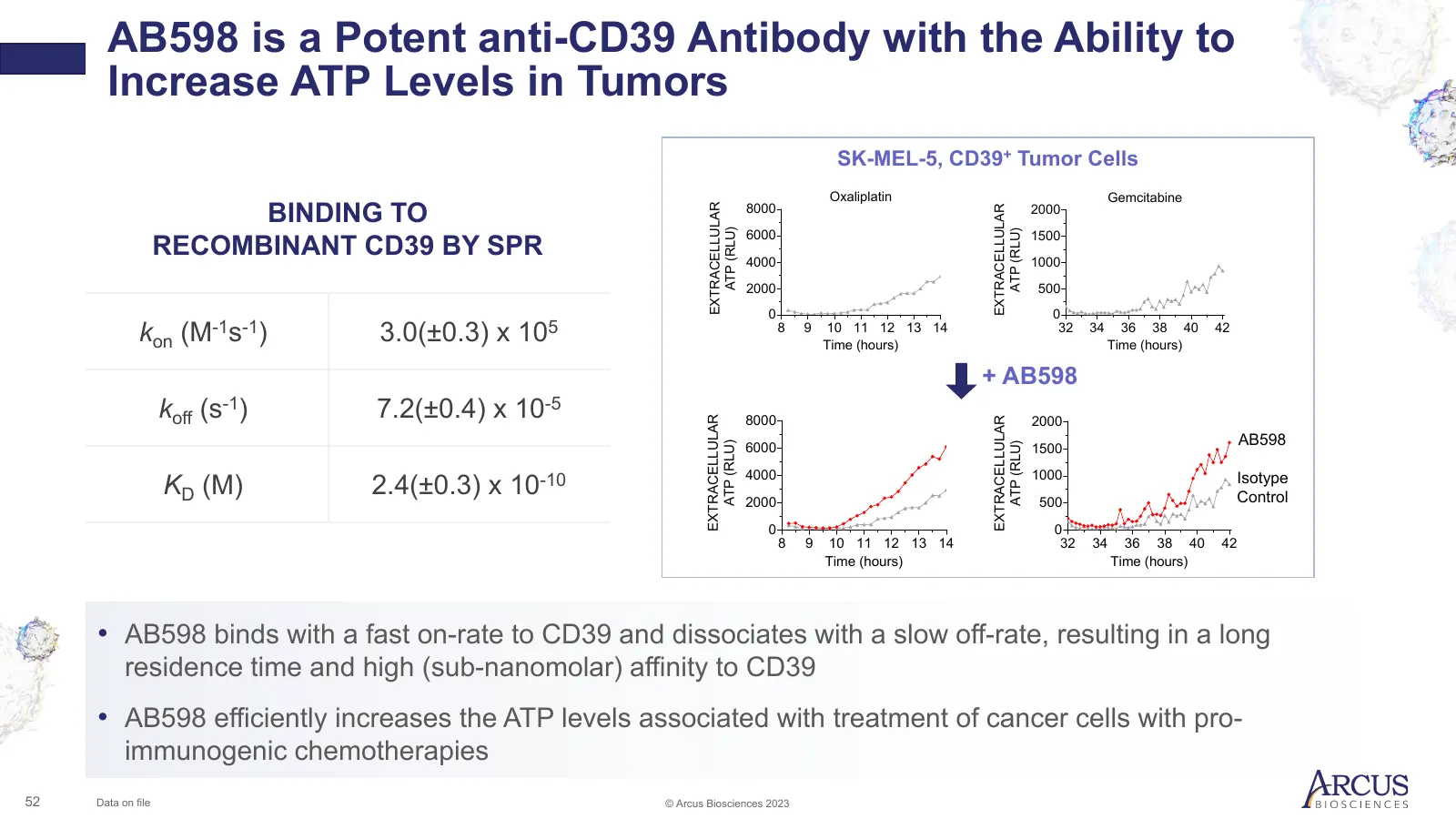
Slide 52: AB598 Potent anti-CD39 Antibody Increases ATP Levels
AB598 is a Potent anti-CD39 Antibody with the Ability to Increase ATP Levels in Tumors SK-MEL-5, CD39+ Tumor Cells Oxaliplatin Gemcitabine BINDING TO 8000 2000 EXTRACELLULAR EXTRACELLULAR RECOMBINANT CD39 BY SPR 6000 1500 ATP (RLU) ATP (RLU) 4000 1000 2000 500 0 0 kon (M-1s-1) 3.0(±0.3) x 105 8 9 10
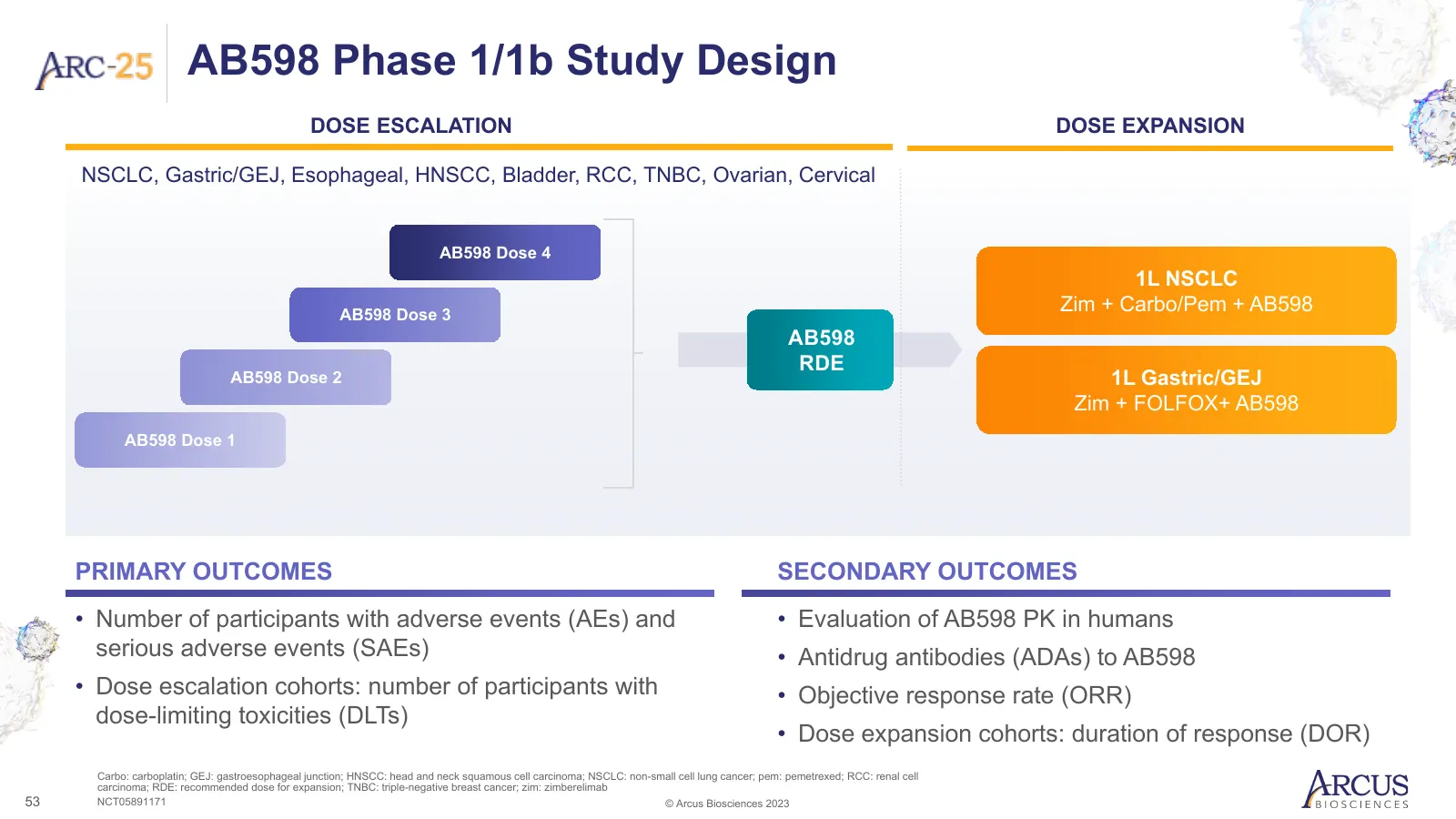
Slide 53: AB598 Phase 1/1b Study Design
AB598 Phase 1/1b Study Design DOSE ESCALATION DOSE EXPANSION NSCLC, Gastric/GEJ, Esophageal, HNSCC, Bladder, RCC, TNBC, Ovarian, Cervical AB598 Dose 4 1L NSCLC AB598 Dose 3 Zim + Carbo/Pem + AB598 AB598 RDE AB598 Dose 2 1L Gastric/GEJ Zim + FOLFOX+ AB598 AB598 Dose 1 PRIMARY OUTCOMES SECONDARY OUTCO
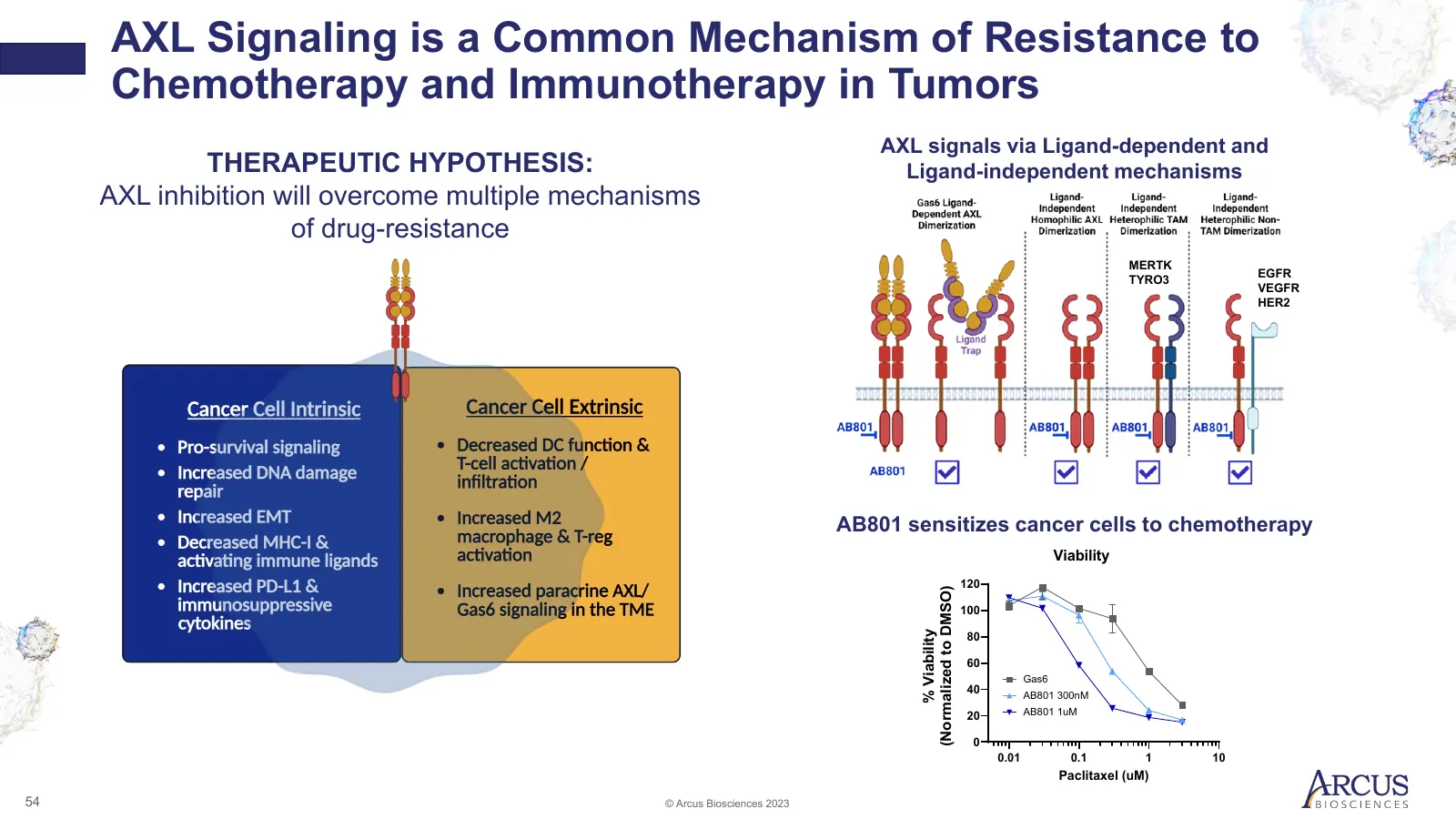
Slide 54: AXL Signaling is a Common Mechanism of Resistance
AXL Signaling is a Common Mechanism of Resistance to Chemotherapy and Immunotherapy in Tumors AXL signals via Ligand-dependent and THERAPEUTIC HYPOTHESIS: Ligand-independent mechanisms AXL inhibition will overcome multiple mechanisms of drug-resistance MERTK EGFR TYRO3 VEGFR HER2 AB801 sensitizes ca
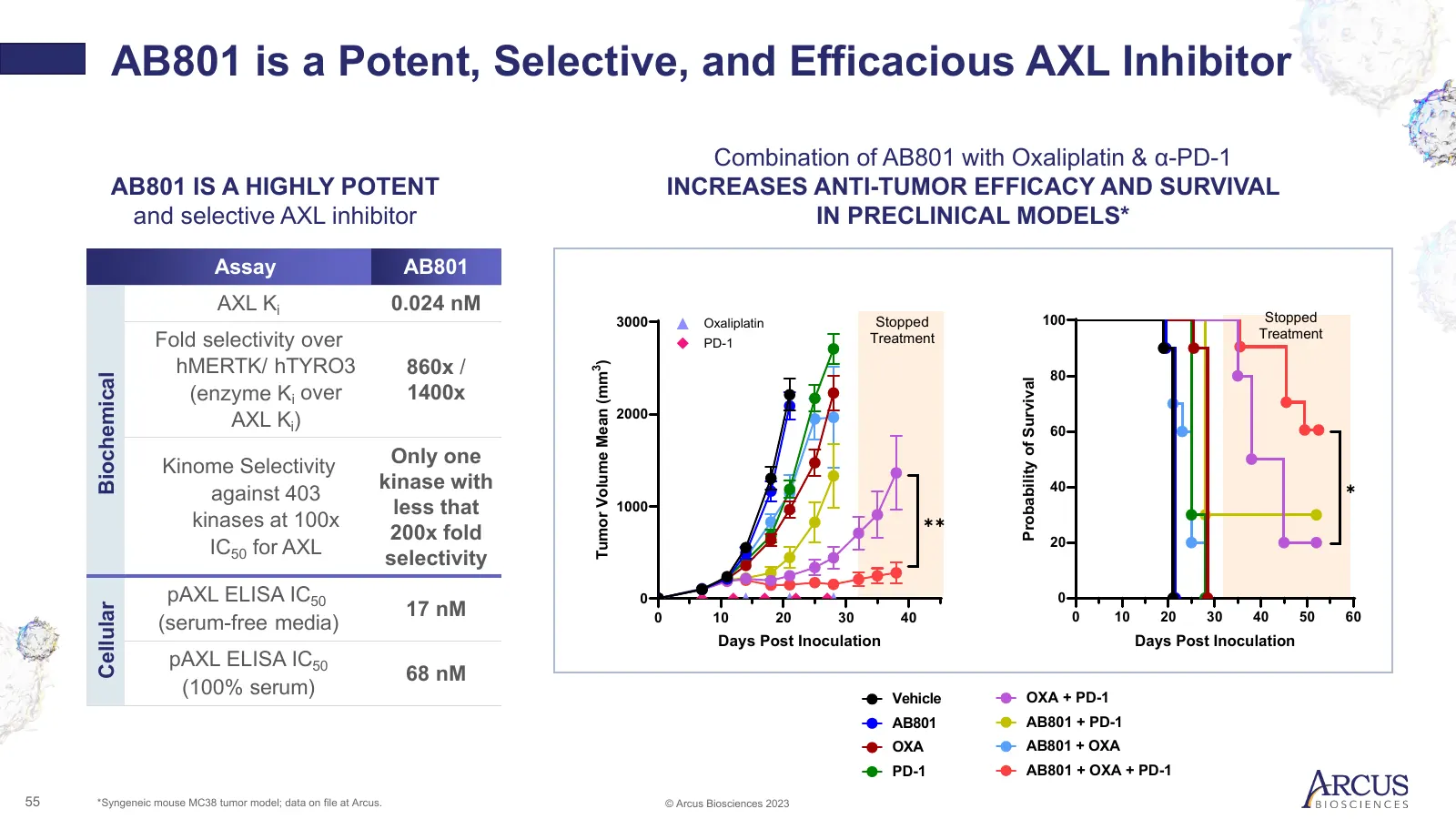
Slide 55: AB801 is a Potent, Selective, Efficacious AXL Inhibitor
AB801 is a Potent, Selective, and Efficacious AXL Inhibitor Combination of AB801 with Oxaliplatin & α-PD-1 AB801 IS A HIGHLY POTENT INCREASES ANTI-TUMOR EFFICACY AND SURVIVAL and selective AXL inhibitor IN PRECLINICAL MODELS* Assay AB801 AXL Ki 0.024 nM 3000 Oxaliplatin Stopped 100 Stopped Treatment
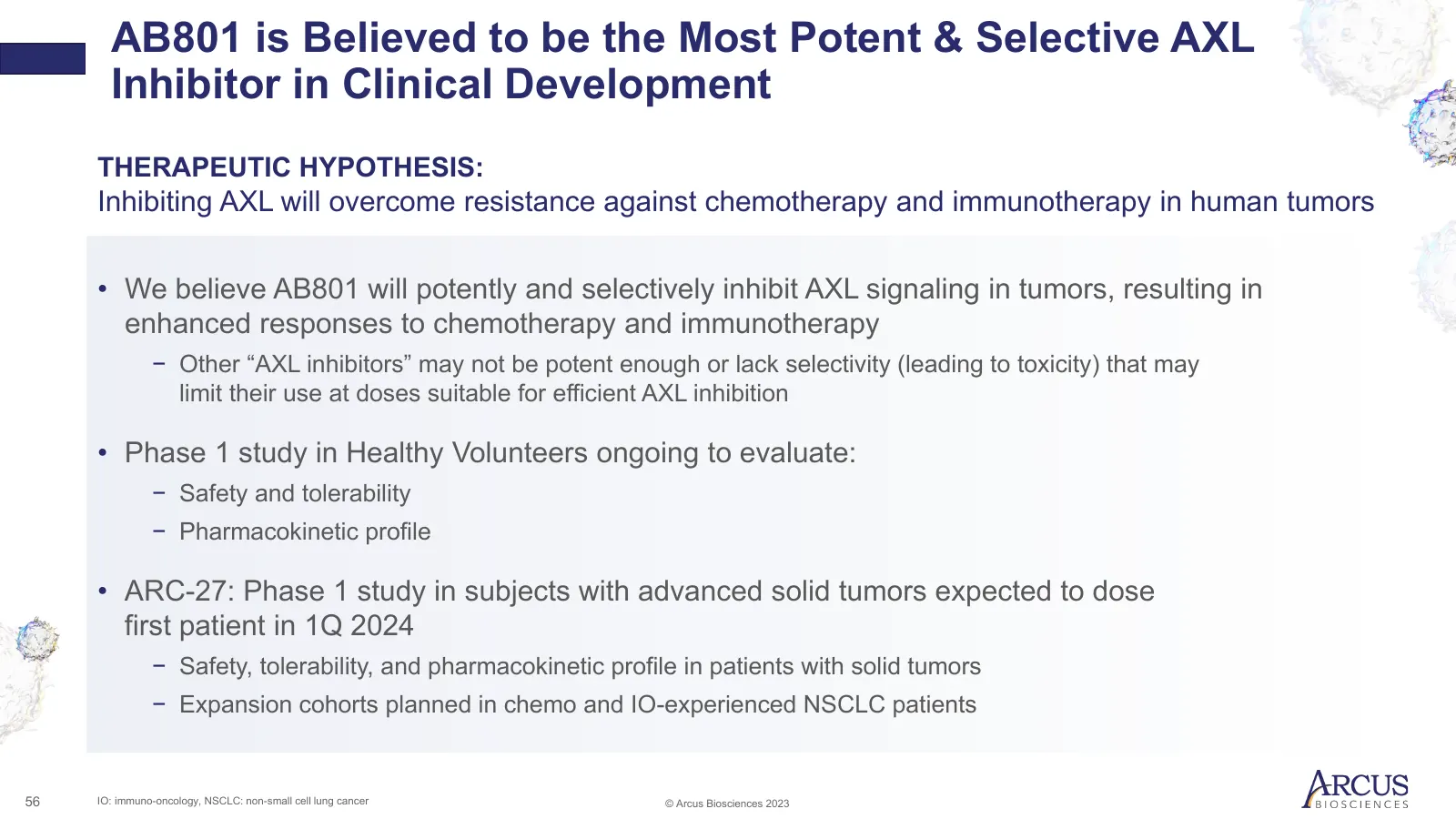
Slide 56: AB801 Believed Most Potent & Selective AXL Inhibitor in Clinic
AB801 is Believed to be the Most Potent & Selective AXL Inhibitor in Clinical Development THERAPEUTIC HYPOTHESIS: Inhibiting AXL will overcome resistance against chemotherapy and immunotherapy in human tumors • We believe AB801 will potently and selectively inhibit AXL signaling in tumors, resulting
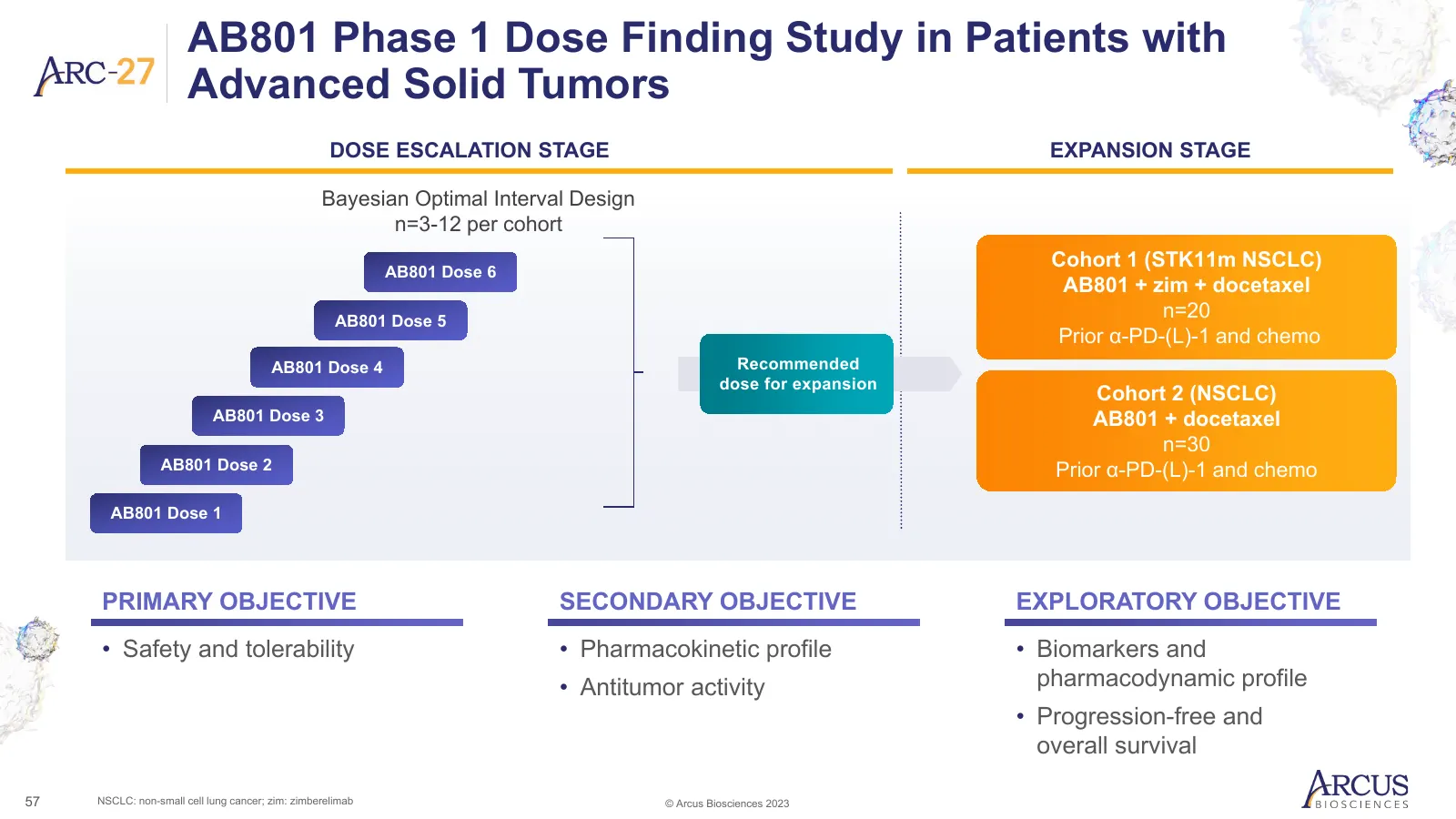
Slide 57: AB801 Phase 1 Dose Finding Study
AB801 Phase 1 Dose Finding Study in Patients with Advanced Solid Tumors DOSE ESCALATION STAGE EXPANSION STAGE Bayesian Optimal Interval Design n=3-12 per cohort Cohort 1 (STK11m NSCLC) AB801 Dose 6 AB801 + zim + docetaxel AB801 Dose 5 n=20 Prior α-PD-(L)-1 and chemo AB801 Dose 4 Recommended dose for

Slide 58: Appendix
APPENDIX 58 © Arcus Biosciences 2023
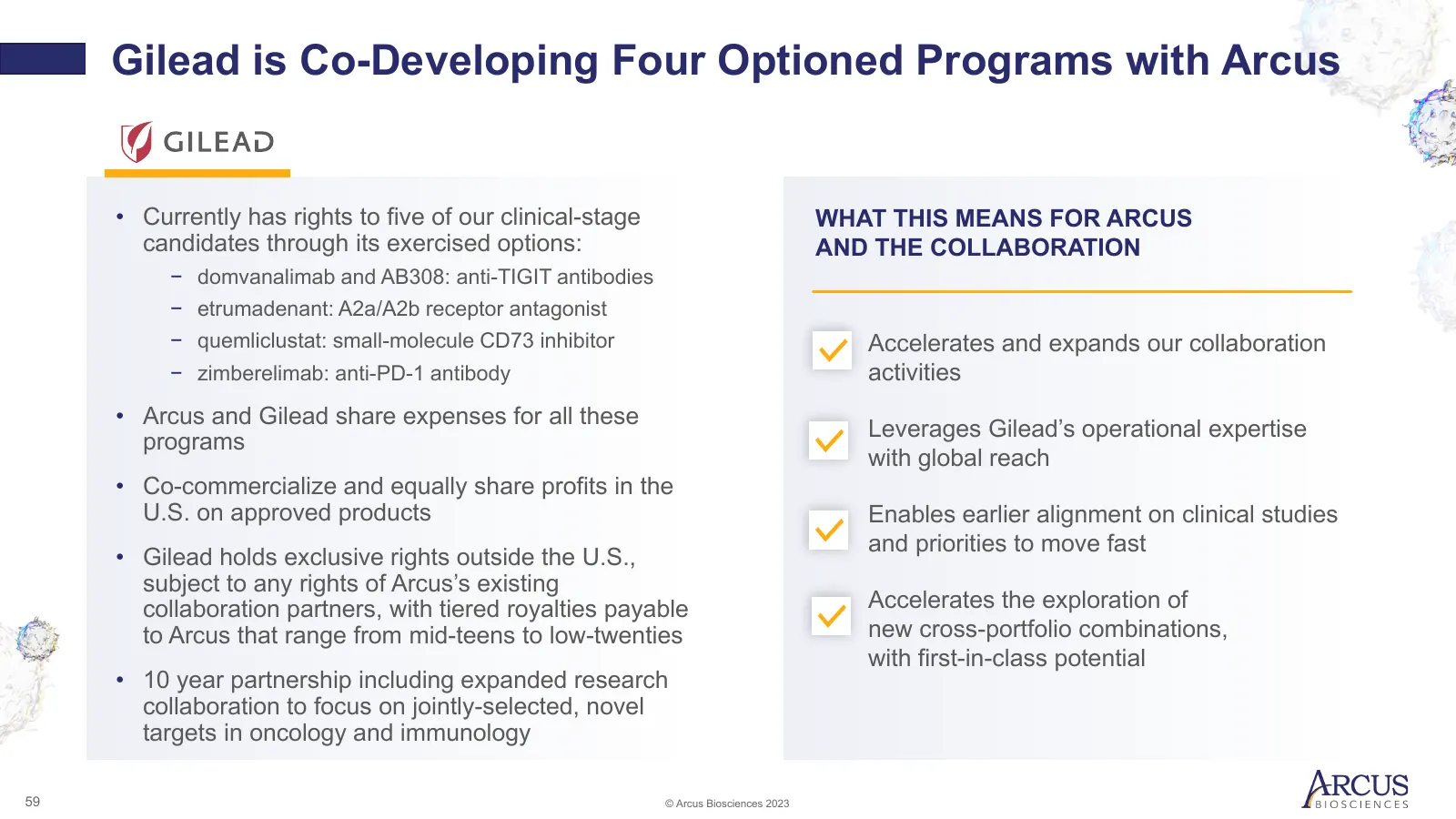
Slide 59: Gilead is Co-Developing Four Optioned Programs with Arcus
Gilead is Co-Developing Four Optioned Programs with Arcus • Currently has rights to five of our clinical-stage WHAT THIS MEANS FOR ARCUS candidates through its exercised options: AND THE COLLABORATION − domvanalimab and AB308: anti-TIGIT antibodies − etrumadenant: A2a/A2b receptor antagonist − queml
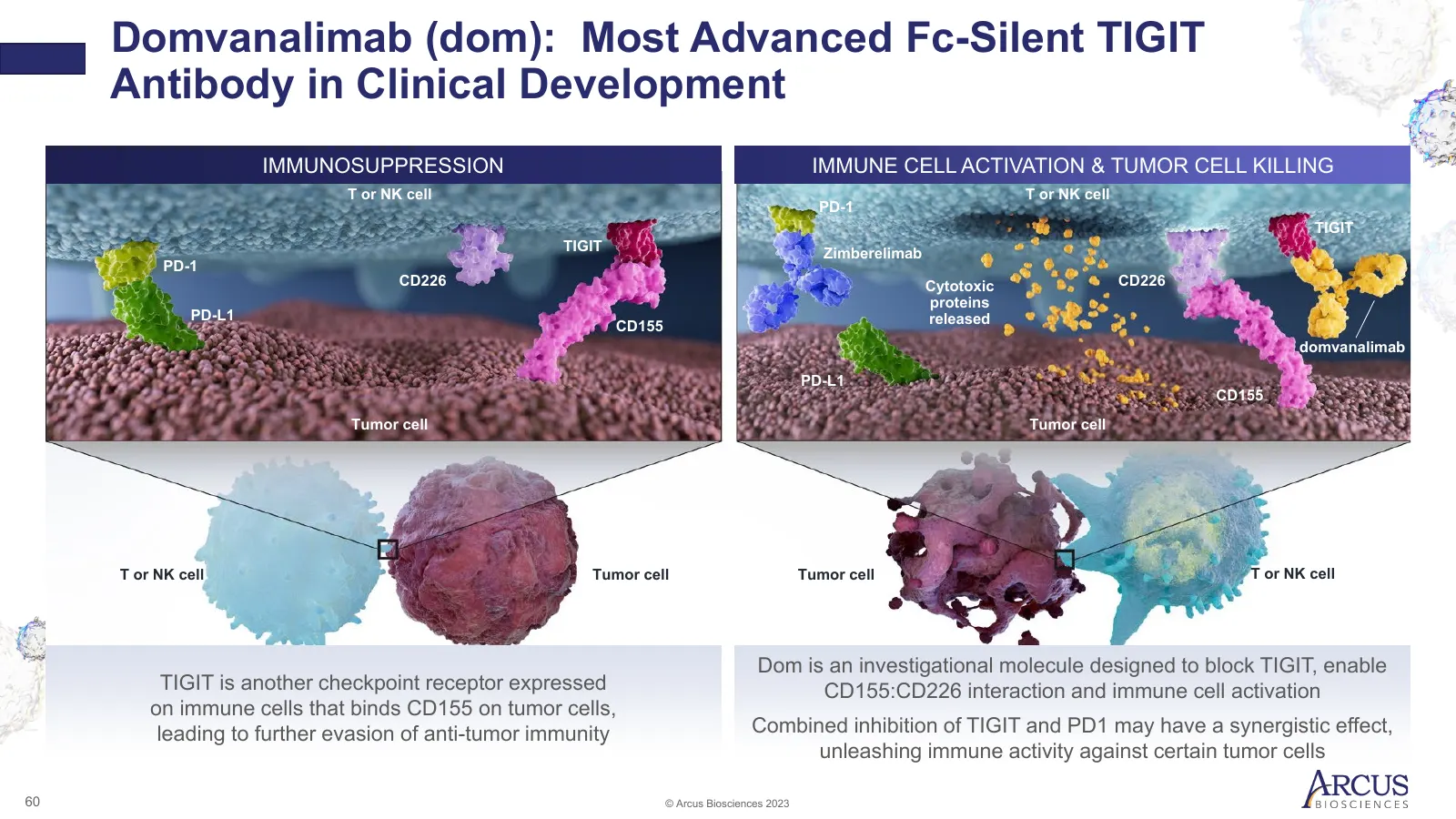
Slide 60: Domvanalimab: Most Advanced Fc-Silent TIGIT Antibody
Domvanalimab (dom): Most Advanced Fc-Silent TIGIT Antibody in Clinical Development IMMUNOSUPPRESSION IMMUNE CELL ACTIVATION & TUMOR CELL KILLING T or NK cell T or NK cell PD-1 TIGIT TIGIT Zimberelimab PD-1 CD226 Cytotoxic CD226 proteins PD-L1 released CD155 domvanalimab PD-L1 CD155 Tumor cell Tumor
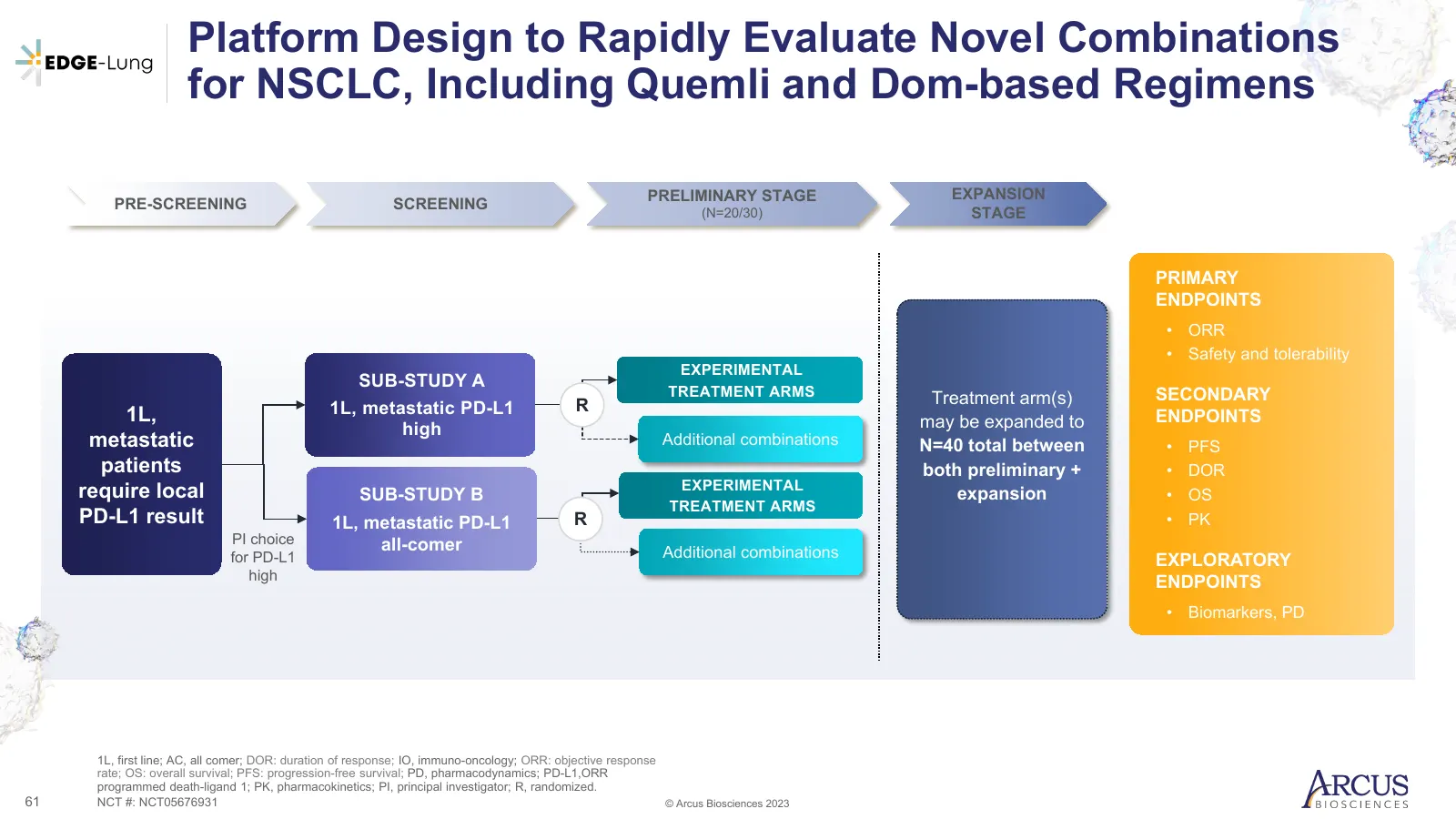
Slide 61: Platform Design to Evaluate Novel NSCLC Combinations
Platform Design to Rapidly Evaluate Novel Combinations for NSCLC, Including Quemli and Dom-based Regimens PRELIMINARY STAGE EXPANSION PRE-SCREENING SCREENING (N=20/30) STAGE PRIMARY ENDPOINTS • ORR • Safety and tolerability EXPERIMENTAL SUB-STUDY A TREATMENT ARMS Treatment arm(s) SECONDARY 1L, metas
Slide 62: Domvanalimab: Advantages as First Fc-Silent TIGIT Program
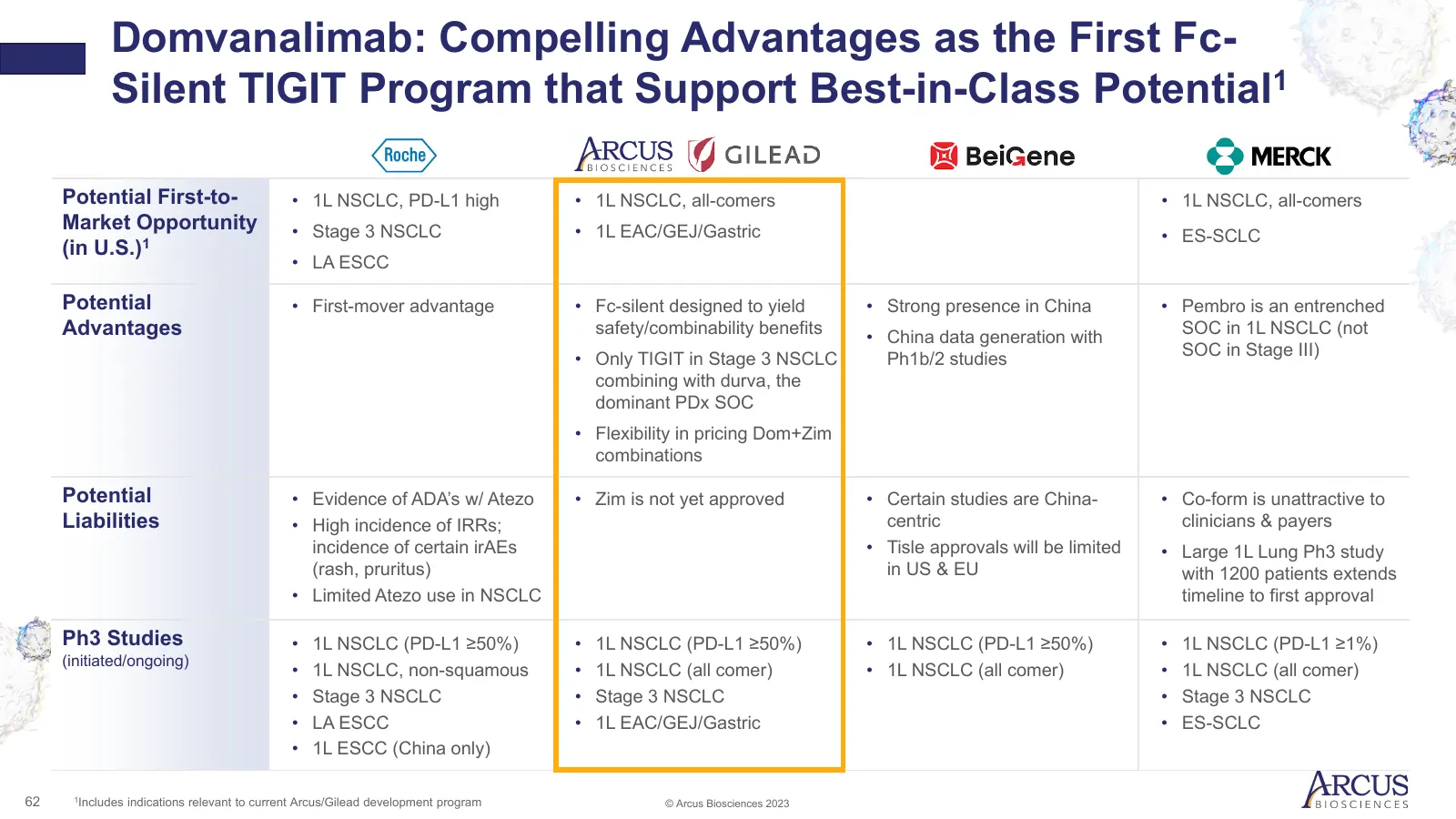
Domvanalimab: Compelling Advantages as the First Fc- Silent TIGIT Program that Support Best-in-Class Potential1 Potential First-to- • 1L NSCLC, PD-L1 high • 1L NSCLC, all-comers • 1L NSCLC, all-comers Market Opportunity • Stage 3 NSCLC • 1L EAC/GEJ/Gastric • ES-SCLC (in U.S.)1 • LA ESCC Potential •
Slide 63: Zimberelimab Activity Consistent with Approved Anti-PD-1 Class
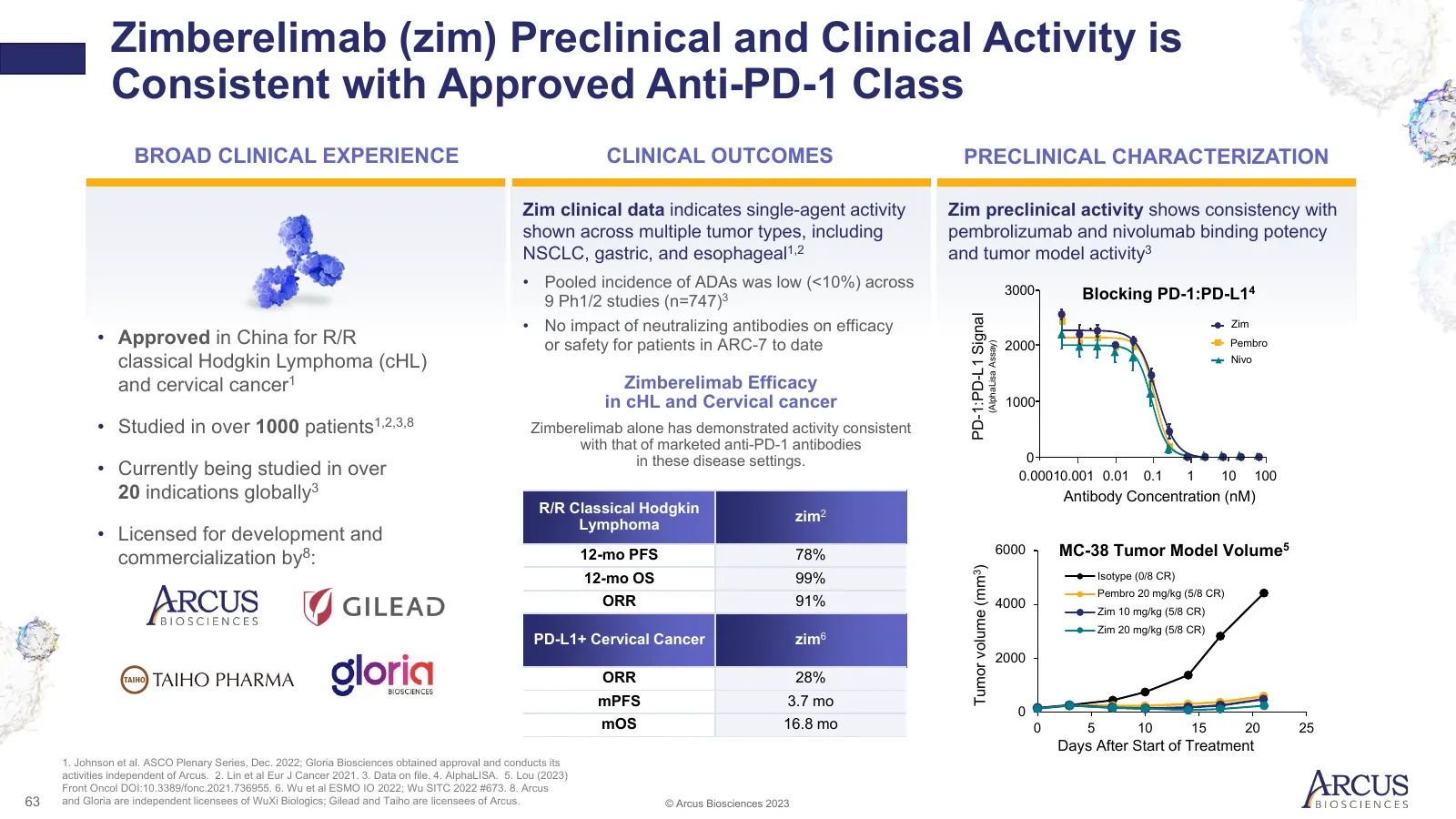
Zimberelimab (zim) Preclinical and Clinical Activity is Consistent with Approved Anti-PD-1 Class BROAD CLINICAL EXPERIENCE CLINICAL OUTCOMES PRECLINICAL CHARACTERIZATION Zim clinical data indicates single-agent activity Zim preclinical activity shows consistency with shown across multiple tumor type
Slide 64: RWD Presented at ESMO IO 2022 for PD-1 Antibodies
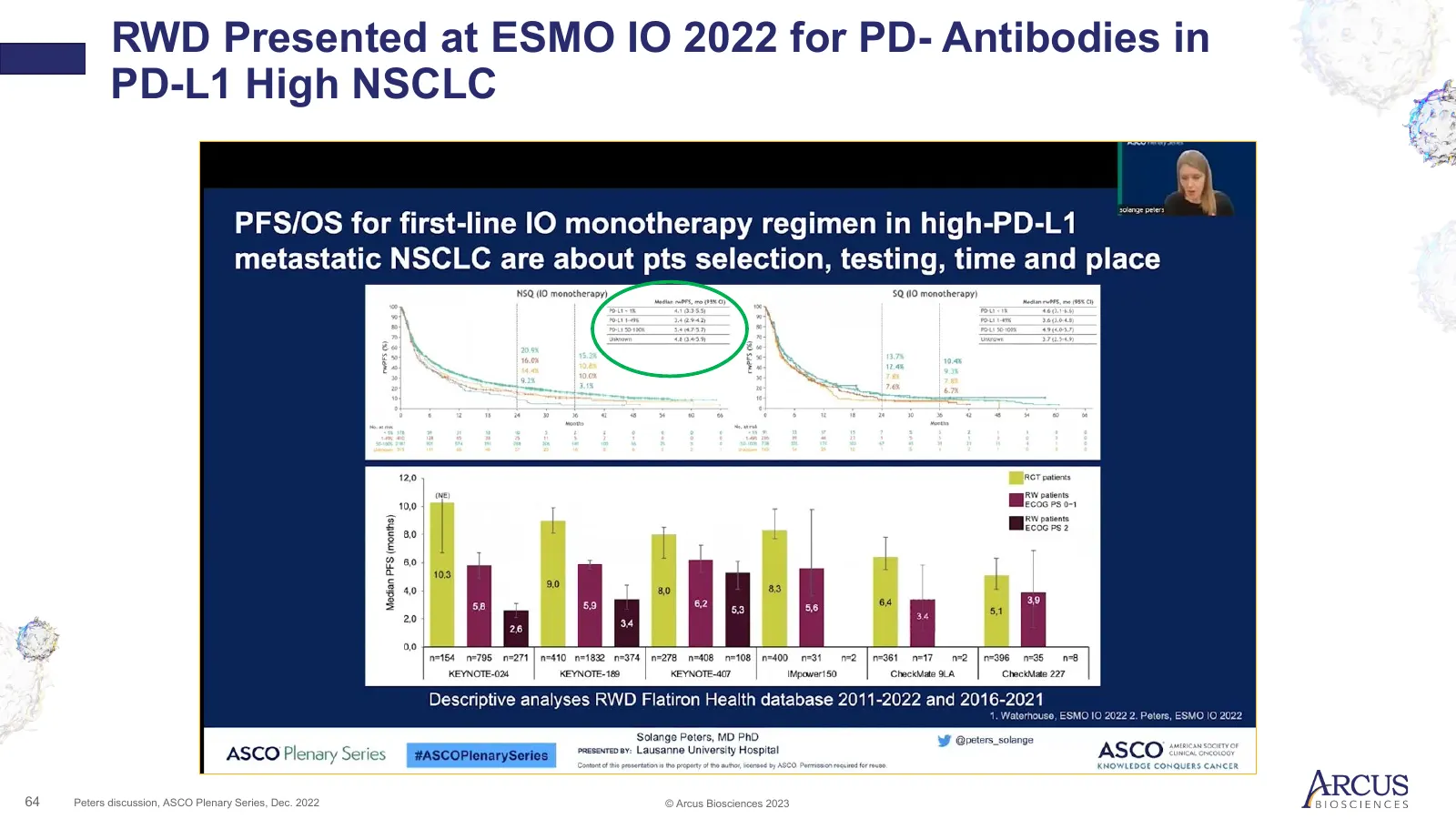
RWD Presented at ESMO IO 2022 for PD- Antibodies in PD-L1 High NSCLC 64 Peters discussion, ASCO Plenary Series, Dec. 2022 © Arcus Biosciences 2023
Slide 65: Progressive Disease as BoR for zim Consistent with Earlier PD-1 Datasets
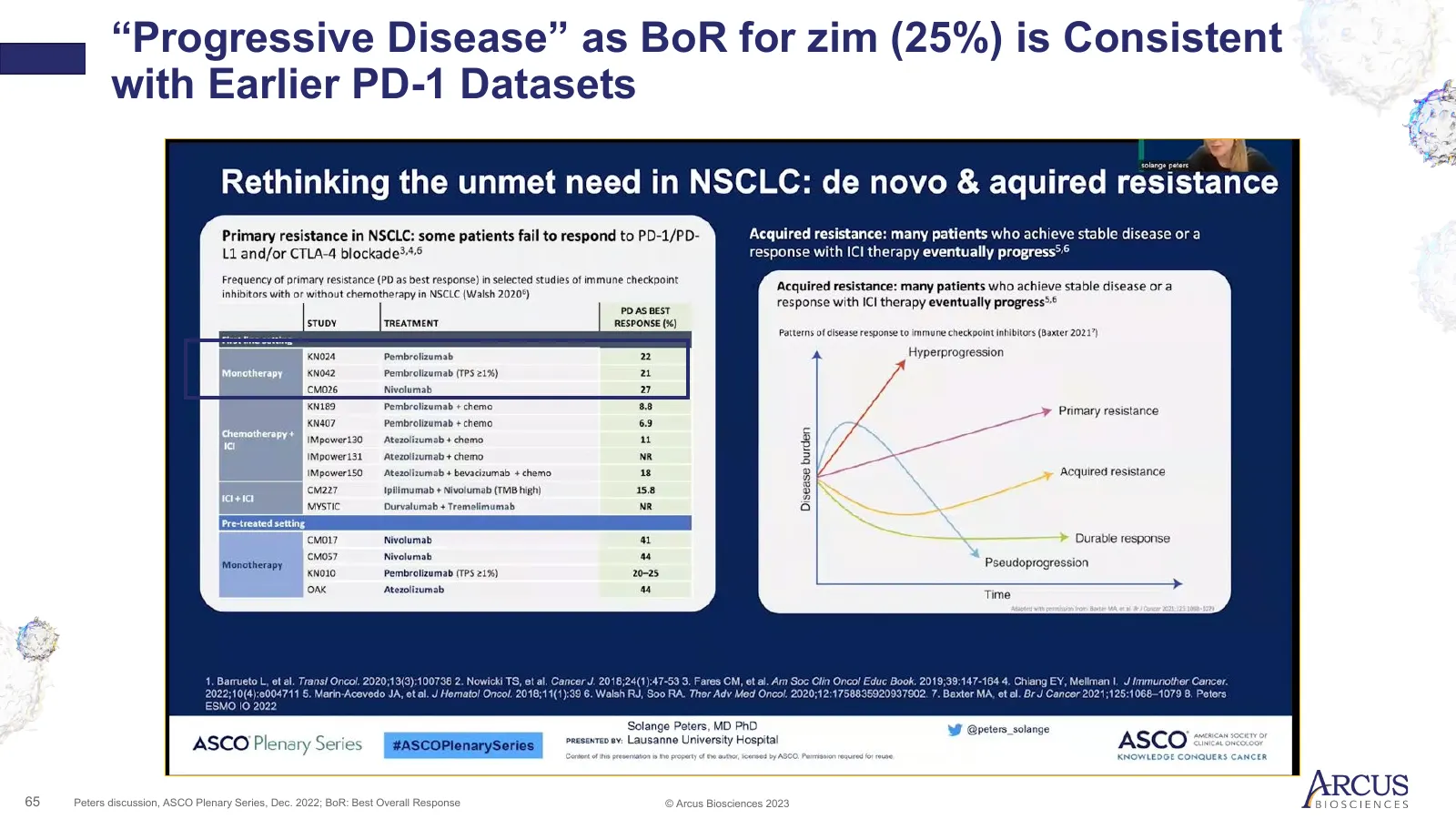
“Progressive Disease” as BoR for zim (25%) is Consistent with Earlier PD-1 Datasets 65 Peters discussion, ASCO Plenary Series, Dec. 2022; BoR: Best Overall Response © Arcus Biosciences 2023
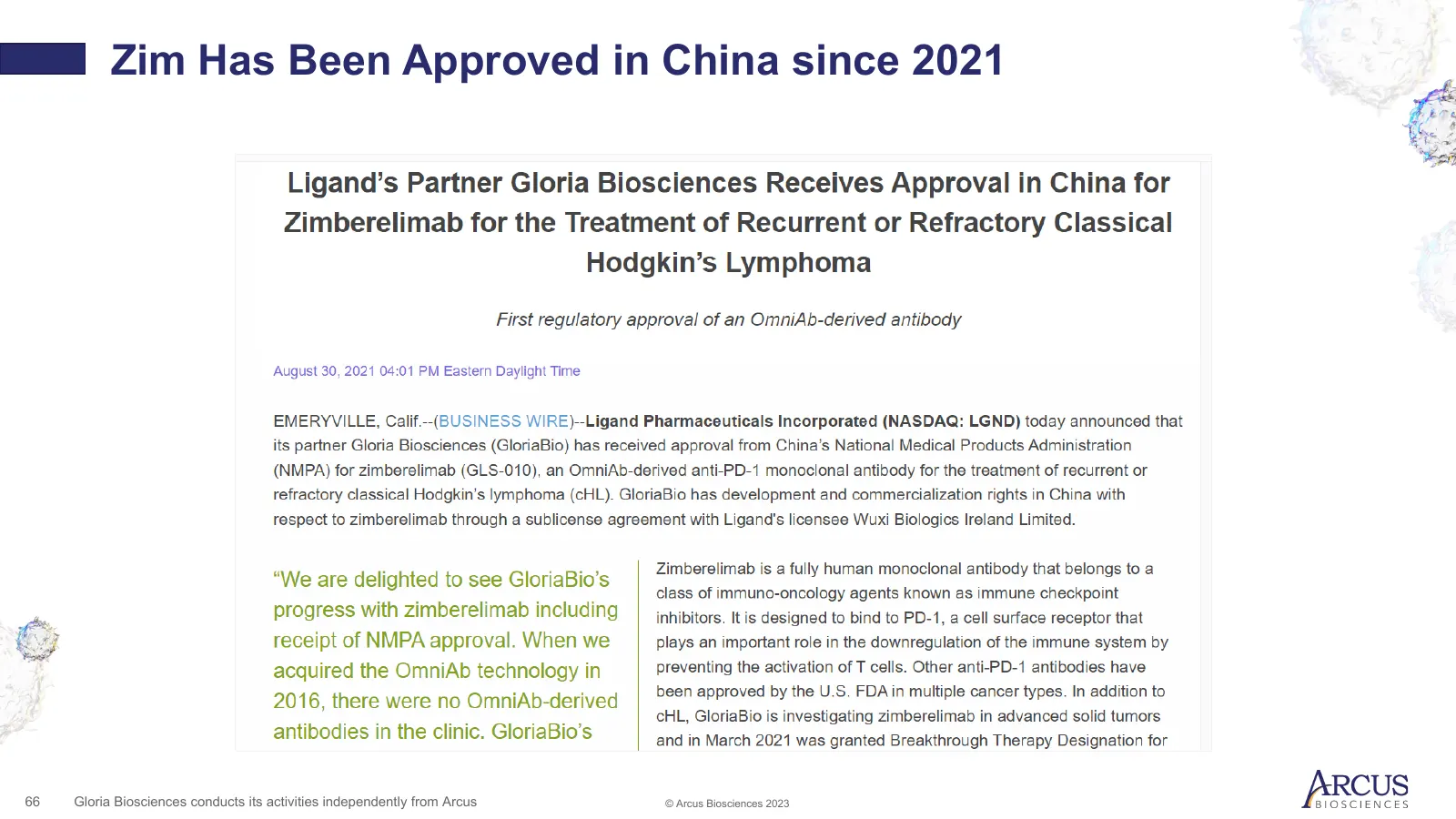
Slide 66: Zim Has Been Approved in China since 2021
Zim Has Been Approved in China since 2021 66 Gloria Biosciences conducts its activities independently from Arcus © Arcus Biosciences 2023
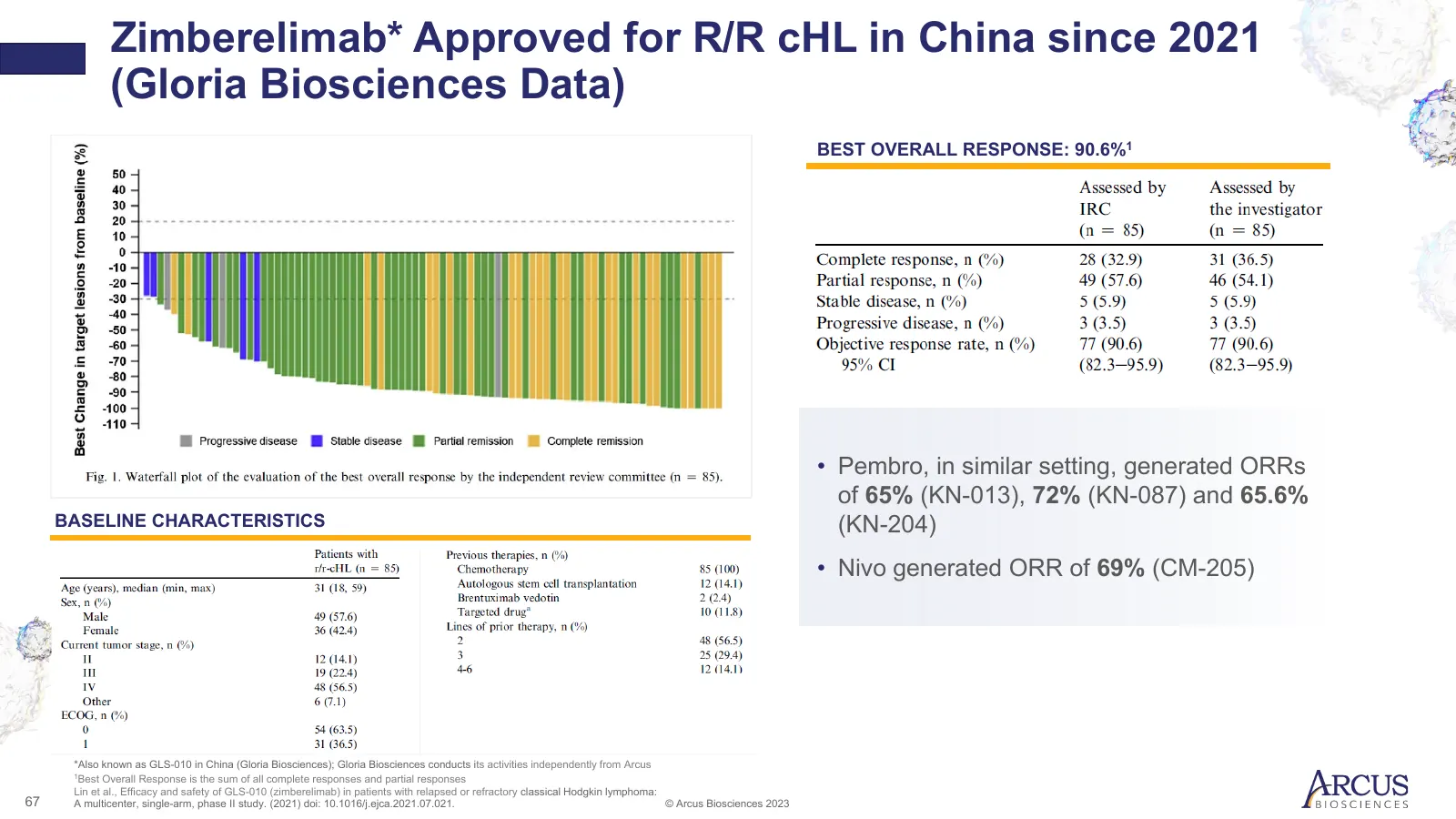
Slide 67: Zimberelimab Approved for R/R cHL in China
Zimberelimab* Approved for R/R cHL in China since 2021 (Gloria Biosciences Data) BEST OVERALL RESPONSE: 90.6%1 • Pembro, in similar setting, generated ORRs of 65% (KN-013), 72% (KN-087) and 65.6% BASELINE CHARACTERISTICS (KN-204) • Nivo generated ORR of 69% (CM-205) *Also known as GLS-010 in China (
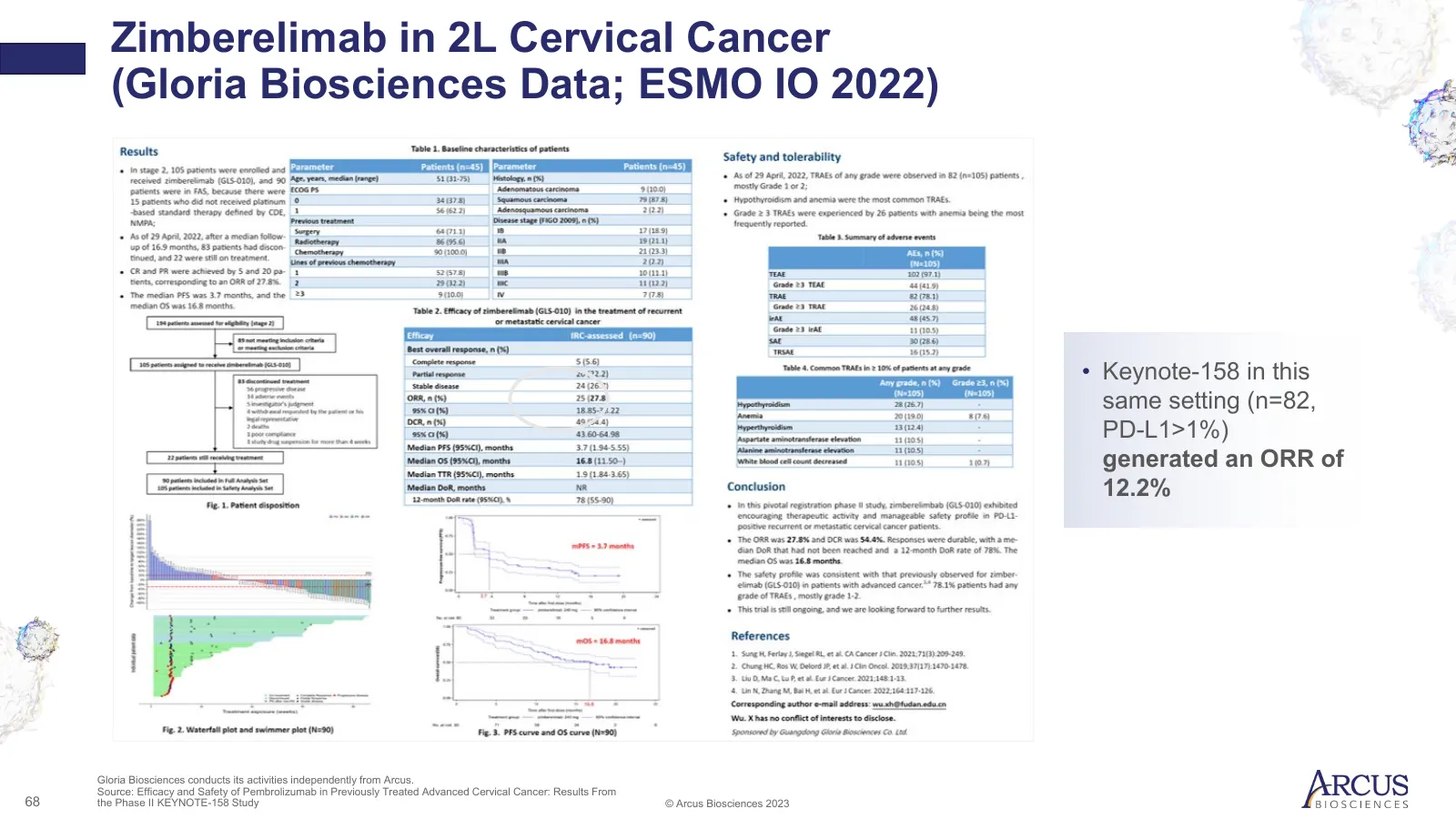
Slide 68: Zimberelimab in 2L Cervical Cancer
Zimberelimab in 2L Cervical Cancer (Gloria Biosciences Data; ESMO IO 2022) • Keynote-158 in this same setting (n=82, PD-L1>1%) generated an ORR of 12.2% Gloria Biosciences conducts its activities independently from Arcus. Source: Efficacy and Safety of Pembrolizumab in Previously Treated Advanced Ce
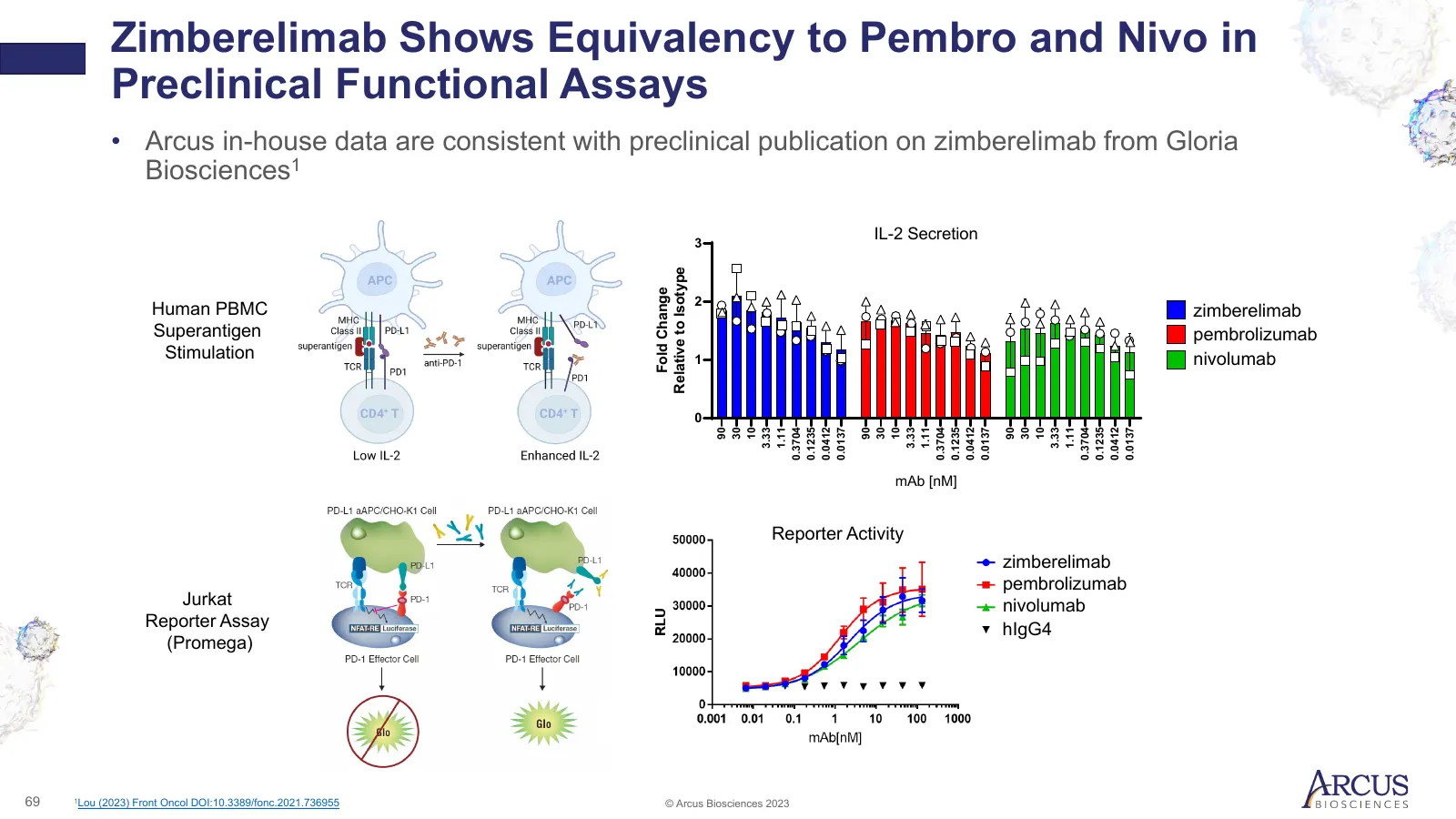
Slide 69: Zimberelimab Equivalency to Pembro and Nivo in Preclinical Assays
Zimberelimab Shows Equivalency to Pembro and Nivo in Preclinical Functional Assays • Arcus in-house data are consistent with preclinical publication on zimberelimab from Gloria Biosciences1 IL-2 Secretion 3 Relative to Isotype Fold Change 2 Human PBMC zimberelimab Superantigen pembrolizumab Stimulat

Slide 70: Combining to Cure
RCUS BIOSCIENCES COMBINING TO CURE”
Source: Internet Archive copy of s202.q4cdn.com
More decks from Arcus Biosciences, Inc.
 Investor Presentation (November 2026)43 slides · Nov 4, 2026
 Investor Day (October 2026)91 slides · Oct 20, 2026
 Q2 2026 Earnings Presentation42 slides · Aug 5, 2026
 Goldman Sachs 47th Annual Global Healthcare Conference (June 2026)40 slides · Jun 9, 2026
 Q1 2026 Earnings Presentation40 slides · May 5, 2026
 Q4 2025 Earnings Presentation35 slides · Feb 25, 2026