QUALCOMM Incorporated · NASDAQ:QCOM
QUALCOMM — Technical Presentation (July 2022)
35 slides from QUALCOMM's technical presentation, Jul 19, 2022
Slide 1: 3D perception: Cutting-edge AI research to understand the 3D world
July 19, 2022 3D perception: Cutting-edge AI research to understand the 3D world Qualcomm Technologies, Inc. @QCOMResearch
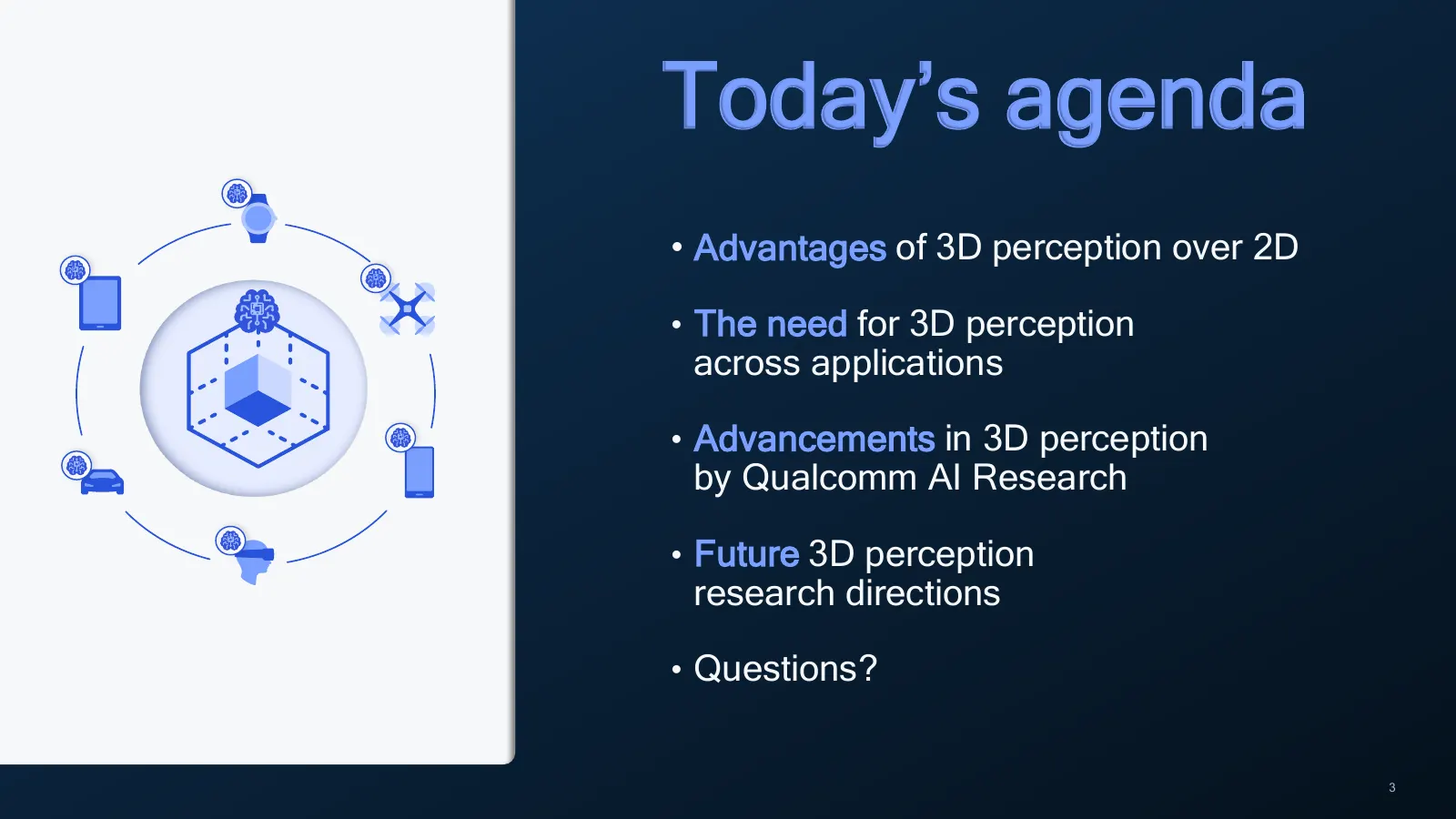
Slide 2: Today's agenda
Today’s agenda • Advantages of 3D perception over 2D • The need for 3D perception across applications • Advancements in 3D perception by Qualcomm AI Research • Future 3D perception research directions • Questions? 3
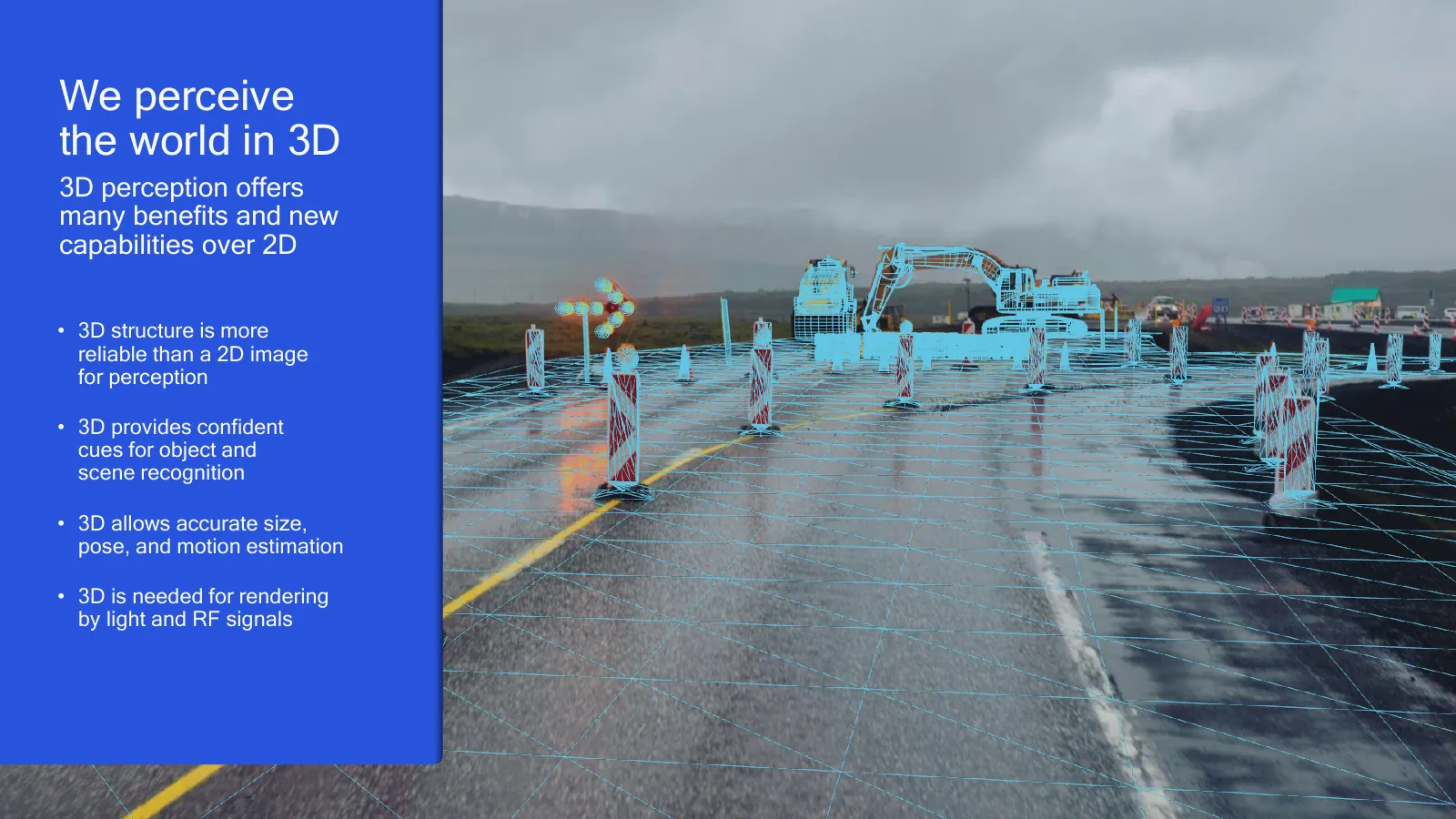
Slide 3: We perceive the world in 3D
We perceive the world in 3D 3D perception offers many benefits and new capabilities over 2D • 3D structure is more reliable than a 2D image for perception • 3D provides confident cues for object and scene recognition • 3D allows accurate size, pose, and motion estimation • 3D is needed for rendering
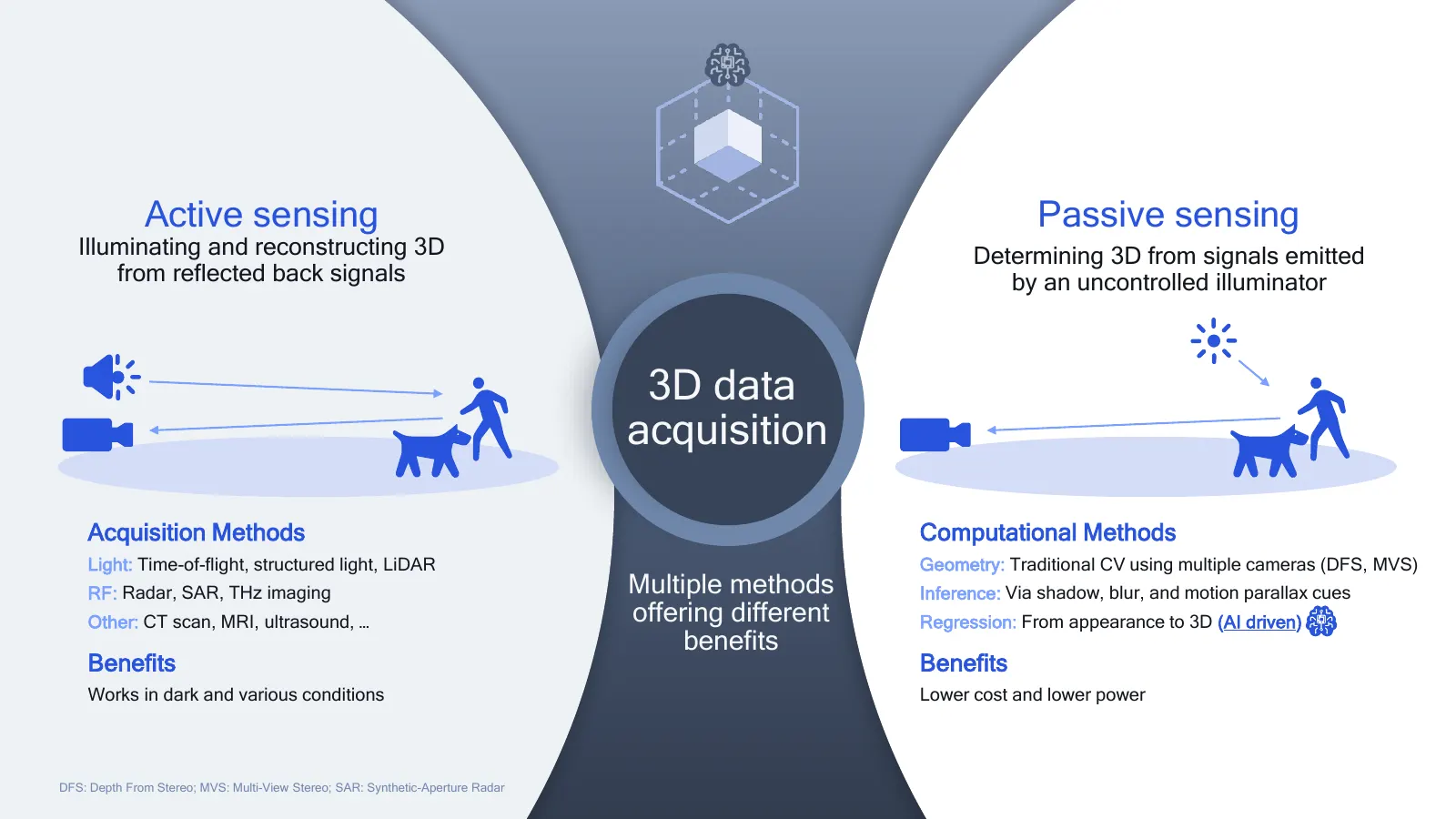
Slide 4: 3D data acquisition
Active sensing Passive sensing Illuminating and reconstructing 3D Determining 3D from signals emitted from reflected back signals by an uncontrolled illuminator 3D data acquisition Acquisition Methods Computational Methods Light: Time-of-flight, structured light, LiDAR Geometry: Traditional CV using
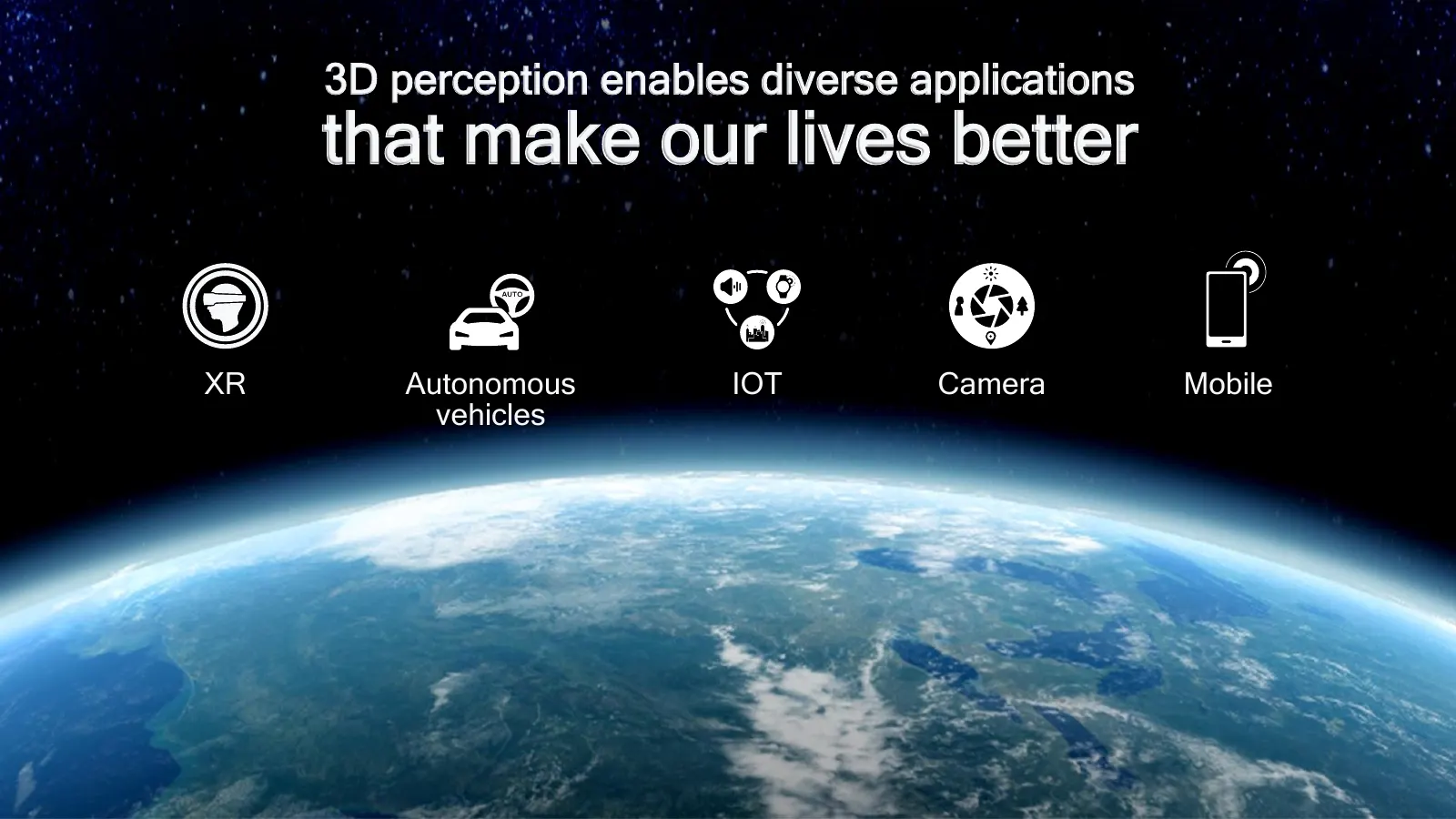
Slide 5: 3D perception enables diverse applications that make our lives better
3D perception enables diverse applications that make our lives better XR Autonomous IOT Camera Mobile vehicles 6
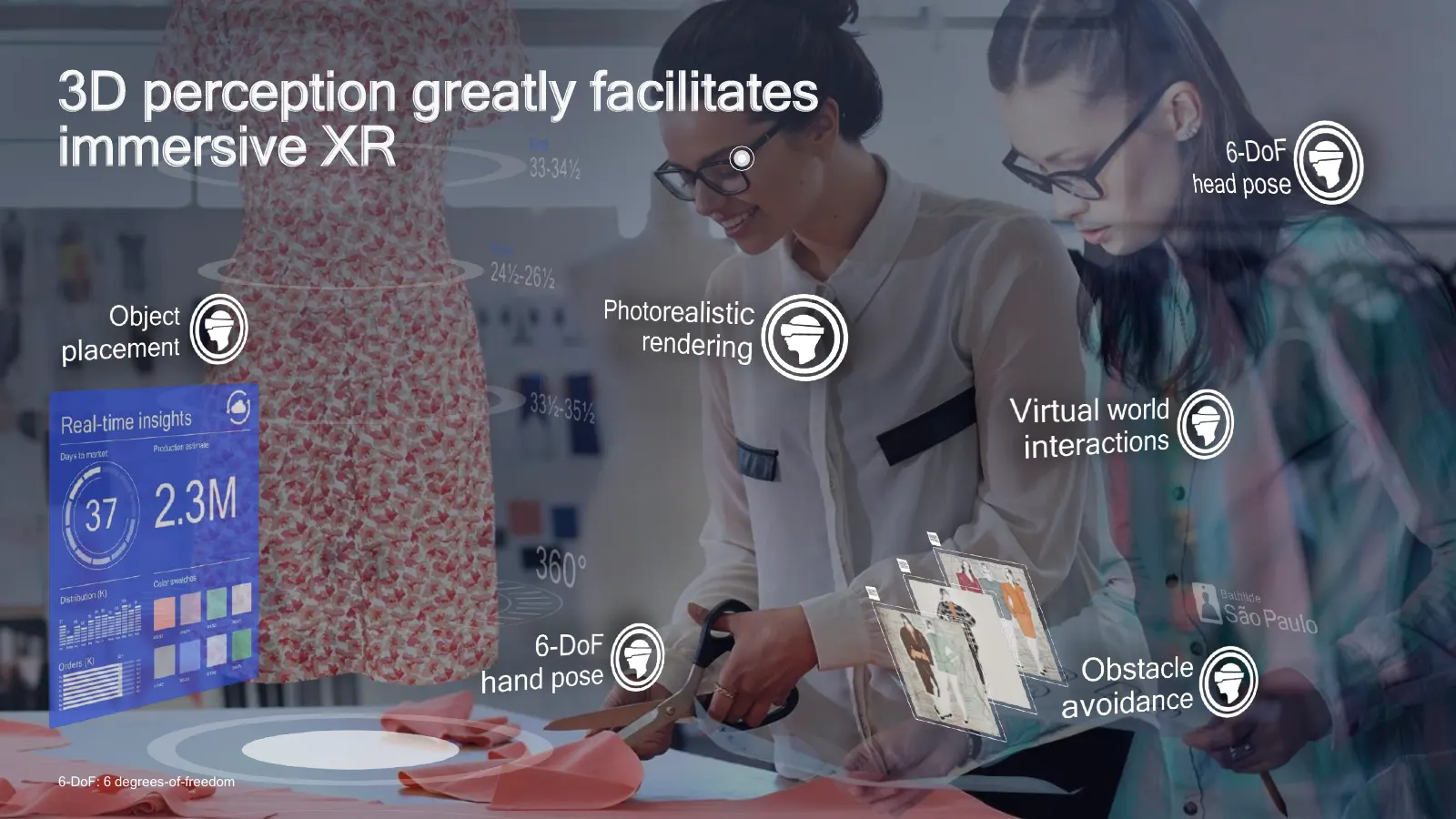
Slide 6: 3D perception greatly facilitates immersive XR
3D perception greatly facilitates immersive XR 6-DoF: 6 degrees-of-freedom 7
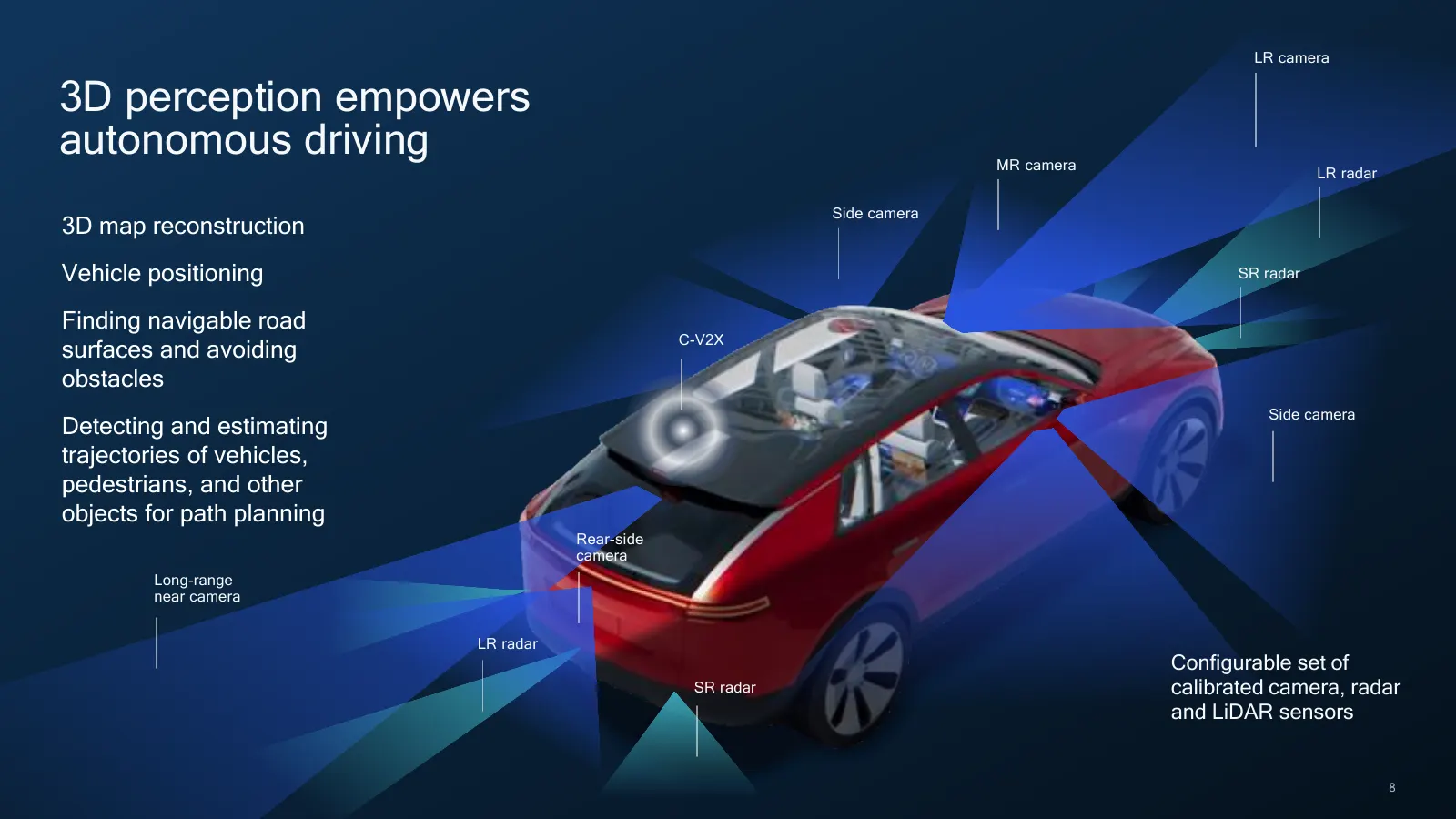
Slide 7: 3D perception empowers autonomous driving
LR camera 3D perception empowers autonomous driving MR camera LR radar Side camera 3D map reconstruction Vehicle positioning SR radar Finding navigable road C-V2X surfaces and avoiding obstacles Side camera Detecting and estimating trajectories of vehicles, pedestrians, and other objects for path pl
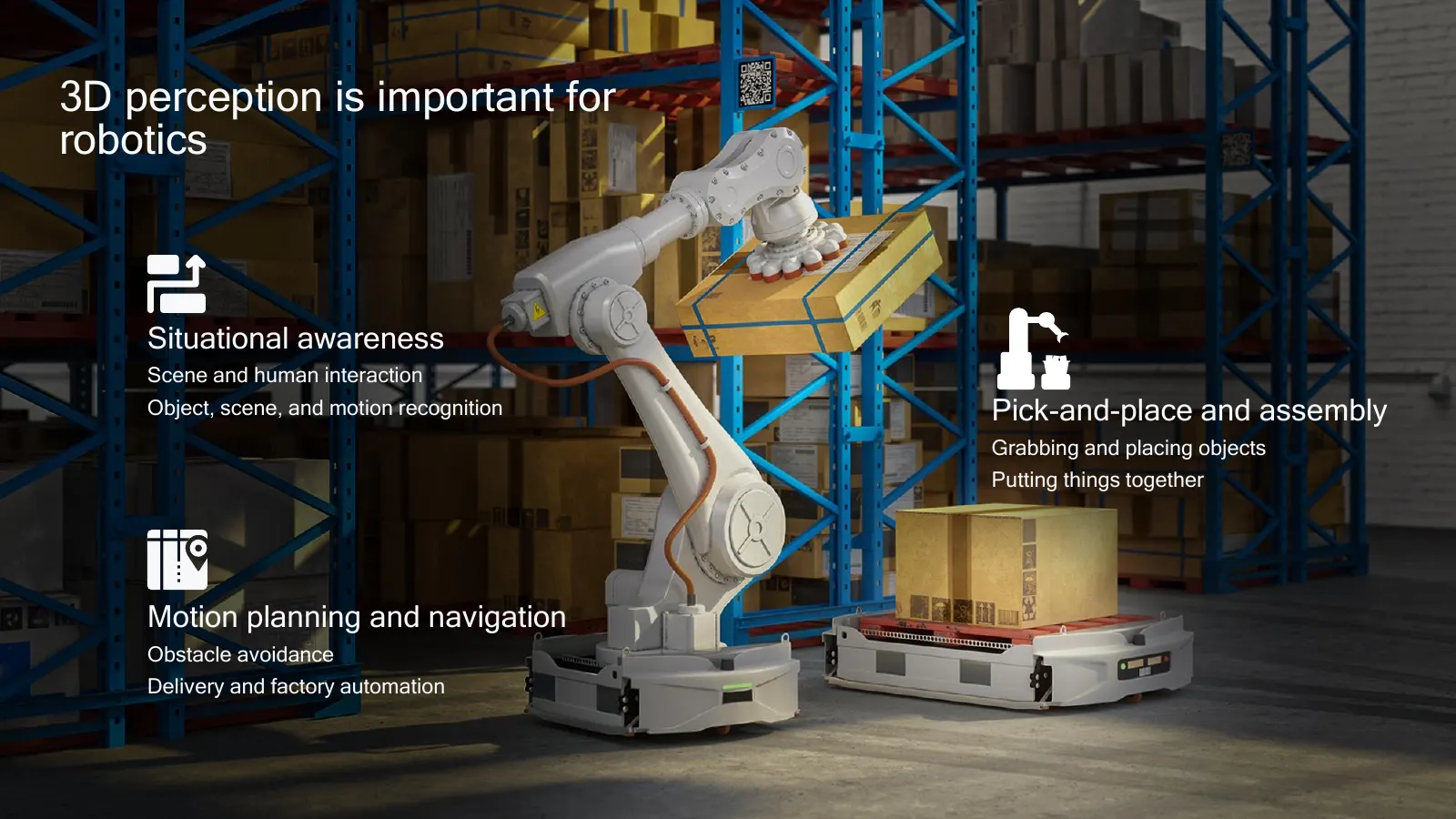
Slide 8: 3D perception is important for robotics
3D perception is important for robotics Situational awareness Scene and human interaction Object, scene, and motion recognition Pick-and-place and assembly Grabbing and placing objects Putting things together Motion planning and navigation Obstacle avoidance Delivery and factory automation 9
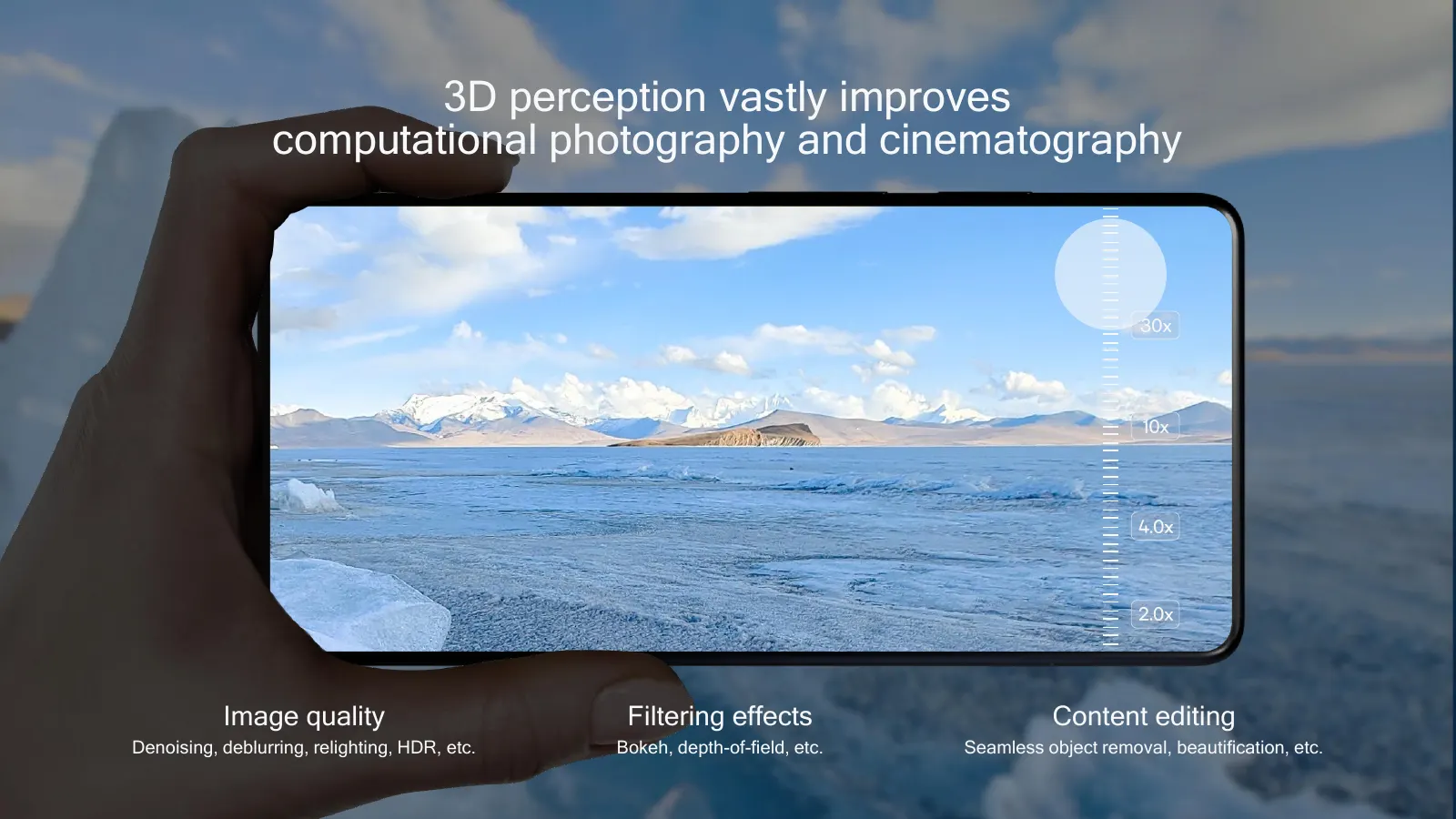
Slide 9: 3D perception vastly improves computational photography and cinematography
3D perception vastly improves computational photography and cinematography Image quality Filtering effects Content editing Denoising, deblurring, relighting, HDR, etc. Bokeh, depth-of-field, etc. Seamless object removal, beautification, etc. 10
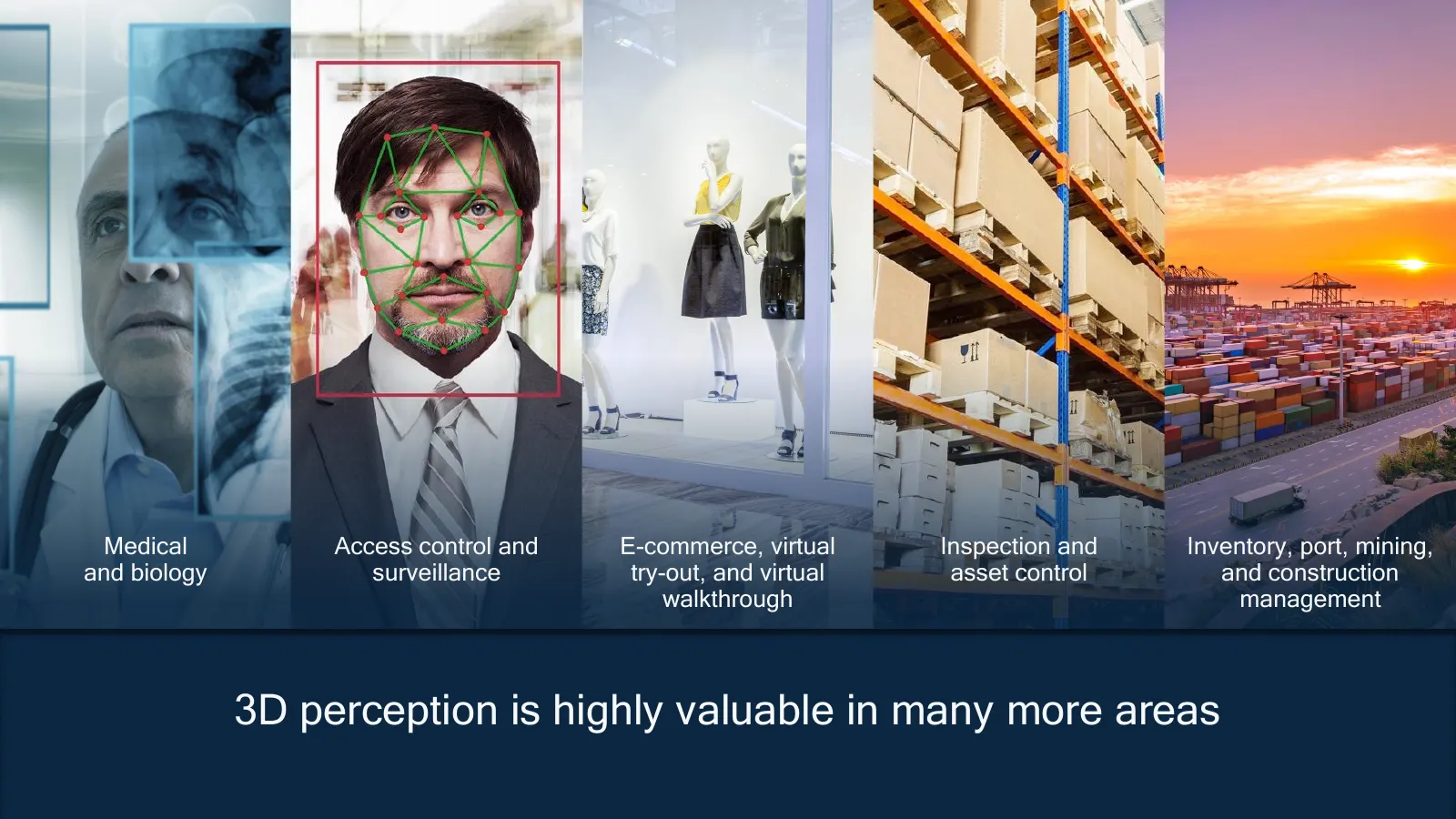
Slide 10: 3D perception valuable in many more areas
Medical Access control and E-commerce, virtual Inspection and Inventory, port, mining, and biology surveillance try-out, and virtual asset control and construction walkthrough management 3Disperception 3D perception valuable inismany highlymore valuable areasin many more areas 11
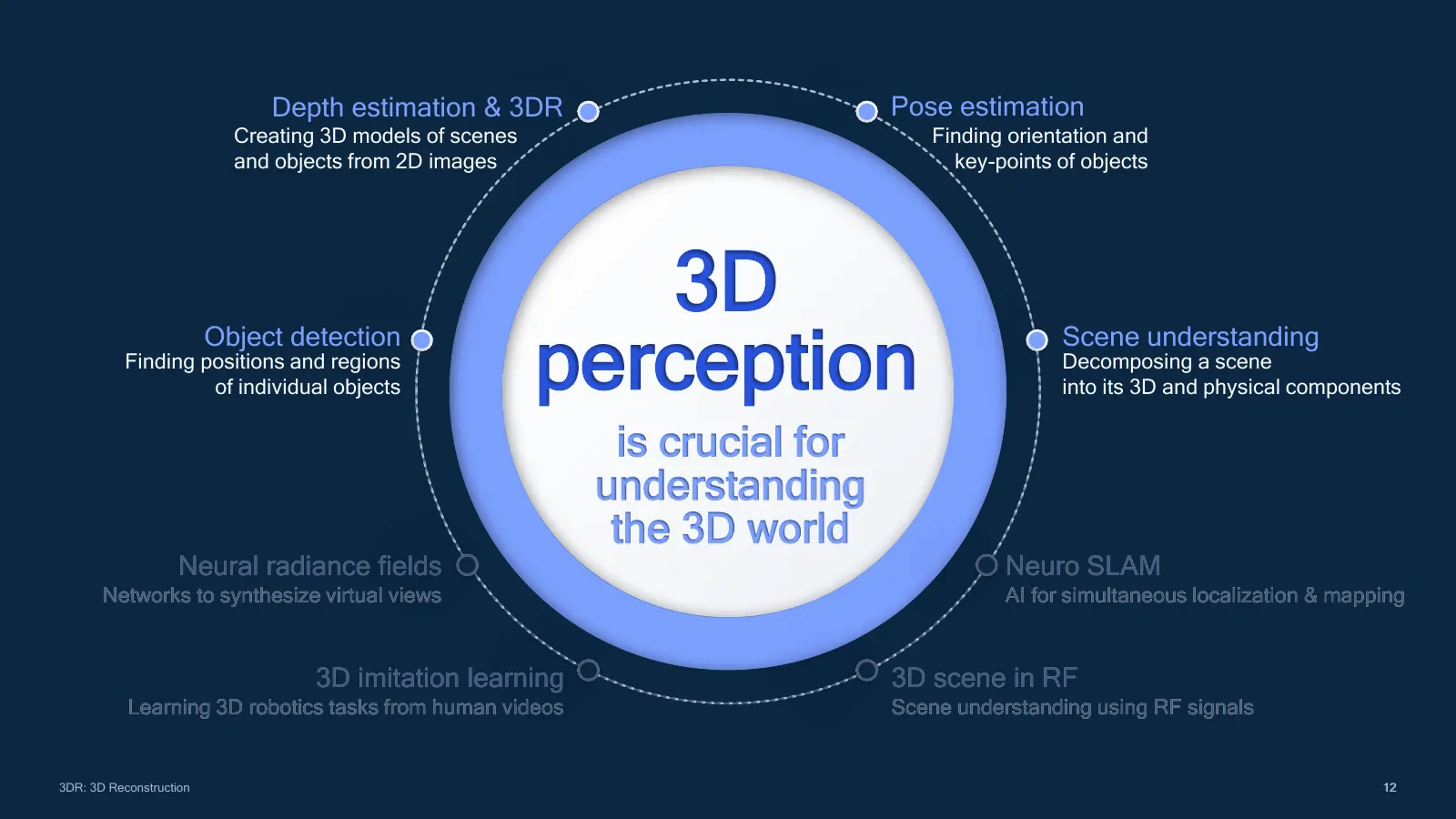
Slide 11: 3D perception is crucial for understanding the 3D world
Depth estimation & 3DR Pose estimation Creating 3D models of scenes Finding orientation and and objects from 2D images key-points of objects 3D perception Object detection Scene understanding Finding positions and regions Decomposing a scene of individual objects into its 3D and physical components
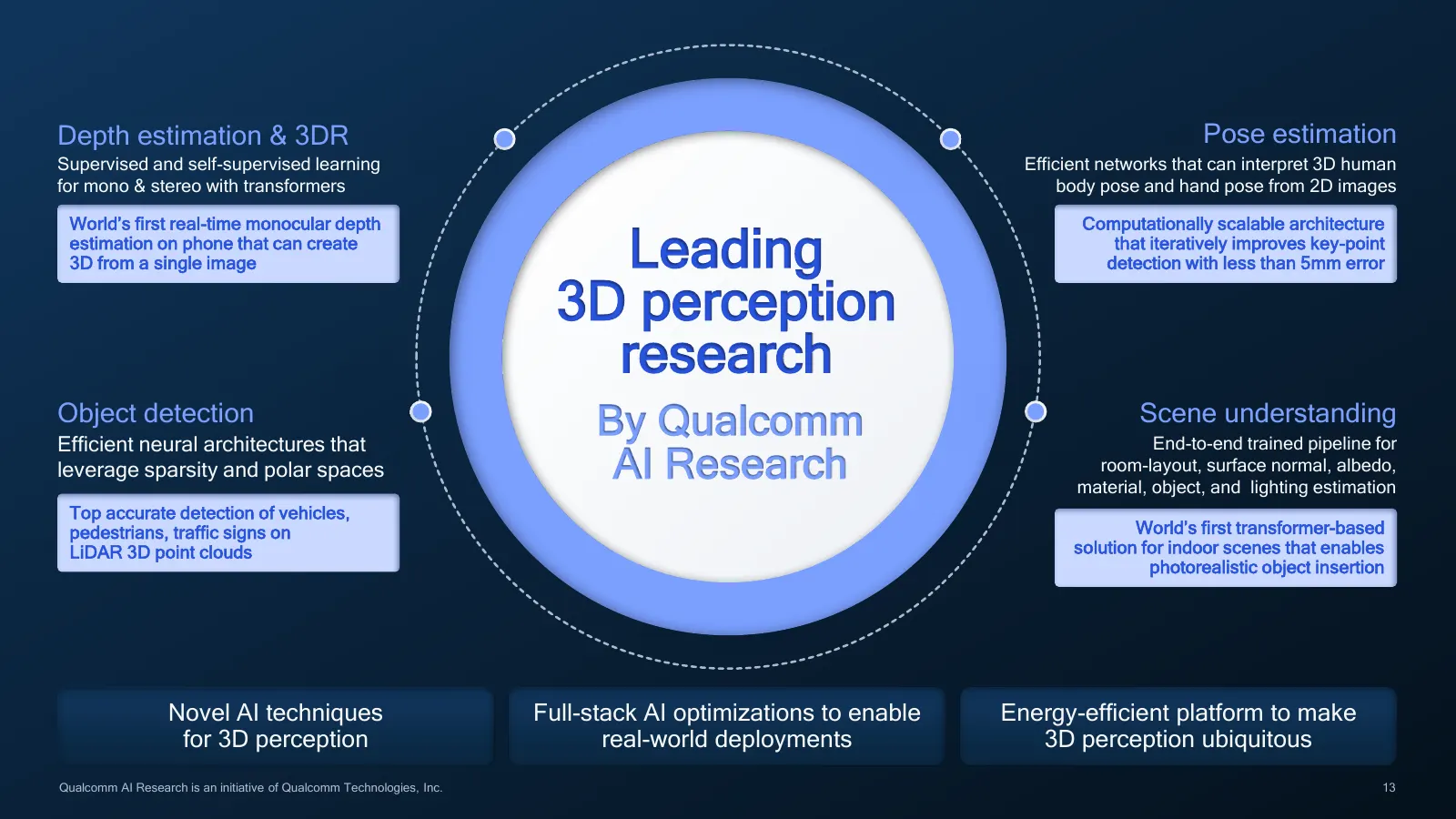
Slide 12: Leading 3D perception research by Qualcomm AI Research
Depth estimation & 3DR Pose estimation Supervised and self-supervised learning Efficient networks that can interpret 3D human for mono & stereo with transformers body pose and hand pose from 2D images World’s first real-time monocular depth Computationally scalable architecture estimation on phone t
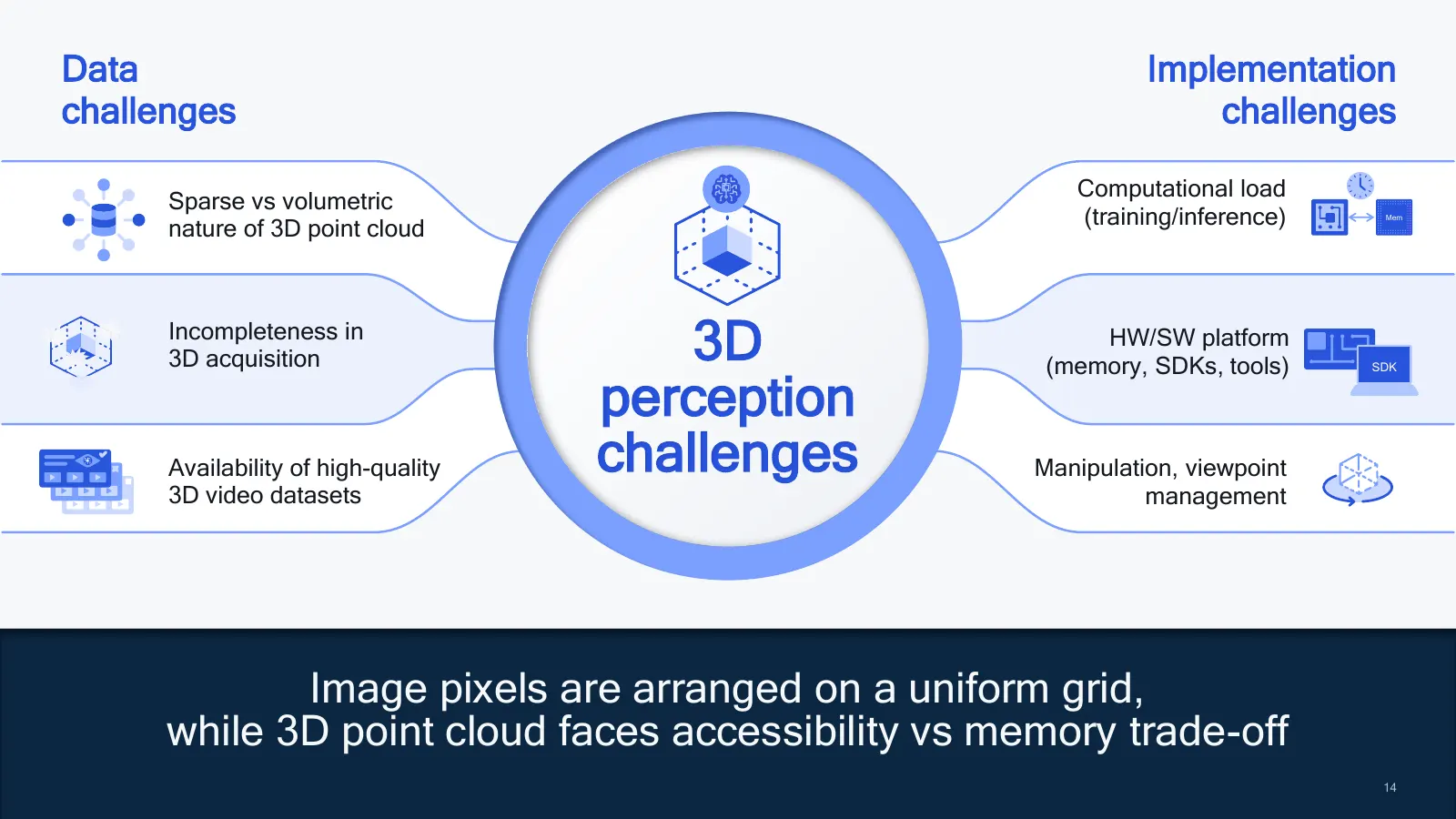
Slide 13: 3D perception challenges
Data Implementation challenges challenges Computational load Sparse vs volumetric (training/inference) Mem nature of 3D point cloud Incompleteness in 3D acquisition 3D HW/SW platform (memory, SDKs, tools) SDK perception Availability of high-quality challenges Manipulation, viewpoint 3D video dataset
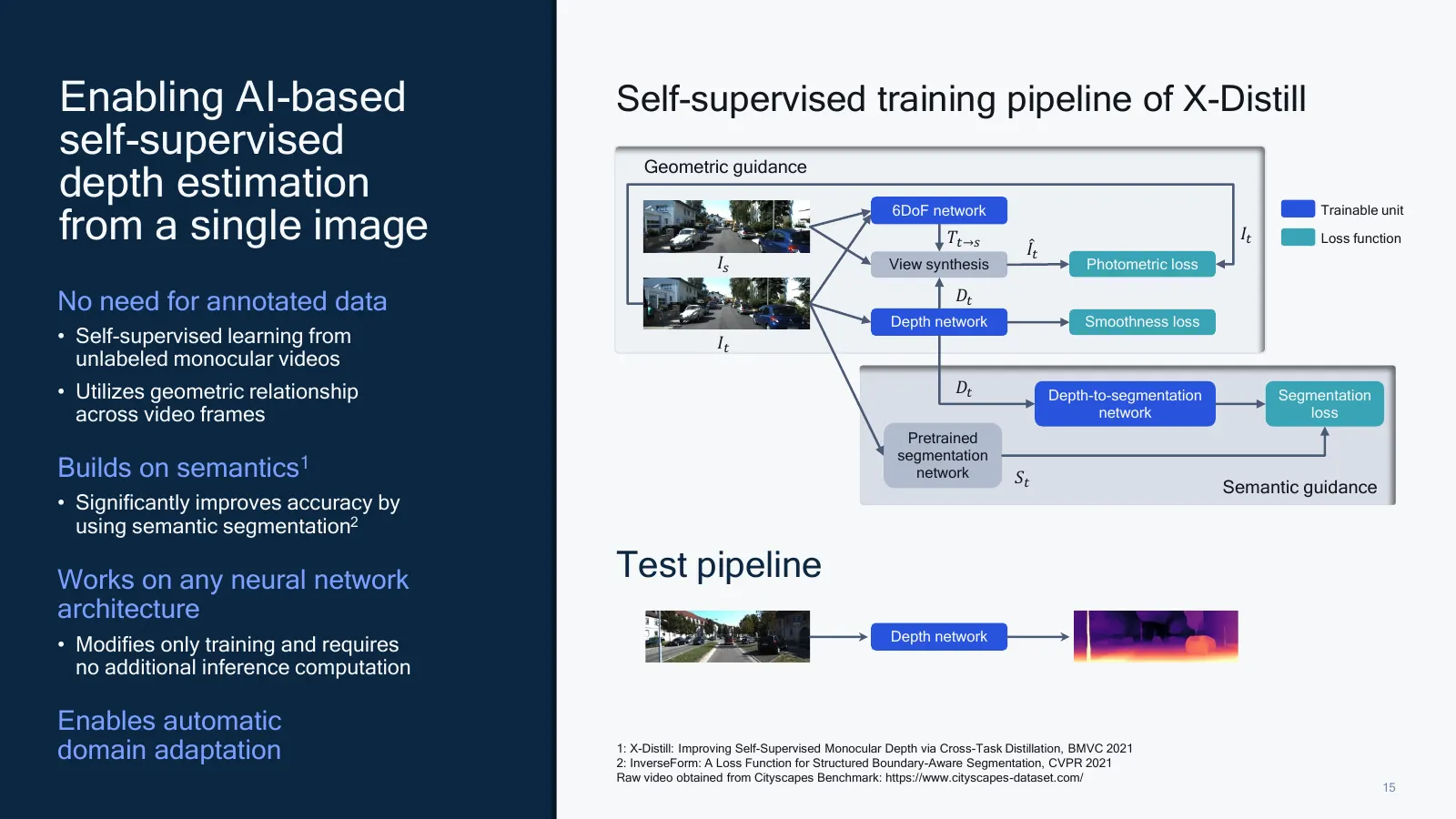
Slide 14: Enabling AI-based self-supervised depth estimation from a single image
Enabling AI-based Self-supervised training pipeline of X-Distill self-supervised Geometric guidance depth estimation from a single image 6DoF network Trainable unit 𝑇𝑡→𝑠 𝐼𝑡 Loss function 𝐼መ𝑡 𝐼𝑠 View synthesis Photometric loss No need for annotated data 𝐷𝑡 Depth network Smoothness loss •…
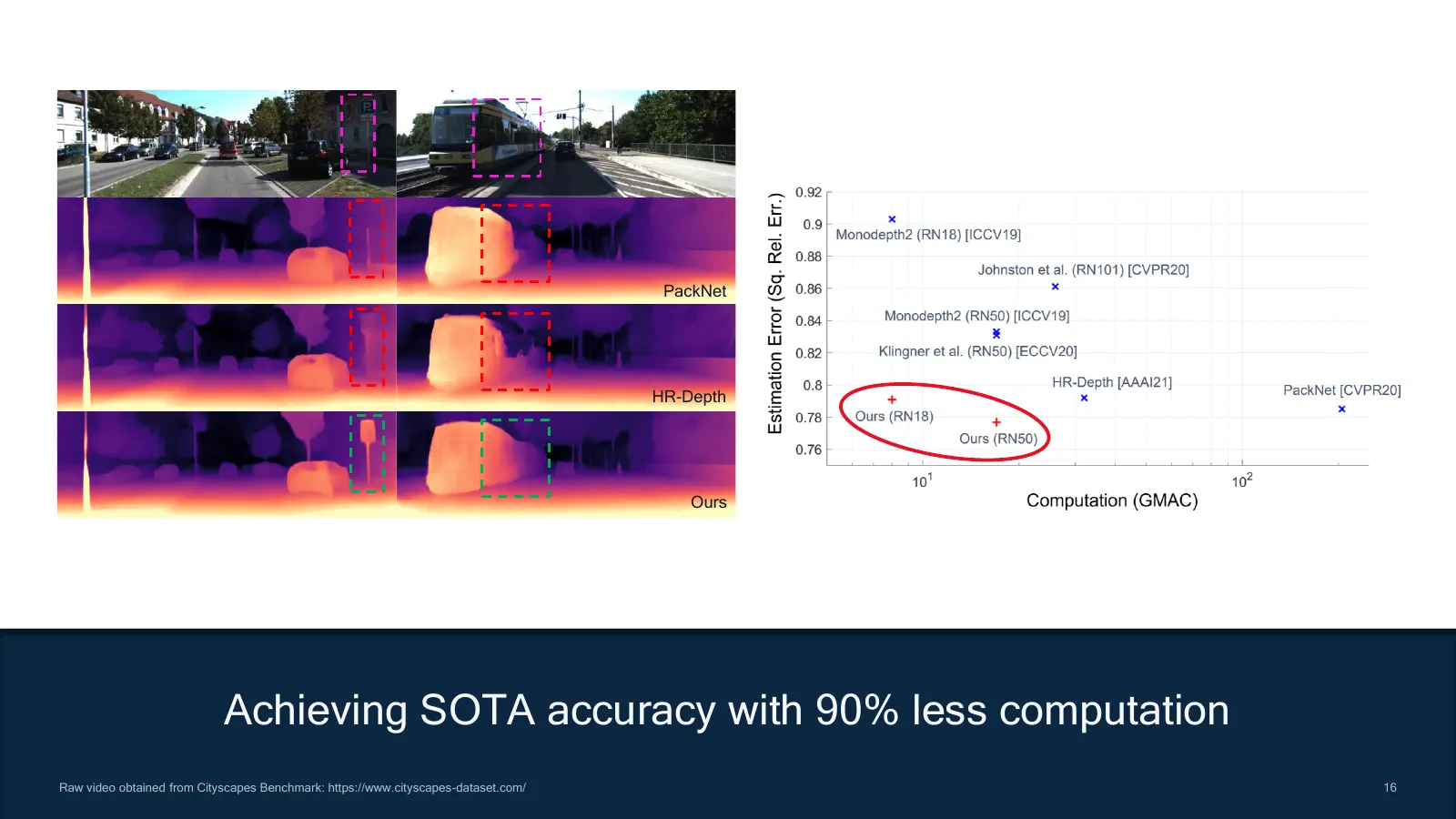
Slide 15: Achieving SOTA accuracy with 90% less computation
PackNet HR-Depth Ours Achieving SOTA accuracy with 90% less computation Raw video obtained from Cityscapes Benchmark: https://www.cityscapes-dataset.com/ 16
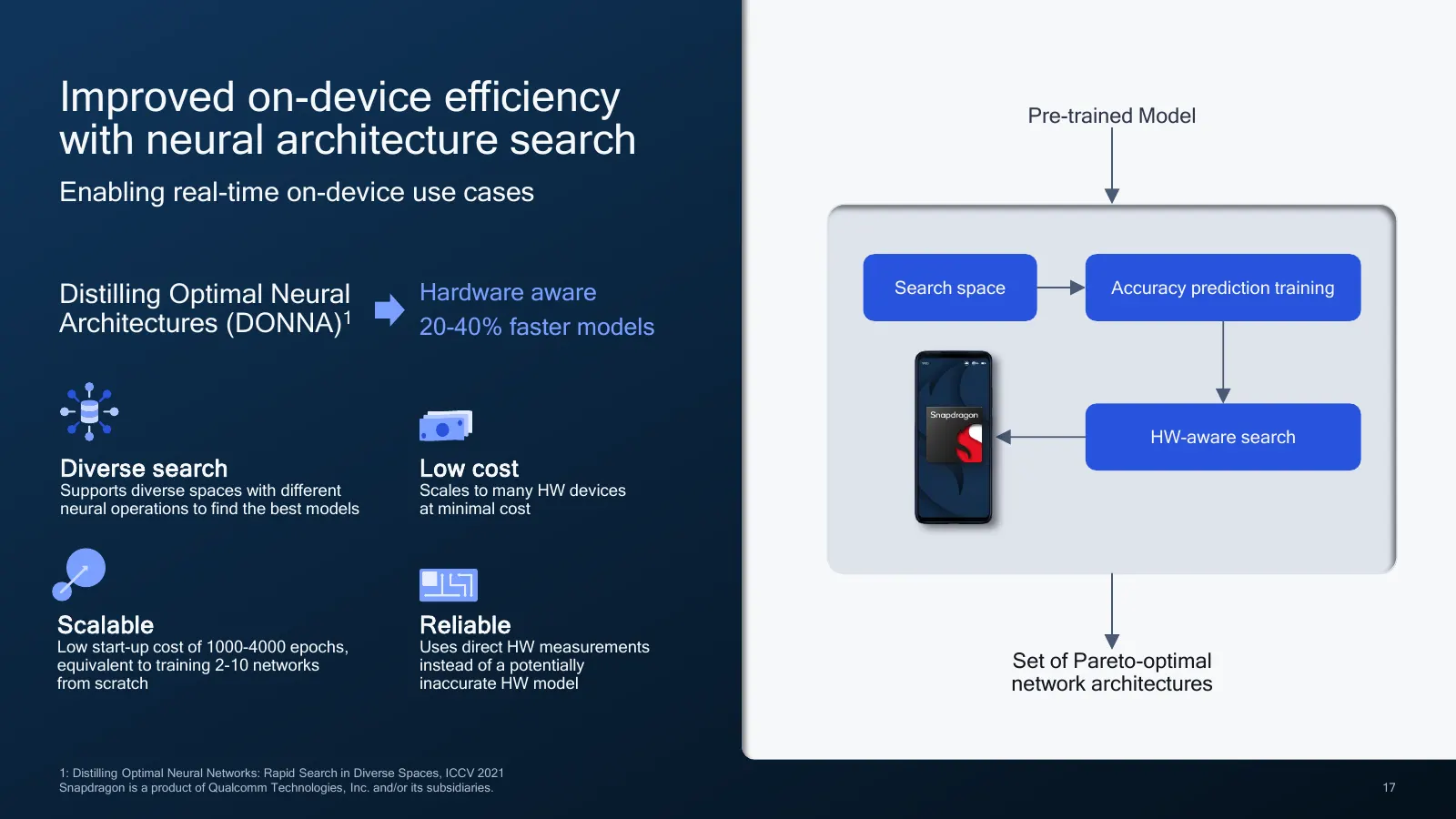
Slide 16: Improved on-device efficiency with neural architecture search
Improved on-device efficiency Pre-trained Model with neural architecture search Enabling real-time on-device use cases Distilling Optimal Neural Hardware aware Search space Accuracy prediction training Architectures (DONNA)1 20-40% faster models HW-aware search Diverse search Low cost Supports diver
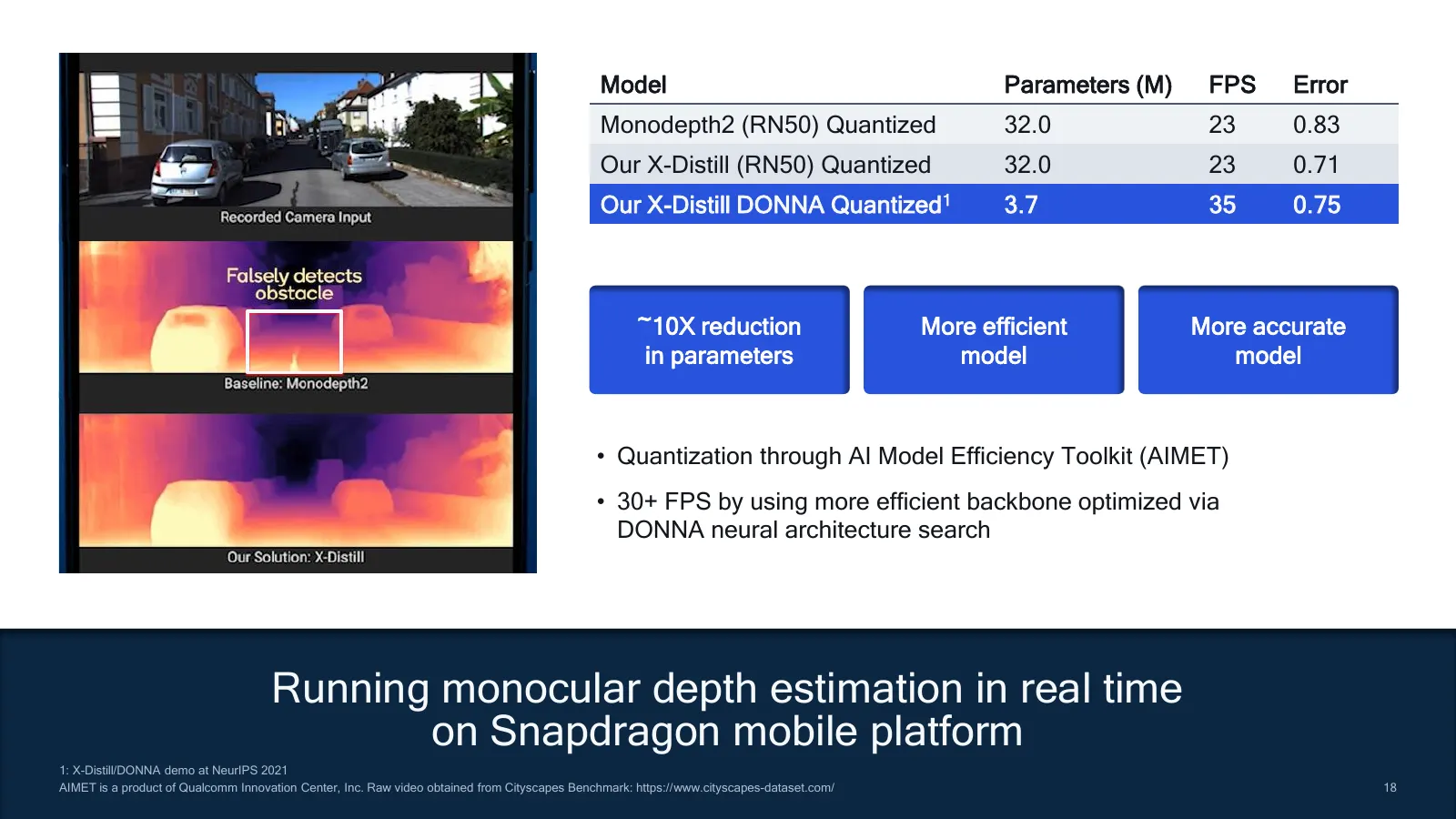
Slide 17: Running monocular depth estimation in real time on Snapdragon mobile platform
Model Parameters (M) FPS Error Monodepth2 (RN50) Quantized 32.0 23 0.83 Our X-Distill (RN50) Quantized 32.0 23 0.71 Our X-Distill DONNA Quantized1 3.7 35 0.75 ~10X reduction More efficient More accurate in parameters model model • Quantization through AI Model Efficiency Toolkit (AIMET) • 30+ FPS by
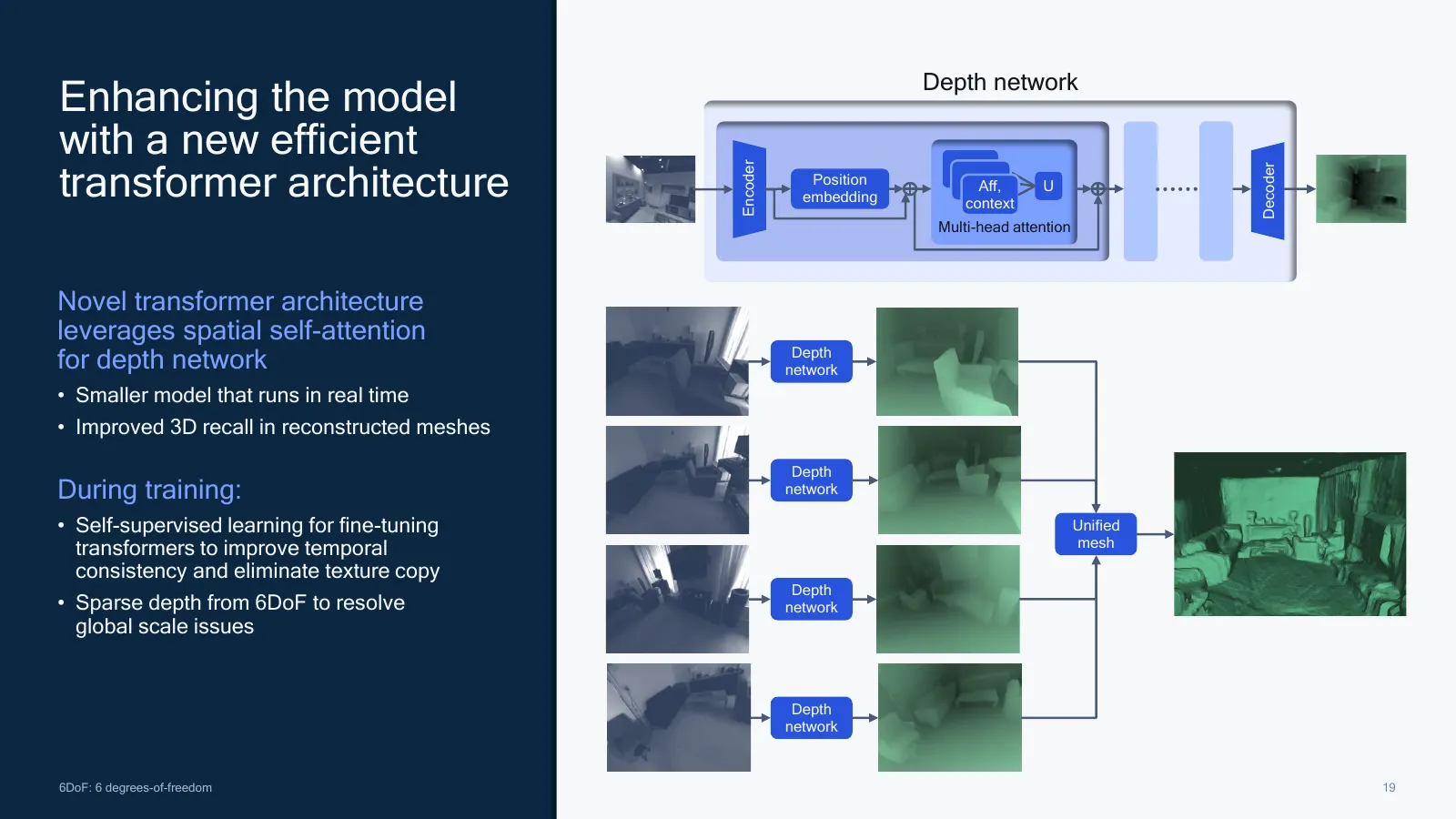
Slide 18: Enhancing the model with a new efficient transformer architecture
Depth network Enhancing the model with a new efficient transformer architecture Encoder Decoder Position Aff, U embedding context Multi-head attention Novel transformer architecture leverages spatial self-attention for depth network Depth network • Smaller model that runs in real time • Improved 3D
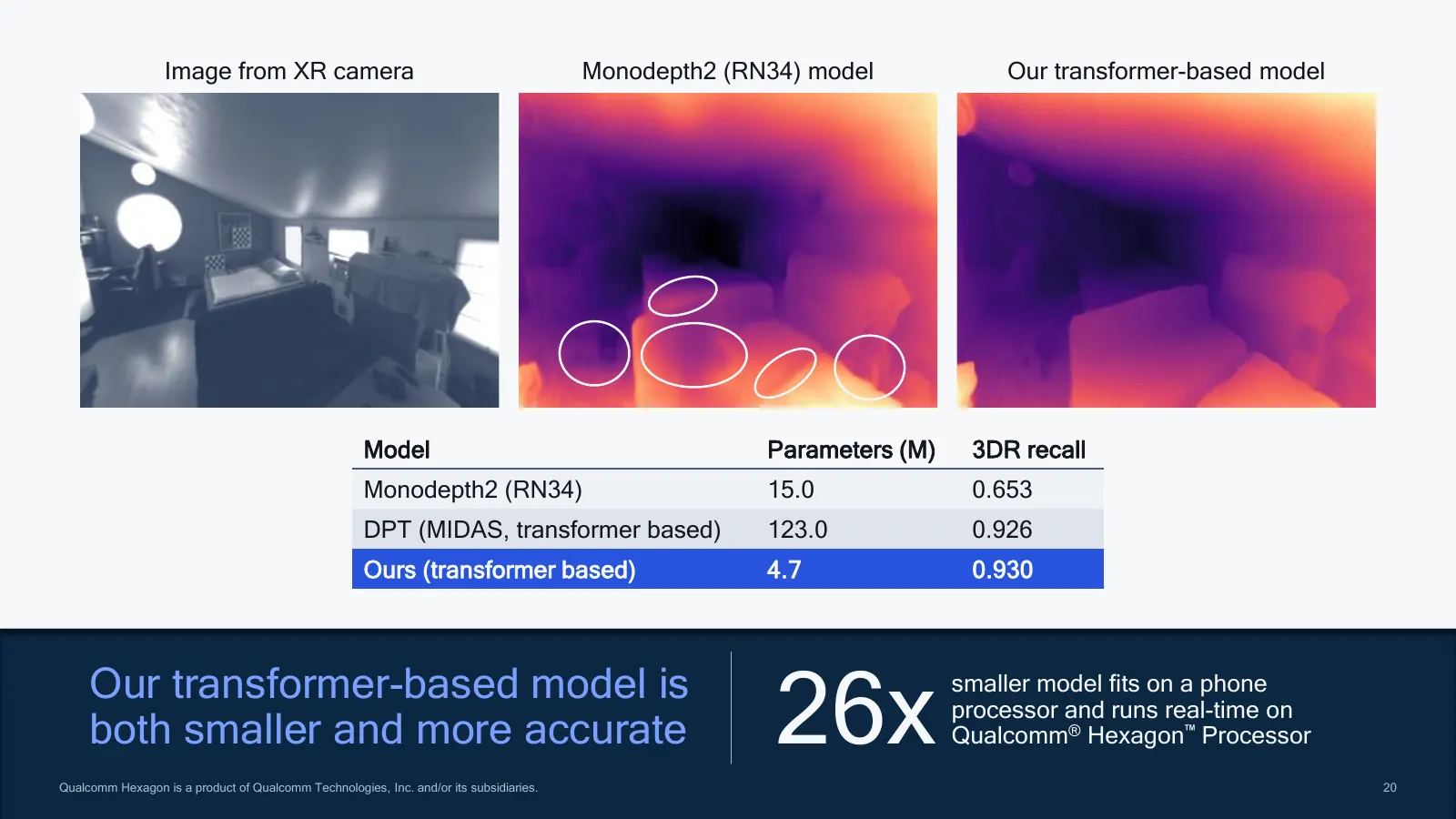
Slide 19: Our transformer-based model is both smaller and more accurate
Image from XR camera Monodepth2 (RN34) model Our transformer-based model Model Parameters (M) 3DR recall Monodepth2 (RN34) 15.0 0.653 DPT (MIDAS, transformer based) 123.0 0.926 Ours (transformer based) 4.7 0.930 Our transformer-based model is 26x smaller model fits on a phone processor and runs real
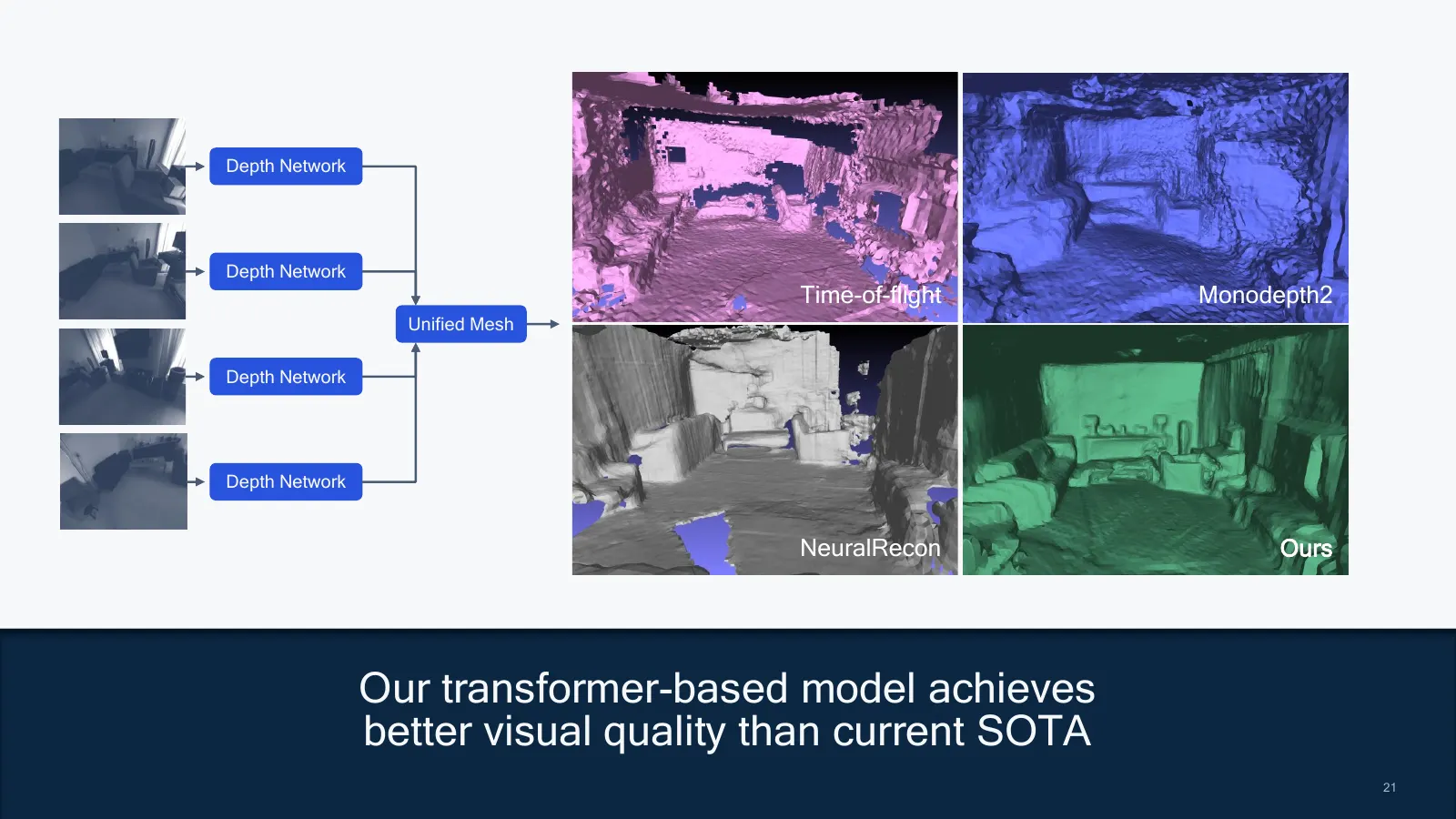
Slide 20: Our transformer-based model achieves better visual quality than current SOTA
Depth Network Depth Network Time-of-flight Monodepth2 Unified Mesh Depth Network Depth Network NeuralRecon Ours Our transformer-based model achieves better visual quality than current SOTA 21
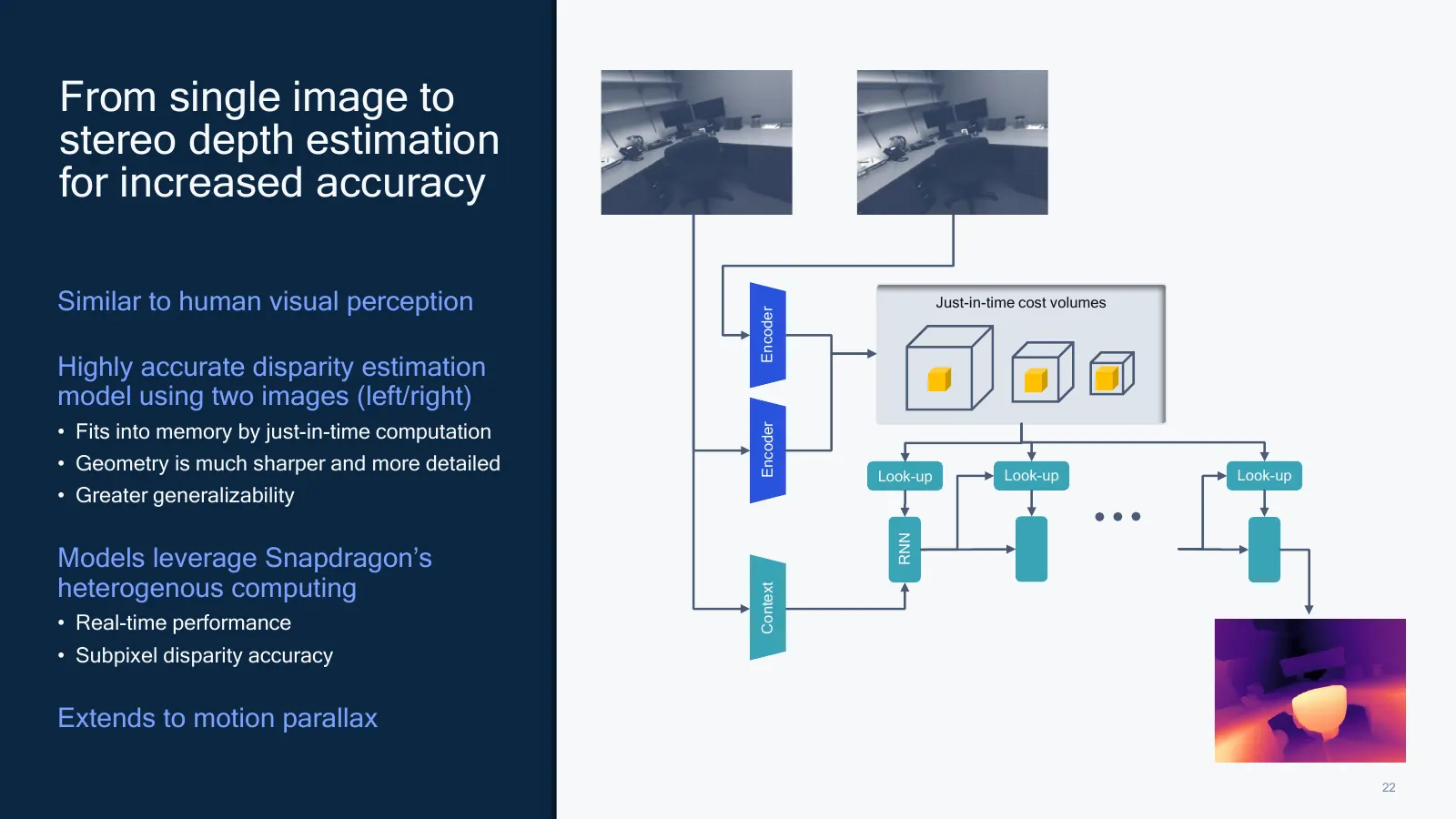
Slide 21: From single image to stereo depth estimation for increased accuracy
From single image to stereo depth estimation for increased accuracy Similar to human visual perception Just-in-time cost volumes Encoder Highly accurate disparity estimation model using two images (left/right) • Fits into memory by just-in-time computation Encoder • Geometry is much sharper and more
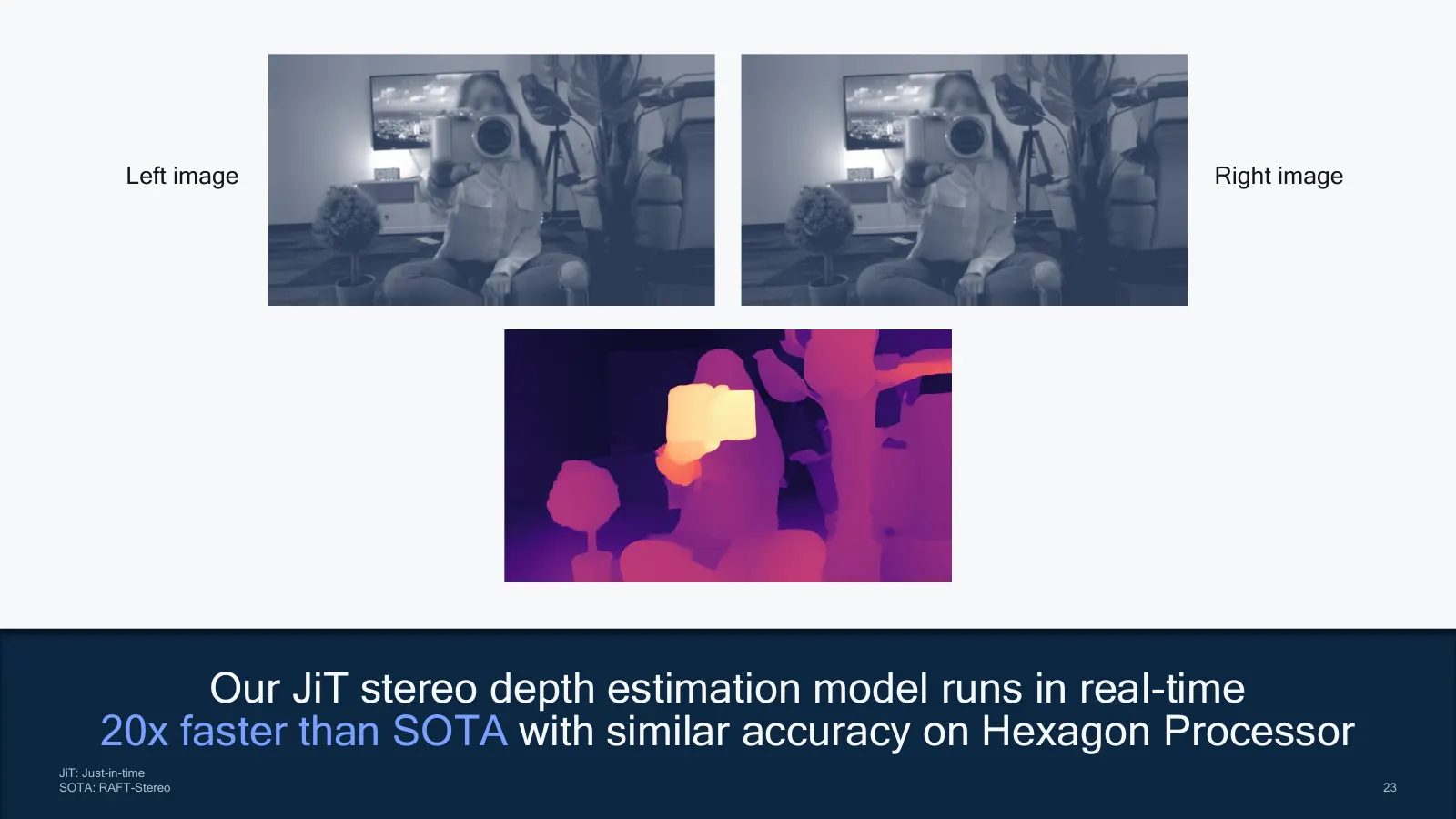
Slide 22: Our JiT stereo depth estimation model runs in real-time 20x faster than SOTA
Left image Right image Our JiT stereo depth estimation model runs in real-time 20x faster than SOTA with similar accuracy on Hexagon Processor JiT: Just-in-time SOTA: RAFT-Stereo 23
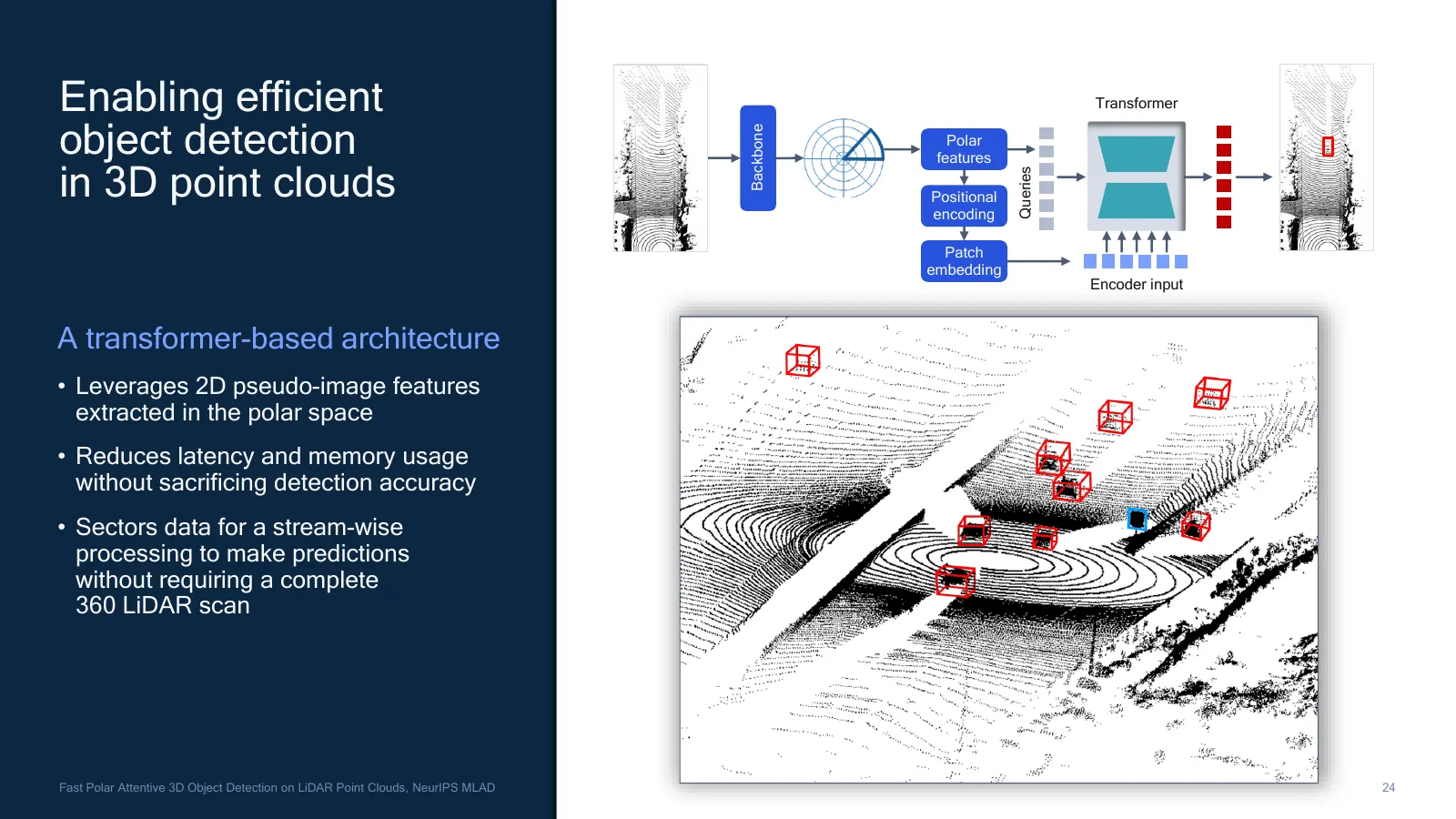
Slide 23: Enabling efficient object detection in 3D point clouds
Enabling efficient Transformer object detection Backbone Polar features in 3D point clouds Queries Positional encoding Patch embedding Encoder input A transformer-based architecture • Leverages 2D pseudo-image features extracted in the polar space • Reduces latency and memory usage without sacrifici
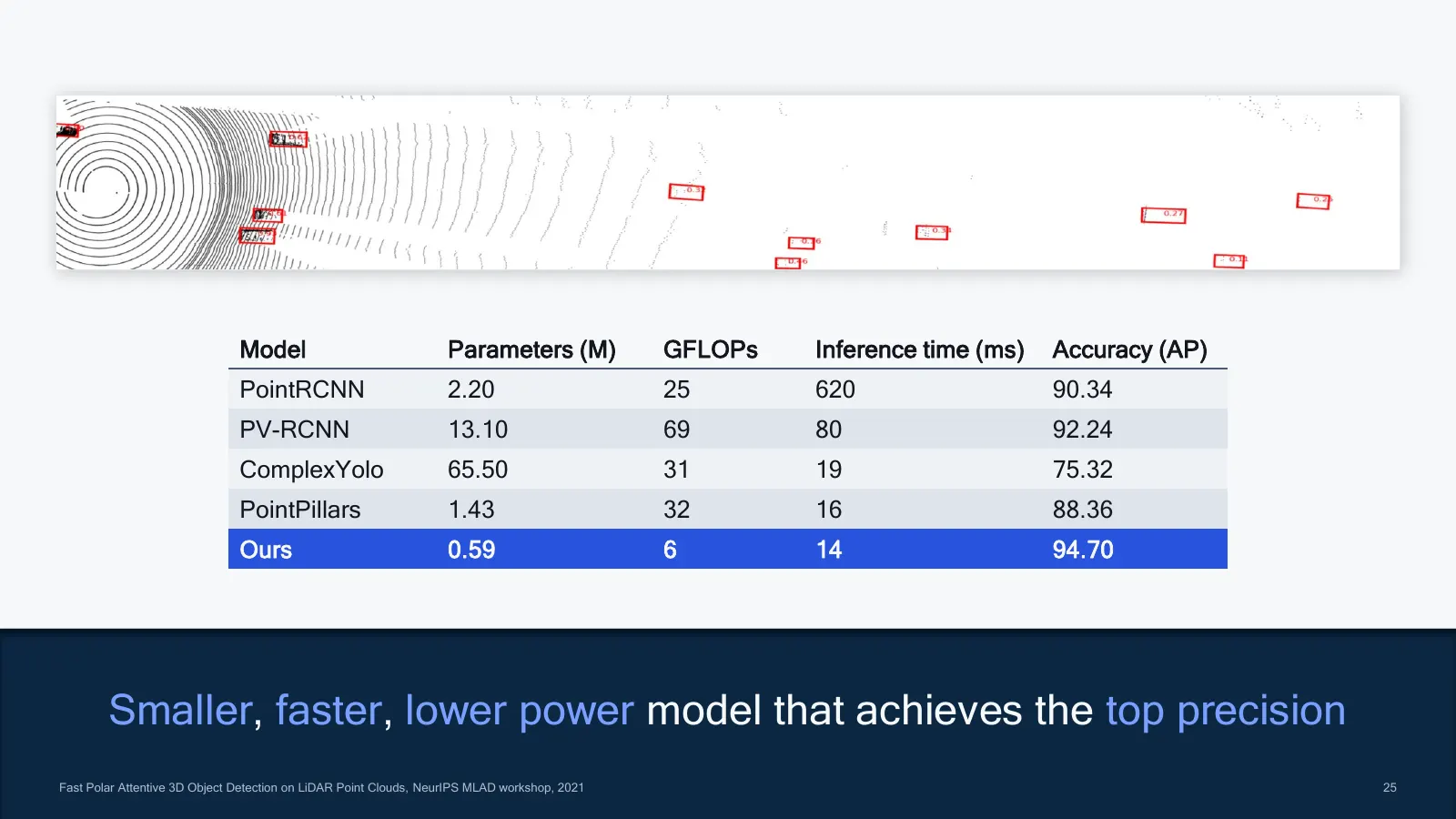
Slide 24: Smaller, faster, lower power model that achieves the top precision
Model Parameters (M) GFLOPs Inference time (ms) Accuracy (AP) PointRCNN 2.20 25 620 90.34 PV-RCNN 13.10 69 80 92.24 ComplexYolo 65.50 31 19 75.32 PointPillars 1.43 32 16 88.36 Ours 0.59 6 14 94.70 Smaller, faster, lower power model that achieves the top precision Fast Polar Attentive 3D Object Detec
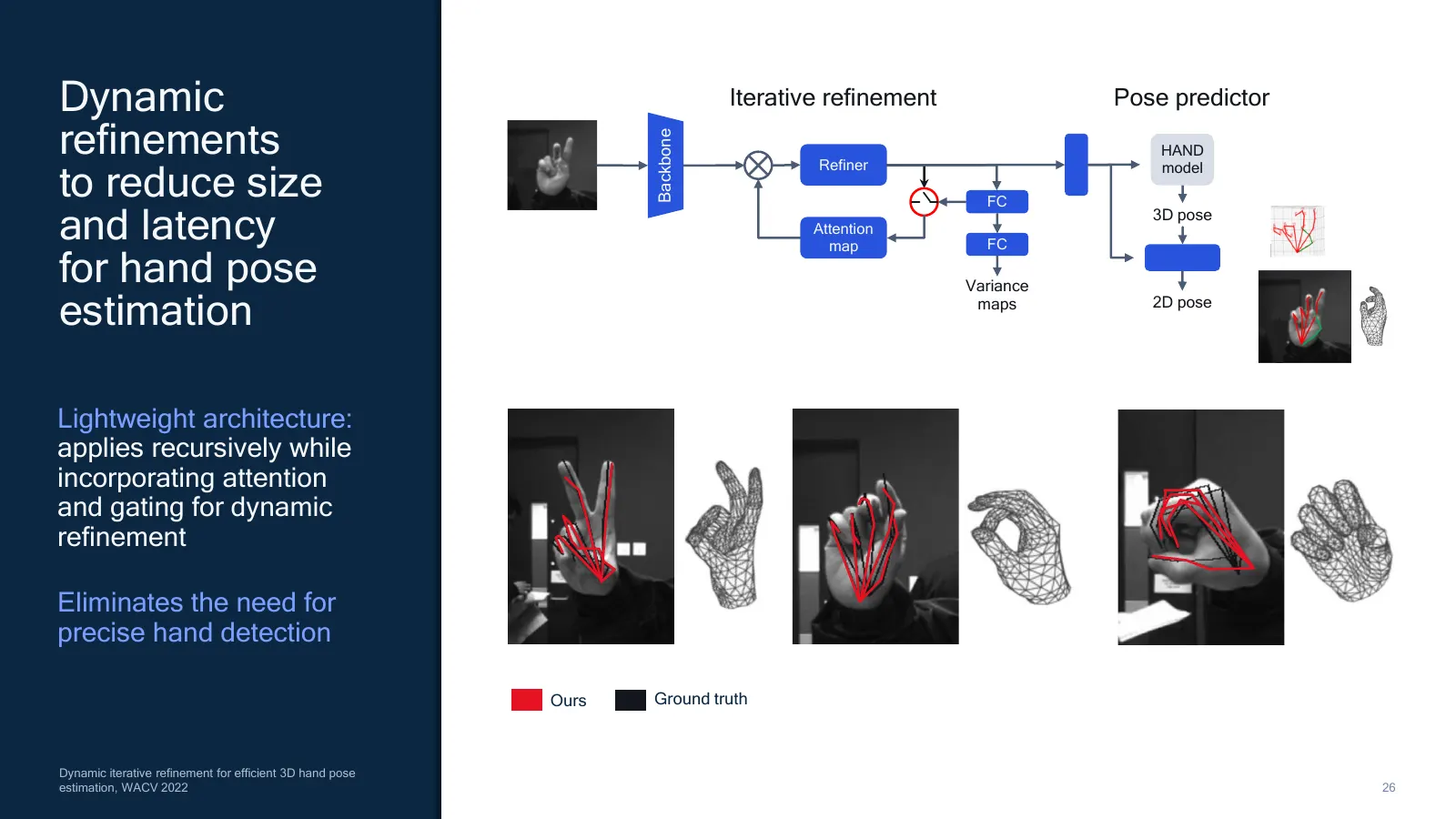
Slide 25: Dynamic refinements to reduce size and latency for hand pose estimation
Dynamic Iterative refinement Pose predictor refinements Backbone HAND Refiner to reduce size model FC and latency Attention map FC 3D pose for hand pose Variance estimation maps 2D pose Lightweight architecture: applies recursively while incorporating attention and gating for dynamic refinement Elim
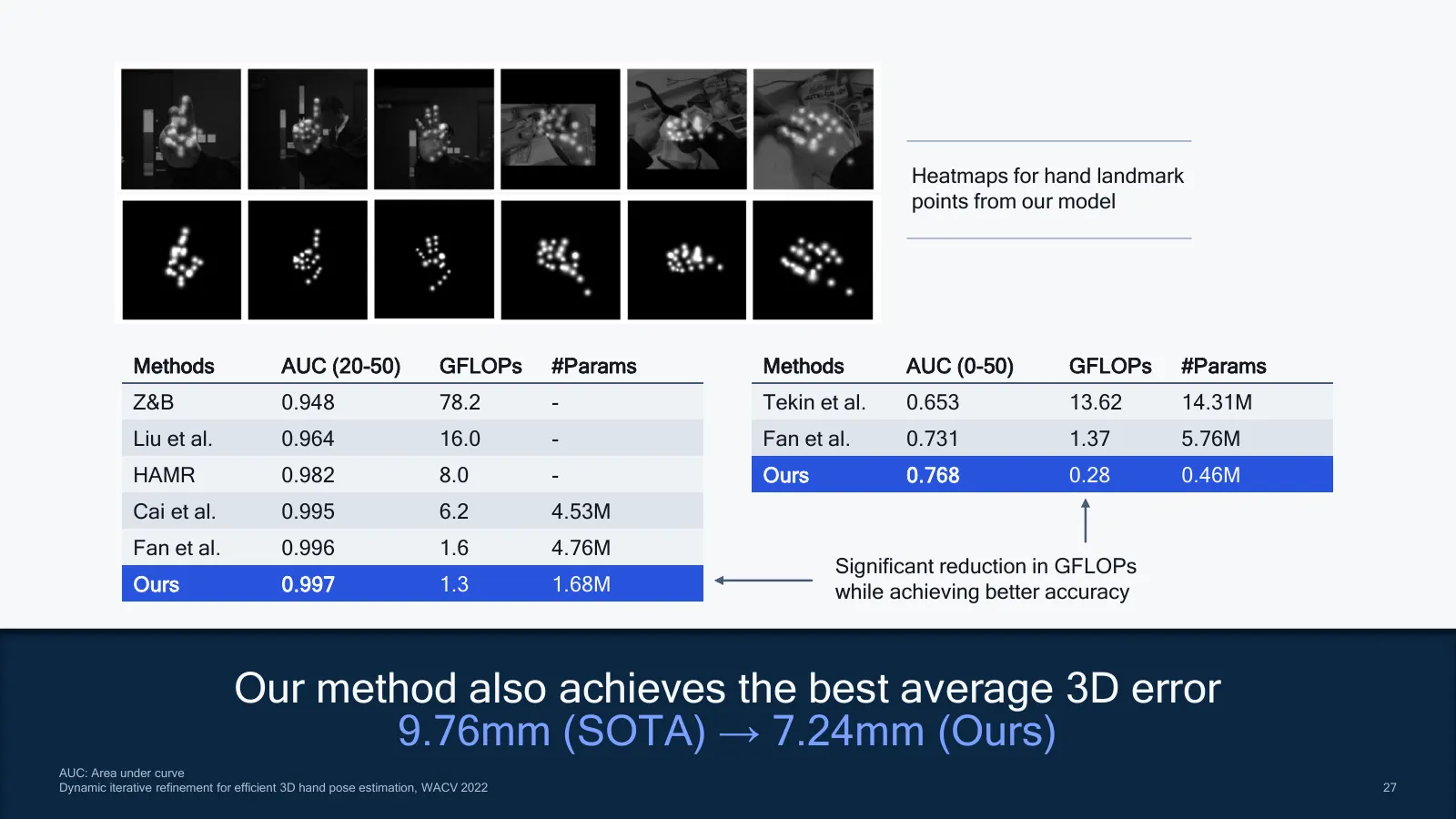
Slide 26: Our method also achieves the best average 3D error
Heatmaps for hand landmark points from our model Methods AUC (20-50) GFLOPs #Params Methods AUC (0-50) GFLOPs #Params Z&B 0.948 78.2 - Tekin et al. 0.653 13.62 14.31M Liu et al. 0.964 16.0 - Fan et al. 0.731 1.37 5.76M HAMR 0.982 8.0 - Ours 0.768 0.28 0.46M Cai et al. 0.995 6.2 4.53M Fan et al. 0.99
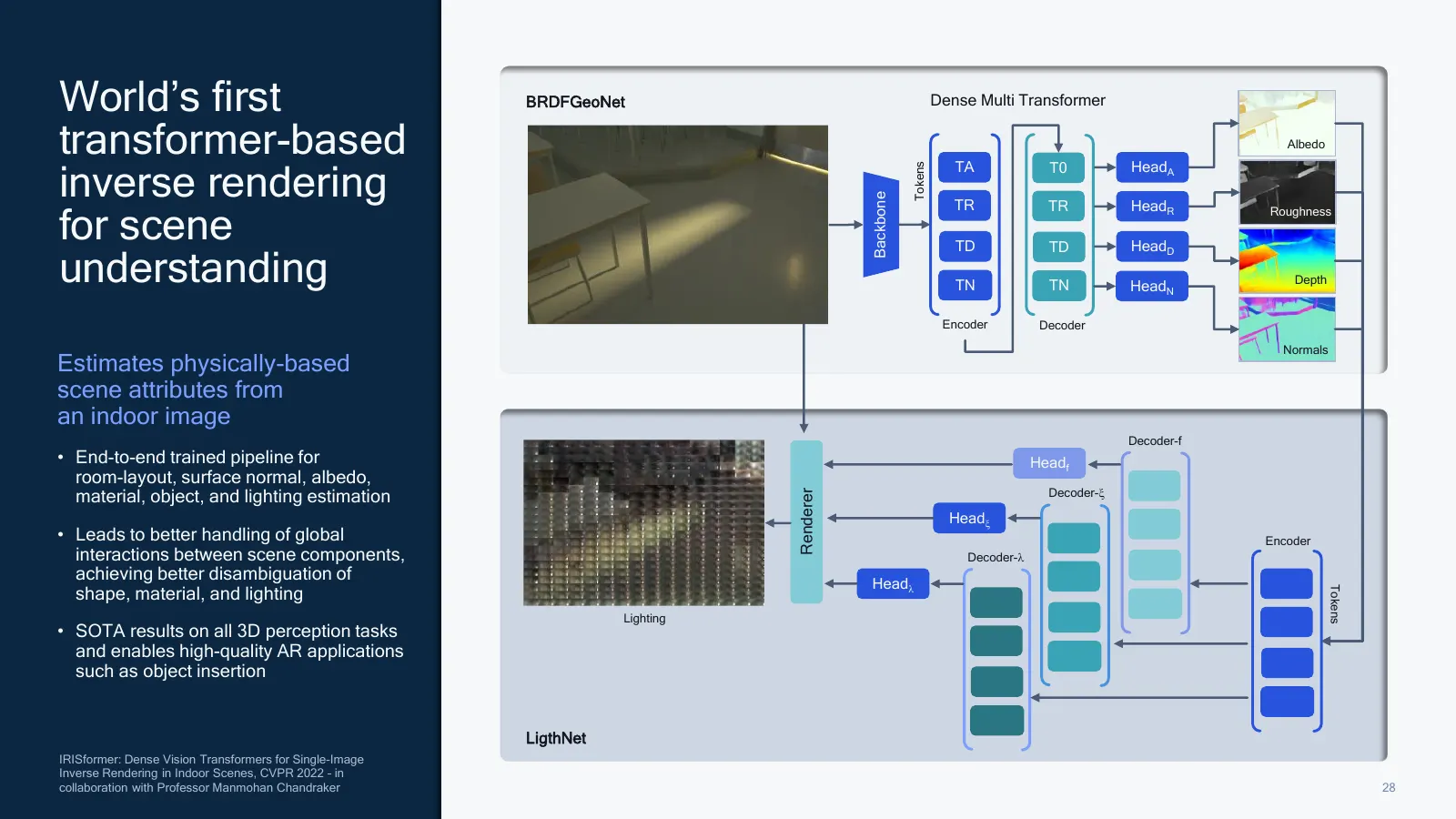
Slide 27: World's first transformer-based inverse rendering for scene understanding
World’s first BRDFGeoNet Dense Multi Transformer transformer-based Albedo inverse rendering TA T0 HeadA Tokens Backbone TR TR HeadR for scene Roughness TD TD HeadD understanding TN TN HeadN Depth Encoder Decoder Normals Estimates physically-based scene attributes from an indoor image Decoder-f • End
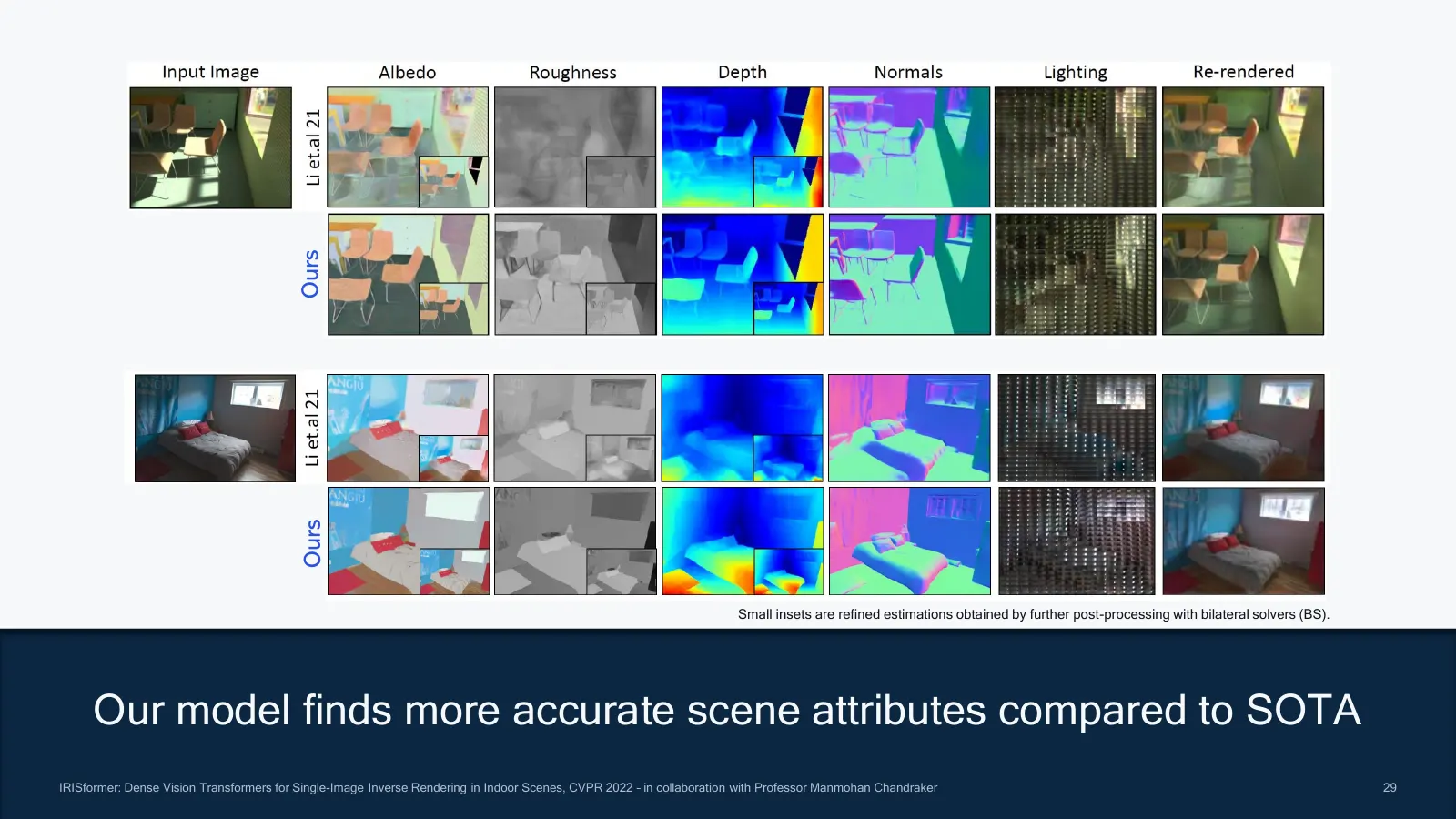
Slide 28: Our model finds more accurate scene attributes compared to SOTA
Ours Ours Small insets are refined estimations obtained by further post-processing with bilateral solvers (BS). Our model finds more accurate scene attributes compared to SOTA IRISformer: Dense Vision Transformers for Single-Image Inverse Rendering in Indoor Scenes, CVPR 2022 – in collaboration with
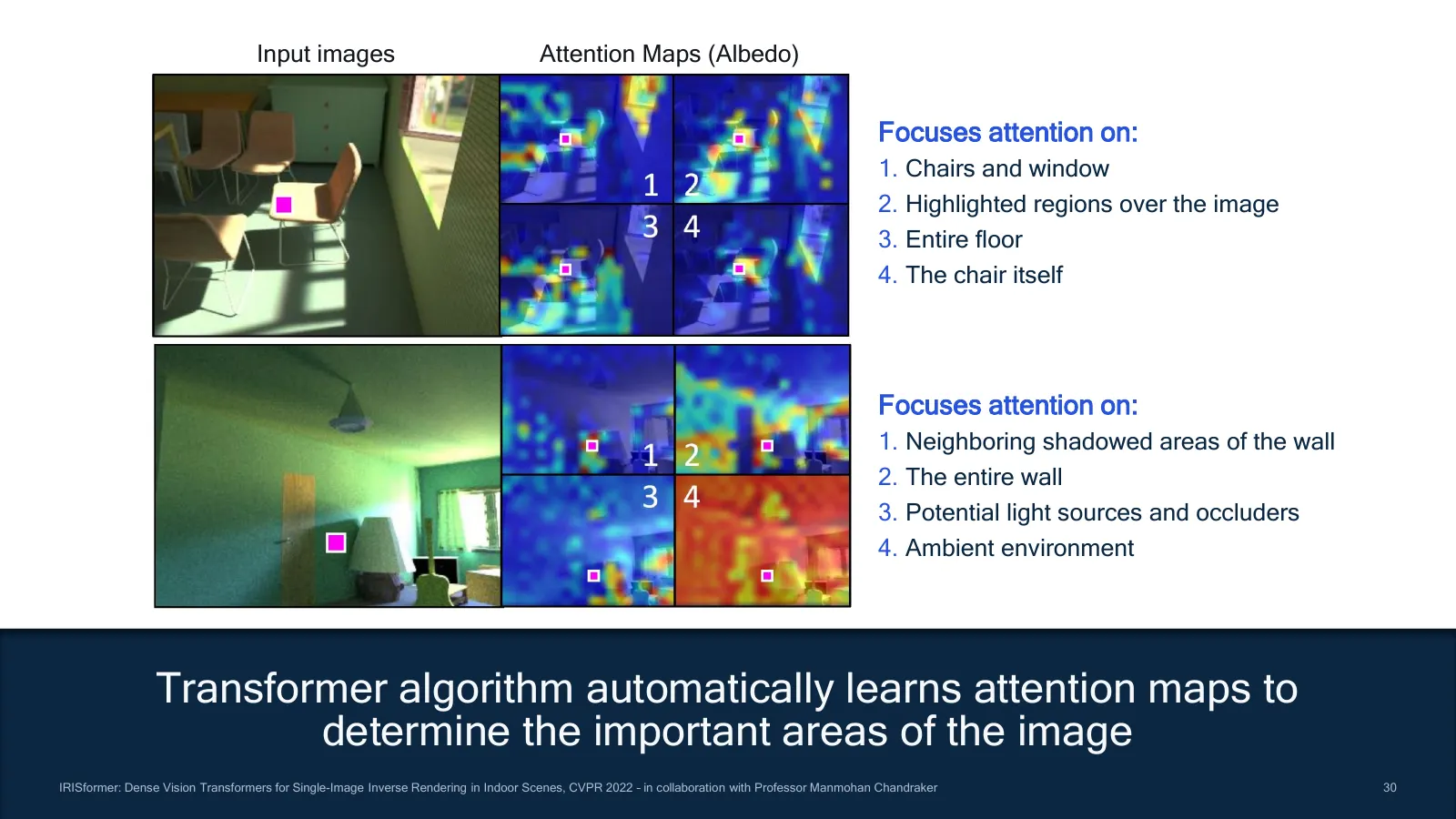
Slide 29: Transformer algorithm automatically learns attention maps
Input images Attention Maps (Albedo) Focuses attention on: 1. Chairs and window 2. Highlighted regions over the image 3. Entire floor 4. The chair itself Focuses attention on: 1. Neighboring shadowed areas of the wall 2. The entire wall 3. Potential light sources and occluders 4. Ambient environment
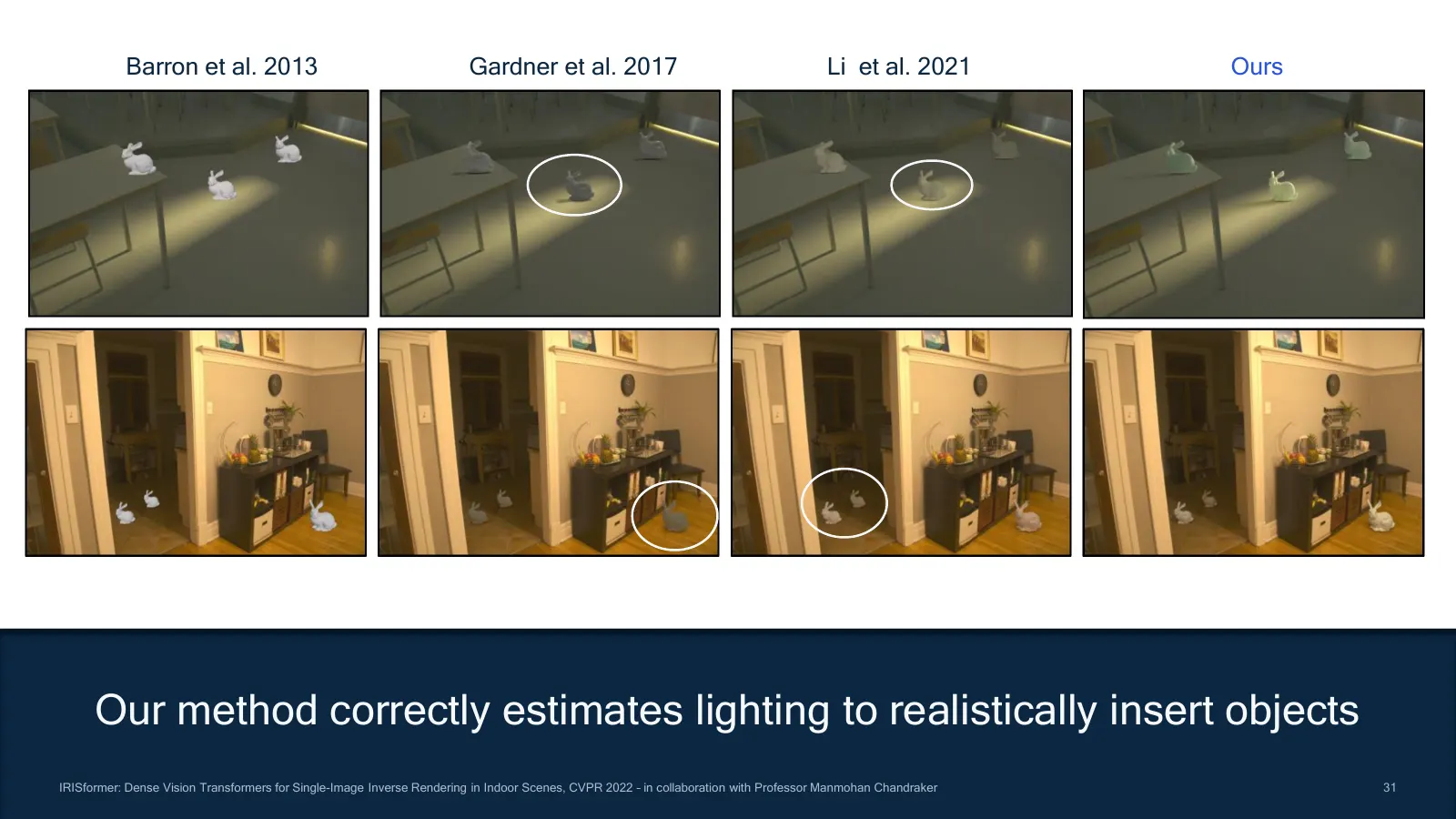
Slide 30: Our method correctly estimates lighting to realistically insert objects
Barron et al. 2013 Gardner et al. 2017 Li et al. 2021 Ours Our method correctly estimates lighting to realistically insert objects IRISformer: Dense Vision Transformers for Single-Image Inverse Rendering in Indoor Scenes, CVPR 2022 – in collaboration with Professor Manmohan Chandraker 31
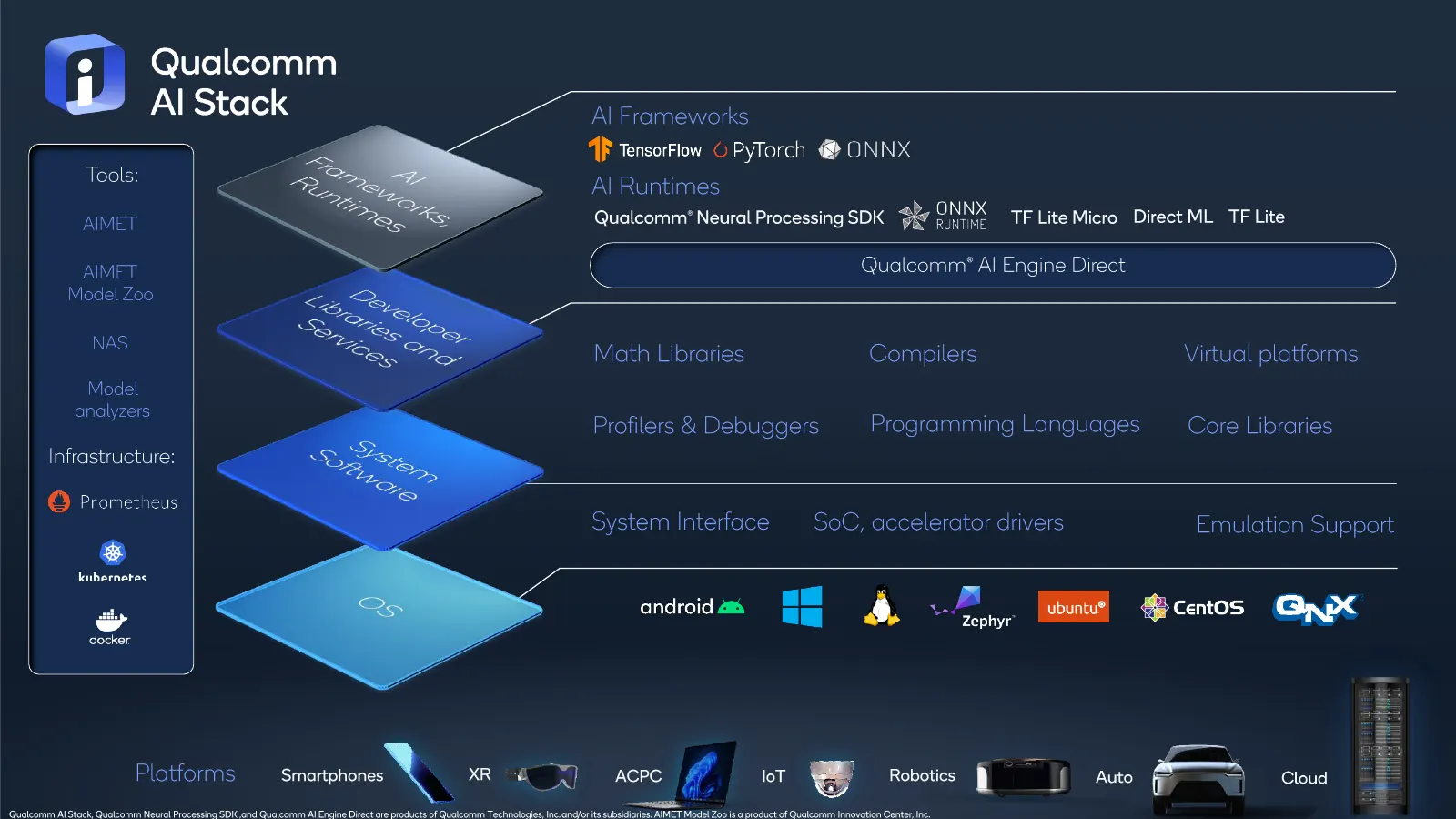
Slide 31: Qualcomm AI Stack
Qualcomm Al Stack Tools: AIMET. AIMET Model Zoo NAS Model analyzers Infrastructure: © Prometheus kubernetes s docker Platforms smoraones A XR & x] acre tA | lo @ Robotics Auto = Cloud — Al Frameworks AR tensorFiow © PyTorch @ ONNX Al Runtimes Qualcomm’ Neural Processing SDK tr ONNX TE Lite Micro Dir
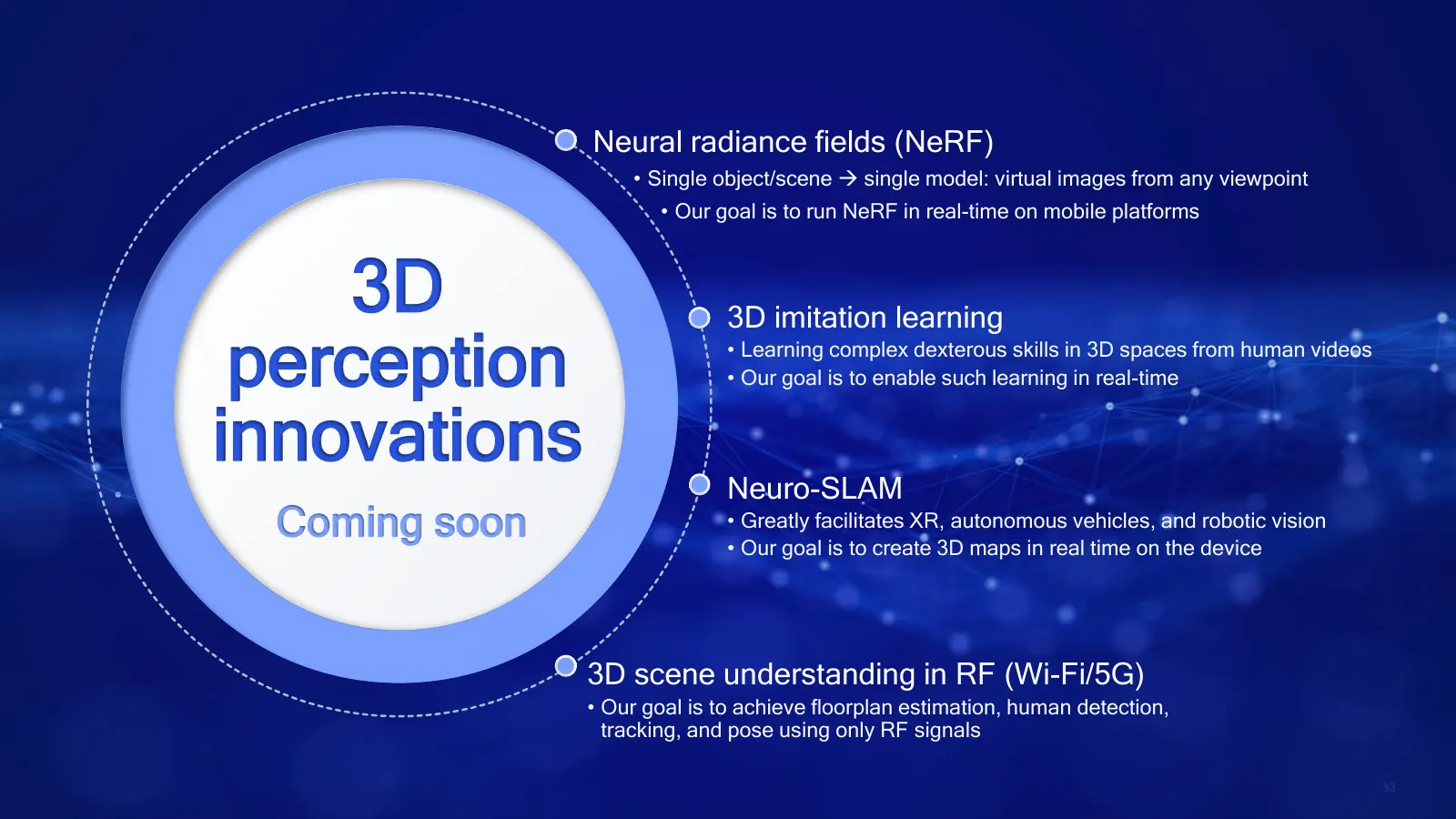
Slide 32: 3D perception innovations
Neural radiance fields (NeRF) • Single object/scene → single model: virtual images from any viewpoint • Our goal is to run NeRF in real-time on mobile platforms 3D 3D imitation learning perception • Learning complex dexterous skills in 3D spaces from human videos • Our goal is to enable such learnin
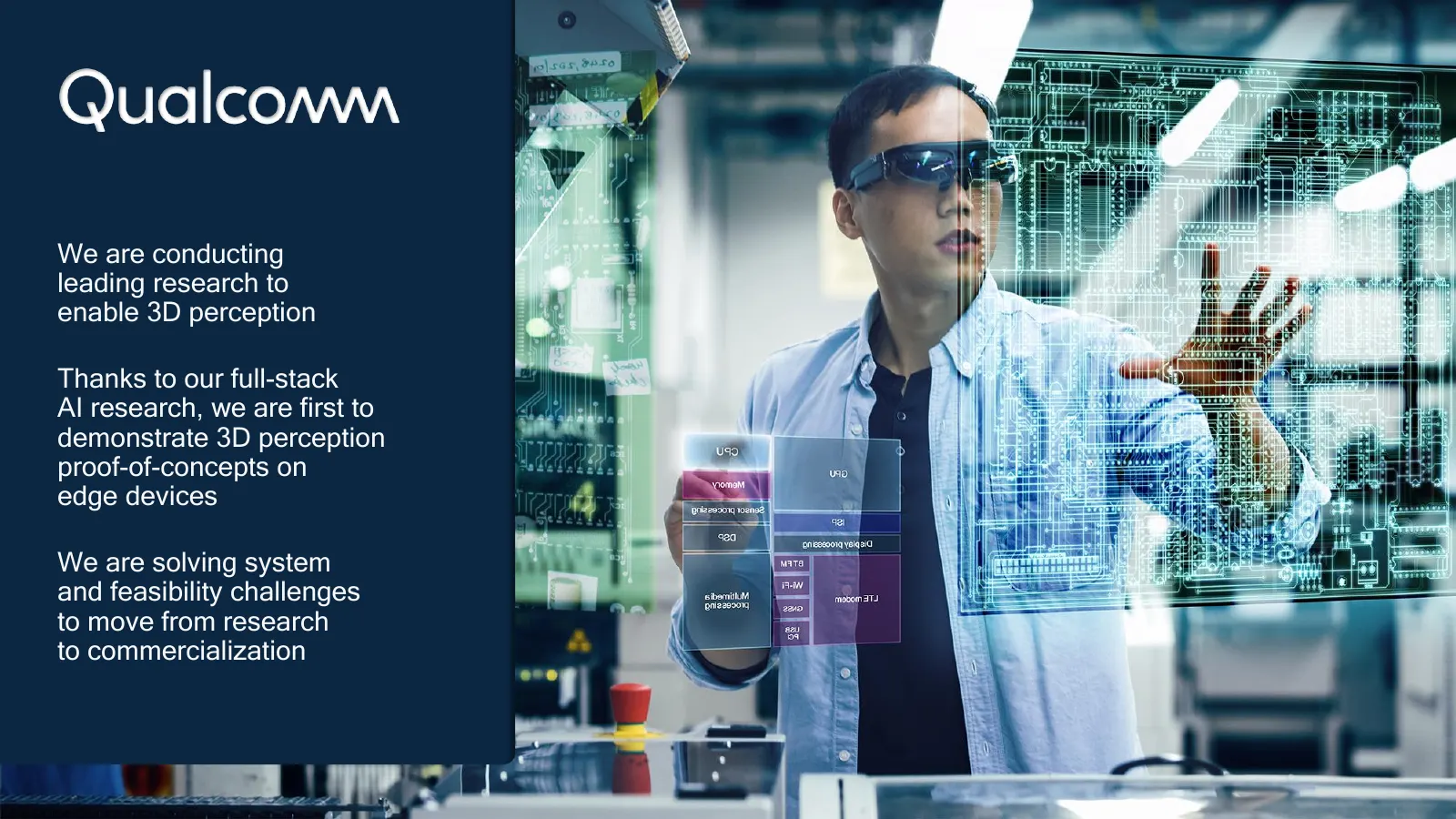
Slide 33: We are conducting leading research to enable 3D perception
We are conducting leading research to enable 3D perception Thanks to our full-stack AI research, we are first to demonstrate 3D perception proof-of-concepts on edge devices We are solving system and feasibility challenges to move from research to commercialization 34

Slide 34: Questions
Questions Connect with us www.qualcomm.com/research/ www.qualcomm.com/news/onq @QCOMResearch artificial-intelligence www.youtube.com/c/QualcommResearch www.slideshare.net/qualcommwirelessevolution 35

Slide 35: Thank you
Thank you Nothing in these materials is an offer to sell any of the components References in this presentation to “Qualcomm” may mean Qualcomm Incorporated, or devices referenced herein. Qualcomm Technologies, Inc., and/or other subsidiaries or business units within the Qualcomm corporate structure,
Source: Internet Archive copy of qualcomm.com
More decks from QUALCOMM Incorporated
 Q4 FY2026 Earnings Presentation27 slides · Nov 4, 2026
 Technical Presentation (October 2026)34 slides · October 2026
 Q3 FY2026 Earnings Presentation32 slides · Jul 29, 2026
 Investor Day (June 2026)29 slides · Jun 24, 2026
 Q2 FY2026 Earnings Presentation25 slides · Apr 29, 2026
 Q1 2026 Earnings Presentation23 slides · Feb 4, 2026