HOCHTIEF Aktiengesellschaft · XETR:HOT
HOCHTIEF Aktiengesellschaft — Investor Day (November 2006)
37 slides from HOCHTIEF Aktiengesellschaft's investor day presentation, Nov 17, 2006
Slide 1: HOCHTIEF and the airport business
HOCHTIEF and the airport business: From airport construction to successful and profitable airport investment and management Dr. Reinhard Kalenda CEO HOCHTIEF AirPort HOCHTIEF Capital Markets Day Concessions and Operation Frankfurt, November 17, 2006
Slide 2: Content
Content HOCHTIEF and the airport business: from airport construction to airport investment and management 1. HOCHTIEF’s entry into the airport business 2. The airport (privatization) market and the competition 3. The acquisition process – from identification to purchase 4. The HTA business model Pag
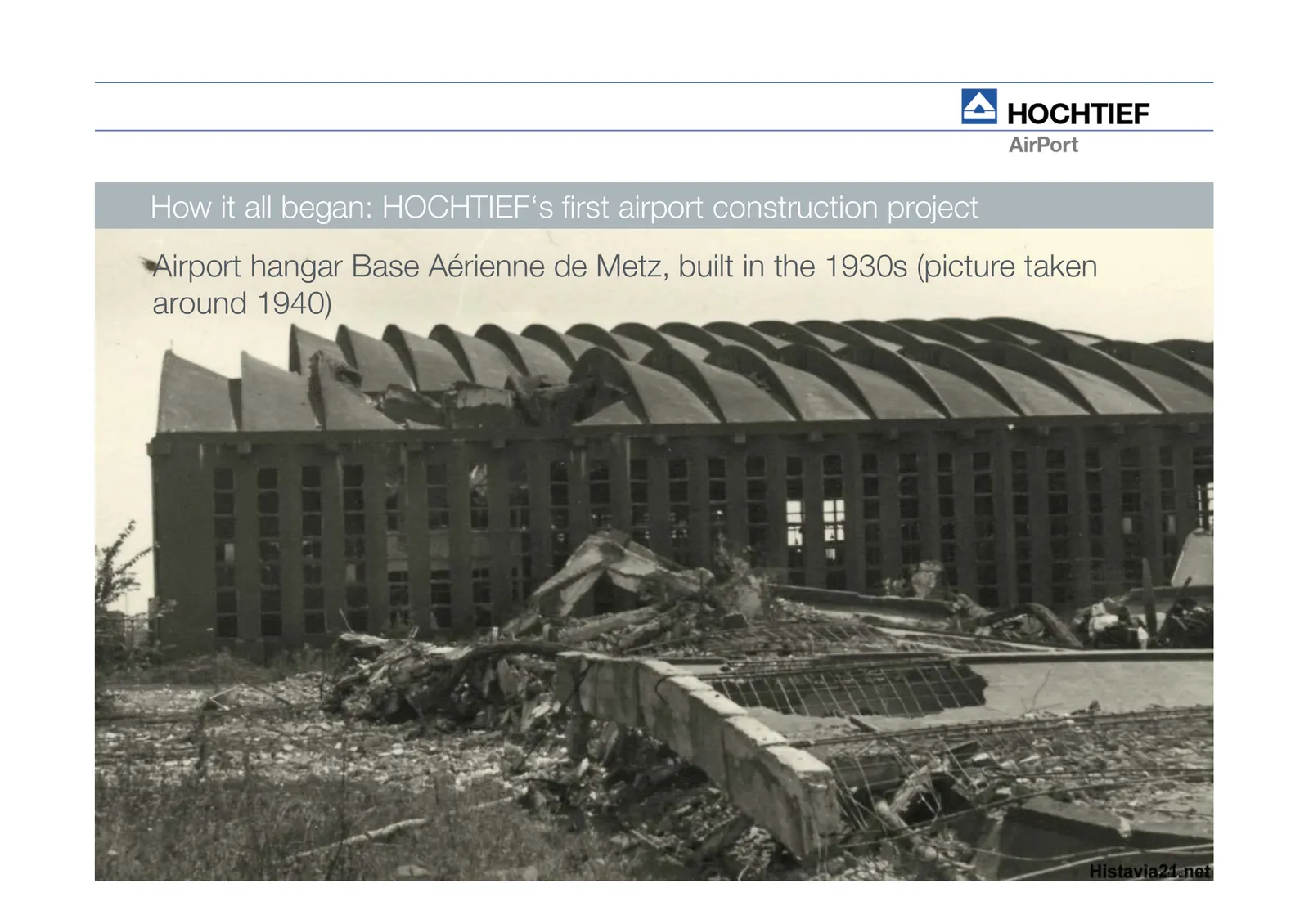
Slide 3: How it all began: HOCHTIEF's first airport construction project
How it all began: HOCHTIEF‘s first airport construction project Airport hangar Base Aérienne de Metz, built in the 1930s (picture taken around 1940) Page 3
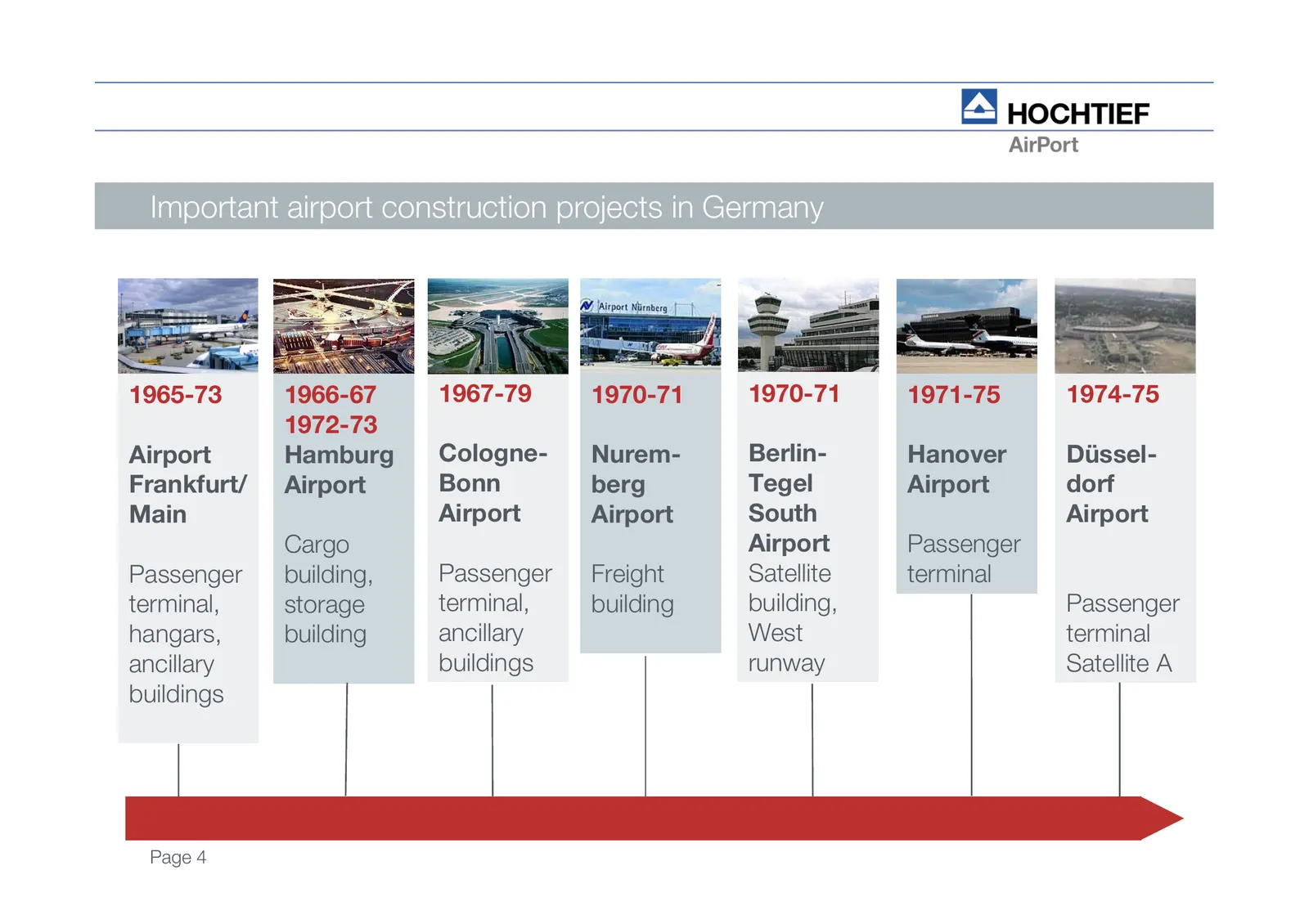
Slide 4: Important airport construction projects in Germany
Important airport construction projects in Germany 1965-73 1966-67 1967-79 1970-71 1970-71 1971-75 1974-75 1972-73 Airport Hamburg Cologne- Nurem- Berlin- Hanover Düssel- Frankfurt/ Airport Bonn berg Tegel Airport dorf Main Airport Airport South Airport Cargo Airport Passenger Passenger building, Pa
Slide 5: Systematic development of airport competence
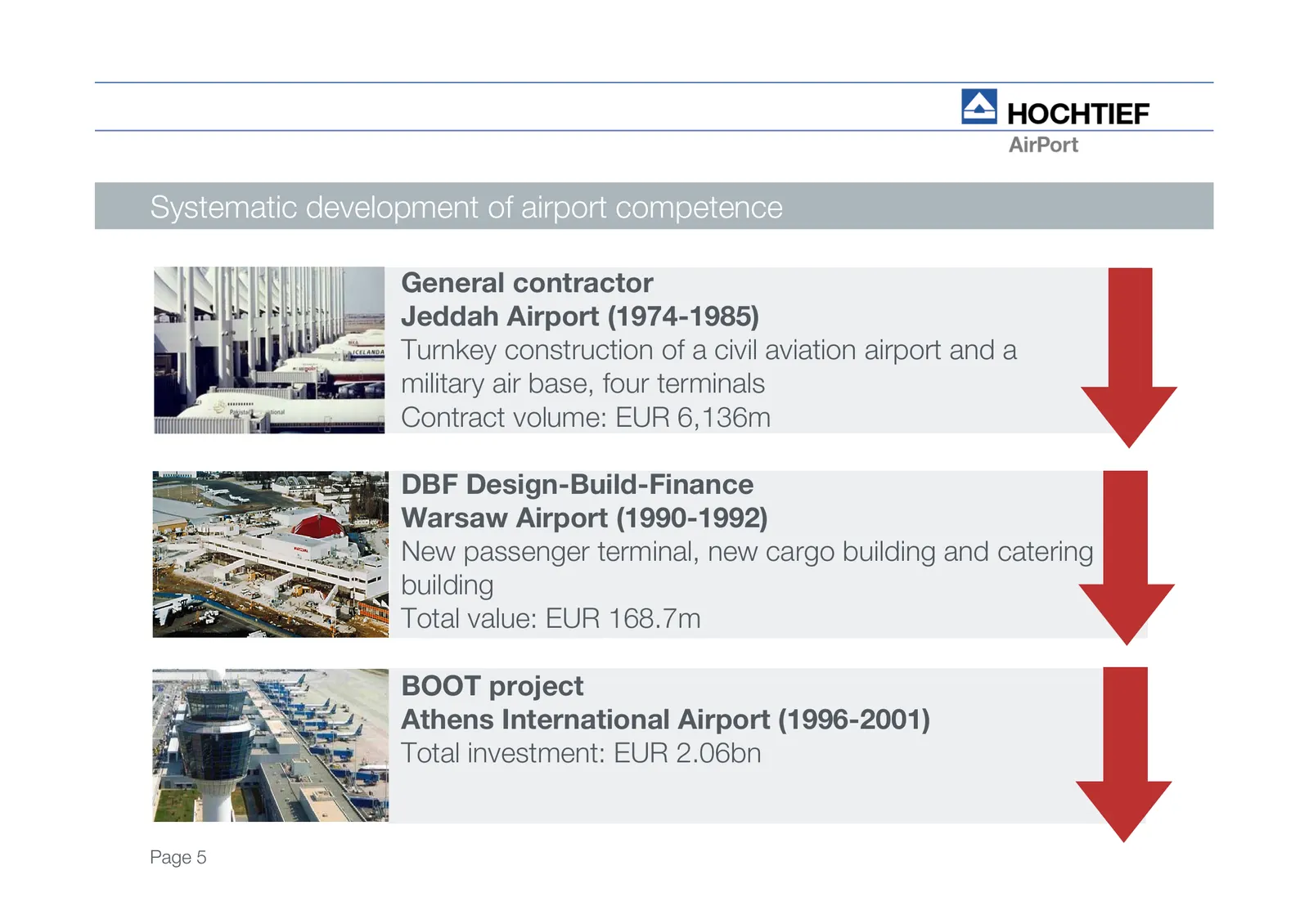
Systematic development of airport competence General contractor Jeddah Airport (1974-1985) Turnkey construction of a civil aviation airport and a military air base, four terminals Contract volume: EUR 6,136m DBF Design-Build-Finance Warsaw Airport (1990-1992) New passenger terminal, new cargo buildi
Slide 6: The situation of the German construction market in 1996
The situation of the German construction market in 1996 • Volume DM 600 bn p. a. • Demand for construction in decline • 100,000 firms in main building trades • 2,000 insolvencies a year • Together, the ten largest companies have a market share of around six percent. Limited scope for HOCHTIEF to gro
Slide 7: Market opportunities in the transportation sector
Market opportunities in the transportation sector • Early identification of transportation as a mega-trend which HOCHTIEF can tap into • The transportation sector calls for planning, financing and operator know-how • e.g. (PPP) models in road and bridge-building and in tunneling • Very promising dev
Slide 8: Airports as an attractive asset class (1996)
Airports as an attractive asset class (1996) • Civil aviation worldwide is growing faster than GDP • Continuing trend towards privatization • Airports offer - relative stability and quick recovery from any shocks (e. g. Gulf War I) - high returns and low volatility - strong asset backing - with long
Slide 9: Stability of airports as an asset class
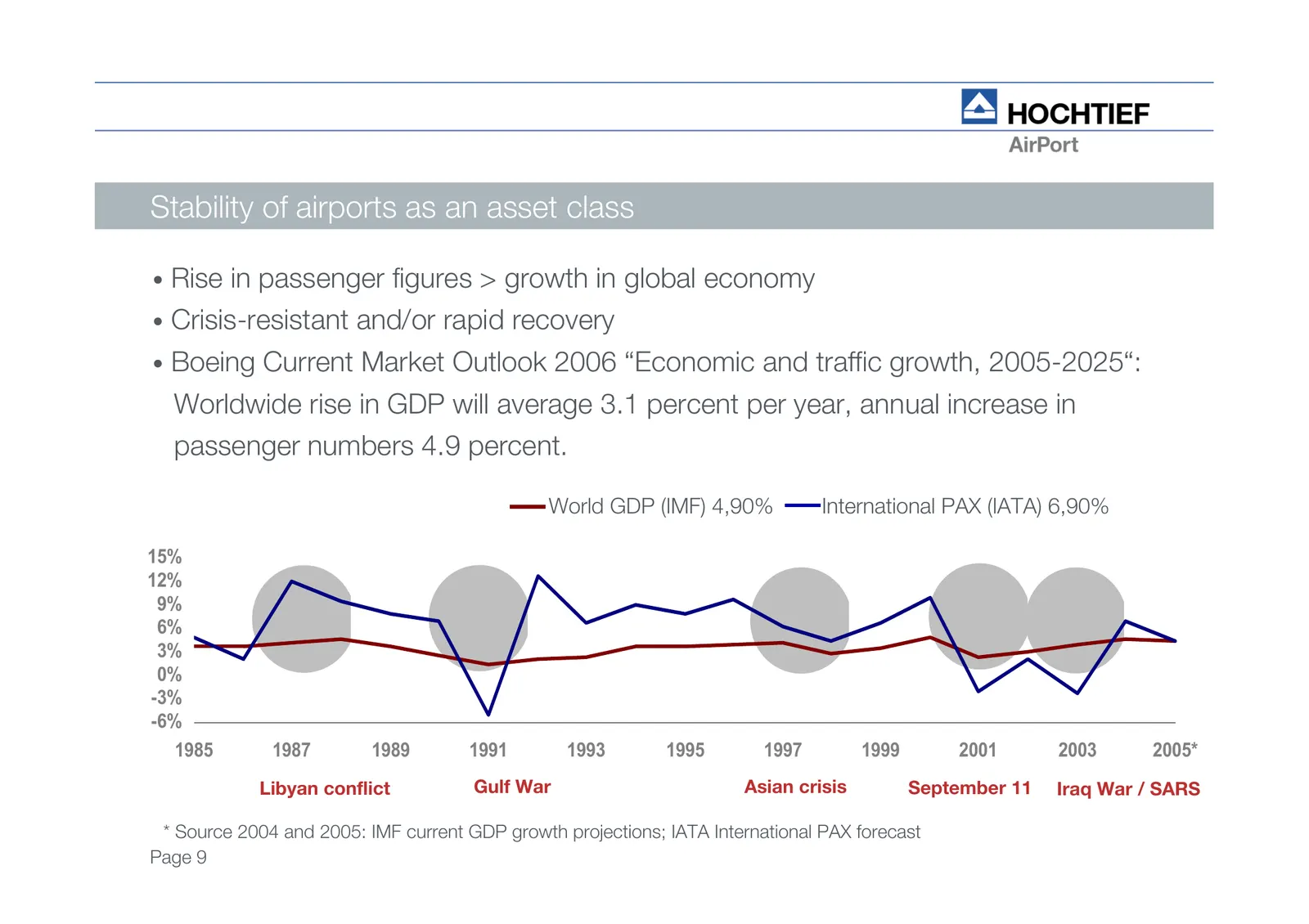
Stability of airports as an asset class • Rise in passenger figures > growth in global economy • Crisis-resistant and/or rapid recovery • Boeing Current Market Outlook 2006 “Economic and traffic growth, 2005-2025“: Worldwide rise in GDP will average 3.1 percent per year, annual increase in passenger
Slide 10: A market is born: how did airport privatizations come about?
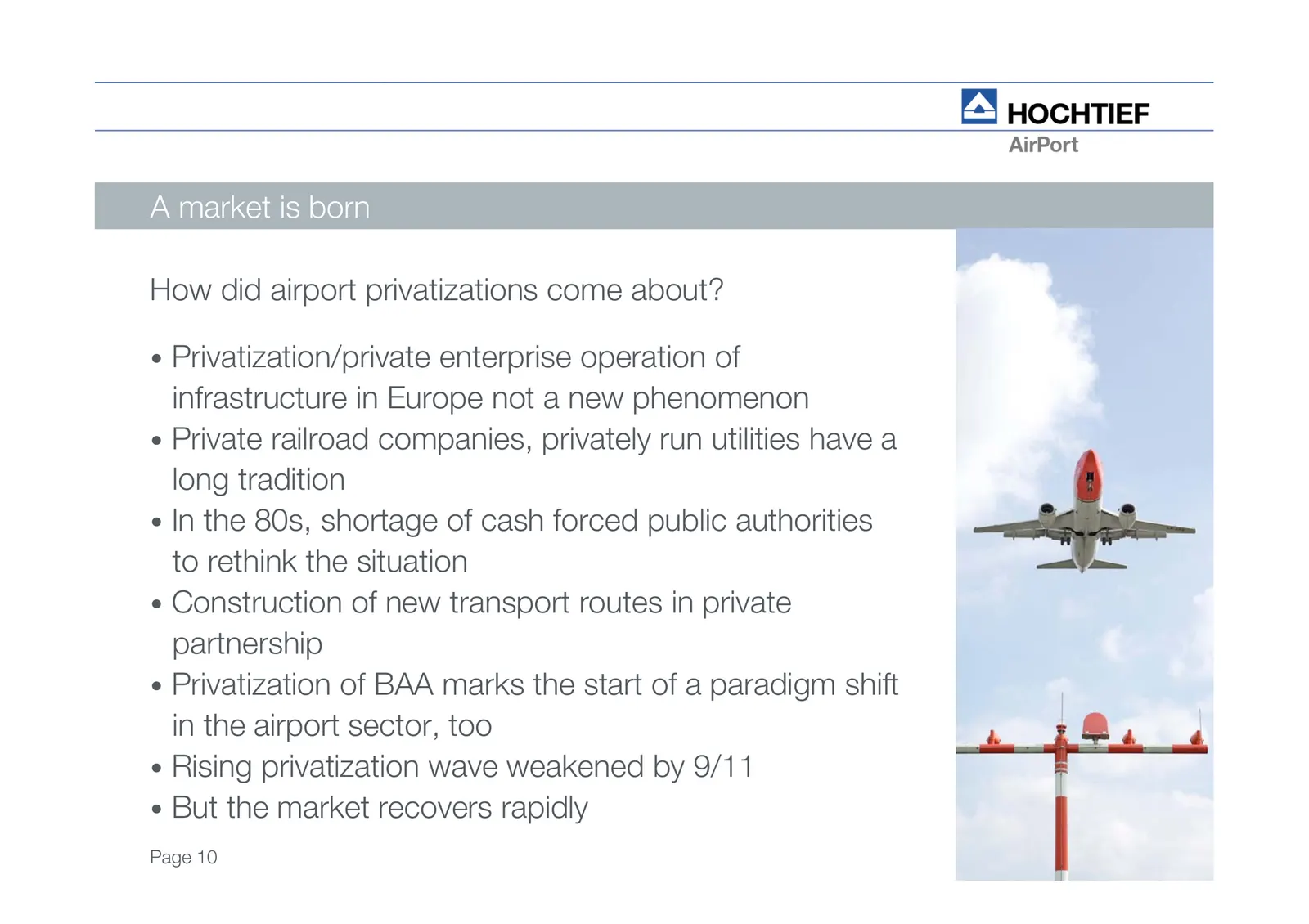
A market is born How did airport privatizations come about? • Privatization/private enterprise operation of infrastructure in Europe not a new phenomenon • Private railroad companies, privately run utilities have a long tradition • In the 80s, shortage of cash forced public authorities to rethink th
Slide 11: Overview of airport transactions worldwide
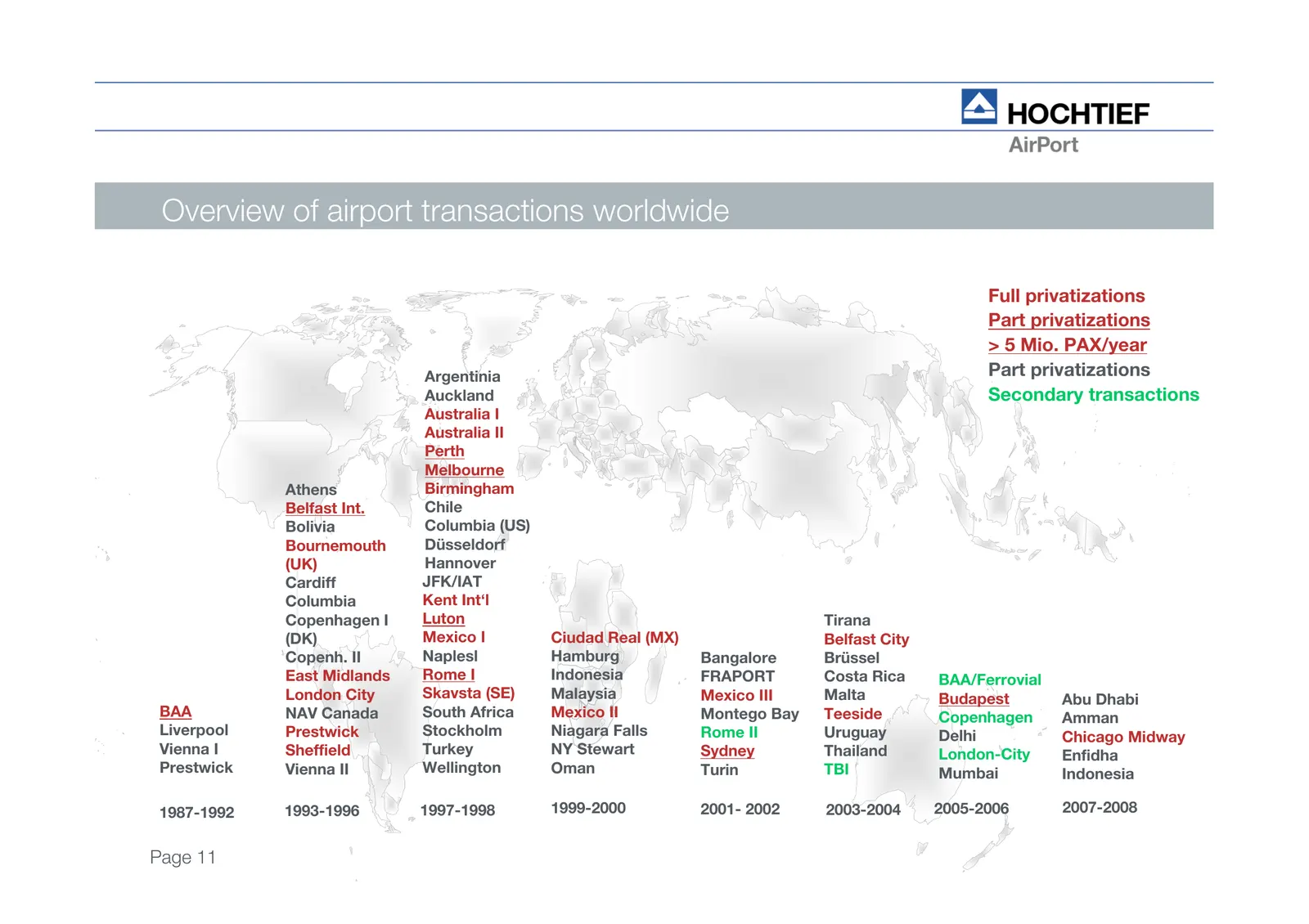
Overview of airport transactions worldwide Full privatizations Part privatizations > 5 Mio. PAX/year Argentinia Part privatizations Auckland Secondary transactions Australia I Australia II Perth Melbourne Athens Birmingham Belfast Int. Chile Bolivia Columbia (US) Bournemouth Düsseldorf (UK) Hannover
Slide 12: Systematic continuation of the adopted path
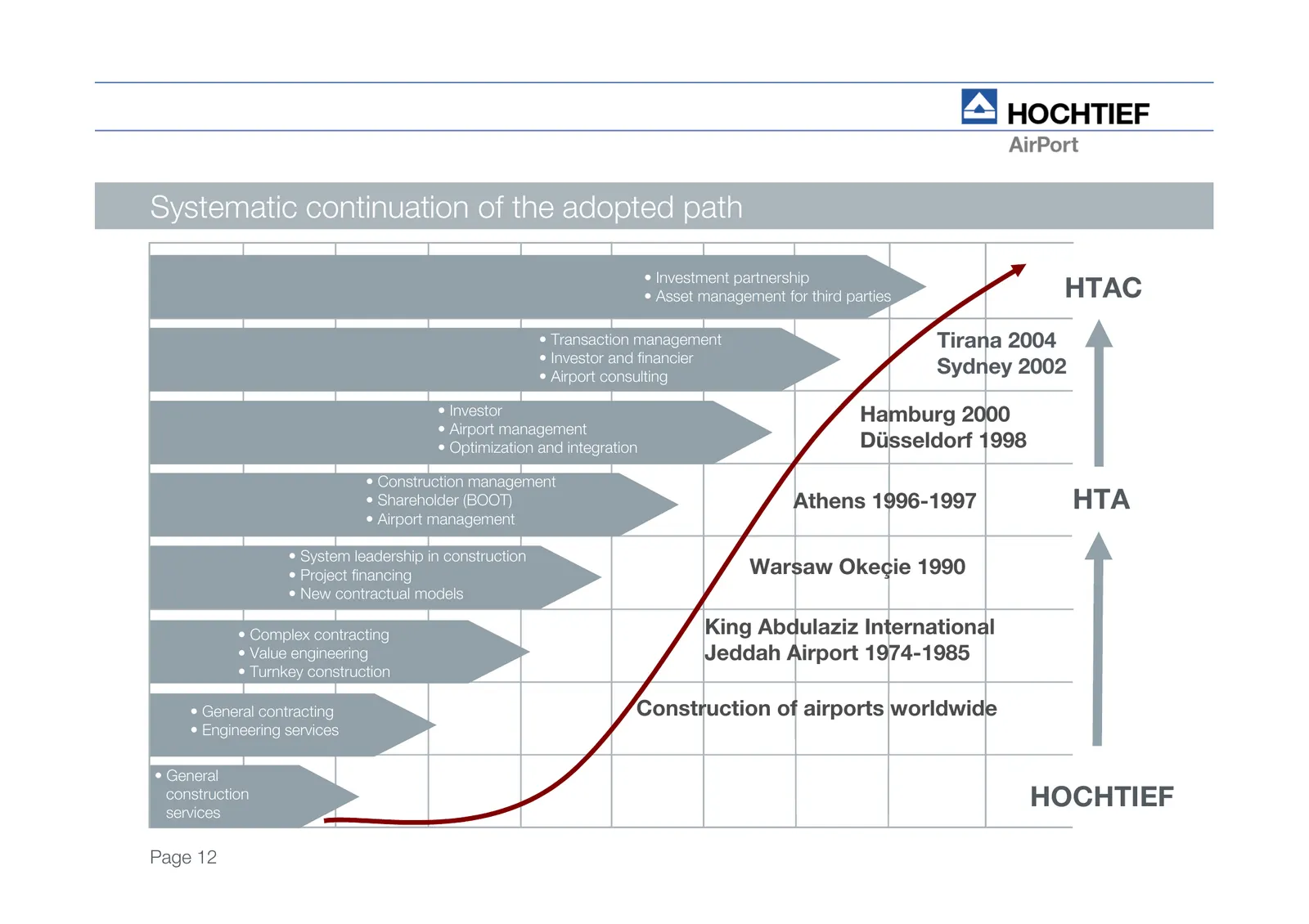
Systematic continuation of the adopted path • Investment partnership • Asset management for third parties HTAC • Transaction management Tirana 2004 • Investor and financier • Airport consulting Sydney 2002 • Investor Hamburg 2000 • Airport management • Optimization and integration Düsseldorf 1998 •
Slide 13: HOCHTIEF AirPort's market position today
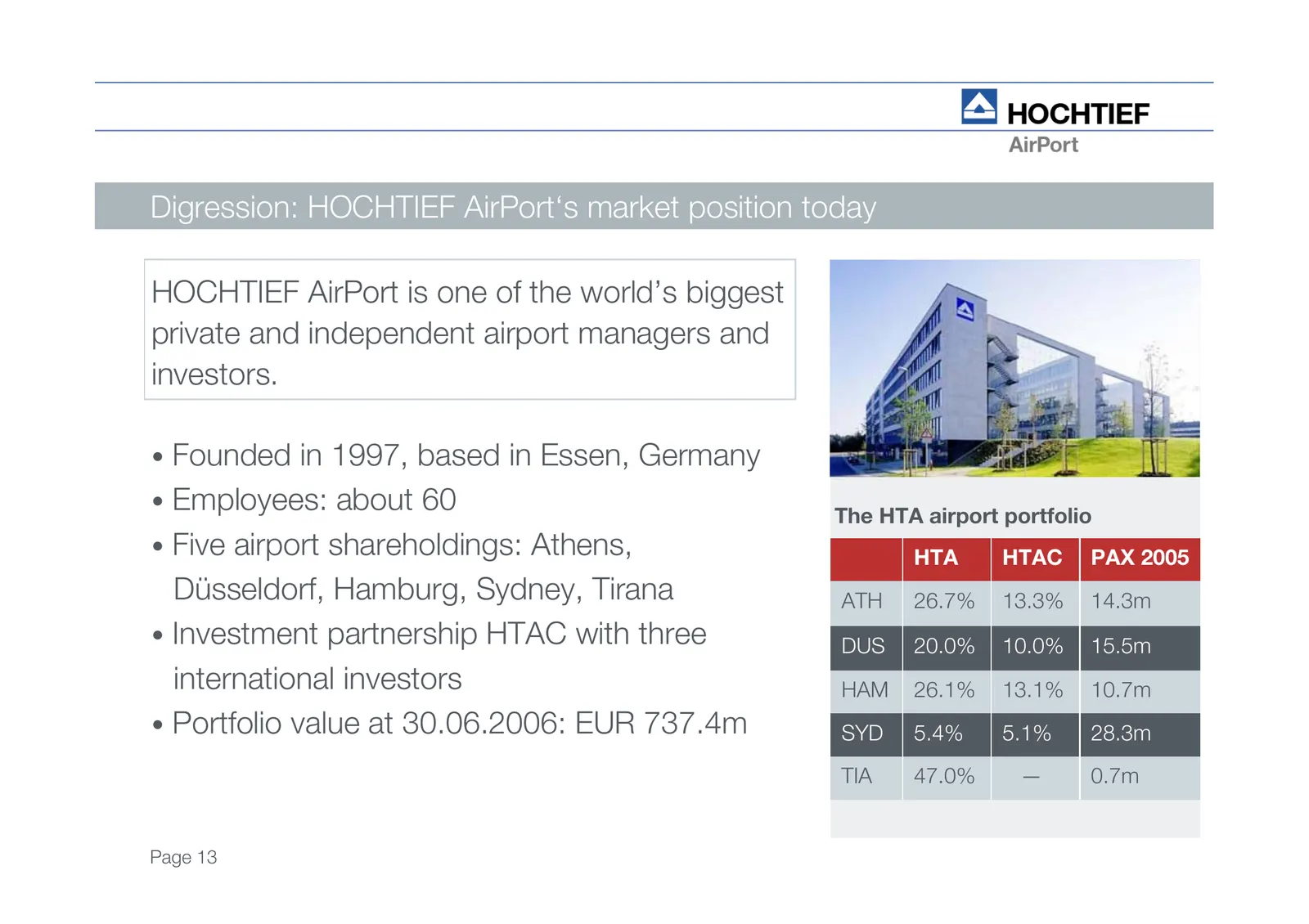
Digression: HOCHTIEF AirPort‘s market position today HOCHTIEF AirPort is one of the world’s biggest private and independent airport managers and investors. • Founded in 1997, based in Essen, Germany • Employees: about 60 The HTA airport portfolio • Five airport shareholdings: Athens, HTA HTAC PAX 20
Slide 14: HOCHTIEF services cover the entire life cycle
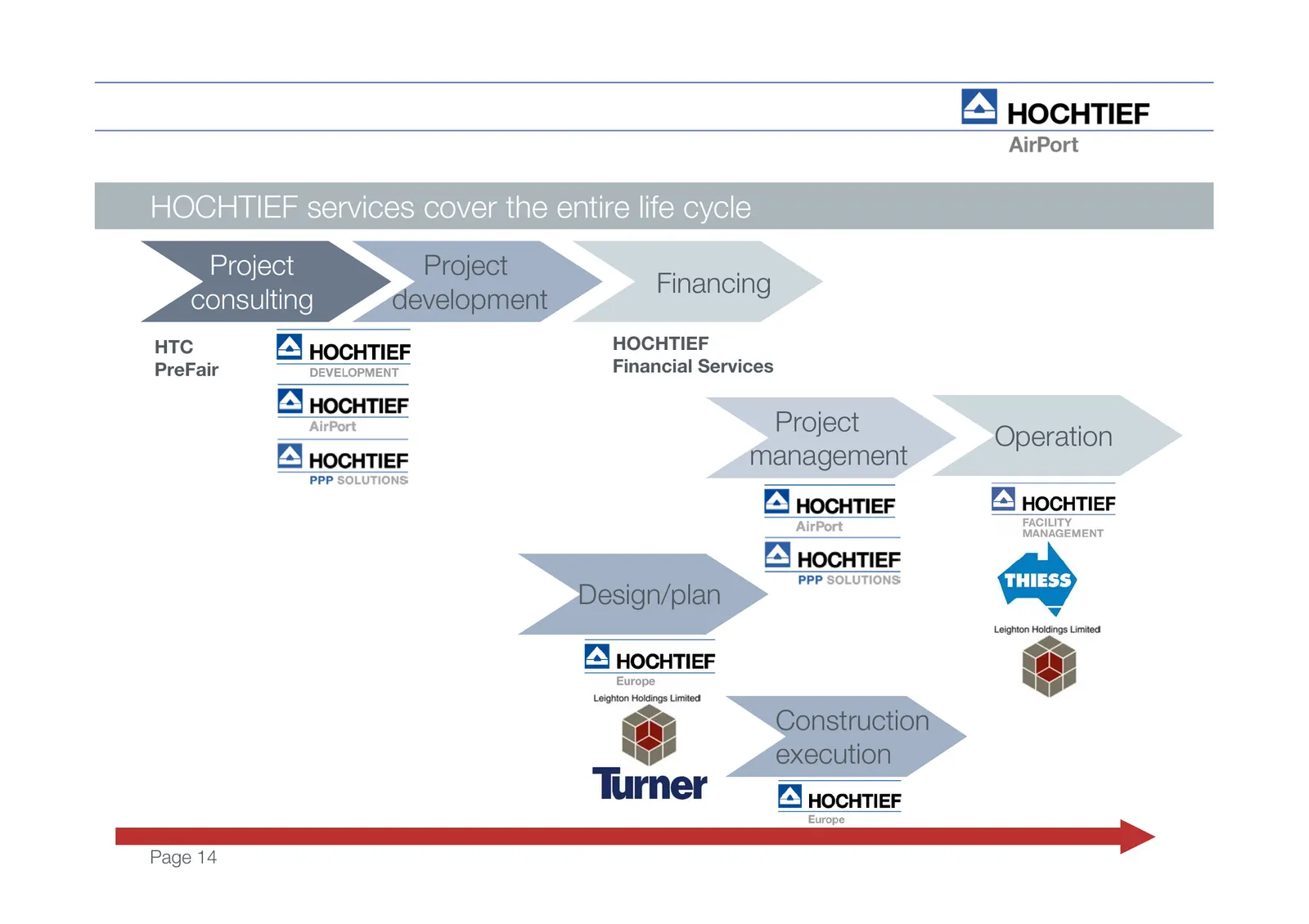
HOCHTIEF services cover the entire life cycle Project Project Financing consulting development HTC HOCHTIEF PreFair Financial Services Project Operation management Design/plan Construction execution Page 14
Slide 15: Privatizations in the pipeline: a selection
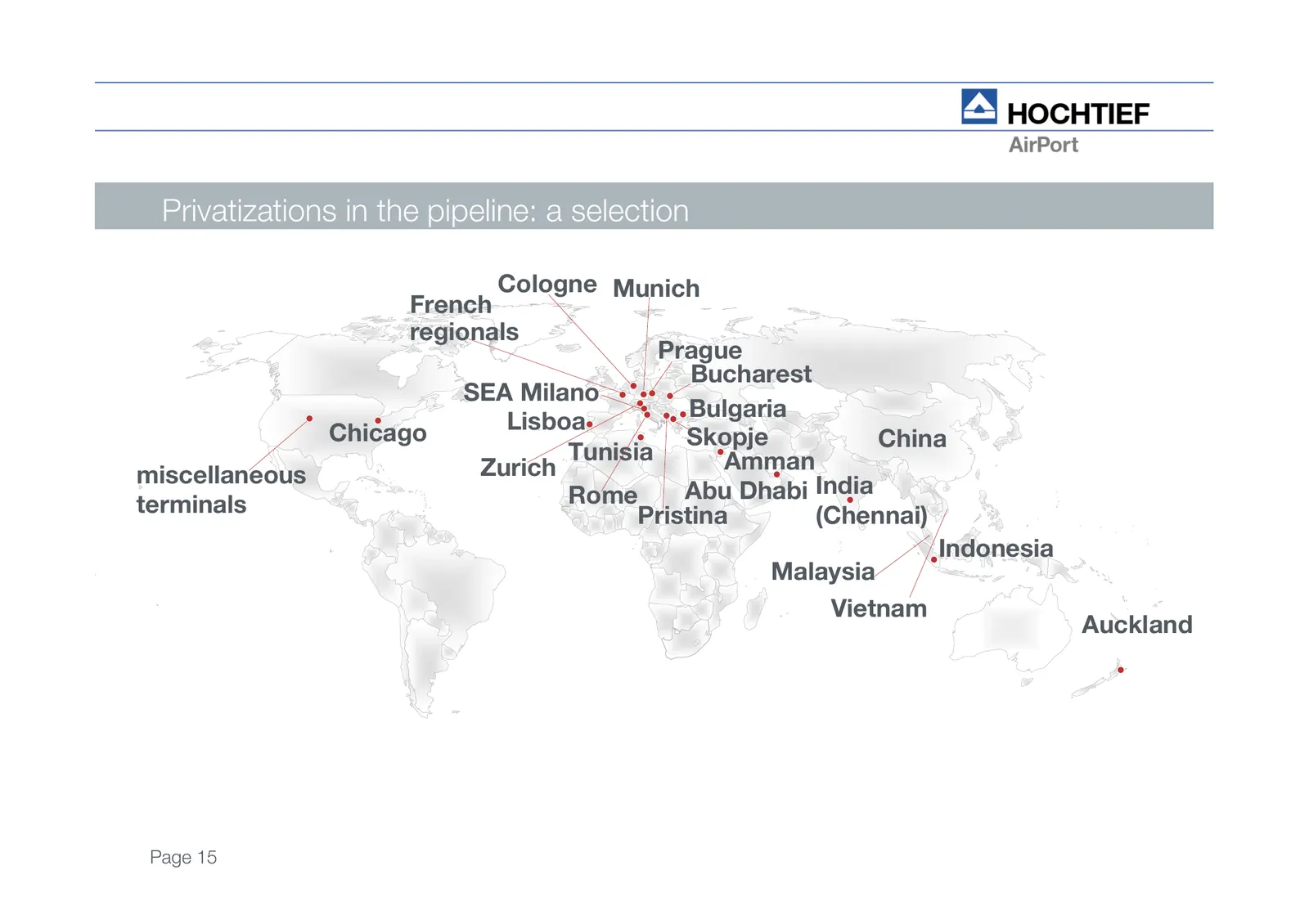
Privatizations in the pipeline: a selection Cologne Munich French regionals Prague Bucharest SEA Milano Bulgaria Chicago Lisboa Skopje China Tunisia Amman miscellaneous Zurich Rome Abu Dhabi India terminals Pristina (Chennai) Indonesia Malaysia Vietnam Auckland Page 15
Slide 16: Overview: Change of market players
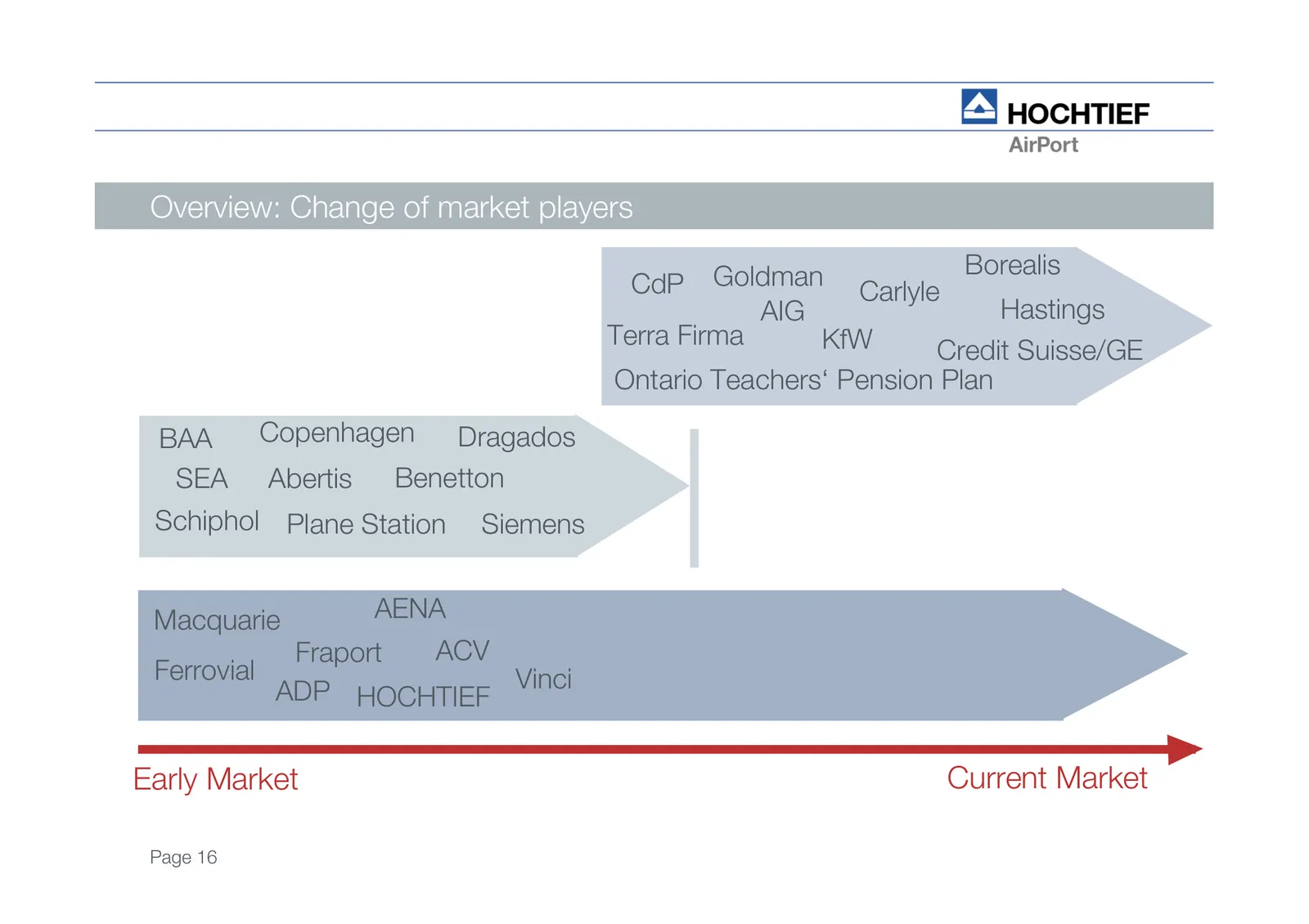
Overview: Change of market players Goldman Borealis CdP Carlyle AIG Hastings Terra Firma KfW Credit Suisse/GE Ontario Teachers‘ Pension Plan BAA Copenhagen Dragados SEA Abertis Benetton Schiphol Plane Station Siemens Macquarie AENA Fraport ACV Ferrovial ADP HOCHTIEF Vinci Early Market Current Market
Slide 17: Restricted access for the public
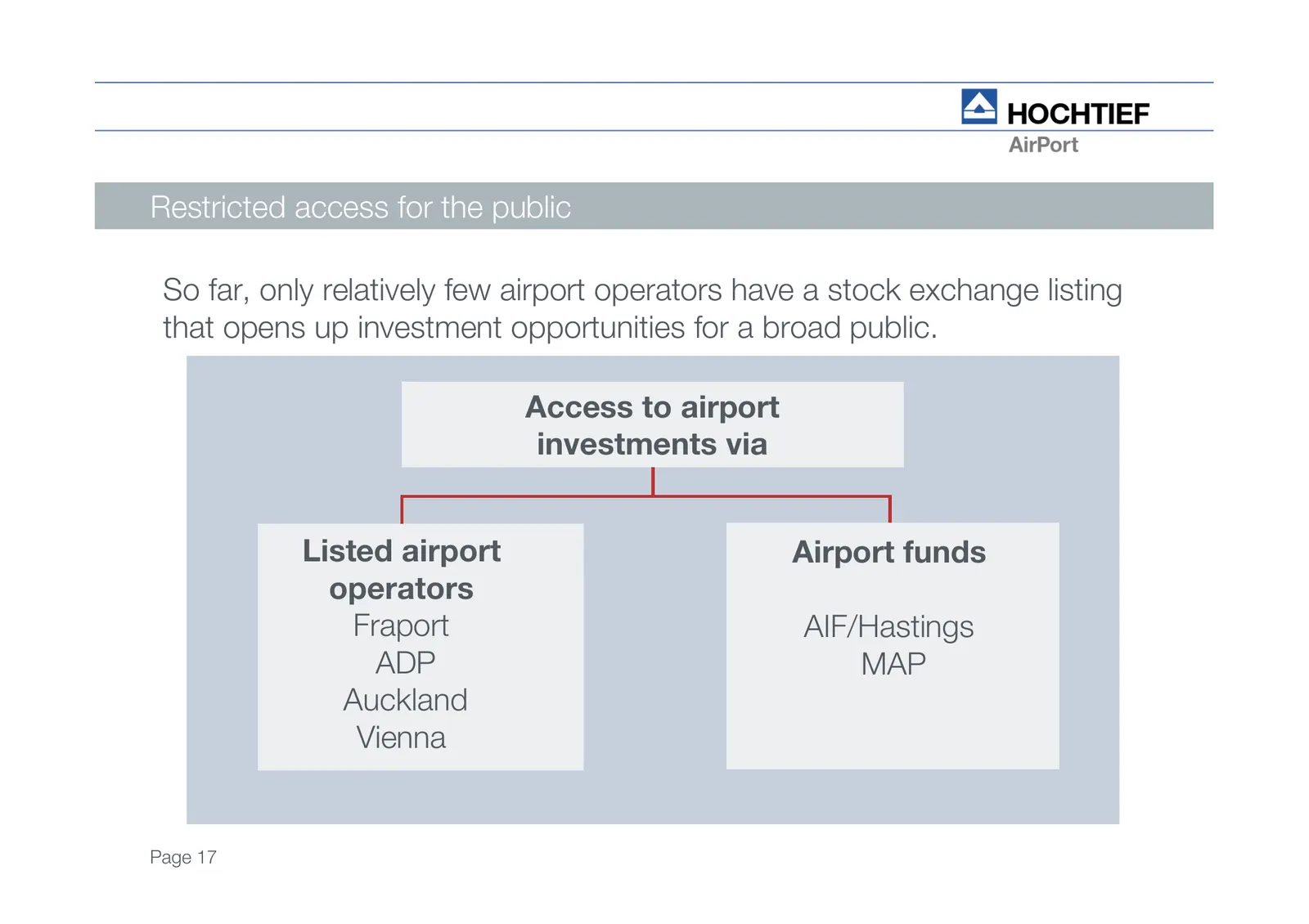
Restricted access for the public So far, only relatively few airport operators have a stock exchange listing that opens up investment opportunities for a broad public. Access to airport investments via Listed airport Airport funds operators Fraport AIF/Hastings ADP MAP Auckland Vienna Page 17
Slide 18: HTA's uniqueness
HTA’s uniqueness • HTA is unique in its business environment • Not an operator/no home airport, but also not a fund • Key differences: – In-depth operational expertise – Strong, active role in managing airports – Provision of consulting services for third parties Page 18
Slide 19: New market players: Private equity airport funds
New market players: Private equity airport funds • ABN Amro Infrastructure Capital Equity Fund (January 2006) • JP Morgan (announced) • Credit Suisse and GE Energy Financial Services und GE Commercial Aviation Services (May 2006) • Morgan Stanley (May 2006) • Goldman Sachs (planned December 2006) •
Slide 20: Airport acquisitions
Airport acquisitions • IPO e.g. Frankfurt (2001); AdP (2006) • Trade sale e.g. Sydney (2002); Delhi/Mumbai (2005) • Secondary transactions e.g. Rome (2000); Copenhagen (2005) • Operator concessions e.g. Tirana (2004); Toronto (Terminal 2003) Sale via official invitations to tender, hostile takeovers
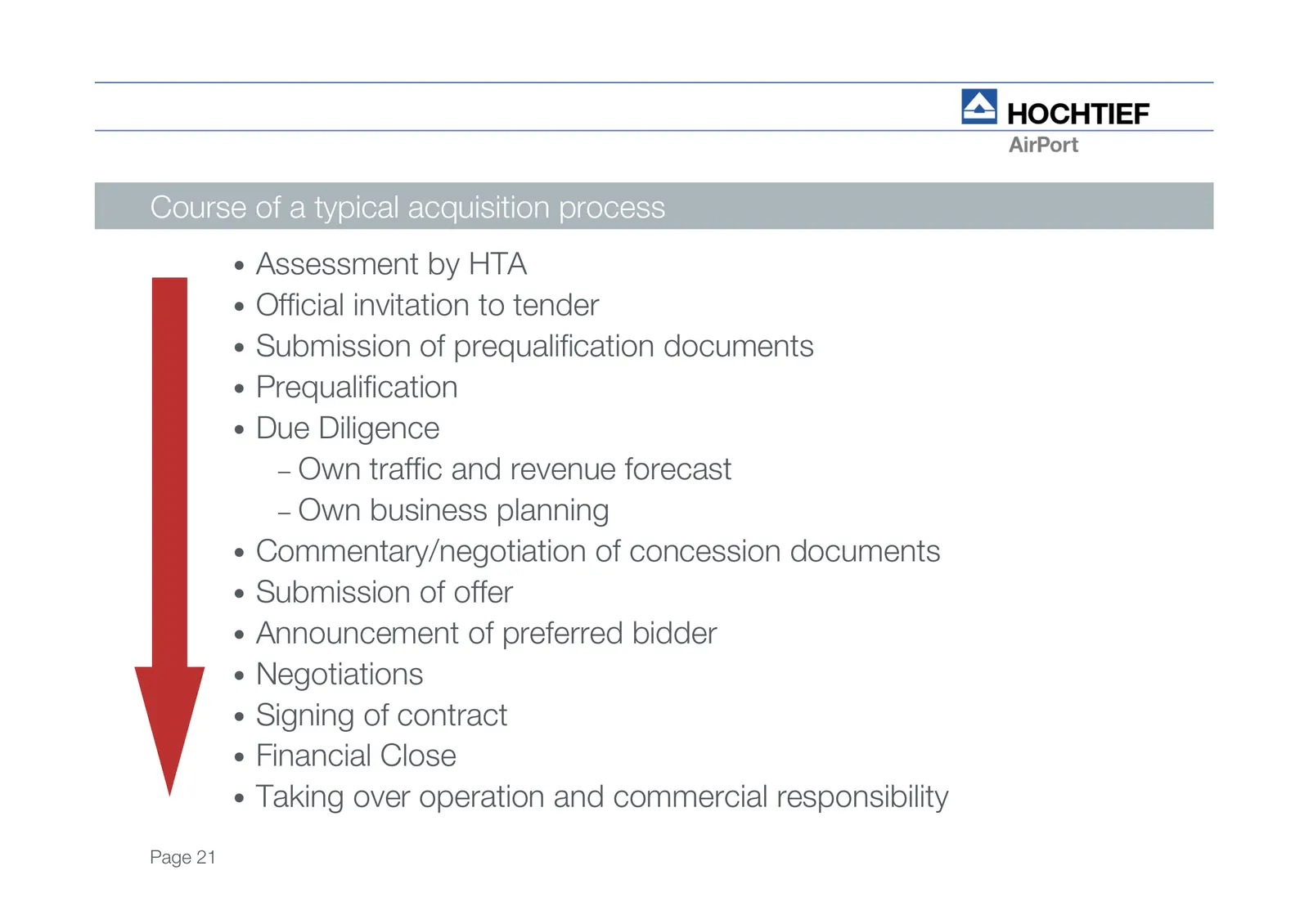
Slide 21: Course of a typical acquisition process
Course of a typical acquisition process • Assessment by HTA • Official invitation to tender • Submission of prequalification documents • Prequalification • Due Diligence – Own traffic and revenue forecast – Own business planning • Commentary/negotiation of concession documents • Submission of offer
Slide 22: Why are privatizations postponed so frequently?
Why are privatizations postponed so frequently? • Airport privatizations are very complex processes involving many people. • Need to take account of various requirements (state obligations, regulation, competition, customers and concessionaires, shareholders etc.) • Sellers underestimate complexity
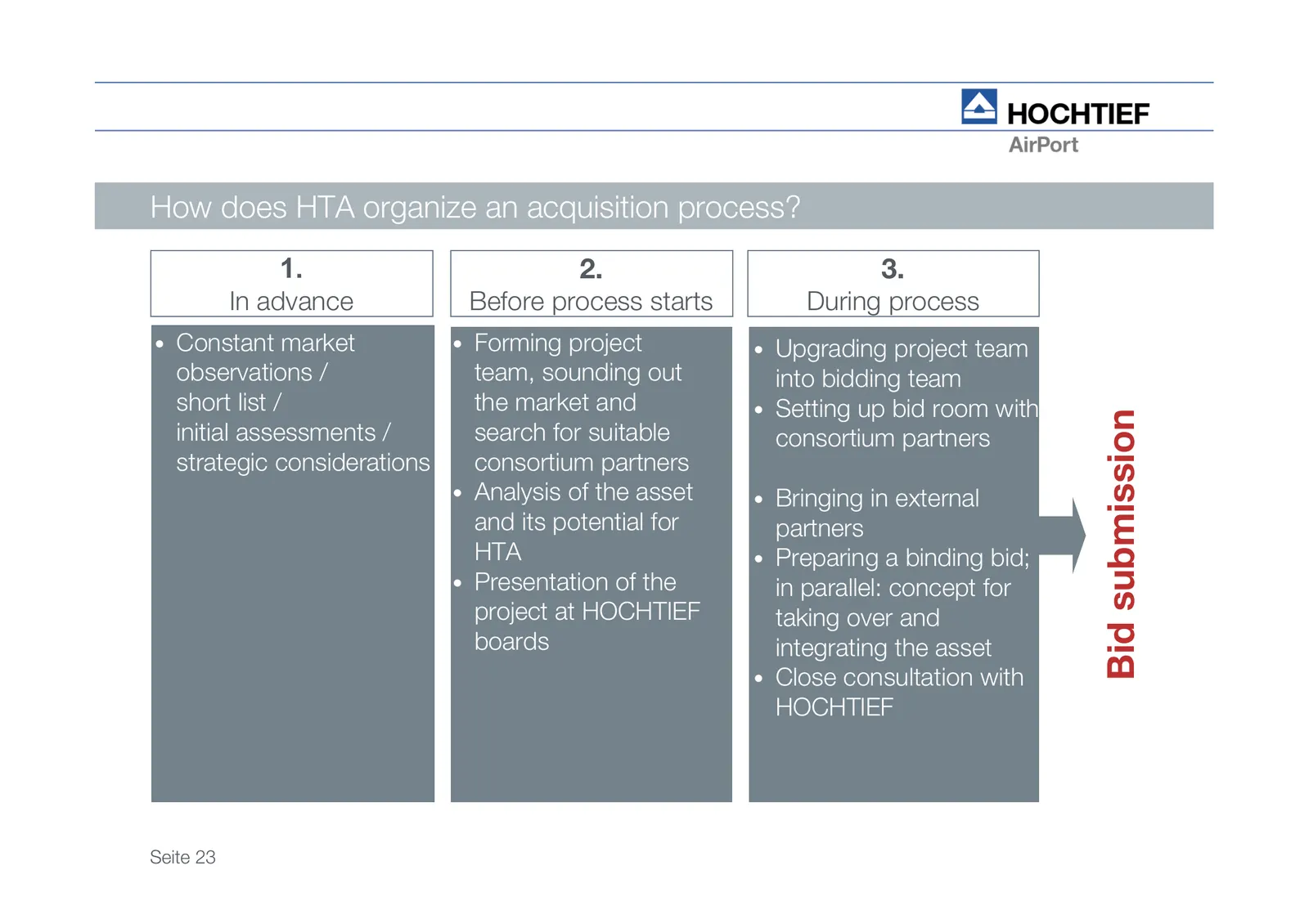
Slide 23: How does HTA organize an acquisition process?
How does HTA organize an acquisition process? 1. 2. 3. In advance Before process starts During process • Constant market • Forming project • Upgrading project team observations / team, sounding out into bidding team short list / the market and • Setting up bid room with Bid submission initial assess
Slide 24: Value drivers in establishing the purchase price
Values drivers in establishing the purchase price • Traffic figures and future development • Scope in non-aviation business + outlook • Flexible regulatory framework conditions • Airport facilities (structural condition of the airport, space reserves, capacity reserves etc.) • Commercial optimizatio
Slide 25: Digression: Regulation of charges
Digression: Regulation of charges • Airport charges are usually regulated; they are subject to approval by the relevant authority or are at least monitored • Regulatory systems vary considerably; this makes comparisons difficult. In most case they are governed by the principle of cost recovery • In
Slide 26: Digression: Charges (Düsseldorf, Hamburg)
Digression: Charges The HTA airports of Hamburg and Düsseldorf have their own price-cap regime: DUS: • Agreement between FDG and airlines; appendix to public-sector contract • Duration: five years (01.01.2005-31.05.2008) • Just one reference quotient for 14.3-17 million Pax => planning dependability
Slide 27: Digression: Charges (Athens)
Digression: Charges ATH • Charges mechanism set out in Airport Development Agreement (qualifies as binding law) • Duration 30 years from Commencement Date (mid 1996) • General Principle: The calculation of airport charges includes: All cost of “Air Activities” (including operating costs and expenses
Slide 28: Digression: Charges (Sydney)
Digression: Charges SYD: • Price monitoring only - Sydney Airport does not require regulatory approval for aeronautical price increases (except for regional/intra NSW services) • Principle is negotiated price outcomes, based on efficient costs and an adequate rate of return • Government may choose t
Slide 29: Digression: Charges (Tirana)
Digression: Charges TIA: • Charges based on the Concession Agreement between TAP and Gov. of Albania • Duration: twenty years (Concession Period) • Changes subject to approval of MoT and MoF (Transport and Finance Ministries) • Periodic review every three years based on a formula: – Average CPI in E
Slide 30: What sets HOCHTIEF AirPort apart?
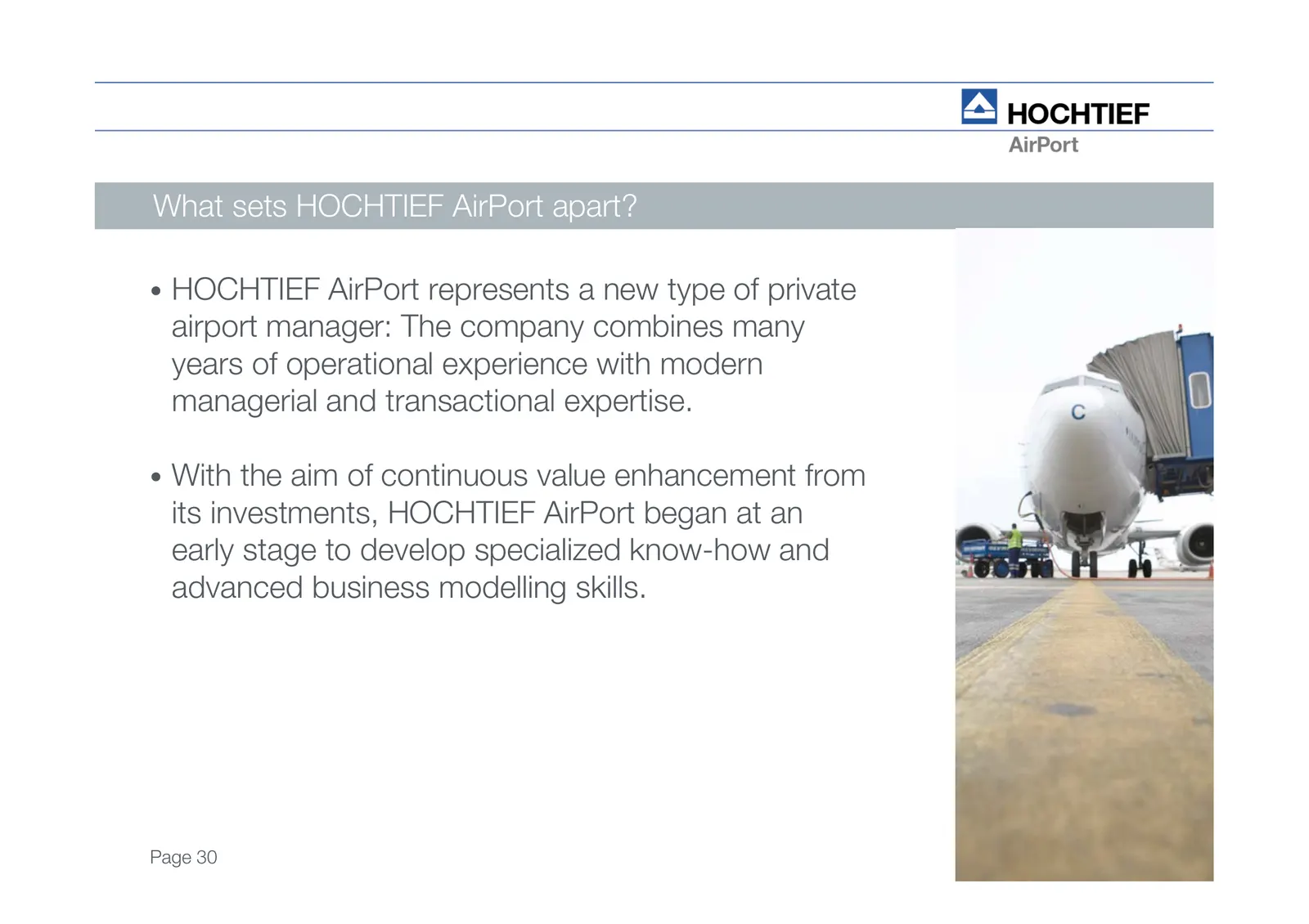
What sets HOCHTIEF AirPort apart? • HOCHTIEF AirPort represents a new type of private airport manager: The company combines many years of operational experience with modern managerial and transactional expertise. • With the aim of continuous value enhancement from its investments, HOCHTIEF AirPort b
Slide 31: Holistic approach & networked knowledge
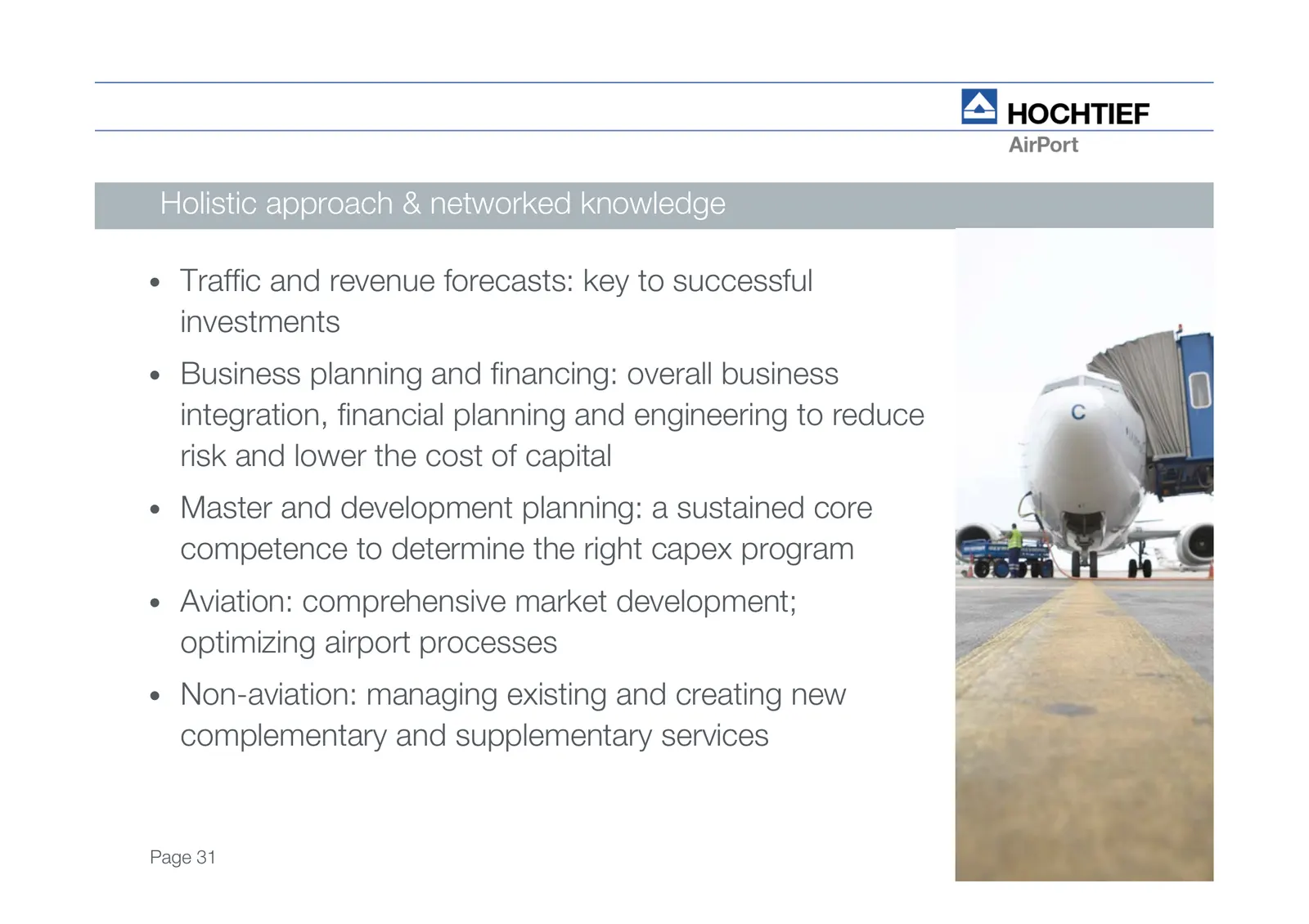
Holistic approach & networked knowledge • Traffic and revenue forecasts: key to successful investments • Business planning and financing: overall business integration, financial planning and engineering to reduce risk and lower the cost of capital • Master and development planning: a sustained core
Slide 32: Divisional organization of HOCHTIEF AirPort
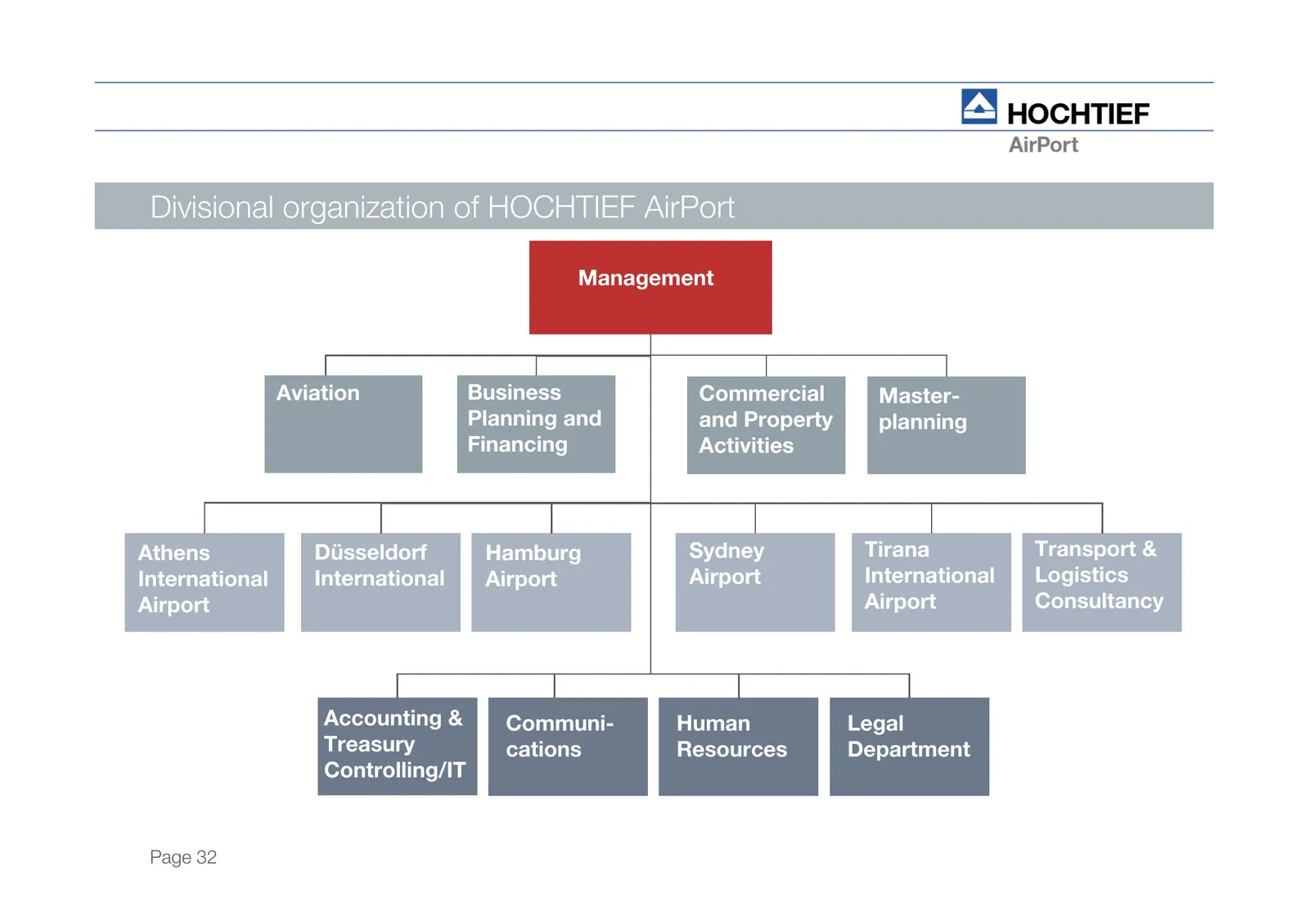
Divisional organization of HOCHTIEF AirPort Management Aviation Business Commercial Master- Planning and and Property planning Financing Activities Athens Düsseldorf Hamburg Sydney Tirana Transport & International International Airport Airport International Logistics Airport Airport Consultancy Acco
Slide 33: HOCHTIEF AirPort – firmly based on three pillars
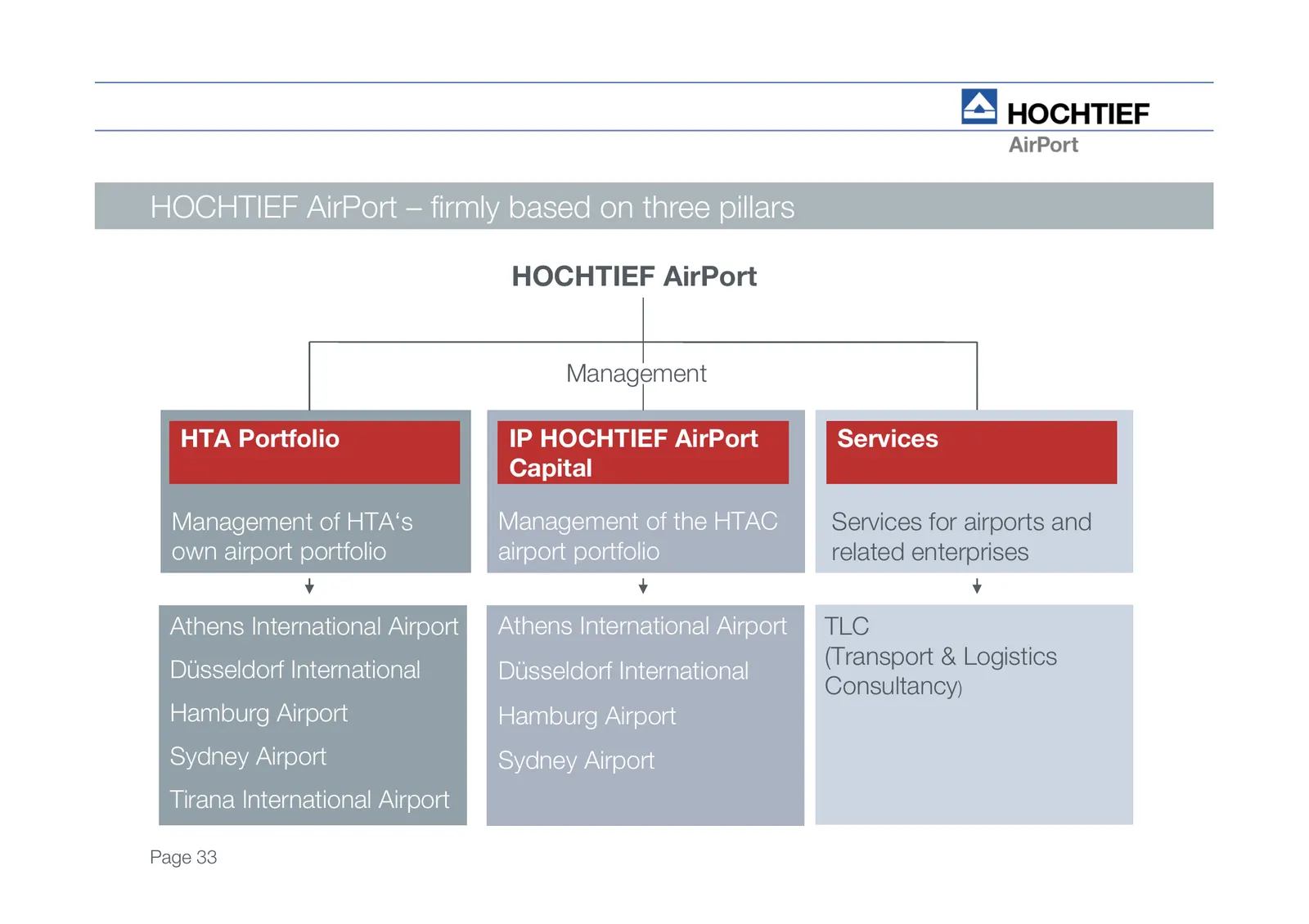
HOCHTIEF AirPort – firmly based on three pillars HOCHTIEF AirPort Management HTA Portfolio IP HOCHTIEF AirPort Services Capital Management of HTA‘s Management of the HTAC Services for airports and own airport portfolio airport portfolio related enterprises Athens International Airport Athens Interna
Slide 34: Where does HTA differ from its competitors?
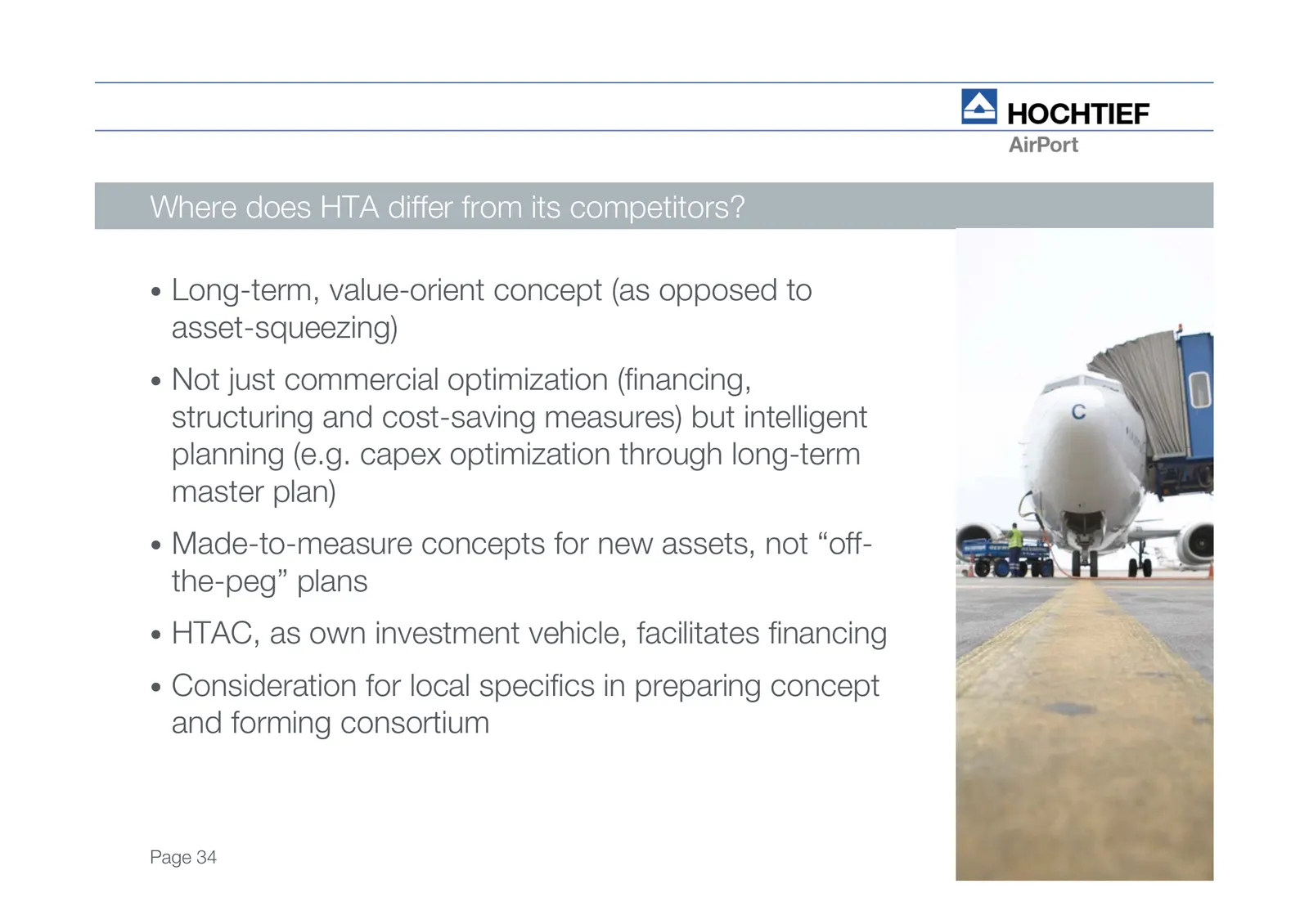
Where does HTA differ from its competitors? • Long-term, value-orient concept (as opposed to asset-squeezing) • Not just commercial optimization (financing, structuring and cost-saving measures) but intelligent planning (e.g. capex optimization through long-term master plan) • Made-to-measure concep
Slide 35: HTA's management concept
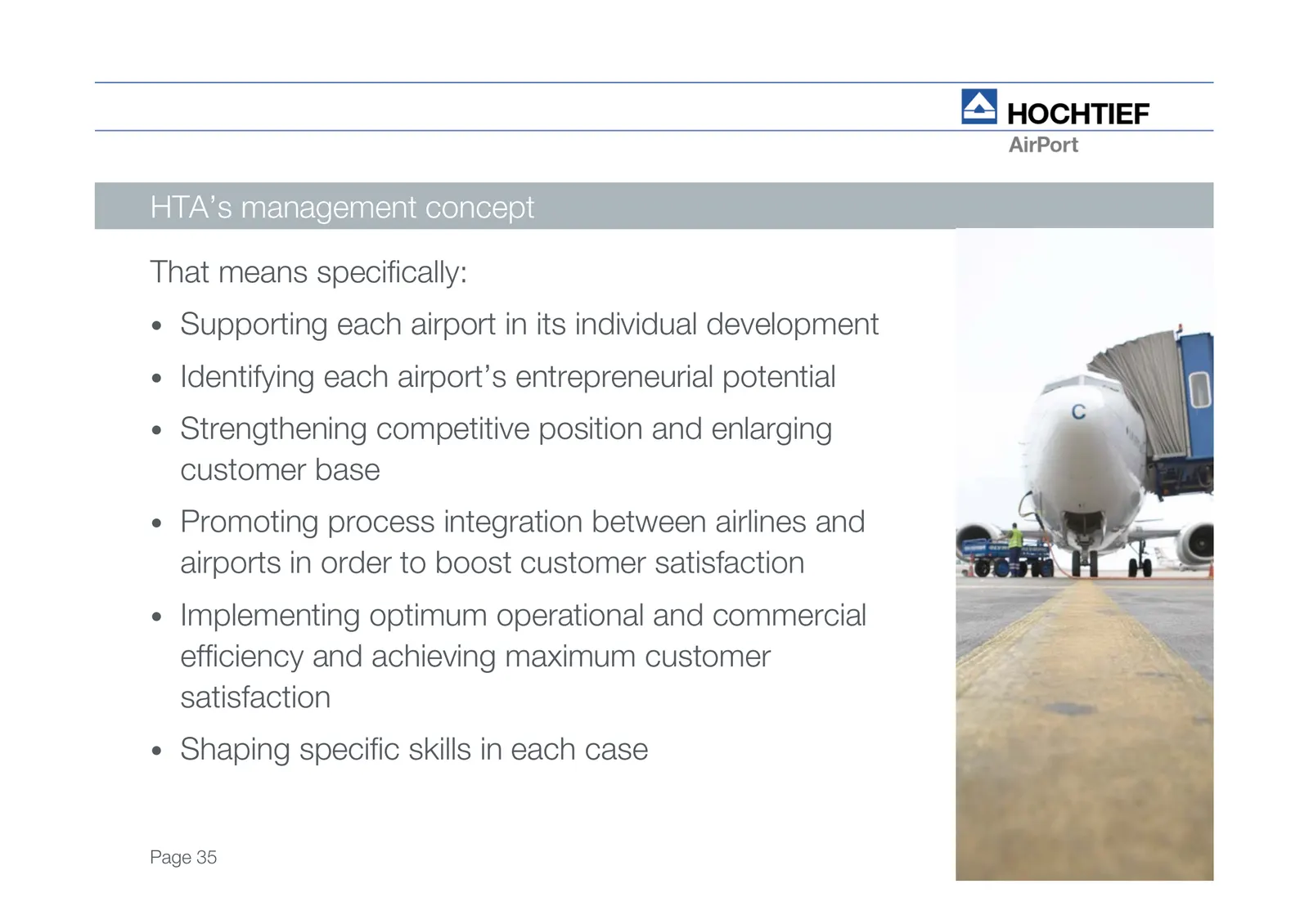
HTA’s management concept That means specifically: • Supporting each airport in its individual development • Identifying each airport’s entrepreneurial potential • Strengthening competitive position and enlarging customer base • Promoting process integration between airlines and airports in order to
Slide 36: Realizing potential – Increasing the value of holdings
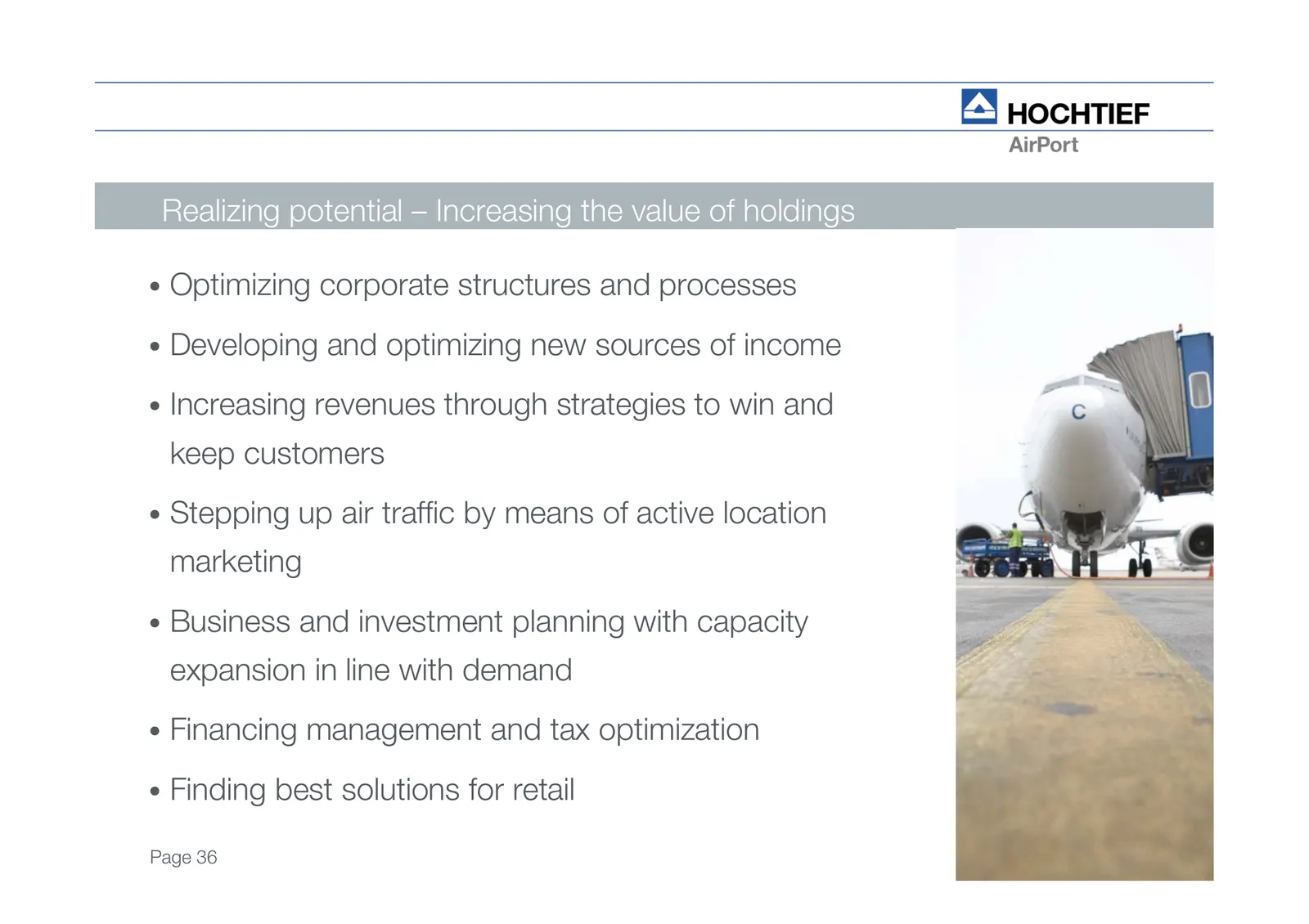
Realizing potential – Increasing the value of holdings • Optimizing corporate structures and processes • Developing and optimizing new sources of income • Increasing revenues through strategies to win and keep customers • Stepping up air traffic by means of active location marketing • Business and i
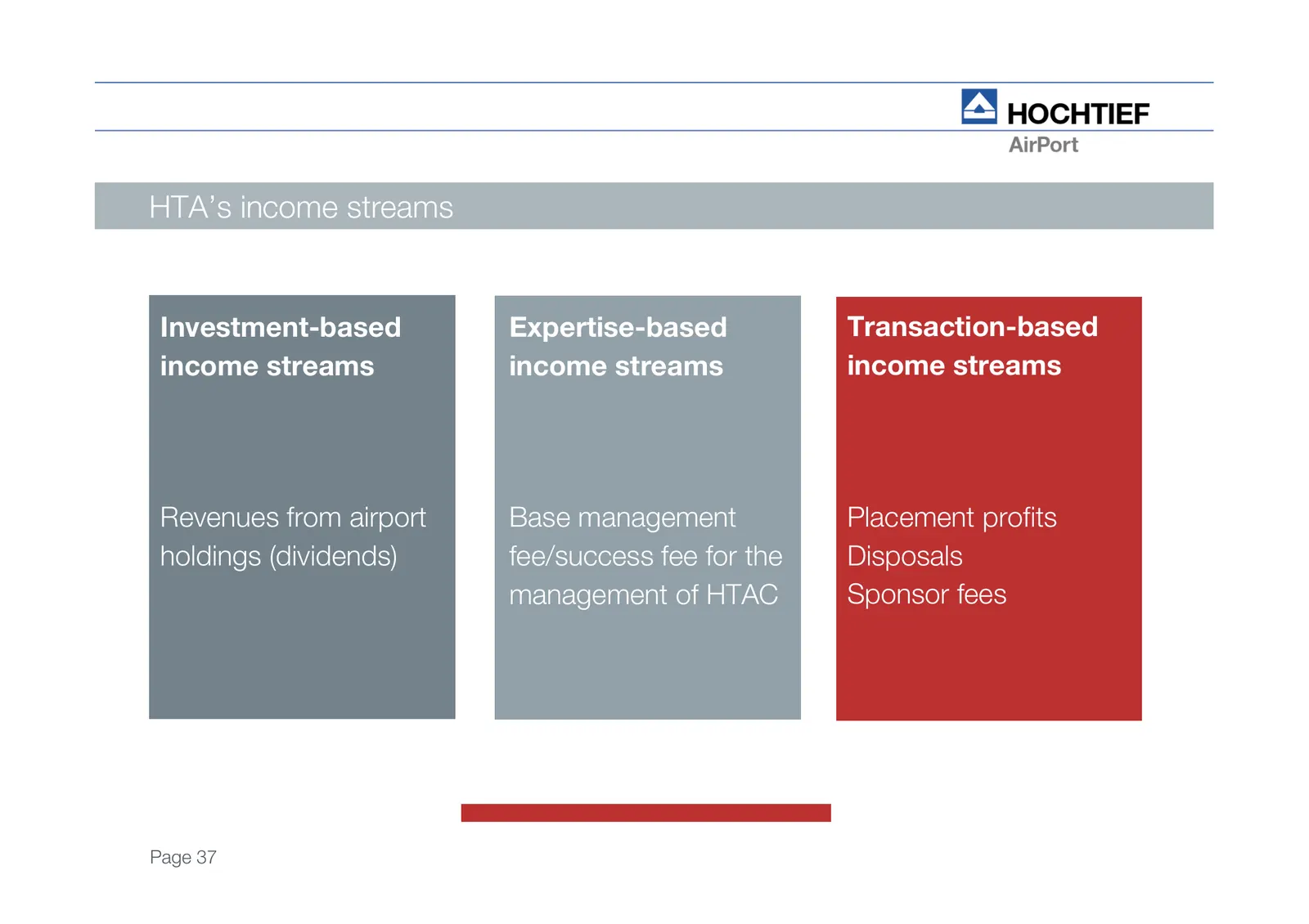
Slide 37: HTA's income streams
HTA’s income streams Investment-based Expertise-based Transaction-based income streams income streams income streams Revenues from airport Base management Placement profits holdings (dividends) fee/success fee for the Disposals management of HTAC Sponsor fees Page 37
Source: Internet Archive copy of hochtief.de
More decks from HOCHTIEF Aktiengesellschaft
 9M 2026 Earnings Presentation38 slides · Nov 5, 2026
 H1 2026 Earnings Presentation41 slides · Jul 27, 2026
 H1 2026 Earnings Presentation38 slides · Jul 27, 2026
 FY 2025 Earnings Presentation40 slides · Feb 19, 2026
 H1 2025 Earnings Presentation44 slides · Jul 23, 2025
 FY 2024 Earnings Presentation42 slides · Feb 19, 2025