Asterias Biotherapeutics — Investor Presentation (January 2017)
33 slides from Asterias Biotherapeutics's investor presentation, Jan 24, 2017

Slide 1: Clinical-Stage Cell Therapy Programs Addressing Significant Unmet Medical Needs in Neurology and Oncology
Clinical-Stage Cell Therapy Programs Addressing Significant Unmet Medical Needs in Neurology and Oncology Asterias Biotherapeutics NYSE Market: ASTJanuary 2017 14219863Text 04698Text 230237246Text
Slide 2: Forward-Looking Statements
Statements pertaining to future financial and/or operating results, future growth in research, technology, clinical development, and potential opportunities for Asterias, along with other statements about the future expectations, beliefs, goals, plans, or prospects expressed by management constitute
Slide 3: Strong Leadership Team with Proven Track Record
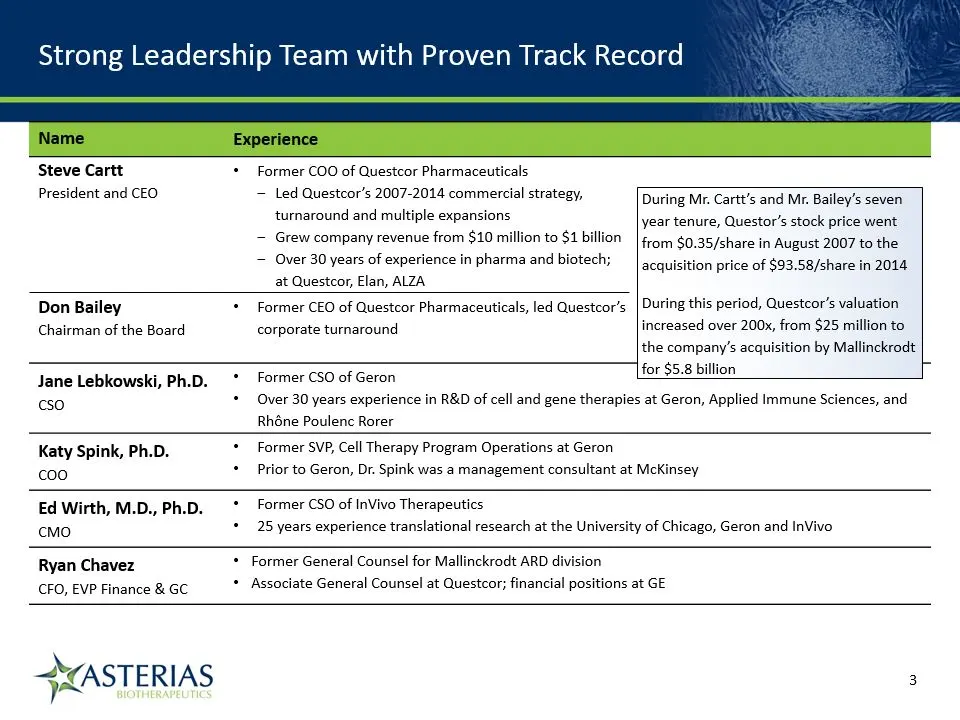
Strong Leadership Team with Proven Track Record Name Experience Steve CarttPresident and CEO Former COO of Questcor PharmaceuticalsLed Questcor’s 2007-2014 commercial strategy, turnaround and multiple expansionsGrew company revenue from $10 million to $1 billionOver 30 years of experience in pharma
Slide 4: Development Pipeline
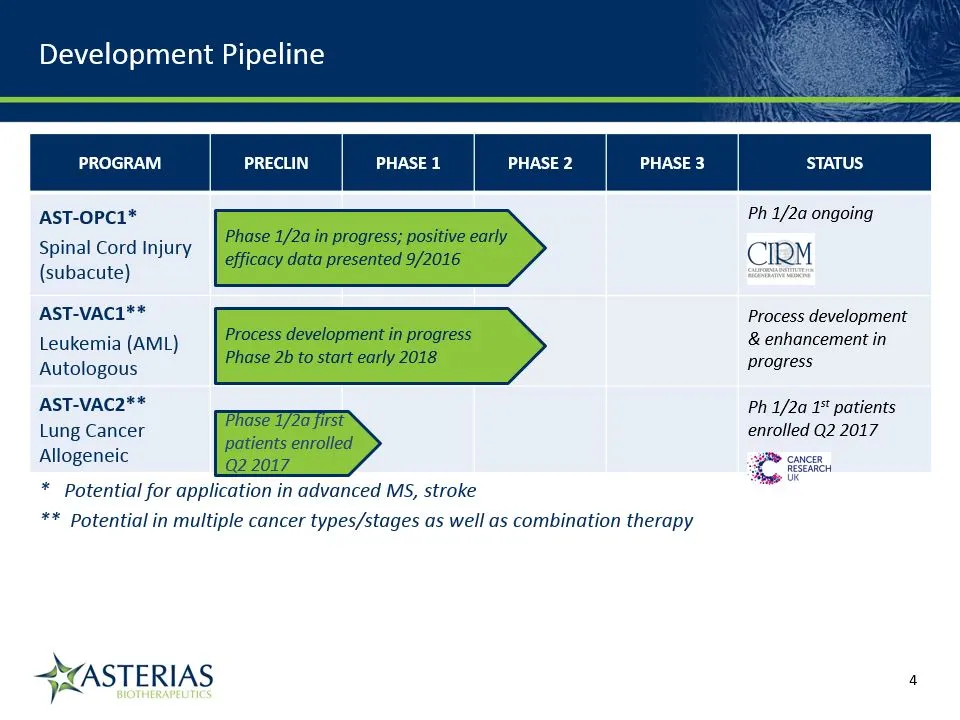
PROGRAM PRECLIN PHASE 1 PHASE 2 PHASE 3 STATUS AST-OPC1*Spinal Cord Injury (subacute) Ph 1/2a ongoing AST-VAC1**Leukemia (AML) Autologous Process development & enhancement in progress AST-VAC2**Lung Cancer Allogeneic Ph 1/2a 1st patients enrolled Q2 2017 * Potential for application in advanced MS, s
Slide 5: Key Highlights
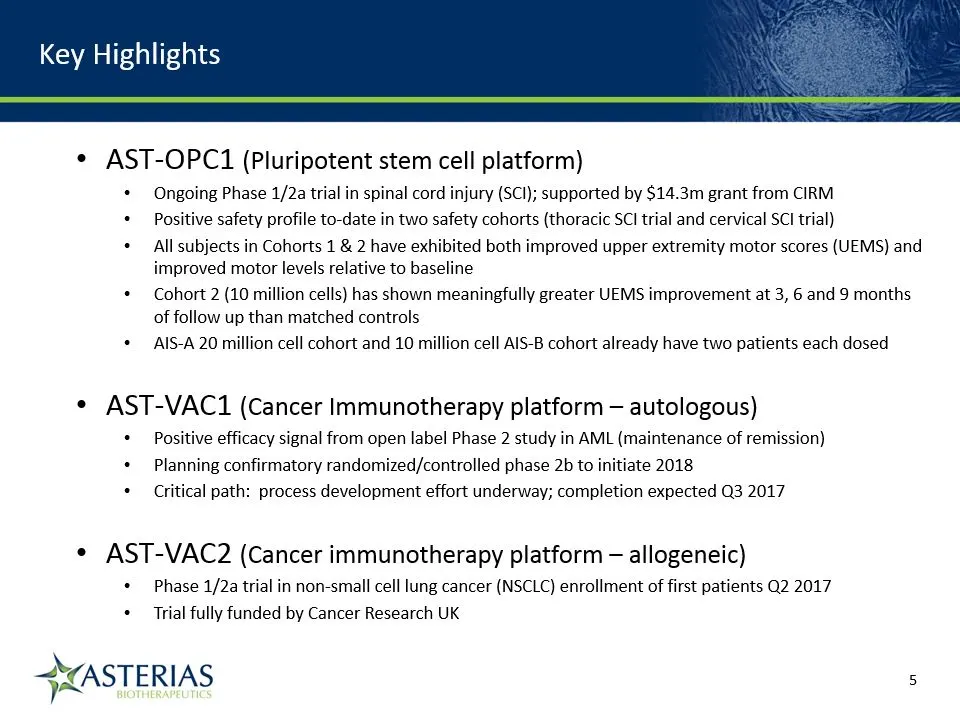
Key Highlights AST-OPC1 (Pluripotent stem cell platform)Ongoing Phase 1/2a trial in spinal cord injury (SCI); supported by $14.3m grant from CIRMPositive safety profile to-date in two safety cohorts (thoracic SCI trial and cervical SCI trial) All subjects in Cohorts 1 & 2 have exhibited both improve
Slide 6: AST-OPC1
Pluripotent stem cell platformSignificant grant funding from California Institute of Regenerative Medicine (CIRM)Phase 1/2a clinical trial in spinal cord injury in progress AST-OPC1 14219863Text 04698Text 230237246Text
Slide 7: Video
Video EASTERIAS ’
Slide 8: Spinal Cord Injury: High Unmet Medical Need, Substantial Commercial Opportunity
Spinal Cord Injury: High Unmet Medical Need, Substantial Commercial Opportunity Spinal cord injury (SCI) affects 17,000 patients per year in U.S.(1)Primarily affects young/healthy males in their 20s and 30s at time of injuryCan be devastating to quality of life and ability to engage in activities of
Slide 9: AST-OPC1 Designed to Address the Complex Pathology of SCI
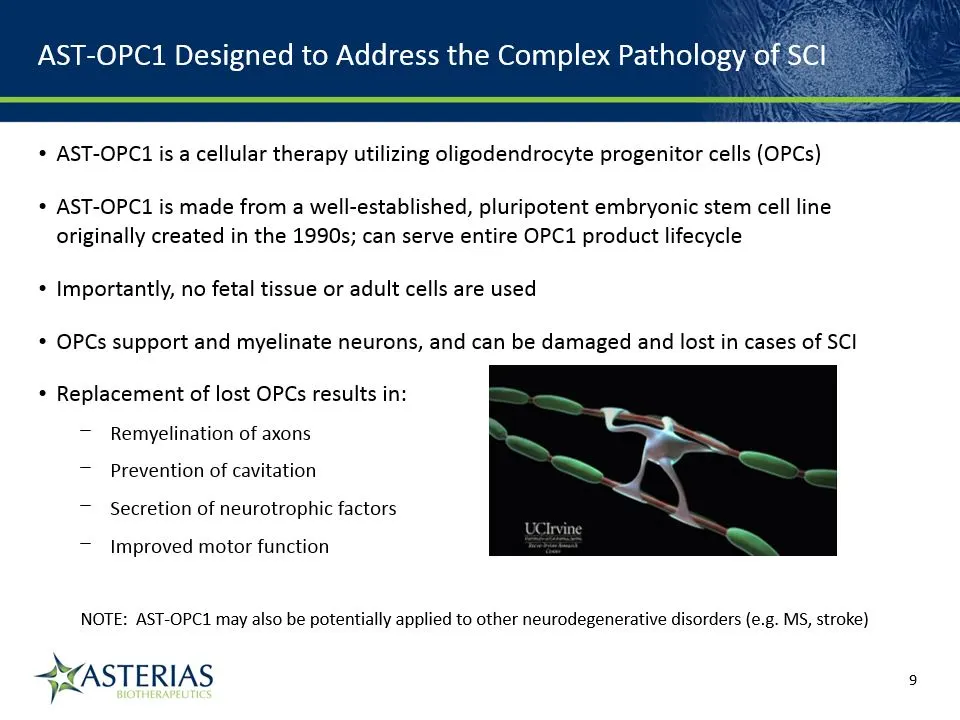
AST-OPC1 is a cellular therapy utilizing oligodendrocyte progenitor cells (OPCs) AST-OPC1 is made from a well-established, pluripotent embryonic stem cell line originally created in the 1990s; can serve entire OPC1 product lifecycleImportantly, no fetal tissue or adult cells are usedOPCs support and
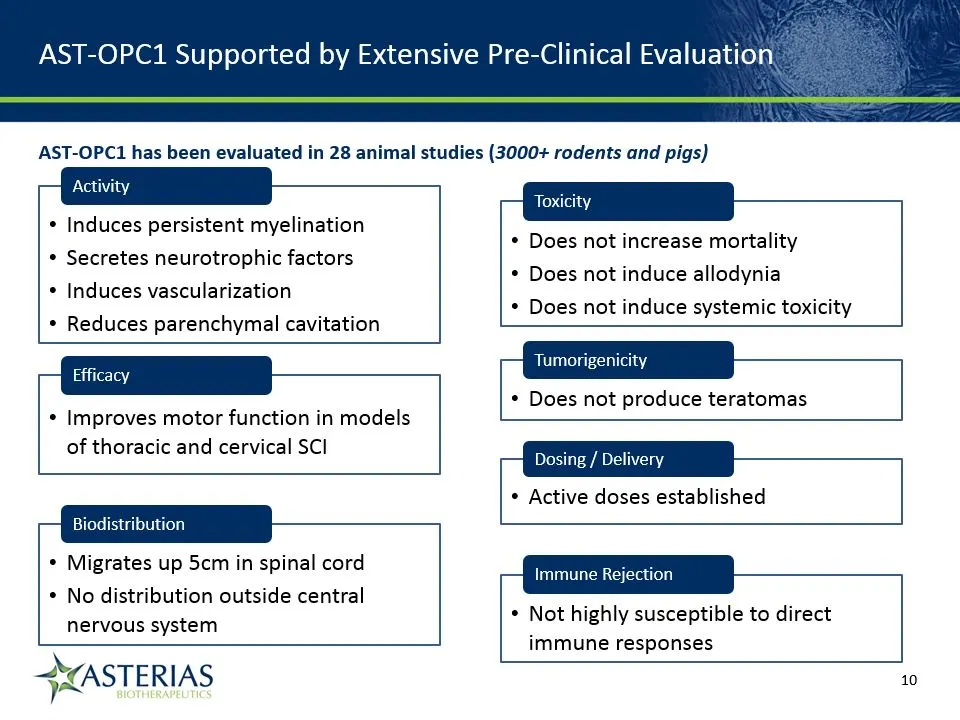
Slide 10: AST-OPC1 Supported by Extensive Pre-Clinical Evaluation
AST-OPC1 Supported by Extensive Pre-Clinical Evaluation 14219863Text 04698Text 230237246Text Activity Induces persistent myelinationSecretes neurotrophic factorsInduces vascularizationReduces parenchymal cavitation Biodistribution Migrates up 5cm in spinal cordNo distribution outside central nervous
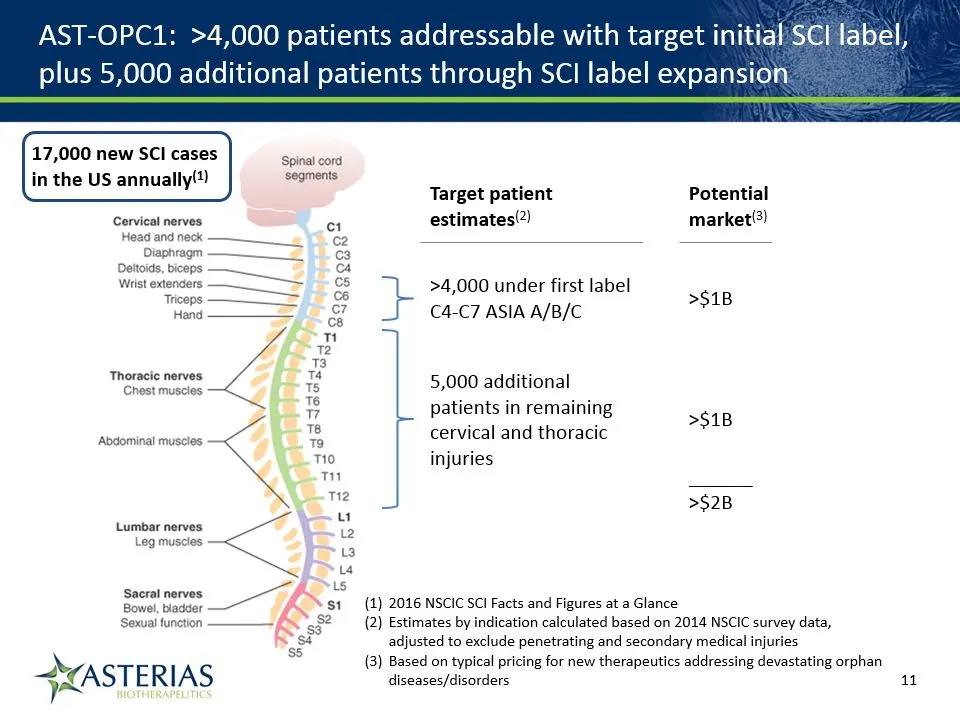
Slide 11: AST-OPC1: >4,000 patients addressable with target initial SCI label
AST-OPC1: >4,000 patients addressable with target initial SCI label, plus 5,000 additional patients through SCI label expansion 17,000 new SCI cases in the US annually(1) >4,000 under first label C4-C7 ASIA A/B/C 2016 NSCIC SCI Facts and Figures at a GlanceEstimates by indication calculated based on
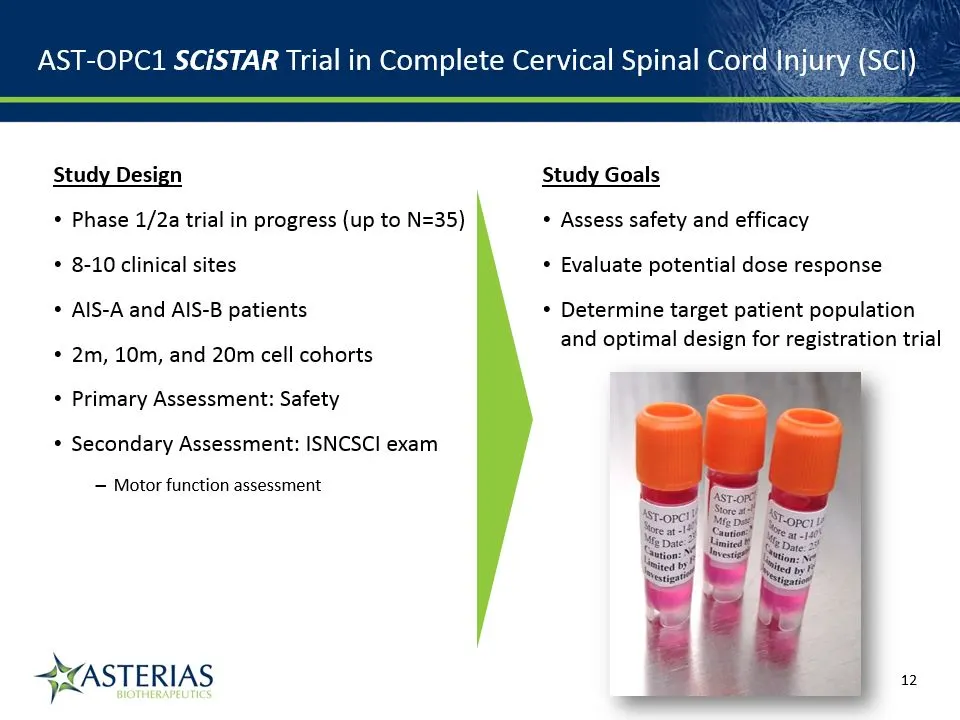
Slide 12: AST-OPC1 SCiSTAR Trial in Complete Cervical Spinal Cord Injury
Study DesignPhase 1/2a trial in progress (up to N=35)8-10 clinical sitesAIS-A and AIS-B patients2m, 10m, and 20m cell cohortsPrimary Assessment: SafetySecondary Assessment: ISNCSCI examMotor function assessment AST-OPC1 SCiSTAR Trial in Complete Cervical Spinal Cord Injury (SCI) Study GoalsAssess sa
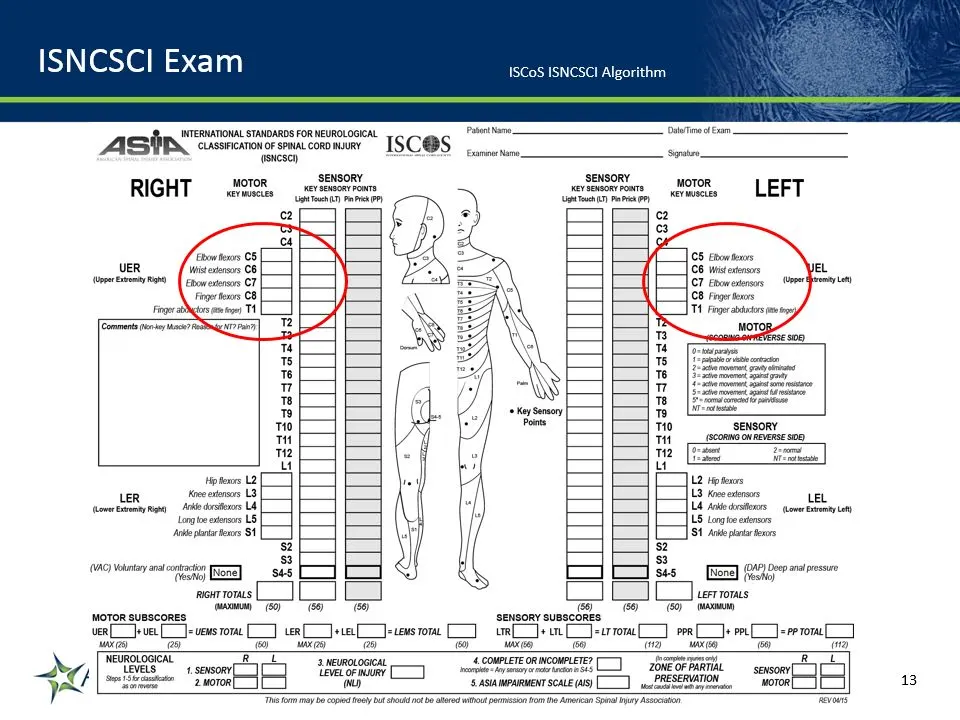
Slide 13: ISNCSCI Exam
ISNCSCI Exam ISCoS ISNCSCI Algorithm
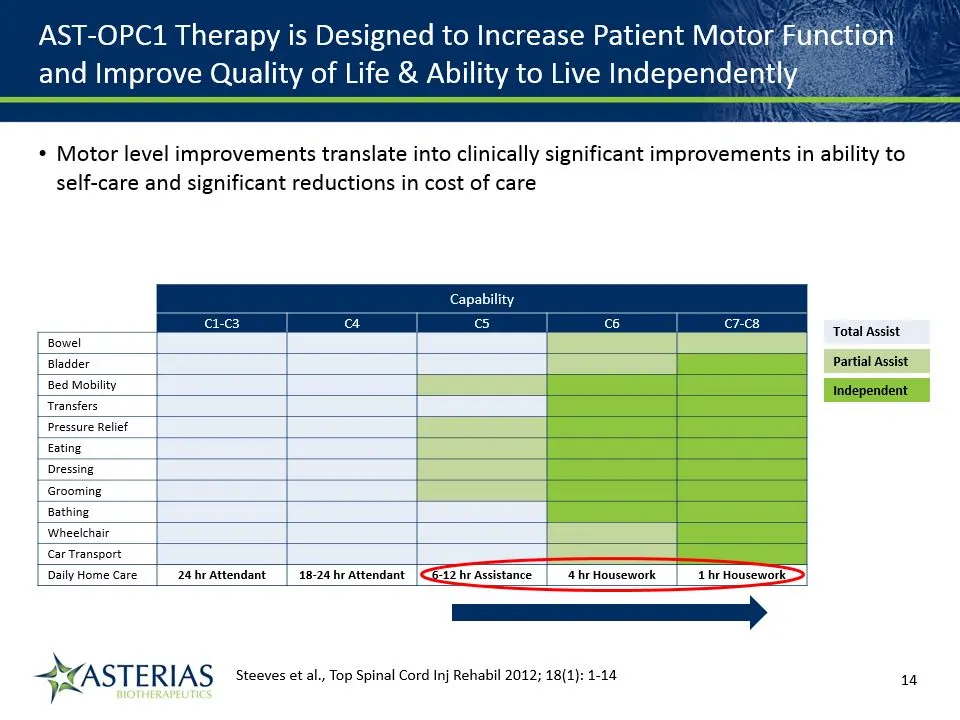
Slide 14: AST-OPC1 Therapy Designed to Increase Patient Motor Function and Improve Quality of Life
AST-OPC1 Therapy is Designed to Increase Patient Motor Function and Improve Quality of Life & Ability to Live Independently Capability C1-C3 C4 C5 C6 C7-C8 Bowel Bladder Bed Mobility Transfers Pressure Relief Eating Dressing Grooming Bathing Wheelchair Car Transport Daily Home Care 24 hr Attendant 1
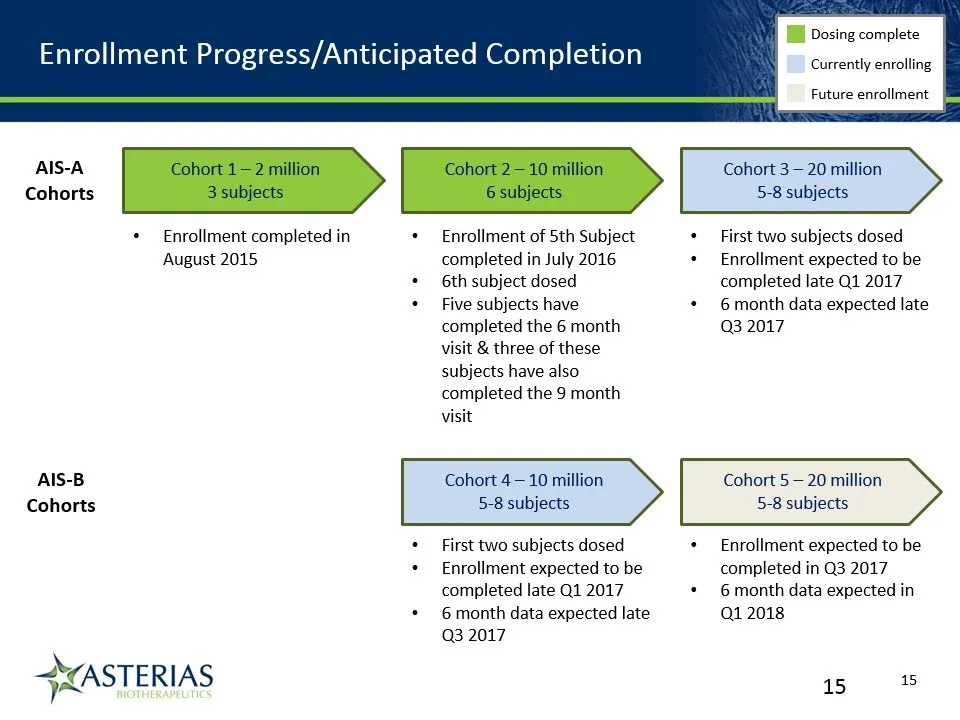
Slide 15: Enrollment Progress/Anticipated Completion
Enrollment Progress/Anticipated Completion 15 Dosing complete Currently enrolling Future enrollment Cohort 1 – 2 million3 subjects AIS-ACohorts Cohort 2 – 10 million6 subjects Cohort 3 – 20 million5-8 subjects AIS-BCohorts Cohort 4 – 10 million5-8 subjects Cohort 5 – 20 million5-8 subjects Enrollmen
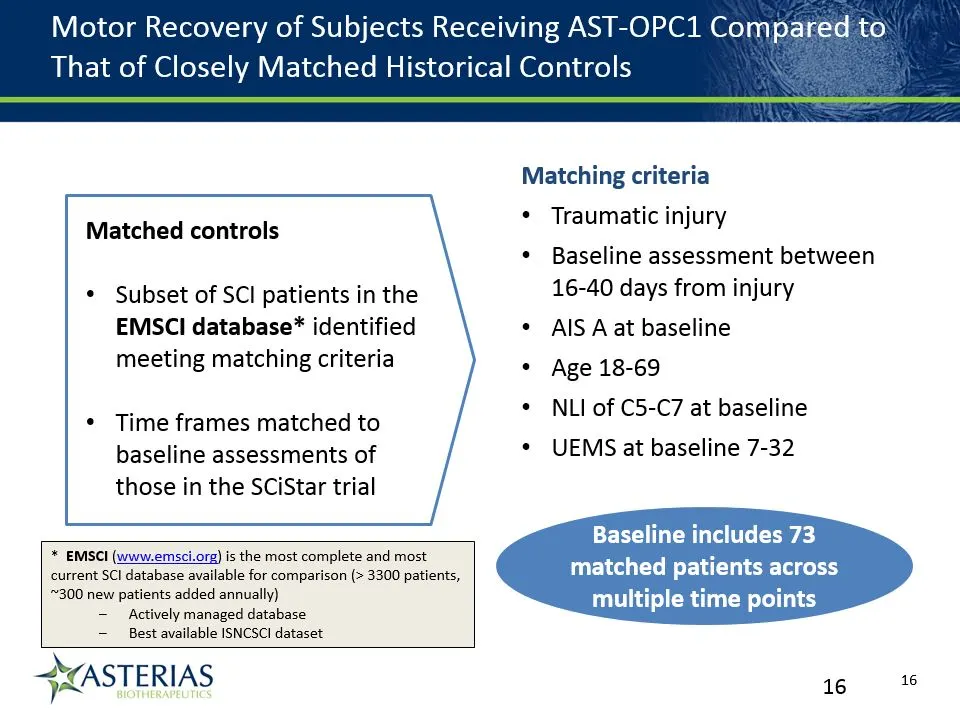
Slide 16: Motor Recovery of Subjects Compared to Closely Matched Historical Controls
16 Motor Recovery of Subjects Receiving AST-OPC1 Compared to That of Closely Matched Historical Controls Matched controlsSubset of SCI patients in the EMSCI database* identified meeting matching criteriaTime frames matched to baseline assessments of those in the SCiStar trial Matching criteriaTrauma
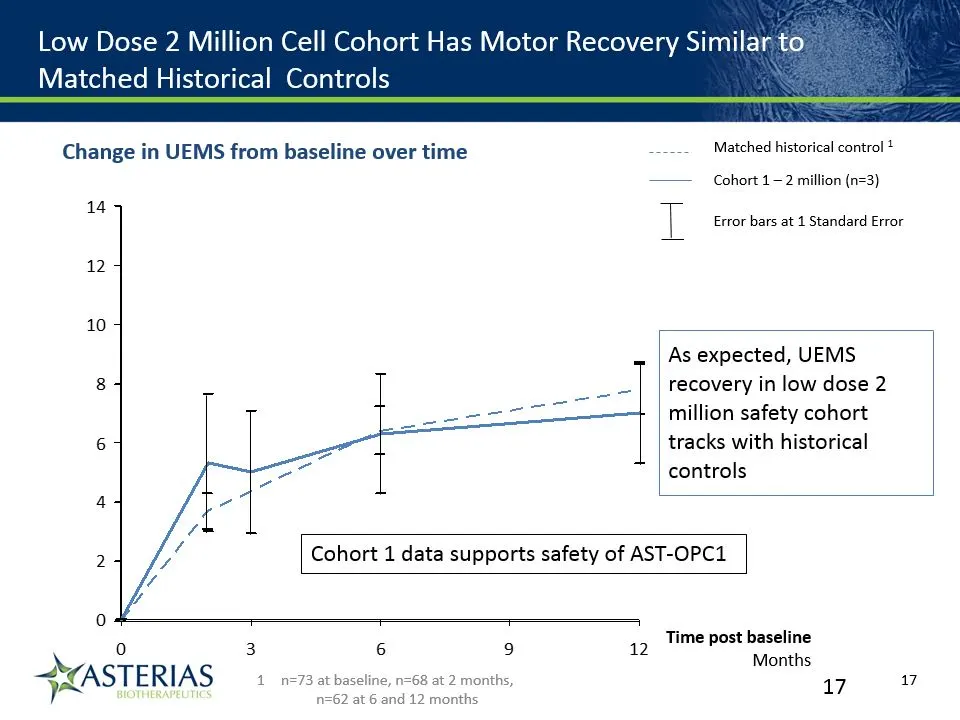
Slide 17: Low Dose Cohort Has Motor Recovery Similar to Matched Historical Controls
17 Low Dose 2 Million Cell Cohort Has Motor Recovery Similar to Matched Historical Controls Change in UEMS from baseline over time Matched historical control 1 Time post baselineMonths Cohort 1 – 2 million (n=3) n=73 at baseline, n=68 at 2 months, n=62 at 6 and 12 months As expected, UEMS recovery i
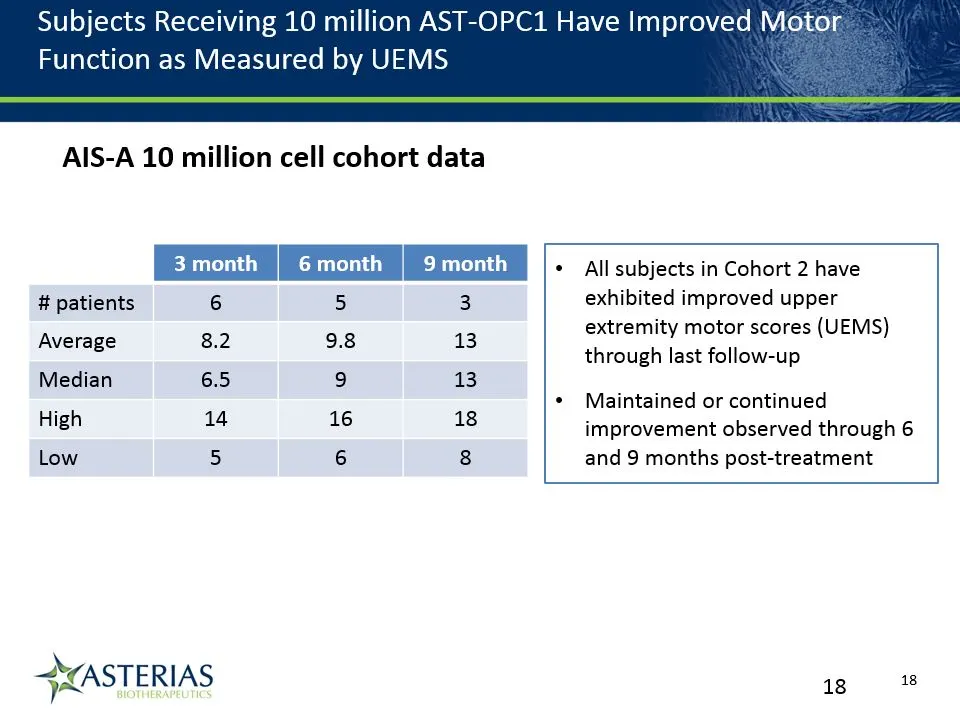
Slide 18: Subjects Receiving 10 Million Cells Have Improved Motor Function as Measured by UEMS
18 Subjects Receiving 10 million AST-OPC1 Have Improved Motor Function as Measured by UEMS 3 month 6 month 9 month # patients 6 5 3 Average 8.2 9.8 13 Median 6.5 9 13 High 14 16 18 Low 5 6 8 All subjects in Cohort 2 have exhibited improved upper extremity motor scores (UEMS) through last follow-upMa
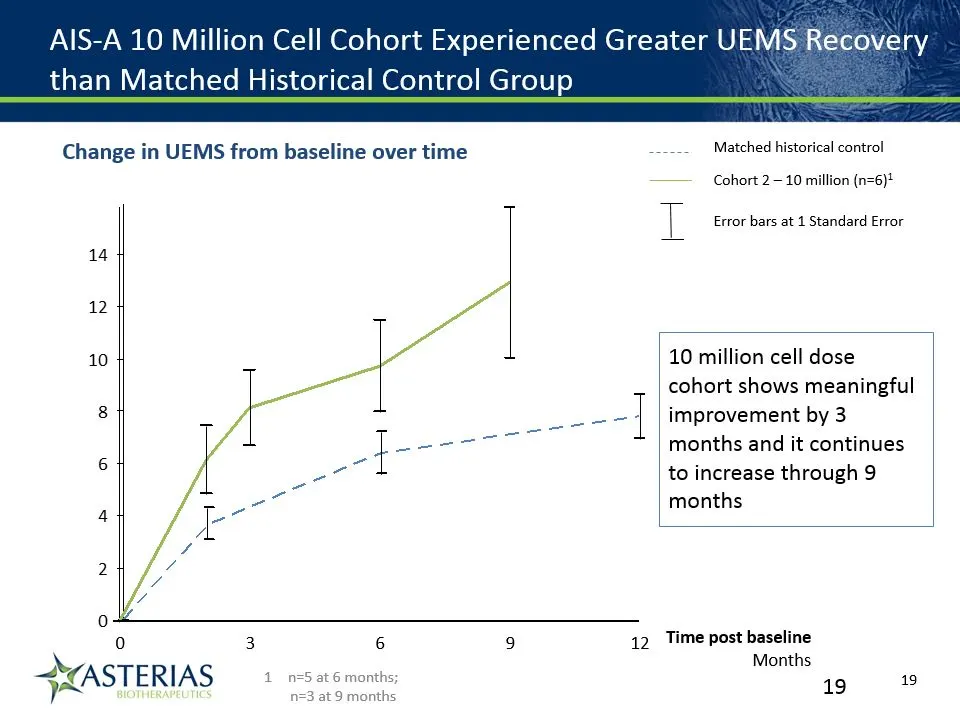
Slide 19: AIS-A 10 Million Cell Cohort Experienced Greater UEMS Recovery than Controls
19 AIS-A 10 Million Cell Cohort Experienced Greater UEMS Recovery than Matched Historical Control Group 0 3 9 6 12 Change in UEMS from baseline over time Matched historical control Cohort 2 – 10 million (n=6)1 10 million cell dose cohort shows meaningful improvement by 3 months and it continues to i
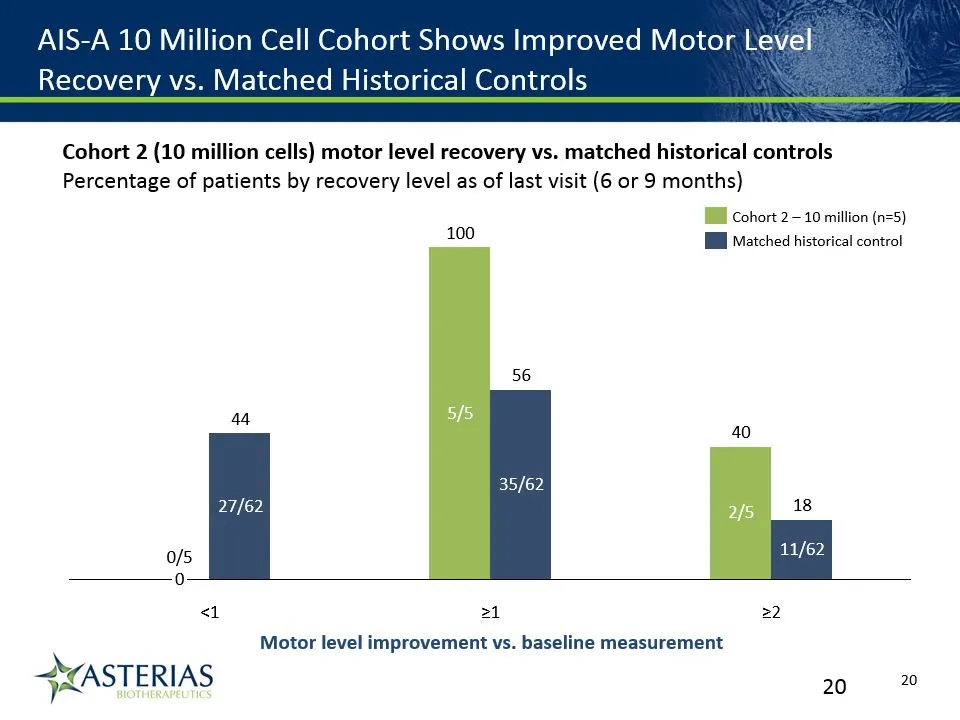
Slide 20: AIS-A 10 Million Cell Cohort Shows Improved Motor Level Recovery
20 AIS-A 10 Million Cell Cohort Shows Improved Motor Level Recovery vs. Matched Historical Controls 18 40 56 ≥1 ≥2 <1 35/62 11/62 2/5 27/62 5/5 0 100 44 0/5 Cohort 2 – 10 million (n=5) Matched historical control Motor level improvement vs. baseline measurement Cohort 2 (10 million cells) motor level
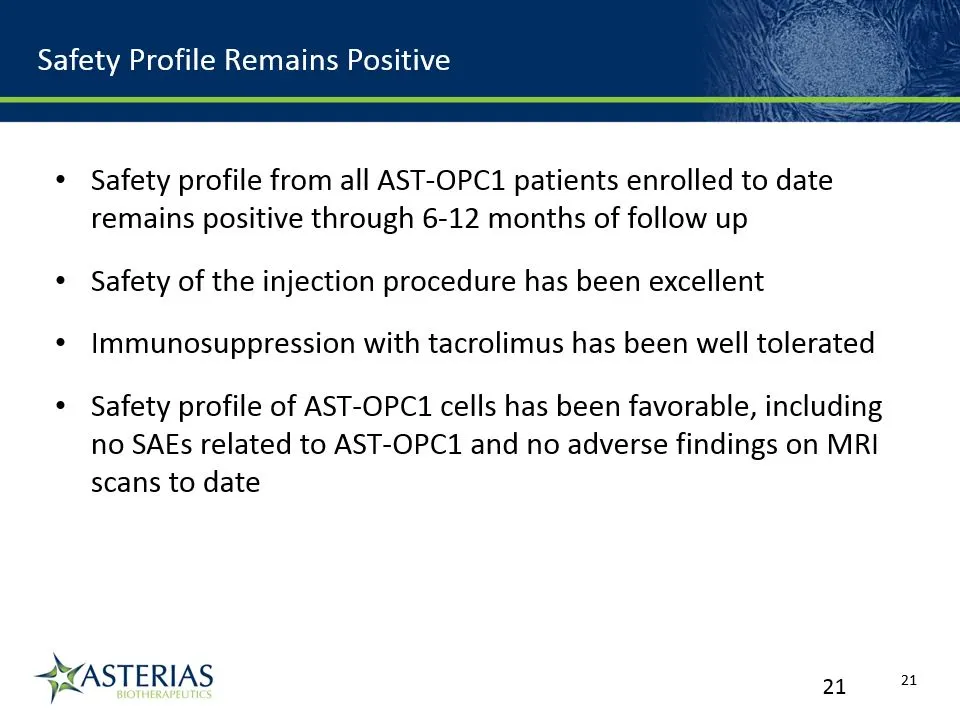
Slide 21: Safety Profile Remains Positive
21 Safety Profile Remains Positive Safety profile from all AST-OPC1 patients enrolled to date remains positive through 6-12 months of follow upSafety of the injection procedure has been excellentImmunosuppression with tacrolimus has been well toleratedSafety profile of AST-OPC1 cells has been favora
Slide 22: Summary of Results To Date
Summary of Results To Date 22 All subjects in Cohorts 1 & 2 have exhibited both improved upper extremity motor scores (UEMS) and improved motor levels relative to baselineEarly improvements in motor function reported for Cohort 2 (10 million cells) in September 2016 have been maintained or further i
Slide 23: Projected AST-OPC1 Data Milestones
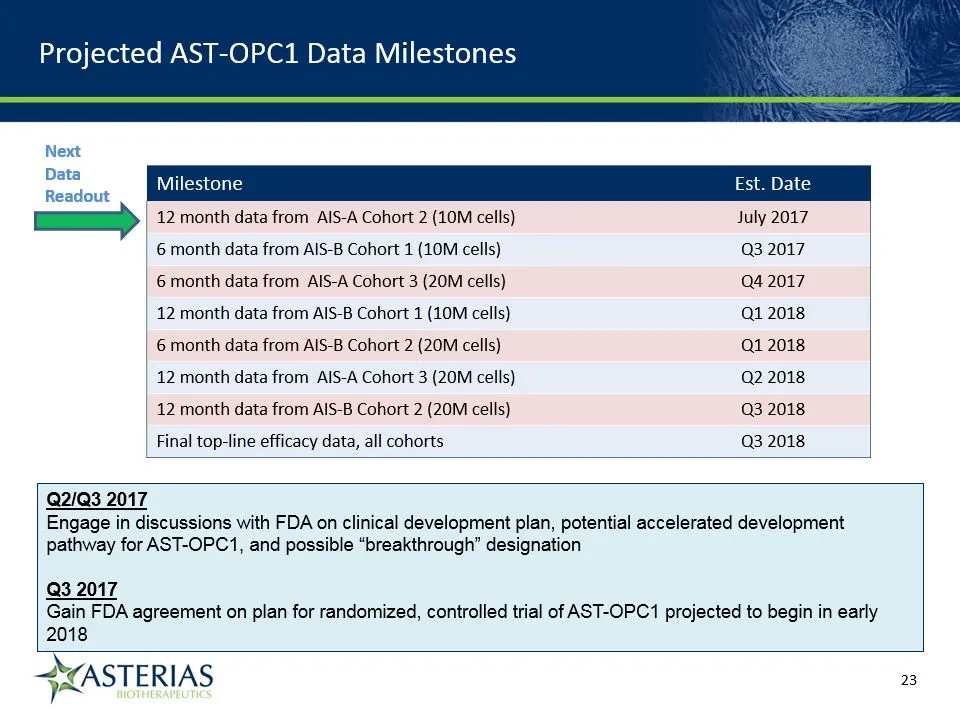
Milestone Est. Date 12 month data from AIS-A Cohort 2 (10M cells) July 2017 6 month data from AIS-B Cohort 1 (10M cells) Q3 2017 6 month data from AIS-A Cohort 3 (20M cells) Q4 2017 12 month data from AIS-B Cohort 1 (10M cells) Q1 2018 6 month data from AIS-B Cohort 2 (20M cells) Q1 2018 12 month da
Slide 24: AST-VAC1
Patient-specific (autologous)Acute Myelogenous Leukemia (AML)Process development/enhancement in progress AST-VAC1 14219863Text 04698Text 230237246Text
Slide 25: AST-VAC1 Targets AML Need in Older and High-Risk Patients
AST-VAC1 is being developed as a treatment for maintenance of remission in AML patients >60 years and in high-risk patients (not eligible for bone marrow transplant)~19,000 new AML cases diagnosed and ~10,500 deaths from AML in U.S. annually(1)AML patients >60 years old do not tolerate AML therapies
Slide 26: AST-VAC1 Has Potential to Safely Maintain AML Remission
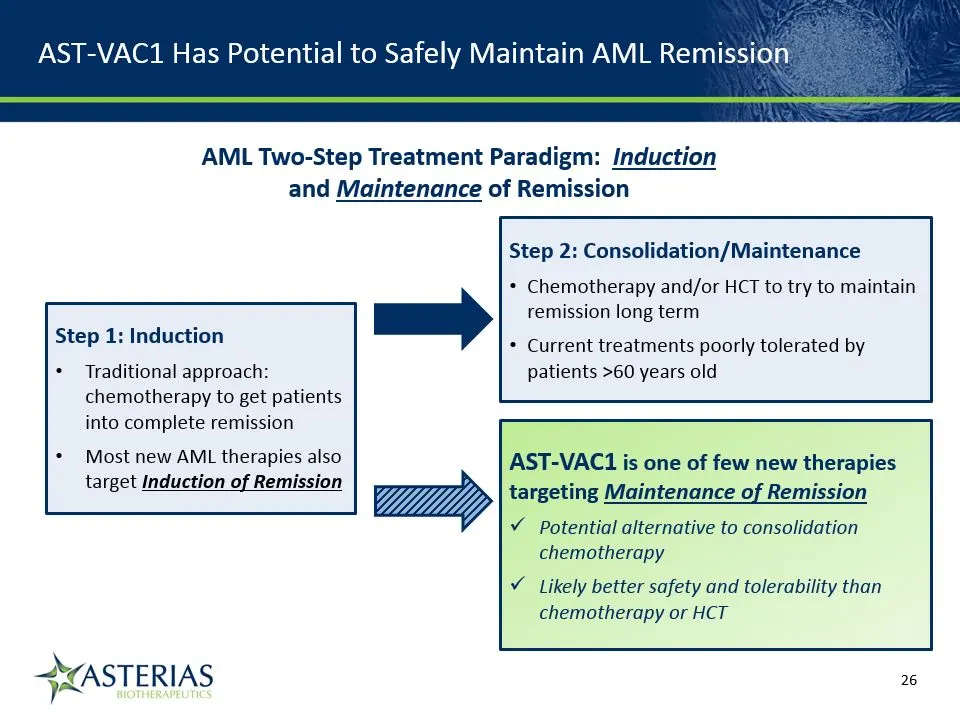
AST-VAC1 Has Potential to Safely Maintain AML Remission AML Two-Step Treatment Paradigm: Induction and Maintenance of Remission Step 1: InductionTraditional approach: chemotherapy to get patients into complete remissionMost new AML therapies also target Induction of Remission Step 2: Consolidation/M
Slide 27: Positive Signal in Open-Label Phase 2 Trial
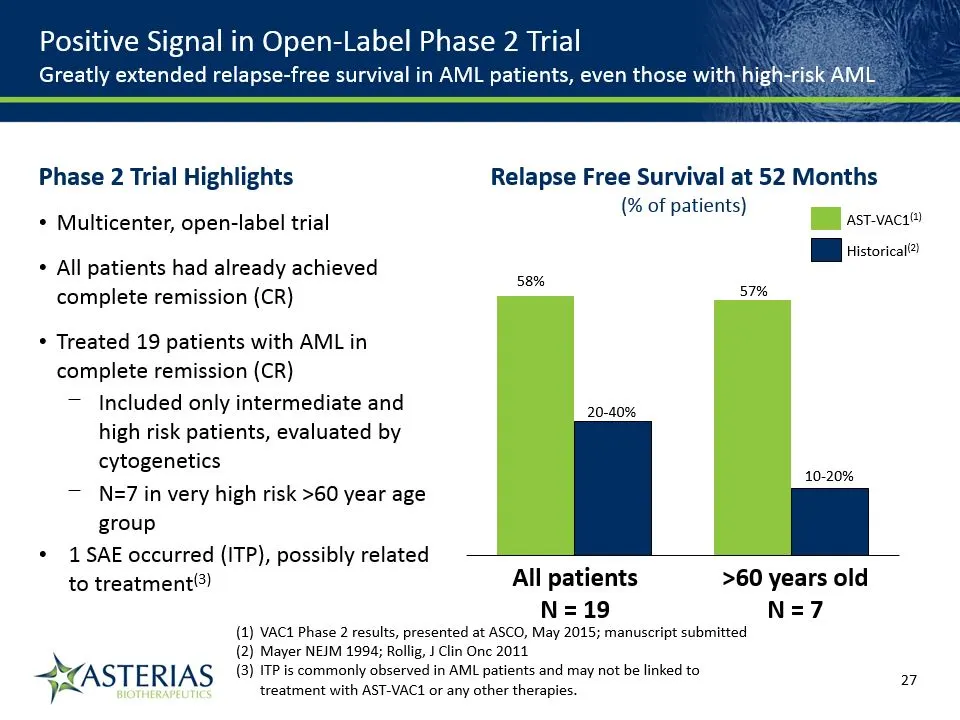
57% 10-20% >60 years oldN = 7 20-40% 58% All patientsN = 19 Relapse Free Survival at 52 Months(% of patients) Historical(2) AST-VAC1(1) VAC1 Phase 2 results, presented at ASCO, May 2015; manuscript submittedMayer NEJM 1994; Rollig, J Clin Onc 2011ITP is commonly observed in AML patients and may not
Slide 28: Path Forward for AST-VAC1 Development
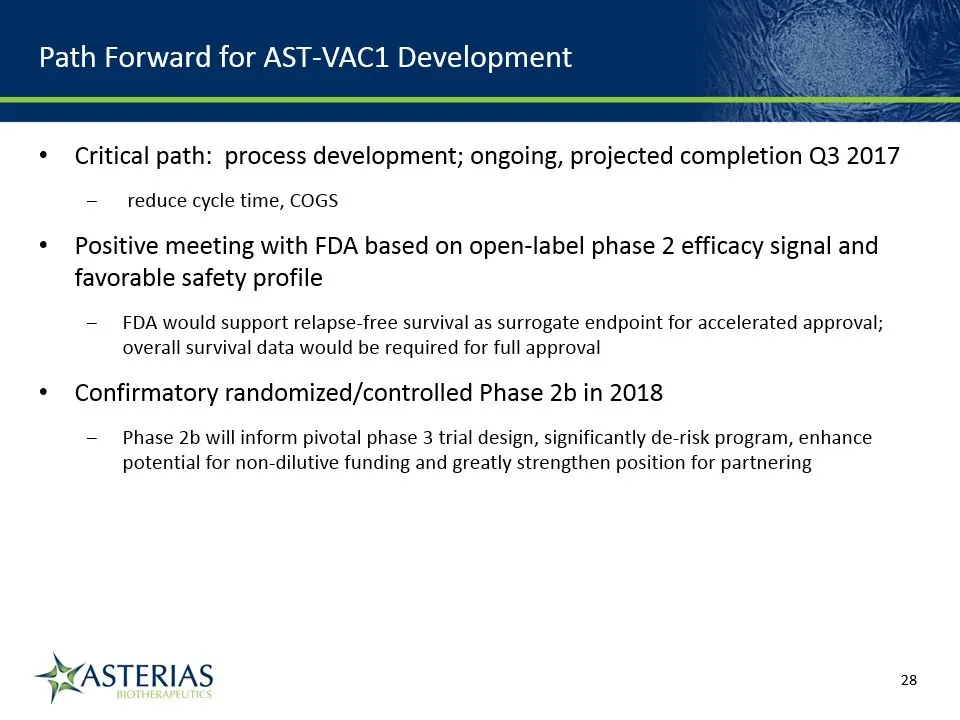
Path Forward for AST-VAC1 Development Critical path: process development; ongoing, projected completion Q3 2017 reduce cycle time, COGSPositive meeting with FDA based on open-label phase 2 efficacy signal and favorable safety profileFDA would support relapse-free survival as surrogate endpoint for a
Slide 29: AST-VAC2
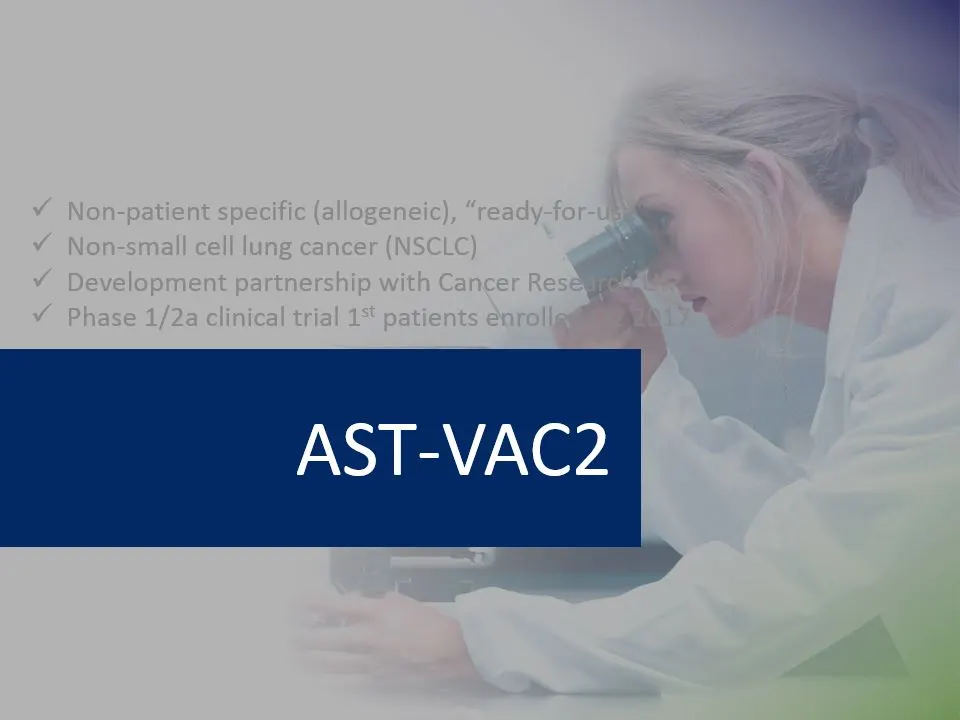
Non-patient specific (allogeneic), “ready-for-use”Non-small cell lung cancer (NSCLC)Development partnership with Cancer Research UKPhase 1/2a clinical trial 1st patients enrolled Q2 2017 AST-VAC2 14219863Text 04698Text 230237246Text
Slide 30: AST-VAC2 Targets an Unmet Need in NSCLC
AST-VAC2 Targets an Unmet Need in NSCLC, a Very Large Population of Cancer Patients with High Mortality Rate Not Staged3% Lung cancer is the most common type of cancer(1)Estimated 1.8M new cases and 1.6M lung cancer deaths worldwide in 2012~220,000 new cases and ~160,000 deaths annually in the U.S.8
Slide 31: AST-VAC2 is Allogeneic, Ready for Use, Non-Patient Specific
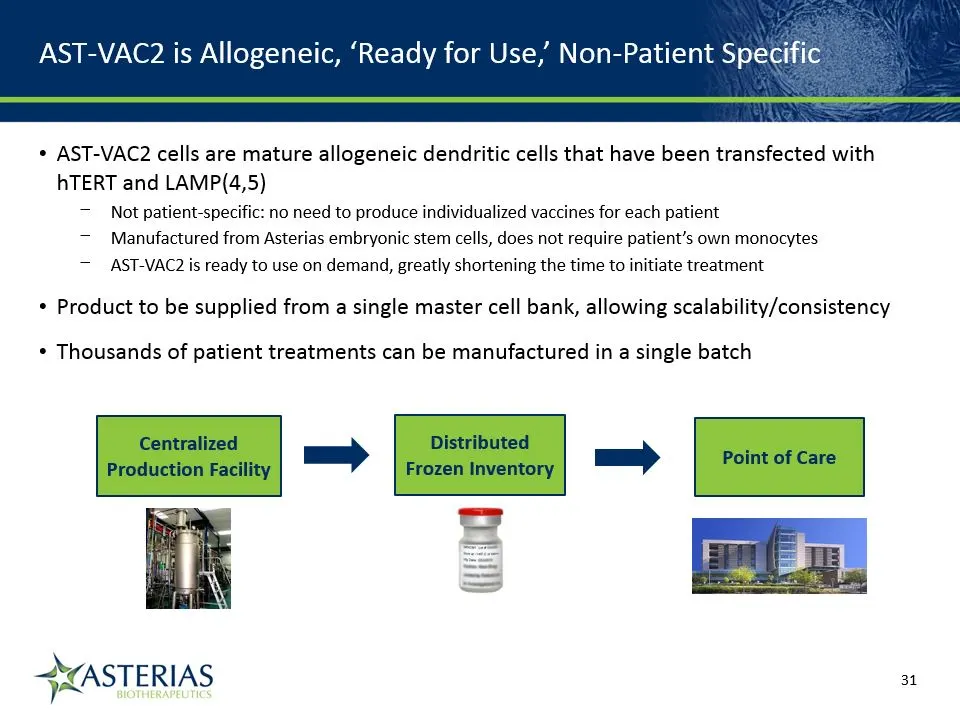
AST-VAC2 is Allogeneic, ‘Ready for Use,’ Non-Patient Specific AST-VAC2 cells are mature allogeneic dendritic cells that have been transfected with hTERT and LAMP(4,5)Not patient-specific: no need to produce individualized vaccines for each patientManufactured from Asterias embryonic stem cells, does
Slide 32: Phase 1/2a Trial to be Funded Through CRUK Partnership
Anticipate MHRA clearance for Phase 1/2a NSCLC trial Q1 2017First patients expected to be enrolled Q2 2017Partnership with Cancer Research UK (CRUK) funds full cost of GMP manufacturing, regulatory filing, and Phase 1/2a trialCRUK partnership saves Asterias an estimated ~$30MFollowing a successful P
Slide 33: Asterias Biotherapeutics Summary
Asterias Biotherapeutics AST-OPC1 (Pluripotent stem cell platform)Ongoing SCiSTAR Phase 1/2a trial in spinal cord injury (SCI)Positive initial efficacy readout announced Sept 2016Possible dose-response is emerging by Day 90AIS-A 20 million cell cohort and 10 million cell AIS-B cohort already have tw
Source: SEC EDGAR · 8-K filed Jan 24, 2017
More decks from Asterias Biotherapeutics Inc
 Merger or Acquisition (December 2018)22 slides · Dec 4, 2018
 Investor Presentation (May 2017)21 slides · May 15, 2017
 Investor Presentation (November 2016)29 slides · Nov 17, 2016
 Investor Presentation (September 2016)39 slides · Sep 12, 2016
 Investor Presentation (August 2016)36 slides · Aug 22, 2016
 Investor Presentation (April 2016)28 slides · Apr 5, 2016