- Kiboko’s drilling along Marcotte zone continues to verify historical results
- Assays from 43% of metres drilled in Phase 1 are still to be reported
- Maiden pit-constrained mineral resource targeted for Q3-2023
KELOWNA, British Columbia / Jun 20, 2023 / Business Wire / Kiboko Gold Inc. (TSXV: KIB) (“Kiboko” or the “Company”) today reported results from 11 holes (2,010 metres (“m”)) drilled at the Marcotte and Claverny zones as part of its systematic 70-hole (11,269 m) Phase 1 verification exploration program at its Harricana Gold Project, located 55 kilometres (“km”) north of Val-d’Or, Québec.
Today’s results continue to align with the Company’s expectations for its first exploration program at the Fontana area of the Harricana Gold Project. Select highlights include:
- 2.7 g/t Au over 8.1 m (DDFON23-010)
- including 12.1 g/t Au over 1.1 m
- 8.5 g/t over 2 m (DDFON23-009)
- including 12.2 g/t Au over 1.0 m
- 1.0 g/t over 6 m (DDFON23-006)
A summary of drilled intervals and drillhole locations are provided in Tables 1 and 2, respectively. Figures 1, 2, and 3 provide maps of Kiboko’s drillhole locations and assay results.
Kiboko’s drilling continues to verify historical results for use in mineral resource estimation
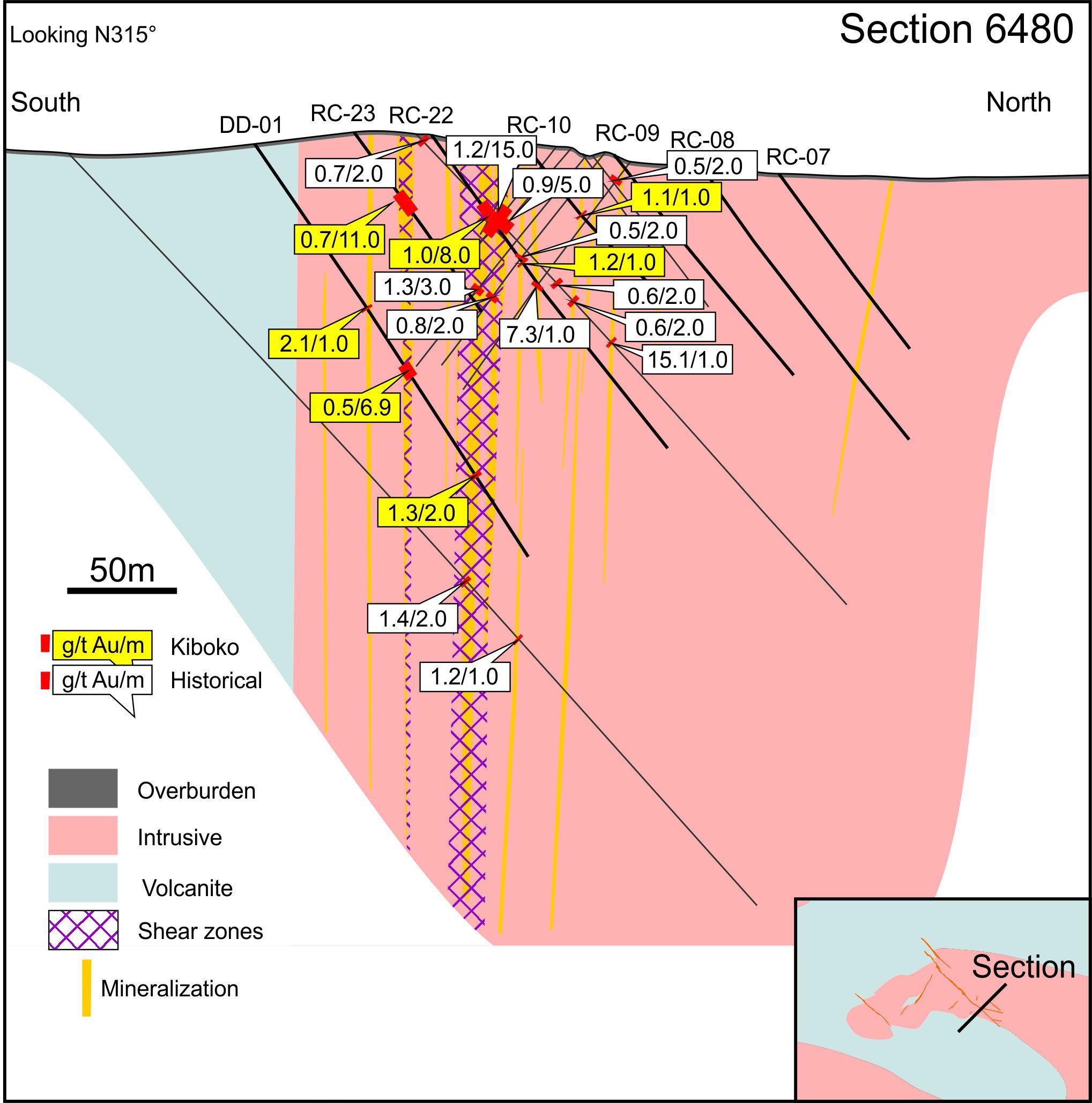
As shown in figures 4, 5 and 6, the Marcotte zone, formerly known as Fontana Main, has a drill-defined strike length of at least 1,250 m that remains open to the southeast. The zone has a variable width of 200 to 300 m that remains open towards the east, with mineralized intercepts exceeding 500 m below surface. A geological cross-section through the Marcotte zone is provided as Figure 7.
In Kiboko’s Phase 1 program, 42 holes (over 6,055 m) were drilled along the central and northern portions of the Marcotte zone. The abundance of mineralized structures, their continuity, and thicknesses support Kiboko’s view that the first-order gold mineralization at Marcotte is primarily associated with altered igneous rocks containing an interconnected network of quartz-carbonate veins, veinlets, and shears, all anastomosed within a large, sub-vertical, and northwesterly striking zone of deformation (as shown in Figure 6). The variability in gold grades is consistent with historical data and is typical of moderate-grade environments containing both fine and coarse grains of native gold.
The Company’s view is that the results from the Marcotte zone are generally consistent with the historical dataset and have thus satisfactorily verified the historical drilling along the Marcotte zone. The Company is therefore confident that it can rely upon the historical drilling data from prior operators for the purposes of mineral resource estimation for the Marcotte zone.
Today’s results also include the third hole (DDFON23-013) drilled by the Company in the Claverny zone, located 1 km east of Marcotte, as shown in Figure 6. The two holes drilled in 2022 confirmed Claverny as a zone of interest. To refine the Company’s understanding of the geological framework, Kiboko drilled this third hole, which intersected numerous gold-bearing structures (as reported in Table 1).
Kiboko is of the view that these results are highly encouraging, given the limited amount of historical drilling in this zone. The Company is also of the view that this drilling has satisfactorily verified a portion of the historical drilling at Claverny. The Company is therefore confident that it can rely upon some of the historical drilling from prior operators for the purposes of resource estimation. Additional desktop work needs to be completed to provide a geological section.
Assays from 43% of metres drilled in Phase 1 are still to be reported
Kiboko’s technical team continues to review new drilling information in relation to its current understanding of the geology and mineralization of the area and for reporting purposes. Additional assay results from 25 holes drilled along the Hooper Bunkhouse and Lot 14 zones are still to be reported, representing 43% of the metres drilled in Kiboko’s Phase 1 exploration program.
Maiden pit-constrained mineral resource targeted for Q3-2023
The Company believes that the areas targeted in the Phase 1 exploration program have the potential to support a near-surface, pit-constrained mineral resource. The Company is targeting the reporting of a maiden mineral resource for a portion of the Fontana area in the third quarter of 2023.
Exploration intended to verify historical Fontana drilling and partially validate Exploration Targets
The Phase 1 program is intended to verify a significant portion of the 79,565 m of historical Fontana area drilling, characterize gold mineralization in the wall rock surrounding the main vein systems, and partially validate the Fontana area Exploration Targets (as defined herein).
The near-surface Exploration Targets for the Fontana area of the Project total 13.6 million to 23.1 million tonnes at a range of grades of 3.0 to 3.4 g/t Au. The primary Exploration Targets for the Harricana Project are summarized in Table 3 at the end of this release. For further details regarding scientific or technical information relating to the Harricana Project, including the recommended exploration programs to validate the Exploration Targets, please refer to the technical report entitled, “Harricana Gold Project Technical Report, Duverny Township, Québec” with an effective date of April 1, 2022, and an issue date of May 2, 2022 (the “Harricana Technical Report”), which is filed under the Company’s SEDAR profile at www.sedar.com and on the Company’s website at www.kibokogold.com.
The Company cautions that while the Exploration Targets are based upon results from historical drilling, the potential quantity and grade of the Exploration Targets are conceptual in nature, there has been insufficient verifiable exploration to define a mineral resource, and it is uncertain if further exploration will result in any of the Exploration Targets being delineated as a mineral resource.
Quality Assurance and Quality Control
Orientated HQ-size drill core was delivered directly from the drill site to Kiboko’s field office in Amos, Québec, where it was systematically logged, photographed, cut in half, and sampled on 1 m intervals by a geologist. Core was cut in half lengthwise along a pre-determined line, with one half (same half, consistently), bagged, securely sealed, labelled, and submitted for analysis. The other half of the core was stored securely at Kiboko’s core logging facility as a witness sample.
For each metre of RC drilling, the stream of RC chips was split into three samples. Two nominal 5 kg samples were collected for analysis, and the remnant nominal 25 kg was bagged for future use if required. The samples were collected directly from the RC drill rig’s cyclone, where they were bagged and labeled. The two 5 kg samples were delivered by Kiboko personnel to Kiboko’s field office in Amos, Québec, for processing. One of the 5 kg samples was submitted to the laboratory for analysis, and the other was stored securely as a witness sample until the results of the first stream of samples were received. At site, a small sub-sample of RC chips was collected from the remnant 25 kg, washed, placed in chip trays, and then delivered by Kiboko personnel to the field office in Amos, where they were systematically logged by a geologist.
In addition to the laboratory’s QA/QC practices, Kiboko personnel inserted certified reference materials (standards) and blank samples at regular intervals into the sample stream to monitor laboratory performance. Duplicates have been inserted at the laboratory, and selected intervals were analyzed as field duplicates. Only results that have met the requirements of Kiboko’s quality control program are considered final and are reported.
Bagged samples were collected in larger bags by Kiboko personnel to ensure an appropriate chain of custody until the samples were delivered to the laboratory. Samples were delivered by either courier or Kiboko personnel on pallets to ensure an appropriate chain of custody during transport to MSALABS INC.’s (“MSA”) secure facility in Val-d’Or, Québec for processing and analysis.
The entire half-drill core sample was crushed to approximately 70% passing 2 millimetres. RC chips required no crushing. Sub-samples were rotary split to fill a 350 ml sealed plastic jar for PhotonAssay containing approximately 0.5 kg of sample material. MSA operates numerous laboratories worldwide and maintains ISO-17025 accreditation for many metal determination methods. Accreditation of the PhotonAssay method at MSA’s Val-d’Or laboratory is in progress.
About the Harricana Gold Project
Kiboko’s Harricana Gold Project is a consolidated 100+ km2 prospective mineral claim package that is located 55 km north of Val-d’Or, Québec, in the world-renowned Abitibi greenstone belt. Historical records compiled and digitized by Kiboko into a new geospatial dataset includes data from 937 historical diamond drillholes totalling 139,397 m.
The Harricana Project benefits from an exceptional location, close to operating mines, with excellent access and proximity to existing infrastructure, including road, rail, and clean, low-cost, renewable hydroelectric grid power. The Harricana Project also benefits from low royalty coverage with the most significant royalty being a 2% NSR production royalty held by Globex Mining Enterprises Inc. on 195 claims covering an area of 85 km2, which includes the areas drilled in the Company’s Phase 1 drill program.
Additional information about Kiboko and its Harricana Gold Project can be found on SEDAR at www.sedar.com and on the Company’s website at www.kibokogold.com.
Qualified Person
Ivor W.O. Jones, B.Sc. (Hons), M.Sc., FAusIMM, P. Geo., (OGQ Special Authorization Permit 74658), Kiboko’s Vice-President, Technical Services & Project Evaluation, has reviewed and approved the pertinent technical or scientific information contained in this news release. Mr. Jones is the Company’s designated “Qualified Person” as defined by Canadian Securities Administrators within the meaning of National Instrument 43-101 Standards of Disclosure for Mineral Projects (“NI 43-101”). Exploration programs at the Harricana Project are managed by Mr. Jones and Yves Caron, M.Sc., géo (OGQ 548), both of whom are “Qualified Persons” as defined by NI 43-101.
About Kiboko Gold Inc.
Kiboko is a Canadian-based exploration company focussed on advancing its 100+ km2 Harricana Gold Project, located 55 km north of Val-d’Or, Québec, within the world-renowned southern Abitibi gold belt. Kiboko’s shares trade on the TSX Venture Exchange under the symbol “KIB”.
Neither the TSX Venture Exchange nor its Regulation Services Provider (as that term is defined in the policies of the TSX Venture Exchange) accepts responsibility for the adequacy or accuracy of this release.
Forward Looking Statements
This news release includes certain “forward-looking statements” which are not comprised of historical facts. Forward looking statements include estimates and statements that describe the Company’s future plans, objectives or goals, including words to the effect that the Company or management expects a stated condition, belief, estimate or opinion, or result to occur. Forward looking statements may be identified by such terms as “believes”, “anticipates”, “expects”, “interpreted”, “pending”, “suggests”, “preliminary”, “estimates”, “confident”, “may”, “aims”, “targets”, “could”, “would”, “will”, or “plans” and similar expressions, or that events or conditions “will, “would”, “may”, “can”, “could” or “should” occur, or are those statements, which, by their nature, refer to future events. Since forward-looking statements are based on assumptions and address future events and conditions, by their very nature they involve inherent risks and uncertainties. Although these statements are based upon information currently available to the Company, the Company provides no assurance that actual results will meet management’s expectations. Risks, uncertainties, and other factors involved with forward-looking information could cause actual events, results, performance, prospects and opportunities to differ materially from those expressed or implied by such forward looking information.
Forward looking information in this news release includes, but is not limited to the Company’s objectives, goals or future plans, statements, exploration results, assay results, re-assay results, potential mineralization, the interpretation of drilling and assay results, the results of the drilling program and other analytical test work, mineralization and the discovery of zones of high-grade mineralization, verification of historical drilling results; the Company’s cost estimates and plans to execute and complete its Phase 1 exploration program including the completion of a maiden mineral resource; future exploration and mine development plans; future news releases by the Company, and the funding of the exploration program, and the timing of the commencement of operations and estimates of market conditions. Factors that could cause actual results to differ materially from such forward-looking information include, but are not limited to failure to identify mineral resources, the preliminary nature of metallurgical test results, delays in obtaining or failures to obtain required governmental, environmental or other project approvals, political risks, inability to fulfill the duty to accommodate First Nations and other Indigenous peoples, uncertainties relating to the availability and costs of financing needed in the future, changes in equity markets, inflation, scarcity and cost of skilled and unskilled labour, changes in exchange rates, fluctuations in commodity prices, delays in the development of projects, capital and operating costs varying significantly from estimates and the other risks involved in the mineral exploration and development industry, an inability to predict and counteract the effects of COVID-19 on the business of the Company, including but not limited to the effects of COVID-19 on the price of commodities, capital market conditions, restriction on labour and travel and supply chains, and those risks set out in the Company’s public documents filed on SEDAR. Although the Company believes that the assumptions and factors used in preparing the forward-looking information in this news release are reasonable, undue reliance should not be placed on such information, which only applies as of the date of this news release, and no assurance can be given that such events will occur in the disclosed time frames or at all. The Company disclaims any intention or obligation to update or revise any forward-looking information, whether as a result of new information, future events or otherwise, other than as required by law.
| Table 1: Harricana Gold Project - Fontana Area Assay Results | |||||||
| Drillhole ID | From (m) | To (m) | Interval (m) | Grade (g/t Au) | Comment | Zone | Line |
| DDFON22-002 | no significant intersections | Marcotte | 6480 | ||||
| DDFON23-004 | no significant intersections | Marcotte | 6920 | ||||
| DDFON23-005 | 148 | 149 | 1 | 1.9 | Marcotte | 7000 | |
| and | 179 | 182 | 3 | 0.6 | |||
| DDFON23-006 | 90 | 91 | 1 | 0.6 | Marcotte | 7000 | |
| and | 99 | 105 | 6 | 1.0 | |||
| and | 121 | 122 | 1 | 0.4 | |||
| and | 153 | 154 | 1 | 0.7 | |||
| DDFON23-007 | 78 | 82 | 4 | 1.0 | Marcotte | 7120 | |
| and | 156 | 157 | 1 | 1.1 | |||
| DDFON23-008 | 81 | 82 | 1 | 0.7 | Marcotte | 7160 | |
| DDFON23-009 | 23 | 24 | 1 | 1.3 | Marcotte | 7040 | |
| and | 47 | 48 | 1 | 0.8 | |||
| and | 98 | 99 | 1 | 0.6 | |||
| and | 167 | 168 | 1 | 0.8 | |||
| and | 180 | 181 | 1 | 0.5 | |||
| and | 199 | 200 | 1 | 0.8 | |||
| and | 205 | 207 | 2 | 8.5 | |||
| including | 205 | 206 | 1 | 12.2 | |||
| and | 219 | 220 | 1 | 4.9 | |||
| DDFON23-010 | 28 | 29 | 1 | 0.5 | Marcotte | 7080 | |
| and | 63 | 64 | 1 | 0.4 | |||
| and | 67 | 68 | 1 | 0.6 | |||
| and | 124 | 125 | 1 | 0.8 | |||
| and | 136 | 138 | 2 | 0.6 | |||
| and | 153 | 154 | 1 | 2.6 | |||
| and | 171 | 172 | 1 | 1.3 | |||
| and | 179 | 180 | 1 | 0.8 | |||
| and | 195.9 | 204 | 8.1 | 2.7 | |||
| including | 195.9 | 197 | 1.1 | 12.1 | |||
| and | 209 | 211 | 2 | 1.5 | |||
| and | 221 | 226 | 5 | 0.5 | |||
| DDFON23-011 | no significant intersections | Marcotte | 7280 | ||||
| DDFON23-012 | 68 | 69 | 1 | 0.8 | Marcotte | 7400 | |
| and | 183 | 185 | 2 | 0.6 | |||
| DDFON23-013 | 24 | 26 | 2 | 0.7 | Claverny | 5840 | |
| and | 37 | 38 | 1 | 0.4 | |||
| and | 54.9 | 56 | 1.1 | 1.3 | |||
| and | 66 | 67 | 1 | 0.7 | |||
| and | 85 | 86 | 1 | 1.2 | |||
| and | 92 | 93 | 1 | 0.5 | |||
| and | 113 | 118 | 5 | 0.8 | |||
| Intervals are reported over a minimum downhole length of 1 m at a minimum length-weighted grade of 0.4 g/t Au with up to 4 m of consecutive internal dilution. High-grade intercepts are reported as any consecutive interval with grades greater than 10 g/t Au. No assays were capped. Due to the exploratory nature of this program and the variable orientations of the mineralized zones the intervals presented may not represent the true width of mineralization. | |||||||
| Table 2: Harricana Gold Project - Fontana Area Drillhole Locations in this News Release | |||||||
| Drillhole ID | Easting (m) | Northing (m) | Length (m) | Azimuth (°) | Dip (°) | Type | Zone |
| DDFON22-002 | 284,799 | 5,392,468 | 150 | 44 | -54 | DD | Marcotte |
| DDFON23-004 | 284,744 | 5,392,526 | 180 | 49 | -53 | DD | Marcotte |
| DDFON23-005 | 284,629 | 5,392,526 | 207 | 39 | -57 | DD | Marcotte |
| DDFON23-006 | 284,657 | 5,392,556 | 165 | 42 | -57 | DD | Marcotte |
| DDFON23-007 | 284,573 | 5,392,643 | 171 | 42 | -52 | DD | Marcotte |
| DDFON23-008 | 284,576 | 5,392,689 | 129 | 50 | -53 | DD | Marcotte |
| DDFON23-009 | 284,569 | 5,392,527 | 258 | 43 | -54 | DD | Marcotte |
| DDFON23-010 | 284,542 | 5,392,558 | 252 | 44 | -54 | DD | Marcotte |
| DDFON23-011 | 284,463 | 5,392,753 | 177 | 45 | -54 | DD | Marcotte |
| DDFON23-012 | 284,399 | 5,392,868 | 201 | 44 | -45 | DD | Marcotte |
| DDFON23-013 | 286,114 | 5,392,404 | 120 | 228 | -47 | DD | Claverny |
| Collar coordinates surveyed using DGPS in UTM NAD 83 Zone 18N | |||||||
| RC = reverse circulation drillhole, DD = diamond drillhole | |||||||
| Table 3: Harricana Gold Project – Near Surface Exploration Targets Summary | ||||
| Material | Tonnage Range | Grade Range | ||
| Project Area | (millions) | (g/t Au) | ||
| Vein | ||||
| Fontana | 10.9 – 15.4 | 3.5 – 4.3 | ||
| Monpas | 3.0 – 4.2 | 2.1 – 4.8 | ||
| Duvay | 2.2 – 2.5 | 2.8 – 5.7 | ||
| Wall Rock | ||||
| Fontana | 2.7 – 7.7 | 0.9 – 1.6 | ||
| Monpas | 0.7 – 2.1 | 0.9 – 1.6 | ||
| Duvay | 0.5 – 1.2 | 0.9 – 1.6 | ||
| Vein + Wall Rock Combined | ||||
| Fontana | 13.6 – 23.1 | 3.0 – 3.4 | ||
| Monpas | 3.7 – 6.3 | 1.9 – 3.7 | ||
| Duvay | 2.7 – 3.7 | 2.4 – 4.4 | ||
| Total Harricana Gold Project | 20.0 – 33.1 | 2.7 – 3.6 | ||
| The Company cautions that while the Exploration Targets are based upon the results from 784 historical diamond drillholes totalling 108,681 m of drilling, the potential quantity and grade of the Exploration Targets are conceptual in nature, there has been insufficient verifiable exploration to define a mineral resource, and it is uncertain if further exploration will result in any of the Exploration Targets being delineated as a mineral resource. For additional information regarding the Exploration Targets, please review sections 9.4 – Exploration Targets and 26 - Recommendations in the Harricana Technical Report that is available on the Company’s website (www.kibokogold.com) and under its profile on SEDAR (www.sedar.com). | ||||