
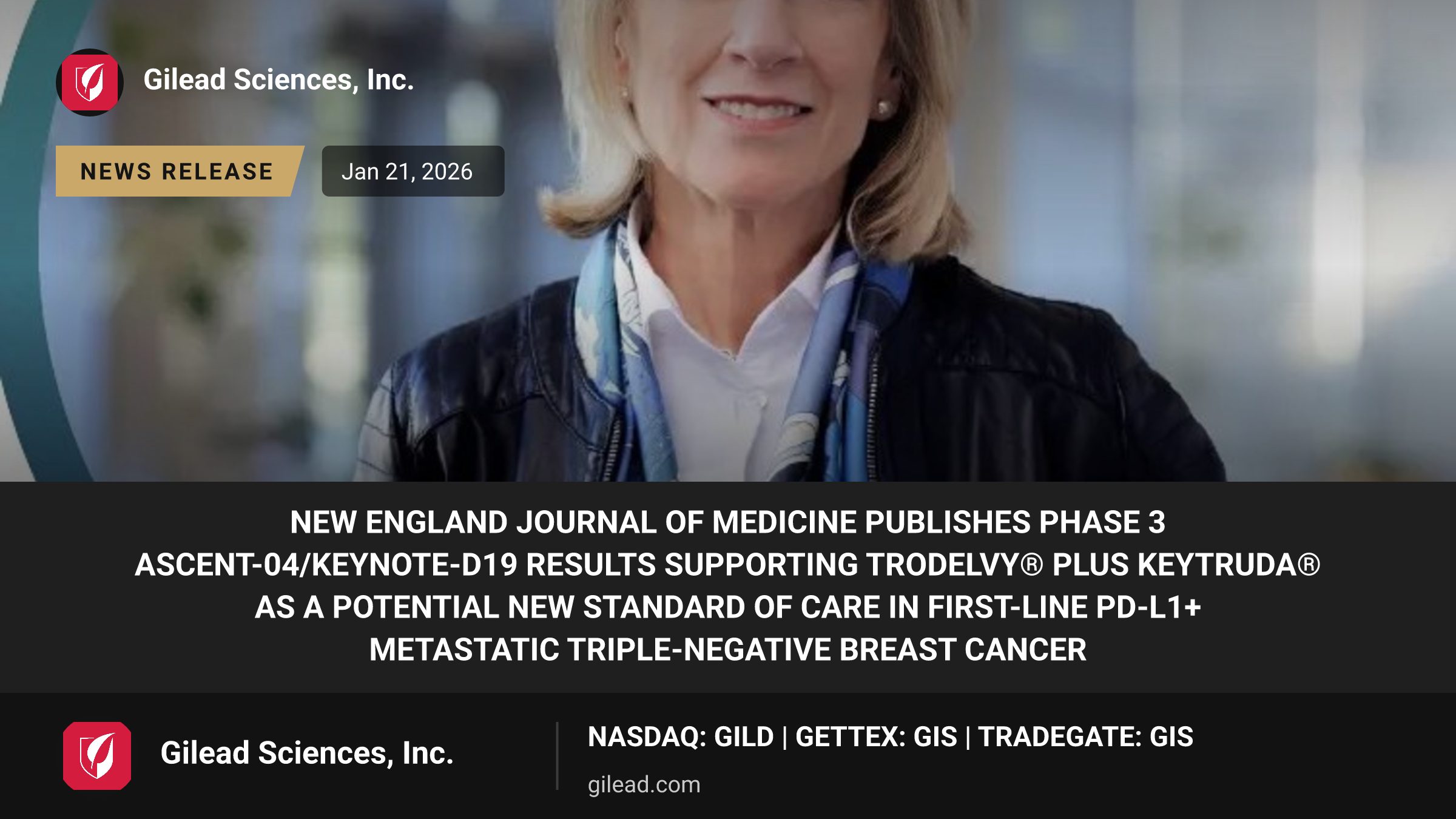
– Combination Reduced the Risk of Death or Disease Progression by 35% Versus Standard of Care in Frontline PD-L1+ Metastatic TNBC Setting –
FOSTER CITY, Calif.--(BUSINESS WIRE)-- Gilead Sciences, Inc. (Nasdaq: GILD) today announced The New England Journal of Medicine (NEJM) published the full results from the positive Phase 3 ASCENT-04/KEYNOTE-D19 study evaluating the combination of Trodelvy® (sacituzumab govitecan-hziy) plus Keytruda® (pembrolizumab) in first-line PD-L1+ (CPS ≥10) metastatic triple-negative breast cancer (TNBC). ASCENT-04 successfully met its primary endpoint of progression-free survival (PFS) with a 35% (HR: 0.65; p1%) were neutropenia (7%), diarrhea (4%), and pneumonia (3%). SAR were reported in 27% of patients, and 5% discontinued therapy due to adverse reactions. The most common Grade 3-4 lab abnormalities (incidence ≥25%) in the ASCENT study were reduced neutrophils, leukocytes, and lymphocytes.
In the TROPiCS-02 study (locally advanced or metastatic HR-positive, HER2-negative breast cancer), the most common adverse reactions (incidence ≥25%) were diarrhea, fatigue, nausea, alopecia, and constipation. The most frequent serious adverse reactions (SAR) (>1%) were diarrhea (5%), febrile neutropenia (4%), neutropenia (3%), abdominal pain, colitis, neutropenic colitis, pneumonia, and vomiting (each 2%). SAR were reported in 28% of patients, and 6% discontinued therapy due to adverse reactions. The most common Grade 3-4 lab abnormalities (incidence ≥25%) in the TROPiCS-02 study were reduced neutrophils and leukocytes.
DRUG INTERACTIONS
UGT1A1 Inhibitors: Concomitant administration of TRODELVY with inhibitors of UGT1A1 may increase the incidence of adverse reactions due to potential increase in systemic exposure to SN-38. Avoid administering UGT1A1 inhibitors with TRODELVY.
UGT1A1 Inducers: Exposure to SN-38 may be reduced in patients concomitantly receiving UGT1A1 enzyme inducers. Avoid administering UGT1A1 inducers with TRODELVY.
Please see full Prescribing Information, including BOXED WARNING.
About Gilead and Kite Oncology
Gilead and Kite Oncology are working to transform how cancer is treated. We are innovating with next-generation therapies, combinations and technologies to deliver improved outcomes for people with cancer. We are purposefully building our oncology portfolio and pipeline to address the greatest gaps in care. From antibody-drug conjugate technologies and small molecules to cell therapy-based approaches, we are creating new possibilities for people with cancer.
About Gilead Sciences
Gilead Sciences, Inc. is a biopharmaceutical company that has pursued and achieved breakthroughs in medicine for more than three decades, with the goal of creating a healthier world for all people. The company is committed to advancing innovative medicines to prevent and treat life-threatening diseases, including HIV, viral hepatitis, COVID-19, cancer and inflammation. In 2025, Gilead announced a planned $32 billion investment to further strengthen its U.S. footprint to power the next era of discovery, job creation and public health preparedness – while continuing to invest globally to ensure patients everywhere benefit from its scientific innovation. Gilead operates in more than 35 countries worldwide, with headquarters in Foster City, Calif.
Forward-Looking Statements
This press release includes forward-looking statements within the meaning of the Private Securities Litigation Reform Act of 1995 that are subject to risks, uncertainties and other factors, including Gilead’s ability to initiate, progress or complete clinical trials or studies within currently anticipated timelines or at all, and the possibility of unfavorable results from ongoing and additional clinical trials or studies, including those involving Trodelvy; uncertainties relating to regulatory applications and related filing and approval timelines, including potential applications for programs and/or indications currently under evaluation, and the risk that any regulatory approvals, if granted, may be subject to significant limitations on use or subject to withdrawal or other adverse actions by the applicable regulatory authority; the possibility that Gilead may make a strategic decision to discontinue development of these programs and, as a result, these programs may never be successfully commercialized for the indications currently under evaluation; and any assumptions underlying any of the foregoing. These and other risks, uncertainties and factors are described in detail in Gilead’s Quarterly Report on Form 10-Q for the quarter ended September 30, 2025, as filed with the U.S. Securities and Exchange Commission. These risks, uncertainties and other factors could cause actual results to differ materially from those referred to in the forward-looking statements. All statements other than statements of historical fact are statements that could be deemed forward-looking statements. The reader is cautioned that any such forward-looking statements are not guarantees of future performance and involve risks and uncertainties and is cautioned not to place undue reliance on these forward-looking statements. All forward-looking statements are based on information currently available to Gilead, and Gilead assumes no obligation and disclaims any intent to update any such forward-looking statements.
Trodelvy, Gilead and the Gilead logo are trademarks of Gilead Sciences, Inc., or its related companies.
U.S. Prescribing Information for Trodelvy, including BOXED WARNING, is available at www.gilead.com.
For more information about Gilead, please visit the company’s website at www.gilead.com, follow Gilead on X/Twitter (@Gilead Sciences) and LinkedIn (@Gilead-Sciences).
View source version on businesswire.com: https://www.businesswire.com/news/home/20260120151830/en/
Ashleigh Koss, Media public_affairs@gilead.com
Jacquie Ross, Investors investor_relations@gilead.com
Source: Gilead Sciences, Inc.